EP2136206A1 - Method and apparatus for determining substrate concentration and reagent for determining substrate concentration - Google Patents
Method and apparatus for determining substrate concentration and reagent for determining substrate concentration Download PDFInfo
- Publication number
- EP2136206A1 EP2136206A1 EP08711870A EP08711870A EP2136206A1 EP 2136206 A1 EP2136206 A1 EP 2136206A1 EP 08711870 A EP08711870 A EP 08711870A EP 08711870 A EP08711870 A EP 08711870A EP 2136206 A1 EP2136206 A1 EP 2136206A1
- Authority
- EP
- European Patent Office
- Prior art keywords
- substrate concentration
- measuring
- reagent
- hydrogen peroxide
- concentration according
- Prior art date
- Legal status (The legal status is an assumption and is not a legal conclusion. Google has not performed a legal analysis and makes no representation as to the accuracy of the status listed.)
- Granted
Links
- 239000000758 substrate Substances 0.000 title claims abstract description 58
- 239000003153 chemical reaction reagent Substances 0.000 title claims abstract description 57
- 238000000034 method Methods 0.000 title claims abstract description 21
- MHAJPDPJQMAIIY-UHFFFAOYSA-N Hydrogen peroxide Chemical compound OO MHAJPDPJQMAIIY-UHFFFAOYSA-N 0.000 claims abstract description 121
- PXIPVTKHYLBLMZ-UHFFFAOYSA-N Sodium azide Chemical compound [Na+].[N-]=[N+]=[N-] PXIPVTKHYLBLMZ-UHFFFAOYSA-N 0.000 claims abstract description 48
- 238000006243 chemical reaction Methods 0.000 claims abstract description 40
- 239000003795 chemical substances by application Substances 0.000 claims abstract description 36
- FAPWRFPIFSIZLT-UHFFFAOYSA-M Sodium chloride Chemical compound [Na+].[Cl-] FAPWRFPIFSIZLT-UHFFFAOYSA-M 0.000 claims abstract description 32
- LPXPTNMVRIOKMN-UHFFFAOYSA-M sodium nitrite Chemical compound [Na+].[O-]N=O LPXPTNMVRIOKMN-UHFFFAOYSA-M 0.000 claims abstract description 28
- -1 azide compound Chemical class 0.000 claims abstract description 25
- 239000003115 supporting electrolyte Substances 0.000 claims abstract description 17
- 239000011780 sodium chloride Substances 0.000 claims abstract description 16
- 239000003112 inhibitor Substances 0.000 claims abstract description 15
- 235000010288 sodium nitrite Nutrition 0.000 claims abstract description 14
- WCUXLLCKKVVCTQ-UHFFFAOYSA-M Potassium chloride Chemical compound [Cl-].[K+] WCUXLLCKKVVCTQ-UHFFFAOYSA-M 0.000 claims abstract description 10
- 239000001103 potassium chloride Substances 0.000 claims abstract description 5
- 235000011164 potassium chloride Nutrition 0.000 claims abstract description 5
- 108010054147 Hemoglobins Proteins 0.000 claims description 15
- 102000001554 Hemoglobins Human genes 0.000 claims description 15
- 108010061951 Methemoglobin Proteins 0.000 claims description 10
- 150000001875 compounds Chemical class 0.000 claims description 7
- 150000002978 peroxides Chemical class 0.000 claims description 7
- ZJRXSAYFZMGQFP-UHFFFAOYSA-N barium peroxide Chemical compound [Ba+2].[O-][O-] ZJRXSAYFZMGQFP-UHFFFAOYSA-N 0.000 claims description 5
- 150000002826 nitrites Chemical class 0.000 claims description 5
- 239000012286 potassium permanganate Substances 0.000 claims description 5
- IOVCWXUNBOPUCH-UHFFFAOYSA-M Nitrite anion Chemical compound [O-]N=O IOVCWXUNBOPUCH-UHFFFAOYSA-M 0.000 claims description 4
- 108010036302 hemoglobin AS Proteins 0.000 claims description 2
- 238000005259 measurement Methods 0.000 description 27
- WQZGKKKJIJFFOK-GASJEMHNSA-N Glucose Natural products OC[C@H]1OC(O)[C@H](O)[C@@H](O)[C@@H]1O WQZGKKKJIJFFOK-GASJEMHNSA-N 0.000 description 24
- 239000008103 glucose Substances 0.000 description 24
- 210000004369 blood Anatomy 0.000 description 22
- 239000008280 blood Substances 0.000 description 22
- 238000007865 diluting Methods 0.000 description 19
- 108090000790 Enzymes Proteins 0.000 description 18
- 102000004190 Enzymes Human genes 0.000 description 18
- 229940088598 enzyme Drugs 0.000 description 18
- 230000001590 oxidative effect Effects 0.000 description 11
- INGWEZCOABYORO-UHFFFAOYSA-N 2-(furan-2-yl)-7-methyl-1h-1,8-naphthyridin-4-one Chemical compound N=1C2=NC(C)=CC=C2C(O)=CC=1C1=CC=CO1 INGWEZCOABYORO-UHFFFAOYSA-N 0.000 description 10
- 108010002255 deoxyhemoglobin Proteins 0.000 description 10
- 239000012491 analyte Substances 0.000 description 9
- 230000005540 biological transmission Effects 0.000 description 8
- XEEYBQQBJWHFJM-UHFFFAOYSA-N iron Substances [Fe] XEEYBQQBJWHFJM-UHFFFAOYSA-N 0.000 description 5
- RGHNJXZEOKUKBD-SQOUGZDYSA-N D-gluconic acid Chemical compound OC[C@@H](O)[C@@H](O)[C@H](O)[C@@H](O)C(O)=O RGHNJXZEOKUKBD-SQOUGZDYSA-N 0.000 description 4
- VTLYFUHAOXGGBS-UHFFFAOYSA-N Fe3+ Chemical compound [Fe+3] VTLYFUHAOXGGBS-UHFFFAOYSA-N 0.000 description 4
- 108090000854 Oxidoreductases Proteins 0.000 description 4
- 102000004316 Oxidoreductases Human genes 0.000 description 4
- 238000013019 agitation Methods 0.000 description 4
- 239000007853 buffer solution Substances 0.000 description 4
- 210000003677 hemocyte Anatomy 0.000 description 4
- 229940000351 hemocyte Drugs 0.000 description 4
- 230000003647 oxidation Effects 0.000 description 4
- 238000007254 oxidation reaction Methods 0.000 description 4
- 230000000717 retained effect Effects 0.000 description 4
- 230000035945 sensitivity Effects 0.000 description 4
- RGHNJXZEOKUKBD-UHFFFAOYSA-N D-gluconic acid Natural products OCC(O)C(O)C(O)C(O)C(O)=O RGHNJXZEOKUKBD-UHFFFAOYSA-N 0.000 description 3
- 239000003085 diluting agent Substances 0.000 description 3
- YAGKRVSRTSUGEY-UHFFFAOYSA-N ferricyanide Chemical compound [Fe+3].N#[C-].N#[C-].N#[C-].N#[C-].N#[C-].N#[C-] YAGKRVSRTSUGEY-UHFFFAOYSA-N 0.000 description 3
- 239000000174 gluconic acid Substances 0.000 description 3
- 235000012208 gluconic acid Nutrition 0.000 description 3
- 239000002504 physiological saline solution Substances 0.000 description 3
- JVTAAEKCZFNVCJ-UHFFFAOYSA-M Lactate Chemical compound CC(O)C([O-])=O JVTAAEKCZFNVCJ-UHFFFAOYSA-M 0.000 description 2
- 108010073450 Lactate 2-monooxygenase Proteins 0.000 description 2
- 108010064719 Oxyhemoglobins Proteins 0.000 description 2
- AZFNGPAYDKGCRB-XCPIVNJJSA-M [(1s,2s)-2-amino-1,2-diphenylethyl]-(4-methylphenyl)sulfonylazanide;chlororuthenium(1+);1-methyl-4-propan-2-ylbenzene Chemical compound [Ru+]Cl.CC(C)C1=CC=C(C)C=C1.C1=CC(C)=CC=C1S(=O)(=O)[N-][C@@H](C=1C=CC=CC=1)[C@@H](N)C1=CC=CC=C1 AZFNGPAYDKGCRB-XCPIVNJJSA-M 0.000 description 2
- SORGEQQSQGNZFI-UHFFFAOYSA-N [azido(phenoxy)phosphoryl]oxybenzene Chemical compound C=1C=CC=CC=1OP(=O)(N=[N+]=[N-])OC1=CC=CC=C1 SORGEQQSQGNZFI-UHFFFAOYSA-N 0.000 description 2
- QVGXLLKOCUKJST-UHFFFAOYSA-N atomic oxygen Chemical compound [O] QVGXLLKOCUKJST-UHFFFAOYSA-N 0.000 description 2
- 150000001540 azides Chemical class 0.000 description 2
- NZJRLCPXRZLFGU-UHFFFAOYSA-N azidomercury Chemical compound [Hg]N=[N+]=[N-] NZJRLCPXRZLFGU-UHFFFAOYSA-N 0.000 description 2
- WQZGKKKJIJFFOK-VFUOTHLCSA-N beta-D-glucose Chemical compound OC[C@H]1O[C@@H](O)[C@H](O)[C@@H](O)[C@@H]1O WQZGKKKJIJFFOK-VFUOTHLCSA-N 0.000 description 2
- 230000003247 decreasing effect Effects 0.000 description 2
- 230000000694 effects Effects 0.000 description 2
- JUINSXZKUKVTMD-UHFFFAOYSA-N hydrogen azide Chemical compound N=[N+]=[N-] JUINSXZKUKVTMD-UHFFFAOYSA-N 0.000 description 2
- HMNJFAQMJRFJRF-UHFFFAOYSA-N iron(2+) diazide Chemical compound [Fe+2].[N-]=[N+]=[N-].[N-]=[N+]=[N-] HMNJFAQMJRFJRF-UHFFFAOYSA-N 0.000 description 2
- NTMHWRHEGDRTPD-UHFFFAOYSA-N n-(4-azidosulfonylphenyl)acetamide Chemical compound CC(=O)NC1=CC=C(S(=O)(=O)N=[N+]=[N-])C=C1 NTMHWRHEGDRTPD-UHFFFAOYSA-N 0.000 description 2
- DYEGEQTYEIHCSO-UHFFFAOYSA-N n-diazo-4-dodecylbenzenesulfonamide Chemical compound CCCCCCCCCCCCC1=CC=C(S(=O)(=O)N=[N+]=[N-])C=C1 DYEGEQTYEIHCSO-UHFFFAOYSA-N 0.000 description 2
- 239000001301 oxygen Substances 0.000 description 2
- 229910052760 oxygen Inorganic materials 0.000 description 2
- 210000002381 plasma Anatomy 0.000 description 2
- BASFCYQUMIYNBI-UHFFFAOYSA-N platinum Chemical compound [Pt] BASFCYQUMIYNBI-UHFFFAOYSA-N 0.000 description 2
- 235000010289 potassium nitrite Nutrition 0.000 description 2
- 239000004304 potassium nitrite Substances 0.000 description 2
- 238000002360 preparation method Methods 0.000 description 2
- 210000003296 saliva Anatomy 0.000 description 2
- 150000003839 salts Chemical class 0.000 description 2
- 210000002966 serum Anatomy 0.000 description 2
- QBFXQJXHEPIJKW-UHFFFAOYSA-N silver azide Chemical compound [Ag+].[N-]=[N+]=[N-] QBFXQJXHEPIJKW-UHFFFAOYSA-N 0.000 description 2
- 210000002700 urine Anatomy 0.000 description 2
- 108010050375 Glucose 1-Dehydrogenase Proteins 0.000 description 1
- 108010015776 Glucose oxidase Proteins 0.000 description 1
- 239000004366 Glucose oxidase Substances 0.000 description 1
- 206010018910 Haemolysis Diseases 0.000 description 1
- 229910019142 PO4 Inorganic materials 0.000 description 1
- SMEGJBVQLJJKKX-HOTMZDKISA-N [(2R,3S,4S,5R,6R)-5-acetyloxy-3,4,6-trihydroxyoxan-2-yl]methyl acetate Chemical compound CC(=O)OC[C@@H]1[C@H]([C@@H]([C@H]([C@@H](O1)O)OC(=O)C)O)O SMEGJBVQLJJKKX-HOTMZDKISA-N 0.000 description 1
- 229940081735 acetylcellulose Drugs 0.000 description 1
- 229920002301 cellulose acetate Polymers 0.000 description 1
- 230000006866 deterioration Effects 0.000 description 1
- 229940116332 glucose oxidase Drugs 0.000 description 1
- 235000019420 glucose oxidase Nutrition 0.000 description 1
- 125000002791 glucosyl group Chemical group C1([C@H](O)[C@@H](O)[C@H](O)[C@H](O1)CO)* 0.000 description 1
- 230000008588 hemolysis Effects 0.000 description 1
- 230000002949 hemolytic effect Effects 0.000 description 1
- 239000001257 hydrogen Substances 0.000 description 1
- 229910052739 hydrogen Inorganic materials 0.000 description 1
- 239000007924 injection Substances 0.000 description 1
- 238000002347 injection Methods 0.000 description 1
- 238000004519 manufacturing process Methods 0.000 description 1
- 239000000463 material Substances 0.000 description 1
- 239000012528 membrane Substances 0.000 description 1
- 235000021317 phosphate Nutrition 0.000 description 1
- 150000003013 phosphoric acid derivatives Chemical class 0.000 description 1
- 229910052697 platinum Inorganic materials 0.000 description 1
- 238000004321 preservation Methods 0.000 description 1
- 230000002829 reductive effect Effects 0.000 description 1
- 229910052709 silver Inorganic materials 0.000 description 1
- 239000004332 silver Substances 0.000 description 1
- 239000011734 sodium Substances 0.000 description 1
- 229910052708 sodium Inorganic materials 0.000 description 1
- 238000005406 washing Methods 0.000 description 1
- XLYOFNOQVPJJNP-UHFFFAOYSA-N water Substances O XLYOFNOQVPJJNP-UHFFFAOYSA-N 0.000 description 1
Images


Classifications
-
- C—CHEMISTRY; METALLURGY
- C12—BIOCHEMISTRY; BEER; SPIRITS; WINE; VINEGAR; MICROBIOLOGY; ENZYMOLOGY; MUTATION OR GENETIC ENGINEERING
- C12Q—MEASURING OR TESTING PROCESSES INVOLVING ENZYMES, NUCLEIC ACIDS OR MICROORGANISMS; COMPOSITIONS OR TEST PAPERS THEREFOR; PROCESSES OF PREPARING SUCH COMPOSITIONS; CONDITION-RESPONSIVE CONTROL IN MICROBIOLOGICAL OR ENZYMOLOGICAL PROCESSES
- C12Q1/00—Measuring or testing processes involving enzymes, nucleic acids or microorganisms; Compositions therefor; Processes of preparing such compositions
- C12Q1/001—Enzyme electrodes
- C12Q1/005—Enzyme electrodes involving specific analytes or enzymes
- C12Q1/006—Enzyme electrodes involving specific analytes or enzymes for glucose
-
- C—CHEMISTRY; METALLURGY
- C12—BIOCHEMISTRY; BEER; SPIRITS; WINE; VINEGAR; MICROBIOLOGY; ENZYMOLOGY; MUTATION OR GENETIC ENGINEERING
- C12Q—MEASURING OR TESTING PROCESSES INVOLVING ENZYMES, NUCLEIC ACIDS OR MICROORGANISMS; COMPOSITIONS OR TEST PAPERS THEREFOR; PROCESSES OF PREPARING SUCH COMPOSITIONS; CONDITION-RESPONSIVE CONTROL IN MICROBIOLOGICAL OR ENZYMOLOGICAL PROCESSES
- C12Q1/00—Measuring or testing processes involving enzymes, nucleic acids or microorganisms; Compositions therefor; Processes of preparing such compositions
- C12Q1/26—Measuring or testing processes involving enzymes, nucleic acids or microorganisms; Compositions therefor; Processes of preparing such compositions involving oxidoreductase
- C12Q1/28—Measuring or testing processes involving enzymes, nucleic acids or microorganisms; Compositions therefor; Processes of preparing such compositions involving oxidoreductase involving peroxidase
Definitions
- the present invention relates to a method, a device and a reagent for carrying out the measurement of a substrate such as glucose.
- an enzyme-electrode method which is a method for measuring a glucose concentration.
- information correlating with a glucose concentration in a specimen is outputted to an electrode in contact with the specimen, and the glucose concentration is calculated based on the output.
- electrons are removed at an electrode from hydrogen peroxide generated by oxidizing glucose with an enzyme, and a glucose concentration is calculated based on a current value measured at the time in the electrode (for example, see the Patent Document 1)
- blood may be used as the specimen in some cases.
- hemoglobin may be included in the specimen whether the whole blood is used or blood serum or plasma is used.
- the hemoglobin easily reacts with the hydrogen peroxide. Therefore, the hemoglobin included in the specimen inhibits the reaction between the hydrogen peroxide and the electrode. As a result, the electrode output tends to show a lower value as the reaction between the hemoglobin and the hydrogen peroxide advances in the presence of the hemoglobin, which makes it difficult to obtain high measuring accuracy.
- the specimen does not include the hemoglobin by preventing the hemolytic activity in the hemocyte. This is, however, not a realistic approach because it is necessary to pay a meticulous attention during the transportation, preservation and pretreatment of the blood, which demands burdensome handling steps.
- Another disadvantage is the variability in easiness of the hymolytic activity depending on an analyte.
- An object of the present invention is to improve measurement accuracy by controlling any influences from an inhibitor when the concentration of a substrate, for example, glucose in a specimen such as blood, is measured without any complicated and time-consuming handling steps.
- a method for measuring a substrate concentration based on the amount of hydrogen peroxide generated from a substrate wherein a suppressing agent for suppressing a reaction between the hydrogen peroxide and an inhibitor is allowed to coexist.
- a concentration measuring device comprising a hydrogen peroxide electrode for measuring the concentration of hydrogen peroxide generated from a substrate, wherein a suppressing agent for suppressing a reaction between the hydrogen peroxide and an inhibitor is supplied.
- a reagent for measuring a substrate concentration based on the amount of hydrogen peroxide generated from a substrate wherein the reagent includes a suppressing agent for suppressing a reaction between the hydrogen peroxide and an inhibitor.
- a compound which transforms the hemoglobin as an inhibitor into methemoglobin is used, and at least one selected from azide compounds; nitrites; ferricyanides; peroxides; and permanganates is used as the compound which transforms the hemoglobin into the methemoglobin.
- azide compound to be used examples include: sodium azide; 4-dodecylbenzenesulfonyl azide; 4-acetylaminobenzenesulfonyl azide; diphenylphosphoric azide; iron azide; hydrogen azide; lead azide; mercury azide; copper azide; and silver azide.
- concentration of the azide compound in the measuring system is preferably 0.001 to 1.000 wt%, and more preferably 0.010 to 0.100 wt%.
- the nitrite to be used are sodium nitrite and potassium nitrite.
- An example of the ferricyanide to be used is potassium ferricyanide
- an example of the peroxide to be used is barium peroxide
- an example of the permanganate to be used is potassium permanganate.
- the concentration of the suppressing agent in the measuring system is, for example, preferably 0.001 to 1.000 wt%, and more preferably 0.010 to 0.100 wt%.
- a supporting electrolyte is further allowed to coexist (to be added).
- the supporting electrolyte to be used are sodium chloride and potassium chloride, and sodium chloride is preferably used as the supporting electrolyte.
- the concentration of the supporting electrolyte is preferably 0.010 to 2.000 wt%, and more preferably 0.050 to 0.500 wt%.
- the substrate examples include glucose and lactate.
- the substrate is included in a biochemical specimen such as blood, urine or saliva.
- an enzyme-electrode method is employed to measure the amount of the hydrogen peroxide.
- a concentration measuring device 1 illustrated in Fig. 1 is configured to measure a specimen adjusted in a specimen preparation mechanism 2 using a measurement mechanism 3.
- the specimen preparation mechanism 2 is a mechanism for preparing a specimen from an analyte, and comprises a nozzle 20, a reagent bottle 21, and a diluting / mixing tank 22.
- the nozzle 20 is a nozzle for supplying an analyte into the diluting / mixing tank 22.
- the analyte to be used are biochemical specimens such as blood, urine and saliva, or diluents obtained therefrom. In a case where blood is used as the specimen, any of the whole blood and blood serum or plasma can be used.
- the reagent bottle 21 retains therein a reagent for diluting an analyte or washing the diluting / mixing tank 22.
- the reagent bottle 21 is connected to the diluting / mixing tank 22 with a pipe 23 interposed therebetween.
- a pump 24 is provided at an intermediate position in the pipe 23, and a configuration is given such that a force generated by the pump 24 serves to supply the reagent retained in the reagent bottle 21 into the diluting / mixing tank 22.
- a material including a diluent and a suppressing agent is used as the reagent.
- the diluent is a buffer solution.
- the buffer solution is not particularly limited as far as it can adjust the reaction pH of a substrate in a targeted range, and phosphates, for example, can be used.
- the concentration of the buffer solution in the reagent is set to, for example, 0.0001 to 0.1000 M.
- the suppressing agent serves to suppress a reaction between hydrogen peroxide as the substrate and an inhibitor.
- the inhibitor is hemoglobin
- a compound which transforms the hemoglobin into methemoglobin for example, at least one selected from: azide compounds; nitrites; ferricyanide; peroxides; and permanganates is used as the suppressing agent.
- azide compound to be used examples include: sodium azide (NaN 3 ); sodium azide; 4-dodecylbenzenesulfonyl azide; 4-acetylaminobenzenesulfonyl azide, diphenylphosphoric azide; iron azide; hydrogen azide; lead azide; mercury azide; copper azide; and silver azide.
- concentration of the azide compound included in the reagent is, for example, 0.001 to 1.000 wt%, and preferably 0.010 to 0.100 wt%.
- the nitrite to be used are sodium nitrite and potassium nitrite.
- An example of the ferricyanide to be used is potassium ferricyanide
- an example of the peroxide to be used is barium peroxide
- an example of the permanganate to be used is potassium permanganate.
- the concentration of the suppressing agent in the measuring system is, for example, preferably 0.001 to 1.000 wt%, and more preferably 0.010 to 0.100 wt%.
- the reagent may further include a supporting electrolyte.
- the supporting electrolyte to be used are sodium chloride and potassium chloride.
- the concentration of the supporting electrolyte in the reagent is, for example, 0.010 to 2.000 wt%, and preferably 0.050 to 0.500 wt%.
- the diluting / mixing tank 22 is a tank for providing a place where an analyte is diluted so that a specimen is prepared.
- the diluting / reaction tank 22 is configured such that the analyte is supplied by means of the nozzle 20, and the reagent is supplied from the reagent bottle 21.
- the diluting / mixing tank 22 comprises therein an agitator 25. When the agitator 25 is rotated by a stirrer 26, the analyte and the reagent are mixed with each other.
- the diluting / mixing tank 22 is further connected to an enzyme electrode 30 of the measurement mechanism 3 with a pipe 27 interposed therebetween.
- a pump 28 is provided at an intermediate position in the pipe 27, and a configuration is given such that a force generated by the pump 28 serves to supply a specimen prepared in the diluting / mixing tank 22 to the enzyme electrode 30 of the measurement mechanism 3.
- the measurement mechanism 3 comprises the enzyme electrode 30, a power supply 31 and a current value measuring unit 32.
- the enzyme electrode 30 outputs an electrophysical quantity corresponding to the amount of electrons transferred to and received from a substrate in a specimen. As illustrated in Fig. 2 , the enzyme electrode 30 comprises a substrate selective transmission film 33, an enzyme immobilized film 34, a hydrogen peroxide selective transmission film 35, and a hydrogen peroxide electrode 36.
- the substrate selective transmission film 33 is a film for selectively supplying a substrate in a specimen to the enzyme immobilized film 34.
- the substrate selective transmission film 33 to be used is a various conventionally available film, although being selected depending on the type of a substrate.
- the enzyme immobilized film 34 a film for generating hydrogen peroxide by oxidizing a substrate, and is configured to include an oxidase.
- the oxidase used in the present invention is selected depending on the type of a substrate. Examples of the substrate to be measured by the concentration measuring device 1 are glucose and lactate, and glucose oxidase or lactate oxidase can be mentioned as the oxidase.
- the hydrogen peroxide selective transmission film 35 is a film for selectively supplying hydrogen peroxide to the hydrogen peroxide electrode 36.
- Examples of the hydrogen peroxide selective transmission film 35 to be used are acetylcellulose-based or polyarylamine-based films.
- the hydrogen peroxide electrode 36 outputs an electrical signal corresponding to the amount of the supplied hydrogen peroxide, in other words, the concentration of the substrate.
- the hydrogen peroxide electrode 36 to be used is an electrode in which platinum is used as an anode 37, while silver is used as a cathode 38.
- the power supply 31 illustrated in Fig. 1 applies a voltage to the enzyme electrode 30 (hydrogen peroxide electrode 36).
- a direct-current power supply for example, is used as the power supply 31, and the voltage applied to the enzyme electrode 30 (hydrogen peroxide electrode 36) is set to, for example, 0.1 to 1.0 V.
- the current value measuring unit 32 is a unit for measuring the amount of electrons transferred to and from the hydrogen peroxide electrode 36 and the hydrogen peroxide as a current value.
- the current value is intermittently measured by the current value measuring unit 32, and a measurement interval is set to, for example, 50 to 200 msec.
- the whole blood and the reagent are supplied into the diluting / mixing tank 22.
- the whole blood is supplied into the diluting / mixing tank 22 by means of the nozzle 20, and the amount of the whole blood to be supplied is set to, for example, 4 to 20 ⁇ L.
- the reagent is supplied into the diluting / mixing tank 22 by means of the pump 24, and the amount of the reagent to be supplied is set to, for example, approximately 100 times as much as the amount of the whole blood.
- the whole blood and the reagent are supplied in the concentration measuring device 1, they are agitated by the agitator 25 in the diluting / mixing tank 22. Because the amount of the reagent to be supplied is set to approximately 100 times as much as the amount of the whole blood to be supplied, the pH of the buffer solution in the diluting / mixing tank 22 and the concentrations of the suppressing agent and the supporting electrolyte are substantially retained to be equal to the pH and the concentrations in the reagent. After that, the prepared specimen is supplied to the enzyme electrode 30 by means of the pump 28.
- the glucose transmits through the substrate selective transmission film 33 and is then supplied to the enzyme immobilized film 34.
- the glucose of the oxidase (glucose dehydrogenase) is oxidized, and gluconic acid and hydrogen peroxide are generated as illustrated in the following reaction formula (1).
- the hydrogen peroxide transmits through the hydrogen peroxide selective transmission film 35 and is then supplied to the hydrogen peroxide electrode 36.
- the reaction represented by the following reaction formula (2) is generated by the application of the voltage by the power supply 31, and the hydrogen peroxide supplies electrons to the anode 37 to be decomposed into oxygen and hydrogen ions.
- the electrons supplied to the anode 37 generate a current flow between the anode 37 and the cathode 38, and the current generated at the time is measured by the current value measuring unit 32.
- the electrons from the anode 37 generate the reaction represented by the following reaction formula (3), whereby water is produced.
- the hydrogen peroxide which is supposed to be consumed in the anode 37, is consumed by the deoxyhemoglobin. Accordingly, the current value measured by the current value measuring unit 32 falls below an expected value to be fundamentally obtained.
- the pH in the vicinity of a hemocyte membrane tends to be lowered because gluconic acid is generated, and the oxyhemoglobin releases oxygen and is thereby transformed into the deoxyhemoglobin with accompanying the decrease of the pH. Therefore, it is considered that the production of the deoxyhemoglobin is increased in accordance with the progress of the oxidizing reaction of the glucose.
- the deoxyhemoglobin which inhibits the oxidizing reaction of the hydrogen peroxide in the anode 37 is generated in accordance with the progress the oxidizing reaction of the glucose (gluconic acid is generated), which is considered a probable reason why the measured oxidation current is smaller than the true value.
- the reaction of the hydrogen peroxide with the deoxyhemoglobin is suppressed when the suppressing agent is allowed to coexist in the specimen.
- the current value measured by the current value measuring unit 32 can be prevented from decreasing, and the variability of the measured response current value can be controlled in the concentration measuring device 1.
- the obtained result of the concentration measurement no longer shows the reduction of the value, which leads to the improvement of reproducibility, and the accuracy and reliability in the measurement can be thereby improved.
- ionic strength in the reaction tank 20 can be increased when the supporting electrolyte such as sodium chloride is included in the reagent, and the oxidation current obtained in the current value measuring unit 32 can be thereby stabilized.
- the inclusion of the supporting electrolyte can further improve the measurement reproducibility.
- the enzyme electrode may be configured to be fixated in the diluting / mixing tank, and the substrate concentration may be measured according to the batch system.
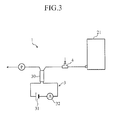
- the diluting / mixing tank is omitted as in the concentration measuring device 1 illustrated in Fig. 3 , and a configuration may be given such that the reagent of the reagent bottle 21 is continuously supplied to the enzyme electrode 30, and the analyte and specimen are injected from an injection valve 4.
- the whole blood in which the glucose concentration is adjusted to 100 mg/dL was used as the specimen.
- a reagent 1 in which NaCl is added by 0.234 wt% to "61H" (manufactured by ARKRAY, Inc.), and a reagent 2 in which NaN 3 is further added by 0.02 wt% to the reagent 1 were respectively diluted 100 times and then supplied into a reaction tank.
- the response value was measured by ADAMS GLUCOSE GA-117 (manufactured by ARKRAY, Inc.) as an oxidation current obtained in a GOD-immobilized hydrogen peroxide electrode when the specimen and reagent were supplied into the reaction tank.
- the voltage to be applied to the hydrogen peroxide electrode was set to 650 mV, and a response current was measured at 50-msec intervals.
- An operation in which the specimen and reagent were supplied to the reaction tank and retained therein for a certain period of time and then replaced with another specimen and reagent, which were retained for a certain period of time is set as one round, and the response current was continuously measured in three rounds in total.
- the result of the specimen 2 in which NaN 3 was added showed maximum values larger than those of the specimen 1, and a stabilized time course of the response value. More specifically, in the specimen 2 in which NaN 3 was added, it is considered that hemoglobin and NaN 3 react with each other, which is expected to prevent the amount of hydrogen peroxide measured in a hydrogen peroxide from decreasing.
- the whole blood in which the glucose concentration is adjusted to 100 mg/dL was used as the specimen.
- a reagent 3 in which NaCl is added by 0.234 wt% to "61H" (manufactured by ARKRAY, Inc.), a reagent 4 in which NaN 3 is further added by 0.02 wt% to the reagent 3, and a reagent 5 in which sodium nitrite is added by 0.02 wt% to the reagent 3 were respectively diluted 100 times and then supplied into a reaction tank.
- the response value was measured by ADAMS GLUCOSE GA-117 (manufactured by ARKRAY, Inc.) as an oxidation current obtained in a GOD-immobilized hydrogen peroxide electrode when the specimen and reagent were supplied into the reaction tank.
- the voltage to be applied to the hydrogen peroxide electrode was set to 650 mV, and a response current was measured at 50-msec intervals.
- the response current was continuously measured in a sequence of operations in which the specimen and reagent were supplied into the reaction tank and agitated for a certain period of time and then the agitation was terminated.
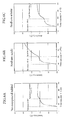
- the measurement results of the response current values, which were converted into voltage values, were illustrated in the drawings, the specimen 3 in Fig. 6A , the specimen 4 in Fig. 6B , and the specimen 5 in Fig. 6C .
- the specimen 3 in which NaN 3 and sodium nitrite were not added showed a deteriorated sensitivity in a while after the agitation was terminated. It is considered that it is because the oxidizing reaction of deoxyhemoglobin (oxy-Hb (Fe II)) into methemoglobin (met-Hb (Fe (III)) advances, and the anodic reaction of hydrogen peroxide is inhibited.
- the sensitivity of the specimen 4 in which NaN 3 was added increased even after the agitation was terminated within the measurement range set in the present example as is known from Fig. 6B
- reagent "61H" (manufactured by ARKRAY, Inc.) was prepared as a reagent 6, and a specimen 7 in which NaCl was added to the specimen 6 by 0.234 wt% were used.
- a physiological saline including NaCl of 0.9 wt% which was diluted 100 times with the specimen 6 or 7 was used.
- the response value was measured in a manner similar to Example 1.
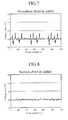
- the measurement results of response current values, which were converted into voltage values, were illustrated in the drawings, the specimen 6 in Fig. 7 , while the specimen 4 in Fig. 8 .
- the response value was instable in the specimen 6 in which NaCl was not added, while the response value was stable in the specimen 7 in which NaCl was added. That is, it is considered that NaCl is likely to stabilize the basis of the response current value.
Landscapes
- Chemical & Material Sciences (AREA)
- Organic Chemistry (AREA)
- Life Sciences & Earth Sciences (AREA)
- Health & Medical Sciences (AREA)
- Wood Science & Technology (AREA)
- Proteomics, Peptides & Aminoacids (AREA)
- Zoology (AREA)
- Engineering & Computer Science (AREA)
- Immunology (AREA)
- General Engineering & Computer Science (AREA)
- Microbiology (AREA)
- Molecular Biology (AREA)
- Analytical Chemistry (AREA)
- Biotechnology (AREA)
- Physics & Mathematics (AREA)
- Biochemistry (AREA)
- Bioinformatics & Cheminformatics (AREA)
- Biophysics (AREA)
- General Health & Medical Sciences (AREA)
- Genetics & Genomics (AREA)
- Emergency Medicine (AREA)
- Investigating Or Analysing Biological Materials (AREA)
- Measuring Or Testing Involving Enzymes Or Micro-Organisms (AREA)
- Telephone Function (AREA)
- Investigating Or Analysing Materials By Optical Means (AREA)
- Investigating Or Analyzing Non-Biological Materials By The Use Of Chemical Means (AREA)
Abstract
Description
- The present invention relates to a method, a device and a reagent for carrying out the measurement of a substrate such as glucose.
- There is a conventionally known method called an enzyme-electrode method, which is a method for measuring a glucose concentration. According to the method, information correlating with a glucose concentration in a specimen is outputted to an electrode in contact with the specimen, and the glucose concentration is calculated based on the output. In an example of the method, electrons are removed at an electrode from hydrogen peroxide generated by oxidizing glucose with an enzyme, and a glucose concentration is calculated based on a current value measured at the time in the electrode (for example, see the Patent Document 1)
- When the glucose concentration is measured, blood may be used as the specimen in some cases. In a case where hemolysis in hemocyte is generated, hemoglobin may be included in the specimen whether the whole blood is used or blood serum or plasma is used.
- However, the hemoglobin easily reacts with the hydrogen peroxide. Therefore, the hemoglobin included in the specimen inhibits the reaction between the hydrogen peroxide and the electrode. As a result, the electrode output tends to show a lower value as the reaction between the hemoglobin and the hydrogen peroxide advances in the presence of the hemoglobin, which makes it difficult to obtain high measuring accuracy.
- It is not avoidable for the specimen to include the hemoglobin by preventing the hemolytic activity in the hemocyte. This is, however, not a realistic approach because it is necessary to pay a meticulous attention during the transportation, preservation and pretreatment of the blood, which demands burdensome handling steps. Another disadvantage is the variability in easiness of the hymolytic activity depending on an analyte.
-
- [Patent Document 1]
JP-B-H07-37991 - An object of the present invention is to improve measurement accuracy by controlling any influences from an inhibitor when the concentration of a substrate, for example, glucose in a specimen such as blood, is measured without any complicated and time-consuming handling steps.
- According to a first aspect of the present invention, there is provided a method for measuring a substrate concentration based on the amount of hydrogen peroxide generated from a substrate, wherein a suppressing agent for suppressing a reaction between the hydrogen peroxide and an inhibitor is allowed to coexist.
- According to a second aspect of the present invention, there is provided a concentration measuring device comprising a hydrogen peroxide electrode for measuring the concentration of hydrogen peroxide generated from a substrate, wherein a suppressing agent for suppressing a reaction between the hydrogen peroxide and an inhibitor is supplied.
- According to a third aspect of the present invention, there is provided a reagent for measuring a substrate concentration based on the amount of hydrogen peroxide generated from a substrate, wherein the reagent includes a suppressing agent for suppressing a reaction between the hydrogen peroxide and an inhibitor.
- As the suppressing agent, for example, a compound which transforms the hemoglobin as an inhibitor into methemoglobin is used, and at least one selected from azide compounds; nitrites; ferricyanides; peroxides; and permanganates is used as the compound which transforms the hemoglobin into the methemoglobin.
- Examples of the azide compound to be used are: sodium azide; 4-dodecylbenzenesulfonyl azide; 4-acetylaminobenzenesulfonyl azide; diphenylphosphoric azide; iron azide; hydrogen azide; lead azide; mercury azide; copper azide; and silver azide. The concentration of the azide compound in the measuring system is preferably 0.001 to 1.000 wt%, and more preferably 0.010 to 0.100 wt%.
- Examples of the nitrite to be used are sodium nitrite and potassium nitrite. An example of the ferricyanide to be used is potassium ferricyanide, an example of the peroxide to be used is barium peroxide, and an example of the permanganate to be used is potassium permanganate. When any of the listed salts is used as the suppressing agent, the concentration of the suppressing agent in the measuring system is, for example, preferably 0.001 to 1.000 wt%, and more preferably 0.010 to 0.100 wt%.
- In the present invention, preferably, a supporting electrolyte is further allowed to coexist (to be added). Examples of the supporting electrolyte to be used are sodium chloride and potassium chloride, and sodium chloride is preferably used as the supporting electrolyte. The concentration of the supporting electrolyte is preferably 0.010 to 2.000 wt%, and more preferably 0.050 to 0.500 wt%.
- Examples of the substrate are glucose and lactate. The substrate is included in a biochemical specimen such as blood, urine or saliva.
- According to the method and device of the present invention, an enzyme-electrode method is employed to measure the amount of the hydrogen peroxide.
- The present invention is described below referring to the drawings.
- A
concentration measuring device 1 illustrated inFig. 1 is configured to measure a specimen adjusted in aspecimen preparation mechanism 2 using a measurement mechanism 3. - The
specimen preparation mechanism 2 is a mechanism for preparing a specimen from an analyte, and comprises anozzle 20, areagent bottle 21, and a diluting /mixing tank 22. - The
nozzle 20 is a nozzle for supplying an analyte into the diluting /mixing tank 22. Examples of the analyte to be used are biochemical specimens such as blood, urine and saliva, or diluents obtained therefrom. In a case where blood is used as the specimen, any of the whole blood and blood serum or plasma can be used. - The
reagent bottle 21 retains therein a reagent for diluting an analyte or washing the diluting /mixing tank 22. Thereagent bottle 21 is connected to the diluting /mixing tank 22 with apipe 23 interposed therebetween. Apump 24 is provided at an intermediate position in thepipe 23, and a configuration is given such that a force generated by thepump 24 serves to supply the reagent retained in thereagent bottle 21 into the diluting /mixing tank 22. - A material including a diluent and a suppressing agent is used as the reagent.
- An example of the diluent is a buffer solution. The buffer solution is not particularly limited as far as it can adjust the reaction pH of a substrate in a targeted range, and phosphates, for example, can be used. The concentration of the buffer solution in the reagent is set to, for example, 0.0001 to 0.1000 M.
- The suppressing agent serves to suppress a reaction between hydrogen peroxide as the substrate and an inhibitor. In a case where the inhibitor is hemoglobin, a compound which transforms the hemoglobin into methemoglobin, for example, at least one selected from: azide compounds; nitrites; ferricyanide; peroxides; and permanganates is used as the suppressing agent.
- Examples of the azide compound to be used are: sodium azide (NaN3); sodium azide; 4-dodecylbenzenesulfonyl azide; 4-acetylaminobenzenesulfonyl azide, diphenylphosphoric azide; iron azide; hydrogen azide; lead azide; mercury azide; copper azide; and silver azide. The concentration of the azide compound included in the reagent is, for example, 0.001 to 1.000 wt%, and preferably 0.010 to 0.100 wt%.
- Examples of the nitrite to be used are sodium nitrite and potassium nitrite. An example of the ferricyanide to be used is potassium ferricyanide, an example of the peroxide to be used is barium peroxide, and an example of the permanganate to be used is potassium permanganate. When any of the listed salts is used as the suppressing agent, the concentration of the suppressing agent in the measuring system is, for example, preferably 0.001 to 1.000 wt%, and more preferably 0.010 to 0.100 wt%.
- The reagent may further include a supporting electrolyte. Examples of the supporting electrolyte to be used are sodium chloride and potassium chloride. The concentration of the supporting electrolyte in the reagent is, for example, 0.010 to 2.000 wt%, and preferably 0.050 to 0.500 wt%.
- The diluting /
mixing tank 22 is a tank for providing a place where an analyte is diluted so that a specimen is prepared. The diluting /reaction tank 22 is configured such that the analyte is supplied by means of thenozzle 20, and the reagent is supplied from thereagent bottle 21. The diluting /mixing tank 22 comprises therein anagitator 25. When theagitator 25 is rotated by astirrer 26, the analyte and the reagent are mixed with each other. The diluting /mixing tank 22 is further connected to anenzyme electrode 30 of the measurement mechanism 3 with apipe 27 interposed therebetween. Apump 28 is provided at an intermediate position in thepipe 27, and a configuration is given such that a force generated by thepump 28 serves to supply a specimen prepared in the diluting / mixingtank 22 to theenzyme electrode 30 of the measurement mechanism 3. - The measurement mechanism 3 comprises the
enzyme electrode 30, apower supply 31 and a currentvalue measuring unit 32. - The
enzyme electrode 30 outputs an electrophysical quantity corresponding to the amount of electrons transferred to and received from a substrate in a specimen. As illustrated inFig. 2 , theenzyme electrode 30 comprises a substrateselective transmission film 33, an enzyme immobilizedfilm 34, a hydrogen peroxideselective transmission film 35, and ahydrogen peroxide electrode 36. - The substrate
selective transmission film 33 is a film for selectively supplying a substrate in a specimen to the enzyme immobilizedfilm 34. The substrateselective transmission film 33 to be used is a various conventionally available film, although being selected depending on the type of a substrate. - The enzyme immobilized film 34 a film for generating hydrogen peroxide by oxidizing a substrate, and is configured to include an oxidase. The oxidase used in the present invention is selected depending on the type of a substrate. Examples of the substrate to be measured by the
concentration measuring device 1 are glucose and lactate, and glucose oxidase or lactate oxidase can be mentioned as the oxidase. - The hydrogen peroxide
selective transmission film 35 is a film for selectively supplying hydrogen peroxide to thehydrogen peroxide electrode 36. Examples of the hydrogen peroxideselective transmission film 35 to be used are acetylcellulose-based or polyarylamine-based films. - The
hydrogen peroxide electrode 36 outputs an electrical signal corresponding to the amount of the supplied hydrogen peroxide, in other words, the concentration of the substrate. Thehydrogen peroxide electrode 36 to be used is an electrode in which platinum is used as ananode 37, while silver is used as acathode 38. - The
power supply 31 illustrated inFig. 1 applies a voltage to the enzyme electrode 30 (hydrogen peroxide electrode 36). A direct-current power supply, for example, is used as thepower supply 31, and the voltage applied to the enzyme electrode 30 (hydrogen peroxide electrode 36) is set to, for example, 0.1 to 1.0 V. - The current
value measuring unit 32 is a unit for measuring the amount of electrons transferred to and from thehydrogen peroxide electrode 36 and the hydrogen peroxide as a current value. The current value is intermittently measured by the currentvalue measuring unit 32, and a measurement interval is set to, for example, 50 to 200 msec. - Next is described an operation of the
concentration measuring device 1 in a case where glucose in the whole blood is a target of the measurement. - When the concentration of the glucose in the whole blood is measured, the whole blood and the reagent are supplied into the diluting /
mixing tank 22. The whole blood is supplied into the diluting /mixing tank 22 by means of thenozzle 20, and the amount of the whole blood to be supplied is set to, for example, 4 to 20 µL. On the other hand, the reagent is supplied into the diluting /mixing tank 22 by means of thepump 24, and the amount of the reagent to be supplied is set to, for example, approximately 100 times as much as the amount of the whole blood. - When the whole blood and the reagent are supplied in the
concentration measuring device 1, they are agitated by theagitator 25 in the diluting /mixing tank 22. Because the amount of the reagent to be supplied is set to approximately 100 times as much as the amount of the whole blood to be supplied, the pH of the buffer solution in the diluting /mixing tank 22 and the concentrations of the suppressing agent and the supporting electrolyte are substantially retained to be equal to the pH and the concentrations in the reagent. After that, the prepared specimen is supplied to theenzyme electrode 30 by means of thepump 28. - In the
enzyme electrode 30, the glucose transmits through the substrateselective transmission film 33 and is then supplied to the enzyme immobilizedfilm 34. In the enzyme immobilizedfilm 34, the glucose of the oxidase (glucose dehydrogenase) is oxidized, and gluconic acid and hydrogen peroxide are generated as illustrated in the following reaction formula (1). The hydrogen peroxide transmits through the hydrogen peroxideselective transmission film 35 and is then supplied to thehydrogen peroxide electrode 36. In thehydrogen peroxide electrode 36, the reaction represented by the following reaction formula (2) is generated by the application of the voltage by thepower supply 31, and the hydrogen peroxide supplies electrons to theanode 37 to be decomposed into oxygen and hydrogen ions. At the time, the electrons supplied to theanode 37 generate a current flow between theanode 37 and thecathode 38, and the current generated at the time is measured by the currentvalue measuring unit 32. On the other hand, in thecathode 38, the electrons from theanode 37 generate the reaction represented by the following reaction formula (3), whereby water is produced. -


- In the
anode 38, the reductive reaction of the hydrogen peroxide (H2O2) is generated. In the presence of oxyhemoglobin (Fe (II)) in the diluting /mixing tank 22, the anodic reaction and the oxidizing reaction of deoxyhemoglobin (oxy-Hb (Fe II)) into methemoglobin (met-Hb (Fe (III)) compete with each other as illustrated in the following reaction formula (4). -

- In a case where the competing reactions are generated, the hydrogen peroxide, which is supposed to be consumed in the
anode 37, is consumed by the deoxyhemoglobin. Accordingly, the current value measured by the currentvalue measuring unit 32 falls below an expected value to be fundamentally obtained. In the specimen including hemocyte, in particular, the pH in the vicinity of a hemocyte membrane tends to be lowered because gluconic acid is generated, and the oxyhemoglobin releases oxygen and is thereby transformed into the deoxyhemoglobin with accompanying the decrease of the pH. Therefore, it is considered that the production of the deoxyhemoglobin is increased in accordance with the progress of the oxidizing reaction of the glucose. Thus, the deoxyhemoglobin which inhibits the oxidizing reaction of the hydrogen peroxide in theanode 37 is generated in accordance with the progress the oxidizing reaction of the glucose (gluconic acid is generated), which is considered a probable reason why the measured oxidation current is smaller than the true value. - On the other hand, when an oxide such as an azide compound or nitrite is allowed to coexist as the suppressing agent, the oxidizing reaction of the deoxyhemoglobin (Fe (II)) into the methemoglobin (Fe (III)) is generated by the oxidative effect of the suppressing agent as illustrated in the following reaction formula (5).
-

- Therefore, the reaction of the hydrogen peroxide with the deoxyhemoglobin is suppressed when the suppressing agent is allowed to coexist in the specimen. As a result, the current value measured by the current
value measuring unit 32 can be prevented from decreasing, and the variability of the measured response current value can be controlled in theconcentration measuring device 1. Thus, the obtained result of the concentration measurement no longer shows the reduction of the value, which leads to the improvement of reproducibility, and the accuracy and reliability in the measurement can be thereby improved. - The effect thus far described can also be obtained in any other system where hydrogen peroxide is generated by a substrate and the hydrogen peroxide and an anode are reacted with each other so that a substrate concentration is measured, without limiting to a case where an inhibitor is deoxyhemoglobin or a substrate is glucose.
- Further, ionic strength in the
reaction tank 20 can be increased when the supporting electrolyte such as sodium chloride is included in the reagent, and the oxidation current obtained in the currentvalue measuring unit 32 can be thereby stabilized. Thus, the inclusion of the supporting electrolyte can further improve the measurement reproducibility. - The present invention is not limited to the embodiment described so far, and can be variously modified. For example, the enzyme electrode may be configured to be fixated in the diluting / mixing tank, and the substrate concentration may be measured according to the batch system.
- Further, the diluting / mixing tank is omitted as in the
concentration measuring device 1 illustrated inFig. 3 , and a configuration may be given such that the reagent of thereagent bottle 21 is continuously supplied to theenzyme electrode 30, and the analyte and specimen are injected from aninjection valve 4. - In this example, the influence of sodium azide onto a response value when a glucose concentration in a specimen is measured by means of a hydrogen peroxide electrode was discussed.
- The whole blood in which the glucose concentration is adjusted to 100 mg/dL was used as the specimen.
- As a reagent, a
reagent 1 in which NaCl is added by 0.234 wt% to "61H" (manufactured by ARKRAY, Inc.), and areagent 2 in which NaN3 is further added by 0.02 wt% to thereagent 1 were respectively diluted 100 times and then supplied into a reaction tank. - The response value was measured by ADAMS GLUCOSE GA-117 (manufactured by ARKRAY, Inc.) as an oxidation current obtained in a GOD-immobilized hydrogen peroxide electrode when the specimen and reagent were supplied into the reaction tank. The voltage to be applied to the hydrogen peroxide electrode was set to 650 mV, and a response current was measured at 50-msec intervals. An operation in which the specimen and reagent were supplied to the reaction tank and retained therein for a certain period of time and then replaced with another specimen and reagent, which were retained for a certain period of time is set as one round, and the response current was continuously measured in three rounds in total. At intervals between the rounds, the reaction tank and the pipe were washed for a certain period of time. The measurement results of response current value, which were converted into voltage values, were illustrated in the drawings, the
specimen 1 inFig. 4 , while thespecimen 2 inFig. 5 . - As is known when
Figs. 4 and 5 are compared to each other, thespecimen 1 not adding NaN3 showed a result that maximum response values were relatively low and also variable without any distinct peak. It is considered that the low values were obtained because the amount of hydrogen peroxide measured in a hydrogen peroxide electrode was lessened when the hydrogen peroxide generated upon oxidizing glucose reacts with hemoglobin. - On the other hand, the result of the
specimen 2 in which NaN3 was added showed maximum values larger than those of thespecimen 1, and a stabilized time course of the response value. More specifically, in thespecimen 2 in which NaN3 was added, it is considered that hemoglobin and NaN3 react with each other, which is expected to prevent the amount of hydrogen peroxide measured in a hydrogen peroxide from decreasing. - It is found from these results that the measurement accuracy and reproducibility are improved when NaN3 is added to the reaction system since the increase of the response value is observed and the maximum values thereof are stabilized.
- In this example, the influences of sodium azide and sodium nitride onto a response value when a glucose concentration in a specimen is measured by means of a hydrogen peroxide electrode were discussed.
- The whole blood in which the glucose concentration is adjusted to 100 mg/dL was used as the specimen.
- As a reagent, a reagent 3 in which NaCl is added by 0.234 wt% to "61H" (manufactured by ARKRAY, Inc.), a
reagent 4 in which NaN3 is further added by 0.02 wt% to the reagent 3, and a reagent 5 in which sodium nitrite is added by 0.02 wt% to the reagent 3 were respectively diluted 100 times and then supplied into a reaction tank. - The response value was measured by ADAMS GLUCOSE GA-117 (manufactured by ARKRAY, Inc.) as an oxidation current obtained in a GOD-immobilized hydrogen peroxide electrode when the specimen and reagent were supplied into the reaction tank. The voltage to be applied to the hydrogen peroxide electrode was set to 650 mV, and a response current was measured at 50-msec intervals. The response current was continuously measured in a sequence of operations in which the specimen and reagent were supplied into the reaction tank and agitated for a certain period of time and then the agitation was terminated. The measurement results of the response current values, which were converted into voltage values, were illustrated in the drawings, the specimen 3 in
Fig. 6A , thespecimen 4 inFig. 6B , and the specimen 5 inFig. 6C . - As is known from
Fig. 6A , the specimen 3 in which NaN3 and sodium nitrite were not added showed a deteriorated sensitivity in a while after the agitation was terminated. It is considered that it is because the oxidizing reaction of deoxyhemoglobin (oxy-Hb (Fe II)) into methemoglobin (met-Hb (Fe (III)) advances, and the anodic reaction of hydrogen peroxide is inhibited. - On the other hand, the sensitivity of the
specimen 4 in which NaN3 was added increased even after the agitation was terminated within the measurement range set in the present example as is known fromFig. 6B , while the sensitivity of the specimen 5 in which sodium nitrite was added inclined to approach asymptotically to a certain value after the agitation was terminated within the measurement range set in the present example as is known fromFig. 6A . More specifically, the deterioration of the sensitivity was not observed in a case where NaN3 and sodium nitrite were added, which is considered that NaN3 and sodium nitrite suppresses the oxidizing reaction of deoxyhemoglobin (oxy-Hb (Fe II)) into methemoglobin (met-Hb (Fe (III)). - In this example, the influence of NaCl in a reagent onto a response value was discussed.
- As the reagent, "61H" (manufactured by ARKRAY, Inc.) was prepared as a reagent 6, and a specimen 7 in which NaCl was added to the specimen 6 by 0.234 wt% were used.
- As a specimen, a physiological saline including NaCl of 0.9 wt% which was diluted 100 times with the specimen 6 or 7 was used.
- The response value was measured in a manner similar to Example 1. The measurement results of response current values, which were converted into voltage values, were illustrated in the drawings, the specimen 6 in
Fig. 7 , while thespecimen 4 inFig. 8 . - As is known from
Figs. 7 and 8 , the response value was instable in the specimen 6 in which NaCl was not added, while the response value was stable in the specimen 7 in which NaCl was added. That is, it is considered that NaCl is likely to stabilize the basis of the response current value. - Therefore, it is considered that the response value is stabilized and the measurement accuracy and reproducibility are improved when NaCl is added to the reagent.
-
-
Fig. 1 is a sectional view schematically illustrating a structure of a concentration measuring device according to the present invention. -
Fig. 2 is a sectional view schematically illustrating a structure of an enzyme electrode provided in the concentration measuring device illustrated inFig. 1 . -
Fig. 3 is a pipe for describing another example of the concentration measuring device according to the present invention. -
Fig. 4 is a graph showing the measurement result of a response current in the whole blood in a case where sodium azide is not added in Example 1. -
Fig. 5 is a graph showing the measurement result of a response current in the whole blood in a case where sodium azide is added in Example 1. -
Fig. 6A is a graph showing the measurement result of a response current value in a case where a suppressing agent is not added in Example 2. -
Fig. 6B is a graph showing the measurement result of a response current in the whole blood in a case where sodium azide is added as a suppressing agent in Example 2. -
Fig. 6C is a graph showing the measurement result of a response current in the whole blood in a case where sodium nitrite is added as a suppressing agent in Example 2. -
Fig. 7 is a graph showing the measurement result of a response current in a physiological saline in a case where sodium nitrite is not added in Example 3. -
Fig. 8 is a graph showing the measurement result of a response current in a physiological saline in a case where sodium nitrite is added in Example 3. -
- 1
- concentration measuring device
- 36
- hydrogen peroxide electrode
Claims (25)
- A method for measuring a substrate concentration based on an amount of hydrogen peroxide generated from a substrate, wherein a suppressing agent for suppressing a reaction between the hydrogen peroxide and an inhibitor is allowed to coexist.
- The method for measuring a substrate concentration according to Claim 1, wherein the inhibitor is hemoglobin, and the suppressing agent is a compound which transforms the hemoglobin into methemoglobin.
- The method for measuring a substrate concentration according to Claim 2, wherein the suppressing agent is an azide compound.
- The method for measuring a substrate concentration according to Claim 3, wherein the suppressing agent is sodium azide.
- The method for measuring a substrate concentration according to Claim 3, wherein a concentration of the azide compound is 0.001 to 1.000 wt%.
- The method for measuring a substrate concentration according to Claim 2, wherein the suppressing agent is at least one selected from: nitrites; ferricyanides; peroxides; and permanganates.
- The method for measuring a substrate concentration according to Claim 6, wherein the suppressing agent is at least one selected from: sodium nitrite; potassium ferricyanide; barium peroxide; and potassium permanganate.
- The method for measuring a substrate concentration according to Claim 1, wherein a supporting electrolyte is further allowed to coexist.
- The method for measuring a substrate concentration according to Claim 8, wherein the supporting electrolyte is sodium chloride or potassium chloride.
- The method for measuring a substrate concentration according to Claim 8, wherein a concentration of the supporting electrolyte is 0.01 to 2.00 wt%.
- A measuring device of a substrate concentration comprising a hydrogen peroxide electrode for measuring a concentration of hydrogen peroxide generated from a substrate, wherein a suppressing agent for suppressing a reaction between the hydrogen peroxide and an inhibitor is supplied.
- The measuring device of a substrate concentration according to Claim 11, wherein a compound which transforms hemoglobin as the inhibitor into methemoglobin is supplied as the suppressing agent.
- The measuring device of a substrate concentration according to Claim 12, wherein the compound is an azide compound.
- The measuring device of a substrate concentration according to Claim 13, wherein the azide compound is sodium azide.
- The measuring device of a substrate concentration according to Claim 12, wherein the suppressing agent is at least one selected from: nitrites; ferricyanides; peroxides; and permanganates.
- The measuring device of a substrate concentration according to Claim 15, wherein the suppressing agent is at least one selected from: sodium nitrite; potassium ferricyanide; barium peroxide; and potassium permanganate.
- The measuring device of a substrate concentration according to Claim 11, wherein a supporting electrolyte is further supplied.
- A reagent for measuring a substrate concentration based on an amount of hydrogen peroxide generated from a substrate, wherein the agent includes a suppressing agent for suppressing a reaction between the hydrogen peroxide and an inhibitor.
- The reagent for measuring a substrate concentration according to Claim 18, wherein the inhibitor is hemoglobin, and the suppressing agent is a compound which transforms the hemoglobin into methemoglobin.
- The reagent for measuring a substrate concentration according to Claim 19, wherein the suppressing agent is an azide compound.
- The reagent for measuring a substrate concentration according to Claim 20, wherein the suppressing agent is sodium azide.
- The reagent for measuring a substrate concentration according to Claim 19, wherein the suppressing agent is at least one selected from: nitrites; ferricyanides; peroxides; and permanganates.
- The reagent for measuring a substrate concentration according to Claim 22, wherein the nitrite is at least one selected from: sodium nitrite; potassium ferricyanide; barium peroxide; and potassium permanganate.
- The reagent for measuring a substrate concentration according to Claim 18, further including a supporting electrolyte.
- The reagent for measuring a substrate concentration according to Claim 24, wherein the supporting electrolyte is sodium chloride or potassium chloride.
Applications Claiming Priority (2)
| Application Number | Priority Date | Filing Date | Title |
|---|---|---|---|
| JP2007044771 | 2007-02-24 | ||
| PCT/JP2008/053106 WO2008102889A1 (en) | 2007-02-24 | 2008-02-24 | Method and apparatus for determining substrate concentration and reagent for determining substrate concentration |
Publications (3)
| Publication Number | Publication Date |
|---|---|
| EP2136206A1 true EP2136206A1 (en) | 2009-12-23 |
| EP2136206A4 EP2136206A4 (en) | 2010-03-24 |
| EP2136206B1 EP2136206B1 (en) | 2012-04-11 |
Family
ID=39710160
Family Applications (1)
| Application Number | Title | Priority Date | Filing Date |
|---|---|---|---|
| EP08711870A Active EP2136206B1 (en) | 2007-02-24 | 2008-02-24 | Method for determining glucose concentration |
Country Status (7)
| Country | Link |
|---|---|
| US (2) | US8508620B2 (en) |
| EP (1) | EP2136206B1 (en) |
| JP (1) | JP5054756B2 (en) |
| KR (1) | KR101491646B1 (en) |
| CN (1) | CN101802600B (en) |
| AT (1) | ATE553214T1 (en) |
| WO (1) | WO2008102889A1 (en) |
Families Citing this family (3)
| Publication number | Priority date | Publication date | Assignee | Title |
|---|---|---|---|---|
| KR101988313B1 (en) * | 2013-01-04 | 2019-06-12 | 엘지전자 주식회사 | Mobile terminal and controlling method thereof, and recording medium thereof |
| US10823715B2 (en) * | 2017-07-19 | 2020-11-03 | American Sterilizer Company | Chemical indicator for monitoring hydrogen peroxide sterilization and disinfection processes |
| WO2019187575A1 (en) * | 2018-03-26 | 2019-10-03 | Phcホールディングス株式会社 | Biological substance detection sensor |
Family Cites Families (36)
| Publication number | Priority date | Publication date | Assignee | Title |
|---|---|---|---|---|
| GB1332431A (en) * | 1969-07-18 | 1973-10-03 | Smiths Industries Ltd | Methods of providing a measure of the concentration of a consti tuent of a blood sample |
| JPS5592694A (en) * | 1979-01-05 | 1980-07-14 | Ajinomoto Co Inc | Buffer solution |
| EP0355864A3 (en) * | 1984-03-15 | 1991-09-18 | Wako Pure Chemical Industries, Ltd. | Method of quantitatively measuring an oxidative substance by using triphenyl methane type leuco compounds as coloring matter |
| JPH0820395B2 (en) * | 1987-11-13 | 1996-03-04 | 新王子製紙株式会社 | Method for measuring amylose content |
| DE68922414T2 (en) * | 1988-02-05 | 1995-11-09 | Nova Biomedical Corp | Enzyme electrode. |
| JP2504812B2 (en) * | 1988-08-31 | 1996-06-05 | 新王子製紙株式会社 | Enzyme electrode and alcohol concentration measuring method |
| US5155025A (en) * | 1989-03-17 | 1992-10-13 | Chemtrak | Hydrogen peroxide stabilization in assays |
| FI954968A7 (en) * | 1993-04-22 | 1995-12-19 | Andcare Inc | Peroxidase and colloidal gold-containing oxidase biosensors for mediator-free glucose determination |
| JPH0737991U (en) | 1993-12-27 | 1995-07-14 | ザ・パック株式会社 | Corn cup wrapping paper box |
| US6656697B1 (en) * | 1998-09-28 | 2003-12-02 | Lifescan, Inc. | Diagnostics based on tetrazolium compounds |
| JP2001274936A (en) | 2000-01-21 | 2001-10-05 | Casio Comput Co Ltd | Image data transmission system and imaging data transmission method |
| JP4462395B2 (en) * | 2000-04-24 | 2010-05-12 | 東洋紡績株式会社 | Polyphenol sensor |
| JP3695341B2 (en) | 2001-03-30 | 2005-09-14 | 株式会社デンソー | Portable communication terminal |
| CN1277931C (en) * | 2001-07-24 | 2006-10-04 | 日本电气株式会社 | Enzyme electrode and production method therefor |
| CN1503555A (en) | 2002-11-25 | 2004-06-09 | 英保达股份有限公司 | An image display method and system |
| US7325198B2 (en) * | 2002-12-31 | 2008-01-29 | Fuji Xerox Co., Ltd. | Calendar-based interfaces for browsing and manipulation of digital images |
| JP2004220420A (en) | 2003-01-16 | 2004-08-05 | Fuji Photo Film Co Ltd | Image retrieval method and device and program |
| JP4328546B2 (en) * | 2003-02-14 | 2009-09-09 | 株式会社テクノメデイカ | Single-use sensor card for blood component measurement |
| US20040248223A1 (en) * | 2003-06-05 | 2004-12-09 | Idexx Laboratories, Inc. | Reduction of interfering peroxidase activity in peroxidase based detection methods |
| US7636733B1 (en) * | 2003-10-03 | 2009-12-22 | Adobe Systems Incorporated | Time-based image management |
| US7443404B2 (en) | 2003-10-17 | 2008-10-28 | Casio Computer Co., Ltd. | Image display apparatus, image display controlling method, and image display program |
| US20050105374A1 (en) * | 2003-11-17 | 2005-05-19 | Nokia Corporation | Media diary application for use with digital device |
| JPWO2005049858A1 (en) * | 2003-11-19 | 2007-11-29 | 第一化学薬品株式会社 | Method for measuring substrate in samples containing hemoglobin |
| JP2005191979A (en) * | 2003-12-25 | 2005-07-14 | Casio Comput Co Ltd | Electronic devices and communication terminals |
| JP2006107144A (en) * | 2004-10-05 | 2006-04-20 | Olympus Corp | Image playback device |
| JP2006191444A (en) | 2005-01-07 | 2006-07-20 | Canon Inc | Imaging device |
| JP4318645B2 (en) | 2005-01-12 | 2009-08-26 | 三洋電機株式会社 | Broadcast receiver |
| JP4757527B2 (en) * | 2005-04-25 | 2011-08-24 | ソニー エリクソン モバイル コミュニケーションズ, エービー | Display control device, display control method, portable terminal device, and display control program |
| WO2006118306A1 (en) * | 2005-05-02 | 2006-11-09 | Oji Paper Co., Ltd. | Analysis apparatus and analysis method for glycosylated hemoglobin |
| JP2006319561A (en) | 2005-05-11 | 2006-11-24 | Sharp Corp | Mobile terminal having folding mechanism |
| US20070067342A1 (en) * | 2005-09-21 | 2007-03-22 | Nancy Haralambopoulos | Calendar based image display system |
| JP4137952B2 (en) * | 2006-05-01 | 2008-08-20 | ソニー・エリクソン・モバイルコミュニケーションズ株式会社 | Information processing device, information processing method, information processing program, and portable terminal device |
| JP4662481B2 (en) * | 2006-06-28 | 2011-03-30 | ソニー・エリクソン・モバイルコミュニケーションズ株式会社 | Information processing device, information processing method, information processing program, and portable terminal device |
| JP4285704B2 (en) * | 2006-08-16 | 2009-06-24 | ソニー・エリクソン・モバイルコミュニケーションズ株式会社 | Information processing apparatus, information processing method, and information processing program |
| JP4453692B2 (en) | 2006-09-08 | 2010-04-21 | カシオ計算機株式会社 | Imaging device |
| US9429579B2 (en) * | 2006-09-22 | 2016-08-30 | Arkray, Inc. | Blood analysis apparatus |
-
2008
- 2008-01-30 US US12/528,398 patent/US8508620B2/en not_active Expired - Fee Related
- 2008-02-24 CN CN200880013181.4A patent/CN101802600B/en active Active
- 2008-02-24 EP EP08711870A patent/EP2136206B1/en active Active
- 2008-02-24 KR KR1020097019905A patent/KR101491646B1/en active Active
- 2008-02-24 WO PCT/JP2008/053106 patent/WO2008102889A1/en not_active Ceased
- 2008-02-24 AT AT08711870T patent/ATE553214T1/en active
- 2008-02-24 US US12/449,732 patent/US20100200432A1/en not_active Abandoned
- 2008-02-24 JP JP2009500257A patent/JP5054756B2/en active Active
Also Published As
| Publication number | Publication date |
|---|---|
| KR101491646B1 (en) | 2015-02-09 |
| WO2008102889A1 (en) | 2008-08-28 |
| US20100200432A1 (en) | 2010-08-12 |
| US8508620B2 (en) | 2013-08-13 |
| US20100053373A1 (en) | 2010-03-04 |
| EP2136206A4 (en) | 2010-03-24 |
| JP5054756B2 (en) | 2012-10-24 |
| JPWO2008102889A1 (en) | 2010-05-27 |
| CN101802600A (en) | 2010-08-11 |
| ATE553214T1 (en) | 2012-04-15 |
| EP2136206B1 (en) | 2012-04-11 |
| KR20100041700A (en) | 2010-04-22 |
| CN101802600B (en) | 2013-08-21 |
Similar Documents
| Publication | Publication Date | Title |
|---|---|---|
| US5030333A (en) | Polarographic method for measuring both analyte and oxygen with the same detecting electrode of an electroenzymatic sensor | |
| US8128796B2 (en) | Analyzer | |
| Ramanavicius | Amperometric biosensor for the determination of creatine | |
| JPWO2003036285A1 (en) | Concentration measuring method and concentration measuring device for specific component | |
| CA2557690A1 (en) | Method and apparatus for implementing threshold based correction functions for biosensors | |
| EP4425165A1 (en) | Electrochemical reaction device and method for electrochemically analyzing glucose | |
| EP2136206B1 (en) | Method for determining glucose concentration | |
| JP4901956B2 (en) | Substrate concentration measuring method and substrate concentration measuring apparatus | |
| CA3025747A1 (en) | Galvanically functionalized sensors | |
| WO2013165823A1 (en) | Method and apparatus for measuring and controllng electrolytically-active species concentration in aqueous solutions | |
| US7906340B2 (en) | Method for quantitative determination of hydrogen peroxide using potentiometric titration | |
| US20240252072A1 (en) | Treatment device using reaction system containing oxidoreductase and co-enzyme, and method for controlling same | |
| JP3885121B2 (en) | Biosensor | |
| CN1938589B (en) | Method and apparatus for implementing a threshold-based correction function for a biosensor | |
| Watson et al. | Development of a glucose analyzer based on immobilized glucose oxidase | |
| JP2001013102A (en) | Fractionately measuring method for peracetic acid and hydrogen peroxide | |
| JP2010286423A (en) | Potential difference measurement method | |
| JP2005148058A (en) | Method and apparatus for measuring concentration of specific component in blood sample | |
| Milardović et al. | Determination of oxalate in urine, using an amperometric biosensor with oxalate oxidase immobilized on the surface of a chromium hexacyanoferrate-modified graphite electrode | |
| EP2154521B1 (en) | Method and apparatus for measuring substrate concentration | |
| JPS62235557A (en) | enzyme electrode | |
| WO2020113129A1 (en) | Systems and methods for electrochemical point-of-care detection of hemoglobin | |
| JPS62240849A (en) | Enzyme electrode | |
| JP2004085374A (en) | Electrochemical measuring method | |
| JP5610033B2 (en) | Method for accurately quantifying chemical substances contained in a sample solution at a very low concentration of 1 × 10 −8 M or less |
Legal Events
| Date | Code | Title | Description |
|---|---|---|---|
| PUAI | Public reference made under article 153(3) epc to a published international application that has entered the european phase |
Free format text: ORIGINAL CODE: 0009012 |
|
| 17P | Request for examination filed |
Effective date: 20090924 |
|
| AK | Designated contracting states |
Kind code of ref document: A1 Designated state(s): AT BE BG CH CY CZ DE DK EE ES FI FR GB GR HR HU IE IS IT LI LT LU LV MC MT NL NO PL PT RO SE SI SK TR |
|
| A4 | Supplementary search report drawn up and despatched |
Effective date: 20100224 |
|
| RIC1 | Information provided on ipc code assigned before grant |
Ipc: C12Q 1/28 20060101ALI20100218BHEP Ipc: C12Q 1/00 20060101AFI20100218BHEP |
|
| DAX | Request for extension of the european patent (deleted) | ||
| 17Q | First examination report despatched |
Effective date: 20100510 |
|
| REG | Reference to a national code |
Ref country code: DE Ref legal event code: R079 Ref document number: 602008014800 Country of ref document: DE Free format text: PREVIOUS MAIN CLASS: G01N0027416000 Ipc: C12Q0001000000 |
|
| GRAP | Despatch of communication of intention to grant a patent |
Free format text: ORIGINAL CODE: EPIDOSNIGR1 |
|
| RIC1 | Information provided on ipc code assigned before grant |
Ipc: C12Q 1/28 20060101ALI20110901BHEP Ipc: C12Q 1/00 20060101AFI20110901BHEP |
|
| RTI1 | Title (correction) |
Free format text: METHOD FOR DETERMINING GLUCOSE CONCENTRATION |
|
| GRAS | Grant fee paid |
Free format text: ORIGINAL CODE: EPIDOSNIGR3 |
|
| GRAA | (expected) grant |
Free format text: ORIGINAL CODE: 0009210 |
|
| AK | Designated contracting states |
Kind code of ref document: B1 Designated state(s): AT BE BG CH CY CZ DE DK EE ES FI FR GB GR HR HU IE IS IT LI LT LU LV MC MT NL NO PL PT RO SE SI SK TR |
|
| REG | Reference to a national code |
Ref country code: GB Ref legal event code: FG4D |
|
| REG | Reference to a national code |
Ref country code: CH Ref legal event code: EP |
|
| REG | Reference to a national code |
Ref country code: AT Ref legal event code: REF Ref document number: 553214 Country of ref document: AT Kind code of ref document: T Effective date: 20120415 |
|
| REG | Reference to a national code |
Ref country code: IE Ref legal event code: FG4D |
|
| REG | Reference to a national code |
Ref country code: DE Ref legal event code: R096 Ref document number: 602008014800 Country of ref document: DE Effective date: 20120606 |
|
| REG | Reference to a national code |
Ref country code: NL Ref legal event code: VDEP Effective date: 20120411 |
|
| REG | Reference to a national code |
Ref country code: AT Ref legal event code: MK05 Ref document number: 553214 Country of ref document: AT Kind code of ref document: T Effective date: 20120411 |
|
| LTIE | Lt: invalidation of european patent or patent extension |
Effective date: 20120411 |
|
| PG25 | Lapsed in a contracting state [announced via postgrant information from national office to epo] |
Ref country code: CY Free format text: LAPSE BECAUSE OF FAILURE TO SUBMIT A TRANSLATION OF THE DESCRIPTION OR TO PAY THE FEE WITHIN THE PRESCRIBED TIME-LIMIT Effective date: 20120411 Ref country code: FI Free format text: LAPSE BECAUSE OF FAILURE TO SUBMIT A TRANSLATION OF THE DESCRIPTION OR TO PAY THE FEE WITHIN THE PRESCRIBED TIME-LIMIT Effective date: 20120411 Ref country code: PL Free format text: LAPSE BECAUSE OF FAILURE TO SUBMIT A TRANSLATION OF THE DESCRIPTION OR TO PAY THE FEE WITHIN THE PRESCRIBED TIME-LIMIT Effective date: 20120411 Ref country code: IS Free format text: LAPSE BECAUSE OF FAILURE TO SUBMIT A TRANSLATION OF THE DESCRIPTION OR TO PAY THE FEE WITHIN THE PRESCRIBED TIME-LIMIT Effective date: 20120811 Ref country code: LT Free format text: LAPSE BECAUSE OF FAILURE TO SUBMIT A TRANSLATION OF THE DESCRIPTION OR TO PAY THE FEE WITHIN THE PRESCRIBED TIME-LIMIT Effective date: 20120411 Ref country code: SE Free format text: LAPSE BECAUSE OF FAILURE TO SUBMIT A TRANSLATION OF THE DESCRIPTION OR TO PAY THE FEE WITHIN THE PRESCRIBED TIME-LIMIT Effective date: 20120411 Ref country code: NO Free format text: LAPSE BECAUSE OF FAILURE TO SUBMIT A TRANSLATION OF THE DESCRIPTION OR TO PAY THE FEE WITHIN THE PRESCRIBED TIME-LIMIT Effective date: 20120711 |
|
| PG25 | Lapsed in a contracting state [announced via postgrant information from national office to epo] |
Ref country code: LV Free format text: LAPSE BECAUSE OF FAILURE TO SUBMIT A TRANSLATION OF THE DESCRIPTION OR TO PAY THE FEE WITHIN THE PRESCRIBED TIME-LIMIT Effective date: 20120411 Ref country code: PT Free format text: LAPSE BECAUSE OF FAILURE TO SUBMIT A TRANSLATION OF THE DESCRIPTION OR TO PAY THE FEE WITHIN THE PRESCRIBED TIME-LIMIT Effective date: 20120813 Ref country code: HR Free format text: LAPSE BECAUSE OF FAILURE TO SUBMIT A TRANSLATION OF THE DESCRIPTION OR TO PAY THE FEE WITHIN THE PRESCRIBED TIME-LIMIT Effective date: 20120411 Ref country code: GR Free format text: LAPSE BECAUSE OF FAILURE TO SUBMIT A TRANSLATION OF THE DESCRIPTION OR TO PAY THE FEE WITHIN THE PRESCRIBED TIME-LIMIT Effective date: 20120712 Ref country code: SI Free format text: LAPSE BECAUSE OF FAILURE TO SUBMIT A TRANSLATION OF THE DESCRIPTION OR TO PAY THE FEE WITHIN THE PRESCRIBED TIME-LIMIT Effective date: 20120411 |
|
| PG25 | Lapsed in a contracting state [announced via postgrant information from national office to epo] |
Ref country code: BE Free format text: LAPSE BECAUSE OF FAILURE TO SUBMIT A TRANSLATION OF THE DESCRIPTION OR TO PAY THE FEE WITHIN THE PRESCRIBED TIME-LIMIT Effective date: 20120411 |
|
| PG25 | Lapsed in a contracting state [announced via postgrant information from national office to epo] |
Ref country code: CZ Free format text: LAPSE BECAUSE OF FAILURE TO SUBMIT A TRANSLATION OF THE DESCRIPTION OR TO PAY THE FEE WITHIN THE PRESCRIBED TIME-LIMIT Effective date: 20120411 Ref country code: NL Free format text: LAPSE BECAUSE OF FAILURE TO SUBMIT A TRANSLATION OF THE DESCRIPTION OR TO PAY THE FEE WITHIN THE PRESCRIBED TIME-LIMIT Effective date: 20120411 Ref country code: SK Free format text: LAPSE BECAUSE OF FAILURE TO SUBMIT A TRANSLATION OF THE DESCRIPTION OR TO PAY THE FEE WITHIN THE PRESCRIBED TIME-LIMIT Effective date: 20120411 Ref country code: AT Free format text: LAPSE BECAUSE OF FAILURE TO SUBMIT A TRANSLATION OF THE DESCRIPTION OR TO PAY THE FEE WITHIN THE PRESCRIBED TIME-LIMIT Effective date: 20120411 Ref country code: DK Free format text: LAPSE BECAUSE OF FAILURE TO SUBMIT A TRANSLATION OF THE DESCRIPTION OR TO PAY THE FEE WITHIN THE PRESCRIBED TIME-LIMIT Effective date: 20120411 Ref country code: RO Free format text: LAPSE BECAUSE OF FAILURE TO SUBMIT A TRANSLATION OF THE DESCRIPTION OR TO PAY THE FEE WITHIN THE PRESCRIBED TIME-LIMIT Effective date: 20120411 Ref country code: EE Free format text: LAPSE BECAUSE OF FAILURE TO SUBMIT A TRANSLATION OF THE DESCRIPTION OR TO PAY THE FEE WITHIN THE PRESCRIBED TIME-LIMIT Effective date: 20120411 |
|
| PLBE | No opposition filed within time limit |
Free format text: ORIGINAL CODE: 0009261 |
|
| STAA | Information on the status of an ep patent application or granted ep patent |
Free format text: STATUS: NO OPPOSITION FILED WITHIN TIME LIMIT |
|
| 26N | No opposition filed |
Effective date: 20130114 |
|
| PG25 | Lapsed in a contracting state [announced via postgrant information from national office to epo] |
Ref country code: ES Free format text: LAPSE BECAUSE OF FAILURE TO SUBMIT A TRANSLATION OF THE DESCRIPTION OR TO PAY THE FEE WITHIN THE PRESCRIBED TIME-LIMIT Effective date: 20120722 |
|
| REG | Reference to a national code |
Ref country code: DE Ref legal event code: R097 Ref document number: 602008014800 Country of ref document: DE Effective date: 20130114 |
|
| PG25 | Lapsed in a contracting state [announced via postgrant information from national office to epo] |
Ref country code: BG Free format text: LAPSE BECAUSE OF FAILURE TO SUBMIT A TRANSLATION OF THE DESCRIPTION OR TO PAY THE FEE WITHIN THE PRESCRIBED TIME-LIMIT Effective date: 20120711 |
|
| PG25 | Lapsed in a contracting state [announced via postgrant information from national office to epo] |
Ref country code: MC Free format text: LAPSE BECAUSE OF NON-PAYMENT OF DUE FEES Effective date: 20130228 |
|
| REG | Reference to a national code |
Ref country code: CH Ref legal event code: PL |
|
| PG25 | Lapsed in a contracting state [announced via postgrant information from national office to epo] |
Ref country code: LI Free format text: LAPSE BECAUSE OF NON-PAYMENT OF DUE FEES Effective date: 20130228 Ref country code: CH Free format text: LAPSE BECAUSE OF NON-PAYMENT OF DUE FEES Effective date: 20130228 |
|
| REG | Reference to a national code |
Ref country code: IE Ref legal event code: MM4A |
|
| PG25 | Lapsed in a contracting state [announced via postgrant information from national office to epo] |
Ref country code: IE Free format text: LAPSE BECAUSE OF NON-PAYMENT OF DUE FEES Effective date: 20130224 |
|
| PG25 | Lapsed in a contracting state [announced via postgrant information from national office to epo] |
Ref country code: MT Free format text: LAPSE BECAUSE OF FAILURE TO SUBMIT A TRANSLATION OF THE DESCRIPTION OR TO PAY THE FEE WITHIN THE PRESCRIBED TIME-LIMIT Effective date: 20120411 |
|
| REG | Reference to a national code |
Ref country code: FR Ref legal event code: PLFP Year of fee payment: 8 |
|
| PG25 | Lapsed in a contracting state [announced via postgrant information from national office to epo] |
Ref country code: TR Free format text: LAPSE BECAUSE OF FAILURE TO SUBMIT A TRANSLATION OF THE DESCRIPTION OR TO PAY THE FEE WITHIN THE PRESCRIBED TIME-LIMIT Effective date: 20120411 |
|
| PG25 | Lapsed in a contracting state [announced via postgrant information from national office to epo] |
Ref country code: LU Free format text: LAPSE BECAUSE OF NON-PAYMENT OF DUE FEES Effective date: 20130224 Ref country code: HU Free format text: LAPSE BECAUSE OF FAILURE TO SUBMIT A TRANSLATION OF THE DESCRIPTION OR TO PAY THE FEE WITHIN THE PRESCRIBED TIME-LIMIT; INVALID AB INITIO Effective date: 20080224 |
|
| REG | Reference to a national code |
Ref country code: FR Ref legal event code: PLFP Year of fee payment: 9 |
|
| REG | Reference to a national code |
Ref country code: FR Ref legal event code: PLFP Year of fee payment: 10 |
|
| REG | Reference to a national code |
Ref country code: FR Ref legal event code: PLFP Year of fee payment: 11 |
|
| PGFP | Annual fee paid to national office [announced via postgrant information from national office to epo] |
Ref country code: DE Payment date: 20250218 Year of fee payment: 18 |
|
| PGFP | Annual fee paid to national office [announced via postgrant information from national office to epo] |
Ref country code: FR Payment date: 20250221 Year of fee payment: 18 |
|
| PGFP | Annual fee paid to national office [announced via postgrant information from national office to epo] |
Ref country code: IT Payment date: 20250224 Year of fee payment: 18 Ref country code: GB Payment date: 20250219 Year of fee payment: 18 |