EP2136181A1 - Direction calculation program and electronic compass - Google Patents
Direction calculation program and electronic compass Download PDFInfo
- Publication number
- EP2136181A1 EP2136181A1 EP08721334A EP08721334A EP2136181A1 EP 2136181 A1 EP2136181 A1 EP 2136181A1 EP 08721334 A EP08721334 A EP 08721334A EP 08721334 A EP08721334 A EP 08721334A EP 2136181 A1 EP2136181 A1 EP 2136181A1
- Authority
- EP
- European Patent Office
- Prior art keywords
- circumcircle
- azimuth calculation
- magnetic sensor
- points
- determined
- Prior art date
- Legal status (The legal status is an assumption and is not a legal conclusion. Google has not performed a legal analysis and makes no representation as to the accuracy of the status listed.)
- Withdrawn
Links
- 238000004364 calculation method Methods 0.000 claims abstract description 50
- 239000000872 buffer Substances 0.000 claims description 52
- 238000012935 Averaging Methods 0.000 claims description 7
- 238000000034 method Methods 0.000 description 23
- 238000010586 diagram Methods 0.000 description 6
- 230000000694 effects Effects 0.000 description 3
- 238000001514 detection method Methods 0.000 description 2
- 238000012545 processing Methods 0.000 description 2
- 238000006243 chemical reaction Methods 0.000 description 1
- 238000013480 data collection Methods 0.000 description 1
- 238000011156 evaluation Methods 0.000 description 1
- 239000011159 matrix material Substances 0.000 description 1
- 238000005259 measurement Methods 0.000 description 1
- 238000012986 modification Methods 0.000 description 1
- 230000004048 modification Effects 0.000 description 1
Images


Classifications
-
- G—PHYSICS
- G01—MEASURING; TESTING
- G01R—MEASURING ELECTRIC VARIABLES; MEASURING MAGNETIC VARIABLES
- G01R33/00—Arrangements or instruments for measuring magnetic variables
- G01R33/02—Measuring direction or magnitude of magnetic fields or magnetic flux
- G01R33/0206—Three-component magnetometers
-
- G—PHYSICS
- G01—MEASURING; TESTING
- G01C—MEASURING DISTANCES, LEVELS OR BEARINGS; SURVEYING; NAVIGATION; GYROSCOPIC INSTRUMENTS; PHOTOGRAMMETRY OR VIDEOGRAMMETRY
- G01C17/00—Compasses; Devices for ascertaining true or magnetic north for navigation or surveying purposes
- G01C17/02—Magnetic compasses
- G01C17/28—Electromagnetic compasses
-
- G—PHYSICS
- G01—MEASURING; TESTING
- G01C—MEASURING DISTANCES, LEVELS OR BEARINGS; SURVEYING; NAVIGATION; GYROSCOPIC INSTRUMENTS; PHOTOGRAMMETRY OR VIDEOGRAMMETRY
- G01C17/00—Compasses; Devices for ascertaining true or magnetic north for navigation or surveying purposes
- G01C17/38—Testing, calibrating, or compensating of compasses
Definitions
- the present invention relates to an azimuth calculation program that performs an azimuth calculation using output of a magnetic sensor, and also to an electronic compass including the azimuth calculation program.
- An electronic compass is a device that calculates an azimuth angle from a reference direction using output of a magnetic sensor.
- mobile terminals such as mobile phones, including such an electronic compass have been developed.
- Patent Document 1 discloses a method with which an azimuth calculation can be performed in such a mobile terminal, regardless of the place of measurement.
- an output value of a magnetic sensor is obtained repeatedly a predetermined number of times or more, so that a circle where the resulting plurality of output values are located is used to perform an azimuth calculation.
- An object of the present invention is to provide an azimuth calculation program and an electronic compass capable of performing an azimuth calculation in a short time even when the inclination direction of the equipment changes.
- An azimuth calculation program is a computer-executable program that performs an azimuth calculation using output of a magnetic sensor.
- the azimuth calculation program includes the steps of generating one triangle in three-dimensional space using three output values of the magnetic sensor, determining a circumcircle of the triangle, and performing an azimuth calculation using center coordinates of the circumcircle and output values of the magnetic sensor.
- the present program can instantaneously perform an azimuth calculation using the latest output values of the magnetic sensor. Therefore, an accurate azimuth can be obtained even when the inclination direction of the equipment suddenly changes.
- center coordinates of the already determined circumcircle may be preferably used to perform the azimuth calculation.
- center coordinates of the newly determined circumcircle may be preferably used to obtain a weighted average of center coordinates of the already determined circumcircle.
- the circumcircle may be preferably determined by collecting multiple sets of the three output values, and averaging centers of virtual circumcircles determined from the respective sets of the three output values.
- An electronic compass includes a compass module having a magnetic sensor, and control means having the azimuth calculation program that performs an azimuth calculation using output of the magnetic sensor.
- control means may preferably include a plurality of buffers capable of storing the three output values, and may preferably determine, on the basis of a predetermined condition, whether the output of the magnetic sensor can be stored in the plurality of buffers.
- the azimuth calculation program generates one triangle in three-dimensional space using three output values of the magnetic sensor, determines a circumcircle of the triangle, and performs an azimuth calculation using center coordinates of the circumcircle and output values of the magnetic sensor. Thus, even when the inclination direction of the mobile terminal changes, an azimuth calculation can be performed in a short time.
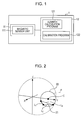
- FIG. 1 is a block diagram illustrating a schematic configuration of an electronic compass according to an embodiment of the present invention.
- An electronic compass 1 illustrated in Fig. 1 primarily includes a compass module 11 and a control unit 12.
- the compass module 11 includes a magnetic sensor unit 111.
- the control unit 12 includes an azimuth calculation program 121 that determines an azimuth using output of the magnetic sensor unit 111, and a calibration program 122 that determines reference points of output of a magnetic sensor using the output of the magnetic sensor unit 111.
- the magnetic sensor in the magnetic sensor unit 111 of the compass module 11 corresponds to at least three axes for magnetic detection purposes.
- the types of sensor elements included in the magnetic sensor are not particularly limited. Examples of the sensor elements include magnetoresistive effect elements, such as a Giant MagnetoResistive (GMR) element, an Anisotropic MagnetoResistive (AMR) element, a Tunnel MagnetoResistive (TMR) element, and a Granular In Gap (GIG) element; and magnetic detection elements, such as a hall element and an MI element.
- the compass module 11 includes a processing unit for applying a voltage and a magnetic field to the magnetic sensor unit 11, and a processing unit for converting an analog signal from the magnetic sensor unit 11 into a digital signal.
- the control unit 12 includes at least the azimuth calculation program 121 and the calibration program 122.
- the calibration program 122 is not limited to a particular one, as long as it is capable of determining reference points of the output of the magnetic sensor.
- the azimuth calculation program 121 is a program that determines an azimuth using output of the magnetic sensor. Since the present program performs an azimuth calculation with a small number of output values, the azimuth can be determined quickly. Additionally, the present program can perform an accurate azimuth calculation even when the inclination direction changes.
- the azimuth calculation program 121 is a computer-executable program that performs an azimuth calculation using output of the magnetic sensor.
- the azimuth calculation program 121 includes a first step of generating one triangle in three-dimensional space using three output values of the magnetic sensor, a second step of determining a circumcircle of the triangle, and a third step of performing an azimuth calculation using center coordinates of the circumcircle and output values of the magnetic sensor.
- Fig. 2 illustrates principles of an azimuth calculation according to an embodiment of the present invention.
- the first step determines magnetic sensor output in three-dimensional space, as illustrated in Fig. 2 .
- the magnetic sensor output is detected data detected in the magnetic sensor unit 111 of equipment on which the compass module 11 is mounted by the user. Three points of detected data are required to form a triangle described below. The three points of detected data are determined by the magnetic sensor unit 111 and used to generate a triangle 21.
- the azimuth calculation can be performed with high accuracy. Specifically, the evaluation is made by determining whether lengths L 1 , L 2 , and L 3 of respective sides of the triangle 21 exceed a predetermined value.
- the predetermined value can be determined by parameters initialized by calibration.
- the parameters include a distance between reference points in three-dimensional space (i.e., a length of each side of the triangle) and the number of sampled triangles.
- a minimum value of the lengths in each side of the sampled triangles is used as a predetermined value.
- a determination may be made as to whether the length of each side is greater than or equal to a predetermined rate (N%) of a radius of a reference sphere P to evaluate the probability of the triangle.
- N% a predetermined rate
- the probability of the triangle may be evaluated on the basis of whether the distance between the center point of the reference sphere P and each vertex of the triangle 21 is substantially equal to the radius of the reference sphere P.
- the probability of the triangle may be evaluated in a simple manner by determining whether the center of the circumcircle of the triangle is located inside the reference sphere P or whether the distance between a plane containing the triangle and the center point of the reference sphere P is within the radius of the reference sphere P.
- the second step determines the circumcircle 22 of the triangle 21, as illustrated in Fig. 2 . This is to obtain a cross section of the reference sphere P in Fig. 2 . Then, the center coordinates of the resulting circumcircle 22 are determined. The center coordinates are used to perform an azimuth calculation.
- the predetermined range can be set using parameters initialized by calibration. This increases the accuracy of the circumcircle and makes it possible to perform an accurate azimuth calculation.
- Information about the circumcircle 22 (e.g., output values for forming the triangle 21 to determine the circumcircle 22, and center coordinates of the circumcircle 22) is stored in a memory.
- the information about this already determined circumcircle and information about a newly determined circumcircle can be used to enhance accuracy of the circumcircle 22. For example, if an angle between a plane containing an already determined circumcircle and a plane containing a newly determined circumcircle is within a predetermined range, the center coordinates of the already determined circumcircle are used to perform an azimuth calculation. If this angle is outside the predetermined range and the triangle 21 is determined not to be probable, it is determined that there is some effect of noise.
- the center coordinates of the already determined circumcircle are used to perform an azimuth calculation. If the above-described angle is within the predetermined range and the triangle 21 is determined to be probable, it is determined that there is a sudden change in inclination direction. Then, the center coordinates of the newly determined circumcircle are used to perform an azimuth calculation. Thus, even when the inclination direction of the equipment including the electronic compass suddenly changes, an azimuth calculation can be performed using the newly determined circumcircle. Therefore, it is possible to quickly respond to a change in inclination direction.
- the center coordinates of the newly determined circumcircle are used to obtain a weighted average of the center coordinates of the already determined circumcircle.
- the third step performs an azimuth calculation using center coordinates C of the circumcircle 22 illustrated in Fig. 2 and output values of the magnetic sensor unit 111.
- three points are collected to generate a triangle.
- a condition considered in the method of collecting the three points is that a distance between points is greater than or equal to a predetermined value.
- Fig. 3 is a flowchart illustrating a procedure of collecting three points.
- Fig. 4 is a conceptual diagram illustrating the collection of three points, the collection being performed in accordance with the procedure of Fig. 3 .
- P NEW indicates a given sensor output value
- P A , P B , and P C indicate sensor output values corresponding to collected three points.
- the first point is collected and its corresponding sensor output value P NEW is set to P A (step ST11).
- the second point is collected and a determination is made as to whether the distance between its corresponding sensor output value P NEW and the sensor output value P A is greater than or equal to a specified value (step ST12).
- the sensor output value P NEW is set to P B (step ST13).
- the third point is collected and determinations are made as to whether the distance between its corresponding sensor output value P NEW and the sensor output value P A is greater than or equal to the specified value, and whether the distance between its corresponding sensor output value P NEW and the sensor output value P B is greater than or equal to the specified value (step ST14). If both are greater than or equal to the specified value, the sensor output value P NEW is set to P C (step ST15).
- the user who operates the electronic compass can make an azimuth calculation without having to perform a specified operation.
- Two conditions to be considered in the method of collecting multiple sets of three points are that a distance between points is greater than or equal to a predetermined value, and that a distance from a center position of a determined circumcircle to each of the points P A , P B , and P C is within a predetermined range.
- Fig. 5 and Fig. 6 are flowcharts illustrating procedures of collecting N sets of three points in buffer (0) to buffer (N-1). Before execution of the procedures, a buffer index (i) is initialized to zero.
- a buffer number "i" is incremented by one (step ST31), and a determination is made as to whether the resulting buffer number is greater than or equal to N (step ST32). If the resulting buffer number is greater than or equal to N, the buffer number "i" is initialized (to zero) (step ST33).
- Fig. 7 is a conceptual diagram illustrating the collection of multiple sets of three points, the collection being performed in accordance with the procedures illustrated in Fig. 5 and Fig. 6 .
- Fig. 8 illustrates how points are stored in buffers during collection of multiple sets of three points.
- the first plotted points are unconditionally stored in respective buffers, each being prepared in advance for storing three points. That is, the initial five plotted points (P A1 , P A2 , P A3 , P A4 , and P A5 ) are stored in the respective buffers as the first points.
- a buffer for storing the plotted point (P A6 ) is searched for.
- the search starts at a buffer that follows the buffer in which the previous plotted point is stored.
- the attempt to store the plotted point (P A6 ) starts at buffer 1.
- distances from the plotted point (P A6 ) to the first points (P A1 , P A2 , P A3 , P A4 , and P A5 ) in the respective buffers are short. Therefore, the plotted point (P A6 ) is discarded, as it does not meet the condition described above.
- the next plotted point (P A7 ) is also discarded for the same reason.
- the subsequently collected plotted point (P B1 ) is away from the first point (P A1 ) in buffer 1 by a distance greater than or equal to a specified value. Therefore, as illustrated in Fig. 8(b) , the plotted point (P B1 ) is stored as the second point in buffer 1. Likewise, as illustrated in Fig. 8(c) , plotted points (P B2 to P B5 ) and plotted points (P C1 to P C5 ) that meet distance conditions are sequentially stored as the second and third points in appropriate buffers.
- the storage of plotted points (sensor output) in a plurality of buffers is not performed in a manner in which, after a set of plotted points (e.g., three plotted points) is completely stored in one buffer, storage of plotted points in the next buffer starts. That is, the plotted points that meet the above-described conditions are stored in the buffers sequentially in the order in which they were obtained. In other words, as illustrated in Fig. 8(b) , while there is still a storage area left in one area, storage in another buffer is performed. As described above, obtained plotted points are sequentially stored in all the buffers on the basis of whether the above-described conditions are met.
- the present embodiment describes the case where the first to third points are sequentially and equally stored in a plurality of buffers.
- each buffer has a unique condition (distance) for storing plotted points
- the occupancy rate of each buffer may vary.
- a locus such as that indicated by a broken line in Fig. 7 may be followed.
- a point P E cannot be stored in buffer 1, but can meet a condition for storage in buffer 5.
- the respective centers of circumcircles are calculated and averaged to determine the original circumcircle center.
- averaging the circumcircle centers only a high-density area in a group of multiple circumcircle centers is subjected to averaging.
- C 1 to C 5 when five sphere centers (C 1 to C 5 ) are calculated, three circumcircle centers in a high-density area (C 1 to C 3 ) are averaged, and C 4 and C 5 , which are assumed to have significant noise, are eliminated.
- the circumcircle center can be determined from a set of only four output points with less noise. Therefore, as compared not only to the method where multiple circumcircle centers are simply averaged, but also to the method where the center is determined by performing a matrix operation directly from many output values, it is possible to reduce the effect of noise and accurately determine the circumcircle.
- the sum (L n ) of distances from an own position (C n ) to other circumcircle centers e.g., when the own position is C 1 , the sum (L 1 ) of distances from C 1 to C 2 , from C 1 to C 3 , from C 1 to C 4 , and from C 1 to C 5
- the average of the distance sums (L AVE (L 1 +L 2 +L 3 +L 4 +L 5 )/5) is calculated.
- L n is smaller than or equal to the average of the distance sums (L AVE )
- the own position (C n ) is regarded as a virtual sphere center in the high-density area.
- FIG. 10 is a flowchart illustrating an azimuth calculation using an azimuth calculation program according to an embodiment of the present invention.
- step ST41 After the electronic compass 1 is activated (step ST41), calibration is performed, and parameters necessary for an azimuth calculation are initialized (steps ST42 and ST43).
- the output of the magnetic sensor unit 111 in the compass module 11 is used to generate a triangle (step ST44).
- three output values are obtained from the magnetic sensor unit 111.
- L 1 , L 2 , and L 3 determined in the above-described manner are compared to a minimum distance of the lengths of the sides of the triangle determined from the parameters initialized by calibration. Then, a determination is made as to whether the triangle is a probable one (step ST45). In other words, a determination is made as to whether L 1 , L 2 , and L 3 are all greater than the minimum distance (threshold value). If L 1 , L 2 , and L 3 are all greater than the minimum distance, it is determined that the triangle is a probable one, and a circumcircle is generated (step ST46). If any of L 1 , L 2 , and L 3 is less than or equal to the minimum distance, a triangle is formed from other plotted points (step ST44).
- the center coordinates of the generated circumcircle and output values (X t , Y t , Z t ) of the magnetic sensor unit 111, the output values being obtained at this point, are used to perform an azimuth calculation (step ST48).
- an output value A (A x , A y , A z ) on the circumcircle 22 is first rotated about the X axis by an inclination angle (- ⁇ ), as illustrated in Fig. 11(b) .
- Coordinates (A' x , A' y , A' z ) of an output value A' obtained after the rotation can be determined by Equation (2) from the coordinates (A x , A y , A z ) obtained before the rotation and the inclination angle (- ⁇ ):
- a ⁇ x A ⁇ y A ⁇ z Ax Ay Az ⁇ 1 0 0 0 cos - ⁇ sin - ⁇ 0 - sin - ⁇ cos - ⁇
- an azimuth angle ⁇ can be determined by Equation (3) from an X component and a Y component (A' x , A' y ) of the output value A' obtained after the rotation:
- Azimuth angle ⁇ tan ⁇ 1 A ′ y / A ′ x
- step ST49 If a reference circumcircle is already determined and stored in the memory, an angle between the already determined circumcircle and the newly determined circumcircle is calculated, and a determination is made as to whether the angle is within a predetermined range (step ST49). If the angle is within the predetermined range (i.e., less than or equal to a threshold value), the center coordinates of the newly determined circumcircle are used to calculate a weighted average of the center coordinates of the already determined circumcircle (step ST50). Then, the weighted-averaged center coordinates of the circumcircle are used to perform an azimuth calculation (step ST48).
- the electronic compass it is possible to perform an azimuth calculation using three output values from the magnetic sensor unit 111, and thus the azimuth of the equipment can be determined quickly. Moreover, even when the inclination direction of the equipment changes, the present program can instantaneously perform an azimuth calculation using the latest output values. Therefore, an accurate azimuth can be obtained even when the inclination direction of the equipment suddenly changes.
- the present invention is not limited to the embodiments described above, and may be implemented in various ways.
- the compass module and the control unit of the electronic compass are configured as separate components.
- the compass module and the control unit of the electronic compass may be configured as a single component.
- the azimuth calculation method described in the above embodiments is merely an example, and other azimuth calculation methods may be used in the present invention. Various other modifications may be made without departing from the scope of the present invention.
Landscapes
- Physics & Mathematics (AREA)
- Engineering & Computer Science (AREA)
- Radar, Positioning & Navigation (AREA)
- Remote Sensing (AREA)
- General Physics & Mathematics (AREA)
- Condensed Matter Physics & Semiconductors (AREA)
- Electromagnetism (AREA)
- Measuring Magnetic Variables (AREA)
- Measurement Of Length, Angles, Or The Like Using Electric Or Magnetic Means (AREA)
- Position Input By Displaying (AREA)
Abstract
Description
- The present invention relates to an azimuth calculation program that performs an azimuth calculation using output of a magnetic sensor, and also to an electronic compass including the azimuth calculation program.
- An electronic compass is a device that calculates an azimuth angle from a reference direction using output of a magnetic sensor. In recent years, mobile terminals, such as mobile phones, including such an electronic compass have been developed.
Patent Document 1 discloses a method with which an azimuth calculation can be performed in such a mobile terminal, regardless of the place of measurement. In the method disclosed inPatent Document 1, an output value of a magnetic sensor is obtained repeatedly a predetermined number of times or more, so that a circle where the resulting plurality of output values are located is used to perform an azimuth calculation. - Patent Document 1: Japanese Unexamined Patent Application Publication No.
2004-309228 - However, in the method disclosed in
Patent Document 1, since an output value of the magnetic sensor is obtained repeatedly a predetermined number of times or more, a long time is required for the azimuth calculation. Moreover, when an inclination direction of the mobile terminal changes, for example, when the azimuth of the mobile terminal changes while the inclination direction thereof changes, the azimuth calculation cannot be accurately performed with the method described above. - The present invention has been made in view of the points described above. An object of the present invention is to provide an azimuth calculation program and an electronic compass capable of performing an azimuth calculation in a short time even when the inclination direction of the equipment changes.
- An azimuth calculation program according to the present invention is a computer-executable program that performs an azimuth calculation using output of a magnetic sensor. The azimuth calculation program includes the steps of generating one triangle in three-dimensional space using three output values of the magnetic sensor, determining a circumcircle of the triangle, and performing an azimuth calculation using center coordinates of the circumcircle and output values of the magnetic sensor.
- With this configuration, it is possible to perform an azimuth calculation using three output values of the magnetic sensor, and thus the azimuth of the equipment can be determined quickly. Moreover, even when the inclination direction of the equipment changes, the present program can instantaneously perform an azimuth calculation using the latest output values of the magnetic sensor. Therefore, an accurate azimuth can be obtained even when the inclination direction of the equipment suddenly changes.
- In the azimuth calculation program according to the present invention, when an angle between a plane containing an already determined circumcircle and a plane containing a newly determined circumcircle is within a predetermined range, center coordinates of the already determined circumcircle may be preferably used to perform the azimuth calculation.
- In the azimuth calculation program according to the present invention, when an angle between a plane containing an already determined circumcircle and a plane containing a newly determined circumcircle is within a predetermined range, center coordinates of the newly determined circumcircle may be preferably used to obtain a weighted average of center coordinates of the already determined circumcircle.
- In the azimuth calculation program according to the present invention, the circumcircle may be preferably determined by collecting multiple sets of the three output values, and averaging centers of virtual circumcircles determined from the respective sets of the three output values.
- An electronic compass according to the present invention includes a compass module having a magnetic sensor, and control means having the azimuth calculation program that performs an azimuth calculation using output of the magnetic sensor.
- In the electronic compass according to the present invention, the control means may preferably include a plurality of buffers capable of storing the three output values, and may preferably determine, on the basis of a predetermined condition, whether the output of the magnetic sensor can be stored in the plurality of buffers.
- The azimuth calculation program according to the present invention generates one triangle in three-dimensional space using three output values of the magnetic sensor, determines a circumcircle of the triangle, and performs an azimuth calculation using center coordinates of the circumcircle and output values of the magnetic sensor. Thus, even when the inclination direction of the mobile terminal changes, an azimuth calculation can be performed in a short time.
-
- [
Fig. 1] Fig. 1 is a block diagram illustrating a schematic configuration of an electronic compass according to an embodiment of the present invention. - [
Fig. 2] Fig. 2 illustrates principles of an azimuth calculation according to an embodiment of the present invention. - [
Fig. 3] Fig. 3 is a flowchart illustrating a procedure of collecting three points. - [
Fig. 4] Fig. 4 is a conceptual diagram illustrating the collection of three points, the collection being performed in accordance with the procedure ofFig. 3 . - [
Fig. 5] Fig. 5 is a flowchart illustrating a procedure of collecting N sets of three points in buffer (0) to buffer (N-1). - [
Fig. 6] Fig. 6 is a flowchart illustrating another procedure of collecting N sets of three points in buffer (0) to buffer (N-1). - [
Fig. 7] Fig. 7 is a conceptual diagram illustrating the collection of multiple sets of three points, the collection being performed in accordance with the procedures illustrated inFig. 5 and Fig. 6 . - [
Fig. 8] Fig. 8 illustrates how points are stored in buffers during collection of multiple sets of three points. - [
Fig. 9] Fig. 9 illustrates density in relation to averaging of circumcircle centers. - [
Fig. 10] Fig. 10 is a flowchart illustrating an azimuth calculation using an azimuth calculation program according to an embodiment of the present invention. - [
Fig. 11] Fig. 11 (a) to Fig. 11 (c) illustrate an azimuth calculation. - Hereinafter, embodiments of the present invention will be described in detail with reference to the attached drawings.
-
Fig. 1 is a block diagram illustrating a schematic configuration of an electronic compass according to an embodiment of the present invention. Anelectronic compass 1 illustrated inFig. 1 primarily includes acompass module 11 and acontrol unit 12. Thecompass module 11 includes amagnetic sensor unit 111. Thecontrol unit 12 includes anazimuth calculation program 121 that determines an azimuth using output of themagnetic sensor unit 111, and acalibration program 122 that determines reference points of output of a magnetic sensor using the output of themagnetic sensor unit 111. - The magnetic sensor in the
magnetic sensor unit 111 of thecompass module 11 corresponds to at least three axes for magnetic detection purposes. The types of sensor elements included in the magnetic sensor are not particularly limited. Examples of the sensor elements include magnetoresistive effect elements, such as a Giant MagnetoResistive (GMR) element, an Anisotropic MagnetoResistive (AMR) element, a Tunnel MagnetoResistive (TMR) element, and a Granular In Gap (GIG) element; and magnetic detection elements, such as a hall element and an MI element. Thecompass module 11 includes a processing unit for applying a voltage and a magnetic field to themagnetic sensor unit 11, and a processing unit for converting an analog signal from themagnetic sensor unit 11 into a digital signal. - As driver software programs that drive the
compass module 11, thecontrol unit 12 includes at least theazimuth calculation program 121 and thecalibration program 122. Thecalibration program 122 is not limited to a particular one, as long as it is capable of determining reference points of the output of the magnetic sensor. - The
azimuth calculation program 121 is a program that determines an azimuth using output of the magnetic sensor. Since the present program performs an azimuth calculation with a small number of output values, the azimuth can be determined quickly. Additionally, the present program can perform an accurate azimuth calculation even when the inclination direction changes. - The
azimuth calculation program 121 is a computer-executable program that performs an azimuth calculation using output of the magnetic sensor. Theazimuth calculation program 121 includes a first step of generating one triangle in three-dimensional space using three output values of the magnetic sensor, a second step of determining a circumcircle of the triangle, and a third step of performing an azimuth calculation using center coordinates of the circumcircle and output values of the magnetic sensor. -
Fig. 2 illustrates principles of an azimuth calculation according to an embodiment of the present invention. - The first step determines magnetic sensor output in three-dimensional space, as illustrated in
Fig. 2 . The magnetic sensor output is detected data detected in themagnetic sensor unit 111 of equipment on which thecompass module 11 is mounted by the user. Three points of detected data are required to form a triangle described below. The three points of detected data are determined by themagnetic sensor unit 111 and used to generate atriangle 21. - In this case, it is preferable to enhance accuracy of the azimuth calculation by evaluating probability of the
triangle 21. When the azimuth calculation is performed, various factors may cause noise in the output of themagnetic sensor 111. If output values affected by noise are used to generate thetriangle 21, theresulting triangle 21 is inaccurate. To eliminate thetriangle 21 generated using output values affected by noise, the probability of thetriangle 21 is evaluated. Thus, the azimuth calculation can be performed with high accuracy. Specifically, the evaluation is made by determining whether lengths L1, L2, and L3 of respective sides of thetriangle 21 exceed a predetermined value. Here, the predetermined value can be determined by parameters initialized by calibration. Examples of the parameters include a distance between reference points in three-dimensional space (i.e., a length of each side of the triangle) and the number of sampled triangles. A minimum value of the lengths in each side of the sampled triangles is used as a predetermined value. Additionally, a determination may be made as to whether the length of each side is greater than or equal to a predetermined rate (N%) of a radius of a reference sphere P to evaluate the probability of the triangle. The probability of the triangle may be evaluated on the basis of whether the distance between the center point of the reference sphere P and each vertex of thetriangle 21 is substantially equal to the radius of the reference sphere P. Alternatively, the probability of the triangle may be evaluated in a simple manner by determining whether the center of the circumcircle of the triangle is located inside the reference sphere P or whether the distance between a plane containing the triangle and the center point of the reference sphere P is within the radius of the reference sphere P. - The second step determines the
circumcircle 22 of thetriangle 21, as illustrated inFig. 2 . This is to obtain a cross section of the reference sphere P inFig. 2 . Then, the center coordinates of the resultingcircumcircle 22 are determined. The center coordinates are used to perform an azimuth calculation. - To determine the
circumcircle 22 in the second step, a determination is made as to whether the center coordinates of thecircumcircle 22 are located within a predetermined range. When the center coordinates are located within the predetermined range, the determination of thecircumcircle 22 is confirmed. The predetermined range can be set using parameters initialized by calibration. This increases the accuracy of the circumcircle and makes it possible to perform an accurate azimuth calculation. - Information about the circumcircle 22 (e.g., output values for forming the
triangle 21 to determine thecircumcircle 22, and center coordinates of the circumcircle 22) is stored in a memory. The information about this already determined circumcircle and information about a newly determined circumcircle can be used to enhance accuracy of thecircumcircle 22. For example, if an angle between a plane containing an already determined circumcircle and a plane containing a newly determined circumcircle is within a predetermined range, the center coordinates of the already determined circumcircle are used to perform an azimuth calculation. If this angle is outside the predetermined range and thetriangle 21 is determined not to be probable, it is determined that there is some effect of noise. Then, again, the center coordinates of the already determined circumcircle, the center coordinates being stored in the memory, are used to perform an azimuth calculation. If the above-described angle is within the predetermined range and thetriangle 21 is determined to be probable, it is determined that there is a sudden change in inclination direction. Then, the center coordinates of the newly determined circumcircle are used to perform an azimuth calculation. Thus, even when the inclination direction of the equipment including the electronic compass suddenly changes, an azimuth calculation can be performed using the newly determined circumcircle. Therefore, it is possible to quickly respond to a change in inclination direction. - When the angle between the plane containing the already determined circumcircle and the plane containing the newly determined circumcircle is within the predetermined range, the center coordinates of the newly determined circumcircle are used to obtain a weighted average of the center coordinates of the already determined circumcircle. Thus, by obtaining a weighted average using information about the newly determined circumcircle, it is possible to enhance accuracy of the circumcircle and perform an accurate azimuth calculation.
- The third step performs an azimuth calculation using center coordinates C of the
circumcircle 22 illustrated inFig. 2 and output values of themagnetic sensor unit 111. - In the calibration program according to the present invention, three points are collected to generate a triangle. A condition considered in the method of collecting the three points is that a distance between points is greater than or equal to a predetermined value.
-
Fig. 3 is a flowchart illustrating a procedure of collecting three points.Fig. 4 is a conceptual diagram illustrating the collection of three points, the collection being performed in accordance with the procedure ofFig. 3 . InFig. 3 and Fig. 4 , PNEW indicates a given sensor output value, and PA, PB, and PC indicate sensor output values corresponding to collected three points. As illustrated inFig. 3 , the first point is collected and its corresponding sensor output value PNEW is set to PA (step ST11). Next, the second point is collected and a determination is made as to whether the distance between its corresponding sensor output value PNEW and the sensor output value PA is greater than or equal to a specified value (step ST12). If the distance is greater than or equal to the specified value, the sensor output value PNEW is set to PB (step ST13). Next, the third point is collected and determinations are made as to whether the distance between its corresponding sensor output value PNEW and the sensor output value PA is greater than or equal to the specified value, and whether the distance between its corresponding sensor output value PNEW and the sensor output value PB is greater than or equal to the specified value (step ST14). If both are greater than or equal to the specified value, the sensor output value PNEW is set to PC (step ST15). - In the method described above, since three points that meet the above-described condition are collected from random sensor outputs, the user who operates the electronic compass can make an azimuth calculation without having to perform a specified operation.
- In practice, however, noise that occurs in an electronic circuit and variations in accuracy of AD conversion etc. may cause an error in the output of the magnetic sensor. To eliminate such an error and accurately determine the center (reference point) of a circumcircle, it is preferable to collect multiple sets of three points such as those described above, so as to average the centers of circumcircles determined from the respective sets of three points. In the averaging, a group of circumcircle centers which are present at low density and likely to have significant errors is eliminated, and only circumcircle centers which are present at high density are subjected to averaging.
- Two conditions to be considered in the method of collecting multiple sets of three points are that a distance between points is greater than or equal to a predetermined value, and that a distance from a center position of a determined circumcircle to each of the points PA, PB, and PC is within a predetermined range.
- When multiple sets of three points are collected, three points in each set are all independent and none of plotted points is shared by multiple sets. In other words, the number of points to be plotted is three times the number of sets of three points. In this case, a plurality of buffers for collecting three points are prepared, so that the sensor output is stored in each buffer in accordance with the procedure illustrated in
Fig. 3 . To ensure even distribution of the sensor output among buffers, when one plotted point is successfully stored in one buffer, the next plotted point is stored in the next buffer. -
Fig. 5 and Fig. 6 are flowcharts illustrating procedures of collecting N sets of three points in buffer (0) to buffer (N-1). Before execution of the procedures, a buffer index (i) is initialized to zero. - As illustrated in
Fig. 5 , a determination is made as to whether collection of three points has been completed in buffer (i) (step ST21). If the collection of three points has been completed, the buffer index is updated (step ST23). If the collection of three points has not been completed, the collection of three points is performed in accordance with the procedure illustrated inFig. 3 (step ST22). Next, a determination is made as to whether storage of sensor output in the buffer, the sensor output being obtained by the collection of three points, has been completed (step ST24). If the storage has been completed, the buffer index is updated (step ST23). This process is repeated N times. - For updating the buffer index, as illustrated in
Fig. 6 , a buffer number "i" is incremented by one (step ST31), and a determination is made as to whether the resulting buffer number is greater than or equal to N (step ST32). If the resulting buffer number is greater than or equal to N, the buffer number "i" is initialized (to zero) (step ST33). -
Fig. 7 is a conceptual diagram illustrating the collection of multiple sets of three points, the collection being performed in accordance with the procedures illustrated inFig. 5 and Fig. 6 .Fig. 8 illustrates how points are stored in buffers during collection of multiple sets of three points. - For example, a description will be given about the case where multiple sets of three points are collected from a group of many plotted points on the locus of sensor output, the locus being illustrated in
Fig. 7 . In this example, five sets of three points are collected. First, as illustrated inFig. 8(a) , the first plotted points are unconditionally stored in respective buffers, each being prepared in advance for storing three points. That is, the initial five plotted points (PA1, PA2, PA3, PA4, and PA5) are stored in the respective buffers as the first points. - In an attempt to store the subsequently collected plotted point (PA6), a buffer for storing the plotted point (PA6) is searched for. The search starts at a buffer that follows the buffer in which the previous plotted point is stored. Here, since the previous plotted point (PA5) is stored in
buffer 5, the attempt to store the plotted point (PA6) starts atbuffer 1. However, distances from the plotted point (PA6) to the first points (PA1, PA2, PA3, PA4, and PA5) in the respective buffers are short. Therefore, the plotted point (PA6) is discarded, as it does not meet the condition described above. The next plotted point (PA7) is also discarded for the same reason. - The subsequently collected plotted point (PB1) is away from the first point (PA1) in
buffer 1 by a distance greater than or equal to a specified value. Therefore, as illustrated inFig. 8(b) , the plotted point (PB1) is stored as the second point inbuffer 1. Likewise, as illustrated inFig. 8(c) , plotted points (PB2 to PB5) and plotted points (PC1 to PC5) that meet distance conditions are sequentially stored as the second and third points in appropriate buffers. - The storage of plotted points (sensor output) in a plurality of buffers (e.g., buffers 1 to 5) is not performed in a manner in which, after a set of plotted points (e.g., three plotted points) is completely stored in one buffer, storage of plotted points in the next buffer starts. That is, the plotted points that meet the above-described conditions are stored in the buffers sequentially in the order in which they were obtained. In other words, as illustrated in
Fig. 8(b) , while there is still a storage area left in one area, storage in another buffer is performed. As described above, obtained plotted points are sequentially stored in all the buffers on the basis of whether the above-described conditions are met. Thus, as compared to the case where collection of plotted points is performed after a set of three plotted points meeting the above-described conditions is collected, multiple sets of plotted points can be collected by performing collection a smaller number of times, and thus, calibration can be completed in a shorter time in a user-transparent manner. The above-described process of storing plotted points in a plurality of buffers is controlled by thecontrol unit 12. - The present embodiment describes the case where the first to third points are sequentially and equally stored in a plurality of buffers. However, since each buffer has a unique condition (distance) for storing plotted points, the occupancy rate of each buffer may vary. For example, when the user does not perform a special operation for calibration, such as rotation of the equipment, a locus such as that indicated by a broken line in
Fig. 7 may be followed. In this case, a point PE cannot be stored inbuffer 1, but can meet a condition for storage inbuffer 5. Thus, by determining whether conditions are met and sequentially storing plotted points in all buffers, data collection can be performed efficiently even when the locus of the sensor does not extend over a wide range. - From multiple sets of three points obtained in the manner described above, the respective centers of circumcircles are calculated and averaged to determine the original circumcircle center. For averaging the circumcircle centers, only a high-density area in a group of multiple circumcircle centers is subjected to averaging. For example, as illustrated in
Fig. 9 , when five sphere centers (C1 to C5) are calculated, three circumcircle centers in a high-density area (C1 to C3) are averaged, and C4 and C5, which are assumed to have significant noise, are eliminated. Thus, the circumcircle center can be determined from a set of only four output points with less noise. Therefore, as compared not only to the method where multiple circumcircle centers are simply averaged, but also to the method where the center is determined by performing a matrix operation directly from many output values, it is possible to reduce the effect of noise and accurately determine the circumcircle. - To determine a virtual sphere center in a high-density area, first, the sum (Ln) of distances from an own position (Cn) to other circumcircle centers (e.g., when the own position is C1, the sum (L1) of distances from C1 to C2, from C1 to C3, from C1 to C4, and from C1 to C5) is calculated. Then, the average of the distance sums (LAVE = (L1+L2+L3+L4+L5)/5) is calculated. When Ln is smaller than or equal to the average of the distance sums (LAVE), the own position (Cn) is regarded as a virtual sphere center in the high-density area.
- Next, an azimuth calculation performed in the above-described electronic compass will be described.
Fig. 10 is a flowchart illustrating an azimuth calculation using an azimuth calculation program according to an embodiment of the present invention. - After the
electronic compass 1 is activated (step ST41), calibration is performed, and parameters necessary for an azimuth calculation are initialized (steps ST42 and ST43). - Next, the output of the
magnetic sensor unit 111 in thecompass module 11 is used to generate a triangle (step ST44). In this case, first, three output values are obtained from themagnetic sensor unit 111. The lengths of sides of the triangle, that is, L1, L2, and L3, can be determined by Equations (1) below:
magnetic sensor unit 111 are (Xn-1, Yn-1, Zn-1), (Xn, Yn, Zn), and (Xn+1, Yn+1, Zn+1). - Next, L1, L2, and L3 determined in the above-described manner are compared to a minimum distance of the lengths of the sides of the triangle determined from the parameters initialized by calibration. Then, a determination is made as to whether the triangle is a probable one (step ST45). In other words, a determination is made as to whether L1, L2, and L3 are all greater than the minimum distance (threshold value). If L1, L2, and L3 are all greater than the minimum distance, it is determined that the triangle is a probable one, and a circumcircle is generated (step ST46). If any of L1, L2, and L3 is less than or equal to the minimum distance, a triangle is formed from other plotted points (step ST44).
- To generate a circumcircle, a determination is made as to whether its center coordinates (Xc, Yc, Zc) are within a predetermined range. If it is determined that the center coordinates are within the predetermined range, the determination of the circumcircle is confirmed. Then, a determination is made as to whether a circumcircle already exists, that is, a circumcircle serving as a reference is already determined and stored in the memory (step ST47). When the electronic compass is activated and a circumcircle is generated for the first time, no reference circumcircle exits. In this case, the center coordinates of the generated circumcircle and output values (Xt, Yt, Zt) of the
magnetic sensor unit 111, the output values being obtained at this point, are used to perform an azimuth calculation (step ST48). - In the azimuth calculation, for the
circumcircle 22 in the reference sphere P, such as that illustrated inFig. 11(a) , an output value A (Ax, Ay, Az) on thecircumcircle 22 is first rotated about the X axis by an inclination angle (-θ), as illustrated inFig. 11(b) . - Coordinates (A'x, A'y, A'z) of an output value A' obtained after the rotation can be determined by Equation (2) from the coordinates (Ax, Ay, Az) obtained before the rotation and the inclination angle (-θ):

- Next, an azimuth angle λ can be determined by Equation (3) from an X component and a Y component (A'x, A'y) of the output value A' obtained after the rotation:

- If a reference circumcircle is already determined and stored in the memory, an angle between the already determined circumcircle and the newly determined circumcircle is calculated, and a determination is made as to whether the angle is within a predetermined range (step ST49). If the angle is within the predetermined range (i.e., less than or equal to a threshold value), the center coordinates of the newly determined circumcircle are used to calculate a weighted average of the center coordinates of the already determined circumcircle (step ST50). Then, the weighted-averaged center coordinates of the circumcircle are used to perform an azimuth calculation (step ST48).
- Thus, in the electronic compass according to the present invention, it is possible to perform an azimuth calculation using three output values from the
magnetic sensor unit 111, and thus the azimuth of the equipment can be determined quickly. Moreover, even when the inclination direction of the equipment changes, the present program can instantaneously perform an azimuth calculation using the latest output values. Therefore, an accurate azimuth can be obtained even when the inclination direction of the equipment suddenly changes. - The present invention is not limited to the embodiments described above, and may be implemented in various ways. For example, in the embodiments described above, the compass module and the control unit of the electronic compass are configured as separate components. However, in the present invention, the compass module and the control unit of the electronic compass may be configured as a single component. Additionally, the azimuth calculation method described in the above embodiments is merely an example, and other azimuth calculation methods may be used in the present invention. Various other modifications may be made without departing from the scope of the present invention.
Claims (6)
- An azimuth calculation program being a computer-executable program performing an azimuth calculation by using output of a magnetic sensor, the azimuth calculation program comprising the steps of generating one triangle in three-dimensional space using three output values of the magnetic sensor, determining a circumcircle of the triangle, and performing an azimuth calculation using center coordinates of the circumcircle and output values of the magnetic sensor.
- The azimuth calculation program according to claim 1, wherein when an angle between a plane containing an already determined circumcircle and a plane containing a newly determined circumcircle is within a predetermined range, center coordinates of the already determined circumcircle are used to perform the azimuth calculation.
- The azimuth calculation program according to claim 1, wherein when an angle between a plane containing an already determined circumcircle and a plane containing a newly determined circumcircle is within a predetermined range, center coordinates of the newly determined circumcircle are used to obtain a weighted average of center coordinates of the already determined circumcircle.
- The azimuth calculation program according to claim 1, wherein the circumcircle is determined by collecting multiple sets of the three output values, and averaging centers of virtual circumcircles determined from the respective sets of the three output values.
- An electronic compass comprising a compass module having a magnetic sensor, and control means having the azimuth calculation program of claim 1, the azimuth calculation program performing an azimuth calculation using output of the magnetic sensor.
- The electronic compass according to claim 5, wherein the control means includes a plurality of buffers capable of storing the three output values, and determines, on the basis of a predetermined condition, whether the output of the magnetic sensor can be stored in the plurality of buffers.
Applications Claiming Priority (3)
| Application Number | Priority Date | Filing Date | Title |
|---|---|---|---|
| JP2007055977 | 2007-03-06 | ||
| JP2007191164 | 2007-07-23 | ||
| PCT/JP2008/053914 WO2008111445A1 (en) | 2007-03-06 | 2008-03-05 | Direction calculation program and electronic compass |
Publications (2)
| Publication Number | Publication Date |
|---|---|
| EP2136181A1 true EP2136181A1 (en) | 2009-12-23 |
| EP2136181A4 EP2136181A4 (en) | 2012-12-26 |
Family
ID=39759388
Family Applications (1)
| Application Number | Title | Priority Date | Filing Date |
|---|---|---|---|
| EP08721334A Withdrawn EP2136181A4 (en) | 2007-03-06 | 2008-03-05 | Direction calculation program and electronic compass |
Country Status (4)
| Country | Link |
|---|---|
| US (1) | US8577636B2 (en) |
| EP (1) | EP2136181A4 (en) |
| JP (1) | JP4558840B2 (en) |
| WO (1) | WO2008111445A1 (en) |
Families Citing this family (4)
| Publication number | Priority date | Publication date | Assignee | Title |
|---|---|---|---|---|
| US8543586B2 (en) * | 2010-11-24 | 2013-09-24 | International Business Machines Corporation | Determining points of interest using intelligent agents and semantic data |
| JP5849448B2 (en) * | 2011-06-14 | 2016-01-27 | リコーイメージング株式会社 | Direction measuring method and direction measuring apparatus using a three-axis electronic compass |
| JP6430262B2 (en) * | 2015-01-16 | 2018-11-28 | ローム株式会社 | Offset calculation apparatus and azimuth angle sensor using the same |
| WO2019187905A1 (en) * | 2018-03-26 | 2019-10-03 | アルプスアルパイン株式会社 | Position estimation device, position estimation system, position estimation method, and program |
Family Cites Families (13)
| Publication number | Priority date | Publication date | Assignee | Title |
|---|---|---|---|---|
| JPH0735974B2 (en) * | 1992-01-08 | 1995-04-19 | 日産自動車株式会社 | Vehicle compass |
| US7149627B2 (en) * | 2002-03-01 | 2006-12-12 | Gentex Corporation | Electronic compass system |
| US6968273B2 (en) * | 2002-03-01 | 2005-11-22 | Gentex Corporation | Electronic compass system |
| JP4381161B2 (en) * | 2003-03-05 | 2009-12-09 | シチズンホールディングス株式会社 | Direction measuring device, direction measuring method, and direction measuring program |
| JP4151785B2 (en) * | 2003-04-03 | 2008-09-17 | 旭化成エレクトロニクス株式会社 | Azimuth measuring device, azimuth measuring program, and azimuth measuring method |
| JP2005061969A (en) * | 2003-08-11 | 2005-03-10 | Asahi Kasei Electronics Co Ltd | Azimuthal angle measuring instrument and azimuthal angle measuring method |
| KR100561849B1 (en) * | 2003-11-13 | 2006-03-16 | 삼성전자주식회사 | Method and device for azimuth correction of moving body |
| JP4551661B2 (en) * | 2004-01-06 | 2010-09-29 | シチズンホールディングス株式会社 | Electronic compass, recording medium, and compass program |
| US8065083B2 (en) * | 2004-07-23 | 2011-11-22 | Yamaha Corporation | Azimuth processing device, azimuth processing method, azimuth processing program, direction finding device, tilt offset correcting method, azimuth measuring method, compass sensor unit, and portable electronic device |
| JP2006226810A (en) * | 2005-02-17 | 2006-08-31 | Alps Electric Co Ltd | Azimuth measuring instrument |
| JP2006234581A (en) * | 2005-02-24 | 2006-09-07 | Aichi Micro Intelligent Corp | Electronic compass and azimuth measuring method |
| EP1791224A1 (en) * | 2005-11-28 | 2007-05-30 | Hon Hai Precision Industry Co., Ltd. | Card edge connector |
| KR20080026395A (en) * | 2006-09-20 | 2008-03-25 | 삼성전자주식회사 | Method and device for calibration of compass sensor considering magnetic environment and method and device for measuring azimuth angle |
-
2008
- 2008-03-05 WO PCT/JP2008/053914 patent/WO2008111445A1/en not_active Ceased
- 2008-03-05 EP EP08721334A patent/EP2136181A4/en not_active Withdrawn
- 2008-03-05 JP JP2009503985A patent/JP4558840B2/en active Active
-
2009
- 2009-08-11 US US12/539,212 patent/US8577636B2/en active Active
Non-Patent Citations (2)
| Title |
|---|
| No Search * |
| See also references of WO2008111445A1 * |
Also Published As
| Publication number | Publication date |
|---|---|
| US20090293295A1 (en) | 2009-12-03 |
| JP4558840B2 (en) | 2010-10-06 |
| JPWO2008111445A1 (en) | 2010-06-24 |
| WO2008111445A1 (en) | 2008-09-18 |
| EP2136181A4 (en) | 2012-12-26 |
| US8577636B2 (en) | 2013-11-05 |
Similar Documents
| Publication | Publication Date | Title |
|---|---|---|
| JP4538071B2 (en) | Calibration program and electronic compass | |
| US8412658B2 (en) | System and method for estimating long term characteristics of battery | |
| US10151805B2 (en) | Method for calibration of magnetic sensor | |
| CN109447359A (en) | A kind of data collection point dispositions method and system | |
| EP2136181A1 (en) | Direction calculation program and electronic compass | |
| EP2009395B1 (en) | Apparatus and method for updating an offset value of magnetic sensor data as well as corresponding machine readable medium | |
| CN111190211B (en) | GPS failure position prediction positioning method | |
| JP2011203243A (en) | Magnetic data processing apparatus, method and program | |
| CN120762035B (en) | A method and apparatus for horizontal wind field inversion based on radial velocity of wind profiler radar | |
| CN117726807A (en) | Infrared small target detection method and system based on scale and position sensitivity | |
| CN120742375A (en) | Positioning method, device and storage medium for satellite navigation | |
| CN118483697A (en) | Method for realizing speed feature fusion aiming at visual target and millimeter wave Lei Dadian cloud | |
| US6571173B1 (en) | Three-dimensional space curve comparison using spatial angle variance metric and applications thereof | |
| JP2013097532A (en) | Evaluation value calculation device and evaluation value calculation method | |
| CN116577672A (en) | Battery fault detection method, device, electronic device and storage medium | |
| CN113591890A (en) | Clustering method and device | |
| KR100881228B1 (en) | Object Detection Method Using Ultrasonic Sensor | |
| JP5040103B2 (en) | Magnetic sensor control device, method and program | |
| CN116805045A (en) | Meteorological prediction model correction method, device, equipment and readable storage medium | |
| CN112742001B (en) | Detection method and device for improving counting accuracy of skipping rope based on attitude detection | |
| TWI572879B (en) | Electronic apparatus and method to estimate state of charge for battery | |
| CN115633373B (en) | Roadside device detection method and device based on intelligent network connection and electronic device | |
| JP4775088B2 (en) | Odor identification device | |
| JP5621181B2 (en) | Magnetic data processing apparatus, magnetic data processing method, and magnetic data processing program | |
| CN109583511A (en) | Speed fusion method and device |
Legal Events
| Date | Code | Title | Description |
|---|---|---|---|
| PUAI | Public reference made under article 153(3) epc to a published international application that has entered the european phase |
Free format text: ORIGINAL CODE: 0009012 |
|
| 17P | Request for examination filed |
Effective date: 20091005 |
|
| AK | Designated contracting states |
Kind code of ref document: A1 Designated state(s): AT BE BG CH CY CZ DE DK EE ES FI FR GB GR HR HU IE IS IT LI LT LU LV MC MT NL NO PL PT RO SE SI SK TR |
|
| DAX | Request for extension of the european patent (deleted) | ||
| A4 | Supplementary search report drawn up and despatched |
Effective date: 20121122 |
|
| RIC1 | Information provided on ipc code assigned before grant |
Ipc: G01C 17/28 20060101AFI20121116BHEP Ipc: G01R 33/02 20060101ALI20121116BHEP Ipc: G01C 17/38 20060101ALI20121116BHEP |
|
| 17Q | First examination report despatched |
Effective date: 20130627 |
|
| STAA | Information on the status of an ep patent application or granted ep patent |
Free format text: STATUS: THE APPLICATION IS DEEMED TO BE WITHDRAWN |
|
| 18D | Application deemed to be withdrawn |
Effective date: 20160304 |