EP2135739A2 - Relief printing plate precursor for laser engraving, relief printing plate, and process for producing relief printing plate - Google Patents
Relief printing plate precursor for laser engraving, relief printing plate, and process for producing relief printing plate Download PDFInfo
- Publication number
- EP2135739A2 EP2135739A2 EP09007613A EP09007613A EP2135739A2 EP 2135739 A2 EP2135739 A2 EP 2135739A2 EP 09007613 A EP09007613 A EP 09007613A EP 09007613 A EP09007613 A EP 09007613A EP 2135739 A2 EP2135739 A2 EP 2135739A2
- Authority
- EP
- European Patent Office
- Prior art keywords
- group
- relief
- printing plate
- compound
- forming layer
- Prior art date
- Legal status (The legal status is an assumption and is not a legal conclusion. Google has not performed a legal analysis and makes no representation as to the accuracy of the status listed.)
- Withdrawn
Links
- 238000007639 printing Methods 0.000 title claims abstract description 184
- 239000002243 precursor Substances 0.000 title claims abstract description 100
- 238000010147 laser engraving Methods 0.000 title claims abstract description 98
- 238000000034 method Methods 0.000 title claims description 95
- 230000008569 process Effects 0.000 title claims description 30
- 150000001875 compounds Chemical class 0.000 claims abstract description 199
- 229920000642 polymer Polymers 0.000 claims abstract description 189
- 239000011230 binding agent Substances 0.000 claims abstract description 52
- 230000001877 deodorizing effect Effects 0.000 claims abstract description 36
- 229910052717 sulfur Inorganic materials 0.000 claims description 86
- 238000004132 cross linking Methods 0.000 claims description 46
- 239000003795 chemical substances by application Substances 0.000 claims description 30
- 235000013824 polyphenols Nutrition 0.000 claims description 28
- 150000008442 polyphenolic compounds Chemical class 0.000 claims description 23
- 125000000524 functional group Chemical group 0.000 claims description 22
- 125000004434 sulfur atom Chemical group 0.000 claims description 18
- WQGWDDDVZFFDIG-UHFFFAOYSA-N pyrogallyl group Chemical group C1(=C(C(=CC=C1)O)O)O WQGWDDDVZFFDIG-UHFFFAOYSA-N 0.000 claims description 7
- YCIMNLLNPGFGHC-UHFFFAOYSA-N catechol Chemical group OC1=CC=CC=C1O YCIMNLLNPGFGHC-UHFFFAOYSA-N 0.000 claims description 5
- 150000001766 catechin derivatives Chemical class 0.000 claims description 4
- 239000010410 layer Substances 0.000 description 225
- -1 amine compound Chemical class 0.000 description 192
- 239000000178 monomer Substances 0.000 description 115
- NIXOWILDQLNWCW-UHFFFAOYSA-M Acrylate Chemical compound [O-]C(=O)C=C NIXOWILDQLNWCW-UHFFFAOYSA-M 0.000 description 99
- 239000011593 sulfur Substances 0.000 description 70
- NINIDFKCEFEMDL-UHFFFAOYSA-N Sulfur Chemical compound [S] NINIDFKCEFEMDL-UHFFFAOYSA-N 0.000 description 69
- 229920005749 polyurethane resin Polymers 0.000 description 52
- 125000001424 substituent group Chemical group 0.000 description 51
- 239000007788 liquid Substances 0.000 description 42
- 230000035945 sensitivity Effects 0.000 description 42
- 125000000217 alkyl group Chemical group 0.000 description 41
- 239000000203 mixture Substances 0.000 description 40
- 239000003963 antioxidant agent Substances 0.000 description 39
- 235000006708 antioxidants Nutrition 0.000 description 39
- CURLTUGMZLYLDI-UHFFFAOYSA-N Carbon dioxide Chemical compound O=C=O CURLTUGMZLYLDI-UHFFFAOYSA-N 0.000 description 38
- LFQSCWFLJHTTHZ-UHFFFAOYSA-N Ethanol Chemical compound CCO LFQSCWFLJHTTHZ-UHFFFAOYSA-N 0.000 description 37
- 125000004435 hydrogen atom Chemical group [H]* 0.000 description 37
- 125000002887 hydroxy group Chemical group [H]O* 0.000 description 37
- 239000004065 semiconductor Substances 0.000 description 37
- 229920005989 resin Polymers 0.000 description 35
- 239000011347 resin Substances 0.000 description 35
- 235000019645 odor Nutrition 0.000 description 34
- 229920002451 polyvinyl alcohol Polymers 0.000 description 33
- 125000003118 aryl group Chemical group 0.000 description 32
- 235000019422 polyvinyl alcohol Nutrition 0.000 description 32
- 239000004372 Polyvinyl alcohol Substances 0.000 description 31
- 238000000576 coating method Methods 0.000 description 31
- 239000000049 pigment Substances 0.000 description 31
- 239000004952 Polyamide Substances 0.000 description 30
- 230000003078 antioxidant effect Effects 0.000 description 30
- 239000011248 coating agent Substances 0.000 description 30
- 229920002647 polyamide Polymers 0.000 description 30
- 230000015572 biosynthetic process Effects 0.000 description 27
- 125000004432 carbon atom Chemical group C* 0.000 description 25
- LYCAIKOWRPUZTN-UHFFFAOYSA-N ethylene glycol Natural products OCCO LYCAIKOWRPUZTN-UHFFFAOYSA-N 0.000 description 25
- 239000003505 polymerization initiator Substances 0.000 description 25
- 239000000126 substance Substances 0.000 description 24
- 229910002092 carbon dioxide Inorganic materials 0.000 description 23
- 239000000463 material Substances 0.000 description 23
- 150000003254 radicals Chemical class 0.000 description 23
- 238000006243 chemical reaction Methods 0.000 description 22
- 239000007789 gas Substances 0.000 description 22
- 238000003786 synthesis reaction Methods 0.000 description 22
- HRPVXLWXLXDGHG-UHFFFAOYSA-N Acrylamide Chemical compound NC(=O)C=C HRPVXLWXLXDGHG-UHFFFAOYSA-N 0.000 description 21
- ISWSIDIOOBJBQZ-UHFFFAOYSA-N Phenol Chemical compound OC1=CC=CC=C1 ISWSIDIOOBJBQZ-UHFFFAOYSA-N 0.000 description 20
- 125000003277 amino group Chemical group 0.000 description 20
- 239000000975 dye Substances 0.000 description 20
- XLYOFNOQVPJJNP-UHFFFAOYSA-N water Substances O XLYOFNOQVPJJNP-UHFFFAOYSA-N 0.000 description 20
- 229920001223 polyethylene glycol Polymers 0.000 description 19
- 239000002904 solvent Substances 0.000 description 19
- 239000002202 Polyethylene glycol Substances 0.000 description 18
- DNIAPMSPPWPWGF-UHFFFAOYSA-N Propylene glycol Chemical compound CC(O)CO DNIAPMSPPWPWGF-UHFFFAOYSA-N 0.000 description 18
- 239000006229 carbon black Substances 0.000 description 18
- 235000019241 carbon black Nutrition 0.000 description 18
- 229920001477 hydrophilic polymer Polymers 0.000 description 18
- 239000003112 inhibitor Substances 0.000 description 18
- 238000006116 polymerization reaction Methods 0.000 description 18
- 239000000243 solution Substances 0.000 description 18
- 150000001412 amines Chemical class 0.000 description 17
- 239000001569 carbon dioxide Substances 0.000 description 17
- 125000003178 carboxy group Chemical group [H]OC(*)=O 0.000 description 17
- 238000004040 coloring Methods 0.000 description 17
- 239000000835 fiber Substances 0.000 description 17
- 239000000976 ink Substances 0.000 description 17
- 239000012790 adhesive layer Substances 0.000 description 15
- 125000003545 alkoxy group Chemical group 0.000 description 15
- 229920001971 elastomer Polymers 0.000 description 15
- 125000005843 halogen group Chemical group 0.000 description 15
- 239000000047 product Substances 0.000 description 15
- CSNNHWWHGAXBCP-UHFFFAOYSA-L Magnesium sulfate Chemical compound [Mg+2].[O-][S+2]([O-])([O-])[O-] CSNNHWWHGAXBCP-UHFFFAOYSA-L 0.000 description 14
- ADRVNXBAWSRFAJ-UHFFFAOYSA-N catechin Natural products OC1Cc2cc(O)cc(O)c2OC1c3ccc(O)c(O)c3 ADRVNXBAWSRFAJ-UHFFFAOYSA-N 0.000 description 14
- 235000005487 catechin Nutrition 0.000 description 14
- 230000000052 comparative effect Effects 0.000 description 14
- 239000002781 deodorant agent Substances 0.000 description 14
- 238000010438 heat treatment Methods 0.000 description 14
- 230000006872 improvement Effects 0.000 description 14
- 229920002037 poly(vinyl butyral) polymer Polymers 0.000 description 14
- 229920002725 thermoplastic elastomer Polymers 0.000 description 14
- 229920001451 polypropylene glycol Polymers 0.000 description 13
- OKKJLVBELUTLKV-UHFFFAOYSA-N Methanol Chemical compound OC OKKJLVBELUTLKV-UHFFFAOYSA-N 0.000 description 12
- 239000011203 carbon fibre reinforced carbon Substances 0.000 description 12
- MTHSVFCYNBDYFN-UHFFFAOYSA-N diethylene glycol Chemical compound OCCOCCO MTHSVFCYNBDYFN-UHFFFAOYSA-N 0.000 description 12
- 239000000284 extract Substances 0.000 description 12
- 150000002989 phenols Chemical class 0.000 description 12
- 230000003405 preventing effect Effects 0.000 description 12
- OKTJSMMVPCPJKN-UHFFFAOYSA-N Carbon Chemical compound [C] OKTJSMMVPCPJKN-UHFFFAOYSA-N 0.000 description 11
- IMROMDMJAWUWLK-UHFFFAOYSA-N Ethenol Chemical group OC=C IMROMDMJAWUWLK-UHFFFAOYSA-N 0.000 description 11
- 239000004793 Polystyrene Substances 0.000 description 11
- OQHMGFSAURFQAF-UHFFFAOYSA-N [2-hydroxy-3-(2-methylprop-2-enoyloxy)propyl] 2-methylprop-2-enoate Chemical compound CC(=C)C(=O)OCC(O)COC(=O)C(C)=C OQHMGFSAURFQAF-UHFFFAOYSA-N 0.000 description 11
- IISBACLAFKSPIT-UHFFFAOYSA-N bisphenol A Chemical compound C=1C=C(O)C=CC=1C(C)(C)C1=CC=C(O)C=C1 IISBACLAFKSPIT-UHFFFAOYSA-N 0.000 description 11
- CREMABGTGYGIQB-UHFFFAOYSA-N carbon carbon Chemical compound C.C CREMABGTGYGIQB-UHFFFAOYSA-N 0.000 description 11
- 239000003822 epoxy resin Substances 0.000 description 11
- 125000000962 organic group Chemical group 0.000 description 11
- 229920000647 polyepoxide Polymers 0.000 description 11
- 229920000728 polyester Polymers 0.000 description 11
- 229920002223 polystyrene Polymers 0.000 description 11
- 238000012719 thermal polymerization Methods 0.000 description 11
- FBPFZTCFMRRESA-FSIIMWSLSA-N D-Glucitol Natural products OC[C@H](O)[C@H](O)[C@@H](O)[C@H](O)CO FBPFZTCFMRRESA-FSIIMWSLSA-N 0.000 description 10
- FBPFZTCFMRRESA-JGWLITMVSA-N D-glucitol Chemical compound OC[C@H](O)[C@@H](O)[C@H](O)[C@H](O)CO FBPFZTCFMRRESA-JGWLITMVSA-N 0.000 description 10
- UIIMBOGNXHQVGW-UHFFFAOYSA-M Sodium bicarbonate Chemical compound [Na+].OC([O-])=O UIIMBOGNXHQVGW-UHFFFAOYSA-M 0.000 description 10
- 125000001931 aliphatic group Chemical group 0.000 description 10
- 238000011156 evaluation Methods 0.000 description 10
- 125000002496 methyl group Chemical group [H]C([H])([H])* 0.000 description 10
- 239000002994 raw material Substances 0.000 description 10
- 239000000600 sorbitol Substances 0.000 description 10
- ARXJGSRGQADJSQ-UHFFFAOYSA-N 1-methoxypropan-2-ol Chemical compound COCC(C)O ARXJGSRGQADJSQ-UHFFFAOYSA-N 0.000 description 9
- XEKOWRVHYACXOJ-UHFFFAOYSA-N Ethyl acetate Chemical compound CCOC(C)=O XEKOWRVHYACXOJ-UHFFFAOYSA-N 0.000 description 9
- 239000000853 adhesive Substances 0.000 description 9
- 230000001070 adhesive effect Effects 0.000 description 9
- 125000003710 aryl alkyl group Chemical group 0.000 description 9
- 150000001732 carboxylic acid derivatives Chemical class 0.000 description 9
- 229920002678 cellulose Polymers 0.000 description 9
- 239000001913 cellulose Substances 0.000 description 9
- 230000009477 glass transition Effects 0.000 description 9
- IQPQWNKOIGAROB-UHFFFAOYSA-N isocyanate group Chemical group [N-]=C=O IQPQWNKOIGAROB-UHFFFAOYSA-N 0.000 description 9
- 238000004519 manufacturing process Methods 0.000 description 9
- 230000009257 reactivity Effects 0.000 description 9
- 239000000758 substrate Substances 0.000 description 9
- 239000002699 waste material Substances 0.000 description 9
- PFTAWBLQPZVEMU-DZGCQCFKSA-N (+)-catechin Chemical compound C1([C@H]2OC3=CC(O)=CC(O)=C3C[C@@H]2O)=CC=C(O)C(O)=C1 PFTAWBLQPZVEMU-DZGCQCFKSA-N 0.000 description 8
- 150000005208 1,4-dihydroxybenzenes Chemical class 0.000 description 8
- LRBQNJMCXXYXIU-PPKXGCFTSA-N Chinese gallotannin Chemical compound OC1=C(O)C(O)=CC(C(=O)OC=2C(=C(O)C=C(C=2)C(=O)OC[C@@H]2[C@H]([C@H](OC(=O)C=3C=C(OC(=O)C=4C=C(O)C(O)=C(O)C=4)C(O)=C(O)C=3)[C@@H](OC(=O)C=3C=C(OC(=O)C=4C=C(O)C(O)=C(O)C=4)C(O)=C(O)C=3)[C@H](OC(=O)C=3C=C(OC(=O)C=4C=C(O)C(O)=C(O)C=4)C(O)=C(O)C=3)O2)OC(=O)C=2C=C(OC(=O)C=3C=C(O)C(O)=C(O)C=3)C(O)=C(O)C=2)O)=C1 LRBQNJMCXXYXIU-PPKXGCFTSA-N 0.000 description 8
- JOYRKODLDBILNP-UHFFFAOYSA-N Ethyl urethane Chemical compound CCOC(N)=O JOYRKODLDBILNP-UHFFFAOYSA-N 0.000 description 8
- KFZMGEQAYNKOFK-UHFFFAOYSA-N Isopropanol Chemical compound CC(C)O KFZMGEQAYNKOFK-UHFFFAOYSA-N 0.000 description 8
- GLUUGHFHXGJENI-UHFFFAOYSA-N Piperazine Chemical compound C1CNCCN1 GLUUGHFHXGJENI-UHFFFAOYSA-N 0.000 description 8
- WNLRTRBMVRJNCN-UHFFFAOYSA-N adipic acid Chemical compound OC(=O)CCCCC(O)=O WNLRTRBMVRJNCN-UHFFFAOYSA-N 0.000 description 8
- 125000002947 alkylene group Chemical group 0.000 description 8
- 125000003368 amide group Chemical group 0.000 description 8
- 125000004104 aryloxy group Chemical group 0.000 description 8
- 125000005442 diisocyanate group Chemical group 0.000 description 8
- 230000000694 effects Effects 0.000 description 8
- XMOCLSLCDHWDHP-IUODEOHRSA-N epi-Gallocatechin Chemical compound C1([C@H]2OC3=CC(O)=CC(O)=C3C[C@H]2O)=CC(O)=C(O)C(O)=C1 XMOCLSLCDHWDHP-IUODEOHRSA-N 0.000 description 8
- 125000000956 methoxy group Chemical group [H]C([H])([H])O* 0.000 description 8
- 230000036961 partial effect Effects 0.000 description 8
- 229920000570 polyether Polymers 0.000 description 8
- 239000005060 rubber Substances 0.000 description 8
- 239000007787 solid Substances 0.000 description 8
- 230000002194 synthesizing effect Effects 0.000 description 8
- 238000005979 thermal decomposition reaction Methods 0.000 description 8
- 150000003568 thioethers Chemical class 0.000 description 8
- ZTQSAGDEMFDKMZ-UHFFFAOYSA-N Butyraldehyde Chemical class CCCC=O ZTQSAGDEMFDKMZ-UHFFFAOYSA-N 0.000 description 7
- CERQOIWHTDAKMF-UHFFFAOYSA-N Methacrylic acid Chemical compound CC(=C)C(O)=O CERQOIWHTDAKMF-UHFFFAOYSA-N 0.000 description 7
- 239000004721 Polyphenylene oxide Substances 0.000 description 7
- GTDPSWPPOUPBNX-UHFFFAOYSA-N ac1mqpva Chemical compound CC12C(=O)OC(=O)C1(C)C1(C)C2(C)C(=O)OC1=O GTDPSWPPOUPBNX-UHFFFAOYSA-N 0.000 description 7
- 239000000654 additive Substances 0.000 description 7
- 125000004453 alkoxycarbonyl group Chemical group 0.000 description 7
- 125000002029 aromatic hydrocarbon group Chemical group 0.000 description 7
- 150000001765 catechin Chemical class 0.000 description 7
- 229950001002 cianidanol Drugs 0.000 description 7
- 239000011247 coating layer Substances 0.000 description 7
- 229940125904 compound 1 Drugs 0.000 description 7
- 125000004093 cyano group Chemical group *C#N 0.000 description 7
- 230000003247 decreasing effect Effects 0.000 description 7
- 239000000806 elastomer Substances 0.000 description 7
- 125000004185 ester group Chemical group 0.000 description 7
- 229910052739 hydrogen Inorganic materials 0.000 description 7
- 229910052943 magnesium sulfate Inorganic materials 0.000 description 7
- 235000019341 magnesium sulphate Nutrition 0.000 description 7
- 229910052757 nitrogen Inorganic materials 0.000 description 7
- 150000001451 organic peroxides Chemical class 0.000 description 7
- 125000004430 oxygen atom Chemical group O* 0.000 description 7
- XRBCRPZXSCBRTK-UHFFFAOYSA-N phosphonous acid Chemical class OPO XRBCRPZXSCBRTK-UHFFFAOYSA-N 0.000 description 7
- 229920000139 polyethylene terephthalate Polymers 0.000 description 7
- 239000005020 polyethylene terephthalate Substances 0.000 description 7
- QIGBRXMKCJKVMJ-UHFFFAOYSA-N Hydroquinone Chemical compound OC1=CC=C(O)C=C1 QIGBRXMKCJKVMJ-UHFFFAOYSA-N 0.000 description 6
- 229920003171 Poly (ethylene oxide) Polymers 0.000 description 6
- 230000000996 additive effect Effects 0.000 description 6
- 150000001336 alkenes Chemical class 0.000 description 6
- 125000000751 azo group Chemical group [*]N=N[*] 0.000 description 6
- 230000001276 controlling effect Effects 0.000 description 6
- 229920001577 copolymer Polymers 0.000 description 6
- 238000001035 drying Methods 0.000 description 6
- JBKVHLHDHHXQEQ-UHFFFAOYSA-N epsilon-caprolactam Chemical compound O=C1CCCCCN1 JBKVHLHDHHXQEQ-UHFFFAOYSA-N 0.000 description 6
- 150000002148 esters Chemical class 0.000 description 6
- 239000001257 hydrogen Substances 0.000 description 6
- 239000003999 initiator Substances 0.000 description 6
- 125000001261 isocyanato group Chemical group *N=C=O 0.000 description 6
- 230000033001 locomotion Effects 0.000 description 6
- 125000000449 nitro group Chemical group [O-][N+](*)=O 0.000 description 6
- 239000013307 optical fiber Substances 0.000 description 6
- 239000012044 organic layer Substances 0.000 description 6
- OJMIONKXNSYLSR-UHFFFAOYSA-N phosphorous acid Chemical compound OP(O)O OJMIONKXNSYLSR-UHFFFAOYSA-N 0.000 description 6
- 239000004014 plasticizer Substances 0.000 description 6
- 229920006122 polyamide resin Polymers 0.000 description 6
- 150000003839 salts Chemical group 0.000 description 6
- 229940058015 1,3-butylene glycol Drugs 0.000 description 5
- IAYPIBMASNFSPL-UHFFFAOYSA-N Ethylene oxide Chemical compound C1CO1 IAYPIBMASNFSPL-UHFFFAOYSA-N 0.000 description 5
- XMOCLSLCDHWDHP-UHFFFAOYSA-N L-Epigallocatechin Natural products OC1CC2=C(O)C=C(O)C=C2OC1C1=CC(O)=C(O)C(O)=C1 XMOCLSLCDHWDHP-UHFFFAOYSA-N 0.000 description 5
- 239000000020 Nitrocellulose Substances 0.000 description 5
- OFOBLEOULBTSOW-UHFFFAOYSA-N Propanedioic acid Natural products OC(=O)CC(O)=O OFOBLEOULBTSOW-UHFFFAOYSA-N 0.000 description 5
- GOOHAUXETOMSMM-UHFFFAOYSA-N Propylene oxide Chemical compound CC1CO1 GOOHAUXETOMSMM-UHFFFAOYSA-N 0.000 description 5
- 230000008901 benefit Effects 0.000 description 5
- PXKLMJQFEQBVLD-UHFFFAOYSA-N bisphenol F Chemical class C1=CC(O)=CC=C1CC1=CC=C(O)C=C1 PXKLMJQFEQBVLD-UHFFFAOYSA-N 0.000 description 5
- 125000001951 carbamoylamino group Chemical group C(N)(=O)N* 0.000 description 5
- 125000005266 diarylamine group Chemical group 0.000 description 5
- 150000002009 diols Chemical class 0.000 description 5
- DZYNKLUGCOSVKS-UHFFFAOYSA-N epigallocatechin Natural products OC1Cc2cc(O)cc(O)c2OC1c3cc(O)c(O)c(O)c3 DZYNKLUGCOSVKS-UHFFFAOYSA-N 0.000 description 5
- 238000005227 gel permeation chromatography Methods 0.000 description 5
- 229920001220 nitrocellulos Polymers 0.000 description 5
- 150000004989 p-phenylenediamines Chemical class 0.000 description 5
- 230000000704 physical effect Effects 0.000 description 5
- BDERNNFJNOPAEC-UHFFFAOYSA-N propan-1-ol Chemical compound CCCO BDERNNFJNOPAEC-UHFFFAOYSA-N 0.000 description 5
- 238000000926 separation method Methods 0.000 description 5
- 235000017557 sodium bicarbonate Nutrition 0.000 description 5
- 229910000030 sodium bicarbonate Inorganic materials 0.000 description 5
- QAOWNCQODCNURD-UHFFFAOYSA-N sulfuric acid group Chemical group S(O)(O)(=O)=O QAOWNCQODCNURD-UHFFFAOYSA-N 0.000 description 5
- 229920001864 tannin Polymers 0.000 description 5
- 235000018553 tannin Nutrition 0.000 description 5
- 239000001648 tannin Substances 0.000 description 5
- 229920001169 thermoplastic Polymers 0.000 description 5
- PUPZLCDOIYMWBV-UHFFFAOYSA-N (+/-)-1,3-Butanediol Chemical compound CC(O)CCO PUPZLCDOIYMWBV-UHFFFAOYSA-N 0.000 description 4
- KGRVJHAUYBGFFP-UHFFFAOYSA-N 2,2'-Methylenebis(4-methyl-6-tert-butylphenol) Chemical compound CC(C)(C)C1=CC(C)=CC(CC=2C(=C(C=C(C)C=2)C(C)(C)C)O)=C1O KGRVJHAUYBGFFP-UHFFFAOYSA-N 0.000 description 4
- XNWFRZJHXBZDAG-UHFFFAOYSA-N 2-METHOXYETHANOL Chemical compound COCCO XNWFRZJHXBZDAG-UHFFFAOYSA-N 0.000 description 4
- NIXOWILDQLNWCW-UHFFFAOYSA-N 2-Propenoic acid Natural products OC(=O)C=C NIXOWILDQLNWCW-UHFFFAOYSA-N 0.000 description 4
- ODJQKYXPKWQWNK-UHFFFAOYSA-N 3,3'-Thiobispropanoic acid Chemical class OC(=O)CCSCCC(O)=O ODJQKYXPKWQWNK-UHFFFAOYSA-N 0.000 description 4
- SECXISVLQFMRJM-UHFFFAOYSA-N N-Methylpyrrolidone Chemical compound CN1CCCC1=O SECXISVLQFMRJM-UHFFFAOYSA-N 0.000 description 4
- 238000010521 absorption reaction Methods 0.000 description 4
- 150000001252 acrylic acid derivatives Chemical class 0.000 description 4
- HFBMWMNUJJDEQZ-UHFFFAOYSA-N acryloyl chloride Chemical compound ClC(=O)C=C HFBMWMNUJJDEQZ-UHFFFAOYSA-N 0.000 description 4
- 239000001361 adipic acid Substances 0.000 description 4
- 235000011037 adipic acid Nutrition 0.000 description 4
- 125000003282 alkyl amino group Chemical group 0.000 description 4
- 229920013820 alkyl cellulose Polymers 0.000 description 4
- 125000004390 alkyl sulfonyl group Chemical group 0.000 description 4
- 150000001408 amides Chemical class 0.000 description 4
- 125000001769 aryl amino group Chemical group 0.000 description 4
- 125000004391 aryl sulfonyl group Chemical group 0.000 description 4
- 125000002915 carbonyl group Chemical group [*:2]C([*:1])=O 0.000 description 4
- 239000003054 catalyst Substances 0.000 description 4
- 238000011161 development Methods 0.000 description 4
- 238000005516 engineering process Methods 0.000 description 4
- 125000001495 ethyl group Chemical group [H]C([H])([H])C([H])([H])* 0.000 description 4
- 238000000605 extraction Methods 0.000 description 4
- 239000000945 filler Substances 0.000 description 4
- 230000006870 function Effects 0.000 description 4
- 229920002824 gallotannin Polymers 0.000 description 4
- 150000004676 glycans Chemical class 0.000 description 4
- WGCNASOHLSPBMP-UHFFFAOYSA-N hydroxyacetaldehyde Natural products OCC=O WGCNASOHLSPBMP-UHFFFAOYSA-N 0.000 description 4
- 239000005457 ice water Substances 0.000 description 4
- ZFSLODLOARCGLH-UHFFFAOYSA-N isocyanuric acid Chemical compound OC1=NC(O)=NC(O)=N1 ZFSLODLOARCGLH-UHFFFAOYSA-N 0.000 description 4
- 238000007644 letterpress printing Methods 0.000 description 4
- 125000005647 linker group Chemical group 0.000 description 4
- 239000011259 mixed solution Substances 0.000 description 4
- 125000001997 phenyl group Chemical group [H]C1=C([H])C([H])=C(*)C([H])=C1[H] 0.000 description 4
- AQSJGOWTSHOLKH-UHFFFAOYSA-N phosphite(3-) Chemical class [O-]P([O-])[O-] AQSJGOWTSHOLKH-UHFFFAOYSA-N 0.000 description 4
- 239000004417 polycarbonate Substances 0.000 description 4
- 229920000515 polycarbonate Polymers 0.000 description 4
- 229920001282 polysaccharide Polymers 0.000 description 4
- 239000005017 polysaccharide Substances 0.000 description 4
- 239000007870 radical polymerization initiator Substances 0.000 description 4
- 238000007142 ring opening reaction Methods 0.000 description 4
- 125000006850 spacer group Chemical group 0.000 description 4
- 125000000020 sulfo group Chemical group O=S(=O)([*])O[H] 0.000 description 4
- LDHQCZJRKDOVOX-UHFFFAOYSA-N trans-crotonic acid Natural products CC=CC(O)=O LDHQCZJRKDOVOX-UHFFFAOYSA-N 0.000 description 4
- JLGLQAWTXXGVEM-UHFFFAOYSA-N triethylene glycol monomethyl ether Chemical compound COCCOCCOCCO JLGLQAWTXXGVEM-UHFFFAOYSA-N 0.000 description 4
- KNXVOGGZOFOROK-UHFFFAOYSA-N trimagnesium;dioxido(oxo)silane;hydroxy-oxido-oxosilane Chemical compound [Mg+2].[Mg+2].[Mg+2].O[Si]([O-])=O.O[Si]([O-])=O.[O-][Si]([O-])=O.[O-][Si]([O-])=O KNXVOGGZOFOROK-UHFFFAOYSA-N 0.000 description 4
- PFTAWBLQPZVEMU-ZFWWWQNUSA-N (+)-epicatechin Natural products C1([C@@H]2OC3=CC(O)=CC(O)=C3C[C@@H]2O)=CC=C(O)C(O)=C1 PFTAWBLQPZVEMU-ZFWWWQNUSA-N 0.000 description 3
- WMBWREPUVVBILR-WIYYLYMNSA-N (-)-Epigallocatechin-3-o-gallate Chemical compound O([C@@H]1CC2=C(O)C=C(C=C2O[C@@H]1C=1C=C(O)C(O)=C(O)C=1)O)C(=O)C1=CC(O)=C(O)C(O)=C1 WMBWREPUVVBILR-WIYYLYMNSA-N 0.000 description 3
- PFTAWBLQPZVEMU-UKRRQHHQSA-N (-)-epicatechin Chemical compound C1([C@H]2OC3=CC(O)=CC(O)=C3C[C@H]2O)=CC=C(O)C(O)=C1 PFTAWBLQPZVEMU-UKRRQHHQSA-N 0.000 description 3
- 150000005206 1,2-dihydroxybenzenes Chemical class 0.000 description 3
- 238000005160 1H NMR spectroscopy Methods 0.000 description 3
- SMZOUWXMTYCWNB-UHFFFAOYSA-N 2-(2-methoxy-5-methylphenyl)ethanamine Chemical compound COC1=CC=C(C)C=C1CCN SMZOUWXMTYCWNB-UHFFFAOYSA-N 0.000 description 3
- QSRJVOOOWGXUDY-UHFFFAOYSA-N 2-[2-[2-[3-(3-tert-butyl-4-hydroxy-5-methylphenyl)propanoyloxy]ethoxy]ethoxy]ethyl 3-(3-tert-butyl-4-hydroxy-5-methylphenyl)propanoate Chemical compound CC(C)(C)C1=C(O)C(C)=CC(CCC(=O)OCCOCCOCCOC(=O)CCC=2C=C(C(O)=C(C)C=2)C(C)(C)C)=C1 QSRJVOOOWGXUDY-UHFFFAOYSA-N 0.000 description 3
- TXBCBTDQIULDIA-UHFFFAOYSA-N 2-[[3-hydroxy-2,2-bis(hydroxymethyl)propoxy]methyl]-2-(hydroxymethyl)propane-1,3-diol Chemical compound OCC(CO)(CO)COCC(CO)(CO)CO TXBCBTDQIULDIA-UHFFFAOYSA-N 0.000 description 3
- 125000000954 2-hydroxyethyl group Chemical group [H]C([*])([H])C([H])([H])O[H] 0.000 description 3
- PFANXOISJYKQRP-UHFFFAOYSA-N 2-tert-butyl-4-[1-(5-tert-butyl-4-hydroxy-2-methylphenyl)butyl]-5-methylphenol Chemical compound C=1C(C(C)(C)C)=C(O)C=C(C)C=1C(CCC)C1=CC(C(C)(C)C)=C(O)C=C1C PFANXOISJYKQRP-UHFFFAOYSA-N 0.000 description 3
- PRWJPWSKLXYEPD-UHFFFAOYSA-N 4-[4,4-bis(5-tert-butyl-4-hydroxy-2-methylphenyl)butan-2-yl]-2-tert-butyl-5-methylphenol Chemical compound C=1C(C(C)(C)C)=C(O)C=C(C)C=1C(C)CC(C=1C(=CC(O)=C(C=1)C(C)(C)C)C)C1=CC(C(C)(C)C)=C(O)C=C1C PRWJPWSKLXYEPD-UHFFFAOYSA-N 0.000 description 3
- VSAWBBYYMBQKIK-UHFFFAOYSA-N 4-[[3,5-bis[(3,5-ditert-butyl-4-hydroxyphenyl)methyl]-2,4,6-trimethylphenyl]methyl]-2,6-ditert-butylphenol Chemical compound CC1=C(CC=2C=C(C(O)=C(C=2)C(C)(C)C)C(C)(C)C)C(C)=C(CC=2C=C(C(O)=C(C=2)C(C)(C)C)C(C)(C)C)C(C)=C1CC1=CC(C(C)(C)C)=C(O)C(C(C)(C)C)=C1 VSAWBBYYMBQKIK-UHFFFAOYSA-N 0.000 description 3
- WEVYAHXRMPXWCK-UHFFFAOYSA-N Acetonitrile Chemical compound CC#N WEVYAHXRMPXWCK-UHFFFAOYSA-N 0.000 description 3
- RTZKZFJDLAIYFH-UHFFFAOYSA-N Diethyl ether Chemical compound CCOCC RTZKZFJDLAIYFH-UHFFFAOYSA-N 0.000 description 3
- WMBWREPUVVBILR-UHFFFAOYSA-N GCG Natural products C=1C(O)=C(O)C(O)=CC=1C1OC2=CC(O)=CC(O)=C2CC1OC(=O)C1=CC(O)=C(O)C(O)=C1 WMBWREPUVVBILR-UHFFFAOYSA-N 0.000 description 3
- PEDCQBHIVMGVHV-UHFFFAOYSA-N Glycerine Chemical compound OCC(O)CO PEDCQBHIVMGVHV-UHFFFAOYSA-N 0.000 description 3
- UFHFLCQGNIYNRP-UHFFFAOYSA-N Hydrogen Chemical compound [H][H] UFHFLCQGNIYNRP-UHFFFAOYSA-N 0.000 description 3
- MHAJPDPJQMAIIY-UHFFFAOYSA-N Hydrogen peroxide Chemical compound OO MHAJPDPJQMAIIY-UHFFFAOYSA-N 0.000 description 3
- LRHPLDYGYMQRHN-UHFFFAOYSA-N N-Butanol Chemical compound CCCCO LRHPLDYGYMQRHN-UHFFFAOYSA-N 0.000 description 3
- 241000282320 Panthera leo Species 0.000 description 3
- NBIIXXVUZAFLBC-UHFFFAOYSA-N Phosphoric acid Chemical group OP(O)(O)=O NBIIXXVUZAFLBC-UHFFFAOYSA-N 0.000 description 3
- 239000004698 Polyethylene Substances 0.000 description 3
- XSQUKJJJFZCRTK-UHFFFAOYSA-N Urea Natural products NC(N)=O XSQUKJJJFZCRTK-UHFFFAOYSA-N 0.000 description 3
- 150000003926 acrylamides Chemical class 0.000 description 3
- 150000001298 alcohols Chemical class 0.000 description 3
- 150000008064 anhydrides Chemical class 0.000 description 3
- 229910052799 carbon Inorganic materials 0.000 description 3
- 125000005587 carbonate group Chemical group 0.000 description 3
- 125000002843 carboxylic acid group Chemical group 0.000 description 3
- LDHQCZJRKDOVOX-NSCUHMNNSA-N crotonic acid Chemical compound C\C=C\C(O)=O LDHQCZJRKDOVOX-NSCUHMNNSA-N 0.000 description 3
- 125000000113 cyclohexyl group Chemical group [H]C1([H])C([H])([H])C([H])([H])C([H])(*)C([H])([H])C1([H])[H] 0.000 description 3
- 125000004663 dialkyl amino group Chemical group 0.000 description 3
- LPTRNLNOHUVQMS-UHFFFAOYSA-N epicatechin Natural products Cc1cc(O)cc2OC(C(O)Cc12)c1ccc(O)c(O)c1 LPTRNLNOHUVQMS-UHFFFAOYSA-N 0.000 description 3
- 235000012734 epicatechin Nutrition 0.000 description 3
- 229940030275 epigallocatechin gallate Drugs 0.000 description 3
- 125000003700 epoxy group Chemical group 0.000 description 3
- 125000001033 ether group Chemical group 0.000 description 3
- 239000010419 fine particle Substances 0.000 description 3
- 229910052731 fluorine Inorganic materials 0.000 description 3
- 125000003827 glycol group Chemical group 0.000 description 3
- 230000002401 inhibitory effect Effects 0.000 description 3
- 230000001678 irradiating effect Effects 0.000 description 3
- 125000001449 isopropyl group Chemical group [H]C([H])([H])C([H])(*)C([H])([H])[H] 0.000 description 3
- 239000011976 maleic acid Substances 0.000 description 3
- 238000005259 measurement Methods 0.000 description 3
- 229910052751 metal Inorganic materials 0.000 description 3
- 239000002184 metal Substances 0.000 description 3
- 239000004005 microsphere Substances 0.000 description 3
- 229930014626 natural product Natural products 0.000 description 3
- 230000003472 neutralizing effect Effects 0.000 description 3
- SSDSCDGVMJFTEQ-UHFFFAOYSA-N octadecyl 3-(3,5-ditert-butyl-4-hydroxyphenyl)propanoate Chemical compound CCCCCCCCCCCCCCCCCCOC(=O)CCC1=CC(C(C)(C)C)=C(O)C(C(C)(C)C)=C1 SSDSCDGVMJFTEQ-UHFFFAOYSA-N 0.000 description 3
- 150000002894 organic compounds Chemical class 0.000 description 3
- NWVVVBRKAWDGAB-UHFFFAOYSA-N p-methoxyphenol Chemical compound COC1=CC=C(O)C=C1 NWVVVBRKAWDGAB-UHFFFAOYSA-N 0.000 description 3
- 150000002978 peroxides Chemical class 0.000 description 3
- 229920003023 plastic Polymers 0.000 description 3
- 239000004033 plastic Substances 0.000 description 3
- 229920001225 polyester resin Polymers 0.000 description 3
- 239000004645 polyester resin Substances 0.000 description 3
- 229920002635 polyurethane Polymers 0.000 description 3
- 239000004814 polyurethane Substances 0.000 description 3
- 238000002360 preparation method Methods 0.000 description 3
- 238000010526 radical polymerization reaction Methods 0.000 description 3
- 230000001603 reducing effect Effects 0.000 description 3
- 230000002829 reductive effect Effects 0.000 description 3
- 238000003756 stirring Methods 0.000 description 3
- 238000003860 storage Methods 0.000 description 3
- 125000000547 substituted alkyl group Chemical group 0.000 description 3
- 125000000542 sulfonic acid group Chemical group 0.000 description 3
- VZCYOOQTPOCHFL-UHFFFAOYSA-N trans-butenedioic acid Natural products OC(=O)C=CC(O)=O VZCYOOQTPOCHFL-UHFFFAOYSA-N 0.000 description 3
- XMOCLSLCDHWDHP-SWLSCSKDSA-N (+)-Epigallocatechin Natural products C1([C@H]2OC3=CC(O)=CC(O)=C3C[C@@H]2O)=CC(O)=C(O)C(O)=C1 XMOCLSLCDHWDHP-SWLSCSKDSA-N 0.000 description 2
- LSHVYAFMTMFKBA-TZIWHRDSSA-N (-)-epicatechin-3-O-gallate Chemical compound O([C@@H]1CC2=C(O)C=C(C=C2O[C@@H]1C=1C=C(O)C(O)=CC=1)O)C(=O)C1=CC(O)=C(O)C(O)=C1 LSHVYAFMTMFKBA-TZIWHRDSSA-N 0.000 description 2
- QGKMIGUHVLGJBR-UHFFFAOYSA-M (4z)-1-(3-methylbutyl)-4-[[1-(3-methylbutyl)quinolin-1-ium-4-yl]methylidene]quinoline;iodide Chemical compound [I-].C12=CC=CC=C2N(CCC(C)C)C=CC1=CC1=CC=[N+](CCC(C)C)C2=CC=CC=C12 QGKMIGUHVLGJBR-UHFFFAOYSA-M 0.000 description 2
- ORTVZLZNOYNASJ-OWOJBTEDSA-N (e)-but-2-ene-1,4-diol Chemical compound OC\C=C\CO ORTVZLZNOYNASJ-OWOJBTEDSA-N 0.000 description 2
- MYRTYDVEIRVNKP-UHFFFAOYSA-N 1,2-Divinylbenzene Chemical compound C=CC1=CC=CC=C1C=C MYRTYDVEIRVNKP-UHFFFAOYSA-N 0.000 description 2
- VNQNXQYZMPJLQX-UHFFFAOYSA-N 1,3,5-tris[(3,5-ditert-butyl-4-hydroxyphenyl)methyl]-1,3,5-triazinane-2,4,6-trione Chemical compound CC(C)(C)C1=C(O)C(C(C)(C)C)=CC(CN2C(N(CC=3C=C(C(O)=C(C=3)C(C)(C)C)C(C)(C)C)C(=O)N(CC=3C=C(C(O)=C(C=3)C(C)(C)C)C(C)(C)C)C2=O)=O)=C1 VNQNXQYZMPJLQX-UHFFFAOYSA-N 0.000 description 2
- MYMKXVFDVQUQLG-UHFFFAOYSA-N 1,3,7,9-tetratert-butyl-11-fluoro-5-methyl-5h-benzo[d][1,3,2]benzodioxaphosphocine Chemical compound CC1C2=CC(C(C)(C)C)=CC(C(C)(C)C)=C2OP(F)OC2=C1C=C(C(C)(C)C)C=C2C(C)(C)C MYMKXVFDVQUQLG-UHFFFAOYSA-N 0.000 description 2
- SBJCUZQNHOLYMD-UHFFFAOYSA-N 1,5-Naphthalene diisocyanate Chemical compound C1=CC=C2C(N=C=O)=CC=CC2=C1N=C=O SBJCUZQNHOLYMD-UHFFFAOYSA-N 0.000 description 2
- WGYZMNBUZFHYRX-UHFFFAOYSA-N 1-(1-methoxypropan-2-yloxy)propan-2-ol Chemical compound COCC(C)OCC(C)O WGYZMNBUZFHYRX-UHFFFAOYSA-N 0.000 description 2
- AREPHAPHABGCQP-UHFFFAOYSA-N 1-(dimethylamino)-3-[2-[2-(4-methoxyphenyl)ethyl]phenoxy]propan-2-ol Chemical compound C1=CC(OC)=CC=C1CCC1=CC=CC=C1OCC(O)CN(C)C AREPHAPHABGCQP-UHFFFAOYSA-N 0.000 description 2
- SDXHBDVTZNMBEW-UHFFFAOYSA-N 1-ethoxy-2-(2-hydroxyethoxy)ethanol Chemical compound CCOC(O)COCCO SDXHBDVTZNMBEW-UHFFFAOYSA-N 0.000 description 2
- XLPJNCYCZORXHG-UHFFFAOYSA-N 1-morpholin-4-ylprop-2-en-1-one Chemical compound C=CC(=O)N1CCOCC1 XLPJNCYCZORXHG-UHFFFAOYSA-N 0.000 description 2
- DKCPKDPYUFEZCP-UHFFFAOYSA-N 2,6-di-tert-butylphenol Chemical compound CC(C)(C)C1=CC=CC(C(C)(C)C)=C1O DKCPKDPYUFEZCP-UHFFFAOYSA-N 0.000 description 2
- OZAIFHULBGXAKX-UHFFFAOYSA-N 2-(2-cyanopropan-2-yldiazenyl)-2-methylpropanenitrile Chemical compound N#CC(C)(C)N=NC(C)(C)C#N OZAIFHULBGXAKX-UHFFFAOYSA-N 0.000 description 2
- SBASXUCJHJRPEV-UHFFFAOYSA-N 2-(2-methoxyethoxy)ethanol Chemical compound COCCOCCO SBASXUCJHJRPEV-UHFFFAOYSA-N 0.000 description 2
- ZUAURMBNZUCEAF-UHFFFAOYSA-N 2-(2-phenoxyethoxy)ethanol Chemical compound OCCOCCOC1=CC=CC=C1 ZUAURMBNZUCEAF-UHFFFAOYSA-N 0.000 description 2
- WFSMVVDJSNMRAR-UHFFFAOYSA-N 2-[2-(2-ethoxyethoxy)ethoxy]ethanol Chemical compound CCOCCOCCOCCO WFSMVVDJSNMRAR-UHFFFAOYSA-N 0.000 description 2
- INQDDHNZXOAFFD-UHFFFAOYSA-N 2-[2-(2-prop-2-enoyloxyethoxy)ethoxy]ethyl prop-2-enoate Chemical compound C=CC(=O)OCCOCCOCCOC(=O)C=C INQDDHNZXOAFFD-UHFFFAOYSA-N 0.000 description 2
- HCLJOFJIQIJXHS-UHFFFAOYSA-N 2-[2-[2-(2-prop-2-enoyloxyethoxy)ethoxy]ethoxy]ethyl prop-2-enoate Chemical compound C=CC(=O)OCCOCCOCCOCCOC(=O)C=C HCLJOFJIQIJXHS-UHFFFAOYSA-N 0.000 description 2
- KUDUQBURMYMBIJ-UHFFFAOYSA-N 2-prop-2-enoyloxyethyl prop-2-enoate Chemical compound C=CC(=O)OCCOC(=O)C=C KUDUQBURMYMBIJ-UHFFFAOYSA-N 0.000 description 2
- UYEMGAFJOZZIFP-UHFFFAOYSA-N 3,5-dihydroxybenzoic acid Chemical compound OC(=O)C1=CC(O)=CC(O)=C1 UYEMGAFJOZZIFP-UHFFFAOYSA-N 0.000 description 2
- YCLSOMLVSHPPFV-UHFFFAOYSA-N 3-(2-carboxyethyldisulfanyl)propanoic acid Chemical compound OC(=O)CCSSCCC(O)=O YCLSOMLVSHPPFV-UHFFFAOYSA-N 0.000 description 2
- QCAHUFWKIQLBNB-UHFFFAOYSA-N 3-(3-methoxypropoxy)propan-1-ol Chemical compound COCCCOCCCO QCAHUFWKIQLBNB-UHFFFAOYSA-N 0.000 description 2
- UPMLOUAZCHDJJD-UHFFFAOYSA-N 4,4'-Diphenylmethane Diisocyanate Chemical compound C1=CC(N=C=O)=CC=C1CC1=CC=C(N=C=O)C=C1 UPMLOUAZCHDJJD-UHFFFAOYSA-N 0.000 description 2
- MDWVSAYEQPLWMX-UHFFFAOYSA-N 4,4'-Methylenebis(2,6-di-tert-butylphenol) Chemical compound CC(C)(C)C1=C(O)C(C(C)(C)C)=CC(CC=2C=C(C(O)=C(C=2)C(C)(C)C)C(C)(C)C)=C1 MDWVSAYEQPLWMX-UHFFFAOYSA-N 0.000 description 2
- FJKROLUGYXJWQN-UHFFFAOYSA-N 4-hydroxybenzoic acid Chemical compound OC(=O)C1=CC=C(O)C=C1 FJKROLUGYXJWQN-UHFFFAOYSA-N 0.000 description 2
- ZVVFVKJZNVSANF-UHFFFAOYSA-N 6-[3-(3,5-ditert-butyl-4-hydroxyphenyl)propanoyloxy]hexyl 3-(3,5-ditert-butyl-4-hydroxyphenyl)propanoate Chemical compound CC(C)(C)C1=C(O)C(C(C)(C)C)=CC(CCC(=O)OCCCCCCOC(=O)CCC=2C=C(C(O)=C(C=2)C(C)(C)C)C(C)(C)C)=C1 ZVVFVKJZNVSANF-UHFFFAOYSA-N 0.000 description 2
- IJGRMHOSHXDMSA-UHFFFAOYSA-N Atomic nitrogen Chemical compound N#N IJGRMHOSHXDMSA-UHFFFAOYSA-N 0.000 description 2
- 229930185605 Bisphenol Natural products 0.000 description 2
- KAKZBPTYRLMSJV-UHFFFAOYSA-N Butadiene Chemical compound C=CC=C KAKZBPTYRLMSJV-UHFFFAOYSA-N 0.000 description 2
- KXDHJXZQYSOELW-UHFFFAOYSA-N Carbamic acid Chemical group NC(O)=O KXDHJXZQYSOELW-UHFFFAOYSA-N 0.000 description 2
- GHKOFFNLGXMVNJ-UHFFFAOYSA-N Didodecyl thiobispropanoate Chemical compound CCCCCCCCCCCCOC(=O)CCSCCC(=O)OCCCCCCCCCCCC GHKOFFNLGXMVNJ-UHFFFAOYSA-N 0.000 description 2
- LCGLNKUTAGEVQW-UHFFFAOYSA-N Dimethyl ether Chemical compound COC LCGLNKUTAGEVQW-UHFFFAOYSA-N 0.000 description 2
- LSHVYAFMTMFKBA-UHFFFAOYSA-N ECG Natural products C=1C=C(O)C(O)=CC=1C1OC2=CC(O)=CC(O)=C2CC1OC(=O)C1=CC(O)=C(O)C(O)=C1 LSHVYAFMTMFKBA-UHFFFAOYSA-N 0.000 description 2
- 241000196324 Embryophyta Species 0.000 description 2
- 108090000790 Enzymes Proteins 0.000 description 2
- 102000004190 Enzymes Human genes 0.000 description 2
- 239000004593 Epoxy Substances 0.000 description 2
- 239000001856 Ethyl cellulose Substances 0.000 description 2
- ZZSNKZQZMQGXPY-UHFFFAOYSA-N Ethyl cellulose Chemical compound CCOCC1OC(OC)C(OCC)C(OCC)C1OC1C(O)C(O)C(OC)C(CO)O1 ZZSNKZQZMQGXPY-UHFFFAOYSA-N 0.000 description 2
- YCKRFDGAMUMZLT-UHFFFAOYSA-N Fluorine atom Chemical compound [F] YCKRFDGAMUMZLT-UHFFFAOYSA-N 0.000 description 2
- VEXZGXHMUGYJMC-UHFFFAOYSA-N Hydrochloric acid Chemical compound Cl VEXZGXHMUGYJMC-UHFFFAOYSA-N 0.000 description 2
- RRHGJUQNOFWUDK-UHFFFAOYSA-N Isoprene Chemical compound CC(=C)C=C RRHGJUQNOFWUDK-UHFFFAOYSA-N 0.000 description 2
- 102000004316 Oxidoreductases Human genes 0.000 description 2
- 108090000854 Oxidoreductases Proteins 0.000 description 2
- JKIJEFPNVSHHEI-UHFFFAOYSA-N Phenol, 2,4-bis(1,1-dimethylethyl)-, phosphite (3:1) Chemical compound CC(C)(C)C1=CC(C(C)(C)C)=CC=C1OP(OC=1C(=CC(=CC=1)C(C)(C)C)C(C)(C)C)OC1=CC=C(C(C)(C)C)C=C1C(C)(C)C JKIJEFPNVSHHEI-UHFFFAOYSA-N 0.000 description 2
- 239000005062 Polybutadiene Substances 0.000 description 2
- 229920000954 Polyglycolide Polymers 0.000 description 2
- 239000004743 Polypropylene Substances 0.000 description 2
- XBDQKXXYIPTUBI-UHFFFAOYSA-M Propionate Chemical compound CCC([O-])=O XBDQKXXYIPTUBI-UHFFFAOYSA-M 0.000 description 2
- 229910000831 Steel Inorganic materials 0.000 description 2
- PPBRXRYQALVLMV-UHFFFAOYSA-N Styrene Chemical compound C=CC1=CC=CC=C1 PPBRXRYQALVLMV-UHFFFAOYSA-N 0.000 description 2
- DKGAVHZHDRPRBM-UHFFFAOYSA-N Tert-Butanol Chemical compound CC(C)(C)O DKGAVHZHDRPRBM-UHFFFAOYSA-N 0.000 description 2
- BGNXCDMCOKJUMV-UHFFFAOYSA-N Tert-Butylhydroquinone Chemical compound CC(C)(C)C1=CC(O)=CC=C1O BGNXCDMCOKJUMV-UHFFFAOYSA-N 0.000 description 2
- UWHCKJMYHZGTIT-UHFFFAOYSA-N Tetraethylene glycol, Natural products OCCOCCOCCOCCO UWHCKJMYHZGTIT-UHFFFAOYSA-N 0.000 description 2
- ZJCCRDAZUWHFQH-UHFFFAOYSA-N Trimethylolpropane Chemical compound CCC(CO)(CO)CO ZJCCRDAZUWHFQH-UHFFFAOYSA-N 0.000 description 2
- 239000007983 Tris buffer Substances 0.000 description 2
- 235000009754 Vitis X bourquina Nutrition 0.000 description 2
- 235000012333 Vitis X labruscana Nutrition 0.000 description 2
- 240000006365 Vitis vinifera Species 0.000 description 2
- 235000014787 Vitis vinifera Nutrition 0.000 description 2
- 239000002253 acid Substances 0.000 description 2
- 230000002378 acidificating effect Effects 0.000 description 2
- 125000003647 acryloyl group Chemical group O=C([*])C([H])=C([H])[H] 0.000 description 2
- 230000009471 action Effects 0.000 description 2
- 230000001476 alcoholic effect Effects 0.000 description 2
- 125000004450 alkenylene group Chemical group 0.000 description 2
- 125000004419 alkynylene group Chemical group 0.000 description 2
- 150000008365 aromatic ketones Chemical class 0.000 description 2
- 125000000732 arylene group Chemical group 0.000 description 2
- 125000004429 atom Chemical group 0.000 description 2
- QVGXLLKOCUKJST-UHFFFAOYSA-N atomic oxygen Chemical compound [O] QVGXLLKOCUKJST-UHFFFAOYSA-N 0.000 description 2
- 239000000987 azo dye Substances 0.000 description 2
- 125000001797 benzyl group Chemical group [H]C1=C([H])C([H])=C(C([H])=C1[H])C([H])([H])* 0.000 description 2
- 230000005540 biological transmission Effects 0.000 description 2
- NENAMKMSJOINIR-UHFFFAOYSA-N bis(2,4,4-trimethylpentan-2-yl) 4-[3,4-bis(2,4,4-trimethylpentan-2-ylperoxycarbonyl)benzoyl]benzene-1,2-dicarboperoxoate Chemical group C1=C(C(=O)OOC(C)(C)CC(C)(C)C)C(C(=O)OOC(C)(C)CC(C)(C)C)=CC=C1C(=O)C1=CC=C(C(=O)OOC(C)(C)CC(C)(C)C)C(C(=O)OOC(C)(C)CC(C)(C)C)=C1 NENAMKMSJOINIR-UHFFFAOYSA-N 0.000 description 2
- ITXCLKMRLHBUEP-UHFFFAOYSA-N bis(2-methylbutan-2-yl) 4-[3,4-bis(2-methylbutan-2-ylperoxycarbonyl)benzoyl]benzene-1,2-dicarboperoxoate Chemical group C1=C(C(=O)OOC(C)(C)CC)C(C(=O)OOC(C)(C)CC)=CC=C1C(=O)C1=CC=C(C(=O)OOC(C)(C)CC)C(C(=O)OOC(C)(C)CC)=C1 ITXCLKMRLHBUEP-UHFFFAOYSA-N 0.000 description 2
- YGWAFVKXCAQAGJ-UHFFFAOYSA-N bis(2-methylpentan-2-yl) 4-[3,4-bis(2-methylpentan-2-ylperoxycarbonyl)benzoyl]benzene-1,2-dicarboperoxoate Chemical group C1=C(C(=O)OOC(C)(C)CCC)C(C(=O)OOC(C)(C)CCC)=CC=C1C(=O)C1=CC=C(C(=O)OOC(C)(C)CCC)C(C(=O)OOC(C)(C)CCC)=C1 YGWAFVKXCAQAGJ-UHFFFAOYSA-N 0.000 description 2
- VRZQMDDQCTXMKG-UHFFFAOYSA-N bis(2-phenylpropan-2-yl) 4-[3,4-bis(2-phenylpropan-2-ylperoxycarbonyl)benzoyl]benzene-1,2-dicarboperoxoate Chemical group C=1C=CC=CC=1C(C)(C)OOC(=O)C1=CC=C(C(=O)C=2C=C(C(C(=O)OOC(C)(C)C=3C=CC=CC=3)=CC=2)C(=O)OOC(C)(C)C=2C=CC=CC=2)C=C1C(=O)OOC(C)(C)C1=CC=CC=C1 VRZQMDDQCTXMKG-UHFFFAOYSA-N 0.000 description 2
- LZZMTLWFWQRJIS-UHFFFAOYSA-N bis[2-(4-propan-2-ylphenyl)propan-2-yl] 4-[3,4-bis[2-(4-propan-2-ylphenyl)propan-2-ylperoxycarbonyl]benzoyl]benzene-1,2-dicarboperoxoate Chemical group C1=CC(C(C)C)=CC=C1C(C)(C)OOC(=O)C1=CC=C(C(=O)C=2C=C(C(C(=O)OOC(C)(C)C=3C=CC(=CC=3)C(C)C)=CC=2)C(=O)OOC(C)(C)C=2C=CC(=CC=2)C(C)C)C=C1C(=O)OOC(C)(C)C1=CC=C(C(C)C)C=C1 LZZMTLWFWQRJIS-UHFFFAOYSA-N 0.000 description 2
- 229910052797 bismuth Inorganic materials 0.000 description 2
- JCXGWMGPZLAOME-UHFFFAOYSA-N bismuth atom Chemical compound [Bi] JCXGWMGPZLAOME-UHFFFAOYSA-N 0.000 description 2
- 235000019437 butane-1,3-diol Nutrition 0.000 description 2
- GKRVGTLVYRYCFR-UHFFFAOYSA-N butane-1,4-diol;2-methylidenebutanedioic acid Chemical compound OCCCCO.OC(=O)CC(=C)C(O)=O.OC(=O)CC(=C)C(O)=O GKRVGTLVYRYCFR-UHFFFAOYSA-N 0.000 description 2
- 125000003917 carbamoyl group Chemical group [H]N([H])C(*)=O 0.000 description 2
- 238000005266 casting Methods 0.000 description 2
- 230000008859 change Effects 0.000 description 2
- 239000007795 chemical reaction product Substances 0.000 description 2
- 239000003086 colorant Substances 0.000 description 2
- 229920001940 conductive polymer Polymers 0.000 description 2
- 238000010276 construction Methods 0.000 description 2
- 238000007334 copolymerization reaction Methods 0.000 description 2
- 239000011243 crosslinked material Substances 0.000 description 2
- VEVZSMAEJFVWIL-UHFFFAOYSA-O cyanidin cation Chemical compound [O+]=1C2=CC(O)=CC(O)=C2C=C(O)C=1C1=CC=C(O)C(O)=C1 VEVZSMAEJFVWIL-UHFFFAOYSA-O 0.000 description 2
- SWXVUIWOUIDPGS-UHFFFAOYSA-N diacetone alcohol Chemical compound CC(=O)CC(C)(C)O SWXVUIWOUIDPGS-UHFFFAOYSA-N 0.000 description 2
- XXJWXESWEXIICW-UHFFFAOYSA-N diethylene glycol monoethyl ether Chemical compound CCOCCOCCO XXJWXESWEXIICW-UHFFFAOYSA-N 0.000 description 2
- 229940075557 diethylene glycol monoethyl ether Drugs 0.000 description 2
- SZXQTJUDPRGNJN-UHFFFAOYSA-N dipropylene glycol Chemical compound OCCCOCCCO SZXQTJUDPRGNJN-UHFFFAOYSA-N 0.000 description 2
- PWWSSIYVTQUJQQ-UHFFFAOYSA-N distearyl thiodipropionate Chemical compound CCCCCCCCCCCCCCCCCCOC(=O)CCSCCC(=O)OCCCCCCCCCCCCCCCCCC PWWSSIYVTQUJQQ-UHFFFAOYSA-N 0.000 description 2
- KGGOIDKBHYYNIC-UHFFFAOYSA-N ditert-butyl 4-[3,4-bis(tert-butylperoxycarbonyl)benzoyl]benzene-1,2-dicarboperoxoate Chemical group C1=C(C(=O)OOC(C)(C)C)C(C(=O)OOC(C)(C)C)=CC=C1C(=O)C1=CC=C(C(=O)OOC(C)(C)C)C(C(=O)OOC(C)(C)C)=C1 KGGOIDKBHYYNIC-UHFFFAOYSA-N 0.000 description 2
- 229920001249 ethyl cellulose Polymers 0.000 description 2
- 235000019325 ethyl cellulose Nutrition 0.000 description 2
- JBTWLSYIZRCDFO-UHFFFAOYSA-N ethyl methyl carbonate Chemical compound CCOC(=O)OC JBTWLSYIZRCDFO-UHFFFAOYSA-N 0.000 description 2
- 230000001747 exhibiting effect Effects 0.000 description 2
- 150000005833 flavanes Chemical group 0.000 description 2
- 238000007647 flexography Methods 0.000 description 2
- 239000011737 fluorine Substances 0.000 description 2
- 125000003055 glycidyl group Chemical group C(C1CO1)* 0.000 description 2
- VOZRXNHHFUQHIL-UHFFFAOYSA-N glycidyl methacrylate Chemical compound CC(=C)C(=O)OCC1CO1 VOZRXNHHFUQHIL-UHFFFAOYSA-N 0.000 description 2
- 229910052736 halogen Inorganic materials 0.000 description 2
- 125000000623 heterocyclic group Chemical group 0.000 description 2
- 230000002209 hydrophobic effect Effects 0.000 description 2
- 229920013821 hydroxy alkyl cellulose Polymers 0.000 description 2
- 125000001841 imino group Chemical group [H]N=* 0.000 description 2
- 150000002500 ions Chemical class 0.000 description 2
- 239000012948 isocyanate Substances 0.000 description 2
- 150000002513 isocyanates Chemical class 0.000 description 2
- JVTAAEKCZFNVCJ-UHFFFAOYSA-N lactic acid Chemical compound CC(O)C(O)=O JVTAAEKCZFNVCJ-UHFFFAOYSA-N 0.000 description 2
- 238000010030 laminating Methods 0.000 description 2
- 230000031700 light absorption Effects 0.000 description 2
- VZCYOOQTPOCHFL-UPHRSURJSA-N maleic acid Chemical compound OC(=O)\C=C/C(O)=O VZCYOOQTPOCHFL-UPHRSURJSA-N 0.000 description 2
- KZMACGJDUUWFCH-UHFFFAOYSA-O malvidin Chemical compound COC1=C(O)C(OC)=CC(C=2C(=CC=3C(O)=CC(O)=CC=3[O+]=2)O)=C1 KZMACGJDUUWFCH-UHFFFAOYSA-O 0.000 description 2
- 239000003550 marker Substances 0.000 description 2
- 230000007246 mechanism Effects 0.000 description 2
- 239000002923 metal particle Substances 0.000 description 2
- 125000005641 methacryl group Chemical group 0.000 description 2
- VHRYZQNGTZXDNX-UHFFFAOYSA-N methacryloyl chloride Chemical compound CC(=C)C(Cl)=O VHRYZQNGTZXDNX-UHFFFAOYSA-N 0.000 description 2
- VNWKTOKETHGBQD-UHFFFAOYSA-N methane Chemical compound C VNWKTOKETHGBQD-UHFFFAOYSA-N 0.000 description 2
- 229920000609 methyl cellulose Polymers 0.000 description 2
- 239000001923 methylcellulose Substances 0.000 description 2
- LVHBHZANLOWSRM-UHFFFAOYSA-N methylenebutanedioic acid Natural products OC(=O)CC(=C)C(O)=O LVHBHZANLOWSRM-UHFFFAOYSA-N 0.000 description 2
- 238000002156 mixing Methods 0.000 description 2
- OENHRRVNRZBNNS-UHFFFAOYSA-N naphthalene-1,8-diol Chemical compound C1=CC(O)=C2C(O)=CC=CC2=C1 OENHRRVNRZBNNS-UHFFFAOYSA-N 0.000 description 2
- 125000001624 naphthyl group Chemical group 0.000 description 2
- 125000004433 nitrogen atom Chemical group N* 0.000 description 2
- JRZJOMJEPLMPRA-UHFFFAOYSA-N olefin Natural products CCCCCCCC=C JRZJOMJEPLMPRA-UHFFFAOYSA-N 0.000 description 2
- 230000010355 oscillation Effects 0.000 description 2
- 239000001301 oxygen Substances 0.000 description 2
- 229910052760 oxygen Inorganic materials 0.000 description 2
- WXZMFSXDPGVJKK-UHFFFAOYSA-N pentaerythritol Chemical compound OCC(CO)(CO)CO WXZMFSXDPGVJKK-UHFFFAOYSA-N 0.000 description 2
- WLJVNTCWHIRURA-UHFFFAOYSA-N pimelic acid Chemical compound OC(=O)CCCCCC(O)=O WLJVNTCWHIRURA-UHFFFAOYSA-N 0.000 description 2
- 125000004193 piperazinyl group Chemical group 0.000 description 2
- 229920002857 polybutadiene Polymers 0.000 description 2
- 229920001610 polycaprolactone Polymers 0.000 description 2
- 239000004632 polycaprolactone Substances 0.000 description 2
- 229920000573 polyethylene Polymers 0.000 description 2
- 239000004633 polyglycolic acid Substances 0.000 description 2
- 239000002861 polymer material Substances 0.000 description 2
- 239000002244 precipitate Substances 0.000 description 2
- 238000001556 precipitation Methods 0.000 description 2
- 238000012545 processing Methods 0.000 description 2
- MWWATHDPGQKSAR-UHFFFAOYSA-N propyne Chemical group CC#C MWWATHDPGQKSAR-UHFFFAOYSA-N 0.000 description 2
- 125000006239 protecting group Chemical group 0.000 description 2
- 229920005604 random copolymer Polymers 0.000 description 2
- 230000009467 reduction Effects 0.000 description 2
- GHMLBKRAJCXXBS-UHFFFAOYSA-N resorcinol Chemical compound OC1=CC=CC(O)=C1 GHMLBKRAJCXXBS-UHFFFAOYSA-N 0.000 description 2
- 238000012552 review Methods 0.000 description 2
- 239000003381 stabilizer Substances 0.000 description 2
- 239000010959 steel Substances 0.000 description 2
- 229920001935 styrene-ethylene-butadiene-styrene Polymers 0.000 description 2
- 150000005846 sugar alcohols Polymers 0.000 description 2
- 238000001308 synthesis method Methods 0.000 description 2
- 229920003051 synthetic elastomer Polymers 0.000 description 2
- 239000005061 synthetic rubber Substances 0.000 description 2
- 125000000999 tert-butyl group Chemical group [H]C([H])([H])C(*)(C([H])([H])[H])C([H])([H])[H] 0.000 description 2
- LVEOKSIILWWVEO-UHFFFAOYSA-N tetradecyl 3-(3-oxo-3-tetradecoxypropyl)sulfanylpropanoate Chemical compound CCCCCCCCCCCCCCOC(=O)CCSCCC(=O)OCCCCCCCCCCCCCC LVEOKSIILWWVEO-UHFFFAOYSA-N 0.000 description 2
- 229920005992 thermoplastic resin Polymers 0.000 description 2
- UMGDCJDMYOKAJW-UHFFFAOYSA-N thiourea Chemical compound NC(N)=S UMGDCJDMYOKAJW-UHFFFAOYSA-N 0.000 description 2
- DVKJHBMWWAPEIU-UHFFFAOYSA-N toluene 2,4-diisocyanate Chemical compound CC1=CC=C(N=C=O)C=C1N=C=O DVKJHBMWWAPEIU-UHFFFAOYSA-N 0.000 description 2
- CNHDIAIOKMXOLK-UHFFFAOYSA-N toluquinol Chemical compound CC1=CC(O)=CC=C1O CNHDIAIOKMXOLK-UHFFFAOYSA-N 0.000 description 2
- ZIBGPFATKBEMQZ-UHFFFAOYSA-N triethylene glycol Chemical compound OCCOCCOCCO ZIBGPFATKBEMQZ-UHFFFAOYSA-N 0.000 description 2
- WGKLOLBTFWFKOD-UHFFFAOYSA-N tris(2-nonylphenyl) phosphite Chemical compound CCCCCCCCCC1=CC=CC=C1OP(OC=1C(=CC=CC=1)CCCCCCCCC)OC1=CC=CC=C1CCCCCCCCC WGKLOLBTFWFKOD-UHFFFAOYSA-N 0.000 description 2
- RSJKGSCJYJTIGS-UHFFFAOYSA-N undecane Chemical compound CCCCCCCCCCC RSJKGSCJYJTIGS-UHFFFAOYSA-N 0.000 description 2
- 238000009834 vaporization Methods 0.000 description 2
- 230000008016 vaporization Effects 0.000 description 2
- 238000005406 washing Methods 0.000 description 2
- 229930013915 (+)-catechin Natural products 0.000 description 1
- 235000007219 (+)-catechin Nutrition 0.000 description 1
- WRXCBRHBHGNNQA-UHFFFAOYSA-N (2,4-dichlorobenzoyl) 2,4-dichlorobenzenecarboperoxoate Chemical compound ClC1=CC(Cl)=CC=C1C(=O)OOC(=O)C1=CC=C(Cl)C=C1Cl WRXCBRHBHGNNQA-UHFFFAOYSA-N 0.000 description 1
- ITOFPJRDSCGOSA-KZLRUDJFSA-N (2s)-2-[[(4r)-4-[(3r,5r,8r,9s,10s,13r,14s,17r)-3-hydroxy-10,13-dimethyl-2,3,4,5,6,7,8,9,11,12,14,15,16,17-tetradecahydro-1h-cyclopenta[a]phenanthren-17-yl]pentanoyl]amino]-3-(1h-indol-3-yl)propanoic acid Chemical compound C([C@H]1CC2)[C@H](O)CC[C@]1(C)[C@@H](CC[C@]13C)[C@@H]2[C@@H]3CC[C@@H]1[C@H](C)CCC(=O)N[C@H](C(O)=O)CC1=CNC2=CC=CC=C12 ITOFPJRDSCGOSA-KZLRUDJFSA-N 0.000 description 1
- BJZYYSAMLOBSDY-QMMMGPOBSA-N (2s)-2-butoxybutan-1-ol Chemical compound CCCCO[C@@H](CC)CO BJZYYSAMLOBSDY-QMMMGPOBSA-N 0.000 description 1
- GDIYMWAMJKRXRE-UHFFFAOYSA-N (2z)-2-[(2e)-2-[2-chloro-3-[(z)-2-(1,3,3-trimethylindol-1-ium-2-yl)ethenyl]cyclohex-2-en-1-ylidene]ethylidene]-1,3,3-trimethylindole Chemical compound CC1(C)C2=CC=CC=C2N(C)C1=CC=C1C(Cl)=C(C=CC=2C(C3=CC=CC=C3[N+]=2C)(C)C)CCC1 GDIYMWAMJKRXRE-UHFFFAOYSA-N 0.000 description 1
- WPRMJBJYCFNTKE-UHFFFAOYSA-L (3,5-ditert-butyl-4-hydroxyphenyl)methyl-ethoxyphosphinate;nickel(2+) Chemical compound [Ni+2].CCOP([O-])(=O)CC1=CC(C(C)(C)C)=C(O)C(C(C)(C)C)=C1.CCOP([O-])(=O)CC1=CC(C(C)(C)C)=C(O)C(C(C)(C)C)=C1 WPRMJBJYCFNTKE-UHFFFAOYSA-L 0.000 description 1
- OLQWMCSSZKNOLQ-ZXZARUISSA-N (3s)-3-[(3r)-2,5-dioxooxolan-3-yl]oxolane-2,5-dione Chemical compound O=C1OC(=O)C[C@H]1[C@@H]1C(=O)OC(=O)C1 OLQWMCSSZKNOLQ-ZXZARUISSA-N 0.000 description 1
- AKOGNYJNGMLDOA-UHFFFAOYSA-N (4-acetyloxyphenyl) acetate Chemical compound CC(=O)OC1=CC=C(OC(C)=O)C=C1 AKOGNYJNGMLDOA-UHFFFAOYSA-N 0.000 description 1
- OAKFFVBGTSPYEG-UHFFFAOYSA-N (4-prop-2-enoyloxycyclohexyl) prop-2-enoate Chemical compound C=CC(=O)OC1CCC(OC(=O)C=C)CC1 OAKFFVBGTSPYEG-UHFFFAOYSA-N 0.000 description 1
- NRLOQEQAWOKEJF-UHFFFAOYSA-N (6-methyl-1,1-diphenylheptyl) dihydrogen phosphite Chemical compound C=1C=CC=CC=1C(OP(O)O)(CCCCC(C)C)C1=CC=CC=C1 NRLOQEQAWOKEJF-UHFFFAOYSA-N 0.000 description 1
- FGTUGLXGCCYKPJ-SPIKMXEPSA-N (Z)-but-2-enedioic acid 2-[2-(2-hydroxyethoxy)ethoxy]ethanol Chemical compound OC(=O)\C=C/C(O)=O.OC(=O)\C=C/C(O)=O.OCCOCCOCCO FGTUGLXGCCYKPJ-SPIKMXEPSA-N 0.000 description 1
- SORHAFXJCOXOIC-CCAGOZQPSA-N (z)-4-[2-[(z)-3-carboxyprop-2-enoyl]oxyethoxy]-4-oxobut-2-enoic acid Chemical compound OC(=O)\C=C/C(=O)OCCOC(=O)\C=C/C(O)=O SORHAFXJCOXOIC-CCAGOZQPSA-N 0.000 description 1
- ORTVZLZNOYNASJ-UPHRSURJSA-N (z)-but-2-ene-1,4-diol Chemical compound OC\C=C/CO ORTVZLZNOYNASJ-UPHRSURJSA-N 0.000 description 1
- DHKHKXVYLBGOIT-UHFFFAOYSA-N 1,1-Diethoxyethane Chemical compound CCOC(C)OCC DHKHKXVYLBGOIT-UHFFFAOYSA-N 0.000 description 1
- ABFCPWCUXLLRSC-UHFFFAOYSA-N 1,1-bis(2,4-ditert-butylphenyl)-2,2-bis(hydroxymethyl)propane-1,3-diol Chemical compound C(C)(C)(C)C1=C(C=CC(=C1)C(C)(C)C)C(O)(C(CO)(CO)CO)C1=C(C=C(C=C1)C(C)(C)C)C(C)(C)C ABFCPWCUXLLRSC-UHFFFAOYSA-N 0.000 description 1
- NALFRYPTRXKZPN-UHFFFAOYSA-N 1,1-bis(tert-butylperoxy)-3,3,5-trimethylcyclohexane Chemical compound CC1CC(C)(C)CC(OOC(C)(C)C)(OOC(C)(C)C)C1 NALFRYPTRXKZPN-UHFFFAOYSA-N 0.000 description 1
- HSLFISVKRDQEBY-UHFFFAOYSA-N 1,1-bis(tert-butylperoxy)cyclohexane Chemical compound CC(C)(C)OOC1(OOC(C)(C)C)CCCCC1 HSLFISVKRDQEBY-UHFFFAOYSA-N 0.000 description 1
- MYWOJODOMFBVCB-UHFFFAOYSA-N 1,2,6-trimethylphenanthrene Chemical compound CC1=CC=C2C3=CC(C)=CC=C3C=CC2=C1C MYWOJODOMFBVCB-UHFFFAOYSA-N 0.000 description 1
- ORGSHTNENTUIQE-UHFFFAOYSA-N 1,2-bis(1-tert-butylperoxy-2-methylpropyl)benzene Chemical compound CC(C)(C)OOC(C(C)C)C1=CC=CC=C1C(OOC(C)(C)C)C(C)C ORGSHTNENTUIQE-UHFFFAOYSA-N 0.000 description 1
- OVHCEGVNLYZQIJ-UHFFFAOYSA-N 1,2-dimethoxypropan-2-ylperoxy hydrogen carbonate Chemical compound COCC(C)(OC)OOOC(O)=O OVHCEGVNLYZQIJ-UHFFFAOYSA-N 0.000 description 1
- XYXJKPCGSGVSBO-UHFFFAOYSA-N 1,3,5-tris[(4-tert-butyl-3-hydroxy-2,6-dimethylphenyl)methyl]-1,3,5-triazinane-2,4,6-trione Chemical compound CC1=CC(C(C)(C)C)=C(O)C(C)=C1CN1C(=O)N(CC=2C(=C(O)C(=CC=2C)C(C)(C)C)C)C(=O)N(CC=2C(=C(O)C(=CC=2C)C(C)(C)C)C)C1=O XYXJKPCGSGVSBO-UHFFFAOYSA-N 0.000 description 1
- VDYWHVQKENANGY-UHFFFAOYSA-N 1,3-Butyleneglycol dimethacrylate Chemical compound CC(=C)C(=O)OC(C)CCOC(=O)C(C)=C VDYWHVQKENANGY-UHFFFAOYSA-N 0.000 description 1
- RTTZISZSHSCFRH-UHFFFAOYSA-N 1,3-bis(isocyanatomethyl)benzene Chemical compound O=C=NCC1=CC=CC(CN=C=O)=C1 RTTZISZSHSCFRH-UHFFFAOYSA-N 0.000 description 1
- YHMYGUUIMTVXNW-UHFFFAOYSA-N 1,3-dihydrobenzimidazole-2-thione Chemical compound C1=CC=C2NC(S)=NC2=C1 YHMYGUUIMTVXNW-UHFFFAOYSA-N 0.000 description 1
- OHLKMGYGBHFODF-UHFFFAOYSA-N 1,4-bis(isocyanatomethyl)benzene Chemical compound O=C=NCC1=CC=C(CN=C=O)C=C1 OHLKMGYGBHFODF-UHFFFAOYSA-N 0.000 description 1
- VZXPHDGHQXLXJC-UHFFFAOYSA-N 1,6-diisocyanato-5,6-dimethylheptane Chemical compound O=C=NC(C)(C)C(C)CCCCN=C=O VZXPHDGHQXLXJC-UHFFFAOYSA-N 0.000 description 1
- UICXTANXZJJIBC-UHFFFAOYSA-N 1-(1-hydroperoxycyclohexyl)peroxycyclohexan-1-ol Chemical compound C1CCCCC1(O)OOC1(OO)CCCCC1 UICXTANXZJJIBC-UHFFFAOYSA-N 0.000 description 1
- UWFRVQVNYNPBEF-UHFFFAOYSA-N 1-(2,4-dimethylphenyl)propan-1-one Chemical compound CCC(=O)C1=CC=C(C)C=C1C UWFRVQVNYNPBEF-UHFFFAOYSA-N 0.000 description 1
- AZUXKVXMJOIAOF-UHFFFAOYSA-N 1-(2-hydroxypropoxy)propan-2-ol Chemical compound CC(O)COCC(C)O AZUXKVXMJOIAOF-UHFFFAOYSA-N 0.000 description 1
- OGBWMWKMTUSNKE-UHFFFAOYSA-N 1-(2-methylprop-2-enoyloxy)hexyl 2-methylprop-2-enoate Chemical compound CCCCCC(OC(=O)C(C)=C)OC(=O)C(C)=C OGBWMWKMTUSNKE-UHFFFAOYSA-N 0.000 description 1
- MQQKTNDBASEZSD-UHFFFAOYSA-N 1-(octadecyldisulfanyl)octadecane Chemical compound CCCCCCCCCCCCCCCCCCSSCCCCCCCCCCCCCCCCCC MQQKTNDBASEZSD-UHFFFAOYSA-N 0.000 description 1
- JMGCAHRKIVCLFW-UHFFFAOYSA-N 1-O-Galloylcastalagin Natural products Oc1cc(cc(O)c1O)C(=O)OC2C3OC(=O)c4c2c(O)c(O)c(O)c4c5c(O)c(O)c(O)c6c5C(=O)OC3C7OC(=O)c8cc(O)c(O)c(O)c8c9c(O)c(O)c(O)cc9C(=O)OCC7OC(=O)c%10cc(O)c(O)c(O)c6%10 JMGCAHRKIVCLFW-UHFFFAOYSA-N 0.000 description 1
- VLDPXPPHXDGHEW-UHFFFAOYSA-N 1-chloro-2-dichlorophosphoryloxybenzene Chemical compound ClC1=CC=CC=C1OP(Cl)(Cl)=O VLDPXPPHXDGHEW-UHFFFAOYSA-N 0.000 description 1
- ICLCCFKUSALICQ-UHFFFAOYSA-N 1-isocyanato-4-(4-isocyanato-3-methylphenyl)-2-methylbenzene Chemical compound C1=C(N=C=O)C(C)=CC(C=2C=C(C)C(N=C=O)=CC=2)=C1 ICLCCFKUSALICQ-UHFFFAOYSA-N 0.000 description 1
- SIZDIMDMQQFWLM-UHFFFAOYSA-N 1-methoxyethenylbenzene Chemical compound COC(=C)C1=CC=CC=C1 SIZDIMDMQQFWLM-UHFFFAOYSA-N 0.000 description 1
- UTPYTEWRMXITIN-YDWXAUTNSA-N 1-methyl-3-[(e)-[(3e)-3-(methylcarbamothioylhydrazinylidene)butan-2-ylidene]amino]thiourea Chemical compound CNC(=S)N\N=C(/C)\C(\C)=N\NC(=S)NC UTPYTEWRMXITIN-YDWXAUTNSA-N 0.000 description 1
- VOBUAPTXJKMNCT-UHFFFAOYSA-N 1-prop-2-enoyloxyhexyl prop-2-enoate Chemical compound CCCCCC(OC(=O)C=C)OC(=O)C=C VOBUAPTXJKMNCT-UHFFFAOYSA-N 0.000 description 1
- WJFKNYWRSNBZNX-UHFFFAOYSA-N 10H-phenothiazine Chemical compound C1=CC=C2NC3=CC=CC=C3SC2=C1 WJFKNYWRSNBZNX-UHFFFAOYSA-N 0.000 description 1
- SIKJAQJRHWYJAI-UHFFFAOYSA-O 1H-indol-1-ium Chemical compound C1=CC=C2[NH2+]C=CC2=C1 SIKJAQJRHWYJAI-UHFFFAOYSA-O 0.000 description 1
- HIYWOHBEPVGIQN-UHFFFAOYSA-N 1h-benzo[g]indole Chemical compound C1=CC=CC2=C(NC=C3)C3=CC=C21 HIYWOHBEPVGIQN-UHFFFAOYSA-N 0.000 description 1
- JCTXKRPTIMZBJT-UHFFFAOYSA-N 2,2,4-trimethylpentane-1,3-diol Chemical compound CC(C)C(O)C(C)(C)CO JCTXKRPTIMZBJT-UHFFFAOYSA-N 0.000 description 1
- LRYMMTNFXKASCB-UHFFFAOYSA-N 2,2,6,6-tetramethyl-1,3-dihydropyridin-4-ol Chemical compound CC1(C)CC(O)=CC(C)(C)N1 LRYMMTNFXKASCB-UHFFFAOYSA-N 0.000 description 1
- PTBDIHRZYDMNKB-UHFFFAOYSA-N 2,2-Bis(hydroxymethyl)propionic acid Chemical compound OCC(C)(CO)C(O)=O PTBDIHRZYDMNKB-UHFFFAOYSA-N 0.000 description 1
- SCBGJZIOPNAEMH-UHFFFAOYSA-N 2,2-bis(4-hydroxyphenyl)acetic acid Chemical compound C=1C=C(O)C=CC=1C(C(=O)O)C1=CC=C(O)C=C1 SCBGJZIOPNAEMH-UHFFFAOYSA-N 0.000 description 1
- HQTRGFZLVRBFPT-UHFFFAOYSA-N 2,2-bis(hydroxymethyl)-3-octadecylhenicosane-1,3-diol Chemical compound CCCCCCCCCCCCCCCCCCC(O)(C(CO)(CO)CO)CCCCCCCCCCCCCCCCCC HQTRGFZLVRBFPT-UHFFFAOYSA-N 0.000 description 1
- JVYDLYGCSIHCMR-UHFFFAOYSA-N 2,2-bis(hydroxymethyl)butanoic acid Chemical compound CCC(CO)(CO)C(O)=O JVYDLYGCSIHCMR-UHFFFAOYSA-N 0.000 description 1
- HQOVXPHOJANJBR-UHFFFAOYSA-N 2,2-bis(tert-butylperoxy)butane Chemical compound CC(C)(C)OOC(C)(CC)OOC(C)(C)C HQOVXPHOJANJBR-UHFFFAOYSA-N 0.000 description 1
- ICKWICRCANNIBI-UHFFFAOYSA-N 2,4-di-tert-butylphenol Chemical compound CC(C)(C)C1=CC=C(O)C(C(C)(C)C)=C1 ICKWICRCANNIBI-UHFFFAOYSA-N 0.000 description 1
- BEVWMRQFVUOPJT-UHFFFAOYSA-N 2,4-dimethyl-1,3-thiazole-5-carboxamide Chemical compound CC1=NC(C)=C(C(N)=O)S1 BEVWMRQFVUOPJT-UHFFFAOYSA-N 0.000 description 1
- DXCHWXWXYPEZKM-UHFFFAOYSA-N 2,4-ditert-butyl-6-[1-(3,5-ditert-butyl-2-hydroxyphenyl)ethyl]phenol Chemical compound C=1C(C(C)(C)C)=CC(C(C)(C)C)=C(O)C=1C(C)C1=CC(C(C)(C)C)=CC(C(C)(C)C)=C1O DXCHWXWXYPEZKM-UHFFFAOYSA-N 0.000 description 1
- CZNRFEXEPBITDS-UHFFFAOYSA-N 2,5-bis(2-methylbutan-2-yl)benzene-1,4-diol Chemical compound CCC(C)(C)C1=CC(O)=C(C(C)(C)CC)C=C1O CZNRFEXEPBITDS-UHFFFAOYSA-N 0.000 description 1
- DMWVYCCGCQPJEA-UHFFFAOYSA-N 2,5-bis(tert-butylperoxy)-2,5-dimethylhexane Chemical compound CC(C)(C)OOC(C)(C)CCC(C)(C)OOC(C)(C)C DMWVYCCGCQPJEA-UHFFFAOYSA-N 0.000 description 1
- JGBAASVQPMTVHO-UHFFFAOYSA-N 2,5-dihydroperoxy-2,5-dimethylhexane Chemical compound OOC(C)(C)CCC(C)(C)OO JGBAASVQPMTVHO-UHFFFAOYSA-N 0.000 description 1
- LKALLEFLBKHPTQ-UHFFFAOYSA-N 2,6-bis[(3-tert-butyl-2-hydroxy-5-methylphenyl)methyl]-4-methylphenol Chemical compound OC=1C(CC=2C(=C(C=C(C)C=2)C(C)(C)C)O)=CC(C)=CC=1CC1=CC(C)=CC(C(C)(C)C)=C1O LKALLEFLBKHPTQ-UHFFFAOYSA-N 0.000 description 1
- LUIMSMUHYNOORM-UHFFFAOYSA-N 2-(1-cyanoethyldiazenyl)propanenitrile Chemical compound N#CC(C)N=NC(C)C#N LUIMSMUHYNOORM-UHFFFAOYSA-N 0.000 description 1
- VJBPOYPFDHMOSM-UHFFFAOYSA-N 2-(2,2-dihydroxyethylsulfonyl)ethane-1,1-diol Chemical compound OC(O)CS(=O)(=O)CC(O)O VJBPOYPFDHMOSM-UHFFFAOYSA-N 0.000 description 1
- AVTLBBWTUPQRAY-UHFFFAOYSA-N 2-(2-cyanobutan-2-yldiazenyl)-2-methylbutanenitrile Chemical compound CCC(C)(C#N)N=NC(C)(CC)C#N AVTLBBWTUPQRAY-UHFFFAOYSA-N 0.000 description 1
- XMNIXWIUMCBBBL-UHFFFAOYSA-N 2-(2-phenylpropan-2-ylperoxy)propan-2-ylbenzene Chemical compound C=1C=CC=CC=1C(C)(C)OOC(C)(C)C1=CC=CC=C1 XMNIXWIUMCBBBL-UHFFFAOYSA-N 0.000 description 1
- JAHNSTQSQJOJLO-UHFFFAOYSA-N 2-(3-fluorophenyl)-1h-imidazole Chemical compound FC1=CC=CC(C=2NC=CN=2)=C1 JAHNSTQSQJOJLO-UHFFFAOYSA-N 0.000 description 1
- CTNICFBTUIFPOE-UHFFFAOYSA-N 2-(4-hydroxyphenoxy)ethane-1,1-diol Chemical compound OC(O)COC1=CC=C(O)C=C1 CTNICFBTUIFPOE-UHFFFAOYSA-N 0.000 description 1
- ZJKWJHONFFKJHG-UHFFFAOYSA-N 2-Methoxy-1,4-benzoquinone Chemical compound COC1=CC(=O)C=CC1=O ZJKWJHONFFKJHG-UHFFFAOYSA-N 0.000 description 1
- PFHOSZAOXCYAGJ-UHFFFAOYSA-N 2-[(2-cyano-4-methoxy-4-methylpentan-2-yl)diazenyl]-4-methoxy-2,4-dimethylpentanenitrile Chemical compound COC(C)(C)CC(C)(C#N)N=NC(C)(C#N)CC(C)(C)OC PFHOSZAOXCYAGJ-UHFFFAOYSA-N 0.000 description 1
- WYGWHHGCAGTUCH-UHFFFAOYSA-N 2-[(2-cyano-4-methylpentan-2-yl)diazenyl]-2,4-dimethylpentanenitrile Chemical compound CC(C)CC(C)(C#N)N=NC(C)(C#N)CC(C)C WYGWHHGCAGTUCH-UHFFFAOYSA-N 0.000 description 1
- ROHFBIREHKPELA-UHFFFAOYSA-N 2-[(3,5-ditert-butyl-4-hydroxyphenyl)methyl]prop-2-enoic acid;methane Chemical compound C.CC(C)(C)C1=CC(CC(=C)C(O)=O)=CC(C(C)(C)C)=C1O.CC(C)(C)C1=CC(CC(=C)C(O)=O)=CC(C(C)(C)C)=C1O.CC(C)(C)C1=CC(CC(=C)C(O)=O)=CC(C(C)(C)C)=C1O.CC(C)(C)C1=CC(CC(=C)C(O)=O)=CC(C(C)(C)C)=C1O ROHFBIREHKPELA-UHFFFAOYSA-N 0.000 description 1
- APJRQJNSYFWQJD-GGWOSOGESA-N 2-[(e)-but-2-enoyl]oxyethyl (e)-but-2-enoate Chemical compound C\C=C\C(=O)OCCOC(=O)\C=C\C APJRQJNSYFWQJD-GGWOSOGESA-N 0.000 description 1
- APJRQJNSYFWQJD-GLIMQPGKSA-N 2-[(z)-but-2-enoyl]oxyethyl (z)-but-2-enoate Chemical compound C\C=C/C(=O)OCCOC(=O)\C=C/C APJRQJNSYFWQJD-GLIMQPGKSA-N 0.000 description 1
- NGNBDVOYPDDBFK-UHFFFAOYSA-N 2-[2,4-di(pentan-2-yl)phenoxy]acetyl chloride Chemical compound CCCC(C)C1=CC=C(OCC(Cl)=O)C(C(C)CCC)=C1 NGNBDVOYPDDBFK-UHFFFAOYSA-N 0.000 description 1
- MXPYJVUYLVNEBB-UHFFFAOYSA-N 2-[2-(2-carboxybenzoyl)oxycarbonylbenzoyl]oxycarbonylbenzoic acid Chemical compound OC(=O)C1=CC=CC=C1C(=O)OC(=O)C1=CC=CC=C1C(=O)OC(=O)C1=CC=CC=C1C(O)=O MXPYJVUYLVNEBB-UHFFFAOYSA-N 0.000 description 1
- HWSSEYVMGDIFMH-UHFFFAOYSA-N 2-[2-[2-(2-methylprop-2-enoyloxy)ethoxy]ethoxy]ethyl 2-methylprop-2-enoate Chemical compound CC(=C)C(=O)OCCOCCOCCOC(=O)C(C)=C HWSSEYVMGDIFMH-UHFFFAOYSA-N 0.000 description 1
- VFBJXXJYHWLXRM-UHFFFAOYSA-N 2-[2-[3-(3,5-ditert-butyl-4-hydroxyphenyl)propanoyloxy]ethylsulfanyl]ethyl 3-(3,5-ditert-butyl-4-hydroxyphenyl)propanoate Chemical compound CC(C)(C)C1=C(O)C(C(C)(C)C)=CC(CCC(=O)OCCSCCOC(=O)CCC=2C=C(C(O)=C(C=2)C(C)(C)C)C(C)(C)C)=C1 VFBJXXJYHWLXRM-UHFFFAOYSA-N 0.000 description 1
- JOWXNCPELQZFHF-UHFFFAOYSA-N 2-[3,3-bis(3-tert-butyl-4-hydroxyphenyl)butanoyloxy]ethyl 3,3-bis(3-tert-butyl-4-hydroxyphenyl)butanoate Chemical compound C1=C(O)C(C(C)(C)C)=CC(C(C)(CC(=O)OCCOC(=O)CC(C)(C=2C=C(C(O)=CC=2)C(C)(C)C)C=2C=C(C(O)=CC=2)C(C)(C)C)C=2C=C(C(O)=CC=2)C(C)(C)C)=C1 JOWXNCPELQZFHF-UHFFFAOYSA-N 0.000 description 1
- MQRCHVBRBGNZGJ-UHFFFAOYSA-N 2-[3,5-bis[2-[3-(3,5-ditert-butyl-4-hydroxyphenyl)propanoyloxy]ethyl]-2,4,6-trioxo-1,3,5-triazinan-1-yl]ethyl 3-(3,5-ditert-butyl-4-hydroxyphenyl)propanoate Chemical compound CC(C)(C)C1=C(O)C(C(C)(C)C)=CC(CCC(=O)OCCN2C(N(CCOC(=O)CCC=3C=C(C(O)=C(C=3)C(C)(C)C)C(C)(C)C)C(=O)N(CCOC(=O)CCC=3C=C(C(O)=C(C=3)C(C)(C)C)C(C)(C)C)C2=O)=O)=C1 MQRCHVBRBGNZGJ-UHFFFAOYSA-N 0.000 description 1
- VIYWVRIBDZTTMH-UHFFFAOYSA-N 2-[4-[2-[4-[2-(2-methylprop-2-enoyloxy)ethoxy]phenyl]propan-2-yl]phenoxy]ethyl 2-methylprop-2-enoate Chemical compound C1=CC(OCCOC(=O)C(=C)C)=CC=C1C(C)(C)C1=CC=C(OCCOC(=O)C(C)=C)C=C1 VIYWVRIBDZTTMH-UHFFFAOYSA-N 0.000 description 1
- CMIPCRJDHTUYMZ-UHFFFAOYSA-N 2-[[(1z)-1-amino-1-hydroxyimino-2-methylpropan-2-yl]diazenyl]-n'-hydroxy-2-methylpropanimidamide Chemical compound ON=C(N)C(C)(C)N=NC(C)(C)C(N)=NO CMIPCRJDHTUYMZ-UHFFFAOYSA-N 0.000 description 1
- OXWDLAHVJDUQJM-UHFFFAOYSA-N 2-[[2-[2-[3-(3,5-ditert-butyl-4-hydroxyphenyl)propanoyloxy]ethylamino]-2-oxoacetyl]amino]ethyl 3-(3,5-ditert-butyl-4-hydroxyphenyl)propanoate Chemical compound CC(C)(C)C1=C(O)C(C(C)(C)C)=CC(CCC(=O)OCCNC(=O)C(=O)NCCOC(=O)CCC=2C=C(C(O)=C(C=2)C(C)(C)C)C(C)(C)C)=C1 OXWDLAHVJDUQJM-UHFFFAOYSA-N 0.000 description 1
- FDSUVTROAWLVJA-UHFFFAOYSA-N 2-[[3-hydroxy-2,2-bis(hydroxymethyl)propoxy]methyl]-2-(hydroxymethyl)propane-1,3-diol;prop-2-enoic acid Chemical compound OC(=O)C=C.OC(=O)C=C.OC(=O)C=C.OC(=O)C=C.OC(=O)C=C.OCC(CO)(CO)COCC(CO)(CO)CO FDSUVTROAWLVJA-UHFFFAOYSA-N 0.000 description 1
- WNZQDUSMALZDQF-UHFFFAOYSA-N 2-benzofuran-1(3H)-one Chemical class C1=CC=C2C(=O)OCC2=C1 WNZQDUSMALZDQF-UHFFFAOYSA-N 0.000 description 1
- LDLCZOVUSADOIV-UHFFFAOYSA-N 2-bromoethanol Chemical compound OCCBr LDLCZOVUSADOIV-UHFFFAOYSA-N 0.000 description 1
- VGZZAZYCLRYTNQ-UHFFFAOYSA-N 2-ethoxyethoxycarbonyloxy 2-ethoxyethyl carbonate Chemical compound CCOCCOC(=O)OOC(=O)OCCOCC VGZZAZYCLRYTNQ-UHFFFAOYSA-N 0.000 description 1
- LZDXRPVSAKWYDH-UHFFFAOYSA-N 2-ethyl-2-(prop-2-enoxymethyl)propane-1,3-diol Chemical compound CCC(CO)(CO)COCC=C LZDXRPVSAKWYDH-UHFFFAOYSA-N 0.000 description 1
- MIRQGKQPLPBZQM-UHFFFAOYSA-N 2-hydroperoxy-2,4,4-trimethylpentane Chemical compound CC(C)(C)CC(C)(C)OO MIRQGKQPLPBZQM-UHFFFAOYSA-N 0.000 description 1
- WFUGQJXVXHBTEM-UHFFFAOYSA-N 2-hydroperoxy-2-(2-hydroperoxybutan-2-ylperoxy)butane Chemical compound CCC(C)(OO)OOC(C)(CC)OO WFUGQJXVXHBTEM-UHFFFAOYSA-N 0.000 description 1
- 125000004200 2-methoxyethyl group Chemical group [H]C([H])([H])OC([H])([H])C([H])([H])* 0.000 description 1
- LYPGJGCIPQYQBW-UHFFFAOYSA-N 2-methyl-2-[[2-methyl-1-oxo-1-(prop-2-enylamino)propan-2-yl]diazenyl]-n-prop-2-enylpropanamide Chemical compound C=CCNC(=O)C(C)(C)N=NC(C)(C)C(=O)NCC=C LYPGJGCIPQYQBW-UHFFFAOYSA-N 0.000 description 1
- TURITJIWSQEMDB-UHFFFAOYSA-N 2-methyl-n-[(2-methylprop-2-enoylamino)methyl]prop-2-enamide Chemical compound CC(=C)C(=O)NCNC(=O)C(C)=C TURITJIWSQEMDB-UHFFFAOYSA-N 0.000 description 1
- YBKWKURHPIBUEM-UHFFFAOYSA-N 2-methyl-n-[6-(2-methylprop-2-enoylamino)hexyl]prop-2-enamide Chemical compound CC(=C)C(=O)NCCCCCCNC(=O)C(C)=C YBKWKURHPIBUEM-UHFFFAOYSA-N 0.000 description 1
- GDHSRTFITZTMMP-UHFFFAOYSA-N 2-methylidenebutanedioic acid;propane-1,2-diol Chemical compound CC(O)CO.OC(=O)CC(=C)C(O)=O.OC(=O)CC(=C)C(O)=O GDHSRTFITZTMMP-UHFFFAOYSA-N 0.000 description 1
- RZVINYQDSSQUKO-UHFFFAOYSA-N 2-phenoxyethyl prop-2-enoate Chemical compound C=CC(=O)OCCOC1=CC=CC=C1 RZVINYQDSSQUKO-UHFFFAOYSA-N 0.000 description 1
- VFZKVQVQOMDJEG-UHFFFAOYSA-N 2-prop-2-enoyloxypropyl prop-2-enoate Chemical compound C=CC(=O)OC(C)COC(=O)C=C VFZKVQVQOMDJEG-UHFFFAOYSA-N 0.000 description 1
- YFHKLSPMRRWLKI-UHFFFAOYSA-N 2-tert-butyl-4-(3-tert-butyl-4-hydroxy-5-methylphenyl)sulfanyl-6-methylphenol Chemical compound CC(C)(C)C1=C(O)C(C)=CC(SC=2C=C(C(O)=C(C)C=2)C(C)(C)C)=C1 YFHKLSPMRRWLKI-UHFFFAOYSA-N 0.000 description 1
- HXIQYSLFEXIOAV-UHFFFAOYSA-N 2-tert-butyl-4-(5-tert-butyl-4-hydroxy-2-methylphenyl)sulfanyl-5-methylphenol Chemical compound CC1=CC(O)=C(C(C)(C)C)C=C1SC1=CC(C(C)(C)C)=C(O)C=C1C HXIQYSLFEXIOAV-UHFFFAOYSA-N 0.000 description 1
- GPNYZBKIGXGYNU-UHFFFAOYSA-N 2-tert-butyl-6-[(3-tert-butyl-5-ethyl-2-hydroxyphenyl)methyl]-4-ethylphenol Chemical compound CC(C)(C)C1=CC(CC)=CC(CC=2C(=C(C=C(CC)C=2)C(C)(C)C)O)=C1O GPNYZBKIGXGYNU-UHFFFAOYSA-N 0.000 description 1
- AIBRSVLEQRWAEG-UHFFFAOYSA-N 3,9-bis(2,4-ditert-butylphenoxy)-2,4,8,10-tetraoxa-3,9-diphosphaspiro[5.5]undecane Chemical compound CC(C)(C)C1=CC(C(C)(C)C)=CC=C1OP1OCC2(COP(OC=3C(=CC(=CC=3)C(C)(C)C)C(C)(C)C)OC2)CO1 AIBRSVLEQRWAEG-UHFFFAOYSA-N 0.000 description 1
- PZRWFKGUFWPFID-UHFFFAOYSA-N 3,9-dioctadecoxy-2,4,8,10-tetraoxa-3,9-diphosphaspiro[5.5]undecane Chemical compound C1OP(OCCCCCCCCCCCCCCCCCC)OCC21COP(OCCCCCCCCCCCCCCCCCC)OC2 PZRWFKGUFWPFID-UHFFFAOYSA-N 0.000 description 1
- FRIBMENBGGCKPD-UHFFFAOYSA-N 3-(2,3-dimethoxyphenyl)prop-2-enal Chemical compound COC1=CC=CC(C=CC=O)=C1OC FRIBMENBGGCKPD-UHFFFAOYSA-N 0.000 description 1
- HCILJBJJZALOAL-UHFFFAOYSA-N 3-(3,5-ditert-butyl-4-hydroxyphenyl)-n'-[3-(3,5-ditert-butyl-4-hydroxyphenyl)propanoyl]propanehydrazide Chemical compound CC(C)(C)C1=C(O)C(C(C)(C)C)=CC(CCC(=O)NNC(=O)CCC=2C=C(C(O)=C(C=2)C(C)(C)C)C(C)(C)C)=C1 HCILJBJJZALOAL-UHFFFAOYSA-N 0.000 description 1
- WADSJYLPJPTMLN-UHFFFAOYSA-N 3-(cycloundecen-1-yl)-1,2-diazacycloundec-2-ene Chemical compound C1CCCCCCCCC=C1C1=NNCCCCCCCC1 WADSJYLPJPTMLN-UHFFFAOYSA-N 0.000 description 1
- ULMZOZMSDIOZAF-UHFFFAOYSA-N 3-hydroxy-2-(hydroxymethyl)propanoic acid Chemical compound OCC(CO)C(O)=O ULMZOZMSDIOZAF-UHFFFAOYSA-N 0.000 description 1
- VKTGGNKPUDNPQI-UHFFFAOYSA-N 3-methoxy-1-(3-methoxy-3-methylbutyl)peroxy-3-methylbutane Chemical group COC(C)(C)CCOOCCC(C)(C)OC VKTGGNKPUDNPQI-UHFFFAOYSA-N 0.000 description 1
- FQMIAEWUVYWVNB-UHFFFAOYSA-N 3-prop-2-enoyloxybutyl prop-2-enoate Chemical compound C=CC(=O)OC(C)CCOC(=O)C=C FQMIAEWUVYWVNB-UHFFFAOYSA-N 0.000 description 1
- MRBKEAMVRSLQPH-UHFFFAOYSA-N 3-tert-butyl-4-hydroxyanisole Chemical compound COC1=CC=C(O)C(C(C)(C)C)=C1 MRBKEAMVRSLQPH-UHFFFAOYSA-N 0.000 description 1
- JIGUICYYOYEXFS-UHFFFAOYSA-N 3-tert-butylbenzene-1,2-diol Chemical compound CC(C)(C)C1=CC=CC(O)=C1O JIGUICYYOYEXFS-UHFFFAOYSA-N 0.000 description 1
- LJMPOXUWPWEILS-UHFFFAOYSA-N 3a,4,4a,7a,8,8a-hexahydrofuro[3,4-f][2]benzofuran-1,3,5,7-tetrone Chemical compound C1C2C(=O)OC(=O)C2CC2C(=O)OC(=O)C21 LJMPOXUWPWEILS-UHFFFAOYSA-N 0.000 description 1
- VFXXTYGQYWRHJP-UHFFFAOYSA-N 4,4'-azobis(4-cyanopentanoic acid) Chemical compound OC(=O)CCC(C)(C#N)N=NC(C)(CCC(O)=O)C#N VFXXTYGQYWRHJP-UHFFFAOYSA-N 0.000 description 1
- QRLSTWVLSWCGBT-UHFFFAOYSA-N 4-((4,6-bis(octylthio)-1,3,5-triazin-2-yl)amino)-2,6-di-tert-butylphenol Chemical compound CCCCCCCCSC1=NC(SCCCCCCCC)=NC(NC=2C=C(C(O)=C(C=2)C(C)(C)C)C(C)(C)C)=N1 QRLSTWVLSWCGBT-UHFFFAOYSA-N 0.000 description 1
- XOJWAAUYNWGQAU-UHFFFAOYSA-N 4-(2-methylprop-2-enoyloxy)butyl 2-methylprop-2-enoate Chemical compound CC(=C)C(=O)OCCCCOC(=O)C(C)=C XOJWAAUYNWGQAU-UHFFFAOYSA-N 0.000 description 1
- MKTOIPPVFPJEQO-UHFFFAOYSA-N 4-(3-carboxypropanoylperoxy)-4-oxobutanoic acid Chemical compound OC(=O)CCC(=O)OOC(=O)CCC(O)=O MKTOIPPVFPJEQO-UHFFFAOYSA-N 0.000 description 1
- KTZOPXAHXBBDBX-FCXRPNKRSA-N 4-[(e)-but-2-enoyl]oxybutyl (e)-but-2-enoate Chemical compound C\C=C\C(=O)OCCCCOC(=O)\C=C\C KTZOPXAHXBBDBX-FCXRPNKRSA-N 0.000 description 1
- GEYAGBVEAJGCFB-UHFFFAOYSA-N 4-[2-(3,4-dicarboxyphenyl)propan-2-yl]phthalic acid Chemical compound C=1C=C(C(O)=O)C(C(O)=O)=CC=1C(C)(C)C1=CC=C(C(O)=O)C(C(O)=O)=C1 GEYAGBVEAJGCFB-UHFFFAOYSA-N 0.000 description 1
- HMMIRWHBSMBXTH-UHFFFAOYSA-N 4-[bis(2-hydroxyethyl)amino]-4-oxobutanoic acid Chemical compound OCCN(CCO)C(=O)CCC(O)=O HMMIRWHBSMBXTH-UHFFFAOYSA-N 0.000 description 1
- DBCAQXHNJOFNGC-UHFFFAOYSA-N 4-bromo-1,1,1-trifluorobutane Chemical compound FC(F)(F)CCCBr DBCAQXHNJOFNGC-UHFFFAOYSA-N 0.000 description 1
- ZGUBOEMAXMRLON-UHFFFAOYSA-N 4-butan-2-yl-2-[1-(5-butan-2-yl-3-tert-butyl-2-hydroxyphenyl)ethyl]-6-tert-butylphenol Chemical compound CC(C)(C)C1=CC(C(C)CC)=CC(C(C)C=2C(=C(C=C(C=2)C(C)CC)C(C)(C)C)O)=C1O ZGUBOEMAXMRLON-UHFFFAOYSA-N 0.000 description 1
- DNFUJUFGVPNZMP-UHFFFAOYSA-N 4-hydroxy-2-(2-hydroxyethyl)-2-methylbutanoic acid Chemical compound OCCC(C)(CCO)C(O)=O DNFUJUFGVPNZMP-UHFFFAOYSA-N 0.000 description 1
- SXIFAEWFOJETOA-UHFFFAOYSA-N 4-hydroxy-butyl Chemical group [CH2]CCCO SXIFAEWFOJETOA-UHFFFAOYSA-N 0.000 description 1
- 229940090248 4-hydroxybenzoic acid Drugs 0.000 description 1
- UDQCDDZBBZNIFA-UHFFFAOYSA-N 4-methyl-1,3-dihydrobenzimidazole-2-thione Chemical compound CC1=CC=CC2=C1NC(=S)N2 UDQCDDZBBZNIFA-UHFFFAOYSA-N 0.000 description 1
- ZYZWCJWINLGQRL-UHFFFAOYSA-N 4-phenylcyclohexa-2,4-diene-1,1-diol Chemical group C1=CC(O)(O)CC=C1C1=CC=CC=C1 ZYZWCJWINLGQRL-UHFFFAOYSA-N 0.000 description 1
- XESZUVZBAMCAEJ-UHFFFAOYSA-N 4-tert-butylcatechol Chemical compound CC(C)(C)C1=CC=C(O)C(O)=C1 XESZUVZBAMCAEJ-UHFFFAOYSA-N 0.000 description 1
- VQVIHDPBMFABCQ-UHFFFAOYSA-N 5-(1,3-dioxo-2-benzofuran-5-carbonyl)-2-benzofuran-1,3-dione Chemical compound C1=C2C(=O)OC(=O)C2=CC(C(C=2C=C3C(=O)OC(=O)C3=CC=2)=O)=C1 VQVIHDPBMFABCQ-UHFFFAOYSA-N 0.000 description 1
- QQGYZOYWNCKGEK-UHFFFAOYSA-N 5-[(1,3-dioxo-2-benzofuran-5-yl)oxy]-2-benzofuran-1,3-dione Chemical compound C1=C2C(=O)OC(=O)C2=CC(OC=2C=C3C(=O)OC(C3=CC=2)=O)=C1 QQGYZOYWNCKGEK-UHFFFAOYSA-N 0.000 description 1
- ZHBXLZQQVCDGPA-UHFFFAOYSA-N 5-[(1,3-dioxo-2-benzofuran-5-yl)sulfonyl]-2-benzofuran-1,3-dione Chemical compound C1=C2C(=O)OC(=O)C2=CC(S(=O)(=O)C=2C=C3C(=O)OC(C3=CC=2)=O)=C1 ZHBXLZQQVCDGPA-UHFFFAOYSA-N 0.000 description 1
- HJCNGGKJQATACT-UHFFFAOYSA-N 6-tert-butyl-2-(3-tert-butyl-2-hydroxy-6-methylphenyl)sulfanyl-3-methylphenol Chemical compound CC1=CC=C(C(C)(C)C)C(O)=C1SC1=C(C)C=CC(C(C)(C)C)=C1O HJCNGGKJQATACT-UHFFFAOYSA-N 0.000 description 1
- UQQYHXZNSYZMEN-UHFFFAOYSA-N 68610-51-5 Chemical compound CC(C)=C.CC1=CC=C(O)C=C1.C1C2C3CC=CC3C1C=C2 UQQYHXZNSYZMEN-UHFFFAOYSA-N 0.000 description 1
- YPIFGDQKSSMYHQ-UHFFFAOYSA-M 7,7-dimethyloctanoate Chemical compound CC(C)(C)CCCCCC([O-])=O YPIFGDQKSSMYHQ-UHFFFAOYSA-M 0.000 description 1
- ADRNSOYXKABLGT-UHFFFAOYSA-N 8-methylnonyl diphenyl phosphite Chemical compound C=1C=CC=CC=1OP(OCCCCCCCC(C)C)OC1=CC=CC=C1 ADRNSOYXKABLGT-UHFFFAOYSA-N 0.000 description 1
- QTBSBXVTEAMEQO-UHFFFAOYSA-M Acetate Chemical compound CC([O-])=O QTBSBXVTEAMEQO-UHFFFAOYSA-M 0.000 description 1
- VGONRPRFJVEJKB-UHFFFAOYSA-O Aurantinidin Chemical compound C1=CC(O)=CC=C1C(C(=C1)O)=[O+]C2=C1C(O)=C(O)C(O)=C2 VGONRPRFJVEJKB-UHFFFAOYSA-O 0.000 description 1
- 239000004342 Benzoyl peroxide Substances 0.000 description 1
- OMPJBNCRMGITSC-UHFFFAOYSA-N Benzoylperoxide Chemical compound C=1C=CC=CC=1C(=O)OOC(=O)C1=CC=CC=C1 OMPJBNCRMGITSC-UHFFFAOYSA-N 0.000 description 1
- AAYXOHMOQRVFBT-UHFFFAOYSA-N C(C)(C)(C)C1=C(C(=CC=C1)C(C)(C)C)C(O)(C(CO)(CO)CO)C1=C(C=CC=C1C(C)(C)C)C(C)(C)C Chemical compound C(C)(C)(C)C1=C(C(=CC=C1)C(C)(C)C)C(O)(C(CO)(CO)CO)C1=C(C=CC=C1C(C)(C)C)C(C)(C)C AAYXOHMOQRVFBT-UHFFFAOYSA-N 0.000 description 1
- DKJOHIMWQYGXFU-UHFFFAOYSA-N C(N)(OCC1=CC(=C(C=C1CCO)CCO)COC(N)=O)=O Chemical compound C(N)(OCC1=CC(=C(C=C1CCO)CCO)COC(N)=O)=O DKJOHIMWQYGXFU-UHFFFAOYSA-N 0.000 description 1
- LAKGQRZUKPZJDH-GLIMQPGKSA-N C\C=C/C(=O)OCC(CO)(CO)COC(=O)\C=C/C Chemical compound C\C=C/C(=O)OCC(CO)(CO)COC(=O)\C=C/C LAKGQRZUKPZJDH-GLIMQPGKSA-N 0.000 description 1
- 239000004215 Carbon black (E152) Substances 0.000 description 1
- BVKZGUZCCUSVTD-UHFFFAOYSA-L Carbonate Chemical compound [O-]C([O-])=O BVKZGUZCCUSVTD-UHFFFAOYSA-L 0.000 description 1
- 229920001661 Chitosan Polymers 0.000 description 1
- RYGMFSIKBFXOCR-UHFFFAOYSA-N Copper Chemical compound [Cu] RYGMFSIKBFXOCR-UHFFFAOYSA-N 0.000 description 1
- 229920000858 Cyclodextrin Polymers 0.000 description 1
- XDTMQSROBMDMFD-UHFFFAOYSA-N Cyclohexane Chemical compound C1CCCCC1 XDTMQSROBMDMFD-UHFFFAOYSA-N 0.000 description 1
- SJIXRGNQPBQWMK-UHFFFAOYSA-N DEAEMA Natural products CCN(CC)CCOC(=O)C(C)=C SJIXRGNQPBQWMK-UHFFFAOYSA-N 0.000 description 1
- GCPYCNBGGPHOBD-UHFFFAOYSA-N Delphinidin Natural products OC1=Cc2c(O)cc(O)cc2OC1=C3C=C(O)C(=O)C(=C3)O GCPYCNBGGPHOBD-UHFFFAOYSA-N 0.000 description 1
- FEWJPZIEWOKRBE-JCYAYHJZSA-N Dextrotartaric acid Chemical compound OC(=O)[C@H](O)[C@@H](O)C(O)=O FEWJPZIEWOKRBE-JCYAYHJZSA-N 0.000 description 1
- MQIUGAXCHLFZKX-UHFFFAOYSA-N Di-n-octyl phthalate Natural products CCCCCCCCOC(=O)C1=CC=CC=C1C(=O)OCCCCCCCC MQIUGAXCHLFZKX-UHFFFAOYSA-N 0.000 description 1
- BWGNESOTFCXPMA-UHFFFAOYSA-N Dihydrogen disulfide Chemical compound SS BWGNESOTFCXPMA-UHFFFAOYSA-N 0.000 description 1
- MUXOBHXGJLMRAB-UHFFFAOYSA-N Dimethyl succinate Chemical compound COC(=O)CCC(=O)OC MUXOBHXGJLMRAB-UHFFFAOYSA-N 0.000 description 1
- VKOUCJUTMGHNOR-UHFFFAOYSA-N Diphenolic acid Chemical compound C=1C=C(O)C=CC=1C(CCC(O)=O)(C)C1=CC=C(O)C=C1 VKOUCJUTMGHNOR-UHFFFAOYSA-N 0.000 description 1
- VGGSQFUCUMXWEO-UHFFFAOYSA-N Ethene Chemical group C=C VGGSQFUCUMXWEO-UHFFFAOYSA-N 0.000 description 1
- 239000005977 Ethylene Substances 0.000 description 1
- 239000001116 FEMA 4028 Substances 0.000 description 1
- 108010010803 Gelatin Proteins 0.000 description 1
- WQZGKKKJIJFFOK-GASJEMHNSA-N Glucose Chemical group OC[C@H]1OC(O)[C@H](O)[C@@H](O)[C@@H]1O WQZGKKKJIJFFOK-GASJEMHNSA-N 0.000 description 1
- NLDMNSXOCDLTTB-UHFFFAOYSA-N Heterophylliin A Natural products O1C2COC(=O)C3=CC(O)=C(O)C(O)=C3C3=C(O)C(O)=C(O)C=C3C(=O)OC2C(OC(=O)C=2C=C(O)C(O)=C(O)C=2)C(O)C1OC(=O)C1=CC(O)=C(O)C(O)=C1 NLDMNSXOCDLTTB-UHFFFAOYSA-N 0.000 description 1
- 239000005057 Hexamethylene diisocyanate Substances 0.000 description 1
- MZNHUHNWGVUEAT-XBXARRHUSA-N Hexyl crotonate Chemical compound CCCCCCOC(=O)\C=C\C MZNHUHNWGVUEAT-XBXARRHUSA-N 0.000 description 1
- 235000013717 Houttuynia Nutrition 0.000 description 1
- 240000000691 Houttuynia cordata Species 0.000 description 1
- OKOBUGCCXMIKDM-UHFFFAOYSA-N Irganox 1098 Chemical compound CC(C)(C)C1=C(O)C(C(C)(C)C)=CC(CCC(=O)NCCCCCCNC(=O)CCC=2C=C(C(O)=C(C=2)C(C)(C)C)C(C)(C)C)=C1 OKOBUGCCXMIKDM-UHFFFAOYSA-N 0.000 description 1
- 239000005058 Isophorone diisocyanate Substances 0.000 description 1
- CERQOIWHTDAKMF-UHFFFAOYSA-M Methacrylate Chemical compound CC(=C)C([O-])=O CERQOIWHTDAKMF-UHFFFAOYSA-M 0.000 description 1
- FSVCELGFZIQNCK-UHFFFAOYSA-N N,N-bis(2-hydroxyethyl)glycine Chemical compound OCCN(CCO)CC(O)=O FSVCELGFZIQNCK-UHFFFAOYSA-N 0.000 description 1
- LRYAPECLTRYCTR-UHFFFAOYSA-N NC(=O)C=C.NC(=O)C=C.NC(=O)C=C.NCCNCCN Chemical compound NC(=O)C=C.NC(=O)C=C.NC(=O)C=C.NCCNCCN LRYAPECLTRYCTR-UHFFFAOYSA-N 0.000 description 1
- 229930192627 Naphthoquinone Natural products 0.000 description 1
- IOVCWXUNBOPUCH-UHFFFAOYSA-M Nitrite anion Chemical compound [O-]N=O IOVCWXUNBOPUCH-UHFFFAOYSA-M 0.000 description 1
- 239000004677 Nylon Substances 0.000 description 1
- YDMUKYUKJKCOEE-SPIKMXEPSA-N OC(=O)\C=C/C(O)=O.OC(=O)\C=C/C(O)=O.OCC(CO)(CO)CO Chemical compound OC(=O)\C=C/C(O)=O.OC(=O)\C=C/C(O)=O.OCC(CO)(CO)CO YDMUKYUKJKCOEE-SPIKMXEPSA-N 0.000 description 1
- BEAWHIRRACSRDJ-UHFFFAOYSA-N OCC(CO)(CO)CO.OC(=O)CC(=C)C(O)=O.OC(=O)CC(=C)C(O)=O Chemical compound OCC(CO)(CO)CO.OC(=O)CC(=C)C(O)=O.OC(=O)CC(=C)C(O)=O BEAWHIRRACSRDJ-UHFFFAOYSA-N 0.000 description 1
- AMFGWXWBFGVCKG-UHFFFAOYSA-N Panavia opaque Chemical compound C1=CC(OCC(O)COC(=O)C(=C)C)=CC=C1C(C)(C)C1=CC=C(OCC(O)COC(=O)C(C)=C)C=C1 AMFGWXWBFGVCKG-UHFFFAOYSA-N 0.000 description 1
- 239000004962 Polyamide-imide Substances 0.000 description 1
- 229920002614 Polyether block amide Polymers 0.000 description 1
- 239000004695 Polyether sulfone Substances 0.000 description 1
- JUJWROOIHBZHMG-UHFFFAOYSA-N Pyridine Chemical compound C1=CC=NC=C1 JUJWROOIHBZHMG-UHFFFAOYSA-N 0.000 description 1
- NRCMAYZCPIVABH-UHFFFAOYSA-N Quinacridone Chemical compound N1C2=CC=CC=C2C(=O)C2=C1C=C1C(=O)C3=CC=CC=C3NC1=C2 NRCMAYZCPIVABH-UHFFFAOYSA-N 0.000 description 1
- 244000178231 Rosmarinus officinalis Species 0.000 description 1
- BQCADISMDOOEFD-UHFFFAOYSA-N Silver Chemical compound [Ag] BQCADISMDOOEFD-UHFFFAOYSA-N 0.000 description 1
- CDBYLPFSWZWCQE-UHFFFAOYSA-L Sodium Carbonate Chemical class [Na+].[Na+].[O-]C([O-])=O CDBYLPFSWZWCQE-UHFFFAOYSA-L 0.000 description 1
- FAPWRFPIFSIZLT-UHFFFAOYSA-M Sodium chloride Chemical class [Na+].[Cl-] FAPWRFPIFSIZLT-UHFFFAOYSA-M 0.000 description 1
- KDYFGRWQOYBRFD-UHFFFAOYSA-N Succinic acid Natural products OC(=O)CCC(O)=O KDYFGRWQOYBRFD-UHFFFAOYSA-N 0.000 description 1
- LSNNMFCWUKXFEE-UHFFFAOYSA-N Sulfurous acid Chemical compound OS(O)=O LSNNMFCWUKXFEE-UHFFFAOYSA-N 0.000 description 1
- UCKMPCXJQFINFW-UHFFFAOYSA-N Sulphide Chemical compound [S-2] UCKMPCXJQFINFW-UHFFFAOYSA-N 0.000 description 1
- FEWJPZIEWOKRBE-UHFFFAOYSA-N Tartaric acid Natural products [H+].[H+].[O-]C(=O)C(O)C(O)C([O-])=O FEWJPZIEWOKRBE-UHFFFAOYSA-N 0.000 description 1
- 244000269722 Thea sinensis Species 0.000 description 1
- GNVMUORYQLCPJZ-UHFFFAOYSA-M Thiocarbamate Chemical compound NC([S-])=O GNVMUORYQLCPJZ-UHFFFAOYSA-M 0.000 description 1
- DAKWPKUUDNSNPN-UHFFFAOYSA-N Trimethylolpropane triacrylate Chemical compound C=CC(=O)OCC(CC)(COC(=O)C=C)COC(=O)C=C DAKWPKUUDNSNPN-UHFFFAOYSA-N 0.000 description 1
- OKKRPWIIYQTPQF-UHFFFAOYSA-N Trimethylolpropane trimethacrylate Chemical compound CC(=C)C(=O)OCC(CC)(COC(=O)C(C)=C)COC(=O)C(C)=C OKKRPWIIYQTPQF-UHFFFAOYSA-N 0.000 description 1
- ACIAHEMYLLBZOI-ZZXKWVIFSA-N Unsaturated alcohol Chemical compound CC\C(CO)=C/C ACIAHEMYLLBZOI-ZZXKWVIFSA-N 0.000 description 1
- BZHJMEDXRYGGRV-UHFFFAOYSA-N Vinyl chloride Chemical compound ClC=C BZHJMEDXRYGGRV-UHFFFAOYSA-N 0.000 description 1
- GQPVFBDWIUVLHG-UHFFFAOYSA-N [2,2-bis(hydroxymethyl)-3-(2-methylprop-2-enoyloxy)propyl] 2-methylprop-2-enoate Chemical compound CC(=C)C(=O)OCC(CO)(CO)COC(=O)C(C)=C GQPVFBDWIUVLHG-UHFFFAOYSA-N 0.000 description 1
- CQHKDHVZYZUZMJ-UHFFFAOYSA-N [2,2-bis(hydroxymethyl)-3-prop-2-enoyloxypropyl] prop-2-enoate Chemical compound C=CC(=O)OCC(CO)(CO)COC(=O)C=C CQHKDHVZYZUZMJ-UHFFFAOYSA-N 0.000 description 1
- ULQMPOIOSDXIGC-UHFFFAOYSA-N [2,2-dimethyl-3-(2-methylprop-2-enoyloxy)propyl] 2-methylprop-2-enoate Chemical compound CC(=C)C(=O)OCC(C)(C)COC(=O)C(C)=C ULQMPOIOSDXIGC-UHFFFAOYSA-N 0.000 description 1
- JUDXBRVLWDGRBC-UHFFFAOYSA-N [2-(hydroxymethyl)-3-(2-methylprop-2-enoyloxy)-2-(2-methylprop-2-enoyloxymethyl)propyl] 2-methylprop-2-enoate Chemical compound CC(=C)C(=O)OCC(CO)(COC(=O)C(C)=C)COC(=O)C(C)=C JUDXBRVLWDGRBC-UHFFFAOYSA-N 0.000 description 1
- HVVWZTWDBSEWIH-UHFFFAOYSA-N [2-(hydroxymethyl)-3-prop-2-enoyloxy-2-(prop-2-enoyloxymethyl)propyl] prop-2-enoate Chemical compound C=CC(=O)OCC(CO)(COC(=O)C=C)COC(=O)C=C HVVWZTWDBSEWIH-UHFFFAOYSA-N 0.000 description 1
- STLLXWLDRUVCHL-UHFFFAOYSA-N [2-[1-[2-hydroxy-3,5-bis(2-methylbutan-2-yl)phenyl]ethyl]-4,6-bis(2-methylbutan-2-yl)phenyl] prop-2-enoate Chemical compound CCC(C)(C)C1=CC(C(C)(C)CC)=CC(C(C)C=2C(=C(C=C(C=2)C(C)(C)CC)C(C)(C)CC)OC(=O)C=C)=C1O STLLXWLDRUVCHL-UHFFFAOYSA-N 0.000 description 1
- LAKGQRZUKPZJDH-GGWOSOGESA-N [2-[[(e)-but-2-enoyl]oxymethyl]-3-hydroxy-2-(hydroxymethyl)propyl] (e)-but-2-enoate Chemical compound C\C=C\C(=O)OCC(CO)(CO)COC(=O)\C=C\C LAKGQRZUKPZJDH-GGWOSOGESA-N 0.000 description 1
- YPCHGLDQZXOZFW-UHFFFAOYSA-N [2-[[4-methyl-3-[[3-prop-2-enoyloxy-2,2-bis(prop-2-enoyloxymethyl)propoxy]carbonylamino]phenyl]carbamoyloxymethyl]-3-prop-2-enoyloxy-2-(prop-2-enoyloxymethyl)propyl] prop-2-enoate Chemical compound CC1=CC=C(NC(=O)OCC(COC(=O)C=C)(COC(=O)C=C)COC(=O)C=C)C=C1NC(=O)OCC(COC(=O)C=C)(COC(=O)C=C)COC(=O)C=C YPCHGLDQZXOZFW-UHFFFAOYSA-N 0.000 description 1
- SWHLOXLFJPTYTL-UHFFFAOYSA-N [2-methyl-3-(2-methylprop-2-enoyloxy)-2-(2-methylprop-2-enoyloxymethyl)propyl] 2-methylprop-2-enoate Chemical compound CC(=C)C(=O)OCC(C)(COC(=O)C(C)=C)COC(=O)C(C)=C SWHLOXLFJPTYTL-UHFFFAOYSA-N 0.000 description 1
- HSZUHSXXAOWGQY-UHFFFAOYSA-N [2-methyl-3-prop-2-enoyloxy-2-(prop-2-enoyloxymethyl)propyl] prop-2-enoate Chemical compound C=CC(=O)OCC(C)(COC(=O)C=C)COC(=O)C=C HSZUHSXXAOWGQY-UHFFFAOYSA-N 0.000 description 1
- IORUEKDKNHHQAL-UHFFFAOYSA-N [2-tert-butyl-6-[(3-tert-butyl-2-hydroxy-5-methylphenyl)methyl]-4-methylphenyl] prop-2-enoate Chemical compound CC(C)(C)C1=CC(C)=CC(CC=2C(=C(C=C(C)C=2)C(C)(C)C)OC(=O)C=C)=C1O IORUEKDKNHHQAL-UHFFFAOYSA-N 0.000 description 1
- VSVVZZQIUJXYQA-UHFFFAOYSA-N [3-(3-dodecylsulfanylpropanoyloxy)-2,2-bis(3-dodecylsulfanylpropanoyloxymethyl)propyl] 3-dodecylsulfanylpropanoate Chemical compound CCCCCCCCCCCCSCCC(=O)OCC(COC(=O)CCSCCCCCCCCCCCC)(COC(=O)CCSCCCCCCCCCCCC)COC(=O)CCSCCCCCCCCCCCC VSVVZZQIUJXYQA-UHFFFAOYSA-N 0.000 description 1
- BGYHLZZASRKEJE-UHFFFAOYSA-N [3-[3-(3,5-ditert-butyl-4-hydroxyphenyl)propanoyloxy]-2,2-bis[3-(3,5-ditert-butyl-4-hydroxyphenyl)propanoyloxymethyl]propyl] 3-(3,5-ditert-butyl-4-hydroxyphenyl)propanoate Chemical compound CC(C)(C)C1=C(O)C(C(C)(C)C)=CC(CCC(=O)OCC(COC(=O)CCC=2C=C(C(O)=C(C=2)C(C)(C)C)C(C)(C)C)(COC(=O)CCC=2C=C(C(O)=C(C=2)C(C)(C)C)C(C)(C)C)COC(=O)CCC=2C=C(C(O)=C(C=2)C(C)(C)C)C(C)(C)C)=C1 BGYHLZZASRKEJE-UHFFFAOYSA-N 0.000 description 1
- UESLMUVACQWFSB-UHFFFAOYSA-N [3-carbamoyloxy-4-(1,5-dihydroxypentan-3-yl)phenyl] carbamate Chemical compound NC(=O)OC1=CC=C(C(CCO)CCO)C(OC(N)=O)=C1 UESLMUVACQWFSB-UHFFFAOYSA-N 0.000 description 1
- MPIAGWXWVAHQBB-UHFFFAOYSA-N [3-prop-2-enoyloxy-2-[[3-prop-2-enoyloxy-2,2-bis(prop-2-enoyloxymethyl)propoxy]methyl]-2-(prop-2-enoyloxymethyl)propyl] prop-2-enoate Chemical compound C=CC(=O)OCC(COC(=O)C=C)(COC(=O)C=C)COCC(COC(=O)C=C)(COC(=O)C=C)COC(=O)C=C MPIAGWXWVAHQBB-UHFFFAOYSA-N 0.000 description 1
- BWVAOONFBYYRHY-UHFFFAOYSA-N [4-(hydroxymethyl)phenyl]methanol Chemical compound OCC1=CC=C(CO)C=C1 BWVAOONFBYYRHY-UHFFFAOYSA-N 0.000 description 1
- KYIKRXIYLAGAKQ-UHFFFAOYSA-N abcn Chemical compound C1CCCCC1(C#N)N=NC1(C#N)CCCCC1 KYIKRXIYLAGAKQ-UHFFFAOYSA-N 0.000 description 1
- 239000011354 acetal resin Substances 0.000 description 1
- YRKCREAYFQTBPV-UHFFFAOYSA-N acetylacetone Natural products CC(=O)CC(C)=O YRKCREAYFQTBPV-UHFFFAOYSA-N 0.000 description 1
- 239000006230 acetylene black Substances 0.000 description 1
- 125000004018 acid anhydride group Chemical group 0.000 description 1
- 125000005396 acrylic acid ester group Chemical group 0.000 description 1
- 125000003158 alcohol group Chemical group 0.000 description 1
- 125000003342 alkenyl group Chemical group 0.000 description 1
- 125000004183 alkoxy alkyl group Chemical group 0.000 description 1
- 125000000304 alkynyl group Chemical group 0.000 description 1
- XYLMUPLGERFSHI-UHFFFAOYSA-N alpha-Methylstyrene Chemical compound CC(=C)C1=CC=CC=C1 XYLMUPLGERFSHI-UHFFFAOYSA-N 0.000 description 1
- 229910052782 aluminium Inorganic materials 0.000 description 1
- XAGFODPZIPBFFR-UHFFFAOYSA-N aluminium Chemical compound [Al] XAGFODPZIPBFFR-UHFFFAOYSA-N 0.000 description 1
- 229910000147 aluminium phosphate Inorganic materials 0.000 description 1
- 125000005577 anthracene group Chemical group 0.000 description 1
- PYKYMHQGRFAEBM-UHFFFAOYSA-N anthraquinone Natural products CCC(=O)c1c(O)c2C(=O)C3C(C=CC=C3O)C(=O)c2cc1CC(=O)OC PYKYMHQGRFAEBM-UHFFFAOYSA-N 0.000 description 1
- 239000001000 anthraquinone dye Substances 0.000 description 1
- 150000004056 anthraquinones Chemical class 0.000 description 1
- 238000013459 approach Methods 0.000 description 1
- 239000000010 aprotic solvent Substances 0.000 description 1
- 235000010323 ascorbic acid Nutrition 0.000 description 1
- 125000003289 ascorbyl group Chemical class [H]O[C@@]([H])(C([H])([H])O*)[C@@]1([H])OC(=O)C(O*)=C1O* 0.000 description 1
- 229930015058 aurantinidin Natural products 0.000 description 1
- IOJUPLGTWVMSFF-UHFFFAOYSA-N benzothiazole Chemical compound C1=CC=C2SC=NC2=C1 IOJUPLGTWVMSFF-UHFFFAOYSA-N 0.000 description 1
- 235000019400 benzoyl peroxide Nutrition 0.000 description 1
- WHGYBXFWUBPSRW-FOUAGVGXSA-N beta-cyclodextrin Chemical compound OC[C@H]([C@H]([C@@H]([C@H]1O)O)O[C@H]2O[C@@H]([C@@H](O[C@H]3O[C@H](CO)[C@H]([C@@H]([C@H]3O)O)O[C@H]3O[C@H](CO)[C@H]([C@@H]([C@H]3O)O)O[C@H]3O[C@H](CO)[C@H]([C@@H]([C@H]3O)O)O[C@H]3O[C@H](CO)[C@H]([C@@H]([C@H]3O)O)O3)[C@H](O)[C@H]2O)CO)O[C@@H]1O[C@H]1[C@H](O)[C@@H](O)[C@@H]3O[C@@H]1CO WHGYBXFWUBPSRW-FOUAGVGXSA-N 0.000 description 1
- 235000011175 beta-cyclodextrine Nutrition 0.000 description 1
- 229960004853 betadex Drugs 0.000 description 1
- 230000033228 biological regulation Effects 0.000 description 1
- RSOILICUEWXSLA-UHFFFAOYSA-N bis(1,2,2,6,6-pentamethylpiperidin-4-yl) decanedioate Chemical compound C1C(C)(C)N(C)C(C)(C)CC1OC(=O)CCCCCCCCC(=O)OC1CC(C)(C)N(C)C(C)(C)C1 RSOILICUEWXSLA-UHFFFAOYSA-N 0.000 description 1
- XITRBUPOXXBIJN-UHFFFAOYSA-N bis(2,2,6,6-tetramethylpiperidin-4-yl) decanedioate Chemical compound C1C(C)(C)NC(C)(C)CC1OC(=O)CCCCCCCCC(=O)OC1CC(C)(C)NC(C)(C)C1 XITRBUPOXXBIJN-UHFFFAOYSA-N 0.000 description 1
- WPKWPKDNOPEODE-UHFFFAOYSA-N bis(2,4,4-trimethylpentan-2-yl)diazene Chemical compound CC(C)(C)CC(C)(C)N=NC(C)(C)CC(C)(C)C WPKWPKDNOPEODE-UHFFFAOYSA-N 0.000 description 1
- BJQHLKABXJIVAM-UHFFFAOYSA-N bis(2-ethylhexyl) phthalate Chemical compound CCCCC(CC)COC(=O)C1=CC=CC=C1C(=O)OCC(CC)CCCC BJQHLKABXJIVAM-UHFFFAOYSA-N 0.000 description 1
- ULCGAWLDXLEIIR-UHFFFAOYSA-N bis(2-hydroxyethyl) benzene-1,3-dicarboxylate Chemical compound OCCOC(=O)C1=CC=CC(C(=O)OCCO)=C1 ULCGAWLDXLEIIR-UHFFFAOYSA-N 0.000 description 1
- GPKQLHLOONCFDY-UHFFFAOYSA-N bis(6-methylheptyl) phenyl phosphite Chemical compound CC(C)CCCCCOP(OCCCCCC(C)C)OC1=CC=CC=C1 GPKQLHLOONCFDY-UHFFFAOYSA-N 0.000 description 1
- LWMFAFLIWMPZSX-UHFFFAOYSA-N bis[2-(4,5-dihydro-1h-imidazol-2-yl)propan-2-yl]diazene Chemical compound N=1CCNC=1C(C)(C)N=NC(C)(C)C1=NCCN1 LWMFAFLIWMPZSX-UHFFFAOYSA-N 0.000 description 1
- JWXSMZJIYUUXSV-UHFFFAOYSA-N bis[2-tert-butyl-6-[(3-tert-butyl-2-hydroxy-5-methylphenyl)methyl]-4-methylphenyl] benzene-1,4-dicarboxylate Chemical compound CC(C)(C)C1=CC(C)=CC(CC=2C(=C(C=C(C)C=2)C(C)(C)C)OC(=O)C=2C=CC(=CC=2)C(=O)OC=2C(=CC(C)=CC=2CC=2C(=C(C=C(C)C=2)C(C)(C)C)O)C(C)(C)C)=C1O JWXSMZJIYUUXSV-UHFFFAOYSA-N 0.000 description 1
- FQUNFJULCYSSOP-UHFFFAOYSA-N bisoctrizole Chemical compound N1=C2C=CC=CC2=NN1C1=CC(C(C)(C)CC(C)(C)C)=CC(CC=2C(=C(C=C(C=2)C(C)(C)CC(C)(C)C)N2N=C3C=CC=CC3=N2)O)=C1O FQUNFJULCYSSOP-UHFFFAOYSA-N 0.000 description 1
- 239000001055 blue pigment Substances 0.000 description 1
- 238000010504 bond cleavage reaction Methods 0.000 description 1
- 239000001058 brown pigment Substances 0.000 description 1
- 230000001680 brushing effect Effects 0.000 description 1
- OZQCLFIWZYVKKK-UHFFFAOYSA-N butane-1,3-diol 2-methylidenebutanedioic acid Chemical compound CC(O)CCO.OC(=O)CC(=C)C(O)=O.OC(=O)CC(=C)C(O)=O OZQCLFIWZYVKKK-UHFFFAOYSA-N 0.000 description 1
- KDYFGRWQOYBRFD-NUQCWPJISA-N butanedioic acid Chemical compound O[14C](=O)CC[14C](O)=O KDYFGRWQOYBRFD-NUQCWPJISA-N 0.000 description 1
- 125000006226 butoxyethyl group Chemical group 0.000 description 1
- 125000000484 butyl group Chemical group [H]C([*])([H])C([H])([H])C([H])([H])C([H])([H])[H] 0.000 description 1
- 239000006227 byproduct Substances 0.000 description 1
- SJEZDMHBMZPMME-UHFFFAOYSA-L calcium;(3,5-ditert-butyl-4-hydroxyphenyl)methyl-ethoxyphosphinate Chemical compound [Ca+2].CCOP([O-])(=O)CC1=CC(C(C)(C)C)=C(O)C(C(C)(C)C)=C1.CCOP([O-])(=O)CC1=CC(C(C)(C)C)=C(O)C(C(C)(C)C)=C1 SJEZDMHBMZPMME-UHFFFAOYSA-L 0.000 description 1
- 239000004202 carbamide Substances 0.000 description 1
- DKVNPHBNOWQYFE-UHFFFAOYSA-N carbamodithioic acid Chemical compound NC(S)=S DKVNPHBNOWQYFE-UHFFFAOYSA-N 0.000 description 1
- 150000001721 carbon Chemical group 0.000 description 1
- BVKZGUZCCUSVTD-UHFFFAOYSA-N carbonic acid Chemical group OC(O)=O BVKZGUZCCUSVTD-UHFFFAOYSA-N 0.000 description 1
- 150000004649 carbonic acid derivatives Chemical class 0.000 description 1
- 125000005626 carbonium group Chemical group 0.000 description 1
- 229920006217 cellulose acetate butyrate Polymers 0.000 description 1
- 239000006231 channel black Substances 0.000 description 1
- 239000013522 chelant Substances 0.000 description 1
- 125000002603 chloroethyl group Chemical group [H]C([*])([H])C([H])([H])Cl 0.000 description 1
- 239000008199 coating composition Substances 0.000 description 1
- 229940125810 compound 20 Drugs 0.000 description 1
- 229920000547 conjugated polymer Polymers 0.000 description 1
- 229910052802 copper Inorganic materials 0.000 description 1
- 239000010949 copper Substances 0.000 description 1
- CMRVDFLZXRTMTH-UHFFFAOYSA-L copper;2-carboxyphenolate Chemical compound [Cu+2].OC1=CC=CC=C1C([O-])=O.OC1=CC=CC=C1C([O-])=O CMRVDFLZXRTMTH-UHFFFAOYSA-L 0.000 description 1
- IXPUJMULXNNEHS-UHFFFAOYSA-L copper;n,n-dibutylcarbamodithioate Chemical compound [Cu+2].CCCCN(C([S-])=S)CCCC.CCCCN(C([S-])=S)CCCC IXPUJMULXNNEHS-UHFFFAOYSA-L 0.000 description 1
- ZOUQIAGHKFLHIA-UHFFFAOYSA-L copper;n,n-dimethylcarbamodithioate Chemical compound [Cu+2].CN(C)C([S-])=S.CN(C)C([S-])=S ZOUQIAGHKFLHIA-UHFFFAOYSA-L 0.000 description 1
- 239000013078 crystal Substances 0.000 description 1
- SPTHWAJJMLCAQF-UHFFFAOYSA-M ctk4f8481 Chemical compound [O-]O.CC(C)C1=CC=CC=C1C(C)C SPTHWAJJMLCAQF-UHFFFAOYSA-M 0.000 description 1
- 235000007336 cyanidin Nutrition 0.000 description 1
- 150000005676 cyclic carbonates Chemical group 0.000 description 1
- 150000004292 cyclic ethers Chemical group 0.000 description 1
- 125000000753 cycloalkyl group Chemical group 0.000 description 1
- WOSVXXBNNCUXMT-UHFFFAOYSA-N cyclopentane-1,2,3,4-tetracarboxylic acid Chemical compound OC(=O)C1CC(C(O)=O)C(C(O)=O)C1C(O)=O WOSVXXBNNCUXMT-UHFFFAOYSA-N 0.000 description 1
- 239000010639 cypress oil Substances 0.000 description 1
- 235000007242 delphinidin Nutrition 0.000 description 1
- FFNDMZIBVDSQFI-UHFFFAOYSA-N delphinidin chloride Chemical compound [Cl-].[O+]=1C2=CC(O)=CC(O)=C2C=C(O)C=1C1=CC(O)=C(O)C(O)=C1 FFNDMZIBVDSQFI-UHFFFAOYSA-N 0.000 description 1
- 239000000412 dendrimer Substances 0.000 description 1
- 229920000736 dendritic polymer Polymers 0.000 description 1
- LSXWFXONGKSEMY-UHFFFAOYSA-N di-tert-butyl peroxide Chemical compound CC(C)(C)OOC(C)(C)C LSXWFXONGKSEMY-UHFFFAOYSA-N 0.000 description 1
- 239000012969 di-tertiary-butyl peroxide Substances 0.000 description 1
- 150000004985 diamines Chemical class 0.000 description 1
- ZFTFAPZRGNKQPU-UHFFFAOYSA-N dicarbonic acid Chemical compound OC(=O)OC(O)=O ZFTFAPZRGNKQPU-UHFFFAOYSA-N 0.000 description 1
- QGBSISYHAICWAH-UHFFFAOYSA-N dicyandiamide Chemical compound NC(N)=NC#N QGBSISYHAICWAH-UHFFFAOYSA-N 0.000 description 1
- KORSJDCBLAPZEQ-UHFFFAOYSA-N dicyclohexylmethane-4,4'-diisocyanate Chemical compound C1CC(N=C=O)CCC1CC1CCC(N=C=O)CC1 KORSJDCBLAPZEQ-UHFFFAOYSA-N 0.000 description 1
- PUFGCEQWYLJYNJ-UHFFFAOYSA-N didodecyl benzene-1,2-dicarboxylate Chemical compound CCCCCCCCCCCCOC(=O)C1=CC=CC=C1C(=O)OCCCCCCCCCCCC PUFGCEQWYLJYNJ-UHFFFAOYSA-N 0.000 description 1
- XSBSXJAYEPDGSF-UHFFFAOYSA-N diethyl 3,5-dimethyl-1h-pyrrole-2,4-dicarboxylate Chemical compound CCOC(=O)C=1NC(C)=C(C(=O)OCC)C=1C XSBSXJAYEPDGSF-UHFFFAOYSA-N 0.000 description 1
- POSWICCRDBKBMH-UHFFFAOYSA-N dihydroisophorone Natural products CC1CC(=O)CC(C)(C)C1 POSWICCRDBKBMH-UHFFFAOYSA-N 0.000 description 1
- 239000000539 dimer Substances 0.000 description 1
- PPSZHCXTGRHULJ-UHFFFAOYSA-N dioxazine Chemical compound O1ON=CC=C1 PPSZHCXTGRHULJ-UHFFFAOYSA-N 0.000 description 1
- OGVJEUDMQQIAPV-UHFFFAOYSA-N diphenyl tridecyl phosphite Chemical compound C=1C=CC=CC=1OP(OCCCCCCCCCCCCC)OC1=CC=CC=C1 OGVJEUDMQQIAPV-UHFFFAOYSA-N 0.000 description 1
- 239000006185 dispersion Substances 0.000 description 1
- 239000012990 dithiocarbamate Substances 0.000 description 1
- 150000004662 dithiols Chemical class 0.000 description 1
- POULHZVOKOAJMA-UHFFFAOYSA-M dodecanoate Chemical compound CCCCCCCCCCCC([O-])=O POULHZVOKOAJMA-UHFFFAOYSA-M 0.000 description 1
- 125000003438 dodecyl group Chemical group [H]C([H])([H])C([H])([H])C([H])([H])C([H])([H])C([H])([H])C([H])([H])C([H])([H])C([H])([H])C([H])([H])C([H])([H])C([H])([H])C([H])([H])* 0.000 description 1
- 238000004043 dyeing Methods 0.000 description 1
- 235000013399 edible fruits Nutrition 0.000 description 1
- 238000010894 electron beam technology Methods 0.000 description 1
- JMGCAHRKIVCLFW-CNWXVVPTSA-N ellagitannin Chemical compound OC1=C(O)C(O)=CC(C(=O)O[C@H]2C3=C4C(=O)O[C@@H]2[C@@H]2[C@@H]5OC(=O)C6=CC(O)=C(O)C(O)=C6C6=C(O)C(O)=C(O)C=C6C(=O)OC[C@H]5OC(=O)C5=CC(O)=C(O)C(O)=C5C=5C(O)=C(O)C(O)=C(C=5C(=O)O2)C4=C(O)C(O)=C3O)=C1 JMGCAHRKIVCLFW-CNWXVVPTSA-N 0.000 description 1
- 229920001968 ellagitannin Polymers 0.000 description 1
- 238000010828 elution Methods 0.000 description 1
- 238000005886 esterification reaction Methods 0.000 description 1
- DAOJMFXILKTYRL-UHFFFAOYSA-N ethane-1,2-diol;2-methylidenebutanedioic acid Chemical compound OCCO.OC(=O)CC(=C)C(O)=O.OC(=O)CC(=C)C(O)=O DAOJMFXILKTYRL-UHFFFAOYSA-N 0.000 description 1
- 150000002170 ethers Chemical class 0.000 description 1
- AEOCXXJPGCBFJA-UHFFFAOYSA-N ethionamide Chemical compound CCC1=CC(C(N)=S)=CC=N1 AEOCXXJPGCBFJA-UHFFFAOYSA-N 0.000 description 1
- DECIPOUIJURFOJ-UHFFFAOYSA-N ethoxyquin Chemical compound N1C(C)(C)C=C(C)C2=CC(OCC)=CC=C21 DECIPOUIJURFOJ-UHFFFAOYSA-N 0.000 description 1
- UHESRSKEBRADOO-UHFFFAOYSA-N ethyl carbamate;prop-2-enoic acid Chemical class OC(=O)C=C.CCOC(N)=O UHESRSKEBRADOO-UHFFFAOYSA-N 0.000 description 1
- STVZJERGLQHEKB-UHFFFAOYSA-N ethylene glycol dimethacrylate Substances CC(=C)C(=O)OCCOC(=O)C(C)=C STVZJERGLQHEKB-UHFFFAOYSA-N 0.000 description 1
- 229930003487 europinidin Natural products 0.000 description 1
- XJXMPIWHBIOJSH-UHFFFAOYSA-O europinidin Chemical compound OC1=C(O)C(OC)=CC(C=2C(=CC=3C(OC)=CC(O)=CC=3[O+]=2)O)=C1 XJXMPIWHBIOJSH-UHFFFAOYSA-O 0.000 description 1
- 238000001125 extrusion Methods 0.000 description 1
- 238000001914 filtration Methods 0.000 description 1
- 125000001153 fluoro group Chemical group F* 0.000 description 1
- 238000009472 formulation Methods 0.000 description 1
- 239000006232 furnace black Substances 0.000 description 1
- LNTHITQWFMADLM-UHFFFAOYSA-N gallic acid Chemical compound OC(=O)C1=CC(O)=C(O)C(O)=C1 LNTHITQWFMADLM-UHFFFAOYSA-N 0.000 description 1
- 239000008273 gelatin Substances 0.000 description 1
- 229920000159 gelatin Polymers 0.000 description 1
- 235000019322 gelatine Nutrition 0.000 description 1
- 235000011852 gelatine desserts Nutrition 0.000 description 1
- 239000011521 glass Substances 0.000 description 1
- 239000003365 glass fiber Substances 0.000 description 1
- 150000002334 glycols Chemical class 0.000 description 1
- PCHJSUWPFVWCPO-UHFFFAOYSA-N gold Chemical compound [Au] PCHJSUWPFVWCPO-UHFFFAOYSA-N 0.000 description 1
- 229910052737 gold Inorganic materials 0.000 description 1
- 239000010931 gold Substances 0.000 description 1
- 239000001056 green pigment Substances 0.000 description 1
- 125000005842 heteroatom Chemical group 0.000 description 1
- IIRDTKBZINWQAW-UHFFFAOYSA-N hexaethylene glycol Chemical compound OCCOCCOCCOCCOCCOCCO IIRDTKBZINWQAW-UHFFFAOYSA-N 0.000 description 1
- RRAMGCGOFNQTLD-UHFFFAOYSA-N hexamethylene diisocyanate Chemical compound O=C=NCCCCCCN=C=O RRAMGCGOFNQTLD-UHFFFAOYSA-N 0.000 description 1
- NAQMVNRVTILPCV-UHFFFAOYSA-N hexane-1,6-diamine Chemical compound NCCCCCCN NAQMVNRVTILPCV-UHFFFAOYSA-N 0.000 description 1
- XXMIOPMDWAUFGU-UHFFFAOYSA-N hexane-1,6-diol Chemical compound OCCCCCCO XXMIOPMDWAUFGU-UHFFFAOYSA-N 0.000 description 1
- 229920001519 homopolymer Polymers 0.000 description 1
- 229940042795 hydrazides for tuberculosis treatment Drugs 0.000 description 1
- OAKJQQAXSVQMHS-UHFFFAOYSA-N hydrazine group Chemical group NN OAKJQQAXSVQMHS-UHFFFAOYSA-N 0.000 description 1
- 229930195733 hydrocarbon Natural products 0.000 description 1
- 150000002430 hydrocarbons Chemical class 0.000 description 1
- SMWDFEZZVXVKRB-UHFFFAOYSA-O hydron;quinoline Chemical compound [NH+]1=CC=CC2=CC=CC=C21 SMWDFEZZVXVKRB-UHFFFAOYSA-O 0.000 description 1
- 229920001600 hydrophobic polymer Polymers 0.000 description 1
- 150000002443 hydroxylamines Chemical class 0.000 description 1
- 238000007373 indentation Methods 0.000 description 1
- 230000005764 inhibitory process Effects 0.000 description 1
- 230000000977 initiatory effect Effects 0.000 description 1
- 150000002484 inorganic compounds Chemical class 0.000 description 1
- 229910010272 inorganic material Inorganic materials 0.000 description 1
- 239000001023 inorganic pigment Substances 0.000 description 1
- 230000003993 interaction Effects 0.000 description 1
- 239000013067 intermediate product Substances 0.000 description 1
- 125000000959 isobutyl group Chemical group [H]C([H])([H])C([H])(C([H])([H])[H])C([H])([H])* 0.000 description 1
- LDHQCZJRKDOVOX-IHWYPQMZSA-N isocrotonic acid Chemical compound C\C=C/C(O)=O LDHQCZJRKDOVOX-IHWYPQMZSA-N 0.000 description 1
- PXZQEOJJUGGUIB-UHFFFAOYSA-N isoindolin-1-one Chemical compound C1=CC=C2C(=O)NCC2=C1 PXZQEOJJUGGUIB-UHFFFAOYSA-N 0.000 description 1
- 125000001972 isopentyl group Chemical group [H]C([H])([H])C([H])(C([H])([H])[H])C([H])([H])C([H])([H])* 0.000 description 1
- NIMLQBUJDJZYEJ-UHFFFAOYSA-N isophorone diisocyanate Chemical compound CC1(C)CC(N=C=O)CC(C)(CN=C=O)C1 NIMLQBUJDJZYEJ-UHFFFAOYSA-N 0.000 description 1
- QQVIHTHCMHWDBS-UHFFFAOYSA-L isophthalate(2-) Chemical compound [O-]C(=O)C1=CC=CC(C([O-])=O)=C1 QQVIHTHCMHWDBS-UHFFFAOYSA-L 0.000 description 1
- ZBKFYXZXZJPWNQ-UHFFFAOYSA-N isothiocyanate group Chemical group [N-]=C=S ZBKFYXZXZJPWNQ-UHFFFAOYSA-N 0.000 description 1
- 125000000468 ketone group Chemical group 0.000 description 1
- 239000004310 lactic acid Substances 0.000 description 1
- 235000014655 lactic acid Nutrition 0.000 description 1
- 238000003475 lamination Methods 0.000 description 1
- 239000006233 lamp black Substances 0.000 description 1
- 229940070765 laurate Drugs 0.000 description 1
- CDOSHBSSFJOMGT-UHFFFAOYSA-N linalool Chemical compound CC(C)=CCCC(C)(O)C=C CDOSHBSSFJOMGT-UHFFFAOYSA-N 0.000 description 1
- 235000015250 liver sausages Nutrition 0.000 description 1
- 229930013978 luteolinidin Natural products 0.000 description 1
- GDNIGMNXEKGFIP-UHFFFAOYSA-O luteolinidin Chemical compound [O+]=1C2=CC(O)=CC(O)=C2C=CC=1C1=CC=C(O)C(O)=C1 GDNIGMNXEKGFIP-UHFFFAOYSA-O 0.000 description 1
- 235000009584 malvidin Nutrition 0.000 description 1
- 150000002734 metacrylic acid derivatives Chemical class 0.000 description 1
- 150000002739 metals Chemical class 0.000 description 1
- 125000005397 methacrylic acid ester group Chemical group 0.000 description 1
- 125000005395 methacrylic acid group Chemical group 0.000 description 1
- RBQRWNWVPQDTJJ-UHFFFAOYSA-N methacryloyloxyethyl isocyanate Chemical compound CC(=C)C(=O)OCCN=C=O RBQRWNWVPQDTJJ-UHFFFAOYSA-N 0.000 description 1
- WREDNSAXDZCLCP-UHFFFAOYSA-N methanedithioic acid Chemical compound SC=S WREDNSAXDZCLCP-UHFFFAOYSA-N 0.000 description 1
- 125000001434 methanylylidene group Chemical group [H]C#[*] 0.000 description 1
- AYLRODJJLADBOB-QMMMGPOBSA-N methyl (2s)-2,6-diisocyanatohexanoate Chemical compound COC(=O)[C@@H](N=C=O)CCCCN=C=O AYLRODJJLADBOB-QMMMGPOBSA-N 0.000 description 1
- YDKNBNOOCSNPNS-UHFFFAOYSA-N methyl 1,3-benzoxazole-2-carboxylate Chemical compound C1=CC=C2OC(C(=O)OC)=NC2=C1 YDKNBNOOCSNPNS-UHFFFAOYSA-N 0.000 description 1
- ZQMHJBXHRFJKOT-UHFFFAOYSA-N methyl 2-[(1-methoxy-2-methyl-1-oxopropan-2-yl)diazenyl]-2-methylpropanoate Chemical compound COC(=O)C(C)(C)N=NC(C)(C)C(=O)OC ZQMHJBXHRFJKOT-UHFFFAOYSA-N 0.000 description 1
- 125000001570 methylene group Chemical group [H]C([H])([*:1])[*:2] 0.000 description 1
- 238000000465 moulding Methods 0.000 description 1
- LNOPIUAQISRISI-UHFFFAOYSA-N n'-hydroxy-2-propan-2-ylsulfonylethanimidamide Chemical compound CC(C)S(=O)(=O)CC(N)=NO LNOPIUAQISRISI-UHFFFAOYSA-N 0.000 description 1
- ZIUHHBKFKCYYJD-UHFFFAOYSA-N n,n'-methylenebisacrylamide Chemical compound C=CC(=O)NCNC(=O)C=C ZIUHHBKFKCYYJD-UHFFFAOYSA-N 0.000 description 1
- WVFLGSMUPMVNTQ-UHFFFAOYSA-N n-(2-hydroxyethyl)-2-[[1-(2-hydroxyethylamino)-2-methyl-1-oxopropan-2-yl]diazenyl]-2-methylpropanamide Chemical compound OCCNC(=O)C(C)(C)N=NC(C)(C)C(=O)NCCO WVFLGSMUPMVNTQ-UHFFFAOYSA-N 0.000 description 1
- BUGISVZCMXHOHO-UHFFFAOYSA-N n-[1,3-dihydroxy-2-(hydroxymethyl)propan-2-yl]-2-[[1-[[1,3-dihydroxy-2-(hydroxymethyl)propan-2-yl]amino]-2-methyl-1-oxopropan-2-yl]diazenyl]-2-methylpropanamide Chemical compound OCC(CO)(CO)NC(=O)C(C)(C)N=NC(C)(C)C(=O)NC(CO)(CO)CO BUGISVZCMXHOHO-UHFFFAOYSA-N 0.000 description 1
- YQCFXPARMSSRRK-UHFFFAOYSA-N n-[6-(prop-2-enoylamino)hexyl]prop-2-enamide Chemical compound C=CC(=O)NCCCCCCNC(=O)C=C YQCFXPARMSSRRK-UHFFFAOYSA-N 0.000 description 1
- 125000004108 n-butyl group Chemical group [H]C([H])([H])C([H])([H])C([H])([H])C([H])([H])* 0.000 description 1
- SFLRURCEBYIKSS-UHFFFAOYSA-N n-butyl-2-[[1-(butylamino)-2-methyl-1-oxopropan-2-yl]diazenyl]-2-methylpropanamide Chemical compound CCCCNC(=O)C(C)(C)N=NC(C)(C)C(=O)NCCCC SFLRURCEBYIKSS-UHFFFAOYSA-N 0.000 description 1
- WMRNGPYHLQSTDL-UHFFFAOYSA-N n-cyclohexyl-2-[[1-(cyclohexylamino)-2-methyl-1-oxopropan-2-yl]diazenyl]-2-methylpropanamide Chemical compound C1CCCCC1NC(=O)C(C)(C)N=NC(C)(C)C(=O)NC1CCCCC1 WMRNGPYHLQSTDL-UHFFFAOYSA-N 0.000 description 1
- 125000001280 n-hexyl group Chemical group C(CCCCC)* 0.000 description 1
- 125000004123 n-propyl group Chemical group [H]C([H])([H])C([H])([H])C([H])([H])* 0.000 description 1
- DOBFTMLCEYUAQC-UHFFFAOYSA-N naphthalene-2,3,6,7-tetracarboxylic acid Chemical compound OC(=O)C1=C(C(O)=O)C=C2C=C(C(O)=O)C(C(=O)O)=CC2=C1 DOBFTMLCEYUAQC-UHFFFAOYSA-N 0.000 description 1
- YTVNOVQHSGMMOV-UHFFFAOYSA-N naphthalenetetracarboxylic dianhydride Chemical compound C1=CC(C(=O)OC2=O)=C3C2=CC=C2C(=O)OC(=O)C1=C32 YTVNOVQHSGMMOV-UHFFFAOYSA-N 0.000 description 1
- 150000002791 naphthoquinones Chemical class 0.000 description 1
- 239000005445 natural material Substances 0.000 description 1
- SLCVBVWXLSEKPL-UHFFFAOYSA-N neopentyl glycol Chemical compound OCC(C)(C)CO SLCVBVWXLSEKPL-UHFFFAOYSA-N 0.000 description 1
- 150000002828 nitro derivatives Chemical class 0.000 description 1
- 125000000018 nitroso group Chemical group N(=O)* 0.000 description 1
- 229920001778 nylon Polymers 0.000 description 1
- XKIVKIIBCJIWNU-UHFFFAOYSA-N o-[3-pentadecanethioyloxy-2,2-bis(pentadecanethioyloxymethyl)propyl] pentadecanethioate Chemical compound CCCCCCCCCCCCCCC(=S)OCC(COC(=S)CCCCCCCCCCCCCC)(COC(=S)CCCCCCCCCCCCCC)COC(=S)CCCCCCCCCCCCCC XKIVKIIBCJIWNU-UHFFFAOYSA-N 0.000 description 1
- GLZWNFNQMJAZGY-UHFFFAOYSA-N octaethylene glycol Chemical compound OCCOCCOCCOCCOCCOCCOCCOCCO GLZWNFNQMJAZGY-UHFFFAOYSA-N 0.000 description 1
- OTLDLKLSNZMTTA-UHFFFAOYSA-N octahydro-1h-4,7-methanoindene-1,5-diyldimethanol Chemical compound C1C2C3C(CO)CCC3C1C(CO)C2 OTLDLKLSNZMTTA-UHFFFAOYSA-N 0.000 description 1
- WWZKQHOCKIZLMA-UHFFFAOYSA-M octanoate Chemical compound CCCCCCCC([O-])=O WWZKQHOCKIZLMA-UHFFFAOYSA-M 0.000 description 1
- 239000001053 orange pigment Substances 0.000 description 1
- 239000003960 organic solvent Substances 0.000 description 1
- UFOIOXZLTXNHQH-UHFFFAOYSA-N oxolane-2,3,4,5-tetracarboxylic acid Chemical compound OC(=O)C1OC(C(O)=O)C(C(O)=O)C1C(O)=O UFOIOXZLTXNHQH-UHFFFAOYSA-N 0.000 description 1
- 125000006353 oxyethylene group Chemical group 0.000 description 1
- 239000003973 paint Substances 0.000 description 1
- NFHFRUOZVGFOOS-UHFFFAOYSA-N palladium;triphenylphosphane Chemical compound [Pd].C1=CC=CC=C1P(C=1C=CC=CC=1)C1=CC=CC=C1.C1=CC=CC=C1P(C=1C=CC=CC=1)C1=CC=CC=C1.C1=CC=CC=C1P(C=1C=CC=CC=1)C1=CC=CC=C1.C1=CC=CC=C1P(C=1C=CC=CC=1)C1=CC=CC=C1 NFHFRUOZVGFOOS-UHFFFAOYSA-N 0.000 description 1
- 239000002245 particle Substances 0.000 description 1
- 238000000059 patterning Methods 0.000 description 1
- HKUHOPQRJKPJCJ-UHFFFAOYSA-N pelargonidin Natural products OC1=Cc2c(O)cc(O)cc2OC1c1ccc(O)cc1 HKUHOPQRJKPJCJ-UHFFFAOYSA-N 0.000 description 1
- 235000006251 pelargonidin Nutrition 0.000 description 1
- YPVZJXMTXCOTJN-UHFFFAOYSA-N pelargonidin chloride Chemical compound [Cl-].C1=CC(O)=CC=C1C(C(=C1)O)=[O+]C2=C1C(O)=CC(O)=C2 YPVZJXMTXCOTJN-UHFFFAOYSA-N 0.000 description 1
- JLFNLZLINWHATN-UHFFFAOYSA-N pentaethylene glycol Chemical compound OCCOCCOCCOCCOCCO JLFNLZLINWHATN-UHFFFAOYSA-N 0.000 description 1
- BUZHLYBJNNZTPL-UHFFFAOYSA-N pentane-1,2,4,5-tetracarboxylic acid Chemical compound OC(=O)CC(C(O)=O)CC(C(O)=O)CC(O)=O BUZHLYBJNNZTPL-UHFFFAOYSA-N 0.000 description 1
- 229930015721 peonidin Natural products 0.000 description 1
- 235000006404 peonidin Nutrition 0.000 description 1
- OGBSHLKSHNAPEW-UHFFFAOYSA-N peonidin chloride Chemical compound [Cl-].C1=C(O)C(OC)=CC(C=2C(=CC=3C(O)=CC(O)=CC=3[O+]=2)O)=C1 OGBSHLKSHNAPEW-UHFFFAOYSA-N 0.000 description 1
- 125000002080 perylenyl group Chemical group C1(=CC=C2C=CC=C3C4=CC=CC5=CC=CC(C1=C23)=C45)* 0.000 description 1
- CSHWQDPOILHKBI-UHFFFAOYSA-N peryrene Natural products C1=CC(C2=CC=CC=3C2=C2C=CC=3)=C3C2=CC=CC3=C1 CSHWQDPOILHKBI-UHFFFAOYSA-N 0.000 description 1
- 229930015717 petunidin Natural products 0.000 description 1
- 235000006384 petunidin Nutrition 0.000 description 1
- QULMBDNPZCFSPR-UHFFFAOYSA-N petunidin chloride Chemical compound [Cl-].OC1=C(O)C(OC)=CC(C=2C(=CC=3C(O)=CC(O)=CC=3[O+]=2)O)=C1 QULMBDNPZCFSPR-UHFFFAOYSA-N 0.000 description 1
- 239000005011 phenolic resin Substances 0.000 description 1
- 229950000688 phenothiazine Drugs 0.000 description 1
- 125000005359 phenoxyalkyl group Chemical group 0.000 description 1
- 125000000843 phenylene group Chemical group C1(=C(C=CC=C1)*)* 0.000 description 1
- XNGIFLGASWRNHJ-UHFFFAOYSA-L phthalate(2-) Chemical compound [O-]C(=O)C1=CC=CC=C1C([O-])=O XNGIFLGASWRNHJ-UHFFFAOYSA-L 0.000 description 1
- IEQIEDJGQAUEQZ-UHFFFAOYSA-N phthalocyanine Chemical compound N1C(N=C2C3=CC=CC=C3C(N=C3C4=CC=CC=C4C(=N4)N3)=N2)=C(C=CC=C2)C2=C1N=C1C2=CC=CC=C2C4=N1 IEQIEDJGQAUEQZ-UHFFFAOYSA-N 0.000 description 1
- 239000001007 phthalocyanine dye Substances 0.000 description 1
- 229950010765 pivalate Drugs 0.000 description 1
- IUGYQRQAERSCNH-UHFFFAOYSA-N pivalic acid Chemical compound CC(C)(C)C(O)=O IUGYQRQAERSCNH-UHFFFAOYSA-N 0.000 description 1
- 239000005014 poly(hydroxyalkanoate) Substances 0.000 description 1
- 229920000747 poly(lactic acid) Polymers 0.000 description 1
- 229920003229 poly(methyl methacrylate) Polymers 0.000 description 1
- 229920000636 poly(norbornene) polymer Polymers 0.000 description 1
- 229920001495 poly(sodium acrylate) polymer Polymers 0.000 description 1
- 229920002492 poly(sulfone) Polymers 0.000 description 1
- 229920002312 polyamide-imide Polymers 0.000 description 1
- 229920000767 polyaniline Polymers 0.000 description 1
- 229920005668 polycarbonate resin Polymers 0.000 description 1
- 239000004431 polycarbonate resin Substances 0.000 description 1
- 229920006267 polyester film Polymers 0.000 description 1
- 229920006393 polyether sulfone Polymers 0.000 description 1
- 229920006146 polyetheresteramide block copolymer Polymers 0.000 description 1
- 229920001721 polyimide Polymers 0.000 description 1
- 239000009719 polyimide resin Substances 0.000 description 1
- 229920001228 polyisocyanate Polymers 0.000 description 1
- 239000005056 polyisocyanate Substances 0.000 description 1
- 239000004626 polylactic acid Substances 0.000 description 1
- 230000000379 polymerizing effect Effects 0.000 description 1
- 239000004926 polymethyl methacrylate Substances 0.000 description 1
- 229920000098 polyolefin Polymers 0.000 description 1
- 229920006324 polyoxymethylene Polymers 0.000 description 1
- 229920001155 polypropylene Polymers 0.000 description 1
- 229920001296 polysiloxane Polymers 0.000 description 1
- 229920000123 polythiophene Polymers 0.000 description 1
- 229920002689 polyvinyl acetate Polymers 0.000 description 1
- 239000011118 polyvinyl acetate Substances 0.000 description 1
- 239000004800 polyvinyl chloride Substances 0.000 description 1
- 229920000915 polyvinyl chloride Polymers 0.000 description 1
- 239000000843 powder Substances 0.000 description 1
- 238000003825 pressing Methods 0.000 description 1
- 125000002924 primary amino group Chemical group [H]N([H])* 0.000 description 1
- BWJUFXUULUEGMA-UHFFFAOYSA-N propan-2-yl propan-2-yloxycarbonyloxy carbonate Chemical compound CC(C)OC(=O)OOC(=O)OC(C)C BWJUFXUULUEGMA-UHFFFAOYSA-N 0.000 description 1
- QLNJFJADRCOGBJ-UHFFFAOYSA-N propionamide Chemical compound CCC(N)=O QLNJFJADRCOGBJ-UHFFFAOYSA-N 0.000 description 1
- 229940080818 propionamide Drugs 0.000 description 1
- 125000001436 propyl group Chemical group [H]C([*])([H])C([H])([H])C([H])([H])[H] 0.000 description 1
- LLHKCFNBLRBOGN-UHFFFAOYSA-N propylene glycol methyl ether acetate Chemical compound COCC(C)OC(C)=O LLHKCFNBLRBOGN-UHFFFAOYSA-N 0.000 description 1
- 239000001057 purple pigment Substances 0.000 description 1
- 125000005581 pyrene group Chemical group 0.000 description 1
- 229940079877 pyrogallol Drugs 0.000 description 1
- IZMJMCDDWKSTTK-UHFFFAOYSA-N quinoline yellow Chemical compound C1=CC=CC2=NC(C3C(C4=CC=CC=C4C3=O)=O)=CC=C21 IZMJMCDDWKSTTK-UHFFFAOYSA-N 0.000 description 1
- 239000001008 quinone-imine dye Substances 0.000 description 1
- 239000002516 radical scavenger Substances 0.000 description 1
- 239000001054 red pigment Substances 0.000 description 1
- 230000000717 retained effect Effects 0.000 description 1
- 229930002286 rosinidin Natural products 0.000 description 1
- GNONHFYAESLOCB-UHFFFAOYSA-O rosinidin Chemical compound [O+]=1C2=CC(OC)=CC(O)=C2C=C(O)C=1C1=CC=C(O)C(OC)=C1 GNONHFYAESLOCB-UHFFFAOYSA-O 0.000 description 1
- 238000007127 saponification reaction Methods 0.000 description 1
- 150000003333 secondary alcohols Chemical class 0.000 description 1
- 229910052709 silver Inorganic materials 0.000 description 1
- 239000004332 silver Substances 0.000 description 1
- GGCZERPQGJTIQP-UHFFFAOYSA-N sodium;9,10-dioxoanthracene-2-sulfonic acid Chemical compound [Na+].C1=CC=C2C(=O)C3=CC(S(=O)(=O)O)=CC=C3C(=O)C2=C1 GGCZERPQGJTIQP-UHFFFAOYSA-N 0.000 description 1
- 238000005507 spraying Methods 0.000 description 1
- 125000004079 stearyl group Chemical group [H]C([*])([H])C([H])([H])C([H])([H])C([H])([H])C([H])([H])C([H])([H])C([H])([H])C([H])([H])C([H])([H])C([H])([H])C([H])([H])C([H])([H])C([H])([H])C([H])([H])C([H])([H])C([H])([H])C([H])([H])C([H])([H])[H] 0.000 description 1
- 238000005728 strengthening Methods 0.000 description 1
- 229920003048 styrene butadiene rubber Polymers 0.000 description 1
- 125000005504 styryl group Chemical group 0.000 description 1
- 125000003107 substituted aryl group Chemical group 0.000 description 1
- 235000000346 sugar Nutrition 0.000 description 1
- 150000008163 sugars Chemical class 0.000 description 1
- 229940124530 sulfonamide Drugs 0.000 description 1
- 150000003456 sulfonamides Chemical class 0.000 description 1
- 125000001174 sulfone group Chemical group 0.000 description 1
- 125000000472 sulfonyl group Chemical group *S(*)(=O)=O 0.000 description 1
- 150000003462 sulfoxides Chemical class 0.000 description 1
- 150000003463 sulfur Chemical class 0.000 description 1
- DHCDFWKWKRSZHF-UHFFFAOYSA-N sulfurothioic S-acid Chemical compound OS(O)(=O)=S DHCDFWKWKRSZHF-UHFFFAOYSA-N 0.000 description 1
- 235000020238 sunflower seed Nutrition 0.000 description 1
- 230000001629 suppression Effects 0.000 description 1
- 239000004094 surface-active agent Substances 0.000 description 1
- 230000008961 swelling Effects 0.000 description 1
- 239000008399 tap water Substances 0.000 description 1
- 235000020679 tap water Nutrition 0.000 description 1
- 239000011975 tartaric acid Substances 0.000 description 1
- 235000002906 tartaric acid Nutrition 0.000 description 1
- CIHOLLKRGTVIJN-UHFFFAOYSA-N tert‐butyl hydroperoxide Chemical compound CC(C)(C)OO CIHOLLKRGTVIJN-UHFFFAOYSA-N 0.000 description 1
- 125000006158 tetracarboxylic acid group Chemical group 0.000 description 1
- HWCKGOZZJDHMNC-UHFFFAOYSA-M tetraethylammonium bromide Chemical compound [Br-].CC[N+](CC)(CC)CC HWCKGOZZJDHMNC-UHFFFAOYSA-M 0.000 description 1
- NZNAAUDJKMURFU-UHFFFAOYSA-N tetrakis(2,2,6,6-tetramethylpiperidin-4-yl) butane-1,2,3,4-tetracarboxylate Chemical compound C1C(C)(C)NC(C)(C)CC1OC(=O)CC(C(=O)OC1CC(C)(C)NC(C)(C)C1)C(C(=O)OC1CC(C)(C)NC(C)(C)C1)CC(=O)OC1CC(C)(C)NC(C)(C)C1 NZNAAUDJKMURFU-UHFFFAOYSA-N 0.000 description 1
- 238000002560 therapeutic procedure Methods 0.000 description 1
- 239000006234 thermal black Substances 0.000 description 1
- 229920002803 thermoplastic polyurethane Polymers 0.000 description 1
- 125000002813 thiocarbonyl group Chemical group *C(*)=S 0.000 description 1
- 150000003566 thiocarboxylic acids Chemical class 0.000 description 1
- 150000003567 thiocyanates Chemical class 0.000 description 1
- JOUDBUYBGJYFFP-FOCLMDBBSA-N thioindigo Chemical compound S\1C2=CC=CC=C2C(=O)C/1=C1/C(=O)C2=CC=CC=C2S1 JOUDBUYBGJYFFP-FOCLMDBBSA-N 0.000 description 1
- 150000007944 thiolates Chemical class 0.000 description 1
- 150000003573 thiols Chemical class 0.000 description 1
- 150000003585 thioureas Chemical class 0.000 description 1
- 239000012974 tin catalyst Substances 0.000 description 1
- KJAMZCVTJDTESW-UHFFFAOYSA-N tiracizine Chemical compound C1CC2=CC=CC=C2N(C(=O)CN(C)C)C2=CC(NC(=O)OCC)=CC=C21 KJAMZCVTJDTESW-UHFFFAOYSA-N 0.000 description 1
- 125000005628 tolylene group Chemical group 0.000 description 1
- IAQRGUVFOMOMEM-ONEGZZNKSA-N trans-but-2-ene Chemical compound C\C=C\C IAQRGUVFOMOMEM-ONEGZZNKSA-N 0.000 description 1
- MZHULIWXRDLGRR-UHFFFAOYSA-N tridecyl 3-(3-oxo-3-tridecoxypropyl)sulfanylpropanoate Chemical compound CCCCCCCCCCCCCOC(=O)CCSCCC(=O)OCCCCCCCCCCCCC MZHULIWXRDLGRR-UHFFFAOYSA-N 0.000 description 1
- 125000002889 tridecyl group Chemical group [H]C([*])([H])C([H])([H])C([H])([H])C([H])([H])C([H])([H])C([H])([H])C([H])([H])C([H])([H])C([H])([H])C([H])([H])C([H])([H])C([H])([H])C([H])([H])[H] 0.000 description 1
- 229920006337 unsaturated polyester resin Polymers 0.000 description 1
- 229920002554 vinyl polymer Polymers 0.000 description 1
- 239000000341 volatile oil Substances 0.000 description 1
- 239000004636 vulcanized rubber Substances 0.000 description 1
- 239000001052 yellow pigment Substances 0.000 description 1
- NWONKYPBYAMBJT-UHFFFAOYSA-L zinc sulfate Chemical compound [Zn+2].[O-]S([O-])(=O)=O NWONKYPBYAMBJT-UHFFFAOYSA-L 0.000 description 1
- 229960001763 zinc sulfate Drugs 0.000 description 1
- 229910000368 zinc sulfate Inorganic materials 0.000 description 1
- GHPJYLIEFFVDGR-UHFFFAOYSA-L zinc;4-methyl-1h-benzimidazole-2-thiolate Chemical compound [Zn+2].CC1=CC=CC2=C1N=C([S-])N2.CC1=CC=CC2=C1N=C([S-])N2 GHPJYLIEFFVDGR-UHFFFAOYSA-L 0.000 description 1
- DUBNHZYBDBBJHD-UHFFFAOYSA-L ziram Chemical compound [Zn+2].CN(C)C([S-])=S.CN(C)C([S-])=S DUBNHZYBDBBJHD-UHFFFAOYSA-L 0.000 description 1
Images

Classifications
-
- B—PERFORMING OPERATIONS; TRANSPORTING
- B41—PRINTING; LINING MACHINES; TYPEWRITERS; STAMPS
- B41C—PROCESSES FOR THE MANUFACTURE OR REPRODUCTION OF PRINTING SURFACES
- B41C1/00—Forme preparation
- B41C1/02—Engraving; Heads therefor
- B41C1/04—Engraving; Heads therefor using heads controlled by an electric information signal
- B41C1/05—Heat-generating engraving heads, e.g. laser beam, electron beam
-
- B—PERFORMING OPERATIONS; TRANSPORTING
- B41—PRINTING; LINING MACHINES; TYPEWRITERS; STAMPS
- B41N—PRINTING PLATES OR FOILS; MATERIALS FOR SURFACES USED IN PRINTING MACHINES FOR PRINTING, INKING, DAMPING, OR THE LIKE; PREPARING SUCH SURFACES FOR USE AND CONSERVING THEM
- B41N1/00—Printing plates or foils; Materials therefor
- B41N1/12—Printing plates or foils; Materials therefor non-metallic other than stone, e.g. printing plates or foils comprising inorganic materials in an organic matrix
-
- Y—GENERAL TAGGING OF NEW TECHNOLOGICAL DEVELOPMENTS; GENERAL TAGGING OF CROSS-SECTIONAL TECHNOLOGIES SPANNING OVER SEVERAL SECTIONS OF THE IPC; TECHNICAL SUBJECTS COVERED BY FORMER USPC CROSS-REFERENCE ART COLLECTIONS [XRACs] AND DIGESTS
- Y10—TECHNICAL SUBJECTS COVERED BY FORMER USPC
- Y10T—TECHNICAL SUBJECTS COVERED BY FORMER US CLASSIFICATION
- Y10T428/00—Stock material or miscellaneous articles
- Y10T428/24—Structurally defined web or sheet [e.g., overall dimension, etc.]
- Y10T428/24802—Discontinuous or differential coating, impregnation or bond [e.g., artwork, printing, retouched photograph, etc.]
Definitions
- the prensent invention relates to a relief printing plate precursor for laser engraving, a relief printing plate, and a process for producing a relief printing plate.
- a relief printing plate is a letterpress printing plate including a relief layer having concavity and convexity, and such a relief layer having concavity and convexity is obtained by patterning a relief forming layer containing a photosensitive composition containing an elastomeric polymer such as a synthetic rubber, a resin such as a thermoplastic resin, or a mixture of a resin and a plasticizer as a main component, to form concavity and convexity.
- a printing plate having a soft relief layer is sometimes called a flexographic plate.
- a relief printing plate precursor For a procedure not requiring an original film, a relief printing plate precursor has been proposed in which a laser-sensitive mask layer element which can form an image mask is provided on a relief forming layer (see e.g. Japanese Patent No. 2773847 and Japanese Patent Application Laid-Open (JP-A) No. 9-171247 ).
- JP-A Japanese Patent Application Laid-Open
- the process of platemaking using the plate precursor since an image mask having the same function as that of an original image film is formed from the mask layer element by laser irradiation based on image data, the process is called a "mask CTP method".
- platemaking treatment thereafter is a step of performing light exposure with ultraviolet light via an image mask to develop and remove an uncured area, and there is room for improvement since development treatment is necessary.
- the direct engraving CTP method is a method of forming concavity and convexity, which are to be a relief, by engraving with a laser, and has an advantage in that unlike a relief formation method using an original image film, a relief shape can be freely controlled. For this reason, when an image such as an outline character is formed, its region may be engraved deeper than other regions, or in a fine dot image, in view of resistance to a printing pressure, engraving with a shoulder may be performed.
- a sensitivity of a relief plate precursor has been tried and, for example, a flexographic printing plate precursor for laser engraving including a foamed elastomer has been proposed (see e.g. JP-A No. 2002-357907 ).
- improvement in an engraving sensitivity is made by using a foamed material having a low density in a relief forming layer, but since it is a material having a low density, a strength for a printing plate is insufficient, and print durability is remarkably deteriorated.
- Japanese Patent No. 2846954 JP-A No. 11-338139 , and JP-A No. 11-170718 disclose a flexographic plate precursor which may be laser-engraved, or a flexographic plate obtained by laser engraving.
- a monomer is mixed into an elastomeric rubber as a binder, the mixture is cured by a thermal polymerization mechanism or a photopolymerizaiton mechanism, and laser engraving is performed to obtain a flexographic plate, but there is a problem in that an unpleasant odor such as a burnt rubber odor is generated at laser engraving.
- a flexographic printing plate precursor for laser engraving including a foamed elastomer has been proposed (see e.g. JP-A No. 2000-318330 ).
- JP-A No. 2000-318330 a foamed material having a low density
- improvement in an engraving sensitivity is made, but since the material is a material having a low density, there is a problem in that a strength as a printing plate is insufficient, and print durability is remarkably deteriorated.
- a flexographic printing plate precursor for laser engraving containing a microsphere in which a hydrocarbon gas has been encapsuled has been proposed (see e.g. US Patent Application Publication 2003/180636 ).
- this technique by a system of expanding a gas in a microsphere with heat produced by a laser, and disintegrating a material to be engraved, improvement in an engraving sensitivity is made, but since the material is a material containing bubbles, there is a problem in that a strength as a printing plate tends to be lacking.
- a gas has a nature of being easily expanded with heat as compared with a solid, even when a microsphere having a high thermal deformation initiating temperature is selected, a volume change due to change in an external temperature cannot be avoided, and thus, it is not suitable to use a material containing bubbles in a printing plate required to have stability of a thickness precision.
- a resin letterpress printing plate for laser engraving containing a polymer filler having a ceiling temperature of lower than 600 K has been proposed (see e.g. JP-A No. 2000-168253 ).
- JP-A No. 2000-168253 a resin letterpress printing plate for laser engraving containing a polymer filler having a ceiling temperature of lower than 600 K.
- this technique by adding a polymer filler having a low depolymerization temperature, improvement in an engraving sensitivity is made, but there is a problem in that when such a polymer filler is used, concavity and convexity are generated on a surface of a printing plate precursor, and this imparts great influence on printing quality.
- a flexographic printing plate which includes a laser processing polymer material obtained by crosslinking a polymer composition containing a polymer including 45% by mass or more of an ethylene unit as a repetition unit, and an organic peroxide (see e.g. JP-A No. 2002-3665 ). According to this flexographic printing plate, an odor from a polymer material may be improved.
- a relief printing plate precursor for laser engraving comprising a relief forming layer containing (A) a polymerizable compound having an ethylenic unsaturated bond, (B) a binder polymer, and (C) a compound having deodorizing ability.
- Fig. 1 is a schematic constitution view (perspective view) showing a platemaking apparatus provided with a semiconductor laser recording device equipped with a fiber, which may be applied to the invention.
- the relief printing plate precursor for laser engraving, the relief printing plate, and the process for producing the relief printing plate of the present invention will be explained below in detail.
- the relief printing plate precursor for laser engraving of the invention has a relief forming layer containing at least (A) a polymerizable compound having an ethylenic unsaturated bond, (B) a binder polymer, and (C) a compound having deodorizing ability.
- the relief printing plate precursor for laser engraving of the invention is also referred to as simply "relief printing plate precursor of the invention".
- the relief printing plate precursor of the invention has a sufficiently high engraving sensitivity when carrying out laser engraving, and may perform laser engraving at a high speed, an engraving time may be shortened and, at the same time, an unpleasant odor generated at laser engraving may be suppressed.
- Respective components constituting the relief forming layer will be explained below.
- the relief forming layer in the invention contains (A) a polymerizable compound having an ethylenic unsaturated bond.
- the polymerizable compound having an ethylenic unsaturated bond used in the invention may be arbitrarily selected from compounds having at least 1, preferably 2 or more, more preferably 2 to 6 ethylenic unsaturated double bonds.
- a monofunctional monomer having one ethylenic unsaturated double bond in the molecule, and a polyfunctional monomer having 2 or more ethylenic unsaturated double bonds in the molecule, which are used as the polymerizable compound, will be explained below.
- the polyfunctional monomer is preferably used. It is preferable that a molecular weight of the polyfunctional monomer is 200 to 2,000.
- Examples of the monofunctional monomer and the polyfunctional monomer include esters of unsaturated carboxylic acid (e.g.
- Examples of the monomer of the ester of the polyhydric alcohol compound and the unsaturated carboxylic acid include, as an acrylic acid ester, ethylene glycol diacrylate, triethylene glycol diacrylate, 1,3-butanediol diacrylate, teramethylene glycol diacrylate, propylene glycol diacrylate, neopentyl glycol diacrylate, trimethylolpropane triacrylate, trimethylolpropane tri(acryloyloxypropyl) ether, trimethylolethane triacrylate, hexanediol diacrylate, 1,4-cyclohexanediol diacrylate, tetraethylene glycol diacrylate, pentaerythritol diacrylate, pentaerythritol triacrylate, pentaerythritol tetraacrylate, dipentaerythritol diacrylate, dipentaerythritol pentaacrylate, dipentaeryth
- Examples of the monomer as a methacrylic acid ester include tetramethylene glycol dimethacrylate, triethylene glycol dimethacrylate, neopentyl glycol dimethacrylate, trimethylolpropane trimethacrylate, trimethylolethane trimethacrylate, ethylene glycol dimethacrylate, 1,3-butanediol dimethacrylate, hexanediol dimethacrylate, pentaerythritol dimethacrylate, pentaerythritol trimethacrylate, pentaerythritol tetramethacrylate, dipentaerythritol dimethacrylate, dipentaerythritol hexamethacrylate, dipentaerythritol pentamethacrylate, sorbitol trimethacrylate, sorbitol tetramethacrylate, bis[p-(3-methacryl
- Examples of the monomer as an itaconic acid ester include ethylene glycol diitaconate, propylene glycol diitaconate, 1,3-butanediol diitaconate, 1,4-butanediol diitaconate, tetramethylene glycol diitaconate, pentaerythritol diitaconate, and sorbitol tetraitaconate.
- Examples of the monomer as a crotonic acid ester include ethylene glycol dicrotonate, tetramethylene glycol dicrotonate, pentaerythritol dicrotonate, and sorbitol tetradicrotonate.
- Examples of the monomer as an isocrotonic acid ester include ethylene glycol diisocrotonate, pentaerythritol diisocrotonate, and sorbitol tetraisocrotonate.
- Examples of the monomer as a maleic acid ester include ethylene glycol dimaleate, triethylene glycol dimaleate, pentaerythritol dimaleate, and sorbitol tetramaleate. Further, a mixture of the aforementioned ester monomers may be exemplified.
- examples of the monomer of amide of the polyvalent amine compound and the unsaturated carboxylic acid include methylenebis-acrylamide, methylenebis-methacrylamide, 1,6-hexamethylenebis-acrylamide, 1,6-hexamethylenebis-methacrylamide, diethylenetriamine trisacrylamide, xylylenebisacrylamide, and xylylenebismethacrylamide.
- examples include polyfunctional acrylates and methacrylates such as urethane acrylates described in JP-A No. 51-37193 , and polyester acrylates, and epoxy acrylates obtained by reacting an epoxy resin and (meth)acrylic acid described in JP-A No. 48-64183 , Japanese Patent Application Publication (JP-B) No. 49-43191 , and JP-B No. 52-30490 . Further, compounds which are introduced as a photocurable monomer and oligomer in Journal of the Adhesion Society of Japan, Vol. 20, No. 7, pp300 to 308 (1984 ) may be used.
- examples include NK Oligo U-4HA, U-4H, U-6HA, U-6ELH, U-108A, U-1084A, U-200AX, U-122A, U-340A, U-324A, UA-100 (all, manufactured by Shin-Nakamura Chemical Co., Ltd.), UA-306H, AI-600, UA-101T, UA-101I, UA-306T, UA-306I (all, manufactured by Kyoeisha Chemical Co., Ltd.), Art Resin UN-9200A, UN-3320HA, UN-3320HB, UN-3320HC, SH-380G, SH-500, SH-9832 (all, manufactured by Negami Chemical Industrial Co., Ltd.), and PLEX6661-O (manufactured by Degussa, Germany).
- a compound having a sulfur atom in the molecule as the polymerizable compound from a viewpoint of improvement in an engraving sensitivity. It is preferable to use, as such a polymerizable compound having a sulfur atom in the molecule, particularly, a polymerizable compound having 2 or more ethylenic unsaturated bonds, and having a carbon- sulfur bond at a site connecting two ethylenic unsaturated bonds among them (hereinafter conveniently referred to as "sulfur-containing polyfunctional monomer”) from a viewpoint of improvement in an engraving sensitivity.
- Examples of the functional group containing a carbon-sulfur bond in the sulfur-containing polyfunctional monomer in the invention include functional groups containing sulfide, disulfide, sulfoxide, sulfonyl, sulfonamide, thiocarbonyl, thiocarboxylic acid, dithiocarboxylic acid, sulfamic acid, thioamide, thiocarbamate, dithiocarbamate, or thiourea.
- the number of sulfur atoms contained in the molecule of the sulfur-containing polyfunctional monomer is not particularly limited as far as it is 1 or more, but may be arbitrarily selected depending on the purpose and, from a viewpoint of balance between an engraving sensitivity and solubility in a coating solvent, the number is preferably 1 to 10, more preferably 1 to 5, further preferably 1 to 2.
- the number of ethylenic unsaturated sites contained in the molecule is not particularly limited as far as it is 2 or more, but may be arbitrarily selected depending on the purpose and, from a viewpoint of softness of a crosslinked film, the number is preferably 2 to 10, more preferably 2 to 6, further preferably 2 to 4.
- R in the following examples represents a hydrogen atom or a methyl group, and plural Rs present in the molecule may be the same or different.
- the sulfur-containing polyfunctional monomer in the invention may be synthesized using a reaction of a sulfur atom-containing dicarboxylic acid and an epoxy group-containing (meth)acrylate, a reaction of sulfur atom-containing diol and isocyanate-containing (meth)acrylate, a reaction of dithiol and ioscyanate-containing (meth)acrylate, a reaction of diisothiocyanate and hydroxyl group-containing (meth)acrylate, or the known esterification reaction.
- a commercially available product may be used.
- a molecular weight of the sulfur-containing polyfunctional monomer in the invention is preferably 120 to 3000, more preferably 120 to 1500 from a viewpoint of softness of a formed film.
- the sulfur-containing polyfunctional monomer in the invention may be used alone, or may be used as a mixture with a polyfunctional polymerizable compound or monofunctional polymerizable compound having no sulfur atom in the molecule. From a viewpoint of an engraving sensitivity, an embodiment in which the sulfur-containing polyfunctional monomer is used alone, or the monomer is used as a mixture of the sulfur-containing polyfunctional monomer and a monofunctional ethylenic monomer is preferable, and an embodiment in which the monomer is used as a mixture of the sulfur-containing polyfunctional monomer and a monofunctional ethylenic monomer is more preferable.
- film physical properties for example, fragility and softness may be also adjusted by using the polymerizable compound including the sulfur-containing polyfunctional monomer.
- a total content of the polymerizable compound including the sulfur-containing polyfunctional monomer in the relief forming layer in the invention is preferably in the range of 5% by mass to 90% by mass, more preferably in the range of 10% by mass to 75% by mass, further preferably in the range of 10% by mass to 60% by mass, particularly preferably in the range of 15% by mass to 40% by mass from a viewpoint of softness and fragility of a crosslinked film.
- the amount of the sulfur-containing polyfunctional monomer in the total polymerizable compound is preferably 5% by mass or more, more preferably 10% by mass or more.
- the relief forming layer in the invention contains (B) a binder polymer.
- the (B) binder polymer used in the invention is a main component contained in the relief forming layer, and usually, a thermoplastic resin and a thermoplastic elastomer are used depending on the purpose.
- a polymer containing a partial structure which is thermally decomposed by light exposure or heating is preferable.
- a soft resin or a thermoplastic elastomer is selected.
- a hydrophilic or alcoholphilic polymer for example, when used for the purpose of curing by heating or light exposure to improve a strength, a polymer having a carbon-carbon unsaturated bond in the molecule is selected as the binder polymer.
- the binder polymer depending on the purpose is selected, and one kind of the binder polymer, or a combination of two or more kinds may be used.
- Various polymers which may be used as the binder polymer in the invention will be explained below.
- polymers having decomposability examples include polymers containing, as a monomer unit having a partial structure which is easily decomposed or cut in a molecular chain, styrene, ⁇ -methylstyrene, ⁇ -methoxystyrene, acryl esters, methacryl esters, other ester compounds, ether compounds, nitro compounds, carbonate compounds, carbamoyl compounds, hemiacetal ester compounds, oxyethylene compounds, or aliphatic cyclic compounds.
- preferable examples include polyethers such as polyethylene glycol, polypropylene glycol, and polytetraethylene glycol, aliphatic polycarbonates, aliphatic carbamates, polymethyl methacrylate, polystyrene, nitrocellulose, polyoxyethylene, polynorbornene, hydrogenated polycyclohexadiene, and a polymer having a molecular structure such as a dendrimer having many branched structures, from a viewpoint of decomposability.
- a polymer containing a number of oxygen atoms in a molecular chain is preferable from a viewpoint of decomposability.
- preferable examples include compounds having a carbonate group, a carbamate group, or a methacryl group in a polymer main chain.
- a polymer having good heat decomposability include polyester and polyurethane synthesized using, as a raw material, (poly)carbonate diol and (poly)carbonate dicarboxylic acid, and polyamide synthesized using, as a raw material, (poly)carbonate diamine.
- These polymers may contain a polymerizable unsaturated group in a main chain and a side chain. Particularly, when the polymers have a reactive functional group such as a hydroxyl group, an amino group, and a carboxyl group, it is easy to introduce a polymerizable unsaturated group into such a heat-decomposable polymer.
- a polyester containing a hydroxylcarboxylic acid unit such as polylactic acid
- a polyester specifically a polyester selected from the group consisting of polyhydroxyalkanoate (PHA), lactic acid polymer, polyglycolic acid (PGA), polycaprolactone (PCL), poly(butylenesuccinic acid), and a derivative or a mixture thereof is preferable.
- thermoplastic polymer As one of binder polymers which are preferably used from a viewpoint of a laser engraving sensitivity, there is a thermoplastic polymer.
- the thermoplastic polymer may be an elastomeric or non-elastomeric resin, and may be selected depending on use mode of the relief printing plate precursor of the invention.
- examples of the thermoplastic elastomer include a urethane thermoplastic elastomer, an ester thermoplastic elastomer, an amide thermoplastic elastomer, and a silicone thermoplastic elastomer.
- thermoplastic elastomer in which an easily decomposable functional group such as a carbamoyl group and a carbonate group is introduced into a main chain thereof may be used.
- the thermoplastic polymer and the thermally decomposable polymer may be used by mixing them.
- the thermoplastic elastomer is a material exhibiting rubber elasticity at a normal temperature and, as a molecular structure, contains a soft segment such as polyether and a rubber molecule, and a hard segment which prevents plastic deformation like a vulcanized rubber at around a normal temperature and, as the hard segment, various types such as frozen phase, crystal phase, hydrogen bond, and ion crosslinking are present.
- a thermoplastic elastomer is suitable, for example, when the relief printing plate precursor of the invention needs flexibility such as a flexographic plate.
- thermoplastic elastomer The kind of the thermoplastic elastomer is selected depending on the purpose, for example, when solvent resistance is required, urethane, ester, amide, and fluorine thermoplastic elastomers are preferable and, when heat resistance is required, urethane, olefin, ester, and fluorine thermoplastic elastomers are preferable. And, by selecting the kind of the thermoplastic elastomer, hardness of the relief forming layer may be greatly changed.
- non-elastomeric resin examples include a polyester resin, an unsaturated polyester resin, a polyamide resin, a polyamideimide resin, a polyurethane resin, an unsaturated polyurethane resin, a polysulfone resin, a polyether sulfone resin, a polyimide resin, a polycarbonate resin, a wholly aromatic polyester resin, and a hydrophilic polymer containing a hydroxyethylene unit (e.g. polyvinyl alcohol derivative).
- a hydrophilic or alcoholphilic binder polymer is preferable from a viewpoint of removability of waste after engraving. More particularly, examples of the hydrophilic polymer include hydrophilic polymers described later and, among them, a hydrophilic polymer containing a hydroxyethylene unit is preferable.
- the alcoholphilic binder for example, a polymer such as polyvinyl butyral may be suitably used.
- the hydrophilic polymer which is one of preferable embodiments of the binder polymer will be described in detail.
- the hydrophilic polymer refers to a water-soluble or water-swellable polymer.
- the "water-soluble” refers to that the polymer is dissolved in water at 25°C in an amount of 5% by mass or more
- the “water-swellable” refers to the state where, when the polymer is added to water at 25°C in an amount of 5% by mass, the polymer absorbs water, and is swollen and, when it is seen visually, it is not dissolved, but an apparent solid (powdery) precipitate is not present.
- hydrophilic polymer the polymer alone may be used, or plural kinds of polymers may be used.
- hydrophilic polymer examples include a hydrophilic polymer containing a hydroxyethylene unit, polysaccharides having a hydrophilic functional group including cellulose, an acryl resin containing a salt structure in which an acidic functional group is neutralized such as polysodium acrylate, a salt structure in which an amino group is neutralized, or an onium structure, a polyamide resin or a polyester resin in which a hydrophilic group such as polyethylene oxide is introduced, and gelatin.
- a hydrophilic polymer containing a hydroxyethylene unit examples include a hydrophilic polymer containing a hydroxyethylene unit, polysaccharides having a hydrophilic functional group including cellulose, an acryl resin containing a salt structure in which an acidic functional group is neutralized such as polysodium acrylate, a salt structure in which an amino group is neutralized, or an onium structure, a polyamide resin or a polyester resin in which a hydrophilic group such as polyethylene oxide is introduced, and gelatin.
- hydrophilic polymer from a viewpoint of exhibiting good hydrophilicity, a hydrophilic polymer containing hydroxyethylene, cellulose containing a polar group such as an amino group, a carboxylic acid group, a sulfonic acid group, a sulfuric acid group, and a salt structure obtained by neutralizing these groups, an acryl resin containing a polar group such as an amino group, a carboxylic acid group, a sulfonic acid group, a sulfuric acid group, and a salt structure obtained by neutralizing these groups, and a polyamide resin are preferable.
- a hydrophilic polymer containing hydroxyethylene, and an acryl resin containing a polar group such as an amino group, a carboxylic acid group, a sulfonic acid group, a sulfuric acid group, and a salt structure obtained by neutralizing these groups, and a polyamide resin are more preferable, and polyvinyl alcohols, and polyamide resins are further preferable.
- the hydrophilic polymer is particularly preferably a polymer selected from polyvinyl alcohol (PVA) and a derivative thereof, from a viewpoint of film forming property, and resistance to a UV ink.
- PVA polyvinyl alcohol
- PVA and a derivative thereof in the invention include copolymers and polymers containing 0.1 mol% or more but 100 mol% or less, preferably 1 mol% or more but 98 mol% or less, further preferably 5 mol% or more but 95 mol% or less of the hydroxyethylene unit, and modified products thereof.
- a monomer for forming a copolymer together with a vinyl alcohol structural unit may be arbitrarily selected from the known copolymerizable monomers.
- PVA and its derivative particularly preferably, PVA and vinyl alcohol/vinyl acetate copolymers (partially saponified polyvinyl alcohol) may be exemplified, which also include modified products thereof.
- hydrophilic polymer particularly, one or more kinds selected from PVA and its derivative, and a hydrophilic polymer not containing a hydroxyethylene unit (hereinafter, conveniently also referred to as "non-PVA derivative”) may be used together.
- hydrophilic polyamide As a method of synthesizing the hydrophilic polyamide, the following is exemplified.
- polyamide having a polyethylene glycol unit By reacting ⁇ -caprolactam and/or adipic acid with polyethylene glycol having both terminals modified with amine, polyamide having a polyethylene glycol unit is obtained and, by reacting with piperazine, hydrophilic polyamide having a piperazine skeleton is obtained.
- hydrophilic polyamide in which a crosslinking functional group is introduced into a polymer is obtained.
- These non-PVA derivatives may be used alone, or plural kinds may be used by mixing them.
- Examples of the PVA derivative include a polymer in which at least a part of hydroxy groups of hydroxyethylene units is modified to have a carboxyl group, a polymer in which a part of the hydroxy groups is modified to have a (meth)acroyl group, a polymer in which at least a part of the hydroxy groups is modified to have an amino group, and a polymer in which ethylene glycol or propylene glycol or a multimer thereof is introduced to at least a part of the hydroxy groups.
- a polymer in which at least a part of hydroxy groups is modified to have a carboxyl group may be obtained by esterifying polyvinyl alcohol or partially saponified polyvinyl alcohol with polyfunctional carboxylic acid such as succinic acid, maleic acid and adipic acid.
- An amount of a carboxyl group to be introduced in the polymer is preferably 0.01 mol to 1.00 mol, further preferably 0.05 mol to 0.80 mol relative to 1 mol of a hydroxy group.
- a polymer in which at least a part of hydroxy groups is modified to have a (meth)acroyl group may be obtained by adding glycidyl (meth)acrylate to the carboxyl group-modified polymer, or esterifying polyvinyl alcohol or partially saponified polyvinyl alcohol with (meth)acrylic acid.
- An amount of a (meth)acroyl group to be introduced in the polymer is preferably 0.01 mol to 1.00 mol, further preferably 0.03 mol to 0.50 mol relative to 1 mol of a hydroxy group.
- the expression of (meth)acroyl group means an acroyl group and/or methacroyl group.
- the expression of (meth)acrylate means acrylate and/or methacrylate. In addition, this is the case in (meth)acrylic acid.
- a polymer in which at least a part of hydroxy groups is modified to have an amino group may be obtained by esterifying polyvinyl alcohol or partially saponified polyvinyl alcohol with carboxylic acid containing an amino group such as carbamic acid.
- An amount of an amino group to be introduced in the polymer is preferably 0.01 mol to 1.00 mol, further preferably 0.05 mol to 0.70 mol relative to 1 mol of the hydroxy group.
- a polymer in which ethylene glycol or propylene glycol or a multimer thereof is introduced to at least a part of hydroxy groups may be obtained by heating polyvinyl alcohol or partially saponified polyvinyl alcohol and glycols in the presence of a sulfuric acid catalyst, and removing water as a byproduct to the outside of the reaction system.
- a total amount of ethylene glycol or propylene glycol or a multimer thereof to be introduced in the polymer is preferably 0.01 mol to 0.90 mol, further preferably 0.03 mol to 0.50 mol relative to 1 mol of a hydroxy group.
- a polymer in which at least a part of hydroxy groups is modified to have a (meth)acroyl group is particularly preferably used. This is because, by directly introducing an unreacted crosslinking functional group into the hydrophilic polymer, a strength of a crosslinked material when the relief forming layer is crosslinked may be enhanced without using a large amount of the sulfur-containing polyfunctional monomer, and both of softness and a strength of the crosslinked material may be realized. That is, in this embodiment, both of softness and a strength may be realized in the relief forming layer of the relief printing plate precursor of the invention.
- the non-PVA derivatives mean those having so similar polarity as to have compatibility with PVA and a derivative thereof.
- the non-PVA derivative include hydrophilic polyamide in which a hydrophilic group such as polyethylene glycol and piperazine is introduced into a non-water-soluble polyamide obtained by polymerization of adipic acid and 1,6-hexanediamine, or ⁇ -caprolactam only. Since the hydrophilic polyamide exhibits compatibility with the PVA derivative due to working of its hydrophilic group, it is suitable for use as the non-PVA derivative. That is, since such a hydrophilic polyamide has good compatibility with PVA and a derivative thereof, and easily enters between molecules of PVA and a derivative thereof, an intermolecular force of two kinds of polymers is reduced, and the polymer is softened.
- the alcoholphilic polymer in the invention it is preferable to use a polymer which is water-insoluble but is soluble in an alcohol having 1 to 4 carbon atoms (hereinafter, referred to as specified alcoholphilic polymer).
- the specified alcoholphilic polymer related to the invention has the property that it is highly polar, but is water-insoluble, and since it has this property, when this is applied to the relief forming layer, both of aqueous ink suitability and UV ink suitability may be attained.
- the alcohol having 1 to 4 carbon atoms is referred to as lower alcohol in some cases.
- the term "insoluble" in a predetermined liquid refers to that when 0.1 g of a binder polymer and 2 ml of a predetermined liquid (e.g. water or organic solvent) are mixed, sealed, allowed to stand at room temperature for 24 hours, and observed visually, precipitation of the binder polymer is recognized, or precipitation is not recognized but the solution (dispersion) is cloudy.
- a predetermined liquid e.g. water or organic solvent
- the specified alcoholphilic polymer in the invention is required to be soluble in an alcohol having 1 to 4 carbon atoms.
- the alcohol having 1 to 4 carbon atoms include methanol, ethanol, 2-propanol, 1-propanol, 1-methoxy-2-propanol, 1-butanol, and tert-butanol from a viewpoint of good UV ink suitability, and it is preferable that the polymer is soluble in at least any of them.
- a polymer which is soluble in any of methanol, ethanol, 2-propanol, and 1-methoxy-2-propanol is preferable, and a polymer which is soluble in all of methanol, ethanol, and 1-methoxy-2-propanol is particularly preferable.
- the specified alcoholphilic polymer in the invention is insoluble in an ester solvent, a representative of which is ethyl acetate.
- an ester solvent a representative of which is ethyl acetate.
- the glass transition temperature is preferably from 20°C to 200°C, more preferably from 20°C to 170°C, particularly preferably from 25°C to 150°C from a viewpoint of balance between an engraving sensitivity and film forming property.
- a glass transition temperature (Tg) of room temperature or higher refers to a Tg of 20°C or higher.
- the specified alcoholphilic polymer which may be used in the invention has the above range of the glass transition temperature
- a photothermal converting agent described later which is a preferable additional component for constituting the relief forming layer in the invention, and which may absorb light having a wavelength of 700 nm to 1300 nm
- an engraving sensitivity is improved.
- the binder polymer having such a glass transition temperature is referred to as "non-elastomer", hereinafter. That is, the elastomer is generally academically defined as a polymer having a glass transition temperature of a normal temperature or lower (see Kagaku Daijiten second edition, edited by Foundation for Advancement of International Science, published by Maruzen, P154 ). Therefore, the non-elastomer refers to a polymer having a glass transition temperature higher than a normal temperature.
- a glass transition temperature of the specified alcoholphilic polymer is room temperature (20°C) or higher, since the polymer has a glass state at a normal temperature, the polymer is in the state where thermal molecular movement is considerably suppressed as compared with the case where the polymer has a rubber state.
- a photothermal converting agent optionally used are transmitted to the specified alcoholphilic polymer present at the periphery, and this is thermally decomposed and dissipated and, as a result, engraved to form a concave portion.
- examples of a non-elastomer which is a particularly preferable embodiment of the specified alcoholphilic polymer preferably used in the invention are as follows.
- examples of the particularly preferable specified alcoholphilic polymer in the invention from a viewpoint of that both of aqueous ink suitability and UV ink suitability are realized, and an engraving sensitivity is high, and film forming property is also good, include a polyvinyl butyral (PVB) derivative, a polyamide, a cellulose derivative, and an epoxy resin and, among them, a polyvinyl butyral (PVB) derivative, a polyamide, and a cellulose derivative are preferable.
- PVB polyvinyl butyral
- a content of butyral in the PVB derivative (total mole number of raw material monomer is 100%) is preferably 30% to 90%, more preferably 50% to 85%, particularly preferably 55% to 78%.
- a weight average molecular weight of PVB and a derivative thereof is preferably 5000 to 800000, more preferably 8000 to 500000. Further, from a viewpoint of improvement in the rinsing property of an engraving waste, 50000 to 300000 is particularly preferable.
- PVB and a derivative thereof are also available as a commercialized product, and preferable examples, from a viewpoint of alcohol solubility (particularly, ethanol), include "ESLEC B” Series, “ESLEC K (KS)” Series manufactured by Sekisui Chemical Co., Ltd., and “Denka Butyral” manufactured by Denki Kagaku Kogyo K.K.. From a viewpoint of alcohol solubility (particularly ethanol), further preferable are “ESLEC B” Series manufactured by Sekisui Chemical Co., Ltd.
- a polyamide in which a polar group such as polyethylene glycol and piperazine is introduced into a main chain improves alcohol solubility due to working of the polar group, it is suitable as the specified alcoholphilic polymer used in the invention.
- a polyamide having a polyethylene glycol unit also called polyethylene oxide segment
- a polyamide having a piperazine skeleton is obtained.
- polyether amide obtained by polycondensing or copolycondensing ⁇ -diaminoproplypolyoxyethylene as at least a part of a raw material diamine component by the known method (e.g. JP-A No.55-79437 ), or polyether ester amide obtained by polycondensing or copolycondensing polyethylene glycol as at least a part of a raw material diol component by the known method (e.g. JP-A No.50-159586 ) is used without any limitation, and a polymer having an amide bond in a main chain may be widely used.
- a number average molecular weight of the polyethylene oxide segment in a polyamide is preferably in the range of 150 to 5000, more preferably in the range of 200 to 3000 from a viewpoint of the form retainability of the relief forming layer.
- a number average molecular weight of these polyamides having the polyethylene oxide segment is preferably in the range of 5000 to 300000, further preferably in the range of 10000 to 200000, particularly preferably in the range of 10000 to 50000.
- a polyamide having a highly polar unit such as polyethylene oxide in a main chain is preferably used, but since even when a side chain of a polyamide has a highly polar functional group, the same function may be obtained, a polyamide having a polar group in a side chain is also suitable in the specified alcoholphilic polymer in the invention.
- a side chain of a polyamide has a highly polar functional group.
- a polyamide specifically, methoxymethylated polyamide, and methoxymethylated nylon are preferable.
- a methoxymethylated polyamide "TORESIN” Series manufactured by Nagase Chemtex is preferable.
- a methoxymethylated polyamide "TORESIN F-30K” is preferable.
- TORESIN F-30K is preferable.
- TORESIN EF-30T manufactured by Nagase Chemitex.
- Usual cellulose is hardly dissolved in water and an alcohol, but water- or solvent-solubility may be controlled by modifying remaining OH of a glucopyranose unit with a specified functional group, and a cellulose derivative which is thus insoluble in water, but is made to be soluble in an alcohol having 1 to 4 carbon atoms is also suitable as the specified alcoholphilic polymer used in the invention.
- the cellulose derivative suitable in the invention include alkylcellulose such as ethylcellulose and methylcellulose, hydroxyethylenecellulose, hydroxypropylenecellulose, and cellulose acetate butyrate, which have physical property of being water-insoluble and lower alcohol-soluble. Further, specific examples include Metholose Series manufactured by Shin-Etsu Chemical Co., Ltd..
- This series is such that a part of a hydrogen atom of a hydroxy group of cellulose is replaced with a methyl group (-CH 3 ), a hydroxypropyl group (-CH 2 CHOHCH 3 ), or a hydroxyethyl group (-CH 2 CH 2 OH).
- a part of a hydrogen atom of a hydroxy group of cellulose is replaced with a methyl group (-CH 3 ), a hydroxypropyl group (-CH 2 CHOHCH 3 ), or a hydroxyethyl group (-CH 2 CH 2 OH).
- alkylcellulose inter alia, ethylcellulose and methylcellulose.
- a modified epoxy resin in which a bisphenol A-type epoxy resin or a bisphenol A-type epoxy resin is high-molecularized or highly functionalized with a modifying agent is preferable from a viewpoint of water-insolubility.
- a modified epoxy resin particularly preferable is a modified epoxy resin.
- the modified epoxy resin include "Arakyd 9201N”, “Arakyd 9203N”, “Arakyd 9205", “Arakyd 9208", “KA-1439A”, “MODEPICS 401”, and “MODEPICS 402" manufactured by Arakawa Chemical Industries Ltd..
- an acryl resin and polyurethane as shown below may be preferably used as far as they are water-insoluble and lower alcohol-soluble.
- a water-insoluble and lower alcohol-soluble acryl resin may be also used.
- an acryl resin an acryl resin obtained by using the known acryl monomer, solubility of which has been controlled so as to satisfy the aforementioned physical conditions, may be used.
- an acryl monomer used in synthesizing an acryl resin for example, (meth)acrylic acid esters, and crotonic acid esters, (meth)acrylamides are preferable. Examples of such a monomer include the following compounds.
- examples of (meth)acrylic acid esters include methyl (meth)acrylate, ethyl (meth)acrylate, n-propyl (meth)acrylate, isopropyl (meth)acrylate, n-butyl (meth)acrylate, isobutyl (meth)acrylate, tert-butyl (meth)acrylate, n-hexyl (meth)acrylate, 2-ethylhexyl (meth)acrylate, acetoxyethyl (meth)acrylate, phenyl (meth)acrylate, 2-hydroxyethyl (meth)acrylate, 2-hydroxypropyl (meth)acrylate, 4-hydroxybutyl (meth)acrylate, 2-methoxyethyl (meth)acrylate, 2-ethoxyethyl (meth)acrylate, 2-(2-methoxyethoxy)ethyl (meth)acrylate, cyclohexyl (meth)
- crotonic acid esters examples include butyl crotonate, and hexyl crotonate.
- Examples of (meth)acrylamides include (meth)acrylamide, N-methyl(meth)acrylamide, N-ethyl(meth)acrylamide, N-propyl(meth)acrylamide, N-n-butyl(meth)acrylamide, N-tert-butyl(meth)acrylamide, N-cyclohexyl(meth)acrylamide, N-(2-methoxyethyl)(meth)acrylamide, N,N-dimethyl(meth)acrylamide, N,N-diethyl(meth)acrylamide, N-phenyl(meth)acrylamide, N-benzyl(meth)acrylamide, and (meth)acryloylmorpholine.
- a modified acryl resin containing an acryl monomer having a urethane group or a urea group may be also preferably used.
- an acryl monomer used in synthesis of an acryl resin used as the specified alcoholphilic polymer in the invention include compounds such as the following exemplified monomers (AM-1) to (AM-22).
- acryl resin which may be suitably used as the specified alcoholphilic polymer in the invention are shown below together with a weight average molecular weight measured by the GPC method [described as Mw (GPC)], but the acryl resin which may be used in the invention is not limited to them as far as it has the aforementioned preferable properties.
- a polyurethane resin which may be used as the specified alcoholphilic polymer in the invention is a polyurethane resin having, as a fundamental skeleton, a structural unit which is a reaction product of at least one kind of a diisocyanate compound represented by the following formula (U-1), and at least one kind of a diol compound represented by the following formula (U-2).
- U-1 a diisocyanate compound represented by the following formula
- U-2 OCN-X 0 -NCO
- U-2) HO-Y 0 -OH
- X 0 and Y 0 each represent independently a divalent organic residue, provided that at least one of organic residues represented by X 0 and Y 0 is linked to a NCO group or an OH group through an aromatic group.
- an organic residue represented by X 0 contains, in a structure, an aromatic group directly linked to a NCO group.
- a preferable diisocyanate compound is a diisocyanate compound represented by the following formula (U-3).
- L 1 represents a divalent aromatic hydrocarbon group optionally having a substituent.
- substituents include an alkyl group, an aralkyl group, an aryl group, an alkoxy group, an aryloxy group, and a halogen atom (-F, -Cl, -Br, -I).
- L 1 may have other functional group which does not react with an isocyanate group, for example, an ester group, a urethane group, an amido group, and a ureido group.
- Examples of the diisocyanate compound represented by the formula (U-3) include the following compounds. That is, examples of the aromatic diisocyanate compound include 2,4-tolylene diisocyanate, 2,4-tolylene diisocyanate dimer, 2,6-tolylenedilene diisocyanate, p-xylylene diisocyanate, m-xylylene diisocyanate, 4,4'-diphenylmethane diisocyanate, 1,5-naphthylene diisocyanate, and 3,3'-dimethylbiphenyl-4,4'-diisocyanate. Particularly, from a viewpoint of thermal decomposability, 4,4'-diphenylmethane diisocyanate, and 1,5-naphthylene diisocyanate are preferable.
- the polyurethane resin used as the specified alcoholphilic polymer in the invention may be a polymer synthesized by using a diisocyanate compound other than the aforementioned diisocyanate compounds, for example, from a viewpoint that compatibility with other components in the relief forming layer is improved, and storage stability is improved.
- diisocyanate compound which may be used together include aliphatic diisocyanate compounds such as hexamethylene diisocyanate, trimethylhexamethylene diisocyanate, lysine diisocyanate, and dimer acid diisocyanate; alicyclic diisocyanate compounds such as isophorone diisocyanate, 4,4'-methylene bis(cyclohexylisocyanate), methylcyclohexane-2,4 (or 2,6) diisocyanate, 1,3-(isocyanatemethyl)cyclohexane; and diisocyanate compounds which are a reaction product of diol and diisocyanate, such as an adduct of 1 mol of 1,3-butylene glycol and 2 mol of tolylene diisocyanete. Diisocyanate obtained by adding a monofunctional alcohol to one of three NCOs of triisocyanate may be also used.
- aliphatic diisocyanate compounds such as hex
- an organic residue represented by Y 0 contains, in a structure, an aromatic group directly linked to an OH group. More specifically, diol compounds represented by the following formulas (A-1) to (A-3) are preferable.
- Ar 1 and Ar 2 may be the same or different, and each represent an aromatic ring.
- aromatic rings include a benzene ring, a naphthalene ring, an anthracene ring, a pyrene ring, and a heterocyclic ring.
- These aromatic rings may have a substituent.
- substituent include an alkyl group, an aralkyl group, an aryl group, an alkoxy group, an aryloxy group, and a halogen atom (-F, -Cl, -Br, -I).
- a benzene ring and a naphthalene ring are particularly preferable.
- X is a divalent organic residue.
- m is preferably 1 to 3, particularly preferably 1, from a viewpoint of film forming property.
- Preferable examples of the diol compound represented by the formula (A-1) are 1,4-dihydroxybenzene, and 1,8-dihydroxynaphthalene.
- Preferable examples of the diol compound represented by the formula (A-2) are 4,4-dihydroxybiphenyl, and 2,2-hydroxybinaphthyl.
- Preferable examples of the diol compound represented by the formula (A-3) are bisphenol A, and 4,4-bis(hydroxyphenyl)methane.
- the polyurethane resin used as the specified alcoholphilic polymer in the invention may be a polymer synthesized by using an additional diol compound other than the aforementioned diol compounds, for example, from a viewpoint that compatibility with other components in the relief forming layer is improved, and storage stability is improved.
- the diol compound which may be used together include a polyether diol compound, a polyester diol compound, and a polycarbonate diol compound.
- polyether diol compound examples include compounds represented by the following formulas (U-4), (U-5), (U-6), (U-7), and (U-8), and a random copolymer of ethylene oxide and propylene oxide having hydroxyl groups at the terminal positions.
- R 14 represents a hydrogen atom or a methyl group
- X 1 represents the following groups.
- a, b, c, d, e, f, and g each indicate independently an integer of 2 or more, preferably an integer of 2 to 100.
- Examples of the polyether diol compounds represented by the formulas (U-4) and (U-5) include the following compounds. That is, examples include diethylene glycol, triethylene glycol, tetraethylene glycol, pentaethylene glycol, hexaethylene glycol, heptaethylene glycol, octaethylene glycol, di-1,2-propylene glycol, tri-1,2-propylene glycol, tetra-1,2-propylene glycol, hexa-1,2-propylene glycol, di-1,3-propylene glycol, tri-1,3-propylene glycol, tetra-1,3-propylene glycol, di-1,3-butylene glycol, tri-1,3-butylene glycol, hexa-1,3-butylene glycol, polyethylene glycol having a weight average molecular weight of 1000, polyethylene glycol having a weight average molecular weight of 1500, polyethylene glycol having a weight average molecular weight of 2000, polyethylene glycol having
- Examples of the polyether diol compound represented by the formula (U-6) include the following compounds. That is, examples include PTMG650, PTMG1000, PTMG2000, and PTMG3000 (trade name) manufactured by Sanyo Chemical Industries, Ltd.
- examples of the polyether diol compound represented by the formula (U-7) include the following compounds. That is, examples include New Pole PE-61, New Pole PE-62, New Pole PE-64, New Pole PE-68, New Pole PE-71, New Pole PE-74, New Pole PE-75, New Pole PE-78, New Pole PE-108, New Pole PE-128, New Pole PE-61 (trade name) manufactured by Sanyo Chemical Industries, Ltd.
- Examples of the polyether diol compound represented by the formula (U-8) include the following compounds. That is, examples include New Pole BPE-20, New Pole BPE-20F, New Pole BPE-20NK, New Pole BPE-20T, New Pole BPE-20G, New Pole BPE-40, New Pole BPE-60, New Pole BPE-100, New Pole BPE-180, New Pole BPE-2P, New Pole BPE-23P, New Pole BPE-3P, and New Pole BPE-5P (trade name) manufactured by Sanyo Chemical Industries, Ltd.
- Examples of the random copolymer of ethylene oxide and propylene oxide having hydroxy groups at the terminal positions include the following copolymers. That is, examples include New Pole 50HB-100, New Pole 50HB-260, New Pole 50HB-400, New Pole 50HB-660, New Pole 50HB-2000, and New Pole 50HB-5100 (trade name) manufactured by Sanyo Chemical Industries, Ltd.
- polyester diol compound examples include compounds represented by the following formulas (U-9), and (U-10).
- L 2 , L 3 , and L 4 may be the same or different, and each represent a divalent aliphatic or aromatic hydrocarbon group, and L 5 represents a divalent aliphatic hydrocarbon group.
- L 2 to L 4 each represent independently an alkylene group, an alkenylene group, an alkynylene group, or an allylene group, and L 5 represents an alkylene group.
- n1 and n2 are an integer of 2 or more, respectively, preferably represent an integer of 2 to 100.
- Examples of the polycarbonate diol compound include a compound represented by the formula (U-11).
- two L 6 s may be the same or different, and each represent a divalent aliphatic or aromatic hydrocarbon group.
- L 6 represents an alkylene group, an alkenylene group, an alkynylene group, or an arylene group.
- other functional group which does not react with an isocyanate group for example, an ether group, a carbonyl group, an ester group, a cyano group, an olefin group, a urethane group, an amido group, a ureido group, or a halogen atom may be present.
- n3 is an integer of 2 or more, preferably represents an integer of 2 to 100.
- Examples of the diol compounds represented by the formula (U-9), (U-10), or (U-11) include the following compounds [exemplified compounds (No. 1) to (No.18)].
- n represents an integer of 2 or more.
- a diol compound having a substituent which does not react with an isocyanate group may be used together.
- examples of such a diol compound include the following compounds. That is, for example, compounds represented by the following formulas (U-12), and (U-13) are used.
- L 7 and L 8 may be the same or different, and each represent a divalent aliphatic hydrocarbon group, aromatic hydrocarbon group or heterocyclic group, each optionally having a substituent (e.g. alkyl group, aralkyl group, aryl group, alkoxy group, aryloxy group, halogen atom (-F, -Cl, -Br, -I) etc.).
- substituent e.g. alkyl group, aralkyl group, aryl group, alkoxy group, aryloxy group, halogen atom (-F, -Cl, -Br, -I) etc.
- L 7 and L 8 may have other functional group which does not react with an isocyanate group, for example, a carbonyl group, an ester group, a urethane group, an amido group, and a ureido group. L 7 and L 8 may form a ring.
- a diol compound having an acid group such as a carboxyl group, a sulfone group, and a phosphoric acid group may be used together.
- a diol compound having a carboxyl group is preferable from a viewpoint of improvement in a film strength, and water resistance due to a hydrogen bond.
- Examples of the diol compound having a carboxyl group include, for example, compounds represented by the following formulas (U-14) to (U-16).
- R 15 represents a hydrogen atom, an alkyl group optionally having a substituent [e.g. cyano group, nitro group, halogen atom such as -F, -Cl, -Br, -I etc., -CONH 2 , -COOR 16 , -OR 16 , -NHCONHR 16 , -NHCOOR 16 , -NHCOR 16 , -OCONHR 16 (wherein R 16 represents an alkyl group having 1 to 10 carbon atoms, or an aralkyl group having 7 to 15 carbon atoms) etc.], an aralkyl group, an aryl group, an alkoxy group, or an aryloxy group, preferably represents a hydrogen atom, an alkyl group having 1 to 8 carbon atoms, or an aryl group having 6 to 15 carbon atoms.
- a substituent e.g. cyano group, nitro group, halogen atom such as -F, -Cl,
- L 9 , L 10 and L 11 may be the same or different, and represent a single bond, or a divalent aliphatic or aromatic hydrocarbon group optionally having a substituent (for example, each group of alkyl, aralkyl, aryl, alkoxy, and halogeno is preferable), preferably represent an alkylene group having 1 to 20 carbon atoms, an arylene group having 6 to 15 carbon atoms, and further preferably represent an alkylene group having 1 to 8 carbon atoms.
- a substituent for example, each group of alkyl, aralkyl, aryl, alkoxy, and halogeno is preferable
- L 9 to L 11 may have other functional group which does not react with an isocyanate group, for example, a carbonyl group, an ester group, a urethane group, an amido group, a ureido group, or an ether group.
- R 15 , L 7 , L 8 and L 9 may form a ring.
- Ar represents a trivalent aromatic hydrocarbon group optionally having a substituent, and preferably represents an aromatic group having 6 to 15 carbon atoms.
- Examples of the diol compounds having a carboxyl group represented by the formulas (U-14) to (U-16) include the following compounds. That is, examples of the diol compounds include 3,5-dihydroxybenzoic acid, 2,2-bis(hydroxymethyl)propionic acid, 2,2-bis(2-hydroxyethyl)propionic acid, 2,2-bis(3-hydroxypropyl)propionic aid, bis(hydroxymethyl)acetic acid, bis(4-hydroxyphenyl)acetic acid, 2,2-bis(hydroxymethyl)butyric acid, 4,4-bis(4-hydroxyphenyl)pentanoic acid, tartaric acid, N,N-dihydroxyethylglycine, and N,N-bis(2-hydroxyethyl)-3-carboxy-propionamide.
- L 12 represents a single bond, a divalent aliphatic or aromatic hydrocarbon group optionally having a substituent (e.g. alkyl group, aralkyl group, aryl group, alkoxy group, halogeno group, ester group, and amido group are preferable), -CO-, -SO-, -SO 2 -, -O-, or -S-, and preferably represents a single bond, a divalent aliphatic hydrocarbon group having 1 to 15 carbon atoms, -CO-, -SO 2 -, -O-, or -S-.
- a substituent e.g. alkyl group, aralkyl group, aryl group, alkoxy group, halogeno group, ester group, and amido group are preferable
- -CO- e.g. alkyl group, aralkyl group, aryl group, alkoxy group, halogeno group, ester group, and amido group are preferable
- R 17 and R 18 may be the same or different, and represent a hydrogen atom, an alkyl group, an aralkyl group, an aryl group, an alkoxy group, or a halogeno group, and preferably represent a hydrogen atom, an alkyl group having 1 to 8 carbon atoms, an aryl group having 6 to 15 carbon atoms, an alkoxy group having 1 to 8 carbon atoms, or a halogeno group.
- Two of L 12 , R 17 and R 18 may be linked to form a ring.
- R 19 and R 20 may be the same or different, and represent a hydrogen atom, an alkyl group, an aralkyl group, an aryl group, or a halogeno group, and preferably represent a hydrogen atom, an alkyl group having 1 to 8 carbon atoms, or an aryl group having 6 to 15 carbon atoms.
- Two of L 12 , R 19 and R 20 may be linked to form a ring.
- L 13 and L 14 may be the same or different, and represent a single bond, a double bond, or a divalent aliphatic hydrocarbon group, and preferably represent a single bond, a double bond, or a methylene group.
- A represents a mononuclear or polynuclear aromatic ring, and preferably represents an aromatic ring having 6 to 18 carbon atoms.
- Examples of the compounds represented by the formula (U-17), (U-18), or (U-19) include the following compounds. That is, examples include aromatic tetracarboxylic dianhydrides such as pyromellitic dianhydride, 3,3',4,4'-benzophenonetetracarboxylic dianhydride, 3,3',4,4'-diphenyltetracarboxylic dianhydride, 2,3,6,7-naphthalenetetracarboxylic dianhydride, 1,4,5,8-naphthalenetetracarboxylic dianhydride, 4,4'-sulfonyldiphthalic dianhydride, 2,2-bis(3,4-dicarboxyphenyl)propane dianhydride, bis(3,4-dicarboxyphenyl) ether dianhydride, 4,4'-[3,3'-(alkylphosphoryldiphenylene)-bis(iminocarbonyl)]diphthalic dianhydride, an adduct
- Examples of the diol compound used in the ring-opening reaction thereupon include the following compounds. That is, examples include ethylene glycol, diethylene glycol, triethylene glycol, tetraethylene glycol, propylene glycol, dipropylene glycol, polyethylene glycol, polypropylene glycol, neopentyl glycol, 1,3-butylene glycol, 1,6-hexanediol, 2-butene-1,4-diol, 2,2,4-trimethyl-1,3-pentanediol, 1,4-bis- ⁇ -hydroxyethoxycyclohexane, cyclohaxanedimethanol, tricyclodecanedimethanol, hydrogenated bisphenol A, hydrogenated bisphenol F, an ethylene oxide adduct of bisphenol A, an propylene oxide adduct of bisphenol A, an ethylene oxide adduct of bisphenol F, a propylene oxide adduct oxide of bisphenol F, an ethylene oxide ad
- a polyurethane resin used as the specified alcoholphilic polymer in the invention may contain an organic group containing at least one of an ether bond, an amido bond, a urea bond, an ester bond, a urethane bond, a biuret bond, and an allophanate bond as a functional group, in addition to a urethane bond.
- a polyurethane resin used as the specified alcoholphilic polymer further has a unit having an ethylenic unsaturated bond. It is preferable that the polyurethane resin having a unit having an ethylenic unsaturated bond has at least one of functional groups represented by the following formulas (E1) to (E3) in a side chain of a polyurethane resin.
- functional groups represented by the following formulas (E1) to (E3) will be explained.
- R 1 to R 3 each represent independently a hydrogen atom or a monovalent organic group.
- R 1 include preferably a hydrogen atom, and an alkyl group optionally having a substituent and, among them, a hydrogen atom, and a methyl group are preferable due to high radical reactivity.
- R 2 and R 3 each represent independently a hydrogen atom, a halogen atom, an amino group, a carboxyl group, an alkoxycarbonyl group, a sulfo group, a nitro group, a cyano group, an alkyl group optionally having a substituent, an aryl group optionally having a substituent, an alkoxy group optionally having a substituent, an aryloxy group optionally having a substituent, an alkylamino group optionally having a substituent, an arylamino group optionally having a substituent, an alkylsulfonyl group optionally having a substituent, or an arylsulfonyl group optionally having a substituent and, among them, a hydrogen atom, a carboxyl group, an alkoxy carbonyl group, an alkyl group optionally having a substituent, and an aryl group optionally having a substituent are preferable due to high radical reactivity.
- X represents an oxygen atom, a sulfur atom, or -N(R 12 )-
- R 12 represents a hydrogen atom, or a monovalent organic group.
- the monovalent organic group include an alkyl group optionally having a substituent.
- R 12 is preferably a hydrogen atom, a methyl group, an ethyl group, or an isopropyl group due to high radical reactivity.
- examples of the substituent which may be introduced include an alkyl group, an alkenyl group, an alkynyl group, an aryl group, an alkoxy group, an aryloxy group, a halogen atom, an amino group, an alkyl amino group, an arylamino group, a carboxyl group, an alkoxycarbonyl group, a sulfo group, a nitro group, a cyano group, an amido group, an alkylsulfonyl group, and an arylsulfonyl group.
- R 4 to R 8 each represent independently a hydrogen atom or a monovalent organic group.
- R 4 to R 8 preferably represent a hydrogen atom, a halogen atom, an amino group, a dialkylamino group, a carboxyl group, an alkoxycarbonyl group, a sulfo group, a nitro group, a cyano group, an alkyl group optionally having a substituent, an aryl group optionally having a substituent, an alkoxy group optionally having a substituent, an aryloxy group optionally having a substituent, an alkylamino group optionally having a substituent, an arylamino group optionally having a substituent, an alkylsulfonyl group optionally having a substituent, and an arylsulfonyl group optionally having a substituent and, among them, a hydrogen atom, a carboxyl group, an alkoxycarbonyl group, an alkyl group optionally, and an
- Y represents an oxygen atom, a sulfur atom, or -N(R 12 )-.
- R 12 has the same meaning as that of R 12 of the formula (E1), and a preferable example is similar.
- R 9 to R 11 each represent independently a hydrogen atom or a monovalent organic group.
- R 9 include preferably a hydrogen atom and an alkyl group optionally having a substituent and, among them, a hydrogen atom, and a methyl group are preferable due to high radical reactivity.
- R 10 and R 11 each represent independently a hydrogen atom, a halogen atom, an amino group, a dialkylamino group, a carboxyl group, an alkoxycarbonyl group, a sulfo group, a nitro group, a cyano group, an alkyl group optionally having a substituent, an aryl group optionally having a substituent, an alkoxy group optionally having a substituent, an aryloxy group optionally having a substituent, an alkylamino group optionally having a substituent, an arylamino group optionally having a substituent, an alkylsulfonyl group optionally having a substituent, or an arylsulfonyl group optionally having a substituent and, among them, a hydrogen atom, a carboxyl group, an alkoxycarbonyl group, an alkyl group optionally having a substituent, and an aryl group optionally having a substituent are preferable due to high radical
- Z represents an oxygen atom, a sulfur atom, -N(R 13 )-, or a phenylene group optionally having a substituent.
- R 13 represents an alkyl group optionally having a substituent and, inter alia, a methyl group, an ethyl group, and an isopropyl group are preferable due to high radical reactivity.
- a method of introducing an ethylenic unsaturated bond into a side chain of a polyurethane resin a method of using a diol compound containing an ethylenic unsaturated bond as a raw material for producing a polyurethane resin is also suitable.
- Such a diol compound may be a commercially available compound such as trimethylolpropane monoallyl ether, or may be a compound which is easily produced by a reaction of a halogenated diol compound, a triol compound, or an aminodiol compound, and a carboxylic acid, acid chloride, isocyanate, alcohol, amine, thiol, or a halogenated alkyl compound containing an ethylenic unsaturated bond.
- Specific examples of these compounds are not limited to, but include the following compounds.
- a polyurethane resin obtained using a diol compound represented by the following formula (G) as at least one of diol compounds having an ethylenic unsaturated bond group upon synthesis of a polyurethane resin is exemplified.
- R 1 to R 3 each represent independently a hydrogen atom or a monovalent organic group
- A represents a divalent organic residue
- X represents an oxygen atom, a sulfur atom, or -N(R 12 )-
- R 12 represents a hydrogen atom, or a monovalent organic group.
- R 1 to R 3 and X in this formula (G) have the same meanings as those of R 1 to R 3 and X in the formula (E1), and a preferable embodiment is similar.
- a divalent organic residue represented by the A is a divalent organic linking group which contains a carbon atom and a hydrogen atom, and optionally an atom selected from an oxygen atom, a nitrogen atom, and a sulfur atom.
- the number of atoms constructing a linking chain contained in this divalent organic linking group is suitably within 60 and, from a viewpoint that film forming property is kept good, is preferably within 50, more preferably within 40.
- diol compound represented by the formula (G) which is suitably used in synthesizing a polyurethane resin will be shown below.
- a main chain terminal is an NCO group, and thus, by separately adding hereto an alcohol having an ethylenic unsaturated bond (2-hydroxyethyl (meth)acrylate, trade name: BLEMMER PME200, manufactured by NOF Corporation) etc.), an ethylenic unsaturated bond may be introduced into a main chain terminal.
- an alcohol having an ethylenic unsaturated bond (2-hydroxyethyl (meth)acrylate, trade name: BLEMMER PME200, manufactured by NOF Corporation) etc.
- a resin having an ethylenic unsaturated bond in a main chain terminal and/or a main chain is also suitably used.
- a method of introducing an ethylenic unsaturated bond into a main chain terminal of a polyurethane resin there is the following method. That is, when synthesizing a polyurethane resin, in a step of treating an isocyanate group remaining in a main chain terminal of the resulting intermediate product with alcohols or amines, alcohols or amines having an ethylenic unsaturated group may be used.
- a method of introducing an ethylenic unsaturated bond into a main chain of a polyurethane resin there is a method of using a diol compound having an ethylenic unsaturated bond in a chain linking an OH group and an OH group in synthesis of a polyurethane resin.
- the diol compound having an ethylenic unsaturated bond in a chain linking an OH group and an OH group include the following compounds. That is, examples include cis-2-butene-1,4-diol, trans-2-butene-1,4-diol, and polybutadiendiol.
- an ethylenic unsaturated bond is introduced into a side chain rather than into a main chain terminal of a polyurethane resin.
- an ethylenic unsaturated bond group to be introduced from a viewpoint of crosslinked cured film forming property, a mathacryloyl group, an acryloyl group, and styryl group are preferable and, a methacryloyl group and an acryloyl group are more preferable. From a viewpoint of realization of both of forming property and unused stock storability of a crosslinked cured film, a methacryloyl group is further preferable.
- an ethylenic unsaturated bond group is contained in a side chain in an amount of preferably 0.3 meq/g or more, further preferably 0.35 to 1.50 meq/g as expressed by equivalent. That is, a polyurethane resin containing a methacryloyl group in a side chain in an amount of 0.35 to 1.50 meq/g is most preferable.
- a weight average molecular weight of a polyurethane resin as the specified alcoholphilic polymer in the invention is preferably 10,000 or more, more preferably in the range of 40,000 to 200,000. Particularly, when a polyurethane resin having a molecular weight in this range is used, a strength of the formed relief layer (image area) is excellent.
- a polyurethane resin used as the specified alcoholphilic polymer in the invention is synthesized by heating the diisocyanate compound and the diol compound in an aprotic solvent with the addition of the known catalyst having activity according to each reactivity.
- a molar ratio (M a :M b ) of the diisocyanate and diol compounds used in synthesis is preferably 1:1 to 1.2:1.1 and, by treating with alcohols or amines, a product having desired physical properties such as a molecular weight and a viscosity is synthesized in such a final form that an isocyanate group does not remain.
- synthesis using a bismuth catalyst is more preferable than a tin catalyst which has been previously used frequently, from a viewpoint of the environment and a polymerization rate.
- a bismuth catalyst trade name: NEOSTAN U-600 manufactured by NITTO CHEMICAL INDUSTRY co., ltd.. is particularly preferable.
- Polyurethane resin Diisocyanate compound used (mol%) Diol compound used (mol%) Weight average molecular weight P-21 60, 000 P-22 70, 000 P-23 50, 000
- Polyurethane resin Diisocyanate compound used (mol%) Diol compound used (mol%) Weight average molecular weight P-24 75, 000 P-25 80, 000 P-26 50, 000
- Polyurethane resin Diisocyanate compound used (mol%) Diol compound used (mol%) Weight average molecular weight P-30 32, 000 P-31 21, 000 P-32 29, 000 P-33 41, 000
- a polyurethane resin as the specified alcoholphilic polymer related to the invention has the characteristic that it is thermally decomposed at a relatively low temperature (lower than 250°C) as compared with a binder polymer used in the normal relief forming layer (in the case of a commercially available general-use resin, it is thermally decomposed at a high temperature of 300°C to 400°C in most cases). Therefore, the relief forming layer containing such a polyurethane resin may be decomposed at a high sensitivity.
- the relief forming layer using such a polyurethane resin as the specified alcoholphilic polymer also has an advantage that, even when the additional binder polymer is present, laser decomposability is improved, and a high sensitivity is attained.
- a relatively hydrophobic binder polymer may be used as a binder polymer in the invention.
- polymers containing the following monomers as a polymerization or copolymerization component may be used for adjusting a nature such as a hardness or flexibility of a film when forming the film, and compatibility with other components such as a polymerization compound and an initiator which are present together.
- Examples include compounds having only one ethylenic unsaturated bond such as (meth)acrylate having a hydroxy group such as 2-hydroxyethyl (meth)acrylate, 2-hydroxypropyl (meth)acrylate, 2-hydroxybutyl (meth)acrylate, 3-chloro-2-hydroxypropyl (meth)acrylate, and ⁇ -hydroxy- ⁇ '-(meth)acryloyloxyethyl phthalate, alkyl (meth)acrylate such as methyl (meth)acrylate, ethyl (meth)acrylate, propyl (meth)acrylate, butyl (meth)acrylate, isoamyl (meth)acrylate, 2-ethylhexyl (meth)acrylate, lauryl (meth)acrylate, and stearyl (meth)acrylate, cycloalkyl (meth)acrylate such as cyclohexyl (meth)acrylate, halogenated alkyl (meth)acryl
- acrylates are particularly preferable from a viewpoint that softness of the resulting polymer is maintained.
- the binder polymer the following polymers may be also used. That is, there is a polymer containing at least any of olefin and a carbon-carbon triple bond in a main chain, and examples include SB (polystyrene-polybutadiene), SBS (polystyrene-polybutadiene-polystyrene), SIS (polystyrene-polyisoprene-polystyrene), and SEBS (polystyrene-polystyrene/polybutylene-polystyrene).
- SB polystyrene-polybutadiene
- SBS polystyrene-polybutadiene-polystyrene
- SIS polystyrene-polyisoprene-polystyrene
- SEBS polystyrene-polystyrene/polybutylene-polystyrene
- a polymer having a carbon-carbon unsaturated bond in a molecule may be suitably used.
- the carbon-carbon unsaturated bond may be present in one of a main chain and a side chain of a polymer, or may be present in both chains.
- the carbon-carbon unsaturated bond is simply referred to as "unsaturated bond” in some cases, and the carbon-carbon unsaturated bond remaining in a main chain or a side chain terminal is referred to as "polymerizable group” in some cases.
- the bond may be included in any of one terminal and both terminals of a polymer main chain, and a main chain.
- the unsaturated bond may directly bind to a main chain structure, or may bind thereto via a suitable linking group.
- Examples of a polymer containing the carbon-carbon unsaturated bond in a main chain include SB (polystyrene-polybutadiene), SBS (polystyrene-polybutadiene-polystyrene), SIS (polystyrene-polyisoprene-polystyrene), and SEBS (polystyrene-polyethylene/polybutylene-polystyrene).
- a film having an extremely high mechanical strength may be made.
- a polymerizable unsaturated group having high reactivity such as a methacryloyl group
- a polymerizable unsaturated group having high reactivity may be introduced into a molecule relatively simply.
- any of the known methods may be adopted, such as a method of copolymerizing, into a polymer, a structural unit having a polymerizable group precursor in which a protecting group is bound to a polymerizable group, and eliminating the protecting group to form a polymerizable group, and a method of preparing a polymer compound having a plural reactive groups such as a hydroxy group, an amino group, an epoxy group, a carboxyl group, an acid anhydride group, a ketone group, a hydrazine residue, an isocyanate group, an isothiocyanate group, a cyclic carbonate group, and an ester group, thereafter, reacting a binding agent (e.g.
- polyisocyanate in the case of a hydroxy group and an amino group having a plural groups which may bind to the reactive groups, performing regulation of a molecular weight, and a conversion of a terminal into a binding group, thereafter, reacting with an organic compound having a group reactive with this terminal binding group and a polymerizable unsaturated group to introduce a polymerizable group by a polymer reaction.
- an amount of an unsaturated bond and a polymerizable group to be introduced into a polymer compound may be controlled.
- such a polymer having an unsaturated bond is used together with a polymer having no unsaturated bond. That is, since a polymer obtained by adding hydrogen to an olefin part of a polymer having the carbon-carbon unsaturated bond, and a polymer obtained by forming a polymer using, as a raw material, a monomer in which an olefin part is hydrogenated, for example, a monomer in which butadiene or isoprene is hydrogenated, are excellent in compatibility, they may be also used to adjust an amount of an unsaturated bond included in the binder polymer.
- the polymer having no unsaturated bond may be used at a ratio of generally 1 part by mass to 90 parts by mass, preferably 5 parts by mass to 80 parts by mass relative to 100 parts by mass of the polymer having an unsaturated bond.
- an unsaturated bond is not necessarily essential in the binder polymer, and only polymers having no unsaturated bond may be used as the binder polymer.
- the polymer having no unsaturated bond in such a case include polyester, polyamide, polystyrene, acryl resin, acetal resin, and polycarbonate.
- a number average molecular weight of the binder polymer having an unsaturated bond, or having no unsaturated bond, which may be used in the invention is preferably in the range of 1,000 to 1,000,000.
- the more preferable range is 5,000 to 500,000.
- the number average molecular weight is in the range of 1,000 to 1,000,000, a mechanical strength of a formed film may be maintained.
- the number average molecular weight is a molecular weight which is measured using gel permeation chromatography (GPC), and is evaluated relative to a polystyrene specimen having the known molecular weight.
- a weight average molecular weight (in terms of polystyrene as measured by GPC) of the binder polymer in the invention is preferably 5,000 to 500,000.
- the weight average molecular weight of the binder polymer is more preferably 10,000 to 400,000, particularly preferably 15,000 to 300,000.
- a content of the binder polymer in the relief forming layer is preferably 5% by mass to 80% by mass, more preferably 15% by mass to 75% by mass, further preferably 20% by mass to 65% by mass.
- a content of the binder polymer of 15% by mass or more print durability sufficient for use of the resulting relief printing plate as a printing plate is obtained and, by adopting 75% by mass or less, other components are not insufficient, and softness sufficient for use as a printing plate also when the relief printing plate is used as a flexographic printing plate may be obtained.
- the relief forming layer in the invention contains (C) a compound having deodorizing ability as an essential component.
- the compound having deodorizing ability in the invention has the effect of preventing or reducing an unpleasant odor generated when light and/or heat are applied to the relief forming layer of the relief printing plate precursor of the invention, and may be at least one compound selected from the group consisting of diphenols, polyphenols, hydroquinones, diarylamines, alkylated p-phenylenediamines, dihydroquinones, thioethers, hindered amines, phenols, phosphites, phosphonites, catechins, tannins, natural substance extracts, phenolic compound oxidases, and polysaccharides. Examples of such compounds include deodorizers and deodorants described later.
- a radical inhibitor may be exemplified.
- the radical inhibitor is a compound which is added to a radical polymerizable composition such as the relief forming layer in the invention for inhibiting or stopping radical polymerization.
- examples of the radical inhibitor include a polymerization inhibitor, a stabilizer, an antioxidant, and a radical scavenger. A radical inhibitor will be explained in detail below.
- radical inhibitors have been known, and are described in, for example, in U.V. and E.B. Curing Formulations for Printing Inks, Coatings and Paints, SITA-Technology (London, 1988), page 22 (written by R. Holman and P. Oldring ).
- Other radical inhibitors are listed in Table 4 of " Antioxidants” written by M.Dexter, Encyclopedia of Chemical Technology, vol. 3 (4th edition, Wiley Interscience, New York, 1992) and edited by J. I.
- monophenols examples include monophenols having the following CAS Registry Numbers: 128-39-2, 128-37-0, 4130-42-1, 4306-88-1, 1879-09-0, 110553-27-0, 61788-44-1, 17540-75-9, 2082-79-3, 103-99-1, 88-27-7, and 99-1-84-4.
- the polymerization inhibitor which is one of radical inhibitors is an additive which slows a process speed of, or inhibits a radical polymerization process of the relief forming layer in the invention.
- examples of such a polymerization inhibitor include diphenols, polyphenols, hydroquinones, diarylamines, alkylated p-phenylenediamines, dihydroquinones, thioethers, and hindered amines.
- diphenols examples include diphenols having the following CAS Registry Numbers: 119-47-1, 88-24-4, 118-82-1, 35958-30-6, 36443-68-2, 85-60-9, 96-69-5, 96-66-2, 35074-77-2, 41484-35-9, 23128-74-7, 65140-91-2, 30947-30-9, 70331-94-1, 32687-78-8, 32509-66-3, and 105350-68-3.
- polyphenols examples include polyphenols having the following CAS Registry Numbers: 68610-51-5, 6683-19-8, 1709-70-2, 27676-62-6, 1843-03-4, 34137-09-2, and 40601-76-1.
- hydroquinones examples include hydroquinones having the following CAS Registry Numbers: 79-74-3, 1948-33-0, and 121-00-6.
- diarylamines examples include diarylamines having the following CAS Registry Numbers: 90-30-2, 68442-68-2, 68259-36-9, 101-67-7, and 10081-67-1.
- alkylated p-phenylenediamines examples include alkylated p-phenylenediamines having the following CAS Registry Numbers: 793-24-8, 101-72-4, 69796-47-0, 15233-47-3, 101-87-1, 74-31-7, 93-46-9, 3081-14-9, 139-60-6, 793-24-8, 103-96-8, and 100-93-6.
- dihydroquinones include dihydroquinones having the following CAS Registry Numbers: 26780-96-1, 89-28-1, and 91-53-2.
- thioethers examples include thioethers having the following CAS Registry Numbers: 2500-88-1, 123-28-4, 693-36-7, 16545-54-3, 10595-72-9, 29598-76-3, 53988-10-6, 61617-00-3, 26523-78-4, 26741-53-7, 3806-34-6, 31570-04-4, 38-613-77-3, and 118337-09-0.
- hindered amines include hindered amines having the following CAS Registry Numbers: 70624-18-9, 82541-48-7, and 106990-43-6.
- Examples of a specific compound of the polymerization inhibitor include p-methoxyphenol, hydroquinone, methoxybenzoquinone, phenothiazine, catechols, alkylphenols, alkylbisphenols, zinc dimethyldithiocarbamate, copper dimethyldithiocarbamate, copper dibutyldithiocarbamate, copper salicylate, thiodipropionic acid esters, mercaptobenzimidazole, and phosphites, and p-methoxyphenol, catechols, alkylphenols, and alkylbisphenols are preferable.
- catechols examples include p-t-butylcatechol.
- alkylphenols and alkylbisphenols examples include 2,6-di-t-butyl-phenol, octadecyl-3-(3,5-di-t-butyl-4-hydroxyphenyl) propionate, N,N'-hexamethylenebis(3,5-di-t-butyl-4-hydroxy-hydrocinamide), 2,2'-methylenebis(4-methyl-6-t-butylphenol), 4,4'-methylenebis(2,6-di-t-butylphenol), 4,4'-butylidenebis(3-methyl-6-t-butylphenol), 2,6-bis(2'-hydroxy-3'-t-butyl-5'-methylbenzyl)-4-methylphenol, 1,1,3-tris(2'-methyl-5'-t-butyl-4'-hydroxyphenyl)butane, 1,3,5-trimethyl-2,4,6-tris(3',5'-di-t-butyl-4'-hydroxybenzyl
- the antioxidant which is one of radical inhibitors is an additive which prevents an organic substance from becoming hydroperoxide (which is easily cleaved to produce a radical) due to an oxygen in the atmospheric air.
- an antioxidant which prevents this process is usually called radical inhibitor.
- antioxidants examples include phenol antioxidants (phenols), phosphite antioxidants (phosphites), phosphonite antioxidants (phosphonites), sulfur containing antioxidants (thioethers), and hindered amine antioxidants (hindered amines).
- the phenol antioxidant is not particularly limited, but a compound represented by the following formula [A], and hydroquinones are preferably exemplified.
- R 1 and R 2 each represent independently a lower alkyl group
- n represents an integer of 0 to 2
- m represents an integer of 1 to 4
- Z represents a hydrogen atom or a monovalent to tetravalent organic group.
- the lower alkyl group represented by R 1 or R 2 represents an alkyl group having 1 to 8 carbon atoms, and may be straight, or may have a branch, and may have a ring structure.
- the monovalent to tetravalent organic group represented by Z is not particularly limited, as far as it is an organic group which does not deteriorate the deodorizing ability of the compound having a partial structure represented by the formula [A].
- R 3 represents a lower alkyl group
- R 4 and R 5 each represent independently a hydrogen atom or a lower alkyl group
- n represents an integer of 1 to 4.
- X represents a single bond or an alkylenecarbonyloxy group
- R 6 represents a hydrogen atom, an alkoxy group, or a lower alkyl group optionally substituted with an alkoxy group or an amino group and, when X is an alkylenecarbonyloxy group, R 6 represents a hydrogen atom or an alkyl group.
- X represents an alkylenecarbonyloxy group
- R 6 represents a divalent to tetravalent alcohol residue optionally containing a hetero atom in the residue.
- X may be an alkylene group
- R 6 may be an isocyanuric acid residue.
- R 3 and R 4 have the same meanings as those of R 3 and R 4 of the formula [A1], and the preferable range is the same.
- R 3 s and R 4 s which are present at the plural number in the molecule may be the same or different.
- Y represents an alkylene group or a sulfur atom.
- R 7 represents a hydrogen atom, an acrylic acid residue, or a methacrylic acid residue.
- phenol antioxidant examples include hydroquinone, methylhydroquinone, t-butylhydroquinone, 2,6-di-t-butyl-4-methylphnol, octadecyl-3-(3,5-di-t-butyl-4-hydroxyphenyl) propionate, 2,2'-methylenebis(6-t-butyl-4-methylphenol), 2-t-butyl-6-(3-t-butyl-2-hydroxy-5-methylbenzyl)-4-methylphenyl acrylate, 2-[1-(2-hydroxy-3,5-di-t-pentylphenyl)ethyl]-4,6-di-t-pentylphenyl acrylate, 4,4'-butylidenebis(6-t-butyl-3-methylphenol), 3,9'-bis ⁇ 2-[3-(3-t-butyl-4-hydroxy-5-methylphenyl)propionyloxy]-1,1-dimethyl
- the sulfur containing antioxidant is not particularly limited, but examples include a compound represented by the following formula [B], and a compound represented by the formula [C].
- R 8 represents an alkyl group, and is preferably an alkyl group having 12 to 18 carbon atoms.
- R 9 represents an alkyl group, and is preferably an alkyl group having 12 carbon atoms.
- sulfur containing antioxidant examples include dilauryl-3,3'-thiodipropionate, dimyristyl-3,3'-thiodipropionate, distearyl-3,3'-thiodipropionate, and tetrakis(3-laurylthiopropionyloxymethyl)methane.
- the phosphite antioxidant and the phosphonite antioxidant are not particularly limited, but examples include compounds represented by the following formulas [D] to [I].
- R 10 represents an optionally substituted alkyl group, or an optionally substituted aryl group.
- R 11 represents an optionally substituted alkyl group or an aryl group
- R 12 , R 13 , and R 14 each represent independently a hydrogen atom or an alkyl group having 1 to 8 carbon atoms
- R 15 represents a fluorine atom, an alkyl group, a hydroxy group, an alkoxy group, an amino group, a monoalkyl amino group, or a dialkyl amino group.
- R 16 and R 17 each represent independently a hydrogen atom or an alkyl group
- R 18 represents a hydrogen atom or an alkyl group, provided that when R 18 is a hydrogen atom, a resonance structure represented by the following [I] is present, and this becomes a phosphinate compound.
- phosphite antioxidant and phosphonite antioxidant examples include tris(nonylphenyl) phosphite, tris(2,4-di-t-butylphenyl) phosphite, tetrakis(2,4-di-t-butylphenyl)-4,4'-biphenylene diphosphonite, bis(2,4-di-t-butylphenyl)pentaerythritol ⁇ diphosphite, bis(2,6-di-t-butylphenyl)pentaerythritol ⁇ diphosphite, distearylpentaerythritol ⁇ diphosphite, phenyldiisooctyl phosphite, phenyldiisodecyl phosphite, phenyldi(tridecyl) phosphite, diphenylisooctyl phosphi
- the hindered amine antioxidant is not particularly limited, but examples include preferably a compound having the following partial structure.
- R 19 represents a hydrogen atom or an optionally substituted alkyl group, and a wavy line part represents a binding position with another chemical structure.
- hindered amine antioxidant examples include bis(2,2,6,6-tetramethyl-4-piperidyl) sebacate, bis(N-methyl-2,2,6,6-tetramethyl-4-piperidyl) sebacate, N,N'-bis(2,2,6,6-tetramethyl-4-piperidyl)-1,6-hexamethylenediamine, 2-methyl-2-(2,2,6,6-tetramethyl-4-piperidyl)amino-N-(2,2,6,6-tetramethyl-4-piperidyl)propio namide, tetrakis(2,2,6,6-tetramethyl-4-piperidyl)-1,2,3,4-butanetetracarboxylate, poly ⁇ [6-(1,1,3,3-tetramethylbutyl)imino-1,3,5-triazine-2,4-diyl] [(2,2,6,6-tetramethyl-4-piperi dyl)imino]hexamethyl ⁇ (2,
- antioxidants examples include antioxidants described in each of JP-A Nos. 57-74192 , 57-87989 and 60-72785 , hydrazides described in JP-A No. 61-154989 , hindered amine antioxidant described in JP-ANo. 61-146591 , a nitrogen-containing heterocyclic mercapto compound described in JP-A No. 61-177279 , a thioether antioxidant described in JP-ANos. 1-115677 and 1-36479 , a hindered phenol antioxidant of a specified structure described in JP-A No. 1-36480 , ascorbic acids described in JP-A Nos.
- the antioxidant which may be used in the invention may be obtained by synthesis according to the known method, or may be easily available as a commercialized product. In the invention, it is preferable that, as the antioxidant, the phenol antioxidant is used.
- a stabilizer which is one of radical inhibitors is an additive which when the relief forming layer in the invention is constructed of an active light curing composition, may stabilize it.
- the deodorizer is preferably a compound having a phenolic hydroxyl group such as phenols, diphenols, polyphenols, hydroquinones, and dihydroquinones.
- the deodorant used in the invention is not particularly limited, but examples include compounds described in "Advanced Deodorant and Deodorizing Technique (Industrial Technical Association)" and “New Deodorant, Development of Industrial Deodorant and Approach to Productization (Technical Information Institute Co., Ltd)".
- the deodorant which may be used in the invention is preferably a natural extraction component.
- the natural extraction component examples include catechin, epigallocatechin, gallocatechin, epicatechin gallate, epigallocatechin gallate, gallotannin, and ellagitannin, which are extracts from plants such as catechins and tannins, extracts from natural products such as rosemary, sunflower seed, raw coffee, tea, fruit skin of grape, seed of grape, and apple, and components containing an enzyme which oxidizes a phenolic compound.
- catechins or tannins are preferable, and catechin, epicatechin gallate, and gallotannin are more preferable. These deodorants may be used alone, or plural kinds of them may be used together.
- the (C) compound having deodorizing ability is diphenols, polyphenols, hydroquinones, diarylamines, alkylated p-phenylenediamines, dihydroquinones, thioethers, or hindered amines, which are described above as the polymerization inhibitor; a phenol antioxidant (phenols), a phosphite antioxidant (phosphites), a phosphonite antioxidant (phosphonites), a sulfur containing antioxidant (thioethers), a hindered amine antioxidant (hindered amines), which are described above as the antioxidant; or catechins, tannins, extracts from natural products (natural product extracts), agent containing an enzyme which oxidizes a phenolic compound (phenolic compound oxidase), or polysaccharides, which are described above as a deodorant (natural extract component).
- diphenols, polyphenols, hydroquinones, or dihydroquinones which are described above as the polymerization inhibitor, a phenol antioxidant (phenols) which is described above as the antioxidant, and a compound having a phenolic hydroxyl group such as catechins and tannins which are described above as the deodorant (natural extraction component) are preferably used.
- a compound having a phenolic hydroxyl group a compound having a plural phenolic hydroxyl groups is preferable.
- a compound having 2 to 10 phenolic hydroxyl groups in one molecule is preferably used, and a compound having a catechol group or a pyrogallol group (more preferably, galloyl group) is further preferable.
- catechins having a flavane skeleton is preferably used, and catechins having 5 to 10 hydroxy groups is preferably used.
- the compound having deodorizing ability used in the invention is at least one compound selected from polyphenols in that the deodorizing effect is high.
- polyphenols in the invention is a compound having plural phenolic hydroxy groups, and examples thereof include not only compounds having plural aromatic rings having a hydroxy group, but also compounds having plural hydroxy groups on the same aromatic ring.
- the at least one compound selected from polyphenols is preferably a compound having at least one of a catechol group or a pyrogallol group, more preferably a compound having a functional group represented by the following structural formula (I).
- a catechin derivative is most preferable.
- "*" in the following structural formula is a site for binding to another structure.
- examples of the catechin derivative include (+)-catechin, epicatechin, gallocatechin, epigallocatechin, and epigallocatachin gallate, and examples include a compound having a flavane structure as a fundamental skeleton, in which OH is introduced into an aromatic ring or an aliphatic cyclic ether ring in the structure, and a compound in which the OH is further modified with a substituent.
- polyphenols or phenols have polymerization inhibiting effect and, as described above, by polyphenols or phenols being in vicinity with the sulfur-containing polyfunctional monomer, this polymerization inhibiting effect is enhanced and, it is presumed that as a result, the coating liquid stability is improved.
- the compound having deodorizing ability used in the invention may be a compound having a polymerizable group and having deodorizing ability from a viewpoint of improvement in tackiness of the relief forming layer.
- preferable examples of the compound having a polymerizable group and having deodorizing ability include the following compound 1 to compound 20.
- compounds in which a partial structure represented by the following (Et-1) to (Et-3) is substituted with a partial structure represented by the following (Re-1) or (Re-2) in the compound 1 to compound 9 may be preferably exemplified.
- a wavy line part in the following formula is a part binding with another structure.
- the compound having deodorizing ability may by used alone, or a plural kinds may be used together.
- the compound having deodorizing ability one of the deodorizer or the deodorant may be used, or the deodorizer and the deodorant may be used together.
- an amount of this deodorizer to be added to the relief forming layer is preferably 0.01% by mass to 13% by mass, more preferably 0.05% by mass to 10% by mass relative to a total mass of the relief forming layer from a viewpoint of the odor reducing effect and curability of the relief forming layer.
- an amount of this deodorant to be added to the relief forming layer is preferably 0.01% by mass to 15% by mass, more preferably 0.05% by mass to 10% by mass relative to a total mass of the relief forming layer from a viewpoint of the odor reducing effect, a curing sensitivity of the relief forming layer, and a sufficient strength of a cured film.
- (D) a photothermal converting agent which may absorb light having a wavelength of 700 nm to 1,300 nm, and a polymerization initiator are preferably used.
- the relief forming layer in the invention contains the (D) photothermal converting agent. It is thought that the photothermal converting agent promotes thermal decomposition of the relief forming layer by absorption of light of laser and heat production. Therefore, it is preferable that a photothermal converting agent which absorbs light having a laser wavelength used in engraving is selected.
- the relief forming layer in the invention contains a photothermal converting agent which may absorb light having a wavelength of 700 nm to 1,300 nm.
- a photothermal converting agent which may absorb light having a wavelength of 700 nm to 1,300 nm.
- various dyes or pigments are used as the photothermal converting agent in the invention.
- the dye commercially available dyes, and the known dyes described in a reference such as " Dye Handbook" (edited by The Society of Synthetic Organic Chemistry, Japan, published in 1970 ) may be utilized.
- examples include dyes such as azo dyes, metal complex salts azo dyes, pyrazoloneazo dyes, naphthoquinone dyes, anthraquinone dyes, phthalocyanine dyes, carbonium dyes, diinmmonium compounds, quinoneimine dyes, methine dyes, cyanine dyes, squarylium coloring matters, pyrilium salts, and metal thiolate complexs.
- Examples of the dye preferably used in the invention include dyes described in paragraphs [0124] to [0137] of JP-A No.2008-63554 .
- One of preferable photothermal converting agents in the invention is at least one compound selected from the cyanine compound and the phthalocyanine compound from a viewpoint of a high engraving sensitivity. Further, when these photothermal converting agents are used in such a combination (condition) that thermal decomposition temperatures of them are equivalent or higher than a thermal decomposition temperature of a hydrophilic polymer preferable as the binder polymer, an engraving sensitivity tends to be further increased.
- the dyes a dye having absorption maximum at the wavelength of 700 nm to 1,300 nm is preferable.
- the dye which may be preferably used in the invention include dyes having a maximum absorption wavelength at 700 nm to 1,300 nm among cyanine coloring matters such as a heptamethinecyanine coloring matter, oxonol coloring matters such as a pentamethineoxonol coloring matter, indolium coloring matters, benzindolium coloring matters, benzthiazolium coloring matters, quinolinium coloring matters, and phthalide compounds which have been reacted with a developer.
- Light absorbing property is extremely greatly changed depending on the kind of a substituent and a position thereof in a molecule, the number of conjugate bonds, the kind of counter ions, and the surrounding environment in which a coloring matter molecule is present.
- laser coloring matters include products with trademarks "ADS740PP”, “ADS745HT”, “ADS760MP”, “ADS740WS”, “ADS765WS”, “ADS745HO”, “ADS790NH”, and “ADS800NH” of American Dye Source (Canada), and products with trademarks "NK-3555”, “NK-3509”, and “NK-3519” manufactured by Hayashibara Biochemical Labs, Inc..
- Examples of the near infrared absorbing coloring matter include products with trademarks "ADS775MI”, “ADS775MP”, “ADS775HI”, “ADS775PI”, “ADS775PP”, “ADS780MT”, “ADS780BP”, “ADS793EI”, “ADS798MI”, “ADS798MP”, “ADS800AT”, “ADS805PI”, “ADS805PP”, “ADS805PA”, “ADS805PF”, “ADS812MI”, “ADS815EI”, “ADS818HI”, “ADS818HT”, “ADS822MT”, “ADS830AT”, “ADS838MT", “ADS840MT”, “ADS845BI”, “ADS905AM”, “ADS956BI, "ADS1040T”, “ADS1040P”, “ADS1045P", “ADS1050P", “ADS1060A”, “ADS1065A”, “ADS1065P”, “ADS 1100T
- the pigment commercially available pigments and pigments described in Color Index (C.I.) Handbook, "Advanced Pigment Handbook” (edited by Japan Pigment Technique Association, published in 1977), “Advanced Pigment Application Technique” (CMC Press, published in 1986), and “Printing Ink Technique” (CMC Press, published in 1984) may be utilized.
- Examples of the kind of the pigment include black pigments, yellow pigments, orange pigments, brown pigments, red pigments, purple pigments, blue pigments, green pigments, fluorescent pigments, metal powder pigments, and polymer binding coloring matters.
- carbon black is preferable.
- any carbon black in addition to carbon blacks according to classification by ATSM may be used regardless of utility (e.g. for color, for rubber, for dry cell etc.) as far as dispersibility in a coating liquid composition for the relief forming layer is stable.
- Examples of carbon black include furnace black, thermal black, channel black, lamp black, and acetylene black.
- the black coloring agent such as carbon black may be used as a color chip or a color paste in which the agent has been dispersed in nitrocellulose or a binder in advance using, if necessary, a disperser in order to make dispersing easy, and such chip and paste are easily available as a commercialized product.
- carbon black having a relatively low specific surface area and relatively low DBP absorption to finely-divided carbon black having a large specific surface area may be used.
- preferable carbon black include Printex (registered trademark) U, Printex (registered trademark) A, and Spezialschwarz (registered trademark) 4 (from Degussa).
- conductive carbon black having a specific surface area of at least 150 m 2 /g and a DBP number of at least 150 ml/100 g is preferable from a viewpoint that the engraving sensitivity is improved by effective conduction of heat generated by photothermal conversion to the surrounding polymer.
- This specific surface area is preferably at least 250, particularly preferably at least 500 m 2 /g.
- the DBP number is preferably at least 200, particularly preferably at least 250 ml/100 g.
- the carbon black may be acidic or basic carbon black. Carbon black is preferably basic carbon black. A mixture of different carbon blacks may be naturally used.
- Suitable conductive carbon black having a specific surface area of up to about 1,500 m 2 /g and a DBP number of up to about 550 ml/100 g is commercially available under the name of, for example, Ketjennlack (registered trademark) EC300J, Ketjennlack (registered trademark) EC600J (from Akzo), Prinrex (registered trademark) XE (from Degussa) or Black Pearls (registered trademark) 2000 (from Cabot), or Ketjenn Black (manufactured by Lion).
- the content of the photothermal converting agent in the relief forming layer is greatly different depending on the molecular light absorption coefficient inherent to the molecule, and is preferably in the range of 0.01% by mass to 20% by mass, more preferably 0.05% by mass to 10% by mass, particularly preferably 0.1% by mass to 5% by mass relative to the total mass of the relief forming layer.
- the relief forming layer in the invention preferably contains (E) a polymerization initiator.
- a polymerization initiator polymerization initiators known to a person skilled in the art may be used without limitation. Specifically, many are described in, for example, Bruce M. Monroe et al, “Chemical Review, 93, 435 (1993 )” and R. S. Davidson et al., “Journal of Photochemistry and Biology A: Chemistry, 73.81(1993 )”; J. P. Faussier, "Photoinitiated Polymerization-Therapy and Applications”: Rapra Review vol.9, Report, Rapra Technology (1998 ); M. Tsunooka et al., Prog. Polym.
- a radical polymerization initiator which generates a radical by light and/or heat energy, and initiates and promotes a polymerization reaction of a polymerizale compound will be described in detail below, but the invention is not limited by these descriptions.
- examples of a preferable radical polymerization initiator include (a) aromatic ketones, (b) an onium salt compound, (c) organic peroxide, (d) a thio compound, (e) a hexaarylbiimidazole compound, (f) a ketooxime ester compound, (g) a borate compound, (h) an azinium compound, (i) a metallocene compound, (j) an active ester compound, (k) a compound having a carbon halogen bond, and (l) an azo compound.
- aromatic ketones aromatic ketones
- examples of a preferable radical polymerization initiator include (a) aromatic ketones, (b) an onium salt compound, (c) organic peroxide, (d) a thio compound, (e) a hexaarylbiimidazole compound, (f) a ketooxime ester compound, (g) a borate compound, (h) an azinium compound, (i) a
- organic peroxide and (l) an azo compound are more preferable, and (c) organic peroxide is particularly preferable from a viewpoint of that the sensitivity and the relief edge shape are made to be good.
- the edge shape may be made to be better without decreasing the engraving sensitivity.
- the (a) aromatic ketones, the (b) onium salt compound, the (d) thio compound, the (e) hexaaryl biimidazole compound, the (f) ketooxime ester compound, the (g) borate compound, the (h) azinium compound, the (i) metallocene compound, the (j) active ester compound, and the (k) compound having a carbon halogen bond compounds listed in paragraphs [0074] to [0118] of JP-A No.2008-63554 may be preferably used.
- the (c) organic peroxide and the (L) azo compounds the following compounds are preferable.
- Examples of a preferable (c) organic peroxide as the radical polymerization initiator which may be used in the invention include almost all organic compounds having one or more oxygen-oxygen bonds in a molecule, but examples include methyl ethyl ketone peroxide, cyclohexanone peroxide, 3,3,5-trimethylcyclohexanone peroxide, methylcyclohexanone peroxide, acetylacetone peroxide, 1,1-bis(tertiarybutylperoxy)-3,3,5-trimethylcyclohexane, 1,1-bis(tertiarybutylperoxy)cyclohexane, 2,2-bis(tertiarybutylperoxy)butane, tertiarybutyl hydroperoxide, cumene hydroperoxide, diisopropylbenzene hydroperoxide, paramethane hydroperoxide, 2,5-dimethylhexane-2,5-dihydroperoxide, 1,1,3,3-
- ester peroxides such as 3,3',4,4'-tetra-(t-butylperoxycarbonyl)benzophenone, 3,3',4,4'-tetra-(t-amylperoxycarbonyl)benzophenone, 3,3',4,4'-tetra-(t-hexylperoxycarbonyl)benzophenone, 3,3',4,4'-tetra-(t-octylperoxycarbonyl)benzophenone, 3,3',4,4'-tetra-(cumylperoxycarbonyl)benzophenone, 3,3',4,4'-tetra-(p-isopropylcumylperoxycarbonyl)benzophenone, and di-t-butyldiperoxy isophthalate are preferable.
- Examples of a preferable (1) azo compound as the radical polymerization initiator which may be used in the invention include 2,2'-azobisisobutyronitrile, 2,2'-azobispropionitrile, 1,1'-azobis(cyclohexane-1-carbonitrile), 2,2'-azobis(2-methylbutyronitrile), 2,2'-azobis(2,4-dimethylvaleronitrile), 2,2'-azobis(4-methoxy-2,4-dimethylvaleronitrile), 4,4'-azobis(4-cyanovaleric acid), dimethyl 2,2'-azobisisobutyrate, 2,2'-azobis(2-methylpropionamidoxime), 2,2'-azobis[2-(2-imidazolin-2-yl)propane], 2,2'-azobis ⁇ 2-methyl-N-[1,1-bis(hydroxymethyl)-2-hydroxyethyl]propionamide ⁇ , 2,2'-azobis[2-methyl-N-(2-hydroxyethyl)propionamide
- the polymerization initiator in the invention may be used alone, or two or more kinds may be used together.
- the polymerization initiator may be added at the ratio of preferably 0.01% by mass to 10% by mass, more preferably 0.1% by mass to 3% by mass relative to the total mass of the relief forming layer.
- the relief forming layer in the invention contains a plasticizer. It is necessary that the plasticizer has the action of softening the relief forming layer, and has good compatibility with the binder polymer.
- the plasticizer for example, dioctyl phthalate, didodecyl phthalate, polyethylene glycols, polypropylene glycol, (monool type or diol type), and polypropylene glycol (monool type or diol type) are preferably used.
- nitrocellulose or a highly thermal conductive substance as an additive for improving the engraving sensitivity is added to the relief forming layer in the invention. Since nitrocellulose is a self-reacting compound, at laser engraving, nitrocellulose itself produces heat, and assists thermal decomposition of the binder polymer such as a hydrophilic polymer. As a result, it is presumed that the engraving sensitivity is improved.
- the highly thermal conductive substance is added for the purpose of assisting thermal conduction, and examples of the thermal conductive substance include inorganic compounds such as metal particles, and organic compounds such as an electrically conductive polymer.
- the metal particles include a gold fine particle, a silver fine particle, and a copper fine particle having a particle diameter of a micrometer order to a few nano meter order and, as the electrically conductive polymer, a conjugated polymer is particularly preferable, and examples include polyaniline, and polythiophene.
- a cosensitizer by using a cosensitizer, the sensitivity upon light curing of the relief forming layer may be further improved.
- the relief forming layer may contain a small amount of a thermal polymerization inhibitor.
- This thermal polymerization inhibitor is used for the purpose of arresting unnecessary thermal polymerization of the polymerizable compound during production or during storage of the relief forming layer.
- a coloring agent such as a dye and a pigment may be added. Thereby, a nature of visibility of an image area, and image concentration measuring machine suitability may be improved. Further, in order to improve physical property upon curing of the relief forming layer, the known additive such as a filler may be added.
- a relief printing plate precursor for laser engraving of the invention has a relief forming layer constructed of the aforementioned respective components. It is preferable that this relief forming layer is provided on a support.
- the "relief printing plate precursor for laser engraving” refers to the state where a relief forming layer having crosslinkability is cured by at least one of light or heat. Thereafter, by laser-engraving this relief printing plate precursor, a "relief printing plate” is prepared.
- the relief printing plate precursor of the invention may have, if necessary, an adhesive layer between the support and the relief forming layer, and may have a slip coating layer and a protecting film on the relief forming layer. Constitutional elements of the relief printing plate precursor of the invention will be explained below.
- the relief forming layer is constructed of the aforementioned respective components, and is a layer which is cured by at least one of light or heat, that is, a layer having crosslinkability.
- An embodiment of producing a relief printing plate from the relief printing plate precursor of the invention is preferably an embodiment in which a relief printing plate is produced by forming a relief layer by crosslinking a relief forming layer and, then, laser-engraving this. By crosslinking the relief forming layer, wear of the relief layer at printing may be prevented, and a relief printing plate having the relief layer having a sharp shape may be obtained after laser engraving.
- the relief forming layer may be formed by using a coating liquid composition for the relief forming layer, and molding this into a sheet or a sleeve.
- a material used in the support for the relief printing plate precursor of the invention is not particularly limited, and a material having high size stability is preferably used, and examples include metals such as steel, stainless and aluminum, plastic resins such as polyester (e.g. PET, PBT, PAN) and polyvinyl chloride, synthetic rubbers such as a styrene-butadiene rubber, and plastic resins (such as epoxy resin and phenol resin) reinforced with a glass fiber.
- plastic resins such as polyester (e.g. PET, PBT, PAN) and polyvinyl chloride, synthetic rubbers such as a styrene-butadiene rubber, and plastic resins (such as epoxy resin and phenol resin) reinforced with a glass fiber.
- a PET (polyethylene terephthalate) film and a steel substrate are preferably used.
- a form of the support is determined depending on whether the relief forming layer is sheet-like or sleeve-like.
- an adhesive layer may be provided for the purpose of strengthening an adhesive force between both layers.
- a material which may be used in the adhesive layer may be a material which enhances an adhesive force after crosslinking of the relief forming layer, and it is preferable that an adhesive force is great also before crosslinking of the relief forming layer.
- the adhesive force means both of an adhesive force between the support/the adhesive layer and an adhesive force between the adhesive layer/the relief forming layer.
- the adhesive force between the support/the adhesive layer is such that, upon peeling of the adhesive layer and the relief forming layer from a laminate consisting of the support/the adhesive layer/the relief forming layer at the rate of 400 mm/min, the peeling force per 1 cm width of a sample is preferably 1.0 N/cm or more, or unpeelable, more preferably 3.0 N/cm or more, or unpeelable.
- the adhesive force of the adhesive layer/the relief forming layer is such that, upon peeling of the adhesive layer from the adhesive layer/the relief forming layer at the rate of 400 mm/min, the peeling force per 1 cm width of a sample is preferably 1.0 N/cm or more, or unpeelable, more preferably 3.0 N/cm or more, or unpeelable.
- adheresive for example, a material described in I. Skeist, "Handbook ofAdhesives", second edition (1977) may be used.
- the relief forming layer becomes a part in which a relief is formed (relief layer) after laser engraving, and a surface of the relief layer functions as an inking part. Since the relief forming layer after crosslinking is strengthened by crosslinking, a flaw or a recess on a surface of the relief forming layer influencing on printing is generated rarely. However, a strength of the relief forming layer before crosslinking is insufficient in many cases, and a flaw or a recess is easily formed on a surface. From such a point of view, a protecting film may be provided on a surface of the relief forming layer for the purpose of preventing a flaw or a recess on a surface of the relief forming layer.
- a thickness of the protecting film is preferably 25 ⁇ m to 500 ⁇ m, more preferably 50 ⁇ m to 200 ⁇ m.
- a material known as the protecting film of the printing plate for example, a polyester film such as PET (polyethylene terephthalate), and a polyolefin film such as PE (polyethylene) and PP (polypropylene) may be used.
- a surface of the film may be plain, or may be matted.
- the protecting film When the protecting film is provided on the relief forming layer, the protecting film should be peelable.
- a slip coating layer may be provided between both layers.
- a material used in the slip coating layer is preferably a material containing, as a main component, a resin which is soluble or dispersible in water, and has little adhering property, such as polyvinyl alcohol, polyvinyl acetate, partially saponified polyvinyl alcohol, hydroxyalkylcellulose, alkylcellulose, and polyamide resin.
- a resin which is soluble or dispersible in water and has little adhering property
- polyvinyl alcohol, polyvinyl acetate, partially saponified polyvinyl alcohol, hydroxyalkylcellulose, alkylcellulose, and polyamide resin are particularly preferably used.
- the peeling force per 1 cm is preferably 5 mN/cm to 200 mN/cm, further preferably 10 mN/cm to 150 mN/cm.
- the peeling force is 5 mN/cm or more, working may be performed without peeling of the protecting film during working and, when the peeling force is 200 mN/cm or less, the peeling film may be peeled naturally.
- Formation of the relief forming layer in the relief printing plate precursor for laser engraving is not particularly limited, but there is a process of preparing a coating liquid composition for the relief forming layer, removing a solvent from this coating liquid composition for the relief forming layer and, thereafter, performing melt extrusion on a support.
- a process of casting the coating liquid composition for the relief forming layer on a support, and drying this in an oven to remove a solvent from the coating liquid composition may be used. Thereafter, if necessary, the protecting film may be laminated on the relief forming layer.
- Lamination may be performed by pressing the protecting film and the relief forming layer with a heated calendar roll, or adhering the protecting film to the relief forming layer having a surface impregnated with a small amount of a solvent.
- a process of first laminating the relief forming layer on the protecting film and, then, laminating the support may be adopted.
- the adhesive layer is provided, the support coated with an adhesive layer may be used.
- the slip coating layer is provided, the protecting film coated with a slip coating layer may be used.
- the coating liquid composition for the relief forming layer may be produced, for example, by dissolving a binder polymer and, as an optional component, a photothermal converting agent and a plasticizer in a suitable solvent and, then, dissolving a polymerizable compound and a polymerization initiator.
- an easily vaporized low-molecular alcohol e.g. methanol, ethanol, n-propanol, isopropanol, propylene glycol monomethyl ether
- a temperature for preparing a coating liquid composition after addition of the polymerizable compound and/or the polymerization initiator is preferably 30°C to 80°C.
- the relief printing plate precursor for laser engraving refers to the state where the relief forming layer is crosslinked as described above.
- a method of crosslinking the relief forming layer it is preferable to perform a step of crosslinking the relief forming layer by irradiation with active light and/or heating (step (1) in a process of producing the relief printing plate of the invention described later).
- a thickness of the relief forming layer in the relief printing plate precursor of the invention is preferably 0.05 mm or more but 10 mm or less, more preferably 0.05 mm or more but 7 mm or less, particularly preferably 0.05 mm or more but 3 mm or less.
- a process for producing the relief printing plate of the invention is characterized in that it includes (1) a step of crosslinking an uncrosslinked relief forming layer in the relief printing plate precursor for laser engraving of the invention by at least one of irradiation with active light or heating (hereinafter, conveniently referred to as “step (1)”), and (2) a step of laser-engraving a crosslinked relief forming layer to form a relief layer (hereinafter, conveniently referred to as “step (2)").
- step (1) a step of crosslinking an uncrosslinked relief forming layer in the relief printing plate precursor for laser engraving of the invention by at least one of irradiation with active light or heating
- step (2) a step of laser-engraving a crosslinked relief forming layer to form a relief layer
- the relief printing plate precursor for laser engraving of the invention has a relief forming layer in the state where it is cured by crosslinking, as described above.
- a step of crosslinking an uncrosslinked relief forming layer in the relief printing plate precursor for laser engraving of the invention by irradiation with active light and/or heating is preferable to use a step of crosslinking an uncrosslinked relief forming layer in the relief printing plate precursor for laser engraving of the invention by irradiation with active light and/or heating.
- Crosslinking in the invention is a concept including a crosslinking reaction to connect binder polymers to each other, and is a concept also including a curing reaction of a relief forming layer by a polymerization reaction between polymerizable compounds having an ethylenic unsaturated bond or a reaction between a binder polymer and a polymerizable compound.
- step (1) crosslinking of an uncrosslinked relief forming layer is performed by irradiation with active light and/or heat.
- step (1) when a step of crosslinking by light, and a step of crosslinking by heat are used together, these steps may be performed simultaneously or separately.
- the step (1) is a step of crosslinking a relief forming layer of the relief printing plate precursor for laser engraving by at least one of irradiation or heating.
- the relief forming layer preferably contains a polymerizable compound, a binder polymer, a photothermal converting agent, and a polymerization initiator, and the step (1) is a step of polymerizing a polymerizable compound by the action of the polymerization initiator to form crosslinking.
- the polymerization initiator is preferably a radical generator, and the radical generator is roughly classified into a photopolymerization initiator and a thermal polymerization initiator, depending on whether triggering for generating a radical is light or heat.
- the relief forming layer may be crosslinked by irradiating the relief forming layer with active light which is triggering of the photopolymerization initiator (step of crosslinking by light). Irradiation with active light is generally performed on a whole surface of the relief forming layer. Examples of active light include visible light, ultraviolet light and electron beam, and ultraviolet light is most general. If a support side of the relief forming layer is a back side, it is enough that only a surface side is irradiated with active light, but when the support is a transparent film through which active light transmits, it is preferable that active light is irradiated also from a back side.
- Irradiation from a surface side when there is a protecting film, may be performed while the protecting film is provided, or irradiation may be performed after peeling of the protecting film. Since polymerization inhibition may be generated in the presence of oxygen, active light may be irradiated after the relief forming layer is covered with a vinyl chloride sheet, and the system is evacuated.
- the relief forming layer may be crosslinked by heating the relief printing plate precursor for laser engraving (step of crosslinking by heat).
- a heating means include a method of heating the printing plate precursor in a hot air oven or a far infrared oven for a predetermined time, and a method of contacting with a heated roll for a predetermined time.
- the step (1) is a step of crosslinking by light
- an apparatus for irradiating active light is of relatively high cost
- a temperature of the printing plate precursor does not become high, therefore, there is little limitation of a raw material of the printing plate precursor.
- the step (1) is a step of crosslinking by heating
- a temperature of the printing plate precursor becomes high, therefore, it is necessary to carefully select a raw material to be used, because of possibility that a thermoplastic polymer which is softened at a high temperature is deformed during heating.
- a thermal polymerization initiator may be added.
- the thermal polymerization initiator may be a commercial thermal polymerization initiator for free radical polymerization.
- thermal polymerization initiator examples include suitable peroxide, hydroperoxide, and a compound containing an azo group.
- a representative vulcanizing agent may be used for crosslinking.
- thermal crosslinking By adding a heat-curable resin, for example, an epoxy resin as a crosslinking component to a layer, thermal crosslinking may be implemented.
- thermal crosslinking is preferable from a viewpoint that the relief forming layer may be uniformly cured (crosslinked) from a surface to an inside.
- crosslinking the relief forming layer there is an advantage that, first, a relief formed after laser engraving becomes sharp and, secondarily, tackiness of an engraving waste generated upon laser engraving is suppressed.
- a part of the layer tends to be unintentionally melted and deformed due to afterheat transmitted to the surrounding of a laser irradiation part, and a sharp relief layer is not obtained in some cases.
- a material As a general nature of a material, as a material is lower-molecular, it becomes not solid but liquid, that is, there is a tendency that tackiness is enhanced. There is a tendency that as a low-molecular material is used more, tackiness of an engraving waste generated upon engraving of the relief forming layer becomes high. Since a polymerizable compound which is low-molecular becomes a polymer by crosslinking, tackiness of a generated engraving waste becomes low.
- the process for producing the relief printing plate of the invention is characterized in that , after the step (1), (2) a step of laser-engraving the crosslinked relief forming layer to form a relief layer is performed.
- a step of laser-engraving the crosslinked relief forming layer to form a relief layer is performed.
- the process for producing the relief printing plate of the invention may further include, if necessary, following step (3) to step (5) subsequent to the step (2).
- Step (3) a step of rinsing a surface of the relief layer after engraving with water or a liquid containing water as a main component (rinsing step).
- Step (4) a step of drying the engraved relief layer (drying step).
- Step (5) a step of applying energy to the relief layer after engraving to further crosslinking the relief layer (post-crosslinking step).
- the step (2) is a step of laser-engraving the relief forming layer crosslinked in the step (1) to form a relief layer. Specifically, by performing engraving by irradiating the crosslinked relief forming layer with laser light corresponding to an image to be formed, a relief layer is formed. Preferably, there is a step of scanning-irradiating the relief forming layer by controlling a laser head with a computer based on digital data of an image which is intended to be formed. In this step (2), infrared laser is preferably used. When infrared laser is irradiated, molecules in the relief forming layer are vibrated to generate heat.
- laser engraving When high output laser such as carbon dioxide gas laser and YAG laser is used as infrared laser, a large amount of heat is generated at a laser-irradiated part, and molecules in the relief forming layer are cut or ionized, thereby, selective removal, that is, engraving is implemented.
- An advantage of laser engraving is that since an engraving depth may be arbitrarily set, a structure may be three-dimensionally controlled. For example, at a part on which a fine dot is printed, a relief may be prevented from falling with a printing pressure, by engraving shallowly or with a shoulder and, at a groove part on which a fine outline letter is printed, it becomes difficult to fill the groove with an ink by engraving deeply, and unclear outline letter may be suppressed.
- the relief forming layer may be selectively removed with higher sensitivity, and a relief layer having a sharp image may be obtained.
- infrared laser used in such a step (2) carbon dioxide gas laser or semiconductor laser is preferable from productivity and the cost.
- semiconductor infrared laser with fiber is preferably used.
- semiconductor laser has a higher efficiency of laser oscillation, and is inexpensive as compared with CO 2 laser, and may be miniaturized. In addition, since semiconductor laser is small, it may be easily arrayed. Controlling of a beam diameter may be performed using an image forming lens, and a specified optical fiber. Since the semiconductor laser with fiber may output laser light effectively by further attaching an optical fiber, it is effective in forming an image in the invention. Further, a beam shape may be controlled by processing of a fiber. For example, a beam profile may be made to be a top hat shape, and it is possible to safely apply the energy to a plate surface.
- the platemaking apparatus 11 equipped with the semiconductor laser recording apparatus 10 with fiber which may be used in the invention engraves (records) a two-dimensional image on a relief printing plate precursor F by rotating a drum 50 mounted with the relief printing plate precursor F (recording medium) of the invention on an external circumferential surface in a main scanning direction and, at the same time, scanning a light exposing head 30 at a predetermined pitch in a sub-scanning direction orthogonal to a main scanning direction while a plural laser beams depending on image data of an image to be engraved (recorded) on the relief printing plate precursor F is emitted at the same time.
- the relief printing plate precursor F is engraved shallow
- the platemaking apparatus 11 is constructed of the drum 50 which is mounted with the relief printing plate precursor F to be engraved with laser beam and image-recorded, and is rotation-driven in a Fig.1 arrow R direction so that the relief printing plate precursor F is moved in a main scanning direction, and the laser recording apparatus 10.
- the laser recording apparatus 10 is constructed of a light source unit 20 generating plural laser beams, a light exposing head 30 with which the relief printing plate precursor F is exposed with plural laser beams generated in the light source unit 20, and a light exposing head moving part 40 which moves the light exposing head 30 along a sub-scanning direction.
- the light source unit 20 is provided with semiconductor lasers 21 A, 21 B constructed of broad area semiconductor laser in which one end of each of optical fibers 22A, 22B is separately coupled, light source substrates 24A, 24B having a surface on which semiconductor lasers 21A, 21B are arranged, adaptor substrates 23A, 23B which are attached to one end of light source substrates 24A, 24B vertically and, at the same time, on which a plurality (the same number of semiconductor lasers 21A, 21B) of adaptors of SC-type light connectors 24A, 24B are provided, and LD driver substrates 27A, 27B which are attached to the other end of light source substrates 24A, 24B and, at the same time, on which a LD driver circuit 26 are provided which drives semiconductor lasers 21A, 21B depending on image data of an image to be engraved (recorded) on the relief printing plate precursor F.
- semiconductor lasers 21 A, 21 B constructed of broad area semiconductor laser in which one end of each of optical fibers 22A, 22B is
- the light head 30 is provided with a fiber array part 300 which collects and emits respective laser beams emitted from plural semiconductor lasers 21A, 21B.
- a fiber array part 300 which collects and emits respective laser beams emitted from plural semiconductor lasers 21A, 21B.
- To this fiber array part 300 are transmitted laser beams emitted from respective semiconductor lasers 21A, 21B by plural optical fibers 70A, 70B connected to SC-type light connectors 25A, 25B connected to respective adaptor substrates 23A, 23B.
- a collimeter lens 32, an opening member 33, and an image forming lens 34 are arranged in an order from a fiber array part 300 side.
- the opening member 33 is arranged so that the opening is situated at a far field position, when it is seen from a fiber array part 300 side.
- the equivalent light amount controlling effect may be imparted to all laser beams emitted from optical fiber ends 71A, 71B of plural optical fibers 70A, 70B in the fiber array part 300.
- Laser beam forms an image in vicinity of a light exposing side (surface) FA of the relief printing plate precursor F by an image forming means constructed of the collimeter lens 32 and an image forming lens 34. Since the beam shape may be changed in the semiconductor laser with fiber, in the invention, it is desirable to control the beam diameter at a light exposing side (relief forming layer surface) FA in the range of 10 ⁇ m to 80 ⁇ m by adjusting an image forming position P in the range which is an inside from the light exposing side FA (transmitting laser beam side) from a viewpoint that effective engraving is performed, and fine line reproductivity becomes good.
- the light exposing head moving part 40 is provided with a ball screw 41 and two rails 42 arranged so that the longitudinal direction is along the sub-scanning direction and, by actuating a sub-scanning motor 43 which rotation-drives the ball screw 41, a base part 310 on which the light exposing head 30 is provided may be moved in the sub-scanning direction in the state where it is guided in the rail 42.
- the drum 50 may be rotated in the arrow R direction of Fig.1 by actuating a main scanning motor (not shown), whereby, main scanning is performed.
- the shape of an engraved region may be changed.
- a step (3) of rinsing the engraving surface with water or a liquid containing water as a main component to wash out the engraving waste may be added.
- the rinsing means include a method of washing with tap water, a method of spraying pressurized water, and a method of brush-rubbing the engraving surface mainly in the presence of water with a batch-type or conveyance-type brushing washing machine known as a developing machine for photosensitive resin letterpress printing plate and, when sliminess of the engraving waste is not removed, a rinsing liquid with a surfactant added thereto may be used.
- step (3) of rinsing the engraving surface it is preferable to add a step (4) of drying the engraved relief forming layer to evaporate the rinsing liquid. Further, if necessary, a step (5) of further crosslinking the relief forming layer may be added. By performing the additional crosslinking step (5), a relief formed by engraving may be made to be more firm.
- the relief printing plate of the invention having a relief layer on a support may be obtained.
- the thickness of the relief layer in the relief printing plate is preferably 0.05 mm or more but 10 mm or less, more preferably 0.05 mm or more but 7 mm or less, particularly preferably 0.05 mm or more but 0.3 mm or less from a viewpoint that various flexography suitabilities such as wear resistance and ink transferability are satisfied.
- the Shore A hardness of the relief layer in the relief printing plate is 50° or more but 90° or less.
- the Shore A hardness of the relief layer is 50° or more, even when a fine dot formed by engraving undergoes a strong printing pressure of a letterpress printing machine, the dot does not fall down and is not crushed, and normal printing may be performed.
- the Shore A hardness of the relief layer is 90° or less, even in the case of flexography in which a printing pressure is kiss touch, printing shortage in a solid area may be prevented.
- the Shore A hardness in the present specification is a value obtained by using a durometer (spring-type rubber hardness scale) for indentation-deforming the surface of an object to be measured with an indenter (also called a press needle), and measuring the value of the deformation amount (indentation depth).
- a durometer spring-type rubber hardness scale
- the relief printing plate produced by the process of the invention may carry out printing with an oily ink or a UV ink with a letterprint printing machine, and may carry out printing with a UV ink with a flexographic printing machine.
- the following embodiments ⁇ 1> to ⁇ 13> are provided.
- a sulfur-containing polyfunctional monomer M2 of the following structure was synthesized by applying the same synthesis method as that of the sulfur-containing polyfunctional monomer M1, but substituting the "3,3'-thiodipropionic acid" with "3,3'-dithiodipropionic acid”.
- the structure of the resulting sulfur-containing polyfunctional monomer M2 was identified by 1 H NMR.
- a polyfunctional monomer C of the following structure was synthesized by applying the same synthesis method as that of the sulfur-containing polyfunctional monomer M1, but substituting the "3,3'-thiodipropionic acid" with "pimelic acid”.
- the structure of the resulting polyfunctional monomer C was identified by 1 H NMR.
- Methacryloyl chloride (0.3 mol) was added dropwise to a mixed solution in which epicatechin (0.2 mol) had been dissolved in N-methylpyrrolidone (200 ml), to react them at room temperature for 24 hours. After completion of the reaction, the reaction solution was added dropwise to ice water (2 L), unreacted methacryloyl chloride was decomposed into methacrylic acid, and a liquid separation procedure was performed using an aqueous sodium bicarbonate solution to extract the organic layer. The extract was dried with magnesium sulfate, and the solvent was removed with an evaporator to obtain a compound (Compound 6 of the following structure) having a polymerizable group and having odor preventing ability (yield 84%).
- KARENZ MOI (0.2 mol) was added dropwise to a mixed solution in which epicatechin (0.2 mol) had been dissolved in N-methylpyrrolidone (200 ml), to react them at room temperature for 24 hours. After completion of the reaction, the reaction solution was added dropwise to ice water (2 L), and a liquid separation procedure was performed using an aqueous sodium bicarbonate solution to extract the organic layer. The extract was dried with magnesium sulfate, and the solvent was removed with an evaporator to obtain a compound (Compound 8 of the following structure) having a polymerizable group and having odor preventing ability (yield 77%).
- the resulting coating liquid (2 g) for a crosslinkable relief forming layer having flowability was placed into a sample bottle, and the bottle was closed. This was immersed into a water bath set at a water temperature of 70°C to a height which was a half from a bottom of the sample bottle, a time at which flowability of the coating liquid was lost (even when the sample bottle was turned bottom up, a liquid did not fall) (gelling time) was measured and this was used as an index for coating liquid stability. A longer gelling time means that coating liquid stability is better.
- a spacer (frame) of the predetermined thickness was arranged on a PET substrate, the coating liquid composition A for a relief forming layer obtained as described above was calmly cast to such an extent that it did not flow out from the spacer (frame), and dried in an oven at 70°C for 4 hours to provide a relief forming layer having a thickness of approximately 1 mm. After the resulting relief forming layer was heated at 80°C for 3 hours, this was further heated at 100°C for 3 hours to thermally crosslink the relief forming layer, to obtain a relief printing plate precursor for laser engraving.
- the relief forming layer after crosslinking was engraved using two kinds of lasers described in the following 3-1 and 3-2.
- the aforementioned laser recording apparatus with fiber shown in Fig. 1 equipped with a semiconductor laser with fiber (FC-LD) SDL-6390 (manufactured by JDSU, wavelength 915 nm) having a maximum output of 8.0 W was used.
- FC-LD semiconductor laser with fiber
- CO 2 laser marker ML-9100 Series manufactured by KEYENCE
- a solid area of 1 cm square was luster-engraved with this carbon dioxide gas laser engraving machine under the condition of output: 12 W, head speed: 200 nm/sec, and pitch setting: 2400 DPI (Results of evaluation using this laser is expressed by "CO 2 Laser” in Table).
- the thickness of the relief layer in the relief printing plate after engraving was 1.14 mm.
- Shore A hardness of the relief layer was measured by the aforementioned measuring method, the hardness was found to be 74°. Measurement of the Shore hardness A of the relief layer was performed similarly in each Example and Comparative Example described later.
- Example A-1 According to the same manner as that of Example A-1 except that the "sulfur-containing polyfunctional monomer M2" used in Example A-1 was changed to a polyfunctional monomer described in the following Table 1, and/or the "Compound C-1 having deodorizing ability" was changed to each compound described in the following Table 1, a coating liquid composition for a relief forming layer was prepared, a relief printing plate precursor for laser engraving was produced and, thereafter, a relief printing plate was produced from the relief printing plate precursor for laser engraving.
- the thickness and the Shore A hardness of a relief layer in the resulting relief printing plate are as shown in the following Table 1.
- Example A-1 According to the same manner as that of Example A-1 except that the "sulfur-containing polyfunctional monomer M2" used in Example A-1 was changed to a polyfunctional monomer described in the following Table 1, and/or a coating liquid composition for a relief forming layer was prepared without using the "Compound C-1 having deodorizing ability", a relief printing plate precursor for laser engraving was produced and, thereafter, a relief printing plate was produced from the relief printing plate precursor for laser engraving.
- the thickness and the Shore A hardness of a relief layer in the resulting relief printing plate are as shown in the following Table 1.
- the "engraving depth” of the relief layer in the relief printing plate after engraving was measured as follows.
- the "engraving depth” refers to a difference between an engraved position (height) and an unengraved position (height) when a cross-section of the relief layer is observed.
- the "engraving depth” in the present Example was measured by observing a cross-section of the relief layer with a superdepth color 3D shape measuring microscope VK9510 (manufactured by Keyence corporation). A greater engraving depth means the higher engraving sensitivity. Results are shown in Table 1.
- a spacer (frame) of the predetermined thickness was arranged on a PET substrate, the coating liquid composition B for a relief forming layer obtained as described above was calmly cast to such an extent that the composition did not flow out from the spacer (frame), and this was dried in an oven at 70° for 4 hours to provide a relief forming layer having a thickness of approximately 1 mm.
- the resulting relief forming layer was heated at 100°C for 3 hours to thermally crosslink the relief forming layer, to obtain a relief printing plate precursor for laser engraving.
- a solid area of a 2 cm square was engraved using "FD-100" (manufactured by Tosei Electrobeam Co., Ltd.) equipped with semiconductor laser (laser oscillation wavelength 840 nm) of a maximum output of 16 W as a near infrared laser engraving machine and setting the engraving condition at laser output: 15 W, scanning speed: 100 mm/sec, and pitch interval: 0.15 mm, thereby, a relief layer was formed to obtain a relief printing plate.
- semiconductor laser laser oscillation wavelength 840 nm
- the thickness of the relief layer in the relief printing plate after engraving was 1.36 mm.
- Shore A hardness of the relief layer was measured by the aforementioned measuring method, the hardness was found to be 64°.
- Example B-1 According to the same manner as that of Example B-1 except that the "sulfur-containing polyfunctional monomer M1" used in Example B-1 was changed to a polyfunctional monomer described in the following Table 2, and the "catechin” was changed to each compound described in the following Table 2, a coating liquid composition for a relief forming layer was prepared, a relief printing plate precursor for laser engraving was produced and, thereafter, a relief printing plate was produced from the relief printing plate precursor for laser engraving.
- the thickness and the Shore A hardness of the relief layer in the resulting relief printing plate are as shown in the following Table 2. Further, as in Example A-1, measurement of the engraving depth and evaluation of an odor were performed. Results are shown in Table 2.
- Example B-1 According to the same manner as that of Example B-1 except that the "sulfur-containing polyfunctional monomer M1" used in Example B-1 was changed to a polyfunctional monomer described in the following Table 2, and the "catechin” was changed to each compound described in the following Table 2, a coating liquid composition for a relief forming layer was prepared, and a relief printing plate precursor for laser engraving was produced. According to the same manner as that of Example B-1 except that laser engraving was performed on the resulting relief printing plate precursor for laser engraving using a carbon dioxide gas laser engraving machine as described below, a relief printing plate was produced.
Landscapes
- Engineering & Computer Science (AREA)
- Physics & Mathematics (AREA)
- Optics & Photonics (AREA)
- Plasma & Fusion (AREA)
- Manufacturing & Machinery (AREA)
- Printing Plates And Materials Therefor (AREA)
- Manufacture Or Reproduction Of Printing Formes (AREA)
- Compositions Of Macromolecular Compounds (AREA)
- Polymerisation Methods In General (AREA)
Abstract
Description
- Field of the Invention
- The prensent invention relates to a relief printing plate precursor for laser engraving, a relief printing plate, and a process for producing a relief printing plate.
- Description of the Related Art
- As a method of forming concavity and convexity on a photosensitive resin layer laminated on a support surface to form a printing plate, a method of exposing a relief forming layer formed using a photosensitive composition with ultraviolet light via an original image film to selectively cure an image area, and removing an uncured area with a developer, so-called "analog platemaking", is well known.
- A relief printing plate is a letterpress printing plate including a relief layer having concavity and convexity, and such a relief layer having concavity and convexity is obtained by patterning a relief forming layer containing a photosensitive composition containing an elastomeric polymer such as a synthetic rubber, a resin such as a thermoplastic resin, or a mixture of a resin and a plasticizer as a main component, to form concavity and convexity. Among such relief printing plates, a printing plate having a soft relief layer is sometimes called a flexographic plate.
- When a relief printing plate is made by analog platemaking, generally, since an original image film using a silver salt material is required, the production time and the cost for the original image film are necessary. Further, since chemical treatment is necessary for developing an original image film, and disposal of a development waste solution is also necessary, further simpler processes for producing a plate such as, for example, a method not using an original image film, and a method not requiring development treatment are being studied.
- In recent years, a method of platemaking of a relief forming layer by scanning light exposure without requiring an original film is being studied.
- For a procedure not requiring an original film, a relief printing plate precursor has been proposed in which a laser-sensitive mask layer element which can form an image mask is provided on a relief forming layer (see e.g. Japanese Patent No.
2773847 9-171247 - As a method of making a plate without requiring a developing step, many so-called "direct engraving CTP methods" have been proposed in which a relief forming layer is directly engraved with a laser to make a plate. The direct engraving CTP method is a method of forming concavity and convexity, which are to be a relief, by engraving with a laser, and has an advantage in that unlike a relief formation method using an original image film, a relief shape can be freely controlled. For this reason, when an image such as an outline character is formed, its region may be engraved deeper than other regions, or in a fine dot image, in view of resistance to a printing pressure, engraving with a shoulder may be performed.
- However, there is a problem in that, for forming a relief having concavity and convexity withstanding a printing pressure on a relief forming layer having a predetermined thickness, a high energy is necessary, and since a rate of laser engraving is slow, productivity is low as compared with a type for forming an image via a mask.
- For this reason, improvement in a sensitivity of a relief plate precursor has been tried and, for example, a flexographic printing plate precursor for laser engraving including a foamed elastomer has been proposed (see e.g.
JP-A No. 2002-357907 - In addition, for example, Japanese Patent No.
2846954 JP-A No. 11-338139 JP-A No. 11-170718 - In addition, as a problem possessed by the direct engraving CPT method, there is a slow rate of laser engraving. This is because in the mask CTP method, a thickness of a mask layer element to be ablated is around 1 to 10 µm, while in the direct engraving CTP method, it is necessary to engrave at least 100 µm for directly forming a relief.
- For this reason, some proposals aiming at improving a laser engraving sensitivity have been made as follows.
- For example, a flexographic printing plate precursor for laser engraving including a foamed elastomer has been proposed (see e.g.
JP-A No. 2000-318330 - For example, a flexographic printing plate precursor for laser engraving containing a microsphere in which a hydrocarbon gas has been encapsuled, has been proposed (see e.g.
US Patent Application Publication 2003/180636 ). In this technique, by a system of expanding a gas in a microsphere with heat produced by a laser, and disintegrating a material to be engraved, improvement in an engraving sensitivity is made, but since the material is a material containing bubbles, there is a problem in that a strength as a printing plate tends to be lacking. In addition, since a gas has a nature of being easily expanded with heat as compared with a solid, even when a microsphere having a high thermal deformation initiating temperature is selected, a volume change due to change in an external temperature cannot be avoided, and thus, it is not suitable to use a material containing bubbles in a printing plate required to have stability of a thickness precision. - For example, a resin letterpress printing plate for laser engraving containing a polymer filler having a ceiling temperature of lower than 600 K has been proposed (see e.g.
JP-A No. 2000-168253 - In addition, as a technique of suppressing an unpleasant odor generated when carrying out laser engraving, for example, a flexographic printing plate has been proposed which includes a laser processing polymer material obtained by crosslinking a polymer composition containing a polymer including 45% by mass or more of an ethylene unit as a repetition unit, and an organic peroxide (see e.g.
JP-A No. 2002-3665 - As described above, regarding a relief forming layer of a relief printing plate precursor for laser engraving, various techniques have been proposed, but a technique of suppressing an unpleasant odor generated at laser engraving while maintaining a high engraving sensitivity when carrying out laser engraving has, for the most part, not been proposed.
- According to an aspect of the invention, there is provided a relief printing plate precursor for laser engraving, comprising a relief forming layer containing (A) a polymerizable compound having an ethylenic unsaturated bond, (B) a binder polymer, and (C) a compound having deodorizing ability.
-
Fig. 1 is a schematic constitution view (perspective view) showing a platemaking apparatus provided with a semiconductor laser recording device equipped with a fiber, which may be applied to the invention. - The relief printing plate precursor for laser engraving, the relief printing plate, and the process for producing the relief printing plate of the present invention will be explained below in detail.
- [Relief printing plate precursor for laser engraving]
- The relief printing plate precursor for laser engraving of the invention has a relief forming layer containing at least (A) a polymerizable compound having an ethylenic unsaturated bond, (B) a binder polymer, and (C) a compound having deodorizing ability.
The relief printing plate precursor for laser engraving of the invention is also referred to as simply "relief printing plate precursor of the invention". - Since the relief printing plate precursor of the invention has a sufficiently high engraving sensitivity when carrying out laser engraving, and may perform laser engraving at a high speed, an engraving time may be shortened and, at the same time, an unpleasant odor generated at laser engraving may be suppressed.
Respective components constituting the relief forming layer will be explained below. - The relief forming layer in the invention contains (A) a polymerizable compound having an ethylenic unsaturated bond.
The polymerizable compound having an ethylenic unsaturated bond used in the invention (hereinafter, simply referred to as "polymerizable compound" in some cases) may be arbitrarily selected from compounds having at least 1, preferably 2 or more, more preferably 2 to 6 ethylenic unsaturated double bonds. - A monofunctional monomer having one ethylenic unsaturated double bond in the molecule, and a polyfunctional monomer having 2 or more ethylenic unsaturated double bonds in the molecule, which are used as the polymerizable compound, will be explained below.
In the relief forming layer in the invention, the polyfunctional monomer is preferably used. It is preferable that a molecular weight of the polyfunctional monomer is 200 to 2,000.
Examples of the monofunctional monomer and the polyfunctional monomer include esters of unsaturated carboxylic acid (e.g. acrylic acid, methacrylic acid, itaconic acid, crotonic acid, isocrotonic acid, maleic acid etc.) and a polyhydric alcohol compound, and amides of unsaturated carboxylic acid and a polyvalent amine compound. - Examples of the monomer of the ester of the polyhydric alcohol compound and the unsaturated carboxylic acid include, as an acrylic acid ester, ethylene glycol diacrylate, triethylene glycol diacrylate, 1,3-butanediol diacrylate, teramethylene glycol diacrylate, propylene glycol diacrylate, neopentyl glycol diacrylate, trimethylolpropane triacrylate, trimethylolpropane tri(acryloyloxypropyl) ether, trimethylolethane triacrylate, hexanediol diacrylate, 1,4-cyclohexanediol diacrylate, tetraethylene glycol diacrylate, pentaerythritol diacrylate, pentaerythritol triacrylate, pentaerythritol tetraacrylate, dipentaerythritol diacrylate, dipentaerythritol pentaacrylate, dipentaerythritol hexaacrylate, sorbitol triacrylate, sorbitol tetraacrylate, sorbitol pentaacrylate, sorbitol hexaacrylate, tri(acroyloxyethyl) isocyanurate, and polyester acrylate oligomer.
- Examples of the monomer as a methacrylic acid ester include tetramethylene glycol dimethacrylate, triethylene glycol dimethacrylate, neopentyl glycol dimethacrylate, trimethylolpropane trimethacrylate, trimethylolethane trimethacrylate, ethylene glycol dimethacrylate, 1,3-butanediol dimethacrylate, hexanediol dimethacrylate, pentaerythritol dimethacrylate, pentaerythritol trimethacrylate, pentaerythritol tetramethacrylate, dipentaerythritol dimethacrylate, dipentaerythritol hexamethacrylate, dipentaerythritol pentamethacrylate, sorbitol trimethacrylate, sorbitol tetramethacrylate, bis[p-(3-methacryloxy-2-hydroxypropoxy)phenyl]dimethylmethane, and bis-[p-(methacryloxyethoxy)phenyl]dimethylmethane.
- Examples of the monomer as an itaconic acid ester include ethylene glycol diitaconate, propylene glycol diitaconate, 1,3-butanediol diitaconate, 1,4-butanediol diitaconate, tetramethylene glycol diitaconate, pentaerythritol diitaconate, and sorbitol tetraitaconate.
- Examples of the monomer as a crotonic acid ester include ethylene glycol dicrotonate, tetramethylene glycol dicrotonate, pentaerythritol dicrotonate, and sorbitol tetradicrotonate.
Examples of the monomer as an isocrotonic acid ester include ethylene glycol diisocrotonate, pentaerythritol diisocrotonate, and sorbitol tetraisocrotonate. - Examples of the monomer as a maleic acid ester include ethylene glycol dimaleate, triethylene glycol dimaleate, pentaerythritol dimaleate, and sorbitol tetramaleate.
Further, a mixture of the aforementioned ester monomers may be exemplified. - In addition, examples of the monomer of amide of the polyvalent amine compound and the unsaturated carboxylic acid include methylenebis-acrylamide, methylenebis-methacrylamide, 1,6-hexamethylenebis-acrylamide, 1,6-hexamethylenebis-methacrylamide, diethylenetriamine trisacrylamide, xylylenebisacrylamide, and xylylenebismethacrylamide.
- In addition, examples include polyfunctional acrylates and methacrylates such as urethane acrylates described in
JP-A No. 51-37193 JP-A No. 48-64183 49-43191 JP-B No. 52-30490
Specifically, examples include NK Oligo U-4HA, U-4H, U-6HA, U-6ELH, U-108A, U-1084A, U-200AX, U-122A, U-340A, U-324A, UA-100 (all, manufactured by Shin-Nakamura Chemical Co., Ltd.), UA-306H, AI-600, UA-101T, UA-101I, UA-306T, UA-306I (all, manufactured by Kyoeisha Chemical Co., Ltd.), Art Resin UN-9200A, UN-3320HA, UN-3320HB, UN-3320HC, SH-380G, SH-500, SH-9832 (all, manufactured by Negami Chemical Industrial Co., Ltd.), and PLEX6661-O (manufactured by Degussa, Germany). - In the invention, it is preferable to use a compound having a sulfur atom in the molecule as the polymerizable compound from a viewpoint of improvement in an engraving sensitivity.
It is preferable to use, as such a polymerizable compound having a sulfur atom in the molecule, particularly, a polymerizable compound having 2 or more ethylenic unsaturated bonds, and having a carbon- sulfur bond at a site connecting two ethylenic unsaturated bonds among them (hereinafter conveniently referred to as "sulfur-containing polyfunctional monomer") from a viewpoint of improvement in an engraving sensitivity. - Examples of the functional group containing a carbon-sulfur bond in the sulfur-containing polyfunctional monomer in the invention include functional groups containing sulfide, disulfide, sulfoxide, sulfonyl, sulfonamide, thiocarbonyl, thiocarboxylic acid, dithiocarboxylic acid, sulfamic acid, thioamide, thiocarbamate, dithiocarbamate, or thiourea.
- The number of sulfur atoms contained in the molecule of the sulfur-containing polyfunctional monomer is not particularly limited as far as it is 1 or more, but may be arbitrarily selected depending on the purpose and, from a viewpoint of balance between an engraving sensitivity and solubility in a coating solvent, the number is preferably 1 to 10, more preferably 1 to 5, further preferably 1 to 2.
On the other hand, the number of ethylenic unsaturated sites contained in the molecule is not particularly limited as far as it is 2 or more, but may be arbitrarily selected depending on the purpose and, from a viewpoint of softness of a crosslinked film, the number is preferably 2 to 10, more preferably 2 to 6, further preferably 2 to 4. - Examples of the sulfur-containing polyfunctional monomer which is used preferably, are shown below.
R in the following examples represents a hydrogen atom or a methyl group, and plural Rs present in the molecule may be the same or different. -
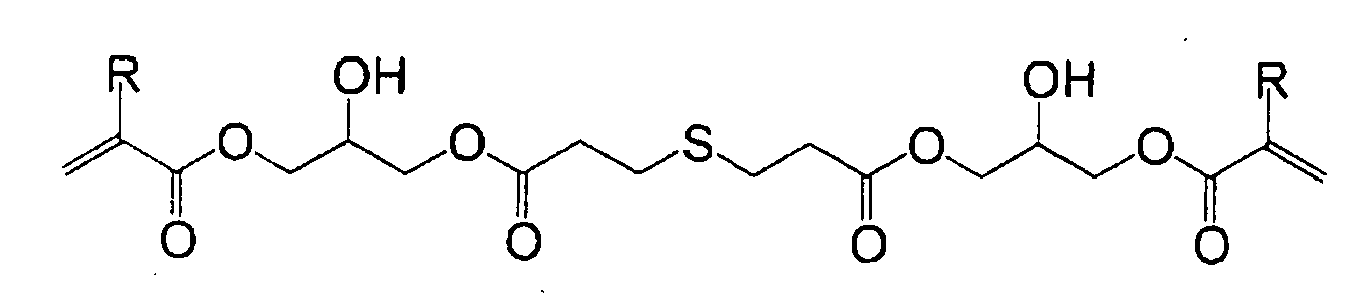


-


-


-


- The sulfur-containing polyfunctional monomer in the invention may be synthesized using a reaction of a sulfur atom-containing dicarboxylic acid and an epoxy group-containing (meth)acrylate, a reaction of sulfur atom-containing diol and isocyanate-containing (meth)acrylate, a reaction of dithiol and ioscyanate-containing (meth)acrylate, a reaction of diisothiocyanate and hydroxyl group-containing (meth)acrylate, or the known esterification reaction. Alternatively, a commercially available product may be used.
- A molecular weight of the sulfur-containing polyfunctional monomer in the invention is preferably 120 to 3000, more preferably 120 to 1500 from a viewpoint of softness of a formed film.
- The sulfur-containing polyfunctional monomer in the invention may be used alone, or may be used as a mixture with a polyfunctional polymerizable compound or monofunctional polymerizable compound having no sulfur atom in the molecule.
From a viewpoint of an engraving sensitivity, an embodiment in which the sulfur-containing polyfunctional monomer is used alone, or the monomer is used as a mixture of the sulfur-containing polyfunctional monomer and a monofunctional ethylenic monomer is preferable, and an embodiment in which the monomer is used as a mixture of the sulfur-containing polyfunctional monomer and a monofunctional ethylenic monomer is more preferable. - In the relief forming layer in the invention, film physical properties, for example, fragility and softness may be also adjusted by using the polymerizable compound including the sulfur-containing polyfunctional monomer.
A total content of the polymerizable compound including the sulfur-containing polyfunctional monomer in the relief forming layer in the invention is preferably in the range of 5% by mass to 90% by mass, more preferably in the range of 10% by mass to 75% by mass, further preferably in the range of 10% by mass to 60% by mass, particularly preferably in the range of 15% by mass to 40% by mass from a viewpoint of softness and fragility of a crosslinked film.
When the sulfur-containing polyfunctional monomer and other polymerizable compound are used together, the amount of the sulfur-containing polyfunctional monomer in the total polymerizable compound is preferably 5% by mass or more, more preferably 10% by mass or more. - The relief forming layer in the invention contains (B) a binder polymer.
The (B) binder polymer used in the invention is a main component contained in the relief forming layer, and usually, a thermoplastic resin and a thermoplastic elastomer are used depending on the purpose.
For example, from a viewpoint of a laser engraving sensitivity, a polymer containing a partial structure which is thermally decomposed by light exposure or heating is preferable.
For example, when formation of a film which is soft and has flexibility is aimed at, a soft resin or a thermoplastic elastomer is selected.
Further, from a viewpoint of easiness of preparation of a coating composition for the relief forming layer, and improvement in resistance to an oily ink in the resulting relief printing plate, it is preferable to use a hydrophilic or alcoholphilic polymer.
In addition, for example, when used for the purpose of curing by heating or light exposure to improve a strength, a polymer having a carbon-carbon unsaturated bond in the molecule is selected as the binder polymer.
Like this, in view of physical properties depending on application of the relief printing plate precursor, the binder polymer depending on the purpose is selected, and one kind of the binder polymer, or a combination of two or more kinds may be used.
Various polymers which may be used as the binder polymer in the invention will be explained below. - Examples of the binder polymer which is preferably used from a viewpoint of a laser engraving sensitivity include a polymer having a partial structure which is decomposed by energy application such as light exposure and heating (polymer having decomposability).
- Examples of the polymer having decomposability include polymers containing, as a monomer unit having a partial structure which is easily decomposed or cut in a molecular chain, styrene, α-methylstyrene, α-methoxystyrene, acryl esters, methacryl esters, other ester compounds, ether compounds, nitro compounds, carbonate compounds, carbamoyl compounds, hemiacetal ester compounds, oxyethylene compounds, or aliphatic cyclic compounds.
- Among them, particularly, preferable examples include polyethers such as polyethylene glycol, polypropylene glycol, and polytetraethylene glycol, aliphatic polycarbonates, aliphatic carbamates, polymethyl methacrylate, polystyrene, nitrocellulose, polyoxyethylene, polynorbornene, hydrogenated polycyclohexadiene, and a polymer having a molecular structure such as a dendrimer having many branched structures, from a viewpoint of decomposability.
A polymer containing a number of oxygen atoms in a molecular chain is preferable from a viewpoint of decomposability. From such a point of view, preferable examples include compounds having a carbonate group, a carbamate group, or a methacryl group in a polymer main chain.
Preferable examples of a polymer having good heat decomposability include polyester and polyurethane synthesized using, as a raw material, (poly)carbonate diol and (poly)carbonate dicarboxylic acid, and polyamide synthesized using, as a raw material, (poly)carbonate diamine. These polymers may contain a polymerizable unsaturated group in a main chain and a side chain. Particularly, when the polymers have a reactive functional group such as a hydroxyl group, an amino group, and a carboxyl group, it is easy to introduce a polymerizable unsaturated group into such a heat-decomposable polymer. - As the polymer having decomposability, a polyester containing a hydroxylcarboxylic acid unit such as polylactic acid may be used. As such a polyester, specifically a polyester selected from the group consisting of polyhydroxyalkanoate (PHA), lactic acid polymer, polyglycolic acid (PGA), polycaprolactone (PCL), poly(butylenesuccinic acid), and a derivative or a mixture thereof is preferable.
- As one of binder polymers which are preferably used from a viewpoint of a laser engraving sensitivity, there is a thermoplastic polymer.
The thermoplastic polymer may be an elastomeric or non-elastomeric resin, and may be selected depending on use mode of the relief printing plate precursor of the invention.
Examples of the thermoplastic elastomer include a urethane thermoplastic elastomer, an ester thermoplastic elastomer, an amide thermoplastic elastomer, and a silicone thermoplastic elastomer. For the purpose of improving a laser engraving sensitivity of these thermoplastic elastomers, an elastomer in which an easily decomposable functional group such as a carbamoyl group and a carbonate group is introduced into a main chain thereof may be used. The thermoplastic polymer and the thermally decomposable polymer may be used by mixing them.
The thermoplastic elastomer is a material exhibiting rubber elasticity at a normal temperature and, as a molecular structure, contains a soft segment such as polyether and a rubber molecule, and a hard segment which prevents plastic deformation like a vulcanized rubber at around a normal temperature and, as the hard segment, various types such as frozen phase, crystal phase, hydrogen bond, and ion crosslinking are present. Such a thermoplastic elastomer is suitable, for example, when the relief printing plate precursor of the invention needs flexibility such as a flexographic plate. - The kind of the thermoplastic elastomer is selected depending on the purpose, for example, when solvent resistance is required, urethane, ester, amide, and fluorine thermoplastic elastomers are preferable and, when heat resistance is required, urethane, olefin, ester, and fluorine thermoplastic elastomers are preferable. And, by selecting the kind of the thermoplastic elastomer, hardness of the relief forming layer may be greatly changed.
- Examples of the non-elastomeric resin include a polyester resin, an unsaturated polyester resin, a polyamide resin, a polyamideimide resin, a polyurethane resin, an unsaturated polyurethane resin, a polysulfone resin, a polyether sulfone resin, a polyimide resin, a polycarbonate resin, a wholly aromatic polyester resin, and a hydrophilic polymer containing a hydroxyethylene unit (e.g. polyvinyl alcohol derivative).
- As the binder polymer used in the invention, a hydrophilic or alcoholphilic binder polymer is preferable from a viewpoint of removability of waste after engraving. More particularly, examples of the hydrophilic polymer include hydrophilic polymers described later and, among them, a hydrophilic polymer containing a hydroxyethylene unit is preferable. In addition, as the alcoholphilic binder, for example, a polymer such as polyvinyl butyral may be suitably used.
- The hydrophilic polymer which is one of preferable embodiments of the binder polymer will be described in detail.
The hydrophilic polymer refers to a water-soluble or water-swellable polymer. Herein, in the invention, the "water-soluble" refers to that the polymer is dissolved in water at 25°C in an amount of 5% by mass or more, and the "water-swellable" refers to the state where, when the polymer is added to water at 25°C in an amount of 5% by mass, the polymer absorbs water, and is swollen and, when it is seen visually, it is not dissolved, but an apparent solid (powdery) precipitate is not present. - As the hydrophilic polymer, the polymer alone may be used, or plural kinds of polymers may be used.
- Examples of the hydrophilic polymer include a hydrophilic polymer containing a hydroxyethylene unit, polysaccharides having a hydrophilic functional group including cellulose, an acryl resin containing a salt structure in which an acidic functional group is neutralized such as polysodium acrylate, a salt structure in which an amino group is neutralized, or an onium structure, a polyamide resin or a polyester resin in which a hydrophilic group such as polyethylene oxide is introduced, and gelatin.
- As the hydrophilic polymer, from a viewpoint of exhibiting good hydrophilicity, a hydrophilic polymer containing hydroxyethylene, cellulose containing a polar group such as an amino group, a carboxylic acid group, a sulfonic acid group, a sulfuric acid group, and a salt structure obtained by neutralizing these groups, an acryl resin containing a polar group such as an amino group, a carboxylic acid group, a sulfonic acid group, a sulfuric acid group, and a salt structure obtained by neutralizing these groups, and a polyamide resin are preferable. A hydrophilic polymer containing hydroxyethylene, and an acryl resin containing a polar group such as an amino group, a carboxylic acid group, a sulfonic acid group, a sulfuric acid group, and a salt structure obtained by neutralizing these groups, and a polyamide resin are more preferable, and polyvinyl alcohols, and polyamide resins are further preferable.
- The hydrophilic polymer is particularly preferably a polymer selected from polyvinyl alcohol (PVA) and a derivative thereof, from a viewpoint of film forming property, and resistance to a UV ink.
- PVA and a derivative thereof in the invention include copolymers and polymers containing 0.1 mol% or more but 100 mol% or less, preferably 1 mol% or more but 98 mol% or less, further preferably 5 mol% or more but 95 mol% or less of the hydroxyethylene unit, and modified products thereof.
A monomer for forming a copolymer together with a vinyl alcohol structural unit may be arbitrarily selected from the known copolymerizable monomers.
Among PVA and its derivative, particularly preferably, PVA and vinyl alcohol/vinyl acetate copolymers (partially saponified polyvinyl alcohol) may be exemplified, which also include modified products thereof. - As the hydrophilic polymer, particularly, one or more kinds selected from PVA and its derivative, and a hydrophilic polymer not containing a hydroxyethylene unit (hereinafter, conveniently also referred to as "non-PVA derivative") may be used together.
- As a method of synthesizing the hydrophilic polyamide, the following is exemplified.
By reacting ε-caprolactam and/or adipic acid with polyethylene glycol having both terminals modified with amine, polyamide having a polyethylene glycol unit is obtained and, by reacting with piperazine, hydrophilic polyamide having a piperazine skeleton is obtained. And, by reacting an amido group of the hydrophilic polyamide and an epoxy group of glycidyl methacrylate, hydrophilic polyamide in which a crosslinking functional group is introduced into a polymer is obtained. These non-PVA derivatives may be used alone, or plural kinds may be used by mixing them. - Examples of the PVA derivative include a polymer in which at least a part of hydroxy groups of hydroxyethylene units is modified to have a carboxyl group, a polymer in which a part of the hydroxy groups is modified to have a (meth)acroyl group, a polymer in which at least a part of the hydroxy groups is modified to have an amino group, and a polymer in which ethylene glycol or propylene glycol or a multimer thereof is introduced to at least a part of the hydroxy groups.
- A polymer in which at least a part of hydroxy groups is modified to have a carboxyl group may be obtained by esterifying polyvinyl alcohol or partially saponified polyvinyl alcohol with polyfunctional carboxylic acid such as succinic acid, maleic acid and adipic acid. An amount of a carboxyl group to be introduced in the polymer is preferably 0.01 mol to 1.00 mol, further preferably 0.05 mol to 0.80 mol relative to 1 mol of a hydroxy group.
- A polymer in which at least a part of hydroxy groups is modified to have a (meth)acroyl group may be obtained by adding glycidyl (meth)acrylate to the carboxyl group-modified polymer, or esterifying polyvinyl alcohol or partially saponified polyvinyl alcohol with (meth)acrylic acid. An amount of a (meth)acroyl group to be introduced in the polymer is preferably 0.01 mol to 1.00 mol, further preferably 0.03 mol to 0.50 mol relative to 1 mol of a hydroxy group. The expression of (meth)acroyl group means an acroyl group and/or methacroyl group. The expression of (meth)acrylate means acrylate and/or methacrylate. In addition, this is the case in (meth)acrylic acid.
- A polymer in which at least a part of hydroxy groups is modified to have an amino group may be obtained by esterifying polyvinyl alcohol or partially saponified polyvinyl alcohol with carboxylic acid containing an amino group such as carbamic acid. An amount of an amino group to be introduced in the polymer is preferably 0.01 mol to 1.00 mol, further preferably 0.05 mol to 0.70 mol relative to 1 mol of the hydroxy group.
- A polymer in which ethylene glycol or propylene glycol or a multimer thereof is introduced to at least a part of hydroxy groups may be obtained by heating polyvinyl alcohol or partially saponified polyvinyl alcohol and glycols in the presence of a sulfuric acid catalyst, and removing water as a byproduct to the outside of the reaction system. A total amount of ethylene glycol or propylene glycol or a multimer thereof to be introduced in the polymer is preferably 0.01 mol to 0.90 mol, further preferably 0.03 mol to 0.50 mol relative to 1 mol of a hydroxy group.
- Among modified products of PVA derivatives, a polymer in which at least a part of hydroxy groups is modified to have a (meth)acroyl group is particularly preferably used. This is because, by directly introducing an unreacted crosslinking functional group into the hydrophilic polymer, a strength of a crosslinked material when the relief forming layer is crosslinked may be enhanced without using a large amount of the sulfur-containing polyfunctional monomer, and both of softness and a strength of the crosslinked material may be realized. That is, in this embodiment, both of softness and a strength may be realized in the relief forming layer of the relief printing plate precursor of the invention.
- The non-PVA derivatives mean those having so similar polarity as to have compatibility with PVA and a derivative thereof.
Examples of the non-PVA derivative include hydrophilic polyamide in which a hydrophilic group such as polyethylene glycol and piperazine is introduced into a non-water-soluble polyamide obtained by polymerization of adipic acid and 1,6-hexanediamine, or ε-caprolactam only. Since the hydrophilic polyamide exhibits compatibility with the PVA derivative due to working of its hydrophilic group, it is suitable for use as the non-PVA derivative. That is, since such a hydrophilic polyamide has good compatibility with PVA and a derivative thereof, and easily enters between molecules of PVA and a derivative thereof, an intermolecular force of two kinds of polymers is reduced, and the polymer is softened. - As the alcoholphilic polymer in the invention, it is preferable to use a polymer which is water-insoluble but is soluble in an alcohol having 1 to 4 carbon atoms (hereinafter, referred to as specified alcoholphilic polymer).
The specified alcoholphilic polymer related to the invention has the property that it is highly polar, but is water-insoluble, and since it has this property, when this is applied to the relief forming layer, both of aqueous ink suitability and UV ink suitability may be attained.
Herein, hereinafter, the alcohol having 1 to 4 carbon atoms is referred to as lower alcohol in some cases. - Herein, in the invention, the term "insoluble" in a predetermined liquid refers to that when 0.1 g of a binder polymer and 2 ml of a predetermined liquid (e.g. water or organic solvent) are mixed, sealed, allowed to stand at room temperature for 24 hours, and observed visually, precipitation of the binder polymer is recognized, or precipitation is not recognized but the solution (dispersion) is cloudy. The term "soluble" refers to the case where, under the above condition, when observed visually, there is no precipitate, and a transparent and uniform state is given.
- The specified alcoholphilic polymer in the invention is required to be soluble in an alcohol having 1 to 4 carbon atoms. Herein, examples of the alcohol having 1 to 4 carbon atoms include methanol, ethanol, 2-propanol, 1-propanol, 1-methoxy-2-propanol, 1-butanol, and tert-butanol from a viewpoint of good UV ink suitability, and it is preferable that the polymer is soluble in at least any of them.
More preferably, as the specified alcoholphilic polymer, a polymer which is soluble in any of methanol, ethanol, 2-propanol, and 1-methoxy-2-propanol is preferable, and a polymer which is soluble in all of methanol, ethanol, and 1-methoxy-2-propanol is particularly preferable. - It is preferable that the specified alcoholphilic polymer in the invention is insoluble in an ester solvent, a representative of which is ethyl acetate. By selecting a polymer which is insoluble in the ester solvent, UV ink suitability is further improved, and reduction in a film strength due to swelling during printing with a UV ink, and elution of a low-molecular component from a relief layer may be effectively suppressed.
- When the specified alcoholphilic polymer is a substance having a glass transition temperature, the glass transition temperature is preferably from 20°C to 200°C, more preferably from 20°C to 170°C, particularly preferably from 25°C to 150°C from a viewpoint of balance between an engraving sensitivity and film forming property.
In the invention, a glass transition temperature (Tg) of room temperature or higher refers to a Tg of 20°C or higher. - In the case where the specified alcoholphilic polymer which may be used in the invention has the above range of the glass transition temperature, when the polymer is combined with (D) a photothermal converting agent described later, which is a preferable additional component for constituting the relief forming layer in the invention, and which may absorb light having a wavelength of 700 nm to 1300 nm, an engraving sensitivity is improved. The binder polymer having such a glass transition temperature is referred to as "non-elastomer", hereinafter.
That is, the elastomer is generally academically defined as a polymer having a glass transition temperature of a normal temperature or lower (see Kagaku Daijiten second edition, edited by Foundation for Advancement of International Science, published by Maruzen, P154). Therefore, the non-elastomer refers to a polymer having a glass transition temperature higher than a normal temperature. - When a glass transition temperature of the specified alcoholphilic polymer is room temperature (20°C) or higher, since the polymer has a glass state at a normal temperature, the polymer is in the state where thermal molecular movement is considerably suppressed as compared with the case where the polymer has a rubber state.
In laser engraving on the relief printing plate precursor of the invention, at laser irradiation (preferably, at infrared laser irradiation), applied heat and heat produced by the function of (D) a photothermal converting agent optionally used are transmitted to the specified alcoholphilic polymer present at the periphery, and this is thermally decomposed and dissipated and, as a result, engraved to form a concave portion.
In a preferable embodiment of the invention, it is thought that when the (D) photothermal converting agent is present in the state where thermal molecular movement of the specified alcoholphilic polymer is suppressed, heat transmission to, and thermal decomposition of the specified alcoholphilic polymer effectively occur, and it is presumed that an engraving sensitivity has been further increased due to such an effect. - On the other hand, in the state (rubber state) where the glass transition temperature is lower than room temperature and thermal molecular movement of the specified alcoholphilic polymer is not suppressed, since due to an intensity of its vibration, that is, thermal molecular movement, an intermolecular distance between the (D) photothermal converting agent and the specified alcoholphilic polymer becomes great, and a volume (space) present between them becomes very great, it is presumed that not only an efficacy of heat transmission from the (D) photothermal converting agent to the specified alcoholphilic polymer is reduced, but also the transmitted heat contributes to active thermal movement, heat loss is generated, and contribution to occurrence of effective thermal decomposition is decreased, and thereby, it is difficult to contribute to improvement in an engraving sensitivity.
- From the foregoing, examples of a non-elastomer which is a particularly preferable embodiment of the specified alcoholphilic polymer preferably used in the invention are as follows.
Examples of the particularly preferable specified alcoholphilic polymer in the invention, from a viewpoint of that both of aqueous ink suitability and UV ink suitability are realized, and an engraving sensitivity is high, and film forming property is also good, include a polyvinyl butyral (PVB) derivative, a polyamide, a cellulose derivative, and an epoxy resin and, among them, a polyvinyl butyral (PVB) derivative, a polyamide, and a cellulose derivative are preferable. - As polyvinyl butyral (hereinafter, referred to as PVB), a homopolymer may be used, or a polyvinyl butyral derivative may be used.
A content of butyral in the PVB derivative (total mole number of raw material monomer is 100%) is preferably 30% to 90%, more preferably 50% to 85%, particularly preferably 55% to 78%.
From a viewpoint that balance between an engraving sensitivity and film forming property is retained, a weight average molecular weight of PVB and a derivative thereof is preferably 5000 to 800000, more preferably 8000 to 500000. Further, from a viewpoint of improvement in the rinsing property of an engraving waste, 50000 to 300000 is particularly preferable. - PVB and a derivative thereof are also available as a commercialized product, and preferable examples, from a viewpoint of alcohol solubility (particularly, ethanol), include "ESLEC B" Series, "ESLEC K (KS)" Series manufactured by Sekisui Chemical Co., Ltd., and "Denka Butyral" manufactured by Denki Kagaku Kogyo K.K.. From a viewpoint of alcohol solubility (particularly ethanol), further preferable are "ESLEC B" Series manufactured by Sekisui Chemical Co., Ltd. and "Denka Butyral" manufactured by Denki Kagaku Kogyo K.K., and particularly preferable are "BL-1", "BL-1H", "BL-2", "BL-5", "BL-S", "BX-L", "BM-S", "BH-S" in "ESLEC B" Series manufactured by Sekisui Chemical Co., Ltd., and "#3000-1", "#3000-2", "#3000-4", "#4000-2", "#6000-C", "#6000-EP", "#6000-CS", "#6000-AS" in "Denka Butyral" manufactured by Denki Kagaku Kogyo K.K..
When a film of the relief forming layer is made using PVB as the specified alcoholphilic polymer, a method of casting and drying a solution of the polymer dissolved in a solvent is preferable from a viewpoint of smoothness of a surface of a film. - Since a polyamide in which a polar group such as polyethylene glycol and piperazine is introduced into a main chain improves alcohol solubility due to working of the polar group, it is suitable as the specified alcoholphilic polymer used in the invention.
By reacting ε-caprolactam and/or adipic acid with polyethylene glycol having both terminals modified with amine, a polyamide having a polyethylene glycol unit (also called polyethylene oxide segment) is obtained and, by reacting this with piperazine, a polyamide having a piperazine skeleton is obtained. - As a polyamide containing a polyethylene glycol unit, usually, polyether amide obtained by polycondensing or copolycondensing α·ω-diaminoproplypolyoxyethylene as at least a part of a raw material diamine component by the known method (e.g.
JP-A No.55-79437 JP-A No.50-159586 - Herein, a number average molecular weight of the polyethylene oxide segment in a polyamide is preferably in the range of 150 to 5000, more preferably in the range of 200 to 3000 from a viewpoint of the form retainability of the relief forming layer. A number average molecular weight of these polyamides having the polyethylene oxide segment is preferably in the range of 5000 to 300000, further preferably in the range of 10000 to 200000, particularly preferably in the range of 10000 to 50000.
- As the polyamide, a polyamide having a highly polar unit such as polyethylene oxide in a main chain is preferably used, but since even when a side chain of a polyamide has a highly polar functional group, the same function may be obtained, a polyamide having a polar group in a side chain is also suitable in the specified alcoholphilic polymer in the invention.
- From a viewpoint of an engraving sensitivity, more preferable is the case where a side chain of a polyamide has a highly polar functional group.
As such a polyamide, specifically, methoxymethylated polyamide, and methoxymethylated nylon are preferable. As a commercialized product of such a polyamide derivative, a methoxymethylated polyamide "TORESIN" Series manufactured by Nagase Chemtex is preferable. Particularly preferable is a methoxymethylated polyamide "TORESIN F-30K", and "TORESIN EF-30T" manufactured by Nagase Chemitex. - Usual cellulose is hardly dissolved in water and an alcohol, but water- or solvent-solubility may be controlled by modifying remaining OH of a glucopyranose unit with a specified functional group, and a cellulose derivative which is thus insoluble in water, but is made to be soluble in an alcohol having 1 to 4 carbon atoms is also suitable as the specified alcoholphilic polymer used in the invention.
Examples of the cellulose derivative suitable in the invention include alkylcellulose such as ethylcellulose and methylcellulose, hydroxyethylenecellulose, hydroxypropylenecellulose, and cellulose acetate butyrate, which have physical property of being water-insoluble and lower alcohol-soluble.
Further, specific examples include Metholose Series manufactured by Shin-Etsu Chemical Co., Ltd.. This series is such that a part of a hydrogen atom of a hydroxy group of cellulose is replaced with a methyl group (-CH3), a hydroxypropyl group (-CH2CHOHCH3), or a hydroxyethyl group (-CH2CH2OH).
In addition, in the invention, particularly preferable in solubility in a lower alcohol and an engraving sensitivity is alkylcellulose, inter alia, ethylcellulose and methylcellulose. - As a water-insoluble and alcohol-soluble epoxy resin which may be used in the invention, a modified epoxy resin in which a bisphenol A-type epoxy resin or a bisphenol A-type epoxy resin is high-molecularized or highly functionalized with a modifying agent is preferable from a viewpoint of water-insolubility. Particularly preferable is a modified epoxy resin.
Preferable examples of the modified epoxy resin include "Arakyd 9201N", "Arakyd 9203N", "Arakyd 9205", "Arakyd 9208", "KA-1439A", "MODEPICS 401", and "MODEPICS 402" manufactured by Arakawa Chemical Industries Ltd.. - As the specified alcoholphilic polymer in the invention, an acryl resin and polyurethane as shown below may be preferably used as far as they are water-insoluble and lower alcohol-soluble.
- As the specified alcoholphilic polymer in the invention, a water-insoluble and lower alcohol-soluble acryl resin may be also used.
As such an acryl resin, an acryl resin obtained by using the known acryl monomer, solubility of which has been controlled so as to satisfy the aforementioned physical conditions, may be used. As an acryl monomer used in synthesizing an acryl resin, for example, (meth)acrylic acid esters, and crotonic acid esters, (meth)acrylamides are preferable.
Examples of such a monomer include the following compounds. - That is, examples of (meth)acrylic acid esters include methyl (meth)acrylate, ethyl (meth)acrylate, n-propyl (meth)acrylate, isopropyl (meth)acrylate, n-butyl (meth)acrylate, isobutyl (meth)acrylate, tert-butyl (meth)acrylate, n-hexyl (meth)acrylate, 2-ethylhexyl (meth)acrylate, acetoxyethyl (meth)acrylate, phenyl (meth)acrylate, 2-hydroxyethyl (meth)acrylate, 2-hydroxypropyl (meth)acrylate, 4-hydroxybutyl (meth)acrylate, 2-methoxyethyl (meth)acrylate, 2-ethoxyethyl (meth)acrylate, 2-(2-methoxyethoxy)ethyl (meth)acrylate, cyclohexyl (meth)acrylate, benzyl (meth)acrylate, diethylene glycol monomethyl ether (meth)acrylate, diethylene glycol monoethyl ether (meth)acrylate, diethylene glycol monophenyl ether (meth)acrylate, triethylene glycol monomethyl ether (meth)acrylate, triethylene glycol monoethyl ether (meth)acrylate, dipropylene glycol monomethyl ether (meth)acrylate, polyethylene glycol monomethyl ether (meth)acrylate, polypropylene glycol monomethyl ether (meth)acrylate, monomethyl ether (meth)acrylate of a copolymer of ethylene glycol and propylene glycol, N,N-dimethylaminoethyl (meth)acrylate, N,N-diethylaminoethyl (meth)acrylate, and N,N-dimethylaminopropyl (meth)acrylate.
- From a viewpoint of alcohol solubility, diethylene glycol monomethyl ether (meth)acrylate, diethylene glycol monoethyl ether (meth)acrylate, diethylene glycol monophenyl ether (meth)acrylate, triethylene glycol monomethyl ether (meth)acrylate, triethylene glycol monoethyl ether (meth)acrylate, dipropylene glycol monomethyl ether (meth)acrylate, polyethylene glycol monomethyl ether (meth)acrylate, polypropylene glycol monomethyl ether (meth)acrylate, and monomethyl ether (meth)acrylate of a copolymer of ethylene glycol and propylene glycol are preferable.
- Examples of (meth)acrylamides include (meth)acrylamide, N-methyl(meth)acrylamide, N-ethyl(meth)acrylamide, N-propyl(meth)acrylamide, N-n-butyl(meth)acrylamide, N-tert-butyl(meth)acrylamide, N-cyclohexyl(meth)acrylamide, N-(2-methoxyethyl)(meth)acrylamide, N,N-dimethyl(meth)acrylamide, N,N-diethyl(meth)acrylamide, N-phenyl(meth)acrylamide, N-benzyl(meth)acrylamide, and (meth)acryloylmorpholine.
- As the acryl resin, a modified acryl resin containing an acryl monomer having a urethane group or a urea group may be also preferably used.
Examples of an acryl monomer used in synthesis of an acryl resin used as the specified alcoholphilic polymer in the invention include compounds such as the following exemplified monomers (AM-1) to (AM-22). -


-


- Examples of the acryl resin which may be suitably used as the specified alcoholphilic polymer in the invention are shown below together with a weight average molecular weight measured by the GPC method [described as Mw (GPC)], but the acryl resin which may be used in the invention is not limited to them as far as it has the aforementioned preferable properties.
-
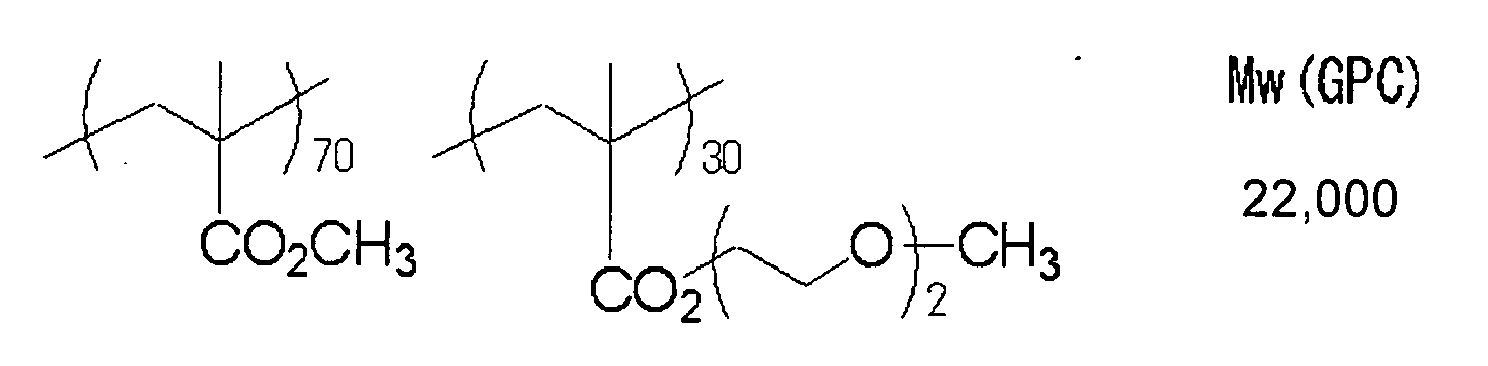


-
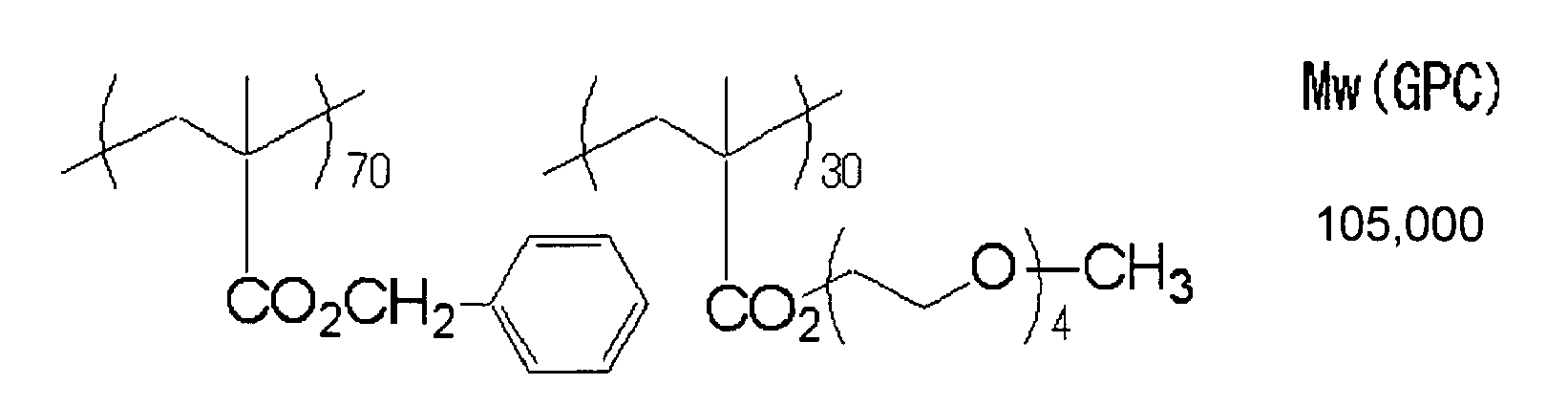


- As the specified alcoholphilic polymer in the invention, a water-insoluble and lower alcohol-soluble polyurethane resin may be also used.
A polyurethane resin which may be used as the specified alcoholphilic polymer in the invention is a polyurethane resin having, as a fundamental skeleton, a structural unit which is a reaction product of at least one kind of a diisocyanate compound represented by the following formula (U-1), and at least one kind of a diol compound represented by the following formula (U-2).
OCN-X0-NCO (U-1)
HO-Y0-OH (U-2)
- In the formulas (U-1) and (U-2), X0 and Y0 each represent independently a divalent organic residue, provided that at least one of organic residues represented by X0 and Y0 is linked to a NCO group or an OH group through an aromatic group.
- It is preferable that in a diisocyanate compound represented by the formula (U-1), an organic residue represented by X0 contains, in a structure, an aromatic group directly linked to a NCO group.
A preferable diisocyanate compound is a diisocyanate compound represented by the following formula (U-3). -
OCN-L1-NCO (U-3)
- In the formula (U-3), L1 represents a divalent aromatic hydrocarbon group optionally having a substituent. Examples of the substituent include an alkyl group, an aralkyl group, an aryl group, an alkoxy group, an aryloxy group, and a halogen atom (-F, -Cl, -Br, -I). If necessary, L1 may have other functional group which does not react with an isocyanate group, for example, an ester group, a urethane group, an amido group, and a ureido group.
- Examples of the diisocyanate compound represented by the formula (U-3) include the following compounds.
That is, examples of the aromatic diisocyanate compound include 2,4-tolylene diisocyanate, 2,4-tolylene diisocyanate dimer, 2,6-tolylenedilene diisocyanate, p-xylylene diisocyanate, m-xylylene diisocyanate, 4,4'-diphenylmethane diisocyanate, 1,5-naphthylene diisocyanate, and 3,3'-dimethylbiphenyl-4,4'-diisocyanate.
Particularly, from a viewpoint of thermal decomposability, 4,4'-diphenylmethane diisocyanate, and 1,5-naphthylene diisocyanate are preferable. - The polyurethane resin used as the specified alcoholphilic polymer in the invention may be a polymer synthesized by using a diisocyanate compound other than the aforementioned diisocyanate compounds, for example, from a viewpoint that compatibility with other components in the relief forming layer is improved, and storage stability is improved.
Examples of the diisocyanate compound which may be used together include aliphatic diisocyanate compounds such as hexamethylene diisocyanate, trimethylhexamethylene diisocyanate, lysine diisocyanate, and dimer acid diisocyanate; alicyclic diisocyanate compounds such as isophorone diisocyanate, 4,4'-methylene bis(cyclohexylisocyanate), methylcyclohexane-2,4 (or 2,6) diisocyanate, 1,3-(isocyanatemethyl)cyclohexane; and diisocyanate compounds which are a reaction product of diol and diisocyanate, such as an adduct of 1 mol of 1,3-butylene glycol and 2 mol of tolylene diisocyanete.
Diisocyanate obtained by adding a monofunctional alcohol to one of three NCOs of triisocyanate may be also used. - It is preferable that in the diol compound represented by the formula (U-2), an organic residue represented by Y0 contains, in a structure, an aromatic group directly linked to an OH group.
More specifically, diol compounds represented by the following formulas (A-1) to (A-3) are preferable. -
HO-Ar1-OH Formula (A-1)
HO-(Ar1- Ar2)m-OH Formula (A-2)
HO-Ar1-X- Ar2-OH Formula (A-3)
- In the formulas (A-1) to (A-3), Ar1 and Ar2 may be the same or different, and each represent an aromatic ring. Examples of such an aromatic ring include a benzene ring, a naphthalene ring, an anthracene ring, a pyrene ring, and a heterocyclic ring. These aromatic rings may have a substituent. Examples of the substituent include an alkyl group, an aralkyl group, an aryl group, an alkoxy group, an aryloxy group, and a halogen atom (-F, -Cl, -Br, -I).
From a viewpoint of easy availability of a raw material, preferable is a benzene ring and a naphthalene ring. Also in view of film forming property, a benzene ring is particularly preferable.
X is a divalent organic residue. And, m is preferably 1 to 3, particularly preferably 1, from a viewpoint of film forming property. - Preferable examples of the diol compound represented by the formula (A-1) are 1,4-dihydroxybenzene, and 1,8-dihydroxynaphthalene.
Preferable examples of the diol compound represented by the formula (A-2) are 4,4-dihydroxybiphenyl, and 2,2-hydroxybinaphthyl.
Preferable examples of the diol compound represented by the formula (A-3) are bisphenol A, and 4,4-bis(hydroxyphenyl)methane. - The polyurethane resin used as the specified alcoholphilic polymer in the invention may be a polymer synthesized by using an additional diol compound other than the aforementioned diol compounds, for example, from a viewpoint that compatibility with other components in the relief forming layer is improved, and storage stability is improved.
Examples of the diol compound which may be used together include a polyether diol compound, a polyester diol compound, and a polycarbonate diol compound. - Examples of the polyether diol compound include compounds represented by the following formulas (U-4), (U-5), (U-6), (U-7), and (U-8), and a random copolymer of ethylene oxide and propylene oxide having hydroxyl groups at the terminal positions.
-


HO-(CH2CH2CH2CH2O)c-H (U - 6)


- In the formulas (U-4) to (U-8), R14 represents a hydrogen atom or a methyl group, and X1 represents the following groups. And, a, b, c, d, e, f, and g each indicate independently an integer of 2 or more, preferably an integer of 2 to 100.
-

- Examples of the polyether diol compounds represented by the formulas (U-4) and (U-5) include the following compounds.
That is, examples include diethylene glycol, triethylene glycol, tetraethylene glycol, pentaethylene glycol, hexaethylene glycol, heptaethylene glycol, octaethylene glycol, di-1,2-propylene glycol, tri-1,2-propylene glycol, tetra-1,2-propylene glycol, hexa-1,2-propylene glycol, di-1,3-propylene glycol, tri-1,3-propylene glycol, tetra-1,3-propylene glycol, di-1,3-butylene glycol, tri-1,3-butylene glycol, hexa-1,3-butylene glycol, polyethylene glycol having a weight average molecular weight of 1000, polyethylene glycol having a weight average molecular weight of 1500, polyethylene glycol having a weight average molecular weight of 2000, polyethylene glycol having a weight average molecular weight of 3000, polyethylene glycol having a weight average molecular weight of 7500, polypropylene glycol having a weight average molecular weight of 400, polypropylene glycol having a weight average molecular weight of 700, polypropylene glycol having a weight average molecular weight of 1000, polypropylene glycol having a weight average molecular weight of 2000, polypropylene glycol having a weight average molecular weight of 3000, and polypropylene glycol having a weight average molecular weight of 4000. - Examples of the polyether diol compound represented by the formula (U-6) include the following compounds.
That is, examples include PTMG650, PTMG1000, PTMG2000, and PTMG3000 (trade name) manufactured by Sanyo Chemical Industries, Ltd. - Further, examples of the polyether diol compound represented by the formula (U-7) include the following compounds.
That is, examples include New Pole PE-61, New Pole PE-62, New Pole PE-64, New Pole PE-68, New Pole PE-71, New Pole PE-74, New Pole PE-75, New Pole PE-78, New Pole PE-108, New Pole PE-128, New Pole PE-61 (trade name) manufactured by Sanyo Chemical Industries, Ltd. - Examples of the polyether diol compound represented by the formula (U-8) include the following compounds.
That is, examples include New Pole BPE-20, New Pole BPE-20F, New Pole BPE-20NK, New Pole BPE-20T, New Pole BPE-20G, New Pole BPE-40, New Pole BPE-60, New Pole BPE-100, New Pole BPE-180, New Pole BPE-2P, New Pole BPE-23P, New Pole BPE-3P, and New Pole BPE-5P (trade name) manufactured by Sanyo Chemical Industries, Ltd. - Examples of the random copolymer of ethylene oxide and propylene oxide having hydroxy groups at the terminal positions include the following copolymers.
That is, examples include New Pole 50HB-100, New Pole 50HB-260, New Pole 50HB-400, New Pole 50HB-660, New Pole 50HB-2000, and New Pole 50HB-5100 (trade name) manufactured by Sanyo Chemical Industries, Ltd. - Examples of the polyester diol compound include compounds represented by the following formulas (U-9), and (U-10).
-


- In the formulas (U-9) and (U-10), L2, L3, and L4 may be the same or different, and each represent a divalent aliphatic or aromatic hydrocarbon group, and L5 represents a divalent aliphatic hydrocarbon group. Preferably, L2 to L4 each represent independently an alkylene group, an alkenylene group, an alkynylene group, or an allylene group, and L5 represents an alkylene group. In L2 to L5, other functional group which does not react with an isocyanate group, for example, an ether group, a carbonyl group, an ester group, a cyano group, an olefin group, a urethane group, an amido group, a ureido group, or a halogen atom may be present. And, n1 and n2 are an integer of 2 or more, respectively, preferably represent an integer of 2 to 100.
- Examples of the polycarbonate diol compound include a compound represented by the formula (U-11).
-

- In the formula (U-11), two L6s may be the same or different, and each represent a divalent aliphatic or aromatic hydrocarbon group. Preferably, L6 represents an alkylene group, an alkenylene group, an alkynylene group, or an arylene group. In L6, other functional group which does not react with an isocyanate group, for example, an ether group, a carbonyl group, an ester group, a cyano group, an olefin group, a urethane group, an amido group, a ureido group, or a halogen atom may be present. And, n3 is an integer of 2 or more, preferably represents an integer of 2 to 100.
- Examples of the diol compounds represented by the formula (U-9), (U-10), or (U-11) include the following compounds [exemplified compounds (No. 1) to (No.18)]. In examples, n represents an integer of 2 or more.
-


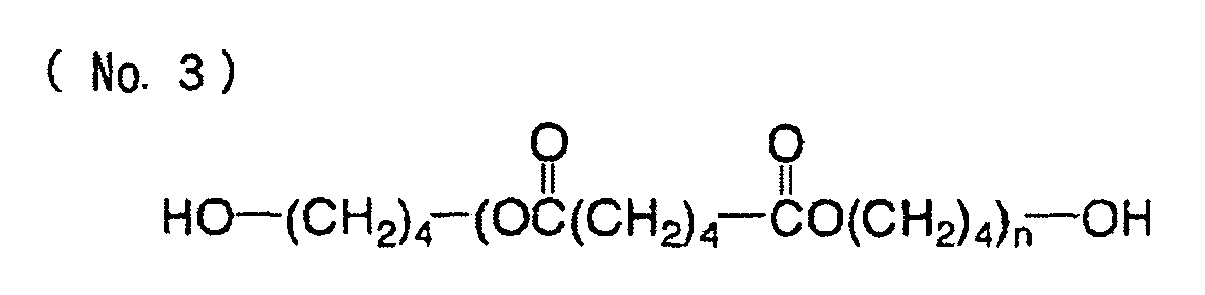


-


-


- In addition, for synthesizing a polyurethane resin used as the specified alcoholphilic polymer, in addition to the aforementioned diol compounds, a diol compound having a substituent which does not react with an isocyanate group may be used together. Examples of such a diol compound include the following compounds.
That is, for example, compounds represented by the following formulas (U-12), and (U-13) are used. - HO-L7-O-CO-L8-CO-O-L7-OH (U-12)
HO-L8-CO-O-L7-OH (U-13)
In the formulas (U-12) and (U-13), L7 and L8 may be the same or different, and each represent a divalent aliphatic hydrocarbon group, aromatic hydrocarbon group or heterocyclic group, each optionally having a substituent (e.g. alkyl group, aralkyl group, aryl group, alkoxy group, aryloxy group, halogen atom (-F, -Cl, -Br, -I) etc.). If necessary, L7 and L8 may have other functional group which does not react with an isocyanate group, for example, a carbonyl group, an ester group, a urethane group, an amido group, and a ureido group. L 7 and L8 may form a ring. - Further, for synthesizing a polyurethane resin used as the specified alcoholphilic polymer, a diol compound having an acid group such as a carboxyl group, a sulfone group, and a phosphoric acid group may be used together. Particularly, a diol compound having a carboxyl group is preferable from a viewpoint of improvement in a film strength, and water resistance due to a hydrogen bond.
Examples of the diol compound having a carboxyl group include, for example, compounds represented by the following formulas (U-14) to (U-16). -


- In the formulas (U-14) to (U-16), R15 represents a hydrogen atom, an alkyl group optionally having a substituent [e.g. cyano group, nitro group, halogen atom such as -F, -Cl, -Br, -I etc., -CONH2, -COOR16, -OR16, -NHCONHR16, -NHCOOR16, -NHCOR16, -OCONHR16 (wherein R16 represents an alkyl group having 1 to 10 carbon atoms, or an aralkyl group having 7 to 15 carbon atoms) etc.], an aralkyl group, an aryl group, an alkoxy group, or an aryloxy group, preferably represents a hydrogen atom, an alkyl group having 1 to 8 carbon atoms, or an aryl group having 6 to 15 carbon atoms. L9, L10 and L11 may be the same or different, and represent a single bond, or a divalent aliphatic or aromatic hydrocarbon group optionally having a substituent (for example, each group of alkyl, aralkyl, aryl, alkoxy, and halogeno is preferable), preferably represent an alkylene group having 1 to 20 carbon atoms, an arylene group having 6 to 15 carbon atoms, and further preferably represent an alkylene group having 1 to 8 carbon atoms. If necessary, L9 to L11 may have other functional group which does not react with an isocyanate group, for example, a carbonyl group, an ester group, a urethane group, an amido group, a ureido group, or an ether group. Two or three of R15, L7, L8 and L9 may form a ring.
Ar represents a trivalent aromatic hydrocarbon group optionally having a substituent, and preferably represents an aromatic group having 6 to 15 carbon atoms. - Examples of the diol compounds having a carboxyl group represented by the formulas (U-14) to (U-16) include the following compounds.
That is, examples of the diol compounds include 3,5-dihydroxybenzoic acid, 2,2-bis(hydroxymethyl)propionic acid, 2,2-bis(2-hydroxyethyl)propionic acid, 2,2-bis(3-hydroxypropyl)propionic aid, bis(hydroxymethyl)acetic acid, bis(4-hydroxyphenyl)acetic acid, 2,2-bis(hydroxymethyl)butyric acid, 4,4-bis(4-hydroxyphenyl)pentanoic acid, tartaric acid, N,N-dihydroxyethylglycine, and N,N-bis(2-hydroxyethyl)-3-carboxy-propionamide. - In addition, for synthesizing a polyurethane resin used as the specified alcoholphilic polymer, compounds obtained by ring-opening of tetracarboxylic acid dianhydrides represented by the following formulas (U-17) to (U-19) with a diol compound may be used together.
-


- In the formulas (U-17) to (U-19), L12 represents a single bond, a divalent aliphatic or aromatic hydrocarbon group optionally having a substituent (e.g. alkyl group, aralkyl group, aryl group, alkoxy group, halogeno group, ester group, and amido group are preferable), -CO-, -SO-, -SO2-, -O-, or -S-, and preferably represents a single bond, a divalent aliphatic hydrocarbon group having 1 to 15 carbon atoms, -CO-, -SO2-, -O-, or -S-. R17 and R18 may be the same or different, and represent a hydrogen atom, an alkyl group, an aralkyl group, an aryl group, an alkoxy group, or a halogeno group, and preferably represent a hydrogen atom, an alkyl group having 1 to 8 carbon atoms, an aryl group having 6 to 15 carbon atoms, an alkoxy group having 1 to 8 carbon atoms, or a halogeno group. Two of L12, R17 and R18 may be linked to form a ring. R19 and R20 may be the same or different, and represent a hydrogen atom, an alkyl group, an aralkyl group, an aryl group, or a halogeno group, and preferably represent a hydrogen atom, an alkyl group having 1 to 8 carbon atoms, or an aryl group having 6 to 15 carbon atoms. Two of L12, R19 and R20 may be linked to form a ring. L13 and L14 may be the same or different, and represent a single bond, a double bond, or a divalent aliphatic hydrocarbon group, and preferably represent a single bond, a double bond, or a methylene group. A represents a mononuclear or polynuclear aromatic ring, and preferably represents an aromatic ring having 6 to 18 carbon atoms.
- Examples of the compounds represented by the formula (U-17), (U-18), or (U-19) include the following compounds.
That is, examples include aromatic tetracarboxylic dianhydrides such as pyromellitic dianhydride, 3,3',4,4'-benzophenonetetracarboxylic dianhydride, 3,3',4,4'-diphenyltetracarboxylic dianhydride, 2,3,6,7-naphthalenetetracarboxylic dianhydride, 1,4,5,8-naphthalenetetracarboxylic dianhydride, 4,4'-sulfonyldiphthalic dianhydride, 2,2-bis(3,4-dicarboxyphenyl)propane dianhydride, bis(3,4-dicarboxyphenyl) ether dianhydride, 4,4'-[3,3'-(alkylphosphoryldiphenylene)-bis(iminocarbonyl)]diphthalic dianhydride, an adduct of hydroquinonediacetate and trimellic anhydride, and an adduct of diacetyldiamine and trimellic anhydride; alicyclic tetracarboxylic dianhydrides such as 5-(2,5-dioxotetrahydrofuryl)-3-methyl-3-cyclohexy-1,2-dicarboxylic anhydride (trade name: EPICHLONE B-4400, manufactured by Dainippon Ink and Chemicals Inc.), 1,2,3,4-cyclopentanetetracarboxylic dianhydride, 1,2,4,5-cyclohexanetetracarboxylic dianhydride, and tetrahydrofurantetracarboxylic dianhydride; and aliphatic tetracarboxylic dianhydrides such as 1,2,3,4-butanetetracarboxylic dianhydride and 1,2,4,5-pentanetetracarboxylic dianhydride. - As a method of introducing a compound obtained by ring-opening of these tetracarboxylic dianhydrides with a diol compound, into a polyurethane resin, for example, there are the following methods.
- a) A method of reacting a compound having an alcoholic terminal obtained by ring-opening of a tetracarbxylic dianhydride with a diol compound, and a diisocyanate compound.
- b) A method of reacting a urethane compound having an alcoholic terminal obtained by reacting a diisocyanate compound under the condition of an excessive diol compound, and a tetracarboxylic dianhydride.
- Examples of the diol compound used in the ring-opening reaction thereupon include the following compounds.
That is, examples include ethylene glycol, diethylene glycol, triethylene glycol, tetraethylene glycol, propylene glycol, dipropylene glycol, polyethylene glycol, polypropylene glycol, neopentyl glycol, 1,3-butylene glycol, 1,6-hexanediol, 2-butene-1,4-diol, 2,2,4-trimethyl-1,3-pentanediol, 1,4-bis-β-hydroxyethoxycyclohexane, cyclohaxanedimethanol, tricyclodecanedimethanol, hydrogenated bisphenol A, hydrogenated bisphenol F, an ethylene oxide adduct of bisphenol A, an propylene oxide adduct of bisphenol A, an ethylene oxide adduct of bisphenol F, a propylene oxide adduct oxide of bisphenol F, an ethylene oxide adduct of hydrogenated bisphenol A, a propylene oxide adduct of hydrogenated bisphenol A, hydroquinonedihydroxyethyl ether, p-xylylene glycol, dihydroxyethylsulfone, bis(2-hydroxyethyl)-2,4-tolylene dicarbamate, 2,4-tolylene-bis(2-hydroxyethylcarbamide), bis(2-hydroxyethyl)-m-xylylene dicarbamate, and bis(2-hydroxyethyl) isophthalate. - A polyurethane resin used as the specified alcoholphilic polymer in the invention may contain an organic group containing at least one of an ether bond, an amido bond, a urea bond, an ester bond, a urethane bond, a biuret bond, and an allophanate bond as a functional group, in addition to a urethane bond.
- It is preferable that a polyurethane resin used as the specified alcoholphilic polymer further has a unit having an ethylenic unsaturated bond. It is preferable that the polyurethane resin having a unit having an ethylenic unsaturated bond has at least one of functional groups represented by the following formulas (E1) to (E3) in a side chain of a polyurethane resin. First, functional groups represented by the following formulas (E1) to (E3) will be explained.
-

- In the formula (E1), R1 to R3 each represent independently a hydrogen atom or a monovalent organic group. Examples of R1 include preferably a hydrogen atom, and an alkyl group optionally having a substituent and, among them, a hydrogen atom, and a methyl group are preferable due to high radical reactivity. R2 and R3 each represent independently a hydrogen atom, a halogen atom, an amino group, a carboxyl group, an alkoxycarbonyl group, a sulfo group, a nitro group, a cyano group, an alkyl group optionally having a substituent, an aryl group optionally having a substituent, an alkoxy group optionally having a substituent, an aryloxy group optionally having a substituent, an alkylamino group optionally having a substituent, an arylamino group optionally having a substituent, an alkylsulfonyl group optionally having a substituent, or an arylsulfonyl group optionally having a substituent and, among them, a hydrogen atom, a carboxyl group, an alkoxy carbonyl group, an alkyl group optionally having a substituent, and an aryl group optionally having a substituent are preferable due to high radical reactivity.
- X represents an oxygen atom, a sulfur atom, or -N(R12)-, and R12 represents a hydrogen atom, or a monovalent organic group. Herein, example of the monovalent organic group include an alkyl group optionally having a substituent. Among them, R12 is preferably a hydrogen atom, a methyl group, an ethyl group, or an isopropyl group due to high radical reactivity.
Herein, examples of the substituent which may be introduced include an alkyl group, an alkenyl group, an alkynyl group, an aryl group, an alkoxy group, an aryloxy group, a halogen atom, an amino group, an alkyl amino group, an arylamino group, a carboxyl group, an alkoxycarbonyl group, a sulfo group, a nitro group, a cyano group, an amido group, an alkylsulfonyl group, and an arylsulfonyl group. -

- In the formula (E2), R4 to R8 each represent independently a hydrogen atom or a monovalent organic group. R4 to R8 preferably represent a hydrogen atom, a halogen atom, an amino group, a dialkylamino group, a carboxyl group, an alkoxycarbonyl group, a sulfo group, a nitro group, a cyano group, an alkyl group optionally having a substituent, an aryl group optionally having a substituent, an alkoxy group optionally having a substituent, an aryloxy group optionally having a substituent, an alkylamino group optionally having a substituent, an arylamino group optionally having a substituent, an alkylsulfonyl group optionally having a substituent, and an arylsulfonyl group optionally having a substituent and, among them, a hydrogen atom, a carboxyl group, an alkoxycarbonyl group, an alkyl group optionally having a substituent, and an aryl group optionally having a substituent are preferable.
As a group which may be introduced as the substituent, the same substituents as those for the formula (E1) are exemplified. Y represents an oxygen atom, a sulfur atom, or -N(R12)-. R12 has the same meaning as that of R12 of the formula (E1), and a preferable example is similar. -

- In the formula (E3), R9 to R11 each represent independently a hydrogen atom or a monovalent organic group. Examples of R9 include preferably a hydrogen atom and an alkyl group optionally having a substituent and, among them, a hydrogen atom, and a methyl group are preferable due to high radical reactivity. R10 and R11 each represent independently a hydrogen atom, a halogen atom, an amino group, a dialkylamino group, a carboxyl group, an alkoxycarbonyl group, a sulfo group, a nitro group, a cyano group, an alkyl group optionally having a substituent, an aryl group optionally having a substituent, an alkoxy group optionally having a substituent, an aryloxy group optionally having a substituent, an alkylamino group optionally having a substituent, an arylamino group optionally having a substituent, an alkylsulfonyl group optionally having a substituent, or an arylsulfonyl group optionally having a substituent and, among them, a hydrogen atom, a carboxyl group, an alkoxycarbonyl group, an alkyl group optionally having a substituent, and an aryl group optionally having a substituent are preferable due to high radical reactivity.
Herein, as a group which may be introduced as the substituent, the same groups as those for the formula (E1) are exemplified. Z represents an oxygen atom, a sulfur atom, -N(R13)-, or a phenylene group optionally having a substituent. R13 represents an alkyl group optionally having a substituent and, inter alia, a methyl group, an ethyl group, and an isopropyl group are preferable due to high radical reactivity. - As a method of introducing an ethylenic unsaturated bond into a side chain of a polyurethane resin, a method of using a diol compound containing an ethylenic unsaturated bond as a raw material for producing a polyurethane resin is also suitable. Such a diol compound may be a commercially available compound such as trimethylolpropane monoallyl ether, or may be a compound which is easily produced by a reaction of a halogenated diol compound, a triol compound, or an aminodiol compound, and a carboxylic acid, acid chloride, isocyanate, alcohol, amine, thiol, or a halogenated alkyl compound containing an ethylenic unsaturated bond. Specific examples of these compounds are not limited to, but include the following compounds.
-


-


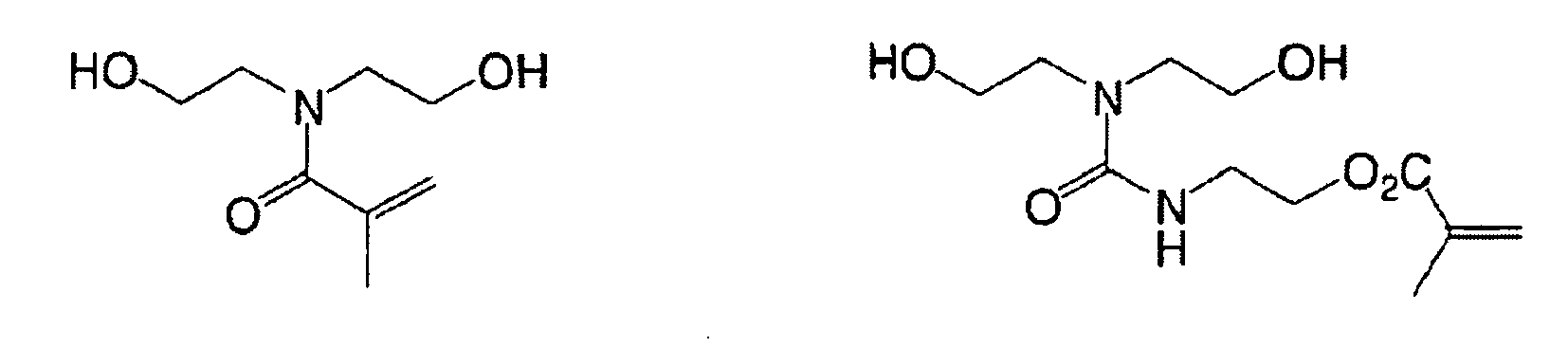
-
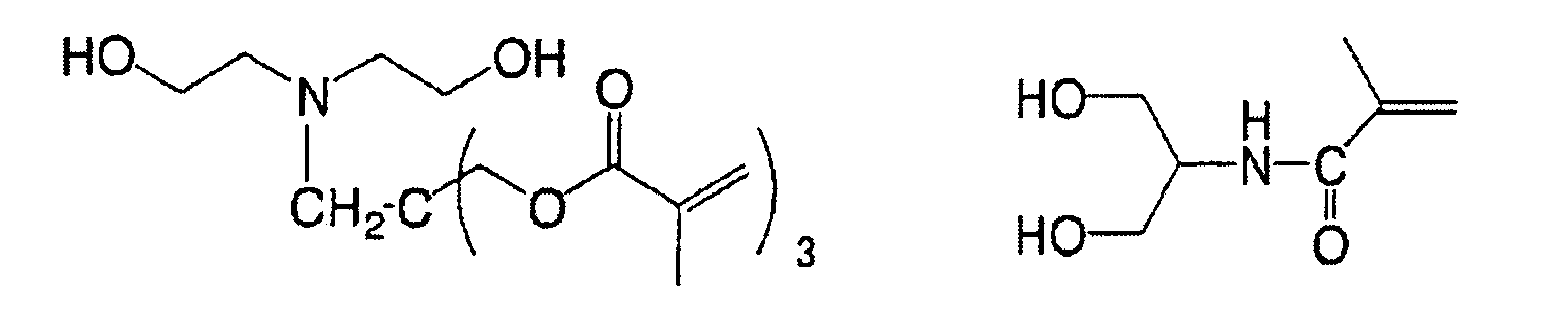


-


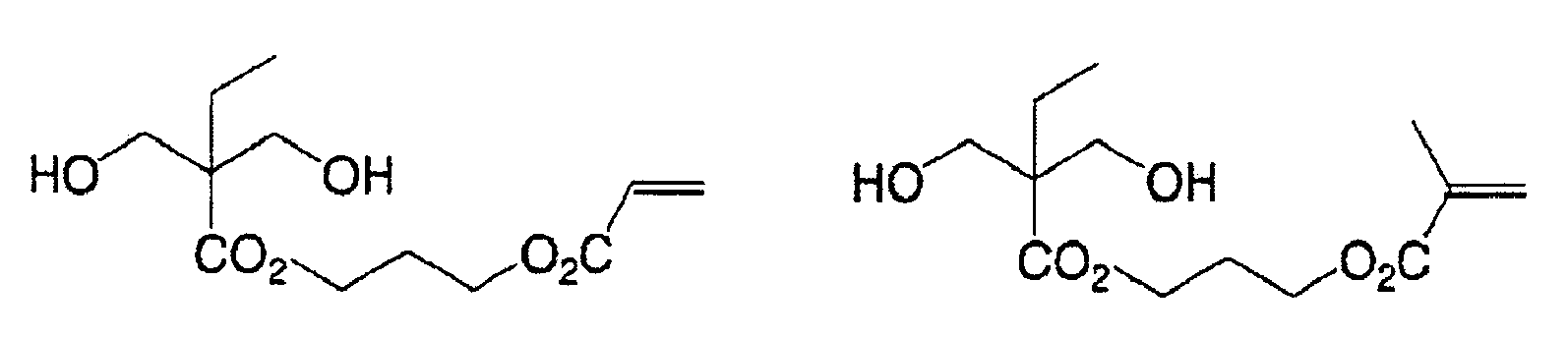
- In addition, as a more preferable polyurethane resin, a polyurethane resin obtained using a diol compound represented by the following formula (G) as at least one of diol compounds having an ethylenic unsaturated bond group upon synthesis of a polyurethane resin is exemplified.
-

- In the formula (G), R1 to R3 each represent independently a hydrogen atom or a monovalent organic group, A represents a divalent organic residue, X represents an oxygen atom, a sulfur atom, or -N(R12)-, and R12 represents a hydrogen atom, or a monovalent organic group.
R1 to R3 and X in this formula (G) have the same meanings as those of R1 to R3 and X in the formula (E1), and a preferable embodiment is similar.
A divalent organic residue represented by the A is a divalent organic linking group which contains a carbon atom and a hydrogen atom, and optionally an atom selected from an oxygen atom, a nitrogen atom, and a sulfur atom. Preferable is a divalent organic linking group which is constructed by suitably combining -C(=O)-, -C(=O)-O-, -C(=O)-NH-, -NH-C(=O)-O-, -NH-C(=O)-NH-, alkylene group, allylene group, or a group constructed by combining them and further -O-, -S-, or -NH-. The number of atoms constructing a linking chain contained in this divalent organic linking group is suitably within 60 and, from a viewpoint that film forming property is kept good, is preferably within 50, more preferably within 40. - It is thought that, by using a polyurethane resin derived from these diol compounds, the effect of suppressing excessive molecular motion of a polymer main chain due to a secondary alcohol having great steric hindrance is obtained, and improvement in a film strength of the relief forming layer is attained.
- Examples of the diol compound represented by the formula (G) which is suitably used in synthesizing a polyurethane resin will be shown below.
-


-


-


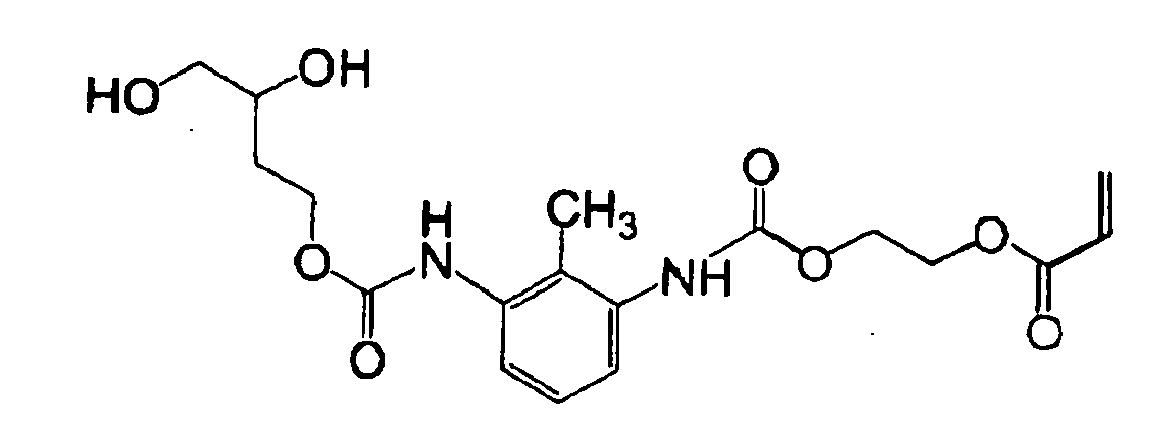

- When synthesizing a polyurethane resin under the NCO group excessive condition where an NCO/OH ratio is 1 or more, a main chain terminal is an NCO group, and thus, by separately adding hereto an alcohol having an ethylenic unsaturated bond (2-hydroxyethyl (meth)acrylate, trade name: BLEMMER PME200, manufactured by NOF Corporation) etc.), an ethylenic unsaturated bond may be introduced into a main chain terminal.
That is, as a polyurethane resin suitable in the invention, a resin having an ethylenic unsaturated group not only in a side chain but also in a main chain terminal is also preferable. - As a polyurethane resin suitable in the invention, as described above, in addition to a resin having an ethylenic unsaturated bond in a side chain, a resin having an ethylenic unsaturated bond in a main chain terminal and/or a main chain is also suitably used.
As a method of introducing an ethylenic unsaturated bond into a main chain terminal of a polyurethane resin, there is the following method.
That is, when synthesizing a polyurethane resin, in a step of treating an isocyanate group remaining in a main chain terminal of the resulting intermediate product with alcohols or amines, alcohols or amines having an ethylenic unsaturated group may be used. - As a method of introducing an ethylenic unsaturated bond into a main chain of a polyurethane resin, there is a method of using a diol compound having an ethylenic unsaturated bond in a chain linking an OH group and an OH group in synthesis of a polyurethane resin. Examples of the diol compound having an ethylenic unsaturated bond in a chain linking an OH group and an OH group include the following compounds.
That is, examples include cis-2-butene-1,4-diol, trans-2-butene-1,4-diol, and polybutadiendiol. - From a viewpoint that an introduction amount is easily controlled, and an introduction amount may be increased, or a crosslinking reaction efficacy is improved, it is preferable that an ethylenic unsaturated bond is introduced into a side chain rather than into a main chain terminal of a polyurethane resin.
As an ethylenic unsaturated bond group to be introduced, from a viewpoint of crosslinked cured film forming property, a mathacryloyl group, an acryloyl group, and styryl group are preferable and, a methacryloyl group and an acryloyl group are more preferable. From a viewpoint of realization of both of forming property and unused stock storability of a crosslinked cured film, a methacryloyl group is further preferable. - Regarding an amount of an ethylenic unsaturated bond contained in a polyurethane resin used in the invention, an ethylenic unsaturated bond group is contained in a side chain in an amount of preferably 0.3 meq/g or more, further preferably 0.35 to 1.50 meq/g as expressed by equivalent. That is, a polyurethane resin containing a methacryloyl group in a side chain in an amount of 0.35 to 1.50 meq/g is most preferable.
- A weight average molecular weight of a polyurethane resin as the specified alcoholphilic polymer in the invention is preferably 10,000 or more, more preferably in the range of 40,000 to 200,000. Particularly, when a polyurethane resin having a molecular weight in this range is used, a strength of the formed relief layer (image area) is excellent.
- A polyurethane resin used as the specified alcoholphilic polymer in the invention is synthesized by heating the diisocyanate compound and the diol compound in an aprotic solvent with the addition of the known catalyst having activity according to each reactivity. A molar ratio (Ma:Mb) of the diisocyanate and diol compounds used in synthesis is preferably 1:1 to 1.2:1.1 and, by treating with alcohols or amines, a product having desired physical properties such as a molecular weight and a viscosity is synthesized in such a final form that an isocyanate group does not remain.
Inter alia, synthesis using a bismuth catalyst is more preferable than a tin catalyst which has been previously used frequently, from a viewpoint of the environment and a polymerization rate. As such a bismuth catalyst, trade name: NEOSTAN U-600 manufactured by NITTO CHEMICAL INDUSTRY co., ltd.. is particularly preferable. - Examples of the specified polyurethane resin used in the invention are shown below, but the invention is not limited by them.
-
Polyurethane resin Diisocyanate compound used (mol%) Diol compound used (mol%) Weight average molecular weight P-1 

95, 000 P-2 
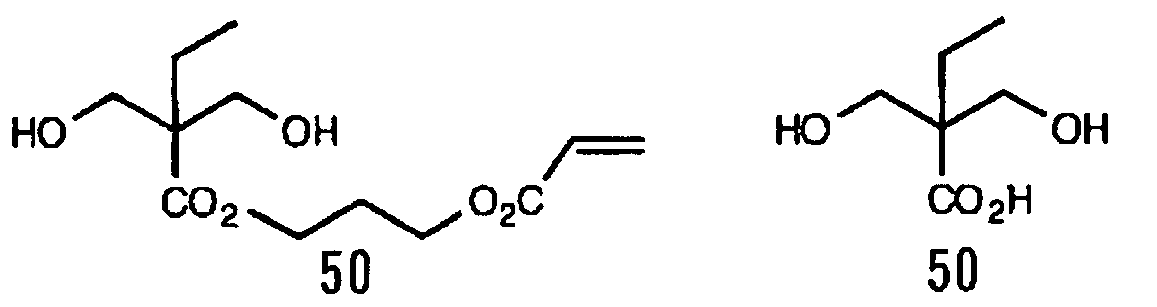
98, 000 P-3 

103, 000 P-4 

108, 000 P-5 

99, 000 -
Polyurethane resin Diisocyanate compound used (mol%) Diol compound used (mol%) Weight average molecular weight P-6 

96,000 P-7 

68, 000 P-8 

96, 000 P-9 

100, 000 -
Polyurethane resin Diisocyanate compound used (mol%) Diol compound used (mol%) Weight average molecular weight P-10 

69, 000 P-11 

120, 000 P-12 

78, 000 P-13 

103, 000 -
Polyurethane resin Diisocyanate compound used (mol%) Diol compound used (mol%) Weight average molecular weight P-14 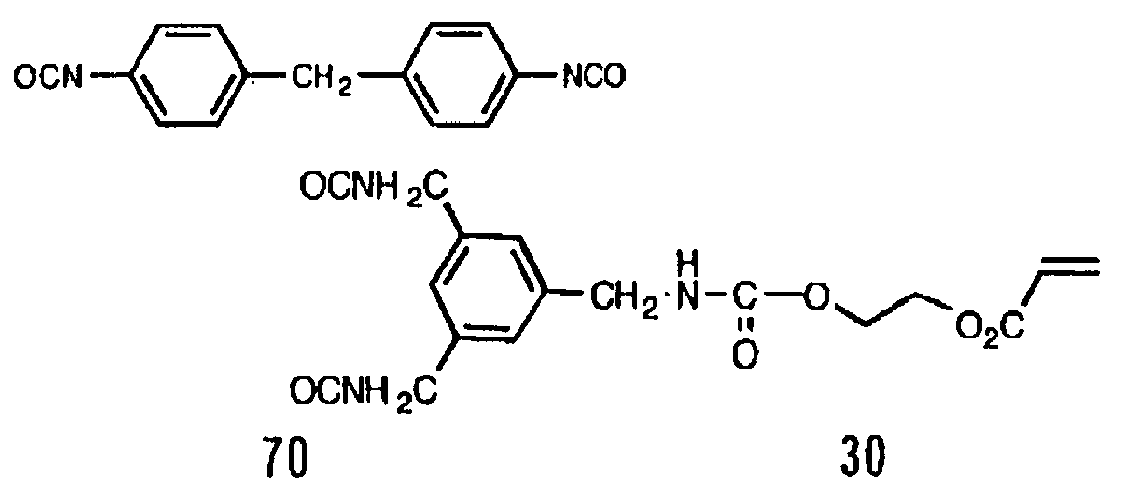

65, 000 P-15 

78, 000 P-16 

69, 000 -
Polyurethane resin Diisocyanate compound used (mol%) Diol compound used (mol%) Weight average molecular weight P-17 

99, 000 P-18 

87, 000 P-19 

97, 000 P-20 

103, 000 -
Polyurethane resin Diisocyanate compound used (mol%) Diol compound used (mol%) Weight average molecular weight P-21 

60, 000 P-22 

70, 000 P-23 

50, 000 -
Polyurethane resin Diisocyanate compound used (mol%) Diol compound used (mol%) Weight average molecular weight P-24 

75, 000 P-25 

80, 000 P-26 

50, 000 -
Polyurethane resin Diisocyanate compound used (mol%) Diol compound used (mol%) Weight average molecular weight P-27 

60, 000 P-28 

59, 000 P-29 

63, 000 -
Polyurethane resin Diisocyanate compound used (mol%) Diol compound used (mol%) Weight average molecular weight P-30 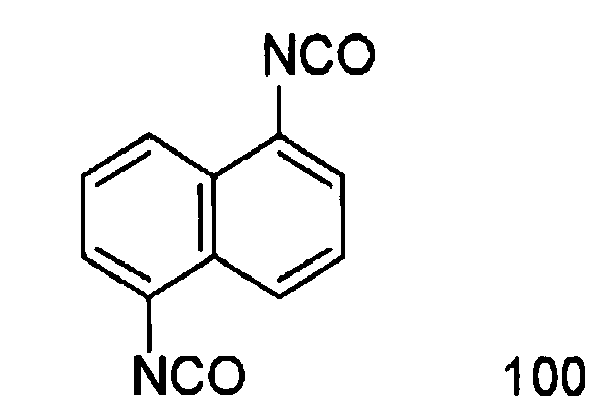

32, 000 P-31 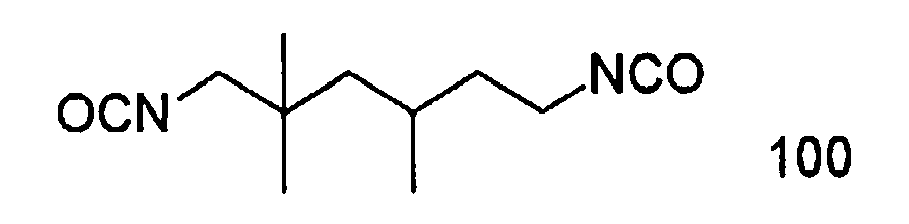

21, 000 P-32 

29, 000 P-33 

41, 000 - A polyurethane resin as the specified alcoholphilic polymer related to the invention has the characteristic that it is thermally decomposed at a relatively low temperature (lower than 250°C) as compared with a binder polymer used in the normal relief forming layer (in the case of a commercially available general-use resin, it is thermally decomposed at a high temperature of 300°C to 400°C in most cases). Therefore, the relief forming layer containing such a polyurethane resin may be decomposed at a high sensitivity.
In addition, in a system in which such a polyurethane resin is used as the specified alcoholphilic polymer and an additional binder polymer described later is used together, even in the state where these polymers are not uniformly mixed and are phase-separated, first, this polyurethane resin is decomposed by heat production with laser irradiation and, as a result, a gas (nitrogen etc.) generated upon thermal decomposition and vaporization of the polyurethane resin assists and promotes vaporization of the additional binder polymer. For this reason, the relief forming layer using such a polyurethane resin as the specified alcoholphilic polymer also has an advantage that, even when the additional binder polymer is present, laser decomposability is improved, and a high sensitivity is attained. - As a binder polymer in the invention, a relatively hydrophobic binder polymer may be used.
As the relatively hydrophobic binder polymer, polymers containing the following monomers as a polymerization or copolymerization component may be used for adjusting a nature such as a hardness or flexibility of a film when forming the film, and compatibility with other components such as a polymerization compound and an initiator which are present together.
Examples include compounds having only one ethylenic unsaturated bond such as (meth)acrylate having a hydroxy group such as 2-hydroxyethyl (meth)acrylate, 2-hydroxypropyl (meth)acrylate, 2-hydroxybutyl (meth)acrylate, 3-chloro-2-hydroxypropyl (meth)acrylate, and β-hydroxy-β'-(meth)acryloyloxyethyl phthalate, alkyl (meth)acrylate such as methyl (meth)acrylate, ethyl (meth)acrylate, propyl (meth)acrylate, butyl (meth)acrylate, isoamyl (meth)acrylate, 2-ethylhexyl (meth)acrylate, lauryl (meth)acrylate, and stearyl (meth)acrylate, cycloalkyl (meth)acrylate such as cyclohexyl (meth)acrylate, halogenated alkyl (meth)acrylate such as chloroethyl (meth)acrylate, and chloropropyl (meth)acrylate, alkoxylalkyl (meth)acrylate such as methoxyethyl (meth)acrylate, ethyoxyethyl (meth)acrylate, and butoxyethyl (meth)acrylate, phenoxyalkyl (meth)acrylate such as phenoxyethyl acrylate, and nonylphenoxyethyl (meth)acrylate, alkoxyalkylene glycol (meth)acrylate such as ethoxydiethylene glycol (meth)acrylate, methoxytriethylene glycol (meth)acrylate, and methoxydipropylene glycol (meth)acrylate, (meth)acrylamides such as (meth)acrylamide, diacetone(meth)acrylamide, and N,N'-methylenebis(meth)acrylamide, 2,2-dimethylaminoethyl (meth)acrylate, 2,2-diethylaminoethyl (meth)acrylate, N,N-dimethylaminoethyl(meth)acrylamide, and N,N-dimethylaminopropyl(meth)acrylamide, and compounds having two or more ethylenic unsaturated bonds such as di(meth)acrylate of polyethylene glycol such as diethylene glycol di(meth)acrylate, polypropylene glycol di(meth)acrylate such as dipropylene glycol di(meth)acrylate, trimethylolpropane tri(meth)acrylate, pentaerythritol tri(meth)acrylate, pentaerythritol tetra(meth)acrylate, glycerol tri(meth)acrylate, polyvalent (meth)acrylate obtained by addition-reacting a compound having an ethylenic unsaturated bond and active hydrogen such as unsaturated carboxylic acid and an unsaturated alcohol with ethylene glycol diglycidyl ether, polyvalent (meth)acrylate obtained by addition-reacting a compound having active hydrogen such as carboxylic acid and amine with an unsaturated epoxy compound such as glycidyl (meth)acrylate, polyvalent (meth)acrylamide such as methylenebis(meth)acrylamide, and a polyvalent vinyl compound such as divinylbenzene. In the invention, these may be used alone, or may be used by combining two or more kinds. - As a monomer of the polymerization components, from a viewpoint of film forming property, 2-hydroxylethyl (meth)acrylate, 2-hydroxypropyl (meth)acrylate, 2-hydroxybutyl (meth)acrylate, alkoxyalkylene glycol (meth)acrylate such as ethoxydiethylene glycol (meth)acrylate, methoxytriethylene glycol (meth)acrylate, and methoxydipropylene glycol (meth)acrylate, (meth)acrylamide, diacetone(meth)acrylamide, cyclohexyl (meth)acrylate, benzyl (meth)acrylate, and N-acryloylmorpholine are preferable. Among them, acrylates are particularly preferable from a viewpoint that softness of the resulting polymer is maintained.
- Besides, as the binder polymer, the following polymers may be also used.
That is, there is a polymer containing at least any of olefin and a carbon-carbon triple bond in a main chain, and examples include SB (polystyrene-polybutadiene), SBS (polystyrene-polybutadiene-polystyrene), SIS (polystyrene-polyisoprene-polystyrene), and SEBS (polystyrene-polystyrene/polybutylene-polystyrene). - As the binder polymer, a polymer having a carbon-carbon unsaturated bond in a molecule may be suitably used. The carbon-carbon unsaturated bond may be present in one of a main chain and a side chain of a polymer, or may be present in both chains. Hereinafter, the carbon-carbon unsaturated bond is simply referred to as "unsaturated bond" in some cases, and the carbon-carbon unsaturated bond remaining in a main chain or a side chain terminal is referred to as "polymerizable group" in some cases.
When a main chain of a polymer has the carbon-carbon unsaturated bond, the bond may be included in any of one terminal and both terminals of a polymer main chain, and a main chain. When a side chain of a polymer has the carbon-carbon unsaturated bond, the unsaturated bond may directly bind to a main chain structure, or may bind thereto via a suitable linking group. - Examples of a polymer containing the carbon-carbon unsaturated bond in a main chain include SB (polystyrene-polybutadiene), SBS (polystyrene-polybutadiene-polystyrene), SIS (polystyrene-polyisoprene-polystyrene), and SEBS (polystyrene-polyethylene/polybutylene-polystyrene).
- When a polymer having a polymerizable unsaturated group having high reactivity such as a methacryloyl group is used as a polymer having the carbon-carbon unsaturated bond in a side chain, a film having an extremely high mechanical strength may be made. In particular, in polyurethane and polyester thermoplastic elastomers, a polymerizable unsaturated group having high reactivity may be introduced into a molecule relatively simply.
- Upon introduction of an unsaturated bond or a polymerizable group into the binder polymer, any of the known methods may be adopted, such as a method of copolymerizing, into a polymer, a structural unit having a polymerizable group precursor in which a protecting group is bound to a polymerizable group, and eliminating the protecting group to form a polymerizable group, and a method of preparing a polymer compound having a plural reactive groups such as a hydroxy group, an amino group, an epoxy group, a carboxyl group, an acid anhydride group, a ketone group, a hydrazine residue, an isocyanate group, an isothiocyanate group, a cyclic carbonate group, and an ester group, thereafter, reacting a binding agent (e.g. polyisocyanate in the case of a hydroxy group and an amino group) having a plural groups which may bind to the reactive groups, performing regulation of a molecular weight, and a conversion of a terminal into a binding group, thereafter, reacting with an organic compound having a group reactive with this terminal binding group and a polymerizable unsaturated group to introduce a polymerizable group by a polymer reaction. According to these methods, an amount of an unsaturated bond and a polymerizable group to be introduced into a polymer compound may be controlled.
- It is also preferable that such a polymer having an unsaturated bond is used together with a polymer having no unsaturated bond. That is, since a polymer obtained by adding hydrogen to an olefin part of a polymer having the carbon-carbon unsaturated bond, and a polymer obtained by forming a polymer using, as a raw material, a monomer in which an olefin part is hydrogenated, for example, a monomer in which butadiene or isoprene is hydrogenated, are excellent in compatibility, they may be also used to adjust an amount of an unsaturated bond included in the binder polymer.
When they are used, the polymer having no unsaturated bond may be used at a ratio of generally 1 part by mass to 90 parts by mass, preferably 5 parts by mass to 80 parts by mass relative to 100 parts by mass of the polymer having an unsaturated bond.
As described later, in an embodiment in which the binder polymer is not required to have curability such as the case where other polymerizable compound is used together, an unsaturated bond is not necessarily essential in the binder polymer, and only polymers having no unsaturated bond may be used as the binder polymer. Preferable examples of the polymer having no unsaturated bond in such a case include polyester, polyamide, polystyrene, acryl resin, acetal resin, and polycarbonate. - A number average molecular weight of the binder polymer having an unsaturated bond, or having no unsaturated bond, which may be used in the invention, is preferably in the range of 1,000 to 1,000,000. The more preferable range is 5,000 to 500,000. When the number average molecular weight is in the range of 1,000 to 1,000,000, a mechanical strength of a formed film may be maintained. The number average molecular weight is a molecular weight which is measured using gel permeation chromatography (GPC), and is evaluated relative to a polystyrene specimen having the known molecular weight.
- A weight average molecular weight (in terms of polystyrene as measured by GPC) of the binder polymer in the invention is preferably 5,000 to 500,000. When the weight average molecular weight is 5,000 or more, form retainability as a single resin is excellent and, when the weight average molecular weight is 500,000 or less, the polymer is easily dissolved in a solvent such as water, and this is advantageous for preparing a coating liquid for the relief forming layer. The weight average molecular weight of the binder polymer is more preferably 10,000 to 400,000, particularly preferably 15,000 to 300,000.
- A content of the binder polymer in the relief forming layer is preferably 5% by mass to 80% by mass, more preferably 15% by mass to 75% by mass, further preferably 20% by mass to 65% by mass.
Particularly, by adopting a content of the binder polymer of 15% by mass or more, print durability sufficient for use of the resulting relief printing plate as a printing plate is obtained and, by adopting 75% by mass or less, other components are not insufficient, and softness sufficient for use as a printing plate also when the relief printing plate is used as a flexographic printing plate may be obtained. - The relief forming layer in the invention contains (C) a compound having deodorizing ability as an essential component.
The compound having deodorizing ability in the invention has the effect of preventing or reducing an unpleasant odor generated when light and/or heat are applied to the relief forming layer of the relief printing plate precursor of the invention, and may be at least one compound selected from the group consisting of diphenols, polyphenols, hydroquinones, diarylamines, alkylated p-phenylenediamines, dihydroquinones, thioethers, hindered amines, phenols, phosphites, phosphonites, catechins, tannins, natural substance extracts, phenolic compound oxidases, and polysaccharides. Examples of such compounds include deodorizers and deodorants described later. - As the deodorizer used in the invention, from a viewpoint of preventing an odor due to a photopolymerizaiton initiator, a radical inhibitor may be exemplified.
The radical inhibitor is a compound which is added to a radical polymerizable composition such as the relief forming layer in the invention for inhibiting or stopping radical polymerization.
Examples of the radical inhibitor include a polymerization inhibitor, a stabilizer, an antioxidant, and a radical scavenger.
A radical inhibitor will be explained in detail below. - Previously, many radical inhibitors have been known, and are described in, for example, in U.V. and E.B. Curing Formulations for Printing Inks, Coatings and Paints, SITA-Technology (London, 1988), page 22 (written by R. Holman and P. Oldring).
Other radical inhibitors are listed in Table 4 of "Antioxidants" written by M.Dexter, Encyclopedia of Chemical Technology, vol. 3 (4th edition, Wiley Interscience, New York, 1992) and edited by J. I. Kroschwitz, pp.424 to 447 and examples of monophenols include monophenols having the following CAS Registry Numbers: 128-39-2, 128-37-0, 4130-42-1, 4306-88-1, 1879-09-0, 110553-27-0, 61788-44-1, 17540-75-9, 2082-79-3, 103-99-1, 88-27-7, and 99-1-84-4. - The polymerization inhibitor which is one of radical inhibitors is an additive which slows a process speed of, or inhibits a radical polymerization process of the relief forming layer in the invention.
Examples of such a polymerization inhibitor include diphenols, polyphenols, hydroquinones, diarylamines, alkylated p-phenylenediamines, dihydroquinones, thioethers, and hindered amines. - Examples of diphenols include diphenols having the following CAS Registry Numbers: 119-47-1, 88-24-4, 118-82-1, 35958-30-6, 36443-68-2, 85-60-9, 96-69-5, 96-66-2, 35074-77-2, 41484-35-9, 23128-74-7, 65140-91-2, 30947-30-9, 70331-94-1, 32687-78-8, 32509-66-3, and 105350-68-3.
Examples of polyphenols include polyphenols having the following CAS Registry Numbers: 68610-51-5, 6683-19-8, 1709-70-2, 27676-62-6, 1843-03-4, 34137-09-2, and 40601-76-1.
Examples of hydroquinones include hydroquinones having the following CAS Registry Numbers: 79-74-3, 1948-33-0, and 121-00-6.
Examples of diarylamines include diarylamines having the following CAS Registry Numbers: 90-30-2, 68442-68-2, 68259-36-9, 101-67-7, and 10081-67-1. - Examples of alkylated p-phenylenediamines include alkylated p-phenylenediamines having the following CAS Registry Numbers: 793-24-8, 101-72-4, 69796-47-0, 15233-47-3, 101-87-1, 74-31-7, 93-46-9, 3081-14-9, 139-60-6, 793-24-8, 103-96-8, and 100-93-6.
Examples of dihydroquinones include dihydroquinones having the following CAS Registry Numbers: 26780-96-1, 89-28-1, and 91-53-2.
Examples of thioethers include thioethers having the following CAS Registry Numbers: 2500-88-1, 123-28-4, 693-36-7, 16545-54-3, 10595-72-9, 29598-76-3, 53988-10-6, 61617-00-3, 26523-78-4, 26741-53-7, 3806-34-6, 31570-04-4, 38-613-77-3, and 118337-09-0.
Examples of hindered amines include hindered amines having the following CAS Registry Numbers: 70624-18-9, 82541-48-7, and 106990-43-6. - Examples of a specific compound of the polymerization inhibitor include p-methoxyphenol, hydroquinone, methoxybenzoquinone, phenothiazine, catechols, alkylphenols, alkylbisphenols, zinc dimethyldithiocarbamate, copper dimethyldithiocarbamate, copper dibutyldithiocarbamate, copper salicylate, thiodipropionic acid esters, mercaptobenzimidazole, and phosphites, and p-methoxyphenol, catechols, alkylphenols, and alkylbisphenols are preferable.
- Examples of alkylphenols and alkylbisphenols include 2,6-di-t-butyl-phenol, octadecyl-3-(3,5-di-t-butyl-4-hydroxyphenyl) propionate, N,N'-hexamethylenebis(3,5-di-t-butyl-4-hydroxy-hydrocinamide), 2,2'-methylenebis(4-methyl-6-t-butylphenol), 4,4'-methylenebis(2,6-di-t-butylphenol), 4,4'-butylidenebis(3-methyl-6-t-butylphenol), 2,6-bis(2'-hydroxy-3'-t-butyl-5'-methylbenzyl)-4-methylphenol, 1,1,3-tris(2'-methyl-5'-t-butyl-4'-hydroxyphenyl)butane, 1,3,5-trimethyl-2,4,6-tris(3',5'-di-t-butyl-4'-hydroxybenzyl)benzene, triethylene glycol bis[3-(3-t-butyl-5-methyl-4-hydroxyphenyl)propionate], and pentaerythrityltetrakis[3-(3,5-di-t-butyl-4-hydroxyphenyl)propionate]. It is preferable that phenols are oil-soluble.
- The antioxidant which is one of radical inhibitors is an additive which prevents an organic substance from becoming hydroperoxide (which is easily cleaved to produce a radical) due to an oxygen in the atmospheric air. Particularly, when the antioxidant is used as an additive for an ethylenic unsaturated oligomer, an antioxidant which prevents this process is usually called radical inhibitor ("Antioxidants" written by M.Dexter, Encyclopedia of Chemical Technology, vol. 3 (4th edition, Wiley Interscience, New York, 1992) edited by J. I. Kroschwitz, pp.424 to 447).
- Examples of the antioxidant used in the invention include phenol antioxidants (phenols), phosphite antioxidants (phosphites), phosphonite antioxidants (phosphonites), sulfur containing antioxidants (thioethers), and hindered amine antioxidants (hindered amines).
- The phenol antioxidant is not particularly limited, but a compound represented by the following formula [A], and hydroquinones are preferably exemplified.
-

- In the general formula [A], R1 and R2 each represent independently a lower alkyl group, n represents an integer of 0 to 2, m represents an integer of 1 to 4, and Z represents a hydrogen atom or a monovalent to tetravalent organic group.
- The lower alkyl group represented by R1 or R2 represents an alkyl group having 1 to 8 carbon atoms, and may be straight, or may have a branch, and may have a ring structure.
The monovalent to tetravalent organic group represented by Z is not particularly limited, as far as it is an organic group which does not deteriorate the deodorizing ability of the compound having a partial structure represented by the formula [A]. - Among the compounds having a partial structure represented by the formula [A], a compound represented by the following formula [A1] or [A2] is preferable.
-

- In the formula [A1], R3 represents a lower alkyl group, R4 and R5 each represent independently a hydrogen atom or a lower alkyl group, and n represents an integer of 1 to 4. When n is 1, X represents a single bond or an alkylenecarbonyloxy group and, when X is a single bond, R6 represents a hydrogen atom, an alkoxy group, or a lower alkyl group optionally substituted with an alkoxy group or an amino group and, when X is an alkylenecarbonyloxy group, R6 represents a hydrogen atom or an alkyl group. When n is 2 to 4, X represents an alkylenecarbonyloxy group, and R6 represents a divalent to tetravalent alcohol residue optionally containing a hetero atom in the residue. And, when n is 3, X may be an alkylene group, and R6 may be an isocyanuric acid residue.
-

- In the formula [A2], R3 and R4 have the same meanings as those of R3 and R4 of the formula [A1], and the preferable range is the same. R3s and R4s which are present at the plural number in the molecule may be the same or different. And, Y represents an alkylene group or a sulfur atom. R7 represents a hydrogen atom, an acrylic acid residue, or a methacrylic acid residue.
- Examples of the phenol antioxidant include hydroquinone, methylhydroquinone, t-butylhydroquinone, 2,6-di-t-butyl-4-methylphnol, octadecyl-3-(3,5-di-t-butyl-4-hydroxyphenyl) propionate, 2,2'-methylenebis(6-t-butyl-4-methylphenol), 2-t-butyl-6-(3-t-butyl-2-hydroxy-5-methylbenzyl)-4-methylphenyl acrylate, 2-[1-(2-hydroxy-3,5-di-t-pentylphenyl)ethyl]-4,6-di-t-pentylphenyl acrylate, 4,4'-butylidenebis(6-t-butyl-3-methylphenol), 3,9'-bis{2-[3-(3-t-butyl-4-hydroxy-5-methylphenyl)propionyloxy]-1,1-dimethylethyl}-2,4,8,1 0-tetraoxaspiro[5.5]undecane, 2-(3,5-di-t-butyl-4-hydroxyanilino)-4,6-bis(n-octylthio)-1,3,5-triazine, 2,2'-ethyldenebis(4,6-di-t-butylphenol), 2,2'-ethylidenebis(4-sec-butyl-6-t-butylphenol), 2,2'-thiobis(6-t-butyl-3-methylphenol), 1,1,3-tris(5-t-butyl-4-hydroxy-2-methylphenyl)butane, bis[2-t-butyl-4-methyl-6-(3-t-butyl-2-hydroxy-5-methylbenzyl)phenyl] terephthalate, tetrakis[methylene-3-(3,5-di-t-butyl-4-hydroxyphenyl)propionate]methane, 2,2'-thiodiethyelenebis[3-(3,5-di-t-butyl-4-hydroxyphenyl)propionate], triethylene glycol bis[3-(3-t-butyl-4-hydroxy-5-methylphenyl)propionate], 1,6-hexanediolbis[3-(3,5-di-t-butyl-4-hydroxyphenyl)propionate], 1,3,5-tris(3,5-di-t-butyl-4-hydroxybenzyl) isocyanurate, 1,3,5-tris[2-{3-(3,5-di-t-butyl-4-hydroxyphenyl)propionyloxy}ethyl] isocyanurate, 1,3,5-tris(4-t-butyl-3-hydroxy-2,6-dimethylbenzyl) isocyanurate, and 1,3,5-tris(3,5-di-t-butyl-4-hydroxybenzyl)-2,4,6-trimethylbenzene.
- In the invention, the sulfur containing antioxidant is not particularly limited, but examples include a compound represented by the following formula [B], and a compound represented by the formula [C].
S-(CH2CH2-COOR8)2 [B]
In the formula [B], R8 represents an alkyl group, and is preferably an alkyl group having 12 to 18 carbon atoms. -
(R9S-CH2CH2-COOCH2)4-C [C]
In the formula [C], R9 represents an alkyl group, and is preferably an alkyl group having 12 carbon atoms. - Examples of the sulfur containing antioxidant include dilauryl-3,3'-thiodipropionate, dimyristyl-3,3'-thiodipropionate, distearyl-3,3'-thiodipropionate, and tetrakis(3-laurylthiopropionyloxymethyl)methane.
- In the invention, the phosphite antioxidant and the phosphonite antioxidant are not particularly limited, but examples include compounds represented by the following formulas [D] to [I].
P(OR10)3 [D]
In the formula [D], R10 represents an optionally substituted alkyl group, or an optionally substituted aryl group. -

- In the formulas [E] and [F], R11 represents an optionally substituted alkyl group or an aryl group, R12, R13, and R14 each represent independently a hydrogen atom or an alkyl group having 1 to 8 carbon atoms, and R15 represents a fluorine atom, an alkyl group, a hydroxy group, an alkoxy group, an amino group, a monoalkyl amino group, or a dialkyl amino group.
-

- In the formulas [G] and [H], R16 and R17 each represent independently a hydrogen atom or an alkyl group, and R18 represents a hydrogen atom or an alkyl group, provided that when R18 is a hydrogen atom, a resonance structure represented by the following [I] is present, and this becomes a phosphinate compound.
-

- Examples of the phosphite antioxidant and phosphonite antioxidant include tris(nonylphenyl) phosphite, tris(2,4-di-t-butylphenyl) phosphite, tetrakis(2,4-di-t-butylphenyl)-4,4'-biphenylene diphosphonite, bis(2,4-di-t-butylphenyl)pentaerythritol·diphosphite, bis(2,6-di-t-butylphenyl)pentaerythritol·diphosphite, distearylpentaerythritol·diphosphite, phenyldiisooctyl phosphite, phenyldiisodecyl phosphite, phenyldi(tridecyl) phosphite, diphenylisooctyl phosphite, diphenylisodecyl phosphite, diphenyltridecyl phosphite, 4,4'-isopropylidenebis(phenyldialkylphosphite), 2,2'-methylenebis(4,6-di-t-butylphenyl)octyl phosphite, and 2,2'-ethylidenebis(4,6-di-t-butylphenyl)fluorophosphonite.
- In the invention, the hindered amine antioxidant is not particularly limited, but examples include preferably a compound having the following partial structure.
-

- In the above formula, R19 represents a hydrogen atom or an optionally substituted alkyl group, and a wavy line part represents a binding position with another chemical structure.
- Examples of the hindered amine antioxidant include bis(2,2,6,6-tetramethyl-4-piperidyl) sebacate, bis(N-methyl-2,2,6,6-tetramethyl-4-piperidyl) sebacate, N,N'-bis(2,2,6,6-tetramethyl-4-piperidyl)-1,6-hexamethylenediamine, 2-methyl-2-(2,2,6,6-tetramethyl-4-piperidyl)amino-N-(2,2,6,6-tetramethyl-4-piperidyl)propio namide, tetrakis(2,2,6,6-tetramethyl-4-piperidyl)-1,2,3,4-butanetetracarboxylate, poly {[6-(1,1,3,3-tetramethylbutyl)imino-1,3,5-triazine-2,4-diyl] [(2,2,6,6-tetramethyl-4-piperi dyl)imino]hexamethyl{(2,2,6,6-tetramethyl-4-piperidyl)imino}}, poly{(6-morpholino-1,3,5-triazine-2,4-diyl)[(2,2,6,6-tetramethyl-4-piperidyl)imino]hexameth ine[(2,2,6,6-tetramethyl-4-piperidyl)imino]}, a polycondensate of dimethyl succinate and 1-(2-hydroxyethyl)-4-hydroxy-2,2,6,6-tetramethylpiperidene, and N,N'-4,7-tetrakis{4,6-bis[N-butyl-N-(1,2,2,6,6-pentamethyl-4-piperidyl)amino]-1,3,5-triazine -2-yl}-4,7-diazadecane-1,10-diamine.
- Examples of other antioxidants include antioxidants described in each of
JP-A Nos. 57-74192 57-87989 60-72785 JP-A No. 61-154989 JP-ANo. 61-146591 JP-A No. 61-177279 JP-ANos. 1-115677 1-36479 JP-A No. 1-36480 JP-A Nos. 7-195824 8-150773 JP-A No. 7-149037 JP-A No. 7-314882 JP-A No. 7-314883 JP-A Nos. 7-276790 8-108617 JP-ANo. 8-118791 JP-A No. 8-300807 JP-A No. 9-267544 JP-A No. 2000-263928 - The antioxidant which may be used in the invention may be obtained by synthesis according to the known method, or may be easily available as a commercialized product.
In the invention, it is preferable that, as the antioxidant, the phenol antioxidant is used. - In addition, a stabilizer which is one of radical inhibitors is an additive which when the relief forming layer in the invention is constructed of an active light curing composition, may stabilize it.
- In the invention, from a viewpoint of suppression of an odor due to a polymerization initiator, the deodorizer is preferably a compound having a phenolic hydroxyl group such as phenols, diphenols, polyphenols, hydroquinones, and dihydroquinones.
- The deodorant used in the invention is not particularly limited, but examples include compounds described in "Advanced Deodorant and Deodorizing Technique (Industrial Technical Association)" and "New Deodorant, Development of Industrial Deodorant and Approach to Productization (Technical Information Institute Co., Ltd)".
The deodorant which may be used in the invention is preferably a natural extraction component.
Examples of the natural extraction component include catechin, epigallocatechin, gallocatechin, epicatechin gallate, epigallocatechin gallate, gallotannin, and ellagitannin, which are extracts from plants such as catechins and tannins, extracts from natural products such as rosemary, sunflower seed, raw coffee, tea, fruit skin of grape, seed of grape, and apple, and components containing an enzyme which oxidizes a phenolic compound. In addition, polysaccharides, a representative of which is chitosan, and plant extraction components, representative of which is Japanese cypress oil, Korean houttuynia extract, and orange essential oil are preferable. Among them, catechins or tannins are preferable, and catechin, epicatechin gallate, and gallotannin are more preferable.
These deodorants may be used alone, or plural kinds of them may be used together. - In the invention, from a viewpoint of availability and general-use, it is preferable that the (C) compound having deodorizing ability is diphenols, polyphenols, hydroquinones, diarylamines, alkylated p-phenylenediamines, dihydroquinones, thioethers, or hindered amines, which are described above as the polymerization inhibitor; a phenol antioxidant (phenols), a phosphite antioxidant (phosphites), a phosphonite antioxidant (phosphonites), a sulfur containing antioxidant (thioethers), a hindered amine antioxidant (hindered amines), which are described above as the antioxidant; or catechins, tannins, extracts from natural products (natural product extracts), agent containing an enzyme which oxidizes a phenolic compound (phenolic compound oxidase), or polysaccharides, which are described above as a deodorant (natural extract component).
Among them, diphenols, polyphenols, hydroquinones, or dihydroquinones which are described above as the polymerization inhibitor, a phenol antioxidant (phenols) which is described above as the antioxidant, and a compound having a phenolic hydroxyl group such as catechins and tannins which are described above as the deodorant (natural extraction component) are preferably used. Among the compounds having a phenolic hydroxyl group, a compound having a plural phenolic hydroxyl groups is preferable. Particularly, a compound having 2 to 10 phenolic hydroxyl groups in one molecule is preferably used, and a compound having a catechol group or a pyrogallol group (more preferably, galloyl group) is further preferable. In addition, catechins having a flavane skeleton is preferably used, and catechins having 5 to 10 hydroxy groups is preferably used. - The following are examples of a preferable compound as the compound having deodorizing ability, but the invention is not limited by them.
-


-


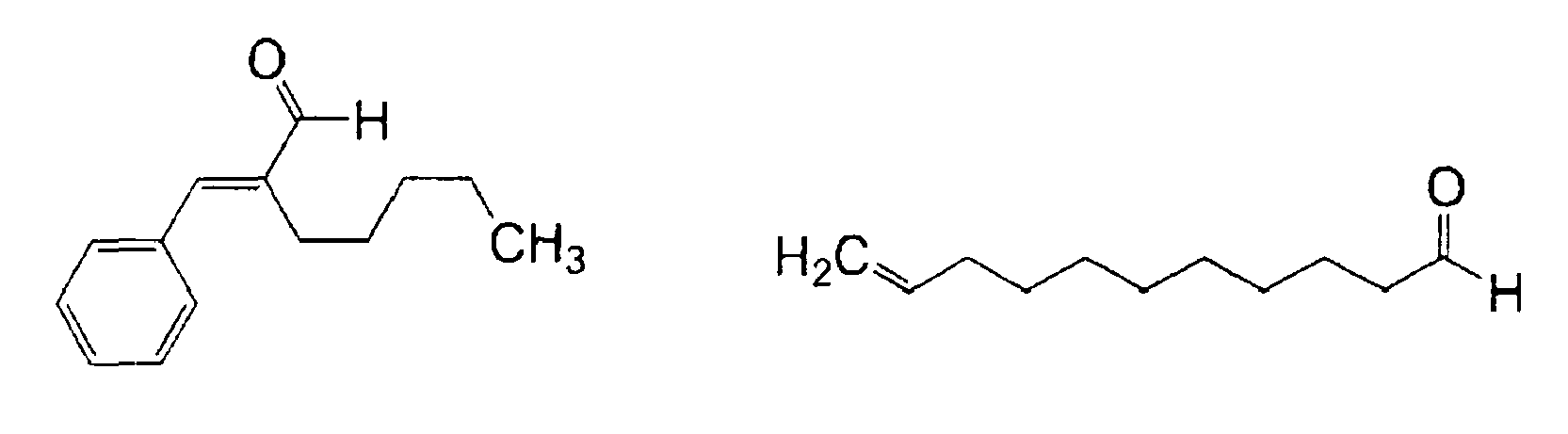

-


-


-

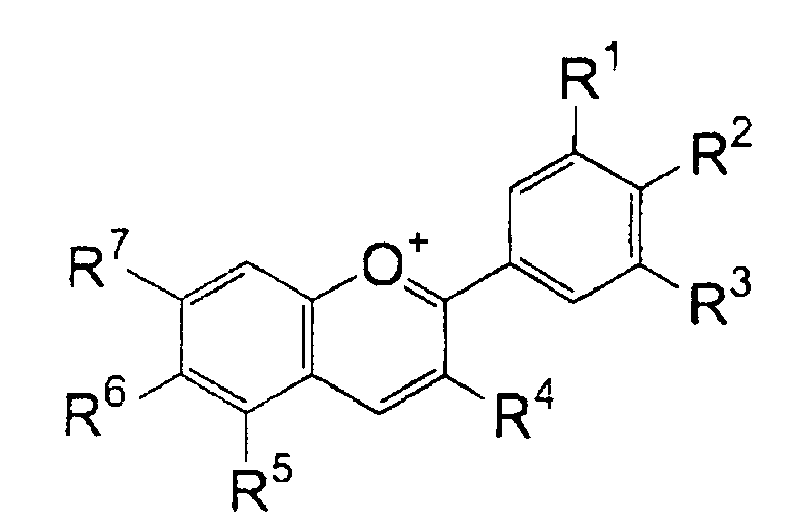
R1 , R2 , R3 , R4 , R5 , R6 , R7 Pelargonidin =H , OH , H , OH , OH , H , OH Cyanidin =OH , OH , H , OH , OH , H , OH Delphinidin =OH , OH , OH , OH , OH , H , OH Aurantinidin =H , OH , H , OH , OH , OH , OH Luteolinidin =OH , OH , H , H , OH , H , OH Peonidin =OCH3 , OH , H , OH , OH , H , OH Malvidin =OCH3 , OH , OCH3 , OH , OH , H , OH Petunidin =OH , OH , OCH3 , OH , OH , H , OH Europinidin =OCH3 , OH , OH , OH , OCH3 , H , OH Rosinidin =OCH3 , OH , H , OH , OH , H , OCH3 - It is preferable that the compound having deodorizing ability used in the invention is at least one compound selected from polyphenols in that the deodorizing effect is high.
Herein, "polyphenols" in the invention is a compound having plural phenolic hydroxy groups, and examples thereof include not only compounds having plural aromatic rings having a hydroxy group, but also compounds having plural hydroxy groups on the same aromatic ring. - Particularly, the at least one compound selected from polyphenols is preferably a compound having at least one of a catechol group or a pyrogallol group, more preferably a compound having a functional group represented by the following structural formula (I). Among them, a catechin derivative is most preferable. Herein, "*" in the following structural formula is a site for binding to another structure.
Herein, examples of the catechin derivative include (+)-catechin, epicatechin, gallocatechin, epigallocatechin, and epigallocatachin gallate, and examples include a compound having a flavane structure as a fundamental skeleton, in which OH is introduced into an aromatic ring or an aliphatic cyclic ether ring in the structure, and a compound in which the OH is further modified with a substituent. -

- As described above, when a polyphenol is used as a compound having deodorizing ability, the effect of improving stability (pot life) of a coating liquid used in formation of a film is obtained in a combination with the sulfur-containing polyfunctional monomer. This reason is not clear, but OH groups in polyphenols or phenols and S atoms in the sulfur-containing polyfunctional monomer form hydrogen bond at many points and, as a result, polyphenols or phenols are present in vicinity with the sulfur-containing polyfunctional monomer. Generally, it is known that polyphenols or phenols have polymerization inhibiting effect and, as described above, by polyphenols or phenols being in vicinity with the sulfur-containing polyfunctional monomer, this polymerization inhibiting effect is enhanced and, it is presumed that as a result, the coating liquid stability is improved.
- In addition, the compound having deodorizing ability used in the invention may be a compound having a polymerizable group and having deodorizing ability from a viewpoint of improvement in tackiness of the relief forming layer.
In the invention, preferable examples of the compound having a polymerizable group and having deodorizing ability include the following compound 1 to compound 20. -

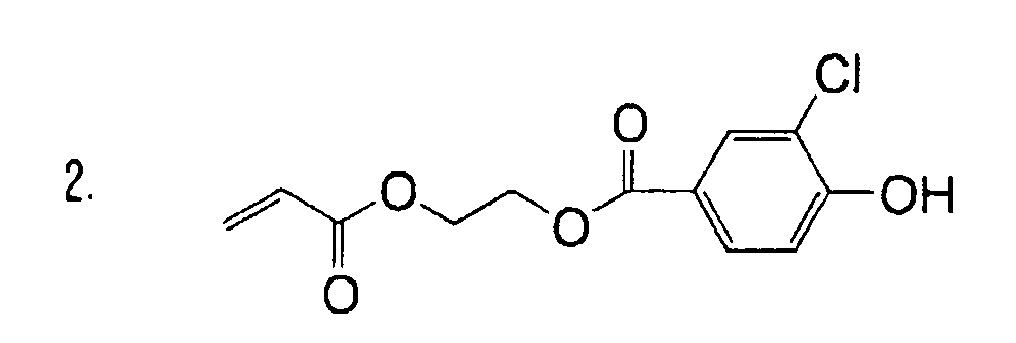


-


-


-


- In addition, as an example of the compound having a polymerizable group and having deodorizing ability, compounds in which a partial structure represented by the following (Et-1) to (Et-3) is substituted with a partial structure represented by the following (Re-1) or (Re-2) in the compound 1 to compound 9 may be preferably exemplified.
A wavy line part in the following formula is a part binding with another structure. -

-

- In the relief forming layer in the invention, the compound having deodorizing ability may by used alone, or a plural kinds may be used together.
As the compound having deodorizing ability, one of the deodorizer or the deodorant may be used, or the deodorizer and the deodorant may be used together. - When the deodorizer is used as the compound having deodorizing ability, an amount of this deodorizer to be added to the relief forming layer is preferably 0.01% by mass to 13% by mass, more preferably 0.05% by mass to 10% by mass relative to a total mass of the relief forming layer from a viewpoint of the odor reducing effect and curability of the relief forming layer.
When the deodorant is used as the compound having deodorizing ability, an amount of this deodorant to be added to the relief forming layer is preferably 0.01% by mass to 15% by mass, more preferably 0.05% by mass to 10% by mass relative to a total mass of the relief forming layer from a viewpoint of the odor reducing effect, a curing sensitivity of the relief forming layer, and a sufficient strength of a cured film. - An optional component preferably used in the relief forming layer in the invention will be explained below.
As the optional component, (D) a photothermal converting agent which may absorb light having a wavelength of 700 nm to 1,300 nm, and a polymerization initiator are preferably used. - It is preferable that the relief forming layer in the invention contains the (D) photothermal converting agent. It is thought that the photothermal converting agent promotes thermal decomposition of the relief forming layer by absorption of light of laser and heat production. Therefore, it is preferable that a photothermal converting agent which absorbs light having a laser wavelength used in engraving is selected.
- When a laser emitting infrared ray having a wavelength of 700 nm to 1,300 nm (YAG laser, semiconductor laser, fiber laser, plane emission laser etc.) is used as a light source in a laser engraving, it is preferable that the relief forming layer in the invention contains a photothermal converting agent which may absorb light having a wavelength of 700 nm to 1,300 nm.
As the photothermal converting agent in the invention, various dyes or pigments are used. - Among the photothermal converting agents, as the dye, commercially available dyes, and the known dyes described in a reference such as "Dye Handbook" (edited by The Society of Synthetic Organic Chemistry, Japan, published in 1970) may be utilized. Specifically, examples include dyes such as azo dyes, metal complex salts azo dyes, pyrazoloneazo dyes, naphthoquinone dyes, anthraquinone dyes, phthalocyanine dyes, carbonium dyes, diinmmonium compounds, quinoneimine dyes, methine dyes, cyanine dyes, squarylium coloring matters, pyrilium salts, and metal thiolate complexs.
- Examples of the dye preferably used in the invention include dyes described in paragraphs [0124] to [0137] of
JP-A No.2008-63554
One of preferable photothermal converting agents in the invention is at least one compound selected from the cyanine compound and the phthalocyanine compound from a viewpoint of a high engraving sensitivity. Further, when these photothermal converting agents are used in such a combination (condition) that thermal decomposition temperatures of them are equivalent or higher than a thermal decomposition temperature of a hydrophilic polymer preferable as the binder polymer, an engraving sensitivity tends to be further increased. - In addition, among the photothermal converting agents used in the invention, as the dyes, a dye having absorption maximum at the wavelength of 700 nm to 1,300 nm is preferable.
Examples of the dye which may be preferably used in the invention include dyes having a maximum absorption wavelength at 700 nm to 1,300 nm among cyanine coloring matters such as a heptamethinecyanine coloring matter, oxonol coloring matters such as a pentamethineoxonol coloring matter, indolium coloring matters, benzindolium coloring matters, benzthiazolium coloring matters, quinolinium coloring matters, and phthalide compounds which have been reacted with a developer. Light absorbing property is extremely greatly changed depending on the kind of a substituent and a position thereof in a molecule, the number of conjugate bonds, the kind of counter ions, and the surrounding environment in which a coloring matter molecule is present. - Generally commercially available laser coloring matters, supersaturated absorbing coloring matters, and near infrared absorbing coloring matters may be used. Examples of the laser coloring matter include products with trademarks "ADS740PP", "ADS745HT", "ADS760MP", "ADS740WS", "ADS765WS", "ADS745HO", "ADS790NH", and "ADS800NH" of American Dye Source (Canada), and products with trademarks "NK-3555", "NK-3509", and "NK-3519" manufactured by Hayashibara Biochemical Labs, Inc.. Examples of the near infrared absorbing coloring matter include products with trademarks "ADS775MI", "ADS775MP", "ADS775HI", "ADS775PI", "ADS775PP", "ADS780MT", "ADS780BP", "ADS793EI", "ADS798MI", "ADS798MP", "ADS800AT", "ADS805PI", "ADS805PP", "ADS805PA", "ADS805PF", "ADS812MI", "ADS815EI", "ADS818HI", "ADS818HT", "ADS822MT", "ADS830AT", "ADS838MT", "ADS840MT", "ADS845BI", "ADS905AM", "ADS956BI, "ADS1040T", "ADS1040P", "ADS1045P", "ADS1050P", "ADS1060A", "ADS1065A", "ADS1065P", "ADS 1100T", "ADS1120F", "ADS1120P", "ADS780WS", "ADS785WA", "ADS790WS", "ADS805WS", "ADS820WS", "ADS830WS", "ADS850WS", "ADS780HO", "ADS810CO", "ADS820HO", "ADS821NH", "ADS840NH", "ADS880MC", "ADS890MC" and "ADS920MC" manufactured by American Dye Source (Canada), products with trademarks "YKR-2200", "YKR-2081", "YKR-2900", "YKR-2100", and "YKR-3071" manufactured by Yamamoto Chemicals Inc., a product with trademark "SDO-1000B" manufactured by Arimoto Chemical Co., Ltd., and products with trademarks "NK-3508" and "NKX-114" manufactured by Hayashibara Biochemical Labs, Inc.. Examples are not limited to them.
- Among the photothermal converting agents used in the invention, as the pigment, commercially available pigments and pigments described in Color Index (C.I.) Handbook, "Advanced Pigment Handbook" (edited by Japan Pigment Technique Association, published in 1977), "Advanced Pigment Application Technique" (CMC Press, published in 1986), and "Printing Ink Technique" (CMC Press, published in 1984) may be utilized.
- Examples of the kind of the pigment include black pigments, yellow pigments, orange pigments, brown pigments, red pigments, purple pigments, blue pigments, green pigments, fluorescent pigments, metal powder pigments, and polymer binding coloring matters. Specifically, insoluble azo pigments, azo lake pigments, condensed azo pigments, chelate azo pigments, phthalocyanine pigments, anthraquinone pigments, perylene and perynone pigments, thioindigo pigments, quinacridone pigments, dioxazine pigments, isoindolinone pigments, quinophthalone pigments, dyeing lake pigments, azine pigments, nitroso pigments, nitro pigments, natural pigments, fluorescent pigments, inorganic pigments, and carbon blacks may be used. Among these pigments, carbon black is preferable.
- As carbon black, any carbon black in addition to carbon blacks according to classification by ATSM may be used regardless of utility (e.g. for color, for rubber, for dry cell etc.) as far as dispersibility in a coating liquid composition for the relief forming layer is stable. Examples of carbon black include furnace black, thermal black, channel black, lamp black, and acetylene black. The black coloring agent such as carbon black may be used as a color chip or a color paste in which the agent has been dispersed in nitrocellulose or a binder in advance using, if necessary, a disperser in order to make dispersing easy, and such chip and paste are easily available as a commercialized product.
- In the invention, from carbon black having a relatively low specific surface area and relatively low DBP absorption to finely-divided carbon black having a large specific surface area may be used. Examples of preferable carbon black include Printex (registered trademark) U, Printex (registered trademark) A, and Spezialschwarz (registered trademark) 4 (from Degussa).
- As carbon black which may be applied to the invention, conductive carbon black having a specific surface area of at least 150 m2/g and a DBP number of at least 150 ml/100 g is preferable from a viewpoint that the engraving sensitivity is improved by effective conduction of heat generated by photothermal conversion to the surrounding polymer.
- This specific surface area is preferably at least 250, particularly preferably at least 500 m2/g. The DBP number is preferably at least 200, particularly preferably at least 250 ml/100 g. The carbon black may be acidic or basic carbon black. Carbon black is preferably basic carbon black. A mixture of different carbon blacks may be naturally used.
- Suitable conductive carbon black having a specific surface area of up to about 1,500 m2/g and a DBP number of up to about 550 ml/100 g is commercially available under the name of, for example, Ketjennlack (registered trademark) EC300J, Ketjennlack (registered trademark) EC600J (from Akzo), Prinrex (registered trademark) XE (from Degussa) or Black Pearls (registered trademark) 2000 (from Cabot), or Ketjenn Black (manufactured by Lion).
- The content of the photothermal converting agent in the relief forming layer is greatly different depending on the molecular light absorption coefficient inherent to the molecule, and is preferably in the range of 0.01% by mass to 20% by mass, more preferably 0.05% by mass to 10% by mass, particularly preferably 0.1% by mass to 5% by mass relative to the total mass of the relief forming layer.
- The relief forming layer in the invention preferably contains (E) a polymerization initiator.
As the polymerization initiator, polymerization initiators known to a person skilled in the art may be used without limitation. Specifically, many are described in, for example, Bruce M. Monroe et al, "Chemical Review, 93, 435 (1993)" and R. S. Davidson et al., "Journal of Photochemistry and Biology A: Chemistry, 73.81(1993)"; J. P. Faussier, "Photoinitiated Polymerization-Therapy and Applications": Rapra Review vol.9, Report, Rapra Technology (1998); M. Tsunooka et al., Prog. Polym. Sci., 21,1 (1996). In addition, a compound group which oxidatively or reductively generates bond cleavage, as described in F. D. Saeva, Topics in Current Chemistry, 156, 59(1990); G. G. Maslak, Topics in Current Chemistry, 168, 1(1993); H. B. Shuster et al., JACS, 112, 6329 (1990); I. D. F. Eaton et al., JACS, 102, 3298 (1980) is also known. - Regarding an embodiment of a preferable polymerization initiator, a radical polymerization initiator which generates a radical by light and/or heat energy, and initiates and promotes a polymerization reaction of a polymerizale compound will be described in detail below, but the invention is not limited by these descriptions.
- In the invention, examples of a preferable radical polymerization initiator include (a) aromatic ketones, (b) an onium salt compound, (c) organic peroxide, (d) a thio compound, (e) a hexaarylbiimidazole compound, (f) a ketooxime ester compound, (g) a borate compound, (h) an azinium compound, (i) a metallocene compound, (j) an active ester compound, (k) a compound having a carbon halogen bond, and (l) an azo compound. The following are examples of (a) to (l), but the invention is not limited by them.
- In the invention, (c) organic peroxide and (l) an azo compound are more preferable, and (c) organic peroxide is particularly preferable from a viewpoint of that the sensitivity and the relief edge shape are made to be good.
Usually, when the hardness is increased in order to make the edge shape of the relief good, the engraving sensitivity is decreased, but by using the sulfur-containing polyfunctional monomer listed as a preferable embodiment of the polymerizable compound and the preferable polymerization initiator as described above, the edge shape may be made to be better without decreasing the engraving sensitivity. This is probably because due to formation of the interaction between a sulfur atom of the sulfur-containing polyfunctional monomer and an oxygen atom or a nitrogen atom in the polymerization initiator, and presence of both components in vicinity to each other, the polymerization degree is increased, and the hardness is increased, and thereby, the edge shape is made to be good and, at the same time, due to low temperature thermal decomposition property of the sulfur-containing polyfunctional monomer, reduction in the sensitivity due to the increased polymerization degree is suppressed. - As the (a) aromatic ketones, the (b) onium salt compound, the (d) thio compound, the (e) hexaaryl biimidazole compound, the (f) ketooxime ester compound, the (g) borate compound, the (h) azinium compound, the (i) metallocene compound, the (j) active ester compound, and the (k) compound having a carbon halogen bond, compounds listed in paragraphs [0074] to [0118] of
JP-A No.2008-63554
As the (c) organic peroxide and the (L) azo compounds, the following compounds are preferable. - Examples of a preferable (c) organic peroxide as the radical polymerization initiator which may be used in the invention include almost all organic compounds having one or more oxygen-oxygen bonds in a molecule, but examples include methyl ethyl ketone peroxide, cyclohexanone peroxide, 3,3,5-trimethylcyclohexanone peroxide, methylcyclohexanone peroxide, acetylacetone peroxide, 1,1-bis(tertiarybutylperoxy)-3,3,5-trimethylcyclohexane, 1,1-bis(tertiarybutylperoxy)cyclohexane, 2,2-bis(tertiarybutylperoxy)butane, tertiarybutyl hydroperoxide, cumene hydroperoxide, diisopropylbenzene hydroperoxide, paramethane hydroperoxide, 2,5-dimethylhexane-2,5-dihydroperoxide, 1,1,3,3-tetramethylbutyl hydroperoxide, di-tertiarybutyl peroxide, tertiarybutylcumyl peroxide, dicumylperoxide, bis(tertiarybutylperoxyisobutyl)benzene, 2,5-dimethyl-2,5-di(tertiarybutylperoxy)hexane, 2,5-xanoyl peroxide, succinic peroxide, benzoyl peroxide, 2,4-dichlorobenzoyl peroxide, meta-toluoyl peroxide, diisopropyl peroxydicarbonate, di-2-ethylhexylperoxy dicarbonate, di-2-ethoxyethylperoxy dicarbonate, dimethoxyisopropylperoxy carbonate, di(3-methyl-3-methoxybutyl)peroxy dicarbonate, tertiarybutylperoxy acetate, tertiarybutylperoxy pivalate, tertiarybutylperoxy neodecanoate, tertiarybutylperoxy octanoate, tertiarybutylperoxy-3,5,5-trimethylhexanoate, tertiarybutylperoxy laurate, tertiary carbonate, 3,3',4,4'-tetra-(t-butylperoxycarbonyl)benzophenone, 3,3',4,4'-tetra-(t-amylperoxycarbonyl)benzophenone, 3,3',4,4'-tetra-(t-hexylperoxycarbonyl)benzophenone, 3,3',4,4'-tetra-(t-octylperoxycarbonyl)benzophenone, 3,3',4,4'-tetra-(cumylperoxycarbonyl)benzophenone, 3,3',4,4'-tetra-(p-isopropylcumylperoxycarbonyl)benzophenone, carbonyldi(t-butylperoxy dihydrogen diphthalate), and carbonyldi(t-hexylperoxy dihydrogen diphthalate).
- Among them, ester peroxides such as 3,3',4,4'-tetra-(t-butylperoxycarbonyl)benzophenone, 3,3',4,4'-tetra-(t-amylperoxycarbonyl)benzophenone, 3,3',4,4'-tetra-(t-hexylperoxycarbonyl)benzophenone, 3,3',4,4'-tetra-(t-octylperoxycarbonyl)benzophenone, 3,3',4,4'-tetra-(cumylperoxycarbonyl)benzophenone, 3,3',4,4'-tetra-(p-isopropylcumylperoxycarbonyl)benzophenone, and di-t-butyldiperoxy isophthalate are preferable.
- Examples of a preferable (1) azo compound as the radical polymerization initiator which may be used in the invention include 2,2'-azobisisobutyronitrile, 2,2'-azobispropionitrile, 1,1'-azobis(cyclohexane-1-carbonitrile), 2,2'-azobis(2-methylbutyronitrile), 2,2'-azobis(2,4-dimethylvaleronitrile), 2,2'-azobis(4-methoxy-2,4-dimethylvaleronitrile), 4,4'-azobis(4-cyanovaleric acid), dimethyl 2,2'-azobisisobutyrate, 2,2'-azobis(2-methylpropionamidoxime), 2,2'-azobis[2-(2-imidazolin-2-yl)propane], 2,2'-azobis{2-methyl-N-[1,1-bis(hydroxymethyl)-2-hydroxyethyl]propionamide}, 2,2'-azobis[2-methyl-N-(2-hydroxyethyl)propionamide], 2,2'-azobis(N-butyl-2-methylpropionamide), 2,2'-azobis(N-cyclohexyl-2-methylpropionamide), 2,2'-azobis[N-(2-propenyl)-2-methylpropionamide], and 2,2'-azobis(2,4,4-trimethylpentane).
- The polymerization initiator in the invention may be used alone, or two or more kinds may be used together.
The polymerization initiator may be added at the ratio of preferably 0.01% by mass to 10% by mass, more preferably 0.1% by mass to 3% by mass relative to the total mass of the relief forming layer. - It is preferable that the relief forming layer in the invention contains a plasticizer.
It is necessary that the plasticizer has the action of softening the relief forming layer, and has good compatibility with the binder polymer.
As the plasticizer, for example, dioctyl phthalate, didodecyl phthalate, polyethylene glycols, polypropylene glycol, (monool type or diol type), and polypropylene glycol (monool type or diol type) are preferably used. - It is more preferable that nitrocellulose or a highly thermal conductive substance as an additive for improving the engraving sensitivity is added to the relief forming layer in the invention.
Since nitrocellulose is a self-reacting compound, at laser engraving, nitrocellulose itself produces heat, and assists thermal decomposition of the binder polymer such as a hydrophilic polymer. As a result, it is presumed that the engraving sensitivity is improved.
In addition, the highly thermal conductive substance is added for the purpose of assisting thermal conduction, and examples of the thermal conductive substance include inorganic compounds such as metal particles, and organic compounds such as an electrically conductive polymer.
Examples of the metal particles include a gold fine particle, a silver fine particle, and a copper fine particle having a particle diameter of a micrometer order to a few nano meter order and, as the electrically conductive polymer, a conjugated polymer is particularly preferable, and examples include polyaniline, and polythiophene.
In addition, by using a cosensitizer, the sensitivity upon light curing of the relief forming layer may be further improved. - Further, the relief forming layer may contain a small amount of a thermal polymerization inhibitor. This thermal polymerization inhibitor is used for the purpose of arresting unnecessary thermal polymerization of the polymerizable compound during production or during storage of the relief forming layer.
Further, for the purpose of coloring the relief forming layer, a coloring agent such as a dye and a pigment may be added. Thereby, a nature of visibility of an image area, and image concentration measuring machine suitability may be improved.
Further, in order to improve physical property upon curing of the relief forming layer, the known additive such as a filler may be added. - A relief printing plate precursor for laser engraving of the invention has a relief forming layer constructed of the aforementioned respective components. It is preferable that this relief forming layer is provided on a support.
Herein, in the invention, the "relief printing plate precursor for laser engraving" refers to the state where a relief forming layer having crosslinkability is cured by at least one of light or heat. Thereafter, by laser-engraving this relief printing plate precursor, a "relief printing plate" is prepared. - The relief printing plate precursor of the invention may have, if necessary, an adhesive layer between the support and the relief forming layer, and may have a slip coating layer and a protecting film on the relief forming layer.
Constitutional elements of the relief printing plate precursor of the invention will be explained below. - It is preferable that the relief forming layer is constructed of the aforementioned respective components, and is a layer which is cured by at least one of light or heat, that is, a layer having crosslinkability.
An embodiment of producing a relief printing plate from the relief printing plate precursor of the invention is preferably an embodiment in which a relief printing plate is produced by forming a relief layer by crosslinking a relief forming layer and, then, laser-engraving this. By crosslinking the relief forming layer, wear of the relief layer at printing may be prevented, and a relief printing plate having the relief layer having a sharp shape may be obtained after laser engraving. - The relief forming layer may be formed by using a coating liquid composition for the relief forming layer, and molding this into a sheet or a sleeve.
- The support which may be used in the relief printing plate precursor of the invention will be explained.
A material used in the support for the relief printing plate precursor of the invention is not particularly limited, and a material having high size stability is preferably used, and examples include metals such as steel, stainless and aluminum, plastic resins such as polyester (e.g. PET, PBT, PAN) and polyvinyl chloride, synthetic rubbers such as a styrene-butadiene rubber, and plastic resins (such as epoxy resin and phenol resin) reinforced with a glass fiber. As the support, a PET (polyethylene terephthalate) film and a steel substrate are preferably used. A form of the support is determined depending on whether the relief forming layer is sheet-like or sleeve-like. - In the relief printing plate precursor of the invention, between the relief forming layer and the support, an adhesive layer may be provided for the purpose of strengthening an adhesive force between both layers.
- A material which may be used in the adhesive layer may be a material which enhances an adhesive force after crosslinking of the relief forming layer, and it is preferable that an adhesive force is great also before crosslinking of the relief forming layer. Herein, the adhesive force means both of an adhesive force between the support/the adhesive layer and an adhesive force between the adhesive layer/the relief forming layer.
- The adhesive force between the support/the adhesive layer is such that, upon peeling of the adhesive layer and the relief forming layer from a laminate consisting of the support/the adhesive layer/the relief forming layer at the rate of 400 mm/min, the peeling force per 1 cm width of a sample is preferably 1.0 N/cm or more, or unpeelable, more preferably 3.0 N/cm or more, or unpeelable.
- The adhesive force of the adhesive layer/the relief forming layer is such that, upon peeling of the adhesive layer from the adhesive layer/the relief forming layer at the rate of 400 mm/min, the peeling force per 1 cm width of a sample is preferably 1.0 N/cm or more, or unpeelable, more preferably 3.0 N/cm or more, or unpeelable.
- As a material which may be used in the adhesive layer (adhesive), for example, a material described in I. Skeist, "Handbook ofAdhesives", second edition (1977) may be used.
- The relief forming layer becomes a part in which a relief is formed (relief layer) after laser engraving, and a surface of the relief layer functions as an inking part. Since the relief forming layer after crosslinking is strengthened by crosslinking, a flaw or a recess on a surface of the relief forming layer influencing on printing is generated rarely. However, a strength of the relief forming layer before crosslinking is insufficient in many cases, and a flaw or a recess is easily formed on a surface. From such a point of view, a protecting film may be provided on a surface of the relief forming layer for the purpose of preventing a flaw or a recess on a surface of the relief forming layer.
- When the protecting film is too thin, the flaw/recess preventing effect is not obtained and, when the protecting film is too thick, handling becomes inconvenient, and the cost becomes high. Therefore, a thickness of the protecting film is preferably 25 µm to 500 µm, more preferably 50 µm to 200 µm.
- In the protecting film, a material known as the protecting film of the printing plate, for example, a polyester film such as PET (polyethylene terephthalate), and a polyolefin film such as PE (polyethylene) and PP (polypropylene) may be used. A surface of the film may be plain, or may be matted.
- When the protecting film is provided on the relief forming layer, the protecting film should be peelable.
- When the protecting film is unpeelable, or when the protecting film is hardly adhered on the relief forming layer, a slip coating layer may be provided between both layers.
- A material used in the slip coating layer is preferably a material containing, as a main component, a resin which is soluble or dispersible in water, and has little adhering property, such as polyvinyl alcohol, polyvinyl acetate, partially saponified polyvinyl alcohol, hydroxyalkylcellulose, alkylcellulose, and polyamide resin. Among them, from a viewpoint of adhering property, partially saponified polyvinyl alcohol having a saponification degree of 60 mol% to 99 mol%, and hydroxyalkylcellulose and alkylcellulose having an alkyl group having 1 to 5 carbon atoms are particularly preferably used.
- When the protecting film is peeled from the relief forming layer (and the slip coating layer)/the protecting film at the rate of 200 mm/min, the peeling force per 1 cm is preferably 5 mN/cm to 200 mN/cm, further preferably 10 mN/cm to 150 mN/cm. When the peeling force is 5 mN/cm or more, working may be performed without peeling of the protecting film during working and, when the peeling force is 200 mN/cm or less, the peeling film may be peeled naturally.
- Then, a process for producing a relief printing plate precursor for laser engraving will be explained.
Formation of the relief forming layer in the relief printing plate precursor for laser engraving is not particularly limited, but there is a process of preparing a coating liquid composition for the relief forming layer, removing a solvent from this coating liquid composition for the relief forming layer and, thereafter, performing melt extrusion on a support. Alternatively, a process of casting the coating liquid composition for the relief forming layer on a support, and drying this in an oven to remove a solvent from the coating liquid composition may be used.
Thereafter, if necessary, the protecting film may be laminated on the relief forming layer. Lamination may be performed by pressing the protecting film and the relief forming layer with a heated calendar roll, or adhering the protecting film to the relief forming layer having a surface impregnated with a small amount of a solvent.
When the protecting film is used, a process of first laminating the relief forming layer on the protecting film and, then, laminating the support may be adopted.
When the adhesive layer is provided, the support coated with an adhesive layer may be used. When the slip coating layer is provided, the protecting film coated with a slip coating layer may be used. - The coating liquid composition for the relief forming layer may be produced, for example, by dissolving a binder polymer and, as an optional component, a photothermal converting agent and a plasticizer in a suitable solvent and, then, dissolving a polymerizable compound and a polymerization initiator.
- Since most of a solvent component is necessary to be removed at a stage of producing the relief printing plate precursor, it is preferable that, as a solvent, an easily vaporized low-molecular alcohol (e.g. methanol, ethanol, n-propanol, isopropanol, propylene glycol monomethyl ether) is used, and the total addition amount of the solvent is suppressed as less as possible. When a temperature of the system is high, an addition amount of the solvent may be suppressed, but when a temperature is too high, since a polymerizable compound is easily polymerization-reacted, a temperature for preparing a coating liquid composition after addition of the polymerizable compound and/or the polymerization initiator is preferably 30°C to 80°C.
- Herein, in the invention, the relief printing plate precursor for laser engraving refers to the state where the relief forming layer is crosslinked as described above. In a method of crosslinking the relief forming layer, it is preferable to perform a step of crosslinking the relief forming layer by irradiation with active light and/or heating (step (1) in a process of producing the relief printing plate of the invention described later).
- A thickness of the relief forming layer in the relief printing plate precursor of the invention is preferably 0.05 mm or more but 10 mm or less, more preferably 0.05 mm or more but 7 mm or less, particularly preferably 0.05 mm or more but 3 mm or less.
- A process for producing the relief printing plate of the invention is characterized in that it includes (1) a step of crosslinking an uncrosslinked relief forming layer in the relief printing plate precursor for laser engraving of the invention by at least one of irradiation with active light or heating (hereinafter, conveniently referred to as "step (1)"), and (2) a step of laser-engraving a crosslinked relief forming layer to form a relief layer (hereinafter, conveniently referred to as "step (2)"). By the process for producing the relief printing plate of the invention, the relief printing plate of the invention having a relief layer on a support may be produced.
- The relief printing plate precursor for laser engraving of the invention has a relief forming layer in the state where it is cured by crosslinking, as described above. In order to obtain such a relief forming layer, it is preferable to use a step of crosslinking an uncrosslinked relief forming layer in the relief printing plate precursor for laser engraving of the invention by irradiation with active light and/or heating.
"Crosslinking" in the invention is a concept including a crosslinking reaction to connect binder polymers to each other, and is a concept also including a curing reaction of a relief forming layer by a polymerization reaction between polymerizable compounds having an ethylenic unsaturated bond or a reaction between a binder polymer and a polymerizable compound. - As described above, in the step (1), crosslinking of an uncrosslinked relief forming layer is performed by irradiation with active light and/or heat.
In the step (1), when a step of crosslinking by light, and a step of crosslinking by heat are used together, these steps may be performed simultaneously or separately. - The step (1) is a step of crosslinking a relief forming layer of the relief printing plate precursor for laser engraving by at least one of irradiation or heating.
The relief forming layer preferably contains a polymerizable compound, a binder polymer, a photothermal converting agent, and a polymerization initiator, and the step (1) is a step of polymerizing a polymerizable compound by the action of the polymerization initiator to form crosslinking.
The polymerization initiator is preferably a radical generator, and the radical generator is roughly classified into a photopolymerization initiator and a thermal polymerization initiator, depending on whether triggering for generating a radical is light or heat. - When the relief forming layer contains a photopolymerization initiator, the relief forming layer may be crosslinked by irradiating the relief forming layer with active light which is triggering of the photopolymerization initiator (step of crosslinking by light).
Irradiation with active light is generally performed on a whole surface of the relief forming layer. Examples of active light include visible light, ultraviolet light and electron beam, and ultraviolet light is most general. If a support side of the relief forming layer is a back side, it is enough that only a surface side is irradiated with active light, but when the support is a transparent film through which active light transmits, it is preferable that active light is irradiated also from a back side. Irradiation from a surface side, when there is a protecting film, may be performed while the protecting film is provided, or irradiation may be performed after peeling of the protecting film. Since polymerization inhibition may be generated in the presence of oxygen, active light may be irradiated after the relief forming layer is covered with a vinyl chloride sheet, and the system is evacuated. - When the relief forming layer contains a thermal polymerization initiator (the photopolymerization initiator may become the thermal polymerization initiator), the relief forming layer may be crosslinked by heating the relief printing plate precursor for laser engraving (step of crosslinking by heat). Examples of a heating means include a method of heating the printing plate precursor in a hot air oven or a far infrared oven for a predetermined time, and a method of contacting with a heated roll for a predetermined time.
- When the step (1) is a step of crosslinking by light, although an apparatus for irradiating active light is of relatively high cost, a temperature of the printing plate precursor does not become high, therefore, there is little limitation of a raw material of the printing plate precursor.
When the step (1) is a step of crosslinking by heating, although there is an advantage that a particularly high cost apparatus is not necessary, a temperature of the printing plate precursor becomes high, therefore, it is necessary to carefully select a raw material to be used, because of possibility that a thermoplastic polymer which is softened at a high temperature is deformed during heating.
Upon thermal crosslinking, a thermal polymerization initiator may be added. The thermal polymerization initiator may be a commercial thermal polymerization initiator for free radical polymerization. Examples of such a thermal polymerization initiator include suitable peroxide, hydroperoxide, and a compound containing an azo group. A representative vulcanizing agent may be used for crosslinking. By adding a heat-curable resin, for example, an epoxy resin as a crosslinking component to a layer, thermal crosslinking may be implemented. - As a method of crosslinking the relief forming layer in the step (1), thermal crosslinking is preferable from a viewpoint that the relief forming layer may be uniformly cured (crosslinked) from a surface to an inside.
By crosslinking the relief forming layer, there is an advantage that, first, a relief formed after laser engraving becomes sharp and, secondarily, tackiness of an engraving waste generated upon laser engraving is suppressed. When an uncrosslinked relief forming layer is laser-engraved, a part of the layer tends to be unintentionally melted and deformed due to afterheat transmitted to the surrounding of a laser irradiation part, and a sharp relief layer is not obtained in some cases. In addition, as a general nature of a material, as a material is lower-molecular, it becomes not solid but liquid, that is, there is a tendency that tackiness is enhanced. There is a tendency that as a low-molecular material is used more, tackiness of an engraving waste generated upon engraving of the relief forming layer becomes high. Since a polymerizable compound which is low-molecular becomes a polymer by crosslinking, tackiness of a generated engraving waste becomes low. - The process for producing the relief printing plate of the invention is characterized in that, after the step (1), (2) a step of laser-engraving the crosslinked relief forming layer to form a relief layer is performed. By the process for producing the relief printing pate of the invention, the relief printing plate of the invention having a relief layer on a support may be produced.
- The process for producing the relief printing plate of the invention may further include, if necessary, following step (3) to step (5) subsequent to the step (2).
Step (3): a step of rinsing a surface of the relief layer after engraving with water or a liquid containing water as a main component (rinsing step).
Step (4): a step of drying the engraved relief layer (drying step).
Step (5): a step of applying energy to the relief layer after engraving to further crosslinking the relief layer (post-crosslinking step). - The step (2) is a step of laser-engraving the relief forming layer crosslinked in the step (1) to form a relief layer. Specifically, by performing engraving by irradiating the crosslinked relief forming layer with laser light corresponding to an image to be formed, a relief layer is formed. Preferably, there is a step of scanning-irradiating the relief forming layer by controlling a laser head with a computer based on digital data of an image which is intended to be formed.
In this step (2), infrared laser is preferably used. When infrared laser is irradiated, molecules in the relief forming layer are vibrated to generate heat. When high output laser such as carbon dioxide gas laser and YAG laser is used as infrared laser, a large amount of heat is generated at a laser-irradiated part, and molecules in the relief forming layer are cut or ionized, thereby, selective removal, that is, engraving is implemented. An advantage of laser engraving is that since an engraving depth may be arbitrarily set, a structure may be three-dimensionally controlled. For example, at a part on which a fine dot is printed, a relief may be prevented from falling with a printing pressure, by engraving shallowly or with a shoulder and, at a groove part on which a fine outline letter is printed, it becomes difficult to fill the groove with an ink by engraving deeply, and unclear outline letter may be suppressed.
Inter alia, when engraving is performed with infrared laser corresponding to the absorption wavelength of a photothermal converting agent, the relief forming layer may be selectively removed with higher sensitivity, and a relief layer having a sharp image may be obtained. As infrared laser used in such a step (2), carbon dioxide gas laser or semiconductor laser is preferable from productivity and the cost. Particularly, semiconductor infrared laser with fiber is preferably used. - Generally, semiconductor laser has a higher efficiency of laser oscillation, and is inexpensive as compared with CO2 laser, and may be miniaturized. In addition, since semiconductor laser is small, it may be easily arrayed. Controlling of a beam diameter may be performed using an image forming lens, and a specified optical fiber. Since the semiconductor laser with fiber may output laser light effectively by further attaching an optical fiber, it is effective in forming an image in the invention. Further, a beam shape may be controlled by processing of a fiber. For example, a beam profile may be made to be a top hat shape, and it is possible to safely apply the energy to a plate surface. Details of semiconductor laser are described, for example, in "Laser Handbook, second edition" edited by Laser Academy, Practical Laser Technique, The Institute of Electronics, Engineers.
In addition, the platemaking apparatus equipped with semiconductor laser with fiber which may be preferably used in the process for producing the relief printing plate using the relief printing plate precursor of the invention is described in detail in Japanese Patent Application No.2008-15460 2008-58160 - One embodiment of a
platemaking apparatus 11 equipped with a semiconductorlaser recording apparatus 10 with fiber which may be used in platemaking of the relief printing plate using the relief printing plate precursor of the invention will be explained regarding a construction thereof, referring toFig.1 .
Theplatemaking apparatus 11 equipped with the semiconductorlaser recording apparatus 10 with fiber which may be used in the invention engraves (records) a two-dimensional image on a relief printing plate precursor F by rotating adrum 50 mounted with the relief printing plate precursor F (recording medium) of the invention on an external circumferential surface in a main scanning direction and, at the same time, scanning alight exposing head 30 at a predetermined pitch in a sub-scanning direction orthogonal to a main scanning direction while a plural laser beams depending on image data of an image to be engraved (recorded) on the relief printing plate precursor F is emitted at the same time. In addition, when a narrow region is engraved (precise engraving such as fine line and dot), the relief printing plate precursor F is engraved shallowly and, when a wide region is engraved, the relief printing plate precursor F is engraved deeply. - As shown in
Fig.1 , theplatemaking apparatus 11 is constructed of thedrum 50 which is mounted with the relief printing plate precursor F to be engraved with laser beam and image-recorded, and is rotation-driven in aFig.1 arrow R direction so that the relief printing plate precursor F is moved in a main scanning direction, and thelaser recording apparatus 10. Thelaser recording apparatus 10 is constructed of alight source unit 20 generating plural laser beams, alight exposing head 30 with which the relief printing plate precursor F is exposed with plural laser beams generated in thelight source unit 20, and a light exposinghead moving part 40 which moves thelight exposing head 30 along a sub-scanning direction. - The
light source unit 20 is provided withsemiconductor lasers optical fibers light source substrates semiconductor lasers adaptor substrates light source substrates semiconductor lasers type light connectors LD driver substrates light source substrates semiconductor lasers - The
light head 30 is provided with afiber array part 300 which collects and emits respective laser beams emitted fromplural semiconductor lasers fiber array part 300 are transmitted laser beams emitted fromrespective semiconductor lasers optical fibers type light connectors respective adaptor substrates - As shown in
Fig.1 , in thelight exposing head 30, acollimeter lens 32, an openingmember 33, and animage forming lens 34 are arranged in an order from afiber array part 300 side. The openingmember 33 is arranged so that the opening is situated at a far field position, when it is seen from afiber array part 300 side. Thereby, the equivalent light amount controlling effect may be imparted to all laser beams emitted from optical fiber ends 71A, 71B of pluraloptical fibers fiber array part 300. - Laser beam forms an image in vicinity of a light exposing side (surface) FA of the relief printing plate precursor F by an image forming means constructed of the
collimeter lens 32 and animage forming lens 34.
Since the beam shape may be changed in the semiconductor laser with fiber, in the invention, it is desirable to control the beam diameter at a light exposing side (relief forming layer surface) FA in the range of 10 µm to 80 µm by adjusting an image forming position P in the range which is an inside from the light exposing side FA (transmitting laser beam side) from a viewpoint that effective engraving is performed, and fine line reproductivity becomes good. - The light exposing
head moving part 40 is provided with aball screw 41 and tworails 42 arranged so that the longitudinal direction is along the sub-scanning direction and, by actuating a sub-scanning motor 43 which rotation-drives theball screw 41, a base part 310 on which thelight exposing head 30 is provided may be moved in the sub-scanning direction in the state where it is guided in therail 42. In addition, thedrum 50 may be rotated in the arrow R direction ofFig.1 by actuating a main scanning motor (not shown), whereby, main scanning is performed. - Alternatively, in controlling of the shape to be engraved, by not chancing the beam shape of the semiconductor laser with fiber but changing the amount of energy supplied to the laser, the shape of an engraved region may be changed.
Specifically, there are a method of controlling by changing output of semiconductor laser, and a method of controlling by changing the laser irradiation time. - When an engraving waste is attached to the engraving surface, a step (3) of rinsing the engraving surface with water or a liquid containing water as a main component to wash out the engraving waste may be added. Examples of the rinsing means include a method of washing with tap water, a method of spraying pressurized water, and a method of brush-rubbing the engraving surface mainly in the presence of water with a batch-type or conveyance-type brushing washing machine known as a developing machine for photosensitive resin letterpress printing plate and, when sliminess of the engraving waste is not removed, a rinsing liquid with a surfactant added thereto may be used.
When the step (3) of rinsing the engraving surface is performed, it is preferable to add a step (4) of drying the engraved relief forming layer to evaporate the rinsing liquid.
Further, if necessary, a step (5) of further crosslinking the relief forming layer may be added. By performing the additional crosslinking step (5), a relief formed by engraving may be made to be more firm. - As described above, the relief printing plate of the invention having a relief layer on a support may be obtained.
The thickness of the relief layer in the relief printing plate is preferably 0.05 mm or more but 10 mm or less, more preferably 0.05 mm or more but 7 mm or less, particularly preferably 0.05 mm or more but 0.3 mm or less from a viewpoint that various flexography suitabilities such as wear resistance and ink transferability are satisfied. - In addition, it is preferable that the Shore A hardness of the relief layer in the relief printing plate is 50° or more but 90° or less.
When the Shore A hardness of the relief layer is 50° or more, even when a fine dot formed by engraving undergoes a strong printing pressure of a letterpress printing machine, the dot does not fall down and is not crushed, and normal printing may be performed. On the other hand, when the Shore A hardness of the relief layer is 90° or less, even in the case of flexography in which a printing pressure is kiss touch, printing shortage in a solid area may be prevented.
The Shore A hardness in the present specification is a value obtained by using a durometer (spring-type rubber hardness scale) for indentation-deforming the surface of an object to be measured with an indenter (also called a press needle), and measuring the value of the deformation amount (indentation depth). - The relief printing plate produced by the process of the invention may carry out printing with an oily ink or a UV ink with a letterprint printing machine, and may carry out printing with a UV ink with a flexographic printing machine.
According to the invention, for example, the following embodiments <1> to <13> are provided. - <1> A relief printing plate precursor for laser engraving, comprising a relief forming layer containing (A) a polymerizable compound having an ethylenic unsaturated bond, (B) a binder polymer, and (C) a compound having deodorizing ability.
- <2> The relief printing plate precursor for laser engraving of <1>, wherein the (A) polymerizable compound having an ethylenic unsaturated bond is a compound comprising a sulfur atom in a molecule.
- <3> The relief printing plate precursor for laser engraving of <1> or <2>, wherein the (C) compound having deodorizing ability is at least one compound selected from polyphenols.
- <4> The relief printing plate precursor for laser engraving of <3>, wherein the at least one compound selected from polyphenols is a compound comprising at least one of a catechol group or a pyrogallol group.
- <5> The relief printing plate precursor for laser engraving of <3> or <4>, wherein the at least one compound selected from polyphenols is a compound comprising a functional group represented by the following structural formula (I):

- <6> The relief printing plate precursor for laser engraving of any one of <3> to <5>, wherein the at least one compound selected from polyphenols is a catechin derivative.
- <7> The relief printing plate precursor for laser engraving of any one of <1> to <6>, wherein the relief forming layer further comprises (D) a photothermal converting agent which absorbs light having a wavelength of 700 nm to 1,300 nm.
- <8> The relief printing plate precursor for laser engraving of any one of <1> to <7>, wherein the relief forming layer is cured by at least one of light or heat.
- <9> A process for producing a relief printing plate, comprising:
- crosslinking the relief forming layer in the relief printing plate precursor for laser engraving as defined in any one of <1> to <7> by at least one of light or heat, and
- laser-engraving the crosslinked relief forming layer to form a relief layer.
- <10> The process for producing a relief printing plate of <9>, wherein the relief forming layer is crosslinked by heat.
- <11> A relief printing plate comprising a relief layer, which is produced by the process for producing a relief printing plate as defined in <9> or <10>.
- <12> The relief printing plate of <11>, wherein the thickness of the relief layer is from 0.05 mm to 10 mm.
- <13> The relief printing plate of <11> or <12>, wherein the Shore A hardness of the relief layer is from 50° to 90°.
- The present invention will be explained in more detail below by way of Examples, but the invention is not limited to these Examples.
- First, Synthesis Examples and structures of sulfur-containing polyfunctional monomers M1 and M2, and a polyfunctional monomer C, and a structure of a sulfur-containing polyfunctional monomer M3, used in Examples and Comparative Examples, will be shown.
- Into a 500 mL three-neck flask equipped with a stirring blade and a condenser were placed 3,3'-thiodipropionic acid (89.05 g, manufactured by Wako Pure Chemical Industries, Ltd.), glycidyl methacrylate (156.26 g, manufactured by Wako Pure Chemical Industries, Ltd.), 1-methoxy-2-propanol (27.78 g, manufactured by Nippon Nyukazai Co., ltd.), tetraethylammonium bromide (4.20 g, manufactured by Tokyo Chemical Industry Co., Ltd.), and 4-hydroxy-2,2,6,6-tetramethylpyridine 1-oxyl free radical (0.50 g, manufactured by Tokyo Chemical Industry Co., Ltd.), and the mixture was stirred at 80 °C for 4 hours. To this solution were added water (500 g) and ethyl acetate (500 g), this was transferred to a separation funnel, the mixture was vigorously stirred, and the aqueous layer was removed. Subsequently, an aqueous saturated sodium carbonate solution (200 g) was added, the mixture was vigorously stirred, and the aqueous layer was removed. Subsequently, an aqueous saturated sodium chloride solution (200 g) was added, the mixture was vigorously stirred, and the aqueous layer was removed. The organic layer was transferred to a 1L Erlenmeyer flask, and magnesium sulfate (100 g) was added for drying. Magnesium sulfate was removed by filtration, and ethyl acetate was removed under reduced pressure to obtain a sulfur-containing polyfunctional monomer M1 (233.04 g) of the following structure. A structure of the resulting sulfur-containing polyfunctional monomer M1 was identified by 1H NMR.
-

- A sulfur-containing polyfunctional monomer M2 of the following structure was synthesized by applying the same synthesis method as that of the sulfur-containing polyfunctional monomer M1, but substituting the "3,3'-thiodipropionic acid" with "3,3'-dithiodipropionic acid". The structure of the resulting sulfur-containing polyfunctional monomer M2 was identified by 1H NMR.
-

-

- A polyfunctional monomer C of the following structure was synthesized by applying the same synthesis method as that of the sulfur-containing polyfunctional monomer M1, but substituting the "3,3'-thiodipropionic acid" with "pimelic acid". The structure of the resulting polyfunctional monomer C was identified by 1H NMR.
-

- Structures of compounds C-1 to C-12 having deodorizing ability used in Examples are shown below.
-


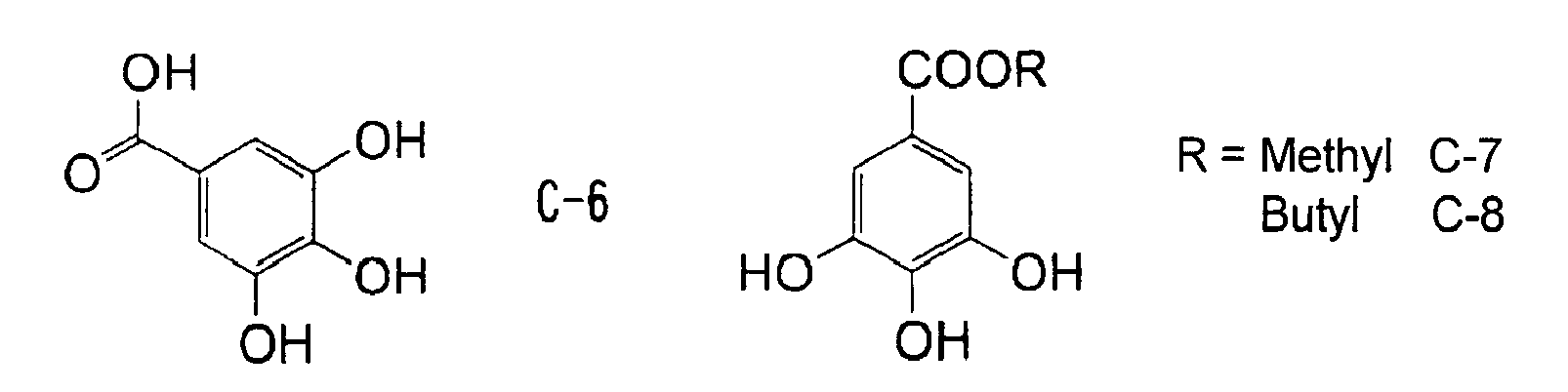

- Subsequently, Synthesis Examples and structures of Compound 1, Compound 6, Compound 7, and Compound 8 used in Examples will be shown.
- 4-Hydroxybenzoic acid (0.2 mol), 2-bromoethanol (0.2 mol), diazabicycloundecene (0.2 mol), and acetonitrile (300 ml) were mixed, and they were reacted at 80 °C for 6 hours. Thereafter, the resulting reaction solution were subjected to liquid separating operation using aqueous hydrochloric acid solution, and an aqueous sodium bicarbonate solution, and the organic layer was extracted. The extract was dried with magnesium sulfate, and the solvent was removed with an evaporator to obtain a precursor (1-a) of the following structure (yield 86%).
-

- Then, acryloyl chloride (0.3 mol) was added dropwise to a mixed solution in which the resulting precursor (1-a) (0.1 mol) had been dissolved in N-methylpyrrolidone (200 ml), to react them at room temperature for 24 hours. After completion of the reaction, the reaction solution was added dropwise to ice water (2 L), unreacted acryloyl chloride was decomposed into acrylic acid, and a liquid separation procedure was performed using an aqueous sodium bicarbonate solution to extract the organic layer. The extract was dried with magnesium sulfate, and the solvent was removed with an evaporator to obtain a compound (Compound 1 of the following structure) having a polymerizable group and having odor preventing ability (yield 79%).
-

- Methacryloyl chloride (0.3 mol) was added dropwise to a mixed solution in which epicatechin (0.2 mol) had been dissolved in N-methylpyrrolidone (200 ml), to react them at room temperature for 24 hours. After completion of the reaction, the reaction solution was added dropwise to ice water (2 L), unreacted methacryloyl chloride was decomposed into methacrylic acid, and a liquid separation procedure was performed using an aqueous sodium bicarbonate solution to extract the organic layer. The extract was dried with magnesium sulfate, and the solvent was removed with an evaporator to obtain a compound (Compound 6 of the following structure) having a polymerizable group and having odor preventing ability (yield 84%).
-

- Acryloyl chloride (0.3 mol) was added dropwise to a mixed solution in which epigallocatechin (0.2 mol) had been dissolved in N-methylpyrrolidone (200 ml), to react them at room temperature for 24 hours. After completion of the reaction, the reaction solution was added dropwise to ice water (2 L), unreacted acryloyl chloride was decomposed into acrylic acid, and a liquid separation procedure was performed using an aqueous sodium bicarbonate solution to extract the organic layer. The extract was dried with magnesium sulfate, and the solvent was removed with an evaporator to obtain a compound (Compound 7 of the following structure) having a polymerizable group and having odor preventing ability (yield 69%).
-

- KARENZ MOI (0.2 mol) was added dropwise to a mixed solution in which epicatechin (0.2 mol) had been dissolved in N-methylpyrrolidone (200 ml), to react them at room temperature for 24 hours. After completion of the reaction, the reaction solution was added dropwise to ice water (2 L), and a liquid separation procedure was performed using an aqueous sodium bicarbonate solution to extract the organic layer. The extract was dried with magnesium sulfate, and the solvent was removed with an evaporator to obtain a compound (Compound 8 of the following structure) having a polymerizable group and having odor preventing ability (yield 77%).
-

- Into a three-neck flask equipped with a stirring blade and a condenser were placed 50 g of "DENKA BUTYRAL #3002-2" (manufactured by Denki Kagaku Kogyo K.K., polyvinyl butyral derivative Mw=90000) as a binder polymer, and 47 g of propylene glycol monomethyl ether acetate as a solvent, and this was heated at 70 °C for 120 minutes while it was stirred, to dissolve the polymer. Thereafter, a temperature of the solution was adjusted to 40°C, 15 g of M2 (the aforementioned structure) as a polymerizable compound (sulfur-containing polyfunctional monomer), 8 g of BLENMER LMA (manufactured by NOF Corporation) as a polymerizable compound (monofunctional monomer), 1.6 g of PERBUTIL Z (manufactured by NOF Corporation) as a polymerization initiator, 1 g of KEDJENN BLACK EC600 JD (carbon black manufactured by Lion Corporation) as a photothermal converting agent, and 1 g of Compound C-1 (the aforementioned structure, β-cyclodextrin) having deodorizing ability were added, and the mixture was stirred for 30 minutes. By this procedure, a coating liquid A for a crosslinkable relief forming layer having flowability was obtained.
- The resulting coating liquid (2 g) for a crosslinkable relief forming layer having flowability was placed into a sample bottle, and the bottle was closed. This was immersed into a water bath set at a water temperature of 70°C to a height which was a half from a bottom of the sample bottle, a time at which flowability of the coating liquid was lost (even when the sample bottle was turned bottom up, a liquid did not fall) (gelling time) was measured and this was used as an index for coating liquid stability. A longer gelling time means that coating liquid stability is better.
- A spacer (frame) of the predetermined thickness was arranged on a PET substrate, the coating liquid composition A for a relief forming layer obtained as described above was calmly cast to such an extent that it did not flow out from the spacer (frame), and dried in an oven at 70°C for 4 hours to provide a relief forming layer having a thickness of approximately 1 mm.
After the resulting relief forming layer was heated at 80°C for 3 hours, this was further heated at 100°C for 3 hours to thermally crosslink the relief forming layer, to obtain a relief printing plate precursor for laser engraving. - The relief forming layer after crosslinking was engraved using two kinds of lasers described in the following 3-1 and 3-2.
- As a semiconductor laser engraving machine, the aforementioned laser recording apparatus with fiber shown in
Fig. 1 equipped with a semiconductor laser with fiber (FC-LD) SDL-6390 (manufactured by JDSU, wavelength 915 nm) having a maximum output of 8.0 W was used. For the relief forming layer after crosslinking, a solid area of 1 cm square was luster-engraved with this semiconductor laser engraving machine under the condition of laser output: 6 W, head speed: 100 mm/sec, and pitch setting: 2400 DPI (Results of evaluation using this laser are expressed by "FC-LD" in Table). - As a carbon dioxide gas laser engraving machine, high quality CO2 laser marker ML-9100 Series (manufactured by KEYENCE) was used. For the relief forming layer after crosslinking, a solid area of 1 cm square was luster-engraved with this carbon dioxide gas laser engraving machine under the condition of output: 12 W, head speed: 200 nm/sec, and pitch setting: 2400 DPI (Results of evaluation using this laser is expressed by "CO2 Laser" in Table).
- The thickness of the relief layer in the relief printing plate after engraving was 1.14 mm.
In addition, when the Shore A hardness of the relief layer was measured by the aforementioned measuring method, the hardness was found to be 74°. Measurement of the Shore hardness A of the relief layer was performed similarly in each Example and Comparative Example described later. - According to the same manner as that of Example A-1 except that the "sulfur-containing polyfunctional monomer M2" used in Example A-1 was changed to a polyfunctional monomer described in the following Table 1, and/or the "Compound C-1 having deodorizing ability" was changed to each compound described in the following Table 1, a coating liquid composition for a relief forming layer was prepared, a relief printing plate precursor for laser engraving was produced and, thereafter, a relief printing plate was produced from the relief printing plate precursor for laser engraving.
The thickness and the Shore A hardness of a relief layer in the resulting relief printing plate are as shown in the following Table 1. - According to the same manner as that of Example A-1 except that the "sulfur-containing polyfunctional monomer M2" used in Example A-1 was changed to a polyfunctional monomer described in the following Table 1, and/or a coating liquid composition for a relief forming layer was prepared without using the "Compound C-1 having deodorizing ability", a relief printing plate precursor for laser engraving was produced and, thereafter, a relief printing plate was produced from the relief printing plate precursor for laser engraving.
The thickness and the Shore A hardness of a relief layer in the resulting relief printing plate are as shown in the following Table 1. - The "engraving depth" of the relief layer in the relief printing plate after engraving was measured as follows. Herein, the "engraving depth" refers to a difference between an engraved position (height) and an unengraved position (height) when a cross-section of the relief layer is observed. The "engraving depth" in the present Example was measured by observing a cross-section of the relief layer with a superdepth color 3D shape measuring microscope VK9510 (manufactured by Keyence corporation). A greater engraving depth means the higher engraving sensitivity. Results are shown in Table 1.
- Regarding the printing plate precursor during laser engraving by the aforementioned method, an odor was smelled to perform organoleptic evaluation, and a level of an odor was evaluated as follows. Results are shown in Table 1.
Evaluation was performed by six professional panelists under the following evaluation criteria (scores).
Evaluation criteria (scores): - A: Four or more of six persons recognized the odor decreasing effect.
- B: Two or more of six persons recognized the odor decreasing effect.
- C: The odor decreasing effect was not recognized.
-
Table 1 Coating liquid A for relief forming layer Relief layer Engraving depth (µm) Odor (A) Polymerizable compound (C) Compound having deodorizing ability Coating liquid stability (hr) (70°C) Thickness (mm) Shore A hardness (°) FC-LD CO2 laser Example A-1 Sulfur-containing polyfunctional monomer M2 C-1 21 1.14 74 460 368 B Example A-2 Sulfur-containing polyfunctional monomer M2 C-2 23 1.13 78 455 364 B Example A-3 Sulfur-containing polyfunctional monomer M2 C-3 >30 1.11 9 450 360 B Example A-4 Sulfur-containing polyfunctional monomer M2 C-4 >30 1.20 70 460 368 B Example A-5 Sulfur-containing polyfunctional monomer M2 C-5 >30 1.33 70 440 352 B Example A-6 Sulfur-containing polyfunctional monomer M2 Resorcinol >30 1.25 70 445 356 B Example A-7 Sulfur-containing polyfunctional monomer M2 Pyrogallol >30 1.14 70 450 360 A Example A-8 Sulfur-containing polyfunctional monomer M3 C-6 >30 1.14 79 450 360 A Example A-9 Sulfur-containing polyfunctional monomer M3 C-7 >30 1.15 70 450 360 A Example A-10 Sulfur-containing polyfunctional monomer M3 C-8 >30 1.10 75 460 368 A Example A-1 Sulfur-containing polyfunctional monomer M3 C-9 >30 1.10 75 460 368 A Example A-12 Sulfur-containing polyfunctional monomer M3 C-10 >30 1.12 75 460 368 A Example A-13 Sulfur-containing polyfunctional monomer M3 C-11 >30 1.14 74 460 368 A Example A-14 Sulfur-containing polyfunctional monomer M3 C-12 >30 1.30 73 460 368 A Example A-15 Glycerol 1,3-dimethacrylate C-6 17 1.25 65 390 312 A Example A-16 Glycerol 1,3-dimethacrylate C-7 19 1.14 66 380 304 A Example A-17 Glycerol 1,3-dimethacrylate C-8 20 1.14 69 380 304 A Example A-18 Glycerol 1,3-dimethacrylate C-9 18 1.15 65 385 308 A Example A-19 Glycerol 1,3-dimethacrylate C-10 15 1.16 64 370 296 A Example A-20 Glycerol 1,3-dimethacrylate C-11 16 1.11 66 390 312 A Example A-21 Glycerol 1,3-dimethacrylate C-12 18 1.10 70 380 304 A Comparative example A-1 Sulfur-containing polyfunctional monomer M2 None >30 1.14 74 450 360 C Comparative example A-2 Sulfur-containing polyfunctional monomer M3 None >30 1.12 75 450 360 C Comparative example A-3 Glycerol 1,3-dimethacrylate None 16 1.10 66 370 296 C - As shown in Table 1, it was confirmed that an unpleasant odor at laser engraving was suppressed by adding the compound having deodorizing ability. In addition, all of engraving depths exceed 300 µm, and it is seen that the engraving sensitivity is sufficiently high.
Particularly, upon use of a polymerizable compound having a sulfur atom (sulfur-containing polyfunctional monomer) as a polymerizable compound, the engraving depth is particularly great, and it was confirmed that the remarkable odor suppressing effect is obtained by using a compound having deodorizing ability containing at least one of a catechol group or a pyrogallol group (galloyl group) together with this polymerizable compound. - Into a three-neck flask equipped with a stirring blade and a condenser were placed 34 g of GOHSENOL T-215 (manufactured by Nippon Synthetic Chemical Industry, Co., Ltd., PVA derivative) as a binder polymer, 0.75 g of KEDJENN BLACK EC600 JD (carbon black manufactured by Lion Corporation) as a photothermal converting agent, 20 g of diethylene glycol as a plasticizer, and 35 g of water and 12 g of ethanol as a solvent, and the mixture was heated at 60°C for 120 minutes while it was stirred, to dissolve the polymer. Further, 34 g of the sulfur-containing polyfunctional monomer M1 synthesized as described above, 1.8 g of PERBUTIL Z (manufactured by NOF Corporation) as a polymerization initiator, and 1.5 g of catechin as a deodordizing agent were added and the mixture was stirred for 30 minutes to obtain a coating liquid composition B for a relief forming layer having flowability.
- A spacer (frame) of the predetermined thickness was arranged on a PET substrate, the coating liquid composition B for a relief forming layer obtained as described above was calmly cast to such an extent that the composition did not flow out from the spacer (frame), and this was dried in an oven at 70° for 4 hours to provide a relief forming layer having a thickness of approximately 1 mm.
The resulting relief forming layer was heated at 100°C for 3 hours to thermally crosslink the relief forming layer, to obtain a relief printing plate precursor for laser engraving. - For the relief forming layer after crosslinking, a solid area of a 2 cm square was engraved using "FD-100" (manufactured by Tosei Electrobeam Co., Ltd.) equipped with semiconductor laser (laser oscillation wavelength 840 nm) of a maximum output of 16 W as a near infrared laser engraving machine and setting the engraving condition at laser output: 15 W, scanning speed: 100 mm/sec, and pitch interval: 0.15 mm, thereby, a relief layer was formed to obtain a relief printing plate.
- The thickness of the relief layer in the relief printing plate after engraving was 1.36 mm.
In addition, when the Shore A hardness of the relief layer was measured by the aforementioned measuring method, the hardness was found to be 64°. - According to the same manner as that of Example B-1 except that the "sulfur-containing polyfunctional monomer M1" used in Example B-1 was changed to a polyfunctional monomer described in the following Table 2, and the "catechin" was changed to each compound described in the following Table 2, a coating liquid composition for a relief forming layer was prepared, a relief printing plate precursor for laser engraving was produced and, thereafter, a relief printing plate was produced from the relief printing plate precursor for laser engraving.
The thickness and the Shore A hardness of the relief layer in the resulting relief printing plate are as shown in the following Table 2.
Further, as in Example A-1, measurement of the engraving depth and evaluation of an odor were performed. Results are shown in Table 2. - According to the same manner as that of Example B-1 except that the "sulfur-containing polyfunctional monomer M1" used in Example B-1 was changed to a polyfunctional monomer described in the following Table 2, and the "catechin" was changed to each compound described in the following Table 2, a coating liquid composition for a relief forming layer was prepared, and a relief printing plate precursor for laser engraving was produced.
According to the same manner as that of Example B-1 except that laser engraving was performed on the resulting relief printing plate precursor for laser engraving using a carbon dioxide gas laser engraving machine as described below, a relief printing plate was produced.
That is, as the carbon dioxide gas laser engraving machine, "CO2 laser marker ML-Z9500" (manufactured by Keyence Corporation) equipped with carbon dioxide gas laser of a maximum output of 30 W was used. The engraving condition was set at laser output: 15 W, scanning speed: 100 mm/sec, and pitch interval: 0.15 mm, and a solid area of 2 cm square was engraved to obtain a relief printing plate.
Herein, the thickness and the Shore A hardness of the relief layer in the resulting relief printing plate are as shown in the following Table 2.
Further, as in Example A-1, measurement of the engraving depth and evaluation of the odor were performed. Results are shown in Table 2. -
Table 2 Coating liquid B for relief forming layer Engraving laser Relief layer Engraving depth (µm) Odor (A) Polymerizable compound (C) Compound having deodorizing ability Thickness (mm) Shore A hardness (°) Example B-1 Sulfur-containing polyfunctional monomer M1 Catechin Semiconductor laser 1.36 64 600 B Example B-2 Sulfur-containing polyfunctional monomer M2 t-Butylcatechol Semiconductor laser 1.26 67 580 B Example B-3 Polyfunctional monomer C Gallotannin Semiconductor laser 1.52 66 470 B Example B-4 Glycerol 1,3-dimethacrylate Compound 1 Semiconductor laser 1.38 70 460 A Example B-5 Sulfur-containing polyfunctional monomer M1 Epigallocatechin gallate Semiconductor laser 1.47 69 560 B Example B-6 Sulfur-containing polyfunctional monomer M2 Compound 6 Semiconductor laser 1.39 67 550 A Example B-7 Polyfunctional monomer C Compound 8 Semiconductor laser 1.28 72 450 A Example B-8 Glycerol 1,3-dimethacrylate 4-Methyl-6-t-butylphenol Semiconductor laser 1.46 65 440 B Example B-9 Sulfur-containing polyfunctional monomer M1 Compound 7 Carbon dioxide gas laser 1.64 63 270 A Example B-10 Sulfur-containing polyfunctional monomer M2 Catechin Carbon dioxide gas laser 1.53 64 280 B Example B-11 Polyfunctional monomer C t-Butylcatecliol Carbon dioxide gas laser 1.38 67 190 B Example B-12 Glycerol 1,3-dimethacrylate Gallotannin Carbon dioxide gas laser 1.25 66 180 B Example B-13 Sulfur-containing poly functional monomer M1 Compound 1 Carbon dioxide gas laser 1.46 70 285 A Example B-14 Sulfur-containing poly functional monomer M2 Epigallocatechin gallate Carbon dioxide gas laser 1.47 69 280 B Example B-15 Poly functional monomer C Compound 6 Carbon dioxide gas laser 1.32 71 180 A Example B-16 Glyceroll,3-dimethacrylate Compound 8 Carbon dioxide gas laser 1.28 68 170 A Comparative example B-1 Polyfunctional monomer C - Semiconductor laser 1.38 78 460 C Comparative example B-2 Sulfur-containing polyfunctional monomer M1 - Semiconductor laser 1.36 62 585 C Comparative example B-3 Glycerol 1,3-dimethacrylate - laser Semiconductor laser 1.42 76 440 C Comparative example B-4 Polyfunctional monomer C - Carbon dioxide gas laser 1.38 78 160 C Comparative example B-5 Sulfur-containing polyfunctional monomer M1 - Carbon dioxide gas laser 1.36 62 270 C Comparative example B-6 Glycerol 1,3-dimethacrylate - Carbon dioxide gas laser 1.42 76 140 C - As shown in Table 2, it was confirmed that an unpleasant odor at laser engraving was suppressed by adding the compound having deodorizing ability. In addition, all of engraving depths exceed 100 µm, and it is seen that the engraving sensitivity is sufficiently high.
Particularly, upon use of a polymerizable compound having a sulfur atom (sulfur-containing polyfunctional monomer) as a polymerizable compound, the engraving depth is particularly great, and it was confirmed that the remarkable odor suppressing effect is obtained.
All publications, patent applications, and technical standards mentioned in this specification are herein incorporated by reference to the same extent as if each individual publication, patent application, or technical standard was specifically and individually indicated to be incorporated by reference.
Herein, the "odor decreasing effect" refers to the effect obtained by laser-engraving both of a relief printing plate precursor with a compound having deodorizing ability added thereto, and a relief printing plate precursor having entirely the same composition except that a compound having deodorizing ability is not added, by the aforementioned method, and comparing odors therefrom.
Claims (13)
- A relief printing plate precursor for laser engraving, comprising a relief forming layer containing (A) a polymerizable compound having an ethylenic unsaturated bond, (B) a binder polymer, and (C) a compound having deodorizing ability.
- The relief printing plate precursor for laser engraving of claim 1, wherein the (A) polymerizable compound having an ethylenic unsaturated bond is a compound comprising a sulfur atom in a molecule.
- The relief printing plate precursor for laser engraving of claim 1, wherein the (C) compound having deodorizing ability is at least one compound selected from polyphenols.
- The relief printing plate precursor for laser engraving of claim 3, wherein the at least one compound selected from polyphenols is a compound comprising at least one of a catechol group or a pyrogallol group.
- The relief printing plate precursor for laser engraving of claim 3, wherein the at least one compound selected from polyphenols is a compound comprising a functional group represented by the following structural formula (I):

- The relief printing plate precursor for laser engraving of claim 3, wherein the at least one compound selected from polyphenols is a catechin derivative.
- The relief printing plate precursor for laser engraving of claim 1, wherein the relief forming layer further comprises (D) a photothermal converting agent which absorbs light having a wavelength of 700 nm to 1,300 nm.
- The relief printing plate precursor for laser engraving of claim 1, wherein the relief forming layer is cured by at least one of light or heat.
- A process for producing a relief printing plate, comprising:crosslinking the relief forming layer in the relief printing plate precursor for laser engraving as defined in claim 1 by at least one of light or heat, andlaser-engraving the crosslinked relief forming layer to form a relief layer.
- The process for producing a relief printing plate of claim 9, wherein the relief forming layer is crosslinked by heat.
- A relief printing plate comprising a relief layer, which is produced by the process for producing a relief printing plate as defined in claim 9.
- The relief printing plate of claim 11, wherein the thickness of the relief layer is from 0.05 mm to 10 mm.
- The relief printing plate of claim 11, wherein the Shore A hardness of the relief layer is from 50° to 90°.
Applications Claiming Priority (2)
| Application Number | Priority Date | Filing Date | Title |
|---|---|---|---|
| JP2008157907 | 2008-06-17 | ||
| JP2009028816 | 2009-02-10 |
Publications (2)
| Publication Number | Publication Date |
|---|---|
| EP2135739A2 true EP2135739A2 (en) | 2009-12-23 |
| EP2135739A3 EP2135739A3 (en) | 2011-11-09 |
Family
ID=41050427
Family Applications (1)
| Application Number | Title | Priority Date | Filing Date |
|---|---|---|---|
| EP09007613A Withdrawn EP2135739A3 (en) | 2008-06-17 | 2009-06-09 | Relief printing plate precursor for laser engraving, relief printing plate, and process for producing relief printing plate |
Country Status (3)
| Country | Link |
|---|---|
| US (1) | US20090311494A1 (en) |
| EP (1) | EP2135739A3 (en) |
| JP (1) | JP2010208313A (en) |
Cited By (1)
| Publication number | Priority date | Publication date | Assignee | Title |
|---|---|---|---|---|
| WO2011143089A1 (en) * | 2010-05-11 | 2011-11-17 | Eastman Kodak Company | Three-dimensional imaging of flexographic media |
Families Citing this family (4)
| Publication number | Priority date | Publication date | Assignee | Title |
|---|---|---|---|---|
| JP2011093308A (en) * | 2009-09-30 | 2011-05-12 | Fujifilm Corp | Resin composition for laser engraving, relief printing plate precursor for laser engraving and method for producing the same, and relief printing plate and method for making the same |
| EP2617773A1 (en) * | 2012-01-19 | 2013-07-24 | Fujifilm Corporation | Resin composition for flexographic printing plate, laser-engraving type flexographic printing plate precursor and process for producing same, and flexographic printing plate and process for making same |
| DE102023118527A1 (en) | 2022-11-10 | 2024-05-16 | Fischerwerke Gmbh & Co. Kg | High performance mortar with TBX and analogues |
| EP4615930A1 (en) | 2022-11-10 | 2025-09-17 | fischerwerke GmbH & Co. KG | High-performance mortar comprising tbx and analogues |
Citations (39)
| Publication number | Priority date | Publication date | Assignee | Title |
|---|---|---|---|---|
| JPS4864183A (en) | 1971-12-09 | 1973-09-05 | ||
| JPS4943191B1 (en) | 1969-07-11 | 1974-11-19 | ||
| JPS50159586A (en) | 1974-05-31 | 1975-12-24 | ||
| JPS5137193A (en) | 1974-09-25 | 1976-03-29 | Toyo Boseki | |
| JPS5230490B2 (en) | 1972-03-21 | 1977-08-09 | ||
| JPS5579437A (en) | 1978-12-11 | 1980-06-14 | Toray Ind Inc | Photosensitive polyamide resin composition |
| JPS5774192A (en) | 1980-10-28 | 1982-05-10 | Fuji Photo Film Co Ltd | Ink jet recording picture forming method |
| JPS5787989A (en) | 1980-11-21 | 1982-06-01 | Matsushita Electric Ind Co Ltd | Ink jet recording paper |
| JPS6072785A (en) | 1983-09-30 | 1985-04-24 | Nippon Shokubai Kagaku Kogyo Co Ltd | Ink jet recording paper |
| JPS61146591A (en) | 1984-12-20 | 1986-07-04 | Mitsubishi Paper Mills Ltd | Ink jet recording medium |
| JPS61154989A (en) | 1984-12-28 | 1986-07-14 | Mitsubishi Paper Mills Ltd | inkjet recording paper |
| JPS61177279A (en) | 1985-02-04 | 1986-08-08 | Mitsubishi Paper Mills Ltd | inkjet recording medium |
| JPS6436479A (en) | 1987-08-03 | 1989-02-07 | Asahi Glass Co Ltd | Recording medium for ink jet |
| JPS6436480A (en) | 1987-08-03 | 1989-02-07 | Asahi Glass Co Ltd | Recording medium for ink jet |
| JPH01115677A (en) | 1987-10-30 | 1989-05-08 | Canon Inc | recoding media |
| JPH07149037A (en) | 1993-11-30 | 1995-06-13 | Fuji Photo Film Co Ltd | Ink jet recording paper |
| JPH07195824A (en) | 1993-12-28 | 1995-08-01 | New Oji Paper Co Ltd | INKJET RECORDING PAPER MANUFACTURING METHOD, RECORDING PAPER, AND RECORDING METHOD USING THE SAME |
| JPH07276790A (en) | 1994-02-15 | 1995-10-24 | Xerox Corp | Recording sheet and printing method using it |
| JPH07314883A (en) | 1994-05-25 | 1995-12-05 | Asahi Glass Co Ltd | Recording sheets and recordings |
| JPH07314882A (en) | 1994-05-25 | 1995-12-05 | Asahi Glass Co Ltd | Recording sheets and recordings |
| JPH08108617A (en) | 1994-10-11 | 1996-04-30 | New Oji Paper Co Ltd | Inkjet recording paper |
| JPH08118791A (en) | 1994-10-20 | 1996-05-14 | Mitsubishi Paper Mills Ltd | Ink jet recording sheet and manufacturing method thereof |
| JPH08150773A (en) | 1994-11-28 | 1996-06-11 | Mitsubishi Paper Mills Ltd | Inkjet recording sheet |
| JPH08300807A (en) | 1995-05-12 | 1996-11-19 | Mitsubishi Paper Mills Ltd | Recording material for inkjet |
| JPH09171247A (en) | 1995-10-02 | 1997-06-30 | Basf Lacke & Farben Ag | Manufacture of relief printing plate by photosensitive polymer and relief printing plate obtained by it |
| JPH09267544A (en) | 1996-04-01 | 1997-10-14 | Konica Corp | Paper for ink-jet recording |
| JP2773847B2 (en) | 1992-08-07 | 1998-07-09 | イー・アイ・デュポン・ドゥ・ヌムール・アンド・カンパニー | Method and element for producing a relief image using an infrared sensitive layer |
| JP2846954B2 (en) | 1992-05-11 | 1999-01-13 | イー・アイ・デュポン・ドゥ・ヌムール・アンド・カンパニー | Method for producing single-layer flexographic printing plate |
| JPH11170718A (en) | 1997-12-10 | 1999-06-29 | Toray Ind Inc | Method for producing relief by laser, apparatus for producing the relief, and printing plate material |
| JPH11338139A (en) | 1998-05-27 | 1999-12-10 | Toyobo Co Ltd | Printing master plate for laser engraving and printing plate |
| JP2000168253A (en) | 1998-08-24 | 2000-06-20 | Basf Drucksyst Gmbh | Material for gravure recording by coherent electromagnetic radiation, and printing plate having the same |
| JP2000263928A (en) | 1999-03-19 | 2000-09-26 | Konica Corp | Ink jet recording sheet and method for ink jet recording using it |
| JP2000318330A (en) | 1999-04-26 | 2000-11-21 | Creo Prod Inc | Flexo printing method which does not require chemical treatment and flexo printing plate |
| JP2002003665A (en) | 2000-06-20 | 2002-01-09 | Jsr Corp | Polymer material for laser processing, flexographic printing plate and seal material using the same |
| JP2002357907A (en) | 2001-03-06 | 2002-12-13 | E I Du Pont De Nemours & Co | Process for making flexographic printing plate and photosensitive element for use in the process |
| US20030180636A1 (en) | 2002-03-25 | 2003-09-25 | Kanga Rustom Sam | Processless digitally imaged printing plate using microspheres |
| JP2008015460A (en) | 2006-06-30 | 2008-01-24 | Lg Philips Lcd Co Ltd | Method for manufacturing liquid crystal display device and liquid crystal display device |
| JP2008058160A (en) | 2006-08-31 | 2008-03-13 | Advantest Corp | Error factor determination device, method, program, output correction apparatus provided with recording medium and the device, and reflection coefficient measuring apparatus |
| JP2008063554A (en) | 2006-08-11 | 2008-03-21 | Fujifilm Corp | Decomposable resin composition, pattern forming material, and pattern forming method |
Family Cites Families (9)
| Publication number | Priority date | Publication date | Assignee | Title |
|---|---|---|---|---|
| US5066568A (en) * | 1985-08-05 | 1991-11-19 | Hoehst Celanese Corporation | Method of developing negative working photographic elements |
| JP3503839B2 (en) * | 1994-05-25 | 2004-03-08 | 富士写真フイルム株式会社 | Positive photosensitive composition |
| US20030108810A1 (en) * | 2001-08-22 | 2003-06-12 | Williamson Sue Ellen | Deodorizing agent for sulfur- or nitrogen-containing salt photoinitiators |
| AU2003275582B2 (en) * | 2002-10-24 | 2009-01-08 | Toray Industries, Inc. | Photosensitive resin printing plate original, process for producing the same and process for producing resin relief printing plate therewith |
| JP5046541B2 (en) * | 2006-03-31 | 2012-10-10 | 富士フイルム株式会社 | Decomposable resin composition and flexographic printing original plate using the composition |
| JP5264082B2 (en) * | 2006-08-11 | 2013-08-14 | 富士フイルム株式会社 | Flexographic printing plate precursor for laser engraving |
| JP4914788B2 (en) * | 2006-09-01 | 2012-04-11 | 富士フイルム株式会社 | Laser engraving flexographic printing plate precursor |
| US7872059B2 (en) * | 2007-02-14 | 2011-01-18 | Fujifilm Corporation | Composition for use in laser decomposition and pattern-forming material using the same |
| JP5322575B2 (en) * | 2008-03-28 | 2013-10-23 | 富士フイルム株式会社 | Resin composition for laser engraving, image forming material, relief printing plate precursor for laser engraving, relief printing plate, and method for producing relief printing plate |
-
2009
- 2009-06-02 US US12/476,260 patent/US20090311494A1/en not_active Abandoned
- 2009-06-09 EP EP09007613A patent/EP2135739A3/en not_active Withdrawn
- 2009-06-17 JP JP2009144529A patent/JP2010208313A/en active Pending
Patent Citations (39)
| Publication number | Priority date | Publication date | Assignee | Title |
|---|---|---|---|---|
| JPS4943191B1 (en) | 1969-07-11 | 1974-11-19 | ||
| JPS4864183A (en) | 1971-12-09 | 1973-09-05 | ||
| JPS5230490B2 (en) | 1972-03-21 | 1977-08-09 | ||
| JPS50159586A (en) | 1974-05-31 | 1975-12-24 | ||
| JPS5137193A (en) | 1974-09-25 | 1976-03-29 | Toyo Boseki | |
| JPS5579437A (en) | 1978-12-11 | 1980-06-14 | Toray Ind Inc | Photosensitive polyamide resin composition |
| JPS5774192A (en) | 1980-10-28 | 1982-05-10 | Fuji Photo Film Co Ltd | Ink jet recording picture forming method |
| JPS5787989A (en) | 1980-11-21 | 1982-06-01 | Matsushita Electric Ind Co Ltd | Ink jet recording paper |
| JPS6072785A (en) | 1983-09-30 | 1985-04-24 | Nippon Shokubai Kagaku Kogyo Co Ltd | Ink jet recording paper |
| JPS61146591A (en) | 1984-12-20 | 1986-07-04 | Mitsubishi Paper Mills Ltd | Ink jet recording medium |
| JPS61154989A (en) | 1984-12-28 | 1986-07-14 | Mitsubishi Paper Mills Ltd | inkjet recording paper |
| JPS61177279A (en) | 1985-02-04 | 1986-08-08 | Mitsubishi Paper Mills Ltd | inkjet recording medium |
| JPS6436479A (en) | 1987-08-03 | 1989-02-07 | Asahi Glass Co Ltd | Recording medium for ink jet |
| JPS6436480A (en) | 1987-08-03 | 1989-02-07 | Asahi Glass Co Ltd | Recording medium for ink jet |
| JPH01115677A (en) | 1987-10-30 | 1989-05-08 | Canon Inc | recoding media |
| JP2846954B2 (en) | 1992-05-11 | 1999-01-13 | イー・アイ・デュポン・ドゥ・ヌムール・アンド・カンパニー | Method for producing single-layer flexographic printing plate |
| JP2773847B2 (en) | 1992-08-07 | 1998-07-09 | イー・アイ・デュポン・ドゥ・ヌムール・アンド・カンパニー | Method and element for producing a relief image using an infrared sensitive layer |
| JPH07149037A (en) | 1993-11-30 | 1995-06-13 | Fuji Photo Film Co Ltd | Ink jet recording paper |
| JPH07195824A (en) | 1993-12-28 | 1995-08-01 | New Oji Paper Co Ltd | INKJET RECORDING PAPER MANUFACTURING METHOD, RECORDING PAPER, AND RECORDING METHOD USING THE SAME |
| JPH07276790A (en) | 1994-02-15 | 1995-10-24 | Xerox Corp | Recording sheet and printing method using it |
| JPH07314883A (en) | 1994-05-25 | 1995-12-05 | Asahi Glass Co Ltd | Recording sheets and recordings |
| JPH07314882A (en) | 1994-05-25 | 1995-12-05 | Asahi Glass Co Ltd | Recording sheets and recordings |
| JPH08108617A (en) | 1994-10-11 | 1996-04-30 | New Oji Paper Co Ltd | Inkjet recording paper |
| JPH08118791A (en) | 1994-10-20 | 1996-05-14 | Mitsubishi Paper Mills Ltd | Ink jet recording sheet and manufacturing method thereof |
| JPH08150773A (en) | 1994-11-28 | 1996-06-11 | Mitsubishi Paper Mills Ltd | Inkjet recording sheet |
| JPH08300807A (en) | 1995-05-12 | 1996-11-19 | Mitsubishi Paper Mills Ltd | Recording material for inkjet |
| JPH09171247A (en) | 1995-10-02 | 1997-06-30 | Basf Lacke & Farben Ag | Manufacture of relief printing plate by photosensitive polymer and relief printing plate obtained by it |
| JPH09267544A (en) | 1996-04-01 | 1997-10-14 | Konica Corp | Paper for ink-jet recording |
| JPH11170718A (en) | 1997-12-10 | 1999-06-29 | Toray Ind Inc | Method for producing relief by laser, apparatus for producing the relief, and printing plate material |
| JPH11338139A (en) | 1998-05-27 | 1999-12-10 | Toyobo Co Ltd | Printing master plate for laser engraving and printing plate |
| JP2000168253A (en) | 1998-08-24 | 2000-06-20 | Basf Drucksyst Gmbh | Material for gravure recording by coherent electromagnetic radiation, and printing plate having the same |
| JP2000263928A (en) | 1999-03-19 | 2000-09-26 | Konica Corp | Ink jet recording sheet and method for ink jet recording using it |
| JP2000318330A (en) | 1999-04-26 | 2000-11-21 | Creo Prod Inc | Flexo printing method which does not require chemical treatment and flexo printing plate |
| JP2002003665A (en) | 2000-06-20 | 2002-01-09 | Jsr Corp | Polymer material for laser processing, flexographic printing plate and seal material using the same |
| JP2002357907A (en) | 2001-03-06 | 2002-12-13 | E I Du Pont De Nemours & Co | Process for making flexographic printing plate and photosensitive element for use in the process |
| US20030180636A1 (en) | 2002-03-25 | 2003-09-25 | Kanga Rustom Sam | Processless digitally imaged printing plate using microspheres |
| JP2008015460A (en) | 2006-06-30 | 2008-01-24 | Lg Philips Lcd Co Ltd | Method for manufacturing liquid crystal display device and liquid crystal display device |
| JP2008063554A (en) | 2006-08-11 | 2008-03-21 | Fujifilm Corp | Decomposable resin composition, pattern forming material, and pattern forming method |
| JP2008058160A (en) | 2006-08-31 | 2008-03-13 | Advantest Corp | Error factor determination device, method, program, output correction apparatus provided with recording medium and the device, and reflection coefficient measuring apparatus |
Non-Patent Citations (15)
| Title |
|---|
| "Advanced Pigment Application Technique", 1986, CMC PRESS |
| "Advanced Pigment Handbook", 1977 |
| "Dye Handbook", 1970 |
| "Printing Ink Technique", 1984, CMC PRESS |
| BRUCE M. MONROE ET AL., CHEMICAL REVIEW, vol. 93, 1993, pages 435 |
| D. F. EATON ET AL., JACS, vol. 102, 1980, pages 3298 |
| F. D. SAEVA, TOPICS IN CURRENT CHEMISTRY, vol. 156, 1990, pages 59 |
| G. G. MASLAK, TOPICS IN CURRENT CHEMISTRY, vol. 168, 1993, pages 1 |
| H. B. SHUSTER ET AL., JACS, vol. 112, 1990, pages 6329 |
| I. SKEIST: "Handbook of Adhesives", 1977 |
| J. P. FAUSSIER: "Photoinitiated Polymerization-Therapy and Applications", RAPRA REVIEW VOL.9, REPORT, RAPRA TECHNOLOGY, vol. 9, 1998 |
| JOURNAL OF THE ADHESION SOCIETY OF JAPAN, vol. 20, no. 7, 1984, pages 300 - 308 |
| M. TSUNOOKA ET AL., PROG. POLYM. SCI., vol. 21, 1996, pages 1 |
| M.DEXTER: "Encyclopedia of Chemical Technology", vol. 3, 1992, WILEY INTERSCIENCE, pages: 424 - 447 |
| R. S. DAVIDSON ET AL., JOURNAL OF PHOTOCHEMISTRY AND BIOLOGY A: CHEMISTRY, vol. 73, 1993, pages 81 |
Cited By (1)
| Publication number | Priority date | Publication date | Assignee | Title |
|---|---|---|---|---|
| WO2011143089A1 (en) * | 2010-05-11 | 2011-11-17 | Eastman Kodak Company | Three-dimensional imaging of flexographic media |
Also Published As
| Publication number | Publication date |
|---|---|
| JP2010208313A (en) | 2010-09-24 |
| EP2135739A3 (en) | 2011-11-09 |
| US20090311494A1 (en) | 2009-12-17 |
Similar Documents
| Publication | Publication Date | Title |
|---|---|---|
| EP2105795B1 (en) | Resin composition for laser engraving, image forming material, relief printing plate precursor for laser engraving, relief printing plate, and method of manufacturing relief printing plate | |
| EP2165828A1 (en) | Resin composition for laser engraving, relief printing plate precursor for laser engraving, relief printing plate and method of producing the same | |
| JP4914788B2 (en) | Laser engraving flexographic printing plate precursor | |
| JP5305793B2 (en) | Relief printing plate and method for producing relief printing plate | |
| JP5419613B2 (en) | Method for producing relief printing plate precursor for laser engraving, relief printing plate obtained thereby, and method for producing relief printing plate | |
| EP2085220B1 (en) | Resin composition for laser engraving, relief printing plate precursor for laser engraving, relief printing plate and method of producing the same | |
| US8822126B2 (en) | Resin composition for laser engraving, relief printing plate precursor for laser engraving, relief printing plate, and method of manufacturing relief printing plate | |
| EP1894953B1 (en) | Flexographic printing plate precursor including a decomposable resin composition | |
| JP5349233B2 (en) | Resin composition for laser engraving, relief printing plate precursor for laser engraving, method for producing relief printing plate, and relief printing plate | |
| EP2135739A2 (en) | Relief printing plate precursor for laser engraving, relief printing plate, and process for producing relief printing plate | |
| EP2145765B1 (en) | Resin composition for laser engraving, image forming material, relief printing plate precursor for laser engraving. relief printing plate, and method of producing relief printing plate | |
| EP2305465A1 (en) | Resin composition and relief printing plate precursor for laser engraving, and method for producing the same | |
| JP5419755B2 (en) | Relief printing plate precursor for laser engraving, resin composition for laser engraving, relief printing plate, and method for producing relief printing plate | |
| EP2810784A1 (en) | Resin composition for laser-engravable flexographic printing plate, original plate for laser-engravable flexographic printing plate and method for production thereof, and flexographic printing plate and method for production thereof | |
| JP5264086B2 (en) | Resin composition for laser decomposition and pattern forming material using the same | |
| JP2008189877A (en) | Resin composition for laser decomposition and pattern forming material using the same | |
| EP2565037B1 (en) | Process for producing flexographic printing plate precursor for laser engraving, and process for making flexographic printing plate | |
| JP2008203782A (en) | Pattern forming material | |
| JP5294774B2 (en) | Relief printing plate precursor for laser engraving, method for producing relief printing plate, and relief printing plate |
Legal Events
| Date | Code | Title | Description |
|---|---|---|---|
| PUAI | Public reference made under article 153(3) epc to a published international application that has entered the european phase |
Free format text: ORIGINAL CODE: 0009012 |
|
| AK | Designated contracting states |
Kind code of ref document: A2 Designated state(s): AT BE BG CH CY CZ DE DK EE ES FI FR GB GR HR HU IE IS IT LI LT LU LV MC MK MT NL NO PL PT RO SE SI SK TR |
|
| PUAL | Search report despatched |
Free format text: ORIGINAL CODE: 0009013 |
|
| AK | Designated contracting states |
Kind code of ref document: A3 Designated state(s): AT BE BG CH CY CZ DE DK EE ES FI FR GB GR HR HU IE IS IT LI LT LU LV MC MK MT NL NO PL PT RO SE SI SK TR |
|
| AX | Request for extension of the european patent |
Extension state: AL BA RS |
|
| RIC1 | Information provided on ipc code assigned before grant |
Ipc: B41N 1/12 20060101ALI20110930BHEP Ipc: B41C 1/05 20060101AFI20110930BHEP |
|
| STAA | Information on the status of an ep patent application or granted ep patent |
Free format text: STATUS: THE APPLICATION IS DEEMED TO BE WITHDRAWN |
|
| 18D | Application deemed to be withdrawn |
Effective date: 20120510 |