EP2134124B1 - Verfahren und Vorrichtung zum Speichern und zum Ablesen von Frequenzwerten, welche zur Kompatiblität mit einem Parameterspeicherbereich geändert werden - Google Patents
Verfahren und Vorrichtung zum Speichern und zum Ablesen von Frequenzwerten, welche zur Kompatiblität mit einem Parameterspeicherbereich geändert werden Download PDFInfo
- Publication number
- EP2134124B1 EP2134124B1 EP08158243A EP08158243A EP2134124B1 EP 2134124 B1 EP2134124 B1 EP 2134124B1 EP 08158243 A EP08158243 A EP 08158243A EP 08158243 A EP08158243 A EP 08158243A EP 2134124 B1 EP2134124 B1 EP 2134124B1
- Authority
- EP
- European Patent Office
- Prior art keywords
- value
- frequency
- previously used
- used frequency
- storage area
- Prior art date
- Legal status (The legal status is an assumption and is not a legal conclusion. Google has not performed a legal analysis and makes no representation as to the accuracy of the status listed.)
- Active
Links
Images





Classifications
-
- H—ELECTRICITY
- H04—ELECTRIC COMMUNICATION TECHNIQUE
- H04W—WIRELESS COMMUNICATION NETWORKS
- H04W72/00—Local resource management
- H04W72/02—Selection of wireless resources by user or terminal
Definitions
- This application relates to telecommunication systems in general, having for example application in UMTS (Universal Mobile Telecommunications System) and in particular relates to a method and apparatus for storing frequencies.
- UMTS Universal Mobile Telecommunications System
- UE mobile user equipment
- RAN radio access radio network
- UE comprises various types of equipment such as mobile telephones (also known as cellular or cell phones), lap tops with wireless communication capability, personal digital assistants (PDAs) etc. These may be portable, hand held, pocket sized, installed in a vehicle etc and communicate voice and/or data signals with the radio access network.
- PDAs personal digital assistants
- the radio access network covers a geographical area divided into a plurality of cell areas. Each cell area is served by at least one base station, which in UMTS may be referred to as a Node B. Each cell is identified by a unique identifier which is broadcast in the cell.
- the base stations communicate at radio frequencies over an air interface with the UEs within range of the base station.
- Several base stations may be connected to a radio network controller (RNC) which controls various activities of the base stations.
- RNC radio network controller
- the radio network controllers are typically connected to a core network.
- UMTS is a third generation public land mobile telecommunication system.
- Various standardization bodies are known to publish and set standards for UMTS, each in their respective areas of competence.
- the 3GPP (Third Generation Partnership Project) has been known to publish and set standards for GSM (Global System for Mobile Communications) based UMTS
- the 3GPP2 (Third Generation Partnership Project 2) has been known to publish and set standards for CDMA (Code Division Multiple Access) based UMTS.
- CDMA Code Division Multiple Access
- a wireless mobile device generally referred to as user equipment (UE) that complies with the 3GPP specifications for the UMTS protocol.
- the 3GPP 25.304 technical specification v7.1.0 referred to herein as the 25.304 specification, addresses the subject of UE procedures in idle mode and procedures for cell reselection in connected mode.
- Section 5.1.2.2 of the 25.304 specification defines the required support for PLMN Selection in the UMTS Terrestrial Radio Access (UTRA) case. This requires the UE to scan all RF channels in the UTRA bands it supports to find available PLMNs.
- UTRA UMTS Terrestrial Radio Access
- a scan to find available PLMNs must be performed regularly such that if the UE is moving, new PLMNs may be detected for the UE to communicate with.
- attempting to detect a PLMN on a frequency can take about 250ms, and in some cases it may take about 500ms.
- a UE will support at least one UMTS band, for example band I. In band I there are 277 frequencies, so in some cases it will take a UE over 2 minutes to search for PLMNs on band I. Some UEs support more than one band, giving rise to yet longer timescales.
- searching for available PLMNs can take a significant amount of time. Furthermore, the PLMN search consumes processing power and battery resources.
- One way to reduce the amount of resources a search for available PLMNs takes is for the UE to store information concerning previously used cell frequencies. The UE may then perform an initial search for PLMNs on previously used frequencies, which may result in the UE finding an available PLMN without performing a full PLMN search.
- EP1843613 describes a scheme comprising time-stamped recording of the areas or locations of coverage of various RAMs/RATs as the UE device traverses a geographical area or region. Information from available networks is captured in a location database to build a map with respect to coverage areas and time information.
- US5,280,636 describes mixing received signals with different intermediate frequencies in order to reduce the bandwidth requirements of an analogue-to-digital convertor.
- US2005/0233765 describes frequency shifting a received broadcast signal into a frequency band compatible with a communication signal receive path of a terminal in order to obtain a shifted signal.
- a broadcast signal frequency convertor is used to process received broadcast signals.
- US2006/0039309 describes a cell reselection process in which the base station informs a terminal of an offset quality value to facilitate the selection of the preferred frequency by the terminal.
- figure 1 is a schematic diagram showing an overview of a network and a user equipment device. Clearly in practice there may be many user equipment devices operating with the network but for the sake of simplicity figure 1 only shows a single user equipment device 100. For the purposes of illustration, figure 1 also shows a radio access network 119 (UTRAN) used in a UMTS system having a few components. It will be clear to a person skilled in the art that in practice a network will include far more components than those shown.
- UTRAN radio access network 119
- the network 119 as shown in figure 1 comprises three Radio Network Subsystems (RNS) 102. Each RNS has a Radio Network Controller (RNC) 104. Each RNS 102 has one or more Node B 102 which are similar in function to a Base Transmitter Station of a GSM radio access network. User Equipment UE 100 may be mobile within the radio access network. Radio connections (indicated by the straight dotted lines in figure 1 ) are established between the UE and one or more of the Node Bs in the UTRAN.
- RNS Radio Network Subsystems
- RNC Radio Network Controller
- a wireless mobile device which complies with the 3GPP specifications for the UMTS protocol.
- Such a wireless mobile device is generally referred to as user equipment (UE).
- UE user equipment
- the 3GPP technical specification 25.331, v 5.17.0, referred to herein as the 25.331 specification addresses the subject of Radio Resource Control protocol for the UE - UTRAN (UTRA Network) interface.
- a UMTS Terrestrial Radio Access is designed to operate in bands using Frequency Division Duplex (FDD).
- FDD Frequency Division Duplex
- new bands are frequently added to the UMTS specification.
- 3GPP technical specification 25.101, v 7.11.0, referred to herein as the 25.101 specification shows ten UMTS operating bands at section 5.2.
- Figure 2 shows these ten operating bands 201, numbered I to X.
- Each operating band 201 comprises an uplink (UL) frequency range 202 and a downlink (DL) frequency range 203.
- a plurality of frequency channels are available within each band.
- a nominal frequency channel spacing is 5MHz, but this may be altered to optimise network performance of a particular installation.
- Frequency Division Duplex (FDD) defines the use of a separate frequency channel for uplink and downlink communications between the UE and the UTRAN.
- Figure 3 is an illustration of the information from the table of figure 2 , showing the relative positions of the uplink and downlink frequency ranges for each UMTS operating band.
- Uplink frequencies 202 are shown with diagonal shading and downlink frequencies 203 are shown with vertical shading.
- Frequency in MHz (megahertz) is shown on the horizontal axis with a range from 800 to 2800 MHz.
- the 25.101 specification states that the channel raster is 200 kHz (kilohertz) for all bands. This means that the centre frequency for each frequency used must be an integer multiple of 200 kHz.
- additional frequencies are specified at section 5.4.3 of the 25.101 specification which are shifted 100 kHz relative to the general 200 kHz raster.
- the table of figure 4 shows additional uplink frequencies 204 and additional downlink frequencies 205. Presently there are no additional frequencies for bands I, III, VIII and IX. Each of the additional frequencies do not lie on the 200 kHz raster, that is, dividing the value of an additional frequency by 200 kHz (0.2 MHz) does not give a whole number result.
- Section 4 of the 31.102 specification defines the Elementary Files (EFs).
- the Elementary Files are stored in the USIM and they contain service and network related information.
- section 4.2.1 of the 31.102 specification defines the Elementary File for Language Indication (EF LI ).
- EF LI contains the codes for one or more languages. This information is determined by the user or operator, and defines the preferred languages of the user in order of priority. This information may also be used for the screening of Cell Broadcast messages in a preferred language.
- Section 4.2.57 of the 31.102 specification defines the Elementary File for Network Parameters (EF NETPAR ).
- EF NETPAR contains information concerning previously used cell frequencies.
- Network Parameter storage using EF NETPAR may reduce the extent of the terminal search of FDD (Frequency Division Duplex), TDD (Time Division Duplex) or GSM (Global System for Mobile communications) carriers when selecting a cell.
- FDD Frequency Division Duplex
- TDD Time Division Duplex
- GSM Global System for Mobile communications
- the RF carrier frequency information is stored in EF NETPAR on 2 bytes and coded on 16 bits starting from 0.0 MHz. Each increment of the 16 bit value is an increment of 200 kHz in frequency, this being in accordance with the general 200 kHz raster on which the majority of frequencies lie. This allows the exact channel frequency to be stored in this data field making it independent of any band information. It is up to the terminal to associate the indicated frequency with a particular band, e.g. GSM 900, GSM 1800 etc. This means that a range from 0 to 13.1 GHz can be covered, with the resolution of 200 kHz.
- the frequency indicated is the terminal receiver carrier frequency.
- a problem with EF NETPAR as defined by the 31.102 specification is that the file is arranged to only store frequencies on the 200 kHz raster. Accordingly, it is not possible to store the additional frequencies 204, 205 in EF NETPAR in the conventional way. Embodiments of the method disclosed herein address this problem.
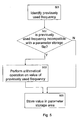
- Figure 5 illustrates a method of storing additional frequencies 204, 205. If the frequency to be stored does not lie on the 200 kHz raster, then it is determined to be incompatible with the parameter storage area and an arithmetical operation is performed on the value in order to shift it so as to lie on the 200 kHz raster where there are no known UMTS bands operating. The modified value is stored in the parameter storage area, which is possible because it lies on the 200 kHz raster. Referring to figure 5 , at 501 a previously used frequency is identified as requiring storage. At 502 it is determined whether the previously used frequency is incompatible with a parameter storage area. If the determination at 502 is negative the value of the previously used frequency is stored in the parameter storage area at 505.
- the storing process at 505 may be a two-stage process comprising firstly dividing the frequency value by a scaling factor (200 kHz, for example) and then storing the result in the parameter storage area.
- Figure 6 illustrates a method of reading additional frequencies wherein an arithmetical operation may be performed on a read value.
- a frequency value is identified from the parameter storage area.
- 611 may be a two-stage process comprising firstly reading a value from the parameter storage area, then multiplying this value by a scaling factor (200 kHz, for example) to arrive at the read value as a frequency.
- a scaling factor 200 kHz, for example
- range C comprises all values not within range A or range B. If the read value is identified as lying within range A at 613a then at 614a arithmetical operation A is performed.
- range C may be implicitly defined as anything not in range A or range B such that where the read value lies within a defined range (range A or range B) then the arithmetical operation for that range is performed, but where the read value does not lie in a defined range, then no arithmetical operation is performed.
- only one range may be defined such that if the read value is within that range, then an arithmetical operation is performed on the value before use, but if the read value is outside of that range then no arithmetical operation is performed on the value before use.
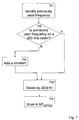
- Figure 7 illustrates an example of a method of storing additional frequencies.
- a previously used frequency is identified as requiring storage.
- Figure 8 illustrates an example of the method of reading additional frequencies.
- a value is read from EF NETPAR and at 812 this value is multiplied by 200 kHz to give a frequency value.
- this frequency is compatible with known networks. Such a determination may be made by determining whether the frequency value lies within one of the ranges shown in the table of figure 2 . If the determination at 813 is positive then at 815 a cell search is performed at that frequency. If the determination at 813 is negative then it is determined that the value read had been offset prior to storage in EF NETPAR (for example, as described above with reference to figure 7 ) and so this offset is removed by subtracting a constant at 814. The constant used in 814 is the same as the constant used in 703 for creating the modified value. Then, the value with the offset removed gives a frequency which is compatible with known networks and so at 815 a search for a cell at that frequency is performed.
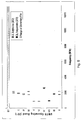
- Figure 9 is similar to figure 3 and shows the relative positions of the uplink and downlink frequency ranges for each UMTS operating band.
- Figure 9 also shows the range for storage of the EF NETPAR , this being 0 to 13100 KHz.
- uplink frequencies 202 are shown with diagonal shading and downlink frequencies 203 are shown with vertical shading.
- the range of the elementary file EF NETPAR is shown using dotted shading. Frequency in MHz is shown on the horizontal axis with the range from 0 to 13200 MHz. It is apparent from figure 9 that a significant proportion of the frequency range of EF NETPAR goes unused in a UE arranged to work with current known bands I to X.
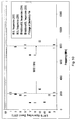
- Figure 10 is a copy of figure 9 additionally showing the regions in which additional frequencies may be stored using an offset constant of 6000.1 MHz as an example. Additional uplink frequencies 204 are shown with diagonal shading travelling down the page from left to right and additional downlink frequencies 205 are shown with horizontal shading. Of course, it should be understood that another offset value could be used. However, it is advantageous for the offset value to conform to n x 200 kHz + 100 kHz, where n is any whole number. In the example shown where the offset is 6000.1 MHz, n takes the value of 30000. Such an offset value, with a suitably high value of n, results in the additional frequencies being stored in a frequency region where no known networks exist and also shifts the frequency value onto the 200 kHz raster. In the example given, a single constant is used to offset all frequency bands. However, in alternative embodiments different values of the offset constant may be used for one or more particular bands.
- Mobile station 900 is preferably a two-way wireless communication device having at least voice and data communication capabilities. Mobile station 900 preferably has the capability to communicate with other computer systems on the Internet. Depending on the exact functionality provided, the wireless device may be referred to as a data messaging device, a two-way pager, a wireless e-mail device, a cellular telephone with data messaging capabilities, a wireless Internet appliance, or a data communication device, as examples.
- mobile station 900 When mobile station 900 is enabled for two-way communication, it will incorporate a communication subsystem 911, including both a receiver 912 and a transmitter 914, as well as associated components such as one or more, preferably embedded or internal, antenna elements 916 and 918, local oscillators (LOs) 913, and a processing module such as a digital signal processor (DSP) 920.
- LOs local oscillators
- DSP digital signal processor
- mobile station 900 may include a communication subsystem 911 designed to operate within the MobitexTM mobile communication system, the DataTACTM mobile communication system, GPRS network, UMTS network, or EDGE network.
- Network access requirements will also vary depending upon the type of network 902.
- mobile station 900 is registered on the network using a unique identification number associated with each mobile station.
- network access is associated with a subscriber or user of mobile station 900.
- SIM subscriber identity module
- a GPRS mobile station therefore requires a subscriber identity module (SIM) card in order to operate on a GPRS network. Without a valid SIM card, a GPRS mobile station will not be fully functional. Local or non-network communication functions, as well as legally required functions (if any) such as "911" emergency calling, may be available, but mobile station 900 will be unable to carry out any other functions involving communications over the network 902.
- SIM subscriber identity module
- the SIM interface 944 is normally similar to a card-slot into which a SIM card can be inserted and ejected like a diskette or PCMCIA card.
- the SIM card can have approximately 64K of memory and hold many key configuration 951, and other information 953 such as identification, and subscriber related information.
- mobile station 900 may send and receive communication signals over the network 902.
- Signals received by antenna 916 through communication network 902 are input to receiver 912, which may perform such common receiver functions as signal amplification, frequency down conversion, filtering, channel selection and the like, and in the example system shown in figure 11 , analog to digital (A/D) conversion.
- A/D conversion of a received signal allows more complex communication functions such as demodulation and decoding to be performed in the DSP 920.
- signals to be transmitted are processed, including modulation and encoding for example, by DSP 920 and input to transmitter 914 for digital to analog conversion, frequency up conversion, filtering, amplification and transmission over the communication network 902 via antenna 918.
- DSP 920 not only processes communication signals, but also provides for receiver and transmitter control. For example, the gains applied to communication signals in receiver 912 and transmitter 914 may be adaptively controlled through automatic gain control algorithms implemented in DSP 920.
- Mobile station 900 preferably includes a microprocessor 938 which controls the overall operation of the device. Communication functions, including at least data and voice communications, are performed through communication subsystem 911. Microprocessor 938 also interacts with further device subsystems such as the display 922, flash memory 924, random access memory (RAM) 926, auxiliary input/output (I/O) subsystems 928, serial port 930, keyboard 932, speaker 934, microphone 936, a short-range communications subsystem 940 and any other device subsystems generally designated as 942.
- a microprocessor 938 which controls the overall operation of the device. Communication functions, including at least data and voice communications, are performed through communication subsystem 911. Microprocessor 938 also interacts with further device subsystems such as the display 922, flash memory 924, random access memory (RAM) 926, auxiliary input/output (I/O) subsystems 928, serial port 930, keyboard 932, speaker 934, microphone 936, a short-range communications subsystem 940 and any other device
- Some of the subsystems shown in figure 11 perform communication-related functions, whereas other subsystems may provide "resident" or on-device functions.
- some subsystems such as keyboard 932 and display 922, for example, may be used for both communication-related functions, such as entering a text message for transmission over a communication network, and device-resident functions such as a calculator or task list.
- Operating system software used by the microprocessor 938 is preferably stored in a persistent store such as flash memory 924, which may instead be a read-only memory (ROM) or similar storage element (not shown).
- flash memory 924 may instead be a read-only memory (ROM) or similar storage element (not shown).
- ROM read-only memory
- Those skilled in the art will appreciate that the operating system, specific device applications, or parts thereof, may be temporarily loaded into a volatile memory such as RAM 926. Received communication signals may also be stored in RAM 926.
- flash memory 924 can be segregated into different areas for both computer programs 958 and program data storage 950, 952, 954 and 956. These different storage types indicate that each program can allocate a portion of flash memory 924 for their own data storage requirements.
- Microprocessor 938 in addition to its operating system functions, preferably enables execution of software applications on the mobile station. A predetermined set of applications that control basic operations, including at least data and voice communication applications for example, will normally be installed on mobile station 900 during manufacturing.
- a preferred software application may be a personal information manager (PIM) application having the ability to organize and manage data items relating to the user of the mobile station such as, but not limited to, e-mail, calendar events, voice mails, appointments, and task items.
- PIM personal information manager
- PIM application would preferably have the ability to send and receive data items, via the wireless network 902.
- the PIM data items are seamlessly integrated, synchronized and updated, via the wireless network 902, with the mobile station user's corresponding data items stored or associated with a host computer system.
- Further applications may also be loaded onto the mobile station 900 through the network 902, an auxiliary I/O subsystem 928, serial port 930, short-range communications subsystem 940 or any other suitable subsystem 942, and installed by a user in the RAM 926 or preferably a non-volatile store (not shown) for execution by the microprocessor 938.
- Such flexibility in application installation increases the functionality of the device and may provide enhanced on-device functions, communication-related functions, or both.
- secure communication applications may enable electronic commerce functions and other such financial transactions to be performed using the mobile station 900.
- a received signal such as a text message or web page download will be processed by the communication subsystem 911 and input to the microprocessor 938, which preferably further processes the received signal for output to the display 922, or alternatively to an auxiliary I/O device 928.
- a user of mobile station 900 may also compose data items such as email messages for example, using the keyboard 932, which is preferably a complete alphanumeric keyboard or telephone-type keypad, in conjunction with the display 922 and possibly an auxiliary I/O device 928. Such composed items may then be transmitted over a communication network through the communication subsystem 911.
- mobile station 900 For voice communications, overall operation of mobile station 900 is similar, except that received signals would preferably be output to a speaker 934 and signals for transmission would be generated by a microphone 936.
- Alternative voice or audio I/O subsystems such as a voice message recording subsystem, may also be implemented on mobile station 900.
- voice or audio signal output is preferably accomplished primarily through the speaker 934, display 922 may also be used to provide an indication of the identity of a calling party, the duration of a voice call, or other voice call related information for example.
- Serial port 930 in figure 11 would normally be implemented in a personal digital assistant (PDA)-type mobile station for which synchronization with a user's desktop computer (not shown) may be desirable, but is an optional device component.
- PDA personal digital assistant
- Such a port 930 would enable a user to set preferences through an external device or software application and would extend the capabilities of mobile station 900 by providing for information or software downloads to mobile station 900 other than through a wireless communication network.
- the alternate download path may for example be used to load an encryption key onto the device through a direct and thus reliable and trusted connection to thereby enable secure device communication.
- communications subsystems 940 such as a short-range communications subsystem, is a further optional component which may provide for communication between mobile station 900 and different systems or devices, which need not necessarily be similar devices.
- the subsystem 940 may include an infrared device and associated circuits and components or a BluetoothTM communication module to provide for communication with similarly enabled systems and devices.
- protocol stacks 946 include a method and apparatus for storing frequencies.
- the apparatus described herein may comprise a single component such as a UE or UTRAN or other user equipment or access network components.
- Embodiments have been described herein in relation to 3GPP specifications. However the method and apparatus described are not intended to be limited to the specifications or the versions thereof referred to herein but may be applicable , within the scope of the claims, to different versions or other specifications.
Landscapes
- Engineering & Computer Science (AREA)
- Computer Networks & Wireless Communication (AREA)
- Signal Processing (AREA)
- Mobile Radio Communication Systems (AREA)
- Stabilization Of Oscillater, Synchronisation, Frequency Synthesizers (AREA)
- Transceivers (AREA)
- Transmitters (AREA)
- Channel Selection Circuits, Automatic Tuning Circuits (AREA)
- Circuits Of Receivers In General (AREA)
Claims (14)
- Verfahren zum Betrieb einer drahtlosen Kommunikationsvorrichtung (100), wobei das Verfahren aufweist:Identifizieren (502) des Werts einer früher benutzten Frequenz als inkompatibel mit dem Bereich und/oder der Auflösung eines Parameterspeicherbereichs;Durchführen (503) einer arithmetischen Operation auf dem Wert der früher benutzten Frequenz, um einen modifizierten Wert der früher benutzten Frequenz zu liefern, der innerhalb eines von zumindest einem vorgegebenen Bereich liegt; undSpeichern (505) des modifizierten Werts der früher benutzten Frequenz in dem Parameterspeicherbereich.
- Verfahren gemäß Anspruch 1, wobei der Wert der früher benutzten Frequenz als inkompatibel identifiziert wird (502), da er auf einem 100kHz-Raster (702) liegt.
- Verfahren gemäß Anspruch 1, wobei der Wert der früher benutzten Frequenz als inkompatibel identifiziert wird (502), da das Ergebnis seines Teilens durch 200 kHz kein ganzzahliger Wert ist (702).
- Verfahren gemäß einem vorhergehenden Anspruch, wobei die arithmetische Operation vorgesehen ist zum Hinzufügen einer Konstante (703).
- Verfahren gemäß Anspruch 4, wobei die Konstante positiv ist.
- Verfahren gemäß Anspruch 5, wobei die Konstante größer ist als jede Frequenz, für deren Verwendung für eine Funkkommunikation die drahtlose Kommunikationsvorrichtung (100) ausgebildet ist.
- Verfahren gemäß Anspruch 4, wobei die Konstante negativ ist.
- Verfahren gemäß Anspruch 7, wobei die Konstante einen Wert hat, der dazu führt, dass der Wert einer inkompatiblen Frequenz als ein modifizierter Wert gespeichert wird, der geringer ist als eine Frequenz, für deren Verwendung für eine Funkkommunikation die drahtlose Kommunikationsvorrichtung ausgebildet ist.
- Verfahren gemäß einem vorhergehenden Anspruch, wobei die arithmetische Operation (614) abhängig ist von dem Wert der früher benutzten Frequenz (613).
- Verfahren gemäß einem der Ansprüche 1 bis 8, wobei die arithmetische Operation (503) unabhängig ist von dem Wert der früher benutzten Frequenz.
- Verfahren zum Betrieb einer drahtlosen Kommunikationsvorrichtung (100), wobei das Verfahren aufweist:Lesen (811) eines gespeicherten Werts einer früher benutzten Frequenz aus einem Parameterspeicherbereich;Identifizieren (813) des gespeicherten Werts als innerhalb eines von zumindest einem vorgegebenen Bereich;Durchführen (814) einer arithmetischen Operation auf dem gespeicherten Wert, um einen korrigierten Wert der früher benutzten Frequenz zu liefern,wobei die arithmetische Operation abhängig ist von dem gespeicherten Wert der früher benutzten Frequenz; undSuchen (815) nach einer Zelle des Kommunikationsnetzwerks bei dem korrigierten Wert der früher benutzten Frequenz.
- Verfahren gemäß einem vorhergehenden Anspruch, wobei die drahtlose Kommunikationsvorrichtung (100) ausgebildet ist, mit einem UMTS-Netzwerk (119) zu kommunizieren, und der Parameterspeicherbereich EFNETPAR ist.
- Drahtlose Kommunikationsvorrichtung (100), die Mittel aufweist, die ausgebildet sind, die Schritte des Verfahrens gemäß einem vorhergehenden Anspruch durchzuführen.
- Computerprogrammprodukt, das Codemittel aufweist, die auf einem Computer-lesbaren Medium gespeichert sind, wobei die Codemittel bei Ausführung durch einen Prozessor, der zu einer drahtlosen Kommunikationsvorrichtung (100) gehört, den Prozessor veranlassen, die Schritte des Verfahrens gemäß einem der Ansprüche 1 bis 12 durchzuführen.
Priority Applications (6)
| Application Number | Priority Date | Filing Date | Title |
|---|---|---|---|
| EP08158243A EP2134124B1 (de) | 2008-06-13 | 2008-06-13 | Verfahren und Vorrichtung zum Speichern und zum Ablesen von Frequenzwerten, welche zur Kompatiblität mit einem Parameterspeicherbereich geändert werden |
| AT08158243T ATE475284T1 (de) | 2008-06-13 | 2008-06-13 | Verfahren und vorrichtung zum speichern und zum ablesen von frequenzwerten, welche zur kompatiblität mit einem parameterspeicherbereich geändert werden |
| DE602008001886T DE602008001886D1 (de) | 2008-06-13 | 2008-06-13 | Verfahren und Vorrichtung zum Speichern und zum Ablesen von Frequenzwerten, welche zur Kompatiblität mit einem Parameterspeicherbereich geändert werden |
| SG200903190-7A SG158006A1 (en) | 2008-06-13 | 2009-05-08 | Method and apparatus for storing frequencies |
| CA2668239A CA2668239C (en) | 2008-06-13 | 2009-06-04 | Method and apparatus for storing frequencies |
| CN200910147030.4A CN101605380B (zh) | 2008-06-13 | 2009-06-08 | 用于存储频率的方法和装置 |
Applications Claiming Priority (1)
| Application Number | Priority Date | Filing Date | Title |
|---|---|---|---|
| EP08158243A EP2134124B1 (de) | 2008-06-13 | 2008-06-13 | Verfahren und Vorrichtung zum Speichern und zum Ablesen von Frequenzwerten, welche zur Kompatiblität mit einem Parameterspeicherbereich geändert werden |
Publications (2)
| Publication Number | Publication Date |
|---|---|
| EP2134124A1 EP2134124A1 (de) | 2009-12-16 |
| EP2134124B1 true EP2134124B1 (de) | 2010-07-21 |
Family
ID=39986455
Family Applications (1)
| Application Number | Title | Priority Date | Filing Date |
|---|---|---|---|
| EP08158243A Active EP2134124B1 (de) | 2008-06-13 | 2008-06-13 | Verfahren und Vorrichtung zum Speichern und zum Ablesen von Frequenzwerten, welche zur Kompatiblität mit einem Parameterspeicherbereich geändert werden |
Country Status (6)
| Country | Link |
|---|---|
| EP (1) | EP2134124B1 (de) |
| CN (1) | CN101605380B (de) |
| AT (1) | ATE475284T1 (de) |
| CA (1) | CA2668239C (de) |
| DE (1) | DE602008001886D1 (de) |
| SG (1) | SG158006A1 (de) |
Family Cites Families (5)
| Publication number | Priority date | Publication date | Assignee | Title |
|---|---|---|---|---|
| US5280636A (en) | 1991-06-13 | 1994-01-18 | Hughes Aircraft Company | Multi-band digital receiving apparatus and method with bandwidth reduction |
| US8000675B2 (en) | 2004-04-16 | 2011-08-16 | Sony Ericsson Mobile Communications Ab | Low cost method for receiving broadcast channels with a cellular terminal |
| KR101128231B1 (ko) | 2004-08-19 | 2012-03-26 | 엘지전자 주식회사 | 방송 및 멀티캐스트(mbms) 서비스를 위한 단말 분포 제어방법 |
| CN1968236B (zh) * | 2005-11-15 | 2011-04-27 | 中国科学技术大学 | 一种多普勒频偏估计方法 |
| EP1843613A1 (de) | 2006-04-03 | 2007-10-10 | Research In Motion Limited | Verfahren und Vorrichtung zum Erleichtern der Bestimmung der Betriebsart und Konfiguration eines drahtlosen Teilnehmergeräts |
-
2008
- 2008-06-13 AT AT08158243T patent/ATE475284T1/de not_active IP Right Cessation
- 2008-06-13 EP EP08158243A patent/EP2134124B1/de active Active
- 2008-06-13 DE DE602008001886T patent/DE602008001886D1/de active Active
-
2009
- 2009-05-08 SG SG200903190-7A patent/SG158006A1/en unknown
- 2009-06-04 CA CA2668239A patent/CA2668239C/en active Active
- 2009-06-08 CN CN200910147030.4A patent/CN101605380B/zh active Active
Also Published As
| Publication number | Publication date |
|---|---|
| EP2134124A1 (de) | 2009-12-16 |
| ATE475284T1 (de) | 2010-08-15 |
| DE602008001886D1 (de) | 2010-09-02 |
| SG158006A1 (en) | 2010-01-29 |
| CN101605380A (zh) | 2009-12-16 |
| CN101605380B (zh) | 2013-11-06 |
| CA2668239C (en) | 2015-11-24 |
| CA2668239A1 (en) | 2009-12-13 |
Similar Documents
| Publication | Publication Date | Title |
|---|---|---|
| US8189524B2 (en) | Method for cell selection in a radio access network | |
| US8526962B2 (en) | Apparatus, and method, for implementing detection of system information changes in universal mobile telecommunications systems | |
| US8351940B2 (en) | Apparatus and method for making measurements in mobile telecommunications system user equipment | |
| US8565768B2 (en) | Apparatus and method for querying for RAT handover system information in mobile telecommunications systems | |
| US8073453B2 (en) | Apparatus and method for handling system information in mobile telecommunications system user equipment | |
| US8498638B2 (en) | Method and apparatus for scanning for cells in a wireless communications network | |
| US7079840B2 (en) | Apparatus and method for implementing system information acquisition in universal mobile telecommunications system user equipment | |
| US20100304781A1 (en) | Method and Apparatus for Calculating an Initial Transmission Power In Universal Mobile Telecommunications System User Equipment | |
| EP1553798A1 (de) | Wiederholung der Benachrichtigung über Systeminformtionsänderungen in universellen mobilen Telekommunikationssystemen | |
| CA2665752C (en) | Apparatus and method for cell reselection in a radio access network | |
| CA2647226C (en) | A method and apparatus for scanning for cells in a wireless communications network | |
| EP1562388B1 (de) | Vorrichtung und Verfahren zum Ausführen von Messungen in einem universalen Mobil-Telekommunikations-System-Teilnehmergerät | |
| US8532593B2 (en) | Method and apparatus for storing frequencies | |
| EP2134124B1 (de) | Verfahren und Vorrichtung zum Speichern und zum Ablesen von Frequenzwerten, welche zur Kompatiblität mit einem Parameterspeicherbereich geändert werden | |
| EP1565020B1 (de) | Verfahren und Gerät zum Bearbeiten von Informationselementen in einer definierten Reihenfolge | |
| CN115606143B (zh) | 用于半静态dl调度的用户设备和通信方法 | |
| EP1784034B1 (de) | Vorrichtung und Verfahren in einem mobilen Telekommunikationssystem zum Abfragen von RAT Weiterreichung-Systeminformationen | |
| HK1079030B (en) | Method and apparatus for applying information elements in a defined order |
Legal Events
| Date | Code | Title | Description |
|---|---|---|---|
| PUAI | Public reference made under article 153(3) epc to a published international application that has entered the european phase |
Free format text: ORIGINAL CODE: 0009012 |
|
| 17P | Request for examination filed |
Effective date: 20080617 |
|
| AK | Designated contracting states |
Kind code of ref document: A1 Designated state(s): AT BE BG CH CY CZ DE DK EE ES FI FR GB GR HR HU IE IS IT LI LT LU LV MC MT NL NO PL PT RO SE SI SK TR |
|
| AX | Request for extension of the european patent |
Extension state: AL BA MK RS |
|
| GRAP | Despatch of communication of intention to grant a patent |
Free format text: ORIGINAL CODE: EPIDOSNIGR1 |
|
| GRAS | Grant fee paid |
Free format text: ORIGINAL CODE: EPIDOSNIGR3 |
|
| GRAA | (expected) grant |
Free format text: ORIGINAL CODE: 0009210 |
|
| AK | Designated contracting states |
Kind code of ref document: B1 Designated state(s): AT BE BG CH CY CZ DE DK EE ES FI FR GB GR HR HU IE IS IT LI LT LU LV MC MT NL NO PL PT RO SE SI SK TR |
|
| REG | Reference to a national code |
Ref country code: GB Ref legal event code: FG4D |
|
| REG | Reference to a national code |
Ref country code: CH Ref legal event code: EP |
|
| REG | Reference to a national code |
Ref country code: IE Ref legal event code: FG4D |
|
| AKX | Designation fees paid |
Designated state(s): AT BE BG CH CY CZ DE DK EE ES FI FR GB GR HR HU IE IS IT LI LT LU LV MC MT NL NO PL PT RO SE SI SK TR |
|
| REF | Corresponds to: |
Ref document number: 602008001886 Country of ref document: DE Date of ref document: 20100902 Kind code of ref document: P |
|
| REG | Reference to a national code |
Ref country code: NL Ref legal event code: VDEP Effective date: 20100721 |
|
| LTIE | Lt: invalidation of european patent or patent extension |
Effective date: 20100721 |
|
| PG25 | Lapsed in a contracting state [announced via postgrant information from national office to epo] |
Ref country code: FI Free format text: LAPSE BECAUSE OF FAILURE TO SUBMIT A TRANSLATION OF THE DESCRIPTION OR TO PAY THE FEE WITHIN THE PRESCRIBED TIME-LIMIT Effective date: 20100721 Ref country code: AT Free format text: LAPSE BECAUSE OF FAILURE TO SUBMIT A TRANSLATION OF THE DESCRIPTION OR TO PAY THE FEE WITHIN THE PRESCRIBED TIME-LIMIT Effective date: 20100721 Ref country code: LT Free format text: LAPSE BECAUSE OF FAILURE TO SUBMIT A TRANSLATION OF THE DESCRIPTION OR TO PAY THE FEE WITHIN THE PRESCRIBED TIME-LIMIT Effective date: 20100721 Ref country code: NO Free format text: LAPSE BECAUSE OF FAILURE TO SUBMIT A TRANSLATION OF THE DESCRIPTION OR TO PAY THE FEE WITHIN THE PRESCRIBED TIME-LIMIT Effective date: 20101021 Ref country code: NL Free format text: LAPSE BECAUSE OF FAILURE TO SUBMIT A TRANSLATION OF THE DESCRIPTION OR TO PAY THE FEE WITHIN THE PRESCRIBED TIME-LIMIT Effective date: 20100721 |
|
| PG25 | Lapsed in a contracting state [announced via postgrant information from national office to epo] |
Ref country code: BG Free format text: LAPSE BECAUSE OF FAILURE TO SUBMIT A TRANSLATION OF THE DESCRIPTION OR TO PAY THE FEE WITHIN THE PRESCRIBED TIME-LIMIT Effective date: 20101021 Ref country code: HR Free format text: LAPSE BECAUSE OF FAILURE TO SUBMIT A TRANSLATION OF THE DESCRIPTION OR TO PAY THE FEE WITHIN THE PRESCRIBED TIME-LIMIT Effective date: 20100721 Ref country code: IS Free format text: LAPSE BECAUSE OF FAILURE TO SUBMIT A TRANSLATION OF THE DESCRIPTION OR TO PAY THE FEE WITHIN THE PRESCRIBED TIME-LIMIT Effective date: 20101121 Ref country code: CY Free format text: LAPSE BECAUSE OF FAILURE TO SUBMIT A TRANSLATION OF THE DESCRIPTION OR TO PAY THE FEE WITHIN THE PRESCRIBED TIME-LIMIT Effective date: 20100721 Ref country code: PL Free format text: LAPSE BECAUSE OF FAILURE TO SUBMIT A TRANSLATION OF THE DESCRIPTION OR TO PAY THE FEE WITHIN THE PRESCRIBED TIME-LIMIT Effective date: 20100721 Ref country code: SI Free format text: LAPSE BECAUSE OF FAILURE TO SUBMIT A TRANSLATION OF THE DESCRIPTION OR TO PAY THE FEE WITHIN THE PRESCRIBED TIME-LIMIT Effective date: 20100721 |
|
| PG25 | Lapsed in a contracting state [announced via postgrant information from national office to epo] |
Ref country code: SE Free format text: LAPSE BECAUSE OF FAILURE TO SUBMIT A TRANSLATION OF THE DESCRIPTION OR TO PAY THE FEE WITHIN THE PRESCRIBED TIME-LIMIT Effective date: 20100721 Ref country code: LV Free format text: LAPSE BECAUSE OF FAILURE TO SUBMIT A TRANSLATION OF THE DESCRIPTION OR TO PAY THE FEE WITHIN THE PRESCRIBED TIME-LIMIT Effective date: 20100721 Ref country code: GR Free format text: LAPSE BECAUSE OF FAILURE TO SUBMIT A TRANSLATION OF THE DESCRIPTION OR TO PAY THE FEE WITHIN THE PRESCRIBED TIME-LIMIT Effective date: 20101022 Ref country code: BE Free format text: LAPSE BECAUSE OF FAILURE TO SUBMIT A TRANSLATION OF THE DESCRIPTION OR TO PAY THE FEE WITHIN THE PRESCRIBED TIME-LIMIT Effective date: 20100721 |
|
| PG25 | Lapsed in a contracting state [announced via postgrant information from national office to epo] |
Ref country code: DK Free format text: LAPSE BECAUSE OF FAILURE TO SUBMIT A TRANSLATION OF THE DESCRIPTION OR TO PAY THE FEE WITHIN THE PRESCRIBED TIME-LIMIT Effective date: 20100721 |
|
| PLBE | No opposition filed within time limit |
Free format text: ORIGINAL CODE: 0009261 |
|
| STAA | Information on the status of an ep patent application or granted ep patent |
Free format text: STATUS: NO OPPOSITION FILED WITHIN TIME LIMIT |
|
| PG25 | Lapsed in a contracting state [announced via postgrant information from national office to epo] |
Ref country code: CZ Free format text: LAPSE BECAUSE OF FAILURE TO SUBMIT A TRANSLATION OF THE DESCRIPTION OR TO PAY THE FEE WITHIN THE PRESCRIBED TIME-LIMIT Effective date: 20100721 Ref country code: EE Free format text: LAPSE BECAUSE OF FAILURE TO SUBMIT A TRANSLATION OF THE DESCRIPTION OR TO PAY THE FEE WITHIN THE PRESCRIBED TIME-LIMIT Effective date: 20100721 Ref country code: RO Free format text: LAPSE BECAUSE OF FAILURE TO SUBMIT A TRANSLATION OF THE DESCRIPTION OR TO PAY THE FEE WITHIN THE PRESCRIBED TIME-LIMIT Effective date: 20100721 Ref country code: IT Free format text: LAPSE BECAUSE OF FAILURE TO SUBMIT A TRANSLATION OF THE DESCRIPTION OR TO PAY THE FEE WITHIN THE PRESCRIBED TIME-LIMIT Effective date: 20100721 Ref country code: SK Free format text: LAPSE BECAUSE OF FAILURE TO SUBMIT A TRANSLATION OF THE DESCRIPTION OR TO PAY THE FEE WITHIN THE PRESCRIBED TIME-LIMIT Effective date: 20100721 |
|
| 26N | No opposition filed |
Effective date: 20110426 |
|
| PG25 | Lapsed in a contracting state [announced via postgrant information from national office to epo] |
Ref country code: ES Free format text: LAPSE BECAUSE OF FAILURE TO SUBMIT A TRANSLATION OF THE DESCRIPTION OR TO PAY THE FEE WITHIN THE PRESCRIBED TIME-LIMIT Effective date: 20101101 |
|
| PGFP | Annual fee paid to national office [announced via postgrant information from national office to epo] |
Ref country code: LU Payment date: 20110617 Year of fee payment: 4 Ref country code: IE Payment date: 20110610 Year of fee payment: 4 Ref country code: MC Payment date: 20110530 Year of fee payment: 4 |
|
| REG | Reference to a national code |
Ref country code: DE Ref legal event code: R097 Ref document number: 602008001886 Country of ref document: DE Effective date: 20110426 |
|
| PGFP | Annual fee paid to national office [announced via postgrant information from national office to epo] |
Ref country code: NL Payment date: 20110621 Year of fee payment: 4 |
|
| PG25 | Lapsed in a contracting state [announced via postgrant information from national office to epo] |
Ref country code: MT Free format text: LAPSE BECAUSE OF FAILURE TO SUBMIT A TRANSLATION OF THE DESCRIPTION OR TO PAY THE FEE WITHIN THE PRESCRIBED TIME-LIMIT Effective date: 20100721 |
|
| PG25 | Lapsed in a contracting state [announced via postgrant information from national office to epo] |
Ref country code: MC Free format text: LAPSE BECAUSE OF NON-PAYMENT OF DUE FEES Effective date: 20120630 |
|
| REG | Reference to a national code |
Ref country code: CH Ref legal event code: PL |
|
| REG | Reference to a national code |
Ref country code: CH Ref legal event code: PL |
|
| REG | Reference to a national code |
Ref country code: IE Ref legal event code: MM4A |
|
| PG25 | Lapsed in a contracting state [announced via postgrant information from national office to epo] |
Ref country code: CH Free format text: LAPSE BECAUSE OF NON-PAYMENT OF DUE FEES Effective date: 20120630 Ref country code: LI Free format text: LAPSE BECAUSE OF NON-PAYMENT OF DUE FEES Effective date: 20120630 Ref country code: IE Free format text: LAPSE BECAUSE OF NON-PAYMENT OF DUE FEES Effective date: 20120613 |
|
| PG25 | Lapsed in a contracting state [announced via postgrant information from national office to epo] |
Ref country code: PT Free format text: LAPSE BECAUSE OF NON-PAYMENT OF DUE FEES Effective date: 20100721 |
|
| PG25 | Lapsed in a contracting state [announced via postgrant information from national office to epo] |
Ref country code: TR Free format text: LAPSE BECAUSE OF FAILURE TO SUBMIT A TRANSLATION OF THE DESCRIPTION OR TO PAY THE FEE WITHIN THE PRESCRIBED TIME-LIMIT Effective date: 20100721 |
|
| PG25 | Lapsed in a contracting state [announced via postgrant information from national office to epo] |
Ref country code: HU Free format text: LAPSE BECAUSE OF FAILURE TO SUBMIT A TRANSLATION OF THE DESCRIPTION OR TO PAY THE FEE WITHIN THE PRESCRIBED TIME-LIMIT Effective date: 20100721 |
|
| PG25 | Lapsed in a contracting state [announced via postgrant information from national office to epo] |
Ref country code: LU Free format text: LAPSE BECAUSE OF NON-PAYMENT OF DUE FEES Effective date: 20120613 |
|
| REG | Reference to a national code |
Ref country code: DE Ref legal event code: R082 Ref document number: 602008001886 Country of ref document: DE Representative=s name: MERH-IP MATIAS ERNY REICHL HOFFMANN, DE |
|
| REG | Reference to a national code |
Ref country code: DE Ref legal event code: R082 Ref document number: 602008001886 Country of ref document: DE Representative=s name: MERH-IP MATIAS ERNY REICHL HOFFMANN, DE Effective date: 20140925 Ref country code: DE Ref legal event code: R081 Ref document number: 602008001886 Country of ref document: DE Owner name: BLACKBERRY LIMITED, WATERLOO, CA Free format text: FORMER OWNER: RESEARCH IN MOTION LTD., WATERLOO, ONTARIO, CA Effective date: 20140925 Ref country code: DE Ref legal event code: R082 Ref document number: 602008001886 Country of ref document: DE Representative=s name: MERH-IP MATIAS ERNY REICHL HOFFMANN PATENTANWA, DE Effective date: 20140925 |
|
| REG | Reference to a national code |
Ref country code: FR Ref legal event code: PLFP Year of fee payment: 9 |
|
| REG | Reference to a national code |
Ref country code: FR Ref legal event code: PLFP Year of fee payment: 10 |
|
| REG | Reference to a national code |
Ref country code: FR Ref legal event code: PLFP Year of fee payment: 11 |
|
| REG | Reference to a national code |
Ref country code: DE Ref legal event code: R082 Ref document number: 602008001886 Country of ref document: DE Ref country code: DE Ref legal event code: R081 Ref document number: 602008001886 Country of ref document: DE Owner name: MALIKIE INNOVATIONS LTD., IE Free format text: FORMER OWNER: BLACKBERRY LIMITED, WATERLOO, ONTARIO, CA |
|
| PGFP | Annual fee paid to national office [announced via postgrant information from national office to epo] |
Ref country code: DE Payment date: 20250626 Year of fee payment: 18 |
|
| PGFP | Annual fee paid to national office [announced via postgrant information from national office to epo] |
Ref country code: GB Payment date: 20250618 Year of fee payment: 18 |
|
| PGFP | Annual fee paid to national office [announced via postgrant information from national office to epo] |
Ref country code: FR Payment date: 20250624 Year of fee payment: 18 |