EP2132682B1 - Method and apparatus for detecting objects of interest in soccer video by color segmentation and shape anaylsis - Google Patents
Method and apparatus for detecting objects of interest in soccer video by color segmentation and shape anaylsis Download PDFInfo
- Publication number
- EP2132682B1 EP2132682B1 EP07861724A EP07861724A EP2132682B1 EP 2132682 B1 EP2132682 B1 EP 2132682B1 EP 07861724 A EP07861724 A EP 07861724A EP 07861724 A EP07861724 A EP 07861724A EP 2132682 B1 EP2132682 B1 EP 2132682B1
- Authority
- EP
- European Patent Office
- Prior art keywords
- skeleton
- pixels
- threshold
- point
- region
- Prior art date
- Legal status (The legal status is an assumption and is not a legal conclusion. Google has not performed a legal analysis and makes no representation as to the accuracy of the status listed.)
- Active
Links
Images

Classifications
-
- G—PHYSICS
- G06—COMPUTING OR CALCULATING; COUNTING
- G06T—IMAGE DATA PROCESSING OR GENERATION, IN GENERAL
- G06T7/00—Image analysis
- G06T7/40—Analysis of texture
-
- G—PHYSICS
- G06—COMPUTING OR CALCULATING; COUNTING
- G06V—IMAGE OR VIDEO RECOGNITION OR UNDERSTANDING
- G06V20/00—Scenes; Scene-specific elements
- G06V20/40—Scenes; Scene-specific elements in video content
-
- G—PHYSICS
- G06—COMPUTING OR CALCULATING; COUNTING
- G06V—IMAGE OR VIDEO RECOGNITION OR UNDERSTANDING
- G06V10/00—Arrangements for image or video recognition or understanding
- G06V10/20—Image preprocessing
- G06V10/34—Smoothing or thinning of the pattern; Morphological operations; Skeletonisation
-
- G—PHYSICS
- G06—COMPUTING OR CALCULATING; COUNTING
- G06V—IMAGE OR VIDEO RECOGNITION OR UNDERSTANDING
- G06V10/00—Arrangements for image or video recognition or understanding
- G06V10/40—Extraction of image or video features
- G06V10/56—Extraction of image or video features relating to colour
Definitions
- the present invention generally relates to a method and apparatus for detecting objects in a video frame and, more particularly, to a method and apparatus for detecting players and a ball in soccer videos by using color segmentation and shape analysis techniques.
- the soccer players and the ball are the most important objects in that they represent a large amount of information about each instant of a game. Detection and tracking of the players and the ball have been motivated by various applications, such as event detection, tactics analysis, automatic indexing/summarization, and object-based compression.
- Known methods for locating the ball as well as the players in soccer videos can be divided in two distinct groups: the first group of methods makes use of fixed cameras, usually calibrated in advance, in a controlled environment, whereas the second group of methods employs regular broadcast videos. While the former can provide better performance, the latter appear to be more flexible.
- Petkovic et al "Recognizing Stokes in Tennis Videos Using Hidden Markov Models", Proceed. of Intl. Conf. on Visualization, Imaging and Image Processing, pp. 1-5, Marbella, Spain (2001 ). Petkovic et al. appears to disclose a method for identifying the tennis player on the side closer to a viewer of a TV by simply identifying the largest blob in the lower half of the TV image. Since there is only one player in this location during a singles tennis match, there is no need in Petkovic et al.to compare the size of the blob object to any kind of threshold or to compare the ratio of the background color to another threshold. Petkovic et al.
- Petkovic et al. does appear to suggest the use of thinning. But it should be noted that thinning is used in Petkovic et al. in step 2 in Section 2.2 after the player object has already been detected. Thinning, according to Petkovic et al. is a technique used as a part of the process to construct the 3D model of the tennis court shown in Figure 1(c) of Petkovic et al.
- Xiang Bai et al. "Skeleton Pruning by Contour Partitioning", Discrete Geometry for Computer Imagery Lecture Notes in Computer Science, Springer, Vol. 4345, pp. 567-579 (January 2006 ).
- Xiang Bai et al. appears to disclose various skeleton pruning methods by using a technique involving contour partitioning. Redundancy is removed from the skeleton when certain branches, which match a contour, are pruned.
- Correia et al. "Objective Evaluation of Video Segmentation Quality", IEEE Transactions on Image Processing, Vol. 12, No. 2, pp. 186-200 (February 2003 ). Correia et al. appears to disclose three instances of an elongation parameter: one is elongation, another is circular elongation, and the last is an elongation difference. According to Correia et al. on page 191, the first two elongation parameters are used to observe shape regularity. According to Correia et al. on page 189, the elongation and elongation difference parameters are used to observe temporal stability.
- Singh "Robust Tracking and Human Activity Recognition", University of Alberta (2004 ). Singh appears to disclose the use of shape based identification employing an aspect ratio of the blob and a skeletal representation of the blob.
- Substantial elimination of errors in the detection and location of soccer players and the soccer ball in soccer videos is achieved, in accordance with at least one aspect of the invention, by a shape analysis-based approach to identify the players and the ball from roughly extracted foregrounds obtained by color segmentation and connected component analysis, by performing a Euclidean distance transform to extract skeletons for every foreground blob, by performing a shape analysis to remove false alarms (non-players and non-ball), and then by performing skeleton pruning and a reverse Euclidean distance transform to cut-off the artifacts primarily caused by playing field lines.
- the playfield is green
- the lines are white
- the ball is generally white or bright
- the teams as well as the referee are dressed at least in jerseys that allow them to be distinguished easily.
- the colors of the playfield (background) and the colors of non-playfield (foreground) may be different.
- the color of a soccer ball is normally white but the color of a basketball is normally orange.
- OI objects of interest
- One relatively simple way to represent the color of the soccer field is by using a constant mean color value obtained through prior statistics over a large data set. The color distance between a chosen pixel in a video frame and the mean value of the field is used to determine whether or not that chosen pixel belongs to the set of pixels for the playing field. Since the soccer field is roughly green colored, the hue component defined in Smith's hexagonal cone model can be used to detect the green colored pixels given a certain range.
- the soccer field has a green coloration in general, it may exhibit some differences in hue based upon appearances caused by lighting patterns (e.g., natural versus artificial lighting and shadows) and field characteristics such as worn out areas, grass mowing patterns, grass growing patterns and the like.
- lighting patterns e.g., natural versus artificial lighting and shadows
- field characteristics such as worn out areas, grass mowing patterns, grass growing patterns and the like.
- a histogram can be employed as a non-parametric color model for playfield. In certain applications it is preferable to find a dominant color assuming that the field has a uniform color of green and occupies the largest area in each frame.
- Single Gaussian statistics or a mixture of Gaussian (MoG) statistics can be learned to represent a color model of the playfield and can be adapted by an Expectation-Maximization (EM) algorithm incrementally.
- EM Expectation-Maximization
- FIG. 1 in which an exemplary method is shown for detecting and extracting the playing field from a soccer video image frame. Headings are used to assist the reader in locating and identifying general operations performed throughout the inventive method.
- Playing field detection is carried out in step 110 of the method shown in Figure 1 .
- Detection is accomplished by a simple histogram learning technique applied to a playfield pixel from the image frame.
- a color histogram having N bins per channel in the red-green-blue (RGB) color space is defined as a generic color model.
- Channel in this context refers to the red, green, and blue components.
- This generic color model can be developed in many ways known in the art such as by a priori learning based on a training set of soccer game videos. In such a training set of videos, playfield pixels and non playfield pixels may be labeled as such in a manual or semi-supervised manner.
- each labeled playfield pixel is placed into the appropriate bin of the playfield histogram.
- a playfield pixel classifier can be realized by using a standard likelihood ratio approach using conditional probabilities. For example, a particular RGB value is labeled playfield if: P rgb / playfield P rgb / non_playfield ⁇ ⁇ , where 0 ⁇ ⁇ ⁇ 1 is a threshold that can be adjusted between the limits in order to achieve an appropriate trade-off between correct detections and false positives.
- a false positive occurs when, for example, a non-playfield pixel is labeled as a playfield pixel.
- a false negative occurs when, for example, a playfield pixel is labeled as a non-playfield pixel.
- the a priori probability for the playing field can be derived as T f / (T f + T n )
- the a priori probability for the non-playing field can be derived as T n / (T f + T n ) .
- the number of bins per channel, N , and the detection threshold, ⁇ can be chosen based upon a receiver operating characteristic (ROC) curve that plots the probability of correct detection against the probability of false detection and the number of bins per channel is varied across a range of values such as for N as 32 to 256 bins.
- the probability of correct detection is defined as the fraction of pixels labeled as playfield that are thereby correctly classified.
- detection threshold ⁇ corresponding to the operating point is then used for the pixel classification in the equation above.
- each frame is processed to yield a binary mask. Pixel values are classified as either a binary "1" or a binary "0".
- Morphological filtering including the operations of erosion and then dilation, is applied to the binary mask of the frame in step 120 to eliminate the noise and makes regions homogeneous.
- Morphological filtering is a known process for image enhancement that tends to simplify the image and thereby facilitate the search for objects of interest. It generally involves modifying the spatial form or structure of objects within the image. Dilation and erosion are two fundamental morphological filtering operations. Dilation allows objects to expand, thus potentially filling in small holes and connecting disjoint objects. Erosion is the complementary operation to dilation in that erosion shrinks objects by etching away (eroding) their boundaries. These operations can be customized for each application by the proper selection of a structuring element, which determines exactly how the objects will be dilated or eroded.
- Connected components analysis (CCA) in step 130 is employed to scan the binary mask and group the mask pixels into connected components based on pixel connectivity. That is, the pixels identified in a connected component share the same binary values and they are in some way connected with each other, such as 4- connectivity or 8- conneclivity also called 4-and 8- point neighborhood systems, respectively. Connected components analysis tools and techniques are well known in the art and will not be disclosed further herein.
- the playfield is understood to include several connected components in the image, each of them is bigger in size than a given area threshold in step 140. This step allows all the playfield components to be tested against a threshold so that smaller playfield components can be removed.
- the playfield mask is obtained in step 150 by filling the interior of each bigger connected component defined by the connected component boundary.
- an exclusive-OR function is applied to the output masks in steps 140 and 150 in order to produce a mask of the extracted playfield areas.
- Foreground blob extraction is then performed in steps 170 and 180.
- a blob is simply a region of a connected grouping of pixels.
- the non-playfield pixels inside the extracted playfield areas from step 160 are expected to be foreground pixels that can be grouped into different foreground blobs by connected component analysis. Since the ball is a relatively small object of interest and generally less than 30 pixels in size, it is only possible to perform dilation before grouping pixels into different blobs only to make regions homogeneous. Performing erosion at this stage in the morphological filtering step would damage the image by possibly erasing the ball. Noise in certain areas of the image must be removed later by shape analysis and use of an appearance model of the true objects.
- the threshold values a and b are determined empirically.
- Region properties for each blob can be categorized by a few basic shape descriptors as follows:
- Skeletons provide an intuitive, compact representation of a shape.
- One of the important features of skeletons is separation of the topological properties for a shape from the geometric properties of that shape.
- a skeleton as its name implies, is a set of curves that approximates the local symmetry axis of the shape for the object of interest.
- An alternative definition for a skeleton is based on a distance transform.
- the distance transform or distance map is a function that, for a given point inside a shape, computes the distance from the given point to the point on an outline of that shape closest to the given point.
- W denotes the complementary mask of W in the sense that W includes the set of background pixels.
- SDT squared distance transform
- f(x,y) is set to the squared distance transform value h(x,y) when the pixel (x,y) belongs to the foreground pixel set V or f(x,y) is set to 0 otherwise.
- Ske ⁇ x y
- max u v h u v - x - u 2 - y - v 2 h x y - i - x 2 - j - y 2 ⁇ .
- the reverse Euclidean distance transform is based on a Power diagram construction as follows:
- the reverse Euclidean distance transform is linked to computation of nonempty cells in the Power labeling. Consequently, the skeleton corresponds to the nonempty cells in the Power Diagram.
- the extracted skeleton and its descriptors are used primarily in the inventive method described herein for player detection and artifact removal by skeleton pruning as described below.
- the shape analysis process as applied for isolated ball detection is shown in Figure 2 .
- the process in Figure 2 is applied to each blob as follows.
- step 220 the blob area A is compared with a maximum threshold ar max . If the blob area A is less than the threshold, then processing of the blob continues to step 230; otherwise the blob is sent for further processing to step 240.
- step 230 the white ratio pw, the roundness F, and the eccentricity E of the blob are tested against their respective thresholds, rw, f max , and e max , as shown in the equation above.
- an isolated player or referee blob exhibits an elliptical shape.
- the player blob when represented by its skeleton, is recognizable with a limited elongation and a limited aspect ratio. These constraints can also help in removing some fragments of field lines or curves that have been erroneously merged into the player blob.
- an area range for the player or referee blob is predefined according to the camera configuration. That range is dependent upon the camera configuration in relation to the playing field.
- step 240 the white pixel ratio for the blob of interest is compared with a threshold yw. If the threshold is exceeded, the blob of interest is removed as being a non-player in step 241. If, on the other hand, the white ratio is less than or equal to the threshold in step 240, the blob of interest is further processed in step 250.
- step 250 the skeleton extraction is performed on the blob of interest as described above.
- the elongation and/or aspect ratio for the blob are tested against their respective thresholds, g max and t max , as shown in step 260. If either or both descriptors are less than their respective thresholds, then the player or referee is detected as shown in step 262. If either one or both descriptors is greater than or equal to the respective threshold, then the blob of interest is removed as shown in step 261.
- skeleton pruning is employed in step 270 and Figure 3 to remove errors caused by artifacts.
- blob When the player (referee) blob merges with fragments of field lines or curved lines(e.g., the curved lines at midfield or above the penalty area), shape analysis does not appear to generate the correct result in identifying the blob.
- the blob of interest may be removed incorrectly as a non-player blob by using global shape descriptors. Artifacts caused by field line fragments may trigger a bias that will hinder the location of the player.
- Step 270 in Figure 2 shows the step of skeleton pruning.
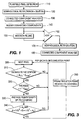
- Figure 3 shows, in more detail, an exemplary method including a set of steps for performing the skeleton pruning in step 270.
- the width of a field line or curve appears to less than the width of a player body in the long view shot.
- the thickness of the blob's skeleton at the point is measured and tested against the product c ⁇ d max , where c is thickness factor. If it is the skeleton width is less than the product c ⁇ d max , then the average values of RGB components for all pixels covered by this skeleton point (Power labeling) are calculated. It has been observed in experimental practice that, when this skeleton point corresponds to a fragment of field lines, the average RGB component values of the skeleton point are close to those of the white color.
- the pruned skeleton is relatively far away from the human body centroid, which corresponds to the skeleton point with the maximal covering value. That is, the distance from the pruned skeleton point to the skeleton point with the maximal covering value is bigger than each of the horizontal distance d h ⁇ d max and the vertical distance d v ⁇ d max , where d v and d h are distance factors and where d max is the maximum thickness of the skeleton as described above.
- step 310 for each skeleton point of the blob of interest, the distance from the skeleton point to the skeleton point with the maximal covering value is measured and tested to determine whether it exceeds each of the horizontal distance d h ⁇ d max and the vertical distance d v ⁇ d max .
- the skeleton point having the maximal covering value normally coincides with the centroid of the blob. If there is more than one skeleton point having the maximal covering value, selects the one that is closest to the centroid of the blob. If the horizontal distance or the vertical distance is exceeded by the distance to the skeleton point with the maximal covering from the particular skeleton point, then the method proceeds to step 320. Otherwise, a new skeleton point is chosen for measurement and testing in the blob of interest and testing resumes at step 309.
- step 320 the thickness of the blob at the skeleton point under test is checked against the product c h ⁇ d max . If the thickness is less than the product c ⁇ d max , then the method proceeds to step 330 where the average intensity values of RGB components for all pixels covered by this skeleton point (Power labeling) are calculated. If the thickness is greater than or equal to the product c ⁇ d max , then a new skeleton point is chosen for measurement and testing in the blob of interest and testing resumes at step 309.
- step 340 the intensity from step 330 is tested against threshold b s . Also, the normalized red and blue component values of the skeleton point are tested against threshold according to the formula, r - 1 ⁇ 3 2 - b - 1 ⁇ 3 2 ⁇ a s . If both tests are true, then the method proceeds to step 350 wherein the skeleton point under test is pruned and its covering is removed. If either test or both tests in step 340 fail, then a new skeleton point is chosen for measurement and testing in the blob of interest and testing resumes at step 309. Step 340 uses the white pixel proportion in the covering of the skeleton point to determine whether or not to prune part of the skeleton.
- the skeleton point is pruned and its covering removed.
- the implementations described herein may be implemented as, for example, a method or process, an apparatus, or a software program. Even though the presentation of the features of this invention has been in the context of a method, persons skilled in the art will discern that the invention may be embodied as, for example, an apparatus or a software program.
- An apparatus may be implemented in, for example, appropriate hardware, software, and firmware.
- the methods may be implemented in, for example, an apparatus such as, for example, a computer or other processing device. Additionally, the methods may be implemented by instructions being performed by a processing device or other apparatus, and such instructions may be stored on a computer readable medium such as, for example, a CD or other computer readable storage device, and an integrated circuit.
- implementations are contemplated by this disclosure.
- additional implementations may be created by combining, deleting, modifying, or supplementing various features of the disclosed implementations.
Landscapes
- Engineering & Computer Science (AREA)
- Physics & Mathematics (AREA)
- General Physics & Mathematics (AREA)
- Theoretical Computer Science (AREA)
- Multimedia (AREA)
- Computer Vision & Pattern Recognition (AREA)
- Image Analysis (AREA)
Applications Claiming Priority (2)
| Application Number | Priority Date | Filing Date | Title |
|---|---|---|---|
| US91997107P | 2007-03-26 | 2007-03-26 | |
| PCT/US2007/023317 WO2008118147A2 (en) | 2007-03-26 | 2007-11-06 | Method and apparatus for detecting objects of interest in soccer video by color segmentation and shape anaylsis |
Publications (2)
| Publication Number | Publication Date |
|---|---|
| EP2132682A2 EP2132682A2 (en) | 2009-12-16 |
| EP2132682B1 true EP2132682B1 (en) | 2012-03-14 |
Family
ID=39689252
Family Applications (1)
| Application Number | Title | Priority Date | Filing Date |
|---|---|---|---|
| EP07861724A Active EP2132682B1 (en) | 2007-03-26 | 2007-11-06 | Method and apparatus for detecting objects of interest in soccer video by color segmentation and shape anaylsis |
Country Status (7)
| Country | Link |
|---|---|
| US (1) | US8391547B2 (enExample) |
| EP (1) | EP2132682B1 (enExample) |
| JP (1) | JP5465657B2 (enExample) |
| KR (1) | KR101463085B1 (enExample) |
| CN (1) | CN101681433B (enExample) |
| AT (1) | ATE549692T1 (enExample) |
| WO (1) | WO2008118147A2 (enExample) |
Families Citing this family (21)
| Publication number | Priority date | Publication date | Assignee | Title |
|---|---|---|---|---|
| JP4636146B2 (ja) * | 2008-09-05 | 2011-02-23 | ソニー株式会社 | 画像処理方法、画像処理装置、プログラム及び画像処理システム |
| US9269154B2 (en) | 2009-01-13 | 2016-02-23 | Futurewei Technologies, Inc. | Method and system for image processing to classify an object in an image |
| CN102473291B (zh) | 2009-07-20 | 2014-08-20 | 汤姆森特许公司 | 体育视频中的远视场景的检测和自适应视频处理方法 |
| US8553982B2 (en) | 2009-12-23 | 2013-10-08 | Intel Corporation | Model-based play field registration |
| CN102005053B (zh) * | 2010-11-17 | 2012-10-17 | 中国科学院声学研究所 | 一种对球员位置的自动检测方法 |
| CN102486827B (zh) * | 2010-12-03 | 2014-11-05 | 中兴通讯股份有限公司 | 复杂背景环境下的前景目标的提取方法和装置 |
| US9236024B2 (en) | 2011-12-06 | 2016-01-12 | Glasses.Com Inc. | Systems and methods for obtaining a pupillary distance measurement using a mobile computing device |
| US9483853B2 (en) | 2012-05-23 | 2016-11-01 | Glasses.Com Inc. | Systems and methods to display rendered images |
| US9378584B2 (en) | 2012-05-23 | 2016-06-28 | Glasses.Com Inc. | Systems and methods for rendering virtual try-on products |
| US9286715B2 (en) | 2012-05-23 | 2016-03-15 | Glasses.Com Inc. | Systems and methods for adjusting a virtual try-on |
| US9256957B1 (en) * | 2012-09-13 | 2016-02-09 | Bae Systems Information And Electronic Systems Integration Inc. | Method for moving-object detection tracking identification cueing of videos |
| CN103886618A (zh) * | 2014-03-12 | 2014-06-25 | 新奥特(北京)视频技术有限公司 | 一种球类的检测方法和装置 |
| CN105916049A (zh) * | 2016-04-18 | 2016-08-31 | 深圳Tcl数字技术有限公司 | 自动切换观看模式的方法和装置 |
| CN106846734B (zh) * | 2017-04-12 | 2019-04-16 | 南京理工大学 | 一种疲劳驾驶检测装置及方法 |
| KR102434397B1 (ko) | 2017-07-10 | 2022-08-22 | 한국전자통신연구원 | 전역적 움직임 기반의 실시간 다중 객체 추적 장치 및 방법 |
| US10528820B2 (en) | 2017-12-07 | 2020-01-07 | Canon Kabushiki Kaisha | Colour look-up table for background segmentation of sport video |
| CN108269265B (zh) * | 2017-12-28 | 2020-10-27 | 中国科学院福建物质结构研究所 | 基于深度学习的台球击球位置测定方法及其装置 |
| CN108596891A (zh) * | 2018-04-23 | 2018-09-28 | 中国计量大学 | 一种面向多种类混合蚕茧的计数方法 |
| CN109146850B (zh) * | 2018-07-26 | 2022-02-18 | 上海电气集团股份有限公司 | 一种多色球形目标检测定位方法及执行该方法的存储介质 |
| CN109145906B (zh) * | 2018-08-31 | 2020-04-24 | 北京字节跳动网络技术有限公司 | 目标对象的图像确定方法、装置、设备及存储介质 |
| CN110646188A (zh) * | 2019-10-14 | 2020-01-03 | 军事科学院系统工程研究院军用标准研究中心 | 一种旋转式机械设备故障诊断方法 |
Family Cites Families (13)
| Publication number | Priority date | Publication date | Assignee | Title |
|---|---|---|---|---|
| JP3503166B2 (ja) * | 1993-07-29 | 2004-03-02 | ソニー株式会社 | 信号変換装置および方法 |
| US5684940A (en) * | 1995-03-13 | 1997-11-04 | Rutgers, The States University Of New Jersey | Computer-implemented method and apparatus for automatically labeling area regions of maps using two-step label placing procedure and for curved labeling of point features |
| KR100423379B1 (ko) * | 1995-05-12 | 2004-07-23 | 소니 가부시끼 가이샤 | 키신호생성장치및화상합성장치와,키신호생성방법및화상합성방법 |
| US7194117B2 (en) * | 1999-06-29 | 2007-03-20 | The Research Foundation Of State University Of New York | System and method for performing a three-dimensional virtual examination of objects, such as internal organs |
| WO1999019828A1 (en) * | 1997-10-15 | 1999-04-22 | Electric Planet, Inc. | Method and apparatus for performing a clean background subtraction |
| US7477768B2 (en) * | 1999-06-29 | 2009-01-13 | The Research Foundation Of State University Of New York | System and method for performing a three-dimensional virtual examination of objects, such as internal organs |
| JP4787424B2 (ja) * | 2001-06-01 | 2011-10-05 | 財団法人エヌエイチケイエンジニアリングサービス | 映像オブジェクト検出・追跡装置 |
| JP2004046647A (ja) * | 2002-07-12 | 2004-02-12 | Univ Waseda | 動画像データに基づく移動物体追跡方法及び装置 |
| JP2006012012A (ja) * | 2004-06-29 | 2006-01-12 | Matsushita Electric Ind Co Ltd | イベント抽出装置及びその方法及びそのプログラム |
| US7502498B2 (en) * | 2004-09-10 | 2009-03-10 | Available For Licensing | Patient monitoring apparatus |
| US7474775B2 (en) * | 2005-03-31 | 2009-01-06 | University Of Iowa Research Foundation | Automatic detection of red lesions in digital color fundus photographs |
| JP4644022B2 (ja) * | 2005-04-04 | 2011-03-02 | 日本放送協会 | 映像解析装置および映像解析プログラム |
| US20070165966A1 (en) * | 2005-07-15 | 2007-07-19 | Yissum Research Development Co. | Closed form method and system for matting a foreground object in an image having a background |
-
2007
- 2007-11-06 WO PCT/US2007/023317 patent/WO2008118147A2/en not_active Ceased
- 2007-11-06 KR KR1020097019895A patent/KR101463085B1/ko active Active
- 2007-11-06 EP EP07861724A patent/EP2132682B1/en active Active
- 2007-11-06 US US12/450,410 patent/US8391547B2/en active Active
- 2007-11-06 CN CN200780053128.2A patent/CN101681433B/zh active Active
- 2007-11-06 JP JP2010500891A patent/JP5465657B2/ja active Active
- 2007-11-06 AT AT07861724T patent/ATE549692T1/de active
Also Published As
| Publication number | Publication date |
|---|---|
| CN101681433B (zh) | 2014-01-08 |
| US20100098307A1 (en) | 2010-04-22 |
| KR20100014554A (ko) | 2010-02-10 |
| WO2008118147A3 (en) | 2009-03-26 |
| ATE549692T1 (de) | 2012-03-15 |
| US8391547B2 (en) | 2013-03-05 |
| CN101681433A (zh) | 2010-03-24 |
| KR101463085B1 (ko) | 2014-11-20 |
| JP5465657B2 (ja) | 2014-04-09 |
| JP2010522926A (ja) | 2010-07-08 |
| WO2008118147A2 (en) | 2008-10-02 |
| EP2132682A2 (en) | 2009-12-16 |
Similar Documents
| Publication | Publication Date | Title |
|---|---|---|
| US8391547B2 (en) | Method and apparatus for detecting objects of interest in soccer video by color | |
| US8805004B2 (en) | Method and apparatus for detecting and separating objects of interest in soccer video by color segmentation and shape analysis | |
| CN102890781B (zh) | 一种针对羽毛球比赛视频的精彩镜头识别方法 | |
| CN104102910B (zh) | 基于时空局部模式的体育视频战术行为识别方法 | |
| Yu et al. | Trajectory-based ball detection and tracking with applications to semantic analysis of broadcast soccer video | |
| US20230206464A1 (en) | System and Method for Player Reidentification in Broadcast Video | |
| Huang et al. | Players and ball detection in soccer videos based on color segmentation and shape analysis | |
| US8977109B2 (en) | Human interaction trajectory-based system | |
| Komorowski et al. | Deepball: Deep neural-network ball detector | |
| Hari et al. | Event detection in cricket videos using intensity projection profile of Umpire gestures | |
| Denman et al. | Content-based analysis for video from snooker broadcasts | |
| CN109145906B (zh) | 目标对象的图像确定方法、装置、设备及存储介质 | |
| Hsu et al. | Spiking and blocking events detection and analysis in volleyball videos | |
| Jayanth et al. | Automated classification of cricket pitch frames in cricket video | |
| CN100442307C (zh) | 球门检测方法 | |
| Hoernig et al. | Real time soccer field analysis from monocular TV video data | |
| Zhu et al. | Towards facial feature extraction and verification for omni-face detection in video/images | |
| CN106651952B (zh) | 基于足球检测跟踪的视频处理方法及装置 | |
| Bu et al. | Automatic line mark recognition and its application in camera calibration in soccer video | |
| Ruiz-del-Solar et al. | An automated refereeing and analysis tool for the Four-Legged League | |
| Zhang | Research on effective field lines detection and tracking algorithm in soccer videos | |
| Dang et al. | A real time player tracking system for broadcast tennis video | |
| Pham-Ngoc et al. | Multi-face detection system in video sequence | |
| Barbadekar et al. | Match Recordings to Its 2D Top View | |
| WO2010083018A1 (en) | Segmenting grass regions and playfield in sports videos |
Legal Events
| Date | Code | Title | Description |
|---|---|---|---|
| PUAI | Public reference made under article 153(3) epc to a published international application that has entered the european phase |
Free format text: ORIGINAL CODE: 0009012 |
|
| 17P | Request for examination filed |
Effective date: 20090928 |
|
| AK | Designated contracting states |
Kind code of ref document: A2 Designated state(s): AT BE BG CH CY CZ DE DK EE ES FI FR GB GR HU IE IS IT LI LT LU LV MC MT NL PL PT RO SE SI SK TR |
|
| RAP1 | Party data changed (applicant data changed or rights of an application transferred) |
Owner name: THOMSON LICENSING |
|
| 17Q | First examination report despatched |
Effective date: 20100824 |
|
| GRAP | Despatch of communication of intention to grant a patent |
Free format text: ORIGINAL CODE: EPIDOSNIGR1 |
|
| DAX | Request for extension of the european patent (deleted) | ||
| GRAS | Grant fee paid |
Free format text: ORIGINAL CODE: EPIDOSNIGR3 |
|
| GRAA | (expected) grant |
Free format text: ORIGINAL CODE: 0009210 |
|
| AK | Designated contracting states |
Kind code of ref document: B1 Designated state(s): AT BE BG CH CY CZ DE DK EE ES FI FR GB GR HU IE IS IT LI LT LU LV MC MT NL PL PT RO SE SI SK TR |
|
| REG | Reference to a national code |
Ref country code: GB Ref legal event code: FG4D |
|
| REG | Reference to a national code |
Ref country code: AT Ref legal event code: REF Ref document number: 549692 Country of ref document: AT Kind code of ref document: T Effective date: 20120315 Ref country code: CH Ref legal event code: EP |
|
| REG | Reference to a national code |
Ref country code: IE Ref legal event code: FG4D |
|
| REG | Reference to a national code |
Ref country code: DE Ref legal event code: R096 Ref document number: 602007021378 Country of ref document: DE Effective date: 20120510 |
|
| REG | Reference to a national code |
Ref country code: NL Ref legal event code: VDEP Effective date: 20120314 |
|
| PG25 | Lapsed in a contracting state [announced via postgrant information from national office to epo] |
Ref country code: LT Free format text: LAPSE BECAUSE OF FAILURE TO SUBMIT A TRANSLATION OF THE DESCRIPTION OR TO PAY THE FEE WITHIN THE PRESCRIBED TIME-LIMIT Effective date: 20120314 |
|
| LTIE | Lt: invalidation of european patent or patent extension |
Effective date: 20120314 |
|
| PG25 | Lapsed in a contracting state [announced via postgrant information from national office to epo] |
Ref country code: LV Free format text: LAPSE BECAUSE OF FAILURE TO SUBMIT A TRANSLATION OF THE DESCRIPTION OR TO PAY THE FEE WITHIN THE PRESCRIBED TIME-LIMIT Effective date: 20120314 Ref country code: GR Free format text: LAPSE BECAUSE OF FAILURE TO SUBMIT A TRANSLATION OF THE DESCRIPTION OR TO PAY THE FEE WITHIN THE PRESCRIBED TIME-LIMIT Effective date: 20120615 Ref country code: FI Free format text: LAPSE BECAUSE OF FAILURE TO SUBMIT A TRANSLATION OF THE DESCRIPTION OR TO PAY THE FEE WITHIN THE PRESCRIBED TIME-LIMIT Effective date: 20120314 |
|
| REG | Reference to a national code |
Ref country code: AT Ref legal event code: MK05 Ref document number: 549692 Country of ref document: AT Kind code of ref document: T Effective date: 20120314 |
|
| PG25 | Lapsed in a contracting state [announced via postgrant information from national office to epo] |
Ref country code: CY Free format text: LAPSE BECAUSE OF FAILURE TO SUBMIT A TRANSLATION OF THE DESCRIPTION OR TO PAY THE FEE WITHIN THE PRESCRIBED TIME-LIMIT Effective date: 20120314 |
|
| PG25 | Lapsed in a contracting state [announced via postgrant information from national office to epo] |
Ref country code: EE Free format text: LAPSE BECAUSE OF FAILURE TO SUBMIT A TRANSLATION OF THE DESCRIPTION OR TO PAY THE FEE WITHIN THE PRESCRIBED TIME-LIMIT Effective date: 20120314 Ref country code: SE Free format text: LAPSE BECAUSE OF FAILURE TO SUBMIT A TRANSLATION OF THE DESCRIPTION OR TO PAY THE FEE WITHIN THE PRESCRIBED TIME-LIMIT Effective date: 20120314 Ref country code: CZ Free format text: LAPSE BECAUSE OF FAILURE TO SUBMIT A TRANSLATION OF THE DESCRIPTION OR TO PAY THE FEE WITHIN THE PRESCRIBED TIME-LIMIT Effective date: 20120314 Ref country code: RO Free format text: LAPSE BECAUSE OF FAILURE TO SUBMIT A TRANSLATION OF THE DESCRIPTION OR TO PAY THE FEE WITHIN THE PRESCRIBED TIME-LIMIT Effective date: 20120314 Ref country code: PL Free format text: LAPSE BECAUSE OF FAILURE TO SUBMIT A TRANSLATION OF THE DESCRIPTION OR TO PAY THE FEE WITHIN THE PRESCRIBED TIME-LIMIT Effective date: 20120314 Ref country code: IS Free format text: LAPSE BECAUSE OF FAILURE TO SUBMIT A TRANSLATION OF THE DESCRIPTION OR TO PAY THE FEE WITHIN THE PRESCRIBED TIME-LIMIT Effective date: 20120714 Ref country code: SI Free format text: LAPSE BECAUSE OF FAILURE TO SUBMIT A TRANSLATION OF THE DESCRIPTION OR TO PAY THE FEE WITHIN THE PRESCRIBED TIME-LIMIT Effective date: 20120314 Ref country code: BE Free format text: LAPSE BECAUSE OF FAILURE TO SUBMIT A TRANSLATION OF THE DESCRIPTION OR TO PAY THE FEE WITHIN THE PRESCRIBED TIME-LIMIT Effective date: 20120314 |
|
| PG25 | Lapsed in a contracting state [announced via postgrant information from national office to epo] |
Ref country code: SK Free format text: LAPSE BECAUSE OF FAILURE TO SUBMIT A TRANSLATION OF THE DESCRIPTION OR TO PAY THE FEE WITHIN THE PRESCRIBED TIME-LIMIT Effective date: 20120314 Ref country code: PT Free format text: LAPSE BECAUSE OF FAILURE TO SUBMIT A TRANSLATION OF THE DESCRIPTION OR TO PAY THE FEE WITHIN THE PRESCRIBED TIME-LIMIT Effective date: 20120716 |
|
| PLBE | No opposition filed within time limit |
Free format text: ORIGINAL CODE: 0009261 |
|
| STAA | Information on the status of an ep patent application or granted ep patent |
Free format text: STATUS: NO OPPOSITION FILED WITHIN TIME LIMIT |
|
| PG25 | Lapsed in a contracting state [announced via postgrant information from national office to epo] |
Ref country code: AT Free format text: LAPSE BECAUSE OF FAILURE TO SUBMIT A TRANSLATION OF THE DESCRIPTION OR TO PAY THE FEE WITHIN THE PRESCRIBED TIME-LIMIT Effective date: 20120314 Ref country code: NL Free format text: LAPSE BECAUSE OF FAILURE TO SUBMIT A TRANSLATION OF THE DESCRIPTION OR TO PAY THE FEE WITHIN THE PRESCRIBED TIME-LIMIT Effective date: 20120314 Ref country code: DK Free format text: LAPSE BECAUSE OF FAILURE TO SUBMIT A TRANSLATION OF THE DESCRIPTION OR TO PAY THE FEE WITHIN THE PRESCRIBED TIME-LIMIT Effective date: 20120314 |
|
| 26N | No opposition filed |
Effective date: 20121217 |
|
| PG25 | Lapsed in a contracting state [announced via postgrant information from national office to epo] |
Ref country code: IT Free format text: LAPSE BECAUSE OF FAILURE TO SUBMIT A TRANSLATION OF THE DESCRIPTION OR TO PAY THE FEE WITHIN THE PRESCRIBED TIME-LIMIT Effective date: 20120314 |
|
| REG | Reference to a national code |
Ref country code: DE Ref legal event code: R097 Ref document number: 602007021378 Country of ref document: DE Effective date: 20121217 |
|
| PG25 | Lapsed in a contracting state [announced via postgrant information from national office to epo] |
Ref country code: ES Free format text: LAPSE BECAUSE OF FAILURE TO SUBMIT A TRANSLATION OF THE DESCRIPTION OR TO PAY THE FEE WITHIN THE PRESCRIBED TIME-LIMIT Effective date: 20120625 |
|
| REG | Reference to a national code |
Ref country code: CH Ref legal event code: PL |
|
| PG25 | Lapsed in a contracting state [announced via postgrant information from national office to epo] |
Ref country code: CH Free format text: LAPSE BECAUSE OF NON-PAYMENT OF DUE FEES Effective date: 20121130 Ref country code: BG Free format text: LAPSE BECAUSE OF FAILURE TO SUBMIT A TRANSLATION OF THE DESCRIPTION OR TO PAY THE FEE WITHIN THE PRESCRIBED TIME-LIMIT Effective date: 20120614 Ref country code: LI Free format text: LAPSE BECAUSE OF NON-PAYMENT OF DUE FEES Effective date: 20121130 |
|
| REG | Reference to a national code |
Ref country code: IE Ref legal event code: MM4A |
|
| PG25 | Lapsed in a contracting state [announced via postgrant information from national office to epo] |
Ref country code: IE Free format text: LAPSE BECAUSE OF NON-PAYMENT OF DUE FEES Effective date: 20121106 |
|
| PG25 | Lapsed in a contracting state [announced via postgrant information from national office to epo] |
Ref country code: MT Free format text: LAPSE BECAUSE OF FAILURE TO SUBMIT A TRANSLATION OF THE DESCRIPTION OR TO PAY THE FEE WITHIN THE PRESCRIBED TIME-LIMIT Effective date: 20120314 |
|
| PG25 | Lapsed in a contracting state [announced via postgrant information from national office to epo] |
Ref country code: MC Free format text: LAPSE BECAUSE OF NON-PAYMENT OF DUE FEES Effective date: 20121130 Ref country code: TR Free format text: LAPSE BECAUSE OF FAILURE TO SUBMIT A TRANSLATION OF THE DESCRIPTION OR TO PAY THE FEE WITHIN THE PRESCRIBED TIME-LIMIT Effective date: 20120314 |
|
| PG25 | Lapsed in a contracting state [announced via postgrant information from national office to epo] |
Ref country code: LU Free format text: LAPSE BECAUSE OF NON-PAYMENT OF DUE FEES Effective date: 20121106 |
|
| PG25 | Lapsed in a contracting state [announced via postgrant information from national office to epo] |
Ref country code: HU Free format text: LAPSE BECAUSE OF FAILURE TO SUBMIT A TRANSLATION OF THE DESCRIPTION OR TO PAY THE FEE WITHIN THE PRESCRIBED TIME-LIMIT Effective date: 20071106 |
|
| REG | Reference to a national code |
Ref country code: FR Ref legal event code: PLFP Year of fee payment: 9 |
|
| REG | Reference to a national code |
Ref country code: FR Ref legal event code: PLFP Year of fee payment: 10 |
|
| REG | Reference to a national code |
Ref country code: DE Ref legal event code: R082 Ref document number: 602007021378 Country of ref document: DE Representative=s name: DEHNS, DE Ref country code: DE Ref legal event code: R082 Ref document number: 602007021378 Country of ref document: DE Representative=s name: DEHNS PATENT AND TRADEMARK ATTORNEYS, DE Ref country code: DE Ref legal event code: R082 Ref document number: 602007021378 Country of ref document: DE Representative=s name: HOFSTETTER, SCHURACK & PARTNER PATENT- UND REC, DE |
|
| REG | Reference to a national code |
Ref country code: FR Ref legal event code: PLFP Year of fee payment: 11 |
|
| REG | Reference to a national code |
Ref country code: FR Ref legal event code: TP Owner name: THOMSON LICENSING DTV, FR Effective date: 20180830 |
|
| REG | Reference to a national code |
Ref country code: GB Ref legal event code: 732E Free format text: REGISTERED BETWEEN 20180927 AND 20181005 Ref country code: FR Ref legal event code: PLFP Year of fee payment: 12 |
|
| REG | Reference to a national code |
Ref country code: DE Ref legal event code: R082 Ref document number: 602007021378 Country of ref document: DE Representative=s name: DEHNS, DE Ref country code: DE Ref legal event code: R081 Ref document number: 602007021378 Country of ref document: DE Owner name: INTERDIGITAL MADISON PATENT HOLDINGS, FR Free format text: FORMER OWNER: THOMSON LICENSING, ISSY-LES-MOULINEAUX, FR Ref country code: DE Ref legal event code: R082 Ref document number: 602007021378 Country of ref document: DE Representative=s name: DEHNS PATENT AND TRADEMARK ATTORNEYS, DE |
|
| REG | Reference to a national code |
Ref country code: DE Ref legal event code: R079 Ref document number: 602007021378 Country of ref document: DE Free format text: PREVIOUS MAIN CLASS: G06K0009460000 Ipc: G06V0030180000 |
|
| P01 | Opt-out of the competence of the unified patent court (upc) registered |
Effective date: 20230514 |
|
| PGFP | Annual fee paid to national office [announced via postgrant information from national office to epo] |
Ref country code: DE Payment date: 20251126 Year of fee payment: 19 |
|
| PGFP | Annual fee paid to national office [announced via postgrant information from national office to epo] |
Ref country code: GB Payment date: 20251125 Year of fee payment: 19 |
|
| PGFP | Annual fee paid to national office [announced via postgrant information from national office to epo] |
Ref country code: FR Payment date: 20251125 Year of fee payment: 19 |