EP2129359B1 - Chimärer peptidantagonist für gpcr135 oder gpcr142 - Google Patents
Chimärer peptidantagonist für gpcr135 oder gpcr142 Download PDFInfo
- Publication number
- EP2129359B1 EP2129359B1 EP08724770A EP08724770A EP2129359B1 EP 2129359 B1 EP2129359 B1 EP 2129359B1 EP 08724770 A EP08724770 A EP 08724770A EP 08724770 A EP08724770 A EP 08724770A EP 2129359 B1 EP2129359 B1 EP 2129359B1
- Authority
- EP
- European Patent Office
- Prior art keywords
- relaxin
- gpcr135
- lgr7
- gpcr142
- chain
- Prior art date
- Legal status (The legal status is an assumption and is not a legal conclusion. Google has not performed a legal analysis and makes no representation as to the accuracy of the status listed.)
- Active
Links
- 108091006116 chimeric peptides Proteins 0.000 title description 3
- 229940083963 Peptide antagonist Drugs 0.000 title 1
- 101000869643 Homo sapiens Relaxin receptor 1 Proteins 0.000 abstract description 48
- 108090000765 processed proteins & peptides Proteins 0.000 abstract description 47
- 102100032444 Relaxin receptor 1 Human genes 0.000 abstract description 40
- 102000004196 processed proteins & peptides Human genes 0.000 abstract description 30
- 239000005557 antagonist Substances 0.000 abstract description 14
- 229920001184 polypeptide Polymers 0.000 abstract description 5
- 101000857740 Homo sapiens Probable G-protein coupled receptor 160 Proteins 0.000 abstract 2
- 102100025346 Probable G-protein coupled receptor 160 Human genes 0.000 abstract 2
- 101001110357 Homo sapiens Relaxin-3 receptor 1 Proteins 0.000 description 62
- 101710113452 Relaxin-3 Proteins 0.000 description 62
- 102100034944 Relaxin-3 Human genes 0.000 description 59
- 102100022105 Relaxin-3 receptor 1 Human genes 0.000 description 50
- 101001110356 Homo sapiens Relaxin-3 receptor 2 Proteins 0.000 description 38
- 102100022100 Relaxin-3 receptor 2 Human genes 0.000 description 31
- 241001465754 Metazoa Species 0.000 description 28
- 210000004027 cell Anatomy 0.000 description 26
- 239000000556 agonist Substances 0.000 description 21
- 102000003688 G-Protein-Coupled Receptors Human genes 0.000 description 20
- 108090000045 G-Protein-Coupled Receptors Proteins 0.000 description 20
- 241000700159 Rattus Species 0.000 description 19
- 230000000694 effects Effects 0.000 description 18
- 238000012360 testing method Methods 0.000 description 18
- 108010005774 beta-Galactosidase Proteins 0.000 description 17
- 210000004556 brain Anatomy 0.000 description 17
- 235000012631 food intake Nutrition 0.000 description 17
- 239000003446 ligand Substances 0.000 description 17
- 235000013305 food Nutrition 0.000 description 16
- 230000037406 food intake Effects 0.000 description 13
- 230000027455 binding Effects 0.000 description 12
- 102000057963 human RXFP3 Human genes 0.000 description 12
- WQZGKKKJIJFFOK-FPRJBGLDSA-N beta-D-galactose Chemical compound OC[C@H]1O[C@@H](O)[C@H](O)[C@@H](O)[C@H]1O WQZGKKKJIJFFOK-FPRJBGLDSA-N 0.000 description 11
- 108700038435 rat RXFP3 Proteins 0.000 description 11
- OHCQJHSOBUTRHG-KGGHGJDLSA-N FORSKOLIN Chemical compound O=C([C@@]12O)C[C@](C)(C=C)O[C@]1(C)[C@@H](OC(=O)C)[C@@H](O)[C@@H]1[C@]2(C)[C@@H](O)CCC1(C)C OHCQJHSOBUTRHG-KGGHGJDLSA-N 0.000 description 10
- 101100476457 Rattus norvegicus Rxfp1 gene Proteins 0.000 description 10
- 230000008484 agonism Effects 0.000 description 8
- 102000054524 human RXFP1 Human genes 0.000 description 8
- NOESYZHRGYRDHS-UHFFFAOYSA-N insulin Chemical compound N1C(=O)C(NC(=O)C(CCC(N)=O)NC(=O)C(CCC(O)=O)NC(=O)C(C(C)C)NC(=O)C(NC(=O)CN)C(C)CC)CSSCC(C(NC(CO)C(=O)NC(CC(C)C)C(=O)NC(CC=2C=CC(O)=CC=2)C(=O)NC(CCC(N)=O)C(=O)NC(CC(C)C)C(=O)NC(CCC(O)=O)C(=O)NC(CC(N)=O)C(=O)NC(CC=2C=CC(O)=CC=2)C(=O)NC(CSSCC(NC(=O)C(C(C)C)NC(=O)C(CC(C)C)NC(=O)C(CC=2C=CC(O)=CC=2)NC(=O)C(CC(C)C)NC(=O)C(C)NC(=O)C(CCC(O)=O)NC(=O)C(C(C)C)NC(=O)C(CC(C)C)NC(=O)C(CC=2NC=NC=2)NC(=O)C(CO)NC(=O)CNC2=O)C(=O)NCC(=O)NC(CCC(O)=O)C(=O)NC(CCCNC(N)=N)C(=O)NCC(=O)NC(CC=3C=CC=CC=3)C(=O)NC(CC=3C=CC=CC=3)C(=O)NC(CC=3C=CC(O)=CC=3)C(=O)NC(C(C)O)C(=O)N3C(CCC3)C(=O)NC(CCCCN)C(=O)NC(C)C(O)=O)C(=O)NC(CC(N)=O)C(O)=O)=O)NC(=O)C(C(C)CC)NC(=O)C(CO)NC(=O)C(C(C)O)NC(=O)C1CSSCC2NC(=O)C(CC(C)C)NC(=O)C(NC(=O)C(CCC(N)=O)NC(=O)C(CC(N)=O)NC(=O)C(NC(=O)C(N)CC=1C=CC=CC=1)C(C)C)CC1=CN=CN1 NOESYZHRGYRDHS-UHFFFAOYSA-N 0.000 description 8
- 238000011282 treatment Methods 0.000 description 8
- 101000998774 Homo sapiens Insulin-like peptide INSL5 Proteins 0.000 description 7
- 102100033266 Insulin-like peptide INSL5 Human genes 0.000 description 7
- 102000058025 human RXFP4 Human genes 0.000 description 7
- 108090000623 proteins and genes Proteins 0.000 description 7
- 102000005962 receptors Human genes 0.000 description 7
- 108020003175 receptors Proteins 0.000 description 7
- 102000003743 Relaxin Human genes 0.000 description 6
- 108090000103 Relaxin Proteins 0.000 description 6
- 101800001492 Relaxin-3 B chain Proteins 0.000 description 6
- 102400000835 Relaxin-3 B chain Human genes 0.000 description 6
- 230000008485 antagonism Effects 0.000 description 6
- 238000012512 characterization method Methods 0.000 description 6
- 231100000673 dose–response relationship Toxicity 0.000 description 6
- 238000001802 infusion Methods 0.000 description 6
- 239000007924 injection Substances 0.000 description 6
- 238000002347 injection Methods 0.000 description 6
- SUZLHDUTVMZSEV-UHFFFAOYSA-N Deoxycoleonol Natural products C12C(=O)CC(C)(C=C)OC2(C)C(OC(=O)C)C(O)C2C1(C)C(O)CCC2(C)C SUZLHDUTVMZSEV-UHFFFAOYSA-N 0.000 description 5
- 101001091089 Homo sapiens Relaxin-3 Proteins 0.000 description 5
- 210000004899 c-terminal region Anatomy 0.000 description 5
- OHCQJHSOBUTRHG-UHFFFAOYSA-N colforsin Natural products OC12C(=O)CC(C)(C=C)OC1(C)C(OC(=O)C)C(O)C1C2(C)C(O)CCC1(C)C OHCQJHSOBUTRHG-UHFFFAOYSA-N 0.000 description 5
- 102000058026 human RLN3 Human genes 0.000 description 5
- 238000000185 intracerebroventricular administration Methods 0.000 description 5
- 239000013641 positive control Substances 0.000 description 5
- 108091026890 Coding region Proteins 0.000 description 4
- 102000004961 Furin Human genes 0.000 description 4
- 108090001126 Furin Proteins 0.000 description 4
- 102000004877 Insulin Human genes 0.000 description 4
- 108090001061 Insulin Proteins 0.000 description 4
- 241000700157 Rattus norvegicus Species 0.000 description 4
- 230000004913 activation Effects 0.000 description 4
- 125000003275 alpha amino acid group Chemical group 0.000 description 4
- 238000004458 analytical method Methods 0.000 description 4
- 238000003556 assay Methods 0.000 description 4
- 230000003542 behavioural effect Effects 0.000 description 4
- 238000006243 chemical reaction Methods 0.000 description 4
- 229940125396 insulin Drugs 0.000 description 4
- 230000003834 intracellular effect Effects 0.000 description 4
- 238000000034 method Methods 0.000 description 4
- 235000018102 proteins Nutrition 0.000 description 4
- 102000004169 proteins and genes Human genes 0.000 description 4
- 238000003653 radioligand binding assay Methods 0.000 description 4
- 230000004044 response Effects 0.000 description 4
- XLYOFNOQVPJJNP-UHFFFAOYSA-N water Substances O XLYOFNOQVPJJNP-UHFFFAOYSA-N 0.000 description 4
- 238000002835 absorbance Methods 0.000 description 3
- 230000008901 benefit Effects 0.000 description 3
- 230000035622 drinking Effects 0.000 description 3
- 239000003814 drug Substances 0.000 description 3
- 229940079593 drug Drugs 0.000 description 3
- 238000000338 in vitro Methods 0.000 description 3
- 238000001727 in vivo Methods 0.000 description 3
- 230000005764 inhibitory process Effects 0.000 description 3
- 230000000144 pharmacologic effect Effects 0.000 description 3
- 238000012545 processing Methods 0.000 description 3
- 238000000159 protein binding assay Methods 0.000 description 3
- 239000000700 radioactive tracer Substances 0.000 description 3
- 238000011084 recovery Methods 0.000 description 3
- 230000019491 signal transduction Effects 0.000 description 3
- 210000003625 skull Anatomy 0.000 description 3
- 239000000758 substrate Substances 0.000 description 3
- 210000001519 tissue Anatomy 0.000 description 3
- UYYRDZGZGNYVBA-VPXCCNNISA-N (2s,3r,4s,5r,6r)-2-[2-chloro-4-[3-(3-chloro-4-hydroxyphenyl)-1,1-dioxo-2,1$l^{6}-benzoxathiol-3-yl]phenoxy]-6-(hydroxymethyl)oxane-3,4,5-triol Chemical compound O[C@@H]1[C@@H](O)[C@@H](O)[C@@H](CO)O[C@H]1OC1=CC=C(C2(C3=CC=CC=C3S(=O)(=O)O2)C=2C=C(Cl)C(O)=CC=2)C=C1Cl UYYRDZGZGNYVBA-VPXCCNNISA-N 0.000 description 2
- CURLTUGMZLYLDI-UHFFFAOYSA-N Carbon dioxide Chemical compound O=C=O CURLTUGMZLYLDI-UHFFFAOYSA-N 0.000 description 2
- 102000003670 Carboxypeptidase B Human genes 0.000 description 2
- 108090000087 Carboxypeptidase B Proteins 0.000 description 2
- 108010013369 Enteropeptidase Proteins 0.000 description 2
- 102100029727 Enteropeptidase Human genes 0.000 description 2
- 108091006027 G proteins Proteins 0.000 description 2
- 102000030782 GTP binding Human genes 0.000 description 2
- 108091000058 GTP-Binding Proteins 0.000 description 2
- 101100397017 Homo sapiens INSL5 gene Proteins 0.000 description 2
- 101500021084 Locusta migratoria 5 kDa peptide Proteins 0.000 description 2
- 208000008589 Obesity Diseases 0.000 description 2
- 241000283984 Rodentia Species 0.000 description 2
- 238000003639 Student–Newman–Keuls (SNK) method Methods 0.000 description 2
- 210000004727 amygdala Anatomy 0.000 description 2
- 230000036528 appetite Effects 0.000 description 2
- 235000019789 appetite Nutrition 0.000 description 2
- 102000005936 beta-Galactosidase Human genes 0.000 description 2
- 230000001413 cellular effect Effects 0.000 description 2
- 238000007398 colorimetric assay Methods 0.000 description 2
- 239000002299 complementary DNA Substances 0.000 description 2
- 150000001875 compounds Chemical class 0.000 description 2
- 208000037265 diseases, disorders, signs and symptoms Diseases 0.000 description 2
- 239000006274 endogenous ligand Substances 0.000 description 2
- 238000002474 experimental method Methods 0.000 description 2
- 238000002825 functional assay Methods 0.000 description 2
- 230000002608 insulinlike Effects 0.000 description 2
- 230000003993 interaction Effects 0.000 description 2
- 210000003140 lateral ventricle Anatomy 0.000 description 2
- 238000004949 mass spectrometry Methods 0.000 description 2
- 230000000955 neuroendocrine Effects 0.000 description 2
- 235000020824 obesity Nutrition 0.000 description 2
- 108091008880 orphan GPCRs Proteins 0.000 description 2
- 230000035790 physiological processes and functions Effects 0.000 description 2
- 229920003023 plastic Polymers 0.000 description 2
- 239000004033 plastic Substances 0.000 description 2
- 230000003389 potentiating effect Effects 0.000 description 2
- 230000008569 process Effects 0.000 description 2
- 230000003938 response to stress Effects 0.000 description 2
- 238000012216 screening Methods 0.000 description 2
- 230000001953 sensory effect Effects 0.000 description 2
- 230000031893 sensory processing Effects 0.000 description 2
- 230000009870 specific binding Effects 0.000 description 2
- 230000000638 stimulation Effects 0.000 description 2
- 239000000126 substance Substances 0.000 description 2
- 210000003863 superior colliculi Anatomy 0.000 description 2
- 238000001356 surgical procedure Methods 0.000 description 2
- 230000001225 therapeutic effect Effects 0.000 description 2
- 102000027257 transmembrane receptors Human genes 0.000 description 2
- 108091008578 transmembrane receptors Proteins 0.000 description 2
- ISPYQTSUDJAMAB-UHFFFAOYSA-N 2-chlorophenol Chemical compound OC1=CC=CC=C1Cl ISPYQTSUDJAMAB-UHFFFAOYSA-N 0.000 description 1
- ODHCTXKNWHHXJC-VKHMYHEASA-N 5-oxo-L-proline Chemical compound OC(=O)[C@@H]1CCC(=O)N1 ODHCTXKNWHHXJC-VKHMYHEASA-N 0.000 description 1
- 239000000275 Adrenocorticotropic Hormone Substances 0.000 description 1
- 108091003079 Bovine Serum Albumin Proteins 0.000 description 1
- 108020004635 Complementary DNA Proteins 0.000 description 1
- 101800000414 Corticotropin Proteins 0.000 description 1
- 102100038018 Corticotropin-releasing factor receptor 1 Human genes 0.000 description 1
- 101710198652 Corticotropin-releasing factor receptor 1 Proteins 0.000 description 1
- 206010052804 Drug tolerance Diseases 0.000 description 1
- KCXVZYZYPLLWCC-UHFFFAOYSA-N EDTA Chemical compound OC(=O)CN(CC(O)=O)CCN(CC(O)=O)CC(O)=O KCXVZYZYPLLWCC-UHFFFAOYSA-N 0.000 description 1
- XZWYTXMRWQJBGX-VXBMVYAYSA-N FLAG peptide Chemical compound NCCCC[C@@H](C(O)=O)NC(=O)[C@H](CC(O)=O)NC(=O)[C@H](CC(O)=O)NC(=O)[C@H](CC(O)=O)NC(=O)[C@H](CC(O)=O)NC(=O)[C@H](CCCCN)NC(=O)[C@@H](NC(=O)[C@@H](N)CC(O)=O)CC1=CC=C(O)C=C1 XZWYTXMRWQJBGX-VXBMVYAYSA-N 0.000 description 1
- 108010020195 FLAG peptide Proteins 0.000 description 1
- 102000009465 Growth Factor Receptors Human genes 0.000 description 1
- 108010009202 Growth Factor Receptors Proteins 0.000 description 1
- 101000998783 Homo sapiens Insulin-like 3 Proteins 0.000 description 1
- 101000599951 Homo sapiens Insulin-like growth factor I Proteins 0.000 description 1
- 101001076292 Homo sapiens Insulin-like growth factor II Proteins 0.000 description 1
- 101001091094 Homo sapiens Prorelaxin H1 Proteins 0.000 description 1
- 101000869654 Homo sapiens Relaxin receptor 2 Proteins 0.000 description 1
- 101500024642 Homo sapiens Relaxin-3 B chain Proteins 0.000 description 1
- 102100033262 Insulin-like 3 Human genes 0.000 description 1
- 102100037852 Insulin-like growth factor I Human genes 0.000 description 1
- 102100025947 Insulin-like growth factor II Human genes 0.000 description 1
- PIWKPBJCKXDKJR-UHFFFAOYSA-N Isoflurane Chemical compound FC(F)OC(Cl)C(F)(F)F PIWKPBJCKXDKJR-UHFFFAOYSA-N 0.000 description 1
- 241001529936 Murinae Species 0.000 description 1
- 108700026244 Open Reading Frames Proteins 0.000 description 1
- 102000016978 Orphan receptors Human genes 0.000 description 1
- 108070000031 Orphan receptors Proteins 0.000 description 1
- 102100034945 Prorelaxin H1 Human genes 0.000 description 1
- 108010076504 Protein Sorting Signals Proteins 0.000 description 1
- 102000004022 Protein-Tyrosine Kinases Human genes 0.000 description 1
- 101150098110 RLN3 gene Proteins 0.000 description 1
- 108090000873 Receptor Protein-Tyrosine Kinases Proteins 0.000 description 1
- 102100032445 Relaxin receptor 2 Human genes 0.000 description 1
- 102000004215 Relaxin receptors Human genes 0.000 description 1
- 108090000728 Relaxin receptors Proteins 0.000 description 1
- 230000002730 additional effect Effects 0.000 description 1
- 238000001261 affinity purification Methods 0.000 description 1
- 230000001270 agonistic effect Effects 0.000 description 1
- VREFGVBLTWBCJP-UHFFFAOYSA-N alprazolam Chemical compound C12=CC(Cl)=CC=C2N2C(C)=NN=C2CN=C1C1=CC=CC=C1 VREFGVBLTWBCJP-UHFFFAOYSA-N 0.000 description 1
- 235000001014 amino acid Nutrition 0.000 description 1
- 125000000539 amino acid group Chemical group 0.000 description 1
- 150000001413 amino acids Chemical class 0.000 description 1
- 238000000540 analysis of variance Methods 0.000 description 1
- 238000010171 animal model Methods 0.000 description 1
- 229940053200 antiepileptics fatty acid derivative Drugs 0.000 description 1
- 235000009697 arginine Nutrition 0.000 description 1
- 125000000637 arginyl group Chemical class N[C@@H](CCCNC(N)=N)C(=O)* 0.000 description 1
- 230000037007 arousal Effects 0.000 description 1
- 230000001174 ascending effect Effects 0.000 description 1
- 238000003149 assay kit Methods 0.000 description 1
- 238000000211 autoradiogram Methods 0.000 description 1
- 239000012148 binding buffer Substances 0.000 description 1
- 230000033228 biological regulation Effects 0.000 description 1
- 230000000903 blocking effect Effects 0.000 description 1
- 229940098773 bovine serum albumin Drugs 0.000 description 1
- 210000005013 brain tissue Anatomy 0.000 description 1
- RMRJXGBAOAMLHD-IHFGGWKQSA-N buprenorphine Chemical compound C([C@]12[C@H]3OC=4C(O)=CC=C(C2=4)C[C@@H]2[C@]11CC[C@]3([C@H](C1)[C@](C)(O)C(C)(C)C)OC)CN2CC1CC1 RMRJXGBAOAMLHD-IHFGGWKQSA-N 0.000 description 1
- 229960001736 buprenorphine Drugs 0.000 description 1
- 229910002092 carbon dioxide Inorganic materials 0.000 description 1
- 239000001569 carbon dioxide Substances 0.000 description 1
- 239000006143 cell culture medium Substances 0.000 description 1
- 230000036978 cell physiology Effects 0.000 description 1
- 210000003169 central nervous system Anatomy 0.000 description 1
- 230000008859 change Effects 0.000 description 1
- 238000003776 cleavage reaction Methods 0.000 description 1
- IDLFZVILOHSSID-OVLDLUHVSA-N corticotropin Chemical compound C([C@@H](C(=O)N[C@@H](CO)C(=O)N[C@@H](CCSC)C(=O)N[C@@H](CCC(O)=O)C(=O)N[C@@H](CC=1NC=NC=1)C(=O)N[C@@H](CC=1C=CC=CC=1)C(=O)N[C@@H](CCCNC(N)=N)C(=O)N[C@@H](CC=1C2=CC=CC=C2NC=1)C(=O)NCC(=O)N[C@@H](CCCCN)C(=O)N1[C@@H](CCC1)C(=O)N[C@@H](C(C)C)C(=O)NCC(=O)N[C@@H](CCCCN)C(=O)N[C@@H](CCCCN)C(=O)N[C@@H](CCCNC(N)=N)C(=O)N[C@@H](CCCNC(N)=N)C(=O)N1[C@@H](CCC1)C(=O)N[C@@H](C(C)C)C(=O)N[C@@H](CCCCN)C(=O)N[C@@H](C(C)C)C(=O)N[C@@H](CC=1C=CC(O)=CC=1)C(=O)N1[C@@H](CCC1)C(=O)N[C@@H](CC(N)=O)C(=O)NCC(=O)N[C@@H](C)C(=O)N[C@@H](CCC(O)=O)C(=O)N[C@@H](CC(O)=O)C(=O)N[C@@H](CCC(O)=O)C(=O)N[C@@H](CO)C(=O)N[C@@H](C)C(=O)N[C@@H](CCC(O)=O)C(=O)N[C@@H](C)C(=O)N[C@@H](CC=1C=CC=CC=1)C(=O)N1[C@@H](CCC1)C(=O)N[C@@H](CC(C)C)C(=O)N[C@@H](CCC(O)=O)C(=O)N[C@@H](CC=1C=CC=CC=1)C(O)=O)NC(=O)[C@@H](N)CO)C1=CC=C(O)C=C1 IDLFZVILOHSSID-OVLDLUHVSA-N 0.000 description 1
- 229960000258 corticotropin Drugs 0.000 description 1
- 239000003479 dental cement Substances 0.000 description 1
- 238000001514 detection method Methods 0.000 description 1
- 230000037213 diet Effects 0.000 description 1
- 235000005911 diet Nutrition 0.000 description 1
- 201000010099 disease Diseases 0.000 description 1
- 208000035475 disorder Diseases 0.000 description 1
- 238000006073 displacement reaction Methods 0.000 description 1
- 238000007876 drug discovery Methods 0.000 description 1
- 239000003596 drug target Substances 0.000 description 1
- 230000002526 effect on cardiovascular system Effects 0.000 description 1
- 230000002996 emotional effect Effects 0.000 description 1
- 230000003631 expected effect Effects 0.000 description 1
- 238000010195 expression analysis Methods 0.000 description 1
- 230000004634 feeding behavior Effects 0.000 description 1
- 239000003205 fragrance Substances 0.000 description 1
- 230000006870 function Effects 0.000 description 1
- 229960003692 gamma aminobutyric acid Drugs 0.000 description 1
- BTCSSZJGUNDROE-UHFFFAOYSA-N gamma-aminobutyric acid Chemical compound NCCCC(O)=O BTCSSZJGUNDROE-UHFFFAOYSA-N 0.000 description 1
- 230000002496 gastric effect Effects 0.000 description 1
- 230000026781 habituation Effects 0.000 description 1
- 230000036541 health Effects 0.000 description 1
- 102000034345 heterotrimeric G proteins Human genes 0.000 description 1
- 108091006093 heterotrimeric G proteins Proteins 0.000 description 1
- 238000004128 high performance liquid chromatography Methods 0.000 description 1
- 229940088597 hormone Drugs 0.000 description 1
- 239000005556 hormone Substances 0.000 description 1
- 238000005286 illumination Methods 0.000 description 1
- 238000007654 immersion Methods 0.000 description 1
- 238000002513 implantation Methods 0.000 description 1
- 150000002500 ions Chemical class 0.000 description 1
- 229960002725 isoflurane Drugs 0.000 description 1
- 210000004901 leucine-rich repeat Anatomy 0.000 description 1
- -1 light Substances 0.000 description 1
- 150000002632 lipids Chemical class 0.000 description 1
- 230000006742 locomotor activity Effects 0.000 description 1
- 238000007422 luminescence assay Methods 0.000 description 1
- 210000004962 mammalian cell Anatomy 0.000 description 1
- 238000004519 manufacturing process Methods 0.000 description 1
- 239000000463 material Substances 0.000 description 1
- 230000001404 mediated effect Effects 0.000 description 1
- 239000002858 neurotransmitter agent Substances 0.000 description 1
- 230000009871 nonspecific binding Effects 0.000 description 1
- 239000002773 nucleotide Substances 0.000 description 1
- 125000003729 nucleotide group Chemical group 0.000 description 1
- 210000000956 olfactory bulb Anatomy 0.000 description 1
- 210000002475 olfactory pathway Anatomy 0.000 description 1
- 230000003287 optical effect Effects 0.000 description 1
- 239000002504 physiological saline solution Substances 0.000 description 1
- 238000013105 post hoc analysis Methods 0.000 description 1
- 210000001176 projection neuron Anatomy 0.000 description 1
- 238000000746 purification Methods 0.000 description 1
- 238000003259 recombinant expression Methods 0.000 description 1
- 230000009467 reduction Effects 0.000 description 1
- 230000029964 regulation of glucose metabolic process Effects 0.000 description 1
- 239000003488 releasing hormone Substances 0.000 description 1
- 238000012827 research and development Methods 0.000 description 1
- 238000004007 reversed phase HPLC Methods 0.000 description 1
- 210000001202 rhombencephalon Anatomy 0.000 description 1
- 230000007017 scission Effects 0.000 description 1
- 230000028327 secretion Effects 0.000 description 1
- 150000003384 small molecules Chemical class 0.000 description 1
- 239000000243 solution Substances 0.000 description 1
- 230000006886 spatial memory Effects 0.000 description 1
- 230000008685 targeting Effects 0.000 description 1
- 238000010361 transduction Methods 0.000 description 1
- 230000026683 transduction Effects 0.000 description 1
- 238000001890 transfection Methods 0.000 description 1
- 238000012800 visualization Methods 0.000 description 1
- 238000005303 weighing Methods 0.000 description 1
Images




Classifications
-
- C—CHEMISTRY; METALLURGY
- C07—ORGANIC CHEMISTRY
- C07K—PEPTIDES
- C07K14/00—Peptides having more than 20 amino acids; Gastrins; Somatostatins; Melanotropins; Derivatives thereof
- C07K14/435—Peptides having more than 20 amino acids; Gastrins; Somatostatins; Melanotropins; Derivatives thereof from animals; from humans
- C07K14/575—Hormones
- C07K14/64—Relaxins
-
- C—CHEMISTRY; METALLURGY
- C07—ORGANIC CHEMISTRY
- C07K—PEPTIDES
- C07K2319/00—Fusion polypeptide
-
- C—CHEMISTRY; METALLURGY
- C07—ORGANIC CHEMISTRY
- C07K—PEPTIDES
- C07K2319/00—Fusion polypeptide
- C07K2319/50—Fusion polypeptide containing protease site
Definitions
- the invention generally relates to a peptidic antagonist that is selective for the G-protein coupled receptors GPRC135 and/or GPCR142 over LGR7.
- GPCRs are transmembrane receptor proteins that are responsible for the transduction of a diverse array of extracellular signals, including hormones, neurotransmitters, peptides, lipids, ions, light, odorants, nucleotides, fatty acid derivatives, and other chemical mediators. See, e.g., WO 2002/00719 . GPCRs are of particular importance to drug discovery because they have been established as excellent drug targets: they are the targets of 50% of marketed drugs. An increasing number of diseases have been found to be associated with GPCRs. Drugs targeting GPCRs have been used to treat a wide range of disorders from cardiovascular to gastro-intestinal to CNS and others ( Wilson et al., 1998, British J. of Pharmacology, 125:1387-1392 ).
- the GPCR-mediated signal transduction event is often initiated upon binding of a specific ligand to the GPCR.
- Each GPCR is composed of an extracellular N-terminal domain, seven distinct transmembrane segments, and an intracellular C-terminal domain. Binding of the ligand to an extracellular N-terminal domain, transmembrane domain, or intracellular loop of a GPCR results in a conformational change that leads to activation of intracellular heterotrimeric GTP-binding proteins (G proteins) associated with the GPCR. These activated G proteins in turn mediate a variety of intracellular responses that regulate cell physiology. Therefore, the ligand provides means of elucidating the physiological function of the GPCR as well as methods of screening for compounds that regulate the signal transduction activity of the GPCR.
- G proteins GTP-binding proteins
- GPCRs belong to one of the largest superfamilies of the human genome: evaluated at over one thousand genes encoding GPCRs ( Civelli et al., 2001, Trends in Neurosciences, 24:230-237 ).
- a large number of putative GPCRs are described as orphan receptors because their natural ligands are unknown. Some of these uncharacterized orphan GPCRs may be useful as therapeutic targets.
- the identification of the specific ligand to a GPCR is the key to harnessing the potential therapeutic benefits of these orphan GPCRs ( Howard et al., 2001, Trends in Pharmacological Sciences, 22:132-140 ).
- GPCR1335 also known as SALPR ( Matsumoto et al., 2000, Gene, 248:183-189 ).
- Relaxin-3 also known as INSL7 has been found to be a ligand for GPCR135 as well as for GPCR142. See Liu et al., 2003a, Journal of Biological Chemistry, 278:50754-50764 ; Liu et al., 2003b, Journal of Biological Chemistry, 278:50765-50770 ; and International Publication Nos. WO 2004/082598 and WO 2005/014616 .
- Relaxin-3 is a member of the insulin/relaxin superfamily.
- Insulin-Like Insulin-Like 5 ( Conklin et al. 1999, Genomics, 60(1):50-56 ), which is believed to be a selective ligand for GPCR142 (see, e.g., U.S.
- Relaxin-3 a member of the insulin-relaxin peptide family ( Bathgate et al., 2002, J. Biol. Chem. 277:1148-1157 ), and its receptor, GPCR135, are predominantly expressed in the brain ( Burazin et al., 2002, J. Neurochem. 82:1553-1557 ). GPCR135 is expressed in many regions of the rodent brain, such as the superior colliculus, sensory cortex, olfactory bulb, amygdala and PVN (see, e.g., Sutton et al., 2004, Neuroendocrinology 80:298-307 ), suggesting potential physiological involvement in neuroendocrine and sensory processing.
- relaxin-3 and GPCR135 are involved in stress response and in the regulation of feeding.
- Water restraint stress or intracerebroventricular (i.c.v.) CRF infusion induces relaxin-3 expression in cells of the nucleus incertus, where corticotrophin releasing factor receptor 1 is also expressed ( Tanaka et al., 2005, Eur. J. Neurosci. 21:1659-1670 ).
- Central administration of relaxin-3 also induces feeding in rat ( McGowan et. al., 2005, Endocrinology 146:3295-3300 ; Hida et al., 2006, J. Receptor and Signal Transduction 26:147-158 ).
- relaxin-3 activates receptors GPCR135, GPCR142, and LGR7 ( Sudo et al., 2003, J. Biol. Chem. 278:7855-7862 ).
- In vitro pharmacological characterization, tissue expression profiling, and evolutionary study of GPCR142 and INSL5 indicate that GPCR142 is the endogenous INSL5 receptor (Conklin et al., 1999; Liu et al., 2003b; Chen et al., 2005, J. Pharmacol. Exp. Ther.
- relaxin is the endogenous ligand for LGR7 ( Zhao et al., 1999, Endocrinology 140:445-453 ; Krajin-Franken et al 2004, Mol. Cell Biol. 24:687-696 ).
- Relaxin-3 activates not only GPCR135 and GPCR142, but also LGR7, which is expressed in both the brain and periphery ( Hsu et al., 2000, Mol. Endocrinol., 14:1257-1271 ; Hsu et al., 2002, Science, 295:671-674 ; Tan et al., 1999, Br. J. Pharmacol., 127:91-98 ).
- the chimeric peptide R3/I5 composed of the relaxin-3 B-chain and the INSL5 A-chain, selectively activates GPCR135 over LGR7 ( Liu et al., 2005b, Mol. Pharmacol., 67:231-240 ). See also WO 2006/026344 .
- GPCR142 is a pseudogene in the rat (Chen et al., 2005) and is not detected in the mouse brain ( Sutton et al., 2005, Neuroendocrinology, 82:139-150 ), activation of GPCR142 by central administration of relaxin-3 is not a great concern in murine species. However, potential activation of LGR7 by relaxin-3 remains problematic. LGR7 is expressed in the brain and is reported to play an important role in drinking ( Thornton et al., 1995, J. Neuroendocrinol., 3:165-169 ; McGowan et.
- Chimeric polypeptides that are selective antagonists of GPCR135 and/or GPCR142 over LGR7 comprising: a B-chain having the amino acid sequence RAAPYGVRLCGREFIRAVIFTCR; and an A-chain having the amino acid sequence ⁇ EDLQTLCCTDGCSMTDLSALC (where " ⁇ E” represents pyro-Glu).
- a chimeric polypeptide referred to as R3(B ⁇ 23-27)R/I5 has now been developed, which comprises the relaxin-3 B-chain with a truncation at the C-terminus (Gly 23 -Trp 27 , the GPCR135 activation domain) plus an Arg residue and the A-chain from INSL5.
- This high-affinity GPCR135 antagonist does not interact with LGR7.
- R3(B ⁇ 23-27)R/I5 relaxin-3 mutants R3(B ⁇ 23-27)R, R3(B ⁇ 24-27), R3(B ⁇ 25-27), and R3(B ⁇ 26-27) were initially prepared. Pharmacological characterization shows that these peptides are GPCR135 antagonists, with R3(B ⁇ 23-27)R being the most potent. R3(B ⁇ 24-27), R3(B ⁇ 25-27) and R3(B ⁇ 26-27) were found, however, to also be potent LGR7 agonists. On the other hand, R3(B ⁇ 23-27)R was found to be a low-affinity LGR7 ligand (IC 50 ⁇ 200 nM).
- the A-chain of relaxin-3 was replaced with the A-chain of INSL5, a strategy used in the past to create specific GPCR135/GPCR142 agonist R3/I5 (Liu et al., 2005b).
- the resulting peptide, R3(B ⁇ 23-27)R/I5 proved to be a selective high-affinity GPCR135 antagonist having essentially no affinity to LGR7.
- R3(B ⁇ 23-27)R/I5 was also shown to displace GPCR135 binding sites in native tissue (rat brain tissue sections, Fig.5 ).
- GPCR135-specific antagonist R3(B ⁇ 23-27)R/I5 blocks increased feeding in satiated Wistar rats following i.c.v. dosing of R3/I5 (a selective GPCR135 agonist).
- a therapeutically effective amount of the chimeric polypeptide R3(B ⁇ 23-27)R/I5 may be used pharmaceutically to suppress appetite or to treat obesity.
- the polypeptide may also be used in drug research and development, for example, as a reference compound or comparator in an assay for screening small molecules to identify antagonists of GPCR135 that may be administered to suppress appetite or treat obesity.
- a chimeric relaxin-3 peptide with a truncated relaxin-3 B-chain (Gly 23 -Trp 27 deleted) and the A-chain from INSLS is designated as R3(B ⁇ 23-27)/15. All mutant relaxin-3 peptide coding regions were created by a two-step PCR process using primers shown in Table 1.
- the first step PCR products (5' end and 3' end) were mixed and served as the templates for the second round PCR reactions using primers P1 and P2 (i.e., Pi5 for R3(B ⁇ 23-27)/I5) as listed in Table 1. All PCR reactions were run under conditions of 94°C, 20 seconds; 65°C, 20 seconds; and then 72°C, 1 minute, for 20 cycles.
- the final PCR products were cloned into a modified pCMV-SPORT1 vector that contains a signal peptide for secretion coding region, which is followed by a FLAG peptide coding region for affinity purification (Liu et al., 2003a). All cDNAs for mutant relaxin-3 peptides were sequence verified.
- the truncated peptides (except R3(B ⁇ 23-27)/I5) have the intact A-chain of the wild type relaxin-3 but have different C-terminal truncations of the B-chains.
- R3(B ⁇ 23-27)/I5 contains the A-chain of human INSL5 with a truncated relaxin-3 B-chain.
- the amino acid sequences for relaxin-3 and the mutant peptides are shown in Table 2.
- R3(B23-27)R and R3(B ⁇ 23-27)R/I5 which are derivatives of R3(B23-27) and R3(B ⁇ 23-27)/I5 respectively, have an extra Arg residue at the C-terminus of the B-chain due to incomplete processing (Table 2).
- COS-7 cells in 24-well tissue culture plates transiently expressing GPCR135, GPCR142 or LGR7 were used in radioligand binding assays as described by Liu et al., 2005a, J. Biol. Chem., 280:292-300 .
- 125 I-Relaxin-3/INSL5 125 I-R3/I5
- a radiolabeled chimeric peptide with the human relaxin-3 B-chain and the human INSL5 A-chain was used at a final concentration of 50 pM as the tracer to characterize the binding properties of all truncated relaxin-3 peptides for GPCR135 and GPCR142.
- 125 I-relaxin-2 (PerkinElmer Biosciences, Boston) was used at a final concentration of 50 pM to characterize the binding properties of the truncated peptides for the relaxin receptor (LGR7). The results were analyzed by GraphPad Prism 4.0 software (Graphpad, San Diego). The IC 50 values, which are the ligand concentrations that inhibited 50% of the maximum specific binding, were then calculated.
- SK-N-MC/CRE- ⁇ -gal cells harbor a ⁇ -galactosidase ( ⁇ -gal) gene under the control of a CRE promoter.
- ⁇ -gal ⁇ -galactosidase
- An increase in cAMP concentration in these cells is associated with increased ⁇ -gal expression, which can be measured using Chlorophenol Red- ⁇ -D-Galactopyranoside (CRGP) as a substrate and reading the optical absorbance at 570 nm.
- CRGP Chlorophenol Red- ⁇ -D-Galactopyranoside
- GPCR135 and GPCR142 are coupled with G ⁇ i proteins, therefore agonists inhibit foskolin-stimulated ⁇ -gal expression in GPCR135 or GPCR142 expressing cells.
- LGR7 is Gs-linked, therefore agonists stimulate ⁇ -gal expression in LGR7 expressing cells.
- R3(B ⁇ 23-27)R/I5 was tested for its ability to produce a rightward-shift in relaxin-3's dose-response curve in the presence of 10 nM, 100 nM, or 1 ⁇ M R3(B ⁇ 23-27)R/I5 to demonstrate functional antagonism. Wild type relaxin-3 peptide was used as positive control in all experiments. The results were analyzed using GraphPad Prism 4.0 software.
- the EC 50 values which are the ligand concentrations that stimulate 50% of the maximum responses, were then calculated.
- the agonism and antagonism of each peptide for rat GPCR135 were tested in the same way as the human GPCR135 using SK-N-MC/CRE- ⁇ -gal cells stably expressing rat GPCR135.
- the agonism and antagonism of peptides for rat LGR7 was assayed using a cAMP luminescence assay. Briefly, HEK293 cells were transiently transfected with a cDNA construct expressing rat LGR7 (Sutton et al., 2004).
- cAMP in the cells was measured with a cAMP detection kit (DiscoveRx HitHunter, Cat. #90-0041) according to the manufacturer's protocol. The results were analyzed using GraphPad Prism 4.0 software.
- R3(B ⁇ 23-27)R/I5 peptide was evaluated pharmacologically using endogenous GPCR135 from rat brain slices in autoradiographic studies as described by Sutton et al., 2004. Briefly, 125 I-R3/I5 was applied in a binding buffer to rat brain slices. Unlabeled human relaxin-3 or R3(B ⁇ 23-27)R/I5 was used at various concentrations as competitors to displace GPCR135 binding of 125 I-R3/I5.
- mice Male Wistar rats (Charles River, Wilmington, MA) weighing 200-225 grams at the time of arrival were used. The animals were initially housed at two per cage and given a one-week acclimation period to the vivarium prior to i.c.v. cannula implantation. All animals had free access to food and water throughout the experiment and were not food deprived prior to behavioral testing. The animal colony was maintained at 22 ⁇ 2 °C during a 12-hr light/12-hr dark illumination cycle with lights on from 0600 to 1800 hours. All behavioral testing occurred during the light phase between 0800 and 1600 hrs. All studies were carried out in accordance with the Guide for the Care and Use of Laboratory Animals as adopted and promulgated by the US National Institutes of Health.
- the testing apparatus consisted of a plastic cage (containing no bedding) normally used to house rats and a wire grid was placed on the floor of the cage. A food hopper and drinking spout were located on opposite walls of the cage. The drinking spout was connected to an automated watering system and thereby delivered water to the animal throughout the session(s) on demand.
- a predetermined amount of standard rat chow (Formulab Diet No. 5008, which contained 23.0% protein and 6.5% fat) was placed in the food hopper at the start of the 4 hr session(s). The amount of food remaining in the food hopper was determined by subtracting the weight of the food at 1 and 4 hrs from the initial food weight (i.e., weight of the food at the start of the session). Food crumbs detected on the floor of the apparatus were included in the determination of food weights.
- the peptides (i.e, R3/I5, R3(B ⁇ 23-27)R/I5) were dissolved in vehicle (sterile physiological saline plus 0.1% bovine serum albumin). All solutions were infused in a 5 ⁇ l volume.
- the animals were randomly assigned to one of the four treatment conditions (i.e., vehicle (5 ⁇ l) + vehicle (5 ⁇ l); vehicle (5 ⁇ l) + R3/I5 (10 ⁇ g); R3(B ⁇ 23-27)R/I5 (10 ⁇ g) + vehicle (5 ⁇ l); R3(B ⁇ 23-27)R/I5 (10 ⁇ g) + R3/I5 (10 ⁇ g)).
- Test consisted of a two-day protocol. Day 1 served as the baseline session. No injections were administered during this session and it served as a habituation period to the testing apparatus, while also providing a baseline measure of food intake. Day 2 served as the test session. Immediately prior to this session, all animals were removed from their home cage and two infusions were administered directly into the lateral ventricle. Test substances were given via a pre-loaded catheter without removing the catheter between injections. A 0.5- ⁇ l air bubble separated each injection to prevent mixing. The animals were first infused with vehicle (5 ⁇ l) or R3(B ⁇ 23-27)R/I5 (10 ⁇ g), followed by a second infusion that consisted of vehicle (5 ⁇ l) or R3/I5 (10 ⁇ g).
- the infusions were separated by 10 minutes and the injection needle remained in the guide cannula for one minute following the termination of the final infusion.
- the animals were placed in the testing apparatus and food intake was measured at 1 and 4 hrs during a 4 hr session. Food intake measured at the end of the session served as a measure of total food intake. All animals were euthanized with carbon dioxide and cannula placements were verified at the end of behavioral testing.
- mutant relaxin-3 peptides with truncations at the C-terminus of the B-chain were created similarly to recombinant expression of wild type relaxin-3 as previously described (Liu et al., 2003a).
- the C-termini of various mutant relaxin-3 B-chains were modified so that amino acids Gly 23 -Trp 27 (R3(B ⁇ 23-27)), Gly 24 -Trp 27 (R3(B ⁇ 24-27)), Ser 25 -Trp 27 (R3(B ⁇ 25-27)), or Arg 26 -Trp 27 (R3(B ⁇ 26-27)) were deleted in the mature peptide.
- the junctions between the B-chain, C-chain, and A-chain contain a furin cleavage site (Arg-Arg-Arg-Arg) for efficient cellular processing when co-transfected with furin (Liu et al., 2003a).
- the arginines were removed by furin and endogenous carboxypeptidase-B ( Hosaka et al., 1991, J. Biol. Chem., 266:12127-12130 ), yielding the mature peptide sequences shown in Table 2.
- the recombinant peptides secreted into the cell culture medium were affinity purified with an anti-FLAG affinity column.
- NA no affinity was observed in radioligand binding assay or no agonist activity was observed in the functional assay.
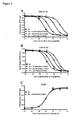
- Truncated relaxin-3 peptides were tested on SK-N-MC/CRE- ⁇ -gal cells stably expressing GPCR135, GPCR142 or LGR7 receptors. Since GPCR135 and GPCR142 are coupled to G ⁇ i proteins (Liu et al 2003a, b), the agonist activities of the mutant peptides were tested as inhibition of forskolin-induced ⁇ -gal expression in SK-N-MC/CRE- ⁇ -gal cells expressing GPCR135 or GPCR142 (Liu et al., 2005b). None of the truncated relaxin-3 peptides demonstrate significant agonist activity for human GPCR135 ( Fig. 1A ) or GPCR142 ( Fig. 1B ).
- LGR7 is linked to G ⁇ s proteins (Hsu et al., 2002), therefore, LGR7 agonism of the truncated relaxin-3 peptides was compared by testing for stimulation of ⁇ -gal expression in SK-N-MC/CRE- ⁇ -gal cells expressing LGR7 (Liu et al., 2005b). In contrast to GPCR135 and GPCR142, the results showed that R3(B ⁇ 24-27), R3(B ⁇ 25-27), and R3(B ⁇ 26-27) are high potency human LGR7 agonists with EC 50 values from 3 to 5 nM ( Fig. 1C , Table 3).
- R3(B ⁇ 23-27)R and R3(B ⁇ 23-27)R/I5 showed no LGR7 agonist activity ( Fig. 1C ).
- Human GPCR135 and GPCR142 bind R3(B ⁇ 23-27)R/I5 with high affinities but neither receptor shows agonist activity.
- LGR7 has little or no affinity for R3(B ⁇ 23-27)R/I5, suggesting that R3(B ⁇ 23-27)R/I5 is a selective antagonist for human GPCR135 over LGR7.
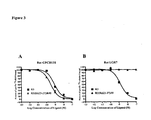
- R3(B ⁇ 23-27)R/I5 The pharmacology of R3(B ⁇ 23-27)R/I5 was also studied using recombinant rat GPCR135 and LGR7.
- IC 50 0.25 nM, Fig. 3A
- rat LGR7 lacks affinity for this peptide ( Fig. 3B ).
- R3(B ⁇ 23-27)R/I5 was further characterized using endogenous GPCR135 in rat brain slices ( Fig. 5 ). Full displacement of 125 I-R3/I5 binding sites in rat brain sections by relaxin-3 and R3(B ⁇ 23-27)R/I5 was observed at 10 nM.
- the IC 50 values for rat brain binding of relaxin-3 and R3(B ⁇ 23-27)R/15 were 0.5 ⁇ 0.1 nM and 0.4 ⁇ 0.1 nM, respectively.
- R3 (B ⁇ 23-27)R / I5 inhibits R3 / I5 stimulated food intake in satiated rats:
- R3/I5 and R3(B ⁇ 23-27)R/I5 were tested in vivo for their abilities to modulate feeding behaviors in rats.
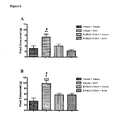
- Intracerebroventricular administration of 10 ⁇ g R3(B ⁇ 23-27)R/I5 prior to the R3/I5 dose blocked R3/I5 stimulated food intake.
- a baseline measure of food intake (i.e., Day 1) was collected prior to introducing any of the treatments. Untreated-satiated animals assigned to the different treatment conditions exhibited similar levels of food intake at 1 hr and 4 hrs on the baseline day (data not shown).
- An ANOVA (Treatment x Day) was used to determine the effect of treatment on food consumption for the four treatment conditions shown ( Fig. 6A and 6B ). The amount of food consumed at 1 hr and the total amount of food consumed during the 4 hr test session after dosing (i.e., Day 2) were used in the analyses.
- GPCR135 is abundantly expressed in many areas of rodent brain such as the amygdala, superior colliculus, sensory cortex, and olfactory bulb (Sutton et al., 2004; Boels et al., 2004, Brain Res. De. v Brain Res., 152:265-268 ).
- the expression of GPCR135 and GPCR135 binding sites are consistent with demonstrated projections of the nucleus incertus ( Goto et al., 2001, J. Com.p Neurol., 438:86-122 ), which is the primary source of relaxin-3 in the rat (Burazin et al., 2002).
- the overall expression patterns of relaxin-3 and its receptor are consistent with roles in spatial memory, emotional, neuroendocrine, and sensory processing.
- relaxin-3 Some expected effects of relaxin-3 have been confirmed in vivo.
- the nucleus incertus is a prominent source of CRF-R1 expression in the hindbrain ( Potter et al., 1994, Proc. Natl Acad. Sci. U S A, 91:8777-8781 ).
- Intracerebroventricular administration of CRF induces relaxin-3 expression in the nucleus incertus, as does a combination of water immersion and restraint stress (Tanaka et al., 2005), suggesting the involvement of relaxin-3 in the stress response.
Landscapes
- Health & Medical Sciences (AREA)
- Chemical & Material Sciences (AREA)
- Organic Chemistry (AREA)
- Life Sciences & Earth Sciences (AREA)
- Biophysics (AREA)
- Gastroenterology & Hepatology (AREA)
- Zoology (AREA)
- Biochemistry (AREA)
- Toxicology (AREA)
- General Health & Medical Sciences (AREA)
- Genetics & Genomics (AREA)
- Medicinal Chemistry (AREA)
- Molecular Biology (AREA)
- Proteomics, Peptides & Aminoacids (AREA)
- Endocrinology (AREA)
- Peptides Or Proteins (AREA)
- Medicines That Contain Protein Lipid Enzymes And Other Medicines (AREA)
Claims (2)
- Polypeptid, umfassend:eine B-Kette mit der AminosäuresequenzRAAPYGVRLCGREFIRAVIFTCR (SEQ ID NO:15); undeine A-Kette mit der AminosäuresequenzGEDLQTLCCTDGCSMTDLSALC (SEQ ID NO:19).
- Polypeptid nach Anspruch 1, im Wesentlichen bestehend aus der mit der A-Kette quervernetzten B-Kette.
Applications Claiming Priority (2)
| Application Number | Priority Date | Filing Date | Title |
|---|---|---|---|
| US89869307P | 2007-01-30 | 2007-01-30 | |
| PCT/US2008/000917 WO2008094437A2 (en) | 2007-01-30 | 2008-01-23 | Chimeric peptide antagonist for gpcr135 or gpcr142 |
Publications (3)
| Publication Number | Publication Date |
|---|---|
| EP2129359A2 EP2129359A2 (de) | 2009-12-09 |
| EP2129359A4 EP2129359A4 (de) | 2011-05-18 |
| EP2129359B1 true EP2129359B1 (de) | 2012-03-14 |
Family
ID=39674681
Family Applications (1)
| Application Number | Title | Priority Date | Filing Date |
|---|---|---|---|
| EP08724770A Active EP2129359B1 (de) | 2007-01-30 | 2008-01-23 | Chimärer peptidantagonist für gpcr135 oder gpcr142 |
Country Status (4)
| Country | Link |
|---|---|
| US (1) | US8299028B2 (de) |
| EP (1) | EP2129359B1 (de) |
| AT (1) | ATE549351T1 (de) |
| WO (1) | WO2008094437A2 (de) |
Families Citing this family (3)
| Publication number | Priority date | Publication date | Assignee | Title |
|---|---|---|---|---|
| CA2704246A1 (en) | 2007-10-30 | 2009-05-07 | Howard Florey Institute Of Experimental Physiology And Medicine | Chimeric relaxin polypeptides comprising an a and b chain derived from different relaxin family peptides |
| WO2012031328A1 (en) * | 2010-09-08 | 2012-03-15 | Howard Florey Institute Of Experimental Physiology And Medicine | Treatments for substance abuse and addiction |
| CA2813802C (en) * | 2010-09-08 | 2020-06-09 | Howard Florey Institute Of Experimental Physiology And Medicine | Single chain relaxin polypeptides |
Family Cites Families (10)
| Publication number | Priority date | Publication date | Assignee | Title |
|---|---|---|---|---|
| AU2001236817A1 (en) | 2000-03-10 | 2001-09-24 | Zymogenetics Inc. | Insulin homolog polypeptide zins4 |
| AU2001248809B2 (en) * | 2000-04-21 | 2005-05-19 | Takeda Pharmaceutical Company Limited | Novel insulin/IGF/relaxin family polypeptides and DNAs thereof |
| AU2001276837A1 (en) | 2000-06-23 | 2002-01-08 | Tularik, Inc. | Human and mouse g-protein couipled receptors |
| AUPR814401A0 (en) * | 2001-10-08 | 2001-11-01 | Howard Florey Institute Of Experimental Physiology And Medicine | Human 3 relaxin |
| JP2007524371A (ja) | 2003-03-04 | 2007-08-30 | ジヤンセン・フアーマシユーチカ・ナームローゼ・フエンノートシヤツプ | レラキシン3−gpcr135複合体ならびにそれらの生産及び使用 |
| AU2003903124A0 (en) | 2003-06-20 | 2003-07-10 | Mark Del Borgo | Analogues of heteromeric proteins |
| JP2007521297A (ja) | 2003-06-30 | 2007-08-02 | メルク エンド カムパニー インコーポレーテッド | アンドロゲン受容体モジュレータとしての17−アセトアミド−4−アザステロイド誘導体 |
| US20050059089A1 (en) | 2003-08-07 | 2005-03-17 | Chester Kuei | Complexes of GPCR142 and relaxin3 or INSL5, and their production and use |
| EP1789452B1 (de) | 2004-08-25 | 2012-04-25 | Janssen Pharmaceutica NV | Relaxin-chimere polypeptide und deren herstellung und anwendung |
| WO2007117400A2 (en) | 2006-03-31 | 2007-10-18 | Janssen Pharmaceutica N.V. | Benzoimidazol-2-yl pyridines as modulators of the histamine h4 receptor |
-
2008
- 2008-01-23 EP EP08724770A patent/EP2129359B1/de active Active
- 2008-01-23 US US12/449,137 patent/US8299028B2/en not_active Expired - Fee Related
- 2008-01-23 AT AT08724770T patent/ATE549351T1/de active
- 2008-01-23 WO PCT/US2008/000917 patent/WO2008094437A2/en not_active Ceased
Also Published As
| Publication number | Publication date |
|---|---|
| WO2008094437A3 (en) | 2008-11-06 |
| WO2008094437A2 (en) | 2008-08-07 |
| EP2129359A2 (de) | 2009-12-09 |
| US20100145007A1 (en) | 2010-06-10 |
| US8299028B2 (en) | 2012-10-30 |
| ATE549351T1 (de) | 2012-03-15 |
| EP2129359A4 (de) | 2011-05-18 |
Similar Documents
| Publication | Publication Date | Title |
|---|---|---|
| Kuei et al. | R3 (BΔ23–27) R/I5 chimeric peptide, a selective antagonist for GPCR135 and GPCR142 over relaxin receptor LGR7: In vitro and in vivo characterization | |
| KR102351313B1 (ko) | Gip/glp1 공효능제 화합물 | |
| Olias et al. | Regulation and function of somatostatin receptors | |
| Weiss et al. | Insulin biosynthesis, secretion, structure, and structure-activity relationships | |
| Patil et al. | Relaxin family peptides: structure–activity relationship studies | |
| Ohki-Hamazaki | Neuromedin b | |
| Bartolomucci et al. | The extended granin family: structure, function, and biomedical implications | |
| Conner et al. | Interaction of calcitonin-gene-related peptide with its receptors | |
| Philippou et al. | The complexity of the IGF1 gene splicing, posttranslational modification and bioactivity | |
| Halls et al. | Relaxin family peptide receptors–former orphans reunite with their parent ligands to activate multiple signalling pathways | |
| Smit et al. | Towards understanding the role of insulin in the brain: lessons from insulin-related signaling systems in the invertebrate brain | |
| Wiedemann et al. | Effects of natriuretic peptides upon hypothalamo-pituitary-adrenocortical system activity and anxiety behaviour | |
| Hojo et al. | Development of a single-chain peptide agonist of the relaxin-3 receptor using hydrocarbon stapling | |
| Belgi et al. | Structure and function relationship of murine insulin-like peptide 5 (INSL5): free C-terminus is essential for RXFP4 receptor binding and activation | |
| CA2333857A1 (en) | Growth hormone secretagogue related receptors and nucleic acids | |
| EP2129359B1 (de) | Chimärer peptidantagonist für gpcr135 oder gpcr142 | |
| EP2614075B1 (de) | Einkettige relaxin-polypeptide | |
| Fu et al. | Synthesis, conformation, receptor binding and biological activities of monobiotinylated human insulin‐like peptide 3 | |
| Liu et al. | Relaxin-3, INSL5, and their receptors | |
| Baldwin et al. | Phylogenetic analysis of the sequences of gastrin-releasing peptide and its receptors: biological implications | |
| Yang et al. | Cloning and mRNA expression of NPB and its effect on hormone secretion of the reproductive cells in the pig | |
| Backeljauw et al. | Growth hormone physiology | |
| Stratakis et al. | Hypothalamic Hormones: GnRH, TRH, GHRH, SRIF, CRH, and Dopamine | |
| Vaughan et al. | Posttranslational processing of human and mouse urocortin 2: characterization and bioactivity of gene products | |
| JP6538682B2 (ja) | Cgrpアゴニストペプチド |
Legal Events
| Date | Code | Title | Description |
|---|---|---|---|
| PUAI | Public reference made under article 153(3) epc to a published international application that has entered the european phase |
Free format text: ORIGINAL CODE: 0009012 |
|
| 17P | Request for examination filed |
Effective date: 20090820 |
|
| AK | Designated contracting states |
Kind code of ref document: A2 Designated state(s): AT BE BG CH CY CZ DE DK EE ES FI FR GB GR HR HU IE IS IT LI LT LU LV MC MT NL NO PL PT RO SE SI SK TR |
|
| AX | Request for extension of the european patent |
Extension state: AL BA MK RS |
|
| A4 | Supplementary search report drawn up and despatched |
Effective date: 20110418 |
|
| RIC1 | Information provided on ipc code assigned before grant |
Ipc: C07K 14/64 20060101AFI20110412BHEP |
|
| REG | Reference to a national code |
Ref country code: DE Ref legal event code: R079 Ref document number: 602008014109 Country of ref document: DE Free format text: PREVIOUS MAIN CLASS: A61K0008180000 Ipc: C07K0014640000 |
|
| GRAP | Despatch of communication of intention to grant a patent |
Free format text: ORIGINAL CODE: EPIDOSNIGR1 |
|
| RIC1 | Information provided on ipc code assigned before grant |
Ipc: C07K 14/64 20060101AFI20110817BHEP |
|
| GRAS | Grant fee paid |
Free format text: ORIGINAL CODE: EPIDOSNIGR3 |
|
| GRAA | (expected) grant |
Free format text: ORIGINAL CODE: 0009210 |
|
| AK | Designated contracting states |
Kind code of ref document: B1 Designated state(s): AT BE BG CH CY CZ DE DK EE ES FI FR GB GR HR HU IE IS IT LI LT LU LV MC MT NL NO PL PT RO SE SI SK TR |
|
| AX | Request for extension of the european patent |
Extension state: AL BA MK RS |
|
| REG | Reference to a national code |
Ref country code: GB Ref legal event code: FG4D |
|
| REG | Reference to a national code |
Ref country code: AT Ref legal event code: REF Ref document number: 549351 Country of ref document: AT Kind code of ref document: T Effective date: 20120315 Ref country code: CH Ref legal event code: EP |
|
| REG | Reference to a national code |
Ref country code: IE Ref legal event code: FG4D |
|
| REG | Reference to a national code |
Ref country code: CH Ref legal event code: NV Representative=s name: E. BLUM & CO. AG PATENT- UND MARKENANWAELTE VSP |
|
| REG | Reference to a national code |
Ref country code: DE Ref legal event code: R096 Ref document number: 602008014109 Country of ref document: DE Effective date: 20120510 |
|
| REG | Reference to a national code |
Ref country code: NL Ref legal event code: T3 |
|
| PG25 | Lapsed in a contracting state [announced via postgrant information from national office to epo] |
Ref country code: NO Free format text: LAPSE BECAUSE OF FAILURE TO SUBMIT A TRANSLATION OF THE DESCRIPTION OR TO PAY THE FEE WITHIN THE PRESCRIBED TIME-LIMIT Effective date: 20120614 Ref country code: HR Free format text: LAPSE BECAUSE OF FAILURE TO SUBMIT A TRANSLATION OF THE DESCRIPTION OR TO PAY THE FEE WITHIN THE PRESCRIBED TIME-LIMIT Effective date: 20120314 Ref country code: LT Free format text: LAPSE BECAUSE OF FAILURE TO SUBMIT A TRANSLATION OF THE DESCRIPTION OR TO PAY THE FEE WITHIN THE PRESCRIBED TIME-LIMIT Effective date: 20120314 |
|
| LTIE | Lt: invalidation of european patent or patent extension |
Effective date: 20120314 |
|
| PG25 | Lapsed in a contracting state [announced via postgrant information from national office to epo] |
Ref country code: LV Free format text: LAPSE BECAUSE OF FAILURE TO SUBMIT A TRANSLATION OF THE DESCRIPTION OR TO PAY THE FEE WITHIN THE PRESCRIBED TIME-LIMIT Effective date: 20120314 Ref country code: FI Free format text: LAPSE BECAUSE OF FAILURE TO SUBMIT A TRANSLATION OF THE DESCRIPTION OR TO PAY THE FEE WITHIN THE PRESCRIBED TIME-LIMIT Effective date: 20120314 Ref country code: GR Free format text: LAPSE BECAUSE OF FAILURE TO SUBMIT A TRANSLATION OF THE DESCRIPTION OR TO PAY THE FEE WITHIN THE PRESCRIBED TIME-LIMIT Effective date: 20120615 |
|
| REG | Reference to a national code |
Ref country code: AT Ref legal event code: MK05 Ref document number: 549351 Country of ref document: AT Kind code of ref document: T Effective date: 20120314 |
|
| PG25 | Lapsed in a contracting state [announced via postgrant information from national office to epo] |
Ref country code: CY Free format text: LAPSE BECAUSE OF FAILURE TO SUBMIT A TRANSLATION OF THE DESCRIPTION OR TO PAY THE FEE WITHIN THE PRESCRIBED TIME-LIMIT Effective date: 20120314 |
|
| PG25 | Lapsed in a contracting state [announced via postgrant information from national office to epo] |
Ref country code: CZ Free format text: LAPSE BECAUSE OF FAILURE TO SUBMIT A TRANSLATION OF THE DESCRIPTION OR TO PAY THE FEE WITHIN THE PRESCRIBED TIME-LIMIT Effective date: 20120314 Ref country code: SI Free format text: LAPSE BECAUSE OF FAILURE TO SUBMIT A TRANSLATION OF THE DESCRIPTION OR TO PAY THE FEE WITHIN THE PRESCRIBED TIME-LIMIT Effective date: 20120314 Ref country code: RO Free format text: LAPSE BECAUSE OF FAILURE TO SUBMIT A TRANSLATION OF THE DESCRIPTION OR TO PAY THE FEE WITHIN THE PRESCRIBED TIME-LIMIT Effective date: 20120314 Ref country code: PL Free format text: LAPSE BECAUSE OF FAILURE TO SUBMIT A TRANSLATION OF THE DESCRIPTION OR TO PAY THE FEE WITHIN THE PRESCRIBED TIME-LIMIT Effective date: 20120314 Ref country code: EE Free format text: LAPSE BECAUSE OF FAILURE TO SUBMIT A TRANSLATION OF THE DESCRIPTION OR TO PAY THE FEE WITHIN THE PRESCRIBED TIME-LIMIT Effective date: 20120314 Ref country code: IS Free format text: LAPSE BECAUSE OF FAILURE TO SUBMIT A TRANSLATION OF THE DESCRIPTION OR TO PAY THE FEE WITHIN THE PRESCRIBED TIME-LIMIT Effective date: 20120714 Ref country code: SE Free format text: LAPSE BECAUSE OF FAILURE TO SUBMIT A TRANSLATION OF THE DESCRIPTION OR TO PAY THE FEE WITHIN THE PRESCRIBED TIME-LIMIT Effective date: 20120314 |
|
| PG25 | Lapsed in a contracting state [announced via postgrant information from national office to epo] |
Ref country code: PT Free format text: LAPSE BECAUSE OF FAILURE TO SUBMIT A TRANSLATION OF THE DESCRIPTION OR TO PAY THE FEE WITHIN THE PRESCRIBED TIME-LIMIT Effective date: 20120716 Ref country code: SK Free format text: LAPSE BECAUSE OF FAILURE TO SUBMIT A TRANSLATION OF THE DESCRIPTION OR TO PAY THE FEE WITHIN THE PRESCRIBED TIME-LIMIT Effective date: 20120314 |
|
| PLBE | No opposition filed within time limit |
Free format text: ORIGINAL CODE: 0009261 |
|
| STAA | Information on the status of an ep patent application or granted ep patent |
Free format text: STATUS: NO OPPOSITION FILED WITHIN TIME LIMIT |
|
| PG25 | Lapsed in a contracting state [announced via postgrant information from national office to epo] |
Ref country code: DK Free format text: LAPSE BECAUSE OF FAILURE TO SUBMIT A TRANSLATION OF THE DESCRIPTION OR TO PAY THE FEE WITHIN THE PRESCRIBED TIME-LIMIT Effective date: 20120314 Ref country code: AT Free format text: LAPSE BECAUSE OF FAILURE TO SUBMIT A TRANSLATION OF THE DESCRIPTION OR TO PAY THE FEE WITHIN THE PRESCRIBED TIME-LIMIT Effective date: 20120314 |
|
| 26N | No opposition filed |
Effective date: 20121217 |
|
| REG | Reference to a national code |
Ref country code: DE Ref legal event code: R097 Ref document number: 602008014109 Country of ref document: DE Effective date: 20121217 |
|
| PG25 | Lapsed in a contracting state [announced via postgrant information from national office to epo] |
Ref country code: ES Free format text: LAPSE BECAUSE OF FAILURE TO SUBMIT A TRANSLATION OF THE DESCRIPTION OR TO PAY THE FEE WITHIN THE PRESCRIBED TIME-LIMIT Effective date: 20120625 |
|
| PG25 | Lapsed in a contracting state [announced via postgrant information from national office to epo] |
Ref country code: BG Free format text: LAPSE BECAUSE OF FAILURE TO SUBMIT A TRANSLATION OF THE DESCRIPTION OR TO PAY THE FEE WITHIN THE PRESCRIBED TIME-LIMIT Effective date: 20120614 |
|
| PG25 | Lapsed in a contracting state [announced via postgrant information from national office to epo] |
Ref country code: MC Free format text: LAPSE BECAUSE OF NON-PAYMENT OF DUE FEES Effective date: 20130131 |
|
| PG25 | Lapsed in a contracting state [announced via postgrant information from national office to epo] |
Ref country code: MT Free format text: LAPSE BECAUSE OF FAILURE TO SUBMIT A TRANSLATION OF THE DESCRIPTION OR TO PAY THE FEE WITHIN THE PRESCRIBED TIME-LIMIT Effective date: 20120314 |
|
| PG25 | Lapsed in a contracting state [announced via postgrant information from national office to epo] |
Ref country code: HU Free format text: LAPSE BECAUSE OF FAILURE TO SUBMIT A TRANSLATION OF THE DESCRIPTION OR TO PAY THE FEE WITHIN THE PRESCRIBED TIME-LIMIT; INVALID AB INITIO Effective date: 20080123 Ref country code: LU Free format text: LAPSE BECAUSE OF NON-PAYMENT OF DUE FEES Effective date: 20130123 |
|
| REG | Reference to a national code |
Ref country code: FR Ref legal event code: PLFP Year of fee payment: 9 |
|
| REG | Reference to a national code |
Ref country code: FR Ref legal event code: PLFP Year of fee payment: 10 |
|
| REG | Reference to a national code |
Ref country code: FR Ref legal event code: PLFP Year of fee payment: 11 |
|
| PGFP | Annual fee paid to national office [announced via postgrant information from national office to epo] |
Ref country code: FR Payment date: 20211214 Year of fee payment: 15 Ref country code: IE Payment date: 20211209 Year of fee payment: 15 Ref country code: GB Payment date: 20211206 Year of fee payment: 15 |
|
| PGFP | Annual fee paid to national office [announced via postgrant information from national office to epo] |
Ref country code: CH Payment date: 20211216 Year of fee payment: 15 Ref country code: BE Payment date: 20211221 Year of fee payment: 15 |
|
| PGFP | Annual fee paid to national office [announced via postgrant information from national office to epo] |
Ref country code: NL Payment date: 20211216 Year of fee payment: 15 |
|
| PGFP | Annual fee paid to national office [announced via postgrant information from national office to epo] |
Ref country code: DE Payment date: 20211130 Year of fee payment: 15 |
|
| PGFP | Annual fee paid to national office [announced via postgrant information from national office to epo] |
Ref country code: TR Payment date: 20220114 Year of fee payment: 15 Ref country code: IT Payment date: 20211213 Year of fee payment: 15 |
|
| REG | Reference to a national code |
Ref country code: DE Ref legal event code: R119 Ref document number: 602008014109 Country of ref document: DE |
|
| REG | Reference to a national code |
Ref country code: CH Ref legal event code: PL |
|
| REG | Reference to a national code |
Ref country code: NL Ref legal event code: MM Effective date: 20230201 |
|
| GBPC | Gb: european patent ceased through non-payment of renewal fee |
Effective date: 20230123 |
|
| REG | Reference to a national code |
Ref country code: BE Ref legal event code: MM Effective date: 20230131 |
|
| PG25 | Lapsed in a contracting state [announced via postgrant information from national office to epo] |
Ref country code: NL Free format text: LAPSE BECAUSE OF NON-PAYMENT OF DUE FEES Effective date: 20230201 Ref country code: LI Free format text: LAPSE BECAUSE OF NON-PAYMENT OF DUE FEES Effective date: 20230131 Ref country code: GB Free format text: LAPSE BECAUSE OF NON-PAYMENT OF DUE FEES Effective date: 20230123 Ref country code: DE Free format text: LAPSE BECAUSE OF NON-PAYMENT OF DUE FEES Effective date: 20230801 Ref country code: CH Free format text: LAPSE BECAUSE OF NON-PAYMENT OF DUE FEES Effective date: 20230131 |
|
| PG25 | Lapsed in a contracting state [announced via postgrant information from national office to epo] |
Ref country code: FR Free format text: LAPSE BECAUSE OF NON-PAYMENT OF DUE FEES Effective date: 20230131 Ref country code: BE Free format text: LAPSE BECAUSE OF NON-PAYMENT OF DUE FEES Effective date: 20230131 |
|
| PG25 | Lapsed in a contracting state [announced via postgrant information from national office to epo] |
Ref country code: IT Free format text: LAPSE BECAUSE OF NON-PAYMENT OF DUE FEES Effective date: 20230123 Ref country code: IE Free format text: LAPSE BECAUSE OF NON-PAYMENT OF DUE FEES Effective date: 20230123 |