EP2129176A2 - Mobiles Multiband-Endgerät und Zellensuchverfahren davon - Google Patents
Mobiles Multiband-Endgerät und Zellensuchverfahren davon Download PDFInfo
- Publication number
- EP2129176A2 EP2129176A2 EP09160695A EP09160695A EP2129176A2 EP 2129176 A2 EP2129176 A2 EP 2129176A2 EP 09160695 A EP09160695 A EP 09160695A EP 09160695 A EP09160695 A EP 09160695A EP 2129176 A2 EP2129176 A2 EP 2129176A2
- Authority
- EP
- European Patent Office
- Prior art keywords
- band
- mobile terminal
- camp
- indicator
- frequency
- Prior art date
- Legal status (The legal status is an assumption and is not a legal conclusion. Google has not performed a legal analysis and makes no representation as to the accuracy of the status listed.)
- Withdrawn
Links
Images


Classifications
-
- H—ELECTRICITY
- H04—ELECTRIC COMMUNICATION TECHNIQUE
- H04B—TRANSMISSION
- H04B1/00—Details of transmission systems, not covered by a single one of groups H04B3/00 - H04B13/00; Details of transmission systems not characterised by the medium used for transmission
- H04B1/38—Transceivers, i.e. devices in which transmitter and receiver form a structural unit and in which at least one part is used for functions of transmitting and receiving
- H04B1/40—Circuits
-
- H—ELECTRICITY
- H04—ELECTRIC COMMUNICATION TECHNIQUE
- H04W—WIRELESS COMMUNICATION NETWORKS
- H04W48/00—Access restriction; Network selection; Access point selection
- H04W48/08—Access restriction or access information delivery, e.g. discovery data delivery
-
- H—ELECTRICITY
- H04—ELECTRIC COMMUNICATION TECHNIQUE
- H04B—TRANSMISSION
- H04B7/00—Radio transmission systems, i.e. using radiation field
- H04B7/24—Radio transmission systems, i.e. using radiation field for communication between two or more posts
-
- H—ELECTRICITY
- H04—ELECTRIC COMMUNICATION TECHNIQUE
- H04W—WIRELESS COMMUNICATION NETWORKS
- H04W88/00—Devices specially adapted for wireless communication networks, e.g. terminals, base stations or access point devices
- H04W88/02—Terminal devices
- H04W88/06—Terminal devices adapted for operation in multiple networks or having at least two operational modes, e.g. multi-mode terminals
Definitions
- the present invention relates to a multiband mobile terminal and, in particularly, to a multiband mobile terminal and cell search method thereof that is capable of reducing the camp-on delay by storing band a indicator extracted from system information transmitted by the base station on which the mobile terminal has most recently camped, and scanning, when a cell search event occurs, the frequency bands indicated by the band indicators first.
- GSM Global Systems for Mobile communication
- 2G 2nd Generation
- a GSM mobile terminal is implemented as a dualband terminal for supporting a pair of frequency bands, e.g., 850MHz and 1900MHz or 900MHz and 1800MHz.
- quadband mobile terminals are mainstream devices to cover these 4 GSM frequency bands.
- Such mobile terminals supporting more than two frequency bands are referred to as multiband mobile terminal.
- the cell means a communication service area that the mobile terminal can uniquely identifies.
- a primary object of the present invention to provide a multiband mobile terminal and cell search method thereof that is capable of reducing cell search delay by storing a broadcast channel allocation list and band indicators extracted from system information message transmitted by cells and scanning, when a cell search even occurs, scanning the frequency bands represented by the band indicators first.
- a multiband mobile terminal supporting at least two frequency bands includes a radio frequency (RF) unit that receives system information transmitted by a base station; a storage unit that stores a band indicator extracted from the system information; and a control unit that controls mobile terminal to scan, when a camp-on event is detected, a frequency band indicated by the band indicator, camp on a base station of a network using the frequency band, and store a band indicator indicating the network.
- the control unit controls the mobile terminal and stores the band indicator into the storage unit together with a broadcast control channel allocation list.
- the broadcast control channel allocation list includes information corresponding to neighbor cells and the neighbor cell information contains information corresponding to the frequency band of the network in which the mobile terminal locates.
- the frequency band is one of a first band and a second band.
- the first band includes at least one of a 900MHz band and an 1800MHz band.
- the second band includes at least one of an 850MHz band and a 1900MHz band.
- the control unit controls the mobile terminal, when the camp-on event is an initial camp-on event, to scan a frequency band preset as a preferred frequency band.
- the control unit controls the mobile terminal, when failed camping on a base station, the mobile terminal scan all available frequency bands.
- the control unit controls the mobile terminal, when a camp-off event is detected, to update the stored band indicator with the band indicator acquired from the base station on which the mobile terminal has camped on most recently.
- a cell search method for a multiband mobile terminal supporting at least two frequency bands includes checking, when a camp-on event is detected, a previously stored band indicator; attempting to camp on a base station by scanning a frequency band indicated by the band indicator; and updating, when a camp-off event is detected, the band indicator with a band indicator acquired from a base station on which the mobile terminal has camped most recently.
- the band indicator is stored with a broadcast control channel allocation list extracted from system information transmitted by the base station on which the mobile terminal has camped most recently.
- the broadcast control channel allocation list includes information corresponding to neighbor cells and the neighbor cell information contains information corresponding to the frequency band of the network in which the mobile terminal locates.
- the frequency band is one of a first band and a second band.
- the first band includes at least one of a 900MHz band and an 1800MHz band.
- the second band includes at least one of an 850MHz band and a 1900MHz band.
- a cell search method further includes scanning, when the camp-on event is an initial camp-on event, a frequency band preset as a preferred frequency band.
- a cell search method further includes scanning, when failed camping on a base station, all available frequency bands.
- FIGURE 1 is a schematic diagram illustrating an exemplary situation where a mobile terminal performs a cell search according to an exemplary embodiment of the present invention
- FIGURE 2 is a block diagram illustrating a configuration of a mobile terminal according to an exemplary embodiment of the present invention
- FIGURE 3 is a flowchart illustrating a band indicator acquisition procedure of a cell search method according to an exemplary embodiment of the present invention.
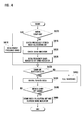
- FIGURE 4 is a flowchart illustrating a cell search procedure of a cell search method according to an exemplary embodiment of the present invention.
- FIGURES 1 through 4 discussed below, and the various embodiments used to describe the principles of the present disclosure in this patent document are by way of illustration only and should not be construed in any way to limit the scope of the disclosure. Those skilled in the art will understand that the principles of the present disclosure may be implemented in any suitably arranged multiband mobile terminal.
- the mobile terminal means a multiband mobile terminal supporting a plurality of frequency bands and represents a Personal Digital Assistant (PDA), a Smartphone, an International Mobile Telecommunication 2000 (IMT-2000) terminal, and their equivalent devices having multiband communication capabilities.
- PDA Personal Digital Assistant
- the mobile terminal can be implemented with a touch screen display.
- the touch screen display is a full-touch screen display.
- the mobile terminal performs cell search by scanning frequency bands indicated by the band indicators acquired from the system information first.
- the band indicators can indicate some or all of the frequency bands of the neighbor base stations listed in the BCCH Allocation List.
- FIGURE 1 is a schematic diagram illustrating an exemplary situation where a mobile terminal performs a cell search according to an exemplary embodiment of the present invention.
- the mobile terminal 110 having radio interfaces supporting a first and second frequency bands moves from a first network 120 using the first frequency band to a second network 130 using the second frequency band.
- the mobile terminal 110 can receive and store a BCCH Allocation List containing information corresponding to the neighbor cells transmitted by a base station and scan the frequency bands of the neighbor cells listed in the BCCH Allocation List first for cell search.
- the mobile terminal 110 can receive and store band indicators containing information corresponding to the frequency bands used by the base stations that are not listed in the BCCH Allocation List and scan the frequency bands indicated by the band indicators first for cell search.
- the first network 120 can be a network deployed in Europe, and the first band can be 900MHz/1800MHz band; and the second network 130 can be a network deployed in North America including the United States of America and Canada, and the second band can be 850MHz/1900MHz.
- the mobile terminal 110 can be a multiband mobile terminal mainly used in the first network 120 and can be configured to scan the first band of the first network 120. Also, the mobile terminal 110 can be a multiband mobile terminal mainly used by the second network 130 and can be configured to scan the second band used by the second network 130.
- the first and second bands can be specified as shown in table 1.
- Table 1 Band UL band DL band AFRCN First band (1800 band) 1710-1785(MHz) 1805-1880(MHz) 512-885 Second band (100 band) 1850-1910(MHz) 1930-1990(MHz) 512-810
- the downlink (DL) band of the first band is overlapped with the uplink (UL) band of the second band.
- the mobile terminal 110 that is configured to scan the first band and mainly used in the first network 120 moves into the second network 130, the mobile terminal 110 fails to find a cell in the frequency range of the first band within the second network.
- the first and second bands are overlapped in the range between 1850MHz and 1880MHz, the mobile terminal 110 cannot hear any of channels since the overlapped frequency range is a part of the uplink band of the second network 130. Accordingly, the mobile terminal 110 performs a full scan, after the preferred band scanning failure, so as to scan all available frequency bands and camps on one of the cells using a channel allocated in second band of the second network 130.
- the preferred scanning band is fixed such that the mobile terminal moved into a visited network must perform the preset preferred band scan and then the full scan repeatedly, thereby increasing the time for camping on a cell.
- the mobile terminal 110 stores the band indicator acquired from the system information transmitted by the base station on which the mobile terminal 110 has camped most recently. At the next camp-on process, the mobile terminal 110 checks the stored band indicator and performs scanning on the frequency band indicated by the band indicator first.
- the band indicator may include the information regarding the frequency band of the network to which the serving base station belongs.
- the band indicator is set to 0 for indicating the first band and set to 1 for indicating the second band.
- the mobile terminal 110 first checks the previously stored band indicator and scans the frequency band indicated by the band indicator for searching a cell to camp on. Accordingly, the mobile terminal 110 can camp on a cell promptly within a network using the frequency band indicated by the band indicator.
- the mobile terminal 110 when the mobile terminal 110 locates in a network of which frequency band differs from that indicated by the band indicator, e.g., the mobile terminal 110 moves from the first network to the second network and vice versa, the mobile terminal 110 fails to find a cell in the preferred band scanning and performs the full scan. In this case, the mobile terminal 110 stores the band indicator acquired during a camp-on process following the full scan and uses the stored band indicator at the next cell search process, resulting in prompt camp on to a cell.
- FIGURE 2 is a block diagram illustrating a configuration of a mobile terminal according to an exemplary embodiment of the present invention.
- the mobile terminal includes a Radio Frequency (RF) unit 210, a data processing unit 220, a display unit 230, an audio processing unit 240, an input unit 250, a storage unit 260, and a control unit 270.
- RF Radio Frequency
- the RF unit 210 includes an RF transmitter for up-converting and amplifying a transmission signal frequency and an RF receiver for low noise amplifying and down-converting a received signal frequency.
- the RF unit 210 can be configured to receive the system information messages that are periodically transmitted by base stations.
- the system information message contains information corresponding to the cell in which the mobile terminal 110 locates.
- the RF unit 210 also changes the frequency to be scan and discover the frequency at which the mobile terminal camps on under the control of the control unit 270.
- the RF unit 210 can be implemented with at least one of mixers and filters.
- the data processing unit 220 includes a transmitter for encoding and modulating the transmission signal and a receiver for demodulating and decoding the received signal.
- the data processing unit 220 can be implemented with at least one of modems and codecs.
- the codecs include a data codec for processing packet data and an audio codec for processing audio signal including voice.
- the display unit 230 can be implemented with a Liquid Crystal Display (LCD) for displaying various visual data and operation status of the mobile terminal. In case of supporting a touch screen function, the display unit 230 can work as a part of the input unit 250.
- LCD Liquid Crystal Display
- the audio processing unit 240 plays the audio data output by the data processing unit 220 and delivers the audio signal input through a microphone (MIC). That is, the audio processing unit converts the audio data so as to output in the form of audible voice/sound through a speaker (SPK) and converts the audio signal input through the microphone (MIC) to output in the form of audio data to the data processing unit 220.
- MIC microphone
- the input unit 250 is responsible for receiving user data and control command input.
- the input unit 250 is provided with a plurality of alphanumeric keys for receiving alphanumeric data and function keys for configuring and executing various functions of the mobile terminal.
- the storage unit 260 stores application programs related to the operations of the mobile terminal and application data.
- the storage unit 260 also stores the BCCH Allocation List extracted from the system information message transmitted by base stations.
- the storage unit 260 is provided with a band indicator storage region 260A for storing the band indicator contained in the system information message.
- the band indicator is separately stored in the band indicator storage region 260A.
- the band indicator can be stored with the BCCH Allocation List.
- the control unit 270 controls general operations of the mobile terminal 110. Particularly in an exemplary embodiment, the control unit 270 controls a series of processes related for the camp-on procedure of the mobile terminal. The control unit 270 controls to extract the band indicator from the system information message transmitted by a base station and store the band indicator within the band indicator storage region 260A of the storage unit 260.
- control unit 270 controls such that the mobile terminal scans the frequency band corresponding to the band indicator with reference to the BCCH Allocation List and band indicator.
- FIGURE 3 is a flowchart illustrating a band indicator acquisition procedure of a cell search method according to an exemplary embodiment of the present invention. Since it is obvious to those skilled in the art, the detailed description on the BCCH Allocation List acquisition process is omitted in this embodiment.
- the control unit 270 of the mobile terminal detects a frequency scan event (S310).
- the frequency scan can be performed in a descending order of received frequency level.
- the control unit 270 decodes the signal received at individual frequencies (S320).
- the control unit 270 determines whether the frequency is a BCCH carrier frequency based on the decoded signal (S330). If the frequency is not a BCCH carrier frequency, the process goes to step S310.
- the steps S310 to S330 are repeated until discovering a BCCH carrier frequency.
- the control unit 270 acquires the system information at the BCCH carrier frequency (S340). Consequently, the control unit 270 extracts a band indicator from the system information and stores the band indicator into the band indicator storage region 260A of the storage unit 260 (S350).
- the band indicator can contain information on the frequency band of the network to which the base station transmitted the system information belongs. In an exemplary embodiment, the band indicator is set to 0 for indicating the network using the first band and set to 1 for indicating the network using the second band.
- control unit 270 checks the stored band indicator and scans the frequencies of the band indicated by the band indicator first, thereby reducing camp-on delay.
- FIGURE 4 is a flowchart illustrating a cell search procedure of a cell search method according to an exemplary embodiment of the present invention.
- the mobile terminal After acquiring the band indicator in the band indicator acquisition procedure of FIGURE 3 , the mobile terminal attempts to camp on the cell.
- the control unit 270 determines whether the current camp-on attempt is an initial camp-on attempt within the network (S405). If the camp-on attempt is an initial camp-on attempt, the control unit 270 controls such that the mobile terminal scans the frequency band preset with mainly used network (S41 0).
- the control unit 270 checks the previously stored BCCH Allocation List (S415).
- the BCCH Allocation List contains information regarding the neighbor cells of the serving cell such that the mobile terminal scans the frequencies of the cells indicated by the BCCH Allocation List first.
- the mobile terminal can be configured to scan the frequencies listed in the BCCH Allocation List first.
- the mobile terminal can be configured to scan the frequencies selected in another way first rather than the frequencies listed in the BCCH Allocation List.
- the control unit 270 After checking the BCCH Allocation List, the control unit 270 checks the previously stored band indicator (S420). Next, the control unit 270 controls such that the mobile terminal scans the frequencies of the band indicated by the band indicator first (S425).
- the band indicator set to 0 means that the network including the base station uses the first band
- the indicator set to 1 means that the network including the base station uses the second band.
- control unit 270 determines whether the mobile terminal camps on a cell successfully (S430). If the mobile terminal camps on a cell successfully, the control unit 270 controls such that the mobile terminal initiates communication service mode (S435).
- the control unit 270 controls such that the mobile terminal performs full scan (S450). For example, when the mobile terminal 110 camped on the first network moves to the second network, the mobile terminal performs scanning the frequencies indicated by the BCCH Allocation List and band indicator acquired in the first network first with the camp-on failure and then scanning all the frequencies.
- the control unit 270 determines whether the mobile terminal camps on a cell successfully (S430). If the mobile terminal camps on a cell successfully, the control unit 270 controls such that the mobile terminal initiates communication service mode (S435).
- the control unit monitors to detect a camp-off event (S440). If a camp-off event is detected, the control unit 270 controls such that the mobile terminal stores the BCCH Allocation List and band indicator acquired from the service base station (S445).
- the multiband mobile terminal and cell search method of the present invention enables the multiband mobile terminal to scan the frequency band of the network in which the mobile terminal locates currently, resulting in reducing the time required for camping on a cell.
- the multiband mobile terminal and cell search method of the present invention enables the mobile terminal moved to a visited network using the frequency band different from that of its home network to scan the frequency band of the visited network first using the BCCH Allocation List and band indicator acquired through the initial full scan in the visited network.
Landscapes
- Engineering & Computer Science (AREA)
- Computer Networks & Wireless Communication (AREA)
- Signal Processing (AREA)
- Computer Security & Cryptography (AREA)
- Mobile Radio Communication Systems (AREA)
Applications Claiming Priority (1)
| Application Number | Priority Date | Filing Date | Title |
|---|---|---|---|
| KR1020080050792A KR20090124522A (ko) | 2008-05-30 | 2008-05-30 | 멀티밴드 단말기 및 그의 주파수 설정 방법 |
Publications (2)
| Publication Number | Publication Date |
|---|---|
| EP2129176A2 true EP2129176A2 (de) | 2009-12-02 |
| EP2129176A3 EP2129176A3 (de) | 2012-05-23 |
Family
ID=41040450
Family Applications (1)
| Application Number | Title | Priority Date | Filing Date |
|---|---|---|---|
| EP09160695A Withdrawn EP2129176A3 (de) | 2008-05-30 | 2009-05-19 | Mobiles Multiband-Endgerät und Zellensuchverfahren davon |
Country Status (3)
| Country | Link |
|---|---|
| US (1) | US20090298497A1 (de) |
| EP (1) | EP2129176A3 (de) |
| KR (1) | KR20090124522A (de) |
Cited By (4)
| Publication number | Priority date | Publication date | Assignee | Title |
|---|---|---|---|---|
| CN101895968A (zh) * | 2010-07-30 | 2010-11-24 | 展讯通信(上海)有限公司 | 移动终端找网方法及移动终端 |
| CN102123430A (zh) * | 2011-03-24 | 2011-07-13 | 华为技术有限公司 | 一种搜网方法和终端 |
| US10779205B2 (en) | 2011-09-23 | 2020-09-15 | Nokia Technologies Oy | Method and apparatus for overlapping frequency band enhancement |
| US11641617B2 (en) | 2016-11-10 | 2023-05-02 | Telefonaktiebolaget Lm Ericsson (Publ) | Mechanisms for initial access to a radio access network |
Families Citing this family (25)
| Publication number | Priority date | Publication date | Assignee | Title |
|---|---|---|---|---|
| KR20110055029A (ko) * | 2009-11-19 | 2011-05-25 | 삼성전자주식회사 | 이동통신 단말기에서 캠프온을 위한 장치 및 방법 |
| GB201007397D0 (en) * | 2010-05-04 | 2010-06-16 | Vodafone Ip Licensing Ltd | Machine to machine type devices |
| CN101977419B (zh) * | 2010-07-23 | 2012-11-28 | 展讯通信(上海)有限公司 | 移动电话找网方法及移动电话 |
| KR20130042009A (ko) * | 2010-08-09 | 2013-04-25 | 노키아 지멘스 네트웍스 오와이 | 적어도 하나의 무선 액세스 기술 네트워크를 포함하는 무선 통신 시스템에서 이웃 셀 정보를 업데이트하도록 구성된 네트워크 노드들 및 방법들 |
| US8929311B2 (en) * | 2011-02-08 | 2015-01-06 | Telefonaktiebolaget L M Ericsson (Publ) | Signaling for legacy terminal operation in harmonized bands |
| EP2737753B1 (de) * | 2011-07-27 | 2017-07-12 | Marvell World Trade Ltd. | Reduzierung einer plmn-suchzeit |
| US9743407B2 (en) | 2011-12-15 | 2017-08-22 | Intel Corporation | Multiband central controller and method for multiband network operations |
| US8923858B2 (en) | 2012-02-21 | 2014-12-30 | Marvell World Trade Ltd. | Parallel multi-RAT PLMN search |
| US8938016B1 (en) | 2012-09-18 | 2015-01-20 | Marvell International Ltd. | Fast identification of OFDM signal |
| CN103974381A (zh) * | 2013-01-31 | 2014-08-06 | 鸿富锦精密工业(深圳)有限公司 | 移动设备及其频道扫描方法 |
| US9615377B2 (en) * | 2015-05-29 | 2017-04-04 | Apple Inc. | Apparatus, systems and methods for prioritizing frequency selection for a mobile device |
| JP6837492B2 (ja) | 2016-04-20 | 2021-03-03 | コンヴィーダ ワイヤレス, エルエルシー | 新しい無線における物理チャネル |
| KR102175608B1 (ko) | 2016-04-20 | 2020-11-06 | 콘비다 와이어리스, 엘엘씨 | 구성가능한 기준 신호들 |
| KR102106581B1 (ko) * | 2016-04-20 | 2020-05-04 | 콘비다 와이어리스, 엘엘씨 | 시스템 정보 프로비저닝 및 경량 접속 시그널링 |
| US10271295B2 (en) | 2016-04-20 | 2019-04-23 | Convida Wireless, Llc | Downlink synchronization |
| EP3455985B1 (de) | 2016-05-11 | 2022-03-09 | Convida Wireless, LLC | Neuer funk-downlink-steuerkanal |
| CN109644089B (zh) | 2016-06-15 | 2022-04-26 | 康维达无线有限责任公司 | 用于新无线电的无许可上行链路传输 |
| CN109565370B (zh) | 2016-06-15 | 2021-06-15 | 康维达无线有限责任公司 | 用于新无线电的上传控制信令的装置 |
| EP3473051A1 (de) | 2016-06-15 | 2019-04-24 | Convida Wireless, LLC | Erkennung und auswahl von netzwerk-slices |
| CN115835405A (zh) | 2016-06-15 | 2023-03-21 | 交互数字专利控股公司 | 用于无许可操作的方法及装置 |
| KR20240006080A (ko) | 2016-08-11 | 2024-01-12 | 인터디지탈 패튼 홀딩스, 인크 | 뉴 라디오를 위한 유연한 프레임 구조에서의 빔포밍 스위핑 및 트레이닝 |
| EP3520243B1 (de) | 2016-11-03 | 2025-07-02 | InterDigital Patent Holdings, Inc. | Rahmenstruktur für nr |
| KR102358234B1 (ko) * | 2017-07-28 | 2022-02-04 | 광동 오포 모바일 텔레커뮤니케이션즈 코포레이션 리미티드 | 시스템 정보의 송신 방법, 네트워크 디바이스 및 단말기 디바이스 |
| CN112753265B (zh) | 2018-09-27 | 2025-02-11 | 交互数字专利控股公司 | 新无线电的未经许可的频谱中的子频带操作 |
| CN110958655A (zh) * | 2019-11-21 | 2020-04-03 | 维沃移动通信有限公司 | 一种网络搜索方法及电子设备 |
Family Cites Families (7)
| Publication number | Priority date | Publication date | Assignee | Title |
|---|---|---|---|---|
| US5499386A (en) * | 1993-07-09 | 1996-03-12 | Telefonaktiebolaget L M Ericsson | Best server selection in layered cellular radio system |
| US5995834A (en) * | 1996-12-24 | 1999-11-30 | At&T Wireless Services, Inc. | Method for controlling channel re-selection from a selected control channel to an alternative control channel |
| EP1459579B1 (de) * | 2001-12-19 | 2011-06-15 | Nokia Corporation | Verfahren zum steuern von einem drahtlosen multiband und/oder multimode telekommunikationsgerät |
| GB2399985B (en) * | 2003-03-25 | 2005-05-25 | Nec Technologies | Method of network acquisition and related cellular radio communication device |
| US7773990B2 (en) * | 2005-05-23 | 2010-08-10 | Telefonaktiebolaget L M Ericsson (Publ) | Avoidance of service interruptions in visited public land mobile network (VPLMNs) |
| US8045981B2 (en) * | 2005-08-18 | 2011-10-25 | Qualcomm Incorporated | System search to detect for a wireless communication network in a crowded frequency band |
| WO2008153514A1 (en) * | 2007-05-23 | 2008-12-18 | Agere Systems, Inc. | System and method for time saving cell search for mobile devices in single and multiple radio technology communication systems |
-
2008
- 2008-05-30 KR KR1020080050792A patent/KR20090124522A/ko not_active Withdrawn
-
2009
- 2009-05-19 EP EP09160695A patent/EP2129176A3/de not_active Withdrawn
- 2009-05-28 US US12/455,049 patent/US20090298497A1/en not_active Abandoned
Cited By (5)
| Publication number | Priority date | Publication date | Assignee | Title |
|---|---|---|---|---|
| CN101895968A (zh) * | 2010-07-30 | 2010-11-24 | 展讯通信(上海)有限公司 | 移动终端找网方法及移动终端 |
| CN101895968B (zh) * | 2010-07-30 | 2012-11-21 | 展讯通信(上海)有限公司 | 移动终端找网方法及移动终端 |
| CN102123430A (zh) * | 2011-03-24 | 2011-07-13 | 华为技术有限公司 | 一种搜网方法和终端 |
| US10779205B2 (en) | 2011-09-23 | 2020-09-15 | Nokia Technologies Oy | Method and apparatus for overlapping frequency band enhancement |
| US11641617B2 (en) | 2016-11-10 | 2023-05-02 | Telefonaktiebolaget Lm Ericsson (Publ) | Mechanisms for initial access to a radio access network |
Also Published As
| Publication number | Publication date |
|---|---|
| KR20090124522A (ko) | 2009-12-03 |
| EP2129176A3 (de) | 2012-05-23 |
| US20090298497A1 (en) | 2009-12-03 |
Similar Documents
| Publication | Publication Date | Title |
|---|---|---|
| US20090298497A1 (en) | Multiband mobile terminal and cell search method thereof | |
| US8155694B2 (en) | Dual standby mode mobile terminal and communication mode control method thereof | |
| JP4891436B2 (ja) | 移動端末と、関連した移動端末とコンピュータプログラム製品に電力を供給するバッテリの現在の電圧に基づいて通信動作モードが変更されるような移動端末を動作させる方法 | |
| CN101980571B (zh) | 一种加快小区搜索的方法和移动通信终端 | |
| US20060009216A1 (en) | Multiple mode scanning | |
| US20090036123A1 (en) | Band scanning and cell selection method and apparatus for mobile station | |
| US20110312274A1 (en) | Radio communication device, receiver controller of a radio communication device, methods for searching for a radio cell | |
| KR20050060073A (ko) | 동시에 동작하는 수신기를 사용하는 다중 모드 이동 통신장치 및 방법 | |
| US8880063B2 (en) | Method and user equipment with dual RF transceivers to perform PLMN list generation or PLMN search | |
| JP2003169379A (ja) | 移動体通信端末、移動体通信システム及び通信方法 | |
| US20160212660A1 (en) | Cell search method of terminal and related device and system | |
| KR100703481B1 (ko) | 멀티밴드 지원 단말기에서의 자동 주파수밴드 설정 방법 | |
| EP2117274A1 (de) | Zellauswahlverfahren und Vorrichtung für ein Kommunikationssystem | |
| US20160044582A1 (en) | Method to accelerate manual public land mobile network search in dual-sim dual-active devices | |
| US9578473B1 (en) | Dynamic subscription selection for energy efficient commercial mobile alert system/earthquake tsunami warning system (CMAS/ETWS) reception | |
| US8849280B2 (en) | Mobile terminal device, its communication method, and radio network system | |
| US8768346B2 (en) | Mobile phone and network connecting method and apparatus thereof | |
| EP1327368B1 (de) | Verfahren und drahltoses endgerät zum erlangen eines dienstes unter verwendung gespeicherter informationen über einen digitalen tdma kontrollkanal | |
| KR20150127782A (ko) | 휴대 단말기에서 네트워크를 연결하는 장치 및 방법 | |
| KR20090005454A (ko) | 휴대 단말기 및 그의 통신 셀 선택 방법 | |
| US20100190494A1 (en) | Method and apparatus for cell selection | |
| US8224319B2 (en) | Mobile wireless terminal apparatus and base station search method | |
| US7218942B2 (en) | Method for transmitting digital channel with priority of mobile communication terminal | |
| US20100278164A1 (en) | Method, Base Station, Mobile Station, Telecommunication System, and Computer Program for Detecting a WLAN | |
| US7321764B2 (en) | Method for processing call in mobile communication terminal supporting multi-mode telecommunication system |
Legal Events
| Date | Code | Title | Description |
|---|---|---|---|
| PUAI | Public reference made under article 153(3) epc to a published international application that has entered the european phase |
Free format text: ORIGINAL CODE: 0009012 |
|
| AK | Designated contracting states |
Kind code of ref document: A2 Designated state(s): AT BE BG CH CY CZ DE DK EE ES FI FR GB GR HR HU IE IS IT LI LT LU LV MC MK MT NL NO PL PT RO SE SI SK TR |
|
| PUAL | Search report despatched |
Free format text: ORIGINAL CODE: 0009013 |
|
| AK | Designated contracting states |
Kind code of ref document: A3 Designated state(s): AT BE BG CH CY CZ DE DK EE ES FI FR GB GR HR HU IE IS IT LI LT LU LV MC MK MT NL NO PL PT RO SE SI SK TR |
|
| AX | Request for extension of the european patent |
Extension state: AL BA RS |
|
| RIC1 | Information provided on ipc code assigned before grant |
Ipc: H04W 48/08 20090101AFI20120416BHEP |
|
| RAP1 | Party data changed (applicant data changed or rights of an application transferred) |
Owner name: SAMSUNG ELECTRONICS CO., LTD. |
|
| STAA | Information on the status of an ep patent application or granted ep patent |
Free format text: STATUS: THE APPLICATION IS DEEMED TO BE WITHDRAWN |
|
| 18D | Application deemed to be withdrawn |
Effective date: 20121124 |