EP2128183A1 - Resin composition for optical components, optical component using the same and production method of optical lens - Google Patents
Resin composition for optical components, optical component using the same and production method of optical lens Download PDFInfo
- Publication number
- EP2128183A1 EP2128183A1 EP09161480A EP09161480A EP2128183A1 EP 2128183 A1 EP2128183 A1 EP 2128183A1 EP 09161480 A EP09161480 A EP 09161480A EP 09161480 A EP09161480 A EP 09161480A EP 2128183 A1 EP2128183 A1 EP 2128183A1
- Authority
- EP
- European Patent Office
- Prior art keywords
- resin composition
- optical
- lens
- optical lens
- components
- Prior art date
- Legal status (The legal status is an assumption and is not a legal conclusion. Google has not performed a legal analysis and makes no representation as to the accuracy of the status listed.)
- Granted
Links
- 230000003287 optical effect Effects 0.000 title claims abstract description 116
- 239000011342 resin composition Substances 0.000 title claims abstract description 99
- 238000004519 manufacturing process Methods 0.000 title claims abstract description 27
- 229920000647 polyepoxide Polymers 0.000 claims abstract description 39
- 239000003822 epoxy resin Substances 0.000 claims abstract description 34
- 239000002253 acid Substances 0.000 claims abstract description 26
- 239000000463 material Substances 0.000 claims abstract description 19
- -1 oxetane compound Chemical class 0.000 claims abstract description 16
- 125000003700 epoxy group Chemical group 0.000 claims abstract description 6
- 125000003566 oxetanyl group Chemical group 0.000 claims abstract description 6
- 239000000758 substrate Substances 0.000 claims description 27
- 238000010438 heat treatment Methods 0.000 claims description 22
- 238000000034 method Methods 0.000 claims description 9
- 150000001450 anions Chemical class 0.000 claims description 8
- 150000003839 salts Chemical class 0.000 claims description 7
- 230000001678 irradiating effect Effects 0.000 claims description 6
- 238000004382 potting Methods 0.000 claims description 6
- 238000011049 filling Methods 0.000 claims description 5
- 238000003825 pressing Methods 0.000 claims description 4
- OKTJSMMVPCPJKN-UHFFFAOYSA-N Carbon Chemical compound [C] OKTJSMMVPCPJKN-UHFFFAOYSA-N 0.000 claims description 3
- 125000000217 alkyl group Chemical group 0.000 claims description 3
- 229910052799 carbon Inorganic materials 0.000 claims description 3
- 150000001768 cations Chemical class 0.000 claims description 3
- 125000001997 phenyl group Chemical group [H]C1=C([H])C([H])=C(*)C([H])=C1[H] 0.000 claims description 3
- 229920005989 resin Polymers 0.000 description 19
- 239000011347 resin Substances 0.000 description 19
- 238000003384 imaging method Methods 0.000 description 17
- 230000009477 glass transition Effects 0.000 description 14
- 238000001723 curing Methods 0.000 description 11
- 229910000679 solder Inorganic materials 0.000 description 11
- IISBACLAFKSPIT-UHFFFAOYSA-N bisphenol A Chemical compound C=1C=C(O)C=CC=1C(C)(C)C1=CC=C(O)C=C1 IISBACLAFKSPIT-UHFFFAOYSA-N 0.000 description 10
- 238000013007 heat curing Methods 0.000 description 10
- 238000005259 measurement Methods 0.000 description 10
- 239000000243 solution Substances 0.000 description 10
- 230000000052 comparative effect Effects 0.000 description 9
- 229930185605 Bisphenol Natural products 0.000 description 8
- NIXOWILDQLNWCW-UHFFFAOYSA-N acrylic acid group Chemical group C(C=C)(=O)O NIXOWILDQLNWCW-UHFFFAOYSA-N 0.000 description 8
- 238000002845 discoloration Methods 0.000 description 8
- AHHWIHXENZJRFG-UHFFFAOYSA-N oxetane Chemical compound C1COC1 AHHWIHXENZJRFG-UHFFFAOYSA-N 0.000 description 8
- JUXZNIDKDPLYBY-UHFFFAOYSA-N 3-ethyl-3-(phenoxymethyl)oxetane Chemical compound C=1C=CC=CC=1OCC1(CC)COC1 JUXZNIDKDPLYBY-UHFFFAOYSA-N 0.000 description 7
- 239000011521 glass Substances 0.000 description 7
- 230000000630 rising effect Effects 0.000 description 7
- 125000002723 alicyclic group Chemical group 0.000 description 6
- 238000002156 mixing Methods 0.000 description 6
- 150000001875 compounds Chemical class 0.000 description 5
- 239000000203 mixture Substances 0.000 description 5
- 239000000126 substance Substances 0.000 description 5
- 229920005992 thermoplastic resin Polymers 0.000 description 5
- 229920002799 BoPET Polymers 0.000 description 4
- 229920000515 polycarbonate Polymers 0.000 description 4
- 239000004417 polycarbonate Substances 0.000 description 4
- 229920001296 polysiloxane Polymers 0.000 description 4
- 238000002360 preparation method Methods 0.000 description 4
- 238000003756 stirring Methods 0.000 description 4
- UNMJLQGKEDTEKJ-UHFFFAOYSA-N (3-ethyloxetan-3-yl)methanol Chemical compound CCC1(CO)COC1 UNMJLQGKEDTEKJ-UHFFFAOYSA-N 0.000 description 3
- 230000001070 adhesive effect Effects 0.000 description 3
- 125000002496 methyl group Chemical group [H]C([H])([H])* 0.000 description 3
- 229920006267 polyester film Polymers 0.000 description 3
- 230000001681 protective effect Effects 0.000 description 3
- 238000003860 storage Methods 0.000 description 3
- 229920001187 thermosetting polymer Polymers 0.000 description 3
- 125000005409 triarylsulfonium group Chemical group 0.000 description 3
- FNYWFRSQRHGKJT-UHFFFAOYSA-N 3-ethyl-3-[(3-ethyloxetan-3-yl)methoxymethyl]oxetane Chemical compound C1OCC1(CC)COCC1(CC)COC1 FNYWFRSQRHGKJT-UHFFFAOYSA-N 0.000 description 2
- UJOBWOGCFQCDNV-UHFFFAOYSA-N 9H-carbazole Chemical compound C1=CC=C2C3=CC=CC=C3NC2=C1 UJOBWOGCFQCDNV-UHFFFAOYSA-N 0.000 description 2
- RTZKZFJDLAIYFH-UHFFFAOYSA-N Diethyl ether Chemical compound CCOCC RTZKZFJDLAIYFH-UHFFFAOYSA-N 0.000 description 2
- UFWIBTONFRDIAS-UHFFFAOYSA-N Naphthalene Chemical compound C1=CC=CC2=CC=CC=C21 UFWIBTONFRDIAS-UHFFFAOYSA-N 0.000 description 2
- MWPLVEDNUUSJAV-UHFFFAOYSA-N anthracene Chemical compound C1=CC=CC2=CC3=CC=CC=C3C=C21 MWPLVEDNUUSJAV-UHFFFAOYSA-N 0.000 description 2
- 230000005540 biological transmission Effects 0.000 description 2
- 230000001413 cellular effect Effects 0.000 description 2
- DIOQZVSQGTUSAI-UHFFFAOYSA-N decane Chemical compound CCCCCCCCCC DIOQZVSQGTUSAI-UHFFFAOYSA-N 0.000 description 2
- 230000006866 deterioration Effects 0.000 description 2
- ZUOUZKKEUPVFJK-UHFFFAOYSA-N diphenyl Chemical compound C1=CC=CC=C1C1=CC=CC=C1 ZUOUZKKEUPVFJK-UHFFFAOYSA-N 0.000 description 2
- 230000000694 effects Effects 0.000 description 2
- 238000011156 evaluation Methods 0.000 description 2
- LNEPOXFFQSENCJ-UHFFFAOYSA-N haloperidol Chemical compound C1CC(O)(C=2C=CC(Cl)=CC=2)CCN1CCCC(=O)C1=CC=C(F)C=C1 LNEPOXFFQSENCJ-UHFFFAOYSA-N 0.000 description 2
- 239000007788 liquid Substances 0.000 description 2
- 125000000956 methoxy group Chemical group [H]C([H])([H])O* 0.000 description 2
- 125000004184 methoxymethyl group Chemical group [H]C([H])([H])OC([H])([H])* 0.000 description 2
- YNPNZTXNASCQKK-UHFFFAOYSA-N phenanthrene Chemical compound C1=CC=C2C3=CC=CC=C3C=CC2=C1 YNPNZTXNASCQKK-UHFFFAOYSA-N 0.000 description 2
- RUOJZAUFBMNUDX-UHFFFAOYSA-N propylene carbonate Chemical compound CC1COC(=O)O1 RUOJZAUFBMNUDX-UHFFFAOYSA-N 0.000 description 2
- 229920002050 silicone resin Polymers 0.000 description 2
- 238000012360 testing method Methods 0.000 description 2
- 230000008646 thermal stress Effects 0.000 description 2
- 238000009281 ultraviolet germicidal irradiation Methods 0.000 description 2
- LFKLPJRVSHJZPL-UHFFFAOYSA-N 1,2:7,8-diepoxyoctane Chemical compound C1OC1CCCCC1CO1 LFKLPJRVSHJZPL-UHFFFAOYSA-N 0.000 description 1
- MQOOPAYPXFMXGW-UHFFFAOYSA-N 1-(3-ethyloxetan-3-yl)-4-[(3-ethyloxetan-3-yl)methoxy]-3,3-dimethylbutan-2-ol Chemical compound C1OCC1(CC)CC(O)C(C)(C)COCC1(CC)COC1 MQOOPAYPXFMXGW-UHFFFAOYSA-N 0.000 description 1
- ZVVZJRGGIIJWBL-UHFFFAOYSA-N 1-(3-ethyloxetan-3-yl)-5-[(3-ethyloxetan-3-yl)methoxy]pentan-2-ol Chemical compound C1OCC1(CC)CC(O)CCCOCC1(CC)COC1 ZVVZJRGGIIJWBL-UHFFFAOYSA-N 0.000 description 1
- HTJFSXYVAKSPNF-UHFFFAOYSA-N 2-[2-(oxiran-2-yl)ethyl]oxirane Chemical compound C1OC1CCC1CO1 HTJFSXYVAKSPNF-UHFFFAOYSA-N 0.000 description 1
- WWJKCARUHXVBFE-UHFFFAOYSA-N 3-ethyl-1-(3-ethyloxetan-3-yl)-3-[(3-ethyloxetan-3-yl)methoxymethyl]heptan-2-ol Chemical compound C1OCC1(CC)CC(O)C(CC)(CCCC)COCC1(CC)COC1 WWJKCARUHXVBFE-UHFFFAOYSA-N 0.000 description 1
- YJCMPXJZAZXTTN-UHFFFAOYSA-N 3-ethyl-3-[[2-[(3-ethyloxetan-3-yl)methoxy]phenoxy]methyl]oxetane Chemical compound C=1C=CC=C(OCC2(CC)COC2)C=1OCC1(CC)COC1 YJCMPXJZAZXTTN-UHFFFAOYSA-N 0.000 description 1
- OKXBYAYFELNJLV-UHFFFAOYSA-N 3-ethyl-3-[[2-[2-[(3-ethyloxetan-3-yl)methoxy]phenyl]phenoxy]methyl]oxetane Chemical group C=1C=CC=C(C=2C(=CC=CC=2)OCC2(CC)COC2)C=1OCC1(CC)COC1 OKXBYAYFELNJLV-UHFFFAOYSA-N 0.000 description 1
- FHFOJGCIXOUQMZ-UHFFFAOYSA-N 3-ethyl-3-[[3-[(3-ethyloxetan-3-yl)methoxy]phenoxy]methyl]oxetane Chemical compound C=1C=CC(OCC2(CC)COC2)=CC=1OCC1(CC)COC1 FHFOJGCIXOUQMZ-UHFFFAOYSA-N 0.000 description 1
- UIKLBTKZWQVZIR-UHFFFAOYSA-N 3-ethyl-3-[[3-[(3-ethyloxetan-3-yl)methoxymethyl]-2-bicyclo[2.2.1]heptanyl]methoxymethyl]oxetane Chemical compound C1C2CCC1C(COCC1(CC)COC1)C2COCC1(CC)COC1 UIKLBTKZWQVZIR-UHFFFAOYSA-N 0.000 description 1
- OUOXFTBHVIBCEI-UHFFFAOYSA-N 3-ethyl-3-[[4-[(3-ethyloxetan-3-yl)methoxy]phenoxy]methyl]oxetane Chemical compound C=1C=C(OCC2(CC)COC2)C=CC=1OCC1(CC)COC1 OUOXFTBHVIBCEI-UHFFFAOYSA-N 0.000 description 1
- LMIOYAVXLAOXJI-UHFFFAOYSA-N 3-ethyl-3-[[4-[(3-ethyloxetan-3-yl)methoxymethyl]phenyl]methoxymethyl]oxetane Chemical compound C=1C=C(COCC2(CC)COC2)C=CC=1COCC1(CC)COC1 LMIOYAVXLAOXJI-UHFFFAOYSA-N 0.000 description 1
- NXHOXSAEFJONFO-UHFFFAOYSA-N 3-ethyl-3-[[4-[4-[(3-ethyloxetan-3-yl)methoxy]phenyl]phenoxy]methyl]oxetane Chemical group C=1C=C(C=2C=CC(OCC3(CC)COC3)=CC=2)C=CC=1OCC1(CC)COC1 NXHOXSAEFJONFO-UHFFFAOYSA-N 0.000 description 1
- YHPAMUSAWICJEZ-UHFFFAOYSA-N 3-ethyl-3-[[6-[(3-ethyloxetan-3-yl)methoxy]-2,2,3,3,4,4,5,5-octafluorohexoxy]methyl]oxetane Chemical compound C1OCC1(CC)COCC(F)(F)C(F)(F)C(F)(F)C(F)(F)COCC1(CC)COC1 YHPAMUSAWICJEZ-UHFFFAOYSA-N 0.000 description 1
- VOLHPVISRZJKBP-UHFFFAOYSA-N 3-ethyl-3-[[7-[(3-ethyloxetan-3-yl)methoxy]naphthalen-2-yl]oxymethyl]oxetane Chemical compound C=1C=C2C=CC(OCC3(CC)COC3)=CC2=CC=1OCC1(CC)COC1 VOLHPVISRZJKBP-UHFFFAOYSA-N 0.000 description 1
- QTZBTBLHYPSFMG-UHFFFAOYSA-N 5-chloro-3-methylpyridin-2-amine Chemical compound CC1=CC(Cl)=CN=C1N QTZBTBLHYPSFMG-UHFFFAOYSA-N 0.000 description 1
- NHJIDZUQMHKGRE-UHFFFAOYSA-N 7-oxabicyclo[4.1.0]heptan-4-yl 2-(7-oxabicyclo[4.1.0]heptan-4-yl)acetate Chemical compound C1CC2OC2CC1OC(=O)CC1CC2OC2CC1 NHJIDZUQMHKGRE-UHFFFAOYSA-N 0.000 description 1
- YXALYBMHAYZKAP-UHFFFAOYSA-N 7-oxabicyclo[4.1.0]heptan-4-ylmethyl 7-oxabicyclo[4.1.0]heptane-4-carboxylate Chemical compound C1CC2OC2CC1C(=O)OCC1CC2OC2CC1 YXALYBMHAYZKAP-UHFFFAOYSA-N 0.000 description 1
- RZVAJINKPMORJF-UHFFFAOYSA-N Acetaminophen Chemical compound CC(=O)NC1=CC=C(O)C=C1 RZVAJINKPMORJF-UHFFFAOYSA-N 0.000 description 1
- 229910017048 AsF6 Inorganic materials 0.000 description 1
- 239000004215 Carbon black (E152) Substances 0.000 description 1
- XDTMQSROBMDMFD-UHFFFAOYSA-N Cyclohexane Chemical compound C1CCCCC1 XDTMQSROBMDMFD-UHFFFAOYSA-N 0.000 description 1
- RWSOTUBLDIXVET-UHFFFAOYSA-N Dihydrogen sulfide Chemical class S RWSOTUBLDIXVET-UHFFFAOYSA-N 0.000 description 1
- PXGOKWXKJXAPGV-UHFFFAOYSA-N Fluorine Chemical compound FF PXGOKWXKJXAPGV-UHFFFAOYSA-N 0.000 description 1
- UFHFLCQGNIYNRP-UHFFFAOYSA-N Hydrogen Chemical compound [H][H] UFHFLCQGNIYNRP-UHFFFAOYSA-N 0.000 description 1
- AFCARXCZXQIEQB-UHFFFAOYSA-N N-[3-oxo-3-(2,4,6,7-tetrahydrotriazolo[4,5-c]pyridin-5-yl)propyl]-2-[[3-(trifluoromethoxy)phenyl]methylamino]pyrimidine-5-carboxamide Chemical compound O=C(CCNC(=O)C=1C=NC(=NC=1)NCC1=CC(=CC=C1)OC(F)(F)F)N1CC2=C(CC1)NN=N2 AFCARXCZXQIEQB-UHFFFAOYSA-N 0.000 description 1
- JUJWROOIHBZHMG-UHFFFAOYSA-N Pyridine Chemical class C1=CC=NC=C1 JUJWROOIHBZHMG-UHFFFAOYSA-N 0.000 description 1
- BLRPTPMANUNPDV-UHFFFAOYSA-N Silane Chemical compound [SiH4] BLRPTPMANUNPDV-UHFFFAOYSA-N 0.000 description 1
- VYPSYNLAJGMNEJ-UHFFFAOYSA-N Silicium dioxide Chemical compound O=[Si]=O VYPSYNLAJGMNEJ-UHFFFAOYSA-N 0.000 description 1
- XUIMIQQOPSSXEZ-UHFFFAOYSA-N Silicon Chemical compound [Si] XUIMIQQOPSSXEZ-UHFFFAOYSA-N 0.000 description 1
- RTAQQCXQSZGOHL-UHFFFAOYSA-N Titanium Chemical compound [Ti] RTAQQCXQSZGOHL-UHFFFAOYSA-N 0.000 description 1
- ZJCCRDAZUWHFQH-UHFFFAOYSA-N Trimethylolpropane Chemical compound CCC(CO)(CO)CO ZJCCRDAZUWHFQH-UHFFFAOYSA-N 0.000 description 1
- 239000007983 Tris buffer Substances 0.000 description 1
- 239000002318 adhesion promoter Substances 0.000 description 1
- 239000002518 antifoaming agent Substances 0.000 description 1
- 239000003963 antioxidant agent Substances 0.000 description 1
- 230000003078 antioxidant effect Effects 0.000 description 1
- 235000010290 biphenyl Nutrition 0.000 description 1
- 239000004305 biphenyl Substances 0.000 description 1
- 125000000484 butyl group Chemical group [H]C([*])([H])C([H])([H])C([H])([H])C([H])([H])[H] 0.000 description 1
- 239000003795 chemical substances by application Substances 0.000 description 1
- 230000008602 contraction Effects 0.000 description 1
- 238000005336 cracking Methods 0.000 description 1
- BOXSCYUXSBYGRD-UHFFFAOYSA-N cyclopenta-1,3-diene;iron(3+) Chemical class [Fe+3].C=1C=C[CH-]C=1.C=1C=C[CH-]C=1 BOXSCYUXSBYGRD-UHFFFAOYSA-N 0.000 description 1
- NLDGJRWPPOSWLC-UHFFFAOYSA-N deca-1,9-diene Chemical compound C=CCCCCCCC=C NLDGJRWPPOSWLC-UHFFFAOYSA-N 0.000 description 1
- 239000012954 diazonium Substances 0.000 description 1
- 150000001989 diazonium salts Chemical class 0.000 description 1
- 230000007613 environmental effect Effects 0.000 description 1
- 229920000840 ethylene tetrafluoroethylene copolymer Polymers 0.000 description 1
- 125000004705 ethylthio group Chemical group C(C)S* 0.000 description 1
- 238000002474 experimental method Methods 0.000 description 1
- 229910052731 fluorine Inorganic materials 0.000 description 1
- 239000011737 fluorine Substances 0.000 description 1
- 230000008642 heat stress Effects 0.000 description 1
- 229930195733 hydrocarbon Natural products 0.000 description 1
- 150000002430 hydrocarbons Chemical class 0.000 description 1
- 229910052739 hydrogen Inorganic materials 0.000 description 1
- 239000001257 hydrogen Substances 0.000 description 1
- XMBWDFGMSWQBCA-UHFFFAOYSA-N hydrogen iodide Chemical class I XMBWDFGMSWQBCA-UHFFFAOYSA-N 0.000 description 1
- 239000011256 inorganic filler Substances 0.000 description 1
- 229910003475 inorganic filler Inorganic materials 0.000 description 1
- ZFSLODLOARCGLH-UHFFFAOYSA-N isocyanuric acid Chemical compound OC1=NC(O)=NC(O)=N1 ZFSLODLOARCGLH-UHFFFAOYSA-N 0.000 description 1
- QSHDDOUJBYECFT-UHFFFAOYSA-N mercury Chemical compound [Hg] QSHDDOUJBYECFT-UHFFFAOYSA-N 0.000 description 1
- 229910052753 mercury Inorganic materials 0.000 description 1
- 238000012986 modification Methods 0.000 description 1
- 230000004048 modification Effects 0.000 description 1
- 150000002921 oxetanes Chemical class 0.000 description 1
- 230000035515 penetration Effects 0.000 description 1
- 150000004714 phosphonium salts Chemical class 0.000 description 1
- 239000003504 photosensitizing agent Substances 0.000 description 1
- 239000004033 plastic Substances 0.000 description 1
- 229920003217 poly(methylsilsesquioxane) Polymers 0.000 description 1
- 229920001721 polyimide Polymers 0.000 description 1
- 239000009719 polyimide resin Substances 0.000 description 1
- 239000004810 polytetrafluoroethylene Substances 0.000 description 1
- 229920001343 polytetrafluoroethylene Polymers 0.000 description 1
- 239000005297 pyrex Substances 0.000 description 1
- 125000003748 selenium group Chemical class *[Se]* 0.000 description 1
- 238000000926 separation method Methods 0.000 description 1
- 229910000077 silane Inorganic materials 0.000 description 1
- 229910052710 silicon Inorganic materials 0.000 description 1
- 239000010703 silicon Substances 0.000 description 1
- PNGLEYLFMHGIQO-UHFFFAOYSA-M sodium;3-(n-ethyl-3-methoxyanilino)-2-hydroxypropane-1-sulfonate;dihydrate Chemical compound O.O.[Na+].[O-]S(=O)(=O)CC(O)CN(CC)C1=CC=CC(OC)=C1 PNGLEYLFMHGIQO-UHFFFAOYSA-M 0.000 description 1
- 238000005476 soldering Methods 0.000 description 1
- 229920003051 synthetic elastomer Polymers 0.000 description 1
- 239000005061 synthetic rubber Substances 0.000 description 1
- 125000000999 tert-butyl group Chemical group [H]C([H])([H])C(*)(C([H])([H])[H])C([H])([H])[H] 0.000 description 1
- 150000003568 thioethers Chemical class 0.000 description 1
- 229910052719 titanium Inorganic materials 0.000 description 1
- 239000010936 titanium Substances 0.000 description 1
- 238000002834 transmittance Methods 0.000 description 1
- 239000012780 transparent material Substances 0.000 description 1
- 125000002023 trifluoromethyl group Chemical group FC(F)(F)* 0.000 description 1
Images


Classifications
-
- C—CHEMISTRY; METALLURGY
- C08—ORGANIC MACROMOLECULAR COMPOUNDS; THEIR PREPARATION OR CHEMICAL WORKING-UP; COMPOSITIONS BASED THEREON
- C08G—MACROMOLECULAR COMPOUNDS OBTAINED OTHERWISE THAN BY REACTIONS ONLY INVOLVING UNSATURATED CARBON-TO-CARBON BONDS
- C08G59/00—Polycondensates containing more than one epoxy group per molecule; Macromolecules obtained by polymerising compounds containing more than one epoxy group per molecule using curing agents or catalysts which react with the epoxy groups
- C08G59/18—Macromolecules obtained by polymerising compounds containing more than one epoxy group per molecule using curing agents or catalysts which react with the epoxy groups ; e.g. general methods of curing
- C08G59/68—Macromolecules obtained by polymerising compounds containing more than one epoxy group per molecule using curing agents or catalysts which react with the epoxy groups ; e.g. general methods of curing characterised by the catalysts used
- C08G59/688—Macromolecules obtained by polymerising compounds containing more than one epoxy group per molecule using curing agents or catalysts which react with the epoxy groups ; e.g. general methods of curing characterised by the catalysts used containing phosphorus
-
- C—CHEMISTRY; METALLURGY
- C08—ORGANIC MACROMOLECULAR COMPOUNDS; THEIR PREPARATION OR CHEMICAL WORKING-UP; COMPOSITIONS BASED THEREON
- C08L—COMPOSITIONS OF MACROMOLECULAR COMPOUNDS
- C08L63/00—Compositions of epoxy resins; Compositions of derivatives of epoxy resins
-
- G—PHYSICS
- G02—OPTICS
- G02B—OPTICAL ELEMENTS, SYSTEMS OR APPARATUS
- G02B1/00—Optical elements characterised by the material of which they are made; Optical coatings for optical elements
- G02B1/04—Optical elements characterised by the material of which they are made; Optical coatings for optical elements made of organic materials, e.g. plastics
Definitions
- the present invention relates to a resin composition for optical components and an optical component using the same. More specifically, the present invention relates to a resin composition for optical components which is used as a material of an optical lens or a transparent protective plate in an imaging device and the like and is used for adhesion or the like of such an optical component, and an optical component using the resin composition. The present invention also relates to a method for producing an optical lens composed of a transparent resin by using the above-described resin composition for optical components, and an optical lens obtained by the production method.
- a method of connecting using a socket pin or a method of previously soldering an imaging elemental device (a device after removing an optical lens unit from an imaging device) on a substrate and then mounting an optical lens unit may be mentioned.
- Such methods are taken so as to avoid a problem that the thermoplastic resin as a lens material is deformed due to heat during solder reflow.
- thermosetting silicone resin is transparent and less liable to heat discoloration, its application to the usage above may be expected.
- the silicon resin generally exhibits low adherence to glass or the like, making difficult its application, for example, to a hybrid lens. Also, because of its low glass transition temperature and large thermal expansion coefficient, it may be caused to undergo the heat shrinkage due to heat in the use environment and lower the optical properties.
- the resin composition for optical components of the present invention includes an epoxy resin having two or more epoxy groups in one molecule thereof, an oxetane compound having one or more oxetanyl groups in one molecule thereof and a photo-acid generator and is excellent in the transparency and heat resistance. Therefore, the ultraviolet deterioration or the problem of deformation or discoloration due to heat during solder reflow can be overcome. Also, this resin composition exhibits high adhesive property and can be used for adhesion or the like of an optical component such as optical lens or transparent protective plate, for example, in an imaging device.
- the optical lens can be produced as a high-quality hybrid lens by potting the ultraviolet-curable transparent resin composition on a transparent substrate such as glass (resin potting), pressing the lens shape-forming mold thereon to fill the resin composition into the forming mold, and performing ultraviolet irradiation and heat treatment of the resin composition as above, thereby allowing the resin composition to be cured and integrated with the transparent substrate.
- a compound having two or more epoxy groups in one molecule thereof is used for the (A) epoxy resin, and examples thereof include 1,5-hexadiene diepoxide, 1,7-octadiene diepoxide, 1,9-decadiene diepoxide, bisphenol A-type epoxy resin, bisphenol F-type epoxy resin, hydrogenated bisphenol A-type epoxy resin, hydrogenated bisphenol F-type epoxy resin, naphthalene-type epoxy resin, fluorene-type epoxy resin, bisphenol S-type epoxy resin, an alicyclic epoxy resin [e.g., 3,4-epoxycyclohexylmethyl-3,4-epoxycyclohexane carboxylate, 1,2-epoxy-4-(2-oxylanyl)cyclohexane adduct of 2,2-bis(hydroxymethyl)-1-butanol], an epoxy resin where hydrogen of such an epoxy resin is partially substituted by a tert-butyl group, a trifluoromethyl group or a fluorine, and
- 3,4-epoxycyclohexylmethyl-3,4-epoxycyclohexane carboxylate is preferably used in combination with various epoxy resins above.
- a compound having one or more oxetanyl groups in one molecule thereof is used for the (B) oxetane compound, and examples thereof include 1,4-bis ⁇ [(3-ethyl-3-oxetanyl)methoxy]methyl ⁇ benzene, di[2-(3-oxetanyl)butyl]ether, 3-ethyl-3-phenoxymethyloxetane, 3-ethyl-3-hydroxymethyloxetane, 1,4-bis[(3-ethyloxetan-3-yl)methoxy]benzene, 1,3-bis[(3-ethyloxetan-3-yl)methoxy]benzene, 1,2-bis[(3-ethyloxetan-3-yl)methoxy]benzene, 4,4'-bis[(3-ethyloxetan-3-yl)methoxy]biphenyl, 2,2'-bis[(3-ethyl-3-ox
- the blended amount of the (C) photo-acid generator is preferably 0.01 to 2.0 parts by weight (hereinafter simply referred to as "parts") based on 100 parts of the total weight of the components (A) and (B).
- the upper limit of the amount of the component (C) is preferably 1.0 part, more preferably 0.5 parts, still more preferably 0.4 parts
- the lower limit of the amount of the component (C) is preferably 0.02 parts, more preferably 0.05 parts, still more preferably 0.1 part.
- the resin composition prepared by mixing the above-described components in a predetermined ratio is formed into a sheet or filled in a forming mold and then cured by ultraviolet irradiation, whereby the optical component of the present invention can be obtained.
- a heat treatment may be performed according to the necessity, after the ultraviolet irradiation.
- the optical lens of the present invention can be obtained by mixing the components above in a predetermined ratio, filling the resulting ultraviolet-curable transparent composition into a lens shape-forming mold, irradiating an ultraviolet ray on the resin composition to cure the resin composition into a lens shape, and then heat-treating the cured product.
- this heat treatment may be performed before or after demolding the cured product of the resin composition from the forming mold.
- a heat treatment is preferably performed after the ultraviolet irradiation, because the glass transition temperature of the cured product as determined by the dynamic viscoelasticity measurement can reach the desired glass transition temperature.
- the heat treatment is preferably performed at 80 to 150°C for 1 to 5 hours.
- the upper limit of the heating temperature is more preferably 130°C, still more preferably 120°C.
- the lower limit of the heating temperature is more preferably 120°C.
- the heating time is more preferably from 1 to 3 hours, still more preferably about 1 hour.
- the glass transition temperature of the optical component (resin cured product) of the present invention including the above-described optical lens is, in view of temperature cyclability and heat resistance, preferably 100°C or more, more preferably 120°C or more. If the glass transition temperature is less than 100°C, the amount of thermal contraction due to temperature cycle is increased and mismatch of the thermal expansion coefficient with the antireflection coat material may cause separation or cracking of the antireflection coat material.
- Each resin composition was film-formed on a silicone release-treated PET film (DIAFOIL MRA-50, produced by Mitsubishi Polyester Film Corp.) to a thickness of 600 ⁇ m, and the film was irradiated with an ultraviolet ray (amount of ultraviolet ray: 8,000 mJ/cm 2 ) to effect primary curing and then heat-cured at 100°C for 1 hour to obtain a molded product. Furthermore, the molded product was reflowed at 260°C for 10 seconds. The resin cured product after the ultraviolet (UV) irradiation, heat curing and reflow was cut into a specimen of 20 mm in width and 30 mm in length and measured for the yellow index value (Y.I. value) in a transmission mode by a color computer (SM-T, manufactured by Suga Test Instruments Co., Ltd.).
- UV ultraviolet
- SM-T yellow index value
- Each resin composition was film-formed on a silicone release-treated PET film ("DIAFOIL MRA-50", produced by Mitsubishi Polyester Film Corp.) to a thickness of 600 ⁇ m, and the film was irradiated with an ultraviolet ray (amount of ultraviolet ray: 8,000 mJ/cm 2 ) to effect primary curing and then heat-cured at 100°C for 1 hour to obtain a molded product.
- DIAFOIL MRA-50 produced by Mitsubishi Polyester Film Corp.
- This molded product was cut into a specimen of 5 mm in width and 35 mm in length, and a tan ⁇ curve based on the storage modulus and loss modulus measured by a dynamic viscoelasticity meter (RS-II, manufactured by Rheometrics) at a frequency of 1 Hz in a temperature range of RT (25°C) to 260°C, was obtained.
- the peak value of the obtained tan ⁇ curve was defined as the glass transition temperature (Tg). When Tg was 100°C or more, this was rated "Good".
- the ultraviolet-curable transparent resin composition of the present invention has high transparency and high heat resistance reliability and therefore, is excellent as a material of an optical component. Additionally, the optical component using this resin composition is free from discoloration or deformation even under heat during solder reflow and assured of stable mechanical properties and therefore, can be advantageously used when mounting an imaging device en bloc by solder reflow.
- Resin Compositions (1) to (4) were prepared as follows.
- Resin Composition (3) was prepared by adding 35 g of bisphenol A-type epoxy resin (EPIKOTE 827, produced by Japan Epoxy Resins Co., Ltd.), 35 g of alicyclic epoxy resin (CEL-2021P, produced by Daicel Chemical Industries, Ltd.), 30 g of oxetane compound (ARON OXETANE OXT-211, produced by Toagosei Co., Ltd.) and 0.6 g of a polycarbonate solution of photo-acid generator (CPI-101A, produced by SAN-APRO Ltd.) (in the solution, the amount of the photoacid generator was 0.3 g) and mixing these components with stirring at 50°C for 10 minutes.
- EPIKOTE 827 produced by Japan Epoxy Resins Co., Ltd.
- CEL-2021P produced by Daicel Chemical Industries, Ltd.
- oxetane compound ARON OXETANE OXT-211, produced by Toagosei Co., Ltd.
- Each resin composition was potted (resin potting) on a silicone release-treated PET film (DIAFOIL MRA-50, produced by Mitsubishi Polyester Film Corp.), and a glass-made lens shape-forming mold was pressed thereon to fill the resin composition into the forming mold. Thereafter, an ultraviolet ray was irradiated on the resin composition through the forming mold under the ultraviolet irradiation condition (irradiation amount) shown in Table 2 below, and the resulting cured product was demolded from the forming mold and then heat-treated under the heat-curing conditions shown in Table 2 below to produce a resin cured product (optical lens) (see, Figs. 1A to 1D ).
Landscapes
- Chemical & Material Sciences (AREA)
- Medicinal Chemistry (AREA)
- Health & Medical Sciences (AREA)
- Chemical Kinetics & Catalysis (AREA)
- Physics & Mathematics (AREA)
- Polymers & Plastics (AREA)
- Organic Chemistry (AREA)
- Optics & Photonics (AREA)
- General Physics & Mathematics (AREA)
- Epoxy Resins (AREA)
- Compositions Of Macromolecular Compounds (AREA)
- Eyeglasses (AREA)
- Polyethers (AREA)
Abstract

Description
- The present invention relates to a resin composition for optical components and an optical component using the same. More specifically, the present invention relates to a resin composition for optical components which is used as a material of an optical lens or a transparent protective plate in an imaging device and the like and is used for adhesion or the like of such an optical component, and an optical component using the resin composition. The present invention also relates to a method for producing an optical lens composed of a transparent resin by using the above-described resin composition for optical components, and an optical lens obtained by the production method.
- An imaging device used in a cellular phone, a digital still camera or the like is mounted with an optical lens for imaging. As for such an optical lens, an organic-inorganic hybrid lens (hereinafter simply referred to as a "hybrid lens") which is composed of a glass, a thermoplastic resin or the like or is obtained by forming a thermoplastic resin composition into a lens shape on a glass substrate has been conventionally used. However, since the glass lens is expensive, a thermoplastic resin lens or a hybrid lens is recently predominating (see, Japanese Patent No.
3,926,380 - In mounting an imaging device using such a lens on a printed board, as the method usually employed for connecting these two members (method for mounting the imaging device), a method of connecting using a socket pin or a method of previously soldering an imaging elemental device (a device after removing an optical lens unit from an imaging device) on a substrate and then mounting an optical lens unit may be mentioned. Such methods are taken so as to avoid a problem that the thermoplastic resin as a lens material is deformed due to heat during solder reflow.
- However, with recent widespread penetration of a cellular phone with an imaging device, for the purpose of enabling more inexpensive and higher-volume production, a system of mounting an imaging device with an optical lens unit en bloc by solder reflow is demanded. The conventional optical lens using a thermoplastic resin as the lens material cannot meet this requirement, because there is a problem that, as described above, the resin deforms due to heat during solder reflow.
- Accordingly, studies are being made on whether an imaging device (with an optical lens unit) can be mounted en bloc by a reflow system as described above by using a thermosetting resin as the lens material. Also, use of a thermosetting resin not only for a lens but also for a transparent protective plate of an imaging device or for adhesion or the like of such an optical component is being studied.
- For example, since a thermosetting silicone resin is transparent and less liable to heat discoloration, its application to the usage above may be expected. However, the silicon resin generally exhibits low adherence to glass or the like, making difficult its application, for example, to a hybrid lens. Also, because of its low glass transition temperature and large thermal expansion coefficient, it may be caused to undergo the heat shrinkage due to heat in the use environment and lower the optical properties.
- Furthermore, for example, it is possible to obtain a molded article having high heat resistance and high transparency from a conventional ultraviolet-curable acrylic material. However, due to its large curing shrinkage percentage, the obtained lens is inferior in dimensional stability and may be involved in a problem such as generation of warpage. In addition, for example, a conventional epoxy resin composition has a high glass transition temperature and it is possible to obtain a lens molded article with excellent dimensional stability from a conventional epoxy resin composition.
However, there may arise a problem that coloration readily occurs by heating. - Under these circumstances, the present invention has been made and an object of the present invention is to provide a resin composition for optical components for obtaining an optical component excellent in the transparency and heat resistance reliability at the production of an optical component in an imaging device or the like, and an optical component obtained using the resin composition. Another object of the present invention is to provide a method for producing an optical lens which is the above-described optical component, and an optical lens obtained by the production method.
- Namely, the present invention relates to the following 1 to 9.
- 1. A resin composition for optical components, which is an ultraviolet-curable transparent resin composition for a material of an optical component,
in which the resin composition includes the following components (A) to (C):- (A) an epoxy resin having two or more epoxy groups in one molecule thereof;
- (B) an oxetane compound having one or more oxetanyl groups in one molecule thereof; and
- (C) a photo-acid generator;
and in which the component (C) is contained in an amount of 0.01 to 2.0 parts by weight based on 100 parts by weight of a total amount of the components (A) and (B).
- 2. The resin composition for optical components according to 1., in which the (C) photo-acid generator is an onium salt including an anion component represented by the following formula (1) and a cation component:

in which n is an integer of 1 to 5, and X is a fluorinated alkyl group having a carbon number of 1 to 9 or a fluorinated phenyl group. - 3. The resin composition for optical components according to 2., in which the amount of the (C) photo-acid generator is 0.01 to 0.5 parts by weight based on 100 parts by weight of the total amount of the components (A) and (B).
- 4. An optical component obtained by using the resin composition for optical components described in any one of 1. to 3.
- 5. The optical component according to 4., which is an optical lens.
- 6. A method for producing an optical lens, the method including:
- filling the resin composition for optical components according to any one of 1. to 3. into a lens shape-forming mold;
- irradiating the resin composition in the forming mold with an ultraviolet ray to cure the resin composition into a lens shape, thereby obtaining a cured product; and
- subjecting the cured product to a heat treatment.
- 7. The method for producing an optical lens according to 6., which includes:
- potting the resin composition for optical components on a transparent substrate; and
- pressing the lens shape-forming mold thereon to fill the resin composition into the forming mold.
- 8. The method for producing an optical lens according to 6. or 7., in which the heat treatment is performed at 80 to 150°C for 1 to 5 hours.
- 9. An optical lens obtained by the method according to any one of 6. to 8.
- The present inventors have made intensive studies to attain the above-described objects. In the course of studies, a specific ultraviolet-curable transparent resin composition containing the components (A) to (C) was used as an optical component material because of its being transparent and less liable to heat discoloration, as a result, this resin has been found to be excellent in the transparency and heat resistance. Also, experiments were repeated by envisaging use of the specific ultraviolet-curable transparent resin composition above as an optical lens material, as a result, it has been found that when the specific ultraviolet-curable transparent resin composition is filled in a lens shape-forming mold and an ultraviolet ray is irradiated on the resin composition in the forming mold to cure the resin composition into a lens shape and when the obtained cured product in this state directly or after removing the cured product from the forming mold is heat-treated, an optical lens having mechanical properties stable to thermal stress can be produced. The present invention has been accomplished based on these findings.
- As described above, the resin composition for optical components of the present invention includes an epoxy resin having two or more epoxy groups in one molecule thereof, an oxetane compound having one or more oxetanyl groups in one molecule thereof and a photo-acid generator and is excellent in the transparency and heat resistance. Therefore, the ultraviolet deterioration or the problem of deformation or discoloration due to heat during solder reflow can be overcome. Also, this resin composition exhibits high adhesive property and can be used for adhesion or the like of an optical component such as optical lens or transparent protective plate, for example, in an imaging device. The production method of an optical lens of the present invention includes: filling the specific ultraviolet-curable transparent resin composition above into a lens shape-forming mold; irradiating the resin composition in the forming mold with an ultraviolet ray to cure the resin composition into a lens shape, thereby obtaining a cured product; and heat-treating the cured product. By such a production method, an optical lens having mechanical properties stable to thermal stress, as well as excellent transparency and high heat discoloration resistance, can be obtained. Also, since the resin composition exhibits high adherence to glass or the like, in the production method of the present invention, the optical lens can be produced as a high-quality hybrid lens by potting the ultraviolet-curable transparent resin composition on a transparent substrate such as glass (resin potting), pressing the lens shape-forming mold thereon to fill the resin composition into the forming mold, and performing ultraviolet irradiation and heat treatment of the resin composition as above, thereby allowing the resin composition to be cured and integrated with the transparent substrate.
- By setting the amount of the photo-acid generator in the resin composition within the specific range, curability, heat discoloration resistance and the like can be advantageously controlled.
- The optical component such as optical lens obtained using the resin composition has, as described above, stable mechanical properties without causing discoloration or deformation due to heat during solder reflow and therefore, can be advantageously used when mounting an imaging device en bloc by solder reflow.
-
-
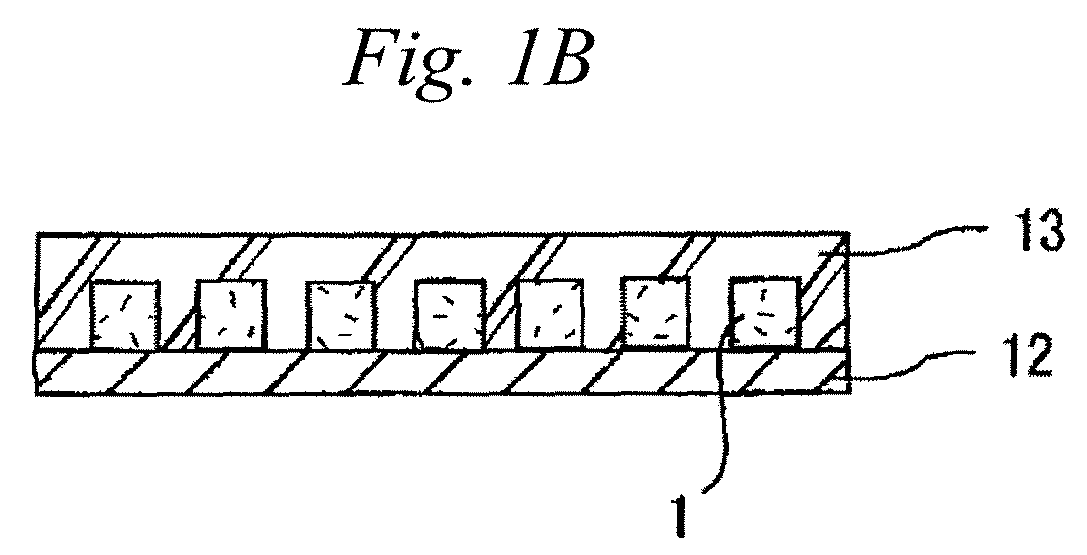
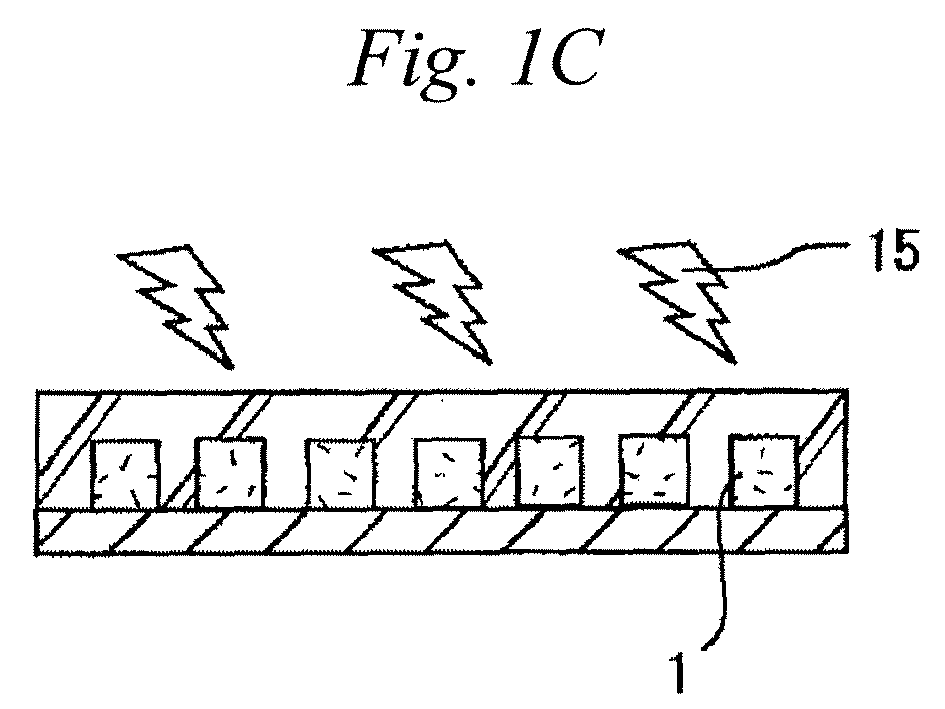
Figs. 1A to 1D are an explanatory view showing the production process of the optical component (optical lens) of the present invention.Fig. 1A shows a state of the ultraviolet-curable transparent resin composition being potted on a substrate,Fig. 1B shows a state of the resin composition being filled into a forming mold by pressing the lens shape-forming mold,Fig. 1C shows a state of an ultraviolet ray being irradiated on the filled resin composition, andFig. 1D shows a state of the optical lens being demolded. -
Fig. 2 is a cross-sectional view showing an optical component (optical lens) obtained by the production method illustrated in the production process above. -
- 11
- Optical lens
- 12
- Substrate
- Embodiments of the present invention are described in detail bellow.
- The resin composition for optical components of the present invention is an ultraviolet-curable transparent resin composition for an optical component material and includes the following components (A) to (C) in a specific ratio; and the production method of an optical lens of the present invention includes, as described above, filling an ultraviolet-curable transparent resin composition including: the following components (A) to (C) in a specific ratio into a lens shape-forming mold; irradiating the resin composition with an ultraviolet ray to cure the resin composition into a lens shape; and heat-treating the produced cured product as it is or after removal from the forming mold:
- (A) an epoxy resin having two or more epoxy groups in one molecule thereof,
- (B) an oxetane compound having one or more oxetanyl groups in one molecule thereof, and
- (C) a photo-acid generator.
- A compound having two or more epoxy groups in one molecule thereof is used for the (A) epoxy resin, and examples thereof include 1,5-hexadiene diepoxide, 1,7-octadiene diepoxide, 1,9-decadiene diepoxide, bisphenol A-type epoxy resin, bisphenol F-type epoxy resin, hydrogenated bisphenol A-type epoxy resin, hydrogenated bisphenol F-type epoxy resin, naphthalene-type epoxy resin, fluorene-type epoxy resin, bisphenol S-type epoxy resin, an alicyclic epoxy resin [e.g., 3,4-epoxycyclohexylmethyl-3,4-epoxycyclohexane carboxylate, 1,2-epoxy-4-(2-oxylanyl)cyclohexane adduct of 2,2-bis(hydroxymethyl)-1-butanol], an epoxy resin where hydrogen of such an epoxy resin is partially substituted by a tert-butyl group, a trifluoromethyl group or a fluorine, and a perfluoroepoxy resin of perfluorinated type. These compounds are used alone or in combination thereof. Above all, in view of curability and flowability, 3,4-epoxycyclohexylmethyl-3,4-epoxycyclohexane carboxylate is preferably used in combination with various epoxy resins above.
- A compound having one or more oxetanyl groups in one molecule thereof is used for the (B) oxetane compound, and examples thereof include 1,4-bis{[(3-ethyl-3-oxetanyl)methoxy]methyl}benzene, di[2-(3-oxetanyl)butyl]ether, 3-ethyl-3-phenoxymethyloxetane, 3-ethyl-3-hydroxymethyloxetane, 1,4-bis[(3-ethyloxetan-3-yl)methoxy]benzene, 1,3-bis[(3-ethyloxetan-3-yl)methoxy]benzene, 1,2-bis[(3-ethyloxetan-3-yl)methoxy]benzene, 4,4'-bis[(3-ethyloxetan-3-yl)methoxy]biphenyl, 2,2'-bis[(3-ethyl-3-oxetanyl)methoxy]biphenyl, 3,3',5,5'-tetramethyl[4,4'-bis(3-ethyloxetan-3-yl)methoxy]biphenyl, 2,7-bis[(3-ethyloxetan-3-yl)methoxy]naphthalene, 1,6-bis[(3-ethyloxetan-3-yl)methoxy]-2,2,3,3,4,4,5,5-octafluorohexane, 3(4),8(9)-bis[(1-ethyl-3-oxetanyl)methoxymethyl]-tricyclo[5.2.1.2.6]decane, 1,2-bis{[2-(1-ethyl-3-oxetanyl)methoxy]ethylthio}ethane, 4,4'-bis[(1-ethyl-3-oxetanyl)methyl]thiodibenzene thioether, 2,3-bis[(3-ethyloxetan-3-yl)methoxymethyl]norbornane, 2-ethyl-2-[(3-ethyloxetan-3-yl)methoxymethyl]-1,3-O-bis[(1-ethyl-3-oxetanyl)methyl]-propane-1,3-diol, 2,2-dimethyl-1,3-O-bis[(3-ethyloxetan-3-yl)methyl]-propane-1,3-diol, 2-butyl-2-ethyl-1,3-O-bis[(3-ethyloxetan-3-yl)methyl]-propane-1,3-diol, 1,4-O-bis[(3-ethyloxetan-3-yl)methyl]-butane-1,4-diol and 2,4,6-O-tris[(3-ethyloxetan-3-yl)methyl]cyanuric acid. These compounds are used alone or in combination thereof.
- In view of curability and adhesive property, the blended amount of the (B) oxetane compound is preferably 5 to 50 wt%, more preferably 10 to 40 wt%, based on the total weight of the components (A) and (B).
- As for the (C) photo-acid generator used in combination with the components (A) and (B), a compound capable of generating a cation-polymerizable acid upon irradiation with an ultraviolet ray is used. Examples of such a photo-acid generator include an onium salt including an anion component represented by SbF6 -, PF6 -, BF4 -, AsF6 -, (C6F5)4 -, or the following formula (1) and a cation component:

in which n is an integer of 1 to 5, and X is a fluorinated alkyl group having a carbon number of 1 to 9 or a fluorinated phenyl group. - Examples of the onium salt having the above-described anion component include a diazonium salt, a sulfonium salt, an iodonium salt, a selenium salt, a pyridinium salt, a ferrocenium salt and a phosphonium salt. These salts are used alone or in combination thereof. In view of curability and transparency, an onium salt having SbF6 - as the anion component is preferred. Also, in view of smaller environmental load as well as curability and transparency, an onium salt having an anion component represented by formula (1) is more preferred. The anion component represented by formula (1) is preferably PF4(CF2CF3)2 -. In view of anion production rate, an aromatic sulfonium salt is preferred, and a triarylsulfonium salt is more preferred.
- From the standpoint of coloration resistance as well as curability and adhesive property, the blended amount of the (C) photo-acid generator is preferably 0.01 to 2.0 parts by weight (hereinafter simply referred to as "parts") based on 100 parts of the total weight of the components (A) and (B). In particular, the upper limit of the amount of the component (C) is preferably 1.0 part, more preferably 0.5 parts, still more preferably 0.4 parts, and the lower limit of the amount of the component (C) is preferably 0.02 parts, more preferably 0.05 parts, still more preferably 0.1 part.
- Incidentally, in the resin composition for optical components of the present invention, in addition to these components, a photosensitizer having anthracene, phenanthrene, carbazole, naphthalene or the like, a silane-based or titanium-based adhesion promoter, a flexibility imparting agent such as synthetic rubber or polyorganosiloxane, an antioxidant, a defoaming agent, a hydrocarbon-based wax, an inorganic filler and the like may be appropriately blended, according to the necessity.
- The resin composition prepared by mixing the above-described components in a predetermined ratio is formed into a sheet or filled in a forming mold and then cured by ultraviolet irradiation, whereby the optical component of the present invention can be obtained. Incidentally, a heat treatment may be performed according to the necessity, after the ultraviolet irradiation. Above all, the optical lens of the present invention can be obtained by mixing the components above in a predetermined ratio, filling the resulting ultraviolet-curable transparent composition into a lens shape-forming mold, irradiating an ultraviolet ray on the resin composition to cure the resin composition into a lens shape, and then heat-treating the cured product. As described above, following the ultraviolet irradiation, this heat treatment may be performed before or after demolding the cured product of the resin composition from the forming mold.
- For example, in the case of producing an optical lens, this is specifically performed as follows. That is, as shown in
Fig. 1A , theresin composition 1 is potted (resin potting) on asubstrate 12, and a lens shape-formingmold 13 is pressed thereon, whereby as shown inFig. 1B , theresin composition 1 is filled into the formingmold 13. Thereafter, as shown inFig. 1C , theresin composition 1 is cured by irradiating anultraviolet ray 15 thereon through the formingmold 13 and then, as shown inFig. 1D , the cured product 11' is demolded and appropriately heat-treated, whereby anoptical lens 11 shown inFig. 2 is obtained. Incidentally, following the ultraviolet irradiation, the heat treatment may be performed before or after demolding the cured product of the resin composition from the forming mold. Theoptical lens 11 can be produced as a high-quality hybrid lens by integrating it with the substrate 12 (thesubstrate 12 is appropriately cut to match the size of the optical lens 11). Also, in the case of using theoptical lens 11 by removing it from thesubstrate 12, a release sheet is used for thesubstrate 12. - As the lens shape-forming
mold 13, for example, a metal-made, glass-made or plastic-made mold may be used. However, as shown inFigs. 1A to 1D , in the case of curing theresin composition 1 by ultraviolet irradiation through the lens shape-formingmold 13, a glass-made or transparent resin-made ultraviolet-transmitting shape-forming mold is used. Above all, in view of productivity and durability, a glass-made or transparent silicone resin-made shape-forming mold is preferred. - Also, as shown in
Figs. 1A to 1D , in the case of using asubstrate 12, the material therefor is preferably a transparent material having high heat resistant because of its adaptability to ultraviolet irradiation (ultraviolet transmittance) or heat treatment. In the case where thesubstrate 12 has transparency, ultraviolet irradiation on the resin composition can be performed not only through the formingmold 13 but also through thesubstrate 12, and this leads to an increase in the latitude of ultraviolet irradiation. Furthermore, in the case where thesubstrate 12 is composed of, for example, various glass materials such as quartz glass, Pyrex (registered trademark) glass and BK-7 (produced by SCHOTT GLAS) or a plastic material that is transparent and is not softened at the reflow temperature (around 260°C) (e.g., polyimide resin, silicone resin), thesubstrate 12 exhibits high adherence to theresin composition 1 and is free from discoloration or deformation due to heat during solder reflow. Therefore, the optical lens can be produced as a high-quality hybrid lens by integrating thesubstrate 12 with the cured product (optical lens 11) of theresin composition 1. On the other hand, in the case where the cured product (optical lens 11) obtained by curing theresin composition 1 on thesubstrate 12 is removed from thesubstrate 12 and used as an optical lens, in view of transparency or the like, a release sheet such as PET film, PP film, PTFE film or ETFE film is suitably used as thesubstrate 12. - A mercury lamp can be used as the light source for the ultraviolet irradiation, and the irradiation may be appropriately selected according to the intended thickness of the optical lens. For example, a molded product (optical lens) of 300 µm in thickness is preferably irradiated at an irradiation energy of 2,000 to 20,000 mJ/cm2, more preferably 3,000 to 15,000 mJ/cm2, from the standpoint of successfully performing its ultraviolet curing. If the ultraviolet irradiation energy is less than this range, the cured product (optical lens 11) of the
resin composition 1 may be separated from thesubstrate 12 at the removal of the shape-forming mold after ultraviolet irradiation and integrated with the formingmold 13, whereas if the ultraviolet irradiation energy exceeds the range above, ultraviolet deterioration may occur in the cured product (optical lens 11) of theresin composition 1 to cause serious coloration by a subsequent heat treatment. - A heat treatment is preferably performed after the ultraviolet irradiation, because the glass transition temperature of the cured product as determined by the dynamic viscoelasticity measurement can reach the desired glass transition temperature. As for the conditions of the heat treatment, in view of productivity, the heat treatment is preferably performed at 80 to 150°C for 1 to 5 hours. The upper limit of the heating temperature is more preferably 130°C, still more preferably 120°C. On the other hand, the lower limit of the heating temperature is more preferably 120°C. The heating time is more preferably from 1 to 3 hours, still more preferably about 1 hour. Whether the heat treatment is successfully performed or not can be confirmed by the curved state in the temperature region of 25 to 260°C in a curve line (plotting) of tan δ obtained by measuring the storage modulus and loss modulus of the molded product after heat treatment. That is, when a specimen is repeatedly measured two times and fluctuation in the rising temperature of tan δ is within 10°C, it may be considered that fluctuation in the glass transition temperature due to heating at the measurement is not generated, and it can be judged that a sufficiently cured state is achieved by the heat treatment before the measurement.
- The optical lens is, for example, as shown in
Fig. 2 , the cured product (optical lens 11) of the ultraviolet-curable transparent composition on thesubstrate 12, which is formed in an arbitrary three-dimensional shape such as columnar, cylindrical, semispherical, pyramidal or Fresnel structure. As described above, according to the material of thesubstrate 12, a hybrid lens may be produced by integrating the substrate with the resin cured product (optical lens 11), or the resin cured product per se may be used as the optical lens by removing the resin cured product (optical lens 11) from thesubstrate 12. Incidentally, the surface of the optical lens is coated with an antireflection coat material, according to the necessity. - The glass transition temperature of the optical component (resin cured product) of the present invention including the above-described optical lens is, in view of temperature cyclability and heat resistance, preferably 100°C or more, more preferably 120°C or more. If the glass transition temperature is less than 100°C, the amount of thermal contraction due to temperature cycle is increased and mismatch of the thermal expansion coefficient with the antireflection coat material may cause separation or cracking of the antireflection coat material.
- The optical component of the present invention is not discolored or deformed even by the heat during solder reflow and assured of stable mechanical properties and therefore, is advantageously usable when mounting an imaging device en bloc by solder reflow.
- Examples and Comparative Examples are described below, but the present invention is not limited to these Examples.
- Production of Ultraviolet-Curable Transparent Resin Composition and Evaluation of Transparency and Glass Transition Temperature Thereof
- The following epoxy resins, oxetane compounds and photo-acid generators were prepared.
- Epoxy Resin:
- (a) Liquid bisphenol A-type epoxy resin ("EPIKOTE 827" trade name, produced by Japan Epoxy Resins Co., Ltd.)
- (b) Liquid alicyclic epoxy resin ("CELLOXIDE 2021P", trade name, produced by Daicel Chemical Industries, Ltd.)
- (c) Fluorene-type epoxy resin ("ONCOAT EX-1040", trade name, produced by Nagase & Co., Ltd.)
-
- (a) 3-Ethyl-3-phenoxymethyloxetane ("ARON OXETANE OXT-211", trade name, produced by Toagosei Co., Ltd.)
- (b) Bis(3-ethyl-3-oxetanylmethyl)ether ("ARON OXETANE OXT-221 ", trade name, produced by Toagosei Co., Ltd.)
- (c) 3-Ethyl-3-hydroxymethyloxetane "ARON OXETANE OXT-101 ", trade name, produced by Toagosei Co., Ltd.)
-
- (a) A 50 wt% propylene carbonate solution of triarylsulfonium salt of tetra(pentafluoroethyl)difluorophosphoric acid ("CPI-200K", trade name, produced by SAN-APRO Ltd.)
- (b) A 50 wt% propylene carbonate solution of triarylsulfonium salt of hexafluorophosphoric acid ("CPI-101P", trade name, produced by SAN-APRO Ltd.)
- Respective components of the epoxy resin and oxetane compound above were blended in a ratio shown in Table 1 below, then heat-melted according to the necessity, and melt-mixed. Subsequently, the photo-acid generator above was blended in a ratio shown in Table 1 below, and the mixture was stirred at a rotation number of 300 rpm for 10 minutes at 50°C to obtain a resin composition (ultraviolet-curable transparent resin composition).
- The thus-obtained resin compositions were evaluated for various properties according to the following criteria. The results obtained are shown together in Table 1 below.
- Each resin composition was film-formed on a silicone release-treated PET film (DIAFOIL MRA-50, produced by Mitsubishi Polyester Film Corp.) to a thickness of 600 µm, and the film was irradiated with an ultraviolet ray (amount of ultraviolet ray: 8,000 mJ/cm2) to effect primary curing and then heat-cured at 100°C for 1 hour to obtain a molded product. Furthermore, the molded product was reflowed at 260°C for 10 seconds. The resin cured product after the ultraviolet (UV) irradiation, heat curing and reflow was cut into a specimen of 20 mm in width and 30 mm in length and measured for the yellow index value (Y.I. value) in a transmission mode by a color computer (SM-T, manufactured by Suga Test Instruments Co., Ltd.).
- Each resin composition was film-formed on a silicone release-treated PET film ("DIAFOIL MRA-50", produced by Mitsubishi Polyester Film Corp.) to a thickness of 600 µm, and the film was irradiated with an ultraviolet ray (amount of ultraviolet ray: 8,000 mJ/cm2) to effect primary curing and then heat-cured at 100°C for 1 hour to obtain a molded product. This molded product was cut into a specimen of 5 mm in width and 35 mm in length, and a tan δ curve based on the storage modulus and loss modulus measured by a dynamic viscoelasticity meter (RS-II, manufactured by Rheometrics) at a frequency of 1 Hz in a temperature range of RT (25°C) to 260°C, was obtained. The peak value of the obtained tan δ curve was defined as the glass transition temperature (Tg). When Tg was 100°C or more, this was rated "Good".
Table 1 Example Comparative Example 1 2 3 4 5 6 7 8 1 2 Epoxy resin a - - - - - - 40 40 - - b 35 35 35 35 35 35 40 40 35 35 c 35 35 35 35 35 35 - - 35 35 Oxetane a 30 30 30 30 30 - 20 - 30 30 b - - - - - - - 20 - - c - - - - - 30 - - - - Photo-acid generator a 0.1 0.2 0.3 0.4 0.5 0.1 0.1 0.1 1.0 - b - - - - - - - - - 6.0 Transparency After UV irradiation (Y.I. value) 2.6 3.0 3.6 4.2 4.6 2.6 2.8 2.8 7.2 6.3 After heat-curing (Y.I. value) 2.9 3.2 4.1 5.8 9.8 2.7 3.1 2.9 22 2.5 After reflow (Y.I. value) 4.7 16 53 81 98 4.9 4.2 5.1 126 6.7 Glass transition temperature (C°) 116 120 123 136 145 128 126 143 146 93 (Unit: parts by weight) - As seen from the results above, in Examples 1 to 8, a resin composition assured of a low Y.I. value and high transparency even after ultraviolet irradiation or heat-curing is obtained and the molded product after heat treatment in all of these Examples has a glass transition temperature of 100°C or more.
- On the other hand, in Comparative Example 1 where the amount of the photo-acid generator is excess, the Y.I. value is low at the initial stage (after UV irradiation) but after heat-curing or reflow, the Y.I. value becomes high and poor transparency results. In Comparative Example 2, a resin molded product having a low Y.I. value (high transparency) is obtained, but the glass transition temperature is less than 100°C and only a molded product having a low glass transition temperature is obtained. Incidentally, when the resin composition of Example 1 was prepared by changing the amount of the photo-acid generator to be less than 0.01 g and the same sample as in Example 1 was produced, the curing was insufficient and a desired hardness could not be obtained.
- These results reveal that the ultraviolet-curable transparent resin composition of the present invention has high transparency and high heat resistance reliability and therefore, is excellent as a material of an optical component. Additionally, the optical component using this resin composition is free from discoloration or deformation even under heat during solder reflow and assured of stable mechanical properties and therefore, can be advantageously used when mounting an imaging device en bloc by solder reflow.
- Production of Optical Lens and Evaluation of Dynamic Viscoelasticity and Colorability Thereof
- Resin Compositions (1) to (4) were prepared as follows.
- Resin Composition (1) was prepared by adding 35 g of bisphenol A-type epoxy resin (EPIKOTE 827, produced by Japan Epoxy Resins Co., Ltd.), 35 g of alicyclic epoxy resin (CEL-2021P, produced by Daicel Chemical Industries, Ltd.), 30 g of oxetane compound (ARON OXETANE OXT-211, produced by Toagosei Co., Ltd.) and 4 g of a polycarbonate solution of photo-acid generator (CPI-100P, produced by SAN-APRO Ltd.) (in the solution, the amount of the photoacid generator was 2 g) and mixing these components with stirring at 50°C for 10 minutes.
- Resin Composition (2) was prepared by adding 35 g of bisphenol A-type epoxy resin (EPIKOTE 827, produced by Japan Epoxy Resins Co., Ltd.), 35 g of alicyclic epoxy resin (CEL-2021P, produced by Daicel Chemical Industries, Ltd.), 30 g of oxetane compound (ARON OXETANE OXT-211, produced by Toagosei Co., Ltd.) and 1 g of a polycarbonate solution of photo-acid generator (CPI-101A, produced by SAN-APRO Ltd.) (in the solution, the amount of the photoacid generator was 0.5 g) and mixing these components with stirring at 50°C for 10 minutes.
- Resin Composition (3) was prepared by adding 35 g of bisphenol A-type epoxy resin (EPIKOTE 827, produced by Japan Epoxy Resins Co., Ltd.), 35 g of alicyclic epoxy resin (CEL-2021P, produced by Daicel Chemical Industries, Ltd.), 30 g of oxetane compound (ARON OXETANE OXT-211, produced by Toagosei Co., Ltd.) and 0.6 g of a polycarbonate solution of photo-acid generator (CPI-101A, produced by SAN-APRO Ltd.) (in the solution, the amount of the photoacid generator was 0.3 g) and mixing these components with stirring at 50°C for 10 minutes.
- Resin Composition (4) was prepared by adding 35 g of bisphenol A-type epoxy resin (EPIKOTE 827, produced by Japan Epoxy Resins Co., Ltd.), 35 g of alicyclic epoxy resin (CEL-2021P, produced by Daicel Chemical Industries, Ltd.), 30 g of oxetane compound (ARON OXETANE OXT-211, produced by Toagosei Co., Ltd.) and 6 g of a polycarbonate solution of photo-acid generator (CPI-101A, produced by SAN-APRO Ltd.) (in the solution, the amount of the photoacid generator was 3 g) and mixing these components with stirring at 50°C for 10 minutes.
- Each resin composition was potted (resin potting) on a silicone release-treated PET film (DIAFOIL MRA-50, produced by Mitsubishi Polyester Film Corp.), and a glass-made lens shape-forming mold was pressed thereon to fill the resin composition into the forming mold. Thereafter, an ultraviolet ray was irradiated on the resin composition through the forming mold under the ultraviolet irradiation condition (irradiation amount) shown in Table 2 below, and the resulting cured product was demolded from the forming mold and then heat-treated under the heat-curing conditions shown in Table 2 below to produce a resin cured product (optical lens) (see,
Figs. 1A to 1D ). - The thus-obtained resin cured products (optical lens) were evaluated for various properties according to the following criteria. The results obtained are shown together in Table 2 below.
- Each resin cured product was cut into a specimen of 5 mm in width and 35 mm in length and measured for the storage modulus and loss modulus by a dynamic viscoelasticity meter (RS-II, manufactured by Rheometrics) at a frequency of 1 Hz in a temperature range of RT (25°C) to 260°C. This measurement was repeated two times and the values of tan δ obtained were plotted to prepare a curve line of tan δ.
Subsequently, a tangential line was drawn on the tan δ curve before and after the rising temperature, and the point at which these tangential lines were crossing was defined as the rising temperature of the tan δ curve in the range of RT to 260°C. Furthermore, ΔT was calculated by subtracting the rising temperature (Ts1) obtained in the first measurement from the rising temperature (Ts2) obtained in the second measurement.
The heat-curing conditions giving ΔT<10°C was rated "Good", and the heat-curing conditions giving ΔT≥10°C was rated "Poor". - The resin cured product was cut into a specimen of 20 mm in width and 30 mm in length and measured for the yellow index value in a transmission mode by a color computer (SM-T, manufactured by Suga Test Instruments Co., Ltd.). When the value obtained was less than 10, the specimen was rated "Good", and when 10 or more, this was rated "Poor".
Table 2 Example Comparative Example 9 10 11 12 13 3 4 Kind of resin composition (1) (2) (2) (2) (3) (4) (2) Ultraviolet irradiation dose (mJ/cm2) 4000 4000 8000 8000 8000 16000 8000 Heat-curing conditions 100°C× 1 hr 100°C× 1 hr 100°C× 1 hr 80° Cx 1 hr100°C× 1 hr 100°C× 1 hr - Dynamic Viscoelasticity ΔT (°C) 3 5 4 4 5 3 36 Rating Good Good Good Good Good Good Poor Colorability Yellow index value 3.8 6.8 7.2 6.4 4.7 17 3.8 Rating Good Good Good Good Good Poor Good - As seen from the results above, in Examples 9 to 13, the fluctuation of the rising temperature of the tan δ curve obtained by the dynamic viscoelasticity measurement after heat curing was less than 10°C even after repeating the measurement two times, and it was confirmed that the molded product obtained under each curing conditions reached a sufficiently crosslinked state and a cured product small in the characteristic fluctuation due to heat was obtained. Also, in all specimens, the yellow index value after heat-curing was confirmed to be less than 10.
- On the other hand, in Comparative Example 3 where the amount of the photo-acid generator was excess, poor coloration resistance resulted. In Comparative Example 4, the yellow index value after curing was low, but since the rising temperature of the tan δ curve obtained by the dynamic viscoelasticity measurement fluctuated by 10°C or more after repeating the measurement two times, it was confirmed that the molded product obtained only by ultraviolet curing failed in reaching a stable crosslinked state. Incidentally, when Resin Composition (1) used in Example 9 was prepared by changing the amount of the photo-acid generator to be less than 0.05 g and the same sample as in Example 9 was produced, the curing was insufficient and a desired hardness could not be obtained.
- These results reveal that according to the production method of an optical lens of the present invention, a plastic-made optical lens having mechanical and optical properties stable to the heat stress and being excellent in the transparency can be provided. By this production method, simplification and cost reduction in the step of mounting an imaging device can be achieved without impairing the optical properties of the optical lens. The optical lens of the present invention can greatly contribute to quality enhancement when this production method is employed.
- While the invention has been described in detail and with reference to specific embodiments thereof, it will be apparent to one skilled in the art that various changes and modifications can be made therein without departing from the spirit and scope thereof.
- This application is based on Japanese Patent Applications (Patent Application Nos.
2008-142150 2008-142151 - All references cited herein are incorporated by reference herein in their entirety.
Claims (9)
- A resin composition for optical components, which is an ultraviolet-curable transparent resin composition used as a material for an optical component,
wherein said resin composition comprises the following components (A) to (C):(A) an epoxy resin having two or more epoxy groups in one molecule thereof;(B) an oxetane compound having one or more oxetanyl groups in one molecule thereof; and(C) a photo-acid generator;
and wherein the component (C) is contained in an amount of 0.01 to 2.0 parts by weight based on 100 parts by weight of a total amount of the components (A) and (B). - The resin composition for optical components according to claim 1, wherein the (C) photo-acid generator is an onium salt comprising an anion component represented by the following formula (1) and a cation component:

wherein n is an integer of 1 to 5, and X is a fluorinated alkyl group having a carbon number of 1 to 9 or a fluorinated phenyl group. - The resin composition for optical components according to claim 2, wherein the amount of the (C) photo-acid generator is 0.01 to 0.5 parts by weight based on 100 parts by weight of the total amount of the components (A) and (B).
- An optical component obtained by using the resin composition for optical components according to any one of claims 1 to 3.
- The optical component according to claim 4, which is an optical lens.
- A method for producing an optical lens, said method comprising:filling the resin composition for optical components according to any one of claims 1 to 3 into a lens shape-forming mold;irradiating the resin composition in said forming mold with an ultraviolet ray to cure the resin composition into a lens shape, thereby obtaining a cured product; andsubjecting the cured product to a heat treatment.
- The method for producing an optical lens according to claim 6, which comprises: potting the resin composition for optical components on a transparent substrate; and pressing the lens shape-forming mold thereon to fill the resin composition into the forming mold.
- The method for producing an optical lens according to claim 6 or 7, wherein said heat treatment is performed at 80 to 150°C for 1 to 5 hours.
- An optical lens obtained by the method according to any one of claims 6 to 8.
Applications Claiming Priority (2)
| Application Number | Priority Date | Filing Date | Title |
|---|---|---|---|
| JP2008142150A JP2009288598A (en) | 2008-05-30 | 2008-05-30 | Manufacturing method of optical lens and optical lens obtained thereby |
| JP2008142151A JP5070131B2 (en) | 2008-05-30 | 2008-05-30 | Resin composition for optical parts and optical part using the same |
Publications (2)
| Publication Number | Publication Date |
|---|---|
| EP2128183A1 true EP2128183A1 (en) | 2009-12-02 |
| EP2128183B1 EP2128183B1 (en) | 2011-04-13 |
Family
ID=41111354
Family Applications (1)
| Application Number | Title | Priority Date | Filing Date |
|---|---|---|---|
| EP09161480A Active EP2128183B1 (en) | 2008-05-30 | 2009-05-29 | Resin composition for optical components, optical component using the same and production method of optical lens |
Country Status (7)
| Country | Link |
|---|---|
| US (1) | US8304470B2 (en) |
| EP (1) | EP2128183B1 (en) |
| KR (1) | KR20090124998A (en) |
| CN (1) | CN101691440B (en) |
| AT (1) | ATE505499T1 (en) |
| DE (1) | DE602009001047D1 (en) |
| TW (1) | TWI427117B (en) |
Cited By (4)
| Publication number | Priority date | Publication date | Assignee | Title |
|---|---|---|---|---|
| EP2258741A1 (en) * | 2009-05-13 | 2010-12-08 | Nitto Denko Corporation | Resin composition for optical components and optical component using the same |
| EP2144288A3 (en) * | 2008-06-17 | 2012-06-20 | Nitto Denko Corporation | Process for producing optical component |
| US20180196167A1 (en) * | 2015-08-20 | 2018-07-12 | Daicel Corporation | Optical component and optical device equipped with same |
| US12600888B2 (en) | 2020-03-23 | 2026-04-14 | Henkel Ag & Co. Kgaa | Dual-curable adhesive composition |
Families Citing this family (12)
| Publication number | Priority date | Publication date | Assignee | Title |
|---|---|---|---|---|
| EP1443344A1 (en) * | 2003-01-29 | 2004-08-04 | Heptagon Oy | Manufacturing micro-structured elements |
| JP5634398B2 (en) * | 2009-06-01 | 2014-12-03 | 株式会社ツジデン | Fingerprint-disappearing cured film, method for producing the same, display using the same, touch panel, and electronic device using the same |
| JP5430345B2 (en) | 2009-10-26 | 2014-02-26 | Jsr株式会社 | Radiation curable liquid resin composition for optical three-dimensional modeling and three-dimensional modeling obtained by photocuring the same |
| JP5415371B2 (en) | 2010-07-12 | 2014-02-12 | 日東電工株式会社 | Photocurable resin composition for optical lens and optical lens using the same |
| JP5415370B2 (en) | 2010-07-12 | 2014-02-12 | 日東電工株式会社 | Photo-curable resin composition and optical component using the same |
| CN103358572A (en) * | 2012-03-31 | 2013-10-23 | 全球微型光学有限公司 | Method for manufacturing optical lens |
| JP2014224205A (en) * | 2013-05-17 | 2014-12-04 | 日東電工株式会社 | Photocurable resin composition for optical component, optical component using the same and method for producing optical component |
| KR20170056617A (en) * | 2014-09-17 | 2017-05-23 | 주식회사 다이셀 | Curable composition and optical element obtained using same |
| KR102048082B1 (en) * | 2018-01-15 | 2019-11-22 | 쓰리디아이즈 주식회사 | Microlens array and method of forming the same |
| CN108485184B (en) * | 2018-02-11 | 2020-11-24 | 东莞爱的合成材料科技有限公司 | A kind of high temperature resistant transparent photosensitive resin which can be used in clinical medicine and preparation method thereof |
| US11691363B2 (en) * | 2020-03-20 | 2023-07-04 | Steris Instrument Management Services, Inc. | Method of forming and incorporating a polymeric lens within a lens housing |
| CN111830733B (en) * | 2020-07-22 | 2022-02-11 | 浙江伟星光学有限公司 | A kind of epoxy resin preparation coating color-changing spectacle lens |
Citations (7)
| Publication number | Priority date | Publication date | Assignee | Title |
|---|---|---|---|---|
| US20020161068A1 (en) * | 2000-04-28 | 2002-10-31 | Takeo Watanabe | Polymerizable composition, cured material thereof and method for manufacturing the same |
| KR20030010527A (en) * | 2001-07-27 | 2003-02-05 | 스미또모 가가꾸 고교 가부시끼가이샤 | Coloured photosensitive resin compositions |
| JP2003177260A (en) * | 2001-12-13 | 2003-06-27 | Showa Denko Kk | Composition for optical waveguide resin |
| JP3926380B1 (en) * | 2006-12-07 | 2007-06-06 | マイルストーン株式会社 | Imaging lens |
| JP2008038114A (en) * | 2006-08-10 | 2008-02-21 | Asahi Kasei Chemicals Corp | Photosensitive composition |
| JP2008142150A (en) | 2006-12-07 | 2008-06-26 | Matsushita Electric Ind Co Ltd | Medical terminal and medical terminal control method |
| JP2008142151A (en) | 2006-12-07 | 2008-06-26 | Matsushita Electric Ind Co Ltd | Ultrasonic diagnostic apparatus and ultrasonic diagnostic system |
Family Cites Families (9)
| Publication number | Priority date | Publication date | Assignee | Title |
|---|---|---|---|---|
| JP3671658B2 (en) | 1998-02-27 | 2005-07-13 | 東亞合成株式会社 | Active energy ray-curable composition for sheet-like optical articles |
| US20060009562A1 (en) * | 2002-10-11 | 2006-01-12 | Hiroshi Sasaki | Cationically polymerizable composition containing metal oxide partricles |
| JP2005338780A (en) | 2004-04-28 | 2005-12-08 | Omron Corp | Micro-lense |
| CN1704417A (en) | 2004-05-26 | 2005-12-07 | 杭州民生药业集团有限公司 | Novel curcumenol derivatives |
| WO2005116038A1 (en) * | 2004-05-28 | 2005-12-08 | San-Apro Limited | Novel fluorinated alkylfluorophosphoric acid salt of onium and transition metal complex |
| JP2006251017A (en) | 2005-03-08 | 2006-09-21 | Seiko Epson Corp | Hybrid lens and manufacturing method thereof |
| JP2007070324A (en) | 2005-09-09 | 2007-03-22 | Nitto Denko Corp | Bisoxetane ether compound having fluorene structure, process for producing the same, and optical waveguide using the same |
| JP2008180533A (en) | 2007-01-23 | 2008-08-07 | Shimadzu Corp | Specific gravity measurement kit and specific gravity measurement device |
| JP5007280B2 (en) * | 2008-07-10 | 2012-08-22 | 日東電工株式会社 | Method for producing optical waveguide for touch panel and optical waveguide for touch panel obtained thereby |
-
2009
- 2009-05-27 TW TW098117826A patent/TWI427117B/en active
- 2009-05-29 AT AT09161480T patent/ATE505499T1/en not_active IP Right Cessation
- 2009-05-29 US US12/474,416 patent/US8304470B2/en not_active Expired - Fee Related
- 2009-05-29 EP EP09161480A patent/EP2128183B1/en active Active
- 2009-05-29 KR KR1020090047458A patent/KR20090124998A/en not_active Ceased
- 2009-05-29 DE DE602009001047T patent/DE602009001047D1/en active Active
- 2009-05-31 CN CN2009101426142A patent/CN101691440B/en active Active
Patent Citations (7)
| Publication number | Priority date | Publication date | Assignee | Title |
|---|---|---|---|---|
| US20020161068A1 (en) * | 2000-04-28 | 2002-10-31 | Takeo Watanabe | Polymerizable composition, cured material thereof and method for manufacturing the same |
| KR20030010527A (en) * | 2001-07-27 | 2003-02-05 | 스미또모 가가꾸 고교 가부시끼가이샤 | Coloured photosensitive resin compositions |
| JP2003177260A (en) * | 2001-12-13 | 2003-06-27 | Showa Denko Kk | Composition for optical waveguide resin |
| JP2008038114A (en) * | 2006-08-10 | 2008-02-21 | Asahi Kasei Chemicals Corp | Photosensitive composition |
| JP3926380B1 (en) * | 2006-12-07 | 2007-06-06 | マイルストーン株式会社 | Imaging lens |
| JP2008142150A (en) | 2006-12-07 | 2008-06-26 | Matsushita Electric Ind Co Ltd | Medical terminal and medical terminal control method |
| JP2008142151A (en) | 2006-12-07 | 2008-06-26 | Matsushita Electric Ind Co Ltd | Ultrasonic diagnostic apparatus and ultrasonic diagnostic system |
Non-Patent Citations (4)
| Title |
|---|
| DATABASE CAPLUS [online] CHEMICAL ABSTRACTS SERVICE, COLUMBUS, OHIO, US; 21 February 2008 (2008-02-21), KATO, KENICHI ET AL KATO, KENICHI ET AL: "Quickly curable photosensitive compositions Quickly curable photosensitive compositions", XP002548614, retrieved from STN Database accession no. 2008:217658 * |
| DATABASE WPI Week 200382, Derwent World Patents Index; AN 2003-881806, XP002548615, ICHIKAWA K: "Color sensitive resin composition for manufacturing color filter" * |
| DATABASE WPI Week 200382, Derwent World Patents Index; AN 2003-882304, XP002548616 * |
| DATABASE WPI Week 200754, Derwent World Patents Index; AN 2007-548363, XP002548617 * |
Cited By (4)
| Publication number | Priority date | Publication date | Assignee | Title |
|---|---|---|---|---|
| EP2144288A3 (en) * | 2008-06-17 | 2012-06-20 | Nitto Denko Corporation | Process for producing optical component |
| EP2258741A1 (en) * | 2009-05-13 | 2010-12-08 | Nitto Denko Corporation | Resin composition for optical components and optical component using the same |
| US20180196167A1 (en) * | 2015-08-20 | 2018-07-12 | Daicel Corporation | Optical component and optical device equipped with same |
| US12600888B2 (en) | 2020-03-23 | 2026-04-14 | Henkel Ag & Co. Kgaa | Dual-curable adhesive composition |
Also Published As
| Publication number | Publication date |
|---|---|
| ATE505499T1 (en) | 2011-04-15 |
| KR20090124998A (en) | 2009-12-03 |
| CN101691440B (en) | 2013-02-27 |
| TW201009010A (en) | 2010-03-01 |
| DE602009001047D1 (en) | 2011-05-26 |
| CN101691440A (en) | 2010-04-07 |
| TWI427117B (en) | 2014-02-21 |
| US8304470B2 (en) | 2012-11-06 |
| EP2128183B1 (en) | 2011-04-13 |
| US20090295003A1 (en) | 2009-12-03 |
Similar Documents
| Publication | Publication Date | Title |
|---|---|---|
| EP2128183B1 (en) | Resin composition for optical components, optical component using the same and production method of optical lens | |
| EP2258741A1 (en) | Resin composition for optical components and optical component using the same | |
| EP2998336A1 (en) | Photo-curable resin composition for optical components, optical component using same, and optical component production method | |
| JP5070131B2 (en) | Resin composition for optical parts and optical part using the same | |
| KR20200019760A (en) | Fresnel lens, and manufacturing method thereof | |
| EP2264081B1 (en) | Photocurable resin composition and optical component using the same | |
| US8575227B2 (en) | Photocurable resin composition and optical component using the same | |
| US8557891B2 (en) | Photocurable resin composition and optical component using the same | |
| JP5184336B2 (en) | Ultraviolet curable resin composition and optical lens obtained using the same | |
| JP2011132487A (en) | Photocurable resin composition and optical component using the same | |
| JP6418672B2 (en) | Resin composition for optical parts and optical part using the same | |
| JP2009288598A (en) | Manufacturing method of optical lens and optical lens obtained thereby | |
| JP2018161798A (en) | Silicone mold | |
| WO2021049443A1 (en) | Ultraviolet curable resin composition, cured product and optical lens | |
| TWI516517B (en) | Photocurable resin composition and optical component using the same |
Legal Events
| Date | Code | Title | Description |
|---|---|---|---|
| PUAI | Public reference made under article 153(3) epc to a published international application that has entered the european phase |
Free format text: ORIGINAL CODE: 0009012 |
|
| AK | Designated contracting states |
Kind code of ref document: A1 Designated state(s): AT BE BG CH CY CZ DE DK EE ES FI FR GB GR HR HU IE IS IT LI LT LU LV MC MK MT NL NO PL PT RO SE SI SK TR |
|
| 17P | Request for examination filed |
Effective date: 20100503 |
|
| GRAP | Despatch of communication of intention to grant a patent |
Free format text: ORIGINAL CODE: EPIDOSNIGR1 |
|
| GRAS | Grant fee paid |
Free format text: ORIGINAL CODE: EPIDOSNIGR3 |
|
| GRAA | (expected) grant |
Free format text: ORIGINAL CODE: 0009210 |
|
| AK | Designated contracting states |
Kind code of ref document: B1 Designated state(s): AT BE BG CH CY CZ DE DK EE ES FI FR GB GR HR HU IE IS IT LI LT LU LV MC MK MT NL NO PL PT RO SE SI SK TR |
|
| REG | Reference to a national code |
Ref country code: GB Ref legal event code: FG4D |
|
| REG | Reference to a national code |
Ref country code: CH Ref legal event code: EP |
|
| REG | Reference to a national code |
Ref country code: IE Ref legal event code: FG4D |
|
| REF | Corresponds to: |
Ref document number: 602009001047 Country of ref document: DE Date of ref document: 20110526 Kind code of ref document: P |
|
| REG | Reference to a national code |
Ref country code: DE Ref legal event code: R096 Ref document number: 602009001047 Country of ref document: DE Effective date: 20110526 |
|
| REG | Reference to a national code |
Ref country code: NL Ref legal event code: VDEP Effective date: 20110413 |
|
| LTIE | Lt: invalidation of european patent or patent extension |
Effective date: 20110413 |
|
| PG25 | Lapsed in a contracting state [announced via postgrant information from national office to epo] |
Ref country code: LT Free format text: LAPSE BECAUSE OF FAILURE TO SUBMIT A TRANSLATION OF THE DESCRIPTION OR TO PAY THE FEE WITHIN THE PRESCRIBED TIME-LIMIT Effective date: 20110413 Ref country code: SE Free format text: LAPSE BECAUSE OF FAILURE TO SUBMIT A TRANSLATION OF THE DESCRIPTION OR TO PAY THE FEE WITHIN THE PRESCRIBED TIME-LIMIT Effective date: 20110413 Ref country code: HR Free format text: LAPSE BECAUSE OF FAILURE TO SUBMIT A TRANSLATION OF THE DESCRIPTION OR TO PAY THE FEE WITHIN THE PRESCRIBED TIME-LIMIT Effective date: 20110413 Ref country code: NO Free format text: LAPSE BECAUSE OF FAILURE TO SUBMIT A TRANSLATION OF THE DESCRIPTION OR TO PAY THE FEE WITHIN THE PRESCRIBED TIME-LIMIT Effective date: 20110713 Ref country code: PT Free format text: LAPSE BECAUSE OF FAILURE TO SUBMIT A TRANSLATION OF THE DESCRIPTION OR TO PAY THE FEE WITHIN THE PRESCRIBED TIME-LIMIT Effective date: 20110816 |
|
| PG25 | Lapsed in a contracting state [announced via postgrant information from national office to epo] |
Ref country code: ES Free format text: LAPSE BECAUSE OF FAILURE TO SUBMIT A TRANSLATION OF THE DESCRIPTION OR TO PAY THE FEE WITHIN THE PRESCRIBED TIME-LIMIT Effective date: 20110724 Ref country code: IS Free format text: LAPSE BECAUSE OF FAILURE TO SUBMIT A TRANSLATION OF THE DESCRIPTION OR TO PAY THE FEE WITHIN THE PRESCRIBED TIME-LIMIT Effective date: 20110813 Ref country code: CY Free format text: LAPSE BECAUSE OF FAILURE TO SUBMIT A TRANSLATION OF THE DESCRIPTION OR TO PAY THE FEE WITHIN THE PRESCRIBED TIME-LIMIT Effective date: 20110413 Ref country code: GR Free format text: LAPSE BECAUSE OF FAILURE TO SUBMIT A TRANSLATION OF THE DESCRIPTION OR TO PAY THE FEE WITHIN THE PRESCRIBED TIME-LIMIT Effective date: 20110714 Ref country code: FI Free format text: LAPSE BECAUSE OF FAILURE TO SUBMIT A TRANSLATION OF THE DESCRIPTION OR TO PAY THE FEE WITHIN THE PRESCRIBED TIME-LIMIT Effective date: 20110413 Ref country code: BE Free format text: LAPSE BECAUSE OF FAILURE TO SUBMIT A TRANSLATION OF THE DESCRIPTION OR TO PAY THE FEE WITHIN THE PRESCRIBED TIME-LIMIT Effective date: 20110413 Ref country code: SI Free format text: LAPSE BECAUSE OF FAILURE TO SUBMIT A TRANSLATION OF THE DESCRIPTION OR TO PAY THE FEE WITHIN THE PRESCRIBED TIME-LIMIT Effective date: 20110413 Ref country code: LV Free format text: LAPSE BECAUSE OF FAILURE TO SUBMIT A TRANSLATION OF THE DESCRIPTION OR TO PAY THE FEE WITHIN THE PRESCRIBED TIME-LIMIT Effective date: 20110413 Ref country code: AT Free format text: LAPSE BECAUSE OF FAILURE TO SUBMIT A TRANSLATION OF THE DESCRIPTION OR TO PAY THE FEE WITHIN THE PRESCRIBED TIME-LIMIT Effective date: 20110413 |
|
| PG25 | Lapsed in a contracting state [announced via postgrant information from national office to epo] |
Ref country code: MC Free format text: LAPSE BECAUSE OF NON-PAYMENT OF DUE FEES Effective date: 20110531 Ref country code: NL Free format text: LAPSE BECAUSE OF FAILURE TO SUBMIT A TRANSLATION OF THE DESCRIPTION OR TO PAY THE FEE WITHIN THE PRESCRIBED TIME-LIMIT Effective date: 20110413 Ref country code: MT Free format text: LAPSE BECAUSE OF FAILURE TO SUBMIT A TRANSLATION OF THE DESCRIPTION OR TO PAY THE FEE WITHIN THE PRESCRIBED TIME-LIMIT Effective date: 20110413 |
|
| PG25 | Lapsed in a contracting state [announced via postgrant information from national office to epo] |
Ref country code: CZ Free format text: LAPSE BECAUSE OF FAILURE TO SUBMIT A TRANSLATION OF THE DESCRIPTION OR TO PAY THE FEE WITHIN THE PRESCRIBED TIME-LIMIT Effective date: 20110413 Ref country code: EE Free format text: LAPSE BECAUSE OF FAILURE TO SUBMIT A TRANSLATION OF THE DESCRIPTION OR TO PAY THE FEE WITHIN THE PRESCRIBED TIME-LIMIT Effective date: 20110413 |
|
| PLBE | No opposition filed within time limit |
Free format text: ORIGINAL CODE: 0009261 |
|
| STAA | Information on the status of an ep patent application or granted ep patent |
Free format text: STATUS: NO OPPOSITION FILED WITHIN TIME LIMIT |
|
| PG25 | Lapsed in a contracting state [announced via postgrant information from national office to epo] |
Ref country code: SK Free format text: LAPSE BECAUSE OF FAILURE TO SUBMIT A TRANSLATION OF THE DESCRIPTION OR TO PAY THE FEE WITHIN THE PRESCRIBED TIME-LIMIT Effective date: 20110413 Ref country code: PL Free format text: LAPSE BECAUSE OF FAILURE TO SUBMIT A TRANSLATION OF THE DESCRIPTION OR TO PAY THE FEE WITHIN THE PRESCRIBED TIME-LIMIT Effective date: 20110413 |
|
| REG | Reference to a national code |
Ref country code: IE Ref legal event code: MM4A |
|
| REG | Reference to a national code |
Ref country code: FR Ref legal event code: ST Effective date: 20120210 |
|
| 26N | No opposition filed |
Effective date: 20120116 |
|
| PG25 | Lapsed in a contracting state [announced via postgrant information from national office to epo] |
Ref country code: FR Free format text: LAPSE BECAUSE OF NON-PAYMENT OF DUE FEES Effective date: 20110614 Ref country code: IE Free format text: LAPSE BECAUSE OF NON-PAYMENT OF DUE FEES Effective date: 20110529 |
|
| REG | Reference to a national code |
Ref country code: DE Ref legal event code: R097 Ref document number: 602009001047 Country of ref document: DE Effective date: 20120116 |
|
| PG25 | Lapsed in a contracting state [announced via postgrant information from national office to epo] |
Ref country code: IT Free format text: LAPSE BECAUSE OF FAILURE TO SUBMIT A TRANSLATION OF THE DESCRIPTION OR TO PAY THE FEE WITHIN THE PRESCRIBED TIME-LIMIT Effective date: 20110413 |
|
| PG25 | Lapsed in a contracting state [announced via postgrant information from national office to epo] |
Ref country code: MK Free format text: LAPSE BECAUSE OF FAILURE TO SUBMIT A TRANSLATION OF THE DESCRIPTION OR TO PAY THE FEE WITHIN THE PRESCRIBED TIME-LIMIT Effective date: 20110413 |
|
| PG25 | Lapsed in a contracting state [announced via postgrant information from national office to epo] |
Ref country code: LU Free format text: LAPSE BECAUSE OF NON-PAYMENT OF DUE FEES Effective date: 20110529 |
|
| PG25 | Lapsed in a contracting state [announced via postgrant information from national office to epo] |
Ref country code: BG Free format text: LAPSE BECAUSE OF FAILURE TO SUBMIT A TRANSLATION OF THE DESCRIPTION OR TO PAY THE FEE WITHIN THE PRESCRIBED TIME-LIMIT Effective date: 20110713 |
|
| PG25 | Lapsed in a contracting state [announced via postgrant information from national office to epo] |
Ref country code: TR Free format text: LAPSE BECAUSE OF FAILURE TO SUBMIT A TRANSLATION OF THE DESCRIPTION OR TO PAY THE FEE WITHIN THE PRESCRIBED TIME-LIMIT Effective date: 20110413 |
|
| PG25 | Lapsed in a contracting state [announced via postgrant information from national office to epo] |
Ref country code: HU Free format text: LAPSE BECAUSE OF FAILURE TO SUBMIT A TRANSLATION OF THE DESCRIPTION OR TO PAY THE FEE WITHIN THE PRESCRIBED TIME-LIMIT Effective date: 20110413 |
|
| REG | Reference to a national code |
Ref country code: CH Ref legal event code: PL |
|
| GBPC | Gb: european patent ceased through non-payment of renewal fee |
Effective date: 20130529 |
|
| PG25 | Lapsed in a contracting state [announced via postgrant information from national office to epo] |
Ref country code: LI Free format text: LAPSE BECAUSE OF NON-PAYMENT OF DUE FEES Effective date: 20130531 Ref country code: CH Free format text: LAPSE BECAUSE OF NON-PAYMENT OF DUE FEES Effective date: 20130531 |
|
| PG25 | Lapsed in a contracting state [announced via postgrant information from national office to epo] |
Ref country code: GB Free format text: LAPSE BECAUSE OF NON-PAYMENT OF DUE FEES Effective date: 20130529 |
|
| PGFP | Annual fee paid to national office [announced via postgrant information from national office to epo] |
Ref country code: DE Payment date: 20160524 Year of fee payment: 8 |
|
| REG | Reference to a national code |
Ref country code: DE Ref legal event code: R119 Ref document number: 602009001047 Country of ref document: DE |
|
| PG25 | Lapsed in a contracting state [announced via postgrant information from national office to epo] |
Ref country code: DE Free format text: LAPSE BECAUSE OF NON-PAYMENT OF DUE FEES Effective date: 20171201 |