EP2125162B1 - Schutzschichten für rcpsa-vorrichtungen (rcpsa - rapid cycle pressure swing adsorption) - Google Patents
Schutzschichten für rcpsa-vorrichtungen (rcpsa - rapid cycle pressure swing adsorption) Download PDFInfo
- Publication number
- EP2125162B1 EP2125162B1 EP20080706294 EP08706294A EP2125162B1 EP 2125162 B1 EP2125162 B1 EP 2125162B1 EP 20080706294 EP20080706294 EP 20080706294 EP 08706294 A EP08706294 A EP 08706294A EP 2125162 B1 EP2125162 B1 EP 2125162B1
- Authority
- EP
- European Patent Office
- Prior art keywords
- sheet
- guard
- adsorbent
- volume
- laminate sheet
- Prior art date
- Legal status (The legal status is an assumption and is not a legal conclusion. Google has not performed a legal analysis and makes no representation as to the accuracy of the status listed.)
- Active
Links
Images


Classifications
-
- B—PERFORMING OPERATIONS; TRANSPORTING
- B01—PHYSICAL OR CHEMICAL PROCESSES OR APPARATUS IN GENERAL
- B01D—SEPARATION
- B01D53/00—Separation of gases or vapours; Recovering vapours of volatile solvents from gases; Chemical or biological purification of waste gases, e.g. engine exhaust gases, smoke, fumes, flue gases, aerosols
- B01D53/02—Separation of gases or vapours; Recovering vapours of volatile solvents from gases; Chemical or biological purification of waste gases, e.g. engine exhaust gases, smoke, fumes, flue gases, aerosols by adsorption, e.g. preparative gas chromatography
- B01D53/04—Separation of gases or vapours; Recovering vapours of volatile solvents from gases; Chemical or biological purification of waste gases, e.g. engine exhaust gases, smoke, fumes, flue gases, aerosols by adsorption, e.g. preparative gas chromatography with stationary adsorbents
- B01D53/047—Pressure swing adsorption
- B01D53/0473—Rapid pressure swing adsorption
-
- B—PERFORMING OPERATIONS; TRANSPORTING
- B01—PHYSICAL OR CHEMICAL PROCESSES OR APPARATUS IN GENERAL
- B01D—SEPARATION
- B01D53/00—Separation of gases or vapours; Recovering vapours of volatile solvents from gases; Chemical or biological purification of waste gases, e.g. engine exhaust gases, smoke, fumes, flue gases, aerosols
- B01D53/02—Separation of gases or vapours; Recovering vapours of volatile solvents from gases; Chemical or biological purification of waste gases, e.g. engine exhaust gases, smoke, fumes, flue gases, aerosols by adsorption, e.g. preparative gas chromatography
- B01D53/04—Separation of gases or vapours; Recovering vapours of volatile solvents from gases; Chemical or biological purification of waste gases, e.g. engine exhaust gases, smoke, fumes, flue gases, aerosols by adsorption, e.g. preparative gas chromatography with stationary adsorbents
- B01D53/0407—Constructional details of adsorbing systems
- B01D53/0446—Means for feeding or distributing gases
-
- B—PERFORMING OPERATIONS; TRANSPORTING
- B01—PHYSICAL OR CHEMICAL PROCESSES OR APPARATUS IN GENERAL
- B01J—CHEMICAL OR PHYSICAL PROCESSES, e.g. CATALYSIS OR COLLOID CHEMISTRY; THEIR RELEVANT APPARATUS
- B01J20/00—Solid sorbent compositions or filter aid compositions; Sorbents for chromatography; Processes for preparing, regenerating or reactivating thereof
- B01J20/02—Solid sorbent compositions or filter aid compositions; Sorbents for chromatography; Processes for preparing, regenerating or reactivating thereof comprising inorganic material
- B01J20/06—Solid sorbent compositions or filter aid compositions; Sorbents for chromatography; Processes for preparing, regenerating or reactivating thereof comprising inorganic material comprising oxides or hydroxides of metals not provided for in group B01J20/04
- B01J20/08—Solid sorbent compositions or filter aid compositions; Sorbents for chromatography; Processes for preparing, regenerating or reactivating thereof comprising inorganic material comprising oxides or hydroxides of metals not provided for in group B01J20/04 comprising aluminium oxide or hydroxide; comprising bauxite
-
- B—PERFORMING OPERATIONS; TRANSPORTING
- B01—PHYSICAL OR CHEMICAL PROCESSES OR APPARATUS IN GENERAL
- B01J—CHEMICAL OR PHYSICAL PROCESSES, e.g. CATALYSIS OR COLLOID CHEMISTRY; THEIR RELEVANT APPARATUS
- B01J20/00—Solid sorbent compositions or filter aid compositions; Sorbents for chromatography; Processes for preparing, regenerating or reactivating thereof
- B01J20/28—Solid sorbent compositions or filter aid compositions; Sorbents for chromatography; Processes for preparing, regenerating or reactivating thereof characterised by their form or physical properties
- B01J20/28014—Solid sorbent compositions or filter aid compositions; Sorbents for chromatography; Processes for preparing, regenerating or reactivating thereof characterised by their form or physical properties characterised by their form
- B01J20/28033—Membrane, sheet, cloth, pad, lamellar or mat
- B01J20/28035—Membrane, sheet, cloth, pad, lamellar or mat with more than one layer, e.g. laminates, separated sheets
-
- B—PERFORMING OPERATIONS; TRANSPORTING
- B01—PHYSICAL OR CHEMICAL PROCESSES OR APPARATUS IN GENERAL
- B01J—CHEMICAL OR PHYSICAL PROCESSES, e.g. CATALYSIS OR COLLOID CHEMISTRY; THEIR RELEVANT APPARATUS
- B01J20/00—Solid sorbent compositions or filter aid compositions; Sorbents for chromatography; Processes for preparing, regenerating or reactivating thereof
- B01J20/28—Solid sorbent compositions or filter aid compositions; Sorbents for chromatography; Processes for preparing, regenerating or reactivating thereof characterised by their form or physical properties
- B01J20/28054—Solid sorbent compositions or filter aid compositions; Sorbents for chromatography; Processes for preparing, regenerating or reactivating thereof characterised by their form or physical properties characterised by their surface properties or porosity
- B01J20/28057—Surface area, e.g. B.E.T specific surface area
- B01J20/28066—Surface area, e.g. B.E.T specific surface area being more than 1000 m2/g
-
- B—PERFORMING OPERATIONS; TRANSPORTING
- B01—PHYSICAL OR CHEMICAL PROCESSES OR APPARATUS IN GENERAL
- B01J—CHEMICAL OR PHYSICAL PROCESSES, e.g. CATALYSIS OR COLLOID CHEMISTRY; THEIR RELEVANT APPARATUS
- B01J20/00—Solid sorbent compositions or filter aid compositions; Sorbents for chromatography; Processes for preparing, regenerating or reactivating thereof
- B01J20/28—Solid sorbent compositions or filter aid compositions; Sorbents for chromatography; Processes for preparing, regenerating or reactivating thereof characterised by their form or physical properties
- B01J20/28054—Solid sorbent compositions or filter aid compositions; Sorbents for chromatography; Processes for preparing, regenerating or reactivating thereof characterised by their form or physical properties characterised by their surface properties or porosity
- B01J20/28088—Pore-size distribution
-
- B—PERFORMING OPERATIONS; TRANSPORTING
- B01—PHYSICAL OR CHEMICAL PROCESSES OR APPARATUS IN GENERAL
- B01J—CHEMICAL OR PHYSICAL PROCESSES, e.g. CATALYSIS OR COLLOID CHEMISTRY; THEIR RELEVANT APPARATUS
- B01J20/00—Solid sorbent compositions or filter aid compositions; Sorbents for chromatography; Processes for preparing, regenerating or reactivating thereof
- B01J20/30—Processes for preparing, regenerating, or reactivating
- B01J20/34—Regenerating or reactivating
- B01J20/3408—Regenerating or reactivating of aluminosilicate molecular sieves
-
- B—PERFORMING OPERATIONS; TRANSPORTING
- B01—PHYSICAL OR CHEMICAL PROCESSES OR APPARATUS IN GENERAL
- B01J—CHEMICAL OR PHYSICAL PROCESSES, e.g. CATALYSIS OR COLLOID CHEMISTRY; THEIR RELEVANT APPARATUS
- B01J20/00—Solid sorbent compositions or filter aid compositions; Sorbents for chromatography; Processes for preparing, regenerating or reactivating thereof
- B01J20/30—Processes for preparing, regenerating, or reactivating
- B01J20/34—Regenerating or reactivating
- B01J20/3433—Regenerating or reactivating of sorbents or filter aids other than those covered by B01J20/3408 - B01J20/3425
-
- B—PERFORMING OPERATIONS; TRANSPORTING
- B01—PHYSICAL OR CHEMICAL PROCESSES OR APPARATUS IN GENERAL
- B01J—CHEMICAL OR PHYSICAL PROCESSES, e.g. CATALYSIS OR COLLOID CHEMISTRY; THEIR RELEVANT APPARATUS
- B01J20/00—Solid sorbent compositions or filter aid compositions; Sorbents for chromatography; Processes for preparing, regenerating or reactivating thereof
- B01J20/30—Processes for preparing, regenerating, or reactivating
- B01J20/34—Regenerating or reactivating
- B01J20/3491—Regenerating or reactivating by pressure treatment
-
- B—PERFORMING OPERATIONS; TRANSPORTING
- B01—PHYSICAL OR CHEMICAL PROCESSES OR APPARATUS IN GENERAL
- B01D—SEPARATION
- B01D2253/00—Adsorbents used in seperation treatment of gases and vapours
- B01D2253/10—Inorganic adsorbents
- B01D2253/104—Alumina
-
- B—PERFORMING OPERATIONS; TRANSPORTING
- B01—PHYSICAL OR CHEMICAL PROCESSES OR APPARATUS IN GENERAL
- B01D—SEPARATION
- B01D2253/00—Adsorbents used in seperation treatment of gases and vapours
- B01D2253/30—Physical properties of adsorbents
- B01D2253/302—Dimensions
- B01D2253/304—Linear dimensions, e.g. particle shape, diameter
-
- B—PERFORMING OPERATIONS; TRANSPORTING
- B01—PHYSICAL OR CHEMICAL PROCESSES OR APPARATUS IN GENERAL
- B01D—SEPARATION
- B01D2257/00—Components to be removed
- B01D2257/80—Water
-
- B—PERFORMING OPERATIONS; TRANSPORTING
- B01—PHYSICAL OR CHEMICAL PROCESSES OR APPARATUS IN GENERAL
- B01D—SEPARATION
- B01D2259/00—Type of treatment
- B01D2259/40—Further details for adsorption processes and devices
- B01D2259/402—Further details for adsorption processes and devices using two beds
-
- B—PERFORMING OPERATIONS; TRANSPORTING
- B01—PHYSICAL OR CHEMICAL PROCESSES OR APPARATUS IN GENERAL
- B01D—SEPARATION
- B01D2259/00—Type of treatment
- B01D2259/40—Further details for adsorption processes and devices
- B01D2259/414—Further details for adsorption processes and devices using different types of adsorbents
- B01D2259/4141—Further details for adsorption processes and devices using different types of adsorbents within a single bed
- B01D2259/4145—Further details for adsorption processes and devices using different types of adsorbents within a single bed arranged in series
-
- B—PERFORMING OPERATIONS; TRANSPORTING
- B01—PHYSICAL OR CHEMICAL PROCESSES OR APPARATUS IN GENERAL
- B01D—SEPARATION
- B01D53/00—Separation of gases or vapours; Recovering vapours of volatile solvents from gases; Chemical or biological purification of waste gases, e.g. engine exhaust gases, smoke, fumes, flue gases, aerosols
- B01D53/02—Separation of gases or vapours; Recovering vapours of volatile solvents from gases; Chemical or biological purification of waste gases, e.g. engine exhaust gases, smoke, fumes, flue gases, aerosols by adsorption, e.g. preparative gas chromatography
- B01D53/04—Separation of gases or vapours; Recovering vapours of volatile solvents from gases; Chemical or biological purification of waste gases, e.g. engine exhaust gases, smoke, fumes, flue gases, aerosols by adsorption, e.g. preparative gas chromatography with stationary adsorbents
- B01D53/0407—Constructional details of adsorbing systems
- B01D53/0423—Beds in columns
-
- B—PERFORMING OPERATIONS; TRANSPORTING
- B01—PHYSICAL OR CHEMICAL PROCESSES OR APPARATUS IN GENERAL
- B01J—CHEMICAL OR PHYSICAL PROCESSES, e.g. CATALYSIS OR COLLOID CHEMISTRY; THEIR RELEVANT APPARATUS
- B01J2220/00—Aspects relating to sorbent materials
- B01J2220/50—Aspects relating to the use of sorbent or filter aid materials
- B01J2220/56—Use in the form of a bed
-
- Y—GENERAL TAGGING OF NEW TECHNOLOGICAL DEVELOPMENTS; GENERAL TAGGING OF CROSS-SECTIONAL TECHNOLOGIES SPANNING OVER SEVERAL SECTIONS OF THE IPC; TECHNICAL SUBJECTS COVERED BY FORMER USPC CROSS-REFERENCE ART COLLECTIONS [XRACs] AND DIGESTS
- Y10—TECHNICAL SUBJECTS COVERED BY FORMER USPC
- Y10T—TECHNICAL SUBJECTS COVERED BY FORMER US CLASSIFICATION
- Y10T137/00—Fluid handling
- Y10T137/0318—Processes
- Y10T137/0396—Involving pressure control
-
- Y—GENERAL TAGGING OF NEW TECHNOLOGICAL DEVELOPMENTS; GENERAL TAGGING OF CROSS-SECTIONAL TECHNOLOGIES SPANNING OVER SEVERAL SECTIONS OF THE IPC; TECHNICAL SUBJECTS COVERED BY FORMER USPC CROSS-REFERENCE ART COLLECTIONS [XRACs] AND DIGESTS
- Y10—TECHNICAL SUBJECTS COVERED BY FORMER USPC
- Y10T—TECHNICAL SUBJECTS COVERED BY FORMER US CLASSIFICATION
- Y10T137/00—Fluid handling
- Y10T137/8593—Systems
- Y10T137/86493—Multi-way valve unit
- Y10T137/86863—Rotary valve unit
Definitions
- the present disclosure concerns embodiments of a method for guarding beds in rapid cycle pressure swing adsorption (RCPSA) devices against contamination.
- RPSA rapid cycle pressure swing adsorption
- it concerns the design of guard layers to be employed at the feed end of the beds.
- PSA Pressure swing adsorption
- Gas separation by PSA is achieved by synchronized pressure cycling and gas flow reversals through a set of adsorber beds which adsorb the preferentially adsorbed component/s in the feed gas mixture.
- a pressurized feed gas mixture is first introduced to the feed end of the adsorber beds.
- the less readily adsorbed component/s pass through the adsorber beds while the preferentially adsorbed component/s are adsorbed.
- gas taken from the end opposite the feed end of the bed i.e. the product end
- the adsorbent in the beds is regenerated later in the cycle by closing off the supply of pressurized feed gas mixture, reducing the pressure in the bed thereby desorbing the preferentially adsorbed component/s, and exhausting or purging them from the bed.
- a simple PSA cycle can thus involve a single pressurization step in which gas concentrated in less readily adsorbed component/s is obtained from the product end of the beds, and a depressurization step in which gas concentrated in readily adsorbed component/s is exhausted from the feed end of the bed.
- complex PSA cycles are typically employed in the art. These more complex cycles use de-pressurization and re-pressurization gas flows between feed and product ends of the adsorbent beds at various stages in the cycle. Multiple adsorption beds are required for these more complex PSA cycles.
- Rapid cycle PSA (RCPSA) devices have been recently developed that operate at cycle speeds greater than about 2 cycles per minute.
- RPSA Rapid cycle PSA
- structured adsorbent beds comprising laminated sheets of immobilized adsorbent avoids issues of bead fluidization and attrition and also allows for decreased pressure drops in the beds.
- laminated sheet adsorbent combined with the use of compact high speed rotary valves allows high PSA cycle speeds to be achieved at high efficiencies.
- U.S. patent numbers 4,968,329 and 5,082,473 and publication number 2002-0170436 disclose preferred embodiments for a RCPSA bed comprising spirally wound adsorbent sheets of 1 mm or less in thickness.
- An adsorbent sheet is spirally wound together with a spacer sheet, e.g. a wire mesh spacer sheet, such that the spacer sheet defines flow channels between adjacent sheets of adsorbent.
- U.S. patent number 5,082,473 suggests that the ratio of half sheet adsorbent thickness to channel gap (b/t) is desirably near unity but could be between 0.5 and 2.0, or in other words, the channel gap could be somewhere between 0.25 to 1 that of the adsorbent sheet thickness. This implies then that the channel fraction in the bed (where channel fraction is defined as the ratio of the channel volume to the total bed volume) is less than 50%.
- the feed streams may contain small amounts of contaminants that are even more preferentially adsorbed on the adsorbent than those component/s intended to be adsorbed.
- contaminants may be characterized by very strong, and sometimes irreversible, adsorption and may deactivate or poison the adsorbent thereby degrading its capacity and selectivity and thus its ability to function properly.
- high nitrogen selectivity, cation exchanged, low silica-to-alumina ratio zeolites are commonly used in the separation of oxygen from air, but these zeolites are very sensitive to water contaminant in the feed stream.
- Various methods may be used in conventional PSA to remove contaminants from the feed gas stream and thus guard against degradation of the adsorbent bed. These include upstream clean-up of the feed gas (e.g. feed gas cooling followed by condensation upstream of the PSA device) or adsorption onto regenerable guard beds (which are typically placed at the feed end within the same adsorbent housing of the PSA device).
- the guard beds serve to adsorb virtually all the contaminant from the feed stream before it reaches the primary adsorbent bed. And, the guard beds are regenerated at the same time as the primary adsorbent bed in the typical PSA cycle.
- a desiccant is typically used as a guard layer at the feed end of the beds.
- Guard layers for contaminant control within a PSA bed do not contribute to the primary adsorption process and thus effectively add undesirable dead volume to the PSA bed.
- the void space at the ends of the adsorbent beds should be minimized for better recovery. It is thus desirable to minimize the length and internal void volume of such guard layers, while still effectively removing the contaminants in the feed stream. In the prior art, this is generally done by maximizing the amount of guard adsorbent material present in the guard layer while still allowing for acceptable flow of gas through the guard layer.
- zeolite adsorbents in which water is a primary contaminant, typically from 5 to 30% of the adsorber bed is occupied by a guard layer containing alumina, silica gel, activated carbon, or a combination of these.
- the feed gas is dried to 0.1 to 5 ppm of water vapour before contacting the zeolite adsorbent layers.
- Conventional PSA devices are less sensitive to the presence of contaminants in the feed stream than are the recently developed, faster cycle RCPSA devices.
- the former have relatively longer adsorber beds over which contaminant diffusion must occur and have relatively larger adsorbent inventory so that if a given amount is deactivated, it represents a smaller fraction of the total. Further, the rate of deterioration is dependant on the cumulative number of cycles experienced, which is less for conventional PSA devices over a given time period.
- the present invention concerns embodiments of a method pertaining to adsorption beds in RCPSA devices and in protecting the beds against contamination. Specifically, it concerns the design of guard layers employed at the feed end of the beds. Such guard layers preferentially adsorb contaminant components (e.g. water) from the feed gas and exhaust them when flow is reversed through the bed during the exhaust or purge stage of the RCPSA cycle.
- contaminant components e.g. water
- guard layer performance can be improved by actually employing less guard adsorbent and instead employing constructions that provide greater accessibility for adsorption of the contaminants.
- a method of protecting beds in a RCPSA device against contamination comprising at least one adsorption bed and a guard layer at a feed end of the adsorption bed, the guard layer comprising a laminate sheet comprising a guard adsorbent, wherein the method comprises:
- An adsorption bed of the invention is for use in a PSA device, particularly an RCPSA device, and has a guard layer at the feed end of the bed.
- the guard layer comprises a laminate sheet and the sheet comprises a guard adsorbent. Less guard adsorbent is used in the guard layer and there is a corresponding increase in the channel volume or fraction in the guard layer.
- the channel fraction of the guard layer is greater than 50%, and typically is between 50% and 75%. In certain disclosed embodiments the channel fraction of the guard layer is greater than 50% up to at least 75%.
- guard adsorbent employed may be or include a dessicant such as activated alumina.
- the laminate sheet may be characterized by a thickness between about 5 and 200 micrometers and a surface area/(volume of the guard layer) ratio of greater than about 5000 square meters per cubic meter.
- the surface of the laminate sheet is textured thereby introducing a surface void to the laminate sheet.
- This surface void is between about 20 and 50%.
- the laminate sheet may be made using a wire mesh.
- a method for texturing the surface of the sheet is to coat a suitable wire mesh with a low solids content (i.e. "runny") slurry of the guard adsorbent material.
- the guard layer may be made by spirally winding the laminate sheet and a spacer sheet together.
- the spacer sheet may comprise a wire mesh.
- the invention is preferred for RCPSA devices operating at cycle speeds of greater than about 5 cycles per minute.
- the method comprises providing a series of gas sampling ports at several locations along the length of a test bed undergoing RCPSA cycling and determining the concentration of the contaminant components at these locations using appropriate sampling instruments (e.g. moisture analyzer, gas chromatograph).
- appropriate sampling instruments e.g. moisture analyzer, gas chromatograph
- Guard layer performance in RCPSA devices can be improved by employing laminate sheet based constructions in which less guard adsorbent is used than is generally used in laminate sheet based adsorbent layers.
- the improved guard layers are characterized by channel fractions that are greater than 50%.
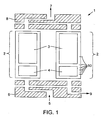
- FIG. 1 shows a schematic of a simple RCPSA system 1 comprising two spirally wound beds 2 with guard layers for the adsorbents in each bed.
- Beds 2 each comprise a primary adsorbent layer 3 for separating the major components in the feed gas mixture and also a guard layer 4 to protect the primary adsorbent layer 3 from contaminants present in the feed gas mixture.
- a feed gas mixture 5 is alternately provided to the feed ends of each bed 2 via feed end rotary valve 6.
- Product gas 7 is alternately obtained from the product ends of each bed 2 via product end rotary valve 8.
- exhaust gas 9 is vented from the feed ends of beds 2 via rotary valve 6 during the regeneration step in the RCPSA cycle.
- FIG. 1 are exemplary sampling sensors 10 which can be used to test the effectiveness of the guard layers in experimental RCPSA devices.
- primary adsorbent layers 3 may actually comprise more than one adsorbent material in order to separate out more than one major component in the feed gas mixture.
- the different adsorbent materials may be configured sequentially along adsorbent layer 3 (i.e. in a series of adsorbent layers).
- guard layers 4 may also comprise more than one guard material for purposes of removing multiple contaminants from the feed gas mixture. Again, the different guard materials may be configured sequentially along guard layer 4. For instance, in applications where a range of operating temperatures can be encountered, multiple guard layers may be required to remove one or more contaminants from the feed gas mixture.
- adsorbent layers 3 comprise a porous laminate adsorbent sheet containing a suitable adsorbent that is spirally wound together with an appropriate spacer sheet.
- the spacer sheet is included in order to define channels for gas to flow through and to access both sides of the wound laminate adsorbent sheet.
- the thickness of typical laminate adsorbent sheets is in the range of 5 to 200 micrometers.
- the height or gap of the channels formed by the spacer sheet is conventionally less than or equal to the thickness of the laminate adsorbent sheet.
- guard layers 4 also comprise a porous laminate sheet containing a suitable guard adsorbent that is spirally wound together with an appropriate spacer sheet.
- the channels defined by the spacer sheet occupy greater than 50% of the volume.
- FIG. 2 shows a close-up schematic cross-section of guard layer 4.
- the view shown is parallel to the winding axis.
- Visible in FIG. 2 are two adjacent winds of laminate guard adsorbent sheet 15 separated by spacer sheet 16.
- Adsorbent sheet 15 is a porous sheet comprising particles of guard adsorbent and an appropriate binder coated onto a woven wire metal mesh support.
- FIG. 2 shows the envelope defined by porous adsorbent sheet 15. (The envelope is a theoretical surface that encloses the solids in sheet 15 and that bridges the openings of its pores.) Sheet 15 shown in FIG.
- Thickness T A is the thickness of adsorbent sheet 15 as measured from peak to peak on the textured surface.
- Spacer sheet 16 is a woven wire metal mesh.
- FIG. 2 shows the envelope defined by spacer sheet 16.
- Thickness T S is the thickness of spacer sheet 16 as measured from peak to peak on the spacer sheet envelope.
- Adsorbent sheet 15 physically contacts spacer sheet 16 at a plurality of locations. However, the significant texturing of adsorbent sheet 15 creates relatively large void spaces between the two envelopes, depicted in FIG. 2 as surface voids 17.
- the channel fraction is defined as 1 minus the adsorbent sheet fraction, where the adsorbent sheet fraction equals the volume within the envelope of adsorbent sheet 15 divided by total guard layer volume.
- the channel fraction is thus also the same as (channel volume/total volume), where the channel volume is equal to the volume within the spacer mesh envelope plus the volume of the surface voids. (The relatively small volume occupied by the wires in the spacer mesh itself is thus still included in the channel volume.)
- the channel fraction is greater than 50% and typically between 50% and 75%.
- Thicknesses T A and T S are readily measured using a micrometer.
- An estimate of the surface void can be made by estimating the effective thickness of the sheets via optical microscopy of cross-sectional samples.
- a preferred method however is based on a liquid displacement test. For this method, a test sample of the adsorbent sheet has its pores filled with a liquid such as water. The water filled adsorbent sheet is then dipped into a second liquid that is immiscible with water (e.g. chlorofluorocarbon), and the volume of the second liquid displaced is determined. The volume displaced is thus the volume within the envelope. And the surface void is then calculated to be the difference between the volume including the surface voids (i.e. Ta* area of sheet sample) minus the volume within the adsorbent sheet envelope (i.e. volume of second liquid displaced).
- guard adsorbent material depends on the separation application.
- Common materials suitable for use as guard adsorbents include activated alumina, aluminosilicate gels, silica gels, zeolites (e.g. zeolite Y or high silica zeolites), activated carbon, carbon molecular sieves and combinations of these materials.
- a combination of materials can also be commonly used, e.g. activated alumina plus a zeolite such as 5A and/or 13X.
- Water is a common contaminant in PSA applications and suitable guard adsorbents for water include desiccants such as activated alumina.
- SA/V surface area to volume ratio
- the thickness of the guard adsorbent sheet necessarily decreases. It is difficult to measure the envelope surface area of a textured sheet like that depicted in FIG. 2 . So, in the Examples below, the SA/V ratio was determined assuming the guard adsorbent sheet was a smooth sheet with thickness T A . There, SA/V of the guard layer was greater than about 5000 square meters per cubic meter.
- Texturing the surface of the guard adsorbent sheet further increases accessibility and effectiveness of the guard layer.
- the increased channel volume introduced by the surface voids results in reduced pressure drop across the guard layer and hence improved performance.
- the sheet surface can readily be textured by web coating a suitable wire mesh with a low solids content (i.e. "runny" or low viscosity) slurry.
- a suitable wire mesh with a low solids content (i.e. "runny" or low viscosity) slurry.
- the wire mesh is woven and thus has a repeating pattern.
- the slurry sags in the openings in the woven mesh before drying, thereby introducing texture to the final dried surface.
- the texture e.g. amplitude and period
- guard layers 4 are subjected to high velocity feed gas jets during the feed step in the RCPSA cycle, which can result in erosion over a very large number of cycles.
- multi-layer perforated plate or mesh-type flow distributors/jet disrupters (not shown in FIG. 1 ) can be used upstream of and adjacent to guard layers 4 to re-distribute gas flow across the inlet face of the guard bed.
- a combination of coarse metal mesh (e.g. 10 mesh) and fine metal mesh (e.g. 325 mesh) may for instance be used.
- the former provides structural support and gross jet disruption/re-distribution while the latter provides fine jet disruption/redistribution.
- RCPSA devices operate at cycle speeds greater than about 5 cycles per minute, significantly greater than conventional PSA devices.
- the gas velocities through the guard layer and the pressure drop per unit length are also therefore greater.
- Another consideration is the feed to product gas volume ratio required for proper guard layer performance.
- the feed-to-product gas volume ratio is a measure which approximates the volumes of gases which pass over the guard layer in opposite directions during the feed and regeneration parts of the cycle. Operating at a relatively high feed/product ratio means that the device is operating at low product yield which is undesirable from that viewpoint. However, it also means that a relatively large volume of gas is exhausted back through the guard layer during the regeneration phase of the cycle for desorbing contaminant from the guard layer. A lower feed/product ratio is better from a product yield perspective but means less exhaust gas is available to desorb contaminant and thus may not be adequate for guard layer performance.
- the target equilibrium concentration of contaminants at the end of the guard layer must be sufficiently low so as to minimize degradation of adsorption on the downstream primary adsorbent.
- this means contaminant levels should be reduced to ⁇ 10 ppmv and preferably ⁇ 1 ppmv.
- the water level is preferably ⁇ 10 ppmv and more preferably ⁇ 1 ppmv for long term cyclical stability.
- the new test method involves installing gas sampling ports along and within the guard layer and also at the interface gap between the guard layer and the primary adsorbent layer. Suitable locations of the sampling ports 10 for disclosed embodiments are depicted in the complete RCPSA device 1 in FIG. 1 .
- testing for development purposes is expected to typically be performed on a test station in which a single test bed is employed.
- the test station uses computer controlled solenoid valves to control the sequence and timing of gases into and out of the test bed and manual flow control valves to control flow rate.
- Accumulator tanks are also used to collect discharged gases and to return these to the same test bed in order to simulate multi-bed PSA cycle flows.
- Such a test station allows for the experimental assessment of multi-bed PSA cycle performance using a single test bed over a wide range of cycle speeds.
- each sampling port can be equipped with a timing valve that opens only during the high-pressure feed step. It was found that a pressure relief valve or check valve with a pre-set cracking pressure was an effective means for gas sampling only during the highest pressure feed step of the PSA cycle.
- a computer controlled solenoid valve is a suitable alternative. For continuous measurement, a fine flow control valve connected to each sampling port valve is effective and a section of fine bore capillary tubing is a suitable alternative. It was found that this sampling procedure did not impact performance of the test bed (confirmed experimentally by establishing cyclical steady state with and without sampling and observing the same results within experimental error).
- Three experimental spirally wound laminate test beds were made using a zeolite as the primary adsorbent and activated alumina as a guard layer desiccant.
- the zeolite laminate sheets were reinforced with inert binder and stainless steel woven mesh.
- the laminate sheets were spirally wound together with a stainless steel woven mesh spacer sheet on a centre mandrel to form the primary adsorbent layers.
- the guard layers comprised guard laminate sheets of activated alumina with variable surface voids. These too were reinforced with inert binder and stainless steel woven mesh and were spirally wound together with a stainless steel mesh spacer sheet to form the guard layers.
- Each test bed consisted of one experimental guard layer and a primary adsorbent layer sealed in a stainless steel containment tube.
- the experimental beds were tested on a solenoid valve based, computer controlled, single bed test apparatus that was used to simulate operation in an actual operating RCPSA device.
- the test feed gas used was humidified compressed air.
- the beds were simply allowed to depressurize from the feed end.
- Cosa XDT-PM/LPDT Humidity & Temperature Transmitters were used at intermediate water concentrations.
- Vasiala HPM238 or Elextronics EE29 Humidity & Temperature Transmitters were used to measure the highest concentrations.
- Each desiccant sheet in the guard layers was prepared as described above, by coating a wire mesh support with a low viscosity slurry containing the activated alumina.
- a number 70 stainless steel woven mesh (made of 0.08 mm wires) was used in all cases.
- the length of each guard layer in the bed was 6.4 cm.
- the laminate desiccant sheet and spacer sheet peak-to-peak thicknesses were measured using a micrometer. Total desiccant loading and the surface area per unit volume of the desiccant were determined.
- the surface void of the desiccant sheets was measured using the Archimedes method described earlier. Here, the activated alumina sheets were first saturated with water to completely fill the void space within.
- the samples were immersed in Vertrel, a chlorofluorocarbon liquid that is immiscible with water, to determine volume displaced.
- This volume displaced would thus not include the surface void of the desiccant laminate.
- the surface void was then calculated to be the difference between the calculated desiccant laminate volume (based on its measured length, width, and thickness T A as defined in FIG. 2 ) and this volume displaced.
- the effective desiccant sheet thickness and effective channel height are also given.
- the effective desiccant sheet thickness represents the equivalent thickness of a flat, non-textured desiccant sheet that would occupy the same volume as the actual textured desiccant sheet.
- the effective channel height represents the equivalent height of the channel that would exist if the actual textured desiccant sheet in the guard layer were considered to be replaced by an equivalent flat, non-textured desiccant sheet.
- the channel fraction (equal to the effective channel height divided by the effective channel height plus the effective laminate thickness) is given.
- FIG. 3 shows the water concentration measured versus distance from feed end for the inventive guard layers tested in the Examples. These experimental guard layers have channel fractions substantially greater than 50% and demonstrate unexpectedly good performance.
- FIG. 4 shows the water concentration versus distance from feed end as a function of feed/product ratio under otherwise similar operating conditions. As can be seen in FIG. 4 , at a feed/product ratio of 3.4, an unacceptable level of water vapour (31 ppmv) entered the zeolite adsorbent layer.
- FIG. 5 shows the water concentration versus distance from feed end as a function of cycle speed under otherwise similar operating conditions (F/P ratio was always about 7.1). Little effect on performance is seen in the FIG. 5 data over the cycle speeds tested. A shift in the location in the water front by about 0.64 cm (or approximately 10% of the length of the guard layer) was observed when cycle speed was changed from 10 to 30 cpm.
Landscapes
- Chemical & Material Sciences (AREA)
- Analytical Chemistry (AREA)
- Chemical Kinetics & Catalysis (AREA)
- Organic Chemistry (AREA)
- Engineering & Computer Science (AREA)
- General Chemical & Material Sciences (AREA)
- Oil, Petroleum & Natural Gas (AREA)
- Inorganic Chemistry (AREA)
- Solid-Sorbent Or Filter-Aiding Compositions (AREA)
- Separation Of Gases By Adsorption (AREA)
- Drying Of Gases (AREA)
Claims (5)
- Verfahren zum Schützen von Betten in einer Schnelltaktdruckwechsel-Adsorptionsvorrichtung (rapid cycle pressure swing adsorption, RCPSA) gegen Verunreinigung, wobei die RCSPA-Vorrichtung wenigstens ein Adsorptionsbett (2) und eine Überwachungsschicht (4) an dem Zufuhrende des Adsorptionsbetts (2) umfasst, wobei die Überwachungsschicht (4) eine Laminatschicht umfasst, welche ein Überwachungsabsorbent umfasst, worin das Verfahren umfasst:das Verwenden eines Kanalanteils in der Überwachungsschicht, welcher größer als 50% ist, wobei der Kanalanteil als 1 minus den Adsorbentschichtanteil definiert ist, wobei der Adsorbentschichtanteil als das Volumen der Laminatschicht geteilt durch das Volumen der Überwachungsschicht definiert ist, unddas Einbringen einer strukturierten Oberfläche in die Laminatschicht, so dass Oberflächenporen in die Laminatschicht eingebracht werden, wobei die Oberflächenporen als das Volumen definiert sind, welches durch die Peak-zu-Peak-Dicke TA der Laminatschicht minus das Volumen der Hülle der Laminatschicht definiert ist, worin ein Oberflächenporenanteil der Laminatschicht zwischen 20 und 50% ist, wobei der Oberflächenporenanteil als das Volumen der Oberflächenporen geteilt durch die Summe des Volumens der Laminatschicht plus des Volumens von den Oberflächenporen ist.
- Verfahren gemäß Anspruch 1, worin die Verunreinigung Wasser ist.
- Verfahren gemäß Anspruch 1 oder Anspruch 2, worin die Drehgeschwindigkeit der betriebenen RCPSA-Vorrichtung größer als ungefähr 5 Umdrehungen pro Minute ist.
- Verfahren gemäß Anspruch 1, worin das Einbringen einer strukturierten Oberfläche zu der Laminatschicht das Umhüllen eines Drahtgestricks mit einer Niedrigfeststoffgehaltsuspension umfasst.
- Verfahren gemäß Anspruch 1 bis 4, worin die Überwachungsschicht eine Spiralwicklung von der Laminatschicht und einer Abstandshalterschicht umfasst und das Verfahren das Verwenden eines Drahtgestricks für die Abstandshalterschicht umfasst.
Priority Applications (2)
| Application Number | Priority Date | Filing Date | Title |
|---|---|---|---|
| EP13186199.9A EP2679294B1 (de) | 2007-01-24 | 2008-01-23 | Schutzschichten für Druckwechseladsorptionsvorrichtungen mit schnellem Zyklus |
| PL08706294T PL2125162T3 (pl) | 2007-01-24 | 2008-01-23 | Warstwy ochronne do urządzeń do adsorpcji zmiennociśnieniowej o szybkim cyklu działania |
Applications Claiming Priority (2)
| Application Number | Priority Date | Filing Date | Title |
|---|---|---|---|
| US88648607P | 2007-01-24 | 2007-01-24 | |
| PCT/CA2008/000147 WO2008089563A1 (en) | 2007-01-24 | 2008-01-23 | Guard layers for rapid cycle pressure swing adsorption devices |
Related Child Applications (2)
| Application Number | Title | Priority Date | Filing Date |
|---|---|---|---|
| EP13186199.9A Division EP2679294B1 (de) | 2007-01-24 | 2008-01-23 | Schutzschichten für Druckwechseladsorptionsvorrichtungen mit schnellem Zyklus |
| EP13186199.9A Division-Into EP2679294B1 (de) | 2007-01-24 | 2008-01-23 | Schutzschichten für Druckwechseladsorptionsvorrichtungen mit schnellem Zyklus |
Publications (3)
| Publication Number | Publication Date |
|---|---|
| EP2125162A1 EP2125162A1 (de) | 2009-12-02 |
| EP2125162A4 EP2125162A4 (de) | 2011-01-19 |
| EP2125162B1 true EP2125162B1 (de) | 2014-07-16 |
Family
ID=39644056
Family Applications (2)
| Application Number | Title | Priority Date | Filing Date |
|---|---|---|---|
| EP20080706294 Active EP2125162B1 (de) | 2007-01-24 | 2008-01-23 | Schutzschichten für rcpsa-vorrichtungen (rcpsa - rapid cycle pressure swing adsorption) |
| EP13186199.9A Active EP2679294B1 (de) | 2007-01-24 | 2008-01-23 | Schutzschichten für Druckwechseladsorptionsvorrichtungen mit schnellem Zyklus |
Family Applications After (1)
| Application Number | Title | Priority Date | Filing Date |
|---|---|---|---|
| EP13186199.9A Active EP2679294B1 (de) | 2007-01-24 | 2008-01-23 | Schutzschichten für Druckwechseladsorptionsvorrichtungen mit schnellem Zyklus |
Country Status (7)
| Country | Link |
|---|---|
| US (1) | US8303683B2 (de) |
| EP (2) | EP2125162B1 (de) |
| JP (2) | JP5448845B2 (de) |
| CA (1) | CA2672653C (de) |
| ES (1) | ES2510547T3 (de) |
| PL (1) | PL2125162T3 (de) |
| WO (1) | WO2008089563A1 (de) |
Cited By (3)
| Publication number | Priority date | Publication date | Assignee | Title |
|---|---|---|---|---|
| EP3582878A4 (de) * | 2017-01-31 | 2020-12-09 | Calgon Carbon Corporation | Sorptionsmittelvorrichtungen |
| US12076687B2 (en) | 2019-08-08 | 2024-09-03 | Calgon Carbon Corporation | Sorbent devices for air intakes |
| US12318758B2 (en) | 2019-07-22 | 2025-06-03 | Calgon Carbon Corporation | Textured sorbent sheets, assemblies containing them, and molds for making same |
Families Citing this family (10)
| Publication number | Priority date | Publication date | Assignee | Title |
|---|---|---|---|---|
| US7954490B2 (en) | 2005-02-09 | 2011-06-07 | Vbox, Incorporated | Method of providing ambulatory oxygen |
| FR2952553B1 (fr) * | 2009-11-19 | 2012-06-01 | Air Liquide | Procede de purification d'un flux gazeux mettant en oeuvre un contacteur a passages paralleles presentant une conservation de ses performances |
| GB2507557B (en) * | 2012-11-05 | 2015-06-10 | Nano Porous Solutions Ltd | Pressure swing adsorption apparatus |
| JP6100621B2 (ja) * | 2013-06-10 | 2017-03-22 | 日本特殊陶業株式会社 | 酸素濃縮装置 |
| US9808755B2 (en) * | 2015-07-24 | 2017-11-07 | Air Products And Chemicals, Inc. | Sour pressure swing adsorption process |
| US10765991B2 (en) * | 2017-08-10 | 2020-09-08 | Air Products And Chemicals, Inc. | Rapid cycle pressure swing adsorption process and adsorbent laminates for use therein |
| US11697580B2 (en) | 2018-08-01 | 2023-07-11 | Calgon Carbon Corporation | Apparatus for hydrocarbon vapor recovery |
| EP3829747A4 (de) | 2018-08-02 | 2022-03-30 | Calgon Carbon Corporation | Sorptionsmittelvorrichtungen |
| EP3829760A4 (de) | 2018-08-02 | 2022-04-06 | Calgon Carbon Corporation | Sorptionsmittelvorrichtungen |
| US12115049B2 (en) * | 2019-04-01 | 2024-10-15 | Raja Singh Tuli | Incontinence detection system |
Family Cites Families (10)
| Publication number | Priority date | Publication date | Assignee | Title |
|---|---|---|---|---|
| US4801308A (en) * | 1983-10-03 | 1989-01-31 | Keefer Bowie | Apparatus and process for pressure swing adsorption separation |
| US4702903A (en) * | 1983-10-03 | 1987-10-27 | Keefer Bowie | Method and apparatus for gas separation and synthesis |
| US4968329A (en) * | 1987-10-26 | 1990-11-06 | Keefer Bowie | Pressure swing adsorption for concentration of a gas component |
| US5082473A (en) | 1990-07-23 | 1992-01-21 | Keefer Bowie | Extraction and concentration of a gas component |
| US6063161A (en) * | 1996-04-24 | 2000-05-16 | Sofinoy Societte Financiere D'innovation Inc. | Flow regulated pressure swing adsorption system |
| US7094275B2 (en) * | 1997-12-01 | 2006-08-22 | Questair Technologies, Inc. | Modular pressure swing adsorption apparatus |
| US6106593A (en) * | 1998-10-08 | 2000-08-22 | Air Products And Chemicals, Inc. | Purification of air |
| CA2329475A1 (en) * | 2000-12-11 | 2002-06-11 | Andrea Gibbs | Fast cycle psa with adsorbents sensitive to atmospheric humidity |
| WO2002066152A2 (en) * | 2001-01-05 | 2002-08-29 | Questair Technologies, Inc. | Adsorbent coating compositions, laminates and adsorber elements comprising such compositions and methods for their manufacture and use |
| US7645324B2 (en) | 2005-01-07 | 2010-01-12 | Xebec Adsorption Inc. | Engineered adsorbent structures for kinetic separation |
-
2008
- 2008-01-23 EP EP20080706294 patent/EP2125162B1/de active Active
- 2008-01-23 US US12/524,157 patent/US8303683B2/en active Active
- 2008-01-23 JP JP2009546622A patent/JP5448845B2/ja active Active
- 2008-01-23 CA CA 2672653 patent/CA2672653C/en active Active
- 2008-01-23 PL PL08706294T patent/PL2125162T3/pl unknown
- 2008-01-23 WO PCT/CA2008/000147 patent/WO2008089563A1/en not_active Ceased
- 2008-01-23 EP EP13186199.9A patent/EP2679294B1/de active Active
- 2008-01-23 ES ES08706294.9T patent/ES2510547T3/es active Active
-
2012
- 2012-09-18 JP JP2012204527A patent/JP5731458B2/ja active Active
Cited By (3)
| Publication number | Priority date | Publication date | Assignee | Title |
|---|---|---|---|---|
| EP3582878A4 (de) * | 2017-01-31 | 2020-12-09 | Calgon Carbon Corporation | Sorptionsmittelvorrichtungen |
| US12318758B2 (en) | 2019-07-22 | 2025-06-03 | Calgon Carbon Corporation | Textured sorbent sheets, assemblies containing them, and molds for making same |
| US12076687B2 (en) | 2019-08-08 | 2024-09-03 | Calgon Carbon Corporation | Sorbent devices for air intakes |
Also Published As
| Publication number | Publication date |
|---|---|
| EP2679294B1 (de) | 2018-01-03 |
| JP2010516452A (ja) | 2010-05-20 |
| JP5731458B2 (ja) | 2015-06-10 |
| EP2125162A4 (de) | 2011-01-19 |
| WO2008089563A1 (en) | 2008-07-31 |
| EP2125162A1 (de) | 2009-12-02 |
| US8303683B2 (en) | 2012-11-06 |
| JP2013013895A (ja) | 2013-01-24 |
| ES2510547T3 (es) | 2014-10-21 |
| CA2672653A1 (en) | 2008-07-31 |
| US20100300288A1 (en) | 2010-12-02 |
| PL2125162T3 (pl) | 2014-12-31 |
| JP5448845B2 (ja) | 2014-03-19 |
| CA2672653C (en) | 2014-10-14 |
| EP2679294A1 (de) | 2014-01-01 |
Similar Documents
| Publication | Publication Date | Title |
|---|---|---|
| EP2125162B1 (de) | Schutzschichten für rcpsa-vorrichtungen (rcpsa - rapid cycle pressure swing adsorption) | |
| US11318413B2 (en) | Swing adsorption processes using zeolite structures | |
| AU2008254516B2 (en) | Removal of a target gas from a mixture of gases by swing adsorption with use of a turboexpander | |
| EP3558490B1 (de) | Selbsttragende strukturen mit schaumgeometriestruktur und aktivmaterialien | |
| EP2164607B1 (de) | Entfernung von co2, n2 und h2s aus diese verbindungen enthaltenden gasgemischen | |
| US20080282885A1 (en) | Removal of CO2, N2, or H2S from gas mixtures by swing adsorption with low mesoporosity adsorbent contactors | |
| US20080282886A1 (en) | Process for removing a target gas from a mixture of gases by swing adsorption | |
| US20150082986A1 (en) | Kinetic Fractionators, and Cycling Processes for Fractionation of Gas Mixtures | |
| CA2688685A1 (en) | Removal of heavy hydrocarbons from gas mixtures containing heavy hydrocarbons and methane | |
| AU2012223554A1 (en) | Rapid temperature swing adsorption contactors for gas separation | |
| Feng et al. | Hollow‐fiber‐based adsorbers for gas separation by pressure‐swing adsorption | |
| PT2125162E (pt) | Camadas de protecção para dispositivos de adsorção de oscilação de pressão de ciclo rápido |
Legal Events
| Date | Code | Title | Description |
|---|---|---|---|
| PUAI | Public reference made under article 153(3) epc to a published international application that has entered the european phase |
Free format text: ORIGINAL CODE: 0009012 |
|
| 17P | Request for examination filed |
Effective date: 20090819 |
|
| AK | Designated contracting states |
Kind code of ref document: A1 Designated state(s): AT BE BG CH CY CZ DE DK EE ES FI FR GB GR HR HU IE IS IT LI LT LU LV MC MT NL NO PL PT RO SE SI SK TR |
|
| RIN1 | Information on inventor provided before grant (corrected) |
Inventor name: GIBBS, ANDREA C. Inventor name: BOULET, ANDRE Inventor name: SELLARS, BRIAN G. Inventor name: CHIU, AMY |
|
| DAX | Request for extension of the european patent (deleted) | ||
| A4 | Supplementary search report drawn up and despatched |
Effective date: 20101220 |
|
| 17Q | First examination report despatched |
Effective date: 20110929 |
|
| RAP1 | Party data changed (applicant data changed or rights of an application transferred) |
Owner name: AIR PRODUCTS AND CHEMICALS, INC. |
|
| GRAP | Despatch of communication of intention to grant a patent |
Free format text: ORIGINAL CODE: EPIDOSNIGR1 |
|
| INTG | Intention to grant announced |
Effective date: 20140227 |
|
| GRAS | Grant fee paid |
Free format text: ORIGINAL CODE: EPIDOSNIGR3 |
|
| GRAA | (expected) grant |
Free format text: ORIGINAL CODE: 0009210 |
|
| AK | Designated contracting states |
Kind code of ref document: B1 Designated state(s): AT BE BG CH CY CZ DE DK EE ES FI FR GB GR HR HU IE IS IT LI LT LU LV MC MT NL NO PL PT RO SE SI SK TR |
|
| REG | Reference to a national code |
Ref country code: GB Ref legal event code: FG4D |
|
| REG | Reference to a national code |
Ref country code: CH Ref legal event code: EP |
|
| REG | Reference to a national code |
Ref country code: IE Ref legal event code: FG4D |
|
| REG | Reference to a national code |
Ref country code: AT Ref legal event code: REF Ref document number: 677229 Country of ref document: AT Kind code of ref document: T Effective date: 20140815 |
|
| REG | Reference to a national code |
Ref country code: DE Ref legal event code: R096 Ref document number: 602008033293 Country of ref document: DE Effective date: 20140828 |
|
| REG | Reference to a national code |
Ref country code: PT Ref legal event code: SC4A Free format text: AVAILABILITY OF NATIONAL TRANSLATION Effective date: 20141006 |
|
| REG | Reference to a national code |
Ref country code: ES Ref legal event code: FG2A Ref document number: 2510547 Country of ref document: ES Kind code of ref document: T3 Effective date: 20141021 |
|
| REG | Reference to a national code |
Ref country code: NL Ref legal event code: T3 |
|
| REG | Reference to a national code |
Ref country code: AT Ref legal event code: MK05 Ref document number: 677229 Country of ref document: AT Kind code of ref document: T Effective date: 20140716 |
|
| REG | Reference to a national code |
Ref country code: LT Ref legal event code: MG4D |
|
| REG | Reference to a national code |
Ref country code: PL Ref legal event code: T3 |
|
| PG25 | Lapsed in a contracting state [announced via postgrant information from national office to epo] |
Ref country code: FI Free format text: LAPSE BECAUSE OF FAILURE TO SUBMIT A TRANSLATION OF THE DESCRIPTION OR TO PAY THE FEE WITHIN THE PRESCRIBED TIME-LIMIT Effective date: 20140716 Ref country code: LT Free format text: LAPSE BECAUSE OF FAILURE TO SUBMIT A TRANSLATION OF THE DESCRIPTION OR TO PAY THE FEE WITHIN THE PRESCRIBED TIME-LIMIT Effective date: 20140716 Ref country code: BG Free format text: LAPSE BECAUSE OF FAILURE TO SUBMIT A TRANSLATION OF THE DESCRIPTION OR TO PAY THE FEE WITHIN THE PRESCRIBED TIME-LIMIT Effective date: 20141016 Ref country code: GR Free format text: LAPSE BECAUSE OF FAILURE TO SUBMIT A TRANSLATION OF THE DESCRIPTION OR TO PAY THE FEE WITHIN THE PRESCRIBED TIME-LIMIT Effective date: 20141017 Ref country code: SE Free format text: LAPSE BECAUSE OF FAILURE TO SUBMIT A TRANSLATION OF THE DESCRIPTION OR TO PAY THE FEE WITHIN THE PRESCRIBED TIME-LIMIT Effective date: 20140716 Ref country code: NO Free format text: LAPSE BECAUSE OF FAILURE TO SUBMIT A TRANSLATION OF THE DESCRIPTION OR TO PAY THE FEE WITHIN THE PRESCRIBED TIME-LIMIT Effective date: 20141016 |
|
| PG25 | Lapsed in a contracting state [announced via postgrant information from national office to epo] |
Ref country code: AT Free format text: LAPSE BECAUSE OF FAILURE TO SUBMIT A TRANSLATION OF THE DESCRIPTION OR TO PAY THE FEE WITHIN THE PRESCRIBED TIME-LIMIT Effective date: 20140716 Ref country code: CY Free format text: LAPSE BECAUSE OF FAILURE TO SUBMIT A TRANSLATION OF THE DESCRIPTION OR TO PAY THE FEE WITHIN THE PRESCRIBED TIME-LIMIT Effective date: 20140716 Ref country code: IS Free format text: LAPSE BECAUSE OF FAILURE TO SUBMIT A TRANSLATION OF THE DESCRIPTION OR TO PAY THE FEE WITHIN THE PRESCRIBED TIME-LIMIT Effective date: 20141116 Ref country code: LV Free format text: LAPSE BECAUSE OF FAILURE TO SUBMIT A TRANSLATION OF THE DESCRIPTION OR TO PAY THE FEE WITHIN THE PRESCRIBED TIME-LIMIT Effective date: 20140716 |
|
| REG | Reference to a national code |
Ref country code: DE Ref legal event code: R097 Ref document number: 602008033293 Country of ref document: DE |
|
| PG25 | Lapsed in a contracting state [announced via postgrant information from national office to epo] |
Ref country code: EE Free format text: LAPSE BECAUSE OF FAILURE TO SUBMIT A TRANSLATION OF THE DESCRIPTION OR TO PAY THE FEE WITHIN THE PRESCRIBED TIME-LIMIT Effective date: 20140716 Ref country code: CZ Free format text: LAPSE BECAUSE OF FAILURE TO SUBMIT A TRANSLATION OF THE DESCRIPTION OR TO PAY THE FEE WITHIN THE PRESCRIBED TIME-LIMIT Effective date: 20140716 Ref country code: SK Free format text: LAPSE BECAUSE OF FAILURE TO SUBMIT A TRANSLATION OF THE DESCRIPTION OR TO PAY THE FEE WITHIN THE PRESCRIBED TIME-LIMIT Effective date: 20140716 Ref country code: RO Free format text: LAPSE BECAUSE OF FAILURE TO SUBMIT A TRANSLATION OF THE DESCRIPTION OR TO PAY THE FEE WITHIN THE PRESCRIBED TIME-LIMIT Effective date: 20140716 Ref country code: DK Free format text: LAPSE BECAUSE OF FAILURE TO SUBMIT A TRANSLATION OF THE DESCRIPTION OR TO PAY THE FEE WITHIN THE PRESCRIBED TIME-LIMIT Effective date: 20140716 |
|
| PLBE | No opposition filed within time limit |
Free format text: ORIGINAL CODE: 0009261 |
|
| STAA | Information on the status of an ep patent application or granted ep patent |
Free format text: STATUS: NO OPPOSITION FILED WITHIN TIME LIMIT |
|
| 26N | No opposition filed |
Effective date: 20150417 |
|
| REG | Reference to a national code |
Ref country code: CH Ref legal event code: PL |
|
| PG25 | Lapsed in a contracting state [announced via postgrant information from national office to epo] |
Ref country code: LU Free format text: LAPSE BECAUSE OF FAILURE TO SUBMIT A TRANSLATION OF THE DESCRIPTION OR TO PAY THE FEE WITHIN THE PRESCRIBED TIME-LIMIT Effective date: 20150123 |
|
| PG25 | Lapsed in a contracting state [announced via postgrant information from national office to epo] |
Ref country code: MC Free format text: LAPSE BECAUSE OF FAILURE TO SUBMIT A TRANSLATION OF THE DESCRIPTION OR TO PAY THE FEE WITHIN THE PRESCRIBED TIME-LIMIT Effective date: 20140716 |
|
| PG25 | Lapsed in a contracting state [announced via postgrant information from national office to epo] |
Ref country code: LI Free format text: LAPSE BECAUSE OF NON-PAYMENT OF DUE FEES Effective date: 20150131 Ref country code: CH Free format text: LAPSE BECAUSE OF NON-PAYMENT OF DUE FEES Effective date: 20150131 |
|
| REG | Reference to a national code |
Ref country code: IE Ref legal event code: MM4A |
|
| PG25 | Lapsed in a contracting state [announced via postgrant information from national office to epo] |
Ref country code: SI Free format text: LAPSE BECAUSE OF FAILURE TO SUBMIT A TRANSLATION OF THE DESCRIPTION OR TO PAY THE FEE WITHIN THE PRESCRIBED TIME-LIMIT Effective date: 20140716 |
|
| REG | Reference to a national code |
Ref country code: FR Ref legal event code: PLFP Year of fee payment: 9 |
|
| PG25 | Lapsed in a contracting state [announced via postgrant information from national office to epo] |
Ref country code: IE Free format text: LAPSE BECAUSE OF NON-PAYMENT OF DUE FEES Effective date: 20150123 |
|
| PG25 | Lapsed in a contracting state [announced via postgrant information from national office to epo] |
Ref country code: MT Free format text: LAPSE BECAUSE OF FAILURE TO SUBMIT A TRANSLATION OF THE DESCRIPTION OR TO PAY THE FEE WITHIN THE PRESCRIBED TIME-LIMIT Effective date: 20140716 |
|
| REG | Reference to a national code |
Ref country code: FR Ref legal event code: PLFP Year of fee payment: 10 |
|
| PG25 | Lapsed in a contracting state [announced via postgrant information from national office to epo] |
Ref country code: HU Free format text: LAPSE BECAUSE OF FAILURE TO SUBMIT A TRANSLATION OF THE DESCRIPTION OR TO PAY THE FEE WITHIN THE PRESCRIBED TIME-LIMIT; INVALID AB INITIO Effective date: 20080123 |
|
| PG25 | Lapsed in a contracting state [announced via postgrant information from national office to epo] |
Ref country code: HR Free format text: LAPSE BECAUSE OF FAILURE TO SUBMIT A TRANSLATION OF THE DESCRIPTION OR TO PAY THE FEE WITHIN THE PRESCRIBED TIME-LIMIT Effective date: 20140716 |
|
| PG25 | Lapsed in a contracting state [announced via postgrant information from national office to epo] |
Ref country code: TR Free format text: LAPSE BECAUSE OF FAILURE TO SUBMIT A TRANSLATION OF THE DESCRIPTION OR TO PAY THE FEE WITHIN THE PRESCRIBED TIME-LIMIT Effective date: 20140716 |
|
| REG | Reference to a national code |
Ref country code: FR Ref legal event code: PLFP Year of fee payment: 11 |
|
| P01 | Opt-out of the competence of the unified patent court (upc) registered |
Effective date: 20230515 |
|
| PGFP | Annual fee paid to national office [announced via postgrant information from national office to epo] |
Ref country code: BE Payment date: 20241220 Year of fee payment: 18 Ref country code: NL Payment date: 20241214 Year of fee payment: 18 Ref country code: PL Payment date: 20241128 Year of fee payment: 18 |
|
| PGFP | Annual fee paid to national office [announced via postgrant information from national office to epo] |
Ref country code: GB Payment date: 20241205 Year of fee payment: 18 |
|
| PGFP | Annual fee paid to national office [announced via postgrant information from national office to epo] |
Ref country code: FR Payment date: 20241209 Year of fee payment: 18 |
|
| PGFP | Annual fee paid to national office [announced via postgrant information from national office to epo] |
Ref country code: PT Payment date: 20250123 Year of fee payment: 18 Ref country code: DE Payment date: 20241126 Year of fee payment: 18 |
|
| PGFP | Annual fee paid to national office [announced via postgrant information from national office to epo] |
Ref country code: ES Payment date: 20250210 Year of fee payment: 18 |
|
| PGFP | Annual fee paid to national office [announced via postgrant information from national office to epo] |
Ref country code: IT Payment date: 20241210 Year of fee payment: 18 |