EP2119739A2 - Polyimide, polyamic acid and processes for the production thereof - Google Patents
Polyimide, polyamic acid and processes for the production thereof Download PDFInfo
- Publication number
- EP2119739A2 EP2119739A2 EP20090251313 EP09251313A EP2119739A2 EP 2119739 A2 EP2119739 A2 EP 2119739A2 EP 20090251313 EP20090251313 EP 20090251313 EP 09251313 A EP09251313 A EP 09251313A EP 2119739 A2 EP2119739 A2 EP 2119739A2
- Authority
- EP
- European Patent Office
- Prior art keywords
- formula
- group
- carbon atoms
- less carbon
- represent
- Prior art date
- Legal status (The legal status is an assumption and is not a legal conclusion. Google has not performed a legal analysis and makes no representation as to the accuracy of the status listed.)
- Withdrawn
Links
- 229920005575 poly(amic acid) Polymers 0.000 title claims abstract description 105
- 229920001721 polyimide Polymers 0.000 title claims abstract description 92
- 239000004642 Polyimide Substances 0.000 title claims abstract description 91
- 238000000034 method Methods 0.000 title claims abstract description 54
- 230000008569 process Effects 0.000 title claims abstract description 20
- 238000004519 manufacturing process Methods 0.000 title claims abstract description 18
- 125000003118 aryl group Chemical group 0.000 claims abstract description 49
- 239000002253 acid Substances 0.000 claims abstract description 26
- 125000004432 carbon atom Chemical group C* 0.000 claims description 143
- 125000000217 alkyl group Chemical group 0.000 claims description 100
- 125000001997 phenyl group Chemical group [H]C1=C([H])C([H])=C(*)C([H])=C1[H] 0.000 claims description 94
- 125000004435 hydrogen atom Chemical group [H]* 0.000 claims description 63
- 150000004985 diamines Chemical class 0.000 claims description 37
- GTDPSWPPOUPBNX-UHFFFAOYSA-N ac1mqpva Chemical compound CC12C(=O)OC(=O)C1(C)C1(C)C2(C)C(=O)OC1=O GTDPSWPPOUPBNX-UHFFFAOYSA-N 0.000 claims description 31
- 125000004122 cyclic group Chemical group 0.000 claims description 24
- 229910052751 metal Inorganic materials 0.000 claims description 17
- 239000002184 metal Substances 0.000 claims description 17
- 239000003960 organic solvent Substances 0.000 claims description 13
- NAWXUBYGYWOOIX-SFHVURJKSA-N (2s)-2-[[4-[2-(2,4-diaminoquinazolin-6-yl)ethyl]benzoyl]amino]-4-methylidenepentanedioic acid Chemical compound C1=CC2=NC(N)=NC(N)=C2C=C1CCC1=CC=C(C(=O)N[C@@H](CC(=C)C(O)=O)C(O)=O)C=C1 NAWXUBYGYWOOIX-SFHVURJKSA-N 0.000 claims description 12
- 125000002496 methyl group Chemical group [H]C([H])([H])* 0.000 claims description 7
- 229910052786 argon Inorganic materials 0.000 claims description 5
- 238000009833 condensation Methods 0.000 claims description 4
- 230000005494 condensation Effects 0.000 claims description 4
- 230000018044 dehydration Effects 0.000 claims description 4
- 238000006297 dehydration reaction Methods 0.000 claims description 4
- 125000001183 hydrocarbyl group Chemical group 0.000 claims 8
- 230000001588 bifunctional effect Effects 0.000 abstract description 62
- OMIHGPLIXGGMJB-UHFFFAOYSA-N 7-oxabicyclo[4.1.0]hepta-1,3,5-triene Chemical compound C1=CC=C2OC2=C1 OMIHGPLIXGGMJB-UHFFFAOYSA-N 0.000 abstract description 58
- XLYOFNOQVPJJNP-UHFFFAOYSA-N water Substances O XLYOFNOQVPJJNP-UHFFFAOYSA-N 0.000 abstract description 30
- 125000003277 amino group Chemical group 0.000 abstract description 10
- 239000000463 material Substances 0.000 abstract description 8
- 150000008065 acid anhydrides Chemical class 0.000 abstract description 6
- 150000004984 aromatic diamines Chemical class 0.000 abstract description 4
- -1 aromatic dinitro compound Chemical group 0.000 description 94
- 239000011347 resin Substances 0.000 description 89
- 229920005989 resin Polymers 0.000 description 89
- 239000000243 solution Substances 0.000 description 72
- YXFVVABEGXRONW-UHFFFAOYSA-N Toluene Chemical compound CC1=CC=CC=C1 YXFVVABEGXRONW-UHFFFAOYSA-N 0.000 description 66
- 230000009102 absorption Effects 0.000 description 63
- 238000010521 absorption reaction Methods 0.000 description 63
- OKKJLVBELUTLKV-UHFFFAOYSA-N Methanol Chemical compound OC OKKJLVBELUTLKV-UHFFFAOYSA-N 0.000 description 57
- IJGRMHOSHXDMSA-UHFFFAOYSA-N Atomic nitrogen Chemical compound N#N IJGRMHOSHXDMSA-UHFFFAOYSA-N 0.000 description 46
- 239000000203 mixture Substances 0.000 description 45
- 238000006243 chemical reaction Methods 0.000 description 42
- 230000015572 biosynthetic process Effects 0.000 description 39
- 238000003786 synthesis reaction Methods 0.000 description 39
- FXHOOIRPVKKKFG-UHFFFAOYSA-N N,N-Dimethylacetamide Chemical compound CN(C)C(C)=O FXHOOIRPVKKKFG-UHFFFAOYSA-N 0.000 description 35
- ZMXDDKWLCZADIW-UHFFFAOYSA-N N,N-Dimethylformamide Chemical compound CN(C)C=O ZMXDDKWLCZADIW-UHFFFAOYSA-N 0.000 description 33
- 239000002904 solvent Substances 0.000 description 25
- 239000010408 film Substances 0.000 description 24
- 239000003054 catalyst Substances 0.000 description 22
- 125000005462 imide group Chemical group 0.000 description 21
- 229910052757 nitrogen Inorganic materials 0.000 description 21
- 238000001228 spectrum Methods 0.000 description 21
- 238000006358 imidation reaction Methods 0.000 description 18
- 238000010992 reflux Methods 0.000 description 17
- UHOVQNZJYSORNB-UHFFFAOYSA-N Benzene Chemical compound C1=CC=CC=C1 UHOVQNZJYSORNB-UHFFFAOYSA-N 0.000 description 16
- 150000002430 hydrocarbons Chemical group 0.000 description 16
- ZWEHNKRNPOVVGH-UHFFFAOYSA-N 2-Butanone Chemical compound CCC(C)=O ZWEHNKRNPOVVGH-UHFFFAOYSA-N 0.000 description 15
- 239000012298 atmosphere Substances 0.000 description 15
- 238000001914 filtration Methods 0.000 description 15
- 238000006722 reduction reaction Methods 0.000 description 15
- NXXYKOUNUYWIHA-UHFFFAOYSA-N 2,6-Dimethylphenol Chemical compound CC1=CC=CC(C)=C1O NXXYKOUNUYWIHA-UHFFFAOYSA-N 0.000 description 14
- 230000009467 reduction Effects 0.000 description 14
- 239000007787 solid Substances 0.000 description 14
- KDLHZDBZIXYQEI-UHFFFAOYSA-N Palladium Chemical compound [Pd] KDLHZDBZIXYQEI-UHFFFAOYSA-N 0.000 description 13
- 239000000706 filtrate Substances 0.000 description 13
- 238000000862 absorption spectrum Methods 0.000 description 12
- ZUOUZKKEUPVFJK-UHFFFAOYSA-N diphenyl Chemical compound C1=CC=CC=C1C1=CC=CC=C1 ZUOUZKKEUPVFJK-UHFFFAOYSA-N 0.000 description 12
- BWHMMNNQKKPAPP-UHFFFAOYSA-L potassium carbonate Chemical compound [K+].[K+].[O-]C([O-])=O BWHMMNNQKKPAPP-UHFFFAOYSA-L 0.000 description 12
- VLDPXPPHXDGHEW-UHFFFAOYSA-N 1-chloro-2-dichlorophosphoryloxybenzene Chemical compound ClC1=CC=CC=C1OP(Cl)(Cl)=O VLDPXPPHXDGHEW-UHFFFAOYSA-N 0.000 description 11
- 238000006210 cyclodehydration reaction Methods 0.000 description 11
- 239000011521 glass Substances 0.000 description 11
- 239000010410 layer Substances 0.000 description 11
- 238000003756 stirring Methods 0.000 description 11
- VEXZGXHMUGYJMC-UHFFFAOYSA-N Hydrochloric acid Chemical compound Cl VEXZGXHMUGYJMC-UHFFFAOYSA-N 0.000 description 10
- JUJWROOIHBZHMG-UHFFFAOYSA-N Pyridine Chemical compound C1=CC=NC=C1 JUJWROOIHBZHMG-UHFFFAOYSA-N 0.000 description 10
- 125000003368 amide group Chemical group 0.000 description 10
- QTMDXZNDVAMKGV-UHFFFAOYSA-L copper(ii) bromide Chemical compound [Cu+2].[Br-].[Br-] QTMDXZNDVAMKGV-UHFFFAOYSA-L 0.000 description 10
- 229910001873 dinitrogen Inorganic materials 0.000 description 10
- 239000011369 resultant mixture Substances 0.000 description 10
- DJEQZVQFEPKLOY-UHFFFAOYSA-N N,N-dimethylbutylamine Chemical compound CCCCN(C)C DJEQZVQFEPKLOY-UHFFFAOYSA-N 0.000 description 9
- 239000003795 chemical substances by application Substances 0.000 description 9
- 238000010438 heat treatment Methods 0.000 description 9
- 239000011259 mixed solution Substances 0.000 description 9
- KGHYGBGIWLNFAV-UHFFFAOYSA-N n,n'-ditert-butylethane-1,2-diamine Chemical compound CC(C)(C)NCCNC(C)(C)C KGHYGBGIWLNFAV-UHFFFAOYSA-N 0.000 description 9
- WYURNTSHIVDZCO-UHFFFAOYSA-N Tetrahydrofuran Chemical compound C1CCOC1 WYURNTSHIVDZCO-UHFFFAOYSA-N 0.000 description 8
- 125000002887 hydroxy group Chemical group [H]O* 0.000 description 8
- 0 COc(c(*)c1*)c(*)c(*)c1-c(c(*)c1*)c(*)c(*)c1OC Chemical compound COc(c(*)c1*)c(*)c(*)c1-c(c(*)c1*)c(*)c(*)c1OC 0.000 description 7
- UFHFLCQGNIYNRP-UHFFFAOYSA-N Hydrogen Chemical compound [H][H] UFHFLCQGNIYNRP-UHFFFAOYSA-N 0.000 description 7
- 239000007864 aqueous solution Substances 0.000 description 7
- 239000001257 hydrogen Substances 0.000 description 7
- 229910052739 hydrogen Inorganic materials 0.000 description 7
- 239000012044 organic layer Substances 0.000 description 7
- 239000000126 substance Substances 0.000 description 7
- 125000001140 1,4-phenylene group Chemical group [H]C1=C([H])C([*:2])=C([H])C([H])=C1[*:1] 0.000 description 6
- HLBLWEWZXPIGSM-UHFFFAOYSA-N 4-Aminophenyl ether Chemical compound C1=CC(N)=CC=C1OC1=CC=C(N)C=C1 HLBLWEWZXPIGSM-UHFFFAOYSA-N 0.000 description 6
- XKRFYHLGVUSROY-UHFFFAOYSA-N Argon Chemical compound [Ar] XKRFYHLGVUSROY-UHFFFAOYSA-N 0.000 description 6
- RYGMFSIKBFXOCR-UHFFFAOYSA-N Copper Chemical compound [Cu] RYGMFSIKBFXOCR-UHFFFAOYSA-N 0.000 description 6
- ZMANZCXQSJIPKH-UHFFFAOYSA-N Triethylamine Chemical compound CCN(CC)CC ZMANZCXQSJIPKH-UHFFFAOYSA-N 0.000 description 6
- 235000010290 biphenyl Nutrition 0.000 description 6
- 239000004305 biphenyl Substances 0.000 description 6
- IISBACLAFKSPIT-UHFFFAOYSA-N bisphenol A Chemical compound C=1C=C(O)C=CC=1C(C)(C)C1=CC=C(O)C=C1 IISBACLAFKSPIT-UHFFFAOYSA-N 0.000 description 6
- 230000005587 bubbling Effects 0.000 description 6
- JQVDAXLFBXTEQA-UHFFFAOYSA-N dibutylamine Chemical compound CCCCNCCCC JQVDAXLFBXTEQA-UHFFFAOYSA-N 0.000 description 6
- 229910017053 inorganic salt Inorganic materials 0.000 description 6
- QJGQUHMNIGDVPM-UHFFFAOYSA-N nitrogen group Chemical group [N] QJGQUHMNIGDVPM-UHFFFAOYSA-N 0.000 description 6
- 229910000027 potassium carbonate Inorganic materials 0.000 description 6
- CZGCEKJOLUNIFY-UHFFFAOYSA-N 4-Chloronitrobenzene Chemical compound [O-][N+](=O)C1=CC=C(Cl)C=C1 CZGCEKJOLUNIFY-UHFFFAOYSA-N 0.000 description 5
- 229910021590 Copper(II) bromide Inorganic materials 0.000 description 5
- PXHVJJICTQNCMI-UHFFFAOYSA-N Nickel Chemical compound [Ni] PXHVJJICTQNCMI-UHFFFAOYSA-N 0.000 description 5
- CTQNGGLPUBDAKN-UHFFFAOYSA-N O-Xylene Chemical compound CC1=CC=CC=C1C CTQNGGLPUBDAKN-UHFFFAOYSA-N 0.000 description 5
- WKDNYTOXBCRNPV-UHFFFAOYSA-N bpda Chemical compound C1=C2C(=O)OC(=O)C2=CC(C=2C=C3C(=O)OC(C3=CC=2)=O)=C1 WKDNYTOXBCRNPV-UHFFFAOYSA-N 0.000 description 5
- 239000007810 chemical reaction solvent Substances 0.000 description 5
- 239000011889 copper foil Substances 0.000 description 5
- 238000001035 drying Methods 0.000 description 5
- 125000004430 oxygen atom Chemical group O* 0.000 description 5
- UMJSCPRVCHMLSP-UHFFFAOYSA-N pyridine Natural products COC1=CC=CN=C1 UMJSCPRVCHMLSP-UHFFFAOYSA-N 0.000 description 5
- 238000007363 ring formation reaction Methods 0.000 description 5
- 238000005406 washing Methods 0.000 description 5
- 239000008096 xylene Substances 0.000 description 5
- QQOMQLYQAXGHSU-UHFFFAOYSA-N 2,3,6-Trimethylphenol Chemical compound CC1=CC=C(C)C(O)=C1C QQOMQLYQAXGHSU-UHFFFAOYSA-N 0.000 description 4
- IOJCFCLZQBXCIQ-UHFFFAOYSA-N 4-(4-hydroxy-2,3,5-trimethylphenyl)-2,3,6-trimethylphenol Chemical compound CC1=C(O)C(C)=CC(C=2C(=C(C)C(O)=C(C)C=2)C)=C1C IOJCFCLZQBXCIQ-UHFFFAOYSA-N 0.000 description 4
- UFWIBTONFRDIAS-UHFFFAOYSA-N Naphthalene Chemical compound C1=CC=CC2=CC=CC=C21 UFWIBTONFRDIAS-UHFFFAOYSA-N 0.000 description 4
- QVGXLLKOCUKJST-UHFFFAOYSA-N atomic oxygen Chemical compound [O] QVGXLLKOCUKJST-UHFFFAOYSA-N 0.000 description 4
- 125000002915 carbonyl group Chemical group [*:2]C([*:1])=O 0.000 description 4
- 230000000052 comparative effect Effects 0.000 description 4
- USIUVYZYUHIAEV-UHFFFAOYSA-N diphenyl ether Chemical compound C=1C=CC=CC=1OC1=CC=CC=C1 USIUVYZYUHIAEV-UHFFFAOYSA-N 0.000 description 4
- KZTYYGOKRVBIMI-UHFFFAOYSA-N diphenyl sulfone Chemical compound C=1C=CC=CC=1S(=O)(=O)C1=CC=CC=C1 KZTYYGOKRVBIMI-UHFFFAOYSA-N 0.000 description 4
- 239000012776 electronic material Substances 0.000 description 4
- 125000004185 ester group Chemical group 0.000 description 4
- 125000001495 ethyl group Chemical group [H]C([H])([H])C([H])([H])* 0.000 description 4
- 239000001301 oxygen Substances 0.000 description 4
- 229910052760 oxygen Inorganic materials 0.000 description 4
- 238000012643 polycondensation polymerization Methods 0.000 description 4
- 239000000843 powder Substances 0.000 description 4
- 239000002994 raw material Substances 0.000 description 4
- YLQBMQCUIZJEEH-UHFFFAOYSA-N tetrahydrofuran Natural products C=1C=COC=1 YLQBMQCUIZJEEH-UHFFFAOYSA-N 0.000 description 4
- UEUXEKPTXMALOB-UHFFFAOYSA-J tetrasodium;2-[2-[bis(carboxylatomethyl)amino]ethyl-(carboxylatomethyl)amino]acetate Chemical compound [Na+].[Na+].[Na+].[Na+].[O-]C(=O)CN(CC([O-])=O)CCN(CC([O-])=O)CC([O-])=O UEUXEKPTXMALOB-UHFFFAOYSA-J 0.000 description 4
- AZZWZMUXHALBCQ-UHFFFAOYSA-N 4-[(4-hydroxy-3,5-dimethylphenyl)methyl]-2,6-dimethylphenol Chemical compound CC1=C(O)C(C)=CC(CC=2C=C(C)C(O)=C(C)C=2)=C1 AZZWZMUXHALBCQ-UHFFFAOYSA-N 0.000 description 3
- WFDIJRYMOXRFFG-UHFFFAOYSA-N Acetic anhydride Chemical compound CC(=O)OC(C)=O WFDIJRYMOXRFFG-UHFFFAOYSA-N 0.000 description 3
- 229910021591 Copper(I) chloride Inorganic materials 0.000 description 3
- YMWUJEATGCHHMB-UHFFFAOYSA-N Dichloromethane Chemical compound ClCCl YMWUJEATGCHHMB-UHFFFAOYSA-N 0.000 description 3
- LFQSCWFLJHTTHZ-UHFFFAOYSA-N Ethanol Chemical compound CCO LFQSCWFLJHTTHZ-UHFFFAOYSA-N 0.000 description 3
- OXBLHERUFWYNTN-UHFFFAOYSA-M copper(I) chloride Chemical compound [Cu]Cl OXBLHERUFWYNTN-UHFFFAOYSA-M 0.000 description 3
- 230000003247 decreasing effect Effects 0.000 description 3
- 125000006159 dianhydride group Chemical group 0.000 description 3
- 239000011888 foil Substances 0.000 description 3
- 239000007789 gas Substances 0.000 description 3
- 238000005227 gel permeation chromatography Methods 0.000 description 3
- RAXXELZNTBOGNW-UHFFFAOYSA-N imidazole Natural products C1=CNC=N1 RAXXELZNTBOGNW-UHFFFAOYSA-N 0.000 description 3
- 239000011261 inert gas Substances 0.000 description 3
- 238000009413 insulation Methods 0.000 description 3
- 150000003512 tertiary amines Chemical class 0.000 description 3
- NJMOHBDCGXJLNJ-UHFFFAOYSA-N trimellitic anhydride chloride Chemical compound ClC(=O)C1=CC=C2C(=O)OC(=O)C2=C1 NJMOHBDCGXJLNJ-UHFFFAOYSA-N 0.000 description 3
- CFTSORNHIUMCGF-UHFFFAOYSA-N (1,1,1,3,3,3-hexafluoro-2-phenylpropan-2-yl)benzene Chemical compound C=1C=CC=CC=1C(C(F)(F)F)(C(F)(F)F)C1=CC=CC=C1 CFTSORNHIUMCGF-UHFFFAOYSA-N 0.000 description 2
- QYGBYAQGBVHMDD-XQRVVYSFSA-N (z)-2-cyano-3-thiophen-2-ylprop-2-enoic acid Chemical compound OC(=O)C(\C#N)=C/C1=CC=CS1 QYGBYAQGBVHMDD-XQRVVYSFSA-N 0.000 description 2
- RYHBNJHYFVUHQT-UHFFFAOYSA-N 1,4-Dioxane Chemical compound C1COCCO1 RYHBNJHYFVUHQT-UHFFFAOYSA-N 0.000 description 2
- 125000004958 1,4-naphthylene group Chemical group 0.000 description 2
- RRQYJINTUHWNHW-UHFFFAOYSA-N 1-ethoxy-2-(2-ethoxyethoxy)ethane Chemical compound CCOCCOCCOCC RRQYJINTUHWNHW-UHFFFAOYSA-N 0.000 description 2
- 125000004959 2,6-naphthylene group Chemical group [H]C1=C([H])C2=C([H])C([*:1])=C([H])C([H])=C2C([H])=C1[*:2] 0.000 description 2
- NGNBDVOYPDDBFK-UHFFFAOYSA-N 2-[2,4-di(pentan-2-yl)phenoxy]acetyl chloride Chemical compound CCCC(C)C1=CC=C(OCC(Cl)=O)C(C(C)CCC)=C1 NGNBDVOYPDDBFK-UHFFFAOYSA-N 0.000 description 2
- MILSYCKGLDDVLM-UHFFFAOYSA-N 2-phenylpropan-2-ylbenzene Chemical compound C=1C=CC=CC=1C(C)(C)C1=CC=CC=C1 MILSYCKGLDDVLM-UHFFFAOYSA-N 0.000 description 2
- GWHLJVMSZRKEAQ-UHFFFAOYSA-N 3-(2,3-dicarboxyphenyl)phthalic acid Chemical compound OC(=O)C1=CC=CC(C=2C(=C(C(O)=O)C=CC=2)C(O)=O)=C1C(O)=O GWHLJVMSZRKEAQ-UHFFFAOYSA-N 0.000 description 2
- FYYYKXFEKMGYLZ-UHFFFAOYSA-N 4-(1,3-dioxo-2-benzofuran-5-yl)-2-benzofuran-1,3-dione Chemical compound C=1C=C2C(=O)OC(=O)C2=CC=1C1=CC=CC2=C1C(=O)OC2=O FYYYKXFEKMGYLZ-UHFFFAOYSA-N 0.000 description 2
- BKQXUNGELBDWLS-UHFFFAOYSA-N 9,9-diphenylfluorene Chemical compound C1=CC=CC=C1C1(C=2C=CC=CC=2)C2=CC=CC=C2C2=CC=CC=C21 BKQXUNGELBDWLS-UHFFFAOYSA-N 0.000 description 2
- HEDRZPFGACZZDS-UHFFFAOYSA-N Chloroform Chemical compound ClC(Cl)Cl HEDRZPFGACZZDS-UHFFFAOYSA-N 0.000 description 2
- XTHFKEDIFFGKHM-UHFFFAOYSA-N Dimethoxyethane Chemical compound COCCOC XTHFKEDIFFGKHM-UHFFFAOYSA-N 0.000 description 2
- IAZDPXIOMUYVGZ-UHFFFAOYSA-N Dimethylsulphoxide Chemical compound CS(C)=O IAZDPXIOMUYVGZ-UHFFFAOYSA-N 0.000 description 2
- ZGTMUACCHSMWAC-UHFFFAOYSA-L EDTA disodium salt (anhydrous) Chemical compound [Na+].[Na+].OC(=O)CN(CC([O-])=O)CCN(CC(O)=O)CC([O-])=O ZGTMUACCHSMWAC-UHFFFAOYSA-L 0.000 description 2
- KFZMGEQAYNKOFK-UHFFFAOYSA-N Isopropanol Chemical compound CC(C)O KFZMGEQAYNKOFK-UHFFFAOYSA-N 0.000 description 2
- JLTDJTHDQAWBAV-UHFFFAOYSA-N N,N-dimethylaniline Chemical compound CN(C)C1=CC=CC=C1 JLTDJTHDQAWBAV-UHFFFAOYSA-N 0.000 description 2
- SECXISVLQFMRJM-UHFFFAOYSA-N N-Methylpyrrolidone Chemical compound CN1CCCC1=O SECXISVLQFMRJM-UHFFFAOYSA-N 0.000 description 2
- NQRYJNQNLNOLGT-UHFFFAOYSA-N Piperidine Chemical compound C1CCNCC1 NQRYJNQNLNOLGT-UHFFFAOYSA-N 0.000 description 2
- ATUOYWHBWRKTHZ-UHFFFAOYSA-N Propane Chemical compound CCC ATUOYWHBWRKTHZ-UHFFFAOYSA-N 0.000 description 2
- SMWDFEZZVXVKRB-UHFFFAOYSA-N Quinoline Chemical compound N1=CC=CC2=CC=CC=C21 SMWDFEZZVXVKRB-UHFFFAOYSA-N 0.000 description 2
- QAOWNCQODCNURD-UHFFFAOYSA-N Sulfuric acid Chemical compound OS(O)(=O)=O QAOWNCQODCNURD-UHFFFAOYSA-N 0.000 description 2
- 239000000853 adhesive Substances 0.000 description 2
- 230000001070 adhesive effect Effects 0.000 description 2
- 150000001412 amines Chemical class 0.000 description 2
- 150000004945 aromatic hydrocarbons Chemical class 0.000 description 2
- 150000007514 bases Chemical class 0.000 description 2
- RWCCWEUUXYIKHB-UHFFFAOYSA-N benzophenone Chemical compound C=1C=CC=CC=1C(=O)C1=CC=CC=C1 RWCCWEUUXYIKHB-UHFFFAOYSA-N 0.000 description 2
- 239000012965 benzophenone Substances 0.000 description 2
- 239000011248 coating agent Substances 0.000 description 2
- 150000001879 copper Chemical class 0.000 description 2
- 230000009849 deactivation Effects 0.000 description 2
- GGSUCNLOZRCGPQ-UHFFFAOYSA-N diethylaniline Chemical compound CCN(CC)C1=CC=CC=C1 GGSUCNLOZRCGPQ-UHFFFAOYSA-N 0.000 description 2
- 229940019778 diethylene glycol diethyl ether Drugs 0.000 description 2
- SBZXBUIDTXKZTM-UHFFFAOYSA-N diglyme Chemical compound COCCOCCOC SBZXBUIDTXKZTM-UHFFFAOYSA-N 0.000 description 2
- 238000005530 etching Methods 0.000 description 2
- LYCAIKOWRPUZTN-UHFFFAOYSA-N ethylene glycol Natural products OCCO LYCAIKOWRPUZTN-UHFFFAOYSA-N 0.000 description 2
- 125000000524 functional group Chemical group 0.000 description 2
- AWJUIBRHMBBTKR-UHFFFAOYSA-N isoquinoline Chemical compound C1=NC=CC2=CC=CC=C21 AWJUIBRHMBBTKR-UHFFFAOYSA-N 0.000 description 2
- VNWKTOKETHGBQD-UHFFFAOYSA-N methane Chemical compound C VNWKTOKETHGBQD-UHFFFAOYSA-N 0.000 description 2
- 238000005065 mining Methods 0.000 description 2
- 229910052759 nickel Inorganic materials 0.000 description 2
- 125000000962 organic group Chemical group 0.000 description 2
- 238000005691 oxidative coupling reaction Methods 0.000 description 2
- 229910052763 palladium Inorganic materials 0.000 description 2
- 125000002080 perylenyl group Chemical group C1(=CC=C2C=CC=C3C4=CC=CC5=CC=CC(C1=C23)=C45)* 0.000 description 2
- CSHWQDPOILHKBI-UHFFFAOYSA-N peryrene Natural products C1=CC(C2=CC=CC=3C2=C2C=CC=3)=C3C2=CC=CC3=C1 CSHWQDPOILHKBI-UHFFFAOYSA-N 0.000 description 2
- BASFCYQUMIYNBI-UHFFFAOYSA-N platinum Chemical compound [Pt] BASFCYQUMIYNBI-UHFFFAOYSA-N 0.000 description 2
- AOJFQRQNPXYVLM-UHFFFAOYSA-N pyridin-1-ium;chloride Chemical compound [Cl-].C1=CC=[NH+]C=C1 AOJFQRQNPXYVLM-UHFFFAOYSA-N 0.000 description 2
- 230000008054 signal transmission Effects 0.000 description 2
- 125000001424 substituent group Chemical group 0.000 description 2
- 238000006467 substitution reaction Methods 0.000 description 2
- HHVIBTZHLRERCL-UHFFFAOYSA-N sulfonyldimethane Chemical compound CS(C)(=O)=O HHVIBTZHLRERCL-UHFFFAOYSA-N 0.000 description 2
- GETQZCLCWQTVFV-UHFFFAOYSA-N trimethylamine Chemical compound CN(C)C GETQZCLCWQTVFV-UHFFFAOYSA-N 0.000 description 2
- YFTHZRPMJXBUME-UHFFFAOYSA-N tripropylamine Chemical compound CCCN(CCC)CCC YFTHZRPMJXBUME-UHFFFAOYSA-N 0.000 description 2
- AVQQQNCBBIEMEU-UHFFFAOYSA-N 1,1,3,3-tetramethylurea Chemical compound CN(C)C(=O)N(C)C AVQQQNCBBIEMEU-UHFFFAOYSA-N 0.000 description 1
- VDFVNEFVBPFDSB-UHFFFAOYSA-N 1,3-dioxane Chemical compound C1COCOC1 VDFVNEFVBPFDSB-UHFFFAOYSA-N 0.000 description 1
- WZCQRUWWHSTZEM-UHFFFAOYSA-N 1,3-phenylenediamine Chemical compound NC1=CC=CC(N)=C1 WZCQRUWWHSTZEM-UHFFFAOYSA-N 0.000 description 1
- CBCKQZAAMUWICA-UHFFFAOYSA-N 1,4-phenylenediamine Chemical compound NC1=CC=C(N)C=C1 CBCKQZAAMUWICA-UHFFFAOYSA-N 0.000 description 1
- WFQDTOYDVUWQMS-UHFFFAOYSA-N 1-fluoro-4-nitrobenzene Chemical compound [O-][N+](=O)C1=CC=C(F)C=C1 WFQDTOYDVUWQMS-UHFFFAOYSA-N 0.000 description 1
- XNWFRZJHXBZDAG-UHFFFAOYSA-N 2-METHOXYETHANOL Chemical compound COCCO XNWFRZJHXBZDAG-UHFFFAOYSA-N 0.000 description 1
- ZNQVEEAIQZEUHB-UHFFFAOYSA-N 2-ethoxyethanol Chemical compound CCOCCO ZNQVEEAIQZEUHB-UHFFFAOYSA-N 0.000 description 1
- DZLUPKIRNOCKJB-UHFFFAOYSA-N 2-methoxy-n,n-dimethylacetamide Chemical compound COCC(=O)N(C)C DZLUPKIRNOCKJB-UHFFFAOYSA-N 0.000 description 1
- BSKHPKMHTQYZBB-UHFFFAOYSA-N 2-methylpyridine Chemical compound CC1=CC=CC=N1 BSKHPKMHTQYZBB-UHFFFAOYSA-N 0.000 description 1
- SMDGQEQWSSYZKX-UHFFFAOYSA-N 3-(2,3-dicarboxyphenoxy)phthalic acid Chemical compound OC(=O)C1=CC=CC(OC=2C(=C(C(O)=O)C=CC=2)C(O)=O)=C1C(O)=O SMDGQEQWSSYZKX-UHFFFAOYSA-N 0.000 description 1
- FMXFZZAJHRLHGP-UHFFFAOYSA-N 3-(2,3-dicarboxyphenyl)sulfonylphthalic acid Chemical compound OC(=O)C1=CC=CC(S(=O)(=O)C=2C(=C(C(O)=O)C=CC=2)C(O)=O)=C1C(O)=O FMXFZZAJHRLHGP-UHFFFAOYSA-N 0.000 description 1
- ZBMISJGHVWNWTE-UHFFFAOYSA-N 3-(4-aminophenoxy)aniline Chemical compound C1=CC(N)=CC=C1OC1=CC=CC(N)=C1 ZBMISJGHVWNWTE-UHFFFAOYSA-N 0.000 description 1
- ZMPZWXKBGSQATE-UHFFFAOYSA-N 3-(4-aminophenyl)sulfonylaniline Chemical compound C1=CC(N)=CC=C1S(=O)(=O)C1=CC=CC(N)=C1 ZMPZWXKBGSQATE-UHFFFAOYSA-N 0.000 description 1
- DFSUKONUQMHUKQ-UHFFFAOYSA-N 3-[2-(2,3-dicarboxyphenyl)-1,1,1,3,3,3-hexafluoropropan-2-yl]phthalic acid Chemical compound OC(=O)C1=CC=CC(C(C=2C(=C(C(O)=O)C=CC=2)C(O)=O)(C(F)(F)F)C(F)(F)F)=C1C(O)=O DFSUKONUQMHUKQ-UHFFFAOYSA-N 0.000 description 1
- PAHZZOIHRHCHTH-UHFFFAOYSA-N 3-[2-(2,3-dicarboxyphenyl)propan-2-yl]phthalic acid Chemical compound C=1C=CC(C(O)=O)=C(C(O)=O)C=1C(C)(C)C1=CC=CC(C(O)=O)=C1C(O)=O PAHZZOIHRHCHTH-UHFFFAOYSA-N 0.000 description 1
- DKKYOQYISDAQER-UHFFFAOYSA-N 3-[3-(3-aminophenoxy)phenoxy]aniline Chemical compound NC1=CC=CC(OC=2C=C(OC=3C=C(N)C=CC=3)C=CC=2)=C1 DKKYOQYISDAQER-UHFFFAOYSA-N 0.000 description 1
- GBUNNYTXPDCASY-UHFFFAOYSA-N 3-[3-[2-[3-(3-aminophenoxy)phenyl]-1,1,1,3,3,3-hexafluoropropan-2-yl]phenoxy]aniline Chemical compound NC1=CC=CC(OC=2C=C(C=CC=2)C(C=2C=C(OC=3C=C(N)C=CC=3)C=CC=2)(C(F)(F)F)C(F)(F)F)=C1 GBUNNYTXPDCASY-UHFFFAOYSA-N 0.000 description 1
- LBPVOEHZEWAJKQ-UHFFFAOYSA-N 3-[4-(3-aminophenoxy)phenoxy]aniline Chemical compound NC1=CC=CC(OC=2C=CC(OC=3C=C(N)C=CC=3)=CC=2)=C1 LBPVOEHZEWAJKQ-UHFFFAOYSA-N 0.000 description 1
- MCJPIXITKJAVBH-UHFFFAOYSA-N 3-[4-[9-[4-(2,3-dicarboxyphenoxy)phenyl]fluoren-9-yl]phenoxy]phthalic acid Chemical compound OC(=O)C1=CC=CC(OC=2C=CC(=CC=2)C2(C3=CC=CC=C3C3=CC=CC=C32)C=2C=CC(OC=3C(=C(C(O)=O)C=CC=3)C(O)=O)=CC=2)=C1C(O)=O MCJPIXITKJAVBH-UHFFFAOYSA-N 0.000 description 1
- YBRVSVVVWCFQMG-UHFFFAOYSA-N 4,4'-diaminodiphenylmethane Chemical compound C1=CC(N)=CC=C1CC1=CC=C(N)C=C1 YBRVSVVVWCFQMG-UHFFFAOYSA-N 0.000 description 1
- AVCOFPOLGHKJQB-UHFFFAOYSA-N 4-(3,4-dicarboxyphenyl)sulfonylphthalic acid Chemical compound C1=C(C(O)=O)C(C(=O)O)=CC=C1S(=O)(=O)C1=CC=C(C(O)=O)C(C(O)=O)=C1 AVCOFPOLGHKJQB-UHFFFAOYSA-N 0.000 description 1
- ZWUBBMDHSZDNTA-UHFFFAOYSA-N 4-Chloro-meta-phenylenediamine Chemical compound NC1=CC=C(Cl)C(N)=C1 ZWUBBMDHSZDNTA-UHFFFAOYSA-N 0.000 description 1
- GEYAGBVEAJGCFB-UHFFFAOYSA-N 4-[2-(3,4-dicarboxyphenyl)propan-2-yl]phthalic acid Chemical compound C=1C=C(C(O)=O)C(C(O)=O)=CC=1C(C)(C)C1=CC=C(C(O)=O)C(C(O)=O)=C1 GEYAGBVEAJGCFB-UHFFFAOYSA-N 0.000 description 1
- WUPRYUDHUFLKFL-UHFFFAOYSA-N 4-[3-(4-aminophenoxy)phenoxy]aniline Chemical compound C1=CC(N)=CC=C1OC1=CC=CC(OC=2C=CC(N)=CC=2)=C1 WUPRYUDHUFLKFL-UHFFFAOYSA-N 0.000 description 1
- JCRRFJIVUPSNTA-UHFFFAOYSA-N 4-[4-(4-aminophenoxy)phenoxy]aniline Chemical compound C1=CC(N)=CC=C1OC(C=C1)=CC=C1OC1=CC=C(N)C=C1 JCRRFJIVUPSNTA-UHFFFAOYSA-N 0.000 description 1
- HHLMWQDRYZAENA-UHFFFAOYSA-N 4-[4-[2-[4-(4-aminophenoxy)phenyl]-1,1,1,3,3,3-hexafluoropropan-2-yl]phenoxy]aniline Chemical compound C1=CC(N)=CC=C1OC1=CC=C(C(C=2C=CC(OC=3C=CC(N)=CC=3)=CC=2)(C(F)(F)F)C(F)(F)F)C=C1 HHLMWQDRYZAENA-UHFFFAOYSA-N 0.000 description 1
- KMKWGXGSGPYISJ-UHFFFAOYSA-N 4-[4-[2-[4-(4-aminophenoxy)phenyl]propan-2-yl]phenoxy]aniline Chemical compound C=1C=C(OC=2C=CC(N)=CC=2)C=CC=1C(C)(C)C(C=C1)=CC=C1OC1=CC=C(N)C=C1 KMKWGXGSGPYISJ-UHFFFAOYSA-N 0.000 description 1
- HYDATEKARGDBKU-UHFFFAOYSA-N 4-[4-[4-(4-aminophenoxy)phenyl]phenoxy]aniline Chemical group C1=CC(N)=CC=C1OC1=CC=C(C=2C=CC(OC=3C=CC(N)=CC=3)=CC=2)C=C1 HYDATEKARGDBKU-UHFFFAOYSA-N 0.000 description 1
- WZGOPUQKVKRIRM-UHFFFAOYSA-N 4-[4-[9-[4-(3,4-dicarboxyphenoxy)phenyl]fluoren-9-yl]phenoxy]phthalic acid Chemical compound C1=C(C(O)=O)C(C(=O)O)=CC=C1OC1=CC=C(C2(C3=CC=CC=C3C3=CC=CC=C32)C=2C=CC(OC=3C=C(C(C(O)=O)=CC=3)C(O)=O)=CC=2)C=C1 WZGOPUQKVKRIRM-UHFFFAOYSA-N 0.000 description 1
- VQVIHDPBMFABCQ-UHFFFAOYSA-N 5-(1,3-dioxo-2-benzofuran-5-carbonyl)-2-benzofuran-1,3-dione Chemical compound C1=C2C(=O)OC(=O)C2=CC(C(C=2C=C3C(=O)OC(=O)C3=CC=2)=O)=C1 VQVIHDPBMFABCQ-UHFFFAOYSA-N 0.000 description 1
- QQGYZOYWNCKGEK-UHFFFAOYSA-N 5-[(1,3-dioxo-2-benzofuran-5-yl)oxy]-2-benzofuran-1,3-dione Chemical compound C1=C2C(=O)OC(=O)C2=CC(OC=2C=C3C(=O)OC(C3=CC=2)=O)=C1 QQGYZOYWNCKGEK-UHFFFAOYSA-N 0.000 description 1
- MRFQFQYRTNGOCZ-UHFFFAOYSA-N CC(C)(c1ccccc1)OC Chemical compound CC(C)(c1ccccc1)OC MRFQFQYRTNGOCZ-UHFFFAOYSA-N 0.000 description 1
- PDBZKYGFQZLSNJ-UHFFFAOYSA-N CC(C)NC([Al](C(NBC(C)(C)C)=O)(C(O)=O)C(O)=O)=O Chemical compound CC(C)NC([Al](C(NBC(C)(C)C)=O)(C(O)=O)C(O)=O)=O PDBZKYGFQZLSNJ-UHFFFAOYSA-N 0.000 description 1
- UXVMQQNJUSDDNG-UHFFFAOYSA-L Calcium chloride Chemical compound [Cl-].[Cl-].[Ca+2] UXVMQQNJUSDDNG-UHFFFAOYSA-L 0.000 description 1
- 229910021589 Copper(I) bromide Inorganic materials 0.000 description 1
- 229910021595 Copper(I) iodide Inorganic materials 0.000 description 1
- 229910021592 Copper(II) chloride Inorganic materials 0.000 description 1
- VMQMZMRVKUZKQL-UHFFFAOYSA-N Cu+ Chemical compound [Cu+] VMQMZMRVKUZKQL-UHFFFAOYSA-N 0.000 description 1
- MQJKPEGWNLWLTK-UHFFFAOYSA-N Dapsone Chemical compound C1=CC(N)=CC=C1S(=O)(=O)C1=CC=C(N)C=C1 MQJKPEGWNLWLTK-UHFFFAOYSA-N 0.000 description 1
- KWYHDKDOAIKMQN-UHFFFAOYSA-N N,N,N',N'-tetramethylethylenediamine Chemical compound CN(C)CCN(C)C KWYHDKDOAIKMQN-UHFFFAOYSA-N 0.000 description 1
- ZWXPDGCFMMFNRW-UHFFFAOYSA-N N-methylcaprolactam Chemical compound CN1CCCCCC1=O ZWXPDGCFMMFNRW-UHFFFAOYSA-N 0.000 description 1
- 239000004793 Polystyrene Substances 0.000 description 1
- 239000007868 Raney catalyst Substances 0.000 description 1
- 150000007513 acids Chemical class 0.000 description 1
- PNEYBMLMFCGWSK-UHFFFAOYSA-N aluminium oxide Inorganic materials [O-2].[O-2].[O-2].[Al+3].[Al+3] PNEYBMLMFCGWSK-UHFFFAOYSA-N 0.000 description 1
- GCAIEATUVJFSMC-UHFFFAOYSA-N benzene-1,2,3,4-tetracarboxylic acid Chemical compound OC(=O)C1=CC=C(C(O)=O)C(C(O)=O)=C1C(O)=O GCAIEATUVJFSMC-UHFFFAOYSA-N 0.000 description 1
- 229920001400 block copolymer Polymers 0.000 description 1
- YHASWHZGWUONAO-UHFFFAOYSA-N butanoyl butanoate Chemical compound CCCC(=O)OC(=O)CCC YHASWHZGWUONAO-UHFFFAOYSA-N 0.000 description 1
- 239000006227 byproduct Substances 0.000 description 1
- 239000001110 calcium chloride Substances 0.000 description 1
- 229910001628 calcium chloride Inorganic materials 0.000 description 1
- 230000008859 change Effects 0.000 description 1
- 238000000576 coating method Methods 0.000 description 1
- 239000002131 composite material Substances 0.000 description 1
- 150000001875 compounds Chemical class 0.000 description 1
- 230000010485 coping Effects 0.000 description 1
- 229910052802 copper Inorganic materials 0.000 description 1
- 239000010949 copper Substances 0.000 description 1
- ORTQZVOHEJQUHG-UHFFFAOYSA-L copper(II) chloride Chemical compound Cl[Cu]Cl ORTQZVOHEJQUHG-UHFFFAOYSA-L 0.000 description 1
- 239000012024 dehydrating agents Substances 0.000 description 1
- 238000011161 development Methods 0.000 description 1
- 230000018109 developmental process Effects 0.000 description 1
- POLCUAVZOMRGSN-UHFFFAOYSA-N dipropyl ether Chemical compound CCCOCCC POLCUAVZOMRGSN-UHFFFAOYSA-N 0.000 description 1
- 230000000694 effects Effects 0.000 description 1
- 238000005516 engineering process Methods 0.000 description 1
- 239000012374 esterification agent Substances 0.000 description 1
- 125000001033 ether group Chemical group 0.000 description 1
- 150000002170 ethers Chemical class 0.000 description 1
- ANSXAPJVJOKRDJ-UHFFFAOYSA-N furo[3,4-f][2]benzofuran-1,3,5,7-tetrone Chemical compound C1=C2C(=O)OC(=O)C2=CC2=C1C(=O)OC2=O ANSXAPJVJOKRDJ-UHFFFAOYSA-N 0.000 description 1
- 238000005984 hydrogenation reaction Methods 0.000 description 1
- 239000011229 interlayer Substances 0.000 description 1
- 239000002648 laminated material Substances 0.000 description 1
- 239000007788 liquid Substances 0.000 description 1
- 239000004973 liquid crystal related substance Substances 0.000 description 1
- 229940018564 m-phenylenediamine Drugs 0.000 description 1
- 238000004377 microelectronic Methods 0.000 description 1
- 239000012046 mixed solvent Substances 0.000 description 1
- 239000012778 molding material Substances 0.000 description 1
- KMWNUXUPCAAAES-UHFFFAOYSA-N n,n-diethyl-2-methoxyacetamide Chemical compound CCN(CC)C(=O)COC KMWNUXUPCAAAES-UHFFFAOYSA-N 0.000 description 1
- KQSABULTKYLFEV-UHFFFAOYSA-N naphthalene-1,5-diamine Chemical compound C1=CC=C2C(N)=CC=CC2=C1N KQSABULTKYLFEV-UHFFFAOYSA-N 0.000 description 1
- DOBFTMLCEYUAQC-UHFFFAOYSA-N naphthalene-2,3,6,7-tetracarboxylic acid Chemical compound OC(=O)C1=C(C(O)=O)C=C2C=C(C(O)=O)C(C(=O)O)=CC2=C1 DOBFTMLCEYUAQC-UHFFFAOYSA-N 0.000 description 1
- YTVNOVQHSGMMOV-UHFFFAOYSA-N naphthalenetetracarboxylic dianhydride Chemical compound C1=CC(C(=O)OC2=O)=C3C2=CC=C2C(=O)OC(=O)C1=C32 YTVNOVQHSGMMOV-UHFFFAOYSA-N 0.000 description 1
- 125000000449 nitro group Chemical group [O-][N+](*)=O 0.000 description 1
- 238000000655 nuclear magnetic resonance spectrum Methods 0.000 description 1
- 238000004806 packaging method and process Methods 0.000 description 1
- 230000000704 physical effect Effects 0.000 description 1
- CLYVDMAATCIVBF-UHFFFAOYSA-N pigment red 224 Chemical compound C=12C3=CC=C(C(OC4=O)=O)C2=C4C=CC=1C1=CC=C2C(=O)OC(=O)C4=CC=C3C1=C42 CLYVDMAATCIVBF-UHFFFAOYSA-N 0.000 description 1
- 239000002985 plastic film Substances 0.000 description 1
- 229920006255 plastic film Polymers 0.000 description 1
- 238000007747 plating Methods 0.000 description 1
- 229910052697 platinum Inorganic materials 0.000 description 1
- 229920001955 polyphenylene ether Polymers 0.000 description 1
- 229920002223 polystyrene Polymers 0.000 description 1
- 239000002243 precursor Substances 0.000 description 1
- 239000001294 propane Substances 0.000 description 1
- WYVAMUWZEOHJOQ-UHFFFAOYSA-N propionic anhydride Chemical compound CCC(=O)OC(=O)CC WYVAMUWZEOHJOQ-UHFFFAOYSA-N 0.000 description 1
- 238000011002 quantification Methods 0.000 description 1
- 229920005604 random copolymer Polymers 0.000 description 1
- 230000035484 reaction time Effects 0.000 description 1
- 230000009257 reactivity Effects 0.000 description 1
- 238000007789 sealing Methods 0.000 description 1
- 238000001694 spray drying Methods 0.000 description 1
- 238000004544 sputter deposition Methods 0.000 description 1
- 238000001256 steam distillation Methods 0.000 description 1
- 239000012258 stirred mixture Substances 0.000 description 1
- 239000000758 substrate Substances 0.000 description 1
- 239000010409 thin film Substances 0.000 description 1
- 238000004448 titration Methods 0.000 description 1
- IMFACGCPASFAPR-UHFFFAOYSA-N tributylamine Chemical compound CCCCN(CCCC)CCCC IMFACGCPASFAPR-UHFFFAOYSA-N 0.000 description 1
- SRPWOOOHEPICQU-UHFFFAOYSA-N trimellitic anhydride Chemical compound OC(=O)C1=CC=C2C(=O)OC(=O)C2=C1 SRPWOOOHEPICQU-UHFFFAOYSA-N 0.000 description 1
Classifications
-
- C—CHEMISTRY; METALLURGY
- C08—ORGANIC MACROMOLECULAR COMPOUNDS; THEIR PREPARATION OR CHEMICAL WORKING-UP; COMPOSITIONS BASED THEREON
- C08G—MACROMOLECULAR COMPOUNDS OBTAINED OTHERWISE THAN BY REACTIONS ONLY INVOLVING UNSATURATED CARBON-TO-CARBON BONDS
- C08G73/00—Macromolecular compounds obtained by reactions forming a linkage containing nitrogen with or without oxygen or carbon in the main chain of the macromolecule, not provided for in groups C08G12/00 - C08G71/00
- C08G73/06—Polycondensates having nitrogen-containing heterocyclic rings in the main chain of the macromolecule
- C08G73/10—Polyimides; Polyester-imides; Polyamide-imides; Polyamide acids or similar polyimide precursors
- C08G73/1003—Preparatory processes
- C08G73/1007—Preparatory processes from tetracarboxylic acids or derivatives and diamines
- C08G73/1028—Preparatory processes from tetracarboxylic acids or derivatives and diamines characterised by the process itself, e.g. steps, continuous
- C08G73/1032—Preparatory processes from tetracarboxylic acids or derivatives and diamines characterised by the process itself, e.g. steps, continuous characterised by the solvent(s) used
-
- C—CHEMISTRY; METALLURGY
- C08—ORGANIC MACROMOLECULAR COMPOUNDS; THEIR PREPARATION OR CHEMICAL WORKING-UP; COMPOSITIONS BASED THEREON
- C08G—MACROMOLECULAR COMPOUNDS OBTAINED OTHERWISE THAN BY REACTIONS ONLY INVOLVING UNSATURATED CARBON-TO-CARBON BONDS
- C08G73/00—Macromolecular compounds obtained by reactions forming a linkage containing nitrogen with or without oxygen or carbon in the main chain of the macromolecule, not provided for in groups C08G12/00 - C08G71/00
- C08G73/06—Polycondensates having nitrogen-containing heterocyclic rings in the main chain of the macromolecule
- C08G73/10—Polyimides; Polyester-imides; Polyamide-imides; Polyamide acids or similar polyimide precursors
- C08G73/1046—Polyimides containing oxygen in the form of ether bonds in the main chain
-
- C—CHEMISTRY; METALLURGY
- C08—ORGANIC MACROMOLECULAR COMPOUNDS; THEIR PREPARATION OR CHEMICAL WORKING-UP; COMPOSITIONS BASED THEREON
- C08G—MACROMOLECULAR COMPOUNDS OBTAINED OTHERWISE THAN BY REACTIONS ONLY INVOLVING UNSATURATED CARBON-TO-CARBON BONDS
- C08G73/00—Macromolecular compounds obtained by reactions forming a linkage containing nitrogen with or without oxygen or carbon in the main chain of the macromolecule, not provided for in groups C08G12/00 - C08G71/00
- C08G73/06—Polycondensates having nitrogen-containing heterocyclic rings in the main chain of the macromolecule
- C08G73/10—Polyimides; Polyester-imides; Polyamide-imides; Polyamide acids or similar polyimide precursors
- C08G73/1042—Copolyimides derived from at least two different tetracarboxylic compounds or two different diamino compounds
-
- C—CHEMISTRY; METALLURGY
- C08—ORGANIC MACROMOLECULAR COMPOUNDS; THEIR PREPARATION OR CHEMICAL WORKING-UP; COMPOSITIONS BASED THEREON
- C08G—MACROMOLECULAR COMPOUNDS OBTAINED OTHERWISE THAN BY REACTIONS ONLY INVOLVING UNSATURATED CARBON-TO-CARBON BONDS
- C08G73/00—Macromolecular compounds obtained by reactions forming a linkage containing nitrogen with or without oxygen or carbon in the main chain of the macromolecule, not provided for in groups C08G12/00 - C08G71/00
- C08G73/06—Polycondensates having nitrogen-containing heterocyclic rings in the main chain of the macromolecule
- C08G73/10—Polyimides; Polyester-imides; Polyamide-imides; Polyamide acids or similar polyimide precursors
- C08G73/1046—Polyimides containing oxygen in the form of ether bonds in the main chain
- C08G73/105—Polyimides containing oxygen in the form of ether bonds in the main chain with oxygen only in the diamino moiety
-
- C—CHEMISTRY; METALLURGY
- C08—ORGANIC MACROMOLECULAR COMPOUNDS; THEIR PREPARATION OR CHEMICAL WORKING-UP; COMPOSITIONS BASED THEREON
- C08G—MACROMOLECULAR COMPOUNDS OBTAINED OTHERWISE THAN BY REACTIONS ONLY INVOLVING UNSATURATED CARBON-TO-CARBON BONDS
- C08G73/00—Macromolecular compounds obtained by reactions forming a linkage containing nitrogen with or without oxygen or carbon in the main chain of the macromolecule, not provided for in groups C08G12/00 - C08G71/00
- C08G73/06—Polycondensates having nitrogen-containing heterocyclic rings in the main chain of the macromolecule
- C08G73/10—Polyimides; Polyester-imides; Polyamide-imides; Polyamide acids or similar polyimide precursors
- C08G73/1067—Wholly aromatic polyimides, i.e. having both tetracarboxylic and diamino moieties aromatically bound
-
- C—CHEMISTRY; METALLURGY
- C08—ORGANIC MACROMOLECULAR COMPOUNDS; THEIR PREPARATION OR CHEMICAL WORKING-UP; COMPOSITIONS BASED THEREON
- C08G—MACROMOLECULAR COMPOUNDS OBTAINED OTHERWISE THAN BY REACTIONS ONLY INVOLVING UNSATURATED CARBON-TO-CARBON BONDS
- C08G73/00—Macromolecular compounds obtained by reactions forming a linkage containing nitrogen with or without oxygen or carbon in the main chain of the macromolecule, not provided for in groups C08G12/00 - C08G71/00
- C08G73/06—Polycondensates having nitrogen-containing heterocyclic rings in the main chain of the macromolecule
- C08G73/10—Polyimides; Polyester-imides; Polyamide-imides; Polyamide acids or similar polyimide precursors
- C08G73/1067—Wholly aromatic polyimides, i.e. having both tetracarboxylic and diamino moieties aromatically bound
- C08G73/1071—Wholly aromatic polyimides containing oxygen in the form of ether bonds in the main chain
-
- C—CHEMISTRY; METALLURGY
- C08—ORGANIC MACROMOLECULAR COMPOUNDS; THEIR PREPARATION OR CHEMICAL WORKING-UP; COMPOSITIONS BASED THEREON
- C08L—COMPOSITIONS OF MACROMOLECULAR COMPOUNDS
- C08L79/00—Compositions of macromolecular compounds obtained by reactions forming in the main chain of the macromolecule a linkage containing nitrogen with or without oxygen or carbon only, not provided for in groups C08L61/00 - C08L77/00
- C08L79/04—Polycondensates having nitrogen-containing heterocyclic rings in the main chain; Polyhydrazides; Polyamide acids or similar polyimide precursors
- C08L79/08—Polyimides; Polyester-imides; Polyamide-imides; Polyamide acids or similar polyimide precursors
-
- H—ELECTRICITY
- H05—ELECTRIC TECHNIQUES NOT OTHERWISE PROVIDED FOR
- H05K—PRINTED CIRCUITS; CASINGS OR CONSTRUCTIONAL DETAILS OF ELECTRIC APPARATUS; MANUFACTURE OF ASSEMBLAGES OF ELECTRICAL COMPONENTS
- H05K1/00—Printed circuits
- H05K1/02—Details
- H05K1/03—Use of materials for the substrate
- H05K1/0313—Organic insulating material
- H05K1/032—Organic insulating material consisting of one material
- H05K1/0346—Organic insulating material consisting of one material containing N
-
- Y—GENERAL TAGGING OF NEW TECHNOLOGICAL DEVELOPMENTS; GENERAL TAGGING OF CROSS-SECTIONAL TECHNOLOGIES SPANNING OVER SEVERAL SECTIONS OF THE IPC; TECHNICAL SUBJECTS COVERED BY FORMER USPC CROSS-REFERENCE ART COLLECTIONS [XRACs] AND DIGESTS
- Y10—TECHNICAL SUBJECTS COVERED BY FORMER USPC
- Y10T—TECHNICAL SUBJECTS COVERED BY FORMER US CLASSIFICATION
- Y10T428/00—Stock material or miscellaneous articles
- Y10T428/31504—Composite [nonstructural laminate]
- Y10T428/31678—Of metal
- Y10T428/31681—Next to polyester, polyamide or polyimide [e.g., alkyd, glue, or nylon, etc.]
Definitions
- the present invention relates to a polyamic acid obtained by reacting an aromatic diamine obtained from a bifunctional phenylene ether oligomer having a specific structure, as a raw material, with an acid dianhydride, a polyimide and process for the production thereof.
- a polyimide has been widely used in the fields of molding materials, composite materials, electrical and electronic parts since a polyimide has excellent heat resistance and also has excellent properties in terms of mechanical physical properties, chemical resistance, flame retardancy and electrical characteristics. Recently, developments of microelectronics technologies are remarkable in the field of electrical and electronic parts.
- large computers employ a multilayer circuit board so that high-speed signal transmission is necessary to the large computers.
- a polyimide is used for an interlayer insulation film of a multilayer wiring structure.
- a decrease in dielectric constant is further required of a polyimide in addition to its conventional excellent insulation properties.
- the present inventors have developed bifunctional phenylene ether oligomers, which have the excellent low dielectric characteristics and heat resistance of a polyphenylene ether structure and also have specific structures, and their derivatives.
- the present inventors have made further diligent studies and as a result found that a terminal aromatic diamine can be derived from a bifunctional phenylene ether oligomer through a terminal aromatic dinitro compound and that a polyimide obtained from the above terminal aromatic diamine and an acid dianhydride has low dielectric characteristics and can maintain the low dielectric characteristics even after moisture absorption.
- the present inventors have completed the present invention.
- the present invention is directed to a polyimide having a structural unit of the formula (1), a film made of the above polyimide and a laminate comprising the above film and a metal layer on one side or both sides of the above film, wherein -(O-X-O)- is a structure of the formula (2) or the formula (3), -(Y-O)- is an arrangement of one kind of structure of the formula (4) or a random arrangement of at least two kinds of structures of the formula (4), each of a and b is an integer of 0 to 100, provided that at least one of a and b is not 0, and Ar represents a tetravalent aromatic group selected from the group consisting of a monocyclic aromatic group, a condensed polycyclic aromatic group and a non-condensed polycyclic aromatic group having a structure in which monocyclic aromatic groups are connected to each other directly or through a connecting group, wherein R 1 , R 2 , R 3 , R 7 and R 8 are the same or different and represent an alkyl
- the polyimide further contains a structural unit of the formula (5) in a formula (1) : formula (5) ratio of 100 : 0 - 50 : 50, wherein Ar represents a tetravalent aromatic group selected from the group consisting of a monocyclic aromatic group, a condensed polycyclic aromatic group and a non-condensed polycyclic aromatic group having a structure in which monocyclic aromatic groups are connected to each other directly or through a connecting group and B represents a bivalent aromatic group having 6 to 30 carbon atoms which is selected from the group consisting of a monocyclic aromatic group, a condensed polycyclic aromatic group and a non-condensed polycyclic aromatic group having a structure in which monocyclic aromatic groups are connected to each other directly or through a connecting group.
- Ar represents a tetravalent aromatic group selected from the group consisting of a monocyclic aromatic group, a condensed polycyclic aromatic group and a non-condensed polycyclic aromatic group having a structure in which monocyclic
- the polyimide -(O-X-O)- in the formula (1) is a structure of the formula (6), the formula (7) or the formula (8) and -(Y-O)- in the formula (1) is an arrangement of a structure of the formula (9) or the formula (10) or a random arrangement of a structure of the formula (9) and a structure of the formula (10), wherein R 21 , R 22 , R 23 and R 24 are the same or different and represent a hydrogen atom or a methyl group and -A- represents a linear, branched or cyclic bivalent hydrocarbon group having 20 or less carbon atoms, wherein -A- represents a linear, branched or cyclic bivalent hydrocarbon group having 20 or less carbon atoms.
- the polyimide Ar in the formula (1) is an aromatic group having 6 or less carbon atoms or an aromatic group represented by the formula (11), wherein -(O-X'-O)- is a structure of the formula (12) or the formula (13), -(Y'-O)- is an arrangement of one kind of structure of the formula (14) or a random arrangement of at least two kinds of structures of the formula (14) and each of a' and b' is an integer of 0 to 100, provided that at least one of a' and b' is not 0, wherein R 24 , R 25 , R 26 , R 30 and R 31 are the same or different and represent an alkyl group having 6 or less carbon atoms or a phenyl group and R 27 , R 28 and R 29 are the same or different and represent a hydrogen atom, an alkyl group having 6 or less carbon atoms or a phenyl group, wherein R 32 , R 33 , R 34 , R 35 , R 36 , R 37
- the structural unit of the formula (1) is a structural unit of the formula (15), wherein -(O-X-O)-, -(Y-O)-, a and b are as defined in the formula (1) recited in claim 1.
- the structural unit of the formula (1) is a structural unit of the formula (16), wherein -(O-X-O)-, -(Y-O)-, a and b are as defined in the formula (1) recited in claim 1.
- the structural unit of the formula (1) is a structural unit of the formula (17), wherein -(O-X-O)-, -(Y-O)-, a and b are as defined in the formula (1) recited in claim 1 and -(O-X'-O)-, -(Y'-O)-, a' and b' are as defined in the formula (11) recited in claim 4.
- the invention further provides a process for the production of the polyimide defined in [0007] above, wherein the process comprises cyclodehydrating a polyamic acid having a structural unit of the formula (18), wherein -(O-X-O)- is a structure of the formula (2) or the formula (3), -(Y-O)- is an arrangement of one kind of structure of the formula (4) or a random arrangement of at least two kinds of structures of the formula (4), each of a and b is an integer of 0 to 100, provided that at least one of a and b is not 0, and Ar represents a tetravalent aromatic group selected from the group consisting of a monocyclic aromatic group, a condensed polycyclic aromatic group and a non-condensed polycyclic aromatic group having a structure in which monocyclic aromatic groups are connected to each other directly or through a connecting group, wherein R 1 , R 2 , R 3 , R 7 and R 8 are the same or different and represent an alkyl group having 6 or less carbon
- the invention further provides a process for the production of the polyimide as defined in paragraph [0008] above, wherein the process comprises cyclodehydrating a polyamic acid which contains a structural unit of the formula (18) and a structural unit of the formula (19) in a formula (18) : formula (19) ratio of 100 : 0 - 50 : 50, wherein -(O-X-O)-, - (Y-O)-, a, b and Ar are as defined in the formula (18) recited in claim 8, wherein Ar represents a tetravalent aromatic group selected from the group consisting of a monocyclic aromatic group, a condensed polycyclic aromatic group and a non-condensed polycyclic aromatic group having a structure in which monocyclic aromatic groups are connected to each other directly or through a connecting group and B represents a bivalent aromatic group having 6 to 30 carbon atoms which is selected from the group consisting of a monocyclic aromatic group, a condensed polycyclic aromatic group and a non-
- the present invention is further directed to a polyamic acid having a structural unit of the formula (18), wherein -(O-X-O)- is a structure of the formula (2) or the formula (3), -(Y-O)- is an arrangement of one kind of structure of the formula (4) or a random arrangement of at least two kinds of structures of the formula (4), each of a and b is an integer of 0 to 100, provided that at least one of a and b is not 0, and Ar represents a tetravalent aromatic group selected from the group consisting of a monocyclic aromatic group, a condensed polycyclic aromatic group and a non-condensed polycyclic aromatic group having a structure in which monocyclic aromatic groups are connected to each other directly or through a connecting group.
- the polyamic acid further has a structural unit of the formula (19) in a formula (18) : formula (19) ratio of 100 : 0 - 50 : 50, wherein Ar represents a tetravalent aromatic group selected from the group consisting of a monocyclic aromatic group, a condensed polycyclic aromatic group and a non-condensed polycyclic aromatic group having a structure in which monocyclic aromatic groups are connected to each other directly or through a connecting group and B represents a bivalent aromatic group having 6 to 30 carbon atoms which is selected from the group consisting of a monocyclic aromatic group, a condensed polycyclic aromatic group and a non-condensed polycyclic aromatic group having a structure in which monocyclic aromatic groups are connected to each other directly or through a connecting group.
- Ar represents a tetravalent aromatic group selected from the group consisting of a monocyclic aromatic group, a condensed polycyclic aromatic group and a non-condensed polycyclic aromatic group having a structure in which mono
- the polyamic acid -(O-X-O)- in the formula (18) is a structure of the formula (6), the formula (7) or the formula (8) and -(Y-O)- in the formula (18) is an arrangement of a structure of the formula (9) or the formula (10) or a random arrangement of a structure of the formula (9) and a structure of the formula (10), wherein formulae (6), (7), (8) and (9) are as defined above.
- the polyamic acid Ar in the formula (18) is an aromatic group having 6 to 30 carbon atoms or an aromatic group represented by the formula (11), wherein -(O-X'-O)- is a structure of the formula (12) or the formula (13), -(Y'-O)- is an arrangement of one kind of structure of the formula (14) or a random arrangement of at least two kinds of structures of the formula (14) and each of a' and b' is an integer of 0 to 100, provided that at least one of a' and b' is not 0, wherein R 24 , R 25 , R 26 , R 30 and R 31 are the same or different and represent an alkyl group having 6 or less carbon atoms or a phenyl group and R 27 , R 28 and R 29 are the same or different and represent a hydrogen atom, an alkyl group having 6 or less carbon atoms or a phenyl group, wherein R 32 , R 33 , R 34 , R 35 , R 36 , R
- the structural unit of the formula (18) is a structural unit of the formula (20), wherein -(O-X-O)-, -(Y-O)-, a and b are as defined in the formula (18).
- the structural unit of the formula (18) is a structural unit of the formula (21), wherein -(O-X-O)-, -(Y-O)-, a and b are as defined in the formula (18).
- the structural unit of the formula (18) is a structural unit of the formula (22), wherein -(O-X-O)-, -(Y-O)-, a and b are as defined in the formula (18) and -(O-X'-O)-, -(Y'-O)-, a' and b' are as defined in the formula (11).
- the invention further comprises a process for the production of the polyamic acid of formula (18), which process comprises dehydration condensation of a diamine represented by the formula (23) and an acid dianhydride in an organic solvent, wherein -(O-X-O)- is a structure of the formula (2) or the formula (3), -(Y-O)- is an arrangement of one kind of structure of the formula (4) or a random arrangement of at least two kinds of structures of the formula (4), and each of a and b is an integer of 0 to 100, provided that at least one of a and b is not 0, wherein R 1 , R 2 , R 3 , R 7 and R 8 are the same or different and represent an alkyl group having 6 or less carbon atoms or a phenyl group and R 4 , R 5 and R 6 are the same or different and represent a hydrogen atom, an alkyl group having 6 or less carbon atoms or a phenyl group, wherein R 9 , R 10 , R 11 , R 12
- the invention further provides a process for the production of the polyamic acid as defined in paragraph [0017] above, which process comprises dehydration condensation of a diamine component containing a diamine represented by the formula (23) and a diamine represented by the formula (24) in a formula (23) : formula (24) molar ratio of 50 : 50 - 100 : 0 with an acid dianhydride in an organic solvent, wherein -(O-X-O)-, -(Y-O)-, a and b are as defined in the formula (23) recited in claim 17, H 2 N-B-NH 2 (24) wherein B represents a bivalent aromatic group having 6 to 30 carbon atoms which is selected from the group consisting of a monocyclic aromatic group, a condensed polycyclic aromatic group and a non-condensed polycyclic aromatic group having a structure in which monocyclic aromatic groups are connected to each other directly or through a connecting group.
- the invention further provides a film made of the polyimide as defined in paragraph [0007] above.
- the invention further provides a laminate comprising the film as defined in paragraph [0025] and a metal layer on one side or both sides of the film.
- the polyimide of the present invention has low water absorptivity so that the polyimide shows only a little change in terms of dielectric characteristics under high humidity. Therefore, the polyimide of the present invention is usable for wide applications such as a resin for a copper-clad laminate, a resin for a resist, a resin for sealing electronic parts, a resin for a color filter of a liquid crystal, a coating, a variety of coating agents, an adhesive, a buildup laminate material, a resin for a flexible substrate and a functional film. Further, the polyamic acid of the present invention is capable of easily generating a polyimide excellent in low dielectric characteristics and low water absorptivity.
- R 1 , R 2 , R 3 , R 7 and R 8 are the same or different and represent an alkyl group having 6 or less carbon atoms or a phenyl group and R 4 , R 5 and R 6 are the same or different and represent a hydrogen atom, an alkyl group having 6 or less carbon atoms or a phenyl group.
- R 9 , R 10 , R 11 , R 12 , R 13 , R 14 , R 15 and R 16 are the same or different and represent a hydrogen atom, an alkyl group having 6 or less carbon atoms or a phenyl group and -A- represents a linear, branched or cyclic bivalent hydrocarbon group having 20 or less carbon atoms.
- R 17 and R 18 are the same or different and represent an alkyl group having 6 or less carbon atoms or a phenyl group and R 19 and R 20 are the same or different and represent a hydrogen atom, an alkyl group having 6 or less carbon atoms or a phenyl group.
- a polyimide having a structural unit of the formula (1) wherein -(O-X-O)- represented by the formula (2) is represented by the formula (6) or -(O-X-O)- represented by the formula (3) is represented by the formula (7) or the formula (8) and -(Y-O)- represented by the formula (4) is an arrangement of a structure of the formula (9) or the formula (10) or a random arrangement of a structure of the formula (9) and a structure of the formula (10).
- R 21 , R 22 , R 23 and R 24 are the same or different and represent a hydrogen atom or a methyl group and -A- represents a linear, branched or cyclic bivalent hydrocarbon group having 20 or less carbon atoms.
- -A- represents a linear, branched or cyclic bivalent hydrocarbon group having 20 or less carbon atoms.
- Ar in the formula (1) examples include tetravalent aromatic groups having molecular structures such as molecular structures of benzene, biphenyl, naphthalene, benzophenone, 2,2-diphenylpropane, 2,2-diphenyl-1,1,1,3,3,3- hexafluoropropane, diphenyl ether, diphenyl sulfone, 9,9-diphenylfluorene and perylene. Ar is not limited to these.
- Ar in the formula (1) can be a tetravalent non-condensed polycyclic aromatic group in which monocyclic aromatic groups such as benzene or biphenyl are connected to each other through a connecting group such as an oxygen atom, a carbonyl group, an ester group, methylene, ethylidene, 1-methylethylidene, 1,1-propylidene, 1,4-phenylenebis(1-methylethylidene), 1,3-phenylenebis(1-methylethylidene), cyclohexylidene, phenylmethylene, naphthylmethylene or 1-phenylethylidene.
- the aromatic group used for Ar can have a substituent such as a methyl group or an ethyl group.
- the structural unit of the formula (1) is a structural unit represented by the formula (15), the formula (16) or the formula (17).
- -(O-X'-O)- is a structure defined by the formula (12) or the formula (13)
- -(Y'-O)- is an arrangement of one kind of structure defined by the formula (14) or a random arrangement of at least two kinds of structures defined by the formula (14) and each of a' and b' is an integer of 0 to 100, provided that at least one of a' and b' is not 0.
- R 24 , R 25 , R 26 , R 30 and R 31 are the same or different and represent an alkyl group having 6 or less carbon atoms or a phenyl group and R 27 , R 28 and R 29 are the same or different and represent a hydrogen atom, an alkyl group having 6 or less carbon atoms or a phenyl group.
- R 32 , R 33 , R 34 , R 35 , R 36 , R 37 , R 38 and R 39 are the same or different and represent a hydrogen atom, an alkyl group having 6 or less carbon atoms or a phenyl group and -A'- represents a linear, branched or cyclic bivalent hydrocarbon group having 20 or less carbon atoms.
- R 40 an R 41 are the same or different and represent an alkyl group having 6 or less carbon atoms or a phenyl group and R 42 and R 43 are the same or different and represent a hydrogen atom, an alkyl group having 6 or less carbon atoms or a phenyl group.
- -(O-X'-O)- is a structure defined by the formula (12) or the formula (13)
- -(Y'-O)- is an arrangement of one kind of structure defined by the formula (14) or a random arrangement of at least two kinds of structures defined by the formula (14) and each of a' and b' is an integer of 0 to 100, provided that at least one of a' and b' is not 0.
- Examples of -A- in the formula (3) include bivalent organic groups such as methylene, ethylidene, 1-methylethylidene, 1,1-propylidene, 1,4-phenylenebis(1-methylethylidene), 1,3-phenylenebis(1-methylethylidene), cyclohexylidene, phenylmethylene, naphthylmethylene and 1-phenylethylidene.
- -A- is not limited to these examples.
- the polyimide of the present invention can further contain a structural unit represented by the formula (5) in a formula (1) : formula (5) ratio of 100 : 0 - 50 : 50.
- Ar represents a tetravalent aromatic group selected from the group consisting of a monocyclic aromatic group, a condensed polycyclic aromatic group and a non-condensed polycyclic aromatic group having a structure in which monocyclic aromatic groups are connected to each other directly or through a connecting group
- B represents a bivalent aromatic group having 6 to 30 carbon atoms which is selected from the group consisting of a monocyclic aromatic group, a condensed polycyclic aromatic group and a non-condensed polycyclic aromatic group having a structure in which monocyclic aromatic groups are connected to each other directly or through a connecting group.
- B which represents a bivalent aromatic groups having 6 to 30 carbon atoms
- monocyclic aromatic groups such as 1,3-phenylene, 1,4-phenylene, 4,4'-biphenylene, 5-chloro-1,3-phenylene and 5-methoxy-1,3-phenylene
- condensed polycyclic aromatic groups such as 1,4-naphthylene, 2,6-naphthylene, 1,4-anthrylene, 9,10-anthrylene and 3,4-perylenylene
- Examples of the above connecting group include an oxygen atom, a carbonyl group, an ester group, methylene, ethylidene, 1-methylethylidene, 1,1-propylidene, 1,4-phenylenebis(1-methylethylidene), 1,3-phenylenebis(1-methylethylidene), cyclohexylidene, phenylmethylene, naphthylmethylene or 1-phenylethylidene.
- B is not limited to these examples. Further, the aromatic group used for B can have a substitute such as methyl group or an ethyl group.
- the polyimide of the present invention can be produced by cyclodehydrating a polyamic acid having a structural unit represented by the formula (18).
- -(O-X-O)- is a structure defined by the formula (2) or the formula (3)
- -(Y-O)- is an arrangement of one kind of structure defined by the formula (4) or a random arrangement of at least two kinds of structures defined by the formula (4)
- each of a and b is an integer of 0 to 100, provided that at least one of a and b is not 0,
- Ar represents a tetravalent aromatic group selected from the group consisting of a monocyclic aromatic group, a condensed polycyclic aromatic group and a non-condensed polycyclic aromatic group having a structure in which monocyclic aromatic groups are connected to each other directly or through a connecting group.
- R 1 , R 2 , R 3 , R 7 and R 8 are the same or different and represent an alkyl group having 6 or less carbon atoms or a phenyl group and R 4 , R 5 and R 6 are the same or different and represent a hydrogen atom, an alkyl group having 6 or less carbon atoms or a phenyl group.
- R 9 , R 10 , R 11 , R 12 , R 13 , R 14 , R 15 and R 16 are the same or different and represent a hydrogen atom, an alkyl group having 6 or less carbon atoms or a phenyl group and -A- represents a linear, branched or cyclic bivalent hydrocarbon group having 20 or less carbon atoms.
- R 17 and R 18 are the same or different and represent an alkyl group having 6 or less carbon atoms or a phenyl group and R 19 and R 20 are the same or different and represent a hydrogen atom, an alkyl group having 6 or less carbon atoms or a phenyl group.
- thermal imidation it is possible to adopt a thermal imidation method or a chemical imidation method.
- the thermal imidation method for example, (1) a method in which a solution of a polyamic acid is flowed and expanded on a base plate having a flat and smooth surface such as a glass plate or a metal plate and then cyclodehydration is carried out by heating or (2) a method in which a solution of a polyamic acid is directly heated to carry out cyclodehydration is adopted.
- an organic solvent which is used for the production of the polyamic acid, to be described later, can be used as a solvent in the above methods.
- a thin film formed by flowing and expanding the polyamic acid solution on the base plate is heated under normal pressure or under reduced pressure, whereby a film-like polyimide can be obtained.
- the heating temperature for the cyclodehydration in this case is generally 100 to 400 °C, preferably 150 to 350 °C. It is preferred to gradually increase the temperature during the reaction.
- the polyamic acid solution is heated, whereby a polyimide in the form of a powder or a solution can be obtained.
- the heating temperature for the cyclodehydration in this case is generally 80 to 300 °C, preferably 100 to 250 °C.
- a catalyst such as a tertiary amine can be used for accelerating the cyclodehydration in the above thermal imidation method (2).
- the amount of the catalyst is, for example, 10 to 400 parts by weight based on 100 parts by weight of the polyamic acid.
- tertiary amine as the catalyst examples include aliphatic tertiary amines such as trimethylamine, triethylamine, tri-n-propylamine, tri-i-propylamine and tri-n-butylamine; aromatic tertiary amines such as N,N-dimethylaniline and N,N-diethylaniline; and heterocyclic tertiary amines such as pyridine, quinoline and isoquinoline.
- aliphatic tertiary amines such as trimethylamine, triethylamine, tri-n-propylamine, tri-i-propylamine and tri-n-butylamine
- aromatic tertiary amines such as N,N-dimethylaniline and N,N-diethylaniline
- heterocyclic tertiary amines such as pyridine, quinoline and isoquinoline.
- the chemical imidation method for example, (3) a method in which poly-imidation is carried out in the state of a solution by the use of a cyclization agent capable of cyclodehydrating a polyamic acid is adopted, whereby a polyimide is obtained in the form of a powder or a solution.
- a cyclization agent capable of cyclodehydrating a polyamic acid for example, an organic solvent which is used for the production of the polyamic acid, to be described later, can be used as a solvent for this method.
- the cyclization agent used in the chemical imidation method (3) include acid anhydrides such as acetic anhydride, propionic anhydride and butyric anhydride.
- the cyclization agent can be used singly or at least two cyclization agents can be used in combination.
- the amount of the cyclization agent is generally 2 to 100 mol, preferably 2 to 50 mol, per 1 mol of a repeating unit of the polyamic acid.
- the reaction temperature in the chemical imidation method (3) is generally 0 to 200 °C.
- a tertiary amine can be used as a catalyst also in the chemical imidation method similarly to the above thermal imidation method.
- the polyimide powder can be separated and recovered from a medium by proper means such as filtration, spray drying or steam distillation.
- the imidation rate of the polyimide of the present invention is 50 % or more, preferably 90 % or more.
- -(O-X-O)- represents a structure defined by the formula (2) or the formula (3)
- -(Y-O)- represents an arrangement of one kind of structure defined by the formula (4) or a random arrangement of at least two kinds of structures defined by the formula (4)
- Ar represents a tetravalent aromatic group selected from the group consisting of a monocyclic aromatic group, a condensed polycyclic aromatic group and a non-condensed polycyclic aromatic group having a structure in which monocyclic aromatic groups are connected to each other directly or through a connecting group
- each of a and b is an integer of 0 to 100, provided that at least one of a and b is not 0.
- R 1 , R 2 , R 3 , R 7 and R 8 are the same or different and represent an alkyl group having 6 or less carbon atoms or a phenyl group and R 4 , R 5 and R 6 are the same or different and represent a hydrogen atom, an alkyl group having 6 or less carbon atoms or a phenyl group.
- R 9 , R 10 , R 11 , R 12 , R 13 , R 14 , R 15 and R 16 are the same or different and represent a hydrogen atom, an alkyl group having 6 or less carbon atoms or a phenyl group and -A- represents a linear, branched or cyclic bivalent hydrocarbon group having 20 or less carbon atoms.
- R 17 and R 18 are the same or different and represent an alkyl group having 6 or less carbon atoms or a phenyl group and R 19 and R 20 are the same or different and represent a hydrogen atom, an alkyl group having 6 or less carbon atoms or a phenyl group.
- a polyamic acid having a structural unit of the formula (18) wherein -(O-X-O)- represented by the formula (2) is represented by the formula (6) or -(O-X-O)- represented by the formula (3) is represented by the formula (7) or the formula (8) and -(Y-O)- represented by the formula (4) is an arrangement of a structure of the formula (9) or the formula (10) or a random arrangement of a structure of the formula (9) and a structure of the formula (10).
- Ar in the formula (18) examples include tetravalent aromatic groups having molecular structures such as molecular structures of benzene, biphenyl, naphthalene, benzophenone, 2,2-diphenylpropane, 2,2-diphenyl-1,1,1,3,3,3- hexafluoropropane, diphenyl ether, diphenyl sulfone, 9,9-diphenylfluorene and perylene. Ar is not limited to these.
- Ar in the formula (18) can be a tetravalent non-condensed polycyclic aromatic group in which monocyclic aromatic groups such as benzene or biphenyl are connected to each other through a connecting group such as an oxygen atom, a carbonyl group, an ester group, methylene, ethylidene, 1-methylethylidene, 1,1-propylidene, 1,4-phenylenebis(1-methylethylidene), 1,3-phenylenebis(1-methylethylidene), cyclohexylidene, phenylmethylene, naphthylmethylene or 1-phenylethylidene.
- the aromatic group used for Ar can have a substituent such as a methyl group or an ethyl group.
- a tetravalent aromatic group having 6 to 30 carbon atoms or a tetravalent aromatic group represented by the formula (11) is preferred as Ar.
- the structural unit of the formula (18) is a structural unit represented by the formula (20), the formula (21) or the formula (22).
- -(O-X'-O)- is a structure defined by the formula (12) or the formula (13)
- -(Y'-O)- is an arrangement of one kind of structure defined by the formula (14) or a random arrangement of at least two kinds of structures defined by the formula (14) and each of a' and b' is an integer of 0 to 100, provided that at least one of a' and b' is not 0.
- R 24 , R 25 , R 26 , R 30 and R 31 are the same or different and represent an alkyl group having 6 or less carbon atoms or a phenyl group and R 27 , R 28 and R 29 are the same or different and represent a hydrogen atom, an alkyl group having 6 or less carbon atoms or a phenyl group.
- R 32 , R 33 , R 34 , R 35 , R 36 , R 37 , R 38 and R 39 are the same or different and represent a hydrogen atom, an alkyl group having 6 or less carbon atoms or a phenyl group and -A'- represents a linear, branched or cyclic bivalent hydrocarbon group having 20 or less carbon atoms.
- R 40 an R 41 are the same or different and represent an alkyl group having 6 or less carbon atoms or a phenyl group and R 42 and R 43 are the same or different and represent a hydrogen atom, an alkyl group having 6 or less carbon atoms or a phenyl group.
- Examples of -A- in the formula (4) include bivalent organic groups such as methylene, ethylidene, 1-methylethylidene, 1,1-propylidene, 1,4-phenylenebis(1-methylethylidene), 1,3-phenylenebis(1-methylethylidene), cyclohexylidene, phenylmethylene, naphthylmethylene and 1-phenylethylidene.
- -Ain the formula (4) is not limited to these examples.
- the polyamic acid of the present invention can further contain a structural unit represented by the formula (19) in a formula (18) : formula (19) ratio of 100 : 0 - 50 : 50.
- Ar represents a tetravalent aromatic group selected from the group consisting of a monocyclic aromatic group, a condensed polycyclic aromatic group and a non-condensed polycyclic aromatic group having a structure in which monocyclic aromatic groups are connected to each other directly or through a connecting group
- B represents a bivalent aromatic group having 6 to 30 carbon atoms which is selected from the group consisting of a monocyclic aromatic group, a condensed polycyclic aromatic group and a non-condensed polycyclic aromatic group having a structure in which monocyclic aromatic groups are connected to each other directly or through a connecting group.
- B which represents a bivalent aromatic groups having 6 to 30 carbon atoms
- monocyclic aromatic groups such as 1,3-phenylene, 1,4-phenylene, 4,4'-biphenylene, 5-chloro-1,3-phenylene and 5-methoxy-1,3-phenylene
- condensed polycyclic aromatic groups such as 1,4-naphthylene, 2,6-naphthylene, 1,4-anthrylene, 9,10-anthrylene and 3,4-perylenylene
- Examples of the above connecting group include an oxygen atom, a carbonyl group, an ester group, methylene, ethylidene, 1-methylethylidene, 1,1-propylidene, 1,4-phenylenebis(1-methylethylidene), 1,3-phenylenebis(1-methylethylidene), cyclohexylidene, phenylmethylene, naphthylmethylene or 1-phenylethylidene.
- B is not limited to these examples. Further, the aromatic group used for B can have a substitute such as methyl group or an ethyl group.
- the polyamic acid of the present invention can be produced by condensation polymerization of a diamine represented by the formula (23) or a diamine represented by the formula (23) and a diamine represented by the formula (24) with an acid dianhydride in an organic solvent.
- -(O-X-O)- is a structure defined by the formula (2) or the formula (3)
- -(Y-O)- is an arrangement of one kind of structure defined by the formula (4) or a random arrangement of at least two kinds of structures defined by the formula (4)
- each of a and b is an integer of 0 to 100, provided that at least one of a and b is not 0.
- R 1 , R 2 , R 3 , R 7 and R 8 are the same or different and represent an alkyl group having 6 or less carbon atoms or a phenyl group and R 4 , R 5 and R 6 are the same or different and represent a hydrogen atom, an alkyl group having 6 or less carbon atoms or a phenyl group.
- R 9 , R 10 , R 11 , R 12 , R 13 , R 14 , R 15 and R 16 are the same or different and represent a hydrogen atom, an alkyl group having 6 or less carbon atoms or a phenyl group and -A- represents a linear, branched or cyclic bivalent hydrocarbon group having 20 or less carbon atoms.
- R 17 and R 18 are the same or different and represent an alkyl group having 6 or less carbon atoms or a phenyl group and R 19 and R 20 are the same or different and represent a hydrogen atom, an alkyl group having 6 or less carbon atoms or a phenyl group.
- B represents a bivalent aromatic group having 6 to 30 carbon atoms which is selected from the group consisting of a monocyclic aromatic group, a condensed polycyclic aromatic group and a non-condensed polycyclic aromatic group having a structure in which monocyclic aromatic groups are connected to each other directly or through a connecting group.
- the method for producing the diamine represented by the formula (23) is not specially limited.
- the diamine of the formula (23) can be produced by any method.
- the diamine of the formula (23) can be produced by reducing a bifunctional phenylene ether oligomer dinitro compound obtained by reacting a bifunctional phenylene ether oligomer, which is obtained by oxidative coupling of a bifunctional phenol compound and a monofunctional phenol compound, with a nitro halobenzene compound or a dinitro benzene compound in an organic solvent in the presence of a basic compound.
- the method of the above reduction of the bifunctional phenylene ether oligomer dinitro compound is not specially limited.
- the reduction reaction of the bifunctional phenylene ether oligomer dinitro compound is carried out by, for example, reducing the bifunctional phenylene ether oligomer dinitro compound to an bifunctional phenylene ether oligomer diamino compound by use of hydrogen in a reaction solvent, which is inactive in the reaction, at a temperature of 20 to 200°C at a pressure of normal pressure to 50kgf/cm 2 in the presence of a hydrogenation catalyst such as a metal catalyst typified by nickel, palladium or platinum, a supported catalyst in which such a metal is carried on a proper support, or a Raney catalyst of nickel, copper or the like.
- a hydrogenation catalyst such as a metal catalyst typified by nickel, palladium or platinum, a supported catalyst in which such a metal is carried on a proper support, or a Raney catalyst of nickel, copper or the like.
- reaction solvent examples include aliphatic alcohols such as methanol, ethanol and isopropanol, ethylene glycol monoalkyl ethers such as methyl cellosolve and ethyl cellosolve, aromatic hydrocarbons such as toluene, benzene and xylene, and ethers such as tetrahydrofuran, dioxane, dipropyl ether, diethylene glycol dimethyl ether, diethylene glycol ethyl methyl ether and diethylene glycol diethyl ether.
- the reaction solvent is not limited to these examples so long as it is a solvent which dissolves the bifunctional phenylene ether oligomer dinitro compound.
- the reaction solvent may be used singly or at least two reaction solvents may be used in combination.
- the number average molecular weight of the diamine of the formula (23) is preferably in the range of from 500 to 3,000.
- the dispersity (weight average molecular weight/number average molecular weight) is preferably in the range of 1 to 3.
- the number average molecular weight is less than 500, it is difficult to obtain electric characteristics possessed by a phenylene ether structure.
- it exceeds 3,000 the reactivity of a terminal functional group is decreased and the solubility into solvent is also decreased.
- the dispersity exceeds 3, the solubility into solvent is decreased.
- substitution position of an amino group of the diamine represented by the formula (23) is not specially limited so long as it is a para position or a meta position with regard to the substitution position of an oxygen atom.
- the bifunctional phenylene ether oligomer dinitro compound which can be a precursor of the diamine represented by the formula (23), will be explained.
- the method for producing the bifunctional phenylene ether oligomer dinitro compound is not specially limited.
- the bifunctional phenylene ether oligomer dinitro compound can be produced by any method.
- the bifunctional phenylene ether oligomer dinitro compound is produced by reacting a bifunctional phenylene ether oligomer, which is obtained by oxidative coupling of a bifunctional phenol compound and a monofunctional phenol compound, with a nitro halobenzene compound or a dinitro benzene compound in an organic solvent in the presence of a basic compound at a temperature of 50 to 250°C, preferably 50 to 180°C, for 0.5 to 24 hours.
- the method for producing the bifunctional phenylene ether oligomer dinitro compound can be selected from known methods. For example, the methods described in JP-A-4-178358 , JP-A-2006-219396 , etc., can be adopted.
- the above-mentioned bifunctional phenylene ether oligomer can be produced by, for example, dissolving a bifunctional phenol compound, a monofunctional phenol compound and a catalyst in a solvent and then introducing oxygen into the resultant solution under heat with stirring.
- the bifunctional phenol compound include 2,2',3,3',5,5'-hexamethyl-(1,1'-biphenyl)-4,4'-diol, 4,4'-methylenebis(2,6-dimethylphenol), 4,4'-dihydroxyphenyl methane and 2,2-bis(4-hydroxyphenyl)propane.
- the bifunctional phenol compound is not limited to these examples.
- the monofunctional phenol compound is typically 2,6-dimethylphenol or 2,3,6-trimethylphenol.
- the monofunctional phenol compound is not limited to these.
- the catalyst is, for example, a combination of a copper salt and an amine.
- the copper salt include CuCl, CuBr, CuI, CuCl 2 and CuBr 2 .
- Examples of the amine include di-n-butylamine, n-butyldimethylamine, N,N'-di-t-butylethylenediamine, pyridine, N,N,N'N'-tetramethylethylenediamine, piperidine and imidazole.
- the catalyst is not limited to these examples.
- the solvent include toluene, methanol, methyl ethyl ketone and xylene. The solvent is not limited to these examples.
- Examples of the diamine represented by the formula (24) include p-phenylenediamine, m-phenylenediamine, 3,4'-diaminodiphenylether, 4,4'-diaminodiphenylether, 1,5-naphthylenediamine, 4,4'-diaminodiphenylmethane, 3,4'-diaminodiphenylsulfone, 4,4'-diaminodiphenylsulfone, 2,4-diaminochlorobenzene, 2,2-bis[4-(4-aminophenoxy)phenyl] propane, 2,2-[4-(4-aminophenoxyphenyl)][4-(3- aminophenoxyphenyl)]propane, 2,2-bis[3-(3-aminophenoxy)phenyl]-1,1,1,3,3,3-hexafluoropropane, 2,2-bis[4-(4-aminophenoxy)phenyl]
- Examples of the acid dianhydride include pyromellitic dianhydride, 1,2,3,4-benzenetetracarboxylic dianhydride, 3,3',4,4'-benzophenonetetracarboxylic dianhydride, 2,2',3,3'-benzophenonetetracarboxylic dianhydride, 3,3',4,4'-biphenyltetracarboxylic dianhydride, 2,2',3,3'-biphenyltetracarboxylic dianhydride, 2,3,3',4'-biphenyltetracarboxylic dianhydride, 2,2-bis(3,4-dicarboxyphenyl)propane dianhydride, 2,2-bis(2,3-dicarboxyphenyl)propane dianhydride, bis(3,4-dicarboxyphenyl)ether dianhydride, bis(2,3-dicarboxyphenyl)ether dianhydride, bis(3,4-dicarbox
- acid dianhydrides pyromellitic dianhydride, 2,2',3,3'-biphenyltetracarboxylic dianhydride, 3,3',4,4'-biphenyltetracarboxylic dianhydride, 2,3,3',4'-biphenyltetracarboxylic dianhydride and the acid dianhydride represented by the formula (25) are preferred.
- the acid dianhydride can be used singly or at least two acid dianhydrides can be used in combination.
- -(O-X'-O)- is a structure defined by the formula (12) or the formula (13)
- -(Y'-O)- is an arrangement of one kind of structure defined by the formula (14) or a random arrangement of at least two kinds of structures defined by the formula (14) and each of a' and b' is an integer of 0 to 100, provided that at least one of a' and b' is not 0.
- R 24 , R 25 , R 26 , R 30 and R 31 are the same or different and represent an alkyl group having 6 or less carbon atoms or a phenyl group and R 27 , R 28 and R 29 are the same or different and represent a hydrogen atom, an alkyl group having 6 or less carbon atoms or a phenyl group.
- R 32 , R 33 , R 34 , R 35 , R 36 , R 37 , R 38 and R 39 are the same or different and represent a hydrogen atom, an alkyl group having 6 or less carbon atoms or a phenyl group and -A' - represents a linear, branched or cyclic bivalent hydrocarbon group having 20 or less carbon atoms.
- R 40 an R 41 are the same or different and represent an alkyl group having 6 or less carbon atoms or a phenyl group and R 42 and R 43 are the same or different and represent a hydrogen atom, an alkyl group having 6 or less carbon atoms or a phenyl group.
- the method for producing the acid dianhydride represented by the formula (25) is not specially limited.
- the acid dianhydride of the formula (25) can be produced by any method.
- the acid dianhydride of the formula (25) can be obtained by reacting the aforementioned bifunctional phenylene ether oligomer with trimellitic anhydride chloride in the presence of a base such as pyridine or triethylamine.
- a solvent which does not react with an acid anhydride and an acid chloride such as toluene, xylene, dichloromethane or chloroform can be used as a solvent for the above reaction. It is preferred to carry out the reaction in an atmosphere of an inert gas such as nitrogen or argon in order to prevent the deactivation of the acid anhydride and the acid chloride.
- the acid dianhydride represented by the formula (25) can be also obtained by reacting the aforementioned bifunctional phenylene ether oligomer with trimellitic anhydride in the presence of a condensing agent.
- a known esterification agent such as sulfuric acid can be used as the condensing agent.
- a solvent which does not react with an acid anhydride such as toluene or xylene can be used as a solvent for the above reaction. It is preferred to carry out the reaction in an atmosphere of an inert gas such as nitrogen or argon in order to prevent the deactivation of the acid anhydride.
- the number average molecular weight of the acid dianhydride represented by the formula (25) is preferably in the range of 500 to 3,000.
- the dispersity is preferably in the range of 1 to 3.
- the polyamic acid of the present invention can be produced by using at least two kinds of diamines represented by the formula (23), at least two kinds of diamines represented by the formula (24) or at least two kinds of acid dianhydrides.
- the polyamic acid can be a block copolymer in which an amic acid having the same repeating unit repeats to a certain extent and then another kind of amic acid repeates to a certain extent or a random copolymer in which amic acids obtained from different raw materials are respectively repeated at random.
- the reaction between the diamine and the acid dianhydride is generally carried out in an organic solvent.
- the organic solvent include N,N-dimethylformamide, N,N-dimethylacetamide, N,N-dimethylmethoxyacetamide, N,N-diethylmethoxyacetamide, N-methyl-2-pyrrolidone, N-methylcaprolactam, 1,2-dimethoxyethane, diethylene glycol dimethyl ether, diethylene glycol ethyl methyl ether, diethylene glycol diethyl ether, tetrahydrofuran, 1,3-dioxane, 1,4-dioxane, pyridine, picoline, dimethylsulfoxide, dimethylsulfone and tetramethylurea.
- the organic solvent can be used singly or at least two organic solvents can be used in combination.
- the concentration of the reaction raw materials in the aforesaid condensation polymerization reaction is generally 2 to 50 wt%, preferably 5 to 30 wt%.
- the reaction temperature is generally 60 °C or lower, preferably 50 °C or lower.
- the reaction pressure is not specially limited. Generally, the condensation polymerization can be carried out under normal pressure. Further, the reaction time is generally 0.5 to 24 hours.
- the polyamic acid of the present invention can be obtained by the above-explained condensation polymerization.
- the reduction viscosity (N,N-dimethylacetamide solvent, 25 °C, concentration 0.5 g/dl) of the polyamic acid of the present invention is preferably 0.1 to 5 dl/g.
- the polyamic acid of the present invention can be partially imidized so long as the imidation rate does not exceed 50 %.
- the film of the present invention will be explained.
- the film made of the polyimide of the present invention is obtained by applying a solution containing the polyimide of the present invention or the polyamic acid of the present invention to a surface of a supporting material such as a glass plate, a metal plate or a plastic film with a device such as a bar coater, a die coater, a doctor blade or a baker applicator, carrying out drying and cyclodehydration by heating, and then removing the supporting material.
- the heating conditions for the cyclodehydration the temperature is generally 100 °C to 400 °C, preferably 150 °C to 350 °C, and it is preferred to gradually increase the temperature.
- the heating time is preferably 1 to 10 hours.
- the thickness of the film of the present invention is preferably 0.1 to 500 ⁇ m, more preferably 0.5 to 200 ⁇ m.
- the laminate of the present invention which has metal layer(s) on one side or both surfaces will be explained.
- the laminate of the present invention can be obtained by a method in which the film of the present invention and a metal foil or a metal plate are pressure-bonded by heating and pressurization, a method in which the film of the present invention and a metal foil or a metal plate is bonded with an adhesive, a method in which a metal layer is formed on the film of the present invention by plating or sputtering or a method in which a solution of the polyamic acid of the present invention is flowed and expanded on a metal plate or a metal foil, followed by drying and cyclodehydration by heating, to form a polyimide.
- a number average molecular weight and a weight average molecular weight were obtained by a gel permeation chromatography (GPC) method (calculated as polystyrene). Tetrahydrofuran (THF) was used for a developing solvent for GPC.
- GPC gel permeation chromatography
- a hydroxyl group equivalent and an amino group equivalent were obtained by quantification of a terminal functional group by means of titration.
- a dielectric constant and a dielectric loss tangent were measured at 10 GHz by a cavity resonance perturbation method.
- the term "at a dried time” means the state of a sample after the sample was kept in a calcium chloride-containing desiccator (humidity 21%) at a temperature of 20 °C for 12 hours and the term “at a moisture-absorbed time” means the state of a sample_after the sample is kept at a humidity of 50 % at a temperature of 25 °C for 12 hours.
- a polyamic acid solution was dissolved into N,N-dimethylacetamide such that the concentration became 0.5 g/dl, and then the reduction viscosity was measured at 25 °C with a Ubbelohde viscosimeter.
- the mixed solution was dropwise added to the mixture in the reactor over 230 minutes with stirring while bubbling was carried out with a nitrogen-air mixed gas having an oxygen concentration of 8 % at a flow velocity of 5.2L/min.
- 1,500 g of water containing 19.89 g (52.3 mmol) of tetrasodium ethylenediamine tetraacetate dissolved therein was added to the mixture to terminate the reaction.
- An aqueous layer and an organic layer were separated. The organic layer was washed with 1N hydrochloric acid aqueous solution and then washed with pure water.
- the thus-obtained solution was concentrated with an evaporator and then dried under reduced pressure at 120 °C for 3 hours, to obtain 416.7 g of a bifunctional phenylene ether oligomer (resin "A").
- the resin "A” had a number average molecular weight of 1, 035, a weight average molecular weight of 1,598 and a hydroxyl group equivalent of 435.
- the resin "C” had a number average molecular weight of 1,269, a weight average molecular weight of 1,788 and an amino group equivalent of 590.
- An infrared absorption spectrum (IR) of the resin “C” showed absorptions at a wavenumber of 3,448 cm -1 and a wavenumber of 3,367 cm -1 , which correspond to an N-H bond.
- the thus-precipitated trimellitic anhydride chloride and pyridine hydrochloride were removed by filtering.
- the thus-obtained filtrate was evaporated and dried under reduced pressure, to obtain 11. 6 g of an acid dianhydride (resin "D") represented by the aforementioned formula (24).
- the resin "D” had a number average molecular weight of 1,343 and a weight average molecular weight of 2,782.
- the structure of the resin "D” was confirmed by nuclear magnetic resonance spectrum and infrared spectroscopic spectrum.
- the mixed solution was dropwise added to the mixture in the reactor over 230 minutes with stirring while bubbling was carried out with a nitrogen-air mixed gas having an oxygen concentration of 8 % at a flow velocity of 5.2L/min.
- 1,500 g of water containing 48.06 g (126.4 mmol) of tetrasodium ethylenediamine tetraacetate dissolved therein was added to the mixture to terminate the reaction.
- An aqueous layer and an organic layer were separated. Then, the organic layer was washed with 1N hydrochloric acid aqueous solution and then washed with pure water.
- the thus-obtained solution was concentrated with an evaporator and then dried under reduced pressure at 120 °C for 3 hours, to obtain 990.5 g of a bifunctional phenylene ether oligomer (resin "E").
- the resin "E” had a number average molecular weight of 1, 975, a weight average molecular weight of 3,514 and a hydroxyl group equivalent of 990.
- the resin "G” had a number average molecular weight of 2, 905, a weight average molecular weight of 6, 388 and an amino group equivalent of 1,351.
- An infrared absorption spectrum (IR) of the resin "G” showed absorptions at a wavenumber of 3,447 cm -1 and a wavenumber of 3,365 cm -1 , which correspond to an N-H bond.
- the solution was dropwise added to the mixture in the reactor over 120 minutes with stirring while bubbling was continuously carried out with 2 L/min of air.
- a disodium dihydrogen ethylenediamine tetraacetate aqueous solution was added to the resultant mixture to terminate the reaction.
- washing was carried out with 1N hydrochloric acid aqueous solution three times and then washing was carried out with ion-exchanged water.
- the thus-obtained solution was concentrated with an evaporator and then dried under reduced pressure at 120 °C for 3 hours, to obtain 946.6 g of a bifunctional phenylene ether oligomer (resin "H”) .
- the resin "H" had a number average molecular weight of 801, a weight average molecular weight of 1,081 and a hydroxyl group equivalent of 455.
- the resin "J” had a number average molecular weight of 1,205, a weight average molecular weight of 2, 009 and an amino group equivalent of 560.
- An infrared absorption spectrum (IR) of the resin “J” showed absorptions at a wavenumber of 3,446 cm -1 and a wavenumber of 3,367 cm -1 , which correspond to an N-H bond.
- the solution was dropwise added to the mixture in the reactor over 120 minutes with stirring while bubbling was continuously carried out with 2 L/min of air.
- a disodium dihydrogen ethylenediamine tetraacetate aqueous solution was added to the resultant mixture, to terminate the reaction.
- washing was carried out with 1N hydrochloric acid aqueous solution three times and then washing was carried out with ion-exchanged water.
- the thus-obtained solution was concentrated with an evaporator and then dried under reduced pressure, to obtain 632.5 g of a bifunctional phenylene ether oligomer (resin "K").
- the resin "K” had a number average molecular weight of 1,884, a weight average molecular weight of 3,763 and a hydroxyl group equivalent of 840.
- the resin "M” had a number average molecular weight of 2,733, a weight average molecular weight of 6,746 and an amino group equivalent of 1, 271.
- An infrared absorption spectrum (IR) of the resin "M” showed absorptions at a wavenumber of 3,449 cm -1 and a wavenumber of 3,366 cm -1 , which correspond to an N-H bond.
- the resin "P” had a number average molecular weight of 2,051, a weight average molecular weight of 6, 142 and an amino group equivalent of 954.
- An infrared absorption spectrum (IR) of the resin "P” showed absorptions at a wavenumber of 3,450 cm -1 and a wavenumber of 3,365 cm -1 , which correspond to an N-H bond.
- the mixed solution was dropwise added to the mixture in the reactor over 230 minutes with stirring while bubbling was carried out with a nitrogen-air mixed gas having an oxygen concentration of 8 % at a flow velocity of 5.2L/min.
- 1,500 g of water containing 19.89 g (52.3 mmol) of tetrasodium ethylenediamine tetraacetate dissolved therein was added to the mixture to terminate the reaction.
- An aqueous layer and an organic layer were separated. The organic layer was washed with 1N hydrochloric acid aqueous solution and then washed with pure water.
- the thus-obtained solution was concentrated with an evaporator and then dried under reduced pressure at 120 °C for 3 hours, to obtain 418.1 g of a bifunctional phenylene ether oligomer (resin "Q").
- the resin "Q” had a number average molecular weight of 986, a weight average molecular weight of 1,530 and a hydroxyl group equivalent of 471.
- the resin "S” had a number average molecular weight of 1,465, a weight average molecular weight of 2, 809 and an amino group equivalent of 681.
- An infrared absorption spectrum (IR) of the resin "S” showed absorptions at a wavenumber of 3,447 cm -1 and a wavenumber of 3,360 cm -1 , which correspond to an N-H bond.
- a nitrogen gas was introduced into a container equipped with a stirrer, a reflux condenser and a nitrogen-introducing tube. 1.18 g of the resin "C” was charged into the container. Then, 12.6 g of N,N-dimethylacetamide was added and the resin "C” was fully dissolved therein. Then, 0.22 g of pyromellitic dianhydride was added and then the mixture was stirred at 30 °C for 3 hours, to obtain an N,N-dimethylacetamide solution of a polyamic acid "T".
- the reduction viscosity (N,N-dimethylacetamide solvent, 25 °C, 0.5 g/dl) of the polyamic acid "T” was 1.09 dl/g.
- An infrared absorption (IR) spectrum of the polyamic acid "T” showed an absorption at a wavenumber of 3,300 cm -1 , which corresponds to the N-H stretching vibration of an amide group.
- a nitrogen gas was introduced into a container equipped with a stirrer, a reflux condenser and a nitrogen-introducing tube. 1.18 g of the resin "C" was charged into the container. Then, 10.3 g of N,N-dimethylacetamide was added and the resin "C” was fully dissolved therein. Then, 0.29 g of 3,3',4,4'-biphenyltetracarboxylic dianhydride was added and then the mixture was stirred at 30 °C for 3 hours, to obtain an N,N-dimethylacetamide solution of a polyamic acid "U". The reduction viscosity (N,N-dimethylacetamide solvent, 25 °C, 0.
- a nitrogen gas was introduced into a container equipped with a stirrer, a reflux condenser and a nitrogen-introducing tube.
- 1.18 g of the resin "C” was charged into the container.
- 22.3 g of N,N-dimethylacetamide was added and the resin "C” was fully dissolved therein.
- 1.30 g of the resin "D” was added and then the mixture was stirred at 30 °C for 3 hours, to obtain an N,N-dimethylacetamide solution of a polyamic acid "V".
- the reduction viscosity (N,N-dimethylacetamide solvent, 25 °C, 0.5 g/dl) of the polyamic acid "V” was 0.67 dl/g.
- An infrared absorption (IR) spectrum of the polyamic acid "V” showed an absorption at a wavenumber of 3,301 cm -1 , which corresponds to the N-H stretching vibration of an amide group.
- a nitrogen gas was introduced into a container equipped with a stirrer, a reflux condenser and a nitrogen-introducing tube. 2.70 g of the resin "G” was charged into the container. Then, 12.6 g of N,N-dimethylacetamide was added and the resin "G” was fully dissolved therein. Then, 0.22 g of pyromellitic dianhydride was added and then the mixture was stirred at 30 °C for 3 hours, to obtain an N,N-dimethylacetamide solution of a polyamic acid "W". The reduction viscosity (N.N-dimethylacetamide solvent, 25 °C, 0.5 g/dl) of the polyamic acid "W" was 0.99 dl/g. An infrared absorption (IR) spectrum of the polyamic acid "W” showed an absorption at a wavenumber of 3,305 cm -1 , which corresponds to the N-H stretching vibration of an amide group.
- IR infrared ab
- a nitrogen gas was introduced into a container equipped with a stirrer, a reflux condenser and a nitrogen-introducing tube. 1.12 g of the resin "J" was charged into the container. Then, 10.3 g of N,N-dimethylacetamide was added and the resin "J" was fully dissolved therein. Then, 0.22 g of pyromellitic dianhydride was added and then the mixture was stirred at 30 °C for 3 hours, to obtain an N,N-dimethylacetamide solution of a polyamic acid "X". The reduction viscosity (N,N-dimethylacetamide solvent, 25 °C, 0.5 g/dl) of the polyamic acid "X" was 0.92 dl/g. An infrared absorption (IR) spectrum of the polyamic acid "X” showed an absorption at a wavenumber of 3,295 cm -1 , which corresponds to the N-H stretching vibration of an amide group.
- IR infrared
- a nitrogen gas was introduced into a container equipped with a stirrer, a reflux condenser and a nitrogen-introducing tube.
- 2.54 g of the resin "M” was charged into the container.
- 10.3 g of N,N-dimethylacetamide was added and the resin "M” was fully dissolved therein.
- 0.22 g of pyromellitic dianhydride was added and then the mixture was stirred at 30 °C for 3 hours, to obtain an N,N-dimethylacetamide solution of a polyamic acid "Y".
- the reduction viscosity (N,N-dimethylacetamide solvent, 25 °C, 0.5 g/dl) of the polyamic acid "Y” was 0.87 dl/g.
- An infrared absorption (IR) spectrum of the polyamic acid "Y” showed an absorption at a wavenumber of 3,297 cm -1 , which corresponds to the N-H stretching vibration of an amide group.
- a nitrogen gas was introduced into a container equipped with a stirrer, a reflux condenser and a nitrogen-introducing tube. 1.91 g of the resin "P" was charged into the container. Then, 10.3 g of N,N-dimethylacetamide was added and the resin "P" was fully dissolved therein. Then, 0.22 g of pyromellitic dianhydride was added and then the mixture was stirred at 30 °C for 3 hours, to obtain an N,N-dimethylacetamide solution of a polyamic acid "Z". The reduction viscosity (N,N-dimethylacetamide solvent, 25 °C, 0.5 g/dl) of the polyamic acid "Z” was 0.61 dl/g. An infrared absorption (IR) spectrum of the polyamic acid "Z” showed an absorption at a wavenumber of 3,301 cm -1 , which corresponds to the N-H stretching vibration of an amide group.
- IR infrared ab
- a nitrogen gas was introduced into a container equipped with a stirrer, a reflux condenser and a nitrogen-introducing tube. 1.36 g of the resin "S" was charged into the container. Then, 12.6 g of N,N-dimethylacetamide was added and the resin "S" was fully dissolved therein. Then, 0.22 g of pyromellitic dianhydride was added and then the mixture was stirred at 30 °C for 3 hours, to obtain an N,N-dimethylacetamide solution of a polyamic acid "AA". The reduction viscosity (N,N-dimethylacetamide solvent, 25 °C, 0.5 g/dl) of the polyamic acid "AA” was 1.22 dl/g. An infrared absorption (IR) spectrum of the polyamic acid "AA” showed an absorption at a wavenumber of 3,303 cm -1 , which corresponds to the N-H stretching vibration of an amide group.
- IR infrared ab
- a nitrogen gas was introduced into a container equipped with a stirrer, a reflux condenser and a nitrogen-introducing tube.
- 0.66 g of the resin "C” and 0.12 g of 4,4'-diaminodiphenylether (ratio of formula (23) : formula (24), 50 : 50) were charged into the container.
- 16.45 g of N,N-dimethylacetamide was added and the resin "C" and the 4,4'-diaminodiphenylether were fully dissolved therein.
- a nitrogen gas was introduced into a container equipped with a stirrer, a reflux condenser and a nitrogen-introducing tube.
- 1.00 g of 4,4'-diaminodiphenylether was charged into the container.
- 18.8 g of N,N-dimethylacetamide was added and the 4,4'-diaminodiphenylether was fully dissolved therein.
- 1.09 g of pyromellitic dianhydride was added and then the mixture was stirred at 30 °C for 3 hours, to obtain an N,N-dimethylacetamide solution of a polyamic acid "AC".
- the reduction viscosity (N,N-dimethylacetamide solvent, 25 °C, 0.5 g/dl) of the polyamic acid “AC” was 4.16 dl/g.
- An infrared absorption (IR) spectrum of the polyamic acid "AC” showed an absorption at a wavenumber of 3,300 cm -1 , which corresponds to the N-H stretching vibration of an amide group.
- a solution of the polyamic acid "T” was applied to a glass plate surface with a doctor blade.
- the applied solution was dried in air at 80 °C for 1 hour, at 150 °C for 1 hour and at 200 °C for 1 hour. Then, the dried solution was heat-treated under nitrogen at 300 °C for 1 hour, to obtain a film of a polyimide "AD" (thickness 15 ⁇ m).
- An infrared absorption (IR) spectrum of the polyimide "AD” showed an absorption at 1,740 cm -1 , which corresponds to the C-O stretching vibration of an imide group, and an absorption at 1, 375 cm -1 , which corresponds to the C-N stretching vibration of an imide group.
- a solution of the polyamic acid "U” was applied to a glass plate surface with a doctor blade.
- the applied solution was dried in air at 80 °C for 1 hour, at 150 °C for 1 hour and at 200 °C for 1 hour. Then, the dried solution was heat-treated under nitrogen at 300 °C for 1 hour, to obtain a film of a polyimide "AE" (thickness 15 ⁇ m).
- An infrared absorption (IR) spectrum of the polyimide "AE” showed an absorption at 1,741 cm -1 , which corresponds to the C-O stretching vibration of an imide group, and an absorption at 1, 373 cm -1 , which corresponds to the C-N stretching vibration of an imide group.
- a solution of the polyamic acid "V” was applied to a glass plate surface with a doctor blade.
- the applied solution was dried in air at 80 °C for 1 hour, at 150 °C for 1 hour and at 200 °C for 1 hour. Then, the dried solution was heat-treated under nitrogen at 250 °C for 2 hours, to obtain a film of a polyimide "AF" (thickness 15 ⁇ m).
- An infrared absorption (IR) spectrum of the polyimide "AF” showed an absorption at 1,739 cm -1 , which corresponds to the C-O stretching vibration of an imide group, and an absorption at 1, 371 cm -1 , which corresponds to the C-N stretching vibration of an imide group.
- a solution of the polyamic acid "W” was applied to a glass plate surface with a doctor blade.
- the applied solution was dried in air at 80 °C for 1 hour, at 150 °C for 1 hour and at 200 °C for 1 hour. Then, the dried solution was heat-treated under nitrogen at 300 °C for 1 hour, to obtain a film of a polyimide "AG" (thickness 15 ⁇ m).
- An infrared absorption (IR) spectrum of the polyimide "AG” showed an absorption at 1,738 cm -1 , which corresponds to the C-O stretching vibration of an imide group, and an absorption at 1, 373 cm -1 , which corresponds to the C-N stretching vibration of an imide group.
- a solution of the polyamic acid "X" was applied to a glass plate surface with a doctor blade.
- the applied solution was dried in air at 80 °C for 1 hour, at 150 °C for 1 hour and at 200 °C for 1 hour.
- the dried solution was heat-treated under nitrogen at 300 °C for 1 hour, to obtain a film of a polyimide "AH" (thickness 15 ⁇ m).
- An infrared absorption (IR) spectrum of the polyimide "AH” showed an absorption at 1,743 cm -1 , which corresponds to the C-O stretching vibration of an imide group, and an absorption at 1, 375 cm -1 , which corresponds to the C-N stretching vibration of an imide group.
- a solution of the polyamic acid "Y” was applied to a glass plate surface with a doctor blade.
- the applied solution was dried in air at 80 °C for 1 hour, at 150 °C for 1 hour and at 200 °C for 1 hour. Then, the dried solution was heat-treated under nitrogen at 300 °C for 1 hour, to obtain a film of a polyimide "AI” (thickness 15 ⁇ m).
- An infrared absorption (IR) spectrum of the polyimide "AI” showed an absorption at 1,741 cm -1 , which corresponds to the C-O stretching vibration of an imide group, and an absorption at 1, 376 cm -1 , which corresponds to the C-N stretching vibration of an imide group.
- a solution of the polyamic acid "Z” was applied to a glass plate surface with a doctor blade.
- the applied solution was dried in air at 80 °C for 1 hour, at 150 °C for 1 hour and at 200 °C for 1 hour. Then, the dried solution was heat-treated under nitrogen at 300 °C for 1 hour, to obtain a film of a polyimide "AJ" (thickness 15 ⁇ m).
- An infrared absorption (IR) spectrum of the polyimide "AJ” showed an absorption at 1,738 cm -1 , which corresponds to the C-O stretching vibration of an imide group, and an absorption at 1, 377 cm -1 , which corresponds to the C-N stretching vibration of an imide group.
- a solution of the polyamic acid "AA” was applied to a glass plate surface with a doctor blade.
- the applied solution was dried in air at 80 °C for 1 hour, at 150 °C for 1 hour and at 200 °C for 1 hour. Then, the dried solution was heat-treated under nitrogen at 300 °C for 1 hour, to obtain a film of a polyimide "AK" (thickness 15 ⁇ m).
- An infrared absorption (IR) spectrum of the polyimide "AK” showed an absorption at 1,742 cm -1 , which corresponds to the C-O stretching vibration of an imide group, and an absorption at 1, 378 cm -1 , which corresponds to the C-N stretching vibration of an imide group.
- a solution of the polyamic acid "AB” was applied to a shiny surface of an electrolytic copper foil (supplied by Mitsui Mining & Smelting Co., Ltd., 3EC-III, 18 ⁇ mt) with a doctor blade.
- the applied solution was dried in air at 80 °C for 1 hour, at 150 °C for 1 hour and at 200 °C for 1 hour. Then, the dried solution was heat-treated under nitrogen at 300 °C for 1 hour, to obtain a laminate having a metal layer on one surface thereof.
- the copper foil was removed by etching, to obtain a film of an polyimide "AL" (thickness 15 ⁇ m).
- An infrared absorption (IR) spectrum of the polyimide "AL” showed an absorption at 1,740 cm -1 , which corresponds to the C-O stretching vibration of an imide group, and an absorption at 1, 375 cm -1 , which corresponds to the C-N stretching vibration of an imide group.
- a solution of the polyamic acid "AC” was applied to a glass plate surface with a doctor blade.
- the applied solution was dried in air at 80 °C for 1 hour, at 150 °C for 1 hour and at 200 °C for 1 hour. Then, the dried solution was heat-treated under nitrogen at 300 °C for 1 hour, to obtain a film of a polyimide "AM" (thickness 15 ⁇ m).
- An infrared absorption (IR) spectrum of the polyimide "AM” showed an absorption at 1,735 cm -1 , which corresponds to the C-O stretching vibration of an imide group, and an absorption at 1,374 cm -1 , which corresponds to the C-N stretching vibration of an imide group.
- the polyimide films obtained in Examples 10 to 18 and Comparative Example 2 were measured for dielectric characteristics at a dried time and at a moisture-absorbed time. Table 1 shows the results thereof.
- a solution of the polyamic acid "T” was applied to a mat surface of an electrolytic copper foil (supplied by Mitsui Mining & Smelting Co., Ltd., 3EC-III, 18 ⁇ mt) with a doctor blade.
- the applied solution was dried in air at 80 °C for 1 hour, at 150 °C for 1 hour and at 200 °C for 1 hour. Then, the dried solution was heat-treated under nitrogen at 300 °C for 1 hour, to obtain a laminate having a metal layer on one surface thereof.
- the thickness of a polyimide layer thereof was 15 ⁇ m.
- the laminate was measured for a copper-foil peel strength on the basis of JIS C-6481. The copper-foil peel strength was 1.3 kN/m.
Landscapes
- Chemical & Material Sciences (AREA)
- Health & Medical Sciences (AREA)
- Chemical Kinetics & Catalysis (AREA)
- Medicinal Chemistry (AREA)
- Polymers & Plastics (AREA)
- Organic Chemistry (AREA)
- Macromolecular Compounds Obtained By Forming Nitrogen-Containing Linkages In General (AREA)
- Laminated Bodies (AREA)
- Manufacture Of Macromolecular Shaped Articles (AREA)
- Polyethers (AREA)
Abstract
Description
- The present invention relates to a polyamic acid obtained by reacting an aromatic diamine obtained from a bifunctional phenylene ether oligomer having a specific structure, as a raw material, with an acid dianhydride, a polyimide and process for the production thereof.
- Conventionally, a polyimide has been widely used in the fields of molding materials, composite materials, electrical and electronic parts since a polyimide has excellent heat resistance and also has excellent properties in terms of mechanical physical properties, chemical resistance, flame retardancy and electrical characteristics. Recently, developments of microelectronics technologies are remarkable in the field of electrical and electronic parts. In particular, large computers employ a multilayer circuit board so that high-speed signal transmission is necessary to the large computers. However, when the dielectric constant of a board material is large, a delay in signal transmission occurs, which hinders speed-up. A polyimide is used for an interlayer insulation film of a multilayer wiring structure. However, from these reasons, a decrease in dielectric constant is further required of a polyimide in addition to its conventional excellent insulation properties.
- On the other hand, in order to secure insulation reliability and dimensional stability, which are essential for high-density packaging accompanied by the recent progress of electronic materials, a resin for electronic materials is required to exhibit low dielectric characteristics even in high-humidity environment. However, generally, the dielectric characteristics of a polyimide at a moisture-absorbed time largely differ from those at a dried time since an imide group is apt to absorb moisture. This is a problem with regard to the employment of a polyimide as electronic materials.
- A variety of polyimides and polyamic acids, which are raw materials for polyimides, have been proposed for solving these problems (for instance,
JP-A-10-152559 - It is an object of the present invention to provide a polyimide useful as a high molecular weight material having a low dielectric constant, a low dielectric loss tangent and low water absorptivity and a polyamic acid which is capable of generating the above polyimide.
- The present inventors have developed bifunctional phenylene ether oligomers, which have the excellent low dielectric characteristics and heat resistance of a polyphenylene ether structure and also have specific structures, and their derivatives. The present inventors have made further diligent studies and as a result found that a terminal aromatic diamine can be derived from a bifunctional phenylene ether oligomer through a terminal aromatic dinitro compound and that a polyimide obtained from the above terminal aromatic diamine and an acid dianhydride has low dielectric characteristics and can maintain the low dielectric characteristics even after moisture absorption. On the basis of the above findings, the present inventors have completed the present invention.
- The present invention is directed to a polyimide having a structural unit of the formula (1), a film made of the above polyimide and a laminate comprising the above film and a metal layer on one side or both sides of the above film,


- Preferably the polyimide further contains a structural unit of the formula (5) in a formula (1) : formula (5) ratio of 100 : 0 - 50 : 50,

- Preferably in the polyimide -(O-X-O)- in the formula (1) is a structure of the formula (6), the formula (7) or the formula (8) and -(Y-O)- in the formula (1) is an arrangement of a structure of the formula (9) or the formula (10) or a random arrangement of a structure of the formula (9) and a structure of the formula (10),


- Preferably in the polyimide Ar in the formula (1) is an aromatic group having 6 or less carbon atoms or an aromatic group represented by the formula (11),


- Preferably in the polyimide the structural unit of the formula (1) is a structural unit of the formula (15),

- Preferably in the polyimide the structural unit of the formula (1) is a structural unit of the formula (16),

- Preferably in the polyimide the structural unit of the formula (1) is a structural unit of the formula (17),

- The invention further provides a process for the production of the polyimide defined in [0007] above, wherein the process comprises cyclodehydrating a polyamic acid having a structural unit of the formula (18),


- The invention further provides a process for the production of the polyimide as defined in paragraph [0008] above, wherein the process comprises cyclodehydrating a polyamic acid which contains a structural unit of the formula (18) and a structural unit of the formula (19) in a formula (18) : formula (19) ratio of 100 : 0 - 50 : 50,


- The present invention is further directed to a polyamic acid having a structural unit of the formula (18),

- Preferably the polyamic acid further has a structural unit of the formula (19) in a formula (18) : formula (19) ratio of 100 : 0 - 50 : 50,

- Preferably in the polyamic acid -(O-X-O)- in the formula (18) is a structure of the formula (6), the formula (7) or the formula (8) and -(Y-O)- in the formula (18) is an arrangement of a structure of the formula (9) or the formula (10) or a random arrangement of a structure of the formula (9) and a structure of the formula (10), wherein formulae (6), (7), (8) and (9) are as defined above.
- Preferably in the polyamic acid Ar in the formula (18) is an aromatic group having 6 to 30 carbon atoms or an aromatic group represented by the formula (11),


- Preferably in the polyamic acid the structural unit of the formula (18) is a structural unit of the formula (20),

- Preferably in the polyamic acid the structural unit of the formula (18) is a structural unit of the formula (21),

- Preferably in the polyamic acid the structural unit of the formula (18) is a structural unit of the formula (22),

- The invention further comprises a process for the production of the polyamic acid of formula (18), which process comprises dehydration condensation of a diamine represented by the formula (23) and an acid dianhydride in an organic solvent,


- The invention further provides a process for the production of the polyamic acid as defined in paragraph [0017] above, which process comprises dehydration condensation of a diamine component containing a diamine represented by the formula (23) and a diamine represented by the formula (24) in a formula (23) : formula (24) molar ratio of 50 : 50 - 100 : 0 with an acid dianhydride in an organic solvent,

H2N-B-NH2 (24)
wherein B represents a bivalent aromatic group having 6 to 30 carbon atoms which is selected from the group consisting of a monocyclic aromatic group, a condensed polycyclic aromatic group and a non-condensed polycyclic aromatic group having a structure in which monocyclic aromatic groups are connected to each other directly or through a connecting group. - The invention further provides a film made of the polyimide as defined in paragraph [0007] above.
- The invention further provides a laminate comprising the film as defined in paragraph [0025] and a metal layer on one side or both sides of the film.
- The polyimide of the present invention has low water absorptivity so that the polyimide shows only a little change in terms of dielectric characteristics under high humidity. Therefore, the polyimide of the present invention is usable for wide applications such as a resin for a copper-clad laminate, a resin for a resist, a resin for sealing electronic parts, a resin for a color filter of a liquid crystal, a coating, a variety of coating agents, an adhesive, a buildup laminate material, a resin for a flexible substrate and a functional film. Further, the polyamic acid of the present invention is capable of easily generating a polyimide excellent in low dielectric characteristics and low water absorptivity.
- The present invention will be explained in detail, hereinafter. First, in the polyimide having a structural unit represented by the formula (1), -(O-X-O)-represents a structure defined by the formula (2) or the formula (3), -(Y-O)-represents an arrangement of one kind of structure defined by the formula (4) or a random arrangement of at least two kinds of structures defined by the formula (4), Ar represents a tetravalent aromatic group selected from the group consisting of a monocyclic aromatic group, a condensed polycyclic aromatic group and a non-condensed polycyclic aromatic group having a structure in which monocyclic aromatic groups are connected to each other directly or through a connecting group, and each of a and b is an integer of 0 to 100, provided that at least one of a and b is not 0. In the formula (2), R1, R2, R3, R7 and R8 are the same or different and represent an alkyl group having 6 or less carbon atoms or a phenyl group and R4, R5 and R6 are the same or different and represent a hydrogen atom, an alkyl group having 6 or less carbon atoms or a phenyl group. In the formula (3), R9, R10, R11, R12, R13, R14, R15 and R16 are the same or different and represent a hydrogen atom, an alkyl group having 6 or less carbon atoms or a phenyl group and -A- represents a linear, branched or cyclic bivalent hydrocarbon group having 20 or less carbon atoms. In the formula (4), R17 and R18 are the same or different and represent an alkyl group having 6 or less carbon atoms or a phenyl group and R19 and R20 are the same or different and represent a hydrogen atom, an alkyl group having 6 or less carbon atoms or a phenyl group.
- In particular, preferred are a polyimide having a structural unit of the formula (1) wherein R1, R2, R3, R7 and R8 in the formula (2) represent an alkyl group having 3 or less carbon atoms and R4, R5 and R6 in the formula (2) represent a hydrogen atom or an alkyl group having 3 or less carbon atoms, a polyimide having a structural unit of the formula (1) wherein R9, R10, R11, R12, R13, R14, R15 and R16 in the formula (3) represent a hydrogen atom or an alkyl group having 3 or less carbon atoms and a polyimide having a structural unit of the formula (1) wherein R17 and R18 in the formula (4) represent an alkyl group having 3 or less carbon atoms and R19 and R20 in the formula (4) represent a hydrogen atom or an alkyl group having 3 or less carbon atoms.
- Especially preferred is a polyimide having a structural unit of the formula (1) wherein -(O-X-O)- represented by the formula (2) is represented by the formula (6) or -(O-X-O)- represented by the formula (3) is represented by the formula (7) or the formula (8) and -(Y-O)- represented by the formula (4) is an arrangement of a structure of the formula (9) or the formula (10) or a random arrangement of a structure of the formula (9) and a structure of the formula (10).
-

-

-

-

-

- Examples of Ar in the formula (1) include tetravalent aromatic groups having molecular structures such as molecular structures of benzene, biphenyl, naphthalene, benzophenone, 2,2-diphenylpropane, 2,2-diphenyl-1,1,1,3,3,3- hexafluoropropane, diphenyl ether, diphenyl sulfone, 9,9-diphenylfluorene and perylene. Ar is not limited to these.
- Further, Ar in the formula (1) can be a tetravalent non-condensed polycyclic aromatic group in which monocyclic aromatic groups such as benzene or biphenyl are connected to each other through a connecting group such as an oxygen atom, a carbonyl group, an ester group, methylene, ethylidene, 1-methylethylidene, 1,1-propylidene, 1,4-phenylenebis(1-methylethylidene), 1,3-phenylenebis(1-methylethylidene), cyclohexylidene, phenylmethylene, naphthylmethylene or 1-phenylethylidene. The aromatic group used for Ar can have a substituent such as a methyl group or an ethyl group.
- Of these, a tetravalent aromatic group having 6 to 30 carbon atoms or a tetravalent aromatic group represented by the formula (11) is preferred as Ar. Further preferably, the structural unit of the formula (1) is a structural unit represented by the formula (15), the formula (16) or the formula (17).
-

-

-

-

-

-

-

- Examples of -A- in the formula (3) include bivalent organic groups such as methylene, ethylidene, 1-methylethylidene, 1,1-propylidene, 1,4-phenylenebis(1-methylethylidene), 1,3-phenylenebis(1-methylethylidene), cyclohexylidene, phenylmethylene, naphthylmethylene and 1-phenylethylidene. -A-is not limited to these examples.
- The polyimide of the present invention can further contain a structural unit represented by the formula (5) in a formula (1) : formula (5) ratio of 100 : 0 - 50 : 50.
-

- Examples of B, which represents a bivalent aromatic groups having 6 to 30 carbon atoms, include monocyclic aromatic groups such as 1,3-phenylene, 1,4-phenylene, 4,4'-biphenylene, 5-chloro-1,3-phenylene and 5-methoxy-1,3-phenylene; condensed polycyclic aromatic groups such as 1,4-naphthylene, 2,6-naphthylene, 1,4-anthrylene, 9,10-anthrylene and 3,4-perylenylene; and bivalent non-condensed polycyclic aromatic groups having a structure in which monocyclic aromatic groups, typified by phenyl or biphenyl, are connected to each other through a connecting group, such as 2,2-propylidenebis(1,4-phenylene), 2,2-(1,1,1,3,3,3-hexafluoropropylidene)bis(1,4-phenylene), carbonylbis(1,4-phenylene), oxybis(1,4-phenylene), sulfonylbis(1,4-phenylene) and 9,9-fluorenylidenebis(1,4-phenylene). Examples of the above connecting group include an oxygen atom, a carbonyl group, an ester group, methylene, ethylidene, 1-methylethylidene, 1,1-propylidene, 1,4-phenylenebis(1-methylethylidene), 1,3-phenylenebis(1-methylethylidene), cyclohexylidene, phenylmethylene, naphthylmethylene or 1-phenylethylidene. B is not limited to these examples. Further, the aromatic group used for B can have a substitute such as methyl group or an ethyl group.
- The polyimide of the present invention can be produced by cyclodehydrating a polyamic acid having a structural unit represented by the formula (18).
-

-
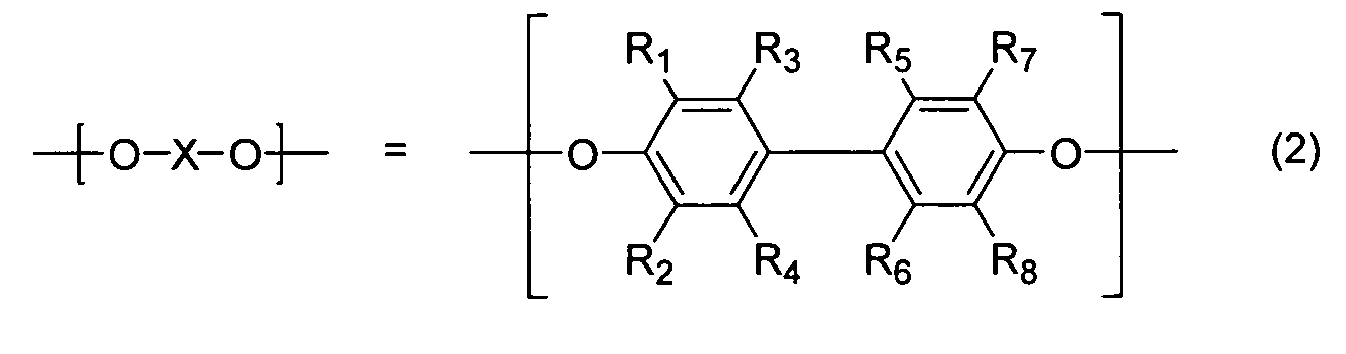
-

-

- As for imidation, it is possible to adopt a thermal imidation method or a chemical imidation method. As the thermal imidation method, for example, (1) a method in which a solution of a polyamic acid is flowed and expanded on a base plate having a flat and smooth surface such as a glass plate or a metal plate and then cyclodehydration is carried out by heating or (2) a method in which a solution of a polyamic acid is directly heated to carry out cyclodehydration is adopted. For example, an organic solvent which is used for the production of the polyamic acid, to be described later, can be used as a solvent in the above methods. In the above thermal imidation method (1), a thin film formed by flowing and expanding the polyamic acid solution on the base plate is heated under normal pressure or under reduced pressure, whereby a film-like polyimide can be obtained. The heating temperature for the cyclodehydration in this case is generally 100 to 400 °C, preferably 150 to 350 °C. It is preferred to gradually increase the temperature during the reaction. In the above thermal imidation method (2), the polyamic acid solution is heated, whereby a polyimide in the form of a powder or a solution can be obtained. The heating temperature for the cyclodehydration in this case is generally 80 to 300 °C, preferably 100 to 250 °C. In the above thermal imidation method (2), a component which is azeotropic with water and, in particular, can be easily separated from water outside a reaction system, such as an aromatic hydrocarbon typified by benzene, toluene or xylene, can be used as a dehydrating agent for the purpose of easily removing water generated as a by-product. Further, a catalyst such as a tertiary amine can be used for accelerating the cyclodehydration in the above thermal imidation method (2). The amount of the catalyst is, for example, 10 to 400 parts by weight based on 100 parts by weight of the polyamic acid. Examples of the tertiary amine as the catalyst include aliphatic tertiary amines such as trimethylamine, triethylamine, tri-n-propylamine, tri-i-propylamine and tri-n-butylamine; aromatic tertiary amines such as N,N-dimethylaniline and N,N-diethylaniline; and heterocyclic tertiary amines such as pyridine, quinoline and isoquinoline.
- As the chemical imidation method, for example, (3) a method in which poly-imidation is carried out in the state of a solution by the use of a cyclization agent capable of cyclodehydrating a polyamic acid is adopted, whereby a polyimide is obtained in the form of a powder or a solution. For example, an organic solvent which is used for the production of the polyamic acid, to be described later, can be used as a solvent for this method. Examples of the cyclization agent used in the chemical imidation method (3) include acid anhydrides such as acetic anhydride, propionic anhydride and butyric anhydride. The cyclization agent can be used singly or at least two cyclization agents can be used in combination. The amount of the cyclization agent is generally 2 to 100 mol, preferably 2 to 50 mol, per 1 mol of a repeating unit of the polyamic acid. The reaction temperature in the chemical imidation method (3) is generally 0 to 200 °C. Further, a tertiary amine can be used as a catalyst also in the chemical imidation method similarly to the above thermal imidation method. When the polyimide is obtained in the form of a powder by the above thermal imidation method or the chemical imidation method, the polyimide powder can be separated and recovered from a medium by proper means such as filtration, spray drying or steam distillation. The imidation rate of the polyimide of the present invention is 50 % or more, preferably 90 % or more.
- Then, the polyamic acid of the present invention will be explained.
- In the polyamic acid having a structural unit represented by the formula (18), -(O-X-O)- represents a structure defined by the formula (2) or the formula (3), -(Y-O)- represents an arrangement of one kind of structure defined by the formula (4) or a random arrangement of at least two kinds of structures defined by the formula (4), Ar represents a tetravalent aromatic group selected from the group consisting of a monocyclic aromatic group, a condensed polycyclic aromatic group and a non-condensed polycyclic aromatic group having a structure in which monocyclic aromatic groups are connected to each other directly or through a connecting group, and each of a and b is an integer of 0 to 100, provided that at least one of a and b is not 0. In the formula (2), R1, R2, R3, R7 and R8 are the same or different and represent an alkyl group having 6 or less carbon atoms or a phenyl group and R4, R5 and R6 are the same or different and represent a hydrogen atom, an alkyl group having 6 or less carbon atoms or a phenyl group. In the formula (3), R9, R10, R11, R12, R13, R14, R15 and R16 are the same or different and represent a hydrogen atom, an alkyl group having 6 or less carbon atoms or a phenyl group and -A- represents a linear, branched or cyclic bivalent hydrocarbon group having 20 or less carbon atoms. In the formula (4), R17 and R18 are the same or different and represent an alkyl group having 6 or less carbon atoms or a phenyl group and R19 and R20 are the same or different and represent a hydrogen atom, an alkyl group having 6 or less carbon atoms or a phenyl group.
- In particular, preferred are a polyamic acid having a structural unit of the formula (18) wherein R1, R2, R3, R7 and R8 in the formula (2) represent an alkyl group having 3 or less carbon atoms and R4, R5 and R6 in the formula (2) represent a hydrogen atom or an alkyl group having 3 or less carbon atoms, a polyamic acid having a structural unit of the formula (18) wherein R9, R10, R11, R12, R13, R14, R15 and R16 in the formula (3) represent a hydrogen atom or an alkyl group having 3 or less carbon atoms and a polyamic acid having a structural unit of the formula (18) wherein R17 and R18 in the formula (4) represent an alkyl group having 3 or less carbon atoms and R19 and R20 in the formula (4) represent a hydrogen atom or an alkyl group having 3 or less carbon atoms.
- Especially preferred is a polyamic acid having a structural unit of the formula (18) wherein -(O-X-O)- represented by the formula (2) is represented by the formula (6) or -(O-X-O)- represented by the formula (3) is represented by the formula (7) or the formula (8) and -(Y-O)- represented by the formula (4) is an arrangement of a structure of the formula (9) or the formula (10) or a random arrangement of a structure of the formula (9) and a structure of the formula (10).
- Examples of Ar in the formula (18) include tetravalent aromatic groups having molecular structures such as molecular structures of benzene, biphenyl, naphthalene, benzophenone, 2,2-diphenylpropane, 2,2-diphenyl-1,1,1,3,3,3- hexafluoropropane, diphenyl ether, diphenyl sulfone, 9,9-diphenylfluorene and perylene. Ar is not limited to these.
- Further, Ar in the formula (18) can be a tetravalent non-condensed polycyclic aromatic group in which monocyclic aromatic groups such as benzene or biphenyl are connected to each other through a connecting group such as an oxygen atom, a carbonyl group, an ester group, methylene, ethylidene, 1-methylethylidene, 1,1-propylidene, 1,4-phenylenebis(1-methylethylidene), 1,3-phenylenebis(1-methylethylidene), cyclohexylidene, phenylmethylene, naphthylmethylene or 1-phenylethylidene. The aromatic group used for Ar can have a substituent such as a methyl group or an ethyl group.
- Of these, a tetravalent aromatic group having 6 to 30 carbon atoms or a tetravalent aromatic group represented by the formula (11) is preferred as Ar. Further preferably, the structural unit of the formula (18) is a structural unit represented by the formula (20), the formula (21) or the formula (22).
-

-

-

-

-

-

-

- Examples of -A- in the formula (4) include bivalent organic groups such as methylene, ethylidene, 1-methylethylidene, 1,1-propylidene, 1,4-phenylenebis(1-methylethylidene), 1,3-phenylenebis(1-methylethylidene), cyclohexylidene, phenylmethylene, naphthylmethylene and 1-phenylethylidene. -Ain the formula (4) is not limited to these examples.
- The polyamic acid of the present invention can further contain a structural unit represented by the formula (19) in a formula (18) : formula (19) ratio of 100 : 0 - 50 : 50.
-

- Examples of B, which represents a bivalent aromatic groups having 6 to 30 carbon atoms, include monocyclic aromatic groups such as 1,3-phenylene, 1,4-phenylene, 4,4'-biphenylene, 5-chloro-1,3-phenylene and 5-methoxy-1,3-phenylene; condensed polycyclic aromatic groups such as 1,4-naphthylene, 2,6-naphthylene, 1,4-anthrylene, 9,10-anthrylene and 3,4-perylenylene; and bivalent non-condensed polycyclic aromatic groups having a structure in which monocyclic aromatic groups, typified by phenyl or biphenyl, are connected to each other through a connecting group, such as 2,2-propylidenebis(1,4-phenylene), 2,2-(1,1,1,3,3,3-hexafluoropropylidene)bis(1,4-phenylene), carbonylbis(1,4-phenylene), oxybis(1,4-phenylene), sulfonylbis(1,4-phenylene) and 9,9-fluorenylidenebis(1,4-phenylene). Examples of the above connecting group include an oxygen atom, a carbonyl group, an ester group, methylene, ethylidene, 1-methylethylidene, 1,1-propylidene, 1,4-phenylenebis(1-methylethylidene), 1,3-phenylenebis(1-methylethylidene), cyclohexylidene, phenylmethylene, naphthylmethylene or 1-phenylethylidene. B is not limited to these examples. Further, the aromatic group used for B can have a substitute such as methyl group or an ethyl group.
- The polyamic acid of the present invention can be produced by condensation polymerization of a diamine represented by the formula (23) or a diamine represented by the formula (23) and a diamine represented by the formula (24) with an acid dianhydride in an organic solvent.
-

-

-

-

-
H2N-B-NH2 (24)
wherein B represents a bivalent aromatic group having 6 to 30 carbon atoms which is selected from the group consisting of a monocyclic aromatic group, a condensed polycyclic aromatic group and a non-condensed polycyclic aromatic group having a structure in which monocyclic aromatic groups are connected to each other directly or through a connecting group. - The method for producing the diamine represented by the formula (23) is not specially limited. The diamine of the formula (23) can be produced by any method. For example, the diamine of the formula (23) can be produced by reducing a bifunctional phenylene ether oligomer dinitro compound obtained by reacting a bifunctional phenylene ether oligomer, which is obtained by oxidative coupling of a bifunctional phenol compound and a monofunctional phenol compound, with a nitro halobenzene compound or a dinitro benzene compound in an organic solvent in the presence of a basic compound.
- The method of the above reduction of the bifunctional phenylene ether oligomer dinitro compound is not specially limited. For example, it is possible to adopt a known method in which a nitro group is reduced to an amino group. The reduction reaction of the bifunctional phenylene ether oligomer dinitro compound is carried out by, for example, reducing the bifunctional phenylene ether oligomer dinitro compound to an bifunctional phenylene ether oligomer diamino compound by use of hydrogen in a reaction solvent, which is inactive in the reaction, at a temperature of 20 to 200°C at a pressure of normal pressure to 50kgf/cm2 in the presence of a hydrogenation catalyst such as a metal catalyst typified by nickel, palladium or platinum, a supported catalyst in which such a metal is carried on a proper support, or a Raney catalyst of nickel, copper or the like. Examples of the above reaction solvent include aliphatic alcohols such as methanol, ethanol and isopropanol, ethylene glycol monoalkyl ethers such as methyl cellosolve and ethyl cellosolve, aromatic hydrocarbons such as toluene, benzene and xylene, and ethers such as tetrahydrofuran, dioxane, dipropyl ether, diethylene glycol dimethyl ether, diethylene glycol ethyl methyl ether and diethylene glycol diethyl ether. The reaction solvent is not limited to these examples so long as it is a solvent which dissolves the bifunctional phenylene ether oligomer dinitro compound. The reaction solvent may be used singly or at least two reaction solvents may be used in combination.
- The number average molecular weight of the diamine of the formula (23) is preferably in the range of from 500 to 3,000. The dispersity (weight average molecular weight/number average molecular weight) is preferably in the range of 1 to 3. When the number average molecular weight is less than 500, it is difficult to obtain electric characteristics possessed by a phenylene ether structure. When it exceeds 3,000, the reactivity of a terminal functional group is decreased and the solubility into solvent is also decreased. When the dispersity exceeds 3, the solubility into solvent is decreased.
- The substitution position of an amino group of the diamine represented by the formula (23) is not specially limited so long as it is a para position or a meta position with regard to the substitution position of an oxygen atom.
- Then, the bifunctional phenylene ether oligomer dinitro compound, which can be a precursor of the diamine represented by the formula (23), will be explained. The method for producing the bifunctional phenylene ether oligomer dinitro compound is not specially limited. The bifunctional phenylene ether oligomer dinitro compound can be produced by any method. For example, the bifunctional phenylene ether oligomer dinitro compound is produced by reacting a bifunctional phenylene ether oligomer, which is obtained by oxidative coupling of a bifunctional phenol compound and a monofunctional phenol compound, with a nitro halobenzene compound or a dinitro benzene compound in an organic solvent in the presence of a basic compound at a temperature of 50 to 250°C, preferably 50 to 180°C, for 0.5 to 24 hours. The method for producing the bifunctional phenylene ether oligomer dinitro compound can be selected from known methods. For example, the methods described in
JP-A-4-178358 JP-A-2006-219396 - The above-mentioned bifunctional phenylene ether oligomer can be produced by, for example, dissolving a bifunctional phenol compound, a monofunctional phenol compound and a catalyst in a solvent and then introducing oxygen into the resultant solution under heat with stirring. Examples of the bifunctional phenol compound include 2,2',3,3',5,5'-hexamethyl-(1,1'-biphenyl)-4,4'-diol, 4,4'-methylenebis(2,6-dimethylphenol), 4,4'-dihydroxyphenyl methane and 2,2-bis(4-hydroxyphenyl)propane. The bifunctional phenol compound is not limited to these examples. The monofunctional phenol compound is typically 2,6-dimethylphenol or 2,3,6-trimethylphenol. The monofunctional phenol compound is not limited to these. The catalyst is, for example, a combination of a copper salt and an amine. Examples of the copper salt include CuCl, CuBr, CuI, CuCl2 and CuBr2. Examples of the amine include di-n-butylamine, n-butyldimethylamine, N,N'-di-t-butylethylenediamine, pyridine, N,N,N'N'-tetramethylethylenediamine, piperidine and imidazole. The catalyst is not limited to these examples. Examples of the solvent include toluene, methanol, methyl ethyl ketone and xylene. The solvent is not limited to these examples.
- Examples of the diamine represented by the formula (24) include p-phenylenediamine, m-phenylenediamine, 3,4'-diaminodiphenylether, 4,4'-diaminodiphenylether, 1,5-naphthylenediamine, 4,4'-diaminodiphenylmethane, 3,4'-diaminodiphenylsulfone, 4,4'-diaminodiphenylsulfone, 2,4-diaminochlorobenzene, 2,2-bis[4-(4-aminophenoxy)phenyl] propane, 2,2-[4-(4-aminophenoxyphenyl)][4-(3- aminophenoxyphenyl)]propane, 2,2-bis[3-(3-aminophenoxy)phenyl]-1,1,1,3,3,3-hexafluoropropane, 2,2-bis[4-(4-aminophenoxy)phenyl]-1,1,1,3,3,3-hexafluoropropane, 2,2-[4-(4-aminophenoxyphenyl)]{4-(3-aminophenoxyphenyl)-1,1,1,3,3,3-hexafluor opropane, 1,3-bis(3-aminophenoxy)benzene, 1,4-bis(3-aminophenoxy)benzene, 1,4-bis(4-aminophenoxy) benzene, 1,3-bis(4-aminophenoxy)benzene and 4,4'-bis(4-aminophenoxy)biphenyl. The amount of the diamine of the formula (24) is 50 mol% or less based on the total of the diamine components. The diamine of the formula (24) can be used singly or a mixture of at least two diamines of the formula (24) can be used.
- Examples of the acid dianhydride include pyromellitic dianhydride, 1,2,3,4-benzenetetracarboxylic dianhydride, 3,3',4,4'-benzophenonetetracarboxylic dianhydride, 2,2',3,3'-benzophenonetetracarboxylic dianhydride, 3,3',4,4'-biphenyltetracarboxylic dianhydride, 2,2',3,3'-biphenyltetracarboxylic dianhydride, 2,3,3',4'-biphenyltetracarboxylic dianhydride, 2,2-bis(3,4-dicarboxyphenyl)propane dianhydride, 2,2-bis(2,3-dicarboxyphenyl)propane dianhydride, bis(3,4-dicarboxyphenyl)ether dianhydride, bis(2,3-dicarboxyphenyl)ether dianhydride, bis(3,4-dicarboxyphenyl)sulfone dianhydride, bis(2,3-dicarboxyphenyl)sulfone dianhydride, 2,3-bis(3,4-dicarboxyphenyl)-1,1,1,3,3,3-hexafluoropropane dianhydride, 2,2-bis(2,3-dicarboxyphenyl)-1,1,1,3,3,3- hexafluoropropane dianhydride, 9,9-bis(4-(3,4- dicarboxyphenoxy)phenyl)fluorene dianhydride, 9,9-bis(4-(2,3-dicarboxyphenoxy)phenyl)fluorene dianhydride, 2,3,6,7-naphthalenetetracarboxylic dianhydride, 1,4,5,8-naphthalenetetracarboxylic dianhydride, 3,4,9,10-perylenetetracarboxylic dianhydride and an acid dianhydride represented by the formula (25).
- Among these acid dianhydrides, pyromellitic dianhydride, 2,2',3,3'-biphenyltetracarboxylic dianhydride, 3,3',4,4'-biphenyltetracarboxylic dianhydride, 2,3,3',4'-biphenyltetracarboxylic dianhydride and the acid dianhydride represented by the formula (25) are preferred. The acid dianhydride can be used singly or at least two acid dianhydrides can be used in combination.
-

-

-

-

- The method for producing the acid dianhydride represented by the formula (25) is not specially limited. The acid dianhydride of the formula (25) can be produced by any method. For example, the acid dianhydride of the formula (25) can be obtained by reacting the aforementioned bifunctional phenylene ether oligomer with trimellitic anhydride chloride in the presence of a base such as pyridine or triethylamine. A solvent which does not react with an acid anhydride and an acid chloride such as toluene, xylene, dichloromethane or chloroform can be used as a solvent for the above reaction. It is preferred to carry out the reaction in an atmosphere of an inert gas such as nitrogen or argon in order to prevent the deactivation of the acid anhydride and the acid chloride.
- The acid dianhydride represented by the formula (25) can be also obtained by reacting the aforementioned bifunctional phenylene ether oligomer with trimellitic anhydride in the presence of a condensing agent. A known esterification agent such as sulfuric acid can be used as the condensing agent. A solvent which does not react with an acid anhydride such as toluene or xylene can be used as a solvent for the above reaction. It is preferred to carry out the reaction in an atmosphere of an inert gas such as nitrogen or argon in order to prevent the deactivation of the acid anhydride.
- The number average molecular weight of the acid dianhydride represented by the formula (25) is preferably in the range of 500 to 3,000. The dispersity (weight average molecular weight/number average molecular weight) is preferably in the range of 1 to 3.
- The polyamic acid of the present invention can be produced by using at least two kinds of diamines represented by the formula (23), at least two kinds of diamines represented by the formula (24) or at least two kinds of acid dianhydrides. The polyamic acid can be a block copolymer in which an amic acid having the same repeating unit repeats to a certain extent and then another kind of amic acid repeates to a certain extent or a random copolymer in which amic acids obtained from different raw materials are respectively repeated at random.
- The reaction between the diamine and the acid dianhydride is generally carried out in an organic solvent. Examples of the organic solvent include N,N-dimethylformamide, N,N-dimethylacetamide, N,N-dimethylmethoxyacetamide, N,N-diethylmethoxyacetamide, N-methyl-2-pyrrolidone, N-methylcaprolactam, 1,2-dimethoxyethane, diethylene glycol dimethyl ether, diethylene glycol ethyl methyl ether, diethylene glycol diethyl ether, tetrahydrofuran, 1,3-dioxane, 1,4-dioxane, pyridine, picoline, dimethylsulfoxide, dimethylsulfone and tetramethylurea. The organic solvent can be used singly or at least two organic solvents can be used in combination. The concentration of the reaction raw materials in the aforesaid condensation polymerization reaction is generally 2 to 50 wt%, preferably 5 to 30 wt%. The reaction temperature is generally 60 °C or lower, preferably 50 °C or lower. The reaction pressure is not specially limited. Generally, the condensation polymerization can be carried out under normal pressure. Further, the reaction time is generally 0.5 to 24 hours. The polyamic acid of the present invention can be obtained by the above-explained condensation polymerization.
- The reduction viscosity (N,N-dimethylacetamide solvent, 25 °C, concentration 0.5 g/dl) of the polyamic acid of the present invention is preferably 0.1 to 5 dl/g.
- Further, the polyamic acid of the present invention can be partially imidized so long as the imidation rate does not exceed 50 %.
- The film of the present invention will be explained.
The film made of the polyimide of the present invention is obtained by applying a solution containing the polyimide of the present invention or the polyamic acid of the present invention to a surface of a supporting material such as a glass plate, a metal plate or a plastic film with a device such as a bar coater, a die coater, a doctor blade or a baker applicator, carrying out drying and cyclodehydration by heating, and then removing the supporting material. As for the heating conditions for the cyclodehydration, the temperature is generally 100 °C to 400 °C, preferably 150 °C to 350 °C, and it is preferred to gradually increase the temperature. The heating time is preferably 1 to 10 hours. It is possible to use a reduced pressure or use an atmosphere of an inert gas such as nitrogen or argon during the heating, as required. As the method of removing the supporting material, peeling-off, etching or the like is used. The supporting material can be removed before the completion of the drying and cyclodehydration. It is possible to adopt a method in which the drying and cyclodehydration are carried out until the applied solution becomes capable of supporting itself, then, it is peeled off from the supporting material, and then, drying and cyclodehydration are carried out again. When the thickness of the applied solution is large, a solvent is apt to remain. Therefore, the thickness of the film of the present invention is preferably 0.1 to 500 µm, more preferably 0.5 to 200 µm. - The laminate of the present invention which has metal layer(s) on one side or both surfaces will be explained.
- The laminate of the present invention can be obtained by a method in which the film of the present invention and a metal foil or a metal plate are pressure-bonded by heating and pressurization, a method in which the film of the present invention and a metal foil or a metal plate is bonded with an adhesive, a method in which a metal layer is formed on the film of the present invention by plating or sputtering or a method in which a solution of the polyamic acid of the present invention is flowed and expanded on a metal plate or a metal foil, followed by drying and cyclodehydration by heating, to form a polyimide.
- The present invention will be more concretely explained with reference to Examples, hereinafter, while the present invention shall not be specially limited to these Examples. A number average molecular weight and a weight average molecular weight were obtained by a gel permeation chromatography (GPC) method (calculated as polystyrene). Tetrahydrofuran (THF) was used for a developing solvent for GPC. A hydroxyl group equivalent and an amino group equivalent were obtained by quantification of a terminal functional group by means of titration. A dielectric constant and a dielectric loss tangent were measured at 10 GHz by a cavity resonance perturbation method. In Examples of the present invention, the term "at a dried time" means the state of a sample after the sample was kept in a calcium chloride-containing desiccator (humidity 21%) at a temperature of 20 °C for 12 hours and the term "at a moisture-absorbed time" means the state of a sample_after the sample is kept at a humidity of 50 % at a temperature of 25 °C for 12 hours. As for the reduction viscosity of a polyamic acid, a polyamic acid solution was dissolved into N,N-dimethylacetamide such that the concentration became 0.5 g/dl, and then the reduction viscosity was measured at 25 °C with a Ubbelohde viscosimeter.
- Synthetic Example 1
- (Synthesis of Bifunctional Phenylene Ether Oligomer)
A 12L longitudinally long reactor equipped with a stirrer, a thermometer, an air-introducing tube and baffleplates was charged with 3.88 g (17.4 mmol) of CuBr2, 0.75 g (4.4 mmol) of N,N'-di-t-butylethylenediamine, 28.04 g (277.6 mmol) of n-butyldimethylamine and 2, 600 g of toluene. The mixture was stirred at a reaction temperature of 40 °C. Separately, 129.32 g (0.48 mol) of 2,2',3,3',5,5'-hexamethyl-(1,1'-biphenyl) -4,4'-diol, 292.19 g (2.40 mol) of 2,6-dimethylphenol, 0.51 g (2.9 mmol) of N,N'-di-t-butylethylenediamine and 10.90 g (108.0 mmol) of n-butyldimethylamine were dissolved in 2,300 g of methanol, to obtain a mixed solution. The mixed solution was dropwise added to the mixture in the reactor over 230 minutes with stirring while bubbling was carried out with a nitrogen-air mixed gas having an oxygen concentration of 8 % at a flow velocity of 5.2L/min. After the completion of the addition, 1,500 g of water containing 19.89 g (52.3 mmol) of tetrasodium ethylenediamine tetraacetate dissolved therein was added to the mixture to terminate the reaction. An aqueous layer and an organic layer were separated. The organic layer was washed with 1N hydrochloric acid aqueous solution and then washed with pure water. The thus-obtained solution was concentrated with an evaporator and then dried under reduced pressure at 120 °C for 3 hours, to obtain 416.7 g of a bifunctional phenylene ether oligomer (resin "A"). The resin "A" had a number average molecular weight of 1, 035, a weight average molecular weight of 1,598 and a hydroxyl group equivalent of 435. - (Synthesis of Bifunctional Phenylene Ether Oligomer Dinitro Compound)
A 2L reactor vessel equipped with a stirrer, a reflux condenser and a thermometer was charged with 999.3 g of N, N-dimethylacetamide, 250.4 g of the resin "A", 89.4 g (0.63 mol) of 4-fluoronitrobenzene and 95.3 g (0.69 mol) of potassium carbonate. The atmosphere in the reactor vessel was replaced with nitrogen. Then, the resultant mixture was heated and the mixture was continuously stirred for 5 hours at 110°C, to allow the mixture to react. After the completion of the reaction, filtering was carried out at 90 to 100°C to remove an inorganic salt. Then, the thus-obtained filtrate was cooled down to room temperature. The filtrate was poured to a mixed solvent of 1,000 g of methanol and 500 g of pure water, to precipitate a solid. The solid was recovered by filtering, washed with methanol and dried, to obtain 286. 9 g of a bifunctional phenylene ether oligomer dinitro compound (resin "B"). The resin "B" had a number average molecular weight of 1,246 and a weight average molecular weight of 1,779. An infrared absorption spectrum (IR) of the resin "B" showed absorptions at a wavenumber of 1, 520cm-1 and a wavenumber of 1, 343 cm-1, which correspond to an N-O bond. - (Synthesis of Bifunctional Phenylene Ether Oligomer Diamine)
Then, a 2L reactor vessel equipped with a stirrer was charged with 100.0 g of the resin "B", 600 g of N,N-dimethylacetamide and 2.5 g of a 5%Pd/alumina catalyst. The mixture was stirred under a hydrogen atmosphere at 80 °C for 7.5 hours, to allow the mixture to react. Then, the resultant reaction solution was filtered, to remove the catalyst, and then poured to 1,000 g of pure water, to precipitate a solid. The solid was recovered by filtering, washed with pure water and dried, to obtain 85.1 g of a bifunctional phenylene ether oligomer diamine (resin "C"). The resin "C" had a number average molecular weight of 1,269, a weight average molecular weight of 1,788 and an amino group equivalent of 590. An infrared absorption spectrum (IR) of the resin "C" showed absorptions at a wavenumber of 3,448 cm-1 and a wavenumber of 3,367 cm-1, which correspond to an N-H bond. - (Synthesis of Bifunctional Phenylene Ether Oligomer Acid Dianhydride)
A 200ml reactor equipped with a stirrer, a thermometer, a dropping funnel and a reflux tube was charged with 6. 31 g (0.03mol) of trimellitic anhydride chloride and 40 g of toluene. The mixture was stirred under heat at 70 °C under nitrogen, and 8.27 g (hydroxyl group 0.019 mol) of the resin "A", 2.41 g of pyridine and 80 g of toluene placed in the dropping funnel were dropwise added over 1 hour. After the completion of the addition, the resultant mixture was further heated and refluxed for 2 hours. After the completion of the reaction, the reactor was cooled by ice bath. The thus-precipitated trimellitic anhydride chloride and pyridine hydrochloride were removed by filtering. The thus-obtained filtrate was evaporated and dried under reduced pressure, to obtain 11. 6 g of an acid dianhydride (resin "D") represented by the aforementioned formula (24). The resin "D" had a number average molecular weight of 1,343 and a weight average molecular weight of 2,782. The structure of the resin "D" was confirmed by nuclear magnetic resonance spectrum and infrared spectroscopic spectrum. - Synthetic Example 2
- (Synthesis of Bifunctional Phenylene Ether Oligomer)
A 12L longitudinally long reactor equipped with a stirrer, a thermometer, an air-introducing tube and baffleplates was charged with 9.36 g (42.1 mmol) of CuBr2, 1.81 g (10.5 mmol) of N,N'-di-t-butylethylenediamine, 67.77 g (671.0 mmol) of n-butyldimethylamine and 2, 600 g of toluene. The mixture was stirred at a reaction temperature of 40 °C. Separately, 129.31 g (0.48 mol) of 2,2',3,3',5,5'-hexamethyl-(1,1'-biphenyl)-4,4'-diol, 878.4 g (7.2 mol) of 2,6-dimethylphenol, 1.22 g (7.2 mmol) of N,N'-di-t-butylethylenediamine and 26.35 g (260.9 mmol) of n-butyldimethylamine were dissolved in 2,300 g of methanol, to obtain a mixed solution. The mixed solution was dropwise added to the mixture in the reactor over 230 minutes with stirring while bubbling was carried out with a nitrogen-air mixed gas having an oxygen concentration of 8 % at a flow velocity of 5.2L/min. After the completion of the addition, 1,500 g of water containing 48.06 g (126.4 mmol) of tetrasodium ethylenediamine tetraacetate dissolved therein was added to the mixture to terminate the reaction. An aqueous layer and an organic layer were separated. Then, the organic layer was washed with 1N hydrochloric acid aqueous solution and then washed with pure water. The thus-obtained solution was concentrated with an evaporator and then dried under reduced pressure at 120 °C for 3 hours, to obtain 990.5 g of a bifunctional phenylene ether oligomer (resin "E"). The resin "E" had a number average molecular weight of 1, 975, a weight average molecular weight of 3,514 and a hydroxyl group equivalent of 990. - (Synthesis of Bifunctional Phenylene Ether Oligomer Dinitro Compound)
A 500ml reactor vessel equipped with a stirrer, a reflux condenser, a thermometer and a Dean and Stark water separator was charged with 250.2 g of N,N-dimethylformamide, 148.5 g of the resin "E", 52.1 g (0.33 mol) of 4-chloronitrobenzene and 25.0 g (0.18 mol) of potassium carbonate. 20.0 g of toluene was added to the reactor vessel. The atmosphere in the reactor vessel was replaced with nitrogen. Then, the resultant mixture was heated and the mixture was continuously stirred for 5 hours at a temperature of 140 to 150°C, to allow the mixture to react. Water generated by the reaction was sequentially removed by azeotropy with toluene. After the completion of the reaction, filtering was carried out at 80 to 90°C, to remove an inorganic salt. Then, the thus-obtained filtrate was cooled down to room temperature. The filtrate was poured to 320.1 g of methanol, to precipitate a solid. The solid was recovered by filtering, washed with methanol and then dried, to obtain 140.3 g of a bifunctional phenylene ether oligomer dinitro compound (resin "F"). The resin "F" had a number average molecular weight of 3, 081 and a weight average molecular weight of 5,587. An infrared absorption spectrum (IR) of the resin "F" showed absorptions at a wavenumber of 1, 519 cm-1 and a wavenumber of 1,342 cm-1, which correspond to an N-O bond. - (Synthesis of Bifunctional Phenylene Ether Oligomer Diamine)
Then, a 300ml reactor vessel equipped with a stirrer was charged with 3.60 g of the resin "F", 105.0 g of N,N-dimethylformamide and 0.468 g of a 5%Pd/C catalyst. The mixture was allowed to react under a hydrogen atmosphere at room temperature for 8 hours with vigorously stirring. Then, the resultant reaction solution was filtered to remove the catalyst, then concentrated with an evaporator and then dried under reduced pressure, to obtain 2.97 g of a bifunctional phenylene ether oligomer diamine (resin "G"). The resin "G" had a number average molecular weight of 2, 905, a weight average molecular weight of 6, 388 and an amino group equivalent of 1,351. An infrared absorption spectrum (IR) of the resin "G" showed absorptions at a wavenumber of 3,447 cm-1 and a wavenumber of 3,365 cm-1, which correspond to an N-H bond. - Synthetic Example 3
- (Synthesis of Bifunctional Phenylene Ether Oligomer)
A 12L longitudinally long reactor equipped with a stirrer, a thermometer, an air-introducing tube and baffleplates was charged with 13.1 g (0.12 mol) of CuCl, 707.0 g (5.5 mol) of di-n-butylamine and 4,000 g of methyl ethyl ketone. The mixture was stirred at a reaction temperature of 40 °C. Separately, 410.2 g (1.6 mol) of 4,4'-methylenebis(2,6-dimethylphenol) and 586.5 g (4.8 mol) of 2,6-dimethylphenol were dissolved in 8,000 g of methyl ethyl ketone to obtain a solution. The solution was dropwise added to the mixture in the reactor over 120 minutes with stirring while bubbling was continuously carried out with 2 L/min of air. A disodium dihydrogen ethylenediamine tetraacetate aqueous solution was added to the resultant mixture to terminate the reaction. Then, washing was carried out with 1N hydrochloric acid aqueous solution three times and then washing was carried out with ion-exchanged water. The thus-obtained solution was concentrated with an evaporator and then dried under reduced pressure at 120 °C for 3 hours, to obtain 946.6 g of a bifunctional phenylene ether oligomer (resin "H") . The resin "H" had a number average molecular weight of 801, a weight average molecular weight of 1,081 and a hydroxyl group equivalent of 455. - (Synthesis of Bifunctional Phenylene Ether Oligomer Dinitro Compound)
A 500ml reactor vessel equipped with a stirrer, a reflux condenser, a thermometer and a Dean and Stark water separator was charged with 200.2 g of N,N-dimethylformamide, 68.3 g of the resin "H", 52.2 g (0.33 mol) of 4-chloronitrobenzene and 24. 9 g (0. 18 mol) of potassium carbonate. 19.0 g of toluene was added to the reactor vessel. The atmosphere in the reactor vessel was replaced with nitrogen. Then, the resultant mixture was heated and the mixture was continuously stirred for 5 hours at a temperature of 140 to 150°C, to allow the mixture to react. Water generated by the reaction was sequentially removed by azeotropy with toluene. After the completion of the reaction, filtering was carried out at 80 to 90°C, to remove an inorganic salt. Then, the thus-obtained filtrate was cooled down to room temperature. The filtrate was poured to 290.2 g of methanol, to precipitate a solid. The solid was recovered by filtering, washed with methanol and then dried, to obtain 63.8 g of a bifunctional phenylene ether oligomer dinitro compound (resin "I") . The resin "I" had a number average molecular weight of 1,250 and a weight average molecular weight of 1,719. An infrared absorption spectrum (IR) of the resin "I" showed absorptions at a wavenumber of 1, 522 cm-1 and a wavenumber of 1,340 cm-1, which correspond to an N-O bond. - (Synthesis of Bifunctional Phenylene Ether Oligomer Diamine) Then, a 300ml reactor vessel equipped with a stirrer was charged with 3.45 g of the resin "I", 90.0 g of N,N-dimethylformamide and 0.48 g of a 5%Pd/C catalyst. The mixture was allowed to react under a hydrogen atmosphere at room temperature for 6 hours with vigorously stirring. Then, the resultant reaction solution was filtered to remove the catalyst, then concentrated with an evaporator and then dried under reduced pressure, to obtain 2.64 g of a bifunctional phenylene ether oligomer diamine (resin "J"). The resin "J" had a number average molecular weight of 1,205, a weight average molecular weight of 2, 009 and an amino group equivalent of 560. An infrared absorption spectrum (IR) of the resin "J" showed absorptions at a wavenumber of 3,446 cm-1 and a wavenumber of 3,367 cm-1, which correspond to an N-H bond.
- Synthetic Example 4
- (Synthesis of Bifunctional Phenylene Ether Oligomer) A 12L longitudinally long reactor equipped with a stirrer, a thermometer, an air-introducing tube and baffleplates was charged with 13.1 g (0.12 mol) of CuCl, 707.0 g (5.5 mol) of di-n-butylamine and 4,000 g of methyl ethyl ketone. The mixture was stirred at a reaction temperature of 40 °C. Separately, 82.1 g (0.32 mol) of 4,4'-methylenebis(2,6-dimethylphenol) and 586.5 g (4.8 mol) of 2,6-dimethylphenol were dissolved in 8,000 g of methyl ethyl ketone to obtain a solution. The solution was dropwise added to the mixture in the reactor over 120 minutes with stirring while bubbling was continuously carried out with 2 L/min of air. A disodium dihydrogen ethylenediamine tetraacetate aqueous solution was added to the resultant mixture, to terminate the reaction. Then, washing was carried out with 1N hydrochloric acid aqueous solution three times and then washing was carried out with ion-exchanged water. The thus-obtained solution was concentrated with an evaporator and then dried under reduced pressure, to obtain 632.5 g of a bifunctional phenylene ether oligomer (resin "K"). The resin "K" had a number average molecular weight of 1,884, a weight average molecular weight of 3,763 and a hydroxyl group equivalent of 840.
- (Synthesis of Bifunctional Phenylene Ether Oligomer Dinitro Compound)
A 500ml reactor vessel equipped with a stirrer, a reflux condenser, a thermometer and a Dean and Stark water separator was charged with 250.5 g of N,N-dimethylformamide, 126.0 g of the resin "K", 51.9 g (0.33 mol) of 4-chloronitrobenzene and 25.0 g (0.18 mol) of potassium carbonate. 19.2 g of toluene was added to the reactor vessel. The atmosphere in the reactor vessel was replaced with nitrogen. Then, the resultant mixture was heated and the mixture was continuously stirred for 5 hours at a temperature of 140 to 150°C, to allow the mixture to react. Water generated by the reaction was sequentially removed by azeotropy with toluene. After the completion of the reaction, filtering was carried out at 80 to 90°C, to remove an inorganic salt. Then, the thus-obtained filtrate was cooled down to room temperature. The filtrate was poured to 330.3 g of methanol, to precipitate a solid. The solid was recovered by filtering, washed with methanol and then dried, to obtain 115.0 g of a bifunctional phenylene ether oligomer dinitro compound (resin "L"). The resin "L" had a number average molecular weight of 2, 939 and a weight average molecular weight of 5,982. An infrared absorption spectrum (IR) of the resin "L" showed absorptions at a wavenumber of 1, 518 cm-1 and a wavenumber of 1,343 cm-1, which correspond to an N-O bond. - (Synthesis of Bifunctional Phenylene Ether Oligomer Diamine)
Then, a 300ml reactor vessel equipped with a stirrer was charged with 6.39 g of the resin "L", 105.3 g of N, N-dimethylformamide and 0.56 g of a 5%Pd/C catalyst. The mixture was allowed to react under a hydrogen atmosphere at room temperature for 8 hours with vigorously stirring. Then, the resultant reaction solution was filtered to remove the catalyst, then concentrated with an evaporator and then dried under reduced pressure, to obtain 5.67 g of a bifunctional phenylene ether oligomer diamine (resin "M"). The resin "M" had a number average molecular weight of 2,733, a weight average molecular weight of 6,746 and an amino group equivalent of 1, 271. An infrared absorption spectrum (IR) of the resin "M" showed absorptions at a wavenumber of 3,449 cm-1 and a wavenumber of 3,366 cm-1, which correspond to an N-H bond. - Synthetic Example 5
- (Synthesis of Bifunctional Phenylene Ether Oligomer)
A 2L longitudinally long reactor equipped with a stirrer, a thermometer, an air-introducing tube and baffleplates was charged with 18.0 g (78.8 mmol) of 2,2-bis(4-hydroxyphenyl)propane(bisphenol A), 0.172 g (0.77 mmol) of CuBr2, 0.199 g(1.15 mmol) of N,N'-di-t-butylethylenediamine, 2.10 g (2.07 mmol) of n-butyldimethylamine, 139 g of methanol and 279 g of toluene. Separately, 48.17 g (0.394 mol) of 2,6-dimethylphenol, 0.245 g(1.44 mmol) of N,N'-di-t-butylethylenediamine and 2.628 g (25.9 mmol) of n-butyldimethylamine were dissolved in 133 g of methanol and 266 g of toluene, to obtain a mixed solution. The mixed solution was dropwise added to the reactor, in which the mixture was stirred at a liquid temperature of 40°C, over 132 minutes while bubbling was carried with air at a flow velocity of 0.5 L/min. After the completion of the addition of the mixed solution, the resultant mixture was further stirred for 120 minutes. 400 g of water containing 2.40 g of tetrasodium ethylenediamine tetraacetate dissolved therein was added to the stirred mixture to terminate the reaction. An aqueous layer and an organic layer were separated. Then, washing with pure water was carried out. The thus-obtained solution was concentrated with an evaporator and then dried in vacuum at 120°C for 3 hours, to obtain 54.8 g of a bifunctional phenylene ether oligomer (resin "N"). The resin "N" had a number average molecular weight of 1,348, a weight average molecular weight of 3,267 and a hydroxyl group equivalent of 503. - (Synthesis of Bifunctional Phenylene Ether Oligomer Dinitro Compound)
A 500ml reactor vessel equipped with a stirrer, a reflux condenser, a thermometer and a Dean and Stark water separator was charged with 200.1 g of N,N-dimethylformamide, 75.5 g of the resin "N", 52.0 g (0.33 mol) of 4-chloronitrobenzene and 25.0 g (0.18 mol) of potassium carbonate. 20.0 g of toluene was added to the reactor vessel. The atmosphere in the reactor vessel was replaced with nitrogen. Then, the resultant mixture was heated and the mixture was continuously stirred for 5 hours at a temperature of 140 to 150°C, to allow the mixture to react. Water generated by the reaction was sequentially removed by azeotropy with toluene. After the completion of the reaction, filtering was carried out at 80 to 90°C, to remove an inorganic salt. Then, the thus-obtained filtrate was cooled down to room temperature. The filtrate was poured to 300.2 g of methanol, to precipitate a solid. The solid was recovered by filtering, washed with methanol and then dried, to obtain 72.1 g of a bifunctional phenylene ether oligomer dinitro compound (resin "O"). The resin "O" had a number average molecular weight of 2,103 and a weight average molecular weight of 5,194. An infrared absorption spectrum (IR) of the resin "O" showed absorptions at a wavenumber of 1, 516 cm-1 and a wavenumber of 1,340 cm-1, which correspond to an N-O bond. - (Synthesis of Bifunctional Phenylene Ether Oligomer Diamine) Then, a 300ml reactor vessel equipped with a stirrer was charged with 3.93 g of the resin "O", 90.0 g of N,N-dimethylformamide and 0.49 g of a 5%Pd/C catalyst. The mixture was allowed to react under a hydrogen atmosphere at room temperature for 6 hours with vigorously stirring. Then, the resultant reaction solution was filtered to remove the catalyst, then concentrated with an evaporator and then dried under reduced pressure, to obtain 3.30 g of a bifunctional phenylene ether oligomer diamine (resin "P") . The resin "P" had a number average molecular weight of 2,051, a weight average molecular weight of 6, 142 and an amino group equivalent of 954. An infrared absorption spectrum (IR) of the resin "P" showed absorptions at a wavenumber of 3,450 cm-1 and a wavenumber of 3,365 cm-1, which correspond to an N-H bond.
- Synthetic Example 6
- (Synthesis of Bifunctional Phenylene Ether Oligomer)
A 12L longitudinally long reactor equipped with a stirrer, a thermometer, an air-introducing tube and baffleplates was charged with 3.88 g (17.4 mmol) of CuBr2, 0.75 g (4.4 mmol) of N,N'-di-t-butylethylenediamine, 28.04 g (277.6 mmol) of n-butyldimethylamine and 2, 600 g of toluene. The mixture was stirred at a reaction temperature of 40 °C. Separately, 129.3 g (0.48 mol) of 2,2',3,3',5,5'-hexamethyl-(1,1'-biphenyl)-4,4'-diol, 233.7 g (1.92 mol) of 2,6-dimethylphenol, 64.9 g (0.48 mol) of 2,3,6-trimethylphenol, 0.51 g (2.9 mmol) of N,N'-di-t-butylethylenediamine and 10.90 g (108.0 mmol) of n-butyldimethylamine were dissolved in 2, 300 g of methanol, to obtain a mixed solution. The mixed solution was dropwise added to the mixture in the reactor over 230 minutes with stirring while bubbling was carried out with a nitrogen-air mixed gas having an oxygen concentration of 8 % at a flow velocity of 5.2L/min. After the completion of the addition, 1,500 g of water containing 19.89 g (52.3 mmol) of tetrasodium ethylenediamine tetraacetate dissolved therein was added to the mixture to terminate the reaction. An aqueous layer and an organic layer were separated. The organic layer was washed with 1N hydrochloric acid aqueous solution and then washed with pure water. The thus-obtained solution was concentrated with an evaporator and then dried under reduced pressure at 120 °C for 3 hours, to obtain 418.1 g of a bifunctional phenylene ether oligomer (resin "Q"). The resin "Q" had a number average molecular weight of 986, a weight average molecular weight of 1,530 and a hydroxyl group equivalent of 471. - (Synthesis of Bifunctional Phenylene Ether Oligomer Dinitro Compound)
A 500ml reactor vessel equipped with a stirrer, a reflux condenser, a thermometer and a Dean and Stark water separator was charged with 200.0 g of N,N-dimethylformamide, 70.7 g of the resin "Q", 52.0 g (0.33 mol) of 4-chloronitrobenzene and 25.1 g (0.18 mol) of potassium carbonate. 19.3 g of toluene was added to the reactor vessel. The atmosphere in the reactor vessel was replaced with nitrogen. Then, the resultant mixture was heated and the mixture was continuously stirred for 5 hours at a temperature of 140 to 150°C, to allow the mixture to react. Water generated by the reaction was sequentially removed by azeotropy with toluene. After the completion of the reaction, filtering was carried out at 80 to 90°C, to remove an inorganic salt. Then, the thus-obtained filtrate was cooled down to room temperature. The filtrate was poured to 300.3 g of methanol, to precipitate a solid. The solid was recovered by filtration, washed with methanol and then dried, to obtain 64.1 g of a bifunctional phenylene ether oligomer dinitro compound (resin "R"). The resin "R" had a number average molecular weight of 1,538 and a weight average molecular weight of 2,432. An infrared absorption spectrum (IR) of the resin "R" showed absorptions at a wavenumber of 1, 522 cm-1 and a wavenumber of 1,344 cm-1, which correspond to an N-O bond. - (Synthesis of Bifunctional Phenylene Ether Oligomer Diamine)
Then, a 300ml reactor vessel equipped with a stirrer was charged with 4.50 g of the resin "R", 90.9 g of N,N-dimethylformamide and 0.51 g of a 5%Pd/C catalyst. The mixture was allowed to react under a hydrogen atmosphere at room temperature for 6 hours with vigorously stirring. Then, the resultant reaction solution was filtered to remove the catalyst, then concentrated with an evaporator and then dried under reduced pressure, to obtain 3.42 g of a bifunctional phenylene ether oligomer diamine (resin "S"). The resin "S" had a number average molecular weight of 1,465, a weight average molecular weight of 2, 809 and an amino group equivalent of 681. An infrared absorption spectrum (IR) of the resin "S" showed absorptions at a wavenumber of 3,447 cm-1 and a wavenumber of 3,360 cm-1, which correspond to an N-H bond. - Example 1
- A nitrogen gas was introduced into a container equipped with a stirrer, a reflux condenser and a nitrogen-introducing tube. 1.18 g of the resin "C" was charged into the container. Then, 12.6 g of N,N-dimethylacetamide was added and the resin "C" was fully dissolved therein. Then, 0.22 g of pyromellitic dianhydride was added and then the mixture was stirred at 30 °C for 3 hours, to obtain an N,N-dimethylacetamide solution of a polyamic acid "T". The reduction viscosity (N,N-dimethylacetamide solvent, 25 °C, 0.5 g/dl) of the polyamic acid "T" was 1.09 dl/g. An infrared absorption (IR) spectrum of the polyamic acid "T" showed an absorption at a wavenumber of 3,300 cm-1, which corresponds to the N-H stretching vibration of an amide group.
- Example 2
- A nitrogen gas was introduced into a container equipped with a stirrer, a reflux condenser and a nitrogen-introducing tube. 1.18 g of the resin "C" was charged into the container. Then, 10.3 g of N,N-dimethylacetamide was added and the resin "C" was fully dissolved therein. Then, 0.29 g of 3,3',4,4'-biphenyltetracarboxylic dianhydride was added and then the mixture was stirred at 30 °C for 3 hours, to obtain an N,N-dimethylacetamide solution of a polyamic acid "U". The reduction viscosity (N,N-dimethylacetamide solvent, 25 °C, 0. 5 g/dl) of the polyamic acid "U" was 0.53 dl/g. An infrared absorption (IR) spectrum of the polyamic acid "U" showed an absorption at a wavenumber of 3, 304 cm-1, which corresponds to the N-H stretching vibration of an amide group.
- Example 3
- A nitrogen gas was introduced into a container equipped with a stirrer, a reflux condenser and a nitrogen-introducing tube. 1.18 g of the resin "C" was charged into the container. Then, 22.3 g of N,N-dimethylacetamide was added and the resin "C" was fully dissolved therein. Then, 1.30 g of the resin "D" was added and then the mixture was stirred at 30 °C for 3 hours, to obtain an N,N-dimethylacetamide solution of a polyamic acid "V". The reduction viscosity (N,N-dimethylacetamide solvent, 25 °C, 0.5 g/dl) of the polyamic acid "V" was 0.67 dl/g. An infrared absorption (IR) spectrum of the polyamic acid "V" showed an absorption at a wavenumber of 3,301 cm-1, which corresponds to the N-H stretching vibration of an amide group.
- Example 4
- A nitrogen gas was introduced into a container equipped with a stirrer, a reflux condenser and a nitrogen-introducing tube. 2.70 g of the resin "G" was charged into the container. Then, 12.6 g of N,N-dimethylacetamide was added and the resin "G" was fully dissolved therein. Then, 0.22 g of pyromellitic dianhydride was added and then the mixture was stirred at 30 °C for 3 hours, to obtain an N,N-dimethylacetamide solution of a polyamic acid "W". The reduction viscosity (N.N-dimethylacetamide solvent, 25 °C, 0.5 g/dl) of the polyamic acid "W" was 0.99 dl/g. An infrared absorption (IR) spectrum of the polyamic acid "W" showed an absorption at a wavenumber of 3,305 cm-1, which corresponds to the N-H stretching vibration of an amide group.
- Example 5
- A nitrogen gas was introduced into a container equipped with a stirrer, a reflux condenser and a nitrogen-introducing tube. 1.12 g of the resin "J" was charged into the container. Then, 10.3 g of N,N-dimethylacetamide was added and the resin "J" was fully dissolved therein. Then, 0.22 g of pyromellitic dianhydride was added and then the mixture was stirred at 30 °C for 3 hours, to obtain an N,N-dimethylacetamide solution of a polyamic acid "X". The reduction viscosity (N,N-dimethylacetamide solvent, 25 °C, 0.5 g/dl) of the polyamic acid "X" was 0.92 dl/g. An infrared absorption (IR) spectrum of the polyamic acid "X" showed an absorption at a wavenumber of 3,295 cm-1, which corresponds to the N-H stretching vibration of an amide group.
- Example 6
- A nitrogen gas was introduced into a container equipped with a stirrer, a reflux condenser and a nitrogen-introducing tube. 2.54 g of the resin "M" was charged into the container. Then, 10.3 g of N,N-dimethylacetamide was added and the resin "M" was fully dissolved therein. Then, 0.22 g of pyromellitic dianhydride was added and then the mixture was stirred at 30 °C for 3 hours, to obtain an N,N-dimethylacetamide solution of a polyamic acid "Y". The reduction viscosity (N,N-dimethylacetamide solvent, 25 °C, 0.5 g/dl) of the polyamic acid "Y" was 0.87 dl/g. An infrared absorption (IR) spectrum of the polyamic acid "Y" showed an absorption at a wavenumber of 3,297 cm-1, which corresponds to the N-H stretching vibration of an amide group.
- Example 7
- A nitrogen gas was introduced into a container equipped with a stirrer, a reflux condenser and a nitrogen-introducing tube. 1.91 g of the resin "P" was charged into the container. Then, 10.3 g of N,N-dimethylacetamide was added and the resin "P" was fully dissolved therein. Then, 0.22 g of pyromellitic dianhydride was added and then the mixture was stirred at 30 °C for 3 hours, to obtain an N,N-dimethylacetamide solution of a polyamic acid "Z". The reduction viscosity (N,N-dimethylacetamide solvent, 25 °C, 0.5 g/dl) of the polyamic acid "Z" was 0.61 dl/g. An infrared absorption (IR) spectrum of the polyamic acid "Z" showed an absorption at a wavenumber of 3,301 cm-1, which corresponds to the N-H stretching vibration of an amide group.
- Example 8
- A nitrogen gas was introduced into a container equipped with a stirrer, a reflux condenser and a nitrogen-introducing tube. 1.36 g of the resin "S" was charged into the container. Then, 12.6 g of N,N-dimethylacetamide was added and the resin "S" was fully dissolved therein. Then, 0.22 g of pyromellitic dianhydride was added and then the mixture was stirred at 30 °C for 3 hours, to obtain an N,N-dimethylacetamide solution of a polyamic acid "AA". The reduction viscosity (N,N-dimethylacetamide solvent, 25 °C, 0.5 g/dl) of the polyamic acid "AA" was 1.22 dl/g. An infrared absorption (IR) spectrum of the polyamic acid "AA" showed an absorption at a wavenumber of 3,303 cm-1, which corresponds to the N-H stretching vibration of an amide group.
- Example 9
- A nitrogen gas was introduced into a container equipped with a stirrer, a reflux condenser and a nitrogen-introducing tube. 0.66 g of the resin "C" and 0.12 g of 4,4'-diaminodiphenylether (ratio of formula (23) : formula (24), 50 : 50) were charged into the container. Then, 16.45 g of N,N-dimethylacetamide was added and the resin "C" and the 4,4'-diaminodiphenylether were fully dissolved therein. Then, 0.26 g of pyromellitic dianhydride was added and then the mixture was stirred at 25 °C for 1 hour, to obtain an N,N-dimethylacetamide solution of a polyamic acid "AB". The reduction viscosity (N,N-dimethylacetamide solvent, 25 °C, 0.5 g/dl) of the polyamic acid "AB" was 2.11 dl/g. An infrared absorption (IR) spectrum of the polyamic acid "AB" showed an absorption at a wavenumber of 3,300 cm-1, which corresponds to the N-H stretching vibration of an amide group.
- Comparative Example 1
- A nitrogen gas was introduced into a container equipped with a stirrer, a reflux condenser and a nitrogen-introducing tube. 1.00 g of 4,4'-diaminodiphenylether was charged into the container. Then, 18.8 g of N,N-dimethylacetamide was added and the 4,4'-diaminodiphenylether was fully dissolved therein. Then, 1.09 g of pyromellitic dianhydride was added and then the mixture was stirred at 30 °C for 3 hours, to obtain an N,N-dimethylacetamide solution of a polyamic acid "AC". The reduction viscosity (N,N-dimethylacetamide solvent, 25 °C, 0.5 g/dl) of the polyamic acid "AC" was 4.16 dl/g. An infrared absorption (IR) spectrum of the polyamic acid "AC" showed an absorption at a wavenumber of 3,300 cm-1, which corresponds to the N-H stretching vibration of an amide group.
- Example 10
- A solution of the polyamic acid "T" was applied to a glass plate surface with a doctor blade. The applied solution was dried in air at 80 °C for 1 hour, at 150 °C for 1 hour and at 200 °C for 1 hour. Then, the dried solution was heat-treated under nitrogen at 300 °C for 1 hour, to obtain a film of a polyimide "AD" (thickness 15 µm). An infrared absorption (IR) spectrum of the polyimide "AD" showed an absorption at 1,740 cm-1, which corresponds to the C-O stretching vibration of an imide group, and an absorption at 1, 375 cm-1, which corresponds to the C-N stretching vibration of an imide group.
- Example 11
- A solution of the polyamic acid "U" was applied to a glass plate surface with a doctor blade. The applied solution was dried in air at 80 °C for 1 hour, at 150 °C for 1 hour and at 200 °C for 1 hour. Then, the dried solution was heat-treated under nitrogen at 300 °C for 1 hour, to obtain a film of a polyimide "AE" (thickness 15 µm). An infrared absorption (IR) spectrum of the polyimide "AE" showed an absorption at 1,741 cm-1, which corresponds to the C-O stretching vibration of an imide group, and an absorption at 1, 373 cm-1, which corresponds to the C-N stretching vibration of an imide group.
- Example 12
- A solution of the polyamic acid "V" was applied to a glass plate surface with a doctor blade. The applied solution was dried in air at 80 °C for 1 hour, at 150 °C for 1 hour and at 200 °C for 1 hour. Then, the dried solution was heat-treated under nitrogen at 250 °C for 2 hours, to obtain a film of a polyimide "AF" (thickness 15 µm). An infrared absorption (IR) spectrum of the polyimide "AF" showed an absorption at 1,739 cm-1, which corresponds to the C-O stretching vibration of an imide group, and an absorption at 1, 371 cm-1, which corresponds to the C-N stretching vibration of an imide group.
- Example 13
- A solution of the polyamic acid "W" was applied to a glass plate surface with a doctor blade. The applied solution was dried in air at 80 °C for 1 hour, at 150 °C for 1 hour and at 200 °C for 1 hour. Then, the dried solution was heat-treated under nitrogen at 300 °C for 1 hour, to obtain a film of a polyimide "AG" (thickness 15 µm). An infrared absorption (IR) spectrum of the polyimide "AG" showed an absorption at 1,738 cm-1, which corresponds to the C-O stretching vibration of an imide group, and an absorption at 1, 373 cm-1, which corresponds to the C-N stretching vibration of an imide group.
- Example 14
- A solution of the polyamic acid "X" was applied to a glass plate surface with a doctor blade. The applied solution was dried in air at 80 °C for 1 hour, at 150 °C for 1 hour and at 200 °C for 1 hour. Then, the dried solution was heat-treated under nitrogen at 300 °C for 1 hour, to obtain a film of a polyimide "AH" (thickness 15 µm). An infrared absorption (IR) spectrum of the polyimide "AH" showed an absorption at 1,743 cm-1, which corresponds to the C-O stretching vibration of an imide group, and an absorption at 1, 375 cm-1, which corresponds to the C-N stretching vibration of an imide group.
- Example 15
- A solution of the polyamic acid "Y" was applied to a glass plate surface with a doctor blade. The applied solution was dried in air at 80 °C for 1 hour, at 150 °C for 1 hour and at 200 °C for 1 hour. Then, the dried solution was heat-treated under nitrogen at 300 °C for 1 hour, to obtain a film of a polyimide "AI" (thickness 15 µm). An infrared absorption (IR) spectrum of the polyimide "AI" showed an absorption at 1,741 cm-1, which corresponds to the C-O stretching vibration of an imide group, and an absorption at 1, 376 cm-1, which corresponds to the C-N stretching vibration of an imide group.
- Example 16
- A solution of the polyamic acid "Z" was applied to a glass plate surface with a doctor blade. The applied solution was dried in air at 80 °C for 1 hour, at 150 °C for 1 hour and at 200 °C for 1 hour. Then, the dried solution was heat-treated under nitrogen at 300 °C for 1 hour, to obtain a film of a polyimide "AJ" (thickness 15 µm). An infrared absorption (IR) spectrum of the polyimide "AJ" showed an absorption at 1,738 cm-1, which corresponds to the C-O stretching vibration of an imide group, and an absorption at 1, 377 cm-1, which corresponds to the C-N stretching vibration of an imide group.
- Example 17
- A solution of the polyamic acid "AA" was applied to a glass plate surface with a doctor blade. The applied solution was dried in air at 80 °C for 1 hour, at 150 °C for 1 hour and at 200 °C for 1 hour. Then, the dried solution was heat-treated under nitrogen at 300 °C for 1 hour, to obtain a film of a polyimide "AK" (thickness 15 µm). An infrared absorption (IR) spectrum of the polyimide "AK" showed an absorption at 1,742 cm-1, which corresponds to the C-O stretching vibration of an imide group, and an absorption at 1, 378 cm-1, which corresponds to the C-N stretching vibration of an imide group.
- Example 18
- A solution of the polyamic acid "AB" was applied to a shiny surface of an electrolytic copper foil (supplied by Mitsui Mining & Smelting Co., Ltd., 3EC-III, 18µmt) with a doctor blade. The applied solution was dried in air at 80 °C for 1 hour, at 150 °C for 1 hour and at 200 °C for 1 hour. Then, the dried solution was heat-treated under nitrogen at 300 °C for 1 hour, to obtain a laminate having a metal layer on one surface thereof. The copper foil was removed by etching, to obtain a film of an polyimide "AL" (thickness 15µm). An infrared absorption (IR) spectrum of the polyimide "AL" showed an absorption at 1,740 cm-1, which corresponds to the C-O stretching vibration of an imide group, and an absorption at 1, 375 cm-1, which corresponds to the C-N stretching vibration of an imide group.
- Comparative Example 2
- A solution of the polyamic acid "AC" was applied to a glass plate surface with a doctor blade. The applied solution was dried in air at 80 °C for 1 hour, at 150 °C for 1 hour and at 200 °C for 1 hour. Then, the dried solution was heat-treated under nitrogen at 300 °C for 1 hour, to obtain a film of a polyimide "AM" (thickness 15 µm). An infrared absorption (IR) spectrum of the polyimide "AM" showed an absorption at 1,735 cm-1, which corresponds to the C-O stretching vibration of an imide group, and an absorption at 1,374 cm-1, which corresponds to the C-N stretching vibration of an imide group.
- The polyimide films obtained in Examples 10 to 18 and Comparative Example 2 were measured for dielectric characteristics at a dried time and at a moisture-absorbed time. Table 1 shows the results thereof.
-

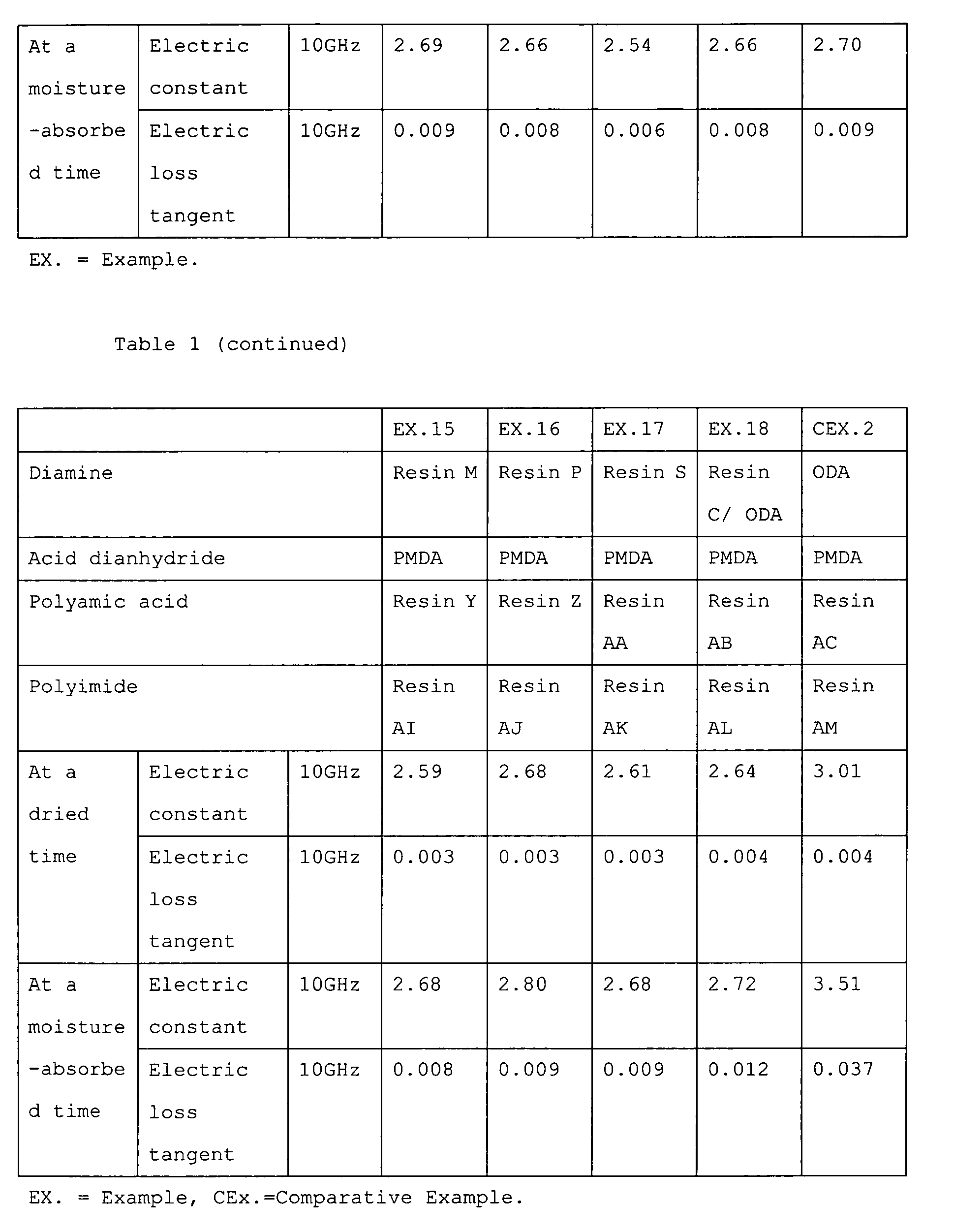
- ODA: 4,4'-diaminodiphenyl ether
- PMDA: pyromellitic dianhydride
- BPDA: 3,3',4,4'-biphenyltetracarboxylic dianhydride
- From Examples 10 - 18 and Comparative Example 2, it is found that the polyimides of the present invention have remarkably low dielectric constants and can maintain low dielectric characteristics even at a moisture-absorbed time.
- Example 19
- A solution of the polyamic acid "T" was applied to a mat surface of an electrolytic copper foil (supplied by Mitsui Mining & Smelting Co., Ltd., 3EC-III, 18µmt) with a doctor blade. The applied solution was dried in air at 80 °C for 1 hour, at 150 °C for 1 hour and at 200 °C for 1 hour. Then, the dried solution was heat-treated under nitrogen at 300 °C for 1 hour, to obtain a laminate having a metal layer on one surface thereof. The thickness of a polyimide layer thereof was 15 µm. The laminate was measured for a copper-foil peel strength on the basis of JIS C-6481. The copper-foil peel strength was 1.3 kN/m.
Claims (16)
- A polyimide having a structural unit represented by the formula (1),


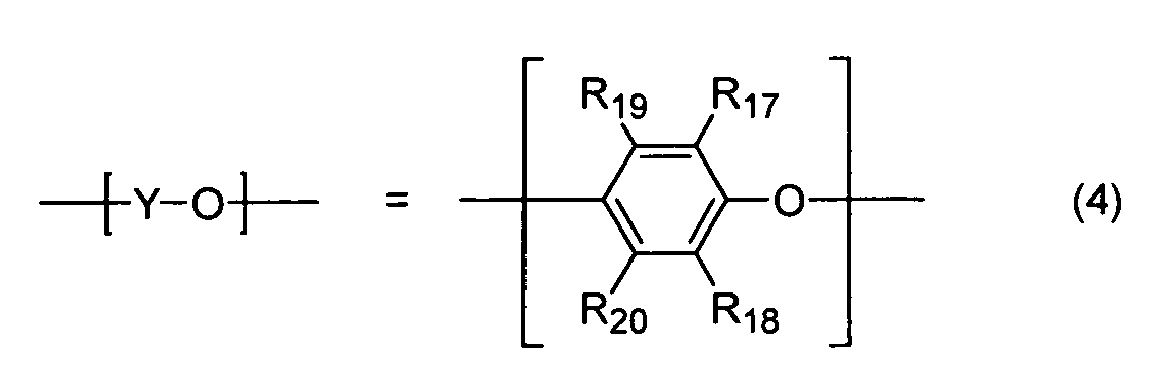
- The polyimide according to claim 1, wherein the polyimide further contains a structural unit of the formula (5) in a formula (1) : formula (5) ratio of 100 : 0 - 50 : 50,

- The polyimide according to claim 1, wherein - (O-X-O) - in the formula (1) is a structure of the formula (6), the formula (7) or the formula (8) and-(Y-O)-in the formula (1) is an arrangement of a structure of the formula (9) or the formula (10) or a random arrangement of a structure of the formula (9) and a structure of the formula (10),


- The polyimide according to claim 1, wherein Ar in the formula (1) is an aromatic group having 6 or less carbon atoms or an aromatic group represented by the formula (11),


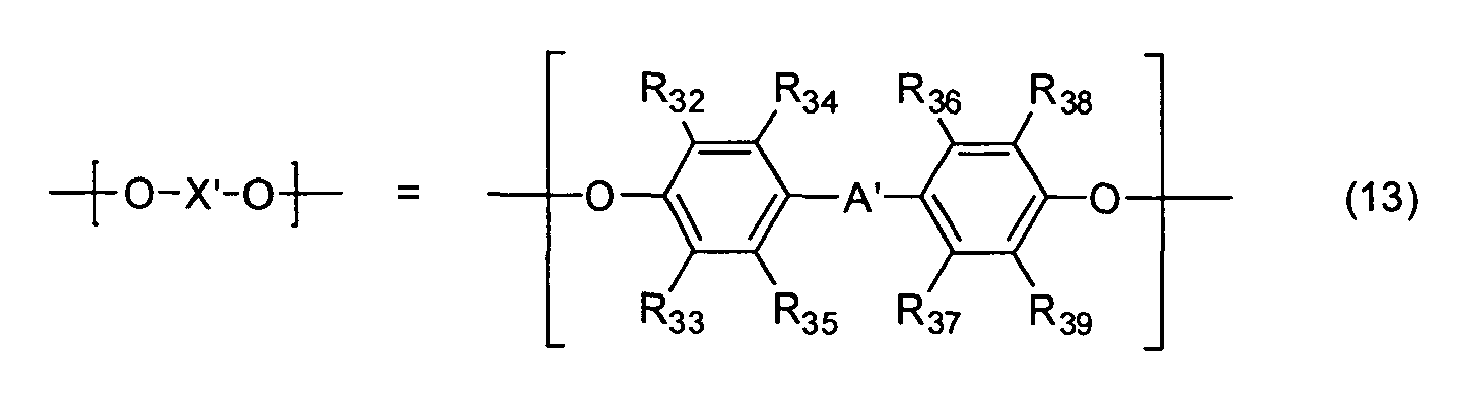

- The polyimide according to claim 1, wherein the structural unit of the formula (1) is a structural unit chosen from the formulae (15), (16) and (17)
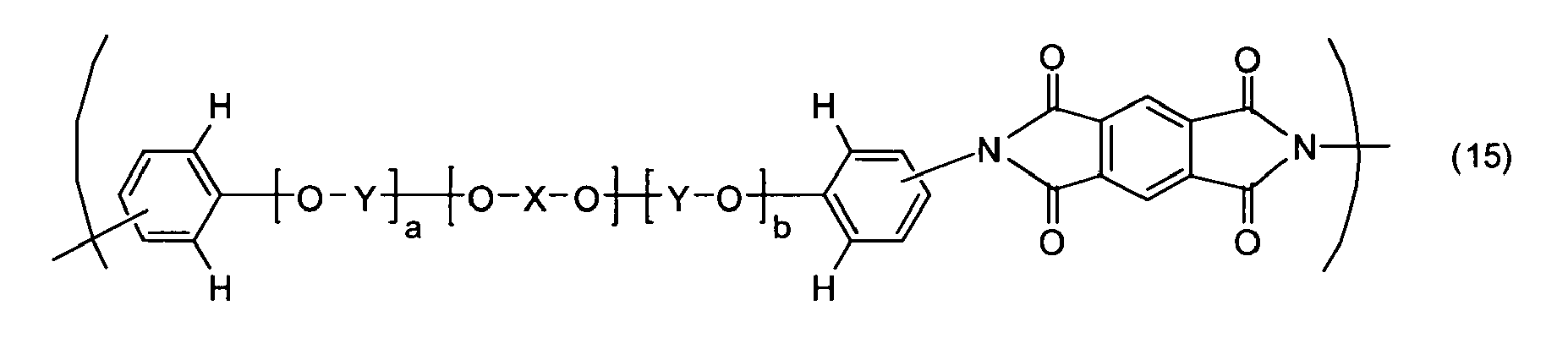


- A process for the production of the polyimide as defined in claim 1, which process comprises cyclodehydrating a polyamic acid having a structural unit of the formula (18),


- A process for the production of the polyimide as defined in claim 2, which process comprises cyclodehydrating a polyamic acid which contains a structural unit of the formula (18) and a structural unit of the formula (19) in a formula (18) : formula (19) ratio of 100 : 0 - 50 : 50,


- A polyamic acid having a structural unit of the formula (18),


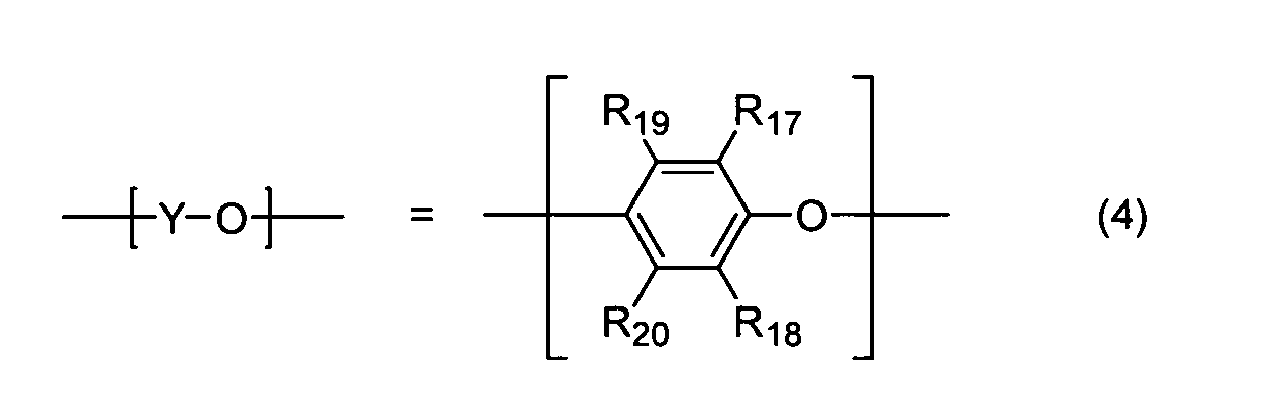
- The polyamic acid according to claim 8, wherein the polyamic acid further has a structural unit of the formula (19) in a formula (18) : formula (19) ratio of 100 : 0 - 50 : 50,

- The polyamic acid according to claim 8, wherein -(O-X-O)- in the formula (18) is a structure of the formula (6), the formula (7) or the formula (8) and -(Y-O) - in the formula (18) is an arrangement of a structure of the formula (9) or the formula (10) or a random arrangement of a structure of the formula (9) and a structure of the formula (10), wherein formulae (6), (7), (8) and (9) are as defined in claim 3.
- The polyamic acid according to claim 8, wherein Ar in the formula (18) is an aromatic group having 6 to 30 carbon atoms or an aromatic group represented by the formula (11),



- The polyamic acid according to claim 8, wherein the structural unit of the formula (18) is a structural unit chosen from the formulae (20), (21) and (22)


- A process for the production of the polyamic acid as defined in claim 8, which process comprises dehydration condensation of a diamine represented by the formula (23) and an acid dianhydride in an organic solvent,


- A process for the production of the polyamic acid as defined in claim 9, which process comprises dehydration condensation of a diamine component containing a diamine represented by the formula (23) and a diamine represented by the formula (24) in a formula (23) : formula (24) molar ratio of 50 : 50 - 100 : 0 with an acid dianhydride in an organic solvent,

H2N-B-NH2 (24)
wherein B represents a bivalent aromatic group having 6 to 30 carbon atoms which is selected from the group consisting of a monocyclic aromatic group, a condensed polycyclic aromatic group and a non-condensed polycyclic aromatic group having a structure in which monocyclic aromatic groups are connected to each other directly or through a connecting group. - A film made of the polyimide as defined in claim 1.
- A laminate comprising the film as defined in claim 15 and a metal layer on one side or both sides of the film.
Applications Claiming Priority (1)
| Application Number | Priority Date | Filing Date | Title |
|---|---|---|---|
| JP2008127210 | 2008-05-14 |
Publications (2)
| Publication Number | Publication Date |
|---|---|
| EP2119739A2 true EP2119739A2 (en) | 2009-11-18 |
| EP2119739A3 EP2119739A3 (en) | 2011-10-19 |
Family
ID=41010306
Family Applications (1)
| Application Number | Title | Priority Date | Filing Date |
|---|---|---|---|
| EP20090251313 Withdrawn EP2119739A3 (en) | 2008-05-14 | 2009-05-14 | Polyimide, polyamic acid and processes for the production thereof |
Country Status (6)
| Country | Link |
|---|---|
| US (1) | US8497025B2 (en) |
| EP (1) | EP2119739A3 (en) |
| JP (1) | JP5338469B2 (en) |
| KR (1) | KR20090118880A (en) |
| CN (1) | CN101580588A (en) |
| TW (1) | TWI466922B (en) |
Families Citing this family (14)
| Publication number | Priority date | Publication date | Assignee | Title |
|---|---|---|---|---|
| CN101921482B (en) * | 2010-08-18 | 2012-07-04 | 东华大学 | Thermosetting polyimide resin and preparation method thereof |
| KR101646283B1 (en) * | 2011-12-27 | 2016-08-08 | 코오롱인더스트리 주식회사 | Polyamic acid solution |
| JP5822352B2 (en) * | 2012-02-10 | 2015-11-24 | 新日鉄住金化学株式会社 | Transparent flexible laminate and laminate roll |
| TWI503610B (en) * | 2013-05-03 | 2015-10-11 | Chi Mei Corp | Liquid crystal alignment composition, liquid crystal alignment film and liquid crystal display device having thereof |
| US9416229B2 (en) | 2014-05-28 | 2016-08-16 | Industrial Technology Research Institute | Dianhydride and polyimide |
| KR102653701B1 (en) | 2015-09-30 | 2024-04-01 | 아라까와 가가꾸 고교 가부시끼가이샤 | Modified polyimide, adhesive composition, copper foil with resin, copper-clad laminate, printed wiring board and multilayer board |
| CN106995678B (en) | 2015-12-28 | 2021-01-15 | 荒川化学工业株式会社 | Polyimide adhesive |
| JP6939017B2 (en) | 2016-03-30 | 2021-09-22 | 荒川化学工業株式会社 | Polyimide, polyimide adhesive, film-like adhesive, adhesive layer, adhesive sheet, copper foil with resin, copper-clad laminate and printed wiring board, and multilayer wiring board and its manufacturing method |
| CN109734910B (en) * | 2019-01-24 | 2021-05-04 | 银禧工程塑料(东莞)有限公司 | A kind of polyimide and its preparation method and application |
| CN109912615A (en) * | 2019-03-20 | 2019-06-21 | 浙江福斯特新材料研究院有限公司 | Benzo alicyclic dianhydride and low dielectric coefficient polyimide precursor film |
| WO2021205675A1 (en) | 2020-04-06 | 2021-10-14 | 昭和電工マテリアルズ株式会社 | Bismaleimide-based adhesive composition, cured product, adhesive sheet, and flexible printed wiring board |
| TWI801103B (en) * | 2022-01-22 | 2023-05-01 | 南亞塑膠工業股份有限公司 | Copper-clad laminate, polyimide resin and manufacturing method thereof |
| TWI872317B (en) * | 2022-03-03 | 2025-02-11 | 南亞塑膠工業股份有限公司 | Polyimide resin |
| CN116715852B (en) * | 2023-06-30 | 2026-02-13 | 中国科学院长春应用化学研究所 | Polyimide and its preparation method and composition |
Citations (3)
| Publication number | Priority date | Publication date | Assignee | Title |
|---|---|---|---|---|
| JPH04178358A (en) | 1989-10-24 | 1992-06-25 | Mitsui Toatsu Chem Inc | Aromatic diamine compound, bismaleimide compound and curable resin composition and resin using these compounds and preparation thereof |
| JPH10152559A (en) | 1996-11-21 | 1998-06-09 | Jsr Corp | Aromatic diamine compound and polyamic acid and polyimide using the same |
| JP2006219396A (en) | 2005-02-09 | 2006-08-24 | Jfe Chemical Corp | Aromatic diamine compound and method for producing the same |
Family Cites Families (17)
| Publication number | Priority date | Publication date | Assignee | Title |
|---|---|---|---|---|
| US3257357A (en) * | 1963-04-01 | 1966-06-21 | Du Pont | Copolymers of polyphenylene ethers |
| US4271288A (en) * | 1979-07-02 | 1981-06-02 | The Dow Chemical Company | Novel polyamic acid polymers and polyimide derivatives thereof |
| US5344894A (en) * | 1983-09-27 | 1994-09-06 | The Boeing Company | Polyimide oligomers and blends |
| US5116935A (en) * | 1987-05-04 | 1992-05-26 | The Boeing Company | Polyimide oligomers and blends and method of curing |
| US4431779A (en) * | 1982-04-02 | 1984-02-14 | General Electric Company | Polyetherimide-polyphenylene ether blends |
| US5175234A (en) * | 1983-09-27 | 1992-12-29 | The Boeing Company | Lightly crosslinked polyimides |
| US5278276A (en) * | 1985-08-27 | 1994-01-11 | Mitsui Toatsu Chemicals, Incorporated | Polyimide and high-temperature adhesive of polyimide |
| JPS6260640A (en) * | 1985-09-12 | 1987-03-17 | 昭和電工株式会社 | Laminate of metal and resin |
| US5011905A (en) * | 1987-05-04 | 1991-04-30 | The Boeing Company | Polyimide oligomers and blends |
| US4931531A (en) * | 1987-07-02 | 1990-06-05 | Mitsui Toatsu Chemicals, Incorporated | Polyimide and high-temperature adhesive thereof |
| DE3856099T2 (en) * | 1987-07-15 | 1998-09-03 | Nasa | Process for the production of low dielectric polyimides |
| US4851544A (en) * | 1988-07-19 | 1989-07-25 | The United States Of America As Represented By The Administrator Of The National Aeronautics And Space Administration | Bis[4-(3,4-dimethylenepyrrolidyl)phenyl]methane |
| US4895915A (en) * | 1988-07-19 | 1990-01-23 | The United States Of America As Represented By The Administrator Of The National Aeronautics And Space Administration | Bis[4-(3,4-dimethylene-pyrrolidyl)phenyl] methane |
| US5734008A (en) * | 1994-10-28 | 1998-03-31 | Sumitomo Chemical Company, Limited | Polyimide film |
| JP4635468B2 (en) * | 2003-06-18 | 2011-02-23 | 三菱瓦斯化学株式会社 | Novel acid anhydride and polyimide using the same |
| US7193030B2 (en) * | 2003-06-18 | 2007-03-20 | Mitsubishi Gas Chemical Company, Inc. | Acid anhydride and polyimide using the same |
| US20090076307A1 (en) * | 2007-08-13 | 2009-03-19 | . | Aromatic diamine compound and aromatic dinitro compound |
-
2009
- 2009-05-11 JP JP2009114634A patent/JP5338469B2/en active Active
- 2009-05-13 US US12/453,511 patent/US8497025B2/en not_active Expired - Fee Related
- 2009-05-14 KR KR1020090042077A patent/KR20090118880A/en not_active Ceased
- 2009-05-14 CN CNA2009101375846A patent/CN101580588A/en active Pending
- 2009-05-14 TW TW98115968A patent/TWI466922B/en active
- 2009-05-14 EP EP20090251313 patent/EP2119739A3/en not_active Withdrawn
Patent Citations (3)
| Publication number | Priority date | Publication date | Assignee | Title |
|---|---|---|---|---|
| JPH04178358A (en) | 1989-10-24 | 1992-06-25 | Mitsui Toatsu Chem Inc | Aromatic diamine compound, bismaleimide compound and curable resin composition and resin using these compounds and preparation thereof |
| JPH10152559A (en) | 1996-11-21 | 1998-06-09 | Jsr Corp | Aromatic diamine compound and polyamic acid and polyimide using the same |
| JP2006219396A (en) | 2005-02-09 | 2006-08-24 | Jfe Chemical Corp | Aromatic diamine compound and method for producing the same |
Also Published As
| Publication number | Publication date |
|---|---|
| TWI466922B (en) | 2015-01-01 |
| JP5338469B2 (en) | 2013-11-13 |
| US8497025B2 (en) | 2013-07-30 |
| CN101580588A (en) | 2009-11-18 |
| US20090286094A1 (en) | 2009-11-19 |
| TW201002763A (en) | 2010-01-16 |
| KR20090118880A (en) | 2009-11-18 |
| JP2009299040A (en) | 2009-12-24 |
| EP2119739A3 (en) | 2011-10-19 |
Similar Documents
| Publication | Publication Date | Title |
|---|---|---|
| US8497025B2 (en) | Polyimide, polyamic acid and processes for the production thereof | |
| KR20190055809A (en) | Polyimide film, copper clad laminate, and circuit board | |
| JP6767759B2 (en) | Polyimide, resin film and metal-clad laminate | |
| CN1898298B (en) | Aromatic polyamic acid and polyimide | |
| KR101553234B1 (en) | Polyimide-base poymer, polyamic acid, and flexible metal-clad laminate and printed circuit board using the polymer or the polyamic acid | |
| KR20090077075A (en) | Polyimide, Diamine Compound and Manufacturing Method Thereof | |
| CN115286756A (en) | Benzoxazine resin, preparation method and adhesive | |
| JP7713558B2 (en) | Polyimide film manufacturing method | |
| JPH0848773A (en) | Polyamic acid and polyimide, and methods for producing these | |
| TWI380744B (en) | ||
| JP7320334B1 (en) | Novel diamine, method for producing the same, and polyamic acid and polyimide produced from the diamine | |
| KR20250013312A (en) | Production method for metal clad laminate and production method for circuit board | |
| KR102881161B1 (en) | Method for producing polyimide film and method for producing metal clad laminate | |
| JP2005314630A (en) | Aromatic polyamic acid and polyimide | |
| WO2005084088A1 (en) | Laminate for wiring board | |
| JP4907142B2 (en) | Aromatic polyamic acid, polyimide and laminate for wiring board | |
| CN102639547B (en) | Phosphorus-containing polyimide and method for producing same | |
| JPH04214786A (en) | Production of heat-resistant adhesive | |
| JP2004137496A (en) | Adhesion assistant composition | |
| WO2021113489A1 (en) | Polyamic acid varnish from high purity bisphenol a dianhydride and articles prepared therefrom | |
| HK1136592A (en) | Polyimide, polyamic acid and processes for the production thereof | |
| JP7492702B2 (en) | Polyimide, polyimide film, polyamic acid, multilayer polyimide film and method for producing the same, polyimide laminate | |
| EP1616898A1 (en) | Polyamic acids, polyimide films and polyimide-metal laminates and methods for making same | |
| CN104478932B (en) | Phosphorous polyimides and manufacture method thereof | |
| JP2024046788A (en) | Circuit board manufacturing method |
Legal Events
| Date | Code | Title | Description |
|---|---|---|---|
| PUAI | Public reference made under article 153(3) epc to a published international application that has entered the european phase |
Free format text: ORIGINAL CODE: 0009012 |
|
| AK | Designated contracting states |
Kind code of ref document: A2 Designated state(s): AT BE BG CH CY CZ DE DK EE ES FI FR GB GR HR HU IE IS IT LI LT LU LV MC MK MT NL NO PL PT RO SE SI SK TR |
|
| PUAL | Search report despatched |
Free format text: ORIGINAL CODE: 0009013 |
|
| AK | Designated contracting states |
Kind code of ref document: A3 Designated state(s): AT BE BG CH CY CZ DE DK EE ES FI FR GB GR HR HU IE IS IT LI LT LU LV MC MK MT NL NO PL PT RO SE SI SK TR |
|
| AX | Request for extension of the european patent |
Extension state: AL BA RS |
|
| RIC1 | Information provided on ipc code assigned before grant |
Ipc: B32B 27/34 20060101ALI20110914BHEP Ipc: C08L 79/08 20060101ALI20110914BHEP Ipc: C08G 73/10 20060101ALI20110914BHEP Ipc: C08G 69/32 20060101AFI20110914BHEP |
|
| 17P | Request for examination filed |
Effective date: 20120418 |
|
| 17Q | First examination report despatched |
Effective date: 20121031 |
|
| STAA | Information on the status of an ep patent application or granted ep patent |
Free format text: STATUS: THE APPLICATION IS DEEMED TO BE WITHDRAWN |
|
| 18D | Application deemed to be withdrawn |
Effective date: 20130312 |