EP2117264A2 - Dienstbereichumschaltverfahren, das auf der Belastung unter Berücksichtigung der Interzellinterferenz in 802.16WIBRO-Systemen basiert - Google Patents
Dienstbereichumschaltverfahren, das auf der Belastung unter Berücksichtigung der Interzellinterferenz in 802.16WIBRO-Systemen basiert Download PDFInfo
- Publication number
- EP2117264A2 EP2117264A2 EP09251227A EP09251227A EP2117264A2 EP 2117264 A2 EP2117264 A2 EP 2117264A2 EP 09251227 A EP09251227 A EP 09251227A EP 09251227 A EP09251227 A EP 09251227A EP 2117264 A2 EP2117264 A2 EP 2117264A2
- Authority
- EP
- European Patent Office
- Prior art keywords
- zone
- frf
- subscriber stations
- cell
- services
- Prior art date
- Legal status (The legal status is an assumption and is not a legal conclusion. Google has not performed a legal analysis and makes no representation as to the accuracy of the status listed.)
- Withdrawn
Links
- 238000000034 method Methods 0.000 title claims abstract description 35
- 230000001360 synchronised effect Effects 0.000 claims description 3
- 230000005540 biological transmission Effects 0.000 abstract description 6
- 230000007704 transition Effects 0.000 description 4
- 230000001413 cellular effect Effects 0.000 description 2
- 230000008859 change Effects 0.000 description 2
- 238000010586 diagram Methods 0.000 description 2
- 230000002708 enhancing effect Effects 0.000 description 2
- 238000012986 modification Methods 0.000 description 2
- 230000004048 modification Effects 0.000 description 2
- 238000010276 construction Methods 0.000 description 1
- 230000000737 periodic effect Effects 0.000 description 1
Images
Classifications
-
- H—ELECTRICITY
- H04—ELECTRIC COMMUNICATION TECHNIQUE
- H04W—WIRELESS COMMUNICATION NETWORKS
- H04W16/00—Network planning, e.g. coverage or traffic planning tools; Network deployment, e.g. resource partitioning or cells structures
- H04W16/02—Resource partitioning among network components, e.g. reuse partitioning
- H04W16/06—Hybrid resource partitioning, e.g. channel borrowing
-
- H—ELECTRICITY
- H04—ELECTRIC COMMUNICATION TECHNIQUE
- H04L—TRANSMISSION OF DIGITAL INFORMATION, e.g. TELEGRAPHIC COMMUNICATION
- H04L5/00—Arrangements affording multiple use of the transmission path
- H04L5/0001—Arrangements for dividing the transmission path
- H04L5/0003—Two-dimensional division
- H04L5/0005—Time-frequency
- H04L5/0007—Time-frequency the frequencies being orthogonal, e.g. OFDM(A) or DMT
-
- H—ELECTRICITY
- H04—ELECTRIC COMMUNICATION TECHNIQUE
- H04W—WIRELESS COMMUNICATION NETWORKS
- H04W16/00—Network planning, e.g. coverage or traffic planning tools; Network deployment, e.g. resource partitioning or cells structures
- H04W16/24—Cell structures
-
- H—ELECTRICITY
- H04—ELECTRIC COMMUNICATION TECHNIQUE
- H04W—WIRELESS COMMUNICATION NETWORKS
- H04W36/00—Hand-off or reselection arrangements
- H04W36/06—Reselecting a communication resource in the serving access point
-
- H—ELECTRICITY
- H04—ELECTRIC COMMUNICATION TECHNIQUE
- H04W—WIRELESS COMMUNICATION NETWORKS
- H04W36/00—Hand-off or reselection arrangements
- H04W36/16—Performing reselection for specific purposes
- H04W36/20—Performing reselection for specific purposes for optimising the interference level
Definitions
- the present invention relates to a method of switching a zone through which services are provided to subscriber stations (SS) in an environment using an FRF-1 zone and an FRF-3 zone based on traffic load of each zone in order to reduce the inter-cell interference in 802.16/WiBro systems, and more particularly, to a service zone switching method based on load considering inter-cell interference in 802.16/WiBro systems capable of minimizing the inter-cell interference, enhancing the capacity of cells and improving users' transmission quality in the cells by determining whether the services are provided through one out of an FRF-1 zone (a zone where users can use all subchannels) and an FRF-3 zone (a zone where users can use one third of all subchannels; dividing all channels into 3 channel groups), which are present in one frame, based on the distribution and traffic load of subscriber stations (SS) present in one cell, which consists of 3 sector units, under the environment of the 802.16/WiBro systems and providing services through the selected zone.
- FRF-1 zone a zone where users can use all subchannels
- the cells affect quality of used frequency channels in a wireless cellular system, which is called "interference.” Then, such interference affects the capacity and coverage of the cells, which makes it difficult to provide satisfactory transmission quality to users.
- the present invention is designed to solve the problems of the prior art, and therefore it is an object of the present invention to provide a service zone switching method based on load considering inter-cell interference in 802.16/WiBro systems capable of minimizing the inter-cell interference, enhancing the capacity of cells and improving users' transmission quality in the cells by determining whether the services are provided through one out of an FRF-1 zone (a zone where users in 3 sectors of one cell can use all subchannels) and an FRF-3 zone (a zone where users in each of 3 sectors of one cell can use one third of all subchannels; 3 sectors of one cell use 3 channel group, respectively), which are present in one frame, based on the distribution and traffic load of subscriber stations (SS) present in one cell, which consists of 3 sector units, under the environment of the 802.16/WiBro systems and providing services through the selected zone.
- FRF-1 zone a zone where users in 3 sectors of one cell can use all subchannels
- FRF-3 zone a zone where users in each of 3 sectors of one cell can use one third of
- a service zone switching method based on load considering inter-cell interference in 802.16/WiBro systems including: selecting one out of an FRF-1 zone and an FRF-3 zone in one frame based on the distribution and traffic load of subscriber stations (SS) present in the one cell; and providing services through the selected FRF-1 zone or FRF-3 zone, wherein the one cell in the 802.16/WiBro Systems consists of 3 sectors and each sector has a base station (BS) , each BS supports services for the FRF-1 zone and the FRF-3 zone under the environment of the 802.16/WiBro systems, the FRF-1 zone is a zone where users in 3 sectors of the one cell can use all subchannels, the FRF-3 zone is a zone where users in each of 3 sectors of the one cell can use one third of all subchannels.
- BS base station
- the service zone switching method may further include: selecting either the FRF-1 zone or FRF-3 zone based on current positions of the subscriber stations; and providing, at subscriber stations present within a certain distance from a base station, services through the FRF-1 zone and providing, at subscriber stations present out of the certain distance from the base station, services through the FRF-3 zone, wherein the certain distance is set to any value.
- the service zone switching method may further include: calculating a density rate of the corresponding FRF zone based on the service reserved rate where the subscriber stations are being provided with the services, wherein the density rate is calculated as represented by the following Equation.
- the service zone switching method may further include: determining whether the corresponding subscriber stations provide services through either the FRF-1 zone or FRF-3 zone, by comparing the system capacity with the average density rate of the corresponding zone at a certain period, after calculating the density rate; providing the capacity of the system and QoS services while providing the solution to loadable situations of a service zone by choosing, as victims, subscriber stations having the greatest influence on causing the loadable situations of the corresponding zone when a loadable zone is present in the FRF-1 zone or FRF-3 zone and choosing victim subscriber stations until the corresponding zone is out of the loadable situations when the corresponding subscriber stations move to another zone.
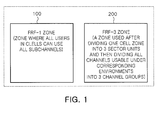
- FIG. 1 is a diagram showing a zone, used in the present invention, including an FRF-1 zone and an FRF-3 zone
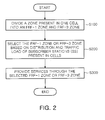
- FIG. 2 is a flowchart illustrating a service zone switching method based on load considering inter-cell interference in 802.16/WiBro systems according to one exemplary embodiment of the present invention.
- the service zone switching method based on load considering inter-cell interference in 802.16/WiBro systems includes: dividing a zone present in one cell into an FRF-1 zone 100 (a zone where users in 3 sectors of one cell can use all subchannels) and an FRF-3 zone 200 (a zone where users in each of 3 sectors of one cell can use one third of all subchannels; 3 sectors of one cell use 3 channel group, respectively) under the environment of the 802.16/WiBro systems (S100) ; selecting one out of the FRF-1 zone 100 and the FRF-3 zone 200 in one frame based on the distribution and traffic load of subscriber stations (SS) present in the one cell (S200) ; and providing services through the selected FRF-1 zone 100 or FRF-3 zone 200 (S300) .
- FRF-1 zone 100 a zone where users in 3 sectors of one cell can use all subchannels
- FRF-3 zone 200 a zone where users in each of 3 sectors of one cell can use one third of all subchannels; 3 sectors of one cell use 3 channel group, respectively
- the system environment used in the present invention is an OFDMA environment, among the environments of 802.16 systems, where subcarriers may be divided and used according to the time and frequency to provide services at the 802.16 system by one frame unit.
- one zone in one cell is divided into a variety of zones according to a frequency permutation method, that is, an available frequency range, and the divided zones have different characteristics.
- one cell consists of 3 sectors and each sector can use FRF-1 zone and FRF-3 zone.
- the present invention targets a zone 100 where all users in 3 sectors of one cell can use all subchannels in such an environment ( FIG. 1 ) ; and a zone 200 where users in each of 3 sectors of one cell can use one third of all subchannels( FIG. 1 ).
- both of the zones are referred respectively to as an FRF-1 zone 100 and an FRF-3 zone 200 throughout the specification, considering frequency reuse factors of each zone.
- the 802.16 system may provide the services through a variety of zones in one frame, and may minimize the inter-cell interference in such an environment by suitably employing the FRF-1 zone 100 and the FRF-3 zone 200, thus to enhance capacity of cells and improve users' transmission quality in the cells.
- the service zone switching method includes: determining whether the services are provided through one out of an FRF-1 zone 100 and an FRF-3 zone 200, which are present in one frame, based on the distribution and traffic load of subscriber stations (SS) present in one cell under the environment of the 802.16 systems, and providing services through the selected zone (S200).
- SS subscriber stations
- Base stations support services of the FRF-1 and FRF-3 zones.
- Base stations and subscriber stations have information on geographical positions.
- All the base stations have the same boundary between the FRF-1 and FRF-3 zones present in one frame, and frame values synchronized with the same level.
- the service zone switching method includes: determining a service zone for all the subscriber stations, and determining whether the services are provided through the determined zone or a zone is switched by calculating a service state of each zone and a service state of the subscriber stations.
- the service zone switching method is divided into two steps: an initial step (init step) and a transition step.
- the initial step is carried out in a step where an 802.16 base station system provides services to subscriber stations present in its own cells for the first time.
- the subscriber stations are provided with the services through the zone selected in the initial step.
- a service zone is switched in the consideration of the interference based on the traffic load and distribution of the subscriber stations while being provided with the services through the 802.16 base station system.
- a service zone of the corresponding subscriber stations is switched into another service zone.
- an FRF-1 zone 100 or an FRF-3 zone 200 is selected based on the current positions of subscriber stations. Subscriber stations present within a certain distance from a base station provide services through the FRF-1 zone 100, and subscriber stations present out of the certain distance from the base station provide services through the FRF-3 zone 200.
- the certain distance (x) used as the standard distance is set to any predetermined value.
- a density rate of the corresponding FRF zone is calculated based on the service reserved rate of a flow where the subscriber stations are being provided with the services.
- the service zone switching method includes: determining whether the corresponding subscriber stations provide services through either the FRF-1 zone 100 or FRF-3 zone 200, by comparing the system capacity with the average density rate of the corresponding zone at a certain period, after calculating the density rate.
- the service zone switching method includes: providing the capacity of the system and QoS services while providing the solution to loadable situations of a service zone by choosing, as victims, subscriber stations having the greatest influence on causing the loadable situations of the corresponding zone when a loadable zone is present in the FRF-1 zone 100 or FRF-3 zone 200, and choosing victim subscriber stations until the corresponding zone is out of the loadable situations by allowing the corresponding subscriber stations to move to another zone.
- the service zone switching method based on load considering inter-cell interference in 802.16/WiBro systems may be useful to minimize the inter-cell interference, enhance the capacity of cells and improve users transmission quality in the cells by determining whether the services are provided through one out of an FRF-1 zone and an FRF-3 zone, which are present in one frame, based on the distribution and traffic load of subscriber stations (SS) present in one cell under the environment of the 802.16/WiBro systems, and providing services through the selected zone.
- SS subscriber stations
Landscapes
- Engineering & Computer Science (AREA)
- Signal Processing (AREA)
- Computer Networks & Wireless Communication (AREA)
- Mobile Radio Communication Systems (AREA)
Applications Claiming Priority (1)
| Application Number | Priority Date | Filing Date | Title |
|---|---|---|---|
| KR1020080041869A KR101009724B1 (ko) | 2008-05-06 | 2008-05-06 | 802.16/와이브로 시스템에서의 셀간 간섭을 고려한 부하 기반의 서비스 구역 변경 방법 |
Publications (1)
| Publication Number | Publication Date |
|---|---|
| EP2117264A2 true EP2117264A2 (de) | 2009-11-11 |
Family
ID=40942362
Family Applications (1)
| Application Number | Title | Priority Date | Filing Date |
|---|---|---|---|
| EP09251227A Withdrawn EP2117264A2 (de) | 2008-05-06 | 2009-04-30 | Dienstbereichumschaltverfahren, das auf der Belastung unter Berücksichtigung der Interzellinterferenz in 802.16WIBRO-Systemen basiert |
Country Status (3)
| Country | Link |
|---|---|
| US (1) | US8320330B2 (de) |
| EP (1) | EP2117264A2 (de) |
| KR (1) | KR101009724B1 (de) |
Cited By (1)
| Publication number | Priority date | Publication date | Assignee | Title |
|---|---|---|---|---|
| CN102547959A (zh) * | 2011-12-21 | 2012-07-04 | 华为技术有限公司 | 控制载波导频发送的方法和装置 |
Families Citing this family (5)
| Publication number | Priority date | Publication date | Assignee | Title |
|---|---|---|---|---|
| JP4703513B2 (ja) * | 2006-08-22 | 2011-06-15 | 株式会社エヌ・ティ・ティ・ドコモ | 移動通信システムで使用される無線基地局及び方法 |
| KR101595025B1 (ko) | 2009-01-07 | 2016-02-26 | 엘지전자 주식회사 | 광대역 무선접속 시스템에서의 영역 변경 방법 |
| KR20100088509A (ko) | 2009-01-30 | 2010-08-09 | 엘지전자 주식회사 | 레거시 시스템을 지원하기 위한 핸드오버 수행방법 |
| KR101406322B1 (ko) * | 2010-07-26 | 2014-06-13 | 한국과학기술원 | 가상 스케줄러를 이용한 핸드오버 결정 방법 및 이를 수행하는 핸드오버 제어 장치 |
| CN106877993B (zh) * | 2015-12-11 | 2020-03-27 | 华为技术有限公司 | 一种配置方法和装置 |
Citations (1)
| Publication number | Priority date | Publication date | Assignee | Title |
|---|---|---|---|---|
| KR20080041869A (ko) | 2006-11-08 | 2008-05-14 | 이희근 | 반사광스티커 |
Family Cites Families (8)
| Publication number | Priority date | Publication date | Assignee | Title |
|---|---|---|---|---|
| CN1783861B (zh) * | 2004-12-01 | 2011-04-13 | 华为技术有限公司 | 一种在无线通信系统中实现频率软复用的方法 |
| KR20060097450A (ko) * | 2005-03-09 | 2006-09-14 | 삼성전자주식회사 | 다중 셀 통신 시스템에서 자원 할당 제어 시스템 및 방법 |
| US8116780B2 (en) * | 2005-08-19 | 2012-02-14 | Electronics And Telecommunications Research Institute | Dynamic resource allocation method based on frequency reuse partitioning for OFMDA/FDD system, and frame transmission method therefor |
| KR101035083B1 (ko) * | 2006-04-26 | 2011-05-19 | 재단법인서울대학교산학협력재단 | 다중 셀 통신 시스템에서 자원 이용 방법 및 시스템 |
| US20080075032A1 (en) * | 2006-09-22 | 2008-03-27 | Krishna Balachandran | Method of resource allocation in a wireless communication system |
| US20080089278A1 (en) * | 2006-10-11 | 2008-04-17 | Inha-Industry Partnership Institute | Method and frame structure for supporting dynamic channel allocation and dynamic power allocation in frequency reuse partitioning based OFDMA system |
| KR101422141B1 (ko) * | 2007-02-27 | 2014-07-28 | 아주대학교산학협력단 | 통신 시스템에서 자원 이용 시스템 및 방법 |
| US8374135B2 (en) * | 2008-11-13 | 2013-02-12 | Nec Laboratories America, Inc. | Methods and systems for location-based allocation of macro cell resources |
-
2008
- 2008-05-06 KR KR1020080041869A patent/KR101009724B1/ko not_active Expired - Fee Related
-
2009
- 2009-04-30 EP EP09251227A patent/EP2117264A2/de not_active Withdrawn
- 2009-05-06 US US12/436,314 patent/US8320330B2/en not_active Expired - Fee Related
Patent Citations (1)
| Publication number | Priority date | Publication date | Assignee | Title |
|---|---|---|---|---|
| KR20080041869A (ko) | 2006-11-08 | 2008-05-14 | 이희근 | 반사광스티커 |
Cited By (3)
| Publication number | Priority date | Publication date | Assignee | Title |
|---|---|---|---|---|
| CN102547959A (zh) * | 2011-12-21 | 2012-07-04 | 华为技术有限公司 | 控制载波导频发送的方法和装置 |
| WO2013091496A1 (zh) * | 2011-12-21 | 2013-06-27 | 华为技术有限公司 | 控制载波导频发送的方法和装置 |
| CN102547959B (zh) * | 2011-12-21 | 2014-08-20 | 华为技术有限公司 | 控制载波导频发送的方法和装置 |
Also Published As
| Publication number | Publication date |
|---|---|
| KR101009724B1 (ko) | 2011-01-19 |
| US8320330B2 (en) | 2012-11-27 |
| US20090279505A1 (en) | 2009-11-12 |
| KR20090116133A (ko) | 2009-11-11 |
Similar Documents
| Publication | Publication Date | Title |
|---|---|---|
| EP2259613B1 (de) | Verwaltung von Nachbarfunkzelleninterferenz in einem SC-FDMA system | |
| JP5093538B2 (ja) | Ofdmaのための分散仮想リソースブロック配分 | |
| US8391877B2 (en) | Measurement-assisted dynamic frequency-reuse in cellular telecommunications networks | |
| FI113933B (fi) | Menetelmä viestintäresurssien varaamiseksi viestintäjärjestelmässä | |
| US5737704A (en) | Channel allocation method for removing inter-cell hard handoffs in a CDMA system | |
| EP2117264A2 (de) | Dienstbereichumschaltverfahren, das auf der Belastung unter Berücksichtigung der Interzellinterferenz in 802.16WIBRO-Systemen basiert | |
| US20060140217A1 (en) | Method for adaptively allocating frequency resource in communication system using orthogonal frequency division multiple access scheme | |
| KR930022756A (ko) | 이동 통신 시스템에서 다이내믹 채널 할당의 분할 방법 | |
| US6469996B1 (en) | Method of allocating transmission channels to a mobile station, in particular in duplex mode, in a mobile packet-mode telecommunications network | |
| KR101337019B1 (ko) | 직교 주파수 분할 멀티플렉싱 통신 시스템에서의 무선 리소스 할당 방법 및 장치 | |
| US20070060145A1 (en) | Method for allocating downlink resources in a communication system | |
| JP2009124668A (ja) | 直交周波数分割多重接続システムでの帯域分散的資源割当方法及び装置 | |
| US8170574B2 (en) | Method and apparatus for controlling interference between cells in mobile communication network | |
| CN100559739C (zh) | 时分双工码分多址系统中交叉时隙资源分配的方法 | |
| EP1925172B1 (de) | Kommunikationsbetriebsmittel-zuteilungsverfahren einer basisstation | |
| US11882536B2 (en) | System and method for transmitting a signal | |
| Salamah et al. | Dynamically adaptive channel reservation scheme for cellular networks | |
| EP1662823A1 (de) | Verfahren und Vorrichtung zur Teilnehmer-Umbesetzung in einem digitalen zellularen Kommunikationssystem | |
| GB2292655A (en) | Dynamic channel allocation in a radio telephone communications sytem | |
| Bassiouni et al. | Dynamic channel allocation for linear macrocellular topology | |
| JPH04351126A (ja) | 移動通信システムのチャネル割当て方式 | |
| JPH089464A (ja) | セルラ移動通信システムの無線チャネル割当方法 | |
| GB2450521A (en) | Method and apparatus for allocating a common control channel to a mobile station | |
| Dubey | Optimal Channel Allocation with Hot-Spot Technique in Wireless Network | |
| KR20050110268A (ko) | 직교 주파수 분할 다중 접속 시스템에서 주파수 자원 할당방법 및 장치 |
Legal Events
| Date | Code | Title | Description |
|---|---|---|---|
| PUAI | Public reference made under article 153(3) epc to a published international application that has entered the european phase |
Free format text: ORIGINAL CODE: 0009012 |
|
| 17P | Request for examination filed |
Effective date: 20090514 |
|
| AK | Designated contracting states |
Kind code of ref document: A2 Designated state(s): AT BE BG CH CY CZ DE DK EE ES FI FR GB GR HR HU IE IS IT LI LT LU LV MC MK MT NL NO PL PT RO SE SI SK TR |
|
| RIN1 | Information on inventor provided before grant (corrected) |
Inventor name: SUH, YOUNG-JOO Inventor name: BAEK, JOO-YOUNG Inventor name: LEE, JEONG-YOON Inventor name: KIM, SOK-HYONG |
|
| STAA | Information on the status of an ep patent application or granted ep patent |
Free format text: STATUS: THE APPLICATION HAS BEEN WITHDRAWN |
|
| 18W | Application withdrawn |
Effective date: 20120327 |