EP2116533A1 - Glucokinase activator - Google Patents
Glucokinase activator Download PDFInfo
- Publication number
- EP2116533A1 EP2116533A1 EP08721434A EP08721434A EP2116533A1 EP 2116533 A1 EP2116533 A1 EP 2116533A1 EP 08721434 A EP08721434 A EP 08721434A EP 08721434 A EP08721434 A EP 08721434A EP 2116533 A1 EP2116533 A1 EP 2116533A1
- Authority
- EP
- European Patent Office
- Prior art keywords
- group
- pharmaceutically acceptable
- acceptable salt
- cyclopropylsulfonyl
- difluorocyclopentyl
- Prior art date
- Legal status (The legal status is an assumption and is not a legal conclusion. Google has not performed a legal analysis and makes no representation as to the accuracy of the status listed.)
- Granted
Links
- 0 *c1cc(*(C[C@@](C[C@]2F)C[C@@]2F)C(N*)=O)ccc1 Chemical compound *c1cc(*(C[C@@](C[C@]2F)C[C@@]2F)C(N*)=O)ccc1 0.000 description 1
- OQNLNIVTLXYXDW-UHFFFAOYSA-N BC1SC(C)N=C1 Chemical compound BC1SC(C)N=C1 OQNLNIVTLXYXDW-UHFFFAOYSA-N 0.000 description 1
- WVUZKFKDZWSDIZ-UHFFFAOYSA-N CC(C)(OC1)OCC1c1c[nH]c(C)c1 Chemical compound CC(C)(OC1)OCC1c1c[nH]c(C)c1 WVUZKFKDZWSDIZ-UHFFFAOYSA-N 0.000 description 1
- ONLHVWCRHGRVBE-SECBINFHSA-N CC(C)(OC1)O[C@H]1c1ncc(C)nc1 Chemical compound CC(C)(OC1)O[C@H]1c1ncc(C)nc1 ONLHVWCRHGRVBE-SECBINFHSA-N 0.000 description 1
- GXKRQXRABLLXDQ-UHFFFAOYSA-N CC(CNC(F)F)C(C)(C)[NH-] Chemical compound CC(CNC(F)F)C(C)(C)[NH-] GXKRQXRABLLXDQ-UHFFFAOYSA-N 0.000 description 1
- LSSYNZHOMNGVQV-UHFFFAOYSA-N CC(N=C1)=CNC1OCCSC Chemical compound CC(N=C1)=CNC1OCCSC LSSYNZHOMNGVQV-UHFFFAOYSA-N 0.000 description 1
- UOPFXHUTMNAKCL-UHFFFAOYSA-N CC1N(C)C(C)SN1 Chemical compound CC1N(C)C(C)SN1 UOPFXHUTMNAKCL-UHFFFAOYSA-N 0.000 description 1
- CWVOORJJLLJYQN-UHFFFAOYSA-N CC1NC(C)=CN=C1SCCO Chemical compound CC1NC(C)=CN=C1SCCO CWVOORJJLLJYQN-UHFFFAOYSA-N 0.000 description 1
- TUGYBZUOSTTYMP-SYDPRGILSA-N F[C@H](CCC1)[C@H]1F Chemical compound F[C@H](CCC1)[C@H]1F TUGYBZUOSTTYMP-SYDPRGILSA-N 0.000 description 1
- KMGNDEFKPZZPGM-PRDGZMPFSA-N OC(C(C[C@@H](C[C@H]1F)C[C@@H]1F)c(cc1)ccc1S(C1CC1)(=O)=O)=O Chemical compound OC(C(C[C@@H](C[C@H]1F)C[C@@H]1F)c(cc1)ccc1S(C1CC1)(=O)=O)=O KMGNDEFKPZZPGM-PRDGZMPFSA-N 0.000 description 1
- ZGKLXLFETVPJRE-YLYIFFLDSA-N OC(C(C[C@@H](C[C@H]1F)C[C@@H]1F)c1ccccc1)=O Chemical compound OC(C(C[C@@H](C[C@H]1F)C[C@@H]1F)c1ccccc1)=O ZGKLXLFETVPJRE-YLYIFFLDSA-N 0.000 description 1
Classifications
-
- C—CHEMISTRY; METALLURGY
- C07—ORGANIC CHEMISTRY
- C07D—HETEROCYCLIC COMPOUNDS
- C07D277/00—Heterocyclic compounds containing 1,3-thiazole or hydrogenated 1,3-thiazole rings
- C07D277/02—Heterocyclic compounds containing 1,3-thiazole or hydrogenated 1,3-thiazole rings not condensed with other rings
- C07D277/20—Heterocyclic compounds containing 1,3-thiazole or hydrogenated 1,3-thiazole rings not condensed with other rings having two or three double bonds between ring members or between ring members and non-ring members
- C07D277/32—Heterocyclic compounds containing 1,3-thiazole or hydrogenated 1,3-thiazole rings not condensed with other rings having two or three double bonds between ring members or between ring members and non-ring members with hetero atoms or with carbon atoms having three bonds to hetero atoms with at the most one bond to halogen, e.g. ester or nitrile radicals, directly attached to ring carbon atoms
- C07D277/38—Nitrogen atoms
- C07D277/44—Acylated amino or imino radicals
- C07D277/46—Acylated amino or imino radicals by carboxylic acids, or sulfur or nitrogen analogues thereof
-
- A—HUMAN NECESSITIES
- A61—MEDICAL OR VETERINARY SCIENCE; HYGIENE
- A61K—PREPARATIONS FOR MEDICAL, DENTAL OR TOILETRY PURPOSES
- A61K31/00—Medicinal preparations containing organic active ingredients
- A61K31/33—Heterocyclic compounds
- A61K31/395—Heterocyclic compounds having nitrogen as a ring hetero atom, e.g. guanethidine or rifamycins
- A61K31/41—Heterocyclic compounds having nitrogen as a ring hetero atom, e.g. guanethidine or rifamycins having five-membered rings with two or more ring hetero atoms, at least one of which being nitrogen, e.g. tetrazole
- A61K31/415—1,2-Diazoles
-
- A—HUMAN NECESSITIES
- A61—MEDICAL OR VETERINARY SCIENCE; HYGIENE
- A61P—SPECIFIC THERAPEUTIC ACTIVITY OF CHEMICAL COMPOUNDS OR MEDICINAL PREPARATIONS
- A61P3/00—Drugs for disorders of the metabolism
- A61P3/04—Anorexiants; Antiobesity agents
-
- A—HUMAN NECESSITIES
- A61—MEDICAL OR VETERINARY SCIENCE; HYGIENE
- A61P—SPECIFIC THERAPEUTIC ACTIVITY OF CHEMICAL COMPOUNDS OR MEDICINAL PREPARATIONS
- A61P3/00—Drugs for disorders of the metabolism
- A61P3/08—Drugs for disorders of the metabolism for glucose homeostasis
- A61P3/10—Drugs for disorders of the metabolism for glucose homeostasis for hyperglycaemia, e.g. antidiabetics
-
- A—HUMAN NECESSITIES
- A61—MEDICAL OR VETERINARY SCIENCE; HYGIENE
- A61P—SPECIFIC THERAPEUTIC ACTIVITY OF CHEMICAL COMPOUNDS OR MEDICINAL PREPARATIONS
- A61P43/00—Drugs for specific purposes, not provided for in groups A61P1/00-A61P41/00
-
- C—CHEMISTRY; METALLURGY
- C07—ORGANIC CHEMISTRY
- C07C—ACYCLIC OR CARBOCYCLIC COMPOUNDS
- C07C317/00—Sulfones; Sulfoxides
- C07C317/44—Sulfones; Sulfoxides having sulfone or sulfoxide groups and carboxyl groups bound to the same carbon skeleton
-
- C—CHEMISTRY; METALLURGY
- C07—ORGANIC CHEMISTRY
- C07D—HETEROCYCLIC COMPOUNDS
- C07D213/00—Heterocyclic compounds containing six-membered rings, not condensed with other rings, with one nitrogen atom as the only ring hetero atom and three or more double bonds between ring members or between ring members and non-ring members
- C07D213/02—Heterocyclic compounds containing six-membered rings, not condensed with other rings, with one nitrogen atom as the only ring hetero atom and three or more double bonds between ring members or between ring members and non-ring members having three double bonds between ring members or between ring members and non-ring members
- C07D213/04—Heterocyclic compounds containing six-membered rings, not condensed with other rings, with one nitrogen atom as the only ring hetero atom and three or more double bonds between ring members or between ring members and non-ring members having three double bonds between ring members or between ring members and non-ring members having no bond between the ring nitrogen atom and a non-ring member or having only hydrogen or carbon atoms directly attached to the ring nitrogen atom
- C07D213/60—Heterocyclic compounds containing six-membered rings, not condensed with other rings, with one nitrogen atom as the only ring hetero atom and three or more double bonds between ring members or between ring members and non-ring members having three double bonds between ring members or between ring members and non-ring members having no bond between the ring nitrogen atom and a non-ring member or having only hydrogen or carbon atoms directly attached to the ring nitrogen atom with hetero atoms or with carbon atoms having three bonds to hetero atoms with at the most one bond to halogen, e.g. ester or nitrile radicals, directly attached to ring carbon atoms
- C07D213/72—Nitrogen atoms
- C07D213/75—Amino or imino radicals, acylated by carboxylic or carbonic acids, or by sulfur or nitrogen analogues thereof, e.g. carbamates
-
- C—CHEMISTRY; METALLURGY
- C07—ORGANIC CHEMISTRY
- C07D—HETEROCYCLIC COMPOUNDS
- C07D231/00—Heterocyclic compounds containing 1,2-diazole or hydrogenated 1,2-diazole rings
- C07D231/02—Heterocyclic compounds containing 1,2-diazole or hydrogenated 1,2-diazole rings not condensed with other rings
- C07D231/10—Heterocyclic compounds containing 1,2-diazole or hydrogenated 1,2-diazole rings not condensed with other rings having two or three double bonds between ring members or between ring members and non-ring members
- C07D231/14—Heterocyclic compounds containing 1,2-diazole or hydrogenated 1,2-diazole rings not condensed with other rings having two or three double bonds between ring members or between ring members and non-ring members with hetero atoms or with carbon atoms having three bonds to hetero atoms with at the most one bond to halogen, e.g. ester or nitrile radicals, directly attached to ring carbon atoms
- C07D231/38—Nitrogen atoms
- C07D231/40—Acylated on said nitrogen atom
-
- C—CHEMISTRY; METALLURGY
- C07—ORGANIC CHEMISTRY
- C07D—HETEROCYCLIC COMPOUNDS
- C07D241/00—Heterocyclic compounds containing 1,4-diazine or hydrogenated 1,4-diazine rings
- C07D241/02—Heterocyclic compounds containing 1,4-diazine or hydrogenated 1,4-diazine rings not condensed with other rings
- C07D241/10—Heterocyclic compounds containing 1,4-diazine or hydrogenated 1,4-diazine rings not condensed with other rings having three double bonds between ring members or between ring members and non-ring members
- C07D241/14—Heterocyclic compounds containing 1,4-diazine or hydrogenated 1,4-diazine rings not condensed with other rings having three double bonds between ring members or between ring members and non-ring members with hetero atoms or with carbon atoms having three bonds to hetero atoms with at the most one bond to halogen, e.g. ester or nitrile radicals, directly attached to ring carbon atoms
- C07D241/20—Nitrogen atoms
-
- C—CHEMISTRY; METALLURGY
- C07—ORGANIC CHEMISTRY
- C07D—HETEROCYCLIC COMPOUNDS
- C07D261/00—Heterocyclic compounds containing 1,2-oxazole or hydrogenated 1,2-oxazole rings
- C07D261/02—Heterocyclic compounds containing 1,2-oxazole or hydrogenated 1,2-oxazole rings not condensed with other rings
- C07D261/06—Heterocyclic compounds containing 1,2-oxazole or hydrogenated 1,2-oxazole rings not condensed with other rings having two or more double bonds between ring members or between ring members and non-ring members
- C07D261/10—Heterocyclic compounds containing 1,2-oxazole or hydrogenated 1,2-oxazole rings not condensed with other rings having two or more double bonds between ring members or between ring members and non-ring members with hetero atoms or with carbon atoms having three bonds to hetero atoms with at the most one bond to halogen, e.g. ester or nitrile radicals, directly attached to ring carbon atoms
- C07D261/14—Nitrogen atoms
-
- C—CHEMISTRY; METALLURGY
- C07—ORGANIC CHEMISTRY
- C07D—HETEROCYCLIC COMPOUNDS
- C07D277/00—Heterocyclic compounds containing 1,3-thiazole or hydrogenated 1,3-thiazole rings
- C07D277/60—Heterocyclic compounds containing 1,3-thiazole or hydrogenated 1,3-thiazole rings condensed with carbocyclic rings or ring systems
- C07D277/62—Benzothiazoles
- C07D277/68—Benzothiazoles with hetero atoms or with carbon atoms having three bonds to hetero atoms with at the most one bond to halogen, e.g. ester or nitrile radicals, directly attached in position 2
- C07D277/82—Nitrogen atoms
-
- C—CHEMISTRY; METALLURGY
- C07—ORGANIC CHEMISTRY
- C07D—HETEROCYCLIC COMPOUNDS
- C07D285/00—Heterocyclic compounds containing rings having nitrogen and sulfur atoms as the only ring hetero atoms, not provided for by groups C07D275/00 - C07D283/00
- C07D285/01—Five-membered rings
- C07D285/02—Thiadiazoles; Hydrogenated thiadiazoles
- C07D285/04—Thiadiazoles; Hydrogenated thiadiazoles not condensed with other rings
- C07D285/08—1,2,4-Thiadiazoles; Hydrogenated 1,2,4-thiadiazoles
-
- C—CHEMISTRY; METALLURGY
- C07—ORGANIC CHEMISTRY
- C07D—HETEROCYCLIC COMPOUNDS
- C07D405/00—Heterocyclic compounds containing both one or more hetero rings having oxygen atoms as the only ring hetero atoms, and one or more rings having nitrogen as the only ring hetero atom
- C07D405/02—Heterocyclic compounds containing both one or more hetero rings having oxygen atoms as the only ring hetero atoms, and one or more rings having nitrogen as the only ring hetero atom containing two hetero rings
- C07D405/04—Heterocyclic compounds containing both one or more hetero rings having oxygen atoms as the only ring hetero atoms, and one or more rings having nitrogen as the only ring hetero atom containing two hetero rings directly linked by a ring-member-to-ring-member bond
-
- C—CHEMISTRY; METALLURGY
- C07—ORGANIC CHEMISTRY
- C07D—HETEROCYCLIC COMPOUNDS
- C07D405/00—Heterocyclic compounds containing both one or more hetero rings having oxygen atoms as the only ring hetero atoms, and one or more rings having nitrogen as the only ring hetero atom
- C07D405/02—Heterocyclic compounds containing both one or more hetero rings having oxygen atoms as the only ring hetero atoms, and one or more rings having nitrogen as the only ring hetero atom containing two hetero rings
- C07D405/06—Heterocyclic compounds containing both one or more hetero rings having oxygen atoms as the only ring hetero atoms, and one or more rings having nitrogen as the only ring hetero atom containing two hetero rings linked by a carbon chain containing only aliphatic carbon atoms
-
- C—CHEMISTRY; METALLURGY
- C07—ORGANIC CHEMISTRY
- C07D—HETEROCYCLIC COMPOUNDS
- C07D405/00—Heterocyclic compounds containing both one or more hetero rings having oxygen atoms as the only ring hetero atoms, and one or more rings having nitrogen as the only ring hetero atom
- C07D405/02—Heterocyclic compounds containing both one or more hetero rings having oxygen atoms as the only ring hetero atoms, and one or more rings having nitrogen as the only ring hetero atom containing two hetero rings
- C07D405/12—Heterocyclic compounds containing both one or more hetero rings having oxygen atoms as the only ring hetero atoms, and one or more rings having nitrogen as the only ring hetero atom containing two hetero rings linked by a chain containing hetero atoms as chain links
-
- C—CHEMISTRY; METALLURGY
- C07—ORGANIC CHEMISTRY
- C07D—HETEROCYCLIC COMPOUNDS
- C07D417/00—Heterocyclic compounds containing two or more hetero rings, at least one ring having nitrogen and sulfur atoms as the only ring hetero atoms, not provided for by group C07D415/00
- C07D417/02—Heterocyclic compounds containing two or more hetero rings, at least one ring having nitrogen and sulfur atoms as the only ring hetero atoms, not provided for by group C07D415/00 containing two hetero rings
- C07D417/04—Heterocyclic compounds containing two or more hetero rings, at least one ring having nitrogen and sulfur atoms as the only ring hetero atoms, not provided for by group C07D415/00 containing two hetero rings directly linked by a ring-member-to-ring-member bond
-
- C—CHEMISTRY; METALLURGY
- C07—ORGANIC CHEMISTRY
- C07D—HETEROCYCLIC COMPOUNDS
- C07D498/00—Heterocyclic compounds containing in the condensed system at least one hetero ring having nitrogen and oxygen atoms as the only ring hetero atoms
- C07D498/02—Heterocyclic compounds containing in the condensed system at least one hetero ring having nitrogen and oxygen atoms as the only ring hetero atoms in which the condensed system contains two hetero rings
- C07D498/04—Ortho-condensed systems
-
- C—CHEMISTRY; METALLURGY
- C07—ORGANIC CHEMISTRY
- C07D—HETEROCYCLIC COMPOUNDS
- C07D513/00—Heterocyclic compounds containing in the condensed system at least one hetero ring having nitrogen and sulfur atoms as the only ring hetero atoms, not provided for in groups C07D463/00, C07D477/00 or C07D499/00 - C07D507/00
- C07D513/02—Heterocyclic compounds containing in the condensed system at least one hetero ring having nitrogen and sulfur atoms as the only ring hetero atoms, not provided for in groups C07D463/00, C07D477/00 or C07D499/00 - C07D507/00 in which the condensed system contains two hetero rings
- C07D513/04—Ortho-condensed systems
-
- C—CHEMISTRY; METALLURGY
- C07—ORGANIC CHEMISTRY
- C07C—ACYCLIC OR CARBOCYCLIC COMPOUNDS
- C07C2601/00—Systems containing only non-condensed rings
- C07C2601/02—Systems containing only non-condensed rings with a three-membered ring
-
- C—CHEMISTRY; METALLURGY
- C07—ORGANIC CHEMISTRY
- C07C—ACYCLIC OR CARBOCYCLIC COMPOUNDS
- C07C2601/00—Systems containing only non-condensed rings
- C07C2601/06—Systems containing only non-condensed rings with a five-membered ring
- C07C2601/08—Systems containing only non-condensed rings with a five-membered ring the ring being saturated
Definitions
- the present invention relates to activators of glucokinase (which may be referred to simply as "GK,” hereinafter). Furthermore, the present invention relates to a pharmaceutical composition for the treatment or prevention of diabetes, obesity and the like and having a GK activator as an active ingredient.
- GK glucokinase
- GK Glucokinase
- GK activators include various amide compounds (Patent Documents 11 to 19) such as arylcycloalkylpropionamides (Patent Document 1), 2,3-disubstituted transolefinic N-heteroaromatic ring - or ureidopropionic amides (Patent Document 2), alkynylphenyl heteroaromatic amides (Patent Document 3), hydantoins (Patent Document 4), substituted phenylacetamides (Patent Document 5), para-alkyl, allyl, cycloheteroalkyl or heteroaryl (carbonyl or sulfonyl) amine substituted phenylamides (Patent Document 6), alpha-acyl and alpha-heteroatom substituted benzene acetamides (Patent Document 7), tetrazolyl phenylacetamides (Patent Document 8), fused heteroaromatic compound (Patent
- the present invention relates to:
- R 1 represents a hydrogen atom, a halogen atom, an amino group, a hydroxyl group, a hydroxyamino group, a nitro group, a cyano group, a sulfamoyl group, a C 1 -C 6 alkyl group, or a C 1 -C 6 alkoxy group
- R 2 represents a C 3 -C 6 cycloalkylsulfanyl group, a C 3 -C 6 cycloalkylsulfinyl group, or a C 3 -C 6 cycloalkylsulfonyl group
- A represents a substituted or unsubstituted heteroaryl group
- R 1 represents a hydrogen atom, a halogen atom, an amino group, a hydroxyl group, a hydroxyamino group, a nitro group, a cyano group, a sulfamoyl group, a C 1 -C 6 alkyl group, or a C 1 -C 6 alkoxy group
- R 2 represents a C 3 -C 6 cycloalkylsulfanyl group, a C 3 -C 6 cycloalkylsulfinyl group, or a C 3 -C 6 cycloalkylsulfonyl group
- a compound which has an excellent GK-activating effect or hypoglycemic effect, and fewer (less) side effects (for example, prolonged QT interval, hypoglycemia symptoms, and the like), which allows a pharmaceutical which is excellent in the treatment or prevention of diabetes, obesity and the like to be provided.
- halogen atom refers to a fluorine atom, a chlorine atom, a bromine atom, or an iodine atom.
- C 1 -C 6 alkyl group refers to a linear or branched alkyl group having 1 to 6 carbon atoms or a cycloalkyl group having 3 to 6 carbon atoms. Examples thereof may include a methyl group, an ethyl group, a propyl group, an isopropyl group, a butyl group, an isobutyl group, a sec-butyl group, a tert-butyl group, a cyclopropyl group, and a cyclobutyl group.
- C 1 -C 6 alkoxy group refers to a linear or branched alkoxy group having 1 to 6 carbon atoms or a cycloalkoxy group having 3 to 6 carbon atoms. Examples thereof may include a methoxy group, an ethoxy group, a propoxy group, an isopropoxy group, a butoxy group, an isobutoxy group, a sec-butoxy group, a tert-butoxy group, a cyclopropxy group, and a cyclobutoxy group.
- C 3 -C 6 cycloalkylsulfanyl group refers to a cyclic alkylsulfanyl group having 3 to 6 carbon atoms. Examples thereof may include a cyclopropylsulfanyl group, a cyclobutylsulfanyl group, and a cyclopentylsulfanyl group.
- C 3 -C 6 cycloalkylsulfinyl group refers to a cyclic alkylsulfinyl group having 3 to 6 carbon atoms. Examples thereof may include a cyclopropylsulfinyl group, a cyclobutylsulfinyl group, and a cyclopentylsulfinyl group.
- C 3 -C 6 cycloalkylsulfonyl group refers to a cyclic alkylsulfonyl group having 3 to 6 carbon atoms. Examples thereof may include a cyclopropylsulfonyl group, a cyclobutylsulfonyl group, and a cyclopentylsulfonyl group.
- heteroaryl group refers to a 5- or 6-membered aromatic heterocyclic ring that contains as the constituent atoms of the ring 1 to 3 heteroatoms selected from a sulfur atom, an oxygen atom, and a nitrogen atom.
- the heteroaryl group may optionally form a fused ring with a benzene ring or a 5- or 6-membered aromatic heterocyclic ring.
- preferred heteroaryl groups include heteroaryl groups having 1 to 3 heteroatoms selected from a sulfur atom, an oxygen atom, and a nitrogen atom, with one of those heteroatoms being a nitrogen atom adjacent to a ring-linking atom.
- ring-linking atom means an atom in the ring which binds to the nitrogen atom of the amide group. A carbon atom is preferred as such a ring-linking atom.
- heteroaryl groups examples include a thiazolyl group, a thiadiazolyl group, a pyrazolyl group, a pyridinyl group, a pyrazinyl group, a pyrimidinyl group, a pyridazinyl group, an oxazolyl group, an imidazolyl group, a triazinyl group, a benzothiazolyl group, a benzoxazolyl group, a benzoimidazolyl group, a pyridothiazolyl group, and a quinolinyl group.
- More preferred examples include a thiazolyl group, a pyrazolyl group, a pyrazinyl group, a pyridinyl group, thiazolo [5,4-b] pyridinylgroup, a thiadiazolyl group, and a pyridothiazolyl group.
- substituted or unsubstituted heteroaryl group denoted by A is preferably an unsubstituted or monosubstituted heteroaryl group.
- substituents include a halogen atom, a C 1 -C 6 alkyl group optionally substituted with a halogen atom, a C 1 -C 6 alkoxy group optionally substituted with a halogen atom, a C 1 -C 3 alkoxy-C 1 -C 3 alkoxy group, a C 1 -C 6 alkylsulfanyl group, a C 1 -C 6 alkylsulfanyl-C 1 -C 6 alkoxy group, a C 1 -C 6 hydroxylalkyl group, a morpholino group, a C 1 -C 6 hydroxylalkylsulfanyl group, a nitro group, a cyano group, and a group represented by the formula, - (CH 2 )
- the compound of the present invention has an excellent GK-activating effect due to its stereostructure. Furthermore, when A is a heteroaryl group unsubstituted or monosubstituted with a halogen atom or a C 1 -C 6 alkyl group, the compound of the present invention exhibits an excellent hypoglycemic effect.
- compounds which have a different stereostructure for the cyclopentyl group and the fluorine atom bonded to the cyclopentyl group and/or a different configuration for the carbon atom marked with an * for example, (+)-2-[4-(cyclopropylsulfonyl)phenyl]-3-[(1 ⁇ , 3 ⁇ , 4 ⁇ )-3,4-difluorocyclopentyl]-N-(thiazol-2-yl)propionamide, (-)-2-[4-(cyclopropylsulfonyl)phenyl]-3-[(1 ⁇ , 3 ⁇ , 4 ⁇ )-3,4-difluorocyclopentyl]-N-(thiazol-2-yl)propionamide, and (+)-2-[4-(cyclopropylsulfonyl)phenyl]-3-[(1 ⁇ , 3 ⁇ , 4 ⁇ )-3,4-difluorocyclopentyl]-N-(thiazol-2-y
- the compound of the present invention include 2-[4-(cyclopropylsulfonyl)phenyl]-3-[(1 ⁇ , 3 ⁇ , 4 ⁇ )-3,4-difluorocyclopentyl]-N-(pyrazin-2-yl)propionamide, 2-[4-(cyclopropylsulfonyl)phenyl]-3-[(1 ⁇ , 3 ⁇ , 4 ⁇ )-3,4-difluorocyclopentyl]-N-(5-fluorothiazol-2-yl)propionam ide, 2-[4-(cyclopropylsulfonyl)phenyl]-3-[(1 ⁇ , 3 ⁇ , 4 ⁇ )-3,4-difluorocyclopentyl]-N-(1-methyl-1H-pyrazol-3-yl)propi onamide, N-(5-chloropyridin-2-yl)-2-[4-(cyclopropylsulfonyl)phen
- the (-) sign of optical rotation means that the sign of optical rotation of the compound measured by the sodium D line with chloroform as a solvent is negative (-).
- a “pharmaceutically acceptable salt thereof” may be an arbitrary salt of an inorganic or organic acid, such as hydrochloric acid, hydrobromic acid, nitric acid, sulfuric acid, phosphoric acid, citric acid, formic acid, maleic acid, acetic acid, succinic acid, and tartaric acid.
- the compound represented by the general formula (1) of the present invention can be produced according to the following production steps, for example, with a compound represented by the general formula (3) as an intermediate.
- the compound represented by the general formula (1) is produced by reacting the compound represented by the general formula (3) and a heteroarylamine in the presence of a suitable reagent.
- This reaction can be carried out by a method in which a general condensation agent is used, or by appropriately employing an active ester method, a mixed acid anhydride method, an acid halide method, or a carbodiimide method.
- reagents which may be used in such reactions include thionyl chloride, oxalyl chloride, N,N'-dicyclohexylcarbodiimide, N,N'-diisopropylcarbodiimide, 1-methyl-2-bromopyridinium iodide, N,N'-carbonyldiimidazole, diphenylphosphoryl chloride, diphenylphosphoryl azide, N,N'-disuccinimidyl carbonate, N,N'-disuccinimidyl oxalate, 1-ethyl-3-(3-dimethylaminopropyl)carbodiimide hydrochloride, ethyl chloroformate, isobutyl
- a base or a condensation aid may also be used with the above-described reagent.
- the base used at this stage may be any base as long as it is not involved in the reaction.
- the reaction may be carried out in the presence of a base such as an alkali metal alkoxide such as sodiummethoxide and sodium ethoxide, an alkali metal hydride such as sodium hydride and potassium hydride, an alkali metal organic base such as n-butyllithium, lithium bis(trimethylsilyl)amide, sodium bis(trimethylsilyl)amide, and potassium bis(trimethylsilyl)amide, a tertiary organic base such as triethylamine, diisoproprlethylamine, pyridine, N-methylmorpholine, imidazole, N-methylpyrrolidine, N-methylpiperidine, 1,5-diazabicyclo[4.3.0]nona-5-ene, and 1,8-diazabicyclo[5.4.0]
- condensation aids examples include N-hydroxybenzotriazole hydrate, N-hydroxysuccinimide, N-hydroxy-5-norbornene-2,3-dicarboxyimide, 3-hydroxy-3,4-dihydro-4-oxo-1,2,3-benzotriazole, and pentafluorophenol. Any solvent may be used as the reaction solvent, as long as it is not involved in the reaction.
- reaction solvents which may be preferably used include hydrocarbon solvents such as hexane, cyclohexane, benzene, toluene, and xylene, halogenated hydrocarbon solvents such as dichloromethane, 1,2-dichloroethane, chloroform, and carbon tetrachloride, ether solvents such as diethyl ether, tetrahydrofuran, and 1,4-dioxane, and aprotic polar solvents such as acetonitrile, propionitrile, nitromethane, nitroethane, N,N-dimethylformamide, N-methylpiperidine, sulfolane, and dimethylsulfoxide.
- hydrocarbon solvents such as hexane, cyclohexane, benzene, toluene, and xylene
- halogenated hydrocarbon solvents such as dichloromethane, 1,2-dichloroethane, chlor
- One aspect of the present invention relates to a pharmaceutical having the compound represented by the formula (1), or a pharmaceutically acceptable salt thereof, as an active ingredient.
- the pharmaceutical of the present invention has a GK-activating effect or a hypoglycemic effect. Therefore, the pharmaceutical of the present invention is useful in the treatment or prevention of type I diabetes, type II diabetes, hyperlipidemia (hyper-LDL cholesteremia, hypertriglyceridemia, and hypo-HDL cholesteremia), obesity, insulin resistance, impaired glucose tolerance, metabolic syndrome and the like.
- the pharmaceutical of the present invention may be administered orally, or via a non-oral route, for example intrarectally, subcutaneously, intravenously, intramuscularly, transdermally and the like.
- the compound of the present invention may be in the form of any of a solid composition, a liquid composition, or some other composition.
- the optimum form is selected as necessary.
- the pharmaceutical of the present invention can be produced by mixing with a carrier which is pharmaceutically acceptable with the compound of the present invention.
- the compound of the present invention can be prepared by ordinary formulation techniques as a tablet, pill, capsule, granule, powder, powdered drug, liquid, emulsion, suspension, injection and the like, by adding common excipients, fillers, binders, disintegrating agents, coating agents, sugar coating agents, pH adjusting agents, dissolving agents, or aqueous or non-aqueous solvents.
- the dose of the compound of the present invention, or a pharmaceutically acceptable salt thereof may vary depending on the disorder, symptoms, body weight, age, sex, administration route and the like, for an adult, for oral administration a preferred dose is about 0.01 to about 1, 000 mg/kg body weight/day, and a more preferred dose is about 0.5 to about 200 mg/kg body weight/day. This amount can be administered once per day, or divided up into several times per day.
- the compound of the present invention, or a pharmaceutically acceptable salt thereof can optionally be used with one or more kinds of compound other than a GK-activating compound.
- the compound of the present invention can be suitably used in combination with one or more of an antidiabetic agent or an antihyperglycemic agent, including sulfonylureas, biguanides, glucagon antagonists, ⁇ -glucosidase inhibitors, insulin secretagogues, and insulin sensitizers, or an anti-obesity agent.
- an antidiabetic agent or an antihyperglycemic agent including sulfonylureas, biguanides, glucagon antagonists, ⁇ -glucosidase inhibitors, insulin secretagogues, and insulin sensitizers, or an anti-obesity agent.
- Examples of the sulfonylurea include glyburide, glimepiride, glipyride, glipizide, chlorpropamide, gliclazide, glisoxepide, acetohexamide, glibornuride, tolbutamide, tolazamide, carbutamide, gliquidone, glyhexamide, phenbutamide, and tolcyclamide.
- Examples of the biguanide include metformin, phenformin, and buformin.
- Examples of the glucagon antagonist include a peptide or non-peptide glucagon antagonist.
- Examples of the ⁇ -glucosidase inhibitor include acarbose, voglibose, and miglitol.
- insulin sensitizer examples include troglitazone, rosiglitazone, pioglitazone, and ciglitazone.
- anti-obesity agent examples include sibutramine, and orlistat.
- the compound of the present invention, or a pharmaceutically acceptable salt thereof, may be administered simultaneously, sequentially, or separately to the other anti-diabetic agents or anti-hyperglycemic agents, or the anti-obesity agents.
- N,N-dimethylpropyleneurea (3. 9 mL) was dissolved in tetrahydrofuran (75 mL), and lithium bis(trimethylsilyl)amide (1 mol/L tetrahydrofuran solution, 8.20 mL) was added thereto at -78 °C.
- a solution of ethyl [4-(cyclopropylsulfonyl)phenyl] acetate (2.00 g) in tetrahydrofuran (10 mL) was then added dropwise. This reaction mixture was stirred for 1 hour at -78°C. (1 ⁇ , 3 ⁇ , 4 ⁇ ) - (3, 4-difluorocyclopentyl) methyl iodide (2.
- the reaction mixture was stirred for 1 hour at the same temperature, and then stirred for a further 5 hours at room temperature.
- Water (34 mL) was added to the reaction mixture, and the pH of the mixture was adjusted to pH 6 with 1 mol/L hydrochloric acid. Then, the tetrahydrofuran was removed by distillation under reduced pressure, and the residue product was extracted with ethyl acetate (2 ⁇ 90 mL). The ethyl acetate extracts were combined, and was washed with saturated brine, dried over anhydrous sodium sulfate, then filtered and concentrated under reduced pressure.
- Ethyl 2-[4-(cyclopropylsulfonyl)phenyl]-3-[(1 ⁇ , 3 ⁇ , 4 ⁇ )-3,4-difluorocyclopentyl]acrylate (5.01 g) was dissolved in ethyl acetate (50 mL), and a suspension of 10% palladium carbon (875 mg) in ethanol (9 mL) was added thereto. The resulting mixture was stirred for 3 hours at room temperature under a hydrogen pressure of 2.94 ⁇ 10 5 Pa. The catalyst in the reaction mixture was filtered off using a Celite pad, and the catalyst and the Celite pad were washed with ethyl acetate.
- This reaction mixture was washed with a hexane-ethyl acetate mixed solution (1:1, 30 mL), and the pH of the mixture was then adjusted to pH 1 with 2 mol/L hydrochloric acid.
- the mixture was then extracted with ethyl acetate (2 x 30 mL).
- the ethyl acetate extracts were combined, and the resulting mixture was dried over anhydrous sodium sulfate, then filtered and concentrated under reduced pressure to obtain ( ⁇ )-2-[4-(cyclopropylsulfonyl)phenyl]-3-[(1 ⁇ , 3 ⁇ , 4 ⁇ )-3,4-difluorocyclopentyl]propionic acid (1.12 g).
- Compounds 2 to 66 according to the present invention were produced by the same procedures as in Example 5.
- the sign of optical rotation in the tables represents the sign of optical rotation as measured with DMF as a solvent for Compounds 7, 13, 14, 36, 48, 50, and 66 of the invention, methanol as a solvent for Compounds 63 and 65 of the invention, and chloroform as a solvent for the remaining Compounds of the invention.
- N-methylmorpholine N-oxide (50% aqueous solution, 22.0 mL) and osmium tetraoxide (2.5% t-butanol solution, 1.90 mL) were dissolved in acetone (190 mL), and a solution of (3-cyclopenten-1-yl)methyl benzoate ( WO 93/18009 , Japanese Translation of PCT International Application No. Hei 7-506816 ) (20.2 g) in acetone (125 mL) was added dropwise thereto over 105 minutes while stirring. The mixture was then stirred for a further 15 hours at room temperature. To this reaction mixture chloroform (310 mL) and water (190 mL) were added, and the organic layer was separated.
- Tetrabutylammoniumfluoride hydrate (571 mg) was dissolved in dehydrated acetonitrile (5 mL), and the resulting mixture was concentrated under reduced pressure. The same operation was repeated twice, and the resulting residue was dried for 45 minutes under reduced pressure at 40°C. This residue was dissolved in dehydrated acetonitrile (5 mL), and to the resulting mixture (3a ⁇ , 5 ⁇ , 6a ⁇ )-(tetrahydro-4H-cyclopenta-1,3,2-dioxathiol-5-yl)methyl benzoate S,S-dioxide (500 mg) was added. The mixture was heated to reflux for 45 minutes while stirring, and the resultant reaction mixture was then concentrated under reduced pressure.
- (+)-2-[4-(Cyclopropylsulfonyl)phenyl]-3-[(1 ⁇ , 3 ⁇ , 4 ⁇ )-3,4-difluorocyclopentyl]-N-(thiazol-2-yl)propionamide (105 mg) was obtained from (+)-2-[4-(cyclopropylsulfonyl)phenyl]-3-[(1 ⁇ , 3 ⁇ , 4 ⁇ )-3,4-difluorocyclopentyl]-N-(thlazol-2-yl)propionic acid (300 mg) according to the same method as in Example 5.
- GK activity was examined not by directly measuring glucose 6-phosphate produced by an enzyme reaction, but by measuring the amount of NADH produced by a conjunction reaction catalyzed by glucose-6-dehydrogenase.
- PCR cloning was carried out by Pyrobest DNA Polymerase (manufactured by Takara Bio Inc.) with human liver cDNA (manufactured by Clontech) and human pancreatic cDNA (manufactured by Clontech) as respective templates. Furthermore, the cloned genes were expressed in the soluble fraction in E. coli as a His-tagged fusion protein that was (His)-6 tagged at the C terminal side. The bacterium was subjected to ultrasonic disintegration, then subjected to centrifugal separation, and the supernatant was recovered. The collected supernatant was purified by metal chelate affinity chromatography.
- the resulting enzyme was stored at -80°C in 12.5 mM HEPES (pH 7.3), 75 mM KCl, 0.5 mM MgCl 2 , 0.5 mM DTT, 2.5 mM glucose, and 50% glycerol.
- An assay was carried out at 25°C using a 96 well half area flat bottom plate manufactured by Costar.
- An incubation mixture was prepared so as to ultimately include 25 mM HEPES buffer solution (pH 7.1) (manufactured by Invitrogen), 25 mM KCl (manufactured by Wako Pure Chemical Industries Ltd.), 2 mM MgCl 2 (manufactured by Wako Pure Chemical Industries Ltd.), 5 mM D-glucose (manufactured by Wako Pure Chemical Industries Ltd.), 1 mM ATP (manufactured by Roche), 1 mM NAD (manufactured by Sigma), 1 mM dithiothreitol (manufactured by Wako Pure Chemical Industries Ltd.), 5 unit/mL G6PDH (manufacturedby Sigma), and a 0.1% BSA (manufacturedby Sigma), and a test compound or 5% DMSO and GK.
- the compound to be tested was dissolved in DMSO in advance, and 2 ⁇ L of the resulting mixture was added to 20 ⁇ L of a solution including a HEPES buffer solution (pH 7.1), KCl, MgCl 2 , D-glucose, ATP, NAD, and dithiothreitol.
- a solution including a HEPES buffer solution (pH 7.1), KCl, MgCl 2 , D-glucose, ATP, NAD, and dithiothreitol was added to the mixture in order to initiate the reaction.
- GK was added into the reaction mixture so that the increase in absorbance per minute in the presence of 5% DMSO was between 0.002 and 0.003.
- the increase in absorbance at 340 nm was measured for 15 minutes using a SPECTRAmax 190 microplate spectrophotometer (manufactured by Molecular Devices) . The activity was evaluated using the amount of increase for the first 10 minutes.
- a human liver GK-activating effect of 200% or more at 10 ⁇ M was found for Compounds 1 to 15, 17 to 37, 42 to 46, 55, and 56 of the present invention, when compared with the wells that did not contain such compound.
- mice Male, 7 to 9 weeks, Charles River Laboratories Japan Inc.
- the effects of each of the tested compounds on blood glucose levels were measured.
- Each compound was dissolved in a mixture of 60/40 of Gelucire 44/14 (trade name, manufactured by Gatefosse) and PEG 400, and the resulting mixture was orally administered (30 mg/kg, 10 mL/kg) to the mice, which had not been fed for two hours.
- Blood was collected by a blood collection tube coated with dipotassium ethylenediamine tetraacetate from the tail vein before administration (pre-value) and at points 0.5, 2, and 4 hours after administration.
- the collected blood was separated by centrifugation (4°C, 3,600 ⁇ g, 3 minutes), to obtain blood plasma samples.
- Each sample was diluted 5-fold with physiological saline, and the blood glucose level was measured using glucose CII-test Wako (trade name, manufactured by Wako Pure Chemical Industries Ltd.). 10 ⁇ l each of one of the samples, physiological saline, and 100 mg/dL of glucose standard solution (200 mg/dL of glucose standard solution diluted two-fold with physiological saline) were placed in each well of a 96 well flat bottom plate. Then, 150 ⁇ L per well of a developing solution was added, and the color was developed by standing for 5 minutes at 37°C. Measurement was carried out at OD 505 nm using an En Vision 2103 Multilabel Reader (trade name, manufactured by PerkinElmer) .
- the decrease in ⁇ glucose from the decrease in glucose of each collected point with respect to the pre-value was calculated.
- a decrease of 35% or more in ⁇ glucose was found for Compounds 1 to 6, 8, 13, 15, 18, 21 to 23, 28, 31, 34, 35, 51, 64, and 65 of the present invention.
- the glucokinase activator of the present invention has an excellent GK-activating effect or hypoglycemic effect, and few side effects (for example, prolonged QT interval, hypoglycemia symptoms etc.). Therefore, the glucokinase activator of the present invention is useful as a pharmaceutical for the treatment or prevention of diabetes, obesity and the like.
Landscapes
- Chemical & Material Sciences (AREA)
- Organic Chemistry (AREA)
- Health & Medical Sciences (AREA)
- Medicinal Chemistry (AREA)
- Veterinary Medicine (AREA)
- General Health & Medical Sciences (AREA)
- Animal Behavior & Ethology (AREA)
- Diabetes (AREA)
- Public Health (AREA)
- Life Sciences & Earth Sciences (AREA)
- Pharmacology & Pharmacy (AREA)
- Engineering & Computer Science (AREA)
- Nuclear Medicine, Radiotherapy & Molecular Imaging (AREA)
- General Chemical & Material Sciences (AREA)
- Chemical Kinetics & Catalysis (AREA)
- Bioinformatics & Cheminformatics (AREA)
- Hematology (AREA)
- Obesity (AREA)
- Child & Adolescent Psychology (AREA)
- Emergency Medicine (AREA)
- Endocrinology (AREA)
- Epidemiology (AREA)
- Pharmaceuticals Containing Other Organic And Inorganic Compounds (AREA)
- Plural Heterocyclic Compounds (AREA)
- Pyridine Compounds (AREA)
- Thiazole And Isothizaole Compounds (AREA)
- Nitrogen- Or Sulfur-Containing Heterocyclic Ring Compounds With Rings Of Six Or More Members (AREA)
- Heterocyclic Carbon Compounds Containing A Hetero Ring Having Nitrogen And Oxygen As The Only Ring Hetero Atoms (AREA)
- Nitrogen And Oxygen Or Sulfur-Condensed Heterocyclic Ring Systems (AREA)
Abstract
Description
- The present invention relates to activators of glucokinase (which may be referred to simply as "GK," hereinafter). Furthermore, the present invention relates to a pharmaceutical composition for the treatment or prevention of diabetes, obesity and the like and having a GK activator as an active ingredient.
- According to a patient survey carried out by the Ministry of Health, Labour and Welfare of Japan in 2002, the total number of Japanese diabetes patients is 2. 28 million. According to a diabetes fact-finding survey carried out in the same year, the combined total of "people strongly suspected of having diabetes" and "people for whom the possibility of diabetes cannot be denied" has increased to 16.20 million, meaning that diabetes is a problem.
- Japanese people have a genetic factor for a weak insulin secretory capacity, and thus the Japanese domestic market is centered on insulin hyposecretion. However, due to the trend toward a more Western diet, recent years have seen a gradual increase in the number of patents with insulin resistance. Therefore, there is a need for drugs which can be expected to be effective against both insulin hyposecretion and insulin resistance.
- Glucokinase (GK), which catalyzes the phosphorylation of glucose, functions as a glucose sensor in the body, and increases the secretion of insulin and the utilization of glucose in the liver during periods of high glucose levels. Diabetic patients are unable to normally maintain glucose homeostatis in their bodies. Thus, by activating GK, insulin secretion in the pancreas, which is glucose concentration dependent, is promoted. This has a dual action of increasing the utilization of glucose in the liver and suppressing the release of glucose. As a result, blood glucose decreases (Non-Patent Documents 1 to 3). Therefore, it is desirable to provide a GK activator which exhibits an effect as a diabetes drug on both insulin hyposecretion (pancreatic effect) and insulin resistance (hepatic effect).
- Examples of known GK activators include various amide compounds (Patent Documents 11 to 19) such as arylcycloalkylpropionamides (Patent Document 1), 2,3-disubstituted transolefinic N-heteroaromatic ring - or ureidopropionic amides (Patent Document 2), alkynylphenyl heteroaromatic amides (Patent Document 3), hydantoins (Patent Document 4), substituted phenylacetamides (Patent Document 5), para-alkyl, allyl, cycloheteroalkyl or heteroaryl (carbonyl or sulfonyl) amine substituted phenylamides (Patent Document 6), alpha-acyl and alpha-heteroatom substituted benzene acetamides (Patent Document 7), tetrazolyl phenylacetamides (Patent Document 8), fused heteroaromatic compound (Patent Document 9), and phenylacetamides having a cycloalkane with a single carbon atom substituted or heterocyclic ring (Patent Document 10). However, there has been no disclosure of GK activators in which two fluorine atoms are substituted on different carbon atoms of a cyclopentyl group.
- [Patent Document 1]
WO2000/058293 Pamphlet - [Patent Document 2]
WO2001/044216 Pamphlet - [Patent Document 3]
WO2001/083465 Pamphlet - [Patent Document 4]
WO2001/083478 Pamphlet - [Patent Document 5]
WO2001/085706 Pamphlet - [Patent Document 6]
W02001/085707 Pamphlet - [Patent Document 7]
WO2002/008209 Pamphlet - [Patent Document 8]
WO2002/014312 Pamphlet - [Patent Document 9]
WO2002/046173 Pamphlet - [Patent Document 10]
WO2003/095438 Pamphlet - [Patent Document 11]
WO2004/052869 Pamphlet - [Patent Document 12]
WO2004/072031 Pamphlet - [Patent Document 13]
W02004/072066 Pamphlet - [Patent Document 14]
WO2005/103021 Pamphlet - [Patent Document 15]
W02006/016174 Pamphlet - [Patent Document 16]
W02006/016178 Pamphlet - [Patent Document 17]
WO2006/016194 Pamphlet - [Patent Document 18]
WO2006/059163 Pamphlet - [Patent Document 19]
U.S. Patent No 6,911,545 - [Non-Patent Document 1] Diabetes 45, 223-241 (1996)
- [Non-Patent Document 2] Diabetes 41, 792-806 (1992)
- [Non-Patent Document 3] FASEB J. 10, 1213-1218 (1996)
- It is an object of the present invention to provide a compound having an excellent GK-activating effect or hypoglycemic effect, which is useful in the treatment or prevention of diabetes, obesity and the like.
- As a result of extensive studies to resolve the above problems, the present inventors discovered that, among propionamide compounds having 3,4-difluorocyclopentyl group at the 3-position thereof, those having a specific stereostructure exhibit an excellent GK-activating effect and hypoglycemic effect, thereby completing the present invention.
- Specifically, the present invention relates to:
- 1) A compound represented by the general formula (1), or a pharmaceutically acceptable salt thereof:
-

- (wherein, the carbon atom marked with an * is in the R-configuration, R1 represents a hydrogen atom, a halogen atom, an amino group, a hydroxyl group, a hydroxyamino group, a nitro group, a cyano group, a sulfamoyl group, a C1-C6 alkyl group, or a C1-C6 alkoxy group, R2 represents a C3-C6 cycloalkylsulfanyl group, a C3-C6 cycloalkylsulfinyl group, or a C3-C6 cycloalkylsulfonyl group, and A represents a substituted or unsubstituted heteroaryl group);
-
- 2) The compound according to 1), or a pharmaceutically acceptable salt thereof, wherein R1 is a hydrogen atom and R2 is a C3-C6 cycloalkylsulfonyl group;
-
- 3) The compound according to 1), or a pharmaceutically acceptable salt thereof, wherein R1 is a hydrogen atom and R2 is a cyclopropylsulfonyl group;
-
- 4) The compound according to any of 1) to 3), represented by the general formula (1a),or a pharmaceutically acceptable salt thereof:
-

- (wherein the *, R1, R2, and A are as defined above);
-
- 5) The compound according to any of 1) to 3) represented by the general formula (1b), or a pharmaceutically acceptable salt thereof:
-

- (wherein the *, R1, R2, and A are as defined above);
-
- 6) The compound according to any of 1) to 5), or a pharmaceutically acceptable salt thereof, wherein A is a heteroaryl group that is unsubstituted or monosubstituted with a halogen atom, a C1-C6 alkyl group, a C1-C6 alkoxy group, a nitro group, a cyano group, or a group represented by the formula, -(CH2)mC(O)OR3
-
- 7) The compound according to any of 1) to 5), or a pharmaceutically acceptable salt thereof, wherein A is a heteroaryl group unsubstituted or monosubstituted with a halogen atom or a C1-C6 alkyl group;
-
- 8) The compound according to 6) or 7), or a pharmaceutically acceptable salt thereof, wherein A is an unsubstituted or monosubstituted 5- or 6-membered aromatic heterocyclic ring that contains 1 to 3 heteroatoms selected from a sulfur atom, an oxygen atom, and a nitrogen atom, with one of those heteroatoms being a nitrogen atom adjacent to a ring-linking atom;
-
- 9) The compound according to 6) or 7), or a pharmaceutically acceptable salt thereof, wherein A is an unsubstituted or monosubstituted fused heterocyclic ring having a 5- or 6-membered aromatic heterocyclic ring that contains 1 to 3 heteroatoms selected from a sulfur atom, an oxygen atom, and a nitrogen atom, with one of those heteroatoms being a nitrogen atom adjacent to a ring-linking atom;
-
- 10) The compound according to 6) or 7), or a pharmaceutically acceptable salt thereof, wherein A is an unsubstituted or substituted aromatic heterocyclic ring selected from the following:
-


-
- 11) (-)-2-[4-(Cyclopropylsulfonyl)phenyl]-3-[(1α, 3α, 4α)-3,4-difluorocyclopentyl]-N-(thiazol-2-yl)propionamide or a pharmaceutically acceptable salt thereof;
-
- 12) (-)-2-[4-(Cyclopropylsulfonyl)phenyl]-3-[(1α, 3α, 4α)-3,4-difluorocyclopentyl]-N-(5-fluorothiazol-2-yl)propionam ide or a pharmaceutically acceptable salt thereof;
-
- 13) (-)-2-[4-(Cyclopropylsulfonyl)phenyl]-3-[(1α, 3α, αa)-3,4-difluorocyclopentyl]-N-(pyrazin-2-yl)propionamide or a pharmaceutically acceptable salt thereof;
-
- 14) (-)-2-[4-(Cyclopropylsulfonyl)phenyl]-3-[(1α, 3α, 4α)-3,4-difluorocyclopentyl]-N-(5-fluoropyridin-2-yl)propionam ide or a pharmaceutically acceptable salt thereof;
-
- 15) A method of treating or preventing diabetes, comprising administering the compound according to any of 1) to 14), or a pharmaceutically acceptable salt thereof;
-
- 16) Use of the compound according to any of 1) to 14), or a pharmaceutically acceptable salt thereof, for manufacturing a medicament for treating or preventing diabetes;
-
- 17) A pharmaceutical composition comprising the compound according to any of 1) to 14), or a pharmaceutically acceptable salt thereof, and a pharmaceutically acceptable carrier;
-
- 18) A compound represented by the general formula (3):
-


- (wherein, the carbon atom marked with an * is in the R-configuration, R1 represents a hydrogen atom, a halogen atom, an amino group, a hydroxyl group, a hydroxyamino group, a nitro group, a cyano group, a sulfamoyl group, a C1-C6 alkyl group, or a C1-C6 alkoxy group, and R2 represents a C3-C6 cycloalkylsulfanyl group, a C3-C6 cycloalkylsulfinyl group, or a C3-C6 cycloalkylsulfonyl group) ; and
-
- 19) The compound according to 18), wherein R1 is a hydrogen atom and R2 is a C3-C6 cyclopropylsulfonyl group.
- According to the present invention, a compound is provided which has an excellent GK-activating effect or hypoglycemic effect, and fewer (less) side effects (for example, prolonged QT interval, hypoglycemia symptoms, and the like), which allows a pharmaceutical which is excellent in the treatment or prevention of diabetes, obesity and the like to be provided.
- As used herein, the term "halogen atom" refers to a fluorine atom, a chlorine atom, a bromine atom, or an iodine atom.
- As used herein, the term "C1-C6 alkyl group" refers to a linear or branched alkyl group having 1 to 6 carbon atoms or a cycloalkyl group having 3 to 6 carbon atoms. Examples thereof may include a methyl group, an ethyl group, a propyl group, an isopropyl group, a butyl group, an isobutyl group, a sec-butyl group, a tert-butyl group, a cyclopropyl group, and a cyclobutyl group.
- As used herein, the term "C1-C6 alkoxy group" refers to a linear or branched alkoxy group having 1 to 6 carbon atoms or a cycloalkoxy group having 3 to 6 carbon atoms. Examples thereof may include a methoxy group, an ethoxy group, a propoxy group, an isopropoxy group, a butoxy group, an isobutoxy group, a sec-butoxy group, a tert-butoxy group, a cyclopropxy group, and a cyclobutoxy group.
- As used herein, the term "C3-C6 cycloalkylsulfanyl group" refers to a cyclic alkylsulfanyl group having 3 to 6 carbon atoms. Examples thereof may include a cyclopropylsulfanyl group, a cyclobutylsulfanyl group, and a cyclopentylsulfanyl group.
- As used herein, the term "C3-C6 cycloalkylsulfinyl group" refers to a cyclic alkylsulfinyl group having 3 to 6 carbon atoms. Examples thereof may include a cyclopropylsulfinyl group, a cyclobutylsulfinyl group, and a cyclopentylsulfinyl group.
- As used herein, the term "C3-C6 cycloalkylsulfonyl group" refers to a cyclic alkylsulfonyl group having 3 to 6 carbon atoms. Examples thereof may include a cyclopropylsulfonyl group, a cyclobutylsulfonyl group, and a cyclopentylsulfonyl group.
- As used herein, the term "heteroaryl group" refers to a 5- or 6-membered aromatic heterocyclic ring that contains as the constituent atoms of the ring 1 to 3 heteroatoms selected from a sulfur atom, an oxygen atom, and a nitrogen atom. The heteroaryl group may optionally form a fused ring with a benzene ring or a 5- or 6-membered aromatic heterocyclic ring. Examples of preferred heteroaryl groups include heteroaryl groups having 1 to 3 heteroatoms selected from a sulfur atom, an oxygen atom, and a nitrogen atom, with one of those heteroatoms being a nitrogen atom adjacent to a ring-linking atom. Furthermore, the term "ring-linking atom" means an atom in the ring which binds to the nitrogen atom of the amide group. A carbon atom is preferred as such a ring-linking atom.
- Examples of preferred heteroaryl groups include a thiazolyl group, a thiadiazolyl group, a pyrazolyl group, a pyridinyl group, a pyrazinyl group, a pyrimidinyl group, a pyridazinyl group, an oxazolyl group, an imidazolyl group, a triazinyl group, a benzothiazolyl group, a benzoxazolyl group, a benzoimidazolyl group, a pyridothiazolyl group, and a quinolinyl group. More preferred examples include a thiazolyl group, a pyrazolyl group, a pyrazinyl group, a pyridinyl group, thiazolo [5,4-b] pyridinylgroup, a thiadiazolyl group, and a pyridothiazolyl group.
- The term "substituted or unsubstituted heteroaryl group" denoted by A is preferably an unsubstituted or monosubstituted heteroaryl group. Examples of the substituent include a halogen atom, a C1-C6 alkyl group optionally substituted with a halogen atom, a C1-C6 alkoxy group optionally substituted with a halogen atom, a C1-C3 alkoxy-C1-C3 alkoxy group, a C1-C6 alkylsulfanyl group, a C1-C6 alkylsulfanyl-C1-C6 alkoxy group, a C1-C6 hydroxylalkyl group, a morpholino group, a C1-C6 hydroxylalkylsulfanyl group, a nitro group, a cyano group, and a group represented by the formula, - (CH2)mC(O)OR3
(wherein R3 represents a hydrogen atom or a C1-C6 alkyl group and m is an integer of 0 to 2). - The compound of the present invention has an excellent GK-activating effect due to its stereostructure. Furthermore, when A is a heteroaryl group unsubstituted or monosubstituted with a halogen atom or a C1-C6 alkyl group, the compound of the present invention exhibits an excellent hypoglycemic effect. For example, compounds which have a different stereostructure for the cyclopentyl group and the fluorine atom bonded to the cyclopentyl group and/or a different configuration for the carbon atom marked with an * (for example, (+)-2-[4-(cyclopropylsulfonyl)phenyl]-3-[(1α, 3α, 4α)-3,4-difluorocyclopentyl]-N-(thiazol-2-yl)propionamide, (-)-2-[4-(cyclopropylsulfonyl)phenyl]-3-[(1β, 3α, 4α)-3,4-difluorocyclopentyl]-N-(thiazol-2-yl)propionamide, and (+)-2-[4-(cyclopropylsulfonyl)phenyl]-3-[(1β, 3α, 4α)-3,4-difluorocyclopentyl]-N-(thiazol-2-yl)propionamide) do not exhibit high hypoglycemic activity like that of the below-described compound 1 of the present invention.
- 1 Specific examples of the compound of the present invention include 2-[4-(cyclopropylsulfonyl)phenyl]-3-[(1α, 3α, 4α)-3,4-difluorocyclopentyl]-N-(pyrazin-2-yl)propionamide, 2-[4-(cyclopropylsulfonyl)phenyl]-3-[(1α, 3α, 4α)-3,4-difluorocyclopentyl]-N-(5-fluorothiazol-2-yl)propionam ide, 2-[4-(cyclopropylsulfonyl)phenyl]-3-[(1α, 3α, 4α)-3,4-difluorocyclopentyl]-N-(1-methyl-1H-pyrazol-3-yl)propi onamide, N-(5-chloropyridin-2-yl)-2-[4-(cyclopropylsulfonyl)phenyl]-3-[ (1α, 3α, 4α)-3,4-difluorocyclopentyl]propionamide, 2-[4-(cyclopropylsulfonyl)phenyl]-3-[(1α, 3α, 4α)-3,4-difluorocyclopentyl]-N-(5-fluoropyridin-2-yl)propionam ide, 2-[4-(cyclopropylsulfonyl)phenyl]-3-[(1α, 3α, 4α)-3,4-difluorocyclopentyl]-N-(1-ethyl-1H-pyrazol-3-yl)propio namide, 2-[4-(cyclopropylsulfonyl)phenyl]-3-[(1α, 3α, 4α)-3,4-difluorocyclopentyl]-N-(5-methylpyrazin-2-yl)propionam ide, 2-[4-(cyclopropylsulfonyl)phenyl]-3-[(1α, 3α, 4α)-3,4-difluorocyclopentyl]-N-(1-{[(R)-2,2-dimethyl-1,3-dioxo lan-4-yl]methyl}-1H-pyrazol-3-yl)propionamide, 2-[4-(cyclopropylsulfonyl)phenyl]-3-[(1α, 3α, 4α)-3,4-difluorocyclopentyl]-N-{1-[(R)-2,3-dihydroxypropyl]-1H -pyrazol-3-yl)propionamide, 2-[4-(cyclopropylsulfonyl)phenyl]-3-[(1α, 3α, 4α)-3,4-difluorocyclopentyl]-N-(1-{[(S)-2,2-dimethyl-1,3-dioxo lan-4-yl]methyl}-1H-pyrazol-3-yl)propionamide, 2-[4-(cyclopropylsulfonyl)phenyl]-3-[(1α, 3α, 4α)-3,4-difluorocyclopentyl]-N-{1-[(S)-2,3-dihydroxypropyl]-1H -pyrazol-3-yl)propionamide, 2-[4-(cyclopropylsulfonyl)phenyl]-3-[(1α, 3α, 4α)-3,4-difluorocyclopentyl]-N-[1-(difluoromethyl)-1H-pyrazol-3-yl)propionamide, 2-[4-(cyclopropylsulfonyl)phenyl]-3-[(1α, 3α, 4α)-3,4-difluorocyclopentyl]-N-[1-(2,2,2-trifluoroethyl)-1H-py razol-3-yl)propionamide, 2-[4-(cyclopropylsulfonyl)phenyl]-3-[(1α, 3α, 4α)-3,4-difluorocyclopentyl]-N-[5-(2-methoxyethoxy)thiazol[5,4 -b]pyridin-3-yl)propionamide, (R)-N-(5-cyclopropylpyridin-2-yl)-2-[4-(cyclopropylsulfonyl)ph enyl]-3-[(1α, 3α, 4α)-3,4-difluorocyclopentyl]propionamide, (R)-2-[4-(cyclopropylsulfonyl)phenyl]-3-[(1α, 3α, 4α)-3,4-difluorocyclopentyl]-N-[5-(ethylthio)pyridin-2-yl)prop ionamide, (R)-2-[4-(cyclopropylsulfonyl)phenyl]-3-[(1α, 3α, 4α)-3,4-difluorocyclopentyl]-N-[5-(methylthio)pyridin-2-yl)pro pionamide, (R)-2-[4-(cyclopropylsulfonyl)phenyl]-3-[(1α, 3α, 4α)-3,4-difluorocyclopentyl]-N-[5-(2-methoxyethoxy)pyrazin-2-y 1)propionamide, (R)-2-[4-(cyclopropylsulfonyl)phenyl]-3-[(1α, 3α, 4α)-3,4-difluorocyclopentyl]-N-[5-(2-methyl)ethoxypyrazin-2-yl )propionamide, (R)-2-[4-(cyclopropylsulfonyl)phenyl]-3-[(1α, 3α, 4α)-3,4-difluorocyclopentyl]-N-(5-ethylpyrazin-2-yl)propionami de, (R)-2-[4-(cyclopropylsulfonyl)phenyl]-3-[(1α, 3α, 4α)-3,4-difluorocyclopentyl]-N-(5-[2-(methylthio)ethoxy]pyrazi n-2-yl}propionamide, (R)-2-[4-(cyclopropylsulfonyl)phenyl]-3-[(1α, 3α, 4α)-3,4-difluorocyclopentyl]-N-(5-methoxypyrazin-2-yl)propiona mide, (R)-2-[4-(cyclopropylsulfonyl)phenyl]-3-[(1α, 3α, 4α)-3,4-difluorocyclopentyl]-N-[1-(2-hydroxy-2-methylpropyl)-1 H-pyrazol-3-yl)propionamide, (R)-2-[4-(cyclopropylsulfonyl)phenyl]-3-[(1α, 3α, 4α)-3,4-difluorocyclopentyl]-N-(6-morpholinobenzo[d]thiazol-2-yl)propionamide, isopropyl 2-{(R)-2-[4-(cyclopropylsulfonyl)phenyl]-3-[(1α, 3α, 4α)-3,4-difluorocyclopentyl]propionamide}benzo[d]thiazol-6-car bonate, 2-methoxyethyl 2-{(R)-2-[4-(cyclopropylsulfonyl)phenyl]-3-[(1α, 3α, 4α)-3,4-difluorocyclopentyl]propionamide}benzo[d]thiazol-6-car bonate, (R)-2-[4-(cyclopropylsulfonyl)phenyl]-3-[(1α, 3α, 4α)-3,4-difluorocyclopentyl]-N-(thiazol[5,4-b]pyridin-2-yl)pro pionamide, (R)-2-[4-(cyclopropylsulfonyl)phenyl]-3-[(1α, 3α, 4α)-3,4-difluorocyclopentyl]-N-{4-[(4RS)-2,2-dimethyl-1,3-diox olan-4-yl]thiazol-2-yl}propionamide, (R)-2-[4-(cyclopropylsulfonyl)phenyl]-3-[(1α, 3α, 4α)-3,4-difluorocyclopentyl]-N-(4-methylthiazol-2-yl)propionam ide, (R)-2-[4-(cyclopropylsulfonyl)phenyl]-3-[(1α, 3α, 4α)-3,4-difluorocyclopentyl]-N-(5-methylthiazol-2-yl)propionam ide, (R)-N-{[4-(2,2-dimethyl)ethyl]thiazol-2-yl}-2-[4-(cyclopropyls ulfonyl)phenyl]-3-[(1α, 3α, 4α)-3,4-difluorocyclopentyl]propionamide, (R)-N-(5-bromothiazol-2-yl)-2-[4-(cyclopropylsulfonyl)phenyl]-3-[(1α, 3α, 4α)-3,4-difluorocyclopentyl]propionamide, (R)-2-[4-(cyclopropylsulfonyl)phenyl]-3-[(1α, 3α, 4α)-3,4-difluorocyclopentyl]-N-(1,2,4-thiazol-5-yl)propionamid e, (R)-2-[4-(cyclopropylsulfonyl)phenyl]-3-[(1α, 3α, 4α)-3,4-difluorocyclopentyl]-N-(3-ethyl-1,2,4-thiazol-5-yl)pro pionamide, (R)-2-[4-(cyclopropylsulfonyl)phenyl]-3-[(1α, 3α, 4α)-3,4-difluorocyclopentyl]-N-(3-morpholino-1,2,4-thiazol-5-y 1)propionamide, ethyl 2-{6-[(R)-2-[4-(cyclopropylsulfonyl)phenyl]-3-[(1α, 3α, 4α)-3,4-difluorocyclopentyl]propionamide]pyridin-3-ylthio}-2-m ethylpropionate, (R)-2-[4-(cyclopropylsulfonyl)phenyl]-3-[(1α, 3α, 4α)-3,4-difluorocyclopentyl]-N-{5-[2-(tetrahydro-2H-pyran-2-yl oxy)ethoxy]pyrazin-2-yl}propionamide, (R)-2-[4-(cyclopropylsulfonyl)phenyl]-3-[(1α, 3α, 4α)-3,4-difluorocyclopentyl]-N-[5-(2-hydroxyethoxy)pyrazin-2-y 1]propionamide, (R)-2-[4-(cyclopropylsulfonyl)phenyl]-3-[(1α, 3α, 4α)-3,4-difluorocyclopentyl]-N-[5-(3-methoxypropoxy)pyrazin-2-yl]propionamide, (R)-2-[4-(cyclopropylsulfonyl)phenyl]-3-[(1α, 3α, 4α)-3,4-difluorocyclopentyl]-N-[5-(2-ethoxyethoxy)pyrazin-2-yl ]propionamide, (R)-2-[4-(cyclopropylsulfonyl)phenyl]-3-[(1α, 3α, 4α)-3,4-difluorocyclopentyl]-N-{5-[(4S)-2,2-dimethyl-l,3-dioxo lan-4-yl]pyrazin-2-yl}propionamide, (R)-2-[4-(cyclopropylsulfonyl)phenyl]-3-[(1α, 3α, 4α)-3,4-difluorocyclopentyl]-N-{5-[(2S)-1,2-dihydroxyethyl]pyr azin-2-yl}propionamide, (R)-2-[4-(cyclopropylsulfonyl)phenyl]-3-[(1α, 3α, 4α)-3,4-difluorocyclopentyl]-N-{5-[(4R)-2,2-dimethyl-1,3-dioxo lan-4-yl]pyrazin-2-yl}propionamide, (R)-2-[4-(cyclopropylsulfonyl)phenyl]-3-[(1α, 3α, 4α)-3,4-difluorocyclopentyl]-N-{5-[(2R)-1,2-dihydroxyethyl]pyr azin-2-yl}propionamide, (R)-2-[4-(cyclopropylsulfonyl)phenyl]-3-[(1α, 3α, 4α)-3,4-difluorocyclopentyl]-N-[5-(2-hydroxyethylthio)pyrazin-2-yl]propionamide, (R)-2-[4-(cyclopropylsulfonyl)phenyl]-3-[(1α, 3α, 4α)-3,4-difluorocyclopentyl]-N-(3,5-dimethylpyrazin-2-yl)propi onamide, (R)-2-[4-(cyclopropylsulfonyl)phenyl]-3-[(1α, 3α, 4α)-3,4-difluorocyclopentyl]-N-[1-(2-fluoroethyl)-1H-pyrazol-3 -yl)propionamide, (R)-2-[4-(cyclopropylsulfonyl)phenyl]-3-[(1α, 3α, 4α)-3,4-difluorocyclopentyl]-N-[1-(2-methyl)ethyl-1H-pyrazol-3 -yl)propionamide, (R)-2-[4-(cyclopropylsulfonyl)phenyl]-3-[(1α, 3α, 4α)-3,4-difluorocyclopentyl]-N-[1-(2-hydroxyethyl)-1H-pyrazol-3-yl)propionamide, (R)-2-[4-(cyclopropylsulfonyl)phenyl]-3-[(1α, 3α, 4α)-3,4-difluorocyclopentyl]-N-(isoxazol-3-yl)propionamide, (R)-2-[4-(cyclopropylsulfonyl)phenyl]-3-[(1α, 3α, 4α)-3,4-difluorocyclopentyl]-N-(6-methoxybenzo[d]thiazol-2-yl) propionamide, (R)-N-(benzo[d]thiazol-2-yl)-2-[4-(cyclopropylsulfonyl)phenyl] -3-[(1α, 3α, 4α)-3,4-difluorocyclopentyl]propionamide, (R)-2-[4-(cyclopropylsulfonyl)phenyl]-3-[(1α, 3α, 4α)-3,4-difluorocyclopentyl]-N-[6-(difluoromethoxy)benzo[d]thi azol-2-yl]propionamide, (R)-N-(5-butoxythiazol[5,4-b]pyridin-2-yl)-2-[4-(cyclopropylsu lfonyl)phenyl]-3-[(1α, 3α, 4α)-3,4-difluorocyclopentyl]propionamide, ethyl 2-{2-[(R)-2-[4-(cyclopropylsulfonyl)phenyl]-3-[(1α, 3α, 4α)-3,4-difluorocyclopentyl]propionamide]thiozole[5,4-b]pyridi n-5-yloxy}acetate, (R)-2-[4-(cyclopropylsulfonyl)phenyl]-3-[(1α, 3α, 4α)-3,4-difluorocyclopentyl]-N-(1-methyl-1H-benzo[d]imidazol-2 -yl)propionamide, (R)-2-[4-(cyclopropylsulfonyl)phenyl]-3-[(1α, 3α, 4α)-3,4-difluorocyclopentyl]-N-(isoxazole[5,4-b]pyridine-3-yl) propionamide, (R)-2-[4-(cyclopropylsulfonyl)phenyl]-3-[(1α, 3α, 4α)-3,4-difluorocyclopentyl]-N-[4-(2,2-dimethyl-1,3-dioxan-5-y 1)thiazol-2-yl]propionamide, (R)-2-[4-(cyclopropylsulfonyl)phenyl]-3-[(1α, 3α, 4α)-3,4-difluorocyclopentyl]-N-[4-(1,3-dihydroxypropan-2-yl)th iazol-2-yl]propionamide, (R)-2-[4-(cyclopropylsulfonyl)phenyl]-3-[(1α, 3α, 4α)-3,4-difluorocyclopentyl]-N-[4-(2-hydroxyethyl)thiazol-2-yl ]propionamide, (R)-2-[4-(cyclopropylsulfonyl)phenyl]-3-[(1α, 3α, 4α)-3,4-difluorocyclopentyl]-N-[3-phenyl-1,2,4-thiazol-5-yl]pr opionamide, (R)-2-[4-(cyclopropylsulfonyl)phenyl]-3-[(1α, 3α, 4α)-3,4-difluorocyclopentyl]-N-[3-(pyridin-4-yl)-1,2,4-thiazol -5-yl]propionamide, (R)-2-[4-(cyclopropylsulfonyljphenyl]-3-[(1α, 3α, 4α)-3,4-difluorocyclopentyl]-N-(3-methyl-1,2,4-thiazol-5-yl)pr opionamide, and (R)-2-[4-(cyclopropylsulfonyl)phenyl]-3-[(1α,3α, 4α)-3,4-difluorocyclopentyl]-N-(3-methoxy-1,2,4-thiazol-5-yl)p ropionamide.
- In the present invention, unless stated otherwise, the (-) sign of optical rotation means that the sign of optical rotation of the compound measured by the sodium D line with chloroform as a solvent is negative (-).
- A "pharmaceutically acceptable salt thereof" may be an arbitrary salt of an inorganic or organic acid, such as hydrochloric acid, hydrobromic acid, nitric acid, sulfuric acid, phosphoric acid, citric acid, formic acid, maleic acid, acetic acid, succinic acid, and tartaric acid.
- The compound represented by the general formula (1) of the present invention can be produced according to the following production steps, for example, with a compound represented by the general formula (3) as an intermediate.
-

- (wherein *, R1, R2, and A are as defined above.)
In this step, the compound represented by the general formula (1) is produced by reacting the compound represented by the general formula (3) and a heteroarylamine in the presence of a suitable reagent. - This reaction can be carried out by a method in which a general condensation agent is used, or by appropriately employing an active ester method, a mixed acid anhydride method, an acid halide method, or a carbodiimide method. Examples of reagents which may be used in such reactions include thionyl chloride, oxalyl chloride, N,N'-dicyclohexylcarbodiimide, N,N'-diisopropylcarbodiimide, 1-methyl-2-bromopyridinium iodide, N,N'-carbonyldiimidazole, diphenylphosphoryl chloride, diphenylphosphoryl azide, N,N'-disuccinimidyl carbonate, N,N'-disuccinimidyl oxalate, 1-ethyl-3-(3-dimethylaminopropyl)carbodiimide hydrochloride, ethyl chloroformate, isobutyl chloroformate, benzotriazol-1-yl-oxy-tris(dimethylamino)phosphonium hexafluorophosphate, and N-bromosuccinimide/triphenylphosphine. In this step, a base or a condensation aid may also be used with the above-described reagent. The base used at this stage may be any base as long as it is not involved in the reaction. For example, the reaction may be carried out in the presence of a base such as an alkali metal alkoxide such as sodiummethoxide and sodium ethoxide, an alkali metal hydride such as sodium hydride and potassium hydride, an alkali metal organic base such as n-butyllithium, lithium bis(trimethylsilyl)amide, sodium bis(trimethylsilyl)amide, and potassium bis(trimethylsilyl)amide, a tertiary organic base such as triethylamine, diisoproprlethylamine, pyridine, N-methylmorpholine, imidazole, N-methylpyrrolidine, N-methylpiperidine, 1,5-diazabicyclo[4.3.0]nona-5-ene, and 1,8-diazabicyclo[5.4.0]undec-7-ene, or an inorganic base such as potassium carbonate,andsodium bicarbonate. Furthermore, examples of condensation aids which may be used include N-hydroxybenzotriazole hydrate, N-hydroxysuccinimide, N-hydroxy-5-norbornene-2,3-dicarboxyimide, 3-hydroxy-3,4-dihydro-4-oxo-1,2,3-benzotriazole, and pentafluorophenol. Any solvent may be used as the reaction solvent, as long as it is not involved in the reaction. Examples of reaction solvents which may be preferably used include hydrocarbon solvents such as hexane, cyclohexane, benzene, toluene, and xylene, halogenated hydrocarbon solvents such as dichloromethane, 1,2-dichloroethane, chloroform, and carbon tetrachloride, ether solvents such as diethyl ether, tetrahydrofuran, and 1,4-dioxane, and aprotic polar solvents such as acetonitrile, propionitrile, nitromethane, nitroethane, N,N-dimethylformamide, N-methylpiperidine, sulfolane, and dimethylsulfoxide. Usually, the reaction smoothly proceeds at -78 to 200°C.
- One aspect of the present invention relates to a pharmaceutical having the compound represented by the formula (1), or a pharmaceutically acceptable salt thereof, as an active ingredient. The pharmaceutical of the present invention has a GK-activating effect or a hypoglycemic effect. Therefore, the pharmaceutical of the present invention is useful in the treatment or prevention of type I diabetes, type II diabetes, hyperlipidemia (hyper-LDL cholesteremia, hypertriglyceridemia, and hypo-HDL cholesteremia), obesity, insulin resistance, impaired glucose tolerance, metabolic syndrome and the like.
- The pharmaceutical of the present invention may be administered orally, or via a non-oral route, for example intrarectally, subcutaneously, intravenously, intramuscularly, transdermally and the like.
- To use as a pharmaceutical, the compound of the present invention, or a pharmaceutically acceptable salt thereof, may be in the form of any of a solid composition, a liquid composition, or some other composition. The optimum form is selected as necessary. The pharmaceutical of the present invention can be produced by mixing with a carrier which is pharmaceutically acceptable with the compound of the present invention. Specifically, the compound of the present invention can be prepared by ordinary formulation techniques as a tablet, pill, capsule, granule, powder, powdered drug, liquid, emulsion, suspension, injection and the like, by adding common excipients, fillers, binders, disintegrating agents, coating agents, sugar coating agents, pH adjusting agents, dissolving agents, or aqueous or non-aqueous solvents.
- While the dose of the compound of the present invention, or a pharmaceutically acceptable salt thereof, may vary depending on the disorder, symptoms, body weight, age, sex, administration route and the like, for an adult, for oral administration a preferred dose is about 0.01 to about 1, 000 mg/kg body weight/day, and a more preferred dose is about 0.5 to about 200 mg/kg body weight/day. This amount can be administered once per day, or divided up into several times per day.
The compound of the present invention, or a pharmaceutically acceptable salt thereof, can optionally be used with one or more kinds of compound other than a GK-activating compound. For example, the compound of the present invention, or a pharmaceutically acceptable salt thereof, can be suitably used in combination with one or more of an antidiabetic agent or an antihyperglycemic agent, including sulfonylureas, biguanides, glucagon antagonists, α-glucosidase inhibitors, insulin secretagogues, and insulin sensitizers, or an anti-obesity agent.
Examples of the sulfonylurea include glyburide, glimepiride, glipyride, glipizide, chlorpropamide, gliclazide, glisoxepide, acetohexamide, glibornuride, tolbutamide, tolazamide, carbutamide, gliquidone, glyhexamide, phenbutamide, and tolcyclamide. Examples of the biguanide include metformin, phenformin, and buformin. Examples of the glucagon antagonist include a peptide or non-peptide glucagon antagonist. Examples of the α-glucosidase inhibitor include acarbose, voglibose, and miglitol. Examples of the insulin sensitizer include troglitazone, rosiglitazone, pioglitazone, and ciglitazone. Examples of the anti-obesity agent include sibutramine, and orlistat. The compound of the present invention, or a pharmaceutically acceptable salt thereof, may be administered simultaneously, sequentially, or separately to the other anti-diabetic agents or anti-hyperglycemic agents, or the anti-obesity agents. -

- [4-(Cyclopropylthio)phenyl] acetic acid (13.1 g) was dissolved into ethanol (52 mL). Then, thionyl chloride (5.51 mL) was added dropwise while cooling by an ice bath, and the resulting mixture was stirred for 90 minutes at room temperature. This reaction mixture was concentrated under reduced pressure, and the resulting residue was dissolved in ethyl acetate (125 mL). This ethyl acetate solution was washed with water (4 × 25 mL) and then a saturated aqueous sodium carbonate solution (25 mL). The resulting mixture was dried over anhydrous sodium sulfate, then filtered and concentrated under reduced pressure. The resulting residue was purified by silica gel column chromatography (eluant; hexane:ethyl acetate = 3:1) to obtain ethyl [4-(cyclopropylthio)phenyl] acetate (15.5 g).
1H NMR (400 MHz, CDCl3) δ 0.66-0.71 (m, 2H), 1.02-1.09 (m, 2H), 1.25 (t, J = 7.4 Hz, 3H), 2.14-2.21 (m, 1H), 3.57 (s, 2H), 4.15 (q, J = 7.4 Hz, 2H), 7.18-7.23 (m, 2H), 7.30-7.35 (m, 2H). - Ethyl [4-(cyclopropylthio)phenyl] acetate (14.2 g) was dissolved in dicholromethane (200 mL). Meta-chloroperbenzoic acid (35.1 g) was added thereto while cooling by an ice bath, and then the resulting mixture was stirred for 1 hour at room temperature. Insoluble matter in this reaction mixture was filtered off, and the filtrate was then diluted with dichloromethane (280 mL). This dichloromethane solution was washed with a 10% aqueous sodium bisulfite solution (2 × 140 mL), a saturated aqueous sodium bicarbonate solution (2 × 140 mL), and saturated brine (140 mL) in that order. The resulting mixture was dried over anhydrous sodium sulfate, then filtered and concentrated under reduced pressure. The resulting residue was purified by silica gel column chromatography (eluant; hexane:ethyl acetate = 1:1) to obtain ethyl [4-(cyclopropylsulfonyl)phenyl] acetate (15.0 g).
1H NMR (400 MHz, CDCl3) δ 1.00-1.07 (m, 2H), 1.27 (t, J = 7.3 Hz, 3H), 1.33-1.39 (m, 2H), 2.41-2.49 (m, 1H), 3.71 (s, 2H), 4.18 (q, J = 7.3 Hz, 2H), 7.45-7.52 (m, 2H), 7.83-7.90 (m, 2H). - N,N-dimethylpropyleneurea (3. 9 mL) was dissolved in tetrahydrofuran (75 mL), and lithium bis(trimethylsilyl)amide (1 mol/L tetrahydrofuran solution, 8.20 mL) was added thereto at -78 °C. A solution of ethyl [4-(cyclopropylsulfonyl)phenyl] acetate (2.00 g) in tetrahydrofuran (10 mL) was then added dropwise. This reaction mixture was stirred for 1 hour at -78°C. (1α, 3α, 4α) - (3, 4-difluorocyclopentyl) methyl iodide (2. 02 g) was then added to the reaction mixture at -78°C, and then the mixture was stirred for a further 16 hours at room temperature. A saturated aqueous ammonium chloride solution (20 mL) was added to the reaction mixture and the mixture was extracted with ethyl acetate (3 × 20 mL). The ethyl acetate extract was washed with saturated brine (20 mL), dried over anhydrous sodium sulfate, then filtered and concentrated under reduced pressure. The resulting residue was purified by silica gel column chromatography (eluant; hexane:dioxane = 2:1) to obtain ethyl (±)-2-[4-(cyclopropylsulfonyl)phenyl]-3-[(1α, 3α, 4α)-3,4-difluorocyclopentyl]propionate (1.45 g).
MS (EI+) m/z: 386 (M+).
HRMS (EI+) for C19H24F2O4S (M+): calcd., 386.1363; found, 386.1389. 1H NMR (400 MHz, CDCl3) 5 1.02-1.07 (m, 2H), 1.23 (d, J = 7.3 Hz, 3H), 1.34-1.39 (m, 2H), 1.63-1.82 (m, 3H), 1.93-2.00 (m, 1H), 2.08-2.19 (m, 2H), 2.23-2.30 (m, 1H), 2.43-2.49 (m, 1H), 3.65 (t, J = 7.9 Hz, 1H), 4.07-4.21 (m, 2H), 4.73-4.92 (m, 2H), 7.49-7.51 (m, 2H), 7.85-7.88 (m, 2H). -

- (1α, 3α, 4α)-(3,4-Difluorocyclopentyl)methylphosphonium iodide (9.15 g) was suspended in tetrahydrofuran (28 mL) , and lithium bis(trimethylsilyl)amide (1 mol/L tetrahydrofuran solution, 18.0 mL) was added to the resulting suspension while cooling by an ice bath. The resulting mixture was then stirred for 1 hour at the same temperature. Next, ethyl [4-(cyclopropylthio)phenyl]oxoacetate (3.75 g) in tetrahydrofuran (18 mL) was added dropwise to the reaction mixture while cooling by an ice bath. The reaction mixture was stirred for 1 hour at the same temperature, and then stirred for a further 5 hours at room temperature. Water (34 mL) was added to the reaction mixture, and the pH of the mixture was adjusted to pH 6 with 1 mol/L hydrochloric acid. Then, the tetrahydrofuran was removed by distillation under reduced pressure, and the residue product was extracted with ethyl acetate (2 × 90 mL). The ethyl acetate extracts were combined, and was washed with saturated brine, dried over anhydrous sodium sulfate, then filtered and concentrated under reduced pressure. The resulting residue was purified by silica gel column chromatography (eluant; hexane:ethyl acetate = 4:1) to obtain ethyl 2-[4-(cyclopropylthio)phenyl]-3-[(1α, 3α, 4α)-3,4-difluorocyclopentyl]acrylate (4.72 g).
1H NMR (400 MHz, CDCl3) δ 0.68-0.73 (m, 2H), 1.07-1.12 (m, 2H), 1.24-1.33 (m, 3H), 1.90-2.40 (m, 5H), 2.58-2.69 (m, 0.7H), 3.20-3.27 (m, 0.3H), 4.19-4.31 (m, 2H), 4.73-5.00 (m, 2H), 6.13 (d, J = 9.8 Hz, 0.3H), 6.97 (d, J = 10.4Hz, 0.7H), 7.04-7.06 (m, 1. 3H) , 7.21-7.25 (m, 0.7H), 7.31-7.37 (m, 2H). - Ethyl 2-[4-(cyclopropylthio)phenyl]-3-[(1α, 3α, 4α)-3,4-difluorocyclopentyl]acrylate (4.72 g) was dissolved in dichloromethane (50 mL), and m-chloroperbenzoic acid (7.83 g) was added thereto while cooling by an ice bath. The resulting mixture was stirred for 1 hour at the same temperature, and then for a further 1 hour at room temperature. Insoluble matter in this reactionmixture was filtered off, and the filtrate was diluted with dichloromethane (50 mL). This dichloromethane solution was washed with a 10% aqueous sodium sulfite solution (2 × 20 mL), a saturated aqueous sodium bicarbonate solution (2 × 20 mL), and water (20 mL). The resulting mixture was dried over anhydrous sodium sulfate, then filtered and concentrated under reduced pressure. The resulting residue was purified by silica gel column chromatography (eluant; hexane:ethyl acetate = 1:1) to obtain ethyl 2-[4-(cyclopropylsulfonyl)phenyl]-3-[(1α, 3α, 4α)-3,4-difluorocyclopentyl]acrylate (5.01 g).
1H NMR (400 MHz, CDCl3) δ 1.02-1.10 (m, 2H), 1.29-1.34 (m, 3H), 1.35-1.41 (m, 2H), 1.88-2.16 (m, 3H), 2.33-2.58 (m, 2.5H), 3.35-3.45 (m, 0.5H), 4.22-4.32 (m, 2H), 4.75-5.05 (m, 2H), 6.29 (d, J = 9.8 Hz, 0.5H), 7.08 (d, J=10.4 Hz, 0.5H), 7.32-7.35 (m, 1.1H), 7.48-7.51 (m, 0.9H), 7.85-7.88 (m, 0.9H), 7.89-7.92 (m, 1.1H). - Ethyl 2-[4-(cyclopropylsulfonyl)phenyl]-3-[(1α, 3α, 4α)-3,4-difluorocyclopentyl]acrylate (5.01 g) was dissolved in ethyl acetate (50 mL), and a suspension of 10% palladium carbon (875 mg) in ethanol (9 mL) was added thereto. The resulting mixture was stirred for 3 hours at room temperature under a hydrogen pressure of 2.94×10⁵ Pa. The catalyst in the reaction mixture was filtered off using a Celite pad, and the catalyst and the Celite pad were washed with ethyl acetate. The filtrate and the washing solution were combined, and the resulting mixture was then concentrated under reduced pressure to obtain ethyl (±)-2-[4-(cyclopropylsulfonyl)phenyl]-3-[(1α, 3α, 4α)-3,4-difluorocyclopentyl]propionate (5.04g). The results from measuring various kinds of spectral data showed that the present compound matched the compound obtained in the third step of Example 1.
-

- Method A: Ethyl 2-[4-(cyclopropylsulfonyl)phenyl]-3-[(1α, 3α, 4α)-3,4-difluorocyclopentyl]propionate (5.04 g) was dissolved in ethanol (50 mL). A 2 mol/L aqueous sodium hydroxide solution (13.0 mL) was added to this solution, followed by stirring for 90 minutes at 65 °C. Ethanol in the reaction mixture was removed by distillation under reduced pressure, and the pH of the resulting residue product was adjusted to pH 1 with 4 mol/L hydrochloric acid. The mixture was then extracted with ethyl acetate (2×100mL). The ethyl acetate extracts were combined, and the resulting mixture was washed with saturated brine (2 × 30 mL), dried over anhydrous sodium sulfate, then filtered and concentrated under reduced pressure. The resulting residue was purified by silica gel column chromatography (eluant; ethyl acetate) to obtain (±)-2-[4-(cyclopropylsulfonyl)phenyl]-3-[(1α, 3α, 4α)-3,4-difluorocyclopentyl]propionic acid (4.24 g).
- Method B: Ethyl (±)2-[4-(cyclopropylsulfonyl)phenyl]-3-[(1α, 3α, 4α)-3,4-difluorocyclopentyl]propionate (1.40 g) was dissolved in a tetrahydrofuran-methanol mixed solution (1:1, 36 mL) , and water (18 mL) was added to the solution. To the resulting mixture lithium hydroxide (435 mg) was added, and the mixture was stirred for 30 minutes at room temperature. This reaction mixture was washed with a hexane-ethyl acetate mixed solution (1:1, 30 mL), and the pH of the mixture was then adjusted to pH 1 with 2 mol/L hydrochloric acid. The mixture was then extracted with ethyl acetate (2 x 30 mL). The ethyl acetate extracts were combined, and the resulting mixture was dried over anhydrous sodium sulfate, then filtered and concentrated under reduced pressure to obtain (±)-2-[4-(cyclopropylsulfonyl)phenyl]-3-[(1α, 3α, 4α)-3,4-difluorocyclopentyl]propionic acid (1.12 g).
MS (EI+) m/z: 358 (M+).
HRMS (EI+) for C17H20F2O4S (M+): calcd., 358.1050; found, 358.1014.
1H NMR (400 MHz, CDCl3) δ 1.02-1.08 (m, 2H), 1.34-1.38 (m, 2H), 1.62-1.85 (m, 3H), 1.96-2.03 (m, 1H), 2.12-2.18 (m, 2H), 2.25-2.32 (m, 1H), 2.42-2.49 (m, 1H), 3.69 (t, J = 7.9 Hz, 1H), 4.73-4.91 (m, 2H), 7.51 (d, J = 7.9 Hz, 2H), 7.87 (d, J = 7.9 Hz, 2H). -

- (+)-2-[4-(Cyclopropylsulfonyl)phenyl]-3-[(1α, 3α, 4α)-3,4-difluorocyclopentyl]propionic acid (1.00 g) was dissolved in a hexane-ethanol mixed solution (1:1), and the resulting mixture was separated by high-performance liquid chromatography (Chiralpak 1A (manufactured by Daicel Chemical Industries Ltd.), Φ 2.0 cm x 25 cm, hexane: tert-butyl methyl ether: ethanol: trifluoroacetic acid = 67:23:10:0.1, flow rate 20 mL/min, UV = 254 nm). A fraction with a retention time of 14 minutes was concentrated under reduced pressure. To the resulting residue a saturated aqueous sodium bicarbonate solution (20mL) was added. This solution was then washed with ethyl acetate (20 mL). The pH of the aqueous layer was adjusted to pH 1 with 1 mol/L hydrochloric acid. The resultant crystals were collected by filtration to obtain (-)-2-[4-(cyclopropylsulfonyl)phenyl]-3-[(1α, 3α, 4α)-3,4-difluorocyclopentyl]propionic acid (466 mg). Another fraction with a retention time of 18.6 minutes was concentrated under reduced pressure. To the resulting residue a saturated aqueous sodium bicarbonate solution (20 mL) was added. This solution was then washed with ethyl acetate (20 mL). The pH of the aqueous layer was adjusted to pH 1 with 1 mol/L hydrochloric acid. The resultant crystals were collected by filtration to obtain (+)-2-[4-(cyclopropylsulfonyl)phenyl]-3-[(1α, 3α, 4α)-3,4-difluorocyclopentyl]propionic acid (458 mg). (-)-form:
MS (EI+) m/z: 358 (M+).
HRMS (EI+) for C17H20F2O4S (M+): calcd., 358.1050; found, 358.1088. 1H NMR (400 MHz, DMSO-d6) δ 1.00-1.05 (m, 2H), 1.08-1.12 (m, 2H), 1.42-1.75 (m, 3H), 1.78-1.86 (m, 1H), 1.95-2.18 (m, 3H), 2.81-2.88 (m, 1H), 3.71 (t, J = 7.3 Hz, 1H), 4.75-4.95 (m, 2H), 7.58 (d, J=8.6 Hz, 2H), 7.84 (d, J = 8.6 Hz, 2H), 12.63 (brs, 1H).
(+)-form:
MS (EI+) m/z: 358 (M+).
HRMS (EI+) for C17H20F2O4S (M+): calcd., 358.1050; found, 358.1019. 1H NMR (400 MHz, DMSO-d6) δ 1.00-1.05 (m, 2H), 1.08-1.12 (m, 2H), 1.42-1.75 (m, 3H), 1.78-1.86 (m, 1H), 1.95-2.18 (m, 3H), 2.81-2.88 (m, 1H), 3.71 (t, J = 7.3 Hz, 1H), 4.75-4.95 (m, 2H), 7.58 (d, J = 8.6 Hz, 2H), 7.84 (d, J = 8.6 Hz, 2H), 12.63 (brs, 1H). -


- Thionyl chloride (6.1 mL) was added to (-)-2-[4-(Cyclopropylsulfonyl)phenyl]-3-[(1α, 3α, 4α)-3,4-difluorocyclopentyl]propionic acid (300 mg), and the resulting mixture was heated to reflux for 40 minutes. The mixture was then cooled to room temperature, and the thionyl chloride was removed by distillation. To the resulting mixture toluene (3 mL × 2) was added, and then removed by distillation under reduced pressure. Tetrahydrofuran (9.0 mL) was added to the resulting residue, and this mixture was divided into three equal fractions. To one of these fractions (3 mL) a solution of 2-aminothiazole (42.0 mg) in pyridine (1.4 mL) was added over a salt-ice water bath. The resulting mixture was stirred for 15 minutes, followed by stirring for 1 hour at room temperature. To this reaction solution 1 mol/L hydrochloric acid (7 mL) was added, and the mixture was extracted with ethyl acetate (2 × 7 mL). The organic layer was washed with a saturated aqueous sodium bicarbonate solution (2 × 10 mL) and saturated brine (10 mL) in that order, dried over anhydrous sodium sulfate, and then filtered. The solvent was removed by distillation under reduced pressure. The resulting residue was pur if led by silica gel column chromatography (eluant; hexane:ethyl acetate = 2:3) to obtain (-)-2-[4-(cyclopropylsulfonyl)phenyl]-3-[(1α, 3α, 4α)-3,4-difluorocyclopentyl]-N-(thiazol-2-yl)propionamide (84.9 mg).
MS (ESI+) m/z: 441 (ESI+).
HRMS (ESI+) for C20H23F2N2O3S2 (ESI+): calcd., 441.11181; found, 441.11174.
1H NMR (400 MHz, CDCl3) δ 1.00-1.09 (m, 2H), 1.32-1.38 (m, 2H), 1.64-1.89 (m, 3H), 2.00-2.22 (m, 3H), 2.37-2.50 (m, 2H), 3.72 (t, J = 7.6 Hz, 1H), 4.70-4.91 (m, 2H), 7.04 (d, J = 3.7 Hz, 1H), 7.46 (d, J = 3.7 Hz, 1H), 7.49 (d, J = 7.9 Hz, 2H), 7.86 (d, J = 7.9 Hz, 2H), 10.1 (brs, 1H). - Compounds 2 to 66 according to the present invention were produced by the same procedures as in Example 5. The sign of optical rotation in the tables represents the sign of optical rotation as measured with DMF as a solvent for Compounds 7, 13, 14, 36, 48, 50, and 66 of the invention, methanol as a solvent for Compounds 63 and 65 of the invention, and chloroform as a solvent for the remaining Compounds of the invention.
-


- (The carbon atoms marked with an * is in the R-configuration)
-
[Table 1] No. Structure (A) 1H NMR (400 MHz) MS (m/z) Sign of Optical Rotation 2 
(CDCl3) δ 1.00-1.09 (m, 2H), 1.34-1.40 2H), (m, 1.71-1.91 (m, 3H), 2.00-223 (m. 3H), (m, 2.38-2.50 2H), 3.66 (t, J = 7.3 Hz, 1H), 4.72-4.92 (m. 2H), 7.57 (d, J = 7.9 Hz, 2H), 7.79 (s, 1H), 7.91 (d, J = 8.6 Hz, 2H), 8.21 (t, J = 1.8 Hz, 1H), 8.36 (d, J = 3.1 Hz, 1H), 9.52 (s, 1H). (ESI+) 436.2 (MH+) (-) 3 
(CDCl3) δ 1.00-1.10 (m, 2H), 1.34-1.40 2H), (m, 1.83-1.86 (m, 3H), 2.00-2.20 (m, 3H), (m, 2.35-2.51 2H), 3.64 (t, J = 7.6 Hz, 1H), 4.71-4.94 (m, 2H), 7.00 (d, J = 3.1 Hz, 1H), 7.51 (dd, J = 6.1, 1.8 Hz, 2H), 7.91 (dd, J = 8.6, 1.8 Hz, 2H), 8.73 (s, 1 H). (ESI+) 459.2 (MH+) (-) 4 
(DMSO-d6) δ 0.95-1.12 (m, 4H), 1.43-1.82 (m, 4H), 2.05-2.22 (m, 3H), 2.76-2.84 (m, 1H), (s, 3.70 3H), 3.84-3.95 (m, 1H), 4.76-5.02 (m, 2H), 6.39 (d, J = 1.8 Hz, 1 H). 7.51 (d, J = 2.4 Hz, 1H), 7.62 (d, J = 7.9 Hz, 2H), 7.84 (d, J = 8.6 Hz, 2H), 10.7 (s, 1H). (ESI+) 438.2 (MH+) (+) 5 
(DMSO-d6) δ 0.96-1.11 (m, 4H), 1.43-1.88 (m, 4H), 2.00-2.24 (m, 3H), 2.78-2.85 (m, 1H), 4.09 J = 7.3 Hz, 1H), 4.74-5.00 (m, 2H), 7.65 (d, J = 8.6 Hz, 2H), 7.85 (d, J = 8.6 Hz, 2H), 7.88 (dd, J = 8.6, 2.4 Hz, 1H), 8.09 (d, J = 8.6 Hz, 1H), 8.36 (d, J = 2.4 Hz, 1H), 11.1 (s, 1H). (ESI+) 469.2 (t,(MH+) (-) 6 
(DMSO-d6) δ 0.97-1.13 (m, 4H), 1.43-1.88 (m, 4H), 2.00-2.25 (m. 3H), 277-2.85 (m, 1H), (t, 4.07 J = 7.3 Hz, 1H), 4.76-5.03 (m, 2H), 7.65 (d, J = 8.6 Hz, 2H), 7.71 (td, J = 8.6, 3.1 Hz, 1H), 7.85 (d, J = 8.6 Hz, 1H), 8.09 (dd. J = 9.2, 3.7 Hz, 1H), 8.31 (d, J = 3.1 Hz, 1 H), 11.0 (s, 1 H). (ESI+) 453.2 (MH+) (-) -
[Table 2] No. Structure (A) 1H NMR (400 MHz) MS (m/z) Sign of Optical Rotation 7 
(DMSO-d6) δ 0:97-1.12 (m, 4H), 1.30 (t, 7.3 J = Hz, 1H), 1.44-1.82 (m, 4H), 2.00-2.22 (m, 3H), 2.75-2.85 (m. 1H), 3.90 (dd, J = 8.3, 6.1 Hz, 1H), 3.98 (q, J = 7.3 Hz, 2H), 4.77-5.02 (m, 2H), 6.40 (d, J = 2.4 Hz, 1H), 7.55 (d, J = 2.4 Hz, 1H), 7.62 (d, J = 7.9 Hz, 1H), 7.84 (d, J = 7.9 Hz, 1H), 10.8 (s, 1H). (ESI+) 452.2 (MH+) (+) (DMF) 8 
(DMSO-d6) δ 1.00-1.12 (m, 4H), (m, 1.59-1.88 4H), 2.10-2.23 (m, 3H), 2.42 (s, 3H), (m, 2.79-2.85 1H), 4.09 (t, J = 7.3 Hz, 1H), 4.75-5.03 (m, 2H), 7.66 (d, J = 8.6 Hz, 2H), 7.86 (d, J = 8.6 Hz, 1H), 8.27 (d, J = 1.2 Hz, 1H), 9.17 (d, J = 1.2 Hz, 1H), 11.0 (s, 1H). (ESI+) 450.2 (MH+) (-) 9 
(DMSO-d6) δ 0.96-1.12 (m, 4H), 1.23 (s, 3H), 1.29 (s, 3H), 1.41-1.82 (m, 4H), 2.00-2.24 3H) (m, 2.77-2.84 (m, 1H), 3.69 (dd, J = 8.6, 5.5 Hz, 1H), 3.91 (dd, J = 8.6, 6.1 Hz, 1H), 3.97 (dd, J = 8.6, 6.1 Hz, 1H), 4.07 (m, 2H), 4.32 (ddd, J = 17.1, 6.1, 5.5 Hz, 1H), 4.78-5.01 (m, 2H), 6.43 (d, J = 2.4 Hz, 1H), 7.57 (d, J = 2.4 Hz, 1H), 7.63 (d, J = 8.6 Hz, 2H), 7.84 (d, J = 8.6 Hz, 2H), 10.8 (s, 1H). (ESI+) 538.2 ,(MH+) (-) 10 
(DMSO-d6) δ 0.97-1.12 (m, 4H), (m, 1.42-1.83 4H), 2.01-2.23 (m, 3H), 2.75-2.84 (m, 1H), 3.20-3.38 (m, 2H), 3.71-3.79 (m, 1H), 3.82 (d, J = 13.5 Hz, 1H), 3.85 (d, J = 14.1 Hz, 1H), 3.90 (dd, J = 8.6, 6.7 Hz, 1H), 4.04 (dd, J = 4.0, 14.1 Hz, 1H), 4.68 (t, J = 6.1 Hz, 1H), 4.78-5.01 (m, 2H), 4.90 (d, J = 4.9 Hz, 1H), 6.40 (d, J = 2.4 Hz, 1H), 7.49 (d, J = 2.4 Hz. 1H), 7.62 (d, J = 8.6 Hz, 2H), 7.84 (d, J = 8.6 Hz, 2H), 10.8 (s, 1H). (ESI+) 498.2 (MH+) (-) -
[Table 3] No. Structure (A) 1H NMR (400 MHz) MS (m/z) Sign of Optical Rotation 11 
(DMSO-d6) δ 0.98-1.12 (m, 4H), 1.22 (s, 3H), 1.29 (s, 3H), 1.40-1.85 (m, 4H), 2.00-2.26 (m, 3H), 2.75-2.85 (m, 1H), 3.70 (dd, J = 8.6, 5.5 Hz, 1H), 3.91 (dd, J = 8.6, 6.1 Hz, 1H), 3.98 (dd, J = 8.6, 6.1 Hz, 1H), 4.07 (m, 2H), 4.31 (ddd, J = 17.1, 6.1, 5.5 Hz, 1H), 4.75-5.02 (m, 2H), 6.43 (d, J = 2.4 Hz, 1H), 7.57 (d, J = 2.4 Hz, 1H), 7.62 (d, J = 8.6 Hz, 2H), 7.84 (d, J = 8.6 Hz, 2H), 10.8 (s, 1H). (ESI+) 538.2 (MH+) (-) 12 
(DMSO-d6) δ 0.97-1.11 (m, 4H), 1.43-1.84 (m, 4H), 1.99-2.25 (m, 3H), 2.75-2.84 (m, 1H), 3.20-3.38 (m, 2H), 3.67-3.77 (m, 1H), 3.80 (d, J = 13.5 Hz, 1H), 3.84 (d, J = 14.1 Hz, 1H), 3.89 (dd, J = 8.6, 6.7 Hz, 1H), 4.03 (dd, J = 14.1, 4.0 Hz, 1H), 4.68 (t, J = 6.1 Hz, 1H), 4.77-5.02 (m, 2H), 4.89 (d, J = 4.9 Hz, 1H), 6.40 (d, J = 2.4 Hz, 1H), 7.49 (d, J = 2.4 Hz, 1H), 7.62 (d, J = 8.6 Hz, 2H), 7.83 (d, J = 8.6 Hz, 2H), 10.8 (s, 1 H). (ESI+) 498.2 (MH+) (-) 13 
(DMSO-d6) δ 0.98-1.14 (m, 4H), 1.46-1.84 (m, 4H), 2.03-2.22 (m, 3H), 2.78-2.84 (m, 1H), 3.92 (t, J = 7.6 Hz, 1H), 4.79-5.00 (m, 2H), 6,73 (d, J = 3.1 Hz, 1 H), 7.63 (d, J = 8.6 Hz, 2H), 7.66 (t, J = 58.7 Hz, 1H), 7.85 (d, J = 8.6 Hz, 2H), 8.07 (d, J = 3.1 Hz, 1 H), 11.2 (br, 1H). (ESI+) 474.2 (MH+) (+) (DMF) 14 
(DMSO-d6) δ 0.98-1.11 (m, 4H), 1.45-1.82 (m, 4H), 2.00-2.21 (m, 3H), 2.78-2.84 (m, 1H), 3.91 (t,> J = 7.6 Hz, 1H), 4.79-5.02 (m, 4H), 6,57 (d, J = 2.4 Hz, 1H), 7.62 (d, J = 8.6 Hz, 2H), 7.70 (d, J = 2.4 Hz, 1H), 7.84 (d, J = 8.6 Hz, 2H), 11.0 (br, 1H). (ESI+) 506.2 (MH+) (+) (DMF) -
[Table 4] No. Structure (A) 1H NMR (400 MHz) MS (m/z) Sign of Optical Rotation 15 
(DMSO-d6) δ 0.94-1.11 (m, 4H), (m, 1.44-1.81 3H), 1.81-1.98 (m, 1H), 2.01-2.29 (m, 3H), 2.77-2.86 (m, 1H), 3.31 (s, 3H), 3.66 (t, J = 4.3 Hz, 2H), 3.96-4.12 (m, 1H), 4.39 (t, J = 4.3 Hz, 2H), 4.75-5.03 (m, 2H), 6.89 (d, J = 8.6 Hz, 1H), 7.66 (d, J = 8.6 Hz, 2H), 7.87 (d, J = 8.6 Hz, 2H), 7.92-8.05 (m, 1H), 12.7 (br, 1H). (ESI+) 566.2 (MH+) (-) 16 
(CDCl3) δ 0.62-0.68 (m, 2H), 0.96-1.07 (m, 4H), 1.33-1.38 (m, 2H), 1.63-1.90 (m, 4H), 1.96-2.06 (m, 1H), 2.06-2.22 (m, 2H), 2.35-2.49 (m, 2H), 3.57 (t, J = 7.6 Hz, 1H), 4.69-4.93 (m, 2H), 7.30-7.35 (m, 2H), 7.54 (d, J = 7.9 Hz, 2H), 7.84-7.90 (m, 3H), 8.02-8.08 (m, 2H). (ESI+) 475.2 (MH+) (-) 17 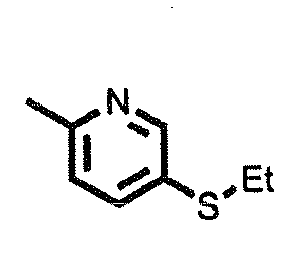
(CDCl3) δ 1.01-1.07 (m, 2H), 1.26 (t, J = 7.3 Hz, 3H), 1.33-1.39 (m, 2H), 1.64-1.91 (m, 3H), 1.97-2.22 (m, 3H), 2.35-2.49 (m, 2H), 2.87 (q, J = 7.3 Hz, 2H), 3.59 (t, J = 7.9 Hz, 1H), 4.70-4.94 (m, 2H), 7.54 (d, J = 7.9 Hz, 2H), 7.71 (dd, J = 8.6, 2.4 Hz, 1H), 7.85-7.92 (m, 3H), 8.13 (d, J = 8.6 Hz, 1H), 8.22 (d, J = 2.4 Hz, 1H). (ESI+) 495.2 (MH+) (-) 18 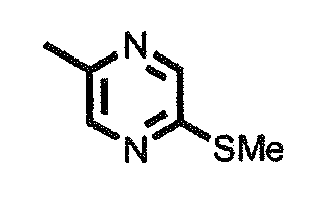
(DMSO-d6) δ 0.93-1.10 (m, 4H), 1.40-1.88 (m, 4H), 1.97-2.21 (m, 3H), 2.73-2.81 (m, 1H), 4.06 (t, J = 7.3 Hz, 1H), 4.74-5.00 (m, 2H), 7.63 (d, J = 8.6 Hz, 2H), 7.82 (d, J = 8.6 Hz, 2H), 8.31 (d, J = 1.8 Hz, 1H), 9.12 (d, J = 1.8 Hz, 1H), 11.0 (s, 1H). (ESI+) 482.1 (MH+) (-) 19 
(DMSO-d6) δ 0.94-1.14 (m, 4H), 1.44-1.90 (m, 4H), 1.98-2.26 (m, 3H), 2.76-2.87 (m, 1H), 3.27 (s, 3H), 3.64 (t, J = 4.9 Hz, 1H), 4.07 (t, J = 7.3 Hz, 1H), 4.36 (dd, J = 4.9, 6.1 Hz, 1H), 4.76-5.02 (m, 2H), 7.66 (d, J = 8.6 Hz, 2H), 7.86 (d, J = 8.6 Hz, 2H), 8.09 (d, J = 1.8 Hz, 1H), 8.82 (d, J = 1.8 Hz, 1 H), 10.9 (s, 1H). (ESI+) 510.2 (MH+) (-) -
[Table 5] No. Structure (A) 1N NMR (400 MHz) MS (m/z) Sign of Optical Rotation 20 
(CDCl3) δ 1.01-1.07 (m, 2H), 1.32-1.39 (m, 8H), 1.64-1.91 (m, 3H), 1.96-2.23 (m, 3H), 2.35-2.50 (m, 2H), 3.61 (t, J = 7.6 Hz, 1H), 4.71-4.93 (m, 2H), 5.24 (m, 1H), 7.56 (d, J = 8.6 Hz, 2H), 7.61 (s, 1H), 7.79 (d, J = 1.8 Hz, 1H), 7.90 (d, J = 8.6 Hz, 2H), 8.96 (s, 1H). (ESI+) 494.2 (MH+) (-) 21 
(DMSO-d6) δ 0.96-1.14 (m, 4H), 1.19 (t, J = 7.3 Hz, 3H), 1.44-1.90 (m, 4H), 1.99-2.25 (m, 3H), 2.72 (q, J = 7.3 Hz, 2H), 2.75-2.86 (m, 1H), 4.09 (t, J = 7.3 Hz, 1H), 4.74-5.04 (m, 2H), 7.66 (d, J = 8.6 Hz, 2H), 7.86 (d, J = 8.6 Hz, 2H), 8.28 (d, J = 1.8 Hz, 1H), 9.19 (d, J = 1.8 Hz, 1H), 11.1 (s, 1H). (ESI+) 464.2 (MH+) (-) 22 
(DMSO-d6) δ 0.95-1.14 (m, 4H), 1.42-1.90 (m, 4H), 1.99-2.25 (m, 3H), 2.11 (s, 3H), 2.76-2.87 (m, 3H), 4.07 (t, J = 7.3 Hz, 1 H), 4.41 (t, J = 6.7 Hz, 1H), 4.75-5.02 (m, 2H), 7.66 (d, J = 8.6 Hz, 2H), 7.86 (d, J = 8.6 Hz, 2H), 8.09 (d, J = 1.8 Hz, 1H), 8.83 (d, J = 1.8 Hz, 1H), 10.9 (s, 1 H). (ESI+) 526.2 (MH+) (-) 23 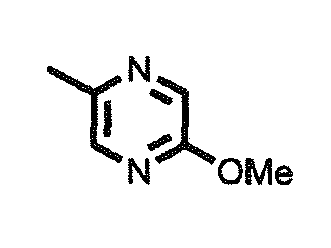
(DMSO-d6) δ 0.94-1.13 (m, 4H), 1.43-1.92 (m, 4H), 2.01-2.25 (m, 3H), 2.75-2.87 (m, 1H), 4.07 (t, J = 7.3 Hz, 1H), 4.71-5.04 (m, 2H), 7.66 (d, J = 8.6 Hz, 2H), 7.86 (d, J = 8.6 Hz, 2H), 8.09 (d, J = 1.8 Hz, 1H), 8.84 (d, J = 1.8 Hz, 1H), 10.9 (s, 1 H). (ESI+) 466.2 (MH+) (-) 24 
(DMSO-d6) δ 1.45 (s, 3H), 1.48 (s, 3H), 1.62-1.87 (m, 3H), 1.99-2.21 (m, 3H), 2.33-2.47 (m, 1H), (s, 3H), 3.66 (t J = 7.3 Hz, 1H), 3.93 (dd, J = 1.2, 7.3 Hz, 1H), 4.26 (dd, J = 1.2, 7.3 Hz, 1H), 4.70-4.93 (m, 2H), 5.08 (t, J = 7.3 Hz, 1H), 6.93 (s, 1H), 7.48 (d, J = 8.6 Hz, 1H), 7.93 (d, J = 8.6 Hz, 1H), 8. (s, 1H). (ESI+) 515.2 3.07(MH+) (-) -
[Table 6] No. Structure (A) 1H NMR (400 MHz) MS (m/z) Sign of Optical Rotation 25 
(CDCl3) δ 1.01-1.11 (m, 2H), 1.33-1.39 (m, 2H), 1.51-1.82 (m, 3H), 1.89-2.19 (m, 3H), 2.28-2.39 (m, 1H), 2.41-2.50 (m, 1H), 3.23 (t, J = 4.9 Hz, 4H), 3.56 (t, J = 7.6 Hz, 1H), 3.91 (t, J = 4.9 Hz, 4H), 4.66-4.92 (m, 2H), 7.06 (d, J = 7.9 Hz, 2H), 7.14 (dd, J = 9.2, 2.4 Hz, 1H), 7.32 (d, J = 2.4 Hz, 1H), 7.66 (d, J = 8.6 Hz, 1H), 7.71 (d, J = 8.6 Hz, 2H). (ESI+) 576.2 (MH+) (-) 26 
(CDCl3) δ 1.04-1.11 (m, 2H), 1.35-1.44 (m, 8H), 1.63-189 (m, 3H), 1.99-2.20 (m, 3H), 2.37-2.54 (m, 2H), 3.70 (t, J = 7.6 Hz, 1H), 4.69-4.95 (m, 2H), 5.29 (m, 1H), 7.40 (d, J = 7.9 Hz, 2H), 7.75 (d, J = 8.6 Hz, 1H), 7.87 (d, J = 7.9 Hz, 2H), 8.14 (dd, J = 8.6, 1.8 Hz, 1H), 8.55 (d, J = 1.8 Hz, 1H), 9.33 (s, 1H). (ESI+) 577.2 (MH+) (-) 27 
(CDCl3) δ 1.01-1.12 (m, 2H), 1.33-1.43 (m, 2H), 1.64-1.88 (m, 3H), 1.98-2.19 (m, 3H), 2.36-2.52 (m, 2H), 3.45 (s, 3H), 3.70 (t, J = 7.9 Hz, 1H), 3.75-3.79 (m, 2H), 4.49-4.55 (m, 2H), 4.69-4.77 (m, 2H), 7.32-7.40 (m, 2H), 7.75 (d, J = 8.6 Hz, 1H), 7.81-7.88 (m, 2H), 8.16 (dd, J = 8.6, 1.8 Hz, 1H), 8.58 (d, J = 1.8 Hz, 1H), 9.67 (br, 1H). (ESI+) 593.2 (MH+) (-) 28 
(DMSO-d6) δ 0.94-.1.15 (m, 4H), 1.42-1.81 (m, 3H), 1.82-2.00 (m, 1H), 2.00-2.29 (m, 3H), 2.77-2.88 (m, 1 H), 4.10 (t, J = 7.3 Hz, 1H), 4.71-5.04 (m, 2H), 7.47 (dd, J = 4.9, 8.6 Hz, 1H), 7.67 (d, J = 8.6 Hz, 2H), 7.88 (d, J = 8.6 Hz, 2H), 8.09 (d, J = 8.6 Hz, 1H), 8.45 (d, J = 4.9 Hz, 1H), 12.9 (s, 1H). (ESI+) 492.1 (MH+) (-) -
[Table 7] No. Structure (A) 1H NMR (400 MHz) MS (m/z) Sign of Optical Rotation 29 
(DMSO-d6) δ 1.00-1.13 (m, 4H), 1.34 (s, 3H), 1.37 (s, 3H), 1.45-1.80 (m, 3H), 1.80-1.92 (m, 1H), 2.00-2.27 (m, 3H), 2.79-2.86 (m, 1H), 3.84 (t, J = 7.3 Hz, 1H), 4.01 (t, J = 7.3 Hz, 1H), 4.21 (dd, J = 6.7, 7.9 Hz, 1H), 4.77-5.00 (m, 2H), 5.05 (t, J = 6.7 Hz, 1H), 7.10 (s, 1H), 7.63 (d, J = 8.6 Hz, 2H), 7.86 (d, J = 8.6 Hz, 2H), 12.5 (s, 1H). (ESI+) 541.2 (MH+) (-) 30 
(DMSO-d6) δ 0.92-1.14 (m, 4H), 1.42-1.76 (m, 3H), 1.76-1.92 (m, 1H), 2.00-2.25 (m, 3H), 2.23 (s, 3H), 2.76-2.86 (m, 1H), 3.99 (t, J = 7.3 Hz, 1H), 4.72-5.05 (m, 2H), 6.75 (s, 1H), 7.63 (d, J = 8.6 Hz, 2H), 7.86 (d, J = 8.6 Hz, 2H), 12.4 (s, 1H). (ESI+) 455.1 (MH+) (-) 31 
(DMSO-d6) δ 0.94-1.14 (m, 4H), 1.44-1.78 (m, 3H), 1.78-1.93 (m, 1H), 1.99-2.25 (m, 3H), 2.30 (d, J = 1.2 Hz, 3H), 2.77-2.86 (m, 1H), 4.00 (t, J = 7.3 Hz, 1H), 4.75-5.02 (m, 2H), 7.12 (d, J = 1.2 Hz, 1H), 7.63 (d, J = 8.6 Hz, 2H), 7.86 (d, J = 8.6 Hz, 2H), 12.3 (s, 1H). (ESI+) 455.1 (MH+) (-) 32 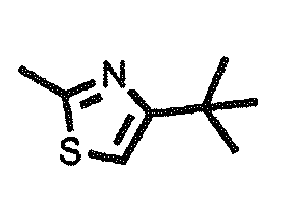
(CDCl3) δ 1.01-1.09 (m, 2H), 1.26 (s, 9H), 1.33-1.42 (m, 2H), 1.60-1.90 (m, 3H), 1.96-2.20 (m, 3H), 2.36-2.53 (m, 2H), 3.64 (t, J = 7.9 Hz, 1H), 4.68-4.93 (m, 2H), 6.55 (s, 1H), 7.47-7.54 (m, 2H), 7.85-7.92 (m, 2H), 8.71-8.91 (m, 1H). (ESI+) 497.2 (MH+) (-) 33 
(CDCl3) δ 1.01-1.07 (m, 2H), 1.33-1.38 (m, 2H), 1.63-1.86 (m, 3H), 2.00-2.18 (m, 3H), 2.36-2.48 (m, 2H), 3.66 fez J = 7.7 Hz, 1H), 4.71-4.90 (m, 2H), 7.32 (s, 1H), 7.46 (d, J = 8 Hz, 2H), 7.87 (d, J = 8 Hz, 2H), 9.38 (s, 1H). (ESI+) 519.0 (MH+) (-) -
[Table 8] No. Structure (A) 1H NMR (400 MHz) MS (m/z) Sign of Optical Rotation 34 
(DMSO-d6) δ 0.98-1.09 (m, 4H), 1.45-1.75 (m, 3H), 1.89-2.30 (m, 4H), 2.79-2.86 (m, 1H), 4.11 (t, J = 7.3 Hz, 1H), 4.77-5.00 (m, 2H), 7.63 (d, J = 8.6 Hz, 2H), 7.88 (d, J = 8.6 Hz, 2H), 8.47 (s, 1H), 13.3 (s, 1H). (ESI+) 442.1 (MH+) (-) 35 
(CDCl3) δ 1.03-1.13 (m, 2H), 1.31 (t, J = 7.3 Hz, 3H), 1.37-1.44 (m, 2H), 1.63-1.89 (m, 3H), 1.99-2.22 (m, 3H), 2.38-2.53 (m, 2H), 2.83 (q, J = 7.3 Hz, 2H), 3.77 (t, J = 7.9 Hz, 1H), 4.69-4.93 (m, 2H), 7.48 (d, J = 7.9 Hz, 2H), 7.90 (d, J = 8.6 Hz, 2H), 9.25 (s, 1H). (ESI+) 470.1 (MH+) (-) 36 
(CDCl3) δ 1.03-1.11 (m, 2H), 1.33-1.43 (m, 1.64-1.90 (m, 3H), 1.98-2.22 (m, 3H), 2.35-2.52 2H), 3.55 (t, J = 5.5 Hz, 4H), 3.70-3.78 (m, 5H), 4.70-4.94 (m, 2H), 7.44-7.52 (m, 2H), 7.84-7.93 (m, 2H), 9.24 (br, 1H). 2H),(ESI+) 527.2 (m,(MH+) (+) (DMF) 37 
(CDCl3) δ 1.01-1.08 (m, 2H), 1.24 (t, J = 7.1 Hz, 3H), 1.33-1.39 (m, 2H), 1,46 (s, 6H), 1.64-1.91 (3H, m), 1.96-2.23 (m, 3H), 2.35-2.51 (m, 2H), 3.60 (t, J = 7.6 Hz, 1H), 4.12 (q, J = 7.1 Hz, 2H), 4.70-4.94 (m, 2H), 7.54 (d, J = 8.6 Hz, 2H), 7.78 (dd, J = 8.6, 1.8 Hz, 1H), 7.88-7.92 (m, 3H), 8.17 (d, J = 9.2 Hz, 1H), 8.25 (d, J = 2.4 Hz, 1H). (ESI+) 581.2 (MH+) (-) 38 
(CDCl3) δ 0.99-1.08 (m, 2H), 1.31-1.40 (m, 2H), 1.45-1.91 (m, 9H), 1.98-2.24 (m, 3H), 2.35-2.51 (m, 2H), 3.49-3.55 (m, 1H), 3.61 (t, J = 7.6 Hz, 1H), 3.75-3.83 (m, 1H), 3.84-3.92 (m, 1H), 4.01-4.08 (m, 1H), 4.43-4.55 (m, 2H), 4.67 (s, 1H), 4.71-4.93 (m, 2H), 7.56 (d, J = 7.9 Hz, 2H), 7.63 (s, 1H), 7.88-7.92 (m, 3H), 8.97 (s, 1H). (ESI+) 580.2 (MH+) (-) -
[Table 9] No. Structure (A) 1H NMR (400 MHz) MS (m/z) Sign of Optical Rotation 39 
(CDCl3) δ 1.01-1.08 (m, 2H), 1.32-1.39 (m, 2H), 1.65-1.89 (m, 3H), 1.99-2.23 (m, 3H), 2.30-2.50 (m, 3H), 3.62 (t, J = 7.6 Hz, 1H), 3.94-4.00 (m, 2H), 4.42-4.49 (m, 2H), 4.71-4.94 (m, 2H), 7.52-7.59 (m, 2H), 7.67 (s, 1H), 7.88-7.93 (m, 3H), 8.98 (s, 1H). (ESI+) 496.2 (MH+) (-) 40 
(CDCl3) δ 1.01-1.08 (m, 2H), 1.33-1.39 (m, 2H), 1.64-1.91 (m, 3H), 1.97-2.22 (m, 5H), 2.36-2.50 (m, 2H), 3.34 (s, 3H), 3.52 (t, J = 6.1 Hz, 2H), 3.62 (t, J = 7.9 Hz, 1H), 4.39 (t, J = 6.1 Hz, 2H), 4.70-4.93 (m, 2H), 7.56 (d, J = 8.6 Hz, 2H), 7.62-7.68 (m, 1H), 7.85 (d, J = 1.2 Hz, 1 H), 7.90 (d, J = 8.6 Hz, 2H), 8.97 (s, 1H). (ESI+) 524.2 (MH+) (-) 41 
(CDCl3) δ 1.01-1.08 (m, 2H), 1.23 (t, J = 7.3 Hz, 3H), 1.33-1.40 (m, 2H), 1.65-1.91 (m, 3H), 1.98-2.23 (m, 3H), 2.35-2.50 (m, 2H), 3.58 (q, J = 7.3 Hz, 2H), 3.62 (t, J = 7.3 Hz, 1H), 3.75-3.80 (m, 2H), 4.43-4.49 (m, 2H), 4.70-4.93 (m, 2H), 7.56 (d, J = 8.6 Hz, 2H), 7.63-7.73 (m, 1H), 7.89 (d, J = 7.9 Hz, 2H), 7.92 (d, J = 1.2 Hz, 1H), 8.97 (s, 1H). (ESI+) 524.2 (MH+) (-) 42 
(CDCl3) δ 1.02-1.08 (m, 2H), 1.34-1.39 (m, 2H), 1.48 (s, 3H), 1.51 (s, 3H), 1.67-1.89 (m, 3H), 2.02-2.22 (m, 3H), 2.37-2.49 (m, 2H), 3.65 (t, J = 7.6 Hz, 1H), 3.97 (dd, J = 8.6, 6.7 Hz, 1H), 4.43 (dd, J = 8.6, 6.7 Hz, 1H), 4.93-4.73 (m, 2H), 5.21 (t, J = 6.4 Hz, 1H), 7.55 (d, J = 8.6 Hz, 2H), 7.78 (s, 1H), 7.91 (d, J = 8.6 Hz, 2H), 8.41 (d, J = 1.2 Hz, 1H), 9.42 (d, J = 1.2 Hz, 1H). (ESI+) 536.2 (MH+) (-) 43 
(CDCl3) δ 1.02-1.08 (m, 2H), 1.35-1.39 (m, 2H), 1.67-1.88 (m, 3H), 2.02-2.22 (m, 3H), 2.36-2.48 (m, 3H), 3.51-3.61 (m, 1H), 3.64-3.74 (m, 1H), 3.81-3.87 (m, 1H), 3.92-3.99 (m, 1H), 4.72-4.93 (m, 3H), 7.55 (d, J = 8.6 Hz, 2H), 7.90 (d, J = 8.6 Hz, 2H), 8.02 (s, 1H), 8.34 (s, 1H), 9.43 (s, 1H). (ESI+) 496.2 (MH+) (-) -
[Table 10] No. Structure (A) 1H NMR (400 MHz) MS (m/z) Sign of Optical Rotation 44 
(COCl3) δ 1.02-1.07 (m, 2H), 1.34-1.39 (m, 2H), 1.48 (s, 3H), 1.52 (s, 3H), 1.66-1.90 (m, 3H), 2.02-2.22 (m, 3H), 2.37-2.49 (m, 2H), 3.65 (t, J = 7.3 Hz, 1H), 4.00 (dd, J = 8.3, 6.4 Hz, 1H), 4.44 (dd, J = 8.3, 6.4 Hz, 1H), 4.93-4.72 (m, 2H), 5.20 (t, J = 6.4 Hz, 1H), 7.56 (d, J = 8.6 Hz, 2H), 7.79 (s, 1H), 7.91 (d, J = 8.6 Hz, 2H), 8.40 (d, J = 1.2 Hz, 1H), 9.42 (d, J = 1.2 Hz, 1H). (ESI+) 536.2 (MH+) (-) 45 
(CDCl3) δ 1.02-1.08 (m, 2H), 1.35-1.39 (m, 2H), 1.67-1.88 (m, 3H), 2.02-2.21 (m, 3H), 2.38-2.49 (m, 3H), 3.58 (d, J = 4.9 Hz, 1H), 3.68 (t, J = 7.6 Hz, 1H), 3.80-3.86 (m, 1H), 3.91-3.98 (m, 1H), 4.72-4.93 (m, 3H), 7.55 (d, J = 8.6 Hz, 2H), 7.90 (d, J = 8.6 Hz, 2H), 8.00 (s, 1H), 8.34 (s, 1H), 9.43 (s, 1H). (ESI+) 496.2 (MH+) (-) 46 
(CDCl3) δ 1.02-1.08 (m, 2H), 1.34-1.39 (m, 2H), 1.67-1.87 (m, 3H), 2.01-2.20 (m, 3H), 2.37-2.49 (m, 2H), 3.11 (s, 1H), 3.34 (t, J = 5.5 Hz, 2H), 3.65 (t, J = 7.3 Hz, 1H), 3.90 (t, J = 5.5 Hz, 2H), 4.72-4.92 (m, 3H), 7.55 (d, J = 8.6 Hz, 2H), 7.82 (s, 1H), 7.90 (d, J = 8.6 Hz, 2H), 8.17 (d, J = 1.2 Hz, 1H), 9.30 (d, J = 1.2 Hz, 1H). (ESI+) 512.2 (MH+) (-) 47 
(CDCl3) δ 1.05 (ddd, J = 14.1, 7.9, 1.8 Hz, 2H), 1.34-1.39 (m, 2H), 1.65-1.83 (m, 2H), 1.80-1.93 (m, 1H), 1.98-2.07 (m, 1H), 2.09-2.23 (m, 2H), 2.35 (s, 3H), 2.37-2.50 (m, 2H), 2.52 (s, 3H), 3.78 (br, 1H), 4.73-4.93 (m, 2H), 7.34 (br, 1H), 7.56 (d, J = 8.0 Hz, 1H), 7.89 (d, J = 8.0 Hz, 2H), 8.06 (s, 1H). (ESI+) 464.2 (MH+) (-) -
[Table 11] No. Structure (A) 1H NMR (400 MHz) MS (m/z) Sign of Optical Rotatior 48 
(DMSO-d6) δ 0.97-1.40 (m, 2H), 1.05-1.12 (m, 2H), 1.45-1.68 (m, 2H), 1.67-1.81 (2H, m), 2.02-2.22 (m, 3H), 2.76-2.84 (m, 1H), 3.90 (dd, J = 8.6, 6.1 Hz, 1H), 4.28 (dt, J = 27.5, 4.9 Hz, 2H), 4.68 (dt, J = 47.7, 4.3 Hz, 2H), 4.78-5.00 (m, 2H), 6.45 (d, J = 2.5 Hz, 1H), 7.60 (d, J = 2.8 Hz, 1H), 7.62 (d, J = 8.0 Hz, 2H), 7.83 (d, J = 8.0 Hz, 2H), 10.8 (s, 1H). (ESI+) 470.2 (MH+) (+) (DMF) 49 
(CDCl3) δ 1.04 (ddd, J = 13.5, 8.0, 2.4 Hz, 1 H), 1.33-1.39 (m, 2H), 1.43 (d, J = 6.7 Hz, 6H), 1.65-1.80 (m, 2H), 1.80-1.91 (m, 1H), 1.94-2.03 (m, 1H), 2.07-2.21 (m, 2H), 2.37-2.48 (m, 2H), 3.53 (t, J = 8.0 Hz, 1H), 4.31 (m, 1H), 4.70-4.91 (m, 2H), 6.63 (d, J = 1.8 Hz, 1H), 7.30 (d, J = 2.5 Hz, 1H), 7.54 (d, J = 8.6 Hz, 2H), 7.72 (br, 1H), 7.87 (d, J = 8.6 Hz, 2H). (ESI+) 466.2 (MH+) (-) 50 
(DMSO-d6) δ 0.97-1.40 (m, 2H), 1.05-1.12 (m, 2H), 1.45-1.68 (m, 2H), 1.67-1.81 (2H, m), 2.02-2.22 (m, 3H), 2.76-2.84 (m, 1H), 3.66 (q, J = 5.5 Hz, 2H), 3.90 (dd, J = 8.6, 6.7 Hz, 1H), 3.98 (t, J = 6.1 Hz, 2H), 4. 81 (t, J = 5.5 Hz, 1H), 4.80-5.00 (m, 2H), 6.40 (d, J = 2.5 Hz, 1H), 7.52 (d, J = 1.8 Hz, 1H), 7.62 (d, J = 8.6 Hz, 2H), 7.84 (d, J = 8.6 Hz, 2H), 10.8 (br, 1H). (ESI+) 468.2 (MH+) (+) (DMF) 51 
(DMSO-d6) δ 0.96-1.13 (m, 4H), 1.40-1.90 (m, 4H), 2.00-2.24 (m, 3H), 2.77-2.86 (m, 1H), 3.96 (t, J = 7.3 Hz, 1H), 4.73-5.02 (m, 2H), 6.90 (d, J = 1.8 Hz, 1H), 7.63 (d, J = 8.6 Hz, 2H), 7.86 (d, J = 8.6 Hz, 2H), 8.78 (d, J = 1.8 Hz, 1H), 11.4 (s, 1H). (ESI+) 425.1 (MH+) (-) -
[Table 12] No. Structure (A) 1H NMR (400 MHz) MS (m/z) Sign of Optical Rotation 52 
(CDCl3) δ 1.04-1.10 (m, 2H), 1.34-1.39 (m, 2H), 1.54-1.81 (m, 3H), 1.94-2.14 (m, 3H), 2.33-2.40 (m, 1H), 2.43-2.50 (m, 1H), 3.59 (t, J = 7.6 Hz, 1H), 3.89 (s, 3H), 4.70-4.91 (m, 2H), 7.08 (dd, J = 8.6, 2.4 Hz, 1H), 7.18 (d, J = 8.6 Hz, 2H), 7.32 (d, J = 2.4 Hz, 1H), 7.65 (d, J = 8.6 Hz, 2H), 7.76 (d, J = 8.6 Hz, 2H), 9.88 (s, 1H). (ESI+) 521.1 (MH+) (-) 53 
(CDCl3) δ 1.04-1.10 (m, 2H), 1.35-1.39 (m, 2H), 1.54-1.81 (m, 3H), 1.93-2.18 (m, 3H), 2.33-2.40 (m, 1H), 2.43-2.50 (m, 1H), 3.61 (t, J = 7.3 Hz, 1H), 4.69-4.92 (m, 2H), 7.13 (d, J = 7.9 Hz, 2H), 7.38 (t, J = 7.6 Hz, 1H), 7.48-7.52 (m, 1H), 7.74-7.79 (m, 3H), 7.87 (d, J = 7.9 Hz, 1H), 10,0 (s, 1 H). (ESI+) 491.1 (MH+) (-) 54 
(DMSO-d6) δ 0.91-1.12 (m, 4H), 1.41-1.76 (m, 3H), 1.85-1.99 (m, 1H), 1.99-2.28 (m, 3H), 2.75-2.85 (m, 1H), 4.06 (t, J = 7.3 Hz, 1H), 4.41 (t, J = 6.7 Hz, 1H), 4.73-5.00 (m, 2H), 7.22 (t, J = 74.0 Hz, 1H), 7.23 (dd, J = 2.4, 8.6 Hz, 1H), 7.65 (d, J = 8.6 Hz, 2H), 7.73 (d, J = 8.6 Hz, 1H), 7.85 (d, J = 2.4 Hz, 1H), 7.86 (d, J = 8.6 Hz, 2H), 12.8 (s, 1H). (ESI+) 557.1 (MH+) (-) 55 
(DMSO-d6) δ 0.92 (t, J = 7.3 Hz, 3H), 0.96-1.13 (m, 4H), 1.36-1.77 (m, 7H), 1.86-1.97 (m, 1H), 2.02-2.27 (m, 3H), 2.78-2.86 (m, 1H), 4.07 (t, J = 7.9 Hz, 1H), 4.27 (t J = 6.7 Hz, 2H), 4.77-5.01 (m, 2H), 6.87 (d, J = 8.6 Hz, 1H), 7.66 (d, J = 8.6 Hz, 2H), 7.88 (d, J = 7.9 Hz, 2H), 8.00 (d, J = 8.6 Hz, 1H), 12.7 (s, 1H). (ESI+) 564.2 (MH+) (-) -
[Table 13] No. Structure (A) 1H NMR (400 MHz) MS (m/z) Sign of Optical Rotation 56 
(DMSO-d6) δ 0.98-1.13 (m, 4H), 1.17 (t, J = 7.3 Hz, 3H), 1.47-1.81 (m, 3H), 1.88-1.99 (m, 1H), 2.04-2.30 (m, 3H), 2.75-2.83 (m, 1H), 4.09 (t, J = 7.9 Hz, 1H), 4.14 (q, J = 7.3 Hz, 2H), 4.77-4.99 (m, 2H), 4.93 (s, 2H), 6.98 (d, J = 8.6 Hz, 1H), 7.64-7.69 (m, 2H), 7.85-7.89 (m, 2H), 8.04 (d, J = 8.6 Hz, 1H), 12.6 (br, 1H). (ESI+) 594.2 (MH+) (-) 57 
(CDCl3) δ 0.96-1.04 (m, 2H), 1.31-1.37 (m, 2H), 1.67-1.90 (m, 3H), 1.97-2.08 (m, 1H), 2.08-2.26 (m, 2H), 2.37-2.48 (m, 2H), 3.64 (s, 3H), 3.84 (t, J = 7.6 Hz, 1H), 4.69-4.92 (m, 2H), 7.18-7.32 (m, 4H), 7.65 (d, J = 8.6 Hz, 2H), 7.83 (d, J = 8.6 Hz, 2H), 11.1 (s, 1H). (ESI+) 488.2 (MH+) (-) 58 
(CDCl3) δ 1.04 (ddd, J = 14.1, 6.1, 1.8 Hz, 1H), 1.33-1.38 (m, 2H), 1.70-1.91 (m, 3H), 2.06-2.28 (m, 3H), 2.40-2.49 (m, 2H), 3.91 (t, J = 7.3 Hz, 1H), 4.72-4.93 (m, 2H), 7.40 (dd, J = 8.0, 4.9 Hz, 1H), 7.64 (d, J = 8.0 Hz, 2H), 7.89 (d, J = 8.6 Hz, 2H), 8.66 (dd, J = 4.9, 1.8 Hz, 1H), 8.84 (d, J = 7.3 Hz, 1), 9.34 (br, 1H). (ESI+) 476.2 (MH+) (-) 59 
(DMSO-d6) δ 0.94-1.11 (m, 4H), 1.30 (s, 3H), 1.38 (s, 3H), 1.41-1.75 (m, 3H), 1.75-1.89 (m, 1H), 1.98-2.24 (m, 3H), 2.74-2.85 (m, 1H), 2.97-3.09 (m, 1H), 3.83-4.02 (m, 5H), 4.73-5.01 (m, 2H), 6.96 (s, 1H), 7.61 (d, J = 8.6 Hz, 2H), 7.84 (d, J = 8.6 Hz, 1H), 12.5 (s, 1H). (ESI+) 555.2 (MH+) (-) 60 
(DMSO-d6) δ 0.91-1.11 (m, 4H), 1.40-1.75 (m, 3H), 1.75-1.90 (m, 1H), 1.98-2.27 (m, 3H), 2.74-2.88 (m, 2H), 3.50-3.67 (m, 4H), 3.99 (d, J = 7.3 Hz, 1H), 4.46 (dd, J = 5.5, 9.8 Hz, 2H), 4.75-4.99 (m, 2H), 6.78 (s, 1H), 7.62 (d, J = 8.6 Hz, 2H), 7.84 (d, J = 8.6 Hz, 1H), 12.4 (s, 1H). (ESI+) 515.1 (MH+) (-) -
[Table 14] No. Structure (A) 1H NMR (400 MHz) MS (m/z) Sign of Optical Rotation 61 
(DMSO-d6) δ 0.95-1.12 (m, 4H), 1.42-1.75 (m, 3H), 1.79-1.90 (m, 1H). 2.00-2.27 (m, 3H), 2.71 (t, J = 6.7 Hz, 2H), 2.77-2.86 (m, 1H), 3.60-3.67 (m, 2H), 3.99 (t, J = 7.9 Hz, 1H), 4.58 (t, J = 5.5 Hz, 1H), 4.76-5.00 (m, 2H), 6.79 (s, 1H), 7.63 (d, J = 8.6 Hz, 2H), 7.86 (d, J = 8.6 Hz, 2H), 12.4 (br, 1H). (ESI+) 485.1 (MH+) (-) 62 
(CDCl3) δ 1.02-1.13 (m, 2H), 1.33-1.45 (m, 2H), 1.50-1.81 (m, 3H), 1.91-2.11 (m, 3H), 2.29-2.40 (m, 1H), 2.42-2.52 (m, 1H), 3.62 (t, J = 7.6 Hz, 1H), 4.65-4.92 (m, 2H), 7.29 (d, J = 8.6 Hz, 2H), 7.48 (t, J = 3.3 Hz, 3H), 7.84 (d, J = 8.6 Hz, 2H), 8.16-8.23 (m, 2H), 9.98 (s, 1H). (ESI+) 518.1 (MH+) (+) 63 
(COCl3) δ 0.99-1.09 (m, 2H), 1.32-1.41 (m, 2H), 1.67-1.95 (m, 3H), 2.06-2.25 (m, 3H), 2.25-2.55 (m, 2H), 3.92 (t, J = 7.6 Hz, 1H), 4.71-4.95 (m, 2H), 7.56 (d, J = 8.6 Hz, 2H), 7.91 (dd, J = 8.6, 2.4 Hz, 2H), 8.10 (d, J = 6.1 Hz, 2H), 8.85 (d, J = 8.6 Hz, 2H), 10.7(s, 1H). (ESI+) 519.1 (MH+) (+) (MeOH) 64 
(CDCl3) δ 1.01-1.14 (m, 2H), 1.32-1.45 (m, 2H), 1.56-1.90 (m, 3H), 2.00-2.22 (m, 3H), 2.38-2.54 (m, 2H), 2.51 (s, 3H), 3.78 (t, J = 7.9 Hz, 1H), 4.69-4.94 (m, 2H), 7.47 (dd, J = 8.6, 1.2 Hz, 2H), 7.89 (dd, J = 8.6, 1.8 Hz, 2H), 9.24-9.44 (m, 1H). (ESI+) 456.1 (MH+) (-) 65 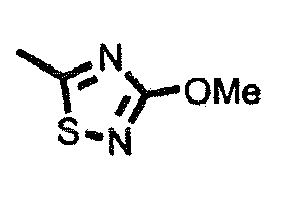
(CDCl3) δ 1.02 (ddd, J = 14.0, 6.1, 2.4 Hz, 2H), 1.32 (td, J = 6.7, 4.9 Hz, 2H), 1.68-1.92 (m, 3H), 2.00-2.22 (m, 3H), 2.36-2.52 (m, 2H), 4.17 (s, 3H), 4.37 (dd, J = 8.6, 6.7 Hz, 1H), 4.72-4.93 (m, 2H), 7.52 (d, J = 8.6 Hz, 2H), 7.83 (d, J = 8.6 Hz, 2H), 12.4 (s, 1H). (ESI+) 472.1 (MH+) (-) (MeOH) -
[Table 15] No. Structure (A) 1H NMR (400 MHz) MS (m/z) Sign of Optical Rotation 66 
(CDCl3) δ 0.97-1.04 (m, 2H), 1.06-1.12 (m, 2H), 1.45-1.67 (m, 3H), 1.68-1.77 (m, 1H), 1.77-1.86 (m, 1H), 2.03-2.23 (m, 3H), 2.77-2.84 (m, 1H), 4.05-4.11 (m, 1H), 4.44 (d, J = 5.5 Hz, 2H), 4.78-5.01 (m, 2H), 5.21 (t, J = 5.5 Hz, 1H), 7.64-7.70 (m, 3H), 7.85 (d, J = 8.6 Hz, 2H), 8.01 (d, J = 8.6 Hz, 1H), 8.23 (d, J = 1.8 Hz, 1H), 10.8 (s, 1H). (ESI+) 465.2 (MH+) (-) (DMF) -

- N-methylmorpholine N-oxide (50% aqueous solution, 22.0 mL) and osmium tetraoxide (2.5% t-butanol solution, 1.90 mL) were dissolved in acetone (190 mL), and a solution of (3-cyclopenten-1-yl)methyl benzoate (
WO 93/18009 PCT International Application No. Hei 7-506816
The filtrate was concentrated under reduced pressure to obtain a mixture of [(1α,3β,4β)-3,4-dihydroxycyclopentyl] methyl benzoate and [(1β,3β,4β)-3,4-dihydroxycyclopentyl]methyl benzoate (4.23 g, based on the 1H NMR integral ratio, a 1:2 mixture).
1H NMR (CDCl3) δ 1.58-1.65 (m, 1.3H), 1.71-1.78 (m, 0.7H), 1. 96-2.17 (m, 2H), 2.75-2.85 (m, 1H), 4.09-4.32 (m, 4H), 7.42-7.46 (m, 2H), 7.54-7.59 (m, 1H), 8.01-8.06 (m, 2H). -

- [(1α,3β,4β)-3,4-Dihydroxycyclopentyl]methyl benzoate (5.00 g) was suspended in carbon tetrachloride (75 mL). Thionyl chloride (1.90 mL) was added to the resultant suspension, and then the mixture was heated to reflux for 1.5 hours while stirring. Thionyl chloride (0.50 mL) was further added to the reaction mixture, and then the mixture was heated to reflux for another 1 hour while stirring. The reaction mixture was concentrated under reduced pressure, and to the resulting residue toluene (25 mL) was added. The mixture was again concentrated under reduced pressure, then dried under reduced pressure to obtain (3aα, 5α, 6aα)-(tetrahydro-4H-cyclopenta-1,3,2-dioxathiol-5-yl)methyl benzoate S-oxide (6.09 g). The obtained (3aα, 5α, 6aα)-(tetrahydro-4H-cyclopenta-1,3,2-dioxathiol-5-ylmethyl benzoate S-oxide (4.27 g), acetonitrile (30 mL), and carbon tetrachloride (30 mL) were mixed. To the resulting mixture, sodium periodate (6.46 g), ruthenium chloride hydrate (31.3 mg), and then water (30 mL) were added. The reaction mixture was stirred for 30 minutes at room temperature, to which dichloromethane (50 mL) was added. Insoluble matter was filtered off. The organic layer of the filtrate was collected, and the aqueous layer of the filtrate was extracted with dichloromethane (50 mL) . The organic layer and the dichloromethane extract were combined, and the resulting mixture was washed with a 1 mol/L aqueous sodium thiosulfate solution (2 × 40 mL) and then with water (2 × 40 mL). The mixture was dried over anhydrous sodium sulfate, and then concentrated under reduced pressure. The resulting residue was dried under reduced pressure to obtain (3aα, 5α, 6aα)-(tetrahydro-4H-cyclopenta-1,3,2-dioxathiol-5-yl)methyl benzoate S,S-dioxide (4.35 g).
MS (CI+) m/z: 299 (MH+) .
HRMS (CI+) for C13H15O6S (MH+) : calcd., 299.0589; found, 299.0593. -
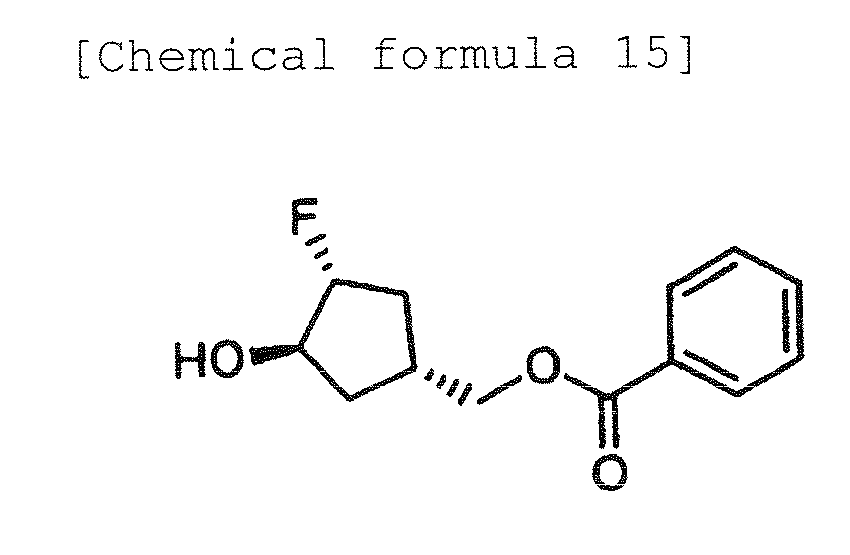
- Tetrabutylammoniumfluoride hydrate (571 mg) was dissolved in dehydrated acetonitrile (5 mL), and the resulting mixture was concentrated under reduced pressure. The same operation was repeated twice, and the resulting residue was dried for 45 minutes under reduced pressure at 40°C. This residue was dissolved in dehydrated acetonitrile (5 mL), and to the resulting mixture (3aα, 5α, 6aα)-(tetrahydro-4H-cyclopenta-1,3,2-dioxathiol-5-yl)methyl benzoate S,S-dioxide (500 mg) was added. The mixture was heated to reflux for 45 minutes while stirring, and the resultant reaction mixture was then concentrated under reduced pressure. The residue was dissolved in ethanol (5mL), and to the resulting mixture sulfuric acid (0.15 mL) was added. The mixture was heated to reflux for 10 minutes while stirring, and the resultant reaction mixture was then concentrated under reduced pressure. The residue was dissolved in ethyl acetate (40 mL), and the resulting mixture was washed with a saturated aqueous sodium bicarbonate solution (5 mL) and then with saturated brine (5 mL). The resulting mixture was dried over anhydrous sodium sulfate, then concentrated under reduced pressure. The resulting residue was purified by a silica gel column (eluant; hexane:ethyl acetate = 1:1) to obtain [(1α, 3α, 4β)-3-fluoro-4-hydroxycyclopentyl]methyl benzoate (342 mg). MS (EI) m/z: 238 (M+) .
HRMS (EI) for C13H15FO3 (M+) : calcd., 238.1005; found, 238.1046. -

- [(1α, 3α, 4β)-3-Fluoro-4-hydroxycyclopentyl]methylbenzoate (326 mg) was dissolved in dehydrated tetrahydrofuran (5 mL), and to the resulting mixture a solution of bis (2-methoxyethyl) aminosulfur trifluoride (455 mg) in dehydrated tetrahydrofuran (2 mL) was added. The resulting mixture was heated to reflux for 1.5 hours while stirring. This reaction mixture was poured into a saturated aqueous sodium bicarbonate solution (10 mL) and then extracted with ethyl acetate (2 × 30 mL). The ethyl acetate extracts were combined, the resulting mixture was washed with saturated brine (2 × 10 mL), dried over anhydrous sodium sulfate, and then concentrated under reduced pressure. The resulting residue was purified by a silica gel column (eluant; hexane:ethyl acetate = 4:1) to obtain [(1α, 3α, 4α)-3,4-difluorocyclopentyl]methyl benzoate (233 mg).
MS (CI+) m/z: 241 (MH+).
HRMS (CI+) for C13H15F2C2 (MH+) : calcd., 241.1040; found, 241.1043. -

- [(1α, 3α, 4α)-3,4-Difluorocyclopentyl]methyl benzoate (221 mg) was dissolved in ethanol (3 mL), and to the resulting mixture a solution of potassium carbonate (191 mg) in water (1mL) was added. The mixture was then heated to reflux for 4 hours while stirring. The reaction mixture was concentrated under reduced pressure, and the resulting residue was purified by a silica gel column (eluant; hexane:ethyl acetate = 1:2) to obtain [(1α, 3α, 4α)-3,4-difluorocyclopentyl]methanol (123 mg).
MS (CI+) m/z: 137 (MH+) .
HRMS (CI+) for C6H11F2O (MH+) : calcd., 137.0778; found, 137.0801. -


- Iodine (120 mg) was added under ice-cooling to a solution of imidazole (64.5 mg) and triphenylphosphine (124 mg) in dichloromethane (2.0 mL), and the resulting mixture was stirred for 30 minutes at room temperature. Then, to the mixture a solution of [(1α, 3α, 4α)-3,4-difluorocyclopentyl]methanol (43.0 mg) in dichloromethane (0.5 mL) was added, and the resulting mixture was stirred for 4 hours at room temperature. Insoluble matter was then was filtered off, and the filtrate was concentrated. The resulting residue was purified by silica gel column chromatography to obtain (1α, 3α, 4α)-3,4-difluorocyclopentylmethyl iodide (28.0 mg).
MS (EI) m/z: 246 (M+) .
HRMS (EI) for C6H9F2I (M+) : calcd., 245.9717; found, 245.9741. -

- A mixture (4.23 g) of the [(1α, 3β, 4β)-3,4-dihydroxycyclopentyl]methyl benzoate and [(1β, 3β, 4β) -3, 4-dihydroxycyclopentyl]methyl benzoate obtained in the first step of Reference Example 1 and carbon tetrachloride (75 mL) were mixed. Thionyl chloride (2.00mL) was addedto the resultingmixture, and then the mixture was heated to reflux for 30 minutes while stirring. The reaction mixture was concentrated under reduced pressure, and toluene (75 mL) was added to the resulting residue. This mixture was concentrated under reduced pressure, and the resulting residue was dried under reduced pressure. This residue was mixed with acetonitrile (35 mL g) and carbon tetrachloride (35 mL), and sodium periodate (7.66 g), ruthenium chloride hydrate (37.1 mg), and then water (35 mL) were added to the resulting mixture. The reaction mixture was stirred for 30 minutes at room temperature. Dichloromethane (60 mL) was then added to the reaction mixture. Insoluble matter was filtered off, and then, the organic layer of the filtrate was collected. The aqueous layer of the filtrate was extracted with dichloromethane (60 mL). The organic layer and the dichloromethane extract were combined, and the resulting mixture was washed with a 1 mol/L aqueous sodium thiosulfate solution (2 × 50 mL) and then with water (2 × 50 mL). The mixture was dried over anhydrous sodium sulfate, and then concentrated under reduced pressure. The resulting residue was purified by a silica gel column (eluant; hexane:ethyl acetate = 1:1) to obtain (3aα, 5β, 6aα)-(tetrahydro-4H-cyclopenta-1,3,2-dioxathiol-5-yl)methyl benzoate S,S-dioxide (2.43 g) and (3aα, 5α, 6aα)-(tetrahydro-4H-cyclopenta-1,3,2-dioxathiol-5-yl)methyl benzoate S,S-dioxide (1.33 g).
MS (EI) m/z: 298 (M+) .
HRMS (EI) for C13H14O6S (M+): calcd., 298.0511; found, 298.0493. - 6aα)-(tetrahydro-4H-cyclopenta-1,3,2-dioxathiol-5-yl)methyl benzoate S,S-dioxide (1.00 g), [(1β, 3α, 4β)-3-fluoro-4-hydroxycyclopentyl]methyl benzoate (660 mg) was obtained by carrying out a reaction in the same manner as in the third step of Reference Example 1.
MS (CI+) m/z: 239 (MH+) .
HRMS (CI+) for C13H16FO3 (MH+) : calcd., 239.1083; found, 239.1040. - Using [(1β, 3α, 4β)-3-fluoro-4-hydroxycyclopentyl]methyl benzoate (644 mg), [(1β, 3α, 4α)-3,4-difluoro-cyclopentyl]methyl benzoate (365 mg) was obtained by carrying out a reaction in the same manner as in the fourth step of Reference Example 1. MS (CI+) m/z: 241 (MH+) .
HRMS (CI+) for C13H15F2O2 (MH+) : calcd., 241.1040; found, 241.1012. - Using [(1β, 3α, 4α)-3,4-difluoro-cyclopentyl]methylbenzoate (349 mg), [(1β, 3α, 4α)-3,4-difluorocyclopentyl]methanol (184 mg) was obtained by carrying out a reaction in the same manner as in the fifth step of Reference Example 1.
MS (CI+) m/z: 137 (MH+) .
HRMS (CI+) for C6H11F2O (MH+): calcd., 137.0778; found, 137.0754. - Using [(1β, 3α, 4α)-3,4-difluorocyclopentyl]methanol (3.46 g), (1β, 3α, 4α)-3,4-difluorocyclopentyl iodide (4.72 g) was obtained by carrying out a reaction in the same manner as in the sixth step of Reference Example 1.
MS (EI) m/z: 246 (M+).
HRMS (EI) for C6H9F2I (M+) : calcd., 245.9717; found, 245.9749. -


- (+)-2-[4-(Cyclopropylsulfonyl)phenyl]-3-[(1α, 3α, 4α)-3,4-difluorocyclopentyl]-N-(thiazol-2-yl)propionamide (105 mg) was obtained from (+)-2-[4-(cyclopropylsulfonyl)phenyl]-3-[(1α, 3α, 4α)-3,4-difluorocyclopentyl]-N-(thlazol-2-yl)propionic acid (300 mg) according to the same method as in Example 5. MS (ESI+) m/z: 441 (ESI+).
HRMS (ESI+) for C20H23F2N2O3S2 (ESI+): calcd., 441.11181; found, 441.11177.
1H NMR (400 MHz, CDCl3) δ 1.00-1.09 (m, 2H), 1.32-1.38 (m, 2H), 1.64-1.89 (m, 3H), 2.00-2.22 (m, 3H), 2.37-2.50 (m, 2H), 3.72 (t, J = 7.6 Hz, 1H), 4.70-4.91 (m, 2H), 7.04 (d, J = 3.7 Hz, 1H), 7.46 (d, J = 3.7 Hz, 1H), 7.49 (d, J = 7.9 Hz, 2H), 7.86 (d, J = 7.9 Hz, 2H), 10.1 (brs, 1H). -


- Based on the method described in
WO2004/052869 , mercaptoethanol (0.93 mL) and tetrakis(triphenylphosphine)palladium (3.39 g) were added to a solution of 1.00 g of 2-amino-5-bromopyrazine (5.75 mmol) in N,N-dimethylformamide (15.1 mL), and the resulting mixture was heated and stirred in a sealed tube for about 3 hours at 120°C. After cooling, the reaction mixture was diluted with water, and then extracted (100 mL × 6) with a mixed liquid (methylene chloride: ethanol = 5:1). The organic layer was dried over anhydrous sodium sulfate, then filtered, and the solvent was removed by distillation under reduced pressure. The resulting residue was purified by column chromatography (hexane: ethyl acetate =1:1, then ethyl acetate, and then ethyl acetate:methanol = 10:1), then recrystallized (chloroform) to obtain 470 mg of the title compound (yield 44%) as yellow needle-like crystals.
MS (EI+) m/z: 171 (M+).
HRMS (EI+) for C6H9N3OS (M+): calcd., 171.0466; found, 172.0451. -

- Based on the method described in
WO2007/007886 , sodium hydride (50% oily substance) (314 mg) was added to methylthioethanol (7.88 mL) under stirring with ice cooling, and then copper (490 mg) and 2-amino-5-bromopyrazine (1.00 g) were added to the resulting mixture. The reaction mixture was placed in an autoclave, and then heated and stirred for about 5 hours at 160°C. After cooling, to the reaction mixture water (50 mL) and ethyl acetate (50 mL) were added to dilute the mixture. Then, the mixture was turned into a basic solution by adding 25% ammonia water (2 mL). The reaction mixture was filtered with Celite and then separated into an organic layer and an aqueous layer. The aqueous layer was extracted with ethyl acetate (50 mL × 2). The organic layers were combined, and was dried over anhydrous sodium sulfate, then filtered, and the solvent was removed by distillation under reduced pressure. The resulting residue was purified by silica gel chromatography (hexane:ethyl acetate = 1:1), then by preparative TLC (chloroform:methanol = 10:1, followed by NH silica gel, hexane: acetone =3:1), to obtain 59.2 mg of the title compound (yield 6%) as white powdery crystals.
MS (EI+) m/z: 185 (M+).
HRMS (EI+) for C7H11N3OS (M+): calcd., 185.0623; found, 185:0613. -

- 1. 50 g of the title compound (yield 41%) was obtained as yellow crystals from 2-amino-5-bromopyrazine (3.48 g) and ethoxyethanol (36.0 g) according to the method of Reference Example 5. MS (EI+) m/z: 183 (M+) .
HRMS (EI+) for C8H13N3O2 (M+): calcd., 183.1008; found, 183.0996. -

- 644 mg of the title compound (yield 18%) was obtained as yellow crystals from 2-amino-5-bromopyrazine (3.48 g) and methoxypropanol (18.0 g) according to the method of Reference Example 5. MS (EI+) m/z: 183 (M+) .
HRMS (EI+) for C8H13N3O2 (M+): calcd., 183.1008; found, 183.1011. - (1β, 3α, 4α)-(3,4-Difluorocyclopentyl)methylphosphonium iodide was produced in the same manner as in the seventh step of Reference Example 1 from the (1β, 3α, 4α)-3,4-difluorocyclopentylmethyliodideobtainedinthefifthstep of Reference Example 2. The title compounds were then obtained in the same manner as in Examples 2, 3, and 4 and in Example 5.
- GK activity was examined not by directly measuring glucose 6-phosphate produced by an enzyme reaction, but by measuring the amount of NADH produced by a conjunction reaction catalyzed by glucose-6-dehydrogenase.
- Based on the human hepatic GK sequence accession number: NM_033507 and human pancreatic GK sequence accession number: NM_000162, which are registered in the GeneBank, PCR cloning was carried out by Pyrobest DNA Polymerase (manufactured by Takara Bio Inc.) with human liver cDNA (manufactured by Clontech) and human pancreatic cDNA (manufactured by Clontech) as respective templates. Furthermore, the cloned genes were expressed in the soluble fraction in E. coli as a His-tagged fusion protein that was (His)-6 tagged at the C terminal side. The bacterium was subjected to ultrasonic disintegration, then subjected to centrifugal separation, and the supernatant was recovered. The collected supernatant was purified by metal chelate affinity chromatography.
- After the purification, the resulting enzyme was stored at -80°C in 12.5 mM HEPES (pH 7.3), 75 mM KCl, 0.5 mM MgCl2, 0.5 mM DTT, 2.5 mM glucose, and 50% glycerol.
- An assay was carried out at 25°C using a 96 well half area flat bottom plate manufactured by Costar. An incubation mixture was prepared so as to ultimately include 25 mM HEPES buffer solution (pH 7.1) (manufactured by Invitrogen), 25 mM KCl (manufactured by Wako Pure Chemical Industries Ltd.), 2 mM MgCl2 (manufactured by Wako Pure Chemical Industries Ltd.), 5 mM D-glucose (manufactured by Wako Pure Chemical Industries Ltd.), 1 mM ATP (manufactured by Roche), 1 mM NAD (manufactured by Sigma), 1 mM dithiothreitol (manufactured by Wako Pure Chemical Industries Ltd.), 5 unit/mL G6PDH (manufacturedby Sigma), and a 0.1% BSA (manufacturedby Sigma), and a test compound or 5% DMSO and GK.
- The compound to be tested was dissolved in DMSO in advance, and 2 µL of the resulting mixture was added to 20 µL of a solution including a HEPES buffer solution (pH 7.1), KCl, MgCl2, D-glucose, ATP, NAD, and dithiothreitol. Next, 18 µL of a solution including G6PDH, BSA, and recombinant GK was added to the mixture in order to initiate the reaction. GK was added into the reaction mixture so that the increase in absorbance per minute in the presence of 5% DMSO was between 0.002 and 0.003. Once the reaction started, the increase in absorbance at 340 nm was measured for 15 minutes using a SPECTRAmax 190 microplate spectrophotometer (manufactured by Molecular Devices) . The activity was evaluated using the amount of increase for the first 10 minutes.
- A human liver GK-activating effect of 200% or more at 10 µM was found for Compounds 1 to 15, 17 to 37, 42 to 46, 55, and 56 of the present invention, when compared with the wells that did not contain such compound.
- Using ICR mice (male, 7 to 9 weeks, Charles River Laboratories Japan Inc.) the effects of each of the tested compounds on blood glucose levels were measured. Each compound was dissolved in a mixture of 60/40 of Gelucire 44/14 (trade name, manufactured by Gatefosse) and PEG 400, and the resulting mixture was orally administered (30 mg/kg, 10 mL/kg) to the mice, which had not been fed for two hours. Blood was collected by a blood collection tube coated with dipotassium ethylenediamine tetraacetate from the tail vein before administration (pre-value) and at points 0.5, 2, and 4 hours after administration. The collected blood was separated by centrifugation (4°C, 3,600×g, 3 minutes), to obtain blood plasma samples.
- Each sample was diluted 5-fold with physiological saline, and the blood glucose level was measured using glucose CII-test Wako (trade name, manufactured by Wako Pure Chemical Industries Ltd.). 10 µl each of one of the samples, physiological saline, and 100 mg/dL of glucose standard solution (200 mg/dL of glucose standard solution diluted two-fold with physiological saline) were placed in each well of a 96 well flat bottom plate. Then, 150 µL per well of a developing solution was added, and the color was developed by standing for 5 minutes at 37°C. Measurement was carried out at OD 505 nm using an En Vision 2103 Multilabel Reader (trade name, manufactured by PerkinElmer) . The decrease in Σ glucose from the decrease in glucose of each collected point with respect to the pre-value (average of the decrease in glucose of each collected point with respect to the pre-value) was calculated.
A decrease of 35% or more in Σ glucose was found for Compounds 1 to 6, 8, 13, 15, 18, 21 to 23, 28, 31, 34, 35, 51, 64, and 65 of the present invention.
None of the (+)-2-[4-(cyclopropylsulfonyl)phenyl]-3-[(1α, 3α, 4α)-3,4-difluorocyclopentyl]-N-(thiazol-2-yl)propionamide produced in Reference Example 3, the (-)-2-[4-(cyclopropylsulfonyl)phenyl]-3-[(1β, 3α, 4α)-3,4-difluorocyclopentyl]-N-(thiazol-2-yl)propionamide produced in Reference Example 8, or the (+)-2-[4-(cyclopropylsulfonyl)phenyl]-3-[(1β, 3α, 4α)-3,4-difluorocyclopentyl]-N-(thiazol-2-yl)propionamide produced in Reference Example 8 showed a decrease in Σ glucose which exceeded 20%. - The glucokinase activator of the present invention has an excellent GK-activating effect or hypoglycemic effect, and few side effects (for example, prolonged QT interval, hypoglycemia symptoms etc.). Therefore, the glucokinase activator of the present invention is useful as a pharmaceutical for the treatment or prevention of diabetes, obesity and the like.
Claims (19)
- A compound represented by the general formula (1), or a pharmaceutically acceptable salt thereof:

- The compound according to claim 1, or a pharmaceutically acceptable salt thereof, wherein R1 is a hydrogen atom and R2 is a C3-C6 cycloalkylsulfonyl group.
- The compound according to claim 1, or a pharmaceutically acceptable salt thereof, wherein R1 is a hydrogen atom and R2 is a cyclopropylsulfonyl group.
- The compound according to any of claims 1 to 3, represented by the general formula (1a),or a pharmaceutically acceptable salt thereof:

- The compound according to any of claims 1 to 3, represented by the general formula (1b), or a pharmaceutically acceptable salt thereof:

- The compound according to any of claims 1 to 5, or a pharmaceutically acceptable salt thereof, wherein A is a heteroaryl group that is unsubstituted or monosubstituted with a halogen atom, a C1-C6 alkyl group, a C1-C6 alkoxy group, a nitro group, a cyano group, or a group represented by the formula, -(CH2)mC(O)OR3
(wherein R3 represents a hydrogen atom or a C1-C6 alkyl group and m is an integer of 0 to 2). - The compound according to any of claims 1 to 5, or a pharmaceutically acceptable salt thereof, wherein A is a heteroaryl group unsubstituted or monosubstituted with a halogen atom or a C1-C6 alkyl group.
- The compound according to claim 6 or 7, or a pharmaceutically acceptable salt thereof, wherein A is an unsubstituted or monosubstituted 5- or 6-membered aromatic heterocyclic ring that contains 1 to 3 heteroatoms selected from a sulfur atom, an oxygen atom, and a nitrogen atom, with one of those heteroatoms being a nitrogen atom adjacent to a ring-linking atom.
- The compound according to claim 6 or 7, or a pharmaceutically acceptable salt thereof, wherein A is an unsubstituted or monosubstituted fused heterocyclic ring having a 5- or 6-membered aromatic heterocyclic ring that contains 1 to 3 heteroatoms selected from a sulfur atom, an oxygen atom, and a nitrogen atom, with one of those heteroatoms being a nitrogen atom adjacent to a ring-linking atom.
- The compound according to claim 6 or 7, or a pharmaceutically acceptable salt thereof, wherein A is an unsubstituted or substituted aromatic heterocyclic ring selected from the following:

- (-)-2-[4-(Cyclopropylsulfonyl)phenyl]-3-[(1α, 3α, 4α)-3,4-difluorocyclopentyl]-N-(thiazol-2-yl)propionamide or a pharmaceutically acceptable salt thereof.
- (-)-2-[4-(Cyclopropylsulfonyl)phenyl]-3-[(1α, 3α, 4α)-3,4-difluorocyclopentyl]-N-(5-fluorothiazol-2-yl)propionam ide or a pharmaceutically acceptable salt thereof.
- (-)-2-[4-(Cyclopropylsulfonyl)phenyl]-3-[(1α, 3α, 4α)-3,4-difluorocyclopentyl]-N-(pyrazin-2-yl)propionamide or a pharmaceutically acceptable salt thereof.
- (-)-2-[4-(Cyclopropylsulfonyl)phenyl]-3-[(1α, 3α, 4α)-3,4-difluorocyclopentyl]-N-(5-fluoropyridin-2-yl)propionam ide or a pharmaceutically acceptable salt thereof.
- A method of treating or preventing diabetes, comprising administering the compound according to any of claims 1 to 14, or a pharmaceutically acceptable salt thereof.
- Use of the compound according to any of claims 1 to 14, or a pharmaceutically acceptable salt thereof, for manufacturing a medicament for treating or preventing diabetes.
- A pharmaceutical composition comprising the compound according to any of claims 1 to 14, or a pharmaceutically acceptable salt thereof, and a pharmaceutically acceptable carrier.
- A compound represented by the general formula (3):

- The compound according to claim 18, wherein R1 is a hydrogen atom and R2 is a C3-C6 cyclopropylsulfonyl group.
Applications Claiming Priority (3)
| Application Number | Priority Date | Filing Date | Title |
|---|---|---|---|
| JP2007057427 | 2007-03-07 | ||
| JP2007336466 | 2007-12-27 | ||
| PCT/JP2008/054014 WO2008111473A1 (en) | 2007-03-07 | 2008-03-06 | Glucokinase activator |
Publications (3)
| Publication Number | Publication Date |
|---|---|
| EP2116533A1 true EP2116533A1 (en) | 2009-11-11 |
| EP2116533A4 EP2116533A4 (en) | 2012-01-25 |
| EP2116533B1 EP2116533B1 (en) | 2013-07-10 |
Family
ID=39759415
Family Applications (1)
| Application Number | Title | Priority Date | Filing Date |
|---|---|---|---|
| EP08721434.2A Not-in-force EP2116533B1 (en) | 2007-03-07 | 2008-03-06 | Glucokinase activator |
Country Status (11)
| Country | Link |
|---|---|
| US (1) | US8034819B2 (en) |
| EP (1) | EP2116533B1 (en) |
| JP (1) | JP5248477B2 (en) |
| KR (1) | KR20090121376A (en) |
| CN (1) | CN101687800B (en) |
| AU (1) | AU2008225613B2 (en) |
| BR (1) | BRPI0808267A2 (en) |
| CA (1) | CA2679971C (en) |
| MX (1) | MX2009009525A (en) |
| TW (1) | TW200902489A (en) |
| WO (1) | WO2008111473A1 (en) |
Cited By (1)
| Publication number | Priority date | Publication date | Assignee | Title |
|---|---|---|---|---|
| US8329707B2 (en) | 2008-01-18 | 2012-12-11 | Astellas Pharma Inc. | Substituted pyrazine compounds |
Families Citing this family (14)
| Publication number | Priority date | Publication date | Assignee | Title |
|---|---|---|---|---|
| TW200831081A (en) * | 2006-12-25 | 2008-08-01 | Kyorin Seiyaku Kk | Glucokinase activator |
| US7741327B2 (en) | 2008-04-16 | 2010-06-22 | Hoffmann-La Roche Inc. | Pyrrolidinone glucokinase activators |
| HRP20150842T1 (en) | 2008-04-28 | 2015-09-11 | Kyorin Pharmaceutical Co., Ltd. | CIKLOPENTILAKRILAMIDA DERIVATIVES |
| WO2011107494A1 (en) | 2010-03-03 | 2011-09-09 | Sanofi | Novel aromatic glycoside derivatives, medicaments containing said compounds, and the use thereof |
| EP2553086B1 (en) | 2010-03-31 | 2017-04-19 | The Scripps Research Institute | Reprogramming cells |
| US8178689B2 (en) | 2010-06-17 | 2012-05-15 | Hoffman-La Roche Inc. | Tricyclic compounds |
| US8933024B2 (en) | 2010-06-18 | 2015-01-13 | Sanofi | Azolopyridin-3-one derivatives as inhibitors of lipases and phospholipases |
| US8530413B2 (en) | 2010-06-21 | 2013-09-10 | Sanofi | Heterocyclically substituted methoxyphenyl derivatives with an oxo group, processes for preparation thereof and use thereof as medicaments |
| TW201215387A (en) | 2010-07-05 | 2012-04-16 | Sanofi Aventis | Spirocyclically substituted 1,3-propane dioxide derivatives, processes for preparation thereof and use thereof as a medicament |
| TW201221505A (en) | 2010-07-05 | 2012-06-01 | Sanofi Sa | Aryloxyalkylene-substituted hydroxyphenylhexynoic acids, process for preparation thereof and use thereof as a medicament |
| TW201215388A (en) | 2010-07-05 | 2012-04-16 | Sanofi Sa | (2-aryloxyacetylamino)phenylpropionic acid derivatives, processes for preparation thereof and use thereof as medicaments |
| WO2013037390A1 (en) | 2011-09-12 | 2013-03-21 | Sanofi | 6-(4-hydroxy-phenyl)-3-styryl-1h-pyrazolo[3,4-b]pyridine-4-carboxylic acid amide derivatives as kinase inhibitors |
| WO2013045413A1 (en) | 2011-09-27 | 2013-04-04 | Sanofi | 6-(4-hydroxy-phenyl)-3-alkyl-1h-pyrazolo[3,4-b]pyridine-4-carboxylic acid amide derivatives as kinase inhibitors |
| WO2014050084A1 (en) | 2012-09-26 | 2014-04-03 | 興和株式会社 | Novel phenylacetamide compound and pharmaceutical containing same |
Family Cites Families (44)
| Publication number | Priority date | Publication date | Assignee | Title |
|---|---|---|---|---|
| WO1998034950A1 (en) * | 1997-02-07 | 1998-08-13 | The University Of Tennessee Research Corporation | Isolated candida albicans oligopeptide transporter gene |
| RU2242469C2 (en) * | 1999-03-29 | 2004-12-20 | Ф.Хоффманн-Ля Рош Аг | Glucokinase activating agents |
| US6353111B1 (en) * | 1999-12-15 | 2002-03-05 | Hoffmann-La Roche Inc. | Trans olefinic glucokinase activators |
| KR100320528B1 (en) * | 1999-12-28 | 2002-01-15 | 이계안 | Hydraulic control system for automatic transmission |
| AU5227001A (en) * | 2000-05-03 | 2001-11-12 | Hoffmann La Roche | Hydantoin-containing glucokinase activators |
| CA2407416C (en) * | 2000-05-03 | 2006-07-18 | Paige Erin Mahaney | Alkynyl phenyl heteroaromatic glucokinase activators |
| US6489485B2 (en) * | 2000-05-08 | 2002-12-03 | Hoffmann-La Roche Inc. | Para-amine substituted phenylamide glucokinase activators |
| EP1282611B1 (en) * | 2000-05-08 | 2004-10-20 | F. Hoffmann-La Roche Ag | Substituted phenylacetamides and their use as glucokinase activators |
| PT1305301E (en) * | 2000-07-20 | 2005-09-30 | Hoffmann La Roche | BENZENO-ACETAMIDES ALPHA-ACYL AND ALPHA-HETEROATOMO-SUBSTITUTED ACTIVATORS OF GLUCOCINASE |
| US6429385B1 (en) * | 2000-08-08 | 2002-08-06 | Micron Technology, Inc. | Non-continuous conductive layer for laminated substrates |
| US6369232B1 (en) * | 2000-08-15 | 2002-04-09 | Hoffmann-La Roche Inc. | Tetrazolyl-phenyl acetamide glucokinase activators |
| US6433188B1 (en) * | 2000-12-06 | 2002-08-13 | Wendy Lea Corbett | Fused heteroaromatic glucokinase activators |
| WO2002046173A1 (en) * | 2000-12-06 | 2002-06-13 | F. Hoffmann-La Roche Ag | Fused heteroaromatic glucokinase activators |
| US6482951B2 (en) * | 2000-12-13 | 2002-11-19 | Hoffmann-La Roche Inc. | Isoindolin-1-one glucokinase activators |
| US6482953B1 (en) * | 2001-12-03 | 2002-11-19 | Eastman Kodak Company | 2-benzyloxy-4-nitro-5-substituted-acylanilide compounds and method of using them |
| US6911545B2 (en) * | 2001-12-19 | 2005-06-28 | Hoffman-La Roche Inc. | Crystals of glucokinase and methods of growing them |
| DE60309856T2 (en) * | 2002-04-26 | 2007-06-14 | F. Hoffmann-La Roche Ag | SUBSTITUTED PHENYLACETAMIDES AND THEIR USE AS GLUCOSE-ACTIVATORS |
| AU2003234548A1 (en) * | 2002-05-14 | 2003-12-02 | E.I. Du Pont De Nemours And Company | Solubilized formulations containing nylon suitable for personal care products |
| MXPA05003559A (en) * | 2002-10-03 | 2005-06-03 | Novartis Ag | Substituted (thiazol-2-yl) -amide or sulfonamide as glycokinase activators useful in the treatment of type 2 diabetes. |
| MY141521A (en) * | 2002-12-12 | 2010-05-14 | Hoffmann La Roche | 5-substituted-six-membered heteroaromatic glucokinase activators |
| WO2004063194A1 (en) | 2003-01-06 | 2004-07-29 | Eli Lilly And Company | Heteroaryl compounds |
| EP1594863A1 (en) * | 2003-02-11 | 2005-11-16 | Prosidion Limited | Tri(cyclo) substituted amide glucokinase activator compounds |
| PL378117A1 (en) * | 2003-02-11 | 2006-03-06 | Prosidion Limited | Tri(cyclo) substituted amide compounds |
| CA2554679C (en) * | 2004-01-30 | 2012-09-25 | Sanwa Kagaku Kenkyusho Co., Ltd. | Prophylactic or therapeutic agent for diabetic maculopathy |
| AU2005229416B2 (en) * | 2004-04-02 | 2009-03-26 | Novartis Ag | Sulfonamide-thiazolpyridine derivatives as glucokinase activators useful the treatment of type 2 diabetes |
| KR20070006816A (en) * | 2004-04-02 | 2007-01-11 | 노파르티스 아게 | Thiazolopyridine Derivatives, Pharmaceutical Compositions Containing the Same and Methods of Treating Glucokinase Mediated Symptoms |
| EA012204B1 (en) * | 2004-04-21 | 2009-08-28 | Прозидион Лимитед | Tri(cyclo) substituted amide compounds |
| GB0418058D0 (en) * | 2004-08-12 | 2004-09-15 | Prosidion Ltd | Fluorination process |
| GB0418046D0 (en) | 2004-08-12 | 2004-09-15 | Prosidion Ltd | Eantioselective process |
| AU2005271016A1 (en) * | 2004-08-12 | 2006-02-16 | Prosidion Limited | Substituted phenylacetamides and their use as glucokinase activators |
| WO2006059163A1 (en) | 2004-12-02 | 2006-06-08 | Prosidion Limited | Treatment of diabetes with glycogen phosphorylase inhibitors |
| US8148412B2 (en) * | 2004-12-03 | 2012-04-03 | Novo Nordisk A/S | Heteroaromatic glucokinase activators |
| EP1921074A1 (en) | 2005-08-31 | 2008-05-14 | Astellas Pharma Inc. | Thiazole derivative |
| GT200600428A (en) * | 2005-09-30 | 2007-05-21 | ORGANIC COMPOUNDS | |
| GT200600429A (en) | 2005-09-30 | 2007-04-30 | ORGANIC COMPOUNDS | |
| CN101296917A (en) * | 2005-10-24 | 2008-10-29 | 霍夫曼-拉罗奇有限公司 | Preparation of cyclic ketals by Favorski rearrangement and its application in the preparation of glucokinase activator 70 |
| JP2009514835A (en) * | 2005-11-03 | 2009-04-09 | プロシディオン・リミテッド | Tricyclo-substituted amide |
| EP1948645A1 (en) * | 2005-11-03 | 2008-07-30 | Prosidion Limited | Tricyclo substituted amides |
| US20080293741A1 (en) * | 2005-11-03 | 2008-11-27 | Matthew Colin Thor Fyfe | Tricyclo Substituted Amides as Glucokinase Modulators |
| US20080319848A1 (en) * | 2006-05-05 | 2008-12-25 | Jonathan Starr | Fresh ad |
| US7888504B2 (en) * | 2006-07-06 | 2011-02-15 | Bristol-Myers Squibb Company | Glucokinase activators and methods of using same |
| US7910747B2 (en) * | 2006-07-06 | 2011-03-22 | Bristol-Myers Squibb Company | Phosphonate and phosphinate pyrazolylamide glucokinase activators |
| MX2009000688A (en) * | 2006-07-24 | 2009-01-30 | Hoffmann La Roche | Pyrazoles as glucokinase activators. |
| TW200831081A (en) | 2006-12-25 | 2008-08-01 | Kyorin Seiyaku Kk | Glucokinase activator |
-
2008
- 2008-03-06 MX MX2009009525A patent/MX2009009525A/en active IP Right Grant
- 2008-03-06 BR BRPI0808267-7A patent/BRPI0808267A2/en not_active IP Right Cessation
- 2008-03-06 WO PCT/JP2008/054014 patent/WO2008111473A1/en not_active Ceased
- 2008-03-06 EP EP08721434.2A patent/EP2116533B1/en not_active Not-in-force
- 2008-03-06 AU AU2008225613A patent/AU2008225613B2/en not_active Ceased
- 2008-03-06 KR KR1020097020886A patent/KR20090121376A/en not_active Withdrawn
- 2008-03-06 TW TW097107907A patent/TW200902489A/en unknown
- 2008-03-06 CN CN2008800148745A patent/CN101687800B/en not_active Expired - Fee Related
- 2008-03-06 CA CA2679971A patent/CA2679971C/en not_active Expired - Fee Related
- 2008-03-06 US US12/449,973 patent/US8034819B2/en not_active Expired - Fee Related
- 2008-03-06 JP JP2009504001A patent/JP5248477B2/en not_active Expired - Fee Related
Cited By (1)
| Publication number | Priority date | Publication date | Assignee | Title |
|---|---|---|---|---|
| US8329707B2 (en) | 2008-01-18 | 2012-12-11 | Astellas Pharma Inc. | Substituted pyrazine compounds |
Also Published As
| Publication number | Publication date |
|---|---|
| CA2679971A1 (en) | 2008-09-18 |
| US8034819B2 (en) | 2011-10-11 |
| HK1140193A1 (en) | 2010-10-08 |
| CA2679971C (en) | 2015-02-17 |
| TW200902489A (en) | 2009-01-16 |
| BRPI0808267A2 (en) | 2014-07-22 |
| JP5248477B2 (en) | 2013-07-31 |
| CN101687800B (en) | 2012-03-21 |
| US20100099671A1 (en) | 2010-04-22 |
| KR20090121376A (en) | 2009-11-25 |
| AU2008225613B2 (en) | 2012-06-14 |
| EP2116533A4 (en) | 2012-01-25 |
| CN101687800A (en) | 2010-03-31 |
| AU2008225613A1 (en) | 2008-09-18 |
| EP2116533B1 (en) | 2013-07-10 |
| JPWO2008111473A1 (en) | 2010-06-24 |
| MX2009009525A (en) | 2009-09-16 |
| WO2008111473A1 (en) | 2008-09-18 |
Similar Documents
| Publication | Publication Date | Title |
|---|---|---|
| EP2116533B1 (en) | Glucokinase activator | |
| JP5449144B2 (en) | Cyclopentylacrylic acid amide derivative | |
| US8173649B2 (en) | Glucokinase activator | |
| RU2330030C2 (en) | Derivatives of heteroarylcarbamoylbenzene | |
| HK1140193B (en) | Glucokinase activator | |
| HK1221220B (en) | Cyclopentylacrylic acid amide derivative | |
| HK1154243B (en) | Cyclopentylacrylic acid amide derivative |
Legal Events
| Date | Code | Title | Description |
|---|---|---|---|
| PUAI | Public reference made under article 153(3) epc to a published international application that has entered the european phase |
Free format text: ORIGINAL CODE: 0009012 |
|
| 17P | Request for examination filed |
Effective date: 20090923 |
|
| AK | Designated contracting states |
Kind code of ref document: A1 Designated state(s): AT BE BG CH CY CZ DE DK EE ES FI FR GB GR HR HU IE IS IT LI LT LU LV MC MT NL NO PL PT RO SE SI SK TR |
|
| DAX | Request for extension of the european patent (deleted) | ||
| A4 | Supplementary search report drawn up and despatched |
Effective date: 20111222 |
|
| RIC1 | Information provided on ipc code assigned before grant |
Ipc: A61K 31/433 20060101ALI20111216BHEP Ipc: A61K 31/426 20060101ALI20111216BHEP Ipc: A61K 31/421 20060101ALI20111216BHEP Ipc: C07D 277/20 20060101ALI20111216BHEP Ipc: C07D 277/56 20060101ALI20111216BHEP Ipc: C07D 241/20 20060101ALI20111216BHEP Ipc: A61K 31/415 20060101ALI20111216BHEP Ipc: C07D 277/46 20060101ALI20111216BHEP Ipc: A61P 3/04 20060101ALI20111216BHEP Ipc: A61K 31/437 20060101ALI20111216BHEP Ipc: C07D 285/12 20060101ALI20111216BHEP Ipc: C07D 213/75 20060101AFI20111216BHEP Ipc: C07D 263/14 20060101ALI20111216BHEP Ipc: A61K 31/4965 20060101ALI20111216BHEP Ipc: A61P 3/10 20060101ALI20111216BHEP Ipc: C07D 231/38 20060101ALI20111216BHEP Ipc: A61P 43/00 20060101ALI20111216BHEP |
|
| GRAP | Despatch of communication of intention to grant a patent |
Free format text: ORIGINAL CODE: EPIDOSNIGR1 |
|
| RIN1 | Information on inventor provided before grant (corrected) |
Inventor name: IDE, TOMOHIRO Inventor name: OHATA, KOHEI Inventor name: KOBAYASHI, SHINJI Inventor name: TAKADOI, MASANORI Inventor name: KOBAYASHI, FUMIYOSHI Inventor name: ASAHINA, YOSHIKAZU Inventor name: YAMAMOTO, MASANORI Inventor name: KOMATSU, KANJI Inventor name: FUKUDA, YASUMICHI |
|
| GRAS | Grant fee paid |
Free format text: ORIGINAL CODE: EPIDOSNIGR3 |
|
| GRAP | Despatch of communication of intention to grant a patent |
Free format text: ORIGINAL CODE: EPIDOSNIGR1 |
|
| INTG | Intention to grant announced |
Effective date: 20130510 |
|
| GRAA | (expected) grant |
Free format text: ORIGINAL CODE: 0009210 |
|
| AK | Designated contracting states |
Kind code of ref document: B1 Designated state(s): AT BE BG CH CY CZ DE DK EE ES FI FR GB GR HR HU IE IS IT LI LT LU LV MC MT NL NO PL PT RO SE SI SK TR |
|
| REG | Reference to a national code |
Ref country code: GB Ref legal event code: FG4D |
|
| REG | Reference to a national code |
Ref country code: AT Ref legal event code: REF Ref document number: 620914 Country of ref document: AT Kind code of ref document: T Effective date: 20130715 Ref country code: CH Ref legal event code: EP |
|
| REG | Reference to a national code |
Ref country code: IE Ref legal event code: FG4D |
|
| REG | Reference to a national code |
Ref country code: DE Ref legal event code: R096 Ref document number: 602008025899 Country of ref document: DE Effective date: 20130905 |
|
| PG25 | Lapsed in a contracting state [announced via postgrant information from national office to epo] |
Ref country code: SI Free format text: LAPSE BECAUSE OF FAILURE TO SUBMIT A TRANSLATION OF THE DESCRIPTION OR TO PAY THE FEE WITHIN THE PRESCRIBED TIME-LIMIT Effective date: 20130710 |
|
| REG | Reference to a national code |
Ref country code: AT Ref legal event code: MK05 Ref document number: 620914 Country of ref document: AT Kind code of ref document: T Effective date: 20130710 |
|
| REG | Reference to a national code |
Ref country code: NL Ref legal event code: VDEP Effective date: 20130710 |
|
| REG | Reference to a national code |
Ref country code: LT Ref legal event code: MG4D |
|
| PG25 | Lapsed in a contracting state [announced via postgrant information from national office to epo] |
Ref country code: AT Free format text: LAPSE BECAUSE OF FAILURE TO SUBMIT A TRANSLATION OF THE DESCRIPTION OR TO PAY THE FEE WITHIN THE PRESCRIBED TIME-LIMIT Effective date: 20130710 Ref country code: IS Free format text: LAPSE BECAUSE OF FAILURE TO SUBMIT A TRANSLATION OF THE DESCRIPTION OR TO PAY THE FEE WITHIN THE PRESCRIBED TIME-LIMIT Effective date: 20131110 Ref country code: PT Free format text: LAPSE BECAUSE OF FAILURE TO SUBMIT A TRANSLATION OF THE DESCRIPTION OR TO PAY THE FEE WITHIN THE PRESCRIBED TIME-LIMIT Effective date: 20131111 Ref country code: SE Free format text: LAPSE BECAUSE OF FAILURE TO SUBMIT A TRANSLATION OF THE DESCRIPTION OR TO PAY THE FEE WITHIN THE PRESCRIBED TIME-LIMIT Effective date: 20130710 Ref country code: LT Free format text: LAPSE BECAUSE OF FAILURE TO SUBMIT A TRANSLATION OF THE DESCRIPTION OR TO PAY THE FEE WITHIN THE PRESCRIBED TIME-LIMIT Effective date: 20130710 Ref country code: HR Free format text: LAPSE BECAUSE OF FAILURE TO SUBMIT A TRANSLATION OF THE DESCRIPTION OR TO PAY THE FEE WITHIN THE PRESCRIBED TIME-LIMIT Effective date: 20130710 Ref country code: CY Free format text: LAPSE BECAUSE OF FAILURE TO SUBMIT A TRANSLATION OF THE DESCRIPTION OR TO PAY THE FEE WITHIN THE PRESCRIBED TIME-LIMIT Effective date: 20130814 Ref country code: NO Free format text: LAPSE BECAUSE OF FAILURE TO SUBMIT A TRANSLATION OF THE DESCRIPTION OR TO PAY THE FEE WITHIN THE PRESCRIBED TIME-LIMIT Effective date: 20131010 Ref country code: BE Free format text: LAPSE BECAUSE OF FAILURE TO SUBMIT A TRANSLATION OF THE DESCRIPTION OR TO PAY THE FEE WITHIN THE PRESCRIBED TIME-LIMIT Effective date: 20130710 |
|
| PG25 | Lapsed in a contracting state [announced via postgrant information from national office to epo] |
Ref country code: ES Free format text: LAPSE BECAUSE OF FAILURE TO SUBMIT A TRANSLATION OF THE DESCRIPTION OR TO PAY THE FEE WITHIN THE PRESCRIBED TIME-LIMIT Effective date: 20131021 Ref country code: GR Free format text: LAPSE BECAUSE OF FAILURE TO SUBMIT A TRANSLATION OF THE DESCRIPTION OR TO PAY THE FEE WITHIN THE PRESCRIBED TIME-LIMIT Effective date: 20131011 Ref country code: PL Free format text: LAPSE BECAUSE OF FAILURE TO SUBMIT A TRANSLATION OF THE DESCRIPTION OR TO PAY THE FEE WITHIN THE PRESCRIBED TIME-LIMIT Effective date: 20130710 Ref country code: LV Free format text: LAPSE BECAUSE OF FAILURE TO SUBMIT A TRANSLATION OF THE DESCRIPTION OR TO PAY THE FEE WITHIN THE PRESCRIBED TIME-LIMIT Effective date: 20130710 Ref country code: NL Free format text: LAPSE BECAUSE OF FAILURE TO SUBMIT A TRANSLATION OF THE DESCRIPTION OR TO PAY THE FEE WITHIN THE PRESCRIBED TIME-LIMIT Effective date: 20130710 Ref country code: FI Free format text: LAPSE BECAUSE OF FAILURE TO SUBMIT A TRANSLATION OF THE DESCRIPTION OR TO PAY THE FEE WITHIN THE PRESCRIBED TIME-LIMIT Effective date: 20130710 |
|
| PG25 | Lapsed in a contracting state [announced via postgrant information from national office to epo] |
Ref country code: CY Free format text: LAPSE BECAUSE OF FAILURE TO SUBMIT A TRANSLATION OF THE DESCRIPTION OR TO PAY THE FEE WITHIN THE PRESCRIBED TIME-LIMIT Effective date: 20130710 |
|
| PG25 | Lapsed in a contracting state [announced via postgrant information from national office to epo] |
Ref country code: CZ Free format text: LAPSE BECAUSE OF FAILURE TO SUBMIT A TRANSLATION OF THE DESCRIPTION OR TO PAY THE FEE WITHIN THE PRESCRIBED TIME-LIMIT Effective date: 20130710 Ref country code: SK Free format text: LAPSE BECAUSE OF FAILURE TO SUBMIT A TRANSLATION OF THE DESCRIPTION OR TO PAY THE FEE WITHIN THE PRESCRIBED TIME-LIMIT Effective date: 20130710 Ref country code: EE Free format text: LAPSE BECAUSE OF FAILURE TO SUBMIT A TRANSLATION OF THE DESCRIPTION OR TO PAY THE FEE WITHIN THE PRESCRIBED TIME-LIMIT Effective date: 20130710 Ref country code: DK Free format text: LAPSE BECAUSE OF FAILURE TO SUBMIT A TRANSLATION OF THE DESCRIPTION OR TO PAY THE FEE WITHIN THE PRESCRIBED TIME-LIMIT Effective date: 20130710 Ref country code: RO Free format text: LAPSE BECAUSE OF FAILURE TO SUBMIT A TRANSLATION OF THE DESCRIPTION OR TO PAY THE FEE WITHIN THE PRESCRIBED TIME-LIMIT Effective date: 20130710 |
|
| PLBE | No opposition filed within time limit |
Free format text: ORIGINAL CODE: 0009261 |
|
| STAA | Information on the status of an ep patent application or granted ep patent |
Free format text: STATUS: NO OPPOSITION FILED WITHIN TIME LIMIT |
|
| PG25 | Lapsed in a contracting state [announced via postgrant information from national office to epo] |
Ref country code: IT Free format text: LAPSE BECAUSE OF FAILURE TO SUBMIT A TRANSLATION OF THE DESCRIPTION OR TO PAY THE FEE WITHIN THE PRESCRIBED TIME-LIMIT Effective date: 20130710 |
|
| 26N | No opposition filed |
Effective date: 20140411 |
|
| REG | Reference to a national code |
Ref country code: DE Ref legal event code: R097 Ref document number: 602008025899 Country of ref document: DE Effective date: 20140411 |
|
| REG | Reference to a national code |
Ref country code: GB Ref legal event code: 732E Free format text: REGISTERED BETWEEN 20140814 AND 20140820 |
|
| REG | Reference to a national code |
Ref country code: DE Ref legal event code: R081 Ref document number: 602008025899 Country of ref document: DE Owner name: TEIJIN LIMITED, JP Free format text: FORMER OWNERS: KYORIN PHARMACEUTICAL CO., LTD., TOKIO/TOKYO, JP; TEIJIN PHARMA LTD., TOKIO/TOKYO, JP Effective date: 20140904 Ref country code: DE Ref legal event code: R081 Ref document number: 602008025899 Country of ref document: DE Owner name: KYORIN PHARMACEUTICAL CO., LTD., JP Free format text: FORMER OWNERS: KYORIN PHARMACEUTICAL CO., LTD., TOKIO/TOKYO, JP; TEIJIN PHARMA LTD., TOKIO/TOKYO, JP Effective date: 20140904 Ref country code: DE Ref legal event code: R081 Ref document number: 602008025899 Country of ref document: DE Owner name: KYORIN PHARMACEUTICAL CO., LTD., JP Free format text: FORMER OWNER: KYORIN PHARMACEUTICAL CO., LTD., TEIJIN PHARMA LTD., , JP Effective date: 20140904 Ref country code: DE Ref legal event code: R081 Ref document number: 602008025899 Country of ref document: DE Owner name: TEIJIN LIMITED, JP Free format text: FORMER OWNER: KYORIN PHARMACEUTICAL CO., LTD., TEIJIN PHARMA LTD., , JP Effective date: 20140904 |
|
| PG25 | Lapsed in a contracting state [announced via postgrant information from national office to epo] |
Ref country code: LU Free format text: LAPSE BECAUSE OF FAILURE TO SUBMIT A TRANSLATION OF THE DESCRIPTION OR TO PAY THE FEE WITHIN THE PRESCRIBED TIME-LIMIT Effective date: 20140306 |
|
| REG | Reference to a national code |
Ref country code: FR Ref legal event code: TQ Owner name: TEIJIN LIMITED, JP Effective date: 20141002 Ref country code: CH Ref legal event code: PL Ref country code: FR Ref legal event code: TQ Owner name: KYORIN PHARMACEUTICAL CO., LTD., JP Effective date: 20141002 |
|
| REG | Reference to a national code |
Ref country code: IE Ref legal event code: MM4A |
|
| PG25 | Lapsed in a contracting state [announced via postgrant information from national office to epo] |
Ref country code: CH Free format text: LAPSE BECAUSE OF NON-PAYMENT OF DUE FEES Effective date: 20140331 Ref country code: IE Free format text: LAPSE BECAUSE OF NON-PAYMENT OF DUE FEES Effective date: 20140306 Ref country code: LI Free format text: LAPSE BECAUSE OF NON-PAYMENT OF DUE FEES Effective date: 20140331 |
|
| PG25 | Lapsed in a contracting state [announced via postgrant information from national office to epo] |
Ref country code: MT Free format text: LAPSE BECAUSE OF FAILURE TO SUBMIT A TRANSLATION OF THE DESCRIPTION OR TO PAY THE FEE WITHIN THE PRESCRIBED TIME-LIMIT Effective date: 20130710 |
|
| REG | Reference to a national code |
Ref country code: FR Ref legal event code: PLFP Year of fee payment: 9 |
|
| PG25 | Lapsed in a contracting state [announced via postgrant information from national office to epo] |
Ref country code: BG Free format text: LAPSE BECAUSE OF FAILURE TO SUBMIT A TRANSLATION OF THE DESCRIPTION OR TO PAY THE FEE WITHIN THE PRESCRIBED TIME-LIMIT Effective date: 20130710 Ref country code: MC Free format text: LAPSE BECAUSE OF FAILURE TO SUBMIT A TRANSLATION OF THE DESCRIPTION OR TO PAY THE FEE WITHIN THE PRESCRIBED TIME-LIMIT Effective date: 20130710 |
|
| PG25 | Lapsed in a contracting state [announced via postgrant information from national office to epo] |
Ref country code: HU Free format text: LAPSE BECAUSE OF FAILURE TO SUBMIT A TRANSLATION OF THE DESCRIPTION OR TO PAY THE FEE WITHIN THE PRESCRIBED TIME-LIMIT; INVALID AB INITIO Effective date: 20080306 Ref country code: TR Free format text: LAPSE BECAUSE OF FAILURE TO SUBMIT A TRANSLATION OF THE DESCRIPTION OR TO PAY THE FEE WITHIN THE PRESCRIBED TIME-LIMIT Effective date: 20130710 |
|
| REG | Reference to a national code |
Ref country code: FR Ref legal event code: PLFP Year of fee payment: 10 |
|
| REG | Reference to a national code |
Ref country code: FR Ref legal event code: PLFP Year of fee payment: 11 |
|
| PGFP | Annual fee paid to national office [announced via postgrant information from national office to epo] |
Ref country code: GB Payment date: 20180328 Year of fee payment: 11 |
|
| PGFP | Annual fee paid to national office [announced via postgrant information from national office to epo] |
Ref country code: FR Payment date: 20180327 Year of fee payment: 11 |
|
| PGFP | Annual fee paid to national office [announced via postgrant information from national office to epo] |
Ref country code: DE Payment date: 20180328 Year of fee payment: 11 |
|
| REG | Reference to a national code |
Ref country code: DE Ref legal event code: R119 Ref document number: 602008025899 Country of ref document: DE |
|
| GBPC | Gb: european patent ceased through non-payment of renewal fee |
Effective date: 20190306 |
|
| PG25 | Lapsed in a contracting state [announced via postgrant information from national office to epo] |
Ref country code: DE Free format text: LAPSE BECAUSE OF NON-PAYMENT OF DUE FEES Effective date: 20191001 Ref country code: GB Free format text: LAPSE BECAUSE OF NON-PAYMENT OF DUE FEES Effective date: 20190306 |
|
| PG25 | Lapsed in a contracting state [announced via postgrant information from national office to epo] |
Ref country code: FR Free format text: LAPSE BECAUSE OF NON-PAYMENT OF DUE FEES Effective date: 20190331 |