EP2116303A1 - Immobilized cyclic imide catalyst and process for oxidation of organic compounds with the same - Google Patents
Immobilized cyclic imide catalyst and process for oxidation of organic compounds with the same Download PDFInfo
- Publication number
- EP2116303A1 EP2116303A1 EP08720304A EP08720304A EP2116303A1 EP 2116303 A1 EP2116303 A1 EP 2116303A1 EP 08720304 A EP08720304 A EP 08720304A EP 08720304 A EP08720304 A EP 08720304A EP 2116303 A1 EP2116303 A1 EP 2116303A1
- Authority
- EP
- European Patent Office
- Prior art keywords
- group
- groups
- cyclic imide
- ring
- compounds
- Prior art date
- Legal status (The legal status is an assumption and is not a legal conclusion. Google has not performed a legal analysis and makes no representation as to the accuracy of the status listed.)
- Withdrawn
Links
- -1 cyclic imide Chemical class 0.000 title claims abstract description 129
- 239000003054 catalyst Substances 0.000 title claims abstract description 92
- 238000007254 oxidation reaction Methods 0.000 title claims abstract description 49
- 238000000034 method Methods 0.000 title claims abstract description 41
- 230000003647 oxidation Effects 0.000 title claims abstract description 32
- 230000008569 process Effects 0.000 title claims abstract description 26
- 150000002894 organic compounds Chemical class 0.000 title claims abstract description 19
- 125000003118 aryl group Chemical group 0.000 claims abstract description 37
- 125000006574 non-aromatic ring group Chemical group 0.000 claims abstract description 10
- 125000004435 hydrogen atom Chemical group [H]* 0.000 claims abstract description 9
- XUIMIQQOPSSXEZ-UHFFFAOYSA-N Silicon Chemical group [Si] XUIMIQQOPSSXEZ-UHFFFAOYSA-N 0.000 claims abstract description 5
- 229910052710 silicon Inorganic materials 0.000 claims abstract description 5
- 125000001183 hydrocarbyl group Chemical group 0.000 claims abstract 4
- 150000001875 compounds Chemical class 0.000 claims description 98
- 150000002430 hydrocarbons Chemical class 0.000 claims description 46
- VYPSYNLAJGMNEJ-UHFFFAOYSA-N Silicium dioxide Chemical compound O=[Si]=O VYPSYNLAJGMNEJ-UHFFFAOYSA-N 0.000 claims description 25
- 150000001732 carboxylic acid derivatives Chemical class 0.000 claims description 23
- LFQSCWFLJHTTHZ-UHFFFAOYSA-N Ethanol Chemical compound CCO LFQSCWFLJHTTHZ-UHFFFAOYSA-N 0.000 claims description 14
- 229930195733 hydrocarbon Natural products 0.000 claims description 14
- 125000004430 oxygen atom Chemical group O* 0.000 claims description 14
- OKTJSMMVPCPJKN-UHFFFAOYSA-N Carbon Chemical group [C] OKTJSMMVPCPJKN-UHFFFAOYSA-N 0.000 claims description 10
- 239000000377 silicon dioxide Substances 0.000 claims description 8
- GWEVSGVZZGPLCZ-UHFFFAOYSA-N Titan oxide Chemical compound O=[Ti]=O GWEVSGVZZGPLCZ-UHFFFAOYSA-N 0.000 claims description 7
- MCMNRKCIXSYSNV-UHFFFAOYSA-N Zirconium dioxide Chemical compound O=[Zr]=O MCMNRKCIXSYSNV-UHFFFAOYSA-N 0.000 claims description 7
- MHAJPDPJQMAIIY-UHFFFAOYSA-N Hydrogen peroxide Chemical compound OO MHAJPDPJQMAIIY-UHFFFAOYSA-N 0.000 claims description 6
- 150000001728 carbonyl compounds Chemical class 0.000 claims description 6
- 125000001624 naphthyl group Chemical group 0.000 claims description 6
- 239000004215 Carbon black (E152) Substances 0.000 claims description 4
- 229910052782 aluminium Inorganic materials 0.000 claims description 4
- PNEYBMLMFCGWSK-UHFFFAOYSA-N aluminium oxide Inorganic materials [O-2].[O-2].[O-2].[Al+3].[Al+3] PNEYBMLMFCGWSK-UHFFFAOYSA-N 0.000 claims description 4
- 229910000422 cerium(IV) oxide Inorganic materials 0.000 claims description 4
- 239000010703 silicon Substances 0.000 claims description 4
- 229910052726 zirconium Inorganic materials 0.000 claims description 4
- 229910052684 Cerium Inorganic materials 0.000 claims description 3
- QCWXUUIWCKQGHC-UHFFFAOYSA-N Zirconium Chemical compound [Zr] QCWXUUIWCKQGHC-UHFFFAOYSA-N 0.000 claims description 3
- XAGFODPZIPBFFR-UHFFFAOYSA-N aluminium Chemical compound [Al] XAGFODPZIPBFFR-UHFFFAOYSA-N 0.000 claims description 3
- CETPSERCERDGAM-UHFFFAOYSA-N ceric oxide Chemical compound O=[Ce]=O CETPSERCERDGAM-UHFFFAOYSA-N 0.000 claims description 3
- ZMIGMASIKSOYAM-UHFFFAOYSA-N cerium Chemical compound [Ce][Ce][Ce][Ce][Ce][Ce][Ce][Ce][Ce][Ce][Ce][Ce][Ce][Ce][Ce][Ce][Ce][Ce][Ce][Ce][Ce][Ce][Ce][Ce][Ce][Ce][Ce][Ce][Ce][Ce][Ce][Ce][Ce][Ce][Ce][Ce][Ce][Ce] ZMIGMASIKSOYAM-UHFFFAOYSA-N 0.000 claims description 3
- 125000004855 decalinyl group Chemical group C1(CCCC2CCCCC12)* 0.000 claims description 3
- 238000006243 chemical reaction Methods 0.000 abstract description 75
- 229910052760 oxygen Inorganic materials 0.000 abstract description 13
- 239000001301 oxygen Substances 0.000 abstract description 12
- 239000007795 chemical reaction product Substances 0.000 abstract description 11
- 239000011949 solid catalyst Substances 0.000 abstract description 11
- 230000002401 inhibitory effect Effects 0.000 abstract description 7
- QVGXLLKOCUKJST-UHFFFAOYSA-N atomic oxygen Chemical group [O] QVGXLLKOCUKJST-UHFFFAOYSA-N 0.000 abstract 1
- 125000004432 carbon atom Chemical group C* 0.000 description 57
- 125000000217 alkyl group Chemical group 0.000 description 33
- CFMZSMGAMPBRBE-UHFFFAOYSA-N 2-hydroxyisoindole-1,3-dione Chemical compound C1=CC=C2C(=O)N(O)C(=O)C2=C1 CFMZSMGAMPBRBE-UHFFFAOYSA-N 0.000 description 28
- YXFVVABEGXRONW-UHFFFAOYSA-N Toluene Chemical compound CC1=CC=CC=C1 YXFVVABEGXRONW-UHFFFAOYSA-N 0.000 description 27
- 125000000753 cycloalkyl group Chemical group 0.000 description 24
- 239000000758 substrate Substances 0.000 description 24
- 229910052799 carbon Inorganic materials 0.000 description 23
- 239000001257 hydrogen Substances 0.000 description 23
- 229910052739 hydrogen Inorganic materials 0.000 description 23
- 125000003545 alkoxy group Chemical group 0.000 description 22
- 125000002252 acyl group Chemical group 0.000 description 21
- 125000002887 hydroxy group Chemical group [H]O* 0.000 description 21
- URLKBWYHVLBVBO-UHFFFAOYSA-N Para-Xylene Chemical group CC1=CC=C(C)C=C1 URLKBWYHVLBVBO-UHFFFAOYSA-N 0.000 description 20
- MYMOFIZGZYHOMD-UHFFFAOYSA-N Dioxygen Chemical compound O=O MYMOFIZGZYHOMD-UHFFFAOYSA-N 0.000 description 19
- 239000003622 immobilized catalyst Substances 0.000 description 19
- 150000003839 salts Chemical class 0.000 description 19
- QTBSBXVTEAMEQO-UHFFFAOYSA-N Acetic acid Chemical compound CC(O)=O QTBSBXVTEAMEQO-UHFFFAOYSA-N 0.000 description 18
- ZMXDDKWLCZADIW-UHFFFAOYSA-N N,N-Dimethylformamide Chemical compound CN(C)C=O ZMXDDKWLCZADIW-UHFFFAOYSA-N 0.000 description 18
- 125000002496 methyl group Chemical group [H]C([H])([H])* 0.000 description 18
- WYURNTSHIVDZCO-UHFFFAOYSA-N Tetrahydrofuran Chemical compound C1CCOC1 WYURNTSHIVDZCO-UHFFFAOYSA-N 0.000 description 16
- 125000004423 acyloxy group Chemical group 0.000 description 16
- 125000005842 heteroatom Chemical group 0.000 description 16
- 150000002576 ketones Chemical class 0.000 description 16
- 150000001298 alcohols Chemical class 0.000 description 15
- RTZKZFJDLAIYFH-UHFFFAOYSA-N ether Chemical group CCOCC RTZKZFJDLAIYFH-UHFFFAOYSA-N 0.000 description 15
- 125000001931 aliphatic group Chemical group 0.000 description 14
- 125000001570 methylene group Chemical group [H]C([H])([*:1])[*:2] 0.000 description 14
- 150000003333 secondary alcohols Chemical class 0.000 description 14
- 239000000243 solution Substances 0.000 description 13
- XEKOWRVHYACXOJ-UHFFFAOYSA-N Ethyl acetate Chemical compound CCOC(C)=O XEKOWRVHYACXOJ-UHFFFAOYSA-N 0.000 description 12
- JUJWROOIHBZHMG-UHFFFAOYSA-N Pyridine Chemical compound C1=CC=NC=C1 JUJWROOIHBZHMG-UHFFFAOYSA-N 0.000 description 12
- KKEYFWRCBNTPAC-UHFFFAOYSA-N Terephthalic acid Chemical compound OC(=O)C1=CC=C(C(O)=O)C=C1 KKEYFWRCBNTPAC-UHFFFAOYSA-N 0.000 description 12
- 150000001491 aromatic compounds Chemical class 0.000 description 12
- LPNBBFKOUUSUDB-UHFFFAOYSA-N p-toluic acid Chemical compound CC1=CC=C(C(O)=O)C=C1 LPNBBFKOUUSUDB-UHFFFAOYSA-N 0.000 description 12
- 239000002243 precursor Substances 0.000 description 12
- 125000001424 substituent group Chemical group 0.000 description 12
- 150000001721 carbon Chemical group 0.000 description 11
- 125000002915 carbonyl group Chemical group [*:2]C([*:1])=O 0.000 description 11
- 150000001923 cyclic compounds Chemical class 0.000 description 11
- 125000005843 halogen group Chemical group 0.000 description 11
- 239000000203 mixture Substances 0.000 description 11
- 150000001299 aldehydes Chemical class 0.000 description 10
- 125000002723 alicyclic group Chemical group 0.000 description 10
- 150000004945 aromatic hydrocarbons Chemical group 0.000 description 10
- JHIVVAPYMSGYDF-UHFFFAOYSA-N cyclohexanone Chemical compound O=C1CCCCC1 JHIVVAPYMSGYDF-UHFFFAOYSA-N 0.000 description 10
- 125000000524 functional group Chemical group 0.000 description 10
- 229910052757 nitrogen Inorganic materials 0.000 description 10
- 239000000741 silica gel Substances 0.000 description 10
- 229910002027 silica gel Inorganic materials 0.000 description 10
- YLQBMQCUIZJEEH-UHFFFAOYSA-N tetrahydrofuran Natural products C=1C=COC=1 YLQBMQCUIZJEEH-UHFFFAOYSA-N 0.000 description 10
- AVXURJPOCDRRFD-UHFFFAOYSA-N Hydroxylamine Chemical compound ON AVXURJPOCDRRFD-UHFFFAOYSA-N 0.000 description 9
- OKKJLVBELUTLKV-UHFFFAOYSA-N Methanol Chemical compound OC OKKJLVBELUTLKV-UHFFFAOYSA-N 0.000 description 9
- ORILYTVJVMAKLC-UHFFFAOYSA-N adamantane Chemical group C1C(C2)CC3CC1CC2C3 ORILYTVJVMAKLC-UHFFFAOYSA-N 0.000 description 9
- 125000004453 alkoxycarbonyl group Chemical group 0.000 description 9
- 229920006395 saturated elastomer Polymers 0.000 description 9
- 229910052717 sulfur Inorganic materials 0.000 description 9
- 150000001241 acetals Chemical class 0.000 description 8
- 239000002253 acid Substances 0.000 description 8
- 150000001336 alkenes Chemical class 0.000 description 8
- 150000001412 amines Chemical class 0.000 description 8
- HUMNYLRZRPPJDN-UHFFFAOYSA-N benzaldehyde Chemical compound O=CC1=CC=CC=C1 HUMNYLRZRPPJDN-UHFFFAOYSA-N 0.000 description 8
- 125000003178 carboxy group Chemical group [H]OC(*)=O 0.000 description 8
- 238000001914 filtration Methods 0.000 description 8
- 125000000623 heterocyclic group Chemical group 0.000 description 8
- 229910052751 metal Inorganic materials 0.000 description 8
- 125000005740 oxycarbonyl group Chemical group [*:1]OC([*:2])=O 0.000 description 8
- 230000000737 periodic effect Effects 0.000 description 8
- 239000000047 product Substances 0.000 description 8
- QGZKDVFQNNGYKY-UHFFFAOYSA-N Ammonia Chemical compound N QGZKDVFQNNGYKY-UHFFFAOYSA-N 0.000 description 7
- 239000006087 Silane Coupling Agent Substances 0.000 description 7
- 150000001993 dienes Chemical class 0.000 description 7
- 150000002148 esters Chemical class 0.000 description 7
- 239000007800 oxidant agent Substances 0.000 description 7
- 125000001997 phenyl group Chemical group [H]C1=C([H])C([H])=C(*)C([H])=C1[H] 0.000 description 7
- ZWEHNKRNPOVVGH-UHFFFAOYSA-N 2-Butanone Chemical compound CCC(C)=O ZWEHNKRNPOVVGH-UHFFFAOYSA-N 0.000 description 6
- CSCPPACGZOOCGX-UHFFFAOYSA-N Acetone Chemical compound CC(C)=O CSCPPACGZOOCGX-UHFFFAOYSA-N 0.000 description 6
- UHOVQNZJYSORNB-UHFFFAOYSA-N Benzene Chemical compound C1=CC=CC=C1 UHOVQNZJYSORNB-UHFFFAOYSA-N 0.000 description 6
- LYCAIKOWRPUZTN-UHFFFAOYSA-N Ethylene glycol Chemical compound OCCO LYCAIKOWRPUZTN-UHFFFAOYSA-N 0.000 description 6
- WTDHULULXKLSOZ-UHFFFAOYSA-N Hydroxylamine hydrochloride Chemical compound Cl.ON WTDHULULXKLSOZ-UHFFFAOYSA-N 0.000 description 6
- KFZMGEQAYNKOFK-UHFFFAOYSA-N Isopropanol Chemical compound CC(C)O KFZMGEQAYNKOFK-UHFFFAOYSA-N 0.000 description 6
- LRHPLDYGYMQRHN-UHFFFAOYSA-N N-Butanol Chemical compound CCCCO LRHPLDYGYMQRHN-UHFFFAOYSA-N 0.000 description 6
- NQTADLQHYWFPDB-UHFFFAOYSA-N N-Hydroxysuccinimide Chemical group ON1C(=O)CCC1=O NQTADLQHYWFPDB-UHFFFAOYSA-N 0.000 description 6
- BLRPTPMANUNPDV-UHFFFAOYSA-N Silane Chemical compound [SiH4] BLRPTPMANUNPDV-UHFFFAOYSA-N 0.000 description 6
- QAOWNCQODCNURD-UHFFFAOYSA-N Sulfuric acid Chemical compound OS(O)(=O)=O QAOWNCQODCNURD-UHFFFAOYSA-N 0.000 description 6
- ZMANZCXQSJIPKH-UHFFFAOYSA-N Triethylamine Chemical compound CCN(CC)CC ZMANZCXQSJIPKH-UHFFFAOYSA-N 0.000 description 6
- 150000007513 acids Chemical class 0.000 description 6
- 150000001735 carboxylic acids Chemical class 0.000 description 6
- 230000003197 catalytic effect Effects 0.000 description 6
- 229910052801 chlorine Inorganic materials 0.000 description 6
- HGCIXCUEYOPUTN-UHFFFAOYSA-N cis-cyclohexene Natural products C1CCC=CC1 HGCIXCUEYOPUTN-UHFFFAOYSA-N 0.000 description 6
- 238000005859 coupling reaction Methods 0.000 description 6
- 150000001924 cycloalkanes Chemical class 0.000 description 6
- 150000001925 cycloalkenes Chemical group 0.000 description 6
- 229910001882 dioxygen Inorganic materials 0.000 description 6
- 125000001495 ethyl group Chemical group [H]C([H])([H])C([H])([H])* 0.000 description 6
- 125000001188 haloalkyl group Chemical group 0.000 description 6
- 125000001434 methanylylidene group Chemical group [H]C#[*] 0.000 description 6
- VLKZOEOYAKHREP-UHFFFAOYSA-N n-Hexane Chemical compound CCCCCC VLKZOEOYAKHREP-UHFFFAOYSA-N 0.000 description 6
- 150000002825 nitriles Chemical class 0.000 description 6
- FXLOVSHXALFLKQ-UHFFFAOYSA-N p-tolualdehyde Chemical compound CC1=CC=C(C=O)C=C1 FXLOVSHXALFLKQ-UHFFFAOYSA-N 0.000 description 6
- 150000003138 primary alcohols Chemical class 0.000 description 6
- BDERNNFJNOPAEC-UHFFFAOYSA-N propan-1-ol Chemical compound CCCO BDERNNFJNOPAEC-UHFFFAOYSA-N 0.000 description 6
- 125000006239 protecting group Chemical group 0.000 description 6
- UMJSCPRVCHMLSP-UHFFFAOYSA-N pyridine Natural products COC1=CC=CN=C1 UMJSCPRVCHMLSP-UHFFFAOYSA-N 0.000 description 6
- 230000002829 reductive effect Effects 0.000 description 6
- 229910000077 silane Inorganic materials 0.000 description 6
- 239000000126 substance Substances 0.000 description 6
- 125000004434 sulfur atom Chemical group 0.000 description 6
- WKBOTKDWSSQWDR-UHFFFAOYSA-N Bromine atom Chemical compound [Br] WKBOTKDWSSQWDR-UHFFFAOYSA-N 0.000 description 5
- XDTMQSROBMDMFD-UHFFFAOYSA-N Cyclohexane Chemical compound C1CCCCC1 XDTMQSROBMDMFD-UHFFFAOYSA-N 0.000 description 5
- OFOBLEOULBTSOW-UHFFFAOYSA-N Malonic acid Chemical compound OC(=O)CC(O)=O OFOBLEOULBTSOW-UHFFFAOYSA-N 0.000 description 5
- XBDQKXXYIPTUBI-UHFFFAOYSA-N Propionic acid Chemical class CCC(O)=O XBDQKXXYIPTUBI-UHFFFAOYSA-N 0.000 description 5
- 125000002777 acetyl group Chemical group [H]C([H])([H])C(*)=O 0.000 description 5
- 150000001252 acrylic acid derivatives Chemical class 0.000 description 5
- 125000003277 amino group Chemical group 0.000 description 5
- WPYMKLBDIGXBTP-UHFFFAOYSA-N benzoic acid Chemical compound OC(=O)C1=CC=CC=C1 WPYMKLBDIGXBTP-UHFFFAOYSA-N 0.000 description 5
- 125000000484 butyl group Chemical group [H]C([*])([H])C([H])([H])C([H])([H])C([H])([H])[H] 0.000 description 5
- 239000003795 chemical substances by application Substances 0.000 description 5
- 125000001449 isopropyl group Chemical group [H]C([H])([H])C([H])(*)C([H])([H])[H] 0.000 description 5
- 125000004043 oxo group Chemical group O=* 0.000 description 5
- 150000003254 radicals Chemical class 0.000 description 5
- 239000011541 reaction mixture Substances 0.000 description 5
- 239000000725 suspension Substances 0.000 description 5
- GWHJZXXIDMPWGX-UHFFFAOYSA-N 1,2,4-trimethylbenzene Chemical compound CC1=CC=C(C)C(C)=C1 GWHJZXXIDMPWGX-UHFFFAOYSA-N 0.000 description 4
- LIKMAJRDDDTEIG-UHFFFAOYSA-N 1-hexene Chemical compound CCCCC=C LIKMAJRDDDTEIG-UHFFFAOYSA-N 0.000 description 4
- QPUYECUOLPXSFR-UHFFFAOYSA-N 1-methylnaphthalene Chemical compound C1=CC=C2C(C)=CC=CC2=C1 QPUYECUOLPXSFR-UHFFFAOYSA-N 0.000 description 4
- RYPKRALMXUUNKS-UHFFFAOYSA-N 2-Hexene Natural products CCCC=CC RYPKRALMXUUNKS-UHFFFAOYSA-N 0.000 description 4
- DTBDAFLSBDGPEA-UHFFFAOYSA-N 3-methylquinoline Chemical compound C1=CC=CC2=CC(C)=CN=C21 DTBDAFLSBDGPEA-UHFFFAOYSA-N 0.000 description 4
- KWOLFJPFCHCOCG-UHFFFAOYSA-N Acetophenone Chemical compound CC(=O)C1=CC=CC=C1 KWOLFJPFCHCOCG-UHFFFAOYSA-N 0.000 description 4
- KAKZBPTYRLMSJV-UHFFFAOYSA-N Butadiene Chemical compound C=CC=C KAKZBPTYRLMSJV-UHFFFAOYSA-N 0.000 description 4
- ZAMOUSCENKQFHK-UHFFFAOYSA-N Chlorine atom Chemical compound [Cl] ZAMOUSCENKQFHK-UHFFFAOYSA-N 0.000 description 4
- RGSFGYAAUTVSQA-UHFFFAOYSA-N Cyclopentane Chemical compound C1CCCC1 RGSFGYAAUTVSQA-UHFFFAOYSA-N 0.000 description 4
- QUSNBJAOOMFDIB-UHFFFAOYSA-N Ethylamine Chemical compound CCN QUSNBJAOOMFDIB-UHFFFAOYSA-N 0.000 description 4
- YNQLUTRBYVCPMQ-UHFFFAOYSA-N Ethylbenzene Chemical compound CCC1=CC=CC=C1 YNQLUTRBYVCPMQ-UHFFFAOYSA-N 0.000 description 4
- BAVYZALUXZFZLV-UHFFFAOYSA-N Methylamine Chemical compound NC BAVYZALUXZFZLV-UHFFFAOYSA-N 0.000 description 4
- UFWIBTONFRDIAS-UHFFFAOYSA-N Naphthalene Chemical compound C1=CC=CC2=CC=CC=C21 UFWIBTONFRDIAS-UHFFFAOYSA-N 0.000 description 4
- NBIIXXVUZAFLBC-UHFFFAOYSA-N Phosphoric acid Chemical compound OP(O)(O)=O NBIIXXVUZAFLBC-UHFFFAOYSA-N 0.000 description 4
- NBBJYMSMWIIQGU-UHFFFAOYSA-N Propionic aldehyde Chemical compound CCC=O NBBJYMSMWIIQGU-UHFFFAOYSA-N 0.000 description 4
- 239000004809 Teflon Substances 0.000 description 4
- 229920006362 Teflon® Polymers 0.000 description 4
- 150000008065 acid anhydrides Chemical class 0.000 description 4
- FOWDOWQYRZXQDP-UHFFFAOYSA-N adamantan-2-ol Chemical compound C1C(C2)CC3CC1C(O)C2C3 FOWDOWQYRZXQDP-UHFFFAOYSA-N 0.000 description 4
- WNLRTRBMVRJNCN-UHFFFAOYSA-N adipic acid Chemical compound OC(=O)CCCCC(O)=O WNLRTRBMVRJNCN-UHFFFAOYSA-N 0.000 description 4
- 150000001335 aliphatic alkanes Chemical class 0.000 description 4
- 125000003342 alkenyl group Chemical group 0.000 description 4
- MWPLVEDNUUSJAV-UHFFFAOYSA-N anthracene Chemical compound C1=CC=CC2=CC3=CC=CC=C3C=C21 MWPLVEDNUUSJAV-UHFFFAOYSA-N 0.000 description 4
- 125000006615 aromatic heterocyclic group Chemical group 0.000 description 4
- 125000005098 aryl alkoxy carbonyl group Chemical group 0.000 description 4
- 125000004429 atom Chemical group 0.000 description 4
- 125000003236 benzoyl group Chemical group [H]C1=C([H])C([H])=C(C([H])=C1[H])C(*)=O 0.000 description 4
- 125000001797 benzyl group Chemical group [H]C1=C([H])C([H])=C(C([H])=C1[H])C([H])([H])* 0.000 description 4
- WGQKYBSKWIADBV-UHFFFAOYSA-N benzylamine Chemical compound NCC1=CC=CC=C1 WGQKYBSKWIADBV-UHFFFAOYSA-N 0.000 description 4
- IAQRGUVFOMOMEM-UHFFFAOYSA-N but-2-ene Chemical compound CC=CC IAQRGUVFOMOMEM-UHFFFAOYSA-N 0.000 description 4
- HQABUPZFAYXKJW-UHFFFAOYSA-N butan-1-amine Chemical compound CCCCN HQABUPZFAYXKJW-UHFFFAOYSA-N 0.000 description 4
- ZTQSAGDEMFDKMZ-UHFFFAOYSA-N butyric aldehyde Natural products CCCC=O ZTQSAGDEMFDKMZ-UHFFFAOYSA-N 0.000 description 4
- 125000003917 carbamoyl group Chemical group [H]N([H])C(*)=O 0.000 description 4
- 239000000460 chlorine Substances 0.000 description 4
- ZBYYWKJVSFHYJL-UHFFFAOYSA-L cobalt(2+);diacetate;tetrahydrate Chemical compound O.O.O.O.[Co+2].CC([O-])=O.CC([O-])=O ZBYYWKJVSFHYJL-UHFFFAOYSA-L 0.000 description 4
- 150000003997 cyclic ketones Chemical class 0.000 description 4
- HPXRVTGHNJAIIH-UHFFFAOYSA-N cyclohexanol Chemical compound OC1CCCCC1 HPXRVTGHNJAIIH-UHFFFAOYSA-N 0.000 description 4
- 125000000113 cyclohexyl group Chemical group [H]C1([H])C([H])([H])C([H])([H])C([H])(*)C([H])([H])C1([H])[H] 0.000 description 4
- PAFZNILMFXTMIY-UHFFFAOYSA-N cyclohexylamine Chemical compound NC1CCCCC1 PAFZNILMFXTMIY-UHFFFAOYSA-N 0.000 description 4
- LPIQUOYDBNQMRZ-UHFFFAOYSA-N cyclopentene Chemical compound C1CC=CC1 LPIQUOYDBNQMRZ-UHFFFAOYSA-N 0.000 description 4
- DIOQZVSQGTUSAI-UHFFFAOYSA-N decane Chemical compound CCCCCCCCCC DIOQZVSQGTUSAI-UHFFFAOYSA-N 0.000 description 4
- 230000003247 decreasing effect Effects 0.000 description 4
- SNRUBQQJIBEYMU-UHFFFAOYSA-N dodecane Chemical compound CCCCCCCCCCCC SNRUBQQJIBEYMU-UHFFFAOYSA-N 0.000 description 4
- SQNZJJAZBFDUTD-UHFFFAOYSA-N durene Chemical compound CC1=CC(C)=C(C)C=C1C SQNZJJAZBFDUTD-UHFFFAOYSA-N 0.000 description 4
- 125000003754 ethoxycarbonyl group Chemical group C(=O)(OCC)* 0.000 description 4
- 125000002485 formyl group Chemical group [H]C(*)=O 0.000 description 4
- 150000002432 hydroperoxides Chemical class 0.000 description 4
- 150000002466 imines Chemical class 0.000 description 4
- 229910000765 intermetallic Inorganic materials 0.000 description 4
- NNPPMTNAJDCUHE-UHFFFAOYSA-N isobutane Chemical compound CC(C)C NNPPMTNAJDCUHE-UHFFFAOYSA-N 0.000 description 4
- HJOVHMDZYOCNQW-UHFFFAOYSA-N isophorone Chemical compound CC1=CC(=O)CC(C)(C)C1 HJOVHMDZYOCNQW-UHFFFAOYSA-N 0.000 description 4
- XMGQYMWWDOXHJM-UHFFFAOYSA-N limonene Chemical compound CC(=C)C1CCC(C)=CC1 XMGQYMWWDOXHJM-UHFFFAOYSA-N 0.000 description 4
- CESXSDZNZGSWSP-UHFFFAOYSA-L manganese(2+);diacetate;tetrahydrate Chemical compound O.O.O.O.[Mn+2].CC([O-])=O.CC([O-])=O CESXSDZNZGSWSP-UHFFFAOYSA-L 0.000 description 4
- 125000001160 methoxycarbonyl group Chemical group [H]C([H])([H])OC(*)=O 0.000 description 4
- DNIAPMSPPWPWGF-UHFFFAOYSA-N monopropylene glycol Natural products CC(O)CO DNIAPMSPPWPWGF-UHFFFAOYSA-N 0.000 description 4
- 125000000449 nitro group Chemical group [O-][N+](*)=O 0.000 description 4
- HFPZCAJZSCWRBC-UHFFFAOYSA-N p-cymene Chemical compound CC(C)C1=CC=C(C)C=C1 HFPZCAJZSCWRBC-UHFFFAOYSA-N 0.000 description 4
- QNGNSVIICDLXHT-UHFFFAOYSA-N para-ethylbenzaldehyde Natural products CCC1=CC=C(C=O)C=C1 QNGNSVIICDLXHT-UHFFFAOYSA-N 0.000 description 4
- FDPIMTJIUBPUKL-UHFFFAOYSA-N pentan-3-one Chemical compound CCC(=O)CC FDPIMTJIUBPUKL-UHFFFAOYSA-N 0.000 description 4
- YNPNZTXNASCQKK-UHFFFAOYSA-N phenanthrene Chemical compound C1=CC=C2C3=CC=CC=C3C=CC2=C1 YNPNZTXNASCQKK-UHFFFAOYSA-N 0.000 description 4
- 229910052698 phosphorus Inorganic materials 0.000 description 4
- 125000001436 propyl group Chemical group [H]C([*])([H])C([H])([H])C([H])([H])[H] 0.000 description 4
- WGYKZJWCGVVSQN-UHFFFAOYSA-N propylamine Chemical compound CCCN WGYKZJWCGVVSQN-UHFFFAOYSA-N 0.000 description 4
- 238000000926 separation method Methods 0.000 description 4
- 125000003808 silyl group Chemical group [H][Si]([H])([H])[*] 0.000 description 4
- 239000002904 solvent Substances 0.000 description 4
- 238000003756 stirring Methods 0.000 description 4
- 125000000999 tert-butyl group Chemical group [H]C([H])([H])C(*)(C([H])([H])[H])C([H])([H])[H] 0.000 description 4
- 125000003396 thiol group Chemical group [H]S* 0.000 description 4
- RPZOPDOUASNMNP-UHFFFAOYSA-N trimethylbenzaldehyde Natural products CC1=CC=C(C=O)C(C)=C1C RPZOPDOUASNMNP-UHFFFAOYSA-N 0.000 description 4
- RSJKGSCJYJTIGS-UHFFFAOYSA-N undecane Chemical compound CCCCCCCCCCC RSJKGSCJYJTIGS-UHFFFAOYSA-N 0.000 description 4
- 150000003682 vanadium compounds Chemical class 0.000 description 4
- ITQTTZVARXURQS-UHFFFAOYSA-N 3-methylpyridine Chemical compound CC1=CC=CN=C1 ITQTTZVARXURQS-UHFFFAOYSA-N 0.000 description 3
- WEVYAHXRMPXWCK-UHFFFAOYSA-N Acetonitrile Chemical compound CC#N WEVYAHXRMPXWCK-UHFFFAOYSA-N 0.000 description 3
- WVDDGKGOMKODPV-UHFFFAOYSA-N Benzyl alcohol Chemical compound OCC1=CC=CC=C1 WVDDGKGOMKODPV-UHFFFAOYSA-N 0.000 description 3
- YMWUJEATGCHHMB-UHFFFAOYSA-N Dichloromethane Chemical compound ClCCl YMWUJEATGCHHMB-UHFFFAOYSA-N 0.000 description 3
- RWSOTUBLDIXVET-UHFFFAOYSA-N Dihydrogen sulfide Chemical class S RWSOTUBLDIXVET-UHFFFAOYSA-N 0.000 description 3
- VEXZGXHMUGYJMC-UHFFFAOYSA-N Hydrochloric acid Chemical compound Cl VEXZGXHMUGYJMC-UHFFFAOYSA-N 0.000 description 3
- JCXJVPUVTGWSNB-UHFFFAOYSA-N Nitrogen dioxide Chemical compound O=[N]=O JCXJVPUVTGWSNB-UHFFFAOYSA-N 0.000 description 3
- 0 O=C(CC1CCC*2CCCCCCCC2)OC1=O Chemical compound O=C(CC1CCC*2CCCCCCCC2)OC1=O 0.000 description 3
- RWRDLPDLKQPQOW-UHFFFAOYSA-N Pyrrolidine Chemical compound C1CCNC1 RWRDLPDLKQPQOW-UHFFFAOYSA-N 0.000 description 3
- DHKHKXVYLBGOIT-UHFFFAOYSA-N acetaldehyde Diethyl Acetal Natural products CCOC(C)OCC DHKHKXVYLBGOIT-UHFFFAOYSA-N 0.000 description 3
- 125000002339 acetoacetyl group Chemical group O=C([*])C([H])([H])C(=O)C([H])([H])[H] 0.000 description 3
- 150000003926 acrylamides Chemical class 0.000 description 3
- 229910021529 ammonia Inorganic materials 0.000 description 3
- 229910052787 antimony Inorganic materials 0.000 description 3
- 125000002029 aromatic hydrocarbon group Chemical group 0.000 description 3
- 125000005161 aryl oxy carbonyl group Chemical group 0.000 description 3
- 125000004104 aryloxy group Chemical group 0.000 description 3
- JFDZBHWFFUWGJE-UHFFFAOYSA-N benzonitrile Chemical compound N#CC1=CC=CC=C1 JFDZBHWFFUWGJE-UHFFFAOYSA-N 0.000 description 3
- GDTBXPJZTBHREO-UHFFFAOYSA-N bromine Substances BrBr GDTBXPJZTBHREO-UHFFFAOYSA-N 0.000 description 3
- 229910052794 bromium Inorganic materials 0.000 description 3
- 239000011203 carbon fibre reinforced carbon Substances 0.000 description 3
- 150000001869 cobalt compounds Chemical class 0.000 description 3
- UFMZWBIQTDUYBN-UHFFFAOYSA-N cobalt dinitrate Chemical compound [Co+2].[O-][N+]([O-])=O.[O-][N+]([O-])=O UFMZWBIQTDUYBN-UHFFFAOYSA-N 0.000 description 3
- 238000004440 column chromatography Methods 0.000 description 3
- 125000004093 cyano group Chemical group *C#N 0.000 description 3
- 125000005170 cycloalkyloxycarbonyl group Chemical group 0.000 description 3
- 125000001511 cyclopentyl group Chemical group [H]C1([H])C([H])([H])C([H])([H])C([H])(*)C1([H])[H] 0.000 description 3
- AFABGHUZZDYHJO-UHFFFAOYSA-N dimethyl butane Natural products CCCC(C)C AFABGHUZZDYHJO-UHFFFAOYSA-N 0.000 description 3
- 230000000694 effects Effects 0.000 description 3
- 150000002170 ethers Chemical class 0.000 description 3
- 229910052731 fluorine Inorganic materials 0.000 description 3
- 125000001153 fluoro group Chemical group F* 0.000 description 3
- DMEGYFMYUHOHGS-UHFFFAOYSA-N heptamethylene Natural products C1CCCCCC1 DMEGYFMYUHOHGS-UHFFFAOYSA-N 0.000 description 3
- 125000004051 hexyl group Chemical group [H]C([H])([H])C([H])([H])C([H])([H])C([H])([H])C([H])([H])C([H])([H])* 0.000 description 3
- RAXXELZNTBOGNW-UHFFFAOYSA-N imidazole Chemical group C1=CNC=N1 RAXXELZNTBOGNW-UHFFFAOYSA-N 0.000 description 3
- PZOUSPYUWWUPPK-UHFFFAOYSA-N indole Natural products CC1=CC=CC2=C1C=CN2 PZOUSPYUWWUPPK-UHFFFAOYSA-N 0.000 description 3
- 150000002484 inorganic compounds Chemical class 0.000 description 3
- 229910010272 inorganic material Inorganic materials 0.000 description 3
- 229910017053 inorganic salt Inorganic materials 0.000 description 3
- 150000002500 ions Chemical class 0.000 description 3
- 125000000959 isobutyl group Chemical group [H]C([H])([H])C([H])(C([H])([H])[H])C([H])([H])* 0.000 description 3
- TVMXDCGIABBOFY-UHFFFAOYSA-N n-Octanol Natural products CCCCCCCC TVMXDCGIABBOFY-UHFFFAOYSA-N 0.000 description 3
- OFBQJSOFQDEBGM-UHFFFAOYSA-N n-pentane Natural products CCCCC OFBQJSOFQDEBGM-UHFFFAOYSA-N 0.000 description 3
- 125000004433 nitrogen atom Chemical group N* 0.000 description 3
- 150000007524 organic acids Chemical class 0.000 description 3
- 235000005985 organic acids Nutrition 0.000 description 3
- 125000001820 oxy group Chemical group [*:1]O[*:2] 0.000 description 3
- 150000004714 phosphonium salts Chemical class 0.000 description 3
- 229910052696 pnictogen Inorganic materials 0.000 description 3
- YPFDHNVEDLHUCE-UHFFFAOYSA-N propane-1,3-diol Chemical compound OCCCO YPFDHNVEDLHUCE-UHFFFAOYSA-N 0.000 description 3
- 125000001501 propionyl group Chemical group O=C([*])C([H])([H])C([H])([H])[H] 0.000 description 3
- 125000002914 sec-butyl group Chemical group [H]C([H])([H])C([H])([H])C([H])(*)C([H])([H])[H] 0.000 description 3
- 125000001273 sulfonato group Chemical class [O-]S(*)(=O)=O 0.000 description 3
- NQRYJNQNLNOLGT-UHFFFAOYSA-N tetrahydropyridine hydrochloride Natural products C1CCNCC1 NQRYJNQNLNOLGT-UHFFFAOYSA-N 0.000 description 3
- 150000003555 thioacetals Chemical class 0.000 description 3
- 125000002813 thiocarbonyl group Chemical group *C(*)=S 0.000 description 3
- 150000003568 thioethers Chemical class 0.000 description 3
- 229930195735 unsaturated hydrocarbon Natural products 0.000 description 3
- 150000007934 α,β-unsaturated carboxylic acids Chemical class 0.000 description 3
- GRWFGVWFFZKLTI-IUCAKERBSA-N (-)-α-pinene Chemical compound CC1=CC[C@@H]2C(C)(C)[C@H]1C2 GRWFGVWFFZKLTI-IUCAKERBSA-N 0.000 description 2
- SPEUIVXLLWOEMJ-UHFFFAOYSA-N 1,1-dimethoxyethane Chemical compound COC(C)OC SPEUIVXLLWOEMJ-UHFFFAOYSA-N 0.000 description 2
- QNLZIZAQLLYXTC-UHFFFAOYSA-N 1,2-dimethylnaphthalene Chemical compound C1=CC=CC2=C(C)C(C)=CC=C21 QNLZIZAQLLYXTC-UHFFFAOYSA-N 0.000 description 2
- WNXJIVFYUVYPPR-UHFFFAOYSA-N 1,3-dioxolane Chemical class C1COCO1 WNXJIVFYUVYPPR-UHFFFAOYSA-N 0.000 description 2
- DSNHSQKRULAAEI-UHFFFAOYSA-N 1,4-Diethylbenzene Chemical compound CCC1=CC=C(CC)C=C1 DSNHSQKRULAAEI-UHFFFAOYSA-N 0.000 description 2
- AZQWKYJCGOJGHM-UHFFFAOYSA-N 1,4-benzoquinone Chemical compound O=C1C=CC(=O)C=C1 AZQWKYJCGOJGHM-UHFFFAOYSA-N 0.000 description 2
- VXNZUUAINFGPBY-UHFFFAOYSA-N 1-Butene Chemical compound CCC=C VXNZUUAINFGPBY-UHFFFAOYSA-N 0.000 description 2
- KBPLFHHGFOOTCA-UHFFFAOYSA-N 1-Octanol Chemical compound CCCCCCCCO KBPLFHHGFOOTCA-UHFFFAOYSA-N 0.000 description 2
- FCEHBMOGCRZNNI-UHFFFAOYSA-N 1-benzothiophene Chemical group C1=CC=C2SC=CC2=C1 FCEHBMOGCRZNNI-UHFFFAOYSA-N 0.000 description 2
- JMSUNAQVHOHLMX-UHFFFAOYSA-N 1-cyclohexylethanol Chemical compound CC(O)C1CCCCC1 JMSUNAQVHOHLMX-UHFFFAOYSA-N 0.000 description 2
- JRLPEMVDPFPYPJ-UHFFFAOYSA-N 1-ethyl-4-methylbenzene Chemical compound CCC1=CC=C(C)C=C1 JRLPEMVDPFPYPJ-UHFFFAOYSA-N 0.000 description 2
- RZTDESRVPFKCBH-UHFFFAOYSA-N 1-methyl-4-(4-methylphenyl)benzene Chemical group C1=CC(C)=CC=C1C1=CC=C(C)C=C1 RZTDESRVPFKCBH-UHFFFAOYSA-N 0.000 description 2
- FAMJUFMHYAFYNU-UHFFFAOYSA-N 1-methyl-4-(propan-2-yl)cyclohex-1-ene Chemical compound CC(C)C1CCC(C)=CC1 FAMJUFMHYAFYNU-UHFFFAOYSA-N 0.000 description 2
- CTMHWPIWNRWQEG-UHFFFAOYSA-N 1-methylcyclohexene Chemical compound CC1=CCCCC1 CTMHWPIWNRWQEG-UHFFFAOYSA-N 0.000 description 2
- KWKAKUADMBZCLK-UHFFFAOYSA-N 1-octene Chemical compound CCCCCCC=C KWKAKUADMBZCLK-UHFFFAOYSA-N 0.000 description 2
- BVQVLAIMHVDZEL-UHFFFAOYSA-N 1-phenyl-1,2-propanedione Chemical group CC(=O)C(=O)C1=CC=CC=C1 BVQVLAIMHVDZEL-UHFFFAOYSA-N 0.000 description 2
- WAPNOHKVXSQRPX-UHFFFAOYSA-N 1-phenylethanol Chemical compound CC(O)C1=CC=CC=C1 WAPNOHKVXSQRPX-UHFFFAOYSA-N 0.000 description 2
- YBYIRNPNPLQARY-UHFFFAOYSA-N 1H-indene Chemical compound C1=CC=C2CC=CC2=C1 YBYIRNPNPLQARY-UHFFFAOYSA-N 0.000 description 2
- YQTCQNIPQMJNTI-UHFFFAOYSA-N 2,2-dimethylpropan-1-one Chemical group CC(C)(C)[C]=O YQTCQNIPQMJNTI-UHFFFAOYSA-N 0.000 description 2
- HDIJZFORGDBEKL-UHFFFAOYSA-N 2,3,4-trimethylbenzoic acid Chemical compound CC1=CC=C(C(O)=O)C(C)=C1C HDIJZFORGDBEKL-UHFFFAOYSA-N 0.000 description 2
- UIFVCPMLQXKEEU-UHFFFAOYSA-N 2,3-dimethylbenzaldehyde Chemical compound CC1=CC=CC(C=O)=C1C UIFVCPMLQXKEEU-UHFFFAOYSA-N 0.000 description 2
- RIZUCYSQUWMQLX-UHFFFAOYSA-N 2,3-dimethylbenzoic acid Chemical compound CC1=CC=CC(C(O)=O)=C1C RIZUCYSQUWMQLX-UHFFFAOYSA-N 0.000 description 2
- ZFFMLCVRJBZUDZ-UHFFFAOYSA-N 2,3-dimethylbutane Chemical compound CC(C)C(C)C ZFFMLCVRJBZUDZ-UHFFFAOYSA-N 0.000 description 2
- BWZVCCNYKMEVEX-UHFFFAOYSA-N 2,4,6-Trimethylpyridine Chemical compound CC1=CC(C)=NC(C)=C1 BWZVCCNYKMEVEX-UHFFFAOYSA-N 0.000 description 2
- JYYNAJVZFGKDEQ-UHFFFAOYSA-N 2,4-Dimethylpyridine Chemical compound CC1=CC=NC(C)=C1 JYYNAJVZFGKDEQ-UHFFFAOYSA-N 0.000 description 2
- OZAIFHULBGXAKX-UHFFFAOYSA-N 2-(2-cyanopropan-2-yldiazenyl)-2-methylpropanenitrile Chemical compound N#CC(C)(C)N=NC(C)(C)C#N OZAIFHULBGXAKX-UHFFFAOYSA-N 0.000 description 2
- HZAXFHJVJLSVMW-UHFFFAOYSA-N 2-Aminoethan-1-ol Chemical compound NCCO HZAXFHJVJLSVMW-UHFFFAOYSA-N 0.000 description 2
- VQKFNUFAXTZWDK-UHFFFAOYSA-N 2-Methylfuran Chemical compound CC1=CC=CO1 VQKFNUFAXTZWDK-UHFFFAOYSA-N 0.000 description 2
- HLPIHRDZBHXTFJ-UHFFFAOYSA-N 2-ethylfuran Chemical compound CCC1=CC=CO1 HLPIHRDZBHXTFJ-UHFFFAOYSA-N 0.000 description 2
- USGBNLRFDZVZDE-UHFFFAOYSA-N 2-hydroxy-1,3-dioxoisoindole-5-carbaldehyde Chemical compound C1=C(C=O)C=C2C(=O)N(O)C(=O)C2=C1 USGBNLRFDZVZDE-UHFFFAOYSA-N 0.000 description 2
- KTWCUGUUDHJVIH-UHFFFAOYSA-N 2-hydroxybenzo[de]isoquinoline-1,3-dione Chemical group C1=CC(C(N(O)C2=O)=O)=C3C2=CC=CC3=C1 KTWCUGUUDHJVIH-UHFFFAOYSA-N 0.000 description 2
- GYMFBYTZOGMSQJ-UHFFFAOYSA-N 2-methylanthracene Chemical compound C1=CC=CC2=CC3=CC(C)=CC=C3C=C21 GYMFBYTZOGMSQJ-UHFFFAOYSA-N 0.000 description 2
- GXDHCNNESPLIKD-UHFFFAOYSA-N 2-methylhexane Chemical compound CCCCC(C)C GXDHCNNESPLIKD-UHFFFAOYSA-N 0.000 description 2
- QIMMUPPBPVKWKM-UHFFFAOYSA-N 2-methylnaphthalene Chemical compound C1=CC=CC2=CC(C)=CC=C21 QIMMUPPBPVKWKM-UHFFFAOYSA-N 0.000 description 2
- BSKHPKMHTQYZBB-UHFFFAOYSA-N 2-methylpyridine Chemical compound CC1=CC=CC=N1 BSKHPKMHTQYZBB-UHFFFAOYSA-N 0.000 description 2
- RNTWWGNZUXGTAX-UHFFFAOYSA-N 3,4-dimethylhexane Chemical compound CCC(C)C(C)CC RNTWWGNZUXGTAX-UHFFFAOYSA-N 0.000 description 2
- QENGPZGAWFQWCZ-UHFFFAOYSA-N 3-Methylthiophene Chemical compound CC=1C=CSC=1 QENGPZGAWFQWCZ-UHFFFAOYSA-N 0.000 description 2
- VAJVDSVGBWFCLW-UHFFFAOYSA-N 3-Phenyl-1-propanol Chemical compound OCCCC1=CC=CC=C1 VAJVDSVGBWFCLW-UHFFFAOYSA-N 0.000 description 2
- ZLCSFXXPPANWQY-UHFFFAOYSA-N 3-ethyltoluene Chemical compound CCC1=CC=CC(C)=C1 ZLCSFXXPPANWQY-UHFFFAOYSA-N 0.000 description 2
- KJRRQXYWFQKJIP-UHFFFAOYSA-N 3-methylfuran Chemical compound CC=1C=COC=1 KJRRQXYWFQKJIP-UHFFFAOYSA-N 0.000 description 2
- VLJXXKKOSFGPHI-UHFFFAOYSA-N 3-methylhexane Chemical compound CCCC(C)CC VLJXXKKOSFGPHI-UHFFFAOYSA-N 0.000 description 2
- SEEOMASXHIJCDV-UHFFFAOYSA-N 3-methyloctane Chemical compound CCCCCC(C)CC SEEOMASXHIJCDV-UHFFFAOYSA-N 0.000 description 2
- PFEOZHBOMNWTJB-UHFFFAOYSA-N 3-methylpentane Chemical compound CCC(C)CC PFEOZHBOMNWTJB-UHFFFAOYSA-N 0.000 description 2
- KUKRLSJNTMLPPK-UHFFFAOYSA-N 4,7,7-trimethylbicyclo[2.2.1]hept-2-ene Chemical group C1CC2(C)C=CC1C2(C)C KUKRLSJNTMLPPK-UHFFFAOYSA-N 0.000 description 2
- GOUHYARYYWKXHS-UHFFFAOYSA-N 4-formylbenzoic acid Chemical compound OC(=O)C1=CC=C(C=O)C=C1 GOUHYARYYWKXHS-UHFFFAOYSA-N 0.000 description 2
- VGVHNLRUAMRIEW-UHFFFAOYSA-N 4-methylcyclohexan-1-one Chemical compound CC1CCC(=O)CC1 VGVHNLRUAMRIEW-UHFFFAOYSA-N 0.000 description 2
- FKNQCJSGGFJEIZ-UHFFFAOYSA-N 4-methylpyridine Chemical compound CC1=CC=NC=C1 FKNQCJSGGFJEIZ-UHFFFAOYSA-N 0.000 description 2
- KDCGOANMDULRCW-UHFFFAOYSA-N 7H-purine Chemical group N1=CNC2=NC=NC2=C1 KDCGOANMDULRCW-UHFFFAOYSA-N 0.000 description 2
- DLFVBJFMPXGRIB-UHFFFAOYSA-N Acetamide Chemical compound CC(N)=O DLFVBJFMPXGRIB-UHFFFAOYSA-N 0.000 description 2
- ROWKJAVDOGWPAT-UHFFFAOYSA-N Acetoin Chemical compound CC(O)C(C)=O ROWKJAVDOGWPAT-UHFFFAOYSA-N 0.000 description 2
- PAYRUJLWNCNPSJ-UHFFFAOYSA-N Aniline Chemical compound NC1=CC=CC=C1 PAYRUJLWNCNPSJ-UHFFFAOYSA-N 0.000 description 2
- XKRFYHLGVUSROY-UHFFFAOYSA-N Argon Chemical compound [Ar] XKRFYHLGVUSROY-UHFFFAOYSA-N 0.000 description 2
- IJGRMHOSHXDMSA-UHFFFAOYSA-N Atomic nitrogen Chemical compound N#N IJGRMHOSHXDMSA-UHFFFAOYSA-N 0.000 description 2
- 239000005711 Benzoic acid Substances 0.000 description 2
- GLVKGYRREXOCIB-UHFFFAOYSA-N Bornylene Natural products CC1CCC(C(C)(C)C)C=C1 GLVKGYRREXOCIB-UHFFFAOYSA-N 0.000 description 2
- FERIUCNNQQJTOY-UHFFFAOYSA-N Butyric acid Chemical compound CCCC(O)=O FERIUCNNQQJTOY-UHFFFAOYSA-N 0.000 description 2
- CURLTUGMZLYLDI-UHFFFAOYSA-N Carbon dioxide Chemical compound O=C=O CURLTUGMZLYLDI-UHFFFAOYSA-N 0.000 description 2
- BAVONGHXFVOKBV-UHFFFAOYSA-N Carveol Chemical compound CC(=C)C1CC=C(C)C(O)C1 BAVONGHXFVOKBV-UHFFFAOYSA-N 0.000 description 2
- HEDRZPFGACZZDS-UHFFFAOYSA-N Chloroform Chemical compound ClC(Cl)Cl HEDRZPFGACZZDS-UHFFFAOYSA-N 0.000 description 2
- SXVPOSFURRDKBO-UHFFFAOYSA-N Cyclododecanone Chemical compound O=C1CCCCCCCCCCC1 SXVPOSFURRDKBO-UHFFFAOYSA-N 0.000 description 2
- LCGLNKUTAGEVQW-UHFFFAOYSA-N Dimethyl ether Chemical compound COC LCGLNKUTAGEVQW-UHFFFAOYSA-N 0.000 description 2
- ROSDSFDQCJNGOL-UHFFFAOYSA-N Dimethylamine Chemical compound CNC ROSDSFDQCJNGOL-UHFFFAOYSA-N 0.000 description 2
- PIICEJLVQHRZGT-UHFFFAOYSA-N Ethylenediamine Chemical compound NCCN PIICEJLVQHRZGT-UHFFFAOYSA-N 0.000 description 2
- ZHNUHDYFZUAESO-UHFFFAOYSA-N Formamide Chemical compound NC=O ZHNUHDYFZUAESO-UHFFFAOYSA-N 0.000 description 2
- HYBBIBNJHNGZAN-UHFFFAOYSA-N Furaldehyde Natural products O=CC1=CC=CO1 HYBBIBNJHNGZAN-UHFFFAOYSA-N 0.000 description 2
- OAKJQQAXSVQMHS-UHFFFAOYSA-N Hydrazine Chemical compound NN OAKJQQAXSVQMHS-UHFFFAOYSA-N 0.000 description 2
- VQTUBCCKSQIDNK-UHFFFAOYSA-N Isobutene Chemical compound CC(C)=C VQTUBCCKSQIDNK-UHFFFAOYSA-N 0.000 description 2
- RRHGJUQNOFWUDK-UHFFFAOYSA-N Isoprene Chemical compound CC(=C)C=C RRHGJUQNOFWUDK-UHFFFAOYSA-N 0.000 description 2
- BAPJBEWLBFYGME-UHFFFAOYSA-N Methyl acrylate Chemical compound COC(=O)C=C BAPJBEWLBFYGME-UHFFFAOYSA-N 0.000 description 2
- YNAVUWVOSKDBBP-UHFFFAOYSA-N Morpholine Chemical compound C1COCCN1 YNAVUWVOSKDBBP-UHFFFAOYSA-N 0.000 description 2
- IMNFDUFMRHMDMM-UHFFFAOYSA-N N-Heptane Chemical compound CCCCCCC IMNFDUFMRHMDMM-UHFFFAOYSA-N 0.000 description 2
- AMQJEAYHLZJPGS-UHFFFAOYSA-N N-Pentanol Chemical compound CCCCCO AMQJEAYHLZJPGS-UHFFFAOYSA-N 0.000 description 2
- PVNIIMVLHYAWGP-UHFFFAOYSA-N Niacin Chemical compound OC(=O)C1=CC=CN=C1 PVNIIMVLHYAWGP-UHFFFAOYSA-N 0.000 description 2
- GRYLNZFGIOXLOG-UHFFFAOYSA-N Nitric acid Chemical compound O[N+]([O-])=O GRYLNZFGIOXLOG-UHFFFAOYSA-N 0.000 description 2
- KFSLWBXXFJQRDL-UHFFFAOYSA-N Peracetic acid Chemical compound CC(=O)OO KFSLWBXXFJQRDL-UHFFFAOYSA-N 0.000 description 2
- GLUUGHFHXGJENI-UHFFFAOYSA-N Piperazine Chemical compound C1CNCCN1 GLUUGHFHXGJENI-UHFFFAOYSA-N 0.000 description 2
- ATUOYWHBWRKTHZ-UHFFFAOYSA-N Propane Chemical compound CCC ATUOYWHBWRKTHZ-UHFFFAOYSA-N 0.000 description 2
- KYQCOXFCLRTKLS-UHFFFAOYSA-N Pyrazine Chemical group C1=CN=CC=N1 KYQCOXFCLRTKLS-UHFFFAOYSA-N 0.000 description 2
- SMWDFEZZVXVKRB-UHFFFAOYSA-N Quinoline Chemical group N1=CC=CC2=CC=CC=C21 SMWDFEZZVXVKRB-UHFFFAOYSA-N 0.000 description 2
- PPBRXRYQALVLMV-UHFFFAOYSA-N Styrene Chemical compound C=CC1=CC=CC=C1 PPBRXRYQALVLMV-UHFFFAOYSA-N 0.000 description 2
- DKGAVHZHDRPRBM-UHFFFAOYSA-N Tert-Butanol Chemical compound CC(C)(C)O DKGAVHZHDRPRBM-UHFFFAOYSA-N 0.000 description 2
- GCRTVIUGJCJVDD-UHFFFAOYSA-N Tetrahydrocarvone Chemical compound CC(C)C1CCC(C)C(=O)C1 GCRTVIUGJCJVDD-UHFFFAOYSA-N 0.000 description 2
- YTPLMLYBLZKORZ-UHFFFAOYSA-N Thiophene Chemical group C=1C=CSC=1 YTPLMLYBLZKORZ-UHFFFAOYSA-N 0.000 description 2
- DTQVDTLACAAQTR-UHFFFAOYSA-N Trifluoroacetic acid Chemical compound OC(=O)C(F)(F)F DTQVDTLACAAQTR-UHFFFAOYSA-N 0.000 description 2
- IKHGUXGNUITLKF-XPULMUKRSA-N acetaldehyde Chemical compound [14CH]([14CH3])=O IKHGUXGNUITLKF-XPULMUKRSA-N 0.000 description 2
- DZBUGLKDJFMEHC-UHFFFAOYSA-N acridine Chemical group C1=CC=CC2=CC3=CC=CC=C3N=C21 DZBUGLKDJFMEHC-UHFFFAOYSA-N 0.000 description 2
- 230000009471 action Effects 0.000 description 2
- VLLNJDMHDJRNFK-UHFFFAOYSA-N adamantan-1-ol Chemical compound C1C(C2)CC3CC2CC1(O)C3 VLLNJDMHDJRNFK-UHFFFAOYSA-N 0.000 description 2
- 239000001361 adipic acid Substances 0.000 description 2
- 235000011037 adipic acid Nutrition 0.000 description 2
- 150000001338 aliphatic hydrocarbons Chemical class 0.000 description 2
- XPNGNIFUDRPBFJ-UHFFFAOYSA-N alpha-methylbenzylalcohol Natural products CC1=CC=CC=C1CO XPNGNIFUDRPBFJ-UHFFFAOYSA-N 0.000 description 2
- 229910000147 aluminium phosphate Inorganic materials 0.000 description 2
- 150000001408 amides Chemical class 0.000 description 2
- 150000003863 ammonium salts Chemical class 0.000 description 2
- 150000001450 anions Chemical class 0.000 description 2
- RDOXTESZEPMUJZ-UHFFFAOYSA-N anisole Chemical compound COC1=CC=CC=C1 RDOXTESZEPMUJZ-UHFFFAOYSA-N 0.000 description 2
- 150000003934 aromatic aldehydes Chemical class 0.000 description 2
- 229910052785 arsenic Inorganic materials 0.000 description 2
- 125000003710 aryl alkyl group Chemical group 0.000 description 2
- 125000002102 aryl alkyloxo group Chemical group 0.000 description 2
- CUFNKYGDVFVPHO-UHFFFAOYSA-N azulene Chemical compound C1=CC=CC2=CC=CC2=C1 CUFNKYGDVFVPHO-UHFFFAOYSA-N 0.000 description 2
- WURBFLDFSFBTLW-UHFFFAOYSA-N benzil Chemical group C=1C=CC=CC=1C(=O)C(=O)C1=CC=CC=C1 WURBFLDFSFBTLW-UHFFFAOYSA-N 0.000 description 2
- 235000010233 benzoic acid Nutrition 0.000 description 2
- ISAOCJYIOMOJEB-UHFFFAOYSA-N benzoin Chemical compound C=1C=CC=CC=1C(O)C(=O)C1=CC=CC=C1 ISAOCJYIOMOJEB-UHFFFAOYSA-N 0.000 description 2
- SIKJAQJRHWYJAI-UHFFFAOYSA-N benzopyrrole Natural products C1=CC=C2NC=CC2=C1 SIKJAQJRHWYJAI-UHFFFAOYSA-N 0.000 description 2
- 125000001584 benzyloxycarbonyl group Chemical group C(=O)(OCC1=CC=CC=C1)* 0.000 description 2
- 229910052797 bismuth Inorganic materials 0.000 description 2
- KGBXLFKZBHKPEV-UHFFFAOYSA-N boric acid Chemical compound OB(O)O KGBXLFKZBHKPEV-UHFFFAOYSA-N 0.000 description 2
- 239000004327 boric acid Substances 0.000 description 2
- 229910052796 boron Inorganic materials 0.000 description 2
- BTANRVKWQNVYAZ-UHFFFAOYSA-N butan-2-ol Chemical compound CCC(C)O BTANRVKWQNVYAZ-UHFFFAOYSA-N 0.000 description 2
- FUSUHKVFWTUUBE-UHFFFAOYSA-N buten-2-one Chemical compound CC(=O)C=C FUSUHKVFWTUUBE-UHFFFAOYSA-N 0.000 description 2
- 125000004063 butyryl group Chemical group O=C([*])C([H])([H])C([H])([H])C([H])([H])[H] 0.000 description 2
- CRPUJAZIXJMDBK-UHFFFAOYSA-N camphene Chemical compound C1CC2C(=C)C(C)(C)C1C2 CRPUJAZIXJMDBK-UHFFFAOYSA-N 0.000 description 2
- BWRHOYDPVJPXMF-UHFFFAOYSA-N carane Chemical compound C1C(C)CCC2C(C)(C)C12 BWRHOYDPVJPXMF-UHFFFAOYSA-N 0.000 description 2
- BVKZGUZCCUSVTD-UHFFFAOYSA-N carbonic acid Chemical compound OC(O)=O BVKZGUZCCUSVTD-UHFFFAOYSA-N 0.000 description 2
- 150000001768 cations Chemical class 0.000 description 2
- 229910052798 chalcogen Inorganic materials 0.000 description 2
- 239000003638 chemical reducing agent Substances 0.000 description 2
- 125000001309 chloro group Chemical group Cl* 0.000 description 2
- MVPPADPHJFYWMZ-UHFFFAOYSA-N chlorobenzene Chemical compound ClC1=CC=CC=C1 MVPPADPHJFYWMZ-UHFFFAOYSA-N 0.000 description 2
- NEHNMFOYXAPHSD-UHFFFAOYSA-N citronellal Chemical compound O=CCC(C)CCC=C(C)C NEHNMFOYXAPHSD-UHFFFAOYSA-N 0.000 description 2
- QAHREYKOYSIQPH-UHFFFAOYSA-L cobalt(II) acetate Chemical compound [Co+2].CC([O-])=O.CC([O-])=O QAHREYKOYSIQPH-UHFFFAOYSA-L 0.000 description 2
- RWGFKTVRMDUZSP-UHFFFAOYSA-N cumene Chemical compound CC(C)C1=CC=CC=C1 RWGFKTVRMDUZSP-UHFFFAOYSA-N 0.000 description 2
- ZXIJMRYMVAMXQP-UHFFFAOYSA-N cycloheptene Chemical compound C1CCC=CCC1 ZXIJMRYMVAMXQP-UHFFFAOYSA-N 0.000 description 2
- MGNZXYYWBUKAII-UHFFFAOYSA-N cyclohexa-1,3-diene Chemical compound C1CC=CC=C1 MGNZXYYWBUKAII-UHFFFAOYSA-N 0.000 description 2
- KVFDZFBHBWTVID-UHFFFAOYSA-N cyclohexanecarbaldehyde Chemical compound O=CC1CCCCC1 KVFDZFBHBWTVID-UHFFFAOYSA-N 0.000 description 2
- URYYVOIYTNXXBN-UPHRSURJSA-N cyclooctene Chemical compound C1CCC\C=C/CC1 URYYVOIYTNXXBN-UPHRSURJSA-N 0.000 description 2
- 239000004913 cyclooctene Substances 0.000 description 2
- ZSWFCLXCOIISFI-UHFFFAOYSA-N cyclopentadiene Chemical compound C1C=CC=C1 ZSWFCLXCOIISFI-UHFFFAOYSA-N 0.000 description 2
- XCIXKGXIYUWCLL-UHFFFAOYSA-N cyclopentanol Chemical compound OC1CCCC1 XCIXKGXIYUWCLL-UHFFFAOYSA-N 0.000 description 2
- BGTOWKSIORTVQH-UHFFFAOYSA-N cyclopentanone Chemical compound O=C1CCCC1 BGTOWKSIORTVQH-UHFFFAOYSA-N 0.000 description 2
- NNBZCPXTIHJBJL-UHFFFAOYSA-N decalin Chemical compound C1CCCC2CCCCC21 NNBZCPXTIHJBJL-UHFFFAOYSA-N 0.000 description 2
- MWKFXSUHUHTGQN-UHFFFAOYSA-N decan-1-ol Chemical compound CCCCCCCCCCO MWKFXSUHUHTGQN-UHFFFAOYSA-N 0.000 description 2
- 125000003074 decanoyl group Chemical group [H]C([H])([H])C([H])([H])C([H])([H])C([H])([H])C([H])([H])C([H])([H])C([H])([H])C([H])([H])C([H])([H])C(*)=O 0.000 description 2
- 125000002704 decyl group Chemical group [H]C([H])([H])C([H])([H])C([H])([H])C([H])([H])C([H])([H])C([H])([H])C([H])([H])C([H])([H])C([H])([H])C([H])([H])* 0.000 description 2
- MHDVGSVTJDSBDK-UHFFFAOYSA-N dibenzyl ether Chemical compound C=1C=CC=CC=1COCC1=CC=CC=C1 MHDVGSVTJDSBDK-UHFFFAOYSA-N 0.000 description 2
- JQVDAXLFBXTEQA-UHFFFAOYSA-N dibutylamine Chemical compound CCCCNCCCC JQVDAXLFBXTEQA-UHFFFAOYSA-N 0.000 description 2
- XNMQEEKYCVKGBD-UHFFFAOYSA-N dimethylacetylene Natural products CC#CC XNMQEEKYCVKGBD-UHFFFAOYSA-N 0.000 description 2
- YYLGKUPAFFKGRQ-UHFFFAOYSA-N dimethyldiethoxysilane Chemical compound CCO[Si](C)(C)OCC YYLGKUPAFFKGRQ-UHFFFAOYSA-N 0.000 description 2
- 125000003438 dodecyl group Chemical group [H]C([H])([H])C([H])([H])C([H])([H])C([H])([H])C([H])([H])C([H])([H])C([H])([H])C([H])([H])C([H])([H])C([H])([H])C([H])([H])C([H])([H])* 0.000 description 2
- 125000006575 electron-withdrawing group Chemical group 0.000 description 2
- JBKVHLHDHHXQEQ-UHFFFAOYSA-N epsilon-caprolactam Chemical compound O=C1CCCCCN1 JBKVHLHDHHXQEQ-UHFFFAOYSA-N 0.000 description 2
- RMBPEFMHABBEKP-UHFFFAOYSA-N fluorene Chemical compound C1=CC=C2C3=C[CH]C=CC3=CC2=C1 RMBPEFMHABBEKP-UHFFFAOYSA-N 0.000 description 2
- 125000001976 hemiacetal group Chemical group 0.000 description 2
- 150000002391 heterocyclic compounds Chemical class 0.000 description 2
- DCAYPVUWAIABOU-UHFFFAOYSA-N hexadecane Chemical compound CCCCCCCCCCCCCCCC DCAYPVUWAIABOU-UHFFFAOYSA-N 0.000 description 2
- ZSIAUFGUXNUGDI-UHFFFAOYSA-N hexan-1-ol Chemical compound CCCCCCO ZSIAUFGUXNUGDI-UHFFFAOYSA-N 0.000 description 2
- JARKCYVAAOWBJS-UHFFFAOYSA-N hexanal Chemical compound CCCCCC=O JARKCYVAAOWBJS-UHFFFAOYSA-N 0.000 description 2
- 125000003104 hexanoyl group Chemical group O=C([*])C([H])([H])C([H])([H])C([H])([H])C([H])([H])C([H])([H])[H] 0.000 description 2
- 150000002443 hydroxylamines Chemical class 0.000 description 2
- PQNFLJBBNBOBRQ-UHFFFAOYSA-N indane Chemical compound C1=CC=C2CCCC2=C1 PQNFLJBBNBOBRQ-UHFFFAOYSA-N 0.000 description 2
- 239000003456 ion exchange resin Substances 0.000 description 2
- 229920003303 ion-exchange polymer Polymers 0.000 description 2
- 239000001282 iso-butane Substances 0.000 description 2
- QWTDNUCVQCZILF-UHFFFAOYSA-N isopentane Chemical compound CCC(C)C QWTDNUCVQCZILF-UHFFFAOYSA-N 0.000 description 2
- 125000000400 lauroyl group Chemical group O=C([*])C([H])([H])C([H])([H])C([H])([H])C([H])([H])C([H])([H])C([H])([H])C([H])([H])C([H])([H])C([H])([H])C([H])([H])C([H])([H])[H] 0.000 description 2
- 235000001510 limonene Nutrition 0.000 description 2
- 229940087305 limonene Drugs 0.000 description 2
- 239000011572 manganese Substances 0.000 description 2
- VNWKTOKETHGBQD-UHFFFAOYSA-N methane Chemical compound C VNWKTOKETHGBQD-UHFFFAOYSA-N 0.000 description 2
- GDOPTJXRTPNYNR-UHFFFAOYSA-N methyl-cyclopentane Natural products CC1CCCC1 GDOPTJXRTPNYNR-UHFFFAOYSA-N 0.000 description 2
- 229910052750 molybdenum Inorganic materials 0.000 description 2
- FUZZWVXGSFPDMH-UHFFFAOYSA-N n-hexanoic acid Natural products CCCCCC(O)=O FUZZWVXGSFPDMH-UHFFFAOYSA-N 0.000 description 2
- 229910017604 nitric acid Inorganic materials 0.000 description 2
- LQNUZADURLCDLV-UHFFFAOYSA-N nitrobenzene Chemical compound [O-][N+](=O)C1=CC=CC=C1 LQNUZADURLCDLV-UHFFFAOYSA-N 0.000 description 2
- JFNLZVQOOSMTJK-KNVOCYPGSA-N norbornene Chemical compound C1[C@@H]2CC[C@H]1C=C2 JFNLZVQOOSMTJK-KNVOCYPGSA-N 0.000 description 2
- NIHNNTQXNPWCJQ-UHFFFAOYSA-N o-biphenylenemethane Natural products C1=CC=C2CC3=CC=CC=C3C2=C1 NIHNNTQXNPWCJQ-UHFFFAOYSA-N 0.000 description 2
- SJWFXCIHNDVPSH-UHFFFAOYSA-N octan-2-ol Chemical compound CCCCCCC(C)O SJWFXCIHNDVPSH-UHFFFAOYSA-N 0.000 description 2
- 125000000962 organic group Chemical group 0.000 description 2
- 238000007248 oxidative elimination reaction Methods 0.000 description 2
- 150000002923 oximes Chemical class 0.000 description 2
- ZRSNZINYAWTAHE-UHFFFAOYSA-N p-methoxybenzaldehyde Chemical compound COC1=CC=C(C=O)C=C1 ZRSNZINYAWTAHE-UHFFFAOYSA-N 0.000 description 2
- JYVLIDXNZAXMDK-UHFFFAOYSA-N pentan-2-ol Chemical compound CCCC(C)O JYVLIDXNZAXMDK-UHFFFAOYSA-N 0.000 description 2
- YWAKXRMUMFPDSH-UHFFFAOYSA-N pentene Chemical compound CCCC=C YWAKXRMUMFPDSH-UHFFFAOYSA-N 0.000 description 2
- 150000002978 peroxides Chemical class 0.000 description 2
- DTUQWGWMVIHBKE-UHFFFAOYSA-N phenylacetaldehyde Chemical compound O=CCC1=CC=CC=C1 DTUQWGWMVIHBKE-UHFFFAOYSA-N 0.000 description 2
- XOKSLPVRUOBDEW-UHFFFAOYSA-N pinane Chemical compound CC1CCC2C(C)(C)C1C2 XOKSLPVRUOBDEW-UHFFFAOYSA-N 0.000 description 2
- 239000011148 porous material Substances 0.000 description 2
- 238000002360 preparation method Methods 0.000 description 2
- 235000019260 propionic acid Nutrition 0.000 description 2
- ODLMAHJVESYWTB-UHFFFAOYSA-N propylbenzene Chemical compound CCCC1=CC=CC=C1 ODLMAHJVESYWTB-UHFFFAOYSA-N 0.000 description 2
- 235000013772 propylene glycol Nutrition 0.000 description 2
- KIDHWZJUCRJVML-UHFFFAOYSA-N putrescine Chemical compound NCCCCN KIDHWZJUCRJVML-UHFFFAOYSA-N 0.000 description 2
- BBEAQIROQSPTKN-UHFFFAOYSA-N pyrene Chemical compound C1=CC=C2C=CC3=CC=CC4=CC=C1C2=C43 BBEAQIROQSPTKN-UHFFFAOYSA-N 0.000 description 2
- CYIDZMCFTVVTJO-UHFFFAOYSA-N pyromellitic acid Chemical compound OC(=O)C1=CC(C(O)=O)=C(C(O)=O)C=C1C(O)=O CYIDZMCFTVVTJO-UHFFFAOYSA-N 0.000 description 2
- 125000001453 quaternary ammonium group Chemical group 0.000 description 2
- SMUQFGGVLNAIOZ-UHFFFAOYSA-N quinaldine Chemical compound C1=CC=CC2=NC(C)=CC=C21 SMUQFGGVLNAIOZ-UHFFFAOYSA-N 0.000 description 2
- IUVKMZGDUIUOCP-BTNSXGMBSA-N quinbolone Chemical compound O([C@H]1CC[C@H]2[C@H]3[C@@H]([C@]4(C=CC(=O)C=C4CC3)C)CC[C@@]21C)C1=CCCC1 IUVKMZGDUIUOCP-BTNSXGMBSA-N 0.000 description 2
- 238000007348 radical reaction Methods 0.000 description 2
- 238000010992 reflux Methods 0.000 description 2
- 230000008929 regeneration Effects 0.000 description 2
- 238000011069 regeneration method Methods 0.000 description 2
- SMQUZDBALVYZAC-UHFFFAOYSA-N salicylaldehyde Chemical compound OC1=CC=CC=C1C=O SMQUZDBALVYZAC-UHFFFAOYSA-N 0.000 description 2
- 239000012279 sodium borohydride Substances 0.000 description 2
- 229910000033 sodium borohydride Inorganic materials 0.000 description 2
- 125000000547 substituted alkyl group Chemical group 0.000 description 2
- 125000000472 sulfonyl group Chemical group *S(*)(=O)=O 0.000 description 2
- 150000003509 tertiary alcohols Chemical class 0.000 description 2
- CIHOLLKRGTVIJN-UHFFFAOYSA-N tert‐butyl hydroperoxide Chemical compound CC(C)(C)OO CIHOLLKRGTVIJN-UHFFFAOYSA-N 0.000 description 2
- NHGXDBSUJJNIRV-UHFFFAOYSA-M tetrabutylammonium chloride Chemical compound [Cl-].CCCC[N+](CCCC)(CCCC)CCCC NHGXDBSUJJNIRV-UHFFFAOYSA-M 0.000 description 2
- VZGDMQKNWNREIO-UHFFFAOYSA-N tetrachloromethane Chemical compound ClC(Cl)(Cl)Cl VZGDMQKNWNREIO-UHFFFAOYSA-N 0.000 description 2
- BGHCVCJVXZWKCC-UHFFFAOYSA-N tetradecane Chemical compound CCCCCCCCCCCCCC BGHCVCJVXZWKCC-UHFFFAOYSA-N 0.000 description 2
- QENJZWZWAWWESF-UHFFFAOYSA-N tri-methylbenzoic acid Natural products CC1=CC(C)=C(C(O)=O)C=C1C QENJZWZWAWWESF-UHFFFAOYSA-N 0.000 description 2
- 125000002023 trifluoromethyl group Chemical group FC(F)(F)* 0.000 description 2
- ARCGXLSVLAOJQL-UHFFFAOYSA-N trimellitic acid Chemical compound OC(=O)C1=CC=C(C(O)=O)C(C(O)=O)=C1 ARCGXLSVLAOJQL-UHFFFAOYSA-N 0.000 description 2
- RIOQSEWOXXDEQQ-UHFFFAOYSA-N triphenylphosphine Chemical compound C1=CC=CC=C1P(C=1C=CC=CC=1)C1=CC=CC=C1 RIOQSEWOXXDEQQ-UHFFFAOYSA-N 0.000 description 2
- NQPDZGIKBAWPEJ-UHFFFAOYSA-N valeric acid Chemical compound CCCCC(O)=O NQPDZGIKBAWPEJ-UHFFFAOYSA-N 0.000 description 2
- 125000003774 valeryl group Chemical group O=C([*])C([H])([H])C([H])([H])C([H])([H])C([H])([H])[H] 0.000 description 2
- XLYOFNOQVPJJNP-UHFFFAOYSA-N water Substances O XLYOFNOQVPJJNP-UHFFFAOYSA-N 0.000 description 2
- 239000008096 xylene Substances 0.000 description 2
- 150000003738 xylenes Chemical class 0.000 description 2
- NOOLISFMXDJSKH-UTLUCORTSA-N (+)-Neomenthol Chemical compound CC(C)[C@@H]1CC[C@@H](C)C[C@@H]1O NOOLISFMXDJSKH-UTLUCORTSA-N 0.000 description 1
- NFLGAXVYCFJBMK-RKDXNWHRSA-N (+)-isomenthone Natural products CC(C)[C@H]1CC[C@@H](C)CC1=O NFLGAXVYCFJBMK-RKDXNWHRSA-N 0.000 description 1
- WTOYNNBCKUYIKC-JMSVASOKSA-N (+)-nootkatone Chemical compound C1C[C@@H](C(C)=C)C[C@@]2(C)[C@H](C)CC(=O)C=C21 WTOYNNBCKUYIKC-JMSVASOKSA-N 0.000 description 1
- DNIAPMSPPWPWGF-VKHMYHEASA-N (+)-propylene glycol Chemical compound C[C@H](O)CO DNIAPMSPPWPWGF-VKHMYHEASA-N 0.000 description 1
- QEBNYNLSCGVZOH-NFAWXSAZSA-N (+)-valencene Chemical compound C1C[C@@H](C(C)=C)C[C@@]2(C)[C@H](C)CCC=C21 QEBNYNLSCGVZOH-NFAWXSAZSA-N 0.000 description 1
- BAVONGHXFVOKBV-ZJUUUORDSA-N (-)-trans-carveol Natural products CC(=C)[C@@H]1CC=C(C)[C@@H](O)C1 BAVONGHXFVOKBV-ZJUUUORDSA-N 0.000 description 1
- 239000001890 (2R)-8,8,8a-trimethyl-2-prop-1-en-2-yl-1,2,3,4,6,7-hexahydronaphthalene Substances 0.000 description 1
- NAWXUBYGYWOOIX-SFHVURJKSA-N (2s)-2-[[4-[2-(2,4-diaminoquinazolin-6-yl)ethyl]benzoyl]amino]-4-methylidenepentanedioic acid Chemical compound C1=CC2=NC(N)=NC(N)=C2C=C1CCC1=CC=C(C(=O)N[C@@H](CC(=C)C(O)=O)C(O)=O)C=C1 NAWXUBYGYWOOIX-SFHVURJKSA-N 0.000 description 1
- WYTZZXDRDKSJID-UHFFFAOYSA-N (3-aminopropyl)triethoxysilane Chemical compound CCO[Si](OCC)(OCC)CCCN WYTZZXDRDKSJID-UHFFFAOYSA-N 0.000 description 1
- JQQDKNVOSLONRS-JEGFTUTRSA-N (3e,5e)-undeca-1,3,5-triene Chemical compound CCCCC\C=C\C=C\C=C JQQDKNVOSLONRS-JEGFTUTRSA-N 0.000 description 1
- GGQQNYXPYWCUHG-RMTFUQJTSA-N (3e,6e)-deca-3,6-diene Chemical compound CCC\C=C\C\C=C\CC GGQQNYXPYWCUHG-RMTFUQJTSA-N 0.000 description 1
- YCTDZYMMFQCTEO-FNORWQNLSA-N (E)-3-octene Chemical compound CCCC\C=C\CC YCTDZYMMFQCTEO-FNORWQNLSA-N 0.000 description 1
- KJPRLNWUNMBNBZ-QPJJXVBHSA-N (E)-cinnamaldehyde Chemical compound O=C\C=C\C1=CC=CC=C1 KJPRLNWUNMBNBZ-QPJJXVBHSA-N 0.000 description 1
- OOCCDEMITAIZTP-QPJJXVBHSA-N (E)-cinnamyl alcohol Chemical compound OC\C=C\C1=CC=CC=C1 OOCCDEMITAIZTP-QPJJXVBHSA-N 0.000 description 1
- DNIAPMSPPWPWGF-GSVOUGTGSA-N (R)-(-)-Propylene glycol Chemical compound C[C@@H](O)CO DNIAPMSPPWPWGF-GSVOUGTGSA-N 0.000 description 1
- DSSYKIVIOFKYAU-XCBNKYQSSA-N (R)-camphor Chemical compound C1C[C@@]2(C)C(=O)C[C@@H]1C2(C)C DSSYKIVIOFKYAU-XCBNKYQSSA-N 0.000 description 1
- GETTZEONDQJALK-UHFFFAOYSA-N (trifluoromethyl)benzene Chemical compound FC(F)(F)C1=CC=CC=C1 GETTZEONDQJALK-UHFFFAOYSA-N 0.000 description 1
- FSJSYDFBTIVUFD-SUKNRPLKSA-N (z)-4-hydroxypent-3-en-2-one;oxovanadium Chemical compound [V]=O.C\C(O)=C\C(C)=O.C\C(O)=C\C(C)=O FSJSYDFBTIVUFD-SUKNRPLKSA-N 0.000 description 1
- MFWFDRBPQDXFRC-LNTINUHCSA-N (z)-4-hydroxypent-3-en-2-one;vanadium Chemical compound [V].C\C(O)=C\C(C)=O.C\C(O)=C\C(C)=O.C\C(O)=C\C(C)=O MFWFDRBPQDXFRC-LNTINUHCSA-N 0.000 description 1
- ORTVZLZNOYNASJ-UPHRSURJSA-N (z)-but-2-ene-1,4-diol Chemical compound OC\C=C/CO ORTVZLZNOYNASJ-UPHRSURJSA-N 0.000 description 1
- SCYULBFZEHDVBN-UHFFFAOYSA-N 1,1-Dichloroethane Chemical compound CC(Cl)Cl SCYULBFZEHDVBN-UHFFFAOYSA-N 0.000 description 1
- FZDZWLDRELLWNN-UHFFFAOYSA-N 1,2,3,3a,4,5,5a,6,7,8,8a,8b-dodecahydroacenaphthylene Chemical compound C1CCC2CCC3C2C1CCC3 FZDZWLDRELLWNN-UHFFFAOYSA-N 0.000 description 1
- GNMCGMFNBARSIY-UHFFFAOYSA-N 1,2,3,4,4a,4b,5,6,7,8,8a,9,10,10a-tetradecahydrophenanthrene Chemical compound C1CCCC2C3CCCCC3CCC21 GNMCGMFNBARSIY-UHFFFAOYSA-N 0.000 description 1
- GVJFFQYXVOJXFI-UHFFFAOYSA-N 1,2,3,4,4a,5,6,7,8,8a,9,9a,10,10a-tetradecahydroanthracene Chemical compound C1C2CCCCC2CC2C1CCCC2 GVJFFQYXVOJXFI-UHFFFAOYSA-N 0.000 description 1
- 125000005837 1,2-cyclopentylene group Chemical group [H]C1([H])C([H])([H])C([H])([*:1])C([H])([*:2])C1([H])[H] 0.000 description 1
- KEIFWROAQVVDBN-UHFFFAOYSA-N 1,2-dihydronaphthalene Chemical compound C1=CC=C2C=CCCC2=C1 KEIFWROAQVVDBN-UHFFFAOYSA-N 0.000 description 1
- 150000000180 1,2-diols Chemical class 0.000 description 1
- 125000005838 1,3-cyclopentylene group Chemical group [H]C1([H])C([H])([H])C([H])([*:2])C([H])([H])C1([H])[*:1] 0.000 description 1
- CWNOIUTVJRWADX-UHFFFAOYSA-N 1,3-dimethyladamantane Chemical compound C1C(C2)CC3CC1(C)CC2(C)C3 CWNOIUTVJRWADX-UHFFFAOYSA-N 0.000 description 1
- 150000000185 1,3-diols Chemical class 0.000 description 1
- 150000000093 1,3-dioxanes Chemical class 0.000 description 1
- 125000004955 1,4-cyclohexylene group Chemical group [H]C1([H])C([H])([H])C([H])([*:1])C([H])([H])C([H])([H])C1([H])[*:2] 0.000 description 1
- SPPWGCYEYAMHDT-UHFFFAOYSA-N 1,4-di(propan-2-yl)benzene Chemical compound CC(C)C1=CC=C(C(C)C)C=C1 SPPWGCYEYAMHDT-UHFFFAOYSA-N 0.000 description 1
- 125000001140 1,4-phenylene group Chemical group [H]C1=C([H])C([*:2])=C([H])C([H])=C1[*:1] 0.000 description 1
- PRBHEGAFLDMLAL-UHFFFAOYSA-N 1,5-Hexadiene Natural products CC=CCC=C PRBHEGAFLDMLAL-UHFFFAOYSA-N 0.000 description 1
- VYXHVRARDIDEHS-UHFFFAOYSA-N 1,5-cyclooctadiene Chemical compound C1CC=CCCC=C1 VYXHVRARDIDEHS-UHFFFAOYSA-N 0.000 description 1
- 239000004912 1,5-cyclooctadiene Substances 0.000 description 1
- FLBAYUMRQUHISI-UHFFFAOYSA-N 1,8-naphthyridine Chemical group N1=CC=CC2=CC=CN=C21 FLBAYUMRQUHISI-UHFFFAOYSA-N 0.000 description 1
- OWVKWHMVLOHKSB-UHFFFAOYSA-N 1-(1,2,3,4,4b,5,6,7,8,8a,9,9a-dodecahydrofluoren-4a-yl)ethanol Chemical compound CC(O)C12CCCCC2CC2CCCCC12 OWVKWHMVLOHKSB-UHFFFAOYSA-N 0.000 description 1
- AKHYUQYYOFPMEX-UHFFFAOYSA-N 1-(1,2,3,4,5,6,7,7a-octahydroinden-3a-yl)ethanol Chemical compound C1CCCC2(C(O)C)C1CCC2 AKHYUQYYOFPMEX-UHFFFAOYSA-N 0.000 description 1
- YALBLVPSPRKDJI-UHFFFAOYSA-N 1-(1-adamantyl)ethanol Chemical compound C1C(C2)CC3CC2CC1(C(O)C)C3 YALBLVPSPRKDJI-UHFFFAOYSA-N 0.000 description 1
- ZPOUDMYDJJMHOO-UHFFFAOYSA-N 1-(1-hydroxycyclohexyl)peroxycyclohexan-1-ol Chemical compound C1CCCCC1(O)OOC1(O)CCCCC1 ZPOUDMYDJJMHOO-UHFFFAOYSA-N 0.000 description 1
- FBGHCYZBCMDEOX-UHFFFAOYSA-N 1-(2,3,4,5,6-pentafluorophenyl)ethanone Chemical compound CC(=O)C1=C(F)C(F)=C(F)C(F)=C1F FBGHCYZBCMDEOX-UHFFFAOYSA-N 0.000 description 1
- AZFNOHAJLIYBPE-UHFFFAOYSA-N 1-(2-tricyclo[5.2.1.02,6]decanyl)ethanol Chemical compound C1C2CCC1C1(C(O)C)C2CCC1 AZFNOHAJLIYBPE-UHFFFAOYSA-N 0.000 description 1
- OJSGRLRPALLGRM-UHFFFAOYSA-N 1-(4-bicyclo[2.2.1]heptanyl)ethanol Chemical compound C1CC2CCC1(C(O)C)C2 OJSGRLRPALLGRM-UHFFFAOYSA-N 0.000 description 1
- 239000005968 1-Decanol Substances 0.000 description 1
- CHLICZRVGGXEOD-UHFFFAOYSA-N 1-Methoxy-4-methylbenzene Chemical compound COC1=CC=C(C)C=C1 CHLICZRVGGXEOD-UHFFFAOYSA-N 0.000 description 1
- MDVGOOIANLZFCP-UHFFFAOYSA-N 1-adamantylmethanol Chemical compound C1C(C2)CC3CC2CC1(CO)C3 MDVGOOIANLZFCP-UHFFFAOYSA-N 0.000 description 1
- DURPTKYDGMDSBL-UHFFFAOYSA-N 1-butoxybutane Chemical compound CCCCOCCCC DURPTKYDGMDSBL-UHFFFAOYSA-N 0.000 description 1
- OZNXTQSXSHODFR-UHFFFAOYSA-N 1-chloroadamantane Chemical compound C1C(C2)CC3CC2CC1(Cl)C3 OZNXTQSXSHODFR-UHFFFAOYSA-N 0.000 description 1
- RIFKADJTWUGDOV-UHFFFAOYSA-N 1-cyclohexylethanone Chemical compound CC(=O)C1CCCCC1 RIFKADJTWUGDOV-UHFFFAOYSA-N 0.000 description 1
- WPCMSUSLCWXTKB-UHFFFAOYSA-N 1-cyclopentylethanol Chemical compound CC(O)C1CCCC1 WPCMSUSLCWXTKB-UHFFFAOYSA-N 0.000 description 1
- LDMOEFOXLIZJOW-UHFFFAOYSA-N 1-dodecanesulfonic acid Chemical class CCCCCCCCCCCCS(O)(=O)=O LDMOEFOXLIZJOW-UHFFFAOYSA-N 0.000 description 1
- BMVXCPBXGZKUPN-UHFFFAOYSA-N 1-hexanamine Chemical compound CCCCCCN BMVXCPBXGZKUPN-UHFFFAOYSA-N 0.000 description 1
- 125000004066 1-hydroxyethyl group Chemical group [H]OC([H])([*])C([H])([H])[H] 0.000 description 1
- GTFDJMHTJNPQFS-UHFFFAOYSA-N 1-hydroxypiperidine-2,6-dione Chemical group ON1C(=O)CCCC1=O GTFDJMHTJNPQFS-UHFFFAOYSA-N 0.000 description 1
- BUXKULRFRATXSI-UHFFFAOYSA-N 1-hydroxypyrrole-2,5-dione Chemical group ON1C(=O)C=CC1=O BUXKULRFRATXSI-UHFFFAOYSA-N 0.000 description 1
- VLBPHZFRABGLFH-UHFFFAOYSA-N 1-methoxyadamantane Chemical compound C1C(C2)CC3CC2CC1(OC)C3 VLBPHZFRABGLFH-UHFFFAOYSA-N 0.000 description 1
- UZUCFTVAWGRMTQ-UHFFFAOYSA-N 1-methyladamantane Chemical compound C1C(C2)CC3CC2CC1(C)C3 UZUCFTVAWGRMTQ-UHFFFAOYSA-N 0.000 description 1
- KZNJSFHJUQDYHE-UHFFFAOYSA-N 1-methylanthracene Chemical compound C1=CC=C2C=C3C(C)=CC=CC3=CC2=C1 KZNJSFHJUQDYHE-UHFFFAOYSA-N 0.000 description 1
- FDZXBERTWXBXIP-UHFFFAOYSA-M 1-methylquinolin-1-ium;chloride Chemical compound [Cl-].C1=CC=C2[N+](C)=CC=CC2=C1 FDZXBERTWXBXIP-UHFFFAOYSA-M 0.000 description 1
- RTBFRGCFXZNCOE-UHFFFAOYSA-N 1-methylsulfonylpiperidin-4-one Chemical compound CS(=O)(=O)N1CCC(=O)CC1 RTBFRGCFXZNCOE-UHFFFAOYSA-N 0.000 description 1
- HONLSNLUVRQMEK-UHFFFAOYSA-N 1-nitroadamantane Chemical compound C1C(C2)CC3CC2CC1([N+](=O)[O-])C3 HONLSNLUVRQMEK-UHFFFAOYSA-N 0.000 description 1
- PPHIIIRFJKDTLG-UHFFFAOYSA-N 1-pyridin-2-ylethanol Chemical compound CC(O)C1=CC=CC=N1 PPHIIIRFJKDTLG-UHFFFAOYSA-N 0.000 description 1
- QCWXDVFBZVHKLV-UHFFFAOYSA-N 1-tert-butyl-4-methylbenzene Chemical compound CC1=CC=C(C(C)(C)C)C=C1 QCWXDVFBZVHKLV-UHFFFAOYSA-N 0.000 description 1
- KAESVJOAVNADME-UHFFFAOYSA-N 1H-pyrrole Natural products C=1C=CNC=1 KAESVJOAVNADME-UHFFFAOYSA-N 0.000 description 1
- 125000000453 2,2,2-trichloroethyl group Chemical group [H]C([H])(*)C(Cl)(Cl)Cl 0.000 description 1
- IIDKLGQPNPUKBQ-UHFFFAOYSA-N 2,2,2-trifluoro-1-(2,3,4,5,6-pentafluorophenyl)ethanone Chemical compound FC1=C(F)C(F)=C(C(=O)C(F)(F)F)C(F)=C1F IIDKLGQPNPUKBQ-UHFFFAOYSA-N 0.000 description 1
- 125000004206 2,2,2-trifluoroethyl group Chemical group [H]C([H])(*)C(F)(F)F 0.000 description 1
- AJOJKYQPLUKSKD-UHFFFAOYSA-N 2,2-bis(hydroxycarbamoyl)cyclohexane-1,1-dicarboxylic acid Chemical group ON=C(O)C1(C(O)=NO)CCCCC1(C(O)=O)C(O)=O AJOJKYQPLUKSKD-UHFFFAOYSA-N 0.000 description 1
- QHRLILANWUCKSQ-UHFFFAOYSA-N 2,2-dibromopropane-1,3-diol Chemical compound OCC(Br)(Br)CO QHRLILANWUCKSQ-UHFFFAOYSA-N 0.000 description 1
- QGUYWRASKKWRQG-UHFFFAOYSA-N 2,3,3a,4,5,6,6a,7,8,9,9a,9b-dodecahydro-1h-phenalene Chemical compound C1CCC2CCCC3C2C1CCC3 QGUYWRASKKWRQG-UHFFFAOYSA-N 0.000 description 1
- JKTCBAGSMQIFNL-UHFFFAOYSA-N 2,3-dihydrofuran Chemical compound C1CC=CO1 JKTCBAGSMQIFNL-UHFFFAOYSA-N 0.000 description 1
- 125000001917 2,4-dinitrophenyl group Chemical group [H]C1=C([H])C(=C([H])C(=C1*)[N+]([O-])=O)[N+]([O-])=O 0.000 description 1
- VBBUVIWLZBAEEF-UHFFFAOYSA-N 2,6-dihydroxypyrrolo[3,4-f]isoindole-1,3,5,7-tetrone Chemical group C1=C2C(=O)N(O)C(=O)C2=CC2=C1C(=O)N(O)C2=O VBBUVIWLZBAEEF-UHFFFAOYSA-N 0.000 description 1
- FALRKNHUBBKYCC-UHFFFAOYSA-N 2-(chloromethyl)pyridine-3-carbonitrile Chemical compound ClCC1=NC=CC=C1C#N FALRKNHUBBKYCC-UHFFFAOYSA-N 0.000 description 1
- 125000003821 2-(trimethylsilyl)ethoxymethyl group Chemical group [H]C([H])([H])[Si](C([H])([H])[H])(C([H])([H])[H])C([H])([H])C(OC([H])([H])[*])([H])[H] 0.000 description 1
- WCASXYBKJHWFMY-NSCUHMNNSA-N 2-Buten-1-ol Chemical compound C\C=C\CO WCASXYBKJHWFMY-NSCUHMNNSA-N 0.000 description 1
- LUZDYPLAQQGJEA-UHFFFAOYSA-N 2-Methoxynaphthalene Chemical compound C1=CC=CC2=CC(OC)=CC=C21 LUZDYPLAQQGJEA-UHFFFAOYSA-N 0.000 description 1
- RZRJYURCNBXIST-UHFFFAOYSA-N 2-anthroic acid Chemical compound C1=CC=CC2=CC3=CC(C(=O)O)=CC=C3C=C21 RZRJYURCNBXIST-UHFFFAOYSA-N 0.000 description 1
- UXGVMFHEKMGWMA-UHFFFAOYSA-N 2-benzofuran Chemical compound C1=CC=CC2=COC=C21 UXGVMFHEKMGWMA-UHFFFAOYSA-N 0.000 description 1
- CGYGETOMCSJHJU-UHFFFAOYSA-N 2-chloronaphthalene Chemical compound C1=CC=CC2=CC(Cl)=CC=C21 CGYGETOMCSJHJU-UHFFFAOYSA-N 0.000 description 1
- QJQZRLXDLORINA-UHFFFAOYSA-N 2-cyclohexylethanol Chemical compound OCCC1CCCCC1 QJQZRLXDLORINA-UHFFFAOYSA-N 0.000 description 1
- WEBRDDDJKLAXTO-UHFFFAOYSA-N 2-ethyl-1,3-dioxolane Chemical compound CCC1OCCO1 WEBRDDDJKLAXTO-UHFFFAOYSA-N 0.000 description 1
- DYNFCHNNOHNJFG-UHFFFAOYSA-N 2-formylbenzoic acid Chemical compound OC(=O)C1=CC=CC=C1C=O DYNFCHNNOHNJFG-UHFFFAOYSA-N 0.000 description 1
- JQPFYXFVUKHERX-UHFFFAOYSA-N 2-hydroxy-2-cyclohexen-1-one Natural products OC1=CCCCC1=O JQPFYXFVUKHERX-UHFFFAOYSA-N 0.000 description 1
- DBWVTDFTWIVIQA-UHFFFAOYSA-N 2-hydroxy-3a,4,5,6,7,7a-hexahydroisoindole-1,3-dione Chemical group C1CCCC2C(=O)N(O)C(=O)C21 DBWVTDFTWIVIQA-UHFFFAOYSA-N 0.000 description 1
- 125000000954 2-hydroxyethyl group Chemical group [H]C([*])([H])C([H])([H])O[H] 0.000 description 1
- 125000004200 2-methoxyethyl group Chemical group [H]C([H])([H])OC([H])([H])C([H])([H])* 0.000 description 1
- HDGHQFQMWUTHKL-UHFFFAOYSA-N 2-methyl-1,3-dioxane Chemical compound CC1OCCCO1 HDGHQFQMWUTHKL-UHFFFAOYSA-N 0.000 description 1
- HTWIZMNMTWYQRN-UHFFFAOYSA-N 2-methyl-1,3-dioxolane Chemical compound CC1OCCO1 HTWIZMNMTWYQRN-UHFFFAOYSA-N 0.000 description 1
- RPPVRMBBPGVXKK-UHFFFAOYSA-N 2-methylpentalene Chemical compound C1=CC2=CC(C)=CC2=C1 RPPVRMBBPGVXKK-UHFFFAOYSA-N 0.000 description 1
- NZWGQBVOKHEKLD-UHFFFAOYSA-N 2-nitroanthracene Chemical compound C1=CC=CC2=CC3=CC([N+](=O)[O-])=CC=C3C=C21 NZWGQBVOKHEKLD-UHFFFAOYSA-N 0.000 description 1
- CMWKITSNTDAEDT-UHFFFAOYSA-N 2-nitrobenzaldehyde Chemical compound [O-][N+](=O)C1=CC=CC=C1C=O CMWKITSNTDAEDT-UHFFFAOYSA-N 0.000 description 1
- WLJVXDMOQOGPHL-PPJXEINESA-N 2-phenylacetic acid Chemical compound O[14C](=O)CC1=CC=CC=C1 WLJVXDMOQOGPHL-PPJXEINESA-N 0.000 description 1
- WRMNZCZEMHIOCP-UHFFFAOYSA-N 2-phenylethanol Chemical compound OCCC1=CC=CC=C1 WRMNZCZEMHIOCP-UHFFFAOYSA-N 0.000 description 1
- 125000003903 2-propenyl group Chemical group [H]C([*])([H])C([H])=C([H])[H] 0.000 description 1
- WBPXZSIKOVBSAS-UHFFFAOYSA-N 2-tert-butylanthracene Chemical compound C1=CC=CC2=CC3=CC(C(C)(C)C)=CC=C3C=C21 WBPXZSIKOVBSAS-UHFFFAOYSA-N 0.000 description 1
- MGADZUXDNSDTHW-UHFFFAOYSA-N 2H-pyran Chemical compound C1OC=CC=C1 MGADZUXDNSDTHW-UHFFFAOYSA-N 0.000 description 1
- JYHSJQNYYLGMEI-UHFFFAOYSA-N 3,3-dimethoxypropanenitrile Chemical compound COC(OC)CC#N JYHSJQNYYLGMEI-UHFFFAOYSA-N 0.000 description 1
- UYYMRSNGRRSYNB-UHFFFAOYSA-N 3,4-bis(hydroxycarbamoyl)naphthalene-1,2-dicarboxylic acid Chemical group C1=CC=CC2=C(C(O)=NO)C(C(O)=NO)=C(C(O)=O)C(C(O)=O)=C21 UYYMRSNGRRSYNB-UHFFFAOYSA-N 0.000 description 1
- HIGQPQRQIQDZMP-UHFFFAOYSA-N 3,7-Dimethyl-2,6-octadien-1-ylacetate Chemical compound CC(C)=CCCC(C)=CCOC(C)=O HIGQPQRQIQDZMP-UHFFFAOYSA-N 0.000 description 1
- ZWDMZLJAGIYDHV-UHFFFAOYSA-N 3-(1-hydroxyethyl)adamantan-1-ol Chemical compound C1C(C2)CC3CC2(O)CC1(C(O)C)C3 ZWDMZLJAGIYDHV-UHFFFAOYSA-N 0.000 description 1
- GXCCRUQGIKCWPC-UHFFFAOYSA-N 3-(1-hydroxyethyl)adamantane-1-carboxylic acid Chemical compound C1C(C2)CC3CC1(C(O)C)CC2(C(O)=O)C3 GXCCRUQGIKCWPC-UHFFFAOYSA-N 0.000 description 1
- 125000006279 3-bromobenzyl group Chemical group [H]C1=C([H])C(=C([H])C(Br)=C1[H])C([H])([H])* 0.000 description 1
- 125000004080 3-carboxypropanoyl group Chemical group O=C([*])C([H])([H])C([H])([H])C(O[H])=O 0.000 description 1
- NHQDETIJWKXCTC-UHFFFAOYSA-N 3-chloroperbenzoic acid Chemical compound OOC(=O)C1=CC=CC(Cl)=C1 NHQDETIJWKXCTC-UHFFFAOYSA-N 0.000 description 1
- DPZYLEIWHTWHCU-UHFFFAOYSA-N 3-ethenylpyridine Chemical compound C=CC1=CC=CN=C1 DPZYLEIWHTWHCU-UHFFFAOYSA-N 0.000 description 1
- BOJMHHBWYPDQQH-UHFFFAOYSA-N 3-ethenylthiophene Chemical compound C=CC=1C=CSC=1 BOJMHHBWYPDQQH-UHFFFAOYSA-N 0.000 description 1
- IGLWCQMNTGCUBB-UHFFFAOYSA-N 3-methylidenepent-1-ene Chemical compound CCC(=C)C=C IGLWCQMNTGCUBB-UHFFFAOYSA-N 0.000 description 1
- ATVJXMYDOSMEPO-UHFFFAOYSA-N 3-prop-2-enoxyprop-1-ene Chemical compound C=CCOCC=C ATVJXMYDOSMEPO-UHFFFAOYSA-N 0.000 description 1
- QZNFRMXKQCIPQY-UHFFFAOYSA-N 3-propylthiophene Chemical compound CCCC=1C=CSC=1 QZNFRMXKQCIPQY-UHFFFAOYSA-N 0.000 description 1
- USMNOWBWPHYOEA-UHFFFAOYSA-N 3‐isothujone Chemical compound CC1C(=O)CC2(C(C)C)C1C2 USMNOWBWPHYOEA-UHFFFAOYSA-N 0.000 description 1
- MGWGWNFMUOTEHG-UHFFFAOYSA-N 4-(3,5-dimethylphenyl)-1,3-thiazol-2-amine Chemical compound CC1=CC(C)=CC(C=2N=C(N)SC=2)=C1 MGWGWNFMUOTEHG-UHFFFAOYSA-N 0.000 description 1
- HAWVCXABNZBPED-UHFFFAOYSA-N 4-[2-(4-oxocyclohexyl)propan-2-yl]cyclohexan-1-one Chemical compound C1CC(=O)CCC1C(C)(C)C1CCC(=O)CC1 HAWVCXABNZBPED-UHFFFAOYSA-N 0.000 description 1
- MTSCTQMKKVEJHD-UHFFFAOYSA-N 4-butylquinoline Chemical compound C1=CC=C2C(CCCC)=CC=NC2=C1 MTSCTQMKKVEJHD-UHFFFAOYSA-N 0.000 description 1
- VJXRKZJMGVSXPX-UHFFFAOYSA-N 4-ethylpyridine Chemical compound CCC1=CC=NC=C1 VJXRKZJMGVSXPX-UHFFFAOYSA-N 0.000 description 1
- AWQSAIIDOMEEOD-UHFFFAOYSA-N 5,5-Dimethyl-4-(3-oxobutyl)dihydro-2(3H)-furanone Chemical compound CC(=O)CCC1CC(=O)OC1(C)C AWQSAIIDOMEEOD-UHFFFAOYSA-N 0.000 description 1
- GJCOSYZMQJWQCA-UHFFFAOYSA-N 9H-xanthene Chemical compound C1=CC=C2CC3=CC=CC=C3OC2=C1 GJCOSYZMQJWQCA-UHFFFAOYSA-N 0.000 description 1
- NLHHRLWOUZZQLW-UHFFFAOYSA-N Acrylonitrile Chemical compound C=CC#N NLHHRLWOUZZQLW-UHFFFAOYSA-N 0.000 description 1
- UMHJEEQLYBKSAN-UHFFFAOYSA-N Adipaldehyde Chemical compound O=CCCCCC=O UMHJEEQLYBKSAN-UHFFFAOYSA-N 0.000 description 1
- 238000006220 Baeyer-Villiger oxidation reaction Methods 0.000 description 1
- LSNNMFCWUKXFEE-UHFFFAOYSA-M Bisulfite Chemical compound OS([O-])=O LSNNMFCWUKXFEE-UHFFFAOYSA-M 0.000 description 1
- ZOXJGFHDIHLPTG-UHFFFAOYSA-N Boron Chemical compound [B] ZOXJGFHDIHLPTG-UHFFFAOYSA-N 0.000 description 1
- DKPFZGUDAPQIHT-UHFFFAOYSA-N Butyl acetate Natural products CCCCOC(C)=O DKPFZGUDAPQIHT-UHFFFAOYSA-N 0.000 description 1
- LSPHULWDVZXLIL-UHFFFAOYSA-N Camphoric acid Natural products CC1(C)C(C(O)=O)CCC1(C)C(O)=O LSPHULWDVZXLIL-UHFFFAOYSA-N 0.000 description 1
- WWZKQHOCKIZLMA-UHFFFAOYSA-N Caprylic acid Natural products CCCCCCCC(O)=O WWZKQHOCKIZLMA-UHFFFAOYSA-N 0.000 description 1
- 241000723346 Cinnamomum camphora Species 0.000 description 1
- WTEVQBCEXWBHNA-UHFFFAOYSA-N Citral Natural products CC(C)=CCCC(C)=CC=O WTEVQBCEXWBHNA-UHFFFAOYSA-N 0.000 description 1
- 229910021503 Cobalt(II) hydroxide Inorganic materials 0.000 description 1
- PMPVIKIVABFJJI-UHFFFAOYSA-N Cyclobutane Chemical compound C1CCC1 PMPVIKIVABFJJI-UHFFFAOYSA-N 0.000 description 1
- LVZWSLJZHVFIQJ-UHFFFAOYSA-N Cyclopropane Chemical compound C1CC1 LVZWSLJZHVFIQJ-UHFFFAOYSA-N 0.000 description 1
- NOOLISFMXDJSKH-UHFFFAOYSA-N DL-menthol Natural products CC(C)C1CCC(C)CC1O NOOLISFMXDJSKH-UHFFFAOYSA-N 0.000 description 1
- RPNUMPOLZDHAAY-UHFFFAOYSA-N Diethylenetriamine Chemical compound NCCNCCN RPNUMPOLZDHAAY-UHFFFAOYSA-N 0.000 description 1
- BUDQDWGNQVEFAC-UHFFFAOYSA-N Dihydropyran Chemical compound C1COC=CC1 BUDQDWGNQVEFAC-UHFFFAOYSA-N 0.000 description 1
- ZAFNJMIOTHYJRJ-UHFFFAOYSA-N Diisopropyl ether Chemical compound CC(C)OC(C)C ZAFNJMIOTHYJRJ-UHFFFAOYSA-N 0.000 description 1
- 239000004593 Epoxy Substances 0.000 description 1
- OTMSDBZUPAUEDD-UHFFFAOYSA-N Ethane Chemical compound CC OTMSDBZUPAUEDD-UHFFFAOYSA-N 0.000 description 1
- PXGOKWXKJXAPGV-UHFFFAOYSA-N Fluorine Chemical compound FF PXGOKWXKJXAPGV-UHFFFAOYSA-N 0.000 description 1
- SXRSQZLOMIGNAQ-UHFFFAOYSA-N Glutaraldehyde Chemical compound O=CCCCC=O SXRSQZLOMIGNAQ-UHFFFAOYSA-N 0.000 description 1
- UFHFLCQGNIYNRP-UHFFFAOYSA-N Hydrogen Chemical compound [H][H] UFHFLCQGNIYNRP-UHFFFAOYSA-N 0.000 description 1
- AMIMRNSIRUDHCM-UHFFFAOYSA-N Isopropylaldehyde Chemical compound CC(C)C=O AMIMRNSIRUDHCM-UHFFFAOYSA-N 0.000 description 1
- NFLGAXVYCFJBMK-UHFFFAOYSA-N Menthone Chemical compound CC(C)C1CCC(C)CC1=O NFLGAXVYCFJBMK-UHFFFAOYSA-N 0.000 description 1
- GMPKIPWJBDOURN-UHFFFAOYSA-N Methoxyamine Chemical compound CON GMPKIPWJBDOURN-UHFFFAOYSA-N 0.000 description 1
- NTIZESTWPVYFNL-UHFFFAOYSA-N Methyl isobutyl ketone Chemical compound CC(C)CC(C)=O NTIZESTWPVYFNL-UHFFFAOYSA-N 0.000 description 1
- UIHCLUNTQKBZGK-UHFFFAOYSA-N Methyl isobutyl ketone Natural products CCC(C)C(C)=O UIHCLUNTQKBZGK-UHFFFAOYSA-N 0.000 description 1
- OKIZCWYLBDKLSU-UHFFFAOYSA-M N,N,N-Trimethylmethanaminium chloride Chemical compound [Cl-].C[N+](C)(C)C OKIZCWYLBDKLSU-UHFFFAOYSA-M 0.000 description 1
- FXHOOIRPVKKKFG-UHFFFAOYSA-N N,N-Dimethylacetamide Chemical compound CN(C)C(C)=O FXHOOIRPVKKKFG-UHFFFAOYSA-N 0.000 description 1
- 229910002651 NO3 Inorganic materials 0.000 description 1
- IOVCWXUNBOPUCH-UHFFFAOYSA-N Nitrous acid Chemical compound ON=O IOVCWXUNBOPUCH-UHFFFAOYSA-N 0.000 description 1
- ZCQWOFVYLHDMMC-UHFFFAOYSA-N Oxazole Chemical group C1=COC=N1 ZCQWOFVYLHDMMC-UHFFFAOYSA-N 0.000 description 1
- 229910019142 PO4 Inorganic materials 0.000 description 1
- PCNDJXKNXGMECE-UHFFFAOYSA-N Phenazine Chemical group C1=CC=CC2=NC3=CC=CC=C3N=C21 PCNDJXKNXGMECE-UHFFFAOYSA-N 0.000 description 1
- ABLZXFCXXLZCGV-UHFFFAOYSA-N Phosphorous acid Chemical compound OP(O)=O ABLZXFCXXLZCGV-UHFFFAOYSA-N 0.000 description 1
- PXRCIOIWVGAZEP-UHFFFAOYSA-N Primaeres Camphenhydrat Natural products C1CC2C(O)(C)C(C)(C)C1C2 PXRCIOIWVGAZEP-UHFFFAOYSA-N 0.000 description 1
- CVQUWLDCFXOXEN-UHFFFAOYSA-N Pyran-4-one Chemical group O=C1C=COC=C1 CVQUWLDCFXOXEN-UHFFFAOYSA-N 0.000 description 1
- WTKZEGDFNFYCGP-UHFFFAOYSA-N Pyrazole Chemical group C=1C=NNC=1 WTKZEGDFNFYCGP-UHFFFAOYSA-N 0.000 description 1
- CZPWVGJYEJSRLH-UHFFFAOYSA-N Pyrimidine Chemical group C1=CN=CN=C1 CZPWVGJYEJSRLH-UHFFFAOYSA-N 0.000 description 1
- 239000002262 Schiff base Substances 0.000 description 1
- 150000004753 Schiff bases Chemical class 0.000 description 1
- 244000028419 Styrax benzoin Species 0.000 description 1
- 235000000126 Styrax benzoin Nutrition 0.000 description 1
- KDYFGRWQOYBRFD-UHFFFAOYSA-N Succinic acid Natural products OC(=O)CCC(O)=O KDYFGRWQOYBRFD-UHFFFAOYSA-N 0.000 description 1
- PCSMJKASWLYICJ-UHFFFAOYSA-N Succinic aldehyde Chemical compound O=CCCC=O PCSMJKASWLYICJ-UHFFFAOYSA-N 0.000 description 1
- QAOWNCQODCNURD-UHFFFAOYSA-L Sulfate Chemical compound [O-]S([O-])(=O)=O QAOWNCQODCNURD-UHFFFAOYSA-L 0.000 description 1
- 235000008411 Sumatra benzointree Nutrition 0.000 description 1
- DHXVGJBLRPWPCS-UHFFFAOYSA-N Tetrahydropyran Chemical compound C1CCOCC1 DHXVGJBLRPWPCS-UHFFFAOYSA-N 0.000 description 1
- FZWLAAWBMGSTSO-UHFFFAOYSA-N Thiazole Chemical group C1=CSC=N1 FZWLAAWBMGSTSO-UHFFFAOYSA-N 0.000 description 1
- SLGBZMMZGDRARJ-UHFFFAOYSA-N Triphenylene Natural products C1=CC=C2C3=CC=CC=C3C3=CC=CC=C3C2=C1 SLGBZMMZGDRARJ-UHFFFAOYSA-N 0.000 description 1
- 229910021550 Vanadium Chloride Inorganic materials 0.000 description 1
- 229910021536 Zeolite Inorganic materials 0.000 description 1
- DGEZNRSVGBDHLK-UHFFFAOYSA-N [1,10]phenanthroline Chemical compound C1=CN=C2C3=NC=CC=C3C=CC2=C1 DGEZNRSVGBDHLK-UHFFFAOYSA-N 0.000 description 1
- XHCLAFWTIXFWPH-UHFFFAOYSA-N [O-2].[O-2].[O-2].[O-2].[O-2].[V+5].[V+5] Chemical compound [O-2].[O-2].[O-2].[O-2].[O-2].[V+5].[V+5] XHCLAFWTIXFWPH-UHFFFAOYSA-N 0.000 description 1
- QKDGGEBMABOMMW-UHFFFAOYSA-I [OH-].[OH-].[OH-].[OH-].[OH-].[V+5] Chemical compound [OH-].[OH-].[OH-].[OH-].[OH-].[V+5] QKDGGEBMABOMMW-UHFFFAOYSA-I 0.000 description 1
- CWRYPZZKDGJXCA-UHFFFAOYSA-N acenaphthene Chemical compound C1=CC(CC2)=C3C2=CC=CC3=C1 CWRYPZZKDGJXCA-UHFFFAOYSA-N 0.000 description 1
- 125000004054 acenaphthylenyl group Chemical group C1(=CC2=CC=CC3=CC=CC1=C23)* 0.000 description 1
- 125000004036 acetal group Chemical group 0.000 description 1
- 150000001242 acetic acid derivatives Chemical class 0.000 description 1
- HXGDTGSAIMULJN-UHFFFAOYSA-N acetnaphthylene Natural products C1=CC(C=C2)=C3C2=CC=CC3=C1 HXGDTGSAIMULJN-UHFFFAOYSA-N 0.000 description 1
- 150000008062 acetophenones Chemical class 0.000 description 1
- 125000005595 acetylacetonate group Chemical group 0.000 description 1
- 125000004018 acid anhydride group Chemical group 0.000 description 1
- NIXOWILDQLNWCW-UHFFFAOYSA-N acrylic acid group Chemical group C(C=C)(=O)O NIXOWILDQLNWCW-UHFFFAOYSA-N 0.000 description 1
- 150000001253 acrylic acids Chemical class 0.000 description 1
- 150000008360 acrylonitriles Chemical class 0.000 description 1
- 229910052768 actinide Inorganic materials 0.000 description 1
- 150000001255 actinides Chemical class 0.000 description 1
- 230000003213 activating effect Effects 0.000 description 1
- 125000000777 acyl halide group Chemical group 0.000 description 1
- 150000001266 acyl halides Chemical class 0.000 description 1
- MCYBYTIPMYLHAK-UHFFFAOYSA-N adamantane-1,3,5-triol Chemical compound C1C(C2)CC3(O)CC1(O)CC2(O)C3 MCYBYTIPMYLHAK-UHFFFAOYSA-N 0.000 description 1
- MOLCWHCSXCKHAP-UHFFFAOYSA-N adamantane-1,3-diol Chemical compound C1C(C2)CC3CC1(O)CC2(O)C3 MOLCWHCSXCKHAP-UHFFFAOYSA-N 0.000 description 1
- JIMXXGFJRDUSRO-UHFFFAOYSA-N adamantane-1-carboxylic acid Chemical compound C1C(C2)CC3CC2CC1(C(=O)O)C3 JIMXXGFJRDUSRO-UHFFFAOYSA-N 0.000 description 1
- IYKFYARMMIESOX-UHFFFAOYSA-N adamantanone Chemical compound C1C(C2)CC3CC1C(=O)C2C3 IYKFYARMMIESOX-UHFFFAOYSA-N 0.000 description 1
- IYKFYARMMIESOX-SPJNRGJMSA-N adamantanone Chemical compound C([C@H](C1)C2)[C@H]3C[C@@H]1C(=O)[C@@H]2C3 IYKFYARMMIESOX-SPJNRGJMSA-N 0.000 description 1
- 230000002411 adverse Effects 0.000 description 1
- 229910052784 alkaline earth metal Inorganic materials 0.000 description 1
- 150000008055 alkyl aryl sulfonates Chemical class 0.000 description 1
- 125000002947 alkylene group Chemical group 0.000 description 1
- 125000000304 alkynyl group Chemical group 0.000 description 1
- OOCCDEMITAIZTP-UHFFFAOYSA-N allylic benzylic alcohol Natural products OCC=CC1=CC=CC=C1 OOCCDEMITAIZTP-UHFFFAOYSA-N 0.000 description 1
- 125000000746 allylic group Chemical group 0.000 description 1
- XCPQUQHBVVXMRQ-UHFFFAOYSA-N alpha-Fenchene Natural products C1CC2C(=C)CC1C2(C)C XCPQUQHBVVXMRQ-UHFFFAOYSA-N 0.000 description 1
- XYLMUPLGERFSHI-UHFFFAOYSA-N alpha-Methylstyrene Chemical compound CC(=C)C1=CC=CC=C1 XYLMUPLGERFSHI-UHFFFAOYSA-N 0.000 description 1
- MVNCAPSFBDBCGF-UHFFFAOYSA-N alpha-pinene Natural products CC1=CCC23C1CC2C3(C)C MVNCAPSFBDBCGF-UHFFFAOYSA-N 0.000 description 1
- 125000003368 amide group Chemical group 0.000 description 1
- 125000004103 aminoalkyl group Chemical group 0.000 description 1
- 235000019270 ammonium chloride Nutrition 0.000 description 1
- JFCQEDHGNNZCLN-UHFFFAOYSA-N anhydrous glutaric acid Natural products OC(=O)CCCC(O)=O JFCQEDHGNNZCLN-UHFFFAOYSA-N 0.000 description 1
- XOYSEKDQVVSNNB-UHFFFAOYSA-N anthracene-2-carbonitrile Chemical compound C1=CC=CC2=CC3=CC(C#N)=CC=C3C=C21 XOYSEKDQVVSNNB-UHFFFAOYSA-N 0.000 description 1
- 239000007864 aqueous solution Substances 0.000 description 1
- 229910052786 argon Inorganic materials 0.000 description 1
- 150000004982 aromatic amines Chemical class 0.000 description 1
- 150000008378 aryl ethers Chemical class 0.000 description 1
- 229910052788 barium Inorganic materials 0.000 description 1
- RFRXIWQYSOIBDI-UHFFFAOYSA-N benzarone Chemical group CCC=1OC2=CC=CC=C2C=1C(=O)C1=CC=C(O)C=C1 RFRXIWQYSOIBDI-UHFFFAOYSA-N 0.000 description 1
- CJPIDIRJSIUWRJ-UHFFFAOYSA-N benzene-1,2,4-tricarbonyl chloride Chemical compound ClC(=O)C1=CC=C(C(Cl)=O)C(C(Cl)=O)=C1 CJPIDIRJSIUWRJ-UHFFFAOYSA-N 0.000 description 1
- IZALUMVGBVKPJD-UHFFFAOYSA-N benzene-1,3-dicarbaldehyde Chemical compound O=CC1=CC=CC(C=O)=C1 IZALUMVGBVKPJD-UHFFFAOYSA-N 0.000 description 1
- SRSXLGNVWSONIS-UHFFFAOYSA-N benzenesulfonic acid Chemical class OS(=O)(=O)C1=CC=CC=C1 SRSXLGNVWSONIS-UHFFFAOYSA-N 0.000 description 1
- 229960002130 benzoin Drugs 0.000 description 1
- 125000001231 benzoyloxy group Chemical group C(C1=CC=CC=C1)(=O)O* 0.000 description 1
- 235000019445 benzyl alcohol Nutrition 0.000 description 1
- GONOPSZTUGRENK-UHFFFAOYSA-N benzyl(trichloro)silane Chemical compound Cl[Si](Cl)(Cl)CC1=CC=CC=C1 GONOPSZTUGRENK-UHFFFAOYSA-N 0.000 description 1
- 125000001743 benzylic group Chemical group 0.000 description 1
- 125000000649 benzylidene group Chemical group [H]C(=[*])C1=C([H])C([H])=C([H])C([H])=C1[H] 0.000 description 1
- YZLCEXRVQZNGEK-UHFFFAOYSA-N bicyclo[2.2.0]hexane Chemical compound C1CC2CCC21 YZLCEXRVQZNGEK-UHFFFAOYSA-N 0.000 description 1
- GPRLTFBKWDERLU-UHFFFAOYSA-N bicyclo[2.2.2]octane Chemical compound C1CC2CCC1CC2 GPRLTFBKWDERLU-UHFFFAOYSA-N 0.000 description 1
- YEHSTKKZWWSIMD-UHFFFAOYSA-N bicyclo[3.2.1]oct-3-ene Chemical compound C1C2CCC1C=CC2 YEHSTKKZWWSIMD-UHFFFAOYSA-N 0.000 description 1
- LPCWKMYWISGVSK-UHFFFAOYSA-N bicyclo[3.2.1]octane Chemical compound C1C2CCC1CCC2 LPCWKMYWISGVSK-UHFFFAOYSA-N 0.000 description 1
- NAVGAEZCCRCJQT-UHFFFAOYSA-N bicyclo[3.3.3]undecane Chemical compound C1CCC2CCCC1CCC2 NAVGAEZCCRCJQT-UHFFFAOYSA-N 0.000 description 1
- OOSCHYDNHHSIKU-UHFFFAOYSA-N bicyclo[4.3.2]undecane Chemical compound C1CC2CCCC1CCCC2 OOSCHYDNHHSIKU-UHFFFAOYSA-N 0.000 description 1
- 230000015572 biosynthetic process Effects 0.000 description 1
- BEWYHVAWEKZDPP-UHFFFAOYSA-N bornane Chemical compound C1CC2(C)CCC1C2(C)C BEWYHVAWEKZDPP-UHFFFAOYSA-N 0.000 description 1
- 229930006742 bornane Natural products 0.000 description 1
- 229910052795 boron group element Inorganic materials 0.000 description 1
- 150000001642 boronic acid derivatives Chemical class 0.000 description 1
- 150000001649 bromium compounds Chemical class 0.000 description 1
- 125000001246 bromo group Chemical group Br* 0.000 description 1
- ITMIAZBRRZANGB-UHFFFAOYSA-N but-3-ene-1,2-diol Chemical compound OCC(O)C=C ITMIAZBRRZANGB-UHFFFAOYSA-N 0.000 description 1
- 239000001273 butane Substances 0.000 description 1
- OWBTYPJTUOEWEK-UHFFFAOYSA-N butane-2,3-diol Chemical compound CC(O)C(C)O OWBTYPJTUOEWEK-UHFFFAOYSA-N 0.000 description 1
- UWJQRYVWXZGVQT-UHFFFAOYSA-N butane-2,3-dione Chemical compound CC(=O)C(C)=O.CC(=O)C(C)=O UWJQRYVWXZGVQT-UHFFFAOYSA-N 0.000 description 1
- KDYFGRWQOYBRFD-NUQCWPJISA-N butanedioic acid Chemical compound O[14C](=O)CC[14C](O)=O KDYFGRWQOYBRFD-NUQCWPJISA-N 0.000 description 1
- WFYPICNXBKQZGB-UHFFFAOYSA-N butenyne Chemical group C=CC#C WFYPICNXBKQZGB-UHFFFAOYSA-N 0.000 description 1
- 125000004106 butoxy group Chemical group [*]OC([H])([H])C([H])([H])C(C([H])([H])[H])([H])[H] 0.000 description 1
- 125000004744 butyloxycarbonyl group Chemical group 0.000 description 1
- 229910052791 calcium Inorganic materials 0.000 description 1
- 229930006739 camphene Natural products 0.000 description 1
- ZYPYEBYNXWUCEA-UHFFFAOYSA-N camphenilone Natural products C1CC2C(=O)C(C)(C)C1C2 ZYPYEBYNXWUCEA-UHFFFAOYSA-N 0.000 description 1
- 229930008380 camphor Natural products 0.000 description 1
- 229960000846 camphor Drugs 0.000 description 1
- LSPHULWDVZXLIL-QUBYGPBYSA-N camphoric acid Chemical compound CC1(C)[C@H](C(O)=O)CC[C@]1(C)C(O)=O LSPHULWDVZXLIL-QUBYGPBYSA-N 0.000 description 1
- 229930006741 carane Natural products 0.000 description 1
- 239000004202 carbamide Substances 0.000 description 1
- 125000002837 carbocyclic group Chemical group 0.000 description 1
- CREMABGTGYGIQB-UHFFFAOYSA-N carbon carbon Chemical compound C.C CREMABGTGYGIQB-UHFFFAOYSA-N 0.000 description 1
- 239000001569 carbon dioxide Substances 0.000 description 1
- 229910002092 carbon dioxide Inorganic materials 0.000 description 1
- 229910052800 carbon group element Inorganic materials 0.000 description 1
- 229910002091 carbon monoxide Inorganic materials 0.000 description 1
- 150000004649 carbonic acid derivatives Chemical class 0.000 description 1
- KXDHJXZQYSOELW-UHFFFAOYSA-N carbonic acid monoamide Natural products NC(O)=O KXDHJXZQYSOELW-UHFFFAOYSA-N 0.000 description 1
- 125000001721 carboxyacetyl group Chemical group 0.000 description 1
- 229930007646 carveol Natural products 0.000 description 1
- YMKDRGPMQRFJGP-UHFFFAOYSA-M cetylpyridinium chloride Chemical compound [Cl-].CCCCCCCCCCCCCCCC[N+]1=CC=CC=C1 YMKDRGPMQRFJGP-UHFFFAOYSA-M 0.000 description 1
- 150000001805 chlorine compounds Chemical class 0.000 description 1
- YACLQRRMGMJLJV-UHFFFAOYSA-N chloroprene Chemical compound ClC(=C)C=C YACLQRRMGMJLJV-UHFFFAOYSA-N 0.000 description 1
- VZWXIQHBIQLMPN-UHFFFAOYSA-N chromane Chemical compound C1=CC=C2CCCOC2=C1 VZWXIQHBIQLMPN-UHFFFAOYSA-N 0.000 description 1
- 229910052804 chromium Inorganic materials 0.000 description 1
- OTAFHZMPRISVEM-UHFFFAOYSA-N chromone Chemical compound C1=CC=C2C(=O)C=COC2=C1 OTAFHZMPRISVEM-UHFFFAOYSA-N 0.000 description 1
- 229940117916 cinnamic aldehyde Drugs 0.000 description 1
- KJPRLNWUNMBNBZ-UHFFFAOYSA-N cinnamic aldehyde Natural products O=CC=CC1=CC=CC=C1 KJPRLNWUNMBNBZ-UHFFFAOYSA-N 0.000 description 1
- 229940043350 citral Drugs 0.000 description 1
- 229930003633 citronellal Natural products 0.000 description 1
- 235000000983 citronellal Nutrition 0.000 description 1
- 238000003776 cleavage reaction Methods 0.000 description 1
- 239000003426 co-catalyst Substances 0.000 description 1
- 229910017052 cobalt Inorganic materials 0.000 description 1
- 239000010941 cobalt Substances 0.000 description 1
- 229940011182 cobalt acetate Drugs 0.000 description 1
- GUTLYIVDDKVIGB-UHFFFAOYSA-N cobalt atom Chemical compound [Co] GUTLYIVDDKVIGB-UHFFFAOYSA-N 0.000 description 1
- GVPFVAHMJGGAJG-UHFFFAOYSA-L cobalt dichloride Chemical compound [Cl-].[Cl-].[Co+2] GVPFVAHMJGGAJG-UHFFFAOYSA-L 0.000 description 1
- 229910001981 cobalt nitrate Inorganic materials 0.000 description 1
- 229910000428 cobalt oxide Inorganic materials 0.000 description 1
- 229910000152 cobalt phosphate Inorganic materials 0.000 description 1
- 229940044175 cobalt sulfate Drugs 0.000 description 1
- 229910000361 cobalt sulfate Inorganic materials 0.000 description 1
- XLJKHNWPARRRJB-UHFFFAOYSA-N cobalt(2+) Chemical class [Co+2] XLJKHNWPARRRJB-UHFFFAOYSA-N 0.000 description 1
- KTVIXTQDYHMGHF-UHFFFAOYSA-L cobalt(2+) sulfate Chemical compound [Co+2].[O-]S([O-])(=O)=O KTVIXTQDYHMGHF-UHFFFAOYSA-L 0.000 description 1
- ZBDSFTZNNQNSQM-UHFFFAOYSA-H cobalt(2+);diphosphate Chemical compound [Co+2].[Co+2].[Co+2].[O-]P([O-])([O-])=O.[O-]P([O-])([O-])=O ZBDSFTZNNQNSQM-UHFFFAOYSA-H 0.000 description 1
- AMFIJXSMYBKJQV-UHFFFAOYSA-L cobalt(2+);octadecanoate Chemical compound [Co+2].CCCCCCCCCCCCCCCCCC([O-])=O.CCCCCCCCCCCCCCCCCC([O-])=O AMFIJXSMYBKJQV-UHFFFAOYSA-L 0.000 description 1
- 229910000001 cobalt(II) carbonate Inorganic materials 0.000 description 1
- BZRRQSJJPUGBAA-UHFFFAOYSA-L cobalt(ii) bromide Chemical compound Br[Co]Br BZRRQSJJPUGBAA-UHFFFAOYSA-L 0.000 description 1
- ASKVAEGIVYSGNY-UHFFFAOYSA-L cobalt(ii) hydroxide Chemical compound [OH-].[OH-].[Co+2] ASKVAEGIVYSGNY-UHFFFAOYSA-L 0.000 description 1
- IVMYJDGYRUAWML-UHFFFAOYSA-N cobalt(ii) oxide Chemical compound [Co]=O IVMYJDGYRUAWML-UHFFFAOYSA-N 0.000 description 1
- FJDJVBXSSLDNJB-LNTINUHCSA-N cobalt;(z)-4-hydroxypent-3-en-2-one Chemical compound [Co].C\C(O)=C\C(C)=O.C\C(O)=C\C(C)=O.C\C(O)=C\C(C)=O FJDJVBXSSLDNJB-LNTINUHCSA-N 0.000 description 1
- 239000013065 commercial product Substances 0.000 description 1
- 239000002131 composite material Substances 0.000 description 1
- 238000002425 crystallisation Methods 0.000 description 1
- 230000008025 crystallization Effects 0.000 description 1
- 150000004292 cyclic ethers Chemical class 0.000 description 1
- 125000004122 cyclic group Chemical group 0.000 description 1
- 125000000392 cycloalkenyl group Chemical group 0.000 description 1
- CFBGXYDUODCMNS-UHFFFAOYSA-N cyclobutene Chemical compound C1CC=C1 CFBGXYDUODCMNS-UHFFFAOYSA-N 0.000 description 1
- LMGZGXSXHCMSAA-UHFFFAOYSA-N cyclodecane Chemical compound C1CCCCCCCCC1 LMGZGXSXHCMSAA-UHFFFAOYSA-N 0.000 description 1
- SXOZDDAFVJANJP-UHFFFAOYSA-N cyclodecanone Chemical compound O=C1CCCCCCCCC1 SXOZDDAFVJANJP-UHFFFAOYSA-N 0.000 description 1
- UCIYGNATMHQYCT-OWOJBTEDSA-N cyclodecene Chemical compound C1CCCC\C=C\CCC1 UCIYGNATMHQYCT-OWOJBTEDSA-N 0.000 description 1
- DDTBPAQBQHZRDW-UHFFFAOYSA-N cyclododecane Chemical compound C1CCCCCCCCCCC1 DDTBPAQBQHZRDW-UHFFFAOYSA-N 0.000 description 1
- SFVWPXMPRCIVOK-UHFFFAOYSA-N cyclododecanol Chemical compound OC1CCCCCCCCCCC1 SFVWPXMPRCIVOK-UHFFFAOYSA-N 0.000 description 1
- HYPABJGVBDSCIT-UHFFFAOYSA-N cyclododecene Chemical compound C1CCCCCC=CCCCC1 HYPABJGVBDSCIT-UHFFFAOYSA-N 0.000 description 1
- HYPABJGVBDSCIT-UPHRSURJSA-N cyclododecene Chemical compound C1CCCCC\C=C/CCCC1 HYPABJGVBDSCIT-UPHRSURJSA-N 0.000 description 1
- PQANGXXSEABURG-UHFFFAOYSA-N cyclohex-2-en-1-ol Chemical compound OC1CCCC=C1 PQANGXXSEABURG-UHFFFAOYSA-N 0.000 description 1
- UVJHQYIOXKWHFD-UHFFFAOYSA-N cyclohexa-1,4-diene Chemical compound C1C=CCC=C1 UVJHQYIOXKWHFD-UHFFFAOYSA-N 0.000 description 1
- JJWIOXUMXIOXQN-UHFFFAOYSA-N cyclohexadecane Chemical compound C1CCCCCCCCCCCCCCC1 JJWIOXUMXIOXQN-UHFFFAOYSA-N 0.000 description 1
- OILAIQUEIWYQPH-UHFFFAOYSA-N cyclohexane-1,2-dione Chemical compound O=C1CCCCC1=O OILAIQUEIWYQPH-UHFFFAOYSA-N 0.000 description 1
- 125000000596 cyclohexenyl group Chemical group C1(=CCCCC1)* 0.000 description 1
- VSSAZBXXNIABDN-UHFFFAOYSA-N cyclohexylmethanol Chemical compound OCC1CCCCC1 VSSAZBXXNIABDN-UHFFFAOYSA-N 0.000 description 1
- GPTJTTCOVDDHER-UHFFFAOYSA-N cyclononane Chemical compound C1CCCCCCCC1 GPTJTTCOVDDHER-UHFFFAOYSA-N 0.000 description 1
- ICPMUWPXCAVOOQ-UHFFFAOYSA-N cycloocta-1,3,5-triene Chemical compound C1CC=CC=CC=C1 ICPMUWPXCAVOOQ-UHFFFAOYSA-N 0.000 description 1
- WJTCGQSWYFHTAC-UHFFFAOYSA-N cyclooctane Chemical compound C1CCCCCCC1 WJTCGQSWYFHTAC-UHFFFAOYSA-N 0.000 description 1
- 239000004914 cyclooctane Substances 0.000 description 1
- LZTHLBQVLFQNKK-UHFFFAOYSA-N cyclooctane-1,4-dione Chemical compound O=C1CCCCC(=O)CC1 LZTHLBQVLFQNKK-UHFFFAOYSA-N 0.000 description 1
- FHADSMKORVFYOS-UHFFFAOYSA-N cyclooctanol Chemical compound OC1CCCCCCC1 FHADSMKORVFYOS-UHFFFAOYSA-N 0.000 description 1
- 125000000058 cyclopentadienyl group Chemical group C1(=CC=CC1)* 0.000 description 1
- NISGSNTVMOOSJQ-UHFFFAOYSA-N cyclopentanamine Chemical compound NC1CCCC1 NISGSNTVMOOSJQ-UHFFFAOYSA-N 0.000 description 1
- VELDYOPRLMJFIK-UHFFFAOYSA-N cyclopentanecarbaldehyde Chemical compound O=CC1CCCC1 VELDYOPRLMJFIK-UHFFFAOYSA-N 0.000 description 1
- PWAPCRSSMCLZHG-UHFFFAOYSA-N cyclopentylidene Chemical group [C]1CCCC1 PWAPCRSSMCLZHG-UHFFFAOYSA-N 0.000 description 1
- ISQVBYGGNVVVHB-UHFFFAOYSA-N cyclopentylmethanol Chemical compound OCC1CCCC1 ISQVBYGGNVVVHB-UHFFFAOYSA-N 0.000 description 1
- OOXWYYGXTJLWHA-UHFFFAOYSA-N cyclopropene Chemical compound C1C=C1 OOXWYYGXTJLWHA-UHFFFAOYSA-N 0.000 description 1
- OOTMSKDHDITFHF-UHFFFAOYSA-N cyclotetracosane Chemical compound C1CCCCCCCCCCCCCCCCCCCCCCC1 OOTMSKDHDITFHF-UHFFFAOYSA-N 0.000 description 1
- KATXJJSCAPBIOB-UHFFFAOYSA-N cyclotetradecane Chemical compound C1CCCCCCCCCCCCC1 KATXJJSCAPBIOB-UHFFFAOYSA-N 0.000 description 1
- RPRAXXJCTCCPOZ-UHFFFAOYSA-N cyclotriacontane Chemical compound C1CCCCCCCCCCCCCCCCCCCCCCCCCCCCC1 RPRAXXJCTCCPOZ-UHFFFAOYSA-N 0.000 description 1
- 238000000354 decomposition reaction Methods 0.000 description 1
- PUBNPKMXGRPTQT-UHFFFAOYSA-N decyl benzenesulfonate Chemical class CCCCCCCCCCOS(=O)(=O)C1=CC=CC=C1 PUBNPKMXGRPTQT-UHFFFAOYSA-N 0.000 description 1
- 238000010511 deprotection reaction Methods 0.000 description 1
- 230000006866 deterioration Effects 0.000 description 1
- RAABOESOVLLHRU-UHFFFAOYSA-N diazene Chemical group N=N RAABOESOVLLHRU-UHFFFAOYSA-N 0.000 description 1
- HPNMFZURTQLUMO-UHFFFAOYSA-N diethylamine Chemical compound CCNCC HPNMFZURTQLUMO-UHFFFAOYSA-N 0.000 description 1
- REZZEXDLIUJMMS-UHFFFAOYSA-M dimethyldioctadecylammonium chloride Chemical compound [Cl-].CCCCCCCCCCCCCCCCCC[N+](C)(C)CCCCCCCCCCCCCCCCCC REZZEXDLIUJMMS-UHFFFAOYSA-M 0.000 description 1
- 150000002009 diols Chemical group 0.000 description 1
- HNPSIPDUKPIQMN-UHFFFAOYSA-N dioxosilane;oxo(oxoalumanyloxy)alumane Chemical compound O=[Si]=O.O=[Al]O[Al]=O HNPSIPDUKPIQMN-UHFFFAOYSA-N 0.000 description 1
- CZZYITDELCSZES-UHFFFAOYSA-N diphenylmethane Chemical compound C=1C=CC=CC=1CC1=CC=CC=C1 CZZYITDELCSZES-UHFFFAOYSA-N 0.000 description 1
- QILSFLSDHQAZET-UHFFFAOYSA-N diphenylmethanol Chemical compound C=1C=CC=CC=1C(O)C1=CC=CC=C1 QILSFLSDHQAZET-UHFFFAOYSA-N 0.000 description 1
- POLCUAVZOMRGSN-UHFFFAOYSA-N dipropyl ether Chemical compound CCCOCCC POLCUAVZOMRGSN-UHFFFAOYSA-N 0.000 description 1
- 238000004821 distillation Methods 0.000 description 1
- 238000009826 distribution Methods 0.000 description 1
- WTOYNNBCKUYIKC-UHFFFAOYSA-N dl-nootkatone Natural products C1CC(C(C)=C)CC2(C)C(C)CC(=O)C=C21 WTOYNNBCKUYIKC-UHFFFAOYSA-N 0.000 description 1
- YRIUSKIDOIARQF-UHFFFAOYSA-N dodecyl benzenesulfonate Chemical class CCCCCCCCCCCCOS(=O)(=O)C1=CC=CC=C1 YRIUSKIDOIARQF-UHFFFAOYSA-N 0.000 description 1
- 238000001035 drying Methods 0.000 description 1
- 238000006735 epoxidation reaction Methods 0.000 description 1
- 150000002118 epoxides Chemical class 0.000 description 1
- 125000003700 epoxy group Chemical group 0.000 description 1
- CCIVGXIOQKPBKL-UHFFFAOYSA-N ethanesulfonic acid Chemical class CCS(O)(=O)=O CCIVGXIOQKPBKL-UHFFFAOYSA-N 0.000 description 1
- QJGZQXPIIVOQDC-UHFFFAOYSA-N ethyl anthracene-2-carboxylate Chemical compound C1=CC=CC2=CC3=CC(C(=O)OCC)=CC=C3C=C21 QJGZQXPIIVOQDC-UHFFFAOYSA-N 0.000 description 1
- NDCAOQAQPGWWEZ-UHFFFAOYSA-M ethyl(diphenyl)sulfanium;iodide Chemical compound [I-].C=1C=CC=CC=1[S+](CC)C1=CC=CC=C1 NDCAOQAQPGWWEZ-UHFFFAOYSA-M 0.000 description 1
- LPSXSORODABQKT-FIRGSJFUSA-N exo-trimethylenenorbornane Chemical compound C([C@@H]1C2)C[C@@H]2[C@@H]2[C@H]1CCC2 LPSXSORODABQKT-FIRGSJFUSA-N 0.000 description 1
- 238000000605 extraction Methods 0.000 description 1
- GVEPBJHOBDJJJI-UHFFFAOYSA-N fluoranthrene Natural products C1=CC(C2=CC=CC=C22)=C3C2=CC=CC3=C1 GVEPBJHOBDJJJI-UHFFFAOYSA-N 0.000 description 1
- 239000011737 fluorine Substances 0.000 description 1
- 150000002222 fluorine compounds Chemical class 0.000 description 1
- 125000003709 fluoroalkyl group Chemical group 0.000 description 1
- 125000004967 formylalkyl group Chemical group 0.000 description 1
- 239000007789 gas Substances 0.000 description 1
- 238000004817 gas chromatography Methods 0.000 description 1
- WTEVQBCEXWBHNA-JXMROGBWSA-N geranial Chemical compound CC(C)=CCC\C(C)=C\C=O WTEVQBCEXWBHNA-JXMROGBWSA-N 0.000 description 1
- 229910001849 group 12 element Inorganic materials 0.000 description 1
- 229910021480 group 4 element Inorganic materials 0.000 description 1
- 229910021478 group 5 element Inorganic materials 0.000 description 1
- 229910021476 group 6 element Inorganic materials 0.000 description 1
- 229910021474 group 7 element Inorganic materials 0.000 description 1
- 229910021472 group 8 element Inorganic materials 0.000 description 1
- 235000019382 gum benzoic Nutrition 0.000 description 1
- 229910052735 hafnium Inorganic materials 0.000 description 1
- 150000004820 halides Chemical class 0.000 description 1
- 150000008282 halocarbons Chemical class 0.000 description 1
- 229910052736 halogen Inorganic materials 0.000 description 1
- 150000002367 halogens Chemical class 0.000 description 1
- 239000001307 helium Substances 0.000 description 1
- 229910052734 helium Inorganic materials 0.000 description 1
- SWQJXJOGLNCZEY-UHFFFAOYSA-N helium atom Chemical compound [He] SWQJXJOGLNCZEY-UHFFFAOYSA-N 0.000 description 1
- 150000002373 hemiacetals Chemical class 0.000 description 1
- 125000000268 heptanoyl group Chemical group O=C([*])C([H])([H])C([H])([H])C([H])([H])C([H])([H])C([H])([H])C([H])([H])[H] 0.000 description 1
- 125000001072 heteroaryl group Chemical group 0.000 description 1
- PYGSKMBEVAICCR-UHFFFAOYSA-N hexa-1,5-diene Chemical compound C=CCCC=C PYGSKMBEVAICCR-UHFFFAOYSA-N 0.000 description 1
- VBZWSGALLODQNC-UHFFFAOYSA-N hexafluoroacetone Chemical compound FC(F)(F)C(=O)C(F)(F)F VBZWSGALLODQNC-UHFFFAOYSA-N 0.000 description 1
- XXMIOPMDWAUFGU-UHFFFAOYSA-N hexane-1,6-diol Chemical compound OCCCCCCO XXMIOPMDWAUFGU-UHFFFAOYSA-N 0.000 description 1
- 125000003707 hexyloxy group Chemical group [H]C([H])([H])C([H])([H])C([H])([H])C([H])([H])C([H])([H])C([H])([H])O* 0.000 description 1
- 125000005935 hexyloxycarbonyl group Chemical group 0.000 description 1
- 238000004128 high performance liquid chromatography Methods 0.000 description 1
- 150000002429 hydrazines Chemical class 0.000 description 1
- 150000007857 hydrazones Chemical class 0.000 description 1
- BNRNAKTVFSZAFA-UHFFFAOYSA-N hydrindane Chemical compound C1CCCC2CCCC21 BNRNAKTVFSZAFA-UHFFFAOYSA-N 0.000 description 1
- 230000007062 hydrolysis Effects 0.000 description 1
- 238000006460 hydrolysis reaction Methods 0.000 description 1
- FGGJBCRKSVGDPO-UHFFFAOYSA-N hydroperoxycyclohexane Chemical compound OOC1CCCCC1 FGGJBCRKSVGDPO-UHFFFAOYSA-N 0.000 description 1
- 150000004679 hydroxides Chemical class 0.000 description 1
- 125000002768 hydroxyalkyl group Chemical group 0.000 description 1
- GFAZHVHNLUBROE-UHFFFAOYSA-N hydroxymethyl propionaldehyde Natural products CCC(=O)CO GFAZHVHNLUBROE-UHFFFAOYSA-N 0.000 description 1
- 150000002467 indacenes Chemical class 0.000 description 1
- QNXSIUBBGPHDDE-UHFFFAOYSA-N indan-1-one Chemical compound C1=CC=C2C(=O)CCC2=C1 QNXSIUBBGPHDDE-UHFFFAOYSA-N 0.000 description 1
- 229910052738 indium Inorganic materials 0.000 description 1
- RKJUIXBNRJVNHR-UHFFFAOYSA-N indolenine Natural products C1=CC=C2CC=NC2=C1 RKJUIXBNRJVNHR-UHFFFAOYSA-N 0.000 description 1
- 125000001041 indolyl group Chemical group 0.000 description 1
- 239000011261 inert gas Substances 0.000 description 1
- 239000003112 inhibitor Substances 0.000 description 1
- 239000003999 initiator Substances 0.000 description 1
- 238000011835 investigation Methods 0.000 description 1
- 150000004694 iodide salts Chemical class 0.000 description 1
- PNDPGZBMCMUPRI-UHFFFAOYSA-N iodine Chemical compound II PNDPGZBMCMUPRI-UHFFFAOYSA-N 0.000 description 1
- 229910052742 iron Inorganic materials 0.000 description 1
- HEBMCVBCEDMUOF-UHFFFAOYSA-N isochromane Chemical compound C1=CC=C2COCCC2=C1 HEBMCVBCEDMUOF-UHFFFAOYSA-N 0.000 description 1
- 125000005928 isopropyloxycarbonyl group Chemical group [H]C([H])([H])C([H])(OC(*)=O)C([H])([H])[H] 0.000 description 1
- ZLTPDFXIESTBQG-UHFFFAOYSA-N isothiazole Chemical group C=1C=NSC=1 ZLTPDFXIESTBQG-UHFFFAOYSA-N 0.000 description 1
- CTAPFRYPJLPFDF-UHFFFAOYSA-N isoxazole Chemical group C=1C=NOC=1 CTAPFRYPJLPFDF-UHFFFAOYSA-N 0.000 description 1
- 150000004715 keto acids Chemical class 0.000 description 1
- 150000003951 lactams Chemical class 0.000 description 1
- 150000002596 lactones Chemical class 0.000 description 1
- 229910052747 lanthanoid Inorganic materials 0.000 description 1
- 150000002602 lanthanoids Chemical class 0.000 description 1
- 229910052745 lead Inorganic materials 0.000 description 1
- QDLAGTHXVHQKRE-UHFFFAOYSA-N lichenxanthone Natural products COC1=CC(O)=C2C(=O)C3=C(C)C=C(OC)C=C3OC2=C1 QDLAGTHXVHQKRE-UHFFFAOYSA-N 0.000 description 1
- 239000003446 ligand Substances 0.000 description 1
- 239000007791 liquid phase Substances 0.000 description 1
- 230000007774 longterm Effects 0.000 description 1
- 229910052749 magnesium Inorganic materials 0.000 description 1
- 229910052748 manganese Inorganic materials 0.000 description 1
- 150000002697 manganese compounds Chemical class 0.000 description 1
- 238000004519 manufacturing process Methods 0.000 description 1
- 239000000463 material Substances 0.000 description 1
- 230000007246 mechanism Effects 0.000 description 1
- 229940041616 menthol Drugs 0.000 description 1
- 229930007503 menthone Natural products 0.000 description 1
- VHOVSQVSAAQANU-UHFFFAOYSA-M mepiquat chloride Chemical compound [Cl-].C[N+]1(C)CCCCC1 VHOVSQVSAAQANU-UHFFFAOYSA-M 0.000 description 1
- AUHZEENZYGFFBQ-UHFFFAOYSA-N mesitylene Substances CC1=CC(C)=CC(C)=C1 AUHZEENZYGFFBQ-UHFFFAOYSA-N 0.000 description 1
- 125000001827 mesitylenyl group Chemical group [H]C1=C(C(*)=C(C([H])=C1C([H])([H])[H])C([H])([H])[H])C([H])([H])[H] 0.000 description 1
- AFVFQIVMOAPDHO-UHFFFAOYSA-M methanesulfonate group Chemical class CS(=O)(=O)[O-] AFVFQIVMOAPDHO-UHFFFAOYSA-M 0.000 description 1
- WSFSSNUMVMOOMR-NJFSPNSNSA-N methanone Chemical compound O=[14CH2] WSFSSNUMVMOOMR-NJFSPNSNSA-N 0.000 description 1
- UZKWTJUDCOPSNM-UHFFFAOYSA-N methoxybenzene Substances CCCCOC=C UZKWTJUDCOPSNM-UHFFFAOYSA-N 0.000 description 1
- 125000004184 methoxymethyl group Chemical group [H]C([H])([H])OC([H])([H])* 0.000 description 1
- SMCVPMKCDDNUCQ-UHFFFAOYSA-N methyl 3,3-dimethoxypropanoate Chemical compound COC(OC)CC(=O)OC SMCVPMKCDDNUCQ-UHFFFAOYSA-N 0.000 description 1
- CLYOOVNORYNXMD-UHFFFAOYSA-N methyl adamantane-1-carboxylate Chemical compound C1C(C2)CC3CC2CC1(C(=O)OC)C3 CLYOOVNORYNXMD-UHFFFAOYSA-N 0.000 description 1
- MQWCXKGKQLNYQG-UHFFFAOYSA-N methyl cyclohexan-4-ol Natural products CC1CCC(O)CC1 MQWCXKGKQLNYQG-UHFFFAOYSA-N 0.000 description 1
- UAEPNZWRGJTJPN-UHFFFAOYSA-N methylcyclohexane Chemical compound CC1CCCCC1 UAEPNZWRGJTJPN-UHFFFAOYSA-N 0.000 description 1
- SNVLJLYUUXKWOJ-UHFFFAOYSA-N methylidenecarbene Chemical group C=[C] SNVLJLYUUXKWOJ-UHFFFAOYSA-N 0.000 description 1
- 125000004170 methylsulfonyl group Chemical group [H]C([H])([H])S(*)(=O)=O 0.000 description 1
- 125000004092 methylthiomethyl group Chemical group [H]C([H])([H])SC([H])([H])* 0.000 description 1
- XKBGEWXEAPTVCK-UHFFFAOYSA-M methyltrioctylammonium chloride Chemical compound [Cl-].CCCCCCCC[N+](C)(CCCCCCCC)CCCCCCCC XKBGEWXEAPTVCK-UHFFFAOYSA-M 0.000 description 1
- 150000007522 mineralic acids Chemical class 0.000 description 1
- HDZGCSFEDULWCS-UHFFFAOYSA-N monomethylhydrazine Chemical compound CNN HDZGCSFEDULWCS-UHFFFAOYSA-N 0.000 description 1
- 125000001419 myristoyl group Chemical group O=C([*])C([H])([H])C([H])([H])C([H])([H])C([H])([H])C([H])([H])C([H])([H])C([H])([H])C([H])([H])C([H])([H])C([H])([H])C([H])([H])C([H])([H])C([H])([H])[H] 0.000 description 1
- GEMHFKXPOCTAIP-UHFFFAOYSA-N n,n-dimethyl-n'-phenylcarbamimidoyl chloride Chemical compound CN(C)C(Cl)=NC1=CC=CC=C1 GEMHFKXPOCTAIP-UHFFFAOYSA-N 0.000 description 1
- IJDNQMDRQITEOD-UHFFFAOYSA-N n-butane Chemical compound CCCC IJDNQMDRQITEOD-UHFFFAOYSA-N 0.000 description 1
- PSZYNBSKGUBXEH-UHFFFAOYSA-N naphthalene-1-sulfonic acid Chemical class C1=CC=C2C(S(=O)(=O)O)=CC=CC2=C1 PSZYNBSKGUBXEH-UHFFFAOYSA-N 0.000 description 1
- 125000005609 naphthenate group Chemical group 0.000 description 1
- 125000001038 naphthoyl group Chemical group C1(=CC=CC2=CC=CC=C12)C(=O)* 0.000 description 1
- 229910052759 nickel Inorganic materials 0.000 description 1
- 235000001968 nicotinic acid Nutrition 0.000 description 1
- 229960003512 nicotinic acid Drugs 0.000 description 1
- 239000011664 nicotinic acid Substances 0.000 description 1
- 150000002823 nitrates Chemical class 0.000 description 1
- 150000002828 nitro derivatives Chemical class 0.000 description 1
- MCSAJNNLRCFZED-UHFFFAOYSA-N nitroethane Chemical compound CC[N+]([O-])=O MCSAJNNLRCFZED-UHFFFAOYSA-N 0.000 description 1
- QJGQUHMNIGDVPM-UHFFFAOYSA-N nitrogen group Chemical group [N] QJGQUHMNIGDVPM-UHFFFAOYSA-N 0.000 description 1
- 229910000069 nitrogen hydride Inorganic materials 0.000 description 1
- LYGJENNIWJXYER-UHFFFAOYSA-N nitromethane Chemical compound C[N+]([O-])=O LYGJENNIWJXYER-UHFFFAOYSA-N 0.000 description 1
- ZCYXXKJEDCHMGH-UHFFFAOYSA-N nonane Chemical compound CCCC[CH]CCCC ZCYXXKJEDCHMGH-UHFFFAOYSA-N 0.000 description 1
- 125000001402 nonanoyl group Chemical group O=C([*])C([H])([H])C([H])([H])C([H])([H])C([H])([H])C([H])([H])C([H])([H])C([H])([H])C([H])([H])[H] 0.000 description 1
- UMRZSTCPUPJPOJ-KNVOCYPGSA-N norbornane Chemical compound C1C[C@H]2CC[C@@H]1C2 UMRZSTCPUPJPOJ-KNVOCYPGSA-N 0.000 description 1
- JFNLZVQOOSMTJK-UHFFFAOYSA-N norbornene Chemical group C1C2CCC1C=C2 JFNLZVQOOSMTJK-UHFFFAOYSA-N 0.000 description 1
- BKIMMITUMNQMOS-UHFFFAOYSA-N normal nonane Natural products CCCCCCCCC BKIMMITUMNQMOS-UHFFFAOYSA-N 0.000 description 1
- ZWLPBLYKEWSWPD-UHFFFAOYSA-N o-toluic acid Chemical compound CC1=CC=CC=C1C(O)=O ZWLPBLYKEWSWPD-UHFFFAOYSA-N 0.000 description 1
- 125000002801 octanoyl group Chemical group C(CCCCCCC)(=O)* 0.000 description 1
- 125000002347 octyl group Chemical group [H]C([*])([H])C([H])([H])C([H])([H])C([H])([H])C([H])([H])C([H])([H])C([H])([H])C([H])([H])[H] 0.000 description 1
- JRZJOMJEPLMPRA-UHFFFAOYSA-N olefin Natural products CCCCCCCC=C JRZJOMJEPLMPRA-UHFFFAOYSA-N 0.000 description 1
- 150000007530 organic bases Chemical class 0.000 description 1
- 125000003431 oxalo group Chemical group 0.000 description 1
- 229910052763 palladium Inorganic materials 0.000 description 1
- 125000001312 palmitoyl group Chemical group O=C([*])C([H])([H])C([H])([H])C([H])([H])C([H])([H])C([H])([H])C([H])([H])C([H])([H])C([H])([H])C([H])([H])C([H])([H])C([H])([H])C([H])([H])C([H])([H])C([H])([H])C([H])([H])[H] 0.000 description 1
- 239000002245 particle Substances 0.000 description 1
- 239000008188 pellet Substances 0.000 description 1
- GJYMQFMQRRNLCY-UHFFFAOYSA-N pent-3-en-2-ol Chemical compound CC=CC(C)O GJYMQFMQRRNLCY-UHFFFAOYSA-N 0.000 description 1
- RPESBQCJGHJMTK-UHFFFAOYSA-I pentachlorovanadium Chemical compound [Cl-].[Cl-].[Cl-].[Cl-].[Cl-].[V+5] RPESBQCJGHJMTK-UHFFFAOYSA-I 0.000 description 1
- WXZMFSXDPGVJKK-UHFFFAOYSA-N pentaerythritol Chemical compound OCC(CO)(CO)CO WXZMFSXDPGVJKK-UHFFFAOYSA-N 0.000 description 1
- 125000006340 pentafluoro ethyl group Chemical group FC(F)(F)C(F)(F)* 0.000 description 1
- XLMFDCKSFJWJTP-UHFFFAOYSA-N pentane-2,3-diol Chemical compound CCC(O)C(C)O XLMFDCKSFJWJTP-UHFFFAOYSA-N 0.000 description 1
- 125000001147 pentyl group Chemical group C(CCCC)* 0.000 description 1
- 150000004965 peroxy acids Chemical class 0.000 description 1
- NQFOGDIWKQWFMN-UHFFFAOYSA-N phenalene Chemical compound C1=CC([CH]C=C2)=C3C2=CC=CC3=C1 NQFOGDIWKQWFMN-UHFFFAOYSA-N 0.000 description 1
- DLRJIFUOBPOJNS-UHFFFAOYSA-N phenetole Chemical compound CCOC1=CC=CC=C1 DLRJIFUOBPOJNS-UHFFFAOYSA-N 0.000 description 1
- BOTNYLSAWDQNEX-UHFFFAOYSA-N phenoxymethylbenzene Chemical compound C=1C=CC=CC=1COC1=CC=CC=C1 BOTNYLSAWDQNEX-UHFFFAOYSA-N 0.000 description 1
- WVDDGKGOMKODPV-ZQBYOMGUSA-N phenyl(114C)methanol Chemical compound O[14CH2]C1=CC=CC=C1 WVDDGKGOMKODPV-ZQBYOMGUSA-N 0.000 description 1
- 229940100595 phenylacetaldehyde Drugs 0.000 description 1
- HKOOXMFOFWEVGF-UHFFFAOYSA-N phenylhydrazine Chemical compound NNC1=CC=CC=C1 HKOOXMFOFWEVGF-UHFFFAOYSA-N 0.000 description 1
- 229940067157 phenylhydrazine Drugs 0.000 description 1
- 125000003170 phenylsulfonyl group Chemical group C1(=CC=CC=C1)S(=O)(=O)* 0.000 description 1
- PMOIAJVKYNVHQE-UHFFFAOYSA-N phosphanium;bromide Chemical group [PH4+].[Br-] PMOIAJVKYNVHQE-UHFFFAOYSA-N 0.000 description 1
- REJGOFYVRVIODZ-UHFFFAOYSA-N phosphanium;chloride Chemical group P.Cl REJGOFYVRVIODZ-UHFFFAOYSA-N 0.000 description 1
- 235000021317 phosphate Nutrition 0.000 description 1
- 150000003003 phosphines Chemical class 0.000 description 1
- 150000003013 phosphoric acid derivatives Chemical class 0.000 description 1
- 125000004437 phosphorous atom Chemical group 0.000 description 1
- 150000003018 phosphorus compounds Chemical class 0.000 description 1
- ZWLUXSQADUDCSB-UHFFFAOYSA-N phthalaldehyde Chemical compound O=CC1=CC=CC=C1C=O ZWLUXSQADUDCSB-UHFFFAOYSA-N 0.000 description 1
- 125000000612 phthaloyl group Chemical group C(C=1C(C(=O)*)=CC=CC1)(=O)* 0.000 description 1
- 229930006728 pinane Natural products 0.000 description 1
- 229910052697 platinum Inorganic materials 0.000 description 1
- 125000005575 polycyclic aromatic hydrocarbon group Chemical group 0.000 description 1
- 229920000166 polytrimethylene carbonate Polymers 0.000 description 1
- 239000000843 powder Substances 0.000 description 1
- 125000000075 primary alcohol group Chemical group 0.000 description 1
- 150000003141 primary amines Chemical class 0.000 description 1
- 230000000135 prohibitive effect Effects 0.000 description 1
- HJWLCRVIBGQPNF-UHFFFAOYSA-N prop-2-enylbenzene Chemical compound C=CCC1=CC=CC=C1 HJWLCRVIBGQPNF-UHFFFAOYSA-N 0.000 description 1
- 239000001294 propane Substances 0.000 description 1
- FVSKHRXBFJPNKK-UHFFFAOYSA-N propionitrile Chemical compound CCC#N FVSKHRXBFJPNKK-UHFFFAOYSA-N 0.000 description 1
- 125000002572 propoxy group Chemical group [*]OC([H])([H])C(C([H])([H])[H])([H])[H] 0.000 description 1
- QQONPFPTGQHPMA-UHFFFAOYSA-N propylene Natural products CC=C QQONPFPTGQHPMA-UHFFFAOYSA-N 0.000 description 1
- 125000004805 propylene group Chemical group [H]C([H])([H])C([H])([*:1])C([H])([H])[*:2] 0.000 description 1
- PBMFSQRYOILNGV-UHFFFAOYSA-N pyridazine Chemical group C1=CC=NN=C1 PBMFSQRYOILNGV-UHFFFAOYSA-N 0.000 description 1
- SHNUBALDGXWUJI-UHFFFAOYSA-N pyridin-2-ylmethanol Chemical compound OCC1=CC=CC=N1 SHNUBALDGXWUJI-UHFFFAOYSA-N 0.000 description 1
- QJZUKDFHGGYHMC-UHFFFAOYSA-N pyridine-3-carbaldehyde Chemical compound O=CC1=CC=CN=C1 QJZUKDFHGGYHMC-UHFFFAOYSA-N 0.000 description 1
- 125000000168 pyrrolyl group Chemical group 0.000 description 1
- 150000003242 quaternary ammonium salts Chemical class 0.000 description 1
- JWVCLYRUEFBMGU-UHFFFAOYSA-N quinazoline Chemical group N1=CN=CC2=CC=CC=C21 JWVCLYRUEFBMGU-UHFFFAOYSA-N 0.000 description 1
- DJXNJVFEFSWHLY-UHFFFAOYSA-N quinoline-3-carboxylic acid Chemical compound C1=CC=CC2=CC(C(=O)O)=CN=C21 DJXNJVFEFSWHLY-UHFFFAOYSA-N 0.000 description 1
- SBYHFKPVCBCYGV-UHFFFAOYSA-N quinuclidine Chemical compound C1CC2CCN1CC2 SBYHFKPVCBCYGV-UHFFFAOYSA-N 0.000 description 1
- GRWFGVWFFZKLTI-UHFFFAOYSA-N rac-alpha-Pinene Natural products CC1=CCC2C(C)(C)C1C2 GRWFGVWFFZKLTI-UHFFFAOYSA-N 0.000 description 1
- 239000002994 raw material Substances 0.000 description 1
- 230000035484 reaction time Effects 0.000 description 1
- 238000011084 recovery Methods 0.000 description 1
- 238000001953 recrystallisation Methods 0.000 description 1
- 229910052703 rhodium Inorganic materials 0.000 description 1
- 229910052707 ruthenium Inorganic materials 0.000 description 1
- 230000007017 scission Effects 0.000 description 1
- 150000003335 secondary amines Chemical class 0.000 description 1
- 229910052711 selenium Inorganic materials 0.000 description 1
- 125000005372 silanol group Chemical group 0.000 description 1
- 229910052708 sodium Inorganic materials 0.000 description 1
- 239000011734 sodium Substances 0.000 description 1
- CMZUMMUJMWNLFH-UHFFFAOYSA-N sodium metavanadate Chemical compound [Na+].[O-][V](=O)=O CMZUMMUJMWNLFH-UHFFFAOYSA-N 0.000 description 1
- 239000007787 solid Substances 0.000 description 1
- 125000006850 spacer group Chemical group 0.000 description 1
- 125000003696 stearoyl group Chemical group O=C([*])C([H])([H])C([H])([H])C([H])([H])C([H])([H])C([H])([H])C([H])([H])C([H])([H])C([H])([H])C([H])([H])C([H])([H])C([H])([H])C([H])([H])C([H])([H])C([H])([H])C([H])([H])C([H])([H])C([H])([H])[H] 0.000 description 1
- 229910052712 strontium Inorganic materials 0.000 description 1
- 229940014800 succinic anhydride Drugs 0.000 description 1
- 150000005846 sugar alcohols Polymers 0.000 description 1
- 125000000020 sulfo group Chemical group O=S(=O)([*])O[H] 0.000 description 1
- 150000003460 sulfonic acids Chemical class 0.000 description 1
- 150000003467 sulfuric acid derivatives Chemical class 0.000 description 1
- 238000003786 synthesis reaction Methods 0.000 description 1
- 229910052714 tellurium Inorganic materials 0.000 description 1
- KUCOHFSKRZZVRO-UHFFFAOYSA-N terephthalaldehyde Chemical compound O=CC1=CC=C(C=O)C=C1 KUCOHFSKRZZVRO-UHFFFAOYSA-N 0.000 description 1
- ILMRJRBKQSSXGY-UHFFFAOYSA-N tert-butyl(dimethyl)silicon Chemical group C[Si](C)C(C)(C)C ILMRJRBKQSSXGY-UHFFFAOYSA-N 0.000 description 1
- IBWGNZVCJVLSHB-UHFFFAOYSA-M tetrabutylphosphanium;chloride Chemical compound [Cl-].CCCC[P+](CCCC)(CCCC)CCCC IBWGNZVCJVLSHB-UHFFFAOYSA-M 0.000 description 1
- IFLREYGFSNHWGE-UHFFFAOYSA-N tetracene Chemical compound C1=CC=CC2=CC3=CC4=CC=CC=C4C=C3C=C21 IFLREYGFSNHWGE-UHFFFAOYSA-N 0.000 description 1
- YMBCJWGVCUEGHA-UHFFFAOYSA-M tetraethylammonium chloride Chemical compound [Cl-].CC[N+](CC)(CC)CC YMBCJWGVCUEGHA-UHFFFAOYSA-M 0.000 description 1
- ODTSDWCGLRVBHJ-UHFFFAOYSA-M tetrahexylazanium;chloride Chemical compound [Cl-].CCCCCC[N+](CCCCCC)(CCCCCC)CCCCCC ODTSDWCGLRVBHJ-UHFFFAOYSA-M 0.000 description 1
- 125000003718 tetrahydrofuranyl group Chemical group 0.000 description 1
- 125000001412 tetrahydropyranyl group Chemical group 0.000 description 1
- CXWXQJXEFPUFDZ-UHFFFAOYSA-N tetralin Chemical compound C1=CC=C2CCCCC2=C1 CXWXQJXEFPUFDZ-UHFFFAOYSA-N 0.000 description 1
- NJFUXFRJVIXVSG-UHFFFAOYSA-M tetramethylphosphanium;chloride Chemical compound [Cl-].C[P+](C)(C)C NJFUXFRJVIXVSG-UHFFFAOYSA-M 0.000 description 1
- VLLMWSRANPNYQX-UHFFFAOYSA-N thiadiazole Chemical group C1=CSN=N1.C1=CSN=N1 VLLMWSRANPNYQX-UHFFFAOYSA-N 0.000 description 1
- 125000004149 thio group Chemical group *S* 0.000 description 1
- 229930192474 thiophene Natural products 0.000 description 1
- VNXUJPCYZSNXDG-UHFFFAOYSA-N thiopyran-4-one Chemical group O=C1C=CSC=C1 VNXUJPCYZSNXDG-UHFFFAOYSA-N 0.000 description 1
- 229930007110 thujone Natural products 0.000 description 1
- 229910052718 tin Inorganic materials 0.000 description 1
- KJAMZCVTJDTESW-UHFFFAOYSA-N tiracizine Chemical compound C1CC2=CC=CC=C2N(C(=O)CN(C)C)C2=CC(NC(=O)OCC)=CC=C21 KJAMZCVTJDTESW-UHFFFAOYSA-N 0.000 description 1
- 229910052719 titanium Inorganic materials 0.000 description 1
- 238000004448 titration Methods 0.000 description 1
- JOXIMZWYDAKGHI-UHFFFAOYSA-N toluene-4-sulfonic acid Chemical class CC1=CC=C(S(O)(=O)=O)C=C1 JOXIMZWYDAKGHI-UHFFFAOYSA-N 0.000 description 1
- 150000004992 toluidines Chemical class 0.000 description 1
- 125000003944 tolyl group Chemical group 0.000 description 1
- 230000007704 transition Effects 0.000 description 1
- 229910052723 transition metal Inorganic materials 0.000 description 1
- 150000003852 triazoles Chemical group 0.000 description 1
- MKBMFIUCQUUSSD-UHFFFAOYSA-M tributyl(hexadecyl)azanium;chloride Chemical compound [Cl-].CCCCCCCCCCCCCCCC[N+](CCCC)(CCCC)CCCC MKBMFIUCQUUSSD-UHFFFAOYSA-M 0.000 description 1
- NNENFOSYDBTCBO-UHFFFAOYSA-M tributyl(hexadecyl)phosphanium;chloride Chemical compound [Cl-].CCCCCCCCCCCCCCCC[P+](CCCC)(CCCC)CCCC NNENFOSYDBTCBO-UHFFFAOYSA-M 0.000 description 1
- RRBYUSWBLVXTQN-UHFFFAOYSA-N tricyclene Chemical compound C12CC3CC2C1(C)C3(C)C RRBYUSWBLVXTQN-UHFFFAOYSA-N 0.000 description 1
- RRBYUSWBLVXTQN-VZCHMASFSA-N tricyclene Natural products C([C@@H]12)C3C[C@H]1C2(C)C3(C)C RRBYUSWBLVXTQN-VZCHMASFSA-N 0.000 description 1
- CVSHJVIVPYIEJK-UHFFFAOYSA-N tricyclo[5.2.1.03,8]decane Chemical compound C1CCC2CC3CC2C1C3 CVSHJVIVPYIEJK-UHFFFAOYSA-N 0.000 description 1
- ICTMDIORIDZWQN-UHFFFAOYSA-M triethyl(phenyl)azanium;chloride Chemical compound [Cl-].CC[N+](CC)(CC)C1=CC=CC=C1 ICTMDIORIDZWQN-UHFFFAOYSA-M 0.000 description 1
- ZQPLVTMCKFXQJF-UHFFFAOYSA-M triethyl(phenyl)phosphanium;chloride Chemical compound [Cl-].CC[P+](CC)(CC)C1=CC=CC=C1 ZQPLVTMCKFXQJF-UHFFFAOYSA-M 0.000 description 1
- LKDQWVKWYGOVJW-UHFFFAOYSA-M triethylsulfanium;iodide Chemical compound [I-].CC[S+](CC)CC LKDQWVKWYGOVJW-UHFFFAOYSA-M 0.000 description 1
- 125000001889 triflyl group Chemical group FC(F)(F)S(*)(=O)=O 0.000 description 1
- 125000000026 trimethylsilyl group Chemical group [H]C([H])([H])[Si]([*])(C([H])([H])[H])C([H])([H])[H] 0.000 description 1
- 125000005580 triphenylene group Chemical group 0.000 description 1
- 125000002221 trityl group Chemical group [H]C1=C([H])C([H])=C([H])C([H])=C1C([*])(C1=C(C(=C(C(=C1[H])[H])[H])[H])[H])C1=C([H])C([H])=C([H])C([H])=C1[H] 0.000 description 1
- 229910052721 tungsten Inorganic materials 0.000 description 1
- WCTNXGFHEZQHDR-UHFFFAOYSA-N valencene Natural products C1CC(C)(C)C2(C)CC(C(=C)C)CCC2=C1 WCTNXGFHEZQHDR-UHFFFAOYSA-N 0.000 description 1
- 229910052720 vanadium Inorganic materials 0.000 description 1
- 229910001935 vanadium oxide Inorganic materials 0.000 description 1
- VLOPEOIIELCUML-UHFFFAOYSA-L vanadium(2+);sulfate Chemical compound [V+2].[O-]S([O-])(=O)=O VLOPEOIIELCUML-UHFFFAOYSA-L 0.000 description 1
- UUUGYDOQQLOJQA-UHFFFAOYSA-L vanadyl sulfate Chemical compound [V+2]=O.[O-]S([O-])(=O)=O UUUGYDOQQLOJQA-UHFFFAOYSA-L 0.000 description 1
- 229940041260 vanadyl sulfate Drugs 0.000 description 1
- 229910000352 vanadyl sulfate Inorganic materials 0.000 description 1
- 238000005406 washing Methods 0.000 description 1
- YYCPSEFQLGXPCO-UHFFFAOYSA-N xi-p-Menth-3-ene Chemical compound CC(C)C1=CCC(C)CC1 YYCPSEFQLGXPCO-UHFFFAOYSA-N 0.000 description 1
- 125000005023 xylyl group Chemical group 0.000 description 1
- 239000010457 zeolite Substances 0.000 description 1
- XOOUIPVCVHRTMJ-UHFFFAOYSA-L zinc stearate Chemical class [Zn+2].CCCCCCCCCCCCCCCCCC([O-])=O.CCCCCCCCCCCCCCCCCC([O-])=O XOOUIPVCVHRTMJ-UHFFFAOYSA-L 0.000 description 1
- 229910000166 zirconium phosphate Inorganic materials 0.000 description 1
- 239000004711 α-olefin Substances 0.000 description 1
Classifications
-
- B—PERFORMING OPERATIONS; TRANSPORTING
- B01—PHYSICAL OR CHEMICAL PROCESSES OR APPARATUS IN GENERAL
- B01J—CHEMICAL OR PHYSICAL PROCESSES, e.g. CATALYSIS OR COLLOID CHEMISTRY; THEIR RELEVANT APPARATUS
- B01J31/00—Catalysts comprising hydrides, coordination complexes or organic compounds
- B01J31/02—Catalysts comprising hydrides, coordination complexes or organic compounds containing organic compounds or metal hydrides
- B01J31/0234—Nitrogen-, phosphorus-, arsenic- or antimony-containing compounds
- B01J31/0235—Nitrogen containing compounds
- B01J31/0245—Nitrogen containing compounds being derivatives of carboxylic or carbonic acids
- B01J31/0247—Imides, amides or imidates (R-C=NR(OR))
-
- B—PERFORMING OPERATIONS; TRANSPORTING
- B01—PHYSICAL OR CHEMICAL PROCESSES OR APPARATUS IN GENERAL
- B01J—CHEMICAL OR PHYSICAL PROCESSES, e.g. CATALYSIS OR COLLOID CHEMISTRY; THEIR RELEVANT APPARATUS
- B01J31/00—Catalysts comprising hydrides, coordination complexes or organic compounds
- B01J31/02—Catalysts comprising hydrides, coordination complexes or organic compounds containing organic compounds or metal hydrides
- B01J31/0234—Nitrogen-, phosphorus-, arsenic- or antimony-containing compounds
- B01J31/0235—Nitrogen containing compounds
- B01J31/0254—Nitrogen containing compounds on mineral substrates
-
- C—CHEMISTRY; METALLURGY
- C07—ORGANIC CHEMISTRY
- C07B—GENERAL METHODS OF ORGANIC CHEMISTRY; APPARATUS THEREFOR
- C07B41/00—Formation or introduction of functional groups containing oxygen
- C07B41/06—Formation or introduction of functional groups containing oxygen of carbonyl groups
-
- C—CHEMISTRY; METALLURGY
- C07—ORGANIC CHEMISTRY
- C07B—GENERAL METHODS OF ORGANIC CHEMISTRY; APPARATUS THEREFOR
- C07B41/00—Formation or introduction of functional groups containing oxygen
- C07B41/08—Formation or introduction of functional groups containing oxygen of carboxyl groups or salts, halides or anhydrides thereof
-
- C—CHEMISTRY; METALLURGY
- C07—ORGANIC CHEMISTRY
- C07C—ACYCLIC OR CARBOCYCLIC COMPOUNDS
- C07C45/00—Preparation of compounds having >C = O groups bound only to carbon or hydrogen atoms; Preparation of chelates of such compounds
- C07C45/27—Preparation of compounds having >C = O groups bound only to carbon or hydrogen atoms; Preparation of chelates of such compounds by oxidation
- C07C45/32—Preparation of compounds having >C = O groups bound only to carbon or hydrogen atoms; Preparation of chelates of such compounds by oxidation with molecular oxygen
- C07C45/33—Preparation of compounds having >C = O groups bound only to carbon or hydrogen atoms; Preparation of chelates of such compounds by oxidation with molecular oxygen of CHx-moieties
- C07C45/34—Preparation of compounds having >C = O groups bound only to carbon or hydrogen atoms; Preparation of chelates of such compounds by oxidation with molecular oxygen of CHx-moieties in unsaturated compounds
- C07C45/36—Preparation of compounds having >C = O groups bound only to carbon or hydrogen atoms; Preparation of chelates of such compounds by oxidation with molecular oxygen of CHx-moieties in unsaturated compounds in compounds containing six-membered aromatic rings
-
- C—CHEMISTRY; METALLURGY
- C07—ORGANIC CHEMISTRY
- C07C—ACYCLIC OR CARBOCYCLIC COMPOUNDS
- C07C51/00—Preparation of carboxylic acids or their salts, halides or anhydrides
- C07C51/16—Preparation of carboxylic acids or their salts, halides or anhydrides by oxidation
- C07C51/21—Preparation of carboxylic acids or their salts, halides or anhydrides by oxidation with molecular oxygen
- C07C51/255—Preparation of carboxylic acids or their salts, halides or anhydrides by oxidation with molecular oxygen of compounds containing six-membered aromatic rings without ring-splitting
- C07C51/265—Preparation of carboxylic acids or their salts, halides or anhydrides by oxidation with molecular oxygen of compounds containing six-membered aromatic rings without ring-splitting having alkyl side chains which are oxidised to carboxyl groups
-
- C—CHEMISTRY; METALLURGY
- C07—ORGANIC CHEMISTRY
- C07D—HETEROCYCLIC COMPOUNDS
- C07D209/00—Heterocyclic compounds containing five-membered rings, condensed with other rings, with one nitrogen atom as the only ring hetero atom
- C07D209/02—Heterocyclic compounds containing five-membered rings, condensed with other rings, with one nitrogen atom as the only ring hetero atom condensed with one carbocyclic ring
- C07D209/44—Iso-indoles; Hydrogenated iso-indoles
- C07D209/48—Iso-indoles; Hydrogenated iso-indoles with oxygen atoms in positions 1 and 3, e.g. phthalimide
-
- B—PERFORMING OPERATIONS; TRANSPORTING
- B01—PHYSICAL OR CHEMICAL PROCESSES OR APPARATUS IN GENERAL
- B01J—CHEMICAL OR PHYSICAL PROCESSES, e.g. CATALYSIS OR COLLOID CHEMISTRY; THEIR RELEVANT APPARATUS
- B01J21/00—Catalysts comprising the elements, oxides, or hydroxides of magnesium, boron, aluminium, carbon, silicon, titanium, zirconium, or hafnium
- B01J21/06—Silicon, titanium, zirconium or hafnium; Oxides or hydroxides thereof
- B01J21/08—Silica
-
- B—PERFORMING OPERATIONS; TRANSPORTING
- B01—PHYSICAL OR CHEMICAL PROCESSES OR APPARATUS IN GENERAL
- B01J—CHEMICAL OR PHYSICAL PROCESSES, e.g. CATALYSIS OR COLLOID CHEMISTRY; THEIR RELEVANT APPARATUS
- B01J2531/00—Additional information regarding catalytic systems classified in B01J31/00
- B01J2531/70—Complexes comprising metals of Group VII (VIIB) as the central metal
- B01J2531/72—Manganese
-
- B—PERFORMING OPERATIONS; TRANSPORTING
- B01—PHYSICAL OR CHEMICAL PROCESSES OR APPARATUS IN GENERAL
- B01J—CHEMICAL OR PHYSICAL PROCESSES, e.g. CATALYSIS OR COLLOID CHEMISTRY; THEIR RELEVANT APPARATUS
- B01J2531/00—Additional information regarding catalytic systems classified in B01J31/00
- B01J2531/80—Complexes comprising metals of Group VIII as the central metal
- B01J2531/84—Metals of the iron group
- B01J2531/845—Cobalt
-
- B—PERFORMING OPERATIONS; TRANSPORTING
- B01—PHYSICAL OR CHEMICAL PROCESSES OR APPARATUS IN GENERAL
- B01J—CHEMICAL OR PHYSICAL PROCESSES, e.g. CATALYSIS OR COLLOID CHEMISTRY; THEIR RELEVANT APPARATUS
- B01J31/00—Catalysts comprising hydrides, coordination complexes or organic compounds
- B01J31/02—Catalysts comprising hydrides, coordination complexes or organic compounds containing organic compounds or metal hydrides
- B01J31/04—Catalysts comprising hydrides, coordination complexes or organic compounds containing organic compounds or metal hydrides containing carboxylic acids or their salts
-
- Y—GENERAL TAGGING OF NEW TECHNOLOGICAL DEVELOPMENTS; GENERAL TAGGING OF CROSS-SECTIONAL TECHNOLOGIES SPANNING OVER SEVERAL SECTIONS OF THE IPC; TECHNICAL SUBJECTS COVERED BY FORMER USPC CROSS-REFERENCE ART COLLECTIONS [XRACs] AND DIGESTS
- Y02—TECHNOLOGIES OR APPLICATIONS FOR MITIGATION OR ADAPTATION AGAINST CLIMATE CHANGE
- Y02P—CLIMATE CHANGE MITIGATION TECHNOLOGIES IN THE PRODUCTION OR PROCESSING OF GOODS
- Y02P20/00—Technologies relating to chemical industry
- Y02P20/50—Improvements relating to the production of bulk chemicals
- Y02P20/55—Design of synthesis routes, e.g. reducing the use of auxiliary or protecting groups
Definitions
- the present invention relates to immobilized cyclic imide catalysts that are useful for oxidation reactions; and to processes for the oxidation of organic compounds using the catalysts.
- An oxidation reaction is one of the most basic reactions in organic chemical industry, and there have been developed a variety of oxidation processes.
- Preferred oxidation processes from the viewpoints of resource and environment are catalytic oxidation process in which molecular oxygen or air is directly used as an oxidizing agent.
- the catalytic oxidation processes generally require a high temperature and/or a high pressure for activating oxygen, or require a reaction in the coexistence of a reducing agent such as an aldehyde in order to carry out the reaction under mild conditions. It is therefore difficult for the catalytic oxidation processes to produce alcohols and carboxylic acids efficiently in a simple manner under mild conditions
- JP-A Japanese Unexamined Patent Application Publication
- JP-A No. H08-38909 and JP-A No. H09-327626 propose oxidation catalysts each including an imide compound having a specific structure, such as N-hydroxyphthalimide, alone or in combination typically with a transition metallic compound, as catalysts for the oxidation of organic substrates with molecular oxygen.
- imide compounds such as hydrocarbons
- the oxidation of organic compounds such as hydrocarbons can be performed under relatively mild conditions to give oxidized products such as hydroperoxides, alcohols, carbonyl compounds, and carboxylic acids in relatively high yields.
- These processes, however, are all based on liquid-phase homogeneous reactions and thereby have a need of complicated procedures to separate and recover a target compound and the catalyst from a reaction mixture.
- JP-A No. 2002-282698 discloses an N-hydroxyphthalimide catalyst bound to a solid through an aminoalkyl group, as an N-hydroxyphthalimide catalyst that can be isolated and recovered from a reaction solution after the completion of the reaction without the need of complicated separation procedures.
- This catalyst is disadvantageous in cost and production facilities, because the catalyst uses 4-formyl-N-hydroxyphthalimide as a raw material and inevitably uses sodium borohydride as a reducing agent, but 4-formyl-N-hydroxyphthalimide is hardly available and sodium borohydride is a water prohibitive substance and is thereby difficult to deal with.
- the catalyst is not desirable in consideration typically of the long-term use of catalyst, because it is an amine compound and may act as a free-radical inhibitor by the action of an unshared electron pair on the amine nitrogen atom to thereby inhibit the oxidation reaction.
- an object of the present invention is to provide an immobilized cyclic imide catalyst that is easily available, can be easily separated from a reaction product, can be recovered and regenerated in a simple manner, and has no inhibitory factor being inhibitory upon a target reaction.
- Another object of the present invention is to provide a process for the oxidation of organic compounds using the immobilized catalyst.
- the present inventors After intensive investigations to achieve the objects, the present inventors have found a solid catalyst (catalyst including an immobilized cyclic imide skeleton) composed of an inorganic support and a cyclic imide skeleton bound to each other through a specific linkage group (spacer) and have found that this solid catalyst, if used, enables smooth oxidation of organic compounds under mild conditions; can be easily separated and recovered from reaction products; can be easily prepared; includes no inhibitory factor upon the oxidation reaction, can thereby be used over a long period of time; if recovered, can be regenerated in a simple manner, and is reusable in reactions.
- the present invention has been made based on these findings.
- the present invention provides an immobilized cyclic imide catalyst which has a structure represented by following Formula (1): wherein X represents oxygen atom or an -OR group, wherein R represents hydrogen atom or a hydroxyl-protecting group; "n" represents 0 or 1; Z 1 represents a five- or six-membered cyclic imide skeleton to which an aromatic or nonaromatic ring Z 2 may be adjacent; elliptically shaped moiety "S" represents an inorganic support; A 1 represents a linkage group linking the inorganic support S with the cyclic imide skeleton Z 1 or with the ring Z 2 and is either a bivalent hydrocarbon group or a group composed of a bivalent hydrocarbon group and an amide bond (-NHCO-); the cyclic imide skeleton Z 1 and the ring Z 2 may each be substituted; and the structure may have, per molecule, two or more of the cyclic imide skeleton Z 1 to which the ring Z 2 may be adjacent.
- n is 0 and the ring Z 2 is a six-membered aromatic or nonaromatic carbon ring possessing one side in common with the cyclic imide skeleton Z 1 , or that (ii) "n” is 1 and the ring Z 2 is naphthalene ring or decahydronaphthalene ring possessing two sides in common with the cyclic imide skeleton Z 1 .
- Examples of the inorganic support S include at least one member selected from the group consisting of a silica, an alumina, a titania, a zirconia and a ceria; and a composite oxide of two or more elements selected from the group consisting of silicon, aluminum, zirconium and cerium.
- the present invention further provides a process for the oxidation of an organic compound.
- the process includes the step of carrying out an oxidation reaction of the organic compound in the presence of the immobilized cyclic imide catalyst.
- the oxidation reaction in the oxidation process may be performed in a fluidized bed system or fixed bed system.
- a hydrocarbon can be oxidized into at least one compound selected from the group consisting of a hydroperoxide, an alcohol, a carbonyl compound and a carboxylic acid.
- a group present at the bonding site between the inorganic support S and the linkage group A 1 is defined as belonging to the inorganic support S (elliptically shaped moiety "S").
- exemplary groups at the bonding site include groups, such as a siloxane bond, which are formed when a surface functional group of the inorganic support S is bound to a terminal functional group of the linkage group A 1 typically through a silane coupling reaction.
- the present invention enables smooth oxidation of organic compounds such as hydrocarbons under mild conditions.
- Catalysts used herein, as being solid catalysts can be easily separated from reaction products and can be easily recovered from a reaction mixture.
- the catalysts can also be easily prepared, because the linkage group linking the cyclic imide skeleton with the inorganic support is a bivalent hydrocarbon group or a group composed of a bivalent hydrocarbon group and an amide bond.
- the catalysts are suitable as catalysts for oxidation reactions and can be used over a long period of time, because the linkage group has no inhibitory factor upon oxidation reactions.
- the recovered catalysts, if deactivated can be regenerated according to a simple procedure, and the regenerated catalysts are reusable.
- Immobilized cyclic imide catalysts according to the present invention each have a structure represented by Formula (1).
- the bond between the nitrogen atom and X is either a single bond or a double bond.
- X represents oxygen atom or an -OR group, wherein R represents hydrogen atom or a hydroxyl-protecting group; "n" represents 0 or 1; and Z 1 represents a five- or six-membered cyclic imide skeleton to which an aromatic or nonaromatic ring Z 2 may be adjacent.
- the structure may have, per molecule, two or more of the cyclic imide skeleton Z 1 to which the ring Z 2 may be adjacent.
- the hydroxyl-protecting group as R in Formula (1) can be a hydroxyl-protecting group commonly used in organic synthesis.
- exemplary protecting groups herein include alkyl groups (e.g., alkyl groups having 1 to 4 carbon atoms, such as methyl and t-butyl groups), alkenyl groups (e.g., allyl group), cycloalkyl groups (e.g., cyclohexyl group), aryl groups (e.g., 2,4-dinitrophenyl group), and aralkyl groups (e.g., benzyl, 2,6-dichlorobenzyl, 3-bromobenzyl, 2-nitrobenzyl, and triphenylmethyl groups); groups capable of forming an acetal or hemiacetal group with hydroxyl group, including substituted methyl groups (e.g., methoxymethyl, methylthiomethyl, benzyloxymethyl, t-butoxymethyl, 2-methoxyethoxymethyl,
- exemplary Rs include acyl groups of polycarboxylic acids, such as oxalyl, malonyl, succinyl, glutaryl, phthaloyl, isophthaloyl, and terephthaloyl groups; carbonyl group; and multivalent hydrocarbon groups such as methylene, ethylidene, isopropylidene, cyclopentylidene, cyclohexylidene, and benzylidene groups, of which groups that form acetal bonds with two hydroxyl groups are preferred.
- polycarboxylic acids such as oxalyl, malonyl, succinyl, glutaryl, phthaloyl, isophthaloyl, and terephthaloyl groups
- carbonyl group and multivalent hydrocarbon groups such as methylene, ethylidene, isopropylidene, cyclopentylidene, cyclohexylidene, and benzylidene
- R include hydrogen atom; groups capable of forming an acetal or hemiacetal group with hydroxyl group; groups corresponding to acids, such as carboxylic acids, sulfonic acids, carbonic acid, carbamic acid, sulfuric acid, phosphoric acid, and boric acid, except for removing hydroxyl group therefrom (acyl groups, sulfonyl groups, alkoxycarbonyl groups, and carbamoyl groups), and other hydrolyzable protecting groups capable of being removed (deprotected) through hydrolysis.
- R is especially preferably hydrogen atom.
- Examples of the aromatic or nonaromatic ring Z 2 include rings having about 5 to about 12 members, of which rings having about 6 to about 10 members are preferred.
- the ring Z 2 may be a heterocyclic ring or fused heterocyclic ring, but it is often a hydrocarbon ring.
- Examples of such rings include alicyclic rings (e.g., cycloalkane rings such as cyclohexane ring, and cycloalkene rings such as cyclohexene ring), bridged rings (e.g., bridged hydrocarbon rings such as 5-norbornene ring), and aromatic rings (including fused rings) such as benzene ring and naphthalene ring.
- the ring is often composed of an aromatic ring.
- the cyclic imide skeleton Z 1 and the ring Z 2 may each be substituted.
- Exemplary substituents on the cyclic imide skeleton Z 1 include halogen atoms, alkyl groups, aryl groups, cycloalkyl groups, hydroxyl group, alkoxy groups, carboxyl group, substituted oxycarbonyl groups, acyl groups, and acyloxy groups.
- the halogen atoms include iodine, bromine, chlorine, and fluorine atoms.
- alkyl groups include linear or branched-chain alkyl groups having 1 to 30 carbon atoms, such as methyl, ethyl, propyl, isopropyl, butyl, hexyl, decyl, and dodecyl groups, of which those having about 1 to about 20 carbon atoms are preferred.
- the aryl groups include, for example, phenyl, tolyl, xylyl, and naphthyl groups; and the cycloalkyl groups include, for example, cyclopentyl and cyclohexyl groups.
- alkoxy groups include alkoxy groups having 1 to 30 carbon atoms, such as methoxy, ethoxy, isopropoxy, butoxy, t-butoxy, hexyloxy, decyloxy, and dodecyloxy groups, of which those having about 1 to about 20 carbon atoms are preferred.
- substituted oxycarbonyl groups include alkoxy-carbonyl groups whose alkoxy moiety having 1 to 30 carbon atoms, such as methoxycarbonyl, ethoxycarbonyl, isopropoxycarbonyl, butoxycarbonyl, t-butoxycarbonyl, hexyloxycarbonyl, and decyloxycarbonyl groups, of which alkoxy-carbonyl groups whose alkoxy moiety having 1 to 20 carbon atoms are preferred; cycloalkyloxycarbonyl groups such as cyclopentyloxycarbonyl and cyclohexyloxycarbonyl groups, of which cycloalkyloxycarbonyl groups having 3 to 20 members are preferred; aryloxycarbonyl groups such as phenyloxycarbonyl group, of which aryloxy-carbonyl groups whose aryloxy moiety having 6 to 20 carbon atoms are preferred; and aralkyloxycarbonyl groups such as benzyloxycarbonyl group
- the acyl groups include, for example, aliphatic saturated or unsaturated acyl groups including aliphatic acyl groups having 1 to 30 carbon atoms, such as formyl, acetyl, propionyl, butyryl, isobutyryl, valeryl, pivaloyl, hexanoyl, decanoyl, and lauroyl groups, of which aliphatic acyl groups having 1 to 20 carbon atoms are preferred; acetoacetyl group; alicyclic acyl groups including cycloalkanecarbonyl groups such as cyclopentanecarbonyl and cyclohexanecarbonyl group; and aromatic acyl groups such as benzoyl group.
- aliphatic saturated or unsaturated acyl groups including aliphatic acyl groups having 1 to 30 carbon atoms, such as formyl, acetyl, propionyl, butyryl, isobutyryl, valeryl, pivaloy
- acyloxy groups include aliphatic saturated or unsaturated acyloxy groups including aliphatic acyloxy groups having 1 to 30 carbon atoms, such as formyloxy, acetyloxy, propionyloxy, butyryloxy, isobutyryloxy, valeryloxy, pivaloyloxy, decanoyloxy, and lauroyloxy groups, of which aliphatic acyloxy groups having 1 to 20 carbon atoms are preferred; acetoacetyloxy group; alicyclic acyloxy groups including cycloalkanecarbonyloxy groups such as cyclopentanecarbonyloxy and cyclohexanecarbonyloxy groups; and aromatic acyloxy groups such as benzoyloxy group.
- substituents on the ring Z 2 include alkyl groups, haloalkyl groups, hydroxyl group, alkoxy groups, carboxyl group, substituted oxycarbonyl groups, acyl groups, acyloxy groups, nitro group, cyano group, amino groups, and halogen atoms.
- the alkyl groups include alkyl groups as with the alkyl groups exemplified as the substituents on the cyclic imide skeleton Z 1 , of which alkyl groups having about 1 to about 6 carbon atoms are preferred.
- the haloalkyl groups include haloalkyl groups having about 1 to about 10 carbon atoms, such as trifluoromethyl group, of which those having about 1 to about 4 carbon atoms are preferred.
- the alkoxy groups include alkoxy groups as above, of which lower alkoxy groups having about 1 to about 4 carbon atoms are preferred.
- the substituted oxycarbonyl groups include substituted oxycarbonyl groups as above, such as alkoxycarbonyl groups, cycloalkyloxycarbonyl groups, aryloxycarbonyl groups, and aralkyloxycarbonyl groups.
- Examples of the acyl groups include acyl groups as above, such as aliphatic saturated or unsaturated acyl groups, acetoacetyl groups, alicyclic acyl groups, and aromatic acyl groups.
- acyloxy groups include acyloxy groups as above, such as aliphatic saturated or unsaturated acyloxy groups, acetoacetyloxy group, alicyclic acyloxy groups, and aromatic acyloxy groups.
- exemplary halogen atoms include fluorine, chlorine, and bromine atoms.
- Preferred substituents on the ring Z 2 include lower alkyl groups having about 1 to about 4 carbon atoms, carboxyl group, substituted oxycarbonyl groups, nitro group, and halogen atoms.
- representative structures of the cyclic imide skeleton Z 1 moiety to which the ring Z 2 may be adjacent include the following structures, in which X is as defined above; and "A" in Formula (g) represents methylene group or oxygen atom .
- skeletons as the cyclic imide skeleton Z 1 to which the ring Z 2 may be adjacent include skeletons in which the cyclic imide skeleton Z 1 is a five-membered ring, such as N-hydroxysuccinimide skeleton, N-hydroxymaleimide skeleton, N-hydroxyhexahydrophthalimide skeleton, N,N'-dihydroxycyclohexanetetracarboxylic diimide skeleton, N-hydroxyphthalimide skeleton, N-hydroxyhimimide skeleton, N,N'-dihydroxypyromellitic diimide skeleton, and N,N'-dihydroxynaphthalenetetracarboxylic diimide skeleton; and skeletons in which the cyclic imide skeleton Z 1 is a six-membered ring, such as N-hydroxyglutarimide skeleton, N-hydroxy-1,8-decahydronaphthalenedicarboximide ske
- elliptically shaped moiety "S" represents an inorganic support.
- the inorganic support S is preferably porous.
- Examples of the inorganic support S include a silica, an alumina, a titania, a zirconia, and a ceria.
- Each of different inorganic supports can be used alone or in combination.
- Exemplary inorganic supports further include multicomponent oxides of two or more elements selected from the group consisting of silicon, aluminum, zirconium, and cerium.
- Usable exemplary multicomponent oxides include silica-alumina, silica-titania, silica-zirconia, silica-ceria, and zeolite.
- the silica may be a silica whose particle diameter and pore size are precisely controlled, but it can also be a silica gel for use in column chromatography or a hygroscopic silica compound (hygroscopic silica gel).
- the inorganic support S may be one whose surface has been activated.
- the surface of the inorganic support S generally has an active functional group (e.g., -OH group; or silanol group in the case of a silica).
- the active functional group of the surface of the inorganic support S may be bound to a terminal functional group of the linkage group A 1 through a siloxane bond or through another bonding.
- the inorganic support S is preferably in the form of a pellet or powder.
- the size thereof is, for example, from 10 nm to 10 mm, and preferably from 0.1 to 10 mm, in terms of diameter (or in terms of major axis).
- the pore size and distribution thereof of the inorganic support S are not especially limited.
- a 1 represents a linkage group linking the inorganic support S with the cyclic imide skeleton Z 1 or with the ring Z 2 and is either a bivalent hydrocarbon group or a group composed of a bivalent hydrocarbon group and an amide bond (-NHCO-).
- the carbon number of the linkage group A 1 is, for example, from about 1 to about 1000, preferably from about 1 to about 100, and more preferably from about 1 to about 20.
- bivalent hydrocarbon groups include bivalent aliphatic hydrocarbon groups including linear or branched-chain alkylene groups such as methylene, ethylene, propylene, isopropylidene, trimethylene, tetramethylene, pentamethylene, hexamethylene, octamethylene, decamethylene, dodecamethylene, tetradecamethylene, pentadecamethylene, hexadecamethylene, and octadecamethylene groups; bivalent alicyclic hydrocarbon groups such as 1,2-cyclopentylene, 1,3-cyclopentylene, cyclopentylidene, 1,2-cyclohexylene, 1,3-cyclohexylene, 1,4-cyclohexylene, and cyclohexylidene groups; bivalent aromatic hydrocarbon groups such as 1,2-phenylene, 1,3-phenylene, and 1,4-phenylene groups; and bivalent groups each composed of two or more of these groups bound to each other.
- the bivalent hydrocarbons may each have substituents.
- substituents include halogen atoms such as fluorine atom, chlorine atom, and bromine atom, of which fluorine atom is preferred; alkyl groups such as methyl, ethyl, propyl, isopropyl, butyl, isobutyl, s-butyl, t-butyl, and hexyl groups, of which alkyl groups having 1 to 12 carbon atoms are preferred, and alkyl groups having 1 to 6 carbon atoms are more preferred; cycloalkyl groups such as cyclopentyl and cyclohexyl groups, of which three- to fifty-membered cycloalkyl groups are preferred, and five- or six-membered cycloalkyl groups are more preferred; aryl groups such as phenyl and naphthyl groups; haloalkyl groups (of which fluoroalkyl groups are preferred), such as trifluoromethyl
- the amide bond (-NHCO-) may face either side.
- the carbonyl group of the amide bond may face either the cyclic imide skeleton Z 1 or the inorganic support S.
- the amide bond in the linkage group A 1 may lie at a terminus adjacent to the cyclic imide skeleton Z 1 or at an intermediate position, but it preferably lies at a terminus adjacent to the cyclic imide skeleton Z 1 .
- the carbonyl group of the amide bond is preferably but not limitatively bound to an atom, such as carbon atom, constituting the cyclic imide skeleton Z 1 or bound to an atom, such as carbon atom, constituting the ring Z 2 adjacent to the cyclic imide skeleton Z 1 .
- the linkage group may contain two or more of bivalent hydrocarbon groups and amide groups, respectively.
- the linkage group A 1 may contain bivalent hydrocarbon group(s) (which may be substituted) alone, or contain bivalent hydrocarbon group(s) (which may be substituted) and amide bond(s) alone, but it may further contain one or more moieties such as carbonyl group, epoxy group, ether bond, thioether bond, ester bond, imide bond, urethane bond, urea bond, phosphoric ester bond, and siloxane bond, within ranges not adversely affecting the catalytic performance.
- the amount of the cyclic imide skeleton Z 1 in the immobilized cyclic imide catalyst having a structure represented by Formula (1) is, for example, from 0.001 mmol to 20 mmol, preferably from 0.01 mmol to 2 mmol, and more preferably from 0.05 mmol to 0.5 mmol, per 1 g of the inorganic support.
- Each of different immobilized cyclic imide catalysts having a structure represented by Formula (1) can be used alone or in combination.
- Such immobilized cyclic imide catalysts having a structure represented by Formula (1) may be formed within the reaction system.
- the amount of immobilized cyclic imide catalysts having a structure represented by Formula (1) can be chosen within a broad range, and is, in terms of the amount of the cyclic imide skeleton Z 1 , for example, from about 0.0000001 to about 1 mole, preferably from about 0.00001 to about 0.5 mole, more preferably from about 0.0001 to about 0.4 mole, and especially preferably from about 0.001 to about 0.35 mole, per 1 mole of the reaction component (substrate).
- immobilized cyclic imide catalysts having a structure represented by Formula (1) immobilized catalysts in which the linkage group A 1 is a group composed of a bivalent hydrocarbon group and an amide bond can be prepared, for example, by reacting an inorganic support S represented by Formula (2), a silane coupling agent represented by Formula (3), and a carboxylic acid containing a cyclic imide skeleton and represented by Formula (4), or a reactive derivative thereof (e.g., an acyl halide, an acid anhydride, or an ester), as in the following scheme:
- Y 1 and Y 2 each represent hydroxyl group, an alkoxy group, a halogen atom, or an alkyl group
- Y 3 represents hydroxyl group, an alkoxy group, or a halogen atom
- a 11 and A 12 each represent a bivalent hydrocarbon group
- "p" denotes 0 or 1
- X, Z 1 , Z 2 , and elliptically shaped moiety "S" are as defied above.
- the compound of Formula (4) may have, per molecule, two or more of the cyclic imide skeleton Z 1 to which the ring Z 2 may be adjacent.
- Exemplary alkoxy groups as Y 1 to Y 3 include alkoxy groups having about 1 to about 6 carbon atoms, such as methoxy, ethoxy, propoxy, isopropyloxy, butoxy, isobutyloxy, t-butyloxy, pentyloxy, and hexyloxy groups, of which alkoxy groups having 1 to 4 carbon atoms are preferred.
- Exemplary halogen atoms include chlorine atom and bromine atom.
- Exemplary alkyl groups as Y 1 and Y 2 include linear or branched-chain alkyl groups having about 1 to about 18 carbon atoms, such as methyl, ethyl, propyl, isopropyl, butyl, isobutyl, s-butyl, t-butyl, pentyl, hexyl, octyl, decyl, and dodecyl groups, of which alkyl groups having 1 to 10 carbon atoms are preferred, and alkyl groups having 1 to 6 carbon atoms are more preferred.
- Exemplary bivalent hydrocarbon groups as A 11 and A 12 are as with those mentioned in the description of A 1 .
- the compound represented by Formula (3) may have two or more -SiY 1 Y 2 Y 3 groups and two or more amino groups, respectively, per molecule.
- the two or more - SiY 1 Y 2 Y 3 groups may be the same as or different from one another.
- the compound represented by Formula (4) may contain two or more carboxyl groups or equivalent functional groups thereto (e.g., acyl halide groups, acid anhydride groups, and alkoxycarbonyl groups).
- carboxyl groups or equivalent functional groups thereto (e.g., acyl halide groups, acid anhydride groups, and alkoxycarbonyl groups).
- reactions may be performed in any order not especially limited. It is acceptable that the inorganic support S represented by Formula (2) is reacted with the silane coupling agent represented by Formula (3) (a silane coupling reaction is performed), and thereafter the carboxylic acid containing a cyclic imide skeleton and represented by Formula (4) or a reactive derivative thereof is reacted to form an amide bond; that the silane coupling agent represented by Formula (3) is reacted with the carboxylic acid containing a cyclic imide skeleton and represented by Formula (4) or a reactive derivative thereof to form an amide bond, and thereafter the inorganic support S represented by Formula (2) is reacted therewith (a silane coupling reaction is performed); or that the three components are reacted simultaneously.
- the silane coupling reaction can be carried out according to a known procedure for reacting a silane coupling agent with an inorganic substance.
- a combination use typically of diethoxy(dimethyl)silane with the silane coupling agent upon the silane coupling reaction enables precise control of the amount to be supported by the inorganic support (the amount of bonding silane coupling agent).
- the reaction for the formation of an amide bond can be performed according to a common or regular procedure for reacting an amine with a carboxylic acid or a reactive derivative thereof.
- a reaction is performed using a carboxylic acid containing a precursor skeleton to a cyclic imide skeleton, or a reactive derivative thereof, instead of, or in combination as a mixture with, the carboxylic acid containing a cyclic imide skeleton and represented by Formula (4) or a reactive derivative thereof, and the precursor skeleton to the cyclic imide skeleton is converted into the cyclic imide skeleton in a suitable stage.
- Exemplary precursor skeletons to cyclic imide skeletons include the following skeletons: wherein R 1 , R 2 , R 3 , R 4 , R 5 , R 6 , and R 7 are the same as or different from one another and each represent hydrogen atom or a hydrocarbon group; the ring Z 2 and "n" are as defined above; and the ring Z 2 may either be present or not.
- hydrocarbon group examples include alkyl groups (e.g., alkyl groups having 1 to 6 carbon atoms), such as methyl, ethyl, propyl, isopropyl, butyl, isobutyl, s-butyl, and t-butyl groups; cycloalkyl groups such as cyclopentyl group; aryl groups such as phenyl group; and aralkyl groups such as benzyl group.
- alkyl groups e.g., alkyl groups having 1 to 6 carbon atoms
- cycloalkyl groups such as cyclopentyl group
- aryl groups such as phenyl group
- aralkyl groups such as benzyl group.
- R 1 , R 2 , R 3 , R 4 , R 5 , R 6 , and R 7 are not limited to the above-listed groups, as long as being a group that can be converted into a compound having a cyclic imide skeleton (cyclic imide compound) by reacting a compound having a precursor skeleton to a cyclic imide skeleton (cyclic imide compound precursor) with a hydroxylamine (H 2 N-OR; wherein R is as defined above) whose oxygen atom may be protected, or a slat thereof (an organic salt or inorganic salt).
- immobilized cyclic imide catalysts having a structure represented by Formula (1) solid catalysts (immobilized catalysts) in which the linkage group A 1 is a bivalent hydrocarbon group can be prepared, for example, by reacting an inorganic support S represented by Formula (2) and a compound represented by Formula (5) in which a reactive silyl group (e.g., a hydrolyzable silyl group) is bound to the cyclic imide skeleton Z 1 or the ring Z 2 adjacent thereto, through a hydrocarbon group, as illustrated in the following scheme:
- a reactive silyl group e.g., a hydrolyzable silyl group
- a 13 represents a bivalent hydrocarbon group; and X, Z 1 , Z 2 , Y 1 , Y 2 , Y 3 , and elliptically shaped moiety "S" are as defined above.
- the compound of Formula (5) may contain, per molecule, two or more of the cyclic imide skeleton Z 1 to which the ring Z 2 may be adjacent.
- Exemplary bivalent hydrocarbon groups as A 13 are as with those exemplified in the description of A 1 .
- the reaction can be performed according to a known procedure for reacting a silane coupling agent with an inorganic substance.
- a reaction is performed using a corresponding compound containing a precursor skeleton to a cyclic imide skeleton instead of, or in combination as a mixture with, the compound represented by Formula (5), and the precursor skeleton to the cyclic imide skeleton is converted into the cyclic imide skeleton in a suitable stage.
- the way to bond or link the inorganic support S with the linkage group A 1 is not limited to a silane coupling reaction and is not especially limited, as long as being a reaction that can form a covalent bond.
- the inorganic support S and the linkage group A 1 can be bound to each other by using a reaction component that contains the linkage group A 1 and has a functional group at the terminal of the linkage group A 1 , which functional group is capable of reacting with a functional group of the surface of the inorganic support S.
- a catalyst in which X is an -OR group and R is hydrogen atom, and another catalyst in which X is an -OR group and R is a hydroxyl-protecting group can be converted into each other through a common reaction for introducing a protecting group or through a common deprotection reaction.
- a promoter may be used herein in combination with the immobilized cyclic imide catalyst(s) having a structure represented by Formula (1).
- exemplary promoters include metallic compounds. The combination use of the catalyst(s) with metallic compound(s) enables improvements in rate and selectivity of the reaction.
- Metallic elements constituting such metallic compounds are not especially limited, but they are often metallic elements belonging to Groups 1 to 15 of the Periodic Table.
- the term "metallic elements” also means and includes boron B.
- the metallic elements include, of the Periodic Table, Group 1 elements (e.g., Li, Na, and K), Group 2 elements (e.g., Mg, Ca, Sr, and Ba), Group 3 elements (e.g., Sc, lanthanoid elements, and actinoid elements), Group 4 elements (e.g., Ti, Zr, and Hf), Group 5 elements (e.g., V), Group 6 elements (e.g., Cr, Mo, and W), Group 7 elements (e.g., Mn), Group 8 elements (e.g., Fe and Ru), Group 9 elements (e.g., Co and Rh), Group 10 elements (e.g., Ni, Pd, and Pt), Group 11 elements (e.g., Cu), Group 12 elements (e.g., Zn), Group 13 elements (e.
- Preferred metallic elements include transition metal elements (elements belonging to Groups 3 to 12 of the Periodic Table) and elements belonging to Group 13 of the Periodic Table (e.g., In). Among them, elements belonging to Groups 5 to 11 of the Periodic Table are preferred, of which elements belonging to Groups 5 to 9 are more preferred, and V, Mo, Mn, and Co are especially typically preferred.
- the metallic elements may have any valence not especially limited. They may have a valence of, for example, from about 0 to about 6.
- Exemplary metallic compounds include, of the metallic elements, inorganic compounds including elementary substances, hydroxides, oxides (including multicomponent oxides), halides (fluorides, chlorides, bromides, and iodides), salts of oxoacids (e.g., nitrates, sulfates, phosphates, borates, and carbonates), salts of isopolyacids, and salts of heteropolyacids; and organic compounds including salts of organic acids (e.g., acetates, propionates, prussiates (cyanides), naphthenates, and stearates), and complexes.
- inorganic compounds including elementary substances, hydroxides, oxides (including multicomponent oxides), halides (fluorides, chlorides, bromides, and iodides), salts of oxoacids (e.g., nitrates, sulfates, phosphates, borates, and carbon
- Exemplary ligands for constituting the complexes include OH (hydroxo), alkoxys (e.g., methoxy, ethoxy, propoxy, and butoxy), acyls (e.g., acetyl and propionyl), alkoxycarbonyls (e.g., methoxycarbonyl and ethoxycarbonyl), acetylacetonato, cyclopentadienyl group, halogen atoms (e.g., chlorine and bromine), CO, CN, oxygen atom, H 2 O (aquo); phosphines (e.g., triarylphosphines such as triphenylphosphine) and other phosphorus compounds; and NH 3 (ammine), NO, NO 2 (nitro), NO 3 (nitrato), ethylenediamine, diethylenetriamine, pyridine, phenanthroline, and other nitrogen-containing compounds.
- alkoxys e.g., meth
- cobalt compounds include bivalent or trivalent cobalt compounds including inorganic compounds such as cobalt hydroxide, cobalt oxide, cobalt chloride, cobalt bromide, cobalt nitrate, cobalt sulfate, and cobalt phosphate; salts of organic acids, such as cobalt acetate, cobalt naphthenate, and cobalt stearate; and complexes such as cobalt acetylacetonate.
- inorganic compounds such as cobalt hydroxide, cobalt oxide, cobalt chloride, cobalt bromide, cobalt nitrate, cobalt sulfate, and cobalt phosphate
- salts of organic acids such as cobalt acetate, cobalt naphthenate, and cobalt stearate
- complexes such as cobalt acetylacetonate.
- Exemplary vanadium compounds include vanadium compounds having a valence of 2 to 5 (bivalent to pentavalent vanadium compounds), including inorganic compounds such as vanadium hydroxide, vanadium oxide, vanadium chloride, vanadyl chloride, vanadium sulfate, vanadyl sulfate, and sodium vanadate; and complexes such as vanadium acetylacetonate and vanadyl acetylacetonate.
- Exemplary compounds of other metallic elements include compounds corresponding to the cobalt or vanadium compounds.
- Each of different metallic compounds can be used alone or in combination. Above all, a combination use of a cobalt compound and a manganese compound may often significantly improve the reaction rate.
- a combination use of two or more metallic compounds having different valances is also preferred.
- the amount of the metallic compounds is, for example, from about 0.001 to about 10 moles, and preferably from about 0.005 to about 3 moles, per 1 mole of the cyclic imide skeleton Z 1 in the immobilized cyclic imide catalyst having a structure represented by Formula (1).
- the amount of the metallic compounds is, for example, from about 0.00001 percent by mole to about 10 percent by mole, and preferably from about 0.2 percent by mole to about 2 percent by mole, per 1 mole of the reaction component (substrate).
- Exemplary promoters usable in the present invention further include organic salts each containing a polyatomic cation or a polyatomic anion and its counter ion, which polyatomic cation or anion contains a Group 15 or Group 16 element of the Periodic Table having at least one organic group bound therewith.
- Use of the organic salts as promoters can further improve the rate and selectivity of the reaction.
- examples of Group 15 elements of the Periodic Table include N, P, As, Sb, and Bi.
- Examples of Group 16 elements of the Periodic Table include O, S, Se, and Te.
- Preferred elements include N, P, As, Sb, and S, of which N, P, and S are typically preferred.
- Exemplary organic groups to be bound to atoms of the elements include hydrocarbon groups which may be substituted, and substituted oxy groups.
- Exemplary hydrocarbon groups include linear or branched-chain aliphatic hydrocarbon groups (alkyl groups, alkenyl groups, and alkynyl groups) having about 1 to about 30 carbon atoms, of which those having about 1 to about 20 carbon atoms are preferred; alicyclic hydrocarbon groups having about 3 to about 8 carbon atoms; and aromatic hydrocarbon groups having about 6 to about 14 carbon atoms.
- Examples of the substituted oxy groups include alkoxy groups, aryloxy groups, and aralkyloxy groups.
- organic salts include organic onium salts such as organic ammonium salts, organic phosphonium salts, and organic sulfonium salts.
- organic ammonium salts include quaternary ammonium salts whose nitrogen atom has four hydrocarbon groups bound thereto, including quaternary ammonium chlorides such as tetramethylammonium chloride, tetraethylammonium chloride, tetrabutylammonium chloride, tetrahexylammonium chloride, trioctylmethylammonium chloride, triethylphenylammonium chloride, tributyl (hexadecyl)ammonium chloride, and di(octadecyl)dimethylammonium chloride, and corresponding quaternary ammonium bromides; and cyclic quaternary ammonium salts such as dimethylpiperidinium chloride, hexadecylpyridinium
- organic phosphonium salts include quaternary phosphonium salts whose phosphorus atom has four hydrocarbon groups bound thereto, including quaternary phosphonium chlorides such as tetramethylphosphonium chloride, tetrabutylphosphonium chloride, tributyl (hexadecyl)phosphonium chloride, and triethylphenylphosphonium chloride, and corresponding quaternary phosphonium bromides.
- quaternary phosphonium chlorides such as tetramethylphosphonium chloride, tetrabutylphosphonium chloride, tributyl (hexadecyl)phosphonium chloride, and triethylphenylphosphonium chloride, and corresponding quaternary phosphonium bromides.
- organic sulfonium salts include sulfonium salts whose sulfur atom has three hydrocarbon groups bound thereto, such as triethylsulfonium iodide and ethyldiphenylsulfonium iodide.
- organic salts further include alkyl-substituted sulfonates (e.g., alkyl-substituted sulfonates whose alkyl moiety having 6 to 18 carbon atoms), such as methanesulfonates, ethanesulfonates, octanesulfonates, and dodecanesulfonates; aryl-substituted sulfonates whose aryl moiety may be substituted with alkyl group(s) (e.g., alkylarylsulfonates whose alkyl moiety having 6 to 18 carbon atoms), such as benzenesulfonates, p-toluenesulfonates, naphthalenesulfonates, decylbenzenesulfonates, and dodecylbenzenesulfonates; sulfonic acid type ion exchange resins (ion exchangers); and
- the amount of organic salts is, for example, from about 0.001 to about 0.1 mole, and preferably from about 0.005 to about 0.08 mole, per 1 mole of the cyclic imide skeleton Z 1 in the immobilized cyclic imide catalyst having a structure represented by Formula (1).
- Exemplary promoters usable in the present invention further include strong acids (e.g., compounds having a pKa of 2 or less at 25°C).
- Preferred exemplary strong acids include hydrogen halides, hydrohalic acids, sulfuric acid, and heteropolyacids.
- the amount of strong acids is, for example, from about 0.001 to about 3 moles, per 1 mole of the cyclic imide skeleton Z 1 in the immobilized cyclic imide catalyst having a structure represented by Formula (1).
- Exemplary promoters usable in the present invention further include compounds having a carbonyl group to which an electron-withdrawing group is bound.
- Representative examples of such compounds having a carbonyl group to which an electron-withdrawing group is bound include hexafluoroacetone, trifluoroacetic acid, pentafluorophenyl methyl ketone, pentafluorophenyl trifluoromethyl ketone, and benzoic acid.
- the amount of these compounds is, for example, from about 0.0001 to about 3 moles, per 1 mole of the reaction component (substrate).
- the reaction system herein may contain a free-radical generator (e.g., a free-radical initiator) and/or a free-radical reaction accelerator.
- a free-radical generator e.g., a free-radical initiator
- a free-radical reaction accelerator examples include halogens such as chlorine and bromine; peracids such as peracetic acid and m-chloroperbenzoic acid; peroxides including hydroperoxides, such as hydrogen peroxide and t-butyl hydroperoxide (TBHP); azo compounds such as azobisisobutyronitrile; acetophenones; cyclic amine-N-oxyl compounds; nitric acid or nitrous acid, or salts of them; nitrogen dioxide; and aldehydes such as benzaldehyde.
- halogens such as chlorine and bromine
- peracids such as peracetic acid and m-chloroperbenzoic acid
- the presence of the component in the system may accelerate the reaction.
- the amount of the component is, for example, from about 0.0001 to about 0.7 mole, and preferably from about 0.001 to about 1 mole, per 1 mole of the cyclic imide skeleton Z 1 in the immobilized cyclic imide catalyst having a structure represented by Formula (1).
- Catalysts according to the present invention are useful typically as catalysts for free-radical reactions. They are advantageously usable in heterogeneous reactions, because they have catalytic activities as with a known catalyst N-hydroxyphthalimide and, additionally, are solid catalysts. Accordingly, they can be easily separated and recovered from a reaction mixture and can be easily separated from a reaction product after the completion of reaction. The recovered catalysts, if being deactivated due typically to deterioration or decomposition, can be regenerated according to a simple procedure, and the regenerated catalysts can be recycled and reused in the reaction system.
- a process for the oxidation of organic compounds includes carrying out oxidation of an organic compound in the presence of the immobilized cyclic imide catalyst having a structure represented by Formula (1), and where necessary, the promoter, to give an oxidation reaction product (oxidized product).
- an oxidizing agent oxygen is generally used.
- the organic compound used as a reaction material is not especially limited, as long as being a compound that is oxidizable with oxygen in the presence of such an imide compound catalyst.
- Compounds (A) capable of forming stable free radicals are preferred as substrates.
- Such compounds include (A1) heteroatom-containing compounds each having a carbon-hydrogen bond at an adjacent position to the heteroatom, (A2) compounds each having a carbon-heteroatom double bond, (A3) compounds each having methine carbon atom, (A4) compounds each having a carbon-hydrogen bond at an adjacent position to an unsaturated bond, (A5) nonaromatic cyclic hydrocarbons, (A6) conjugated compounds, (A7) amines, (A8) aromatic compounds, (A9) linear alkanes, and (A10) olefins.
- Each of these compounds may have one or more substituents within ranges not inhibiting the reaction.
- substituents include halogen atoms, hydroxyl group, mercapto group, oxo group, substituted oxy groups (e.g., alkoxy groups, aryloxy groups, and acyloxy groups), substituted thio groups, carboxyl group, substituted oxycarbonyl groups, substituted or unsubstituted carbamoyl groups, cyano group, nitro group, substituted or unsubstituted amino groups, sulfo group, alkyl groups, alkenyl groups, alkenyl groups, alicyclic hydrocarbon groups, aromatic hydrocarbon groups, and heterocyclic groups.
- Exemplary heteroatom-containing compounds (A1) each having a carbon-hydrogen bond at an adjacent position to the heteroatom include (A1-1) primary or secondary alcohols and primary or secondary thiols; (A1-2) ethers each having a carbon-hydrogen bond at an adjacent position to the oxygen atom, and sulfides each having a carbon-hydrogen bond at an adjacent position to the sulfur atom; and (A1-3) acetals (including hemiacetals) each having a carbon-hydrogen bond at an adjacent position to the oxygen atom, and thioacetals (including thiohemiacetals) each having a carbon-hydrogen bond at an adjacent position to the sulfur atom.
- the primary or secondary alcohols as the compounds (A1-1) include a wide variety of alcohols. These alcohols may be whichever of monohydric, dihydric, and polyhydric alcohols.
- primary alcohols include saturated or unsaturated aliphatic primary alcohols having about 1 to about 30 carbon atoms, such as methanol, ethanol, 1-propanol, 1-butanol, 1-pentanol, 1-hexanol, 1-octanol, 1-decanol, 2-buten-1-ol, ethylene glycol, trimethylene glycol, hexamethylene glycol, and pentaerythritol, of which those having about 1 to about 20 carbon atoms are preferred, and those having about 1 to about 15 carbon atoms are more preferred; saturated or unsaturated alicyclic primary alcohols such as cyclopentylmethyl alcohol, cyclohexylmethyl alcohol, and 2-cyclohexylethyl alcohol; aromatic primary alcohols such as benzyl alcohol, 2-phenylethyl alcohol, 3-phenylpropyl alcohol, and cinnamic alcohol; and heterocyclic alcohols such as 2-hydroxymethylpyridine.
- secondary alcohols include saturated or unsaturated aliphatic secondary alcohols having about 3 to about 30 carbon atoms, such as 2-propanol, s-butyl alcohol, 2-pentanol, 2-octanol, 2-pentene-4-ol, as well as vicinal diols such as 1,2-propanediol, 2,3-butanediol, and 2,3-pentanediol, of which those having about 3 to about 20 carbon atoms are preferred, and those having about 3 to about 15 carbon atoms are more preferred; secondary alcohols each having an aliphatic hydrocarbon group and an alicyclic hydrocarbon group (e.g., a cycloalkyl group) bound to a hydroxyl-binding carbon atom, such as 1-cyclopentylethanol and 1-cyclohexylethanol; saturated or unsaturated alicyclic secondary alcohols (including bridged cyclic secondary alcohols) having about 3 to about 20 members, such as cyclopenty
- alcohols further include alcohols having a bridged cyclic hydrocarbon group (e.g., compounds having a bridged cyclic hydrocarbon group bound to a hydroxyl-binding carbon atom), such as 1-adamantanemethanol, ⁇ -methyl-1-adamantanemethanol, 3-hydroxy- ⁇ -methyl-1-adamantanemethanol, 3-carboxy- ⁇ -methyl-1-adamantanemethanol, ⁇ -methyl-3a-perhydroindenemethanol, ⁇ -methyl-4a-decahydronaphthalenemethanol, ⁇ -methyl-4a-perhydrofluorenemethanol, ⁇ -methyl-2-tricyclo[5.2.1.0 2,6 ]decanemethanol, and ⁇ -methyl-1-norbornanemethanol.
- a bridged cyclic hydrocarbon group e.g., compounds having a bridged cyclic hydrocarbon group bound to a hydroxyl-binding carbon atom
- Preferred alcohols include secondary alcohols and the alcohols having a bridged cyclic hydrocarbon group.
- Exemplary preferred secondary alcohols include aliphatic secondary alcohols such as 2-propanol and s-butyl alcohol; secondary alcohols each having an aliphatic hydrocarbon group (e.g., an alkyl group having 1 to 4 carbon atoms or an aryl group having 6 to 14 carbon atoms) and a nonaromatic carbocyclic group (e.g., a cycloalkyl or cycloalkenyl group having 3 to 15 carbon atoms) bound to a hydroxyl-binding carbon atom, such as 1-cyclohexylethanol; alicyclic secondary alcohols having about 3 to about 15 members, such as cyclopentanol, cyclohexanol, and 2-adamantanol; and aromatic secondary alcohols such as 1-phenylethanol.
- aliphatic secondary alcohols such as 2-propanol and s-butyl alcohol
- Exemplary primary or secondary thiols as the compounds (A1-1) include thiols corresponding to the primary or secondary alcohols.
- Exemplary ethers each having a carbon-hydrogen bond at an adjacent position to the oxygen atom as the compounds (A1-2) include aliphatic ethers such as dimethyl ether, diethyl ether, dipropyl ether, diisopropyl ether, dibutyl ether, and diallyl ether; aromatic ethers such as anisole, phenetole, dibenzyl ether, and phenyl benzyl ether; and cyclic ethers (to which an aromatic ring or nonaromatic ring may be fused), such as dihydrofuran, tetrahydrofuran, pyran, dihydropyran, tetrahydropyran, morpholine, chroman, and isochroman.
- aliphatic ethers such as dimethyl ether, diethyl ether, dipropyl ether, diisopropyl ether, dibutyl ether, and diallyl ether
- aromatic ethers such as ani
- Exemplary sulfides each having a carbon-hydrogen bond at an adjacent position to the sulfur atom as the compounds (A1-2) include sulfides corresponding to the exemplified ethers having a carbon-hydrogen bond at an adjacent position to the oxygen atom.
- Exemplary acetals each having a carbon-hydrogen bond at an adjacent position to the oxygen atom as the compounds (A1-3) include acetals derived from aldehydes and alcohols or acid anhydrides. Such acetals include cyclic acetals and acyclic acetals.
- the aldehydes include aliphatic aldehydes such as formaldehyde, acetaldehyde, propionaldehyde, butylaldehyde, and isobutylaldehyde; alicyclic aldehydes such as cyclopentanecarbaldehyde and cyclohexanecarbaldehyde; and aromatic aldehydes such as benzaldehyde and phenylacetaldehyde.
- aliphatic aldehydes such as formaldehyde, acetaldehyde, propionaldehyde, butylaldehyde, and isobutylaldehyde
- alicyclic aldehydes such as cyclopentanecarbaldehyde and cyclohexanecarbaldehyde
- aromatic aldehydes such as benzaldehyde and phenylacetaldehyde.
- Examples of the alcohol include monohydric alcohols such as methanol, ethanol, 1-propanol, 1-butanol, and benzyl alcohol; and dihydric alcohols such as ethylene glycol, propylene glycol, 1,3-propanediol, and 2,2-dibromo-1,3-propanediol.
- monohydric alcohols such as methanol, ethanol, 1-propanol, 1-butanol, and benzyl alcohol
- dihydric alcohols such as ethylene glycol, propylene glycol, 1,3-propanediol, and 2,2-dibromo-1,3-propanediol.
- Exemplary representative acetals include 1,3-dioxolane compounds such as 1,3-dioxolane, 2-methyl-1,3-dioxolane, and 2-ethyl-1,3-dioxolane; 1,3-dioxane compounds such as 2-methyl-1,3-dioxane; and dialkylacetal compounds such as acetaldehyde dimethyl acetal.
- Exemplary thioacetals having a carbon-hydrogen bond at an adjacent position to the sulfur atom as the compounds (A1-3) include thioacetals corresponding to the above-mentioned acetals having a carbon-hydrogen bond at an adjacent position to the oxygen atom.
- Examples of the compounds (A2) each having a carbon-heteroatom double bond include (A2-1) carbonyl-containing compounds; (A2-2) thiocarbonyl-containing compounds; and (A2-3) imines.
- the carbonyl-containing compounds (A2-1) include ketones and aldehydes.
- ketones and aldehydes include chain ketones such as acetone, methyl ethyl ketone, methyl isobutyl ketone, 3-pentanone, methyl vinyl ketone, methyl cyclohexyl ketone, and acetophenone; cyclic ketones such as cyclopentanone, cyclohexanone, 4-methylcyclohexanone, isophorone, cyclodecanone, cyclododecanone, 1,4-cyclooctanedione, 2,2-bis(4-oxocyclohexyl)propane, and 2-adamantanone; 1,2-dicarbonyl compounds (e.g., ⁇ -diketones), such as biacetyl (2,3-butanedione), bibenzoyl (benzil), acetylbenzoyl, and cyclohexane-1,2-dione; ⁇ -keto-alcohols such as
- Exemplary thiocarbonyl-containing compounds (A2-2) include thiocarbonyl-containing compounds corresponding to the above-mentioned carbonyl-containing compounds (A2-1).
- Exemplary imines (A2-3) include imines (including oximes and hydrazones) derived from the carbonyl-containing compound (A2-1) and ammonia or amines.
- Exemplary amines include amines such as methylamine, ethylamine, propylamine, butylamine, hexylamine, benzylamine, cyclohexylamine, and aniline; hydroxylamines such as hydroxylamine and O-methylhydroxylamine; and hydrazines such as hydrazine, methylhydrazine, and phenylhydrazine.
- the compounds (A3) each having methine carbon atom include (A3-1) cyclic compounds each having methine group (i.e., a methine carbon-hydrogen bond) as a constitutional unit of its ring; and (A3-2) chain compounds each having methine carbon atom.
- Exemplary cyclic compounds (A3-1) include (A3-1a) bridged cyclic compounds each having at least one methine group; and (A3-1b) nonaromatic cyclic compounds (e.g., alicyclic hydrocarbons) each having a hydrocarbon group bound to its ring.
- the bridged cyclic compounds further include compounds each containing two rings having two carbon atoms in common, such as hydrogenated products of fused polycyclic aromatic hydrocarbons.
- Exemplary bridged cyclic compounds (A3-1a) include bridged cyclic hydrocarbons or bridged heterocyclic compounds each having two to four rings, such as decahydronaphthalene, bicyclo[2.2.0]hexane, bicyclo[2.2.2]octane, bicyclo[3.2.1]octane, bicyclo[4.3.2]undecane, bicyclo[3.3.3]undecane, thujone, carane, pinane, pinene, bornane, bornylene, norbornane, norbornene, camphor, camphoric acid, camphene, tricyclene, tricyclo[5.2.1.0 3,8 ]decane, tricyclo[4.2.1.1 2,5 ]decane, exo-tricyclo[5.2.1.0 2,6 ]decane, endo-tricyclo[5.2.1.0 2,6 ]decane, tricyclo[4.3.1.1 2,5 ]undecane, tricyclo[4.2.2.1 2,5
- Exemplary nonaromatic cyclic compounds (A3-1b) each having a hydrocarbon group bound to its ring include alicyclic hydrocarbons each having about 3 to about 15 members and containing a hydrocarbon group (e.g., an alkyl group) bound to its ring, and derivatives thereof, such as 1-methylcyclopentane, 1-methylcyclohexane, limonene, menthene, menthol, carvomenthone, and menthone.
- the hydrocarbon group just mentioned above may have about 1 to about 20 carbon atoms, and preferably about 1 to about 10 carbon atoms.
- the nonaromatic cyclic compounds (A3-1b) each having a hydrocarbon group bound to its ring have a methine carbon atom at the bonding site between the ring and the hydrocarbon group.
- Exemplary chain compounds (A3-2) each having methine carbon atom include chain hydrocarbons each having a tertiary carbon atom, including aliphatic hydrocarbons having about 4 to about 20 (preferably about 4 to about 10) carbon atoms, such as isobutane, isopentane, isohexane, 3-methylpentane, 2,3-dimethylbutane, 2-methylhexane, 3-methylhexane, 3,4-dimethylhexane, and 3-methyloctane; and derivatives of them.
- chain hydrocarbons each having a tertiary carbon atom including aliphatic hydrocarbons having about 4 to about 20 (preferably about 4 to about 10) carbon atoms, such as isobutane, isopentane, isohexane, 3-methylpentane, 2,3-dimethylbutane, 2-methylhexane, 3-methylhexane, 3,4-dimethylhexane, and 3-methyloctan
- Examples of the compounds (A4) each having a carbon-hydrogen bond at an adjacent position to an unsaturated bond include (A4-1) aromatic compounds each having methyl group or methylene group at an adjacent position to an aromatic ring (at a "benzylic position"); and (A4-2) nonaromatic compounds each having methyl group or methylene group at an adjacent position to an unsaturated bond (e.g., carbon-carbon unsaturated bond or carbon-oxygen double bond).
- the aromatic rings in the aromatic compounds (A4-1) may each be whichever of an aromatic hydrocarbon ring and an aromatic heterocyclic ring (heteroaromatic rings).
- Exemplary aromatic hydrocarbon rings include benzene ring and fused carbon rings.
- Exemplary fused carbon rings include fused carbon rings each having fused two to ten 4-to seven-membered carbon rings, such as naphthalene, azulene, indacene, anthracene, phenanthrene, triphenylene, and pyrene.
- Exemplary aromatic heterocyclic rings include heterocyclic rings containing oxygen atom as a heteroatom, including five-membered rings such as furan, oxazole, and isoxazole, six-membered rings such as 4-oxo-4H-pyran, and fused rings such as benzofuran, isobenzofuran, and 4-oxo-4H-chromene; heterocyclic rings containing sulfur atom as a heteroatom, including five-membered rings such as thiophene, thiazole, isothiazole, and thiadiazole, six-membered rings such as 4-oxo-4H-thiopyran, and fused rings such as benzothiophene; and heterocyclic rings containing nitrogen atom as a heteroatom, including five-membered rings such as pyrrole, pyrazole, imidazole, and triazole, six-membered rings such as pyridine, pyridazine, pyrimidine, and pyrazine,
- the methylene group at an adjacent position to an aromatic ring may be a methylene group constituting a nonaromatic ring fused to the aromatic ring.
- the compounds (A4-1) may each have both methyl group and methylene group at an adjacent position to an aromatic ring.
- Exemplary aromatic compounds each having methyl group at an adjacent position to an aromatic ring include aromatic hydrocarbons whose aromatic ring having about one to about six methyl groups substituted thereon, such as toluene, xylenes, 1-ethyl-4-methylbenzene, 1-ethyl-3-methylbenzene, 1-isopropyl-4-methylbenzene, 1-t-butyl-4-methylbenzene, 1-methoxy-4-methylbenzene, mesitylene, pseudocumene, durene, methylnaphthalene, dimethylnaphthalene, methylanthracene, 4,4'-dimethylbiphenyl, tolualdehyde, dimethylbenzaldehyde, trimethylbenzaldehyde, toluic acid, trimethylbenzoic acid, and dimethylbenzoic acid; and heterocyclic compounds whose heterocyclic ring having about one to about six methyl groups substituted thereon, such as 2-methylfuran, 3-methylfuran, 3-methyl
- Exemplary aromatic compounds having methylene group at an adjacent position to an aromatic ring include aromatic hydrocarbons each containing an alkyl group or substituted alkyl group having 2 or more carbon atoms, such as ethylbenzene, propylbenzene, 1,4-diethylbenzene, and diphenylmethane; aromatic heterocyclic compounds each containing an alkyl group or substituted alkyl group having 2 or more carbon atoms, such as 2-ethylfuran, 3-propylthiophene, 4-ethylpyridine, and 4-butylquinoline; and compounds each having a aromatic ring fused to an nonaromatic ring, which nonaromatic ring has methylene group at an adjacent position to the aromatic ring, such as dihydronaphthalene, indene, indane, tetrahydronaphthalene, fluorene, acenaphthene, phenalene, indanone, and xanthene.
- Exemplary nonaromatic compounds (A4-2 ) each having methyl group or methylene group at an adjacent position to an unsaturated bond include (A4-2a) chain unsaturated hydrocarbons each having methyl group or methylene group at an "allylic position"; and (A4-2b) compounds each having methyl group or methylene group at an adjacent position to carbonyl group.
- Example of the chain unsaturated hydrocarbons (A4-2a) include chain unsaturated hydrocarbons having about 3 to about 20 carbon atoms, such as propylene, 1-butene, 2-butene, 1-pentene, 1-hexene, 2-hexene, 1,5-hexadiene, 1-octene, 3-octene, and undecatriene.
- Exemplary compounds (A4-2b) include ketones (e.g., chain ketones such as acetone, methyl ethyl ketone, 3-pentanone, and acetophenone; and cyclic ketones such as cyclohexanone) and carboxylic acids and derivatives thereof (e.g., acetic acid, propionic acid, butanoic acid, pentanoic acid, hexanoic acid, heptanoic acid, phenylacetic acid, malonic acid, succinic acid, glutaric acid, and esters of them).
- ketones e.g., chain ketones such as acetone, methyl ethyl ketone, 3-pentanone, and acetophenone
- cyclic ketones such as cyclohexanone
- carboxylic acids and derivatives thereof e.g., acetic acid, propionic acid, butanoic acid, pentanoic acid, hexanoic acid,
- the nonaromatic cyclic hydrocarbons (A5) include (A5-1) cycloalkanes; and (A5-2) cycloalkenes.
- Exemplary cycloalkanes include compounds each having a three- to thirty-membered cycloalkane ring, such as cyclopropane, cyclobutane, cyclopentane, cyclohexane, cycloheptane, cyclooctane, cyclononane, cyclodecane, cyclododecane, cyclotetradecane, cyclohexadecane, cyclotetracosane, cyclotriacontane, and derivatives of them.
- Preferred cycloalkane rings include five- to thirty-membered cycloalkane rings, of which five- to twenty-membered cycloalkane rings are more preferred.
- Exemplary cycloalkenes include compounds each having a three- to thirty-membered cycloalkene ring, such as cyclopropene, cyclobutene, cyclopentene, cyclooctene, cyclohexene, 1-methyl-cyclohexene, isophorone, cycloheptene, and cyclododecaene; cycloalkadienes such as cyclopentadiene, 1,3-cyclohexadiene, and 1,5-cyclooctadiene; cycloalkatrienes such as cyclooctatriene; and derivatives of them.
- Preferred cycloalkenes include compounds each having a three- to twenty-membered ring, of which compounds each having a three- to twelve-membered ring are more preferred.
- the conjugated compounds (A6) include (A6-1) conjugated dienes; (A6-2) ⁇ , ⁇ -unsaturated nitriles; and (A6-3) ⁇ , ⁇ -unsaturated carboxylic acids and derivatives thereof (e.g., esters, amides, and acid anhydrides).
- conjugated dienes (A6-1) include butadiene, isoprene, 2-chlorobutadiene, and 2-ethylbutadiene.
- conjugated dienes (A6-1) also include compounds having a double bond conjugated with a triple bond, such as vinylacetylene.
- Exemplary ⁇ , ⁇ -unsaturated nitriles include (meth)acrylonitriles.
- Exemplary ⁇ , ⁇ -unsaturated carboxylic acids and derivatives thereof include (meth)acrylic acids; (meth)acrylic esters such as methyl (meth)acrylates, ethyl (meth)acrylates, isopropyl (meth)acrylates, butyl (meth)acrylates, and 2-hydroxyethyl (meth)acrylates; and (meth)acrylamide derivatives such as (meth)acrylamides and N-methylol (meth)acrylamides.
- Examples of the amines (A7) include primary or secondary amines including aliphatic amines such as methylamine, ethylamine, propylamine, butylamine, dimethylamine, diethylamine, dibutylamine, ethylenediamine, 1,4-butanediamine, hydroxylamine, and ethanolamine; alicyclic amines such as cyclopentylamine and cyclohexylamine; aromatic amines such as benzylamine and toluidine; and cyclic amines to which an aromatic or nonaromatic ring may be fused, such as pyrrolidine, piperidine, piperazine, and indoline.
- aliphatic amines such as methylamine, ethylamine, propylamine, butylamine, dimethylamine, diethylamine, dibutylamine, ethylenediamine, 1,4-butanediamine, hydroxylamine, and ethanolamine
- alicyclic amines
- aromatic hydrocarbons (A8) include aromatic compounds having at least one benzene ring, such as benzene, naphthalene, acenaphthylene, phenanthrene, anthracene, and naphthacene, of which fused polycyclic aromatic compounds having at least two (e.g., two to ten) benzene rings being fused are preferred.
- aromatic hydrocarbons may have one or more substituents.
- aromatic hydrocarbons having one or more substituents include 2-chloronaphthalene, 2-methoxynaphthalene, 1-methylnaphthalene, 2-methylnaphthalene, 2-methylanthracene, 2-t-butylanthracene, 2-carboxyanthracene, 2-ethoxycarbonylanthracene, 2-cyanoanthracene, 2-nitroanthracene, and 2-methylpentalene.
- a nonaromatic carbon ring, aromatic heterocyclic ring, or nonaromatic heterocyclic ring may be fused.
- linear alkanes (A9) examples include linear alkanes having about 1 to about 30 carbon atoms (preferably having about 1 to about 20 carbon atoms), such as methane, ethane, propane, butane, pentane, hexane, heptane, octane, nonane, decane, dodecane, tetradecane, and hexadecane.
- the olefins (A10) may be whichever of ⁇ -olefins and internal olefins, each of which may have one or more substituents (e.g., the aforementioned substituents such as hydroxyl group and acyloxy groups) and also include other olefins each having two or more carbon-carbon double bonds such as dienes.
- substituents e.g., the aforementioned substituents such as hydroxyl group and acyloxy groups
- Exemplary olefins include chain olefins such as ethylene, propylene, 1-butene, 2-butene, isobutene, 1-hexene, 2-hexene, 1-acetoxy-3,7-di-methyl-2,6-octadiene, styrene, vinyltoluene, ⁇ -methylstyrene, 3-vinylpyridine, and 3-vinylthiophene; and cyclic olefins such as cyclopentene, cyclohexene, cycloheptene, cyclooctene, cyclodecene, cyclododecene, 1,4-cyclohexadiene, limonene, 1-p-menthene, 3-p-menthene, carveol, bicyclo[2.2.1]hept-2-ene, bicyclo[3.2.1]oct-2-ene, ⁇ -pinene, and 2-born
- Each of different compounds (A) capable of forming a free radical may be used alone or in combination, and in the latter case, the compounds used in combination may belong to the same or different categories.
- one of the substrates may act as a co-reacting agent (e.g., co-oxidizing agent) with respect to the other, and this may significantly improve the reaction rate.
- hydrocarbons including hydrocarbons each having methine carbon atom, such as adamantane and other bridged cyclic compounds having methine group; aromatic hydrocarbons each having methyl group or methylene group at an adjacent position to an aromatic ring, such as toluene and xylenes; and nonaromatic cyclic hydrocarbons such as cyclohexane and other cycloalkanes.
- hydrocarbons can industrially efficiently give, for example, hydroperoxides, alcohols, carbonyl compounds, and/or carboxylic acids in high yields.
- Molecular oxygen can be used as oxygen acting as an oxidizing agent.
- the oxygen may be formed within the reaction system.
- the molecular oxygen is not especialy limited and can be whichever of pure oxygen; a diluted oxygen diluted with an inert gas such as nitrogen, helium, argon, or carbon dioxide gas; and air.
- the amount of the molecular oxygen is generally about 0.5 mole or more (e.g., 1 mole or more), preferably from about 1 to about 100 moles, and more preferably from about 2 to about 50 moles, per 1 mole of the substrate.
- the molecular oxygen is often used in excel moles to the substrate.
- the oxidation reaction is carried out in the presence of, or in the absence of, a solvent.
- solvents include organic acids such as acetic acid and propionic acid; nitriles such as acetonitrile, propionitrile, and benzonitrile; amides such as formamide, acetamide, dimethylformamide (DMF), and dimethylacetamide; aliphatic hydrocarbons such as hexane and octane; halogenated hydrocarbons such as chloroform, dichloromethane, dichloroethane, carbon tetrachloride, chlorobenzene, and trifluoromethylbenzene; nitro compounds such as nitrobenzene, nitromethane, and nitroethane; esters such as ethyl acetate and butyl acetate; and mixtures of these solvents.
- the process according to the present invention allows a reaction to proceed smoothly under mild conditions.
- the reaction temperature can be appropriately selected according typically to the types of the substrate and the target compound and is, for example, from about 0°C to about 300°C, and preferably from about 20°C to about 200°C.
- the reaction can be performed under normal atmospheric pressure or under a pressure (under a load). When the reaction is performed under a pressure, the pressure is generally from about 0.1 to about 10 MPa, for example, from about 0.15 to about 8 MPa, and preferably from about 0.5 to about 8 MPa.
- the reaction time can be appropriately selected according to the temperature and pressure of reaction within ranges of, for example, from about 10 minutes to about 48 hours.
- the reaction can be performed in the presence of, or under flow of, oxygen according to a common procedure or system such as a batch system, a semibatch system, or a continuous system.
- the reaction is preferably performed in a fluidized bed system or fixed bed system.
- a reaction product can be separated and purified according to a separation procedure such as filtration, concentration, distillation, extraction, crystallization, recrystallization, or column chromatography, or any combination of them.
- the process according to the present invention gives an oxidized product corresponding to the type of the substrate and the reaction conditions.
- exemplary oxidized products include hydroperoxides, alcohols, carbonyl compounds (aldehydes or ketones), and carboxylic acids. Descriptions about such reaction products can be found typically in JAP-A No. H08-38909, JP-A No. H09-327626 , JP-A No. H10-286467 , and JP-A No. 2000-219650 (examples typically using a N-hydroxyphthalimide catalyst).
- the carbon atom at an adjacent position to the heteroatom is oxidized.
- a primary alcohol gives a corresponding aldehyde or carboxylic acid
- a secondary alcohol gives, for example, a corresponding ketone and/or carboxylic acid
- a 1,3-diol gives a corresponding hydroxyketone
- a 1,2-diol gives a corresponding carboxylic acid through oxidative cleavage [see JP-A No. 2000-212116 ; and JP-A No. 2000-219652 (examples typically using a N-hydroxyphthalimide catalyst)].
- a compound (A2) having a carbon-heteroatom double bond if used as the substrate, gives an oxidation reaction product according typically to the type of the heteroatom.
- the oxidation of a ketones gives a corresponding ester, and further cleavage thereof gives, for example, a carboxylic acid.
- a cyclic ketone such as cyclohexanone gives a dicarboxylic acid such as adipic acid.
- a Baeyer-Villiger type reaction proceeds under mild conditions when, for example, a heteroatom-containing compound (A1) having a carbon-hydrogen bond at an adjacent position to the heteroatom, such as a secondary alcohol (e.g., benzhydrol), is used as a co-reacting agent (co-oxidizing agent).
- a heteroatom-containing compound (A1) having a carbon-hydrogen bond at an adjacent position to the heteroatom such as a secondary alcohol (e.g., benzhydrol)
- co-oxidizing agent co-oxidizing agent
- a cyclic ketone gives a corresponding lactone and/or dicarboxylic acid
- a chain ketone gives a corresponding ester and/or carboxylic acid, respectively in good yields [see PCT International Publication Number WO 99/50204 (examples typically using a N-hydroxyphthalimide catalyst)].
- An aldehyde gives a corresponding carboxylic acid.
- a compound (A3) having methine carbon atom, if used as the substrate, can give an alcohol derivative, whose methine carbon having an introduced hydroxyl group, in a high yield.
- a bridged cyclic hydrocarbon (A3-la) such as adamantane
- a chain compound (A3-2) having methine carbon atom, such as isobutane, can give a tertiary alcohol, such as t-butanol, in a high yield [see JP-A No. H10-310543 (examples typically using a N-hydroxyphthalimide catalyst)]. It can further gives a corresponding ketone and/or carboxylic acid.
- a compound (A4) having a carbon-hydrogen bond at an adjacent position to an unsaturated bond typically gives an alcohol, a carboxylic acid, an aldehyde, and/or a ketone through efficient oxidation of the adjacent position to an unsaturated bond.
- a compound having methyl group at an adjacent position to an unsaturated bond gives a primary alcohol or carboxylic acid in a high yield [see JP-A No. H8-38909 , JP-A No. H9-327626 , and JP-A No. H11-106377 (examples typically using a N-hydroxyphthalimide catalyst)].
- a compound having methylene group or methine group at an adjacent position to an unsaturated bond gives a secondary or tertiary alcohol, ketone, or carboxylic acid according to the reaction conditions in a good yield.
- an aromatic compound whose aromatic ring being bound to an alkyl group or lower-order oxidized group thereof gives an aromatic carboxylic acid whose aromatic ring being bound to carboxyl group, through the oxidation of the alkyl group or lower-order oxidized group thereof.
- toluene, ethylbenzene, isopropylbenzene, benzaldehyde, or a mixture of them gives benzoic acid;
- p-xylene, p-isopropyltoluene, p-diisopropylbenzene, p-tolualdehyde, p-toluic acid, p-carboxybenzaldehyde, or a mixture of them gives terephthalic acid; pseudocumene, dimethylbenzaldehyde, dimethylbenzoic acid, or a mixture of them gives trimellitic acid; durene, trimethylbenzaldehyde, trimethylbenzoic acid, or a mixture of them gives pyromellitic acid; 3-methylquinoline, for example, gives 3-quinolinecarboxylic acid, respectively in good yields.
- ⁇ -Picolin gives nicotinic acid.
- a compound having methylene group at an adjacent position to a carbon-carbon double bond gives a secondary alcohol or ketone, and/or a carboxylic acid.
- a cobalt(II) salt of an acid having a pKa of 8.0 or less such as cobalt(II) acetate or cobalt(II) nitrate, as the promoter, gives a corresponding conjugated unsaturated carbonyl compound having an oxo group introduced into the methylene carbon atom in a high yield. More specifically, valencene yields nootkatone in a high yield.
- a nonaromatic cyclic hydrocarbon (A5) if used as the substrate, gives an alcohol or ketone whose ring-constituting carbon atom having an introduced hydroxy group or oxo group. Under some reaction conditions, the nonaromatic cyclic hydrocarbon (A5) gives a corresponding dicarboxylic acid through oxidative cleavage of the ring.
- cyclohexane gives cyclohexylhydroperoxide, cyclohexanol, cyclohexanone, or adipic acid in a high selectivity under appropriately selected conditions.
- a cycloalkane such as cyclohexane gives a bis(1-hydroxycycloalkyl)peroxide such as bis(1-hydroxycyclohexyl)peroxide [see Japanese Patent Application Number 2000-345824 (examples typically using a N-hydroxyphthalimide catalyst)].
- the use of a strong acid as the promoter allows adamantane to give adamantanone in a good yield [see JP-A No. H10-309469 (examples typically using a N-hydroxyphthalimide catalyst)].
- a conjugated compound (A6) if used as the substrate, gives a variety of compounds according to its structure.
- a conjugated diene gives, for example, an alkenediol, a ketone, and/or a carboxylic acid through oxidation.
- butadiene gives, for example, 2-butene-1,4-diol and/or 1-butene-3,4-diol through oxidation.
- the oxidation of an ⁇ , ⁇ -unsaturated nitrile or an ⁇ , ⁇ -unsaturated carboxylic acid or a derivative thereof causes the selective oxidation of the ⁇ , ⁇ -unsaturated bonding site and gives a compound having a single bond derived from the unsaturated bond and having a group at the beta-position converted into formyl group or acetal group (when reacted in the presence of an alcohol) or into an acyloxy group (when reacted in the presence of a carboxylic acid). More specifically, the oxidation of acrylonitrile and methyl acrylate, for example, in the presence of methanol gives 3,3-dimethoxypropionitrile and methyl 3,3-dimethoxypropionate, respectively.
- An amine (A7) if used as the substrate, typically gives a Schiff base and/or oxime.
- An aromatic compound (A8) gives a corresponding quinone in a good yield by the coexistence typically of a compound (A4) having a carbon-hydrogen bond at an adjacent position to an unsaturated bond (e.g., fluorene) as a co-reacting agent (co-oxidizing agent) [see JP-A No. H11-226416 and JP-A No. H11-228484 (examples typically using a N-hydroxyphthalimide catalyst)].
- a linear alkane (A9) typically gives an alcohol, a ketone, and/or a carboxylic acid.
- An olefin (A10) if used as the substrate, gives a corresponding epoxy compound [see JP-A No. H11-49764 and PCT International Publication Number WO 99/50204 (examples typically using a N-hydroxyphthalimide catalyst)].
- an epoxidation reaction proceeds under mild condition to give a corresponding epoxide in a good yield by the coexistence as a co-reacting agent (co-oxidizing agent) of, for example, a heteroatom-containing compound (A1) having a carbon-hydrogen bond at an adjacent position to the heteroatom, such as a secondary alcohol, or a compound (A4) having a carbon-hydrogen bond at an adjacent position to an unsaturated bond.
- a corresponding alcohol and/or carboxylic acid for example, can be obtained.
- a corresponding lactam is given by a reaction of at least one compound selected from cycloalkanes, cycloalkanols, and cycloalkanones with oxygen (B4-1) as an oxygen-containing reacting agent and ammonia in the presence of the immobilized cyclic imide catalyst [see Japanese Patent Application No. 2000-345823 (examples typically using a N-hydroxyphthalimide catalyst)]. More specifically, ⁇ -caprolactam is given by a reaction of at least one compound selected from cyclohexane, cyclohexanol, and cyclohexanone with oxygen and ammonia in the presence of the catalyst.
- a reaction mechanism in the process according to the present invention is supposed to be as follows.
- an oxidized active species e.g., imido-N-oxy radical (>NO•)
- the oxidized active species withdraws hydrogen from the substrate and allows the substrate to form a free radical; the resulting free radical reacts with oxygen and thereby yields a corresponding oxidized product.
- the free radical is formed, for example, at the carbon atom at an adjacent position to the heteroatom in the compound (A1), at the carbon atom relating to the carbon-heteroatom double bond in the compound (A2), at the methine carbon atom in the compound (A3), or at the carbon atom at an adjacent position to the unsaturated bond in the compound (A4).
- the immobilized cyclic imide catalyst if used as a fluidized bed, can be easily recovered from the reaction mixture through a physical separation procedure such as filtration or centrifugal separation.
- the catalyst if used as a fixed bed, can be recovered by detaching from the device.
- the immobilized cyclic imide catalyst may be deactivated during some type of reactions under some reaction conditions.
- the recovered immobilized catalyst is deactivated, its decreased catalytic activity can be re-activated or regenerated by the action of a hydroxylamine.
- the way to allow a hydroxylamine to act thereon is not specifically limited.
- the immobilized catalyst can be regenerated, for example, by dispersing the recovered immobilized catalyst into an organic base (e.g., pyridine or triethylamine); adding a salt (e.g., an inorganic salt, such as a hydrochloride or sulfate, or an organic salt) of hydroxylamine thereto; carrying out a reaction between them under mild reaction conditions of a temperature of about room temperature to about 120°C; and carrying out filtration, washing or rinsing, and drying after the reaction to complete the regeneration of the immobilized catalyst.
- an organic base e.g., pyridine or triethylamine
- a salt e.g., an inorganic salt, such as a hydrochloride or sulfate, or an organic salt
- the reaction between the recovered immobilized catalyst and the hydroxylamine may be carried out in a solvent such as toluene or tetrahydrofuran (THF) as appropriate.
- the salt of hydroxylamine may be used in the form of an aqueous solution.
- the hydroxyl group of the resulting immobilized catalyst having an N-hydroxyimide skeleton may be protected by a protecting group R (R is as defined above) that will be easily deprotected, such as acetyl group, benzoyl group, or benzyl group. This protection is carried out by using a common reaction for introducing a protecting group.
- R is as defined above
- an immobilized catalyst having an N-substituted oxyimide skeleton [an immobilized catalyst of Formula (1) in which X is an -OR group and R is a hydroxyl-protecting group] can be obtained by using, instead of a hydroxylamine in the reaction, a hydroxylamine derivative having a deprotectable protecting group R (e.g., acetyl group, benzoyl group, or benzyl group) on its oxygen atom (H 2 N-OR; R is as defined above) or a salt thereof (organic salt or inorganic salt).
- a deprotectable protecting group R e.g., acetyl group, benzoyl group, or benzyl group
- reaction products were analyzed typically by gas chromatography and high-performance liquid chromatography.
- An immobilized N-hydroxyphthalimide catalyst was prepared according to the following scheme: An aliquot (23 g) of a commercially available silica gel for column chromatography [Formula (6); supplied by Wako Pure Chemical Industries, Ltd., trade name "C-100"] was suspended in 50 mL of toluene, and to the thoroughly stirred suspension were added 0.883 g (4.0 mmol) of triethoxy(aminopropyl)silane and 6.0 g (40.5 mmol) of diethoxy(dimethyl)silane, followed by stirring under reflux for 14 hours.
- a commercially available silica gel for column chromatography [Formula (6); supplied by Wako Pure Chemical Industries, Ltd., trade name "C-100"] was suspended in 50 mL of toluene, and to the thoroughly stirred suspension were added 0.883 g (4.0 mmol) of triethoxy(aminopropyl)silane and 6.0 g (40.5
- the treated silica gel was filtrated, washed with toluene several times, dried under reduced pressure, and thereby yielded an aminopropyl-immobilized silica gel [Formula (7)].
- the amount of supported amino groups was found to be 0.105 mmol/g through titration.
- 10 mL of toluene was suspended 5 g (corresponding to 0.53 mmol of amino groups) of the above-prepared aminopropyl-immobilized silica gel [Formula (7)], and to the thoroughly stirred suspension were added 80.6 mg (0.8 mmol) of triethylamine and 113 mg (0.54 mmol) of anhydrous trimellitic chloride, followed by stirring at room temperature for a whole day and night.
- the treated aminopropyl-immobilized silica gel was filtrated, washed with toluene several times, dried under reduced pressure, and thereby yielded an immobilized N-hydroxyphthalimide precursor [Formula (8)].
- the aminopropyl-immobilized silica gel represented by Formula (7) can also be a commercial product (e.g., one supplied by Sigma-Aldrich Inc.).
- 10 mL of pyridine was suspended 5 g of the above-prepared immobilized N-hydroxyphthalimide precursor [Formula (8)], and to the suspension was added 46 mg (0.66 mmol) of hydroxylamine hydrochloride, followed by a reaction under reflux for 4 hours.
- the treated immobilized N-hydroxyphthalimide precursor was collected by filtration, washed sequentially with toluene, THF, and diethyl ether, dried under reduced pressure, and thereby yielded 4.8 g of an immobilized N-hydroxyphthalimide catalyst [Formula (9)].
- An immobilized N-hydroxysuccinimide catalyst was prepared according to the following scheme: A commercially available succinic anhydride-supporting silica gel [Formula (10); supplied by Sigma-Aldrich Inc., supporting amount: 1.6 mmol/g] was used as an immobilized N-hydroxysuccinimide precursor. In 20 mL of pyridine was suspended 5.1 g (corresponding to 6.9 mmol of succinic anhydride) of the precursor, and to the thoroughly stirred suspension was added 544 mg (7.83 mmol) of hydroxylamine hydrochloride, followed by stirring at 110°C for 17 hours.
- the reaction solution was analyzed to find that, in a conversion from p-xylene of 52%, there were produced p-methylbenzaldehyde in a selectivity of 12%, p-methylbenzoic acid in a selectivity of 58%, and terephthalic acid in a selectivity of 4%.
- the immobilized catalyst was separated by filtration, washed with ethyl acetate, dried under reduced pressure, and recovered as an immobilized catalyst.
- the recovered immobilized catalyst was reused in an oxidation reaction according to the same procedure, but the conversion was decreased to 26%, demonstrating that the activity of the catalyst was decreased.
- An oxidation reaction of p-xylene was performed a total of four times in the same manner as in Example 3 while using the immobilized N-hydroxyphthalimide catalyst prepared in Example 1 in each reaction (average of four reactions: conversion: 50%, selectivity: 12% for p-methylbenzaldehyde, 60% for p-methylbenzoic acid, and 2% for terephthalic acid), and the immobilized catalyst was recovered.
- the immobilized N-hydroxyphthalimide catalyst (1.88 g) whose activity had been decreased was suspended in 10 mL of pyridine, and 121.7 mg (1.75 mmol) of hydroxylamine hydrochloride was added to the suspension, followed by thoroughly stirring at 120°C for 16 hours.
- the treated catalyst was collected by filtration, washed sequentially with THF, 1 M diluted hydrochloric acid, THF, and diethyl ether, dried under reduced pressure, and thereby yielded 1.56 g of a regenerated immobilized N-hydroxyphthalimide catalyst.
- Teflon registered trademark
- an acetic acid solution 3 mL of 7.0 mg of manganese(II) acetate tetrahydrate, 6.6 mg of cobalt(II) acetate tetrahydrate, and 2.1 g (20 mmol) of p-xylene; and 427 mg of the above regenerated immobilized N-hydroxyphthalimide catalyst was suspended in the solution.
- the resulting mixture was stirred at 100°C under pressurized air (20 atmospheres, i.e., 2 MPa) for 15 hours.
- the reaction solution was analyzed to find that, in a conversion from p-xylene of 51%, there were produced p-methylbenzaldehyde in a selectivity of 8%, p-methylbenzoic acid in a selectivity of 57%, and terephthalic acid in a selectivity of 4%. This demonstrates that the catalyst was regenerated to have an activity equivalent to that immediately after preparation.
- the reaction solution was analyzed to find that, in a conversion from p-xylene of 97%, there were produced p-methylbenzaldehyde in a selectivity of 1%, p-methylbenzoic acid in a selectivity of 50%, and terephthalic acid in a selectivity of 20%.
- the products were dissolved in N,N-dimethylformamide (DMF), from which the immobilized catalyst was separated by filtration, washed with ethyl acetate, dried, and thereby recovered.
- DMF N,N-dimethylformamide
- the reaction solution was analyzed to find that, in a conversion from p-xylene of 39%, there were produced p-methylbenzaldehyde in a selectivity of 20%, p-methylbenzoic acid in a selectivity of 44%, and terephthalic acid in a selectivity of 3%.
- the products were dissolved in N,N-dimethylformamide (DMF), from which the immobilized catalyst was separated by filtration, washed with ethyl acetate, dried, and thereby recovered.
- DMF N,N-dimethylformamide
- organic compounds such as hydrocarbons can be smoothly oxidized under mild conditions.
- the catalysts used herein, as being solid catalysts can be easily separated from a reaction product and easily recovered from a reaction mixture.
- the catalysts can also be easily prepared, because the linkage group linking the cyclic imide skeleton with the inorganic support is a bivalent hydrocarbon group or a group composed of a bivalent hydrocarbon group and an amide bond.
- the catalysts are suitable as catalysts for oxidation reactions and can be used over a long period of time, because the linkage group has no factor inhibitory upon such oxidation reactions.
- the recovered catalysts, if deactivated can be regenerated according to a simple procedure, and the regenerated catalysts are reusable.
Landscapes
- Chemical & Material Sciences (AREA)
- Organic Chemistry (AREA)
- Engineering & Computer Science (AREA)
- Materials Engineering (AREA)
- Chemical Kinetics & Catalysis (AREA)
- Oil, Petroleum & Natural Gas (AREA)
- Catalysts (AREA)
- Organic Low-Molecular-Weight Compounds And Preparation Thereof (AREA)
- Low-Molecular Organic Synthesis Reactions Using Catalysts (AREA)
Abstract
Description
- The present invention relates to immobilized cyclic imide catalysts that are useful for oxidation reactions; and to processes for the oxidation of organic compounds using the catalysts.
- An oxidation reaction is one of the most basic reactions in organic chemical industry, and there have been developed a variety of oxidation processes. Preferred oxidation processes from the viewpoints of resource and environment are catalytic oxidation process in which molecular oxygen or air is directly used as an oxidizing agent. The catalytic oxidation processes, however, generally require a high temperature and/or a high pressure for activating oxygen, or require a reaction in the coexistence of a reducing agent such as an aldehyde in order to carry out the reaction under mild conditions. It is therefore difficult for the catalytic oxidation processes to produce alcohols and carboxylic acids efficiently in a simple manner under mild conditions
- Japanese Unexamined Patent Application Publication (JP-A) No.
H08-38909 JP-A No. H09-327626 -
JP-A No. 2002-282698 -
- Patent Document 1:
JP-A No. H08-38909 - Patent Document 2:
JP-A No. H09-327626 - Patent Document 3:
JP-A No. 2002-282698 - Accordingly, an object of the present invention is to provide an immobilized cyclic imide catalyst that is easily available, can be easily separated from a reaction product, can be recovered and regenerated in a simple manner, and has no inhibitory factor being inhibitory upon a target reaction. Another object of the present invention is to provide a process for the oxidation of organic compounds using the immobilized catalyst.
- After intensive investigations to achieve the objects, the present inventors have found a solid catalyst (catalyst including an immobilized cyclic imide skeleton) composed of an inorganic support and a cyclic imide skeleton bound to each other through a specific linkage group (spacer) and have found that this solid catalyst, if used, enables smooth oxidation of organic compounds under mild conditions; can be easily separated and recovered from reaction products; can be easily prepared; includes no inhibitory factor upon the oxidation reaction, can thereby be used over a long period of time; if recovered, can be regenerated in a simple manner, and is reusable in reactions. The present invention has been made based on these findings.
- Specifically, the present invention provides an immobilized cyclic imide catalyst which has a structure represented by following Formula (1):
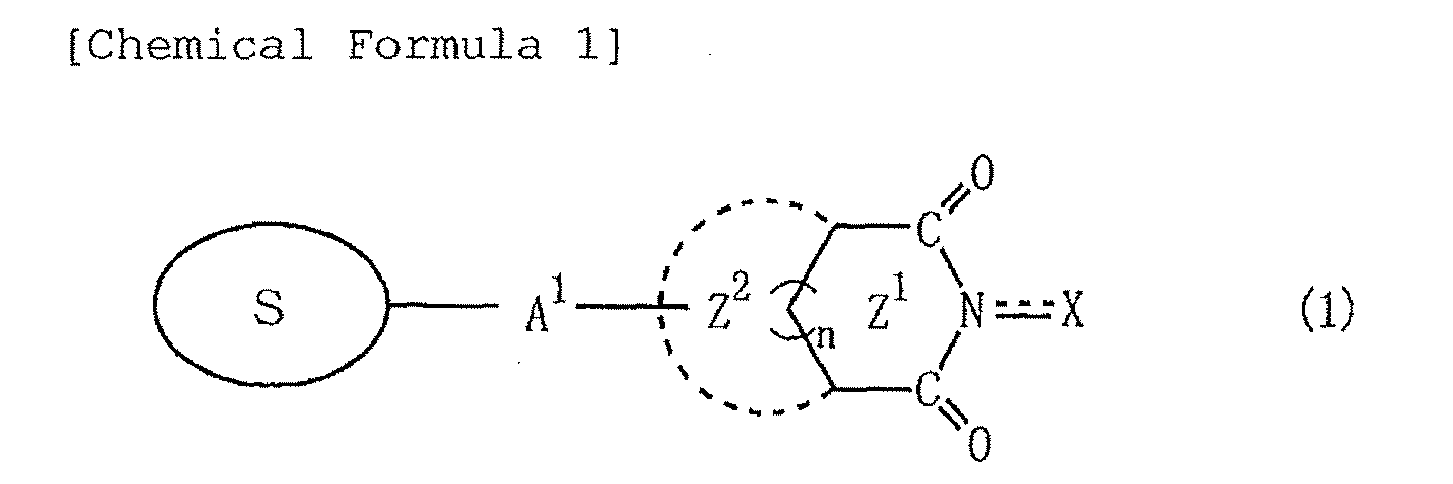
- In Formula (1), it is preferred that (i) "n" is 0 and the ring Z2 is a six-membered aromatic or nonaromatic carbon ring possessing one side in common with the cyclic imide skeleton Z1, or that (ii) "n" is 1 and the ring Z2 is naphthalene ring or decahydronaphthalene ring possessing two sides in common with the cyclic imide skeleton Z1.
- Examples of the inorganic support S include at least one member selected from the group consisting of a silica, an alumina, a titania, a zirconia and a ceria; and a composite oxide of two or more elements selected from the group consisting of silicon, aluminum, zirconium and cerium.
- The present invention further provides a process for the oxidation of an organic compound. The process includes the step of carrying out an oxidation reaction of the organic compound in the presence of the immobilized cyclic imide catalyst.
- The oxidation reaction in the oxidation process may be performed in a fluidized bed system or fixed bed system. According to the oxidation process, a hydrocarbon can be oxidized into at least one compound selected from the group consisting of a hydroperoxide, an alcohol, a carbonyl compound and a carboxylic acid.
- In Formula (1), a group present at the bonding site between the inorganic support S and the linkage group A1 is defined as belonging to the inorganic support S (elliptically shaped moiety "S"). Exemplary groups at the bonding site include groups, such as a siloxane bond, which are formed when a surface functional group of the inorganic support S is bound to a terminal functional group of the linkage group A1 typically through a silane coupling reaction.
- The present invention enables smooth oxidation of organic compounds such as hydrocarbons under mild conditions. Catalysts used herein, as being solid catalysts, can be easily separated from reaction products and can be easily recovered from a reaction mixture. The catalysts can also be easily prepared, because the linkage group linking the cyclic imide skeleton with the inorganic support is a bivalent hydrocarbon group or a group composed of a bivalent hydrocarbon group and an amide bond. In addition, the catalysts are suitable as catalysts for oxidation reactions and can be used over a long period of time, because the linkage group has no inhibitory factor upon oxidation reactions. The recovered catalysts, if deactivated, can be regenerated according to a simple procedure, and the regenerated catalysts are reusable.
- Immobilized cyclic imide catalysts according to the present invention each have a structure represented by Formula (1). In Formula (1), the bond between the nitrogen atom and X is either a single bond or a double bond. X represents oxygen atom or an -OR group, wherein R represents hydrogen atom or a hydroxyl-protecting group; "n" represents 0 or 1; and Z1 represents a five- or six-membered cyclic imide skeleton to which an aromatic or nonaromatic ring Z2 may be adjacent. The structure may have, per molecule, two or more of the cyclic imide skeleton Z1 to which the ring Z2 may be adjacent.
- When X is an -OR group and R is a hydroxyl-protecting group in Formula (1), two or more of moieties of the solid catalyst represented by Formula (1) other than R may be bound to each other through R.
- The hydroxyl-protecting group as R in Formula (1) can be a hydroxyl-protecting group commonly used in organic synthesis. Exemplary protecting groups herein include alkyl groups (e.g., alkyl groups having 1 to 4 carbon atoms, such as methyl and t-butyl groups), alkenyl groups (e.g., allyl group), cycloalkyl groups (e.g., cyclohexyl group), aryl groups (e.g., 2,4-dinitrophenyl group), and aralkyl groups (e.g., benzyl, 2,6-dichlorobenzyl, 3-bromobenzyl, 2-nitrobenzyl, and triphenylmethyl groups); groups capable of forming an acetal or hemiacetal group with hydroxyl group, including substituted methyl groups (e.g., methoxymethyl, methylthiomethyl, benzyloxymethyl, t-butoxymethyl, 2-methoxyethoxymethyl, 2,2,2-trichloroethoxymethyl, bis(2-chloroethoxy)methyl, and 2-(trimethylsilyl)ethoxymethyl groups), substituted ethyl groups (e.g., 1-ethoxyethyl, 1-methyl-1-methoxyethyl, 1-isopropoxyethyl, 2,2,2-trichloroethyl, and 2-methoxyethyl groups), tetrahydropyranyl group, tetrahydrofuranyl group, and 1-hydroxyalkyl groups (e.g., 1-hydroxyethyl, 1-hydroxyhexyl, 1-hydroxydecyl, 1-hydroxyhexadecyl, and 1-hydroxy-1-phenylmethyl groups); acyl groups (e.g., aliphatic saturated or unsaturated acyl groups including aliphatic acyl groups having 1 to 20 carbon atoms, such as formyl, acetyl, propionyl, butyryl, isobutyryl, valeryl, pivaloyl, hexanoyl, heptanoyl, octanoyl, nonanoyl, decanoyl, lauroyl, myristoyl, palmitoyl, and stearoyl groups; acetoacetyl group; alicyclic acyl groups including cycloalkanecarbonyl groups such as cyclopentanecarbonyl and cyclohexanecarbonyl groups; and aromatic acyl groups such as benzoyl and naphthoyl groups), sulfonyl groups (e.g., methanesulfonyl, ethanesulfonyl, trifluoromethanesulfonyl, benzenesulfonyl, p-toluenesulfonyl, and naphthalenesulfonyl groups), alkoxycarbonyl groups (e.g., alkoxy-carbonyl groups whose alkoxy moiety having 1 to 4 carbon atoms, such as methoxycarbonyl, ethoxycarbonyl, and t-butoxycarbonyl groups), aralkyloxycarbonyl groups (e.g., benzyloxycarbonyl group and p-methoxybenzyloxycarbonyl group), substituted or unsubstituted carbamoyl groups (e.g., carbamoyl, methylcarbamoyl, and phenylcarbamoyl groups), groups corresponding to inorganic acids (e.g., sulfuric acid, nitric acid, phosphoric acid, and boric acid) except for removing hydroxyl group (OH group) therefrom, dialkylphosphinothioyl groups (e.g., dimethylphosphinothioyl group), diarylphosphinothioyl groups (e.g., diphenylphosphinothioyl group), and substituted silyl groups (e.g., trimethylsilyl, t-butyldimethylsilyl, tribenzylsilyl, and triphenylsilyl group).
- When X is an -OR group and two or more moieties of the solid catalyst represented by Formula (1) other than R are bound to each other through R, exemplary Rs include acyl groups of polycarboxylic acids, such as oxalyl, malonyl, succinyl, glutaryl, phthaloyl, isophthaloyl, and terephthaloyl groups; carbonyl group; and multivalent hydrocarbon groups such as methylene, ethylidene, isopropylidene, cyclopentylidene, cyclohexylidene, and benzylidene groups, of which groups that form acetal bonds with two hydroxyl groups are preferred.
- Preferred examples of R include hydrogen atom; groups capable of forming an acetal or hemiacetal group with hydroxyl group; groups corresponding to acids, such as carboxylic acids, sulfonic acids, carbonic acid, carbamic acid, sulfuric acid, phosphoric acid, and boric acid, except for removing hydroxyl group therefrom (acyl groups, sulfonyl groups, alkoxycarbonyl groups, and carbamoyl groups), and other hydrolyzable protecting groups capable of being removed (deprotected) through hydrolysis. R is especially preferably hydrogen atom.
- Examples of the aromatic or nonaromatic ring Z2 include rings having about 5 to about 12 members, of which rings having about 6 to about 10 members are preferred. The ring Z2 may be a heterocyclic ring or fused heterocyclic ring, but it is often a hydrocarbon ring. Examples of such rings include alicyclic rings (e.g., cycloalkane rings such as cyclohexane ring, and cycloalkene rings such as cyclohexene ring), bridged rings (e.g., bridged hydrocarbon rings such as 5-norbornene ring), and aromatic rings (including fused rings) such as benzene ring and naphthalene ring. The ring is often composed of an aromatic ring.
- The cyclic imide skeleton Z1 and the ring Z2 may each be substituted. Exemplary substituents on the cyclic imide skeleton Z1 include halogen atoms, alkyl groups, aryl groups, cycloalkyl groups, hydroxyl group, alkoxy groups, carboxyl group, substituted oxycarbonyl groups, acyl groups, and acyloxy groups.
- The halogen atoms include iodine, bromine, chlorine, and fluorine atoms. Examples of the alkyl groups include linear or branched-chain alkyl groups having 1 to 30 carbon atoms, such as methyl, ethyl, propyl, isopropyl, butyl, hexyl, decyl, and dodecyl groups, of which those having about 1 to about 20 carbon atoms are preferred.
- The aryl groups include, for example, phenyl, tolyl, xylyl, and naphthyl groups; and the cycloalkyl groups include, for example, cyclopentyl and cyclohexyl groups. Examples of the alkoxy groups include alkoxy groups having 1 to 30 carbon atoms, such as methoxy, ethoxy, isopropoxy, butoxy, t-butoxy, hexyloxy, decyloxy, and dodecyloxy groups, of which those having about 1 to about 20 carbon atoms are preferred.
- Examples of the substituted oxycarbonyl groups include alkoxy-carbonyl groups whose alkoxy moiety having 1 to 30 carbon atoms, such as methoxycarbonyl, ethoxycarbonyl, isopropoxycarbonyl, butoxycarbonyl, t-butoxycarbonyl, hexyloxycarbonyl, and decyloxycarbonyl groups, of which alkoxy-carbonyl groups whose alkoxy moiety having 1 to 20 carbon atoms are preferred; cycloalkyloxycarbonyl groups such as cyclopentyloxycarbonyl and cyclohexyloxycarbonyl groups, of which cycloalkyloxycarbonyl groups having 3 to 20 members are preferred; aryloxycarbonyl groups such as phenyloxycarbonyl group, of which aryloxy-carbonyl groups whose aryloxy moiety having 6 to 20 carbon atoms are preferred; and aralkyloxycarbonyl groups such as benzyloxycarbonyl group, of which aralkyloxy-carbonyl groups whose aralkyloxy moiety having 7 to 21 carbon atoms are preferred.
- The acyl groups include, for example, aliphatic saturated or unsaturated acyl groups including aliphatic acyl groups having 1 to 30 carbon atoms, such as formyl, acetyl, propionyl, butyryl, isobutyryl, valeryl, pivaloyl, hexanoyl, decanoyl, and lauroyl groups, of which aliphatic acyl groups having 1 to 20 carbon atoms are preferred; acetoacetyl group; alicyclic acyl groups including cycloalkanecarbonyl groups such as cyclopentanecarbonyl and cyclohexanecarbonyl group; and aromatic acyl groups such as benzoyl group.
- Examples of the acyloxy groups include aliphatic saturated or unsaturated acyloxy groups including aliphatic acyloxy groups having 1 to 30 carbon atoms, such as formyloxy, acetyloxy, propionyloxy, butyryloxy, isobutyryloxy, valeryloxy, pivaloyloxy, decanoyloxy, and lauroyloxy groups, of which aliphatic acyloxy groups having 1 to 20 carbon atoms are preferred; acetoacetyloxy group; alicyclic acyloxy groups including cycloalkanecarbonyloxy groups such as cyclopentanecarbonyloxy and cyclohexanecarbonyloxy groups; and aromatic acyloxy groups such as benzoyloxy group.
- Exemplary substituents on the ring Z2 include alkyl groups, haloalkyl groups, hydroxyl group, alkoxy groups, carboxyl group, substituted oxycarbonyl groups, acyl groups, acyloxy groups, nitro group, cyano group, amino groups, and halogen atoms. The alkyl groups include alkyl groups as with the alkyl groups exemplified as the substituents on the cyclic imide skeleton Z1, of which alkyl groups having about 1 to about 6 carbon atoms are preferred. The haloalkyl groups include haloalkyl groups having about 1 to about 10 carbon atoms, such as trifluoromethyl group, of which those having about 1 to about 4 carbon atoms are preferred. The alkoxy groups include alkoxy groups as above, of which lower alkoxy groups having about 1 to about 4 carbon atoms are preferred. The substituted oxycarbonyl groups include substituted oxycarbonyl groups as above, such as alkoxycarbonyl groups, cycloalkyloxycarbonyl groups, aryloxycarbonyl groups, and aralkyloxycarbonyl groups. Examples of the acyl groups include acyl groups as above, such as aliphatic saturated or unsaturated acyl groups, acetoacetyl groups, alicyclic acyl groups, and aromatic acyl groups. Examples of the acyloxy groups include acyloxy groups as above, such as aliphatic saturated or unsaturated acyloxy groups, acetoacetyloxy group, alicyclic acyloxy groups, and aromatic acyloxy groups. Exemplary halogen atoms include fluorine, chlorine, and bromine atoms. Preferred substituents on the ring Z2 include lower alkyl groups having about 1 to about 4 carbon atoms, carboxyl group, substituted oxycarbonyl groups, nitro group, and halogen atoms.
- It is especially preferred in Formula (1) that (i) "n" is 0 and the ring Z2 is a six-membered aromatic or nonaromatic carbon ring possessing one side in common with the cyclic imide skeleton Z1, or that (ii) "n" is 1 and the ring Z2 is naphthalene ring or decahydronaphthalene ring possessing two sides in common with the cyclic imide skeleton Z1.
- Of the immobilized cyclic imide catalysts represented by Formula (1), representative structures of the cyclic imide skeleton Z1 moiety to which the ring Z2 may be adjacent include the following structures, in which X is as defined above; and "A" in Formula (g) represents methylene group or oxygen atom .

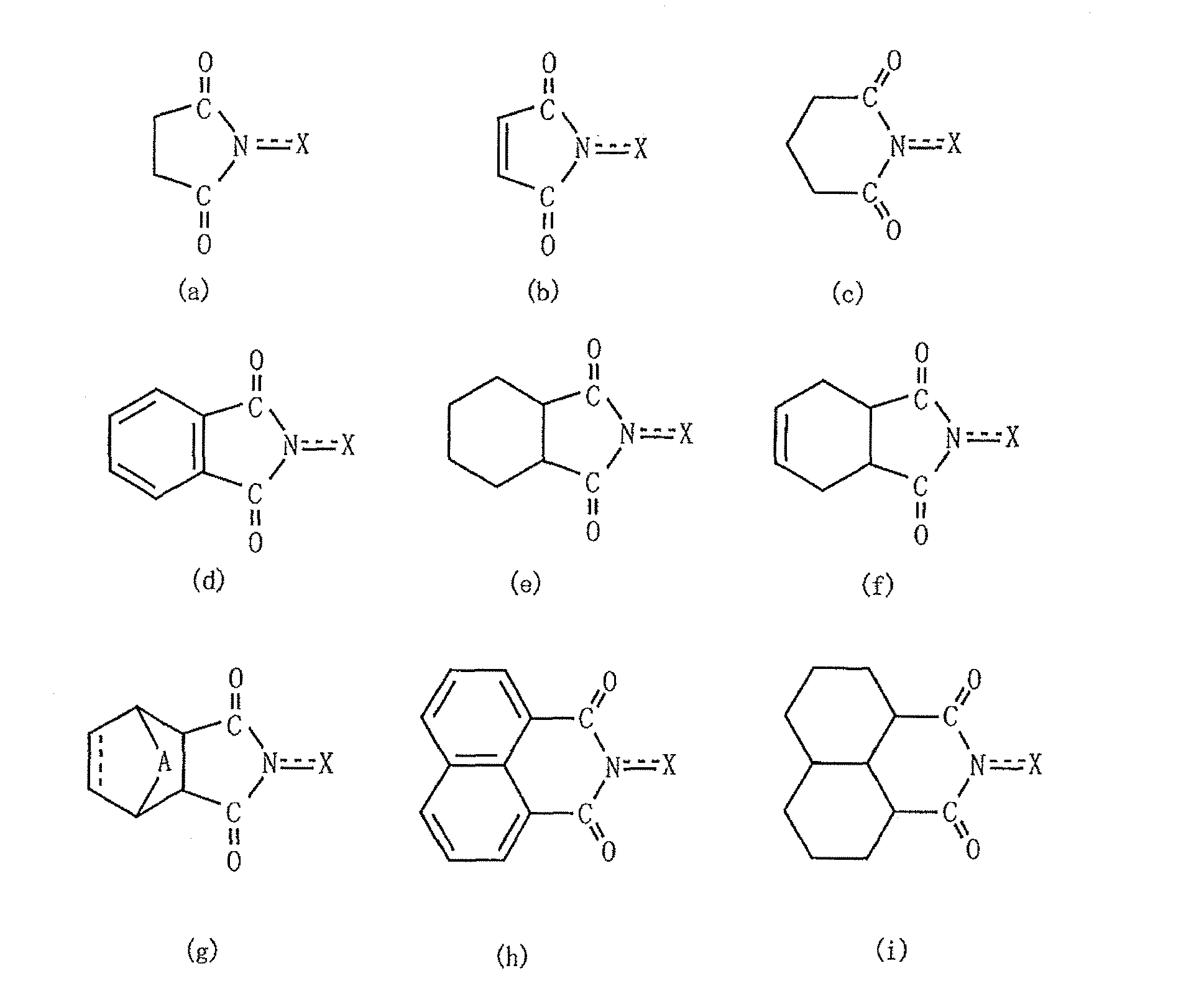
- Representative examples of preferred skeletons as the cyclic imide skeleton Z1 to which the ring Z2 may be adjacent include skeletons in which the cyclic imide skeleton Z1 is a five-membered ring, such as N-hydroxysuccinimide skeleton, N-hydroxymaleimide skeleton, N-hydroxyhexahydrophthalimide skeleton, N,N'-dihydroxycyclohexanetetracarboxylic diimide skeleton, N-hydroxyphthalimide skeleton, N-hydroxyhimimide skeleton, N,N'-dihydroxypyromellitic diimide skeleton, and N,N'-dihydroxynaphthalenetetracarboxylic diimide skeleton; and skeletons in which the cyclic imide skeleton Z1 is a six-membered ring, such as N-hydroxyglutarimide skeleton, N-hydroxy-1,8-decahydronaphthalenedicarboximide skeleton, N,N'-dihydroxy-1,8;4,5-decahydronaphthalenetetracarboxylic diimide skeleton, N-hydroxy-1,8-naphthalenedicarboximide skeleton (N-hydroxynaphthalimide skeleton), and N,N'-dihydroxy-1,8;4,5-naphthalenetetracarboxylic diimide skeleton.
- In Formula (1), elliptically shaped moiety "S" represents an inorganic support. The inorganic support S is preferably porous. Examples of the inorganic support S include a silica, an alumina, a titania, a zirconia, and a ceria. Each of different inorganic supports can be used alone or in combination. Exemplary inorganic supports further include multicomponent oxides of two or more elements selected from the group consisting of silicon, aluminum, zirconium, and cerium. Usable exemplary multicomponent oxides include silica-alumina, silica-titania, silica-zirconia, silica-ceria, and zeolite. Among them, preferred are a silica or a multicomponent oxide containing silicon element. The silica may be a silica whose particle diameter and pore size are precisely controlled, but it can also be a silica gel for use in column chromatography or a hygroscopic silica compound (hygroscopic silica gel).
- The inorganic support S may be one whose surface has been activated. The surface of the inorganic support S generally has an active functional group (e.g., -OH group; or silanol group in the case of a silica). The active functional group of the surface of the inorganic support S may be bound to a terminal functional group of the linkage group A1 through a siloxane bond or through another bonding.
- Though not especially limited in shape, the inorganic support S is preferably in the form of a pellet or powder. The size thereof is, for example, from 10 nm to 10 mm, and preferably from 0.1 to 10 mm, in terms of diameter (or in terms of major axis). The pore size and distribution thereof of the inorganic support S are not especially limited.
- In Formula (1), A1 represents a linkage group linking the inorganic support S with the cyclic imide skeleton Z1 or with the ring Z2 and is either a bivalent hydrocarbon group or a group composed of a bivalent hydrocarbon group and an amide bond (-NHCO-). The carbon number of the linkage group A1 is, for example, from about 1 to about 1000, preferably from about 1 to about 100, and more preferably from about 1 to about 20.
- Exemplary bivalent hydrocarbon groups include bivalent aliphatic hydrocarbon groups including linear or branched-chain alkylene groups such as methylene, ethylene, propylene, isopropylidene, trimethylene, tetramethylene, pentamethylene, hexamethylene, octamethylene, decamethylene, dodecamethylene, tetradecamethylene, pentadecamethylene, hexadecamethylene, and octadecamethylene groups; bivalent alicyclic hydrocarbon groups such as 1,2-cyclopentylene, 1,3-cyclopentylene, cyclopentylidene, 1,2-cyclohexylene, 1,3-cyclohexylene, 1,4-cyclohexylene, and cyclohexylidene groups; bivalent aromatic hydrocarbon groups such as 1,2-phenylene, 1,3-phenylene, and 1,4-phenylene groups; and bivalent groups each composed of two or more of these groups bound to each other.
- The bivalent hydrocarbons may each have substituents. Exemplary substituents include halogen atoms such as fluorine atom, chlorine atom, and bromine atom, of which fluorine atom is preferred; alkyl groups such as methyl, ethyl, propyl, isopropyl, butyl, isobutyl, s-butyl, t-butyl, and hexyl groups, of which alkyl groups having 1 to 12 carbon atoms are preferred, and alkyl groups having 1 to 6 carbon atoms are more preferred; cycloalkyl groups such as cyclopentyl and cyclohexyl groups, of which three- to fifty-membered cycloalkyl groups are preferred, and five- or six-membered cycloalkyl groups are more preferred; aryl groups such as phenyl and naphthyl groups; haloalkyl groups (of which fluoroalkyl groups are preferred), such as trifluoromethyl, pentafluoroethyl, and 2,2,2-trifluoroethyl groups, of which haloalkyl groups having 1 to 12 carbon atoms are preferred, and haloalkyl groups having 1 to 8 carbon atoms are more preferred; alkoxy groups such as methoxy, ethoxy, and propoxy groups, of which alkoxy groups having 1 to 12 carbon atoms are preferred, and alkoxy groups having 1 to 6 carbon atoms are more preferred; protected or unprotected hydroxyl group; protected or unprotected carboxyl groups [including substituted oxycarbonyl groups (e.g., alkoxy-carbonyl groups whose alkoxy moiety having 1 to 4 carbon atoms), such as methoxycarbonyl and ethoxycarbonyl groups]; cyano group; and silyl groups such as -SiY1Y2Y3 groups mentioned below.
- In the linkage group composed of a bivalent hydrocarbon group and an amide bond, the amide bond (-NHCO-) may face either side. Specifically, the carbonyl group of the amide bond may face either the cyclic imide skeleton Z1 or the inorganic support S. The amide bond in the linkage group A1 may lie at a terminus adjacent to the cyclic imide skeleton Z1 or at an intermediate position, but it preferably lies at a terminus adjacent to the cyclic imide skeleton Z1. In this case, the carbonyl group of the amide bond is preferably but not limitatively bound to an atom, such as carbon atom, constituting the cyclic imide skeleton Z1 or bound to an atom, such as carbon atom, constituting the ring Z2 adjacent to the cyclic imide skeleton Z1. The linkage group may contain two or more of bivalent hydrocarbon groups and amide groups, respectively.
- The linkage group A1 may contain bivalent hydrocarbon group(s) (which may be substituted) alone, or contain bivalent hydrocarbon group(s) (which may be substituted) and amide bond(s) alone, but it may further contain one or more moieties such as carbonyl group, epoxy group, ether bond, thioether bond, ester bond, imide bond, urethane bond, urea bond, phosphoric ester bond, and siloxane bond, within ranges not adversely affecting the catalytic performance.
- Though not especially limited, the amount of the cyclic imide skeleton Z1 in the immobilized cyclic imide catalyst having a structure represented by Formula (1) is, for example, from 0.001 mmol to 20 mmol, preferably from 0.01 mmol to 2 mmol, and more preferably from 0.05 mmol to 0.5 mmol, per 1 g of the inorganic support.
- Each of different immobilized cyclic imide catalysts having a structure represented by Formula (1) can be used alone or in combination. Such immobilized cyclic imide catalysts having a structure represented by Formula (1) may be formed within the reaction system.
- The amount of immobilized cyclic imide catalysts having a structure represented by Formula (1) can be chosen within a broad range, and is, in terms of the amount of the cyclic imide skeleton Z1, for example, from about 0.0000001 to about 1 mole, preferably from about 0.00001 to about 0.5 mole, more preferably from about 0.0001 to about 0.4 mole, and especially preferably from about 0.001 to about 0.35 mole, per 1 mole of the reaction component (substrate).
- Of immobilized cyclic imide catalysts having a structure represented by Formula (1), immobilized catalysts in which the linkage group A1 is a group composed of a bivalent hydrocarbon group and an amide bond can be prepared, for example, by reacting an inorganic support S represented by Formula (2), a silane coupling agent represented by Formula (3), and a carboxylic acid containing a cyclic imide skeleton and represented by Formula (4), or a reactive derivative thereof (e.g., an acyl halide, an acid anhydride, or an ester), as in the following scheme:

- In the scheme, Y1 and Y2 each represent hydroxyl group, an alkoxy group, a halogen atom, or an alkyl group; Y3 represents hydroxyl group, an alkoxy group, or a halogen atom; A11 and A12 each represent a bivalent hydrocarbon group; "p" denotes 0 or 1; and X, Z1, Z2, and elliptically shaped moiety "S" are as defied above. The compound of Formula (4) may have, per molecule, two or more of the cyclic imide skeleton Z1 to which the ring Z2 may be adjacent.
- Exemplary alkoxy groups as Y1 to Y3 include alkoxy groups having about 1 to about 6 carbon atoms, such as methoxy, ethoxy, propoxy, isopropyloxy, butoxy, isobutyloxy, t-butyloxy, pentyloxy, and hexyloxy groups, of which alkoxy groups having 1 to 4 carbon atoms are preferred. Exemplary halogen atoms include chlorine atom and bromine atom. Exemplary alkyl groups as Y1 and Y2 include linear or branched-chain alkyl groups having about 1 to about 18 carbon atoms, such as methyl, ethyl, propyl, isopropyl, butyl, isobutyl, s-butyl, t-butyl, pentyl, hexyl, octyl, decyl, and dodecyl groups, of which alkyl groups having 1 to 10 carbon atoms are preferred, and alkyl groups having 1 to 6 carbon atoms are more preferred. Exemplary bivalent hydrocarbon groups as A11 and A12 are as with those mentioned in the description of A1.
- The compound represented by Formula (3) may have two or more -SiY1Y2Y3 groups and two or more amino groups, respectively, per molecule. In this case, the two or more - SiY1Y2Y3 groups may be the same as or different from one another. The compound represented by Formula (4) may contain two or more carboxyl groups or equivalent functional groups thereto (e.g., acyl halide groups, acid anhydride groups, and alkoxycarbonyl groups). When the compound has two or more carboxyl groups or equivalent functional groups thereof, they may be the same as or different from one another.
- In the above process, reactions may be performed in any order not especially limited. It is acceptable that the inorganic support S represented by Formula (2) is reacted with the silane coupling agent represented by Formula (3) (a silane coupling reaction is performed), and thereafter the carboxylic acid containing a cyclic imide skeleton and represented by Formula (4) or a reactive derivative thereof is reacted to form an amide bond; that the silane coupling agent represented by Formula (3) is reacted with the carboxylic acid containing a cyclic imide skeleton and represented by Formula (4) or a reactive derivative thereof to form an amide bond, and thereafter the inorganic support S represented by Formula (2) is reacted therewith (a silane coupling reaction is performed); or that the three components are reacted simultaneously.
- The silane coupling reaction can be carried out according to a known procedure for reacting a silane coupling agent with an inorganic substance. A combination use typically of diethoxy(dimethyl)silane with the silane coupling agent upon the silane coupling reaction enables precise control of the amount to be supported by the inorganic support (the amount of bonding silane coupling agent). The reaction for the formation of an amide bond can be performed according to a common or regular procedure for reacting an amine with a carboxylic acid or a reactive derivative thereof.
- It is also acceptable that a reaction is performed using a carboxylic acid containing a precursor skeleton to a cyclic imide skeleton, or a reactive derivative thereof, instead of, or in combination as a mixture with, the carboxylic acid containing a cyclic imide skeleton and represented by Formula (4) or a reactive derivative thereof, and the precursor skeleton to the cyclic imide skeleton is converted into the cyclic imide skeleton in a suitable stage.
- Exemplary precursor skeletons to cyclic imide skeletons include the following skeletons:

- Examples of the hydrocarbon group include alkyl groups (e.g., alkyl groups having 1 to 6 carbon atoms), such as methyl, ethyl, propyl, isopropyl, butyl, isobutyl, s-butyl, and t-butyl groups; cycloalkyl groups such as cyclopentyl group; aryl groups such as phenyl group; and aralkyl groups such as benzyl group.
- Each of R1, R2, R3, R4, R5, R6, and R7 are not limited to the above-listed groups, as long as being a group that can be converted into a compound having a cyclic imide skeleton (cyclic imide compound) by reacting a compound having a precursor skeleton to a cyclic imide skeleton (cyclic imide compound precursor) with a hydroxylamine (H2N-OR; wherein R is as defined above) whose oxygen atom may be protected, or a slat thereof (an organic salt or inorganic salt).
- Or immobilized cyclic imide catalysts having a structure represented by Formula (1), solid catalysts (immobilized catalysts) in which the linkage group A1 is a bivalent hydrocarbon group can be prepared, for example, by reacting an inorganic support S represented by Formula (2) and a compound represented by Formula (5) in which a reactive silyl group (e.g., a hydrolyzable silyl group) is bound to the cyclic imide skeleton Z1 or the ring Z2 adjacent thereto, through a hydrocarbon group, as illustrated in the following scheme:

- In the scheme, A13 represents a bivalent hydrocarbon group; and X, Z1, Z2, Y1, Y2, Y3, and elliptically shaped moiety "S" are as defined above. The compound of Formula (5) may contain, per molecule, two or more of the cyclic imide skeleton Z1 to which the ring Z2 may be adjacent. Exemplary bivalent hydrocarbon groups as A13 are as with those exemplified in the description of A1. The reaction can be performed according to a known procedure for reacting a silane coupling agent with an inorganic substance.
- As is described above, it is also acceptable that a reaction is performed using a corresponding compound containing a precursor skeleton to a cyclic imide skeleton instead of, or in combination as a mixture with, the compound represented by Formula (5), and the precursor skeleton to the cyclic imide skeleton is converted into the cyclic imide skeleton in a suitable stage.
- The way to bond or link the inorganic support S with the linkage group A1 is not limited to a silane coupling reaction and is not especially limited, as long as being a reaction that can form a covalent bond. The inorganic support S and the linkage group A1 can be bound to each other by using a reaction component that contains the linkage group A1 and has a functional group at the terminal of the linkage group A1, which functional group is capable of reacting with a functional group of the surface of the inorganic support S.
- Of immobilized cyclic imide catalysts having a structure represented by Formula (1), a catalyst in which X is an -OR group and R is hydrogen atom, and another catalyst in which X is an -OR group and R is a hydroxyl-protecting group can be converted into each other through a common reaction for introducing a protecting group or through a common deprotection reaction.
- A promoter (co-catalyst) may be used herein in combination with the immobilized cyclic imide catalyst(s) having a structure represented by Formula (1). Exemplary promoters include metallic compounds. The combination use of the catalyst(s) with metallic compound(s) enables improvements in rate and selectivity of the reaction.
- Metallic elements constituting such metallic compounds are not especially limited, but they are often metallic elements belonging to Groups 1 to 15 of the Periodic Table. As used herein the term "metallic elements" also means and includes boron B. Examples of the metallic elements include, of the Periodic Table, Group 1 elements (e.g., Li, Na, and K), Group 2 elements (e.g., Mg, Ca, Sr, and Ba), Group 3 elements (e.g., Sc, lanthanoid elements, and actinoid elements), Group 4 elements (e.g., Ti, Zr, and Hf), Group 5 elements (e.g., V), Group 6 elements (e.g., Cr, Mo, and W), Group 7 elements (e.g., Mn), Group 8 elements (e.g., Fe and Ru), Group 9 elements (e.g., Co and Rh), Group 10 elements (e.g., Ni, Pd, and Pt), Group 11 elements (e.g., Cu), Group 12 elements (e.g., Zn), Group 13 elements (e.g., B, Al, and In), Group 14 elements (e.g., Sn and Pb), and Group 15 elements (e.g., Sb and Bi). Preferred metallic elements include transition metal elements (elements belonging to Groups 3 to 12 of the Periodic Table) and elements belonging to Group 13 of the Periodic Table (e.g., In). Among them, elements belonging to Groups 5 to 11 of the Periodic Table are preferred, of which elements belonging to Groups 5 to 9 are more preferred, and V, Mo, Mn, and Co are especially typically preferred. The metallic elements may have any valence not especially limited. They may have a valence of, for example, from about 0 to about 6.
- Exemplary metallic compounds include, of the metallic elements, inorganic compounds including elementary substances, hydroxides, oxides (including multicomponent oxides), halides (fluorides, chlorides, bromides, and iodides), salts of oxoacids (e.g., nitrates, sulfates, phosphates, borates, and carbonates), salts of isopolyacids, and salts of heteropolyacids; and organic compounds including salts of organic acids (e.g., acetates, propionates, prussiates (cyanides), naphthenates, and stearates), and complexes. Exemplary ligands for constituting the complexes include OH (hydroxo), alkoxys (e.g., methoxy, ethoxy, propoxy, and butoxy), acyls (e.g., acetyl and propionyl), alkoxycarbonyls (e.g., methoxycarbonyl and ethoxycarbonyl), acetylacetonato, cyclopentadienyl group, halogen atoms (e.g., chlorine and bromine), CO, CN, oxygen atom, H2O (aquo); phosphines (e.g., triarylphosphines such as triphenylphosphine) and other phosphorus compounds; and NH3 (ammine), NO, NO2 (nitro), NO3 (nitrato), ethylenediamine, diethylenetriamine, pyridine, phenanthroline, and other nitrogen-containing compounds.
- Taking cobalt compounds as an example, specific examples of the metallic compounds include bivalent or trivalent cobalt compounds including inorganic compounds such as cobalt hydroxide, cobalt oxide, cobalt chloride, cobalt bromide, cobalt nitrate, cobalt sulfate, and cobalt phosphate; salts of organic acids, such as cobalt acetate, cobalt naphthenate, and cobalt stearate; and complexes such as cobalt acetylacetonate. Exemplary vanadium compounds include vanadium compounds having a valence of 2 to 5 (bivalent to pentavalent vanadium compounds), including inorganic compounds such as vanadium hydroxide, vanadium oxide, vanadium chloride, vanadyl chloride, vanadium sulfate, vanadyl sulfate, and sodium vanadate; and complexes such as vanadium acetylacetonate and vanadyl acetylacetonate. Exemplary compounds of other metallic elements include compounds corresponding to the cobalt or vanadium compounds. Each of different metallic compounds can be used alone or in combination. Above all, a combination use of a cobalt compound and a manganese compound may often significantly improve the reaction rate. A combination use of two or more metallic compounds having different valances (e.g., a bivalent metallic compound and a trivalent metallic compound) is also preferred.
- The amount of the metallic compounds is, for example, from about 0.001 to about 10 moles, and preferably from about 0.005 to about 3 moles, per 1 mole of the cyclic imide skeleton Z1 in the immobilized cyclic imide catalyst having a structure represented by Formula (1). The amount of the metallic compounds is, for example, from about 0.00001 percent by mole to about 10 percent by mole, and preferably from about 0.2 percent by mole to about 2 percent by mole, per 1 mole of the reaction component (substrate).
- Exemplary promoters usable in the present invention further include organic salts each containing a polyatomic cation or a polyatomic anion and its counter ion, which polyatomic cation or anion contains a Group 15 or Group 16 element of the Periodic Table having at least one organic group bound therewith. Use of the organic salts as promoters can further improve the rate and selectivity of the reaction.
- In the organic salts, examples of Group 15 elements of the Periodic Table include N, P, As, Sb, and Bi. Examples of Group 16 elements of the Periodic Table include O, S, Se, and Te. Preferred elements include N, P, As, Sb, and S, of which N, P, and S are typically preferred. Exemplary organic groups to be bound to atoms of the elements include hydrocarbon groups which may be substituted, and substituted oxy groups. Exemplary hydrocarbon groups include linear or branched-chain aliphatic hydrocarbon groups (alkyl groups, alkenyl groups, and alkynyl groups) having about 1 to about 30 carbon atoms, of which those having about 1 to about 20 carbon atoms are preferred; alicyclic hydrocarbon groups having about 3 to about 8 carbon atoms; and aromatic hydrocarbon groups having about 6 to about 14 carbon atoms. Examples of the substituted oxy groups include alkoxy groups, aryloxy groups, and aralkyloxy groups.
- Representative examples of the organic salts include organic onium salts such as organic ammonium salts, organic phosphonium salts, and organic sulfonium salts. Specific examples of organic ammonium salts include quaternary ammonium salts whose nitrogen atom has four hydrocarbon groups bound thereto, including quaternary ammonium chlorides such as tetramethylammonium chloride, tetraethylammonium chloride, tetrabutylammonium chloride, tetrahexylammonium chloride, trioctylmethylammonium chloride, triethylphenylammonium chloride, tributyl (hexadecyl)ammonium chloride, and di(octadecyl)dimethylammonium chloride, and corresponding quaternary ammonium bromides; and cyclic quaternary ammonium salts such as dimethylpiperidinium chloride, hexadecylpyridinium chloride, and methylquinolinium chloride. Specific examples of organic phosphonium salts include quaternary phosphonium salts whose phosphorus atom has four hydrocarbon groups bound thereto, including quaternary phosphonium chlorides such as tetramethylphosphonium chloride, tetrabutylphosphonium chloride, tributyl (hexadecyl)phosphonium chloride, and triethylphenylphosphonium chloride, and corresponding quaternary phosphonium bromides. Specific examples of organic sulfonium salts include sulfonium salts whose sulfur atom has three hydrocarbon groups bound thereto, such as triethylsulfonium iodide and ethyldiphenylsulfonium iodide.
- Examples of the organic salts further include alkyl-substituted sulfonates (e.g., alkyl-substituted sulfonates whose alkyl moiety having 6 to 18 carbon atoms), such as methanesulfonates, ethanesulfonates, octanesulfonates, and dodecanesulfonates; aryl-substituted sulfonates whose aryl moiety may be substituted with alkyl group(s) (e.g., alkylarylsulfonates whose alkyl moiety having 6 to 18 carbon atoms), such as benzenesulfonates, p-toluenesulfonates, naphthalenesulfonates, decylbenzenesulfonates, and dodecylbenzenesulfonates; sulfonic acid type ion exchange resins (ion exchangers); and phosphonic acid type ion exchange resins (ion exchangers).
- The amount of organic salts is, for example, from about 0.001 to about 0.1 mole, and preferably from about 0.005 to about 0.08 mole, per 1 mole of the cyclic imide skeleton Z1 in the immobilized cyclic imide catalyst having a structure represented by Formula (1).
- Exemplary promoters usable in the present invention further include strong acids (e.g., compounds having a pKa of 2 or less at 25°C). Preferred exemplary strong acids include hydrogen halides, hydrohalic acids, sulfuric acid, and heteropolyacids. The amount of strong acids is, for example, from about 0.001 to about 3 moles, per 1 mole of the cyclic imide skeleton Z1 in the immobilized cyclic imide catalyst having a structure represented by Formula (1).
- Exemplary promoters usable in the present invention further include compounds having a carbonyl group to which an electron-withdrawing group is bound. Representative examples of such compounds having a carbonyl group to which an electron-withdrawing group is bound include hexafluoroacetone, trifluoroacetic acid, pentafluorophenyl methyl ketone, pentafluorophenyl trifluoromethyl ketone, and benzoic acid. The amount of these compounds is, for example, from about 0.0001 to about 3 moles, per 1 mole of the reaction component (substrate).
- The reaction system herein may contain a free-radical generator (e.g., a free-radical initiator) and/or a free-radical reaction accelerator. Examples of such components include halogens such as chlorine and bromine; peracids such as peracetic acid and m-chloroperbenzoic acid; peroxides including hydroperoxides, such as hydrogen peroxide and t-butyl hydroperoxide (TBHP); azo compounds such as azobisisobutyronitrile; acetophenones; cyclic amine-N-oxyl compounds; nitric acid or nitrous acid, or salts of them; nitrogen dioxide; and aldehydes such as benzaldehyde. The presence of the component in the system may accelerate the reaction. The amount of the component is, for example, from about 0.0001 to about 0.7 mole, and preferably from about 0.001 to about 1 mole, per 1 mole of the cyclic imide skeleton Z1 in the immobilized cyclic imide catalyst having a structure represented by Formula (1).
- Catalysts according to the present invention are useful typically as catalysts for free-radical reactions. They are advantageously usable in heterogeneous reactions, because they have catalytic activities as with a known catalyst N-hydroxyphthalimide and, additionally, are solid catalysts. Accordingly, they can be easily separated and recovered from a reaction mixture and can be easily separated from a reaction product after the completion of reaction. The recovered catalysts, if being deactivated due typically to deterioration or decomposition, can be regenerated according to a simple procedure, and the regenerated catalysts can be recycled and reused in the reaction system.
- A process for the oxidation of organic compounds, according to the present invention, includes carrying out oxidation of an organic compound in the presence of the immobilized cyclic imide catalyst having a structure represented by Formula (1), and where necessary, the promoter, to give an oxidation reaction product (oxidized product). As an oxidizing agent, oxygen is generally used.
- The organic compound used as a reaction material (substrate) is not especially limited, as long as being a compound that is oxidizable with oxygen in the presence of such an imide compound catalyst. Compounds (A) capable of forming stable free radicals are preferred as substrates. Representative examples of such compounds include (A1) heteroatom-containing compounds each having a carbon-hydrogen bond at an adjacent position to the heteroatom, (A2) compounds each having a carbon-heteroatom double bond, (A3) compounds each having methine carbon atom, (A4) compounds each having a carbon-hydrogen bond at an adjacent position to an unsaturated bond, (A5) nonaromatic cyclic hydrocarbons, (A6) conjugated compounds, (A7) amines, (A8) aromatic compounds, (A9) linear alkanes, and (A10) olefins.
- Each of these compounds may have one or more substituents within ranges not inhibiting the reaction. Exemplary substituents include halogen atoms, hydroxyl group, mercapto group, oxo group, substituted oxy groups (e.g., alkoxy groups, aryloxy groups, and acyloxy groups), substituted thio groups, carboxyl group, substituted oxycarbonyl groups, substituted or unsubstituted carbamoyl groups, cyano group, nitro group, substituted or unsubstituted amino groups, sulfo group, alkyl groups, alkenyl groups, alkenyl groups, alicyclic hydrocarbon groups, aromatic hydrocarbon groups, and heterocyclic groups.
- Exemplary heteroatom-containing compounds (A1) each having a carbon-hydrogen bond at an adjacent position to the heteroatom include (A1-1) primary or secondary alcohols and primary or secondary thiols; (A1-2) ethers each having a carbon-hydrogen bond at an adjacent position to the oxygen atom, and sulfides each having a carbon-hydrogen bond at an adjacent position to the sulfur atom; and (A1-3) acetals (including hemiacetals) each having a carbon-hydrogen bond at an adjacent position to the oxygen atom, and thioacetals (including thiohemiacetals) each having a carbon-hydrogen bond at an adjacent position to the sulfur atom.
- The primary or secondary alcohols as the compounds (A1-1) include a wide variety of alcohols. These alcohols may be whichever of monohydric, dihydric, and polyhydric alcohols.
- Representative examples of primary alcohols include saturated or unsaturated aliphatic primary alcohols having about 1 to about 30 carbon atoms, such as methanol, ethanol, 1-propanol, 1-butanol, 1-pentanol, 1-hexanol, 1-octanol, 1-decanol, 2-buten-1-ol, ethylene glycol, trimethylene glycol, hexamethylene glycol, and pentaerythritol, of which those having about 1 to about 20 carbon atoms are preferred, and those having about 1 to about 15 carbon atoms are more preferred; saturated or unsaturated alicyclic primary alcohols such as cyclopentylmethyl alcohol, cyclohexylmethyl alcohol, and 2-cyclohexylethyl alcohol; aromatic primary alcohols such as benzyl alcohol, 2-phenylethyl alcohol, 3-phenylpropyl alcohol, and cinnamic alcohol; and heterocyclic alcohols such as 2-hydroxymethylpyridine.
- Representative examples of secondary alcohols include saturated or unsaturated aliphatic secondary alcohols having about 3 to about 30 carbon atoms, such as 2-propanol, s-butyl alcohol, 2-pentanol, 2-octanol, 2-pentene-4-ol, as well as vicinal diols such as 1,2-propanediol, 2,3-butanediol, and 2,3-pentanediol, of which those having about 3 to about 20 carbon atoms are preferred, and those having about 3 to about 15 carbon atoms are more preferred; secondary alcohols each having an aliphatic hydrocarbon group and an alicyclic hydrocarbon group (e.g., a cycloalkyl group) bound to a hydroxyl-binding carbon atom, such as 1-cyclopentylethanol and 1-cyclohexylethanol; saturated or unsaturated alicyclic secondary alcohols (including bridged cyclic secondary alcohols) having about 3 to about 20 members, such as cyclopentanol, cyclohexanol, cyclooctanol, cyclododecanol, 2-cyclohexen-1-ol, 2-adamantanol, 2-adamantanols having one to four hydroxyl groups at the bridgehead positions, and 2-adamantanols having oxo group on the adamantane ring, of which those having about 3 to about 15 members are preferred, those having about 5 to about 15 members are more preferred, and those having about 5 to about 8 members are especially preferred; aromatic secondary alcohols such as 1-phenylethanol; heterocyclic secondary alcohols such as 1-(2-pyridyl)ethanol.
- Representative examples of alcohols further include alcohols having a bridged cyclic hydrocarbon group (e.g., compounds having a bridged cyclic hydrocarbon group bound to a hydroxyl-binding carbon atom), such as 1-adamantanemethanol, α-methyl-1-adamantanemethanol, 3-hydroxy-α-methyl-1-adamantanemethanol, 3-carboxy-α-methyl-1-adamantanemethanol, α-methyl-3a-perhydroindenemethanol, α-methyl-4a-decahydronaphthalenemethanol, α-methyl-4a-perhydrofluorenemethanol, α-methyl-2-tricyclo[5.2.1.02,6]decanemethanol, and α-methyl-1-norbornanemethanol.
- Preferred alcohols include secondary alcohols and the alcohols having a bridged cyclic hydrocarbon group. Exemplary preferred secondary alcohols include aliphatic secondary alcohols such as 2-propanol and s-butyl alcohol; secondary alcohols each having an aliphatic hydrocarbon group (e.g., an alkyl group having 1 to 4 carbon atoms or an aryl group having 6 to 14 carbon atoms) and a nonaromatic carbocyclic group (e.g., a cycloalkyl or cycloalkenyl group having 3 to 15 carbon atoms) bound to a hydroxyl-binding carbon atom, such as 1-cyclohexylethanol; alicyclic secondary alcohols having about 3 to about 15 members, such as cyclopentanol, cyclohexanol, and 2-adamantanol; and aromatic secondary alcohols such as 1-phenylethanol.
- Exemplary primary or secondary thiols as the compounds (A1-1) include thiols corresponding to the primary or secondary alcohols.
- Exemplary ethers each having a carbon-hydrogen bond at an adjacent position to the oxygen atom as the compounds (A1-2) include aliphatic ethers such as dimethyl ether, diethyl ether, dipropyl ether, diisopropyl ether, dibutyl ether, and diallyl ether; aromatic ethers such as anisole, phenetole, dibenzyl ether, and phenyl benzyl ether; and cyclic ethers (to which an aromatic ring or nonaromatic ring may be fused), such as dihydrofuran, tetrahydrofuran, pyran, dihydropyran, tetrahydropyran, morpholine, chroman, and isochroman.
- Exemplary sulfides each having a carbon-hydrogen bond at an adjacent position to the sulfur atom as the compounds (A1-2) include sulfides corresponding to the exemplified ethers having a carbon-hydrogen bond at an adjacent position to the oxygen atom.
- Exemplary acetals each having a carbon-hydrogen bond at an adjacent position to the oxygen atom as the compounds (A1-3) include acetals derived from aldehydes and alcohols or acid anhydrides. Such acetals include cyclic acetals and acyclic acetals. The aldehydes include aliphatic aldehydes such as formaldehyde, acetaldehyde, propionaldehyde, butylaldehyde, and isobutylaldehyde; alicyclic aldehydes such as cyclopentanecarbaldehyde and cyclohexanecarbaldehyde; and aromatic aldehydes such as benzaldehyde and phenylacetaldehyde. Examples of the alcohol include monohydric alcohols such as methanol, ethanol, 1-propanol, 1-butanol, and benzyl alcohol; and dihydric alcohols such as ethylene glycol, propylene glycol, 1,3-propanediol, and 2,2-dibromo-1,3-propanediol. Exemplary representative acetals include 1,3-dioxolane compounds such as 1,3-dioxolane, 2-methyl-1,3-dioxolane, and 2-ethyl-1,3-dioxolane; 1,3-dioxane compounds such as 2-methyl-1,3-dioxane; and dialkylacetal compounds such as acetaldehyde dimethyl acetal.
- Exemplary thioacetals having a carbon-hydrogen bond at an adjacent position to the sulfur atom as the compounds (A1-3) include thioacetals corresponding to the above-mentioned acetals having a carbon-hydrogen bond at an adjacent position to the oxygen atom.
- Examples of the compounds (A2) each having a carbon-heteroatom double bond include (A2-1) carbonyl-containing compounds; (A2-2) thiocarbonyl-containing compounds; and (A2-3) imines. The carbonyl-containing compounds (A2-1) include ketones and aldehydes. Exemplary ketones and aldehydes include chain ketones such as acetone, methyl ethyl ketone, methyl isobutyl ketone, 3-pentanone, methyl vinyl ketone, methyl cyclohexyl ketone, and acetophenone; cyclic ketones such as cyclopentanone, cyclohexanone, 4-methylcyclohexanone, isophorone, cyclodecanone, cyclododecanone, 1,4-cyclooctanedione, 2,2-bis(4-oxocyclohexyl)propane, and 2-adamantanone; 1,2-dicarbonyl compounds (e.g., α-diketones), such as biacetyl (2,3-butanedione), bibenzoyl (benzil), acetylbenzoyl, and cyclohexane-1,2-dione; α-keto-alcohols such as acetoin and benzoin; aliphatic aldehydes such as acetaldehyde, propionaldehyde, butanal, hexanal, succinaldehyde, glutaraldehyde, and adipaldehyde; alicyclic aldehydes such as cyclohexyl aldehyde, citral, and citronellal; aromatic aldehydes such as benzaldehyde, carboxybenzaldehyde, nitrobenzaldehyde, cinnamaldehyde, salicylaldehyde, anisaldehyde, phthalaldehyde, isophthalaldehyde, and terephthalaldehyde; and heterocyclic aldehydes such as furfural and nicotinaldehyde.
- Exemplary thiocarbonyl-containing compounds (A2-2) include thiocarbonyl-containing compounds corresponding to the above-mentioned carbonyl-containing compounds (A2-1).
- Exemplary imines (A2-3) include imines (including oximes and hydrazones) derived from the carbonyl-containing compound (A2-1) and ammonia or amines. Exemplary amines include amines such as methylamine, ethylamine, propylamine, butylamine, hexylamine, benzylamine, cyclohexylamine, and aniline; hydroxylamines such as hydroxylamine and O-methylhydroxylamine; and hydrazines such as hydrazine, methylhydrazine, and phenylhydrazine.
- The compounds (A3) each having methine carbon atom include (A3-1) cyclic compounds each having methine group (i.e., a methine carbon-hydrogen bond) as a constitutional unit of its ring; and (A3-2) chain compounds each having methine carbon atom.
- Exemplary cyclic compounds (A3-1) include (A3-1a) bridged cyclic compounds each having at least one methine group; and (A3-1b) nonaromatic cyclic compounds (e.g., alicyclic hydrocarbons) each having a hydrocarbon group bound to its ring. The bridged cyclic compounds further include compounds each containing two rings having two carbon atoms in common, such as hydrogenated products of fused polycyclic aromatic hydrocarbons.
- Exemplary bridged cyclic compounds (A3-1a) include bridged cyclic hydrocarbons or bridged heterocyclic compounds each having two to four rings, such as decahydronaphthalene, bicyclo[2.2.0]hexane, bicyclo[2.2.2]octane, bicyclo[3.2.1]octane, bicyclo[4.3.2]undecane, bicyclo[3.3.3]undecane, thujone, carane, pinane, pinene, bornane, bornylene, norbornane, norbornene, camphor, camphoric acid, camphene, tricyclene, tricyclo[5.2.1.03,8]decane, tricyclo[4.2.1.12,5]decane, exo-tricyclo[5.2.1.02,6]decane, endo-tricyclo[5.2.1.02,6]decane, tricyclo[4.3.1.12,5]undecane, tricyclo[4.2.2.12,5]undecane, endo-tricyclo[5.2.2.02,6]undecane, adamantane, 1-adamantanol, 1-chloroadamantane, 1-methyladamantane, 1,3-dimethyladamantane, 1-methoxyadamantane, 1-carboxyadamantane, 1-methoxycarbonyladamantane, 1-nitroadamantane, tetracyclo[4.4.0.12,5.17,10]dodecane, perhydroanthracene, perhydroacenaphthene, perhydrophenanthrene, perhydrophenalene, perhydroindene, and quinuclidine; and derivatives of them. These bridged cyclic compounds each have a methine carbon atom at a bridgehead position (corresponding to a junction site when two rings have two atoms in common).
- Exemplary nonaromatic cyclic compounds (A3-1b) each having a hydrocarbon group bound to its ring include alicyclic hydrocarbons each having about 3 to about 15 members and containing a hydrocarbon group (e.g., an alkyl group) bound to its ring, and derivatives thereof, such as 1-methylcyclopentane, 1-methylcyclohexane, limonene, menthene, menthol, carvomenthone, and menthone. The hydrocarbon group just mentioned above may have about 1 to about 20 carbon atoms, and preferably about 1 to about 10 carbon atoms. The nonaromatic cyclic compounds (A3-1b) each having a hydrocarbon group bound to its ring have a methine carbon atom at the bonding site between the ring and the hydrocarbon group.
- Exemplary chain compounds (A3-2) each having methine carbon atom include chain hydrocarbons each having a tertiary carbon atom, including aliphatic hydrocarbons having about 4 to about 20 (preferably about 4 to about 10) carbon atoms, such as isobutane, isopentane, isohexane, 3-methylpentane, 2,3-dimethylbutane, 2-methylhexane, 3-methylhexane, 3,4-dimethylhexane, and 3-methyloctane; and derivatives of them.
- Examples of the compounds (A4) each having a carbon-hydrogen bond at an adjacent position to an unsaturated bond include (A4-1) aromatic compounds each having methyl group or methylene group at an adjacent position to an aromatic ring (at a "benzylic position"); and (A4-2) nonaromatic compounds each having methyl group or methylene group at an adjacent position to an unsaturated bond (e.g., carbon-carbon unsaturated bond or carbon-oxygen double bond).
- The aromatic rings in the aromatic compounds (A4-1) may each be whichever of an aromatic hydrocarbon ring and an aromatic heterocyclic ring (heteroaromatic rings). Exemplary aromatic hydrocarbon rings include benzene ring and fused carbon rings. Exemplary fused carbon rings include fused carbon rings each having fused two to ten 4-to seven-membered carbon rings, such as naphthalene, azulene, indacene, anthracene, phenanthrene, triphenylene, and pyrene. Exemplary aromatic heterocyclic rings include heterocyclic rings containing oxygen atom as a heteroatom, including five-membered rings such as furan, oxazole, and isoxazole, six-membered rings such as 4-oxo-4H-pyran, and fused rings such as benzofuran, isobenzofuran, and 4-oxo-4H-chromene; heterocyclic rings containing sulfur atom as a heteroatom, including five-membered rings such as thiophene, thiazole, isothiazole, and thiadiazole, six-membered rings such as 4-oxo-4H-thiopyran, and fused rings such as benzothiophene; and heterocyclic rings containing nitrogen atom as a heteroatom, including five-membered rings such as pyrrole, pyrazole, imidazole, and triazole, six-membered rings such as pyridine, pyridazine, pyrimidine, and pyrazine, and fused rings such as indole, quinoline, acridine, naphthyridine, quinazoline, and purine.
- The methylene group at an adjacent position to an aromatic ring may be a methylene group constituting a nonaromatic ring fused to the aromatic ring. The compounds (A4-1) may each have both methyl group and methylene group at an adjacent position to an aromatic ring.
- Exemplary aromatic compounds each having methyl group at an adjacent position to an aromatic ring include aromatic hydrocarbons whose aromatic ring having about one to about six methyl groups substituted thereon, such as toluene, xylenes, 1-ethyl-4-methylbenzene, 1-ethyl-3-methylbenzene, 1-isopropyl-4-methylbenzene, 1-t-butyl-4-methylbenzene, 1-methoxy-4-methylbenzene, mesitylene, pseudocumene, durene, methylnaphthalene, dimethylnaphthalene, methylanthracene, 4,4'-dimethylbiphenyl, tolualdehyde, dimethylbenzaldehyde, trimethylbenzaldehyde, toluic acid, trimethylbenzoic acid, and dimethylbenzoic acid; and heterocyclic compounds whose heterocyclic ring having about one to about six methyl groups substituted thereon, such as 2-methylfuran, 3-methylfuran, 3-methylthiophene, 2-methylpyridine, 3-methylpyridine, 4-methylpyridine, 2,4-dimethylpyridine, 2,4,6-trimethylpyridine, 4-methylindole, 2-methylquinoline, and 3-methylquinoline.
- Exemplary aromatic compounds having methylene group at an adjacent position to an aromatic ring include aromatic hydrocarbons each containing an alkyl group or substituted alkyl group having 2 or more carbon atoms, such as ethylbenzene, propylbenzene, 1,4-diethylbenzene, and diphenylmethane; aromatic heterocyclic compounds each containing an alkyl group or substituted alkyl group having 2 or more carbon atoms, such as 2-ethylfuran, 3-propylthiophene, 4-ethylpyridine, and 4-butylquinoline; and compounds each having a aromatic ring fused to an nonaromatic ring, which nonaromatic ring has methylene group at an adjacent position to the aromatic ring, such as dihydronaphthalene, indene, indane, tetrahydronaphthalene, fluorene, acenaphthene, phenalene, indanone, and xanthene.
- Exemplary nonaromatic compounds (A4-2 ) each having methyl group or methylene group at an adjacent position to an unsaturated bond include (A4-2a) chain unsaturated hydrocarbons each having methyl group or methylene group at an "allylic position"; and (A4-2b) compounds each having methyl group or methylene group at an adjacent position to carbonyl group.
- Example of the chain unsaturated hydrocarbons (A4-2a) include chain unsaturated hydrocarbons having about 3 to about 20 carbon atoms, such as propylene, 1-butene, 2-butene, 1-pentene, 1-hexene, 2-hexene, 1,5-hexadiene, 1-octene, 3-octene, and undecatriene. Exemplary compounds (A4-2b) include ketones (e.g., chain ketones such as acetone, methyl ethyl ketone, 3-pentanone, and acetophenone; and cyclic ketones such as cyclohexanone) and carboxylic acids and derivatives thereof (e.g., acetic acid, propionic acid, butanoic acid, pentanoic acid, hexanoic acid, heptanoic acid, phenylacetic acid, malonic acid, succinic acid, glutaric acid, and esters of them).
- The nonaromatic cyclic hydrocarbons (A5) include (A5-1) cycloalkanes; and (A5-2) cycloalkenes.
- Exemplary cycloalkanes (A5-1) include compounds each having a three- to thirty-membered cycloalkane ring, such as cyclopropane, cyclobutane, cyclopentane, cyclohexane, cycloheptane, cyclooctane, cyclononane, cyclodecane, cyclododecane, cyclotetradecane, cyclohexadecane, cyclotetracosane, cyclotriacontane, and derivatives of them. Preferred cycloalkane rings include five- to thirty-membered cycloalkane rings, of which five- to twenty-membered cycloalkane rings are more preferred.
- Exemplary cycloalkenes (A5-2) include compounds each having a three- to thirty-membered cycloalkene ring, such as cyclopropene, cyclobutene, cyclopentene, cyclooctene, cyclohexene, 1-methyl-cyclohexene, isophorone, cycloheptene, and cyclododecaene; cycloalkadienes such as cyclopentadiene, 1,3-cyclohexadiene, and 1,5-cyclooctadiene; cycloalkatrienes such as cyclooctatriene; and derivatives of them. Preferred cycloalkenes include compounds each having a three- to twenty-membered ring, of which compounds each having a three- to twelve-membered ring are more preferred.
- The conjugated compounds (A6) include (A6-1) conjugated dienes; (A6-2) α,β-unsaturated nitriles; and (A6-3) α,β-unsaturated carboxylic acids and derivatives thereof (e.g., esters, amides, and acid anhydrides).
- Exemplary conjugated dienes (A6-1) include butadiene, isoprene, 2-chlorobutadiene, and 2-ethylbutadiene. As used herein "conjugated dienes (A6-1)" also include compounds having a double bond conjugated with a triple bond, such as vinylacetylene.
- Exemplary α,β-unsaturated nitriles (A6-2) include (meth)acrylonitriles. Exemplary α,β-unsaturated carboxylic acids and derivatives thereof (A6-3) include (meth)acrylic acids; (meth)acrylic esters such as methyl (meth)acrylates, ethyl (meth)acrylates, isopropyl (meth)acrylates, butyl (meth)acrylates, and 2-hydroxyethyl (meth)acrylates; and (meth)acrylamide derivatives such as (meth)acrylamides and N-methylol (meth)acrylamides.
- Examples of the amines (A7) include primary or secondary amines including aliphatic amines such as methylamine, ethylamine, propylamine, butylamine, dimethylamine, diethylamine, dibutylamine, ethylenediamine, 1,4-butanediamine, hydroxylamine, and ethanolamine; alicyclic amines such as cyclopentylamine and cyclohexylamine; aromatic amines such as benzylamine and toluidine; and cyclic amines to which an aromatic or nonaromatic ring may be fused, such as pyrrolidine, piperidine, piperazine, and indoline.
- Examples of the aromatic hydrocarbons (A8) include aromatic compounds having at least one benzene ring, such as benzene, naphthalene, acenaphthylene, phenanthrene, anthracene, and naphthacene, of which fused polycyclic aromatic compounds having at least two (e.g., two to ten) benzene rings being fused are preferred. Such aromatic hydrocarbons may have one or more substituents. Specific examples of aromatic hydrocarbons having one or more substituents include 2-chloronaphthalene, 2-methoxynaphthalene, 1-methylnaphthalene, 2-methylnaphthalene, 2-methylanthracene, 2-t-butylanthracene, 2-carboxyanthracene, 2-ethoxycarbonylanthracene, 2-cyanoanthracene, 2-nitroanthracene, and 2-methylpentalene. To the benzene ring(s), a nonaromatic carbon ring, aromatic heterocyclic ring, or nonaromatic heterocyclic ring may be fused.
- Examples of the linear alkanes (A9) include linear alkanes having about 1 to about 30 carbon atoms (preferably having about 1 to about 20 carbon atoms), such as methane, ethane, propane, butane, pentane, hexane, heptane, octane, nonane, decane, dodecane, tetradecane, and hexadecane.
- The olefins (A10) may be whichever of α-olefins and internal olefins, each of which may have one or more substituents (e.g., the aforementioned substituents such as hydroxyl group and acyloxy groups) and also include other olefins each having two or more carbon-carbon double bonds such as dienes. Exemplary olefins (A10) include chain olefins such as ethylene, propylene, 1-butene, 2-butene, isobutene, 1-hexene, 2-hexene, 1-acetoxy-3,7-di-methyl-2,6-octadiene, styrene, vinyltoluene, α-methylstyrene, 3-vinylpyridine, and 3-vinylthiophene; and cyclic olefins such as cyclopentene, cyclohexene, cycloheptene, cyclooctene, cyclodecene, cyclododecene, 1,4-cyclohexadiene, limonene, 1-p-menthene, 3-p-menthene, carveol, bicyclo[2.2.1]hept-2-ene, bicyclo[3.2.1]oct-2-ene, α-pinene, and 2-bornene.
- Each of different compounds (A) capable of forming a free radical may be used alone or in combination, and in the latter case, the compounds used in combination may belong to the same or different categories. When two or more types of these compounds, especially two or more types of these compounds belonging to different categories, are used in a reaction, one of the substrates may act as a co-reacting agent (e.g., co-oxidizing agent) with respect to the other, and this may significantly improve the reaction rate.
- Among the substrates, especially preferred substrates for use in the present invention are hydrocarbons including hydrocarbons each having methine carbon atom, such as adamantane and other bridged cyclic compounds having methine group; aromatic hydrocarbons each having methyl group or methylene group at an adjacent position to an aromatic ring, such as toluene and xylenes; and nonaromatic cyclic hydrocarbons such as cyclohexane and other cycloalkanes. According to the present invention, such hydrocarbons can industrially efficiently give, for example, hydroperoxides, alcohols, carbonyl compounds, and/or carboxylic acids in high yields.
- Molecular oxygen can be used as oxygen acting as an oxidizing agent. The oxygen may be formed within the reaction system. The molecular oxygen is not especialy limited and can be whichever of pure oxygen; a diluted oxygen diluted with an inert gas such as nitrogen, helium, argon, or carbon dioxide gas; and air. Though suitably selectable according to the type of the substrate, the amount of the molecular oxygen is generally about 0.5 mole or more (e.g., 1 mole or more), preferably from about 1 to about 100 moles, and more preferably from about 2 to about 50 moles, per 1 mole of the substrate. The molecular oxygen is often used in excel moles to the substrate.
- The oxidation reaction is carried out in the presence of, or in the absence of, a solvent. Exemplary solvents include organic acids such as acetic acid and propionic acid; nitriles such as acetonitrile, propionitrile, and benzonitrile; amides such as formamide, acetamide, dimethylformamide (DMF), and dimethylacetamide; aliphatic hydrocarbons such as hexane and octane; halogenated hydrocarbons such as chloroform, dichloromethane, dichloroethane, carbon tetrachloride, chlorobenzene, and trifluoromethylbenzene; nitro compounds such as nitrobenzene, nitromethane, and nitroethane; esters such as ethyl acetate and butyl acetate; and mixtures of these solvents.
- The process according to the present invention allows a reaction to proceed smoothly under mild conditions. The reaction temperature can be appropriately selected according typically to the types of the substrate and the target compound and is, for example, from about 0°C to about 300°C, and preferably from about 20°C to about 200°C. The reaction can be performed under normal atmospheric pressure or under a pressure (under a load). When the reaction is performed under a pressure, the pressure is generally from about 0.1 to about 10 MPa, for example, from about 0.15 to about 8 MPa, and preferably from about 0.5 to about 8 MPa. The reaction time can be appropriately selected according to the temperature and pressure of reaction within ranges of, for example, from about 10 minutes to about 48 hours.
- The reaction can be performed in the presence of, or under flow of, oxygen according to a common procedure or system such as a batch system, a semibatch system, or a continuous system. The reaction is preferably performed in a fluidized bed system or fixed bed system.
- After the completion of the reaction, a reaction product can be separated and purified according to a separation procedure such as filtration, concentration, distillation, extraction, crystallization, recrystallization, or column chromatography, or any combination of them.
- The process according to the present invention gives an oxidized product corresponding to the type of the substrate and the reaction conditions. Exemplary oxidized products include hydroperoxides, alcohols, carbonyl compounds (aldehydes or ketones), and carboxylic acids. Descriptions about such reaction products can be found typically in JAP-A No. H08-38909,
JP-A No. H09-327626 JP-A No. H10-286467 JP-A No. 2000-219650 - Typically, when the heteroatom-containing compound (A1) having a carbon-hydrogen bond at an adjacent position to the heteroatom is used as the substrate, the carbon atom at an adjacent position to the heteroatom is oxidized. For example, a primary alcohol gives a corresponding aldehyde or carboxylic acid; a secondary alcohol gives, for example, a corresponding ketone and/or carboxylic acid; a 1,3-diol gives a corresponding hydroxyketone; and a 1,2-diol gives a corresponding carboxylic acid through oxidative cleavage [see
JP-A No. 2000-212116 JP-A No. 2000-219652 JP-A No. H10-316610 PCT International Publication Number WO 00/46145 - A compound (A2) having a carbon-heteroatom double bond, if used as the substrate, gives an oxidation reaction product according typically to the type of the heteroatom. For example, the oxidation of a ketones gives a corresponding ester, and further cleavage thereof gives, for example, a carboxylic acid. Typically, a cyclic ketone such as cyclohexanone gives a dicarboxylic acid such as adipic acid. A Baeyer-Villiger type reaction proceeds under mild conditions when, for example, a heteroatom-containing compound (A1) having a carbon-hydrogen bond at an adjacent position to the heteroatom, such as a secondary alcohol (e.g., benzhydrol), is used as a co-reacting agent (co-oxidizing agent). As a result, a cyclic ketone gives a corresponding lactone and/or dicarboxylic acid, and a chain ketone gives a corresponding ester and/or carboxylic acid, respectively in good yields [see
PCT International Publication Number WO 99/50204 - A compound (A3) having methine carbon atom, if used as the substrate, can give an alcohol derivative, whose methine carbon having an introduced hydroxyl group, in a high yield. Typically, the oxidation of a bridged cyclic hydrocarbon (A3-la), such as adamantane, gives, in a high selectivity, an alcohol derivative having an introduced hydroxyl group at a bridgehead position, such as 1-adamantanol, 1,3-adamantanediol, and/or 1,3,5-adamantanetriol. A chain compound (A3-2) having methine carbon atom, such as isobutane, can give a tertiary alcohol, such as t-butanol, in a high yield [see
JP-A No. H10-310543 - A compound (A4) having a carbon-hydrogen bond at an adjacent position to an unsaturated bond, if used as the substrate, typically gives an alcohol, a carboxylic acid, an aldehyde, and/or a ketone through efficient oxidation of the adjacent position to an unsaturated bond. For example, a compound having methyl group at an adjacent position to an unsaturated bond gives a primary alcohol or carboxylic acid in a high yield [see
JP-A No. H8-38909 JP-A No. H9-327626 JP-A No. H11-106377 - More specifically, an aromatic compound whose aromatic ring being bound to an alkyl group or lower-order oxidized group thereof (a hydroxyalkyl group, formyl group, a formylalkyl group, or an oxo-containing alkyl group) gives an aromatic carboxylic acid whose aromatic ring being bound to carboxyl group, through the oxidation of the alkyl group or lower-order oxidized group thereof. Typically, toluene, ethylbenzene, isopropylbenzene, benzaldehyde, or a mixture of them gives benzoic acid; p-xylene, p-isopropyltoluene, p-diisopropylbenzene, p-tolualdehyde, p-toluic acid, p-carboxybenzaldehyde, or a mixture of them gives terephthalic acid; pseudocumene, dimethylbenzaldehyde, dimethylbenzoic acid, or a mixture of them gives trimellitic acid; durene, trimethylbenzaldehyde, trimethylbenzoic acid, or a mixture of them gives pyromellitic acid; 3-methylquinoline, for example, gives 3-quinolinecarboxylic acid, respectively in good yields. β-Picolin gives nicotinic acid.
- A compound having methylene group at an adjacent position to a carbon-carbon double bond, for example, gives a secondary alcohol or ketone, and/or a carboxylic acid. In this case, the use of a cobalt(II) salt of an acid having a pKa of 8.0 or less, such as cobalt(II) acetate or cobalt(II) nitrate, as the promoter, gives a corresponding conjugated unsaturated carbonyl compound having an oxo group introduced into the methylene carbon atom in a high yield. More specifically, valencene yields nootkatone in a high yield.
- A nonaromatic cyclic hydrocarbon (A5), if used as the substrate, gives an alcohol or ketone whose ring-constituting carbon atom having an introduced hydroxy group or oxo group. Under some reaction conditions, the nonaromatic cyclic hydrocarbon (A5) gives a corresponding dicarboxylic acid through oxidative cleavage of the ring. Typically, cyclohexane gives cyclohexylhydroperoxide, cyclohexanol, cyclohexanone, or adipic acid in a high selectivity under appropriately selected conditions. A cycloalkane such as cyclohexane gives a bis(1-hydroxycycloalkyl)peroxide such as bis(1-hydroxycyclohexyl)peroxide [see Japanese Patent Application Number
2000-345824 JP-A No. H10-309469 - A conjugated compound (A6), if used as the substrate, gives a variety of compounds according to its structure. Typically, a conjugated diene gives, for example, an alkenediol, a ketone, and/or a carboxylic acid through oxidation. Specifically, butadiene gives, for example, 2-butene-1,4-diol and/or 1-butene-3,4-diol through oxidation. The oxidation of an α,β-unsaturated nitrile or an α,β-unsaturated carboxylic acid or a derivative thereof causes the selective oxidation of the α,β-unsaturated bonding site and gives a compound having a single bond derived from the unsaturated bond and having a group at the beta-position converted into formyl group or acetal group (when reacted in the presence of an alcohol) or into an acyloxy group (when reacted in the presence of a carboxylic acid). More specifically, the oxidation of acrylonitrile and methyl acrylate, for example, in the presence of methanol gives 3,3-dimethoxypropionitrile and methyl 3,3-dimethoxypropionate, respectively.
- An amine (A7), if used as the substrate, typically gives a Schiff base and/or oxime. An aromatic compound (A8) gives a corresponding quinone in a good yield by the coexistence typically of a compound (A4) having a carbon-hydrogen bond at an adjacent position to an unsaturated bond (e.g., fluorene) as a co-reacting agent (co-oxidizing agent) [see
JP-A No. H11-226416 JP-A No. H11-228484 - An olefin (A10), if used as the substrate, gives a corresponding epoxy compound [see
JP-A No. H11-49764 PCT International Publication Number WO 99/50204 - A corresponding lactam is given by a reaction of at least one compound selected from cycloalkanes, cycloalkanols, and cycloalkanones with oxygen (B4-1) as an oxygen-containing reacting agent and ammonia in the presence of the immobilized cyclic imide catalyst [see Japanese Patent Application No.
2000-345823 - Though not yet clarified in detail, a reaction mechanism in the process according to the present invention is supposed to be as follows. During the reaction, an oxidized active species [e.g., imido-N-oxy radical (>NO•)] is formed as in the cases using N-hydroxyphthalimide as a catalyst, the oxidized active species withdraws hydrogen from the substrate and allows the substrate to form a free radical; the resulting free radical reacts with oxygen and thereby yields a corresponding oxidized product. The free radical is formed, for example, at the carbon atom at an adjacent position to the heteroatom in the compound (A1), at the carbon atom relating to the carbon-heteroatom double bond in the compound (A2), at the methine carbon atom in the compound (A3), or at the carbon atom at an adjacent position to the unsaturated bond in the compound (A4).
- After the completion of the reaction, the immobilized cyclic imide catalyst, if used as a fluidized bed, can be easily recovered from the reaction mixture through a physical separation procedure such as filtration or centrifugal separation. The catalyst, if used as a fixed bed, can be recovered by detaching from the device.
- The immobilized cyclic imide catalyst may be deactivated during some type of reactions under some reaction conditions. When the recovered immobilized catalyst is deactivated, its decreased catalytic activity can be re-activated or regenerated by the action of a hydroxylamine. The way to allow a hydroxylamine to act thereon is not specifically limited. Typically, the immobilized catalyst can be regenerated, for example, by dispersing the recovered immobilized catalyst into an organic base (e.g., pyridine or triethylamine); adding a salt (e.g., an inorganic salt, such as a hydrochloride or sulfate, or an organic salt) of hydroxylamine thereto; carrying out a reaction between them under mild reaction conditions of a temperature of about room temperature to about 120°C; and carrying out filtration, washing or rinsing, and drying after the reaction to complete the regeneration of the immobilized catalyst. The reaction between the recovered immobilized catalyst and the hydroxylamine may be carried out in a solvent such as toluene or tetrahydrofuran (THF) as appropriate. The salt of hydroxylamine may be used in the form of an aqueous solution. Thus, a regenerated immobilized catalyst having an N-hydroxy imide skeleton [an immobilized catalyst of Formula (1) in which X is an -OR group; and R is hydrogen atom] can be obtained.
- The hydroxyl group of the resulting immobilized catalyst having an N-hydroxyimide skeleton may be protected by a protecting group R (R is as defined above) that will be easily deprotected, such as acetyl group, benzoyl group, or benzyl group. This protection is carried out by using a common reaction for introducing a protecting group. Alternatively, an immobilized catalyst having an N-substituted oxyimide skeleton [an immobilized catalyst of Formula (1) in which X is an -OR group and R is a hydroxyl-protecting group] can be obtained by using, instead of a hydroxylamine in the reaction, a hydroxylamine derivative having a deprotectable protecting group R (e.g., acetyl group, benzoyl group, or benzyl group) on its oxygen atom (H2N-OR; R is as defined above) or a salt thereof (organic salt or inorganic salt).
- The present invention will be illustrated in further detail with reference to several examples below. It should be noted, however, that these examples are never construed to limit the scope of the present invention. Reaction products were analyzed typically by gas chromatography and high-performance liquid chromatography.
- An immobilized N-hydroxyphthalimide catalyst was prepared according to the following scheme:


In 10 mL of toluene was suspended 5 g (corresponding to 0.53 mmol of amino groups) of the above-prepared aminopropyl-immobilized silica gel [Formula (7)], and to the thoroughly stirred suspension were added 80.6 mg (0.8 mmol) of triethylamine and 113 mg (0.54 mmol) of anhydrous trimellitic chloride, followed by stirring at room temperature for a whole day and night. The treated aminopropyl-immobilized silica gel was filtrated, washed with toluene several times, dried under reduced pressure, and thereby yielded an immobilized N-hydroxyphthalimide precursor [Formula (8)]. The aminopropyl-immobilized silica gel represented by Formula (7) can also be a commercial product (e.g., one supplied by Sigma-Aldrich Inc.).
In 10 mL of pyridine was suspended 5 g of the above-prepared immobilized N-hydroxyphthalimide precursor [Formula (8)], and to the suspension was added 46 mg (0.66 mmol) of hydroxylamine hydrochloride, followed by a reaction under reflux for 4 hours. The treated immobilized N-hydroxyphthalimide precursor was collected by filtration, washed sequentially with toluene, THF, and diethyl ether, dried under reduced pressure, and thereby yielded 4.8 g of an immobilized N-hydroxyphthalimide catalyst [Formula (9)]. - An immobilized N-hydroxysuccinimide catalyst was prepared according to the following scheme:

- In an autoclave equipped with a Teflon (registered trademark) inner cylinder, was prepared an acetic acid solution (3 mL) of 7.0 mg of manganese(II) acetate tetrahydrate, 6.6 mg of cobalt(II) acetate tetrahydrate, and 2.1 g (20 mmol) of p-xylene. To the solution was suspended 418 mg of an immobilized N-hydroxyphthalimide catalyst prepared according to the procedure of Example 1. The resulting mixture was stirred at 100°C under pressurized air (at 20 atmospheres, i.e., 2 MPa) for 15 hours. The reaction solution was analyzed to find that, in a conversion from p-xylene of 52%, there were produced p-methylbenzaldehyde in a selectivity of 12%, p-methylbenzoic acid in a selectivity of 58%, and terephthalic acid in a selectivity of 4%. After the completion of the reaction, the immobilized catalyst was separated by filtration, washed with ethyl acetate, dried under reduced pressure, and recovered as an immobilized catalyst. The recovered immobilized catalyst was reused in an oxidation reaction according to the same procedure, but the conversion was decreased to 26%, demonstrating that the activity of the catalyst was decreased.
- An oxidation reaction of p-xylene was performed a total of four times in the same manner as in Example 3 while using the immobilized N-hydroxyphthalimide catalyst prepared in Example 1 in each reaction (average of four reactions: conversion: 50%, selectivity: 12% for p-methylbenzaldehyde, 60% for p-methylbenzoic acid, and 2% for terephthalic acid), and the immobilized catalyst was recovered. The immobilized N-hydroxyphthalimide catalyst (1.88 g) whose activity had been decreased was suspended in 10 mL of pyridine, and 121.7 mg (1.75 mmol) of hydroxylamine hydrochloride was added to the suspension, followed by thoroughly stirring at 120°C for 16 hours. The treated catalyst was collected by filtration, washed sequentially with THF, 1 M diluted hydrochloric acid, THF, and diethyl ether, dried under reduced pressure, and thereby yielded 1.56 g of a regenerated immobilized N-hydroxyphthalimide catalyst.
In an autoclave equipped with a Teflon (registered trademark) inner cylinder, was prepared an acetic acid solution (3 mL) of 7.0 mg of manganese(II) acetate tetrahydrate, 6.6 mg of cobalt(II) acetate tetrahydrate, and 2.1 g (20 mmol) of p-xylene; and 427 mg of the above regenerated immobilized N-hydroxyphthalimide catalyst was suspended in the solution. The resulting mixture was stirred at 100°C under pressurized air (20 atmospheres, i.e., 2 MPa) for 15 hours. The reaction solution was analyzed to find that, in a conversion from p-xylene of 51%, there were produced p-methylbenzaldehyde in a selectivity of 8%, p-methylbenzoic acid in a selectivity of 57%, and terephthalic acid in a selectivity of 4%. This demonstrates that the catalyst was regenerated to have an activity equivalent to that immediately after preparation. - In an autoclave equipped with a Teflon (registered trademark) inner cylinder was prepared an acetic acid solution (5 mL) of 7.3 mg of manganese(II) acetate tetrahydrate, 8.4 mg of cobalt(II) acetate tetrahydrate, and 221 mg (2 mmol) of p-xylene; and 134 mg of an immobilized N-hydroxysuccinimide catalyst prepared by the procedure of Example 2 was suspended in the solution. The resulting mixture was stirred at 100°C under pressurized air (at 20 atmospheres, i.e., 2 MPa) for 4 hours. The reaction solution was analyzed to find that, in a conversion from p-xylene of 97%, there were produced p-methylbenzaldehyde in a selectivity of 1%, p-methylbenzoic acid in a selectivity of 50%, and terephthalic acid in a selectivity of 20%. After the completion of the reaction, the products were dissolved in N,N-dimethylformamide (DMF), from which the immobilized catalyst was separated by filtration, washed with ethyl acetate, dried, and thereby recovered.
- In an autoclave equipped with a Teflon (registered trademark) inner cylinder, was prepared an acetic acid solution (3 mL) of 9.1 mg of manganese(II) acetate tetrahydrate, 7.0 mg of cobalt(II) acetate tetrahydrate, and 2.14 mg (20 mmol) of p-xylene; and 128 mg of an immobilized N-hydroxysuccinimide catalyst prepared by the procedure of Example 2 was suspended in the solution. The resulting mixture was stirred at 100°C under pressurized air (at 20 atmospheres , i.e., 2 MPa) for 4 hours. The reaction solution was analyzed to find that, in a conversion from p-xylene of 39%, there were produced p-methylbenzaldehyde in a selectivity of 20%, p-methylbenzoic acid in a selectivity of 44%, and terephthalic acid in a selectivity of 3%. After the completion of the reaction, the products were dissolved in N,N-dimethylformamide (DMF), from which the immobilized catalyst was separated by filtration, washed with ethyl acetate, dried, and thereby recovered. Industrial Applicability
- According to the present invention, organic compounds such as hydrocarbons can be smoothly oxidized under mild conditions. The catalysts used herein, as being solid catalysts, can be easily separated from a reaction product and easily recovered from a reaction mixture. The catalysts can also be easily prepared, because the linkage group linking the cyclic imide skeleton with the inorganic support is a bivalent hydrocarbon group or a group composed of a bivalent hydrocarbon group and an amide bond. In addition, the catalysts are suitable as catalysts for oxidation reactions and can be used over a long period of time, because the linkage group has no factor inhibitory upon such oxidation reactions. The recovered catalysts, if deactivated, can be regenerated according to a simple procedure, and the regenerated catalysts are reusable.
Claims (6)
- An immobilized cyclic imide catalyst, having a structure represented by following Formula (1):

- The immobilized cyclic imide catalyst of claim 1, wherein, in Formula (1), (i) "n" is 0 and the ring Z2 is a six-membered aromatic or nonaromatic carbon ring possessing one side in common with the cyclic imide skeleton Z1, or (ii) "n" is 1 and the ring Z2 is naphthalene ring or decahydronaphthalene ring possessing two sides in common with the cyclic imide skeleton Z1.
- The immobilized cyclic imide catalyst of claim 1, wherein the inorganic support S comprises at least one member selected from the group consisting of a silica, an alumina, a titania, a zirconia and a ceria, or comprises a conposite oxide of two or more elements selected from the group consisting of silicon, aluminum, zirconium and cerium.
- A process for the oxidation of an organic compound, the process comprising the step of carrying out an oxidation reaction of the organic compound in the presence of the immobilized cyclic imide catalyst according to any one of claims 1 to 3.
- The process for the oxidation of an organic compound of claim 4, wherein the oxidation reaction is carried out in a fluidized bed system or fixed bed system.
- The process for the oxidation of an organic compound of claims 4 or 5, wherein a hydrocarbon is oxidized into at least one compound selected from the group consisting of a hydroperoxide, an alcohol, a carbonyl compound and a carboxylic acid.
Applications Claiming Priority (2)
| Application Number | Priority Date | Filing Date | Title |
|---|---|---|---|
| JP2007059081 | 2007-03-08 | ||
| PCT/JP2008/000390 WO2008108073A1 (en) | 2007-03-08 | 2008-02-28 | Immobilized cyclic imide catalyst and process for oxidation of organic compounds with the same |
Publications (2)
| Publication Number | Publication Date |
|---|---|
| EP2116303A1 true EP2116303A1 (en) | 2009-11-11 |
| EP2116303A4 EP2116303A4 (en) | 2015-06-24 |
Family
ID=39737971
Family Applications (1)
| Application Number | Title | Priority Date | Filing Date |
|---|---|---|---|
| EP08720304.8A Withdrawn EP2116303A4 (en) | 2007-03-08 | 2008-02-28 | IMMOBILIZED CYCLIC IMIDE TYPE CATALYST AND METHOD FOR OXIDATION OF ORGANIC COMPOUNDS THEREWITH |
Country Status (5)
| Country | Link |
|---|---|
| US (1) | US20100317869A1 (en) |
| EP (1) | EP2116303A4 (en) |
| JP (1) | JP5176080B2 (en) |
| CN (1) | CN101626835B (en) |
| WO (1) | WO2008108073A1 (en) |
Cited By (2)
| Publication number | Priority date | Publication date | Assignee | Title |
|---|---|---|---|---|
| PL422563A1 (en) * | 2017-08-17 | 2019-02-25 | Uniwersytet Jagielloński | Method for obtaining heterophasic polymer catalysts with N-hydroxy-4-vinylphthalimide mers built-in into the polymer network |
| PL446502A1 (en) * | 2023-10-25 | 2025-04-28 | Politechnika Śląska | Method of oxidation of alkyl derivatives of aromatic hydrocarbons using a hybrid catalyst |
Families Citing this family (5)
| Publication number | Priority date | Publication date | Assignee | Title |
|---|---|---|---|---|
| US8101561B2 (en) * | 2009-11-17 | 2012-01-24 | Wai Mun Lee | Composition and method for treating semiconductor substrate surface |
| CN104148110B (en) * | 2014-08-07 | 2016-03-23 | 湘潭大学 | Preparation method and application of a solid-supported catalyst for hydrocarbon oxidation |
| JPWO2017057141A1 (en) * | 2015-10-01 | 2018-07-19 | 株式会社ダイセル | Oxidation reaction catalyst and flow reactor using the same |
| CN109836406B (en) | 2017-11-28 | 2020-06-09 | 浙江大学 | Method for preparing lactone compounds |
| CN109232510B (en) * | 2018-10-24 | 2020-07-17 | 浙江大学 | Method for preparing lactone compound by oxidizing cycloalkane compound |
Family Cites Families (16)
| Publication number | Priority date | Publication date | Assignee | Title |
|---|---|---|---|---|
| JP3911060B2 (en) | 1996-02-07 | 2007-05-09 | ダイセル化学工業株式会社 | Oxidation catalyst system and oxidation method using the same |
| JP4004595B2 (en) | 1997-03-11 | 2007-11-07 | ダイセル化学工業株式会社 | Method for oxidizing branched aliphatic hydrocarbon and method for producing oxide |
| JP3892938B2 (en) | 1997-05-13 | 2007-03-14 | ダイセル化学工業株式会社 | Oxidation catalyst and method for producing ketones using the same |
| JP4080026B2 (en) | 1997-05-13 | 2008-04-23 | ダイセル化学工業株式会社 | Oxidation method of ethers |
| WO1999050204A1 (en) | 1998-03-27 | 1999-10-07 | Daicel Chemical Industries, Ltd. | Process for cooxidizing organic compounds, process for producing epoxy compounds and process for producing esters or lactones |
| JP2000212116A (en) | 1999-01-26 | 2000-08-02 | Daicel Chem Ind Ltd | Method for producing hydroxyketone |
| JP2000219650A (en) | 1999-01-29 | 2000-08-08 | Daicel Chem Ind Ltd | Method for producing hydroxyadamantanone derivative |
| JP3998845B2 (en) | 1999-01-29 | 2007-10-31 | ダイセル化学工業株式会社 | Production method of carboxylic acid |
| ID26858A (en) | 1999-02-08 | 2001-02-15 | Daicel Chem | THE PROCESS OF PRODUCING HYDROGEN PEROXIDE |
| JP3870609B2 (en) | 1999-05-31 | 2007-01-24 | スズキ株式会社 | Outboard motor oil level gauge |
| JP2000345823A (en) | 1999-06-02 | 2000-12-12 | Sanshin Ind Co Ltd | Lubrication device of engine |
| JP4618867B2 (en) * | 2000-11-13 | 2011-01-26 | ダイセル化学工業株式会社 | Method for producing organic peroxide |
| JP2002282698A (en) | 2001-03-29 | 2002-10-02 | Mitsui Chemicals Inc | N-hydroxyphthalimide catalyst supported on solid carrier |
| JP2003064067A (en) * | 2001-08-28 | 2003-03-05 | Daicel Chem Ind Ltd | Method for producing epoxy compound |
| JP3992958B2 (en) * | 2001-10-24 | 2007-10-17 | ダイセル化学工業株式会社 | Method for producing oxidation products of cycloalkanes |
| JP4469238B2 (en) * | 2004-07-14 | 2010-05-26 | ダイセル化学工業株式会社 | Method for recovering metal catalyst and method for producing carboxylic acid including the recovery method |
-
2008
- 2008-02-28 WO PCT/JP2008/000390 patent/WO2008108073A1/en not_active Ceased
- 2008-02-28 US US12/526,010 patent/US20100317869A1/en not_active Abandoned
- 2008-02-28 EP EP08720304.8A patent/EP2116303A4/en not_active Withdrawn
- 2008-02-28 CN CN2008800075602A patent/CN101626835B/en not_active Expired - Fee Related
- 2008-02-28 JP JP2009502452A patent/JP5176080B2/en not_active Expired - Fee Related
Non-Patent Citations (1)
| Title |
|---|
| See references of WO2008108073A1 * |
Cited By (3)
| Publication number | Priority date | Publication date | Assignee | Title |
|---|---|---|---|---|
| PL422563A1 (en) * | 2017-08-17 | 2019-02-25 | Uniwersytet Jagielloński | Method for obtaining heterophasic polymer catalysts with N-hydroxy-4-vinylphthalimide mers built-in into the polymer network |
| PL236435B1 (en) * | 2017-08-17 | 2021-01-11 | Politechnika Slaska Im Wincent | Method for obtaining heterophasic polymer catalysts with N-hydroxy-4-vinylphthalimide mers built-in into the polymer network |
| PL446502A1 (en) * | 2023-10-25 | 2025-04-28 | Politechnika Śląska | Method of oxidation of alkyl derivatives of aromatic hydrocarbons using a hybrid catalyst |
Also Published As
| Publication number | Publication date |
|---|---|
| CN101626835B (en) | 2013-04-24 |
| JP5176080B2 (en) | 2013-04-03 |
| US20100317869A1 (en) | 2010-12-16 |
| CN101626835A (en) | 2010-01-13 |
| EP2116303A4 (en) | 2015-06-24 |
| WO2008108073A1 (en) | 2008-09-12 |
| JPWO2008108073A1 (en) | 2010-06-10 |
Similar Documents
| Publication | Publication Date | Title |
|---|---|---|
| EP1459804A1 (en) | Catalysts comprising cyclic acylurea compounds and processes for production of organic compounds with the same | |
| US7115541B2 (en) | Catalyst comprising n-substituted cyclic imides and processes for preparing organic compounds with the catalyst | |
| US20100317869A1 (en) | Immobilized cyclic imide catalyst and process for oxidation of organic compounds with the same | |
| US7084090B2 (en) | Catalyst comprised of n-substituted cyclic imides and processes for preparing organic compounds with the catalyst | |
| WO2016031491A1 (en) | Solid acid catalyst and method for producing oxide | |
| EP1238704B1 (en) | Catalyst comprising a cyclic imide compound and process for producing organic compounds using the catalyst | |
| JP6285933B2 (en) | Method for producing oxide | |
| EP2248792B1 (en) | Process for production of oxygen-containing organic compound | |
| JP2016132618A (en) | Method for producing oxide | |
| JP4841468B2 (en) | Catalyst composed of nitrogen atom-containing cyclic compound and method for oxidizing organic compound using the same | |
| JP5000043B2 (en) | Method for producing organic compound using imide compound and nitrogen oxide as catalyst | |
| WO2017057141A1 (en) | Catalyst for oxidation reaction, and flow reactor in which said catalyst is used |
Legal Events
| Date | Code | Title | Description |
|---|---|---|---|
| PUAI | Public reference made under article 153(3) epc to a published international application that has entered the european phase |
Free format text: ORIGINAL CODE: 0009012 |
|
| 17P | Request for examination filed |
Effective date: 20090824 |
|
| AK | Designated contracting states |
Kind code of ref document: A1 Designated state(s): AT BE BG CH CY CZ DE DK EE ES FI FR GB GR HR HU IE IS IT LI LT LU LV MC MT NL NO PL PT RO SE SI SK TR |
|
| DAX | Request for extension of the european patent (deleted) | ||
| STAA | Information on the status of an ep patent application or granted ep patent |
Free format text: STATUS: THE APPLICATION HAS BEEN WITHDRAWN |
|
| RA4 | Supplementary search report drawn up and despatched (corrected) |
Effective date: 20150526 |
|
| RIC1 | Information provided on ipc code assigned before grant |
Ipc: C07C 45/36 20060101ALI20150519BHEP Ipc: C07C 63/26 20060101ALI20150519BHEP Ipc: C07D 209/48 20060101ALI20150519BHEP Ipc: C07C 47/542 20060101ALI20150519BHEP Ipc: C07B 41/06 20060101AFI20150519BHEP Ipc: C07B 41/08 20060101ALI20150519BHEP Ipc: C07C 51/265 20060101ALI20150519BHEP Ipc: B01J 31/02 20060101ALI20150519BHEP Ipc: C07C 63/04 20060101ALI20150519BHEP |
|
| 18W | Application withdrawn |
Effective date: 20150609 |