EP2115635B1 - Automatic search query correction - Google Patents
Automatic search query correction Download PDFInfo
- Publication number
- EP2115635B1 EP2115635B1 EP07865690.7A EP07865690A EP2115635B1 EP 2115635 B1 EP2115635 B1 EP 2115635B1 EP 07865690 A EP07865690 A EP 07865690A EP 2115635 B1 EP2115635 B1 EP 2115635B1
- Authority
- EP
- European Patent Office
- Prior art keywords
- user
- search
- search query
- keyboard layout
- language
- Prior art date
- Legal status (The legal status is an assumption and is not a legal conclusion. Google has not performed a legal analysis and makes no representation as to the accuracy of the status listed.)
- Not-in-force
Links
Images


Classifications
-
- G—PHYSICS
- G06—COMPUTING OR CALCULATING; COUNTING
- G06F—ELECTRIC DIGITAL DATA PROCESSING
- G06F16/00—Information retrieval; Database structures therefor; File system structures therefor
- G06F16/30—Information retrieval; Database structures therefor; File system structures therefor of unstructured textual data
- G06F16/33—Querying
- G06F16/3331—Query processing
- G06F16/3332—Query translation
-
- G—PHYSICS
- G06—COMPUTING OR CALCULATING; COUNTING
- G06F—ELECTRIC DIGITAL DATA PROCESSING
- G06F3/00—Input arrangements for transferring data to be processed into a form capable of being handled by the computer; Output arrangements for transferring data from processing unit to output unit, e.g. interface arrangements
- G06F3/01—Input arrangements or combined input and output arrangements for interaction between user and computer
- G06F3/048—Interaction techniques based on graphical user interfaces [GUI]
- G06F3/0487—Interaction techniques based on graphical user interfaces [GUI] using specific features provided by the input device, e.g. functions controlled by the rotation of a mouse with dual sensing arrangements, or of the nature of the input device, e.g. tap gestures based on pressure sensed by a digitiser
-
- G—PHYSICS
- G06—COMPUTING OR CALCULATING; COUNTING
- G06F—ELECTRIC DIGITAL DATA PROCESSING
- G06F40/00—Handling natural language data
- G06F40/10—Text processing
- G06F40/12—Use of codes for handling textual entities
- G06F40/126—Character encoding
-
- G—PHYSICS
- G06—COMPUTING OR CALCULATING; COUNTING
- G06F—ELECTRIC DIGITAL DATA PROCESSING
- G06F40/00—Handling natural language data
- G06F40/10—Text processing
- G06F40/12—Use of codes for handling textual entities
- G06F40/126—Character encoding
- G06F40/129—Handling non-Latin characters, e.g. kana-to-kanji conversion
-
- G—PHYSICS
- G06—COMPUTING OR CALCULATING; COUNTING
- G06F—ELECTRIC DIGITAL DATA PROCESSING
- G06F40/00—Handling natural language data
- G06F40/20—Natural language analysis
- G06F40/232—Orthographic correction, e.g. spell checking or vowelisation
Definitions
- This specification relates to automatically changing a search query in a given script to a search query in another script.
- a search engine enables a user to provide a search query for which search results are returned in response.
- the query can include any character that the user is capable of generating with his or her input device.
- Input devices can have keys or buttons that are each capable of producing one of many characters.
- a keyboard for example, can have multiple keyboard layouts. Each keyboard layout typically corresponds to the characters most frequently used within a particular writing system (i.e., a script). In countries whose writing systems are not based on the Latin alphabet, keyboards usually have at least two keyboard layouts, one for producing Latin characters (e.g., a U.S. English keyboard layout), the other for producing the characters of the user's native writing system (e.g., Cyrillic, Devan gar ,or Arabic).
- keyboard layouts very easily (e.g., typically with a single keystroke).
- the currently selected keyboard layout normally determines the characters produced by each key of the keyboard.
- a user may inadvertently use their input device to submit a query in one script when they really intended to provide the same query in another script. For example, a user searching for 'news' may inadvertently submit ' ' on a Hebrew keyboard layout because the keystrokes that produce the characters ' ' produce the characters 'news' on the corresponding Latin keyboard layout.
- a first search query is received from a user, the first search query having one or more characters, and a search result is determined based on the first search query. Based on the search result, the first search query is determined to have an incorrect input mapping.
- a first keyboard layout is identified for the first search query, and a second keyboard layout is identified.
- a corrected search query is generated from the first search query by mapping characters from the first keyboard layout to characters in the second keyboard layout.
- a corrected search result is determined based on the corrected search query, and the corrected search result is presented to the user.
- Implementations may include one or more of the following features. Multiple corrected search queries can be generated; one of the multiple corrected search queries can be selected; and the corrected search result can be presented to the user based on the selected one of the multiple corrected search queries.
- a first search query is received from a user, the first search query having one or more characters, and a search result is determined based on the first search query.
- the first search query is determined to have an incorrect input mapping based on the search result, and a corrected search query is generated from the first search query from a dictionary of input mapping corrections.
- a corrected search result is determined based on the corrected search query, and the corrected search result is presented to the user.
- a first search query is received from a user, the first search query including at least one or a combination of two or more of (1) one or more characters, (2) user languages settings, (3) a user language preference, (4) a user interface language, (5) a geographic location, and (6) user search history.
- a search result is determined based on the first search query.
- the first search query is determined to have an incorrect input mapping based on the search result.
- a first keyboard layout is identified for the first search query.
- a second keyboard layout is identified.
- a corrected search query is generated from the first search query by mapping characters from the first keyboard layout to characters in the second keyboard layout.
- a corrected search result is determined based on the corrected search query.
- the corrected search result is presented to the user.
- the user language preference can be associated with a part of an operating system's language settings.
- the user language preference can be associated with information about a supplemental language support provided by an operating system.
- the user language preference can be associated with information of a web browser.
- the information of the web browser can be related to a language associated with the web browser.
- a page request of a web browser can be used to provide the user language preference.
- the identifying of the first keyboard layout can be based on a language setting or language information of a system used by the user.
- the identifying of the first keyboard layout can be based on primary and secondary languages identified by the user.
- the identifying of the first keyboard layout can be based on a user preferred keyboard layout.
- the identifying of the first keyboard layout can be based on an inference from a language of the user interface.
- the identifying of the first keyboard layout can be based on information about a device connection of the user from which the user's geographic location and thus the user's most likely language are inferred.
- the identifying of the first keyboard layout can be based on search query history of the user. A portion of search results in the search query history, being less than an entire collection of search results in the search query history, can be used to identify the first keyboard layout.
- the portion of search results in the search query history can include search results that have been accessed by the user.
- a search query is received from a user, the search query including at least one or a combination of two or more of (1) one or more characters, (2) user languages settings, (3) a user language preference, (4) a user interface language, (5) a geographic location, and (6) user search history.
- a search result is determined based on the search query, and a keyboard layout associated with the search query is identified.
- Implementations may include one or more of the following features.
- the identifying of the keyboard layout can be based on a language setting or language information of a system used by the user.
- the identifying of the keyboard layout can be based on primary and secondary languages identified by the user.
- the identifying of the keyboard layout can be based on a user preferred keyboard layout.
- the identifying of the keyboard layout can be based on an inference from a language of the user interface.
- the identifying of the keyboard layout can be based on information about a device connection of the user from which the user's geographic location and thus the user's most likely language are inferred.
- the identifying of the keyboard layout can be based on search query history of the user. A portion of search results in the search query history, being less than an entire collection of search results in the search query history, can be used to identify the first keyboard layout.
- the portion of search results in the search query history can include search results that have been accessed by the user.
- a search query is received from a user, the search query including user search history; a search result is determined based on the search query; and a keyboard layout associated with the search query is identified.
- the search query can include at least one of (1) one or more characters, (2) user languages settings, (3) a user language preference, (4) a user interface language, and (5) a geographic location.
- a portion of search results in the search query history being less than an entire collection of search results in the search query history, can be used to identify the first keyboard layout.
- the portion of search results in the search query history can include search results that have been accessed by the user.
- a keyboard layout used by a user is determined to be incorrect based on first search results responsive to an initial search query submitted by the user.
- Second search results can be provided to the user using a corrected search query.
- the corrected search query can be generated from a dictionary of input mapping corrections.
- a corrected search query can be generated from the initial search query by mapping characters from the keyboard layout used by the user to characters in a corrected keyboard layout.
- the corrected keyboard layout can be determined based on a search query history associated with the user.
- the corrected keyboard layout can be determined based on a language setting associated with the user.
- the corrected keyboard layout can be determined based on a geographic location associated with the user.
- Multiple corrected search queries can be provided to the user. Corrected search results can be provided to the user responsive to a selection of one of the multiple corrected search queries by the user.
- Queries can be corrected automatically without the user having to correct the query manually. Users can provide queries using an unfamiliar keyboard layout and still receive results as though the query had been generated by the user's preferred keyboard layout.
- a process 100 determines whether a search query has been mistakenly entered using an incorrect keyboard layout and, if so, corrects the search query.
- the search query is received from a user (step 110).
- the search query is a string of one or more characters.
- the characters of the search query correspond to the characters used in a particular script (e.g., Latin, Cyrillic, Hebrew or Arabic). Sometimes characters received from the user are not the characters the user intended to provide.
- the process 100 includes receiving a search query in a particular script (step 110).
- Initial search results are determined based on the received query (step 120). Search results are determined based on any convenient mechanism for determining search results. Typically, a corpus of items will be searched to identify particular items that are relevant to the search query. In general, a search result identifies many items. However, the initial search result may include no search result items.
- the process 100 determines whether the initial search query was likely generated using the correct keyboard layout (step 125).
- the items in the initial search result can be counted to determine whether the initial search result identified a sufficient number of items.
- a threshold can be used to determine whether the number of items is sufficient (e.g., greater than zero or greater than ten).
- the threshold is proportional to the total number of items in the corpus of items. For example, the threshold may be 25, if the corpus contains 10,000 items; however, the threshold may only be 2, if the corpus contains 1000 items.
- process 100 is complete when the initial search results are presented to the user (step 127).
- the search query is automatically corrected as though it had been generated by a user using a target keyboard layout.
- a target keyboard layout corresponds to the keyboard layout that the user most likely intended to use to provide the search query.
- a source keyboard layout corresponds to the keyboard layout that the user most likely inadvertently used to provide the search query.
- the source and the target keyboard can be determined based on the characters used in the initial search query. Alternatively, the target keyboard can be determined based on a user's languages settings, language preferences, user interface language, geographic location, search history, or a combination of them.
- the process 100 identifies the particular character set in which the search query is specified (step 130).
- a character set refers to a group of characters within a family of characters.
- the family of characters is typically specified by a single consistent encoding (e.g., Unicode).
- the character set can be identified based on which group of characters are specified in the search query.
- the non-Latin search query can be corrected as though the user intended to generate the query on a Latin keyboard layout.
- the target keyboard layout is a Latin keyboard layout.
- the process 100 determines the source keyboard layout used to produce the non-Latin search query (step 140).
- Hebrew characters are generally produced using a standard Hebrew keyboard layout while Arabic characters are generally produced using a standard Arabic keyboard layout.
- Cyrillic script is used in both Russian and Bulgarian languages, and likewise, Cyrillic characters can be generated by both Russian and Bulgarian keyboard layouts. However, the Russian and Bulgarian keyboard layouts differ. The same keystroke on a Russian or Bulgarian keyboard layout will produce respectively different Cyrillic characters.
- a user provides a search query to a user interface typically associated with a particular language.
- the language of the search interface can be used to resolve the ambiguity. If, for example, the user has provided the search query to a Bulgarian user interface, the search query is likely to have been generated using a Bulgarian keyboard layout.
- query corrections can be generated for each applicable keyboard layout (e.g., for all applicable keyboard layouts or for a preferred subset).
- each corrected query is used to determine respective corrected search results.
- the numbers of items in the corrected search result are compared with one another to determine the source keyboard layout. Since a search query is unlikely to map to a meaningful term using an incorrect source keyboard layout, the corrected search result with the most items is taken as corresponding with the correct source keyboard layout.
- the Latin search query can be corrected as though the user intended to generate the query on a non-Latin keyboard layout.
- the source keyboard layout is a Latin keyboard layout.
- Latin keyboard layouts there are multiple Latin keyboard layouts that vary somewhat, the most commonly used keys on any Latin keyboard generate largely the same characters (e.g., the character A-Z and a-z).
- the process 100 determines the most likely target keyboard layout (step 150).
- all potential corrections can be generated for every possible target keyboard layout.
- the large number of potential keyboard layouts means that such an approach is inefficient.
- the process 100 can determine the user's most likely target keyboard layout using one or a combination of five alternative approaches.
- the first approach is to identify further language settings or information from the user's system.
- the user's system can automatically provide (or be specifically queried to provide) information about the user's language preferences (e.g., operating system language settings).
- a user's language preference can be specified as (or derived from) a part of an operating system's language settings or information about supplemental language support provided by the operating system or web browser (e.g., installed languages or language packs).
- a web browser can automatically provide a user's language preferences with a page request.
- the user can explicitly identify primary and secondary languages, or alternatively, user preferred keyboard layouts.
- the user providing the search query is associated with a predetermined profile in which the user sets language preferences.
- the language of the user interface is used to infer the user's language preferences. If the user provides the search query to a Russian user interface, then the target keyboard layout can be assumed to be a Russian keyboard layout.
- IP Internet protocol
- a user's search query history includes search queries provided previously by the user. Each search query in the search query history corresponds to one or more search results, some of which may have been accessed by the user (e.g., the user clicked on a search result). Each search result is associated with a language that ideally identifies the language of the search result.
- the languages of the search results of all the user's search queries can be used to determine the most likely intended target language, from which the target keyboard layout is derived. For example, if, among all of a user's previous search results, 75% of search results are English and 20% are Hebrew, then the target keyboard layout is assumed to be English when the source keyboard layout is Latin. In some implementations, rather than consider all of the search results associated with the user's search query history, only the search results that have been accessed by the user are considered.
- Each of the five approaches described above generally identifies a user's language preference.
- a language that uses a non-Latin script has only one commonly-used keyboard layout.
- the particular keyboard layout that corresponds to the user's language preference is assumed to be the target keyboard layout.
- the process 100 corrects the search query based on the identified source and target keyboard layouts (step 160).
- Keyboard layouts are well known and predefined. Therefore, a character mapping between keyboard layouts can be pre-defined. For example, a predefined mapping identifies that the Hebrew character ' ' is produced on a Hebrew keyboard layout using the same keystroke that produces the Latin character 'n' on a Latin keyboard layout.
- a corrected search query can be generated by mapping each character in the received search query to a corresponding character in a corrected search query.
- a character in the received search query, generated by the source keyboard layout is mapped to the corresponding character that would have been generated with the same keystroke using the target keyboard layout.
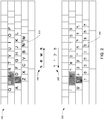
- FIG. 2 illustrates two keyboard layouts, a US-English keyboard layout 200 and a Hebrew keyboard layout 250, used to produce two different queries based on the same keystrokes.
- the keyboard with the Latin keyboard layout 200 is used to produce a string 'news' 205.
- the sequence of characters 'n', 'e', 'w', and 's' are generated with the keystrokes shown in grey. For example, 'n' is generated from the keystroke 210.
- ' ' is the first character generated by the keystroke 260, which is the same as keystroke 210 that generated 'n' using the Latin keyboard layout 200.
- the process 100 determines corrected search results based on the corrected search query (step 170). In some implementations, if more than one corrected search query is generated, then corrected search results are determined for each corrected search query.
- the process 100 determines which of either the initial search results or the corrected search results are presented to the user (step 180).
- the number of items in the initial search result is compared to the number of items in the corrected search result.
- the search result with the greatest number of items is presented to the user.
- the initial and corrected search result are each a suggestion-set.
- the items of a suggestion-set identify query suggestions that a user can select as a new search query from which new search results may be generated.
- the suggestion-set is identified from a first corpus (e.g., a corpus of search query suggestions), while the new search results are identified from a second corpus (e.g., a corpus of web pages).
- FIG. 3 illustrates two suggestion-sets that correspond to the two search queries, 'news' 300 and ' ' 350 respectively.
- Each suggestion-set includes i suggestions (qi) 310, wherein i may be any integer from 0 to n.
- Each suggestion is in itself a query that when submitted as a new search query to the second corpus, yields (or would be expected to yield) some number of results 320.
- the first suggestion, q0 is expected to generate x results.
- the value n(qi) 330 represents the expected number of results that the suggested query qi would yield.
- the information associated with each query suggestion can be used to determine which of the suggestion-sets (initial or corrected) is presented to the user. For example, the expected results of each query suggestion in a suggestion-set are used to score the suggestion-set. In some implementations, the suggestion-set is scored based on an average (or a maximum or standard deviation) of the expected results of each query suggestion. In other implementations, the suggestion-set is scored based on the median of the expected results of each query suggestion.
- n(qsj) is the sum of n(q1), n(q2) ... n(qn) where n(qi) is the number of expected results for each potential search query qi in the suggestion-set qsj.
- the value of S can be the number of suggestions that is normally expected. In some implementations, the value of S is predefined (e.g., corresponding to a fixed limit for all suggestion sets). In other implementations, the value S can be periodically determined based on the average number of items in all suggestion-sets. The above formula demotes the scores of suggestion-sets that have fewer than the expected number of suggestions (S).
- the first corpus of query suggestions can include suggestions based on erroneous strings that have been entered using the wrong keyboard layout (e.g., a string that makes no sense except if mapped using another keyboard layout).
- the demotion of suggestion-set scores based on S prevents presenting a suggestion-set that refers only to the erroneous strings in the first corpus.
- the suggestion-set with the greatest score is presented to the user.
- the initial suggestion-set can be scored before correcting the initial search query.
- the score of the initial suggestion-set is used to determine whether the initial search results were likely generated using an incorrect keyboard layout. In other words, this scoring technique can be used rather than counting the items in the initial search results, which was described in reference to FIG. 1 and step 125).
- search query when a search query is automatically corrected, information is presented to the user indicating the automatic correction.
- multiple potential search queries e.g., when target or source keyboard layout is ambiguous
- One of these presented corrected search queries can be explicitly selected by a user.
- a dictionary of common search query corrections can be maintained.
- the dictionary contains search query entries and corresponding corrections.
- the dictionary can be generated by analyzing the logs of search queries that have been received from users (e.g., off-line, rather than in immediate response to a user's search query). Each logged search query can be considered in the same manner as described in reference to FIG. 1 .
- the dictionary of common search queries can be used as a cache. When a search query is received from a user, the search query can be used to lookup corrections in the dictionary. If corrections exist in the dictionary, the search query can be corrected based on the dictionary entry.
- the source or target keyboard layout can be determined to resolve which dictionary correction to apply. If no corrections exist, the search query can be subject to the process 100 described in reference to FIG. 1 .
- Examples of the invention and all of the functional operations described in this specification can be implemented in digital electronic circuitry, or in computer software, firmware, or hardware, including the structures disclosed in this specification and their structural equivalents, or in combinations of one or more of them.
- Examples of the invention can be implemented as one or more computer program products, i.e., one or more modules of computer program instructions encoded on a computer-readable medium for execution by, or to control the operation of, data processing apparatus.
- the computer-readable medium can be a machine-readable storage device, a machine-readable storage substrate, a memory device, a composition of matter effecting a machine-readable propagated signal, or a combination of one or more of them.
- data processing apparatus encompasses all apparatus, devices, and machines for processing data, including by way of example a programmable processor, a computer, or multiple processors or computers.
- the apparatus can include, in addition to hardware, code that creates an execution environment for the computer program in question, e.g., code that constitutes processor firmware, a protocol stack, a database management system, an operating system, or a combination of one or more of them.
- a propagated signal is an artificially generated signal, e.g., a machine-generated electrical, optical, or electromagnetic signal, that is generated to encode information for transmission to suitable receiver apparatus.
- a computer program (also known as a program, software, software application, script, or code) can be written in any form of programming language, including compiled or interpreted languages, and it can be deployed in any form, including as a stand-alone program or as a module, component, subroutine, or other unit suitable for use in a computing environment.
- a computer program does not necessarily correspond to a file in a file system.
- a program can be stored in a portion of a file that holds other programs or data (e.g., one or more scripts stored in a markup language document), in a single file dedicated to the program in question, or in multiple coordinated files (e.g., files that store one or more modules, sub-programs, or portions of code).
- a computer program can be deployed to be executed on one computer or on multiple computers that are located at one site or distributed across multiple sites and interconnected by a communication network.
- the processes and logic flows described in this specification can be performed by one or more programmable processors executing one or more computer programs to perform functions by operating on input data and generating output.
- the processes and logic flows can also be performed by, and apparatus can also be implemented as, special purpose logic circuitry, e.g., an FPGA (field programmable gate array) or an ASIC (application-specific integrated circuit).
- processors suitable for the execution of a computer program include, by way of example, both general and special purpose microprocessors, and any one or more processors of any kind of digital computer.
- a processor will receive instructions and data from a read-only memory or a random access memory or both.
- the essential elements of a computer are a processor for performing instructions and one or more memory devices for storing instructions and data.
- a computer will also include, or be operatively coupled to receive data from or transfer data to, or both, one or more mass storage devices for storing data, e.g., magnetic, magneto-optical disks, or optical disks.
- mass storage devices for storing data, e.g., magnetic, magneto-optical disks, or optical disks.
- a computer need not have such devices.
- a computer can be embedded in another device, e.g., a mobile telephone, a personal digital assistant (PDA), a mobile audio player, a Global Positioning System (GPS) receiver, to name just a few.
- Computer-readable media suitable for storing computer program instructions and data include all forms of non-volatile memory, media and memory devices, including by way of example semiconductor memory devices, e.g., EPROM, EEPROM, and flash memory devices; magnetic disks, e.g., internal hard disks or removable disks; magneto-optical disks; and CD-ROM and DVD-ROM disks.
- the processor and the memory can be supplemented by, or incorporated in, special purpose logic circuitry.
- examples of the invention can be implemented on a computer having a display device, e.g., a CRT (cathode ray tube) or LCD (liquid crystal display) monitor, for displaying information to the user and a keyboard and a pointing device, e.g., a mouse or a trackball, by which the user can provide input to the computer.
- a display device e.g., a CRT (cathode ray tube) or LCD (liquid crystal display) monitor
- keyboard and a pointing device e.g., a mouse or a trackball
- Other kinds of devices can be used to provide for interaction with a user as well; for example, feedback provided to the user can be any form of sensory feedback, e.g., visual feedback, auditory feedback, or tactile feedback; and input from the user can be received in any form, including acoustic, speech, or tactile input.
- Examples of the invention can be implemented in a computing system that includes a back-end component, e.g., as a data server, or that includes a middleware component, e.g., an application server, or that includes a front-end component, e.g., a client computer having a graphical user interface or a Web browser through which a user can interact with an implementation of the invention, or any combination of one or more such back-end, middleware, or front-end components.
- the components of the system can be interconnected by any form or medium of digital data communication, e.g., a communication network. Examples of communication networks include a local area network (“LAN”) and a wide area network (“WAN”), e.g., the Internet.
- LAN local area network
- WAN wide area network
- the computing system can include clients and servers.
- a client and server are generally remote from each other and typically interact through a communication network.
- the relationship of client and server arises by virtue of computer programs running on the respective computers and having a client-server relationship to each other.
Landscapes
- Engineering & Computer Science (AREA)
- Theoretical Computer Science (AREA)
- General Engineering & Computer Science (AREA)
- Physics & Mathematics (AREA)
- General Physics & Mathematics (AREA)
- Computational Linguistics (AREA)
- General Health & Medical Sciences (AREA)
- Health & Medical Sciences (AREA)
- Audiology, Speech & Language Pathology (AREA)
- Artificial Intelligence (AREA)
- Data Mining & Analysis (AREA)
- Databases & Information Systems (AREA)
- Human Computer Interaction (AREA)
- User Interface Of Digital Computer (AREA)
Description
- This application claims priority to Chinese Patent Application No.
200710101817.8, filed on April 16, 2007 U.S. Provisional Patent Application Serial No. 60/875,425, filed on December 15, 2006 U.S. Provisional Patent Application Serial No. 60/884,839, filed on January 12, 2007 - This specification relates to automatically changing a search query in a given script to a search query in another script.
- A search engine enables a user to provide a search query for which search results are returned in response. In general, the query can include any character that the user is capable of generating with his or her input device. Input devices can have keys or buttons that are each capable of producing one of many characters. A keyboard, for example, can have multiple keyboard layouts. Each keyboard layout typically corresponds to the characters most frequently used within a particular writing system (i.e., a script). In countries whose writing systems are not based on the Latin alphabet, keyboards usually have at least two keyboard layouts, one for producing Latin characters (e.g., a U.S. English keyboard layout), the other for producing the characters of the user's native writing system (e.g., Cyrillic, Devangar
 ,or Arabic).
- Generally, users are able to switch between two or more keyboard layouts very easily (e.g., typically with a single keystroke). The currently selected keyboard layout normally determines the characters produced by each key of the keyboard. A user may inadvertently use their input device to submit a query in one script when they really intended to provide the same query in another script. For example, a user searching for 'news' may inadvertently submit '' on a Hebrew keyboard layout because the keystrokes that produce the characters '
 ' produce the characters 'news' on the corresponding Latin keyboard layout.
 - Reference is made to the following prior art:
-
EP 0 967 555 A2 <(MICROSOFT CORP [US]) 29 December 1999 (1999-12-29)> discloses converting text according to keyboard mode using language detection in a word processing enviromnent. -
US 2005/071332 A1 <(ORTEGA RUBEN ERNESTO [US] ET AL) 31 March 2005 (2005-03-31)> discloses correction of misspelled search terms. - This specification discloses various examples of technologies for automatically changing a search query in a given script to a search query in another script. These examples feature methods, systems, apparatus, including computer program product apparatus. Each of these will be described in this summary by reference to the methods, for which there are corresponding systems and apparatus.
- In general, in one aspect, a first search query is received from a user, the first search query having one or more characters, and a search result is determined based on the first search query. Based on the search result, the first search query is determined to have an incorrect input mapping. A first keyboard layout is identified for the first search query, and a second keyboard layout is identified. A corrected search query is generated from the first search query by mapping characters from the first keyboard layout to characters in the second keyboard layout. A corrected search result is determined based on the corrected search query, and the corrected search result is presented to the user.
- Implementations may include one or more of the following features. Multiple corrected search queries can be generated; one of the multiple corrected search queries can be selected; and the corrected search result can be presented to the user based on the selected one of the multiple corrected search queries.
- In general, in another aspect, a first search query is received from a user, the first search query having one or more characters, and a search result is determined based on the first search query. The first search query is determined to have an incorrect input mapping based on the search result, and a corrected search query is generated from the first search query from a dictionary of input mapping corrections. A corrected search result is determined based on the corrected search query, and the corrected search result is presented to the user.
- In general, in another aspect, a first search query is received from a user, the first search query including at least one or a combination of two or more of (1) one or more characters, (2) user languages settings, (3) a user language preference, (4) a user interface language, (5) a geographic location, and (6) user search history. A search result is determined based on the first search query. The first search query is determined to have an incorrect input mapping based on the search result. A first keyboard layout is identified for the first search query. A second keyboard layout is identified. A corrected search query is generated from the first search query by mapping characters from the first keyboard layout to characters in the second keyboard layout. A corrected search result is determined based on the corrected search query. The corrected search result is presented to the user.
- Implementations may include one or more of the following features. The user language preference can be associated with a part of an operating system's language settings. The user language preference can be associated with information about a supplemental language support provided by an operating system. The user language preference can be associated with information of a web browser. The information of the web browser can be related to a language associated with the web browser. A page request of a web browser can be used to provide the user language preference.
- The identifying of the first keyboard layout can be based on a language setting or language information of a system used by the user. The identifying of the first keyboard layout can be based on primary and secondary languages identified by the user. The identifying of the first keyboard layout can be based on a user preferred keyboard layout. The identifying of the first keyboard layout can be based on an inference from a language of the user interface. The identifying of the first keyboard layout can be based on information about a device connection of the user from which the user's geographic location and thus the user's most likely language are inferred. The identifying of the first keyboard layout can be based on search query history of the user. A portion of search results in the search query history, being less than an entire collection of search results in the search query history, can be used to identify the first keyboard layout. The portion of search results in the search query history can include search results that have been accessed by the user.
- In general, in another aspect, a search query is received from a user, the search query including at least one or a combination of two or more of (1) one or more characters, (2) user languages settings, (3) a user language preference, (4) a user interface language, (5) a geographic location, and (6) user search history. A search result is determined based on the search query, and a keyboard layout associated with the search query is identified.
- Implementations may include one or more of the following features. The identifying of the keyboard layout can be based on a language setting or language information of a system used by the user. The identifying of the keyboard layout can be based on primary and secondary languages identified by the user. The identifying of the keyboard layout can be based on a user preferred keyboard layout. The identifying of the keyboard layout can be based on an inference from a language of the user interface. The identifying of the keyboard layout can be based on information about a device connection of the user from which the user's geographic location and thus the user's most likely language are inferred. The identifying of the keyboard layout can be based on search query history of the user. A portion of search results in the search query history, being less than an entire collection of search results in the search query history, can be used to identify the first keyboard layout. The portion of search results in the search query history can include search results that have been accessed by the user.
- In general, in another aspect, a search query is received from a user, the search query including user search history; a search result is determined based on the search query; and a keyboard layout associated with the search query is identified.
- Implementations may include one or more of the following features. The search query can include at least one of (1) one or more characters, (2) user languages settings, (3) a user language preference, (4) a user interface language, and (5) a geographic location. A portion of search results in the search query history, being less than an entire collection of search results in the search query history, can be used to identify the first keyboard layout. The portion of search results in the search query history can include search results that have been accessed by the user.
- In general, in another aspect, a keyboard layout used by a user is determined to be incorrect based on first search results responsive to an initial search query submitted by the user.
- Implementations may include one or more of the following features. Second search results can be provided to the user using a corrected search query. The corrected search query can be generated from a dictionary of input mapping corrections. A corrected search query can be generated from the initial search query by mapping characters from the keyboard layout used by the user to characters in a corrected keyboard layout. The corrected keyboard layout can be determined based on a search query history associated with the user. The corrected keyboard layout can be determined based on a language setting associated with the user. The corrected keyboard layout can be determined based on a geographic location associated with the user. Multiple corrected search queries can be provided to the user. Corrected search results can be provided to the user responsive to a selection of one of the multiple corrected search queries by the user.
- These and other aspects and features, and combinations of them, may be expressed as methods, apparatus, systems, means for performing functions, program products, and in other ways.
- Advantages of the aspects and features can include one or more of the following. Queries can be corrected automatically without the user having to correct the query manually. Users can provide queries using an unfamiliar keyboard layout and still receive results as though the query had been generated by the user's preferred keyboard layout.
- The details of one or more examples are set forth in the accompanying drawings and the description below. Other features, aspects, and advantages of the invention will be apparent from the description and drawings, and from the claims.
-
-
FIG. 1 is a flow diagram of a process for detecting and correcting an incorrect query. -
FIG. 2 illustrates two keyboard layouts used to produce two queries from the same keystrokes. -
FIG. 3 illustrates query suggestions and each suggestion's associated query results. - Like reference numbers and designations in the various drawings indicate like elements.
- As shown in
FIG. 1 , aprocess 100 determines whether a search query has been mistakenly entered using an incorrect keyboard layout and, if so, corrects the search query. The search query is received from a user (step 110). The search query is a string of one or more characters. The characters of the search query correspond to the characters used in a particular script (e.g., Latin, Cyrillic, Hebrew or Arabic). Sometimes characters received from the user are not the characters the user intended to provide. - The
process 100 includes receiving a search query in a particular script (step 110). Initial search results are determined based on the received query (step 120). Search results are determined based on any convenient mechanism for determining search results. Typically, a corpus of items will be searched to identify particular items that are relevant to the search query. In general, a search result identifies many items. However, the initial search result may include no search result items. - The
process 100 determines whether the initial search query was likely generated using the correct keyboard layout (step 125). The items in the initial search result can be counted to determine whether the initial search result identified a sufficient number of items. In some implementations, a threshold can be used to determine whether the number of items is sufficient (e.g., greater than zero or greater than ten). In other implementations, the threshold is proportional to the total number of items in the corpus of items. For example, the threshold may be 25, if the corpus contains 10,000 items; however, the threshold may only be 2, if the corpus contains 1000 items. - If the initial search query was likely generated by the correct keyboard layout, then process 100 is complete when the initial search results are presented to the user (step 127). Alternatively, if the search query was likely generated by the incorrect keyboard layout, then the search query is automatically corrected as though it had been generated by a user using a target keyboard layout.
- A target keyboard layout corresponds to the keyboard layout that the user most likely intended to use to provide the search query. A source keyboard layout corresponds to the keyboard layout that the user most likely inadvertently used to provide the search query. The source and the target keyboard can be determined based on the characters used in the initial search query. Alternatively, the target keyboard can be determined based on a user's languages settings, language preferences, user interface language, geographic location, search history, or a combination of them.
- The
process 100 identifies the particular character set in which the search query is specified (step 130). In general, a character set refers to a group of characters within a family of characters. The family of characters is typically specified by a single consistent encoding (e.g., Unicode). The character set can be identified based on which group of characters are specified in the search query. - If the search query is specified in non-Latin characters (step 135), then the non-Latin search query can be corrected as though the user intended to generate the query on a Latin keyboard layout. In other words, the target keyboard layout is a Latin keyboard layout. The
process 100 determines the source keyboard layout used to produce the non-Latin search query (step 140). - Many non-Latin character sets are produced by a single, predictable, keyboard layout. For example, Hebrew characters are generally produced using a standard Hebrew keyboard layout while Arabic characters are generally produced using a standard Arabic keyboard layout.
- Not all non-Latin character sets, however, have a single corresponding keyboard layout. For example, Cyrillic script is used in both Russian and Bulgarian languages, and likewise, Cyrillic characters can be generated by both Russian and Bulgarian keyboard layouts. However, the Russian and Bulgarian keyboard layouts differ. The same keystroke on a Russian or Bulgarian keyboard layout will produce respectively different Cyrillic characters.
- In general, a user provides a search query to a user interface typically associated with a particular language. When the user's source keyboard layout is ambiguous, the language of the search interface can be used to resolve the ambiguity. If, for example, the user has provided the search query to a Bulgarian user interface, the search query is likely to have been generated using a Bulgarian keyboard layout.
- Alternatively, instead of resolving the ambiguity, query corrections can be generated for each applicable keyboard layout (e.g., for all applicable keyboard layouts or for a preferred subset). In some implementations, each corrected query is used to determine respective corrected search results. The numbers of items in the corrected search result are compared with one another to determine the source keyboard layout. Since a search query is unlikely to map to a meaningful term using an incorrect source keyboard layout, the corrected search result with the most items is taken as corresponding with the correct source keyboard layout.
- If the search query is specified using Latin characters (step 135), then the Latin search query can be corrected as though the user intended to generate the query on a non-Latin keyboard layout. In other words, the source keyboard layout is a Latin keyboard layout. Although there are multiple Latin keyboard layouts that vary somewhat, the most commonly used keys on any Latin keyboard generate largely the same characters (e.g., the character A-Z and a-z). The
process 100 determines the most likely target keyboard layout (step 150). - In some implementations, all potential corrections can be generated for every possible target keyboard layout. The large number of potential keyboard layouts, however, means that such an approach is inefficient. Instead, the
process 100 can determine the user's most likely target keyboard layout using one or a combination of five alternative approaches. - The first approach is to identify further language settings or information from the user's system. For example, the user's system can automatically provide (or be specifically queried to provide) information about the user's language preferences (e.g., operating system language settings). A user's language preference can be specified as (or derived from) a part of an operating system's language settings or information about supplemental language support provided by the operating system or web browser (e.g., installed languages or language packs). For example, a web browser can automatically provide a user's language preferences with a page request.
- Using the second approach, the user can explicitly identify primary and secondary languages, or alternatively, user preferred keyboard layouts. For example, the user providing the search query is associated with a predetermined profile in which the user sets language preferences.
- In the third approach, the language of the user interface is used to infer the user's language preferences. If the user provides the search query to a Russian user interface, then the target keyboard layout can be assumed to be a Russian keyboard layout.
- Using the fourth approach, when the user provides a search request through a network connected device, information about the device connection is used to infer the user's geographic location and thus the user's most likely language. For example, the user's Internet protocol (IP) address can be used to identify the approximate geographic location (e.g., typically a particular country) of the user's network device. A particular country can be associated with one or more languages that a given user would likely be using.
- The fifth approach considers a user's search query history. A user's search query history includes search queries provided previously by the user. Each search query in the search query history corresponds to one or more search results, some of which may have been accessed by the user (e.g., the user clicked on a search result). Each search result is associated with a language that ideally identifies the language of the search result. The languages of the search results of all the user's search queries can be used to determine the most likely intended target language, from which the target keyboard layout is derived. For example, if, among all of a user's previous search results, 75% of search results are English and 20% are Hebrew, then the target keyboard layout is assumed to be English when the source keyboard layout is Latin. In some implementations, rather than consider all of the search results associated with the user's search query history, only the search results that have been accessed by the user are considered.
- Each of the five approaches described above generally identifies a user's language preference. In general, a language that uses a non-Latin script has only one commonly-used keyboard layout. The particular keyboard layout that corresponds to the user's language preference is assumed to be the target keyboard layout.
- The
process 100 corrects the search query based on the identified source and target keyboard layouts (step 160). Keyboard layouts are well known and predefined. Therefore, a character mapping between keyboard layouts can be pre-defined. For example, a predefined mapping identifies that the Hebrew character '' is produced on a Hebrew keyboard layout using the same keystroke that produces the Latin character 'n' on a Latin keyboard layout. A corrected search query can be generated by mapping each character in the received search query to a corresponding character in a corrected search query. A character in the received search query, generated by the source keyboard layout, is mapped to the corresponding character that would have been generated with the same keystroke using the target keyboard layout.
-
FIG. 2 illustrates two keyboard layouts, a US-English keyboard layout 200 and aHebrew keyboard layout 250, used to produce two different queries based on the same keystrokes. The keyboard with theLatin keyboard layout 200 is used to produce a string 'news' 205. The sequence of characters 'n', 'e', 'w', and 's' are generated with the keystrokes shown in grey. For example, 'n' is generated from thekeystroke 210. - The same keystrokes of the same keyboard with the
Hebrew keyboard layout 250 generates the string '' 255. Note that although thestring 255 appears to be reversed compared to the characters produced from the same sequence of keystrokes, Hebrew text is written right-to-left. Therefore, '' is the first character generated by thekeystroke 260, which is the same askeystroke 210 that generated 'n' using theLatin keyboard layout 200. - Returning to
FIG. 1 , theprocess 100 determines corrected search results based on the corrected search query (step 170). In some implementations, if more than one corrected search query is generated, then corrected search results are determined for each corrected search query. - The
process 100 determines which of either the initial search results or the corrected search results are presented to the user (step 180). In some implementations, the number of items in the initial search result is compared to the number of items in the corrected search result. The search result with the greatest number of items is presented to the user. - In some implementations, the initial and corrected search result are each a suggestion-set. The items of a suggestion-set identify query suggestions that a user can select as a new search query from which new search results may be generated. Typically, the suggestion-set is identified from a first corpus (e.g., a corpus of search query suggestions), while the new search results are identified from a second corpus (e.g., a corpus of web pages).
-
FIG. 3 illustrates two suggestion-sets that correspond to the two search queries, 'news' 300 and '' 350 respectively. Each suggestion-set includes i suggestions (qi) 310, wherein i may be any integer from 0 to n. Each suggestion is in itself a query that when submitted as a new search query to the second corpus, yields (or would be expected to yield) some number ofresults 320. For example, the first suggestion, q0 is expected to generate x results. The value n(qi) 330 represents the expected number of results that the suggested query qi would yield. - The information associated with each query suggestion can be used to determine which of the suggestion-sets (initial or corrected) is presented to the user. For example, the expected results of each query suggestion in a suggestion-set are used to score the suggestion-set. In some implementations, the suggestion-set is scored based on an average (or a maximum or standard deviation) of the expected results of each query suggestion. In other implementations, the suggestion-set is scored based on the median of the expected results of each query suggestion.
- Alternatively, the score of a suggestion-set (qsj) can be based on the following formula:

- Where n(qsj) is the sum of n(q1), n(q2) ... n(qn) where n(qi) is the number of expected results for each potential search query qi in the suggestion-set qsj. The value of S can be the number of suggestions that is normally expected. In some implementations, the value of S is predefined (e.g., corresponding to a fixed limit for all suggestion sets). In other implementations, the value S can be periodically determined based on the average number of items in all suggestion-sets. The above formula demotes the scores of suggestion-sets that have fewer than the expected number of suggestions (S). In some cases, the first corpus of query suggestions can include suggestions based on erroneous strings that have been entered using the wrong keyboard layout (e.g., a string that makes no sense except if mapped using another keyboard layout). The demotion of suggestion-set scores based on S prevents presenting a suggestion-set that refers only to the erroneous strings in the first corpus.
- In general, the suggestion-set with the greatest score is presented to the user. In some implementations, the initial suggestion-set can be scored before correcting the initial search query. The score of the initial suggestion-set is used to determine whether the initial search results were likely generated using an incorrect keyboard layout. In other words, this scoring technique can be used rather than counting the items in the initial search results, which was described in reference to
FIG. 1 and step 125). - In some implementations, when a search query is automatically corrected, information is presented to the user indicating the automatic correction. In some implementations, multiple potential search queries (e.g., when target or source keyboard layout is ambiguous) can be presented. One of these presented corrected search queries can be explicitly selected by a user.
- In some implementations, a dictionary of common search query corrections can be maintained. The dictionary contains search query entries and corresponding corrections. The dictionary can be generated by analyzing the logs of search queries that have been received from users (e.g., off-line, rather than in immediate response to a user's search query). Each logged search query can be considered in the same manner as described in reference to
FIG. 1 . The dictionary of common search queries can be used as a cache. When a search query is received from a user, the search query can be used to lookup corrections in the dictionary. If corrections exist in the dictionary, the search query can be corrected based on the dictionary entry. When a dictionary entry contains more than one potential correction (e.g., because the same search query could have been entered by more than one source keyboard layout), the source or target keyboard layout can be determined to resolve which dictionary correction to apply. If no corrections exist, the search query can be subject to theprocess 100 described in reference toFIG. 1 . - Examples of the invention and all of the functional operations described in this specification can be implemented in digital electronic circuitry, or in computer software, firmware, or hardware, including the structures disclosed in this specification and their structural equivalents, or in combinations of one or more of them. Examples of the invention can be implemented as one or more computer program products, i.e., one or more modules of computer program instructions encoded on a computer-readable medium for execution by, or to control the operation of, data processing apparatus. The computer-readable medium can be a machine-readable storage device, a machine-readable storage substrate, a memory device, a composition of matter effecting a machine-readable propagated signal, or a combination of one or more of them. The term "data processing apparatus" encompasses all apparatus, devices, and machines for processing data, including by way of example a programmable processor, a computer, or multiple processors or computers. The apparatus can include, in addition to hardware, code that creates an execution environment for the computer program in question, e.g., code that constitutes processor firmware, a protocol stack, a database management system, an operating system, or a combination of one or more of them. A propagated signal is an artificially generated signal, e.g., a machine-generated electrical, optical, or electromagnetic signal, that is generated to encode information for transmission to suitable receiver apparatus.
- A computer program (also known as a program, software, software application, script, or code) can be written in any form of programming language, including compiled or interpreted languages, and it can be deployed in any form, including as a stand-alone program or as a module, component, subroutine, or other unit suitable for use in a computing environment. A computer program does not necessarily correspond to a file in a file system. A program can be stored in a portion of a file that holds other programs or data (e.g., one or more scripts stored in a markup language document), in a single file dedicated to the program in question, or in multiple coordinated files (e.g., files that store one or more modules, sub-programs, or portions of code). A computer program can be deployed to be executed on one computer or on multiple computers that are located at one site or distributed across multiple sites and interconnected by a communication network.
- The processes and logic flows described in this specification can be performed by one or more programmable processors executing one or more computer programs to perform functions by operating on input data and generating output. The processes and logic flows can also be performed by, and apparatus can also be implemented as, special purpose logic circuitry, e.g., an FPGA (field programmable gate array) or an ASIC (application-specific integrated circuit).
- Processors suitable for the execution of a computer program include, by way of example, both general and special purpose microprocessors, and any one or more processors of any kind of digital computer. Generally, a processor will receive instructions and data from a read-only memory or a random access memory or both. The essential elements of a computer are a processor for performing instructions and one or more memory devices for storing instructions and data. Generally, a computer will also include, or be operatively coupled to receive data from or transfer data to, or both, one or more mass storage devices for storing data, e.g., magnetic, magneto-optical disks, or optical disks. However, a computer need not have such devices. Moreover, a computer can be embedded in another device, e.g., a mobile telephone, a personal digital assistant (PDA), a mobile audio player, a Global Positioning System (GPS) receiver, to name just a few. Computer-readable media suitable for storing computer program instructions and data include all forms of non-volatile memory, media and memory devices, including by way of example semiconductor memory devices, e.g., EPROM, EEPROM, and flash memory devices; magnetic disks, e.g., internal hard disks or removable disks; magneto-optical disks; and CD-ROM and DVD-ROM disks. The processor and the memory can be supplemented by, or incorporated in, special purpose logic circuitry.
- To provide for interaction with a user, examples of the invention can be implemented on a computer having a display device, e.g., a CRT (cathode ray tube) or LCD (liquid crystal display) monitor, for displaying information to the user and a keyboard and a pointing device, e.g., a mouse or a trackball, by which the user can provide input to the computer. Other kinds of devices can be used to provide for interaction with a user as well; for example, feedback provided to the user can be any form of sensory feedback, e.g., visual feedback, auditory feedback, or tactile feedback; and input from the user can be received in any form, including acoustic, speech, or tactile input.
- Examples of the invention can be implemented in a computing system that includes a back-end component, e.g., as a data server, or that includes a middleware component, e.g., an application server, or that includes a front-end component, e.g., a client computer having a graphical user interface or a Web browser through which a user can interact with an implementation of the invention, or any combination of one or more such back-end, middleware, or front-end components. The components of the system can be interconnected by any form or medium of digital data communication, e.g., a communication network. Examples of communication networks include a local area network ("LAN") and a wide area network ("WAN"), e.g., the Internet.
- The computing system can include clients and servers. A client and server are generally remote from each other and typically interact through a communication network. The relationship of client and server arises by virtue of computer programs running on the respective computers and having a client-server relationship to each other.
- While this specification contains many specifics, these should not be construed as limitations on the scope of the invention or of what may be claimed, but rather as descriptions of features specific to particular examples of the invention. Certain features that are described in this specification in the context of separate examples can also be implemented in combination in a single example Conversely, various features that are described in the context of a single example can also be implemented in multiple examples separately or in any suitable subcombination. Moreover, although features may be described above as acting in certain combinations and even initially claimed as such, one or more features from a claimed combination can in some cases be excised from the combination, and the claimed combination may be directed to a subcombination or variation of a subcombination.
- Similarly, while operations are depicted in the drawings in a particular order, this should not be understood as requiring that such operations be performed in the particular order shown or in sequential order, or that all illustrated operations be performed, to achieve desirable results. In certain circumstances, multitasking and parallel processing may be advantageous. Moreover, the separation of various system components in the examples described above should not be understood as requiring such separation in all examples, and it should be understood that the described program components and systems can generally be integrated together in a single software product or packaged into multiple software products.
- Thus, particular examples of the invention have been described. Other examples are within the scope of the following claims. For example, the actions recited in the claims can be performed in a different order and still achieve desirable results. Although the foregoing specification refers to input devices such as a keyboard which can have one of several keyboard layouts, the foregoing specification can equally apply to any device that can generate one of several sets of characters. Moreover, the Latin and Hebrew scripts used throughout the above specification are used only as examples; any other combination of keyboard layouts can be similarly used.
Claims (15)
- A computer-implemented method comprising:receiving a first search query from a user (110), the first search query having one or more characters;determining a first search result based on the first search query (120);determining that the first search query has an incorrect input mapping (125), the determining being based on the number of items in the first search result;identifying, for the first search query, a first keyboard layout used to provide the first search query (130);identifying second keyboard layouts;generating multiple corrected search queries from the first search query by mapping characters from the first keyboard layout to characters in the second keyboard layouts (160);determining corrected search results based on the corrected search queries (170);selecting one of the multiple corrected search queries;comparing the number of items in the first search result to the number of items in the search result based on the selected corrected search query; andpresenting to the user the search result with the greatest number of items (180).
- The method of claim 1, wherein selecting one of the multiple corrected search queries further comprises presenting multiple potential search queries to the user for selection.
- The method of claim 1, wherein receiving the first search query (110) comprises receiving a combination of two or more characters; and the method further comprises:identifying a user language preference of the user using one or more of user languages settings, a user identified language, a user interface language, a geographic location, and user search history;wherein identifying the second keyboard layout comprises identifying the second keyboard layout based on the user language preference of the user.
- The method of claim 3, wherein the user language setting is associated with at least one of: a part of an operating system's language settings, information about a supplemental language support provided by an operating system, and information of a web browser.
- The method of claim 4, wherein the information of the web browser is related to a language associated with the web browser.
- The method of claim 3, wherein the user language preference is identified using the user language setting, and the method further comprises using a page request of a web browser to provide the user language setting.
- The method of claim 3, wherein the identifying of the first keyboard layout (130) is based on a language setting or language information of a system used by the user.
- The method of claim 3, wherein the identifying of the first keyboard layout (130) is based on primary and secondary languages identified by the user, or based on a user preferred keyboard layout.
- The method of claim 3, wherein the user language preference is identified using the user interface language, and the identifying of the first keyboard layout is based on an inference from the user interface language.
- The method of claim 3, wherein the identifying of the first keyboard layout (130) is based on search query history of the user, or based on information about a device connection of the user from which the user's geographic location and thus the user's most likely language are inferred.
- The method of claim 1, wherein a portion of items identified by search results in a search query history, being less than an entire collection of items identified by search results in the search query history, is used to identify the first keyboard layout (130).
- The method of claim 11, wherein the portion of items identified by search results in the search query history includes items that have been accessed by the user.
- A computer program product, encoded on a computer readable medium, operable to cause data processing apparatus to perform operations comprising:receiving a first search query from a user (110), the first search query having one or more characters;determining a first search result based on the first search query (120);determining that the first search query has an incorrect input mapping (125), the determining being based on the number of items in the first search result;identifying, for the first search query, a first keyboard layout used to provide the first search query (130);identifying second keyboard layouts;generating multiple corrected search queries from the first search query by mapping characters from the first keyboard layout to characters in the second keyboard layouts (160);determining corrected search results based on the corrected search queries (170);selecting one of the multiple corrected search queries;comparing the number of items in the first search result to the number of items in the search result based on the selected corrected search query; andpresenting to the user the search result with the greatest number of items (180).
- A system, comprising:means for receiving a first search query from a user (110), the first search query having one or more characters;means for determining a first search result based on the first search query (120);means for determining that the first search query has an incorrect input mapping (125), the determining being based on the number of items in the first search result;means for identifying, for the first search query, a first keyboard layout used to provide the first search query (130);means for identifying second keyboard layouts;means for generating multiple corrected search queries from the first search query by mapping characters from the first keyboard layout to characters in the second keyboard layouts (160);means for determining corrected search results based on the corrected search queries (170);means for selecting one of the multiple corrected search queries;comparing the number of items in the first search result to the number of items in the search result based on the selected corrected search query; andmeans for presenting to the user the search result with the greatest number of items (180).
- The system of claim 14, wherein means for selecting one of the multiple corrected search queries further comprise means for presenting multiple potential search queries to the user for selection.
Applications Claiming Priority (4)
| Application Number | Priority Date | Filing Date | Title |
|---|---|---|---|
| US87542506P | 2006-12-15 | 2006-12-15 | |
| US88483907P | 2007-01-12 | 2007-01-12 | |
| CN2007101018178A CN101206659B (en) | 2006-12-15 | 2007-04-16 | Automatic search query correction |
| PCT/US2007/087582 WO2008076887A1 (en) | 2006-12-15 | 2007-12-14 | Automatic search query correction |
Publications (3)
| Publication Number | Publication Date |
|---|---|
| EP2115635A1 EP2115635A1 (en) | 2009-11-11 |
| EP2115635A4 EP2115635A4 (en) | 2012-05-30 |
| EP2115635B1 true EP2115635B1 (en) | 2019-06-12 |
Family
ID=41013954
Family Applications (1)
| Application Number | Title | Priority Date | Filing Date |
|---|---|---|---|
| EP07865690.7A Not-in-force EP2115635B1 (en) | 2006-12-15 | 2007-12-14 | Automatic search query correction |
Country Status (7)
| Country | Link |
|---|---|
| US (1) | US8676824B2 (en) |
| EP (1) | EP2115635B1 (en) |
| KR (1) | KR101505985B1 (en) |
| CN (1) | CN101206659B (en) |
| IL (1) | IL199327A (en) |
| TW (1) | TWI454943B (en) |
| WO (1) | WO2008076887A1 (en) |
Families Citing this family (33)
| Publication number | Priority date | Publication date | Assignee | Title |
|---|---|---|---|---|
| US8564544B2 (en) | 2006-09-06 | 2013-10-22 | Apple Inc. | Touch screen device, method, and graphical user interface for customizing display of content category icons |
| US20080168478A1 (en) | 2007-01-07 | 2008-07-10 | Andrew Platzer | Application Programming Interfaces for Scrolling |
| US20080168402A1 (en) | 2007-01-07 | 2008-07-10 | Christopher Blumenberg | Application Programming Interfaces for Gesture Operations |
| US8229732B2 (en) | 2007-08-31 | 2012-07-24 | Google Inc. | Automatic correction of user input based on dictionary |
| US9875298B2 (en) * | 2007-10-12 | 2018-01-23 | Lexxe Pty Ltd | Automatic generation of a search query |
| US8645827B2 (en) | 2008-03-04 | 2014-02-04 | Apple Inc. | Touch event model |
| CN101266520B (en) * | 2008-04-18 | 2013-03-27 | 上海触乐信息科技有限公司 | A system for flexible keyboard layouts |
| WO2010003155A1 (en) * | 2008-07-03 | 2010-01-07 | Nuance Communications, Inc. | Methods and systems for processing japanese text on a mobile device |
| US8462123B1 (en) * | 2008-10-21 | 2013-06-11 | Google Inc. | Constrained keyboard organization |
| US8566045B2 (en) | 2009-03-16 | 2013-10-22 | Apple Inc. | Event recognition |
| US9684521B2 (en) | 2010-01-26 | 2017-06-20 | Apple Inc. | Systems having discrete and continuous gesture recognizers |
| KR101657307B1 (en) | 2009-09-25 | 2016-09-19 | 엘지전자 주식회사 | Fluorinated hollow fiber membrane and method for preparing the same |
| US8805750B2 (en) * | 2009-12-18 | 2014-08-12 | Microsoft Corporation | Providing comparison experiences in response to search queries |
| US20110179372A1 (en) * | 2010-01-15 | 2011-07-21 | Bradford Allen Moore | Automatic Keyboard Layout Determination |
| US8552999B2 (en) | 2010-06-14 | 2013-10-08 | Apple Inc. | Control selection approximation |
| US9064014B2 (en) * | 2010-08-20 | 2015-06-23 | Rakuten, Inc. | Information provisioning device, information provisioning method, program, and information recording medium |
| US8959430B1 (en) | 2011-09-21 | 2015-02-17 | Amazon Technologies, Inc. | Facilitating selection of keys related to a selected key |
| US9135245B1 (en) * | 2012-01-09 | 2015-09-15 | Cox Communications, Inc. | Filtering content based on acquiring data associated with language identification |
| US8671123B2 (en) | 2012-02-01 | 2014-03-11 | Microsoft Corporation | Contextual icon-oriented search tool |
| US10127314B2 (en) * | 2012-03-21 | 2018-11-13 | Apple Inc. | Systems and methods for optimizing search engine performance |
| US9329778B2 (en) * | 2012-09-07 | 2016-05-03 | International Business Machines Corporation | Supplementing a virtual input keyboard |
| US9733716B2 (en) | 2013-06-09 | 2017-08-15 | Apple Inc. | Proxy gesture recognizer |
| US20150177847A1 (en) * | 2013-12-23 | 2015-06-25 | Google Inc. | Techniques for resolving keyboard and input method ambiguity on computing devices |
| CN106469429B (en) * | 2015-08-18 | 2019-12-06 | 菜鸟智能物流控股有限公司 | Method and device for determining options through species relationship and electronic equipment |
| TWI562000B (en) * | 2015-12-09 | 2016-12-11 | Ind Tech Res Inst | Internet question answering system and method, and computer readable recording media |
| CN105868356A (en) * | 2016-03-29 | 2016-08-17 | 乐视控股(北京)有限公司 | Corpus detection method and device |
| CN106446069B (en) * | 2016-09-07 | 2019-10-15 | 北京百度网讯科技有限公司 | Method and device for pushing information based on artificial intelligence |
| RU2693328C2 (en) * | 2017-07-27 | 2019-07-02 | Общество С Ограниченной Ответственностью "Яндекс" | Methods and systems for generating a replacement request for a user input request |
| CN110413131A (en) * | 2018-04-27 | 2019-11-05 | 群光电子(苏州)有限公司 | Computer system and key board unit |
| CN111400464B (en) * | 2019-01-03 | 2023-05-26 | 百度在线网络技术(北京)有限公司 | Text generation method, device, server and storage medium |
| US11216065B2 (en) * | 2019-09-26 | 2022-01-04 | Lenovo (Singapore) Pte. Ltd. | Input control display based on eye gaze |
| WO2022039745A1 (en) * | 2020-08-20 | 2022-02-24 | Google Llc | Selecting from arrays of multilingual content |
| WO2025089664A1 (en) * | 2023-10-25 | 2025-05-01 | 삼성전자주식회사 | Electronic devices and search methods |
Family Cites Families (35)
| Publication number | Priority date | Publication date | Assignee | Title |
|---|---|---|---|---|
| US5535119A (en) * | 1992-06-11 | 1996-07-09 | Hitachi, Ltd. | Character inputting method allowing input of a plurality of different types of character species, and information processing equipment adopting the same |
| KR970007686B1 (en) * | 1994-07-07 | 1997-05-15 | 주식회사 삼양사 | Manufacturing method of polyester microfiber |
| KR0157031B1 (en) | 1995-07-07 | 1998-11-16 | 이찬진 | Automatic keyboard mode inverter and method |
| US5721897A (en) * | 1996-04-09 | 1998-02-24 | Rubinstein; Seymour I. | Browse by prompted keyword phrases with an improved user interface |
| US6065003A (en) * | 1997-08-19 | 2000-05-16 | Microsoft Corporation | System and method for finding the closest match of a data entry |
| US6272456B1 (en) * | 1998-03-19 | 2001-08-07 | Microsoft Corporation | System and method for identifying the language of written text having a plurality of different length n-gram profiles |
| US20050119875A1 (en) * | 1998-03-25 | 2005-06-02 | Shaefer Leonard Jr. | Identifying related names |
| US6326953B1 (en) * | 1998-06-24 | 2001-12-04 | Microsoft Corporation | Method for converting text corresponding to one keyboard mode to text corresponding to another keyboard mode |
| US6144958A (en) * | 1998-07-15 | 2000-11-07 | Amazon.Com, Inc. | System and method for correcting spelling errors in search queries |
| US6292772B1 (en) * | 1998-12-01 | 2001-09-18 | Justsystem Corporation | Method for identifying the language of individual words |
| KR20010064751A (en) * | 1999-12-18 | 2001-07-11 | 이계철 | Method of correcting typing error for on-line information retrieval |
| KR100726582B1 (en) * | 2000-10-25 | 2007-06-11 | 주식회사 케이티 | Method of providing multi-character keyboard by checking the location of wireless communication terminal |
| US7113904B2 (en) * | 2001-03-30 | 2006-09-26 | Park City Group | System and method for providing dynamic multiple language support for application programs |
| US7103534B2 (en) * | 2001-03-31 | 2006-09-05 | Microsoft Corporation | Machine learning contextual approach to word determination for text input via reduced keypad keys |
| CN1643511A (en) * | 2002-03-11 | 2005-07-20 | 南加利福尼亚大学 | Named entity translation |
| JP4025178B2 (en) * | 2002-11-11 | 2007-12-19 | 株式会社東芝 | Structured data search method, structured data search device and program |
| KR100634496B1 (en) * | 2003-06-16 | 2006-10-13 | 삼성전자주식회사 | Input language mode recognition method and device and input language mode automatic switching method and device using same |
| US7310605B2 (en) * | 2003-11-25 | 2007-12-18 | International Business Machines Corporation | Method and apparatus to transliterate text using a portable device |
| US8200475B2 (en) * | 2004-02-13 | 2012-06-12 | Microsoft Corporation | Phonetic-based text input method |
| US7636083B2 (en) * | 2004-02-20 | 2009-12-22 | Tegic Communications, Inc. | Method and apparatus for text input in various languages |
| US7254774B2 (en) | 2004-03-16 | 2007-08-07 | Microsoft Corporation | Systems and methods for improved spell checking |
| US20050216253A1 (en) * | 2004-03-25 | 2005-09-29 | Microsoft Corporation | System and method for reverse transliteration using statistical alignment |
| TWI240876B (en) * | 2004-06-17 | 2005-10-01 | Bridgewell Inc | Portable database search agent processing system |
| TW200620001A (en) * | 2004-10-20 | 2006-06-16 | Bridgewell Inc | Method and system for webpage advertisement, and agent management method for webpage advertisement |
| KR100707725B1 (en) * | 2005-05-16 | 2007-04-16 | 엔에이치엔(주) | A computer-readable recording medium having recorded thereon an autocomplete query providing system, method and program for executing the method. |
| US20070011132A1 (en) * | 2005-06-17 | 2007-01-11 | Microsoft Corporation | Named entity translation |
| KR100739726B1 (en) * | 2005-08-30 | 2007-07-13 | 삼성전자주식회사 | String matching method and system and computer readable recording medium recording the method |
| KR101265263B1 (en) * | 2006-01-02 | 2013-05-16 | 삼성전자주식회사 | Method and system for name matching using phonetic sign and computer readable medium recording the method |
| JP4744317B2 (en) * | 2006-02-16 | 2011-08-10 | 富士通株式会社 | Word search device, word search method, and computer program |
| US7797152B1 (en) * | 2006-02-17 | 2010-09-14 | The United States Of America As Represented By The Director, National Security Agency | Method of database searching |
| US7831911B2 (en) * | 2006-03-08 | 2010-11-09 | Microsoft Corporation | Spell checking system including a phonetic speller |
| US7590626B2 (en) * | 2006-10-30 | 2009-09-15 | Microsoft Corporation | Distributional similarity-based models for query correction |
| US20080155399A1 (en) * | 2006-12-20 | 2008-06-26 | Yahoo! Inc. | System and method for indexing a document that includes a misspelled word |
| US7813920B2 (en) * | 2007-06-29 | 2010-10-12 | Microsoft Corporation | Learning to reorder alternates based on a user'S personalized vocabulary |
| US8229732B2 (en) * | 2007-08-31 | 2012-07-24 | Google Inc. | Automatic correction of user input based on dictionary |
-
2007
- 2007-04-16 CN CN2007101018178A patent/CN101206659B/en not_active Expired - Fee Related
- 2007-12-14 TW TW096148064A patent/TWI454943B/en not_active IP Right Cessation
- 2007-12-14 KR KR1020097014284A patent/KR101505985B1/en active Active
- 2007-12-14 EP EP07865690.7A patent/EP2115635B1/en not_active Not-in-force
- 2007-12-14 US US11/956,692 patent/US8676824B2/en not_active Expired - Fee Related
- 2007-12-14 WO PCT/US2007/087582 patent/WO2008076887A1/en not_active Ceased
-
2009
- 2009-06-11 IL IL199327A patent/IL199327A/en active IP Right Grant
Non-Patent Citations (1)
| Title |
|---|
| None * |
Also Published As
| Publication number | Publication date |
|---|---|
| CN101206659A (en) | 2008-06-25 |
| EP2115635A4 (en) | 2012-05-30 |
| KR101505985B1 (en) | 2015-03-25 |
| EP2115635A1 (en) | 2009-11-11 |
| TW200925906A (en) | 2009-06-16 |
| CN101206659B (en) | 2013-09-18 |
| US8676824B2 (en) | 2014-03-18 |
| KR20090091325A (en) | 2009-08-27 |
| WO2008076887A1 (en) | 2008-06-26 |
| TWI454943B (en) | 2014-10-01 |
| US20090222445A1 (en) | 2009-09-03 |
| IL199327A (en) | 2016-02-29 |
Similar Documents
| Publication | Publication Date | Title |
|---|---|---|
| US8676824B2 (en) | Automatic search query correction | |
| US8229732B2 (en) | Automatic correction of user input based on dictionary | |
| JP5761833B2 (en) | Dictionary candidates for partial user input | |
| US8762358B2 (en) | Query language determination using query terms and interface language | |
| US8255376B2 (en) | Augmenting queries with synonyms from synonyms map | |
| US7475063B2 (en) | Augmenting queries with synonyms selected using language statistics | |
| RU2363983C2 (en) | System and method for searching using queries, written in language and/or set of characters, distinct from that of target pages | |
| KR101495240B1 (en) | Method and system for statistical context-sensitive spelling correction using confusion set | |
| US7835903B2 (en) | Simplifying query terms with transliteration | |
| US9460149B2 (en) | Dynamic query resolution using accuracy profiles | |
| WO2007124385A2 (en) | Processing of query terms | |
| WO2011050494A1 (en) | Generating input suggestions | |
| JP2017117109A (en) | Information processing device, information processing system, information retrieval method, and program | |
| HK1163846B (en) | A computer-implemented method and a system and device for performing searches using queries |
Legal Events
| Date | Code | Title | Description |
|---|---|---|---|
| PUAI | Public reference made under article 153(3) epc to a published international application that has entered the european phase |
Free format text: ORIGINAL CODE: 0009012 |
|
| 17P | Request for examination filed |
Effective date: 20090714 |
|
| AK | Designated contracting states |
Kind code of ref document: A1 Designated state(s): AT BE BG CH CY CZ DE DK EE ES FI FR GB GR HU IE IS IT LI LT LU LV MC MT NL PL PT RO SE SI SK TR |
|
| DAX | Request for extension of the european patent (deleted) | ||
| A4 | Supplementary search report drawn up and despatched |
Effective date: 20120426 |
|
| RIC1 | Information provided on ipc code assigned before grant |
Ipc: G06F 17/30 20060101AFI20120420BHEP |
|
| 17Q | First examination report despatched |
Effective date: 20120514 |
|
| RAP1 | Party data changed (applicant data changed or rights of an application transferred) |
Owner name: GOOGLE LLC |
|
| GRAP | Despatch of communication of intention to grant a patent |
Free format text: ORIGINAL CODE: EPIDOSNIGR1 |
|
| STAA | Information on the status of an ep patent application or granted ep patent |
Free format text: STATUS: GRANT OF PATENT IS INTENDED |
|
| RIC1 | Information provided on ipc code assigned before grant |
Ipc: G06F 17/22 20060101ALI20181130BHEP Ipc: G06F 17/30 20060101AFI20181130BHEP Ipc: G06F 17/27 20060101ALI20181130BHEP |
|
| INTG | Intention to grant announced |
Effective date: 20181220 |
|
| GRAS | Grant fee paid |
Free format text: ORIGINAL CODE: EPIDOSNIGR3 |
|
| GRAA | (expected) grant |
Free format text: ORIGINAL CODE: 0009210 |
|
| STAA | Information on the status of an ep patent application or granted ep patent |
Free format text: STATUS: THE PATENT HAS BEEN GRANTED |
|
| AK | Designated contracting states |
Kind code of ref document: B1 Designated state(s): AT BE BG CH CY CZ DE DK EE ES FI FR GB GR HU IE IS IT LI LT LU LV MC MT NL PL PT RO SE SI SK TR |
|
| REG | Reference to a national code |
Ref country code: GB Ref legal event code: FG4D |
|
| REG | Reference to a national code |
Ref country code: CH Ref legal event code: EP |
|
| REG | Reference to a national code |
Ref country code: AT Ref legal event code: REF Ref document number: 1143501 Country of ref document: AT Kind code of ref document: T Effective date: 20190615 |
|
| REG | Reference to a national code |
Ref country code: DE Ref legal event code: R096 Ref document number: 602007058600 Country of ref document: DE |
|
| REG | Reference to a national code |
Ref country code: IE Ref legal event code: FG4D |
|
| REG | Reference to a national code |
Ref country code: NL Ref legal event code: MP Effective date: 20190612 |
|
| REG | Reference to a national code |
Ref country code: LT Ref legal event code: MG4D |
|
| PG25 | Lapsed in a contracting state [announced via postgrant information from national office to epo] |
Ref country code: LT Free format text: LAPSE BECAUSE OF FAILURE TO SUBMIT A TRANSLATION OF THE DESCRIPTION OR TO PAY THE FEE WITHIN THE PRESCRIBED TIME-LIMIT Effective date: 20190612 Ref country code: FI Free format text: LAPSE BECAUSE OF FAILURE TO SUBMIT A TRANSLATION OF THE DESCRIPTION OR TO PAY THE FEE WITHIN THE PRESCRIBED TIME-LIMIT Effective date: 20190612 Ref country code: SE Free format text: LAPSE BECAUSE OF FAILURE TO SUBMIT A TRANSLATION OF THE DESCRIPTION OR TO PAY THE FEE WITHIN THE PRESCRIBED TIME-LIMIT Effective date: 20190612 Ref country code: ES Free format text: LAPSE BECAUSE OF FAILURE TO SUBMIT A TRANSLATION OF THE DESCRIPTION OR TO PAY THE FEE WITHIN THE PRESCRIBED TIME-LIMIT Effective date: 20190612 |
|
| PG25 | Lapsed in a contracting state [announced via postgrant information from national office to epo] |
Ref country code: BG Free format text: LAPSE BECAUSE OF FAILURE TO SUBMIT A TRANSLATION OF THE DESCRIPTION OR TO PAY THE FEE WITHIN THE PRESCRIBED TIME-LIMIT Effective date: 20190912 Ref country code: LV Free format text: LAPSE BECAUSE OF FAILURE TO SUBMIT A TRANSLATION OF THE DESCRIPTION OR TO PAY THE FEE WITHIN THE PRESCRIBED TIME-LIMIT Effective date: 20190612 Ref country code: GR Free format text: LAPSE BECAUSE OF FAILURE TO SUBMIT A TRANSLATION OF THE DESCRIPTION OR TO PAY THE FEE WITHIN THE PRESCRIBED TIME-LIMIT Effective date: 20190913 |
|
| REG | Reference to a national code |
Ref country code: AT Ref legal event code: MK05 Ref document number: 1143501 Country of ref document: AT Kind code of ref document: T Effective date: 20190612 |
|
| PG25 | Lapsed in a contracting state [announced via postgrant information from national office to epo] |
Ref country code: SK Free format text: LAPSE BECAUSE OF FAILURE TO SUBMIT A TRANSLATION OF THE DESCRIPTION OR TO PAY THE FEE WITHIN THE PRESCRIBED TIME-LIMIT Effective date: 20190612 Ref country code: PT Free format text: LAPSE BECAUSE OF FAILURE TO SUBMIT A TRANSLATION OF THE DESCRIPTION OR TO PAY THE FEE WITHIN THE PRESCRIBED TIME-LIMIT Effective date: 20191014 Ref country code: AT Free format text: LAPSE BECAUSE OF FAILURE TO SUBMIT A TRANSLATION OF THE DESCRIPTION OR TO PAY THE FEE WITHIN THE PRESCRIBED TIME-LIMIT Effective date: 20190612 Ref country code: EE Free format text: LAPSE BECAUSE OF FAILURE TO SUBMIT A TRANSLATION OF THE DESCRIPTION OR TO PAY THE FEE WITHIN THE PRESCRIBED TIME-LIMIT Effective date: 20190612 Ref country code: NL Free format text: LAPSE BECAUSE OF FAILURE TO SUBMIT A TRANSLATION OF THE DESCRIPTION OR TO PAY THE FEE WITHIN THE PRESCRIBED TIME-LIMIT Effective date: 20190612 Ref country code: CZ Free format text: LAPSE BECAUSE OF FAILURE TO SUBMIT A TRANSLATION OF THE DESCRIPTION OR TO PAY THE FEE WITHIN THE PRESCRIBED TIME-LIMIT Effective date: 20190612 Ref country code: RO Free format text: LAPSE BECAUSE OF FAILURE TO SUBMIT A TRANSLATION OF THE DESCRIPTION OR TO PAY THE FEE WITHIN THE PRESCRIBED TIME-LIMIT Effective date: 20190612 |
|
| PG25 | Lapsed in a contracting state [announced via postgrant information from national office to epo] |
Ref country code: IS Free format text: LAPSE BECAUSE OF FAILURE TO SUBMIT A TRANSLATION OF THE DESCRIPTION OR TO PAY THE FEE WITHIN THE PRESCRIBED TIME-LIMIT Effective date: 20191012 Ref country code: IT Free format text: LAPSE BECAUSE OF FAILURE TO SUBMIT A TRANSLATION OF THE DESCRIPTION OR TO PAY THE FEE WITHIN THE PRESCRIBED TIME-LIMIT Effective date: 20190612 |
|
| REG | Reference to a national code |
Ref country code: DE Ref legal event code: R097 Ref document number: 602007058600 Country of ref document: DE |
|
| PG25 | Lapsed in a contracting state [announced via postgrant information from national office to epo] |
Ref country code: TR Free format text: LAPSE BECAUSE OF FAILURE TO SUBMIT A TRANSLATION OF THE DESCRIPTION OR TO PAY THE FEE WITHIN THE PRESCRIBED TIME-LIMIT Effective date: 20190612 |
|
| PLBE | No opposition filed within time limit |
Free format text: ORIGINAL CODE: 0009261 |
|
| STAA | Information on the status of an ep patent application or granted ep patent |
Free format text: STATUS: NO OPPOSITION FILED WITHIN TIME LIMIT |
|
| PG25 | Lapsed in a contracting state [announced via postgrant information from national office to epo] |
Ref country code: PL Free format text: LAPSE BECAUSE OF FAILURE TO SUBMIT A TRANSLATION OF THE DESCRIPTION OR TO PAY THE FEE WITHIN THE PRESCRIBED TIME-LIMIT Effective date: 20190612 Ref country code: DK Free format text: LAPSE BECAUSE OF FAILURE TO SUBMIT A TRANSLATION OF THE DESCRIPTION OR TO PAY THE FEE WITHIN THE PRESCRIBED TIME-LIMIT Effective date: 20190612 |
|
| 26N | No opposition filed |
Effective date: 20200313 |
|
| PG25 | Lapsed in a contracting state [announced via postgrant information from national office to epo] |
Ref country code: SI Free format text: LAPSE BECAUSE OF FAILURE TO SUBMIT A TRANSLATION OF THE DESCRIPTION OR TO PAY THE FEE WITHIN THE PRESCRIBED TIME-LIMIT Effective date: 20190612 Ref country code: IS Free format text: LAPSE BECAUSE OF FAILURE TO SUBMIT A TRANSLATION OF THE DESCRIPTION OR TO PAY THE FEE WITHIN THE PRESCRIBED TIME-LIMIT Effective date: 20200224 |
|
| PG2D | Information on lapse in contracting state deleted |
Ref country code: IS |
|
| PG25 | Lapsed in a contracting state [announced via postgrant information from national office to epo] |
Ref country code: IS Free format text: LAPSE BECAUSE OF FAILURE TO SUBMIT A TRANSLATION OF THE DESCRIPTION OR TO PAY THE FEE WITHIN THE PRESCRIBED TIME-LIMIT Effective date: 20191112 |
|
| REG | Reference to a national code |
Ref country code: CH Ref legal event code: PL |
|
| REG | Reference to a national code |
Ref country code: BE Ref legal event code: MM Effective date: 20191231 |
|
| PG25 | Lapsed in a contracting state [announced via postgrant information from national office to epo] |
Ref country code: MC Free format text: LAPSE BECAUSE OF FAILURE TO SUBMIT A TRANSLATION OF THE DESCRIPTION OR TO PAY THE FEE WITHIN THE PRESCRIBED TIME-LIMIT Effective date: 20190612 |
|
| PG25 | Lapsed in a contracting state [announced via postgrant information from national office to epo] |
Ref country code: LU Free format text: LAPSE BECAUSE OF NON-PAYMENT OF DUE FEES Effective date: 20191214 Ref country code: IE Free format text: LAPSE BECAUSE OF NON-PAYMENT OF DUE FEES Effective date: 20191214 |
|
| PG25 | Lapsed in a contracting state [announced via postgrant information from national office to epo] |
Ref country code: BE Free format text: LAPSE BECAUSE OF NON-PAYMENT OF DUE FEES Effective date: 20191231 Ref country code: CH Free format text: LAPSE BECAUSE OF NON-PAYMENT OF DUE FEES Effective date: 20191231 Ref country code: LI Free format text: LAPSE BECAUSE OF NON-PAYMENT OF DUE FEES Effective date: 20191231 |
|
| PG25 | Lapsed in a contracting state [announced via postgrant information from national office to epo] |
Ref country code: CY Free format text: LAPSE BECAUSE OF FAILURE TO SUBMIT A TRANSLATION OF THE DESCRIPTION OR TO PAY THE FEE WITHIN THE PRESCRIBED TIME-LIMIT Effective date: 20190612 |
|
| PG25 | Lapsed in a contracting state [announced via postgrant information from national office to epo] |
Ref country code: HU Free format text: LAPSE BECAUSE OF FAILURE TO SUBMIT A TRANSLATION OF THE DESCRIPTION OR TO PAY THE FEE WITHIN THE PRESCRIBED TIME-LIMIT; INVALID AB INITIO Effective date: 20071214 Ref country code: MT Free format text: LAPSE BECAUSE OF FAILURE TO SUBMIT A TRANSLATION OF THE DESCRIPTION OR TO PAY THE FEE WITHIN THE PRESCRIBED TIME-LIMIT Effective date: 20190612 |
|
| PGFP | Annual fee paid to national office [announced via postgrant information from national office to epo] |
Ref country code: DE Payment date: 20221228 Year of fee payment: 16 |
|
| P01 | Opt-out of the competence of the unified patent court (upc) registered |
Effective date: 20230509 |
|
| PGFP | Annual fee paid to national office [announced via postgrant information from national office to epo] |
Ref country code: GB Payment date: 20231227 Year of fee payment: 17 |
|
| PGFP | Annual fee paid to national office [announced via postgrant information from national office to epo] |
Ref country code: FR Payment date: 20231227 Year of fee payment: 17 |
|
| REG | Reference to a national code |
Ref country code: DE Ref legal event code: R119 Ref document number: 602007058600 Country of ref document: DE |
|
| PG25 | Lapsed in a contracting state [announced via postgrant information from national office to epo] |
Ref country code: DE Free format text: LAPSE BECAUSE OF NON-PAYMENT OF DUE FEES Effective date: 20240702 |
|
| PG25 | Lapsed in a contracting state [announced via postgrant information from national office to epo] |
Ref country code: DE Free format text: LAPSE BECAUSE OF NON-PAYMENT OF DUE FEES Effective date: 20240702 |
|
| GBPC | Gb: european patent ceased through non-payment of renewal fee |
Effective date: 20241214 |
|
| PG25 | Lapsed in a contracting state [announced via postgrant information from national office to epo] |
Ref country code: GB Free format text: LAPSE BECAUSE OF NON-PAYMENT OF DUE FEES Effective date: 20241214 |
|
| PG25 | Lapsed in a contracting state [announced via postgrant information from national office to epo] |
Ref country code: FR Free format text: LAPSE BECAUSE OF NON-PAYMENT OF DUE FEES Effective date: 20241231 |