EP2115486B1 - Nmr-verfahren zur identifikation und quantifizierung von komponenten in einer flüssigkeit - Google Patents
Nmr-verfahren zur identifikation und quantifizierung von komponenten in einer flüssigkeit Download PDFInfo
- Publication number
- EP2115486B1 EP2115486B1 EP08730103A EP08730103A EP2115486B1 EP 2115486 B1 EP2115486 B1 EP 2115486B1 EP 08730103 A EP08730103 A EP 08730103A EP 08730103 A EP08730103 A EP 08730103A EP 2115486 B1 EP2115486 B1 EP 2115486B1
- Authority
- EP
- European Patent Office
- Prior art keywords
- oil
- mixture
- nmr
- obmf
- gas
- Prior art date
- Legal status (The legal status is an assumption and is not a legal conclusion. Google has not performed a legal analysis and makes no representation as to the accuracy of the status listed.)
- Active
Links
- 238000000034 method Methods 0.000 title claims abstract description 32
- 239000012530 fluid Substances 0.000 title description 40
- 238000011002 quantification Methods 0.000 title 1
- 239000000203 mixture Substances 0.000 claims abstract description 80
- 238000009792 diffusion process Methods 0.000 claims description 3
- 238000005481 NMR spectroscopy Methods 0.000 abstract description 49
- 229930195733 hydrocarbon Natural products 0.000 abstract description 43
- 150000002430 hydrocarbons Chemical class 0.000 abstract description 42
- 239000004215 Carbon black (E152) Substances 0.000 abstract description 31
- 239000000470 constituent Substances 0.000 abstract description 15
- 230000004044 response Effects 0.000 abstract description 14
- 238000004590 computer program Methods 0.000 abstract 1
- 239000003921 oil Substances 0.000 description 69
- 239000000523 sample Substances 0.000 description 12
- 239000007788 liquid Substances 0.000 description 10
- 238000004458 analytical method Methods 0.000 description 9
- 230000015572 biosynthetic process Effects 0.000 description 9
- 238000005755 formation reaction Methods 0.000 description 9
- 238000009826 distribution Methods 0.000 description 8
- 238000005259 measurement Methods 0.000 description 8
- 238000012512 characterization method Methods 0.000 description 7
- 230000006870 function Effects 0.000 description 7
- 238000005553 drilling Methods 0.000 description 6
- 239000000706 filtrate Substances 0.000 description 6
- 230000003993 interaction Effects 0.000 description 6
- 230000009878 intermolecular interaction Effects 0.000 description 6
- 230000003287 optical effect Effects 0.000 description 6
- 238000001228 spectrum Methods 0.000 description 6
- 230000002902 bimodal effect Effects 0.000 description 5
- 230000005415 magnetization Effects 0.000 description 5
- 230000005298 paramagnetic effect Effects 0.000 description 5
- 238000005516 engineering process Methods 0.000 description 4
- 230000008863 intramolecular interaction Effects 0.000 description 4
- 239000012071 phase Substances 0.000 description 4
- 238000011156 evaluation Methods 0.000 description 3
- 230000009545 invasion Effects 0.000 description 3
- 230000005291 magnetic effect Effects 0.000 description 3
- 239000000463 material Substances 0.000 description 3
- 230000007246 mechanism Effects 0.000 description 3
- 230000008901 benefit Effects 0.000 description 2
- 230000008878 coupling Effects 0.000 description 2
- 238000010168 coupling process Methods 0.000 description 2
- 238000005859 coupling reaction Methods 0.000 description 2
- 239000010779 crude oil Substances 0.000 description 2
- 150000002500 ions Chemical class 0.000 description 2
- 239000007791 liquid phase Substances 0.000 description 2
- 230000033001 locomotion Effects 0.000 description 2
- VNWKTOKETHGBQD-UHFFFAOYSA-N methane Chemical compound C VNWKTOKETHGBQD-UHFFFAOYSA-N 0.000 description 2
- 239000011148 porous material Substances 0.000 description 2
- 238000003860 storage Methods 0.000 description 2
- 239000012808 vapor phase Substances 0.000 description 2
- 238000009736 wetting Methods 0.000 description 2
- 238000005084 2D-nuclear magnetic resonance Methods 0.000 description 1
- -1 C-16 hydrocarbons Chemical class 0.000 description 1
- OKTJSMMVPCPJKN-UHFFFAOYSA-N Carbon Chemical compound [C] OKTJSMMVPCPJKN-UHFFFAOYSA-N 0.000 description 1
- 230000002776 aggregation Effects 0.000 description 1
- 238000004220 aggregation Methods 0.000 description 1
- 239000002199 base oil Substances 0.000 description 1
- 230000009286 beneficial effect Effects 0.000 description 1
- 239000003990 capacitor Substances 0.000 description 1
- 229910052799 carbon Inorganic materials 0.000 description 1
- 238000004891 communication Methods 0.000 description 1
- 239000004020 conductor Substances 0.000 description 1
- 238000001816 cooling Methods 0.000 description 1
- 238000007405 data analysis Methods 0.000 description 1
- 238000013480 data collection Methods 0.000 description 1
- 230000001419 dependent effect Effects 0.000 description 1
- 238000004141 dimensional analysis Methods 0.000 description 1
- 230000000694 effects Effects 0.000 description 1
- 239000000839 emulsion Substances 0.000 description 1
- 239000010419 fine particle Substances 0.000 description 1
- 238000011010 flushing procedure Methods 0.000 description 1
- 238000009472 formulation Methods 0.000 description 1
- 239000007789 gas Substances 0.000 description 1
- 238000010438 heat treatment Methods 0.000 description 1
- 239000012535 impurity Substances 0.000 description 1
- 238000004519 manufacturing process Methods 0.000 description 1
- 238000012986 modification Methods 0.000 description 1
- 230000004048 modification Effects 0.000 description 1
- 230000000149 penetrating effect Effects 0.000 description 1
- 230000035515 penetration Effects 0.000 description 1
- 239000003208 petroleum Substances 0.000 description 1
- 230000008569 process Effects 0.000 description 1
- 238000012545 processing Methods 0.000 description 1
- 230000001681 protective effect Effects 0.000 description 1
- 238000001303 quality assessment method Methods 0.000 description 1
- 238000005057 refrigeration Methods 0.000 description 1
- 238000012552 review Methods 0.000 description 1
- 238000000926 separation method Methods 0.000 description 1
- 238000004088 simulation Methods 0.000 description 1
- 150000003384 small molecules Chemical class 0.000 description 1
- 230000003068 static effect Effects 0.000 description 1
- 239000000126 substance Substances 0.000 description 1
- XLYOFNOQVPJJNP-UHFFFAOYSA-N water Substances O XLYOFNOQVPJJNP-UHFFFAOYSA-N 0.000 description 1
Images


Classifications
-
- G—PHYSICS
- G01—MEASURING; TESTING
- G01R—MEASURING ELECTRIC VARIABLES; MEASURING MAGNETIC VARIABLES
- G01R33/00—Arrangements or instruments for measuring magnetic variables
- G01R33/20—Arrangements or instruments for measuring magnetic variables involving magnetic resonance
- G01R33/44—Arrangements or instruments for measuring magnetic variables involving magnetic resonance using nuclear magnetic resonance [NMR]
- G01R33/48—NMR imaging systems
- G01R33/54—Signal processing systems, e.g. using pulse sequences ; Generation or control of pulse sequences; Operator console
- G01R33/56—Image enhancement or correction, e.g. subtraction or averaging techniques, e.g. improvement of signal-to-noise ratio and resolution
- G01R33/563—Image enhancement or correction, e.g. subtraction or averaging techniques, e.g. improvement of signal-to-noise ratio and resolution of moving material, e.g. flow contrast angiography
- G01R33/56341—Diffusion imaging
-
- G—PHYSICS
- G01—MEASURING; TESTING
- G01N—INVESTIGATING OR ANALYSING MATERIALS BY DETERMINING THEIR CHEMICAL OR PHYSICAL PROPERTIES
- G01N24/00—Investigating or analyzing materials by the use of nuclear magnetic resonance, electron paramagnetic resonance or other spin effects
- G01N24/08—Investigating or analyzing materials by the use of nuclear magnetic resonance, electron paramagnetic resonance or other spin effects by using nuclear magnetic resonance
- G01N24/081—Making measurements of geologic samples, e.g. measurements of moisture, pH, porosity, permeability, tortuosity or viscosity
-
- G—PHYSICS
- G01—MEASURING; TESTING
- G01V—GEOPHYSICS; GRAVITATIONAL MEASUREMENTS; DETECTING MASSES OR OBJECTS; TAGS
- G01V3/00—Electric or magnetic prospecting or detecting; Measuring magnetic field characteristics of the earth, e.g. declination, deviation
- G01V3/18—Electric or magnetic prospecting or detecting; Measuring magnetic field characteristics of the earth, e.g. declination, deviation specially adapted for well-logging
- G01V3/32—Electric or magnetic prospecting or detecting; Measuring magnetic field characteristics of the earth, e.g. declination, deviation specially adapted for well-logging operating with electron or nuclear magnetic resonance
-
- G—PHYSICS
- G01—MEASURING; TESTING
- G01N—INVESTIGATING OR ANALYSING MATERIALS BY DETERMINING THEIR CHEMICAL OR PHYSICAL PROPERTIES
- G01N24/00—Investigating or analyzing materials by the use of nuclear magnetic resonance, electron paramagnetic resonance or other spin effects
- G01N24/08—Investigating or analyzing materials by the use of nuclear magnetic resonance, electron paramagnetic resonance or other spin effects by using nuclear magnetic resonance
- G01N24/082—Measurement of solid, liquid or gas content
-
- G—PHYSICS
- G01—MEASURING; TESTING
- G01R—MEASURING ELECTRIC VARIABLES; MEASURING MAGNETIC VARIABLES
- G01R33/00—Arrangements or instruments for measuring magnetic variables
- G01R33/20—Arrangements or instruments for measuring magnetic variables involving magnetic resonance
- G01R33/44—Arrangements or instruments for measuring magnetic variables involving magnetic resonance using nuclear magnetic resonance [NMR]
- G01R33/448—Relaxometry, i.e. quantification of relaxation times or spin density
-
- Y—GENERAL TAGGING OF NEW TECHNOLOGICAL DEVELOPMENTS; GENERAL TAGGING OF CROSS-SECTIONAL TECHNOLOGIES SPANNING OVER SEVERAL SECTIONS OF THE IPC; TECHNICAL SUBJECTS COVERED BY FORMER USPC CROSS-REFERENCE ART COLLECTIONS [XRACs] AND DIGESTS
- Y10—TECHNICAL SUBJECTS COVERED BY FORMER USPC
- Y10T—TECHNICAL SUBJECTS COVERED BY FORMER US CLASSIFICATION
- Y10T436/00—Chemistry: analytical and immunological testing
- Y10T436/24—Nuclear magnetic resonance, electron spin resonance or other spin effects or mass spectrometry
Definitions
- the present invention relates to a method for determining a gas to oil ratio (GOR) of a mixture including oil and solution gas.
- GOR gas to oil ratio
- a downhole fluid characterization method such as one implemented by the Reservoir Characterization Instrument (RCI) (produced by Baker Hughes, Incorporated of Houston, Texas) is used to determine light hydrocarbon types in a formation. This is completed by measuring pressure gradients in a reservoir section. Such measurements treat the fluid as a bulk fluid despite the fact that the fluid may contain multiple components.
- the fluid may include mixtures of hydrocarbons or mixtures of hydrocarbons and non-hydrocarbon fluids.
- classification of hydrocarbon mixtures such as those having a high gas-to-oil-ratio (GOR) or a low GOR as well as gas condensates can only be inferred qualitatively.
- the most commonly inferred parameters for characterizing crude oil in the petroleum industry is either viscosity or fluid density. Both parameters are bulk fluid properties that do not provide for discrimination of compositions of the underlying fluids. In other words, from a measured viscosity or density value alone, one does not have sufficient information to determine whether the fluid generally includes only one type of hydrocarbon molecule, or a mixture of more than one type of hydrocarbon molecules.
- NMR magnetic resonance
- a bulk fluid having a hydrocarbon of a single molecular type may have a different NMR response than another bulk fluid that is a mixture having multiple types of hydrocarbon molecules. This is the case even where viscosity, ⁇ , of the two bulk fluids is similar or identical.
- Other techniques for performing microscopic analyses are known. However, these have certain limitations.
- optical technology can in principle provide information regarding individual fluid components in hydrocarbon mixtures
- use of optical technology has limitations when optical response of the various mixture components overlap.
- Lo et al have studied various aspects of mixtures of hydrocarbons.
- the mixtures formed are primarily binary (i.e., the mixtures include a first molecule of interest and a second molecule of interest).
- the studies of Lo et al. have considered gas and oil mixtures as well as oil and oil mixtures.
- the studies provide that NMR relaxation time or diffusivity distributions from the mixtures may exhibit bimodal distribution patterns. The patterns depend on how close respective relaxation times or diffusivities are, as well as the relative amounts of the individual components in the mixtures.
- the technique provides for use of multiple NMR responses to provide the estimating for a variety of mixtures.
- GOR gas-to-oil ratio
- GOR gas-to-oil ratio
- the teachings herein take advantage of various unique nuclear magnetic resonance (NMR) properties of materials to provide for determination of gas-to-oil-ratios (GOR) in mixtures of gas, oil, oil based mud (OBM), oil based mud filtrate (OBMF) as well as other fluids.
- NMR nuclear magnetic resonance
- the determination of other ratios may also be provided for by applying the teachings herein.
- this disclosure provides a review of techniques for well logging using nuclear magnetic resonance (NMR) technology, some background on NMR measurements and analysis for volumes having multiple constituents as well as consideration for some of the complexities of downhole characterizations.
- NMR nuclear magnetic resonance
- a presentation of data and an evaluation of the data is provided. Aspects of information presented are then applied to disclose techniques for estimating GOR, viscosity, and performing some quantitative determinations.
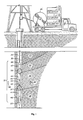
- FIG. 1 To consider aspects of downhole NMR characterizations, using a non-limiting embodiment of a wireline logging device.
- LWD logging-while-drilling
- MWD measurements-while-drilling
- FIG. 1 shows a well logging apparatus disposed in a wellbore 22 penetrating earth formations 23, 24, 26, 28 for making measurements of properties of the earth formations 23, 24, 26, 28 downhole.
- the wellbore 22 in FIG. 1 is typically filled with a fluid 34 known in the art as "drilling mud.”
- a "sensitive volume,” shown generally at 58 and having a generally cylindrical shape, is disposed in one of the earth formations, shown at 26.
- the sensitive volume 58 is a predetermined portion of the earth formations 26 in which nuclear magnetic resonance (NMR) measurements are made, as will be further explained.
- NMR nuclear magnetic resonance
- the sensitive volume 58 includes materials such as would be found downhole (below the surface and within or around the wellbore 22) including a mixture of liquids including gas, water, drilling fluid, oil and formation fluids that are indigenous to the formations 23, 24, 26, 28.
- a string of logging tools 32 is typically lowered into the wellbore 22 by, for example, an armored electrical cable 30 .
- the cable 30 can be spooled and unspooled from a winch or drum 48.
- the tool string 32 can be electrically connected to surface equipment 54 by an insulated electrical conductor (not shown separately in FIG. 1 ) forming part of the cable 30.
- the surface equipment 54 can include one part of a telemetry system 38 for communicating control signals and data to the tool string 32 and computer 40.
- the computer may also include a data recorder 52 for recording measurements made by the apparatus and transmitted to the surface equipment 54.
- the computer includes a variety of input / output devices and other supporting devices to enhance the operation of the apparatus and estimations performed by use thereof.
- An NMR probe 42 can be included in the tool string 32.
- Circuitry for operating the NMR probe 42 can be located within an NMR electronics cartridge 44.
- the circuitry can be connected to the NMR probe 42 through a connector 50.
- the NMR probe 42 is typically located within a protective housing 43 which is designed to exclude the drilling mud 34 from the interior of the probe 42. The function of the probe 42 will be further explained.
- Other well logging sensors may form part of the tool string 32. As shown in FIG. 1 , one additional logging sensor 47 may be located above the NMR electronics cartridge 44. Other logging sensors, such as shown at 41 and 46 may be located within or below the bottom centralizer 57. The other sensors 41, 46, 47 can be of types familiar to those skilled in the art.
- teachings herein may be performed downhole, they are also applicable to evaluations conducted on the surface, such as in a laboratory. Further, and as discussed elsewhere herein, at least a portion of an evaluation or determination may be performed in one place or another. For example, a property of a constituent may be determined in a laboratory, while other measurements and determinations are performed downhole.
- Bo static field strength
- B 1 radiofrequency (RF) field strength
- D diffusivity
- e,E echo amplitude with and without noise included
- f a proton fraction
- G RF field gradient strength
- k represents a number of constituents (i.e., molecular types) within the mixture, and may be used as a subscript
- M represents echo magnetization amplitude
- M z(t) represents a longitudinal magnetization, which involves a time constant T 1 , where T 1 is the time required for the magnetization vector to be restored to 63% of its original amplitude (referred to as "longitudinal relaxation time")
- M x , y represents a transverse magnetization, which involves a time constant T 2 , where T 2 is
- transverse relaxation time T 2 and diffusivity D typically, there are higher values for transverse relaxation time T 2 and diffusivity D for lighter hydrocarbon components.
- the relaxation time T 2 and diffusivity D for each component in a mixture shifts from a respective value in a non-mixture state and may become concentration dependent.
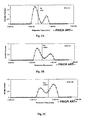
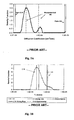
- Transverse relaxation time T 2 data for the mixture are presented in Table 1. Similar data is provided in FIGS. 2 and 3.
- FIG. 3 also takes into consideration certain mixing rules. Table 1 Mixture of C6 and C16 Oil C6 Wt.
- the disclosure herein generally considers that the mixture is binary (i.e., the mixture includes two molecules of interest, molecule A and molecule B). It should be understood that the teachings herein may be applied to mixtures having more than two constituents or components (i.e., molecules of interest) in the mixture.
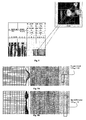
- FIGS. 5-11 provide further depictions of NMR data.
- FIG. 5 shows a dry gas interval having a pronounced peak. There is no significant filtrate invasion identified in this gas interval.
- oil or mixed oil and oil based mud filtrate are also identified.
- FIG. 7 depicts a sample interval further including a potential mixture of mixed wettability (as denoted by the indicator arrow). This mixture has a reduced transverse relaxation time T 2 (but not diffusivity D ). This can be problematic as mixed wetting can effect part of the oil signal. Although it is not probable, it is still possible that diffusivity of the oil is increased due to presence of dissolved gas.
- FIG. 8 depicts aspects of a mixture of oil and OBMF (which is considered mixed wet OBMF).
- OBMF which is considered mixed wet OBMF.
- theoretical analysis provides that for a given GOR, P and T, gas content is approximately 20% of the mixture. Applying experimental analysis, the gas content is approximately 25% of the mixture. This is consistent but semi-quantitative.
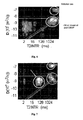
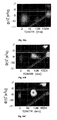
- FIGS. 9A and 9B depict aspects of maps for gas and high GOR zones.
- Related two dimensional maps are provided in FIG. 10 .
- the intensity of the individual two dimensional images were normalized to the highest intensity one among all of the two dimensional images.
- FIG. 11 depicts an exemplary well log for a system applying the teachings herein.
- no fine particle plugging was observed among the three DOIs (2.8, 3.4, 3.7 inches).
- the data involved a running average of thirty two data sets with individual frequency processing.
- ⁇ 1 and ⁇ 2 each represent a gyromagnetic ratio of nuclei involved in the interaction
- ⁇ c represents a correlation time
- h is Plank's constant
- r 12 represents distance between two nuclei.
- the two molecules relax at different rates.
- the relaxation rates T 1 , 2A , T 1 , 2B are also different from the values measured for corresponding non-mixing states.
- T 1 PM 4 ⁇ ⁇ 2 ⁇ N p ⁇ ⁇ 2 ⁇ ⁇ eff 2 kT
- N p represents the number of paramagnetic ions present in the sensitive volume 58 and ⁇ eff represents the effective magnetic moment of the paramagnetic ion.
- T 2 ⁇ LM ⁇ k T 2 , k f k
- Multiphase fluid systems encountered in NMR well logging generally include scenarios where: 1) both vapor and liquid phase hydrocarbons coexist; 2) oil based mud filtrate (OBMF) and native oils occupy different pores separately, such as may result from piston-type invasion flushing; 3) OBMF and native oils are well mixed in porous media; and 4) oil having a high gas-to-oil ratio (GOR) is encountered and contains solution gas mixed with other liquid hydrocarbon components or OBMF.
- GOR gas-to-oil ratio
- Native oil makes reference to deposits of hydrocarbons that are resident downhole and prior to penetration by the wellbore.
- Native oil typically includes a mixture of gas an oil.
- native oil deposits may experience invasion of OBMF during the drilling process, and mixing may occur in varying degrees.
- the relaxation time of the two liquid hydrocarbon components depart from their respective, single-phase relaxation time T 1 , 2 values.
- the resultant relaxation time distribution of the mixed fluid may be unimodal or bimodal.
- the separation between the bimodal peaks may be smaller than that of the second scenario.
- the hydrocarbon components in the mixture may also be non-unimodal. In other words, even though the hydrocarbon components appear macroscopically to be in a single fluid phase, NMR may provide information that reveals otherwise (such as at the molecular level).
- the invention disclosed herein provides for, among other things, identifying fluid properties for individual hydrocarbon constituents (i.e., components) in various forms of a mixture.
- identifying fluid properties for individual hydrocarbon constituents i.e., components
- GOR gas-to-oil ratio
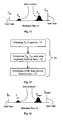
- the high-GOR mixture is described as having a fraction of protons from gas molecules f G , a fraction of protons from liquid molecules f o , and corresponding relaxation times denoted as T 2G and T 2O (in their respective gas-alone or oil-alone state).
- the viscosities of the separate constituent fluids are denoted as ⁇ G and ⁇ o , respectively.
- the mixture i.e., the high-GOR mixture
- the mixture relaxation times T 2g and T 2o are somewhat different than the pure state relaxation times, T 2G and T 2O respectively. This may be seen with greater clarity with regard to the one-dimensional display in FIG.12 .
- the teachings herein provide for solving for GOR from a measured bimodal relaxation time distribution having two peaks at T 2g and T 2o .
- T 2g ⁇ T 2G and T 2o ⁇ T 2O the ratio of the areas under T 2g and T 2o (denoted as f g / fo ) approximates f G / f o . Accordingly, an exemplary method for solving for GOR is provided in FIG.13 .
- a first step 31 calls for obtaining a two-dimensional (2D) map ( T 2 and diffusivity, D) and summarizing intensity under the two peaks ( T 2 g and T 2o ) separately. The result is denoted as f g and f o , respectively.
- a second step 32 calls for computing the proton fraction ratio for gas and liquid components (denoted as f g l f o ).
- a third step calls for converting the proton fraction ratio, f g l f o , to a gas and liquid volume ratio (GOR). Note that it is generally assumed that T 2g ⁇ T 2G and T 2o ⁇ T 2O . Estimation of native oil viscosity, ⁇ , from an OBMF contaminated mixture is described by the third scenario above.
- the third scenario describes a system where OBMF is well mixed with native oil and well disbursed within pores in the formations 23, 24, 26, 28.
- the technique described in this embodiment provides for cases where the viscosities of the OBMF and native oil has substantially different; that is, where these two fluids include hydrocarbon molecules that are substantially different in carbon numbers such that the corresponding T 2 values are sufficiently different.
- the relaxation time of the OBMF alone, T 2,OBMF is known.
- the relaxation time of the OBMF alone, T 2 , OBMF is often readily available by prior knowledge, or by measuring the properties of the OBMF in a laboratory.
- the usually unknown relaxation time of the native oil, T 2o is needed for estimating the native, reservoir oil viscosity.
- the log derived relaxation times shows two peaks at T 2 , obmf and T 2o respectively, and in general, it may be considered that T 2,obmf ⁇ T 2,OBMF and T 2o ⁇ T 2o .
- T 2 ⁇ LM T 2 ⁇ OBMF f OBMF ⁇ T 2 ⁇ O f O
- T 2 ⁇ LM ⁇ ⁇ i T 2 ⁇ i f i
- f i the individual bin-porosity corresponding to T 2i
- the OBMF and oil are separable on the T 2 spectrum such that f OBMF ⁇ f obmf .
- the teachings provide for estimating the quantity of OBMF and native oil when measurement data overlaps.
- another aspect of the third scenario is considered.
- both the OBMF and native oil viscosities, ⁇ are known.
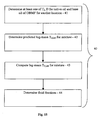
- NMR response signals for the native oil and OBMF are considerably overlapped ( T 2 and/or diffusivity D ). Accordingly, the objective is to determine quantities of native hydrocarbon and the OBMF. An exemplary method for this is provided in FIG .15
- the exemplary method 40 for determining quantities of native hydrocarbon and OBMF when NMR measurements overlap generally calls for four steps.
- a first step 41 the native oil and base oil of the OBMF from the same reservoir for an adjacent well is determined. Typically, this calls for measuring the NMR response (such as T 2 and diffusivity) directly, or learning the property such as by deriving the NMR response using known correlations or referring to a source of property information.
- the predicted log-mean T 2 response of the mixture fluid is formulated, assuming an appropriate mixing rule is known. The fraction of invaded OBMF is unknown.
- Eq. (12) provides an exemplary formulation for predicting the log-mean T 2LM response.
- a third step 43 the log-mean of the mixture T 2 , LM is computed from the T 2 distribution.
- the technique involves only the transverse relaxation time T 2 .
- the technique can be applied to longitudinal relaxation time T 1 , diffusivity D, and the cross-plot of the two (commonly known as two-dimensional (2D) NMR) as well as cross-plots between diffusivity D and T 2 , between T 1 and T 2 , and the combinations thereof.
- various analysis components may be used, including digital and/or an analog systems.
- the system may have components such as a computer, a processor, storage media, memory, input, output, communications link (wired, wireless, pulsed mud, optical or other), user interfaces, software programs, signal processors (digital or analog) and other such components (such as resistors, capacitors, inductors and others) to provide for operation and analyses of the apparatus and methods disclosed herein in any of several manners well-appreciated in the art.
- teachings may be, but need not be, implemented in conjunction with a set of computer executable instructions stored on a computer readable medium, including memory (ROMs, RAMS), optical (CD-ROMs), or magnetic (disks, hard drives), or any other type that when executed causes a computer to implement the method of the present invention.
- ROMs read-only memory
- CD-ROMs compact disc-read only memory
- magnetic (disks, hard drives) any other type that when executed causes a computer to implement the method of the present invention.
- These instructions may provide for equipment operation, control, data collection and analysis and other functions deemed relevant by a system designer, owner, user or other such personnel, in addition to the functions described in this disclosure.
- a sample line, sample storage, sample chamber, sample exhaust, pump, piston, power supply e.g., at least one of a generator, a remote supply and a battery
- vacuum supply e.g., at least one of a generator, a remote supply and a battery
- refrigeration i.e., cooling
- heating component e.g., heating component
- motive force such as a translational force, propulsional force or a rotational force
- magnet electromagnet
- sensor electrode
- transmitter, receiver, transceiver e.g., transceiver
- controller e.g., optical unit, electrical unit or electromechanical unit
Landscapes
- Physics & Mathematics (AREA)
- Life Sciences & Earth Sciences (AREA)
- High Energy & Nuclear Physics (AREA)
- Engineering & Computer Science (AREA)
- Health & Medical Sciences (AREA)
- General Physics & Mathematics (AREA)
- Nuclear Medicine, Radiotherapy & Molecular Imaging (AREA)
- Geology (AREA)
- General Health & Medical Sciences (AREA)
- General Life Sciences & Earth Sciences (AREA)
- Environmental & Geological Engineering (AREA)
- Signal Processing (AREA)
- Biochemistry (AREA)
- Radiology & Medical Imaging (AREA)
- Geochemistry & Mineralogy (AREA)
- Vascular Medicine (AREA)
- Chemical & Material Sciences (AREA)
- Analytical Chemistry (AREA)
- Condensed Matter Physics & Semiconductors (AREA)
- Immunology (AREA)
- Pathology (AREA)
- Remote Sensing (AREA)
- Geophysics (AREA)
- Other Investigation Or Analysis Of Materials By Electrical Means (AREA)
- Production Of Liquid Hydrocarbon Mixture For Refining Petroleum (AREA)
- Measurement Of Mechanical Vibrations Or Ultrasonic Waves (AREA)
Claims (2)
- Verfahren zur Schätzung eines Gas-zu-Öl-Verhältnisses (GOR) eines Gemisches mit einem hohen GOR, das Öl und Lösungsgas einschließt, wobei eine zweidimensionale T2-D-Abbildung Diffusionskoeffizienten D zu den transversen Relaxationszeiten T2 des Gemisches in Beziehung setzt, wobei sie separate Spitzen für das Öl bzw. das Lösungsgas zeigt;
wobei das Verfahren umfasst:- Berechnung eines Protonenfraktionsverhältnisses von Gasmolekülen zu Ölmolekülen in dem Gemisch als dem Quotienten der Intensitätensumme der Gasspitzen bzw. der Ölspitzen; und- Umwandlung des Protonenfraktionsverhältnisses zu dem GOR für das Gemisch. - Verfahren nach Anspruch 1, das weiterhin die Bestimmung einer Viskosität von gashaltigem Öl aus dem GOR umfasst.
Applications Claiming Priority (2)
| Application Number | Priority Date | Filing Date | Title |
|---|---|---|---|
| US11/678,341 US7768260B2 (en) | 2007-02-23 | 2007-02-23 | Methods for identification and quantification of multicomponent-fluid and estimating fluid gas/ oil ratio from NMR logs |
| PCT/US2008/054232 WO2008103635A1 (en) | 2007-02-23 | 2008-02-19 | Nmr-methods for identification and quantification of components in a fluid |
Publications (2)
| Publication Number | Publication Date |
|---|---|
| EP2115486A1 EP2115486A1 (de) | 2009-11-11 |
| EP2115486B1 true EP2115486B1 (de) | 2012-07-25 |
Family
ID=39496149
Family Applications (1)
| Application Number | Title | Priority Date | Filing Date |
|---|---|---|---|
| EP08730103A Active EP2115486B1 (de) | 2007-02-23 | 2008-02-19 | Nmr-verfahren zur identifikation und quantifizierung von komponenten in einer flüssigkeit |
Country Status (4)
| Country | Link |
|---|---|
| US (1) | US7768260B2 (de) |
| EP (1) | EP2115486B1 (de) |
| CA (1) | CA2678503A1 (de) |
| WO (1) | WO2008103635A1 (de) |
Cited By (1)
| Publication number | Priority date | Publication date | Assignee | Title |
|---|---|---|---|---|
| WO2015178934A1 (en) * | 2014-05-23 | 2015-11-26 | Landmark Graphics Corporation | Robust viscosity estimation methods and systems |
Families Citing this family (29)
| Publication number | Priority date | Publication date | Assignee | Title |
|---|---|---|---|---|
| US7768260B2 (en) * | 2007-02-23 | 2010-08-03 | Baker Hughes Incorporated | Methods for identification and quantification of multicomponent-fluid and estimating fluid gas/ oil ratio from NMR logs |
| WO2009045670A1 (en) * | 2007-10-05 | 2009-04-09 | Exxonmobil Upstream Research Company | Method and apparatus for detection of a liquid under a surface |
| US7924001B2 (en) * | 2008-05-23 | 2011-04-12 | Schlumberger Technology Corp. | Determination of oil viscosity and continuous gas oil ratio from nuclear magnetic resonance logs |
| CA2730067A1 (en) * | 2008-07-11 | 2010-01-14 | Schlumberger Canada Limited | Nmr logging of miscible displacement |
| RU2411508C1 (ru) * | 2009-10-19 | 2011-02-10 | Государственное образовательное учреждение высшего профессионального образования "Казанский государственный энергетический университет" (КГЭУ) | Способ оперативного контроля компонентов и отдельных органических соединений в их смесях |
| US8532929B2 (en) * | 2009-12-07 | 2013-09-10 | Baker Hughes Incorporated | Method and apparatus to incorporate internal gradient and restricted diffusion in NMR inversion |
| US10677718B2 (en) | 2011-02-22 | 2020-06-09 | Saudi Arabian Oil Company | Characterization of crude oil by near infrared spectroscopy |
| US10684239B2 (en) | 2011-02-22 | 2020-06-16 | Saudi Arabian Oil Company | Characterization of crude oil by NMR spectroscopy |
| US11022588B2 (en) | 2011-02-22 | 2021-06-01 | Saudi Arabian Oil Company | Characterization of crude oil by simulated distillation |
| US10571452B2 (en) | 2011-06-28 | 2020-02-25 | Saudi Arabian Oil Company | Characterization of crude oil by high pressure liquid chromatography |
| US10725013B2 (en) | 2011-06-29 | 2020-07-28 | Saudi Arabian Oil Company | Characterization of crude oil by Fourier transform ion cyclotron resonance mass spectrometry |
| WO2013009299A1 (en) | 2011-07-12 | 2013-01-17 | Halliburton Energy Services, Inc. | Nmr tracking of injected fluids |
| WO2013066549A1 (en) * | 2011-10-31 | 2013-05-10 | Baker Hughes Incorporated | Hydrocarbon determination in unconventional shale |
| US9285497B2 (en) * | 2012-02-13 | 2016-03-15 | Baker Hughes Incorporated | Porosity estimator for formate brine invaded hydrocarbon zone |
| WO2015084347A1 (en) | 2013-12-04 | 2015-06-11 | Exxonmobil Upstream Research Company | Method and system for detection of a material within a region of the earth |
| US10197697B2 (en) | 2013-12-12 | 2019-02-05 | Halliburton Energy Services, Inc. | Modeling subterranean formation permeability |
| MX2016005259A (es) | 2013-12-12 | 2017-01-05 | Halliburton Energy Services Inc | Modalidad de modelos de viscosidad de fluidos subterraneos. |
| DE102014010238A1 (de) | 2014-02-20 | 2015-09-03 | Krohne Ag | Durchflussmessgerät mit einer ein tomographisches Messprinzip umsetzenden Messvorrichtung |
| KR20170118713A (ko) | 2015-01-05 | 2017-10-25 | 사우디 아라비안 오일 컴퍼니 | 나프타 스트림에 대한 상대적인 가치 평가 방법 |
| SG11201705471TA (en) | 2015-01-05 | 2017-08-30 | Saudi Arabian Oil Co | Characterization of crude oil by ultraviolet visible spectroscopy |
| EP3243067B1 (de) | 2015-01-05 | 2020-04-08 | Saudi Arabian Oil Company | Charakterisierung von rohöl durch nahinfrarot-spektroskopie |
| JP6792557B2 (ja) | 2015-01-05 | 2020-11-25 | サウジ アラビアン オイル カンパニー | 熱重量分析による原油およびその留分のキャラクタリゼーション |
| WO2016122531A1 (en) * | 2015-01-29 | 2016-08-04 | Halliburton Energy Services, Inc. | Determining the oleophilic to aqueous phase fluid ratio for drilling fluids |
| US10739489B2 (en) * | 2016-01-15 | 2020-08-11 | Baker Hughes, A Ge Company, Llc | Low gradient magnetic resonance logging for measurement of light hydrocarbon reservoirs |
| CN109386282B (zh) * | 2017-08-09 | 2022-02-15 | 中国石油化工股份有限公司 | 一种混油钻井液条件下钻遇油层的判识方法 |
| US11913332B2 (en) | 2022-02-28 | 2024-02-27 | Saudi Arabian Oil Company | Method to prepare virtual assay using fourier transform infrared spectroscopy |
| US12243627B2 (en) | 2022-02-28 | 2025-03-04 | Saudi Arabian Oil Company | Method to prepare virtual assay using Fourier transform ion cyclotron resonance mass spectroscopy |
| US12354712B2 (en) | 2022-02-28 | 2025-07-08 | Saudi Arabian Oil Company | Method to prepare virtual assay using nuclear magnetic resonance spectroscopy |
| US11781988B2 (en) | 2022-02-28 | 2023-10-10 | Saudi Arabian Oil Company | Method to prepare virtual assay using fluorescence spectroscopy |
Citations (1)
| Publication number | Priority date | Publication date | Assignee | Title |
|---|---|---|---|---|
| US20050270023A1 (en) * | 2004-06-04 | 2005-12-08 | Robert Freedman | Method and apparatus for using pulsed field gradient NMR measurements to determine fluid properties in a fluid sampling well logging tool |
Family Cites Families (14)
| Publication number | Priority date | Publication date | Assignee | Title |
|---|---|---|---|---|
| NL265991A (de) * | 1960-06-15 | |||
| US4710713A (en) * | 1986-03-11 | 1987-12-01 | Numar Corporation | Nuclear magnetic resonance sensing apparatus and techniques |
| US7226484B2 (en) * | 1994-04-19 | 2007-06-05 | Applied Elastomerics, Inc. | Tear resistant gels and articles for every uses |
| US5712566A (en) * | 1996-02-23 | 1998-01-27 | Western Atlas International, Inc. | Nuclear magnetic resonance apparatus and method |
| US6891369B2 (en) * | 1998-08-13 | 2005-05-10 | Schlumberger Technology Corporation | Nuclear magnetic resonance method and logging apparatus for fluid analysis |
| US6229308B1 (en) * | 1998-11-19 | 2001-05-08 | Schlumberger Technology Corporation | Formation evaluation using magnetic resonance logging measurements |
| US6650114B2 (en) * | 2001-06-28 | 2003-11-18 | Baker Hughes Incorporated | NMR data acquisition with multiple interecho spacing |
| US6859032B2 (en) * | 2001-12-18 | 2005-02-22 | Schlumberger Technology Corporation | Method for determining molecular properties of hydrocarbon mixtures from NMR data |
| US7396971B2 (en) * | 2002-08-01 | 2008-07-08 | Exxonmobil Chemical Patents Inc. | Two stage hydrocarbon conversion reaction system |
| US7629416B2 (en) * | 2002-08-12 | 2009-12-08 | Exxonmobil Chemical Patents Inc. | Plasticized polyolefin compositions |
| US7795366B2 (en) * | 2002-08-12 | 2010-09-14 | Exxonmobil Chemical Patents Inc. | Modified polyethylene compositions |
| US6859033B2 (en) * | 2002-08-28 | 2005-02-22 | Schlumberger Technology Corporation | Method for magnetic resonance fluid characterization |
| BRPI0418081A (pt) * | 2003-12-24 | 2007-04-17 | Halliburton Energy Serv Inc | métodos para estimar nìveis de contaminação em fluidos em um furo de sondagem, e para testagem de formação no furo descendente, aparelho para estimar nìveis de contaminação de fluidos de formação em um furo de sondagem, e, meio utilizável por computador |
| US7768260B2 (en) * | 2007-02-23 | 2010-08-03 | Baker Hughes Incorporated | Methods for identification and quantification of multicomponent-fluid and estimating fluid gas/ oil ratio from NMR logs |
-
2007
- 2007-02-23 US US11/678,341 patent/US7768260B2/en active Active
-
2008
- 2008-02-19 WO PCT/US2008/054232 patent/WO2008103635A1/en not_active Ceased
- 2008-02-19 CA CA002678503A patent/CA2678503A1/en not_active Abandoned
- 2008-02-19 EP EP08730103A patent/EP2115486B1/de active Active
Patent Citations (1)
| Publication number | Priority date | Publication date | Assignee | Title |
|---|---|---|---|---|
| US20050270023A1 (en) * | 2004-06-04 | 2005-12-08 | Robert Freedman | Method and apparatus for using pulsed field gradient NMR measurements to determine fluid properties in a fluid sampling well logging tool |
Cited By (1)
| Publication number | Priority date | Publication date | Assignee | Title |
|---|---|---|---|---|
| WO2015178934A1 (en) * | 2014-05-23 | 2015-11-26 | Landmark Graphics Corporation | Robust viscosity estimation methods and systems |
Also Published As
| Publication number | Publication date |
|---|---|
| WO2008103635A8 (en) | 2008-12-04 |
| US7768260B2 (en) | 2010-08-03 |
| WO2008103635A4 (en) | 2009-02-12 |
| EP2115486A1 (de) | 2009-11-11 |
| US20080206887A1 (en) | 2008-08-28 |
| CA2678503A1 (en) | 2008-08-28 |
| WO2008103635A1 (en) | 2008-08-28 |
Similar Documents
| Publication | Publication Date | Title |
|---|---|---|
| EP2115486B1 (de) | Nmr-verfahren zur identifikation und quantifizierung von komponenten in einer flüssigkeit | |
| Elsayed et al. | A review on the applications of nuclear magnetic resonance (NMR) in the oil and gas industry: laboratory and field-scale measurements | |
| RU2377609C2 (ru) | Способ и устройство для использования ядерно-магнитных резонансных измерений с градиентами импульсного поля для определения характеристик флюидов в скважинном каротажном приборе для отбора проб флюидов | |
| CN100504366C (zh) | 用于通过核磁共振数据确定烃类混合物的分子特性的方法 | |
| Freedman et al. | Fluid characterization using nuclear magnetic resonance logging | |
| Howard et al. | NMR in partially saturated rocks: laboratory insights on free fluid index and comparison with borehole logs | |
| US6765380B2 (en) | Determining wettability of an oil reservoir using borehole NMR measurements | |
| US10527566B2 (en) | Methods for determining oil and water compositions in drilling muds | |
| US10900915B2 (en) | NMR sequential fluid characterization | |
| US20090179636A1 (en) | Method of discerning water from hydrocarbon fluids using downhole nmr instruments in petroleum reservoirs with formation brine | |
| US20090066327A1 (en) | Method and computer program product for estimating true intrinsic relaxation time and internal gradient from multigradient nmr logging | |
| Liang et al. | Wettability characterization of low-permeability reservoirs using nuclear magnetic resonance: An experimental study | |
| US10557809B2 (en) | Modified pulse sequence to estimate properties | |
| US9459370B2 (en) | Method of determining formation parameter | |
| Yang et al. | 23Na and 1H NMR relaxometry of shale at high magnetic field | |
| US7511488B2 (en) | Viscosity determination from logarithmic mean ratio of relaxation times | |
| Zhong et al. | Determination of Archie's cementation exponent for shale reservoirs; an experimental approach | |
| Hürlimann et al. | Hydrocarbon composition from NMR diffusion and relaxation data | |
| Freedman et al. | Field applications of a new nuclear magnetic resonance fluid characterization method | |
| Appel | Nuclear magnetic resonance and formation porosity | |
| Washburn et al. | A new laboratory approach to shale analysis using NMR relaxometry | |
| Washburn et al. | Low-field nuclear magnetic resonance characterization of organic content in shales | |
| Song et al. | Two-dimensional NMR of Diffusion and Relaxation | |
| US7301339B1 (en) | Estimating the concentration of a substance in a sample using NMR | |
| Winkler et al. | The limits of fluid property correlations used in NMR well logging: an experimental study of reservoir fluids at reservoir conditions |
Legal Events
| Date | Code | Title | Description |
|---|---|---|---|
| PUAI | Public reference made under article 153(3) epc to a published international application that has entered the european phase |
Free format text: ORIGINAL CODE: 0009012 |
|
| 17P | Request for examination filed |
Effective date: 20090916 |
|
| AK | Designated contracting states |
Kind code of ref document: A1 Designated state(s): AT BE BG CH CY CZ DE DK EE ES FI FR GB GR HR HU IE IS IT LI LT LU LV MC MT NL NO PL PT RO SE SI SK TR |
|
| DAX | Request for extension of the european patent (deleted) | ||
| 17Q | First examination report despatched |
Effective date: 20110318 |
|
| REG | Reference to a national code |
Ref country code: DE Ref legal event code: R079 Ref document number: 602008017404 Country of ref document: DE Free format text: PREVIOUS MAIN CLASS: G01R0033440000 Ipc: G01N0024080000 |
|
| GRAP | Despatch of communication of intention to grant a patent |
Free format text: ORIGINAL CODE: EPIDOSNIGR1 |
|
| RIC1 | Information provided on ipc code assigned before grant |
Ipc: G01N 24/08 20060101AFI20120210BHEP Ipc: G01V 3/32 20060101ALI20120210BHEP |
|
| GRAS | Grant fee paid |
Free format text: ORIGINAL CODE: EPIDOSNIGR3 |
|
| GRAA | (expected) grant |
Free format text: ORIGINAL CODE: 0009210 |
|
| RIN1 | Information on inventor provided before grant (corrected) |
Inventor name: CHEN, SONGHUA Inventor name: CHEN, JIANSHENG Inventor name: KWAK, HYUNG, T. |
|
| AK | Designated contracting states |
Kind code of ref document: B1 Designated state(s): AT BE BG CH CY CZ DE DK EE ES FI FR GB GR HR HU IE IS IT LI LT LU LV MC MT NL NO PL PT RO SE SI SK TR |
|
| REG | Reference to a national code |
Ref country code: GB Ref legal event code: FG4D |
|
| REG | Reference to a national code |
Ref country code: CH Ref legal event code: EP |
|
| REG | Reference to a national code |
Ref country code: AT Ref legal event code: REF Ref document number: 567895 Country of ref document: AT Kind code of ref document: T Effective date: 20120815 Ref country code: IE Ref legal event code: FG4D |
|
| REG | Reference to a national code |
Ref country code: DE Ref legal event code: R096 Ref document number: 602008017404 Country of ref document: DE Effective date: 20120920 |
|
| REG | Reference to a national code |
Ref country code: NO Ref legal event code: T2 Effective date: 20120725 |
|
| REG | Reference to a national code |
Ref country code: NL Ref legal event code: VDEP Effective date: 20120725 |
|
| REG | Reference to a national code |
Ref country code: AT Ref legal event code: MK05 Ref document number: 567895 Country of ref document: AT Kind code of ref document: T Effective date: 20120725 |
|
| REG | Reference to a national code |
Ref country code: LT Ref legal event code: MG4D Effective date: 20120725 |
|
| PG25 | Lapsed in a contracting state [announced via postgrant information from national office to epo] |
Ref country code: BE Free format text: LAPSE BECAUSE OF FAILURE TO SUBMIT A TRANSLATION OF THE DESCRIPTION OR TO PAY THE FEE WITHIN THE PRESCRIBED TIME-LIMIT Effective date: 20120725 Ref country code: IS Free format text: LAPSE BECAUSE OF FAILURE TO SUBMIT A TRANSLATION OF THE DESCRIPTION OR TO PAY THE FEE WITHIN THE PRESCRIBED TIME-LIMIT Effective date: 20121125 Ref country code: AT Free format text: LAPSE BECAUSE OF FAILURE TO SUBMIT A TRANSLATION OF THE DESCRIPTION OR TO PAY THE FEE WITHIN THE PRESCRIBED TIME-LIMIT Effective date: 20120725 Ref country code: CY Free format text: LAPSE BECAUSE OF FAILURE TO SUBMIT A TRANSLATION OF THE DESCRIPTION OR TO PAY THE FEE WITHIN THE PRESCRIBED TIME-LIMIT Effective date: 20120725 Ref country code: LT Free format text: LAPSE BECAUSE OF FAILURE TO SUBMIT A TRANSLATION OF THE DESCRIPTION OR TO PAY THE FEE WITHIN THE PRESCRIBED TIME-LIMIT Effective date: 20120725 Ref country code: HR Free format text: LAPSE BECAUSE OF FAILURE TO SUBMIT A TRANSLATION OF THE DESCRIPTION OR TO PAY THE FEE WITHIN THE PRESCRIBED TIME-LIMIT Effective date: 20120725 Ref country code: FI Free format text: LAPSE BECAUSE OF FAILURE TO SUBMIT A TRANSLATION OF THE DESCRIPTION OR TO PAY THE FEE WITHIN THE PRESCRIBED TIME-LIMIT Effective date: 20120725 |
|
| PGFP | Annual fee paid to national office [announced via postgrant information from national office to epo] |
Ref country code: MC Payment date: 20121231 Year of fee payment: 6 |
|
| PG25 | Lapsed in a contracting state [announced via postgrant information from national office to epo] |
Ref country code: PL Free format text: LAPSE BECAUSE OF FAILURE TO SUBMIT A TRANSLATION OF THE DESCRIPTION OR TO PAY THE FEE WITHIN THE PRESCRIBED TIME-LIMIT Effective date: 20120725 Ref country code: LV Free format text: LAPSE BECAUSE OF FAILURE TO SUBMIT A TRANSLATION OF THE DESCRIPTION OR TO PAY THE FEE WITHIN THE PRESCRIBED TIME-LIMIT Effective date: 20120725 Ref country code: SI Free format text: LAPSE BECAUSE OF FAILURE TO SUBMIT A TRANSLATION OF THE DESCRIPTION OR TO PAY THE FEE WITHIN THE PRESCRIBED TIME-LIMIT Effective date: 20120725 Ref country code: SE Free format text: LAPSE BECAUSE OF FAILURE TO SUBMIT A TRANSLATION OF THE DESCRIPTION OR TO PAY THE FEE WITHIN THE PRESCRIBED TIME-LIMIT Effective date: 20120725 Ref country code: GR Free format text: LAPSE BECAUSE OF FAILURE TO SUBMIT A TRANSLATION OF THE DESCRIPTION OR TO PAY THE FEE WITHIN THE PRESCRIBED TIME-LIMIT Effective date: 20121026 Ref country code: PT Free format text: LAPSE BECAUSE OF FAILURE TO SUBMIT A TRANSLATION OF THE DESCRIPTION OR TO PAY THE FEE WITHIN THE PRESCRIBED TIME-LIMIT Effective date: 20121126 |
|
| PG25 | Lapsed in a contracting state [announced via postgrant information from national office to epo] |
Ref country code: NL Free format text: LAPSE BECAUSE OF FAILURE TO SUBMIT A TRANSLATION OF THE DESCRIPTION OR TO PAY THE FEE WITHIN THE PRESCRIBED TIME-LIMIT Effective date: 20120725 |
|
| PG25 | Lapsed in a contracting state [announced via postgrant information from national office to epo] |
Ref country code: EE Free format text: LAPSE BECAUSE OF FAILURE TO SUBMIT A TRANSLATION OF THE DESCRIPTION OR TO PAY THE FEE WITHIN THE PRESCRIBED TIME-LIMIT Effective date: 20120725 Ref country code: DK Free format text: LAPSE BECAUSE OF FAILURE TO SUBMIT A TRANSLATION OF THE DESCRIPTION OR TO PAY THE FEE WITHIN THE PRESCRIBED TIME-LIMIT Effective date: 20120725 Ref country code: ES Free format text: LAPSE BECAUSE OF FAILURE TO SUBMIT A TRANSLATION OF THE DESCRIPTION OR TO PAY THE FEE WITHIN THE PRESCRIBED TIME-LIMIT Effective date: 20121105 Ref country code: CZ Free format text: LAPSE BECAUSE OF FAILURE TO SUBMIT A TRANSLATION OF THE DESCRIPTION OR TO PAY THE FEE WITHIN THE PRESCRIBED TIME-LIMIT Effective date: 20120725 Ref country code: RO Free format text: LAPSE BECAUSE OF FAILURE TO SUBMIT A TRANSLATION OF THE DESCRIPTION OR TO PAY THE FEE WITHIN THE PRESCRIBED TIME-LIMIT Effective date: 20120725 |
|
| PGFP | Annual fee paid to national office [announced via postgrant information from national office to epo] |
Ref country code: FR Payment date: 20130301 Year of fee payment: 6 |
|
| PG25 | Lapsed in a contracting state [announced via postgrant information from national office to epo] |
Ref country code: SK Free format text: LAPSE BECAUSE OF FAILURE TO SUBMIT A TRANSLATION OF THE DESCRIPTION OR TO PAY THE FEE WITHIN THE PRESCRIBED TIME-LIMIT Effective date: 20120725 |
|
| PLBE | No opposition filed within time limit |
Free format text: ORIGINAL CODE: 0009261 |
|
| STAA | Information on the status of an ep patent application or granted ep patent |
Free format text: STATUS: NO OPPOSITION FILED WITHIN TIME LIMIT |
|
| 26N | No opposition filed |
Effective date: 20130426 |
|
| PG25 | Lapsed in a contracting state [announced via postgrant information from national office to epo] |
Ref country code: BG Free format text: LAPSE BECAUSE OF FAILURE TO SUBMIT A TRANSLATION OF THE DESCRIPTION OR TO PAY THE FEE WITHIN THE PRESCRIBED TIME-LIMIT Effective date: 20121025 |
|
| REG | Reference to a national code |
Ref country code: DE Ref legal event code: R097 Ref document number: 602008017404 Country of ref document: DE Effective date: 20130426 |
|
| PG25 | Lapsed in a contracting state [announced via postgrant information from national office to epo] |
Ref country code: IT Free format text: LAPSE BECAUSE OF FAILURE TO SUBMIT A TRANSLATION OF THE DESCRIPTION OR TO PAY THE FEE WITHIN THE PRESCRIBED TIME-LIMIT Effective date: 20120725 |
|
| REG | Reference to a national code |
Ref country code: CH Ref legal event code: PL |
|
| PG25 | Lapsed in a contracting state [announced via postgrant information from national office to epo] |
Ref country code: CH Free format text: LAPSE BECAUSE OF NON-PAYMENT OF DUE FEES Effective date: 20130228 Ref country code: LI Free format text: LAPSE BECAUSE OF NON-PAYMENT OF DUE FEES Effective date: 20130228 |
|
| REG | Reference to a national code |
Ref country code: IE Ref legal event code: MM4A |
|
| REG | Reference to a national code |
Ref country code: DE Ref legal event code: R119 Ref document number: 602008017404 Country of ref document: DE Effective date: 20130903 |
|
| PG25 | Lapsed in a contracting state [announced via postgrant information from national office to epo] |
Ref country code: DE Free format text: LAPSE BECAUSE OF NON-PAYMENT OF DUE FEES Effective date: 20130903 Ref country code: IE Free format text: LAPSE BECAUSE OF NON-PAYMENT OF DUE FEES Effective date: 20130219 |
|
| PG25 | Lapsed in a contracting state [announced via postgrant information from national office to epo] |
Ref country code: MT Free format text: LAPSE BECAUSE OF FAILURE TO SUBMIT A TRANSLATION OF THE DESCRIPTION OR TO PAY THE FEE WITHIN THE PRESCRIBED TIME-LIMIT Effective date: 20120725 |
|
| PG25 | Lapsed in a contracting state [announced via postgrant information from national office to epo] |
Ref country code: MC Free format text: LAPSE BECAUSE OF NON-PAYMENT OF DUE FEES Effective date: 20140228 |
|
| REG | Reference to a national code |
Ref country code: FR Ref legal event code: ST Effective date: 20141031 |
|
| PG25 | Lapsed in a contracting state [announced via postgrant information from national office to epo] |
Ref country code: FR Free format text: LAPSE BECAUSE OF NON-PAYMENT OF DUE FEES Effective date: 20140228 |
|
| PG25 | Lapsed in a contracting state [announced via postgrant information from national office to epo] |
Ref country code: TR Free format text: LAPSE BECAUSE OF FAILURE TO SUBMIT A TRANSLATION OF THE DESCRIPTION OR TO PAY THE FEE WITHIN THE PRESCRIBED TIME-LIMIT Effective date: 20120725 |
|
| PG25 | Lapsed in a contracting state [announced via postgrant information from national office to epo] |
Ref country code: LU Free format text: LAPSE BECAUSE OF NON-PAYMENT OF DUE FEES Effective date: 20130219 Ref country code: HU Free format text: LAPSE BECAUSE OF FAILURE TO SUBMIT A TRANSLATION OF THE DESCRIPTION OR TO PAY THE FEE WITHIN THE PRESCRIBED TIME-LIMIT; INVALID AB INITIO Effective date: 20080219 |
|
| P01 | Opt-out of the competence of the unified patent court (upc) registered |
Effective date: 20230526 |
|
| PGFP | Annual fee paid to national office [announced via postgrant information from national office to epo] |
Ref country code: NO Payment date: 20250321 Year of fee payment: 18 |
|
| PGFP | Annual fee paid to national office [announced via postgrant information from national office to epo] |
Ref country code: GB Payment date: 20250325 Year of fee payment: 18 |