EP2113009B1 - Verfahren zur aufreinigung wasserlöslicher polymere - Google Patents
Verfahren zur aufreinigung wasserlöslicher polymere Download PDFInfo
- Publication number
- EP2113009B1 EP2113009B1 EP07701815.8A EP07701815A EP2113009B1 EP 2113009 B1 EP2113009 B1 EP 2113009B1 EP 07701815 A EP07701815 A EP 07701815A EP 2113009 B1 EP2113009 B1 EP 2113009B1
- Authority
- EP
- European Patent Office
- Prior art keywords
- polymer
- peg
- mpeg
- polymers
- mixture
- Prior art date
- Legal status (The legal status is an assumption and is not a legal conclusion. Google has not performed a legal analysis and makes no representation as to the accuracy of the status listed.)
- Active
Links
- 238000000034 method Methods 0.000 title claims description 110
- 230000008569 process Effects 0.000 title claims description 71
- 229920003169 water-soluble polymer Polymers 0.000 title claims description 23
- 238000000746 purification Methods 0.000 title description 64
- 229920001223 polyethylene glycol Polymers 0.000 claims description 308
- 229920000642 polymer Polymers 0.000 claims description 286
- -1 poly(ethylene glycol) Polymers 0.000 claims description 206
- 239000000203 mixture Substances 0.000 claims description 127
- 238000005342 ion exchange Methods 0.000 claims description 62
- 238000006243 chemical reaction Methods 0.000 claims description 53
- 238000004458 analytical method Methods 0.000 claims description 51
- 238000000926 separation method Methods 0.000 claims description 43
- 229920002959 polymer blend Polymers 0.000 claims description 31
- 238000004255 ion exchange chromatography Methods 0.000 claims description 28
- 125000002887 hydroxy group Chemical group [H]O* 0.000 claims description 22
- SRPWOOOHEPICQU-UHFFFAOYSA-N trimellitic anhydride Chemical compound OC(=O)C1=CC=C2C(=O)OC(=O)C2=C1 SRPWOOOHEPICQU-UHFFFAOYSA-N 0.000 claims description 19
- IAYPIBMASNFSPL-UHFFFAOYSA-N Ethylene oxide Chemical compound C1CO1 IAYPIBMASNFSPL-UHFFFAOYSA-N 0.000 claims description 16
- 238000006116 polymerization reaction Methods 0.000 claims description 11
- GTDPSWPPOUPBNX-UHFFFAOYSA-N ac1mqpva Chemical compound CC12C(=O)OC(=O)C1(C)C1(C)C2(C)C(=O)OC1=O GTDPSWPPOUPBNX-UHFFFAOYSA-N 0.000 claims description 8
- 238000005917 acylation reaction Methods 0.000 claims description 8
- 150000001346 alkyl aryl ethers Chemical group 0.000 claims description 8
- ANSXAPJVJOKRDJ-UHFFFAOYSA-N furo[3,4-f][2]benzofuran-1,3,5,7-tetrone Chemical compound C1=C2C(=O)OC(=O)C2=CC2=C1C(=O)OC2=O ANSXAPJVJOKRDJ-UHFFFAOYSA-N 0.000 claims description 8
- 150000005215 alkyl ethers Chemical class 0.000 claims description 7
- 125000000217 alkyl group Chemical group 0.000 claims description 7
- 230000010933 acylation Effects 0.000 claims description 6
- 125000001797 benzyl group Chemical group [H]C1=C([H])C([H])=C(C([H])=C1[H])C([H])([H])* 0.000 claims description 5
- 125000002496 methyl group Chemical group [H]C([H])([H])* 0.000 claims description 5
- OFXSXYCSPVKZPF-UHFFFAOYSA-N methoxyperoxymethane Chemical group COOOC OFXSXYCSPVKZPF-UHFFFAOYSA-N 0.000 claims description 4
- 125000002221 trityl group Chemical group [H]C1=C([H])C([H])=C([H])C([H])=C1C([*])(C1=C(C(=C(C(=C1[H])[H])[H])[H])[H])C1=C([H])C([H])=C([H])C([H])=C1[H] 0.000 claims description 4
- 125000004432 carbon atom Chemical group C* 0.000 claims description 3
- CURBACXRQKTCKZ-UHFFFAOYSA-N cyclobutane-1,2,3,4-tetracarboxylic acid Chemical compound OC(=O)C1C(C(O)=O)C(C(O)=O)C1C(O)=O CURBACXRQKTCKZ-UHFFFAOYSA-N 0.000 claims description 3
- 229920000233 poly(alkylene oxides) Polymers 0.000 claims 5
- 125000002947 alkylene group Chemical group 0.000 claims 2
- 125000004178 (C1-C4) alkyl group Chemical group 0.000 claims 1
- 239000000463 material Substances 0.000 description 105
- YMWUJEATGCHHMB-UHFFFAOYSA-N Dichloromethane Chemical compound ClCCl YMWUJEATGCHHMB-UHFFFAOYSA-N 0.000 description 90
- 239000000047 product Substances 0.000 description 84
- UJMDYLWCYJJYMO-UHFFFAOYSA-N benzenetricarboxylic Acid Natural products OC(=O)C1=CC=CC(C(O)=O)=C1C(O)=O UJMDYLWCYJJYMO-UHFFFAOYSA-N 0.000 description 57
- 239000000243 solution Substances 0.000 description 54
- USFZMSVCRYTOJT-UHFFFAOYSA-N Ammonium acetate Chemical compound N.CC(O)=O USFZMSVCRYTOJT-UHFFFAOYSA-N 0.000 description 47
- 239000005695 Ammonium acetate Substances 0.000 description 38
- 229940043376 ammonium acetate Drugs 0.000 description 38
- 235000019257 ammonium acetate Nutrition 0.000 description 38
- XLYOFNOQVPJJNP-UHFFFAOYSA-N water Substances O XLYOFNOQVPJJNP-UHFFFAOYSA-N 0.000 description 38
- 230000014759 maintenance of location Effects 0.000 description 35
- 239000000872 buffer Substances 0.000 description 34
- 239000000356 contaminant Substances 0.000 description 34
- 238000002360 preparation method Methods 0.000 description 30
- WYURNTSHIVDZCO-UHFFFAOYSA-N Tetrahydrofuran Chemical compound C1CCOC1 WYURNTSHIVDZCO-UHFFFAOYSA-N 0.000 description 28
- ZMANZCXQSJIPKH-UHFFFAOYSA-N Triethylamine Chemical compound CCN(CC)CC ZMANZCXQSJIPKH-UHFFFAOYSA-N 0.000 description 28
- 239000000523 sample Substances 0.000 description 28
- 230000015572 biosynthetic process Effects 0.000 description 26
- 238000001212 derivatisation Methods 0.000 description 26
- BZLVMXJERCGZMT-UHFFFAOYSA-N Methyl tert-butyl ether Chemical compound COC(C)(C)C BZLVMXJERCGZMT-UHFFFAOYSA-N 0.000 description 22
- KWYUFKZDYYNOTN-UHFFFAOYSA-M Potassium hydroxide Chemical compound [OH-].[K+] KWYUFKZDYYNOTN-UHFFFAOYSA-M 0.000 description 22
- FAPWRFPIFSIZLT-UHFFFAOYSA-M Sodium chloride Chemical compound [Na+].[Cl-] FAPWRFPIFSIZLT-UHFFFAOYSA-M 0.000 description 22
- 239000012535 impurity Substances 0.000 description 22
- OKKJLVBELUTLKV-UHFFFAOYSA-N Methanol Chemical compound OC OKKJLVBELUTLKV-UHFFFAOYSA-N 0.000 description 21
- 239000008367 deionised water Substances 0.000 description 21
- 229910021641 deionized water Inorganic materials 0.000 description 21
- 238000000105 evaporative light scattering detection Methods 0.000 description 20
- 230000002829 reductive effect Effects 0.000 description 20
- 239000002253 acid Substances 0.000 description 19
- 230000007935 neutral effect Effects 0.000 description 19
- HEMHJVSKTPXQMS-UHFFFAOYSA-M Sodium hydroxide Chemical compound [OH-].[Na+] HEMHJVSKTPXQMS-UHFFFAOYSA-M 0.000 description 18
- YXFVVABEGXRONW-UHFFFAOYSA-N Toluene Chemical compound CC1=CC=CC=C1 YXFVVABEGXRONW-UHFFFAOYSA-N 0.000 description 18
- 230000002441 reversible effect Effects 0.000 description 17
- 150000003839 salts Chemical class 0.000 description 17
- 238000003786 synthesis reaction Methods 0.000 description 17
- NBBJYMSMWIIQGU-UHFFFAOYSA-N Propionic aldehyde Chemical compound CCC=O NBBJYMSMWIIQGU-UHFFFAOYSA-N 0.000 description 15
- JUJWROOIHBZHMG-UHFFFAOYSA-N Pyridine Chemical compound C1=CC=NC=C1 JUJWROOIHBZHMG-UHFFFAOYSA-N 0.000 description 15
- 238000004519 manufacturing process Methods 0.000 description 15
- IOLCXVTUBQKXJR-UHFFFAOYSA-M potassium bromide Chemical compound [K+].[Br-] IOLCXVTUBQKXJR-UHFFFAOYSA-M 0.000 description 15
- PMZURENOXWZQFD-UHFFFAOYSA-L Sodium Sulfate Chemical compound [Na+].[Na+].[O-]S([O-])(=O)=O PMZURENOXWZQFD-UHFFFAOYSA-L 0.000 description 14
- GCAIEATUVJFSMC-UHFFFAOYSA-N benzenetetracarboxylic acid Natural products OC(=O)C1=CC=C(C(O)=O)C(C(O)=O)=C1C(O)=O GCAIEATUVJFSMC-UHFFFAOYSA-N 0.000 description 14
- 229910017052 cobalt Inorganic materials 0.000 description 14
- 239000010941 cobalt Substances 0.000 description 14
- GUTLYIVDDKVIGB-UHFFFAOYSA-N cobalt atom Chemical compound [Co] GUTLYIVDDKVIGB-UHFFFAOYSA-N 0.000 description 14
- 239000002244 precipitate Substances 0.000 description 14
- 238000012360 testing method Methods 0.000 description 14
- 150000002148 esters Chemical class 0.000 description 13
- FYSNRJHAOHDILO-UHFFFAOYSA-N thionyl chloride Chemical compound ClS(Cl)=O FYSNRJHAOHDILO-UHFFFAOYSA-N 0.000 description 13
- 125000000129 anionic group Chemical group 0.000 description 12
- 238000010828 elution Methods 0.000 description 12
- LFQSCWFLJHTTHZ-UHFFFAOYSA-N Ethanol Chemical compound CCO LFQSCWFLJHTTHZ-UHFFFAOYSA-N 0.000 description 11
- LYCAIKOWRPUZTN-UHFFFAOYSA-N Ethylene glycol Chemical compound OCCO LYCAIKOWRPUZTN-UHFFFAOYSA-N 0.000 description 11
- 239000011780 sodium chloride Substances 0.000 description 11
- 239000007858 starting material Substances 0.000 description 11
- VEXZGXHMUGYJMC-UHFFFAOYSA-N Hydrochloric acid Chemical compound Cl VEXZGXHMUGYJMC-UHFFFAOYSA-N 0.000 description 10
- 150000008064 anhydrides Chemical class 0.000 description 10
- RTZKZFJDLAIYFH-UHFFFAOYSA-N Diethyl ether Chemical compound CCOCC RTZKZFJDLAIYFH-UHFFFAOYSA-N 0.000 description 9
- LCGLNKUTAGEVQW-UHFFFAOYSA-N Dimethyl ether Chemical compound COC LCGLNKUTAGEVQW-UHFFFAOYSA-N 0.000 description 9
- 150000001412 amines Chemical class 0.000 description 9
- 125000003277 amino group Chemical group 0.000 description 9
- 150000007942 carboxylates Chemical group 0.000 description 9
- 150000004820 halides Chemical class 0.000 description 9
- 235000018102 proteins Nutrition 0.000 description 9
- 108090000623 proteins and genes Proteins 0.000 description 9
- 102000004169 proteins and genes Human genes 0.000 description 9
- 150000001450 anions Chemical class 0.000 description 8
- 125000002091 cationic group Chemical group 0.000 description 8
- 238000004587 chromatography analysis Methods 0.000 description 8
- 239000011347 resin Substances 0.000 description 8
- 229920005989 resin Polymers 0.000 description 8
- 230000000717 retained effect Effects 0.000 description 8
- 239000007787 solid Substances 0.000 description 8
- NWUYHJFMYQTDRP-UHFFFAOYSA-N 1,2-bis(ethenyl)benzene;1-ethenyl-2-ethylbenzene;styrene Chemical compound C=CC1=CC=CC=C1.CCC1=CC=CC=C1C=C.C=CC1=CC=CC=C1C=C NWUYHJFMYQTDRP-UHFFFAOYSA-N 0.000 description 7
- 150000001299 aldehydes Chemical class 0.000 description 7
- ZTQSAGDEMFDKMZ-UHFFFAOYSA-N butyric aldehyde Natural products CCCC=O ZTQSAGDEMFDKMZ-UHFFFAOYSA-N 0.000 description 7
- 230000000875 corresponding effect Effects 0.000 description 7
- 239000000706 filtrate Substances 0.000 description 7
- 239000003456 ion exchange resin Substances 0.000 description 7
- 229920003303 ion-exchange polymer Polymers 0.000 description 7
- 230000004048 modification Effects 0.000 description 7
- 238000012986 modification Methods 0.000 description 7
- UMJSCPRVCHMLSP-UHFFFAOYSA-N pyridine Natural products COC1=CC=CN=C1 UMJSCPRVCHMLSP-UHFFFAOYSA-N 0.000 description 7
- 238000010992 reflux Methods 0.000 description 7
- 238000006467 substitution reaction Methods 0.000 description 7
- ASUGWWOMVNVWAW-UHFFFAOYSA-N 1-(2-methoxyethyl)pyrrole-2,5-dione Chemical class COCCN1C(=O)C=CC1=O ASUGWWOMVNVWAW-UHFFFAOYSA-N 0.000 description 6
- LMDZBCPBFSXMTL-UHFFFAOYSA-N 1-Ethyl-3-(3-dimethylaminopropyl)carbodiimide Substances CCN=C=NCCCN(C)C LMDZBCPBFSXMTL-UHFFFAOYSA-N 0.000 description 6
- JGFZNNIVVJXRND-UHFFFAOYSA-N N,N-Diisopropylethylamine (DIPEA) Chemical compound CCN(C(C)C)C(C)C JGFZNNIVVJXRND-UHFFFAOYSA-N 0.000 description 6
- 239000004698 Polyethylene Substances 0.000 description 6
- 238000013459 approach Methods 0.000 description 6
- 238000007385 chemical modification Methods 0.000 description 6
- MTHSVFCYNBDYFN-UHFFFAOYSA-N diethylene glycol Chemical compound OCCOCCO MTHSVFCYNBDYFN-UHFFFAOYSA-N 0.000 description 6
- 150000002009 diols Chemical class 0.000 description 6
- 238000004821 distillation Methods 0.000 description 6
- 238000002347 injection Methods 0.000 description 6
- 239000007924 injection Substances 0.000 description 6
- 239000000543 intermediate Substances 0.000 description 6
- XNGIFLGASWRNHJ-UHFFFAOYSA-N o-dicarboxybenzene Natural products OC(=O)C1=CC=CC=C1C(O)=O XNGIFLGASWRNHJ-UHFFFAOYSA-N 0.000 description 6
- 230000006320 pegylation Effects 0.000 description 6
- 239000002861 polymer material Substances 0.000 description 6
- 108090000765 processed proteins & peptides Proteins 0.000 description 6
- 239000011541 reaction mixture Substances 0.000 description 6
- 229920013730 reactive polymer Polymers 0.000 description 6
- 229910052938 sodium sulfate Inorganic materials 0.000 description 6
- 235000011152 sodium sulphate Nutrition 0.000 description 6
- 239000002904 solvent Substances 0.000 description 6
- 239000000126 substance Substances 0.000 description 6
- YLQBMQCUIZJEEH-UHFFFAOYSA-N tetrahydrofuran Natural products C=1C=COC=1 YLQBMQCUIZJEEH-UHFFFAOYSA-N 0.000 description 6
- IDPURXSQCKYKIJ-UHFFFAOYSA-N 1-(4-methoxyphenyl)methanamine Chemical compound COC1=CC=C(CN)C=C1 IDPURXSQCKYKIJ-UHFFFAOYSA-N 0.000 description 5
- LGRFSURHDFAFJT-UHFFFAOYSA-N Phthalic anhydride Natural products C1=CC=C2C(=O)OC(=O)C2=C1 LGRFSURHDFAFJT-UHFFFAOYSA-N 0.000 description 5
- 239000012564 Q sepharose fast flow resin Substances 0.000 description 5
- UHOVQNZJYSORNB-UHFFFAOYSA-N benzene Substances C1=CC=CC=C1 UHOVQNZJYSORNB-UHFFFAOYSA-N 0.000 description 5
- 125000002843 carboxylic acid group Chemical group 0.000 description 5
- 239000003795 chemical substances by application Substances 0.000 description 5
- 238000013375 chromatographic separation Methods 0.000 description 5
- 239000012501 chromatography medium Substances 0.000 description 5
- 238000001514 detection method Methods 0.000 description 5
- 238000006073 displacement reaction Methods 0.000 description 5
- 238000001914 filtration Methods 0.000 description 5
- 238000011068 loading method Methods 0.000 description 5
- 238000005259 measurement Methods 0.000 description 5
- 239000012044 organic layer Substances 0.000 description 5
- FALRKNHUBBKYCC-UHFFFAOYSA-N 2-(chloromethyl)pyridine-3-carbonitrile Chemical compound ClCC1=NC=CC=C1C#N FALRKNHUBBKYCC-UHFFFAOYSA-N 0.000 description 4
- IJGRMHOSHXDMSA-UHFFFAOYSA-N Atomic nitrogen Chemical compound N#N IJGRMHOSHXDMSA-UHFFFAOYSA-N 0.000 description 4
- 229910006124 SOCl2 Inorganic materials 0.000 description 4
- ULUAUXLGCMPNKK-UHFFFAOYSA-N Sulfobutanedioic acid Chemical compound OC(=O)CC(C(O)=O)S(O)(=O)=O ULUAUXLGCMPNKK-UHFFFAOYSA-N 0.000 description 4
- 239000012736 aqueous medium Substances 0.000 description 4
- 230000008901 benefit Effects 0.000 description 4
- JHIWVOJDXOSYLW-UHFFFAOYSA-N butyl 2,2-difluorocyclopropane-1-carboxylate Chemical compound CCCCOC(=O)C1CC1(F)F JHIWVOJDXOSYLW-UHFFFAOYSA-N 0.000 description 4
- 239000003153 chemical reaction reagent Substances 0.000 description 4
- 150000001875 compounds Chemical class 0.000 description 4
- 238000011109 contamination Methods 0.000 description 4
- 238000001035 drying Methods 0.000 description 4
- 239000003999 initiator Substances 0.000 description 4
- 230000003993 interaction Effects 0.000 description 4
- 150000002500 ions Chemical class 0.000 description 4
- 239000011159 matrix material Substances 0.000 description 4
- 239000002609 medium Substances 0.000 description 4
- 238000006268 reductive amination reaction Methods 0.000 description 4
- 239000002002 slurry Substances 0.000 description 4
- 150000003900 succinic acid esters Chemical class 0.000 description 4
- 229940014800 succinic anhydride Drugs 0.000 description 4
- NJRXVEJTAYWCQJ-UHFFFAOYSA-N thiomalic acid Chemical compound OC(=O)CC(S)C(O)=O NJRXVEJTAYWCQJ-UHFFFAOYSA-N 0.000 description 4
- 238000005160 1H NMR spectroscopy Methods 0.000 description 3
- SXGZJKUKBWWHRA-UHFFFAOYSA-N 2-(N-morpholiniumyl)ethanesulfonate Chemical compound [O-]S(=O)(=O)CC[NH+]1CCOCC1 SXGZJKUKBWWHRA-UHFFFAOYSA-N 0.000 description 3
- FPQQSJJWHUJYPU-UHFFFAOYSA-N 3-(dimethylamino)propyliminomethylidene-ethylazanium;chloride Chemical compound Cl.CCN=C=NCCCN(C)C FPQQSJJWHUJYPU-UHFFFAOYSA-N 0.000 description 3
- WEVYAHXRMPXWCK-UHFFFAOYSA-N Acetonitrile Chemical compound CC#N WEVYAHXRMPXWCK-UHFFFAOYSA-N 0.000 description 3
- IAZDPXIOMUYVGZ-UHFFFAOYSA-N Dimethylsulphoxide Chemical compound CS(C)=O IAZDPXIOMUYVGZ-UHFFFAOYSA-N 0.000 description 3
- 208000016113 North Carolina macular dystrophy Diseases 0.000 description 3
- 150000001408 amides Chemical class 0.000 description 3
- SOIFLUNRINLCBN-UHFFFAOYSA-N ammonium thiocyanate Chemical compound [NH4+].[S-]C#N SOIFLUNRINLCBN-UHFFFAOYSA-N 0.000 description 3
- 125000003118 aryl group Chemical group 0.000 description 3
- 239000006227 byproduct Substances 0.000 description 3
- 230000008859 change Effects 0.000 description 3
- 238000012512 characterization method Methods 0.000 description 3
- 239000007795 chemical reaction product Substances 0.000 description 3
- QGUAJWGNOXCYJF-UHFFFAOYSA-N cobalt dinitrate hexahydrate Chemical compound O.O.O.O.O.O.[Co+2].[O-][N+]([O-])=O.[O-][N+]([O-])=O QGUAJWGNOXCYJF-UHFFFAOYSA-N 0.000 description 3
- 239000012043 crude product Substances 0.000 description 3
- 230000007423 decrease Effects 0.000 description 3
- 208000037265 diseases, disorders, signs and symptoms Diseases 0.000 description 3
- 230000000694 effects Effects 0.000 description 3
- 239000003480 eluent Substances 0.000 description 3
- 238000000605 extraction Methods 0.000 description 3
- 238000010438 heat treatment Methods 0.000 description 3
- 239000003014 ion exchange membrane Substances 0.000 description 3
- 239000012299 nitrogen atmosphere Substances 0.000 description 3
- 238000011084 recovery Methods 0.000 description 3
- 238000004366 reverse phase liquid chromatography Methods 0.000 description 3
- 238000012552 review Methods 0.000 description 3
- 238000007142 ring opening reaction Methods 0.000 description 3
- 150000003384 small molecules Chemical class 0.000 description 3
- 238000003756 stirring Methods 0.000 description 3
- KDYFGRWQOYBRFD-UHFFFAOYSA-L succinate(2-) Chemical compound [O-]C(=O)CCC([O-])=O KDYFGRWQOYBRFD-UHFFFAOYSA-L 0.000 description 3
- 150000003443 succinic acid derivatives Chemical class 0.000 description 3
- 150000003459 sulfonic acid esters Chemical group 0.000 description 3
- 125000003396 thiol group Chemical group [H]S* 0.000 description 3
- FZZMTSNZRBFGGU-UHFFFAOYSA-N 2-chloro-7-fluoroquinazolin-4-amine Chemical group FC1=CC=C2C(N)=NC(Cl)=NC2=C1 FZZMTSNZRBFGGU-UHFFFAOYSA-N 0.000 description 2
- JOZZAIIGWFLONA-UHFFFAOYSA-N 3-methylbutan-2-amine Chemical compound CC(C)C(C)N JOZZAIIGWFLONA-UHFFFAOYSA-N 0.000 description 2
- WHJDTUHLRPOPSK-UHFFFAOYSA-N 4-amino-4-oxo-3-sulfobutanoic acid Chemical compound NC(=O)C(S(O)(=O)=O)CC(O)=O WHJDTUHLRPOPSK-UHFFFAOYSA-N 0.000 description 2
- LSNNMFCWUKXFEE-UHFFFAOYSA-M Bisulfite Chemical compound OS([O-])=O LSNNMFCWUKXFEE-UHFFFAOYSA-M 0.000 description 2
- BTBUEUYNUDRHOZ-UHFFFAOYSA-N Borate Chemical compound [O-]B([O-])[O-] BTBUEUYNUDRHOZ-UHFFFAOYSA-N 0.000 description 2
- KDXKERNSBIXSRK-UHFFFAOYSA-N Lysine Natural products NCCCCC(N)C(O)=O KDXKERNSBIXSRK-UHFFFAOYSA-N 0.000 description 2
- 239000004472 Lysine Substances 0.000 description 2
- PEEHTFAAVSWFBL-UHFFFAOYSA-N Maleimide Chemical compound O=C1NC(=O)C=C1 PEEHTFAAVSWFBL-UHFFFAOYSA-N 0.000 description 2
- LSDPWZHWYPCBBB-UHFFFAOYSA-N Methanethiol Chemical compound SC LSDPWZHWYPCBBB-UHFFFAOYSA-N 0.000 description 2
- 229910019142 PO4 Inorganic materials 0.000 description 2
- VYPSYNLAJGMNEJ-UHFFFAOYSA-N Silicium dioxide Chemical compound O=[Si]=O VYPSYNLAJGMNEJ-UHFFFAOYSA-N 0.000 description 2
- WQDUMFSSJAZKTM-UHFFFAOYSA-N Sodium methoxide Chemical compound [Na+].[O-]C WQDUMFSSJAZKTM-UHFFFAOYSA-N 0.000 description 2
- 239000007983 Tris buffer Substances 0.000 description 2
- 150000008065 acid anhydrides Chemical class 0.000 description 2
- 125000003158 alcohol group Chemical group 0.000 description 2
- 150000001298 alcohols Chemical class 0.000 description 2
- 230000029936 alkylation Effects 0.000 description 2
- 238000005804 alkylation reaction Methods 0.000 description 2
- 150000004982 aromatic amines Chemical group 0.000 description 2
- 150000001768 cations Chemical group 0.000 description 2
- 230000021615 conjugation Effects 0.000 description 2
- 238000001816 cooling Methods 0.000 description 2
- 201000010099 disease Diseases 0.000 description 2
- UZUODNWWWUQRIR-UHFFFAOYSA-L disodium;3-aminonaphthalene-1,5-disulfonate Chemical compound [Na+].[Na+].C1=CC=C(S([O-])(=O)=O)C2=CC(N)=CC(S([O-])(=O)=O)=C21 UZUODNWWWUQRIR-UHFFFAOYSA-L 0.000 description 2
- 238000009826 distribution Methods 0.000 description 2
- 239000003814 drug Substances 0.000 description 2
- 229940079593 drug Drugs 0.000 description 2
- 150000002170 ethers Chemical class 0.000 description 2
- 229920001002 functional polymer Polymers 0.000 description 2
- 125000000623 heterocyclic group Chemical group 0.000 description 2
- 238000004128 high performance liquid chromatography Methods 0.000 description 2
- 230000006872 improvement Effects 0.000 description 2
- 238000001727 in vivo Methods 0.000 description 2
- 230000000977 initiatory effect Effects 0.000 description 2
- NBTOZLQBSIZIKS-UHFFFAOYSA-N methoxide Chemical compound [O-]C NBTOZLQBSIZIKS-UHFFFAOYSA-N 0.000 description 2
- 125000004170 methylsulfonyl group Chemical group [H]C([H])([H])S(*)(=O)=O 0.000 description 2
- 238000007040 multi-step synthesis reaction Methods 0.000 description 2
- ZUHZZVMEUAUWHY-UHFFFAOYSA-N n,n-dimethylpropan-1-amine Chemical compound CCCN(C)C ZUHZZVMEUAUWHY-UHFFFAOYSA-N 0.000 description 2
- SYSQUGFVNFXIIT-UHFFFAOYSA-N n-[4-(1,3-benzoxazol-2-yl)phenyl]-4-nitrobenzenesulfonamide Chemical class C1=CC([N+](=O)[O-])=CC=C1S(=O)(=O)NC1=CC=C(C=2OC3=CC=CC=C3N=2)C=C1 SYSQUGFVNFXIIT-UHFFFAOYSA-N 0.000 description 2
- 229910052757 nitrogen Inorganic materials 0.000 description 2
- QJGQUHMNIGDVPM-UHFFFAOYSA-N nitrogen group Chemical group [N] QJGQUHMNIGDVPM-UHFFFAOYSA-N 0.000 description 2
- 230000000269 nucleophilic effect Effects 0.000 description 2
- NBIIXXVUZAFLBC-UHFFFAOYSA-K phosphate Chemical compound [O-]P([O-])([O-])=O NBIIXXVUZAFLBC-UHFFFAOYSA-K 0.000 description 2
- 239000010452 phosphate Substances 0.000 description 2
- UEZVMMHDMIWARA-UHFFFAOYSA-M phosphonate Chemical compound [O-]P(=O)=O UEZVMMHDMIWARA-UHFFFAOYSA-M 0.000 description 2
- XNGIFLGASWRNHJ-UHFFFAOYSA-L phthalate(2-) Chemical compound [O-]C(=O)C1=CC=CC=C1C([O-])=O XNGIFLGASWRNHJ-UHFFFAOYSA-L 0.000 description 2
- PXRJBUPXKDXDLG-UHFFFAOYSA-M potassium;4-sulfobenzoate Chemical compound [K+].OC(=O)C1=CC=C(S([O-])(=O)=O)C=C1 PXRJBUPXKDXDLG-UHFFFAOYSA-M 0.000 description 2
- 238000001556 precipitation Methods 0.000 description 2
- 230000009467 reduction Effects 0.000 description 2
- 238000006722 reduction reaction Methods 0.000 description 2
- 239000012321 sodium triacetoxyborohydride Substances 0.000 description 2
- 239000011343 solid material Substances 0.000 description 2
- KDYFGRWQOYBRFD-UHFFFAOYSA-N succinic acid Chemical compound OC(=O)CCC(O)=O KDYFGRWQOYBRFD-UHFFFAOYSA-N 0.000 description 2
- QAOWNCQODCNURD-UHFFFAOYSA-L sulfate group Chemical group S(=O)(=O)([O-])[O-] QAOWNCQODCNURD-UHFFFAOYSA-L 0.000 description 2
- BDHFUVZGWQCTTF-UHFFFAOYSA-M sulfonate Chemical compound [O-]S(=O)=O BDHFUVZGWQCTTF-UHFFFAOYSA-M 0.000 description 2
- 125000000542 sulfonic acid group Chemical group 0.000 description 2
- 239000012085 test solution Substances 0.000 description 2
- ARCGXLSVLAOJQL-UHFFFAOYSA-N trimellitic acid Chemical compound OC(=O)C1=CC=C(C(O)=O)C(C(O)=O)=C1 ARCGXLSVLAOJQL-UHFFFAOYSA-N 0.000 description 2
- LENZDBCJOHFCAS-UHFFFAOYSA-N tris Chemical compound OCC(N)(CO)CO LENZDBCJOHFCAS-UHFFFAOYSA-N 0.000 description 2
- 238000005292 vacuum distillation Methods 0.000 description 2
- GHUBZYXDFSBGLI-UHFFFAOYSA-N 1-[[(2,3-dimethoxyphenyl)-diphenylmethoxy]-diphenylmethyl]-2,3-dimethoxybenzene Chemical group COC1=CC=CC(C(OC(C=2C=CC=CC=2)(C=2C=CC=CC=2)C=2C(=C(OC)C=CC=2)OC)(C=2C=CC=CC=2)C=2C=CC=CC=2)=C1OC GHUBZYXDFSBGLI-UHFFFAOYSA-N 0.000 description 1
- LTJMHCGDSFTOHA-UHFFFAOYSA-N 2-carbamoylbenzenesulfonic acid Chemical compound NC(=O)C1=CC=CC=C1S(O)(=O)=O LTJMHCGDSFTOHA-UHFFFAOYSA-N 0.000 description 1
- KTFJPMPXSYUEIP-UHFFFAOYSA-N 3-benzoylphthalic acid Chemical compound OC(=O)C1=CC=CC(C(=O)C=2C=CC=CC=2)=C1C(O)=O KTFJPMPXSYUEIP-UHFFFAOYSA-N 0.000 description 1
- HWAQOZGATRIYQG-UHFFFAOYSA-N 4-sulfobenzoic acid Chemical compound OC(=O)C1=CC=C(S(O)(=O)=O)C=C1 HWAQOZGATRIYQG-UHFFFAOYSA-N 0.000 description 1
- 0 C*([N+](*)[O-])N=O Chemical compound C*([N+](*)[O-])N=O 0.000 description 1
- LHRUHFOKNZUEQE-UHFFFAOYSA-N CCC(CC)([N]#C)O Chemical compound CCC(CC)([N]#C)O LHRUHFOKNZUEQE-UHFFFAOYSA-N 0.000 description 1
- OGDSQNYOGMZWAM-UHFFFAOYSA-N CCC(CC)([N]#C)OC Chemical compound CCC(CC)([N]#C)OC OGDSQNYOGMZWAM-UHFFFAOYSA-N 0.000 description 1
- VEXZGXHMUGYJMC-UHFFFAOYSA-M Chloride anion Chemical compound [Cl-] VEXZGXHMUGYJMC-UHFFFAOYSA-M 0.000 description 1
- DTHNMHAUYICORS-KTKZVXAJSA-N Glucagon-like peptide 1 Chemical compound C([C@@H](C(=O)N[C@@H]([C@@H](C)CC)C(=O)N[C@@H](C)C(=O)N[C@@H](CC=1C2=CC=CC=C2NC=1)C(=O)N[C@@H](CC(C)C)C(=O)N[C@@H](C(C)C)C(=O)N[C@@H](CCCCN)C(=O)NCC(=O)N[C@@H](CCCNC(N)=N)C(N)=O)NC(=O)[C@H](CCC(O)=O)NC(=O)[C@H](CCCCN)NC(=O)[C@H](C)NC(=O)[C@H](C)NC(=O)[C@H](CCC(N)=O)NC(=O)CNC(=O)[C@H](CCC(O)=O)NC(=O)[C@H](CC(C)C)NC(=O)[C@H](CC=1C=CC(O)=CC=1)NC(=O)[C@H](CO)NC(=O)[C@H](CO)NC(=O)[C@@H](NC(=O)[C@H](CC(O)=O)NC(=O)[C@H](CO)NC(=O)[C@@H](NC(=O)[C@H](CC=1C=CC=CC=1)NC(=O)[C@@H](NC(=O)CNC(=O)[C@H](CCC(O)=O)NC(=O)[C@H](C)NC(=O)[C@@H](N)CC=1N=CNC=1)[C@@H](C)O)[C@@H](C)O)C(C)C)C1=CC=CC=C1 DTHNMHAUYICORS-KTKZVXAJSA-N 0.000 description 1
- 102400000322 Glucagon-like peptide 1 Human genes 0.000 description 1
- 101800000224 Glucagon-like peptide 1 Proteins 0.000 description 1
- XUJNEKJLAYXESH-REOHCLBHSA-N L-Cysteine Chemical compound SC[C@H](N)C(O)=O XUJNEKJLAYXESH-REOHCLBHSA-N 0.000 description 1
- AFVFQIVMOAPDHO-UHFFFAOYSA-N Methanesulfonic acid Chemical compound CS(O)(=O)=O AFVFQIVMOAPDHO-UHFFFAOYSA-N 0.000 description 1
- 206010028980 Neoplasm Diseases 0.000 description 1
- 239000002202 Polyethylene glycol Substances 0.000 description 1
- XBDQKXXYIPTUBI-UHFFFAOYSA-N Propionic acid Substances CCC(O)=O XBDQKXXYIPTUBI-UHFFFAOYSA-N 0.000 description 1
- 238000002835 absorbance Methods 0.000 description 1
- 238000010521 absorption reaction Methods 0.000 description 1
- 239000012445 acidic reagent Substances 0.000 description 1
- 230000002378 acidificating effect Effects 0.000 description 1
- 150000007513 acids Chemical class 0.000 description 1
- 238000012382 advanced drug delivery Methods 0.000 description 1
- 125000003172 aldehyde group Chemical group 0.000 description 1
- HAXFWIACAGNFHA-UHFFFAOYSA-N aldrithiol Chemical compound C=1C=CC=NC=1SSC1=CC=CC=N1 HAXFWIACAGNFHA-UHFFFAOYSA-N 0.000 description 1
- 150000004703 alkoxides Chemical group 0.000 description 1
- 125000005233 alkylalcohol group Chemical group 0.000 description 1
- 230000004075 alteration Effects 0.000 description 1
- 238000005576 amination reaction Methods 0.000 description 1
- 239000000538 analytical sample Substances 0.000 description 1
- 238000005349 anion exchange Methods 0.000 description 1
- 238000005571 anion exchange chromatography Methods 0.000 description 1
- 238000010539 anionic addition polymerization reaction Methods 0.000 description 1
- 239000007864 aqueous solution Substances 0.000 description 1
- 239000012298 atmosphere Substances 0.000 description 1
- QVGXLLKOCUKJST-UHFFFAOYSA-N atomic oxygen Chemical compound [O] QVGXLLKOCUKJST-UHFFFAOYSA-N 0.000 description 1
- 230000009286 beneficial effect Effects 0.000 description 1
- 150000001555 benzenes Chemical class 0.000 description 1
- 230000000975 bioactive effect Effects 0.000 description 1
- 230000000903 blocking effect Effects 0.000 description 1
- 239000012267 brine Substances 0.000 description 1
- 238000005251 capillar electrophoresis Methods 0.000 description 1
- 238000005515 capillary zone electrophoresis Methods 0.000 description 1
- 150000001244 carboxylic acid anhydrides Chemical group 0.000 description 1
- 150000001732 carboxylic acid derivatives Chemical group 0.000 description 1
- 238000009614 chemical analysis method Methods 0.000 description 1
- 125000003636 chemical group Chemical group 0.000 description 1
- 239000003638 chemical reducing agent Substances 0.000 description 1
- 238000007398 colorimetric assay Methods 0.000 description 1
- 230000000052 comparative effect Effects 0.000 description 1
- 238000012937 correction Methods 0.000 description 1
- 230000002596 correlated effect Effects 0.000 description 1
- XUJNEKJLAYXESH-UHFFFAOYSA-N cysteine Natural products SCC(N)C(O)=O XUJNEKJLAYXESH-UHFFFAOYSA-N 0.000 description 1
- 235000018417 cysteine Nutrition 0.000 description 1
- 230000000593 degrading effect Effects 0.000 description 1
- 239000002274 desiccant Substances 0.000 description 1
- 150000004985 diamines Chemical class 0.000 description 1
- 125000001142 dicarboxylic acid group Chemical group 0.000 description 1
- 125000001891 dimethoxy group Chemical group [H]C([H])([H])O* 0.000 description 1
- OVUZMMRWVZCCHV-UHFFFAOYSA-L dipotassium;2-sulfonatobenzoate Chemical compound [K+].[K+].[O-]C(=O)C1=CC=CC=C1S([O-])(=O)=O OVUZMMRWVZCCHV-UHFFFAOYSA-L 0.000 description 1
- 238000002086 displacement chromatography Methods 0.000 description 1
- 238000009509 drug development Methods 0.000 description 1
- 229940126534 drug product Drugs 0.000 description 1
- 230000008030 elimination Effects 0.000 description 1
- 238000003379 elimination reaction Methods 0.000 description 1
- 238000005516 engineering process Methods 0.000 description 1
- 125000001033 ether group Chemical group 0.000 description 1
- DNJIEGIFACGWOD-UHFFFAOYSA-N ethyl mercaptane Natural products CCS DNJIEGIFACGWOD-UHFFFAOYSA-N 0.000 description 1
- 238000001704 evaporation Methods 0.000 description 1
- 230000008020 evaporation Effects 0.000 description 1
- 238000002474 experimental method Methods 0.000 description 1
- ZHNUHDYFZUAESO-UHFFFAOYSA-N formamide Substances NC=O ZHNUHDYFZUAESO-UHFFFAOYSA-N 0.000 description 1
- 238000009472 formulation Methods 0.000 description 1
- 230000006870 function Effects 0.000 description 1
- 125000000524 functional group Chemical group 0.000 description 1
- 150000002334 glycols Chemical class 0.000 description 1
- 125000005842 heteroatom Chemical group 0.000 description 1
- 125000004051 hexyl group Chemical group [H]C([H])([H])C([H])([H])C([H])([H])C([H])([H])C([H])([H])C([H])([H])* 0.000 description 1
- 238000004191 hydrophobic interaction chromatography Methods 0.000 description 1
- XLYOFNOQVPJJNP-UHFFFAOYSA-M hydroxide Chemical compound [OH-] XLYOFNOQVPJJNP-UHFFFAOYSA-M 0.000 description 1
- WGCNASOHLSPBMP-UHFFFAOYSA-N hydroxyacetaldehyde Natural products OCC=O WGCNASOHLSPBMP-UHFFFAOYSA-N 0.000 description 1
- CBOIHMRHGLHBPB-UHFFFAOYSA-N hydroxymethyl Chemical group O[CH2] CBOIHMRHGLHBPB-UHFFFAOYSA-N 0.000 description 1
- PGLTVOMIXTUURA-UHFFFAOYSA-N iodoacetamide Chemical compound NC(=O)CI PGLTVOMIXTUURA-UHFFFAOYSA-N 0.000 description 1
- 125000000468 ketone group Chemical group 0.000 description 1
- 239000002502 liposome Substances 0.000 description 1
- 238000004811 liquid chromatography Methods 0.000 description 1
- 229920001427 mPEG Polymers 0.000 description 1
- 150000005217 methyl ethers Chemical class 0.000 description 1
- 238000001012 micellar electrokinetic chromatography Methods 0.000 description 1
- 150000002762 monocarboxylic acid derivatives Chemical class 0.000 description 1
- QWLISCJHYITNQF-UHFFFAOYSA-N n-methoxy-1-phenylmethanamine Chemical compound CONCC1=CC=CC=C1 QWLISCJHYITNQF-UHFFFAOYSA-N 0.000 description 1
- 239000012457 nonaqueous media Substances 0.000 description 1
- 230000003287 optical effect Effects 0.000 description 1
- 210000000056 organ Anatomy 0.000 description 1
- 230000003647 oxidation Effects 0.000 description 1
- 238000007254 oxidation reaction Methods 0.000 description 1
- 229910052760 oxygen Inorganic materials 0.000 description 1
- 239000001301 oxygen Substances 0.000 description 1
- 230000020477 pH reduction Effects 0.000 description 1
- 239000000825 pharmaceutical preparation Substances 0.000 description 1
- 125000005498 phthalate group Chemical group 0.000 description 1
- 150000003022 phthalic acids Chemical class 0.000 description 1
- 230000000704 physical effect Effects 0.000 description 1
- 229920002851 polycationic polymer Polymers 0.000 description 1
- 229920000573 polyethylene Polymers 0.000 description 1
- 229920001451 polypropylene glycol Polymers 0.000 description 1
- 229920002451 polyvinyl alcohol Polymers 0.000 description 1
- 239000002243 precursor Substances 0.000 description 1
- 102000004196 processed proteins & peptides Human genes 0.000 description 1
- 230000009145 protein modification Effects 0.000 description 1
- 239000012063 pure reaction product Substances 0.000 description 1
- 239000012264 purified product Substances 0.000 description 1
- 239000008213 purified water Substances 0.000 description 1
- JUJWROOIHBZHMG-UHFFFAOYSA-O pyridinium Chemical compound C1=CC=[NH+]C=C1 JUJWROOIHBZHMG-UHFFFAOYSA-O 0.000 description 1
- 239000000376 reactant Substances 0.000 description 1
- 230000009257 reactivity Effects 0.000 description 1
- 238000009877 rendering Methods 0.000 description 1
- 230000004044 response Effects 0.000 description 1
- 238000013341 scale-up Methods 0.000 description 1
- 150000003335 secondary amines Chemical class 0.000 description 1
- 238000007086 side reaction Methods 0.000 description 1
- 239000000377 silicon dioxide Substances 0.000 description 1
- HPALAKNZSZLMCH-UHFFFAOYSA-M sodium;chloride;hydrate Chemical compound O.[Na+].[Cl-] HPALAKNZSZLMCH-UHFFFAOYSA-M 0.000 description 1
- 239000001384 succinic acid Substances 0.000 description 1
- RINCXYDBBGOEEQ-UHFFFAOYSA-N succinic anhydride Chemical compound O=C1CCC(=O)O1 RINCXYDBBGOEEQ-UHFFFAOYSA-N 0.000 description 1
- 125000000020 sulfo group Chemical group O=S(=O)([*])O[H] 0.000 description 1
- 239000000725 suspension Substances 0.000 description 1
- 150000007970 thio esters Chemical class 0.000 description 1
- 150000003568 thioethers Chemical class 0.000 description 1
- 150000003573 thiols Chemical class 0.000 description 1
- 125000002088 tosyl group Chemical group [H]C1=C([H])C(=C([H])C([H])=C1C([H])([H])[H])S(*)(=O)=O 0.000 description 1
- 125000000391 vinyl group Chemical group [H]C([*])=C([H])[H] 0.000 description 1
- 229920002554 vinyl polymer Polymers 0.000 description 1
- DGVVWUTYPXICAM-UHFFFAOYSA-N β‐Mercaptoethanol Chemical compound OCCS DGVVWUTYPXICAM-UHFFFAOYSA-N 0.000 description 1
Images







Classifications
-
- C—CHEMISTRY; METALLURGY
- C08—ORGANIC MACROMOLECULAR COMPOUNDS; THEIR PREPARATION OR CHEMICAL WORKING-UP; COMPOSITIONS BASED THEREON
- C08F—MACROMOLECULAR COMPOUNDS OBTAINED BY REACTIONS ONLY INVOLVING CARBON-TO-CARBON UNSATURATED BONDS
- C08F8/00—Chemical modification by after-treatment
- C08F8/44—Preparation of metal salts or ammonium salts
-
- B—PERFORMING OPERATIONS; TRANSPORTING
- B01—PHYSICAL OR CHEMICAL PROCESSES OR APPARATUS IN GENERAL
- B01D—SEPARATION
- B01D15/00—Separating processes involving the treatment of liquids with solid sorbents; Apparatus therefor
- B01D15/08—Selective adsorption, e.g. chromatography
- B01D15/26—Selective adsorption, e.g. chromatography characterised by the separation mechanism
- B01D15/36—Selective adsorption, e.g. chromatography characterised by the separation mechanism involving ionic interaction, e.g. ion-exchange, ion-pair, ion-suppression or ion-exclusion
- B01D15/361—Ion-exchange
-
- B—PERFORMING OPERATIONS; TRANSPORTING
- B01—PHYSICAL OR CHEMICAL PROCESSES OR APPARATUS IN GENERAL
- B01J—CHEMICAL OR PHYSICAL PROCESSES, e.g. CATALYSIS OR COLLOID CHEMISTRY; THEIR RELEVANT APPARATUS
- B01J47/00—Ion-exchange processes in general; Apparatus therefor
- B01J47/12—Ion-exchange processes in general; Apparatus therefor characterised by the use of ion-exchange material in the form of ribbons, filaments, fibres or sheets, e.g. membranes
-
- C—CHEMISTRY; METALLURGY
- C08—ORGANIC MACROMOLECULAR COMPOUNDS; THEIR PREPARATION OR CHEMICAL WORKING-UP; COMPOSITIONS BASED THEREON
- C08F—MACROMOLECULAR COMPOUNDS OBTAINED BY REACTIONS ONLY INVOLVING CARBON-TO-CARBON UNSATURATED BONDS
- C08F6/00—Post-polymerisation treatments
- C08F6/001—Removal of residual monomers by physical means
- C08F6/003—Removal of residual monomers by physical means from polymer solutions, suspensions, dispersions or emulsions without recovery of the polymer therefrom
-
- C—CHEMISTRY; METALLURGY
- C08—ORGANIC MACROMOLECULAR COMPOUNDS; THEIR PREPARATION OR CHEMICAL WORKING-UP; COMPOSITIONS BASED THEREON
- C08G—MACROMOLECULAR COMPOUNDS OBTAINED OTHERWISE THAN BY REACTIONS ONLY INVOLVING UNSATURATED CARBON-TO-CARBON BONDS
- C08G65/00—Macromolecular compounds obtained by reactions forming an ether link in the main chain of the macromolecule
- C08G65/02—Macromolecular compounds obtained by reactions forming an ether link in the main chain of the macromolecule from cyclic ethers by opening of the heterocyclic ring
- C08G65/30—Post-polymerisation treatment, e.g. recovery, purification, drying
-
- C—CHEMISTRY; METALLURGY
- C08—ORGANIC MACROMOLECULAR COMPOUNDS; THEIR PREPARATION OR CHEMICAL WORKING-UP; COMPOSITIONS BASED THEREON
- C08G—MACROMOLECULAR COMPOUNDS OBTAINED OTHERWISE THAN BY REACTIONS ONLY INVOLVING UNSATURATED CARBON-TO-CARBON BONDS
- C08G65/00—Macromolecular compounds obtained by reactions forming an ether link in the main chain of the macromolecule
- C08G65/02—Macromolecular compounds obtained by reactions forming an ether link in the main chain of the macromolecule from cyclic ethers by opening of the heterocyclic ring
- C08G65/32—Polymers modified by chemical after-treatment
- C08G65/329—Polymers modified by chemical after-treatment with organic compounds
- C08G65/331—Polymers modified by chemical after-treatment with organic compounds containing oxygen
- C08G65/332—Polymers modified by chemical after-treatment with organic compounds containing oxygen containing carboxyl groups, or halides, or esters thereof
- C08G65/3324—Polymers modified by chemical after-treatment with organic compounds containing oxygen containing carboxyl groups, or halides, or esters thereof cyclic
- C08G65/3326—Polymers modified by chemical after-treatment with organic compounds containing oxygen containing carboxyl groups, or halides, or esters thereof cyclic aromatic
-
- C—CHEMISTRY; METALLURGY
- C08—ORGANIC MACROMOLECULAR COMPOUNDS; THEIR PREPARATION OR CHEMICAL WORKING-UP; COMPOSITIONS BASED THEREON
- C08G—MACROMOLECULAR COMPOUNDS OBTAINED OTHERWISE THAN BY REACTIONS ONLY INVOLVING UNSATURATED CARBON-TO-CARBON BONDS
- C08G65/00—Macromolecular compounds obtained by reactions forming an ether link in the main chain of the macromolecule
- C08G65/02—Macromolecular compounds obtained by reactions forming an ether link in the main chain of the macromolecule from cyclic ethers by opening of the heterocyclic ring
- C08G65/32—Polymers modified by chemical after-treatment
- C08G65/329—Polymers modified by chemical after-treatment with organic compounds
- C08G65/334—Polymers modified by chemical after-treatment with organic compounds containing sulfur
- C08G65/3344—Polymers modified by chemical after-treatment with organic compounds containing sulfur containing oxygen in addition to sulfur
- C08G65/3346—Polymers modified by chemical after-treatment with organic compounds containing sulfur containing oxygen in addition to sulfur having sulfur bound to carbon and oxygen
-
- G—PHYSICS
- G01—MEASURING; TESTING
- G01N—INVESTIGATING OR ANALYSING MATERIALS BY DETERMINING THEIR CHEMICAL OR PHYSICAL PROPERTIES
- G01N30/00—Investigating or analysing materials by separation into components using adsorption, absorption or similar phenomena or using ion-exchange, e.g. chromatography or field flow fractionation
- G01N30/02—Column chromatography
-
- Y—GENERAL TAGGING OF NEW TECHNOLOGICAL DEVELOPMENTS; GENERAL TAGGING OF CROSS-SECTIONAL TECHNOLOGIES SPANNING OVER SEVERAL SECTIONS OF THE IPC; TECHNICAL SUBJECTS COVERED BY FORMER USPC CROSS-REFERENCE ART COLLECTIONS [XRACs] AND DIGESTS
- Y10—TECHNICAL SUBJECTS COVERED BY FORMER USPC
- Y10T—TECHNICAL SUBJECTS COVERED BY FORMER US CLASSIFICATION
- Y10T436/00—Chemistry: analytical and immunological testing
- Y10T436/25—Chemistry: analytical and immunological testing including sample preparation
- Y10T436/25375—Liberation or purification of sample or separation of material from a sample [e.g., filtering, centrifuging, etc.]
- Y10T436/255—Liberation or purification of sample or separation of material from a sample [e.g., filtering, centrifuging, etc.] including use of a solid sorbent, semipermeable membrane, or liquid extraction
Definitions
- the invention relates generally to a chemical purification process, and more particularly, to a process for separation of water soluble polymers from impurities arising in their production.
- both ends of a PEG polymer are utilized, for example, to couple a radioactively labeled material via the intervening polymer chain to a small molecule or small peptide that specifically binds to a cell receptor in vivo.
- a radioactively labeled material via the intervening polymer chain
- a small molecule or small peptide that specifically binds to a cell receptor in vivo require material that can be manipulated differently at the two (or more) termini present.
- the monofunctional product is produced by initiating the polymerization of ethylene oxide with, for example, sodium methoxide.
- Methyl ethers of ethylene glycol or of diethylene glycol can also be used.
- PEG polymerization mixture
- the ethylene oxide utilized in the preparation of MPEG polymer usually contains trace amounts of water as an impurity. This water can lead to the formation of additional PEG contaminant in a MPEG synthesis, as discussed in U.S. Patent No. 6,448,369 to Bentley et al. U.S. Patent No.
- 6,448,369 describes an alternative to the purification of the polymer in the preparation of heterobifunctional PEG derivatives in which the impurity is reacted to a relatively inert form by chemical reaction with a blocking group such that the impurity will not react with target molecules. While representing a moderately pragmatic approach for the short term, the use of such mixtures and the necessity of their remaining inert throughout use as well as the need to ultimately separate PEGylated materials from unreacted PEG reagents makes this approach less than ideal. Pharmaceutical usages would not benefit from the presence of such polymeric impurities.
- U.S. Patent No. 6,448,369 also refers to chromatographic methods of Zalipshky in Bioconjugate Chemistry, 6 (1995) 150-165 and U.S. Patent Nos. 5,747,639 and 5,935,564 to Seely , as applicable to the purification of polymeric PEGylation materials, but characterized such methods as tedious and having little value for useful commercial production.
- U.S. Patent Nos. 5,747,639 and 5,935,564 relate to hydrophobic interaction chromatography, which requires the use of high salt concentrations, expensive specialty media, and tends to have low binding capacities for the types of media utilized.
- the highest loading capacity disclosed in these patents involves the application of 8 mg of a PEG based material for each ml of chromatographic medium used, typically 3 mg of PEG per ml of material.
- U.S. Patent No. 5,747,639 describes PEG and the production of symmetrical bi-functional PEG derivatives. Separations described involve removal of PEG and PEG derivatives having only one end of the PEG derivatized with the desired moiety while the other end is present as an unmodified hydroxyl group. No route for separating reacted from unreacted MPEG materials is provided, and there is no suggestion of a method for purification and recovery of MPEG for use in the preparation of other derivatives.
- Triphenyl methyl (or trityl) ether derivatives are used and the method employs expensive acetonitrile containing elutants and expensive reverse phase silica chromatographic media.
- This patent describes the ion exchange purification of a mono-acid derivative of PEG made with PEG 2,000.
- a similar PEG based purification of mono-carboxylate substituted PEG from PEG and the di-carboxylate form is described in US 5,672,662 to Harris and Kozlowski.
- a covalently bonded carboxylic acid group is produced in a three step reaction yielding a mixture that is 6% PEG (40,000 Da)-dipropionic acid and MPEG (20,000 Da)-propionic acid (91%) and MPEG (20,000 Da) (3%).
- This is purified using a chromatographic process to separate the neutral PEG materials from the mono-acid and the diacid forms.
- a complex chromatographic system is employed for separation, which uses a limited amount of media to provide some measure of selectivity for the charged species formed. In the final example, the same media is used in both the pre-column and the column. Thus, the basis of separation seems to be the marginal difference in binding between the mono-substituted and di-substituted material.
- the pre-column contains both the di-substituted PEG product and the monosubstituted desired product without providing much quantitative data on the relative yields.
- Figure 4D of this publication illustrates that material bound to the pre-column is 80% mono and only about 20% PEG di-acid.
- U.S. Patent Application 2005/054816 teaches the alkylation or substitution of the PEG alcohol or anion thereof with a halide, vinyl, tosyl or mesyl group wherein an ether type bond is formed between the PEG oxygen and the functionalizing reagent.
- Chromatographic methods known as sample displacement chromatography allow purification of peptides by reversed-phase chromatography in a sample displacement mode rather than a gradient elution mode, as described Hodges et al. (J. Chromatogr. 1988; 444,349-62 ), or in U.S. Patent Nos. 6,576,134 and US 6,245,238 to Agner .
- Oudhoff et al. described electrophoretic characterization and analysis of PEG using multiply charged derivative compounds in " Characterization of polyethylene glycols and polypropylene glycols by capillary zone electrophoresis and micellar electrokinetic chromatography.” J Chromatogr A. 985, 479-91(2003 ).
- the additional charge introduced using such materials as described by Oudhoff et al., as compared to a simple monoacid derivative, demonstrates only a standard mass to charge ratio increase in electrophoretic mobility and provides a more rapid separation. While this shortens the time of the analysis, it is not a major improvement in the analytical separation of species.
- the capillary electrophoresis methodology described is only an analytical method, and has no preparative applications. MPEG materials were not assessed.
- a chemical analysis method for the determination of polyethylene glycol compounds conjugated to groups with one positive or one negative charge including derivatizing with a derivatizing agent that is either 1-(hydrazinocarbonymehtyl)pyridinium or ortho dipyridinyl disulphide.
- the invention provides processes that allow separation of water-soluble polymers in a way that overcomes one or more disadvantage of prior art processes.
- a process for purification of a water soluble polymer of interest from an initial mixture of polymers wherein the polymer of interest contains a different number of reactive terminal groups than other polymers in the mixture.
- the process comprises reacting the initial mixture of polymers with a derivatizing molecule to form a reacted polymer mixture, said derivatizing molecule comprising (i) 2 or 3 ionizable groups and a group available for covalent bonding with the reactive terminal groups; or (ii) 3 or 4 ionizable groups, at least one of the ionizable groups being available for covalent bonding with the reactive terminal groups; subjecting the reacted polymer mixture to ion exchange; and collecting a fraction containing the polymer of interest.
- a process for separating one or more contaminant polymer from a polymer of interest wherein the polymer of interest comprises n reactive terminal groups and the contaminant polymer comprises m reactive terminal groups, wherein n and m are whole numbers and n ⁇ m.
- the process comprises reacting the reactive terminal groups with a derivatizing molecule comprising (i) 2 or 3 ionizable groups and a group available for reversible covalent bonding with the reactive terminal groups; or (ii) 3 or 4 ionizable groups, at least one of the ionizable groups being available for reversible covalent bonding with the reactive terminal groups; and separating the contaminant polymer from the polymer of interest using ion exchange chromatography.
- a derivatizing molecule comprising (i) 2 or 3 ionizable groups and a group available for reversible covalent bonding with the reactive terminal groups; or (ii) 3 or 4 ionizable groups, at least one of the ionizable groups being available for reversible covalent bonding with the reactive terminal groups; and separating the contaminant polymer from the polymer of interest using ion exchange chromatography.
- embodiments of the processes of the invention permit collection of a highly purified mono alkyl ether end capped poly(ethylene glycol), separated from contaminant polymers, such as poly(ethylene glycol).
- the highly purified mono alkyl ether end capped poly(ethylene glycol) obtained may have less than 1% poly(ethylene glycol) content. This level of purity was previously unattainable or was difficult to obtain for endcapped poly(ethylene glycol) produced by the polymerization of ethylene oxide using other processes.
- the mixture comprises poly(ethylene glycol) polymers having the general formulae R 1 -O-PEG-O-R 1 and R 1 -O-PEG-O-R 2 , wherein -R 1 is a di-anion, a tri-anion, a di-cation or a tri-cation; and -R 2 is a straight-chain alkyl group containing 1 to 4 carbon atoms, a benzyl group or a triphenylmethyl group.
- an embodiment of the invention provides a method for analysis of the presence of more than one water soluble polymer in an initial mixture, wherein each polymer to be assessed has a different number of reactive terminal groups.
- the method comprising the steps of reacting the initial mixture with a derivatizing molecule to form a reacted polymer mixture; said derivatizing molecule comprising (i) 2 or 3 ionizable groups and a group available for covalent bonding with the reactive terminal groups; or (ii) 3 or 4 ionizable groups, at least one of the ionizable groups being available for covalent bonding with the reactive terminal groups; or (iii) 2, 3 or 4 amine groups, one of the amine groups being available for covalent bonding with a reactive terminal group consisting of an aldehyde or -CH 2 -X wherein X is a halide, sulfonic acid ester or other leaving group; subjecting the reacted polymer mixture to ion exchange chromatography; and evaluating polymer composition
- the method comprises heating PEG with toluene, pyridine, and SOCl 2 to form a polymeric mixture; reacting the polymeric mixture with ethanol, KBr and KOH to form a mixture containing EtO-PEG; reacting the mixture containing EtO-PEG with a derivatizing molecule Q to form a mixture containing a derivatized polymer EtO-PEG-Q; said derivatizing molecule comprising (i) 2 or 3 ionizable groups and a group available for covalent bonding with a terminal hydroxy group of EtO-PEG; or (ii) 3 or 4 ionizable groups, at least one of the ionizable groups being available for covalent bonding with a terminal hydroxy group of EtO-PEG; subjecting the mixture containing derivat
- the product formed as a result of this process is also considered an embodiment of the invention.
- the EtO-PEG product may comprise less than 2% contaminant polymer, and preferably less than 1% of any contaminant polymer.
- An additional embodiment of the invention provides a process for preparation of poly(ethylene glycol) monomethyl ether (MPEG) from poly(ethylene glycol) (PEG).
- the method comprises heating PEG with toluene, pyridine, and SOCl 2 to form a polymeric mixture; reacting the polymeric mixture with methanol, KBr and KOH to form a mixture containing MPEG; reacting the mixture containing MPEG with a derivatizing molecule Q to form a mixture containing a derivatized polymer MPEG-Q; said derivatizing molecule comprising (i) 2 or 3 ionizable groups and a group available for covalent bonding with a terminal hydroxy group of MPEG; or (ii) 3 or 4 ionizable groups, at least one of the ionizable groups being available for covalent bonding with a terminal hydroxy group of MPEG; subjecting the mixture containing derivatized polymer MPEG-Q to ion exchange; collecting a fraction containing the derivatized
- the invention allows formation of an ester or other easily reversible bond between a PEG hydroxyl and another species, in reaction typically referred to herein as an acylation reaction.
- the invention allows the separation, purification and analysis of simple linear polymers having two terminal groups of the same or similar chemical reactivity from linear polymers having no or only one chemically reactive end.
- embodiments of this invention can achieve a highly efficient purification of MPEG from PEG by chromatographic means that these same means can be applied to yield highly efficient and accurate analytical separations for the analysis of PEGs, MPEG and the derivatives of these and like polymers. This permits methods of analysis of polymeric materials.
- the invention relates to a method of separating or purifying water soluble polymers, allowing separation or purification of these polymers from contaminants or from impurities arising in their production.
- the invention encompasses the preparation of polymer derivatives in a way that permits and facilitates the separation, purification, and/or analysis of such polymers after derivatization.
- the derivatization may be reversible, allowing purified polymers to be obtained.
- the purification and analysis of such water soluble polymers as poly(ethylene glycol) hetero bi-functional derivatives is accomplished using a specific class of derivatizing molecules having more than one ionizable group.
- the invention provides advantages over prior art methods of purification and analysis.
- Preferred derivatives possess more than one ionizable group, that is: a group capable of possessing either more than one anionic charge or more than one cationic charge. These derivatives allow for chromatographic ion exchange separation of polymer species having different numbers of derivatizing molecules thereon into pure fractions. For example, an ion exchange column may be used to separate derivatives having different numbers of derivatizing molecules thereon, due to distinct retention times on a column under certain elution conditions.
- the invention provides a process for purification of a water soluble polymer of interest from an initial mixture of polymers, wherein the polymer of interest contains a different number of reactive terminal groups than other polymers in the mixture.
- the process comprising reacting the initial mixture of polymers with a derivatizing molecule to form a reacted polymer mixture, said derivatizing molecule comprising (i) 2 or 3 ionizable groups and a group available for covalent bonding with a reactive terminal group of polymers in the initial mixture; or (ii) 3 or 4 ionizable groups, at least one of the ionizable groups being available for covalent bonding with a reactive terminal group of polymers in the initial mixture; subjecting the reacted polymer mixture to ion exchange; and collecting a fraction containing the polymer of interest.
- the group available for covalent bonding may be an ionizable group, but need not necessarily be considered as an ionizable group per se before the derivatizing molecule is reacted with the polymer mixture.
- the covalent bond between the derivatizing molecule and the reactive terminal of a polymer is an ester bond
- such a bond may be formed between a carboxylic acid anhydride group of the derivatizing molecule and an alcohol group on the polymer.
- the group available for covalent bonding may be, for example, a halide, one of the acid groups forming an anhydride, an acid, an ester, or an ionizable group that is the same as or different from other ionizable groups on the molecule.
- a derivatizing molecule may have three or four ionizing groups which may be the same or different from one another. One of these ionizing groups may be used as the group available for covalent bonding with a reactive terminal of a polymer.
- the derivatizing molecule may thus be described as one comprising 2 or 3 ionizable groups, and an additional group for forming the covalent bond. Such terminology is used when the group for forming the covalent bond may not fall within a narrow concept of the meaning of the term "ionizable group”.
- the derivatizing molecule can be described as one comprising 3 or 4 ionizable groups, one of which is utilized or consumed in the formation of the covalent bond.
- An optional additional step may be included to remove the derivatizing molecule from the polymer of interest, after the step of collecting. Additionally, the optional step of collecting a fraction containing a contaminant polymer other than the polymer of interest may be included in the process. The derivatizing molecule is removed from the contaminant polymer after collection.
- the invention also provides a process for separating one or more contaminant polymer from a polymer of interest, wherein the polymer of interest comprises n reactive terminal groups and the contaminant polymer comprises m reactive terminal groups, wherein n and m are whole numbers and n ⁇ m.
- the term "whole numbers" as used herein is understood to encompass the number zero.
- the process comprises acylating the reactive terminal groups with a derivatizing molecule possessing 2 or 3 ionizable groups, forming a reversible bond; and separating the contaminant polymer from the polymer of interest using ion exchange chromatography.
- the reactive terminal groups may be any reactive group available to form bonds with the group on the derivatizing molecule available for forming covalent bonds.
- exemplary reactive terminal groups include hydroxyl groups, sulfhydryl or mercapto groups, aldehyde groups, halide groups, carboxylate groups or amino groups.
- Sulfhydryl groups can form thioester or thioether bonds to the derivatizing molecule.
- Aldehydes can be reductively aminated by reaction with amines and a reducing agent.
- Halides can be displaced by nucleophilic centers of the derivatizing molecule forming a thioether, for example, with a mercaptan containing derivatizing molecule.
- a carboxylate can be reacted with an alcohol or an amine group on the derivatizing molecule to form an ester or amide bond, respectively.
- Amino groups may form amide bonds when covalently bound with a derivatizing molecule.
- one or more contaminant polymer may be present, for example, 2 or more contaminants.
- the step of removing the derivatizing molecule from the polymer of interest or the contaminant polymer after the step of separating can be employed according to the process.
- the ion exchange used in the process may comprise ion exchange chromatography or ion exchange membrane separation.
- ion exchange chromatography When ion exchange chromatography is employed, the process may be conducted on a single column. Ion exchange chromatography may be carried out isocratically, using a pH gradient, or using an ionic strength gradient to elute the desired fractions.
- the gradient may be either a continuous gradient or, more preferably, a step gradient in which a distinct change of ionic strength or pH is undertaken as is common in the art of ion exchange separations.
- the polymer of interest may have one reactive terminal group and other polymers in the mixture may have zero or two reactive terminal groups.
- the polymer of interest may be linear or branched.
- the reactive groups are found only at the terminal polymer ends, and not at various internal sites along the length of the polymer.
- a specific polymer of interest may be MPEG, and in certain examples, the initial mixture of polymers to be purified may comprise a mixture of MPEG and PEG.
- An exemplary mixture may be one comprising less than 10% PEG, and MPEG as the remainder of the polymers in the mixture.
- the initial mixture of polymers may include MPEG and PEG having an molecular weight of about 100,000 Da or less. Further, the initial mixture of polymers may comprise MPEG and PEG, each having an molecular weight of about 9,000 Da or greater. Further, the initial mixture of polymers may comprise MPEG and PEG, with the PEG having a molecular weight of about twice the molecular weight of the MPEG present in the mixture.
- the process may involve the step of preparing MPEG by ethylene oxide polymerization thereby forming a mixture of polymers containing MPEG and PEG.
- the derivatizing molecule may comprise two or three anionic ionizable groups, or two or three cationic ionizable groups in addition to a group having a site available for covalent bonding, which may itself be an ionizable group.
- the group having a site available for covalent bonding can be categorized as an ionizable group, it may be either cationic or anionic, regardless of the nature of other ionizable groups present.
- the group having the site available for covalent bonding is utilized when reacted with the reactive terminal groups of the polymer, and thus, in the resulting derivatized polymer, the covalent bond is present.
- this covalent bonding site (which fell within the category of an ionizable group on the derivatizing molecule) may no longer be available as an ionizable group.
- An anionic ionizable group utilized in the covalent bond formed in the derivatization process is no longer ionizable after reaction.
- a cationic ionizable group utilized in the covalent bond formed in the derivatization process may still be available as an ionizable group when reaction is with an aldehyde or a -CH 2 -X terminal group wherein X is a leaving group capable of nucleophilic displacement.
- an exemplary derivatizing molecule may have three ionizable groups, two of which are carboxylate groups and one of which is a sulfonic acid group.
- One of the two carboxylate groups may be the group having a site available for covalent bonding to the polymer, thereby resulting in a polymer covalently bound to a molecule having two ionizable groups thereon, one a carboxylate group and the other a sulfonic acid group.
- Another illustrative example of a possible derivatizing molecule for use in the process would be one having 4 ionizable groups, all of which are carboxylate groups, such as benzene tetracarboxylic acid or its corresponding di-anhydride form.
- any one of the available ionizable groups may be utilized in the covalent bond, resulting in a derivatized polymer having three remaining carboxylate groups at the reacted terminal ends.
- a derivatizing molecule comprising 2 ionizable groups and one group with a site available for covalent bonding, such as a halide, which may not be considered to fall within a narrow definition of an ionizable group.
- the choice of derivatizing molecule may have 2, 3, or 4 ionizable groups, provided that after the reaction to form a covalent bond, the resulting derivatized terminal ends of the polymer comprises 2 or 3 ionizable groups.
- the capacity of a derivatizing molecule to ionize can be evaluated when the derivatizing molecule is present in aqueous media, and under appropriate pH conditions. For example, many molecules typically considered capable of ionization under typical reaction conditions may not show such characteristics at pH extremes, or when present in non-aqueous media. A person skilled in the art would understand an ionizable group to be one capable of ionizing under such typical conditions, even if such ability can be hindered under atypical reaction conditions. Under conditions conductive to ion exchange, the ionizable groups of the derivatized polymers may not be fully ionized, and may result in a net charge that is not a whole number.
- a group having 2 ionizable groups may be in a state of equilibrium where 20% of the molecules are not in and ionized state, while 80% of the molecules are in an ionized state.
- the number of ionizable groups refers to the number of groups available for ionization, not the net charge of a particular molecule under given conditions, as would readily be understood by one of skill in the art. Further, the ionizability of a group is evaluated under aqueous conditions, as opposed to non-aqueous conditions.
- ionizable groups originally present as organic cyclic carboxylic acid anhydrides would be considered eligible ionizable groups, regardless of the ionic status under non-aqueous conditions or prior to reaction. Any unreacted anhydride functions would be converted in water to the corresponding dicarboxylic acid form and contribute two ionizable groups.
- the number of ionizable groups that will remain at each derivatized termini of a polymer once a covalent bond is formed is 2 or 3 and practically will be less than 5.
- a typical anionic derivatizing molecule is one comprising 2 or 3 ionizable anionic groups, which are independently selected from the group consisting of carboxylate, phosphate, phosphonate, borate, sulfonate, and sulfate groups when present in aqueous media.
- the ionizable groups present on any given derivatizing molecule need not be identical to each other.
- An exemplary derivatizing molecule is a di-anion, for example, a benzene derivative.
- the derivatizing molecule may be an acid anhydride, a cyclic anhydride, an intramolecular anhydride, or an aromatic intramolecular anhydride.
- Specific derivatizing molecules include 1,2,4-benzene tricarboxylic acid anhydride, 1,2,4,5-benzene tetracaboxylic acid dianhydride, 1,2,3,4-cyclobutane tetracarboxylic acid dianhydride, and 2,2',3,3'-dicarboxybenzophenone dianhydride.
- the derivatizing molecule may be referred to herein for convenience as "Q”.
- An exemplary polymer having a derivatizing molecule covalently bound thereto may be referred to herein as MPEG-Q or EtO-PEG-Q, for convenience.
- a typical cationic derivatizing molecule is one comprising 2 or 3 ionizable cationic groups independently selected from the group consisting of amine, aromatic amine, and heterocyclic nitrogen containing groups, when present in aqueous media.
- a specific exemplary process may be one in which the polymer of interest is a poly(ethylene glycol) polymer having one reactive terminal group.
- the initial mixture of polymers may comprise a poly(ethylene glycol) polymer having two reactive terminal groups admixed with the polymer of interest.
- the step of reacting may comprise acylation with the derivatizing molecule, and ion exchange chromatography is employed to elute a fraction containing the polymer of interest at a distinct retention time or at a specific ionic strength of eluant
- a further specific exemplary process may be one in which the polymer of interest is mono alkyl ether end capped poly(ethylene glycol); the contaminant polymer comprises one or both of poly(ethylene glycol) or bis alkyl ether end capped poly(ethylene glycol); and the alkyl ether end cap is unreactive in an acylation reaction with simple organic anhydrides at temperatures under 130 °C.
- the polymer of interest may be methoxy ether end capped poly(ethylene glycol).
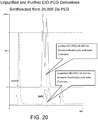
- the polymer of interest, after separation from the contaminant polymer may be greater than 98% pure. In an exemplary embodiment of the process the polymer of interest, after separation from the contaminant polymer, may be greater than 99% pure.
- the invention also provides mono ether end capped poly(ethylene glycol) which has been separated according to any of the processes described herein and having less than 1% poly(ethylene glycol) content.
- the ether end cap can be a lower alkyl (C1 to C6 alkyl) or aryl or benzyl or substituted benzyl or triphenylmethy ether group.
- a typical polymer mixture that falls within the scope of the invention may comprise poly(ethylene glycol) polymers having the general formulae: R 1 -O-PEG-O-R 1 and R 1 -O-PEG-O-R 2 wherein -R 1 comprises a di-anion, a tri-anion, a di-cation or a tri-cation; and -R 2 is a straight-chain alkyl group containing 1 to 4 carbon atoms, or a benzyl or triphenylmethyl (trityl) group.
- -R 1 may comprise a di-anion and -R 2 can be methyl. In such a mixture, less than 2% R 1 -O-PEG-O-R 1 may be present.
- the invention also provides a method for analysis of an initial mixture of two or more water soluble polymers, wherein each polymer has a different number of reactive terminal groups.
- the method comprises the steps of reacting the initial mixture with a derivatizing molecule to form a reacted polymer mixture; said derivatizing molecule comprising (i) 2 or 3 ionizable groups and a group available for covalent bonding with the reactive terminal groups; (ii) 3 or 4 ionizable groups, at least one of the ionizable groups being available for covalent bonding with the reactive terminal groups; or (iii) 2, 3 or 4 amine groups, one of the amine groups being available for covalent bonding with a reactive terminal group consisting of an aldehyde or -CH 2 -X wherein X is a halide, sulfonic acid ester or other leaving group; subjecting the reacted polymer mixture to ion exchange; and evaluating polymer content of ion exchange fractions.
- This analytical embodiment does not require collection of separated reacted polymer mixture. It also does not require the derivatizing molecule(s) to be capable of being removed to regenerate the original polymer(s), thus certain additional derivatizing molecules produce reacted polymer mixtures sufficient for analysis, although certain derivatizing molecules may not be removable.
- the site of attachment will be a secondary amine and will still represent an ionizable group even after the covalent bond to the polymer is formed and thus, only 2 ionizable amine groups would need to be present in the derivatizing molecule to form a polymer product with 2 ionizable groups.
- an amine be used to form an amide linkage to a polymer, such a linkage would be neutral and the amine would need to be one of three or four ionizable groups present such as in case ii above.
- the step of evaluating polymer content is used to demonstrate that the initial mixture contains predominantly one polymer of interest and a negligible amount of contaminant polymers. Evaluating polymer content may be used to determine content, either qualitatively or quantitatively, of a reactive polymer in such applications where only a specific polymer possessing a particular reactive termini can be converted to a derivatized polymer. Additionally, the step of evaluating polymer content could be used to determine presence or amount of any polymer in the mixture that can react more than once with the derivatizing molecule. The method may additionally comprise measuring the amount of a reactive product formed from a PEG species present in a reactive MPEG polymer or mixture.
- An additional embodiment of the invention provides a process for preparation of poly(ethylene glycol) monomethyl ether (MPEG) or poly(ethylene glycol) monoethyl ether (EtO-PEG) from poly(ethylene glycol) (PEG).
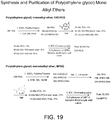
- the method comprises heating PEG with toluene, pyridine, and SOCl 2 to form a polymeric mixture; reacting the polymeric mixture with methanol (if MPEG is desired) or ethanol (if EtO-PEG is desired), along with KBr and KOH to form a mixture containing MPEG (or EtO-PEG); then reacting this mixture containing MPEG (or EtO-PEG) with a derivatizing molecule Q to form a mixture containing a derivatized polymer MPEG-Q (or EtO-PEG-Q); said derivatizing molecule comprising (i) 2 or 3 ionizable groups and a group available for covalent bonding with a terminal hydroxy group of MPEG (or EtO-PEG) ;
- the product formed as a result of this process is also considered an embodiment of the invention.
- the MPEG (or EtO-PEG) product may comprise less than 2% contaminant polymer, and preferably less than 1% of any contaminant polymer.
- 1,2,4-benzenetricarboxylic anhydride is an exemplary derivatizing molecule which may be used in such a process, however, alternative derivatizing molecules may be used.
- Use of methanol and ethanol are exemplified, but other alcohols may be used.
- a symmetrical PEG derivative may be employed, without regard to how it was made (or it could be prepared from PEG) wherein the ends have become leaving groups.
- halides such as Cl, Br or I may be employed.
- Sulfonic acid esters of PEG such as: tosy and mesyl p-tolulene sulfonic acid PEG esters, methyl sulfonic acid PEG esters or other leaving groups may be used.
- the process involves a reaction with a lower alkyl alcohol such as methanol (for MPEG) and a base strong enough to promote the displacement of the leaving group with the methoxide or alkoxide form of the alcohol. It is desirable to obtain about 50 % displacement, either directly competing or, in a further step, reacting with hydroxide ion to remove the remaining leaving group and replace with OH, this can be done with KOH where there will be some competing reaction with OH.
- a lower alkyl alcohol such as methanol (for MPEG)
- a base strong enough to promote the displacement of the leaving group with the methoxide or alkoxide form of the alcohol. It is desirable to obtain about 50 % displacement, either directly competing or, in a further step, reacting with hydrox
- PEG may be converted to a Bis leaving group-PEG, and subsequently, OR and OH anions sequentially or in competition make a mixture of RO-PEG-OR, RO-PEG-OH and HO-PEG-OH.
- OR and OH anions sequentially or in competition make a mixture of RO-PEG-OR, RO-PEG-OH and HO-PEG-OH.
- RO-PEG-OH may be separated from the mixture according to the method of the invention, using the subsequent steps of reacting the mixture with a derivatizing molecule, and subjecting the mixture to ion exchange.
- Embodiments of the invention allow the production of poly(ethylene glycol) monomethyl ether (MPEG) essentially free of any poly(ethylene glycol) (PEG). Analytical results for such polymers are also significantly enhanced and the formation of these derivatives allows certain analyses that are difficult to carry out by other means to be conducted with relative ease.
- MPEG poly(ethylene glycol) monomethyl ether
- the invention incorporates an ion exchange process to purify water soluble neutral polymers that are either linear or branched in nature with one or more reactive end groups.
- the polymers to be purified have the property that only the reactive terminal end groups of the polymer chain or chains are readily capable of chemical modification through reactions such as alkylation, acylation, amination, or oxidation.
- chemical modification occurs selectively at the terminal ends of the polymer chains without degrading the polymer chain(s).
- the polymer of interest can be purified from an impure mixture of polymer components. Impurities in the mixture may arise from, for example, the initial synthesis of the polymer, the incomplete chemical modification of the polymer, or from undesired side reactions which may occur in synthesis or modification.
- the invention allows for separation of polymer of interest from impurities when there are differences in the number and/or the chemical nature of reactive terminal end groups present.
- the mixture containing the polymer to be purified or separated can be reacted to form a product at greater than 90% conversion of polymer terminal end groups. It is not necessary to have complete derivatization to yield a product that is pure or has been significantly purified.
- the reactive terminal end of the polymer mixture so formed are converted into a group capable of possessing more then one ionic charge, or having more than one ionizable group, and preferably having 2 or 3, ionizable groups.
- Separation of the mixture of products so formed into fractions can then be conducted using an ion exchange process.
- One or more polymer of interest may be recovered from the fractions obtained by ion exchange at a level of at least 98% purity with respect to the number of reactive terminal groups present. A level of 99% purity may be accomplished (that is to say having 1% or less contaminant polymer content).
- the ion exchange separation of the mixture can be done using an ion exchange column, or can be conducted using an ion exchange membrane.
- the derivatization of the end groups with a derivatizing molecule having more than one ionizable group, forming end groups capable of possessing more than one ionic charge can be reversed to recover the original polymer.
- the process allows separation of a mixture by ion exchange chromatography with the end result that over 40% of the desired product present in the mixture is obtained at a level of at least 98% purity.
- over 50% of the desired product present in the mixture is obtained at a level of at least 98% purity.
- the process allows purification of a water soluble polymer of interest that is either a minor component of a polymer mixture, or which is a predominant component of a polymer mixture.
- the polymer of interest has 0, 1 or 2 reactive terminal ends, it can be separated from other polymeric components in the mix having a different number of reactive terminal ends, regardless of the prevalence of the polymer of interest within the mixture.
- the polymer of interest when the polymer of interest is the most prevalent polymer and has no reactive terminal ends, it can be purified by ion exchange, by retaining derivatized polymers (possessing reactive terminal ends) while the polymer of interest is eluted.
- the polymer of interest when the polymer of interest has one reactive terminal end, upon derivatizing the polymer mixture according to the invention, the polymer of interest can be purified using ion exchange by elution of contaminant polymers having no reactive terminal ends. Further, by using an eluant that selectively elutes the polymer of interest but not other polymers having more than one reactive terminal end, the polymer of interest can be eluted in a distinct fraction.
- polymeric products formed by derivatization of the reactive end groups have more than one negative or anionic charge per reactive polymer terminal group.
- the more than one negative or anionic charge on the resulting polymer derivative may be present as carboxylate, phosphate, phosphonate, borate, sulfonate, or sulfate substituents, or mixtures thereof.
- polymeric products formed by derivatization of the reactive end groups have more than one positive or cationic charge per reactive polymer terminal group.
- the charge may be present as amine, aromatic amine, or heterocyclic nitrogen containing group capable of bearing a positive charge in aqueous solution, or mixtures of these.
- the invention provides a process for purifying poly(ethylene glycol) polymers having one reactive group capable of reversible acylation from similar and related poly(ethylene glycol) polymers having either zero or more than one reactive groups.
- the reactive group may be acylated with a modifying molecule that will yield a product with more than one ionizable group.
- the resultant polymer mixture is chromatographically purified by ion exchange chromatography under conditions that permit components having more than one charge for each modifying molecule attached to be separated from other molecules in the mixture having no charge or molecules with more reactive groups and thus more multiply charged molecules attached.
- fraction of the mixture containing polymers having no modifying molecule attached is not bound by the ion exchange material, and is readily eluted.
- the fraction containing a polymer with only a single modifying molecule attached is first bound and then recovered from an ion exchange column in essentially pure form, and the modifying molecule can then be removed to yield a pure polymer with only a single reactive group.
- the initial conditions can be adjusted so the polymer with a single modifying molecule attached is not bound but all other polymers with more than a single modifying molecule attached are bound.
- additional bound components may be obtained in essentially pure form based on the number of reactive groups present in each species. These may also have the modifying molecule removed to give fractions having the same number of reactive groups.
- the invention also provides a process for producing pure mono alkyl ether end caped poly(ethylene glycol) (RO-PEG-OH) wherein a mixture of mono alkyl ether end caped poly(ethylene glycol) (RO-PEG-OH), PEG with no end substitution (HO-PEG-OH) and PEG materials with no available hydroxyl groups, such as the bis alkyl ether end capped poly(ethylene glycol) (RO-PEG-OR or more generally R-PEG-R) wherein alkyl group "R" has no reactive group capable of acylation by simple organic anhydrides at temperatures under 130 °C.
- the hydroxyl groups and any other readily alkylated groups in the mixture are acylated with a modifying molecule that will yield a product with more than one ionizable group at each substitution point.
- the fraction having no modifying molecule attached is not bound by the ion exchange material.
- the resultant polytheylene glycol polymer product mixture is chromatographically purified by ion exchange chromatography under conditions where the products will have more than one charge for each of the modifying molecules attached.
- the fraction containing the RO-PEG-OH polymer product with only a single modifying molecule attached is recovered, and the modifying molecule is removed to yield a pure RO-PEG-OH.
- the invention further provides a process for producing pure methoxy ether end caped poly(ethylene glycol) (MPEG) from a mixture containing MPEG, poly(ethylene glycol) (PEG) with no end substitution, and/or PEG materials with no available hydroxyl groups such as the bis alkyl ether end capped poly(ethylene glycol) (RO-PEG-OR) or more generally R-PEG-R wherein R has no reactive groups capable of acylation by simple organic anhydrides at temperatures under 130 °C.
- MPEG poly(ethylene glycol)
- PEG poly(ethylene glycol)
- PEG poly(ethylene glycol)
- R-PEG-OR bis alkyl ether end capped poly(ethylene glycol)
- R has no reactive groups capable of acylation by simple organic anhydrides at temperatures under 130 °C.
- Such a mixture is typical of conventional synthesis of MPEG from ethylene oxide, in which PEG is commonly found at levels of 1 to 20% as an impurity.
- hydroxyl groups are acylated with a modifying molecule that will yield a product with more than one ionizable group at each substitution point.
- the resultant MPEG polymer in the mixture is chromatographically purified from the mixture by ion exchange chromatography under conditions where the products will have more than one charge for each of the modifying molecules attached.
- the modifying molecule may then be removed to yield a pure MPEG with less than 1% PEG present.
- additional fractions may be obtained from the mixture in essentially pure form based on the number of reactive groups present in each polymer species.
- the modifying molecule can be removed from the fractions obtained to give pure fractions having the same number of reactive groups. Materials with no available hydroxyl group are not bound to the ion exchange chromatography, and can be eluted readily in a distinct fraction.
- the MPEG product with a multiply charged modifying molecule bound thereto becomes bound to the ion exchange chromatography medium to which it is applied, and may then be eluted from the medium. Elution may occur by any means acceptable to those skilled in the art of ion exchange chromatography such as a change in pH or ionic strength. Typically the desired fraction is then eluted by raising the salt concentration of the chromatography elutant.
- the MPEG product with the modifying molecule can be eluted by changing the pH of the chromatography elutant, by changing the ionic strength of the chromatography elutant, or by a combination of these.
- the invention further relates to a monoalkylether end capped poly(ethylene glycol) or MPEG with less than 1% total poly(ethylene glycol) or PEG content, which may be formed using the method of the invention.
- the total PEG content may include both PEG of molecular weight larger than the average molecular weight of the MPEG and PEG molecules with similar and lower molecular weights.
- the MPEG may be originally produced using ethylene oxide polymerization, or any method as would be known to a person of skill in the art.
- a pure branched poly(ethylene glycol) polymeric material with only a single reactive site can be produced, in which less than 1% of the branched poly(ethylene glycol) segments have a hydroxyl group.
- the remaining branched poly(ethylene glycol) segments - may have substantially complete alkyl ether end-capping.
- a pure MPEG product may be produced from a MPEG wherein the product has been purified by removal of all unreacted MPEG. This can be done by first reacting the impure derivative with a modifying agent capable of reacting with MPEG terminal hydroxyl groups. Such a modifying agent can also produce a new derivative of the MPEG material, such as one capable of having more than one negative or positive charge under conditions suitable for ion exchange chromatography.
- a method of analysis of linear or branched water soluble polymers containing one or more alkyl ether end capped poly(ethylene glycol) polymer chains can be conducted according to the invention.
- derivatives are formed using reagents that possess more than one positive charge for each molecule attached to the polymer material. Subsequently, the resultant products can be separated by ion exchange chromatography.
- Exemplary derivatives may be formed from polymer hydroxyl groups, from polymer amine groups, from polymer aldehyde or ketone groups, or from polymer end groups capable of reacting with a simple mercaptan such as cysteine or mercaptoethanol.
- an improved method of analysis of the PEG content of MPEG wherein the hydroxyl groups of the mixture of PEG and MPEG are first reacted and converted to derivatives capable of possessing more than one charge for each molecule attached.
- the resulting product is analyzed by ion exchange chromatography.
- the derivative formed may have negative (or anionic) charge groups, or alternatively, may have positive (cationic) charge groups.
- the derivative may be formed by reacting the polymer with an acid anhydride, such as an intramolecular anhydride, or an aromatic intramolecular anhydride.
- anhydrides which may be used are 1,2,4 benzene tricarboxylic acid anhydride; 1,2,4,5 benzene tetracarboxylic acid dianhydride; 1,2,3,4 cyclobutane tetracarboxylic acid dianhydride; or 2,2',3,3' dicarboxybenzophenone dianhydride.
- ion exchange chromatography can be carried out isocratically, by using a pH gradient, or by using an ionic strength gradient.
- the gradient can be accomplished with a series of discreet steps or in a continuously variable manner.
- the methodology of the invention is preferably used for purification of water soluble polymers with only reactive end groups, as opposed to those polymers having reactive groups within the chain.
- the invention is particularly useful when the polymer is PEG or PEG mono alkyl ethers
- Branched and linear water soluble polymers may be used, such as branched PEGs and MPEGs.
- Exemplary branched materials are those in which the site of branching, when incompletely reacted and therefore not fully branched, can be separated from fully branched materials.
- the invention may be particularly useful for polymers over 9,000 Da, which have been heretofore viewed as inappropriate candidates for chromatographic separation.
- the invention is capable of scale-up to high capacity and high yield procedures, in large scale batches greater than 10 kg, and further in batches greater than 20 kg.
- large batch purification is used the isolated individual component yield can be greater than 40% pure component.
- the polymer may first be converted to an intermediate form and a selected impurity may be removed which may then become the unreacted polymer starting material. In this way, a very high yield can be achieved on the basis of the fraction of starting material utilized. Further, if upon conducting the reactive process, the target reacts and is purified, reaction byproducts or earlier intermediates in the synthesis which are non-reactive may be removed by virtue of not binding to an ion exchange column.
- Nearly pure material made from impure starting material can be separated into non-reactive polymer, mono-reactive end capped polymer and fully reactive material.
- pure MPEG can be obtained with PEG removed. Both straight-chain and branched PEG/MPEG derivatives may be separated in this way.
- a specific example of this may be one in which purified MPEG is obtained in a purified form based on purification of the product of a poly(ethylene glycol) based synthesis in which over 2% PEG was originally present.
- MPEG can be obtained in essentially pure form from a PEG-based synthesis having as much as 15% PEG contaminant present.
- Purified MPEG having more than one charge introduced at each reactive termini is formed according to the invention.
- the invention further relates to the use of multi-charge derivatives for separation for analysis of terminally reactive polymer materials, including both branched and linear polymer materials. Materials successfully formed in a branching process can be separated or analysed to determine branch failure analysis. Further, in processes aimed at adding reactive groups, analysis of the success of the reaction can be done according to the invention.
- Polymer mixtures may be analysed, such as PEG present in MPEG. Both low and high molecular weight PEG in MPEG can be analysed. Functional end group analysis by ion exchange may also be conducted according to the invention.
- the chemistry of derivatization does not need to be reversible. However, there may be advantageous reasons why the derivatization reaction can be reversible, for example, so that impurities may be removed and added again to a subsequent reaction as starting materials.
- the derivatization does not need to be reversible.
- analysis of the unretained PEG fraction can be conducted to demonstrate that there is a neutral or unreactive impurity that is also removed.
- Conversion of pure MPEG into a different MPEG alcohol derivative can be conducted according to the invention, followed by purification of this product from neutral precursors.
- the invention may also be used for purification of a branched PEG derivative.
- Analysis of MPEG aldehyde by conversion to a poly cation, followed by IEX chromatography can be conducted according to the invention.
- Exemplary polymers which can be purified according to the invention include di- and tri-cationic derivatives of MPEG aldehyde and/or MPEG propionaldehyde, or di-anionic derivatives of MPEG maleimide or MPEG iodoacetamide.
- aspects of the invention allow the production of pure MPEG from MPEG containing PEG.
- embodiments of the invention involve linear PEG materials above about 9,000 Da
- the process may be used to purify an intermediate in a multistep synthesis, or to achieve a purified end-product.
- the invention relates to compounds and means to produce purified water soluble polymers.
- Compositions of matter that facilitate the purification, methods of purification and methods of analysis of the water soluble polymers are all disclosed.
- the invention is particularly suited to the separation of water soluble polymers having a chemically reactive end capable of reversible chemical modification from related polymers having two or more such reactive terminal end or from polymers having no such reactive end.
- it can be illustrated by way of example by describing the purification of polymers of poly(ethylene glycol).
- the purification of MPEG contaminated with PEG in its manufacture is further made difficult by the fact that the PEG present is typically about twice the molecular weight as the desired MPEG. As the molecular weight of these polymers increases, their binding to chromatographic media decreases. Separations that are well resolved such as the separation of 10,000 Da PEG from a 5,000 Da MPEG become very difficult when the size increases to 40,000 PEG from a 20,000 MPEG.
- the derivative in certain instances and for purely analytical use, it is not necessary for the derivative to be reversed to be useful or even to be reversed at all. It is found that in the production of modified polymers, a desired form of a polymer may be formed that no longer will react with the derivatization reagent while unreacted or unconverted starting material and/or impurities formed in the chemical reaction(s) used to form the desired product will react to form the derivatives of the invention. In these instances, the desired product will remain un-modified and can be purified from the reactive components in the impure reaction mixture by ion exchange chromatography. Since the derivatized materials are not the desired product, there is no requirement for the chemistry of formation of the derivatives in this instance to be reversible.
- the chemistry of derivatization can be taken to a high degree of completion so as to allow a high level of purification in the ion exchange chromatography or a high level of accuracy when used as an analytical tool in analytical ion exchange chromatography of polymers. Since the ion exchange chromatography will not separate a PEG molecule which has been only derivatized on one of its terminal groups from a MPEG molecule that has been derivatized on its single reactive site, only a small portion of the reactive sites can be left unmodified for best results. Typically, as long as at least 95% of all reactive groups are derivatized, at least a ten fold reduction in PEG content in a MPEG sample is theoretically possible. This will take an unacceptable MPEG product containing 4% PEG to an acceptable product with less than 0.5% PEG.
- the resulting MPEG has two negative charges while the PEG impurity has four negative charges (at appropriate pH values in aqueous media).
- Another multiply charged acid material is shown below as Formula 3 , having the chemical name: 1,2,4,5-benzene tetracaboxylic acid dianhydride (CAS # 89-32-7).
- the exemplary compounds shown as Formula 2 or Formula 3 can be used to derivatize a polymer mixture, for example, a mixture containing primarily MPEG with PEG as a contaminant, in order to separate the species within the mixture, according to the methodology described herein.
- HPLC chromatograms were produced using an evaporative light scattering detector (ELSD). Unless otherwise noted, areas are reported as the area% each peak represents of the total area of all polymer containing peaks. Although the ELSD response is not fully linear, it is monotonic, with lower area% representing less relative amount of a material than other samples with higher area% values for a component.
- the Refractive Index detector is generally assumed to be linear with respect to polymer concentration and, for example, the SEC result of Example 3 showed only 0.2% PEG remaining in the purified MPEG product and confirms the high level of purification seen when using ELSD as a detector.
- Buffer A 0.0004M ammonium acetate 20% MeOH solution.
- Buffer C 0.006 M ammonium acetate 20% MeOH solution.
- Buffer B 0.4M ammonium acetate 20% MeOH solution.
- Da means Dalton; DIEA, diisopropylethylamine; EDAC, 1-ethyl-3-(3-dimethylaminopropyl) carbodiimide hydrochloride; ELSD, evaporative light scattering detector; Eq, equivalents; kDa, kiloDalton; MeOH, methanol; MES, 2-(N-morpholino)ethane sulfonic acid; MPEG, poly(ethylene glycol) monomethyl ether; mS, milli-Seimen; MTBE, tertiary-butyl methyl ether; NH 4 OAc, ammonium acetate; NHS, N-hydroxylsuccimide; PEG, poly(ethylene glycol); RI, Refractive Index; SEC, Size exclusion chromatography; TEA, triethylamine; THF, tetrahydrofuran; ⁇ L, microlitre; DI water, deionized water; Na 2
- polyethylene glycol is used here as a synonym for poly(ethylene glycol) and both terms refer to compound 1A as well as does the abbreviation PEG defined above.
- Synonyms for MPEG, poly(ethylene glycol) monomethyl ether, include: methoxy PEG, MeO-PEG, PEG monomethylether and mPEG.
- CAS numbers of select compounds referred to herein are as follows: 1,2,4-benzene tricarboxylic anhydride, 552-30-7; succinic anhydride, 108-30-5; phthalic anhydride, 85-44-9; triethylamine, 121-44-8; ammonium acetate, 631-61-8; and MPEG (regardless of Mw), 9004-74-4; ammonium thiocyanate, 1762-95-4; 1,2,4,5-benzenetetracarboxylic dianhydride, 89-32-7; cobalt (II) nitrate hexahydrate, 10026-22-9; diisopropylethylamine, 7087-68-5; 1,2-dimethylpropyl amine, 598-74-3; 1-ethyl-3-(3-dimethylaminopropyl) carbodiimide hydrochloride, 25952-53-8; mercaptosuccinic acid, 70-49-5; 4-methoxy
- phthalic acid esters of MPEG 10,000 Da, MPEG 20,000 Da, PEG 8,000 Da, PEG 20,000 Da and PEG 35,000 Da were prepared.
- These PEG derivatives possessed an ester bonded phthalate group capable of possessing a single negative charge at each end of the polymer chain.
- FIG. 2A A chromatogram of phthalic acid derivatized 10,000 Da and 20,000 Da MPEG and 20,000 Da and 35,000 Da PEG is shown in Figure 2A .
- This chromatogram displays two partially resolved peaks. Injections of the individual components confirm that the first peak is composed of the 20,000 Da MPEG mono-derivative and 35,000 Da di-derivatized species PEG; the second is mono-derivatized 10,000 Da MPEG and 20,000 Da di-derivatized species PEG.
- Figure 2B shows an overlay of 20,000 Da MPEG mono-derivative and 35,000 Da di-derivatized PEG.
- the monocarboxylic acid derivatives are not suitable for purification purposes.
- the mixture was heated to reflux (75-85°C) and stirred under a nitrogen atmosphere for 20 hours. After removal of the THF by distillation, the reactor was cooled to 45°C, MTBE (200 L) was added over a 30 min period to precipitate the MPEG and PEG derivatives. The mixture was further cooled to 0-5 °C. The resultant precipitate was collected and dried under vacuum at 30°C for 24 hours. The dried crude product was dissolved in an aqueous sodium chloride solution (15%, pH adjusted to 2.0) and stirred for 1 hour. Dichloromethane was used to extract the desired PEG derivatives (3 x 35L). The organic layer was collected and washed with aqueous sodium chloride solution (15%) and dried over anhydrous sodium sulfate.
- the slurry was filtered and the filtrate collected. Dichloromethane was removed until the volume of the solution was reduced to ⁇ 35L. The remaining mixture was cooled to 30°C and MTBE (120L) was added to precipitate the PEG derivatives. The reactor was further cooled to 0-5°C and the precipitate was collected. After drying under reduced pressure for 24 hours, the derivatized MPEG/PEG material was collected (9.16 kg, 91.6% yield).
- the conductance of a typical sample prepared at this concentration was 0.32 mS.
- the neutral PEG was eluted with 50L of deionized water.
- a cobalt test was conducted to estimate poly(ethylene glycol). Briefly, cobalt test solution is used for the colorimetric assay for estimation of poly(ethylene glycol). Cobalt (II) nitrate hexahydrate (1.5 g, 0.0052 mol) and ammonium thiocyanate (10 g, 0.104 mol) were dissolved in deionized water (50 mL). Use an equivolume amount of cobalt test solution and eluate. A pink colour result (negative) indicates absence of PEG material; a blue coloration (positive test) indicates presence of PEG material. Strong positives yield a precipitate.
- Cobalt (II) nitrate hexahydrate (1.5 g, 0.0052 mol) and ammonium thiocyanate (10 g, 0.104 mol) were dissolved in deionized water (50 mL). Use an equivolume amount of cobalt test solution and eluate. A pink colour result (negative) indicates absence of PEG material; a
- Figure 4 is a representative chromatogram of a collected fraction using a typical two step gradient chromatography conditions. For more direct comparison of the binding strength, the materials were also chromatographed using a linear gradient elution profile. This allows an estimation of the strength of binding based on the salt concentration required to elute the various PEG and MPEG derivatives. With a linear gradient of buffer, MPEG 20,000 Da diacid isomers have retention times of 17.01 and 17.73 minutes. With the same gradient, PEG 35,000 Da ⁇ , ⁇ -bis-(benzene tricarboxylic acid ester) has a retention time of 20.47 minutes.
- Figure 5 is an overlay of these two linear gradient chromatograms.
- the purified non-derivatized MPEG 20,000 Da had a chromatogram with a 100 area% peak eluting with a retention time of 1.15 minutes with 100% of buffer A.
- MPEG benzene tricarboxylic acid ester 10,000 Da An 10,000 Da MPEG product was purchased that contained over 5 % of the high molecular weight PEG typically found in materials produced from ethylene oxide polymerizations. Unpurified MPEG 10,000 Da (15 kg, 1.5 moles) contaminated with high and low molecular weight PEG material was added to a previously cleaned dried 100 gallon reactor with anhydrous tetrahydrofuran (THF, 100L) and 1, 2, 4-benzene tricarboxylic anhydride (2880 g, 15 moles). After complete addition, the mixture was stirred and the temperature was maintained between 5° C and 15° C under a nitrogen atmosphere.
- THF anhydrous tetrahydrofuran
- Triethylamine (435 mL, 3 moles) was to the reaction mixture.
- the reaction mixture was heated to reflux (75-85°C) and stirred under a nitrogen atmosphere for 24 hours. After this period, THF (33 kg) was removed with distillation and the reactor was cooled to 45°C.
- MTBE 300 L was added over a 30 min period to precipitate the MPEG (and PEG) derivatives. The mixture was further cooled to 0-5 °C. The resultant precipitate was collected and dried under vacuum at 30°C for 24 hours. The dried crude product was dissolved in an aqueous sodium chloride solution (15%, pH adjusted to 2.0) and stirred for 1 hour.
- the PEG derivatives were extracted into dichloromethane (3 x 50L).
- the neutral underivatized species represents 3.14% of the total area
- MPEG 10,000 Da
- benzene tricarboxylic acid ester two isomers
- the ⁇ , ⁇ -bis-(benzene tricarboxylic acid ester) derivatized PEG impurities are more retained and represent 9.40%.
- a solution of unpurified MPEG benzene tricarboxylic acid ester 20,000 Da in deionized water (2.16 kg/ 55L DI water 40g/l) was prepared and loaded onto the prepared column at a flow rate between 1.0 to 1.4 L/min.
- the column was eluted with 50L of deionized water and samples of the wash were tested using the cobalt test to test for any PEG derivative. After a negative cobalt test result, the column was eluted with 8 mM ammonium acetate solution at a flow rate between 1.0 to 1.4 L/min.
- the eluate was collected from the column in 10L fractions. Each fraction was tested using the cobalt test. The collected fractions are analyzed using ion exchange chromatography with an ELSD. Product was determined in 89.8L of eluent.
- FIG. 7 A chromatogram of the purified 10,000 Da MPEG run as a linear gradient is represented in Figure 7 . With this linear gradient, MPEG 10,000 Da diacid isomers have retention times of 19.41 and 20.19 minutes. With the same gradient, PEG 20,000 Da ⁇ , ⁇ -bis-(benzene tricarboxylic acid ester) has a retention time of 24.50 minutes.
- Figure 8 is an overlay of these chromatograms.
- MPEG benzene tricarboxylic acid ester derivative 30,000 Da MPEG product was purchased that contained over 7 % of the high molecular weight PEG typically found in materials produced from ethylene oxide polymerizations.
- the purchased material (304 g) was converted to a mixture of MPEG diacids and PEG tetra acids by reaction with 19.5 g of 1,2,4-benzene tricarboxylic anhydride in 3 L of tetrahydrofuran. Triethylamine (8.5 ml) was added to neutralize the excess acid. The mixture was stirred for 78 hours at reflux (ca. 69 °C).
- the mixture of polymeric products was concentrated to a volume of 1.5 L total and precipitated by the addition of 6L of MTBE and filtered.
- the product was washed with 2 X 500 ml MTBE and dried under vacuum at 30 °C for 18 hours.
- the crude product was dissolved in 3 L of aqueous sodium chloride (15% NaCl, pH adjusted to 2.0 with HCI).
- the acidified product was extracted into dichloromethane (3 X 1L).
- the dichloromethane was washed once with 1.4 L of the fresh acidic brine.
- the dichloromethane was dried with sodium sulfate (250g), filtered and combined with two 250 ml washes of the drying agent.
- the solution was concentrated to a final volume of 750 ml.
- the product was precipitated with 3 L of MTBE.
- the solid was filtered and washed with 500 ml MTBE. After drying, 293.5 g or >96% of the original MPEG weight was recovered.
- the PEG present in the starting material is converted to a mixture of the ⁇ - bis- (benzene tricarboxylic acid ester) derivatives, each derivative (multiple isomers are possible to form but poorly resolved chromatographically) capable of having four anionic charges.
- the neutral underivatized species represents 6.65% of the total area, MPEG (30,000 Da) benzene tricarboxylic acid ester represent 86.89% of the area.
- the ⁇ , ⁇ - bis -(benzene tricarboxylic acid ester) PEG impurities are more retained and represent 6.46%.
- This water eluted fraction contains neutral polymer material and any un-derivatized MPEG or PEG.
- the column is then eluted and collected in nine fractions of 1.5 to 3.5L using 0.004 M ammonium acetate.
- the derivative also has UV absorption and relative concentration can be estimated by measuring the absorbance at 240 nm. Fractions having an optical density at 240 nm greater than 0.325 were pooled (fractions 5, 6 and 7). These fractions totaled 7.75 L.
- the column was then washed with 0.375 M ammonium acetate until the eluate was negative for the presence of polymer using the cobalt color test.
- the dried dichloromethane solution was concentrated under vacuum to a volume of 600 ml and 2.2 L of MTBE was added. The solution was cooled to 0 °C for 1 hour, filtered and the product washed with 200 ml of MTBE. Drying yielded 70.0 g of purified 30,000 Da MPEG (70% yield).
- Triethylamine (12.74 mL, 20 mmol) was added to the solution and stirring was continued for 30 hours. After this time, the solvent volume was reduced by half and MTBE was used to precipitate the polymeric compounds. The precipitate was filtered, washed and dried under vacuum at 30°C. Yield of the reaction was 97.6%.
- the eluate was collected from the column in 10 mL fractions. Each fraction was tested using the cobalt test. Product was present in approximately 30 mL of eluate. The fractions containing product were pooled, concentrated and extracted with dichloromethane. The dichloromethane was removed by evaporation at reduced pressure. The residue was redissolved in 5 ml of dichloromethane and precipitated by addition of MTBE, filtered and dried. The 30,000 Da MPEG benzene tetracarboxylic acid ester was recover in 58% yield (580 mg).
- Ion exchange analysis A 6.3 mg sample of the derivatized material was dissolved in 1.26 mL 0.0004M ammonium acetate (NH 4 OAc) buffer. The solution was filtered through a 0.2 ⁇ m to produce a sample for injection. A sample of 5 ⁇ L of the sample was injected into a mobile phase of 0.006M ammonium acetate buffer (Buffer C) and of 0.4M ammonium acetate buffer (Buffer B) at a flow rate of 0.5 mL per minute and flowed through a Sepax Proteomix SAX-NP3 ion exchange column using ELSD detection to produce the chromatogram shown in Figure 10 . The retention time of the MPEG (30,000 Da) benzene tetracarboxylic acid ester (a trianion) is 29.33 minutes.
- a 20,000 Da MPEG succinate ester sample was analyzed via anion exchange liquid chromatography using ELSD detection and indicated 87.57% mono-anion material, 0.91 % neutral material and 11.52% ⁇ , ⁇ - bis -succinyl ester material arising from PEG present in the MPEG.
- a prepared analytical sample was flowed through a Sepax Proteomix SAX-NP3 ion exchange column. After a five minute period flowing Buffer C, a linear gradient of increasing concentrations of Buffer B was pumped through the column.
- FIGURE 11A shows an overlay of chromatograms of two succinic acid derivatives, the 20,000 Da mono-succinate MPEG and the 35,000 Da ⁇ , ⁇ - bis -succinyl ester PEG. The two species have indistinguishable retention times. All monoanionic derivatives eluted before the gradient of Buffer B had reached the detector.
- FIGURE 11B is the corresponding overlay of the 20,000 Da MPEG benzene tricarboxylic acid ester and 35,000 Da PEG ⁇ , ⁇ - bis -(benzene tricarboxylic acid ester)
- Retention times for the derivatized 20,000 Da MPEG and 35,000 Da PEG materials are noted in TABLE 1. Since a linear gradient of ionic strength was applied to the column after a 5 minute isocratic period, a retention time over 5 minutes correlates with the salt concentration or ionic strength required to overcome the binding of the polymer to the ion exchange material and thus, to elute the polymer. The longer the retention time, the greater the ionic strength needed for elution and the stronger the binding of the polymer to the ion exchange medium.
- Derivatives were prepared and eluted from SEPAXTM ion exchange resin.
- Table 2 describes the concentration of salt necessary to elute exemplary acid ester derivatives of MPEG and PEG polymers. These values are determined from the retention time of the product eluted from the ion exchange matrix using a linear gradient of buffer. Corrections were made to reflect the time system lag time between the control sequence input and the actual buffer change at the detector. Basically, the retention time of a non-retained MPEG was subtracted from the observed retention time and the salt concentration at that time was calculated based on the slope of the gradient utilized.
- Table 2 and Figure 12 show derivatives such as MPEG and PEG succinate derivatives known in the prior art for comparative purposes and to demonstrate the great utility of the current invention when compared to these materials.
- Mono-charged MPEG and PEG polymers listed in the succinic acid ester derivative and phthalate ester derivative categories co-eluted at a low salt concentration level, showing that the mono-charged derivatization does not assist in separating the species of polymers.
- the polymers are converted to di- or tri-charged derivatives, shown in the benzene tricarboxylic acid ester and benzene tetracarboxylic acid ester categories, the derivatives exhibited elution at higher and distinct salt concentrations.
- Figure 12 is a graphical representation of the salt concentration required to elute a species versus the molecular weight of the polymer derivative being eluted.
- Figure 12 illustrates the influence of polymeric molecular weight on salt concentration of ion exchange elutant required to elute the polymeric MPEG and PEG derivatives shown in Table 2 from a SEPAXTM ion exchange column. The stronger the binding, the greater the salt concentration required to elute the polymer.
- the molecular weight of the polymer is inversely correlated to the required salt concentration of the buffer required to elute the polymer derivative.
- the required salt concentration of the buffer required to elute the polymer derivative there is no such relationship.
- products with two or more ionizable groups need significantly greater concentration of salt to be eluted from the ion exchange matrix compared to the products with less than two ionizable groups.
- Table 2 and Figure 12 demonstrate the unexpectedly strong binding of polymers with both terminal groups derivatized according to the invention with a derivatizing molecule capable of possessing two or more ionizable groups after attachment when compared to similar molecular weight species possessing only one identical derivatized terminal group.
- Such polymers with two ends derivatized with a derivatizing molecule capable of possessing two or more ionizable groups bind more strongly than the mono-substituted polymer with only one half the molecular weight and the same mass to charge ratio.
- Figure 12 shows the "lines" relating a molecular weight group of derivatives are well separated from the "line” connecting similar weight materials with a different number of reactive termini. That is to say that the MPEG materials with 2 ionizable groups are separated from the PEG materials with 2 ionizable groups. Similarly, the MPEGs with three ionizable groups are even more distinctly separated from the corresponding group of PEG derivatives with both ends derivatized with three ionizable groups.
- a derivative is prepared by use of a thiol having two carboxylic acid substituents and analyzed via ELSD.
- MPEG maleimide (20,000 Da, 0.100g, 0.005 mmol), mercapto succinic acid (0.015 g, 0.1 mmol) and diisopropylethylamine (DIEA, 0.035 mL, 0.2 mmol) were reacted together in anhydrous dichloromethane.
- DIEA diisopropylethylamine
- Figure 13A illustrates the maleimide derivatization of MPEG while Figure 13B illustrates the ring opening of MPEG maleimide to MPEG maleamic monoacid.
- the chromatogram in Figure 14 depicts the separation of these mono-, di- and tri-anionic material.
- the maleamic monoacid has a retention time of 2.56 minutes while the dianion reaction product is more retained and elutes at 4.11 minutes. The most highly retained species is the result of the ring opening of the product which is a trianionic species.
- MPEG amine (20,000 Da, 1.0g, 0.05 mmol) and 4-sulfobenzoic acid potassium salt (120 mg, 0.5 mmol) were dissolved in water.
- 2- ⁇ N-morpholino ⁇ ethane sulfonic acid (MES, 0.1 M, 0.39 g) was added as buffer and the pH was adjusted to 5.6 with sodium hydroxide (0.1N, 1.0 mL).
- 1-Ethyl-3-(3-dimethylaminopropyl) carbodiimide hydrochloride (EDAC, 96 mg, 0.5 mmol) and N-hydroxylsuccimide (NHS, 144 mg, 1.25 mmol) were added and the solution was stirred at 20°C for 24 hours.
- Table 3 compares the retention times of the charged amide derivatives versus the charged ester derivatives. There is no distinction between the two monocharged species or the two bischarged species.
- Figure 16 is an overlay of the diacid species, one with two carboxylic acid groups and one with one carboxylic acid group and one sulfonic acid ionizable group. The separation depends largely on the number of ionizable groups, not their nature.
- Analytical ion exchange separation A sample (0.330 mL) of the reaction solution was removed from the reaction vessel and reduced to dryness. Ammonium acetate (NH 4 OAc) buffer (0.150 mL) was added to dissolve the residue; 0.100 mL of this solution was spin filtered on a prepared Bio-spin Tris 6 filter. The spin-filtered filtrate was diluted with 0.900 mL of 0.4 mM NH 4 OAc.
- FIG. 18 is an overlay of the two propionaldehyde reductive animation products.
- the product, 30,000 Da MPEG 4-methoxybenzyl amine possessing a monocationic charge is much less strongly bound to the resin than the product 30,000 Da MPEG 3-N,N-dimethylaminopropylamine possessing a dicationic charge.
- the neutral PEG was eluted with 60 mL of deionized water.
- the product was eluted with a 4 mM ammonium acetate solution at the same flow rate.
- the eluate was collected from the column in 10 mL fractions. Each fraction was tested using the cobalt test. Product was present in 30 mL of eluate.
- Figure 20 is an overlay of the unpurified material and the purified collected fraction using a typical two step gradient elution method.
- the unpurified material contained 34% of desired MPEG benzene tricarboxylic acid ester product (peaks 2a/b),
Landscapes
- Chemical & Material Sciences (AREA)
- Chemical Kinetics & Catalysis (AREA)
- Organic Chemistry (AREA)
- Health & Medical Sciences (AREA)
- Medicinal Chemistry (AREA)
- Polymers & Plastics (AREA)
- General Chemical & Material Sciences (AREA)
- Dispersion Chemistry (AREA)
- Analytical Chemistry (AREA)
- Polyethers (AREA)
- Other Resins Obtained By Reactions Not Involving Carbon-To-Carbon Unsaturated Bonds (AREA)
Claims (25)
- Verfahren zur Trennung eines wasserlöslichen Poly(alkylenoxid)-Polymers von Interesse von anderen wasserlöslichen Poly(alkylenoxid)-Polymeren, die anfänglich als eine Komponente eines Gemischs vorhanden sind, wobei das Polymer von Interesse eine andere Zahl von reaktiven Endgruppen enthält als die anderen wasserlöslichen Polymere in dem Gemisch, bei dem man:das Anfangsgemisch von Polymeren mit einem Derivatisierungsmolekül, das aus 1,2,4-Benzoltricarbonsäureanhydrid, 1,2,4,5-Benzoltetracarbonsäuredianhydrid, 1,2,3,4-Cyclobutantetracarbonsäuredianhydrid oder 2,2',3,3'-Dicarboxybenzophenondianhydrid zu einem umgesetzten Polymergemisch umsetzt, wobei das Derivatisierungsmolekül (i) 2 oder 3 ionisierbare Gruppen und eine für die kovalente Bindung mit den reaktiven Endgruppen verfügbare Gruppe oder (ii) 3 oder 4 ionisierbare Gruppen, wobei mindestens eine der ionisierbaren Gruppen für die kovalente Bindung mit den reaktiven Endgruppen offenbar ist, umfasst; unddas umgesetzte Polymergemisch zur Trennung der derivatisierten Polymere Ionenaustausch unterwirft.
- Verfahren nach Anspruch 1, bei dem die Umsetzung mit dem Derivatisierungsmolekül dazu führt, dass im Wesentlichen alle reaktiven Endgruppen der wasserlöslichen Poly(alkylenoxid)-Polymere kovalent an ein Dianion oder ein Trianion gebunden sind.
- Verfahren nach einem der Ansprüche 1 oder 2, bei dem es sich bei den reaktiven Endgruppen um Hydroxylgruppen handelt.
- Verfahren nach einem der Ansprüche 1 bis 3, bei dem man ferner nach dem Trennungsschritt das Derivatisierungsmolekül von dem Polymer von Interesse und/oder den anderen Polymeren entfernt.
- Verfahren nach einem der Ansprüche 1 bis 3, bei dem das resultierende abgetrennte Polymer von Interesse eine Reinheit von mehr als etwa 99 % aufweist.
- Verfahren nach einem der Ansprüche 1 bis 5, bei dem die Alkylenoxid-Monomereinheiten unabhängig aus der Gruppe bestehend aus Alkylenoxiden der Struktur:

- Verfahren nach Anspruch 6, bei dem R1 für H oder Methyl steht.
- Verfahren nach einem der Ansprüche 1 bis 7, bei dem das Anfangsgemisch von Polymeren jeweils ein Molekulargewicht von etwa 100.000 Da oder weniger aufweist.
- Verfahren nach einem der Ansprüche 1 bis 8, bei dem das Anfangsgemisch von Polymeren jeweils ein Molekulargewicht von etwa 9000 Da oder mehr aufweist.
- Verfahren nach einem der Ansprüche 1 bis 9, bei dem es sich bei dem Polymer von Interesse um Monomethoxypoly(ethylenglykol) (MPEG) handelt.
- Verfahren nach Anspruch 10, bei dem das Anfangsgemisch von Polymeren Monomethoxypoly-(ethylenglykol) (MPEG) und Polyethylenglykol (PEG) umfasst.
- Verfahren nach Anspruch 11, bei dem das Anfangsgemisch von Polymeren weniger als 10 % PEG umfasst.
- Verfahren nach Anspruch 11 oder 12, das zusätzlich vor dem Schritt des Umsetzens des Anfangsgemischs von Polymeren den Schritt des Herstellens von MPEG durch Polymerisation von Ethylenoxid unter Bildung eines Gemischs von MPEG- und PEG-Polymeren umfasst.
- Verfahren nach einem der Ansprüche 1 bis 13, bei dem:es sich bei dem Polymer von Interesse um ein Poly(ethylenglykol)-Polymer mit einer reaktiven Endgruppen handelt;das Anfangsgemisch von Polymeren ein Poly(ethylenglykol)-Polymer mit zwei reaktiven Endgruppen im Gemisch mit dem Polymer von Interesse umfasst;der Schritt des Umsetzens die Acylierung mit dem Derivatisierungsmolekül umfasst undIonenaustauschchromatographie zum Eluieren einer Fraktion, die das Polymer von Interesse bei einer bestimmten Ionenstärke enthält, eingesetzt wird.
- Verfahren nach einem der Ansprüche 1 bis 9, bei dem:es sich bei dem Polymer von Interesse um ein monoalkylether-endverkapptes Poly(ethylenglykol) handelt unddie anderen Polymere Poly(ethylenglykol) und/oder bisalkylether-endverkapptes Poly(ethylenglykol) handelt.
- Verfahren nach Anspruch 16, bei dem es sich bei dem Polymer vom Interesse um methoxyetherendverkapptes Poly(ethylenglykol) (MPEG) handelt.
- Verfahren zur Analyse des Vorliegens von mehr als einem wasserlöslichen Poly(alkylenoxid)-Polymer in einem Anfangsgemisch von wasserlöslichen Poly-(alkylenoxid)-Polymeren, wobei jedes abzuschätzen de Polymer eine andere Zahl von reaktiven Endgruppen aufweist, wobei das Verfahren die folgenden Schritte umfasst:Durchführen des Verfahrens nach einem der Ansprüche 1 bis 17 undEvaluieren der Polymerzusammensetzung des umgesetzten Polymergemischs.
- Verfahren nach Anspruch 18, bei dem der Schritt des Evaluierens des Polymergehalts zur Bestimmung des Vorliegens oder der Menge eines Polymers in dem Gemisch, das mehr als einmal mit dem Derivatisierungsmolekül reagieren kann, verwendet wird.
- Verfahren nach Anspruch 18, bei dem die Menge eines aus einer in einem reaktiven MPEG-Polymer vorliegenden PEG-Spezies gebildeten reaktiven Produkts gemessen wird.
- Polymergemisch, umfassend Poly(ethylenglykol)-Polymere mit den allgemeinen Formeln:
R1-O-PEG-O-R1 und R1O-PEG-O-R2
wobei -R1 für ein Dianion, ein Trianion, ein Dikation oder ein Trikation steht und
-R2 für eine geradkettige Alkylgruppen mit 1 bis 4 Kohlenstoffatomen, eine Benzylgruppe oder eine Triphenylmethylgruppe steht. - Polymergemisch nach Anspruch 21, wobei -R1 für ein Dianion steht und -R2 für Methyl steht.
- Polymergemisch nach Anspruch 21 oder 22, wobei die Polymere ein Molekulargewicht von etwa 9000 Da oder mehr aufweisen.
- Polymergemisch nach Anspruch 21 oder 22, wobei die Polymere ein Molekulargewicht von etwa 15.000 Da oder mehr aufweisen.
- Polymergemisch nach einem der Ansprüche 21 bis 24, das weniger als 2 % R1-O-PEG-O-R1 umfasst.
- Polymergemisch nach einem der Ansprüche 21 bis 24, das weniger als 1 % R1-O-PEG-O-R1 umfasst.
Applications Claiming Priority (1)
| Application Number | Priority Date | Filing Date | Title |
|---|---|---|---|
| PCT/CA2007/000272 WO2008101311A1 (en) | 2007-02-22 | 2007-02-22 | Process for purification of water soluble polymers |
Publications (3)
| Publication Number | Publication Date |
|---|---|
| EP2113009A1 EP2113009A1 (de) | 2009-11-04 |
| EP2113009A4 EP2113009A4 (de) | 2017-02-15 |
| EP2113009B1 true EP2113009B1 (de) | 2018-11-21 |
Family
ID=39709574
Family Applications (1)
| Application Number | Title | Priority Date | Filing Date |
|---|---|---|---|
| EP07701815.8A Active EP2113009B1 (de) | 2007-02-22 | 2007-02-22 | Verfahren zur aufreinigung wasserlöslicher polymere |
Country Status (4)
| Country | Link |
|---|---|
| US (1) | US8222039B2 (de) |
| EP (1) | EP2113009B1 (de) |
| CA (1) | CA2678401A1 (de) |
| WO (1) | WO2008101311A1 (de) |
Families Citing this family (6)
| Publication number | Priority date | Publication date | Assignee | Title |
|---|---|---|---|---|
| KR102239131B1 (ko) * | 2013-09-30 | 2021-04-12 | 가부시키가이샤 후지미인코퍼레이티드 | 연마용 조성물 및 그 제조 방법 |
| WO2015131144A1 (en) * | 2014-02-28 | 2015-09-03 | The University Of Memphis Research Foundation | Chitosan nanofiber compositions, compositions comprising modified chitosan, and methods of use |
| JP6935059B2 (ja) * | 2017-03-30 | 2021-09-15 | 日油株式会社 | カルボキシル基を一つ有するポリエチレングリコールの精製方法 |
| EP3778703B1 (de) * | 2018-03-29 | 2022-08-03 | NOF Corporation | Verfahren zur reinigung von tritylgruppenhaltigem monodispergiertem polyethylenglykol |
| CN112759757B (zh) * | 2020-12-28 | 2023-11-24 | 苏州欣影生物医药技术有限公司 | 单/双磷酸聚乙二醇单甲醚纯化方法 |
| EP4219603A1 (de) * | 2022-01-28 | 2023-08-02 | Ustav experimentálnej fyziky SAV, v.v.i. | Verfahren zur reinigung von organischen wasserlöslichen polymeren aus hydrophoben verunreinigungen |
Family Cites Families (12)
| Publication number | Priority date | Publication date | Assignee | Title |
|---|---|---|---|---|
| US5298410A (en) * | 1993-02-25 | 1994-03-29 | Sterling Winthrop Inc. | Lyophilized formulation of polyethylene oxide modified proteins with increased shelf-life |
| US5672662A (en) * | 1995-07-07 | 1997-09-30 | Shearwater Polymers, Inc. | Poly(ethylene glycol) and related polymers monosubstituted with propionic or butanoic acids and functional derivatives thereof for biotechnical applications |
| US5747639A (en) * | 1996-03-06 | 1998-05-05 | Amgen Boulder Inc. | Use of hydrophobic interaction chromatography to purify polyethylene glycols |
| GB9707696D0 (en) * | 1997-04-16 | 1997-06-04 | Agner Erik | Improvements in or relating to chromatography |
| US6448369B1 (en) * | 1997-11-06 | 2002-09-10 | Shearwater Corporation | Heterobifunctional poly(ethylene glycol) derivatives and methods for their preparation |
| WO1999048948A1 (fr) * | 1998-03-24 | 1999-09-30 | Nof Corporation | Derives d'oxiranne et leur procede de production |
| GB9822963D0 (en) * | 1998-10-20 | 1998-12-16 | Agner Erik | Improvements in or relating to chromatography |
| US8129330B2 (en) * | 2002-09-30 | 2012-03-06 | Mountain View Pharmaceuticals, Inc. | Polymer conjugates with decreased antigenicity, methods of preparation and uses thereof |
| ES2341960T3 (es) * | 2003-07-22 | 2010-06-30 | Nektar Therapeutics | Procedimientos para preparar polimeros funcionalizados a partir de alcoholes polimericos. |
| SE0302509D0 (sv) * | 2003-09-19 | 2003-09-19 | Amersham Biosciences Ab | Matrix for separation of polyethers and method of separation |
| US20060045866A1 (en) * | 2004-09-01 | 2006-03-02 | Chris Chappelow | Novel high purity and high molecular weight mPEG alcohol compositions |
| US7824919B2 (en) * | 2005-03-04 | 2010-11-02 | Dr. Reddy's Laboratories Limited | Method for analyzing activated polyethylene glycol compounds |
-
2007
- 2007-02-22 EP EP07701815.8A patent/EP2113009B1/de active Active
- 2007-02-22 WO PCT/CA2007/000272 patent/WO2008101311A1/en not_active Ceased
- 2007-02-22 US US12/528,304 patent/US8222039B2/en active Active
- 2007-02-22 CA CA002678401A patent/CA2678401A1/en not_active Abandoned
Non-Patent Citations (1)
| Title |
|---|
| None * |
Also Published As
| Publication number | Publication date |
|---|---|
| EP2113009A1 (de) | 2009-11-04 |
| CA2678401A1 (en) | 2008-08-28 |
| WO2008101311A1 (en) | 2008-08-28 |
| EP2113009A4 (de) | 2017-02-15 |
| US20100323452A1 (en) | 2010-12-23 |
| US8222039B2 (en) | 2012-07-17 |
Similar Documents
| Publication | Publication Date | Title |
|---|---|---|
| EP2412744B1 (de) | Verfahren zur Herstellung von verzweigten funktionalisierten Polymeren mithilfe von verzweigten Polyol-Kernen | |
| EP2113009B1 (de) | Verfahren zur aufreinigung wasserlöslicher polymere | |
| Harris et al. | Synthesis and characterization of poly (ethylene glycol) derivatives | |
| US10941248B2 (en) | Methods for preparing functionalized polymers from polymer alcohols | |
| CN103217523B (zh) | 糖链捕获物及其用途 | |
| Maier et al. | Enantioselective anion exchangers based on cinchona alkaloid‐derived carbamates: Influence of C8/C9 stereochemistry on chiral recognition | |
| EP0985697B1 (de) | Oximanderivate und verfahren zu ihrer herstellung | |
| EP2265129B1 (de) | Chromatographiereinigung von antikörpern | |
| KR20130125404A (ko) | 활성화된 폴리옥사졸린 및 이를 포함하는 조성물 | |
| EP2508516B1 (de) | Zusammensetzung mit einem zwischenprodukt für ein wasserlösliches monomer und herstellungsverfahren dafür, zusammensetzung mit dem wasserlöslichen monomer, zwischenprodukt für ein wasserlösliches monomer sowie wasserlösliches monomer und herstellungsverfahren dafür | |
| KR102522413B1 (ko) | 헤테로형 단분산 폴리에틸렌글리콜, 헤테로형 단분산 폴리에틸렌글리콜 제조용 중간체, 그들의 제조 방법, 및 헤테로형 단분산 폴리에틸렌글리콜 결합체 | |
| Gong et al. | Discarded free PEG-based assay for obtaining the modification extent of pegylated proteins | |
| US7005071B2 (en) | Method of generating metal chelating affinity ligands | |
| US20060207938A1 (en) | Silica gel bonded with cucurbituril | |
| CN102643420B (zh) | 一种异端基双官能团聚烷基醚类化合物及其用途 | |
| Burggraef et al. | Exactly defined molecular weight poly (ethylene glycol) allows for facile identification of PEGylation sites on proteins | |
| Harris et al. | Synthesis of new poly (ethylene glycol) derivatives | |
| EP2045282B1 (de) | Verfahren zur Modifizierung von Polymeren | |
| US12545641B2 (en) | Amphoteric fluorescent substance capable of being attached to biomaterials | |
| Kubo et al. | Target-selective ion-exchange media for highly hydrophilic compounds: a possible solution by use of the “interval immobilization technique” | |
| Zhang et al. | Synthesis and characterization of heterotelechelic poly (ethylene glycol) s with amino acid at one end and hydroxyl group at another end | |
| PL178037B1 (pl) | Sposób otrzymywania czystych monoeterów poli(glikolu etylenowego) |
Legal Events
| Date | Code | Title | Description |
|---|---|---|---|
| PUAI | Public reference made under article 153(3) epc to a published international application that has entered the european phase |
Free format text: ORIGINAL CODE: 0009012 |
|
| 17P | Request for examination filed |
Effective date: 20080401 |
|
| AK | Designated contracting states |
Kind code of ref document: A1 Designated state(s): AT BE BG CH CY CZ DE DK EE ES FI FR GB GR HU IE IS IT LI LT LU LV MC NL PL PT RO SE SI SK TR |
|
| DAX | Request for extension of the european patent (deleted) | ||
| RIC1 | Information provided on ipc code assigned before grant |
Ipc: G01N 30/02 20060101ALI20160929BHEP Ipc: C08G 65/332 20060101ALI20160929BHEP Ipc: C08F 6/00 20060101ALI20160929BHEP Ipc: C08L 29/02 20060101AFI20160929BHEP Ipc: C08G 65/334 20060101ALI20160929BHEP Ipc: B01J 47/12 20060101ALI20160929BHEP Ipc: C08F 6/12 20060101ALI20160929BHEP Ipc: C08G 65/30 20060101ALI20160929BHEP Ipc: C08F 8/44 20060101ALI20160929BHEP Ipc: B01D 59/30 20060101ALI20160929BHEP Ipc: B01D 15/36 20060101ALI20160929BHEP Ipc: G01N 33/44 20060101ALI20160929BHEP |
|
| STAA | Information on the status of an ep patent application or granted ep patent |
Free format text: STATUS: EXAMINATION IS IN PROGRESS |
|
| RA4 | Supplementary search report drawn up and despatched (corrected) |
Effective date: 20170116 |
|
| RIC1 | Information provided on ipc code assigned before grant |
Ipc: G01N 30/02 20060101ALI20170110BHEP Ipc: G01N 33/44 20060101ALI20170110BHEP Ipc: C08F 6/00 20060101ALI20170110BHEP Ipc: C08L 29/02 20060101AFI20170110BHEP Ipc: C08F 8/44 20060101ALI20170110BHEP Ipc: B01D 59/30 20060101ALI20170110BHEP Ipc: C08G 65/332 20060101ALI20170110BHEP Ipc: C08F 6/12 20060101ALI20170110BHEP Ipc: B01D 15/36 20060101ALI20170110BHEP Ipc: C08G 65/30 20060101ALI20170110BHEP Ipc: C08G 65/334 20060101ALI20170110BHEP Ipc: B01J 47/12 20170101ALI20170110BHEP |
|
| 17Q | First examination report despatched |
Effective date: 20170127 |
|
| GRAP | Despatch of communication of intention to grant a patent |
Free format text: ORIGINAL CODE: EPIDOSNIGR1 |
|
| STAA | Information on the status of an ep patent application or granted ep patent |
Free format text: STATUS: GRANT OF PATENT IS INTENDED |
|
| INTG | Intention to grant announced |
Effective date: 20180615 |
|
| GRAS | Grant fee paid |
Free format text: ORIGINAL CODE: EPIDOSNIGR3 |
|
| GRAA | (expected) grant |
Free format text: ORIGINAL CODE: 0009210 |
|
| STAA | Information on the status of an ep patent application or granted ep patent |
Free format text: STATUS: THE PATENT HAS BEEN GRANTED |
|
| AK | Designated contracting states |
Kind code of ref document: B1 Designated state(s): AT BE BG CH CY CZ DE DK EE ES FI FR GB GR HU IE IS IT LI LT LU LV MC NL PL PT RO SE SI SK TR |
|
| REG | Reference to a national code |
Ref country code: CH Ref legal event code: EP |
|
| REG | Reference to a national code |
Ref country code: IE Ref legal event code: FG4D |
|
| REG | Reference to a national code |
Ref country code: DE Ref legal event code: R096 Ref document number: 602007056880 Country of ref document: DE |
|
| REG | Reference to a national code |
Ref country code: AT Ref legal event code: REF Ref document number: 1067465 Country of ref document: AT Kind code of ref document: T Effective date: 20181215 |
|
| REG | Reference to a national code |
Ref country code: NL Ref legal event code: MP Effective date: 20181121 |
|
| REG | Reference to a national code |
Ref country code: AT Ref legal event code: MK05 Ref document number: 1067465 Country of ref document: AT Kind code of ref document: T Effective date: 20181121 |
|
| PG25 | Lapsed in a contracting state [announced via postgrant information from national office to epo] |
Ref country code: LV Free format text: LAPSE BECAUSE OF FAILURE TO SUBMIT A TRANSLATION OF THE DESCRIPTION OR TO PAY THE FEE WITHIN THE PRESCRIBED TIME-LIMIT Effective date: 20181121 Ref country code: ES Free format text: LAPSE BECAUSE OF FAILURE TO SUBMIT A TRANSLATION OF THE DESCRIPTION OR TO PAY THE FEE WITHIN THE PRESCRIBED TIME-LIMIT Effective date: 20181121 Ref country code: LT Free format text: LAPSE BECAUSE OF FAILURE TO SUBMIT A TRANSLATION OF THE DESCRIPTION OR TO PAY THE FEE WITHIN THE PRESCRIBED TIME-LIMIT Effective date: 20181121 Ref country code: BG Free format text: LAPSE BECAUSE OF FAILURE TO SUBMIT A TRANSLATION OF THE DESCRIPTION OR TO PAY THE FEE WITHIN THE PRESCRIBED TIME-LIMIT Effective date: 20190221 Ref country code: IS Free format text: LAPSE BECAUSE OF FAILURE TO SUBMIT A TRANSLATION OF THE DESCRIPTION OR TO PAY THE FEE WITHIN THE PRESCRIBED TIME-LIMIT Effective date: 20190321 Ref country code: FI Free format text: LAPSE BECAUSE OF FAILURE TO SUBMIT A TRANSLATION OF THE DESCRIPTION OR TO PAY THE FEE WITHIN THE PRESCRIBED TIME-LIMIT Effective date: 20181121 Ref country code: AT Free format text: LAPSE BECAUSE OF FAILURE TO SUBMIT A TRANSLATION OF THE DESCRIPTION OR TO PAY THE FEE WITHIN THE PRESCRIBED TIME-LIMIT Effective date: 20181121 |
|
| PG25 | Lapsed in a contracting state [announced via postgrant information from national office to epo] |
Ref country code: GR Free format text: LAPSE BECAUSE OF FAILURE TO SUBMIT A TRANSLATION OF THE DESCRIPTION OR TO PAY THE FEE WITHIN THE PRESCRIBED TIME-LIMIT Effective date: 20190222 Ref country code: NL Free format text: LAPSE BECAUSE OF FAILURE TO SUBMIT A TRANSLATION OF THE DESCRIPTION OR TO PAY THE FEE WITHIN THE PRESCRIBED TIME-LIMIT Effective date: 20181121 Ref country code: PT Free format text: LAPSE BECAUSE OF FAILURE TO SUBMIT A TRANSLATION OF THE DESCRIPTION OR TO PAY THE FEE WITHIN THE PRESCRIBED TIME-LIMIT Effective date: 20190321 Ref country code: SE Free format text: LAPSE BECAUSE OF FAILURE TO SUBMIT A TRANSLATION OF THE DESCRIPTION OR TO PAY THE FEE WITHIN THE PRESCRIBED TIME-LIMIT Effective date: 20181121 |
|
| PG25 | Lapsed in a contracting state [announced via postgrant information from national office to epo] |
Ref country code: DK Free format text: LAPSE BECAUSE OF FAILURE TO SUBMIT A TRANSLATION OF THE DESCRIPTION OR TO PAY THE FEE WITHIN THE PRESCRIBED TIME-LIMIT Effective date: 20181121 Ref country code: IT Free format text: LAPSE BECAUSE OF FAILURE TO SUBMIT A TRANSLATION OF THE DESCRIPTION OR TO PAY THE FEE WITHIN THE PRESCRIBED TIME-LIMIT Effective date: 20181121 Ref country code: CZ Free format text: LAPSE BECAUSE OF FAILURE TO SUBMIT A TRANSLATION OF THE DESCRIPTION OR TO PAY THE FEE WITHIN THE PRESCRIBED TIME-LIMIT Effective date: 20181121 Ref country code: PL Free format text: LAPSE BECAUSE OF FAILURE TO SUBMIT A TRANSLATION OF THE DESCRIPTION OR TO PAY THE FEE WITHIN THE PRESCRIBED TIME-LIMIT Effective date: 20181121 |
|
| REG | Reference to a national code |
Ref country code: DE Ref legal event code: R097 Ref document number: 602007056880 Country of ref document: DE |
|
| PG25 | Lapsed in a contracting state [announced via postgrant information from national office to epo] |
Ref country code: RO Free format text: LAPSE BECAUSE OF FAILURE TO SUBMIT A TRANSLATION OF THE DESCRIPTION OR TO PAY THE FEE WITHIN THE PRESCRIBED TIME-LIMIT Effective date: 20181121 Ref country code: SK Free format text: LAPSE BECAUSE OF FAILURE TO SUBMIT A TRANSLATION OF THE DESCRIPTION OR TO PAY THE FEE WITHIN THE PRESCRIBED TIME-LIMIT Effective date: 20181121 Ref country code: EE Free format text: LAPSE BECAUSE OF FAILURE TO SUBMIT A TRANSLATION OF THE DESCRIPTION OR TO PAY THE FEE WITHIN THE PRESCRIBED TIME-LIMIT Effective date: 20181121 |
|
| PLBE | No opposition filed within time limit |
Free format text: ORIGINAL CODE: 0009261 |
|
| STAA | Information on the status of an ep patent application or granted ep patent |
Free format text: STATUS: NO OPPOSITION FILED WITHIN TIME LIMIT |
|
| 26N | No opposition filed |
Effective date: 20190822 |
|
| PG25 | Lapsed in a contracting state [announced via postgrant information from national office to epo] |
Ref country code: SI Free format text: LAPSE BECAUSE OF FAILURE TO SUBMIT A TRANSLATION OF THE DESCRIPTION OR TO PAY THE FEE WITHIN THE PRESCRIBED TIME-LIMIT Effective date: 20181121 Ref country code: LU Free format text: LAPSE BECAUSE OF NON-PAYMENT OF DUE FEES Effective date: 20190222 Ref country code: MC Free format text: LAPSE BECAUSE OF FAILURE TO SUBMIT A TRANSLATION OF THE DESCRIPTION OR TO PAY THE FEE WITHIN THE PRESCRIBED TIME-LIMIT Effective date: 20181121 |
|
| PG25 | Lapsed in a contracting state [announced via postgrant information from national office to epo] |
Ref country code: TR Free format text: LAPSE BECAUSE OF FAILURE TO SUBMIT A TRANSLATION OF THE DESCRIPTION OR TO PAY THE FEE WITHIN THE PRESCRIBED TIME-LIMIT Effective date: 20181121 |
|
| PG25 | Lapsed in a contracting state [announced via postgrant information from national office to epo] |
Ref country code: CY Free format text: LAPSE BECAUSE OF FAILURE TO SUBMIT A TRANSLATION OF THE DESCRIPTION OR TO PAY THE FEE WITHIN THE PRESCRIBED TIME-LIMIT Effective date: 20181121 |
|
| PG25 | Lapsed in a contracting state [announced via postgrant information from national office to epo] |
Ref country code: HU Free format text: LAPSE BECAUSE OF FAILURE TO SUBMIT A TRANSLATION OF THE DESCRIPTION OR TO PAY THE FEE WITHIN THE PRESCRIBED TIME-LIMIT; INVALID AB INITIO Effective date: 20070222 |
|
| PGFP | Annual fee paid to national office [announced via postgrant information from national office to epo] |
Ref country code: DE Payment date: 20250226 Year of fee payment: 19 |
|
| PGFP | Annual fee paid to national office [announced via postgrant information from national office to epo] |
Ref country code: IE Payment date: 20250224 Year of fee payment: 19 |
|
| PGFP | Annual fee paid to national office [announced via postgrant information from national office to epo] |
Ref country code: BE Payment date: 20250224 Year of fee payment: 19 Ref country code: CH Payment date: 20250301 Year of fee payment: 19 |
|
| PGFP | Annual fee paid to national office [announced via postgrant information from national office to epo] |
Ref country code: FR Payment date: 20250220 Year of fee payment: 19 |
|
| PGFP | Annual fee paid to national office [announced via postgrant information from national office to epo] |
Ref country code: GB Payment date: 20250218 Year of fee payment: 19 |