EP2111297B1 - Bimetallischer oder polymetallischer katalysator mit optimiertem bimetallizitätsindex und wasserstoffadsorptionskapazität - Google Patents
Bimetallischer oder polymetallischer katalysator mit optimiertem bimetallizitätsindex und wasserstoffadsorptionskapazität Download PDFInfo
- Publication number
- EP2111297B1 EP2111297B1 EP07871818.6A EP07871818A EP2111297B1 EP 2111297 B1 EP2111297 B1 EP 2111297B1 EP 07871818 A EP07871818 A EP 07871818A EP 2111297 B1 EP2111297 B1 EP 2111297B1
- Authority
- EP
- European Patent Office
- Prior art keywords
- promoter
- catalyst
- tin
- catalyst according
- weight
- Prior art date
- Legal status (The legal status is an assumption and is not a legal conclusion. Google has not performed a legal analysis and makes no representation as to the accuracy of the status listed.)
- Active
Links
Images
Classifications
-
- B—PERFORMING OPERATIONS; TRANSPORTING
- B01—PHYSICAL OR CHEMICAL PROCESSES OR APPARATUS IN GENERAL
- B01J—CHEMICAL OR PHYSICAL PROCESSES, e.g. CATALYSIS OR COLLOID CHEMISTRY; THEIR RELEVANT APPARATUS
- B01J23/00—Catalysts comprising metals or metal oxides or hydroxides, not provided for in group B01J21/00
- B01J23/38—Catalysts comprising metals or metal oxides or hydroxides, not provided for in group B01J21/00 of noble metals
- B01J23/54—Catalysts comprising metals or metal oxides or hydroxides, not provided for in group B01J21/00 of noble metals combined with metals, oxides or hydroxides provided for in groups B01J23/02 - B01J23/36
- B01J23/56—Platinum group metals
- B01J23/62—Platinum group metals with gallium, indium, thallium, germanium, tin or lead
- B01J23/622—Platinum group metals with gallium, indium, thallium, germanium, tin or lead with germanium, tin or lead
-
- B—PERFORMING OPERATIONS; TRANSPORTING
- B01—PHYSICAL OR CHEMICAL PROCESSES OR APPARATUS IN GENERAL
- B01J—CHEMICAL OR PHYSICAL PROCESSES, e.g. CATALYSIS OR COLLOID CHEMISTRY; THEIR RELEVANT APPARATUS
- B01J27/00—Catalysts comprising the elements or compounds of halogens, sulfur, selenium, tellurium, phosphorus or nitrogen; Catalysts comprising carbon compounds
- B01J27/06—Halogens; Compounds thereof
- B01J27/135—Halogens; Compounds thereof with titanium, zirconium, hafnium, germanium, tin or lead
-
- B—PERFORMING OPERATIONS; TRANSPORTING
- B01—PHYSICAL OR CHEMICAL PROCESSES OR APPARATUS IN GENERAL
- B01J—CHEMICAL OR PHYSICAL PROCESSES, e.g. CATALYSIS OR COLLOID CHEMISTRY; THEIR RELEVANT APPARATUS
- B01J27/00—Catalysts comprising the elements or compounds of halogens, sulfur, selenium, tellurium, phosphorus or nitrogen; Catalysts comprising carbon compounds
- B01J27/14—Phosphorus; Compounds thereof
- B01J27/185—Phosphorus; Compounds thereof with iron group metals or platinum group metals
- B01J27/1856—Phosphorus; Compounds thereof with iron group metals or platinum group metals with platinum group metals
-
- B—PERFORMING OPERATIONS; TRANSPORTING
- B01—PHYSICAL OR CHEMICAL PROCESSES OR APPARATUS IN GENERAL
- B01J—CHEMICAL OR PHYSICAL PROCESSES, e.g. CATALYSIS OR COLLOID CHEMISTRY; THEIR RELEVANT APPARATUS
- B01J37/00—Processes, in general, for preparing catalysts; Processes, in general, for activation of catalysts
- B01J37/02—Impregnation, coating or precipitation
- B01J37/0201—Impregnation
- B01J37/0205—Impregnation in several steps
-
- B—PERFORMING OPERATIONS; TRANSPORTING
- B01—PHYSICAL OR CHEMICAL PROCESSES OR APPARATUS IN GENERAL
- B01J—CHEMICAL OR PHYSICAL PROCESSES, e.g. CATALYSIS OR COLLOID CHEMISTRY; THEIR RELEVANT APPARATUS
- B01J37/00—Processes, in general, for preparing catalysts; Processes, in general, for activation of catalysts
- B01J37/02—Impregnation, coating or precipitation
- B01J37/0201—Impregnation
- B01J37/0207—Pretreatment of the support
-
- B—PERFORMING OPERATIONS; TRANSPORTING
- B01—PHYSICAL OR CHEMICAL PROCESSES OR APPARATUS IN GENERAL
- B01J—CHEMICAL OR PHYSICAL PROCESSES, e.g. CATALYSIS OR COLLOID CHEMISTRY; THEIR RELEVANT APPARATUS
- B01J37/00—Processes, in general, for preparing catalysts; Processes, in general, for activation of catalysts
- B01J37/02—Impregnation, coating or precipitation
- B01J37/024—Multiple impregnation or coating
-
- C—CHEMISTRY; METALLURGY
- C10—PETROLEUM, GAS OR COKE INDUSTRIES; TECHNICAL GASES CONTAINING CARBON MONOXIDE; FUELS; LUBRICANTS; PEAT
- C10G—CRACKING HYDROCARBON OILS; PRODUCTION OF LIQUID HYDROCARBON MIXTURES, e.g. BY DESTRUCTIVE HYDROGENATION, OLIGOMERISATION, POLYMERISATION; RECOVERY OF HYDROCARBON OILS FROM OIL-SHALE, OIL-SAND, OR GASES; REFINING MIXTURES MAINLY CONSISTING OF HYDROCARBONS; REFORMING OF NAPHTHA; MINERAL WAXES
- C10G35/00—Reforming naphtha
- C10G35/04—Catalytic reforming
- C10G35/06—Catalytic reforming characterised by the catalyst used
- C10G35/085—Catalytic reforming characterised by the catalyst used containing platinum group metals or compounds thereof
- C10G35/09—Bimetallic catalysts in which at least one of the metals is a platinum group metal
-
- B—PERFORMING OPERATIONS; TRANSPORTING
- B01—PHYSICAL OR CHEMICAL PROCESSES OR APPARATUS IN GENERAL
- B01J—CHEMICAL OR PHYSICAL PROCESSES, e.g. CATALYSIS OR COLLOID CHEMISTRY; THEIR RELEVANT APPARATUS
- B01J35/00—Catalysts, in general, characterised by their form or physical properties
- B01J35/30—Catalysts, in general, characterised by their form or physical properties characterised by their physical properties
- B01J35/34—Mechanical properties
- B01J35/36—Mechanical strength
Definitions
- the present invention relates to the field of hydrocarbon conversion and more specifically to the reforming of hydrocarbon feedstocks in the presence of a catalyst to produce gasoline cuts.
- the invention also relates to improved catalytic formulations based on a platinum group metal that can be used for this conversion, as well as their method of preparation.
- the patent US 4,522,935 describes reforming catalysts comprising platinum, tin, indium and a halogenated compound deposited on a support in which the indium/platinum atomic ratio is greater than 1.14.
- Patents US 4,964,975 , US 6,600,082 B2 And US 6,605,566 B2 describe platinum and tin catalysts suitable for use in reforming or dehydrogenation processes.
- the patent FR 2 840 548 describes a catalyst in the form of a homogeneous bed of particles comprising an amorphous matrix, at least one noble metal, at least one halogen and at least one additional metal.
- This additional metal is preferably chosen from the group consisting of tin, germanium, lead, gallium, indium, thallium, rhenium, manganese, chromium, molybdenum and tungsten.
- the patent FR2091114 describes a catalyst comprising a group VIII metal, in particular platinum, at least one promoter X1 selected from the group consisting of tin and germanium, a halogenated compound, and a porous support.
- the publication FM Dautzenberg et al. (“Conversion of n-hexane over Monofunctional Catalysis Supported and Unsupported PtSn Catalysis”, Journal of Catalysys, vol 63, 1980, pages 119-128 ) describes alumina catalysts impregnated with tin and/or platinum, but free of halogen.
- the patent EP0183861 describes a catalyst comprising the combination of the following metals: a platinum group metal, tin, indium and an alkali metal or an alkaline earth metal. It contemplates the optional addition of halogen.
- the present invention relates to the field of bimetallic or multimetallic catalysts based on a noble metal which can be used in a catalytic reforming process.
- the invention relates to a catalyst comprising a platinum group metal M, at least one promoter X1 selected from the group consisting of tin, germanium and lead, and optionally at least one promoter X2 selected from the group consisting of gallium, indium and thallium, a halogenated compound and a porous support, in which the atomic ratio X1/M, and optionally X2/M is between 0.3 and 8, the ratio H ir /M measured by hydrogen adsorption is greater than 0.40 and the IBM bimetallicity index measured by hydrogen/oxygen titration is greater than 108.
- the invention also relates to the method of preparation of this catalyst and the process of catalytic reforming in the presence of these catalysts.
- the present invention relates to a catalyst comprising a platinum group metal M, at least one promoter X1 selected from the group consisting of tin, germanium and lead, a halogenated compound and a porous support, in which the atomic ratio X1/M is between 0.3 and 8.
- the ratio X1/M is between 0.7 and 5, more preferably between 0.8 and 4, even more preferably between 1.0 and 3.0 and very preferably between 1.0 and 2.9, or even between 1.2 and 2.6.
- the catalyst according to the invention may further optionally comprise at least one promoter X2 selected from the group consisting of gallium, indium and thallium.
- the ratio X2/M is then between 0.5 and 6, more preferably said ratio is between 0.8 and 5, even more preferably said ratio is between 0.9 and 4 and very preferably between 1.1 and 4, or even between 1.1 and 3.5.
- the catalyst according to the invention preferably contains 0.01 to 5% by weight of metal M from the platinum group, more preferably 0.01 to 2% by weight of metal M and even more preferably 0.1 to 1% by weight of metal M.
- metal M is platinum or palladium and very preferably platinum.
- the content of promoter X1 or X2 is preferably between 0.005 and 10% by weight, more preferably between 0.01 and 5% by weight and very preferably between 0.1 and 2% by weight.
- the promoter X1 is selected from tin and germanium.
- the promoter X2 is indium.
- the catalyst according to the invention may optionally comprise 2 promoters such as, for example, tin and indium or germanium and indium. Very preferably, it is then tin and indium. According to one variant, the catalyst according to the invention can therefore comprise only one promoter X1, and preferably X1 is tin.
- the catalyst according to the invention can comprise both a promoter X1 and a promoter X2, and preferably X1 is tin and X2 is indium.
- the atomic ratio (X1+X2)/M is preferably between 0.3 and 8, more preferably between 0.8 and 7, even more preferably between 1.4 and 7, very preferably between 1.4 and 6.0, or even between 2.0 and 5.5.
- the catalyst may optionally further comprise phosphorus.
- Preferred catalysts according to the invention may therefore comprise, for example, tin and phosphorus, or tin and gallium and phosphorus, or tin and indium and phosphorus. Very preferably, it is then tin and phosphorus.
- the phosphorus content is preferably between 0.01 and 5% by weight and more preferably between 0.05 and 2% by weight, or even between 0.05 and 1% by weight.
- the tin content is preferably between 0.1 and 2% by weight, and very preferably between 0.1 and 0.7% by weight, or even between 0.1 and 0.5% by weight.
- the indium content is preferably between 0.05 and 3% by weight, more preferably between 0.1 and 2% by weight and even more preferably between 0.2 and 2% by weight, or even between 0.25 and 1% by weight.
- the halogenated compound (or the halogen) is preferably selected from the group consisting of: fluorine, chlorine, bromine and iodine.
- the catalyst contains 0.1 to 15% by weight of halogen, more preferably 0.2 to 8% by weight, even more preferably 0.5 to 5% by weight. Chlorine is the very preferred and in this case, the catalyst according to the invention very preferably contains 0.5 to 2% by weight, or even 0.7 to 1.5% by weight of chlorine.
- the catalyst according to the invention also has a hydrogen adsorption capacity such that the ratio between the amount of irreversibly adsorbed hydrogen and the platinum group metal (also called the atomic ratio H ir /M) is greater than 0.40, preferably greater than 0.43, more preferably between 0.43 and 0.9, even more preferably between 0.45 and 0.8, and very preferably between 0.45 and 0.65.
- a hydrogen adsorption capacity such that the ratio between the amount of irreversibly adsorbed hydrogen and the platinum group metal (also called the atomic ratio H ir /M) is greater than 0.40, preferably greater than 0.43, more preferably between 0.43 and 0.9, even more preferably between 0.45 and 0.8, and very preferably between 0.45 and 0.65.
- the ratio H ir /M of a catalyst according to the invention is determined by means of the hydrogen chemisorption technique. This technique is known to those skilled in the art and described for example in chapter 5 page 127 and following of the journal book entitled: " Catalytic Naphtha Reforming, Science and Technology, by GJ Antos, AM Aitani and JM Parera, Publisher Marcel Decker, 1995 It allows the characterization of complex systems based on platinum or other metals and one or more promoters.
- Phases a) and b) are reproduced in such a way as to trace the adsorption isotherm between approximately 40 and 300 mbar (4 to 30 kPa)
- Two measurements are carried out by desorbing under vacuum at 25°C for 3 h which allow the quantity of hydrogen adsorbed reversibly to be measured.
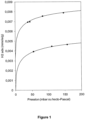
- FIG. 1 shows an example of an isotherm obtained for a catalyst according to the invention.
- the bottom curve corresponds to the reversible adsorption isotherm and the top curve represents the total adsorption isotherm.
- the optimized catalyst according to the invention has a bimetallicity index (BMI) greater than 108.
- BMI bimetallicity index
- This index defined below is measured by the hydrogen/oxygen titration technique.
- this BMI index is greater than 110 and very preferably greater than 115, or even 120.
- this index is less than 170, and even more preferably less than 160, or even less than 150. It is also possible according to another preferred variant that this index is between 108 and 160, or very preferably between 110 and 160, or even between 110 and 150, or even between 115 and 145.
- the bimetallicity index (BMI) is determined by exploiting in a particular way the hydrogen-oxygen titration technique.
- This technique is known to the person skilled in the art to determine the dispersion of a metal, that is to say the ratio of the number of surface atoms of a metal to the total number of atoms of this same metal. It is described for example in chapter 5 pages 130 and 131 of the journal book entitled: “ Catalytic Naphtha Reforming, Science and Technology", by GJ Antos, AM Aitani and JM Parera, Publisher Marcel Decker, 1995 . It consists of chemisorbing oxygen on a metal M contained in a previously reduced catalyst and therefore containing a layer of chemisorbed hydrogen.
- the stoichiometric reaction representing the titration step of chemisorbed hydrogen by oxygen is considered to be the following: MH + 3/4 O 2 ⁇ MO + 1 ⁇ 2 H 2 O
- the amount of oxygen consumed during the titration allows the quantity of accessible metal sites to be determined.
- the amount of oxygen adsorbed during the first cycle was greater than that adsorbed during the second cycle. This is explained by the fact that during the first cycle, the reduction of tin contributes to the oxygen consumption, while the second cycle mainly reflects the chemisorption of oxygen on the accessible platinum sites.
- This second cycle can be used to determine the dispersion of the metal M.
- the dispersion of the metal M is preferably greater than 80%, more preferably greater than 90% and very preferably greater than 95%.
- the volume of oxygen consumed in step g) is used for the calculation of the bimetallicity index.
- the porous support used in the catalyst according to the invention is generally a refractory oxide selected from magnesium, titanium, zirconium, alumina, silicon oxides or their mixture. Preferably it is silica, alumina or silica-alumina, and very preferably alumina.
- said porous support is advantageously in the form of beads, extrudates, pellets or powder.
- said support is in the form of beads or extrudates.
- the pore volume of the support is preferably between 0.1 and 1.5 cm 3 /g, more preferably between 0.4 and 0.8 cm 3 /g.
- said porous support has a specific surface area advantageously between 50 and 600 m 2 /g, preferably between 100 and 400 m 2 /g, or even between 150 and 300 m 2 /g.
- the catalysts according to the invention were obtained in particular by depositing the promoter X1 in two stages (two separate steps), a first step located before the introduction of the platinum group element, and a second step located after the introduction of the platinum group element.
- X1 can be incorporated into the support, for example during the synthesis of the support or during the shaping of the support.
- X1 can also be introduced onto the support, for example by impregnation of the previously shaped support.
- X1 can also be introduced partly during the synthesis or shaping of the support and partly by deposition onto the shaped support. 30% to 70% by weight, preferably 40% to 65% by weight and even more preferably 50% to 65% by weight, of the total amount of X1 entering into the composition of the catalyst according to the invention are thus introduced into the support or deposited onto the support during this first introduction step.
- the fraction of X1 introduced during the synthesis of the support is incorporated by any technique known to those skilled in the art. Without being exhaustive, the techniques of addition before or during the dissolution of the oxide precursors of the support, with or without ripening, may be suitable. The introduction can therefore be simultaneous or successive to the mixing of the precursors of the support.
- the promoter X1 is introduced during the synthesis of the support using a sol-gel technique. According to another variant, the promoter X1 is added to an alumina sol.
- the promoter X1 is introduced during the shaping of the support according to the techniques of the prior art for shaping the support such as the shaping procedures by extrusion or by coagulation in drops (Oil-Drop according to the Anglo-Saxon terminology).
- the fraction of X1 is deposited on the support, after its shaping, it can be impregnated using any technique known to those skilled in the art, and preferably by impregnation of a solution containing one or more precursors of X1.
- the impregnation can be carried out by excess solution or dry (the volume of solution containing X1 corresponding to the pore volume of the support).
- the impregnation can be carried out in the presence of species acting on the interaction between the precursor of the promoter X1 and the support.
- These species can be, for example, and without being limiting, mineral acids (HCl, HNO3) or organic acids (carboxylic or polycarboxylic acid types), and organic compounds of the complexing type, as described for example in the patents US 6,872,300 B1 And US 6,291,394 B1 .
- the impregnation is carried out according to any technique known to those skilled in the art making it possible to obtain a homogeneous distribution of the promoter X1 within the catalyst.
- the precursors of the promoter X1 may be mineral or of organometallic type, optionally of water-soluble organometallic type.
- X1 is preferably chosen from the elements germanium and tin.
- the precursors containing germanium may be chosen from at least one of the following reagents, without being exhaustive: germanium oxides, tetraalkoxides and fluorides.
- An example of an organosoluble organometallic compound is the oxide (EtGeO) 2 O. In the case of tin, different precursors may be used, alone or in a mixture.
- tin may be chosen, in a non-limiting manner, from the group formed by halogenated compounds, hydroxides, carbonates, carboxylates, sulfates, tartrates and nitrates. These forms of tin may be introduced into the catalyst preparation medium as they are or generated in situ (for example by introducing tin and carboxylic acid).
- the tin-based organometallic precursors may be, for example, SnR4, where R represents an alkyl group, for example the butyl group, Me 3 SnCl, Me 2 SnCl 2 , Et 3 SnCl, Et 2 SnCl 2 , EtSnCl 3 , iPrSnCl 2 and the hydroxides Me 3 SnOH, Me 2 Sn(OH) 2 , EtsSnOH, Et 2 Sn(OH) 2 , the oxides (Bu 3 Sn) 2 O, the acetate Bu 3 SnOC(O)Me.
- the halogenated, in particular chlorinated, species of tin will be used.
- SnCl 2 or SnCl 4 will be advantageously used.
- step b it may be preferred to carry out drying of the support (step b) at the end after addition of the promoter.
- This drying can be carried out according to any technique known to those skilled in the art, for example at a temperature between 40°C and 200°C, preferably between 80°C and 180°C.
- This drying can be carried out with temperature programming and can optionally include temperature steps.
- the protocol for preparing the catalysts according to the invention generally requires calcination before the deposition of the metal M of the platinum group (step c).
- This calcination is preferably carried out at a temperature of between 350 and 650°C and preferably between 400 and 600°C and even more preferably between 400 and 550°C.
- the increase in temperature may be regular or include intermediate temperature steps, these steps being reached with fixed or variable temperature rise rates. These temperature rises may therefore be identical or differ in their speed (in degrees per minute or per hour).
- the gas atmosphere used during calcination contains oxygen, preferably between 2 and 50% and more preferably between 5 and 25%. Air may therefore also be used during this calcination step.
- a deposit of platinum group metal M is carried out (step d).
- the metal M can be introduced by dry impregnation or in excess solution, using a precursor or a mixture of precursors containing a platinum group metal M.
- the impregnation can be carried out in the presence of species acting on the interaction between the precursor of the metal M and the support. These species can be, and without being limiting, mineral acids (HCl, HNO3) or organic acids (carboxylic or polycarboxylic acid types), and organic compounds of the complexing type.
- the impregnation is carried out according to any technique known to those skilled in the art making it possible to obtain a homogeneous distribution of the metal M within the catalyst.
- the precursors of metal M are part of the following group, without this list being exhaustive: hexachloroplatinic acid, bromoplatinic acid, ammonium chloroplatinate, platinum chlorides, platinum dichlorocarbonyl dichloride, platinum tetra-amine chloride.
- the support containing X1 (a fraction of the total quantity of X1 targeted in the final catalyst) and the platinum is optionally dried (step e), under a neutral atmosphere or one containing oxygen (air may be used), at a moderate temperature and preferably not exceeding 150°C.
- the drying is carried out at a temperature below 100°C and over a period of a few minutes to a few hours.
- an additional fraction of the promoter X1 is deposited on the product obtained in step d or e (step f). More precisely, for the introduction of the species X1 (used alone or in a mixture) concerning this step, at least 30% and at most 70%, preferably 35% at most, less and 60% at most, and very preferably 35% at least and 50% at most of the total quantity of X1 entering into the composition of the catalyst according to the invention are thus introduced during this second step (step f) of introduction of X1.
- the complementary fraction of the promoter X1 is deposited by bringing into contact a solution containing the precursor.
- tin tetrachloride SnCl4 In this step, and in the case of tin precursors, tin tetrachloride SnCl4 will be used exclusively. In the case of germanium precursors, germanium tetrachloride GeCl4 will be used exclusively.
- Optional drying of the product obtained in step f can then take place (step g), in a neutral atmosphere or one containing oxygen (air can be used), at a moderate temperature.
- This step is then generally followed by calcination of the product obtained in step f or g (step h).
- This calcination is preferably carried out in the presence of air.
- This air can also be enriched with oxygen or nitrogen.
- the oxygen content of this gas reaches 0.5 to 30% and even more preferably 2 to 25%.
- This calcination is carried out at a temperature between 350 and 600°C and preferably between 400 and 550°C and even more preferably between 450 and 550°C.
- the temperature ramp must be regular and sufficiently rapid. It may optionally contain temperature steps from 350°C.
- the temperature rise rate will be greater than or equal to 5°C/min. This temperature rise rate may be greater than 10°C/min. Preferably, this temperature rise rate will not be less than 2°C/min.
- the optional promoter X2 may be introduced at one or more stages of the catalyst preparation. For example, it may be introduced before, during or after the first stage of introduction of X1 (stage a, during the shaping of the support or by deposition on the support), alone or in a mixture. X2 may also be introduced between the stage of calcination of the support (stage c) and the stage of introduction of the platinum group metal (stage d). Another possibility of introducing X2 is to incorporate it before the addition of the second fraction of X1 (stage f), it may finally be introduced before the final calcination step (step h). The promoter X2 can be introduced in one or more times, provided that the introduction conditions mentioned above are respected.
- the promoter X2 can also be introduced by impregnation during an additional step (step i) located after step h, step i is then generally followed by steps j and k respectively of drying and calcination of the catalyst under the conditions detailed above for drying steps e or g or calcination steps h.
- the preparation process according to the invention can therefore further and advantageously comprise an additional step of introducing a promoter X2 located before step a, or between step c and step d or just before step f or step h, or even after step h.
- the optional promoter X2 can be introduced using any technique known to those skilled in the art. Ion exchanges, dry impregnations or excess solution impregnations are appropriate when it comes to deposition on the support (modified by X1 or not). In the case of incorporation during the preparation of the support, the promoter X2 can be added by mixing, coprecipitation, dissolution without being limiting. In the case of gallium, indium, and thallium, nitrates or halides can be used. Concerning indium, precursors, alone or in a mixture, of indium nitrate, chlorides or bromides are suitable. Other precursors can also be used.
- halogenated compound When the various precursors used in the preparation of the catalyst according to the invention do not contain halogen or contain halogen in insufficient quantity, it may be necessary to add a halogenated compound during the preparation.
- Any compound known to those skilled in the art may be used and incorporated in any of the steps of the preparation of the catalyst according to the invention.
- compounds of the Friedel and Crafts type such as aluminum chloride or bromide, iron chloride or bromide or zinc chloride.
- organic compounds such as methyl or ethyl halides, for example dichloromethane, chloroform, dichloroethane, methyl chloroform or carbon tetrachloride.
- Chlorine may also be added to the catalyst according to the invention by means of an oxychlorination treatment.
- a treatment may for example be carried out at 500°C for 4 hours under a flow rate of 100 liters per hour of air containing the quantity of chlorine gas necessary to deposit the desired quantity of chlorine and a quantity of water with a molar ratio H2O/Cl close to, for example, 20.
- Chlorine can also be added by impregnation with an aqueous solution of hydrochloric acid.
- a typical protocol is to impregnate the solid so as to introduce the desired amount of chlorine.
- the catalyst is kept in contact with the aqueous solution for a time long enough to deposit this amount of chlorine, then the catalyst is drained and dried at a temperature between 80 and 150°C, and finally calcined in air at a temperature between 450°C and 600°C.
- the invention also relates to a process for catalytic reforming of a hydrocarbon feedstock in the presence of the catalyst according to the invention.
- the catalyst according to the invention can in fact be used in processes for reforming gasoline and producing aromatic compounds.
- Reforming processes make it possible to increase the octane number of gasoline fractions originating from the distillation of crude oil and/or other refining processes such as, for example, catalytic cracking or thermal cracking.
- Aromatics production processes provide the basic products (benzene, toluene, xylenes) that can be used in petrochemistry. These processes are of additional interest in contributing to the production of significant quantities of hydrogen, which is essential for the hydrogenation and hydrotreatment processes of the refinery. These two types of processes differ in the choice of operating conditions and the composition of the feedstock, which are known to those skilled in the art.
- the feedstock for reforming processes generally contains paraffinic, naphthenic and aromatic hydrocarbons containing 5 to 12 carbon atoms per molecule.
- This feedstock is defined, among other things, by its density and weight composition.
- These feedstocks can have an initial boiling point between 40°C and 70°C and a final boiling point of between 160°C and 220°C. They may also consist of a fraction or a mixture of gasoline fractions having initial and final boiling points of between 40°C and 220°C.
- the feedstock may thus also consist of a heavy naphtha having a boiling point of between 160°C and 200°C.
- the reforming catalyst is loaded into a unit and previously subjected to a reduction treatment.
- This reduction step is generally carried out under a dilute or pure hydrogen atmosphere and at a temperature advantageously between 400°C and 600°C, preferably between 450°C and 550°C.
- the feedstock is then introduced in the presence of hydrogen and with a hydrogen/hydrocarbon molar ratio of the feedstock generally between 0.1 and 10, preferably between 1 and 8.
- the operating conditions of the reforming are generally as follows: a temperature preferably between 400°C and 600°C, more preferably between 450°C and 540°C, and a pressure preferably between 0.1 MPa and 4 MPa and more preferably between 0.25 MPa and 3.0 MPa. All or part of the hydrogen produced can be recycled to the inlet of the reforming reactor.
- Example 1 Preparation of catalyst A SnPtSn / Al2O3-Cl
- a catalyst A is prepared containing 0.3% by weight of platinum, 0.4% by weight of tin, and 1% by weight of chlorine, deposited on a gamma alumina support with a specific surface area of 200 m2 /g.
- alumina support To 100 g of alumina support are added 200 cm 3 of an aqueous solution containing tin dichloride in the presence of hydrochloric acid. The mixture is left in contact for 4 hours, filtered, dried at 120°C and then calcined for 2 hours at 500°C under an air flow of 100 liters per hour. The quantity of tin dichloride is chosen so as to obtain 0.2% by weight of tin on the calcined product. The solid is then brought into contact with 400 cm 3 of an aqueous solution of hexachloroplatinic acid and hydrochloric acid. The mixture is left in contact for 4 hours and then drained.
- a catalyst B is prepared according to the procedure described in example 1, this time choosing the quantity of tin dichloride so as to obtain 0.27% by weight of tin on the calcined intermediate product, and the quantity of tin tetrachloride so as to complete to always obtain 0.4% of tin on the final catalyst.
- a catalyst C is prepared on the same support and with the same tin, platinum and chlorine contents as in example 1.
- alumina support To 100 g of alumina support, 200 cm 3 of an aqueous solution containing tin dichloride in the presence of hydrochloric acid are added. The mixture is left in contact for 4 hours, filtered, dried at 120°C and then calcined for 2 hours at 500°C under an air flow rate of 100 liters per hour. The quantity of tin dichloride is chosen so as to obtain 0.4% by weight of tin in the calcined product. The solid is then placed in contact with 400 cm 3 of an aqueous solution of hexachloroplatinic acid and hydrochloric acid. The mixture is left in contact for 4 hours and then drained. The mixture is dried at 120°C and then calcined for 2 hours at 500°C under an air flow rate of 100 liters per hour, with a temperature rise rate of 7°C per minute.
- Example 4 (comparative): Preparation of a SnPtSn / Al2O3-Cl catalyst D
- a catalyst C is prepared according to the procedure described in example 1, with the only difference being that during the two tin impregnations, the precursor used filter, dry at 120°C then calcine for 2 hours at 500°C under an air flow of 100 liters per hour.
- the quantity of tin dichloride is chosen so as to obtain 0.4% by weight of tin on the calcined product.
- the solid is then placed in contact with 400 cm 3 of an aqueous solution of hexachloroplatinic acid and hydrochloric acid. Leave in contact for 4 hours then drain. Dry at 120°C then calcine for 2 hours at 500°C under an air flow of 100 liters per hour, with a temperature rise rate of 7°C per minute.
- Example 4 (comparative): Preparation of a SnPtSn / Al2O3-Cl catalyst D
- a catalyst D is prepared according to the procedure described in example 1, with the only difference that during the two tin impregnations, the precursor used is an aqueous solution containing tin dichloride in the presence of hydrochloric acid.
- Example 5 Preparation of catalyst E SnPtInSn / Al2O3-Cl
- a catalyst E is prepared on the same support as in example 1, by depositing 0.3% by weight of platinum, 0.4% by weight of tin, 0.2% by weight of indium and 1% by weight of chlorine.
- To 100 g of alumina support are added 200 cm 3 of an aqueous solution containing tin dichloride in the presence of hydrochloric acid. The mixture is left in contact for 4 hours, filtered, dried at 120°C and then calcined for 2 hours at 500°C under an air flow of 100 liters per hour.
- the quantity of tin dichloride is chosen so as to obtain 0.2% by weight of tin on the calcined product.
- the solid is then placed in contact with 400 cm 3 of an aqueous solution of hexachloroplatinic acid and hydrochloric acid.
- the mixture is left in contact for 4 hours and then drained. It is dried at 90°C and then brought into contact with 300 cm3 of an aqueous solution containing indium nitrate in the presence of hydrochloric acid. It is again left in contact for 4 hours, drained, dried and then brought into contact with 200 cm3 of an aqueous solution containing tin tetrachloride in the presence of hydrochloric acid.
- Example 5 Preparation of catalyst E SnPtInSn / Al2O3-Cl
- a catalyst E is prepared on the same support as in example 1, by depositing 0.3% by weight of platinum, 0.4% by weight of tin, 0.2% by weight of indium and 1% by weight of chlorine.
- To 100 g of alumina support are added 200 cm 3 of an aqueous solution containing tin dichloride in the presence of hydrochloric acid. The mixture is left in contact for 4 hours, filtered, dried at 120°C and then calcined for 2 hours at 500°C under an air flow of 100 liters per hour.
- the quantity of tin dichloride is chosen so as to obtain 0.2% by weight of tin on the calcined product.
- the solid is then placed in contact with 400 cm 3 of an aqueous solution of hexachloroplatinic acid and hydrochloric acid.
- the mixture is left in contact for 4 hours and then drained. Dry at 90°C and then contact with 300 cm3 of an aqueous solution containing indium nitrate in the presence of hydrochloric acid.
- the amount of tin tetrachloride is chosen so as to obtain a total of 0.4% by weight of tin in the calcined product.
- a support of alumina balls containing 0.2% by weight of tin and 0.2% by weight of indium, with an average diameter of 1.2 mm, having a BET surface area of 205 m2/g, is prepared by bringing tin dichloride and indium trichloride into contact with an alumina hydrosol obtained by hydrolysis of aluminum chloride.
- the alumina hydrosol thus obtained is then passed through a vertical column filled with additive oil.
- the spheres thus obtained are heat treated up to 600°C so as to obtain balls with good mechanical strength.
- a catalyst F is prepared on this support, by depositing 0.3% by weight of platinum, 0.2% by weight of additional tin so as to obtain 0.4% by weight of tin and 1% by weight of chlorine on the final catalyst.
- alumina support containing tin and indium 400 cm 3 of an aqueous solution of hexachloroplatinic acid and hydrochloric acid are added. The mixture is left in contact for 4 hours and then drained. It is dried at 90°C and then brought into contact with 200 cm 3 of an aqueous solution of tin tetrachloride in the presence of hydrochloric acid. It is left in contact for 4 hours, drained, dried at 120°C and then calcined for 2 hours at 500°C under an air flow rate of 100 liters per hour, with a temperature rise rate of 7°C per minute. The quantity of tin tetrachloride is chosen so as to obtain a total of 0.4% by weight of tin in the calcined product.
- Example 7 Preparation of catalyst G SnInPtSn / Al2O3
- a catalyst G is prepared on the same support as in example 1, by depositing 0.3% by weight of platinum, 0.4% by weight of tin, 0.2% by weight of indium and 1% by weight of chlorine.
- To 100 g of alumina support are added 200 cm 3 of an aqueous solution containing tin dichloride in the presence of hydrochloric acid. The mixture is left in contact for 4 hours, filtered, dried at 120°C and then calcined for 2 hours at 500°C under an air flow of 100 liters per hour.
- the quantity of tin dichloride is chosen so as to obtain 0.2% by weight of tin on the calcined product.
- the solid is then placed in contact with 300 cm 3 of an aqueous solution containing indium nitrate in the presence of hydrochloric acid.
- the mixture is again left in contact for 4 hours, drained and the solid is dried.
- the solid is then brought into contact with 400 cm 3 of an aqueous solution of hexachloroplatinic acid and hydrochloric acid.
- the mixture is left in contact for 4 hours and then drained. It is dried at 90°C and then brought into contact with 200 cm 3 of an aqueous solution containing tin tetrachloride in the presence of hydrochloric acid.
- Example 8 Evaluation of the performance of catalysts A to G in catalytic reforming.
- the research octane rating of the charge is close to 55.
- the comparison is made at iso quality of research octane number of liquid effluents (called reformates) resulting from the catalytic conversion of the charge.
- the comparison is made for a research octane number of 102.
Landscapes
- Chemical & Material Sciences (AREA)
- Engineering & Computer Science (AREA)
- Organic Chemistry (AREA)
- Chemical Kinetics & Catalysis (AREA)
- Materials Engineering (AREA)
- Oil, Petroleum & Natural Gas (AREA)
- General Chemical & Material Sciences (AREA)
- Catalysts (AREA)
- Production Of Liquid Hydrocarbon Mixture For Refining Petroleum (AREA)
Claims (22)
- Katalysator, der ein Metall M der Platingruppe, mindestens einen Promotor X1, der aus der aus Zinn, Germanium und Blei bestehenden Gruppe ausgewählt ist, eine Halogenverbindung und einen porösen Träger umfasst, wobei das Atomverhältnis X1/M zwischen 0,3 und 8 beträgt, das mittels irreversibler Wasserstoff-Chemisorption gemessene Verhältnis Hir/M mehr als 0,40 beträgt und der mittels Wasserstoff-Sauerstoff-Titration gemessene Bimetallizitätsindex IBM mehr als 108 beträgt, wobei der Katalysator 0,1 bis 15 Gew.-% der Halogenverbindung enthält und gemäß den folgenden Schritten hergestellt wird:a) der Einführung des Promotors X1 in den Träger oder auf den Träger,c) der Calcinierung des in Schritt a) erhaltenen Produkts bei einer Temperatur vorzugsweise zwischen 350 und 650 °C,d) der Abscheidung mindestens eines Metalls M der Platingruppe,e) der optionalen Trocknung unter einer neutralen oder einer Sauerstoff enthaltenden Atmosphäre bei einer Temperatur, die mäßig ist und vorzugsweise nicht 150 °C übersteigt,f) der Abscheidung einer komplementären Fraktion des Promotors X1 auf dem in Schritt d oder e erhaltenen Produkt, wobei die komplementäre Fraktion des Promotors X1 durch das In-Kontakt-Bringen einer Lösung von Zinntetrachlorid oder Germaniumtetrachlorid abgeschieden wird,h) der Calcinierung des in Schritt f) erhaltenen Produkts, wobei diese Calcinierung vorzugsweise in Gegenwart von Luft durchgeführt wird und diese Luft auch mit Sauerstoff oder Stickstoff angereichert sein kann, und wobei in demjenigen Fall, in dem die bei der Herstellung des Katalysators verwendeten Vorstufen des Promotors X1 oder des Metalls M kein Halogen enthalten oder Halogen in einer unzureichenden Menge enthalten, der Zugabe einer Halogenverbindung bei der Herstellung oder, wenn das Halogen Chlor ist, einer Oxychlorierungs- oder Tränkbehandlung mit einer wässrigen Salzsäurelösung.
- Katalysator nach Anspruch 1, der weiterhin mindestens einen Promotor X2 umfasst, der ausgewählt ist aus der Gruppe bestehend aus Gallium, Indium und Thallium, wobei das Verhältnis X2/M zwischen 0,3 und 8 beträgt.
- Katalysator nach einem der Ansprüche 1 oder 2, wobei das Atomverhältnis X1/M zwischen 0,6 und 6 beträgt.
- Katalysator nach Anspruch 2, wobei das Atomverhältnis (X1+X2)/M zwischen 0,3 und 8 beträgt.
- Katalysator nach Anspruch 2, wobei das Verhältnis X1/M zwischen 1,0 und 2,9 beträgt und das Verhältnis X2/M zwischen 0,9 und 4 beträgt.
- Katalysator nach Anspruch 1, der ausschließlich einen Promotor X1 umfasst und wobei X1 Zinn ist.
- Katalysator nach Anspruch 2, der einen Promotor X1 und einen Promotor X2 umfasst und wobei X1 Zinn und X2 Indium ist.
- Katalysator nach einem der vorhergehenden Ansprüche, wobei der Katalysator weiterhin Phosphor umfasst.
- Katalysator nach Anspruch 8, wobei der Phosphorgehalt zwischen 0,01 und 5 Gew.-% beträgt.
- Katalysator nach einem der vorhergehenden Ansprüche, wobei das Verhältnis Hir/M zwischen 0,43 und 0,9 beträgt.
- Katalysator nach einem der vorhergehenden Ansprüche, wobei das Verhältnis Hir/M zwischen 0,45 und 0,65 beträgt.
- Katalysator nach einem der vorhergehenden Ansprüche, wobei der mittels Wasserstoff-Sauerstoff-Titration gemessene Bimetallizitätsindex IBM mehr als 115 beträgt.
- Katalysator nach einem der Ansprüche 1 bis 11, wobei der mittels Wasserstoff-Sauerstoff-Titration gemessene Bimetallizitätsindex IBM zwischen 110 und 160, vorzugsweise zwischen 115 und 145, beträgt.
- Katalysator nach einem der vorhergehenden Ansprüche, wobei die Halogenverbindung ausgewählt ist aus der Gruppe bestehend aus: Fluor, Chlor, Brom und Iod.
- Katalysator nach einem der vorhergehenden Ansprüche, wobei es sich bei der Halogenverbindung um Chlor handelt und der Katalysator 0,5 bis 2 Gew.-% Chlor enthält.
- Verfahren zur Herstellung eines Katalysators, der ein Metall M der Platingruppe, mindestens einen Promotor X1, der aus der aus Zinn, Germanium und Blei bestehenden Gruppe ausgewählt ist, eine Halogenverbindung und einen porösen Träger umfasst, wobei das Atomverhältnis X1/M zwischen 0,3 und 8 beträgt, das mittels irreversibler Wasserstoff-Chemisorption gemessene Verhältnis Hir/M mehr als 0,40 beträgt und der mittels Wasserstoff-Sauerstoff-Titration gemessene Bimetallizitätsindex IBM mehr als 108 beträgt, wobei der Katalysator 0,1 bis 15 Gew.-% der Halogenverbindung enthält, wobei das Verfahren die folgenden Schritte umfasst:a) die Einführung des Promotors X1 in den Träger oder auf den Träger,c) die Calcinierung des in Schritt a) erhaltenen Produkts bei einer Temperatur vorzugsweise zwischen 350 und 650 °C,d) die Abscheidung mindestens eines Metalls M der Platingruppe,e) die optionale Trocknung unter einer neutralen oder einer Sauerstoff enthaltenden Atmosphäre bei einer Temperatur, die mäßig ist und vorzugsweise nicht 150 °C übersteigt,f) die Abscheidung einer komplementären Fraktion des Promotors X1 auf dem in Schritt d oder e erhaltenen Produkt, wobei die komplementäre Fraktion des Promotors X1 durch das In-Kontakt-Bringen einer Lösung von Zinntetrachlorid oder Germaniumtetrachlorid abgeschieden wird,h) die Calcinierung des in Schritt f) erhaltenen Produkts, wobei diese Calcinierung vorzugsweise in Gegenwart von Luft durchgeführt wird und diese Luft auch mit Sauerstoff oder Stickstoff angereichert sein kann, und wobei in demjenigen Fall, in dem die bei der Herstellung des Katalysators verwendeten Vorstufen des Promotors X1 oder des Metalls M kein Halogen enthalten oder Halogen in einer unzureichenden Menge enthalten, die Zugabe einer Halogenverbindung bei der Herstellung oder, wenn das Halogen Chlor ist, eine Oxychlorierungs- oder Tränkbehandlung mit einer wässrigen Salzsäurelösung.
- Herstellungsverfahren nach Anspruch 16, das weiterhin einen Schritt b) des Trocknens des aus Schritt a erhaltenen Produkts umfasst.
- Herstellungsverfahren nach einem der Ansprüche 16 oder 17, das weiterhin vor Schritt h) einen Schritt g) des Trocknens des aus Schritt f erhaltenen Produkts umfasst.
- Herstellungsverfahren nach einem der Ansprüche 16 bis 18, wobei ein Promotor X2 in einen oder mehrere Schritte der Herstellung eingeführt wird, die aus den Schritten a), d) und f) ausgewählt sind.
- Herstellungsverfahren nach einem der Ansprüche 16 bis 19, das weiterhin einen zusätzlichen Schritt der Einführung eines Promotors X2 umfasst, der vor Schritt a) oder zwischen Schritt c) und Schritt d) oder unmittelbar vor Schritt f) oder Schritt h) oder auch nach Schritt h) angeordnet ist.
- Herstellungsverfahren nach einem der Ansprüche 16 bis 20, wobei mindestens 30 % und höchstens 70 % der Gesamtmenge an X1, die in die erfindungsgemäße Katalysatorzusammensetzung gelangen, im zweiten Schritt f) der Einführung von X1 eingeführt werden.
- Verfahren zum katalytischen Reforming eines Kohlenwasserstoff-Einsatzmaterials in Gegenwart eines Katalysators nach einem der Ansprüche 1 bis 15.
Applications Claiming Priority (2)
| Application Number | Priority Date | Filing Date | Title |
|---|---|---|---|
| FR0611407A FR2910347B1 (fr) | 2006-12-22 | 2006-12-22 | Catalyseur bimetallique ou multi-metallique presentant un indice de bimetallicite et une capacite d'adsorption d'hydrogene optimises |
| PCT/FR2007/002023 WO2008087273A2 (fr) | 2006-12-22 | 2007-12-07 | Catalyseur bimetallique ou multi-metallique presentant un indice de bimetallicite et une capacite d'adsorption d'hydrogene optimises |
Publications (2)
| Publication Number | Publication Date |
|---|---|
| EP2111297A2 EP2111297A2 (de) | 2009-10-28 |
| EP2111297B1 true EP2111297B1 (de) | 2024-09-18 |
Family
ID=38508839
Family Applications (1)
| Application Number | Title | Priority Date | Filing Date |
|---|---|---|---|
| EP07871818.6A Active EP2111297B1 (de) | 2006-12-22 | 2007-12-07 | Bimetallischer oder polymetallischer katalysator mit optimiertem bimetallizitätsindex und wasserstoffadsorptionskapazität |
Country Status (6)
| Country | Link |
|---|---|
| US (1) | US8148288B2 (de) |
| EP (1) | EP2111297B1 (de) |
| CN (1) | CN101583427B (de) |
| DK (1) | DK2111297T3 (de) |
| FR (1) | FR2910347B1 (de) |
| WO (1) | WO2008087273A2 (de) |
Families Citing this family (5)
| Publication number | Priority date | Publication date | Assignee | Title |
|---|---|---|---|---|
| FR2910347B1 (fr) * | 2006-12-22 | 2009-12-04 | Inst Francais Du Petrole | Catalyseur bimetallique ou multi-metallique presentant un indice de bimetallicite et une capacite d'adsorption d'hydrogene optimises |
| FR2947465B1 (fr) * | 2009-07-01 | 2012-05-11 | Inst Francais Du Petrole | Catalyseur multi-metallique presentant une proximite de sites optimisee |
| FR2947464B1 (fr) * | 2009-07-01 | 2011-07-22 | Inst Francais Du Petrole | Catalyseur multi-metallique presentant une forte interaction metallique |
| CA2959591C (en) * | 2014-08-29 | 2022-05-31 | Reliance Industries Limited | Reforming catalyst and a method of preparation thereof |
| RU2598944C1 (ru) * | 2015-05-14 | 2016-10-10 | Федеральное государственное унитарное предприятие "Горно-химический комбинат" (ФГУП "ГХК") | Способ приготовления биметаллического катализатора окислительно-восстановительных процессов в азотнокислых средах |
Family Cites Families (10)
| Publication number | Priority date | Publication date | Assignee | Title |
|---|---|---|---|---|
| GB1356383A (en) * | 1970-05-04 | 1974-06-12 | Shell Int Research | Process for the preparation of regenerable noble metal catalysts and use of catalysts thus prepared in the conversion of hydro carbons |
| US4367137A (en) * | 1980-12-04 | 1983-01-04 | Uop Inc. | Hydrocarbon conversion with an acidic multimetallic catalytic composite |
| EP0183861B1 (de) * | 1981-11-05 | 1988-07-27 | Uop Inc. | Indium enthaltender Dehydrierungskatalysator |
| US4487848A (en) * | 1983-06-02 | 1984-12-11 | Uop Inc. | Indium-containing catalyst for reforming hydrocarbons |
| US4929332A (en) * | 1989-02-06 | 1990-05-29 | Uop | Multizone catalytic reforming process |
| ES2192075T5 (es) * | 1998-09-03 | 2008-02-01 | Dow Global Technologies Inc. | Procedimiento autotermico para la produccion de olefinas. |
| US7655137B2 (en) * | 2003-07-14 | 2010-02-02 | Headwaters Technology Innovation, Llc | Reforming catalysts having a controlled coordination structure and methods for preparing such compositions |
| US7541309B2 (en) * | 2006-05-16 | 2009-06-02 | Headwaters Technology Innovation, Llc | Reforming nanocatalysts and methods of making and using such catalysts |
| FR2910346B1 (fr) * | 2006-12-22 | 2010-10-15 | Inst Francais Du Petrole | Procede de deshydrogenation en presence d'un catalyseur bimetallique ou multi-metallique ayant un indice de bimetallicite et une capacite d'adsorption d'hydrogene optimises |
| FR2910347B1 (fr) * | 2006-12-22 | 2009-12-04 | Inst Francais Du Petrole | Catalyseur bimetallique ou multi-metallique presentant un indice de bimetallicite et une capacite d'adsorption d'hydrogene optimises |
-
2006
- 2006-12-22 FR FR0611407A patent/FR2910347B1/fr active Active
-
2007
- 2007-12-07 CN CN200780047703.8A patent/CN101583427B/zh active Active
- 2007-12-07 WO PCT/FR2007/002023 patent/WO2008087273A2/fr not_active Ceased
- 2007-12-07 DK DK07871818.6T patent/DK2111297T3/da active
- 2007-12-07 EP EP07871818.6A patent/EP2111297B1/de active Active
- 2007-12-07 US US12/520,702 patent/US8148288B2/en active Active
Also Published As
| Publication number | Publication date |
|---|---|
| DK2111297T3 (da) | 2024-12-09 |
| US8148288B2 (en) | 2012-04-03 |
| US20100048389A1 (en) | 2010-02-25 |
| EP2111297A2 (de) | 2009-10-28 |
| WO2008087273A3 (fr) | 2008-09-12 |
| WO2008087273A2 (fr) | 2008-07-24 |
| CN101583427B (zh) | 2013-03-27 |
| CN101583427A (zh) | 2009-11-18 |
| FR2910347A1 (fr) | 2008-06-27 |
| FR2910347B1 (fr) | 2009-12-04 |
Similar Documents
| Publication | Publication Date | Title |
|---|---|---|
| EP2097166B1 (de) | Dehydrierferfahren in gegenwart eines bimetall- oder multimetallkatalysators mit optimiertem bimetallindex und wasserstoffabsorptionsfähigkeit | |
| EP0832168B1 (de) | In kohlenwasserstoffumwandlung verwendbare, ein dotierung-metall enthaltende katalysatoren | |
| EP0831966B1 (de) | Silizium enthaltende katalysatoren zur verwendung für die umwandlung von reaktionen von kohlenwasserstoffen | |
| EP1951460B1 (de) | Verfahren zur synthese eines katalysators auf grundlage anisotropischer metall-nanoteilchen unter verwendung eines reduzierenden wirkstoffs | |
| EP2111297B1 (de) | Bimetallischer oder polymetallischer katalysator mit optimiertem bimetallizitätsindex und wasserstoffadsorptionskapazität | |
| CA2355483C (fr) | Catalyseur bimetallique supporte comprenant une forte interaction entre un metal du groupe viii et de l'etain et son utilisation dans un procede de reformage catalytique | |
| EP0832169A1 (de) | Verfahren zur verwandlung von kohlenwasserstoffen in aromaverbindungen mit dotiermetallen | |
| EP2448670B1 (de) | Prozess zur herstellung eines multimetallischen katalysators mit einer optimierten stellenanordnung | |
| EP3325145B1 (de) | Multimetallischer, mit phosphor und einem cerium dotierter katalysator | |
| EP0832167B1 (de) | Reformierungsverfahren mit einem alkali- oder erdalkalimetall enthaltendem katalysator | |
| EP2448671B1 (de) | Multimetallischer katalysator mit einer starken wechselwirkung | |
| EP3717118B1 (de) | Mit phosphor und yttrium dotierter multimetallkatalysator | |
| EP3717117B1 (de) | Mit phosphor und ytterbium dotierter multimetallkatalysator | |
| FR2789332A1 (fr) | Lit homogene de catalyseur et procede de transformation d'hydrocarbures en composes aromatiques avec ledit lit | |
| FR2735391A1 (fr) | Catalyseurs utilisables dans les reactions de transformation d'hydrocarbures et contenant du silicium | |
| FR2735394A1 (fr) | Catalyseurs utilisables dans les reactions de transformation d'hydrocarbures et contenant du silicium et des metaux alcalins ou alcalino-terreux | |
| FR2735491A1 (fr) | Procede de transformation catalytique d'hydrocarbures en composes aromatiques avec un catalyseur comprenant du silicium |
Legal Events
| Date | Code | Title | Description |
|---|---|---|---|
| PUAI | Public reference made under article 153(3) epc to a published international application that has entered the european phase |
Free format text: ORIGINAL CODE: 0009012 |
|
| 17P | Request for examination filed |
Effective date: 20090722 |
|
| AK | Designated contracting states |
Kind code of ref document: A2 Designated state(s): AT BE BG CH CY CZ DE DK EE ES FI FR GB GR HU IE IS IT LI LT LU LV MC MT NL PL PT RO SE SI SK TR |
|
| RIN1 | Information on inventor provided before grant (corrected) |
Inventor name: LE PELTIER, FABIENNE Inventor name: LE GOFF, PIERRE-YVES Inventor name: CHAU, CHRISTOPHE Inventor name: LACOMBE, SYLVIE Inventor name: GIRAUD, JEAN |
|
| DAX | Request for extension of the european patent (deleted) | ||
| 17Q | First examination report despatched |
Effective date: 20100614 |
|
| RAP1 | Party data changed (applicant data changed or rights of an application transferred) |
Owner name: IFP ENERGIES NOUVELLES |
|
| RAP1 | Party data changed (applicant data changed or rights of an application transferred) |
Owner name: IFP ENERGIES NOUVELLES |
|
| STAA | Information on the status of an ep patent application or granted ep patent |
Free format text: STATUS: EXAMINATION IS IN PROGRESS |
|
| REG | Reference to a national code |
Ref country code: DE Ref legal event code: R079 Ref document number: 602007061925 Country of ref document: DE Free format text: PREVIOUS MAIN CLASS: B01J0037020000 Ipc: B01J0023620000 Ref country code: DE Ref legal event code: R079 Free format text: PREVIOUS MAIN CLASS: B01J0037020000 Ipc: B01J0023620000 |
|
| GRAP | Despatch of communication of intention to grant a patent |
Free format text: ORIGINAL CODE: EPIDOSNIGR1 |
|
| STAA | Information on the status of an ep patent application or granted ep patent |
Free format text: STATUS: GRANT OF PATENT IS INTENDED |
|
| RIC1 | Information provided on ipc code assigned before grant |
Ipc: C10G 35/09 20060101ALI20240328BHEP Ipc: B01J 37/02 20060101ALI20240328BHEP Ipc: B01J 35/30 20240101ALI20240328BHEP Ipc: B01J 27/185 20060101ALI20240328BHEP Ipc: B01J 27/135 20060101ALI20240328BHEP Ipc: B01J 23/62 20060101AFI20240328BHEP |
|
| INTG | Intention to grant announced |
Effective date: 20240415 |
|
| GRAS | Grant fee paid |
Free format text: ORIGINAL CODE: EPIDOSNIGR3 |
|
| GRAA | (expected) grant |
Free format text: ORIGINAL CODE: 0009210 |
|
| STAA | Information on the status of an ep patent application or granted ep patent |
Free format text: STATUS: THE PATENT HAS BEEN GRANTED |
|
| AK | Designated contracting states |
Kind code of ref document: B1 Designated state(s): AT BE BG CH CY CZ DE DK EE ES FI FR GB GR HU IE IS IT LI LT LU LV MC MT NL PL PT RO SE SI SK TR |
|
| REG | Reference to a national code |
Ref country code: GB Ref legal event code: FG4D Free format text: NOT ENGLISH |
|
| REG | Reference to a national code |
Ref country code: CH Ref legal event code: EP |
|
| REG | Reference to a national code |
Ref country code: DE Ref legal event code: R096 Ref document number: 602007061925 Country of ref document: DE |
|
| REG | Reference to a national code |
Ref country code: IE Ref legal event code: FG4D Free format text: LANGUAGE OF EP DOCUMENT: FRENCH |
|
| REG | Reference to a national code |
Ref country code: DK Ref legal event code: T3 Effective date: 20241205 |
|
| REG | Reference to a national code |
Ref country code: NL Ref legal event code: FP |
|
| REG | Reference to a national code |
Ref country code: LT Ref legal event code: MG9D |
|
| PG25 | Lapsed in a contracting state [announced via postgrant information from national office to epo] |
Ref country code: GR Free format text: LAPSE BECAUSE OF FAILURE TO SUBMIT A TRANSLATION OF THE DESCRIPTION OR TO PAY THE FEE WITHIN THE PRESCRIBED TIME-LIMIT Effective date: 20241219 Ref country code: FI Free format text: LAPSE BECAUSE OF FAILURE TO SUBMIT A TRANSLATION OF THE DESCRIPTION OR TO PAY THE FEE WITHIN THE PRESCRIBED TIME-LIMIT Effective date: 20240918 |
|
| PGFP | Annual fee paid to national office [announced via postgrant information from national office to epo] |
Ref country code: BE Payment date: 20241224 Year of fee payment: 18 |
|
| PG25 | Lapsed in a contracting state [announced via postgrant information from national office to epo] |
Ref country code: BG Free format text: LAPSE BECAUSE OF FAILURE TO SUBMIT A TRANSLATION OF THE DESCRIPTION OR TO PAY THE FEE WITHIN THE PRESCRIBED TIME-LIMIT Effective date: 20240918 |
|
| PG25 | Lapsed in a contracting state [announced via postgrant information from national office to epo] |
Ref country code: LV Free format text: LAPSE BECAUSE OF FAILURE TO SUBMIT A TRANSLATION OF THE DESCRIPTION OR TO PAY THE FEE WITHIN THE PRESCRIBED TIME-LIMIT Effective date: 20240918 |
|
| PG25 | Lapsed in a contracting state [announced via postgrant information from national office to epo] |
Ref country code: LV Free format text: LAPSE BECAUSE OF FAILURE TO SUBMIT A TRANSLATION OF THE DESCRIPTION OR TO PAY THE FEE WITHIN THE PRESCRIBED TIME-LIMIT Effective date: 20240918 Ref country code: GR Free format text: LAPSE BECAUSE OF FAILURE TO SUBMIT A TRANSLATION OF THE DESCRIPTION OR TO PAY THE FEE WITHIN THE PRESCRIBED TIME-LIMIT Effective date: 20241219 Ref country code: FI Free format text: LAPSE BECAUSE OF FAILURE TO SUBMIT A TRANSLATION OF THE DESCRIPTION OR TO PAY THE FEE WITHIN THE PRESCRIBED TIME-LIMIT Effective date: 20240918 Ref country code: BG Free format text: LAPSE BECAUSE OF FAILURE TO SUBMIT A TRANSLATION OF THE DESCRIPTION OR TO PAY THE FEE WITHIN THE PRESCRIBED TIME-LIMIT Effective date: 20240918 |
|
| REG | Reference to a national code |
Ref country code: AT Ref legal event code: MK05 Ref document number: 1724218 Country of ref document: AT Kind code of ref document: T Effective date: 20240918 |
|
| PG25 | Lapsed in a contracting state [announced via postgrant information from national office to epo] |
Ref country code: IS Free format text: LAPSE BECAUSE OF FAILURE TO SUBMIT A TRANSLATION OF THE DESCRIPTION OR TO PAY THE FEE WITHIN THE PRESCRIBED TIME-LIMIT Effective date: 20250118 Ref country code: PT Free format text: LAPSE BECAUSE OF FAILURE TO SUBMIT A TRANSLATION OF THE DESCRIPTION OR TO PAY THE FEE WITHIN THE PRESCRIBED TIME-LIMIT Effective date: 20250120 |
|
| PGFP | Annual fee paid to national office [announced via postgrant information from national office to epo] |
Ref country code: DE Payment date: 20241227 Year of fee payment: 18 |
|
| PG25 | Lapsed in a contracting state [announced via postgrant information from national office to epo] |
Ref country code: RO Free format text: LAPSE BECAUSE OF FAILURE TO SUBMIT A TRANSLATION OF THE DESCRIPTION OR TO PAY THE FEE WITHIN THE PRESCRIBED TIME-LIMIT Effective date: 20240918 |
|
| PG25 | Lapsed in a contracting state [announced via postgrant information from national office to epo] |
Ref country code: ES Free format text: LAPSE BECAUSE OF FAILURE TO SUBMIT A TRANSLATION OF THE DESCRIPTION OR TO PAY THE FEE WITHIN THE PRESCRIBED TIME-LIMIT Effective date: 20240918 |
|
| PG25 | Lapsed in a contracting state [announced via postgrant information from national office to epo] |
Ref country code: EE Free format text: LAPSE BECAUSE OF FAILURE TO SUBMIT A TRANSLATION OF THE DESCRIPTION OR TO PAY THE FEE WITHIN THE PRESCRIBED TIME-LIMIT Effective date: 20240918 Ref country code: AT Free format text: LAPSE BECAUSE OF FAILURE TO SUBMIT A TRANSLATION OF THE DESCRIPTION OR TO PAY THE FEE WITHIN THE PRESCRIBED TIME-LIMIT Effective date: 20240918 |
|
| PG25 | Lapsed in a contracting state [announced via postgrant information from national office to epo] |
Ref country code: PL Free format text: LAPSE BECAUSE OF FAILURE TO SUBMIT A TRANSLATION OF THE DESCRIPTION OR TO PAY THE FEE WITHIN THE PRESCRIBED TIME-LIMIT Effective date: 20240918 Ref country code: CZ Free format text: LAPSE BECAUSE OF FAILURE TO SUBMIT A TRANSLATION OF THE DESCRIPTION OR TO PAY THE FEE WITHIN THE PRESCRIBED TIME-LIMIT Effective date: 20240918 |
|
| PG25 | Lapsed in a contracting state [announced via postgrant information from national office to epo] |
Ref country code: SK Free format text: LAPSE BECAUSE OF FAILURE TO SUBMIT A TRANSLATION OF THE DESCRIPTION OR TO PAY THE FEE WITHIN THE PRESCRIBED TIME-LIMIT Effective date: 20240918 |
|
| REG | Reference to a national code |
Ref country code: DE Ref legal event code: R097 Ref document number: 602007061925 Country of ref document: DE |
|
| PG25 | Lapsed in a contracting state [announced via postgrant information from national office to epo] |
Ref country code: MC Free format text: LAPSE BECAUSE OF FAILURE TO SUBMIT A TRANSLATION OF THE DESCRIPTION OR TO PAY THE FEE WITHIN THE PRESCRIBED TIME-LIMIT Effective date: 20240918 |
|
| PLBE | No opposition filed within time limit |
Free format text: ORIGINAL CODE: 0009261 |
|
| STAA | Information on the status of an ep patent application or granted ep patent |
Free format text: STATUS: NO OPPOSITION FILED WITHIN TIME LIMIT |
|
| REG | Reference to a national code |
Ref country code: CH Ref legal event code: PL |
|
| PG25 | Lapsed in a contracting state [announced via postgrant information from national office to epo] |
Ref country code: LU Free format text: LAPSE BECAUSE OF NON-PAYMENT OF DUE FEES Effective date: 20241207 |
|
| 26N | No opposition filed |
Effective date: 20250619 |
|
| PG25 | Lapsed in a contracting state [announced via postgrant information from national office to epo] |
Ref country code: SE Free format text: LAPSE BECAUSE OF FAILURE TO SUBMIT A TRANSLATION OF THE DESCRIPTION OR TO PAY THE FEE WITHIN THE PRESCRIBED TIME-LIMIT Effective date: 20240918 |
|
| PG25 | Lapsed in a contracting state [announced via postgrant information from national office to epo] |
Ref country code: CH Free format text: LAPSE BECAUSE OF NON-PAYMENT OF DUE FEES Effective date: 20241231 |
|
| PG25 | Lapsed in a contracting state [announced via postgrant information from national office to epo] |
Ref country code: IE Free format text: LAPSE BECAUSE OF NON-PAYMENT OF DUE FEES Effective date: 20241207 |
|
| PGFP | Annual fee paid to national office [announced via postgrant information from national office to epo] |
Ref country code: GB Payment date: 20251223 Year of fee payment: 19 |
|
| PGFP | Annual fee paid to national office [announced via postgrant information from national office to epo] |
Ref country code: IT Payment date: 20251218 Year of fee payment: 19 Ref country code: DK Payment date: 20251222 Year of fee payment: 19 |
|
| PGFP | Annual fee paid to national office [announced via postgrant information from national office to epo] |
Ref country code: NL Payment date: 20251222 Year of fee payment: 19 Ref country code: FR Payment date: 20251223 Year of fee payment: 19 |