EP2110370A1 - Method of producing p-hydroxyphenylalkanols - Google Patents
Method of producing p-hydroxyphenylalkanols Download PDFInfo
- Publication number
- EP2110370A1 EP2110370A1 EP09009858A EP09009858A EP2110370A1 EP 2110370 A1 EP2110370 A1 EP 2110370A1 EP 09009858 A EP09009858 A EP 09009858A EP 09009858 A EP09009858 A EP 09009858A EP 2110370 A1 EP2110370 A1 EP 2110370A1
- Authority
- EP
- European Patent Office
- Prior art keywords
- alkaline earth
- earth metal
- compound
- group
- formula
- Prior art date
- Legal status (The legal status is an assumption and is not a legal conclusion. Google has not performed a legal analysis and makes no representation as to the accuracy of the status listed.)
- Granted
Links
Classifications
-
- C—CHEMISTRY; METALLURGY
- C07—ORGANIC CHEMISTRY
- C07C—ACYCLIC OR CARBOCYCLIC COMPOUNDS
- C07C37/00—Preparation of compounds having hydroxy or O-metal groups bound to a carbon atom of a six-membered aromatic ring
- C07C37/11—Preparation of compounds having hydroxy or O-metal groups bound to a carbon atom of a six-membered aromatic ring by reactions increasing the number of carbon atoms
- C07C37/14—Preparation of compounds having hydroxy or O-metal groups bound to a carbon atom of a six-membered aromatic ring by reactions increasing the number of carbon atoms by addition reactions, i.e. reactions involving at least one carbon-to-carbon unsaturated bond
-
- C—CHEMISTRY; METALLURGY
- C07—ORGANIC CHEMISTRY
- C07C—ACYCLIC OR CARBOCYCLIC COMPOUNDS
- C07C29/00—Preparation of compounds having hydroxy or O-metal groups bound to a carbon atom not belonging to a six-membered aromatic ring
- C07C29/32—Preparation of compounds having hydroxy or O-metal groups bound to a carbon atom not belonging to a six-membered aromatic ring increasing the number of carbon atoms by reactions without formation of -OH groups
Definitions
- the present invention relates to a method of producing p-hydroxyphenylalkanols.
- p-Hydroxyphenylalkanols are useful compounds as raw compounds for producing stabilizers for thermoplastic resins, raw compounds of pharmaceuticals and the like.
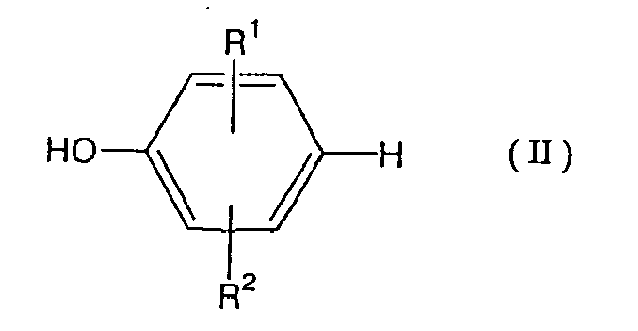
- p-hydroxyphenylalkanols of the following formula (I) can be produced in a good yield.
- the present invention provides: as the first aspect of the invention,
- Examples of the C1-8 alkyl group represented by R 1 or R 2 include, for example, methyl, ethyl, n-propyl, i-propyl, n-butyl, i-butyl, sec-butyl, t-butyl, t-pentyl, n-hexyl, n-heptyl, i-octyl, t-octyl and 2-ethylhexyl groups.
- Examples of the C1-8 alkoxy group represented by R 1 or R 2 include, for example, methoxy, ethoxy, n-propoxy, i-propoxy, n-butyloxy, i-butyloxy, sec-butyloxy, t-butyloxy, t-pentyloxy, n-hexyloxy, n-heptyloxy, i-octyloxy, t-octyloxy and 2-ethylhexyloxy groups.
- Examples of the C5-8 cycloalkyl group by R 1 or R 2 include, for example, cyclopentyl, cyclohexyl, cycloheptyl and cyclooctyl groups.
- Examples of the C6-12 alkylcycloalkyl group represented by R 1 or R 2 include, for example, 1-methylcyclopentyl, 1-methylcyclohexyl and 1-methyl-4-i-propylcyclohexyl groups.
- Examples of the C7-12 aralkyl group which may be substituted with a C1-8 alkyl group represented by R 1 or R 2 include, for example, benzyl, phenylethyl, ⁇ -methylbenzyl and ⁇ , ⁇ -dimethylbenzyl.
- Examples of the phenyl group which may be substituted with the C1-8 alkyl group represented by R 1 or R 2 include, for example, a phenyl group, methylphenyl, ethylphenyl, n-propylphenyl, i-propylphenyl, n-butylphenyl, i-butylphenyl, sec-butylphenyl, t-butylphenyl, t-pentylphenyl, n-hexylphenyl, n-heptylphenyl, i-octylphenyl, t-octylphenyl and 2-ethylhexylphenyl groups.
- Examples of the phenoxy group which may be substituted with the C1-8 alkyl group represented by R 1 or R 2 include, for example, a phenoxy group, methylphenoxy, ethylphenoxy, n-propylphenoxy, i-propylphenoxy, n-butylphenoxy, i-butylphenoxy, sec-butylphenoxy, t-butylphenoxy, t-pentylphenoxy, n-hexylphenoxy, n-heptylphenoxy, i-octylphenoxy, t-octylphenoxy and 2-ethylhexylphenoxy, 2,6-di-t-butylphenoxy, 2,4-dimethyl-6-t-butylphenoxy groups.
- At least one of R 1 and R 2 is preferably the C1-8 alkyl, C1-8 alkoxy, or C5-8 cycloalkyl group, the phenyl group which may be substituted with a C1-8 alkyl group, or the phenoxy group which may be substituted with a C1-8 alkyl group, more preferably an C1-8 alkyl group or a C5-8 cycloalkyl group and particularly preferably a methyl group or a t-alkyl group such as t-butyl, t-pentyl or t-octyl.
- phenol compound (II) examples include, for example, phenol, 2-methylphenol, 2-methoxyphenol, 2-t-butylphenol, 2-t-butoxyphenol, 2-t-pentylphenol, 2-t-pentyloxyphenol, 2-octylphenol, 2-cyclohexylphenol, 2-(1-methylcyclohexyl)phenol, 2,6-dimethylphenol, 2,6-dimethoxyphenol, 2-t-butyl-6-methylphenol, 2-t-butoxy-6-methylphenol, 2-t-butyl-6-methoxyphenol, 2-t-pentyl-6-methylphenol, 2-t-octyl-6-methylphenol, 2-cyclohexyl-6-methylphenol, 2-di-t-butoxyphenol, 2-(1-methylcyclohexyl)-6-methylphenol, 2-t-butyl-6-ethylphenol, 2-t-butyl-6-ethoxyphenol, 2-t-pentyl-6-ethylphenol, 2-t-oct
- 2-methyl-6-t-butylphenol or 2,6-di-t-butylphenol is preferably used.
- Examples of the C1-8 alkyl group represented by R 3 , R 4 , R 5 R 6 or R 7 in the unsaturated alcohol of formula (III) include, for example, methyl, ethyl, n-propyl, i-propyl, n-butyl, i-butyl, sec-butyl, t-butyl, t-pentyl, n-hexyl, n-heptyl, i-octyl, t-octy, 2-ethylhexyl and the like.
- R 3 and R 4 are preferably hydrogen atoms.
- Examples of the unsaturated alcohol (III) include, for example, allyl alcohol, 2-butene-1-ol, 3-butene-1-ol, 3-butene-2-ol, 2-methyl-2-propene-1-ol, 2-methyl-3-butene-1-ol, 3-methyl-2-butene-1-ol, 2-methyl-3-butene-2-ol, 3-methyl-3-butene-1-ol, 4-pentene-1-ol, 4-penetene-2-ol, 1-pentene-3-ol, 1-hexene-3-ol, 5-hexene-1-ol, 6-heptene-1-ol, 7-octene-1-ol, 8-nonene-1-ol or 9-decene-1-ol.
- allyl alcohol is preferably used.
- the amount of the unsaturated alcohol (III) that may be suitably used is usually about 0.1 to 10 moles and preferably about 1 to 5 moles per mol of the phenol compound (II).
- alkali metal examples include lithium, sodium and potassium.
- alkali metal compound examples include, for example, hydroxides, hydrides, carbonates, alkoxide and amides of alkali metals(e.g., lithium, sodium and potassium); an alkali metal compound of formula (IV): R-M a (IV) wherein R represents an aliphatic or aromatic hydrocarbon group and M a represents the alkali metal atom; and aryloxides of formula (V): ArOM a (V) wherein M a represents the same as defined above, and Ar represents phenol residue, such as bisphenol A residue having two benzene nucleus, and monohydric, dihydric and trihydric phenol residue which may be substituted with an alkyl group or an alkoxy group.
- R-M a IV
- M a represents the alkali metal atom
- Examples of the aliphatic or aromatic hydrocarbon group represented by R in the above formula (IV) include, for example, a methyl, ethyl, propyl, and butyl groups, phenyl and tolyl groups.
- hydroxides of alkali metals include, for example, lithium hydroxide, sodium hydroxide and potassium hydroxide.
- hydrides include, for example, sodium hydride and potassium hydride.
- alkali metal compound of formula (IV) examples include, for example, methyl lithium, butyl lithium, and phenyl lithium.
- carbonates include, for example, potassium carbonate, sodium carbonate, lithium carbonate and the like.
- amide examples include, for example, potassium amide, sodium amide, lithium amide and the like.
- alkali metal alkoxide examples include, for example, lithium methoxide, lithium ethoxide, lithium t-butoxide, sodium methoxide, sodium ethoxide, sodium t-butoxide, potassium methoxide, potassium ethoxide and potassium t-butoxide
- specific examples of the aryloxide of formula (V) include, for example, lithium phenoxide, sodium phenoxide, potassium phenoxide and the like.
- alkali metal hydroxides such as lithium hydroxide, sodium hydroxide and potassium hydroxide
- alkali metal alkoxides such as lithium methoxide, lithium ethoxide, lithium t-butoxide, sodium methoxide, sodium ethoxide, sodium t-butoxide, potassium methoxide, potassium ethoxide and potassium t-butoxide.
- alkaline earth metal examples include, for example, magnesium, calcium and barium.
- alkaline earth metal compound examples include, for example, hydroxides, hydrides, oxides, halides, carboxylates, alkoxides, amides and carbonates of alkaline earth metals(e.g. magnesium, calcium and barium); and an alkaline earth metal compound of formula (VI): R-M b -R' (VI) wherein R and R' independently represent an aliphatic or aromatic hydrocarbon group, and M b represents an alkaline earth metal atom(e.g.
- VIII Grignard compound of formula (VIII): R-Mg-X (VIII) wherein R represents the same as defined above and X represents a halogen atom(e.g. chlorine, bromine, and iodine).
- alkaline earth metal hyroxide examples include, for example, barium hydroxide, calcium hydroxide and the like.
- alkaline earth metal hydride examples include, for example, magnesium hydride and the like.
- alkaline earth metal oxide examples include, barium oxide, calcium oxide and the like.
- alkaline earth metal halide examples include, for example, magnesium chloride, magnesium bromide, and magnesium iodide and the like.
- alkaline earth metal carboxylates examples include, for example, magnesium acetate, barium acetate, calcium acetate and the like.
- alkaline earth metal amide examples include, for example, magnesium amide and the like.
- Examples of the carbonates include, for example, magnesium carbonate, barium carbonate, calcium carbonate and the like.
- Examples of the aliphatic or aromatic hydrocarbon group represented by R or R' in the above formulae (VI) or (VIII) include an alkyl group such as methyl, ethyl, propyl, or butyl group, and an aryl group such as phenyl group or tolyl group.
- alkaline earth metal compound of formula (VI) examples include, for example, dimethyl magnesium, diphenyl magnesium and the like.
- alkaline earth metal alkoxide examples include, for example, magnesium alkoxides such as magnesium methoxide, magnesium ethoxide, calcium ethoxide and barium ethoxide.
- aryloxide of formula (VII) examples include, for example, magnesium phenoxide and the like.
- Grignard compound of formula (VIII) examples include, methyl magnesium chloride, methyl magnesium bromide, methyl magnesium iodide, n-butyl magnesium chloride, sec-butyl magnesium chloride, t-butyl magnesium chloride, phenyl magnesium chloride and the like.
- At least one compound selected from the group consisting of the alkali metal, alkali metal compound, the alkaline earth metal and alkaline earth metal compound is usually used in an amount of about 0.01 to 2 moles and more preferably about 0.05 to 1 mol per mol of the phenol compound (II).
- transition metal examples include, for example, iron or zinc.
- transition metal compound examples include, for example, hydroxides, oxides, halides, carbonates, hydrides, alkoxides, aryloxides and sulfides of transition metals, and alkylated transition metal compound such as diethyl zinc; a divalent transition metal compound of formula (IX): R-M c -Y (IX) wherein R represents an alkyl group or an aryl group, Y represents an alkoxy group, an aryloxy group or a halogen atom and M c represents a divalent transition metal atom (e.g.
- R and R' independently represent the aliphatic or aromatic hydrocarbon group as defined above, Y and Z independently represent an alkoxy group, an aryloxy group or a halogen atom and M d represents a tetravalent transition metal atom (e.g. dimethyl titanium dichloride, dimethyl titanium diisopropoxide, dimethyl titanium diisopropoxide, bis(cyclopentyadienyl)
- transition metal compounds include, for example, alkoxides such as titanium alkoxide (e.g. titanium tetramethoxide, titanium tetraethoxide, titanium tetraisopropoxide), zirconium tetrabutoxide, diethoxy zinc, hydroxides such as lanthanum hydroxide, hydrides such as titanium hydride, halides such as titanium tetrachloride, zirconium tetrachloride and zinc chloride, alkoxy halides such as dichlorodiisopropoxy titanium, oxides such as zinc oxide, sulfides such as titanium sulfide and a complex of transition metal halides such as cyclopentadienyldichlorotitanium.
- titanium (IV) alkoxides e.g. titanium tetramethoxide, titanium tetraethoxide, titanium tetraisopropoxide
- zirconium tetrabutoxide
- the transition metal compound is usually used in an amount of about 0.01 to 2 moles and preferably about 0.05 to 1 mol per mol of the phenol compound (II).
- the reaction is conducted in the presence or absence of a reaction solvent.
- reaction solvent examples include, for example, aromatic hydrocarbon solvents such as benzene, toluene, xylene, ethylbenzene, chlorobenzene and nitrobenzene, ether solvents such as diethyl ether, dibutyl ether, diisopropyl ether, tetrahydrofuran, dimethoxyethane or diglyme, and aliphatic hydrocarbon solvents such as n-hexane, n-heptane, cyclohexane, octane and decane, or alcohol solvents such as n-butyl alcohol, sec-butyl alcohol, t-butyl alcohol and diethylene glycol, and a mixture thereof.
- aromatic hydrocarbon solvents such as benzene, toluene, xylene, ethylbenzene, chlorobenzene and nitrobenzene
- ether solvents such as diethyl ether, dibutyl ether
- the amount of the reaction solvent that may be suitably used is preferably about 0.1 to 5 parts by weight per 1 part by weight of the phenol compound (II).
- the phenol compound and the unsaturated alcohol may be simultaneously added into a reactor and reacted in the presence of at least one compound selected from the group consisting of alkali metals, alkali metal compounds, alkaline earth metals and alkaline earth metal compounds, and at least one compound selected from the group consisting of transition metals and transition metal compounds; or (ii) at least one compound selected from the group consisting of alkali metals, alkali metal compounds, alkaline earth metals and alkaline earth metal compounds and the phenol compound may be added to produce corresponding phenolate and then at least one compound selected from the group consisting of transition metals and transition metal compound and the unsaturated alcohol may be added to the produced phenolate to react the unsaturated alcohol with the phenolate; or (iii) at least one compound selected from the group consisting of alkali metals, alkali metal compounds, alkaline earth metals and alkaline earth metal compounds may be reacted with the unsaturated alcohols and then at least one compound selected from the unsaturated alcohol
- the reaction is usually conducted in a tightly closed system at a temperature, typically higher than the boiling point of the unsaturated alcohol.
- the reaction temperature is preferably about 100 to 300°C and more preferably about 180 to 250°C.
- At least one compound selected from the group consisting of alkali metals, alkali metal compounds, alkaline earth metals and alkaline earth metal compounds and the phenol compound are reacted at a reaction temperature ranging from room temperature to about 200°C.
- Water produced during the reaction using the hydroxide of an alkali metal or an alkaline earth metal may be removed from the reaction system.
- Alcohols produced during the reaction using the alkoxide of an alkali metal or alkali earth metal may be removed from the reaction system.
- At least one compound selected from the group consisting of transition metals and transition metal compounds and the unsaturated alcohols (III) are added to the above reaction mixture and usually, the reaction is usually conducted in a tightly closed system at a temperature typically higher than the boiling point of the unsaturated alcohol.
- the reaction temperature is preferably about 100 to 300°C and more preferably about 180 to 250°C.
- the reaction is usually conducted in a tightly closed system at a temperature typically higher than the boiling point of the unsaturated alcohol.
- the reaction temperature is preferably about 100 to 300°C and more preferably about 180 to 250°C.
- the progress of the reaction in the present invention can be monitored using analytical means such as gaschromatography or liquid chromatography.
- the p-hydroxyphenylalkanols(I) thus produced may be isolated or separated, for example, by adding an inorganic acid such as sulfuric acid and hydrochloric acid or an organic acid such as acetic acid and then by adding an organic solvent, if necessary, to extract or separate the p-hydroxyphenylalkanol (I) and thereafter the unreacted raw material and/or the organic solvent in the extract may be distilled.
- the p-hydroxyphenylalkanols (I) isolated or separated in this manner may be further purified by means such as distillation, crystallization or liquid column chromatography, if necessary. Unreacted phenol compound (II) or an unsaturated alcohol (III) may be recovered and reused.
- alkali metal examples include, for example, lithium, sodium and potassium.
- alkali metal compound examples include, for example, hydroxides, hydrides, carbonates, amides aryloxides and alkoxides of these alkali metals, and an alkali metal compound of formula (IV) as defined above.
- Examples of the aliphatic or aromatic hydrocarbon group represented by R in formula (IV) include, for example, ethyl, butyl, phenyl and tolyl groups.
- alkali metal alkoxide such as lithium methoxide, lithium ethoxide, lithium t-butoxide, sodium methoxide, sodium ethoxide, sodium t-butoxide, potassium methoxide, potassium ethoxide or potassium t-butoxide, and more preferred is sodium methoxide.
- the alkali metal or the alkali metal compound is typically used in an amount of 0.01 to 2 moles, preferably 0.05 to 1 mol per mol of the phenol compound of formula (II).
- alkaline earth metal examples include, for example, magnesium, calcium, barium and the like. Preferred is magnesium.
- alkaline earth metal compound examples include, for example, the hydroxide, hydride, oxide, halide, amide, carbonate, carboxylate and alkoxide of alkaline earth metals as defined above, the alkaline earth metal compound of formula (VI) as defied above, the alkaline earth metal aryloxide of formula (VII) as defined above, and the Grignard compound of formula (VIII) as defined above.
- magnesium compounds such as hydroxide, oxide, halide, amide, carbonate, carboxylate or alkoxide of magnesium, an alkaline earth metal compound of formula (VI) wherein M b represents magnesium, an alkaline earth metal aryloxide of formula (VII) wherein M b represents magnesium, or the Grignard compound of formula (VIII), and more preferred are magnesium acetate, magnesium alkoxides such as magnesium methoxide or magnesium ethoxide, and alkaline earth metal compound of formula (VI) wherein M b is magnesium, and yet more preferred is magnesium alkoxides such as magnesium methoxide.
- the combinations of (a) the alkali metal or the alkali metal compound, and (b) the alkaline earth metal or alkaline earth metal compound include, for example, a combination of sodium hydroxide and magnesium acetate, a combination of sodium hydroxide and magnesium alkoxide such as magnesium methoxide, a combination of sodium methoxide and magnesium oxide, a combination of magnesium alkoxide (e.g. methoxide) and sodium alkoxide (e.g. methoxide), and the like.
- the amount of the alkaline earth metal or alkaline earth metal compound that may be suitably used is preferably about 0.01 to 2 moles and more preferably about 0.02 to 1 mol per mol of the phenol compound (II).
- the reaction is carried out in the presence or absence of a reaction solvent.
- reaction solvent examples include, the same solvent that may be suitably used for the first aspect of the invention above.
- the amount of the reaction solvent that may be suitably used is preferably about 0.1 to 5 parts by weight per one part by weight of the phenol compound (II).
- a mixture of the alkali metal or the alkali metal compound and the alkaline earth metal or the alkaline earth metal compound, the phenol compound (II) and the unsaturated alcohol (III) may be fed simultaneously and reacted with each other, or (ii) the alkali metal or the alkali metal compound, and the alkaline earth metal or the alkaline earth metal compound and the phenol may be fed, then the unsaturated alcohol may be fed and the resulting mixture may be reacted, or (iii) one of the alkali metal or the alkali metal compound and the alkaline earth metal or the alkaline earth metal compound, and the unsaturated alcohol may be fed first and then the other of the alkali metal or the alkali metal compound and the alkaline earth metal or the alkaline earth metal compound and the phenol compound (II) may be fed and the mixture is reacted.
- the phenol compound (II) and the unsaturated alcohol (III) are fed simultaneously, and the reaction is usually carried out under tightly closed system at a temperature higher than the boiling point of the unsaturated alcohol.
- the reaction temperature is preferably about 100 to 300°C and more preferably about 180 to 250°C.
- the alkali metal or the alkali metal compound and the alkaline earth metal or the alkaline earth metal compound and the phenol compound (II) and then feeding the unsaturated alcohol (III) to conduct a reaction the alkali metal or the alkali metal compound and the alkaline earth metal or the alkaline earth metal compound are usually reacted with the phenol compound (II) at a temperature ranging from room temperature to about 200°C.
- Water produced during the reaction using the hydroxides of an alkali metal or alkaline earth metal may be removed from the reaction system.
- Alcohols produced during the reaction using the alkoxide of an alkali metal or alkali earth metal may be removed from the reaction system.
- reaction mixture is usually closed tightly and the unsaturated alcohols (III) are fed to react usually at a temperature higher than the boiling point of the unsaturated alcohols.
- the reaction temperature is preferably about 150 to 300°C and more preferably about 180 to 250°C.
- the progress of the reaction in the present invention may be monitored by using analytical means such as gas-chromatography or liquid chromatography.
- analytical means such as gas-chromatography or liquid chromatography.
- the resulting reaction mixture is treated as described above for the first aspect of the invention to isolate the desired compound.
- Examples of the p-hydroxyphenylalkanol (I) that may be produced in the first aspect or the second aspect of the present invention include, for example, 3-(4-hydroxyphenyl)propanol, 4-(4-hydroxyphenyl)butane-2-ol, 3-(3-methyl-4-hydroxyphenyl)propanol, 3-(3-methoxy-4-hydroxyphenyl)propanol, 3-(3-t-butyl-4-hydroxyphenyl)propanol, 3-(3-t-butoxy-4-hydroxyphenyl)propanol, 3-(3-t-pentyl-4-hydroxyphenyl)propanol, 3-(3-t-octyl-4-hydroxyphenyl)propanol, 3-(3-cyclohexyl-4-hydroxyphenyl)propanol, 3-[3-(1-methylcyclohexyl)-4-hydroxyphenyl]propanol, 3-(3-phenyl-4-hydroxyphenyl)
- a pressure container was charged with 62.4 g (0.38 mol) of 2-methyl-6-t-butylphenol, 14.7 g (0.076 mol) of a methanol solution containing 28% sodium methoxide and 17.4 g (0.076 mol) of titanium tetraethoxide.
- the mixture was heated under reduced pressure to distill a mixture of 13.0 g (0.41 mol) of methanol and 14.1 g (0.31 mol) of ethanol out of the reaction system. Thereafter, 53.2 g (0.92 mol) of allyl alcohol and 38.7 g (0.42 mol) of toluene were added to the reaction system and the atmosphere in the reaction system was replaced by nitrogen.
- reaction system was tightly closed, heated up to 210°C and kept at that temperature for 7 hours. Then, the reaction system was cooled to room temperature. A sample of the reaction solution was analyzed by gas-chromatography. The desied product, 3-(3-t-butyl-4-hydroxy-5-methylphenyl)propanol was obtained in a yield of 78%.
- reaction vessels A and B obtained above were transferred into a pressure container respectively and mixed. Then 15.9g (0.27mol) of ally alcohol were added thereto. The atmosphere of the reaction container were replaced with nitrogen and sealed and heated to 210°C, and maintained at the same temperature for 4 hours. Then, the reaction mixture was cooled to room temperature and a sample of the reaction solution was analyzed by gas-chromatography. The desired product, 3-(3-t-butyl-4-hydroxy-5-methylphenyl)propanol was obtained in a yield of 80%.
- a pressure container was charged with 62.4 g (0.38 mol) of 2-methyl-6-t-butylphenol, 7.3 g (0.038 mol) of a methanol solution containing 28% of sodium methoxide and 4.35 g (0.038 mol) of magnesium ethoxide.
- the mixture was heated under reduced pressure to distill a mixture of 6.5 g (0.2 mol) of methanol and 3.5 g (0.075 mol) of ethanol out of the reaction system. Thereafter, 22.2 g (0.38 mol) of allyl alcohol and 18.7 g (0.19 mol) of toluene were added to the reaction system and the atmosphere in the reaction system was replaced by nitrogen.
- a pressure container was charged with 62.7 g (0.38 mol) of 2-methyl-6-t-butylphenol and 7.3 g (0.038 mol) of a methanol solution containing 28% of sodium methoxide. Then the mixture was heated under reduced pressure to distill 6.5 g (0.2 mol) of methanol. Thereafter, 22.2 g (0.92 mol) of allyl alcohol and 18.7 g (0.19 mol) of toluene were added to the reaction system, the atmosphere in the reaction system was replaced by nitrogen and then, the reaction system was tightly closed. Then, the reaction systemwas raised up to 210°C and kept at that temperature for 7 hours. Then, the reaction mixture was cooled to room temperature. A sample of the reaction solution was analyzed by gas-chromatography. The desired product, 3-(3-t-butyl-4-hydroxy-5-methylphenyl)propanol was obtained in a yield of 52%.
- p-hydroxyphenylalkanol (I) are obtained in a good yield. Also, when a thermoplastic resin stabilizer is produced by using the phenylalkanol (I) obtained by the method of the present invention as a raw compound, the amount of impurities in the stabilizer can be decreased to less than tolerable level.
Landscapes
- Chemical & Material Sciences (AREA)
- Organic Chemistry (AREA)
- Chemical Kinetics & Catalysis (AREA)
- Organic Low-Molecular-Weight Compounds And Preparation Thereof (AREA)
- Catalysts (AREA)
Abstract

R3R4C=C(R5)-C(R6)(R7)-(CH2)n-OH (III)
wherein R3, R4, R5, R6, R7 and n are as defined above,
in the presence of (a) an alkali metal or an alkali metal compound, and (b) an alkaline earth metal or an alkaline earth metal compound.
Description
- The present invention relates to a method of producing p-hydroxyphenylalkanols.
- p-Hydroxyphenylalkanols are useful compounds as raw compounds for producing stabilizers for thermoplastic resins, raw compounds of pharmaceuticals and the like.
- As a method of producing p-hydroxyphenylalkanols of the following formula:

n denotes an integer from 0 to 7, a method is known in which phenols represented by the following formula:
CH2=C(R13)-CH(R14)-(CH2)n-OH
wherein R13, R14 and n respectively represent the same meaning as above, in the presence of a base (Japanese Patent Application Laid-Open (JP-A) No.2001-64220 - According to the present invention, p-hydroxyphenylalkanols of the following formula (I) can be produced in a good yield.
- The present invention provides: as the first aspect of the invention,
- 1. a method for producing a p-hydroxyphenylalkanol of formula (I):

a hydrogen atom,
an C1-8 alkyl group,
an C1-8 alkoxy group,
a C5-8 cycloalkyl group,
an C6-12 alkylcycloalkyl group,
an C7-12 aralkyl group which may be substituted with an C1-8 alkyl group,
a phenyl group which may be substituted with a C1-8 alkyl group,
a phenoxy group which may be substituted with a C1-8 alkyl group,
R3, R4, R5, R6 and R7 independently represent a hydrogen atom or an C1-8 alkyl group, and
n denotes an integer from 0 to 7, which method comprises reacting a phenol compound of formula (II):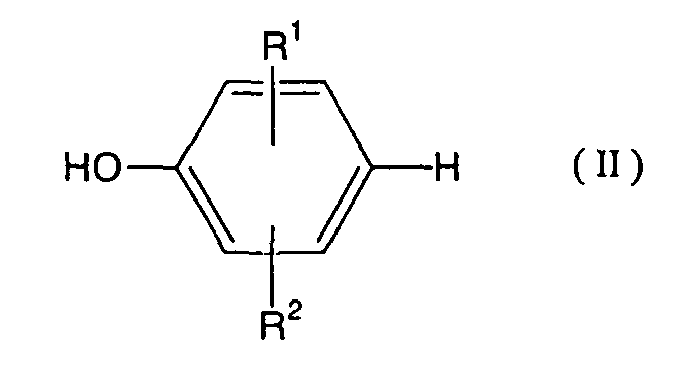
R3R4C=C(R5)-C(R6)(R7)-(CH2)n-OH (III)
wherein R3, R4, R5, R6, R7 and n respectively represent the same as defined, in the presence of- (A) at least one compound selected from the group consisting of an alkali metal, an alkali metal compound, an alkaline earth metal and an alkaline earth metal compound, and
- (B) at least one compound selected from the group consisting of a transition metal and a transition metal compound; and
- 2. a method for producing a p-hydroxyphenylalkanol of formula (I) as defined above, which method comprises reacting the phenol compound of formula (II) as defined above with the unsaturated alcohol of formula (III) as defined above, in the presence of
- (a) an alkali metal or an alkali metal compound, and
- (b) an alkaline earth metal or an alkaline earth metal compound.
- A description will be made to the first aspect of the invention.
- Examples of the C1-8 alkyl group represented by R1 or R2 include, for example, methyl, ethyl, n-propyl, i-propyl, n-butyl, i-butyl, sec-butyl, t-butyl, t-pentyl, n-hexyl, n-heptyl, i-octyl, t-octyl and 2-ethylhexyl groups.
- Examples of the C1-8 alkoxy group represented by R1 or R2 include, for example, methoxy, ethoxy, n-propoxy, i-propoxy, n-butyloxy, i-butyloxy, sec-butyloxy, t-butyloxy, t-pentyloxy, n-hexyloxy, n-heptyloxy, i-octyloxy, t-octyloxy and 2-ethylhexyloxy groups.
- Examples of the C5-8 cycloalkyl group by R1 or R2 include, for example, cyclopentyl, cyclohexyl, cycloheptyl and cyclooctyl groups.
- Examples of the C6-12 alkylcycloalkyl group represented by R1 or R2 include, for example, 1-methylcyclopentyl, 1-methylcyclohexyl and 1-methyl-4-i-propylcyclohexyl groups.
- Examples of the C7-12 aralkyl group which may be substituted with a C1-8 alkyl group represented by R1 or R2 include, for example, benzyl, phenylethyl, α-methylbenzyl and α, α-dimethylbenzyl.
- Examples of the phenyl group which may be substituted with the C1-8 alkyl group represented by R1 or R2 include, for example, a phenyl group, methylphenyl, ethylphenyl, n-propylphenyl, i-propylphenyl, n-butylphenyl, i-butylphenyl, sec-butylphenyl, t-butylphenyl, t-pentylphenyl, n-hexylphenyl, n-heptylphenyl, i-octylphenyl, t-octylphenyl and 2-ethylhexylphenyl groups.
- Examples of the phenoxy group which may be substituted with the C1-8 alkyl group represented by R1 or R2 include, for example, a phenoxy group, methylphenoxy, ethylphenoxy, n-propylphenoxy, i-propylphenoxy, n-butylphenoxy, i-butylphenoxy, sec-butylphenoxy, t-butylphenoxy, t-pentylphenoxy, n-hexylphenoxy, n-heptylphenoxy, i-octylphenoxy, t-octylphenoxy and 2-ethylhexylphenoxy, 2,6-di-t-butylphenoxy, 2,4-dimethyl-6-t-butylphenoxy groups.
- At least one of R1 and R2 is preferably the C1-8 alkyl, C1-8 alkoxy, or C5-8 cycloalkyl group, the phenyl group which may be substituted with a C1-8 alkyl group, or the phenoxy group which may be substituted with a C1-8 alkyl group, more preferably an C1-8 alkyl group or a C5-8 cycloalkyl group and particularly preferably a methyl group or a t-alkyl group such as t-butyl, t-pentyl or t-octyl.
- Examples of the phenol compound (II) include, for example, phenol, 2-methylphenol, 2-methoxyphenol, 2-t-butylphenol, 2-t-butoxyphenol, 2-t-pentylphenol, 2-t-pentyloxyphenol, 2-octylphenol, 2-cyclohexylphenol, 2-(1-methylcyclohexyl)phenol, 2,6-dimethylphenol, 2,6-dimethoxyphenol, 2-t-butyl-6-methylphenol, 2-t-butoxy-6-methylphenol, 2-t-butyl-6-methoxyphenol, 2-t-pentyl-6-methylphenol, 2-t-octyl-6-methylphenol, 2-cyclohexyl-6-methylphenol, 2-di-t-butoxyphenol, 2-(1-methylcyclohexyl)-6-methylphenol, 2-t-butyl-6-ethylphenol, 2-t-butyl-6-ethoxyphenol, 2-t-pentyl-6-ethylphenol, 2-t-octyl-6-ethylphenol, 2-cyclohexyl-6-ethylphenol, 2-(1-methylcyclohexyl)-6-ethylphenol, 2,6-di-t-butylphenol, 2-t-pentyl-6-t-butylphenol, 2,6-di-t-pentylphenol, 2-t-octyl-6-butylphenol, 2-cyclohexyl-6-t-butylphenol, 2-(1-methylcyclohexyl)-6-t-butylphenol, 2-phenyl-6-methylphenol, 2-phenyl-6-t-butylphenol, 2-tolyl-6-methylphenol, 2-tolyl-6-t-butylphenol, 2,6-diphenylphenol, 2-phenoxyphenol, 2-(2-methylphenoxy)phenol, 2-phenoxy-6-methylphenol, 2-phenoxy-6-t-butylphenol, 2-phenoxy-6-methoxyphenol, 2,6-diphenoxyphenol, 2-(2-methyl-6-t-butylphenoxy)phenol, 2-(2,4-dimethyl-6-t-butylphenoxy)phenol, 2-(2-methyl-6-t-butylphenoxy)-6-methylphenol, and 2-(2,4-dimethyl-6-t-butylphenoxy)-6-methylphenol.
- Among these phenol compounds, 2-methyl-6-t-butylphenol or 2,6-di-t-butylphenol is preferably used.
- Examples of the C1-8 alkyl group represented by R3, R4, R5 R6 or R7 in the unsaturated alcohol of formula (III) include, for example, methyl, ethyl, n-propyl, i-propyl, n-butyl, i-butyl, sec-butyl, t-butyl, t-pentyl, n-hexyl, n-heptyl, i-octyl, t-octy, 2-ethylhexyl and the like. R3 and R4 are preferably hydrogen atoms.
- Examples of the unsaturated alcohol (III) include, for example, allyl alcohol, 2-butene-1-ol, 3-butene-1-ol, 3-butene-2-ol, 2-methyl-2-propene-1-ol, 2-methyl-3-butene-1-ol, 3-methyl-2-butene-1-ol, 2-methyl-3-butene-2-ol, 3-methyl-3-butene-1-ol, 4-pentene-1-ol, 4-penetene-2-ol, 1-pentene-3-ol, 1-hexene-3-ol, 5-hexene-1-ol, 6-heptene-1-ol, 7-octene-1-ol, 8-nonene-1-ol or 9-decene-1-ol. Among these compounds, allyl alcohol is preferably used.
- The amount of the unsaturated alcohol (III) that may be suitably used is usually about 0.1 to 10 moles and preferably about 1 to 5 moles per mol of the phenol compound (II).
- Examples of the alkali metal include lithium, sodium and potassium.
- Examples of the alkali metal compound include, for example,
hydroxides, hydrides, carbonates, alkoxide and amides of alkali metals(e.g., lithium, sodium and potassium);
an alkali metal compound of formula (IV):
R-Ma (IV)
wherein R represents an aliphatic or aromatic hydrocarbon group and Ma represents the alkali metal atom; and
aryloxides of formula (V):
ArOMa (V)
wherein Ma represents the same as defined above, and Ar represents phenol residue, such as bisphenol A residue having two benzene nucleus, and monohydric, dihydric and trihydric phenol residue which may be substituted with an alkyl group or an alkoxy group. - Examples of the aliphatic or aromatic hydrocarbon group represented by R in the above formula (IV) include, for example, a methyl, ethyl, propyl, and butyl groups, phenyl and tolyl groups.
- Specific examples of the hydroxides of alkali metals include, for example, lithium hydroxide, sodium hydroxide and potassium hydroxide.
- Specific examples of the hydrides include, for example, sodium hydride and potassium hydride.
- Specific examples of the alkali metal compound of formula (IV) include, for example, methyl lithium, butyl lithium, and phenyl lithium.
- Specific examples of the carbonates include, for example, potassium carbonate, sodium carbonate, lithium carbonate and the like.
- Specific examples of the amide include, for example, potassium amide, sodium amide, lithium amide and the like.
- Specific examples of the alkali metal alkoxide include, for example, lithium methoxide, lithium ethoxide, lithium t-butoxide, sodium methoxide, sodium ethoxide, sodium t-butoxide, potassium methoxide, potassium ethoxide and potassium t-butoxide, and specific examples of the aryloxide of formula (V) include, for example, lithium phenoxide, sodium phenoxide, potassium phenoxide and the like.
- Among these alkali metal compounds, preferred are alkali metal hydroxides such as lithium hydroxide, sodium hydroxide and potassium hydroxide, alkali metal alkoxides such as lithium methoxide, lithium ethoxide, lithium t-butoxide, sodium methoxide, sodium ethoxide, sodium t-butoxide, potassium methoxide, potassium ethoxide and potassium t-butoxide.
- Examples of the alkaline earth metal include, for example, magnesium, calcium and barium.
- Examples of the alkaline earth metal compound include, for example, hydroxides, hydrides, oxides, halides, carboxylates, alkoxides, amides and carbonates of alkaline earth metals(e.g. magnesium, calcium and barium); and
an alkaline earth metal compound of formula (VI):
R-Mb-R' (VI)
wherein R and R' independently represent an aliphatic or aromatic hydrocarbon group, and Mb represents an alkaline earth metal atom(e.g. magnesium, calcium and barium);
an alkaline earth metal aryloxide of formula (VII):
ArOMbOAr' (VII)
wherein Mb represents the same as defined above, and Ar and Ar' independently represent a phenol residue such as bisphenol A residue having two benzene nucleus, and monohydric, dihydric or trihydric phenol residue which may be substituted with an alkyl group or an alkoxy group; and
a Grignard compound of formula (VIII):
R-Mg-X (VIII)
wherein R represents the same as defined above and X represents a halogen atom(e.g. chlorine, bromine, and iodine). - Examples of the alkaline earth metal hyroxide include, for example, barium hydroxide, calcium hydroxide and the like.
- Examples of the alkaline earth metal hydride include, for example, magnesium hydride and the like.
- Examples of the alkaline earth metal oxide include, barium oxide, calcium oxide and the like.
- Examples of the alkaline earth metal halide include, for example, magnesium chloride, magnesium bromide, and magnesium iodide and the like.
- Examples of the alkaline earth metal carboxylates include, for example, magnesium acetate, barium acetate, calcium acetate and the like.
- Examples of the alkaline earth metal amide include, for example, magnesium amide and the like.
- Examples of the carbonates include, for example, magnesium carbonate, barium carbonate, calcium carbonate and the like.
- Examples of the aliphatic or aromatic hydrocarbon group represented by R or R' in the above formulae (VI) or (VIII) include an alkyl group such as methyl, ethyl, propyl, or butyl group, and an aryl group such as phenyl group or tolyl group.
- Examples of the alkaline earth metal compound of formula (VI) include, for example, dimethyl magnesium, diphenyl magnesium and the like.
- Examples of the alkaline earth metal alkoxide include, for example, magnesium alkoxides such as magnesium methoxide, magnesium ethoxide, calcium ethoxide and barium ethoxide.
- Examples of the aryloxide of formula (VII) include, for example, magnesium phenoxide and the like.
- Examples of the Grignard compound of formula (VIII) include, methyl magnesium chloride, methyl magnesium bromide, methyl magnesium iodide, n-butyl magnesium chloride, sec-butyl magnesium chloride, t-butyl magnesium chloride, phenyl magnesium chloride and the like.
- At least one compound selected from the group consisting of the alkali metal, alkali metal compound, the alkaline earth metal and alkaline earth metal compound is usually used in an amount of about 0.01 to 2 moles and more preferably about 0.05 to 1 mol per mol of the phenol compound (II).
- Examples of the transition metal include, for example, iron or zinc.
- Examples of the transition metal compound include, for example, hydroxides, oxides, halides, carbonates, hydrides, alkoxides, aryloxides and sulfides of transition metals, and alkylated transition metal compound such as diethyl zinc;
a divalent transition metal compound of formula (IX):
R-Mc-Y (IX)
wherein R represents an alkyl group or an aryl group,
Y represents an alkoxy group, an aryloxy group or a halogen atom and Mc represents a divalent transition metal atom (e.g. methyl zinc iodide, phenyl zinc iodide, and the like); and
a tetravalent transition metal compound of formula (X):
RR'MdYZ (X)
wherein R and R' independently represent the aliphatic or aromatic hydrocarbon group as defined above, Y and Z independently represent an alkoxy group, an aryloxy group or a halogen atom and Md represents a tetravalent transition metal atom (e.g. dimethyl titanium dichloride, dimethyl titanium diisopropoxide, dimethyl titanium diisopropoxide, bis(cyclopentyadienyl)titanium dichloride and the like). - Specific examples of these transition metal compounds include, for example,
alkoxides such as titanium alkoxide (e.g. titanium tetramethoxide, titanium tetraethoxide, titanium tetraisopropoxide), zirconium tetrabutoxide, diethoxy zinc,
hydroxides such as lanthanum hydroxide,
hydrides such as titanium hydride,
halides such as titanium tetrachloride, zirconium tetrachloride and zinc chloride,
alkoxy halides such as dichlorodiisopropoxy titanium,
oxides such as zinc oxide, sulfides such as titanium sulfide and a complex of transition metal halides such as cyclopentadienyldichlorotitanium. Preferred is titanium (IV) alkoxides. - The transition metal compound is usually used in an amount of about 0.01 to 2 moles and preferably about 0.05 to 1 mol per mol of the phenol compound (II).
- In the present invention, the reaction is conducted in the presence or absence of a reaction solvent.
- Examples of the reaction solvent include, for example, aromatic hydrocarbon solvents such as benzene, toluene, xylene, ethylbenzene, chlorobenzene and nitrobenzene, ether solvents such as diethyl ether, dibutyl ether, diisopropyl ether, tetrahydrofuran, dimethoxyethane or diglyme, and aliphatic hydrocarbon solvents such as n-hexane, n-heptane, cyclohexane, octane and decane, or alcohol solvents such as n-butyl alcohol, sec-butyl alcohol, t-butyl alcohol and diethylene glycol, and a mixture thereof.
- The amount of the reaction solvent that may be suitably used is preferably about 0.1 to 5 parts by weight per 1 part by weight of the phenol compound (II).
- In the present invention, there is no particular limitation as to the order of addition of at least one compound selected from the group consisting of alkali metals, alkali metal compounds, alkaline earth metals and alkaline earth metal compounds, and at least one compound selected from the group consisting of transition metals and transition metal compounds.
- For example, (i) the phenol compound and the unsaturated alcohol may be simultaneously added into a reactor and reacted in the presence of at least one compound selected from the group consisting of alkali metals, alkali metal compounds, alkaline earth metals and alkaline earth metal compounds, and at least one compound selected from the group consisting of transition metals and transition metal compounds; or
(ii) at least one compound selected from the group consisting of alkali metals, alkali metal compounds, alkaline earth metals and alkaline earth metal compounds and the phenol compound may be added to produce corresponding phenolate and then at least one compound selected from the group consisting of transition metals and transition metal compound and the unsaturated alcohol may be added to the produced phenolate to react the unsaturated alcohol with the phenolate; or
(iii) at least one compound selected from the group consisting of alkali metals, alkali metal compounds, alkaline earth metals and alkaline earth metal compounds may be reacted with the unsaturated alcohols and then at least one compound selected from the group consisting of transition metals and transition metal compounds and the phenol compound are added to react the phenols with the resulting product. - In the case of (i) above, the reaction is usually conducted in a tightly closed system at a temperature, typically higher than the boiling point of the unsaturated alcohol. The reaction temperature is preferably about 100 to 300°C and more preferably about 180 to 250°C.
- In the case of (ii) above, at least one compound selected from the group consisting of alkali metals, alkali metal compounds, alkaline earth metals and alkaline earth metal compounds and the phenol compound are reacted at a reaction temperature ranging from room temperature to about 200°C. Water produced during the reaction using the hydroxide of an alkali metal or an alkaline earth metal may be removed from the reaction system. Alcohols produced during the reaction using the alkoxide of an alkali metal or alkali earth metal may be removed from the reaction system.
- After water and these alcohols are removed, at least one compound selected from the group consisting of transition metals and transition metal compounds and the unsaturated alcohols (III) are added to the above reaction mixture and usually, the reaction is usually conducted in a tightly closed system at a temperature typically higher than the boiling point of the unsaturated alcohol. The reaction temperature is preferably about 100 to 300°C and more preferably about 180 to 250°C.
- In the case of (iii) above, the reaction is usually conducted in a tightly closed system at a temperature typically higher than the boiling point of the unsaturated alcohol. The reaction temperature is preferably about 100 to 300°C and more preferably about 180 to 250°C.
- The progress of the reaction in the present invention can be monitored using analytical means such as gaschromatography or liquid chromatography.
- The p-hydroxyphenylalkanols(I) thus produced may be isolated or separated, for example, by adding an inorganic acid such as sulfuric acid and hydrochloric acid or an organic acid such as acetic acid and then by adding an organic solvent, if necessary, to extract or separate the p-hydroxyphenylalkanol (I) and thereafter the unreacted raw material and/or the organic solvent in the extract may be distilled. The p-hydroxyphenylalkanols (I) isolated or separated in this manner may be further purified by means such as distillation, crystallization or liquid column chromatography, if necessary. Unreacted phenol compound (II) or an unsaturated alcohol (III) may be recovered and reused.
- Next, a description will be made to the second aspect of the invention drawn to a method of producing the p-hydroxyphenylalkanol of formula (I), which method comprises reacting the phenol compound of formula (II), with the unsaturated alcohol of formula (III), in the presence of
- (a) an alkali metal or an alkali metal compound, and
- (b) an alkaline earth metal or an alkaline earth metal compound.
- Examples of the alkali metal include, for example, lithium, sodium and potassium.
- Examples of the alkali metal compound include, for example, hydroxides, hydrides, carbonates, amides aryloxides and alkoxides of these alkali metals, and
an alkali metal compound of formula (IV) as defined above. - Examples of the aliphatic or aromatic hydrocarbon group represented by R in formula (IV) include, for example, ethyl, butyl, phenyl and tolyl groups.
- Among the alkali metal compounds, preferred are an alkali metal alkoxide such as lithium methoxide, lithium ethoxide, lithium t-butoxide, sodium methoxide, sodium ethoxide, sodium t-butoxide, potassium methoxide, potassium ethoxide or potassium t-butoxide, and more preferred is sodium methoxide.
- The alkali metal or the alkali metal compound is typically used in an amount of 0.01 to 2 moles, preferably 0.05 to 1 mol per mol of the phenol compound of formula (II).
- Examples of the alkaline earth metal include, for example, magnesium, calcium, barium and the like. Preferred is magnesium.
- Examples of the alkaline earth metal compound include, for example, the hydroxide, hydride, oxide, halide, amide, carbonate, carboxylate and alkoxide of alkaline earth metals as defined above, the alkaline earth metal compound of formula (VI) as defied above, the alkaline earth metal aryloxide of formula (VII) as defined above, and the Grignard compound of formula (VIII) as defined above.
- Among the alkaline earth metal compounds, preferred are magnesium compounds such as hydroxide, oxide, halide, amide, carbonate, carboxylate or alkoxide of magnesium, an alkaline earth metal compound of formula (VI) wherein Mb represents magnesium, an alkaline earth metal aryloxide of formula (VII) wherein Mb represents magnesium, or the Grignard compound of formula (VIII), and more preferred are magnesium acetate, magnesium alkoxides such as magnesium methoxide or magnesium ethoxide, and alkaline earth metal compound of formula (VI) wherein Mb is magnesium, and yet more preferred is magnesium alkoxides such as magnesium methoxide.
- Specific examples of the combinations of (a) the alkali metal or the alkali metal compound, and (b) the alkaline earth metal or alkaline earth metal compound include, for example, a combination of sodium hydroxide and magnesium acetate,
a combination of sodium hydroxide and magnesium alkoxide such as magnesium methoxide,
a combination of sodium methoxide and magnesium oxide, a combination of magnesium alkoxide (e.g. methoxide) and sodium alkoxide (e.g. methoxide), and the like. - The amount of the alkaline earth metal or alkaline earth metal compound that may be suitably used is preferably about 0.01 to 2 moles and more preferably about 0.02 to 1 mol per mol of the phenol compound (II).
- The reaction is carried out in the presence or absence of a reaction solvent.
- Examples of the reaction solvent include, the same solvent that may be suitably used for the first aspect of the invention above.
- The amount of the reaction solvent that may be suitably used is preferably about 0.1 to 5 parts by weight per one part by weight of the phenol compound (II).
- In the present invention, there is no particular limitation as to the order of addition of these compounds.
- For example, (i) a mixture of the alkali metal or the alkali metal compound and the alkaline earth metal or the alkaline earth metal compound, the phenol compound (II) and the unsaturated alcohol (III) may be fed simultaneously and reacted with each other, or
(ii) the alkali metal or the alkali metal compound, and the alkaline earth metal or the alkaline earth metal compound and the phenol may be fed, then the unsaturated alcohol may be fed and the resulting mixture may be reacted, or
(iii) one of the alkali metal or the alkali metal compound and the alkaline earth metal or the alkaline earth metal compound, and the unsaturated alcohol may be fed first and then the other of the alkali metal or the alkali metal compound and the alkaline earth metal or the alkaline earth metal compound and the phenol compound (II) may be fed and the mixture is reacted. - In the case of feeding the alkali metal or the alkali metal compound and the alkaline earth metal or the alkaline earth metal compound, the phenol compound (II) and the unsaturated alcohol (III) are fed simultaneously, and the reaction is usually carried out under tightly closed system at a temperature higher than the boiling point of the unsaturated alcohol. The reaction temperature is preferably about 100 to 300°C and more preferably about 180 to 250°C.
- In the case of feeding the alkali metal or the alkali metal compound and the alkaline earth metal or the alkaline earth metal compound and the phenol compound (II) and then feeding the unsaturated alcohol (III) to conduct a reaction, the alkali metal or the alkali metal compound and the alkaline earth metal or the alkaline earth metal compound are usually reacted with the phenol compound (II) at a temperature ranging from room temperature to about 200°C. Water produced during the reaction using the hydroxides of an alkali metal or alkaline earth metal may be removed from the reaction system. Alcohols produced during the reaction using the alkoxide of an alkali metal or alkali earth metal may be removed from the reaction system.
- After these operations, the reaction mixture is usually closed tightly and the unsaturated alcohols (III) are fed to react usually at a temperature higher than the boiling point of the unsaturated alcohols. The reaction temperature is preferably about 150 to 300°C and more preferably about 180 to 250°C.
- The progress of the reaction in the present invention may be monitored by using analytical means such as gas-chromatography or liquid chromatography. After completion of the reaction, the resulting reaction mixture is treated as described above for the first aspect of the invention to isolate the desired compound.
- Examples of the p-hydroxyphenylalkanol (I) that may be produced in the first aspect or the second aspect of the present invention include, for example, 3-(4-hydroxyphenyl)propanol, 4-(4-hydroxyphenyl)butane-2-ol, 3-(3-methyl-4-hydroxyphenyl)propanol, 3-(3-methoxy-4-hydroxyphenyl)propanol, 3-(3-t-butyl-4-hydroxyphenyl)propanol, 3-(3-t-butoxy-4-hydroxyphenyl)propanol, 3-(3-t-pentyl-4-hydroxyphenyl)propanol, 3-(3-t-octyl-4-hydroxyphenyl)propanol, 3-(3-cyclohexyl-4-hydroxyphenyl)propanol, 3-[3-(1-methylcyclohexyl)-4-hydroxyphenyl]propanol, 3-(3-phenyl-4-hydroxyphenyl)propanol, 3-(3-tolyl-4-hydroxyphenyl)propanol, 3-(3-phenoxy-4-hydroxyphenyl)propanol, 3-[3-(2-methylphenoxy)-4-hyrdoxyphenyl]propanol, 3-(3,5-dimethyl-4-hydroxyphenyl)propanol, 3-(3,5-dimethoxy-4-hydroxyphenyl)propanol, 3-(3-t-butyl-4-hydroxy-5-methylphenyl)propanol, 3-(3-t-butyl-4-hydroxy-5-methoxyphenyl)propanol, 3-(3-t-pentyl-4-hydroxy-5-methylphenyl)propanol, 3-(3-t-octyl-4-hydroxy-5-methylphenyl)propanol, 3-(3-cyclohexyl-4-hydroxy-5-methylphenyl)propanol, 3-[3-(1-methylcyclohexyl)-4-hydroxy-5-methylphenyl]propanol, 3-[3-(1-methylcyclohexyl)-4-hydroxy-5-methoxyphenyl]propanol, 3-(3-phenyl-4-hydroxy-5-methylphenyl)propanol, 3-(3-phenyl-4-hydroxy-5-methoxyphenyl)propanol, 3-(3-phenoxy-4-hydroxy-5-methylphenyl)propanol, 3-(3-phenoxy-4-hydroxy-5-methoxyphenyl)propanol, 3-(3-t-butyl-4-hydroxy-5-ethylphenyl)propanol, 3-(3-t-pentyl-4-hydroxy-5-ethylphenyl)propanol, 3-(3-t-octyl-4-hydroxy-5-ethylphenyl)propanol, 3-(3-cyclohexyl-4-hydroxy-5-ethylphenyl)propanol, 3-[3-(1-methylcyclohexyl)-4-hydroxy-5-ethylphenyl]propanol, 3-(3,5-di-t-butyl-4-hydroxyphenyl)propanol, 3-(3-t-pentyl-4-hydroxy-5-t-butylphenyl)propanol, 3-(3-phenyl-4-hydroxy-5-t-butylphenyl)propanol, 3-(3-tolyl-4-hydroxy-5-t-butylphenyl)propanol, 3-(3-phenoxy-4-hydroxy-5-t-butylphenyl)propanol, 3-[3-(2-methylphenoxy)-4-hydroxy-5-t-butylphenyl]propanol, 3-(3,5-di-t-pentyl-4-hydroxyphenyl)propanol, 3-(3-t-octyl-4-hydroxy-5-t-butylphenyl)propanol, 3-(3-cyclohexyl-4-hydroxy-5-t-butylphenyl)propanol and 3-[3-(1-methylcyclohexyl)-4-hydroxy-5-t-butylphenyl]propanol, 3-(3,5-diphenyl-4-hydroxyphenyl)propanol, 3-(3,5-ditolyl-4-hydroxyphenyl)propanol, 3-(3,5-diphenoxy-4-hydroxyphenyl)propanol, and 3-[3,5-di-(2-methylphenoxy)-4-hydroxy-phenyl]propanol.
- The present invention will be explained in more detail by way of examples, which, however, are not to be construed to limit the present invention thereto.
- A pressure container was charged with 62.4 g (0.38 mol) of 2-methyl-6-t-butylphenol, 14.7 g (0.076 mol) of a methanol solution containing 28% sodium methoxide and 17.4 g (0.076 mol) of titanium tetraethoxide. The mixture was heated under reduced pressure to distill a mixture of 13.0 g (0.41 mol) of methanol and 14.1 g (0.31 mol) of ethanol out of the reaction system. Thereafter, 53.2 g (0.92 mol) of allyl alcohol and 38.7 g (0.42 mol) of toluene were added to the reaction system and the atmosphere in the reaction system was replaced by nitrogen. Then, the reaction system was tightly closed, heated up to 210°C and kept at that temperature for 7 hours. Then, the reaction system was cooled to room temperature. A sample of the reaction solution was analyzed by gas-chromatography. The desied product, 3-(3-t-butyl-4-hydroxy-5-methylphenyl)propanol was obtained in a yield of 78%.
- After charging 5.2 g (0.027mol) of 28% sodium methoxide inmethanol and 10.6 (0.33mol) of methanol into a reaction vessel, 0.67 g (0.027 mol) of magnesium was added thereto and heated under nitrogen atmosphere until methanol begun to reflux while removing 0.06 g (0.027mol) of hydrogen out of the reaction system. Evolution of hydrogen gas had ceased after maintaining the heating.
- To the solution obtained above after hydrogen gas evolution had ceased, 45 g (0.27 mol) of 2-methyl-6-t-butylphenol were added, and then heated under reduced pressure, thereby 15 g (0.47 mol) of methanol were removed from the reaction system. Then, 15.9 g (0.27 mol) of allyl alcohol and 13.5 g (0.15mol) of toluene were added thereto. The resulting solution after the addition of toluene and allyl alcohol were transferred to a pressure container, and the atmosphere thereof was substituted with nitrogen gas, sealed and heated up to 210°C and maintained at the same temperature for 4 hours. Thereafter the reaction mixture was cooled to room temperature and a sample thereof was analyzed by gas-chromatography. The desired product, 3-(3-t-butyl-4-hydroxy-5-methylphenyl)propanol was obtained in a yield of 82%.
- After charging 23 g (0.14mol) of 2-methyl-6-t-butylphenol in a reaction vessel A, 14ml (0.03mol) of butyl magnesium chloride in diethyl ether were added thereto.
- After 23g (0.14mol) of 2-methyl-6-t-butylphenol were added into another reaction vessel B, 0.62 g (0.03mol) of sodium was added thereto under nitrogen atmosphere.
- The solutions in reaction vessels A and B obtained above were transferred into a pressure container respectively and mixed. Then 15.9g (0.27mol) of ally alcohol were added thereto. The atmosphere of the reaction container were replaced with nitrogen and sealed and heated to 210°C, and maintained at the same temperature for 4 hours. Then, the reaction mixture was cooled to room temperature and a sample of the reaction solution was analyzed by gas-chromatography. The desired product, 3-(3-t-butyl-4-hydroxy-5-methylphenyl)propanol was obtained in a yield of 80%.
- A pressure container was charged with 62.4 g (0.38 mol) of 2-methyl-6-t-butylphenol, 7.3 g (0.038 mol) of a methanol solution containing 28% of sodium methoxide and 4.35 g (0.038 mol) of magnesium ethoxide. The mixture was heated under reduced pressure to distill a mixture of 6.5 g (0.2 mol) of methanol and 3.5 g (0.075 mol) of ethanol out of the reaction system. Thereafter, 22.2 g (0.38 mol) of allyl alcohol and 18.7 g (0.19 mol) of toluene were added to the reaction system and the atmosphere in the reaction system was replaced by nitrogen. Then, the reaction system was tightly closed, raised up to 210°C and kept at that temperature for 7 hours. Then, the reaction mixture was cooled to room temperature. A part of the reaction solution was sampled and analyzed by gas-chromatography. The yield of 3-(3-t-butyl-4-hydroxy-5-methylphenyl)propanol which was the target compound was 78%.
- A pressure container was charged with 62.7 g (0.38 mol) of 2-methyl-6-t-butylphenol and 7.3 g (0.038 mol) of a methanol solution containing 28% of sodium methoxide. Then the mixture was heated under reduced pressure to distill 6.5 g (0.2 mol) of methanol. Thereafter, 22.2 g (0.92 mol) of allyl alcohol and 18.7 g (0.19 mol) of toluene were added to the reaction system, the atmosphere in the reaction system was replaced by nitrogen and then, the reaction system was tightly closed. Then, the reaction systemwas raised up to 210°C and kept at that temperature for 7 hours. Then, the reaction mixture was cooled to room temperature. A sample of the reaction solution was analyzed by gas-chromatography. The desired product, 3-(3-t-butyl-4-hydroxy-5-methylphenyl)propanol was obtained in a yield of 52%.
- According to the present invention, p-hydroxyphenylalkanol (I) are obtained in a good yield. Also, when a thermoplastic resin stabilizer is produced by using the phenylalkanol (I) obtained by the method of the present invention as a raw compound, the amount of impurities in the stabilizer can be decreased to less than tolerable level.
-
- 1. A method for producing a p-hydroxyphenylalkanol of formula (I):

a hydrogen atom,
a C1-8 alkyl group,
a C1-8 alkoxy group,
a C5-8 cycloalkyl group,
a C6-12 alkylcycloalkyl group,
a C7-12 aralkyl group which may be substituted with a C1-8 alkyl group,
a phenyl group which may be substituted with a C1-8 alkyl group, or
a phenoxy group which may be substituted with a C1-8 alkyl group,
R3, R4, R5, R6 and R7 independently represent a hydrogen atom or a C1-8 alkyl group, and
n denotes an integer from 0 to 7, which method comprises reacting a phenol compound of formula (II):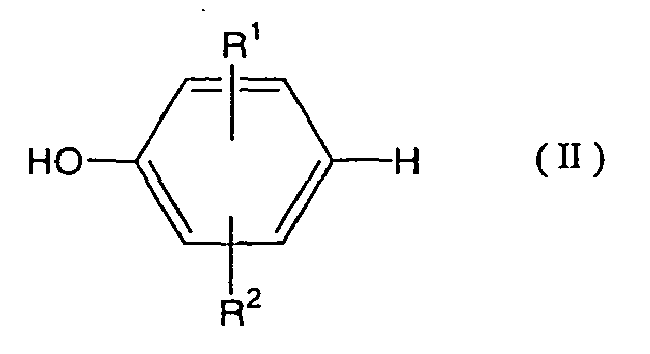
R3R4C=C(R5)-C(R6)(R7)-(CH2)n-OH (III)
wherein R3, R4, R5, R6, R7 and n are as defined above, in the presence of- (A) at least one member selected from the group consisting of alkali metals, alkali metal compounds, alkaline earth metals and alkaline earth metal compounds, and
- (B) at least one member selected from the group consisting of transition metals and transition metal compounds.
- 2. A method according to 1, wherein at least one of R1 and R2 in the phenol compound (II) is a C1-8 alkyl group, a C1-8 alkoxy group, a C5-8 cycloalkyl group, a phenyl group which may be substituted with a C1-8 alkyl group, or a phenoxy group which may be substituted with a C1-8 alkyl group.
- 3. A method according to 1 or 2, wherein the unsaturated alcohol (III) is allyl alcohol.
- 4. A method according to any one of 1 to 3, wherein the phenol compound (II) is at least one compound selected from 2-methyl-6-t-butylphenol and 2,6-di-t-butylphenol.
- 5. A method according to any one of 1 to 4, wherein the alkali metal compound is
a hydroxide, hydride, carbonate, amide or alkoxide of an alkali metal;
an alkali metal compound of formula (IV):
R-Ma (IV)
wherein R represents an aliphatic or aromatic hydrocarbon group and Ma represents an alkali metal atom; or
an aryloxide of alkali metal of formula (V):
ArOMa (V)
wherein Ma is as defined above, and Ar represents a phenol residue; and
the alkaline earth metal compound is
a hydroxide, hydride, oxide, halide, carboxylate, alkoxide, amide or carbonate of an alkaline earth metal;
an alkaline earth metal compound of formula (VI):
R-Mb-R' (VI)
wherein R and R' independently represent an aliphatic or aromatic hydrocarbon group, and Mb represents an alkaline earth metal atom;
an alkaline earth metal aryloxide of formula (VII):
ArOMbOAr' (VII)
wherein Mb is as defined above, and Ar and Ar' independently represent a phenol residue; or
a Grignard compound of formula (VIII):
R-Mg-X (VIII)
wherein R is as defined above and X represents a halogen atom. - 6. A method according to any one of 1 to 5, wherein the alkali metal compound is an alkali metal hydroxide or alkali metal alkoxide.
- 7. A method according to any one of 1 to 6, wherein the transition metal is iron or zinc.
- 8. A method according to any one of 1 to 6 , wherein the transition metal compound is at least one compound selected from
a hydroxide, oxide, halide, carbonate, alkoxide and phenoxide of a transition metal,
a compound of formula (IX):
R-Mc-Y (IX)
wherein R represents an alkyl group or an aryl group, Y represents an alkoxy group, an aryloxy group or a halogen atom and Mc represents a divalent transition metal atom, and
a compound of formula (X):
RR'MdYZ (X)
wherein R and R' independently represent an alkyl group or an aryl group, Y and Z independently represent an alkoxy group, an aryloxy group or a halogen atom and Md represents a tetravalent transition metal atom. - 9. A method according to any one of 1 to 8, wherein the alkaline earth metal compound is titanium (IV) alkoxide.
- 10. A method according to any one of 1 to 9, wherein the reaction temperature is in the range from 100 to 300°C.
- 11. A method for producing a p-hydroxyphenylalkanol of formula (I) as defined in 1, which method comprises reacting a phenol compound of formula (II) as defined in 1 with an unsaturated alcohol of formula (III) as defined in 1, in the presence of
- (a) an alkali metal or an alkali metal compound, and
- (b) an alkaline earth metal or an alkaline earth metal compound.
- 12. A method according to 11, wherein at least one of R1 and R2 in the phenol compound (II) is a C1-8 alkyl group, a C1-8 alkoxy group, a C5-8 cycloalkyl group, a phenyl group which may be substituted with a C1-8 alkyl group, or a phenoxy group which may be substituted with a C1-8 alkyl group.
- 13. A method according to 11 or 12, wherein the unsaturated alcohol (III) is allyl alcohol.
- 14. A method according to any one of 11 to 13, wherein the phenol (II) is at least one compound selected from 2-methyl-6-t-butylphenol and 2,6-di-t-butylphenol.
- 15. A method according to any one of 11 to 14, wherein the alkali metal compound is at least one compound selected from
a hydroxide, hydride, carbonate, amide and alkoxide of an alkali metal,
an alkali metal compound of formula (IV):
R-Ma (IV)
wherein R represents an aliphatic or aromatic hydrocarbon group and Ma represents an alkali metal atom; and
an aryloxide of alkali metal of formula (V):
ArOMa (V)
wherein Ma is as defined above, and Ar represents a phenol residue. - 16. A method according to any one of 11 to 15, wherein the alkaline earth metal compound is at least one compound selected from
a hydroxide, hydride, oxide, halide, carboxylate, alkoxide, amide and carbonate of an alkaline earth metal; and
an alkaline earth metal compound of formula (VI):
R-Mb-R' (VI)
wherein R and R' independently represent an aliphatic or aromatic hydrocarbon group, and Mb represents an alkaline earth metal atom;
an alkaline earth metal aryloxide of formula (VII):
ArOMbOAr' (VII)
wherein Mb is as defined above, and Ar and Ar' independently represent a phenol residue; and
a Grignard compound of formula (VIII):
R-Mg-X (VIII)
wherein R is as defined above and X represents a halogen atom. - 17. A method according to 16, wherein the alkaline earth metal compound is a hydroxide, hydride, or alkoxide of an alkaline earth metal or an alkaline earth metal compound of formula (VI).
- 18. A method according to any one of 11 to 17, wherein the alkali metal compound is an alkali metal alkoxide and the alkaline earth metal compound is an alkaline earth metal alkoxide.
- 19. A method according to any one of 11 to 18, wherein the reaction temperature is in the range from 100 to 300°C.
- 20. A method according to any one of 11 to 19, wherein the alkaline earth metal in the alkaline earth metal or the alkaline earth metal compound is magnesium.
Claims (10)
- A method for producing a p-hydroxyphenylalkanol of formula (I):

a hydrogen atom,
a C1-8 alkyl group,
a C1-8 alkoxy group,
a C5-8 cycloalkyl group,
a C6-12 alkylcycloalkyl group,
a C7-12 aralkyl group which may be substituted with a C1-8 alkyl group,
a phenyl group which may be substituted with a C1-8 alkyl group, or
a phenoxy group which may be substituted with a C1-8 alkyl group,
R3, R4, R5, R6 and R7 independently represent a hydrogen atom or a C1-8 alkyl group, and
n denotes an integer from 0 to 7, which method comprises reacting a phenol compound of formula (II):
R3R4C=C(R5)-C(R6)(R7)-(CH2)n-OH (III)
wherein R3, R4, R5, R6, R7 and n are as defined above, in the presence of(a) an alkali metal or an alkali metal compound, and(b) an alkaline earth metal or an alkaline earth metal compound. - A method according to claim 1, wherein at least one of R1 and R2 in the phenol compound (II) is a C1-8 alkyl group, a C1-8 alkoxy group, a C5-8 cycloalkyl group, a phenyl group which may be substituted with a C1-8 alkyl group, or a phenoxy group which may be substituted with a C1-8 alkyl group.
- A method according to claim 1 or 2, wherein the unsaturated alcohol (III) is allyl alcohol.
- A method according to any one of claims 1 to 3, wherein the phenol (II) is at least one compound selected from 2-methyl-6-t-butylphenol and 2,6-di-t-butylphenol.
- A method according to any one of claims 1 to 4, wherein the alkali metal compound is at least one compound selected from
a hydroxide, hydride, carbonate, amide and alkoxide of an alkali metal,
an alkali metal compound of formula (IV):
R-Ma (IV)
wherein R represents an aliphatic or aromatic hydrocarbon group and Ma represents an alkali metal atom; and
an aryloxide of alkali metal of formula (V):
ArOMa (V)
wherein Ma is as defined above, and Ar represents a phenol residue. - A method according to any one of claims 1 to 5, wherein the alkaline earth metal compound is at least one compound selected from
a hydroxide, hydride, oxide, halide, carboxylate, alkoxide, amide and carbonate of an alkaline earth metal; and
an alkaline earth metal compound of formula (VI):
R-Mb-R' (VI)
wherein R and R' independently represent an aliphatic or aromatic hydrocarbon group, and Mb represents an alkaline earth metal atom;
an alkaline earth metal aryloxide of formula (VII):
ArOMbOAr' (VII)
wherein Mb is as defined above, and Ar and Ar' independently represent a phenol residue; and
a Grignard compound of formula (VIII):
R-Mg-X (VIII)
wherein R is as defined above and X represents a halogen atom. - A method according to claim 6, wherein the alkaline earth metal compound is a hydroxide, hydride, or alkoxide of an alkaline earth metal or an alkaline earth metal compound of formula (VI).
- A method according to any one of claims 1 to 7, wherein the alkali metal compound is an alkali metal alkoxide and the alkaline earth metal compound is an alkaline earth metal alkoxide.
- A method according to any one of claims 1 to 8, wherein the reaction temperature is in the range from 100 to 300°C.
- A method according to any one of claims 1 to 9, wherein the alkaline earth metal in the alkaline earth metal or the alkaline earth metal compound is magnesium.
Applications Claiming Priority (3)
| Application Number | Priority Date | Filing Date | Title |
|---|---|---|---|
| JP2002094483 | 2002-03-29 | ||
| JP2002094484 | 2002-03-29 | ||
| EP03251949A EP1348686B1 (en) | 2002-03-29 | 2003-03-27 | Method of producing p-hydroxyphenylalkanols |
Related Parent Applications (2)
| Application Number | Title | Priority Date | Filing Date |
|---|---|---|---|
| EP03251949.8 Division | 2003-03-27 | ||
| EP03251949A Division EP1348686B1 (en) | 2002-03-29 | 2003-03-27 | Method of producing p-hydroxyphenylalkanols |
Publications (2)
| Publication Number | Publication Date |
|---|---|
| EP2110370A1 true EP2110370A1 (en) | 2009-10-21 |
| EP2110370B1 EP2110370B1 (en) | 2010-09-01 |
Family
ID=27807042
Family Applications (2)
| Application Number | Title | Priority Date | Filing Date |
|---|---|---|---|
| EP03251949A Expired - Lifetime EP1348686B1 (en) | 2002-03-29 | 2003-03-27 | Method of producing p-hydroxyphenylalkanols |
| EP09009858A Expired - Lifetime EP2110370B1 (en) | 2002-03-29 | 2003-03-27 | Method of producing p-hydroxyphenylalkanols |
Family Applications Before (1)
| Application Number | Title | Priority Date | Filing Date |
|---|---|---|---|
| EP03251949A Expired - Lifetime EP1348686B1 (en) | 2002-03-29 | 2003-03-27 | Method of producing p-hydroxyphenylalkanols |
Country Status (7)
| Country | Link |
|---|---|
| US (1) | US6717020B2 (en) |
| EP (2) | EP1348686B1 (en) |
| KR (2) | KR100929788B1 (en) |
| CN (1) | CN1307139C (en) |
| CA (1) | CA2423072C (en) |
| DE (2) | DE60331494D1 (en) |
| TW (1) | TWI247736B (en) |
Families Citing this family (4)
| Publication number | Priority date | Publication date | Assignee | Title |
|---|---|---|---|---|
| US8747651B2 (en) * | 2008-05-22 | 2014-06-10 | Graftech International Holdings Inc. | High coking value pitch |
| US8007658B2 (en) | 2008-06-03 | 2011-08-30 | Graftech International Holdings Inc. | Reduced puffing needle coke from coal tar |
| US8007659B2 (en) | 2008-06-03 | 2011-08-30 | Graftech International Holdings Inc. | Reduced puffing needle coke from coal tar distillate |
| CN107162879B (en) * | 2017-06-06 | 2020-05-26 | 常州大学 | Method for synthesizing nonyl phenol by catalyzing nonene and phenol with alkaline ionic liquid |
Citations (2)
| Publication number | Priority date | Publication date | Assignee | Title |
|---|---|---|---|---|
| JPH02221240A (en) * | 1989-02-23 | 1990-09-04 | Hokko Chem Ind Co Ltd | P-tert-butoxyphenylalkyl alcohol and production thereof |
| JP2001064220A (en) * | 1999-08-30 | 2001-03-13 | Sumitomo Chem Co Ltd | Method for producing p-hydroxyphenylalkanols |
Family Cites Families (1)
| Publication number | Priority date | Publication date | Assignee | Title |
|---|---|---|---|---|
| TW482765B (en) | 1996-08-05 | 2002-04-11 | Sumitomo Chemical Co | Phosphites, process for producing the same and their use |
-
2003
- 2003-03-20 TW TW092106135A patent/TWI247736B/en not_active IP Right Cessation
- 2003-03-21 CA CA002423072A patent/CA2423072C/en not_active Expired - Fee Related
- 2003-03-25 CN CNB031213170A patent/CN1307139C/en not_active Expired - Fee Related
- 2003-03-26 KR KR1020030018768A patent/KR100929788B1/en not_active Expired - Fee Related
- 2003-03-27 EP EP03251949A patent/EP1348686B1/en not_active Expired - Lifetime
- 2003-03-27 DE DE60331494T patent/DE60331494D1/en not_active Expired - Lifetime
- 2003-03-27 DE DE60334039T patent/DE60334039D1/en not_active Expired - Lifetime
- 2003-03-27 US US10/397,351 patent/US6717020B2/en not_active Expired - Lifetime
- 2003-03-27 EP EP09009858A patent/EP2110370B1/en not_active Expired - Lifetime
-
2009
- 2009-05-27 KR KR1020090046582A patent/KR100918189B1/en not_active Expired - Fee Related
Patent Citations (2)
| Publication number | Priority date | Publication date | Assignee | Title |
|---|---|---|---|---|
| JPH02221240A (en) * | 1989-02-23 | 1990-09-04 | Hokko Chem Ind Co Ltd | P-tert-butoxyphenylalkyl alcohol and production thereof |
| JP2001064220A (en) * | 1999-08-30 | 2001-03-13 | Sumitomo Chem Co Ltd | Method for producing p-hydroxyphenylalkanols |
Non-Patent Citations (2)
| Title |
|---|
| DATABASE WPI Section Ch Week 199041, Derwent World Patents Index; Class B05, AN 1990-310198, XP002245666 * |
| DATABASE WPI Section Ch Week 200136, Derwent World Patents Index; Class B05, AN 2001-338086, XP002245665 * |
Also Published As
| Publication number | Publication date |
|---|---|
| DE60334039D1 (en) | 2010-10-14 |
| EP2110370B1 (en) | 2010-09-01 |
| KR100918189B1 (en) | 2009-09-22 |
| EP1348686B1 (en) | 2010-03-03 |
| CA2423072A1 (en) | 2003-09-29 |
| CN1448379A (en) | 2003-10-15 |
| TWI247736B (en) | 2006-01-21 |
| US20030195379A1 (en) | 2003-10-16 |
| EP1348686A1 (en) | 2003-10-01 |
| US6717020B2 (en) | 2004-04-06 |
| KR100929788B1 (en) | 2009-12-07 |
| CN1307139C (en) | 2007-03-28 |
| CA2423072C (en) | 2009-12-08 |
| TW200306296A (en) | 2003-11-16 |
| KR20030078681A (en) | 2003-10-08 |
| DE60331494D1 (en) | 2010-04-15 |
| KR20090064516A (en) | 2009-06-19 |
Similar Documents
| Publication | Publication Date | Title |
|---|---|---|
| CA2294114C (en) | Process for the preparation of aromatic carbonates | |
| US7473752B2 (en) | Functionalized silicone resins, methods for their preparation, and use as catalysts | |
| JPH0819008B2 (en) | Method for hydroxyalkylation of phenols or thiophenols with cyclic organic carbonates using triorganophosphine catalyst | |
| WO1997011049A1 (en) | Process for the preparation of aromatic carbonate | |
| US5679871A (en) | Hydroxyalklylation of phenols | |
| JPS6125696B2 (en) | ||
| EP1348686B1 (en) | Method of producing p-hydroxyphenylalkanols | |
| US4349486A (en) | Monocarbonate transesterification process | |
| US6498278B1 (en) | Alkoxylation of 6-membered alkylene carbonates | |
| JP4284635B2 (en) | Production method of polycarbonate | |
| US9738590B1 (en) | Method of melt polymerizing polycarbonate and the polycarbonate made therefrom | |
| JP2569351B2 (en) | Method for producing aromatic carbonate compound | |
| JP4013810B2 (en) | Process for producing p-hydroxyphenylalkanols | |
| JP3994901B2 (en) | Process for producing p-hydroxyphenylalkanols | |
| CN1178806A (en) | Method for producing polycarbonate | |
| US4973728A (en) | Preparation of aromatic carbonates | |
| US6472498B2 (en) | Diaryl carbonate product and production of polycarbonate | |
| JP2005200326A (en) | Method for producing phosphites | |
| US20040225145A1 (en) | Process for producing phosphite | |
| JP3912963B2 (en) | Process for producing dialkyl carbonate | |
| US6169197B1 (en) | Process for separation between dialkyl carbonate and alkyl carbamate | |
| JP2001064220A (en) | Method for producing p-hydroxyphenylalkanols | |
| JP2002012575A (en) | Method for producing dialkyl carbonate | |
| KR20020010925A (en) | Method for manufacturing dialkyl carbonate | |
| JP2000159709A (en) | Production of bisphenols |
Legal Events
| Date | Code | Title | Description |
|---|---|---|---|
| PUAI | Public reference made under article 153(3) epc to a published international application that has entered the european phase |
Free format text: ORIGINAL CODE: 0009012 |
|
| AC | Divisional application: reference to earlier application |
Ref document number: 1348686 Country of ref document: EP Kind code of ref document: P |
|
| AK | Designated contracting states |
Kind code of ref document: A1 Designated state(s): CH DE FR GB IT LI NL |
|
| RIN1 | Information on inventor provided before grant (corrected) |
Inventor name: MURAKAMI, CHIKARA |
|
| 17P | Request for examination filed |
Effective date: 20091124 |
|
| GRAP | Despatch of communication of intention to grant a patent |
Free format text: ORIGINAL CODE: EPIDOSNIGR1 |
|
| GRAS | Grant fee paid |
Free format text: ORIGINAL CODE: EPIDOSNIGR3 |
|
| GRAA | (expected) grant |
Free format text: ORIGINAL CODE: 0009210 |
|
| AC | Divisional application: reference to earlier application |
Ref document number: 1348686 Country of ref document: EP Kind code of ref document: P |
|
| AK | Designated contracting states |
Kind code of ref document: B1 Designated state(s): CH DE FR GB IT LI NL |
|
| REG | Reference to a national code |
Ref country code: GB Ref legal event code: FG4D |
|
| REG | Reference to a national code |
Ref country code: CH Ref legal event code: NV Representative=s name: BOHEST AG Ref country code: CH Ref legal event code: EP |
|
| REG | Reference to a national code |
Ref country code: NL Ref legal event code: T3 |
|
| REF | Corresponds to: |
Ref document number: 60334039 Country of ref document: DE Date of ref document: 20101014 Kind code of ref document: P |
|
| PLBE | No opposition filed within time limit |
Free format text: ORIGINAL CODE: 0009261 |
|
| STAA | Information on the status of an ep patent application or granted ep patent |
Free format text: STATUS: NO OPPOSITION FILED WITHIN TIME LIMIT |
|
| 26N | No opposition filed |
Effective date: 20110606 |
|
| REG | Reference to a national code |
Ref country code: DE Ref legal event code: R097 Ref document number: 60334039 Country of ref document: DE Effective date: 20110606 |
|
| PGFP | Annual fee paid to national office [announced via postgrant information from national office to epo] |
Ref country code: IT Payment date: 20120321 Year of fee payment: 10 |
|
| PGFP | Annual fee paid to national office [announced via postgrant information from national office to epo] |
Ref country code: DE Payment date: 20130320 Year of fee payment: 11 Ref country code: FR Payment date: 20130325 Year of fee payment: 11 Ref country code: GB Payment date: 20130327 Year of fee payment: 11 |
|
| PGFP | Annual fee paid to national office [announced via postgrant information from national office to epo] |
Ref country code: NL Payment date: 20130309 Year of fee payment: 11 |
|
| REG | Reference to a national code |
Ref country code: CH Ref legal event code: PCAR Free format text: NEW ADDRESS: HOLBEINSTRASSE 36-38, 4051 BASEL (CH) |
|
| REG | Reference to a national code |
Ref country code: DE Ref legal event code: R119 Ref document number: 60334039 Country of ref document: DE |
|
| REG | Reference to a national code |
Ref country code: NL Ref legal event code: V1 Effective date: 20141001 |
|
| GBPC | Gb: european patent ceased through non-payment of renewal fee |
Effective date: 20140327 |
|
| REG | Reference to a national code |
Ref country code: FR Ref legal event code: ST Effective date: 20141128 |
|
| REG | Reference to a national code |
Ref country code: DE Ref legal event code: R119 Ref document number: 60334039 Country of ref document: DE Effective date: 20141001 |
|
| PG25 | Lapsed in a contracting state [announced via postgrant information from national office to epo] |
Ref country code: FR Free format text: LAPSE BECAUSE OF NON-PAYMENT OF DUE FEES Effective date: 20140331 Ref country code: GB Free format text: LAPSE BECAUSE OF NON-PAYMENT OF DUE FEES Effective date: 20140327 Ref country code: DE Free format text: LAPSE BECAUSE OF NON-PAYMENT OF DUE FEES Effective date: 20141001 |
|
| PG25 | Lapsed in a contracting state [announced via postgrant information from national office to epo] |
Ref country code: NL Free format text: LAPSE BECAUSE OF NON-PAYMENT OF DUE FEES Effective date: 20141001 |
|
| PG25 | Lapsed in a contracting state [announced via postgrant information from national office to epo] |
Ref country code: IT Free format text: LAPSE BECAUSE OF NON-PAYMENT OF DUE FEES Effective date: 20140327 |
|
| PGFP | Annual fee paid to national office [announced via postgrant information from national office to epo] |
Ref country code: CH Payment date: 20210317 Year of fee payment: 19 |
|
| REG | Reference to a national code |
Ref country code: CH Ref legal event code: PL |
|
| PG25 | Lapsed in a contracting state [announced via postgrant information from national office to epo] |
Ref country code: LI Free format text: LAPSE BECAUSE OF NON-PAYMENT OF DUE FEES Effective date: 20220331 Ref country code: CH Free format text: LAPSE BECAUSE OF NON-PAYMENT OF DUE FEES Effective date: 20220331 |