EP2107485A2 - Sichere Peer-to-Peer-Verteilung eines aktualisierbaren Schlüsselrings - Google Patents
Sichere Peer-to-Peer-Verteilung eines aktualisierbaren Schlüsselrings Download PDFInfo
- Publication number
- EP2107485A2 EP2107485A2 EP09156826A EP09156826A EP2107485A2 EP 2107485 A2 EP2107485 A2 EP 2107485A2 EP 09156826 A EP09156826 A EP 09156826A EP 09156826 A EP09156826 A EP 09156826A EP 2107485 A2 EP2107485 A2 EP 2107485A2
- Authority
- EP
- European Patent Office
- Prior art keywords
- key
- feed
- entry
- keyring
- blob
- Prior art date
- Legal status (The legal status is an assumption and is not a legal conclusion. Google has not performed a legal analysis and makes no representation as to the accuracy of the status listed.)
- Withdrawn
Links
Images









Classifications
-
- H—ELECTRICITY
- H04—ELECTRIC COMMUNICATION TECHNIQUE
- H04L—TRANSMISSION OF DIGITAL INFORMATION, e.g. TELEGRAPHIC COMMUNICATION
- H04L63/00—Network architectures or network communication protocols for network security
- H04L63/10—Network architectures or network communication protocols for network security for controlling access to devices or network resources
-
- G—PHYSICS
- G06—COMPUTING OR CALCULATING; COUNTING
- G06F—ELECTRIC DIGITAL DATA PROCESSING
- G06F21/00—Security arrangements for protecting computers, components thereof, programs or data against unauthorised activity
- G06F21/60—Protecting data
- G06F21/62—Protecting access to data via a platform, e.g. using keys or access control rules
-
- G—PHYSICS
- G06—COMPUTING OR CALCULATING; COUNTING
- G06F—ELECTRIC DIGITAL DATA PROCESSING
- G06F21/00—Security arrangements for protecting computers, components thereof, programs or data against unauthorised activity
- G06F21/60—Protecting data
- G06F21/62—Protecting access to data via a platform, e.g. using keys or access control rules
- G06F21/6218—Protecting access to data via a platform, e.g. using keys or access control rules to a system of files or objects, e.g. local or distributed file system or database
-
- H—ELECTRICITY
- H04—ELECTRIC COMMUNICATION TECHNIQUE
- H04L—TRANSMISSION OF DIGITAL INFORMATION, e.g. TELEGRAPHIC COMMUNICATION
- H04L63/00—Network architectures or network communication protocols for network security
- H04L63/06—Network architectures or network communication protocols for network security for supporting key management in a packet data network
-
- H—ELECTRICITY
- H04—ELECTRIC COMMUNICATION TECHNIQUE
- H04L—TRANSMISSION OF DIGITAL INFORMATION, e.g. TELEGRAPHIC COMMUNICATION
- H04L9/00—Cryptographic mechanisms or cryptographic arrangements for secret or secure communications; Network security protocols
- H04L9/08—Key distribution or management, e.g. generation, sharing or updating, of cryptographic keys or passwords
- H04L9/0816—Key establishment, i.e. cryptographic processes or cryptographic protocols whereby a shared secret becomes available to two or more parties, for subsequent use
- H04L9/0819—Key transport or distribution, i.e. key establishment techniques where one party creates or otherwise obtains a secret value, and securely transfers it to the other(s)
- H04L9/083—Key transport or distribution, i.e. key establishment techniques where one party creates or otherwise obtains a secret value, and securely transfers it to the other(s) involving central third party, e.g. key distribution center [KDC] or trusted third party [TTP]
- H04L9/0833—Key transport or distribution, i.e. key establishment techniques where one party creates or otherwise obtains a secret value, and securely transfers it to the other(s) involving central third party, e.g. key distribution center [KDC] or trusted third party [TTP] involving conference or group key
- H04L9/0836—Key transport or distribution, i.e. key establishment techniques where one party creates or otherwise obtains a secret value, and securely transfers it to the other(s) involving central third party, e.g. key distribution center [KDC] or trusted third party [TTP] involving conference or group key using tree structure or hierarchical structure
-
- H—ELECTRICITY
- H04—ELECTRIC COMMUNICATION TECHNIQUE
- H04L—TRANSMISSION OF DIGITAL INFORMATION, e.g. TELEGRAPHIC COMMUNICATION
- H04L9/00—Cryptographic mechanisms or cryptographic arrangements for secret or secure communications; Network security protocols
- H04L9/08—Key distribution or management, e.g. generation, sharing or updating, of cryptographic keys or passwords
- H04L9/0891—Revocation or update of secret information, e.g. encryption key update or rekeying
Definitions
- the present invention relates generally to document archiving and document distribution, and in particular to a distributed secure peer-to-peer document archival system.
- the first is to insure that team members are able to access their documents and share them with other members.
- the second is to insure that no one else can access those documents.
- the first function typically requires a dedicated file server, centralized backups, dedicated network, static IP address and domain name service, the second requires firewalls, account and password management, and physical security for one's servers.
- the personal archive model has features to support the mobile, distributed and loose-knit organizations that are becoming increasingly prevalent in today's business world.
- Knowledge workers in these environments tend to work on many projects at once, and simultaneously belong to many overlapping (and potentially competing) communities. They are also increasingly mobile, and often find themselves in environments with slow, partitioned or no network access.
- Knowledge workers in these environments need a sharable personal archive: one that is easy for a single person to maintain, works both on- and offline and supports an intuitive limited-publication model that allows an ad-hoc working group to share some pieces of information while keeping others confidential.
- the main difference between the centralized and decentralized solution is whether control naturally lies with the publisher or the reader of a document.
- the publisher of a site (or his designated site administrator) has ultimate control and responsibility over who has access to a document, who can modify it and whether past versions are made available. The publisher may also decide to take a site down entirely, thus denying access to everyone.
- email and paper-based solutions it is the reader who has control.
- anyone who receives a paper document has the ability to share it with someone else simply by making a photocopy, and once someone receives a paper document it is very difficult for the original author to "take it back.”
- email is often forwarded to others, sometimes with modifications or annotations made by the person doing the forwarding.
- the decision to grant or deny access to a document is distributed among those who already have access, with limitations imposed through social (and sometimes legal) rules.
- a personal document archive system provides for secure publication of compound documents to a limited audience.
- the present invention has been reduced to practice by the inventors and is referred to herein generally as Makyoh.
- Features include version-control, secure storage, permanent handles for publications and versions (URI's), and the ability to build compound documents and organize documents into directory trees. It also provides features including robust redundant storage, an intuitive "paper-like" publication and access-control model, and the ability to operate in environments with slow, partitioned or no network access.
- a “feed” in accordance with the present invention can represent a mutable document, wherein each new "feed entry” represents a new version of the document.
- a “feed” can also represent a publication channel where each feed entry is its own content; e.g. blog entries or messages on a message board. Each individual entry in a feed can be accessed through its own unique URI.
- the present invention provides special URI's for accessing the latest entry in a feed (useful for representing version-controlled documents) and for accessing a merged view of all known entries (useful for representing blogs and other aggregations of multiple documents over time).
- Entries can be posted to a feed from multiple machines (Makyoh servers) and if desired by multiple authors. Authoring, distribution and reading of documents are all completely decentralized. The ability to publish is garnered by obtaining the publication key for a feed.
- Each document as represented by a file or set of files, is associated with a unique key called a "document key.”
- a document key grants the ability to both identify and decrypt the file or set of files that make up a single, fixed version of the associated document.
- Each feed (and its entries) is associated with two unique keys, called a "subscription key” and a "publication key.”
- a subscription key grants the ability to both identify and decrypt the file or set of files that make up entries in the associated feed, but does not grant the ability to add new entries to the feed.
- a publication key grants the ability to both identify and decrypt the file or set of files that make up entries in the associated feed, and also grants the ability to add new entries to the feed through a process called "publication.”
- a user can grant access to a document or feed to someone else by giving the appropriate key. The receiver will then "import" the key into his or her personal Makyoh server.
- the key is encrypted using the user's passphrase and stored in a private directory on his or her personal Makyoh server's local disk.
- the keys are managed as a feed.
- a "keyring feed” stores only document keys, subscription keys, and publication keys.
- a temporary local cache contains a database that manages all the keys imported during the current session (since the Makyoh server was started). The database is deleted when the user's Makyoh server is shut down. The database is re-created (empty) on server start-up.
- a personal document archive system provides robust, secure document storage and sharing without requiring any of the infrastructure required in conventional archiving systems. It is robust without requiring dedicated servers, scheduled backup or even a reliable network, and it is secure without the need for account password, firewalls or secure server rooms.
- the archive appears to be a local disk. Once the user has entered his passphrase to unlock the system, his entire archive is available in this manner.
- each file and directory is actually stored on disk in its own encrypted file called a blob (Binary Large OBject).
- Each blob has its own unique 128-bit symmetric decryption key. No one can access the contents of an archive without the appropriate key, even if they steal the hard drive.
- Blob decryption keys can be listed in encrypted directory blobs, but not in all cases. For example, the key for a blob representing a single-file document might only exist as a printed 2D barcode representing the document key.
- control over how resources e.g., files, directories and feed entries
- control over how resources is more evenly balanced between publishers and consumers than is the case in either typical central server systems like the Web or decentralized systems like email.
- the present invention ensures the following needs are met for readers, publishers, and re-publishers (e.g., readers who are also publishers; e.g., readers who modify material they have read and then publish the modified material).
- Permanence guarantee that the reader's own mirrored resources can not be deleted or modified without his permission.
- Updates ability to receive the latest published version of a resource.
- multi-versioned resources are represented with feeds, where each version is an entry in the feed.
- Access control ability to restrict initial access to a resource. (However, anyone who is given access can still forward the resource to others.)
- Versioning ability to publish new versions of a resource.
- Pseudonymity ability to author materials with a name that is not tied to a physical identity.
- Integrity ability to ensure that readers can tell whether their mirror of a resource is complete (that is, to tell when they have all the files necessary to read a complete document or feed entry).
- Escrow ability to publish documents "in escrow,” such that encrypted documents are mirrored by third parties but can not be decrypted until a key is produced at a later time.
- Linking ability to publish resources that themselves link to or use resources authored by someone else, and the guarantee that these linked-to or included resources will not change from what was originally published.
- Branching ability to create a new resource that is based on the content of another resource, potentially one authored by someone else.
- DRM Digital Rights Management
- Makyoh The present invention has been reduced to practice by the inventors and is referred to hereinafter generally as Makyoh.
- a prototype version of the Makyoh personal server has been implemented on a Java-based server. Encryption, storage, versioning, digital-signature functions, peer-to-peer distribution and server discovery have all been implemented.
- Makyoh provides robust and secure document storage and document sharing without needing any of the conventional infrastructure, as described above for example. It is robust without requiring dedicated servers, scheduled backup or even a reliable network, and it is secure without the need for account passwords, firewalls or secure server rooms.
- a Makyoh archive appears to be a local disk (actually a locally-running WebDAV server, what is sometimes called a Web Folder). Once the user has entered his passphrase to unlock the Makyoh system, his entire archive is available in this manner (i.e., as a local disk). As with all WebDAV servers, his archive can also be viewed as a web page using a standard web browser.
- each file and directory is stored in its own encrypted file called a blob (for Binary Large OBject) on persistent storage media such as a hard drive, or removable media (e.g., devices popularly referred to as "thumbnail drives").
- a blob has its own unique 128-bit symmetric decryption key. Consequently, no one can access the contents of an archive without the appropriate key, even if they steal the storage media.
- Blob decryption keys can be listed in encrypted directory blobs, but not in all cases. For example, the key for a blob representing a single-file document might only exist as a printed 2D barcode representing the document key.
- a personal document archive system 100 (also referred to herein as Makyoh) in accordance with the present invention is shown in Fig. 1 .
- the system 100 comprises a plurality of personal servers (referred to herein variously as personal servers, Makyoh personal servers, Makyoh servers, servers, and the like) for receiving and storing documents and for serving documents.
- the figure illustrates, as an example, four portable personal servers 102-108 such as laptop computers, hand held data devices, cell phones, etc. It will be apparent that the personal servers 102-108 can also be traditionally non-portable computing devices such as desktop PCs, and the like.
- Communication among the personal servers 102-108 can be by any suitable wireless technology (e.g., Bluetooth, IEEE 802.11, and so on), or over any suitable wired technology (e.g., ethernet, serial port connections, and so on).
- the personal servers 102-108 collectively provide both secure storage of resources and a secure peer-to-peer model for publishing resources to a limited audience.
- Each personal server 102-108 stores a Makyoh archive comprising of one or more resources, where a resource is a file, directory, feed or feed entry.
- Each Makyoh archive can be thought of as an encrypted, locally-cached mirror of both resources that have been created locally and resources that have been created on other Makyoh servers and subsequently published.
- a Makyoh archive is implemented using a combination of encrypted blobs (representing files, directories and feed keys), a set of decryption keys, and feed entry files, each of which is associated with a particular feed.
- every user will have stored on her personal server her own locally-stored Makyoh archive. Additional details of a Makyoh archive will be given below.
- a Makyoh personal server 102 performs three main functions. First, the server maintains an encrypted, version-controlled personal archive. Second, the server acts as a local mirror of resources that have been published by other Makyoh personal servers 104-108. Finally, the server distributes these mirrored resources to other Makyoh personal servers with which it comes into contact. In this way, every Makyoh personal server 102-108 functions as a personal archive, as a node and router in a peer-to-peer network, and as a mirror for nearby archives. All personal servers102-108 are able to participate in routing and mirroring activities, but since all resources are encrypted, only those who know the decryption key for a given resource are able to read its contents.
- blobs are always encrypted they can be distributed freely without worrying about revealing sensitive information.
- his local Makyoh server 102 will automatically find all nearby Makyoh servers 104-108 (using an open protocol called Bonjour) and distribute all the blobs associated with that document to all other Makyoh servers in the area.
- This process referred to herein as "local superdistribution”, accomplishes two things: First, it automatically creates an encrypted backup of the user's documents 122 on all the other machines (Makyoh servers) in the area. Second, it pre-caches documents that the user might want to share with other people in the area.
- Fig. 1A illustrates a more generalized embodiment of the present invention.
- the device 102' can be any document processing device that is also configured to provide the functionality of a Makyoh server as disclosed herein.
- the device 102' can be a photocopier, a facsimile machine, a printer, and so on, including combinations thereof.
- a document source 101 e.g., a human user
- the copier can be configured to perform encryption, storage and distribution of the document according to the present invention, described in more detail below.
- the document processing device 102' is a printing device
- the document source 101 can be a computing device attached to the printer (e.g., a laptop connected locally to the printer, or accessing the printer via a network connection).
- the printer e.g., a laptop connected locally to the printer, or accessing the printer via a network connection.
- the document can be encrypted, stored and distributed according to the present invention, in addition to being printed.
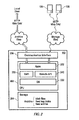
- Fig. 2 illustrates a high level block diagram of some hardware and software elements comprising a Makyoh server 102 in accordance with an embodiment of the present invention.
- the Makyoh server 102 comprises a suitable data processing component 202 such as general CPU, a custom ASIC (application-specific integrated circuit), or any other suitable data processing logic.
- a generic representation for storage is shown as storage component 204 and represents storage capabilities of the server 102, for transient data storage (e.g., DRAM, etc.) and for persistent data storage (e.g., hard drive, ROM, flash memory, removable flash memories, and so on).
- the storage component 204 stores program code, among other data, for execution by the data processing component 202 to perform operations relating to operation of the server 102 in the personal archive system of the present invention, as will be discussed in further detail below.
- the storage component 204 also stores the Makyoh archive, details of which are described below.
- a communication interface 206 represents hardware and software elements for communication with users and other Makyoh servers 104, 106.
- the communication interface 206 can include one or more connectors to which a display device and an input device (e.g., keyboard) are connected, and related drivers for interacting with the display device and the input device.
- the communication interface 206 can include connectors (e.g., ethernet) for wired communication with other Makyoh servers 104, 106.
- the communication interface 206 can include a wireless transceiver (e.g., Bluetooth or 802.11 compliant hardware) for wireless communication with other Makyoh servers 104, 106.
- the data processing component 202 is shown executing an operating system (OS) 222.
- OS operating system
- the OS 222 can be the Microsoft® Windows operating system, the Apple® OS X operating system, or the Linux operating system.
- the data processing component 202 is also shown executing two application programming interfaces (API), one called a trusted-user API 232 and the other called a remote-user API 242.
- APIs working in conjunction with functionality of the OS, provide application level programs 252 with functionality in accordance with the present invention.
- the APIs 232, 242 are discussed in further detail below.
- the APIs 232, 242 provide services for higher level applications 252.
- one such application 252 is a Java-based server.
- the server application includes all the WebDAV (WEB-based Distributed Authoring and Versioning) functionality necessary for mounting a resource or full archive as a disk under the OS 222 (e.g., Micrasaft® Windows operating system, Apple® OS X operating system, Linux operating system, etc.).
- the archive can then be browsed and modified using the operating system's standard file-browsing user interface, or any other suitable file-browsing application.
- URI Universal Resource Identifier
- hash URI's function as both identifiers and keys, and thus can be used to both retrieve encrypted blobs from nearby servers 104-108 and to decrypt those blobs once they are retrieved. Once retrieved, the remaining fields let the server know how the blob contents should be decrypted and presented to the user.
- Makyoh Access control in Makyoh is primarily done using hash URI's. Once someone imports a hash URI (often simply called a key) into his Makyoh archive he has access to the contents of the file it identifies. Makyoh also uses special kinds of files, namely directory blobs and feedkey blobs, to grant access to a large and possibly extensible set of files given a single hash URI. In general, users will interact with three kinds of hash URI's: document keys, which give access to a single immutable file or directory tree, subscription keys, which give the ability to read feed entries for a particular feed, and publication keys, which give the ability to both read feed entries for a particular feed and publish new entries for that feed.
- document keys which give access to a single immutable file or directory tree
- subscription keys which give the ability to read feed entries for a particular feed
- publication keys which give the ability to both read feed entries for a particular feed and publish new entries for that feed.
- a hash URI can be used directly as a hyperlink, similar to how URLs are embedded in email and web pages. All that would be necessary is to write a browser plug-in to access the new URI format and retrieve the necessary blobs from some data store.
- Makyoh because it is not very flexible in terms of access: if a user has access to a document that contains a hash URI for another document he automatically has access to both. If at a later time the author wanted to allow access to only the first document he would need to edit its contents and remove all mentions of the second hash URI before handing out the hash URI to the first document.
- hash URI hash URI
- the archive directory structure that is presented in the trusted-user API, which is based on the ID of a document or feed.
- the path to a particular document or feed entry is the same for all Makyoh users, but unlike hash URI's an archive path does not reveal the document's decryption key. Users who already have the key (and thus have been given access to the document or feed) will be able to access the file or files at the given path, while other users will not.
- Makyoh provides a personal archive, and typically every user will run his own individual personal server 102.
- the personal server 102 maintains an encrypted, local copy of all the user's entire archive, and will also replicate encrypted documents on nearby servers 104-108. This distinguishes Makyoh from conventional distributed document stores like FreeNet or OceanStore, which assign each file to specific nodes in a distributed network of storage servers.
- Makyoh presents two separate APIs:
- the trusted-user API 232 presents the Makyoh archive as a file system of folders and documents organized in a directory hierarchy (virtual file system, archive view). Additional details of this archive view are discussed below.
- the Makyoh archive can be accessed either using a standard Web browser communicating with the local Makyoh server 102 (also referred to as localhost) using HTTP, or as a part of the local file system (sometimes called Web Folders) using the WebDAV protocol.
- the trusted-user API 232 is only available from locally-generated connections (that is, connections to localhost 102), and only after the user has authenticated with the Makyoh server using his passphrase.
- the second API is the "remote-user API", also shown in Fig. 2 .
- the remote-user API 242 presents to other Makyoh servers 104, 106 (so-called un-trusted users) the raw files comprising the Makyoh archive (e.g., feed entry files, encrypted blobs, and so on) as they are actually stored in the storage component 204. These raw files are also accessible via HTTP and WebDAV protocols, and are used by other Makyoh servers to find and retrieve needed blobs and feed entries, and to push blobs and feed entry files onto yet other servers.
- Makyoh servers 104, 106 so-called un-trusted users
- These raw files are also accessible via HTTP and WebDAV protocols, and are used by other Makyoh servers to find and retrieve needed blobs and feed entries, and to push blobs and feed entry files onto yet other servers.
- the virtual file system view of the Makyoh archive comprises two kinds of resources: documents and feeds.
- a "document” is an immutable file or directory tree, while a “feed” specifies a distribution channel through which one may subscribe to new documents (called entries) that are published to the feed.
- Each document and feed is associated with a unique URI (Universal Resource Identifier) which serves both as an identifier and a decryption key allowing access to the resource.
- URI Universal Resource Identifier
- Documents are immutable; a URI pointing to a document is guaranteed to always point to the same exact contents.
- Feeds are mutable, in that new entries can be published to a given feed.
- Each feed entry is identifiable by its own URI, and will itself point to an immutable document that represents the contents of the entry.
- a feed can be used as a publication channel where each feed entry is its own content (e.g. blog entries or messages on a message board), or it can represent a mutable, version-controlled document where each new feed entry represents a new version of the document.
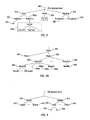
- Fig. 3 shows an example of the virtual file system view of the Makyoh archive that is presented to the trusted user.
- the root directory tree 302 of the virtual file system of a server 102 that is presented to local authenticated users comprises three directories: docs, feeds, and keyring.
- the root directory tree 302 represents the highest level in the virtual file system view of the Makyoh archive and does not necessarily coincide with the "root" of the underlying physical file system.
- a docs directory 312 contains documents which are immutable; i.e., do not change.
- a feeds directory 314 contains feed entries which are mutable by virtue of receiving entries published by the local server 102 or by any of the remote servers 104-108. The user can decrypt and view those documents in the docs directory 312 and feed entries in the feeds directory 314 for which he has imported the appropriate document, subscription or publication key.
- a keyring directory 316 contains all keys that the user has ever imported. In an embodiment of the present invention, these keys are been encrypted using the user's passphrase as a symmetric key and stored in a private directory on the local server 102.
- Documents are stored under the docs directory 312 in respective subdirectories 322.
- Each subdirectory 322 is named by an identifier referred to as the blob-Id, which is defined as the SHA-1 hash of the encrypted contents of the blob representing the file or root directory for the document, written as a lowercase 40-character hexadecimal string.
- the blob-Id is defined as the SHA-1 hash of the encrypted contents of the blob representing the file or root directory for the document, written as a lowercase 40-character hexadecimal string.
- the name of the subdirectory ⁇ sub-D1> within which that file is presented is based on the SHA-1 hash of the encrypted contents of the file's corresponding blob.
- the SHA-1 hash of the encrypted contents of the encrypted blob representing my-document.pdf is the text string:
- a document consists of a directory of files
- the name of the subdirectory is based on the SHA-1 hash of the directory blob corresponding to the directory of files.
- the "directory blob" is an invisible file which stores information about the contents of the directory itself; e.g., a list of files and/or sub-directories.
- Fig. 3 shows that subdirectory 322a contains a directory of files, called "my-web-page.”
- the directory file schematically indicated in Fig.
- the name of the subdirectory 322a is based on the SHA-1 hash of the encrypted contents of its directory file 332a, and in an embodiment of the present invention the pathnames might appear as:
- feeds are stored under the feeds directory 314.
- Each feed is stored in a feed subdirectory 324 named by the feed's ID, which is defined as the fingerprint of the public key used to verify the feed's signature (described later).
- Each feed directory 324 contains a subdirectory 334 for each entry, named by the creation time of the entry followed by a period (".") followed by the SHA-1 hash of the contents of the feed entry file.
- the creation time should be encoded in Coordinated Universal Time (UTC) in the form yyyyMMdd + 'T' + HHmmss + 'Z', where "hh" is the hour in 24-hour format and 'T' and 'Z' are the literal characters T and Z.
- UTC Coordinated Universal Time
- a feed subdirectory 334 is a file 344' or a directory tree 344 representing the entry.
- a feed with two entries might appear as:
- Feeds also contain up to three other directories: a scratch directory (.../-/) 344a; a latest directory (.../latest/) 344b; and a merged directory (.../merged/) 344c.
- a scratch directory .../-/
- a latest directory .../latest/
- a merged directory .../merged/ 344c.
- the keyring directory 316 is a directory containing all keys that a user has ever imported. Keys are represented as key files 326 with the extension ".makyoh. " Key files for document keys contain the hash URI of the file or directory that represents the document associated with the key. As will be explained below, there are two kinds of keys for a feed, a subscription key and a publication key. Key files for a feed's subscription key contain the hash URI of the subscription feedkey blob. Similarly, key files for a feed's publication key contain the hash URI of the publication feedkey blob.
- Local users can perform the usual HTTP and WebDAV requests: GET, PUT, HEAD, MKCOL, PROPFIND, LOCK, UNLOCK, DELETE, MOVE, COPY and OPTIONS (POST is not currently supported).
- connections to Makyoh server 102 from remote Makyoh servers 104-108 are presented with a view ("physical view") of the files as they are stored on the storage device of the storage component 204 of the Makyoh server 102. This is compared to the archive (logical or virtual) view that is presented a trusted user described in Fig. 3 .
- the remote user is presented with a blobs directory 412 and an entries directory 414.
- the blobs directory 412 simply contains encrypted blob files 422, each with the SHA-1 hash of its encrypted file contents as its filename. For example:
- the entries directory 414 contains feed entry files 434, each within a subdirectory 424 named with the feed's ID.
- the entry file itself 434 is named by the creation time of the entry followed by a period (".") followed by the SHA-1 hash of the contents of the feed entry file.
- the creation time should be encoded in Coordinated Universal Time (UTC) in the form yyyyMMdd + 'T' + HHmmss + 'Z', where "hh" is the hour in 24-hour format and ⁇ T' and 'Z' are the literal characters T and Z.
- UTC Coordinated Universal Time
- the files and directories presented in the remote view are the actual files and directory structure as stored on disk.
- Remote servers can perform a subset of the HTTP and WebDAV (type 2) requests; e.g., GET, PUT, HEAD, MKCOL, PROPFIND, LOCK, UNLOCK and OPTIONS.
- Other requests e.g., POST, DELETE, MOVE, or COPY
- POST, DELETE, MOVE, or COPY will return with a Bad Request (400) error.
- blob files 502 are immutable, and represent just a single version of a file as it existed at a particular time.
- each blob file 502 is illustrated by a document icon and a lock icon.
- the document icon associated with a blob file 502 represents the contents of the file, which the associated lock icon indicates that the contents are encrypted.
- the encrypted contents of the blob files 502 are decrypted using their respective symmetric decryption keys 502a.
- Each decryption key 502a is illustrated in Fig. 5 with an arrow leading to the encrypted blob file 502 for which it is serves as the decryption key.
- a blob file 502 is immutable; i.e., a given instance of a blob file cannot be modified.
- a user can, nonetheless, make modifications for example by reading in the file, making desired edits to the file, and then writing out the modified contents of the file into an entirely new blob file along with its own unique ID and decryption key 502a.
- a blob file 502, along with its ID and key 502a, are automatically computed based on the contents of the file being encrypted.
- the file is first prepended with a null-terminated header consisting of the blob's type (currently blob, directory or feedkey), the document's length in bytes and an optional "salt" string, all separated by spaces.
- This plaintext is then compressed using a known algorithm called the DEFLATE algorithm and encrypted with the known Advanced Encryption System algorithm using the MD5 hash of the plaintext as the encryption key.
- the ID for the resulting blob is the SHA-1 hash of the encrypted blob's contents, encoded as a 40-hex-digit lowercase string. More formally:
- the header serves two purposes. First, it guarantees that even zero-length documents can generate an MD5 hash. Second, it includes an optional "salt" which can be used to generate a blob file with a different ID than would be obtained if no salt was used. This can be less efficient in terms of storage, but provides additional privacy against some kinds of attacks.
- One advantage of using hashes for a blob's key 502a and ID is that the process is entirely determined by document contents: multiple copies of the same exact document will produce the same blob file and blob-Id, even if the documents were independently published by different people. This reduces the amount of storage an archive uses, especially in cases where the same file appears in several different documents' directory trees. The only exception is when a publisher adds the optional salt to their headers, which (by design) creates a different blob and blob-Id based on the salt.
- a directory blob 504 is simply a list of hash URI's pointing to the files and subdirectories the directory contains, encoded and encrypted in blob format as described above.
- Directory blobs 504 have the type directory.
- the decrypted contents of a directory blob 504 containing two files and a subdirectory might consist of the following:
- the corresponding directory blob 504 is decrypted and the ID, key, MIME type and name of its contents are cached in a temporary database.
- This database is then used to present the directory structure and files of the user's archive.
- the use of a caching database improves performance, but is not necessary and other embodiments of the present invention can easily be implemented without a database.
- a feed key blob 506 is a file containing keys necessary for decrypting, verifying, and optionally for creating (publishing) feed entries.
- Feed keys come in two forms: subscription keys, which give read-only access to a feed, and publication keys which grant both the ability to read entries and to publish new entries.
- the feed key file 506 consists of the following fields, each separated by a linefeed ( ⁇ n). The entire contents are then encrypted and encoded as a blob, as described above.
- Header the string "MAKYOH FEEDKEY VERSION n", where n is the version number for the feed key file format being used (currently 1.0).
- Entry-key the string "Entry-key: " followed by a randomly generated 128-bit symmetric key that is used to encrypt and decrypt the Entry field in every feed entry file for this feed.
- the key is encoded as a 32-character lowercase hexadecimal string.
- Verify-key the string "Verify-key: " followed by a linefeed ( ⁇ n), followed by the public key to be used to verify a feed entry, followed by another linefeed.
- this key could be an ASCII-armored public key as defined by the OpenPGP Format standard. Lines should be separated by a linefeed ( ⁇ n), not a carriage-return linefeed ( ⁇ r ⁇ n).
- Write-key (optional) the string "Write-key: " followed by a linefeed ( ⁇ n) and the secret key to be used to sign a new feed entry.
- this key could be an ASCII-armored secret key as defined by the OpenPGP Format standard, and should be the secret-key pair of the feed's verify-key.
- the Write-key field is only listed in publication keys, not in subscription keys.
- a feed's ID is defined as the 160-bit key fingerprint of the feed's verify key in accordance with the OpenPGP Format standard, encoded as a 40-character lowercase hexadecimal string.
- a feed entry file 506a is a file that contains information about an entry to a feed.
- the feed entry file 506a comprises the following fields, each separated by a linefeed ( ⁇ n). These contents are not encoded as an encrypted blob (though the "Entry" field 506b shown in Fig. 5 is encoded in encrypted form, as described below).
- Header the string "MAKYOH FEED ENTRY VERSION n", where n is the version number for the feed entry file format being used (currently 1.0).
- Entry the string "Entry: " followed by the hash URI for the document (file or root directory) representing this entry, encrypted using the Entry-key specified in the feed's feed key.
- the encrypted contents are encoded as a lowercase hexadecimal string (usually around 256 characters).
- Verify-key the string "Verify-key: " followed by a linefeed ( ⁇ n), followed by the public key to be used to verify a feed entry, followed by another linefeed.
- this key could be an ASCII-armored public key as defined by the OpenPGP Format standard.
- Signature the public key signature on the contents of the fields listed above, using the Write Key specified in the feed's feed key.
- this signature could be an ASCII-armored signature block as defined by the OpenPGP Format standard.
- the keyring is a collection of keys (i.e., hash URI's) the user has imported.
- the keyring is implemented as a private directory stored on the local Makyoh server 102. Referring to Figs. 3 and 5 , when a user logs into a Makyoh server for the very first time, a personal keyring directory 316 is automatically created. When a key is imported, it is encrypted using the user's passphrase as the symmetric key, and the resulting encrypted file 326 is then stored in the keyring directory 316. When the user logs in using his passphrase, Makyoh bootstraps by decrypting all key files in the user's keyring directory. The process of importing keys (hash URI's) is explained further below.
- a typical usage scenario of the present invention will now be described.
- Alan is attending business negotiations with a competitor, and the user's documents are stored in his personal Makyoh archive running on his laptop.
- the encrypted blob(s) for that outline will be replicated by his laptop on all other laptops running Makyoh in the area. If the key for that document is never revealed, then Alan has effectively securely backed up a copy of his document on the laptops of everyone else in the meeting.
- Alan's Makyoh server is likewise backing up documents of other laptops when documents on those laptops are accessed.
- the "key" is the hash URI described above. Users carry hash URI's (one for each document, or directory of documents, or feed entries) and pass them around to other users to give them access to the information.
- the hash URI is a small amount of data, on the order of a hundred or so bytes, that can be conveniently stored in a "key file" on a storage device (e.g., thumbdrive), on a printable medium (e.g., linear barcode, two-dimensional barcode, etc), and so on.
- a storage device e.g., thumbdrive
- a printable medium e.g., linear barcode, two-dimensional barcode, etc
- they can be printed on business cards as 2-dimensional barcodes, beamed to a PDA via infrared, transmitted by human touch using a technology such as NTT's RedTacton, or through more traditional means such as Bluetooth or even instant messaging.
- a technology such as NTT's RedTacton
- Bluetooth or even instant messaging.
- the colleague can access the document - even if the original transmission of the blobs (already completed at this point) had taken several minutes.
- the processing can be performed by a suitable data processing component of the Makyoh server such as shown in Fig. 2 .
- the processing described in figures to follow can be embodied in suitable computer program code that is executed by the data processing component 202.
- the blobs' IDs associated with it are automatically added to a list of files to be pushed to other servers (the Put Blob Queue), and any blobs required by the document that are not found are added to a list of files to get from other servers (the Get Blob Queue).
- the Put Blob Queue the corresponding feed entry file is added to a list of feed entries to push to other servers (the Put Feed Entry Queue), and its feed-Id is added to a list of feeds to check for new entries on other servers (the Get Feed Queue).
- a trusted user i.e., a trusted user
- Makyoh server the "local server”
- a user specifies a full pathname for the file or directory to retrieve, for example:
- the trusted user's view of the Makyoh archive is that of a virtual file system ( Fig. 3 ).
- the pathname provided by the user is in the context of that virtual file system.
- the file system is hierarchical such as in the Unix operating system, and hence a the pathname appears as a Unix pathname.
- the pathname leads to the encrypted blob file from which a cleartext representation of the requested document will be obtained.
- a key (the hash URI) is used to decrypt the content of the obtained blob.
- the blob-Id of the requested document is determined based on the pathname specified by the requestor.
- the blob-Id is the name of the subdirectory 322 ( Fig. 3 ) in the pathname.
- the keyring directory 316 ( Fig. 3 ) contains key files 326, each of which contains the hash URI of the file or document that represents the document associated with the key. Recall that the hash URI includes the blob-Id.
- a search is performed of the hash URI's in the key files 326 for the blob-Id determined from step 602, thus identifying the key file associated with the requested document. If it is determined in step 601 that the blob-Id is not found, then the requested document is deemed not found and a suitable response is sent in a step 692 to the requestor indicating that the requested document was not found.
- step 601 If it is determined in step 601 that the blob-Id is found in one of the key files 326, then a determination is made in a step 603 whether a local copy of the requested blob file is stored in the docs directory 312 ( Fig. 3 ) of the requestor's local Makyoh server. If not, then in a step 610 a "pull request" is queued on a Get Blob Queue by placing the blob-Id in the queue in order to attempt to obtain the requested document from another ("remote") Makyoh server. In a step 612, the Get Blob Queue is serviced, as will be discussed in more detail below.
- the blob-Ids in the Get Blob Queue can be serviced with each document access, or after some predetermined number of document accesses have occurred, or after a predetermined period of time has elapsed, or based other suitable criteria, or based on some combination of the foregoing.
- requests added to the Get Blob Queue expire after a certain amount of time (e.g., one hour), after which they are removed from the queue.
- step 607 it is determined that the blob was successfully retrieved from a remote Makyoh server and stored in the storage component 204 of the local server, then processing proceeds to step 604 discussed below. If it is determined in step 607 that the blob was not successfully retrieved (e.g., no other Makyoh servers contain the blob), then a suitable response is sent in step 692 to the requestor indicating that the requested document was not found.
- a push blob service is performed (step 615).
- the push blob service (described in Fig. 13 ) distributes, or pushes, the received blob to other Makyoh servers (e.g., 104-108).
- the blob-key contained in the hash URI stored in the key file 326 associated with the requested document is obtained and used to decrypt the encrypted blob file.
- the resulting clear text constitutes the requested document.
- the Makyoh server can be embodied in a document processing device 102' such as a printer, or a fax machine, and so on.
- a user can make a request on his personal server, such as a laptop, or PDA to access a document.
- the user can make a similar request on a printer device (or fax machine) to access the document to be printed (or faxed).
- the device 102' can be configured as a Makyoh server and access the documents in accordance with Fig. 6A , including obtaining the document(s) from another Makyoh server if necessary and distributing the document(s) to other Makyoh servers, in addition to printing or faxing the obtained document(s).
- the general flow for accessing a feed entry is similar to the flow for accessing a document.
- the user would specify a pathname in terms of the archive view presented to a trusted user.
- the path for a particular feed entry might look like:
- the feed-Id of the requested feed is determined based on the pathname specified by the requestor at the local Makyoh server.
- the feed-Id is the name of the subdirectory 324 ( Fig. 3A ) in the pathname.
- the Feedkey List allows the lookup of feedkey files for a particular feed-Id.
- the Feedkey List is initialized to contain all feedkeys for which a subscription key or a publication key exists in the user's keyring and for which the associated blob is stored in the user's local repository. The process by which this initialization is discussed in more detail below.
- a search is performed in the Feedkey List for the feedkey associated with the feed-Id determined from step 632, thus identifying the feedkey file associated with the requested feed. If the feed-Id and associated feedkey is not found, then a suitable response is sent in a step 694 to the requestor indicating that the requested feed was not found.
- the feed-Ids in the Get Feed Queue can be serviced with each feed access, or after some predetermined number of feed accesses have occurred, or after a predetermined period of time has elapsed, or based other suitable criteria, or based on some combination of the foregoing.
- requests added to the Get Feed Queue expire after a certain amount of time (e.g., one hour), after which they are removed from the queue.
- step 637 If in a step 637, it is determined that the entry file was successfully retrieved from a remote server and stored in the local storage component 204, then processing proceeds to step 634 discussed below. If it is determined in step 637 that the entry file was not successfully retrieved (e.g., no other Makyoh servers contain the entry file), then a suitable response is sent in step 694 to the requestor indicating that the requested document was not found.
- step 634 the Entry field (506b, Fig. 5 ) is decrypted using the feedkey file retrieved from Feedkey List associated with the requested feed to obtain the hash URI for the file or root directory associated with the requested feed entry.
- this hash URI is imported into the keyring, to be detailed below.
- the document path associated with the hash URI is calculated by concatenating the string "/docs/", the Blob-ID specified in the hash URI, the string "/”, and the filename specified in the hash URI.
- the document path would be:
- a step 636 the feed entry is retrieved in the same manner as a document is retrieved in accordance with Fig. 6A described above, including communicating the feed entry to the requestor via suitable software; for example to permit viewing and/or editing the document.
- Every Makyoh server maintains set of servers with which it should share blobs and feed entries, called that server's "neighborhood.”
- a neighborhood is limited to those servers running Makyoh that can be considered “nearby.”
- the neighborhood of a given Makyoh server (also referred to as the "local” server) is defined as those other Makyoh servers (also referred to as “remote” servers) that are communicating on the same local subnet as the local server.
- “nearby” may or may not imply physical proximity. For example, while most servers on a local subnet will likely to be physically near each other, some may be physically remote, for example if they are connected through a VPN (Virtual Private Network).
- a neighborhood might include both a user's work machine and home machine.
- the Makyoh servers of people who regularly communicate via email, instant messaging or phone might be considered neighbors even though they are physically thousands of miles apart and communicate on different subnets. These servers might be in each other's neighborhood, only while communication is in progress (e.g. when the users are communicating over the phone to each other), or might continue to be in each other's neighborhood for some time after communication has ceased.
- a local Makyoh server is notified whenever a machine running Makyoh joins or leaves the local subnet, using an open protocol called Bonjour (generically known as Multicast DNS + DNS Service Discovery).
- Bonjour Geneically known as Multicast DNS + DNS Service Discovery.
- the local Makyoh server is notified of a new server it automatically determines whether the newly joining server has the blobs and entry files on the Get and Put Blob Queues (using HTTP Head and HTTP PROPFIND requests) and then performs the appropriate push or pull of the files as necessary using HTTP GET and HTTP PUT requests.
- a similar set of actions is taken for all known servers in the local server's neighborhood whenever a new request is added.
- the files held on each remote server are cached so requests need not be made more than once per session.
- a local Makyoh server's neighborhood is defined as the set of servers running Makyoh within a particular organization, as determined by using DNS resource discovery to query that organization's Domain Name Service server for all Makyoh servers running in the organization.
- new servers join the neighborhood by using the open DNS UPDATE protocol.
- the neighborhood of a local Makyoh server is explicitly set; e.g., through the use of configuration files.
- the neighborhood of a local Makyoh server is defined as the set of other servers running Makyoh with which direct wireless communication can be established (that is, those within wireless range).
- new servers join the neighborhood by broadcasting their existence over the wireless channels to any other Makyoh servers within range.
- the neighborhood of a local Makyoh server is defined as the set of machines running Makyoh with which other recent network traffic has recently been communicated. For example, if a user initiated an instant message (IM) chat with another user, each of their personal Makyoh servers would join the other's neighborhood. Their personal Makyoh servers would also join each other's neighborhoods when one user sent email to the other, when one user called the other on the telephone, etc.
- IM instant message
- a remote Makyoh server is automatically added to a local server's neighborhood if the remote Makyoh server attempts to initiate a GET or PUT on the local Makyoh server.
- This embodiment insures that servers using different criteria for a neighborhood will still reciprocate joining each other's neighborhood.
- one might also combine different definitions of neighborhood for example, by including both servers on the local subnet and servers within wireless range) or use multiple definitions for "neighborhood", and one can imagine still other definitions of neighborhood.
- a "session” refers to the time from when the local server detects a remote server (e.g., is announced by Bonjour) to the time when the remote server quits its application or otherwise leaves the neighborhood. When a remote server leaves the neighborhood, it has effectively quit (or logged out). All record of the files it held is discarded. This is done, in part, because typically there is no direct way to tell whether a new server that is being announced is one that had been previously known to the local server. Servers typically do not have unique IDs, and server IP addresses may change (for example, in the case of DHCP - dynamic host configuration protocol).
- Fig. 7A shows the basic steps for processing the detection of a new server (the newly joined server).
- the new server is added to a REMOTE list, step 702, stored in the server that detects the newly joined server. This list will be used in service routines to be discussed below.
- service routines are performed to service the Get Feed Queue and the Get Blob Queue to obtain feed entries and blobs from the newly joined server.
- service routines are performed to service the Put Blob Queue and the Put Feed Queue to distribute the documents obtained from the newly joined server to those servers that have previously been detected.
- a single REMOTE List can be stored in a commonly accessible place (e.g., DNS server) that can be updated and accessed by servers in the "neighborhood.”
- Fig. 7A describes a process whereby a Makyoh server in a neighborhood is notified by the joining server.
- each server in a neighborhood can be informed of the joining server by itself.
- a server may have a digital camera that monitors for the physical presence of other servers. The server can capture images periodically, and by analyzing the images determine that a new server has joined the neighborhood. Though simplistic, this example points out that the joining server need not broadcast its presence; the idea it that servers in a neighborhood can be informed or otherwise become aware of newly joining servers, and in response to take the steps described in Fig. 7A .
- Fig. 7B shows that when a server "leaves" a group of server, then those servers that remain in the group will detect this and each will remove the leaving server from its REMOTE list.
- detection by the remaining servers of a leaving server is handled entirely by the Bonjour protocol. Basically when a server quits or leaves the network, it sends out a multicast or broadcast message announcing its departure. The remaining servers can take appropriate action upon receiving such messages.
- Fig. 8 shows the processing that occurs when a hash URI is imported. Recall, that the hash URI provides the decryption key for decrypting a stored encrypted blob or feedkey (which itself is a blob).
- a server receiving server
- receives a hash URI a determination is made in a step 801 whether the received hash URI is already stored in the receiving server. If not, then the received hash URI is stored in the storage 204 of the receiving server (step 806). Processing will proceed to a step 802 where the blob-Id is obtained from the hash URI.
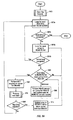
- Fig. 9A shows the processing for servicing the Get Blob Queue on the local Makyoh server.
- the local Makyoh server will queue up a list of blob-Ids for subsequent servicing whereby blobs associated with the blob-Ids are retrieved from other (remote) Makyoh servers and stored in the storage 204 of the local Makyoh server.
- stale blob-Id's in the Get Blob Queue are removed in a step 913, which will be discussed in more detail below in Fig. 14 .
- Steps 902a, 902b represent an outer loop to process each blob-Id on the Get Blob Queue.
- an inner loop 904a, 904b is processed for each Makyoh server in the REMOTE list, as managed in accordance with Figs. 7A and 7B , for example.
- a determination is attempted in a step 903 whether the candidate server has the blob-Id. If the determination cannot be made, then in a step 906 a HEAD request is performed on the candidate server to inquire whether it contains the blob-Id. If in step 903 it is determined that the candidate server does not contain the blob-Id, then the next server in the REMOTE list is considered (steps 904a, 904b).
- step 908 a GET request is performed on that server to obtain the corresponding blob (the new blob).
- the new blob is serviced in a step 910, additional details of which will be discussed below.
- a determination is made in a step 905 whether the new blob was rejected or not. If the new blob was rejected, then in a step 912 that candidate server is marked as not having the blob, so that in step 903 the NO branch will be taken for this server. If the new blob is not rejected, then processing continues with the next blob-Id in the Get Blob Queue (steps 902a, 902b).
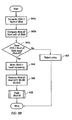
- Fig. 9B describes processing of a new blob by the local Makyoh server (i.e., the server receiving the new blob).
- An initial verification is performed by computing the SHA-lhash of the blob contents (step 942a), computing blob-Id specified in the path to which the blob is being written (step 942b), and then comparing the two (step 942c). It should be observed that this verification can be performed even if the local server does not have the ability to decrypt the blob in question. If there is no match, then it is assumed that the new blob is somehow corrupted and it is rejected in a step 950 and not stored in the local archive.
- a step 944 the blob is stored in subdirectory 412 with the blob-Id as the blob's filename in the storage 204 of the local server.
- a step 946 any requests for blob-Id are removed from the Get Blob Queue.
- a push blob service is performed, as described in Fig. 13 below. As will become apparent, in this context the push blob service will serve to distribute (push) the received blob to other Makyoh servers (e.g., 104-108).
- a device 102' such as a printer or fax is configured as a Makyoh server
- the documents will be distributed to other Makyoh servers by operation of servicing the Get Blob Queue.
- Fig. 10 shows processing for servicing the Put Blob Queue.
- the blob-Ids on the Put Blob Queue of the local Makyoh server identify blobs stored on the local server that are to be distributed to the other servers.
- stale blob-Id's in the Put Blob Queue are removed in a step 1002, per Fig. 14 .
- Steps 1004a and 1004b represent an outer loop to process each blob-Id on the Put Blob Queue.
- an inner loop 1006a, 1006b is processed for each Makyoh server in the REMOTE list.
- step 1001 If it is determined in step 1001 that the target server does not contain the blob-Id, then in a step 1010 a PUT request is performed on that server to send the corresponding blob to that server. Processing then continues with the next target server in the REMOTE list (steps 1006a, 1006b). When every server is processed, then processing continues with the next blob-Id in the Put Blob Queue (steps 1004a, 1004b).
- Fig. 11A shows the processing for servicing the Get Feed Queue. This is the same idea as in the servicing of GET requests for blobs.
- the local Makyoh server will queue up a list of feed-Ids for subsequent servicing whereby feed entry files associated with the feed-Ids are retrieved from other (remote) Makyoh servers and stored in the storage 204 of the local Makyoh server.
- a Get Feed Queue contains a list of feed-Ids that are to be serviced by one or more GET requests by the local server.
- stale feed-Id's in the Get Feed Queue are removed in a step 1101, per Fig. 14 .
- Steps 1102a and 1102b represent an outer loop to process each feed-Id on the Get Feed Queue.
- an inner loop 1104a, 1104b is processed for each Makyoh server in the REMOTE list.
- a determination is attempted in a step 1103 whether the candidate server has the feed-Id. If it is determined that the candidate server does not contain the feed-Id, then the next server in the REMOTE list is considered (steps 1104a, 1104b).
- step 1106 a PROPFIND request is performed on the candidate server to obtain a directory listing of that candidate server's feed-Id directory 424 ( Fig. 4 ).
- Steps 1108a and 1108b are iterated for each feed entry file 434 (see also 506a in Fig. 5 ) that is listed in the candidate server's directory 424.
- a determination is made whether a candidate feed entry file in the list is already stored locally. If so, then the next feed entry file in the list is processed (steps 1108a, 1108b).
- a GET request is performed on the candidate server to obtain a new feed entry file for the local server.
- the new feed file is processed in a step 1114, which will be discussed shortly. Processing then continues with the next feed-Id in the Get Feed Queue (steps 1102a, 1102b).
- Fig. 11B describes processing of new feed entries.
- the feed-Id is computed from the feed entry.
- the fingerprint of the verify key in the feed entry is computed.
- a determination is made in a step 1131 whether the feed-Id matches the fingerprint, and if not then the new feed entry is assumed to be somehow corrupted and rejected in a step 1144. If there is a match then a determination is made in a step 1133 whether the signature field of feed entry is a valid signature of the rest of the feed entry's contents, given the verify-key specified in the feed entry as the signor's public key. If the signature on the feed entry is not validated, then the feed entry is rejected.
- a validated feed entry is stored in step 1136 in the storage of the local server. If the feed key is for a feed-Id in the Feedkey list (step 1135), then the entry key is obtained from the feed key file in a step 1138. In a step 1140, the "entry" field of the Feed Entry is decrypted using the entry key to obtain its hash URI, which is then "imported” in a step 1142 in the manner shown in Fig. 8 .
- Fig. 12 shows the processing for servicing the Put Feed Entry Queue.
- stale feed-Id's in the Put Feed Entry Queue are removed in a step 1202, per Fig. 14 .
- Steps 1204a, 1204b represent a loop that is performed for each feed entry in the Put Feed Entry Queue.
- an inner loop represented by steps 1206a, 1206b is performed for each target server in the REMOTE list.
- a determination is made whether a target server already has the feed entry. If so, then the next server is considered, steps 1206a, 1206b.
- a HEAD request is made to determine if that server has a copy of the feed entry in its storage. If the target server does not have a copy of the feed entry, then a PUT request is performed in a step 1210 to place a copy of the feed entry in that server, along with updating the REMOTE list to indicate that it has a copy of the feed entry.
- a request to push the blob to other servers is queued by adding blob-Id to the Put Blob Queue.
- a determination is made in a step 1302 whether a hash URI corresponding to the blob-Id is in the local server's keyring. In one embodiment of the invention this determination is accomplished by searching each key file 326 and comparing the blob-Id part of the enclosed hash URI to the blob-Id being pushed. In another embodiment the keyring is stored in a temporary database which allows fast lookup of hash URI's based on their blob-Id component. If an appropriate hash URI is not found in step 1302, then in a step 1312 the Put Blob Queue is serviced in accordance with processing shown in Fig. 9A , and the processing is complete.
- step 1303 the blob contents are decrypted using the key specified in the hash URI.
- a determination is made in a step 1304 whether the blob is a feedkey. This determination is made by examining the blob type, as specified in the blob's header.
- the feed-Id of the feed corresponding to that feedkey is obtained by calculating the fingerprint of the feedkey's verify-key, e.g. by using the known method specified in the OpenPGP standard.
- the feedkey is then associated with the calculated feed-Id in the Feedkey List in a step 1306.
- a request to retrieve any new feed entries from other servers is queued by adding the feed-Id to the Get Feed Queue.
- the Get Feed Queue is then serviced in a step 1308 in accordance with processing shown in Fig. 11A .
- a number of locally-stored feed entries associated with feed-Id are determined by listing the directory 424 associated with feed-Id.
- the number of locally-stored feed entries so listed is determined by a configuration parameter, and may include all, none, or some number of such entries. If the number so listed is less than the number of entries locally stored for the feed-Id then the most recent entries are listed, as based on the timestamp in the feed entry's filename 434.
- the feed entries determined in steps 1309a and 1309b are then queued to be pushed to other servers 104-108 in a step 1310 by adding each feed entry's path to the Put Feed Entry Queue.
- the Put Feed Entry Queue is serviced in a step 1311 in accordance with Fig. 12 .
- the Put Blob Queue is then serviced in a step 1312 in accordance with Fig. 10 , and the processing is complete.
- step 1313 another determination is made in step 1313 whether the blob is a directory by examining the blob type, as specified in the blob's header. If the received blob is not a directory (e.g. if it is a normal content file, of type "blob"), then the Put Blob Queue is serviced in a step 1312 per Fig. 10 , and the processing is complete.
- step 1313 if the blob is of type directory, then a loop is performed over each hash URI listed in the directory blob (steps 1314a and 1314b), in which each hash URI is imported in a step 1315 in accordance with Fig. 8 . Once the loop over the directory's listed hash URI's is complete, the Put Blob Queue is then serviced in a step 1312 per Fig. 10 , and the processing is complete.
- Fig. 14 describes the utility for handling stale entries in the various queues.
- the loop 1402a, 1402b is iterated for each queue (Get Blob Queue, Put Blob Queue, Get Feed Queue, and Put Feed Entry Queue).
- each request in that queue is considered in the loop 1404a, 1404b.
- a determination is made in a step 1401 whether it has been on that queue for a period of time greater than a timeout parameter.
- Each queue can have its own timeout parameter, or as shown in the figure a single parameter can be used. If the request is "old,” then it is removed from that queue.
- Fig. 15 describes steps performed when a user logs in.
- the actual login sequence can be in any suitable form.
- the user can be presented with a login screen, which typically involves entering username and a password.
- Implied login can occur when the user's Makyoh server joins a group of servers, that event of joining the group can constitute logging in. For example, suppose a joining server enters within detection range of an existing group of servers. The existing servers as well as the joining server can detect this occurrence, for example as discussed in Fig. 8 . The joining server can then initiate login processing described in Fig. 15 . Implied login can also simply occur on start-up of the Makyoh server, or upon making the first request for a path initiated on the local server.
- Login processing includes steps 1502a, 1502b which define a loop that is performed on a local directory of encrypted key files stored on the physical local disk of the server.
- This directory is in a private, local configuration directory -- it is not distributed over either the trusted API or the remote API.
- Each file contains one key in the keyring, encrypted using the user's passphrase.
- the virtual key files 326 are presented as plaintext, and are intended as an easy way for him to access his keys so he can give them to someone else.
- the keyring directory 316 is also only available *after* the user logs in, and thus can't be looped during login.
- the key file is decrypted in a step 1504 using the user's passphrase in order to access its contents, namely, the hash URI.
- the blob-Id is obtained from the hash URI. If in a step 1501 it is determined that the blob associated with the obtained blob-Id is not locally stored (i.e., stored in the user's server), then the next key file 326 in the user's keyring 316 is processed (steps 1502a, 1502b). The determination uses the "type" field in the header part of the decrypted blob, discussed above in the "Blob file format" section.
- step 1501 If in step 1501 it is determined that the blob associated with the obtained blob-Id is locally stored, then the blob is decrypted in a step 1508 using the decryption key obtained from the hash URI to obtain cleartext content. If in a step 1503 it is determined from the cleartext content that the blob is a file, then the next key file 326 in the user's keyring 316 is processed (steps 1502a, 1502b).
- step 1503 If in step 1503 it is determined from the cleartext content that the blob is a feedkey, then the feed-Id is obtained in a step 1510 from the signature of the verify-key. The feed-Id and the blob are then added to the Feedkey List in a step 1512. Processing then continues with the next key file 326 in the user's keyring 316 (steps 1502a, 1502b).
- standard WebDAV methods in particular, PUT, COPY, DELETE, MOVE and RENAME.
- a blob header consisting of the file's length, the file's type ("blob" or “feedkey") and an optional salt is prepended to the file, and a blob-key is determined in a step 1602 by computing the MD5 hash of the resulting prepended file.
- the prepended file is then encrypted in a step 1603 using the blob-key as a symmetric key, for example using the known Advanced Encryption Standard (AES-128), to produce the "blob” (blob file).
- AES-128 Advanced Encryption Standard
- the "blob-Id” is then calculated in a step 1604 by computing the SHA-1 hash of the resulting encrypted blob file.
- a step 1605 the blob is stored in subdirectory 412, using the calculated blob-Id as its filename.
- This hash URI is then imported into the keyring in a step 1607 per processing described in Fig. 8 . As discussed above, this service will cause the newly added file to be distributed.
- a user creates the document or otherwise receives a new document. If the user desires to add it to his Makyoh archive then he can invoke the process described in Fig. 16A .
- a document handling device 102' such as a printer, or a fax, or a scanner
- a user or another machine can send a document to the device to be printed or faxed, or the user may place thd document on the scanner to be scanned.
- the device 102' is also configured as a Makyoh server, the received document can be viewed as a new document and trigger the process of Fig. 16A to incorporate the received document in the device's Makyoh archive, and also distribute the received document to other Makyoh servers.
- the device 102' would receive unencrypted image or file data. The device 102' would then publish the document, store the encrypted blobs locally and give the user a key to decrypt the document (e.g. in the form of a 2D barcode). In an embodiment of the present invention, the device 102' would not store the key locally (or indeed have a keyring at all) -- that way the data remains completely secure.
- step 1630 when a directory is published a blank directory file is created in step 1630. Then each child (that is, each file or subdirectory) is processed in a loop (steps 1631a and 1631b) in which first a determination is made in step 1632 whether the child is a directory. If the child is not a directory (i.e. if it is a file) then in step 1633 child is published by the method described above and in Fig. 16A . The resulting hash URI is then added in step 1634 to the directory file created earlier.
- step 1632 the child is determined to be a directory then the child is published in step 1635 by recursively applying the method described here, after which the resulting hash URI is added in step 1634 to the directory file created earlier.
- step 1635 the child is published in step 1635 by recursively applying the method described here, after which the resulting hash URI is added in step 1634 to the directory file created earlier.
- a new publication feedkey 506 is generated in step 1651 by generating an asymmetric key pair (for example, using the known OpenPGP standard) for the write key and verify key fields of the key, and a random symmetric key is generated for the feedkey's Entry Key field.
- the file is then published in step 1652 using the method described above and in Fig. 16A .
- the subscription feedkey that corresponds to the created publication feedkey is then computed in step 1653 by removing the verify-key field from the publication feedkey. This subscription key is then published in step 1654, and the creation process is complete.
- the Makyoh server will then ensure that the entry feed entry file is made available to remote servers in subdirectory 414, ensure that blob files representing all files and directories that make up the contents of the entry are made available to remote servers in subdirectory 412, import the associated hash URI(s) into the local keyring, and push the entry file and associated blobs out to known remote servers.
- step 1671 a determination is made in step 1671 whether a publication feedkey associated with the feed-Id to be published can be found in the Feedkey List. If not, then an error is reported in step 1672, and processing is complete. If a publication feedkey is found, then another determination is made in step 1673 for whether the root of the entry (that is, the entry's main contents) is a directory. If not (i.e. if the entry consists of just a single file) then the entry's root file is published in a step 1674.
- the feed entry file is then created in a step 1675, using the entry key specified in the publication feedkey to encrypt the hash URI of the newly-published entry root using the write-key specified by the publication feedkey to sign the contents of the feed entry.
- the feed entry file is then stored in a step 1676 in the feed's subdirectory 424.
- a request to push the feed entry is added to the Put Feed Entry Queue in step 1677, that queue is serviced in step 1678 per Fig. 12 (this serves to distribute the received feed entry to other Makyoh servers), and processing is complete.
- step 1673 if the entry root is a directory then the directory is published in step 1679, using the method described above and in Fig. 16B . The process then continues through steps 1675-1678, as described above.
- Makyoh provides a distributed digital archive system and method for document storage and retrieval.
- Makyoh provides a distributed digital archive system and method for document storage and retrieval.
- one of Makyoh's unique and novel features is the ability to securely share documents with others on a document-by-document basis. It also supports feeds, which are secure distribution channels to which one can publish multiple documents to a limited audience, thus enabling the creation of secure documents such as blogs, wikis, version controlled documents, and so on. This is accomplished by encrypting each document, or directory of documents, or feed using its own unique key, to create a blob. Because these unique keys are very small relative to the size of a full document they are much easier to maintain, store, and distribute.
- these encrypted document files, directories, and feed files (hereinafter referred to generally as a "blob") are distributed among reachable Makyoh devices by a process referred to as local superdistribution.
- "reachable” refers to other devices executing a Makyoh server that are in data communication with respect to a given Makyoh server.
- Superdistribution facilitates two goals: (1) backing up the files; and (2) decrease download time by mirroring copies to other nearby machines who might want to access those files.
- blobs are encrypted, only those who have the unique key (referred to above as the "hash URI") for a given blob can access its contents (i.e., document, directory, or feed).
- every user's personal Makyoh server will store all the blobs necessary to recreate his own archive. The user will also use part of his storage capacity to locally mirror blobs he cannot currently decrypt. In return, other servers on the network will similarly be mirroring blobs that they cannot decrypt, thus ensuring redundant storage.
- a "key” in accordance with the present invention serves to both locate and decrypt the blob(s) associated with that key; for example, if the key is associated with a document, then it identifies only one blob to produce document content. Sharing a document is as simple as giving the document's key to another Makyoh user. When the recipient imports the received key into his personal Makyoh server, Makyoh will automatically identify the appropriate blob(s) either on other user's server or on other servers in the area. For blobs located on other servers, they will be downloaded and decrypted so the content can be accessed. The recipient may also copy his key and redistribute it to his own colleagues, just as he might photocopy and redistribute a paper document.
- the keyring comprises a locally-stored list of all imported key's, as illustrated in Fig. 3 .
- the "keyring” is implemented as a subdirectory 316 that serves two purposes: (1) it is a place for a user to store keys that he would receive from other users; and (2) it serves as a local cache for fast retrieval of known hash URI's.
- Makyoh receives a key, it will compare the received key against those already stored in subdirectory 316 to see if the key and its corresponding blob are already stored on the device.
- While the directory approach for implementing the "keyring" such as illustrated in Fig. 3 can be a suitable implementation in a small community of documents (shared among a small number of Makyoh users), performance limitations and practical issues can arise in a larger setting.
- a user In a larger user environment, a user is likely to collect keys to a large number of documents/feeds in the course of his work. These keys can be self-generated, as would be the case for newly-created documents, or they can be generated by other users and given to the user so he can access their documents.
- the user can also use multiple personal Makyoh servers, for example one on his desktop computer and one on his laptop. The collection of keys can become quite large, including keys for documents collected and shared among colleagues over the years and keys for personal documents which likely have not been shared and for which may very well be the only copies in existence.
- a keyring management structure shown in Fig. 17 can be used to facilitate users who handle large numbers of documents.
- the keyring management system provides a user with access to all keys seen by that user, regardless of the machine he is currently using, and with a way to recover all keys seen by the user in case of computer theft or catastrophic failure. Because keys give access to confidential data, they would also need to be stored so as not to be readable by others, including those who might have physical access to backups or to other servers on the network.
- the underlying Makyoh mechanisms disclosed above for secured sharing of documents, directories, and feeds are utilized to provide secured management and distribution of a user's keys among other Makyoh users.
- the "keyring" is implemented as a Makyoh feed rather than as the local directory 316 shown in the embodiment of Fig. 3 .
- the "key files" 326 are plaintext files each containing a single hash URI that represents a key in the keyring.
- the keyring feed is a feed for receiving and storing hash URI's (the keys).
- the hash URI's are the keys that one user would give to one or more other users to grant access to a blob.
- a hash URI includes information as to the identity of the document or feed and a cryptographic key for decrypting the blob.
- the keyring feed includes a feed blob (e.g., 506, Fig. 5 ) referred to as the keyring feed key blob 1704. Referring to Fig.
- the keyring feed key blob 1704 is an instantiation of a publication feed key blob 506 (see explanation in the section entitled “Feed Key Blob”).
- the plaintext file referred to simply as the "keyring feed key” is shown in Fig. 17 in its encrypted form (indicated by the "lock” icon), and hence is identified as the “keyring feed key blob” 1704. It will be understood from the context of the discussion whether 1704 refers to the encrypted, "blob,” form, or the plaintext form.
- Each hash URI managed by the keyring feed is contained in a feed entry referred to as the keyring feed entry 1706.
- the physical storage for the data file(s) that comprise a keyring feed are stored on a suitable storage medium of the Makyoh device, such as a hard disk or flash memory, where the data persists even if the device is powered off.
- the keyring feed is accessed by a master key 1702a. More specifically, the master key 1702a is the hash URI of the keyring feed key blob 1704. As with any hash URI in accordance with the present invention, the master key 1702a comprises a component that identifies the keyring feed key blob 1704 and includes a component that is used to decrypt the keyring feed key blob. Each key (hash URI) in the keyring feed is contained in a keyring feed entry 1706. More specifically, the hash URI is contained in the "entry" field 1706a in encrypted form.
- the keyring feed key 1704 includes an "entry key” field 1704a which contains a cryptographic key that is used to decrypt the "entry” field 1706a, and hence obtain a plaintext copy of the hash URI.
- the decrypted hash URI is then used to identify its corresponding blob and to decrypt that blob to obtain the desired content, be it a document, a directory, or a feed (including another keyring feed).
- Figs. 17 and 18 a discussion of how the keyring is initially created will be given. Keyring initialization is performed, for example, when the user logs into a particular Makyoh server for the very first time and has never produced or otherwise collected any keys.
- the flow chart 1800 shown in Fig. 18 illustrates the steps for creating a keyring feed in accordance with this particular embodiment of the present invention.
- Step 1802 When the user accesses the particular Makyoh server for the first time, the user will be prompted (step 1802) for a passphrase, in addition to other information that may be needed when logging in for the first time.
- the Makyoh server will generate a keyring feed that will be used to manage the keyring.
- Step 1804 creates the keyring feed key blob 1704 component of the keyring feed.
- the keyring feed key blob 1704 is a file containing a write key, a verify key, and an entry key 1704a.
- the write key, verify key, and entry key are cryptographic keys as described above in the "Feed Key Blob" section.
- the entry key 1704a is used to encrypt and decrypt received hash URIs, and hence is a symmetric cryptographic key; and in this particular embodiment is a randomly generated key.
- a received hash URI can be a user-created hash URI or a hash URI received from another Makyoh user.
- the master key 1702a for the keyring feed is created.
- the master key 1702a is a hash URI computed from the keyring feed key blob 1704.
- a hash URI comprises, among other elements, a SHA-1 hash (called the id, or the blob-Id).
- the "id" component of the hash URI that constitutes the master key 1702a is obtained by computing the SHA-1 hash of the encrypted contents of the keyring-feed key blob1704.
- the decryption "key” component of the master key 1702a is based on the MD5 hash of the plaintext file contents of the kerying feed key blob 1704.
- the master key 1702a in turn is encrypted (step 1808) using the passphrase obtained from the user in step 1802 to produce an encrypted master key 1702.
- the encrypted master key 1702 is then stored to a special configuration file on the local disk (step 1810), the idea being to protect the master key 1702a, since it will "unlock" the entire keyring feed.
- the master key 1702a is then added as the first key in the newly created keyring feed.
- the discussion will continue with Fig. 19 for a description of a process in accordance with this embodiment of the present invention by which a hash URI such as the master key 1702a is added to the keyring feed.
- Makyoh During the course of using Makyoh, the user will create documents, directories, and/or feeds, and the user will import other users' documents, directories, and/or feeds. Whenever a new document, directory, or feed is created, the Makyoh server will generate a blob, create a corresponding hash URI as its key to access the blob, and add the newly created key to the keyring as a keyring feed entry 1706 in the keyring feed. Likewise, other users' keys can be added to the user's keyring via a suitable web API to invoke the procedure illustrated in Fig. 19 .
- Fig. 19 illustrates steps in a process according to an embodiment of the present invention for adding a hash URI to a user's keyring.
- the procedure is invoked for a given hash URI.
- the process of Fig. 19 is invoked with the master key 1702a as the given hash URI.
- the given hash URI will be the newly created hash URI corresponding to the new object.
- the given hash URI would be the received hash URI.
- a procedure (shown in Fig. 21 ) is invoked for the given hash URI.
- the invocation simply results in superdistribution of the document blob. If the given hash URI identifies a feed blob, then the procedure of Fig. 21 will obtain the hash URI's of all the blobs subordinate to that feed, in addition to superdistribution of the feed blob.
- a keyring feed entry 1706 is created. This includes encrypting the given hash URI using the entry key 1704a stored in the keyring feed key blob 1704. In particular, the given URI is encrypted using the entry key 1704a and stored in the "entry" field 1706a of the created keyring feed entry 1706.
- the resulting file that represents the created keyring feed entry 1706 is stored on the user's Makyoh server.
- the created keyring feed entry 1706 is then queued on the Put Feed Entry Queue. The Put Feed Entry Queue is then serviced by an invocation made in step 1910 to the procedure shown in Fig. 12 to effect local superdistribution of the newly created keyring feed entry 1706.
- Fig. 21 illustrates a recursive process for importing a given feed (identified by a hash URI), including nested feeds.
- the given feed will be imported.
- that given feed contains a feed entry that accesses a nested feed, then that feed entry is processed to import the nested feed, and so on.
- a hash URI is passed to this process as a given hash URI. If the given hash URI is a hash URI for a feed, the procedure will examine all the entries in that feed.
- a step 2102 the hash URI is imported by invoking the procedure outlined in Fig. 8 . More specifically, the process of Fig. 8 will either obtain the blob identified by the hash URI (in the case where the blob was not already stored in the user's server), or the blob will be superdistributed (in the case where the blob was already stored in the user's server).
- error processing e.g., notifying the user, logging the error, etc
- retrieved blob is a feed key blob (retrieved feedkey)
- each feed entry accessible via the retrieved feedkey will be examined.
- step 2110 a feed-Id is computed from the signature contained in the "verify-key" field of the retrieved feedkey.
- the feed-Id is the 160-bit key fingerprint of the verify key per the OpenPGP standard.
- step 2112 the feed-Id of the retrieved feedkey is added to the user's Feedkey List.
- step 2114 the feed-Id is added to the Get Feed Queue which is the list of feeds to be checked for new entries on other servers.
- the Get Feed Queue is serviced by invoking the process of Fig. 11A in order to import the feed entries in the feed identified by feed-Id.
- a loop 2118a, 2118b is executed to consider each of the imported feed entries.
- the "entry" field of the first feed entry is decrypted using the decryption key contained in the "entry-key” field of the retrieved feedkey to obtain the hash URI of the first feed entry.
- the process of Fig. 21 is invoked (recursion) to instantiate a second invocation of Fig. 21 , this time using the hash URI of this first feed entry as the given hash URI.
- Processing begins with step 2102 and proceeds as discussed above. If the hash URI is associated with a document, then processing will stop at the determination step 2104. This would terminate the second invocation of Fig.
- step 21 processing would resume with the first invocation of Fig. 21 at step 2118a, to process the next feed entry.
- the hash URI is associated with another feed (i.e., the blob associated with the hash URI is a feed key blob)
- processing continues with the steps following step 2104 to retrieve its feed entries, which can include still feeds as well. The procedure terminates when all the imported feed entries have been considered.
- a keyring feed is created by generating a keyring feed key file1704 containing a "sign key,” a "verify key,” and an "entry key.”
- the keyring feed key blob is then created by encrypting the keyring feed key file.
- the hash URI (the master key) 1702a for accessing the keyring feed key blob 1704 is created and includes an identifier to identify the blob and a cryptographic key to decrypt the blob to obtain the plaintext keyring feed key file.
- the master key 1702a is then passed on in step 1812 as the hash URI to be processed according to Fig. 19 .
- the master key 1702a is passed on to the process of Fig. 21 (step 1902).
- the master key 1702a is passed on to Fig. 8 via step 2102.
- the procedure reaches step 802 and 803.
- the extracted Blob-Id identifies the keyring feed key blob 1704, which was just created above in accordance with Fig. 18 .
- step 803 will evaluate to YES, and processing will proceed to step 804 where the keyring feed key blob 1704 is superdistributed. Processing continues with step 2104 in Fig. 21 .
- Step 2106 will evaluate to YES because the "blob" referred to in step 2106 is the keyring feed key blob 1704. Since this is the first time for the keyring feed key blob 1704, step 2108 will evaluate to NO because the keyring feed key blob is not yet on the FEEDKEY-LIST, until step 2112 is performed. In step 2114 the feed entries for the feed accessed by the keyring feed key 1704 are obtained. However, in this case the list of feed entries is empty since the keyring feed has just been created. The process in Fig. 21 thus completes, and processing continues with step 1904.
- a feed entry 1706 for the master key 1702a is created and stored on the user's Makyoh server (steps 1904, 1906).
- the feed entry 1706 is then superdistributed (steps 1908, 1910) to other reachable Makyoh servers.
- both the keyring feed key blob 1704 and the master key 1702a are "out there," being redundantly backed up among Makyoh servers that were reachable at the time of step 804 (beginning of superdistribution of keyring feed key blob 1704) and step 1910 (beginning of superdistribution of keyring feed entry 1706).
- the discussion will now turn to processing when a hash URI for a document blob is added to the keyring feed of Fig. 17 .
- the hash URI may originate from the user or may be given to the user by another user directly or indirectly via superdistribution of the hash URI from the other user's Makyoh server.
- the entry point for a received hash URI was Fig. 8 , see the section entitled "Import Key.”
- the entry point for processing a received hash URI is Fig. 19 .
- the server When the user's Makyoh server receives a hash URI, the server will invoke processing according to Fig. 19 with the received hash URI in order to add the received hash URI (key) to the user's keyring feed.
- Step 1902 invokes Fig. 21 , which in turn invokes Fig. 8 in step 2102. If the received hash URI identifies a blob that is already stored on the user's Makyoh device, then step 804 is performed to superdistribute the blob; otherwise, step 810 is invoked in an attempt to obtain the blob from a reachable Makyoh server.
- Fig. 21 Since we are assuming the received hash URI accesses a document blob ("content blob"), processing in Fig. 21 will proceed down the NO branch from step 2106 (assuming success in Fig. 8 ). Processing continues at step 1904 in Fig. 19 , where a keyring feed entry 1706 is created for the received hash URI, thus adding the received hash URI into the user's keyring feed. As discussed above, this involves encrypting the received hash URI using the "entry key" 1704a in the user's keyring feed key 1704 to produce an encrypted hash URI which is then stored in the "entry" field 1706a of the created keyring feed entry 1706. The keyring feed entry 1706 is then superdistributed to reachable Makyoh devices (steps 1908, 1910). Processing for adding a received document hash URI, thus concludes.
- the publication feed includes a publication feed key blob 506 which provides access to its constituent feed entries 506a.
- the decrypted publication feed key blob 506 is a file that contains among other keys, an "entry key” that is used to access the "entry" fields 506b of the constituent feed entries 506a.
- the publication feed key blob 506 is decrypted by the publication key 506, which is a hash URI that identifies the publication feed key blob and includes a key for decrypting the blob.
- the master key 1702a ( Fig.
- the feed is the keyring feed.
- the master key 1702a is the hash URI for the keyring feed key blob 1704.
- the discussion that follows is a more generalized discussion of the processing that was described for keyring creation.
- a hash URI is received, and in this case the hash URI (key) for a feed.
- Fig. 19 is invoked to add the received hash URI as another key to the user's keyring feed.
- Fig. 21 is invoked in step 1902, and in step 2102 Fig. 8 is invoked.
- the feed key blob is superdistributed per step 804. If the feed key blob is not already stored on the user's Makyoh device, then an attempt to retrieve it from a reachable Makyoh device is made in step 810. Processing then continues in step 2104 of Fig. 21 . Processing continues to step 2108, assuming success in that was described for keyring creation.
- Fig. 21 concludes and processing continues with step 1904 in Fig. 19 , where a keyring feed entry is created for the received hash URI, and superdistributed.
- step 2116 the constituent feed entries associated with the feed key blob are obtained.
- the loop 2118a, 2118b examines each obtained feed entry. For each feed entry, the "entry key" field in the feed key blob is used to decrypt the "entry" field of the feed entry to obtain a hash URI. If the retrieved hash URI is for a feed (i.e., the "type" field in its header indicates "feedkey"), then Fig. 21 is recursively invoked to process the retrieved hash URI.
- Fig. 21 concludes and resumes with step 1904 in Fig. 19 .
- a keyring feed entry is created for the received hash URI, and superdistributed. Processing for adding a received feed hash URI, thus concludes.
- processing of the keyring feed can consume a good deal of computational effort. For this reason, it may be desirable (though not necessary) to store certain intermediate results and computed data on the device running the Makyoh server. This can be loosely analogized to using a disk cache to store frequently accessed data instead of going to the disk drive.
- Another analogy is an internet search engine. On the one hand, a search can performed by "brute force" where each site on the web is visited, including all the links encountered. Of course, this is inefficient. Typically, web crawlers crawl the web and collect data for each visited site and index that data. A search then amounts to a search of the indexed data.
- processing of the keyring feed includes tasks such as decrypting blobs and searching hash URIs. The decrypted blobs can be stored to reduce processing overhead.
- a keyring session cache which in Fig. 17 for example is logically represented by reference numeral 1722 to indicate various implementation specific data structures and files that represent the dynamic state of the keyring during the user session.
- the Feedkey List described above is an example of a cache for storing feed keys (e.g., see step 601, Fig. 6A , step 1135, Fig. 11B , step 2108, Fig. 21 ).
- the keyring session cache 1722 is a list of all the hash URIs found in the keyring feed as well as all hash URIs contained within the documents and feed entries that have been accessed so far (even the ones that just represent, say, a single file in a subdirectory of one of the documents, which would not be listed in the keyring feed shown in Fig. 17 ).
- the keyring session cache 1722 is stored in a format that is faster to retrieve than directly accessing file structure(s) comprising the keyring feed.
- the keyring session cache 1722 is implemented as a temporary database which is deleted at the end of a user session, typically marked by the user logging out or shutting down the server, and re-created (empty) at the start of another user session such as when the user logs backs on or when the server is started up.
- other data formats can be used; e.g., a set of hash tables stored in RAM.
- the data in the keyring session cache 1722 is not typically encrypted - at least not using the normal Makyoh-style encryption.
- the phrase "current user session” refers to the time since the Makyoh server on the user's device was started, and continues until the user logs out or the Makyoh server is stopped.
- a typical usage scenario involves the user starting up the Makyoh application program (i.e., the Makyoh server) and logging on.
- the session ends when the user logs out of the Makyoh server, or "exits” from the application (Microsoft OS), or "quits” the application (Apple OS). It is noted that the end of a user session is not necessarily marked by termination of the Makyoh application program. The user can simply log out without terminating the Makyoh server, yet still be considered to have ended the user session.
- the keyring session cache 1722 When a user terminates a user session (e.g., logs out of Makyoh), the keyring session cache 1722 is deleted. Deletion of the keyring session cache 1722 greatly reduces the risk of unauthorized access to a user's keyring in case the user's Makyoh device is stolen or otherwise accessed without permission.
- An aspect of this particular embodiment of the present invention therefore is to perform a bootstrap operation of the user's keyring feed upon logging onto the Makyoh server.
- Figs. 17 and 20 will now be discussed to describe steps which result in initialization of the data structures and temporary files comprising keyring session cache 1722 when the user logs back into the Makyoh server.
- the master key 1702a is encrypted using a user-provided passphrase and stored in a configuration file or some other suitable storage location on the user's Makyoh drive. This serves to protect the master key 1702a from unauthorized users.
- the master key 1702a In order to initialize the keyring feed, the master key 1702a first must be obtained. Typically, this involves the user providing his passphrase to the Makyoh server.
- the user can provide his passphrase (step 2002), which is then used to initialize the user's keyring.
- the passphrase can be used as a password for logging into the Makyoh server as well.
- An alternative is to employ a login sequence that does not involve the passphrase. In this alternative approach, the user would provide his passphrase to the Makyoh server after logging in, in order to initialize his keyring.
- a less secure approach is to simply store the user's passphrase in a file on his Makyoh device that can then be retrieved by Makyoh upon login to produce the master key 1702. The idea is to provide some form of secure storage of the master key 1702a.
- the use of a passphrase represents one of any number of approaches to safeguard the master key 1702a.
- the passphrase is used to decrypt the encrypted master key 1702a (keyring hash URI).
- the blob-Id can be computed from the master key 1702a to identify the keyring feed key blob 1794.
- the master key 1702a is then used in step 2008 to access all the other keys to the documents and feeds in the user's archive by invoking the procedure shown in Fig. 21 .
- the master key 1702a is a feed hash URI.
- the keyring session cache 1722 is initialized by invoking Fig. 19 with the master key 1702a, as discussed above in the third usage scenario regarding storing the hash URI of a feed.
- Synchronizing files between a laptop and desktop computer is as easy as importing the master key 1702a for the Makyoh archive running on each machine into the other machine's keyring. From that time forward, whenever the two machines are on the same local network together they will automatically transfer newly-added keys to each other's respective keyrings along with the blobs necessary to read the documents and feeds associated with them.
- the master key 1702a is easy to store outside of a Makyoh device because the key is so small: the master key can simply be printed on a scrap of paper (either in text or as a two-dimensional bar code) and placed in a safe, safe-deposit box, or other secure long-term storage. Note that this key need not be modified after its initial creation. In particular, it need not be updated to incorporate documents that have been newly added to an archive - as long as the blobs are available the master key will always recover even the most recently added documents and feed entries in an archive.
- caching servers could be installed on a company's local network, and would presumably include a large hard drive and fast network. This would both guarantee document availability and improve document access and download speeds.
- an online storage service such as Google Basel or Amazon's S3 service2 as a caching service to guarantee access to encrypted blobs.
- a document may have been created on a laptop that was completely disconnected from all other computers. Then, before communication was ever reestablished, the computer was destroyed. Needless to say, in this scenario any documents created during this black-out period will be lost.
- blobs making up most of the lost archive should be available from other locally running Makyoh servers.
- the server was configured to only superdistribute documents when they are accessed or published (the minimum level of superdistribution) then depending on how long other servers have been running on the same local network some of the more infrequently accessed documents may not have their blobs backed up. These documents would not be recoverable.
- a server configured with minimal superdistribution tended to travel among many different networks (for example, if it were running on a traveling salesman's laptop), then document blobs can be physically distributed across many different machines, possibly running inside many different firewalls. In this case, documents might only be recoverable when the server comes back into contact with machines that stored the backup blobs - a process that can take some time, not to mention physical travel.
- Makyoh will recreate as much of an archive as possible, even if not all the blobs that make up the archive can be found on nearby servers. Often missing blobs will represent a single file, but some blobs can cause more of an archive to be unrecoverable should they go missing. Most important is the feed key blob, which is the blob pointed to by the master key itself. In the unlikely case that this blob is not found on any other server then none of the archive can be recovered.
- feed key blob which is the blob pointed to by the master key itself. In the unlikely case that this blob is not found on any other server then none of the archive can be recovered.
- feed key blob which is the blob pointed to by the master key itself. In the unlikely case that this blob is not found on any other server then none of the archive can be recovered.
- feed key blob which is the blob pointed to by the master key itself. In the unlikely case that this blob is not found on any other server then none of
- Makyoh is designed to protect against many kinds of attacks, many of which have already been mentioned. To summarize, Makyoh protects against the following threats:
Landscapes
- Engineering & Computer Science (AREA)
- Computer Security & Cryptography (AREA)
- General Engineering & Computer Science (AREA)
- Theoretical Computer Science (AREA)
- Computer Hardware Design (AREA)
- Signal Processing (AREA)
- Computer Networks & Wireless Communication (AREA)
- General Physics & Mathematics (AREA)
- Health & Medical Sciences (AREA)
- General Health & Medical Sciences (AREA)
- Physics & Mathematics (AREA)
- Computing Systems (AREA)
- Software Systems (AREA)
- Bioethics (AREA)
- Databases & Information Systems (AREA)
- Storage Device Security (AREA)
- Information Retrieval, Db Structures And Fs Structures Therefor (AREA)
Applications Claiming Priority (1)
| Application Number | Priority Date | Filing Date | Title |
|---|---|---|---|
| US12/060,048 US8885832B2 (en) | 2007-03-30 | 2008-03-31 | Secure peer-to-peer distribution of an updatable keyring |
Publications (2)
| Publication Number | Publication Date |
|---|---|
| EP2107485A2 true EP2107485A2 (de) | 2009-10-07 |
| EP2107485A3 EP2107485A3 (de) | 2010-04-21 |
Family
ID=40740106
Family Applications (1)
| Application Number | Title | Priority Date | Filing Date |
|---|---|---|---|
| EP09156826A Withdrawn EP2107485A3 (de) | 2008-03-31 | 2009-03-31 | Sichere Peer-to-Peer-Verteilung eines aktualisierbaren Schlüsselrings |
Country Status (2)
| Country | Link |
|---|---|
| US (1) | US8885832B2 (de) |
| EP (1) | EP2107485A3 (de) |
Families Citing this family (25)
| Publication number | Priority date | Publication date | Assignee | Title |
|---|---|---|---|---|
| US8046328B2 (en) * | 2007-03-30 | 2011-10-25 | Ricoh Company, Ltd. | Secure pre-caching through local superdistribution and key exchange |
| DE602007011673D1 (de) * | 2007-04-25 | 2011-02-10 | Nec Europe Ltd | Verfahren zum aggregieren von daten in einem netzwerk |
| US8850544B1 (en) * | 2008-04-23 | 2014-09-30 | Ravi Ganesan | User centered privacy built on MashSSL |
| US8943328B2 (en) | 2010-01-29 | 2015-01-27 | Hewlett-Packard Development Company, L.P. | Key rotation for encrypted storage media |
| US9032218B2 (en) * | 2010-01-29 | 2015-05-12 | Hewlett-Packard Development Company, L.P. | Key rotation for encrypted storage media using a mirrored volume revive operation |
| US8489893B2 (en) | 2010-01-29 | 2013-07-16 | Hewlett-Packard Development Company, L.P. | Encryption key rotation messages written and observed by storage controllers via storage media |
| GB2486462B (en) * | 2010-12-16 | 2019-04-24 | Maidsafe Found | Distributed file system |
| US8737384B2 (en) * | 2011-01-10 | 2014-05-27 | Vtech Telecommunications Limited | Peer-to-peer, internet protocol telephone system with auto-attendant |
| US20130091355A1 (en) * | 2011-10-05 | 2013-04-11 | Cisco Technology, Inc. | Techniques to Prevent Mapping of Internal Services in a Federated Environment |
| US9015479B2 (en) | 2011-12-16 | 2015-04-21 | Sandisk Technologies Inc. | Host device and method for super-distribution of content protected with a localized content encryption key |
| US20130156196A1 (en) * | 2011-12-16 | 2013-06-20 | Fabrice E. Jogand-Coulomb | Storage Device and Method for Super-Distribution of Content Protected with a Localized Content Encyrption Key |
| US8850037B2 (en) * | 2012-05-24 | 2014-09-30 | Fmr Llc | Communication session transfer between devices |
| US9413758B2 (en) * | 2012-05-24 | 2016-08-09 | Fmr Llc | Communication session transfer between devices |
| CN102685148B (zh) * | 2012-05-31 | 2014-10-15 | 清华大学 | 一种云存储环境下的安全网盘系统的实现方法 |
| US10069640B2 (en) | 2012-12-05 | 2018-09-04 | Tencent Technology (Shenzhen) Company Limited | Methods and devices for adding new member to group through barcode scanning |
| US9197700B2 (en) * | 2013-01-18 | 2015-11-24 | Apple Inc. | Keychain syncing |
| US10078431B1 (en) * | 2013-02-01 | 2018-09-18 | Nextdoor.Com, Inc. | Social networking based on nearby neighborhoods |
| US9215075B1 (en) | 2013-03-15 | 2015-12-15 | Poltorak Technologies Llc | System and method for secure relayed communications from an implantable medical device |
| EP3258375A1 (de) * | 2015-05-07 | 2017-12-20 | Cyber-Ark Software Ltd. | Systeme und verfahren zur erkennung und reaktion auf bösartige aktivitäten in computernetzwerken |
| EP3185465A1 (de) * | 2015-12-23 | 2017-06-28 | Osmerus Investments Ltd | Verfahren zum verschlüsseln von daten und verfahren zur entschlüsselung von daten |
| US20170244783A1 (en) * | 2016-02-22 | 2017-08-24 | Verisign, Inc. | Federating geographically distributed networks of message brokers into a scalable content delivery network |
| US10853315B1 (en) * | 2016-03-08 | 2020-12-01 | EMC IP Holding Company LLC | Multi-tier storage system configured for efficient management of small files associated with Internet of Things |
| US10936438B2 (en) | 2018-01-24 | 2021-03-02 | International Business Machines Corporation | Automated and distributed backup of sensor data |
| US11113114B2 (en) * | 2019-04-09 | 2021-09-07 | Cisco Technology, Inc. | Distributed object placement, replication, and retrieval for cloud-scale storage and data delivery |
| CN112506796B (zh) * | 2020-12-21 | 2022-06-10 | 北京百度网讯科技有限公司 | 数据处理方法、装置、设备以及存储介质 |
Family Cites Families (46)
| Publication number | Priority date | Publication date | Assignee | Title |
|---|---|---|---|---|
| US5634012A (en) | 1994-11-23 | 1997-05-27 | Xerox Corporation | System for controlling the distribution and use of digital works having a fee reporting mechanism |
| US6446092B1 (en) | 1996-11-01 | 2002-09-03 | Peerdirect Company | Independent distributed database system |
| JP2996197B2 (ja) | 1997-02-14 | 1999-12-27 | 日本電気株式会社 | 文書共有管理方法 |
| US6405315B1 (en) | 1997-09-11 | 2002-06-11 | International Business Machines Corporation | Decentralized remotely encrypted file system |
| US6925182B1 (en) | 1997-12-19 | 2005-08-02 | Koninklijke Philips Electronics N.V. | Administration and utilization of private keys in a networked environment |
| US6738907B1 (en) | 1998-01-20 | 2004-05-18 | Novell, Inc. | Maintaining a soft-token private key store in a distributed environment |
| US7233948B1 (en) * | 1998-03-16 | 2007-06-19 | Intertrust Technologies Corp. | Methods and apparatus for persistent control and protection of content |
| US7809138B2 (en) * | 1999-03-16 | 2010-10-05 | Intertrust Technologies Corporation | Methods and apparatus for persistent control and protection of content |
| US6154543A (en) | 1998-11-25 | 2000-11-28 | Hush Communications Anguilla, Inc. | Public key cryptosystem with roaming user capability |
| US6438550B1 (en) * | 1998-12-10 | 2002-08-20 | International Business Machines Corporation | Method and apparatus for client authentication and application configuration via smart cards |
| TW539982B (en) | 1999-10-25 | 2003-07-01 | Sony Corp | Content providing system, content distribution method, and memory medium |
| AU2000243591A1 (en) | 2000-01-14 | 2001-07-24 | Critical Path Inc. | Secure management of electronic documents in a networked environment |
| US7047281B1 (en) | 2000-08-08 | 2006-05-16 | Fineground Networks | Method and system for accelerating the delivery of content in a networked environment |
| US7010689B1 (en) | 2000-08-21 | 2006-03-07 | International Business Machines Corporation | Secure data storage and retrieval in a client-server environment |
| PL345054A1 (en) | 2001-01-11 | 2002-07-15 | Igor Hansen | Personal database system and method of managing the access to such database |
| US7142690B2 (en) | 2001-02-20 | 2006-11-28 | Ricoh Company, Ltd. | System, computer program product and method for managing documents |
| US7062490B2 (en) | 2001-03-26 | 2006-06-13 | Microsoft Corporation | Serverless distributed file system |
| JP2003078518A (ja) * | 2001-09-03 | 2003-03-14 | Fuji Xerox Co Ltd | 暗号化・復号システム、暗号化装置、復号装置およびそれらの方法 |
| US7127477B2 (en) | 2001-11-06 | 2006-10-24 | Everyware Solutions Inc. | Method and system for access to automatically synchronized remote files |
| US20030126162A1 (en) * | 2002-01-03 | 2003-07-03 | Yohe Thomas Patrick | System and method for synchronizing databases in a secure network environment |
| US7020665B2 (en) | 2002-03-07 | 2006-03-28 | Microsoft Corporation | File availability in distributed file storage systems |
| NZ518575A (en) | 2002-04-24 | 2004-08-27 | Open Cloud Ltd | Distributed application server using a peer configuration |
| US7549060B2 (en) | 2002-06-28 | 2009-06-16 | Microsoft Corporation | Using a rights template to obtain a signed rights label (SRL) for digital content in a digital rights management system |
| US7206934B2 (en) | 2002-09-26 | 2007-04-17 | Sun Microsystems, Inc. | Distributed indexing of identity information in a peer-to-peer network |
| JP3974511B2 (ja) | 2002-12-19 | 2007-09-12 | インターナショナル・ビジネス・マシーンズ・コーポレーション | 情報検索のためのデータ構造を生成するコンピュータ・システム、そのための方法、情報検索のためのデータ構造を生成するコンピュータ実行可能なプログラム、情報検索のためのデータ構造を生成するコンピュータ実行可能なプログラムを記憶したコンピュータ可読な記憶媒体、情報検索システム、およびグラフィカル・ユーザ・インタフェイス・システム |
| US7272231B2 (en) | 2003-01-27 | 2007-09-18 | International Business Machines Corporation | Encrypting data for access by multiple users |
| WO2004092933A1 (en) | 2003-04-11 | 2004-10-28 | Matsushita Electric Industrial Co., Ltd. | Apparatus and method for flexible licensing of composite digital contents |
| US7509344B1 (en) | 2003-08-18 | 2009-03-24 | Google Inc. | Method for detecting link spam in hyperlinked databases |
| US20050086384A1 (en) | 2003-09-04 | 2005-04-21 | Johannes Ernst | System and method for replicating, integrating and synchronizing distributed information |
| US20050114686A1 (en) | 2003-11-21 | 2005-05-26 | International Business Machines Corporation | System and method for multiple users to securely access encrypted data on computer system |
| EP2284645B1 (de) | 2003-12-04 | 2015-02-25 | Koninklijke Philips N.V. | Verbindungsorientierter Rechteschutz |
| JP4225201B2 (ja) | 2004-01-08 | 2009-02-18 | ヤマハ株式会社 | 音楽コンテンツ利用装置及びプログラム |
| US7756271B2 (en) * | 2004-06-15 | 2010-07-13 | Microsoft Corporation | Scalable layered access control for multimedia |
| US7827416B2 (en) | 2004-08-26 | 2010-11-02 | Mitsubishi Denki Kabushiki Kaisha | Key management apparatus, document security and editing system, and key management method |
| BRPI0515038A (pt) * | 2004-09-10 | 2008-07-01 | Koninkl Philips Electronics Nv | métodos de associar conteúdo de dados com objetos de direitos em um sistema de comunicação e de prover acesso condicional, sistema para implementar um método, dispositivo receptor de fluxo para obter acesso condicional a um fluxo de dados criptografados, produto de programa de computador, e, dados de saìda para transmissão gerada por um método |
| US20060265489A1 (en) * | 2005-02-01 | 2006-11-23 | Moore James F | Disaster management using an enhanced syndication platform |
| US8200700B2 (en) * | 2005-02-01 | 2012-06-12 | Newsilike Media Group, Inc | Systems and methods for use of structured and unstructured distributed data |
| US20070198633A1 (en) * | 2005-07-20 | 2007-08-23 | Q2 Labs, Llc | System and method for delivery of PC content through a server based relay system using really simple syndication |
| US7770220B2 (en) | 2005-08-16 | 2010-08-03 | Xerox Corp | System and method for securing documents using an attached electronic data storage device |
| US20070049258A1 (en) * | 2005-08-30 | 2007-03-01 | Jason Thibeault | System and method of mobile to desktop document interaction using really simple syndication |
| EP1984866B1 (de) | 2006-02-07 | 2011-11-02 | Nextenders (India) Private Limited | Dokumentsicherheitsverwaltungssystem |
| US7889861B2 (en) * | 2006-09-13 | 2011-02-15 | Michael Borza | Multiple sequential security key encryption-decryption |
| US7738503B2 (en) | 2007-02-02 | 2010-06-15 | Palm, Inc. | Multi-way, peer-to-peer synchronization |
| US8046328B2 (en) | 2007-03-30 | 2011-10-25 | Ricoh Company, Ltd. | Secure pre-caching through local superdistribution and key exchange |
| US8452016B2 (en) * | 2009-07-10 | 2013-05-28 | Disney Enterprises, Inc. | Interoperable keychest for use by service providers |
| US8281034B2 (en) * | 2009-07-13 | 2012-10-02 | Empire Technology Development Llc | Peer to peer subscription service |
-
2008
- 2008-03-31 US US12/060,048 patent/US8885832B2/en active Active
-
2009
- 2009-03-31 EP EP09156826A patent/EP2107485A3/de not_active Withdrawn
Non-Patent Citations (1)
| Title |
|---|
| None |
Also Published As
| Publication number | Publication date |
|---|---|
| US8885832B2 (en) | 2014-11-11 |
| US20090060201A1 (en) | 2009-03-05 |
| EP2107485A3 (de) | 2010-04-21 |
Similar Documents
| Publication | Publication Date | Title |
|---|---|---|
| US8885832B2 (en) | Secure peer-to-peer distribution of an updatable keyring | |
| EP1975835B1 (de) | Sicheres Vor-Zwischenspeichern mittels lokaler Superdistribution und Schlüsselaustausches | |
| US11863380B2 (en) | Community internet drive | |
| JP6810172B2 (ja) | 文書管理およびアクセス制御を有する分散データシステム | |
| US10135767B2 (en) | Method and system for sender-controlled messaging and content sharing | |
| EP2865129B1 (de) | Ereignisausgelöste freigabe durch dritte von vorverschlüsselten digitalen daten von einem dateninhaber zu einem datenbevollmächtigten | |
| Tootoonchian et al. | Lockr: social access control for web 2.0 | |
| US12210488B2 (en) | Distributed data system with document management and access control | |
| US8782392B1 (en) | Privacy-protective data transfer and storage | |
| US20060059544A1 (en) | Distributed secure repository | |
| CN103595730A (zh) | 一种密文云存储方法和系统 | |
| GB2446169A (en) | Granular accessibility to data in a distributed and/or corporate network | |
| WO2014138705A1 (en) | Systems and methods for managing files in a cloud-based computing environment | |
| CN101689989A (zh) | 创建和确认密码保护文档 | |
| CN102138145B (zh) | 以密码控制对文档的访问 | |
| GB2444339A (en) | Shared access to private files in a distributed network | |
| WO2008065343A1 (en) | Shared access to private files | |
| US9325679B2 (en) | Method and apparatus for communicating information between devices | |
| Afify | Access control in a peer-to-peer social network | |
| CN119788391B (zh) | 数据安全分享方法、客户端、服务端、存储介质及程序产品 | |
| Kanimozhi et al. | Cloud Based Remote File Access from PC to Mobile Using File Directory | |
| de Bruin et al. | Analyzing the Tahoe-LAFS filesystem for privacy friendly replication and file sharing | |
| Delaet et al. | Managing your content with CIMPLE-a content-centric storage interface | |
| Abi Ayshwariya¹ | to Mobile Using File Directory | |
| Suthar et al. | PMS-Sharing: Framework for Automatically Authenticating users in a Group to Allow Sharing Storage |
Legal Events
| Date | Code | Title | Description |
|---|---|---|---|
| PUAI | Public reference made under article 153(3) epc to a published international application that has entered the european phase |
Free format text: ORIGINAL CODE: 0009012 |
|
| 17P | Request for examination filed |
Effective date: 20090331 |
|
| AK | Designated contracting states |
Kind code of ref document: A2 Designated state(s): AT BE BG CH CY CZ DE DK EE ES FI FR GB GR HR HU IE IS IT LI LT LU LV MC MK MT NL NO PL PT RO SE SI SK TR |
|
| AX | Request for extension of the european patent |
Extension state: AL BA RS |
|
| PUAL | Search report despatched |
Free format text: ORIGINAL CODE: 0009013 |
|
| AK | Designated contracting states |
Kind code of ref document: A3 Designated state(s): AT BE BG CH CY CZ DE DK EE ES FI FR GB GR HR HU IE IS IT LI LT LU LV MC MK MT NL NO PL PT RO SE SI SK TR |
|
| AX | Request for extension of the european patent |
Extension state: AL BA RS |
|
| RIN1 | Information on inventor provided before grant (corrected) |
Inventor name: PIERSOL, KURT Inventor name: SAVITZKY, STEPHEN R. Inventor name: RHODES, BRADLEY J. |
|
| 17Q | First examination report despatched |
Effective date: 20100727 |
|
| AKX | Designation fees paid |
Designated state(s): DE FR GB |
|
| STAA | Information on the status of an ep patent application or granted ep patent |
Free format text: STATUS: THE APPLICATION IS DEEMED TO BE WITHDRAWN |
|
| 18D | Application deemed to be withdrawn |
Effective date: 20190312 |