EP2098474A2 - Transportable machinery - Google Patents
Transportable machinery Download PDFInfo
- Publication number
- EP2098474A2 EP2098474A2 EP09154348A EP09154348A EP2098474A2 EP 2098474 A2 EP2098474 A2 EP 2098474A2 EP 09154348 A EP09154348 A EP 09154348A EP 09154348 A EP09154348 A EP 09154348A EP 2098474 A2 EP2098474 A2 EP 2098474A2
- Authority
- EP
- European Patent Office
- Prior art keywords
- frame
- machine
- crane
- transportable
- motor vehicle
- Prior art date
- Legal status (The legal status is an assumption and is not a legal conclusion. Google has not performed a legal analysis and makes no representation as to the accuracy of the status listed.)
- Withdrawn
Links
Images


Classifications
-
- B—PERFORMING OPERATIONS; TRANSPORTING
- B66—HOISTING; LIFTING; HAULING
- B66C—CRANES; LOAD-ENGAGING ELEMENTS OR DEVICES FOR CRANES, CAPSTANS, WINCHES, OR TACKLES
- B66C23/00—Cranes comprising essentially a beam, boom, or triangular structure acting as a cantilever and mounted for translatory of swinging movements in vertical or horizontal planes or a combination of such movements, e.g. jib-cranes, derricks, tower cranes
- B66C23/18—Cranes comprising essentially a beam, boom, or triangular structure acting as a cantilever and mounted for translatory of swinging movements in vertical or horizontal planes or a combination of such movements, e.g. jib-cranes, derricks, tower cranes specially adapted for use in particular purposes
- B66C23/36—Cranes comprising essentially a beam, boom, or triangular structure acting as a cantilever and mounted for translatory of swinging movements in vertical or horizontal planes or a combination of such movements, e.g. jib-cranes, derricks, tower cranes specially adapted for use in particular purposes mounted on road or rail vehicles; Manually-movable jib-cranes for use in workshops; Floating cranes
- B66C23/42—Cranes comprising essentially a beam, boom, or triangular structure acting as a cantilever and mounted for translatory of swinging movements in vertical or horizontal planes or a combination of such movements, e.g. jib-cranes, derricks, tower cranes specially adapted for use in particular purposes mounted on road or rail vehicles; Manually-movable jib-cranes for use in workshops; Floating cranes with jibs of adjustable configuration, e.g. foldable
-
- B—PERFORMING OPERATIONS; TRANSPORTING
- B62—LAND VEHICLES FOR TRAVELLING OTHERWISE THAN ON RAILS
- B62D—MOTOR VEHICLES; TRAILERS
- B62D21/00—Understructures, i.e. chassis frame on which a vehicle body may be mounted
- B62D21/02—Understructures, i.e. chassis frame on which a vehicle body may be mounted comprising longitudinally or transversely arranged frame members
-
- B—PERFORMING OPERATIONS; TRANSPORTING
- B66—HOISTING; LIFTING; HAULING
- B66C—CRANES; LOAD-ENGAGING ELEMENTS OR DEVICES FOR CRANES, CAPSTANS, WINCHES, OR TACKLES
- B66C23/00—Cranes comprising essentially a beam, boom, or triangular structure acting as a cantilever and mounted for translatory of swinging movements in vertical or horizontal planes or a combination of such movements, e.g. jib-cranes, derricks, tower cranes
- B66C23/62—Constructional features or details
-
- B—PERFORMING OPERATIONS; TRANSPORTING
- B66—HOISTING; LIFTING; HAULING
- B66C—CRANES; LOAD-ENGAGING ELEMENTS OR DEVICES FOR CRANES, CAPSTANS, WINCHES, OR TACKLES
- B66C23/00—Cranes comprising essentially a beam, boom, or triangular structure acting as a cantilever and mounted for translatory of swinging movements in vertical or horizontal planes or a combination of such movements, e.g. jib-cranes, derricks, tower cranes
- B66C23/62—Constructional features or details
- B66C23/72—Counterweights or supports for balancing lifting couples
- B66C23/78—Supports, e.g. outriggers, for mobile cranes
Definitions
- the present invention relates to structures which may be generally described as transportable machinery.
- This includes machinery or apparatus which has some specific function, combined with elements or structures designed for facilitating transport of the machinery.
- Such machinery may include, for example, pumps, compressors, machines for treating materials, cranes and other lifting devices, etc.
- truck mounted machinery Such combinations are often referred to as "truck mounted machinery.” This is because it is common practice to utilize a standard truck-type motor vehicle, simply place on top of the vehicle chassis a separate and distinct machine, and attach the machine to the chassis (such as by bolts or welds) so that it remains in place, simply stacked on top of the motor vehicle chassis.
- Such an arrangement is generally adequate for providing for transportation of the machine. It is limited, however, by the necessity of designing machines to be compatible with existing available motor vehicles. Also, such a combination results in a total weight for the combined parts of the apparatus which is simply the sum of the weights of the individual components.
- the resulting configuration of a machine stacked on top of a motor vehicle is also limited by the configuration of whatever motor vehicle may be chosen/available and the configuration of whatever machine is placed on the motor vehicle.
- the overall height of such a combination is, at a minimum, the total of the machine height and the height of the standard motor vehicle on which it is placed.
- the present invention represents an improvement over such a combination of a standard motor vehicle and a separate and distinct machine merely stacked one upon the other.
- the present invention provides a combination of elements which constitute a transportable machine which may be lighter in weight than a substantially similar machine of conventional construction stacked atop a standard motor vehicle.
- the lighter weight can result in greater economy of operation, a greater capacity for the transportable machine to also carry other payloads, and perhaps other advantages.
- a transportable machine in accordance with the present invention may also be constructed so as to have a lower profile than a similarly constructed but conventional machine stacked atop a standard motor vehicle.
- lower profile it is meant that the overall height of the transportable machine is lower than the cumulative height of a similarly constructed conventional machine stacked upon a standard motor vehicle chassis.
- the lower height is of great importance because transportable machines must be low enough to clear under road overpasses, overhead wires, and other obstacles encountered during transport.
- a transportable machine in accordance with the invention also may have a lowered center of gravity as compared to the conventional arrangements of the prior art. This provides for highly desirable stability and safety in transport of the machine over roadways.
- a conventional transportable machine is designated generally by reference numeral 10.
- the transportable machine is a crane mounted on a conventional truck chassis for transport from one location to another.
- the combination illustrated in Figure 1 comprises generally a motor vehicle 12 having a crane 14 mounted thereon.
- Motor vehicle 12 conventionally includes a chassis 16, a cab 18 mounted on the front portion of the chassis, a plurality of wheels 20 suitably arranged, and an engine and drive train (not shown) for propelling the motor vehicle.
- Machine 14 in this case a crane, includes, inter alia , a machine frame or support portion 22.
- a frame or support portion such as shown at 22 forms a base or support for remaining parts of a machine.
- machine frame 22 is simply stacked on top of chassis 16. It is then attached by bolts, pins, welds, etc. simply so that it will not shift or slide off of the chassis.
- the transportable machine comprises what amounts to a set of "building blocks," one independently designed element stacked atop the other with no particular functional interaction or synergy between them, other than the fact that the machine can be transported because it is atop a motor vehicle.
- the present invention is not a simple combination of building blocks. Rather the invention provides a machine designed and combined in an unobvious manner with a transport carriage, and does so while providing several distinct and unobvious advantages not attainable using conventional structures or designed in a conventional manner.
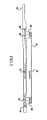
- Figure 2 illustrates certain parts of a transportable machine in accordance with the present invention. Certain parts illustrated in Figure 2 are analogous to elements illustrated in Figure 1 , as discussed below. Although analogous, these parts are different from their counterparts in the prior art in significant ways, as detailed in the description below.
- Figure 2 illustrates a pair of rails 30 and 32.
- the rails 30 and 32 would be positioned generally parallel to the direction of normal movement of a transportable carriage in substantially the same manner as components that might be found in a standard chassis 16 of Figure 1 which extend generally along the length of the vehicle illustrated in Figure 1 .
- a machine frame or support 34 illustrated in Figure 2 is corresponds generally to frame or support 22 illustrated in Figure 1 .
- frame or support 34 is the base or "torque box" of a crane. Torque box 34 supports other elements of the crane on a bearing plate 36.
- machine frame 34 is not of a conventional design, and is not simply stacked on top of rails 30 and 32. Rather, rails 30, 32 and machine frame 34 form parts of a unique combination that offers new and surprising advantages.
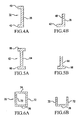
- Rails 30 and 32 are not uniform in shape or cross section. Rather, rail 32 of the exemplary embodiment has a cross section along a major portion of its length as illustrated in Figure 4A . As noted above, Figure 4A is a cross section taken along line AA of Figure 2 . This cross section of rail 32 includes a vertical portion 38, an upper flange 40 and a lower flange 42.
- this exemplary embodiment further includes modified portions, in this case gaps 44 and 46 at portions of rails 30 and 32, respectively.
- the rails have a distinctly different configuration or cross section.
- Figure 4B the configuration or cross section of the rails at the notches or gaps 44, 46 differs from the cross section at the remaining portions of the rails.
- Figure 4B is a cross section of rail 32, taking at line BB of Figure 2 .
- vertical portion 38 is shorter as compared to the height of vertical portion 38 at other locations along the rail.
- Lower flange 42 remains, but upper flange 42 is not provided in the notch or gap portions.
- One or more holes 48 are provided in vertical portion 38 in the notch or gap areas for a purpose to be described in greater detail below.
- the notch or gap portions provide openings or spaces in the rails. These openings or spaces can receive and accommodate a portion of a machine to be joined to the rails, the rails being associated with a carriage for transport, as will be described in greater detail below.
- the gaps or notches are in the upper part of the rail profile.
- the invention is not limited to such an arrangement, however.
- the rail modifications, gaps or notches can also be positioned in the lower part of the rail or in a mid-portion of the rails to accommodate machinery of different designs and configurations.
- machine frame 34 includes a plurality of flanges 50, 52 and 54 for attaching the machine frame, and thus the machine, to rails 30, 32. This is also illustrated in Figure 3 , a side view of the machine frame 34 attached to rail 32.
- Figure 3 illustrates in a side view machine frame 34 attached to rails 30, 32, only rail 32 being visible in this view.
- Machine frame 34 is not simply sitting on top of the rails as would be the case if associated with a conventional motor vehicle. Elements of machine frame 34 are actually received within the space that would normally be occupied by conventional chassis.
- the machine constructed for transport is a crane
- machine frame 34 is what is commonly called a torque box 34 that comprises a portion of the crane.
- Torque box 34 includes a pair of outrigger boxes 56 and 58. These house structure that supports “outriggers” or extendable stabilizing legs which are used to stabilize a crane when it is positioned in a stationary manner for lifting tasks.
- outrigger boxes 56 and 58 fit within notches 44 and 46 of rails 30 and 32. This arrangement lowers the profile of the transportable machine, in this case a crane.
- This lowered profile is a highly desirable result inasmuch as transportable cranes must pass below overpasses, overhead wires, and other obstacles encountered in the course of over-the-road transportation.
- a lower profile enables the transportable crane to pass along more roads than would otherwise be possible if the profile was of a greater height and would encounter a broader range of obstacles normally found along roadways.
- a combination in accordance with the invention also provides and allows for a lowered center of gravity of the transportable machine as compared to the prior art.
- a lowered center of gravity facilitates stability and safety in transport, which is of paramount importance.
- the machine and/or the rails might be modified in various ways to lower the profile, lower the center of gravity, and otherwise achieve the advantages of the invention.
- the example of outrigger boxes fitting within the modified parts of the frame are exemplary only, and not limiting of the invention.
- Fastener 60 may comprise bolts, pins, rivets or equivalent elements inserted through openings 48 in the rails 30, 32 and through corresponding openings in flanges 50, 52 and 54 of the machine frame. While bolts and the like are illustrated in the accompanying drawings, the machine frame and rails could also be secured together by other means or method, such as by welding or other fasteners or fastening methods which may be available.
- the machine frame 34 and rails 30, 32 provide a low profile apparatus of an advantageous configuration that includes a support structure sufficient to support the machine for transport while rails 30, 32 alone may not be adequate for that purpose.
- rails having notched, reduced or otherwise modified portions as constitute part of the invention are not normally used in any vehicle apparatus intended to bear and transport a load of significant magnitude. This is because a chassis of a motor vehicle having such reduced portions or modifications is not suitable for a vehicle intended for carrying a load.
- the machine to be transported is also specially designed to interface with and attach to the specially configured rails. It is not merely carried by the rails. Rather, the machine supplements and complements the strength and rigidity of the rails, and the machine and rails together provide a unique combination that is sufficiently strong, rigid and suitable as a transportable machine.
- the specially designed and equipped rails and machine frame may be associated with a motorized or otherwise propelled carriage and thus constitute a transportable machine having the unique advantage discussed above.
- the reduction in height and the corresponding lowering of the center of gravity are relatively modest as the depth dimension of the illustrated notches 44, 46 is relatively modest.
- the invention is not limited to anything having similar dimensions, however, but encompasses rail structures and machine frame structures that have greater dimensional variations and permit larger reductions in overall height and/or reductions in other dimensions.
- a transportable machine in accordance with the present invention has a reduced weight as compared to a conventionally designed combination of an ordinary motor vehicle and ordinary machine placed atop the motor vehicle.
- the notches or gaps 44, 46 in rails 30, 32 are relatively small. This alone would result in a relatively modest weight reduction. However, the weight reduction can be more substantial, depending on the specific design and arrangement of a particular machine and rails.
- the unique combination of elements of the present invention also permits a heretofore unobtainable reduction in the mass of the rails that are to support the machine for transport. This is possible in accordance with the invention, but not in the prior art because, according to the invention, the machine is designed to supplement the strength of the rails attached thereto. As a result, the overall weight reduction of a transportable machine in accordance with the invention can be significant as compared to a corresponding machine of conventional design simply stacked upon an ordinary motor vehicle.
- the present invention also facilitates a reduction in the mass of the machine frame as compared to the prior art.
- the rails fastened to the machine frame strengthen and rigidify the machine frame whereby the machine frame can be of reduced mass without impairing its functionality.
- the prior art in which a machine is simply stacked atop a chassis, does not enjoy this unobvious advantage.
- either or both of the rails and the machine frame might be constructed with significantly reduced mass as a result of the fact that the rails and machine frame compliment and support each other.
- the illustrated embodiment is only exemplary.
- the mass of the rails and/or the machine frame might be reduced by a more substantial amount for any particular combination of rails and machine frame.
- Figures 5A and 5B illustrate an alternate possible embodiment of rails 30, 32 in accordance with the invention.
- Figure 5A illustrates an exemplary cross section of a rail as it might appear, for example, along line AA of Figure 2 .
- rail 62 might be described as an "I" beam which includes a vertical element 64, an upper flange 66 and a lower flange 68.
- vertical part 64 might be shortened.
- Lower flange 68 remains as part of the beam in this exemplary configuration, but top flange 66 is not included.
- Figures 6A and 6B illustrate yet an additional possible configuration for a rail in accordance with the present invention.
- exemplary rail 70 has a box-shaped cross section as it might appear, for example, along line AA in Figure 2 .
- Rail 70 includes two vertical portions 72, a lower horizontal portion 76 and an upper horizontal portion 74.
- Figure 6B illustrates the manner in which rail 70 might be modified at a notch portion, such as at line BB in Figure 2 . At that portion, rail 70 might include lower portion 76, shortened vertical portions 72, but upper horizontal portion 74 is not provided.
- the present invention is not limited to the particular embodiments and examples described above.
- the present invention encompasses additional rail configurations and variations in cross section or configuration of rails.
- a machine built to be transportable in accordance with the present invention might be attached not only to the upper part of rails or supports 30, 32.
- Support rails and a machine in accordance with the present invention may be designed so that the machine is joined to a lower part of the rails or to a mid portion of the rails, as may be dictated by specific design configurations and considerations.
Landscapes
- Engineering & Computer Science (AREA)
- Mechanical Engineering (AREA)
- Chemical & Material Sciences (AREA)
- Combustion & Propulsion (AREA)
- Transportation (AREA)
- Body Structure For Vehicles (AREA)
- Automatic Assembly (AREA)
- Handcart (AREA)
Abstract
Description
- The present invention relates to structures which may be generally described as transportable machinery. This includes machinery or apparatus which has some specific function, combined with elements or structures designed for facilitating transport of the machinery. Such machinery may include, for example, pumps, compressors, machines for treating materials, cranes and other lifting devices, etc.
- Such combinations are often referred to as "truck mounted machinery." This is because it is common practice to utilize a standard truck-type motor vehicle, simply place on top of the vehicle chassis a separate and distinct machine, and attach the machine to the chassis (such as by bolts or welds) so that it remains in place, simply stacked on top of the motor vehicle chassis.
- Such an arrangement is generally adequate for providing for transportation of the machine. It is limited, however, by the necessity of designing machines to be compatible with existing available motor vehicles. Also, such a combination results in a total weight for the combined parts of the apparatus which is simply the sum of the weights of the individual components. The resulting configuration of a machine stacked on top of a motor vehicle is also limited by the configuration of whatever motor vehicle may be chosen/available and the configuration of whatever machine is placed on the motor vehicle. Thus, the overall height of such a combination is, at a minimum, the total of the machine height and the height of the standard motor vehicle on which it is placed.
- The present invention, however, represents an improvement over such a combination of a standard motor vehicle and a separate and distinct machine merely stacked one upon the other. The present invention provides a combination of elements which constitute a transportable machine which may be lighter in weight than a substantially similar machine of conventional construction stacked atop a standard motor vehicle. The lighter weight can result in greater economy of operation, a greater capacity for the transportable machine to also carry other payloads, and perhaps other advantages. A transportable machine in accordance with the present invention may also be constructed so as to have a lower profile than a similarly constructed but conventional machine stacked atop a standard motor vehicle. By a "lower profile" it is meant that the overall height of the transportable machine is lower than the cumulative height of a similarly constructed conventional machine stacked upon a standard motor vehicle chassis. The lower height is of great importance because transportable machines must be low enough to clear under road overpasses, overhead wires, and other obstacles encountered during transport.
- A transportable machine in accordance with the invention also may have a lowered center of gravity as compared to the conventional arrangements of the prior art. This provides for highly desirable stability and safety in transport of the machine over roadways.
- The present invention and its advantages are accomplished in a manner which is counter-intuitive, or completely contrary to conventional thinking relating to the design of transport carriages and vehicles at least because the present invention utilizes components which are generally considered unsatisfactory for such uses, as discussed in greater detail below.
- The present invention will be described in greater detail with reference to a specific embodiment and with reference to the accompanying drawings in which:
-
Figure 1 is a side view of a typical transportable machine, in this exemplary embodiment a crane, mounted on a conventional motor vehicle; -
Figure 2 is a perspective, exploded view of a portion of a machine and a frame forming part of a transport carriage in accordance with the present invention; -
Figure 3 is a side view of the assembled machine portion and frame ofFigure 2 ; -
Figures 4A and 4B are sectional views of the exemplary frame rail ofFigure 2 taken along lines AA and BB, respectively ofFigure 2 ; -
Figures 5A and 5B are sectional views, similar toFigures 4A and 4B , of an alternate exemplary embodiment of rails that may be utilized in accordance with the present invention; and -
Figures 6A and 6B are sectional views, likeFigures 4A and 4B , of another alternate exemplary embodiment of rails in accordance with the present invention. - Referring to
Figure 1 , a conventional transportable machine is designated generally byreference numeral 10. In the exemplary embodiment shown, the transportable machine is a crane mounted on a conventional truck chassis for transport from one location to another. The combination illustrated inFigure 1 comprises generally amotor vehicle 12 having acrane 14 mounted thereon.Motor vehicle 12 conventionally includes achassis 16, acab 18 mounted on the front portion of the chassis, a plurality ofwheels 20 suitably arranged, and an engine and drive train (not shown) for propelling the motor vehicle. -
Machine 14, in this case a crane, includes, inter alia, a machine frame orsupport portion 22. In conventional arrangements a frame or support portion such as shown at 22 forms a base or support for remaining parts of a machine. Typically, as illustrated,machine frame 22 is simply stacked on top ofchassis 16. It is then attached by bolts, pins, welds, etc. simply so that it will not shift or slide off of the chassis. - In such a conventional arrangement, as described above, the transportable machine comprises what amounts to a set of "building blocks," one independently designed element stacked atop the other with no particular functional interaction or synergy between them, other than the fact that the machine can be transported because it is atop a motor vehicle.
- The present invention, on the other hand, is not a simple combination of building blocks. Rather the invention provides a machine designed and combined in an unobvious manner with a transport carriage, and does so while providing several distinct and unobvious advantages not attainable using conventional structures or designed in a conventional manner.
-
Figure 2 illustrates certain parts of a transportable machine in accordance with the present invention. Certain parts illustrated inFigure 2 are analogous to elements illustrated inFigure 1 , as discussed below. Although analogous, these parts are different from their counterparts in the prior art in significant ways, as detailed in the description below. -
Figure 2 illustrates a pair ofrails rails standard chassis 16 ofFigure 1 which extend generally along the length of the vehicle illustrated inFigure 1 . - A machine frame or
support 34 illustrated inFigure 2 is corresponds generally to frame or support 22 illustrated inFigure 1 . In the exemplary embodiment of the invention illustrated inFigure 2 , frame orsupport 34 is the base or "torque box" of a crane.Torque box 34 supports other elements of the crane on abearing plate 36. - In accordance with the present invention,
machine frame 34 is not of a conventional design, and is not simply stacked on top ofrails rails machine frame 34 form parts of a unique combination that offers new and surprising advantages. -
Rails rail 32 of the exemplary embodiment has a cross section along a major portion of its length as illustrated inFigure 4A . As noted above,Figure 4A is a cross section taken along line AA ofFigure 2 . This cross section ofrail 32 includes avertical portion 38, anupper flange 40 and alower flange 42. - According to the invention, this exemplary embodiment further includes modified portions, in this
case gaps rails - As illustrated in
Figure 4B , the configuration or cross section of the rails at the notches orgaps Figure 4B is a cross section ofrail 32, taking at line BB ofFigure 2 . As illustrated,vertical portion 38 is shorter as compared to the height ofvertical portion 38 at other locations along the rail.Lower flange 42 remains, butupper flange 42 is not provided in the notch or gap portions. One or more holes 48 are provided invertical portion 38 in the notch or gap areas for a purpose to be described in greater detail below. - The notch or gap portions provide openings or spaces in the rails. These openings or spaces can receive and accommodate a portion of a machine to be joined to the rails, the rails being associated with a carriage for transport, as will be described in greater detail below.
- In the embodiment illustrated in
Figure 2 , the gaps or notches are in the upper part of the rail profile. The invention is not limited to such an arrangement, however. The rail modifications, gaps or notches can also be positioned in the lower part of the rail or in a mid-portion of the rails to accommodate machinery of different designs and configurations. - Referring again to
Figure 2 ,machine frame 34 includes a plurality offlanges rails Figure 3 , a side view of themachine frame 34 attached to rail 32. - Specifically,
Figure 3 illustrates in a sideview machine frame 34 attached torails Machine frame 34 is not simply sitting on top of the rails as would be the case if associated with a conventional motor vehicle. Elements ofmachine frame 34 are actually received within the space that would normally be occupied by conventional chassis. - Specifically, in the exemplary illustrated embodiment, the machine constructed for transport is a crane, and
machine frame 34 is what is commonly called atorque box 34 that comprises a portion of the crane.Torque box 34 includes a pair ofoutrigger boxes outrigger boxes notches rails - A combination in accordance with the invention also provides and allows for a lowered center of gravity of the transportable machine as compared to the prior art. A lowered center of gravity facilitates stability and safety in transport, which is of paramount importance.
- Depending on the specific configuration of a crane or other machine, and of the rails that are to support the machine, the machine and/or the rails might be modified in various ways to lower the profile, lower the center of gravity, and otherwise achieve the advantages of the invention. The example of outrigger boxes fitting within the modified parts of the frame are exemplary only, and not limiting of the invention.
- As illustrated in
Figure 3 ,machine frame 34 and rails 30, 32 are secured to each other via a plurality offasteners 60.Fastener 60 may comprise bolts, pins, rivets or equivalent elements inserted through openings 48 in therails flanges - Combined in this manner the
machine frame 34 and rails 30, 32 provide a low profile apparatus of an advantageous configuration that includes a support structure sufficient to support the machine for transport whilerails - However, in accordance with the present invention, the machine to be transported is also specially designed to interface with and attach to the specially configured rails. It is not merely carried by the rails. Rather, the machine supplements and complements the strength and rigidity of the rails, and the machine and rails together provide a unique combination that is sufficiently strong, rigid and suitable as a transportable machine.
- The specially designed and equipped rails and machine frame, in combination, may be associated with a motorized or otherwise propelled carriage and thus constitute a transportable machine having the unique advantage discussed above.
- In the illustrated exemplary embodiment, the reduction in height and the corresponding lowering of the center of gravity are relatively modest as the depth dimension of the illustrated
notches - As noted above, a transportable machine in accordance with the present invention has a reduced weight as compared to a conventionally designed combination of an ordinary motor vehicle and ordinary machine placed atop the motor vehicle. In the illustrated exemplary embodiment, the notches or
gaps rails - The unique combination of elements of the present invention also permits a heretofore unobtainable reduction in the mass of the rails that are to support the machine for transport. This is possible in accordance with the invention, but not in the prior art because, according to the invention, the machine is designed to supplement the strength of the rails attached thereto. As a result, the overall weight reduction of a transportable machine in accordance with the invention can be significant as compared to a corresponding machine of conventional design simply stacked upon an ordinary motor vehicle.
- The present invention also facilitates a reduction in the mass of the machine frame as compared to the prior art. In an apparatus constructed in accordance with the invention the rails fastened to the machine frame strengthen and rigidify the machine frame whereby the machine frame can be of reduced mass without impairing its functionality. The prior art, in which a machine is simply stacked atop a chassis, does not enjoy this unobvious advantage.
- Thus, according to the present invention, either or both of the rails and the machine frame might be constructed with significantly reduced mass as a result of the fact that the rails and machine frame compliment and support each other. The illustrated embodiment is only exemplary. Depending on specifics of the rails and machine frame associated therewith, the mass of the rails and/or the machine frame might be reduced by a more substantial amount for any particular combination of rails and machine frame.
- By way of additional example, and not by way of limitation,
Figures 5A and 5B illustrate an alternate possible embodiment ofrails Figure 5A illustrates an exemplary cross section of a rail as it might appear, for example, along line AA ofFigure 2 . In this exemplary embodiment,rail 62 might be described as an "I" beam which includes avertical element 64, anupper flange 66 and alower flange 68. As illustrated inFigure 5B , at a notch or gap portion of the rail,vertical part 64 might be shortened.Lower flange 68 remains as part of the beam in this exemplary configuration, buttop flange 66 is not included. - In a similar manner,
Figures 6A and 6B illustrate yet an additional possible configuration for a rail in accordance with the present invention. As shown inFigure 6A ,exemplary rail 70 has a box-shaped cross section as it might appear, for example, along line AA inFigure 2 .Rail 70 includes twovertical portions 72, a lowerhorizontal portion 76 and an upperhorizontal portion 74.Figure 6B illustrates the manner in which rail 70 might be modified at a notch portion, such as at line BB inFigure 2 . At that portion,rail 70 might includelower portion 76, shortenedvertical portions 72, but upperhorizontal portion 74 is not provided. - The present invention is not limited to the particular embodiments and examples described above. By way of further example and not by way of limitation, the present invention encompasses additional rail configurations and variations in cross section or configuration of rails. A machine built to be transportable in accordance with the present invention might be attached not only to the upper part of rails or supports 30, 32. Support rails and a machine in accordance with the present invention may be designed so that the machine is joined to a lower part of the rails or to a mid portion of the rails, as may be dictated by specific design configurations and considerations.
Claims (21)
- A transportable machine comprising
a motorized carriage including a frame engaging a machine for transport, said frame having one or more gaps defining an interface engaging the machine;
said machine including elements that fit within the gaps of the motorized carriage frame; and
fasteners engaging the machine and engaging the motorized carriage frame in the vicinity of said gaps to secure the machine to the motorized carriage. - A transportable machine as in claim 1, said machine further including frame supplementing elements for engaging said motorized carriage frame in the vicinity of said gaps in said frame.
- A transportable machine as in claim 2, said frame supplementing elements comprising flanges for overlapping a part of said motorized carriage frame in the vicinity of said gaps.
- A transportable machine as in claim 1, said fasteners comprising bolts engaging said frame and engaging said machine.
- A transportable machine as in claim 3, said fasteners comprising bolts engaging said flanges and said frame.
- A transportable machine as in claim 1, said flame comprising beams having multiple segments in cross section, wherein at least one of said segments is absent from a section of one or more beams of the frame to form said gaps.
- A transportable machine as in claim 1, wherein said machine is a crane, and a part of the crane fits within the gaps of the motorized carriage frame when said crane is mounted on the motorized carriage.
- A transportable machine as in claim 7, wherein said crane comprises outriggers for stabilizing the crane during operation thereof, wherein portions of said outriggers fit within the gaps of the motorized carriage frame when said crane is mounted on the motorized carriage.
- A transportable machine as in claim 7, wherein said crane includes a support element, wherein said support element fits within the gaps of the motorized carriage frame when the crane is mounted on the motorized carriage.
- A transportable machine as in claim 9, wherein said crane comprises outriggers for stabilizing the crane during operation thereof, said outriggers are housed within a part of said support element, and said part of the support element housing the outriggers fits within the gaps of the motorized carriage frame when the crane mounted on the motorized carriage.
- A transportable machine as in claim 1, wherein said motorized carriage frame having said gaps is fastened to said machine to provide sufficient support for transport of said machine.
- A transportable machine as in claim 1, wherein said gaps comprise notches in the upper portions of the motorized carriage frame, said machine comprises portions that fit within said notches, and said fasteners engage said frame adjacent said notches.
- A transportable machine as in claim 12, said machine further including frame supplementing elements for engaging said motorized carriage frame in the vicinity of said gaps in said frame.
- A transportable machine as in claim 13, said frame supplementing elements comprising flanges for overlapping a part of said motorized carriage frame in the vicinity of said gaps, said fasteners comprising bolts engaging said flanges and said frame.
- A transportable machine comprising
a motor driven carriage portion and a machine portion;
the motor driven carriage portion including a first part of a frame for supporting said machine portion on said motor driven carriage portion, said first frame part having a complete frame segment and at least one incomplete frame segment;
said machine portion including a second part of a frame for supporting said machine on said motor driven carriage portion; and
fasteners engaging the second frame part and engaging the first frame part in the vicinity of said incomplete frame segment and securing the first frame part to the second frame part. - A transportable machine as in claim 15, said second frame part comprising at least one frame supplementing element for engaging said incomplete frame segment of the first frame part.
- A combined motor vehicle and machine comprising
a motor vehicle including a frame for supporting a machine for transport, said vehicle frame having one or more complete portions and one or more reduced frame portions having frame parts absent therefrom, said reduced frame portions rendering said frame inadequate to support loads for transport;
said machine including elements that fit within the reduced frame portions of the motor vehicle;
said machine further including a machine frame for engaging said motor vehicle frame at least at said reduced frame portions; and
further including flanges and fasteners connecting the motor vehicle frame and the machine frame for providing a combined motor vehicle frame and machine frame sufficient to support the machine for transport. - A combined motor vehicle and machine as in claim 17, wherein said flanges are attached to said machine frame.
- A combined motor vehicle and machine as in claim 17, wherein said machine frame is attached to said vehicle frame adjacent said reduced frame portions.
- A combined motor vehicle and machine as in claim 17, wherein said machine is a crane that includes a crane support platform comprising said machine frame, and a portion of said crane support platform fits within the reduced portions of the motor vehicle frame when the crane is mounted on the motor vehicle.
- A combined motor vehicle and machine as in claim 20, said crane further including outriggers, said outriggers being housed within the portion of the crane support platform that fits within the reduced portions of the motor vehicle frame when the crane is mounted on the motor vehicle.
Applications Claiming Priority (1)
| Application Number | Priority Date | Filing Date | Title |
|---|---|---|---|
| US12/073,416 US9440823B2 (en) | 2008-03-05 | 2008-03-05 | Transportable machinery |
Publications (2)
| Publication Number | Publication Date |
|---|---|
| EP2098474A2 true EP2098474A2 (en) | 2009-09-09 |
| EP2098474A3 EP2098474A3 (en) | 2010-12-15 |
Family
ID=40848733
Family Applications (1)
| Application Number | Title | Priority Date | Filing Date |
|---|---|---|---|
| EP09154348A Withdrawn EP2098474A3 (en) | 2008-03-05 | 2009-03-04 | Transportable machinery |
Country Status (4)
| Country | Link |
|---|---|
| US (2) | US9440823B2 (en) |
| EP (1) | EP2098474A3 (en) |
| BR (1) | BRPI0900517A2 (en) |
| CA (1) | CA2657100A1 (en) |
Cited By (1)
| Publication number | Priority date | Publication date | Assignee | Title |
|---|---|---|---|---|
| EP2390165A2 (en) | 2010-05-25 | 2011-11-30 | Lokhoff V.o.F | Truck having a narrow chassis |
Families Citing this family (6)
| Publication number | Priority date | Publication date | Assignee | Title |
|---|---|---|---|---|
| CN102424001B (en) * | 2011-12-30 | 2014-05-14 | 徐州重型机械有限公司 | Four-axle car chassis and truck crane with the same |
| RU2495816C1 (en) * | 2012-03-07 | 2013-10-20 | Олег Станиславович Баринов | Self-propelled jig crane |
| US10300950B2 (en) * | 2014-03-31 | 2019-05-28 | Yorozu Corp. | Suspension member and method for manufacturing same |
| US12234135B2 (en) | 2014-11-24 | 2025-02-25 | Oshkosh Corporation | Fire apparatus |
| RU2599741C2 (en) * | 2015-03-10 | 2016-10-10 | Акционерное общество "Галичский автокрановый завод" | Self-propelled jib crane |
| US12246786B2 (en) * | 2023-01-05 | 2025-03-11 | Custom Truck One Source, Inc. | System and method for reconfiguring a truck body |
Family Cites Families (45)
| Publication number | Priority date | Publication date | Assignee | Title |
|---|---|---|---|---|
| US1409378A (en) * | 1919-09-02 | 1922-03-14 | Commw Steel | Locomotive-crane underframe |
| US2136122A (en) | 1935-03-21 | 1938-11-08 | Midland Steel Prod Co | Chassis side rail |
| US2209392A (en) * | 1938-04-27 | 1940-07-30 | Harnischfeger Corp | Truck base for load-lifting machinery |
| US2297123A (en) | 1940-05-07 | 1942-09-29 | Midland Steel Prod Co | Automobile frame |
| US2351233A (en) * | 1942-09-14 | 1944-06-13 | Marmon Herrington Co Inc | Dual motor chassis |
| US2590787A (en) * | 1946-01-19 | 1952-03-25 | Manitowoc Shipbuilding Company | Truck type articulated crane |
| US2653829A (en) * | 1950-01-09 | 1953-09-29 | Gen Steel Castings Corp | Motor crane underframe |
| US3021016A (en) * | 1959-12-15 | 1962-02-13 | Thew Shovel Co | Outriggers for crawler cranes, shovels, hoes and the like |
| US3064825A (en) * | 1960-03-31 | 1962-11-20 | James G Thomas | Power controlled outriggers for motor cranes |
| US3096887A (en) * | 1960-11-09 | 1963-07-09 | James G Thomas | Removable power and manually operated outriggers for carrier frames |
| US3111226A (en) * | 1961-09-19 | 1963-11-19 | Kirsten Erhard | Truck crane |
| US3338426A (en) * | 1965-09-21 | 1967-08-29 | Grove Mfg Co | Heavy duty truck crane |
| AT302824B (en) * | 1968-07-31 | 1972-10-25 | Schmidt Dipl Ing Karl Heinz | Vehicle frames for road or off-road trucks, in particular for crane vehicles |
| US3643815A (en) * | 1969-06-23 | 1972-02-22 | Mccabe Powers Body Co | Mobile derrick |
| US3734223A (en) * | 1971-06-29 | 1973-05-22 | L Anderson | Vehicle frame and interchangeable components |
| US3726418A (en) * | 1971-07-01 | 1973-04-10 | Clark Equipment Co | System and method for removable installation of swing circle for large crane |
| FR2242869A5 (en) | 1973-09-04 | 1975-03-28 | Leclerc Jean Paul | Crane transport chassis for a truck - plates with cut-outs form outrigger guides on U-beam chassis |
| US4014400A (en) * | 1975-12-22 | 1977-03-29 | Caterpillar Tractor Co. | Mounting arrangement for detachably coupling a vehicle frame to a ground-engaging undercarriage |
| US4027801A (en) | 1976-05-21 | 1977-06-07 | Bucyrus-Erie Company | Outrigger system for vehicles |
| US4194639A (en) | 1977-05-12 | 1980-03-25 | Jlg Industries, Inc. | Truck mounted crane and method of constructing same |
| US4160558A (en) | 1977-10-19 | 1979-07-10 | Harnischfeger Corporation | Carrier frame for mobile crane |
| JPS5621979A (en) * | 1979-07-27 | 1981-02-28 | Hitachi Constr Mach Co Ltd | Truck structure for construction vehicle |
| AU5051879A (en) | 1979-09-03 | 1981-03-12 | Newman, T.L. | Road-rail crane vehicle |
| US4397396A (en) * | 1980-11-07 | 1983-08-09 | Harnischfeger Corporation | Truck crane having an elongated main frame |
| FR2518981B1 (en) * | 1981-12-28 | 1986-02-28 | Ppm Sa | DOUBLE CHASSIS PUBLIC WORKS MACHINE |
| JPS6157468A (en) | 1984-08-28 | 1986-03-24 | Toyota Motor Corp | Side rail for car frame |
| US4640421A (en) | 1985-02-26 | 1987-02-03 | Mason Daniel P | Truck crane conversion to crawler crane |
| US5403145A (en) | 1991-08-02 | 1995-04-04 | Serv-Tech, Inc. | Street legal, mobile, truck mounted tube bundle pulling apparatus |
| US5348171A (en) | 1992-12-08 | 1994-09-20 | Link-Belt Construction Equip. Co. | Removable outrigger for mobile crane |
| DE9413931U1 (en) | 1994-08-30 | 1995-03-09 | Karl Kumlin GmbH & Co. KG, Fahrzeugfabrik, 79183 Waldkirch | Vehicle with loading area and devices for the releasable fixing of a loading crane or the like. |
| JP3434370B2 (en) * | 1994-11-15 | 2003-08-04 | 株式会社加藤製作所 | Outriggers for special vehicles |
| DE29508567U1 (en) * | 1995-03-28 | 1996-07-25 | Liebherr-Werk Ehingen Gmbh, 89584 Ehingen | Mobile crane with a detachable coupling that connects the undercarriage to the superstructure |
| JPH08311929A (en) * | 1995-05-12 | 1996-11-26 | Komatsu Ltd | Suspension device of hydraulic excavator |
| US5882039A (en) | 1997-01-23 | 1999-03-16 | Dana Corporation | Hydroformed engine cradle and cross member for vehicle body and frame assembly |
| DE19733470C1 (en) | 1997-08-02 | 1998-12-10 | Daimler Benz Ag | Support frame profile for working vehicle |
| US6250679B1 (en) | 1999-09-24 | 2001-06-26 | Nmc Wollard, Inc. | Airport vehicle frame assembly used therefore |
| JP2002193587A (en) * | 2000-12-28 | 2002-07-10 | Tadano Ltd | On-vehicle crane |
| JP2002248954A (en) * | 2001-02-21 | 2002-09-03 | Komatsu Ltd | Piping structure of crawler drive hydraulic motor |
| US20020163173A1 (en) | 2001-05-07 | 2002-11-07 | Ruehl Phillip C. | Contoured hip/straight member vehicle frame |
| DE10126234B4 (en) | 2001-05-30 | 2005-03-24 | Dr.Ing.H.C. F. Porsche Ag | Building structure for a motor vehicle with composite beams |
| KR100639721B1 (en) * | 2001-09-28 | 2006-10-31 | 코벨코 크레인 가부시키가이샤 | Self-propelled working machines |
| CN1530496B (en) * | 2003-03-10 | 2010-04-21 | 株式会社小松制作所 | Track frame of building machinery |
| US7108315B1 (en) | 2003-10-14 | 2006-09-19 | Delaware Capital Formation, Inc. | Support frame for container trailer |
| FR2871455B1 (en) | 2004-06-15 | 2008-03-14 | Bernard Coeuret | TELESCOPIC MAST CRANE |
| US7523571B2 (en) * | 2005-09-26 | 2009-04-28 | Vermeer Manufacturing Company | Machine with adapter frame for weight stabilization |
-
2008
- 2008-03-05 US US12/073,416 patent/US9440823B2/en active Active
-
2009
- 2009-03-04 EP EP09154348A patent/EP2098474A3/en not_active Withdrawn
- 2009-03-05 BR BRPI0900517-0A patent/BRPI0900517A2/en not_active IP Right Cessation
- 2009-03-05 CA CA002657100A patent/CA2657100A1/en not_active Abandoned
-
2016
- 2016-08-19 US US15/241,472 patent/US20160355381A1/en not_active Abandoned
Cited By (1)
| Publication number | Priority date | Publication date | Assignee | Title |
|---|---|---|---|---|
| EP2390165A2 (en) | 2010-05-25 | 2011-11-30 | Lokhoff V.o.F | Truck having a narrow chassis |
Also Published As
| Publication number | Publication date |
|---|---|
| US20090223918A1 (en) | 2009-09-10 |
| CA2657100A1 (en) | 2009-09-05 |
| BRPI0900517A2 (en) | 2009-11-17 |
| US9440823B2 (en) | 2016-09-13 |
| US20160355381A1 (en) | 2016-12-08 |
| EP2098474A3 (en) | 2010-12-15 |
Similar Documents
| Publication | Publication Date | Title |
|---|---|---|
| US20160355381A1 (en) | Transportable machinery | |
| US3794375A (en) | Detachable vehicle enclosure | |
| US8342784B2 (en) | Collapsible intermodal transport platform | |
| CN103832310A (en) | Wheel support suspension assembly | |
| US8757943B2 (en) | Intermodal transport platform | |
| US8231315B2 (en) | Stackable armored vehicle | |
| US11066281B2 (en) | Construction machine | |
| JP2011020655A (en) | Monorail vehicle transport system | |
| US8277164B2 (en) | Hoist suspension frame for flatbed trailers | |
| EP2991889B1 (en) | A chassis component for a heavy vehicle frame structure and a truck or a tractor with such a chassis component | |
| EP3498632B1 (en) | Automobile transport frame for use in container, and container having same | |
| CN109195901A (en) | Subframe for rail crane | |
| JPH02306835A (en) | Movable separaterack | |
| CN115110420B (en) | Arch bridge arch rib top hoist and mount construction equipment | |
| JP2010070104A (en) | Container chassis towed by tractor | |
| WO2005002951A1 (en) | System for connecting units to a truck and a device forming part of the system | |
| JP3114945U (en) | Truck vehicle | |
| JP2007099228A (en) | Truck chassis frame | |
| CN110139779B (en) | Transportation platform | |
| JP5037318B2 (en) | Loading, transporting, and unloading methods of divided pillars on trucks, and vehicle mounting platforms used for these | |
| JPS6031440A (en) | Stack housing device for container trailer etc. | |
| CN217804858U (en) | Novel tiger vehicle | |
| JP7626814B1 (en) | Vehicle holding device, loading method | |
| JP2002266311A (en) | Rolling machine | |
| JP3230445U (en) | Single rail carrier for transporting personnel |
Legal Events
| Date | Code | Title | Description |
|---|---|---|---|
| PUAI | Public reference made under article 153(3) epc to a published international application that has entered the european phase |
Free format text: ORIGINAL CODE: 0009012 |
|
| AK | Designated contracting states |
Kind code of ref document: A2 Designated state(s): AT BE BG CH CY CZ DE DK EE ES FI FR GB GR HR HU IE IS IT LI LT LU LV MC MK MT NL NO PL PT RO SE SI SK TR |
|
| AX | Request for extension of the european patent |
Extension state: AL BA RS |
|
| RAP1 | Party data changed (applicant data changed or rights of an application transferred) |
Owner name: MANITOWOC CRANE COMPANIES, LLC |
|
| PUAL | Search report despatched |
Free format text: ORIGINAL CODE: 0009013 |
|
| AK | Designated contracting states |
Kind code of ref document: A3 Designated state(s): AT BE BG CH CY CZ DE DK EE ES FI FR GB GR HR HU IE IS IT LI LT LU LV MC MK MT NL NO PL PT RO SE SI SK TR |
|
| AX | Request for extension of the european patent |
Extension state: AL BA RS |
|
| 17P | Request for examination filed |
Effective date: 20110510 |
|
| AKX | Designation fees paid |
Designated state(s): AT BE BG CH CY CZ DE DK EE ES FI FR GB GR HR HU IE IS IT LI LT LU LV MC MK MT NL NO PL PT RO SE SI SK TR |
|
| STAA | Information on the status of an ep patent application or granted ep patent |
Free format text: STATUS: THE APPLICATION IS DEEMED TO BE WITHDRAWN |
|
| 18D | Application deemed to be withdrawn |
Effective date: 20111001 |