EP2088217A1 - Casting magnesium alloy and process for production of cast magnesium alloy - Google Patents
Casting magnesium alloy and process for production of cast magnesium alloy Download PDFInfo
- Publication number
- EP2088217A1 EP2088217A1 EP07831487A EP07831487A EP2088217A1 EP 2088217 A1 EP2088217 A1 EP 2088217A1 EP 07831487 A EP07831487 A EP 07831487A EP 07831487 A EP07831487 A EP 07831487A EP 2088217 A1 EP2088217 A1 EP 2088217A1
- Authority
- EP
- European Patent Office
- Prior art keywords
- mass
- magnesium alloy
- casting
- alloy
- magnesium
- Prior art date
- Legal status (The legal status is an assumption and is not a legal conclusion. Google has not performed a legal analysis and makes no representation as to the accuracy of the status listed.)
- Withdrawn
Links
Images







Classifications
-
- F—MECHANICAL ENGINEERING; LIGHTING; HEATING; WEAPONS; BLASTING
- F02—COMBUSTION ENGINES; HOT-GAS OR COMBUSTION-PRODUCT ENGINE PLANTS
- F02F—CYLINDERS, PISTONS OR CASINGS, FOR COMBUSTION ENGINES; ARRANGEMENTS OF SEALINGS IN COMBUSTION ENGINES
- F02F7/00—Casings, e.g. crankcases
- F02F7/0085—Materials for constructing engines or their parts
-
- B—PERFORMING OPERATIONS; TRANSPORTING
- B22—CASTING; POWDER METALLURGY
- B22D—CASTING OF METALS; CASTING OF OTHER SUBSTANCES BY THE SAME PROCESSES OR DEVICES
- B22D21/00—Casting non-ferrous metals or metallic compounds so far as their metallurgical properties are of importance for the casting procedure; Selection of compositions therefor
- B22D21/002—Castings of light metals
- B22D21/007—Castings of light metals with low melting point, e.g. Al 659 degrees C, Mg 650 degrees C
-
- C—CHEMISTRY; METALLURGY
- C22—METALLURGY; FERROUS OR NON-FERROUS ALLOYS; TREATMENT OF ALLOYS OR NON-FERROUS METALS
- C22C—ALLOYS
- C22C23/00—Alloys based on magnesium
-
- C—CHEMISTRY; METALLURGY
- C22—METALLURGY; FERROUS OR NON-FERROUS ALLOYS; TREATMENT OF ALLOYS OR NON-FERROUS METALS
- C22C—ALLOYS
- C22C23/00—Alloys based on magnesium
- C22C23/02—Alloys based on magnesium with aluminium as the next major constituent
-
- C—CHEMISTRY; METALLURGY
- C22—METALLURGY; FERROUS OR NON-FERROUS ALLOYS; TREATMENT OF ALLOYS OR NON-FERROUS METALS
- C22F—CHANGING THE PHYSICAL STRUCTURE OF NON-FERROUS METALS AND NON-FERROUS ALLOYS
- C22F1/00—Changing the physical structure of non-ferrous metals or alloys by heat treatment or by hot or cold working
- C22F1/06—Changing the physical structure of non-ferrous metals or alloys by heat treatment or by hot or cold working of magnesium or alloys based thereon
-
- F—MECHANICAL ENGINEERING; LIGHTING; HEATING; WEAPONS; BLASTING
- F04—POSITIVE - DISPLACEMENT MACHINES FOR LIQUIDS; PUMPS FOR LIQUIDS OR ELASTIC FLUIDS
- F04D—NON-POSITIVE-DISPLACEMENT PUMPS
- F04D29/00—Details, component parts, or accessories
- F04D29/02—Selection of particular materials
- F04D29/023—Selection of particular materials especially adapted for elastic fluid pumps
-
- F—MECHANICAL ENGINEERING; LIGHTING; HEATING; WEAPONS; BLASTING
- F04—POSITIVE - DISPLACEMENT MACHINES FOR LIQUIDS; PUMPS FOR LIQUIDS OR ELASTIC FLUIDS
- F04D—NON-POSITIVE-DISPLACEMENT PUMPS
- F04D29/00—Details, component parts, or accessories
- F04D29/26—Rotors specially for elastic fluids
- F04D29/28—Rotors specially for elastic fluids for centrifugal or helico-centrifugal pumps for radial-flow or helico-centrifugal pumps
- F04D29/284—Rotors specially for elastic fluids for centrifugal or helico-centrifugal pumps for radial-flow or helico-centrifugal pumps for compressors
-
- F—MECHANICAL ENGINEERING; LIGHTING; HEATING; WEAPONS; BLASTING
- F05—INDEXING SCHEMES RELATING TO ENGINES OR PUMPS IN VARIOUS SUBCLASSES OF CLASSES F01-F04
- F05C—INDEXING SCHEME RELATING TO MATERIALS, MATERIAL PROPERTIES OR MATERIAL CHARACTERISTICS FOR MACHINES, ENGINES OR PUMPS OTHER THAN NON-POSITIVE-DISPLACEMENT MACHINES OR ENGINES
- F05C2201/00—Metals
- F05C2201/02—Light metals
- F05C2201/028—Magnesium
-
- F—MECHANICAL ENGINEERING; LIGHTING; HEATING; WEAPONS; BLASTING
- F05—INDEXING SCHEMES RELATING TO ENGINES OR PUMPS IN VARIOUS SUBCLASSES OF CLASSES F01-F04
- F05D—INDEXING SCHEME FOR ASPECTS RELATING TO NON-POSITIVE-DISPLACEMENT MACHINES OR ENGINES, GAS-TURBINES OR JET-PROPULSION PLANTS
- F05D2300/00—Materials; Properties thereof
- F05D2300/10—Metals, alloys or intermetallic compounds
- F05D2300/12—Light metals
- F05D2300/125—Magnesium
-
- F—MECHANICAL ENGINEERING; LIGHTING; HEATING; WEAPONS; BLASTING
- F05—INDEXING SCHEMES RELATING TO ENGINES OR PUMPS IN VARIOUS SUBCLASSES OF CLASSES F01-F04
- F05D—INDEXING SCHEME FOR ASPECTS RELATING TO NON-POSITIVE-DISPLACEMENT MACHINES OR ENGINES, GAS-TURBINES OR JET-PROPULSION PLANTS
- F05D2300/00—Materials; Properties thereof
- F05D2300/10—Metals, alloys or intermetallic compounds
- F05D2300/17—Alloys
Definitions
- the present invention is one which relates to a magnesium alloy for casing, magnesium alloy which is suitable for service under high temperature.
- Magnesium alloy which is much lightweight than aluminum alloy is, is about to come to be used widely for aircraft material, vehicle material, and the like, from the viewpoint of weight saving.
- magnesium alloy since the strength and heat resistance are not sufficient depending on applications, further improvement of the characteristics has been sought.
- a magnesium alloy that possesses heat resistance is disclosed.
- it is a magnesium alloy that includes aluminum (Al) in an amount of 4-9% by mass, copper (Cu) in an amount of 1-5% by mass, zinc (Zn) in an amount of 4% by mass or less, and beryllium (Be) in an amount of 0.001-0.01% by mass, and that is provided with a metallic structure in which Mg-Al-Cu system compounds are scattered in the mother-phase Mg.
- AZ91D As a general magnesium alloy, AZ91D (ASTM code) is present, for instance. Although AZ91D is good in terms of the mechanical characteristics and castability, the heat conductivity of AZ91D is 73 W/mK approximately and is extremely low compared with the heat conductivity of pure magnesium (167 W/mK). Accordingly, when AZ91D is used in member whose service environment is high temperature, or in member that generates heat in service, the radiation of heat cannot be carried out satisfactorily, and thereby thermal deformation might occur in the member.
- a magnesium alloy whose heat conductivity is low is used as a magnesium alloy that is used in a cylinder head or cylinder block of internal-combustion engine
- the cylinder head undergoes thermal deformation, or heat dwells within the cylinder block so that the thermal deformation of cylinder bores augments, and thereby adverse affects, such as increased friction and declined airtightness, occur.
- a magnesium alloy has been sought, magnesium alloy in which the radiation of heat is carried out satisfactorily by possessing a high heat conductivity, and magnesium alloy which is thereby suitable for usage under high temperature.
- a magnesium alloy for casting according to the present invention is characterized in that , when the entirety is taken as 100% by mass, it includes: copper (Cu) in an amount of from 0.5% by mass or more to 10% by mass or less; calcium (Ca) in an amount of from 0.01% by mass or more to 3% by mass or less; and the balance comprising magnesium (Mg) and inevitable impurities.
- the copper (Cu) can be from 1% by mass or more to 5% by mass or less.
- the magnesium alloy for casting according to the present invention that includes Cu and Ca possesses a metallic structure that is constituted of Mg crystalline grains including Mg, and grain-boundary crystallized substances including Cu and Ca and being crystallized as three-dimensional network shapes (three-dimensionally mesh constructions) in grain boundaries between the Mg crystalline grains.
- grain-boundary crystallized substances that take on three-dimensionally mesh constructions, grain-boundary sliding, which becomes active especially when becoming high temperature, is suppressed, and thereby high-temperature strength and creep resistance at high temperature improve.
- the heat conduction between the Mg crystalline grains is less likely to be hindered even when the grain-boundary crystallized substances are crystallized as network shapes by letting the present magnesium alloy contain copper whose heat conductivity is high in a predetermined amount as an alloying element.
- the magnesium alloy for casting according to the present invention has a metallic structure that is constituted of Mg crystalline grains including Mg, and granular compounds including Cu and being dispersed as granular shapes in grain boundaries between the Mg crystalline grains.
- the grain-boundary crystallized substances that are crystallized as network shapes in the grain boundaries between the Mg crystalline grains in the as-cast material are dispersed granularly in the grain boundaries between the Mg crystalline grains by means of heat treatment. Consequently, the contact areas between the Mg crystalline grains in the grain boundaries augment, and thereby heat conductivity improves.
- the high-temperature strength and creep resistance at high temperature are less likely to lower when it contains Cu and Ca in the aforementioned predetermined ranges.
- the magnesium alloy for casting according to the present invention can include aluminum (Al) in an amount of 10% by mass or less, or further 3% by mass or less.
- Al aluminum
- the mechanical strengths of the magnesium alloy at room temperature and high temperature are improved by further including Al.
- the magnesium alloy for casting according to the present invention can further include manganese (Mn) in an amount of 1% by mass or less.
- Mn manganese
- the creep resistance, the corrosion resistance, the castability, and the like are improved by including Mn, in addition to the mechanical strengths at room temperature and high temperature.
- a production method of magnesium-alloy cast product according to the present invention is a process for producing cast product comprising the magnesium alloy for casting according to the present invention.
- the production method of magnesium-alloy cast product according to the present invention is characterized in that it includes:
- the production method of magnesium-alloy cast product according to the present invention can include, after said solidifying step, a heat-treating step of granulating crystallized substances including Cu in grain boundaries between Mg crystalline grains including Mg.
- % by mass might be abbreviated to “%” simply (however, [%], the units of "0.2% proof stress” and “elongation,” does not mean “% by mass”). Note that any one of the respective alloying elements' contents is their proportions when the entire magnesium alloy for casting is taken as 100% by mass.
- Fig. 1 is a graph for illustrating the changes of heat conductivities with respect to Al contents in magnesium alloys that include Cu and Ca at least.
- Fig. 2 is a graph for illustrating the changes of heat conductivities with respect to Al/Cu values (mass ratio) in magnesium alloys that include Cu and Ca at least.
- Fig. 3 is a graph for illustrating the changes of tensile strengths and elongations with respect to Ca contents in magnesium alloys that include Cu and Ca at least.
- Fig. 4A and Fig. 4B are photographs for substituting for drawings that show the metallic structure of Mg-3%Cu-0.5%Ca alloy, and are a photograph (A) with low magnification and a photograph (B) with high magnification, respectively.
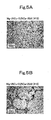
- Fig. 5A and Fig. 5B are photographs for substituting for drawings that show the metallic structure of Mg-3%Cu-0.2%Ca-3%Al alloy, and are a photograph (A) with lowmagnification and a photograph (B) with high magnification, respectively.
- Fig. 6A and Fig. 6B are photographs for substituting for drawings that show the metallic structure of Mg-3%Cu-3%Ca-3%Al-0.5%Mn alloy, and are a photograph (A) with low magnification and a photograph (B) with high magnification, respectively.
- Fig. 7 is a graph for illustrating the change of tensile strengths with respect to Ca contents in magnesium alloys that include Cu and Ca at least.
- Fig. 8 is a graph for illustrating the change of elongations with respect to Ca contents in magnesium alloys that include Cu and Ca at least.
- Fig. 9 is a graph for illustrating the change of heat conductivities with respect to Al contents in magnesium alloys that include Cu and Ca at least.
- Fig. 10 is a graph for illustrating the changes of stress lowering magnitudes with respect to Al contents in magnesium alloys that include 3% Cu and 1% Ca.
- Fig. 11A through Fig. 11D are photographs for substituting for drawings that show the metallic structure of magnesium alloys including 3% Cu and 1% Ca, and show the metallic structures of magnesium alloys that further include Al in an amount of 0.5% (A), 2% (B), 4% (C) and 8% (D), respectively.
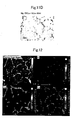
- Fig. 12 shows the analyzed results on Mg-3%Cu-1%Ca-1%Al alloy by means of electron-beam microanalysis (EPMA).
- Fig. 13 is a graph for illustrating the changes of tensile strengths, 0.2% proof stresses and elongations with respect to Cu contents in magnesium alloys (as-cast materials) that include 1% Ca, 1% Al and 0.5% Mn.
- Fig. 14 is a graph for illustrating the changes of tensile strengths, 0.2% proof stresses and elongations with respect to Cu contents in magnesium alloys (heat-treated materials) that include 1% Ca, 1% Al and 0.5% Mn.
- Fig. 15 is a graph for illustrating the changes of stress lowering magnitudes with respect to Cu contents in magnesium alloys that include 1% Ca, 1% Al and 0.5% Mn.
- Fig. 16 is a graph for illustrating the changes of tensile strengths with respect to Mn contents in magnesium alloys that include 3% Cu,1% Ca and 1% Al.
- Fig. 17 is a graph for illustrating the changes of stress lowering magnitudes with respect to Mn contents in magnesium alloys that include 3% Cu,1% Ca and 1% Al.
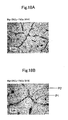
- Fig. 18A and Fig. 18B are photographs for substituting for drawings that show the metallic structure of Mg-3%Cu-1%Ca alloy, and are a photograph (A) with low magnification and a photograph (B) with high magnification.
- Fig. 19 shows the analyzed results on Mg-3%Cu-1%Ca alloy by means of EPMA.
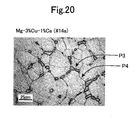
- Fig. 20 is a photograph for substituting for a drawing that shows the metallic structure of heat-treated Mg-3%Cu-1%Ca alloy.
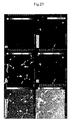
- Fig. 21 shows the analyzed results on heat-treated Mg-3%Cu-1%Ca alloy by means of EPMA.
- the magnesium alloy for casting according to the present invention is characterized in that it includes copper (Cu), calcium (Ca), and the balance comprising magnesium (Mg) and inevitable impurities.
- an as-cast material of the magnesium alloy for casting according to the present invention that includes Cu and Ca
- at least Cu and Ca crystallize in crystalline grain boundaries, and thereby a network-shaped metallic structure (three-dimensional mesh construction) is formed.
- the three-dimensional mesh construction is less likely to be formed in suchamagnesiumalloy. Therefore, it is desirable that the magnesium alloy for casting according to the present invention cannot include any rare-earth element virtually.
- the content of Cu can be 0.5% by mass or more, or further 1% by mass or more; and it is preferable that it can be 10% by mass or less, or further 5% by mass or less, or 4% by mass or less.
- the content of Cu is less than 0.5% by mass, the improvement effect of heat conductivity that results from adding Cu cannot be obtained satisfactorily. Although heat is likely to flow when Cu is abundant, when it surpasses 10% by mass, no greater improvement of heat conductivity can be expected, and accordingly that is not economical. Moreover, that is not preferable because creep resistance at high temperature lowers.
- the magnesium alloy for casting according to the present invention exhibits a low coefficient of thermal expansion.
- the magnesium alloy for casting according to the present invention includes Ca along with Cu.
- Ca also crystallizes in crystalline grain boundaries along with Cu, and thereby it also contributes to the formation of three-dimensional mesh construction.
- Mg-Ca system compounds crystallize along with Mg-Cu system compounds, and thereby a more complete three-dimensional mesh construction in which discontinuous sections are present less is formed.
- Ca possesses an anti-inflammation effect.
- the ignition temperature is high by about 300 °C, compared with that of AZ91 that does not include Ca. Consequently, in the magnesium alloy for casting according to the present invention as well, it is preferable that, when the entire magnesium alloy for casting is taken as 100% by mass, the content of Ca can be from 0.01% by mass or more to 3% by mass or less, or further from 0.5% by mass or more to 2% by mass or less. Although it is allowable that Ca can be added to the magnesium alloy even in a small amount, the mechanical properties, such as the tensile strength and elongation, have lowered when it surpasses 3% by mass.
- intermetallic compounds such as the Mg-Cu compounds and the Mg-Ca compounds, which crystallize as network shapes in crystalline grain boundaries in the magnesium alloy for casting according to the present invention, suppress the grain-boundary sliding within the magnesium alloy. Consequently, it seems that the magnesium alloy for casting according to the present invention demonstrates such good creep resistance that creep deformations, and the like, are less even in high-temperature regions.
- themagnesiumalloy for casting according to the present invention can further include aluminum (Al).
- Al aluminum
- mechanical strength is needed along with high heat conductivity, it is allowable to set the Al content when the entire magnesium alloy for casting according to the present invention is taken as 100% by mass at 0.5% by mass at least.
- the content of Al can exhibit a mass ratio to Cu (Al/Cu) of being 1 or less.
- a mass ratio to Cu (Al/Cu) of being 1 or less.
- the magnesium alloy for casting according to the present invention can further include manganese (Mn) in an amount of 1% by mass or less.
- Mn is an element that solves into the base material of magnesium alloy to solution harden the magnesium alloy.
- Mn also produces an effect of removing Fe, one of impurities that become a cause of corrosion, by sedimentation. That is, in the magnesium alloy according to the present invention to which Mn is added, the corrosion resistance improves along with the mechanical strength.
- Mn manganese
- a preferable Mn content can be 0.1% by mass or more, or 0.2% by mass or more, or further 0.3% by mass or more; and moreover it can be 1% by mass or less, or 0.8% by mass or less, or further 0.7% by mass or less.
- the magnesium alloy for casting according to the present invention can further include strontium (Sr) in an amount of 1% by mass or less.
- Sr strontium
- the magnesium alloy according to the present invention to which Sr is added produces an effect of improving corrosion resistance in magnesium alloy including Ca. Consequently, Sr is suitable as an alloying element for improving the corrosion resistance of the magnesium alloy for casting according to the present invention.
- Sr improves the castability (molten-metal flowability, and the like) of magnesium alloy.
- a preferable Sr content can be from 0.01% by mass or more to 1% by mass or less, or further from 0.1% by mass or more to 1% by mass or less.
- the magnesium alloy for casting according to the present invention can further include barium (Ba) in an amount of 1% by mass or less.
- Ba barium
- a preferable Ba content can be from 0.01% by mass or more to 1% by mass or less, or further from 0.1% by mass or more to 1% by mass or less.
- alloying elements such as Mn, Sr and Ba, do not impair the network-shaped metallic structure of the magnesium alloy for casting according to the present invention even when they are added to it.
- the magnesium alloy for casting according to the present invention makes an as-cast material, although it has a metallic structure that is constituted of Mg crystalline grains including Mg, and grain-boundary crystallized substances including Cu and Ca and being crystallized as three-dimensional network shapes in grain boundaries between the Mg crystalline grains, granular compounds including Cu, for example, Mg-Cu system compounds, are dispersed in the grain boundaries between the Mg crystalline grains including Mg by carrying out heat treatment. That is, it is allowable that the magnesium alloy for casting according to the present invention can have a metallic structure that is constituted of Mg crystalline grains including Mg, and granular compounds including Cu and being dispersed as granular shapes in grain boundaries between the Mg crystalline grains.
- the magnesium alloy for casting according to the present invention can be used in various fields, such as automobiles and electric instruments.
- the following can be given, taking advantage of its characteristics at high temperature: products being utilized in high-temperature environments, for example, component parts constituting compressor, pumps and various cases that become high temperatures in service; moreover, engine component parts being used under high temperature and high load, especially, cylinder heads, cylinder blocks and oil pans of internal-combustion engine, impellers for turbocharger of internal-combustion engine, transmission cases being used for automobile and the like, and so forth.
- the production method of magnesium-alloy cast product according to the present invention is a production method of cast product comprising the magnesium alloy for casting according to the present invention that has been described in detail as above.
- the production method of magnesium-alloy cast product according to the present invention includes a molten-metal pouring step, and a solidifying step.
- the molten-metal pouring step is a step of pouring an alloy molten metal into a casting mold, the alloy molten metal including: copper (Cu) in an amount of from 0.5% by mass or more to 10% by mass or less; calcium (Ca) in an amount of from 0.01% by mass or more to 3% by mass or less; and the balance comprising manganese (Mg) and inevitable impurities; when the entirety is taken as 100% by mass.
- the solidifying step is a step of solidifying the alloy molten metal after the molten-metal pouring step by cooling it.
- the magnesium-alloy cast product is not limited to those made by ordinary gravity casting and pressure casting, but can even be those made by die-cast casting. Moreover, even the casting mold being utilized for the casting does not matter if it is sand molds, metallic molds, and the like. Since even the solidification rate (cooling rate) in the solidifying step is not limited in particular, it is allowable to properly select such an extent of solidification rate, which permits to form the three-dimensional mesh construction, depending on the size of ingots. Note that, when it is solidified at a usual solidification rate, the metallic structure possessing the three-dimensional mesh construction is obtainable.
- the production method of magnesium-alloy cast product according to the present invention can include, after the solidifying step, a heat-treating step of dispersing granular compounds including Cu in grain boundaries between Mg crystalline grains including Mg.
- a heat-treating step of dispersing granular compounds including Cu in grain boundaries between Mg crystalline grains including Mg.
- tempering treatment after quenching (or high-temperature working), tempering treatment which is specified by the thermal-refining code "T5" or "T6" that is used in the JIS standard.
- an as-cast member being made of the magnesium alloy for casting according to the present invention is allowable to subject an age-hardening treatment at a temperature of 100-300 °C after subjecting it to a solution treatment at a temperature of from 400 °C or more to a eutectic temperature or less. More desirably, it is allowable to carry out the solution treatment at a temperature of 400-550 °C, or further at a temperature of 410-510 °C; and then to carry out the age-hardening treatment at a temperature of 150-250 °C. Moreover, it is allowable that the solution treatment can be carried out while holding it at the high temperature for 5-24 hours, or further for 5-10 hours.
- the cooling can be either air cooling or water cooling; or it is desirable to quench it by means of water cooling. Note that it is allowable to select an optimum temperature, time and cooling rate for the heat treatment by means of usual methods that have been carried out heretofore.
- Test specimens whose contents of alloying elements in magnesium alloys were varied were made in a quantity of plural pieces, and then the evaluation of the characteristics and the observation of the metallic structures, and so forth, were carried out.
- a chloride-system flux was coated onto the inner surface of a crucible being made of iron that had been preheated within an electric furnace, and then a weighed pure magnesium base metal, pure Cu, and pure Al, if needed, were charged into it and were then melted. Further, weighed Ca was added into this molten metal that was held at 750 °C (a molten-metal preparing step).
- Alloy Composition I is the proportions of the respective components, which were weighed at the molten-metal preparing step, when the raw materials were taken as 100% as a whole; and that “Alloy Composition II” is the alloy compositions of the respective test specimens that were analyzed by means of fluorescent X-ray analysis; and that the balance is Mg.
- the heat conductivities were found by means of laser flash method. Moreover, the tensile test by means of JIS Z 2241 (testing temperature: 25 °C) was carried out, thereby finding the tensile strengths and elongations. The test results are specified in Table 1 all together.
- a graph that exhibits the changes of the heat conductivities with respect to the Al contents is illustrated in Fig. 1 ; a graph that exhibits the changes of the heat conductivities with respect to the Al/Cu values (mass ratio) is illustrated in Fig. 2 ; and a graph that exhibits the changes of the tensile strengths and elongations with respect to the Ca contents is illustrated in Fig. 3 , respectively.
- Ca contributes to the formation of the three-dimensional mesh structure in magnesium alloy; however, from Fig. 3 , it was understood that the greater the Ca content becomes the more the mechanical characteristics tend to lower.
- Each “Alloy Composition I” was set at Mg-3%Cu-0.5%Ca (equivalent to #1), Mg-3%Cu-0.2%Ca-3%Al (equivalent to #10), and Mg-3%Cu-3%Ca-3%Al-0.5%Mn (the units, "%,” were all "% by mass”).
- the observation of the metallic structures was carried out by observing cross sections, which were cut out of the respective test specimens, with a metallographic microscope.
- the metallic structures are shown in Fig. 4A-Fig. 6B .
- the three-dimensional mesh construction was confirmed, three-dimensional mesh construction which comprised intermetallic compounds that crystallized in crystalline grain boundaries. Therefore, it was understood that a magnesium alloy including Cu and Ca at least possesses the three-dimensional mesh construction.
- the compounds that crystallized in crystalline grain boundaries were Mg-Cu system compounds and Mg-Ca system compounds in Figs. 4A and B; that they were Mg-Al-Cu system compounds and Mg-Ca system compounds in Figs. 5A and B; and that they were Mg-Al-Cu system compounds and Mg-Ca system compounds in Figs. 6A and B.
- a chloride-system flux was coated onto the inner surface of a crucible being made of iron that had been preheated within an electric furnace, and then a weighed pure magnesium base metal, pure Cu, and pure Al and an Al-Mn alloy, if needed, were charged into it and were then melted. Further, weighed Ca was added into this molten metal that was held at 750 °C (a molten-metal preparing step).
- Alloy Composition I is the proportions of the respective components, which were weighed at the molten-metal preparing step, when the raw materials were taken as 100% as a whole; and that “Alloy Composition II” is the alloy compositions of the respective test specimens that were analyzed by means of fluorescent X-ray analysis; and that the balance is Mg.
- #13, #16-#21 and #32 are the same test specimens as those of #1, #2-7 and #9, respectively (see the remarks column in Table 2).
- test specimens being labeled #11-#35
- the heat conductivities were found by means of laser flash method.
- the tensile test by means of JIS Z 2241 (testing temperature: 25 °C) was carried out, thereby finding the tensile strengths, elongations and 0.2% proof stresses.
- the test results are specified in Table 2 all together (with regard to the 0.2% proof stresses, see Table 3).
- a graph that exhibits the change of the tensile strengths with respect to the Ca contents is illustrated in Fig. 7 ; a graph that exhibits the change of the elongations with respect to the Ca contents is illustrated in Fig. 8 ; and a graph that exhibits the change of the heat conductivities with respect to the Al contents is illustrated in Fig. 9 , respectively.
- Test Specimens #11, #14 and #32 were magnesium alloys that included Ca in an amount of 1%, but whose Cu contents differed one another.
- Test Specimens #25 and #33-35 were magnesium alloys that included Ca in an amount of 1%, Al in an amount of 1% and Mn in an amount of 0.5%, but whose Cu contents differed one another.
- the heat conductivities of these magnesium alloys exhibited lowering magnitudes of 9-39 W/mK, which were small relatively compared with that of the heat conductivity of pure magnesium (167 W/mK) that was measured by the aforementioned method. It was understood that it is especially preferable that the Cu content can be 0.8-4.5%.
- Fig. 7 and Fig. 8 are graphs that summarize the change of the tensile strengths in Test Specimens #11-#35 and the change of the elongations in them for the Ca contents. As the Ca amounts increased, both the tensile strengths and elongations tended to decline. In particular, it was understood that magnesium alloys that possess high mechanical characteristic and high heat conductivity simultaneously can be obtained by keeping the Ca amount down to 2.5% or less, or further down to 1.5% or less.
- Fig. 9 is a graph that summarizes the change of the heat conductivities in Test Specimens #11-#35 for the Al contents. As the Al amounts increased, the heat conductivities tended to decline. That is, in order to obtain magnesium alloy that possesses high heat conductivity, it is understood that it is preferable to keep down the Al content as much as possible.
- a stress relief test was carried out, thereby examining the magnesium alloys' creep resistance under high temperature.
- a process was measured, process in which stress that arose when load was applied to test specimen until it deformed to predetermined deformation magnitude decreased with time during the time of testing.
- a compression stress of 100 MPa was loaded to the respective test specimens, and then that compression stress was lowered as the time elapsed so that the test specimens' displacement on that occasion could be kept constant.
- the stress lowering magnitudes after 1 hour from the beginning of the test, those after 10 hours therefrom and those after 40 hours therefrom; and stress lowering rates from after 20 hours and up to 40 hours are given in Table 3, respectively.
- Fig. 10 is a graph that summarizes the changes of the stress lowering magnitudes after 40 hours from the beginning of the test in Test Specimens #14-#21, which included Cu in an amount of 3% and Ca in an amount of 1% but whose Al contents differed one another, for the Al contents.
- Magnesium alloy whose stress loweringmagnitude is small is good in terms of creep resistance at high temperature. According to Fig. 10 , it was understood that good creep resistance was exhibited even at high temperature by setting the Al content to 0.5% or more, or further to 0.75% or more.
- Each "Alloy Composition I” was set at Mg-3%Cu-1%Ca-0.5Al (equivalent to #15), Mg-3%Cu-1%Ca-2%Al (equivalent to #17), Mg-3%Cu-1%Ca-4%Al (equivalent to #19), and Mg-3%Cu-1%Ca-8%Al (the units, "%,” were all "% by mass”).
- the observation of the metallic structures was carried out by observing cross sections, which were cut out of the respectivetest specimens, with a metallographic microscope.
- the metallicstructures are shown in Fig. 11A-Fig. 11D .
- Fig. 11A-11C the three-dimensional mesh construction was confirmed, three-dimensional mesh construction which comprised intermetallic compounds that crystallized in crystalline grain boundaries.
- the three-dimensional mesh construction had come not to be seen as the Al contents increased. It is believed that the decrease of the three-dimensional mesh construction that was accompanied by the increase of Al had influence on the deterioration of the creep resistance.
- the Al content can be 4.5% or less.
- Test Specimens #14-#16, #23-#27, #29-#31 and #33-#35 were heat treated, thereby making Test Specimens #14a-#16a, #23a-#27a, #29a-#31a and #33a-#35a (heat-treated materials).
- the heat treatment was carried out as follows: the as-cast materials were heated to 410-510 °C for 5-24 hours and then water cooled (a solution treatment); and thereafter they were reheated to 150-250 °C for 1-10 hours (an age-hardening treatment).
- Fig. 13 and Fig. 14 are graphs that summarize the change of the mechanical characteristics in the magnesium alloys, which included Ca in an amount of 1%, Al in an amount of 1% and Mn in an amount of 0.5% but whose Cu contents differed, for the Ca contents. Note that Fig. 13 illustrates those in the as-cast materials; and Fig. 14 illustrates those in the heat-treated materials. In any one of the test specimens, the mechanical characteristics were improved by means of the heat treatment.
- Fig. 15 is a graph that summarizes the changes of the stress lowering magnitudes after 40 hours from the beginning of the test in the magnesium alloys, which included Ca in an amount of 1%, Al in an amount of 1% and Mn in an amount of 0.5% but whose Cu contents differed, for the Cu contents.
- the creep resistances at high temperature were declined by means of the heat treatment, it was understood that, not limited to those in the as-cast materials, the decline of creep resistance by means of heat treatment can be kept down by setting the Cu content to 3.5% by mass or less.
- Fig. 16 is a graph that summarizes the changes of the tensile strengths in the magnesium alloys, which included Cu in an amount of 3%, Ca in an amount of 1% and Al in an amount of 1% but whose Mn contents differed, for the Mn contents. Despite the Mn contents, the tensile strengths after the heat treatment improved.
- Fig. 17 is a graph that summarizes the changes of the stress lowering magnitudes after 40 hours from the beginning of the test in the magnesium alloys, which included Cu in an amount of 3%, Ca in an amount of 1% and Al in an amount of 1% but whose Mn contents differed, for the Mn contents. In the as-cast materials, the more the Mn contents were the more the creep resistances tended to improve.
- an especially preferable Mn content can be 0.1-0.8%, or further 0.3-0.7%.
- Fig. 18A, Fig. 18B and Fig. 19-Fig. 21 show the observation results on the metallic structures of Test Specimen #14 before and after the heat treatment, and the EPMA analysis results thereon.
- Fig. 18A and Fig. 18B show the metallic structure of the as-cast material.
- Fig. 18A the three-dimensional mesh construction was observed.
- Fig. 18B with high magnification the following were observed in the crystalline grain boundaries: portions whose contrasts were uniform (a part of them is specified with "P1"); and portions whose contrasts were striped shapes (a part of them is specified with "P2").
- P1 comprises Mg-Cu system compounds
- P2 comprises Mg-Ca system compounds.
- Cu and Ca most of them, exist in the crystalline grain boundaries.
- Fig. 20 shows the metallic structure of one of the heat-treated materials (#14a).
- the heat-treated material granular compounds (a part of them is specified with "P3"), which had granular shapes and existed dispersedly, were appreciated.
- P4 granular compounds
- “P3" comprises Cu system compounds including mainly Cu.
Landscapes
- Engineering & Computer Science (AREA)
- Chemical & Material Sciences (AREA)
- Mechanical Engineering (AREA)
- Materials Engineering (AREA)
- Metallurgy (AREA)
- Organic Chemistry (AREA)
- General Engineering & Computer Science (AREA)
- Thermal Sciences (AREA)
- Physics & Mathematics (AREA)
- Crystallography & Structural Chemistry (AREA)
- Combustion & Propulsion (AREA)
- Continuous Casting (AREA)
- Lubrication Details And Ventilation Of Internal Combustion Engines (AREA)
- Cylinder Crankcases Of Internal Combustion Engines (AREA)
- Structures Of Non-Positive Displacement Pumps (AREA)
- General Details Of Gearings (AREA)
- Forging (AREA)
Abstract
Amagnesiumalloy for casting according to the present invention is characterized in that, when the entirety is taken as 100% by mass, it includes copper (Cu) in an amount of from 0.5% by mass or more to 10% by mass or less, calcium (Ca) in an amount of from 0.01% by mass or more to 3% by mass or less, and the balance comprising magnesium (Mg) and inevitable impurities.
Since the magnesium alloy for casting according to the present invention includes Cu whose heat conductivity is high in a predetermined amount, it is good in terms of heat-conducive ability. The heat-conductive ability is improved by carrying out heat treatment. Moreover, in the magnesium alloy for casting according to the present invention being in as-cast state, grain-boundary crystallized substances including Cu and Ca constitute three-dimensional networks in grain boundaries between Mg crystalline grains. In the network-shaped grain-boundary crystallized substances, grain-boundary sliding, which becomes active when they become high temperature, is suppressed, and thereby high-temperature strength and creep resistance improve.
Description
- The present invention is one which relates to a magnesium alloy for casing, magnesium alloy which is suitable for service under high temperature.
- Magnesium alloy, which is much lightweight than aluminum alloy is, is about to come to be used widely for aircraft material, vehicle material, and the like, from the viewpoint of weight saving. However, in magnesium alloy, since the strength and heat resistance are not sufficient depending on applications, further improvement of the characteristics has been sought.
- For example, in Japanese Unexamined Patent Publication (KOKAI) Gazette No.
2005-54,233 - Moreover, as a general magnesium alloy, AZ91D (ASTM code) is present, for instance. Although AZ91D is good in terms of the mechanical characteristics and castability, the heat conductivity of AZ91D is 73 W/mK approximately and is extremely low compared with the heat conductivity of pure magnesium (167 W/mK). Accordingly, when AZ91D is used in member whose service environment is high temperature, or in member that generates heat in service, the radiation of heat cannot be carried out satisfactorily, and thereby thermal deformation might occur in the member. In particular, when a magnesium alloy whose heat conductivity is low is used as a magnesium alloy that is used in a cylinder head or cylinder block of internal-combustion engine, the cylinder head undergoes thermal deformation, or heat dwells within the cylinder block so that the thermal deformation of cylinder bores augments, and thereby adverse affects, such as increased friction and declined airtightness, occur. Consequently, a magnesium alloy has been sought, magnesium alloy in which the radiation of heat is carried out satisfactorily by possessing a high heat conductivity, and magnesium alloy which is thereby suitable for usage under high temperature.
- In view of the aforementioned problematic issues, it is an object for the present invention to provide a magnesium alloy for casting, magnesium alloy which is suitable for usage under high temperature. Moreover, it is an object to provide a productionmethod of cast product, which comprises that magnesium alloy for casting.
- As a result of wholehearted studies, the present inventors found out that it is possible to improve the heat-conductive ability of magnesium alloy by letting it contain copper whose heat conductivity is high in an adequate amount along with calcium, and then arrived at completing the present invention based on this.
- Specifically, a magnesium alloy for casting according to the present invention is characterized in that, when the entirety is taken as 100% by mass, it includes: copper (Cu) in an amount of from 0.5% by mass or more to 10% by mass or less; calcium (Ca) in an amount of from 0.01% by mass or more to 3% by mass or less; and the balance comprising magnesium (Mg) and inevitable impurities. In this instance, it is preferable that the copper (Cu) can be from 1% by mass or more to 5% by mass or less.
- In an as-cast state (hereinafter being abbreviated to as an "as-cast material"), the magnesium alloy for casting according to the present invention that includes Cu and Ca possesses a metallic structure that is constituted of Mg crystalline grains including Mg, and grain-boundary crystallized substances including Cu and Ca and being crystallized as three-dimensional network shapes (three-dimensionally mesh constructions) in grain boundaries between the Mg crystalline grains. By means of the grain-boundary crystallized substances that take on three-dimensionally mesh constructions, grain-boundary sliding, which becomes active especially when becoming high temperature, is suppressed, and thereby high-temperature strength and creep resistance at high temperature improve. And, it was understood newly that, in the magnesium alloy for casting according to the present invention, the heat conduction between the Mg crystalline grains is less likely to be hindered even when the grain-boundary crystallized substances are crystallized as network shapes by letting the present magnesium alloy contain copper whose heat conductivity is high in a predetermined amount as an alloying element.
- Moreover, in a heat-treated state in which the aforementioned as-cast material is treated with heat (hereinafter being abbreviated to as a "heat-treated material"), the magnesium alloy for casting according to the present invention has a metallic structure that is constituted of Mg crystalline grains including Mg, and granular compounds including Cu and being dispersed as granular shapes in grain boundaries between the Mg crystalline grains. The grain-boundary crystallized substances that are crystallized as network shapes in the grain boundaries between the Mg crystalline grains in the as-cast material are dispersed granularly in the grain boundaries between the Mg crystalline grains by means of heat treatment. Consequently, the contact areas between the Mg crystalline grains in the grain boundaries augment, and thereby heat conductivity improves. Moreover, even being a heat-treated material, the high-temperature strength and creep resistance at high temperature are less likely to lower when it contains Cu and Ca in the aforementioned predetermined ranges.
- Moreover, it is preferable that the magnesium alloy for casting according to the present invention can include aluminum (Al) in an amount of 10% by mass or less, or further 3% by mass or less. In the magnesium alloy for casting according to the present invention, the mechanical strengths of the magnesium alloy at room temperature and high temperature are improved by further including Al.
- Moreover, it is even allowable that the magnesium alloy for casting according to the present invention can further include manganese (Mn) in an amount of 1% by mass or less. In the magnesium alloy for casting according to the present invention, the creep resistance, the corrosion resistance, the castability, and the like, are improved by including Mn, in addition to the mechanical strengths at room temperature and high temperature.
- Moreover, a production method of magnesium-alloy cast product according to the present invention is a process for producing cast product comprising the magnesium alloy for casting according to the present invention. The production method of magnesium-alloy cast product according to the present invention is characterized in that it includes:
- a molten-metal pouring step of pouring an alloy molten metal into a casting mold, the alloy molten metal including: copper (Cu) in an amount of from 0.5% by mass or more to 10% by mass or less; calcium (Ca) in an amount of from 0.01% by mass or more to 3% by mass or less; and the balance comprising manganese (Mg) and inevitable impurities; when the entirety is taken as 100% by mass; and
- a solidifying step of solidifying the alloy molten metal after the molten-metal pouring step by cooling it.
- It is even allowable that the production method of magnesium-alloy cast product according to the present invention can include, after said solidifying step, a heat-treating step of granulating crystallized substances including Cu in grain boundaries between Mg crystalline grains including Mg.
- Hereinafter, "% by mass" might be abbreviated to "%" simply (however, [%], the units of "0.2% proof stress" and "elongation," does not mean "% by mass"). Note that any one of the respective alloying elements' contents is their proportions when the entire magnesium alloy for casting is taken as 100% by mass.
-
Fig. 1 is a graph for illustrating the changes of heat conductivities with respect to Al contents in magnesium alloys that include Cu and Ca at least. -
Fig. 2 is a graph for illustrating the changes of heat conductivities with respect to Al/Cu values (mass ratio) in magnesium alloys that include Cu and Ca at least. -
Fig. 3 is a graph for illustrating the changes of tensile strengths and elongations with respect to Ca contents in magnesium alloys that include Cu and Ca at least. -
Fig. 4A and Fig. 4B are photographs for substituting for drawings that show the metallic structure of Mg-3%Cu-0.5%Ca alloy, and are a photograph (A) with low magnification and a photograph (B) with high magnification, respectively. -
Fig. 5A and Fig. 5B are photographs for substituting for drawings that show the metallic structure of Mg-3%Cu-0.2%Ca-3%Al alloy, and are a photograph (A) with lowmagnification and a photograph (B) with high magnification, respectively. -
Fig. 6A and Fig. 6B are photographs for substituting for drawings that show the metallic structure of Mg-3%Cu-3%Ca-3%Al-0.5%Mn alloy, and are a photograph (A) with low magnification and a photograph (B) with high magnification, respectively. -
Fig. 7 is a graph for illustrating the change of tensile strengths with respect to Ca contents in magnesium alloys that include Cu and Ca at least. -
Fig. 8 is a graph for illustrating the change of elongations with respect to Ca contents in magnesium alloys that include Cu and Ca at least. -
Fig. 9 is a graph for illustrating the change of heat conductivities with respect to Al contents in magnesium alloys that include Cu and Ca at least. -
Fig. 10 is a graph for illustrating the changes of stress lowering magnitudes with respect to Al contents in magnesium alloys that include 3% Cu and 1% Ca. -
Fig. 11A through Fig. 11D are photographs for substituting for drawings that show the metallic structure of magnesium alloys including 3% Cu and 1% Ca, and show the metallic structures of magnesium alloys that further include Al in an amount of 0.5% (A), 2% (B), 4% (C) and 8% (D), respectively. -
Fig. 12 shows the analyzed results on Mg-3%Cu-1%Ca-1%Al alloy by means of electron-beam microanalysis (EPMA). -
Fig. 13 is a graph for illustrating the changes of tensile strengths, 0.2% proof stresses and elongations with respect to Cu contents in magnesium alloys (as-cast materials) that include 1% Ca, 1% Al and 0.5% Mn. -
Fig. 14 is a graph for illustrating the changes of tensile strengths, 0.2% proof stresses and elongations with respect to Cu contents in magnesium alloys (heat-treated materials) that include 1% Ca, 1% Al and 0.5% Mn. -
Fig. 15 is a graph for illustrating the changes of stress lowering magnitudes with respect to Cu contents in magnesium alloys that include 1% Ca, 1% Al and 0.5% Mn. -
Fig. 16 is a graph for illustrating the changes of tensile strengths with respect to Mn contents in magnesium alloys that include 3% Cu,1% Ca and 1% Al. -
Fig. 17 is a graph for illustrating the changes of stress lowering magnitudes with respect to Mn contents in magnesium alloys that include 3% Cu,1% Ca and 1% Al. -
Fig. 18A and Fig. 18B are photographs for substituting for drawings that show the metallic structure of Mg-3%Cu-1%Ca alloy, and are a photograph (A) with low magnification and a photograph (B) with high magnification. -
Fig. 19 shows the analyzed results on Mg-3%Cu-1%Ca alloy by means of EPMA. -
Fig. 20 is a photograph for substituting for a drawing that shows the metallic structure of heat-treated Mg-3%Cu-1%Ca alloy. -
Fig. 21 shows the analyzed results on heat-treated Mg-3%Cu-1%Ca alloy by means of EPMA. - Hereinafter, the best mode for carrying out the magnesium alloy for casting according to the present invention and the production method of magnesium-alloy cast product according to the present invention will be explained.
- The magnesium alloy for casting according to the present invention is characterized in that it includes copper (Cu), calcium (Ca), and the balance comprising magnesium (Mg) and inevitable impurities.
- In an as-cast material of the magnesium alloy for casting according to the present invention that includes Cu and Ca, at least Cu and Ca crystallize in crystalline grain boundaries, and thereby a network-shaped metallic structure (three-dimensional mesh construction) is formed. Note that, as a general magnesium alloy, although there has been a magnesium alloy to which a rare-earth element, or the like, is added for the improvement of heat resistance, the three-dimensional mesh construction is less likely to be formed in suchamagnesiumalloy. Therefore, it is desirable that the magnesium alloy for casting according to the present invention cannot include any rare-earth element virtually.
- It is preferable that, when the entire magnesium alloy for casting is taken as 100% by mass, the content of Cu can be 0.5% by mass or more, or further 1% by mass or more; and it is preferable that it can be 10% by mass or less, or further 5% by mass or less, or 4% by mass or less. When the content of Cu is less than 0.5% by mass, the improvement effect of heat conductivity that results from adding Cu cannot be obtained satisfactorily. Although heat is likely to flow when Cu is abundant, when it surpasses 10% by mass, no greater improvement of heat conductivity can be expected, and accordingly that is not economical. Moreover, that is not preferable because creep resistance at high temperature lowers.
- Note that, in Cu and Cu compounds, their coefficients of thermal expansion are low. Consequently, the magnesium alloy for casting according to the present invention exhibits a low coefficient of thermal expansion.
- The magnesium alloy for casting according to the present invention includes Ca along with Cu. Ca also crystallizes in crystalline grain boundaries along with Cu, and thereby it also contributes to the formation of three-dimensional mesh construction. For example, Mg-Ca system compounds crystallize along with Mg-Cu system compounds, and thereby a more complete three-dimensional mesh construction in which discontinuous sections are present less is formed. Moreover, Ca possesses an anti-inflammation effect. When Ca is added to magnesium alloy, since the ignition temperature of the magnesium alloy rises, the combustion that might occur when turning magnesium alloy into molten metal is prevented. It has been known that, in the magnesium alloy (AZ91) that includes Ca in an amount of 0.5% by mass, the ignition temperature is high by about 300 °C, compared with that of AZ91 that does not include Ca. Consequently, in the magnesium alloy for casting according to the present invention as well, it is preferable that, when the entire magnesium alloy for casting is taken as 100% by mass, the content of Ca can be from 0.01% by mass or more to 3% by mass or less, or further from 0.5% by mass or more to 2% by mass or less. Although it is allowable that Ca can be added to the magnesium alloy even in a small amount, the mechanical properties, such as the tensile strength and elongation, have lowered when it surpasses 3% by mass.
- Moreover, it is believed that intermetallic compounds, such as the Mg-Cu compounds and the Mg-Ca compounds, which crystallize as network shapes in crystalline grain boundaries in the magnesium alloy for casting according to the present invention, suppress the grain-boundary sliding within the magnesium alloy. Consequently, it seems that the magnesium alloy for casting according to the present invention demonstrates such good creep resistance that creep deformations, and the like, are less even in high-temperature regions.
- It is allowable that themagnesiumalloy for casting according to the present invention can further include aluminum (Al). In the magnesium alloy for casting according to the present invention to which Al is added, since Mg-Al-Cu system compounds andMg-Al-Ca system compounds crystallize in crystalline grain boundaries, the mechanical properties, such as the tensile strength and elongation, improve. Meanwhile, the addition of Al might bring about the decline of heat conductivity. Consequently, it is preferable that, when the entire magnesium alloy for casting is taken as 100% by mass, the content of Al canbe 10% by mass or less; and further it is preferable that it can be 4% by mass or less, or 3% by mass or less; depending on applications, it is desirable that it cannot rather include Al. In the case where mechanical strength is needed along with high heat conductivity, it is allowable to set the Al content when the entire magnesium alloy for casting according to the present invention is taken as 100% by mass at 0.5% by mass at least.
- Moreover, it is preferable that the content of Al can exhibit a mass ratio to Cu (Al/Cu) of being 1 or less. When it is 1 or less, high heat conductivity and high mechanical strength are compatible with each other.
- Moreover, it is allowable that, when the entire magnesium alloy for casting is taken as 100% by mass, the magnesium alloy for casting according to the present invention can further include manganese (Mn) in an amount of 1% by mass or less. Mn is an element that solves into the base material of magnesium alloy to solution harden the magnesium alloy. In addition, Mn also produces an effect of removing Fe, one of impurities that become a cause of corrosion, by sedimentation. That is, in the magnesium alloy according to the present invention to which Mn is added, the corrosion resistance improves along with the mechanical strength. However, such effects are subtle when Mn is too less; but, even when it surpasses 1% by mass, no improvement of the effects can be expected, and accordingly that is not economical. Therefore, a preferable Mn content can be 0.1% by mass or more, or 0.2% by mass or more, or further 0.3% by mass or more; and moreover it can be 1% by mass or less, or 0.8% by mass or less, or further 0.7% by mass or less.
- Moreover, it is allowable that, when the entire magnesium alloy for casting is taken as 100% by mass, the magnesium alloy for casting according to the present invention can further include strontium (Sr) in an amount of 1% by mass or less. The magnesium alloy according to the present invention to which Sr is added produces an effect of improving corrosion resistance in magnesium alloy including Ca. Consequently, Sr is suitable as an alloying element for improving the corrosion resistance of the magnesium alloy for casting according to the present invention. In addition, Sr improves the castability (molten-metal flowability, and the like) of magnesium alloy. A preferable Sr content can be from 0.01% by mass or more to 1% by mass or less, or further from 0.1% by mass or more to 1% by mass or less.
- Moreover, it is allowable that, when the entire magnesium alloy for casting is taken as 100% by mass, the magnesium alloy for casting according to the present invention can further include barium (Ba) in an amount of 1% by mass or less. In the magnesium alloy according to the present invention to which Ba is added, the castability improves. A preferable Ba content can be from 0.01% by mass or more to 1% by mass or less, or further from 0.1% by mass or more to 1% by mass or less.
- Note that the alloying elements, such as Mn, Sr and Ba, do not impair the network-shaped metallic structure of the magnesium alloy for casting according to the present invention even when they are added to it.
- When the magnesium alloy for casting according to the present invention makes an as-cast material, although it has a metallic structure that is constituted of Mg crystalline grains including Mg, and grain-boundary crystallized substances including Cu and Ca and being crystallized as three-dimensional network shapes in grain boundaries between the Mg crystalline grains, granular compounds including Cu, for example, Mg-Cu system compounds, are dispersed in the grain boundaries between the Mg crystalline grains including Mg by carrying out heat treatment. That is, it is allowable that the magnesium alloy for casting according to the present invention can have a metallic structure that is constituted of Mg crystalline grains including Mg, and granular compounds including Cu and being dispersed as granular shapes in grain boundaries between the Mg crystalline grains. It has been known that performing an appropriate heat treatment to magnesium alloy improves the mechanical characteristics. In the magnesium alloy for casting according to the present invention that possesses the aforementioned composition, the heat conductivity is improved by granulating Cu compounds by means of heat treatment. Moreover, when the contents of the additive elements, such as Cu and Ca, fall in the aforementioned ranges, the decline of creep resistance after heat treatment is suppressed.
- Beginning with the fields of space, military and aviation, the magnesium alloy for casting according to the present invention being explained as above can be used in various fields, such as automobiles and electric instruments. Moreover, as a member comprising the magnesium alloy for casting according to the present invention, the following can be given, taking advantage of its characteristics at high temperature: products being utilized in high-temperature environments, for example, component parts constituting compressor, pumps and various cases that become high temperatures in service; moreover, engine component parts being used under high temperature and high load, especially, cylinder heads, cylinder blocks and oil pans of internal-combustion engine, impellers for turbocharger of internal-combustion engine, transmission cases being used for automobile and the like, and so forth.
- Moreover, the production method of magnesium-alloy cast product according to the present invention is a production method of cast product comprising the magnesium alloy for casting according to the present invention that has been described in detail as above. The production method of magnesium-alloy cast product according to the present invention includes a molten-metal pouring step, and a solidifying step. The molten-metal pouring step is a step of pouring an alloy molten metal into a casting mold, the alloy molten metal including: copper (Cu) in an amount of from 0.5% by mass or more to 10% by mass or less; calcium (Ca) in an amount of from 0.01% by mass or more to 3% by mass or less; and the balance comprising manganese (Mg) and inevitable impurities; when the entirety is taken as 100% by mass. The solidifying step is a step of solidifying the alloy molten metal after the molten-metal pouring step by cooling it.
- The magnesium-alloy cast product is not limited to those made by ordinary gravity casting and pressure casting, but can even be those made by die-cast casting. Moreover, even the casting mold being utilized for the casting does not matter if it is sand molds, metallic molds, and the like. Since even the solidification rate (cooling rate) in the solidifying step is not limited in particular, it is allowable to properly select such an extent of solidification rate, which permits to form the three-dimensional mesh construction, depending on the size of ingots. Note that, when it is solidified at a usual solidification rate, the metallic structure possessing the three-dimensional mesh construction is obtainable.
- Moreover, it is even allowable that the production method of magnesium-alloy cast product according to the present invention can include, after the solidifying step, a heat-treating step of dispersing granular compounds including Cu in grain boundaries between Mg crystalline grains including Mg. In the heat-treating step, it is allowable to carry out a tempering treatment after quenching (or high-temperature working), tempering treatment which is specified by the thermal-refining code "T5" or "T6" that is used in the JIS standard. For example, it is allowable to subject an as-cast member being made of the magnesium alloy for casting according to the present invention to an age-hardening treatment at a temperature of 100-300 °C after subjecting it to a solution treatment at a temperature of from 400 °C or more to a eutectic temperature or less. More desirably, it is allowable to carry out the solution treatment at a temperature of 400-550 °C, or further at a temperature of 410-510 °C; and then to carry out the age-hardening treatment at a temperature of 150-250 °C. Moreover, it is allowable that the solution treatment can be carried out while holding it at the high temperature for 5-24 hours, or further for 5-10 hours. In addition, in the solution treatment, although it is cooled to a low temperature after it has been held at the high temperature, it is allowable that the cooling can be either air cooling or water cooling; or it is desirable to quench it by means of water cooling. Note that it is allowable to select an optimum temperature, time and cooling rate for the heat treatment by means of usual methods that have been carried out heretofore.
- So far, the embodiment modes of the magnesium alloy for casting and production method of magnesium-alloy cast product according to the present invention have been explained, however, the present invention is not one which is limited to the aforementioned embodiment modes. It can be conducted in various modes to which modifications, improvements, and the like, which one of ordinary skill in the art can carry out, are performed, within a range not departing from the scope of the present invention.
- Hereinafter, while giving examples of the magnesium alloy for casting and production method of magnesium-alloy cast product according to the present invention, the present invention will be explained in detail.
- Test specimens whose contents of alloying elements in magnesium alloys were varied were made in a quantity of plural pieces, and then the evaluation of the characteristics and the observation of the metallic structures, and so forth, were carried out.
- [Making of Test Specimens #1-#10]
- A chloride-system flux was coated onto the inner surface of a crucible being made of iron that had been preheated within an electric furnace, and then a weighed pure magnesium base metal, pure Cu, and pure Al, if needed, were charged into it and were then melted. Further, weighed Ca was added into this molten metal that was held at 750 °C (a molten-metal preparing step).
- After fully stirring this molten metal to melt the raw materials completely, it was held calmly at the same temperature for a while. The thus obtained alloy molten metal was poured into a metallic mold with a predetermined configuration (a molten-metal pouring step), and was then solidified in air atmosphere (a solidifying step), thereby casting test specimens (magnesium-alloy cast products) being labeled #1-#10. Note that the obtained test specimens had a size of 30 mm × 30 mm × 200 mm. The alloy compositions of the respective test specimens were specified in Table 1. Note that "Alloy Composition I" is the proportions of the respective components, which were weighed at the molten-metal preparing step, when the raw materials were taken as 100% as a whole; and that "Alloy Composition II" is the alloy compositions of the respective test specimens that were analyzed by means of fluorescent X-ray analysis; and that the balance is Mg.
- [Measurements of Heat Conductivity and Mechanical Strength]
- Regarding the test specimens being labeled #1-#10, the heat conductivities were found by means of laser flash method. Moreover, the tensile test by means of JIS Z 2241 (testing temperature: 25 °C) was carried out, thereby finding the tensile strengths and elongations. The test results are specified in Table 1 all together. In addition, a graph that exhibits the changes of the heat conductivities with respect to the Al contents is illustrated in
Fig. 1 ; a graph that exhibits the changes of the heat conductivities with respect to the Al/Cu values (mass ratio) is illustrated inFig. 2 ; and a graph that exhibits the changes of the tensile strengths and elongations with respect to the Ca contents is illustrated inFig. 3 , respectively. -
[TABLE 1] Test Specimen Alloy Composition I [%]* Alloy Composition II (Analyzed Value) [%]* Al/Cu Heat Conductivity [W/mK] Tensile Strength [MPa] Elongation [%] Cu Ca Al Cu Ca Al # 1 3 0.5 2.9 0.34 0.0 0.0 154 113.71 3.84 #2 3 1 1 2.9 0.85 0.8 0.3 138 125.36 2.47 #3 3 1 2 2.9 0.82 1.8 0.6 123 121.19 2.53 #4 3 1 3 2.9 0.74 3.0 1.0 105 120.00 3.32 #5 3 1 4 2.7 0.75 4.1 1.5 90 135.28 3.26 #6 3 1 5 2.7 0.72 5.4 2.0 80 - - #7 3 1 7 2.7 0.61 8.3 3.1 62 132.11 1.61 #8 3 2 3 2.7 1.50 2.7 1.0 110 94.30 1.23 #9 5 1 4.2 0.78 0.0 0.0 151 103.40 1.81 #10 3 0.2 3 2.9 0.13 2.7 0.9 104 161.64 7.18 *: The balance is Mg. - From
Fig. 1 , it was understood that the heat conductivity lowers when the Al content increases. In particular, the magnesium alloys whose Al content was 3% by mass or less exhibited a high heat conductivity (100 W/mK or more). Moreover, fromFig. 2 , it was understood that the smaller the Al/Cu value is the larger the heat conductivity becomes. In particular, in the case where the Cu content was equal to the Al content, or in the case where it surpassed the Al content, the magnesium alloys exhibited a high conductivity (100 W/mK or more). - Ca contributes to the formation of the three-dimensional mesh structure in magnesium alloy; however, from
Fig. 3 , it was understood that the greater the Ca content becomes the more the mechanical characteristics tend to lower. - [Observation of Metallic Structure]
- Three types of test specimens for observing metallic structure were made in the same manner as the aforementioned procedures. Each "Alloy Composition I" was set at Mg-3%Cu-0.5%Ca (equivalent to #1), Mg-3%Cu-0.2%Ca-3%Al (equivalent to #10), and Mg-3%Cu-3%Ca-3%Al-0.5%Mn (the units, "%," were all "% by mass").
- The observation of the metallic structures was carried out by observing cross sections, which were cut out of the respective test specimens, with a metallographic microscope. The metallic structures are shown in
Fig. 4A-Fig. 6B . In any one of the test specimens, the three-dimensional mesh construction was confirmed, three-dimensional mesh construction which comprised intermetallic compounds that crystallized in crystalline grain boundaries. Therefore, it was understood that a magnesium alloy including Cu and Ca at least possesses the three-dimensional mesh construction. Note that it is believed that the compounds that crystallized in crystalline grain boundaries were Mg-Cu system compounds and Mg-Ca system compounds inFigs. 4A and B; that they were Mg-Al-Cu system compounds and Mg-Ca system compounds inFigs. 5A and B; and that they were Mg-Al-Cu system compounds and Mg-Ca system compounds inFigs. 6A and B. - [Making of Test Specimens #11-#35]
- A chloride-system flux was coated onto the inner surface of a crucible being made of iron that had been preheated within an electric furnace, and then a weighed pure magnesium base metal, pure Cu, and pure Al and an Al-Mn alloy, if needed, were charged into it and were then melted. Further, weighed Ca was added into this molten metal that was held at 750 °C (a molten-metal preparing step).
- After fully stirring this molten metal to melt the raw materials completely, it was held calmly at the same temperature for a while. The thus obtained alloy molten metal was poured into a metallic mold with a predetermined configuration (a molten-metal pouring step), and was then solidified in air atmosphere (a solidifying step), thereby casting test specimens (magnesium-alloy cast products) being labeled #11-#35. Note that the obtained test specimens had a size of 30 mm × 30 mm × 200 mm. The alloy compositions of the respective test specimens were specified in Table 2. Note that "Alloy Composition I" is the proportions of the respective components, which were weighed at the molten-metal preparing step, when the raw materials were taken as 100% as a whole; and that "Alloy Composition II" is the alloy compositions of the respective test specimens that were analyzed by means of fluorescent X-ray analysis; and that the balance is Mg.
- Note that #13, #16-#21 and #32 are the same test specimens as those of #1, #2-7 and #9, respectively (see the remarks column in Table 2).
- [Measurements of Heat Conductivity and Mechanical Strength]
- Regarding the test specimens being labeled #11-#35, the heat conductivities were found by means of laser flash method. Moreover, the tensile test by means of JIS Z 2241 (testing temperature: 25 °C) was carried out, thereby finding the tensile strengths, elongations and 0.2% proof stresses. The test results are specified in Table 2 all together (with regard to the 0.2% proof stresses, see Table 3). In addition, a graph that exhibits the change of the tensile strengths with respect to the Ca contents is illustrated in
Fig. 7 ; a graph that exhibits the change of the elongations with respect to the Ca contents is illustrated inFig. 8 ; and a graph that exhibits the change of the heat conductivities with respect to the Al contents is illustrated inFig. 9 , respectively. -
[TABLE 2] Test Specimen Alloy Composition I [%]* Alloy Composition II {%}* Al/Cu Heat Conductivity [W/mK] Tensile Strength [MPa] Elongation [%] Remarks Cu Ca Al Mn Cu Ca Al Mn #11 1 1 0.88 0.69 0.00 0.00 0.0 158 90 2.3 #12 2 1 0.5 1.90 0.70 0.54 0.00 0.3 146 120 2.6 #13 3 0.5 2.90 0.34 0.00 0.00 0.0 154 114 3.8 #1 #14 3 1 2.80 0.51 0.00 0.00 0.0 155 129 3.9 #15 3 1 0.5 2.80 0.62 0.54 0.00 0.2 145 112 2.0 #16 3 1 1 2.90 0.85 0.78 0.00 0.3 138 125 2.5 #2 #17 3 1 2 2.90 0.82 1.80 0.00 0.6 123 121 2.5 #3 #18 3 1 3 2.90 0.74 3.00 0.00 1.0 105 120 3.3 #4 #19 3 1 4 2.70 0.75 4.10 0.00 1.5 90 135 3. 3 #5 #20 3 1 5 2.70 0.72 5.40 0.00 2.0 80 114 1. 5 #6 #21 3 1 7 2.70 0.61 8.30 0.00 3.1 62 132 1.6 #7 #22 3 1 0.335 1 2.90 0.85 0.20 0.52 0.1 136 98 1.5 #23 3 1 0.5 1.5 2.90 0.69 0.52 1.10 0.2 130 121 2.1 #24 3 1 1 0.2 3.30 0.78 0.89 0.19 0.3 136 137 3.3 #25 3 1 1 0.5 3.23 0.82 0.93 0.51 0.3 135 131 2.2 #26 3 1 1 0.8 3.27 0.86 0.93 0.67 0.3 132 142 2.9 #27 3 1 1 3 2.90 0.82 0.97 1.20 0.3 130 114 1.8 #28 3 2 2.80 1.80 0.00 0.00 0.0 154 93 0.9 #29 3 2 1 2.99 2.14 0.98 0.00 0.3 134 96 0.8 #30 3 2 1 0.2 3.14 1.87 0.99 0.19 0.3 134 99 0.7 #31 3 2 1 0.5 3.21 2.14 0.98 0.45 0.3 131 113 0.9 #32 5 1 4.20 0.78 0.00 0.00 0.0 151 103 1.8 #9 #33 1 1 1 0.5 1.21 0.74 1.20 0.38 1.0 128 128 3.7 #34 5 1 1 0.5 5.16 0.84 0.85 0.40 0.2 132 128 2.0 #35 10 1 1 0.5 9.42 0.53 0.81 0.30 0.1 133 143 1.8 - Test Specimens #11, #14 and #32 were magnesium alloys that included Ca in an amount of 1%, but whose Cu contents differed one another. Test Specimens #25 and #33-35 were magnesium alloys that included Ca in an amount of 1%, Al in an amount of 1% and Mn in an amount of 0.5%, but whose Cu contents differed one another. The heat conductivities of these magnesium alloys exhibited lowering magnitudes of 9-39 W/mK, which were small relatively compared with that of the heat conductivity of pure magnesium (167 W/mK) that was measured by the aforementioned method. It was understood that it is especially preferable that the Cu content can be 0.8-4.5%.
- Moreover,
Fig. 7 and Fig. 8 are graphs that summarize the change of the tensile strengths in Test Specimens #11-#35 and the change of the elongations in them for the Ca contents. As the Ca amounts increased, both the tensile strengths and elongations tended to decline. In particular, it was understood that magnesium alloys that possess high mechanical characteristic and high heat conductivity simultaneously can be obtained by keeping the Ca amount down to 2.5% or less, or further down to 1.5% or less. Further, according to Test Specimens #13, #14 and #28 which included Cu in an amount of 3% and whose Ca contents differed one another, it was understood that even varying the Ca contents has no great affect on the heat conductivities when the Ca amount falls in a range of 0.3-2.0%. - Moreover,
Fig. 9 is a graph that summarizes the change of the heat conductivities in Test Specimens #11-#35 for the Al contents. As the Al amounts increased, the heat conductivities tended to decline. That is, in order to obtain magnesium alloy that possesses high heat conductivity, it is understood that it is preferable to keep down the Al content as much as possible. - [Stress Relief Test]
- Regarding Test Specimens #11-#35 given in Table 2, a stress relief test was carried out, thereby examining the magnesium alloys' creep resistance under high temperature. In the stress relief test, a process was measured, process in which stress that arose when load was applied to test specimen until it deformed to predetermined deformation magnitude decreased with time during the time of testing. Concretely speaking, in 200 °C air atmosphere, a compression stress of 100 MPa was loaded to the respective test specimens, and then that compression stress was lowered as the time elapsed so that the test specimens' displacement on that occasion could be kept constant. The stress lowering magnitudes after 1 hour from the beginning of the test, those after 10 hours therefrom and those after 40 hours therefrom; and stress lowering rates from after 20 hours and up to 40 hours are given in Table 3, respectively.
-
[TABLE 3] Test Specimen Alloy CompositionII(Analyzed Value) [%]* 0.2% Proof Stress [MPa] Stress Lowering Magnitude Stress Lowering Rate Remarks Cu Ca Al Mn 0-1 h [MPa] 0-10 h [MPa] 0-40 h [MPa] 20-40 [MPa/h] #11 0.88 0.69 0.00 0.00 49 26 48 59 0.26 #12 1.90 0.70 0.54 0.00 62 - - - - #13 2.90 0.34 0.00 0.00 51 26 53 65 0.31 #1 #14 2.80 0.51 0.00 0.00 58 22 51 65 0.29 #15 2.80 0.62 0.54 0.00 60 26 44 52 0.21 #16 2.90 0.85 0.78 0.00 64 22 34 42 0.19 #2 #17 2.90 0.82 1.80 0.00 61 24 35 42 0.14 #3 #18 2.90 0.74 3.00 0.00 52 29 41 48 0.19 #4 #19 2.70 0.75 4.10 0.00 60 29 42 51 0.20 #5 #20 2.70 0.72 5.40 0.00 67 29 43 55 0.30 #6 #21 2.70 0.61 8.30 0.00 72 26 43 54 0.26 #7 #22 2.90 0.85 0.20 0.52 62 21 36 42 0.12 #23 2.90 0.69 0.52 1.10 69 17 27 33 0.15 #24 3.30 0.78 0.89 0.19 62 17 26 28 0.13 #25 3.23 0.82 0.93 0.51 70 12 19 20 0.09 #26 3.27 0.86 0.93 0.67 69 13 18 21 0.15 #27 2.90 0.82 0.97 1.20 70 14 20 23 0.10 #28 2.80 1.80 0.00 0.00 69 25 50 61 0.31 #29 2.99 2.14 0.98 0.00 68 13 27 37 0.15 #30 3.14 1.87 0.99 0.19 75 12 20 24 0.08 #31 3.21 2.14 0.98 0.45 75 11 18 23 0.20 #32 4.20 0.78 0.00 0.00 68 26 52 64 0.17 #9 #33 1.21 0.74 1.20 0.38 58 14 18 24 0.17 #34 5.16 0.84 0.85 0.40 75 17 24 27 0.08 #35 9.42 0.53 0.81 0.30 85 16 29 34 0.17 -
Fig. 10 is a graph that summarizes the changes of the stress lowering magnitudes after 40 hours from the beginning of the test in Test Specimens #14-#21, which included Cu in an amount of 3% and Ca in an amount of 1% but whose Al contents differed one another, for the Al contents. Magnesium alloy whose stress loweringmagnitude is small is good in terms of creep resistance at high temperature. According toFig. 10 , it was understood that good creep resistance was exhibited even at high temperature by setting the Al content to 0.5% or more, or further to 0.75% or more. - [Observation of Metallic Structure]
- Four types of test specimens for observingmetallic structure were made in the same manner as the aforementioned procedures. Each "Alloy Composition I" was set at Mg-3%Cu-1%Ca-0.5Al (equivalent to #15), Mg-3%Cu-1%Ca-2%Al (equivalent to #17), Mg-3%Cu-1%Ca-4%Al (equivalent to #19), and Mg-3%Cu-1%Ca-8%Al (the units, "%," were all "% by mass").
- The observation of the metallic structures was carried out by observing cross sections, which were cut out of the respectivetest specimens, with a metallographic microscope. The metallicstructures are shown in
Fig. 11A-Fig. 11D . InFig. 11A-11C , the three-dimensional mesh construction was confirmed, three-dimensional mesh construction which comprised intermetallic compounds that crystallized in crystalline grain boundaries. However, the three-dimensional mesh construction had come not to be seen as the Al contents increased. It is believed that the decrease of the three-dimensional mesh construction that was accompanied by the increase of Al had influence on the deterioration of the creep resistance. When taking the graph ofFig. 10 also into consideration, it is especially preferable that the Al content can be 4.5% or less. - [EPMA Analysis]
- Regarding an Mg-3%Cu-1%Ca-1%Al (equivalent to #16), an analysis by means of electron-beam microanalysis (EPMA) was carried out. The results are shown in
Fig. 12 . Note that, inFig. 12 , the upper left photograph is the secondary electron-beam image (BEI) and the others are areal-analysis results that analyzed the elemental distributions in the regions of the secondary electron-beam image. It was understood that the magnesium alloy being labeled #16 possessed a metallic structure that comprised: Mg crystalline grains comprising mainly Mg; and grain-boundary crystallized substances being crystallized as three-dimensional network shapes in grain boundaries between the Mg crystalline grains, and including Cu, Ca and Al. - [Making of Heat-treated Test Specimen]
- A forementioned Test Specimens #14-#16, #23-#27, #29-#31 and #33-#35 (as-cast materials) were heat treated, thereby making
Test Specimens # 14a-#16a, #23a-#27a, #29a-#31a and #33a-#35a (heat-treated materials). The heat treatment was carried out as follows: the as-cast materials were heated to 410-510 °C for 5-24 hours and then water cooled (a solution treatment); and thereafter they were reheated to 150-250 °C for 1-10 hours (an age-hardening treatment). - Regarding the heat-treated materials as well, the heat conductivities, tensile strengths, elongations, 0.2% proof stresses and stress lowering magnitudes were measured in the same manner as aforementioned. The results are given in Table 4.
-
[TABLE 4] Test Specimen Alloy Composition II (Analyzed Value) [%]* Heat Conductivity [W/mK] Tensile Strength [MPa] Elongation [%] 0.2% Proof Stress [MPa] Stress Lowering Magnitude Stress Lowering Rate Cu Ca Al Mn 0-1 h [MPa] 0-10 h [MPa] 0-40 h [MPa] 20-40 h [MPa/H] #14a 2.80 0.51 0.00 0.00 163 130 4.2 61 22 51 66 0.18 #15a 2.80 0.62 0.54 0.00 157 136 3.2 76 22 46 58 0.24 #16a 2.90 0.85 0.78 0.00 146 161 2.6 98 20 31 42 0.28 #23a 2.90 0.69 0.52 1.10 154 143 4.4 62 31 51 61 0.22 #24a 3.30 0.78 0.89 0.19 142 179 3.4 112 10 20 29 0.33 #25a 3.23 0.82 0.93 0.51 144 176 2.7 111 8 19 28 0.30 #26a 3.27 0.86 0.93 0.67 146 175 2.4 113 9 18 27 0.25 #27a 2.90 0.82 0.97 1.20 150 157 2.1 98 11 25 36 0.24 #29a 2.99 2.14 0.98 0.00 134 148 1.5 93 8 17 25 0.25 #30a 3.14 1.87 0.99 0.19 140 145 1.2 102 8 17 27 0.43 #31a 3.21 2.14 0.98 0.45 142 151 1.4 115 7 18 29 0.33 #33a 1.21 0.74 1.20 0.38 138 191 5.1 83 17 26 32 0.18 #34a 5.16 0.84 0.85 0.40 148 144 2.1 87 17 41 52 0.24 #35a 9.42 0.53 0.81 0.30 145 182 4.2 106 13 39 54 0.35 - When comparing the heat conductivities before the heat treatment with those after it, there were no test specimens whose heat conductivities were lowered by means of the heat treatment, and improvements of the heat conductivities by means of the heat treatment were appreciated in most of the test specimens. Moreover, from the measurement results on the heat conductivities of Test Specimens #16, #24-#27 and #16a, #24a-#27a, or from those of Test Specimens #29-#31 and #29a-#31a, the more Mn contents the test specimens had, the greater the heat conductivities were improved by means of the heat treatment.
-
Fig. 13 and Fig. 14 are graphs that summarize the change of the mechanical characteristics in the magnesium alloys, which included Ca in an amount of 1%, Al in an amount of 1% and Mn in an amount of 0.5% but whose Cu contents differed, for the Ca contents. Note thatFig. 13 illustrates those in the as-cast materials; andFig. 14 illustrates those in the heat-treated materials. In any one of the test specimens, the mechanical characteristics were improved by means of the heat treatment. -
Fig. 15 is a graph that summarizes the changes of the stress lowering magnitudes after 40 hours from the beginning of the test in the magnesium alloys, which included Ca in an amount of 1%, Al in an amount of 1% and Mn in an amount of 0.5% but whose Cu contents differed, for the Cu contents. In both the as-cast materials and heat-treated materials, the more the Cu contents were the more the creep resistances at high temperature tended to decline. Moreover, although the creep resistances at high temperature were declined by means of the heat treatment, it was understood that, not limited to those in the as-cast materials, the decline of creep resistance by means of heat treatment can be kept down by setting the Cu content to 3.5% by mass or less. -
Fig. 16 is a graph that summarizes the changes of the tensile strengths in the magnesium alloys, which included Cu in an amount of 3%, Ca in an amount of 1% and Al in an amount of 1% but whose Mn contents differed, for the Mn contents. Despite the Mn contents, the tensile strengths after the heat treatment improved. Moreover,Fig. 17 is a graph that summarizes the changes of the stress lowering magnitudes after 40 hours from the beginning of the test in the magnesium alloys, which included Cu in an amount of 3%, Ca in an amount of 1% and Al in an amount of 1% but whose Mn contents differed, for the Mn contents. In the as-cast materials, the more the Mn contents were the more the creep resistances tended to improve. However, when containing it in excess of 1%, no improvement of creep resistances is appreciated, but the decline of creep resistances is predicted adversely. In addition, when the Mn content exceeded 1%, the creep resistances of the heat-treated materials declined greatly. Therefore, it is possible to say that an especially preferable Mn content can be 0.1-0.8%, or further 0.3-0.7%. - In
Fig. 18A, Fig. 18B andFig. 19-Fig. 21 , the observation results on the metallic structures ofTest Specimen # 14 before and after the heat treatment, and the EPMA analysis results thereon.Fig. 18A and Fig. 18B show the metallic structure of the as-cast material. InFig. 18A , the three-dimensional mesh construction was observed. InFig. 18B with high magnification, the following were observed in the crystalline grain boundaries: portions whose contrasts were uniform (a part of them is specified with "P1"); and portions whose contrasts were striped shapes (a part of them is specified with "P2"). According to the EMPA analysis results shown inFig. 19 , it was understood that "P1" comprises Mg-Cu system compounds and "P2" comprises Mg-Ca system compounds. Moreover, it was understood that Cu and Ca, most of them, exist in the crystalline grain boundaries. - Meanwhile,
Fig. 20 shows the metallic structure of one of the heat-treated materials (#14a). In the heat-treated material, granular compounds (a part of them is specified with "P3"), which had granular shapes and existed dispersedly, were appreciated. Moreover, like portions being specified with "P4," locations at which neighboring Mg crystalline grains contacted with each other, were appreciated abundantly. It is believed that heat-treated material comes to exhibit high heat conductivity by means of possessing such a metallic structure. According to the EMPA analysis results shown inFig. 21 , it was understood that "P3" comprises Cu system compounds including mainly Cu. In addition, it was understood that, although Cu, most of it, exists in the crystalline grain boundaries, the major part of Ca exists diffusedly in the Mg crystalline grains. This is definite from the facts that, when the areal-analysis results on Ca shown inFig. 19 (as-cast material) is compared with the areal-analysis results on Ca shown inFig. 21 (heat-treated material), the contrast is brighter as a whole inFig. 21 than in the other (in the color photograph, Ca that is indicated in blue is dotted within the area that comprises Mg mostly and is indicated in black.)
Claims (15)
- A magnesium alloy for casting, the magnesium alloy being characterized in that, when the entirety is taken as 100% by mass, it includes:copper (Cu) in an amount of from 0.5% by mass or more to 10% by mass or less;calcium (Ca) in an amount of from 0.01% by mass or more to 3% by mass or less; andthe balance comprising magnesium (Mg) and inevitable impurities.
- The magnesium alloy for casting as set forth in claim 1 further including aluminum (Al) in an amount of 10% by mass or less when the entirety is taken as 100% by mass.
- The magnesium alloy for casting as set forth in claim 1 further including aluminum (Al) in an amount of 3% by mass or less when the entirety is taken as 100% by mass.
- The magnesium alloy for casting as set forth in claim 1, wherein said copper (Cu) is from 1% by mass or more to 5% by mass or less.
- The magnesium alloy for casting as set forth in claim 1 further including manganese (Mn) in an amount of 1% by mass or less when the entirety is taken as 100% by mass.
- The magnesium alloy for casting as set forth in claim 1 having a metallic structure that is constituted of Mg crystalline grains including Mg, and grain-boundary crystallized substances including Cu and Ca and being crystallized as three-dimensional network shapes in grain boundaries between the Mg crystalline grains.
- The magnesium alloy for casing as set forth in claim 1 having a metallic structure that is constituted of Mg crystalline grains including Mg, and granular compounds including Cu and being dispersed as granular shapes in grain boundaries between the Mg crystalline grains.
- A cylinder head of internal-combustion engine, the cylinder head comprising the magnesium alloy for casting as set forth in claim 1.
- A cylinder block of internal-combustion engine, the cylinder block comprising the magnesium alloy for casting as set forth in claim 1.
- An oil pan of internal-combustion engine, the oil pan comprising the magnesium alloy for casting as set forth in claim 1.
- An impeller for turbocharger of internal-combustion engine, the impeller comprising the magnesium alloy for casting as set forth in claim 1.
- A transmission case comprising the magnesium alloy for casting as set forth in claim 1.
- A production method of magnesium-alloy cast product, the production method being characterized in that it includes:a molten-metal pouring step of pouring an alloy molten metal into a casting mold, the alloy molten metal including: copper (Cu) in an amount of from 0.5% by mass or more to 10% by mass or less; calcium (Ca) in an amount of from 0.01% by mass or more to 3% by mass or less; and the balance comprising manganese (Mg) and inevitable impurities; when the entirety is taken as 100% by mass; anda solidifying step of solidifying the alloy molten metal after the molten-metal pouring step by cooling it.
- The production method of magnesium-alloy cast product as set forth in claim 13 including, after said solidifying step, a heat-treating step of granulating crystallized substances including Cu in grain boundaries between Mg crystalline grains including Mg.
- The production method of magnesium-alloy cast product as set forth in claim 14, wherein said heat-treating step is a step in which an age-hardening treatment is carried out at 100-300 °C after carrying out a solution treatment at 400-550 °C.
Applications Claiming Priority (2)
| Application Number | Priority Date | Filing Date | Title |
|---|---|---|---|
| JP2006333652 | 2006-12-11 | ||
| PCT/JP2007/071756 WO2008072435A1 (en) | 2006-12-11 | 2007-11-02 | Casting magnesium alloy and process for production of cast magnesium alloy |
Publications (1)
| Publication Number | Publication Date |
|---|---|
| EP2088217A1 true EP2088217A1 (en) | 2009-08-12 |
Family
ID=39511460
Family Applications (1)
| Application Number | Title | Priority Date | Filing Date |
|---|---|---|---|
| EP07831487A Withdrawn EP2088217A1 (en) | 2006-12-11 | 2007-11-02 | Casting magnesium alloy and process for production of cast magnesium alloy |
Country Status (3)
| Country | Link |
|---|---|
| EP (1) | EP2088217A1 (en) |
| JP (1) | JP5146767B2 (en) |
| WO (1) | WO2008072435A1 (en) |
Cited By (12)
| Publication number | Priority date | Publication date | Assignee | Title |
|---|---|---|---|---|
| WO2016016628A3 (en) * | 2014-07-28 | 2016-03-31 | Magnesium Elektron Limited | Corrodible downhole article |
| US9903010B2 (en) | 2014-04-18 | 2018-02-27 | Terves Inc. | Galvanically-active in situ formed particles for controlled rate dissolving tools |
| US10150713B2 (en) | 2014-02-21 | 2018-12-11 | Terves, Inc. | Fluid activated disintegrating metal system |
| US10625336B2 (en) | 2014-02-21 | 2020-04-21 | Terves, Llc | Manufacture of controlled rate dissolving materials |
| US10689740B2 (en) | 2014-04-18 | 2020-06-23 | Terves, LLCq | Galvanically-active in situ formed particles for controlled rate dissolving tools |
| US10758974B2 (en) | 2014-02-21 | 2020-09-01 | Terves, Llc | Self-actuating device for centralizing an object |
| US10865465B2 (en) | 2017-07-27 | 2020-12-15 | Terves, Llc | Degradable metal matrix composite |
| US11167343B2 (en) | 2014-02-21 | 2021-11-09 | Terves, Llc | Galvanically-active in situ formed particles for controlled rate dissolving tools |
| CN114001041A (en) * | 2021-09-18 | 2022-02-01 | 喻开怀 | A kind of light alloy fan impeller and preparation method thereof |
| EP4047106A4 (en) * | 2019-10-18 | 2023-01-11 | Kurimoto, Ltd. | Degradable magnesium alloy |
| US11674208B2 (en) | 2014-02-21 | 2023-06-13 | Terves, Llc | High conductivity magnesium alloy |
| US20230183843A1 (en) * | 2020-04-21 | 2023-06-15 | National Institute Of Advanced Industrial Science And Technology | Magnesium alloy, magnesium alloy plate, magnesium alloy bar, manufacturing methods thereof, and magnesium alloy member |
Families Citing this family (2)
| Publication number | Priority date | Publication date | Assignee | Title |
|---|---|---|---|---|
| KR102542754B1 (en) | 2016-03-31 | 2023-06-12 | 가부시키가이샤 구리모토 뎃코쇼 | Degradable Mg alloy |
| CN116732397B (en) * | 2023-06-16 | 2025-10-28 | 上海陕煤高新技术研究院有限公司 | A microalloyed magnesium alloy and its preparation method |
Family Cites Families (3)
| Publication number | Priority date | Publication date | Assignee | Title |
|---|---|---|---|---|
| JP2741642B2 (en) * | 1992-03-25 | 1998-04-22 | 三井金属鉱業株式会社 | High strength magnesium alloy |
| JP2730847B2 (en) * | 1993-06-28 | 1998-03-25 | 宇部興産株式会社 | Magnesium alloy for castings with excellent high temperature creep strength |
| JP2005054233A (en) | 2003-08-04 | 2005-03-03 | Chiba Inst Of Technology | Heat-resistant magnesium alloy |
-
2007
- 2007-11-02 EP EP07831487A patent/EP2088217A1/en not_active Withdrawn
- 2007-11-02 WO PCT/JP2007/071756 patent/WO2008072435A1/en not_active Ceased
- 2007-11-02 JP JP2008549226A patent/JP5146767B2/en active Active
Non-Patent Citations (1)
| Title |
|---|
| See references of WO2008072435A1 * |
Cited By (28)
| Publication number | Priority date | Publication date | Assignee | Title |
|---|---|---|---|---|
| US11097338B2 (en) | 2014-02-21 | 2021-08-24 | Terves, Llc | Self-actuating device for centralizing an object |
| US11685983B2 (en) | 2014-02-21 | 2023-06-27 | Terves, Llc | High conductivity magnesium alloy |
| US10150713B2 (en) | 2014-02-21 | 2018-12-11 | Terves, Inc. | Fluid activated disintegrating metal system |
| US12031400B2 (en) | 2014-02-21 | 2024-07-09 | Terves, Llc | Fluid activated disintegrating metal system |
| US10870146B2 (en) | 2014-02-21 | 2020-12-22 | Terves, Llc | Self-actuating device for centralizing an object |
| US11674208B2 (en) | 2014-02-21 | 2023-06-13 | Terves, Llc | High conductivity magnesium alloy |
| US11613952B2 (en) | 2014-02-21 | 2023-03-28 | Terves, Llc | Fluid activated disintegrating metal system |
| US10625336B2 (en) | 2014-02-21 | 2020-04-21 | Terves, Llc | Manufacture of controlled rate dissolving materials |
| US11365164B2 (en) | 2014-02-21 | 2022-06-21 | Terves, Llc | Fluid activated disintegrating metal system |
| US11167343B2 (en) | 2014-02-21 | 2021-11-09 | Terves, Llc | Galvanically-active in situ formed particles for controlled rate dissolving tools |
| US10758974B2 (en) | 2014-02-21 | 2020-09-01 | Terves, Llc | Self-actuating device for centralizing an object |
| US10689740B2 (en) | 2014-04-18 | 2020-06-23 | Terves, LLCq | Galvanically-active in situ formed particles for controlled rate dissolving tools |
| US9903010B2 (en) | 2014-04-18 | 2018-02-27 | Terves Inc. | Galvanically-active in situ formed particles for controlled rate dissolving tools |
| US10329653B2 (en) | 2014-04-18 | 2019-06-25 | Terves Inc. | Galvanically-active in situ formed particles for controlled rate dissolving tools |
| US12018356B2 (en) | 2014-04-18 | 2024-06-25 | Terves Inc. | Galvanically-active in situ formed particles for controlled rate dissolving tools |
| US10724128B2 (en) | 2014-04-18 | 2020-07-28 | Terves, Llc | Galvanically-active in situ formed particles for controlled rate dissolving tools |
| US10760151B2 (en) | 2014-04-18 | 2020-09-01 | Terves, Llc | Galvanically-active in situ formed particles for controlled rate dissolving tools |
| WO2016016628A3 (en) * | 2014-07-28 | 2016-03-31 | Magnesium Elektron Limited | Corrodible downhole article |
| RU2695691C2 (en) * | 2014-07-28 | 2019-07-25 | Магнезиум Электрон Лимитед | Corrosion-prone well product |
| US10337086B2 (en) | 2014-07-28 | 2019-07-02 | Magnesium Elektron Limited | Corrodible downhole article |
| US10329643B2 (en) | 2014-07-28 | 2019-06-25 | Magnesium Elektron Limited | Corrodible downhole article |
| US11649526B2 (en) | 2017-07-27 | 2023-05-16 | Terves, Llc | Degradable metal matrix composite |
| US11898223B2 (en) | 2017-07-27 | 2024-02-13 | Terves, Llc | Degradable metal matrix composite |
| US10865465B2 (en) | 2017-07-27 | 2020-12-15 | Terves, Llc | Degradable metal matrix composite |
| EP4047106A4 (en) * | 2019-10-18 | 2023-01-11 | Kurimoto, Ltd. | Degradable magnesium alloy |
| US20230183843A1 (en) * | 2020-04-21 | 2023-06-15 | National Institute Of Advanced Industrial Science And Technology | Magnesium alloy, magnesium alloy plate, magnesium alloy bar, manufacturing methods thereof, and magnesium alloy member |
| EP4141136A4 (en) * | 2020-04-21 | 2024-04-17 | National Institute Of Advanced Industrial Science and Technology | MAGNESIUM ALLOY, MAGNESIUM ALLOY PLATE, MAGNESIUM ALLOY ROD, PRODUCTION METHODS THEREOF, AND MAGNESIUM ALLOY ELEMENT |
| CN114001041A (en) * | 2021-09-18 | 2022-02-01 | 喻开怀 | A kind of light alloy fan impeller and preparation method thereof |
Also Published As
| Publication number | Publication date |
|---|---|
| JP5146767B2 (en) | 2013-02-20 |
| WO2008072435A1 (en) | 2008-06-19 |
| JPWO2008072435A1 (en) | 2010-03-25 |
Similar Documents
| Publication | Publication Date | Title |
|---|---|---|
| JP5146767B2 (en) | Magnesium alloy for casting and method for producing magnesium alloy casting | |
| US5811058A (en) | Heat-resistant magnesium alloy | |
| US4834941A (en) | Heat-resisting high-strength Al-alloy and method for manufacturing a structural member made of the same alloy | |
| EP2369025B1 (en) | Magnesium alloy and magnesium alloy casting | |
| US6719857B2 (en) | Die casting magnesium alloy | |
| EP2138594A1 (en) | Magnesium alloy for casting and magnesium alloy cast | |
| JP5703881B2 (en) | High strength magnesium alloy and method for producing the same | |
| JP4852082B2 (en) | Magnesium alloy | |
| EP2138595A1 (en) | Magnesium alloy for casting and magnesium alloy cast | |
| GB2332448A (en) | Aluminium alloy. | |
| JP5590413B2 (en) | High thermal conductivity magnesium alloy | |
| EP2135965A1 (en) | Heat-resistant magnesium alloy | |
| JP2005187896A (en) | Heat resistant magnesium alloy casting | |
| CN101087895B (en) | Aluminum-based alloy and molded body made of the alloy | |
| JP2011219820A (en) | Heat resisting magnesium alloy | |
| KR100421102B1 (en) | Die casting magnesium alloy | |
| JP2005187895A (en) | Heat resistant magnesium alloy casting | |
| AU2022331917A1 (en) | Aluminium casting alloy displaying improved thermal conductivity | |
| JP2005187894A (en) | Heat resistant magnesium alloy casting | |
| JPH11335765A (en) | High toughness molten aluminum forged part and method of manufacturing the same | |
| JPS61246339A (en) | Molten-metal-forged high-toughness aluminum alloy and its manufacture |
Legal Events
| Date | Code | Title | Description |
|---|---|---|---|
| PUAI | Public reference made under article 153(3) epc to a published international application that has entered the european phase |
Free format text: ORIGINAL CODE: 0009012 |
|
| 17P | Request for examination filed |
Effective date: 20090330 |
|
| AK | Designated contracting states |
Kind code of ref document: A1 Designated state(s): AT BE BG CH CY CZ DE DK EE ES FI FR GB GR HU IE IS IT LI LT LU LV MC MT NL PL PT RO SE SI SK TR |
|
| DAX | Request for extension of the european patent (deleted) | ||
| RBV | Designated contracting states (corrected) |
Designated state(s): DE FR GB |
|
| STAA | Information on the status of an ep patent application or granted ep patent |
Free format text: STATUS: THE APPLICATION HAS BEEN WITHDRAWN |
|
| 18W | Application withdrawn |
Effective date: 20120201 |