EP2085984A1 - Oxide für Halbleiter mit geringem Bandabstand, Verfahren zu deren Herstellung und farbstoffsensibilisierte Solarzellen, die diese enthalten - Google Patents
Oxide für Halbleiter mit geringem Bandabstand, Verfahren zu deren Herstellung und farbstoffsensibilisierte Solarzellen, die diese enthalten Download PDFInfo
- Publication number
- EP2085984A1 EP2085984A1 EP09151871A EP09151871A EP2085984A1 EP 2085984 A1 EP2085984 A1 EP 2085984A1 EP 09151871 A EP09151871 A EP 09151871A EP 09151871 A EP09151871 A EP 09151871A EP 2085984 A1 EP2085984 A1 EP 2085984A1
- Authority
- EP
- European Patent Office
- Prior art keywords
- tio
- band gap
- doped
- low band
- nanocrystalline porous
- Prior art date
- Legal status (The legal status is an assumption and is not a legal conclusion. Google has not performed a legal analysis and makes no representation as to the accuracy of the status listed.)
- Withdrawn
Links
- 239000004065 semiconductor Substances 0.000 title claims abstract description 34
- 238000000034 method Methods 0.000 title claims abstract description 26
- 230000008569 process Effects 0.000 title claims abstract description 26
- 239000000463 material Substances 0.000 claims abstract description 48
- IJGRMHOSHXDMSA-UHFFFAOYSA-N Atomic nitrogen Chemical compound N#N IJGRMHOSHXDMSA-UHFFFAOYSA-N 0.000 claims abstract description 18
- 229910052799 carbon Inorganic materials 0.000 claims abstract description 14
- OKTJSMMVPCPJKN-UHFFFAOYSA-N Carbon Chemical compound [C] OKTJSMMVPCPJKN-UHFFFAOYSA-N 0.000 claims abstract description 12
- 229910052731 fluorine Inorganic materials 0.000 claims abstract description 11
- 229910052757 nitrogen Inorganic materials 0.000 claims abstract description 11
- 239000002245 particle Substances 0.000 claims abstract description 11
- 239000011737 fluorine Substances 0.000 claims abstract description 9
- 150000001450 anions Chemical class 0.000 claims abstract description 6
- PXGOKWXKJXAPGV-UHFFFAOYSA-N Fluorine Chemical compound FF PXGOKWXKJXAPGV-UHFFFAOYSA-N 0.000 claims abstract 2
- GWEVSGVZZGPLCZ-UHFFFAOYSA-N Titan oxide Chemical compound O=[Ti]=O GWEVSGVZZGPLCZ-UHFFFAOYSA-N 0.000 claims description 286
- 239000002019 doping agent Substances 0.000 claims description 28
- 239000002243 precursor Substances 0.000 claims description 20
- 239000000843 powder Substances 0.000 claims description 19
- 150000003839 salts Chemical class 0.000 claims description 18
- 239000003792 electrolyte Substances 0.000 claims description 12
- XLOMVQKBTHCTTD-UHFFFAOYSA-N Zinc monoxide Chemical compound [Zn]=O XLOMVQKBTHCTTD-UHFFFAOYSA-N 0.000 claims description 8
- ZKATWMILCYLAPD-UHFFFAOYSA-N niobium pentoxide Chemical compound O=[Nb](=O)O[Nb](=O)=O ZKATWMILCYLAPD-UHFFFAOYSA-N 0.000 claims description 8
- XOLBLPGZBRYERU-UHFFFAOYSA-N tin dioxide Chemical compound O=[Sn]=O XOLBLPGZBRYERU-UHFFFAOYSA-N 0.000 claims description 8
- 238000002156 mixing Methods 0.000 claims description 6
- DQTJHJVUOOYAMD-UHFFFAOYSA-N oxotitanium(2+) dinitrate Chemical group [O-][N+](=O)O[Ti](=O)O[N+]([O-])=O DQTJHJVUOOYAMD-UHFFFAOYSA-N 0.000 claims description 5
- DDFHBQSCUXNBSA-UHFFFAOYSA-N 5-(5-carboxythiophen-2-yl)thiophene-2-carboxylic acid Chemical group S1C(C(=O)O)=CC=C1C1=CC=C(C(O)=O)S1 DDFHBQSCUXNBSA-UHFFFAOYSA-N 0.000 claims description 4
- ZNOKGRXACCSDPY-UHFFFAOYSA-N tungsten(VI) oxide Inorganic materials O=[W](=O)=O ZNOKGRXACCSDPY-UHFFFAOYSA-N 0.000 claims description 3
- 229910011208 Ti—N Inorganic materials 0.000 claims description 2
- 238000005049 combustion synthesis Methods 0.000 abstract description 7
- 239000000975 dye Substances 0.000 description 39
- 239000000243 solution Substances 0.000 description 20
- 239000000446 fuel Substances 0.000 description 14
- 239000010936 titanium Substances 0.000 description 13
- 238000002485 combustion reaction Methods 0.000 description 12
- 238000010438 heat treatment Methods 0.000 description 11
- 238000001228 spectrum Methods 0.000 description 11
- 238000010521 absorption reaction Methods 0.000 description 9
- DHMQDGOQFOQNFH-UHFFFAOYSA-N Glycine Chemical compound NCC(O)=O DHMQDGOQFOQNFH-UHFFFAOYSA-N 0.000 description 8
- YCKRFDGAMUMZLT-UHFFFAOYSA-N Fluorine atom Chemical compound [F] YCKRFDGAMUMZLT-UHFFFAOYSA-N 0.000 description 7
- LDDQLRUQCUTJBB-UHFFFAOYSA-N ammonium fluoride Chemical compound [NH4+].[F-] LDDQLRUQCUTJBB-UHFFFAOYSA-N 0.000 description 7
- 239000004408 titanium dioxide Substances 0.000 description 7
- 230000018044 dehydration Effects 0.000 description 6
- 238000006297 dehydration reaction Methods 0.000 description 6
- 239000000203 mixture Substances 0.000 description 6
- 238000002441 X-ray diffraction Methods 0.000 description 5
- -1 e.g. Substances 0.000 description 5
- 239000010410 layer Substances 0.000 description 5
- 230000031700 light absorption Effects 0.000 description 5
- NHNBFGGVMKEFGY-UHFFFAOYSA-N nitrate group Chemical group [N+](=O)([O-])[O-] NHNBFGGVMKEFGY-UHFFFAOYSA-N 0.000 description 5
- 239000000758 substrate Substances 0.000 description 5
- VXUYXOFXAQZZMF-UHFFFAOYSA-N titanium(IV) isopropoxide Chemical compound CC(C)O[Ti](OC(C)C)(OC(C)C)OC(C)C VXUYXOFXAQZZMF-UHFFFAOYSA-N 0.000 description 5
- 239000004215 Carbon black (E152) Substances 0.000 description 4
- 239000004471 Glycine Substances 0.000 description 4
- 229910002651 NO3 Inorganic materials 0.000 description 4
- 238000006243 chemical reaction Methods 0.000 description 4
- 230000000694 effects Effects 0.000 description 4
- 239000010408 film Substances 0.000 description 4
- VKYKSIONXSXAKP-UHFFFAOYSA-N hexamethylenetetramine Chemical compound C1N(C2)CN3CN1CN2C3 VKYKSIONXSXAKP-UHFFFAOYSA-N 0.000 description 4
- 229930195733 hydrocarbon Natural products 0.000 description 4
- 150000002430 hydrocarbons Chemical class 0.000 description 4
- 229910052751 metal Inorganic materials 0.000 description 4
- 239000002184 metal Substances 0.000 description 4
- 239000003960 organic solvent Substances 0.000 description 4
- BASFCYQUMIYNBI-UHFFFAOYSA-N platinum Chemical compound [Pt] BASFCYQUMIYNBI-UHFFFAOYSA-N 0.000 description 4
- 230000009467 reduction Effects 0.000 description 4
- OGIDPMRJRNCKJF-UHFFFAOYSA-N titanium oxide Inorganic materials [Ti]=O OGIDPMRJRNCKJF-UHFFFAOYSA-N 0.000 description 4
- XLYOFNOQVPJJNP-UHFFFAOYSA-N water Substances O XLYOFNOQVPJJNP-UHFFFAOYSA-N 0.000 description 4
- WEVYAHXRMPXWCK-UHFFFAOYSA-N Acetonitrile Chemical compound CC#N WEVYAHXRMPXWCK-UHFFFAOYSA-N 0.000 description 3
- USFZMSVCRYTOJT-UHFFFAOYSA-N Ammonium acetate Chemical compound N.CC(O)=O USFZMSVCRYTOJT-UHFFFAOYSA-N 0.000 description 3
- 239000005695 Ammonium acetate Substances 0.000 description 3
- LFQSCWFLJHTTHZ-UHFFFAOYSA-N Ethanol Chemical compound CCO LFQSCWFLJHTTHZ-UHFFFAOYSA-N 0.000 description 3
- 235000019257 ammonium acetate Nutrition 0.000 description 3
- 229940043376 ammonium acetate Drugs 0.000 description 3
- 230000015572 biosynthetic process Effects 0.000 description 3
- 230000005611 electricity Effects 0.000 description 3
- 230000001590 oxidative effect Effects 0.000 description 3
- 230000005855 radiation Effects 0.000 description 3
- 239000002356 single layer Substances 0.000 description 3
- 238000006467 substitution reaction Methods 0.000 description 3
- 238000001429 visible spectrum Methods 0.000 description 3
- YEJRWHAVMIAJKC-UHFFFAOYSA-N 4-Butyrolactone Chemical compound O=C1CCCO1 YEJRWHAVMIAJKC-UHFFFAOYSA-N 0.000 description 2
- QGZKDVFQNNGYKY-UHFFFAOYSA-N Ammonia Chemical compound N QGZKDVFQNNGYKY-UHFFFAOYSA-N 0.000 description 2
- KFZMGEQAYNKOFK-UHFFFAOYSA-N Isopropanol Chemical compound CC(C)O KFZMGEQAYNKOFK-UHFFFAOYSA-N 0.000 description 2
- LRHPLDYGYMQRHN-UHFFFAOYSA-N N-Butanol Chemical compound CCCCO LRHPLDYGYMQRHN-UHFFFAOYSA-N 0.000 description 2
- NINIDFKCEFEMDL-UHFFFAOYSA-N Sulfur Chemical compound [S] NINIDFKCEFEMDL-UHFFFAOYSA-N 0.000 description 2
- XSQUKJJJFZCRTK-UHFFFAOYSA-N Urea Chemical compound NC(N)=O XSQUKJJJFZCRTK-UHFFFAOYSA-N 0.000 description 2
- 238000000862 absorption spectrum Methods 0.000 description 2
- 239000000654 additive Substances 0.000 description 2
- 238000000137 annealing Methods 0.000 description 2
- 239000012298 atmosphere Substances 0.000 description 2
- QVGXLLKOCUKJST-UHFFFAOYSA-N atomic oxygen Chemical class [O] QVGXLLKOCUKJST-UHFFFAOYSA-N 0.000 description 2
- 238000001354 calcination Methods 0.000 description 2
- 239000004202 carbamide Substances 0.000 description 2
- 239000003054 catalyst Substances 0.000 description 2
- 150000001875 compounds Chemical class 0.000 description 2
- 238000000354 decomposition reaction Methods 0.000 description 2
- SWRGUMCEJHQWEE-UHFFFAOYSA-N ethanedihydrazide Chemical compound NNC(=O)C(=O)NN SWRGUMCEJHQWEE-UHFFFAOYSA-N 0.000 description 2
- 235000010299 hexamethylene tetramine Nutrition 0.000 description 2
- 239000004312 hexamethylene tetramine Substances 0.000 description 2
- XMBWDFGMSWQBCA-UHFFFAOYSA-N hydrogen iodide Chemical compound I XMBWDFGMSWQBCA-UHFFFAOYSA-N 0.000 description 2
- 230000007062 hydrolysis Effects 0.000 description 2
- 238000006460 hydrolysis reaction Methods 0.000 description 2
- 239000011244 liquid electrolyte Substances 0.000 description 2
- 238000005259 measurement Methods 0.000 description 2
- 229910021645 metal ion Inorganic materials 0.000 description 2
- 229960004011 methenamine Drugs 0.000 description 2
- 230000003287 optical effect Effects 0.000 description 2
- 229910052760 oxygen Inorganic materials 0.000 description 2
- 239000001301 oxygen Substances 0.000 description 2
- 229910052697 platinum Inorganic materials 0.000 description 2
- 238000004626 scanning electron microscopy Methods 0.000 description 2
- 239000007784 solid electrolyte Substances 0.000 description 2
- 238000000859 sublimation Methods 0.000 description 2
- 230000008022 sublimation Effects 0.000 description 2
- 229910052717 sulfur Inorganic materials 0.000 description 2
- 239000011593 sulfur Substances 0.000 description 2
- JMXKSZRRTHPKDL-UHFFFAOYSA-N titanium ethoxide Chemical compound [Ti+4].CC[O-].CC[O-].CC[O-].CC[O-] JMXKSZRRTHPKDL-UHFFFAOYSA-N 0.000 description 2
- 230000007704 transition Effects 0.000 description 2
- 238000002371 ultraviolet--visible spectrum Methods 0.000 description 2
- 230000004580 weight loss Effects 0.000 description 2
- NWZSZGALRFJKBT-KNIFDHDWSA-N (2s)-2,6-diaminohexanoic acid;(2s)-2-hydroxybutanedioic acid Chemical compound OC(=O)[C@@H](O)CC(O)=O.NCCCC[C@H](N)C(O)=O NWZSZGALRFJKBT-KNIFDHDWSA-N 0.000 description 1
- FGYADSCZTQOAFK-UHFFFAOYSA-N 1-methylbenzimidazole Chemical compound C1=CC=C2N(C)C=NC2=C1 FGYADSCZTQOAFK-UHFFFAOYSA-N 0.000 description 1
- PAWQVTBBRAZDMG-UHFFFAOYSA-N 2-(3-bromo-2-fluorophenyl)acetic acid Chemical compound OC(=O)CC1=CC=CC(Br)=C1F PAWQVTBBRAZDMG-UHFFFAOYSA-N 0.000 description 1
- YSHMQTRICHYLGF-UHFFFAOYSA-N 4-tert-butylpyridine Chemical compound CC(C)(C)C1=CC=NC=C1 YSHMQTRICHYLGF-UHFFFAOYSA-N 0.000 description 1
- RZVAJINKPMORJF-UHFFFAOYSA-N Acetaminophen Chemical compound CC(=O)NC1=CC=C(O)C=C1 RZVAJINKPMORJF-UHFFFAOYSA-N 0.000 description 1
- 229910018089 Al Ka Inorganic materials 0.000 description 1
- KMTRUDSVKNLOMY-UHFFFAOYSA-N Ethylene carbonate Chemical compound O=C1OCCO1 KMTRUDSVKNLOMY-UHFFFAOYSA-N 0.000 description 1
- GRYLNZFGIOXLOG-UHFFFAOYSA-N Nitric acid Chemical compound O[N+]([O-])=O GRYLNZFGIOXLOG-UHFFFAOYSA-N 0.000 description 1
- RFFFKMOABOFIDF-UHFFFAOYSA-N Pentanenitrile Chemical compound CCCCC#N RFFFKMOABOFIDF-UHFFFAOYSA-N 0.000 description 1
- OAICVXFJPJFONN-UHFFFAOYSA-N Phosphorus Chemical compound [P] OAICVXFJPJFONN-UHFFFAOYSA-N 0.000 description 1
- 206010034972 Photosensitivity reaction Diseases 0.000 description 1
- KJTLSVCANCCWHF-UHFFFAOYSA-N Ruthenium Chemical compound [Ru] KJTLSVCANCCWHF-UHFFFAOYSA-N 0.000 description 1
- 229910010416 TiO(OH)2 Inorganic materials 0.000 description 1
- ATJFFYVFTNAWJD-UHFFFAOYSA-N Tin Chemical compound [Sn] ATJFFYVFTNAWJD-UHFFFAOYSA-N 0.000 description 1
- RTAQQCXQSZGOHL-UHFFFAOYSA-N Titanium Chemical compound [Ti] RTAQQCXQSZGOHL-UHFFFAOYSA-N 0.000 description 1
- 238000000026 X-ray photoelectron spectrum Methods 0.000 description 1
- SLHXSTYDYJJADB-UHFFFAOYSA-N [Ti+4].ClOCl Chemical compound [Ti+4].ClOCl SLHXSTYDYJJADB-UHFFFAOYSA-N 0.000 description 1
- 238000002835 absorbance Methods 0.000 description 1
- 239000002253 acid Substances 0.000 description 1
- 230000000996 additive effect Effects 0.000 description 1
- 229910021529 ammonia Inorganic materials 0.000 description 1
- 125000000129 anionic group Chemical group 0.000 description 1
- FPCJKVGGYOAWIZ-UHFFFAOYSA-N butan-1-ol;titanium Chemical compound [Ti].CCCCO.CCCCO.CCCCO.CCCCO FPCJKVGGYOAWIZ-UHFFFAOYSA-N 0.000 description 1
- 238000004364 calculation method Methods 0.000 description 1
- 238000003763 carbonization Methods 0.000 description 1
- 239000000969 carrier Substances 0.000 description 1
- 230000008859 change Effects 0.000 description 1
- 239000002800 charge carrier Substances 0.000 description 1
- 229910017052 cobalt Inorganic materials 0.000 description 1
- 239000010941 cobalt Substances 0.000 description 1
- 239000004020 conductor Substances 0.000 description 1
- 230000008878 coupling Effects 0.000 description 1
- 238000010168 coupling process Methods 0.000 description 1
- 238000005859 coupling reaction Methods 0.000 description 1
- 239000013078 crystal Substances 0.000 description 1
- 238000002425 crystallisation Methods 0.000 description 1
- 230000008025 crystallization Effects 0.000 description 1
- 230000009849 deactivation Effects 0.000 description 1
- 238000000151 deposition Methods 0.000 description 1
- 238000013461 design Methods 0.000 description 1
- 238000009792 diffusion process Methods 0.000 description 1
- 239000012153 distilled water Substances 0.000 description 1
- 239000008151 electrolyte solution Substances 0.000 description 1
- 230000005274 electronic transitions Effects 0.000 description 1
- 150000002148 esters Chemical class 0.000 description 1
- 229920002457 flexible plastic Polymers 0.000 description 1
- 229920002313 fluoropolymer Polymers 0.000 description 1
- 239000004811 fluoropolymer Substances 0.000 description 1
- 230000004907 flux Effects 0.000 description 1
- 239000011521 glass Substances 0.000 description 1
- IKDUDTNKRLTJSI-UHFFFAOYSA-N hydrazine monohydrate Substances O.NN IKDUDTNKRLTJSI-UHFFFAOYSA-N 0.000 description 1
- BHEPBYXIRTUNPN-UHFFFAOYSA-N hydridophosphorus(.) (triplet) Chemical compound [PH] BHEPBYXIRTUNPN-UHFFFAOYSA-N 0.000 description 1
- 125000002887 hydroxy group Chemical group [H]O* 0.000 description 1
- 238000005286 illumination Methods 0.000 description 1
- 239000012535 impurity Substances 0.000 description 1
- 238000010348 incorporation Methods 0.000 description 1
- 230000003993 interaction Effects 0.000 description 1
- 239000002608 ionic liquid Substances 0.000 description 1
- 150000002500 ions Chemical class 0.000 description 1
- 238000004599 local-density approximation Methods 0.000 description 1
- 229910001960 metal nitrate Inorganic materials 0.000 description 1
- 230000004048 modification Effects 0.000 description 1
- 238000012986 modification Methods 0.000 description 1
- 239000003607 modifier Substances 0.000 description 1
- 239000002120 nanofilm Substances 0.000 description 1
- 229910017604 nitric acid Inorganic materials 0.000 description 1
- 150000002825 nitriles Chemical class 0.000 description 1
- 238000005457 optimization Methods 0.000 description 1
- 229910052762 osmium Inorganic materials 0.000 description 1
- SYQBFIAQOQZEGI-UHFFFAOYSA-N osmium atom Chemical compound [Os] SYQBFIAQOQZEGI-UHFFFAOYSA-N 0.000 description 1
- 229910052698 phosphorus Inorganic materials 0.000 description 1
- 239000011574 phosphorus Substances 0.000 description 1
- 125000004424 polypyridyl Polymers 0.000 description 1
- 150000004032 porphyrins Chemical class 0.000 description 1
- 239000002244 precipitate Substances 0.000 description 1
- 238000012545 processing Methods 0.000 description 1
- RUOJZAUFBMNUDX-UHFFFAOYSA-N propylene carbonate Chemical compound CC1COC(=O)O1 RUOJZAUFBMNUDX-UHFFFAOYSA-N 0.000 description 1
- 239000005297 pyrex Substances 0.000 description 1
- 239000002096 quantum dot Substances 0.000 description 1
- 238000006862 quantum yield reaction Methods 0.000 description 1
- 238000010791 quenching Methods 0.000 description 1
- 230000000171 quenching effect Effects 0.000 description 1
- 230000027756 respiratory electron transport chain Effects 0.000 description 1
- 229910052707 ruthenium Inorganic materials 0.000 description 1
- 238000001878 scanning electron micrograph Methods 0.000 description 1
- SSGHNQPVSRJHEO-UHFFFAOYSA-N selenocyanogen Chemical compound N#C[Se][Se]C#N SSGHNQPVSRJHEO-UHFFFAOYSA-N 0.000 description 1
- 238000003980 solgel method Methods 0.000 description 1
- 238000001179 sorption measurement Methods 0.000 description 1
- 230000003595 spectral effect Effects 0.000 description 1
- 230000007480 spreading Effects 0.000 description 1
- 238000003892 spreading Methods 0.000 description 1
- 238000003756 stirring Methods 0.000 description 1
- 239000000126 substance Substances 0.000 description 1
- 230000003746 surface roughness Effects 0.000 description 1
- 238000003786 synthesis reaction Methods 0.000 description 1
- 238000002411 thermogravimetry Methods 0.000 description 1
- 239000010409 thin film Substances 0.000 description 1
- DTMHTVJOHYTUHE-UHFFFAOYSA-N thiocyanogen Chemical compound N#CSSC#N DTMHTVJOHYTUHE-UHFFFAOYSA-N 0.000 description 1
- 229910052719 titanium Inorganic materials 0.000 description 1
- XJDNKRIXUMDJCW-UHFFFAOYSA-J titanium tetrachloride Chemical compound Cl[Ti](Cl)(Cl)Cl XJDNKRIXUMDJCW-UHFFFAOYSA-J 0.000 description 1
- 238000012546 transfer Methods 0.000 description 1
- 229910052723 transition metal Inorganic materials 0.000 description 1
- 150000003624 transition metals Chemical class 0.000 description 1
- 238000002834 transmittance Methods 0.000 description 1
- WRTMQOHKMFDUKX-UHFFFAOYSA-N triiodide Chemical compound I[I-]I WRTMQOHKMFDUKX-UHFFFAOYSA-N 0.000 description 1
- 230000007306 turnover Effects 0.000 description 1
Images



Classifications
-
- H—ELECTRICITY
- H01—ELECTRIC ELEMENTS
- H01G—CAPACITORS; CAPACITORS, RECTIFIERS, DETECTORS, SWITCHING DEVICES, LIGHT-SENSITIVE OR TEMPERATURE-SENSITIVE DEVICES OF THE ELECTROLYTIC TYPE
- H01G9/00—Electrolytic capacitors, rectifiers, detectors, switching devices, light-sensitive or temperature-sensitive devices; Processes of their manufacture
- H01G9/20—Light-sensitive devices
- H01G9/2027—Light-sensitive devices comprising an oxide semiconductor electrode
- H01G9/2031—Light-sensitive devices comprising an oxide semiconductor electrode comprising titanium oxide, e.g. TiO2
-
- H—ELECTRICITY
- H10—SEMICONDUCTOR DEVICES; ELECTRIC SOLID-STATE DEVICES NOT OTHERWISE PROVIDED FOR
- H10K—ORGANIC ELECTRIC SOLID-STATE DEVICES
- H10K71/00—Manufacture or treatment specially adapted for the organic devices covered by this subclass
- H10K71/30—Doping active layers, e.g. electron transporting layers
-
- Y—GENERAL TAGGING OF NEW TECHNOLOGICAL DEVELOPMENTS; GENERAL TAGGING OF CROSS-SECTIONAL TECHNOLOGIES SPANNING OVER SEVERAL SECTIONS OF THE IPC; TECHNICAL SUBJECTS COVERED BY FORMER USPC CROSS-REFERENCE ART COLLECTIONS [XRACs] AND DIGESTS
- Y02—TECHNOLOGIES OR APPLICATIONS FOR MITIGATION OR ADAPTATION AGAINST CLIMATE CHANGE
- Y02E—REDUCTION OF GREENHOUSE GAS [GHG] EMISSIONS, RELATED TO ENERGY GENERATION, TRANSMISSION OR DISTRIBUTION
- Y02E10/00—Energy generation through renewable energy sources
- Y02E10/50—Photovoltaic [PV] energy
- Y02E10/542—Dye sensitized solar cells
-
- Y—GENERAL TAGGING OF NEW TECHNOLOGICAL DEVELOPMENTS; GENERAL TAGGING OF CROSS-SECTIONAL TECHNOLOGIES SPANNING OVER SEVERAL SECTIONS OF THE IPC; TECHNICAL SUBJECTS COVERED BY FORMER USPC CROSS-REFERENCE ART COLLECTIONS [XRACs] AND DIGESTS
- Y02—TECHNOLOGIES OR APPLICATIONS FOR MITIGATION OR ADAPTATION AGAINST CLIMATE CHANGE
- Y02E—REDUCTION OF GREENHOUSE GAS [GHG] EMISSIONS, RELATED TO ENERGY GENERATION, TRANSMISSION OR DISTRIBUTION
- Y02E10/00—Energy generation through renewable energy sources
- Y02E10/50—Photovoltaic [PV] energy
- Y02E10/549—Organic PV cells
Definitions
- the present disclosure generally relates to low band gap semiconductor oxides such as titania and processes for making the same. Also disclosed are dye sensitized solar cells employing the low band gap oxides.
- Solar cells also referred to as photovoltaic cells, are commonly used to transfer energy in the form of light into energy in the form of electricity.
- a typical solar cell includes a photoactive material sandwiched between two electrodes. Generally, light passes through one or both of the electrodes to interact with the photoactive material to generate electricity. Most solar cells cannot use about 55% of the energy of sunlight, because this energy is either below the bandgap of the material or carries excess energy.
- Dye sensitized solar cells are typically composed of a nanocrystalline semiconductor oxide film electrode, dye sensitizers, electrolytes, and a counter electrode sandwiched between transparent conducting substrates.
- Semiconductor oxides used in dye sensitized solar cells can include TiO 2 , ZnO, SnO 2 , Nb 2 O 5 , and the like, which serve as the carrier for the monolayers of dye sensitizer.
- the dye derived nanocrystalline titania films are most commonly used as the photoanode with the cell typically being filled with an electrolyte solution of I 3 - /I - in organic solvent.
- a catalyst e.g., platinum, is disposed on a surface of the counter electrode to catalyze the cathodic reduction of the electrolyte, e.g., triiodide to iodide.
- the dye-derived nanocrystalline titania films generally include a monolayer or sub monolayer coverage of the dye sensitizer to maximize efficiency.
- the absorption of light by a monolayer of dye is always destined to be weak.
- the use of a porous, nanostructured film of very high surface roughness (high porosity and high surface area) can improve efficiency since when the light penetrates the photosensitized, semiconductor "sponge", it crosses hundreds of adsorbed dye monolayers.
- the nanocrystalline structure equally allows a certain spreading of the radiation.
- the thicker dye layer would be electrically insulating and also serve to cut off light incident on the dye molecules that are in contact with TiO 2 particle. Furthermore, when the surface concentration of the dye is increased, deactivation of the excited molecules by mutual interaction (concentration quenching) is promoted.
- the nanocrystalline and porous TiO 2 is a wide band gap semiconductor and forms electron-hole pairs at photon energies of light greater than about 3.2 eV. Because of this, inefficiencies are inherently present since the TiO 2 absorbs photon energy in the ultraviolet (UV) region of the solar spectrum. However, UV light accounts for only a small faction of the sun's energy compared to visible light, which accounts for about 45%. By lowering the band gap energy of the TiO 2 , greater absorption in the visible spectrum can be realized.
- the process includes mixing a semiconductor oxide precursor with a dopant to form a solution, dehydrating the solution to form a powder of the semiconductor oxide and dopant, and combusting the powder to form a doped semiconductor oxide.
- the process includes mixing a semiconductor oxide precursor, a dopant, and a fuel to form a solution, dehydrating the solution to form a powder of the semiconductor oxide and dopant, and combusting the powder to form a doped semiconductor oxide.
- the low band gap TiO 2 material comprises nanocrystalline porous TiO 2 particles doped with an anion selected from the group consisting of carbon, nitrogen, fluorine, and combinations thereof, wherein the doped nanocrystalline porous TiO 2 has a band gap energy less than 3.2 eV.
- a dye sensitized solar cell comprises a photoactive layer sandwiched between first and a second electrode, wherein at least one of the first and second electrodes is transparent, wherein the photoactive layer comprises a dye sensitized nanocrystalline porous doped TiO 2 material having a band gap energy within a range of 2.1 to 2.6 eV and an electrolyte.
- low band gap TiO 2 material processes for making the low band gap TiO 2 material, and dye sensitized solar cells containing the same so as to increase the light absorption cross section and the energy conversion efficiency.
- a combustion synthesis process can be used to achieve effective bulk doping of C, F, N anion into the lattice structure of the TiO 2 material so as to form the low band gap TiO 2 material.
- the low band gap TiO 2 can be selectively tuned to exhibit band gap energies that provide absorption in the visible spectrum.
- the low band gap TiO 2 provides a higher absorption threshold in the range of 450 to 550 nm.
- the band gap energy can be tuned to form electron pairs in the visible region of the solar spectrum, e.g., 2.6 to 2.1 eV, thereby increasing the light absorption cross section.
- the combustion process is a solution combustion process and generally includes mixing a soluble titanium dioxide precursor salt and a dopant with a fuel. The mixture is then heated together to form the doped TiO 2 , i.e., the low band gap material having a band gap energy less than 3.2 eV.
- the doped TiO 2 materials are nanocrystalline and porous.
- the combustion process includes first heating a solution of the titanium dioxide precursor salt, dopant, and fuel to a temperature effective to cause dehydration and provide an amorphous TiO 2 powder.
- a temperature effective to cause dehydration is about 100 to 200°C in one embodiment, and in other embodiments, a temperature of about 150°C.
- the powder was calcined at a temperature within a range of 400 to 600°C to provide a low band gap TiO 2 .
- this powder i.e, mixture of fuel, dopant precursor, and Ti salt
- This low band gap TiO 2 is nanocrystalline and porous.
- the solution combustion process can be with or without a flame.
- the particular apparatus and the parameters used to effect combustion are not intended to be limited and are well within the skill of those in the art.
- the mixture undergoes dehydration and a spark is generated that propagates throughout the sample.
- the process is a hydrolysis process and includes mixing the titanium dioxide precursor salt mixed with a dopant precursor in water or organic media like ethanol, isopropanol, butanol. No fuel is added.
- the solution is then heated to 150°C to effect dehydration and provide an amorphous TiO 2 powder, which is then calcined at a temperature within a range of 400 to 600°C to provide the low band gap TiO 2 .
- the use of the relatively low temperatures as noted in the above embodiments permits the use of flexible plastic substrates.
- Suitable titanium dioxide precursor salts include, but are not limited to, titanyl nitrate.
- titanyl nitrate is formed from titanium (IV) isopropoxide, titanium (IV) butoxide, titanium (IV) ethoxide, titanium (IV) oxychloride, titanium (IV) chloride and the like.
- the Ti precursor is in the nitrate form.
- any of the above mentioned salts can be used directly.
- Suitable dopants include, but are not limited to, an N-F dopant salt co-precursor such as ammonium fluoride; F dopant salt precursors such as NaF, LiF, HF, perfluroacetic acid, fluoropolymers; and the like.
- N-F dopant salt co-precursor such as ammonium fluoride
- F dopant salt precursors such as NaF, LiF, HF, perfluroacetic acid, fluoropolymers; and the like.
- Suitable fuels include, but are not limited to glycine, urea, ammonium acetate, hydrazine hydrate, oxalic acid dihydrazide (ODH), ammonium acetate, Hexamethylene tetramine (HMT), ammonium nitrate (these fuels can also be a C-N dopant precursor), and the like.
- titanyl nitrate [TiO(NO 3 ) 2 ] is mixed with ammonium fluoride in glycine and subsequently heated at 250°C to effect dehydration and form a TiO 2 powder.
- the combustion reaction was of the smoldering type within the appearance of a flame.
- the powder obtained was then sintered at 600°C to form the doped TiO 2 .
- the doped TiO 2 was yellow in color in comparison to the white colored wide band gap TiO 2 .
- the dopant content e.g., NH 4 F
- the stoichiometry of the metal nitrate and fuel mixtures can be calculated based on the total oxidizing and reducing valency of the fuel.
- the band gap reduction of the titanium dioxide can specifically occur through the partial substitution of oxygen with carbon, nitrogen, fluorine, sulfur and phosphorus. The partial substitution is preferably done with nitrogen.
- titanium dioxide Although reference is made specifically to titanium dioxide, the process is equally applicable to other semiconductor oxides such as, but not limited to, ZnO, SnO 2 , Nb 2 O 5 , WO 3 , and the like, which serve as carriers for the monolayers of the sensitizer their relative large surface area and medium of electron transfer to a conducting substrate.
- semiconductor oxides such as, but not limited to, ZnO, SnO 2 , Nb 2 O 5 , WO 3 , and the like, which serve as carriers for the monolayers of the sensitizer their relative large surface area and medium of electron transfer to a conducting substrate.
- the efficiency of solar cells can be significantly increased by using band gap tuned TiO 2 with dye coupling.
- the adsorption of dye molecule over low band gap TiO 2 can do both the task of light absorption and charge carrier transport effectively. Nearly quantitative conversion of incident photons into electric current can be achieved over a large spectral range extending over the whole visible region.
- An exemplary dye sensitized solar cell 10 is shown in Figure 1 and generally includes a photoactive material 12 sandwiched between conductive electrodes 14, 16, one or both of which are transparent.
- the photoactive material includes a dye sensitized semiconductor oxide material 18, e.g., dye sensitized TiO 2 and an electrolyte 20.
- a catalyst e.g., platinum, is disposed on a surface of the counter electrode (i.e., electrode16) to catalyze the cathodic reduction of the electrolyte, e.g., triodide to iodide.
- the dye sensitizer is generally selected to absorb light at wavelengths less than 920 nm. In addition, it should be firmly grafted to the oxide surface and inject electrons into the conduction band with a quantum yield of unity. Its redox potential should be sufficiently high that it can be regenerated rapidly via electron donation from the electrolyte or a hole conductor. Finally, it should be selected to be stable enough to sustain at least 10 8 redox turnovers under illumination, which is equivalent to about 20 years of exposure to natural light.
- the dye can be organic or inorganic depending on the application.
- Suitable inorganic dyes include, without limitation, metal complexes such as polypyridyl complexes of ruthenium, and osmium, metal porphyrin, phthalocyancine and inorganic quantum dots whereas the organic dyes generally include, without limitation, natural organic dyes and synthetic organic dyes.
- the particular dye sensitizer is not intended to be limited to any particular type or compound.
- the electrolyte can be divided into three generally types: liquid electrolyte, quasi-solid electrolyte, and solid electrolyte.
- Organic solvent electrolytes are widely used for their low viscosity, fast ion diffusion, and high pervasion into the nanocrystalline film electrode.
- the composition of the organic liquid electrolyte includes organic solvent, redox couple, and optionally, an additive.
- the primary redox couple currently used is I 3 - /I - .
- Other redox couples include Br - /Br 2 - ; SCN /(SCN) 2 , SeCN - /(SeCN) 2 , substituted bipyridyl cobalt (III/II), and the like.
- Suitable organic solvents include, without limitation, nitriles such as acetonitrile, valeronitrile, 3-methoypropioniutriole, and the like, and esters such as ethylene carbonate, propylene carbonate, ⁇ -butyrolactone, and the like.
- Commonly used additives include 4-tert-butylpyridine and N-methylbenzimidazole, among others.
- Ionic liquid electrolytes generally include alkyl imidazolium salts, alkylpyridinium salts and trialkylmethylsulfonium slats, wherein the counterion generally includes I - , N(CN) 2 - , B(CN) 4 - , (CFCOO) 2 N - , BF 4 - , PF 6 - , NCS-, and the like.
- the particular electrolyte is not intended to be limited to any particular type or compound.
- the X-ray diffraction measurement of the low band gap TiO 2 material was carried out using a Philips Expert X-ray diffractometer from Philips, USA, with Ni-filtered Cu K ⁇ radiation in a ⁇ to 2 ⁇ geometry, from 5 to 100° with 0.02° step size, and 1s per step.
- the Tg DTA was performed on a TG/DTA system (SETARAM, 16/18AS, France), in an air atmosphere. Samples were heated from room temperature to 1000°C at 5°C/min. Particle sizes and shapes were observed using scanning electron microscopy (SEM) using a JEOL 635, Japan.
- SEM scanning electron microscopy
- a titanium dioxide precursor salt was prepared as follows. TiO(NO 3 ) 2 solution was used as a titanium source and prepared from titanium isopropoxide [Ti(I-OPr) 4 ]. The titanium isopropoxide was hydrolysed under cold ice (about 4°C) with vigorous stirring to provide a white precipitate of TiO(OH) 2 . The precipitated was washed in distilled water and then dissolved in 1:1 nitric acid solution to obtain a clear transparent solution of TiO(NO 3 ) 2 .
- doped TiO 2 was prepared by solution combustion from a mixture of TiO(NO 3 ) 2 (0.01M), NH 4 F (0.05 M) and glycine (0.012M). The solution was first heated on a mantle heater for dehydration and the powder obtained was treated at 600°C to provide the low band gap TiO 2 material. A series of low band gap materials were synthesized by changing the amount of NH 4 F from 0.02 to 0.25 M. The doped TiO 2 was yellowish in color compared to the undoped TiO 2 , which is white in color.
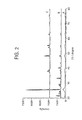
- Figure 2 shows the XRD patterns of pure Ti02, and the doped TiO 2 of Example 2 before and after heat treatment.
- the XRD pattern of the pure TiO 2 synthesized by the solution combustion process can be indexed with anatase phase.
- NH 4 F peaks were seen before heat treatment, which disappeared after heating that 600°C for 2 hours.
- the rutile and brookite phases of TiO 2 were not observed. It was found that anatase phase was restored even after calcining at 800°C suggesting that doping stabilizes the anatase phase.
- FIG. 3 shows TG-DTA curves of doped TiO 2 (before heat treatment). At about 300°C a small exothermic peak was observed , which was presumable due to sublimation of NH 4 F. A broad exothermic peak exists around 440°C, which corresponds to the crystallization of TiO 2 from amorphous phase to the anatase phase. The DTA curve also shows a small exotherm at about 500°C, which was attributed to decomposition of organic substances containing the doped TiO 2 precursor.
- the Tg can be divided into 3 stages. The total weight loss in the whole temperature range was 45% for the doped TiO 2 .
- the first stage was from 250 to 410°C, which was caused by sublimation of NH 4 F.
- the second stage was from 400 to 520°C, which can be assigned to the combustion and carbonization of organic impurities in the precursor.
- the third stage was from 500 to 800°C, where the mass loss was minimal and the mass was relatively constant. This phase can be attributed to the incorporation of the dopant into the TiO 2 crystalline anatase structure, i.e., carbon, nitrogen, and fluorine incorporated into the material.
- XPS of the Ti(2p) core level spectrum for the doped TiO 2 showed peaks at 458.4 and 464.5 eV, which are significantly lower than the binding energy of pure TiO 2 such as that obtained from Degussa P25, which had a binding energy of 459.5 eV. These peaks can be assigned to Ti 4+( 2p 3/2 ) and Ti 4+ (2p 1/2 ), respectively. While not wanting to be bound by theory, the shift in the binding energy of Ti 2p 2/3 peak to lower energies might be assigned to the reduction of Ti 4+ to Ti 3+ .
- the O(1s) core level spectrum of the doped TiO 2 shows two peaks at 529.5 and 531.0 eV.
- the peak at 531.0 eV could be attributed to the surface hydroxyl groups or chemisorbed water molecules on the doped titania while the 529.5 eV peak can be attributed to O 2- from the lattice.
- the C(1s) spectrum showed a peak at 284.6 eV, which can be assigned to graphitic carbon. Again, not wanting to be bound by theory, this peak may be caused by hydrocarbon/oxidized hydrocarbon on the doped TiO 2 . However, it is feasible that the carbon is present due to the hydrocarbon-based fuel used in the combustion synthesis. Further, the maximum heating temperature was 600°C during the synthesis and there was no observed weight loss in TGA above 600°C, which would indicate that there was no free carbon left. However, the possibility of absorption of carbon anions cannot be ruled out.
- the absorption spectra of doped TiO 2 as a function of dopant concentration is shown in Figure 10 .
- a new absorption band was observed in the visible region of 400 to 500nm due to formation of Ti +3 affecting the conduction band and the presence of C(2p) levels affecting the valence band as discussed above.
- the fundamental absorption edge of doped TiO 2 was also shifted to higher wavelength, corresponds to the 2.6 eV transition. For various doping concentration, the amount of shift was different.
- the absorbance increased with the atomic percentage of dopant.
- the fuel used in the combustion synthesis also had a strong effect on the visible absorption properties.
- the maximum visible absorption was observed for glycine compared to other fuels such as urea and ammonium acetate.
- the data is shown relative to undoped TiO 2 .
Landscapes
- Engineering & Computer Science (AREA)
- Power Engineering (AREA)
- Microelectronics & Electronic Packaging (AREA)
- Manufacturing & Machinery (AREA)
- Hybrid Cells (AREA)
- Inorganic Compounds Of Heavy Metals (AREA)
- Photovoltaic Devices (AREA)
Applications Claiming Priority (1)
| Application Number | Priority Date | Filing Date | Title |
|---|---|---|---|
| US12/025,209 US20090194149A1 (en) | 2008-02-04 | 2008-02-04 | Low band gap semiconductor oxides, processes for making the same, and dye sensitized solar cells containing the same |
Publications (1)
| Publication Number | Publication Date |
|---|---|
| EP2085984A1 true EP2085984A1 (de) | 2009-08-05 |
Family
ID=40578572
Family Applications (1)
| Application Number | Title | Priority Date | Filing Date |
|---|---|---|---|
| EP09151871A Withdrawn EP2085984A1 (de) | 2008-02-04 | 2009-02-02 | Oxide für Halbleiter mit geringem Bandabstand, Verfahren zu deren Herstellung und farbstoffsensibilisierte Solarzellen, die diese enthalten |
Country Status (4)
| Country | Link |
|---|---|
| US (1) | US20090194149A1 (de) |
| EP (1) | EP2085984A1 (de) |
| CN (1) | CN101525153A (de) |
| AU (1) | AU2009200151A1 (de) |
Cited By (1)
| Publication number | Priority date | Publication date | Assignee | Title |
|---|---|---|---|---|
| CN121231405A (zh) * | 2025-12-01 | 2025-12-30 | 攀西钒钛检验检测院 | 钨钛固溶体中游离碳含量的检测方法 |
Families Citing this family (5)
| Publication number | Priority date | Publication date | Assignee | Title |
|---|---|---|---|---|
| US20120073640A1 (en) * | 2010-09-24 | 2012-03-29 | Ut-Battelle, Llc | Pulsed photothermal phase transformation control for titanium oxide structures and reversible bandgap shift for solar absorption |
| CN102103931B (zh) * | 2011-01-13 | 2012-07-18 | 宁波大学 | 氮掺杂二氧化钛光阳极及其制备方法和应用 |
| GB2499974B (en) * | 2011-12-28 | 2014-10-01 | 3Gsolar Photovoltaics Ltd | Titania microstructure in a dye solar cell |
| WO2014180780A1 (en) * | 2013-05-06 | 2014-11-13 | Greatcell Solar S.A. | Organic-inorganic perovskite based solar cell |
| CN113555572A (zh) * | 2021-07-22 | 2021-10-26 | 广东工业大学 | 质子交换膜燃料电池催化剂及其制备方法 |
Citations (1)
| Publication number | Priority date | Publication date | Assignee | Title |
|---|---|---|---|---|
| US20060210798A1 (en) * | 2005-03-16 | 2006-09-21 | Clemens Burda | Doped metal oxide nanoparticles and methods for making and using same |
Family Cites Families (4)
| Publication number | Priority date | Publication date | Assignee | Title |
|---|---|---|---|---|
| US6291763B1 (en) * | 1999-04-06 | 2001-09-18 | Fuji Photo Film Co., Ltd. | Photoelectric conversion device and photo cell |
| US6946597B2 (en) * | 2002-06-22 | 2005-09-20 | Nanosular, Inc. | Photovoltaic devices fabricated by growth from porous template |
| US6936761B2 (en) * | 2003-03-29 | 2005-08-30 | Nanosolar, Inc. | Transparent electrode, optoelectronic apparatus and devices |
| US7446207B2 (en) * | 2005-09-27 | 2008-11-04 | Ctci Foundation | Organic dye used in dye-sensitized solar cell |
-
2008
- 2008-02-04 US US12/025,209 patent/US20090194149A1/en not_active Abandoned
-
2009
- 2009-01-15 AU AU2009200151A patent/AU2009200151A1/en not_active Abandoned
- 2009-02-02 EP EP09151871A patent/EP2085984A1/de not_active Withdrawn
- 2009-02-04 CN CN200910009688A patent/CN101525153A/zh active Pending
Patent Citations (1)
| Publication number | Priority date | Publication date | Assignee | Title |
|---|---|---|---|---|
| US20060210798A1 (en) * | 2005-03-16 | 2006-09-21 | Clemens Burda | Doped metal oxide nanoparticles and methods for making and using same |
Non-Patent Citations (6)
| Title |
|---|
| CLEMENS BURDA ET AL: "Enhanced Nitrogen Doping in TiO2 Nanoparticles", NANO LETTERS, ACS, WASHINGTON, DC, US, vol. 3, no. 8, 1 January 2003 (2003-01-01), pages 1049 - 1051, XP007908496, ISSN: 1530-6984 * |
| DAOBAO CHU ET AL: "Efficient carbon-doped nanostructured TiO2 (anatase) film for photoelectrochemical solar cells", JOURNAL OF NANOPARTICLE RESEARCH ; AN INTERDISCIPLINARY FORUM FOR NANOSCALE SCIENCE AND TECHNOLOGY, KLUWER ACADEMIC PUBLISHERS, DO, vol. 10, no. 2, 11 May 2007 (2007-05-11), pages 357 - 363, XP019555350, ISSN: 1572-896X * |
| JIAGUO YU ET AL: "Effects of acidic and basic hydrolysis catalysts on the photocatalytic activity and microstructures of bimodal mesoporous titania", JOURNAL OF CATALYSIS, ACADEMIC PRESS, DULUTH, MN, US, vol. 217, 1 January 2003 (2003-01-01), pages 69 - 78, XP007908508, ISSN: 0021-9517 * |
| JIMMY C YU ET AL: "Effects of F- Doping on the Photocatalytic Activity and Microstructures of Nanocrystalline TiO2 Powders", CHEMISTRY OF MATERIALS, AMERICAN CHEMICAL SOCIETY, WASHINGTON, US, vol. 14, no. 9, 1 January 2002 (2002-01-01), pages 3808 - 3816, XP007908501, ISSN: 0897-4756 * |
| LI ET AL: "Origin of visible-light-driven photocatalysis: A comparative study on N/F-doped and N-F-codoped TiO2 powders by means of experimental characterizations and theoretical calculations", JOURNAL OF SOLID STATE CHEMISTRY, ORLANDO, FL, US, vol. 178, no. 11, 1 November 2005 (2005-11-01), pages 3293 - 3302, XP005153449, ISSN: 0022-4596 * |
| TINGLI MA ET AL: "HIGH-EFFICIENCY DYE-SENSITIZED SOLAR CELL BASED ON A NITROGEN-DOPED NANOSTRUCTURED TITANIA ELECTRODE", NANO LETTERS, ACS, WASHINGTON, DC, US, vol. 5, no. 12, 1 December 2005 (2005-12-01), pages 2543 - 2547, XP008078106, ISSN: 1530-6984 * |
Cited By (1)
| Publication number | Priority date | Publication date | Assignee | Title |
|---|---|---|---|---|
| CN121231405A (zh) * | 2025-12-01 | 2025-12-30 | 攀西钒钛检验检测院 | 钨钛固溶体中游离碳含量的检测方法 |
Also Published As
| Publication number | Publication date |
|---|---|
| AU2009200151A1 (en) | 2009-08-20 |
| CN101525153A (zh) | 2009-09-09 |
| US20090194149A1 (en) | 2009-08-06 |
Similar Documents
| Publication | Publication Date | Title |
|---|---|---|
| Ünlü et al. | Effect of Cu and Mn amounts doped to TiO2 on the performance of DSSCs | |
| Krishnapriya et al. | MOF-derived Co2+-doped TiO2 nanoparticles as photoanodes for dye-sensitized solar cells | |
| Wu et al. | Sulfur substitution and defect engineering in an unfavored MnMoO4 catalyst for efficient hydrogen evolution under visible light | |
| Dong et al. | One-step hydrothermal synthesis of Ag decorated TiO2 nanoparticles for dye-sensitized solar cell application | |
| Dubey et al. | Investigation of structural and optical properties of pure and chromium doped TiO2 nanoparticles prepared by solvothermal method | |
| Wang et al. | Research progress of perovskite materials in photocatalysis-and photovoltaics-related energy conversion and environmental treatment | |
| Chandiran et al. | Ga3+ and Y3+ cationic substitution in mesoporous TiO2 photoanodes for photovoltaic applications | |
| Wategaonkar et al. | Structural, morphological, and optical studies of hydrothermally synthesized Nb-added TiO2 for DSSC application | |
| Nizamudeen et al. | Photovoltaic performance of MOF-derived transition metal doped titania-based photoanodes for DSSCs | |
| Kondalkar et al. | Microwave-assisted rapid synthesis of highly porous TiO2 thin films with nanocrystalline framework for efficient photoelectrochemical conversion | |
| Melhem et al. | Direct photocurrent generation from nitrogen doped TiO2 electrodes in solid-state dye-sensitized solar cells: Towards optically-active metal oxides for photovoltaic applications | |
| Mehnane et al. | Hydrothermal synthesis of TiO 2 nanoparticles doped with trace amounts of strontium, and their application as working electrodes for dye sensitized solar cells: tunable electrical properties & enhanced photo-conversion performance | |
| Aravinthkumar et al. | Promoting active sites of Fe3+ ions in SrTiO3 nanosphere: a superior candidate for high performances of dye-sensitized solar cell and photocatalytic dye degradation | |
| Tsvetkov et al. | Controlled synthesis of nanocrystalline Nb: SrTiO3 electron transport layers for robust interfaces and stable high photovoltaic energy conversion efficiency in perovskite halide solar cells | |
| Rafieh et al. | Enhanced performance of CH3NH3PbI3-based perovskite solar cells by tuning the electrical and structural properties of mesoporous TiO2 layer via Al and Mg doping | |
| US8906711B2 (en) | Method for preparing titania pastes for use in dye-sensitized solar cells | |
| Shariatinia et al. | Application of ZnxLayFezO4 spinel nanomaterial in quantum dot sensitized solar cells | |
| EP2085984A1 (de) | Oxide für Halbleiter mit geringem Bandabstand, Verfahren zu deren Herstellung und farbstoffsensibilisierte Solarzellen, die diese enthalten | |
| Dissanayake et al. | A novel multilayered photoelectrode with nitrogen doped TiO2 for efficiency enhancement in dye sensitized solar cells | |
| Bakhshayesh et al. | Enhanced short circuit current density of dye-sensitized solar cells aided by Sr, V co-doped TiO2 particles | |
| Krishnapriya et al. | Unveiling the Co2+ ion doping-induced hierarchical shape evolution of ZnO: in correlation with magnetic and photovoltaic performance | |
| Venkatachalam et al. | Erbium doped anatase TiO2 nanoparticles for photovoltaic applications | |
| Sha et al. | Efficient pathways for photogenerated charge transfer induced by Co dopants in WO3/TiO2 nanorod arrays | |
| Jayapal et al. | The use of urea as an N‐doping 3D hierarchical preserving agent for titanium dioxide nanostructures tailored for dye‐sensitized solar cells | |
| Bakhshayesh et al. | Efficient dye-sensitised solar cell based on uniform In-doped TiO2 spherical particles |
Legal Events
| Date | Code | Title | Description |
|---|---|---|---|
| PUAI | Public reference made under article 153(3) epc to a published international application that has entered the european phase |
Free format text: ORIGINAL CODE: 0009012 |
|
| AK | Designated contracting states |
Kind code of ref document: A1 Designated state(s): AT BE BG CH CY CZ DE DK EE ES FI FR GB GR HR HU IE IS IT LI LT LU LV MC MK MT NL NO PL PT RO SE SI SK TR |
|
| AX | Request for extension of the european patent |
Extension state: AL BA RS |
|
| 17P | Request for examination filed |
Effective date: 20100205 |
|
| 17Q | First examination report despatched |
Effective date: 20100312 |
|
| AKX | Designation fees paid |
Designated state(s): DE ES IT |
|
| STAA | Information on the status of an ep patent application or granted ep patent |
Free format text: STATUS: THE APPLICATION IS DEEMED TO BE WITHDRAWN |
|
| 18D | Application deemed to be withdrawn |
Effective date: 20100923 |