EP2085213A1 - Tamper-evident push-through packaging - Google Patents
Tamper-evident push-through packaging Download PDFInfo
- Publication number
- EP2085213A1 EP2085213A1 EP20080447002 EP08447002A EP2085213A1 EP 2085213 A1 EP2085213 A1 EP 2085213A1 EP 20080447002 EP20080447002 EP 20080447002 EP 08447002 A EP08447002 A EP 08447002A EP 2085213 A1 EP2085213 A1 EP 2085213A1
- Authority
- EP
- European Patent Office
- Prior art keywords
- push
- layer
- tamper
- polymer
- evident
- Prior art date
- Legal status (The legal status is an assumption and is not a legal conclusion. Google has not performed a legal analysis and makes no representation as to the accuracy of the status listed.)
- Granted
Links
Images


Classifications
-
- B—PERFORMING OPERATIONS; TRANSPORTING
- B65—CONVEYING; PACKING; STORING; HANDLING THIN OR FILAMENTARY MATERIAL
- B65D—CONTAINERS FOR STORAGE OR TRANSPORT OF ARTICLES OR MATERIALS, e.g. BAGS, BARRELS, BOTTLES, BOXES, CANS, CARTONS, CRATES, DRUMS, JARS, TANKS, HOPPERS, FORWARDING CONTAINERS; ACCESSORIES, CLOSURES, OR FITTINGS THEREFOR; PACKAGING ELEMENTS; PACKAGES
- B65D75/00—Packages comprising articles or materials partially or wholly enclosed in strips, sheets, blanks, tubes or webs of flexible sheet material, e.g. in folded wrappers
- B65D75/28—Articles or materials wholly enclosed in composite wrappers, i.e. wrappers formed by associating or interconnecting two or more sheets or blanks
- B65D75/30—Articles or materials enclosed between two opposed sheets or blanks having their margins united, e.g. by pressure-sensitive adhesive, crimping, heat-sealing, or welding
- B65D75/32—Articles or materials enclosed between two opposed sheets or blanks having their margins united, e.g. by pressure-sensitive adhesive, crimping, heat-sealing, or welding one or both sheets or blanks being recessed to accommodate contents
- B65D75/325—Articles or materials enclosed between two opposed sheets or blanks having their margins united, e.g. by pressure-sensitive adhesive, crimping, heat-sealing, or welding one or both sheets or blanks being recessed to accommodate contents one sheet being recessed, and the other being a flat not- rigid sheet, e.g. puncturable or peelable foil
- B65D75/326—Articles or materials enclosed between two opposed sheets or blanks having their margins united, e.g. by pressure-sensitive adhesive, crimping, heat-sealing, or welding one or both sheets or blanks being recessed to accommodate contents one sheet being recessed, and the other being a flat not- rigid sheet, e.g. puncturable or peelable foil and forming one compartment
-
- B—PERFORMING OPERATIONS; TRANSPORTING
- B32—LAYERED PRODUCTS
- B32B—LAYERED PRODUCTS, i.e. PRODUCTS BUILT-UP OF STRATA OF FLAT OR NON-FLAT, e.g. CELLULAR OR HONEYCOMB, FORM
- B32B1/00—Layered products having a non-planar shape
-
- B—PERFORMING OPERATIONS; TRANSPORTING
- B32—LAYERED PRODUCTS
- B32B—LAYERED PRODUCTS, i.e. PRODUCTS BUILT-UP OF STRATA OF FLAT OR NON-FLAT, e.g. CELLULAR OR HONEYCOMB, FORM
- B32B15/00—Layered products comprising a layer of metal
- B32B15/04—Layered products comprising a layer of metal comprising metal as the main or only constituent of a layer, which is next to another layer of the same or of a different material
- B32B15/08—Layered products comprising a layer of metal comprising metal as the main or only constituent of a layer, which is next to another layer of the same or of a different material of synthetic resin
-
- B—PERFORMING OPERATIONS; TRANSPORTING
- B32—LAYERED PRODUCTS
- B32B—LAYERED PRODUCTS, i.e. PRODUCTS BUILT-UP OF STRATA OF FLAT OR NON-FLAT, e.g. CELLULAR OR HONEYCOMB, FORM
- B32B15/00—Layered products comprising a layer of metal
- B32B15/20—Layered products comprising a layer of metal comprising aluminium or copper
-
- B—PERFORMING OPERATIONS; TRANSPORTING
- B32—LAYERED PRODUCTS
- B32B—LAYERED PRODUCTS, i.e. PRODUCTS BUILT-UP OF STRATA OF FLAT OR NON-FLAT, e.g. CELLULAR OR HONEYCOMB, FORM
- B32B27/00—Layered products comprising a layer of synthetic resin
- B32B27/06—Layered products comprising a layer of synthetic resin as the main or only constituent of a layer, which is next to another layer of the same or of a different material
- B32B27/08—Layered products comprising a layer of synthetic resin as the main or only constituent of a layer, which is next to another layer of the same or of a different material of synthetic resin
-
- B—PERFORMING OPERATIONS; TRANSPORTING
- B32—LAYERED PRODUCTS
- B32B—LAYERED PRODUCTS, i.e. PRODUCTS BUILT-UP OF STRATA OF FLAT OR NON-FLAT, e.g. CELLULAR OR HONEYCOMB, FORM
- B32B27/00—Layered products comprising a layer of synthetic resin
- B32B27/06—Layered products comprising a layer of synthetic resin as the main or only constituent of a layer, which is next to another layer of the same or of a different material
- B32B27/10—Layered products comprising a layer of synthetic resin as the main or only constituent of a layer, which is next to another layer of the same or of a different material of paper or cardboard
-
- B—PERFORMING OPERATIONS; TRANSPORTING
- B32—LAYERED PRODUCTS
- B32B—LAYERED PRODUCTS, i.e. PRODUCTS BUILT-UP OF STRATA OF FLAT OR NON-FLAT, e.g. CELLULAR OR HONEYCOMB, FORM
- B32B27/00—Layered products comprising a layer of synthetic resin
- B32B27/18—Layered products comprising a layer of synthetic resin characterised by the use of special additives
- B32B27/20—Layered products comprising a layer of synthetic resin characterised by the use of special additives using fillers, pigments, thixotroping agents
-
- B—PERFORMING OPERATIONS; TRANSPORTING
- B32—LAYERED PRODUCTS
- B32B—LAYERED PRODUCTS, i.e. PRODUCTS BUILT-UP OF STRATA OF FLAT OR NON-FLAT, e.g. CELLULAR OR HONEYCOMB, FORM
- B32B27/00—Layered products comprising a layer of synthetic resin
- B32B27/30—Layered products comprising a layer of synthetic resin comprising vinyl (co)polymers; comprising acrylic (co)polymers
- B32B27/308—Layered products comprising a layer of synthetic resin comprising vinyl (co)polymers; comprising acrylic (co)polymers comprising acrylic (co)polymers
-
- B—PERFORMING OPERATIONS; TRANSPORTING
- B32—LAYERED PRODUCTS
- B32B—LAYERED PRODUCTS, i.e. PRODUCTS BUILT-UP OF STRATA OF FLAT OR NON-FLAT, e.g. CELLULAR OR HONEYCOMB, FORM
- B32B27/00—Layered products comprising a layer of synthetic resin
- B32B27/32—Layered products comprising a layer of synthetic resin comprising polyolefins
-
- B—PERFORMING OPERATIONS; TRANSPORTING
- B32—LAYERED PRODUCTS
- B32B—LAYERED PRODUCTS, i.e. PRODUCTS BUILT-UP OF STRATA OF FLAT OR NON-FLAT, e.g. CELLULAR OR HONEYCOMB, FORM
- B32B27/00—Layered products comprising a layer of synthetic resin
- B32B27/34—Layered products comprising a layer of synthetic resin comprising polyamides
-
- B—PERFORMING OPERATIONS; TRANSPORTING
- B32—LAYERED PRODUCTS
- B32B—LAYERED PRODUCTS, i.e. PRODUCTS BUILT-UP OF STRATA OF FLAT OR NON-FLAT, e.g. CELLULAR OR HONEYCOMB, FORM
- B32B27/00—Layered products comprising a layer of synthetic resin
- B32B27/36—Layered products comprising a layer of synthetic resin comprising polyesters
-
- B—PERFORMING OPERATIONS; TRANSPORTING
- B32—LAYERED PRODUCTS
- B32B—LAYERED PRODUCTS, i.e. PRODUCTS BUILT-UP OF STRATA OF FLAT OR NON-FLAT, e.g. CELLULAR OR HONEYCOMB, FORM
- B32B7/00—Layered products characterised by the relation between layers; Layered products characterised by the relative orientation of features between layers, or by the relative values of a measurable parameter between layers, i.e. products comprising layers having different physical, chemical or physicochemical properties; Layered products characterised by the interconnection of layers
- B32B7/04—Interconnection of layers
- B32B7/05—Interconnection of layers the layers not being connected over the whole surface, e.g. discontinuous connection or patterned connection
-
- B—PERFORMING OPERATIONS; TRANSPORTING
- B32—LAYERED PRODUCTS
- B32B—LAYERED PRODUCTS, i.e. PRODUCTS BUILT-UP OF STRATA OF FLAT OR NON-FLAT, e.g. CELLULAR OR HONEYCOMB, FORM
- B32B7/00—Layered products characterised by the relation between layers; Layered products characterised by the relative orientation of features between layers, or by the relative values of a measurable parameter between layers, i.e. products comprising layers having different physical, chemical or physicochemical properties; Layered products characterised by the interconnection of layers
- B32B7/04—Interconnection of layers
- B32B7/06—Interconnection of layers permitting easy separation
-
- B—PERFORMING OPERATIONS; TRANSPORTING
- B32—LAYERED PRODUCTS
- B32B—LAYERED PRODUCTS, i.e. PRODUCTS BUILT-UP OF STRATA OF FLAT OR NON-FLAT, e.g. CELLULAR OR HONEYCOMB, FORM
- B32B7/00—Layered products characterised by the relation between layers; Layered products characterised by the relative orientation of features between layers, or by the relative values of a measurable parameter between layers, i.e. products comprising layers having different physical, chemical or physicochemical properties; Layered products characterised by the interconnection of layers
- B32B7/04—Interconnection of layers
- B32B7/12—Interconnection of layers using interposed adhesives or interposed materials with bonding properties
-
- A—HUMAN NECESSITIES
- A61—MEDICAL OR VETERINARY SCIENCE; HYGIENE
- A61M—DEVICES FOR INTRODUCING MEDIA INTO, OR ONTO, THE BODY; DEVICES FOR TRANSDUCING BODY MEDIA OR FOR TAKING MEDIA FROM THE BODY; DEVICES FOR PRODUCING OR ENDING SLEEP OR STUPOR
- A61M5/00—Devices for bringing media into the body in a subcutaneous, intra-vascular or intramuscular way; Accessories therefor, e.g. filling or cleaning devices, arm-rests
- A61M5/002—Packages specially adapted therefor, e.g. for syringes or needles, kits for diabetics
-
- B—PERFORMING OPERATIONS; TRANSPORTING
- B32—LAYERED PRODUCTS
- B32B—LAYERED PRODUCTS, i.e. PRODUCTS BUILT-UP OF STRATA OF FLAT OR NON-FLAT, e.g. CELLULAR OR HONEYCOMB, FORM
- B32B2255/00—Coating on the layer surface
- B32B2255/10—Coating on the layer surface on synthetic resin layer or on natural or synthetic rubber layer
-
- B—PERFORMING OPERATIONS; TRANSPORTING
- B32—LAYERED PRODUCTS
- B32B—LAYERED PRODUCTS, i.e. PRODUCTS BUILT-UP OF STRATA OF FLAT OR NON-FLAT, e.g. CELLULAR OR HONEYCOMB, FORM
- B32B2255/00—Coating on the layer surface
- B32B2255/20—Inorganic coating
- B32B2255/205—Metallic coating
-
- B—PERFORMING OPERATIONS; TRANSPORTING
- B32—LAYERED PRODUCTS
- B32B—LAYERED PRODUCTS, i.e. PRODUCTS BUILT-UP OF STRATA OF FLAT OR NON-FLAT, e.g. CELLULAR OR HONEYCOMB, FORM
- B32B2307/00—Properties of the layers or laminate
- B32B2307/30—Properties of the layers or laminate having particular thermal properties
- B32B2307/31—Heat sealable
-
- B—PERFORMING OPERATIONS; TRANSPORTING
- B32—LAYERED PRODUCTS
- B32B—LAYERED PRODUCTS, i.e. PRODUCTS BUILT-UP OF STRATA OF FLAT OR NON-FLAT, e.g. CELLULAR OR HONEYCOMB, FORM
- B32B2307/00—Properties of the layers or laminate
- B32B2307/70—Other properties
- B32B2307/724—Permeability to gases, adsorption
- B32B2307/7242—Non-permeable
- B32B2307/7244—Oxygen barrier
-
- B—PERFORMING OPERATIONS; TRANSPORTING
- B32—LAYERED PRODUCTS
- B32B—LAYERED PRODUCTS, i.e. PRODUCTS BUILT-UP OF STRATA OF FLAT OR NON-FLAT, e.g. CELLULAR OR HONEYCOMB, FORM
- B32B2307/00—Properties of the layers or laminate
- B32B2307/70—Other properties
- B32B2307/748—Releasability
-
- B—PERFORMING OPERATIONS; TRANSPORTING
- B32—LAYERED PRODUCTS
- B32B—LAYERED PRODUCTS, i.e. PRODUCTS BUILT-UP OF STRATA OF FLAT OR NON-FLAT, e.g. CELLULAR OR HONEYCOMB, FORM
- B32B2435/00—Closures, end caps, stoppers
- B32B2435/02—Closures, end caps, stoppers for containers
-
- B—PERFORMING OPERATIONS; TRANSPORTING
- B32—LAYERED PRODUCTS
- B32B—LAYERED PRODUCTS, i.e. PRODUCTS BUILT-UP OF STRATA OF FLAT OR NON-FLAT, e.g. CELLULAR OR HONEYCOMB, FORM
- B32B2439/00—Containers; Receptacles
- B32B2439/80—Medical packaging
-
- B—PERFORMING OPERATIONS; TRANSPORTING
- B65—CONVEYING; PACKING; STORING; HANDLING THIN OR FILAMENTARY MATERIAL
- B65D—CONTAINERS FOR STORAGE OR TRANSPORT OF ARTICLES OR MATERIALS, e.g. BAGS, BARRELS, BOTTLES, BOXES, CANS, CARTONS, CRATES, DRUMS, JARS, TANKS, HOPPERS, FORWARDING CONTAINERS; ACCESSORIES, CLOSURES, OR FITTINGS THEREFOR; PACKAGING ELEMENTS; PACKAGES
- B65D2401/00—Tamper-indicating means
-
- B—PERFORMING OPERATIONS; TRANSPORTING
- B65—CONVEYING; PACKING; STORING; HANDLING THIN OR FILAMENTARY MATERIAL
- B65D—CONTAINERS FOR STORAGE OR TRANSPORT OF ARTICLES OR MATERIALS, e.g. BAGS, BARRELS, BOTTLES, BOXES, CANS, CARTONS, CRATES, DRUMS, JARS, TANKS, HOPPERS, FORWARDING CONTAINERS; ACCESSORIES, CLOSURES, OR FITTINGS THEREFOR; PACKAGING ELEMENTS; PACKAGES
- B65D2575/00—Packages comprising articles or materials partially or wholly enclosed in strips, sheets, blanks, tubes or webs of flexible sheet material, e.g. in folded wrappers
- B65D2575/28—Articles or materials wholly enclosed in composite wrappers, i.e. wrappers formed by association or interconnecting two or more sheets or blanks
- B65D2575/30—Articles or materials enclosed between two opposed sheets or blanks having their margins united, e.g. by pressure-sensitive adhesive, crimping, heat-sealing, or welding
- B65D2575/32—Articles or materials enclosed between two opposed sheets or blanks having their margins united, e.g. by pressure-sensitive adhesive, crimping, heat-sealing, or welding one or both sheets or blanks being recessed to accommodate contents
- B65D2575/3209—Details
- B65D2575/3218—Details with special means for gaining access to the contents
-
- B—PERFORMING OPERATIONS; TRANSPORTING
- B65—CONVEYING; PACKING; STORING; HANDLING THIN OR FILAMENTARY MATERIAL
- B65D—CONTAINERS FOR STORAGE OR TRANSPORT OF ARTICLES OR MATERIALS, e.g. BAGS, BARRELS, BOTTLES, BOXES, CANS, CARTONS, CRATES, DRUMS, JARS, TANKS, HOPPERS, FORWARDING CONTAINERS; ACCESSORIES, CLOSURES, OR FITTINGS THEREFOR; PACKAGING ELEMENTS; PACKAGES
- B65D2575/00—Packages comprising articles or materials partially or wholly enclosed in strips, sheets, blanks, tubes or webs of flexible sheet material, e.g. in folded wrappers
- B65D2575/28—Articles or materials wholly enclosed in composite wrappers, i.e. wrappers formed by association or interconnecting two or more sheets or blanks
- B65D2575/30—Articles or materials enclosed between two opposed sheets or blanks having their margins united, e.g. by pressure-sensitive adhesive, crimping, heat-sealing, or welding
- B65D2575/32—Articles or materials enclosed between two opposed sheets or blanks having their margins united, e.g. by pressure-sensitive adhesive, crimping, heat-sealing, or welding one or both sheets or blanks being recessed to accommodate contents
- B65D2575/3209—Details
- B65D2575/3218—Details with special means for gaining access to the contents
- B65D2575/3245—Details with special means for gaining access to the contents by peeling off the non-rigid sheet
-
- Y—GENERAL TAGGING OF NEW TECHNOLOGICAL DEVELOPMENTS; GENERAL TAGGING OF CROSS-SECTIONAL TECHNOLOGIES SPANNING OVER SEVERAL SECTIONS OF THE IPC; TECHNICAL SUBJECTS COVERED BY FORMER USPC CROSS-REFERENCE ART COLLECTIONS [XRACs] AND DIGESTS
- Y02—TECHNOLOGIES OR APPLICATIONS FOR MITIGATION OR ADAPTATION AGAINST CLIMATE CHANGE
- Y02W—CLIMATE CHANGE MITIGATION TECHNOLOGIES RELATED TO WASTEWATER TREATMENT OR WASTE MANAGEMENT
- Y02W30/00—Technologies for solid waste management
- Y02W30/50—Reuse, recycling or recovery technologies
- Y02W30/80—Packaging reuse or recycling, e.g. of multilayer packaging
-
- Y—GENERAL TAGGING OF NEW TECHNOLOGICAL DEVELOPMENTS; GENERAL TAGGING OF CROSS-SECTIONAL TECHNOLOGIES SPANNING OVER SEVERAL SECTIONS OF THE IPC; TECHNICAL SUBJECTS COVERED BY FORMER USPC CROSS-REFERENCE ART COLLECTIONS [XRACs] AND DIGESTS
- Y10—TECHNICAL SUBJECTS COVERED BY FORMER USPC
- Y10S—TECHNICAL SUBJECTS COVERED BY FORMER USPC CROSS-REFERENCE ART COLLECTIONS [XRACs] AND DIGESTS
- Y10S206/00—Special receptacle or package
- Y10S206/807—Tamper proof
-
- Y—GENERAL TAGGING OF NEW TECHNOLOGICAL DEVELOPMENTS; GENERAL TAGGING OF CROSS-SECTIONAL TECHNOLOGIES SPANNING OVER SEVERAL SECTIONS OF THE IPC; TECHNICAL SUBJECTS COVERED BY FORMER USPC CROSS-REFERENCE ART COLLECTIONS [XRACs] AND DIGESTS
- Y10—TECHNICAL SUBJECTS COVERED BY FORMER USPC
- Y10T—TECHNICAL SUBJECTS COVERED BY FORMER US CLASSIFICATION
- Y10T428/00—Stock material or miscellaneous articles
- Y10T428/13—Hollow or container type article [e.g., tube, vase, etc.]
- Y10T428/1352—Polymer or resin containing [i.e., natural or synthetic]
Definitions
- the present invention relates to a packaging, in particular a thermoformed packaging for medical devices with a multilayer lidding film, said lidding film comprising a coextruded combination of a protective peelable polymer layer and a push-through polymer layer; both polymer layers being incompatible and in direct contact, without any adhesion layer, and the packaging being secured against fraudulent reuse, since it is impossible to reseal the layers by heat due to the incompatibility of their polymers.
- Various packaging's for medical devices comprise a heat-sealable, peelable lidding film that can be heat-sealed again after it has been opened. While these types of packages are preferred because of their ease of opening, the risk of fraudulent reuse has now become a problem. In the case of pre-filled syringes for example, refilling and repacking by malicious individuals constitutes a major public health hazard.
- the present invention describes a packaging material that prevents heat-resealing after use and that is nevertheless easy to open, as no cutting tools are required. Besides the major security feature of being non-reclosable by heat-seal, other features providing tamper evidence such as differences in colours or aspects between the push-through layer and the peelable protective layer may be foreseen.
- Document US 5,522,506 discloses a push-through container comprising a lidding film made of a polyolefin or polyester-based layer with a filler to adjust its mechanical properties.
- the filler is added in order to reduce the elasticity of the push-through film.
- the content can be easily pushed through the film.
- Document EP 0 959 020 discloses a manipulation-proof packaging having a lidding film comprising a push-through plastic layer, a peelable adhesive layer joining a third, resistant push-through top layer, the particular composition of said push-through layer being described in US 5,522,506 .
- Document DE 19613959 discloses a packaging wherein the lidding film comprises a pull-off protective layer, said pull-off layer being peelably connected to a push-through layer by means of an adhesive peelable layer, and said push-through layer being connected to the base web by means of a sealant layer.
- Document US 2005/0003155 discloses a coextruded structure for making tamper-evident packaging wherein the Z tear strength of the inner layer is lower than the adhesive strength of the pressure-sensitive adhesive used to seal the package so that this inner layer is partly broken by the opening of the package and partly delaminates from the outer layer of the coextruded structure. Again, if this package cannot be resealed by simple pressure, it can be resealed by a heat-seal process and it is therefore not secured against fraudulent reuse.
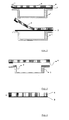
- Figure 1 represents a cross-section view of the packaging of the present invention with the preliminary step of removing the protective polymer layer 4 by peeling by means of an opening aid 5, the push-through layer 3 remaining on the thermoformed base web 1.
- Figure 2 represents a cross-section view of the packaging of the present invention after peeling the protective layer 4 and the removal of the push-trough layer fragments.
- Layers 3 and 4 are essentially made of incompatible polymers and cannot be heat-sealed again on the remaining push-through layer residues 6.
- Figure 3 represents a cross-section view of the coextruded structure comprising a protective polymer layer 4 and a push-through polymer layer 3, the polymers of both layers 3 and 4 being incompatible.
- Figure 4 represents a cross section view of a multilayer lidding film comprising additional coextruded or laminated layers 8,7.
- Figure 5 represents the closed package of the present invention with a syringe inside.
- Figures 6 and 7 represent the procedure for peeling off the transparent protective polymer layer 4, the push-through polymer layer 3 also being transparent and not visible on the figure.
- Figure 8 represents the package after partial peeling of the protective polymer layer 4 with a finger pushing on the push-through polymer layer 3.
- Figure 9 represents the removal of the syringe from the package of the present invention.
- Figure 10 represents a package with a push-through polymer layer 3 having a colour/aspect that is different from the protective polymer layer 4 before opening.
- Figure 11 represents a package with a push-through polymer layer 3 having a colour/aspect that is different from the protective polymer layer 4 after the pushed-through layer has been opened and removed, the push-through layer fragments 6 remaining on the base web 1 (seal seams).
- the present invention aims to provide a tamper-evident push-through packaging secured against fraudulent heat reseal by conventional means in a heat-sealing process.
- the present invention discloses a tamper-evident push-through packaging secured against fraudulent reuse comprising:
- the present invention takes advantage of the low adhesion between coextruded incompatible polymer layers.
- the packaging of the present invention comprises a plastic base web 1, preferably thermoformed, and a multilayer lidding film 2.
- Said lidding film 2 comprises at least one coextruded structure with at least two layers of incompatible polymers coextruded without any adhesive inter layer. The absence of this adhesive interlayer renders the adhesion sufficient after coextrusion to maintain the integrity of the film during the shelf life of the product, but renders said adhesion too low to allow a reseal after peeling.
- the push-through layer 3 of the lidding film is compatible with the base web and has to be chosen essentially among the same polymer family, so that it can be sealed by heat seal on said base web 1, forming a closed pocket containing for instance a medical device, said push-through layer 3 having a thickness and composition which can be easily pushed through to have access to said medical device.
- a part of the lidding film 2 can remain unsealed, producing an opening aid 5, so that the user can grip said opening aid with his fingers and peel off the protective polymer layer 4.
- the protective polymer layer 4 can be easily peeled-off from said push-through polymer layer 3.
- the peel strength between the layer 3 and 4 is such that an easy peeling is possible without tearing the push-through polymer layer 4.
- This protective polymer layer 4 provides, along with possible additional coextruded or laminated layers, both the necessary mechanical strength to fulfil his protective function and, if needed, a barrier against oxygen/water.
- the required peel strength between the push-through polymer layer 3 and the protective layer 4 is achieved by using coextrusion techniques.
- the coextrusion of a polymer layer A and a polymer layer B, with A and B being specific incompatible polymer types, provides the desired peel strength.
- incompatible polymers although being frequently used by the man skilled in the art, is not univocal in the technical community, some authors defining it as immiscible polymers, others by interfacial tension or interfacial adhesion levels. In the following paragraphs of the present document is defined what should be understood by incompatible polymers.
- Two polymers are said to be non-miscible when the free energy of the mixture ( ⁇ G mix ) is greater than or equal to zero.
- Two polymers are said to be non-miscible and compatible when the free energy of the mixture is greater than or equal to zero, when modifications of the respective vitreous transition temperatures (Tg) of the partners can be observed, when the mixture has a Flory-Huggins parameter ⁇ (chi) that is low but greater than zero, and when the interface tension is low.
- the interface tension which is proportional to the square of the Flory-Huggins parameter ⁇ (chi), is considered "low” when it is between 0 and 2mN/m.
- Two polymers are said to be non-miscible and incompatible when the free energy of the mixture is greater than or equal to zero, when no modification of the respective vitreous transition temperatures (Tg) of the partners can be observed, when the mixture has a Flory-Huggins parameter ⁇ (chi) greater than zero, and when the interface tension is high.
- the interface tension which is proportional to the square of the Flory-Huggins parameter ⁇ (chi), is considered "high" when it is greater than 2mN/m.
- the push-through and protective layers 3 and 4 which are non-miscible and incompatible, adhere sufficiently to each other in their "co-extruded layer state" but do not provide sufficient seal strength once they are peeled off and submitted to a heat-seal trial.
- this thin push-through polymer layer 3 is preferably such that:
- the base web 1 is a common plastic web comprising one or more layer based for instance on PETG, PET-GAG, APET, PVC, PP, Nylon//PE, PP/PE, PETG//PE, APET/PE, ... This type of base webs is widely used for packed medical devices, syringes and the like.
- the multilayer lidding film 2 comprises a peelable co-extruded film with at least a push-through polymer layer 3 on one side and a protective polymer layer 4 on the other side.
- the coextruded film of two layers (3,4) can be used alone ( Fig. 3 ) or in combination with further additional layers ( Fig. 4 ).
- the desired peel strength between the push-through polymer layer 3 and the protective layer 4 can be achieved by co-extruding specific types of polymers.
- incompatible polymer combinations that result in the desired interlayer adhesion are PETG/PP, PE/APET, APET/PE, PETG/PE, PE/PETG, PE/PA, PE/PP, PP/PE, EMA/PA. It is important to emphasize here that those structures are produced without tie layers between the layers 3 and 4. They are interlayer-free.
- the 180°-peel strength between the push-through polymer layer 3 and the protective polymer layer 4 varies between 0.3-3.5N/15mm.
- the puncture resistance of the push-through layer should be lower than 7N/8mm 2 , preferably lower than 4N/8mm 2 and this at a film thickness of maximum 25 ⁇ m, and preferably of maximum 20 ⁇ m.
- a certain amount of filler may be added in order to give said layer the desired rupture properties, such as disclosed in US 5,522,506 .
- the addition of such filler is not needed when the thickness of the push-through polymer layer 3 is sufficiently low.
- the absence of filler allows to maintain the transparency of the layer, if needed.
- the polymers used in both layer 3 and 4 may be random, block, alternating, and/or graft copolymers of the above-mentioned types of polymers prepared by polymerising two or more comonomers and thus including dipolymers, terpolymers, such as copolymers of polyethylene and vinylacetate (EVA), methyl acrylate (EMA), (meth) acrylic acid, ...
- EVA polyethylene and vinylacetate
- EMA methyl acrylate
- acrylic acid ...
- the above-mentioned polymers may be blended with one or more other types of polymer providing the required mechanical/sealing properties and the required adhesion and peelability between the layers 3 and 4 is given.
- the coextruded protective polymer layer 4 has a low softening temperature (Tm or Tg), such as LDPE or PETG, the coextrusion or lamination of an additional layer with a polymer having a higher softening temperature is recommended in order to be able to seal the multilayer lidding film 2 onto the base web 1.
- Tm or Tg softening temperature
- the push-through polymer layer 3 is preferably made of a thin layer of less than 20 ⁇ m that can be both easily ruptured and heat-sealed (tight seal) onto the base web 1.
- the structure of the multilayer lidding film 2 is the following ( Fig. 4 ):
- Additional layers that are of interest for lamination with the co-extruded film (3,4) are OPET, OPA, PA, OPP, aluminium foil containing a film, paper containing film, ... ( Fig. 4 ).
- a vapour-deposited layer of aluminium, aluminiumoxide, siliciumoxide, ... may be applied on this protective film layer (OPET, OPP are widely used for this purpose).
- the lamination with an aluminium foil type of film may also be of interest in this perspective.
- the laminated protective film structure 7 may be a laminate itself of two or more layers as well. Both adhesive lamination and extrusion lamination may be used.
- the main security feature provided by the claimed packaging is the impossibility to reseal the lidding film 2 by conventional sealing methods. This is due to always remaining residual material 6 of the push-through layer that is left on the seal seam of the bottom web 1. Once the package has been opened and the ruptured push-through polymer layer 3 covering the pocket has been removed, a subsequent heat reseal becomes impossible. This unique feature can only be achieved by combining specific polymer types in the push-through polymer layer 3 and the protective polymer layer 4, as explained above.
- Another possible security feature providing tamper evidence is the use of a push-through polymer layer 3 having another colour/aspect than the protective polymer layer 4. Once the package has been opened and the push-through polymer layer 3 has been ruptured and removed, it is impossible to reproduce the aspect of the original package, as illustrated in Fig. 10 and 11 .
- a packaging comprising
- the coextrudate (3,4) is then laminated on the PP side with an additional layer 7 of OPET (Mylar 800 DuPont Teijin Films), 12 ⁇ m, using a 2K-PU adhesive 8.
- OPET Mylar 800 DuPont Teijin Films
- a packaging comprising
- the coextrudate (3,4) is then laminated on the PETG side with an additional layer 7 of OPA (Capran 1200 from Honeywell), 15 ⁇ m, using a 2K-PU adhesive 8.
- OPA Capran 1200 from Honeywell
- a packaging comprising
- the coextrudate (3,4) is then laminated on the PP side with an additional layer 7 of OPET (Mylar 800 from DuPont Teijin Films), 12 ⁇ m using a 2K-PU adhesive 8.
- OPET Mylar 800 from DuPont Teijin Films
- a packaging comprising
- This lidding film is not further laminated, since the polyamide layer already has a high melting temperature.
- the coextrudate (3,4) is then laminated on the LDPE side with an additional layer 7 of AlOx coated oriented PET (Camclear RHB-Y from AMCOR-Camvac), 12 ⁇ m, using a 2K-PU adhesive 8.
- a packaging comprising
- the coextrudate (3,4) is then laminated on the PETG side with an additional layer 7 of a laminate of Aluminium foil (from Hydro Aluminium) 12 ⁇ m and oriented PET (Mylar 800 DuPont Teijin Films) 12 ⁇ m using a 2K-PU adhesive 8.
- the base web 1 is thermoformed on a Multivac packaging machine (packs of 6x13cm, 1.5cm deep) and the multilayer lidding film is sealed on the base web using the following conditions:
Landscapes
- Engineering & Computer Science (AREA)
- Mechanical Engineering (AREA)
- Chemical & Material Sciences (AREA)
- Composite Materials (AREA)
- Wrappers (AREA)
- Closures For Containers (AREA)
- Packages (AREA)
- Laminated Bodies (AREA)
Abstract
- a polymer base web (1) comprising at least one pocket;
- a multilayer lidding film (2) covering said pocket, said multilayer lidding film (2) comprising on its seal side a coextruded polymer film, said coextruded polymer film comprising a push-through polymer layer (3) and a peelable protective polymer layers (4), the polymers of both layers (3,4) being incompatible and in direct contact with each other, without interlayer, the adhesion between said push- through polymer layer (3) and said peelable protective polymer layer (4) being lower than the seal strength between said polymer base web (1) and said push-through polymer layer (3).
Description
- The present invention relates to a packaging, in particular a thermoformed packaging for medical devices with a multilayer lidding film, said lidding film comprising a coextruded combination of a protective peelable polymer layer and a push-through polymer layer; both polymer layers being incompatible and in direct contact, without any adhesion layer, and the packaging being secured against fraudulent reuse, since it is impossible to reseal the layers by heat due to the incompatibility of their polymers.
- Various packaging's for medical devices comprise a heat-sealable, peelable lidding film that can be heat-sealed again after it has been opened. While these types of packages are preferred because of their ease of opening, the risk of fraudulent reuse has now become a problem. In the case of pre-filled syringes for example, refilling and repacking by malicious individuals constitutes a major public health hazard.
- The present invention describes a packaging material that prevents heat-resealing after use and that is nevertheless easy to open, as no cutting tools are required. Besides the major security feature of being non-reclosable by heat-seal, other features providing tamper evidence such as differences in colours or aspects between the push-through layer and the peelable protective layer may be foreseen.
- Document
US 5,522,506 discloses a push-through container comprising a lidding film made of a polyolefin or polyester-based layer with a filler to adjust its mechanical properties. The filler is added in order to reduce the elasticity of the push-through film. Thus, the content can be easily pushed through the film. - Document
EP 0 959 020 discloses a manipulation-proof packaging having a lidding film comprising a push-through plastic layer, a peelable adhesive layer joining a third, resistant push-through top layer, the particular composition of said push-through layer being described inUS 5,522,506 . - Document
DE 19613959 discloses a packaging wherein the lidding film comprises a pull-off protective layer, said pull-off layer being peelably connected to a push-through layer by means of an adhesive peelable layer, and said push-through layer being connected to the base web by means of a sealant layer. - Document
US 5,172,812 discloses a lidding closure comprising a push-through layer laminated by means of a peelable adhesive on a paperboard sheet. - The presence of an adhesive layer between the protective and push-through layers in
DE 19613959 ,EP 0 959 020 andUS 5,172,812 renders it resealable by a standard heat-seal process. Furthermore, in order to achieve peelability between two layers, an additional layer having the desired peel strength level is usually added. DocumentUS 6,006,913 describes the composition of such a peelable layer. Another possibility is the use of a peelable adhesive. - Document
US 2005/0003155 discloses a coextruded structure for making tamper-evident packaging wherein the Z tear strength of the inner layer is lower than the adhesive strength of the pressure-sensitive adhesive used to seal the package so that this inner layer is partly broken by the opening of the package and partly delaminates from the outer layer of the coextruded structure. Again, if this package cannot be resealed by simple pressure, it can be resealed by a heat-seal process and it is therefore not secured against fraudulent reuse. -
Figure 1 represents a cross-section view of the packaging of the present invention with the preliminary step of removing theprotective polymer layer 4 by peeling by means of anopening aid 5, the push-throughlayer 3 remaining on thethermoformed base web 1. -
Figure 2 represents a cross-section view of the packaging of the present invention after peeling theprotective layer 4 and the removal of the push-trough layer fragments.Layers layer residues 6. -
Figure 3 represents a cross-section view of the coextruded structure comprising aprotective polymer layer 4 and a push-throughpolymer layer 3, the polymers of bothlayers -
Figure 4 represents a cross section view of a multilayer lidding film comprising additional coextruded or laminatedlayers -
Figure 5 represents the closed package of the present invention with a syringe inside. -
Figures 6 and7 represent the procedure for peeling off the transparentprotective polymer layer 4, the push-throughpolymer layer 3 also being transparent and not visible on the figure. -
Figure 8 represents the package after partial peeling of theprotective polymer layer 4 with a finger pushing on the push-throughpolymer layer 3. -
Figure 9 represents the removal of the syringe from the package of the present invention. -
Figure 10 represents a package with a push-through polymer layer 3 having a colour/aspect that is different from theprotective polymer layer 4 before opening. -
Figure 11 represents a package with a push-through polymer layer 3 having a colour/aspect that is different from theprotective polymer layer 4 after the pushed-through layer has been opened and removed, the push-throughlayer fragments 6 remaining on the base web 1 (seal seams). - The present invention aims to provide a tamper-evident push-through packaging secured against fraudulent heat reseal by conventional means in a heat-sealing process.
- The present invention discloses a tamper-evident push-through packaging secured against fraudulent reuse comprising:
- a
polymer base web 1 comprising at least one pocket; - a
multilayer lidding film 2 covering said pocket, saidmultilayer lidding film 2 comprising on its seal side a coextruded polymer film, said coextruded polymer film comprising a push-throughpolymer layer 3 and a peelableprotective polymer layer 4, the polymers of both layers (3,4) being incompatible and in direct contact with each other, without interlayer, the adhesion between said push-throughpolymer layer 3 and said peelableprotective polymer layer 4 being lower than the seal strength between saidpolymer base web 1 and said push-throughpolymer layer 3. - Particular embodiments of the present invention comprise at least one or any suitable combination of the following features:
- the
multilayer lidding film 2 comprises at least one additional layer; - the at least one additional layer is either added by a coextrusion or by a lamination process;
- the at least one additional layer is selected from the group consisting of paper, metal and polymer;
- the adhesion between said push-through
layer 3 and saidprotective layer 4 is between 0,3N/15mm and 3,5N/15mm measured according to ASTM F88-00; - the puncture resistance of the push-through
layer 3 is between 0.6N and 7N measured according to ASTM F1306-90; - the puncture resistance of the push-through
layer 3 is between 1.4N and 4N, measured according to ASTM F1306-90; - the thickness of the push-
trough layer 3 is lower than 20µm; - the thickness of the push-
trough layer 3 is lower than 15µm; - the combinations of the incompatible polymers of the push-through
polymer layer 3 and the peelableprotective polymer layer 4 are selected from the group consisting of PETG/PP block copolymer, PETG/LDPE, ethylen-propylen block copolymer/PETG, MDPE/PP, MDPE/PETG and EMA/PA; - the push-through
polymer layer 3 comprises inorganic filler; - the push-through
polymer layer 3 has another colour and/or aspect than theprotective polymer layer 4; - the compatibility between the polymers of the push-through
layer 3 and thebase web 1 ensures the presence of apermanent seam 6, permanently sealed onto thebase web 1 even after removing the part of the push-trough layer covering the pocket; - the
protective layer 4 cannot be resealed by a heat sealing process on saidseam 6 left by said push-throughlayer 3 after removing the part of the push-throughlayer 3 covering the pocket. - The present invention takes advantage of the low adhesion between coextruded incompatible polymer layers.
- The packaging of the present invention comprises a
plastic base web 1, preferably thermoformed, and amultilayer lidding film 2. Said liddingfilm 2 comprises at least one coextruded structure with at least two layers of incompatible polymers coextruded without any adhesive inter layer. The absence of this adhesive interlayer renders the adhesion sufficient after coextrusion to maintain the integrity of the film during the shelf life of the product, but renders said adhesion too low to allow a reseal after peeling. - The push-through
layer 3 of the lidding film is compatible with the base web and has to be chosen essentially among the same polymer family, so that it can be sealed by heat seal on saidbase web 1, forming a closed pocket containing for instance a medical device, said push-throughlayer 3 having a thickness and composition which can be easily pushed through to have access to said medical device. - In order to ease the opening of the package, a part of the
lidding film 2 can remain unsealed, producing anopening aid 5, so that the user can grip said opening aid with his fingers and peel off theprotective polymer layer 4. - The
protective polymer layer 4 can be easily peeled-off from said push-throughpolymer layer 3. The peel strength between thelayer polymer layer 4. - This
protective polymer layer 4 provides, along with possible additional coextruded or laminated layers, both the necessary mechanical strength to fulfil his protective function and, if needed, a barrier against oxygen/water. - The required peel strength between the push-through
polymer layer 3 and theprotective layer 4 is achieved by using coextrusion techniques. The coextrusion of a polymer layer A and a polymer layer B, with A and B being specific incompatible polymer types, provides the desired peel strength. - The definition of incompatible polymers, although being frequently used by the man skilled in the art, is not univocal in the technical community, some authors defining it as immiscible polymers, others by interfacial tension or interfacial adhesion levels. In the following paragraphs of the present document is defined what should be understood by incompatible polymers.
- Two polymers are said to be non-miscible when the free energy of the mixture (ΔGmix) is greater than or equal to zero.
- Two polymers are said to be non-miscible and compatible when the free energy of the mixture is greater than or equal to zero, when modifications of the respective vitreous transition temperatures (Tg) of the partners can be observed, when the mixture has a Flory-Huggins parameter χ (chi) that is low but greater than zero, and when the interface tension is low. The interface tension, which is proportional to the square of the Flory-Huggins parameter χ (chi), is considered "low" when it is between 0 and 2mN/m.
- Two polymers are said to be non-miscible and incompatible when the free energy of the mixture is greater than or equal to zero, when no modification of the respective vitreous transition temperatures (Tg) of the partners can be observed, when the mixture has a Flory-Huggins parameter χ (chi) greater than zero, and when the interface tension is high. The interface tension, which is proportional to the square of the Flory-Huggins parameter χ (chi), is considered "high" when it is greater than 2mN/m.
- The push-through and
protective layers - When opening the package by using the lidding
film opening aid 5, said push-throughpolymer layer 3 breaks at the seal and theprotective polymer layer 4 starts peeling (seeFig. 1 ). Once theprotective polymer layer 4 has been peeled off, the push-throughpolymer layer 3, which is still intact and covering the packed item, is pushed through in order to have access to the packed item. - Thanks to the use of coextrusion techniques, the additional application of a peelable adhesive layer can be avoided. According to this coextrusion technique, it is also possible to produce a very thin push-through
polymer layer 3. A thickness below 20µm, preferably 15µm or even 10µm is easily achievable, and this low thickness is favourable for the ease of push-through. The lamination of such film thickness is, in practice, extremely difficult. - The nature and thickness of this thin push-through
polymer layer 3 is preferably such that: - it provides the desired peel-strength with the co-extruded protective polymer layer 4 (incompatibility);
- it can be very easily ruptured;
- it is heat-sealable (firm seal) onto the
base web 1, not requiring an additional heat-seal lacquer. - The following examples are only illustrative for the packaging of the present invention.
- The
base web 1 is a common plastic web comprising one or more layer based for instance on PETG, PET-GAG, APET, PVC, PP, Nylon//PE, PP/PE, PETG//PE, APET/PE, ... This type of base webs is widely used for packed medical devices, syringes and the like. - The
multilayer lidding film 2 comprises a peelable co-extruded film with at least a push-throughpolymer layer 3 on one side and aprotective polymer layer 4 on the other side. The coextruded film of two layers (3,4) can be used alone (Fig. 3 ) or in combination with further additional layers (Fig. 4 ). - The desired peel strength between the push-through
polymer layer 3 and theprotective layer 4 can be achieved by co-extruding specific types of polymers. Examples of incompatible polymer combinations that result in the desired interlayer adhesion are PETG/PP, PE/APET, APET/PE, PETG/PE, PE/PETG, PE/PA, PE/PP, PP/PE, EMA/PA. It is important to emphasize here that those structures are produced without tie layers between thelayers - The 180°-peel strength between the push-through
polymer layer 3 and theprotective polymer layer 4 varies between 0.3-3.5N/15mm. - The puncture resistance of the push-through layer, as measured according to ASTM F1306-90, should be lower than 7N/8mm2, preferably lower than 4N/8mm2 and this at a film thickness of maximum 25µm, and preferably of maximum 20µm.
- Depending on the nature and the thickness of the push-through
polymer layer 3, a certain amount of filler may be added in order to give said layer the desired rupture properties, such as disclosed inUS 5,522,506 . The addition of such filler is not needed when the thickness of the push-throughpolymer layer 3 is sufficiently low. The absence of filler allows to maintain the transparency of the layer, if needed. - The polymers used in both
layer - The above-mentioned polymers may be blended with one or more other types of polymer providing the required mechanical/sealing properties and the required adhesion and peelability between the
layers - In case the coextruded
protective polymer layer 4 has a low softening temperature (Tm or Tg), such as LDPE or PETG, the coextrusion or lamination of an additional layer with a polymer having a higher softening temperature is recommended in order to be able to seal themultilayer lidding film 2 onto thebase web 1. - The push-through
polymer layer 3 is preferably made of a thin layer of less than 20µm that can be both easily ruptured and heat-sealed (tight seal) onto thebase web 1. - In order to optimize the properties (puncture resistance, tear resistance, thermal resistance, barrier properties, ...) of the
multilayer lidding film 2, laminating the coextruded film (3,4) with at least one additional layer may be required. In this case, the structure of themultilayer lidding film 2 is the following (Fig. 4 ): - 3: a push-through co-extruded polymer layer that can easily be ruptured (thin layer)
- 4: a protective co-extruded polymer layer, peelable from push-through
layer 3 - 7: a laminated or coextruded additional layer
- 8: an adhesive layer (tie layer/interlayer)
- Additional layers that are of interest for lamination with the co-extruded film (3,4) are OPET, OPA, PA, OPP, aluminium foil containing a film, paper containing film, ... (
Fig. 4 ). - In order to improve the barrier properties of the lidding film, a vapour-deposited layer of aluminium, aluminiumoxide, siliciumoxide, ... may be applied on this protective film layer (OPET, OPP are widely used for this purpose). The lamination with an aluminium foil type of film may also be of interest in this perspective. The laminated
protective film structure 7 may be a laminate itself of two or more layers as well. Both adhesive lamination and extrusion lamination may be used. - The main security feature provided by the claimed packaging is the impossibility to reseal the
lidding film 2 by conventional sealing methods. This is due to always remainingresidual material 6 of the push-through layer that is left on the seal seam of thebottom web 1. Once the package has been opened and the ruptured push-throughpolymer layer 3 covering the pocket has been removed, a subsequent heat reseal becomes impossible. This unique feature can only be achieved by combining specific polymer types in the push-throughpolymer layer 3 and theprotective polymer layer 4, as explained above. - Another possible security feature providing tamper evidence is the use of a push-through
polymer layer 3 having another colour/aspect than theprotective polymer layer 4. Once the package has been opened and the push-throughpolymer layer 3 has been ruptured and removed, it is impossible to reproduce the aspect of the original package, as illustrated inFig. 10 and 11 . - A packaging comprising
- a thermoformed
plastic base web 1 of PETG, 300µm - a
multilayer lidding film 2 comprising a coextruded film obtained by the coextrusion of - a push-through
layer 3 of PETG (Eaststar 6763 from Eastman-Kodak), 8µm and - a peelable
protective layer 4 of PP block-copolymer (RB307MO from Borealis), 30µm - The coextrudate (3,4) is then laminated on the PP side with an
additional layer 7 of OPET (Mylar 800 DuPont Teijin Films), 12µm, using a 2K-PU adhesive 8. - A packaging comprising
- a thermoformed
plastic base web 1 of PP, 300µm - a
multilayer lidding film 2 comprising a coextruded film obtained by the coextrusion of : - a push-through
layer 3 of ethylen-propylene block-copolymer (RD735CF from Borealis), 5µm - a peelable
protective layer 4 of PETG (Eaststar 6763 from Eastman-Kodak), 35µm - The coextrudate (3,4) is then laminated on the PETG side with an
additional layer 7 of OPA (Capran 1200 from Honeywell), 15µm, using a 2K-PU adhesive 8. - A packaging comprising
- a thermoformed
plastic base web 1 of APET/PE, 240µm - a
multilayer lidding film 2 comprising a coextruded film obtained by the coextrusion of : - a push-through
layer 3 of MDPE (LD 151BW from ExxonMobil), 10µm - a peelable
protective layer 4 of a PP block-copolymer (BB213CF from Borealis), 40µm - The coextrudate (3,4) is then laminated on the PP side with an
additional layer 7 of OPET (Mylar 800 from DuPont Teijin Films), 12µm using a 2K-PU adhesive 8. - A packaging comprising
- a thermoformed
plastic base web 1 of PVC, 240µm - a
multilayer lidding film 2 comprising a coextruded film obtained by the coextrusion of : - a push-through
layer 3 of a copolymer of ethylene and methylacrylate (Elvaloy 1218AC from Dupont) containing 30% calcium carbonate, 10µm - a peelable
protective layer 4 of PA (Akulon F132-F from DSM), 40µm - This lidding film is not further laminated, since the polyamide layer already has a high melting temperature.
- Packaging comprising
- a thermoformed
plastic base web 1 of PETG, 240µm - a
multilayer lidding film 2 comprising a coextruded film obtained by the coextrusion of : - a push-through
layer 3 of PETG (Eaststar 6763 from Eastman), 15µm - a peelable
protective layer 4 of LDPE (Sabic 2201 TH00 from Sabic), 50µm - The coextrudate (3,4) is then laminated on the LDPE side with an
additional layer 7 of AlOx coated oriented PET (Camclear RHB-Y from AMCOR-Camvac), 12µm, using a 2K-PU adhesive 8. - A packaging comprising
- a thermoformed
plastic base web 1 of PETG/PE, 300 µm - a
multilayer lidding film 2 comprising a coextruded film obtained by the coextrusion of : - a push-through
layer 3 of 99% MDPE (LD 151BW from ExxonMobil)+1% masterbatch red pigment (Polybatch 5020 from Schulman), 20µm - a peelable
protective layer 4 of PETG (Eaststar 6763 from Eastman), 30µm - The coextrudate (3,4) is then laminated on the PETG side with an
additional layer 7 of a laminate of Aluminium foil (from Hydro Aluminium) 12µm and oriented PET (Mylar 800 DuPont Teijin Films) 12µm using a 2K-PU adhesive 8. - The
base web 1 is thermoformed on a Multivac packaging machine (packs of 6x13cm, 1.5cm deep) and the multilayer lidding film is sealed on the base web using the following conditions: - Pressure : 0.2-0.6MPa
- Temperature : 140-180 °C
- Sealing time : 2-8 seconds
- Peel strength measurements were performed according to ASTM F88-00 with the following parameters:
- Rate of grip separation: 300mm/min
- Tail holding method: supported 180°
- Sample width: 15mm
Puncture resistance measurements were performed according to the standard ASTM F1306-90, with the following parameters: -
- 1. Polymer base web
- 2. Multilayer lidding film
- 3. Push-through polymer layer
- 4. Protective polymer layer
- 5. Opening aid
- 6. Push-through layer residue on the base web after peeling and opening
- 7. Additional protective layer, laminated or coextruded onto the protective polymer layer (4)
- 8. Adhesive layer
- 9. Sealed surfaces
- Cross head speed: 25mm/
| Features | Ex |
| 1 | | | | | | |
| Peel strength between | 0.3 | 0.3 | 0.6 | 3.5 | 0.9 | 0.75 |
| Puncture resistance (N/8mm2) of the push through | 4 | 1.4 | 1.9 | 0.6 | 7 | 3.5 |
Claims (14)
- Tamper-evident push-through packaging secured against fraudulent reuse comprising:- a polymer base web (1) comprising at least one pocket;- a multilayer lidding film (2) covering said pocket, said multilayer lidding film (2) comprising on its seal side a coextruded polymer film, said coextruded polymer film comprising a push-through polymer layer (3) and a peelable protective polymer layer (4), the polymers of both layers (3,4) being incompatible and in direct contact with each other, without interlayer, the adhesion between said push-through polymer layer (3) and said peelable protective polymer layer (4) being lower than the seal strength between said polymer base web (1) and said push-through polymer layer (3).
- A tamper-evident push-through packaging according to Claim 1, wherein said multilayer lidding film (2) comprises at least one additional layer.
- A tamper-evident push-through packaging according to Claim 2, wherein said at least one additional layer is added by either a coextrusion or a lamination process.
- A tamper-evident push-through packaging according to Claim 3, wherein said at least one additional layer is selected from the group consisting of paper, metal and polymer.
- A tamper-evident push-through packaging according to any of the previous claims, wherein the adhesion between said push-through layer (3) and said protective layer (4) is between 0,3N/15mm and 3,5N/15mm measured according to ASTM F88-00.
- A tamper-evident push-through packaging according to any of the previous claims, wherein the puncture resistance of the push-through layer (3) is between 0.6N and 7N, measured according to ASTM F1306-90.
- A tamper-evident push-through packaging according to any of the previous claims, wherein the puncture resistance of the push-through layer (3) is between 1.4N and 4N, measured according to ASTM F1306-90.
- A tamper-evident push-through packaging according to any of the previous claims, wherein the thickness of the push-trough layer (3) is lower than 20µm.
- A tamper-evident push-through packaging according to any of the previous claims, wherein the thickness of the push-trough layer (3) is lower than 15µm.
- A tamper-evident push-through packaging according to any of the previous claims, wherein the combinations of the incompatible polymers of the push-through polymer layer (3) and the peelable protective polymer layer (4) are selected from the group consisting of PETG/PP block copolymer, PETG/LDPE, ethylen-propylen block copolymer/PETG, MDPE/PP, MDPE/PETG and EMA/PA.
- A tamper-evident push-through packaging according to any of the previous claims, wherein the push-through polymer layer (3) comprises inorganic filler.
- A tamper-evident push-through packaging according to any of the previous claims, wherein the push-through polymer layer (3) has another colour and/or aspect than the protective polymer layer (4).
- A tamper-evident push-through packaging according to any of the previous claims, wherein the compatibility between the polymers of the push-through layer (3) and the base web (1) ensures the presence of a permanent seam (6) permanently sealed onto the base web (1) even after removing the part of the push-trough layer covering the pocket.
- A tamper-evident push-through packaging according to Claim 13, wherein said protective layer (4) cannot be resealed by a heat sealing process on said seam (6) left by said push-through layer (3) after removing the part of the push-through layer (3) covering the pocket.
Priority Applications (13)
| Application Number | Priority Date | Filing Date | Title |
|---|---|---|---|
| EP20080447002 EP2085213B1 (en) | 2008-01-30 | 2008-01-30 | Tamper-evident push-through packaging |
| DE200860002214 DE602008002214D1 (en) | 2008-01-30 | 2008-01-30 | Tamper-evident puncture packaging |
| AT08447002T ATE477922T1 (en) | 2008-01-30 | 2008-01-30 | TAMPER-PROOF PUNCH-PROOF PACKAGING |
| PCT/EP2009/050942 WO2009095407A1 (en) | 2008-01-30 | 2009-01-28 | Tamper-evident push-through packaging |
| AU2009209641A AU2009209641A1 (en) | 2008-01-30 | 2009-01-28 | Tamper-evident push-through packaging |
| CN2009801022077A CN101918207A (en) | 2008-01-30 | 2009-01-28 | Tamper-evident press-fit packaging |
| EA201001247A EA201001247A1 (en) | 2008-01-30 | 2009-01-28 | RIPPED PACKAGING WITH OPEN INDICATION |
| JP2010544684A JP2011510874A (en) | 2008-01-30 | 2009-01-28 | Fraud explicit push-through packaging |
| CA 2709173 CA2709173A1 (en) | 2008-01-30 | 2009-01-28 | Tamper-evident push-through packaging |
| US12/864,757 US8056716B2 (en) | 2008-01-30 | 2009-01-28 | Tamper-evident push-through packaging |
| AP2010005302A AP2010005302A0 (en) | 2008-01-30 | 2009-01-28 | Tamper-evident push-through packaging |
| TN2010000296A TN2010000296A1 (en) | 2008-01-30 | 2010-06-23 | Tamper-evident push-turough packaging |
| IL207320A IL207320A0 (en) | 2008-01-30 | 2010-07-29 | Tamper - evident push - through packaging |
Applications Claiming Priority (1)
| Application Number | Priority Date | Filing Date | Title |
|---|---|---|---|
| EP20080447002 EP2085213B1 (en) | 2008-01-30 | 2008-01-30 | Tamper-evident push-through packaging |
Publications (2)
| Publication Number | Publication Date |
|---|---|
| EP2085213A1 true EP2085213A1 (en) | 2009-08-05 |
| EP2085213B1 EP2085213B1 (en) | 2010-08-18 |
Family
ID=39535731
Family Applications (1)
| Application Number | Title | Priority Date | Filing Date |
|---|---|---|---|
| EP20080447002 Active EP2085213B1 (en) | 2008-01-30 | 2008-01-30 | Tamper-evident push-through packaging |
Country Status (13)
| Country | Link |
|---|---|
| US (1) | US8056716B2 (en) |
| EP (1) | EP2085213B1 (en) |
| JP (1) | JP2011510874A (en) |
| CN (1) | CN101918207A (en) |
| AP (1) | AP2010005302A0 (en) |
| AT (1) | ATE477922T1 (en) |
| AU (1) | AU2009209641A1 (en) |
| CA (1) | CA2709173A1 (en) |
| DE (1) | DE602008002214D1 (en) |
| EA (1) | EA201001247A1 (en) |
| IL (1) | IL207320A0 (en) |
| TN (1) | TN2010000296A1 (en) |
| WO (1) | WO2009095407A1 (en) |
Cited By (4)
| Publication number | Priority date | Publication date | Assignee | Title |
|---|---|---|---|---|
| US8657793B2 (en) | 2011-09-30 | 2014-02-25 | Becton Dickinson France, S.A.S | Space saving plunger cap and rod assembly |
| WO2014072677A1 (en) * | 2012-11-09 | 2014-05-15 | Reckitt Benckiser Llc | Single use, foldable dispenser for an adhesive lavatory treatment composition |
| EP2585297B1 (en) | 2010-06-22 | 2018-06-13 | Danapak Flexibles A/S | A sheet, a method of making and using a sheet as a lid for packages |
| EP3851136A1 (en) * | 2020-01-15 | 2021-07-21 | Becton Dickinson France | Packaging for medical devices |
Families Citing this family (45)
| Publication number | Priority date | Publication date | Assignee | Title |
|---|---|---|---|---|
| US8715825B2 (en) | 2005-01-06 | 2014-05-06 | Selig Sealing Products, Inc. | Two-piece pull-tab sealing member with improved heat distribution for a container |
| US8057896B2 (en) * | 2005-01-06 | 2011-11-15 | Selig Sealing Products, Inc. | Pull-tab sealing member with improved heat distribution for a container |
| MX2007012737A (en) | 2005-04-15 | 2008-01-14 | Illinois Tool Works | Seal stock laminate. |
| EP1837288B2 (en) | 2006-03-20 | 2017-05-31 | Selig Sealing Products, Inc. | Vessel closing laminate |
| PL1935636T5 (en) | 2006-12-20 | 2016-05-31 | Selig Sealing Products Inc | Laminate |
| US20080233339A1 (en) * | 2007-03-23 | 2008-09-25 | Thorstensen-Woll Robert William | Laminated container seal with removal tab bound by adhesive |
| US8703265B2 (en) | 2007-03-23 | 2014-04-22 | Selig Sealing Products, Inc. | Container seal with removal tab and piercable holographic security seal |
| US8522990B2 (en) | 2007-03-23 | 2013-09-03 | Selig Sealing Products, Inc. | Container seal with removal tab and holographic security ring seal |
| US9624008B2 (en) | 2007-03-23 | 2017-04-18 | Selig Sealing Products, Inc. | Container seal with removal tab and security ring seal |
| ES2334275T3 (en) * | 2007-06-22 | 2010-03-08 | Selig Sealing Products, Inc. | BOARD FOR A CONTAINER. |
| EP2183106B1 (en) | 2007-08-24 | 2016-10-12 | Selig Sealing Products, Inc. | Multi-purpose covering for hygienically covering a container top |
| JP5244553B2 (en) * | 2008-11-17 | 2013-07-24 | 日東電工株式会社 | Blister packaging |
| US9404665B1 (en) * | 2010-08-30 | 2016-08-02 | Khart Panels LLC | Radiant panel system having increased efficiency |
| US8684217B2 (en) * | 2010-12-17 | 2014-04-01 | Curwood, Inc. | Easy-open package |
| WO2012135353A1 (en) | 2011-03-28 | 2012-10-04 | Selig Sealing Products, Inc. | Laminate structure to stabilize a dimensionally unstable layer |
| AU2012272897B2 (en) | 2011-06-24 | 2017-02-16 | Selig Sealing Products, Inc. | Sealing member with removable portion for exposing and forming a dispensing feature |
| US8580067B2 (en) * | 2012-02-23 | 2013-11-12 | Chroma Paper, Llc. | Thermo-sealing control method and packaging for resealable packaging |
| WO2013134665A1 (en) | 2012-03-08 | 2013-09-12 | Selig Sealing Products, Inc. | Container sealing member with protected security component and removal tab |
| US8727117B2 (en) * | 2012-07-16 | 2014-05-20 | Becton, Dickinson And Company | Package for syringe |
| US9193513B2 (en) | 2012-09-05 | 2015-11-24 | Selig Sealing Products, Inc. | Tabbed inner seal |
| US9028963B2 (en) | 2012-09-05 | 2015-05-12 | Selig Sealing Products, Inc. | Tamper evident tabbed sealing member having a foamed polymer layer |
| CN110126376A (en) | 2012-12-07 | 2019-08-16 | 比密斯公司 | Multilayer film |
| CA2846021C (en) | 2013-03-15 | 2021-06-08 | Selig Sealing Products, Inc. | Inner seal with an overlapping partial tab layer |
| CA2846164C (en) | 2013-03-15 | 2020-11-10 | Selig Sealing Products, Inc. | Inner seal with a sub tab layer |
| EP3102499B1 (en) * | 2014-02-05 | 2019-11-20 | Selig Sealing Products, Inc. | Dual aluminum tamper indicating tabbed sealing member |
| US20150225151A1 (en) | 2014-02-11 | 2015-08-13 | Christopher L. Osborn | Anti-Scalping Transdermal Patch Packaging Film |
| US9468584B2 (en) | 2014-04-02 | 2016-10-18 | Bemis Company, Inc. | Child-resistant packaging |
| US9333289B1 (en) | 2015-01-16 | 2016-05-10 | Plas-Tech Engineering, Inc. | Tamper evident closure container |
| WO2016130910A1 (en) | 2015-02-13 | 2016-08-18 | Direct Pack, Inc. | Container comprising integral film lid |
| US10556732B2 (en) | 2015-03-03 | 2020-02-11 | Selig Sealing Products, Inc. | Tabbed seal concepts |
| WO2016145206A1 (en) | 2015-03-10 | 2016-09-15 | Regeneron Pharmaceuticals, Inc. | Aseptic piercing system and method |
| US11358770B2 (en) * | 2016-02-29 | 2022-06-14 | Coopervision International Limited | Contact lens blister pack label and method for adjoining blister packs |
| WO2018081533A1 (en) | 2016-10-28 | 2018-05-03 | Selig Sealing Products, Inc. | Sealing member for use with fat containing compositions |
| WO2018081419A1 (en) | 2016-10-28 | 2018-05-03 | Selig Sealing Products, Inc. | Single aluminum tamper indicating tabbed sealing member |
| US11866242B2 (en) | 2016-10-31 | 2024-01-09 | Selig Sealing Products, Inc. | Tabbed inner seal |
| KR20210030404A (en) | 2018-07-09 | 2021-03-17 | 셀리그 실링 프로덕츠, 아이엔씨. | Tab seals with oversized tabs |
| US11254481B2 (en) | 2018-09-11 | 2022-02-22 | Selig Sealing Products, Inc. | Enhancements for tabbed seal |
| WO2021029912A1 (en) * | 2019-08-13 | 2021-02-18 | Sealtech Llc | Improved user-friendly tamper-resistant/tamper-evident container-seal system for containers of consumer goods and methods of use |
| EP4065485A4 (en) | 2019-11-29 | 2023-01-04 | Selig Sealing Products, Inc. | TAB SEAL WITHOUT METALLIC FOIL |
| KR102884993B1 (en) | 2020-05-29 | 2025-11-12 | 셀리그 실링 프로덕츠, 아이엔씨. | Discharge liner |
| CN113002983A (en) * | 2021-02-09 | 2021-06-22 | 广州蓝月亮实业有限公司 | Packaging container and preparation method and application thereof |
| FR3128452B1 (en) * | 2021-10-26 | 2024-02-09 | Mft Generale De Joints | DOUBLE-PIECE HEAT-SEALABLE SEAL INCLUDING A PEELABLE LID |
| USD1007676S1 (en) | 2021-11-16 | 2023-12-12 | Regeneron Pharmaceuticals, Inc. | Wearable autoinjector |
| KR20260025363A (en) * | 2023-06-16 | 2026-02-24 | 리제너론 파아마슈티컬스, 인크. | Medical device packaging and related methods |
| WO2026095950A1 (en) | 2024-11-01 | 2026-05-07 | Amcor Flexibles North America, Inc. | Multi-layer lidding film with peel off and push through portions |
Citations (9)
| Publication number | Priority date | Publication date | Assignee | Title |
|---|---|---|---|---|
| DE2543069A1 (en) * | 1975-09-26 | 1977-03-31 | Paco Packaging | Blister pack having laminated body - with strippable reinforcing cover layer protecting rupturable foil layer |
| US4169531A (en) * | 1977-08-18 | 1979-10-02 | Packaging Components Industries, Inc. | Plastic container with individual product pockets |
| US5172812A (en) | 1992-01-23 | 1992-12-22 | Rexham Corporation | Child-resistant paperboard blister package and method of making the same |
| US5522506A (en) | 1993-03-04 | 1996-06-04 | Alusuisse-Lonza Services Ltd. | Blister packs |
| DE19613959A1 (en) | 1996-04-09 | 1997-10-16 | Bp Chemicals Plastec Gmbh | Childproof sealed package for tablets, capsules etc. |
| US5785180A (en) * | 1995-06-22 | 1998-07-28 | G. D. Searle & Co. | Child-resistant package |
| EP0959020A1 (en) | 1998-05-20 | 1999-11-24 | Alusuisse Technology & Management AG | Packaging enabling manipulation security |
| US20050003155A1 (en) | 2003-07-02 | 2005-01-06 | Huffer Scott W. | Tamper evident flow wrap |
| EP1602593A1 (en) * | 2004-06-05 | 2005-12-07 | ROMACO Pharmatechnik GmbH | Blister pack |
Family Cites Families (6)
| Publication number | Priority date | Publication date | Assignee | Title |
|---|---|---|---|---|
| SI0770023T1 (en) * | 1994-07-26 | 2000-12-31 | Pharmacia & Upjohn Company | Convertible child-resistant blister package |
| US5568865A (en) * | 1994-07-28 | 1996-10-29 | Depuy Inc. | Surgical cable packaging apparatus |
| AU704070B2 (en) * | 1995-04-07 | 1999-04-15 | Linvatec Corporation | Package retainer for surgical screw |
| EP1312470A1 (en) * | 2001-11-20 | 2003-05-21 | Amcor Flexibles Transpac | Peelable seal film |
| US20050139505A1 (en) * | 2003-12-15 | 2005-06-30 | Miller Mark R. | Child-resistant blister package |
| US7919171B2 (en) * | 2007-04-09 | 2011-04-05 | E. I. Du Pont De Nemours And Company | Lidding for a child-resistant blister package |
-
2008
- 2008-01-30 DE DE200860002214 patent/DE602008002214D1/en active Active
- 2008-01-30 AT AT08447002T patent/ATE477922T1/en not_active IP Right Cessation
- 2008-01-30 EP EP20080447002 patent/EP2085213B1/en active Active
-
2009
- 2009-01-28 CN CN2009801022077A patent/CN101918207A/en active Pending
- 2009-01-28 US US12/864,757 patent/US8056716B2/en active Active
- 2009-01-28 CA CA 2709173 patent/CA2709173A1/en not_active Abandoned
- 2009-01-28 AU AU2009209641A patent/AU2009209641A1/en not_active Abandoned
- 2009-01-28 AP AP2010005302A patent/AP2010005302A0/en unknown
- 2009-01-28 EA EA201001247A patent/EA201001247A1/en unknown
- 2009-01-28 WO PCT/EP2009/050942 patent/WO2009095407A1/en not_active Ceased
- 2009-01-28 JP JP2010544684A patent/JP2011510874A/en active Pending
-
2010
- 2010-06-23 TN TN2010000296A patent/TN2010000296A1/en unknown
- 2010-07-29 IL IL207320A patent/IL207320A0/en unknown
Patent Citations (10)
| Publication number | Priority date | Publication date | Assignee | Title |
|---|---|---|---|---|
| DE2543069A1 (en) * | 1975-09-26 | 1977-03-31 | Paco Packaging | Blister pack having laminated body - with strippable reinforcing cover layer protecting rupturable foil layer |
| US4169531A (en) * | 1977-08-18 | 1979-10-02 | Packaging Components Industries, Inc. | Plastic container with individual product pockets |
| US5172812A (en) | 1992-01-23 | 1992-12-22 | Rexham Corporation | Child-resistant paperboard blister package and method of making the same |
| US5522506A (en) | 1993-03-04 | 1996-06-04 | Alusuisse-Lonza Services Ltd. | Blister packs |
| US5785180A (en) * | 1995-06-22 | 1998-07-28 | G. D. Searle & Co. | Child-resistant package |
| DE19613959A1 (en) | 1996-04-09 | 1997-10-16 | Bp Chemicals Plastec Gmbh | Childproof sealed package for tablets, capsules etc. |
| US6006913A (en) | 1996-04-09 | 1999-12-28 | Bp Chemicals Plastec Gmbh | Packaging |
| EP0959020A1 (en) | 1998-05-20 | 1999-11-24 | Alusuisse Technology & Management AG | Packaging enabling manipulation security |
| US20050003155A1 (en) | 2003-07-02 | 2005-01-06 | Huffer Scott W. | Tamper evident flow wrap |
| EP1602593A1 (en) * | 2004-06-05 | 2005-12-07 | ROMACO Pharmatechnik GmbH | Blister pack |
Cited By (8)
| Publication number | Priority date | Publication date | Assignee | Title |
|---|---|---|---|---|
| EP2585297B1 (en) | 2010-06-22 | 2018-06-13 | Danapak Flexibles A/S | A sheet, a method of making and using a sheet as a lid for packages |
| US8657793B2 (en) | 2011-09-30 | 2014-02-25 | Becton Dickinson France, S.A.S | Space saving plunger cap and rod assembly |
| WO2014072677A1 (en) * | 2012-11-09 | 2014-05-15 | Reckitt Benckiser Llc | Single use, foldable dispenser for an adhesive lavatory treatment composition |
| US9376793B2 (en) | 2012-11-09 | 2016-06-28 | Reckitt Benckiser Llc | Single use, foldable dispenser for an adhesive lavatory treatment composition |
| EP3851136A1 (en) * | 2020-01-15 | 2021-07-21 | Becton Dickinson France | Packaging for medical devices |
| WO2021144324A1 (en) * | 2020-01-15 | 2021-07-22 | Becton Dickinson France | Packaging for medical devices |
| CN115003350A (en) * | 2020-01-15 | 2022-09-02 | 贝克顿迪金森法国公司 | Packaging for medical devices |
| US11730881B2 (en) | 2020-01-15 | 2023-08-22 | Becton Dickinson France | Packaging for medical devices |
Also Published As
| Publication number | Publication date |
|---|---|
| IL207320A0 (en) | 2010-12-30 |
| EA201001247A1 (en) | 2010-12-30 |
| US8056716B2 (en) | 2011-11-15 |
| EP2085213B1 (en) | 2010-08-18 |
| ATE477922T1 (en) | 2010-09-15 |
| TN2010000296A1 (en) | 2011-11-11 |
| DE602008002214D1 (en) | 2010-09-30 |
| US20100314278A1 (en) | 2010-12-16 |
| AU2009209641A1 (en) | 2009-08-06 |
| CN101918207A (en) | 2010-12-15 |
| CA2709173A1 (en) | 2009-08-06 |
| JP2011510874A (en) | 2011-04-07 |
| WO2009095407A1 (en) | 2009-08-06 |
| AP2010005302A0 (en) | 2010-06-30 |
Similar Documents
| Publication | Publication Date | Title |
|---|---|---|
| EP2085213B1 (en) | Tamper-evident push-through packaging | |
| EP2204282B1 (en) | Peelable/resealable packaging film | |
| JP5007742B2 (en) | Multi-chamber pouch with fragile seal | |
| AU2010213197B2 (en) | Childproof, highly inert individual packaging | |
| US20110005961A1 (en) | Extrusion-Coated Lidding Foil For Push-Through Blister Packaging | |
| NO854731L (en) | MULTILAYER MOVIES CONTAINING ORIENTED LAYERS OF NYLON AND ETHYLENE VINYL ALCOHOL. | |
| JP5713190B2 (en) | Easy-open multilayer film and packaging material using the film | |
| JP2007245612A (en) | Coextruded multilayer film and packaging material using the film | |
| KR20160147721A (en) | Multilayer sealant film | |
| JP4702245B2 (en) | Co-extruded multilayer film, and laminate film and packaging material using the film | |
| EP0971819B1 (en) | Polymeric films and packages produced therefrom | |
| JP6859699B2 (en) | Resealable sealant film | |
| EP1667842A1 (en) | Multilayer heat sealant structures, packages and methods of making the same | |
| EP0785066B1 (en) | Peelable heat seals and method for making same | |
| US20020193031A1 (en) | Laminates for blisters and pouches | |
| JP2020164178A (en) | Packaging materials and packaging | |
| JP2008114437A (en) | Multilayer laminated film for lid of packaging containers | |
| JP2009035308A (en) | Sealant film for cap material of polypropylene container | |
| JP2022059454A (en) | Easy-release film for extrusion laminating, easy-release film for lid material and its packaging | |
| JPH106450A (en) | Easily opening multilayered film | |
| MXPA06004148A (en) | Multilayer heat sealant structures, packages and methods of making the same |
Legal Events
| Date | Code | Title | Description |
|---|---|---|---|
| PUAI | Public reference made under article 153(3) epc to a published international application that has entered the european phase |
Free format text: ORIGINAL CODE: 0009012 |
|
| AK | Designated contracting states |
Kind code of ref document: A1 Designated state(s): AT BE BG CH CY CZ DE DK EE ES FI FR GB GR HR HU IE IS IT LI LT LU LV MC MT NL NO PL PT RO SE SI SK TR |
|
| AX | Request for extension of the european patent |
Extension state: AL BA MK RS |
|
| 17P | Request for examination filed |
Effective date: 20091013 |
|
| 17Q | First examination report despatched |
Effective date: 20091111 |
|
| GRAP | Despatch of communication of intention to grant a patent |
Free format text: ORIGINAL CODE: EPIDOSNIGR1 |
|
| AKX | Designation fees paid |
Designated state(s): AT BE BG CH CY CZ DE DK EE ES FI FR GB GR HR HU IE IS IT LI LT LU LV MC MT NL NO PL PT RO SE SI SK TR |
|
| GRAS | Grant fee paid |
Free format text: ORIGINAL CODE: EPIDOSNIGR3 |
|
| GRAA | (expected) grant |
Free format text: ORIGINAL CODE: 0009210 |
|
| AK | Designated contracting states |
Kind code of ref document: B1 Designated state(s): AT BE BG CH CY CZ DE DK EE ES FI FR GB GR HR HU IE IS IT LI LT LU LV MC MT NL NO PL PT RO SE SI SK TR |
|
| REG | Reference to a national code |
Ref country code: GB Ref legal event code: FG4D |
|
| REG | Reference to a national code |
Ref country code: CH Ref legal event code: EP |
|
| REG | Reference to a national code |
Ref country code: IE Ref legal event code: FG4D |
|
| REF | Corresponds to: |
Ref document number: 602008002214 Country of ref document: DE Date of ref document: 20100930 Kind code of ref document: P |
|
| REG | Reference to a national code |
Ref country code: NL Ref legal event code: T3 |
|
| LTIE | Lt: invalidation of european patent or patent extension |
Effective date: 20100818 |
|
| PG25 | Lapsed in a contracting state [announced via postgrant information from national office to epo] |
Ref country code: AT Free format text: LAPSE BECAUSE OF FAILURE TO SUBMIT A TRANSLATION OF THE DESCRIPTION OR TO PAY THE FEE WITHIN THE PRESCRIBED TIME-LIMIT Effective date: 20100818 Ref country code: NO Free format text: LAPSE BECAUSE OF FAILURE TO SUBMIT A TRANSLATION OF THE DESCRIPTION OR TO PAY THE FEE WITHIN THE PRESCRIBED TIME-LIMIT Effective date: 20101118 Ref country code: LT Free format text: LAPSE BECAUSE OF FAILURE TO SUBMIT A TRANSLATION OF THE DESCRIPTION OR TO PAY THE FEE WITHIN THE PRESCRIBED TIME-LIMIT Effective date: 20100818 Ref country code: FI Free format text: LAPSE BECAUSE OF FAILURE TO SUBMIT A TRANSLATION OF THE DESCRIPTION OR TO PAY THE FEE WITHIN THE PRESCRIBED TIME-LIMIT Effective date: 20100818 |
|
| REG | Reference to a national code |
Ref country code: CH Ref legal event code: NV Representative=s name: CRONIN INTELLECTUAL PROPERTY |
|
| PG25 | Lapsed in a contracting state [announced via postgrant information from national office to epo] |
Ref country code: CY Free format text: LAPSE BECAUSE OF FAILURE TO SUBMIT A TRANSLATION OF THE DESCRIPTION OR TO PAY THE FEE WITHIN THE PRESCRIBED TIME-LIMIT Effective date: 20100818 Ref country code: HR Free format text: LAPSE BECAUSE OF FAILURE TO SUBMIT A TRANSLATION OF THE DESCRIPTION OR TO PAY THE FEE WITHIN THE PRESCRIBED TIME-LIMIT Effective date: 20100818 Ref country code: BG Free format text: LAPSE BECAUSE OF FAILURE TO SUBMIT A TRANSLATION OF THE DESCRIPTION OR TO PAY THE FEE WITHIN THE PRESCRIBED TIME-LIMIT Effective date: 20101118 Ref country code: SI Free format text: LAPSE BECAUSE OF FAILURE TO SUBMIT A TRANSLATION OF THE DESCRIPTION OR TO PAY THE FEE WITHIN THE PRESCRIBED TIME-LIMIT Effective date: 20100818 Ref country code: PL Free format text: LAPSE BECAUSE OF FAILURE TO SUBMIT A TRANSLATION OF THE DESCRIPTION OR TO PAY THE FEE WITHIN THE PRESCRIBED TIME-LIMIT Effective date: 20100818 Ref country code: IS Free format text: LAPSE BECAUSE OF FAILURE TO SUBMIT A TRANSLATION OF THE DESCRIPTION OR TO PAY THE FEE WITHIN THE PRESCRIBED TIME-LIMIT Effective date: 20101218 |
|
| PG25 | Lapsed in a contracting state [announced via postgrant information from national office to epo] |
Ref country code: GR Free format text: LAPSE BECAUSE OF FAILURE TO SUBMIT A TRANSLATION OF THE DESCRIPTION OR TO PAY THE FEE WITHIN THE PRESCRIBED TIME-LIMIT Effective date: 20101119 Ref country code: LV Free format text: LAPSE BECAUSE OF FAILURE TO SUBMIT A TRANSLATION OF THE DESCRIPTION OR TO PAY THE FEE WITHIN THE PRESCRIBED TIME-LIMIT Effective date: 20100818 Ref country code: SE Free format text: LAPSE BECAUSE OF FAILURE TO SUBMIT A TRANSLATION OF THE DESCRIPTION OR TO PAY THE FEE WITHIN THE PRESCRIBED TIME-LIMIT Effective date: 20100818 |
|
| PG25 | Lapsed in a contracting state [announced via postgrant information from national office to epo] |
Ref country code: DK Free format text: LAPSE BECAUSE OF FAILURE TO SUBMIT A TRANSLATION OF THE DESCRIPTION OR TO PAY THE FEE WITHIN THE PRESCRIBED TIME-LIMIT Effective date: 20100818 |
|
| PG25 | Lapsed in a contracting state [announced via postgrant information from national office to epo] |
Ref country code: SK Free format text: LAPSE BECAUSE OF FAILURE TO SUBMIT A TRANSLATION OF THE DESCRIPTION OR TO PAY THE FEE WITHIN THE PRESCRIBED TIME-LIMIT Effective date: 20100818 Ref country code: CZ Free format text: LAPSE BECAUSE OF FAILURE TO SUBMIT A TRANSLATION OF THE DESCRIPTION OR TO PAY THE FEE WITHIN THE PRESCRIBED TIME-LIMIT Effective date: 20100818 Ref country code: IT Free format text: LAPSE BECAUSE OF FAILURE TO SUBMIT A TRANSLATION OF THE DESCRIPTION OR TO PAY THE FEE WITHIN THE PRESCRIBED TIME-LIMIT Effective date: 20100818 Ref country code: RO Free format text: LAPSE BECAUSE OF FAILURE TO SUBMIT A TRANSLATION OF THE DESCRIPTION OR TO PAY THE FEE WITHIN THE PRESCRIBED TIME-LIMIT Effective date: 20100818 Ref country code: EE Free format text: LAPSE BECAUSE OF FAILURE TO SUBMIT A TRANSLATION OF THE DESCRIPTION OR TO PAY THE FEE WITHIN THE PRESCRIBED TIME-LIMIT Effective date: 20100818 |
|
| PLBE | No opposition filed within time limit |
Free format text: ORIGINAL CODE: 0009261 |
|
| STAA | Information on the status of an ep patent application or granted ep patent |
Free format text: STATUS: NO OPPOSITION FILED WITHIN TIME LIMIT |
|
| PG25 | Lapsed in a contracting state [announced via postgrant information from national office to epo] |
Ref country code: ES Free format text: LAPSE BECAUSE OF FAILURE TO SUBMIT A TRANSLATION OF THE DESCRIPTION OR TO PAY THE FEE WITHIN THE PRESCRIBED TIME-LIMIT Effective date: 20101129 |
|
| 26N | No opposition filed |
Effective date: 20110519 |
|
| PG25 | Lapsed in a contracting state [announced via postgrant information from national office to epo] |
Ref country code: MC Free format text: LAPSE BECAUSE OF NON-PAYMENT OF DUE FEES Effective date: 20110131 |
|
| REG | Reference to a national code |
Ref country code: DE Ref legal event code: R097 Ref document number: 602008002214 Country of ref document: DE Effective date: 20110519 |
|
| REG | Reference to a national code |
Ref country code: IE Ref legal event code: MM4A |
|
| PG25 | Lapsed in a contracting state [announced via postgrant information from national office to epo] |
Ref country code: MT Free format text: LAPSE BECAUSE OF FAILURE TO SUBMIT A TRANSLATION OF THE DESCRIPTION OR TO PAY THE FEE WITHIN THE PRESCRIBED TIME-LIMIT Effective date: 20100818 |
|
| PG25 | Lapsed in a contracting state [announced via postgrant information from national office to epo] |
Ref country code: IE Free format text: LAPSE BECAUSE OF NON-PAYMENT OF DUE FEES Effective date: 20110130 |
|
| PG25 | Lapsed in a contracting state [announced via postgrant information from national office to epo] |
Ref country code: LU Free format text: LAPSE BECAUSE OF NON-PAYMENT OF DUE FEES Effective date: 20110130 |
|
| PG25 | Lapsed in a contracting state [announced via postgrant information from national office to epo] |
Ref country code: PT Free format text: LAPSE BECAUSE OF NON-PAYMENT OF DUE FEES Effective date: 20100818 |
|
| PG25 | Lapsed in a contracting state [announced via postgrant information from national office to epo] |
Ref country code: TR Free format text: LAPSE BECAUSE OF FAILURE TO SUBMIT A TRANSLATION OF THE DESCRIPTION OR TO PAY THE FEE WITHIN THE PRESCRIBED TIME-LIMIT Effective date: 20100818 |
|
| PG25 | Lapsed in a contracting state [announced via postgrant information from national office to epo] |
Ref country code: HU Free format text: LAPSE BECAUSE OF FAILURE TO SUBMIT A TRANSLATION OF THE DESCRIPTION OR TO PAY THE FEE WITHIN THE PRESCRIBED TIME-LIMIT Effective date: 20100818 |
|
| PGFP | Annual fee paid to national office [announced via postgrant information from national office to epo] |
Ref country code: NL Payment date: 20150126 Year of fee payment: 8 |
|
| PGFP | Annual fee paid to national office [announced via postgrant information from national office to epo] |
Ref country code: CH Payment date: 20150126 Year of fee payment: 8 |
|
| PGFP | Annual fee paid to national office [announced via postgrant information from national office to epo] |
Ref country code: BE Payment date: 20150127 Year of fee payment: 8 |
|
| REG | Reference to a national code |
Ref country code: FR Ref legal event code: PLFP Year of fee payment: 9 |
|
| PG25 | Lapsed in a contracting state [announced via postgrant information from national office to epo] |
Ref country code: BE Free format text: LAPSE BECAUSE OF NON-PAYMENT OF DUE FEES Effective date: 20160131 |
|
| REG | Reference to a national code |
Ref country code: CH Ref legal event code: PL |
|
| REG | Reference to a national code |
Ref country code: NL Ref legal event code: MM Effective date: 20160201 |
|
| PG25 | Lapsed in a contracting state [announced via postgrant information from national office to epo] |
Ref country code: LI Free format text: LAPSE BECAUSE OF NON-PAYMENT OF DUE FEES Effective date: 20160131 Ref country code: CH Free format text: LAPSE BECAUSE OF NON-PAYMENT OF DUE FEES Effective date: 20160131 |
|
| PG25 | Lapsed in a contracting state [announced via postgrant information from national office to epo] |
Ref country code: NL Free format text: LAPSE BECAUSE OF NON-PAYMENT OF DUE FEES Effective date: 20160201 |
|
| REG | Reference to a national code |
Ref country code: FR Ref legal event code: PLFP Year of fee payment: 10 |
|
| REG | Reference to a national code |
Ref country code: FR Ref legal event code: PLFP Year of fee payment: 11 |
|
| PGFP | Annual fee paid to national office [announced via postgrant information from national office to epo] |
Ref country code: GB Payment date: 20260127 Year of fee payment: 19 |
|
| PGFP | Annual fee paid to national office [announced via postgrant information from national office to epo] |
Ref country code: DE Payment date: 20260128 Year of fee payment: 19 |
|
| PGFP | Annual fee paid to national office [announced via postgrant information from national office to epo] |
Ref country code: FR Payment date: 20260126 Year of fee payment: 19 |