EP2085092A1 - Attenuated oncolytic paramyxoviruses encoding avian cytokines - Google Patents
Attenuated oncolytic paramyxoviruses encoding avian cytokines Download PDFInfo
- Publication number
- EP2085092A1 EP2085092A1 EP08001643A EP08001643A EP2085092A1 EP 2085092 A1 EP2085092 A1 EP 2085092A1 EP 08001643 A EP08001643 A EP 08001643A EP 08001643 A EP08001643 A EP 08001643A EP 2085092 A1 EP2085092 A1 EP 2085092A1
- Authority
- EP
- European Patent Office
- Prior art keywords
- virus
- recombinant
- ndv
- transgene
- oncolytic
- Prior art date
- Legal status (The legal status is an assumption and is not a legal conclusion. Google has not performed a legal analysis and makes no representation as to the accuracy of the status listed.)
- Withdrawn
Links
- 230000000174 oncolytic effect Effects 0.000 title claims abstract description 61
- 102000004127 Cytokines Human genes 0.000 title claims abstract description 51
- 108090000695 Cytokines Proteins 0.000 title claims abstract description 51
- 241000271566 Aves Species 0.000 title claims abstract description 43
- 230000002238 attenuated effect Effects 0.000 title claims description 13
- 241000700605 Viruses Species 0.000 claims abstract description 198
- 241000711404 Avian avulavirus 1 Species 0.000 claims abstract description 125
- 210000004027 cell Anatomy 0.000 claims abstract description 124
- 108700019146 Transgenes Proteins 0.000 claims abstract description 86
- 210000004881 tumor cell Anatomy 0.000 claims abstract description 46
- 108091008324 binding proteins Proteins 0.000 claims abstract description 44
- 102000004190 Enzymes Human genes 0.000 claims abstract description 42
- 108090000790 Enzymes Proteins 0.000 claims abstract description 42
- 238000011282 treatment Methods 0.000 claims abstract description 40
- 108091005804 Peptidases Proteins 0.000 claims abstract description 33
- 239000004365 Protease Substances 0.000 claims abstract description 33
- 208000037265 diseases, disorders, signs and symptoms Diseases 0.000 claims abstract description 33
- 201000010099 disease Diseases 0.000 claims abstract description 25
- 230000002829 reductive effect Effects 0.000 claims abstract description 20
- 230000002062 proliferating effect Effects 0.000 claims abstract description 18
- 230000007918 pathogenicity Effects 0.000 claims abstract description 17
- 241001493065 dsRNA viruses Species 0.000 claims description 54
- 108090000623 proteins and genes Proteins 0.000 claims description 50
- 208000015181 infectious disease Diseases 0.000 claims description 42
- 108020004414 DNA Proteins 0.000 claims description 41
- 230000001225 therapeutic effect Effects 0.000 claims description 37
- 102000053602 DNA Human genes 0.000 claims description 35
- 241000287828 Gallus gallus Species 0.000 claims description 34
- 238000000034 method Methods 0.000 claims description 31
- 102000004169 proteins and genes Human genes 0.000 claims description 29
- 244000309459 oncolytic virus Species 0.000 claims description 28
- 150000007523 nucleic acids Chemical class 0.000 claims description 25
- 230000027455 binding Effects 0.000 claims description 24
- 102100037486 Reverse transcriptase/ribonuclease H Human genes 0.000 claims description 23
- 102000039446 nucleic acids Human genes 0.000 claims description 23
- 108020004707 nucleic acids Proteins 0.000 claims description 23
- 241000282414 Homo sapiens Species 0.000 claims description 20
- 229940002612 prodrug Drugs 0.000 claims description 20
- 239000000651 prodrug Substances 0.000 claims description 20
- 239000008194 pharmaceutical composition Substances 0.000 claims description 17
- 244000144977 poultry Species 0.000 claims description 17
- 230000003042 antagnostic effect Effects 0.000 claims description 15
- 150000001875 compounds Chemical class 0.000 claims description 15
- 239000011230 binding agent Substances 0.000 claims description 14
- 239000003112 inhibitor Substances 0.000 claims description 14
- 238000013518 transcription Methods 0.000 claims description 14
- 230000035897 transcription Effects 0.000 claims description 14
- 235000013601 eggs Nutrition 0.000 claims description 13
- 108020001507 fusion proteins Proteins 0.000 claims description 13
- 102000037865 fusion proteins Human genes 0.000 claims description 13
- 230000000903 blocking effect Effects 0.000 claims description 12
- 210000002257 embryonic structure Anatomy 0.000 claims description 12
- 239000003446 ligand Substances 0.000 claims description 12
- 108090000765 processed proteins & peptides Proteins 0.000 claims description 11
- 239000012634 fragment Substances 0.000 claims description 10
- 230000004083 survival effect Effects 0.000 claims description 10
- 244000052769 pathogen Species 0.000 claims description 9
- 230000001717 pathogenic effect Effects 0.000 claims description 9
- 102000014150 Interferons Human genes 0.000 claims description 8
- 108010050904 Interferons Proteins 0.000 claims description 8
- 239000002671 adjuvant Substances 0.000 claims description 8
- 230000003833 cell viability Effects 0.000 claims description 8
- 239000003085 diluting agent Substances 0.000 claims description 8
- 239000004480 active ingredient Substances 0.000 claims description 7
- 239000003937 drug carrier Substances 0.000 claims description 7
- 230000000694 effects Effects 0.000 claims description 7
- 230000009467 reduction Effects 0.000 claims description 7
- 230000034994 death Effects 0.000 claims description 6
- 239000003102 growth factor Substances 0.000 claims description 6
- 102000004196 processed proteins & peptides Human genes 0.000 claims description 6
- 102000005962 receptors Human genes 0.000 claims description 6
- 108020003175 receptors Proteins 0.000 claims description 6
- 102000053187 Glucuronidase Human genes 0.000 claims description 5
- 108010060309 Glucuronidase Proteins 0.000 claims description 5
- 108090000467 Interferon-beta Proteins 0.000 claims description 5
- 241001529936 Murinae Species 0.000 claims description 5
- 101000677856 Stenotrophomonas maltophilia (strain K279a) Actin-binding protein Smlt3054 Proteins 0.000 claims description 5
- 239000012636 effector Substances 0.000 claims description 5
- 229920001184 polypeptide Polymers 0.000 claims description 5
- 102000002227 Interferon Type I Human genes 0.000 claims description 4
- 108010014726 Interferon Type I Proteins 0.000 claims description 4
- 230000001419 dependent effect Effects 0.000 claims description 4
- 230000001965 increasing effect Effects 0.000 claims description 4
- 229940047124 interferons Drugs 0.000 claims description 4
- 230000001023 pro-angiogenic effect Effects 0.000 claims description 4
- 102000005367 Carboxypeptidases Human genes 0.000 claims description 3
- 108010006303 Carboxypeptidases Proteins 0.000 claims description 3
- 102100025064 Cellular tumor antigen p53 Human genes 0.000 claims description 3
- 230000004568 DNA-binding Effects 0.000 claims description 3
- 108090000204 Dipeptidase 1 Proteins 0.000 claims description 3
- 102000010834 Extracellular Matrix Proteins Human genes 0.000 claims description 3
- 108010037362 Extracellular Matrix Proteins Proteins 0.000 claims description 3
- 101000721661 Homo sapiens Cellular tumor antigen p53 Proteins 0.000 claims description 3
- 108010002350 Interleukin-2 Proteins 0.000 claims description 3
- 102000000588 Interleukin-2 Human genes 0.000 claims description 3
- 102000040945 Transcription factor Human genes 0.000 claims description 3
- 108091023040 Transcription factor Proteins 0.000 claims description 3
- 102000005936 beta-Galactosidase Human genes 0.000 claims description 3
- 108010005774 beta-Galactosidase Proteins 0.000 claims description 3
- 102000006995 beta-Glucosidase Human genes 0.000 claims description 3
- 108010047754 beta-Glucosidase Proteins 0.000 claims description 3
- 102000006635 beta-lactamase Human genes 0.000 claims description 3
- 210000002744 extracellular matrix Anatomy 0.000 claims description 3
- 102000006495 integrins Human genes 0.000 claims description 3
- 108010044426 integrins Proteins 0.000 claims description 3
- 230000002035 prolonged effect Effects 0.000 claims description 3
- 230000022532 regulation of transcription, DNA-dependent Effects 0.000 claims description 3
- MZOFCQQQCNRIBI-VMXHOPILSA-N (3s)-4-[[(2s)-1-[[(2s)-1-[[(1s)-1-carboxy-2-hydroxyethyl]amino]-4-methyl-1-oxopentan-2-yl]amino]-5-(diaminomethylideneamino)-1-oxopentan-2-yl]amino]-3-[[2-[[(2s)-2,6-diaminohexanoyl]amino]acetyl]amino]-4-oxobutanoic acid Chemical compound OC[C@@H](C(O)=O)NC(=O)[C@H](CC(C)C)NC(=O)[C@H](CCCN=C(N)N)NC(=O)[C@H](CC(O)=O)NC(=O)CNC(=O)[C@@H](N)CCCCN MZOFCQQQCNRIBI-VMXHOPILSA-N 0.000 claims description 2
- 101001082110 Acanthamoeba polyphaga mimivirus Eukaryotic translation initiation factor 4E homolog Proteins 0.000 claims description 2
- 108010063104 Apoptosis Regulatory Proteins Proteins 0.000 claims description 2
- 102000010565 Apoptosis Regulatory Proteins Human genes 0.000 claims description 2
- 102100021569 Apoptosis regulator Bcl-2 Human genes 0.000 claims description 2
- 102000000905 Cadherin Human genes 0.000 claims description 2
- 108050007957 Cadherin Proteins 0.000 claims description 2
- 108050006400 Cyclin Proteins 0.000 claims description 2
- 102000016736 Cyclin Human genes 0.000 claims description 2
- 101001082109 Danio rerio Eukaryotic translation initiation factor 4E-1B Proteins 0.000 claims description 2
- 108010053187 Diphtheria Toxin Proteins 0.000 claims description 2
- 102000016607 Diphtheria Toxin Human genes 0.000 claims description 2
- 108010017213 Granulocyte-Macrophage Colony-Stimulating Factor Proteins 0.000 claims description 2
- 102100039620 Granulocyte-macrophage colony-stimulating factor Human genes 0.000 claims description 2
- 108010009202 Growth Factor Receptors Proteins 0.000 claims description 2
- 102000009465 Growth Factor Receptors Human genes 0.000 claims description 2
- 101000971171 Homo sapiens Apoptosis regulator Bcl-2 Proteins 0.000 claims description 2
- 206010021143 Hypoxia Diseases 0.000 claims description 2
- 102100026720 Interferon beta Human genes 0.000 claims description 2
- 102000002274 Matrix Metalloproteinases Human genes 0.000 claims description 2
- 108010000684 Matrix Metalloproteinases Proteins 0.000 claims description 2
- 108091000080 Phosphotransferase Proteins 0.000 claims description 2
- 101000762949 Pseudomonas aeruginosa (strain ATCC 15692 / DSM 22644 / CIP 104116 / JCM 14847 / LMG 12228 / 1C / PRS 101 / PAO1) Exotoxin A Proteins 0.000 claims description 2
- 101150057615 Syn gene Proteins 0.000 claims description 2
- 108060008682 Tumor Necrosis Factor Proteins 0.000 claims description 2
- 102000000852 Tumor Necrosis Factor-alpha Human genes 0.000 claims description 2
- 239000005557 antagonist Substances 0.000 claims description 2
- 230000006037 cell lysis Effects 0.000 claims description 2
- 230000001413 cellular effect Effects 0.000 claims description 2
- 230000002860 competitive effect Effects 0.000 claims description 2
- 230000009918 complex formation Effects 0.000 claims description 2
- 230000004069 differentiation Effects 0.000 claims description 2
- 238000006471 dimerization reaction Methods 0.000 claims description 2
- 102000052116 epidermal growth factor receptor activity proteins Human genes 0.000 claims description 2
- 108700015053 epidermal growth factor receptor activity proteins Proteins 0.000 claims description 2
- 102000009543 guanyl-nucleotide exchange factor activity proteins Human genes 0.000 claims description 2
- 230000007954 hypoxia Effects 0.000 claims description 2
- 239000000411 inducer Substances 0.000 claims description 2
- 230000003993 interaction Effects 0.000 claims description 2
- 230000000394 mitotic effect Effects 0.000 claims description 2
- YOHYSYJDKVYCJI-UHFFFAOYSA-N n-[3-[[6-[3-(trifluoromethyl)anilino]pyrimidin-4-yl]amino]phenyl]cyclopropanecarboxamide Chemical compound FC(F)(F)C1=CC=CC(NC=2N=CN=C(NC=3C=C(NC(=O)C4CC4)C=CC=3)C=2)=C1 YOHYSYJDKVYCJI-UHFFFAOYSA-N 0.000 claims description 2
- 238000006366 phosphorylation reaction Methods 0.000 claims description 2
- 102000020233 phosphotransferase Human genes 0.000 claims description 2
- 230000011664 signaling Effects 0.000 claims description 2
- 239000003381 stabilizer Substances 0.000 claims description 2
- 239000003053 toxin Substances 0.000 claims description 2
- 231100000765 toxin Toxicity 0.000 claims description 2
- 230000014621 translational initiation Effects 0.000 claims description 2
- 230000005945 translocation Effects 0.000 claims description 2
- 102000023732 binding proteins Human genes 0.000 claims 8
- 101100520072 Caenorhabditis elegans pik-1 gene Proteins 0.000 claims 1
- 102000013462 Interleukin-12 Human genes 0.000 claims 1
- 108010065805 Interleukin-12 Proteins 0.000 claims 1
- 102000014914 Carrier Proteins Human genes 0.000 abstract description 36
- 230000014509 gene expression Effects 0.000 abstract description 18
- 102000035195 Peptidases Human genes 0.000 abstract description 10
- 230000000259 anti-tumor effect Effects 0.000 abstract description 3
- 230000001404 mediated effect Effects 0.000 abstract description 3
- 206010028980 Neoplasm Diseases 0.000 description 51
- 230000002103 transcriptional effect Effects 0.000 description 25
- 108091032973 (ribonucleotides)n+m Proteins 0.000 description 23
- 201000011510 cancer Diseases 0.000 description 23
- 235000018102 proteins Nutrition 0.000 description 21
- 229960005486 vaccine Drugs 0.000 description 20
- 108090001074 Nucleocapsid Proteins Proteins 0.000 description 16
- 230000037361 pathway Effects 0.000 description 14
- 230000003612 virological effect Effects 0.000 description 11
- 239000013612 plasmid Substances 0.000 description 10
- 241000711504 Paramyxoviridae Species 0.000 description 9
- 239000003814 drug Substances 0.000 description 9
- 208000035475 disorder Diseases 0.000 description 8
- 230000002458 infectious effect Effects 0.000 description 8
- 230000035755 proliferation Effects 0.000 description 8
- 230000010076 replication Effects 0.000 description 8
- 239000006228 supernatant Substances 0.000 description 8
- 241000124008 Mammalia Species 0.000 description 7
- 238000004519 manufacturing process Methods 0.000 description 7
- 241000286209 Phasianidae Species 0.000 description 6
- 238000003556 assay Methods 0.000 description 6
- 230000004071 biological effect Effects 0.000 description 6
- 239000002299 complementary DNA Substances 0.000 description 6
- 230000009089 cytolysis Effects 0.000 description 6
- 210000002950 fibroblast Anatomy 0.000 description 6
- 230000002401 inhibitory effect Effects 0.000 description 6
- 230000005764 inhibitory process Effects 0.000 description 6
- 239000000463 material Substances 0.000 description 6
- 239000002245 particle Substances 0.000 description 6
- 230000002265 prevention Effects 0.000 description 6
- 231100000588 tumorigenic Toxicity 0.000 description 6
- 230000000381 tumorigenic effect Effects 0.000 description 6
- 241001465754 Metazoa Species 0.000 description 5
- 241000711975 Vesicular stomatitis virus Species 0.000 description 5
- 238000011161 development Methods 0.000 description 5
- 238000005516 engineering process Methods 0.000 description 5
- 239000005090 green fluorescent protein Substances 0.000 description 5
- 230000003463 hyperproliferative effect Effects 0.000 description 5
- 239000000203 mixture Substances 0.000 description 5
- 230000002441 reversible effect Effects 0.000 description 5
- 239000002356 single layer Substances 0.000 description 5
- 238000002255 vaccination Methods 0.000 description 5
- 230000029812 viral genome replication Effects 0.000 description 5
- 102000040650 (ribonucleotides)n+m Human genes 0.000 description 4
- 238000010790 dilution Methods 0.000 description 4
- 239000012895 dilution Substances 0.000 description 4
- 231100000584 environmental toxicity Toxicity 0.000 description 4
- 238000010353 genetic engineering Methods 0.000 description 4
- 229940079322 interferon Drugs 0.000 description 4
- 239000002243 precursor Substances 0.000 description 4
- 230000008685 targeting Effects 0.000 description 4
- 238000002560 therapeutic procedure Methods 0.000 description 4
- 102000008102 Ankyrins Human genes 0.000 description 3
- 108010049777 Ankyrins Proteins 0.000 description 3
- 208000003174 Brain Neoplasms Diseases 0.000 description 3
- 206010006187 Breast cancer Diseases 0.000 description 3
- 208000026310 Breast neoplasm Diseases 0.000 description 3
- 206010008342 Cervix carcinoma Diseases 0.000 description 3
- 241000588724 Escherichia coli Species 0.000 description 3
- WSFSSNUMVMOOMR-UHFFFAOYSA-N Formaldehyde Chemical compound O=C WSFSSNUMVMOOMR-UHFFFAOYSA-N 0.000 description 3
- 102000008394 Immunoglobulin Fragments Human genes 0.000 description 3
- 108010021625 Immunoglobulin Fragments Proteins 0.000 description 3
- 102000006992 Interferon-alpha Human genes 0.000 description 3
- 108010047761 Interferon-alpha Proteins 0.000 description 3
- 102000003996 Interferon-beta Human genes 0.000 description 3
- 108091029795 Intergenic region Proteins 0.000 description 3
- 108060001084 Luciferase Proteins 0.000 description 3
- 239000005089 Luciferase Substances 0.000 description 3
- 101150084044 P gene Proteins 0.000 description 3
- 206010060862 Prostate cancer Diseases 0.000 description 3
- 208000000236 Prostatic Neoplasms Diseases 0.000 description 3
- 208000006105 Uterine Cervical Neoplasms Diseases 0.000 description 3
- 108020000999 Viral RNA Proteins 0.000 description 3
- 230000001464 adherent effect Effects 0.000 description 3
- 230000001270 agonistic effect Effects 0.000 description 3
- 150000001413 amino acids Chemical class 0.000 description 3
- 230000000840 anti-viral effect Effects 0.000 description 3
- 238000013459 approach Methods 0.000 description 3
- 201000010881 cervical cancer Diseases 0.000 description 3
- 229940079593 drug Drugs 0.000 description 3
- 238000002474 experimental method Methods 0.000 description 3
- 239000012530 fluid Substances 0.000 description 3
- 230000002068 genetic effect Effects 0.000 description 3
- 230000001939 inductive effect Effects 0.000 description 3
- 239000007924 injection Substances 0.000 description 3
- 238000002347 injection Methods 0.000 description 3
- 238000003780 insertion Methods 0.000 description 3
- 230000037431 insertion Effects 0.000 description 3
- 229960001388 interferon-beta Drugs 0.000 description 3
- 230000002147 killing effect Effects 0.000 description 3
- 108020004999 messenger RNA Proteins 0.000 description 3
- 231100000668 minimum lethal dose Toxicity 0.000 description 3
- 230000008569 process Effects 0.000 description 3
- 230000004850 protein–protein interaction Effects 0.000 description 3
- 238000012552 review Methods 0.000 description 3
- 230000019491 signal transduction Effects 0.000 description 3
- 241000894007 species Species 0.000 description 3
- 238000013519 translation Methods 0.000 description 3
- 108010068327 4-hydroxyphenylpyruvate dioxygenase Proteins 0.000 description 2
- QTBSBXVTEAMEQO-UHFFFAOYSA-N Acetic acid Chemical compound CC(O)=O QTBSBXVTEAMEQO-UHFFFAOYSA-N 0.000 description 2
- 241000894006 Bacteria Species 0.000 description 2
- UAEPNZWRGJTJPN-UHFFFAOYSA-N CC1CCCCC1 Chemical compound CC1CCCCC1 UAEPNZWRGJTJPN-UHFFFAOYSA-N 0.000 description 2
- 108091026890 Coding region Proteins 0.000 description 2
- 206010009944 Colon cancer Diseases 0.000 description 2
- FBPFZTCFMRRESA-KVTDHHQDSA-N D-Mannitol Chemical compound OC[C@@H](O)[C@@H](O)[C@H](O)[C@H](O)CO FBPFZTCFMRRESA-KVTDHHQDSA-N 0.000 description 2
- AOJJSUZBOXZQNB-TZSSRYMLSA-N Doxorubicin Chemical compound O([C@H]1C[C@@](O)(CC=2C(O)=C3C(=O)C=4C=CC=C(C=4C(=O)C3=C(O)C=21)OC)C(=O)CO)[C@H]1C[C@H](N)[C@H](O)[C@H](C)O1 AOJJSUZBOXZQNB-TZSSRYMLSA-N 0.000 description 2
- 241000196324 Embryophyta Species 0.000 description 2
- 241000233866 Fungi Species 0.000 description 2
- 101710154606 Hemagglutinin Proteins 0.000 description 2
- 241000282412 Homo Species 0.000 description 2
- 101150062031 L gene Proteins 0.000 description 2
- KDXKERNSBIXSRK-YFKPBYRVSA-N L-lysine Chemical compound NCCCC[C@H](N)C(O)=O KDXKERNSBIXSRK-YFKPBYRVSA-N 0.000 description 2
- 235000019687 Lamb Nutrition 0.000 description 2
- 206010058467 Lung neoplasm malignant Diseases 0.000 description 2
- 108010090054 Membrane Glycoproteins Proteins 0.000 description 2
- 102000012750 Membrane Glycoproteins Human genes 0.000 description 2
- 241000711513 Mononegavirales Species 0.000 description 2
- 208000010359 Newcastle Disease Diseases 0.000 description 2
- 102000011931 Nucleoproteins Human genes 0.000 description 2
- 108010061100 Nucleoproteins Proteins 0.000 description 2
- 108700026244 Open Reading Frames Proteins 0.000 description 2
- 101710093908 Outer capsid protein VP4 Proteins 0.000 description 2
- 101710135467 Outer capsid protein sigma-1 Proteins 0.000 description 2
- 108010089430 Phosphoproteins Proteins 0.000 description 2
- 102000007982 Phosphoproteins Human genes 0.000 description 2
- 101710176177 Protein A56 Proteins 0.000 description 2
- 101710172711 Structural protein Proteins 0.000 description 2
- 108010003533 Viral Envelope Proteins Proteins 0.000 description 2
- 230000009471 action Effects 0.000 description 2
- 230000004075 alteration Effects 0.000 description 2
- 229940024606 amino acid Drugs 0.000 description 2
- 235000001014 amino acid Nutrition 0.000 description 2
- 230000003321 amplification Effects 0.000 description 2
- 239000000427 antigen Substances 0.000 description 2
- 108091007433 antigens Proteins 0.000 description 2
- 102000036639 antigens Human genes 0.000 description 2
- 230000006907 apoptotic process Effects 0.000 description 2
- 238000004166 bioassay Methods 0.000 description 2
- 239000006143 cell culture medium Substances 0.000 description 2
- 239000013553 cell monolayer Substances 0.000 description 2
- 239000003795 chemical substances by application Substances 0.000 description 2
- 210000003837 chick embryo Anatomy 0.000 description 2
- 238000003776 cleavage reaction Methods 0.000 description 2
- 238000010367 cloning Methods 0.000 description 2
- 208000029742 colonic neoplasm Diseases 0.000 description 2
- 230000000295 complement effect Effects 0.000 description 2
- 238000010276 construction Methods 0.000 description 2
- 230000001276 controlling effect Effects 0.000 description 2
- 230000006378 damage Effects 0.000 description 2
- 230000007547 defect Effects 0.000 description 2
- 238000012217 deletion Methods 0.000 description 2
- 230000037430 deletion Effects 0.000 description 2
- 230000003292 diminished effect Effects 0.000 description 2
- 239000000839 emulsion Substances 0.000 description 2
- 239000008098 formaldehyde solution Substances 0.000 description 2
- 208000005017 glioblastoma Diseases 0.000 description 2
- 230000012010 growth Effects 0.000 description 2
- 230000001900 immune effect Effects 0.000 description 2
- 230000001976 improved effect Effects 0.000 description 2
- 238000011534 incubation Methods 0.000 description 2
- 231100000518 lethal Toxicity 0.000 description 2
- 230000001665 lethal effect Effects 0.000 description 2
- 238000003670 luciferase enzyme activity assay Methods 0.000 description 2
- 201000005202 lung cancer Diseases 0.000 description 2
- 208000020816 lung neoplasm Diseases 0.000 description 2
- 230000002101 lytic effect Effects 0.000 description 2
- 210000004962 mammalian cell Anatomy 0.000 description 2
- 210000001161 mammalian embryo Anatomy 0.000 description 2
- 230000007246 mechanism Effects 0.000 description 2
- 210000004779 membrane envelope Anatomy 0.000 description 2
- 244000005700 microbiome Species 0.000 description 2
- 102000035118 modified proteins Human genes 0.000 description 2
- 108091005573 modified proteins Proteins 0.000 description 2
- 230000035772 mutation Effects 0.000 description 2
- 238000010899 nucleation Methods 0.000 description 2
- 238000003199 nucleic acid amplification method Methods 0.000 description 2
- 230000036961 partial effect Effects 0.000 description 2
- 238000002823 phage display Methods 0.000 description 2
- 102000027426 receptor tyrosine kinases Human genes 0.000 description 2
- 108091008598 receptor tyrosine kinases Proteins 0.000 description 2
- 230000003252 repetitive effect Effects 0.000 description 2
- 230000003362 replicative effect Effects 0.000 description 2
- 238000002702 ribosome display Methods 0.000 description 2
- 230000007017 scission Effects 0.000 description 2
- 239000000243 solution Substances 0.000 description 2
- 239000007858 starting material Substances 0.000 description 2
- 230000004936 stimulating effect Effects 0.000 description 2
- 210000001519 tissue Anatomy 0.000 description 2
- 241000712461 unidentified influenza virus Species 0.000 description 2
- 239000013598 vector Substances 0.000 description 2
- 230000001018 virulence Effects 0.000 description 2
- APOKYMYZOKIMLM-LUMVZWMBSA-N (2s,3s,4s,5r,6s)-3,4,5-trihydroxy-6-[4-[[(2s,3s,4s,6r)-3-hydroxy-2-methyl-6-[[(1s,3s)-3,5,12-trihydroxy-3-(2-hydroxyacetyl)-10-methoxy-6,11-dioxo-2,4-dihydro-1h-tetracen-1-yl]oxy]oxan-4-yl]carbamoyloxymethyl]-2-nitrophenoxy]oxane-2-carboxylic acid Chemical compound N([C@H]1C[C@@H](O[C@@H](C)[C@H]1O)O[C@H]1C[C@@](O)(CC=2C(O)=C3C(=O)C=4C=CC=C(C=4C(=O)C3=C(O)C=21)OC)C(=O)CO)C(=O)OCC(C=C1[N+]([O-])=O)=CC=C1O[C@@H]1O[C@H](C(O)=O)[C@@H](O)[C@H](O)[C@H]1O APOKYMYZOKIMLM-LUMVZWMBSA-N 0.000 description 1
- 102100034540 Adenomatous polyposis coli protein Human genes 0.000 description 1
- 102000002260 Alkaline Phosphatase Human genes 0.000 description 1
- 108020004774 Alkaline Phosphatase Proteins 0.000 description 1
- 241000035315 Avulavirus Species 0.000 description 1
- 101100464293 Caenorhabditis elegans plk-1 gene Proteins 0.000 description 1
- 108090000565 Capsid Proteins Proteins 0.000 description 1
- 208000005623 Carcinogenesis Diseases 0.000 description 1
- 108010067225 Cell Adhesion Molecules Proteins 0.000 description 1
- 102000016289 Cell Adhesion Molecules Human genes 0.000 description 1
- 102000000844 Cell Surface Receptors Human genes 0.000 description 1
- 108010001857 Cell Surface Receptors Proteins 0.000 description 1
- 102100023321 Ceruloplasmin Human genes 0.000 description 1
- 102000019034 Chemokines Human genes 0.000 description 1
- 108010012236 Chemokines Proteins 0.000 description 1
- 108010035563 Chloramphenicol O-acetyltransferase Proteins 0.000 description 1
- 208000003322 Coinfection Diseases 0.000 description 1
- 108020004635 Complementary DNA Proteins 0.000 description 1
- CMSMOCZEIVJLDB-UHFFFAOYSA-N Cyclophosphamide Chemical compound ClCCN(CCCl)P1(=O)NCCCO1 CMSMOCZEIVJLDB-UHFFFAOYSA-N 0.000 description 1
- 102000001301 EGF receptor Human genes 0.000 description 1
- 108060006698 EGF receptor Proteins 0.000 description 1
- 238000002965 ELISA Methods 0.000 description 1
- 101150029707 ERBB2 gene Proteins 0.000 description 1
- 101150034814 F gene Proteins 0.000 description 1
- 108010067306 Fibronectins Proteins 0.000 description 1
- 102000016359 Fibronectins Human genes 0.000 description 1
- 102000003886 Glycoproteins Human genes 0.000 description 1
- 108090000288 Glycoproteins Proteins 0.000 description 1
- 244000060234 Gmelina philippensis Species 0.000 description 1
- 108060003393 Granulin Proteins 0.000 description 1
- 108010043121 Green Fluorescent Proteins Proteins 0.000 description 1
- 102000004144 Green Fluorescent Proteins Human genes 0.000 description 1
- 101150008820 HN gene Proteins 0.000 description 1
- 101710133291 Hemagglutinin-neuraminidase Proteins 0.000 description 1
- 241000238631 Hexapoda Species 0.000 description 1
- 101001046870 Homo sapiens Hypoxia-inducible factor 1-alpha Proteins 0.000 description 1
- 206010020843 Hyperthermia Diseases 0.000 description 1
- 102100022875 Hypoxia-inducible factor 1-alpha Human genes 0.000 description 1
- 108060003951 Immunoglobulin Proteins 0.000 description 1
- 102000001706 Immunoglobulin Fab Fragments Human genes 0.000 description 1
- 108010054477 Immunoglobulin Fab Fragments Proteins 0.000 description 1
- 102000017727 Immunoglobulin Variable Region Human genes 0.000 description 1
- 108010067060 Immunoglobulin Variable Region Proteins 0.000 description 1
- 241000702626 Infectious bursal disease virus Species 0.000 description 1
- 102000005755 Intercellular Signaling Peptides and Proteins Human genes 0.000 description 1
- 108010070716 Intercellular Signaling Peptides and Proteins Proteins 0.000 description 1
- 102000001617 Interferon Receptors Human genes 0.000 description 1
- 108010054267 Interferon Receptors Proteins 0.000 description 1
- 108090000978 Interleukin-4 Proteins 0.000 description 1
- 235000019766 L-Lysine Nutrition 0.000 description 1
- 102000019298 Lipocalin Human genes 0.000 description 1
- 108050006654 Lipocalin Proteins 0.000 description 1
- 239000004472 Lysine Substances 0.000 description 1
- 241000712079 Measles morbillivirus Species 0.000 description 1
- 206010027476 Metastases Diseases 0.000 description 1
- 101710081079 Minor spike protein H Proteins 0.000 description 1
- 241000711386 Mumps virus Species 0.000 description 1
- 241000711408 Murine respirovirus Species 0.000 description 1
- 241000699666 Mus <mouse, genus> Species 0.000 description 1
- 241000699660 Mus musculus Species 0.000 description 1
- 241000699670 Mus sp. Species 0.000 description 1
- 206010067482 No adverse event Diseases 0.000 description 1
- 108091028043 Nucleic acid sequence Proteins 0.000 description 1
- 108090000854 Oxidoreductases Proteins 0.000 description 1
- 102000004316 Oxidoreductases Human genes 0.000 description 1
- 102100034574 P protein Human genes 0.000 description 1
- 101710181008 P protein Proteins 0.000 description 1
- 102000038030 PI3Ks Human genes 0.000 description 1
- 108091007960 PI3Ks Proteins 0.000 description 1
- 101710177166 Phosphoprotein Proteins 0.000 description 1
- 241000700159 Rattus Species 0.000 description 1
- 102100030086 Receptor tyrosine-protein kinase erbB-2 Human genes 0.000 description 1
- 240000004808 Saccharomyces cerevisiae Species 0.000 description 1
- 108091081024 Start codon Proteins 0.000 description 1
- 108020005038 Terminator Codon Proteins 0.000 description 1
- 102000005789 Vascular Endothelial Growth Factors Human genes 0.000 description 1
- 108010019530 Vascular Endothelial Growth Factors Proteins 0.000 description 1
- 108700005077 Viral Genes Proteins 0.000 description 1
- 108010016200 Zinc Finger Protein GLI1 Proteins 0.000 description 1
- 102100035535 Zinc finger protein GLI1 Human genes 0.000 description 1
- JLCPHMBAVCMARE-UHFFFAOYSA-N [3-[[3-[[3-[[3-[[3-[[3-[[3-[[3-[[3-[[3-[[3-[[5-(2-amino-6-oxo-1H-purin-9-yl)-3-[[3-[[3-[[3-[[3-[[3-[[5-(2-amino-6-oxo-1H-purin-9-yl)-3-[[5-(2-amino-6-oxo-1H-purin-9-yl)-3-hydroxyoxolan-2-yl]methoxy-hydroxyphosphoryl]oxyoxolan-2-yl]methoxy-hydroxyphosphoryl]oxy-5-(5-methyl-2,4-dioxopyrimidin-1-yl)oxolan-2-yl]methoxy-hydroxyphosphoryl]oxy-5-(6-aminopurin-9-yl)oxolan-2-yl]methoxy-hydroxyphosphoryl]oxy-5-(6-aminopurin-9-yl)oxolan-2-yl]methoxy-hydroxyphosphoryl]oxy-5-(6-aminopurin-9-yl)oxolan-2-yl]methoxy-hydroxyphosphoryl]oxy-5-(6-aminopurin-9-yl)oxolan-2-yl]methoxy-hydroxyphosphoryl]oxyoxolan-2-yl]methoxy-hydroxyphosphoryl]oxy-5-(5-methyl-2,4-dioxopyrimidin-1-yl)oxolan-2-yl]methoxy-hydroxyphosphoryl]oxy-5-(4-amino-2-oxopyrimidin-1-yl)oxolan-2-yl]methoxy-hydroxyphosphoryl]oxy-5-(5-methyl-2,4-dioxopyrimidin-1-yl)oxolan-2-yl]methoxy-hydroxyphosphoryl]oxy-5-(5-methyl-2,4-dioxopyrimidin-1-yl)oxolan-2-yl]methoxy-hydroxyphosphoryl]oxy-5-(6-aminopurin-9-yl)oxolan-2-yl]methoxy-hydroxyphosphoryl]oxy-5-(6-aminopurin-9-yl)oxolan-2-yl]methoxy-hydroxyphosphoryl]oxy-5-(4-amino-2-oxopyrimidin-1-yl)oxolan-2-yl]methoxy-hydroxyphosphoryl]oxy-5-(4-amino-2-oxopyrimidin-1-yl)oxolan-2-yl]methoxy-hydroxyphosphoryl]oxy-5-(4-amino-2-oxopyrimidin-1-yl)oxolan-2-yl]methoxy-hydroxyphosphoryl]oxy-5-(6-aminopurin-9-yl)oxolan-2-yl]methoxy-hydroxyphosphoryl]oxy-5-(4-amino-2-oxopyrimidin-1-yl)oxolan-2-yl]methyl [5-(6-aminopurin-9-yl)-2-(hydroxymethyl)oxolan-3-yl] hydrogen phosphate Polymers Cc1cn(C2CC(OP(O)(=O)OCC3OC(CC3OP(O)(=O)OCC3OC(CC3O)n3cnc4c3nc(N)[nH]c4=O)n3cnc4c3nc(N)[nH]c4=O)C(COP(O)(=O)OC3CC(OC3COP(O)(=O)OC3CC(OC3COP(O)(=O)OC3CC(OC3COP(O)(=O)OC3CC(OC3COP(O)(=O)OC3CC(OC3COP(O)(=O)OC3CC(OC3COP(O)(=O)OC3CC(OC3COP(O)(=O)OC3CC(OC3COP(O)(=O)OC3CC(OC3COP(O)(=O)OC3CC(OC3COP(O)(=O)OC3CC(OC3COP(O)(=O)OC3CC(OC3COP(O)(=O)OC3CC(OC3COP(O)(=O)OC3CC(OC3COP(O)(=O)OC3CC(OC3COP(O)(=O)OC3CC(OC3COP(O)(=O)OC3CC(OC3CO)n3cnc4c(N)ncnc34)n3ccc(N)nc3=O)n3cnc4c(N)ncnc34)n3ccc(N)nc3=O)n3ccc(N)nc3=O)n3ccc(N)nc3=O)n3cnc4c(N)ncnc34)n3cnc4c(N)ncnc34)n3cc(C)c(=O)[nH]c3=O)n3cc(C)c(=O)[nH]c3=O)n3ccc(N)nc3=O)n3cc(C)c(=O)[nH]c3=O)n3cnc4c3nc(N)[nH]c4=O)n3cnc4c(N)ncnc34)n3cnc4c(N)ncnc34)n3cnc4c(N)ncnc34)n3cnc4c(N)ncnc34)O2)c(=O)[nH]c1=O JLCPHMBAVCMARE-UHFFFAOYSA-N 0.000 description 1
- 229960000583 acetic acid Drugs 0.000 description 1
- 230000004913 activation Effects 0.000 description 1
- 230000001154 acute effect Effects 0.000 description 1
- 239000000443 aerosol Substances 0.000 description 1
- WNROFYMDJYEPJX-UHFFFAOYSA-K aluminium hydroxide Chemical compound [OH-].[OH-].[OH-].[Al+3] WNROFYMDJYEPJX-UHFFFAOYSA-K 0.000 description 1
- 230000033115 angiogenesis Effects 0.000 description 1
- 230000002942 anti-growth Effects 0.000 description 1
- 238000011394 anticancer treatment Methods 0.000 description 1
- 230000005775 apoptotic pathway Effects 0.000 description 1
- 229940120638 avastin Drugs 0.000 description 1
- VEZXCJBBBCKRPI-UHFFFAOYSA-N beta-propiolactone Chemical compound O=C1CCO1 VEZXCJBBBCKRPI-UHFFFAOYSA-N 0.000 description 1
- 230000015572 biosynthetic process Effects 0.000 description 1
- 210000000481 breast Anatomy 0.000 description 1
- 239000000872 buffer Substances 0.000 description 1
- 230000036952 cancer formation Effects 0.000 description 1
- 231100000504 carcinogenesis Toxicity 0.000 description 1
- 239000000969 carrier Substances 0.000 description 1
- 238000004113 cell culture Methods 0.000 description 1
- 238000012054 celltiter-glo Methods 0.000 description 1
- 230000010479 cellular ifn response Effects 0.000 description 1
- 238000002512 chemotherapy Methods 0.000 description 1
- 210000004978 chinese hamster ovary cell Anatomy 0.000 description 1
- 210000001072 colon Anatomy 0.000 description 1
- 239000013078 crystal Substances 0.000 description 1
- 229960004397 cyclophosphamide Drugs 0.000 description 1
- 231100000433 cytotoxic Toxicity 0.000 description 1
- 230000001472 cytotoxic effect Effects 0.000 description 1
- 230000001627 detrimental effect Effects 0.000 description 1
- 230000003467 diminishing effect Effects 0.000 description 1
- 229960004679 doxorubicin Drugs 0.000 description 1
- 229940082789 erbitux Drugs 0.000 description 1
- 210000003527 eukaryotic cell Anatomy 0.000 description 1
- 230000001747 exhibiting effect Effects 0.000 description 1
- 239000013613 expression plasmid Substances 0.000 description 1
- 210000003608 fece Anatomy 0.000 description 1
- 230000037406 food intake Effects 0.000 description 1
- 238000009472 formulation Methods 0.000 description 1
- 102000013069 gamma-Crystallins Human genes 0.000 description 1
- 108010079934 gamma-Crystallins Proteins 0.000 description 1
- 238000011331 genomic analysis Methods 0.000 description 1
- 239000012362 glacial acetic acid Substances 0.000 description 1
- 230000009422 growth inhibiting effect Effects 0.000 description 1
- 230000009036 growth inhibition Effects 0.000 description 1
- 230000036541 health Effects 0.000 description 1
- 239000000185 hemagglutinin Substances 0.000 description 1
- 229940022353 herceptin Drugs 0.000 description 1
- 210000005260 human cell Anatomy 0.000 description 1
- 244000052637 human pathogen Species 0.000 description 1
- 210000004408 hybridoma Anatomy 0.000 description 1
- 230000036031 hyperthermia Effects 0.000 description 1
- -1 iL-12 Proteins 0.000 description 1
- 238000003384 imaging method Methods 0.000 description 1
- 230000028993 immune response Effects 0.000 description 1
- 230000036039 immunity Effects 0.000 description 1
- 230000002163 immunogen Effects 0.000 description 1
- 102000018358 immunoglobulin Human genes 0.000 description 1
- 230000001771 impaired effect Effects 0.000 description 1
- 238000001727 in vivo Methods 0.000 description 1
- 238000011065 in-situ storage Methods 0.000 description 1
- 208000027866 inflammatory disease Diseases 0.000 description 1
- 238000001802 infusion Methods 0.000 description 1
- 239000002054 inoculum Substances 0.000 description 1
- 230000010468 interferon response Effects 0.000 description 1
- 230000003834 intracellular effect Effects 0.000 description 1
- 239000007928 intraperitoneal injection Substances 0.000 description 1
- 230000002601 intratumoral effect Effects 0.000 description 1
- 238000001990 intravenous administration Methods 0.000 description 1
- 230000009545 invasion Effects 0.000 description 1
- 238000005304 joining Methods 0.000 description 1
- 230000005923 long-lasting effect Effects 0.000 description 1
- 210000004072 lung Anatomy 0.000 description 1
- 108010026228 mRNA guanylyltransferase Proteins 0.000 description 1
- 235000010355 mannitol Nutrition 0.000 description 1
- 239000003550 marker Substances 0.000 description 1
- 239000011159 matrix material Substances 0.000 description 1
- 239000002609 medium Substances 0.000 description 1
- 201000001441 melanoma Diseases 0.000 description 1
- 239000012528 membrane Substances 0.000 description 1
- 230000009401 metastasis Effects 0.000 description 1
- 230000004048 modification Effects 0.000 description 1
- 238000012986 modification Methods 0.000 description 1
- 239000013642 negative control Substances 0.000 description 1
- 210000004882 non-tumor cell Anatomy 0.000 description 1
- 231100000252 nontoxic Toxicity 0.000 description 1
- 230000003000 nontoxic effect Effects 0.000 description 1
- 238000011275 oncology therapy Methods 0.000 description 1
- 230000001575 pathological effect Effects 0.000 description 1
- 230000000144 pharmacologic effect Effects 0.000 description 1
- 238000003752 polymerase chain reaction Methods 0.000 description 1
- 239000013641 positive control Substances 0.000 description 1
- 238000009374 poultry farming Methods 0.000 description 1
- 238000002360 preparation method Methods 0.000 description 1
- 210000001236 prokaryotic cell Anatomy 0.000 description 1
- 229960000380 propiolactone Drugs 0.000 description 1
- 210000002307 prostate Anatomy 0.000 description 1
- 230000007026 protein scission Effects 0.000 description 1
- 238000011002 quantification Methods 0.000 description 1
- 230000005855 radiation Effects 0.000 description 1
- 238000001959 radiotherapy Methods 0.000 description 1
- 238000003259 recombinant expression Methods 0.000 description 1
- 230000006798 recombination Effects 0.000 description 1
- 238000005215 recombination Methods 0.000 description 1
- 230000001105 regulatory effect Effects 0.000 description 1
- 238000011160 research Methods 0.000 description 1
- 210000002345 respiratory system Anatomy 0.000 description 1
- 238000003757 reverse transcription PCR Methods 0.000 description 1
- 206010039073 rheumatoid arthritis Diseases 0.000 description 1
- 238000012216 screening Methods 0.000 description 1
- 230000035945 sensitivity Effects 0.000 description 1
- 238000013207 serial dilution Methods 0.000 description 1
- 150000003384 small molecules Chemical class 0.000 description 1
- 238000011301 standard therapy Methods 0.000 description 1
- 230000000638 stimulation Effects 0.000 description 1
- 238000010254 subcutaneous injection Methods 0.000 description 1
- 239000007929 subcutaneous injection Substances 0.000 description 1
- 239000000758 substrate Substances 0.000 description 1
- 239000004094 surface-active agent Substances 0.000 description 1
- 238000001356 surgical procedure Methods 0.000 description 1
- 239000000725 suspension Substances 0.000 description 1
- 230000002459 sustained effect Effects 0.000 description 1
- 230000002195 synergetic effect Effects 0.000 description 1
- 238000003786 synthesis reaction Methods 0.000 description 1
- 238000012360 testing method Methods 0.000 description 1
- 229940124597 therapeutic agent Drugs 0.000 description 1
- 231100000440 toxicity profile Toxicity 0.000 description 1
- 238000001890 transfection Methods 0.000 description 1
- 230000009261 transgenic effect Effects 0.000 description 1
- 238000011830 transgenic mouse model Methods 0.000 description 1
- 230000004614 tumor growth Effects 0.000 description 1
- 238000009281 ultraviolet germicidal irradiation Methods 0.000 description 1
- 230000035899 viability Effects 0.000 description 1
- 230000007482 viral spreading Effects 0.000 description 1
- 238000000316 virotherapy Methods 0.000 description 1
Images


Classifications
-
- A—HUMAN NECESSITIES
- A61—MEDICAL OR VETERINARY SCIENCE; HYGIENE
- A61K—PREPARATIONS FOR MEDICAL, DENTAL OR TOILETRY PURPOSES
- A61K35/00—Medicinal preparations containing materials or reaction products thereof with undetermined constitution
- A61K35/66—Microorganisms or materials therefrom
- A61K35/76—Viruses; Subviral particles; Bacteriophages
- A61K35/768—Oncolytic viruses not provided for in groups A61K35/761 - A61K35/766
-
- A—HUMAN NECESSITIES
- A61—MEDICAL OR VETERINARY SCIENCE; HYGIENE
- A61P—SPECIFIC THERAPEUTIC ACTIVITY OF CHEMICAL COMPOUNDS OR MEDICINAL PREPARATIONS
- A61P15/00—Drugs for genital or sexual disorders; Contraceptives
-
- A—HUMAN NECESSITIES
- A61—MEDICAL OR VETERINARY SCIENCE; HYGIENE
- A61P—SPECIFIC THERAPEUTIC ACTIVITY OF CHEMICAL COMPOUNDS OR MEDICINAL PREPARATIONS
- A61P31/00—Antiinfectives, i.e. antibiotics, antiseptics, chemotherapeutics
- A61P31/12—Antivirals
-
- A—HUMAN NECESSITIES
- A61—MEDICAL OR VETERINARY SCIENCE; HYGIENE
- A61P—SPECIFIC THERAPEUTIC ACTIVITY OF CHEMICAL COMPOUNDS OR MEDICINAL PREPARATIONS
- A61P35/00—Antineoplastic agents
-
- A—HUMAN NECESSITIES
- A61—MEDICAL OR VETERINARY SCIENCE; HYGIENE
- A61P—SPECIFIC THERAPEUTIC ACTIVITY OF CHEMICAL COMPOUNDS OR MEDICINAL PREPARATIONS
- A61P43/00—Drugs for specific purposes, not provided for in groups A61P1/00-A61P41/00
-
- C—CHEMISTRY; METALLURGY
- C07—ORGANIC CHEMISTRY
- C07K—PEPTIDES
- C07K14/00—Peptides having more than 20 amino acids; Gastrins; Somatostatins; Melanotropins; Derivatives thereof
- C07K14/435—Peptides having more than 20 amino acids; Gastrins; Somatostatins; Melanotropins; Derivatives thereof from animals; from humans
- C07K14/52—Cytokines; Lymphokines; Interferons
- C07K14/555—Interferons [IFN]
- C07K14/56—IFN-alpha
-
- C—CHEMISTRY; METALLURGY
- C07—ORGANIC CHEMISTRY
- C07K—PEPTIDES
- C07K14/00—Peptides having more than 20 amino acids; Gastrins; Somatostatins; Melanotropins; Derivatives thereof
- C07K14/435—Peptides having more than 20 amino acids; Gastrins; Somatostatins; Melanotropins; Derivatives thereof from animals; from humans
- C07K14/52—Cytokines; Lymphokines; Interferons
- C07K14/555—Interferons [IFN]
- C07K14/565—IFN-beta
-
- C—CHEMISTRY; METALLURGY
- C12—BIOCHEMISTRY; BEER; SPIRITS; WINE; VINEGAR; MICROBIOLOGY; ENZYMOLOGY; MUTATION OR GENETIC ENGINEERING
- C12N—MICROORGANISMS OR ENZYMES; COMPOSITIONS THEREOF; PROPAGATING, PRESERVING, OR MAINTAINING MICROORGANISMS; MUTATION OR GENETIC ENGINEERING; CULTURE MEDIA
- C12N15/00—Mutation or genetic engineering; DNA or RNA concerning genetic engineering, vectors, e.g. plasmids, or their isolation, preparation or purification; Use of hosts therefor
- C12N15/09—Recombinant DNA-technology
- C12N15/63—Introduction of foreign genetic material using vectors; Vectors; Use of hosts therefor; Regulation of expression
- C12N15/79—Vectors or expression systems specially adapted for eukaryotic hosts
- C12N15/85—Vectors or expression systems specially adapted for eukaryotic hosts for animal cells
- C12N15/86—Viral vectors
-
- C—CHEMISTRY; METALLURGY
- C12—BIOCHEMISTRY; BEER; SPIRITS; WINE; VINEGAR; MICROBIOLOGY; ENZYMOLOGY; MUTATION OR GENETIC ENGINEERING
- C12N—MICROORGANISMS OR ENZYMES; COMPOSITIONS THEREOF; PROPAGATING, PRESERVING, OR MAINTAINING MICROORGANISMS; MUTATION OR GENETIC ENGINEERING; CULTURE MEDIA
- C12N7/00—Viruses; Bacteriophages; Compositions thereof; Preparation or purification thereof
-
- A—HUMAN NECESSITIES
- A61—MEDICAL OR VETERINARY SCIENCE; HYGIENE
- A61K—PREPARATIONS FOR MEDICAL, DENTAL OR TOILETRY PURPOSES
- A61K38/00—Medicinal preparations containing peptides
-
- A—HUMAN NECESSITIES
- A61—MEDICAL OR VETERINARY SCIENCE; HYGIENE
- A61K—PREPARATIONS FOR MEDICAL, DENTAL OR TOILETRY PURPOSES
- A61K48/00—Medicinal preparations containing genetic material which is inserted into cells of the living body to treat genetic diseases; Gene therapy
-
- C—CHEMISTRY; METALLURGY
- C12—BIOCHEMISTRY; BEER; SPIRITS; WINE; VINEGAR; MICROBIOLOGY; ENZYMOLOGY; MUTATION OR GENETIC ENGINEERING
- C12N—MICROORGANISMS OR ENZYMES; COMPOSITIONS THEREOF; PROPAGATING, PRESERVING, OR MAINTAINING MICROORGANISMS; MUTATION OR GENETIC ENGINEERING; CULTURE MEDIA
- C12N2760/00—MICROORGANISMS OR ENZYMES; COMPOSITIONS THEREOF; PROPAGATING, PRESERVING, OR MAINTAINING MICROORGANISMS; MUTATION OR GENETIC ENGINEERING; CULTURE MEDIA ssRNA viruses negative-sense
- C12N2760/00011—Details
- C12N2760/18011—Paramyxoviridae
- C12N2760/18111—Avulavirus, e.g. Newcastle disease virus
- C12N2760/18132—Use of virus as therapeutic agent, other than vaccine, e.g. as cytolytic agent
-
- C—CHEMISTRY; METALLURGY
- C12—BIOCHEMISTRY; BEER; SPIRITS; WINE; VINEGAR; MICROBIOLOGY; ENZYMOLOGY; MUTATION OR GENETIC ENGINEERING
- C12N—MICROORGANISMS OR ENZYMES; COMPOSITIONS THEREOF; PROPAGATING, PRESERVING, OR MAINTAINING MICROORGANISMS; MUTATION OR GENETIC ENGINEERING; CULTURE MEDIA
- C12N2760/00—MICROORGANISMS OR ENZYMES; COMPOSITIONS THEREOF; PROPAGATING, PRESERVING, OR MAINTAINING MICROORGANISMS; MUTATION OR GENETIC ENGINEERING; CULTURE MEDIA ssRNA viruses negative-sense
- C12N2760/00011—Details
- C12N2760/18011—Paramyxoviridae
- C12N2760/18111—Avulavirus, e.g. Newcastle disease virus
- C12N2760/18141—Use of virus, viral particle or viral elements as a vector
- C12N2760/18143—Use of virus, viral particle or viral elements as a vector viral genome or elements thereof as genetic vector
-
- C—CHEMISTRY; METALLURGY
- C12—BIOCHEMISTRY; BEER; SPIRITS; WINE; VINEGAR; MICROBIOLOGY; ENZYMOLOGY; MUTATION OR GENETIC ENGINEERING
- C12N—MICROORGANISMS OR ENZYMES; COMPOSITIONS THEREOF; PROPAGATING, PRESERVING, OR MAINTAINING MICROORGANISMS; MUTATION OR GENETIC ENGINEERING; CULTURE MEDIA
- C12N2760/00—MICROORGANISMS OR ENZYMES; COMPOSITIONS THEREOF; PROPAGATING, PRESERVING, OR MAINTAINING MICROORGANISMS; MUTATION OR GENETIC ENGINEERING; CULTURE MEDIA ssRNA viruses negative-sense
- C12N2760/00011—Details
- C12N2760/18011—Paramyxoviridae
- C12N2760/18111—Avulavirus, e.g. Newcastle disease virus
- C12N2760/18161—Methods of inactivation or attenuation
Definitions
- the present invention refers to a recombinant oncolytic RNA Newcastle Disease Virus comprising at least one transgene coding for an avian cytokine, wherein the recombinant oncolytic RNA Newcastle Disease Virus is obtainable from a velogenic or mesogenic oncolytic RNA Newcastle Disease Virus.
- Virus-mediated expression of the cytokine in the natural host cells leads to a reduced pathogenicity of the virus for avian species.
- the virus in the present invention is suitable for the treatment of diseases, especially for oncolytic tumor treatment.
- Recombinant viruses are produced that encode an avian cytokine, wherein the pathogenicity of the virus is reduced for an avian species leading to a diminished environmental toxicity of the virus.
- the oncolytic activity of the virus is not impaired by the described method of pathogenicity reduction.
- the virus genome may encode additional therapeutic transgenes, preferably binding proteins (antibodies, ankyrin repeat molecules, peptides etc.), prodrug-converting enzymes or/and proteases.
- binding proteins antibodies, ankyrin repeat molecules, peptides etc.
- prodrug-converting enzymes or/and proteases The activity of these binding proteins, prodrug-converting enzymes and/or proteases increases the anti-tumor effect of the virus.
- the invention describes manufacture and the use of such modified viruses for treatment of cancer.
- Newcastle Disease Virus has been used as an experimental therapeutic agent for more than 40 years and is reviewed by Sinkovics and Horvath (2000). The Newcastle Disease Virus in general is described in the book by Alexander (1988).
- NDV strain PV701 is being developed as an anticancer treatment for glioblastoma (Lorence et al., 2003).
- the NDV strain MTH68 has been used as an experimental cancer treatment and has been administered to humans for more than 30 years (Csatary et al., 2004).
- VSV Vesicular Stomatitis Virus
- Paramyxoviruses contain single-stranded RNA genomes of negative polarity having genomes of 15-19 kb in length (wild-type) and the genomes contain 6-10 genes.
- the viral envelope is formed by the surface glycoproteins and a membrane part derived from the host cell.
- the surface glycoproteins F and HN or H or G) mediate entry and exit of the virus from the host cell.
- the nucleocapsid is inside the envelope and contains the RNA genome and the nucleocapsid protein (NP), phospho- (P) and large (L) proteins responsible for intercellular virus transcription and replication.
- the matrix (M) protein connects the viral envelope and the nucleocapsid.
- Paramyxoviridae may contain "accessory" genes which may be additional transcriptional units interspersed with the genes mentioned above.
- the accessory genes are mostly ORFs that overlap with the P gene transcriptional unit. A comprehensive description of paramyxoviridae can be found in (Lamb, 2001).
- NDV is the prototypic member of the genus Avulavirus in the family Paramyxoviridae belonging to the order Mononegavirales.
- the viral genome is a single-stranded negative-sense RNA coding for six major proteins: the nucleocapsid protein (NP), phosphoprotein (P), matrix protein (M), fusion protein (F), hemagglutinin protein (HN), and the polymerase protein (L).
- NP nucleocapsid protein
- P phosphoprotein
- M matrix protein
- F fusion protein
- HN hemagglutinin protein
- L polymerase protein
- NDV is in detail characterized in Alexander (1988) and Lamb (2001).
- Newcastle Disease virus as an avian pathogen
- NDV strains are classified on their pathogenicity for chicken as velogenic strains (highly virulent) leading to acute lethal infection of chicken of all ages, mesogenic isolates (intermediate virulence) that are only lethal in young chicks, and lentogenic strains (nonvirulent) manifested in a mild or unapparent form of the disease.
- Classification of NDV isolates in velogen, mesogen or lentogen is determined by the mean death time (MDT) of the chicken embryo in 9 day-old embryonated eggs after inocculation with the minimum lethal dose to kill the embryo.
- MDT mean death time
- NDV is primarily transmitted by aerosols or large droplets that are inhaled by susceptible birds. During the course of infection new infectious virus particles will be shed from the infected respiratory tract or excreted in the feces. By ingestion of this virus-containing material by healthy birds, new infections can be established and virus-spreading from one bird to another can be maintained.
- NDV as an avian pathogen is described in detail in Alexander (1997), Diseases of Poultry.
- NDV as a threat for poultry farming and the need for vaccination has been already recognised at the beginning of the last century. lyer and Dobson have performed studies in the 1930s on the attenuation of virulent NDV strains, leading to the development of some mesogenic NDV vaccine strains. The development of live vaccines was moved forward by the establishment of the lentogenic vaccine strains Hitchner B1 and LaSota, which are now the most widely used NDV vaccines. Further vaccination strategies includes the use of inactivated NDV vaccines (e.g. by formaline, ⁇ -propiolactone), given together with a carrier adjuvant (aluminum hydroxide, oil emulsion).
- a carrier adjuvant aluminum hydroxide, oil emulsion
- NDV Newcastle disease virus
- US 2004/0043035 relates to a recombinant NDV mutant that is not able to express an immunodominant epitope of the nucleoprotein (NP) and is suited as a marker vaccine strain.
- NP nucleoprotein
- US 2003/0224017 describes a reverse genetic system for NDV for the production of a recombinant NDV vaccine.
- This system allows the expresssion of transgenes, e.g. avian cytokines (chicken IL-2, chicken IL-4) from the NDV genome to generate NDV vaccine strains.
- transgenes e.g. avian cytokines (chicken IL-2, chicken IL-4) from the NDV genome to generate NDV vaccine strains.
- EP 1 300 157 relates to an attenuated mutant Newcastle disease virus strain suitable for in ovo vaccination of avian species comprising a mutation in the gene sequences encoding the HN and/or F glycoproteins.
- US 6,719,979 relates to a process for generating infectious Newcastle disease virus (NDV) entirely from cloned full-length cDNA and to the use of vaccines and diagnostic assays generated with and derived from the process.
- NDV Newcastle disease virus
- WO 2007/025431 describes a method for producing a recombinant attenuated Newcastle Disease La Sota strain and its use in the preparation of vaccine for the prevention of the diseases caused by Newcastle Disease virus (NDV).
- NDV Newcastle Disease virus
- WO 2000/067786 concerns cDNAs for making attenuated, infectious Newcastle disease virus (NDV).
- NDV Newcastle disease virus
- vaccines comprising attenuated, infectious NDV.
- EP-A-0 702 085 relates to genetically manipulated infectious replicating non-segmented negative-stranded RNA virus mutants, comprising an insertion and/or deletion in an open reading frame, a pseudogen region or an intergenic region of the virus genome.
- WO 99/66045 relates to genetically modified NDV viruses obtained from full-length cDNA molecules of the virus genome.
- WO 00/62735 relates to a method of tumor treatment comprising administering an interferon-sensitive, replication-competent clonal RNA virus, e.g. NDV.
- an interferon-sensitive, replication-competent clonal RNA virus e.g. NDV.
- WO 01/20989 PCT/US00/26116 a method for treating patients having tumor with recombinant oncolytic paramyxoviruses is described.
- the tumor is reduced by administering a replication-competent Paramyxoviridae virus.
- Various methods are described that can be used to engineer the virus genome in order to improve the oncolytic properties.
- WO 03/005964 relates to recombinant VSV comprising a nucleic acid encoding a cytokine.
- US 2004/0170607 relates to the treatment of melanoma by administering a virus which is not a common human pathogen.
- NDV can be genetically manipulated using the reverse genetics technology as described e.g. in EP-A-0 702 085 .
- RNA viruses as virotherapy agents are reviewed in Russell (2002). The content of any of these documents is herein incorporated by reference.
- Oncolytic NDV strains have been studied since the early 1960s as tumor therapeutics. Most virus strains used for oncolytic tumor therapy are belonging to the class of mesogenic viruses, that are described as pathogens for poultry. To develop an oncolytic NDV as an antitumoral biological drug, potential existing environmental toxicity, especially the pathogenicity for poultry should be reduced. However NDVs attenuated for poultry must have the continuing ability to lyse tumor cells and keep its oncolytic potential.
- Existing strategies for the development of vaccines can not be applied, because they are focussing on the stimulation of the bird immune systeme either by application of completely inactivated virus particles or apathogenic lentogenic virus strains. Both vaccine types are no more able to replicate in cancer cells and subsequently have lost the potential to lyse tumor cells.
- the attenuation of NDV for poultry without diminishing the oncolytic activity of the virus can be reached with the help of the reverse genetic technology.
- Recombinant attenuated NDVs are created by the insertion of transgenes coding for cytokines, in particular antiviral or immune-stimulating cytokines.
- NDV vaccine is not suitable for such an approach because the objective of a vaccine is to induce a strong immune response with a long lasting immunity to protect the animal against a secondary infection.
- the described attenuation of NDV has the main goal to allow an animal to control the (undesired) primary infection and thus to decrease environmental toxicity and to increase safety of the virus when applied in a therapy of a proliferative disease.
- a subject of the present invention is the lysis of tumor cells by an oncolytic virus.
- An indication for such an oncolytic virus approach is cancer therapy in humans.
- a NDV vaccine for poultry as disclosed in US 2003/0224017 is applied to animals and therefore located in the field of animal health care.
- an object of the present invention is a recombinant oncolytic RNA Newcastle Disease Virus comprising at least one transgene coding for an avian cytokine, wherein the recombinant oncolytic RNA Newcastle Disease Virus is obtainable from a velogenic or mesogenic oncolytic RNA Newcastle Disease Virus.
- the virus of the present invention may comprise at least one further transgene having therapeutic activity when expressed by a virus-infected tumor cell.
- the at least one further transgene is partially allogene or syngene for the host.
- the virus of the present invention may be an attenuated virus.
- Attenuation includes reduction of the pathogenicity of the virus for an avian species and reduction of pathogenicity in a biological assay system that is predictive for avian species (see Example 5).
- a further aspect of the present invention is a recombinant oncolytic RNA virus attenuated for poultry comprising a nucleic acid comprising at least one transgene coding for a cytokine.
- the virus is attenuated for chicken.
- the "transgene coding for a cytokine” is in particular the "a transgene coding for an avian cytokine” as described herein.
- the invention relates to the nucleocapsid of the recombinant virus of the present invention comprising viral RNA complexed with capsid proteins. Further, the invention relates to an RNA which is RNA of the virus of the present invention. The invention also relates to an RNA complementary to the RNA of the virus of the present invention.
- the invention relates to a DNA, e.g. a cDNA encoding the RNA of the present invention and/or a DNA complementary to the RNA of the present invention. Furthermore, the invention relates to the prevention or treatment of tumor diseases, cancer or/and proliferative diseases.
- RNA or/and the DNA of the present invention may be provided in an isolated form.
- the cytokine encoded by the transgene as described herein may be secreted from a bird cell infected by the virus of the present invention and, after binding to its appropriate interferon-receptor on the neighbouring cell, may induce an antiviral state in the receptor-carrying cell. Therefore replication of the virus of the present invention in the interferon stimulated bird cell can be inhibited at least partially.
- the similarity between chicken type I interferons and mammalian type I interferons is very low ( ⁇ 25% identity at amino acid level) (Staeheli et al. 2001).
- a cytokine exhibiting such antiviral effect in a bird cell does not show essentially biological activity in a human cell and may have essentially no influence on virus replication in human tumor cells. Furthermore, essentially no adverse effects by these cytokines are expected in the human organism.
- the expression of the transgene encoding a cytokine as described herein leads to a reduced pathogenicity of the virus for an avian species, especially poultry, especially chicken and thereby to a diminished environmental toxicity.
- the activity of the transgene encoding a cytokine as described herein has essentially no detrimental effect on the therapeutic effect of the virus.
- the invention generally relates to RNA viruses, preferably negative strand RNA viruses, more preferably such viruses that have both oncolytic properties and can be genetically engineered.
- viruses are:
- the virus of the present invention is an avian pathogen, in particular a pathogen of poultry, more particular a pathogen of chicken.
- the virus of the present invention is a negative strand RNA virus.
- the recombinant RNA virus of the present invention may be a paramyxovirus, preferably a Newcastle Disease Virus (NDV).
- NDV Newcastle Disease Virus
- the NDV may be a mesogenic or velogenic strain. It is preferred that the NDV is a mesogenic NDV.
- the virus of the present inventon is obtainable from a velogenic or mesogenic oncolytic RNA Newcastle Disease Virus, in particular from strain MTH68.
- the virus of the present invention is preferably replication competent.
- the virus of the present invention may have a pathogenicity reduced for an avian species, in particular with respect to the virus from which the recombinant virus is obtainable.
- the pathogenicity reduction is a capability of the virus to reduce bird cell lysis about 48h after infection with MOI 0,01 measured by increasing cell viability, whereby cell viability is increased to at least about 25% (such as at least about 25% up to about 50%) surviving cells, more preferably to at least about 50% (such as at least about 50 % up to about 75%) surviving cells and most preferably to at least about 75% (such as at least about 75% up to 100%) surviving cells with respect to the virus from which the recombinant virus is obtainable.
- the pathogenicity reduction is a survival time prolongation of virus infected chicken embryos in 11 day old embryonated eggs measured by mean death time (MDT) determination, whereby the MDT is prolonged by at least about 15h (such as at least 15 h up to about 20h), more preferably at least about 20h (such as at least 20 h up to about 30h and most preferably by more than 30h compared to the virus from which the recombinant virus is obtainable.
- MDT mean death time
- the oncolytic activity of the virus of the present invention for human tumor cells is essentially not reduced.
- the oncolytic activity of the virus for human tumor cells measured by cell viability after 48h after infection is not reduced to more than 50% compared to the virus from which the recombinant virus is obtainable and more preferably is essentially not reduced with respect to the virus from which the recombinant virus is obtainable.
- the cytokine encoded by the at least one transgene as indicated herein may be any cytokine.
- the cytokine may be a cytokine capable of inhibiting at least partially virus replication in a bird cell, in particular in poultry cell, more particular in chicken cell. It is preferred that virus replication is essentially completely inhibited.
- the cytokine may be a cytokine having essentially no biological activity in a mammal, in particular in a human being.
- biological activity refers in particular to the ability of a cytokine to inhibit at least partially virus replication, in particular replication of a virus of the present invention.
- Biological activity also refers to any other activity a cytokine may exhibit in a non-mammalian cell or/and in a non-mammal.
- the cytokine may be a cytokine capable of inhibiting at least partially virus replication in a bird, in particular in poultry, more particular in chicken, and may have essentially no biological activity in a mammal, in particular in a human being.
- the cytokine may be selected from avian cytokines, in particular from poultry cytokines, more particular from chicken cytokines.
- the cytokine may be selected from interferons, in particular from avian interferons, more particular from chicken interferons, more particular from chicken type I interferons.
- the interferon may be interferon-beta or a member of the interferon-alpha family.
- the recombinant oncolytic RNA virus is an NDV comprising a nucleic acid comprising a transgene encoding a chicken interferon-alpha or/and chicken interferon-beta.
- a transgene is defined in the context of the NDV genome as additional nucleic acids that are introduced in the viral genome.
- the nucleic acids can be selected from different genomic sources (e.g. NDV genome, different virus class, prokaryotic or eukaryotic sources, mammalian or non-mammalian species). Also fused transgenes from two or more different genomic sources are possible. Also synthetic transgenes based on de novo synthesis of nucleic acid sequences can be constructed.
- the nucleic acids must be located within at least one transcriptional cassette.
- the transgene is translated into a protein in the infected cell. For this reason the transgenic sequence should include a translational start and stop-codon.
- the recombinant oncolytic virus of the present invention may comprise a nucleic acid encoding at least one further transgene independently selected from transgenes coding for binding proteins, prodrug-converting enzymes, and proteases.
- the at least one further transgene codes preferably for a binding protein that has a therapeutic activity when expressed by the virus-infected tumor cell.
- the at least one further transgene codes for a prodrug-converting enzyme that has a therapeutic activity when expressed by the virus-infected tumor cell.
- the at least one further transgene codes for a protease that has a therapeutic activity when expressed by the virus-infected tumor cell.
- transgene or “at least one transgene” as used herein refers to a transgene encoding an avian cytokine, or the at least one further transgene having therapeutic activity when expressed by a virus-infected tumor cell, or a combination thereof. This definition of “transgene” applies in particular in the position and number of transgenes within the virus genome, as described herein, if not indicated otherwise.
- RNA virus, the genome, antigenome, nucleocapsid and/or DNA molecule of the present invention may comprise the transgene as described herein which may be located within the transcriptional cassette as described herein.
- the recombinant oncolytic virus of the present invention may comprise at least two, at least three, at least four, or at least five nucleic acids each comprising a transgene as described herein.
- the recombinant oncolytic virus of the present invention may comprise at the maximum five nucleic acids each comprising a transgene as described herein.
- recombinant oncolytic virus of the present invention comprises one, two, three, four, or five nucleic acids each comprising a transgene as described herein. If the recombinant virus of the present invention comprises at least two transgenes, they may be identical or different.
- the nucleic acid comprising the at least one transgene may be located at any position between the reading frames of the viral genes.
- the nucleic acid comprising the at least one transgene may be located 5' of the N gene, between the N and the P gene, between the P and the M gene, between the M and the F gene, between the F and the HN gene, between the HN and the L gene, or/and 3' of the L gene. It is preferred that the nucleic acid is located in a more 5' position, such as 5' of the N gene, between the N and the P gene, or/and between the P and the M gene, as such location leads to an improved expression compared with a more 3' location.
- the virus of the present invention exhibits a tumor-selective infection that leads to a tumor-selective expression of the transgene as described herein.
- the recombinant RNA virus of the present invention may comprise in total up to five transgenes, up to four transgenes, or up to three transgenes.
- the transgene encoding an avian cytokine, or the at least one further transgene having therapeutic activity when expressed by a virus-infected tumor cell, or a combination thereof is preferably heterologous to the oncolytic RNA virus on which the recombinant RNA virus of the present invention is based.
- heterologous refers to the complete gene or a part thereof, which may be the coding region of the gene or a part thereof.
- the heterologous nucleic acid may be an artificial nucleic acid or may be obtained from natural sources or by recombination of at least two nucleic acids selected from nucleic acids obtained from natural sources and/or artificial nucleic acids.
- Natural sources include animals such as mammals, plants, fungi, and microorganisms such as bacteria, protozoa and viruses, which may be different from oncolytic RNA viruses of the present invention.
- the transgene may also encode for a fusion protein.
- the transgene encoding an avian cytokine and the at least one further transgene having therapeutic activity when expressed by a virus-infected tumor cell may be located on at least two separated transcription units.
- At least one transcription unit comprising the nucleic acid comprising the at least one transgene encoding an avian cytokine may also be transcribed in a tumor cell as described herein.
- At least one transcription unit comprising the nucleic acid comprising the at least one second transgene having therapeutic activity when expressed by a virus-infected tumor may also be transcribed in a bird cell as described herein.
- At least two separated transcription units each may be transcribed in a tumor cell as described herein and in a bird cell as described herein.
- At least one transgene encoding an avian cytokine and the at least one further transgene having therapeutic activity when expressed by a virus-infected tumor cell are translated in a tumor cell as described herein and in a bird cell as described herein.
- the at least one further transgene having therapeutic activity when expressed by a virus-infected tumor cell may code for a binding protein.
- a pharmaceutical composition comprising a recombinant oncolytic virus of the present invention, a virus genome of the present invention, a virus antigenome of the present invention, and/or a DNA molecule of the present invention as an active ingredient optionally together with pharmaceutically acceptable carriers, diluents and/or adjuvants, which virus, virus genome, antigenome and/or DNA molecule comprises at least one one further transgene having therapeutic activity when expressed by a virus-infected tumor cell encoding for a binding protein.
- Binding proteins are proteins, which, when expressed in a target cell, are capable of binding to a component of said cell and/or a neighbouring cell.
- binding proteins are proteins which bind to intracellular components.
- a binding protein is selected from the following group consisting of a natural ligand, a genetically modified ligand, a recombinant soluble domain of a natural receptor and a modified version thereof, a peptide ligand, a polypeptide ligand, an antibody molecule and fragments and derivatives thereof, and an antibody-like molecule like an ankyrin-repeat protein and fragments and derivatives thereof.
- binding proteins as described herein might be of human, murine or closely related origin or a chimeric version, i.e. a protein which may be a fusion protein comprising sequences from different species, e.g. human and mouse.
- the recombinant binding molecules based on the description above can be monomeric, dimeric, trimeric, tetrameric or multimeric.
- the recombinant binding molecules based on the description above can be monospecific, bispecific or multispecific.
- the preferred binding proteins are selected from binding proteins having a therapeutic activity.
- a natural ligand as described herein can be a growth factor or a peptide.
- a genetically modified ligand may be an analogue of a naturally occurring growth factor or peptide.
- Recombinant soluble domains of a natural receptor or modified versions of it as described herein are recombinantly expressed soluble extracellular domains of a cell-surface receptor and/or fragments of it, a recombinantly expressed soluble extracellular domain of a cell adhesion molecule and/or fragments thereof.
- Antibody molecules as mentioned above may be monoclonal immunoglobulin antibodies of any known specificity and isotype, fragments thereof and/or fragments thereof fused to effector proteins.
- the antibody molecules may be chimeric, humanized or human antibodies.
- Antibody fragments contain at least one antigen-binding domain of an antibody. Antibody fragments have been described extensively in the literature (reviewed eg. in Allen (2002), herein incorporated by reference).
- Preferred examples are single-chain Fv fragments, Fab fragments, F(ab2'), domain-deleted versions called minibodies, and other immunoactive portions, fragments, segments and other smaller or larger partial antibody structures wherein the latter possess sufficient targeting properties or immunological stimulatory or inhibitory activity so as to be therapeutically useful within the methods of the present invention.
- Such antibodies may be derived from hybridoma cloning experiments by use of transgenic mice or from phage display selections, ribosome display selections, or colony filter screening of antibody libraries containing human antibody sequences or related methodologies.
- Binding proteins with antibody like properties as described herein may be genetically modified proteins or domains of it in which one or more peptide loops are randomized on the level of amino acids in such a way that high affinity binding molecules with high specificity can be enriched against any antigen from libraries of such molecules by phage display, ribosome display, colony filter screen or related methodologies.
- the selected proteins usually have high thermal and thermodynamic stability and are well expressed in recombinant expression systems such as E. coli, yeast, insect and mammalian expression system. Examples for such binding proteins with antibody like properties are ankyrin repeat proteins as described in Binz et al.
- Antibody-like molecules can be monomeric or repetitive molecules either constructed as single-chain molecules or as multichain molecules wherein the antibody-like molecule possesses sufficient targeting properties or immunological stimulatory or inhibitory activity so as to be therapeutically useful within the methods of the present invention.
- Another subject of the present invention is a method for treatment of a proliferative disease, in particular a hyperproliferative disease, such as a tumor or cancer, comprising administering in a pharmaceutically effective amount to a subject in need thereof a recombinant oncolytic virus of the present invention, a virus genome of the present invention, a virus antigenome of the present invention, and/or a DNA molecule of the present invention comprising at least one further transgene having therapeutic activity when expressed by a virus-infected tumor cell encoding for a binding protein as described herein.
- a proliferative disease in particular a hyperproliferative disease, such as a tumor or cancer
- the binding protein may be a fusion protein comprising at least one binding domain, e.g. from an antibody, and at least one heterologous domain.
- “Heterologous” has the meaning as discussed above in the context of heterologous genes.
- the binding proteins described above are able to deliver a payload to a disease specific site (e.g. a tumor) as a so called intrabody or as extracellular available binding protein.
- the delivered payload can be a heterologous domain, e.g. a toxin such as human RNAse (De Lorenzo et al., 2004) (Zewe et al., 1997) Pseudomonas exotoxin (Chaudhary et al., 1989) (Kreitman and Pastan, 1995) (Batra et al., 1992) , Diphtheria toxin (Kreitman et al., 1993) (Chaudhary et al., 1990) (Batra et al., 1991), or an enzyme such as beta-galactosidase, beta-glucuronidase (Roffler et al., 1991) (Wang et al., 1992) (Bosslet et al
- binding proteins described above have themselves antagonistic or agonistic efficacy which is therapeutically useful.
- antagonistic/blocking binding molecules are the VEGF inhibitory antibody Avastin (Ferrara et al., 2004), the HER2/neu receptor blocking antibody Herceptin (Noonberg and Benz, 2000) or the EGF-receptor blocking antibody Erbitux (Herbst and Langer, 2002).
- Agonistic binding proteins can be binding proteins which induce for example apoptosis (Georgakis et al., 2005) or have regulatory activity on DNA, RNA or proteins (e.g. induce transcription, stabilize proteins). The review by (Adams and Weiner, 2005) describes various therapeutic antibodies that could also be incorporated into an oncolytic virus
- the at least one further transgene having therapeutic activity when expressed by a virus-infected tumor cell may code for a prodrug-converting enzyme.
- a prodrug is a derivative or a precursor of a therapeutically active compound, which can be enzymatically converted into the active compound.
- Prodrug-converting enzymes are enzymes capable of converting a prodrug into the therapeutically active drug.
- a pharmaceutical composition comprising a recombinant oncolytic virus of the present invention, a virus genome of the present invention, a virus antigenome of the present invention, and/or a DNA molecule of the present invention as an active ingredient optionally together with pharmaceutically acceptable carriers, diluents and/or adjuvants, which virus, virus genome, antigenome and/or DNA molecule comprises at least one one further transgene having therapeutic activity when expressed by a virus-infected tumor cell encoding for a prodrug-converting enzyme.
- the pharmaceutical composition may further comprise a prodrug which can be converted into a therapeutically active compound by the prodrug-converting enzyme encoded by the virus, virus genome, antigenome and/or DNA molecule.
- the pharmaceutical composition may be suitable for treatment and/or alleviation of a proliferative disorder.
- the prodrug may be formulated in a single composition with the recombinant oncolytic virus of the present invention, a virus genome of the present invention, a virus antigenome of the present invention, and/or a DNA molecule of the present invention as an active ingredient, or may be formulated in a composition distinct from the oncolytic virus formulation.
- the oncolytic virus of the present invention encodes for a prodrug-converting enzyme
- the oncolytic virus of the present invention causes selective expression of the prodrug-converting enzyme in a virus-infected target cell (in particular a tumor cell) which is usually not or not sufficiently expressing the prodrug converting enzyme.
- a virus-infected target cell in particular a tumor cell
- the prodrug is specifically converted into the pharmaceutical active compound in a target cell, in particular in a tumor cell, but may essentially not be converted into the therapeutically active compound in a non-target cell, in particular in a healthy cell of the subject to be treated.
- undesired side-effect of the therapeutically active compound are reduced compared with treatment of the therapeutically active compound alone.
- the prodrug may be a derivative or a precursor of a therapeutically active compound suitable for treatment and/or alleviation of a proliferative disorder, tumor or/and cancer, which prodrug can be converted by a prodrug converting enzyme.
- the prodrug may be a compound known by a person skilled in the art. Derivatives and/or precursors are known by a person skilled in the art.
- the prodrug is essentially pharmaceutically inactive and/or nontoxic.
- prodrug-converting enzymes of the present invention are beta-glucuronidase, beta-galactosidase, beta-glucosidase, carboxypeptidase, beta-lactamase, D-amino acic oxidase. Further examples are known by a person skilled in the art.
- the prodrug-converting enzyme is essentially not expressed in non-tumor cells.
- the prodrug-converting enzyme may be obtained from an organism selected from mammals, plants, fungi, and microorganisms such as bacteria, protozoa and viruses.
- a most preferred combination of the prodrug-converting enzyme and a prodrug is E. coli beta-glucuronidase and a prodrug which can be converted by beta-glucuronidase into an active cytotoxic compound.
- E. coli beta-glucuronidase and a prodrug which can be converted by beta-glucuronidase into an active cytotoxic compound.
- An example is HMR1826 (doxorubicin-glucuronide) which can be converted into doxorubicin which is a known compound for treatment of cancer.
- Another subject of the present invention is a method for treatment of a proliferative disease, in particular a hyperproliferative disease, such as a tumor or cancer, comprising administering in a pharmaceutically effective amount to a subject in need thereof a recombinant oncolytic virus of the present invention, a virus genome of the present invention, a virus antigenome of the present invention, and/or a DNA molecule of the present invention comprising at least one further transgene encoding for a prodrug converting enzyme as described herein.
- a proliferative disease in particular a hyperproliferative disease, such as a tumor or cancer
- subject of the present invention is a method for treatment of a proliferative disease, in particular a hyperproliferative disease, such a cancer, comprising administering in a pharmaceutically effective amount to a subject in need thereof
- the method may comprise the administration of a single pharmaceutical composition comprising both components (i) and (ii), or may comprise the administration of two distinct pharmaceutical compositions, one of which comprises component (i) and the other comprises (ii).
- At least one further transgene having therapeutic activity when expressed by a virus-infected tumor cell may code for a protease.
- a pharmaceutical composition comprising a recombinant oncolytic virus of the present invention, a virus genome of the present invention, a virus antigenome of the present invention, and/or a DNA molecule of the present invention as an active ingredient optionally together with pharmaceutically acceptable carriers, diluents and/or adjuvants, which virus, virus genome, antigenome and/or DNA molecule comprises at least one further transgene having therapeutic activity when expressed by a virus-infected tumor cell encoding for a protease.
- the pharmaceutical composition may be suitable for treatment and/or alleviation of a proliferative disorder.
- the oncolytic virus of the present invention may cause selective expression of the protease in a virus-infected target cell (in particular a tumor cell) which is usually not or not sufficiently expressing the protease.
- a virus-infected target cell in particular a tumor cell
- the protease may irreversibly cleave a target polypeptide in a target cell, thereby inhibiting proliferation and/or growth of the target cell or killing the target cell, but may essentially not cleave the target molecule in a non-target cell, in particular in a healthy cell of the subject to be treated.
- the protease is a sequence-specific protease. More preferred is a protease specifically cleaving a target polypeptide.
- the protease may either be of natural origin and may be derived from any species or it may be engineered. Amino acid sequences suitable for a specific cleavage of a predetermined target polypeptide can be determined by a person skilled in the art, e.g. on the basis of publicly available sequence databases. US 2005-0175581 and US 2004-0072276 describe the generation of protein-engineered proteases with a predetermined substrate specifity. These two documents are herein included by reference.
- the target molecule of the protease may be any target molecule as described below for targets of binding proteins.
- Another subject of the present invention is a method for treatment of a proliferative disease, in particular a hyperproliferative disease, such as a tumor or cancer, comprising administering in a pharmaceutically effective amount to a subject in need thereof a recombinant oncolytic virus of the present invention, a virus genome of the present invention, a virus antigenome of the present invention, and/or a DNA molecule of the present invention comprising at least one further transgene having therapeutic activity when expressed by a virus-infected tumor cell encoding for a protease.
- a proliferative disease in particular a hyperproliferative disease, such as a tumor or cancer
- the transgene of the present invention may encode a fusion protein of a prodrug-converting enzyme as defined above, a binding molecule as defined above and/or a protease as defined above. Especially preferred is a fusion protein of a prodrug-converting enzyme and a binding molecule or a fusion protein of a protease and a binding molecule.
- the present invention relates to a pharmaceutical composition which comprises as an active ingredient a virus as described herein, a nucleocapsid of the virus, a genome of the virus or a DNA molecule encoding the genome or/and an antigenome of the virus, optionally together with pharmaceutically acceptable carriers, diluents and/or adjuvants.
- the pharmaceutical composition may be provided as a solution, suspension, a lyophilisate or in any other suitable form.
- the composition may comprise carriers, buffers, surfactants and/or adjuvants as known in the art.
- the composition may be administered e.g. orally, topically, nasally, pulmonally or by injection locally or intravenously.
- the pharmaceutical composition is administered in a pharmaceutically effective amount depending on the type of disorder, the patient's condition and weight, the route of administration etc.
- 10 9 to 10 12 virus particles, 10 8 to 10 11 , 10 7 to 10 10 , or 10 6 to 10 9 virus particles are administered per application.
- the oncolytic therapy may be optionally combined with other tumor therapies such as surgery, radiation and/or chemotherapy such as cyclophosphamide treatment and/or hyperthermia treatment.
- Yet another aspect is a method for treatment of a proliferative disease or/and cancer, comprising administering in a pharmaceutically effective amount to a subject in need thereof a recombinant oncolytic virus comprises as described herein, a nucleocapsid of the virus, a genome of the virus or a DNA molecule encoding the genome or/and an antigenome of the virus, optionally together with pharmaceutically acceptable carriers, diluents and/or adjuvants.
- a recombinant oncolytic paramyxovirus can express a soluble binding protein, a prodrug-converting enzyme and/or a protease that may remain either in the infected cell or may be secreted, such as an antibody, an antibody fragment, an ankyrin repeat protein or another binding molecule as specified below.
- the strain MTH68 was chosen in the present application because it has an inherent oncolytic property with promising data from experimental clinical treatments of patients (Sinkovics and Horvath, 2000). In principle, however, most NDV strains with multibasic fusion protein cleavage sites may be used as oncolytic agents for the treatment of tumors. The reverse genetics technology is applicable to all strains.
- Binding proteins as described herein have been demonstrated to be of high therapeutic potential.
- the combination of oncolytic NDV with therapeutic binding proteins, prodrug-converting enzymes and/or proteases of the above described properties will have additional or even synergistic efficacy of two therapeutical principles.
- the oncolytic self-replicating virus targets the binding protein drug, the prodrug-converting enzyme and/or the protease to the preferred site of action where it is expressed in situ in high local concentrations. Such protein expression is expected to be very selective and the binding protein, the prodrug-converting enzyme and/or the protease with its respective mode of action will add to the intrinsic therapeutic oncolytic activity of the NDV.
- Based on the replication competent nature of the used virus and the selective replication in tumor cells the amount of expressed transgene [binding protein, the prodrug-converting enzyme and/or protease] is expected to be roughly proportional to the mass of the tumor.
- Antibody molecules or antibody like molecules or derivatives thereof are ideal binding proteins to be used with the NDV-system. Antibody molecules have been the subject of intensive research and technologies are now available to generate antibody molecules which are non-immunogenic, very selective and of high affinity. The local expression of antibody molecules at high concentrations lead to very significant agonistic or antagonistic efficacy or efficient targeting of effector molecules with reduced toxicity profile compared to standard therapy.
- antibody-like molecules in the NDV system is expected to be even superior. These molecules are designed for selective high affinity binding with very high thermal stability and yield compared to normal antibodies.
- the repetitive nature of the molecule can be finetuned according to the respective target for optimized targeting, binding, inhibition or activation.
- different binding specificities can be combined within one ankyrin molecule, exploiting the possibility of joining in one ankyrin-repeat molecule several units with different binding specificities.
- This modular structure allows the multivalent binding of greater protein surfaces than it is possible for antibodies, which can be extremely important in blocking protein-protein interactions.
- the modular structure can also be exploited to block several effectors with only one single blocking ankyrin-repeat-protein.
- ankyrin-repeat-molecules are extremely stable even under reducing condition these molecules can be designed to target proteins inside the cell ("Intrabody").
- Possible targets for binding molecules or/and proteases can be all structures of a target cell or of the extracellular matrix surrounding the target cell which can be recognized by the described binding proteins or/and proteases and which are relevant to a certain type of pathological phenotype. These can be structural proteins, enzymes, growth factors, growth factor receptors, integrins, transcription factors etc.
- oncolytic NDV and therapeutic binding proteins, prodrug-converting enzymes and/or proteases as described herein are envisaged for the treatment of inflammatory disease e.g. rheumatoid arthritis and of cancer.
- binding proteins could interfere with are the ras, Wnt and Hedgehog pathway, where for example protein protein interactions can be blocked.
- binding proteins intervening beneficially in the above described pathways in cancer cells are:
- protease of the present invention, the prodrug-converting enzyme and/or the therapeutically active compounds derived from prodrugs of the present invention by the prodrug-converting enzyme may also beneficially intervene in the above described pathways of cancer cells.
- Recombinant virus means a virus that has an engineered defined alteration in its genomic RNA sequence. This alteration may be one or more insertions, deletions, point mutations or combinations thereof.
- a recombinant RNA virus of the present invention may comprise the full genomic sequence of a natural (unmodified) RNA virus or a sequence derived thereof and may additionally comprise at least one recombinant transcriptional cassette.
- the at least one transcriptional cassette may be located in between two genes (transcriptional units) of the viral genome. In this case, the at least one transcriptional cassette is flanked by transcriptional start and stop sequences.
- the at least one transcriptional cassette may also be located within a transcriptional unit of the viral genome. In this case, no additional transcriptional start and stop sequences are required.
- the at least one transcriptional cassette may comprise restriction sites, such as PacI or/and AscI, which may be unique. If two transcriptional cassettes are present, they may comprise different restriction sites.
- RNA virus of the present invention comprises one or two recombinant transcriptional cassettes.
- transgene located which may encode for a binding protein, a prodrug-converting enzyme and/or a protease as described herein.
- any intergenic region between each of two genes (transcriptional units) of the viral genome is suitable for introducing the at least one recombinant transcriptional cassette. If more than one recombinant transcriptional cassette is present, they may be located in the same or different intergenic regions. It is preferred that at least one recombinant transcriptional cassette is located between the viral F and HN genes, in particular if the RNA virus of the present invention is a recombinant Newcastle Disease Virus.
- transgene transgene encoding an avian cytokine, or the at least one further transgene having therapeutic activity when expressed by a virus-infected tumor cell, or a combination thereof, as described herein
- the transgene independently have a size of up to about 10 kb, more preferred up to about 5 kb, most preferred up to about 2 kb.
- expression control sequences such as transcriptional start and stop sequences and sequences controlling the translation are used.
- the expression control sequences of an RNA virus may be used which may be the RNA virus on which the recombinant RNA virus of the present invention is based.
- transcriptional start and stop sequences may be obtained from an RNA virus.
- Expression control sequences may also be obtained from a target cell, in particular sequences controlling the translation and/or protein transport.
- RNA virus a further subject of the present invention is a nucleocapsid of a recombinant oncolytic RNA virus of the present invention.
- the nucleocapsid comprises the RNA molecule encoding the genome or/and the antigenome of the RNA virus and the nucleocapsid protein.
- the nucleocapsid may also comprise the polymerase protein L or/and the phosphoprotein P.
- Also subject of the present invention is the anti-genome of the genome of the present invention as described herein.
- a further aspect of the present invention is a DNA molecule encoding the genome or/and the anti-genome of a recombinant oncolytic RNA virus of the present invention.
- the DNA molecule may be a plasmid.
- the DNA molecule of the present invention can be used for genetically engineering the RNA virus of the present invention. Further, the DNA molecule may be used for producing the RNA virus of the present invention. Therefore, the DNA molecule may be operatively linked to a transcriptional control sequence e.g. a prokaryotic or eukaryotic transcription control sequence.
- Another aspect of the present invention is a method for producing a recombinant oncolytic RNA virus expressed from a DNA molecule encoding the genome and/or the anti-genome of a recombinant oncolytic virus of the present invention, in particular the recombinant oncolytic NDV of the present invention.
- a further aspect of the present invention is a cell comprising the recombinant oncolytic virus of the present invention, a virus genome of the present invention, a virus anti-genome of the present invention and/or a DNA molecule of the present invention.
- the cell may be a prokaryotic cell or a eukaryotic cell.
- the cell may be a cell line, in particular a mammalian cell line, more particularly a human or murine cell line.
- the cell may be used in the method of the present invention for producing the RNA virus of the present invention.
- Suitable systems for transcribing a DNA molecule are known by a person skilled in the art, e.g. in prokaryotic systems such as E. coli or eukaryotic systems such as HeLa or CHO.
- RNA virus a genome or anti-genome thereof or a DNA molecule comprising the full set of genes of Paramyxoviridae or a set of genes of Paramyxoviridae in which at least one gene or intergenic region is genetically modified, and further comprising at least one recombinant transcriptional cassette as described herein.
- a virus, genome or antigenome or DNA molecule may be used for the manufacture of a medicament and/or treatment of cancer.
- RNA virus, genome, anti-genome or DNA molecule is suitable for constructing a recombinant Paramyxoviridae virus, in particular a recombinant Newcastle Disease Virus by genetic engineering techniques in order to introduce a recombinant sequence into the transcription cassette.
- the at least one transcription cassette may comprise a restriction site. If more than one transcription cassettes are present, the unique restriction sites of the transcriptional cassettes may be different.
- An example is plasmid pflMTH68_Asc_Pac of Fig. 1 of WO 2006/050984 , the disclosure of which is included herein by reference.
- Another example is pflMTH68 murine IgG EDB as disclosed in Fig. 2 of WO 2006/050984 , the disclosure of which is included herein by reference.
- Treatment of cancer or/and of a tumor includes inhibition of tumor growth, preferably the killing of the tumor cells or the blocking of proliferation in a time gap by infection.
- NDV replicates selectively in tumor cells.
- the virus of the present invention can be used to treat proliferative disorders, in particular hyperproliferative disorders.
- neoplasms can be treated with the described virus, preferably cancers from the group consisting of lung, colon, prostate, breast and brain cancer can be treated.
- a solid tumor can be treated.
- tumors with low proliferation rate are prostate cancer or breast cancer.
- a brain tumor can be treated.
- glioblastoma More preferably a glioblastoma can be treated.
- Mammals include human beings, mice, and rats.
- RNA virus of the present invention in particular the recombinant NDV, can be constructed as described in Romer-Oberdorfer et al. (1999).
- the construction of the new nucleic acid sequences is on the level of the cDNA which then is translated into RNA within a eucaryotic cell using the following starting plasmids: pCITE P, pCITE N, pCITE L, pX8 ⁇ T fINDV.
- NDV can be any strain of Newcastle Disease Virus, more preferred a strain that is oncolytic in its wildtype form.
- the plasmid pX8 ⁇ T is described in EP 0 702 085 (Conzelmann KK ).
- the recombinant RNA virus of the present invention in particular the recombinant NDV, can be recovered initially from T7 polymerase expressing cells, eg. BHK T7 cells or transiently with T7 polymerase transfected CHO cells. It can be amplified in cells like 293, CEC32, HT29 or A431. It can also be amplified in the allantoic fluid of embryonated chicken eggs.
- T7 polymerase expressing cells eg. BHK T7 cells or transiently with T7 polymerase transfected CHO cells. It can be amplified in cells like 293, CEC32, HT29 or A431. It can also be amplified in the allantoic fluid of embryonated chicken eggs.
- the recombinant RNA virus in particular the recombinant NDV, is stored under the following conditions.
- the recombinant RNA-virus, in particular NDV is stable in 5% D-mannitol / 1% (w/v) L-lysine / pH 8,0 or standard cell culture medium.
- the recombinant RNA virus of the present invention may be manufactured using a wild type-virus or a recombinant virus as starting material.
- a nucleic acid such as DNA, including such wild-type or recombinant sequence, may be used.
- the recombinant RNA virus or/and DNA molecule as described in WO 2006/050984 may be employed as starting material.
- An example is plasmid pfIMTH68_Asc_Pac of Fig. 1 of WO 2006/050984 .
- Another example is pfIMTH68 murine IgG EDB of Fig. 2 of WO 2006/050984 .
- the diclosure of WO 2006/050984 is included herein by reference.
- the disclosure of WO 2006/050984 concering recombinant oncolytic RNA viruses and the construction thereof is included herein by reference.
- the recombinant RNA virus of the present invention in particular the purified recombinant NDV according to the invention can be used as a medicament, because it shows pharmacological effects.
- RNA virus in particular the NDV of the invention, the virus genome, antigenome, nucleocapsid and/or DNA molecule of the present invention can be used for the manufacture of a medicament especially for prevention, alleviation or/and treatment of cancer, a tumor or/and a proliferative disease, especially for prevention, alleviation or/and treatment of cancer, such as lung cancer, prostate cancer, brain cancer, colon cancer, breast cancer.
- the pharmaceutical composition of the present invention optionally comprises pharmaceutically acceptable carrier and diluents.
- pharmaceutically acceptable carrier and diluents are described in Remington's Pharmaceutical Science, 15th ed. Mack Publishing Company, Easton Pennsylvania (1980 ).
- the virus titers used in the pharmaceutical composition or/and applied in the method of treatment of the present invention may be in the range of 10 9 to 10 12 pfu per dose, in a range of 10 8 to 10 11 pfu, in a range of 10 7 to 10 10 pfu or in a range of 10 6 to 10 9 pfu dependent on the indication of treatment.
- the pharmaceutical composition of the present invention may be used for the prevention or/and treatment of a proliferative disorder, such as cancer.
- the pharmaceutical composition of the present invention may comprise an emulsion of the recombinant oncolytic RNA virus of the present invention, in particular the NDV of the invention and may be administered by inhalation, intravenous infusion, subcutaneous injection, intraperitoneal injection or intratumoral injection.
- a pharmaceutically effective amount is a titre of the oncolytic RNA virus of the present invention, in particular the NDV of the present invention, the virus genome of the present invention, or the DNA molecule of the present invention which prevents, alleviates or/and suppresses the disease.
- the acceptable dosis may depend for example on the construct, the patient, the ways of administration and the type of cancer.
- the subject is a mammal, more preferably a human patient.
- the oncolytic strain MTH68 of NDV was used to obtain viral RNA.
- RT-PCR several fragments of cDNA were obtained and in a multi-step cloning procedure they were assembled into a full-genome cDNA that was cloned into the vector pX8 ⁇ T (Schnell et al., 1994) yielding the plasmid pflMTH68.
- This vector can be used for transfection in order to rescue recombinant virus from a T7-polymerase expressing cell line.
- ChIFN-alpha Two DNA transgenes coding for ChIFN-alpha (NM_205427) and ChIFN-beta (NM_001024836) were amplified by PCR.
- ChIFN-alpha and ChIFN-beta expression constructs described in Schultz et al, 1995 and Sick et al, 1996 were used.
- ChIFN-alpha fw 5'-ccttaattaagccaccatggctgtgcctgcaagccc-3' SEQ.
- ChIFN-alpha-rev 5'-ccttaattaactaagtgcgcgtgttgcctgtg-3' SEQ. ID NO:4
- Pacl ChIFN-beta fw 5'-ccttaattaacgcaccatgactgcaaaccatcagtctccagg-3' SEQ. ID NO:5
- ChIFN-beta-rev 5'-ccttaattaatcactgggtgttgagacgtttggatg-3' SEQ. ID NO:6 were used.
- each of the two chIFN-transgenes were cloned into the Pacl site of the plasmid pflMTH68Pac, respectively.
- the total length of the genome was adjusted to be a multiple of 6 to follow the "rule of six" for the length of the viral genome.
- the sequence identity of the ChIFN-beta insert was confirmed by nucleotide sequencing.
- In the ChIFN-alpha insert one G to A nucleotide exchange in position 89 in comparision with the sequence NM_205427 was detected.
- Recombinant virus was rescued from T7-expressing cells transfected with the full-length viral genomic plasmid containing the genes for ChIFN-alpha ( Fig.
- ChIFN-alpha-expressing virus was designated NDV-ChIFN-alpha and the ChIFN-beta expressing NDV was named NDV-ChIFN-beta.
- the viruses were cultivated either in tissue culture or in the allantoic fluid of chicken eggs to produce high titres.
- ChIFN-alpha and ChIFN-beta expressed from a recombinant NDV is biological active.
- CEC-32 cells (avian quail cell line) or Hela cells (cervical cancer cell line) were seeded in a 6 well plate at 1x10 5 cells/well. After becoming adherent the cells were infected using a MOI of 0.01 with the GFP-expressing control virus NDV-GFP, NDV-ChIFN-alpha, NDV-ChIFN-beta or MOCK. After 64 h the supernatants were harvested and infectious virus particles were inactivated by UV irradiation.
- a chicken interferon-specific bioassay was used (Schwarz et al, JICR, 2005).
- the assay is based on the stable transfected quail cell line CEC-511 carrying a luciferase-gene controlled by the IFN-responsive chicken Mx promotor.
- the luciferase activity is induced when the CEC-511 indicator cells where incubated with ChIFN-alpha or ChIFN-beta. To perform this assay 15.000 CEC-511 cells were seeded in 96-well plate.
- the cells were treated with the UV-treated supernatant of the virus-infected Hela or CEC-32 cells.
- Cells were incubated with 75 ⁇ l of a 1:100 dilution of the respective supernatants.
- As positive controls cells were incubated with a 1:1000 dilution of supernatant from 293T-cells transfected with an expression plasmid for ChIFN-alpha or ChIFN-beta (Sick et al, 1996) or only medium.
- the Steady-Glo ® Luciferase Assay Promega was performed, following the protocol provided by the manufacturer. To determine mean values each datapoint was measured as triplicate.
- the supernatants of the NDV-ChIFN-alpha and NDV-ChIFN-beta infected CEC-32 and Hela cells have a strong luciferase inducing activity on CEC-511 cells indicating virus-mediated expression of ChIFN-alpha and ChIFN-beta in the infected cells.
- supernatant of MOCK-infected cells or infected with a control virus expressing GFP show no luciferase-inducing activity on the CEC-511 indicator cell line.
- a 1:1000 dilution of supernatant containing recombinant ChIFN-alpha or ChIFN-beta also demonstrate a ChIFN-dependent Mx promotor inducing activity.
- Fig 3 . a. After 48h the avian CEC-32 cells are lysed by the GFP expressing NDV (NDV-GFP). In contrast cells infected with the ChIFN-alpha expressing virus are partially protected from lysis. The NDV-ChIFN-alpha infected CEC-32 monolayer is to 25-50% intact. An even stronger protection is seen with NDV expressing ChIFN-beta. After 48h nearly 90-100% of the CEC-32 monolyer is intact and protected from viral lysis. The density of this monolayer is comparable with the monolayer of the MOCK infected CEC-32 cells.
- NDV-GFP NDV-GFP
- NDV-ChIFN-alpha NDV-ChIFN-alpha
- NDV-ChIFN-beta NDV-ChIFN-beta
- This assay allows to compare the pathogenicity of diffferent NDV strains by comparing the survival time of the infected embryos.
- the method is based on the " Mean Death Time of the Minimum Lethal Dose (MDT/MLD)" determination described in R.P. Hanson (1980 ).
- MDT/MLD Mean Death Time of the Minimum Lethal Dose
- the protocol was modified in that way that not serial dilutions of the virus stock were inocculated in the eggs, instead of one defined virus dose injection with a concentration higher than the minimal lethal dose. For ethical reasons this assay modification reduces the number of embryos used for the test.
- the survival of the NDV-ChIFN-alpha and NDV-ChIFN-beta infected chick embryos is improved in comparision with the NDV-GFP infected embryos.
- the NDV-GFP infected embryonated eggs are losing signs of vitality between 24h and 62h, leading to a MDT (Mean Death Time) of 50h.
- the NDV-ChIFN-beta infected embryos are surviving up to 96h with a calculated MDT of 69h.
- a comparable survival time with a MDT of 74h is measured in the NDV-ChIFN-beta infected embryos.
- Most of the NDV-ChIFN-beta infected embryos are dying between 48h and 96h.
- the sensitivity of the assay is indicated by usage of the apathogenic or lentogenic strain LaSota. Even embryonated eggs inocculated with the NDV LaSota strain are dying between 62h to 115h with a calculated MDT of 85h. This experiments shows that the MDT of the mesogenic NDV MTH68 is shifted towards a lentogenic NDV strain.
Landscapes
- Health & Medical Sciences (AREA)
- Life Sciences & Earth Sciences (AREA)
- Chemical & Material Sciences (AREA)
- Organic Chemistry (AREA)
- Genetics & Genomics (AREA)
- General Health & Medical Sciences (AREA)
- Zoology (AREA)
- Engineering & Computer Science (AREA)
- Medicinal Chemistry (AREA)
- Bioinformatics & Cheminformatics (AREA)
- Virology (AREA)
- Biochemistry (AREA)
- Wood Science & Technology (AREA)
- Animal Behavior & Ethology (AREA)
- Pharmacology & Pharmacy (AREA)
- Public Health (AREA)
- Veterinary Medicine (AREA)
- Biomedical Technology (AREA)
- Microbiology (AREA)
- Molecular Biology (AREA)
- Biotechnology (AREA)
- General Engineering & Computer Science (AREA)
- Biophysics (AREA)
- Toxicology (AREA)
- Nuclear Medicine, Radiotherapy & Molecular Imaging (AREA)
- Gastroenterology & Hepatology (AREA)
- Chemical Kinetics & Catalysis (AREA)
- Proteomics, Peptides & Aminoacids (AREA)
- General Chemical & Material Sciences (AREA)
- Oncology (AREA)
- Physics & Mathematics (AREA)
- Immunology (AREA)
- Epidemiology (AREA)
- Mycology (AREA)
- Plant Pathology (AREA)
- Communicable Diseases (AREA)
- Endocrinology (AREA)
- Reproductive Health (AREA)
- Medicines Containing Material From Animals Or Micro-Organisms (AREA)
- Micro-Organisms Or Cultivation Processes Thereof (AREA)
Abstract
The invention refers to a recombinant oncolytic RNA Newcastle Disease Virus for the treatment of a proliferative disease, comprising at least one transgene coding for an avian cytokine, wherein the recombinant oncolytic RNA Newcastle Disease Virus is obtainable from a velogenic or mesogenic oncolytic RNA Newcastle Disease Virus. Virus-mediated expression of the cytokine in the natural host cells leads to a reduced pathogenicity of the virus for avian species. Furthermore the virus genome can encode binding proteins, prodrug-converting enzymes or/and proteases. The selective expression of these molecules in virus-infected tumor cells increases the anti-tumor effect of the virus.
Description
- The present invention refers to a recombinant oncolytic RNA Newcastle Disease Virus comprising at least one transgene coding for an avian cytokine, wherein the recombinant oncolytic RNA Newcastle Disease Virus is obtainable from a velogenic or mesogenic oncolytic RNA Newcastle Disease Virus. Virus-mediated expression of the cytokine in the natural host cells leads to a reduced pathogenicity of the virus for avian species.
- The virus in the present invention is suitable for the treatment of diseases, especially for oncolytic tumor treatment. Recombinant viruses are produced that encode an avian cytokine, wherein the pathogenicity of the virus is reduced for an avian species leading to a diminished environmental toxicity of the virus. The oncolytic activity of the virus is not impaired by the described method of pathogenicity reduction. The virus genome may encode additional therapeutic transgenes, preferably binding proteins (antibodies, ankyrin repeat molecules, peptides etc.), prodrug-converting enzymes or/and proteases. The activity of these binding proteins, prodrug-converting enzymes and/or proteases increases the anti-tumor effect of the virus. Further the invention describes manufacture and the use of such modified viruses for treatment of cancer.
- Oncolytic viruses in general for the treatment of tumors are reviewed in Chiocca (2002). Newcastle Disease Virus (NDV) has been used as an experimental therapeutic agent for more than 40 years and is reviewed by Sinkovics and Horvath (2000). The Newcastle Disease Virus in general is described in the book by Alexander (1988). NDV strain PV701 is being developed as an anticancer treatment for glioblastoma (Lorence et al., 2003). The NDV strain MTH68 has been used as an experimental cancer treatment and has been administered to humans for more than 30 years (Csatary et al., 2004).
- In the paper by Stojdl et al. (2003) it is described that in the range of 80% of all tested tumor cell lines, there is a defect in the interferon response following infection with Vesicular Stomatitis Virus (VSV). It may be assumed that a similar percentage of tumor cell lines will be susceptible to infection with NDV because both VSV and NDV are members of the order mononegavirales. It has also been shown that the mechanism of selective replication of NDV in tumor cells is based on a defect in the cellular interferon response against the virus (see e.g.
US: 20030044384 ). - Paramyxoviruses contain single-stranded RNA genomes of negative polarity having genomes of 15-19 kb in length (wild-type) and the genomes contain 6-10 genes. The viral envelope is formed by the surface glycoproteins and a membrane part derived from the host cell. The surface glycoproteins (F and HN or H or G) mediate entry and exit of the virus from the host cell. The nucleocapsid is inside the envelope and contains the RNA genome and the nucleocapsid protein (NP), phospho- (P) and large (L) proteins responsible for intercellular virus transcription and replication. The matrix (M) protein connects the viral envelope and the nucleocapsid. In addition to these genes encoding structural proteins, Paramyxoviridae may contain "accessory" genes which may be additional transcriptional units interspersed with the genes mentioned above. The accessory genes are mostly ORFs that overlap with the P gene transcriptional unit. A comprehensive description of paramyxoviridae can be found in (Lamb, 2001).
- NDV is the prototypic member of the genus Avulavirus in the family Paramyxoviridae belonging to the order Mononegavirales. The viral genome is a single-stranded negative-sense RNA coding for six major proteins: the nucleocapsid protein (NP), phosphoprotein (P), matrix protein (M), fusion protein (F), hemagglutinin protein (HN), and the polymerase protein (L). By editing of the P protein mRNA, one or two additional proteins, V (and W), are translated.
- NDV is in detail characterized in Alexander (1988) and Lamb (2001).
- NDV strains are classified on their pathogenicity for chicken as velogenic strains (highly virulent) leading to acute lethal infection of chicken of all ages, mesogenic isolates (intermediate virulence) that are only lethal in young chicks, and lentogenic strains (nonvirulent) manifested in a mild or unapparent form of the disease. Classification of NDV isolates in velogen, mesogen or lentogen is determined by the mean death time (MDT) of the chicken embryo in 9 day-old embryonated eggs after inocculation with the minimum lethal dose to kill the embryo. One of the determinants of NDV virulence seems to be the cleavage site of the precursor F protein.
- The first outbreak of NDV were observed in the year 1926 in Newcastle-upon-Tyne, England and in Java, Indonesia. Three NDV panzootics have been described since the first appearance of the disease.
- NDV is primarily transmitted by aerosols or large droplets that are inhaled by susceptible birds. During the course of infection new infectious virus particles will be shed from the infected respiratory tract or excreted in the feces. By ingestion of this virus-containing material by healthy birds, new infections can be established and virus-spreading from one bird to another can be maintained.
- NDV as an avian pathogen is described in detail in Alexander (1997), Diseases of Poultry.
- NDV as a threat for poultry farming and the need for vaccination has been already recognised at the beginning of the last century. lyer and Dobson have performed studies in the 1930s on the attenuation of virulent NDV strains, leading to the development of some mesogenic NDV vaccine strains. The development of live vaccines was moved forward by the establishment of the lentogenic vaccine strains Hitchner B1 and LaSota, which are now the most widely used NDV vaccines. Further vaccination strategies includes the use of inactivated NDV vaccines (e.g. by formaline, β-propiolactone), given together with a carrier adjuvant (aluminum hydroxide, oil emulsion).
- The history and the actual state of development of NDV vaccines is depicted in detail in Alexander (1997) Diseases of Poultry.
- Next generation vaccines for veterinary use based on recombinant NDV generated by reverse genetic technology are reviewed in Huang et al. (2003) and recombinant NDV vaccines are described in the following patents.
-
US 6,699,479 B1 describes a Newcastle disease virus (NDV) mutant that expresses its V protein at a reduced level and is used for vaccination of embryos before hatch. -
US 2004/0043035 relates to a recombinant NDV mutant that is not able to express an immunodominant epitope of the nucleoprotein (NP) and is suited as a marker vaccine strain. -
US 2003/0224017 describes a reverse genetic system for NDV for the production of a recombinant NDV vaccine. This system allows the expresssion of transgenes, e.g. avian cytokines (chicken IL-2, chicken IL-4) from the NDV genome to generate NDV vaccine strains. -
EP 1 300 157 -
US 6,719,979 relates to a process for generating infectious Newcastle disease virus (NDV) entirely from cloned full-length cDNA and to the use of vaccines and diagnostic assays generated with and derived from the process. -
WO 2007/025431 describes a method for producing a recombinant attenuated Newcastle Disease La Sota strain and its use in the preparation of vaccine for the prevention of the diseases caused by Newcastle Disease virus (NDV). -
WO 2000/067786 concerns cDNAs for making attenuated, infectious Newcastle disease virus (NDV). Within the scope of the invention are vaccines comprising attenuated, infectious NDV. -
EP-A-0 702 085 relates to genetically manipulated infectious replicating non-segmented negative-stranded RNA virus mutants, comprising an insertion and/or deletion in an open reading frame, a pseudogen region or an intergenic region of the virus genome. -
WO 99/66045 -
WO 00/62735 - In
WO 01/20989 PCT/US00/26116 ) a method for treating patients having tumor with recombinant oncolytic paramyxoviruses is described. The tumor is reduced by administering a replication-competent Paramyxoviridae virus. Various methods are described that can be used to engineer the virus genome in order to improve the oncolytic properties. -
WO 03/005964 -
US 2004/0170607 relates to the treatment of melanoma by administering a virus which is not a common human pathogen. - NDV can be genetically manipulated using the reverse genetics technology as described e.g. in
EP-A-0 702 085 . For example, it is known to make recombinant NDV constructs comprising additional nucleic acids coding for secreted alkaline phosphatase (Zhao and Peeters, 2003), green fluorescent protein (Engel-Herbert et al., 2003), VP2 protein of infectious bursal disease virus (Huang et al., 2004), influenza virus hemagglutinin (Nakaya et al., 2001) and chloramphenicol acetyl transferase (Huang et al., 2001) (Krishnamurthy et al., 2000). None of these recombinant NDV has been constructed for use in the treatment of human disease. The recombinant NDVs were made to study either basic virology of NDV or to develop vaccine strains for poultry. As parental virus strains served lentogenic strains of NDV. These strains do not have significant oncolytic properties. - Methods for genetically manipulating RNA viruses are well known as stated above. Further, genetic manipulation of oncolytic viruses is reviewed e.g. in Bell et al. (2002). RNA viruses as virotherapy agents are reviewed in Russell (2002). The content of any of these documents is herein incorporated by reference.
- Avian cytokines are reviewed in Staeheli et al. (2001). A genomic analysis of chicken cytokines and chemokines was described in Kaiser et al. (2005).
- Oncolytic NDV strains have been studied since the early 1960s as tumor therapeutics. Most virus strains used for oncolytic tumor therapy are belonging to the class of mesogenic viruses, that are described as pathogens for poultry. To develop an oncolytic NDV as an antitumoral biological drug, potential existing environmental toxicity, especially the pathogenicity for poultry should be reduced. However NDVs attenuated for poultry must have the continuing ability to lyse tumor cells and keep its oncolytic potential. Existing strategies for the development of vaccines can not be applied, because they are focussing on the stimulation of the bird immune systeme either by application of completely inactivated virus particles or apathogenic lentogenic virus strains. Both vaccine types are no more able to replicate in cancer cells and subsequently have lost the potential to lyse tumor cells.
- In the present invention, the attenuation of NDV for poultry without diminishing the oncolytic activity of the virus can be reached with the help of the reverse genetic technology. Recombinant attenuated NDVs are created by the insertion of transgenes coding for cytokines, in particular antiviral or immune-stimulating cytokines.
- Furthermore a NDV vaccine is not suitable for such an approach because the objective of a vaccine is to induce a strong immune response with a long lasting immunity to protect the animal against a secondary infection. In the present invention the described attenuation of NDV has the main goal to allow an animal to control the (undesired) primary infection and thus to decrease environmental toxicity and to increase safety of the virus when applied in a therapy of a proliferative disease.
- A subject of the present invention is the lysis of tumor cells by an oncolytic virus. An indication for such an oncolytic virus approach is cancer therapy in humans. In contrast a NDV vaccine for poultry as disclosed in
US 2003/0224017 is applied to animals and therefore located in the field of animal health care. - Thus, an object of the present invention is a recombinant oncolytic RNA Newcastle Disease Virus comprising at least one transgene coding for an avian cytokine, wherein the recombinant oncolytic RNA Newcastle Disease Virus is obtainable from a velogenic or mesogenic oncolytic RNA Newcastle Disease Virus.
- The virus of the present invention may comprise at least one further transgene having therapeutic activity when expressed by a virus-infected tumor cell.
- The at least one further transgene is partially allogene or syngene for the host.
- In another aspect of the present invention, the virus of the present invention may be an attenuated virus.
- "Attenuation" or "attenuated" includes reduction of the pathogenicity of the virus for an avian species and reduction of pathogenicity in a biological assay system that is predictive for avian species (see Example 5).
- A further aspect of the present invention is a recombinant oncolytic RNA virus attenuated for poultry comprising a nucleic acid comprising at least one transgene coding for a cytokine. In particular, the virus is attenuated for chicken. The "transgene coding for a cytokine" is in particular the "a transgene coding for an avian cytokine" as described herein.
- Further, the invention relates to the nucleocapsid of the recombinant virus of the present invention comprising viral RNA complexed with capsid proteins. Further, the invention relates to an RNA which is RNA of the virus of the present invention. The invention also relates to an RNA complementary to the RNA of the virus of the present invention.
- Furthermore, the invention relates to a DNA, e.g. a cDNA encoding the RNA of the present invention and/or a DNA complementary to the RNA of the present invention. Furthermore, the invention relates to the prevention or treatment of tumor diseases, cancer or/and proliferative diseases.
- The RNA or/and the DNA of the present invention may be provided in an isolated form.
- In the present invention, the cytokine encoded by the transgene as described herein may be secreted from a bird cell infected by the virus of the present invention and, after binding to its appropriate interferon-receptor on the neighbouring cell, may induce an antiviral state in the receptor-carrying cell. Therefore replication of the virus of the present invention in the interferon stimulated bird cell can be inhibited at least partially. The similarity between chicken type I interferons and mammalian type I interferons is very low (<25% identity at amino acid level) (Staeheli et al. 2001). For this reason a cytokine exhibiting such antiviral effect in a bird cell does not show essentially biological activity in a human cell and may have essentially no influence on virus replication in human tumor cells. Furthermore, essentially no adverse effects by these cytokines are expected in the human organism.
- The expression of the transgene encoding a cytokine as described herein leads to a reduced pathogenicity of the virus for an avian species, especially poultry, especially chicken and thereby to a diminished environmental toxicity. The activity of the transgene encoding a cytokine as described herein has essentially no detrimental effect on the therapeutic effect of the virus.
- The invention generally relates to RNA viruses, preferably negative strand RNA viruses, more preferably such viruses that have both oncolytic properties and can be genetically engineered. Such viruses are:
- paramyxoviruses, preferably Newcastle Disease Virus (NDV), measles virus, mumps virus, Sendai virus;
- orthomyxoviruses, preferably influenza virus;
- rhabdoviruses, preferably vesicular stomatitis virus.
- It is preferred that the virus of the present invention is an avian pathogen, in particular a pathogen of poultry, more particular a pathogen of chicken.
- It is also preferred that the virus of the present invention is a negative strand RNA virus. The recombinant RNA virus of the present invention may be a paramyxovirus, preferably a Newcastle Disease Virus (NDV). The NDV may be a mesogenic or velogenic strain. It is preferred that the NDV is a mesogenic NDV.
- The virus of the present inventon is obtainable from a velogenic or mesogenic oncolytic RNA Newcastle Disease Virus, in particular from strain MTH68.
- The virus of the present invention is preferably replication competent.
- The virus of the present invention may have a pathogenicity reduced for an avian species, in particular with respect to the virus from which the recombinant virus is obtainable.
- It is preferred that in the virus of the present invention, the pathogenicity reduction is a capability of the virus to reduce bird cell lysis about 48h after infection with
MOI 0,01 measured by increasing cell viability, whereby cell viability is increased to at least about 25% (such as at least about 25% up to about 50%) surviving cells, more preferably to at least about 50% (such as at least about 50 % up to about 75%) surviving cells and most preferably to at least about 75% (such as at least about 75% up to 100%) surviving cells with respect to the virus from which the recombinant virus is obtainable. - It is also preferred that in the virus of the present invention, the pathogenicity reduction is a survival time prolongation of virus infected chicken embryos in 11 day old embryonated eggs measured by mean death time (MDT) determination, whereby the MDT is prolonged by at least about 15h (such as at least 15 h up to about 20h), more preferably at least about 20h (such as at least 20 h up to about 30h and most preferably by more than 30h compared to the virus from which the recombinant virus is obtainable.
- In yet another embodiment, the oncolytic activity of the virus of the present invention for human tumor cells is essentially not reduced.
- It is preferred that in the virus of the present invention, the oncolytic activity of the virus for human tumor cells measured by cell viability after 48h after infection is not reduced to more than 50% compared to the virus from which the recombinant virus is obtainable and more preferably is essentially not reduced with respect to the virus from which the recombinant virus is obtainable.
- The cytokine encoded by the at least one transgene as indicated herein may be any cytokine. In particular, the cytokine may be a cytokine capable of inhibiting at least partially virus replication in a bird cell, in particular in poultry cell, more particular in chicken cell. It is preferred that virus replication is essentially completely inhibited.
- The cytokine may be a cytokine having essentially no biological activity in a mammal, in particular in a human being. In this context, "biological activity" refers in particular to the ability of a cytokine to inhibit at least partially virus replication, in particular replication of a virus of the present invention. "Biological activity" also refers to any other activity a cytokine may exhibit in a non-mammalian cell or/and in a non-mammal.
- The cytokine may be a cytokine capable of inhibiting at least partially virus replication in a bird, in particular in poultry, more particular in chicken, and may have essentially no biological activity in a mammal, in particular in a human being.
- The cytokine may be selected from avian cytokines, in particular from poultry cytokines, more particular from chicken cytokines.
- The cytokine may be selected from interferons, in particular from avian interferons, more particular from chicken interferons, more particular from chicken type I interferons.
- The interferon may be interferon-beta or a member of the interferon-alpha family.
- In a preferred embodiment, the recombinant oncolytic RNA virus is an NDV comprising a nucleic acid comprising a transgene encoding a chicken interferon-alpha or/and chicken interferon-beta.
- A transgene is defined in the context of the NDV genome as additional nucleic acids that are introduced in the viral genome. The nucleic acids can be selected from different genomic sources (e.g. NDV genome, different virus class, prokaryotic or eukaryotic sources, mammalian or non-mammalian species). Also fused transgenes from two or more different genomic sources are possible. Also synthetic transgenes based on de novo synthesis of nucleic acid sequences can be constructed. The nucleic acids must be located within at least one transcriptional cassette. Preferably the transgene is translated into a protein in the infected cell. For this reason the transgenic sequence should include a translational start and stop-codon.
- The recombinant oncolytic virus of the present invention may comprise a nucleic acid encoding at least one further transgene independently selected from transgenes coding for binding proteins, prodrug-converting enzymes, and proteases.
- The at least one further transgene codes preferably for a binding protein that has a therapeutic activity when expressed by the virus-infected tumor cell.
- In another preferred embodiment, the at least one further transgene codes for a prodrug-converting enzyme that has a therapeutic activity when expressed by the virus-infected tumor cell.
- In yet another preferred embodiment, the at least one further transgene codes for a protease that has a therapeutic activity when expressed by the virus-infected tumor cell.
- If not indicated otherwise, "transgene" or "at least one transgene" as used herein refers to a transgene encoding an avian cytokine, or the at least one further transgene having therapeutic activity when expressed by a virus-infected tumor cell, or a combination thereof. This definition of "transgene" applies in particular in the position and number of transgenes within the virus genome, as described herein, if not indicated otherwise.
- The RNA virus, the genome, antigenome, nucleocapsid and/or DNA molecule of the present invention may comprise the transgene as described herein which may be located within the transcriptional cassette as described herein.
- The recombinant oncolytic virus of the present invention may comprise at least two, at least three, at least four, or at least five nucleic acids each comprising a transgene as described herein. The recombinant oncolytic virus of the present invention may comprise at the maximum five nucleic acids each comprising a transgene as described herein. In particular, recombinant oncolytic virus of the present invention comprises one, two, three, four, or five nucleic acids each comprising a transgene as described herein. If the recombinant virus of the present invention comprises at least two transgenes, they may be identical or different.
- The nucleic acid comprising the at least one transgene may be located at any position between the reading frames of the viral genes. In particular, the nucleic acid comprising the at least one transgene may be located 5' of the N gene, between the N and the P gene, between the P and the M gene, between the M and the F gene, between the F and the HN gene, between the HN and the L gene, or/and 3' of the L gene. It is preferred that the nucleic acid is located in a more 5' position, such as 5' of the N gene, between the N and the P gene, or/and between the P and the M gene, as such location leads to an improved expression compared with a more 3' location.
- Preferably the virus of the present invention exhibits a tumor-selective infection that leads to a tumor-selective expression of the transgene as described herein.
- The recombinant RNA virus of the present invention may comprise in total up to five transgenes, up to four transgenes, or up to three transgenes.
- In the present invention, the transgene encoding an avian cytokine, or the at least one further transgene having therapeutic activity when expressed by a virus-infected tumor cell, or a combination thereof is preferably heterologous to the oncolytic RNA virus on which the recombinant RNA virus of the present invention is based. The term "heterologous" as used herein refers to the complete gene or a part thereof, which may be the coding region of the gene or a part thereof.
- The heterologous nucleic acid may be an artificial nucleic acid or may be obtained from natural sources or by recombination of at least two nucleic acids selected from nucleic acids obtained from natural sources and/or artificial nucleic acids. "Natural sources" include animals such as mammals, plants, fungi, and microorganisms such as bacteria, protozoa and viruses, which may be different from oncolytic RNA viruses of the present invention.
- The transgene may also encode for a fusion protein.
- In another embodiment of the present invention, the transgene encoding an avian cytokine and the at least one further transgene having therapeutic activity when expressed by a virus-infected tumor cell may be located on at least two separated transcription units.
- At least one transcription unit comprising the nucleic acid comprising the at least one transgene encoding an avian cytokine may also be transcribed in a tumor cell as described herein.
- At least one transcription unit comprising the nucleic acid comprising the at least one second transgene having therapeutic activity when expressed by a virus-infected tumor may also be transcribed in a bird cell as described herein.
- At least two separated transcription units each may be transcribed in a tumor cell as described herein and in a bird cell as described herein.
- In an alternative preferred embodiment, at least one transgene encoding an avian cytokine and the at least one further transgene having therapeutic activity when expressed by a virus-infected tumor cell are translated in a tumor cell as described herein and in a bird cell as described herein.
- In the oncolytic recombinant RNA virus of the present invention, the at least one further transgene having therapeutic activity when expressed by a virus-infected tumor cell may code for a binding protein.
- Therefore subject of the present invention is a pharmaceutical composition comprising a recombinant oncolytic virus of the present invention, a virus genome of the present invention, a virus antigenome of the present invention, and/or a DNA molecule of the present invention as an active ingredient optionally together with pharmaceutically acceptable carriers, diluents and/or adjuvants, which virus, virus genome, antigenome and/or DNA molecule comprises at least one one further transgene having therapeutic activity when expressed by a virus-infected tumor cell encoding for a binding protein.
- Binding proteins are proteins, which, when expressed in a target cell, are capable of binding to a component of said cell and/or a neighbouring cell. Preferably, binding proteins are proteins which bind to intracellular components.
- In a preferred embodiment, a binding protein is selected from the following group consisting of a natural ligand, a genetically modified ligand, a recombinant soluble domain of a natural receptor and a modified version thereof, a peptide ligand, a polypeptide ligand, an antibody molecule and fragments and derivatives thereof, and an antibody-like molecule like an ankyrin-repeat protein and fragments and derivatives thereof.
- An incomplete review of high-affinity binding frameworks is given by Ladner and Ley (2001).
- The binding proteins as described herein might be of human, murine or closely related origin or a chimeric version, i.e. a protein which may be a fusion protein comprising sequences from different species, e.g. human and mouse.
- The recombinant binding molecules based on the description above can be monomeric, dimeric, trimeric, tetrameric or multimeric. The recombinant binding molecules based on the description above can be monospecific, bispecific or multispecific.
- The preferred binding proteins are selected from binding proteins having a therapeutic activity.
- A natural ligand as described herein can be a growth factor or a peptide. A genetically modified ligand may be an analogue of a naturally occurring growth factor or peptide.
- Recombinant soluble domains of a natural receptor or modified versions of it as described herein are recombinantly expressed soluble extracellular domains of a cell-surface receptor and/or fragments of it, a recombinantly expressed soluble extracellular domain of a cell adhesion molecule and/or fragments thereof.
- Antibody molecules as mentioned above may be monoclonal immunoglobulin antibodies of any known specificity and isotype, fragments thereof and/or fragments thereof fused to effector proteins. The antibody molecules may be chimeric, humanized or human antibodies. Antibody fragments contain at least one antigen-binding domain of an antibody. Antibody fragments have been described extensively in the literature (reviewed eg. in Allen (2002), herein incorporated by reference). Preferred examples are single-chain Fv fragments, Fab fragments, F(ab2'), domain-deleted versions called minibodies, and other immunoactive portions, fragments, segments and other smaller or larger partial antibody structures wherein the latter possess sufficient targeting properties or immunological stimulatory or inhibitory activity so as to be therapeutically useful within the methods of the present invention.
- Such antibodies may be derived from hybridoma cloning experiments by use of transgenic mice or from phage display selections, ribosome display selections, or colony filter screening of antibody libraries containing human antibody sequences or related methodologies.
- Binding proteins with antibody like properties as described herein may be genetically modified proteins or domains of it in which one or more peptide loops are randomized on the level of amino acids in such a way that high affinity binding molecules with high specificity can be enriched against any antigen from libraries of such molecules by phage display, ribosome display, colony filter screen or related methodologies. The selected proteins usually have high thermal and thermodynamic stability and are well expressed in recombinant expression systems such as E. coli, yeast, insect and mammalian expression system. Examples for such binding proteins with antibody like properties are ankyrin repeat proteins as described in Binz et al. (2004), the lipocalins as described in Skerra (2000), the gamma-crystallins as described in
DE 199 32 688.6 , the modified protein A scaffold (affibodies) as described in Hogbom et al. (2003), or Nord et al. (2000) or the fibronectin framework and others. Antibody-like molecules can be monomeric or repetitive molecules either constructed as single-chain molecules or as multichain molecules wherein the antibody-like molecule possesses sufficient targeting properties or immunological stimulatory or inhibitory activity so as to be therapeutically useful within the methods of the present invention. - Another subject of the present invention is a method for treatment of a proliferative disease, in particular a hyperproliferative disease, such as a tumor or cancer, comprising administering in a pharmaceutically effective amount to a subject in need thereof a recombinant oncolytic virus of the present invention, a virus genome of the present invention, a virus antigenome of the present invention, and/or a DNA molecule of the present invention comprising at least one further transgene having therapeutic activity when expressed by a virus-infected tumor cell encoding for a binding protein as described herein.
- The binding protein may be a fusion protein comprising at least one binding domain, e.g. from an antibody, and at least one heterologous domain. "Heterologous" has the meaning as discussed above in the context of heterologous genes.
- The binding proteins described above are able to deliver a payload to a disease specific site (e.g. a tumor) as a so called intrabody or as extracellular available binding protein. The delivered payload can be a heterologous domain, e.g. a toxin such as human RNAse (De Lorenzo et al., 2004) (Zewe et al., 1997) Pseudomonas exotoxin (Chaudhary et al., 1989) (Kreitman and Pastan, 1995) (Batra et al., 1992) , Diphtheria toxin (Kreitman et al., 1993) (Chaudhary et al., 1990) (Batra et al., 1991), or an enzyme such as beta-galactosidase, beta-glucuronidase (Roffler et al., 1991) (Wang et al., 1992) (Bosslet et al., 1992), beta-glucosidase (Rowlinson-Busza, 1992), carboxypeptidase, (Antoniw et al., 1990), (Bagshawe et al., 1988), beta-lactamase with therapeutic efficacy, or an immune-stimulatory protein with cytokine activity such as IL-2, iL-12, TNF-alpha, IFN-beta or GM-CSF (see e. g. review by Allen (2002).
- In another example the binding proteins described above have themselves antagonistic or agonistic efficacy which is therapeutically useful. Examples for antagonistic/blocking binding molecules are the VEGF inhibitory antibody Avastin (Ferrara et al., 2004), the HER2/neu receptor blocking antibody Herceptin (Noonberg and Benz, 2000) or the EGF-receptor blocking antibody Erbitux (Herbst and Langer, 2002). Agonistic binding proteins can be binding proteins which induce for example apoptosis (Georgakis et al., 2005) or have regulatory activity on DNA, RNA or proteins (e.g. induce transcription, stabilize proteins). The review by (Adams and Weiner, 2005) describes various therapeutic antibodies that could also be incorporated into an oncolytic virus
- In the oncolytic recombinant RNA virus of the present invention, the at least one further transgene having therapeutic activity when expressed by a virus-infected tumor cell may code for a prodrug-converting enzyme.
- A prodrug is a derivative or a precursor of a therapeutically active compound, which can be enzymatically converted into the active compound. Prodrug-converting enzymes are enzymes capable of converting a prodrug into the therapeutically active drug.
- Therefore subject of the present invention is a pharmaceutical composition comprising a recombinant oncolytic virus of the present invention, a virus genome of the present invention, a virus antigenome of the present invention, and/or a DNA molecule of the present invention as an active ingredient optionally together with pharmaceutically acceptable carriers, diluents and/or adjuvants, which virus, virus genome, antigenome and/or DNA molecule comprises at least one one further transgene having therapeutic activity when expressed by a virus-infected tumor cell encoding for a prodrug-converting enzyme.
- The pharmaceutical composition may further comprise a prodrug which can be converted into a therapeutically active compound by the prodrug-converting enzyme encoded by the virus, virus genome, antigenome and/or DNA molecule. The pharmaceutical composition may be suitable for treatment and/or alleviation of a proliferative disorder.
- The prodrug may be formulated in a single composition with the recombinant oncolytic virus of the present invention, a virus genome of the present invention, a virus antigenome of the present invention, and/or a DNA molecule of the present invention as an active ingredient, or may be formulated in a composition distinct from the oncolytic virus formulation.
- If the oncolytic recombinant RNA virus of the present invention encodes for a prodrug-converting enzyme, the oncolytic virus of the present invention causes selective expression of the prodrug-converting enzyme in a virus-infected target cell (in particular a tumor cell) which is usually not or not sufficiently expressing the prodrug converting enzyme. Thus, during treatment of a subject in need thereof, the prodrug is specifically converted into the pharmaceutical active compound in a target cell, in particular in a tumor cell, but may essentially not be converted into the therapeutically active compound in a non-target cell, in particular in a healthy cell of the subject to be treated. Thus, undesired side-effect of the therapeutically active compound are reduced compared with treatment of the therapeutically active compound alone.
- In the context of the present invention, the prodrug may be a derivative or a precursor of a therapeutically active compound suitable for treatment and/or alleviation of a proliferative disorder, tumor or/and cancer, which prodrug can be converted by a prodrug converting enzyme. The prodrug may be a compound known by a person skilled in the art. Derivatives and/or precursors are known by a person skilled in the art.
- It is preferred that the prodrug is essentially pharmaceutically inactive and/or nontoxic.
- Examples of prodrug-converting enzymes of the present invention are beta-glucuronidase, beta-galactosidase, beta-glucosidase, carboxypeptidase, beta-lactamase, D-amino acic oxidase. Further examples are known by a person skilled in the art.
- It is preferred that the prodrug-converting enzyme is essentially not expressed in non-tumor cells.
- The prodrug-converting enzyme may be obtained from an organism selected from mammals, plants, fungi, and microorganisms such as bacteria, protozoa and viruses.
- A most preferred combination of the prodrug-converting enzyme and a prodrug is E. coli beta-glucuronidase and a prodrug which can be converted by beta-glucuronidase into an active cytotoxic compound. An example is HMR1826 (doxorubicin-glucuronide) which can be converted into doxorubicin which is a known compound for treatment of cancer.
- Another subject of the present invention is a method for treatment of a proliferative disease, in particular a hyperproliferative disease, such as a tumor or cancer, comprising administering in a pharmaceutically effective amount to a subject in need thereof a recombinant oncolytic virus of the present invention, a virus genome of the present invention, a virus antigenome of the present invention, and/or a DNA molecule of the present invention comprising at least one further transgene encoding for a prodrug converting enzyme as described herein.
- In particular, subject of the present invention is a method for treatment of a proliferative disease, in particular a hyperproliferative disease, such a cancer, comprising administering in a pharmaceutically effective amount to a subject in need thereof
- (i) a recombinant oncolytic virus of the present invention, a virus genome of the present invention, a virus antigenome of the present invention, and/or a DNA molecule of the present invention comprising at least one transgene encoding for a prodrug-converting enzyme, and
- (ii) a prodrug suitable for treatment of the proliferative disease, which prodrug can be converted into a pharmaceutically active compound by the prodrug-converting enzyme of (i).
- The method may comprise the administration of a single pharmaceutical composition comprising both components (i) and (ii), or may comprise the administration of two distinct pharmaceutical compositions, one of which comprises component (i) and the other comprises (ii).
- In the oncolytic recombinant RNA virus of the present invention, at least one further transgene having therapeutic activity when expressed by a virus-infected tumor cell may code for a protease.
- Therefore subject of the present invention is a pharmaceutical composition comprising a recombinant oncolytic virus of the present invention, a virus genome of the present invention, a virus antigenome of the present invention, and/or a DNA molecule of the present invention as an active ingredient optionally together with pharmaceutically acceptable carriers, diluents and/or adjuvants, which virus, virus genome, antigenome and/or DNA molecule comprises at least one further transgene having therapeutic activity when expressed by a virus-infected tumor cell encoding for a protease. The pharmaceutical composition may be suitable for treatment and/or alleviation of a proliferative disorder.
- If the oncolytic recombinant RNA virus of the present invention encodes for a protease, the oncolytic virus of the present invention may cause selective expression of the protease in a virus-infected target cell (in particular a tumor cell) which is usually not or not sufficiently expressing the protease. Thus, during treatment of a subject in need thereof, the protease may irreversibly cleave a target polypeptide in a target cell, thereby inhibiting proliferation and/or growth of the target cell or killing the target cell, but may essentially not cleave the target molecule in a non-target cell, in particular in a healthy cell of the subject to be treated. By this strategy, undesired side-effects of protease treatment are reduced.
- It is preferred that the protease is a sequence-specific protease. More preferred is a protease specifically cleaving a target polypeptide. The protease may either be of natural origin and may be derived from any species or it may be engineered. Amino acid sequences suitable for a specific cleavage of a predetermined target polypeptide can be determined by a person skilled in the art, e.g. on the basis of publicly available sequence databases.
US 2005-0175581 andUS 2004-0072276 describe the generation of protein-engineered proteases with a predetermined substrate specifity. These two documents are herein included by reference. - The target molecule of the protease may be any target molecule as described below for targets of binding proteins.
- Another subject of the present invention is a method for treatment of a proliferative disease, in particular a hyperproliferative disease, such as a tumor or cancer, comprising administering in a pharmaceutically effective amount to a subject in need thereof a recombinant oncolytic virus of the present invention, a virus genome of the present invention, a virus antigenome of the present invention, and/or a DNA molecule of the present invention comprising at least one further transgene having therapeutic activity when expressed by a virus-infected tumor cell encoding for a protease.
- The transgene of the present invention may encode a fusion protein of a prodrug-converting enzyme as defined above, a binding molecule as defined above and/or a protease as defined above. Especially preferred is a fusion protein of a prodrug-converting enzyme and a binding molecule or a fusion protein of a protease and a binding molecule.
- The present invention relates to a pharmaceutical composition which comprises as an active ingredient a virus as described herein, a nucleocapsid of the virus, a genome of the virus or a DNA molecule encoding the genome or/and an antigenome of the virus, optionally together with pharmaceutically acceptable carriers, diluents and/or adjuvants.
- The pharmaceutical composition may be provided as a solution, suspension, a lyophilisate or in any other suitable form. In addition to the active ingredient, the composition may comprise carriers, buffers, surfactants and/or adjuvants as known in the art. The composition may be administered e.g. orally, topically, nasally, pulmonally or by injection locally or intravenously. The pharmaceutical composition is administered in a pharmaceutically effective amount depending on the type of disorder, the patient's condition and weight, the route of administration etc. Preferably 109 to 1012 virus particles, 108 to 1011, 107 to 1010, or 106 to 109 virus particles are administered per application. The oncolytic therapy may be optionally combined with other tumor therapies such as surgery, radiation and/or chemotherapy such as cyclophosphamide treatment and/or hyperthermia treatment.
- Yet another aspect is a method for treatment of a proliferative disease or/and cancer, comprising administering in a pharmaceutically effective amount to a subject in need thereof a recombinant oncolytic virus comprises as described herein, a nucleocapsid of the virus, a genome of the virus or a DNA molecule encoding the genome or/and an antigenome of the virus, optionally together with pharmaceutically acceptable carriers, diluents and/or adjuvants.
- According to the present invention, a recombinant oncolytic paramyxovirus can express a soluble binding protein, a prodrug-converting enzyme and/or a protease that may remain either in the infected cell or may be secreted, such as an antibody, an antibody fragment, an ankyrin repeat protein or another binding molecule as specified below.
- As an example NDV, the strain MTH68 was chosen in the present application because it has an inherent oncolytic property with promising data from experimental clinical treatments of patients (Sinkovics and Horvath, 2000). In principle, however, most NDV strains with multibasic fusion protein cleavage sites may be used as oncolytic agents for the treatment of tumors. The reverse genetics technology is applicable to all strains.
- Binding proteins as described herein have been demonstrated to be of high therapeutic potential.
- The combination of oncolytic NDV with therapeutic binding proteins, prodrug-converting enzymes and/or proteases of the above described properties will have additional or even synergistic efficacy of two therapeutical principles. The oncolytic self-replicating virus targets the binding protein drug, the prodrug-converting enzyme and/or the protease to the preferred site of action where it is expressed in situ in high local concentrations. Such protein expression is expected to be very selective and the binding protein, the prodrug-converting enzyme and/or the protease with its respective mode of action will add to the intrinsic therapeutic oncolytic activity of the NDV. Based on the replication competent nature of the used virus and the selective replication in tumor cells the amount of expressed transgene [binding protein, the prodrug-converting enzyme and/or protease] is expected to be roughly proportional to the mass of the tumor.
- Antibody molecules or antibody like molecules or derivatives thereof are ideal binding proteins to be used with the NDV-system. Antibody molecules have been the subject of intensive research and technologies are now available to generate antibody molecules which are non-immunogenic, very selective and of high affinity. The local expression of antibody molecules at high concentrations lead to very significant agonistic or antagonistic efficacy or efficient targeting of effector molecules with reduced toxicity profile compared to standard therapy.
- The use of antibody-like molecules in the NDV system is expected to be even superior. These molecules are designed for selective high affinity binding with very high thermal stability and yield compared to normal antibodies. In the case of the ankyrin-based antibody-like molecules the repetitive nature of the molecule can be finetuned according to the respective target for optimized targeting, binding, inhibition or activation. Also different binding specificities can be combined within one ankyrin molecule, exploiting the possibility of joining in one ankyrin-repeat molecule several units with different binding specificities. This modular structure allows the multivalent binding of greater protein surfaces than it is possible for antibodies, which can be extremely important in blocking protein-protein interactions. The modular structure can also be exploited to block several effectors with only one single blocking ankyrin-repeat-protein.
- Since the ankyrin-repeat-molecules are extremely stable even under reducing condition these molecules can be designed to target proteins inside the cell ("Intrabody").
- Also possible is the use of libraries of binding protein-coding sequences with NDV for in vivo target identification.
- Possible targets for binding molecules or/and proteases can be all structures of a target cell or of the extracellular matrix surrounding the target cell which can be recognized by the described binding proteins or/and proteases and which are relevant to a certain type of pathological phenotype. These can be structural proteins, enzymes, growth factors, growth factor receptors, integrins, transcription factors etc.
- Even targets that are not drugable by small molecules (protein-protein interactions, DNA-binding etc.) can be addressed by this invention.
- The combination of the oncolytic NDV and therapeutic binding proteins, prodrug-converting enzymes and/or proteases as described herein are envisaged for the treatment of inflammatory disease e.g. rheumatoid arthritis and of cancer.
- For the treatment of cancer all pathways which contribute to the development of cancer can be targeted. These pathways are: self-sufficiency in growth signals, insensitivity to growth-inhibitory (antigrowth) signals, evasion of apoptosis, limitless replicative potential, sustained angiogenesis, and tissue invasion and metastasis. A summary of these pathways is given in (Hanahan and Weinberg, 2000). Signaling pathways that are involved in the tumorigenesis process and can be targeted by the described approach are the receptor tyrosine kinase pathway (RTK) pathway, RB and p53 pathway, apoptosis pathway, APC pathway, HIF1 pathway, GLI pathway, PI3K pathway and the SMAD pathway. A detailed description of these signaling pathways are given in Vogelstein and Kinzler (2004).
- Other signaling pathways where described binding proteins could interfere with are the ras, Wnt and Hedgehog pathway, where for example protein protein interactions can be blocked.
- Examples of binding proteins intervening beneficially in the above described pathways in cancer cells are:
- blocking proteins of autonomous active growth factor receptors (eg. EGFR, Met)
- competitive binders for growth factors (antagonists)
- blocking proteins for Rb-phosphorylation
- blocking proteins for E2F-dependent transcription
- stabilizers for p53
- antagonistic binders for antiapoptotic proteins (e.g. Bcl-2)
- antagonistic binders for cyclins
- antagonistic binders for Ras effectors (eg. GEFs)
- antagonistic binders for hypoxia induced proteins (e.g. HIF1α)
- inhibitors of transcription factors that interfere with dimerization, DNA-binding or/and cofactor binding (eg. Myc/Max)
- inducers of differentiation
- inhibitors of smad signalling/translocation
- inhibitors of cellular adhesion interactions (cadherins, integrins, eg. α5β1, αvβ3)
- inhibitors of enzymes that degrade the extracellular matrix (eg. MMPs)
- antagonistic binders for proangiogenic ligands (eg. soluble VEGF-R)
- inhibitors of mitotic kinases (eg. Plk-1)
- antagonistic binders to proangiogenic receptors
- inhibitors of scaffold complex formation (eg. KSR/Ras)
- inhibitors of translation initiation (eIF4E, EIF2a)
- The protease of the present invention, the prodrug-converting enzyme and/or the therapeutically active compounds derived from prodrugs of the present invention by the prodrug-converting enzyme may also beneficially intervene in the above described pathways of cancer cells.
- Recombinant virus means a virus that has an engineered defined alteration in its genomic RNA sequence. This alteration may be one or more insertions, deletions, point mutations or combinations thereof.
- A recombinant RNA virus of the present invention may comprise the full genomic sequence of a natural (unmodified) RNA virus or a sequence derived thereof and may additionally comprise at least one recombinant transcriptional cassette. The at least one transcriptional cassette may be located in between two genes (transcriptional units) of the viral genome. In this case, the at least one transcriptional cassette is flanked by transcriptional start and stop sequences. The at least one transcriptional cassette may also be located within a transcriptional unit of the viral genome. In this case, no additional transcriptional start and stop sequences are required.
- The at least one transcriptional cassette may comprise restriction sites, such as PacI or/and AscI, which may be unique. If two transcriptional cassettes are present, they may comprise different restriction sites.
- It is preferred that the RNA virus of the present invention comprises one or two recombinant transcriptional cassettes.
- In the at least one transcriptional cassette of the present invention, there is a transgene located, which may encode for a binding protein,a prodrug-converting enzyme and/or a protease as described herein.
- Any intergenic region between each of two genes (transcriptional units) of the viral genome is suitable for introducing the at least one recombinant transcriptional cassette. If more than one recombinant transcriptional cassette is present, they may be located in the same or different intergenic regions. It is preferred that at least one recombinant transcriptional cassette is located between the viral F and HN genes, in particular if the RNA virus of the present invention is a recombinant Newcastle Disease Virus.
- There is no known upper limit for the size of the genome of Paramyxoviridae. Therefore, there is no upper limit for the number and size of transgenes introduced into the recombinant RNA virus of the present invention. It is preferred that the transgene (transgene encoding an avian cytokine, or the at least one further transgene having therapeutic activity when expressed by a virus-infected tumor cell, or a combination thereof, as described herein) independently have a size of up to about 10 kb, more preferred up to about 5 kb, most preferred up to about 2 kb.
- In the expression (including transcription of the viral RNA into mRNA and translation of the mRNA) of the transgene as described herein, expression control sequences such as transcriptional start and stop sequences and sequences controlling the translation are used. The expression control sequences of an RNA virus may be used which may be the RNA virus on which the recombinant RNA virus of the present invention is based. In particular, transcriptional start and stop sequences may be obtained from an RNA virus. Expression control sequences may also be obtained from a target cell, in particular sequences controlling the translation and/or protein transport.
- Due to the replication mechanism of Paramyxoviridae, the genomic or antigenomic RNAs usually do not appear as naked RNAs. The genomic and antigenomic RNAs are assembled with the nucleoprotein. Therefore, a further subject of the present invention is a nucleocapsid of a recombinant oncolytic RNA virus of the present invention. The nucleocapsid comprises the RNA molecule encoding the genome or/and the antigenome of the RNA virus and the nucleocapsid protein. The nucleocapsid may also comprise the polymerase protein L or/and the phosphoprotein P.
- Also subject of the present invention is the anti-genome of the genome of the present invention as described herein.
- A further aspect of the present invention is a DNA molecule encoding the genome or/and the anti-genome of a recombinant oncolytic RNA virus of the present invention. The DNA molecule may be a plasmid. The DNA molecule of the present invention can be used for genetically engineering the RNA virus of the present invention. Further, the DNA molecule may be used for producing the RNA virus of the present invention. Therefore, the DNA molecule may be operatively linked to a transcriptional control sequence e.g. a prokaryotic or eukaryotic transcription control sequence.
- Another aspect of the present invention is a method for producing a recombinant oncolytic RNA virus expressed from a DNA molecule encoding the genome and/or the anti-genome of a recombinant oncolytic virus of the present invention, in particular the recombinant oncolytic NDV of the present invention.
- A further aspect of the present invention is a cell comprising the recombinant oncolytic virus of the present invention, a virus genome of the present invention, a virus anti-genome of the present invention and/or a DNA molecule of the present invention. The cell may be a prokaryotic cell or a eukaryotic cell. The cell may be a cell line, in particular a mammalian cell line, more particularly a human or murine cell line. The cell may be used in the method of the present invention for producing the RNA virus of the present invention. Suitable systems for transcribing a DNA molecule are known by a person skilled in the art, e.g. in prokaryotic systems such as E. coli or eukaryotic systems such as HeLa or CHO.
- Yet another aspect is an oncolytic RNA virus, a genome or anti-genome thereof or a DNA molecule comprising the full set of genes of Paramyxoviridae or a set of genes of Paramyxoviridae in which at least one gene or intergenic region is genetically modified, and further comprising at least one recombinant transcriptional cassette as described herein. Such a virus, genome or antigenome or DNA molecule may be used for the manufacture of a medicament and/or treatment of cancer. Such RNA virus, genome, anti-genome or DNA molecule is suitable for constructing a recombinant Paramyxoviridae virus, in particular a recombinant Newcastle Disease Virus by genetic engineering techniques in order to introduce a recombinant sequence into the transcription cassette. For this purpose, the at least one transcription cassette may comprise a restriction site. If more than one transcription cassettes are present, the unique restriction sites of the transcriptional cassettes may be different. An example is plasmid pflMTH68_Asc_Pac of
Fig. 1 ofWO 2006/050984 , the disclosure of which is included herein by reference. Another example is pflMTH68 murine IgG EDB as disclosed inFig. 2 ofWO 2006/050984 , the disclosure of which is included herein by reference. - Treatment of cancer or/and of a tumor includes inhibition of tumor growth, preferably the killing of the tumor cells or the blocking of proliferation in a time gap by infection. NDV replicates selectively in tumor cells.
- The virus of the present invention can be used to treat proliferative disorders, in particular hyperproliferative disorders. Preferably neoplasms can be treated with the described virus, preferably cancers from the group consisting of lung, colon, prostate, breast and brain cancer can be treated.
- More preferably a solid tumor can be treated.
- More preferably a tumor with low proliferation rate can be treated. Examples of tumors with low proliferation rate are prostate cancer or breast cancer.
- More preferably a brain tumor can be treated.
- More preferably a glioblastoma can be treated.
- Mammals include human beings, mice, and rats.
- The recombinant RNA virus of the present invention, in particular the recombinant NDV, can be constructed as described in Romer-Oberdorfer et al. (1999). The construction of the new nucleic acid sequences is on the level of the cDNA which then is translated into RNA within a eucaryotic cell using the following starting plasmids: pCITE P, pCITE N, pCITE L, pX8δT fINDV.
- NDV can be any strain of Newcastle Disease Virus, more preferred a strain that is oncolytic in its wildtype form.
- The plasmid pX8δT is described in
EP 0 702 085 (Conzelmann KK - The recombinant RNA virus of the present invention, in particular the recombinant NDV, can be recovered initially from T7 polymerase expressing cells, eg. BHK T7 cells or transiently with T7 polymerase transfected CHO cells. It can be amplified in cells like 293, CEC32, HT29 or A431. It can also be amplified in the allantoic fluid of embryonated chicken eggs.
- The recombinant RNA virus, in particular the recombinant NDV, is stored under the following conditions. The recombinant RNA-virus, in particular NDV is stable in 5% D-mannitol / 1% (w/v) L-lysine /
pH 8,0 or standard cell culture medium. - At -20°C for up to one month.
- At -80°C for up to 10 years.
- The recombinant RNA virus of the present invention may be manufactured using a wild type-virus or a recombinant virus as starting material. Also a nucleic acid, such a DNA, including such wild-type or recombinant sequence, may be used. For instance, the recombinant RNA virus or/and DNA molecule as described in
WO 2006/050984 may be employed as starting material. An example is plasmid pfIMTH68_Asc_Pac ofFig. 1 ofWO 2006/050984 . Another example is pfIMTH68 murine IgG EDB ofFig. 2 ofWO 2006/050984 . The diclosure ofWO 2006/050984 is included herein by reference. In particular, the disclosure ofWO 2006/050984 concering recombinant oncolytic RNA viruses and the construction thereof is included herein by reference. - The recombinant RNA virus of the present invention, in particular the purified recombinant NDV according to the invention can be used as a medicament, because it shows pharmacological effects.
- The recombinant RNA virus, in particular the NDV of the invention, the virus genome, antigenome, nucleocapsid and/or DNA molecule of the present invention can be used for the manufacture of a medicament especially for prevention, alleviation or/and treatment of cancer, a tumor or/and a proliferative disease, especially for prevention, alleviation or/and treatment of cancer, such as lung cancer, prostate cancer, brain cancer, colon cancer, breast cancer.
- The pharmaceutical composition of the present invention optionally comprises pharmaceutically acceptable carrier and diluents. Such carrier and diluents are described in Remington's Pharmaceutical Science, 15th ed. Mack Publishing Company, Easton Pennsylvania (1980). The virus titers used in the pharmaceutical composition or/and applied in the method of treatment of the present invention may be in the range of 109 to 1012 pfu per dose, in a range of 108 to 1011 pfu, in a range of 107 to 1010 pfu or in a range of 106 to 109 pfu dependent on the indication of treatment.
- The pharmaceutical composition of the present invention may be used for the prevention or/and treatment of a proliferative disorder, such as cancer.
- The pharmaceutical composition of the present invention may comprise an emulsion of the recombinant oncolytic RNA virus of the present invention, in particular the NDV of the invention and may be administered by inhalation, intravenous infusion, subcutaneous injection, intraperitoneal injection or intratumoral injection.
- In the method of the present invention for the prevention or/and treatment of a proliferative disorder, in particular cancer, a pharmaceutically effective amount is a titre of the oncolytic RNA virus of the present invention, in particular the NDV of the present invention, the virus genome of the present invention, or the DNA molecule of the present invention which prevents, alleviates or/and suppresses the disease.
- For the therapeutic effect the acceptable dosis may depend for example on the construct, the patient, the ways of administration and the type of cancer.
- It is preferred that the subject (the patient) is a mammal, more preferably a human patient.
- The present invention is further illustrated by the following Figures and Examples.
-
-
Figure 1 describes plasmid pflMTH68 ChIFN-alpha comprising the full genome of NDV and one transcription cassette comprising the chicken interferon-alpha (ChIFN-alpha) transgene. -
Figure 2 describes plasmid pfIMTH68 ChIFN-beta comprising the full genome of NDV and one transcription cassette comprising the chicken interferon-beta (ChIFN-beta) transgene. -
Figure 3a demonstrates that the avian CEC-32 cell line is partial protected fromlysis 48h after infection with NDV-ChIFN-alpha and strong protected after infection with NDV-ChIFN-beta. Infection with a GFP expressing NDV completely destroys the CEC-32 monolayer. In contrast no difference in the lytic effect between the three viruses NDV-GFP, NDV-ChIFN-alpha and NDV-ChIFN-beta is seen after infection of the tumorigenic Hela cell line. Independend of the used virus the Hela cell monolayer is 48h after infection completely destroyed. -
Figure 3b shows a quantification of the cell survival of CEC-32 andHela cells 48h after infection with the viruses NDV-GFP, NDV-ChIFN-alpha and NDV-ChIFN-beta. After infection with NDV-GFP nearly a complete killing of the CEC-32 cells is observed, only 3% of the cells are viable. The infection of the quail cells with the NDV-ChIFN-alpha keeps 26% of the infected cells alive. The best protection is observed after infection with the NDV-ChIFN-beta virus, 96% of the CEC-32 cells are viable. Incontrast 48h after infection the viability of the tumorigenic Hela cells is reduced under 10% independend of the used recombinant NDV. -
Figure 4 shows that a large therapeutic window exists after the infection of tumor and fibroblast cells with NDV-ChIFN-alpha and NDV-ChIFN-beta. The proliferation inhibition of the oncolytic viruses NDV-ChIFN-alpha and NDV-ChIFN-beta is very strong on tumor cells and in contrast nearly no growth inhibition is observed after infection of primary fibroblast cells, especially at low MOIs like 0.1 and MOI 0.01. -
Figure 5a depicts the survival curves of NDV infected embryonated chicken eggs with the four viruses NDV-GFP, NDV-ChIFN-alpha, NDV-ChIFN-beta and the apathogenic strain LaSota. Chick embryos infected with NDV-ChIFN-alpha or NDV-ChIFN-beta are surviving longer than the NDV-GFP infected embryos. The curves are shifted clearly in the direction of the survival curve of the lentogenic NDV LaSota strain. -
Figure 5b : From the results of the survival curves a MDT (Mean Death Time) is calculated for each infection group. The MDT is increased for the viruses NDV-ChIFN-alpha and ChIFN-beta compared with NDV-GFP. The highest MDT was observed with the apathogenic strain LaSota. - The oncolytic strain MTH68 of NDV was used to obtain viral RNA. Using RT-PCR several fragments of cDNA were obtained and in a multi-step cloning procedure they were assembled into a full-genome cDNA that was cloned into the vector pX8δT (Schnell et al., 1994) yielding the plasmid pflMTH68. This vector can be used for transfection in order to rescue recombinant virus from a T7-polymerase expressing cell line.
- One additional transcriptional cassette were cloned into the full-length genomic plasmid of NDV MTH68 (pflMTH68) between the genes encoding the F-protein and the HN-protein into the unique Sfil restriction site. The two DNA-oligonucleotides
- Sfi fw (5'-aggccttaattaaccgacaacttaagaaaaaatacgggtagaacggcctgag-3', SEQ. ID. NO: 1) and
- Sfi back (5'-aggccgttctacccgtattttttcttaagttgtcggttaattaaggcctctc-3', SEQ. ID. NO: 2)
- Two DNA transgenes coding for ChIFN-alpha (NM_205427) and ChIFN-beta (NM_001024836) were amplified by PCR. As templates for the polymerase chain reaction ChIFN-alpha and ChIFN-beta expression constructs described in Schultz et al, 1995 and Sick et al, 1996 were used. For the amplification of the ChIFN-alpha transgene the following primer pair: ChIFN-alpha fw (5'-ccttaattaagccaccatggctgtgcctgcaagccc-3' SEQ. ID NO:3) and ChIFN-alpha-rev (5'-ccttaattaactaagtgcgcgtgttgcctgtg-3' SEQ. ID NO:4) were used and for the amplification of ChIFN-beta coding sequence the two primers Pacl ChIFN-beta fw (5'-ccttaattaacgcaccatgactgcaaaccatcagtctccagg-3' SEQ. ID NO:5) and ChIFN-beta-rev (5'-ccttaattaatcactgggtgttgagacgtttggatg-3' SEQ. ID NO:6) were used.
- Each of the two chIFN-transgenes were cloned into the Pacl site of the plasmid pflMTH68Pac, respectively. The total length of the genome was adjusted to be a multiple of 6 to follow the "rule of six" for the length of the viral genome. The sequence identity of the ChIFN-beta insert was confirmed by nucleotide sequencing. In the ChIFN-alpha insert one G to A nucleotide exchange in position 89 in comparision with the sequence NM_205427 was detected. Recombinant virus was rescued from T7-expressing cells transfected with the full-length viral genomic plasmid containing the genes for ChIFN-alpha (
Fig. 1 ) or ChIFN-beta (Fig. 2 ) by a standard virus rescue technique. The resulting ChIFN-alpha-expressing virus was designated NDV-ChIFN-alpha and the ChIFN-beta expressing NDV was named NDV-ChIFN-beta. The viruses were cultivated either in tissue culture or in the allantoic fluid of chicken eggs to produce high titres. - CEC-32 cells (avian quail cell line) or Hela cells (cervical cancer cell line) were seeded in a 6 well plate at 1x10⁵ cells/well. After becoming adherent the cells were infected using a MOI of 0.01 with the GFP-expressing control virus NDV-GFP, NDV-ChIFN-alpha, NDV-ChIFN-beta or MOCK. After 64 h the supernatants were harvested and infectious virus particles were inactivated by UV irradiation.
- To demonstrate the biological activity of ChIFN-alpha or ChIFN-beta in the supernatant of the virus-infected cells, a chicken interferon-specific bioassay was used (Schwarz et al, JICR, 2005). The assay is based on the stable transfected quail cell line CEC-511 carrying a luciferase-gene controlled by the IFN-responsive chicken Mx promotor. The luciferase activity is induced when the CEC-511 indicator cells where incubated with ChIFN-alpha or ChIFN-beta. To perform this assay 15.000 CEC-511 cells were seeded in 96-well plate. 24 h after seeding the cells were treated with the UV-treated supernatant of the virus-infected Hela or CEC-32 cells. Cells were incubated with 75 µl of a 1:100 dilution of the respective supernatants. As positive controls, cells were incubated with a 1:1000 dilution of supernatant from 293T-cells transfected with an expression plasmid for ChIFN-alpha or ChIFN-beta (Sick et al, 1996) or only medium. After 6h incubation time the Steady-Glo® Luciferase Assay (Promega) was performed, following the protocol provided by the manufacturer. To determine mean values each datapoint was measured as triplicate.
- 64 h after infection the supernatants of the NDV-ChIFN-alpha and NDV-ChIFN-beta infected CEC-32 and Hela cells have a strong luciferase inducing activity on CEC-511 cells indicating virus-mediated expression of ChIFN-alpha and ChIFN-beta in the infected cells. In contrast supernatant of MOCK-infected cells or infected with a control virus expressing GFP show no luciferase-inducing activity on the CEC-511 indicator cell line. A 1:1000 dilution of supernatant containing recombinant ChIFN-alpha or ChIFN-beta also demonstrate a ChIFN-dependent Mx promotor inducing activity.
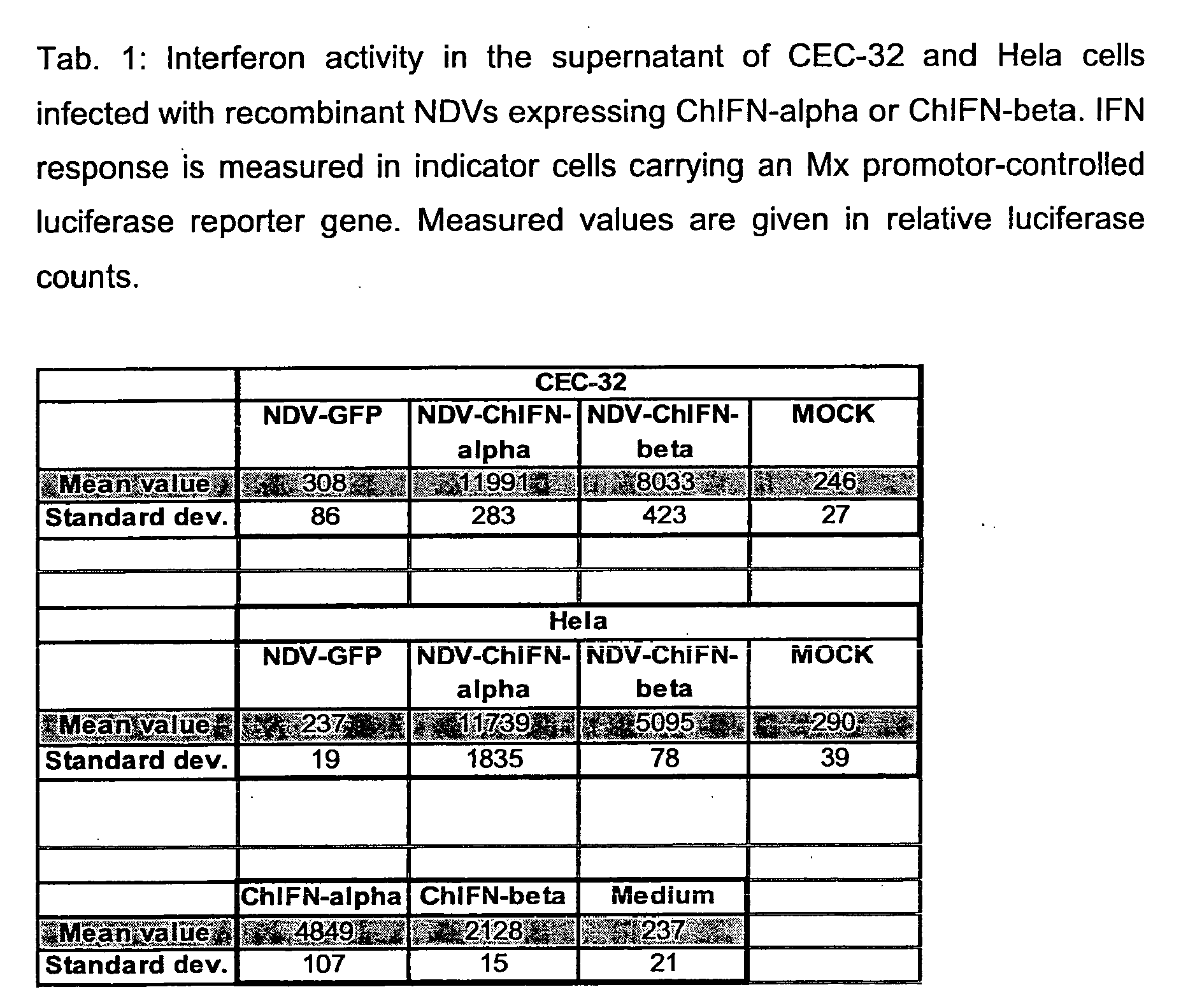
-
- 3 a.) CEC-32 cells (avian quail cell line) or Hela cells (cervical cancer cell line) were seeded in a 6 well plate at 1x10⁵ cells/well. After becoming adherent the cells were infected with a MOI of 0.01 either with the control virus NDV-GFP, NDV-ChIFN-alpha, NDV-ChIFN-beta or MOCK. After 48h the cells were fixed with 4% formaldehyde solution and stained with Giemsa solution. Subsequent photodocumention was performed with a Zeiss Axiophot imaging system.
- 3 b.) CEC-32 cells (avian quail cell line) or Hela cells (cervical cancer cell line) were seeded in a 96 well plate at 15.000 cells/well. After becoming adherent the cells were infected with a MOI of 0.01 either with the control virus NDV-GFP, NDV-ChIFN-alpha, NDV-ChIFN-beta or MOCK (= non-infected). After 48h incubation time the CellTiter-Glo® Luciferase Assay (Promega) was performed to measure cell viability, following the protocol provided by the manufacturer. To determine the mean values, each datapoint was generated from six independend values.
-
Fig 3 . a.) After 48h the avian CEC-32 cells are lysed by the GFP expressing NDV (NDV-GFP). In contrast cells infected with the ChIFN-alpha expressing virus are partially protected from lysis. The NDV-ChIFN-alpha infected CEC-32 monolayer is to 25-50% intact. An even stronger protection is seen with NDV expressing ChIFN-beta. After 48h nearly 90-100% of the CEC-32 monolyer is intact and protected from viral lysis. The density of this monolayer is comparable with the monolayer of the MOCK infected CEC-32 cells. - Infection with the three viruses on the tumorigenic Hela cell line shows a comparable oncolytic activity between the viruses NDV-GFP, NDV-ChIFN-alpha and NDV-ChIFN-beta. After 48h the monolayer of Hela cells infected with NDV-GFP, NDV-ChIFN-alpha or NDV-ChIFN-beta is nearly completely destroyed. The cell monolayer of MOCK-infected Hela cells is intact, indicated by the blue color of Giemsa-stained cells.
-
Fig 3. b) In a second experiment cell viabilty was quantified 48h after infection with the ChIFN-expressing NDVs. The NDV-GFP infected avian CEC-32 cells showed only 3% remaining cell viability. In the NDV-ChIFN-alpha infected CEC-32cells 26% of the remaining cells are intact. 48h after NDV-ChIFN-beta infection of the CEC-32quail cell line 94% of the cells are viable and protected against viral lysis. - In contrast nearly any difference in cell destruction can be observed after infection with the three viruses NDV-GFP, NDV-ChIFN-alpha or NDV-ChIFN-beta on the tumorigenic Hela cell line. After 48 h the value for the viable cells is for all three viruses between 3%-9% indicating nearly a complete tumor cell destruction.
- 5000 primary fibroblast cells or 3000 Hela cells were seeded in each well of a 96 well plate. 16h after seeding virus dilutions of NDV-GFP (NDV-GFP), NDV-ChIFN-alpha (NDV-ChIFN-alpha) and NDV-ChIFN-beta (NDV-ChIFN-beta) were prepared. Fibroblast cells were infected with the indicated virus concentrations. As a negative control fibroblasts cells were MOCK infected. After 1 h the inocculum was removed, cells were washed with PBS and incubated with 200 µl cell culture medium for 4 days in the cell culture incubator. Afterwards the remaining cells were fixed with 4% formaldehyde solution and stained with crystal violet. The stain was solubilized with 10% glacial acetic acid and the absorbence of each well was measured at 595 nm in an ELISA Reader.
- Four days after infection the primary fibroblasts infected with the three viruses NDV-GFP, NDV-ChIFN-alpha and NDV-ChIFN-beta using MOIs between MOI 0,001 up to
MOI Fig. 4 ). The first signs of proliferation inhibition are only observed at MOIs where 1 or 10 viral particles per cell were used for infection. In contrast tumorigenic Hela cells infected with MOIs between MOI 0,001 andMOI 10 show a very strong proliferation inhibition. This results indicates that the recombinant NDVs have a very good therapeutic window especially at low MOIs likeMOI - Groups of fifteen 11d old embryonated chicken eggs were infected with NDV-ChIFN-alpha, NDV-ChIFN-beta, NDV-GFP or the non-pathogenic NDV strain LaSota, respectively. As infectious material egg-grown virus in allantoic fluid diluted with sterile PBS was used. An infectious dose of 4000 PFU in a total volume of 200 µl was applied. The inoculum was injected into the allantoic cavity. After infection the eggs were incubated at 37°C and 50%-60%.humidity in a egg breader. Eggs were candled two times a day at the indicated time points (
Fig. 5 ) and embryos were checked for signs of vitality. - This assay allows to compare the pathogenicity of diffferent NDV strains by comparing the survival time of the infected embryos. The method is based on the "Mean Death Time of the Minimum Lethal Dose (MDT/MLD)" determination described in R.P. Hanson (1980). The protocol was modified in that way that not serial dilutions of the virus stock were inocculated in the eggs, instead of one defined virus dose injection with a concentration higher than the minimal lethal dose. For ethical reasons this assay modification reduces the number of embryos used for the test. The MDT is determined by the following formula:

- The survival of the NDV-ChIFN-alpha and NDV-ChIFN-beta infected chick embryos is improved in comparision with the NDV-GFP infected embryos. The NDV-GFP infected embryonated eggs are losing signs of vitality between 24h and 62h, leading to a MDT (Mean Death Time) of 50h. The NDV-ChIFN-beta infected embryos are surviving up to 96h with a calculated MDT of 69h. A comparable survival time with a MDT of 74h is measured in the NDV-ChIFN-beta infected embryos. Most of the NDV-ChIFN-beta infected embryos are dying between 48h and 96h. The sensitivity of the assay is indicated by usage of the apathogenic or lentogenic strain LaSota. Even embryonated eggs inocculated with the NDV LaSota strain are dying between 62h to 115h with a calculated MDT of 85h. This experiments shows that the MDT of the mesogenic NDV MTH68 is shifted towards a lentogenic NDV strain.
-
- Adams, G.P. and Weiner, L.M. (2005) Monoclonal antibody therapy of cancer. Nat Biotechnol, 23, 1147-1157.
- Alexander, D.J. (1988) Newcastle disease. Kluwer Academic Publishers, Norwell, Massachusetts.
- Allen, T.M. (2002) Ligand-targeted therapeutics in anticancer therapy. Nat Rev Cancer, 2, 750-763.
- Amstutz, P., Binz, H.K., Parizek, P., Stumpp, M.T., Kohl, A., Grutter, M.G., Forrer, P. and Pluckthun, A. (2005) Intracellular kinase inhibitors selected from combinatorial libraries of designed ankyrin repeat proteins. J Biol Chem, 280, 24715-24722.
- Antoniw, P., Springer, C.J., Bagshawe, K.D., Searle, F., Melton, R.G., Rogers, G.T., Burke, P.J. and Sherwood, R.F. (1990) Disposition of the prodrug 4-(bis (2-chloroethyl) amino) benzoyl-L-glutamic acid and its active parent drug in mice. Br J Cancer, 62, 909-914.
- Bagshawe, K.D., Springer, C.J., Searle, F., Antoniw, P., Sharma, S.K., Melton, R.G. and Sherwood, R.F. (1988) A cytotoxic agent can be generated selectively at cancer sites. Br J Cancer, 58, 700-703.
- Batra, J.K., Fitzgerald, D.J., Chaudhary, V.K. and Pastan, I. (1991) Single-chain immunotoxins directed at the human transferrin receptor containing Pseudomonas exotoxin A or diphtheria toxin: anti-TFR(Fv)-PE40 and DT388-anti-TFR(Fv). Mol Cell Biol, 11, 2200-2205.
- Batra, J.K., Kasprzyk, P.G., Bird, R.E., Pastan, I. and King, C.R. (1992) Recombinant anti-erbB2 immunotoxins containing Pseudomonas exotoxin. Proc Natl Acad Sci U S A, 89, 5867-5871.
- Bell, J.C., Garson, K.A., Lichty, B.D. and Stojdl, D.F. (2002) Oncolytic viruses: programmable tumor hunters. Curr Gene Ther, 2, 243-254.
- Binz, H.K., Amstutz, P., Kohl, A., Stumpp, M.T., Briand, C., Forrer, P., Grutter, M.G. and Pluckthun, A. (2004) High-affinity binders selected from designed ankyrin repeat protein libraries. Nat Biotechnol, 22, 575-582.
- Bosslet, K., Czech, J., Lorenz, P., Sedlacek, H.H., Schuermann, M. and Seemann, G. (1992) Molecular and functional characterisation of a fusion protein suited for tumor specific prodrug activation. Br J Cancer, 65, 234-238.
- Carnemolla, B., Borsi, L., Balza, E., Castellani, P., Meazza, R., Berndt, A., Ferrini, S., Kosmehl, H., Neri, D. and Zardi, L. (2002) Enhancement of the antitumor properties of interleukin-2 by its targeted delivery to the tumor blood vessel extracellular matrix. Blood, 99, 1659-1665.
- Chaudhary, V.K., Gallo, M.G., FitzGerald, D.J. and Pastan, I. (1990) A recombinant single-chain immunotoxin composed of anti-Tac variable regions and a truncated diphtheria toxin. Proc Natl Acad Sci U S A, 87, 9491-9494.
- Chaudhary, V.K., Queen, C., Junghans, R.P., Waldmann, T.A., FitzGerald, D.J. and Pastan, I. (1989) A recombinant immunotoxin consisting of two antibody variable domains fused to Pseudomonas exotoxin. Nature, 339, 394-397.
- Chiocca, E.A. (2002) Oncolytic viruses. Nat Rev Cancer, 2, 938-950.
- Csatary, L.K., Gosztonyi, G., Szeberenyi, J., Fabian, Z., Liszka, V., Bodey, B. and Csatary, C.M. (2004) MTH-68/H oncolytic viral treatment in human high-grade gliomas. J Neurooncol, 67, 83-93.
- De Lorenzo, C., Arciello, A., Cozzolino, R., Palmer, D.B., Laccetti, P., Piccoli, R. and D'Alessio, G. (2004) A fully human antitumor immunoRNase selective for ErbB-2-positive carcinomas. Cancer Res, 64, 4870-4874.
- Engel-Herbert, I., Werner, O., Teifke, J.P., Mebatsion, T., Mettenleiter, T.C. and Romer-Oberdorfer, A. (2003) Characterization of a recombinant Newcastle disease virus expressing the green fluorescent protein. J Virol Methods, 108, 19-28.
- Ferrara, N., Hillan, K.J., Gerber, H.P. and Novotny, W. (2004) Discovery and development of bevacizumab, an anti-VEGF antibody for treating cancer. Nat Rev Drug Discov, 3, 391-400.
- Ford, K.G., Souberbielle, B.E., Darling, D. and Farzaneh, F. (2001) Protein transduction: an alternative to genetic intervention? Gene Ther, 8, 1-4.
- Georgakis, G.V., Li, Y., Humphreys, R., Andreeff, M., O'Brien, S., Younes, M., Carbone, A., Albert, V. and Younes, A. (2005) Activity of selective fully human agonistic antibodies to the TRAIL death receptors TRAIL-R1 and TRAIL-R2 in primary and cultured lymphoma cells: induction of apoptosis and enhancement of doxorubicin- and bortezomib-induced cell death. Br J Haematol, 130, 501-510.
- Gerber, H.P. and Ferrara, N. (2005) Pharmacology and pharmacodynamics of bevacizumab as monotherapy or in combination with cytotoxic therapy in preclinical studies. Cancer Res, 65, 671-680.
- Hanahan, D. and Weinberg, R.A. (2000) The hallmarks of cancer. Cell, 100, 57-70.
- Hanson, R.P: (1980) Newcastle Disease. In Hitchner, S. B. (ed.). Isolation and identification of avian pathogens. College Station, Tex: American Association of Avian Pathologists.
- Herbst, R.S. and Langer, C.J. (2002) Epidermal growth factor receptors as a target for cancer treatment: the emerging role of IMC-C225 in the treatment of lung and head and neck cancers. Semin Oncol, 29, 27-36.
- Hogbom, M., Eklund, M., Nygren, P.A. and Nordlund, P. (2003) Structural basis for recognition by an in vitro evolved affibody. Proc Natl Acad Sci U S A, 100, 3191-3196.
- Huang, Z., Elankumaran, S., Panda, A. and Samal, S.K. (2003) Recombinant Newcastle disease virus as a vaccine vector. Poult Sci. 82, 899-906.
- Huang, Z., Elankumaran, S., Yunus, A.S. and Samal, S.K. (2004) A recombinant Newcastle disease virus (NDV) expressing VP2 protein of infectious bursal disease virus (IBDV) protects against NDV and IBDV. J Virol, 78, 10054-10063.
- Huang, Z., Krishnamurthy, S., Panda, A. and Samal, S.K. (2001) High-level expression of a foreign gene from the most 3'-proximal locus of a recombinant Newcastle disease virus. J Gen Virol, 82, 1729-1736.
- Kreitman, R.J., Chaudhary, V.K., Waldmann, T.A., Hanchard, B., Cranston, B., FitzGerald, D.J. and Pastan, I. (1993) Cytotoxic activities of recombinant immunotoxins composed of Pseudomonas toxin or diphtheria toxin toward lymphocytes from patients with adult T-cell leukemia. Leukemia, 7, 553-562.
- Kaiser, P" Poh, T.Y., Rothwell, L., Avery, S., Balu, S., Pathania, U.S., Hughes, S., Goodchild, M., Morrell, S., Watson, M., Bumstead, N., Kaufman, J. and Young, J.R. (2005) A genomic analysis of chicken cytokines and chemokines. J Interferon Cytokine Res. 25: 467-484.
- Kreitman, R.J. and Pastan, I. (1995) Importance of the glutamate residue of KDEL in increasing the cytotoxicity of Pseudomonas exotoxin derivatives and for increased binding to the KDEL receptor. Biochem J, 307 (Pt1), 29-37.
- Krishnamurthy, S., Huang, Z. and Samal, S.K. (2000) Recovery of a virulent strain of newcastle disease virus from cloned cDNA: expression of a foreign gene results in growth retardation and attenuation. Virology, 278, 168-182.
- Kuan, S.F., Byrd, J.C., Basbaum, C.B. and Kim, Y.S. (1987) Characterization of quantitative mucin variants from a human colon cancer cell line. Cancer Res, 47, 5715-5724.
- Ladner, R.C. and Ley, A.C. (2001) Novel frameworks as a source of high-affinity ligands. Curr Opin Biotechnol, 12, 406-410.
- Lamb, R.A., Kolakofsky, D. (2001) Paramyxoviridae: The Viruses And Their Replication. In Fields, B.N. (ed.), Virology. Lippincott Williams & Wilkins, pp. 1305-1485.
- Lorence, R.M., Pecora, A.L., Major, P.P., Hotte, S.J., Laurie, S.A., Roberts, M.S., Groene, W.S. and Bamat, M.K. (2003) Overview of phase I studies of intravenous administration of PV701, an oncolytic virus. Curr Opin Mol Ther, 5, 618-624.
- Mizukami, Y., Jo, W.S., Duerr, E.M., Gala, M., Li, J., Zhang, X., Zimmer, M.A., Iliopoulos, O., Zukerberg, L.R., Kohgo, Y., Lynch, M.P., Rueda, B.R. and Chung, D.C. (2005) Induction of interleukin-8 preserves the angiogenic response in HIF-1alpha-deficient colon cancer cells. Nat Med, 11, 992-997.
- Nakaya, T., Cros, J., Park, M.S., Nakaya, Y., Zheng, H., Sagrera, A., Villar, E., Garcia-Sastre, A. and Palese, P. (2001) Recombinant Newcastle disease virus as a vaccine vector. J Virol, 75, 11868-11873.
- Noonberg, S.B. and Benz, C.C. (2000) Tyrosine kinase inhibitors targeted to the epidermal growth factor receptor subfamily: role as anticancer agents. Drugs, 59, 753-767.
- Nord, K., Gunneriusson, E., Uhl inverted question marken, M. and Nygren, P.A. (2000) Ligands selected from combinatorial libraries of protein A for use in affinity capture of apolipoprotein A-1M and taq DNA polymerase. J Biotechnol, 80, 45-54.
- Roffler, S.R., Wang, S.M., Chern, J.W., Yeh, M.Y. and Tung, E. (1991) Antineoplastic glucuronide prodrug treatment of human tumor cells targeted with a monoclonal antibody-enzyme conjugate. Biochem Pharmacol, 42, 2062-2065.
- Romer-Oberdorfer, A., Mundt, E., Mebatsion, T., Buchholz, U.J. and Mettenleiter, T.C. (1999) Generation of recombinant lentogenic Newcastle disease virus from cDNA. J Gen Virol, 80 ( Pt 11), 2987-2995.
- Rowlinson-Busza, G., Bamias, A., Krausz, T. and Epenetos, A.A. (1992) Antibody guided enzyme nitrile therapy (Agent): in vitro cytotoxicity and in vivo tumor localisation. In Epenetos, a. (ed.), .
- Russell, S.J. (2002) RNA viruses as virotherapy agents. Cancer Gene Ther, 9, 961-966.
- Salgaller, M.L. (2003) Technology evaluation: bevacizumab, Genentech/Roche. Curr Opin Mol Ther, 5, 657-667.
- Schnell, M.J., Mebatsion, T. and Conzelmann, K.K. (1994) Infectious rabies viruses from cloned cDNA. Embo J, 13, 4195-4203.
- Schultz, U., Rinderle, C., Sekellick, M.J., Marcus, P.I. and Staeheli, P. (1995) Recombinant chicken interferon from Escherichia coli and transfected COS cells is biologically active..Eur J Biochem. 229:73-76.
- Schwarz, H., Harlin, O., Ohnemus, A., Kaspers, B. and Staeheii, P. (2004) Synthesis of IFN-beta by virus-infected chicken embryo cells demonstrated with specific antisera and a new bioassay. J Interferon Cytokine Res. 24:179-184.
- Sick, C., Schultz, U. and Staeheli, P. (1996) A family of genes coding for two serologically distinct chicken interferons. J Biol Chem., 271, 7635-7639.
- Sinkovics, J.G. and Horvath, J.C. (2000) Newcastle disease virus (NDV): brief history of its oncolytic strains. J Clin Virol, 16, 1-15.
- Skerra, A. (2000) Lipocalins as a scaffold. Biochim Biophys Acta, 1482, 337-350.
- Staeheli, P., Puehler, F., Schneider, K., Gobel, T.W. and Kaspers, B. (2001) Cytokines of birds: conserved functions--a largely different look. J Interferon Cytokine Res. 2001 21:993-1010.
- Stojdl, D.F., Lichty, B.D., tenOever, B.R., Paterson, J.M., Power, A.T., Knowles, S., Marius, R., Reynard, J., Poliquin, L., Atkins, H., Brown, E.G., Durbin, R.K., Durbin, J.E., Hiscott, J. and Bell, J.C. (2003) VSV strains with defects in their ability to shutdown innate immunity are potent systemic anti-cancer agents. Cancer Cell, 4, 263-275.
- Vogelstein, B. and Kinzler, K.W. (2004) Cancer genes and the pathways they control. Nat Med, 10, 789-799.
- Waltenberger, J., Claesson-Welsh, L., Siegbahn, A., Shibuya, M. and Heldin, C.H. (1994) Different signal transduction properties of KDR and FIt1, two receptors for vascular endothelial growth factor. J Biol Chem, 269, 26988-26995.
- Wang, S.M., Chern, J.W., Yeh, M.Y., Ng, J.C., Tung, E. and Roffler, S.R. (1992) Specific activation of glucuronide prodrugs by antibody-targeted enzyme conjugates for cancer therapy. Cancer Res, 52, 4484-4491.
- Warren, R.S., Yuan, H., Matli, M.R., Gillett, N.A. and Ferrara, N. (1995) Regulation by vascular endothelial growth factor of human colon cancer tumorigenesis in a mouse model of experimental liver metastasis. J Clin Invest, 95, 1789-1797.
- Zewe, M., Rybak, S.M., Dubel, S., Coy, J.F., Welschof, M., Newton, D.L. and Little, M. (1997) Cloning and cytotoxicity of a human pancreatic RNase immunofusion. Immunotechnology, 3, 127-136.
- Zhao, H. and Peeters, B.P. (2003) Recombinant Newcastle disease virus as a viral vector: effect of genomic location of foreign gene on gene expression and virus replication. J Gen Virol, 84, 781-788.
Claims (37)
- A recombinant oncolytic RNA Newcastle Disease Virus comprising at least one transgene coding for an avian cytokine, wherein the recombinant oncolytic RNA Newcastle Disease Virus is obtainable from a velogenic or mesogenic oncolytic RNA Newcastle Disease Virus.
- The virus according to claim 1, comprising at least one further transgene having therapeutic activity when expressed by a virus-infected tumor cell.
- The virus according to claim 2, wherein the at least one further transgene is partially allogene or syngene for the host.
- The virus according to any of the claims 1 to 3, wherein the pathogenicity of the virus is reduced for an avian species.
- The virus of claim 4, wherein the pathogenicity of the virus is reduced for an avian species with respect to the virus from which the recombinant virus is obtainable.
- The virus of claim 4 or 5, wherein the avian species is selected from poultry.
- The virus of any of the claims 4 to 6, wherein the avian species is chicken.
- The virus of any of the claims 1 to 7, which is an avian pathogen, in particular a pathogen of poultry, more particular a pathogen of chicken.
- The virus of any of the claims 1 to 8, obtainable from the mesogenic strain MTH68.
- The virus of any of the claims 1 to 9, wherein the at least one further transgene codes for a binding protein that has a therapeutic activity when expressed by the virus-infected tumor cell.
- The virus according to claim 10, wherein the binding protein is selected from the following group consisting of a natural ligand, a genetically modified ligand, a recombinant soluble domain of a natural receptor and a modified version thereof, a peptide ligand, a polypeptide ligand, an antibody molecule and fragments and derivatives thereof, and an antibody-like molecule like an ankyrin-repeat protein and fragments and derivatives thereof.
- The virus according to claim 10 or 11, wherein the binding protein is of mammalian, e.g. human, murine or closely related origin or a chimeric protein.
- The virus according to any of one the claims 10 to 12, wherein the binding protein is a monomeric, dimeric, trimeric, tetrameric or multimeric protein.
- The virus according to any one of the claims 10 to 13, wherein the binding protein is monospecific, bispecific or multispecific.
- The virus according to any one of the claims 10 to 14, wherein the binding protein is a fusion protein comprising at least one binding domain and at least one heterologous domain.
- The virus according to claim 15, wherein the binding protein is a fusion protein comprising a toxin such as human RNAse (pseudomonas exotoxin, Diphtheria toxin), or a fusion protein comprising an enzyme like beta-glucuronidase, beta-galactosidase, beta-glucosidase, carboxypeptidase, beta-lactamase, or a fusion protein comprising an immune-stimulatory protein with cytokine activity like IL-2, IL-12, TNF-alpha, IFN-beta or GM-CSF.
- The virus according to any one of the claims 10 to 16, wherein the binding protein is selected from the group constisting of blocking proteins of autonomous active growth factor receptors (eg. EGFR, Met), competitive binders for growth factors (antagonists), blocking proteins for Rb-phosphorylation, blocking proteins for E2F-dependent transcription; stabilizers for p53; antagonistic binders for antiapoptotic proteins (eg. Bcl-2); antagonistic binders for cyclins; antagonistic binders for Ras effectors (eg. GEFs); antagonistic binders for hypoxia induced proteins (eg. HIF1α); inhibitors of transcription factors that interfere with dimerization, DNA-binding or/and cofactor binding (eg. Myc/Max); Inducers of differentiation; Inhibitors of smad signalling/translocation; inhibitors of cellular adhesion interactions (cadherins, integrins, eg. α5β1, αvβ3); inhibitors of enzymes that degrade the extracellular matrix (eg. MMPs); antagonistic binders for proangiogenic ligands (eg. soluble VEGF-R); antagonistic binders to proangiogenic receptors; inhibitors of scaffold complex formation (eg. KSR/Ras); inhibitors of translation initiation (eg. eIF4E, EIF2a); and inhibitors of mitotic kinases (eg. PIk-1).
- The virus of any of the claims 1 to 9, wherein the at least one further transgene codes for a prodrug-converting enzyme that has a therapeutic activity when expressed by the virus-infected tumor cell.
- The virus of any of the claims 1 to 9, wherein the at least one further transgene codes for a protease that has a therapeutic activity when expressed by the virus-infected tumor cell.
- The virus of any of the preceding claims, wherein the at least one transgene encoding an avian cytokine is selected from chicken interferons.
- The virus of claim 20, wherein the at least one transgene encoding an avian cytokine is selected from chicken type I interferons.
- The virus of any of the claims 5 to 21, wherein the pathogenicity reduction is a capability of the virus to reduce bird cell lysis about 48h after infection with MOI 0,01 measured by increasing cell viability, whereby the cell viability is inceased to at least about 25% up to about 50% surviving cells, more preferably to at least about 50% up to about 75% surviving cells and most preferably to at least about 75% up to 100% surviving cells with respect to the virus from which the recombinant virus is obtainable.
- The virus of any of the claims 5 to 21, wherein the pathogenicity reduction is a survival time prolongation of virus infected chicken embryos in 11 day old embryonated eggs measured by mean death time (MDT) determination, whereby the MDT is prolonged by at least about 15h up to about 20h, more preferably at least about 20h up to about 30h and most preferably by more than 30h compared to the virus from which the recombinant virus is obtainable.
- The virus of any of the claims 1 to 23, wherein the oncolytic activity of the virus for human tumor cells is essentially not reduced.
- The virus of any of the claims 1 to 23, wherein the oncolytic activity of the virus for human tumor cells measured by cell viability after 48h after infection is not reduced by more than 50% compared to the virus from which the recombinant virus is obtainable and more preferably is essentially not reduced with respect to the virus from which the recombinant virus is obtainable.
- A nucleocapsid of a recombinant oncolytic RNA virus of any one of claims 1-25.
- A genome of a recombinant oncolytic RNA virus of any one of claims 1-25.
- A DNA molecule encoding the genome and/or antigenome of a recombinant oncolytic RNA virus of any one of the claims 1-25.
- The DNA molecule of claim 27 operatively linked to a transcriptional control sequence.
- A cell comprising a recombinant oncolytic virus of any one of claims 1-25, a virus genome of claims 27 or/and a DNA molecule of claim 28 or 29.
- A pharmaceutical composition comprising a recombinant oncolytic virus of any one of claims 1-25, a virus genome of claims 27 or/and a DNA molecule of claim 28 or 29 as an active ingredient optionally together with pharmaceutically acceptable carriers, diluents and/or adjuvants.
- The pharmaceutical composition of claim 31 further comprising a prodrug which can be converted into a therapeutically active compound by the prodrug-converting enzyme encoded by the at least one further transgene.
- A method for treatment of a proliferative disease, comprising administering in a pharmaceutically effective amount to a subject in need thereof a recombinant oncolytic virus of any one of claims 1-25, a virus genome of claim 27 or/and a DNA molecule of claim 28 or 29.
- The method of claim 33, comprising administering in a pharmaceutically effective amount to a subject in need thereof(i) a recombinant oncolytic virus of any one of claims 1-25, a virus genome of claims 27 or/and a DNA molecule of claim 28 or 29 comprising at least one transgene encoding for a prodrug-converting enzyme and(ii) a prodrug suitable for treatment of the proliferative disease in combination with the virus, which prodrug can be converted into a pharmaceutically active compound by the prodrug-converting enzyme of (i).
- The method of any of the claims 33 to 34, wherein the subject is a human patient.
- A recombinant oncolytic RNA virus attenuated for poultry comprising a nucleic acid comprising at least one transgene coding for a cytokine.
- The virus of claim 36 which is attenuated for chicken.
Priority Applications (23)
| Application Number | Priority Date | Filing Date | Title |
|---|---|---|---|
| EP08001643A EP2085092A1 (en) | 2008-01-29 | 2008-01-29 | Attenuated oncolytic paramyxoviruses encoding avian cytokines |
| KR1020107016944A KR20100113096A (en) | 2008-01-29 | 2009-01-20 | Attenuated oncolytic paramyxoviruses encoding avian cytokines |
| CA2711571A CA2711571A1 (en) | 2008-01-29 | 2009-01-20 | Attenuated oncolytic paramyxoviruses encoding avian cytokines |
| PCT/EP2009/000308 WO2009095167A1 (en) | 2008-01-29 | 2009-01-20 | Attenuated oncolytic paramyxoviruses encoding avian cytokines |
| CN2009801035310A CN102099045A (en) | 2008-01-29 | 2009-01-20 | Attenuated oncolytic paramyxoviruses encoding avian cytokines |
| BRPI0906354A BRPI0906354A2 (en) | 2008-01-29 | 2009-01-20 | attenuated oncolytic paramyxovirus encoding avian cytokines |
| JP2010544616A JP2011510638A (en) | 2008-01-29 | 2009-01-20 | Attenuated oncolytic paramyxovirus encoding avian cytokines |
| EA201001202A EA201001202A1 (en) | 2008-01-29 | 2009-01-20 | ATENUED ONCOLYTIC PARAMIXOVIRUSES ENCODING BIRDS CYTOKINS |
| AU2009210301A AU2009210301A1 (en) | 2008-01-29 | 2009-01-20 | Attenuated oncolytic paramyxoviruses encoding avian cytokines |
| MX2010008370A MX2010008370A (en) | 2008-01-29 | 2009-01-20 | Attenuated oncolytic paramyxoviruses encoding avian cytokines. |
| EP09704993A EP2237790A1 (en) | 2008-01-29 | 2009-01-20 | Attenuated oncolytic paramyxoviruses encoding avian cytokines |
| TW098103098A TW200936159A (en) | 2008-01-29 | 2009-01-23 | Attenuated oncolytic paramyxoviruses encoding avian cytokines |
| ARP090100255A AR070272A1 (en) | 2008-01-29 | 2009-01-28 | DAMAGED ONCOLITICS PARAMIXOVIRUS THAT CODIFY BIRD CYTOKINS |
| US12/361,201 US20100092430A1 (en) | 2008-01-29 | 2009-01-28 | Attenuated oncolytic paramyxoviruses encoding avian cytokines |
| PA20098813901A PA8813901A1 (en) | 2008-01-29 | 2009-01-28 | DAMAGED ONCOLITICAL PARAMIXOVIRUS THAT CODIFY BIRD CYTOKINS |
| PE2009000128A PE20091355A1 (en) | 2008-01-29 | 2009-01-29 | ATTENUATED ONCOLYTIC PARAMYXOVIRUSES CODING CYTOKINES OF BIRDS |
| CL2009000190A CL2009000190A1 (en) | 2008-01-29 | 2009-01-29 | Recombinant Newcastle disease virus comprising a transgene encoding a bird cytokine; nucleocapsid and genome of said virus; DNA molecule encoding the genome and / or antigenome of the virus; cell and composition that comprise it. |
| IL206382A IL206382A0 (en) | 2008-01-29 | 2010-06-15 | Attenuated oncolytic paramyxoviruses encoding avian cytokines |
| DO2010000233A DOP2010000233A (en) | 2008-01-29 | 2010-07-29 | DAMAGED ONCOLITICS PARAMIXOVIRUS THAT CODIFY BIRD CYTOKINS |
| CO10092654A CO6290693A2 (en) | 2008-01-29 | 2010-07-29 | DAMAGED ONCOLITICS PARAMIXOVIRUS THAT CODIFY BIRD CYTOKINS |
| CR11616A CR11616A (en) | 2008-01-29 | 2010-07-29 | DAMAGED ONCOLITICS PARAMIXOVIRUS THAT CODIFY BIRD CYTOKINS |
| EC2010010375A ECSP10010375A (en) | 2008-01-29 | 2010-07-29 | DAMAGED ONCOLITICAL PARAMIXOVIRUS THAT CODIFY BIRD CYTOKINS |
| ZA2010/06151A ZA201006151B (en) | 2008-01-29 | 2010-08-27 | Attenuated oncolytic paramyxoviruses encoding avian cytokines |
Applications Claiming Priority (1)
| Application Number | Priority Date | Filing Date | Title |
|---|---|---|---|
| EP08001643A EP2085092A1 (en) | 2008-01-29 | 2008-01-29 | Attenuated oncolytic paramyxoviruses encoding avian cytokines |
Publications (1)
| Publication Number | Publication Date |
|---|---|
| EP2085092A1 true EP2085092A1 (en) | 2009-08-05 |
Family
ID=39708421
Family Applications (2)
| Application Number | Title | Priority Date | Filing Date |
|---|---|---|---|
| EP08001643A Withdrawn EP2085092A1 (en) | 2008-01-29 | 2008-01-29 | Attenuated oncolytic paramyxoviruses encoding avian cytokines |
| EP09704993A Withdrawn EP2237790A1 (en) | 2008-01-29 | 2009-01-20 | Attenuated oncolytic paramyxoviruses encoding avian cytokines |
Family Applications After (1)
| Application Number | Title | Priority Date | Filing Date |
|---|---|---|---|
| EP09704993A Withdrawn EP2237790A1 (en) | 2008-01-29 | 2009-01-20 | Attenuated oncolytic paramyxoviruses encoding avian cytokines |
Country Status (22)
| Country | Link |
|---|---|
| US (1) | US20100092430A1 (en) |
| EP (2) | EP2085092A1 (en) |
| JP (1) | JP2011510638A (en) |
| KR (1) | KR20100113096A (en) |
| CN (1) | CN102099045A (en) |
| AR (1) | AR070272A1 (en) |
| AU (1) | AU2009210301A1 (en) |
| BR (1) | BRPI0906354A2 (en) |
| CA (1) | CA2711571A1 (en) |
| CL (1) | CL2009000190A1 (en) |
| CO (1) | CO6290693A2 (en) |
| CR (1) | CR11616A (en) |
| DO (1) | DOP2010000233A (en) |
| EA (1) | EA201001202A1 (en) |
| EC (1) | ECSP10010375A (en) |
| IL (1) | IL206382A0 (en) |
| MX (1) | MX2010008370A (en) |
| PA (1) | PA8813901A1 (en) |
| PE (1) | PE20091355A1 (en) |
| TW (1) | TW200936159A (en) |
| WO (1) | WO2009095167A1 (en) |
| ZA (1) | ZA201006151B (en) |
Cited By (10)
| Publication number | Priority date | Publication date | Assignee | Title |
|---|---|---|---|---|
| WO2013022764A1 (en) * | 2011-08-05 | 2013-02-14 | David Kirn | Methods and compositions for production of vaccina virus |
| CN107787364A (en) * | 2015-04-07 | 2018-03-09 | 艾佳尔免疫有限公司 | Therapeutic combination and application method for treating cancer |
| US10035984B2 (en) | 2009-02-05 | 2018-07-31 | Icahn School Of Medicine At Mount Sinai | Chimeric newcastle disease viruses and uses thereof |
| US10251922B2 (en) | 2013-03-14 | 2019-04-09 | Icahn School Of Medicine At Mount Sinai | Newcastle disease viruses and uses thereof |
| US10308913B2 (en) | 2005-12-02 | 2019-06-04 | Icahn School Of Medicine At Mount Sinai | Chimeric viruses presenting non-native surface proteins and uses thereof |
| CN113710260A (en) * | 2019-01-25 | 2021-11-26 | 勃林格殷格翰国际有限公司 | Recombinant rhabdovirus encoding CCL21 |
| US11389495B2 (en) | 2014-02-27 | 2022-07-19 | Merck Sharp & Dohme Llc | Combination method for treatment of cancer |
| US12042534B2 (en) | 2017-05-12 | 2024-07-23 | Icahn School Of Medicine At Mount Sinai | Newcastle disease viruses and uses thereof |
| US12391957B2 (en) | 2018-08-17 | 2025-08-19 | Icahn School Of Medicine At Mount Sinai | Recombinant Newcastle disease viruses and uses thereof for the prevention of RSV disease or human metapneumovirus disease |
| US12611454B2 (en) | 2020-05-13 | 2026-04-28 | Laboratorio Avi-Mex, S.A. De C.V. | Recombinant vaccine against COVID-19 based on a paramyxovirus viral vector |
Families Citing this family (4)
| Publication number | Priority date | Publication date | Assignee | Title |
|---|---|---|---|---|
| US9937196B2 (en) * | 2009-06-19 | 2018-04-10 | University Of Maryland, College Park | Genomic sequence of avian paramyxovirus type 2 and uses thereof |
| HUE042382T2 (en) | 2013-09-03 | 2019-06-28 | Medimmune Ltd | Preparations containing attenuated Newcastle disease virus and their use in the treatment of neoplasia |
| CN108362875A (en) * | 2018-01-10 | 2018-08-03 | 华南农业大学 | It is a kind of to differentiate newcastle disease infection and immune indirect ELISA method |
| CN111094324B (en) * | 2018-03-14 | 2023-10-10 | 武汉博威德生物技术有限公司 | An oncolytic virus, synthetic DNA sequence and application thereof |
Citations (17)
| Publication number | Priority date | Publication date | Assignee | Title |
|---|---|---|---|---|
| EP0702085A1 (en) | 1994-07-18 | 1996-03-20 | Akzo Nobel N.V. | Recombinant infectious non-segmented negative strand RNA virus |
| WO1999066045A1 (en) | 1998-06-19 | 1999-12-23 | Id-Lelystad, Instituut Voor Dierhouderij En Diergezondheid B.V. | Newcastle disease virus infectious clones, vaccines and diagnostic assays |
| WO2000062735A2 (en) | 1999-04-15 | 2000-10-26 | Pro-Virus, Inc. | Treatment of neoplasms with viruses |
| WO2000067786A1 (en) | 1999-05-05 | 2000-11-16 | University Of Maryland | PRODUCTION OF NOVEL NEWCASTLE DISEASE VIRUS STRAINS FROM cDNAS AND IMPROVED LIVE ATTENUATED NEWCASTLE DISEASE VACCINES |
| DE19932688A1 (en) | 1999-07-13 | 2001-01-18 | Ulrike Fiedler | Design of beta-sheet proteins with specific binding properties |
| WO2001020989A1 (en) | 1999-09-22 | 2001-03-29 | Mayo Foundation For Medical Education And Research | Therapeutic methods and compositions using viruses of the recombinant paramyxoviridae family |
| WO2003005964A2 (en) | 2001-07-11 | 2003-01-23 | University Of Miami | Recombinant vsv for the treatment of tumor cells |
| US20030044384A1 (en) | 1997-10-09 | 2003-03-06 | Pro-Virus, Inc. | Treatment of neoplasms with viruses |
| EP1300157A1 (en) | 2001-10-04 | 2003-04-09 | Centrum voor Onderzoek in Diergeneeskunde en Agrochemie | Attenuated mutant newcastle disease virus strains for in ovo vaccination, method for preparing and their use |
| US20030224017A1 (en) | 2002-03-06 | 2003-12-04 | Samal Siba K. | Recombinant Newcastle disease viruses useful as vaccines or vaccine vectors |
| US6699479B1 (en) | 1999-07-27 | 2004-03-02 | Akzo Nobal N.V. | Recombinant newcastle disease virus as an embryo vaccine |
| US20040043035A1 (en) | 2000-11-02 | 2004-03-04 | Teshome Mebatsion | Recombinant newcastle disease virus nucleoprotein mutant as a marker vaccine |
| US20040072276A1 (en) | 2002-05-10 | 2004-04-15 | Direvo BioTech AG. | Process for generating sequence-specific proteases by directed evolution and use thereof |
| US20040170607A1 (en) | 1999-09-17 | 2004-09-02 | Bell John C. | Oncolytic virus |
| US20050175581A1 (en) | 2003-06-18 | 2005-08-11 | Ulrich Haupts | Biological entities and the pharmaceutical and diagnostic use thereof |
| WO2006050984A2 (en) | 2004-11-12 | 2006-05-18 | Bayer Schering Pharma Aktiengesellschaft | Recombinant newcastle disease virus |
| WO2007025431A1 (en) | 2005-09-02 | 2007-03-08 | Zhigao Bu | Recombinant newcastle disease lasota attenuated vaccine strain expressing vp2 gene of infectious bursal disease virus |
-
2008
- 2008-01-29 EP EP08001643A patent/EP2085092A1/en not_active Withdrawn
-
2009
- 2009-01-20 EP EP09704993A patent/EP2237790A1/en not_active Withdrawn
- 2009-01-20 CA CA2711571A patent/CA2711571A1/en not_active Abandoned
- 2009-01-20 AU AU2009210301A patent/AU2009210301A1/en not_active Abandoned
- 2009-01-20 MX MX2010008370A patent/MX2010008370A/en not_active Application Discontinuation
- 2009-01-20 BR BRPI0906354A patent/BRPI0906354A2/en not_active Application Discontinuation
- 2009-01-20 JP JP2010544616A patent/JP2011510638A/en not_active Withdrawn
- 2009-01-20 CN CN2009801035310A patent/CN102099045A/en active Pending
- 2009-01-20 KR KR1020107016944A patent/KR20100113096A/en not_active Withdrawn
- 2009-01-20 WO PCT/EP2009/000308 patent/WO2009095167A1/en not_active Ceased
- 2009-01-20 EA EA201001202A patent/EA201001202A1/en unknown
- 2009-01-23 TW TW098103098A patent/TW200936159A/en unknown
- 2009-01-28 PA PA20098813901A patent/PA8813901A1/en unknown
- 2009-01-28 AR ARP090100255A patent/AR070272A1/en unknown
- 2009-01-28 US US12/361,201 patent/US20100092430A1/en not_active Abandoned
- 2009-01-29 PE PE2009000128A patent/PE20091355A1/en not_active Application Discontinuation
- 2009-01-29 CL CL2009000190A patent/CL2009000190A1/en unknown
-
2010
- 2010-06-15 IL IL206382A patent/IL206382A0/en unknown
- 2010-07-29 CO CO10092654A patent/CO6290693A2/en not_active Application Discontinuation
- 2010-07-29 CR CR11616A patent/CR11616A/en not_active Application Discontinuation
- 2010-07-29 DO DO2010000233A patent/DOP2010000233A/en unknown
- 2010-07-29 EC EC2010010375A patent/ECSP10010375A/en unknown
- 2010-08-27 ZA ZA2010/06151A patent/ZA201006151B/en unknown
Patent Citations (18)
| Publication number | Priority date | Publication date | Assignee | Title |
|---|---|---|---|---|
| EP0702085A1 (en) | 1994-07-18 | 1996-03-20 | Akzo Nobel N.V. | Recombinant infectious non-segmented negative strand RNA virus |
| US20030044384A1 (en) | 1997-10-09 | 2003-03-06 | Pro-Virus, Inc. | Treatment of neoplasms with viruses |
| WO1999066045A1 (en) | 1998-06-19 | 1999-12-23 | Id-Lelystad, Instituut Voor Dierhouderij En Diergezondheid B.V. | Newcastle disease virus infectious clones, vaccines and diagnostic assays |
| US6719979B2 (en) | 1998-06-19 | 2004-04-13 | Id-Lelystad, Instituut Voor Dierhouderij En Diergezondheid B.V. | Newcastle disease virus infectious clones, vaccines and diagnostic assays |
| WO2000062735A2 (en) | 1999-04-15 | 2000-10-26 | Pro-Virus, Inc. | Treatment of neoplasms with viruses |
| WO2000067786A1 (en) | 1999-05-05 | 2000-11-16 | University Of Maryland | PRODUCTION OF NOVEL NEWCASTLE DISEASE VIRUS STRAINS FROM cDNAS AND IMPROVED LIVE ATTENUATED NEWCASTLE DISEASE VACCINES |
| DE19932688A1 (en) | 1999-07-13 | 2001-01-18 | Ulrike Fiedler | Design of beta-sheet proteins with specific binding properties |
| US6699479B1 (en) | 1999-07-27 | 2004-03-02 | Akzo Nobal N.V. | Recombinant newcastle disease virus as an embryo vaccine |
| US20040170607A1 (en) | 1999-09-17 | 2004-09-02 | Bell John C. | Oncolytic virus |
| WO2001020989A1 (en) | 1999-09-22 | 2001-03-29 | Mayo Foundation For Medical Education And Research | Therapeutic methods and compositions using viruses of the recombinant paramyxoviridae family |
| US20040043035A1 (en) | 2000-11-02 | 2004-03-04 | Teshome Mebatsion | Recombinant newcastle disease virus nucleoprotein mutant as a marker vaccine |
| WO2003005964A2 (en) | 2001-07-11 | 2003-01-23 | University Of Miami | Recombinant vsv for the treatment of tumor cells |
| EP1300157A1 (en) | 2001-10-04 | 2003-04-09 | Centrum voor Onderzoek in Diergeneeskunde en Agrochemie | Attenuated mutant newcastle disease virus strains for in ovo vaccination, method for preparing and their use |
| US20030224017A1 (en) | 2002-03-06 | 2003-12-04 | Samal Siba K. | Recombinant Newcastle disease viruses useful as vaccines or vaccine vectors |
| US20040072276A1 (en) | 2002-05-10 | 2004-04-15 | Direvo BioTech AG. | Process for generating sequence-specific proteases by directed evolution and use thereof |
| US20050175581A1 (en) | 2003-06-18 | 2005-08-11 | Ulrich Haupts | Biological entities and the pharmaceutical and diagnostic use thereof |
| WO2006050984A2 (en) | 2004-11-12 | 2006-05-18 | Bayer Schering Pharma Aktiengesellschaft | Recombinant newcastle disease virus |
| WO2007025431A1 (en) | 2005-09-02 | 2007-03-08 | Zhigao Bu | Recombinant newcastle disease lasota attenuated vaccine strain expressing vp2 gene of infectious bursal disease virus |
Non-Patent Citations (63)
| Title |
|---|
| "Remington's Pharmaceutical Science", 1980, MACK PUBLISHING COMPANY |
| ADAMS, G.P.; WEINER, L.M.: "Monoclonal antibody therapy of cancer", NAT BIOTECHNOL, vol. 23, 2005, pages 1147 - 1157 |
| ALEXANDER, D.J.: "Newcastle disease.", 1988, KLUWER ACADEMIC PUBLISHERS |
| ALLEN, T.M.: "Ligand-targeted therapeutics in anticancer therapy", NAT REV CANCER, vol. 2, 2002, pages 750 - 763 |
| AMSTUTZ, P. ET AL.: "Intracellular kinase inhibitors selected from combinatorial libraries of designed ankyrin repeat proteins", J BIOL CHEM, vol. 280, 2005, pages 24715 - 24722 |
| ANTONIW, P. ET AL.: "Disposition of the prodrug 4-(bis (2-chloroethyl) amino) benzoyl-L-glutamic acid and its active parent drug in mice", BR J CANCER, vol. 62, 1990, pages 909 - 914 |
| BAGSHAWE, K.D. ET AL.: "A cytotoxic agent can be generated selectively at cancer sites", BR J CANCER, vol. 58, 1988, pages 700 - 703 |
| BATRA, J.K. ET AL.: "Recombinant anti-erbB2 immunotoxins containing Pseudomonas exotoxin", PROC NATL ACAD SCI USA, vol. 89, 1992, pages 5867 - 5871, XP000990722, DOI: doi:10.1073/pnas.89.13.5867 |
| BATRA, J.K. ET AL.: "Single-chain immunotoxins directed at the human transferrin receptor containing Pseudomonas exotoxin A or diphtheria toxin: anti-TFR(Fv)-PE40 and DT388-anti-TFR(Fv", MOL CELL BIOL, vol. 11, 1991, pages 2200 - 2205 |
| BELL, J.C. ET AL.: "Oncolytic viruses: programmable tumor hunters", CURR GENE THER, vol. 2, 2002, pages 243 - 254, XP008096967, DOI: doi:10.2174/1566523024605582 |
| BINZ, H.K. ET AL.: "High-affinity binders selected from designed ankyrin repeat protein libraries", NAT BIOTECHNOL, vol. 22, 2004, pages 575 - 582, XP002343919, DOI: doi:10.1038/nbt962 |
| BOSSLET, K. ET AL.: "Molecular and functional characterisation of a fusion protein suited for tumor specific prodrug activation", BR J CANCER, vol. 65, 1992, pages 234 - 238 |
| CARNEMOLLA, B. ET AL.: "Enhancement of the antitumor properties of interleukin-2 by its targeted delivery to the tumor blood vessel extracellular matrix", BLOOD, vol. 99, 2002, pages 1659 - 1665, XP002256864, DOI: doi:10.1182/blood.V99.5.1659 |
| CHAUDHARY, V.K. ET AL.: "A recombinant immunotoxin consisting of two antibody variable domains fused to Pseudomonas exotoxin", NATURE, vol. 339, 1989, pages 394 - 397, XP000026214, DOI: doi:10.1038/339394a0 |
| CHAUDHARY, V.K. ET AL.: "A recombinant single-chain immunotoxin composed of anti-Tac variable regions and a truncated diphtheria toxin", PROC NATL ACAD SCI US A, vol. 87, 1990, pages 9491 - 9494 |
| CHIOCCA, E.A.: "Oncolytic viruses", NAT REV CANCER, vol. 2, 2002, pages 938 - 950 |
| CSATARY, L.K. ET AL.: "MTH-68/H oncolytic viral treatment in human high-grade gliomas", J NEUROONCOL, vol. 67, 2004, pages 83 - 93, XP002569843, DOI: doi:10.1023/B:NEON.0000021735.85511.05 |
| DE LORENZO, C. ET AL.: "A fully human antitumor immunoRNase selective for ErbB-2-positive carcinomas", CANCER RES, vol. 64, 2004, pages 4870 - 4874, XP002463021, DOI: doi:10.1158/0008-5472.CAN-03-3717 |
| ENGEL-HERBERT, I. ET AL.: "Characterization of a recombinant Newcastle disease virus expressing the green fluorescent protein", J VIROL METHODS, vol. 108, 2003, pages 19 - 28, XP002615996, DOI: doi:10.1016/S0166-0934(02)00247-1 |
| FERRARA, N. ET AL.: "Discovery and development of bevacizumab, an anti-VEGF antibody for treating cancer", NAT REV DRUG DISCOV, vol. 3, 2004, pages 391 - 400, XP002302380 |
| FORD, K.G. ET AL.: "Protein transduction: an alternative to genetic intervention", GENE THER, vol. 8, 2001, pages 1 - 4, XP001117818, DOI: doi:10.1038/sj.gt.3301383 |
| GEORGAKIS, G.V. ET AL.: "Activity of selective fully human agonistic antibodies to the TRAIL death receptors TRAIL-R1 and TRAIL-R2 in primary and cultured lymphoma cells: induction of apoptosis and enhancement of doxorubicin- and bortezomib-induced cell death", BR J HAEMATOL, vol. 130, 2005, pages 501 - 510, XP002357745, DOI: doi:10.1111/j.1365-2141.2005.05656.x |
| GERBER, H.P.; FERRARA, N.: "Pharmacology and pharmacodynamics of bevacizumab as monotherapy or in combination with cytotoxic therapy in preclinical studies", CANCER RES, vol. 65, 2005, pages 671 - 680, XP002481174 |
| HANAHAN, D.; WEINBERG, R.A.: "The hallmarks of cancer", CELL, vol. 100, 2000, pages 57 - 70 |
| HANSON, R.P: "Newcastle Disease", 1980, AMERICAN ASSOCIATION OF AVIAN PATHOLOGISTS, article "Isolation and identification of avian pathogens. College Station" |
| HERBST, R.S.; LANGER, C.J.: "Epidermal growth factor receptors as a target for cancer treatment: the emerging role of IMC-C225 in the treatment of lung and head and neck cancers", SEMIN ONCOL, vol. 29, 2002, pages 27 - 36 |
| HOGBOM, M. ET AL.: "Structural basis for recognition by an in vitro evolved affibody", PROC NATL ACAD SCI USA, vol. 100, 2003, pages 3191 - 3196 |
| HUANG, Z. ET AL.: "A recombinant Newcastle disease virus (NDV) expressing VP2 protein of infectious bursal disease virus (IBDV) protects against NDV and IBDV", J VIROL, vol. 78, 2004, pages 10054 - 10063, XP003009168, DOI: doi:10.1128/JVI.78.18.10054-10063.2004 |
| HUANG, Z. ET AL.: "High-level expression of a foreign gene from the most 3'-proximal locus of a recombinant Newcastle disease virus", J GEN VIROL, vol. 82, 2001, pages 1729 - 1736, XP002616279 |
| HUANG, Z. ET AL.: "Recombinant Newcastle disease virus as a vaccine vector", POULT SCI., vol. 82, 2003, pages 899 - 906 |
| KAISER, P ET AL.: "A genomic analysis of chicken cytokines and chemokines", J INTERFERON CYTOKINE RES., vol. 25, 2005, pages 467 - 484 |
| KREITMAN, R.J. ET AL.: "Cytotoxic activities of recombinant immunotoxins composed of Pseudomonas toxin or diphtheria toxin toward lymphocytes from patients with adult T-cell leukemia", LEUKEMIA, vol. 7, 1993, pages 553 - 562 |
| KREITMAN, R.J.; PASTAN, 1.: "Importance of the glutamate residue of KDEL in increasing the cytotoxicity of Pseudomonas exotoxin derivatives and for increased binding to the KDEL receptor", BIOCHEM J, vol. 307, no. 1, 1995, pages 29 - 37, XP008059217 |
| KRISHNAMURTHY, S.; HUANG, Z.; SAMAL, S.K.: "Recovery of a virulent strain of newcastle disease virus from cloned cDNA: expression of a foreign gene results in growth retardation and attenuation", VIROLOGY, vol. 278, 2000, pages 168 - 182, XP004435793, DOI: doi:10.1006/viro.2000.0618 |
| KUAN, S.F. ET AL.: "Characterization of quantitative mucin variants from a human colon cancer cell line", CANCER RES, vol. 47, 1987, pages 5715 - 5724 |
| LADNER, R.C.; LEY, A.C.: "Novel frameworks as a source of high-affinity ligands", CURR OPIN BIOTECHNOL, vol. 12, 2001, pages 406 - 410, XP002524558, DOI: doi:10.1016/S0958-1669(00)00235-4 |
| LAMB, R.A.; KOLAKOFSKY, D.: "Virology", 2001, LIPPINCOTT WILLIAMS & WILKINS, article "Paramyxoviridae: The Viruses And Their Replication", pages: 1305 - 1485 |
| LORENCE R M ET AL: "REPLICATION-COMPETENT, ONCOLYTIC NEWCASTLE DISEASE VIRUS FOR CANCER THERAPY", MONOGRAPHS IN VIROLOGY, KARGER, BASEL, CH, vol. 22, 1 January 2001 (2001-01-01), pages 160 - 182, XP008051134, ISSN: 0077-0965 * |
| LORENCE, R.M. ET AL.: "Overview of phase I studies of intravenous administration of PV701, an oncolytic virus", CURR OPIN MOL THER, vol. 5, 2003, pages 618 - 624, XP008064763 |
| MIZUKAMI, Y. ET AL.: "Induction of interleukin-8 preserves the angiogenic response in HIF-1alpha-deficient colon cancer cells", NAT MED, vol. 11, 2005, pages 992 - 997 |
| MO C W ET AL: "THE IN VIVO AND IN VITRO EFFECTS OF CHICKEN INTERFERON ALPHA ON INFECTIOUS BURSAL DISEASE VIRUS AND NEWCASTLE DISEASE VIRUS INFECTION", AVIAN DISEASES, AMERICAN ASSOCIATION OF AVIAN PATHOLOGISTS, KENNET SQ., PA, US, vol. 45, no. 2, 1 April 2001 (2001-04-01), pages 389 - 399, XP008069611, ISSN: 0005-2086 * |
| NAKAYA, T. ET AL.: "Recombinant Newcastle disease virus as a vaccine vector", J VIROL, vol. 75, 2001, pages 11868 - 11873, XP002974292, DOI: doi:10.1128/JVI.75.23.11868-11873.2001 |
| NOONBERG, S.B.; BENZ, C.C.: "Tyrosine kinase inhibitors targeted to the epidermal growth factor receptor subfamily: role as anticancer agents", DRUGS, vol. 59, 2000, pages 753 - 767, XP008025058, DOI: doi:10.2165/00003495-200059040-00003 |
| NORD, K. ET AL.: "Ligands selected from combinatorial libraries of protein A for use in affinity capture of apolipoprotein A-1 M and taq DNA polymerase", J BIOTECHNOL, vol. 80, 2000, pages 45 - 54, XP004201977, DOI: doi:10.1016/S0168-1656(00)00232-7 |
| ROFFLER, S.R. ET AL.: "Antineoplastic glucuronide prodrug treatment of human tumor cells targeted with a monoclonal antibody-enzyme conjugate", BIOCHEM PHARMACOL, vol. 42, 1991, pages 2062 - 2065 |
| ROMER-OBERDORFER, A. ET AL.: "Generation of recombinant lentogenic Newcastle disease virus from cDNA", J GEN VIROL, vol. 80, no. 11, 1999, pages 2987 - 2995, XP002168299 |
| ROWLINSON-BUSZA, G. ET AL.: "Monoclonal Antibodies 2. Applications in Clinical Oncology", 1992, CHAPMAN AND HALL, article "Antibody guided enzyme nitrile therapy (Agent): in vitro cytotoxicity and in vivo tumor localisation", pages: 111 - 118 |
| RUSSELL, S.J.: "RNA viruses as virotherapy agent", CANCER GENE THER, vol. 9, 2002, pages 961 - 966 |
| SALGALLER, M.L.: "Technology evaluation: bevacizumab, Genentech/Roche", CURR OPIN MOL THER, vol. 5, 2003, pages 657 - 667 |
| SCHNELL, M.J.; MEBATSION, T.; CONZELMANN, K.K.: "Infectious rabies viruses from cloned cDNA", EMBO J, vol. 13, 1994, pages 4195 - 4203 |
| SCHULTZ, U. ET AL.: "Recombinant chicken interferon from Escherichia coli and transfected COS cells is biologically active.", EUR J BIOCHEM., vol. 229, 1995, pages 73 - 76 |
| SCHWARZ, H. ET AL.: "Synthesis of IFN-beta by virus-infected chicken embryo cells demonstrated with specific antisera and a new bioassay", J INTERFERON CYTOKINE RES., vol. 24, 2004, pages 179 - 184 |
| SICK, C.; SCHULTZ, U.; STAEHELI, P.: "A family of genes coding for two serologically distinct chicken interferons", J BIOL CHEM., vol. 271, 1996, pages 7635 - 7639 |
| SINKOVICS, J.G.; HORVATH, J.C.: "Newcastle disease virus (NDV): brief history of its oncolytic strains", J CLIN VIROL, vol. 16, 2000, pages 1 - 15, XP000982846, DOI: doi:10.1016/S1386-6532(99)00072-4 |
| SKERRA, A.: "Lipocalins as a scaffold", BIOCHIM BIOPHYS ACTA, vol. 1482, 2000, pages 337 - 350 |
| STAEHELI, P. ET AL.: "Cytokines of birds: conserved functions--a largely different look", J INTERFERON CYTOKINE RES., vol. 21, 2001, pages 993 - 1010, XP001079945, DOI: doi:10.1089/107999001317205123 |
| STOJDL, D.F. ET AL.: "VSV strains with defects in their ability to shutdown innate immunity are potent systemic anti-cancer agents", CANCER CELL, vol. 4, 2003, pages 263 - 275, XP002287312, DOI: doi:10.1016/S1535-6108(03)00241-1 |
| VOGELSTEIN, B.; KINZLER, K.W.: "Cancer genes and the pathways they control", NAT MED, vol. 10, 2004, pages 789 - 799, XP002552463, DOI: doi:10.1038/nm1087 |
| WALTENBERGER, J. ET AL.: "Different signal transduction properties of KDR and Flt1, two receptors for vascular endothelial growth factor.", J BIOL CHEM, vol. 269, 1994, pages 26988 - 26995, XP002052458 |
| WANG, S.M. ET AL.: "Specific activation of glucuronide prodrugs by antibody- targeted enzyme conjugates for cancer therapy", CANCER RES, vol. 52, 1992, pages 4484 - 4491, XP000606979 |
| WARREN, R.S. ET AL.: "Regulation by vascular endothelial growth factor of human colon cancer tumorigenesis in a mouse model of experimental liver metastasis", J CLIN INVEST, vol. 95, 1995, pages 1789 - 1797, XP000941000, DOI: doi:10.1172/JCI117857 |
| ZEWE, M. ET AL.: "Cloning and cytotoxicity of a human pancreatic RNase immunofusion", IMMUNOTECHNOLOGY, vol. 3, 1997, pages 127 - 136, XP004126675, DOI: doi:10.1016/S1380-2933(97)00070-5 |
| ZHAO, H.; PEETERS, B.P.: "Recombinant Newcastle disease virus as a viral vector: effect of genomic location of foreign gene on gene expression and virus replication", J GEN VIROL, vol. 84, 2003, pages 781 - 788 |
Cited By (15)
| Publication number | Priority date | Publication date | Assignee | Title |
|---|---|---|---|---|
| US10308913B2 (en) | 2005-12-02 | 2019-06-04 | Icahn School Of Medicine At Mount Sinai | Chimeric viruses presenting non-native surface proteins and uses thereof |
| US10035984B2 (en) | 2009-02-05 | 2018-07-31 | Icahn School Of Medicine At Mount Sinai | Chimeric newcastle disease viruses and uses thereof |
| CN103732236A (en) * | 2011-08-05 | 2014-04-16 | 詹纳里克斯公司 | Methods and compositions for producing vaccinia virus |
| US9719105B2 (en) | 2011-08-05 | 2017-08-01 | Sillajen Biotherapeutics, Inc. | Methods and compositions for production of vaccinia virus |
| CN103732236B (en) * | 2011-08-05 | 2017-09-15 | 新罗杰公司 | Methods and compositions for producing vaccinia virus |
| US10767166B2 (en) | 2011-08-05 | 2020-09-08 | Sillajen Biotherapeutics, Inc. | Methods and compositions for production of vaccina virus |
| WO2013022764A1 (en) * | 2011-08-05 | 2013-02-14 | David Kirn | Methods and compositions for production of vaccina virus |
| US10251922B2 (en) | 2013-03-14 | 2019-04-09 | Icahn School Of Medicine At Mount Sinai | Newcastle disease viruses and uses thereof |
| US11389495B2 (en) | 2014-02-27 | 2022-07-19 | Merck Sharp & Dohme Llc | Combination method for treatment of cancer |
| CN107787364A (en) * | 2015-04-07 | 2018-03-09 | 艾佳尔免疫有限公司 | Therapeutic combination and application method for treating cancer |
| US12042534B2 (en) | 2017-05-12 | 2024-07-23 | Icahn School Of Medicine At Mount Sinai | Newcastle disease viruses and uses thereof |
| US12391957B2 (en) | 2018-08-17 | 2025-08-19 | Icahn School Of Medicine At Mount Sinai | Recombinant Newcastle disease viruses and uses thereof for the prevention of RSV disease or human metapneumovirus disease |
| CN113710260A (en) * | 2019-01-25 | 2021-11-26 | 勃林格殷格翰国际有限公司 | Recombinant rhabdovirus encoding CCL21 |
| US12453749B2 (en) | 2019-01-25 | 2025-10-28 | Boehringer Ingelheim International Gmbh | Recombinant rhabdovirus encoding for CCL21 |
| US12611454B2 (en) | 2020-05-13 | 2026-04-28 | Laboratorio Avi-Mex, S.A. De C.V. | Recombinant vaccine against COVID-19 based on a paramyxovirus viral vector |
Also Published As
| Publication number | Publication date |
|---|---|
| CN102099045A (en) | 2011-06-15 |
| US20100092430A1 (en) | 2010-04-15 |
| CR11616A (en) | 2010-09-09 |
| ECSP10010375A (en) | 2010-08-31 |
| TW200936159A (en) | 2009-09-01 |
| KR20100113096A (en) | 2010-10-20 |
| CO6290693A2 (en) | 2011-06-20 |
| EA201001202A1 (en) | 2011-02-28 |
| JP2011510638A (en) | 2011-04-07 |
| EP2237790A1 (en) | 2010-10-13 |
| BRPI0906354A2 (en) | 2019-12-17 |
| CA2711571A1 (en) | 2009-08-06 |
| CL2009000190A1 (en) | 2010-07-19 |
| ZA201006151B (en) | 2012-02-29 |
| PE20091355A1 (en) | 2009-10-04 |
| DOP2010000233A (en) | 2010-08-15 |
| MX2010008370A (en) | 2010-08-23 |
| IL206382A0 (en) | 2010-12-30 |
| AU2009210301A1 (en) | 2009-08-06 |
| WO2009095167A1 (en) | 2009-08-06 |
| PA8813901A1 (en) | 2009-08-26 |
| AR070272A1 (en) | 2010-03-25 |
Similar Documents
| Publication | Publication Date | Title |
|---|---|---|
| EP2085092A1 (en) | Attenuated oncolytic paramyxoviruses encoding avian cytokines | |
| AU2005303912B2 (en) | Recombinant Newcastle Disease Virus | |
| JP6862500B2 (en) | Compositions characterized by attenuated Newcastle disease virus and usage for treating neoplasms | |
| ES2291029T3 (en) | INFECTIOUS CLONES OF NEWCASTLE DISEASE VACCINES AND DIAGNOSTIC ANALYSIS. | |
| Huang et al. | Recombinant Newcastle disease virus as a vaccine vector | |
| US20210169956A1 (en) | Increased activity of oncolytic newcastle disease virus | |
| KR20070073970A (en) | Recombinant Newcastle Disease Virus RNA Expression System and Vaccine | |
| Lech et al. | Use of attenuated paramyxoviruses for cancer therapy | |
| EP2327764B1 (en) | New clone of Newcastle disease virus, its manufacture and its application in the medical treatment of cancer | |
| Lorence et al. | Replication-competent, oncolytic Newcastle disease virus for cancer therapy | |
| He et al. | Newcastle disease virus chimeras expressing the hemagglutinin-neuraminidase protein of mesogenic strain exhibits an enhanced anti-hepatoma efficacy | |
| US20230147975A1 (en) | Pharmaceutical formulation comprising a combination of recombinant newcastle disease viruses for the treatment of cancer | |
| US20220339222A1 (en) | New oncolytic newcastle disease viruses and recombinant ndv strains | |
| HK1149053A (en) | Recombinant newcastle disease virus | |
| EP3795161A1 (en) | Recombinant oncolytic newcastle disease viruses with increased activity and improved viral safety | |
| Mustafa | In Vitro and Preclinical Evaluation of Newcastle Disease Virus Strain V4upm as an Oncolytic Virus Candidate for Novel Human Malignant Glioma Therapy | |
| Saikia | Generation and Characterization of a Recombinant Newcastle Disease Virus Expressing Sigma-C Gene of Avian Reovirus |
Legal Events
| Date | Code | Title | Description |
|---|---|---|---|
| PUAI | Public reference made under article 153(3) epc to a published international application that has entered the european phase |
Free format text: ORIGINAL CODE: 0009012 |
|
| AK | Designated contracting states |
Kind code of ref document: A1 Designated state(s): AT BE BG CH CY CZ DE DK EE ES FI FR GB GR HR HU IE IS IT LI LT LU LV MC MT NL NO PL PT RO SE SI SK TR |
|
| AX | Request for extension of the european patent |
Extension state: AL BA MK RS |
|
| AKX | Designation fees paid | ||
| STAA | Information on the status of an ep patent application or granted ep patent |
Free format text: STATUS: THE APPLICATION IS DEEMED TO BE WITHDRAWN |
|
| 18D | Application deemed to be withdrawn |
Effective date: 20100206 |
|
| REG | Reference to a national code |
Ref country code: DE Ref legal event code: 8566 |