EP2082998A1 - Method of brake fluid disposal and grinding aid for cement material - Google Patents
Method of brake fluid disposal and grinding aid for cement material Download PDFInfo
- Publication number
- EP2082998A1 EP2082998A1 EP07828600A EP07828600A EP2082998A1 EP 2082998 A1 EP2082998 A1 EP 2082998A1 EP 07828600 A EP07828600 A EP 07828600A EP 07828600 A EP07828600 A EP 07828600A EP 2082998 A1 EP2082998 A1 EP 2082998A1
- Authority
- EP
- European Patent Office
- Prior art keywords
- brake fluid
- cement
- glycol
- grinding
- recovered
- Prior art date
- Legal status (The legal status is an assumption and is not a legal conclusion. Google has not performed a legal analysis and makes no representation as to the accuracy of the status listed.)
- Pending
Links
- 239000004568 cement Substances 0.000 title claims abstract description 89
- 239000012530 fluid Substances 0.000 title claims abstract description 80
- 238000000227 grinding Methods 0.000 title claims abstract description 70
- 239000000463 material Substances 0.000 title claims abstract description 54
- 238000000034 method Methods 0.000 title claims abstract description 16
- LYCAIKOWRPUZTN-UHFFFAOYSA-N Ethylene glycol Chemical compound OCCO LYCAIKOWRPUZTN-UHFFFAOYSA-N 0.000 claims abstract description 107
- MTHSVFCYNBDYFN-UHFFFAOYSA-N diethylene glycol Chemical compound OCCOCCO MTHSVFCYNBDYFN-UHFFFAOYSA-N 0.000 claims abstract description 77
- WGCNASOHLSPBMP-UHFFFAOYSA-N hydroxyacetaldehyde Natural products OCC=O WGCNASOHLSPBMP-UHFFFAOYSA-N 0.000 claims abstract description 52
- 238000004519 manufacturing process Methods 0.000 abstract description 16
- 230000000052 comparative effect Effects 0.000 description 30
- 239000000203 mixture Substances 0.000 description 20
- 239000002699 waste material Substances 0.000 description 14
- 230000000694 effects Effects 0.000 description 9
- 150000002334 glycols Chemical class 0.000 description 9
- XLYOFNOQVPJJNP-UHFFFAOYSA-N water Substances O XLYOFNOQVPJJNP-UHFFFAOYSA-N 0.000 description 9
- 239000011398 Portland cement Substances 0.000 description 8
- 239000003245 coal Substances 0.000 description 8
- 239000000428 dust Substances 0.000 description 8
- 238000012360 testing method Methods 0.000 description 8
- 239000004567 concrete Substances 0.000 description 7
- 238000005259 measurement Methods 0.000 description 6
- 238000002156 mixing Methods 0.000 description 5
- 230000003014 reinforcing effect Effects 0.000 description 5
- RTZKZFJDLAIYFH-UHFFFAOYSA-N Diethyl ether Chemical compound CCOCC RTZKZFJDLAIYFH-UHFFFAOYSA-N 0.000 description 4
- 239000002245 particle Substances 0.000 description 4
- 239000010695 polyglycol Substances 0.000 description 4
- 229920000151 polyglycol Polymers 0.000 description 4
- VYPSYNLAJGMNEJ-UHFFFAOYSA-N Silicium dioxide Chemical compound O=[Si]=O VYPSYNLAJGMNEJ-UHFFFAOYSA-N 0.000 description 3
- 239000002826 coolant Substances 0.000 description 3
- 238000001035 drying Methods 0.000 description 3
- 239000010440 gypsum Substances 0.000 description 3
- 229910052602 gypsum Inorganic materials 0.000 description 3
- 238000010438 heat treatment Methods 0.000 description 3
- UQSXHKLRYXJYBZ-UHFFFAOYSA-N Iron oxide Chemical compound [Fe]=O UQSXHKLRYXJYBZ-UHFFFAOYSA-N 0.000 description 2
- 238000001354 calcination Methods 0.000 description 2
- 238000010586 diagram Methods 0.000 description 2
- 239000007788 liquid Substances 0.000 description 2
- 238000000926 separation method Methods 0.000 description 2
- 239000000725 suspension Substances 0.000 description 2
- 239000002351 wastewater Substances 0.000 description 2
- ZNQVEEAIQZEUHB-UHFFFAOYSA-N 2-ethoxyethanol Chemical compound CCOCCO ZNQVEEAIQZEUHB-UHFFFAOYSA-N 0.000 description 1
- 235000019738 Limestone Nutrition 0.000 description 1
- XUIMIQQOPSSXEZ-UHFFFAOYSA-N Silicon Chemical compound [Si] XUIMIQQOPSSXEZ-UHFFFAOYSA-N 0.000 description 1
- QAOWNCQODCNURD-UHFFFAOYSA-L Sulfate Chemical compound [O-]S([O-])(=O)=O QAOWNCQODCNURD-UHFFFAOYSA-L 0.000 description 1
- SLINHMUFWFWBMU-UHFFFAOYSA-N Triisopropanolamine Chemical compound CC(O)CN(CC(C)O)CC(C)O SLINHMUFWFWBMU-UHFFFAOYSA-N 0.000 description 1
- 230000002411 adverse Effects 0.000 description 1
- PNEYBMLMFCGWSK-UHFFFAOYSA-N aluminium oxide Inorganic materials [O-2].[O-2].[O-2].[Al+3].[Al+3] PNEYBMLMFCGWSK-UHFFFAOYSA-N 0.000 description 1
- KGBXLFKZBHKPEV-UHFFFAOYSA-N boric acid Chemical class OB(O)O KGBXLFKZBHKPEV-UHFFFAOYSA-N 0.000 description 1
- 239000004927 clay Substances 0.000 description 1
- 238000005345 coagulation Methods 0.000 description 1
- 230000015271 coagulation Effects 0.000 description 1
- 239000011248 coating agent Substances 0.000 description 1
- 238000000576 coating method Methods 0.000 description 1
- 239000010881 fly ash Substances 0.000 description 1
- 239000000446 fuel Substances 0.000 description 1
- 238000007689 inspection Methods 0.000 description 1
- 239000006028 limestone Substances 0.000 description 1
- 239000004570 mortar (masonry) Substances 0.000 description 1
- 238000013031 physical testing Methods 0.000 description 1
- 239000011435 rock Substances 0.000 description 1
- 239000004576 sand Substances 0.000 description 1
- 239000004065 semiconductor Substances 0.000 description 1
- 239000010703 silicon Substances 0.000 description 1
- 229910052710 silicon Inorganic materials 0.000 description 1
- 239000000377 silicon dioxide Substances 0.000 description 1
- 239000002893 slag Substances 0.000 description 1
- 238000003756 stirring Methods 0.000 description 1
- 239000004575 stone Substances 0.000 description 1
- 239000000758 substrate Substances 0.000 description 1
Images
Classifications
-
- C—CHEMISTRY; METALLURGY
- C04—CEMENTS; CONCRETE; ARTIFICIAL STONE; CERAMICS; REFRACTORIES
- C04B—LIME, MAGNESIA; SLAG; CEMENTS; COMPOSITIONS THEREOF, e.g. MORTARS, CONCRETE OR LIKE BUILDING MATERIALS; ARTIFICIAL STONE; CERAMICS; REFRACTORIES; TREATMENT OF NATURAL STONE
- C04B7/00—Hydraulic cements
- C04B7/36—Manufacture of hydraulic cements in general
- C04B7/48—Clinker treatment
- C04B7/52—Grinding ; After-treatment of ground cement
-
- C—CHEMISTRY; METALLURGY
- C04—CEMENTS; CONCRETE; ARTIFICIAL STONE; CERAMICS; REFRACTORIES
- C04B—LIME, MAGNESIA; SLAG; CEMENTS; COMPOSITIONS THEREOF, e.g. MORTARS, CONCRETE OR LIKE BUILDING MATERIALS; ARTIFICIAL STONE; CERAMICS; REFRACTORIES; TREATMENT OF NATURAL STONE
- C04B24/00—Use of organic materials as active ingredients for mortars, concrete or artificial stone, e.g. plasticisers
- C04B24/02—Alcohols; Phenols; Ethers
-
- C—CHEMISTRY; METALLURGY
- C04—CEMENTS; CONCRETE; ARTIFICIAL STONE; CERAMICS; REFRACTORIES
- C04B—LIME, MAGNESIA; SLAG; CEMENTS; COMPOSITIONS THEREOF, e.g. MORTARS, CONCRETE OR LIKE BUILDING MATERIALS; ARTIFICIAL STONE; CERAMICS; REFRACTORIES; TREATMENT OF NATURAL STONE
- C04B24/00—Use of organic materials as active ingredients for mortars, concrete or artificial stone, e.g. plasticisers
- C04B24/24—Macromolecular compounds
- C04B24/28—Macromolecular compounds obtained otherwise than by reactions only involving carbon-to-carbon unsaturated bonds
- C04B24/32—Polyethers, e.g. alkylphenol polyglycolether
-
- C—CHEMISTRY; METALLURGY
- C04—CEMENTS; CONCRETE; ARTIFICIAL STONE; CERAMICS; REFRACTORIES
- C04B—LIME, MAGNESIA; SLAG; CEMENTS; COMPOSITIONS THEREOF, e.g. MORTARS, CONCRETE OR LIKE BUILDING MATERIALS; ARTIFICIAL STONE; CERAMICS; REFRACTORIES; TREATMENT OF NATURAL STONE
- C04B7/00—Hydraulic cements
- C04B7/36—Manufacture of hydraulic cements in general
- C04B7/38—Preparing or treating the raw materials individually or as batches, e.g. mixing with fuel
- C04B7/42—Active ingredients added before, or during, the burning process
- C04B7/428—Organic materials
-
- C—CHEMISTRY; METALLURGY
- C04—CEMENTS; CONCRETE; ARTIFICIAL STONE; CERAMICS; REFRACTORIES
- C04B—LIME, MAGNESIA; SLAG; CEMENTS; COMPOSITIONS THEREOF, e.g. MORTARS, CONCRETE OR LIKE BUILDING MATERIALS; ARTIFICIAL STONE; CERAMICS; REFRACTORIES; TREATMENT OF NATURAL STONE
- C04B2103/00—Function or property of ingredients for mortars, concrete or artificial stone
- C04B2103/0068—Ingredients with a function or property not provided for elsewhere in C04B2103/00
- C04B2103/0075—Anti-dusting agents
-
- C—CHEMISTRY; METALLURGY
- C04—CEMENTS; CONCRETE; ARTIFICIAL STONE; CERAMICS; REFRACTORIES
- C04B—LIME, MAGNESIA; SLAG; CEMENTS; COMPOSITIONS THEREOF, e.g. MORTARS, CONCRETE OR LIKE BUILDING MATERIALS; ARTIFICIAL STONE; CERAMICS; REFRACTORIES; TREATMENT OF NATURAL STONE
- C04B2103/00—Function or property of ingredients for mortars, concrete or artificial stone
- C04B2103/52—Grinding aids; Additives added during grinding
Definitions
- the present invention relates to a method of brake fluid disposal that enables waste brake fluid to be effectively utilized as a resource, and a grinding aid for cement material using brake fluid.
- glycols such as ethylene glycol and diethylene glycol
- alkanolamines such as triethyanolamine and triisopropanolamine are used as grinding aids in grinding cement products, etc.
- Patent Document 1 utilization of wastewater discharged from semiconductor plants or machinery plants as the grinding aid
- Patent Document 2 utilization of waste coolant liquid taken out from automobiles, etc., as the grinding aid
- an object of the present invention is to reduce troublesome works as much as possible in the aforesaid cement material production facilities, while at the same time achieve efficient utilization of resources.
- glycol-based brake fluid among such brake fluids is suitable as a grinding aid for cement materials, and thus accomplished the present invention.
- a method of brake fluid disposal which is characterized in that glycol-based brake fluid, which has been recovered from vehicles, is added to cement materials and the cement materials are ground in cement production facilities.
- the method of brake fluid disposal of the present invention is also characterized in that the recovered glycol-based brake fluid is mixed with diethylene glycol.
- the glycol-based brake fluid is suitable as an aid for suppressing dust flying, which prevents generating and flying of dusts when in use of cement materials, and also suitable as a strength reinforcing aid for reinforcing the set cement materials when it is mixed into the cement materials, and thus accomplished the present invention.
- a method of brake fluid disposal which is characterized in that glycol-based brake fluid, which has been recovered from vehicles, is added to cement materials.
- a grinding aid for cement materials which is characterized in that glycol-based brake fluid, which has been recovered from vehicles, is mixed with diethylene glycol.
- Glycol-based brake fluid recovered from vehicles contains less water and is formulated with glycols of very high concentration and therefore using the glycol-based brake fluid can omit troublesome works of, such as, adjusting the concentration or amount to be added for each recovered fluid, and omit the necessity for the step of separating water from the fluid.
- the glycol-based brake fluid as a grinding aid or utilizing the same as a dust-flying suppressing aid by adding the fluid to cement materials, it is possible to reduce troublesome works in cement production facilities, while efficiently utilizing resources.
- a grinding aid for cement materials in which glycol-based brake fluid recovered from vehicles is mixed with diethylene glycol, can not only increase the grinding efficiency of cement materials, but also produce a significant effect of improving both the short age strength and long age strength, of cement compositions produced by using the grinding aid.
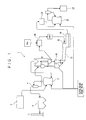
- FIG. 1 is a schematic diagram illustrating one embodiment in a case where the method of brake fluid disposal of the present invention is carried out in a cement production facility.
- a cement production facility 1 comprises mainly three steps, namely a material grinding step of grinding cement materials, a cement burning step of burning cement materials formulated in the material grinding step, and a finishing step of finishing burned cement clinker.
- the material grinding step is achieved by, for example, a cement material storage facility 2 for storage of cement materials, such as limestone, clay, silica rock and iron oxide, a material grinding machine 3 for drying and grinding cement materials supplied from the cement storage facility 2, a cyclone 4 for separating gasses from the cement materials ground at the material grinding machine 3, and an electric dust collector 5 for processing the separated gasses.
- a cement material storage facility 2 for storage of cement materials, such as limestone, clay, silica rock and iron oxide
- a material grinding machine 3 for drying and grinding cement materials supplied from the cement storage facility 2
- a cyclone 4 for separating gasses from the cement materials ground at the material grinding machine 3
- an electric dust collector 5 for processing the separated gasses.
- the cement burning step is achieved by a suspension pre-heater (pre-heating device) 11, a calcinations furnace 12, a rotary kiln 13 and a clinker cooler (cooler) 14, as well as a coal grinding machine 16 for grinding coal, a burner (burning device) 15 for heating the inside of the rotary kiln to a predetermined temperature by burring finely ground powdered coal together with fuel.
- pre-heating device pre-heating device
- a calcinations furnace 12 a rotary kiln 13 and a clinker cooler (cooler) 14
- a coal grinding machine 16 for grinding coal
- a burner (burning device) 15 for heating the inside of the rotary kiln to a predetermined temperature by burring finely ground powdered coal together with fuel.
- the finishing step is achieved by a clinker silo 21 for storing produced cement clinker, a finish grinding machine 22 for grinding a cement product to a predetermined particle size, which cement product is produced by mixing cement clinker supplied from the clinker silo 21 with other cement materials, such as gypsum, and a cement silo 23 for storing a cement product prepared by the finish grinding machine 22.
- glycol-based brake fluid recovered from vehicles is designed to be added to the material grinding machine 3, the coal grinding machine 16 and the finishing grinding machine 22.
- the glycol-based brake fluid is classified in a category different from silicon-based brake fluid, and generally contains about 98 wt. % glycols before use, and the glycols are still contained about 95 wt. % or more even when the brake fluid is recovered after use.
- the recovered glycol-based brake fluid by employing the recovered glycol-based brake fluid, large labor and time are not required for separation of water from, such as, waste coolant unlike those containing a large amount of water, and thus there is an advantage in that the recovered glycol-based brake fluid can be used without taking such separation. Since the concentration of the contained glycols is substantially constant, there is an advantage in that the adjustment of the glycol concentration or adjustment of the amount to be added to a grinding machine can be remarkably facilitated.
- glycols contained in the glycol-based brake fluid include glycol, glycol ether, polyglycol, polyglycol ether, and boric acid esters thereof.
- glycol preferably used are those having little or not more than 5 % ethyl glycol or diethylene glycol, and contains as main components (i.e., components of the greatest amount) polyglycol ether and polyglycol having 20 or more molecular weight.
- glycol-based brake fluid When glycol-based brake fluid is added to the material grinding machine 3, the coal grinding machine 16 and the finish grinding machine, glycols contained in the glycol-based brake fluid produces the same effect as that of diethylene glycol conventionally added as a grinding aid, and hence can increase the grinding efficiency of these cement materials, coal and cement products, etc. That is, it is assumed that glycol-based brake fluid increases the grinding efficiency by improving the dispersibility of cement particles, etc., suppressing coagulation of particles, as well as preventing coating on the inner wall of the grinding machine or grinding media. Since the glycol-based brake fluid contains less water, it is unlikely to be hydrated with cement or other hydraulic material.
- glycol-based brake fluid is preferably mixed with diethylene glycol to produce a grinding aid.
- Mixing glycol-based brake fluid with diethylene glycol increases the short age strength of cement cured body as compared with the case in which the glycol-based brake fluid is solely used as a grinding aid; and increases the long age strength of cement cured body as compared with the case in which the diethylene glycol is solely used as a grinding aid.
- these advantageous effects of the present invention can be produced even when the total amount of the grinding aids is the same (i.e., the case in which the content of each component is small), as compared with the case in which the glycol-based brake fluid or the diethylene glycol is solely used.
- glycol-based brake fluid is preferably 30:70 to 70:30 in mass ratio, more preferably 40:60 to 60:40 in mass ratio and much more preferably 45:55 to 55:45 in mass ratio.
- the amount of the grinding aid having the glycol-based brake fluid mixed with the diethylene glycol relative to cement or other mixture to be ground may be the same as that conventionally applied, and, for example, the amount of the grinding aid may be 0.01 to 0.05 parts by weight relative to 100 parts by weight of cement or other mixtures.
- the glycol-based brake fluid can be used as a strength reinforcing aid for reinforcing the strength of the cured cement by being added to cement materials produced at the cement-material production facility and can be used as a dust generation suppressing aid by being mixed with the cement material, as well.
- a cement material is not necessarily limited to a specific one as long as it is a powdered product which contains cement or other hydraulic material.
- Examples thereof include various portland cements such as ordinary, high-early-strength, ultra-high-early-strength, white, sulfate-resistant, moderate-heat and low heat portland cements, blended cement having the portland cement mixed with blast furnace slag or fly ash, special cements such as jet cement and alumina cement, and cement-based solidifying materials.
- portland cements such as ordinary, high-early-strength, ultra-high-early-strength, white, sulfate-resistant, moderate-heat and low heat portland cements, blended cement having the portland cement mixed with blast furnace slag or fly ash, special cements such as jet cement and alumina cement, and cement-based solidifying materials.
- the glycol-based brake fluid is added to a cement-based solidifying material for use in ground improvement, it is possible to effectively prevent dust generation during ground improvement of a substrate layer by using the cement-based solidifying material.
- the grinding test was performed in the same manner as Example 1 except that, in place of glycol-based brake fluid, diethylene glycol was added at the same ratio.
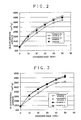
- Example 2 The grinding test was performed in the same manner as Example 1 except that glycol-based brake fluid was not added. The result is shown in FIG. 2 .
- Example 1 the grinding efficiency of Example 1 using, as a grinding aid, glycol-based brake fluid recovered from vehicles, is greatly improved as compared with Comparative Example 2 with no grinding aid added, and thus it is found that Example 1 produces substantially the same effect as that of Comparative Example 1, in which diethylene glycol generally used as a grinding aid is added.
- Example 1 The relationship between the grinding time and the fineness was determined in the same manner as Example 1 and Comparative Examples 1, 2 of Series 1, except that portland cement clinker of a different lot was used.
- the relationship between the grinding time and the fineness was determined by using, as a grinding aid, a mixture produced by mixing glycol-based brake fluid (BF) recovered from vehicles and diethylene glycol (DEG) together at the weight ratio of 50:50. The result is shown in FIG. 3 .
- BF glycol-based brake fluid
- DEG diethylene glycol
- Example 2 the grinding efficiency of Example 2 using, as a grinding aid, glycol-based brake fluid recovered from vehicles, is greatly improved as compared with Comparative Example 4 with no grinding aid added, and thus it is found that Example 2 produces substantially the same effect as that of Comparative Example 3 in which diethylene glycol generally used as a grinding aid is added. Also, it is found that Example 3 having the glycol-based brake fluid mixed with an equal amount of diethylene glycol produces substantially the same effect of Comparative Example 3 in which diethylene glycol is solely added.
- Portland cement clinker is mixed with gypsum by produced by an exhaust gas desulfurizer to have a content of SO 3 of 2.0 % by weight, and then the resulting mixture is ground for 30 minutes by a ball mill to produce a cement composition having a Blaine specific surface of 3300 cm 2 .
- a cement paste prepared with a water content of 27.8% following a testing method stipulated by JIS R 5201 "Physical testing methods of cement" was measured in terms of the starting time, the ending time, and the compressive strength at the age of 3 days, 7 days and 28 days, respectively. The result is shown in Table 1.
- Glycol-based brake fluid (BF) recovered from vehicles was mixed with the cement composition produced by the aforesaid Comparative Example 5 to have a content of glycols of 0.03 parts by weight relative to 100 parts by weight of the cement composition, and thus the same measurement as that of Comparative Example 5 was made.
- Example 4 The testing was made in the same manner as that of Example 4 except that a mixture having glycol-based brake fluid (BF) recovered from vehicles mixed with diethylene glycol (DEG) at a weight ratio of 70:30 was used.
- BF glycol-based brake fluid
- Example 4 The testing was made in the same manner as that of Example 4 except that a mixture having glycol-based brake fluid (BF) recovered from vehicles mixed with diethylene glycol (DEG) at a weight ratio of 50:50 was used.
- BF glycol-based brake fluid
- Example 4 The testing was made in the same manner as that of Example 4 except that a mixture having glycol-based brake fluid (BF) recovered from vehicles mixed with diethylene glycol (DEG) at a weight ratio of 30:70 was used.
- BF glycol-based brake fluid
- DEG diethylene glycol
- Example 8 and Comparative Example 7 were measured in terms of the properties of concrete (slump, and changes of air content and length), following JIS A 1129-2 "Testing methods for length change of mortar and concrete-Part 2 : Method with contact-type strain gauge”. The result is shown in the following Table 4.
- Example 8 having waste brake fluid added, the length change after curing is greatly reduced as compared with the concrete of Comparative Example 7 having no waste brake fluid added.
- Cement of Example 9 was prepared by placing 30 kg of ordinary portland cement and 450 g of waste brake fluid (1.5 % by weight relative to the cement) into a V-type blender having a volume of 100 litters, and then stirring them for 30 minutes.
- the thus obtained 100 g of cement is dropped into a square column shaped container having a width of 30 cm, a depth of 30 cm and a height of 100 cm through a hole having a diameter of 3 cm provided at the center of an upper surface of the container through a pipe; then air within the container is sucked at a rate of 0.3 litters/min through a hole in a side wall positioned 20 cm higher than the bottom surface of the container and then drawn into a dust counter at which particles having a diameter not smaller than 0.5 ⁇ m are counted.
- the dust concentration was measured.
Landscapes
- Chemical & Material Sciences (AREA)
- Engineering & Computer Science (AREA)
- Ceramic Engineering (AREA)
- Materials Engineering (AREA)
- Structural Engineering (AREA)
- Organic Chemistry (AREA)
- Chemical Kinetics & Catalysis (AREA)
- Disintegrating Or Milling (AREA)
- Processing Of Solid Wastes (AREA)
- Braking Arrangements (AREA)
- Curing Cements, Concrete, And Artificial Stone (AREA)
Abstract
Provided is a method of brake fluid disposal, which is characterized in that glycol-based brake fluid is recovered from vehicles, and the recovered glycol-based brake fluid is added to a grinding step of a cement material production facility. Furthermore, a method of brake fluid disposal is characterized in that the recovered glycol-based brake fluid is mixed with diethylene glycol. With these methods, it is possible to reduce troublesome works and effectively utilize the resources in cement material production facilities.
Description
- The present invention relates to a method of brake fluid disposal that enables waste brake fluid to be effectively utilized as a resource, and a grinding aid for cement material using brake fluid.
- In cement plants, glycols, such as ethylene glycol and diethylene glycol, alkanolamines, such as triethyanolamine and triisopropanolamine are used as grinding aids in grinding cement products, etc.
- Conventionally, from the view point of reduction in manufacturing costs of cement products and natural environment conservation, there are proposed, for example, utilization of wastewater discharged from semiconductor plants or machinery plants as the grinding aid (Patent Document 1), and utilization of waste coolant liquid taken out from automobiles, etc., as the grinding aid (Patent Document 2).
-
- Patent Document 1: Japanese Patent Application Laid-open No.
2003-2706 - Patent Document 2: Japanese Patent Application Laid-open No.
2004-167885 - However, in the above conventional arts, there are problems in which the glycol concentration of factory wastewater or waste coolant liquid is not kept constant, which leads to the necessity to pre-adjust the glycol concentration or adjust the amount of the waste to be added according to the glycol concentration, which involves troublesome works.
- Therefore, an object of the present invention is to reduce troublesome works as much as possible in the aforesaid cement material production facilities, while at the same time achieve efficient utilization of resources.
- The present inventors paid notice to used brake fluids taken out from automobiles when they are subjected to safety inspection or scrapped, found that glycol-based brake fluid among such brake fluids is suitable as a grinding aid for cement materials, and thus accomplished the present invention.
Specifically, according to the present invention, there is provided a method of brake fluid disposal, which is characterized in that glycol-based brake fluid, which has been recovered from vehicles, is added to cement materials and the cement materials are ground in cement production facilities.
The method of brake fluid disposal of the present invention is also characterized in that the recovered glycol-based brake fluid is mixed with diethylene glycol. - The present inventors further found out that the glycol-based brake fluid is suitable as an aid for suppressing dust flying, which prevents generating and flying of dusts when in use of cement materials, and also suitable as a strength reinforcing aid for reinforcing the set cement materials when it is mixed into the cement materials, and thus accomplished the present invention.
Specifically, according to the present invention, there is provided a method of brake fluid disposal, which is characterized in that glycol-based brake fluid, which has been recovered from vehicles, is added to cement materials. - According to another aspect of the present invention, there is provided a grinding aid for cement materials, which is characterized in that glycol-based brake fluid, which has been recovered from vehicles, is mixed with diethylene glycol.
- Glycol-based brake fluid recovered from vehicles contains less water and is formulated with glycols of very high concentration and therefore using the glycol-based brake fluid can omit troublesome works of, such as, adjusting the concentration or amount to be added for each recovered fluid, and omit the necessity for the step of separating water from the fluid.
Thus, by utilizing the glycol-based brake fluid as a grinding aid or utilizing the same as a dust-flying suppressing aid by adding the fluid to cement materials, it is possible to reduce troublesome works in cement production facilities, while efficiently utilizing resources. - Furthermore, a grinding aid for cement materials, in which glycol-based brake fluid recovered from vehicles is mixed with diethylene glycol, can not only increase the grinding efficiency of cement materials, but also produce a significant effect of improving both the short age strength and long age strength, of cement compositions produced by using the grinding aid.
- Still furthermore, according to the method of brake fluid disposal and the grinding aid for cement materials of the present invention, it is possible to produce an effect of reducing drying shrinkage when the produced cement materials have been set.
-
-
FIG. 1 illustrates a schematic diagram illustrating one embodiment of a method of brake fluid disposal according to the present invention. -
FIG. 2 is a graph showing the influences over the grinding efficiency caused by addition of glycol-based brake fluid (in case of Series 1). -
FIG. 3 is a graph showing the influences over the grinding efficiency caused by addition of glycol-based brake fluid (in case of Series 2). -
- 1: cement production facility
- 2: cement material storage facility
- 3: material grinding machine
- 4: cyclone
- 5: electric dust collector
- 11: suspension pre-heater (pre-heating device)
- 12: calcinations furnace
- 13: rotary kiln
- 14: clinker cooler (cooler)
- 15: burner (burning device)
- 16: coal grinding machine
- 21: clinker silo
- 22: finish grinding machine
- 23: cement silo
- Now, the description will be made for an embodiment of the present invention with reference to the drawings attached hereto.
FIG. 1 is a schematic diagram illustrating one embodiment in a case where the method of brake fluid disposal of the present invention is carried out in a cement production facility. As illustrated inFIG. 1 , as similar to a conventional cement production facility, a cement production facility 1 comprises mainly three steps, namely a material grinding step of grinding cement materials, a cement burning step of burning cement materials formulated in the material grinding step, and a finishing step of finishing burned cement clinker. - Specifically, as illustrated in
FIG. 1 , the material grinding step is achieved by, for example, a cementmaterial storage facility 2 for storage of cement materials, such as limestone, clay, silica rock and iron oxide, amaterial grinding machine 3 for drying and grinding cement materials supplied from thecement storage facility 2, acyclone 4 for separating gasses from the cement materials ground at thematerial grinding machine 3, and an electric dust collector 5 for processing the separated gasses. - The cement burning step is achieved by a suspension pre-heater (pre-heating device) 11, a
calcinations furnace 12, arotary kiln 13 and a clinker cooler (cooler) 14, as well as acoal grinding machine 16 for grinding coal, a burner (burning device) 15 for heating the inside of the rotary kiln to a predetermined temperature by burring finely ground powdered coal together with fuel. - The finishing step is achieved by a
clinker silo 21 for storing produced cement clinker, afinish grinding machine 22 for grinding a cement product to a predetermined particle size, which cement product is produced by mixing cement clinker supplied from theclinker silo 21 with other cement materials, such as gypsum, and acement silo 23 for storing a cement product prepared by thefinish grinding machine 22. - In this embodiment, glycol-based brake fluid recovered from vehicles is designed to be added to the
material grinding machine 3, thecoal grinding machine 16 and the finishinggrinding machine 22. - The glycol-based brake fluid is classified in a category different from silicon-based brake fluid, and generally contains about 98 wt. % glycols before use, and the glycols are still contained about 95 wt. % or more even when the brake fluid is recovered after use.
Specifically, by employing the recovered glycol-based brake fluid, large labor and time are not required for separation of water from, such as, waste coolant unlike those containing a large amount of water, and thus there is an advantage in that the recovered glycol-based brake fluid can be used without taking such separation.
Since the concentration of the contained glycols is substantially constant, there is an advantage in that the adjustment of the glycol concentration or adjustment of the amount to be added to a grinding machine can be remarkably facilitated. - Examples of the glycols contained in the glycol-based brake fluid include glycol, glycol ether, polyglycol, polyglycol ether, and boric acid esters thereof. Among them, preferably used are those having little or not more than 5 % ethyl glycol or diethylene glycol, and contains as main components (i.e., components of the greatest amount) polyglycol ether and polyglycol having 20 or more molecular weight.
- When glycol-based brake fluid is added to the
material grinding machine 3, thecoal grinding machine 16 and the finish grinding machine, glycols contained in the glycol-based brake fluid produces the same effect as that of diethylene glycol conventionally added as a grinding aid, and hence can increase the grinding efficiency of these cement materials, coal and cement products, etc. That is, it is assumed that glycol-based brake fluid increases the grinding efficiency by improving the dispersibility of cement particles, etc., suppressing coagulation of particles, as well as preventing coating on the inner wall of the grinding machine or grinding media. Since the glycol-based brake fluid contains less water, it is unlikely to be hydrated with cement or other hydraulic material. - Furthermore, in the present invention, glycol-based brake fluid is preferably mixed with diethylene glycol to produce a grinding aid. Mixing glycol-based brake fluid with diethylene glycol increases the short age strength of cement cured body as compared with the case in which the glycol-based brake fluid is solely used as a grinding aid; and increases the long age strength of cement cured body as compared with the case in which the diethylene glycol is solely used as a grinding aid.
In addition, these advantageous effects of the present invention can be produced even when the total amount of the grinding aids is the same (i.e., the case in which the content of each component is small), as compared with the case in which the glycol-based brake fluid or the diethylene glycol is solely used. - The mixing proportion between glycol-based brake fluid and diethylene glycol is preferably 30:70 to 70:30 in mass ratio, more preferably 40:60 to 60:40 in mass ratio and much more preferably 45:55 to 55:45 in mass ratio.
- The amount of the grinding aid having the glycol-based brake fluid mixed with the diethylene glycol relative to cement or other mixture to be ground may be the same as that conventionally applied, and, for example, the amount of the grinding aid may be 0.01 to 0.05 parts by weight relative to 100 parts by weight of cement or other mixtures.
- Although the description was made for the aforesaid embodiment by taking, for example, a cement production facility as a cement-material production facility, the present invention is not necessarily limited to the cement production facility, while it is possible to apply the present invention to other cement-material production facilities. Also, the description was made for the aforesaid embodiment by taking, for example, the material grinding machine, the coal grinding machine and the finish grinding machine as a grinding step, but the grinding step for the present invention is not necessarily limited to these.
- The glycol-based brake fluid can be used as a strength reinforcing aid for reinforcing the strength of the cured cement by being added to cement materials produced at the cement-material production facility and can be used as a dust generation suppressing aid by being mixed with the cement material, as well.
A cement material is not necessarily limited to a specific one as long as it is a powdered product which contains cement or other hydraulic material. Examples thereof include various portland cements such as ordinary, high-early-strength, ultra-high-early-strength, white, sulfate-resistant, moderate-heat and low heat portland cements, blended cement having the portland cement mixed with blast furnace slag or fly ash, special cements such as jet cement and alumina cement, and cement-based solidifying materials.
Especially, when the glycol-based brake fluid is added to a cement-based solidifying material for use in ground improvement, it is possible to effectively prevent dust generation during ground improvement of a substrate layer by using the cement-based solidifying material. - Ground portland cement and gypsum by produced by an exhaust gas desulfurizer were mixed together to produce a mixture having a content of SO3 of 2.0 %by weight. Then, glycol-based brake fluid recovered from vehicles was added to this mixture in such a manner that the amount of glycols added reaches 0.03 parts by weight relative to 100 parts by weight of the mixture.
The resulting mixture is ground by a ball mill and the relationship between the grinding time and the fineness was determined. - The grinding test was performed in the same manner as Example 1 except that, in place of glycol-based brake fluid, diethylene glycol was added at the same ratio.
- The grinding test was performed in the same manner as Example 1 except that glycol-based brake fluid was not added. The result is shown in
FIG. 2 . - In
FIG. 2 , the grinding efficiency of Example 1 using, as a grinding aid, glycol-based brake fluid recovered from vehicles, is greatly improved as compared with Comparative Example 2 with no grinding aid added, and thus it is found that Example 1 produces substantially the same effect as that of Comparative Example 1, in which diethylene glycol generally used as a grinding aid is added. - The relationship between the grinding time and the fineness was determined in the same manner as Example 1 and Comparative Examples 1, 2 of Series 1, except that portland cement clinker of a different lot was used.
- Furthermore, the relationship between the grinding time and the fineness was determined by using, as a grinding aid, a mixture produced by mixing glycol-based brake fluid (BF) recovered from vehicles and diethylene glycol (DEG) together at the weight ratio of 50:50.
The result is shown inFIG. 3 . - In
FIG. 3 , the grinding efficiency of Example 2 using, as a grinding aid, glycol-based brake fluid recovered from vehicles, is greatly improved as compared with Comparative Example 4 with no grinding aid added, and thus it is found that Example 2 produces substantially the same effect as that of Comparative Example 3 in which diethylene glycol generally used as a grinding aid is added.
Also, it is found that Example 3 having the glycol-based brake fluid mixed with an equal amount of diethylene glycol produces substantially the same effect of Comparative Example 3 in which diethylene glycol is solely added. - Portland cement clinker is mixed with gypsum by produced by an exhaust gas desulfurizer to have a content of SO3 of 2.0 % by weight, and then the resulting mixture is ground for 30 minutes by a ball mill to produce a cement composition having a Blaine specific surface of 3300 cm2.
Furthermore, with respect to the cement composition, a cement paste prepared with a water content of 27.8% following a testing method stipulated by JIS R 5201 "Physical testing methods of cement" was measured in terms of the starting time, the ending time, and the compressive strength at the age of 3 days, 7 days and 28 days, respectively. The result is shown in Table 1. - Mixing was made to have diethylene glycol of 0.03 parts by weight relative to 100 parts by weight of a cement composition produced by the aforesaid Comparative Example 5 and the same measurement as that of Comparative Example 5 was made.
- Glycol-based brake fluid (BF) recovered from vehicles was mixed with the cement composition produced by the aforesaid Comparative Example 5 to have a content of glycols of 0.03 parts by weight relative to 100 parts by weight of the cement composition, and thus the same measurement as that of Comparative Example 5 was made.
- The testing was made in the same manner as that of Example 4 except that a mixture having glycol-based brake fluid (BF) recovered from vehicles mixed with diethylene glycol (DEG) at a weight ratio of 70:30 was used.
- The testing was made in the same manner as that of Example 4 except that a mixture having glycol-based brake fluid (BF) recovered from vehicles mixed with diethylene glycol (DEG) at a weight ratio of 50:50 was used.
- The testing was made in the same manner as that of Example 4 except that a mixture having glycol-based brake fluid (BF) recovered from vehicles mixed with diethylene glycol (DEG) at a weight ratio of 30:70 was used.
-
[Table 1] Composition [wt%] Volume of water (%) Setting time [hour: min] Compressive strength [N/mm2] BF DEG Starting Ending 3 days 7 days 28 days Example 4 100 0 27.8 1-45 2-43 30.5 47.6 66.1 Example 5 70 30 27.8 1-35 2-33 32.9 47.8 65.0 Example 6 50 50 27.8 1-32 2-29 33.4 48.0 65.0 Example 7 30 70 27.8 1-32 2-30 33.5 47.9 65.7 Comparative Example 5 - - 27.8 1-43 2-45 30.3 46.1 65.4 Comparative Example 6 0 100 27.8 1-32 2-29 33.7 47.8 63.6 - According to Table 1, in case of Comparative Example 6 in which only the diethylene glycol is mixed, it is possible to increase the initial strength (3-day strength), but it is found that the long age strength (28-day strength) is lowered as compared with Comparative Example 4 having no addition. On the contrary, in case of Examples 5-7 in which a mixture of brake fluid and diethylene glycol are mixed, it is found that the initial strength (3-day strength) can be increased, while maintaining the long age strength (28-day strength) equivalent to Example 4 having only the brake fluid mixed.
- Any of Examples is substantially the same as Comparative Example 5 in terms of setting time, and thus it is found that the initial strength can be increased without causing adverse influences on setting.
- By using materials shown in the following Table 2, respectively prepared concrete of Example 8 having waste brake fluid (BF) added in the ratio shown in the following Table 3, and concrete of Comparative Example 7 having no waste brake fluid added.
-
[Table 2] Materials used Material Abbr. Name (Trade name) Production region/Manufacturer Water W Clean water - Cement C Ordinary portland cement Sumitomo Osaka Cement Co., Ltd. Fine aggregate S River sand: density of 2.56 and fineness modulus of 2.72 Produced at Yasu, Shiga Prefecture Coarse aggregate G Crushed stone: density of 2.63 and fineness modulus of 6.62 Produced at Nishijima, Hyogo Prefecture Admixture SP Pozzolith No.70 NMB Ltd. Waste brake fluid BF - - -
[Table 3] Composition of concrete BF
(C×%)W/C Unit quantity (kg/m3) SP
(C×%)W C S G Example 8 1.5 45.5 170 374 821 936 0.25 Comparative Example 7 0 45.5 170 374 821 936 0.25 - The produced concretes of Example 8 and Comparative Example 7 were measured in terms of the properties of concrete (slump, and changes of air content and length), following JIS A 1129-2 "Testing methods for length change of mortar and concrete-Part 2 : Method with contact-type strain gauge". The result is shown in the following Table 4.
-
[Table 4] Properties of concrete Slump (cm) Air content (%) Length change (×10-4) 5 weeks 10 weeks 20 weeks Example 8 7.6 4.1 2.1 3.9 5.1 Comparative Example 7 8.2 4.7 5.4 6.5 7.2 - As shown in Table 4, regarding Example 8 having waste brake fluid added, the length change after curing is greatly reduced as compared with the concrete of Comparative Example 7 having no waste brake fluid added.
- Cement of Example 9 was prepared by placing 30 kg of ordinary portland cement and 450 g of waste brake fluid (1.5 % by weight relative to the cement) into a V-type blender having a volume of 100 litters, and then stirring them for 30 minutes.
The thus obtained 100 g of cement is dropped into a square column shaped container having a width of 30 cm, a depth of 30 cm and a height of 100 cm through a hole having a diameter of 3 cm provided at the center of an upper surface of the container through a pipe; then air within the container is sucked at a rate of 0.3 litters/min through a hole in a side wall positioned 20 cm higher than the bottom surface of the container and then drawn into a dust counter at which particles having a diameter not smaller than 0.5 µm are counted. Thus, the dust concentration was measured. - Cement of Comparative Example 8 was prepared in the same manner except that waste brake fluid is not added, and the same testing was made.
-
[Table 5] BF Dust concentration (C×%) (piece/m3) Example 9 1.5 1.2×10⁷ Comparative Example 8 0 2.1×10⁹ - As shown in Table 5, the dust concentration of cement of Example 9 having waste brake fluid added is greatly reduced as compared with cement of Comparative Example 8 having no waste brake fluid added, and thus it is found that dusts are effectively prevented from being generated during handling of cement.
Claims (4)
- A method of brake fluid disposal, which is characterized in that glycol-based brake fluid which has been recovered from vehicles is added to cement materials and the cement materials are ground.
- A method of brake fluid disposal, which is characterized in that glycol-based brake fluid which has been recovered from vehicles is added to cement materials.
- A method of brake fluid disposal according to any one of claims 1 and 2, wherein the recovered glycol-based brake fluid is mixed with diethylene glycol.
- A grinding aid for cement materials, which is characterized in that glycol-based brake fluid, which has been recovered from vehicles, is mixed with diethylene glycol.
Applications Claiming Priority (2)
| Application Number | Priority Date | Filing Date | Title |
|---|---|---|---|
| JP2006265171 | 2006-09-28 | ||
| PCT/JP2007/068854 WO2008038732A1 (en) | 2006-09-28 | 2007-09-27 | Method of brake fluid disposal and grinding aid for cement material |
Publications (1)
| Publication Number | Publication Date |
|---|---|
| EP2082998A1 true EP2082998A1 (en) | 2009-07-29 |
Family
ID=39230167
Family Applications (1)
| Application Number | Title | Priority Date | Filing Date |
|---|---|---|---|
| EP07828600A Pending EP2082998A1 (en) | 2006-09-28 | 2007-09-27 | Method of brake fluid disposal and grinding aid for cement material |
Country Status (8)
| Country | Link |
|---|---|
| US (1) | US8083850B2 (en) |
| EP (1) | EP2082998A1 (en) |
| JP (1) | JP5228230B2 (en) |
| KR (1) | KR101402572B1 (en) |
| CN (1) | CN101516799B (en) |
| CA (1) | CA2664759A1 (en) |
| TW (1) | TW200831443A (en) |
| WO (1) | WO2008038732A1 (en) |
Families Citing this family (10)
| Publication number | Priority date | Publication date | Assignee | Title |
|---|---|---|---|---|
| JP5243185B2 (en) * | 2008-10-30 | 2013-07-24 | 太平洋セメント株式会社 | Recycling method of antifreeze for distribution |
| EP2730549A4 (en) | 2011-09-08 | 2015-03-18 | Tokuyama Corp | SURFACTANT AGENT-COATED HEMIHYDRATE GYPSUM AND METHOD FOR MANUFACTURING THE SAME |
| CN103204513B (en) * | 2012-01-14 | 2016-03-30 | 比亚迪股份有限公司 | A kind of inefficacy braking fluid reuse method |
| JP2015213869A (en) * | 2014-05-09 | 2015-12-03 | 株式会社片山化学工業研究所 | Method for crushing minerals, rocks or their composites and treatment agent used therefor |
| JP6528206B2 (en) * | 2014-09-03 | 2019-06-12 | 太平洋セメント株式会社 | Method of manufacturing cement, mortar and concrete |
| CN104909597B (en) * | 2015-05-20 | 2017-01-04 | 南京工业大学 | A cement grinding aid prepared from waste antifreeze |
| KR102004257B1 (en) * | 2018-09-05 | 2019-07-26 | 아세아시멘트(주) | Construction material for reducing dust using polymer-based dust reducing agent |
| JP7369650B2 (en) * | 2020-03-19 | 2023-10-26 | 太平洋セメント株式会社 | Method for recycling carbon dioxide absorption liquid, grinding aid for cement, and method for producing cement |
| JP7313303B2 (en) * | 2020-03-19 | 2023-07-24 | 太平洋セメント株式会社 | Method for recycling carbon dioxide absorbing liquid, grinding aid for cement, and method for producing cement |
| CN111852364B (en) * | 2020-07-29 | 2022-03-01 | 中国石油化工股份有限公司 | Cyclone separation and mechanical crushing type coal dust cleaning system and working method thereof |
Family Cites Families (8)
| Publication number | Priority date | Publication date | Assignee | Title |
|---|---|---|---|---|
| JPH02298366A (en) * | 1989-05-15 | 1990-12-10 | Denka Gureesu Kk | Grinding adjuvant of mineral substance |
| JP2980752B2 (en) * | 1991-11-21 | 1999-11-22 | 住友大阪セメント株式会社 | Manufacturing method of cement material and cement material |
| JP2622920B2 (en) * | 1992-09-02 | 1997-06-25 | 日本セメント株式会社 | Method for suppressing dust generation of cement or lime |
| CN1078572C (en) * | 1999-08-06 | 2002-01-30 | 宋延秋 | Grinding-helping and reinforcing additive of cement |
| JP2003002706A (en) | 2001-06-20 | 2003-01-08 | Mitsubishi Materials Corp | Method of treating industrial waste water |
| JP4257104B2 (en) | 2002-11-20 | 2009-04-22 | 太平洋セメント株式会社 | Recycling method of waste coolant liquid water |
| JP4661121B2 (en) | 2003-08-08 | 2011-03-30 | 宇部興産株式会社 | Cement manufacturing method |
| KR100686790B1 (en) * | 2004-05-13 | 2007-02-23 | 경남유화 주식회사 | Cement Grinding Aid Composition |
-
2007
- 2007-09-27 EP EP07828600A patent/EP2082998A1/en active Pending
- 2007-09-27 US US12/443,079 patent/US8083850B2/en not_active Expired - Fee Related
- 2007-09-27 JP JP2008536430A patent/JP5228230B2/en active Active
- 2007-09-27 CN CN200780035992XA patent/CN101516799B/en not_active Expired - Fee Related
- 2007-09-27 WO PCT/JP2007/068854 patent/WO2008038732A1/en not_active Ceased
- 2007-09-27 TW TW096136061A patent/TW200831443A/en unknown
- 2007-09-27 CA CA002664759A patent/CA2664759A1/en not_active Abandoned
- 2007-09-27 KR KR1020097008587A patent/KR101402572B1/en not_active Expired - Fee Related
Non-Patent Citations (1)
| Title |
|---|
| See references of WO2008038732A1 * |
Also Published As
| Publication number | Publication date |
|---|---|
| US20090266271A1 (en) | 2009-10-29 |
| JP5228230B2 (en) | 2013-07-03 |
| CA2664759A1 (en) | 2008-04-03 |
| TW200831443A (en) | 2008-08-01 |
| KR101402572B1 (en) | 2014-05-30 |
| US8083850B2 (en) | 2011-12-27 |
| KR20090080951A (en) | 2009-07-27 |
| CN101516799A (en) | 2009-08-26 |
| JPWO2008038732A1 (en) | 2010-01-28 |
| WO2008038732A1 (en) | 2008-04-03 |
| CN101516799B (en) | 2013-02-06 |
Similar Documents
| Publication | Publication Date | Title |
|---|---|---|
| US8083850B2 (en) | Method of brake fluid disposal and grinding aid for cement material | |
| EP0696262B1 (en) | Method for producing cement | |
| EP1558543B1 (en) | Process for producing blended cements with reduced carbon dioxide emissions | |
| EP2215031B1 (en) | Method for processing of pozzolans. | |
| EP1558544B1 (en) | Method for the treatment of fly ash | |
| EP2467347A1 (en) | Robust air-detraining for cement milling | |
| JP2009013023A (en) | Portland cement clinker and method for producing the same | |
| JP5583429B2 (en) | Hydraulic composition | |
| JP2004292307A (en) | Hydraulic composition | |
| JP4176668B2 (en) | concrete | |
| JPH06287046A (en) | Mixed cement | |
| JP4166183B2 (en) | concrete | |
| AU2023374289A1 (en) | Blended cements, methods for their manufacture, and use of an admixture to increase performance of blended cements | |
| JP2834613B2 (en) | Cement composition | |
| JP2000007397A (en) | Admixture for cement-based hydraulic composition | |
| CN119930250B (en) | A high crack-resistant self-leveling dry powder mortar, its preparation method and construction method | |
| US20230219844A1 (en) | High-strength concrete and method of producing same | |
| JP4116987B2 (en) | Hydraulic composition | |
| JP3161575B2 (en) | Cement composition for autoclave curing | |
| JP2007131477A (en) | Fly ash cement composition and concrete molded product using the same | |
| JPS61197173A (en) | Surface plate | |
| JP4565126B2 (en) | Method for producing hydraulic materials using waste materials from ceramics building materials | |
| WO2025204522A1 (en) | Hydraulic composition and method for producing hardened body of hydraulic composition | |
| JP2011168462A (en) | Hydraulic composition | |
| WO1990009968A1 (en) | Binder for a high strength high density concrete and concrete using said binder |
Legal Events
| Date | Code | Title | Description |
|---|---|---|---|
| PUAI | Public reference made under article 153(3) epc to a published international application that has entered the european phase |
Free format text: ORIGINAL CODE: 0009012 |
|
| STAA | Information on the status of an ep patent application or granted ep patent |
Free format text: STATUS: REQUEST FOR EXAMINATION WAS MADE |
|
| 17P | Request for examination filed |
Effective date: 20090414 |
|
| AK | Designated contracting states |
Kind code of ref document: A1 Designated state(s): AT BE BG CH CY CZ DE DK EE ES FI FR GB GR HU IE IS IT LI LT LU LV MC MT NL PL PT RO SE SI SK TR |
|
| DAX | Request for extension of the european patent (deleted) |