EP2082669A2 - Hybrid apparatus for preparing beverages - Google Patents
Hybrid apparatus for preparing beverages Download PDFInfo
- Publication number
- EP2082669A2 EP2082669A2 EP08152433A EP08152433A EP2082669A2 EP 2082669 A2 EP2082669 A2 EP 2082669A2 EP 08152433 A EP08152433 A EP 08152433A EP 08152433 A EP08152433 A EP 08152433A EP 2082669 A2 EP2082669 A2 EP 2082669A2
- Authority
- EP
- European Patent Office
- Prior art keywords
- heating means
- liquid
- supply
- combustion
- heat
- Prior art date
- Legal status (The legal status is an assumption and is not a legal conclusion. Google has not performed a legal analysis and makes no representation as to the accuracy of the status listed.)
- Withdrawn
Links
- 235000013361 beverage Nutrition 0.000 title claims abstract description 40
- 239000007788 liquid Substances 0.000 claims abstract description 92
- 238000002485 combustion reaction Methods 0.000 claims abstract description 82
- 238000010438 heat treatment Methods 0.000 claims abstract description 67
- 238000005485 electric heating Methods 0.000 claims abstract description 36
- 230000001105 regulatory effect Effects 0.000 claims abstract description 23
- 235000012171 hot beverage Nutrition 0.000 claims abstract description 8
- XLYOFNOQVPJJNP-UHFFFAOYSA-N water Substances O XLYOFNOQVPJJNP-UHFFFAOYSA-N 0.000 claims description 31
- 239000002184 metal Substances 0.000 claims description 24
- 229910052751 metal Inorganic materials 0.000 claims description 24
- 238000002360 preparation method Methods 0.000 claims description 24
- 235000016213 coffee Nutrition 0.000 claims description 20
- 235000013353 coffee beverage Nutrition 0.000 claims description 20
- 238000000605 extraction Methods 0.000 claims description 16
- 239000000463 material Substances 0.000 claims description 9
- 241001122767 Theaceae Species 0.000 claims description 7
- 230000001276 controlling effect Effects 0.000 claims description 5
- 239000004615 ingredient Substances 0.000 claims description 5
- 229910000831 Steel Inorganic materials 0.000 claims description 4
- 239000010959 steel Substances 0.000 claims description 4
- 239000004411 aluminium Substances 0.000 claims description 3
- 229910052782 aluminium Inorganic materials 0.000 claims description 3
- XAGFODPZIPBFFR-UHFFFAOYSA-N aluminium Chemical compound [Al] XAGFODPZIPBFFR-UHFFFAOYSA-N 0.000 claims description 3
- 230000001737 promoting effect Effects 0.000 claims description 3
- 238000001802 infusion Methods 0.000 claims description 2
- 239000007789 gas Substances 0.000 description 12
- 235000015114 espresso Nutrition 0.000 description 8
- 239000002775 capsule Substances 0.000 description 5
- 239000000126 substance Substances 0.000 description 5
- 238000009835 boiling Methods 0.000 description 3
- 239000000567 combustion gas Substances 0.000 description 2
- 230000000694 effects Effects 0.000 description 2
- 238000001704 evaporation Methods 0.000 description 2
- 239000000446 fuel Substances 0.000 description 2
- 239000000203 mixture Substances 0.000 description 2
- 239000007787 solid Substances 0.000 description 2
- 229910001369 Brass Inorganic materials 0.000 description 1
- 239000010951 brass Substances 0.000 description 1
- 239000003054 catalyst Substances 0.000 description 1
- 235000019504 cigarettes Nutrition 0.000 description 1
- 239000004020 conductor Substances 0.000 description 1
- 230000008020 evaporation Effects 0.000 description 1
- 239000000796 flavoring agent Substances 0.000 description 1
- 235000019634 flavors Nutrition 0.000 description 1
- 239000006260 foam Substances 0.000 description 1
- 235000013305 food Nutrition 0.000 description 1
- 239000012774 insulation material Substances 0.000 description 1
- 230000033001 locomotion Effects 0.000 description 1
- 238000004806 packaging method and process Methods 0.000 description 1
- 230000001681 protective effect Effects 0.000 description 1
Images
Classifications
-
- A—HUMAN NECESSITIES
- A47—FURNITURE; DOMESTIC ARTICLES OR APPLIANCES; COFFEE MILLS; SPICE MILLS; SUCTION CLEANERS IN GENERAL
- A47J—KITCHEN EQUIPMENT; COFFEE MILLS; SPICE MILLS; APPARATUS FOR MAKING BEVERAGES
- A47J31/00—Apparatus for making beverages
- A47J31/44—Parts or details or accessories of beverage-making apparatus
- A47J31/54—Water boiling vessels in beverage making machines
- A47J31/56—Water boiling vessels in beverage making machines having water-level controls; having temperature controls
-
- A—HUMAN NECESSITIES
- A47—FURNITURE; DOMESTIC ARTICLES OR APPLIANCES; COFFEE MILLS; SPICE MILLS; SUCTION CLEANERS IN GENERAL
- A47J—KITCHEN EQUIPMENT; COFFEE MILLS; SPICE MILLS; APPARATUS FOR MAKING BEVERAGES
- A47J27/00—Cooking-vessels
- A47J27/21—Water-boiling vessels, e.g. kettles
-
- A—HUMAN NECESSITIES
- A47—FURNITURE; DOMESTIC ARTICLES OR APPLIANCES; COFFEE MILLS; SPICE MILLS; SUCTION CLEANERS IN GENERAL
- A47J—KITCHEN EQUIPMENT; COFFEE MILLS; SPICE MILLS; APPARATUS FOR MAKING BEVERAGES
- A47J31/00—Apparatus for making beverages
- A47J31/005—Portable or compact beverage making apparatus, e.g. for travelling, for use in automotive vehicles
-
- A—HUMAN NECESSITIES
- A47—FURNITURE; DOMESTIC ARTICLES OR APPLIANCES; COFFEE MILLS; SPICE MILLS; SUCTION CLEANERS IN GENERAL
- A47J—KITCHEN EQUIPMENT; COFFEE MILLS; SPICE MILLS; APPARATUS FOR MAKING BEVERAGES
- A47J31/00—Apparatus for making beverages
- A47J31/44—Parts or details or accessories of beverage-making apparatus
- A47J31/54—Water boiling vessels in beverage making machines
-
- A—HUMAN NECESSITIES
- A47—FURNITURE; DOMESTIC ARTICLES OR APPLIANCES; COFFEE MILLS; SPICE MILLS; SUCTION CLEANERS IN GENERAL
- A47J—KITCHEN EQUIPMENT; COFFEE MILLS; SPICE MILLS; APPARATUS FOR MAKING BEVERAGES
- A47J31/00—Apparatus for making beverages
- A47J31/44—Parts or details or accessories of beverage-making apparatus
- A47J31/54—Water boiling vessels in beverage making machines
- A47J31/542—Continuous-flow heaters
- A47J31/545—Control or safety devices
Definitions
- the present invention relates to an apparatus for preparing beverages.
- the invention more precisely relates to dispensing machines, such as mobile or portable coffee machines.
- the beverage preparation apparatuses of the coffee machine type which use prepacked or non-packed portions of a food substance are very widespread among private individuals, and also in municipalities, shopping centres and companies.
- the preparation principle is based on the extraction of portions of the substance by the passage through this substance of a quantity of cold or hot liquid under high pressure, typically a pressure above atmospheric pressure.
- the prepacked portions can be partially rigid capsules, or else flexible bags, which are hermetically sealed or partially open, or else a dose filter.
- the individual packages are easy to use and require no batching of coffee or other substances, in the machine.
- the user places a capsule, a ground-coffee dose or other portions in the machine, then presses a button to start extraction.
- the individual packages are batched to deliver a beverage, like a coffee, having the desired characteristics such as sufficient character, flavour, foam or other important attributes.
- they When they are impermeable, they usually preserve the freshness of the substance better, up to the time of extraction.
- the preparation conditions such as the temperature, pressure and extraction time can be better controlled, thereby guaranteeing relatively controlled and constant quality to the consumer.
- US 6,739,241 discloses a camping drip coffee maker in which a water is promoted from a reservoir to a brewing basket via a tube by heating the tube with an open flame heater to cause pressurisation of the water therein, whereby the boiling/evaporating water is promoted to the brewing basket.
- this type of flame heating of the water may prove to be convenient to circulate boiling/evaporated water under the effect of pressure for the purpose of making drip coffee, this heating system is not appropriate to be adapted to prepare an espresso.
- the water which is pumped, usually mechanically, under pressure through ground coffee to prepare an espresso coffee is preferably maintained at a controlled temperature, typically at a temperature within a range of a few degrees around 85°C.
- W02006/102980 discloses an espresso machine that can be operated to prepare beverages without being connected to an electric power network.
- the machine is powered with a battery.
- the espresso machine has a thermally-insulated reservoir containing water that is preheated using the mains prior to prepare beverages in an autonomous mode.
- the water is then maintained at a sufficient temperature using the battery in the autonomous mode.
- the autonomy of such beverage machines can be of a few hours and thus provides a solution when their use is intended within a relatively short period from the time after the water has been preheated, for instance in trains, planes, cinemas...
- this machine is not optimal when intended to be used only several hours or days after preheating the water.
- US2007/0199452 discloses a mobile or portable espresso machine in which water is pumped from a reservoir by means of a pressure gas actuated pump. The water is heated in the reservoir (in which case the reservoir is insulated) or between the reservoir and the machine's extraction head.
- the espresso machine has either an electric heater, such as a thermoblock, or a combustion heater such as a burner using solid and/or gaseous and/or liquid fuel.
- combustion heaters may constitute an interesting alternative to electric heating for certain type of mobile or portable coffee machines
- the known use of a combustion heater leads to boiling and/or evaporation of the water, which is not desirable for the preparation of espresso-type coffee or even tea.
- such combustion heaters are sometimes not well accepted when the coffee machine is also intended to be used at proximity of the electric power supply, in particular at home.
- the invention therefore relates to a device for preparing hot beverages, in particular coffee or tea, comprising: an arrangement for circulating a liquid from a liquid supply, e.g. a water supply, to a beverage supply exit; and a combustion heating means, such as a burner, for supplying combustion heat to the liquid that is circulated to the supply exit.
- a liquid supply e.g. a water supply
- a combustion heating means such as a burner
- the liquid supply may be in the form of a tank of liquid having a capacity that is sufficient for supplying more than one beverage.
- the combustion heating means is associated with an electric heating means for supplying electric heat to the liquid that is circulated to the supply exit.
- the user who does not want to have an appliance that needs a gas supply or another combustion system at home or in the office for example, typically for safety reasons, does not anymore need to buy a separate appliance for going to places, typically outdoor places, where he does not have access to the mains, such as a household or industrial electric power supply providing typically about 110, 220 or 380 volt.
- Electric heating means are for instance disclosed in WO 2004/006742 and in WO 2006/029763 .
- the electric heating means may comprise a thermoblock having a metal-based body with a through passage for the circulation of the liquid and one or more resistances for supplying electric heat to the metal-based body.
- the combustion heating means is arranged to supply heat to the liquid via the metal-based body of the thermoblock.
- a metal-based body may comprise a mass of aluminium with a steel passage for the circulation of the liquid, and/or it may form a sufficient thermal capacity that can provide a more or less constant amount of heat to liquid circulating through the thermoblock and absorb possible variations of the combustion heat supply.
- the metal-based body may have a generally tubular shape with a generally helicoidal through passage for the circulation of liquid.
- the combustion heating means and/or the electric heating means is/are preferably associated with a means for regulating the heat supplied to the liquid from the combustion heating means and/or the electric heating means, the regulating means comprising usually a temperature sensor.
- the electric heating means is associated with a temperature sensor that is arranged to measure directly or indirectly the temperature of the heated liquid.
- the electric heating means is arranged to: compare the measured temperature with a target temperature; and adjust the supply of electric heat based on the difference between the measured temperature and the target temperature.
- the combustion heating means may be arranged to supply an amount of combustion heat to the liquid which is below the heat required for the liquid to reach the target temperature but does not need to be further regulated since the required heat for the liquid to reach or approach the target temperature is provided by the electric heating means.
- the combustion heating means is associated with a temperature sensor that is arranged to measure directly or indirectly the temperature of the heated liquid.
- the combustion heating means is arranged to: compare the measured temperature with a target temperature; and adjust the supply of the combustion heat based on the difference between the measured temperature and the target temperature.
- the electric heating means may be arranged to supply electric heat to the liquid which is below the heat required for the liquid to reach the target temperature but does not need to be further regulated since the required heat for the liquid to reach or approach the target temperature is provided by the combustion heating means.
- the electric heating means and the combustion heating means are associated with a temperature sensor, optionally the same temperature sensor for both heating means, that is arranged to measure directly or indirectly the temperature of the heated liquid.
- the electric heating means and the combustion heating means can be arranged to: compare the measured temperature with a target temperature; and adjust the supply of electric heat and/or combustion heat based on the difference between the measured temperature and the target temperature.
- the regulating means may also comprise a flow meter to monitor not only the temperature of the heated liquid but also the flow rate, and thus the amount of liquid that requires heating.
- the electric heating means and the combustion heating means may be configured or configurable, in particular by the user, so that: the electric heating means and the combustion heating means supply heat simultaneously to the liquid; or only one at a time of the electric heating means and the combustion heating means supplies heat to the liquid.
- the combustion heating means may comprise a combustible supply arrangement for supplying combustible material to a burner for consuming the combustible material.
- the combustible material may be a solid and/or gaseous and/or a liquid fuel, that can be subjected to a flame burning.
- the combustible supply arrangement may include a combustible supply reservoir or tank, or a connector to a combustible supply network, in particular for gas.
- the combustion heating means further comprises a valve between the combustible supply arrangement and the burner for controlling the supply of combustible material from the supply arrangement to the burner, in particular a variable valve, e.g. allowing the passage of a variable flow of combustible, or a two state on-off valve, e.g. a valve that merely has an open and a closed position for controlling the flow of gas.
- a variable valve e.g. allowing the passage of a variable flow of combustible
- a two state on-off valve e.g. a valve that merely has an open and a closed position for controlling the flow of gas.
- the combustion heating means is advantageously associated with means for regulating its heat supply, the regulating means being arranged to control the valve.
- the regulating means can be arranged to control the periods of time during which the heating means supply heat and, respectively, do not heat the liquid.
- the regulation means is preferably arranged further to control the supply rate of the combustion material for the heating, for instance the gas flow to the burner.
- the combustion heating means is associated with an ignition means, in particular an electric ignition means.
- an ignition means in particular an electric ignition means.
- such an ignition means is preferably controlled by the regulation means.
- the arrangement for circulating a liquid comprises a pump for promoting the circulation of the liquid in the arrangement, in particular under pressure, e.g. up to 30 bar, such as in the range of 1.5 to 25 bar, for instance 10 to 20 bar, typically to prepare an espresso-type beverage.
- the pump may be electrically powered and/or gas actuated, for instance a gas actuated pump as disclosed in US2007/0199452 .
- the beverage preparation device is typically arranged to be powered with an electric current supply that can be at least one of a battery-type low voltage supply and the mains.
- the device may comprise a housing for a battery and/or a connector for a low voltage supply, for instance connectable to a cigarette lighter type car connector.
- the beverage preparation device may be arranged for operation with electric heating when powered by the mains and with combustion heating when powered by the battery-type low voltage supply.
- a battery may be sufficient to power satisfactorily such components when the heating is primarily provided by the combustion heating means.
- the electric heating requires about 95% of the consumed electric energy. Therefore, it may be an advantageous combination for the autonomy of the device while allowing a fine control of the temperature of the liquid to provide a beverage preparation device with a combustion heating means and an electric temperature regulation means and pump, powered by a battery or another low voltage electric supply.
- the arrangement for circulating the liquid may comprise an extraction and/or infusion head for containing an ingredient for the preparation of the beverage, the extraction head leading to the supply exit.
- the ingredient may be provided in the form of a prepacked portion in a container such as a cartridge, bag, or other appropriate packaging modes.
- the ingredient can be provided in the form of a non-packed portion, such as ground coffee, directly introduced into the chamber of the extraction module.
- the invention also relates to a device for preparing hot beverages, in particular coffee or tea.
- This device comprises: an arrangement for circulating a liquid, such as water, from a liquid supply to a beverage supply exit; and a combustion heating means, such as a burner, for supplying combustion heat to the liquid that is circulated to the supply exit.
- the combustion heating means is associated with a means for regulating the heat supplied to the liquid from the combustion heating means, the regulating means comprising usually a temperature sensor.
- the regulating means may in particular be associated with a temperature sensor that is arranged to measure directly or indirectly the temperature of the heated liquid.
- the regulating means can be arranged to: compare the measured temperature with a target temperature; and adjust the supply of combustion heat by the combustion means based on the difference between the measured temperature and the target temperature.
- This beverage preparation device may incorporate all the above disclosed features or combination of features.
- the combustion heating means is associated with an electric heating element for supplying an electric heat to the liquid that is circulated to the supply exit.
- beverage preparation device is particularly advantageous for providing mobile or portable devices that may be suitable for inside and outside use, at home or out of home, such a beverage preparation device may also be used as a fixed device, for instance in a place with a combustible, in particular gas, supply network to which the beverage preparation device may be conveniently connected.
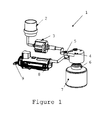
- Figure 1 discloses a water circulation and heating system 1 of a liquid beverage preparation device, in particular a coffee, espresso and/or tea preparation machine, in accordance with the invention.
- System 1 comprises a reservoir 2 for containing the liquid, in particular water, a pump 3 for promoting the circulation of the liquid, in particular under pressure, a thermoblock 4 with an electric thermal resistance 5 and a burner 6 with a combustible tank 7 for heating the circulating liquid and an extraction head 8 with a beverage supply exit 9.
- Thermoblock 4 has a mass of metal, in particular an aluminium body incorporating a steel passage such as a steel tube extending through the body, through which the liquid is circulated from pump 3 towards extraction head 8 and thereby appropriately heated.
- This thermoblock's mass forms a thermal capacity to smooth or absorb the effect of variable heat supply by resistor 5 or burner 6 and/or variable heat consumption by the circulating liquid.
- the amount of material of metal mass 41 is limited by the presence of a central through opening that can be provided through mass 41 (see in particular Figures 3 and 5 ).
- burner 6 is associated with thermoblock 4 and arranged to supply a combustion heat to the circulating liquid via thermoblock 4 by supplying combustion heat to the bottom part of thermoblock 4.
- Thermoblock 4 is so arranged above burner 6 to be heated by the consumption of combustible at burner 6, when the burner is in use. Hence, burner 6 is arranged relative to thermoblock 4 so as to maximise heat transfer from the consuming combustible to thermoblock 4 and therefrom to the circulating liquid.
- resistor 5 and combustible heater 6,7 are associated with a thermal regulator (not shown).
- the regulator includes a temperature sensor arranged to measure the temperature of the heated liquid, for instance at the liquid exit of thermoblock 4, or within thermoblock 4. The temperature of the thermoblock's metal mass may be measured in order to obtain an indirect measure of the temperature of liquid.
- the regulator further comprises a control unit, e.g. including a controller or microprocessor, connected to the temperature sensor for comparing the measured temperature to a target temperature.
- the control unit is further connected: on the one hand, to an electric valve and an electric ignitor of burner 6 for controlling the supplied combustion heat; and, on the other hand, to an electric switch or variator connected to resistor 5 for controlling the supplied electric heat.
- the thermal regulator may be associated with a flow meter 55 to measure the flow rate of the circulated liquid and determine precisely the required heat for heating the circulating liquid.
- the control unit may include a predictive model to anticipate the required heat for adjusting the temperature of the circulating liquid.
- System 1 is further associated with a supply of electric power, from the mains and from a low voltage battery, allowing two modes of electric operations, in a plugged or unplugged mode.
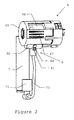
- FIGs 2 to 6 show in greater details a heating system of a beverage preparation device according to the invention. More specifically, Figure 2 shows a perspective view of the thermoblock 4, burner 6 and combustible tank 7.
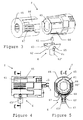
- Figure 3 is an exploded view of thermoblock 4 and burner 6 shown in Figure 2 .
- the same structural elements of the heating system are shown in Figures 4 and 5, Figure 4 being a side view and Figure 5 a cross-sectional view according to line and arrows E-E indicated in Figure 4 .
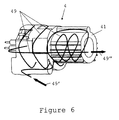
- Figure 6 schematically shows the general flow path of liquid through thermoblock 4.
- combustible tank 7 is connected via a solenoid valve 71 and duct 75 to burner 6 in order to supply combustible, in particular in the form of gas, to burner 6.
- the flow of gas from burner 6 is adjusted by the control of solenoid valve 71.
- Thermoblock 4 shown in Figures 2 to 6 has an inner generally tubular metal mass 41 with a duct (not shown) for the circulation of water to be heated to be heated in thermoblock 5 during use.
- Metal mass 41 is enclosed in an outer casing 45 made of thermal insulation material.
- metal mass 41 is associated with electric thermal resistance 5, permitting electric heating of thermoblock 4, and sensor connector 55 for measuring one or more a characteristics of thermoblock 4 and/or of the liquid, for example water, circulating therethrough during use, such as the flow rate of the circulating water and/or the temperature thereof and/or of mass 41.
- thermoblock's metal mass 41 for the liquid to be heated via thermoblock 4 is generally shown in Figure 6 , arrows 49' and 49'' indicating the entry and the exit, respectively, of liquid circulating through mass 41.
- Flow path 49 is generally helicoidal and extends along the periphery of the generally tubular mass 41.
- thermoblock 4 is associated with a combustible heater 6, in the form of burner, as depicted in Figures 2 to 5 .
- Burner 6 connected at the end of gas supply duct 75 extends into thermoblock 4 through outer casing 45.
- the upper part of outer casing 45 has a pair of openings 46 for the exit of exhaust combustion gases and a series of lateral openings 47, in the form of slits, for the passage of air.
- Burner 6 has a combustible distribution chamber 62 with a generally V-shaped cross-section 63 that generally matches the lower part of thermoblock 4 and that leads via a tubular connector 63' containing a burner nozzle 61 to duct 75, nozzle 61 being located at the bottom of distribution chamber 62 and extending therebelow.
- An opening 64 is provided for the passage of air through tubular connector 63' to burner nozzle 61.
- a metal sheet 66 for conducting heat for example made of brass, extends around a bottom part of metal mass 41. Conductor sheet 66 and metal mass 41 having therebetween a heat exchanger 66' for transferring combustion heat to metal mass 41.
- burner nozzle 61 and distribution chamber 62 are covered with a porous protective inlay 68 against fire backlash.
- Inlay 68 is itself covered with a porous catalyser layer 67 for the combustion.
- Burner nozzle 61 is further associated with an ignitor 65 for igniting combustion. Ignitor 65 extends through distribution chamber 62.
- liquid is pumped from reservoir 2 by pump 3, usually electric, via thermoblock 4 to extraction head 8 and through a batch of beverage ingredient, in particular a coffee or tea capsule or pod housed in head 8, and then to beverage exit 9 where the beverage can be collected in a recipient, in particular in a cup or mug, located thereunder.
- system 1 In the plugged mode, system 1 is connected to the mains and the heat is provided electrically by resistor 5. In this mode, system 1 can be operated and regulated like in known beverage preparation devices.
- system 1 is electrically powered by a low voltage battery (not shown) that supplies electric energy to pump 3, to the regulator, to the electric valve and the ignitor 65 of burner 6.
- the regulator controls the burner's valve and ignitor 65 to adjust the combustion heat transferred to the circulating liquid via thermoblock. More specifically, during use, gas, or another suitable combustible, is guided from tank 7 along duct 75 via valve 71 to burner nozzle 61 where it is mixed with air passed to nozzle 62 via opening 64. The mixture is then distributed in distribution chamber 62 and circulates via porous inlay 68 to porous catalyst 67 where the mixture is consumed. The hot combustion gases flow around metal mass 41 to exhaust openings 46 in the thermal insulating casing 45.
- the electric and/or combustion heat is passed from metal mass 41 to the water circulating in mass 41 along flow path 49 in a duct (not shown) extending through mass 41.
- the duct of metal mass 41 normally has a water inlet that leads incoming water coming from pump 3 into mass 41 and a water outlet that guides exiting water from mass 41 to extraction head 8.
- Such water inlet and outlet may be located on the same face of metal mass 41 or on different, for instance opposite, faces of mass 41.
- electric resistor 5 and burner 6 may be used in the same beverage preparation cycle to increase the produced heat and/or provide a finer adjustment of the temperature.
Landscapes
- Engineering & Computer Science (AREA)
- Food Science & Technology (AREA)
- Apparatus For Making Beverages (AREA)
- Cookers (AREA)
- Instantaneous Water Boilers, Portable Hot-Water Supply Apparatuses, And Control Of Portable Hot-Water Supply Apparatuses (AREA)
- Commercial Cooking Devices (AREA)
- Food Preservation Except Freezing, Refrigeration, And Drying (AREA)
Abstract
A device for preparing hot beverages comprises: an arrangement (1) for circulating a liquid to a beverage supply exit (9); and a combustion heating means (6,7), such as a burner, for supplying combustion heat to the liquid that is circulated to the supply exit (9). The combustion heating means (6,7) can be associated: with an electric heating means (5) for supplying electric heat to the liquid that is circulated to the supply exit (9) and/or with a means for regulating the heat supplied to the liquid from the combustion heating means (6, 7).
Description
- The present invention relates to an apparatus for preparing beverages. The invention more precisely relates to dispensing machines, such as mobile or portable coffee machines.
- The beverage preparation apparatuses of the coffee machine type which use prepacked or non-packed portions of a food substance are very widespread among private individuals, and also in municipalities, shopping centres and companies. The preparation principle is based on the extraction of portions of the substance by the passage through this substance of a quantity of cold or hot liquid under high pressure, typically a pressure above atmospheric pressure. The prepacked portions can be partially rigid capsules, or else flexible bags, which are hermetically sealed or partially open, or else a dose filter.
- An example of a capsule is described in patent
EP 0 512 468 B1 . An example of a bag is described in patentEP 0 602 203 B1 . - Such extraction systems have many advantages. On the one hand, the individual packages are easy to use and require no batching of coffee or other substances, in the machine. The user places a capsule, a ground-coffee dose or other portions in the machine, then presses a button to start extraction. On the other hand, the individual packages are batched to deliver a beverage, like a coffee, having the desired characteristics such as sufficient character, flavour, foam or other important attributes. When they are impermeable, they usually preserve the freshness of the substance better, up to the time of extraction. Finally, the preparation conditions, such as the temperature, pressure and extraction time can be better controlled, thereby guaranteeing relatively controlled and constant quality to the consumer.
- An example of an extraction method is described in patent
EP 0 512 470 B1 . - To extract a beverage under pressure from these portions, of the capsule or other type, it is necessary to use a relatively powerful water pump such as an electric compressor and electric heating elements that require significant amounts of electric power to heat water to the appropriate temperature for preparing hot beverages. These pumps and heating elements are usually supplied with electric energy from the mains.
- It is therefore difficult to move these preparation apparatuses, for example on a trolley or simply by carrying them. In fact, it would be an advantage to be able to make these apparatuses more mobile so as to offer beverages in locomotion means such as the train, plane, or in certain places such as cinemas, theatres, and also in public places such as beaches, parks, poolsides and other public or private places.
-
US 6,739,241 discloses a camping drip coffee maker in which a water is promoted from a reservoir to a brewing basket via a tube by heating the tube with an open flame heater to cause pressurisation of the water therein, whereby the boiling/evaporating water is promoted to the brewing basket. Whereas this type of flame heating of the water may prove to be convenient to circulate boiling/evaporated water under the effect of pressure for the purpose of making drip coffee, this heating system is not appropriate to be adapted to prepare an espresso. Indeed, the water which is pumped, usually mechanically, under pressure through ground coffee to prepare an espresso coffee is preferably maintained at a controlled temperature, typically at a temperature within a range of a few degrees around 85°C. -
W02006/102980 discloses an espresso machine that can be operated to prepare beverages without being connected to an electric power network. The machine is powered with a battery. To avoid extensive use of the battery to heat water used for the preparation of the beverages, the espresso machine has a thermally-insulated reservoir containing water that is preheated using the mains prior to prepare beverages in an autonomous mode. The water is then maintained at a sufficient temperature using the battery in the autonomous mode. The autonomy of such beverage machines can be of a few hours and thus provides a solution when their use is intended within a relatively short period from the time after the water has been preheated, for instance in trains, planes, cinemas... However, this machine is not optimal when intended to be used only several hours or days after preheating the water. -
US2007/0199452 discloses a mobile or portable espresso machine in which water is pumped from a reservoir by means of a pressure gas actuated pump. The water is heated in the reservoir (in which case the reservoir is insulated) or between the reservoir and the machine's extraction head. The espresso machine has either an electric heater, such as a thermoblock, or a combustion heater such as a burner using solid and/or gaseous and/or liquid fuel. - Even though combustion heaters may constitute an interesting alternative to electric heating for certain type of mobile or portable coffee machines, the known use of a combustion heater leads to boiling and/or evaporation of the water, which is not desirable for the preparation of espresso-type coffee or even tea. Moreover, such combustion heaters are sometimes not well accepted when the coffee machine is also intended to be used at proximity of the electric power supply, in particular at home.
- Therefore, there is still a need to provide a handy mobile or portable espresso-type beverage machine that can be used to prepare beverages at home, in an office or even in the absence of an electric power network (mains) and which is suitable to prepare hot beverages from a liquid heated at a controlled temperature.
- The invention therefore relates to a device for preparing hot beverages, in particular coffee or tea, comprising: an arrangement for circulating a liquid from a liquid supply, e.g. a water supply, to a beverage supply exit; and a combustion heating means, such as a burner, for supplying combustion heat to the liquid that is circulated to the supply exit.
- The liquid supply may be in the form of a tank of liquid having a capacity that is sufficient for supplying more than one beverage.
- In accordance with the invention, the combustion heating means is associated with an electric heating means for supplying electric heat to the liquid that is circulated to the supply exit.
- By providing a hybrid coffee machine, which works with a combustion heating means and an electric heating means, the user who does not want to have an appliance that needs a gas supply or another combustion system at home or in the office for example, typically for safety reasons, does not anymore need to buy a separate appliance for going to places, typically outdoor places, where he does not have access to the mains, such as a household or industrial electric power supply providing typically about 110, 220 or 380 volt.
- Electric heating means are for instance disclosed in
WO 2004/006742 and inWO 2006/029763 . - The electric heating means may comprise a thermoblock having a metal-based body with a through passage for the circulation of the liquid and one or more resistances for supplying electric heat to the metal-based body. Advantageously, the combustion heating means is arranged to supply heat to the liquid via the metal-based body of the thermoblock. Such a metal-based body may comprise a mass of aluminium with a steel passage for the circulation of the liquid, and/or it may form a sufficient thermal capacity that can provide a more or less constant amount of heat to liquid circulating through the thermoblock and absorb possible variations of the combustion heat supply. The metal-based body may have a generally tubular shape with a generally helicoidal through passage for the circulation of liquid.
- In order to adjust the temperature of the liquid, in particular in the range of 70 to 95°C, such as around 85°C for preparing a espresso coffee, the combustion heating means and/or the electric heating means is/are preferably associated with a means for regulating the heat supplied to the liquid from the combustion heating means and/or the electric heating means, the regulating means comprising usually a temperature sensor.
- In a first embodiment, the electric heating means is associated with a temperature sensor that is arranged to measure directly or indirectly the temperature of the heated liquid. In this case, the electric heating means is arranged to: compare the measured temperature with a target temperature; and adjust the supply of electric heat based on the difference between the measured temperature and the target temperature. In this configuration, the combustion heating means may be arranged to supply an amount of combustion heat to the liquid which is below the heat required for the liquid to reach the target temperature but does not need to be further regulated since the required heat for the liquid to reach or approach the target temperature is provided by the electric heating means.
- In another embodiment the combustion heating means is associated with a temperature sensor that is arranged to measure directly or indirectly the temperature of the heated liquid. In this case, the combustion heating means is arranged to: compare the measured temperature with a target temperature; and adjust the supply of the combustion heat based on the difference between the measured temperature and the target temperature. In such a situation, the electric heating means may be arranged to supply electric heat to the liquid which is below the heat required for the liquid to reach the target temperature but does not need to be further regulated since the required heat for the liquid to reach or approach the target temperature is provided by the combustion heating means.
- In a further advantageous embodiment, the electric heating means and the combustion heating means are associated with a temperature sensor, optionally the same temperature sensor for both heating means, that is arranged to measure directly or indirectly the temperature of the heated liquid. In this case, the electric heating means and the combustion heating means can be arranged to: compare the measured temperature with a target temperature; and adjust the supply of electric heat and/or combustion heat based on the difference between the measured temperature and the target temperature.
- The regulating means may also comprise a flow meter to monitor not only the temperature of the heated liquid but also the flow rate, and thus the amount of liquid that requires heating.
- The electric heating means and the combustion heating means may be configured or configurable, in particular by the user, so that: the electric heating means and the combustion heating means supply heat simultaneously to the liquid; or only one at a time of the electric heating means and the combustion heating means supplies heat to the liquid.
- The combustion heating means may comprise a combustible supply arrangement for supplying combustible material to a burner for consuming the combustible material. The combustible material may be a solid and/or gaseous and/or a liquid fuel, that can be subjected to a flame burning. The combustible supply arrangement may include a combustible supply reservoir or tank, or a connector to a combustible supply network, in particular for gas.
- Usually, the combustion heating means further comprises a valve between the combustible supply arrangement and the burner for controlling the supply of combustible material from the supply arrangement to the burner, in particular a variable valve, e.g. allowing the passage of a variable flow of combustible, or a two state on-off valve, e.g. a valve that merely has an open and a closed position for controlling the flow of gas.
- In such a case, the combustion heating means is advantageously associated with means for regulating its heat supply, the regulating means being arranged to control the valve. When the valve is an on-off valve, the regulating means can be arranged to control the periods of time during which the heating means supply heat and, respectively, do not heat the liquid. When the valve is a variable valve, the regulation means is preferably arranged further to control the supply rate of the combustion material for the heating, for instance the gas flow to the burner.
- One should bear in mind that each time the combustion heating means is interrupted, it must be reignited to further supply heat.
- Usually, the combustion heating means is associated with an ignition means, in particular an electric ignition means. For the above reason, such an ignition means is preferably controlled by the regulation means.
- The arrangement for circulating a liquid comprises a pump for promoting the circulation of the liquid in the arrangement, in particular under pressure, e.g. up to 30 bar, such as in the range of 1.5 to 25 bar, for instance 10 to 20 bar, typically to prepare an espresso-type beverage. The pump may be electrically powered and/or gas actuated, for instance a gas actuated pump as disclosed in
US2007/0199452 . - The beverage preparation device is typically arranged to be powered with an electric current supply that can be at least one of a battery-type low voltage supply and the mains. The device may comprise a housing for a battery and/or a connector for a low voltage supply, for instance connectable to a cigarette lighter type car connector.
- The beverage preparation device may be arranged for operation with electric heating when powered by the mains and with combustion heating when powered by the battery-type low voltage supply.
- When the beverage preparation device has an electrically powered pump, electric regulation means or other electric components, a battery may be sufficient to power satisfactorily such components when the heating is primarily provided by the combustion heating means. In fact, when hot beverage preparation devices are powered solely by an electric energy, the electric heating requires about 95% of the consumed electric energy. Therefore, it may be an advantageous combination for the autonomy of the device while allowing a fine control of the temperature of the liquid to provide a beverage preparation device with a combustion heating means and an electric temperature regulation means and pump, powered by a battery or another low voltage electric supply.
- The arrangement for circulating the liquid may comprise an extraction and/or infusion head for containing an ingredient for the preparation of the beverage, the extraction head leading to the supply exit. The ingredient may be provided in the form of a prepacked portion in a container such as a cartridge, bag, or other appropriate packaging modes. Alternatively, the ingredient can be provided in the form of a non-packed portion, such as ground coffee, directly introduced into the chamber of the extraction module.
- The invention also relates to a device for preparing hot beverages, in particular coffee or tea. This device comprises: an arrangement for circulating a liquid, such as water, from a liquid supply to a beverage supply exit; and a combustion heating means, such as a burner, for supplying combustion heat to the liquid that is circulated to the supply exit. In accordance with the invention, the combustion heating means is associated with a means for regulating the heat supplied to the liquid from the combustion heating means, the regulating means comprising usually a temperature sensor.
- The regulating means may in particular be associated with a temperature sensor that is arranged to measure directly or indirectly the temperature of the heated liquid. In such a case the regulating means can be arranged to: compare the measured temperature with a target temperature; and adjust the supply of combustion heat by the combustion means based on the difference between the measured temperature and the target temperature.
- This beverage preparation device may incorporate all the above disclosed features or combination of features. In particular, the combustion heating means is associated with an electric heating element for supplying an electric heat to the liquid that is circulated to the supply exit.
- While the disclosed beverage preparation device is particularly advantageous for providing mobile or portable devices that may be suitable for inside and outside use, at home or out of home, such a beverage preparation device may also be used as a fixed device, for instance in a place with a combustible, in particular gas, supply network to which the beverage preparation device may be conveniently connected.
- The invention will now be described with reference to the schematic drawings, wherein:
-
Figure 1 shows a schematic arrangement of components of a beverage preparation device according to the invention; and -
Figures 2 to 6 show various details of a heating system of a beverage preparation device according to the invention. -
Figure 1 discloses a water circulation andheating system 1 of a liquid beverage preparation device, in particular a coffee, espresso and/or tea preparation machine, in accordance with the invention. -
System 1 comprises areservoir 2 for containing the liquid, in particular water, apump 3 for promoting the circulation of the liquid, in particular under pressure, athermoblock 4 with an electricthermal resistance 5 and aburner 6 with acombustible tank 7 for heating the circulating liquid and anextraction head 8 with abeverage supply exit 9. -
Thermoblock 4 has a mass of metal, in particular an aluminium body incorporating a steel passage such as a steel tube extending through the body, through which the liquid is circulated frompump 3 towardsextraction head 8 and thereby appropriately heated. This thermoblock's mass forms a thermal capacity to smooth or absorb the effect of variable heat supply byresistor 5 orburner 6 and/or variable heat consumption by the circulating liquid. However, in order to limit the thermal inertia the amount of material ofmetal mass 41 is limited by the presence of a central through opening that can be provided through mass 41 (see in particularFigures 3 and 5 ). - As shown in
Figure 1 ,burner 6 is associated withthermoblock 4 and arranged to supply a combustion heat to the circulating liquid viathermoblock 4 by supplying combustion heat to the bottom part ofthermoblock 4. -
Thermoblock 4 is so arranged aboveburner 6 to be heated by the consumption of combustible atburner 6, when the burner is in use. Hence,burner 6 is arranged relative tothermoblock 4 so as to maximise heat transfer from the consuming combustible tothermoblock 4 and therefrom to the circulating liquid. - Furthermore,
resistor 5 andcombustible heater thermoblock 4, or withinthermoblock 4. The temperature of the thermoblock's metal mass may be measured in order to obtain an indirect measure of the temperature of liquid. The regulator further comprises a control unit, e.g. including a controller or microprocessor, connected to the temperature sensor for comparing the measured temperature to a target temperature. The control unit is further connected: on the one hand, to an electric valve and an electric ignitor ofburner 6 for controlling the supplied combustion heat; and, on the other hand, to an electric switch or variator connected toresistor 5 for controlling the supplied electric heat. To allow a finer regulation of the temperature of the circulating liquid, the thermal regulator may be associated with aflow meter 55 to measure the flow rate of the circulated liquid and determine precisely the required heat for heating the circulating liquid. For regulating the supplied heat, in particular fromburner 6, the control unit may include a predictive model to anticipate the required heat for adjusting the temperature of the circulating liquid. -
System 1 is further associated with a supply of electric power, from the mains and from a low voltage battery, allowing two modes of electric operations, in a plugged or unplugged mode. -
Figures 2 to 6 , in which the same numeric references designate the same elements, show in greater details a heating system of a beverage preparation device according to the invention. More specifically,Figure 2 shows a perspective view of thethermoblock 4,burner 6 andcombustible tank 7.Figure 3 is an exploded view ofthermoblock 4 andburner 6 shown inFigure 2 . The same structural elements of the heating system are shown inFigures 4 and 5, Figure 4 being a side view andFigure 5 a cross-sectional view according to line and arrows E-E indicated inFigure 4 .Figure 6 schematically shows the general flow path of liquid throughthermoblock 4. - As shown in
Figure 2 ,combustible tank 7 is connected via asolenoid valve 71 andduct 75 toburner 6 in order to supply combustible, in particular in the form of gas, toburner 6. The flow of gas fromburner 6 is adjusted by the control ofsolenoid valve 71. -
Thermoblock 4 shown inFigures 2 to 6 has an inner generallytubular metal mass 41 with a duct (not shown) for the circulation of water to be heated to be heated inthermoblock 5 during use.Metal mass 41 is enclosed in anouter casing 45 made of thermal insulation material. As shown inFigure 4 ,metal mass 41 is associated with electricthermal resistance 5, permitting electric heating ofthermoblock 4, andsensor connector 55 for measuring one or more a characteristics ofthermoblock 4 and/or of the liquid, for example water, circulating therethrough during use, such as the flow rate of the circulating water and/or the temperature thereof and/or ofmass 41. Furthermore, asuitable flow path 49 through the thermoblock'smetal mass 41 for the liquid to be heated viathermoblock 4 is generally shown inFigure 6 , arrows 49' and 49'' indicating the entry and the exit, respectively, of liquid circulating throughmass 41. Flowpath 49 is generally helicoidal and extends along the periphery of the generallytubular mass 41. - In addition to an
electric heater 5,thermoblock 4 is associated with acombustible heater 6, in the form of burner, as depicted inFigures 2 to 5 .Burner 6 connected at the end ofgas supply duct 75 extends intothermoblock 4 throughouter casing 45. The upper part ofouter casing 45 has a pair ofopenings 46 for the exit of exhaust combustion gases and a series oflateral openings 47, in the form of slits, for the passage of air. -
Burner 6 has acombustible distribution chamber 62 with a generally V-shapedcross-section 63 that generally matches the lower part ofthermoblock 4 and that leads via a tubular connector 63' containing aburner nozzle 61 toduct 75,nozzle 61 being located at the bottom ofdistribution chamber 62 and extending therebelow. Anopening 64 is provided for the passage of air through tubular connector 63' toburner nozzle 61. Ametal sheet 66 for conducting heat, for example made of brass, extends around a bottom part ofmetal mass 41.Conductor sheet 66 andmetal mass 41 having therebetween a heat exchanger 66' for transferring combustion heat tometal mass 41. Also shown inFigure 5 ,burner nozzle 61 anddistribution chamber 62 are covered with a porousprotective inlay 68 against fire backlash.Inlay 68 is itself covered with aporous catalyser layer 67 for the combustion.Burner nozzle 61 is further associated with anignitor 65 for igniting combustion.Ignitor 65 extends throughdistribution chamber 62. - During use of
system 1 to prepare a beverage, liquid is pumped fromreservoir 2 bypump 3, usually electric, viathermoblock 4 toextraction head 8 and through a batch of beverage ingredient, in particular a coffee or tea capsule or pod housed inhead 8, and then tobeverage exit 9 where the beverage can be collected in a recipient, in particular in a cup or mug, located thereunder. - In the plugged mode,
system 1 is connected to the mains and the heat is provided electrically byresistor 5. In this mode,system 1 can be operated and regulated like in known beverage preparation devices. - In the unplugged mode,
system 1 is electrically powered by a low voltage battery (not shown) that supplies electric energy to pump 3, to the regulator, to the electric valve and theignitor 65 ofburner 6. In this unplugged mode, the regulator controls the burner's valve andignitor 65 to adjust the combustion heat transferred to the circulating liquid via thermoblock. More specifically, during use, gas, or another suitable combustible, is guided fromtank 7 alongduct 75 viavalve 71 toburner nozzle 61 where it is mixed with air passed tonozzle 62 viaopening 64. The mixture is then distributed indistribution chamber 62 and circulates viaporous inlay 68 toporous catalyst 67 where the mixture is consumed. The hot combustion gases flow aroundmetal mass 41 to exhaustopenings 46 in the thermal insulatingcasing 45. - Whether the system is operated in the plugged or unplugged mode, the electric and/or combustion heat is passed from
metal mass 41 to the water circulating inmass 41 alongflow path 49 in a duct (not shown) extending throughmass 41. The duct ofmetal mass 41 normally has a water inlet that leads incoming water coming frompump 3 intomass 41 and a water outlet that guides exiting water frommass 41 toextraction head 8. Such water inlet and outlet may be located on the same face ofmetal mass 41 or on different, for instance opposite, faces ofmass 41. - In a variation,
electric resistor 5 andburner 6 may be used in the same beverage preparation cycle to increase the produced heat and/or provide a finer adjustment of the temperature.
Claims (20)
- A device for preparing hot beverages, in particular coffee or tea, comprising:- an arrangement for circulating a liquid, such as water, from a liquid supply to a beverage supply exit; and- a combustion heating means, such as a burner, for supplying combustion heat to the liquid that is circulated to the supply exit,characterised in that the combustion heating means is associated with an electric heating means for supplying electric heat to the liquid that is circulated to the supply exit.
- The device of claim 1, wherein the electric heating means comprises a thermoblock having a metal-based body with a through passage, such as a mass of aluminium with a steel passage, for the circulation of the liquid and one or more resistances for supplying electric heat to the metal-based body.
- The device of claim 2, wherein the metal-based body has a generally tubular shape with a generally helicoidal through passage for the circulation of liquid.
- The device of claim 2 or 3, wherein the combustion heating means is arranged to supply heat to the liquid via the metal-based body of the thermoblock.
- The device of claim 4, wherein at least one of the combustion heating means and the electric heating means is associated with a means for regulating the heat supplied to the liquid from said at least one of the combustion heating means and the electric heating means, the regulating means comprising optionally a temperature sensor.
- The device of claim 5, wherein the electric heating means is associated with a temperature sensor that is arranged to measure directly or indirectly the temperature of the heated liquid, the electric heating means being arranged to:- compare the measured temperature with a target temperature; and- adjust the supply of the electric heat based on the difference between the measured temperature and the target temperature, the combustion heating means being arranged to supply an amount of combustion heat to the liquid which is below the heat required for the liquid to reach the target temperature.
- The device of claim 5, wherein the combustion heating means is associated with a temperature sensor that is arranged to measure directly or indirectly the temperature of the heated liquid, the combustion heating means being arranged to:- compare the measured temperature with a target temperature; and- adjust the supply of the combustion heat based on the difference between the measured temperature and the target temperature, the electric heating means being arranged to supply electric heat to the liquid which is below the heat required for the liquid to reach the target temperature.
- The device of claim 5, wherein the electric heating means and the combustion heating means are associated with a temperature sensor that is arranged to measure directly or indirectly the temperature of the heated liquid, the electric heating means and the combustion heating means being arranged to:- compare the measured temperature with a target temperature; and- adjust the supply of the electric heat and/or combustion heat based on the difference between the measured temperature and the target temperature.
- The device of any preceding claim, wherein the electric heating means and the combustion heating means are configured or configurable so that:- the electric heating means and the combustion heating means supply heat simultaneously to the liquid; or- only one at a time of the electric heating means and the combustion heating means supplies heat to the liquid.
- The device of any preceding claim, wherein the combustion heating means comprises a combustible supply arrangement for supplying combustible material to a burner for consuming the combustible material.
- The device of claim 10, wherein the combustion heating means further comprises a valve between the combustible supply arrangement and the burner for controlling the supply of combustible material from the supply arrangement to the burner, in particular a variable valve or an on-off valve.
- The device of claim 11, wherein the combustion heating means is associated with means for regulating its heat supply, the regulating means being arranged to control the valve.
- The device of any preceding claim, wherein the combustion heating means is associated with an ignition means, in particular an electric ignition means.
- The device of any preceding claim, wherein said arrangement for circulating a liquid comprises a pump for promoting the circulation of the liquid in said arrangement, in particular under pressure.
- The device of any preceding claim, which is arranged to be powered with an electric current supply that is at least one of a battery-type low voltage supply and the mains.
- The device of claim 15, which is arranged for operation with electric heating when powered by the mains and with combustion heating when powered by the battery-type low voltage supply.
- The device of any preceding claim, wherein said arrangement for circulating a liquid comprises an extraction and/or infusion head for containing an ingredient for the preparation of the beverage, the extraction head leading to the supply exit.
- A device for preparing hot beverages, in particular coffee or tea, comprising:- an arrangement for circulating a liquid, such as water, from a liquid supply to a beverage supply exit; and- a combustion heating means, such as a burner, for supplying combustion heat to the liquid that is circulated to the supply exit,characterised in that the combustion heating means is associated with a means for regulating the heat supplied to the liquid from the combustion heating means, the regulating means comprising optionally a temperature sensor.
- The device of claim 18, wherein the regulating means is associated with a temperature sensor that is arranged to measure directly or indirectly the temperature of the heated liquid, the regulating means being arranged to:- compare the measured temperature with a target temperature; and- adjust the supply of the combustion heat by the combustion means based on the difference between the measured temperature and the target temperature.
- The device of claim 18 or 19, wherein the combustion heating means is associated with an electric heating element for supplying electric heat to the liquid that is circulated to the supply exit.
Priority Applications (13)
| Application Number | Priority Date | Filing Date | Title |
|---|---|---|---|
| EP08152433A EP2082669A2 (en) | 2008-01-25 | 2008-03-07 | Hybrid apparatus for preparing beverages |
| PL09704875T PL2254448T3 (en) | 2008-01-25 | 2009-01-22 | Hybrid apparatus for preparing beverages |
| ES09704875T ES2378027T3 (en) | 2008-01-25 | 2009-01-22 | Hybrid apparatus for the preparation of beverages |
| CN2009801031466A CN101925319B (en) | 2008-01-25 | 2009-01-22 | Mixing equipment for preparing beverages |
| EP09704875A EP2254448B1 (en) | 2008-01-25 | 2009-01-22 | Hybrid apparatus for preparing beverages |
| US12/811,336 US9271605B2 (en) | 2008-01-25 | 2009-01-22 | Hybrid apparatus for preparing beverages |
| AT09704875T ATE539659T1 (en) | 2008-01-25 | 2009-01-22 | HYBRID DEVICE FOR PREPARING BEVERAGES |
| HK11105430.4A HK1151205B (en) | 2008-01-25 | 2009-01-22 | Hybrid apparatus for preparing beverages |
| PCT/EP2009/050684 WO2009092746A2 (en) | 2008-01-25 | 2009-01-22 | Hybrid apparatus for preparing beverages |
| TW098103075A TW200936092A (en) | 2008-01-25 | 2009-01-23 | Hybrid apparatus for preparing beverages |
| CL2009000163A CL2009000163A1 (en) | 2008-01-25 | 2009-01-26 | A device for the preparation of hot beverages that comprises a combustion heating element associated with an electric heating element to heat the liquid flowing towards the outlet of the beverage supply to a regulated temperature that is measured and compared with a target temperature. |
| ARP090100235A AR070259A1 (en) | 2008-01-25 | 2009-01-26 | HYBRID DEVICE FOR DRINK PREPARATION |
| US14/725,076 US20150282665A1 (en) | 2008-01-25 | 2015-05-29 | Hybrid apparatus for preparing beverages |
Applications Claiming Priority (2)
| Application Number | Priority Date | Filing Date | Title |
|---|---|---|---|
| EP08100917 | 2008-01-25 | ||
| EP08152433A EP2082669A2 (en) | 2008-01-25 | 2008-03-07 | Hybrid apparatus for preparing beverages |
Publications (1)
| Publication Number | Publication Date |
|---|---|
| EP2082669A2 true EP2082669A2 (en) | 2009-07-29 |
Family
ID=40458308
Family Applications (2)
| Application Number | Title | Priority Date | Filing Date |
|---|---|---|---|
| EP08152433A Withdrawn EP2082669A2 (en) | 2008-01-25 | 2008-03-07 | Hybrid apparatus for preparing beverages |
| EP09704875A Not-in-force EP2254448B1 (en) | 2008-01-25 | 2009-01-22 | Hybrid apparatus for preparing beverages |
Family Applications After (1)
| Application Number | Title | Priority Date | Filing Date |
|---|---|---|---|
| EP09704875A Not-in-force EP2254448B1 (en) | 2008-01-25 | 2009-01-22 | Hybrid apparatus for preparing beverages |
Country Status (10)
| Country | Link |
|---|---|
| US (2) | US9271605B2 (en) |
| EP (2) | EP2082669A2 (en) |
| CN (1) | CN101925319B (en) |
| AR (1) | AR070259A1 (en) |
| AT (1) | ATE539659T1 (en) |
| CL (1) | CL2009000163A1 (en) |
| ES (1) | ES2378027T3 (en) |
| PL (1) | PL2254448T3 (en) |
| TW (1) | TW200936092A (en) |
| WO (1) | WO2009092746A2 (en) |
Families Citing this family (41)
| Publication number | Priority date | Publication date | Assignee | Title |
|---|---|---|---|---|
| EP1634520A1 (en) * | 2004-09-13 | 2006-03-15 | Nestec S.A. | Device and method for heating a liquid |
| MX2012011468A (en) | 2010-04-20 | 2012-11-21 | Nestec Sa | Container with thermal management. |
| CN102578916A (en) * | 2011-01-14 | 2012-07-18 | 创意国际有限公司 | Mixing device applicable to brewing Turkish coffee |
| US8857315B2 (en) * | 2011-03-25 | 2014-10-14 | Be Intellectual Property, Inc. | Pressure relief system for espresso maker |
| CA2902391A1 (en) * | 2013-03-22 | 2014-09-25 | Nestec S.A. | Capsule-based beverage production system with inductive liquid heating |
| US11849877B2 (en) * | 2013-12-31 | 2023-12-26 | Adrian Rivera Maynez Enterprises, Inc. | Portable coffee brewing system |
| US9743797B2 (en) * | 2013-12-31 | 2017-08-29 | Brett C. Richardson | Portable coffee brewing device |
| US10219647B2 (en) * | 2013-12-31 | 2019-03-05 | Brett C. Richardson | Portable coffee brewing device |
| US11246445B2 (en) * | 2013-12-31 | 2022-02-15 | Brett C. Richardson | Portable coffee brewing device |
| US9743796B2 (en) * | 2013-12-31 | 2017-08-29 | Brett C. Richardson | Portable coffee brewing device |
| WO2016005348A1 (en) | 2014-07-09 | 2016-01-14 | Nestec S.A. | Device for connecting a beverage machine to a distribution network with safe flow interruption |
| PT3166457T (en) | 2014-07-09 | 2020-01-20 | Nestle Sa | Device for connecting a beverage machine to a distribution network with safe monitoring |
| EP3166458B1 (en) | 2014-07-09 | 2021-05-05 | Société des Produits Nestlé S.A. | Coupling of a device for connecting a beverage machine to a distribution network |
| PT3166456T (en) | 2014-07-09 | 2019-01-11 | Nestle Sa | Accessory for supplying automatically a beverage machine with liquid from a distribution network |
| DE202014007322U1 (en) * | 2014-09-08 | 2015-12-09 | Innovative ThermoAnalytic Instruments KG | Heating hood device with a novel arrangement of the heater |
| WO2016083488A1 (en) | 2014-11-27 | 2016-06-02 | Nestec S.A. | Liquid dispensing machine with compact drop stop |
| WO2016083485A1 (en) | 2014-11-27 | 2016-06-02 | Nestec S.A. | Liquid dispensing machine with manual drop stop |
| US9585513B2 (en) * | 2015-02-04 | 2017-03-07 | Hamilton Beach Brands, Inc. | Pump operated beverage maker |
| WO2017001367A1 (en) * | 2015-07-02 | 2017-01-05 | Nestec S.A. | Mobile liquid tank for heating liquids |
| US20170095108A1 (en) * | 2015-10-05 | 2017-04-06 | Grindmaster Corporation | Beverage brewer with adjustable shelf |
| ES2847752T3 (en) | 2015-11-11 | 2021-08-03 | Nestle Sa | Easy connection of a liquid reservoir to a beverage machine |
| US20170354290A1 (en) * | 2016-06-13 | 2017-12-14 | Curt Jones | Preparation of Heated Beverages |
| WO2018069268A1 (en) | 2016-10-11 | 2018-04-19 | Nestec Sa | Liquid dispensing machine with speed regulator |
| ES2828962T3 (en) | 2016-10-11 | 2021-05-28 | Nestle Sa | Vending machine for liquid products with anti-drip system |
| US11559166B2 (en) | 2017-02-15 | 2023-01-24 | 2266170 Ontario Inc. | Beverage preparation and infusion system |
| EP3629858A1 (en) | 2017-06-01 | 2020-04-08 | Société des Produits Nestlé S.A. | Beverage machine with ergonomic power switch |
| US11700969B2 (en) | 2017-06-01 | 2023-07-18 | Societe Des Produits Nestle S.A. | Beverage machine with a collapsible interface |
| CN110662469B (en) | 2017-06-01 | 2023-03-14 | 雀巢产品有限公司 | Beverage machine with stowable dispensing head |
| EP3629854A1 (en) | 2017-06-01 | 2020-04-08 | Société des Produits Nestlé S.A. | Beverage machine with a stablizing foot |
| CN111565610B (en) | 2017-12-20 | 2023-01-13 | 雀巢产品有限公司 | Beverage preparation machine with droplet discharge |
| JP7308199B2 (en) | 2017-12-20 | 2023-07-13 | ソシエテ・デ・プロデュイ・ネスレ・エス・アー | Beverage preparation machine for miniaturizing foam |
| US11866318B2 (en) | 2017-12-20 | 2024-01-09 | Societe Des Produits Nestle S.A. | Beverage preparation machine with handy drop stop |
| WO2019158542A1 (en) | 2018-02-14 | 2019-08-22 | Societe Des Produits Nestle S.A. | Used capsule receptacle for beverage machines |
| US11553814B2 (en) * | 2019-08-28 | 2023-01-17 | Ii-Vi Delaware, Inc. | Non-electric powered, off-grid, beverage brewer |
| CN111000463B (en) * | 2019-10-29 | 2022-10-04 | 九阳股份有限公司 | Control method of food processing machine |
| CN114287794B (en) * | 2022-01-28 | 2025-09-30 | 广东汇莱德温控器有限公司 | A modular water supply structure with integrated probe combination |
| EP4719141A1 (en) | 2023-06-05 | 2026-04-08 | Société des Produits Nestlé S.A. | Beverage preparation machine with reliable dispensing |
| CN121263113A (en) | 2023-06-05 | 2026-01-02 | 雀巢产品有限公司 | Machine for dispensing beverages with foam |
| CN122295032A (en) | 2023-12-07 | 2026-06-26 | 雀巢产品有限公司 | Used capsule containers for beverage machines |
| WO2025120135A1 (en) | 2023-12-07 | 2025-06-12 | Societe Des Produits Nestle S.A. | Reliable capsule removal system |
| AU2024393510A1 (en) | 2023-12-07 | 2026-05-28 | Societe Des Produits Nestle S.A. | Reliable capsule beverage dispensing system |
Citations (8)
| Publication number | Priority date | Publication date | Assignee | Title |
|---|---|---|---|---|
| EP0512470B1 (en) | 1991-05-08 | 1996-04-24 | Societe Des Produits Nestle S.A. | Method of producing beverages using sealed cartridges and apparatus for carrying out this method |
| EP0512468B1 (en) | 1991-05-10 | 1997-01-29 | Societe Des Produits Nestle S.A. | Closed cartridge for making a beverage |
| EP0602203B1 (en) | 1992-07-06 | 1997-04-16 | Societe Des Produits Nestle S.A. | Sealed flexible bag and method for making same |
| WO2004006742A1 (en) | 2002-07-12 | 2004-01-22 | Nestec S.A. | A device for the heating of a liquid |
| US6739241B2 (en) | 2002-08-05 | 2004-05-25 | The Coleman Company, Inc. | Camping coffee maker |
| WO2006029763A2 (en) | 2004-09-13 | 2006-03-23 | Nestec S.A. | Liquid heating device and method for heating a liquid |
| WO2006102980A1 (en) | 2005-03-29 | 2006-10-05 | Nestec S.A. | Standalone drink dispensing machine |
| US20070199452A1 (en) | 2003-11-22 | 2007-08-30 | Nestec S.A. | Mobile Or Portable Apparatus With Pressurized Gas Supply For Preparing Beverages Or Similar Products |
Family Cites Families (26)
| Publication number | Priority date | Publication date | Assignee | Title |
|---|---|---|---|---|
| US1731226A (en) | 1927-10-01 | 1929-10-08 | Barstow Stove Company | Cooking apparatus |
| US2150801A (en) | 1937-12-17 | 1939-03-14 | Stanley S Tumbridge | Electric coffee maker |
| US2507666A (en) | 1946-09-21 | 1950-05-16 | Rutenber Electric Co | Pressure cooking stove protective system |
| GB706866A (en) | 1950-09-07 | 1954-04-07 | Owen Murray Kendon | Improved water heating apparatus |
| US3249303A (en) * | 1964-07-13 | 1966-05-03 | Esley L Townsend | Combination gas and electric hot water heating system |
| US3916869A (en) * | 1974-02-15 | 1975-11-04 | Inst Gas Technology | Heat exchange apparatus |
| US3969610A (en) | 1975-01-20 | 1976-07-13 | Lawrence Peska Associates, Inc. | Liquid heating device |
| IT1043294B (en) | 1975-10-10 | 1980-02-20 | Cimbali Giuseppe Spa Off | MACHINE FOR THE PRODUCTION OF ESPRESSO COFFEE |
| US4067684A (en) * | 1976-07-23 | 1978-01-10 | Vapor Corporation | Apparatus for controlling fuel flow fluid heater burner |
| FR2367465A1 (en) | 1976-10-13 | 1978-05-12 | Lafitte Jacques | Safety device for coffee machine - consists of piston in cylinder, with calibrated spring and two pipes |
| JPS60205131A (en) | 1984-03-28 | 1985-10-16 | Matsushita Electric Ind Co Ltd | Burning cooker |
| CH674793A5 (en) * | 1988-05-17 | 1990-07-31 | Turmix Ag | |
| US5440972A (en) | 1991-08-01 | 1995-08-15 | English; Philip H. | Portable beverage brewing device |
| DE19845464A1 (en) | 1998-10-02 | 2000-04-13 | Paul Piskol | Catalytic water heater for brewing tea or coffee burns gas supplied from small pressure bottle and has integral piezoelectric igniter |
| DE19924279A1 (en) | 1999-05-27 | 2000-11-30 | Aweco Appliance Sys Gmbh & Co | Automatic power switching device for coffee machine has temperature controlled bistable switch with electromagnetic coil for control of switch element |
| DE29917036U1 (en) | 1999-09-27 | 1999-12-30 | Merlaku, Kastriot, 84347 Pfarrkirchen | coffee machine |
| PT1097663E (en) | 1999-11-02 | 2005-09-30 | Nestle Sa | SLIDE AND CONTINUOUS HEATING PROCESS OF A LIQUID AT A CONSTANT TEMPERATURE |
| US6459854B1 (en) | 2000-01-24 | 2002-10-01 | Nestec S.A. | Process and module for heating liquid |
| US6957111B2 (en) | 2001-08-24 | 2005-10-18 | Koninklijke Philips Electronics N.V. | Automated system for cooking and method of use |
| DE10154046A1 (en) | 2001-11-02 | 2003-05-22 | Miele & Cie | household appliance |
| US6752069B1 (en) | 2002-02-04 | 2004-06-22 | Grindmaster Corporation | Beverage brewer with pour over feature |
| WO2004098360A1 (en) | 2003-05-02 | 2004-11-18 | Salton, Inc. | Apparatus for making brewed coffee and the like |
| US20050199130A1 (en) * | 2004-02-23 | 2005-09-15 | Pragotrade Usa, Incorporated | Portable coffee maker |
| US7089849B2 (en) * | 2004-05-06 | 2006-08-15 | Electrical And Electronics Limited | Single/multiple beverage machine |
| WO2006066626A1 (en) * | 2004-12-21 | 2006-06-29 | Martex Holland B.V. | Apparatus for preparing a beverage |
| AU2006285272A1 (en) | 2005-08-05 | 2007-03-08 | Cascade Designs, Inc. | High efficiency burner with heat exchanger option |
-
2008
- 2008-03-07 EP EP08152433A patent/EP2082669A2/en not_active Withdrawn
-
2009
- 2009-01-22 CN CN2009801031466A patent/CN101925319B/en not_active Expired - Fee Related
- 2009-01-22 US US12/811,336 patent/US9271605B2/en not_active Expired - Fee Related
- 2009-01-22 ES ES09704875T patent/ES2378027T3/en active Active
- 2009-01-22 PL PL09704875T patent/PL2254448T3/en unknown
- 2009-01-22 WO PCT/EP2009/050684 patent/WO2009092746A2/en not_active Ceased
- 2009-01-22 EP EP09704875A patent/EP2254448B1/en not_active Not-in-force
- 2009-01-22 AT AT09704875T patent/ATE539659T1/en active
- 2009-01-23 TW TW098103075A patent/TW200936092A/en unknown
- 2009-01-26 CL CL2009000163A patent/CL2009000163A1/en unknown
- 2009-01-26 AR ARP090100235A patent/AR070259A1/en not_active Application Discontinuation
-
2015
- 2015-05-29 US US14/725,076 patent/US20150282665A1/en not_active Abandoned
Patent Citations (8)
| Publication number | Priority date | Publication date | Assignee | Title |
|---|---|---|---|---|
| EP0512470B1 (en) | 1991-05-08 | 1996-04-24 | Societe Des Produits Nestle S.A. | Method of producing beverages using sealed cartridges and apparatus for carrying out this method |
| EP0512468B1 (en) | 1991-05-10 | 1997-01-29 | Societe Des Produits Nestle S.A. | Closed cartridge for making a beverage |
| EP0602203B1 (en) | 1992-07-06 | 1997-04-16 | Societe Des Produits Nestle S.A. | Sealed flexible bag and method for making same |
| WO2004006742A1 (en) | 2002-07-12 | 2004-01-22 | Nestec S.A. | A device for the heating of a liquid |
| US6739241B2 (en) | 2002-08-05 | 2004-05-25 | The Coleman Company, Inc. | Camping coffee maker |
| US20070199452A1 (en) | 2003-11-22 | 2007-08-30 | Nestec S.A. | Mobile Or Portable Apparatus With Pressurized Gas Supply For Preparing Beverages Or Similar Products |
| WO2006029763A2 (en) | 2004-09-13 | 2006-03-23 | Nestec S.A. | Liquid heating device and method for heating a liquid |
| WO2006102980A1 (en) | 2005-03-29 | 2006-10-05 | Nestec S.A. | Standalone drink dispensing machine |
Also Published As
| Publication number | Publication date |
|---|---|
| ATE539659T1 (en) | 2012-01-15 |
| EP2254448B1 (en) | 2012-01-04 |
| HK1151205A1 (en) | 2012-01-27 |
| EP2254448A2 (en) | 2010-12-01 |
| ES2378027T3 (en) | 2012-04-04 |
| WO2009092746A3 (en) | 2009-09-17 |
| WO2009092746A2 (en) | 2009-07-30 |
| PL2254448T3 (en) | 2012-06-29 |
| US20150282665A1 (en) | 2015-10-08 |
| US20100282089A1 (en) | 2010-11-11 |
| AR070259A1 (en) | 2010-03-25 |
| CL2009000163A1 (en) | 2010-02-12 |
| TW200936092A (en) | 2009-09-01 |
| CN101925319A (en) | 2010-12-22 |
| CN101925319B (en) | 2013-02-27 |
| US9271605B2 (en) | 2016-03-01 |
Similar Documents
| Publication | Publication Date | Title |
|---|---|---|
| EP2254448B1 (en) | Hybrid apparatus for preparing beverages | |
| JP4914980B2 (en) | Equipment for producing hot drinks | |
| CA2544608C (en) | Mobile or portable apparatus with pressurized gas supply for preparing beverages or similar products | |
| ES2623755T3 (en) | Device and procedure for preparing drinks with different tastes | |
| US8621980B2 (en) | Temperature control system | |
| US20090120299A1 (en) | Line Pressure Brewer | |
| JP2010528823A (en) | Portable extraction device and extraction / operation method | |
| JP2014502903A (en) | Milk frothing with pressurized gas | |
| EP4167803B1 (en) | Electrically powered machine for preparing coffee | |
| JP2009512493A (en) | Hot water generating device and coffee machine equipped with the device | |
| ES2339519B1 (en) | COFFEE MACHINE AND WORK CYCLE FOR SUCH COFFEE MACHINE. | |
| KR20210003634A (en) | Portable coffee machine | |
| JP2007536020A (en) | Beverage machine for one or more cups | |
| HK1151205B (en) | Hybrid apparatus for preparing beverages | |
| CN205410897U (en) | Hydrocone type coffee machine | |
| CN101181134A (en) | Improved hot beverage equipment | |
| JP2003500144A (en) | Coffee preparation device and coffee beverage preparation method using the device | |
| GB2266763A (en) | An apparatus for making beverages | |
| TH101277A (en) | Hybrid tool for preparing different beverages | |
| HK1145133A (en) | Portable brewing device and method of making and operating | |
| RU2025108280A (en) | HOT DRINK MAKER WITH WATER HEATING BOILER | |
| MXPA06005126A (en) | Mobile or portable apparatus with pressurized gas supply for preparing beverages or similar products |
Legal Events
| Date | Code | Title | Description |
|---|---|---|---|
| PUAI | Public reference made under article 153(3) epc to a published international application that has entered the european phase |
Free format text: ORIGINAL CODE: 0009012 |
|
| STAA | Information on the status of an ep patent application or granted ep patent |
Free format text: STATUS: THE APPLICATION HAS BEEN WITHDRAWN |
|
| AK | Designated contracting states |
Kind code of ref document: A2 Designated state(s): AT BE BG CH CY CZ DE DK EE ES FI FR GB GR HR HU IE IS IT LI LT LU LV MC MT NL NO PL PT RO SE SI SK TR |
|
| AX | Request for extension of the european patent |
Extension state: AL BA MK RS |
|
| 18W | Application withdrawn |
Effective date: 20090707 |