EP2082498B1 - Method of providing neighbor information and method of generating neighbor location information - Google Patents
Method of providing neighbor information and method of generating neighbor location information Download PDFInfo
- Publication number
- EP2082498B1 EP2082498B1 EP07833026.3A EP07833026A EP2082498B1 EP 2082498 B1 EP2082498 B1 EP 2082498B1 EP 07833026 A EP07833026 A EP 07833026A EP 2082498 B1 EP2082498 B1 EP 2082498B1
- Authority
- EP
- European Patent Office
- Prior art keywords
- neighbor
- message
- relay station
- location
- base station
- Prior art date
- Legal status (The legal status is an assumption and is not a legal conclusion. Google has not performed a legal analysis and makes no representation as to the accuracy of the status listed.)
- Active
Links
Images


Classifications
-
- H—ELECTRICITY
- H04—ELECTRIC COMMUNICATION TECHNIQUE
- H04B—TRANSMISSION
- H04B7/00—Radio transmission systems, i.e. using radiation field
- H04B7/24—Radio transmission systems, i.e. using radiation field for communication between two or more posts
- H04B7/26—Radio transmission systems, i.e. using radiation field for communication between two or more posts at least one of which is mobile
- H04B7/2603—Arrangements for wireless physical layer control
- H04B7/2606—Arrangements for base station coverage control, e.g. by using relays in tunnels
-
- H—ELECTRICITY
- H04—ELECTRIC COMMUNICATION TECHNIQUE
- H04W—WIRELESS COMMUNICATION NETWORKS
- H04W48/00—Access restriction; Network selection; Access point selection
- H04W48/08—Access restriction or access information delivery, e.g. discovery data delivery
- H04W48/10—Access restriction or access information delivery, e.g. discovery data delivery using broadcasted information
-
- H—ELECTRICITY
- H04—ELECTRIC COMMUNICATION TECHNIQUE
- H04W—WIRELESS COMMUNICATION NETWORKS
- H04W64/00—Locating users or terminals or network equipment for network management purposes, e.g. mobility management
-
- H—ELECTRICITY
- H04—ELECTRIC COMMUNICATION TECHNIQUE
- H04W—WIRELESS COMMUNICATION NETWORKS
- H04W88/00—Devices specially adapted for wireless communication networks, e.g. terminals, base stations or access point devices
- H04W88/02—Terminal devices
- H04W88/04—Terminal devices adapted for relaying to or from another terminal or user
-
- H—ELECTRICITY
- H04—ELECTRIC COMMUNICATION TECHNIQUE
- H04W—WIRELESS COMMUNICATION NETWORKS
- H04W88/00—Devices specially adapted for wireless communication networks, e.g. terminals, base stations or access point devices
- H04W88/08—Access point devices
Definitions
- the present invention relates to a wireless communication system. More particularly, the present invention relates to a multi-hop wireless communication system which performs multi-hop communication via a relay station.
- Multi-hop communication is used to improve communication coverage and system capacity.
- a relay station is a basic component for multi-hop communication in a cellular system.
- the number of neighbors associated with a particular node increases since the relay stations in the communication network are included in the number of neighbors.
- neighbor information increases since the number of neighbors increases. Accordingly, the number of neighbors in a neighbor list increases.
- the increase in the number of neighbors causes a huge increase in overhead when distributing the neighbor information. Also, the increase in the number of neighbors increases the time spent in performing a scan process for the hand-off in a mobile station.
- an aspect of exemplary embodiments of the present invention is to provide a method of providing neighbor information efficiently.
- Another aspect of the present invention is to generate neighbor location information which is utilized to reduce neighbor information of unnecessary neighbors by using location information.
- An aspect of the present invention also provides a method of providing neighbor information and a method of generating neighbor location information which reduces the electric power and time required to scan for neighbors in a mobile station, as well as handover delay.
- An aspect of the present invention also provides a method of providing neighbor information and a method of generating neighbor location information which reduces the overhead which is necessary when transmitting neighbor information in a multi-hop communication system.
- An aspect of the present invention also provides a method of providing neighbor information and a method of generating neighbor location information which selects and provides only neighbor information suitable for a particular node.
- FIG. 1 is a diagram illustrating a system where a method of generating neighbor location information is performed according to an exemplary embodiment of the present invention.
- a base station BS transmits a location request message to a neighbor node (110), and the neighbor node which receives the location request message transmits a location response message in response to the location request message (120).
- the location request message may include a report type field which indicates whether to receive the location response message regularly or irregularly, or indicates whether to receive the location response message when a particular event is triggered.
- the location response message may include location information of a node included in the location request message.
- the location information may be global positioning system (GPS) coordinates, three-dimensional Cartesian coordinates, and the like.
- the base station may regularly receive the location response message from the neighbor node (130).
- the base station may receive the location response message from a neighbor node where the particular event is triggered, according to an exemplary embodiment of the present invention.
- the neighbor node may be a relay station RS around the base station, or another base station.
- the base station which receives the location response message from neighbor nodes may store a location of each of the neighbor nodes in a neighbor location information table.
- the location of each of the neighbor nodes includes a distance and an angle between the base station and the neighbor nodes.
- the base station calculates location information of the relay station, as shown in Equation 1.
- the relay station may also store the location of each of the neighbor nodes in the neighbor location information table according to a capability of the relay station.
- the location of each of the neighbor nodes includes the distance and the angle between the base station and the neighbor nodes.
- the distance and the angle between the base station and the neighbor nodes may be stored.
- the base station may receive the location response message.
- FIG. 2 is a diagram illustrating an a neighbor location information table according to an exemplary embodiment of the present invention.
- d NM designates a distance from a node corresponding to an N to a node corresponding to an M.
- ⁇ NM designates an angle of the node corresponding to the M from the node corresponding to the N.
- each of the N and M is a integer not less than zero.
- the node corresponds to a base station or a relay station.
- FIG. 2 illustrates an exemplary embodiment of the present invention only when the node is included in a single multi-hop relay cell.
- the multi-hop relay cell corresponds to a zone including a single base station and relay stations which are controlled by the single base station.
- FIG. 3 is a flowchart illustrating a method of generating neighbor location information performed in a base station or a relay station according to an exemplary embodiment of the present invention.
- the base station or the relay station increments an index by one.
- the base station or the relay station returns to operation S310 and increments an index by one.
- the base station or the relay station updates the calculated distance and angle in a neighbor location information table.
- operation S350 it is determined whether generating of neighbor location information with respect to all neighbor nodes is completed.
- the base station or the relay station returns to operation S310 and increments an index by one.
- the base station or the relay station In the method of providing neighbor information according to an exemplary embodiment of the present invention, the base station or the relay station generates a neighbor advertisement message by using a neighbor location information table.
- the neighbor advertisement message corresponds to a message which is broadcasted from the base station or the relay station to another relay station.
- the base station or the relay station generates the neighbor information message.
- the relay station provides a relay service downstream.
- the neighbor information message corresponds to a unicast message, and is generated by considering location information of a node which receives the neighbor information message.
- a node which receives both the neighbor advertisement message and the neighbor information message does not retransmit the received neighbor advertisement message downstream. Also, the node generates and broadcasts a new neighbor advertisement message including only a portion of a neighbor list based on the received neighbor information message. The neighbor list is included in the received neighbor advertisement message.
- FIG. 4 is a diagram illustrating a system where a method of providing neighbor information is performed according to an exemplary embodiment of the present invention.
- a serving station of a mobile station MS corresponds to a relay station RS13.
- a range where the mobile station may move corresponds to a zone 410 within a dotted line. Accordingly, with respect to the mobile station, neighbor information corresponding to nodes included in the zone 410 within the dotted line is required to be provided.
- the base station BS1 includes location information of neighboring base stations BS2 and BS3, and location information of relay stations RS21, RS22, RS23, RS31, RS32, and RS33.
- the relay stations RS21, RS22, RS23, RS31, RS32, and RS33 are serviced by the neighboring base stations BS2 and BS3.
- the base station BS1 transmits location information to the relay station RS13, that is the serving station of the mobile station.
- location information of neighbor nodes which are located relatively far from the serving station, such as RS33 or RS22, is deleted.
- the mobile station may be prevented from performing an unnecessary calculation.
- the neighbor list may be determined by setting a predetermined number of zones according to a ⁇ value based on a reference point, and selecting neighbors corresponding to a local policy for each zon e.
- the neighbors are located within a predetermined distance. For example, a neighbor which is the most adjacent to each zone or neighbors which are located within a predetermined distance d may be selected.
- the reference point may correspond to the base station or the relay station. In FIG. 4 , the reference point may be the serving station, i.e. the relay station RS13.
- FIG. 5 is a diagram illustrating a method of determining a neighbor list when a neighbor node is non-uniformly distributed according to an exemplary embodiment of the present invention.
- a serving station of a mobile station corresponds to a relay station RS13.
- the serving station is a reference point, that is the relay station RS13.
- the six zones having 60 for each zone are established.
- each of the six zones corresponds to a zone ⁇ 1 , a zone ⁇ 2 , a zone ⁇ 3 , a zone ⁇ 4 , a zone ⁇ 5 , and a zone ⁇ 6 , respectively.
- the example illustrated in FIG. 5 illustrates selecting neighbors which are located within a distance d in each zone.
- a neighbor node which is located within the distance d based on the reference point, is a relay station RS22.
- a neighbor node which is located within the distance d based on the reference point, is a relay station RS11.
- zone ⁇ 3 In the zone ⁇ 3 , the zone ⁇ 4 , and the zone ⁇ 5 , a neighbor node, which is located within the distance d based on the reference point, is non-existent. Specifically, in zone ⁇ 3 , relay station RS12 is located outside the distance d based on the reference point, and in zone ⁇ 4 , base station BS1 is located outside the distance d based on the reference point.
- a neighbor node which is located within the distance d based on the reference point, is a relay station RS14.
- only the relay stations RS11, RS22, and RS14 may be included in the neighbor list.
- a zone including many nodes may be segmented, and the distance d may be differently set for each zone.
- FIG. 6 is a diagram illustrating a message format of a location request message and a location response message.
- each of the location request message MMR_LOC-REQ and the location response message MMR_LOC-RSP includes a report type filed, a coordinate type field, a report metric field, a node index N_Node_index, and other appropriate fields.
- the location request message MMR_LOC-REQ includes a node index of each node in which ascertaining of location information is required.
- the location response message MMR_LOC-RSP includes location information of requested nodes.
- the location request message MMR_LOC-REQ includes the report type field.
- the report type field indicates whether to receive the location response message MMR_LOC-RSP regularly or irregularly, or indicates whether to receive the location response message MMR_LOC-RSP when a particular event is triggered.
- the report metric field may indicate a metric which triggers the particular event in response to the particular event when receiving the location response message MMR_LOC-RSP.
- the location request message MMR_LOC-REQ may request location information of other nodes as well as a node which receives the location request message MMR_LOC-REQ.
- the node index may be an index indicating nodes in which ascertaining of the location information is required.
- the coordinate type field may indicate a coordinate type of the location information.
- the location response message MMR_LOC-RSP may include location information of a node included in the location request message MMR_LOC-REQ.
- FIG. 7 is a diagram illustrating a message format of neighbor information message.
- the neighbor information message is transmitted to a relay station, which is located downstream of a base station or the relay station by a base station or a relay station downstream of the base station or relay station, in a unicast method. Also, the neighbor information message transmits neighbor information which is customized for the relay station.
- the neighbor information message has a format similar to a neighbor advertisement message, and includes a neighbor station type field and location information field for each neighbor on a neighbor list.
- the neighbor station type is for identifying the base station, the relay station, a mobile station, and the like.
- FIG. 8 is a diagram illustrating a system corresponding to an exemplary embodiment of a method of providing neighbor information and a method of generating neighbor location information.
- a relay station RS1 is a serving station
- a mobile station moves, and thus the serving station is changed to a relay station RS2.
- the relay station RS2 is connected to a base station BS1 via the relay station RS1.
- FIG. 9 is a flowchart illustrating a method of providing neighbor information and a method of generating neighbor location information are applied to the system illustrated in FIG. 8 according to an exemplary embodiment of the present invention.
- a base station BS1 transmits a location request message to a relay station RS1.
- the base station BS1 receives a location response message from the relay station RS1.
- the relay station RS1 transmits the location request message to a relay station RS2, and in operation 914, the relay station RS1 receives the location response message from the relay station RS2.
- the base station BS1 may transmit the location request message to the relay station RS2.
- the base station BS1 In operation 915, the base station BS1 generates a neighbor location information table by using the received location response message, and broadcasts a neighbor advertisement message by using the neighbor location information table.
- L designates a number of neighbors included in the broadcasted neighbor advertisement message. L is a natural number.
- the base station BS1 In operation 916, the base station BS1 generates a neighbor information message by considering a location of the relay station RS1, and transmits the neighbor information message to the relay station RS1 in a unicast method.
- the relay station RS1 In operations 917 and 918, the relay station RS1 generates and broadcasts a new neighbor advertisement message by using the neighbor advertisement message and neighbor information message which are received from the base station BS1.
- M designates a number of neighbors included in the new neighbor advertisement message. M is a natural number, and may be less than L.
- the relay station RS1 generates the neighbor information message by considering a location of the relay station RS2, and transmits the neighbor information message to the relay station RS2.
- a mobile station MS which receives the broadcasted neighbor advertisement message, performs a scan process.
- the base station BS1 determines whether a handover process is required. When required, the handover process is performed in operation 927.
- a handover from the relay station RS1 to the relay station RS2 is illustrated.
- the relay station RS2 In operation 928, the relay station RS2 generates and broadcasts a new neighbor advertisement message by using the neighbor advertisement message and neighbor information message which are received from the relay station RS1.
- N designates a number of neighbors included in the new neighbor advertisement message. N is a natural number, and may be less than M.
- the mobile station MS performs a new scan process based on the new broadcasted neighbor advertisement message from relay station RS2.
- the neighbor information message includes a neighbor list which is customized for a node receiving the neighbor information message.
- the relay station generates the neighbor advertisement message by using the received neighbor information message.
- the base station BS1 and the relay stations RS1 and RS2 broadcast the neighbor advertisement message to nodes within a coverage area of respective base station BS1 and the relay stations RS1 and RS2.
- FIG. 10 is a diagram illustrating a system corresponding to an exemplary embodiment of a method of providing neighbor information according to an exemplary embodiment of the present invention.
- a relay station RS1 is a serving station
- a mobile station moves, and thus the serving station is changed to a relay station RS2.
- the relay station RS1 and the relay station RS2 are connected to a base station BS1, and the base station BS1 is connected to a base station BS2.
- FIG. 11 is a flowchart illustrating an example where a method of providing neighbor information is applied to the system illustrated in FIG. 10 .
- a base station transmits data to a mobile station MS via a relay station RS1, and an operation for acquiring location information has already been performed. Also, base stations transmit and receive control information via a backbone message.
- a base station BS1 broadcasts a neighbor advertisement message.
- X designates a number of neighbors included in the neighbor advertisement message to be broadcasted. X is a natural number.
- the base station BS1 In operation 1103, the base station BS1 generates a neighbor information message which is customized for the relay station RS1 by considering a location of the relay st ation RS1, and transmits the neighbor information message to the relay station RS1.
- the base station BS1 In operation 1104, the base station BS1 generates a neighbor information message which is customized for the relay station RS2 by considering a location of the relay station RS2, and transmits the neighbor information message to the relay station RS2.
- the relay station RS1 In operation 1105, the relay station RS1 generates and broadcasts a new neighbor advertisement message by using the neighbor advertisement message and the neighbor information message which are received from the base station BS1.
- Y designates a number of neighbors included in the new neighbor advertisement message. Y is a natural number and may be less than X.
- the mobile station which receives the broadcasted neighbor advertisement message performs a scan process.
- the scan process when a handover process is required, the handover process is performed in operation 1107.
- the mobile station acquires neighbor information by receiving the neighbor advertisement message which is broadcasted from the relay station RS2.
- the neighbor advertisement message is a new neighbor advertisement message which is generated by using the neighbor advertisement message and the neighbor information message in operation 1108.
- the neighbor advertisement message and the neighbor information message are received from the base station BS1.
- Z designates a number of neighbors included in the new neighbor advertisement message. Z is a natural number, and may be less than X.
- the base station BS1 provides the customized neighbor information message to the relay station RS1 and the relay station RS2, respectively. Accordingly, the neighbor advertisement message and the messages are associated with the scan process and handover process may have a neighbor list reduced by location information.
- FIG. 12 is a flowchart illustrating a method of providing neighbor information according to an exemplary embodiment of the present invention.
- a base station broadcasts a neighbor advertisement message.
- the neighbor advertisement message may include a neighbor list.
- the neighbor list is generated by referring to a location of neighbors and a reference point.
- the neighbor list may be generated by setting a predetermined number of zones based on the reference point, and selecting neighbors corresponding to a local policy for each zone or selecting neighbors located within a predetermined distance.
- the predetermined number of zones may be non-uniformly set according to a distribution of the neighbors.
- the local policy may correspond to selecting the neighbors within a distance, and the distance may be non-uniformly set according to a distribution of the neighbors.
- the base station transmits a neighbor information message to a relay station which is connected to the base station.
- the neighbor information message is generated by considering a location of the relay station.
- the neighbor information message may include a neighbor list.
- the neighbor list is generated by referring to a location of the neighbors and the relay station.
- the neighbor list may be generated by setting a predetermined number of zones based on the relay station, and selecting the neighbors located within the predetermined distance corresponding to the local policy for each zone.
- the predetermined number of zones may be non-uniformly set according to the distribution of the neighbors.
- the local policy corresponds to selecting the neighbors within a distance, and the distance may be non-uniformly set according to the according to the distribution of the neighbors by local policy.
- the neighbor information message corresponds to a unicast message.
- the neighbor information message may include a neighbor station type field.
- the relay station In operation S1230, the relay station generates a new neighbor advertisement message including only a portion of neighbor list by using the neighbor information message.
- the neighbor list is included in the neighbor advertisement message.
- the new neighbor advertisement message is broadcasted downstream of the relay station.
- the relay station may transmit a neighbor information message, which is custom generated for the base station by considering a location of other relay stations, to the other relay station, when the other relay station exists downstream of the relay station.
- the method of providing neighbor information may further include determining a neighbor to be scanned by using neighbors in the neighbor list included in a message, and performing a scan process with respect to the neighbor to be scanned.
- a mobile station receives the message which is generated by using a message corresponding to the new neighbor advertisement message.
- the method of providing neighbor information may further include the following operations: the base station transmitting a location request message to neighbor nodes; the base station receiving a location response message which is transmitted from the neighbor nodes in response to the location request message; forming a neighbor location information table by using the location response message; and the base station generating the neighbor advertisement message by using the neighbor location information table.
- the method of providing neighbor information may be performed by relay stations which serve other relay stations downstream of the relay station, excluding the base station.
- FIG. 13 is a flowchart illustrating a method of generating neighbor location information according to an exemplary embodiment of the present invention.
- any one of a base station and a relay station transmits a location request message to neighbor nodes.
- any one of the base station and the relay station receives a location response message which is transmitted from the neighbor nodes in response to the location request message.
- a neighbor location information table is formed by using the location response message.
- the location request message includes a report type field.
- the report type field indicates whether to receive the location response message periodically or non-periodically, or indicates whether to receive the location response message when a particular event is triggered.
- the location response message includes location information of the node which receives the location request message and location information of nodes included in the location request message.
- the neighbor location information table may store a distance and an angle between one of the base station or the relay station, and the neighbor nodes.
- the method of providing neighbor information and the method of generating neighbor location information according to the above-described exemplary embodiments of the present invention may be recorded in computer-readable media including program instructions to implement various operations embodied by a computer.
- the media may also include, alone or in combination with the program instructions, data files, data structures, and the like.
- the media and program instructions may be those specially designed and constructed for the purposes of the present invention, or they may be of the kind well-known and available to those having skill in the computer software arts.
- Examples of computer-readable media include magnetic media such as hard disks, floppy disks, and magnetic tape; optical media such as CD ROM disks and DVD; magneto-optical media such as optical disks; and hardware devices that are specially configured to store and perform program instructions, such as read-only memory (ROM), random access memory (RAM), flash memory, and the like.
- the media may also be a transmission medium such as optical or metallic lines, wave guides, etc. including a carrier wave transmitting signals specifying the program instructions, data structures, etc.
- Examples of program instructions include both machine code, such as produced by a compiler, and files containing higher level code that may be executed by the computer using an interpreter.
- the described hardware devices may be configured to act as one or more software modules in order to perform the operations of the above-described embodiments of the present invention.
- a method of providing neighbor information and a method of generating neighbor location information reduces neighbor information of unnecessary neighbors by using location information.
- a method of providing neighbor information and a method of generating neighbor location information reduces the electric power and time required to scan for a neighbor in a mobile station, as well as handover delay.
- a method of providing neighbor information and a method of generating neighbor location information reduces the overhead which is necessary when transmitting neighbor information in a multi-hop communication system.
- a method of providing neighbor information and a method of generating neighbor location information selects and provides only neighbor information suitable for a particular node.
Landscapes
- Engineering & Computer Science (AREA)
- Computer Networks & Wireless Communication (AREA)
- Signal Processing (AREA)
- Computer Security & Cryptography (AREA)
- Mobile Radio Communication Systems (AREA)
Description
- The present invention relates to a wireless communication system. More particularly, the present invention relates to a multi-hop wireless communication system which performs multi-hop communication via a relay station.
- Multi-hop communication is used to improve communication coverage and system capacity. Specifically, a relay station is a basic component for multi-hop communication in a cellular system. However, there is more neighbor information in multi-hop communication systems having relay stations than in communication networks having only base stations since multi-hop communication systems having relay stations include more neighbors than communication networks having only base stations. Specifically, the number of neighbors associated with a particular node increases since the relay stations in the communication network are included in the number of neighbors. Also, neighbor information increases since the number of neighbors increases. Accordingly, the number of neighbors in a neighbor list increases.
- The increase in the number of neighbors causes a huge increase in overhead when distributing the neighbor information. Also, the increase in the number of neighbors increases the time spent in performing a scan process for the hand-off in a mobile station.
- Accordingly, it is important to decrease the number of neighbors included in a neighbor list of a multi-hop communication system where the relay stations are added. However, when the number of neighbors included in the neighbor list is not efficiently reduced, necessary neighbors may be deleted from the neighbor list.
- Accordingly, there is a need for a new method of providing neighbor information. In the new method of providing neighbor information, from a mobile station's point of view, electric power and effort required to scan for neighbors, as well as handover delay, is reduced. Also, from a system's point of view, the overhead, which is necessary for distributing neighbor information, is reduced and necessary neighbors are prevented from being deleted.
EP-A1- 1 786 231 , with priority date 10.11.2005 and publication date 16.05.2007, discloses apparatus and method for performing handover for multi-hop system in a broadband wireless access communication network. - Exemplary embodiments of the present invention address at least the above problems and/or disadvantages and provide at least the advantages described below. Accordingly, an aspect of exemplary embodiments of the present invention is to provide a method of providing neighbor information efficiently. Another aspect of the present invention is to generate neighbor location information which is utilized to reduce neighbor information of unnecessary neighbors by using location information.
- An aspect of the present invention also provides a method of providing neighbor information and a method of generating neighbor location information which reduces the electric power and time required to scan for neighbors in a mobile station, as well as handover delay.
- An aspect of the present invention also provides a method of providing neighbor information and a method of generating neighbor location information which reduces the overhead which is necessary when transmitting neighbor information in a multi-hop communication system.
- An aspect of the present invention also provides a method of providing neighbor information and a method of generating neighbor location information which selects and provides only neighbor information suitable for a particular node.
- The scope of the present invention is defined by the appended claims.
- Other aspects, advantages, and salient features of the invention will become apparent to those skilled in the art from the following detailed description, which, taken in conjunction with the annexed drawings, discloses exemplary embodiments of the invention.
- The above and other aspects, features, and advantages of certain exemplary embodiments of the present invention will be more apparent from the following detailed description, taken in conjunction with the accompanying drawings in which:
-
FIG. 1 is a diagram illustrating an example of a system where a method of generating neighbor location information is performed according to an exemplary embodiment of the present invention; -
FIG. 2 is a diagram illustrating a neighbor location information table according to an exemplary embodiment of the present invention; -
FIG. 3 is a flowchart illustrating a method of generating neighbor location information performed in a base station or a relay station according to an exemplary embodiment of the present invention; -
FIG. 4 is a diagram illustrating a system where a method of providing neighbor information is performed according to an exemplary embodiment of the present invention; -
FIG. 5 is a diagram illustrating a method of determining a neighbor list when a neighbor node is non-uniformly distributed according to an exemplary embodiment of the present invention; -
FIG. 6 is a diagram illustrating a message format of a location request message and a location response message according to an exemplary embodiment of the present invention; -
FIG. 7 is a diagram illustrating a message format of neighbor information message according to an exemplary embodiment of the present invention; -
FIG. 8 is a diagram illustrating a system corresponding to a method of providing neighbor information and a method of generating neighbor location information according to an exemplary embodiment of the present invention; -
FIG. 9 is a flowchart illustrating a method of providing neighbor information and a method of generating neighbor location information applied to the system illustrated inFIG. 8 according to an exemplary embodiment of the present invention; -
FIG. 10 is a diagram illustrating a system corresponding to a method of providing neighbor information according to an exemplary embodiment of the present invention; -
FIG. 11 is a flowchart illustrating a method of providing neighbor information applied to the system illustrated inFIG. 10 according to an exemplary embodiment of the present invention; -
FIG. 12 is a flowchart illustrating a method of providing neighbor information according to an exemplary embodiment of the present invention; and -
FIG. 13 is a flowchart illustrating a method of generating neighbor location information according to an exemplary embodiment of the present invention. - Throughout the drawings, the same drawing reference numerals will be understood to refer to the same elements, features, and structures.
- The matters defined in the description such as a detailed construction and elements are provided to assist in a comprehensive understanding of the embodiments of the invention and are merely exemplary. Accordingly, those of ordinary skill in the art will recognize that various changes and modifications of the embodiments described herein can be made without departing from the scope of the invention as defined by appended claims. Also, descriptions of well-known functions and constructions are omitted for clarity and conciseness.
-
FIG. 1 is a diagram illustrating a system where a method of generating neighbor location information is performed according to an exemplary embodiment of the present invention. - Referring to
FIG. 1 , in the system where the method of generating neighbor location information is performed according to an exemplary embodiment of the present invention, a base station BS transmits a location request message to a neighbor node (110), and the neighbor node which receives the location request message transmits a location response message in response to the location request message (120). - In this embodiment, the location request message may include a report type field which indicates whether to receive the location response message regularly or irregularly, or indicates whether to receive the location response message when a particular event is triggered.
- In this embodiment, the location response message may include location information of a node included in the location request message. The location information may be global positioning system (GPS) coordinates, three-dimensional Cartesian coordinates, and the like.
- Also, the base station may regularly receive the location response message from the neighbor node (130).
- Although it is not illustrated in
FIG. 1 , the base station may receive the location response message from a neighbor node where the particular event is triggered, according to an exemplary embodiment of the present invention. - In this embodiment, the neighbor node may be a relay station RS around the base station, or another base station.
- The base station which receives the location response message from neighbor nodes may store a location of each of the neighbor nodes in a neighbor location information table. The location of each of the neighbor nodes includes a distance and an angle between the base station and the neighbor nodes.
- For example, when (x0, y0, z0) designates a location of the base station, and (x1, y1, z1) designates a location of the relay station, the base station calculates location information of the relay station, as shown in
Equation 1.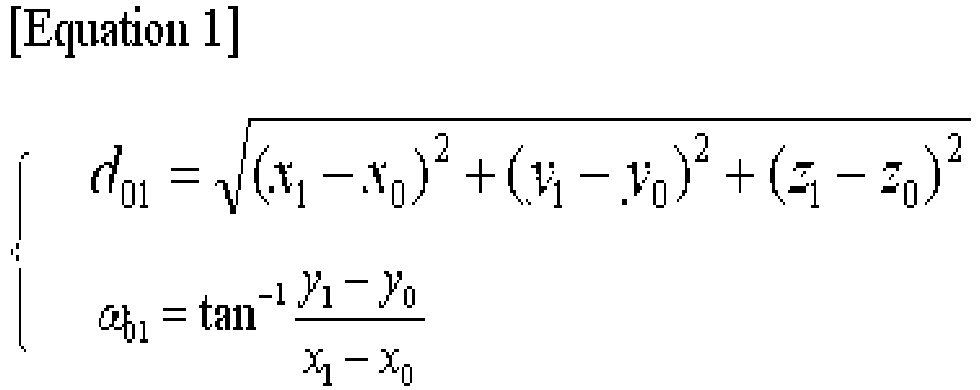
- In this embodiment, the relay station may also store the location of each of the neighbor nodes in the neighbor location information table according to a capability of the relay station. The location of each of the neighbor nodes includes the distance and the angle between the base station and the neighbor nodes.
- In the neighbor location information table, the distance and the angle between the base station and the neighbor nodes may be stored.
- Not only the base station, but also mobile station and the relay station may receive the location response message.
-
FIG. 2 is a diagram illustrating an a neighbor location information table according to an exemplary embodiment of the present invention. - In
FIG. 2 , dNM designates a distance from a node corresponding to an N to a node corresponding to an M. to ωNM designates an angle of the node corresponding to the M from the node corresponding to the N. In this case, each of the N and M is a integer not less than zero. Also, the node corresponds to a base station or a relay station. -
FIG. 2 illustrates an exemplary embodiment of the present invention only when the node is included in a single multi-hop relay cell. The multi-hop relay cell corresponds to a zone including a single base station and relay stations which are controlled by the single base station. -
FIG. 3 is a flowchart illustrating a method of generating neighbor location information performed in a base station or a relay station according to an exemplary embodiment of the present invention. - Referring to
FIG. 3 , in operation S310, the base station or the relay station increments an index by one. In operation S320, it is determined whether a coordinate of a node corresponding to the increased index changes. - In operation S330, as a result of the determination in operation S320, when the coordinate of the node corresponding to the increased index is changed, a distance and an angle between the node and a reference point is calculated.
- As a result of the determination in operation S320, when the coordinate of the node corresponding to the increased index is not changed, the base station or the relay station returns to operation S310 and increments an index by one.
- In operation S340, the base station or the relay station updates the calculated distance and angle in a neighbor location information table.
- In operation S350, it is determined whether generating of neighbor location information with respect to all neighbor nodes is completed.
- As a result of the determination in operation S350, when the generating of neighbor location information with respect to all neighbor nodes is completed, all operations end.
- As a result of the determination in operation S350, when the generating of neighbor location information with respect to all neighbor nodes is not completed, the base station or the relay station returns to operation S310 and increments an index by one.
- In the method of providing neighbor information according to an exemplary embodiment of the present invention, the base station or the relay station generates a neighbor advertisement message by using a neighbor location information table.
- The neighbor advertisement message corresponds to a message which is broadcasted from the base station or the relay station to another relay station.
- Also, in the method of providing neighbor information according to an exemplary embodiment of the present invention, the base station or the relay station generates the neighbor information message. In this embodiment, the relay station provides a relay service downstream.
- In this embodiment, the neighbor information message corresponds to a unicast message, and is generated by considering location information of a node which receives the neighbor information message.
- Accordingly, a node which receives both the neighbor advertisement message and the neighbor information message does not retransmit the received neighbor advertisement message downstream. Also, the node generates and broadcasts a new neighbor advertisement message including only a portion of a neighbor list based on the received neighbor information message. The neighbor list is included in the received neighbor advertisement message.
-
FIG. 4 is a diagram illustrating a system where a method of providing neighbor information is performed according to an exemplary embodiment of the present invention. - Referring to
FIG. 4 , a serving station of a mobile station MS corresponds to a relay station RS13. - In this embodiment, a range where the mobile station may move corresponds to a
zone 410 within a dotted line. Accordingly, with respect to the mobile station, neighbor information corresponding to nodes included in thezone 410 within the dotted line is required to be provided. - According to an exemplary embodiment of the present invention, the base station BS1 includes location information of neighboring base stations BS2 and BS3, and location information of relay stations RS21, RS22, RS23, RS31, RS32, and RS33. The relay stations RS21, RS22, RS23, RS31, RS32, and RS33 are serviced by the neighboring base stations BS2 and BS3. Accordingly, the base station BS1 transmits location information to the relay station RS13, that is the serving station of the mobile station. In the location information, location information of neighbor nodes, which are located relatively far from the serving station, such as RS33 or RS22, is deleted. Thus, the mobile station may be prevented from performing an unnecessary calculation.
- In this embodiment, when the relay stations are not uniformly distributed, it may not be easy to determine a neighbor list by simply considering a distance. Thus, according to an exemplary embodiment of the present invention, the neighbor list may be determined by setting a predetermined number of zones according to a θvalue based on a reference point, and selecting neighbors corresponding to a local policy for each zon e. In this embodiment, the neighbors are located within a predetermined distance. For example, a neighbor which is the most adjacent to each zone or neighbors which are located within a predetermined distance d may be selected. The reference point may correspond to the base station or the relay station. In
FIG. 4 , the reference point may be the serving station, i.e. the relay station RS13. -
FIG. 5 is a diagram illustrating a method of determining a neighbor list when a neighbor node is non-uniformly distributed according to an exemplary embodiment of the present invention. - Referring to
FIG. 5 , a serving station of a mobile station corresponds to a relay station RS13. - In the exemplary embodiment of the present invention illustrated in
FIG. 5 , the serving station is a reference point, that is the relay station RS13. When divided into six zones by an identical θvalue, based on the reference point, the six zones having 60 for each zone are established. InFIG. 5 , each of the six zones corresponds to a zone θ1, a zone θ2, a zone θ3, a zone θ4, a zone θ5, and a zone θ6, respectively. The example illustrated inFIG. 5 illustrates selecting neighbors which are located within a distance d in each zone. - In the zone θ1, a neighbor node, which is located within the distance d based on the reference point, is a relay station RS22.
- In the zone θ2, a neighbor node, which is located within the distance d based on the reference point, is a relay station RS11.
- In the zone θ3, the zone θ4, and the zone θ5, a neighbor node, which is located within the distance d based on the reference point, is non-existent. Specifically, in zone θ3, relay station RS12 is located outside the distance d based on the reference point, and in zone θ4, base station BS1 is located outside the distance d based on the reference point.
- In the zone θ6, a neighbor node, which is located within the distance d based on the reference point, is a relay station RS14.
- Accordingly, in the example illustrated in
FIG. 5 , only the relay stations RS11, RS22, and RS14 may be included in the neighbor list. - Depending on the system, a zone including many nodes may be segmented, and the distance d may be differently set for each zone.
-
FIG. 6 is a diagram illustrating a message format of a location request message and a location response message. - Referring to
FIG. 6 , each of the location request message MMR_LOC-REQ and the location response message MMR_LOC-RSP includes a report type filed, a coordinate type field, a report metric field, a node index N_Node_index, and other appropriate fields. The location request message MMR_LOC-REQ includes a node index of each node in which ascertaining of location information is required. Also, the location response message MMR_LOC-RSP includes location information of requested nodes. - In this embodiment, the location request message MMR_LOC-REQ includes the report type field. The report type field indicates whether to receive the location response message MMR_LOC-RSP regularly or irregularly, or indicates whether to receive the location response message MMR_LOC-RSP when a particular event is triggered.
- In this embodiment, the report metric field may indicate a metric which triggers the particular event in response to the particular event when receiving the location response message MMR_LOC-RSP.
- In this embodiment, the location request message MMR_LOC-REQ may request location information of other nodes as well as a node which receives the location request message MMR_LOC-REQ.
- In this embodiment, the node index may be an index indicating nodes in which ascertaining of the location information is required.
- In this embodiment, the coordinate type field may indicate a coordinate type of the location information.
- The location response message MMR_LOC-RSP may include location information of a node included in the location request message MMR_LOC-REQ.
-
FIG. 7 is a diagram illustrating a message format of neighbor information message. The neighbor information message is transmitted to a relay station, which is located downstream of a base station or the relay station by a base station or a relay station downstream of the base station or relay station, in a unicast method. Also, the neighbor information message transmits neighbor information which is customized for the relay station. - Referring to
FIG. 7 , the neighbor information message has a format similar to a neighbor advertisement message, and includes a neighbor station type field and location information field for each neighbor on a neighbor list. In this case, the neighbor station type is for identifying the base station, the relay station, a mobile station, and the like. -
FIG. 8 is a diagram illustrating a system corresponding to an exemplary embodiment of a method of providing neighbor information and a method of generating neighbor location information. - Referring to
FIG. 8 , while a relay station RS1 is a serving station, a mobile station moves, and thus the serving station is changed to a relay station RS2. - In this embodiment, the relay station RS2 is connected to a base station BS1 via the relay station RS1.
-
FIG. 9 is a flowchart illustrating a method of providing neighbor information and a method of generating neighbor location information are applied to the system illustrated inFIG. 8 according to an exemplary embodiment of the present invention. - Referring to
FIG. 9 , inoperation 911, a base station BS1 transmits a location request message to a relay station RS1. Inoperation 912, the base station BS1 receives a location response message from the relay station RS1. Also, inoperation 913, the relay station RS1 transmits the location request message to a relay station RS2, and inoperation 914, the relay station RS1 receives the location response message from the relay station RS2. In this embodiment, the base station BS1 may transmit the location request message to the relay station RS2. - In
operation 915, the base station BS1 generates a neighbor location information table by using the received location response message, and broadcasts a neighbor advertisement message by using the neighbor location information table. In this case, L designates a number of neighbors included in the broadcasted neighbor advertisement message. L is a natural number. - In
operation 916, the base station BS1 generates a neighbor information message by considering a location of the relay station RS1, and transmits the neighbor information message to the relay station RS1 in a unicast method. - In
operations - Also, in
operation 919, the relay station RS1 generates the neighbor information message by considering a location of the relay station RS2, and transmits the neighbor information message to the relay station RS2. - In
operations operation 926, the base station BS1 determines whether a handover process is required. When required, the handover process is performed inoperation 927. InFIG. 9 , a handover from the relay station RS1 to the relay station RS2 is illustrated. - In
operation 928, the relay station RS2 generates and broadcasts a new neighbor advertisement message by using the neighbor advertisement message and neighbor information message which are received from the relay station RS1. In this embodiment, N designates a number of neighbors included in the new neighbor advertisement message. N is a natural number, and may be less than M. - In
operation 929, the mobile station MS performs a new scan process based on the new broadcasted neighbor advertisement message from relay station RS2. - As described above, the neighbor information message includes a neighbor list which is customized for a node receiving the neighbor information message. Also, the relay station generates the neighbor advertisement message by using the received neighbor information message. The base station BS1 and the relay stations RS1 and RS2 broadcast the neighbor advertisement message to nodes within a coverage area of respective base station BS1 and the relay stations RS1 and RS2.
-
FIG. 10 is a diagram illustrating a system corresponding to an exemplary embodiment of a method of providing neighbor information according to an exemplary embodiment of the present invention. - Referring to
FIG. 10 , while a relay station RS1 is a serving station, a mobile station moves, and thus the serving station is changed to a relay station RS2. - In this embodiment, the relay station RS1 and the relay station RS2 are connected to a base station BS1, and the base station BS1 is connected to a base station BS2.
-
FIG. 11 is a flowchart illustrating an example where a method of providing neighbor information is applied to the system illustrated inFIG. 10 . A base station transmits data to a mobile station MS via a relay station RS1, and an operation for acquiring location information has already been performed. Also, base stations transmit and receive control information via a backbone message. - Referring to
FIG. 11 , inoperations - In
operation 1103, the base station BS1 generates a neighbor information message which is customized for the relay station RS1 by considering a location of the relay st ation RS1, and transmits the neighbor information message to the relay station RS1. - In
operation 1104, the base station BS1 generates a neighbor information message which is customized for the relay station RS2 by considering a location of the relay station RS2, and transmits the neighbor information message to the relay station RS2. - In
operation 1105, the relay station RS1 generates and broadcasts a new neighbor advertisement message by using the neighbor advertisement message and the neighbor information message which are received from the base station BS1. In this embodiment, Y designates a number of neighbors included in the new neighbor advertisement message. Y is a natural number and may be less than X. - In
operation 1106, the mobile station which receives the broadcasted neighbor advertisement message performs a scan process. As a result of the scan process, when a handover process is required, the handover process is performed inoperation 1107. - As a result of the handover process, when a serving station of the mobile station changes to the relay station RS2, the mobile station acquires neighbor information by receiving the neighbor advertisement message which is broadcasted from the relay station RS2. In this embodiment, the neighbor advertisement message is a new neighbor advertisement message which is generated by using the neighbor advertisement message and the neighbor information message in
operation 1108. The neighbor advertisement message and the neighbor information message are received from the base station BS1. Z designates a number of neighbors included in the new neighbor advertisement message. Z is a natural number, and may be less than X. - The base station BS1 provides the customized neighbor information message to the relay station RS1 and the relay station RS2, respectively. Accordingly, the neighbor advertisement message and the messages are associated with the scan process and handover process may have a neighbor list reduced by location information.
-
FIG. 12 is a flowchart illustrating a method of providing neighbor information according to an exemplary embodiment of the present invention. - Referring to
FIG. 12 , in the method of providing neighbor information according to an exemplary embodiment of the present invention, in operation S1210, a base station broadcasts a neighbor advertisement message. - In this embodiment, the neighbor advertisement message may include a neighbor list. The neighbor list is generated by referring to a location of neighbors and a reference point. Also, the neighbor list may be generated by setting a predetermined number of zones based on the reference point, and selecting neighbors corresponding to a local policy for each zone or selecting neighbors located within a predetermined distance. The predetermined number of zones may be non-uniformly set according to a distribution of the neighbors. Also, the local policy may correspond to selecting the neighbors within a distance, and the distance may be non-uniformly set according to a distribution of the neighbors.
- In operation S1220, the base station transmits a neighbor information message to a relay station which is connected to the base station. The neighbor information message is generated by considering a location of the relay station.
- In this embodiment, the neighbor information message may include a neighbor list. The neighbor list is generated by referring to a location of the neighbors and the relay station. The neighbor list may be generated by setting a predetermined number of zones based on the relay station, and selecting the neighbors located within the predetermined distance corresponding to the local policy for each zone. The predetermined number of zones may be non-uniformly set according to the distribution of the neighbors. Also, the local policy corresponds to selecting the neighbors within a distance, and the distance may be non-uniformly set according to the according to the distribution of the neighbors by local policy.
- In this embodiment, the neighbor information message corresponds to a unicast message.
- The neighbor information message may include a neighbor station type field.
- In operation S1230, the relay station generates a new neighbor advertisement message including only a portion of neighbor list by using the neighbor information message. In this embodiment, the neighbor list is included in the neighbor advertisement message.
- In operation S1240, the new neighbor advertisement message is broadcasted downstream of the relay station.
- In this embodiment, the relay station may transmit a neighbor information message, which is custom generated for the base station by considering a location of other relay stations, to the other relay station, when the other relay station exists downstream of the relay station.
- Also, the method of providing neighbor information may further include determining a neighbor to be scanned by using neighbors in the neighbor list included in a message, and performing a scan process with respect to the neighbor to be scanned. In the determining of the neighbor to be scanned, a mobile station receives the message which is generated by using a message corresponding to the new neighbor advertisement message.
- Also, the method of providing neighbor information may further include the following operations: the base station transmitting a location request message to neighbor nodes; the base station receiving a location response message which is transmitted from the neighbor nodes in response to the location request message; forming a neighbor location information table by using the location response message; and the base station generating the neighbor advertisement message by using the neighbor location information table.
- The method of providing neighbor information may be performed by relay stations which serve other relay stations downstream of the relay station, excluding the base station.
-
FIG. 13 is a flowchart illustrating a method of generating neighbor location information according to an exemplary embodiment of the present invention. - Referring to
FIG. 13 , in the method of generating neighbor location information according to an exemplary embodiment of the present invention, in operation S1310, any one of a base station and a relay station transmits a location request message to neighbor nodes. - In operation S1320, any one of the base station and the relay station receives a location response message which is transmitted from the neighbor nodes in response to the location request message.
- In operation S 1330, a neighbor location information table is formed by using the location response message.
- In this embodiment, the location request message includes a report type field. The report type field indicates whether to receive the location response message periodically or non-periodically, or indicates whether to receive the location response message when a particular event is triggered.
- In this embodiment, the location response message includes location information of the node which receives the location request message and location information of nodes included in the location request message.
- The neighbor location information table may store a distance and an angle between one of the base station or the relay station, and the neighbor nodes.
- The method of providing neighbor information and the method of generating neighbor location information according to the above-described exemplary embodiments of the present invention may be recorded in computer-readable media including program instructions to implement various operations embodied by a computer. The media may also include, alone or in combination with the program instructions, data files, data structures, and the like. The media and program instructions may be those specially designed and constructed for the purposes of the present invention, or they may be of the kind well-known and available to those having skill in the computer software arts. Examples of computer-readable media include magnetic media such as hard disks, floppy disks, and magnetic tape; optical media such as CD ROM disks and DVD; magneto-optical media such as optical disks; and hardware devices that are specially configured to store and perform program instructions, such as read-only memory (ROM), random access memory (RAM), flash memory, and the like. The media may also be a transmission medium such as optical or metallic lines, wave guides, etc. including a carrier wave transmitting signals specifying the program instructions, data structures, etc. Examples of program instructions include both machine code, such as produced by a compiler, and files containing higher level code that may be executed by the computer using an interpreter. The described hardware devices may be configured to act as one or more software modules in order to perform the operations of the above-described embodiments of the present invention.
- According to an aspect of the present invention, a method of providing neighbor information and a method of generating neighbor location information reduces neighbor information of unnecessary neighbors by using location information.
- Also, according to an aspect of the present invention, a method of providing neighbor information and a method of generating neighbor location information reduces the electric power and time required to scan for a neighbor in a mobile station, as well as handover delay.
- Also, according to an aspect of the present invention, a method of providing neighbor information and a method of generating neighbor location information reduces the overhead which is necessary when transmitting neighbor information in a multi-hop communication system.
- Also, according to an aspect of the present invention, a method of providing neighbor information and a method of generating neighbor location information selects and provides only neighbor information suitable for a particular node.
- While certain exemplary embodiments of the invention have been shown and described with reference to certain preferred embodiments thereof, it will be understood by those skilled in the art that various changes in form and details may be made therein without departing from the scope of the invention as defined by the appended claims and their equivalents.
Claims (10)
- A method of providing neighbor information in
a multi-hop wireless communication system, the method comprising:a base station broadcasting a neighbor advertisement message including a neighbor list;the base station transmitting a neighbor information message to a relay station connected to the base station, wherein the neighbor information message is generated by considering a location of the relay station;the relay station generating a new neighbor advertisement message including only a portion of the neighbor list by using the neighbor information message; andbroadcasting the new neighbor advertisement message downstream of the relay station including to mobile stations. - The method of claim 1, wherein the relay station transmits the neighbor information message, which is generated by considering a location of another relay station, to the other relay station when the other relay station exists downstream of the relay station.
- The method of claim 1, wherein the neighbor advertisement message comprises a neighbor list which is generated by referring to a location of neighbors.
- The method of claim 3, wherein the neighbor list is generated by setting a predetermined number of zones, and selecting neighbors corresponding to a local policy for each zone, and/or
wherein the neighbor list is generated by referring a reference point and the predetermined zones are set based on the reference point, and/or
wherein the predetermined number of zones is non-uniformly set according to a distribution of the neighbors, and/or
wherein the local policy corresponds to selecting the neighbors in a distance, the distance being non-uniformly set according to a distribution of the neighbors. - The method of claim 1, wherein the neighbor information message comprises a neighbor list which is custom generated for the relay station, and/or
wherein the neighbor list is generated by setting a predetermined number of zones based on the relay station, and selecting neighbors corresponding to a local policy for each zone, and/or
wherein an angle of the predetermined number of zones is non-uniformly set according to a distribution of the neighbors, and/or
wherein the local policy corresponds to selecting the neighbors in the distance, the distance being non-uniformly set according to a distribution of the neighbors. - The method of any of claims 1-5, wherein the neighbor information message corresponds to one of a unicast message, a neighbor station type field, and/or location information of a neighbor station.
- The method of any of claims 1-6, further comprising:determining, by using the neighbor list included in a message, a neighbor to be scanned by a mobile station which receives the message, the message being generated by using a message corresponding to the new neighbor advertisement message; andperforming a scan process with respect to the neighbor to be scanned.
- The method of any of claims 1-7, further comprising:the base station transmitting a location request message to neighbor nodes;the base station receiving a location response message which is transmitted from the neighbor nodes in response to the location request message;forming a neighbor location information table by using the location response message; andthe base station generating the neighbor advertisement message by using the neighbor location information table, and/orwherein the location response message comprises location information of a node included in the location request message, and/orwherein the neighbor location information table stores a distance and an angle between the base station and the neighbor nodes.
- A computer-readable medium of instructions for controlling a base station of a multi-hop wireless communication system, comprising:a first set of instructions for controlling the base station to broadcast a neighbor advertisement message including a neighbor list; anda second set of instructions for controlling the base station to transmit a neighbor information message to a relay station connected to the base station, wherein the neighbor information message is generated by considering a location of the relay station; and a third set of instructions for controlling the relay station to generate a new neighbor advertisement message including only a portion of the neighbor list by using the neighbor information message; and to broadcast the new neighbor advertisement message downstream of the relay station including to mobile stations.
- The computer-readable recording medium according to claim 9, wherein the method steps of any of claims 1-8 are performed.
Priority Applications (2)
| Application Number | Priority Date | Filing Date | Title |
|---|---|---|---|
| EP18161297.9A EP3355489B1 (en) | 2006-10-18 | 2007-09-21 | Method of providing neighbor information and method of generating neighbor location information |
| EP18161287.0A EP3355488B1 (en) | 2006-10-18 | 2007-09-21 | Method of providing neighbor information and method of generating neighbor location information |
Applications Claiming Priority (3)
| Application Number | Priority Date | Filing Date | Title |
|---|---|---|---|
| KR1020060101446A KR101074758B1 (en) | 2006-10-18 | 2006-10-18 | Method of providing neighbor information and method of generating neighbor location information |
| KR1020070054054A KR100824673B1 (en) | 2007-06-01 | 2007-06-01 | How to provide neighbor information and how to generate neighbor location information |
| PCT/KR2007/004656 WO2008048007A1 (en) | 2006-10-18 | 2007-09-21 | Method of providing neighbor information and method of generating neighbor location information |
Related Child Applications (4)
| Application Number | Title | Priority Date | Filing Date |
|---|---|---|---|
| EP18161287.0A Division EP3355488B1 (en) | 2006-10-18 | 2007-09-21 | Method of providing neighbor information and method of generating neighbor location information |
| EP18161287.0A Division-Into EP3355488B1 (en) | 2006-10-18 | 2007-09-21 | Method of providing neighbor information and method of generating neighbor location information |
| EP18161297.9A Division EP3355489B1 (en) | 2006-10-18 | 2007-09-21 | Method of providing neighbor information and method of generating neighbor location information |
| EP18161297.9A Division-Into EP3355489B1 (en) | 2006-10-18 | 2007-09-21 | Method of providing neighbor information and method of generating neighbor location information |
Publications (3)
| Publication Number | Publication Date |
|---|---|
| EP2082498A1 EP2082498A1 (en) | 2009-07-29 |
| EP2082498A4 EP2082498A4 (en) | 2013-11-27 |
| EP2082498B1 true EP2082498B1 (en) | 2018-04-18 |
Family
ID=39314191
Family Applications (3)
| Application Number | Title | Priority Date | Filing Date |
|---|---|---|---|
| EP18161297.9A Active EP3355489B1 (en) | 2006-10-18 | 2007-09-21 | Method of providing neighbor information and method of generating neighbor location information |
| EP18161287.0A Active EP3355488B1 (en) | 2006-10-18 | 2007-09-21 | Method of providing neighbor information and method of generating neighbor location information |
| EP07833026.3A Active EP2082498B1 (en) | 2006-10-18 | 2007-09-21 | Method of providing neighbor information and method of generating neighbor location information |
Family Applications Before (2)
| Application Number | Title | Priority Date | Filing Date |
|---|---|---|---|
| EP18161297.9A Active EP3355489B1 (en) | 2006-10-18 | 2007-09-21 | Method of providing neighbor information and method of generating neighbor location information |
| EP18161287.0A Active EP3355488B1 (en) | 2006-10-18 | 2007-09-21 | Method of providing neighbor information and method of generating neighbor location information |
Country Status (3)
| Country | Link |
|---|---|
| US (1) | US8971956B2 (en) |
| EP (3) | EP3355489B1 (en) |
| WO (1) | WO2008048007A1 (en) |
Families Citing this family (21)
| Publication number | Priority date | Publication date | Assignee | Title |
|---|---|---|---|---|
| US8971956B2 (en) * | 2006-10-18 | 2015-03-03 | Samsung Electronics Co., Ltd. | Method of providing neighbor information and method of generating neighbor location information |
| KR101599844B1 (en) * | 2007-12-24 | 2016-03-04 | 엘지전자 주식회사 | Multiple access area multiplexing method |
| US8014346B2 (en) * | 2008-03-05 | 2011-09-06 | Motorola Solutions, Inc. | Method for enabling periodic scanning in wireless communication networks |
| US8060097B1 (en) * | 2008-06-05 | 2011-11-15 | Sprint Spectrum L.P. | Method and apparatus for intelligent mobile-assisted hard handoff |
| US20090312039A1 (en) * | 2008-06-13 | 2009-12-17 | Jialin Zou | Geo location polling and reporting for mobiles in idle mode |
| WO2010027164A2 (en) * | 2008-09-03 | 2010-03-11 | Electronics And Telecommunications Research Institute | Method for broadcasting and method for receiving location information of base station |
| KR101192428B1 (en) | 2008-09-03 | 2012-10-17 | 삼성전자주식회사 | Method for advertising and method for receiving location information of base station |
| US20110019649A1 (en) * | 2009-01-31 | 2011-01-27 | Qualcomm Incorporated | Methods and systems for mobile station location determination in wimax |
| WO2010100325A1 (en) * | 2009-03-04 | 2010-09-10 | Nokia Corporation | Building and maintaining wireless node constellations |
| CN102045751B (en) * | 2009-10-23 | 2014-10-22 | 中兴通讯股份有限公司 | Method and system for maintaining local connection information |
| US8588779B2 (en) * | 2009-11-06 | 2013-11-19 | Industrial Technology Research Institute | Wireless communication system, communication device and base station thereof |
| US8843129B2 (en) * | 2009-12-21 | 2014-09-23 | Samsung Electronics Co., Ltd. | Methods and apparatus to support base station detection and selection in multi-tier wireless networks |
| KR101642046B1 (en) * | 2010-02-18 | 2016-07-25 | 삼성전자주식회사 | Apparatus and method for managing neighbor bs list in distrebuted wireless ad hoc network |
| CN102281546B (en) * | 2010-06-13 | 2014-11-05 | 中兴通讯股份有限公司 | Method and system for selecting candidate neighbor cells |
| JP5767449B2 (en) * | 2010-07-28 | 2015-08-19 | 京セラ株式会社 | Wireless base station, control method therefor, wireless terminal, processor |
| US10405163B2 (en) * | 2013-10-06 | 2019-09-03 | Staton Techiya, Llc | Methods and systems for establishing and maintaining presence information of neighboring bluetooth devices |
| US9253595B1 (en) * | 2014-01-30 | 2016-02-02 | Sprint Spectrum L.P. | Determination of base station location based on other serving locations available to client devices |
| EP3476153B1 (en) * | 2016-06-22 | 2020-04-29 | Telefonaktiebolaget LM Ericsson (PUBL) | Candidate link locating by a wireless terminal |
| CN107765213B (en) * | 2016-08-15 | 2020-08-25 | 华为技术有限公司 | Positioning method and device |
| CA3136819A1 (en) | 2019-04-03 | 2020-10-08 | Dow Agrosciences Llc | Adaptive active infrared sensor hardware and software in the detection of pests with pest detection station |
| WO2022040095A1 (en) * | 2020-08-17 | 2022-02-24 | Kyocera Corporation | Relay device management using neighbor lists |
Family Cites Families (39)
| Publication number | Priority date | Publication date | Assignee | Title |
|---|---|---|---|---|
| US4829554A (en) * | 1985-01-31 | 1989-05-09 | Harris Corporation | Cellular mobile telephone system and method |
| US5265150A (en) * | 1991-01-30 | 1993-11-23 | At&T Bell Laboratories | Automatically configuring wireless PBX system |
| US5675629A (en) * | 1995-09-08 | 1997-10-07 | At&T | Cordless cellular system base station |
| US5911120A (en) * | 1995-09-08 | 1999-06-08 | At&T Wireless Services | Wireless communication system having mobile stations establish a communication link through the base station without using a landline or regional cellular network and without a call in progress |
| JPH0993639A (en) | 1995-09-22 | 1997-04-04 | Hitachi Software Eng Co Ltd | Phs exchange system |
| US6236365B1 (en) * | 1996-09-09 | 2001-05-22 | Tracbeam, Llc | Location of a mobile station using a plurality of commercial wireless infrastructures |
| US6463055B1 (en) * | 1998-06-01 | 2002-10-08 | Telefonaktiebolaget L M Ericsson (Publ) | Integrated radio telecommunications network and method of interworking an ANSI-41 network and the general packet radio service (GPRS) |
| KR100425085B1 (en) | 1998-12-16 | 2004-05-17 | 엘지전자 주식회사 | Method for managing neighbor list of mobile communication system |
| US6980524B1 (en) * | 1999-05-20 | 2005-12-27 | Polytechnic University | Methods and apparatus for routing in a mobile ad hoc network |
| JP2001209891A (en) | 2000-01-26 | 2001-08-03 | Matsushita Electric Works Ltd | Report system |
| JP3770046B2 (en) | 2000-04-25 | 2006-04-26 | 松下電工株式会社 | Position detection system |
| US7206294B2 (en) * | 2001-08-15 | 2007-04-17 | Meshnetworks, Inc. | Movable access points and repeaters for minimizing coverage and capacity constraints in a wireless communications network and a method for using the same |
| JP2003078540A (en) | 2001-09-04 | 2003-03-14 | Nec Corp | Multiplex transmission system and its data transferring method |
| JP3570404B2 (en) | 2001-09-10 | 2004-09-29 | 株式会社デンソー | Base station location guidance device |
| KR100492970B1 (en) | 2002-08-28 | 2005-06-07 | 삼성전자주식회사 | A wireless network system capable of tracking a location of a mobile station and a method for tracking a location of the mobile station |
| US7215966B2 (en) * | 2003-06-05 | 2007-05-08 | Meshnetworks, Inc. | System and method for determining location of a device in a wireless communication network |
| TWI366385B (en) | 2003-11-13 | 2012-06-11 | Interdigital Tech Corp | Method and system for facilitating inter-system handover |
| US7420954B2 (en) * | 2004-01-13 | 2008-09-02 | General Motors Corporation | Efficient lightweight information dissemination algorithm for mobile wireless ad hoc networks |
| KR100619837B1 (en) | 2004-03-30 | 2006-09-13 | 엘지전자 주식회사 | Local emergency information provision method of mobile communication system and mobile terminal |
| KR100625165B1 (en) | 2004-04-22 | 2006-09-20 | 에스케이 텔레콤주식회사 | Operation method and system of neighbor list update message for location based service in CDM2000 system |
| KR100731380B1 (en) | 2004-04-23 | 2007-06-21 | 에스케이 텔레콤주식회사 | Repeater control device using GPS signal |
| US7428221B2 (en) * | 2004-06-01 | 2008-09-23 | Cisco Technology, Inc. | Arrangement for providing network prefix information from attached mobile routers to a clusterhead in a tree-based ad hoc mobile network |
| KR100594116B1 (en) | 2004-06-18 | 2006-06-28 | 삼성전자주식회사 | Information Configuration and Transmission / Reception Method and System of Adjacent Base Station in Broadband Wireless Access Communication System |
| KR100876771B1 (en) | 2004-08-17 | 2009-01-07 | 삼성전자주식회사 | Method and apparatus for compressing control information and transmitting and receiving scanning information in a wireless communication system |
| US7715396B2 (en) * | 2004-08-19 | 2010-05-11 | Microsoft Corporation | Network routing |
| KR100617732B1 (en) | 2004-10-26 | 2006-08-28 | 삼성전자주식회사 | Method and system for transmitting / receiving neighboring base station advertisement message in mobile communication system |
| KR20060076640A (en) | 2004-12-29 | 2006-07-04 | 주식회사데이콤 | Wireless communication repeater management device and location system using location based service |
| DE102005014695B4 (en) | 2005-03-29 | 2009-05-07 | Nec Europe Ltd. | Method for disseminating information to nodes of a mobile ad hoc network |
| US20060276189A1 (en) | 2005-04-01 | 2006-12-07 | Interdigital Technology Corporation | Supporting inter-technology handover using IEEE 802.16 handover procedures |
| US7366111B2 (en) * | 2005-04-08 | 2008-04-29 | Cisco Technology, Inc. | Arrangement for providing optimized connections between peer routers in a tree-based ad hoc mobile network |
| KR100698249B1 (en) * | 2005-09-13 | 2007-03-22 | 삼성전자주식회사 | Apparatus and method for relaying neighbor base station information in broadband wireless access communication system using multi-hop relay method |
| KR100872413B1 (en) | 2005-09-13 | 2008-12-05 | 삼성전자주식회사 | Method of Acquiring Neighbor Base Station and Neighbor Relay Station in Broadband Wireless Access Communication System Using Multi-hop Relay System |
| KR100871620B1 (en) | 2005-11-10 | 2008-12-02 | 삼성전자주식회사 | Handover Apparatus and Method for Multihop Systems in Broadband Wireless Access Networks |
| EP1833204A1 (en) * | 2006-03-08 | 2007-09-12 | Matsushita Electric Industrial Co., Ltd. | Fast configuration of a default router for a mobile node in a mobile communication system |
| US8971956B2 (en) * | 2006-10-18 | 2015-03-03 | Samsung Electronics Co., Ltd. | Method of providing neighbor information and method of generating neighbor location information |
| KR20080041576A (en) * | 2006-11-07 | 2008-05-13 | 삼성전자주식회사 | Handover Method in Wireless Communication System |
| KR101009776B1 (en) * | 2007-05-21 | 2011-01-19 | 삼성전자주식회사 | System and method for transmitting / receiving neighboring base station information in communication system |
| WO2009089643A1 (en) * | 2008-01-14 | 2009-07-23 | Lucent Technologies Inc. | Method for detecting a duplicate address, mobile station, network element and communication system |
| KR20110021633A (en) * | 2009-08-25 | 2011-03-04 | 엘지전자 주식회사 | Efficient Multi-antenna Transmission Mode in Broadband Wireless Access Systems |
-
2007
- 2007-07-06 US US11/822,472 patent/US8971956B2/en active Active
- 2007-09-21 EP EP18161297.9A patent/EP3355489B1/en active Active
- 2007-09-21 EP EP18161287.0A patent/EP3355488B1/en active Active
- 2007-09-21 WO PCT/KR2007/004656 patent/WO2008048007A1/en not_active Ceased
- 2007-09-21 EP EP07833026.3A patent/EP2082498B1/en active Active
Non-Patent Citations (1)
| Title |
|---|
| None * |
Also Published As
| Publication number | Publication date |
|---|---|
| EP2082498A1 (en) | 2009-07-29 |
| US20080096581A1 (en) | 2008-04-24 |
| EP3355489B1 (en) | 2020-12-09 |
| US8971956B2 (en) | 2015-03-03 |
| EP2082498A4 (en) | 2013-11-27 |
| EP3355488A1 (en) | 2018-08-01 |
| EP3355489A1 (en) | 2018-08-01 |
| EP3355488B1 (en) | 2021-07-21 |
| WO2008048007A1 (en) | 2008-04-24 |
Similar Documents
| Publication | Publication Date | Title |
|---|---|---|
| EP3355489B1 (en) | Method of providing neighbor information and method of generating neighbor location information | |
| US11424787B2 (en) | AI-based power allocation for efficient 5G/6G communications | |
| CN101449613B (en) | Handover from a first basestation to a second basestation of multi mobile stations | |
| JP4227737B2 (en) | Wireless network, relay node, relay transmission method used therefor, and program thereof | |
| US7113495B2 (en) | Data transmission method and apparatus in relay transmission type radio network | |
| US20110306353A1 (en) | Channel allocation device and method using wireless access in vehicular enviroments | |
| CN103109558B (en) | Improve the method for physical sector user capacity, device and base station | |
| EP1734705A2 (en) | Routing apparatus and method in a multi-hop relay cellular network | |
| CN101039462B (en) | Method and apparatus for dynamic frequency selection between basic service set in same channel | |
| US20090042574A1 (en) | Apparatus and method for performing handover in a communication system | |
| EP2103005A1 (en) | Handover method using relay station having handover control function and multi-hop relay system | |
| CN112753268A (en) | Interference management in a wireless system | |
| WO2014161450A1 (en) | Method, device, and system for handing over user equipment during change of configuration of base station | |
| US8798626B2 (en) | Handover control apparatus and operation method of handover control apparatus | |
| CN112449374B (en) | Method and device for determining target main base station and associating target auxiliary base station | |
| US8300617B2 (en) | Subscriber station, time division multiplexing system and transmission timing control method suitable for wireless communication in synchronous PtoMP scheme | |
| US11304117B2 (en) | Method for a wireless communication system | |
| KR100824673B1 (en) | How to provide neighbor information and how to generate neighbor location information | |
| JP5505423B2 (en) | Method, base station, and user equipment for reducing cognitive pilot channel bandwidth | |
| RU2378801C2 (en) | Method of communication in wireless local network with group consisting of repeaters and radio access stations | |
| KR101074758B1 (en) | Method of providing neighbor information and method of generating neighbor location information | |
| KR100955765B1 (en) | How to provide neighbor information and how to generate neighbor location information | |
| KR101147687B1 (en) | Method of providing neighbor information and method of generating neighbor location information | |
| US20070173243A1 (en) | Method for communicating by means of a plurality of network-side transmission antennas | |
| CN113133066A (en) | Switching method and network equipment |
Legal Events
| Date | Code | Title | Description |
|---|---|---|---|
| PUAI | Public reference made under article 153(3) epc to a published international application that has entered the european phase |
Free format text: ORIGINAL CODE: 0009012 |
|
| 17P | Request for examination filed |
Effective date: 20090518 |
|
| AK | Designated contracting states |
Kind code of ref document: A1 Designated state(s): AT BE BG CH CY CZ DE DK EE ES FI FR GB GR HU IE IS IT LI LT LU LV MC MT NL PL PT RO SE SI SK TR |
|
| RIN1 | Information on inventor provided before grant (corrected) |
Inventor name: KANG, HYUN JEONG Inventor name: DO, MI-SUN Inventor name: LEE, JAI YONG Inventor name: YEON, HUN JE Inventor name: LEE, SUNG JIN Inventor name: RAKESH, TAORI |
|
| DAX | Request for extension of the european patent (deleted) | ||
| RAP1 | Party data changed (applicant data changed or rights of an application transferred) |
Owner name: INDUSTRY-ACADEMIC COOPERATION FOUNDATION, YONSEI U Owner name: SAMSUNG ELECTRONICS CO., LTD. |
|
| A4 | Supplementary search report drawn up and despatched |
Effective date: 20131028 |
|
| RIC1 | Information provided on ipc code assigned before grant |
Ipc: H04W 48/10 20090101ALI20131022BHEP Ipc: H04B 7/26 20060101AFI20131022BHEP Ipc: H04W 64/00 20090101ALI20131022BHEP |
|
| STAA | Information on the status of an ep patent application or granted ep patent |
Free format text: STATUS: EXAMINATION IS IN PROGRESS |
|
| 17Q | First examination report despatched |
Effective date: 20170209 |
|
| GRAP | Despatch of communication of intention to grant a patent |
Free format text: ORIGINAL CODE: EPIDOSNIGR1 |
|
| STAA | Information on the status of an ep patent application or granted ep patent |
Free format text: STATUS: GRANT OF PATENT IS INTENDED |
|
| INTG | Intention to grant announced |
Effective date: 20171109 |
|
| GRAS | Grant fee paid |
Free format text: ORIGINAL CODE: EPIDOSNIGR3 |
|
| GRAA | (expected) grant |
Free format text: ORIGINAL CODE: 0009210 |
|
| STAA | Information on the status of an ep patent application or granted ep patent |
Free format text: STATUS: THE PATENT HAS BEEN GRANTED |
|
| AK | Designated contracting states |
Kind code of ref document: B1 Designated state(s): AT BE BG CH CY CZ DE DK EE ES FI FR GB GR HU IE IS IT LI LT LU LV MC MT NL PL PT RO SE SI SK TR |
|
| REG | Reference to a national code |
Ref country code: GB Ref legal event code: FG4D |
|
| REG | Reference to a national code |
Ref country code: CH Ref legal event code: EP |
|
| REG | Reference to a national code |
Ref country code: AT Ref legal event code: REF Ref document number: 991521 Country of ref document: AT Kind code of ref document: T Effective date: 20180515 |
|
| REG | Reference to a national code |
Ref country code: IE Ref legal event code: FG4D |
|
| REG | Reference to a national code |
Ref country code: DE Ref legal event code: R096 Ref document number: 602007054617 Country of ref document: DE |
|
| REG | Reference to a national code |
Ref country code: NL Ref legal event code: MP Effective date: 20180418 Ref country code: FR Ref legal event code: PLFP Year of fee payment: 12 |
|
| REG | Reference to a national code |
Ref country code: LT Ref legal event code: MG4D |
|
| PG25 | Lapsed in a contracting state [announced via postgrant information from national office to epo] |
Ref country code: NL Free format text: LAPSE BECAUSE OF FAILURE TO SUBMIT A TRANSLATION OF THE DESCRIPTION OR TO PAY THE FEE WITHIN THE PRESCRIBED TIME-LIMIT Effective date: 20180418 |
|
| PG25 | Lapsed in a contracting state [announced via postgrant information from national office to epo] |
Ref country code: SE Free format text: LAPSE BECAUSE OF FAILURE TO SUBMIT A TRANSLATION OF THE DESCRIPTION OR TO PAY THE FEE WITHIN THE PRESCRIBED TIME-LIMIT Effective date: 20180418 Ref country code: FI Free format text: LAPSE BECAUSE OF FAILURE TO SUBMIT A TRANSLATION OF THE DESCRIPTION OR TO PAY THE FEE WITHIN THE PRESCRIBED TIME-LIMIT Effective date: 20180418 Ref country code: BG Free format text: LAPSE BECAUSE OF FAILURE TO SUBMIT A TRANSLATION OF THE DESCRIPTION OR TO PAY THE FEE WITHIN THE PRESCRIBED TIME-LIMIT Effective date: 20180718 Ref country code: PL Free format text: LAPSE BECAUSE OF FAILURE TO SUBMIT A TRANSLATION OF THE DESCRIPTION OR TO PAY THE FEE WITHIN THE PRESCRIBED TIME-LIMIT Effective date: 20180418 Ref country code: LT Free format text: LAPSE BECAUSE OF FAILURE TO SUBMIT A TRANSLATION OF THE DESCRIPTION OR TO PAY THE FEE WITHIN THE PRESCRIBED TIME-LIMIT Effective date: 20180418 Ref country code: ES Free format text: LAPSE BECAUSE OF FAILURE TO SUBMIT A TRANSLATION OF THE DESCRIPTION OR TO PAY THE FEE WITHIN THE PRESCRIBED TIME-LIMIT Effective date: 20180418 |
|
| PG25 | Lapsed in a contracting state [announced via postgrant information from national office to epo] |
Ref country code: GR Free format text: LAPSE BECAUSE OF FAILURE TO SUBMIT A TRANSLATION OF THE DESCRIPTION OR TO PAY THE FEE WITHIN THE PRESCRIBED TIME-LIMIT Effective date: 20180719 Ref country code: LV Free format text: LAPSE BECAUSE OF FAILURE TO SUBMIT A TRANSLATION OF THE DESCRIPTION OR TO PAY THE FEE WITHIN THE PRESCRIBED TIME-LIMIT Effective date: 20180418 |
|
| REG | Reference to a national code |
Ref country code: AT Ref legal event code: MK05 Ref document number: 991521 Country of ref document: AT Kind code of ref document: T Effective date: 20180418 |
|
| PG25 | Lapsed in a contracting state [announced via postgrant information from national office to epo] |
Ref country code: PT Free format text: LAPSE BECAUSE OF FAILURE TO SUBMIT A TRANSLATION OF THE DESCRIPTION OR TO PAY THE FEE WITHIN THE PRESCRIBED TIME-LIMIT Effective date: 20180820 |
|
| REG | Reference to a national code |
Ref country code: DE Ref legal event code: R097 Ref document number: 602007054617 Country of ref document: DE |
|
| PG25 | Lapsed in a contracting state [announced via postgrant information from national office to epo] |
Ref country code: CZ Free format text: LAPSE BECAUSE OF FAILURE TO SUBMIT A TRANSLATION OF THE DESCRIPTION OR TO PAY THE FEE WITHIN THE PRESCRIBED TIME-LIMIT Effective date: 20180418 Ref country code: EE Free format text: LAPSE BECAUSE OF FAILURE TO SUBMIT A TRANSLATION OF THE DESCRIPTION OR TO PAY THE FEE WITHIN THE PRESCRIBED TIME-LIMIT Effective date: 20180418 Ref country code: RO Free format text: LAPSE BECAUSE OF FAILURE TO SUBMIT A TRANSLATION OF THE DESCRIPTION OR TO PAY THE FEE WITHIN THE PRESCRIBED TIME-LIMIT Effective date: 20180418 Ref country code: DK Free format text: LAPSE BECAUSE OF FAILURE TO SUBMIT A TRANSLATION OF THE DESCRIPTION OR TO PAY THE FEE WITHIN THE PRESCRIBED TIME-LIMIT Effective date: 20180418 Ref country code: AT Free format text: LAPSE BECAUSE OF FAILURE TO SUBMIT A TRANSLATION OF THE DESCRIPTION OR TO PAY THE FEE WITHIN THE PRESCRIBED TIME-LIMIT Effective date: 20180418 Ref country code: SK Free format text: LAPSE BECAUSE OF FAILURE TO SUBMIT A TRANSLATION OF THE DESCRIPTION OR TO PAY THE FEE WITHIN THE PRESCRIBED TIME-LIMIT Effective date: 20180418 |
|
| PLBE | No opposition filed within time limit |
Free format text: ORIGINAL CODE: 0009261 |
|
| STAA | Information on the status of an ep patent application or granted ep patent |
Free format text: STATUS: NO OPPOSITION FILED WITHIN TIME LIMIT |
|
| PG25 | Lapsed in a contracting state [announced via postgrant information from national office to epo] |
Ref country code: IT Free format text: LAPSE BECAUSE OF FAILURE TO SUBMIT A TRANSLATION OF THE DESCRIPTION OR TO PAY THE FEE WITHIN THE PRESCRIBED TIME-LIMIT Effective date: 20180418 |
|
| 26N | No opposition filed |
Effective date: 20190121 |
|
| PG25 | Lapsed in a contracting state [announced via postgrant information from national office to epo] |
Ref country code: MC Free format text: LAPSE BECAUSE OF FAILURE TO SUBMIT A TRANSLATION OF THE DESCRIPTION OR TO PAY THE FEE WITHIN THE PRESCRIBED TIME-LIMIT Effective date: 20180418 |
|
| REG | Reference to a national code |
Ref country code: CH Ref legal event code: PL |
|
| PG25 | Lapsed in a contracting state [announced via postgrant information from national office to epo] |
Ref country code: SI Free format text: LAPSE BECAUSE OF FAILURE TO SUBMIT A TRANSLATION OF THE DESCRIPTION OR TO PAY THE FEE WITHIN THE PRESCRIBED TIME-LIMIT Effective date: 20180418 |
|
| REG | Reference to a national code |
Ref country code: BE Ref legal event code: MM Effective date: 20180930 |
|
| REG | Reference to a national code |
Ref country code: IE Ref legal event code: MM4A |
|
| PG25 | Lapsed in a contracting state [announced via postgrant information from national office to epo] |
Ref country code: LU Free format text: LAPSE BECAUSE OF NON-PAYMENT OF DUE FEES Effective date: 20180921 |
|
| PG25 | Lapsed in a contracting state [announced via postgrant information from national office to epo] |
Ref country code: IE Free format text: LAPSE BECAUSE OF NON-PAYMENT OF DUE FEES Effective date: 20180921 |
|
| PG25 | Lapsed in a contracting state [announced via postgrant information from national office to epo] |
Ref country code: BE Free format text: LAPSE BECAUSE OF NON-PAYMENT OF DUE FEES Effective date: 20180930 Ref country code: LI Free format text: LAPSE BECAUSE OF NON-PAYMENT OF DUE FEES Effective date: 20180930 Ref country code: CH Free format text: LAPSE BECAUSE OF NON-PAYMENT OF DUE FEES Effective date: 20180930 |
|
| PG25 | Lapsed in a contracting state [announced via postgrant information from national office to epo] |
Ref country code: MT Free format text: LAPSE BECAUSE OF NON-PAYMENT OF DUE FEES Effective date: 20180921 |
|
| PG25 | Lapsed in a contracting state [announced via postgrant information from national office to epo] |
Ref country code: TR Free format text: LAPSE BECAUSE OF FAILURE TO SUBMIT A TRANSLATION OF THE DESCRIPTION OR TO PAY THE FEE WITHIN THE PRESCRIBED TIME-LIMIT Effective date: 20180418 |
|
| PG25 | Lapsed in a contracting state [announced via postgrant information from national office to epo] |
Ref country code: HU Free format text: LAPSE BECAUSE OF FAILURE TO SUBMIT A TRANSLATION OF THE DESCRIPTION OR TO PAY THE FEE WITHIN THE PRESCRIBED TIME-LIMIT; INVALID AB INITIO Effective date: 20070921 |
|
| PG25 | Lapsed in a contracting state [announced via postgrant information from national office to epo] |
Ref country code: CY Free format text: LAPSE BECAUSE OF FAILURE TO SUBMIT A TRANSLATION OF THE DESCRIPTION OR TO PAY THE FEE WITHIN THE PRESCRIBED TIME-LIMIT Effective date: 20180418 |
|
| PG25 | Lapsed in a contracting state [announced via postgrant information from national office to epo] |
Ref country code: IS Free format text: LAPSE BECAUSE OF FAILURE TO SUBMIT A TRANSLATION OF THE DESCRIPTION OR TO PAY THE FEE WITHIN THE PRESCRIBED TIME-LIMIT Effective date: 20180818 |
|
| P01 | Opt-out of the competence of the unified patent court (upc) registered |
Effective date: 20230530 |
|
| PGFP | Annual fee paid to national office [announced via postgrant information from national office to epo] |
Ref country code: DE Payment date: 20250813 Year of fee payment: 19 |
|
| PGFP | Annual fee paid to national office [announced via postgrant information from national office to epo] |
Ref country code: GB Payment date: 20250814 Year of fee payment: 19 |
|
| PGFP | Annual fee paid to national office [announced via postgrant information from national office to epo] |
Ref country code: FR Payment date: 20250808 Year of fee payment: 19 |