EP2082345B1 - Lizenzspezifische authorisierte domänen - Google Patents
Lizenzspezifische authorisierte domänen Download PDFInfo
- Publication number
- EP2082345B1 EP2082345B1 EP07826702.8A EP07826702A EP2082345B1 EP 2082345 B1 EP2082345 B1 EP 2082345B1 EP 07826702 A EP07826702 A EP 07826702A EP 2082345 B1 EP2082345 B1 EP 2082345B1
- Authority
- EP
- European Patent Office
- Prior art keywords
- license
- domain
- client device
- content information
- content
- Prior art date
- Legal status (The legal status is an assumption and is not a legal conclusion. Google has not performed a legal analysis and makes no representation as to the accuracy of the status listed.)
- Active
Links
Images


Classifications
-
- H—ELECTRICITY
- H04—ELECTRIC COMMUNICATION TECHNIQUE
- H04L—TRANSMISSION OF DIGITAL INFORMATION, e.g. TELEGRAPHIC COMMUNICATION
- H04L63/00—Network architectures or network communication protocols for network security
- H04L63/10—Network architectures or network communication protocols for network security for controlling access to devices or network resources
-
- G—PHYSICS
- G06—COMPUTING OR CALCULATING; COUNTING
- G06F—ELECTRIC DIGITAL DATA PROCESSING
- G06F21/00—Security arrangements for protecting computers, components thereof, programs or data against unauthorised activity
- G06F21/10—Protecting distributed programs or content, e.g. vending or licensing of copyrighted material ; Digital rights management [DRM]
-
- G—PHYSICS
- G06—COMPUTING OR CALCULATING; COUNTING
- G06Q—INFORMATION AND COMMUNICATION TECHNOLOGY [ICT] SPECIALLY ADAPTED FOR ADMINISTRATIVE, COMMERCIAL, FINANCIAL, MANAGERIAL OR SUPERVISORY PURPOSES; SYSTEMS OR METHODS SPECIALLY ADAPTED FOR ADMINISTRATIVE, COMMERCIAL, FINANCIAL, MANAGERIAL OR SUPERVISORY PURPOSES, NOT OTHERWISE PROVIDED FOR
- G06Q2220/00—Business processing using cryptography
- G06Q2220/10—Usage protection of distributed data files
- G06Q2220/12—Usage or charge determination
-
- G—PHYSICS
- G06—COMPUTING OR CALCULATING; COUNTING
- G06Q—INFORMATION AND COMMUNICATION TECHNOLOGY [ICT] SPECIALLY ADAPTED FOR ADMINISTRATIVE, COMMERCIAL, FINANCIAL, MANAGERIAL OR SUPERVISORY PURPOSES; SYSTEMS OR METHODS SPECIALLY ADAPTED FOR ADMINISTRATIVE, COMMERCIAL, FINANCIAL, MANAGERIAL OR SUPERVISORY PURPOSES, NOT OTHERWISE PROVIDED FOR
- G06Q2220/00—Business processing using cryptography
- G06Q2220/10—Usage protection of distributed data files
- G06Q2220/18—Licensing
-
- H—ELECTRICITY
- H04—ELECTRIC COMMUNICATION TECHNIQUE
- H04L—TRANSMISSION OF DIGITAL INFORMATION, e.g. TELEGRAPHIC COMMUNICATION
- H04L2463/00—Additional details relating to network architectures or network communication protocols for network security covered by H04L63/00
- H04L2463/101—Additional details relating to network architectures or network communication protocols for network security covered by H04L63/00 applying security measures for digital rights management
Definitions
- the invention relates to a method of enabling to process content information at an electronic system.
- the invention further relates to a data processing system and to software for use in such a method.
- the first category is referred to as Copy Protection (CP) systems.
- CP systems have traditionally been the main focus for consumer electronics (CE) equipment. This type of content protection can typically be implemented in an inexpensive manner, and does not require bi-directional interaction with the content provider.
- CE consumer electronics
- Some examples are the Content Scrambling System (CSS), the protection system of DVD ROM discs and DTCP (a protection system for IEEE 1394 connections).
- SCS Content Scrambling System
- DTCP a protection system for IEEE 1394 connections.
- the second category of systems relating to prohibiting access, is known under several names. In the TV broadcast world, these systems are generally known as conditional access (CA) systems, whereas on the Internet they are generally known as digital rights management (DRM) systems.
- CA conditional access
- DRM digital rights management
- a home network can be defined as a set of devices that are interconnected using a network technology (e.g., Ethernet, IEEE 1394, BlueTooth, 802.11b, 802.11g, etc.). Although network technology allows the different devices to communicate, this is not enough to enable devices to interoperate. For interoperability, devices need to be able to discover and address the functions present in the other devices in the network. This functionality is provided by home networking middleware. Examples of home networking middleware are Jini, HAVi, UPnP, and AVC.
- authorized domains aims at finding a solution to both serve the interests of the content owners (who want their copyrights protected) and of the content consumers (who want unrestricted use of the content).
- the basic principle is to have a controlled network environment, also referred to as an authorized domain.
- Content can be used relatively freely, but only within the authorized domain.
- authorized domains are centered on the home environment or home networks.
- a user could, for example, take with him/her on a trip a portable device for rendering audio and/or video stored at the device, and also use it in his/her hotel room to access or download additional content stored at his/her personal audio/video system at home.
- the portable device is geographically outside the home network, it stays functionally a part of this user's authorized domain.
- an authorized domain is a system that allows access to content by devices belonging to the domain, but not by any other devices.
- One type of known implementation is a device-based authorized domain.
- Examples of such systems are SmartRight (Thomson Multimedia), xCP, and Netdigital rights managementNetDRM (Matshushita).
- a further example of a device-based authorized domain is discussed in, e.g., WO 03/098931 (attorney docket NL020455) of Philips Electronics, also published as US 20050210261 .
- a typical device-based authorized domain is formed by a specific set of devices and by content. Only a device of this specific set is allowed to access, use, etc., the content of that domain. There is no distinction between different users of the same specific set of devices in the same domain.
- a drawback of device-based authorized domain systems is that they typically do not provide the flexibility that a user wants or needs, because the user is restricted to a particular and limited set of devices. In this way, the user is not allowed to exercise the rights, which the user has obtained, anytime and anywhere he/she chooses. For example, if a user is visiting a friend's house he/she cannot have access, from the friend's devices, to the user's legally purchased content. The devices at the friend's are typically not included in the particular and limited set of devices that together form the domain comprising this specific user's content.
- a person-based authorized domain is based on persons (instead of on devices, as in device-based authorized domains discussed above) and on content.
- An example of such a system is described in, e.g., WO 04/038568 (attorney docket NL021063), also published as US 20060021065 .
- content is tied to persons who have been grouped into a domain.
- person-based systems require person identification, which is not always convenient for, or preferred by, their users. Further, a visitor to the home of an authorized user may want to access the user's content. As he/she does not have a personal identifier for that domain, it is not possible for him/her to access the content. It is preferred that devices in the home belonging to the domain enable the visitor to access the content of that domain.
- a hybrid person-based and device-based authorized domain is proposed in WO 05/010879 (attorney docket NL030926), filed in the US with serial no. 10/565,663 .
- an authorized domain is disclosed that combines two different approaches in order to define an authorized domain.
- the connecting part between the device-approach and the person-approach is a so-called Domain Identifier.
- the devices are preferably grouped together via a domain-devices certificate (DDC); the persons are preferably separately grouped via a domain-users certificate (DUC); and content is directly or indirectly linked to a person.
- DDC domain-devices certificate
- DUC domain-users certificate
- a method of generating an authorized domain is proposed with following characteristics: a domain identifier is selected uniquely identifying the authorized domain; a user is bound to the domain identifier; a content item is bound to the user; and a device is bound to the user. Rather than binding each of the content items, each of the devices and each of the users to an authorized domain, only users are bound to an authorized domain, and content items and devices are bound in turn to users.
- the authorized domain can be defined as a set of, say, at most ten devices linked to a single domain identifier, which is linked to a maximum of, say, five user accounts to which an unlimited set of content is bound.
- policies may include frequency limitations, allowing a limited number of configuration changes per unit of time, or proximity controls that restrict certain content or domain functions to certain locations.
- a DRM license does not include rights expressions that address the distribution of content within an authorized domain.
- a license includes a link to a manager (e.g., OMA DRM) that defines and handles a domain policy.
- the inventors now propose a system wherein a description of (or the conditions of) the domain configuration and domain policy is a functional part of the license.
- the domain configuration conditions determine the allowed domain configuration, i.e., the potential structure of a domain.
- the conditions determine the conditions under which content or rights may be distributed within a certain domain.
- a domain configuration may be based on License Proximity rules as to be discussed below.
- the domain policy determines a policy within the context of a domain configuration. It may be a set of variables or functions that effectively pose (numeric) limits to the size of the domain. For example, for a domain configuration based on License Proximity rules, a policy may indicate that at least 5 licenses must be proximate before a copy of a license or content may be made.
- a first problem is that in some systems the authorized domain policy is built into a specific technology. This implies that for authorized domains a single configuration is defined for a complete system. The argument is often that this provides the consumer with a single, integrated experience.
- the domain configuration turns out to be directly related to the business models of the content owners and content distributors. Different content types need different domain configurations and policies.
- the different domain configurations and domain policies are a means in the competition for attracting consumers. Standardization of these policies is therefore extremely difficult as it is related to finding a business model that suits all parties involved. These difficulties greatly hamper the standardization of DRM systems, thereby hampering their successful market introduction.
- a second problem is that in some systems a service provider carries out domain management and (policy) enforcement. This creates long-term dependencies between customers and content providers. In these cases a link (a URL) to a specific (Internet) service is embedded into a license. The party that sells the content typically runs this service. This service maintains a large set of domains and enforces the accompanied policies. This service-approach circumvents the problems of having a single domain policy for the whole system. However, this approach introduces a long-term dependence between the customer and the service provider. This also leads to several drawbacks. A first drawback is that the customer is dependent on the continuing existence of the service provider to distribute, and on the long term, to render his/her content.
- a second drawback is that the service provider may gain some insight in part of the use (distribution) of content. From the perspective of the consumer this can be considered as a violation of privacy.
- it creates a burden for a content distributor in that this distributor must set up a domain management infrastructure, and must guarantee that it will exist for a sufficiently long period of time. This type of domain management is not too interesting to a distributor who merely wants to sell content.
- the inventors propose that the enforcement of distribution of content (authorized domains) be carried out in a way similar to that wherein the content rights (play, burn, render, print, etc.) are enforced.
- the content provider defines the distribution rights (domain configuration and domain policy conditions) and sells content with these conditions. In a sense, content is purchased with a combination of content rights and distribution rights.
- the DRM clients at the consumers enforce both the content rights and the distribution rights.
- the invention relates to a method of enabling, e.g., a user, to process content information at a data processing system of the user, e.g., CE equipment, a home network or an electronic device or another DRM client, where the content information comprises a license with a right to distribute within a domain.
- the step of enabling to process comprises exercising through the system control of, e.g., user-initiated, distribution of the content information via the system according to domain configuration and domain policy conditions being a functional part of the license (and in case of license communication or distribution are thus also being distributed as a functional part of the license).
- the step of exercising of the control comprises providing a license with a right to distribute the content information, wherein the right is enforceable by the system.
- the step of enabling to process further comprises exercising via the system control of conditional access to the content information through the system.
- the content information is encrypted and the step of exercising of the control comprises providing with the license a key to decrypt the encrypted content information.
- the domain configuration and domain policy conditions are at least partly expressed in a dedicated machine-processable language describing the distribution rights.
- the step of providing of a license mentioned above, comprises enabling to provide a further license with a further right to distribute the content information, the further right being enforceable by the system.
- the further right is derived from the right first-mentioned.
- the invention also relates to a data processing system for processing content information, and to software for installing on such a system as further specified in the appending claims.
- the invention aims, among other things, at providing a service so as to enable a user to process content information.
- the service exercises preferably combined control of both conditional access by the user to the content information, and of distribution of the content information by the user.
- REL Rights Expression Language
- a dedicated language for the expression of the distribution rights can be implemented using XML or another suitable mark-up language.
- the generic structure of the DRM system with explicit distribution rights is similar to existing DRM systems. The main difference is in the part played by the DRM clients. These clients now have an additional set of functions that enforce the distribution rights. These distribution rights are added to the set of conventional rights contained in a license. This is illustrated in Fig. 1 .
- Fig. 1 is a diagram illustrating the various concepts in a DRM system 100 of the invention.
- System 100 comprises a service provider 102 who issues a license 104 to a specific client 108.
- Service provider 102 also supplies encrypted content information 106 to specific client device 108.
- License 104 contains a content key 110 that enables client 108 to decrypt and render content information 106.
- License 104 also comprises explicit distribution rights 112 that specify the domain of usage of content 106 as supplied to client 108.
- Client 108 is operative to enforce distribution rights 112 in operational use of system 100.
- Client device 108 can handle most policy decisions locally. However, some policy decisions require a form of state management that needs the cooperation of device 108 and all other devices 114, 116, ..., 118 to which license 104 is copied. This is typically the case with counting devices (as described under "Device count” above) to which copies of the license (or the extended license) have been made available. Furthermore, some policy decisions require device interaction under condition of proximity.
- a specific one of devices 108, 114, 116 and 118 may be elected as the owner of the state. This could be device 108 that received the first instance of license 104 from service provider 102. In the copies of license 104 the state owner, in this case device 108, is explicitly mentioned. DRM clients, e.g., devices 114-118 that need to access the global state are required to contact the designated state owner, i.e., device 108.
- An alternative approach is to add a protocol (e.g., peer-to-peer) that tries to synchronize the states of the different replicas of license 104 existing on devices 108 and 114-118.
- Such a protocol works well on a best-effort basis. This means that the states may be temporarily inconsistent between different DRM clients 108, 114-118, but this may be acceptable depending on the domain policies.
- An option is to embed both mechanisms (state ownership and synchronization protocol) in DRM clients 108 and 114-118, and add a policy choice option in the distribution rights language.
- the state can alternatively be managed by an online service, e.g., service 102 or another trusted party.
- an online service e.g., service 102 or another trusted party.
- This is the easier solution from a technical point of view, but this also re-introduces the dependence on an external service.
- this approach still allows different domain policies to co-exist within a single system.
- the service fails a different service may take over the responsibility.
- the licenses include all the necessary policy information for the new service to set up the domain.
- a preferred way is to bind each individual license to a specific DRM client. This means that the license is encrypted, and can only be decrypted by the DRM client for which the license is intended. This prevents licenses from being copied to an unknown location, invisible to the set of devices that are already part of the license domain. This also prevents licenses from being inserted multiple times at different locations.
- An alternative approach is not to encrypt the licenses but to set up secure channels over which the licenses are distributed. The channel is only set up between trusted DRM clients, thereby preventing distribution of rights to unknown devices.
- the DRM client which is the source of the copy, creates a new license with the adjusted rights and binds that new license to the other DRM client to which the copy is made. This implies that DRM clients can generate and alter copies of licenses.
- An alternative approach is sending the original license, and indicating in a separate data structure the state of the license. In both cases the DRM clients become issuers of a license themselves. This is something that is usually not part of a conventional DRM client.
- Fig. 2 shows a DRM client 202 creating a license 204 that is derived from another license 206 it has.
- Derived license 204 is to be used by another DRM client 208 and contains rights 210 that are adjusted according to, and based on, rights 212 specified in initial license 206.
- license 206 and derived license 204 both contain the same encryption key 214 in order for clients 202 and 208 to have access to content 216.
- derived license 204 may contain instead another key (not shown), different from the one contained in license 206.
- derived license 204 contains a key that decrypts only a low-quality level of content 216, whereas the key contained in license 206 enables decryption of a high-quality level of content 216.
- DRM client 202 can be replaced with a rights mediation service (not shown).
- the goal of this service is to issue licenses derived from a set of rights that have been issued by a license issuer (e.g., in the form of a rights token, which can be regarded as a license).
- the derived licenses are licenses in a DRM system, which may be different from the DRM system wherein the first license was issued. This derivation is highly policy driven. By putting the policy in the initial license it does not have to be standardized for the complete system.
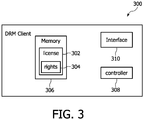
- Fig. 3 is a block diagram of a DRM client 300 illustrating its functionalities within the context of the invention.
- Client 302 has received a license 302 comprising certain rights 304 that specify the domain of usage of content information to which license 302 pertains, as discussed above.
- the rights are installed at client 300, e.g., in a memory 306, as control code to enable control of the distribution, via client 300, of the content information.
- client 300 has a controller 308 that enforces these rights 304, as represented in the control code, in the interaction with other clients on the network (as in Figs. 1 and 2 , not further shown) via an interface 310.
- This invention can be applied to future DRM systems, or such systems currently under development. It enables to standardize a domain model that may benefit of this invention as it circumvents the troublesome policy discussions. For example, in a service framework that mediates between different DRM systems, this approach can be used to describe the content exchange policies for the different content items, allowing multiple domain models to co-exist within the same technical framework. This enables to develop a specification that allows manufacturers to implement DRM so that it works across a range of devices from different manufacturers.
Landscapes
- Engineering & Computer Science (AREA)
- Software Systems (AREA)
- Computer Security & Cryptography (AREA)
- Theoretical Computer Science (AREA)
- General Engineering & Computer Science (AREA)
- Computer Hardware Design (AREA)
- Computer Networks & Wireless Communication (AREA)
- Signal Processing (AREA)
- General Physics & Mathematics (AREA)
- Multimedia (AREA)
- Physics & Mathematics (AREA)
- Technology Law (AREA)
- Computing Systems (AREA)
- Storage Device Security (AREA)
- Management, Administration, Business Operations System, And Electronic Commerce (AREA)
- Two-Way Televisions, Distribution Of Moving Picture Or The Like (AREA)
Claims (14)
- Verfahren zur Verarbeitung verschlüsselter Inhaltsinformationen an einem bestimmten elektronischen Clientgerät mit einer Lizenz mit einem Recht zur Verteilung innerhalb einer Domäne, wonach:- die verschlüsselten Inhaltsinformationen verarbeitet werden,- die verschlüsselten Inhaltsinformationen (106) mit Hilfe eines Inhaltsschlüssels entschlüsselt werden, wobei die Lizenz den Inhaltsschlüssel (110), die einen funktionalen Teil der Lizenz darstellende Domänenkonfiguration und Domänenrichtlinienbedingungen enthält, die Begrenzungen bezüglich der Größe der Domäne darstellen, wobei die Verarbeitung die folgenden Schritte umfasst, wonach:- durch das bestimmte elektronische Clientgerät Kontrolle über die Verteilung der Inhaltsinformationen entsprechend der Domänenkonfiguration und den Domänenrichtlinienbedingungen ausgeübt wird,- eine weitere Lizenz für ein anderes Clientgerät mit einem weiteren Recht zur Verteilung der von der Lizenz abgeleiteten Inhaltsinformationen erzeugt wird,- die weitere Lizenz so verschlüsselt wird, dass die weitere Lizenz nur von dem anderen Clientgerät entschlüsselt werden kann, um die weitere Lizenz an das andere Clientgerät zu binden,- dem anderen Clientgerät (114) die weitere Lizenz mit dem weiteren Recht zur Verteilung der von dem anderen Clientgerät (114) zu verwendenden Inhaltsinformationen zugeführt wird.
- Verfahren nach Anspruch 1, wobei die Domänenkonfiguration und Domänenrichtlinienbedingungen ein ,Device-Count'- Verteilungsrecht umfassen, das angibt, bei wie vielen verschiedene Geräten eine Kopie der Lizenz vorhanden sein kann, wobei das ,Device-Count'-Verteilungsrecht die Verwaltung eines globalen Zustands erfordert, wobei das bestimmte elektronische Clientgerät den globalen Zustand als ,State-Owner' verwaltet, wenn das bestimmte elektronische Clientgerät die erste Instanz der Lizenz empfing, die weitere Lizenz den 'State-Owner' erwähnt, wobei das andere Clientgerät aufgefordert wird, den 'State-Owner' zu kontaktieren, um auf den globalen Zustand Zugriff zu haben.
- Verfahren nach Anspruch 1, wobei die weitere Lizenz den Inhaltsschlüssel (110) umfasst.
- Verfahren nach Anspruch 1, wobei die weitere Lizenz einen weiteren, von dem Inhaltsschlüssel (110) verschiedenen Schlüssel umfasst.
- Verfahren nach Anspruch 4, wobei
der Inhaltsschlüssel eine Entschlüsselung der Inhaltsinformationen (216) auf hohem Qualitätsniveau ermöglicht, und
der andere Schlüssel eine Entschlüsselung der Inhaltsinformationen (216) auf geringerem Qualitätsniveau ermöglicht. - Verfahren nach Anspruch 1, wobei das Recht zur Verteilung durch das bestimmte elektronische Clientgerät erzwingbar ist.
- Verfahren nach Anspruch 1, wobei die Verarbeitung weiterhin beinhaltet, dass über das bestimmte elektronische Clientgerät Kontrolle über den bedingten Zugriff auf die Inhaltsinformationen durch das bestimmte elektronische Clientgerät ausgeübt wird.
- Verfahren nach Anspruch 1, wobei die Domänenrichtlinie zumindest teilweise in einer maschinenlesbaren Sprache dargestellt wird.
- Verfahren nach Anspruch 1, wobei die weiteren Rechte von dem Recht zur Verteilung abgeleitet werden.
- Verfahren nach Anspruch 1, wobei das Bereitstellen einer weiteren Lizenz das Erzeugen der weiteren Lizenz umfasst.
- Elektronisches Clientgerät zur Verarbeitung verschlüsselter Inhaltsinformationen unter Verwendung einer Lizenz mit einem Recht zur Verteilung innerhalb einer Domäne,
wobei das Datenverarbeitungssystem so konfiguriert ist, dass es- die verschlüsselten Inhaltsinformationen (106) mit Hilfe eines Inhaltsschlüssels entschlüsselt, wobei die Lizenz den Inhaltsschlüssel (110), die Domänenkonfiguration und Domänenrichtlinienbedingungen enthält, die ein funktionaler Teil der Lizenz sind und die Begrenzungen bezüglich der Größe der Domäne darstellen,- Kontrolle über die Verteilung der Inhaltsinformationen entsprechend der Domänenkonfiguration und den Domänenrichtlinienbedingungen ausübt,- eine weitere Lizenz für ein anderes Clientgerät mit einem weiteren Recht zur Verteilung der von der Lizenz abgeleiteten Inhaltsinformationen erzeugt,- die weitere Lizenz so verschlüsselt, dass die weitere Lizenz nur von dem anderen Clientgerät entschlüsselt werden kann, um die weitere Lizenz an das andere Clientgerät zu binden,- dem anderen Clientgerät eine weitere Lizenz mit einem weiteren Recht zur Verteilung der von dem anderen Clientgerät (114) zu verwendenden Inhaltsinformationen zuführt. - Software zur Installation auf einem Datenverarbeitungssystem, das so konfiguriert ist, dass es ein Verfahren nach Anspruch 1 ausführt.
- Datenstrukturträger mit einer Lizenz mit einem Recht zur Verteilung innerhalb einer Domäne, wobei die Lizenz einen Inhaltsschlüssel (110) enthält, der einem bestimmten elektronischen Clientgerät (108) die Möglichkeit gibt, die verschlüsselten Inhaltsinformationen (106) zu entschlüsseln, wobei die Domänenkonfiguration und Domänenrichtlinienbedingungen ein funktionaler Teil der Lizenz sind und Begrenzungen bezüglich der Größe der Domäne darstellen; gemäß der Domänenkonfiguration und Domänenrichtlinienbedingungen wird es dem bestimmten elektronischen Clientgerät ermöglicht, eine weitere Lizenz mit einem weiteren Recht zur Verteilung der von einem anderen Clientgerät (114) zu verwendenden Inhaltsinformationen vorzusehen.
- Datenstruktursignal mit einer Lizenz mit einem Recht zur Verteilung innerhalb einer Domäne, wobei die Lizenz einen Inhaltsschlüssel (110) enthält, der einem bestimmten elektronischen Clientgerät (108) die Möglichkeit gibt, die verschlüsselten Inhaltsinformationen (106) zu entschlüsseln, wobei die Domänenkonfiguration und Domänenrichtlinienbedingungen ein funktionaler Teil der Lizenz sind und Begrenzungen bezüglich der Größe der Domäne darstellen; gemäß der Domänenkonfiguration und Domänenrichtlinienbedingungen wird es dem bestimmten elektronischen Clientgerät ermöglicht, eine weitere Lizenz mit einem weiteren Recht zur Verteilung der von einem anderen Clientgerät (114) zu verwendenden Inhaltsinformationen vorzusehen.
Priority Applications (1)
| Application Number | Priority Date | Filing Date | Title |
|---|---|---|---|
| EP07826702.8A EP2082345B2 (de) | 2006-10-12 | 2007-10-10 | Lizenzspezifische authorisierte domänen |
Applications Claiming Priority (3)
| Application Number | Priority Date | Filing Date | Title |
|---|---|---|---|
| EP06122191 | 2006-10-12 | ||
| EP07826702.8A EP2082345B2 (de) | 2006-10-12 | 2007-10-10 | Lizenzspezifische authorisierte domänen |
| PCT/IB2007/054120 WO2008044210A2 (en) | 2006-10-12 | 2007-10-10 | License specific authorized domains |
Publications (3)
| Publication Number | Publication Date |
|---|---|
| EP2082345A2 EP2082345A2 (de) | 2009-07-29 |
| EP2082345B1 true EP2082345B1 (de) | 2017-12-13 |
| EP2082345B2 EP2082345B2 (de) | 2021-09-29 |
Family
ID=39208178
Family Applications (1)
| Application Number | Title | Priority Date | Filing Date |
|---|---|---|---|
| EP07826702.8A Active EP2082345B2 (de) | 2006-10-12 | 2007-10-10 | Lizenzspezifische authorisierte domänen |
Country Status (5)
| Country | Link |
|---|---|
| US (1) | US8886568B2 (de) |
| EP (1) | EP2082345B2 (de) |
| JP (1) | JP5203376B2 (de) |
| CN (1) | CN101523400B (de) |
| WO (1) | WO2008044210A2 (de) |
Families Citing this family (6)
| Publication number | Priority date | Publication date | Assignee | Title |
|---|---|---|---|---|
| KR101319491B1 (ko) * | 2006-09-21 | 2013-10-17 | 삼성전자주식회사 | 도메인 정보를 설정하기 위한 장치 및 방법 |
| BRPI0816777A2 (pt) | 2007-09-12 | 2017-05-02 | Sony Corp | método e sistema de distribuição de conteúdo para um ou mais dispositivos de usuários |
| US8407483B2 (en) * | 2008-12-18 | 2013-03-26 | Electronics And Telecommunications Research Institute | Apparatus and method for authenticating personal use of contents by using portable storage |
| WO2011082322A2 (en) * | 2009-12-30 | 2011-07-07 | Intergraph Technologies Company | A system and method for transmission of files within a secured network |
| JP5352756B1 (ja) * | 2012-03-07 | 2013-11-27 | パナソニック株式会社 | 端末管理システム |
| US20130262265A1 (en) * | 2012-03-27 | 2013-10-03 | Futurewei Technologies, Inc. | System and Method for Managing Software Licenses |
Citations (2)
| Publication number | Priority date | Publication date | Assignee | Title |
|---|---|---|---|---|
| US20050071280A1 (en) | 2003-09-25 | 2005-03-31 | Convergys Information Management Group, Inc. | System and method for federated rights management |
| US20060143134A1 (en) | 2004-12-25 | 2006-06-29 | Nicol So | Method and apparatus for sharing a digital access license |
Family Cites Families (16)
| Publication number | Priority date | Publication date | Assignee | Title |
|---|---|---|---|---|
| US20020141582A1 (en) * | 2001-03-28 | 2002-10-03 | Kocher Paul C. | Content security layer providing long-term renewable security |
| US6895503B2 (en) * | 2001-05-31 | 2005-05-17 | Contentguard Holdings, Inc. | Method and apparatus for hierarchical assignment of rights to documents and documents having such rights |
| US7546359B2 (en) * | 2001-10-24 | 2009-06-09 | Groove Networks, Inc. | Method and apparatus for managing a peer-to-peer collaboration system |
| AU2003228007A1 (en) * | 2002-05-22 | 2003-12-02 | Koninklijke Philips Electronics N.V. | Digital rights management method and system |
| BR0315550A (pt) * | 2002-10-22 | 2005-08-23 | Koninkl Philips Electronics Nv | Método para autorizar uma operação solicitada por um primeiro usuário em um item de conteúdo, e, dispositivo arranjado para executar uma operação solicitada por um primeiro usuário em um item de conteúdo |
| RU2385491C2 (ru) * | 2002-12-30 | 2010-03-27 | Конинклейке Филипс Электроникс Н.В. | Разделенные права в авторизованном домене |
| US7669225B2 (en) * | 2003-05-06 | 2010-02-23 | Portauthority Technologies Inc. | Apparatus and method for assuring compliance with distribution and usage policy |
| MXPA06000880A (es) * | 2003-07-24 | 2006-04-19 | Koninkl Philips Electronics Nv | Dispositivo hibrido y arquitectura de dominio autorizado basado en una persona. |
| EP1692587A1 (de) * | 2003-12-04 | 2006-08-23 | Koninklijke Philips Electronics N.V. | Rechteschutz mit verbindungsverknüpfung |
| US8843413B2 (en) * | 2004-02-13 | 2014-09-23 | Microsoft Corporation | Binding content to a domain |
| US7546641B2 (en) * | 2004-02-13 | 2009-06-09 | Microsoft Corporation | Conditional access to digital rights management conversion |
| BRPI0509181A (pt) * | 2004-03-26 | 2007-09-18 | Koninkl Philips Electronics Nv | método e sistema para gerar um domìnio autorizado, meio legìvel por computador, domìnio autorizado, e, estrutura de domìnio autorizado |
| JP2006129323A (ja) * | 2004-11-01 | 2006-05-18 | Matsushita Electric Ind Co Ltd | 無線ネットワーク接続システム及び無線ネットワーク接続方法 |
| WO2006109982A1 (en) * | 2005-04-11 | 2006-10-19 | Electronics And Telecommunications Research Intitute | License data structure and license issuing method |
| US7971261B2 (en) * | 2007-06-12 | 2011-06-28 | Microsoft Corporation | Domain management for digital media |
| WO2010041991A1 (en) * | 2008-10-06 | 2010-04-15 | Telefonaktiebolaget L M Ericsson (Publ) | Digital rights management in user-controlled environment |
-
2007
- 2007-10-10 CN CN2007800381124A patent/CN101523400B/zh active Active
- 2007-10-10 JP JP2009531963A patent/JP5203376B2/ja active Active
- 2007-10-10 EP EP07826702.8A patent/EP2082345B2/de active Active
- 2007-10-10 WO PCT/IB2007/054120 patent/WO2008044210A2/en not_active Ceased
- 2007-10-10 US US12/444,736 patent/US8886568B2/en active Active
Patent Citations (2)
| Publication number | Priority date | Publication date | Assignee | Title |
|---|---|---|---|---|
| US20050071280A1 (en) | 2003-09-25 | 2005-03-31 | Convergys Information Management Group, Inc. | System and method for federated rights management |
| US20060143134A1 (en) | 2004-12-25 | 2006-06-29 | Nicol So | Method and apparatus for sharing a digital access license |
Non-Patent Citations (1)
| Title |
|---|
| SRIJITH K. NAIR ET AL., ENABLING DRM-PRESERVING DIGITAL CONTENT REDISTRIBUTION, 19 July 2005 (2005-07-19), XP010846191 |
Also Published As
| Publication number | Publication date |
|---|---|
| US8886568B2 (en) | 2014-11-11 |
| EP2082345A2 (de) | 2009-07-29 |
| JP5203376B2 (ja) | 2013-06-05 |
| EP2082345B2 (de) | 2021-09-29 |
| CN101523400B (zh) | 2011-12-14 |
| JP2010506325A (ja) | 2010-02-25 |
| WO2008044210A2 (en) | 2008-04-17 |
| WO2008044210A3 (en) | 2008-10-30 |
| US20100024039A1 (en) | 2010-01-28 |
| CN101523400A (zh) | 2009-09-02 |
Similar Documents
| Publication | Publication Date | Title |
|---|---|---|
| JP4888910B2 (ja) | オーソライズド・ドメイン生成方法及びシステム | |
| JP4694482B2 (ja) | 複合型の装置及び個人に基づく認可されたドメインのアーキテクチャ | |
| JP4734257B2 (ja) | 接続リンクされた権利保護 | |
| KR100982166B1 (ko) | 디지털 권한 관리 방법 및 시스템 | |
| US9253165B2 (en) | Digital rights domain management for secure content distribution in a local network | |
| EP1581849B1 (de) | Geteilte rechte in autorisierter domäne | |
| US8239962B2 (en) | Processing rights in DRM systems | |
| WO2006109982A1 (en) | License data structure and license issuing method | |
| EP2082345B2 (de) | Lizenzspezifische authorisierte domänen | |
| AU2004260247B2 (en) | Hybrid device and person based authorized domain architecture | |
| Simplício Jr et al. | PHD A Generic and Flexible Architecture for IPTV in Authorized Domains |
Legal Events
| Date | Code | Title | Description |
|---|---|---|---|
| PUAI | Public reference made under article 153(3) epc to a published international application that has entered the european phase |
Free format text: ORIGINAL CODE: 0009012 |
|
| 17P | Request for examination filed |
Effective date: 20090512 |
|
| AK | Designated contracting states |
Kind code of ref document: A2 Designated state(s): AT BE BG CH CY CZ DE DK EE ES FI FR GB GR HU IE IS IT LI LT LU LV MC MT NL PL PT RO SE SI SK TR |
|
| 17Q | First examination report despatched |
Effective date: 20091125 |
|
| DAX | Request for extension of the european patent (deleted) | ||
| RAP1 | Party data changed (applicant data changed or rights of an application transferred) |
Owner name: KONINKLIJKE PHILIPS N.V. |
|
| REG | Reference to a national code |
Ref country code: DE Ref legal event code: R079 Ref document number: 602007053407 Country of ref document: DE Free format text: PREVIOUS MAIN CLASS: G06F0021000000 Ipc: G06F0021100000 |
|
| GRAP | Despatch of communication of intention to grant a patent |
Free format text: ORIGINAL CODE: EPIDOSNIGR1 |
|
| STAA | Information on the status of an ep patent application or granted ep patent |
Free format text: STATUS: GRANT OF PATENT IS INTENDED |
|
| RIC1 | Information provided on ipc code assigned before grant |
Ipc: G06F 21/10 20130101AFI20170411BHEP Ipc: H04L 29/06 20060101ALI20170411BHEP |
|
| INTG | Intention to grant announced |
Effective date: 20170515 |
|
| GRAS | Grant fee paid |
Free format text: ORIGINAL CODE: EPIDOSNIGR3 |
|
| GRAA | (expected) grant |
Free format text: ORIGINAL CODE: 0009210 |
|
| STAA | Information on the status of an ep patent application or granted ep patent |
Free format text: STATUS: THE PATENT HAS BEEN GRANTED |
|
| AK | Designated contracting states |
Kind code of ref document: B1 Designated state(s): AT BE BG CH CY CZ DE DK EE ES FI FR GB GR HU IE IS IT LI LT LU LV MC MT NL PL PT RO SE SI SK TR |
|
| REG | Reference to a national code |
Ref country code: GB Ref legal event code: FG4D |
|
| REG | Reference to a national code |
Ref country code: AT Ref legal event code: REF Ref document number: 955043 Country of ref document: AT Kind code of ref document: T Effective date: 20171215 Ref country code: CH Ref legal event code: EP |
|
| REG | Reference to a national code |
Ref country code: IE Ref legal event code: FG4D |
|
| REG | Reference to a national code |
Ref country code: DE Ref legal event code: R096 Ref document number: 602007053407 Country of ref document: DE |
|
| REG | Reference to a national code |
Ref country code: NL Ref legal event code: MP Effective date: 20171213 |
|
| REG | Reference to a national code |
Ref country code: LT Ref legal event code: MG4D |
|
| PG25 | Lapsed in a contracting state [announced via postgrant information from national office to epo] |
Ref country code: SE Free format text: LAPSE BECAUSE OF FAILURE TO SUBMIT A TRANSLATION OF THE DESCRIPTION OR TO PAY THE FEE WITHIN THE PRESCRIBED TIME-LIMIT Effective date: 20171213 Ref country code: LT Free format text: LAPSE BECAUSE OF FAILURE TO SUBMIT A TRANSLATION OF THE DESCRIPTION OR TO PAY THE FEE WITHIN THE PRESCRIBED TIME-LIMIT Effective date: 20171213 Ref country code: FI Free format text: LAPSE BECAUSE OF FAILURE TO SUBMIT A TRANSLATION OF THE DESCRIPTION OR TO PAY THE FEE WITHIN THE PRESCRIBED TIME-LIMIT Effective date: 20171213 |
|
| REG | Reference to a national code |
Ref country code: AT Ref legal event code: MK05 Ref document number: 955043 Country of ref document: AT Kind code of ref document: T Effective date: 20171213 |
|
| PG25 | Lapsed in a contracting state [announced via postgrant information from national office to epo] |
Ref country code: GR Free format text: LAPSE BECAUSE OF FAILURE TO SUBMIT A TRANSLATION OF THE DESCRIPTION OR TO PAY THE FEE WITHIN THE PRESCRIBED TIME-LIMIT Effective date: 20180314 Ref country code: LV Free format text: LAPSE BECAUSE OF FAILURE TO SUBMIT A TRANSLATION OF THE DESCRIPTION OR TO PAY THE FEE WITHIN THE PRESCRIBED TIME-LIMIT Effective date: 20171213 Ref country code: BG Free format text: LAPSE BECAUSE OF FAILURE TO SUBMIT A TRANSLATION OF THE DESCRIPTION OR TO PAY THE FEE WITHIN THE PRESCRIBED TIME-LIMIT Effective date: 20180313 |
|
| PG25 | Lapsed in a contracting state [announced via postgrant information from national office to epo] |
Ref country code: NL Free format text: LAPSE BECAUSE OF FAILURE TO SUBMIT A TRANSLATION OF THE DESCRIPTION OR TO PAY THE FEE WITHIN THE PRESCRIBED TIME-LIMIT Effective date: 20171213 |
|
| PG25 | Lapsed in a contracting state [announced via postgrant information from national office to epo] |
Ref country code: EE Free format text: LAPSE BECAUSE OF FAILURE TO SUBMIT A TRANSLATION OF THE DESCRIPTION OR TO PAY THE FEE WITHIN THE PRESCRIBED TIME-LIMIT Effective date: 20171213 Ref country code: CY Free format text: LAPSE BECAUSE OF FAILURE TO SUBMIT A TRANSLATION OF THE DESCRIPTION OR TO PAY THE FEE WITHIN THE PRESCRIBED TIME-LIMIT Effective date: 20171213 Ref country code: ES Free format text: LAPSE BECAUSE OF FAILURE TO SUBMIT A TRANSLATION OF THE DESCRIPTION OR TO PAY THE FEE WITHIN THE PRESCRIBED TIME-LIMIT Effective date: 20171213 Ref country code: CZ Free format text: LAPSE BECAUSE OF FAILURE TO SUBMIT A TRANSLATION OF THE DESCRIPTION OR TO PAY THE FEE WITHIN THE PRESCRIBED TIME-LIMIT Effective date: 20171213 Ref country code: SK Free format text: LAPSE BECAUSE OF FAILURE TO SUBMIT A TRANSLATION OF THE DESCRIPTION OR TO PAY THE FEE WITHIN THE PRESCRIBED TIME-LIMIT Effective date: 20171213 |
|
| PG25 | Lapsed in a contracting state [announced via postgrant information from national office to epo] |
Ref country code: AT Free format text: LAPSE BECAUSE OF FAILURE TO SUBMIT A TRANSLATION OF THE DESCRIPTION OR TO PAY THE FEE WITHIN THE PRESCRIBED TIME-LIMIT Effective date: 20171213 Ref country code: IT Free format text: LAPSE BECAUSE OF FAILURE TO SUBMIT A TRANSLATION OF THE DESCRIPTION OR TO PAY THE FEE WITHIN THE PRESCRIBED TIME-LIMIT Effective date: 20171213 Ref country code: PL Free format text: LAPSE BECAUSE OF FAILURE TO SUBMIT A TRANSLATION OF THE DESCRIPTION OR TO PAY THE FEE WITHIN THE PRESCRIBED TIME-LIMIT Effective date: 20171213 Ref country code: RO Free format text: LAPSE BECAUSE OF FAILURE TO SUBMIT A TRANSLATION OF THE DESCRIPTION OR TO PAY THE FEE WITHIN THE PRESCRIBED TIME-LIMIT Effective date: 20171213 Ref country code: IS Free format text: LAPSE BECAUSE OF FAILURE TO SUBMIT A TRANSLATION OF THE DESCRIPTION OR TO PAY THE FEE WITHIN THE PRESCRIBED TIME-LIMIT Effective date: 20180413 |
|
| REG | Reference to a national code |
Ref country code: DE Ref legal event code: R026 Ref document number: 602007053407 Country of ref document: DE |
|
| PLBI | Opposition filed |
Free format text: ORIGINAL CODE: 0009260 |
|
| PLAX | Notice of opposition and request to file observation + time limit sent |
Free format text: ORIGINAL CODE: EPIDOSNOBS2 |
|
| 26 | Opposition filed |
Opponent name: MOLNIA, DAVID Effective date: 20180913 |
|
| REG | Reference to a national code |
Ref country code: FR Ref legal event code: PLFP Year of fee payment: 12 |
|
| PG25 | Lapsed in a contracting state [announced via postgrant information from national office to epo] |
Ref country code: DK Free format text: LAPSE BECAUSE OF FAILURE TO SUBMIT A TRANSLATION OF THE DESCRIPTION OR TO PAY THE FEE WITHIN THE PRESCRIBED TIME-LIMIT Effective date: 20171213 |
|
| PLBB | Reply of patent proprietor to notice(s) of opposition received |
Free format text: ORIGINAL CODE: EPIDOSNOBS3 |
|
| PG25 | Lapsed in a contracting state [announced via postgrant information from national office to epo] |
Ref country code: SI Free format text: LAPSE BECAUSE OF FAILURE TO SUBMIT A TRANSLATION OF THE DESCRIPTION OR TO PAY THE FEE WITHIN THE PRESCRIBED TIME-LIMIT Effective date: 20171213 |
|
| REG | Reference to a national code |
Ref country code: CH Ref legal event code: PL |
|
| REG | Reference to a national code |
Ref country code: BE Ref legal event code: MM Effective date: 20181031 |
|
| PG25 | Lapsed in a contracting state [announced via postgrant information from national office to epo] |
Ref country code: LU Free format text: LAPSE BECAUSE OF NON-PAYMENT OF DUE FEES Effective date: 20181010 Ref country code: MC Free format text: LAPSE BECAUSE OF FAILURE TO SUBMIT A TRANSLATION OF THE DESCRIPTION OR TO PAY THE FEE WITHIN THE PRESCRIBED TIME-LIMIT Effective date: 20171213 |
|
| REG | Reference to a national code |
Ref country code: IE Ref legal event code: MM4A |
|
| PG25 | Lapsed in a contracting state [announced via postgrant information from national office to epo] |
Ref country code: CH Free format text: LAPSE BECAUSE OF NON-PAYMENT OF DUE FEES Effective date: 20181031 Ref country code: LI Free format text: LAPSE BECAUSE OF NON-PAYMENT OF DUE FEES Effective date: 20181031 Ref country code: BE Free format text: LAPSE BECAUSE OF NON-PAYMENT OF DUE FEES Effective date: 20181031 |
|
| PG25 | Lapsed in a contracting state [announced via postgrant information from national office to epo] |
Ref country code: IE Free format text: LAPSE BECAUSE OF NON-PAYMENT OF DUE FEES Effective date: 20181010 |
|
| PG25 | Lapsed in a contracting state [announced via postgrant information from national office to epo] |
Ref country code: MT Free format text: LAPSE BECAUSE OF NON-PAYMENT OF DUE FEES Effective date: 20181010 |
|
| RAP2 | Party data changed (patent owner data changed or rights of a patent transferred) |
Owner name: KONINKLIJKE PHILIPS N.V. |
|
| PG25 | Lapsed in a contracting state [announced via postgrant information from national office to epo] |
Ref country code: TR Free format text: LAPSE BECAUSE OF FAILURE TO SUBMIT A TRANSLATION OF THE DESCRIPTION OR TO PAY THE FEE WITHIN THE PRESCRIBED TIME-LIMIT Effective date: 20171213 |
|
| PG25 | Lapsed in a contracting state [announced via postgrant information from national office to epo] |
Ref country code: PT Free format text: LAPSE BECAUSE OF FAILURE TO SUBMIT A TRANSLATION OF THE DESCRIPTION OR TO PAY THE FEE WITHIN THE PRESCRIBED TIME-LIMIT Effective date: 20171213 |
|
| PG25 | Lapsed in a contracting state [announced via postgrant information from national office to epo] |
Ref country code: HU Free format text: LAPSE BECAUSE OF FAILURE TO SUBMIT A TRANSLATION OF THE DESCRIPTION OR TO PAY THE FEE WITHIN THE PRESCRIBED TIME-LIMIT; INVALID AB INITIO Effective date: 20071010 |
|
| PUAH | Patent maintained in amended form |
Free format text: ORIGINAL CODE: 0009272 |
|
| STAA | Information on the status of an ep patent application or granted ep patent |
Free format text: STATUS: PATENT MAINTAINED AS AMENDED |
|
| 27A | Patent maintained in amended form |
Effective date: 20210929 |
|
| AK | Designated contracting states |
Kind code of ref document: B2 Designated state(s): AT BE BG CH CY CZ DE DK EE ES FI FR GB GR HU IE IS IT LI LT LU LV MC MT NL PL PT RO SE SI SK TR |
|
| REG | Reference to a national code |
Ref country code: DE Ref legal event code: R102 Ref document number: 602007053407 Country of ref document: DE |
|
| PGFP | Annual fee paid to national office [announced via postgrant information from national office to epo] |
Ref country code: DE Payment date: 20251028 Year of fee payment: 19 |
|
| PGFP | Annual fee paid to national office [announced via postgrant information from national office to epo] |
Ref country code: GB Payment date: 20251023 Year of fee payment: 19 |
|
| PGFP | Annual fee paid to national office [announced via postgrant information from national office to epo] |
Ref country code: FR Payment date: 20251027 Year of fee payment: 19 |