EP2078986A1 - Toner for developing electrostatic latent image, and image forming method using the toner - Google Patents
Toner for developing electrostatic latent image, and image forming method using the toner Download PDFInfo
- Publication number
- EP2078986A1 EP2078986A1 EP09150236A EP09150236A EP2078986A1 EP 2078986 A1 EP2078986 A1 EP 2078986A1 EP 09150236 A EP09150236 A EP 09150236A EP 09150236 A EP09150236 A EP 09150236A EP 2078986 A1 EP2078986 A1 EP 2078986A1
- Authority
- EP
- European Patent Office
- Prior art keywords
- toner
- image
- prepare
- chrome
- weight
- Prior art date
- Legal status (The legal status is an assumption and is not a legal conclusion. Google has not performed a legal analysis and makes no representation as to the accuracy of the status listed.)
- Granted
Links
- 238000000034 method Methods 0.000 title claims description 74
- 229920005989 resin Polymers 0.000 claims abstract description 57
- 239000011347 resin Substances 0.000 claims abstract description 57
- ARXJGSRGQADJSQ-UHFFFAOYSA-N 1-methoxypropan-2-ol Chemical compound COCC(C)O ARXJGSRGQADJSQ-UHFFFAOYSA-N 0.000 claims abstract description 42
- 239000011230 binding agent Substances 0.000 claims abstract description 11
- 239000003086 colorant Substances 0.000 claims abstract description 10
- 239000002245 particle Substances 0.000 claims description 89
- VYZAMTAEIAYCRO-UHFFFAOYSA-N Chromium Chemical compound [Cr] VYZAMTAEIAYCRO-UHFFFAOYSA-N 0.000 claims description 51
- -1 monoazo compound Chemical class 0.000 claims description 44
- 230000008569 process Effects 0.000 claims description 33
- 238000009826 distribution Methods 0.000 claims description 27
- 239000000463 material Substances 0.000 claims description 25
- 238000012546 transfer Methods 0.000 claims description 19
- 238000002441 X-ray diffraction Methods 0.000 claims description 15
- 108091008695 photoreceptors Proteins 0.000 claims description 15
- 238000001228 spectrum Methods 0.000 claims description 10
- 238000004140 cleaning Methods 0.000 claims description 6
- 125000004435 hydrogen atom Chemical group [H]* 0.000 claims description 2
- 238000004064 recycling Methods 0.000 claims description 2
- 239000000203 mixture Substances 0.000 description 62
- NYGZLYXAPMMJTE-UHFFFAOYSA-M metanil yellow Chemical group [Na+].[O-]S(=O)(=O)C1=CC=CC(N=NC=2C=CC(NC=3C=CC=CC=3)=CC=2)=C1 NYGZLYXAPMMJTE-UHFFFAOYSA-M 0.000 description 28
- 239000007787 solid Substances 0.000 description 26
- XLYOFNOQVPJJNP-UHFFFAOYSA-N water Substances O XLYOFNOQVPJJNP-UHFFFAOYSA-N 0.000 description 24
- VYPSYNLAJGMNEJ-UHFFFAOYSA-N Silicium dioxide Chemical compound O=[Si]=O VYPSYNLAJGMNEJ-UHFFFAOYSA-N 0.000 description 21
- 238000009472 formulation Methods 0.000 description 20
- 239000001993 wax Substances 0.000 description 19
- VEXZGXHMUGYJMC-UHFFFAOYSA-N Hydrochloric acid Chemical compound Cl VEXZGXHMUGYJMC-UHFFFAOYSA-N 0.000 description 14
- 239000012295 chemical reaction liquid Substances 0.000 description 14
- 239000003795 chemical substances by application Substances 0.000 description 14
- 238000002360 preparation method Methods 0.000 description 13
- 230000015572 biosynthetic process Effects 0.000 description 12
- 238000003786 synthesis reaction Methods 0.000 description 12
- 239000006229 carbon black Substances 0.000 description 11
- 239000008119 colloidal silica Substances 0.000 description 11
- 229920001296 polysiloxane Polymers 0.000 description 11
- 239000004743 Polypropylene Substances 0.000 description 10
- 239000010410 layer Substances 0.000 description 10
- 229920001155 polypropylene Polymers 0.000 description 10
- 239000000654 additive Substances 0.000 description 9
- 230000000052 comparative effect Effects 0.000 description 9
- 239000000049 pigment Substances 0.000 description 9
- 230000000996 additive effect Effects 0.000 description 8
- 229920001577 copolymer Polymers 0.000 description 8
- YLGXILFCIXHCMC-JHGZEJCSSA-N methyl cellulose Chemical compound COC1C(OC)C(OC)C(COC)O[C@H]1O[C@H]1C(OC)C(OC)C(OC)OC1COC YLGXILFCIXHCMC-JHGZEJCSSA-N 0.000 description 8
- 239000000843 powder Substances 0.000 description 8
- 239000000126 substance Substances 0.000 description 8
- PPBRXRYQALVLMV-UHFFFAOYSA-N Styrene Chemical compound C=CC1=CC=CC=C1 PPBRXRYQALVLMV-UHFFFAOYSA-N 0.000 description 7
- 239000007864 aqueous solution Substances 0.000 description 7
- 229940125782 compound 2 Drugs 0.000 description 7
- 230000006866 deterioration Effects 0.000 description 7
- 239000007788 liquid Substances 0.000 description 7
- 229920001225 polyester resin Polymers 0.000 description 7
- 239000004645 polyester resin Substances 0.000 description 7
- BDAGIHXWWSANSR-UHFFFAOYSA-M Formate Chemical compound [O-]C=O BDAGIHXWWSANSR-UHFFFAOYSA-M 0.000 description 6
- 239000012736 aqueous medium Substances 0.000 description 6
- 238000000605 extraction Methods 0.000 description 6
- 238000002156 mixing Methods 0.000 description 6
- 238000004220 aggregation Methods 0.000 description 5
- 230000002776 aggregation Effects 0.000 description 5
- 238000006243 chemical reaction Methods 0.000 description 5
- 229940125898 compound 5 Drugs 0.000 description 5
- 238000004898 kneading Methods 0.000 description 5
- 238000005259 measurement Methods 0.000 description 5
- 239000000178 monomer Substances 0.000 description 5
- 238000010298 pulverizing process Methods 0.000 description 5
- 239000000377 silicon dioxide Substances 0.000 description 5
- 239000002904 solvent Substances 0.000 description 5
- GWEVSGVZZGPLCZ-UHFFFAOYSA-N titanium dioxide Inorganic materials O=[Ti]=O GWEVSGVZZGPLCZ-UHFFFAOYSA-N 0.000 description 5
- ARCGXLSVLAOJQL-UHFFFAOYSA-N trimellitic acid Chemical compound OC(=O)C1=CC=C(C(O)=O)C(C(O)=O)=C1 ARCGXLSVLAOJQL-UHFFFAOYSA-N 0.000 description 5
- IJGRMHOSHXDMSA-UHFFFAOYSA-N Atomic nitrogen Chemical compound N#N IJGRMHOSHXDMSA-UHFFFAOYSA-N 0.000 description 4
- HEDRZPFGACZZDS-UHFFFAOYSA-N Chloroform Chemical compound ClC(Cl)Cl HEDRZPFGACZZDS-UHFFFAOYSA-N 0.000 description 4
- LFQSCWFLJHTTHZ-UHFFFAOYSA-N Ethanol Chemical compound CCO LFQSCWFLJHTTHZ-UHFFFAOYSA-N 0.000 description 4
- VZCYOOQTPOCHFL-OWOJBTEDSA-N Fumaric acid Chemical compound OC(=O)\C=C\C(O)=O VZCYOOQTPOCHFL-OWOJBTEDSA-N 0.000 description 4
- 239000006227 byproduct Substances 0.000 description 4
- 229940125904 compound 1 Drugs 0.000 description 4
- 229940126214 compound 3 Drugs 0.000 description 4
- 238000010586 diagram Methods 0.000 description 4
- 238000004519 manufacturing process Methods 0.000 description 4
- 229910052751 metal Inorganic materials 0.000 description 4
- 239000002184 metal Substances 0.000 description 4
- 230000010355 oscillation Effects 0.000 description 4
- LYCAIKOWRPUZTN-UHFFFAOYSA-N Ethylene glycol Chemical compound OCCO LYCAIKOWRPUZTN-UHFFFAOYSA-N 0.000 description 3
- OKKJLVBELUTLKV-UHFFFAOYSA-N Methanol Chemical compound OC OKKJLVBELUTLKV-UHFFFAOYSA-N 0.000 description 3
- ZMXDDKWLCZADIW-UHFFFAOYSA-N N,N-Dimethylformamide Chemical compound CN(C)C=O ZMXDDKWLCZADIW-UHFFFAOYSA-N 0.000 description 3
- OFOBLEOULBTSOW-UHFFFAOYSA-N Propanedioic acid Natural products OC(=O)CC(O)=O OFOBLEOULBTSOW-UHFFFAOYSA-N 0.000 description 3
- DNIAPMSPPWPWGF-UHFFFAOYSA-N Propylene glycol Chemical compound CC(O)CO DNIAPMSPPWPWGF-UHFFFAOYSA-N 0.000 description 3
- HEMHJVSKTPXQMS-UHFFFAOYSA-M Sodium hydroxide Chemical compound [OH-].[Na+] HEMHJVSKTPXQMS-UHFFFAOYSA-M 0.000 description 3
- IISBACLAFKSPIT-UHFFFAOYSA-N bisphenol A Chemical compound C=1C=C(O)C=CC=1C(C)(C)C1=CC=C(O)C=C1 IISBACLAFKSPIT-UHFFFAOYSA-N 0.000 description 3
- 150000001875 compounds Chemical class 0.000 description 3
- MTHSVFCYNBDYFN-UHFFFAOYSA-N diethylene glycol Chemical compound OCCOCCO MTHSVFCYNBDYFN-UHFFFAOYSA-N 0.000 description 3
- 150000002148 esters Chemical class 0.000 description 3
- 238000011156 evaluation Methods 0.000 description 3
- 239000010419 fine particle Substances 0.000 description 3
- 239000000243 solution Substances 0.000 description 3
- VZCYOOQTPOCHFL-UHFFFAOYSA-N trans-butenedioic acid Natural products OC(=O)C=CC(O)=O VZCYOOQTPOCHFL-UHFFFAOYSA-N 0.000 description 3
- MYRTYDVEIRVNKP-UHFFFAOYSA-N 1,2-Divinylbenzene Chemical compound C=CC1=CC=CC=C1C=C MYRTYDVEIRVNKP-UHFFFAOYSA-N 0.000 description 2
- JWAZRIHNYRIHIV-UHFFFAOYSA-N 2-naphthol Chemical compound C1=CC=CC2=CC(O)=CC=C21 JWAZRIHNYRIHIV-UHFFFAOYSA-N 0.000 description 2
- XEEYBQQBJWHFJM-UHFFFAOYSA-N Iron Chemical compound [Fe] XEEYBQQBJWHFJM-UHFFFAOYSA-N 0.000 description 2
- PXHVJJICTQNCMI-UHFFFAOYSA-N Nickel Chemical compound [Ni] PXHVJJICTQNCMI-UHFFFAOYSA-N 0.000 description 2
- 239000004698 Polyethylene Substances 0.000 description 2
- FAPWRFPIFSIZLT-UHFFFAOYSA-M Sodium chloride Chemical compound [Na+].[Cl-] FAPWRFPIFSIZLT-UHFFFAOYSA-M 0.000 description 2
- KKEYFWRCBNTPAC-UHFFFAOYSA-N Terephthalic acid Chemical compound OC(=O)C1=CC=C(C(O)=O)C=C1 KKEYFWRCBNTPAC-UHFFFAOYSA-N 0.000 description 2
- 239000002253 acid Substances 0.000 description 2
- PNEYBMLMFCGWSK-UHFFFAOYSA-N aluminium oxide Inorganic materials [O-2].[O-2].[O-2].[Al+3].[Al+3] PNEYBMLMFCGWSK-UHFFFAOYSA-N 0.000 description 2
- 150000001732 carboxylic acid derivatives Chemical class 0.000 description 2
- 238000005119 centrifugation Methods 0.000 description 2
- 239000002270 dispersing agent Substances 0.000 description 2
- 239000000975 dye Substances 0.000 description 2
- 229920001971 elastomer Polymers 0.000 description 2
- 239000003792 electrolyte Substances 0.000 description 2
- 239000001530 fumaric acid Substances 0.000 description 2
- 239000007789 gas Substances 0.000 description 2
- 238000002290 gas chromatography-mass spectrometry Methods 0.000 description 2
- 239000011521 glass Substances 0.000 description 2
- 150000002500 ions Chemical class 0.000 description 2
- QQVIHTHCMHWDBS-UHFFFAOYSA-N isophthalic acid Chemical compound OC(=O)C1=CC=CC(C(O)=O)=C1 QQVIHTHCMHWDBS-UHFFFAOYSA-N 0.000 description 2
- VLKZOEOYAKHREP-UHFFFAOYSA-N n-Hexane Chemical compound CCCCCC VLKZOEOYAKHREP-UHFFFAOYSA-N 0.000 description 2
- 229910052757 nitrogen Inorganic materials 0.000 description 2
- 230000002093 peripheral effect Effects 0.000 description 2
- XNGIFLGASWRNHJ-UHFFFAOYSA-N phthalic acid Chemical compound OC(=O)C1=CC=CC=C1C(O)=O XNGIFLGASWRNHJ-UHFFFAOYSA-N 0.000 description 2
- 229920000573 polyethylene Polymers 0.000 description 2
- 239000005060 rubber Substances 0.000 description 2
- 229920002379 silicone rubber Polymers 0.000 description 2
- LPXPTNMVRIOKMN-UHFFFAOYSA-M sodium nitrite Chemical compound [Na+].[O-]N=O LPXPTNMVRIOKMN-UHFFFAOYSA-M 0.000 description 2
- 239000008247 solid mixture Substances 0.000 description 2
- KDYFGRWQOYBRFD-UHFFFAOYSA-N succinic acid Chemical compound OC(=O)CCC(O)=O KDYFGRWQOYBRFD-UHFFFAOYSA-N 0.000 description 2
- SWFNPENEBHAHEB-UHFFFAOYSA-N 2-amino-4-chlorophenol Chemical compound NC1=CC(Cl)=CC=C1O SWFNPENEBHAHEB-UHFFFAOYSA-N 0.000 description 1
- ZNQVEEAIQZEUHB-UHFFFAOYSA-N 2-ethoxyethanol Chemical compound CCOCCO ZNQVEEAIQZEUHB-UHFFFAOYSA-N 0.000 description 1
- 229930185605 Bisphenol Natural products 0.000 description 1
- OKTJSMMVPCPJKN-UHFFFAOYSA-N Carbon Chemical compound [C] OKTJSMMVPCPJKN-UHFFFAOYSA-N 0.000 description 1
- 239000004971 Cross linker Substances 0.000 description 1
- 102000004190 Enzymes Human genes 0.000 description 1
- 108090000790 Enzymes Proteins 0.000 description 1
- DGAQECJNVWCQMB-PUAWFVPOSA-M Ilexoside XXIX Chemical compound C[C@@H]1CC[C@@]2(CC[C@@]3(C(=CC[C@H]4[C@]3(CC[C@@H]5[C@@]4(CC[C@@H](C5(C)C)OS(=O)(=O)[O-])C)C)[C@@H]2[C@]1(C)O)C)C(=O)O[C@H]6[C@@H]([C@H]([C@@H]([C@H](O6)CO)O)O)O.[Na+] DGAQECJNVWCQMB-PUAWFVPOSA-M 0.000 description 1
- CTQNGGLPUBDAKN-UHFFFAOYSA-N O-Xylene Chemical compound CC1=CC=CC=C1C CTQNGGLPUBDAKN-UHFFFAOYSA-N 0.000 description 1
- 240000007594 Oryza sativa Species 0.000 description 1
- 235000007164 Oryza sativa Nutrition 0.000 description 1
- CBENFWSGALASAD-UHFFFAOYSA-N Ozone Chemical compound [O-][O+]=O CBENFWSGALASAD-UHFFFAOYSA-N 0.000 description 1
- 239000002033 PVDF binder Substances 0.000 description 1
- 208000031481 Pathologic Constriction Diseases 0.000 description 1
- 229920003171 Poly (ethylene oxide) Polymers 0.000 description 1
- 239000002202 Polyethylene glycol Substances 0.000 description 1
- 239000004793 Polystyrene Substances 0.000 description 1
- BLRPTPMANUNPDV-UHFFFAOYSA-N Silane Chemical compound [SiH4] BLRPTPMANUNPDV-UHFFFAOYSA-N 0.000 description 1
- BZHJMEDXRYGGRV-UHFFFAOYSA-N Vinyl chloride Chemical compound ClC=C BZHJMEDXRYGGRV-UHFFFAOYSA-N 0.000 description 1
- YIMQCDZDWXUDCA-UHFFFAOYSA-N [4-(hydroxymethyl)cyclohexyl]methanol Chemical compound OCC1CCC(CO)CC1 YIMQCDZDWXUDCA-UHFFFAOYSA-N 0.000 description 1
- XYLMUPLGERFSHI-UHFFFAOYSA-N alpha-Methylstyrene Chemical compound CC(=C)C1=CC=CC=C1 XYLMUPLGERFSHI-UHFFFAOYSA-N 0.000 description 1
- 239000004411 aluminium Substances 0.000 description 1
- 229910052782 aluminium Inorganic materials 0.000 description 1
- XAGFODPZIPBFFR-UHFFFAOYSA-N aluminium Chemical compound [Al] XAGFODPZIPBFFR-UHFFFAOYSA-N 0.000 description 1
- IRERQBUNZFJFGC-UHFFFAOYSA-L azure blue Chemical compound [Na+].[Na+].[Na+].[Na+].[Na+].[Na+].[Na+].[Na+].[Al+3].[Al+3].[Al+3].[Al+3].[Al+3].[Al+3].[S-]S[S-].[O-][Si]([O-])([O-])[O-].[O-][Si]([O-])([O-])[O-].[O-][Si]([O-])([O-])[O-].[O-][Si]([O-])([O-])[O-].[O-][Si]([O-])([O-])[O-].[O-][Si]([O-])([O-])[O-] IRERQBUNZFJFGC-UHFFFAOYSA-L 0.000 description 1
- 229950011260 betanaphthol Drugs 0.000 description 1
- 238000012662 bulk polymerization Methods 0.000 description 1
- CQEYYJKEWSMYFG-UHFFFAOYSA-N butyl acrylate Chemical compound CCCCOC(=O)C=C CQEYYJKEWSMYFG-UHFFFAOYSA-N 0.000 description 1
- 239000004204 candelilla wax Substances 0.000 description 1
- 235000013868 candelilla wax Nutrition 0.000 description 1
- 229940073532 candelilla wax Drugs 0.000 description 1
- 150000001735 carboxylic acids Chemical class 0.000 description 1
- 239000004203 carnauba wax Substances 0.000 description 1
- 235000013869 carnauba wax Nutrition 0.000 description 1
- 239000012159 carrier gas Substances 0.000 description 1
- 230000008859 change Effects 0.000 description 1
- HQKOBNMULFASAN-UHFFFAOYSA-N chembl1991515 Chemical compound OC1=CC=C(Cl)C=C1N=NC1=C(O)C=CC2=CC=CC=C12 HQKOBNMULFASAN-UHFFFAOYSA-N 0.000 description 1
- 239000011362 coarse particle Substances 0.000 description 1
- 238000001816 cooling Methods 0.000 description 1
- 239000013078 crystal Substances 0.000 description 1
- WTNDADANUZETTI-UHFFFAOYSA-N cyclohexane-1,2,4-tricarboxylic acid Chemical compound OC(=O)C1CCC(C(O)=O)C(C(O)=O)C1 WTNDADANUZETTI-UHFFFAOYSA-N 0.000 description 1
- 239000003599 detergent Substances 0.000 description 1
- JQZRVMZHTADUSY-UHFFFAOYSA-L di(octanoyloxy)tin Chemical compound [Sn+2].CCCCCCCC([O-])=O.CCCCCCCC([O-])=O JQZRVMZHTADUSY-UHFFFAOYSA-L 0.000 description 1
- LSXWFXONGKSEMY-UHFFFAOYSA-N di-tert-butyl peroxide Chemical compound CC(C)(C)OOC(C)(C)C LSXWFXONGKSEMY-UHFFFAOYSA-N 0.000 description 1
- 239000012954 diazonium Substances 0.000 description 1
- 150000001989 diazonium salts Chemical class 0.000 description 1
- 239000006185 dispersion Substances 0.000 description 1
- GVGUFUZHNYFZLC-UHFFFAOYSA-N dodecyl benzenesulfonate;sodium Chemical compound [Na].CCCCCCCCCCCCOS(=O)(=O)C1=CC=CC=C1 GVGUFUZHNYFZLC-UHFFFAOYSA-N 0.000 description 1
- 238000001035 drying Methods 0.000 description 1
- 238000007720 emulsion polymerization reaction Methods 0.000 description 1
- 239000003822 epoxy resin Substances 0.000 description 1
- 229940093476 ethylene glycol Drugs 0.000 description 1
- 229920006244 ethylene-ethyl acrylate Polymers 0.000 description 1
- 239000000945 filler Substances 0.000 description 1
- NBVXSUQYWXRMNV-UHFFFAOYSA-N fluoromethane Chemical compound FC NBVXSUQYWXRMNV-UHFFFAOYSA-N 0.000 description 1
- 238000010528 free radical solution polymerization reaction Methods 0.000 description 1
- 230000004927 fusion Effects 0.000 description 1
- 238000004817 gas chromatography Methods 0.000 description 1
- 230000009477 glass transition Effects 0.000 description 1
- 150000002334 glycols Chemical class 0.000 description 1
- 239000010931 gold Substances 0.000 description 1
- 229910052737 gold Inorganic materials 0.000 description 1
- 229910052736 halogen Inorganic materials 0.000 description 1
- 150000002367 halogens Chemical class 0.000 description 1
- LNEPOXFFQSENCJ-UHFFFAOYSA-N haloperidol Chemical compound C1CC(O)(C=2C=CC(Cl)=CC=2)CCN1CCCC(=O)C1=CC=C(F)C=C1 LNEPOXFFQSENCJ-UHFFFAOYSA-N 0.000 description 1
- 239000001307 helium Substances 0.000 description 1
- 229910052734 helium Inorganic materials 0.000 description 1
- SWQJXJOGLNCZEY-UHFFFAOYSA-N helium atom Chemical compound [He] SWQJXJOGLNCZEY-UHFFFAOYSA-N 0.000 description 1
- IUJAMGNYPWYUPM-UHFFFAOYSA-N hentriacontane Chemical compound CCCCCCCCCCCCCCCCCCCCCCCCCCCCCCC IUJAMGNYPWYUPM-UHFFFAOYSA-N 0.000 description 1
- GWCHPNKHMFKKIQ-UHFFFAOYSA-N hexane-1,2,5-tricarboxylic acid Chemical compound OC(=O)C(C)CCC(C(O)=O)CC(O)=O GWCHPNKHMFKKIQ-UHFFFAOYSA-N 0.000 description 1
- 230000002209 hydrophobic effect Effects 0.000 description 1
- UCNNJGDEJXIUCC-UHFFFAOYSA-L hydroxy(oxo)iron;iron Chemical compound [Fe].O[Fe]=O.O[Fe]=O UCNNJGDEJXIUCC-UHFFFAOYSA-L 0.000 description 1
- 238000002347 injection Methods 0.000 description 1
- 239000007924 injection Substances 0.000 description 1
- 229910052742 iron Inorganic materials 0.000 description 1
- 150000002576 ketones Chemical class 0.000 description 1
- 239000006233 lamp black Substances 0.000 description 1
- VZCYOOQTPOCHFL-UPHRSURJSA-N maleic acid Chemical compound OC(=O)\C=C/C(O)=O VZCYOOQTPOCHFL-UPHRSURJSA-N 0.000 description 1
- 239000011976 maleic acid Substances 0.000 description 1
- 150000002689 maleic acids Chemical class 0.000 description 1
- 238000000691 measurement method Methods 0.000 description 1
- 230000007246 mechanism Effects 0.000 description 1
- 239000000155 melt Substances 0.000 description 1
- 239000012046 mixed solvent Substances 0.000 description 1
- 238000012986 modification Methods 0.000 description 1
- 230000004048 modification Effects 0.000 description 1
- 229910052759 nickel Inorganic materials 0.000 description 1
- WDAISVDZHKFVQP-UHFFFAOYSA-N octane-1,2,7,8-tetracarboxylic acid Chemical compound OC(=O)CC(C(O)=O)CCCCC(C(O)=O)CC(O)=O WDAISVDZHKFVQP-UHFFFAOYSA-N 0.000 description 1
- 239000003960 organic solvent Substances 0.000 description 1
- SOQBVABWOPYFQZ-UHFFFAOYSA-N oxygen(2-);titanium(4+) Chemical class [O-2].[O-2].[Ti+4] SOQBVABWOPYFQZ-UHFFFAOYSA-N 0.000 description 1
- 238000012856 packing Methods 0.000 description 1
- 239000003208 petroleum Substances 0.000 description 1
- 239000005011 phenolic resin Substances 0.000 description 1
- 229920002037 poly(vinyl butyral) polymer Polymers 0.000 description 1
- 229920006122 polyamide resin Polymers 0.000 description 1
- 229920000647 polyepoxide Polymers 0.000 description 1
- 229920001223 polyethylene glycol Polymers 0.000 description 1
- 229920013716 polyethylene resin Polymers 0.000 description 1
- 229920000642 polymer Polymers 0.000 description 1
- 238000006116 polymerization reaction Methods 0.000 description 1
- 229920000098 polyolefin Polymers 0.000 description 1
- 229920001451 polypropylene glycol Polymers 0.000 description 1
- 229920002223 polystyrene Polymers 0.000 description 1
- 229920005749 polyurethane resin Polymers 0.000 description 1
- 229920002981 polyvinylidene fluoride Polymers 0.000 description 1
- 229960004063 propylene glycol Drugs 0.000 description 1
- 235000013772 propylene glycol Nutrition 0.000 description 1
- 238000013441 quality evaluation Methods 0.000 description 1
- 229910052703 rhodium Inorganic materials 0.000 description 1
- 235000009566 rice Nutrition 0.000 description 1
- 238000005096 rolling process Methods 0.000 description 1
- 238000001507 sample dispersion Methods 0.000 description 1
- 229910000077 silane Inorganic materials 0.000 description 1
- 229920002050 silicone resin Polymers 0.000 description 1
- 229910052708 sodium Inorganic materials 0.000 description 1
- 239000011734 sodium Substances 0.000 description 1
- 239000011780 sodium chloride Substances 0.000 description 1
- 229940080264 sodium dodecylbenzenesulfonate Drugs 0.000 description 1
- 235000010288 sodium nitrite Nutrition 0.000 description 1
- 239000007858 starting material Substances 0.000 description 1
- 238000003756 stirring Methods 0.000 description 1
- 238000003860 storage Methods 0.000 description 1
- 229920003048 styrene butadiene rubber Polymers 0.000 description 1
- 229920005792 styrene-acrylic resin Polymers 0.000 description 1
- 239000001384 succinic acid Substances 0.000 description 1
- 239000002344 surface layer Substances 0.000 description 1
- 238000010557 suspension polymerization reaction Methods 0.000 description 1
- 230000002194 synthesizing effect Effects 0.000 description 1
- 239000004408 titanium dioxide Substances 0.000 description 1
- OGIDPMRJRNCKJF-UHFFFAOYSA-N titanium oxide Inorganic materials [Ti]=O OGIDPMRJRNCKJF-UHFFFAOYSA-N 0.000 description 1
- 230000032258 transport Effects 0.000 description 1
- ZIBGPFATKBEMQZ-UHFFFAOYSA-N triethylene glycol Chemical compound OCCOCCOCCO ZIBGPFATKBEMQZ-UHFFFAOYSA-N 0.000 description 1
- 235000013799 ultramarine blue Nutrition 0.000 description 1
- XOSXWYQMOYSSKB-LDKJGXKFSA-L water blue Chemical compound CC1=CC(/C(\C(C=C2)=CC=C2NC(C=C2)=CC=C2S([O-])(=O)=O)=C(\C=C2)/C=C/C\2=N\C(C=C2)=CC=C2S([O-])(=O)=O)=CC(S(O)(=O)=O)=C1N.[Na+].[Na+] XOSXWYQMOYSSKB-LDKJGXKFSA-L 0.000 description 1
- 239000008096 xylene Substances 0.000 description 1
- 229910052845 zircon Inorganic materials 0.000 description 1
- GFQYVLUOOAAOGM-UHFFFAOYSA-N zirconium(iv) silicate Chemical compound [Zr+4].[O-][Si]([O-])([O-])[O-] GFQYVLUOOAAOGM-UHFFFAOYSA-N 0.000 description 1
- 229910000859 α-Fe Inorganic materials 0.000 description 1
Images




Classifications
-
- G—PHYSICS
- G03—PHOTOGRAPHY; CINEMATOGRAPHY; ANALOGOUS TECHNIQUES USING WAVES OTHER THAN OPTICAL WAVES; ELECTROGRAPHY; HOLOGRAPHY
- G03G—ELECTROGRAPHY; ELECTROPHOTOGRAPHY; MAGNETOGRAPHY
- G03G9/00—Developers
- G03G9/08—Developers with toner particles
- G03G9/09—Colouring agents for toner particles
- G03G9/0906—Organic dyes
- G03G9/091—Azo dyes
-
- G—PHYSICS
- G03—PHOTOGRAPHY; CINEMATOGRAPHY; ANALOGOUS TECHNIQUES USING WAVES OTHER THAN OPTICAL WAVES; ELECTROGRAPHY; HOLOGRAPHY
- G03G—ELECTROGRAPHY; ELECTROPHOTOGRAPHY; MAGNETOGRAPHY
- G03G9/00—Developers
- G03G9/08—Developers with toner particles
- G03G9/0802—Preparation methods
- G03G9/0812—Pretreatment of components
-
- G—PHYSICS
- G03—PHOTOGRAPHY; CINEMATOGRAPHY; ANALOGOUS TECHNIQUES USING WAVES OTHER THAN OPTICAL WAVES; ELECTROGRAPHY; HOLOGRAPHY
- G03G—ELECTROGRAPHY; ELECTROPHOTOGRAPHY; MAGNETOGRAPHY
- G03G9/00—Developers
- G03G9/08—Developers with toner particles
- G03G9/097—Plasticisers; Charge controlling agents
- G03G9/09733—Organic compounds
- G03G9/0975—Organic compounds anionic
-
- G—PHYSICS
- G03—PHOTOGRAPHY; CINEMATOGRAPHY; ANALOGOUS TECHNIQUES USING WAVES OTHER THAN OPTICAL WAVES; ELECTROGRAPHY; HOLOGRAPHY
- G03G—ELECTROGRAPHY; ELECTROPHOTOGRAPHY; MAGNETOGRAPHY
- G03G9/00—Developers
- G03G9/08—Developers with toner particles
- G03G9/097—Plasticisers; Charge controlling agents
- G03G9/09783—Organo-metallic compounds
Definitions
- the present invention relates to a toner for developing an electrostatic latent image, and to an image forming method using the toner.
- the electrophotographic image forming methods are broadly classified to dry developing methods and wet developing methods"
- the dry developing methods are further classified to one-component and two-component developing methods.
- a toner used in any methods needs to be positively or negatively charged, according to the polarity of an electrostatic latent image.
- a charge controlling agent is most effectively added to the toner to maintain a charge of the toner.
- Japanese published unexamined application No. 2000-321819 discloses a toner including a chrome-containing complex compound and a polyester resin having an acid value of from 15 to 30 mg KOH/g. Although this improves an edge of negative chargeability, the developer initially has no problem but noticeably deteriorates in its chargeability as time passes in an environment of high humidity because the polyester resin varies due to environment.
- Japanese published unexamined application No. 2003-255617 discloses a charge controlling agent having a specific X-ray diffraction pattern, with which a developer does not deteriorate in its chargeability in an environment of high humidity. In addition, even when a carrier is charged low, the developer has high transferability, producing images having good granularity without producing foggy images.
- toner are having smaller particle diameters to improve image quality and toners having a particle diameter 7.0 ⁇ m need further charging buildability.
- a charge controlling agent is included in a toner too much to increase charging buildability, the toner has higher elasticity because the charge controlling agent works as a filler, resulting in deterioration of low-temperature fixability of the toner.
- 2002-53539 discloses a toner including a charge controlling agent which is a mono azo gold-bearing compound having a purity not less than 90%.
- the toner has high negative chargeability but the durability thereof is unknown at all. Above all, when a toner has a small particle diameter, the toner recycled is an ultra fine powder, resulting in noticeable poor charging buildability thereof.
- an object of the present invention is to provide a toner having high colorability and maintaining low-temperature fixability without producing foggy images even after used or stored at high temperature for long periods.
- Another object of the present invention is to provide an image forming method using the toner.
- a further object of the present invention is to provide a process cartridge using the toner.
- the present invention provides a toner having high colorability and maintaining low-temperature fixability without producing foggy images even after used or stored at high temperature for long periods. More particularly, the present invention relates to a toner for developing electrostatic latent images, comprising:
- Such a toner has high colorability.
- Propyleneglycolmonomethylether has high solubility even to a material having a different solubility parameter and compatibility between a resin and a wax increases. Therefore, the toner has high durability without spent wax and deterioration due to aggregation even after used or stored at high temperature for long periods.
- propyleneglycolmonomethylether is a good solvent for both of them and the resultant images have high smoothness after fixed and has high image density.
- spent wax occurs and foggy images are produced after used or storedathightemperature for long periods.
- the surface of the toner is partly softened when store for long periods in an environment having a temperature higher than 50°C, resulting in deterioration of the fluidity of the toner"
- propyleneglycolmonomethylether included in a toner in an amount of from 30 to 200 ppm works as a wax dispersant and the toner has high durability without spent wax even after used for long periods.
- the toner preferably has a weight-average particle diameter of from 3.5 to 6.5 ⁇ m, and a variation coefficient of number distribution (standard deviation of number distribution/number-average particle diameter) of from 22.0 to 35.0 to have high colorability.
- the toner Having a weight-average particle diameter less than 3.5 ⁇ m, the toner deteriorates in its cleanability, resulting in production of foggy images and deterioration of the colorability. Having a weight-average particle diameter greater than 6.5 ⁇ m, the resultant images deteriorates in sharpness and colorability.
- a toner having a variation coefficient of number distribution (standard deviation of number distribution/number-average particle diameter) of from 22.0 to 35.0 has higher colorability.
- the toner has small variations of fluidity and chargeability, and produces images without deterioration even when mixed with a recycled toner.
- the toner When less than 22.0, having a sharp particle diameter distribution, the toner produces good images at the beginning, but when mixed with a recycled toner, the particle diameter distributions of the initial toner and the recycled toner are completely separate and the initial toner is preferentially developed while the recycled toner is accumulated undeveloped in an image developer, resulting in spent carrier and aggregation of a developer.
- the particle diameter distribution When greater than 35.0, the particle diameter distribution is so wide that the toner having a specific distribution is preferentially developed, resulting in the same phenomena.
- the toner having a variation coefficient of number distribution (standard deviation of number distribution/number-average particle diameter) of from 22.0 to 35.0 has good chargeability and fluidity, and produces images having high image density without such phenomena because the recycled toner is consumed even when mixed with a recycled toner.
- the propyleneglycolmonomethylether is added to a toner as a monomer or dissolved in a resin-synthesizing solvent because of having high solubility in water and various organic solvents.
- the solvent is removed after synthesizing the resin.
- the content thereof is controlled by an input thereof or a temperature and a time in the process of removing the solvent.
- the propyleneglycolmonomethylether thermally expands the resin when stored for long periods at higher than 50°C (not at room temperature) and softens the surface of the toner.. Then, an external additive is partly buried in the tone, resulting in deterioration of the fluidity thereof.
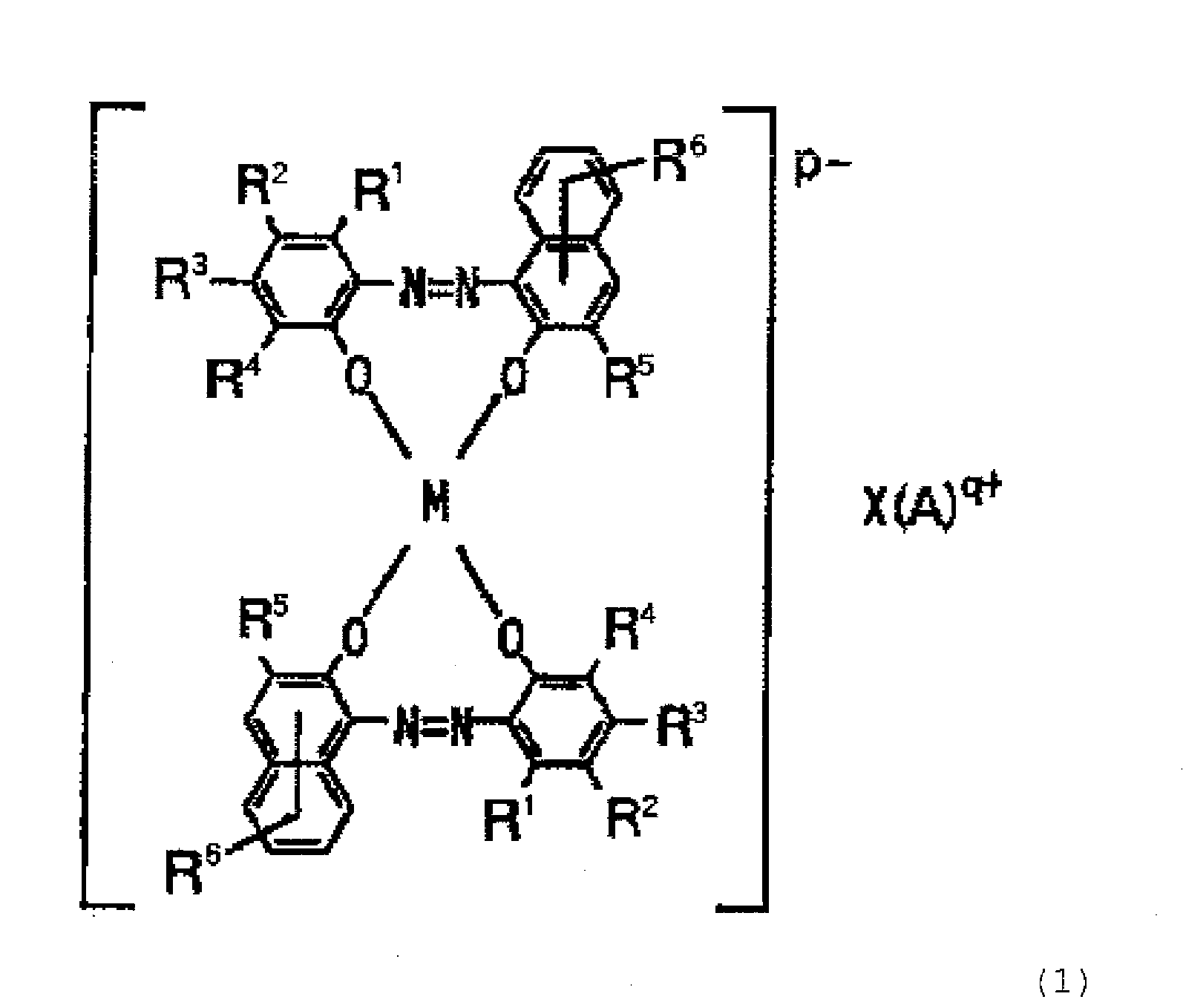
- the toner preferably includes a chrome-containing monoazo compound as a charge controlling agent, which is synthesized in propyleneglycolmonomethylether and subj ected to de-solvent, including propyleneglycolmonomethylether in an amount of from 0.3 to 0.9% by weight and having the following formula (1): wherein R 2 is Cl; R 1 and R 3 to R 6 are hydrogen atoms; M is Cr; (A) q+ is H + ; and X is an integer of 1 or 2.
- a chrome-containing monoazo compound as a charge controlling agent, which is synthesized in propyleneglycolmonomethylether and subj ected to de-solvent, including propyleneglycolmonomethylether in an amount of from 0.3 to 0.9% by weight and having the following formula (1): wherein R 2 is Cl; R 1 and R 3 to R 6 are hydrogen atoms; M is Cr; (A) q+ is H + ; and X is an integer of 1 or 2.
- An enzyme bonded with chrome which is a central metal in a crystalline stricture of the chrome-containing monoazo compound having the formula (1) and the propyleneglycolmonomethylether are coordinated to grow the crystal, and the propyleneglycolmonomethylether does not volatilize even when stored for long periods at higher than 50°C and the toner maintains its storage stability.
- the crystalline structure When the toner includes 2-ethoxyethanolethylcellosolve, the crystalline structure has a main peak at Bragg angle (2 ⁇ ) of 8.70° having a lattice spacing a bit smaller than that of 8.68° in a CuK ⁇ X-xay diffraction spectrum when irradiated with the CuK ⁇ X-ray at an angle (2 ⁇ ) of from 5 to 30°.
- the toner when the toner includes propyleneglycolmonomethylether, the crystalline structure has a main peak at Bragg angle (2 ⁇ ) in a range of from 8.64 to 8.68°, having a lattice spacing.
- the charge controlling agent When the peak strength is from 7, 000 to 13, 000 cps at a tube voltage of 50 KV and a tube current of 30 mA, the charge controlling agent has high crystallinity and negative chargeability, and the crystalline structure thereof is not damaged with a heat energy when kneaded. When less than 7,000 cps, the negative chargeability deteriorates. When greater than 13,000 cps, the charge controlling agent increases in crystallinity and aggregability, and has insufficient dispersibility in a toner, resulting in production of foggy images.
- the chrome-containing monoazo compound having the formula (1) preferably includes propyleneglycolmonomethylether in an amount of from 0.3 to 0.9% by weight.
- a toner including such a chrome-containing monoazo compound has good chargeability and produces images having high image density for long periods. When less than 0.3% by weight, the chrome-containing monoazo compound deteriorates crystallinity and negative chargeability. When greater than 0.9% by weight, the chrome-containing monoazo compound increases in aggregability and has insufficient dispersibility in a toner, resulting in production of foggy images.
- the toner of the present invention having high changeability, high transfer efficiency with a sharp particle diameter distribution and good fluidity even after stored after long periods is used in an image forming method including a process of charging an image bearer with a charger a voltage is applied to from outside; a process of forming an electrostatic latent image on the charged image bearer; a process of developing the electrostatic latent image with a toner to form a toner image; a process of transferring the toner image onto a transfer body with a transferor a voltage is applied to from outside; a process of cleaning the image bearer with a cleaner after the toner image is transferred; and a process of fixing a toner image on a recording material upon application of heat, the image forming method produces quality images without producing foggy images.
- the toner of the present invention having good fluidity even after stored after long periods does not deteriorate in changeability and fluidity with a heat in an image forming apparatus.
- the toner of the present invention having high transfer efficiency and being less untransferred has very high suitability for a toner recycle system. Therefore, the image forming method produces quality images having high image density.
- Fig. 1 is a schematic view illustrating an embodiment of digital copiers.
- the digital copier in Fig. 1 uses a known electrophotographic method and includes a drum-shaped photoreceptor 1.
- a charger 2 Around the photoreceptor 1, a charger 2, an irradiator 3, an image developer 4, a transferor 5, a cleaner 6, a recycler 15 and a fixer 10, which perform an electrophotographic duplication process, are located along with a rotating direction indicated by an arrow A.
- the irradiator 3 forms an electrostatic latent image on the photoreceptor 1 based on an image signal from a scanner 8 scanning an original located on an original setting table 7 on the copier.
- the electrostatic latent image formed on the photoreceptor 1 was developed by the image developer 4 to form a toner image thereon, and the toner image is electrostatically transferred by the transferor 5 onto a transfer sheet fed by a paper feeder 9.
- the transfer sheet having the toner image thereon is transported to the fixer 10 fixing the toner image thereon and discharged out of the copier.
- the photoreceptor 1 having a part from which the toner has not been transferred or a stain is cleaned by the cleaner 6.
- the toner cleaned by the cleaner is collected by the recycle 15 into a toner hopper and mixed with a toner supplied from outside.
- the mixed toner is retuned to the image developer 4 and ready for the following image forming step.
- a charger, a transferer and a cleaner contact a photoreceptor to decrease ozone, and a charging roller or a charging blade, a transfer belt and a cleaning blade are used. Therefore, a toner tends to adhere to these members because they directly contact a photoreceptor.
- a toner for use in the image forming method of present invention is preferably used in such a method. This is because the number of reversely charged toner is small as the toner has a sharp charge distribution, and an amount of a residual toner is small as the toner has high transferability.
- an agglutinated charge controlling agent on a surface of the toner occasionally separates therefrom and becomes a core of progress of the toner adherence.
- a charge controlling agent for use in the image forming method of the present invention has good dispersibility with other materials of the toner, the charge controlling agent does not agglutinate on the surface of the toner and does not become a core of the toner adherence. Therefore, fusion bonding of a toner does not occur even in a contact charging process, a contact transfer process and a contact cleaning process.
- the charging roller or a charging blade, a transfer belt and a cleaning blade are preferably formed of an electroconductive rubber.
- the toner for use in the image forming method of the present invention forms uniform and precise images on transfer papers. Further, one or two rollers having elasticity in the fixing process contacts the surface of the toner image closer to the transfer paper, and there is less uneven fixation, image density and gloss. Therefore, the resultant images are not crushed after fixed and have good granularity and high definition.
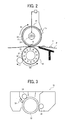
- FIG. 2 is a schematic view illustrating an embodiment of heat-roller fixers, including a fixing roller 21 having a heater 24 such as halogen lamps and a pressure roller 25 having an elastic layer 27 such as foamed silicone rubbers on a metal core 26, which is pressurized by the fixing roller 11.
- a release layer 28 formed of a PFA tube, etc. is formed on the elastic layer 27 of the pressure roller 25.
- the fixing roller 21 includes an elastic layer 27 formed of silicone rubbers, etc. on a metal core (not shown), and further a resin layer 23 formed of resins such as fluorocarbon resins having good releasability on the elastic layer 27 for the purpose of preventing adherence of a toner.
- the elastic layer 27 preferably has a thickness of from 100 to 500 ⁇ m in consideration of the resultant image quality and heat conduction efficiency in fixing the image.
- the resin surface layer 23 is formed of a PFA tube, etc. similarly to the pressure roller 25, and preferably has a thickness of from 10 to 50 ⁇ m in consideration of mechanical deterioration thereof.
- a temperature detector 29 is formed on a peripheral surface of the fixing roller 21, which detects a surface temperature thereof and controls the heater 24 to maintain a fixed temperature.
- the fixing roller 21 and pressure roller 26 contact with each other by a predetermined pressure to form a fixing nip portion N, and driven by a driver (not shown) and rotated in directions of R1 and R5 respectively such that the nip portion N sandwiches and transports a transfer material P.
- the fixing roller 21 is controlled to have a predetermined temperature by the heater 24, and a toner image T on the transfer material P is heated and melted while pressurized between the rollers.
- the toner image T is cooled after passing between the rollers and fixed on the transfer sheet P as a permanent image.
- the elastic layer 27 of the pressure roller 25 has an outer diameter of 30 mm and a radial thickness of 6 mm, and the roller is coated with an electroconductive PFA tube. Hardness of a rubber of the elastic layer 27 is 42 HS (Asker C).
- the metal core of the fixing roller 11 is made of aluminium and has a radial thickness of 0.4 mm. A pressure of 88 N is applied to both ends of the rollers to form the nip N and a surface pressure is 9.3 N/cm 2 .
- any known binder resins can be used in the toner of the present invention.
- the resins include styrene resins such as polystyrene, poly- ⁇ -methylstyrene, styrene-chlorostyrene copolymers, styrene-butadiene copolymers, styrene-vinylchloride copolymers, styrene-vinylacetate copolymers, styrene-maleic acid copolymers, styrene-ester acrylate copolymers, styrene- ⁇ -methylchloroacrylate copolymers and styrene-acrylonitrile-ester acrylate copolymers (polymers or copolymers including styrene or styrene substituents); polyester resins; epoxy resins; vinylchloride resins; rosin-modified maleic acid resins; phenol resins; polyethylene
- the polyester resin can be obtained from a condensed polymerization between alcohol and a carboxylic acid.
- the alcohol include glycols such as ethyleneglycol, diethyleneglycol, triethyleneglycol and propyleneglycol; etherified bisphenol such as 1,4-bis (hydroxymethyl) cyclohexane and bisphenol A; units obtained form a dihydric alcohol monomer; and units obtained from a tri-or-more hydric alcohol monomer.
- carboxylic acids include units obtained from a dihydric organic-acidmonomer such as maleic acid, fumaric acid, phthalic acid, isophthalic acid, terephthalic acid, succinic acid and malonic acid; and units obtained from a tri-or-more hydric carboxylic-acid monomer such as 1,2,4-benzenetricarboxylic acid, 1,2,5-benzenetricarboxylic acid, 1,2,4-cyclohexanetricarboxylic acid, 1,2,4-naphthalanetricarboxylic acid, 1,2,5-hexanetricarboxylic acid, 1,3-dicar-boxyl-2-methylenecarboxypropane and 1,2,7,8-octantetracarboxylic acid.
- the polyester resin preferably has a glass transition temperature (Tg) of from 58 to 75°C.
- manufacturing methods of these resins are not particularly limited and any methods such as mass polymerization, solution polymerization, emulsion polymerization and suspension polymerization can be used.
- a wax can be used in the toner for use in the present invention to improve releasability of the toner when fixed.
- the waxes include polyolefin waxes such as polypropylene wax and polyethylene wax; and natural waxes such as candelilla wax, rice wax and carnauba wax.
- the toner preferably includes the wax in an amount of from 0.5 to 10 parts by weight.
- any pigments and dyes conventionally used as colorants for a toner can be used as a colorant included in the toner for use in the present invention.
- Specific examples of the colorants include carbon black, lamp black, iron black, ultramarine blue, nigrosin dyes, aniline blue, chalco Oil Blue, oil black, azo oil black, etc. However, these are not limited thereto.
- the toner preferably includes the colorant in an amount of from 1 to 10, and more preferably from 3 to 7 parts by weight.
- An additive can optionally be included in the toner for use in the present invention.
- the additives include silica, aluminium oxides, titanium oxides.
- a hydrophobized silica or a rutile type fine-particle titanium dioxide preferably having an average particle diameter of from 0.001 to 1 ⁇ m, and more preferably from.0.005 to 0.1 ⁇ m can optionally be used.
- an organic silane surface-treated silica or titania is preferably used.
- the toner preferably includes the additive in an amount of from 0.1 to 5%, and more preferably from 0.2 to 2% by weight.
- the toner of the present invention when used as a two-component dry toner, as a carrier for use in the developer, a powder having including glass, iron, ferrite, nickel zircon, silica, etc.. as a main component and having a particle diameter of from about 30 to 1, 000 ⁇ m or the powder coated with styrene-acrylic resins, silicone resins, polyamide resins, polyvinylidene fluoride resins, etc. can optionally be used.
- Method of producing the toner of the present invention includes at least a mixing process, a kneading process upon application of heat, a pulverizing process and a classifying process of a developer including a binder resin, a main charge controlling agent and a colorant.
- the methods include a method of recycling a powder besides particles to be used for a toner in a pulverizing or a classifying process into a mechanical mixing process or a kneading process upon application of heat.
- the powder besides particles to be used for a toner means fine particles and coarse particles besides toner particles having a desired particle diameter in the pulverizing process or the following classifying process.
- the by-product is preferably has a content of 1 part by weight or 50 parts by weight based on total weight of the toner materials.
- a conventional mixer having a rotating blade can be used in the mechanical mixing process of a developer including at least a binder resin, a main charge controlling agent, a colorant and the by-product in conventional conditions without any particular conditions.
- the mixture is kneaded upon application of heat in a kneader.
- a uniaxial or biaxial continuous kneader and a batch type kneader with a roll mill can be used.
- a temperature of the kneading process upon application of heat is determined in consideration of a softening point of the binder resin. When the temperature is lower than the softening point, the molecular chain of the binder resin is considerably cut. When higher than the softening point, the dispersion does not proceed well.
- the mixture is pulverized.
- the mixture is preferably crashed, and then pulverized.
- the mixture is preferably pulverized by being crashed to a collision board in a jet stream, and pulverized by being passed through a narrow gap between a mechanically rotating rotor and a stator.
- the pulverized material is classified by a centrifugal force, etc. in a stream of air to prepare a toner having a predetermined particle diameter, e.g., of from 5 to 20 ⁇ m.
- an external additive i.e., inorganic fine particles such as hydrophobic silica fine powders can be added to the thus prepared toner.
- a conventional powder mixer can be used to mix the external additive, and is preferably equipped with a jacket to control an inside temperature.
- the external additive may be added on the way of mixing process or gradually added to the toner.
- the number of revolutions, a rolling speed, a time of mixing and a temperature of the mixer may be changed. A large load at the beginning and a small load later may be applied to the additive, and vice versa.
- mixers include a V-type mixer, a locking mixer, a Loedige Mixer, a Nauta Mixer, a Henschel Mixer, etc.
- X-ray diffractometer RINT1100 from Hitachi, Ltd. and CuK ⁇ ray are used to measure the X-ray diffraction in the present invention under the following conditions:
- Pxecisely-weighed 0.01 g of a chrome-containing monoazo compound is stirred with 0.5 ml of dimethylformamide in a measuring flask having a capacity of 10 ml to prepare a mixture.
- a mixed solvent including 2 parts by weight of chloroform and 98 parts by weight of n-hexane is dropped in the mixture while stirred to prepare an extraction liquid.
- the extraction liquid is subjected to centrifugation at 5, 000 rpm for 10 min to prepare another extraction liquid, i.e., a measurement sample.
- particle diameters are measured by Coulter Multisizer II from Beckman Coulter, Inc. as follows:
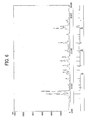
- Fig. 3 is a schematic view illustrating an embodiment of the process cartridge of the present invention.
- numeral 31 represents a whole process cartridge
- 32 is a photoreceptor
- 33 is a charger
- 34 is an image developer
- 35 is a cleaner.
- Two or more of the photoreceptor 32, the charger 33, the image developer 34 and the cleaner 35 are combined in a body as the process cartridge, and which is detachable from image forming apparatuses such as copiers and printers.
- a photoreceptor rotates at a predetermined peripheral speed.
- the circumferential surface of the photoreceptor is positively or negatively charged evenly by a charger in the process of rotating.
- the circumferential surface is irradiated by an irradiator such as slit irradiators and laser beam scanning irradiators with imagewise light to from an electrostatic latent image thereon.
- the electrostatic latent image is developed by an image developer with a toner to form a toner image.
- the toner image is transferred by a transferor onto a transfer material synchronously fed between the photoreceptor and the transferer.
- the transfer material having received the toner image separates from the photoreceptor and comes into a fixer where the toner image is fixed thereon, and the transfer material the toner image is fixed on is printed out as a copy.
- the surface of the photoreceptor is cleaned by a cleaner removing the toner remaining untransferred thereon, and further discharged to be ready to form a following image.
- the mixture was heated to have a temperature of 90°C and subjected to a reaction for 12 hrs to prepare a polymeric material.
- the polymeric material was washed with water and dried at a room temperature and 10 torr to prepare a resin 1 including propyleneglycolmonomethylether in an amount of 350 ppm.
- Resin 1 The procedure for preparation of Resin 1 was repeated to prepare a resin 2 except for not placing 10 g of propyleneglycolmonomethylether.
- the resin 2 included propyleneglycolmonomethylether in an amount of 0 ppm.
- aqueous solution was cooled to have a temperature of 5°C
- a solution including 60 ml of water and 14.0 g of sodium nitrite dissolved therein was dropped in the aqueous solution for 30 min to prepare a mixture.
- the reaction liquid was filtered to prepare an aqueous solution (solution A) of a diazonium salt of4-chlor-2-aminophenol.
- the mixture was heated to have a temperature of 120°C at 10°C/min and stirred for 8 hrs, the mixture was cooled to have a temperature of 5°C at 7°C/min to prepare a reaction liquid.
- a solid content was filtered from the reaction liquid through a paper filter and the solid content was washed with 100 ml of water on the paper filter to prepare a wet cake.
- the wet cake was re-dispersed in an aqueous medium including 200 ml of water and 15 g of hydrochloric acid, and stirred for 1 hr. Then, after a solid content was filtered out again and washed with 1,200 ml of water, the solid content was dried at 100°C for 5 hrs and pulverized to prepare a chrome-containing monoazo compound 1.
- the chrome-containing monoazo compound 1 included propyleneglycolmonomethylether in an amount of 0.3% by weight, and has a main peak at Bragg angle (2 ⁇ ) of 8.68° in a CuK ⁇ X-ray diffraction spectrum, The peak strength was 13,000 cps at a tube voltage of 50 KV and a tube current of 30 mA.
- the mixture was heated to have a temperature of 120°C at 5°C/min and stirred for 8 hrs, the mixture was cooled to have a temperature of 10°C at 10°C/min to prepare a reaction liquid.
- a solid content was filtered from the reaction liquid through a paper filter and the solid content was washed with 100 ml of water on the paper filter to prepare a wet cake.
- the wet cake was re-dispersed in an aqueous medium including 200 ml of water and 15 g of hydrochloric acid, and stirred for 1 hr.
- the chrome-containing monoazo compound 2 included propyleneglycolmonomethylether in an amount of 0.9% by weight, and has a main peak at Bragg angle (2 ⁇ ) of 8.66° in a CuK ⁇ X-ray diffraction spectrum.
- the peak strength was 9, 400 cps at a tube voltage of 50 KV and a tube current of 30 mA.
- Fig. 5 is a diagram showing X-ray diffraction data of the chrome-containing monoazo compound 2.
- the mixture was heated to have a temperature of 120°C at 5°C/min and stirred for 8 hrs, the mixture was cooled to have a temperature of 10°C at 10°C/min to prepare a reaction liquid.
- a solid content was filtered from the reaction liquid through a paper filter and the solid content was washed with 100 ml of water on the paper filter to prepare a wet cake..
- the wet cake was re-dispersed in an aqueous medium including 200 ml of water and 50 g of hydrochloric acid, heated in an oil bath to have a temperature of 80°C and stirred for 1 hr, the dispersed wet cake was left cool to have room temperature.
- the chrome-containing monoazo compound 3 included propyleneglycolmonomethylether in an amount of 0.2% by weight, and has a main peak at Bragg angle (2 ⁇ ) of 8.67° in a CuK ⁇ X-ray diffraction spectrum.
- the peak strength was 3, 300 cps at a tube voltage of 50 KV and a tube current of 30 mA.
- the chrome-containing monoazo compound 4 included propyleneglycolmonomethylether in an amount of 1.1% by weight, and has a main peak at Bragg angle (2 ⁇ ) of 8.67° in a CuK ⁇ X-ray diffraction spectrum.
- the peak strength was 12,000 cps at a tube voltage of 50 KV and a tube current of 30 mA.
- the mixture was heated to have a temperature of 120°C at 5°C/min and stirred for 8 hrs, the mixture was cooled to have a temperature of 30°C at 15°C/min to prepare a reaction liquid.
- a solid content was filtered from the reaction liquid through a paper filter and the solid content was washed with 100 ml of water on the paper filter to prepare a wet cake.
- the wet cake was re-dispersed in an aqueous medium including 200 ml of water and 15 g of hydrochloric acid, and stirred for 1 hr.
- the chrome-containing monoazo compound 5 included propyleneglycolmonomethylether in an amount of 0.5% by weight, and has a main peak at Bragg angle (2 ⁇ ) of 8.66° in a CuK ⁇ X-ray diffraction spectrum.
- the peak strength was 7, 000 cps at a tube voltage of 50 KV and a tube current of 30 mA.
- the mixture was heated to have a temperature of 120°C at 5°C/min and stirred for 8 hrs, the mixture was cooled to have a temperature of 5°C at 5°C/min to prepare a reaction liquid.
- a solid content was filtered from the reaction liquid through a paper filter and the solid content was washed with 100 ml of water on the paper filter to prepare a wet cake.
- the wet cake was re-dispersed in an aqueous medium including 200 ml of water and 15 g of hydrochloric acid, and stirred for 1 hr.
- the chrome-containing monoazo compound 6 included propyleneglycolmonomethylether in an amount of 0.6% by weight, and has a main peak at Bragg angle (2 ⁇ ) of 8.67° in a CuK ⁇ X-ray diffraction spectrum.
- the peak strength was 14,000 cps at a tube voltage of 50 KV and a tube current of 30 mA.
- the mixture was heated to have a temperature of 120°C at 5°C/min and stirred for 8 hrs, the mixture was cooled to have a temperature of 40°C at 20°C/min to prepare a reaction liquid.
- a solid content was filtered from the reaction liquid through a paper filter and the solid content was washed with 100 ml of water on the paper filter to prepare a wet cake.
- the wet cake was re-dispersed in an aqueous medium including 200 ml of water and 15 g of hydrochloric acid, and stirred for 1 hr.
- the chrome-containing monoazo compound 7 included propyleneglycolmonomethylether in an amount of 0.6% by weight, and has a main peak at Bragg angle (2 ⁇ ) of 8.68° in a CuK ⁇ X-ray diffraction spectrum.
- the peak strength was 6, 500 cps at a tube voltage of 50 KV and a tube current of 30 mA.
- Fig.. 6 is a diagram showing X-ray diffraction data of the chrome-containing monoazo compound 7.
- the chrome-containing monoazo compound 8 included propyleneglycolmonomethylether in an amount of 0% by weight, and has a main peak at Bragg angle (2 ⁇ ) of 8.70° in a CuK ⁇ X-ray diffraction spectrum.
- the peak strength was 10,000 cps at a tube voltage of 50 KV and a tube current of 30 mA.
- the kneaded mixture was cooled and solidified to prepare a solid mixture.
- the solid mixture was pulverized by an ultrasonic jet pulverizer LABOJET from Nippon Pneumatic Mfg. Co., Ltd. to prepare a pulverized mixture, and the pulverized mixture was classified by an airflow classifier MDS-1 from Nippon Pneumatic Mfg. Co., Ltd.. to prepare mother toner particles having a particle diameter distribution shown in Table 1-1.
- 100 parts by weight of the mother toner particles and 2.0 parts by weight of colloidal silica H-2000 from Clariant Corp. were mixed by a sample mill to prepare a toner.
- the toner and silicone-coated carrier having an average particle diameter of 50 ⁇ m were mixed so as to have a toner concentration of 7% to prepare a developer.
- Example 1 The procedure for preparation of the mother toner particles in Example 1 was repeated to prepare mother toner particles except for changing the formulation to a following formulation and controlling an air pressure of the pulverizer and a suction air pressure of the classifier such that the mother toner particles had a particle diameter distribution shown in Table 1-1.
- Resin 2 39 Resin 3 39 Chrome-containing monoazo compound 2 3 Ester wax WA-2 from NOF Corp. 9 Carbon Black Regal 330R from Cabot Corp. 10
- 100 parts by weight of the mother toner particles and 3.0 parts by weight of colloidal silica H-2000 from Clariant Corp. were mixed by a sample mill to prepare a toner.
- the toner and silicone-coated carrier having an average particle diameter of 50 ⁇ m were mixed so as to have a toner concentration of 7% to prepare a developer.
- Example 1 The procedure for preparation of the mother toner particles in Example 1 was repeated to prepare respective mother toner particles except for changing the formulation to a following formulation and controlling an air pressure of the pulverizer and a suction air pressure of the classifier such that the respective mother toner particles had a particle diameter distribution shown in Table 1-1.
- Resin 3 80 Chrome-containing monoazo compound 1 5 Polypropylene VISCOL 660P from Sanyo Chemical industries, Ltd. 5 Carbon Black Regal 330R from Cabot Corp. 10
- Example 1 The procedure for preparation of the mother toner particles in Example 1 was repeated to prepare mother toner particles except for changing the formulation to a following formulation and controlling an air pressure of the pulverizer and a suction air pressure of the classifier such that the mother toner particles had a particle diameter distribution shown in Table 1-1.
- 100 parts by weight of the mother toner particles and 3.0 parts by weight of colloidal silica H-2000 from Clariant Corp. were mixed by a sample mill to prepare a toner.
- the toner and silicone-coated carrier having an average particle diameter of 50 ⁇ m were mixed so as to have a toner concentration of 7% to prepare a developer.
- Example 1 The procedure for preparation of the mother toner particles in Example 1 was repeated to prepare mother toner particles except for changing the formulation to a following formulation and controlling an air pressure of the pulverizer and a suction air pressure of the classifier such that the mother toner particles had a particle diameter distribution shown in Table 1-1.
- Resin 3 83 Chrome-containing monoazo compound 4 2 Polypropylene VISCOL 660P from Sanyo Chemical industries, Ltd. 5 Carbon Black Regal 330R from Cabot Corp. 10
- 100 parts by weight of the mother toner particles and 3.0 parts by weight of colloidal silica H-2000 from Clariant Corp. were mixed by a sample mill to prepare a toner.
- the toner and silicone-coated carrier having an average particle diameter of 50 ⁇ m were mixed so as to have a toner concentration of 7% to prepare a developer.
- Example 1 The procedure for preparation of the mother toner particles in Example 1 was repeated to prepare mother toner particles except for changing the formulation to a following formulation and controlling an air pressure of the pulverizer and a suction air pressure of the classifier such that the mother toner particles had a particle diameter distribution shown in Table 1-1.
- Example 1 The procedure for preparation of the mother toner particles in Example 1 was repeated to prepare mother toner particles except for changing the formulation to a following formulation and controlling an air pressure of the pulverizer and a suction air pressure of the classifier such that the mother toner particles had a particle diameter distribution shown in Table 1-1.
- Resin 2 82 Chrome-containing monoazo compound 6 3 Polypropylene VISCOL 660P from Sanyo Chemical industries, Ltd. 5 Carbon Black Regal 330R from Cabot Corp. 10
- 100 parts by weight of the mother toner particles and 3.0 parts by weight of colloidal silica H-2000 from Clariant Corp. were mixed by a sample mill to prepare a toner.
- the toner and silicone-coated carrier having an average particle diameter of 50 ⁇ m were mixed so as to have a toner concentration of 7% to prepare a developer.
- Example 1 The procedure for preparation of the mother toner particles in Example 1 was repeated to prepare mother toner particles except for changing the formulation to a following formulation and controlling an air pressure of the pulverizer and a suction air pressure of the classifier such that the mother toner particles had a particle diameter distribution shown in Table 1-1.
- Resin 2 82 Chrome-containing monoazo compound 7 3 Polypropylene VISCOL 660P from Sanyo Chemical industries, Ltd. 5 Carbon Black Regal 330R from Cabot Corp. 10
- 100 parts by weight of the mother toner particles and 3.0 parts by weight of colloidal silica H-2000 from Clariant Corp. were mixed by a sample mill to prepare a toner.
- the toner and silicone-coated carrier having an average particle diameter of 50 ⁇ m were mixed so as to have a toner concentration of 7% to prepare a developer.
- Example 1 The procedure for preparation of the mother toner particles in Example 1 was repeated to prepare mother toner particles except for changing the formulation to a following formulation and controlling an air pressure of the pulverizer and a suction air pressure of the classifier such that the mother toner particles had a particle diameter distribution shown in Table 1-1.
- Resin 2 40
- Resin 3 40 Chrome-containing monoazo compound 5 0.6
- 100 parts by weight of the mother toner particles and 3.0 parts by weight of colloidal silica H-2000 from Clariant Corp. were mixed by a sample mill to prepare a toner.
- the toner and silicone-coated carrier having an average particle diameter of 50 ⁇ m were mixed so as to have a toner concentration of 7% to prepare a developer.
- Example 1 The procedure for preparation of the mother toner particles in Example 1 was repeated to prepare mother toner particles except for changing the formulation to a following formulation and controlling an air pressure of the pulverizer and a suction air pressure of the classifier such that the mother toner particles had a particle diameter distribution shown in Table 1-1.
- 100 parts by weight of the mother toner particles and 3.0 parts by weight of colloidal silica H-2000 from Clariant Corp. were mixed by a sample mill to prepare a toner.
- the toner and silicone-coated carrier having an average particle diameter of 50 ⁇ m were mixed so as to have a toner concentration of 7% to prepare a developer.
- Example 1 The procedure for preparation of the mother toner particles in Example 1 was repeated to prepare mother toner particles except for changing the formulation to a following formulation and controlling an air pressure of the pulverizer and a suction air pressure of the classifier such that the mother toner particles had a particle diameter distribution shown in Table 1-1.
- 100 parts by weight of the mother toner particles and 3.0 parts by weight of colloidal silica H-2000 from Clariant Corp. were mixed by a sample mill to prepare a toner.
- the toner and silicone-coated carrier having an average particle diameter of 50 ⁇ m were mixed so as to have a toner concentration of 7% to prepare a developer.
- the toners stored in a constant-temperature reservoir having a temperature of 50 ⁇ 1°C for 6 months were used.
- Each of the toners was set in Imagio neo 453 using a toner recycle method from Ricoh Company, Ltd., and an image after 100, 000 images were produced at 25°C and 60% Rh was evaluated.
- Image density 10 points on a black solid circular image having a diameter of 3 cm were measured by Macbeth densitometer and an average thereof was determined as image density.
- the charge quantity of the toner was measured by the following method. Further, after the developer was stored in a constarit-temperature reservoir having a temperature of 50 ⁇ 1°C for 6 months, the charge quantity of the toner was measured again thereby.
- Fig. 4 is an explanatory view of charge quantity measure.
- a sample was placed in a metallic measuring container 22 including an electroconductive screen 23 having 635 meshes (selectable as desired so as not to pass the carrier) at the bottom, and the container was capped with a metallic lid.
- an air volume control valve of a suctioner 21 (a part contacting to the measuring container 22 was insulative) was adjusted such that a vacuum gauge 25 indicated a pressure of 250 mm H 2 O, The sample was suctioned from a suction opening 27 for 1 min.
- Numeral 28 is a condenser having a capacity of C ⁇ F. The resultant charge quantity is divided by a quantity (g) of the suctioned toner to determine a friction charge quantity mC/kg.
Landscapes
- Physics & Mathematics (AREA)
- General Physics & Mathematics (AREA)
- Developing Agents For Electrophotography (AREA)
- Cleaning In Electrography (AREA)
Abstract
Description
- The present invention relates to a toner for developing an electrostatic latent image, and to an image forming method using the toner.
- The electrophotographic image forming methods are broadly classified to dry developing methods and wet developing methods" The dry developing methods are further classified to one-component and two-component developing methods. A toner used in any methods needs to be positively or negatively charged, according to the polarity of an electrostatic latent image. A charge controlling agent is most effectively added to the toner to maintain a charge of the toner.
- A variety of charge controlling agents are available, and chrome-containing complex compounds have conventionally been used because of being inexpensive and negatively charging. Japanese published unexamined application No.
2000-321819 - Japanese published unexamined application No.
2003-255617 2002-53539 - Because of these reasons, a need exists for a toner having high colorability and maintaining low-temperature fixability without producing foggy images even after used or stored at high temperature for long periods.
- Accordingly, an object of the present invention is to provide a toner having high colorability and maintaining low-temperature fixability without producing foggy images even after used or stored at high temperature for long periods.
- Another object of the present invention is to provide an image forming method using the toner.
- A further object of the present invention is to provide a process cartridge using the toner.
- These objects and other objects of the present invention, either individually or collectively, have been satisfied by the discovery of a toner for developing electrostatic latent images, comprising:
- a binder resin; and
- a colorant,
- These and other objects, features and advantages of the present invention will become apparent upon consideration of the following description of the preferred embodiments of the present invention taken in conjunction with the accompanying drawings.
- Various other objects, features and attendant advantages of the present invention will be more fully appreciated as the same becomes better understood from the detailed description when considered in connection with the accompanying drawing (s) in which like reference characters designate like corresponding parts throughout and wherein:
-
Fig. 1 is a schematic view illustrating an embodiment of digital copiers; -
Fig. 2 is a schematic view illustrating an embodiment of heat-roller fixers; -
Fig. 3 is a schematic view illustrating an embodiment of the process cartridge of the present invention; -
Fig. 4 is an explanatory view of charge quantity measurer; -
Fig. 5 is a diagram showing X-ray diffraction data of the chrome-containingmonoazo compound 2; -
Fig. 6 is a diagram showing X-ray diffraction data of the chrome-containingmonoazo compound 7; and -
Fig. 7 is used as a standard for evaluating letter sharpness. - The present invention provides a toner having high colorability and maintaining low-temperature fixability without producing foggy images even after used or stored at high temperature for long periods. More particularly, the present invention relates to a toner for developing electrostatic latent images, comprising:
- a binder resin; and
- a colorant,
- Such a toner has high colorability. Propyleneglycolmonomethylether has high solubility even to a material having a different solubility parameter and compatibility between a resin and a wax increases. Therefore, the toner has high durability without spent wax and deterioration due to aggregation even after used or stored at high temperature for long periods. In addition, when the resin or wax in the toner melts when fixed, propyleneglycolmonomethylether is a good solvent for both of them and the resultant images have high smoothness after fixed and has high image density. When less than 30 ppm, spent wax occurs and foggy images are produced after used or storedathightemperature for long periods. When greater than 200 ppm, the surface of the toner is partly softened when store for long periods in an environment having a temperature higher than 50°C, resulting in deterioration of the fluidity of the toner" Particularly when polyester resins having low compatibility with a wax are used alone as a binder resin, propyleneglycolmonomethylether included in a toner in an amount of from 30 to 200 ppm works as a wax dispersant and the toner has high durability without spent wax even after used for long periods.
Further, the toner preferably has a weight-average particle diameter of from 3.5 to 6.5 µm, and a variation coefficient of number distribution (standard deviation of number distribution/number-average particle diameter) of from 22.0 to 35.0 to have high colorability. Having a weight-average particle diameter less than 3.5 µm, the toner deteriorates in its cleanability, resulting in production of foggy images and deterioration of the colorability. Having a weight-average particle diameter greater than 6.5 µm, the resultant images deteriorates in sharpness and colorability. Particularly in a recycle system, a toner having a variation coefficient of number distribution (standard deviation of number distribution/number-average particle diameter) of from 22.0 to 35.0 has higher colorability. In the recycle system, the toner has small variations of fluidity and chargeability, and produces images without deterioration even when mixed with a recycled toner. When less than 22.0, having a sharp particle diameter distribution, the toner produces good images at the beginning, but when mixed with a recycled toner, the particle diameter distributions of the initial toner and the recycled toner are completely separate and the initial toner is preferentially developed while the recycled toner is accumulated undeveloped in an image developer, resulting in spent carrier and aggregation of a developer. When greater than 35.0, the particle diameter distribution is so wide that the toner having a specific distribution is preferentially developed, resulting in the same phenomena. The toner having a variation coefficient of number distribution (standard deviation of number distribution/number-average particle diameter) of from 22.0 to 35.0 has good chargeability and fluidity, and produces images having high image density without such phenomena because the recycled toner is consumed even when mixed with a recycled toner. - In order to prepare a toner including propyleneglycolmonomethylether in an amount of from 30 to 200 ppm, the propyleneglycolmonomethylether is added to a toner as a monomer or dissolved in a resin-synthesizing solvent because of having high solubility in water and various organic solvents. The solvent is removed after synthesizing the resin. The content thereof is controlled by an input thereof or a temperature and a time in the process of removing the solvent. However, when included in a resin of a toner, the propyleneglycolmonomethylether thermally expands the resin when stored for long periods at higher than 50°C (not at room temperature) and softens the surface of the toner.. Then, an external additive is partly buried in the tone, resulting in deterioration of the fluidity thereof.
- The toner preferably includes a chrome-containing monoazo compound as a charge controlling agent, which is synthesized in propyleneglycolmonomethylether and subj ected to de-solvent, including propyleneglycolmonomethylether in an amount of from 0.3 to 0.9% by weight and having the following formula (1):
- An enzyme bonded with chrome which is a central metal in a crystalline stricture of the chrome-containing monoazo compound having the formula (1) and the propyleneglycolmonomethylether are coordinated to grow the crystal, and the propyleneglycolmonomethylether does not volatilize even when stored for long periods at higher than 50°C and the toner maintains its storage stability.
- When the toner includes 2-ethoxyethanolethylcellosolve, the crystalline structure has a main peak at Bragg angle (2θ) of 8.70° having a lattice spacing a bit smaller than that of 8.68° in a CuKα X-xay diffraction spectrum when irradiated with the CuKα X-ray at an angle (2θ) of from 5 to 30°. Namely, when the toner includes propyleneglycolmonomethylether, the crystalline structure has a main peak at Bragg angle (2θ) in a range of from 8.64 to 8.68°, having a lattice spacing. When the peak strength is from 7, 000 to 13, 000 cps at a tube voltage of 50 KV and a tube current of 30 mA, the charge controlling agent has high crystallinity and negative chargeability, and the crystalline structure thereof is not damaged with a heat energy when kneaded. When less than 7,000 cps, the negative chargeability deteriorates. When greater than 13,000 cps, the charge controlling agent increases in crystallinity and aggregability, and has insufficient dispersibility in a toner, resulting in production of foggy images.
- The chrome-containing monoazo compound having the formula (1) preferably includes propyleneglycolmonomethylether in an amount of from 0.3 to 0.9% by weight. A toner including such a chrome-containing monoazo compound has good chargeability and produces images having high image density for long periods. When less than 0.3% by weight, the chrome-containing monoazo compound deteriorates crystallinity and negative chargeability. When greater than 0.9% by weight, the chrome-containing monoazo compound increases in aggregability and has insufficient dispersibility in a toner, resulting in production of foggy images.
- When the toner of the present invention, having high changeability, high transfer efficiency with a sharp particle diameter distribution and good fluidity even after stored after long periods is used in an image forming method including a process of charging an image bearer with a charger a voltage is applied to from outside; a process of forming an electrostatic latent image on the charged image bearer; a process of developing the electrostatic latent image with a toner to form a toner image; a process of transferring the toner image onto a transfer body with a transferor a voltage is applied to from outside; a process of cleaning the image bearer with a cleaner after the toner image is transferred; and a process of fixing a toner image on a recording material upon application of heat, the image forming method produces quality images without producing foggy images. The toner of the present invention, having good fluidity even after stored after long periods does not deteriorate in changeability and fluidity with a heat in an image forming apparatus. The toner of the present invention, having high transfer efficiency and being less untransferred has very high suitability for a toner recycle system. Therefore, the image forming method produces quality images having high image density.
-
Fig. 1 is a schematic view illustrating an embodiment of digital copiers. The digital copier inFig. 1 uses a known electrophotographic method and includes a drum-shapedphotoreceptor 1. Around thephotoreceptor 1, acharger 2, anirradiator 3, animage developer 4, atransferor 5, a cleaner 6, arecycler 15 and afixer 10, which perform an electrophotographic duplication process, are located along with a rotating direction indicated by an arrow A. - The
irradiator 3 forms an electrostatic latent image on thephotoreceptor 1 based on an image signal from ascanner 8 scanning an original located on an original setting table 7 on the copier. - The electrostatic latent image formed on the
photoreceptor 1 was developed by theimage developer 4 to form a toner image thereon, and the toner image is electrostatically transferred by thetransferor 5 onto a transfer sheet fed by apaper feeder 9. The transfer sheet having the toner image thereon is transported to thefixer 10 fixing the toner image thereon and discharged out of the copier. - On the other hand, the
photoreceptor 1 having a part from which the toner has not been transferred or a stain is cleaned by the cleaner 6. The toner cleaned by the cleaner is collected by therecycle 15 into a toner hopper and mixed with a toner supplied from outside. The mixed toner is retuned to theimage developer 4 and ready for the following image forming step. - Recently, a charger, a transferer and a cleaner contact a photoreceptor to decrease ozone, and a charging roller or a charging blade, a transfer belt and a cleaning blade are used. Therefore, a toner tends to adhere to these members because they directly contact a photoreceptor. However, a toner for use in the image forming method of present invention is preferably used in such a method.. This is because the number of reversely charged toner is small as the toner has a sharp charge distribution, and an amount of a residual toner is small as the toner has high transferability. In addition, as one of a mechanism of the toner adherence, an agglutinated charge controlling agent on a surface of the toner occasionally separates therefrom and becomes a core of progress of the toner adherence. However, because a charge controlling agent for use in the image forming method of the present invention has good dispersibility with other materials of the toner, the charge controlling agent does not agglutinate on the surface of the toner and does not become a core of the toner adherence. Therefore, fusion bonding of a toner does not occur even in a contact charging process, a contact transfer process and a contact cleaning process.
- The charging roller or a charging blade, a transfer belt and a cleaning blade are preferably formed of an electroconductive rubber.
- Having high changeability, a sharp charge distribution and good charge stability at high temperature and high humidity, the toner for use in the image forming method of the present invention forms uniform and precise images on transfer papers. Further, one or two rollers having elasticity in the fixing process contacts the surface of the toner image closer to the transfer paper, and there is less uneven fixation, image density and gloss. Therefore, the resultant images are not crushed after fixed and have good granularity and high definition.
- A fixer including one or two rollers having elasticity will be explained in detail.
Fig. 2 is a schematic view illustrating an embodiment of heat-roller fixers, including a fixingroller 21 having aheater 24 such as halogen lamps and apressure roller 25 having anelastic layer 27 such as foamed silicone rubbers on ametal core 26, which is pressurized by the fixing roller 11. Arelease layer 28 formed of a PFA tube, etc. is formed on theelastic layer 27 of thepressure roller 25. The fixingroller 21 includes anelastic layer 27 formed of silicone rubbers, etc. on a metal core (not shown), and further aresin layer 23 formed of resins such as fluorocarbon resins having good releasability on theelastic layer 27 for the purpose of preventing adherence of a toner. Theelastic layer 27 preferably has a thickness of from 100 to 500 µm in consideration of the resultant image quality and heat conduction efficiency in fixing the image. Theresin surface layer 23 is formed of a PFA tube, etc. similarly to thepressure roller 25, and preferably has a thickness of from 10 to 50 µm in consideration of mechanical deterioration thereof. Atemperature detector 29 is formed on a peripheral surface of the fixingroller 21, which detects a surface temperature thereof and controls theheater 24 to maintain a fixed temperature. The fixingroller 21 andpressure roller 26 contact with each other by a predetermined pressure to form a fixing nip portion N, and driven by a driver (not shown) and rotated in directions of R1 and R5 respectively such that the nip portion N sandwiches and transports a transfer material P. The fixingroller 21 is controlled to have a predetermined temperature by theheater 24, and a toner image T on the transfer material P is heated and melted while pressurized between the rollers. The toner image T is cooled after passing between the rollers and fixed on the transfer sheet P as a permanent image. - The
elastic layer 27 of thepressure roller 25 has an outer diameter of 30 mm and a radial thickness of 6 mm, and the roller is coated with an electroconductive PFA tube. Hardness of a rubber of theelastic layer 27 is 42 HS (Asker C). The metal core of the fixing roller 11 is made of aluminium and has a radial thickness of 0.4 mm. A pressure of 88 N is applied to both ends of the rollers to form the nip N and a surface pressure is 9.3 N/cm2. - Any known binder resins can be used in the toner of the present invention. Specific examples of the resins include styrene resins such as polystyrene, poly-α-methylstyrene, styrene-chlorostyrene copolymers, styrene-butadiene copolymers, styrene-vinylchloride copolymers, styrene-vinylacetate copolymers, styrene-maleic acid copolymers, styrene-ester acrylate copolymers, styrene-α-methylchloroacrylate copolymers and styrene-acrylonitrile-ester acrylate copolymers (polymers or copolymers including
styrene or styrene substituents); polyester resins; epoxy resins; vinylchloride resins; rosin-modified maleic acid resins; phenol resins; polyethylene resins; polypropylene resins; petroleum resins; polyurethane resins; ketone resins; ethylene-ethylacrylate copolymers, xylene resins; and polyvinylbutyral resins. Particularly, the polyester resins are preferably used. - The polyester resin can be obtained from a condensed polymerization between alcohol and a carboxylic acid. Specific examples of the alcohol include glycols such as ethyleneglycol, diethyleneglycol, triethyleneglycol and propyleneglycol; etherified bisphenol such as 1,4-bis (hydroxymethyl) cyclohexane and bisphenol A; units obtained form a dihydric alcohol monomer; and units obtained from a tri-or-more hydric alcohol monomer. Specific examples of the carboxylic acids include units obtained from a dihydric organic-acidmonomer such as maleic acid, fumaric acid, phthalic acid, isophthalic acid, terephthalic acid, succinic acid and malonic acid; and units obtained from a tri-or-more hydric carboxylic-acid monomer such as 1,2,4-benzenetricarboxylic acid, 1,2,5-benzenetricarboxylic acid, 1,2,4-cyclohexanetricarboxylic acid, 1,2,4-naphthalanetricarboxylic acid, 1,2,5-hexanetricarboxylic acid, 1,3-dicar-boxyl-2-methylenecarboxypropane and 1,2,7,8-octantetracarboxylic acid. The polyester resin preferably has a glass transition temperature (Tg) of from 58 to 75°C. These resins can be used alone or in combination.
- In addition, manufacturing methods of these resins are not particularly limited and any methods such as mass polymerization, solution polymerization, emulsion polymerization and suspension polymerization can be used.
- A wax can be used in the toner for use in the present invention to improve releasability of the toner when fixed. Specific examples of the waxes include polyolefin waxes such as polypropylene wax and polyethylene wax; and natural waxes such as candelilla wax, rice wax and carnauba wax. The toner preferably includes the wax in an amount of from 0.5 to 10 parts by weight.
- Any pigments and dyes conventionally used as colorants for a toner can be used as a colorant included in the toner for use in the present invention. Specific examples of the colorants include carbon black, lamp black, iron black, ultramarine blue, nigrosin dyes, aniline blue, chalco Oil Blue, oil black, azo oil black, etc. However, these are not limited thereto. The toner preferably includes the colorant in an amount of from 1 to 10, and more preferably from 3 to 7 parts by weight.
- An additive can optionally be included in the toner for use in the present invention. Specific examples of the additives include silica, aluminium oxides, titanium oxides. As a fluidizer, a hydrophobized silica or a rutile type fine-particle titanium dioxide preferably having an average particle diameter of from 0.001 to 1 µm, and more preferably from.0.005 to 0.1 µm can optionally be used.. Particularly, an organic silane surface-treated silica or titania is preferably used. The toner preferably includes the additive in an amount of from 0.1 to 5%, and more preferably from 0.2 to 2% by weight.
- In addition, when the toner of the present invention is used as a two-component dry toner, as a carrier for use in the developer, a powder having including glass, iron, ferrite, nickel zircon, silica, etc.. as a main component and having a particle diameter of from about 30 to 1, 000 µm or the powder coated with styrene-acrylic resins, silicone resins, polyamide resins, polyvinylidene fluoride resins, etc. can optionally be used.
- Method of producing the toner of the present invention includes at least a mixing process, a kneading process upon application of heat, a pulverizing process and a classifying process of a developer including a binder resin, a main charge controlling agent and a colorant. In addition, the methods include a method of recycling a powder besides particles to be used for a toner in a pulverizing or a classifying process into a mechanical mixing process or a kneading process upon application of heat.
- The powder besides particles to be used for a toner (by-product) means fine particles and coarse particles besides toner particles having a desired particle diameter in the pulverizing process or the following classifying process. When such a by-product is mixed or kneaded upon application of heat with original materials, the by-product is preferably has a content of 1 part by weight or 50 parts by weight based on total weight of the toner materials.
- A conventional mixer having a rotating blade can be used in the mechanical mixing process of a developer including at least a binder resin, a main charge controlling agent, a colorant and the by-product in conventional conditions without any particular conditions.
- After the mixing process, the mixture is kneaded upon application of heat in a kneader. A uniaxial or biaxial continuous kneader and a batch type kneader with a roll mill can be used.
- It is important that the kneading process is performed in proper conditions so as not to cut a molecular chain of the binder resin. Specifically, a temperature of the kneading process upon application of heat is determined in consideration of a softening point of the binder resin. When the temperature is lower than the softening point, the molecular chain of the binder resin is considerably cut. When higher than the softening point, the dispersion does not proceed well.
- After the kneading process upon application of heat, the mixture is pulverized. In this pulverizing process, the mixture is preferably crashed, and then pulverized. The mixture is preferably pulverized by being crashed to a collision board in a jet stream, and pulverized by being passed through a narrow gap between a mechanically rotating rotor and a stator. After the pulverizing process, the pulverized material is classified by a centrifugal force, etc. in a stream of air to prepare a toner having a predetermined particle diameter, e.g., of from 5 to 20 µm. In addition, an external additive, i.e., inorganic fine particles such as hydrophobic silica fine powders can be added to the thus prepared toner. A conventional powder mixer can be used to mix the external additive, and is preferably equipped with a jacket to control an inside temperature. In order to change a load to the external additive, the external additive may be added on the way of mixing process or gradually added to the toner. As a matter of course, the number of revolutions, a rolling speed, a time of mixing and a temperature of the mixer may be changed. A large load at the beginning and a small load later may be applied to the additive, and vice versa.
- Specific examples of the mixers include a V-type mixer, a locking mixer, a Loedige Mixer, a Nauta Mixer, a Henschel Mixer, etc.
- X-ray diffractometer RINT1100 from Hitachi, Ltd. and CuKα ray are used to measure the X-ray diffraction in the present invention under the following conditions:
- X-ray tube bulb: Cu
- Tube voltage: 50kV
- Tube current: 30 mA
- Scanning speed: 2°/min
- Divergence slit: 1°
- Scattering slit: 1°
- Light-receiving slit: 0.2 mm
- Propyleneglycolmonomethylether is measured by GC/MS.
- Pxecisely-weighed 0.01 g of a chrome-containing monoazo compound is stirred with 0.5 ml of dimethylformamide in a measuring flask having a capacity of 10 ml to prepare a mixture. A mixed solvent including 2 parts by weight of chloroform and 98 parts by weight of n-hexane is dropped in the mixture while stirred to prepare an extraction liquid. The extraction liquid is subjected to centrifugation at 5, 000 rpm for 10 min to prepare another extraction liquid, i.e., a measurement sample.
- Precisely-weighed 0.01 g of a toner or a resin is stirred by an ultrasonic with 0.5 ml of chloroform for one min in a measuring flask having a capacity of 10 ml to prepare a mixture. Methanol is dropped in the mixture while stirred to prepare an extraction liquid. The extraction liquid is subjected to centrifugation at 5,000 rpm for 10 min to prepare another extraction liquid, i.e., a measurement sample.
- Gas chromatography equipment 5890 from Hewlett-Packard Co. and a mass spectrometer SX-102A from JEOL Ltd. are used.
- Column: DB-WAX (J&W) having a polyethyleneglycol layer, a length of 30 m, an inner diameter of 0.25 mm and a thickness of 0.25 µm.
- · GC conditions
- Injection temperature: 150°C
- Column flow rate: 3.0 ml/min
- Carrier gas: helium gas
- Split ratio: 1/20
- Input: 1.0 µl
- Column temperature: starting at 50°C and maintains 50°C fro 3 min, and increases up to 150°C at 20°C/min and maintains 150°C fro 1 min
- Detector temperature: 220°C
- · MS conditions
- Ion source: EI+
- Ionization voltage: 70 eV
- Ionization current: 300 pA
- Accelerating voltage: 8.0 kV
- Collector slit: 300 µm
- CD voltage: 10 kV
- Ion multi: -1.5 kV
- Amp: F/1
- Interface temperature: 220°C
- In the present invention, particle diameters are measured by Coulter Multisizer II from Beckman Coulter, Inc. as follows:
- 0.1 to 5 ml of a detergent, preferably alkylbenzene sulfonate is included as a dispersant in 100 to 150 ml of the electrolyte ISOTON R-II from Coulter Scientific Japan, Ltd., which is a NaCl aqueous solution including an elemental sodium content of 1%;
- 2 to 20 mg of a toner sample is included in the electrolyte to be suspended therein, and the suspended toner is dispersed by an ultrasonic disperser for about 1 to 3 min to prepare a sample dispersion liquid; and
- a volume and a number of the toner particles for each of the following 13 channels are measured by the above-mentioned measurer using an aperture of 100 µm to determine a weight distribution and a number distribution:
- 2.00 to 2.52 µm; 2.52 to 3.17 µm; 3.17 to 4.00 µm; 4.00 to 5.04 µm; 5.04 to 6.35 µm; 6.35 to 8.00 µm; 8.00 to 10.08 µm; 10.08 to 12.70 µm; 12.70 to 16.00 µm; 16.00 to 20.20 µm; 20.20 to 25.40 µm; 25.40 to 32.00 µm; and 32.00 to 40.30 µm.
-
Fig. 3 is a schematic view illustrating an embodiment of the process cartridge of the present invention. - In
Fig. 3 , numeral 31 represents a whole process cartridge, 32 is a photoreceptor, 33 is a charger, 34 is an image developer and 35 is a cleaner. - Two or more of the
photoreceptor 32, thecharger 33, theimage developer 34 and the cleaner 35 are combined in a body as the process cartridge, and which is detachable from image forming apparatuses such as copiers and printers. - In an image forming apparatus having the process cartridge of the present invention, including an image developer, a photoreceptor rotates at a predetermined peripheral speed. The circumferential surface of the photoreceptor is positively or negatively charged evenly by a charger in the process of rotating. Next, the circumferential surface is irradiated by an irradiator such as slit irradiators and laser beam scanning irradiators with imagewise light to from an electrostatic latent image thereon. The electrostatic latent image is developed by an image developer with a toner to form a toner image. The toner image is transferred by a transferor onto a transfer material synchronously fed between the photoreceptor and the transferer. The transfer material having received the toner image separates from the photoreceptor and comes into a fixer where the toner image is fixed thereon, and the transfer material the toner image is fixed on is printed out as a copy. The surface of the photoreceptor is cleaned by a cleaner removing the toner remaining untransferred thereon, and further discharged to be ready to form a following image.
- Having generally described this invention, further understanding can be obtained by reference to certain specific examples which are provided herein for the purpose of illustration only and are not intended to be limiting. In the descriptions in the following examples, the numbers represent weight ratios in parts, unless otherwise specified.
- 300 g of ion-exchanged water and 10 g of propyleneglycolmonomethylether were placed and stirred in a flask having a cooling tube, a stirrer, a gas inlet tube, a thermometer and a capacity of 31 to prepare a mixture.. A mixed monomer including 184 g of styrene and 16 g of n-butylacrylate, 3 g of di-t-butylperoxide as a starter, and 0.8 g of divinylbenzene and 3 g of sodium dodecylbenzenesulfonate as crosslinkers were dropped in the mixture while stirred. Further, the mixture was heated to have a temperature of 90°C and subjected to a reaction for 12 hrs to prepare a polymeric material. The polymeric material was washed with water and dried at a room temperature and 10 torr to prepare a
resin 1 including propyleneglycolmonomethylether in an amount of 350 ppm. - The procedure for preparation of
Resin 1 was repeated to prepare aresin 2 except for not placing 10 g of propyleneglycolmonomethylether. Theresin 2 included propyleneglycolmonomethylether in an amount of 0 ppm. - 551 g of polyoxypropylene(2,2)-2,2-bis(4-hydroxyphenyl)propane, 463 g of polyoxyethylene(2,2)-2,2-bis(4-hydroxyphenyl)propane, 191 g of fumaric acid, 189 g of 1,2,4-benzenetricarboxylic acid and 8 g of tin dioctanoate were placed in a four-opening flask made of glass having a capacity of 31, attached with a thermometer, a stainless stirring bar, a flow-down condenser and a nitrogen inlet tube to prepare a mixture. The mixture was subjected to a reaction while stirred at 210°C at the first half under a nitrogen stream in an electrothermal mantle heater. The reaction was terminated when a softening point of the mixture reached 120°C according to ASTM E28-67 to prepare a
resin 3. Theresin 3 included propyleneglycolmonomethylether in an amount of 0 ppm. - The following materials were mixed to prepare an aqueous solution.
Water 300 ml Hydrochloric acid 20.0 g 4-chlor-2-aminophenol 28.6 g - After the aqueous solution was cooled to have a temperature of 5°C, a solution including 60 ml of water and 14.0 g of sodium nitrite dissolved therein was dropped in the aqueous solution for 30 min to prepare a mixture. After the mixture was stirred at a temperature of from 5 to 15°C to prepare a reaction liquid, the reaction liquid was filtered to prepare an aqueous solution (solution A) of a diazonium salt of4-chlor-2-aminophenol.
- Next, the following materials were mixed to prepare an aqueous solution.
Water 400 ml Sodium hydroxide 14.0 g 2-naphthol 28.8 g - After the solution A was dropped in the aqueous solution for 40 min to prepare a mixture, the mixture was stirred for 3 hrs to filter a reaction deposit out. The reaction deposit was washed and dried at 100°C to prepare 62.0 g of 1-(5-chlor-2hydroxyphenyl)azo-2-hydroxynaphthalene (monoazo pigment).
- The following materials were mixed to prepare a mixture.
Monoazo pigment prepared in (a) 62.0 g Chrome formate 19.2 g Propyleneglycolmonomethylether 200 ml - After the mixture was heated to have a temperature of 120°C at 10°C/min and stirred for 8 hrs, the mixture was cooled to have a temperature of 5°C at 7°C/min to prepare a reaction liquid. After a solid content was filtered from the reaction liquid through a paper filter and the solid content was washed with 100 ml of water on the paper filter to prepare a wet cake. The wet cake was re-dispersed in an aqueous medium including 200 ml of water and 15 g of hydrochloric acid, and stirred for 1 hr. Then, after a solid content was filtered out again and washed with 1,200 ml of water, the solid content was dried at 100°C for 5 hrs and pulverized to prepare a chrome-containing
monoazo compound 1. - The chrome-containing
monoazo compound 1 included propyleneglycolmonomethylether in an amount of 0.3% by weight, and has a main peak at Bragg angle (2θ) of 8.68° in a CuKα X-ray diffraction spectrum, The peak strength was 13,000 cps at a tube voltage of 50 KV and a tube current of 30 mA. - The following materials were mixed to prepare a mixture.
Monoazo pigment prepared in (a) 62.0 g Chrome formate 19.2 g Propyleneglycolmonomethylether 200 ml - After the mixture was heated to have a temperature of 120°C at 5°C/min and stirred for 8 hrs, the mixture was cooled to have a temperature of 10°C at 10°C/min to prepare a reaction liquid. After a solid content was filtered from the reaction liquid through a paper filter and the solid content was washed with 100 ml of water on the paper filter to prepare a wet cake. The wet cake was re-dispersed in an aqueous medium including 200 ml of water and 15 g of hydrochloric acid, and stirred for 1 hr. Then, after a solid content was filtered out again and washed with 1,200 ml of water, the solid content was dried at 80°C for 1 hr and further dried at 100°C for 2 hrs, and pulverized to prepare a chrome-containing
monoazo compound 2. - The chrome-containing
monoazo compound 2 included propyleneglycolmonomethylether in an amount of 0.9% by weight, and has a main peak at Bragg angle (2θ) of 8.66° in a CuKα X-ray diffraction spectrum. The peak strength was 9, 400 cps at a tube voltage of 50 KV and a tube current of 30 mA.Fig. 5 is a diagram showing X-ray diffraction data of the chrome-containingmonoazo compound 2. - The following materials were mixed to prepare a mixture.
Monoazo pigment prepared in (a) 62.0 g Chrome formate 19.2 g Propyleneglycolmonomethylether 200 ml - After the mixture was heated to have a temperature of 120°C at 5°C/min and stirred for 8 hrs, the mixture was cooled to have a temperature of 10°C at 10°C/min to prepare a reaction liquid. After a solid content was filtered from the reaction liquid through a paper filter and the solid content was washed with 100 ml of water on the paper filter to prepare a wet cake.. After the wet cake was re-dispersed in an aqueous medium including 200 ml of water and 50 g of hydrochloric acid, heated in an oil bath to have a temperature of 80°C and stirred for 1 hr, the dispersed wet cake was left cool to have room temperature. Then, after a solid content was filtered out again and washed with 1,200 ml of water, the solid content was dried at dried at 80°C for 1 hr and further dried at 100°C for 2 hrs, and pulverized to prepare a chrome-containing
monoazo compound 3. - The chrome-containing
monoazo compound 3 included propyleneglycolmonomethylether in an amount of 0.2% by weight, and has a main peak at Bragg angle (2θ) of 8.67° in a CuKα X-ray diffraction spectrum. The peak strength was 3, 300 cps at a tube voltage of 50 KV and a tube current of 30 mA. - The procedure for preparation of the chrome-containing
monoazo compound 1 was repeated to prepare a chrome-containingmonoazo compound 4 except for drying the solid content at 100°C for 2 hrs. - The chrome-containing
monoazo compound 4 included propyleneglycolmonomethylether in an amount of 1.1% by weight, and has a main peak at Bragg angle (2θ) of 8.67° in a CuKα X-ray diffraction spectrum. The peak strength was 12,000 cps at a tube voltage of 50 KV and a tube current of 30 mA. - The following materials were mixed to prepare a mixture.
Monoazo pigment prepared in (a) 62.0 g Chrome formate 19.2 g Propyleneglycolmonomethylether 200 ml - After the mixture was heated to have a temperature of 120°C at 5°C/min and stirred for 8 hrs, the mixture was cooled to have a temperature of 30°C at 15°C/min to prepare a reaction liquid. After a solid content was filtered from the reaction liquid through a paper filter and the solid content was washed with 100 ml of water on the paper filter to prepare a wet cake. The wet cake was re-dispersed in an aqueous medium including 200 ml of water and 15 g of hydrochloric acid, and stirred for 1 hr. Then, after a solid content was filtered out again and washed with 1,200 ml of water, the solid content was dried at 80°C for 1 hr and further dried at 100°C for 3 hrs, and pulverized to prepare a chrome-containing
monoazo compound 5. - The chrome-containing
monoazo compound 5 included propyleneglycolmonomethylether in an amount of 0.5% by weight, and has a main peak at Bragg angle (2θ) of 8.66° in a CuKα X-ray diffraction spectrum. The peak strength was 7, 000 cps at a tube voltage of 50 KV and a tube current of 30 mA. - The following materials were mixed to prepare a mixture.
Monoazo pigment prepared in (a) 62.0 g Chrome formate 19.2 g Propyleneglycolmonomethylether 300 ml - After the mixture was heated to have a temperature of 120°C at 5°C/min and stirred for 8 hrs, the mixture was cooled to have a temperature of 5°C at 5°C/min to prepare a reaction liquid. After a solid content was filtered from the reaction liquid through a paper filter and the solid content was washed with 100 ml of water on the paper filter to prepare a wet cake. The wet cake was re-dispersed in an aqueous medium including 200 ml of water and 15 g of hydrochloric acid, and stirred for 1 hr. Then, after a solid content was filtered out again and washed with 1,200 ml of water, the solid content was dried at 80°C for 1 hr and further dried at 100°C for 3 hrs, and pulverized to prepare a chrome-containing monoazo compound 6.
- The chrome-containing monoazo compound 6 included propyleneglycolmonomethylether in an amount of 0.6% by weight, and has a main peak at Bragg angle (2θ) of 8.67° in a CuKα X-ray diffraction spectrum. The peak strength was 14,000 cps at a tube voltage of 50 KV and a tube current of 30 mA.
- The following materials were mixed to prepare a mixture.
Monoazo pigment prepared in (a) 62.0 g Chrome formate 19.2 g Propyleneglycolmonomethylether 200 ml - After the mixture was heated to have a temperature of 120°C at 5°C/min and stirred for 8 hrs, the mixture was cooled to have a temperature of 40°C at 20°C/min to prepare a reaction liquid. After a solid content was filtered from the reaction liquid through a paper filter and the solid content was washed with 100 ml of water on the paper filter to prepare a wet cake. The wet cake was re-dispersed in an aqueous medium including 200 ml of water and 15 g of hydrochloric acid, and stirred for 1 hr. Then, after a solid content was filtered out again and washed with 1,200 ml of water, the solid content was dried at 80°C for 1 hr and further dried at 100°C for 3 hrs, and pulverized to prepare a chrome-containing
monoazo compound 7. - The chrome-containing
monoazo compound 7 included propyleneglycolmonomethylether in an amount of 0.6% by weight, and has a main peak at Bragg angle (2θ) of 8.68° in a CuKα X-ray diffraction spectrum. The peak strength was 6, 500 cps at a tube voltage of 50 KV and a tube current of 30 mA.Fig.. 6 is a diagram showing X-ray diffraction data of the chrome-containingmonoazo compound 7. - The procedure for preparation of the Chrome-Containing
Monoazo Compound 1 was repeated to prepare a chrome-containingmonoazo compound 8 except for replacing 200 ml of propyleneglycolmonomethylether with 200 ml of ethyleneglycolmonoethylether. - The chrome-containing
monoazo compound 8 included propyleneglycolmonomethylether in an amount of 0% by weight, and has a main peak at Bragg angle (2θ) of 8.70° in a CuKα X-ray diffraction spectrum. The peak strength was 10,000 cps at a tube voltage of 50 KV and a tube current of 30 mA. - The following materials were preliminarily mixed by Henschel Mixer FM10B from Mitsui Mining Co., Ltd. to prepare a mixture, and the mixture was kneaded by biaxial kneader PCM-30 from Ikegai Corp. at 140°C to prepare a kneaded mixture.
Resin 240 Resin 340 Chrome-containing monoazo compound 51 Ester wax WA-2 from NOF Corp. 9 Carbon Black Regal 330R from Cabot Corp. 10 - The kneaded mixture was cooled and solidified to prepare a solid mixture. Next, the solid mixture was pulverized by an ultrasonic jet pulverizer LABOJET from Nippon Pneumatic Mfg. Co., Ltd. to prepare a pulverized mixture, and the pulverized mixture was classified by an airflow classifier MDS-1 from Nippon Pneumatic Mfg. Co., Ltd.. to prepare mother toner particles having a particle diameter distribution shown in Table 1-1. 100 parts by weight of the mother toner particles and 2.0 parts by weight of colloidal silica H-2000 from Clariant Corp. were mixed by a sample mill to prepare a toner. Next, the toner and silicone-coated carrier having an average particle diameter of 50 µm were mixed so as to have a toner concentration of 7% to prepare a developer.
- The procedure for preparation of the mother toner particles in Example 1 was repeated to prepare mother toner particles except for changing the formulation to a following formulation and controlling an air pressure of the pulverizer and a suction air pressure of the classifier such that the mother toner particles had a particle diameter distribution shown in Table 1-1.
Resin 239 Resin 339 Chrome-containing monoazo compound 23 Ester wax WA-2 from NOF Corp. 9 Carbon Black Regal 330R from Cabot Corp. 10 - 100 parts by weight of the mother toner particles and 3.0 parts by weight of colloidal silica H-2000 from Clariant Corp. were mixed by a sample mill to prepare a toner. Next, the toner and silicone-coated carrier having an average particle diameter of 50 µm were mixed so as to have a toner concentration of 7% to prepare a developer.
- The procedure for preparation of the mother toner particles in Example 1 was repeated to prepare respective mother toner particles except for changing the formulation to a following formulation and controlling an air pressure of the pulverizer and a suction air pressure of the classifier such that the respective mother toner particles had a particle diameter distribution shown in Table 1-1.
Resin 380 Chrome-containing monoazo compound 15 Polypropylene VISCOL 660P from Sanyo Chemical industries, Ltd. 5 Carbon Black Regal 330R from Cabot Corp. 10 - 100 parts by weight of the respective mother toner particles and 3.0 parts by weight of colloidal silica H-2000 from Clariant Corp. were mixed by a sample mill to prepare respective toners. Next, each of the toners and a silicone-coated carrier having an average particle diameter of 50 µm were mixed so as to have a toner concentration of 7% to prepare respective developers.
- The procedure for preparation of the mother toner particles in Example 1 was repeated to prepare mother toner particles except for changing the formulation to a following formulation and controlling an air pressure of the pulverizer and a suction air pressure of the classifier such that the mother toner particles had a particle diameter distribution shown in Table 1-1.
Resin 380 Chrome-containing monoazo compound 35 Polypropylene VISCOL 660P from Sanyo Chemical industries, Ltd. 5 Carbon Black Regal 330R from Cabot Corp. 10 - 100 parts by weight of the mother toner particles and 3.0 parts by weight of colloidal silica H-2000 from Clariant Corp. were mixed by a sample mill to prepare a toner. Next, the toner and silicone-coated carrier having an average particle diameter of 50 µm were mixed so as to have a toner concentration of 7% to prepare a developer.
- The procedure for preparation of the mother toner particles in Example 1 was repeated to prepare mother toner particles except for changing the formulation to a following formulation and controlling an air pressure of the pulverizer and a suction air pressure of the classifier such that the mother toner particles had a particle diameter distribution shown in Table 1-1.
Resin 383 Chrome-containing monoazo compound 42 Polypropylene VISCOL 660P from Sanyo Chemical industries, Ltd. 5 Carbon Black Regal 330R from Cabot Corp. 10 - 100 parts by weight of the mother toner particles and 3.0 parts by weight of colloidal silica H-2000 from Clariant Corp. were mixed by a sample mill to prepare a toner. Next, the toner and silicone-coated carrier having an average particle diameter of 50 µm were mixed so as to have a toner concentration of 7% to prepare a developer.
- The procedure for preparation of the mother toner particles in Example 1 was repeated to prepare mother toner particles except for changing the formulation to a following formulation and controlling an air pressure of the pulverizer and a suction air pressure of the classifier such that the mother toner particles had a particle diameter distribution shown in Table 1-1.
Resin 182 Chrome-containing monoazo compound 83 Polypropylene VISCOL 660P from Sanyo Chemical industries, Ltd. 5 Carbon Black Regal 330R from Cabot Corp. 10 - 100 parts by weight of the mother toner particles and 3.0 parts by weight of colloidal silica H-2000 from Clariant Corp.. were mixed by a sample mill to prepare a toner. Next, the toner and silicone-coated carrier having an average particle diameter of 50 µm were mixed so as to have a toner concentration of 7% to prepare a developer.
- The procedure for preparation of the mother toner particles in Example 1 was repeated to prepare mother toner particles except for changing the formulation to a following formulation and controlling an air pressure of the pulverizer and a suction air pressure of the classifier such that the mother toner particles had a particle diameter distribution shown in Table 1-1.
Resin 282 Chrome-containing monoazo compound 6 3 Polypropylene VISCOL 660P from Sanyo Chemical industries, Ltd. 5 Carbon Black Regal 330R from Cabot Corp. 10 - 100 parts by weight of the mother toner particles and 3.0 parts by weight of colloidal silica H-2000 from Clariant Corp. were mixed by a sample mill to prepare a toner. Next, the toner and silicone-coated carrier having an average particle diameter of 50 µm were mixed so as to have a toner concentration of 7% to prepare a developer.
- The procedure for preparation of the mother toner particles in Example 1 was repeated to prepare mother toner particles except for changing the formulation to a following formulation and controlling an air pressure of the pulverizer and a suction air pressure of the classifier such that the mother toner particles had a particle diameter distribution shown in Table 1-1.
Resin 282 Chrome-containing monoazo compound 73 Polypropylene VISCOL 660P from Sanyo Chemical industries, Ltd. 5 Carbon Black Regal 330R from Cabot Corp. 10 - 100 parts by weight of the mother toner particles and 3.0 parts by weight of colloidal silica H-2000 from Clariant Corp. were mixed by a sample mill to prepare a toner. Next, the toner and silicone-coated carrier having an average particle diameter of 50 µm were mixed so as to have a toner concentration of 7% to prepare a developer.
- The procedure for preparation of the mother toner particles in Example 1 was repeated to prepare mother toner particles except for changing the formulation to a following formulation and controlling an air pressure of the pulverizer and a suction air pressure of the classifier such that the mother toner particles had a particle diameter distribution shown in Table 1-1.
Resin 240 Resin 340 Chrome-containing monoazo compound 50.6 Ester wax WA-2 from NOF Corp. 9.4 Carbon Black Regal 330R from Cabot Corp. 10 - 100 parts by weight of the mother toner particles and 3.0 parts by weight of colloidal silica H-2000 from Clariant Corp. were mixed by a sample mill to prepare a toner. Next, the toner and silicone-coated carrier having an average particle diameter of 50 µm were mixed so as to have a toner concentration of 7% to prepare a developer.
- The procedure for preparation of the mother toner particles in Example 1 was repeated to prepare mother toner particles except for changing the formulation to a following formulation and controlling an air pressure of the pulverizer and a suction air pressure of the classifier such that the mother toner particles had a particle diameter distribution shown in Table 1-1.
Resin 182 Chrome-containing monoazo compound 23 Polypropylene VISCOL 660P from Sanyo Chemical industries, Ltd. 5 Carbon Black Regal 330R from Cabot Corp. 10 - 100 parts by weight of the mother toner particles and 3.0 parts by weight of colloidal silica H-2000 from Clariant Corp. were mixed by a sample mill to prepare a toner. Next, the toner and silicone-coated carrier having an average particle diameter of 50 µm were mixed so as to have a toner concentration of 7% to prepare a developer.
- The procedure for preparation of the mother toner particles in Example 1 was repeated to prepare mother toner particles except for changing the formulation to a following formulation and controlling an air pressure of the pulverizer and a suction air pressure of the classifier such that the mother toner particles had a particle diameter distribution shown in Table 1-1.
Resin 282 Chrome-containing monoazo compound 83 Polypropylene VISCOL 660P from Sanyo Chemical industries, Ltd. 5 Carbon Black Regal 330R from Cabot Corp. 10 - 100 parts by weight of the mother toner particles and 3.0 parts by weight of colloidal silica H-2000 from Clariant Corp. were mixed by a sample mill to prepare a toner. Next, the toner and silicone-coated carrier having an average particle diameter of 50 µm were mixed so as to have a toner concentration of 7% to prepare a developer.
- In all the evaluations, the toners stored in a constant-temperature reservoir having a temperature of 50±1°C for 6 months were used.
- Each of the toners was set in Imagio neo 453 using a toner recycle method from Ricoh Company, Ltd., and an image after 100, 000 images were produced at 25°C and 60% Rh was evaluated.
- Image density: 10 points on a black solid circular image having a diameter of 3 cm were measured by Macbeth densitometer and an average thereof was determined as image density.
- Foggy images:
- A: No foggy image
- B: A slight foggy image which is no problem in practical use.
- C: poor, a serious foggy image
- Sharpness: A letter "" (2 mm x 2 mm) was magnified 30 diameters to evaluate according to

Fig. 7 .Ranks - The following accessories were set on an oscillation table of a powder tester from Hosokawa Micron Corp.
- (1) vibroshoot
- (2) packing
- (3) space ring
- (4) 3 sieves (upper, middle and lower)
- (5) press bar
- These were fixed with a knob nut, and the oscillation table was operated. The measurement conditions are as follows:
- Sieve mesh (upper): 200
- Sieve mesh (middle): 350
- Sieve mesh (lower): 635
- Oscillation scale: 1 mm
- Sample weight: 2 g
- Oscillation time: 10 sec.
- The aggregability was determined by the following formulae.


- The charge quantity of the toner was measured by the following method. Further, after the developer was stored in a constarit-temperature reservoir having a temperature of 50±1°C for 6 months, the charge quantity of the toner was measured again thereby.
- 50 g of the developer were placed in a polyethylene container, and left under an environment having a temperature of from 21 to 25°C and a humidity of from 55 to 63% for 2 days. After the container was capped and vibrated by Tubular Mixer for 240 sec, 0.5 g of the developer were sampled and the friction charge quantity thereof was measured by a suction method,
Fig. 4 is an explanatory view of charge quantity measure. A sample was placed in ametallic measuring container 22 including anelectroconductive screen 23 having 635 meshes (selectable as desired so as not to pass the carrier) at the bottom, and the container was capped with a metallic lid. Next, an air volume control valve of a suctioner 21 (a part contacting to the measuringcontainer 22 was insulative) was adjusted such that avacuum gauge 25 indicated a pressure of 250 mm H2O, The sample was suctioned from asuction opening 27 for 1 min.Numeral 28 is a condenser having a capacity of C µF. The resultant charge quantity is divided by a quantity (g) of the suctioned toner to determine a friction charge quantity mC/kg. - The evaluation results are shown in Tables 1-1 and 1-2.
Table 1-1 PGMMME
(ppm)NAPD
(µm)NVC Sharpness Foggy images Example 1 30 3.7 22.1 5 A Example 2 200 3.5 33.8 5 A to B Example 3 80 3.2 29.6 5 A to B Example 4 80 6.7 31.5 4 A to B Example 5 80 3.9 21.0 5 A to B Example 6 80 4.1 35.9 5 A to B Example 7 35 4.0 34.8 5 A to B Example 8 170 5.3 32.8 5 B Example 9 55 6.1 25.6 4 B Example 10 120 6.5 27.9 4 A to B Example 11 100 5.8 27.9 4 A Comparative Example 1 20 3.9 28.2 5 C Comparative Example 2 240 4.5 31.1 4 C Comparative Example 3 0 5.2 26.1 4 C *PGMMME: propyleneglycolmonomethylether in toner
NAPD: Number-average particle diameter
NVC: number variation coefficientTable 1-2 Image density Aggregation before stored
(%)Aggregation after stored
(%)Charge quantity before stored
(-µc/g)Charge quantity after stored
(-µc/g)Example 1 1.52 9 12 52 50 Example 2 1.48 7 8 49 46 Example 3 1.46 10 11 50 48 Example 4 1.38 11 11 36 35 Example 5 1.49 10 12 51 50 Example 6 1.45 9 12 48 45 Example 7 1.45 8 10 38 35 Example 8 1.41 7 12 42 42 Example 9 1.37 8 10 39 39 Example 10 1.40 9 10 35 35 Example 11 1.40 10 10 40 40 Comparative Example 1 1.12 8 35 45 20 Comparative Example 2 1.07 9 45 46 10 Comparative Example 3 1.18 8 48 42 15 - This application claims priority and contains subject matter related to Japanese Patent Application No.
2008-001847, filed on January 9 , 2008 - Having now fully described the invention, it will be apparent to one of ordinary skill in the art that many changes and modifications can be made thereto without departing from the spirit and scope of the invention as set forth therein.
Claims (8)
- A toner for developing electrostatic latent images, comprising:a binder resin; anda colorant,wherein the toner further comprises propyleneglycol monomethylether in an amount of from 30 to 200 ppm..
- The toner of Claim 1, wherein the toner has a weight-average particle diameter of from 3.5 to 6.5 µm, and a variation coefficient (a standard deviation of number distribution of the toner/number-average particle diameter thereof) of from 22.0 to 35.0.
- The toner of Claim 1 or 2, wherein the toner further comprises a chrome-containing monoazo compound synthesized in propyleneglycol monomethylether, comprising propyleneglycol monomethylether in an amount of from 0.3 to 0.9% by weight and having the following formula (1):

- The toner of Claim 3, wherein the chrome-containing monoazo compound has a main peak at Bragg angle (2θ) in a range of from 8.64 to 8.68° in a CuKα X-ray diffraction spectrum when irradiated with the CuKα X-ray at an angle (2θ) of from 5 to 30°.
- The toner of Claim 3 or 4, wherein the peak has a strength of from 7,000 to 13,000 cps at a tube voltage of 50 KV and a tube current of 30 mA.
- An image forming method, comprising:charging an image bearer with a charger upon external application of a bias thereto;forming an electrostatic latent image on the image bearer;developing the electrostatic latent image with the toner according to any one of Claims 1 to 5 to form a toner image;transferring the toner image onto a transfer material with a transferer upon external application of a bias thereto;cleaning the surface of the image bearer after transferring the toner image onto the transfer material; andfixing the toner image on the transfer material upon application of heat.
- The image forming method of Claim 6, wherein the cleaning step further comprises recycling the toner remaining untransferred on the surface of the image bearer.
- A process cartridge detachable from image forming apparatuses, comprising a photoreceptor and an image developer comprising the toner according to any one of Claims 1 to 5 or a developer comprising the toner, and optionally a charger or a cleaner.
Applications Claiming Priority (1)
| Application Number | Priority Date | Filing Date | Title |
|---|---|---|---|
| JP2008001847A JP5252180B2 (en) | 2008-01-09 | 2008-01-09 | Toner for developing electrostatic image and image forming method |
Publications (2)
| Publication Number | Publication Date |
|---|---|
| EP2078986A1 true EP2078986A1 (en) | 2009-07-15 |
| EP2078986B1 EP2078986B1 (en) | 2011-04-27 |
Family
ID=40403068
Family Applications (1)
| Application Number | Title | Priority Date | Filing Date |
|---|---|---|---|
| EP09150236A Ceased EP2078986B1 (en) | 2008-01-09 | 2009-01-08 | Toner for developing electrostatic latent image, and image forming method using the toner |
Country Status (5)
| Country | Link |
|---|---|
| US (1) | US8202676B2 (en) |
| EP (1) | EP2078986B1 (en) |
| JP (1) | JP5252180B2 (en) |
| CN (1) | CN101482708B (en) |
| DE (1) | DE602009001111D1 (en) |
Families Citing this family (1)
| Publication number | Priority date | Publication date | Assignee | Title |
|---|---|---|---|---|
| AU2007292107B2 (en) * | 2006-09-04 | 2011-04-14 | Ricoh Company, Ltd. | Electrostatic image developing toner, two-component developer, image forming method and process cartridge |
Citations (5)
| Publication number | Priority date | Publication date | Assignee | Title |
|---|---|---|---|---|
| US5298950A (en) * | 1989-11-22 | 1994-03-29 | Canon Kabushiki Kaisha | Image forming apparatus |
| JP2000321819A (en) | 1999-05-14 | 2000-11-24 | Sharp Corp | Toner for developing electrostatic latent images |
| EP1160293A2 (en) * | 2000-05-31 | 2001-12-05 | Orient Chemical Industries, Ltd. | Monoazo metal complex compound containing composition and production method thereof |
| EP1341052A1 (en) * | 2002-02-28 | 2003-09-03 | Ricoh Company, Ltd. | Image-forming toner, developer, process cartridge and image-forming apparatus comprising the same and image-forming process |
| JP2008001847A (en) | 2006-06-26 | 2008-01-10 | National Institute Of Advanced Industrial & Technology | Method for producing aliphatic polyester |
Family Cites Families (30)
| Publication number | Priority date | Publication date | Assignee | Title |
|---|---|---|---|---|
| JPH04271359A (en) * | 1991-02-27 | 1992-09-28 | Ricoh Co Ltd | Developer for dry processing |
| JP3433535B2 (en) * | 1994-11-18 | 2003-08-04 | 三菱化学株式会社 | Toner for developing electrostatic images |
| US5747210A (en) | 1995-08-24 | 1998-05-05 | Ricoh Company, Ltd. | Electrostatic image developing toner and method for producing the toner |
| US5769931A (en) * | 1996-07-25 | 1998-06-23 | Bic Corporation | Ink composition |
| DE69938410T2 (en) | 1998-10-06 | 2009-04-16 | Ricoh Co., Ltd. | Electrostatic imaging process |
| JP3767846B2 (en) | 1999-05-28 | 2006-04-19 | 株式会社リコー | Toner for developing electrostatic image and image forming method |
| JP2001142248A (en) | 1999-11-12 | 2001-05-25 | Ricoh Co Ltd | Intermediate transfer type image forming toner and intermediate transfer type image forming method using the toner |
| DE60120556T2 (en) | 2000-05-23 | 2007-06-06 | Ricoh Co., Ltd. | Two-component developer, a container filled with this developer, and image forming apparatus |
| DE10032138A1 (en) * | 2000-07-01 | 2002-01-10 | Clariant Gmbh | Use of iron azo complex compounds as charge control agents |
| US20020039698A1 (en) | 2000-07-17 | 2002-04-04 | Ricoh Company, Ltd. | Electrophotographic image formation method |
| JP4026358B2 (en) * | 2001-03-21 | 2007-12-26 | コニカミノルタホールディングス株式会社 | Toner for developing electrostatic image, method for producing toner for developing electrostatic image, and image forming method |
| EP1296201B1 (en) | 2001-09-21 | 2012-05-30 | Ricoh Company, Ltd. | Image forming method and toner therefor |
| US6924073B2 (en) | 2001-12-28 | 2005-08-02 | Ricoh Company, Ltd. | Toner for developing electrostatic latent image, toner cartridge, developer, developer cartridge, image forming method, and image forming apparatus |
| ES2239290T3 (en) | 2002-07-19 | 2005-09-16 | Ricoh Company Ltd. | VIRADOR UNDERSTANDING ORGANOMETALIC LOAD CONTROL AGENT BASED ON ZIRCONY AND IMAGE FORMAT METHOD. |
| JP3953964B2 (en) | 2003-02-10 | 2007-08-08 | 株式会社リコー | Toner for image formation and fixing method |
| JP3905048B2 (en) | 2003-03-17 | 2007-04-18 | 株式会社リコー | Toner for developing electrostatic image, process cartridge, fixing method, image forming method, and image forming apparatus |
| JP4192683B2 (en) * | 2003-05-30 | 2008-12-10 | 東洋インキ製造株式会社 | Toner for developing electrostatic image, charge control agent for toner, and production method thereof |
| US7112393B2 (en) * | 2003-07-29 | 2006-09-26 | Canon Kabushiki Kaisha | Non-magnetic toner |
| US7183029B2 (en) | 2003-09-18 | 2007-02-27 | Ricoh Company, Limited. | Dry toner, toner kit, and image forming apparatus and process cartridge using the dry toner |
| JP4123121B2 (en) * | 2003-09-30 | 2008-07-23 | コニカミノルタビジネステクノロジーズ株式会社 | Toner for developing electrostatic image and method for producing toner for developing electrostatic image |
| US20050208403A1 (en) | 2004-03-18 | 2005-09-22 | Hyo Shu | Toner, developer including the toner, and developing device and image forming apparatus using the toner |
| JP4458979B2 (en) | 2004-08-03 | 2010-04-28 | 株式会社リコー | Full-color toner and image forming method |
| JP4451256B2 (en) | 2004-09-13 | 2010-04-14 | 株式会社リコー | Image forming apparatus |
| JP4364759B2 (en) | 2004-09-17 | 2009-11-18 | 株式会社リコー | Toner, toner storage container, toner supply device, and image forming apparatus |
| JP4349347B2 (en) * | 2004-09-27 | 2009-10-21 | Dic株式会社 | Modified nigrosine, method for producing the same, and toner for developing electrostatic image using the modified nigrosine |
| JP4353424B2 (en) | 2004-11-04 | 2009-10-28 | 株式会社リコー | Magenta toner for developing electrostatic image, toner cartridge and process cartridge |
| JP4680049B2 (en) * | 2005-11-02 | 2011-05-11 | 株式会社リコー | Toner for developing electrostatic image, developer and image forming method |
| US7964327B2 (en) * | 2006-06-13 | 2011-06-21 | Ricoh Company Ltd. | Electrophotographic photoreceptor and method of preparing the photoreceptor, and image forming apparatus, image forming method and process cartridge using the photoreceptor |
| JP2008116580A (en) | 2006-11-01 | 2008-05-22 | Ricoh Co Ltd | Image forming toner, toner supply method and process cartridge |
| JP4662958B2 (en) | 2007-03-05 | 2011-03-30 | 株式会社リコー | Toner and two-component developer |
-
2008
- 2008-01-09 JP JP2008001847A patent/JP5252180B2/en not_active Expired - Fee Related
-
2009
- 2009-01-05 US US12/348,478 patent/US8202676B2/en not_active Expired - Fee Related
- 2009-01-08 DE DE602009001111T patent/DE602009001111D1/en active Active
- 2009-01-08 EP EP09150236A patent/EP2078986B1/en not_active Ceased
- 2009-01-08 CN CN2009100020305A patent/CN101482708B/en not_active Expired - Fee Related
Patent Citations (7)
| Publication number | Priority date | Publication date | Assignee | Title |
|---|---|---|---|---|
| US5298950A (en) * | 1989-11-22 | 1994-03-29 | Canon Kabushiki Kaisha | Image forming apparatus |
| JP2000321819A (en) | 1999-05-14 | 2000-11-24 | Sharp Corp | Toner for developing electrostatic latent images |
| EP1160293A2 (en) * | 2000-05-31 | 2001-12-05 | Orient Chemical Industries, Ltd. | Monoazo metal complex compound containing composition and production method thereof |
| JP2002053539A (en) | 2000-05-31 | 2002-02-19 | Orient Chem Ind Ltd | Monoazo containing compound-containing composition and related art |
| EP1341052A1 (en) * | 2002-02-28 | 2003-09-03 | Ricoh Company, Ltd. | Image-forming toner, developer, process cartridge and image-forming apparatus comprising the same and image-forming process |
| JP2003255617A (en) | 2002-02-28 | 2003-09-10 | Ricoh Co Ltd | Electrostatic latent image developing toner and image forming method |
| JP2008001847A (en) | 2006-06-26 | 2008-01-10 | National Institute Of Advanced Industrial & Technology | Method for producing aliphatic polyester |
Also Published As
| Publication number | Publication date |
|---|---|
| JP2009163078A (en) | 2009-07-23 |
| EP2078986B1 (en) | 2011-04-27 |
| US8202676B2 (en) | 2012-06-19 |
| CN101482708A (en) | 2009-07-15 |
| CN101482708B (en) | 2012-05-23 |
| US20090176169A1 (en) | 2009-07-09 |
| DE602009001111D1 (en) | 2011-06-09 |
| JP5252180B2 (en) | 2013-07-31 |
Similar Documents
| Publication | Publication Date | Title |
|---|---|---|
| US6964835B2 (en) | Toner and image forming method using the toner | |
| US20030022080A1 (en) | Toner, developer, and image forming method and apparatus | |
| JP6545538B2 (en) | Toner, toner cartridge and image forming apparatus | |
| CN106257332B (en) | Toner for electrostatic image development, electrostatic image developer, toner cartridge, process cartridge, image forming apparatus, and image forming method | |
| JP2005338810A (en) | Development method and development apparatus using the same | |
| JP4634948B2 (en) | Non-magnetic one-component developer, image forming apparatus, image forming method, and process cartridge | |
| CN102004401B (en) | Toner set, developer set, image forming apparatus and image forming method | |
| JP5298464B2 (en) | Toner for image formation, two-component developer, toner container, developing device, and image forming method | |
| JP4335099B2 (en) | Toner manufacturing method for developing electrostatic image | |
| EP2078986B1 (en) | Toner for developing electrostatic latent image, and image forming method using the toner | |
| US9665024B2 (en) | Toner, method for producing the same, toner cartridge, and image forming apparatus | |
| JP4993533B2 (en) | Toner for electrophotography and method for producing the same | |
| JP4566905B2 (en) | Toner kit, developer, process cartridge, image forming method, and image forming apparatus | |
| JP2003149859A (en) | Negative toner for developing electrostatic charge image and method for manufacturing the same | |
| JP4472903B2 (en) | Toner for electrophotography, developer and image forming method | |
| JP4700526B2 (en) | Developer for electrostatic latent image | |
| JP5228949B2 (en) | Toner and toner production method | |
| JP2002278164A (en) | Electrophotographic toner, developer and image forming method | |
| JP2000330327A (en) | Electrophotographic developer and image forming method | |
| US20230109052A1 (en) | Toner, toner cartridge, and image forming apparatus | |
| JP3906070B2 (en) | Magenta toner for electrophotography, developer, and image forming apparatus | |
| JP5624830B2 (en) | Toner for electrostatic image development | |
| JP3948856B2 (en) | Non-magnetic one-component toner | |
| JP2019003080A (en) | Image formation method | |
| JP4657913B2 (en) | Pulverized toner and manufacturing method thereof, developer, process cartridge, image forming method, and image forming apparatus |
Legal Events
| Date | Code | Title | Description |
|---|---|---|---|
| PUAI | Public reference made under article 153(3) epc to a published international application that has entered the european phase |
Free format text: ORIGINAL CODE: 0009012 |
|
| AK | Designated contracting states |
Kind code of ref document: A1 Designated state(s): AT BE BG CH CY CZ DE DK EE ES FI FR GB GR HR HU IE IS IT LI LT LU LV MC MK MT NL NO PL PT RO SE SI SK TR |
|
| AX | Request for extension of the european patent |
Extension state: AL BA RS |
|
| 17P | Request for examination filed |
Effective date: 20090811 |
|
| AKX | Designation fees paid |
Designated state(s): DE FR GB |
|
| GRAP | Despatch of communication of intention to grant a patent |
Free format text: ORIGINAL CODE: EPIDOSNIGR1 |
|
| GRAS | Grant fee paid |
Free format text: ORIGINAL CODE: EPIDOSNIGR3 |
|
| GRAA | (expected) grant |
Free format text: ORIGINAL CODE: 0009210 |
|
| AK | Designated contracting states |
Kind code of ref document: B1 Designated state(s): DE FR GB |
|
| REG | Reference to a national code |
Ref country code: GB Ref legal event code: FG4D |
|
| REF | Corresponds to: |
Ref document number: 602009001111 Country of ref document: DE Date of ref document: 20110609 Kind code of ref document: P |
|
| REG | Reference to a national code |
Ref country code: DE Ref legal event code: R096 Ref document number: 602009001111 Country of ref document: DE Effective date: 20110609 |
|
| PLBE | No opposition filed within time limit |
Free format text: ORIGINAL CODE: 0009261 |
|
| STAA | Information on the status of an ep patent application or granted ep patent |
Free format text: STATUS: NO OPPOSITION FILED WITHIN TIME LIMIT |
|
| 26N | No opposition filed |
Effective date: 20120130 |
|
| REG | Reference to a national code |
Ref country code: DE Ref legal event code: R097 Ref document number: 602009001111 Country of ref document: DE Effective date: 20120130 |
|
| REG | Reference to a national code |
Ref country code: FR Ref legal event code: PLFP Year of fee payment: 8 |
|
| REG | Reference to a national code |
Ref country code: FR Ref legal event code: PLFP Year of fee payment: 9 |
|
| REG | Reference to a national code |
Ref country code: FR Ref legal event code: PLFP Year of fee payment: 10 |
|
| PGFP | Annual fee paid to national office [announced via postgrant information from national office to epo] |
Ref country code: DE Payment date: 20200121 Year of fee payment: 12 Ref country code: GB Payment date: 20200123 Year of fee payment: 12 |
|
| PGFP | Annual fee paid to national office [announced via postgrant information from national office to epo] |
Ref country code: FR Payment date: 20200121 Year of fee payment: 12 |
|
| REG | Reference to a national code |
Ref country code: DE Ref legal event code: R119 Ref document number: 602009001111 Country of ref document: DE |
|
| GBPC | Gb: european patent ceased through non-payment of renewal fee |
Effective date: 20210108 |
|
| PG25 | Lapsed in a contracting state [announced via postgrant information from national office to epo] |
Ref country code: FR Free format text: LAPSE BECAUSE OF NON-PAYMENT OF DUE FEES Effective date: 20210131 |
|
| PG25 | Lapsed in a contracting state [announced via postgrant information from national office to epo] |
Ref country code: DE Free format text: LAPSE BECAUSE OF NON-PAYMENT OF DUE FEES Effective date: 20210803 Ref country code: GB Free format text: LAPSE BECAUSE OF NON-PAYMENT OF DUE FEES Effective date: 20210108 |