EP2078645A1 - Airbag device for restraining waist part - Google Patents
Airbag device for restraining waist part Download PDFInfo
- Publication number
- EP2078645A1 EP2078645A1 EP07827876A EP07827876A EP2078645A1 EP 2078645 A1 EP2078645 A1 EP 2078645A1 EP 07827876 A EP07827876 A EP 07827876A EP 07827876 A EP07827876 A EP 07827876A EP 2078645 A1 EP2078645 A1 EP 2078645A1
- Authority
- EP
- European Patent Office
- Prior art keywords
- inflatable bag
- region
- mount bracket
- vehicle body
- lumbar
- Prior art date
- Legal status (The legal status is an assumption and is not a legal conclusion. Google has not performed a legal analysis and makes no representation as to the accuracy of the status listed.)
- Granted
Links
Images


Classifications
-
- B—PERFORMING OPERATIONS; TRANSPORTING
- B60—VEHICLES IN GENERAL
- B60R—VEHICLES, VEHICLE FITTINGS, OR VEHICLE PARTS, NOT OTHERWISE PROVIDED FOR
- B60R21/00—Arrangements or fittings on vehicles for protecting or preventing injuries to occupants or pedestrians in case of accidents or other traffic risks
- B60R21/02—Occupant safety arrangements or fittings, e.g. crash pads
- B60R21/16—Inflatable occupant restraints or confinements designed to inflate upon impact or impending impact, e.g. air bags
- B60R21/20—Arrangements for storing inflatable members in their non-use or deflated condition; Arrangement or mounting of air bag modules or components
- B60R21/207—Arrangements for storing inflatable members in their non-use or deflated condition; Arrangement or mounting of air bag modules or components in vehicle seats
-
- B—PERFORMING OPERATIONS; TRANSPORTING
- B60—VEHICLES IN GENERAL
- B60N—SEATS SPECIALLY ADAPTED FOR VEHICLES; VEHICLE PASSENGER ACCOMMODATION NOT OTHERWISE PROVIDED FOR
- B60N2/00—Seats specially adapted for vehicles; Arrangement or mounting of seats in vehicles
- B60N2/24—Seats specially adapted for vehicles; Arrangement or mounting of seats in vehicles for particular purposes or particular vehicles
- B60N2/42—Seats specially adapted for vehicles; Arrangement or mounting of seats in vehicles for particular purposes or particular vehicles the seat constructed to protect the occupant from the effect of abnormal g-forces, e.g. crash or safety seats
- B60N2/427—Seats or parts thereof displaced during a crash
- B60N2/42727—Seats or parts thereof displaced during a crash involving substantially rigid displacement
- B60N2/42754—Seats or parts thereof displaced during a crash involving substantially rigid displacement of the cushion
- B60N2/42763—Seats or parts thereof displaced during a crash involving substantially rigid displacement of the cushion with anti-submarining systems
Definitions
- the present invention relates to an airbag device for a vehicle, which has a function to restrict and protect a passenger at a seat in the vehicle when an accident happens.
- a frontal crash of a vehicle When a frontal crash of a vehicle occurs, passengers in the vehicle tend to move forward due to force of inertia. When the passenger fastens a seatbelt on, a shoulder belt and a lumbar belt of the seatbelt device might restrict forward movement of the passenger.
- a lumbar restriction device has been proposed (for example, see Patent Publications 1-4), in which a front part of a seat cushion is lifted up immediately in response to a frontal crash or sudden-slowdown to restrict forward movement of the passenger.
- the present invention has been created in view of the above-described problems, and an object is to improve reliability of installation of an inflatable bag to a vehicle body.
- Another object of the present invention is to provide an airbag device for restricting a lumbar of a passenger, which can absorb impact applied to the inflatable bag sufficiently when larger pressure (impact, energy) is applied from a passenger to a developed inflatable bag.
- a further object of the present invention is to provide an airbag device for restricting a lumbar of a passenger, which can be installed in a vehicle easily.
- an airbag device for restricting a lumbar region comprises: an inflatable bag, which is compressed and accommodated under a seat cushion to develop and inflate when an accident occurs; an inflator which supplies an inflation gas to the inflatable bag when an accident occurs; and a mount bracket, which is arranged between a bottom surface of the inflatable bag and the vehicle body and is fixed to both the inflatable bag and the vehicle body.
- said mount bracket comprises: a body region connected to the bottom surface of the inflatable bag; and a first protruding region, which extends outwardly from the body region, protrudes forward or backward under the inflatable bag and to be connected to the vehicle body.
- said first protruding region comprises a pair of connecting regions, which extend forwardly or backwardly and are arranged at left and right sides with a predetermined space.
- each of said pair of connecting regions comprises a first portion extending forwardly or backwardly from the body region, and a second portion extending in left and right direction from the first portion, a region around an end of said second portion being connected to the vehicle body.
- said first portion and second portion may be formed integrally or separately.
- the first portion and the second portion may form a circular arc part or a perpendicular part.
- said mount bracket further comprises a second protruding region, which extends from the bottom surface of the inflatable bag in a direction opposing to the direction the first protruding region extending in, the second protruding region being connected to the vehicle body.
- an inflatable bag may be made of metal, resin and fabric.
- a mount bracket is fixed on a bottom surface of an inflatable bag, and the bracket is fixed to the vehicle body.
- a mount bracket is arranged under an inflatable bag so that the bracket is completely covered (overlapped or hide) with the inflatable bag in plane view (in development direction).
- pressure impact
- the impact may not be supported.
- a mount bracket since a mount bracket includes a first protruding region, which protruded outwardly from the inflatable bag at least forwardly or backwardly and is fixed to the vehicle body, when pressure (impact) is applied from the lumbar of a passenger to a developed inflatable bag, the impact is supported by the connecting portion of the first protruding region.
- connecting portion of a mount bracket, fixed to a vehicle body is located under an inflatable bag, and such a connecting point is close to a point of action (load point), it is difficult to support pressure or impact at the connecting point.
- connecting portion of a mount bracket, fixed to a vehicle body is located sufficiently apart from a point of action (load point), as compared with the conventional technology, it is easy to support pressure or impact at the connecting point. As a result, reliability of installation of an inflatable bag to a vehicle body is improved, and restriction performance of passenger is also improved.
- the first protruding region is designed to include a pair of connecting regions, which extend forwardly or backwardly and are arranged at left and right sides with a predetermined space, the first protruding region would be deformed easily in response to external force as compared with a structure in which the first protruding region is shaped to continue in a width direction of the inflatable bag.
- the first protruding region itself is deformed, so that impact applied to the passenger and impact applied to the inflatable bag can be reduced (absorbed).
- each of said pair of connecting regions includes a first portion extending forwardly or backwardly from the body region, and a second portion extending in left and right direction from the first portion, a region around an end of said second portion being connected to the vehicle body, the connecting regions themselves could be deformed more easily.
- the first and second portions may form a "L" shape or "C" shape.
- the mount bracket protrudes outwardly from the airbag, so that installation process can be performed above the airbag without bolt-fixing operation on the bottom of the device.
- Fig. 1 is an explanatory diagram showing an operating condition (mounted condition) of a lumbar-restriction airbag device according to an embodiment of the present invention, the device being in a condition prior to development.
- Fig. 2 shows the device in a condition after development.
- Fig. 3 is a cross-sectional view of an airbag 14.
- An airbag device for lumbar restraint 10 is designed to be arranged inside or under a seat cushion 12 so that a lumbar of a passenger M sitting on the seat cushion 12 is restrained to restrict forward movement of the passenger when an accident (frontal crash, etc.) occurs.
- the airbag device 10 includes an airbag (inflatable bag) 14, which has a bottom surface fixed to a vehicle body with a mount bracket (later described) and is accommodated in an inflatable condition; and an inflator 18 functioning as a gas supplying device to supply an inflation gas into the airbag 14.
- the airbag 14 may be made of a metal sheet having a thickness of about 0.4mm or a molded-resin sheet having a thickness larger than the metal sheet. Also, the airbag 14 may be made of a fabric.
- the airbag 14 may be arranged to develop with a tilted angle relative to a traveling direction of the vehicle.
- Figs. 4 and 5 are perspective views showing a mount bracket (16) used in a lumbar-restriction airbag device according to the present invention, in which Fig. 4 is a top view (viewing from the airbag 14 side) and Fig. 5 is a bottom view.
- Fig. 6 is a plane view showing an arrangement (relation in location) of the airbag (14) and a mount bracket (16) in a lumbar-restriction airbag device according to the present invention.
- the mount bracket 16 is located generally to be hidden below the airbag 14, and is provided with a body region 20 to be fixed to the airbag 14, protruding regions 30R and 30L extending backwardly from the body region 20, and a protruding region 26 extending forwardly from the body region 20.
- the mount bracket 16 may be made of, for example, a galvanized sheet iron having a thickness of 2mm.
- the body region 20 and the protruding regions 30R and 30L may be formed separately or integrally.
- the body region 20 is provided at its center with a cavity 24 in which an inflator 18 is accommodated.
- the forward protruding region 26 is provided with a mounting hole 28 through which a bolt is inserted to fix the bracket to the vehicle body.
- the backward protruding region 30R is provided with a mounting hole 32R through which a bolt is inserted, and an alignment hole 34R through which an alignment pin is inserted.
- the backward protruding region 30L is provided with a mounting hole 32L through which a bolt is inserted, and an alignment hole 34L through which an alignment pin is inserted.
- the body region (20) of the mount bracket 16 is overlapped by the airbag 14, while the protruding regions 26, 30R and 30L extend outwardly.
- the backward protruding regions 30R and 30L extend vertically and outwardly from the body region 20, those region having ends bending in right and left directions, respectively.
- the mounting holes 32R and 32L are located as very end as possible in the bent regions. Since the mounting holes 32R and 32L are widely apart from each other, the protruding regions 30R and 30L would be easily deformed when pressure is applied from the passenger to the airbag 14. That is because; a point connected to the body and a joining line of the fixing locations (32R, 32L) are offset from each other in a load direction (left and right direction in Fig. 6 ). Further, the protruding regions 30R and 30L may be shaped to have ends bending inwardly but not outwardly. In addition, such bending may be a gentle arc or straight line corner (right-angled, obtuse angle or acute angle).
- the mount bracket 16 When mounting a lumbar-restricting airbag device according to the present invention to a vehicle, the mount bracket 16 is fixed to the bottom of the airbag 14 using bolts. Next, the mount bracket 16 with the airbag 14 is arranged under a seat, pins provided to the vehicle (not shown) are inserted into the alignment holes 34R and 34L to align the bracket. After that, bolts are inserted into the mount holes 32R, 32L and 28 and are fixed.
- Fig. 7 is an explanatory diagram showing operation of a lumbar-restriction airbag device according to the present invention.
- the inflator 18 operates to supply an inflation gas into the airbag 14.
- the airbag 14 is inflated and restrict forward movement of a passenger.
- body weight of the passenger is applied to the airbag 14, for example, at a point "X"A in Fig. 7 .
- pressure or impact applied to the point "X" the airbag 14 is rotated and moved forwardly.
- Fig. 8 is an explanatory diagram showing operation of a lumbar-restriction airbag device according to the present invention, in which (A) shows a condition just developed and (B) shows a condition pressure is applied from a passenger.
- the shape of the mount bracket 16 is simplified.
- the backward protruding regions 30R and 30L are provide with vertical extension portions 40R and 40L, which are shaped relatively narrow to extend from the body region of the mount bracket, and portions extending in left and right directions from the ends of the vertical extension portions.
- the protruding regions 30R and 30L of the mount bracket 16 extend backwardly and the protruding region 26 extends forwardly, it is possible to design the device so that the protruding regions 30R and 30L extend forwardly and the protruding region 26 extends backwardly.
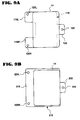
- Figs. 9A and 9B are summarized plane views showing other embodiments of a lumbar-restriction device according to the present invention. Another type of above described mount bracket 16 will be described.
- a mount bracket 116 is provided with protruding regions 118R and 118L extending backwardly, and a protruding region 122 extending forwardly.
- This point of structure is basically the same as the above described mount bracket 16.
- Mounting holes 120R and 120L are formed at corners of the backward protruding regions 118R and 118L, so that fixing bolts are inserted in the holes.
- the forward protruding region 122 is also provided with a fixing hole 124.
- the mount bracket 116 shown in Fig. 9A has different shape of backward protruding regions 118R and 118L, which is about rectangle having the uniform width. According to the mount bracket 116 shown in Fig. 9A , the amount of deform of the backward protruding regions 118R and 118L in respond to a large amount of pressure applied to the inflated airbag 14 is smaller, as compared with the above described mount bracket 16.
- a mount bracket 216 is provided with a protruding region 218, which is shaped to have the same width as the body region and to extend backwardly.
- a protruding region 222 extending forwardly is the same as that shown in Fig. 9A .
- Mount holes 220R and 220L are formed at the corners of the backward protruding region 218, so that fixing bolts are inserted therein.
- a mount hole 224 is formed on the forward protruding region 222 as well.
- the mount bracket 216 shown in Fig. 9B is shaped to have the backward protruding region 218, which is different in shape from that of the above described mount bracket 16, the region being shaped to have the same width as the body region.
- the amount of deform of the backward protruding region 218 in respond to a large amount of pressure applied to the inflated airbag 14 is smaller, as compared with Fig. 9A .
- the device in the same manner as the first embodiment, it is possible to design the device so that the protruding regions 118L and 118L (220L and 220R) extend forwardly and the protruding region 122 (222) extends backwardly.
Landscapes
- Engineering & Computer Science (AREA)
- Mechanical Engineering (AREA)
- Aviation & Aerospace Engineering (AREA)
- Transportation (AREA)
- Air Bags (AREA)
- Seats For Vehicles (AREA)
Abstract
Description
- The present invention relates to an airbag device for a vehicle, which has a function to restrict and protect a passenger at a seat in the vehicle when an accident happens.
- When a frontal crash of a vehicle occurs, passengers in the vehicle tend to move forward due to force of inertia. When the passenger fastens a seatbelt on, a shoulder belt and a lumbar belt of the seatbelt device might restrict forward movement of the passenger. In order to improve such restriction performance or to supplement such restriction performance when the passenger is not wearing a seatbelt on, a lumbar restriction device has been proposed (for example, see Patent Publications 1-4), in which a front part of a seat cushion is lifted up immediately in response to a frontal crash or sudden-slowdown to restrict forward movement of the passenger.
-
- [Patent Publication 1]
JP H05-229378A - [Patent Publication 2]
JP H10-217818A - [Patent Publication 3]
GB2357466A - [Patent Publication 4]
WO01/45978A1 - However, according to a conventional lumbar-restriction device, when a larger pressure is applied to a developed inflatable bag from the passenger, it would be difficult to support the inflatable bag with a mount bracket. As a result, restriction performance would be deteriorated. On the other hand, if the interior pressure of the inflatable bag is reduced, restriction performance of the passenger, which is the fundamental function of the device, would be deteriorated.
- For that reason, it can be considered that strength of a mount bracket and joint members (bolts and the like) is increased or the number of points to be fixed to a vehicle body is increased. However, if such countermeasures are carried out, the stiffness of the device would be increased as whole, impact or pressure applied from the passenger to the inflatable bag is hardly absorbed, and therefore, the passenger would have damage at his or her lumbar. Further, stress is concentrated to the inflatable bag and the bag would be damaged.
- In addition to solve a problem due to impact or pressure from a passenger to an inflatable bag, it has been required to mount an airbag device in a vehicle easily.
- The present invention has been created in view of the above-described problems, and an object is to improve reliability of installation of an inflatable bag to a vehicle body.
- Another object of the present invention is to provide an airbag device for restricting a lumbar of a passenger, which can absorb impact applied to the inflatable bag sufficiently when larger pressure (impact, energy) is applied from a passenger to a developed inflatable bag.
- A further object of the present invention is to provide an airbag device for restricting a lumbar of a passenger, which can be installed in a vehicle easily.
- In order to achieve the above objects, according to the present invention, an airbag device for restricting a lumbar region according to the present invention comprises: an inflatable bag, which is compressed and accommodated under a seat cushion to develop and inflate when an accident occurs; an inflator which supplies an inflation gas to the inflatable bag when an accident occurs; and a mount bracket, which is arranged between a bottom surface of the inflatable bag and the vehicle body and is fixed to both the inflatable bag and the vehicle body. Further the present invention is characterized in that said mount bracket comprises: a body region connected to the bottom surface of the inflatable bag; and a first protruding region, which extends outwardly from the body region, protrudes forward or backward under the inflatable bag and to be connected to the vehicle body.
- Preferably, said first protruding region comprises a pair of connecting regions, which extend forwardly or backwardly and are arranged at left and right sides with a predetermined space. Further, each of said pair of connecting regions comprises a first portion extending forwardly or backwardly from the body region, and a second portion extending in left and right direction from the first portion, a region around an end of said second portion being connected to the vehicle body. Here, said first portion and second portion may be formed integrally or separately. Further, the first portion and the second portion may form a circular arc part or a perpendicular part.
- Further, preferably, said mount bracket further comprises a second protruding region, which extends from the bottom surface of the inflatable bag in a direction opposing to the direction the first protruding region extending in, the second protruding region being connected to the vehicle body.
- In the present invention, an inflatable bag may be made of metal, resin and fabric.
- In general, according to a lumbar restriction device, a mount bracket is fixed on a bottom surface of an inflatable bag, and the bracket is fixed to the vehicle body. According to a conventional lumbar restriction device, in order mainly to minimize a mounting space, a mount bracket is arranged under an inflatable bag so that the bracket is completely covered (overlapped or hide) with the inflatable bag in plane view (in development direction). However, according to such an arrangement, as described above, when pressure (impact) is applied from the lumbar of a passenger to a developed inflatable bag, the impact may not be supported.
- On the other hand, according to the present invention, since a mount bracket includes a first protruding region, which protruded outwardly from the inflatable bag at least forwardly or backwardly and is fixed to the vehicle body, when pressure (impact) is applied from the lumbar of a passenger to a developed inflatable bag, the impact is supported by the connecting portion of the first protruding region. According to the conventional technology, since connecting portion of a mount bracket, fixed to a vehicle body, is located under an inflatable bag, and such a connecting point is close to a point of action (load point), it is difficult to support pressure or impact at the connecting point. On the other hand, according to the present invention, since connecting portion of a mount bracket, fixed to a vehicle body, is located sufficiently apart from a point of action (load point), as compared with the conventional technology, it is easy to support pressure or impact at the connecting point. As a result, reliability of installation of an inflatable bag to a vehicle body is improved, and restriction performance of passenger is also improved.
- Further, if the first protruding region is designed to include a pair of connecting regions, which extend forwardly or backwardly and are arranged at left and right sides with a predetermined space, the first protruding region would be deformed easily in response to external force as compared with a structure in which the first protruding region is shaped to continue in a width direction of the inflatable bag. As a result, when a larger impact (force) is applied from the passenger to the inflatable bag, the first protruding region itself is deformed, so that impact applied to the passenger and impact applied to the inflatable bag can be reduced (absorbed).
- Further, if each of said pair of connecting regions includes a first portion extending forwardly or backwardly from the body region, and a second portion extending in left and right direction from the first portion, a region around an end of said second portion being connected to the vehicle body, the connecting regions themselves could be deformed more easily. For example, the first and second portions may form a "L" shape or "C" shape.
- In addition, according to the present invention, the mount bracket protrudes outwardly from the airbag, so that installation process can be performed above the airbag without bolt-fixing operation on the bottom of the device.
-
Fig. 1 is an explanatory diagram showing an operating condition (mounted condition) of a lumbar-restriction airbag device according to an embodiment of the present invention, the device being in a condition prior to development.Fig. 2 shows the device in a condition after development.Fig. 3 is a cross-sectional view of anairbag 14. - An airbag device for
lumbar restraint 10 is designed to be arranged inside or under aseat cushion 12 so that a lumbar of a passenger M sitting on theseat cushion 12 is restrained to restrict forward movement of the passenger when an accident (frontal crash, etc.) occurs. Theairbag device 10 includes an airbag (inflatable bag) 14, which has a bottom surface fixed to a vehicle body with a mount bracket (later described) and is accommodated in an inflatable condition; and aninflator 18 functioning as a gas supplying device to supply an inflation gas into theairbag 14. Theairbag 14 may be made of a metal sheet having a thickness of about 0.4mm or a molded-resin sheet having a thickness larger than the metal sheet. Also, theairbag 14 may be made of a fabric. Theairbag 14 may be arranged to develop with a tilted angle relative to a traveling direction of the vehicle. -
Figs. 4 and5 are perspective views showing a mount bracket (16) used in a lumbar-restriction airbag device according to the present invention, in whichFig. 4 is a top view (viewing from theairbag 14 side) andFig. 5 is a bottom view.Fig. 6 is a plane view showing an arrangement (relation in location) of the airbag (14) and a mount bracket (16) in a lumbar-restriction airbag device according to the present invention. - The
mount bracket 16 is located generally to be hidden below theairbag 14, and is provided with abody region 20 to be fixed to theairbag 14, protrudingregions body region 20, and aprotruding region 26 extending forwardly from thebody region 20. Themount bracket 16 may be made of, for example, a galvanized sheet iron having a thickness of 2mm. Thebody region 20 and theprotruding regions body region 20 is provided at its center with acavity 24 in which aninflator 18 is accommodated. - The
forward protruding region 26 is provided with amounting hole 28 through which a bolt is inserted to fix the bracket to the vehicle body. Also, the backward protrudingregion 30R is provided with amounting hole 32R through which a bolt is inserted, and analignment hole 34R through which an alignment pin is inserted. In the same manner, the backward protrudingregion 30L is provided with amounting hole 32L through which a bolt is inserted, and analignment hole 34L through which an alignment pin is inserted. - As shown in
Fig. 6 , the body region (20) of themount bracket 16 is overlapped by theairbag 14, while theprotruding regions - As shown in
Fig. 5 , as an overall shape, the backwardprotruding regions body region 20, those region having ends bending in right and left directions, respectively. Here, preferably, themounting holes mounting holes protruding regions airbag 14. That is because; a point connected to the body and a joining line of the fixing locations (32R, 32L) are offset from each other in a load direction (left and right direction inFig. 6 ). Further, the protrudingregions - When mounting a lumbar-restricting airbag device according to the present invention to a vehicle, the
mount bracket 16 is fixed to the bottom of theairbag 14 using bolts. Next, themount bracket 16 with theairbag 14 is arranged under a seat, pins provided to the vehicle (not shown) are inserted into thealignment holes -
Fig. 7 is an explanatory diagram showing operation of a lumbar-restriction airbag device according to the present invention. When an accident, such as a frontal crash, occurs, theinflator 18 operates to supply an inflation gas into theairbag 14. Theairbag 14 is inflated and restrict forward movement of a passenger. At this time, body weight of the passenger is applied to theairbag 14, for example, at a point "X"A inFig. 7 . When pressure or impact applied to the point "X", theairbag 14 is rotated and moved forwardly. According to the conventional structure, since amount bracket 16 and avehicle body 16 are fixed to each other under anairbag 14, as shown with fine doted lines, distances between the point "X" and fixed points become short, and therefore, it is difficult to receive impact applied thereto. On the other hand, according to the present invention, as shown with alternate long and short dash lines, distances between the point "X" and fixed points (32R, 32L and 28) become longer, and therefore, it is relatively easy to receive impact applied to the airbag. -
Fig. 8 is an explanatory diagram showing operation of a lumbar-restriction airbag device according to the present invention, in which (A) shows a condition just developed and (B) shows a condition pressure is applied from a passenger. InFigs. 8A and 8B , the shape of themount bracket 16 is simplified. In structure, it can be described that the backward protrudingregions vertical extension portions - In the same manner as the description of
Fig. 7 , when theairbag 14 is inflated, as shown inFig. 8A , and then pressure is applied from the passenger to theairbag 14, the protrudingregions airbag 14 is absorbed and impact to the passenger is reduced. - Although according to the present embodiment, the protruding
regions mount bracket 16 extend backwardly and the protrudingregion 26 extends forwardly, it is possible to design the device so that the protrudingregions region 26 extends backwardly. -
Figs. 9A and 9B are summarized plane views showing other embodiments of a lumbar-restriction device according to the present invention. Another type of above describedmount bracket 16 will be described. According to an embodiment shown inFig. 9A , amount bracket 116 is provided with protrudingregions protruding region 122 extending forwardly. This point of structure is basically the same as the above describedmount bracket 16. Mountingholes regions protruding region 122 is also provided with a fixinghole 124. As compared with the above describedmount bracket 16, themount bracket 116 shown inFig. 9A has different shape of backward protrudingregions mount bracket 116 shown inFig. 9A , the amount of deform of the backward protrudingregions inflated airbag 14 is smaller, as compared with the above describedmount bracket 16. - According to an embodiment shown in
Fig. 9B , amount bracket 216 is provided with aprotruding region 218, which is shaped to have the same width as the body region and to extend backwardly. Aprotruding region 222 extending forwardly is the same as that shown inFig. 9A . Mount holes 220R and 220L are formed at the corners of the backwardprotruding region 218, so that fixing bolts are inserted therein. Amount hole 224 is formed on the forwardprotruding region 222 as well. Themount bracket 216 shown inFig. 9B is shaped to have the backwardprotruding region 218, which is different in shape from that of the above describedmount bracket 16, the region being shaped to have the same width as the body region. The amount of deform of the backwardprotruding region 218 in respond to a large amount of pressure applied to theinflated airbag 14 is smaller, as compared withFig. 9A . - In the same manner as the first embodiment, it is possible to design the device so that the protruding
regions - Although embodiments of the present invention has been described above, the present invention is not limited by those embodiments, but can be modified or changed within a scope of the subject matter described in the claims.
-
-
Fig. 1 is an explanatory diagram showing an operating condition (mounted condition) of a lumbar-restriction airbag device according to an embodiment of the present invention, the device being in a condition prior to development. -
Fig. 2 is an explanatory diagram showing an operating condition (mounted condition) of a lumbar-restriction airbag device according to an embodiment of the present invention, the device being in a condition after development. -
Fig. 3 is a cross-sectional view showing an airbag in a contained condition according to the embodiment, the airbag being inflated. -
Fig. 4 is a perspective view showing a mount bracket used in a lumbar-restriction airbag device according to the present invention, viewing from above (airbag side). -
Fig. 5 is a perspective view showing a mount bracket used in a lumbar-restriction airbag device according to the present invention, viewing from below. -
Fig. 6 is a plane view showing an arrangement of an airbag and a mount bracket in a lumbar-restriction airbag device according to the present invention. -
Fig. 7 is an explanatory diagram showing operation of a lumbar-restriction airbag device according to the present invention. -
Figs. 8A and 8B are explanatory diagrams showing operation of a lumbar-restriction airbag device according to the present invention, in whichFig. 8A shows a condition just developed andFig. 8B shows a condition pressure is applied from a passenger. -
Figs. 9A and 9B are summarized plane views showing other embodiments of a lumbar-restriction device according to the present invention. -
- 14: Airbag (Inflatable Bag)
- 16: Mount Bracket
- 18: Inflator
- 20: Body Region
- 26: Forward Protruding Region
- 30R, 30L: Backward Protruding Region
Claims (5)
- A lumbar-restriction airbag device, which restricts a lumbar region of a passenger in a vehicle when an accident occurs, which is characterized by comprising:an inflatable bag, which is compressed and accommodated under a seat cushion to develop and inflate when an accident occurs;an inflator which supplies an inflation gas to the inflatable bag when an accident occurs; anda mount bracket, which is arranged between a bottom surface of the inflatable bag and the vehicle body and is fixed to both the inflatable bag and the vehicle body, whereinsaid mount bracket comprises: a body region connected to the bottom surface of the inflatable bag; and a first protruding region, which extends outwardly from the body region, protrudes forward or backward under the inflatable bag and to be connected to the vehicle body.
- An airbag device for restricting a lumbar region according to claim 1, wherein
said first protruding region comprises a pair of connecting regions, which extend forwardly or backwardly and are arranged at left and right sides with a predetermined space. - An airbag device for restricting a lumbar region according to claim 2, wherein
each of said pair of connecting regions comprises a first portion extending forwardly or backwardly from the body region, and a second portion extending in left and right direction from the first portion, a region around an end of said second portion being connected to the vehicle body. - An airbag device for restricting a lumbar region according to claim 1, 2 or 3, wherein
said mount bracket further comprises a second protruding region, which extends from the bottom surface of the inflatable bag in a direction opposing to the direction to the first protruding region, the second protruding region being connected to the vehicle body. - A lumbar-restricting airbag device, which restricts a lumbar region of a passenger in a vehicle when an accident occurs, which is characterized by comprising:an inflatable bag, which is compressed and accommodated under a seat cushion to develop and inflate when an accident occurs;an inflator which supplies an inflation gas to the inflatable bag when an accident occurs; anda mount bracket, which is arranged between a bottom surface of the inflatable bag and the vehicle body and is fixed to both the inflatable bag and the vehicle body, whereinsaid mount bracket comprises: a body region connected to the bottom surface of the inflatable bag; and a first protruding region, which extends outwardly from the body region, protrudes forward or backward under the inflatable bag and to be connected to the vehicle body,said first protruding region comprises a pair of connecting regions, which extend forwardly or backwardly and are arranged at left and right sides with a predetermined space,each of said pair of connecting regions comprises a first portion extending forwardly or backwardly from the body region, and a second portion extending in left and right direction from the first portion, a region around an end of said second portion being connected to the vehicle body, andsaid mount bracket further comprises a second protruding region, which extends from the bottom surface of the inflatable bag in a direction opposing to the direction the first protruding region extending in, the second protruding region being connected to the vehicle body.
Applications Claiming Priority (2)
| Application Number | Priority Date | Filing Date | Title |
|---|---|---|---|
| JP2006280887 | 2006-10-16 | ||
| PCT/JP2007/001097 WO2008047467A1 (en) | 2006-10-16 | 2007-10-10 | Airbag device for restraining waist part |
Publications (3)
| Publication Number | Publication Date |
|---|---|
| EP2078645A1 true EP2078645A1 (en) | 2009-07-15 |
| EP2078645A4 EP2078645A4 (en) | 2010-01-20 |
| EP2078645B1 EP2078645B1 (en) | 2014-04-30 |
Family
ID=39313723
Family Applications (1)
| Application Number | Title | Priority Date | Filing Date |
|---|---|---|---|
| EP07827876.9A Active EP2078645B1 (en) | 2006-10-16 | 2007-10-10 | Airbag device for restraining waist part |
Country Status (4)
| Country | Link |
|---|---|
| EP (1) | EP2078645B1 (en) |
| JP (1) | JP5117389B2 (en) |
| CN (1) | CN101528512B (en) |
| WO (1) | WO2008047467A1 (en) |
Cited By (1)
| Publication number | Priority date | Publication date | Assignee | Title |
|---|---|---|---|---|
| DE102015006898A1 (en) * | 2015-06-03 | 2016-12-22 | Trw Airbag Systems Gmbh | An assembly of a vehicle safety system, vehicle safety system, vehicle safety device, and method for manufacturing an assembly of a vehicle safety system |
Families Citing this family (1)
| Publication number | Priority date | Publication date | Assignee | Title |
|---|---|---|---|---|
| KR102718598B1 (en) * | 2019-08-09 | 2024-10-18 | 아우토리브 디벨롭먼트 아베 | Airbag device, vehicle seat, and method of ignition of airbag device |
Family Cites Families (7)
| Publication number | Priority date | Publication date | Assignee | Title |
|---|---|---|---|---|
| DE4313616A1 (en) * | 1993-04-26 | 1994-10-27 | Trw Repa Gmbh | Airbag restraint system for vehicles |
| JPH0781466A (en) | 1993-09-10 | 1995-03-28 | Nissan Motor Co Ltd | Seat lower structure for restraining forward movement of passengers |
| JP2001171458A (en) * | 1999-12-14 | 2001-06-26 | Ashimori Ind Co Ltd | Airbag apparatus and airbag folding method |
| JP4453176B2 (en) * | 2000-09-06 | 2010-04-21 | 豊田合成株式会社 | Bench seat for vehicle |
| US20050067209A1 (en) * | 2003-09-30 | 2005-03-31 | Takata Corporation | Passenger protecting device |
| JP2005126051A (en) * | 2003-09-30 | 2005-05-19 | Takata Corp | Occupant protecting device |
| JP4143063B2 (en) * | 2004-11-19 | 2008-09-03 | オートリブ ディベロップメント エービー | Lumbar restraint device and vehicle seat |
-
2007
- 2007-10-10 CN CN2007800379571A patent/CN101528512B/en not_active Expired - Fee Related
- 2007-10-10 EP EP07827876.9A patent/EP2078645B1/en active Active
- 2007-10-10 WO PCT/JP2007/001097 patent/WO2008047467A1/en not_active Ceased
- 2007-10-10 JP JP2008539673A patent/JP5117389B2/en active Active
Cited By (2)
| Publication number | Priority date | Publication date | Assignee | Title |
|---|---|---|---|---|
| DE102015006898A1 (en) * | 2015-06-03 | 2016-12-22 | Trw Airbag Systems Gmbh | An assembly of a vehicle safety system, vehicle safety system, vehicle safety device, and method for manufacturing an assembly of a vehicle safety system |
| US10259415B2 (en) | 2015-06-03 | 2019-04-16 | Trw Airbag Systems Gmbh | Subassembly of a vehicle safety system, vehicle safety system, vehicle safety device and method of manufacturing a subassembly of a vehicle safety system |
Also Published As
| Publication number | Publication date |
|---|---|
| JPWO2008047467A1 (en) | 2010-02-18 |
| WO2008047467A1 (en) | 2008-04-24 |
| CN101528512B (en) | 2011-04-13 |
| EP2078645A4 (en) | 2010-01-20 |
| CN101528512A (en) | 2009-09-09 |
| EP2078645B1 (en) | 2014-04-30 |
| JP5117389B2 (en) | 2013-01-16 |
Similar Documents
| Publication | Publication Date | Title |
|---|---|---|
| US9944246B2 (en) | Occupant protection device | |
| EP2631126B1 (en) | Rear seat side airbag device | |
| US20210146874A1 (en) | Airbag apparatus | |
| EP2617606B1 (en) | Vehicle rear side airbag device fixing structure | |
| EP3112211B1 (en) | Vehicle seat | |
| JP6455483B2 (en) | Crew protection device | |
| CN101574951B (en) | Vehicle occupant protection system | |
| US20200238943A1 (en) | Passenger protection device for front passenger seat | |
| US8573691B2 (en) | Vehicle seat | |
| EP1772329B1 (en) | Inflator attaching structure and lap anchor | |
| JP6374361B2 (en) | Crew protection device | |
| EP3514007B1 (en) | Vehicle seat | |
| CN110871720A (en) | vehicle seat | |
| JP5675293B2 (en) | Vehicle seat equipped with an airbag device | |
| JP2023073310A (en) | vehicle seat | |
| EP3744579B1 (en) | Side air bag device and vehicle seat with same | |
| JP6517662B2 (en) | Occupant protection device | |
| JP6491081B2 (en) | Crew protection device | |
| EP2078645A1 (en) | Airbag device for restraining waist part | |
| JP6499093B2 (en) | Crew protection device | |
| EP1767396A1 (en) | Waist restraining airbag device and seat cushion device using the same | |
| JP2006321284A (en) | Vehicle seat | |
| JP2017030374A (en) | Occupant protection device | |
| JP2024043671A (en) | Vehicle seat | |
| JP5704059B2 (en) | Vehicle occupant restraint system |
Legal Events
| Date | Code | Title | Description |
|---|---|---|---|
| PUAI | Public reference made under article 153(3) epc to a published international application that has entered the european phase |
Free format text: ORIGINAL CODE: 0009012 |
|
| 17P | Request for examination filed |
Effective date: 20090518 |
|
| AK | Designated contracting states |
Kind code of ref document: A1 Designated state(s): AT BE BG CH CY CZ DE DK EE ES FI FR GB GR HU IE IS IT LI LT LU LV MC MT NL PL PT RO SE SI SK TR |
|
| A4 | Supplementary search report drawn up and despatched |
Effective date: 20091218 |
|
| 17Q | First examination report despatched |
Effective date: 20100329 |
|
| DAX | Request for extension of the european patent (deleted) | ||
| REG | Reference to a national code |
Ref country code: DE Ref legal event code: R079 Ref document number: 602007036399 Country of ref document: DE Free format text: PREVIOUS MAIN CLASS: B60R0021200000 Ipc: B60R0021207000 |
|
| RIC1 | Information provided on ipc code assigned before grant |
Ipc: B60R 21/207 20060101AFI20130814BHEP Ipc: B60N 2/427 20060101ALI20130814BHEP |
|
| GRAP | Despatch of communication of intention to grant a patent |
Free format text: ORIGINAL CODE: EPIDOSNIGR1 |
|
| INTG | Intention to grant announced |
Effective date: 20131016 |
|
| GRAS | Grant fee paid |
Free format text: ORIGINAL CODE: EPIDOSNIGR3 |
|
| GRAP | Despatch of communication of intention to grant a patent |
Free format text: ORIGINAL CODE: EPIDOSNIGR1 |
|
| GRAA | (expected) grant |
Free format text: ORIGINAL CODE: 0009210 |
|
| INTG | Intention to grant announced |
Effective date: 20140313 |
|
| AK | Designated contracting states |
Kind code of ref document: B1 Designated state(s): AT BE BG CH CY CZ DE DK EE ES FI FR GB GR HU IE IS IT LI LT LU LV MC MT NL PL PT RO SE SI SK TR |
|
| REG | Reference to a national code |
Ref country code: GB Ref legal event code: FG4D Ref country code: CH Ref legal event code: EP |
|
| REG | Reference to a national code |
Ref country code: AT Ref legal event code: REF Ref document number: 664890 Country of ref document: AT Kind code of ref document: T Effective date: 20140515 |
|
| REG | Reference to a national code |
Ref country code: IE Ref legal event code: FG4D |
|
| REG | Reference to a national code |
Ref country code: DE Ref legal event code: R096 Ref document number: 602007036399 Country of ref document: DE Effective date: 20140618 |
|
| REG | Reference to a national code |
Ref country code: AT Ref legal event code: MK05 Ref document number: 664890 Country of ref document: AT Kind code of ref document: T Effective date: 20140430 |
|
| REG | Reference to a national code |
Ref country code: LT Ref legal event code: MG4D |
|
| REG | Reference to a national code |
Ref country code: NL Ref legal event code: VDEP Effective date: 20140430 |
|
| PG25 | Lapsed in a contracting state [announced via postgrant information from national office to epo] |
Ref country code: BG Free format text: LAPSE BECAUSE OF FAILURE TO SUBMIT A TRANSLATION OF THE DESCRIPTION OR TO PAY THE FEE WITHIN THE PRESCRIBED TIME-LIMIT Effective date: 20140730 Ref country code: CY Free format text: LAPSE BECAUSE OF FAILURE TO SUBMIT A TRANSLATION OF THE DESCRIPTION OR TO PAY THE FEE WITHIN THE PRESCRIBED TIME-LIMIT Effective date: 20140430 Ref country code: LT Free format text: LAPSE BECAUSE OF FAILURE TO SUBMIT A TRANSLATION OF THE DESCRIPTION OR TO PAY THE FEE WITHIN THE PRESCRIBED TIME-LIMIT Effective date: 20140430 Ref country code: GR Free format text: LAPSE BECAUSE OF FAILURE TO SUBMIT A TRANSLATION OF THE DESCRIPTION OR TO PAY THE FEE WITHIN THE PRESCRIBED TIME-LIMIT Effective date: 20140731 Ref country code: FI Free format text: LAPSE BECAUSE OF FAILURE TO SUBMIT A TRANSLATION OF THE DESCRIPTION OR TO PAY THE FEE WITHIN THE PRESCRIBED TIME-LIMIT Effective date: 20140430 Ref country code: IS Free format text: LAPSE BECAUSE OF FAILURE TO SUBMIT A TRANSLATION OF THE DESCRIPTION OR TO PAY THE FEE WITHIN THE PRESCRIBED TIME-LIMIT Effective date: 20140830 Ref country code: NL Free format text: LAPSE BECAUSE OF FAILURE TO SUBMIT A TRANSLATION OF THE DESCRIPTION OR TO PAY THE FEE WITHIN THE PRESCRIBED TIME-LIMIT Effective date: 20140430 |
|
| PG25 | Lapsed in a contracting state [announced via postgrant information from national office to epo] |
Ref country code: LV Free format text: LAPSE BECAUSE OF FAILURE TO SUBMIT A TRANSLATION OF THE DESCRIPTION OR TO PAY THE FEE WITHIN THE PRESCRIBED TIME-LIMIT Effective date: 20140430 Ref country code: ES Free format text: LAPSE BECAUSE OF FAILURE TO SUBMIT A TRANSLATION OF THE DESCRIPTION OR TO PAY THE FEE WITHIN THE PRESCRIBED TIME-LIMIT Effective date: 20140430 Ref country code: AT Free format text: LAPSE BECAUSE OF FAILURE TO SUBMIT A TRANSLATION OF THE DESCRIPTION OR TO PAY THE FEE WITHIN THE PRESCRIBED TIME-LIMIT Effective date: 20140430 Ref country code: SE Free format text: LAPSE BECAUSE OF FAILURE TO SUBMIT A TRANSLATION OF THE DESCRIPTION OR TO PAY THE FEE WITHIN THE PRESCRIBED TIME-LIMIT Effective date: 20140430 Ref country code: PL Free format text: LAPSE BECAUSE OF FAILURE TO SUBMIT A TRANSLATION OF THE DESCRIPTION OR TO PAY THE FEE WITHIN THE PRESCRIBED TIME-LIMIT Effective date: 20140430 |
|
| PG25 | Lapsed in a contracting state [announced via postgrant information from national office to epo] |
Ref country code: PT Free format text: LAPSE BECAUSE OF FAILURE TO SUBMIT A TRANSLATION OF THE DESCRIPTION OR TO PAY THE FEE WITHIN THE PRESCRIBED TIME-LIMIT Effective date: 20140901 |
|
| PG25 | Lapsed in a contracting state [announced via postgrant information from national office to epo] |
Ref country code: EE Free format text: LAPSE BECAUSE OF FAILURE TO SUBMIT A TRANSLATION OF THE DESCRIPTION OR TO PAY THE FEE WITHIN THE PRESCRIBED TIME-LIMIT Effective date: 20140430 Ref country code: CZ Free format text: LAPSE BECAUSE OF FAILURE TO SUBMIT A TRANSLATION OF THE DESCRIPTION OR TO PAY THE FEE WITHIN THE PRESCRIBED TIME-LIMIT Effective date: 20140430 Ref country code: RO Free format text: LAPSE BECAUSE OF FAILURE TO SUBMIT A TRANSLATION OF THE DESCRIPTION OR TO PAY THE FEE WITHIN THE PRESCRIBED TIME-LIMIT Effective date: 20140430 Ref country code: BE Free format text: LAPSE BECAUSE OF FAILURE TO SUBMIT A TRANSLATION OF THE DESCRIPTION OR TO PAY THE FEE WITHIN THE PRESCRIBED TIME-LIMIT Effective date: 20140430 Ref country code: DK Free format text: LAPSE BECAUSE OF FAILURE TO SUBMIT A TRANSLATION OF THE DESCRIPTION OR TO PAY THE FEE WITHIN THE PRESCRIBED TIME-LIMIT Effective date: 20140430 Ref country code: SK Free format text: LAPSE BECAUSE OF FAILURE TO SUBMIT A TRANSLATION OF THE DESCRIPTION OR TO PAY THE FEE WITHIN THE PRESCRIBED TIME-LIMIT Effective date: 20140430 |
|
| REG | Reference to a national code |
Ref country code: DE Ref legal event code: R097 Ref document number: 602007036399 Country of ref document: DE |
|
| PLBE | No opposition filed within time limit |
Free format text: ORIGINAL CODE: 0009261 |
|
| STAA | Information on the status of an ep patent application or granted ep patent |
Free format text: STATUS: NO OPPOSITION FILED WITHIN TIME LIMIT |
|
| PG25 | Lapsed in a contracting state [announced via postgrant information from national office to epo] |
Ref country code: IT Free format text: LAPSE BECAUSE OF FAILURE TO SUBMIT A TRANSLATION OF THE DESCRIPTION OR TO PAY THE FEE WITHIN THE PRESCRIBED TIME-LIMIT Effective date: 20140430 |
|
| 26N | No opposition filed |
Effective date: 20150202 |
|
| REG | Reference to a national code |
Ref country code: DE Ref legal event code: R097 Ref document number: 602007036399 Country of ref document: DE Effective date: 20150202 |
|
| PG25 | Lapsed in a contracting state [announced via postgrant information from national office to epo] |
Ref country code: MC Free format text: LAPSE BECAUSE OF FAILURE TO SUBMIT A TRANSLATION OF THE DESCRIPTION OR TO PAY THE FEE WITHIN THE PRESCRIBED TIME-LIMIT Effective date: 20140430 Ref country code: LU Free format text: LAPSE BECAUSE OF FAILURE TO SUBMIT A TRANSLATION OF THE DESCRIPTION OR TO PAY THE FEE WITHIN THE PRESCRIBED TIME-LIMIT Effective date: 20141010 |
|
| REG | Reference to a national code |
Ref country code: CH Ref legal event code: PL |
|
| REG | Reference to a national code |
Ref country code: IE Ref legal event code: MM4A |
|
| PG25 | Lapsed in a contracting state [announced via postgrant information from national office to epo] |
Ref country code: SI Free format text: LAPSE BECAUSE OF FAILURE TO SUBMIT A TRANSLATION OF THE DESCRIPTION OR TO PAY THE FEE WITHIN THE PRESCRIBED TIME-LIMIT Effective date: 20140430 Ref country code: CH Free format text: LAPSE BECAUSE OF NON-PAYMENT OF DUE FEES Effective date: 20141031 Ref country code: LI Free format text: LAPSE BECAUSE OF NON-PAYMENT OF DUE FEES Effective date: 20141031 |
|
| REG | Reference to a national code |
Ref country code: FR Ref legal event code: PLFP Year of fee payment: 9 |
|
| PG25 | Lapsed in a contracting state [announced via postgrant information from national office to epo] |
Ref country code: IE Free format text: LAPSE BECAUSE OF NON-PAYMENT OF DUE FEES Effective date: 20141010 |
|
| PG25 | Lapsed in a contracting state [announced via postgrant information from national office to epo] |
Ref country code: HU Free format text: LAPSE BECAUSE OF FAILURE TO SUBMIT A TRANSLATION OF THE DESCRIPTION OR TO PAY THE FEE WITHIN THE PRESCRIBED TIME-LIMIT; INVALID AB INITIO Effective date: 20071010 Ref country code: MT Free format text: LAPSE BECAUSE OF FAILURE TO SUBMIT A TRANSLATION OF THE DESCRIPTION OR TO PAY THE FEE WITHIN THE PRESCRIBED TIME-LIMIT Effective date: 20140430 Ref country code: TR Free format text: LAPSE BECAUSE OF FAILURE TO SUBMIT A TRANSLATION OF THE DESCRIPTION OR TO PAY THE FEE WITHIN THE PRESCRIBED TIME-LIMIT Effective date: 20140430 |
|
| REG | Reference to a national code |
Ref country code: FR Ref legal event code: PLFP Year of fee payment: 10 |
|
| REG | Reference to a national code |
Ref country code: FR Ref legal event code: PLFP Year of fee payment: 11 |
|
| REG | Reference to a national code |
Ref country code: FR Ref legal event code: PLFP Year of fee payment: 12 |
|
| PGFP | Annual fee paid to national office [announced via postgrant information from national office to epo] |
Ref country code: GB Payment date: 20201028 Year of fee payment: 14 |
|
| GBPC | Gb: european patent ceased through non-payment of renewal fee |
Effective date: 20211010 |
|
| PG25 | Lapsed in a contracting state [announced via postgrant information from national office to epo] |
Ref country code: GB Free format text: LAPSE BECAUSE OF NON-PAYMENT OF DUE FEES Effective date: 20211010 |
|
| PGFP | Annual fee paid to national office [announced via postgrant information from national office to epo] |
Ref country code: DE Payment date: 20241029 Year of fee payment: 18 |
|
| PGFP | Annual fee paid to national office [announced via postgrant information from national office to epo] |
Ref country code: FR Payment date: 20241025 Year of fee payment: 18 |