EP2072613A1 - Bleaching agent composition - Google Patents
Bleaching agent composition Download PDFInfo
- Publication number
- EP2072613A1 EP2072613A1 EP07831183A EP07831183A EP2072613A1 EP 2072613 A1 EP2072613 A1 EP 2072613A1 EP 07831183 A EP07831183 A EP 07831183A EP 07831183 A EP07831183 A EP 07831183A EP 2072613 A1 EP2072613 A1 EP 2072613A1
- Authority
- EP
- European Patent Office
- Prior art keywords
- group
- alkyl
- monomer
- mass
- bleaching composition
- Prior art date
- Legal status (The legal status is an assumption and is not a legal conclusion. Google has not performed a legal analysis and makes no representation as to the accuracy of the status listed.)
- Withdrawn
Links
- 239000000203 mixture Substances 0.000 title claims abstract description 55
- 239000007844 bleaching agent Substances 0.000 title description 6
- 239000000178 monomer Substances 0.000 claims abstract description 62
- 238000004061 bleaching Methods 0.000 claims abstract description 51
- -1 alkali metal hypochlorite Chemical class 0.000 claims abstract description 29
- 239000000470 constituent Substances 0.000 claims abstract description 28
- WQYVRQLZKVEZGA-UHFFFAOYSA-N hypochlorite Inorganic materials Cl[O-] WQYVRQLZKVEZGA-UHFFFAOYSA-N 0.000 claims abstract description 22
- 125000001453 quaternary ammonium group Chemical group 0.000 claims abstract description 21
- 239000004094 surface-active agent Substances 0.000 claims abstract description 16
- 229920000642 polymer Polymers 0.000 claims abstract description 14
- 150000001875 compounds Chemical class 0.000 claims abstract description 13
- 229910052783 alkali metal Inorganic materials 0.000 claims abstract description 11
- 125000000129 anionic group Chemical group 0.000 claims abstract description 9
- XLYOFNOQVPJJNP-UHFFFAOYSA-N water Substances O XLYOFNOQVPJJNP-UHFFFAOYSA-N 0.000 claims abstract description 9
- 125000000467 secondary amino group Chemical group [H]N([*:1])[*:2] 0.000 claims abstract 2
- 125000001302 tertiary amino group Chemical group 0.000 claims abstract 2
- 125000000217 alkyl group Chemical group 0.000 claims description 23
- 229920005989 resin Polymers 0.000 claims description 18
- 239000011347 resin Substances 0.000 claims description 18
- 238000000034 method Methods 0.000 claims description 14
- 125000004435 hydrogen atom Chemical group [H]* 0.000 claims description 13
- 125000002768 hydroxyalkyl group Chemical group 0.000 claims description 12
- 150000008051 alkyl sulfates Chemical class 0.000 claims description 7
- 125000002496 methyl group Chemical group [H]C([H])([H])* 0.000 claims description 7
- 125000002947 alkylene group Chemical group 0.000 claims description 4
- 150000001450 anions Chemical class 0.000 claims description 4
- 229940077388 benzenesulfonate Drugs 0.000 claims description 3
- 229910052736 halogen Inorganic materials 0.000 claims description 3
- 150000001340 alkali metals Chemical class 0.000 claims description 2
- 229910052784 alkaline earth metal Inorganic materials 0.000 claims description 2
- 150000001342 alkaline earth metals Chemical class 0.000 claims description 2
- 125000001797 benzyl group Chemical group [H]C1=C([H])C([H])=C(C([H])=C1[H])C([H])([H])* 0.000 claims description 2
- 125000001495 ethyl group Chemical group [H]C([H])([H])C([H])([H])* 0.000 claims description 2
- 125000002887 hydroxy group Chemical group [H]O* 0.000 claims description 2
- 125000001997 phenyl group Chemical group [H]C1=C([H])C([H])=C(*)C([H])=C1[H] 0.000 claims description 2
- 229920001577 copolymer Polymers 0.000 claims 1
- 239000000463 material Substances 0.000 description 13
- HEMHJVSKTPXQMS-UHFFFAOYSA-M Sodium hydroxide Chemical compound [OH-].[Na+] HEMHJVSKTPXQMS-UHFFFAOYSA-M 0.000 description 12
- 239000003599 detergent Substances 0.000 description 11
- 150000003839 salts Chemical class 0.000 description 10
- ZAMOUSCENKQFHK-UHFFFAOYSA-N Chlorine atom Chemical compound [Cl] ZAMOUSCENKQFHK-UHFFFAOYSA-N 0.000 description 9
- 125000004432 carbon atom Chemical group C* 0.000 description 9
- 239000000460 chlorine Substances 0.000 description 9
- 229910052801 chlorine Inorganic materials 0.000 description 9
- 230000000694 effects Effects 0.000 description 9
- 150000008044 alkali metal hydroxides Chemical class 0.000 description 7
- 150000001412 amines Chemical class 0.000 description 6
- 239000002304 perfume Substances 0.000 description 6
- 230000000379 polymerizing effect Effects 0.000 description 6
- 239000000243 solution Substances 0.000 description 6
- CERQOIWHTDAKMF-UHFFFAOYSA-N Methacrylic acid Chemical compound CC(=C)C(O)=O CERQOIWHTDAKMF-UHFFFAOYSA-N 0.000 description 5
- 239000003795 chemical substances by application Substances 0.000 description 5
- 150000003242 quaternary ammonium salts Chemical class 0.000 description 5
- IAYPIBMASNFSPL-UHFFFAOYSA-N Ethylene oxide Chemical compound C1CO1 IAYPIBMASNFSPL-UHFFFAOYSA-N 0.000 description 4
- GOOHAUXETOMSMM-UHFFFAOYSA-N Propylene oxide Chemical compound CC1CO1 GOOHAUXETOMSMM-UHFFFAOYSA-N 0.000 description 4
- PPBRXRYQALVLMV-UHFFFAOYSA-N Styrene Chemical compound C=CC1=CC=CC=C1 PPBRXRYQALVLMV-UHFFFAOYSA-N 0.000 description 4
- RAHZWNYVWXNFOC-UHFFFAOYSA-N Sulphur dioxide Chemical compound O=S=O RAHZWNYVWXNFOC-UHFFFAOYSA-N 0.000 description 4
- 125000003647 acryloyl group Chemical group O=C([*])C([H])=C([H])[H] 0.000 description 4
- 229910001514 alkali metal chloride Inorganic materials 0.000 description 4
- 150000008052 alkyl sulfonates Chemical class 0.000 description 4
- 150000001408 amides Chemical class 0.000 description 4
- 230000001236 detergent effect Effects 0.000 description 4
- 238000012856 packing Methods 0.000 description 4
- 238000006116 polymerization reaction Methods 0.000 description 4
- 150000003335 secondary amines Chemical group 0.000 description 4
- 238000005507 spraying Methods 0.000 description 4
- 150000003512 tertiary amines Chemical group 0.000 description 4
- WEVYAHXRMPXWCK-UHFFFAOYSA-N Acetonitrile Chemical compound CC#N WEVYAHXRMPXWCK-UHFFFAOYSA-N 0.000 description 3
- 241000894006 Bacteria Species 0.000 description 3
- CERQOIWHTDAKMF-UHFFFAOYSA-M Methacrylate Chemical compound CC(=C)C([O-])=O CERQOIWHTDAKMF-UHFFFAOYSA-M 0.000 description 3
- 229920003171 Poly (ethylene oxide) Polymers 0.000 description 3
- KWYUFKZDYYNOTN-UHFFFAOYSA-M Potassium hydroxide Chemical compound [OH-].[K+] KWYUFKZDYYNOTN-UHFFFAOYSA-M 0.000 description 3
- 239000005708 Sodium hypochlorite Substances 0.000 description 3
- 239000003513 alkali Substances 0.000 description 3
- 239000003093 cationic surfactant Substances 0.000 description 3
- 238000011156 evaluation Methods 0.000 description 3
- 229910052757 nitrogen Inorganic materials 0.000 description 3
- 229920000915 polyvinyl chloride Polymers 0.000 description 3
- 239000004800 polyvinyl chloride Substances 0.000 description 3
- 239000012260 resinous material Substances 0.000 description 3
- SUKJFIGYRHOWBL-UHFFFAOYSA-N sodium hypochlorite Chemical compound [Na+].Cl[O-] SUKJFIGYRHOWBL-UHFFFAOYSA-N 0.000 description 3
- AKEJUJNQAAGONA-UHFFFAOYSA-N sulfur trioxide Inorganic materials O=S(=O)=O AKEJUJNQAAGONA-UHFFFAOYSA-N 0.000 description 3
- SMZOUWXMTYCWNB-UHFFFAOYSA-N 2-(2-methoxy-5-methylphenyl)ethanamine Chemical compound COC1=CC=C(C)C=C1CCN SMZOUWXMTYCWNB-UHFFFAOYSA-N 0.000 description 2
- NIXOWILDQLNWCW-UHFFFAOYSA-N 2-Propenoic acid Natural products OC(=O)C=C NIXOWILDQLNWCW-UHFFFAOYSA-N 0.000 description 2
- WWUVJRULCWHUSA-UHFFFAOYSA-N 2-methyl-1-pentene Chemical compound CCCC(C)=C WWUVJRULCWHUSA-UHFFFAOYSA-N 0.000 description 2
- AGBXYHCHUYARJY-UHFFFAOYSA-N 2-phenylethenesulfonic acid Chemical compound OS(=O)(=O)C=CC1=CC=CC=C1 AGBXYHCHUYARJY-UHFFFAOYSA-N 0.000 description 2
- RYKZRKKEYSRDNF-UHFFFAOYSA-N 3-methylidenepentane Chemical compound CCC(=C)CC RYKZRKKEYSRDNF-UHFFFAOYSA-N 0.000 description 2
- WSSSPWUEQFSQQG-UHFFFAOYSA-N 4-methyl-1-pentene Chemical compound CC(C)CC=C WSSSPWUEQFSQQG-UHFFFAOYSA-N 0.000 description 2
- NIXOWILDQLNWCW-UHFFFAOYSA-M Acrylate Chemical compound [O-]C(=O)C=C NIXOWILDQLNWCW-UHFFFAOYSA-M 0.000 description 2
- VVJKKWFAADXIJK-UHFFFAOYSA-N Allylamine Chemical compound NCC=C VVJKKWFAADXIJK-UHFFFAOYSA-N 0.000 description 2
- VEXZGXHMUGYJMC-UHFFFAOYSA-M Chloride anion Chemical compound [Cl-] VEXZGXHMUGYJMC-UHFFFAOYSA-M 0.000 description 2
- MHAJPDPJQMAIIY-UHFFFAOYSA-N Hydrogen peroxide Chemical compound OO MHAJPDPJQMAIIY-UHFFFAOYSA-N 0.000 description 2
- RRHGJUQNOFWUDK-UHFFFAOYSA-N Isoprene Chemical compound CC(=C)C=C RRHGJUQNOFWUDK-UHFFFAOYSA-N 0.000 description 2
- WCUXLLCKKVVCTQ-UHFFFAOYSA-M Potassium chloride Chemical compound [Cl-].[K+] WCUXLLCKKVVCTQ-UHFFFAOYSA-M 0.000 description 2
- OFOBLEOULBTSOW-UHFFFAOYSA-N Propanedioic acid Natural products OC(=O)CC(O)=O OFOBLEOULBTSOW-UHFFFAOYSA-N 0.000 description 2
- FAPWRFPIFSIZLT-UHFFFAOYSA-M Sodium chloride Chemical compound [Na+].[Cl-] FAPWRFPIFSIZLT-UHFFFAOYSA-M 0.000 description 2
- QAOWNCQODCNURD-UHFFFAOYSA-N Sulfuric acid Chemical compound OS(O)(=O)=O QAOWNCQODCNURD-UHFFFAOYSA-N 0.000 description 2
- BZHJMEDXRYGGRV-UHFFFAOYSA-N Vinyl chloride Chemical compound ClC=C BZHJMEDXRYGGRV-UHFFFAOYSA-N 0.000 description 2
- 229940045714 alkyl sulfonate alkylating agent Drugs 0.000 description 2
- 125000003277 amino group Chemical group 0.000 description 2
- 125000004103 aminoalkyl group Chemical group 0.000 description 2
- ROOXNKNUYICQNP-UHFFFAOYSA-N ammonium persulfate Chemical compound [NH4+].[NH4+].[O-]S(=O)(=O)OOS([O-])(=O)=O ROOXNKNUYICQNP-UHFFFAOYSA-N 0.000 description 2
- 239000003945 anionic surfactant Substances 0.000 description 2
- NEHMKBQYUWJMIP-NJFSPNSNSA-N chloro(114C)methane Chemical compound [14CH3]Cl NEHMKBQYUWJMIP-NJFSPNSNSA-N 0.000 description 2
- DENRZWYUOJLTMF-UHFFFAOYSA-N diethyl sulfate Chemical compound CCOS(=O)(=O)OCC DENRZWYUOJLTMF-UHFFFAOYSA-N 0.000 description 2
- VAYGXNSJCAHWJZ-UHFFFAOYSA-N dimethyl sulfate Chemical compound COS(=O)(=O)OC VAYGXNSJCAHWJZ-UHFFFAOYSA-N 0.000 description 2
- 239000006260 foam Substances 0.000 description 2
- 230000002070 germicidal effect Effects 0.000 description 2
- 230000001771 impaired effect Effects 0.000 description 2
- 239000003999 initiator Substances 0.000 description 2
- VZCYOOQTPOCHFL-UPHRSURJSA-N maleic acid Chemical compound OC(=O)\C=C/C(O)=O VZCYOOQTPOCHFL-UPHRSURJSA-N 0.000 description 2
- 239000011976 maleic acid Substances 0.000 description 2
- FPYJFEHAWHCUMM-UHFFFAOYSA-N maleic anhydride Chemical compound O=C1OC(=O)C=C1 FPYJFEHAWHCUMM-UHFFFAOYSA-N 0.000 description 2
- 150000007524 organic acids Chemical class 0.000 description 2
- 125000005429 oxyalkyl group Chemical group 0.000 description 2
- 229920001296 polysiloxane Polymers 0.000 description 2
- 238000010526 radical polymerization reaction Methods 0.000 description 2
- 239000007921 spray Substances 0.000 description 2
- 150000003871 sulfonates Chemical class 0.000 description 2
- VZCYOOQTPOCHFL-UHFFFAOYSA-N trans-butenedioic acid Natural products OC(=O)C=CC(O)=O VZCYOOQTPOCHFL-UHFFFAOYSA-N 0.000 description 2
- PSBDWGZCVUAZQS-UHFFFAOYSA-N (dimethylsulfonio)acetate Chemical compound C[S+](C)CC([O-])=O PSBDWGZCVUAZQS-UHFFFAOYSA-N 0.000 description 1
- KEQGZUUPPQEDPF-UHFFFAOYSA-N 1,3-dichloro-5,5-dimethylimidazolidine-2,4-dione Chemical compound CC1(C)N(Cl)C(=O)N(Cl)C1=O KEQGZUUPPQEDPF-UHFFFAOYSA-N 0.000 description 1
- LCPVQAHEFVXVKT-UHFFFAOYSA-N 2-(2,4-difluorophenoxy)pyridin-3-amine Chemical compound NC1=CC=CN=C1OC1=CC=C(F)C=C1F LCPVQAHEFVXVKT-UHFFFAOYSA-N 0.000 description 1
- GANOKKCPYBWVRC-UHFFFAOYSA-N 2-[(dimethylamino)methyl]prop-2-enoic acid Chemical compound CN(C)CC(=C)C(O)=O GANOKKCPYBWVRC-UHFFFAOYSA-N 0.000 description 1
- WFUGQJXVXHBTEM-UHFFFAOYSA-N 2-hydroperoxy-2-(2-hydroperoxybutan-2-ylperoxy)butane Chemical compound CCC(C)(OO)OOC(C)(CC)OO WFUGQJXVXHBTEM-UHFFFAOYSA-N 0.000 description 1
- FEWFXBUNENSNBQ-UHFFFAOYSA-N 2-hydroxyacrylic acid Chemical compound OC(=C)C(O)=O FEWFXBUNENSNBQ-UHFFFAOYSA-N 0.000 description 1
- OMIGHNLMNHATMP-UHFFFAOYSA-N 2-hydroxyethyl prop-2-enoate Chemical compound OCCOC(=O)C=C OMIGHNLMNHATMP-UHFFFAOYSA-N 0.000 description 1
- KGIGUEBEKRSTEW-UHFFFAOYSA-N 2-vinylpyridine Chemical compound C=CC1=CC=CC=N1 KGIGUEBEKRSTEW-UHFFFAOYSA-N 0.000 description 1
- FRIBMENBGGCKPD-UHFFFAOYSA-N 3-(2,3-dimethoxyphenyl)prop-2-enal Chemical compound COC1=CC=CC(C=CC=O)=C1OC FRIBMENBGGCKPD-UHFFFAOYSA-N 0.000 description 1
- YNJSNEKCXVFDKW-UHFFFAOYSA-N 3-(5-amino-1h-indol-3-yl)-2-azaniumylpropanoate Chemical compound C1=C(N)C=C2C(CC(N)C(O)=O)=CNC2=C1 YNJSNEKCXVFDKW-UHFFFAOYSA-N 0.000 description 1
- GAVHQOUUSHBDAA-UHFFFAOYSA-N 3-butyl-1-ethenylaziridin-2-one Chemical compound CCCCC1N(C=C)C1=O GAVHQOUUSHBDAA-UHFFFAOYSA-N 0.000 description 1
- LDTAOIUHUHHCMU-UHFFFAOYSA-N 3-methylpent-1-ene Chemical compound CCC(C)C=C LDTAOIUHUHHCMU-UHFFFAOYSA-N 0.000 description 1
- RBPIYINIVXGGFY-UHFFFAOYSA-N 4-(dimethylazaniumyl)-2-methylidenebutanoate Chemical compound CN(C)CCC(=C)C(O)=O RBPIYINIVXGGFY-UHFFFAOYSA-N 0.000 description 1
- KFDVPJUYSDEJTH-UHFFFAOYSA-N 4-ethenylpyridine Chemical compound C=CC1=CC=NC=C1 KFDVPJUYSDEJTH-UHFFFAOYSA-N 0.000 description 1
- XZQWWHBLXRBQKI-UHFFFAOYSA-N 5-(dimethylamino)-2-methylidenepentanoic acid Chemical compound CN(C)CCCC(=C)C(O)=O XZQWWHBLXRBQKI-UHFFFAOYSA-N 0.000 description 1
- HRPVXLWXLXDGHG-UHFFFAOYSA-N Acrylamide Chemical compound NC(=O)C=C HRPVXLWXLXDGHG-UHFFFAOYSA-N 0.000 description 1
- 239000004342 Benzoyl peroxide Substances 0.000 description 1
- OMPJBNCRMGITSC-UHFFFAOYSA-N Benzoylperoxide Chemical compound C=1C=CC=CC=1C(=O)OOC(=O)C1=CC=CC=C1 OMPJBNCRMGITSC-UHFFFAOYSA-N 0.000 description 1
- 0 C*(C)(C)N(*)S Chemical compound C*(C)(C)N(*)S 0.000 description 1
- 206010073306 Exposure to radiation Diseases 0.000 description 1
- VQTUBCCKSQIDNK-UHFFFAOYSA-N Isobutene Chemical group CC(C)=C VQTUBCCKSQIDNK-UHFFFAOYSA-N 0.000 description 1
- WHNWPMSKXPGLAX-UHFFFAOYSA-N N-Vinyl-2-pyrrolidone Chemical compound C=CN1CCCC1=O WHNWPMSKXPGLAX-UHFFFAOYSA-N 0.000 description 1
- 229910019142 PO4 Inorganic materials 0.000 description 1
- 239000002202 Polyethylene glycol Substances 0.000 description 1
- QAOWNCQODCNURD-UHFFFAOYSA-L Sulfate Chemical compound [O-]S([O-])(=O)=O QAOWNCQODCNURD-UHFFFAOYSA-L 0.000 description 1
- XTXRWKRVRITETP-UHFFFAOYSA-N Vinyl acetate Chemical compound CC(=O)OC=C XTXRWKRVRITETP-UHFFFAOYSA-N 0.000 description 1
- LXEKPEMOWBOYRF-UHFFFAOYSA-N [2-[(1-azaniumyl-1-imino-2-methylpropan-2-yl)diazenyl]-2-methylpropanimidoyl]azanium;dichloride Chemical compound Cl.Cl.NC(=N)C(C)(C)N=NC(C)(C)C(N)=N LXEKPEMOWBOYRF-UHFFFAOYSA-N 0.000 description 1
- 239000002253 acid Substances 0.000 description 1
- 229910001413 alkali metal ion Inorganic materials 0.000 description 1
- 150000003973 alkyl amines Chemical class 0.000 description 1
- 125000005037 alkyl phenyl group Chemical group 0.000 description 1
- 230000002152 alkylating effect Effects 0.000 description 1
- XYLMUPLGERFSHI-UHFFFAOYSA-N alpha-Methylstyrene Chemical compound CC(=C)C1=CC=CC=C1 XYLMUPLGERFSHI-UHFFFAOYSA-N 0.000 description 1
- 150000003862 amino acid derivatives Chemical class 0.000 description 1
- 229910001870 ammonium persulfate Inorganic materials 0.000 description 1
- 239000002280 amphoteric surfactant Substances 0.000 description 1
- 230000003373 anti-fouling effect Effects 0.000 description 1
- 239000002519 antifouling agent Substances 0.000 description 1
- 239000007864 aqueous solution Substances 0.000 description 1
- SRSXLGNVWSONIS-UHFFFAOYSA-N benzenesulfonic acid Chemical group OS(=O)(=O)C1=CC=CC=C1 SRSXLGNVWSONIS-UHFFFAOYSA-N 0.000 description 1
- 229940092714 benzenesulfonic acid Drugs 0.000 description 1
- 235000019400 benzoyl peroxide Nutrition 0.000 description 1
- 230000015572 biosynthetic process Effects 0.000 description 1
- 230000015556 catabolic process Effects 0.000 description 1
- 150000001767 cationic compounds Chemical class 0.000 description 1
- XTHPWXDJESJLNJ-UHFFFAOYSA-N chlorosulfonic acid Substances OS(Cl)(=O)=O XTHPWXDJESJLNJ-UHFFFAOYSA-N 0.000 description 1
- 230000000052 comparative effect Effects 0.000 description 1
- 239000002131 composite material Substances 0.000 description 1
- 238000001816 cooling Methods 0.000 description 1
- LDHQCZJRKDOVOX-NSCUHMNNSA-N crotonic acid Chemical compound C\C=C\C(O)=O LDHQCZJRKDOVOX-NSCUHMNNSA-N 0.000 description 1
- 238000006731 degradation reaction Methods 0.000 description 1
- 239000008367 deionised water Substances 0.000 description 1
- 229910021641 deionized water Inorganic materials 0.000 description 1
- 229940008406 diethyl sulfate Drugs 0.000 description 1
- USIUVYZYUHIAEV-UHFFFAOYSA-N diphenyl ether Natural products C=1C=CC=CC=1OC1=CC=CC=C1 USIUVYZYUHIAEV-UHFFFAOYSA-N 0.000 description 1
- 238000007598 dipping method Methods 0.000 description 1
- 239000012153 distilled water Substances 0.000 description 1
- 239000000428 dust Substances 0.000 description 1
- 239000000839 emulsion Substances 0.000 description 1
- RTZKZFJDLAIYFH-UHFFFAOYSA-N ether Substances CCOCC RTZKZFJDLAIYFH-UHFFFAOYSA-N 0.000 description 1
- 238000001914 filtration Methods 0.000 description 1
- 238000005227 gel permeation chromatography Methods 0.000 description 1
- 238000010438 heat treatment Methods 0.000 description 1
- 229910052739 hydrogen Inorganic materials 0.000 description 1
- 239000001257 hydrogen Substances 0.000 description 1
- 230000002209 hydrophobic effect Effects 0.000 description 1
- 230000003165 hydrotropic effect Effects 0.000 description 1
- XLYOFNOQVPJJNP-UHFFFAOYSA-M hydroxide Chemical compound [OH-] XLYOFNOQVPJJNP-UHFFFAOYSA-M 0.000 description 1
- 230000002401 inhibitory effect Effects 0.000 description 1
- 239000007788 liquid Substances 0.000 description 1
- 229910021645 metal ion Inorganic materials 0.000 description 1
- 125000005641 methacryl group Chemical group 0.000 description 1
- 239000012046 mixed solvent Substances 0.000 description 1
- QYZFTMMPKCOTAN-UHFFFAOYSA-N n-[2-(2-hydroxyethylamino)ethyl]-2-[[1-[2-(2-hydroxyethylamino)ethylamino]-2-methyl-1-oxopropan-2-yl]diazenyl]-2-methylpropanamide Chemical compound OCCNCCNC(=O)C(C)(C)N=NC(C)(C)C(=O)NCCNCCO QYZFTMMPKCOTAN-UHFFFAOYSA-N 0.000 description 1
- WGESLFUSXZBFQF-UHFFFAOYSA-N n-methyl-n-prop-2-enylprop-2-en-1-amine Chemical compound C=CCN(C)CC=C WGESLFUSXZBFQF-UHFFFAOYSA-N 0.000 description 1
- DYUWTXWIYMHBQS-UHFFFAOYSA-N n-prop-2-enylprop-2-en-1-amine Chemical compound C=CCNCC=C DYUWTXWIYMHBQS-UHFFFAOYSA-N 0.000 description 1
- 238000006386 neutralization reaction Methods 0.000 description 1
- 230000003472 neutralizing effect Effects 0.000 description 1
- QJGQUHMNIGDVPM-UHFFFAOYSA-N nitrogen group Chemical group [N] QJGQUHMNIGDVPM-UHFFFAOYSA-N 0.000 description 1
- 239000002736 nonionic surfactant Substances 0.000 description 1
- 239000005416 organic matter Substances 0.000 description 1
- 150000001451 organic peroxides Chemical class 0.000 description 1
- JRKICGRDRMAZLK-UHFFFAOYSA-L persulfate group Chemical group S(=O)(=O)([O-])OOS(=O)(=O)[O-] JRKICGRDRMAZLK-UHFFFAOYSA-L 0.000 description 1
- NBIIXXVUZAFLBC-UHFFFAOYSA-K phosphate Chemical compound [O-]P([O-])([O-])=O NBIIXXVUZAFLBC-UHFFFAOYSA-K 0.000 description 1
- 235000021317 phosphate Nutrition 0.000 description 1
- 239000008055 phosphate buffer solution Substances 0.000 description 1
- 229940085991 phosphate ion Drugs 0.000 description 1
- 239000003504 photosensitizing agent Substances 0.000 description 1
- 229920001223 polyethylene glycol Polymers 0.000 description 1
- 239000001103 potassium chloride Substances 0.000 description 1
- 235000011164 potassium chloride Nutrition 0.000 description 1
- SATVIFGJTRRDQU-UHFFFAOYSA-N potassium hypochlorite Chemical compound [K+].Cl[O-] SATVIFGJTRRDQU-UHFFFAOYSA-N 0.000 description 1
- USHAGKDGDHPEEY-UHFFFAOYSA-L potassium persulfate Chemical compound [K+].[K+].[O-]S(=O)(=O)OOS([O-])(=O)=O USHAGKDGDHPEEY-UHFFFAOYSA-L 0.000 description 1
- HJWLCRVIBGQPNF-UHFFFAOYSA-N prop-2-enylbenzene Chemical compound C=CCC1=CC=CC=C1 HJWLCRVIBGQPNF-UHFFFAOYSA-N 0.000 description 1
- 239000012966 redox initiator Substances 0.000 description 1
- 230000001105 regulatory effect Effects 0.000 description 1
- 229920002050 silicone resin Polymers 0.000 description 1
- 239000011780 sodium chloride Substances 0.000 description 1
- CHQMHPLRPQMAMX-UHFFFAOYSA-L sodium persulfate Substances [Na+].[Na+].[O-]S(=O)(=O)OOS([O-])(=O)=O CHQMHPLRPQMAMX-UHFFFAOYSA-L 0.000 description 1
- 239000002904 solvent Substances 0.000 description 1
- 239000000758 substrate Substances 0.000 description 1
- 229940117986 sulfobetaine Drugs 0.000 description 1
- 230000002195 synergetic effect Effects 0.000 description 1
- CIHOLLKRGTVIJN-UHFFFAOYSA-N tert‐butyl hydroperoxide Chemical compound CC(C)(C)OO CIHOLLKRGTVIJN-UHFFFAOYSA-N 0.000 description 1
- LDHQCZJRKDOVOX-UHFFFAOYSA-N trans-crotonic acid Natural products CC=CC(O)=O LDHQCZJRKDOVOX-UHFFFAOYSA-N 0.000 description 1
- 238000004078 waterproofing Methods 0.000 description 1
Classifications
-
- C—CHEMISTRY; METALLURGY
- C11—ANIMAL OR VEGETABLE OILS, FATS, FATTY SUBSTANCES OR WAXES; FATTY ACIDS THEREFROM; DETERGENTS; CANDLES
- C11D—DETERGENT COMPOSITIONS; USE OF SINGLE SUBSTANCES AS DETERGENTS; SOAP OR SOAP-MAKING; RESIN SOAPS; RECOVERY OF GLYCEROL
- C11D3/00—Other compounding ingredients of detergent compositions covered in group C11D1/00
- C11D3/395—Bleaching agents
- C11D3/3956—Liquid compositions
-
- C—CHEMISTRY; METALLURGY
- C11—ANIMAL OR VEGETABLE OILS, FATS, FATTY SUBSTANCES OR WAXES; FATTY ACIDS THEREFROM; DETERGENTS; CANDLES
- C11D—DETERGENT COMPOSITIONS; USE OF SINGLE SUBSTANCES AS DETERGENTS; SOAP OR SOAP-MAKING; RESIN SOAPS; RECOVERY OF GLYCEROL
- C11D1/00—Detergent compositions based essentially on surface-active compounds; Use of these compounds as a detergent
- C11D1/38—Cationic compounds
- C11D1/62—Quaternary ammonium compounds
-
- C—CHEMISTRY; METALLURGY
- C11—ANIMAL OR VEGETABLE OILS, FATS, FATTY SUBSTANCES OR WAXES; FATTY ACIDS THEREFROM; DETERGENTS; CANDLES
- C11D—DETERGENT COMPOSITIONS; USE OF SINGLE SUBSTANCES AS DETERGENTS; SOAP OR SOAP-MAKING; RESIN SOAPS; RECOVERY OF GLYCEROL
- C11D3/00—Other compounding ingredients of detergent compositions covered in group C11D1/00
- C11D3/16—Organic compounds
- C11D3/37—Polymers
- C11D3/3796—Amphoteric polymers or zwitterionic polymers
Definitions
- the present invention relates to a bleaching composition.
- Dirt on hard surfaces in a house is of great variety, varying depending on the surface to be cleaned.
- composite dirt composed of denatured oil, dust etc. will adhere easily around an electric range in a kitchen, or inorganic matter and organic matter will form insoluble salts to remain as dirt in a toilet or a bathroom or may serve as substrates on which bacteria and molds grow to generate dirt.
- darkish dirt derived from such bacteria and molds is hardly completely removed with a surfactant or abrasive-based detergent, and thus a chlorine-based bleaching detergent compounded with a hypochlorite is used.
- the conventional chlorine-based bleaching detergent has exhibited a sufficient effect on darkish dirt on tiles, joints, etc .
- molds grow on resin portions of a silicone resin-based caulking material or of a polyvinyl chloride resin-based flexible packing material, and molds that have grown on such resin portions are hardly removed by bleaching/degradation even with the conventional bleaching detergent that has exhibited a sufficient effect on tiles and joints.
- JP-A2002-212593 and JP-A 2002-256289 disclose, respectively, a bleaching detergent composition containing a combination of a hypochlorite and a cationic compound.
- JP-A 2002-161298 discloses a bleaching detergent composition containing a combination of a hypochlorite and an amphoteric polymer.
- JP-A 2002-060786 discloses a germicidal antifouling agent for hard surfaces, containing a polymer having quaternary ammonium group-containing monomer units and a germicidal compound having a quaternary ammonium group
- JP-A 2002-060784 discloses a detergent composition for hard surfaces, containing a polymer having quaternary ammonium group-containing monomer units and a surfactant.
- the present invention relates to a bleaching composition containing 0.5 to 5.0% by mass of (a) an alkali metal hypochlorite (referred to hereinafter as “component (a)”), 0.005 to 1% by mass of (b) an amphoteric polymer compound (referred to hereinafter as “component (b)”) having, as constituent units, (b1) a monomer unit having at least one member selected from a quaternary ammonium group, a tertiary amine group and a secondary amine group and (b2) a monomer unit having an anionic group, 0.005 to 0.5% by mass of (c) a quaternary ammonium-based surfactant (referred to hereinafter as “component (c)”), and (d) water (referred to hereinafter as “component (d)”).
- component (a) an alkali metal hypochlorite
- component (b) amphoteric polymer compound having, as constituent units, (b1) a monomer unit having at least
- the present invention also relates to a method of removing molds which contains applying the above-mentioned bleaching composition of the invention onto a resin having molds thereon, thereby removing the molds.
- JP-A 2002-212593 , JP-A 2002-256289 and JP-A 2002-161298 supra disclose that the compositions can improve bleaching performance toward molds that have grown on a silicone caulking material and a polyvinyl chloride packing material used for waterproofing a window or a joint in a bathtub in a bathroom, etc., but there is demand for a bleaching agent further having a stronger bleaching effect.
- JP-A 2002-060786 and JP-A 2002-060784 supra do not refer to a bleaching agent.
- the present invention relates to provide a bleaching composition excellent in bleaching power, particularly a bleaching composition showing excellent bleaching power on molds that have grown on a resin portion.
- a bleaching composition excellent in bleaching power particularly a bleaching composition showing excellent bleaching power on molds that have grown on a resin portion.
- the alkali metal hypochlorite as the component (a) includes sodium hypochlorite, potassium hypochlorite, etc., among which sodium hypochlorite is particularly preferable.
- the content of the component (a) in the bleaching detergent composition for hard surfaces of the present invention is in the range of 0.5 to 5.0% by mass, preferably 1.0 to 4.0% by mass, more preferably 2.0 to 3.0% by mass. When the content of the component (a) is higher than 0.5% by mass, sufficient bleaching power is obtained, and when the content is lower than 5.0% by mass, excellent stability is obtained.
- the component (b) used in the present invention is a polymer compound containing of (b1) a monomer unit having at least one member selected from a quaternary ammonium group, a tertiary amine group and a secondary amine group (referred to hereinafter as “monomer constituent unit (b1)”) and (b2) a monomer unit having an anionic group (referred to hereinafter as “monomer constituent unit (b2)").
- R 1b is preferably a methyl group
- Z - is preferably a halogen ion, a sulfate ion, a phosphate ion, a C1 to C12 fatty acid ion, or a benzene sulfonate ion optionally substituted with one to three C1 to C3 groups, more preferably a chlorine ion.
- n is preferably 0.
- the monomer constituent unit (b2) is preferably a monomer constituent unit represented by the following formula (4): wherein R 2b represents a hydrogen atom, a methyl group, or -COOM, R 3b represents a hydrogen atom, a methyl group or a hydroxyl group, A is -COOM or -ph-SO 3 M whereupon M is a hydrogen atom, an alkali metal or an alkaline earth metal, and ph is a benzene ring.
- the component (b) in the present invention can be produced by subjecting monomers corresponding to the monomer constituent units constituting the component (b) to usual polymerization reaction. Alternatively, a polymer compound may be subjected to post-treatment to obtain the component (b) finally.
- the component (b), for example in the case of a polymer compound having a quaternary ammonium group, can be obtained either by polymerization reaction of a monomer initially having a quaternary ammonium group or polymerization reaction of a monomer having an amino group and then quaternarizing the resulting polymer. Naturally, the foregoing also applies to an anionic group.
- the monomer used in obtaining the polymer compound requiring post-treatment is a monomer having a structure selected in consideration of the post-treatment.
- Examples of the monomer represented by the formula (1) include acryloyl (or methacryloyl) aminoalkyl (C1 to C5)-N,N,N-trialkyl (C1 to C3) quaternary ammonium salt, acryloyl (or methacryloyl) oxyalkyl (C1 to C5)-N,N,N-trialkyl (C1 to C3) quaternary ammonium salt, N-( ⁇ -alkenyl (C2 to C10))-N,N,N-trialkyl (C1 to C3) quaternary ammonium salt, and N,N-di( ⁇ -alkenyl (C2 to C10)) -N,N-dialkyl (C1 to C3) quaternary ammonium salt, from which the monomer unit of the formula (3) is constituted.
- Examples of the monomer represented by the formula (2) include acryloyl (or methacryloyl) aminoalkyl (C1 to C5)-N,N-dialkyl (C1 to C3) amine, acryloyl (or methacryloyl) oxyalkyl (C1 to C5)-N,N-dialkyl (C1 to C3) amine, N-( ⁇ -alkenyl (C2 to C10))-N,N-dialkyl (C1 to C3) amine, N,N-di( ⁇ -alkenyl (C2 to C10))-N-alkyl (C1 to C3) amine, allyl amine, diallyl methyl amine, and diallyl amine.
- the component (b) can also be produced by polymerizing the monomer of the formula (2) and then alkylating the resulting monomer constituent unit with a quaternarizing agent such as methyl chloride, dimethyl sulfate, diethyl sulfate, ethylene oxide or propylene oxide.
- a quaternarizing agent such as methyl chloride, dimethyl sulfate, diethyl sulfate, ethylene oxide or propylene oxide.
- ZH is a group corresponding to the above-mentioned anion Z - ).
- the monomer corresponding to the formula (4) can include acrylic acid or a salt thereof, methacrylic acid or a salt thereof, crotonic acid or a salt thereof, ⁇ -hydroxyacrylic acid or a salt thereof, maleic acid or a salt thereof, maleic anhydride, and styrene sulfonate.
- a monomer constituent unit obtained by polymerizing styrene sulfonate can also be obtained by polymerizing styrene, then sulfonating the resulting compound with a sulfonating agent such as sulfur trioxide, chlorosulfonic acid or sulfuric acid and neutralizing the product.
- the monomer constituent unit having a quaternary ammonium group is preferably a monomer constituent unit obtained by polymerizing particularly N,N-diallyl-N,N-dialkyl (C1 to C3) quaternary ammonium salt, or a monomer constituent unit obtained by polymerizing N,N-diallyl-N-alkyl (C1 to C3) amine and alkylated with a quaternarizing agent such as methyl chloride, dimethylsulfuric acid, diethylsulfuric acid, ethylene oxide or propylene oxide, and the monomer constituent unit having an anionic group is preferably a monomer constituent unit obtained by polymerizing a monomer selected from acrylic acid or a salt thereof, methacrylic acid or a salt thereof, maleic acid or a salt thereof, and maleic anhydride.
- a monomer constituent unit obtained by polymerizing particularly N,N-diallyl-N,N-dialkyl (C1 to C3) quaternary ammonium salt or a
- the molar ratio (total number of moles of the quaternary ammonium group, tertiary amine group and secondary amine group) / (total number of moles of the anionic group) is preferably in the range of 30/70 to 95/5, more preferably 40/60 to 70/30, even more preferably 50/50 to 70/30.
- the component (b) in the present invention is preferably a polymer compound wherein all of monomer constituent units (b1) and monomer constituent units (b2), preferably all of monomer units (3) represented by the formula (3) and monomer units (4) represented by the formula (4), account for 50 to 100 mol%, preferably 70 to 100 mol%, more preferably 80 to 100 mol%, even more preferably 90 to 100 mol%, based on the whole of monomer constituent units constituting the component (b).
- the component (b) in the present invention is preferably a polymer compound wherein all monomer constituent units (b1) having a quaternary ammonium group, a tertiary amine group and/or a secondary amine group (preferably a quaternary ammonium group) account for 30 to 90 mol%, more preferably 40 to 80 mol%, even more preferably 50 to 70 mol%, based on the whole of monomer constituent units constituting the component (b).
- composition of the present invention may contain a monomer constituent unit obtained by copolymerizing a monomer (b3) copolymerizable with the monomer constituent unit (b1) and the monomer constituent unit (b2), preferably with the monomer unit (3) represented by the formula (3) and the monomer unit (4) represented by the formula (4), to such an extent that the effect of the present invention is not impaired.
- Such monomer constituent units include acrylamide, N,N-dimethylaminopropylacrylic acid (or methacrylic acid) amide, N,N-dimethylacryl (or methacryl) amide, N,N-dimethylaminoethylacrylic acid (or methacrylic acid) amide, N,N-dimethylaminomethylacrylic acid (or methacrylic acid) amide, N-vinyl-2-caprolactam, N-vinyl-2-pyrrolidone, alkyl (C1 to C5) acrylate (or methacrylate), 2-hydroxyethyl acrylate (or methacrylate), N,N-dimethylaminoalkyl (C1 to C5) acrylate (or methacrylate), vinyl acetate, ethylene, propylene, N-butylene, isobutylene, N-pentene, isoprene, 2-ethyl-1-butene, N-hexene, 2-methyl
- a compound having sulfur dioxide copolymerized in an amount of 1 to 15 mol% in the component (b) is even more preferable.
- the component (b) in the present invention can be obtained by any polymerization method, particularly preferably by a radical polymerization method, which can be carried out in a bulk, solution or emulsion system.
- Radical polymerization can be initiated by heating or with existing radical initiators including azo-based initiators such as 2,2'-azobis(2-amidinopropane) dihydrochloride and 2,2'-azobis(N,N-dimethyleneisobutylamidine) dihydrochloride, hydrogen peroxide, organic peroxides such as benzoyl peroxide, t-butyl hydroperoxide, cumene hydroperoxide, methyl ethyl ketone peroxide and perbenzoic acid, persulfates such as sodium persulfate, potassium persulfate and ammonium persulfate, and redox initiators such as hydrogen peroxide-Fe 3+ , or by light irradiation in the presence and/or absence of a photosens
- the weight-average molecular weight of the component (b) in the present invention is preferably 1,000 to 6,000,000, more preferably 5,000 to 3,000,000, even more preferably 10, 000 to 2,000,000. This weight-average molecular weight is determined by gel permeation chromatography with a mixed solvent (phosphate buffer solution) of acetonitrile and water as a developing solvent with polyethylene glycol as standard.
- the content of the component (b) in the composition is preferably 0.005 to 1% by mass, more preferably 0.005 to 0.2% by mass, more preferably 0.008 to 0.18% by mass, even more preferably 0.01 to 0.15% by mass.
- the quaternary ammonium-based surfactant as the component (c) is preferably a surfactant having one alkyl group containing 6 to 18 carbon atoms, more preferably 6 to 12 carbon atoms, and preferably having a chlorine ion as a counter anion.
- the component (c) is represented more preferably by the following formula (5): wherein R 1c represents an alkyl group containing preferably 6 to 18 carbon atoms, more preferably 6 to 12 carbon atoms, R 2c and R 3c independently represent a methyl or ethyl group, R 4c represents an alkylene group containing 1 to 3 carbon atoms, and M - represents a halogen ion, an alkyl sulfate ion containing 1 to 3 carbon atoms, or a benzene sulfonate ion substituted with an alkyl group containing 1 to 3 carbon atoms.
- the component (c), particularly the quaternary ammonium-based surfactant represented by the formula (5), is to improve the bleaching detergent effect on dirt on a resin material attributable to bacteria and molds, which is insufficient with the conventional chlorine-based detergent, and it is estimated that the quaternary ammonium-based surfactant assists in bringing a hypochlorite ion into contact with a hydrophobic material, thereby improving the bleaching detergent effect on dirt.
- the present invention provides a bleaching composition effective for a resinous material.
- the intended resin is a vinyl chloride-based resin used in, for example, a packing material in a window frame
- the compound of the formula (5) wherein R 1c is an alkyl group having 8 carbon atoms is more effective.
- the component (c) is contained in an amount of 0.005 to 0.5% by mass, preferably 0.008 to 0.3% by mass, more preferably 0.01 to 0.2% by mass, in the bleaching composition of the present invention.
- the amount of the component (c) is in this range, the composition is effective in storage stability and in removal of dirt on a resinous material.
- the mass ratio of the component (c) to the component (b), that is, (c)/(b), is preferably in the range of 0.10 to 7.0, more preferably 0.28 to 5.0, from the viewpoint of the bleaching detergent effect.
- the bleaching composition of the present invention can contain an alkali metal chloride (referred to hereinafter as component (e)).
- the alkali metal chloride includes sodium chloride and potassium chloride, and may be contained in a solution of the alkali metal hypochlorite.
- the content of the component (e) in the bleaching detergent composition of the present invention is preferably 0.001 to 3.0% by mass, more preferably 0.001 to 1.0% by mass, from the viewpoint of storage stability.
- the concentration of the alkali metal chloride in a solution of the alkali metal hypochlorite can be reduced to such concentration for example by cooling the aqueous solution of the alkali metal hypochlorite to crystallize the alkali metal chloride, and then filtering the solution.
- the bleaching composition of the present invention can contain an alkali metal hydroxide (referred to hereinafter as component (f)).
- the alkali metal hydroxide as the component (f) refers to the one in the form of a free alkali, that is, a combination of an alkali metal ion and a hydroxy ion in the bleaching composition, and therefore the amount of the alkali metal hydroxide combined with another counterion is not counted.
- the alkali metal hydroxide incorporated serves as a counterion of the organic acid, and thus the amount of this alkali metal hydroxide in the composition is not counted.
- the alkali metal hydroxide includes sodium hydroxide, potassium hydroxide etc., among which sodium hydroxide is preferable.
- an alkali metal hydroxide is incorporated in a larger amount into the chlorine-based bleaching agent or the like in order to attain the stability of hypochlorite.
- the content of the component (f) in the composition is preferably 0.2 to 3.0% by mass, more preferably 0.2 to 1.0% by mass, even more preferably 0.3 to 0.8% by mass, in order to attain a sufficient effect particularly on dirt attributable to molds adhering to a resinous material.
- the content of the component (f) is 0.2% by mass or more, the stability of the alkali metal hypochlorite as the component (a) is made excellent with sufficient sualkalinity.
- the content is 3.0% by mass or less, a sufficient effect on mold dirt on a resin can be achieved at an appropriate speed of bleaching, in addition to the stability of the alkali metal hypochlorite as the component (a).
- the amount of the component (f) in the composition is measured by a method described in ASTM D 2022-89.
- a free alkali in a bleaching agent is quantified as sodium hydroxide (NaOH), and in the present invention, the amount of the free alkali in the composition, as determined by this method, is regarded as the amount of the component (f) in the composition.
- a surfactant other than the component (c) may be used, and the total amount of the component (c) and such other surfactant is desirably 5.0% by mass or less, preferably 3.0% by mass or less, more preferably 1.0% by mass or less, from the viewpoint of storage stability.
- the surfactant that can be used in the present invention is preferably a surfactant having an alkyl group containing 6 to 22 carbon atoms, and specific examples can include one or more members selected from nonionic surfactants (excluding nitrogen-containing anionic surfactants such as amino acid derivatives) such as alkyl sulfonates, alkane sulfonates, alkyl sulfates, alkylbenzene sulfonates, alkylnaphthalene sulfonates, alkyl sulfosuccinates, alkyl diphenyl ether disulfonates, alkyl phosphates, polyoxyethylene alkyl sulfates, polyoxyethylene alkyl aryl sulfates and polyoxyethylene alkyl phenyl ether sulfonates, and amphoteric surfactants such as alkylamine oxides, carboxybetaine and sulfobetaine.
- nonionic surfactants excluding nitrogen-containing
- the surfactant is preferably amine oxide from the viewpoint of formation of excellent foams.
- anionic surfactants particularly alkyl sulfonates and alkyl sulfates, will bind electrically to cationic surfactants in the detergent solution and are thus considered to function in inhibiting the synergistic effect of the hypochlorite ion (component (a)) and the cationic surfactant (component (c)) in the present invention, so the tendency for the bleaching effect to decrease was observed.
- the molar ratio of the cationic surfactant [including the component (c)] to (alkyl sulfonate and/or alkyl sulfate) in the composition is preferably 0.2 or more, more preferably 0.5 or more, even more preferably 1 or more.
- the bleaching composition of the present invention is compounded with a hydrotropic agent selected from benzenesulfonic acid substituted with one to three C1 to C3 alkyl groups and salts thereof, thereby increasing storage stability.
- a perform component can be incorporated.
- perfume components compounded with the hypochlorite JP-A 50-74581 and JP-A 62-205200 can be referred to, and a single perfume or a blend of perfumes may be used.
- the perfume is contained usually in an amount of 0.001 to 0.5% by mass in the composition, the amount of the perfume incorporated should be carefully determined because stability may be impaired in some cases upon addition of the perfume.
- the remainder of the composition of the present invention is water (component (d)), which from the viewpoint of storage stability, is preferably deionized water or distilled water from which metal ions etc. occurring in trace amounts were removed.
- the content of water in the composition is preferably 80 to 98% by mass, more preferably 90 to 98% by mass, from the viewpoint of storage stability.
- the pH of the composition at 20°C is regulated preferably in the range of 12.5 to 13.5, from the viewpoint of storage stability and bleaching effect.
- the viscosity of the composition of the present invention is preferably lower from the viewpoint of spraying via a trigger, and the viscosity of the composition at 20°C is preferably 1 to 20 mPa ⁇ s, even more preferably 1 to 10 mPa ⁇ s.
- Preferable methods of using the bleaching composition of the present invention include (1) a method of directly spraying onto an objective material by a sprayer such as a trigger, (2) a method of impregnating a water-absorbing pliable material with the composition and rubbing an objective material therewith, and (3) a method of dipping an objective material in a solution containing the composition dissolved therein, among which the method (1) is particularly preferable from the viewpoint of convenience.
- the sprayer is preferably a trigger spray capable of spraying, in foams, the bleaching composition compounded with the components (a) to (d) and arbitrary components, and the composition is sprayed preferably in amount of 5 to 15 g per m 2 of an objective material.
- the bleaching composition of the present invention can be applied by the methods (1) to (3) for example onto a resin having molds thereon, thereby removing the molds on the resin.
- the intended resin includes various resins such as silicone-based resin and vinyl chloride-based resin used in a bathroom, a toilet and a kitchen.
- the bleaching composition of the present invention is suitable for hard surfaces.
Landscapes
- Chemical & Material Sciences (AREA)
- Life Sciences & Earth Sciences (AREA)
- Engineering & Computer Science (AREA)
- Chemical Kinetics & Catalysis (AREA)
- Oil, Petroleum & Natural Gas (AREA)
- Wood Science & Technology (AREA)
- Organic Chemistry (AREA)
- Detergent Compositions (AREA)
Abstract
The present invention relates to a bleaching composition containing, in a specific ratio, (a) an alkali metal hypochlorite, (b) an amphoteric polymer compound having, as constituent units, (b1) a monomer unit having at least one member selected from a quaternary ammonium group, a tertiary amine group and a secondary amine group and (b2) a monomer unit having an anionic group, (c) a quaternary ammonium-based surfactant, and (d) water.
Description
- The present invention relates to a bleaching composition.
- Dirt on hard surfaces in a house is of great variety, varying depending on the surface to be cleaned. Generally, composite dirt composed of denatured oil, dust etc. will adhere easily around an electric range in a kitchen, or inorganic matter and organic matter will form insoluble salts to remain as dirt in a toilet or a bathroom or may serve as substrates on which bacteria and molds grow to generate dirt. In the dirt on hard surfaces, darkish dirt derived from such bacteria and molds is hardly completely removed with a surfactant or abrasive-based detergent, and thus a chlorine-based bleaching detergent compounded with a hypochlorite is used.
- The conventional chlorine-based bleaching detergent has exhibited a sufficient effect on darkish dirt on tiles, joints, etc . , but recently, there are increasing cases where molds grow on resin portions of a silicone resin-based caulking material or of a polyvinyl chloride resin-based flexible packing material, and molds that have grown on such resin portions are hardly removed by bleaching/degradation even with the conventional bleaching detergent that has exhibited a sufficient effect on tiles and joints.
- With respect to bleaching agents compounded with hypochlorites,
JP-A2002-212593 JP-A 2002-256289 JP-A 2002-161298 - As techniques relating to treatment agents directed to an antifouling effect,
JP-A 2002-060786 JP-A 2002-060784 - The present invention relates to a bleaching composition containing 0.5 to 5.0% by mass of (a) an alkali metal hypochlorite (referred to hereinafter as "component (a)"), 0.005 to 1% by mass of (b) an amphoteric polymer compound (referred to hereinafter as "component (b)") having, as constituent units, (b1) a monomer unit having at least one member selected from a quaternary ammonium group, a tertiary amine group and a secondary amine group and (b2) a monomer unit having an anionic group, 0.005 to 0.5% by mass of (c) a quaternary ammonium-based surfactant (referred to hereinafter as "component (c)"), and (d) water (referred to hereinafter as "component (d)").
- The present invention also relates to a method of removing molds which contains applying the above-mentioned bleaching composition of the invention onto a resin having molds thereon, thereby removing the molds.
-
JP-A 2002-212593 JP-A 2002-256289 JP-A 2002-161298 JP-A 2002-060786 JP-A 2002-060784 - The present invention relates to provide a bleaching composition excellent in bleaching power, particularly a bleaching composition showing excellent bleaching power on molds that have grown on a resin portion.
- According to the present invention, there can be provided a bleaching composition excellent in bleaching power, particularly a bleaching composition showing excellent bleaching power on molds that have grown on a resin portion.
- The alkali metal hypochlorite as the component (a) includes sodium hypochlorite, potassium hypochlorite, etc., among which sodium hypochlorite is particularly preferable. The content of the component (a) in the bleaching detergent composition for hard surfaces of the present invention is in the range of 0.5 to 5.0% by mass, preferably 1.0 to 4.0% by mass, more preferably 2.0 to 3.0% by mass. When the content of the component (a) is higher than 0.5% by mass, sufficient bleaching power is obtained, and when the content is lower than 5.0% by mass, excellent stability is obtained.
- The component (b) used in the present invention is a polymer compound containing of (b1) a monomer unit having at least one member selected from a quaternary ammonium group, a tertiary amine group and a secondary amine group (referred to hereinafter as "monomer constituent unit (b1)") and (b2) a monomer unit having an anionic group (referred to hereinafter as "monomer constituent unit (b2)").
- The monomer constituent unit (b1) is preferably a monomer unit derived from a monomer selected from monomers represented by the following formulae (1) and (2):


- Among the monomer constituent units (b1), the monomer unit having a quaternary ammonium group is preferably a monomer constituent unit represented by the following formula (3):

- In the formula (3), R1b is preferably a methyl group, Z- is preferably a halogen ion, a sulfate ion, a phosphate ion, a C1 to C12 fatty acid ion, or a benzene sulfonate ion optionally substituted with one to three C1 to C3 groups, more preferably a chlorine ion. n is preferably 0.
- The monomer constituent unit (b2) is preferably a monomer constituent unit represented by the following formula (4):

- The component (b) in the present invention can be produced by subjecting monomers corresponding to the monomer constituent units constituting the component (b) to usual polymerization reaction. Alternatively, a polymer compound may be subjected to post-treatment to obtain the component (b) finally. The component (b), for example in the case of a polymer compound having a quaternary ammonium group, can be obtained either by polymerization reaction of a monomer initially having a quaternary ammonium group or polymerization reaction of a monomer having an amino group and then quaternarizing the resulting polymer. Naturally, the foregoing also applies to an anionic group. As a matter of course, the monomer used in obtaining the polymer compound requiring post-treatment is a monomer having a structure selected in consideration of the post-treatment.
- Examples of the monomer represented by the formula (1) include acryloyl (or methacryloyl) aminoalkyl (C1 to C5)-N,N,N-trialkyl (C1 to C3) quaternary ammonium salt, acryloyl (or methacryloyl) oxyalkyl (C1 to C5)-N,N,N-trialkyl (C1 to C3) quaternary ammonium salt, N-(ω-alkenyl (C2 to C10))-N,N,N-trialkyl (C1 to C3) quaternary ammonium salt, and N,N-di(ω-alkenyl (C2 to C10)) -N,N-dialkyl (C1 to C3) quaternary ammonium salt, from which the monomer unit of the formula (3) is constituted. Examples of the monomer represented by the formula (2) include acryloyl (or methacryloyl) aminoalkyl (C1 to C5)-N,N-dialkyl (C1 to C3) amine, acryloyl (or methacryloyl) oxyalkyl (C1 to C5)-N,N-dialkyl (C1 to C3) amine, N-(ω-alkenyl (C2 to C10))-N,N-dialkyl (C1 to C3) amine, N,N-di(ω-alkenyl (C2 to C10))-N-alkyl (C1 to C3) amine, allyl amine, diallyl methyl amine, and diallyl amine.
- The component (b) can also be produced by polymerizing the monomer of the formula (2) and then alkylating the resulting monomer constituent unit with a quaternarizing agent such as methyl chloride, dimethyl sulfate, diethyl sulfate, ethylene oxide or propylene oxide. When ethylene oxide and/or propylene oxide is used, the monomer constituent unit should be reacted therewith after neutralization of the amino group with an acid represented by ZH (Z is a group corresponding to the above-mentioned anion Z-).
- The monomer corresponding to the formula (4) can include acrylic acid or a salt thereof, methacrylic acid or a salt thereof, crotonic acid or a salt thereof, α-hydroxyacrylic acid or a salt thereof, maleic acid or a salt thereof, maleic anhydride, and styrene sulfonate. A monomer constituent unit obtained by polymerizing styrene sulfonate can also be obtained by polymerizing styrene, then sulfonating the resulting compound with a sulfonating agent such as sulfur trioxide, chlorosulfonic acid or sulfuric acid and neutralizing the product.
- In the present invention, the monomer constituent unit having a quaternary ammonium group is preferably a monomer constituent unit obtained by polymerizing particularly N,N-diallyl-N,N-dialkyl (C1 to C3) quaternary ammonium salt, or a monomer constituent unit obtained by polymerizing N,N-diallyl-N-alkyl (C1 to C3) amine and alkylated with a quaternarizing agent such as methyl chloride, dimethylsulfuric acid, diethylsulfuric acid, ethylene oxide or propylene oxide, and the monomer constituent unit having an anionic group is preferably a monomer constituent unit obtained by polymerizing a monomer selected from acrylic acid or a salt thereof, methacrylic acid or a salt thereof, maleic acid or a salt thereof, and maleic anhydride.
- In the component (b) in the present invention, the molar ratio (total number of moles of the quaternary ammonium group, tertiary amine group and secondary amine group) / (total number of moles of the anionic group) is preferably in the range of 30/70 to 95/5, more preferably 40/60 to 70/30, even more preferably 50/50 to 70/30.
- The component (b) in the present invention is preferably a polymer compound wherein all of monomer constituent units (b1) and monomer constituent units (b2), preferably all of monomer units (3) represented by the formula (3) and monomer units (4) represented by the formula (4), account for 50 to 100 mol%, preferably 70 to 100 mol%, more preferably 80 to 100 mol%, even more preferably 90 to 100 mol%, based on the whole of monomer constituent units constituting the component (b). From the viewpoint of the bleaching detergent effect and storage stability, the component (b) in the present invention is preferably a polymer compound wherein all monomer constituent units (b1) having a quaternary ammonium group, a tertiary amine group and/or a secondary amine group (preferably a quaternary ammonium group) account for 30 to 90 mol%, more preferably 40 to 80 mol%, even more preferably 50 to 70 mol%, based on the whole of monomer constituent units constituting the component (b).
- The composition of the present invention may contain a monomer constituent unit obtained by copolymerizing a monomer (b3) copolymerizable with the monomer constituent unit (b1) and the monomer constituent unit (b2), preferably with the monomer unit (3) represented by the formula (3) and the monomer unit (4) represented by the formula (4), to such an extent that the effect of the present invention is not impaired. Specific examples of such monomer constituent units include acrylamide, N,N-dimethylaminopropylacrylic acid (or methacrylic acid) amide, N,N-dimethylacryl (or methacryl) amide, N,N-dimethylaminoethylacrylic acid (or methacrylic acid) amide, N,N-dimethylaminomethylacrylic acid (or methacrylic acid) amide, N-vinyl-2-caprolactam, N-vinyl-2-pyrrolidone, alkyl (C1 to C5) acrylate (or methacrylate), 2-hydroxyethyl acrylate (or methacrylate), N,N-dimethylaminoalkyl (C1 to C5) acrylate (or methacrylate), vinyl acetate, ethylene, propylene, N-butylene, isobutylene, N-pentene, isoprene, 2-ethyl-1-butene, N-hexene, 2-methyl-1-pentene, 3-methyl-1-pentene, 4-methyl-1-pentene, 2-ethyl-1-butene, styrene, vinyltoluene, α-methylstyrene, ethylene oxide, propylene oxide, 2-vinylpyridine, 4-vinylpyridine, and sulfur dioxide.
- Particularly, a compound having sulfur dioxide copolymerized in an amount of 1 to 15 mol% in the component (b) is even more preferable.
- The component (b) in the present invention can be obtained by any polymerization method, particularly preferably by a radical polymerization method, which can be carried out in a bulk, solution or emulsion system. Radical polymerization can be initiated by heating or with existing radical initiators including azo-based initiators such as 2,2'-azobis(2-amidinopropane) dihydrochloride and 2,2'-azobis(N,N-dimethyleneisobutylamidine) dihydrochloride, hydrogen peroxide, organic peroxides such as benzoyl peroxide, t-butyl hydroperoxide, cumene hydroperoxide, methyl ethyl ketone peroxide and perbenzoic acid, persulfates such as sodium persulfate, potassium persulfate and ammonium persulfate, and redox initiators such as hydrogen peroxide-Fe3+, or by light irradiation in the presence and/or absence of a photosensitizer or by exposure to radiation.
- The weight-average molecular weight of the component (b) in the present invention is preferably 1,000 to 6,000,000, more preferably 5,000 to 3,000,000, even more preferably 10, 000 to 2,000,000. This weight-average molecular weight is determined by gel permeation chromatography with a mixed solvent (phosphate buffer solution) of acetonitrile and water as a developing solvent with polyethylene glycol as standard.
- The content of the component (b) in the composition is preferably 0.005 to 1% by mass, more preferably 0.005 to 0.2% by mass, more preferably 0.008 to 0.18% by mass, even more preferably 0.01 to 0.15% by mass.
- The quaternary ammonium-based surfactant as the component (c) is preferably a surfactant having one alkyl group containing 6 to 18 carbon atoms, more preferably 6 to 12 carbon atoms, and preferably having a chlorine ion as a counter anion. The component (c) is represented more preferably by the following formula (5):

- The component (c), particularly the quaternary ammonium-based surfactant represented by the formula (5), is to improve the bleaching detergent effect on dirt on a resin material attributable to bacteria and molds, which is insufficient with the conventional chlorine-based detergent, and it is estimated that the quaternary ammonium-based surfactant assists in bringing a hypochlorite ion into contact with a hydrophobic material, thereby improving the bleaching detergent effect on dirt.
- The present invention provides a bleaching composition effective for a resinous material. When the intended resin is a vinyl chloride-based resin used in, for example, a packing material in a window frame, the compound of the formula (5) wherein R1c is an alkyl group having 8 carbon atoms is more effective.
- The component (c) is contained in an amount of 0.005 to 0.5% by mass, preferably 0.008 to 0.3% by mass, more preferably 0.01 to 0.2% by mass, in the bleaching composition of the present invention. When the amount of the component (c) is in this range, the composition is effective in storage stability and in removal of dirt on a resinous material.
- In the bleaching composition of the present invention, the mass ratio of the component (c) to the component (b), that is, (c)/(b), is preferably in the range of 0.10 to 7.0, more preferably 0.28 to 5.0, from the viewpoint of the bleaching detergent effect.
- The bleaching composition of the present invention can contain an alkali metal chloride (referred to hereinafter as component (e)). The alkali metal chloride includes sodium chloride and potassium chloride, and may be contained in a solution of the alkali metal hypochlorite. The content of the component (e) in the bleaching detergent composition of the present invention is preferably 0.001 to 3.0% by mass, more preferably 0.001 to 1.0% by mass, from the viewpoint of storage stability. The concentration of the alkali metal chloride in a solution of the alkali metal hypochlorite can be reduced to such concentration for example by cooling the aqueous solution of the alkali metal hypochlorite to crystallize the alkali metal chloride, and then filtering the solution.
- The bleaching composition of the present invention can contain an alkali metal hydroxide (referred to hereinafter as component (f)). The alkali metal hydroxide as the component (f) refers to the one in the form of a free alkali, that is, a combination of an alkali metal ion and a hydroxy ion in the bleaching composition, and therefore the amount of the alkali metal hydroxide combined with another counterion is not counted. For example, when an organic acid is separately compounded, the alkali metal hydroxide incorporated serves as a counterion of the organic acid, and thus the amount of this alkali metal hydroxide in the composition is not counted. The alkali metal hydroxide includes sodium hydroxide, potassium hydroxide etc., among which sodium hydroxide is preferable. Generally, an alkali metal hydroxide is incorporated in a larger amount into the chlorine-based bleaching agent or the like in order to attain the stability of hypochlorite. In the present invention, however, the content of the component (f) in the composition is preferably 0.2 to 3.0% by mass, more preferably 0.2 to 1.0% by mass, even more preferably 0.3 to 0.8% by mass, in order to attain a sufficient effect particularly on dirt attributable to molds adhering to a resinous material. When the content of the component (f) is 0.2% by mass or more, the stability of the alkali metal hypochlorite as the component (a) is made excellent with sufficient sualkalinity. When the content is 3.0% by mass or less, a sufficient effect on mold dirt on a resin can be achieved at an appropriate speed of bleaching, in addition to the stability of the alkali metal hypochlorite as the component (a). In the present invention, the amount of the component (f) in the composition is measured by a method described in ASTM D 2022-89. In this method, a free alkali in a bleaching agent is quantified as sodium hydroxide (NaOH), and in the present invention, the amount of the free alkali in the composition, as determined by this method, is regarded as the amount of the component (f) in the composition.
- In the present invention, a surfactant other than the component (c) may be used, and the total amount of the component (c) and such other surfactant is desirably 5.0% by mass or less, preferably 3.0% by mass or less, more preferably 1.0% by mass or less, from the viewpoint of storage stability. The surfactant that can be used in the present invention is preferably a surfactant having an alkyl group containing 6 to 22 carbon atoms, and specific examples can include one or more members selected from nonionic surfactants (excluding nitrogen-containing anionic surfactants such as amino acid derivatives) such as alkyl sulfonates, alkane sulfonates, alkyl sulfates, alkylbenzene sulfonates, alkylnaphthalene sulfonates, alkyl sulfosuccinates, alkyl diphenyl ether disulfonates, alkyl phosphates, polyoxyethylene alkyl sulfates, polyoxyethylene alkyl aryl sulfates and polyoxyethylene alkyl phenyl ether sulfonates, and amphoteric surfactants such as alkylamine oxides, carboxybetaine and sulfobetaine. Particularly in spraying by a trigger spray, the surfactant is preferably amine oxide from the viewpoint of formation of excellent foams. Among the surfactants described above, anionic surfactants, particularly alkyl sulfonates and alkyl sulfates, will bind electrically to cationic surfactants in the detergent solution and are thus considered to function in inhibiting the synergistic effect of the hypochlorite ion (component (a)) and the cationic surfactant (component (c)) in the present invention, so the tendency for the bleaching effect to decrease was observed. With respect to the alkyl sulfonate and alkyl sulfate, therefore, the molar ratio of the cationic surfactant [including the component (c)] to (alkyl sulfonate and/or alkyl sulfate) in the composition is preferably 0.2 or more, more preferably 0.5 or more, even more preferably 1 or more.
- The bleaching composition of the present invention is compounded with a hydrotropic agent selected from benzenesulfonic acid substituted with one to three C1 to C3 alkyl groups and salts thereof, thereby increasing storage stability. As another arbitrary component, a perform component can be incorporated. For examples of perfume components compounded with the hypochlorite,
JP-A 50-74581 JP-A 62-205200 - The remainder of the composition of the present invention is water (component (d)), which from the viewpoint of storage stability, is preferably deionized water or distilled water from which metal ions etc. occurring in trace amounts were removed. The content of water in the composition is preferably 80 to 98% by mass, more preferably 90 to 98% by mass, from the viewpoint of storage stability. The pH of the composition at 20°C is regulated preferably in the range of 12.5 to 13.5, from the viewpoint of storage stability and bleaching effect.
- The viscosity of the composition of the present invention is preferably lower from the viewpoint of spraying via a trigger, and the viscosity of the composition at 20°C is preferably 1 to 20 mPa·s, even more preferably 1 to 10 mPa·s.
- Preferable methods of using the bleaching composition of the present invention include (1) a method of directly spraying onto an objective material by a sprayer such as a trigger, (2) a method of impregnating a water-absorbing pliable material with the composition and rubbing an objective material therewith, and (3) a method of dipping an objective material in a solution containing the composition dissolved therein, among which the method (1) is particularly preferable from the viewpoint of convenience. The sprayer is preferably a trigger spray capable of spraying, in foams, the bleaching composition compounded with the components (a) to (d) and arbitrary components, and the composition is sprayed preferably in amount of 5 to 15 g per m2 of an objective material. The bleaching composition of the present invention can be applied by the methods (1) to (3) for example onto a resin having molds thereon, thereby removing the molds on the resin. The intended resin includes various resins such as silicone-based resin and vinyl chloride-based resin used in a bathroom, a toilet and a kitchen. The bleaching composition of the present invention is suitable for hard surfaces.
- The present invention is described by reference to the Examples, but the Examples are set forth for merely illustrative purposes and not intended to limit the scope of the present invention.
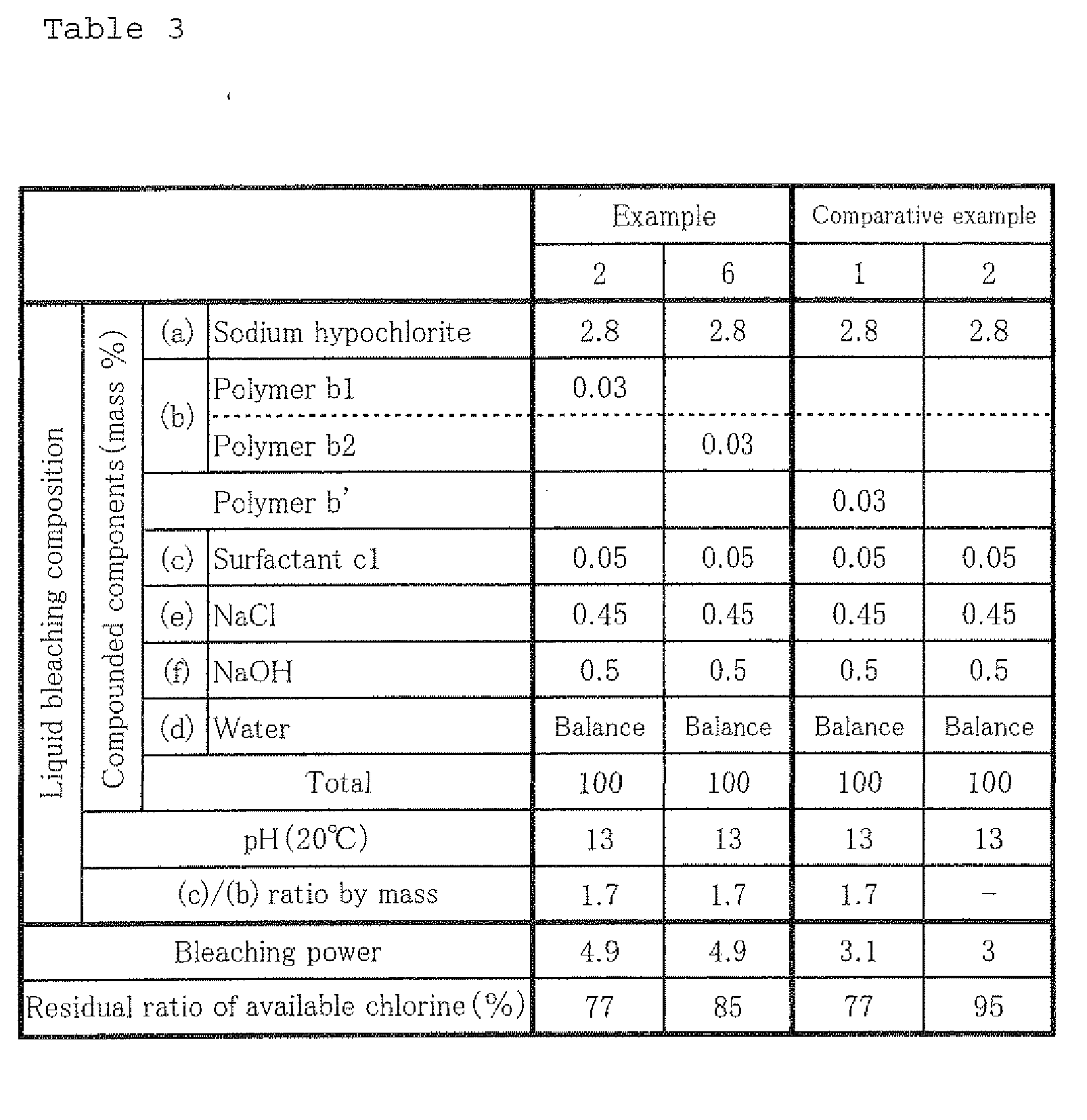
- Molds were developed under actual use conditions on a flexible polyvinyl chloride resin packing material used in a window frame in a bathroom at house, and a test specimen was obtained therefrom and cut into about 1-cm pieces as evaluation samples. The evaluation samples were measured for their luminosity (L value) with a color measuring colorimeter (ND-300A manufactured by Nippon Denshoku Industries Co., Ltd.), and samples different in L value by ±2 or less were used. Two sheets of Kimwipes (3 cm×3 cm, manufactured by Kimberly-Clark Company) were placed on each of the test specimens, 0.5 ml of a liquid bleaching composition shown in Table 1 and 2 was dropped onto it and left for 10 minutes, then the specimen was washed with water, air-dried and measured for its luminosity (L value) with the above color measuring colorimeter. The difference in L value before and after evaluation was regarded as bleaching power. A larger difference in L value is indicative of a higher bleaching effect. The results are shown in Tables 1 and 2. The (c)/(b) ratio by mass wherein (b) represents the polymer b' is shown for some comparative examples.
- Some of the compositions in Tables 1 and 2 were stored at 50°C for 2 weeks, and the storage stability of sodium hypochlorite after storage was evaluated in terms of residual ratio of available chlorine. The residual ratio of available chlorine was determined according to the following equation:


Claims (6)
- A bleaching composition comprising 0.5 to 5.0% by mass of (a) an alkali metal hypochlorite, 0.005 to 1% by mass of (b) an amphoteric polymer compound having, as constituent units, (b1) a monomer unit having at least one member selected from the group consisting of a quaternary ammonium group, a tertiary amine group and a secondary amine group and (b2) a monomer unit having an anionic group, 0.005 to 0.5% by mass of (c) a quaternary ammonium-based surfactant, and (d) water.
- The bleaching composition according to claim 1, wherein (b) has a monomer unit derived from a monomer selected from the group consisting of monomers represented by the following formula (1) and monomers represented by the following formula (2) :


- The bleaching composition according to claim 1 or 2, wherein (b) is a copolymer containing, in an amount of 50 mol% to 100 mol% in the whole of monomer units, a monomer unit (3) represented by the following formula (3) and a monomer unit (4) represented by the following formula (4):


- The bleaching composition according to any of claims 1 to 3, wherein (c) is a quaternary ammonium-based surfactant represented by the following formula (5):

- The bleaching composition according to any of claims 1 to 4, wherein the mass ratio of (c) to (b), that is, (c) / (b), is from 0.10 to 7.0.
- A method of removing molds which comprises applying the bleaching composition of any of claims 1 to 5 onto a resin having molds thereon, thereby removing the molds.
Applications Claiming Priority (3)
| Application Number | Priority Date | Filing Date | Title |
|---|---|---|---|
| JP2006295109 | 2006-10-31 | ||
| JP2007274667A JP5342126B2 (en) | 2006-10-31 | 2007-10-23 | Bleach composition |
| PCT/JP2007/071450 WO2008054009A1 (en) | 2006-10-31 | 2007-10-30 | Bleaching agent composition |
Publications (1)
| Publication Number | Publication Date |
|---|---|
| EP2072613A1 true EP2072613A1 (en) | 2009-06-24 |
Family
ID=39344345
Family Applications (1)
| Application Number | Title | Priority Date | Filing Date |
|---|---|---|---|
| EP07831183A Withdrawn EP2072613A1 (en) | 2006-10-31 | 2007-10-30 | Bleaching agent composition |
Country Status (5)
| Country | Link |
|---|---|
| US (1) | US20100237282A1 (en) |
| EP (1) | EP2072613A1 (en) |
| JP (1) | JP5342126B2 (en) |
| TW (1) | TW200839009A (en) |
| WO (1) | WO2008054009A1 (en) |
Families Citing this family (8)
| Publication number | Priority date | Publication date | Assignee | Title |
|---|---|---|---|---|
| JP5419754B2 (en) * | 2010-03-03 | 2014-02-19 | 花王株式会社 | Mold stain removing composition |
| US9309435B2 (en) | 2010-03-29 | 2016-04-12 | The Clorox Company | Precursor polyelectrolyte complexes compositions comprising oxidants |
| US20110236582A1 (en) | 2010-03-29 | 2011-09-29 | Scheuing David R | Polyelectrolyte Complexes |
| US9474269B2 (en) * | 2010-03-29 | 2016-10-25 | The Clorox Company | Aqueous compositions comprising associative polyelectrolyte complexes (PEC) |
| WO2012008269A1 (en) * | 2010-07-15 | 2012-01-19 | 日東紡績株式会社 | Anti-corrosive agent for washing of metal with acid, detergent solution composition, and method for washing of metal |
| US20150211130A1 (en) * | 2013-01-07 | 2015-07-30 | Nitto Boseki Co., Ltd | Anti-corrosive agent for washing of metal with acid, detergent solution composition, and method for washing of metal |
| US8975220B1 (en) * | 2014-08-11 | 2015-03-10 | The Clorox Company | Hypohalite compositions comprising a cationic polymer |
| JP2017075295A (en) * | 2015-10-15 | 2017-04-20 | ライオン株式会社 | Liquid detergent |
Family Cites Families (13)
| Publication number | Priority date | Publication date | Assignee | Title |
|---|---|---|---|---|
| JPS5425514B2 (en) | 1973-11-02 | 1979-08-28 | ||
| JPS5761099A (en) * | 1980-09-30 | 1982-04-13 | Lion Corp | Liquid sterilizing beaching agent composition |
| JPS62205200A (en) | 1986-03-03 | 1987-09-09 | 花王株式会社 | Aromatic liquid bleaching composition |
| US4933103A (en) * | 1987-03-23 | 1990-06-12 | Kao Corporation | Bleaching composition |
| US6718992B1 (en) * | 1998-08-27 | 2004-04-13 | Sergio Cardola | Liquid neutral to alkaline hard-surface cleaning composition |
| AU6866400A (en) * | 1999-09-03 | 2001-04-10 | Settsu Oil Mill., Ltd. | Bleacher composition |
| JP2002060786A (en) * | 2000-08-23 | 2002-02-26 | Kao Corp | Bactericidal antifouling agent for hard surfaces |
| JP3422978B2 (en) * | 2000-08-23 | 2003-07-07 | 花王株式会社 | Cleaning composition for hard surfaces |
| JP4401559B2 (en) * | 2000-11-27 | 2010-01-20 | 花王株式会社 | Bleach composition |
| JP5000040B2 (en) * | 2001-01-12 | 2012-08-15 | 花王株式会社 | Liquid bleach detergent composition |
| JP3805629B2 (en) * | 2001-02-15 | 2006-08-02 | 花王株式会社 | Liquid bleach detergent composition |
| JP3479644B2 (en) | 2001-03-02 | 2003-12-15 | 花王株式会社 | Liquid bleaching detergent composition |
| EP1689844A1 (en) * | 2003-12-03 | 2006-08-16 | The Procter & Gamble Company | Method, articles and compositions for cleaning bathroom surfaces |
-
2007
- 2007-10-23 JP JP2007274667A patent/JP5342126B2/en not_active Expired - Fee Related
- 2007-10-29 TW TW096140503A patent/TW200839009A/en unknown
- 2007-10-30 WO PCT/JP2007/071450 patent/WO2008054009A1/en not_active Ceased
- 2007-10-30 EP EP07831183A patent/EP2072613A1/en not_active Withdrawn
- 2007-10-30 US US12/377,981 patent/US20100237282A1/en not_active Abandoned
Non-Patent Citations (1)
| Title |
|---|
| See references of WO2008054009A1 * |
Also Published As
| Publication number | Publication date |
|---|---|
| WO2008054009A1 (en) | 2008-05-08 |
| JP2008133453A (en) | 2008-06-12 |
| JP5342126B2 (en) | 2013-11-13 |
| TW200839009A (en) | 2008-10-01 |
| US20100237282A1 (en) | 2010-09-23 |
Similar Documents
| Publication | Publication Date | Title |
|---|---|---|
| US20100237282A1 (en) | Bleaching composition | |
| MX2010014134A (en) | Amphoteric polymer for treating hard surfaces. | |
| JP5756080B2 (en) | Quick-drying amphoteric polymers for cleaning compositions | |
| CA2560041C (en) | Polymers for use in cleaning compositions | |
| US7501387B2 (en) | Antifouling detergent for hard surfaces | |
| JP6231364B2 (en) | Hard surface treatment composition | |
| CN101072802A (en) | Hydrophobically modified cationic polymers and their use as cleaning aids | |
| JP2002241791A (en) | Liquid bleaching detergent composition | |
| US7544649B2 (en) | Antifouling detergent for hard surfaces | |
| JP6193102B2 (en) | Liquid surface treatment composition for hard surface | |
| JP2002105433A (en) | Fluorine-containing surface treatment agent | |
| WO2019102823A1 (en) | Hydrophilizing agent | |
| JP3617813B2 (en) | Cleaning composition for hard surface | |
| JP5490511B2 (en) | Biofilm production suppression method | |
| JP2002348596A (en) | Detergent composition | |
| JP6525559B2 (en) | Hard surface treatment composition | |
| JP5419760B2 (en) | Cleaning composition for hard surface | |
| JP2002105434A (en) | Amphoteric amphiphilic surface treatment agent | |
| JP6953290B2 (en) | Hydrophilization treatment agent composition | |
| JP3405970B2 (en) | Cleaning composition for hard surfaces | |
| JP4401559B2 (en) | Bleach composition | |
| JP4944757B2 (en) | Textile treatment agent | |
| JP4156113B2 (en) | Antifogging composition | |
| WO2022215652A1 (en) | Amino-group-containing copolymer | |
| CN101528908A (en) | Bleaching agent composition |
Legal Events
| Date | Code | Title | Description |
|---|---|---|---|
| PUAI | Public reference made under article 153(3) epc to a published international application that has entered the european phase |
Free format text: ORIGINAL CODE: 0009012 |
|
| 17P | Request for examination filed |
Effective date: 20090223 |
|
| AK | Designated contracting states |
Kind code of ref document: A1 Designated state(s): AT BE BG CH CY CZ DE DK EE ES FI FR GB GR HU IE IS IT LI LT LU LV MC MT NL PL PT RO SE SI SK TR |
|
| AX | Request for extension of the european patent |
Extension state: AL BA HR MK RS |
|
| RBV | Designated contracting states (corrected) |
Designated state(s): DE FR GB |
|
| STAA | Information on the status of an ep patent application or granted ep patent |
Free format text: STATUS: THE APPLICATION HAS BEEN WITHDRAWN |
|
| 18W | Application withdrawn |
Effective date: 20110905 |