EP2072497A1 - Verfahren zum Herstellen von 2-Fluoracyl-3-amino-acrylsäure-Derivaten - Google Patents
Verfahren zum Herstellen von 2-Fluoracyl-3-amino-acrylsäure-Derivaten Download PDFInfo
- Publication number
- EP2072497A1 EP2072497A1 EP07150357A EP07150357A EP2072497A1 EP 2072497 A1 EP2072497 A1 EP 2072497A1 EP 07150357 A EP07150357 A EP 07150357A EP 07150357 A EP07150357 A EP 07150357A EP 2072497 A1 EP2072497 A1 EP 2072497A1
- Authority
- EP
- European Patent Office
- Prior art keywords
- acid
- aryl
- enyl
- radicals
- dimethylamino
- Prior art date
- Legal status (The legal status is an assumption and is not a legal conclusion. Google has not performed a legal analysis and makes no representation as to the accuracy of the status listed.)
- Ceased
Links
- 238000000034 method Methods 0.000 title claims description 23
- 238000004519 manufacturing process Methods 0.000 title description 4
- -1 carboxylic acid compound Chemical class 0.000 claims abstract description 93
- 239000002253 acid Substances 0.000 claims abstract description 25
- 229910052801 chlorine Inorganic materials 0.000 claims abstract description 14
- 229910052731 fluorine Inorganic materials 0.000 claims abstract description 13
- 229910052760 oxygen Inorganic materials 0.000 claims abstract description 10
- 229910052794 bromium Inorganic materials 0.000 claims abstract description 9
- 125000005842 heteroatom Chemical group 0.000 claims abstract description 9
- 229910052717 sulfur Inorganic materials 0.000 claims abstract description 9
- 229910052739 hydrogen Inorganic materials 0.000 claims abstract description 8
- 229910052757 nitrogen Inorganic materials 0.000 claims description 22
- ZMANZCXQSJIPKH-UHFFFAOYSA-N Triethylamine Chemical group CCN(CC)CC ZMANZCXQSJIPKH-UHFFFAOYSA-N 0.000 claims description 18
- ZAMOUSCENKQFHK-UHFFFAOYSA-N Chlorine atom Chemical compound [Cl] ZAMOUSCENKQFHK-UHFFFAOYSA-N 0.000 claims description 15
- PXGOKWXKJXAPGV-UHFFFAOYSA-N Fluorine Chemical compound FF PXGOKWXKJXAPGV-UHFFFAOYSA-N 0.000 claims description 15
- 239000000460 chlorine Substances 0.000 claims description 13
- 239000011737 fluorine Substances 0.000 claims description 12
- 150000001732 carboxylic acid derivatives Chemical class 0.000 claims description 11
- 150000001735 carboxylic acids Chemical class 0.000 claims description 11
- 125000002496 methyl group Chemical group [H]C([H])([H])* 0.000 claims description 11
- OISVCGZHLKNMSJ-UHFFFAOYSA-N 2,6-dimethylpyridine Chemical compound CC1=CC=CC(C)=N1 OISVCGZHLKNMSJ-UHFFFAOYSA-N 0.000 claims description 9
- KWYUFKZDYYNOTN-UHFFFAOYSA-M Potassium hydroxide Chemical compound [OH-].[K+] KWYUFKZDYYNOTN-UHFFFAOYSA-M 0.000 claims description 9
- HEMHJVSKTPXQMS-UHFFFAOYSA-M Sodium hydroxide Chemical compound [OH-].[Na+] HEMHJVSKTPXQMS-UHFFFAOYSA-M 0.000 claims description 9
- 150000004820 halides Chemical class 0.000 claims description 9
- WKBOTKDWSSQWDR-UHFFFAOYSA-N Bromine atom Chemical compound [Br] WKBOTKDWSSQWDR-UHFFFAOYSA-N 0.000 claims description 8
- 125000003118 aryl group Chemical group 0.000 claims description 8
- GDTBXPJZTBHREO-UHFFFAOYSA-N bromine Substances BrBr GDTBXPJZTBHREO-UHFFFAOYSA-N 0.000 claims description 8
- 125000001495 ethyl group Chemical group [H]C([H])([H])C([H])([H])* 0.000 claims description 8
- 239000001257 hydrogen Substances 0.000 claims description 7
- 125000001449 isopropyl group Chemical group [H]C([H])([H])C([H])(*)C([H])([H])[H] 0.000 claims description 7
- NTSLROIKFLNUIJ-UHFFFAOYSA-N 5-Ethyl-2-methylpyridine Chemical compound CCC1=CC=C(C)N=C1 NTSLROIKFLNUIJ-UHFFFAOYSA-N 0.000 claims description 6
- UFHFLCQGNIYNRP-UHFFFAOYSA-N Hydrogen Chemical compound [H][H] UFHFLCQGNIYNRP-UHFFFAOYSA-N 0.000 claims description 6
- WMFOQBRAJBCJND-UHFFFAOYSA-M Lithium hydroxide Chemical compound [Li+].[OH-] WMFOQBRAJBCJND-UHFFFAOYSA-M 0.000 claims description 6
- SJRJJKPEHAURKC-UHFFFAOYSA-N N-Methylmorpholine Chemical compound CN1CCOCC1 SJRJJKPEHAURKC-UHFFFAOYSA-N 0.000 claims description 6
- PAMIQIKDUOTOBW-UHFFFAOYSA-N N-methylcyclohexylamine Natural products CN1CCCCC1 PAMIQIKDUOTOBW-UHFFFAOYSA-N 0.000 claims description 6
- JUJWROOIHBZHMG-UHFFFAOYSA-N Pyridine Chemical compound C1=CC=NC=C1 JUJWROOIHBZHMG-UHFFFAOYSA-N 0.000 claims description 6
- DTQVDTLACAAQTR-UHFFFAOYSA-N Trifluoroacetic acid Chemical compound OC(=O)C(F)(F)F DTQVDTLACAAQTR-UHFFFAOYSA-N 0.000 claims description 6
- 125000002877 alkyl aryl group Chemical group 0.000 claims description 6
- 125000004123 n-propyl group Chemical group [H]C([H])([H])C([H])([H])C([H])([H])* 0.000 claims description 6
- 238000002360 preparation method Methods 0.000 claims description 6
- 150000002431 hydrogen Chemical class 0.000 claims description 5
- 125000004433 nitrogen atom Chemical group N* 0.000 claims description 5
- PPNCOQHHSGMKGI-UHFFFAOYSA-N 1-cyclononyldiazonane Chemical compound C1CCCCCCCC1N1NCCCCCCC1 PPNCOQHHSGMKGI-UHFFFAOYSA-N 0.000 claims description 4
- VZAWCLCJGSBATP-UHFFFAOYSA-N 1-cycloundecyl-1,2-diazacycloundecane Chemical compound C1CCCCCCCCCC1N1NCCCCCCCCC1 VZAWCLCJGSBATP-UHFFFAOYSA-N 0.000 claims description 4
- JVSFQJZRHXAUGT-UHFFFAOYSA-N 2,2-dimethylpropanoyl chloride Chemical compound CC(C)(C)C(Cl)=O JVSFQJZRHXAUGT-UHFFFAOYSA-N 0.000 claims description 4
- BWZVCCNYKMEVEX-UHFFFAOYSA-N 2,4,6-Trimethylpyridine Chemical compound CC1=CC(C)=NC(C)=C1 BWZVCCNYKMEVEX-UHFFFAOYSA-N 0.000 claims description 4
- VHYFNPMBLIVWCW-UHFFFAOYSA-N 4-Dimethylaminopyridine Chemical compound CN(C)C1=CC=NC=C1 VHYFNPMBLIVWCW-UHFFFAOYSA-N 0.000 claims description 4
- JGFZNNIVVJXRND-UHFFFAOYSA-N N,N-Diisopropylethylamine (DIPEA) Chemical compound CCN(C(C)C)C(C)C JGFZNNIVVJXRND-UHFFFAOYSA-N 0.000 claims description 4
- JLTDJTHDQAWBAV-UHFFFAOYSA-N N,N-dimethylaniline Chemical compound CN(C)C1=CC=CC=C1 JLTDJTHDQAWBAV-UHFFFAOYSA-N 0.000 claims description 4
- SMWDFEZZVXVKRB-UHFFFAOYSA-N Quinoline Chemical compound N1=CC=CC2=CC=CC=C21 SMWDFEZZVXVKRB-UHFFFAOYSA-N 0.000 claims description 4
- CDBYLPFSWZWCQE-UHFFFAOYSA-L Sodium Carbonate Chemical compound [Na+].[Na+].[O-]C([O-])=O CDBYLPFSWZWCQE-UHFFFAOYSA-L 0.000 claims description 4
- UIIMBOGNXHQVGW-UHFFFAOYSA-M Sodium bicarbonate Chemical compound [Na+].OC([O-])=O UIIMBOGNXHQVGW-UHFFFAOYSA-M 0.000 claims description 4
- PBWZKZYHONABLN-UHFFFAOYSA-N difluoroacetic acid Chemical compound OC(=O)C(F)F PBWZKZYHONABLN-UHFFFAOYSA-N 0.000 claims description 4
- 229910052736 halogen Inorganic materials 0.000 claims description 4
- 150000002367 halogens Chemical class 0.000 claims description 4
- BWHMMNNQKKPAPP-UHFFFAOYSA-L potassium carbonate Chemical compound [K+].[K+].[O-]C([O-])=O BWHMMNNQKKPAPP-UHFFFAOYSA-L 0.000 claims description 4
- SMUQFGGVLNAIOZ-UHFFFAOYSA-N quinaldine Chemical compound C1=CC=CC2=NC(C)=CC=C21 SMUQFGGVLNAIOZ-UHFFFAOYSA-N 0.000 claims description 4
- GETQZCLCWQTVFV-UHFFFAOYSA-N trimethylamine Chemical compound CN(C)C GETQZCLCWQTVFV-UHFFFAOYSA-N 0.000 claims description 4
- YTLYLLTVENPWFT-UPHRSURJSA-N (Z)-3-aminoacrylic acid Chemical class N\C=C/C(O)=O YTLYLLTVENPWFT-UPHRSURJSA-N 0.000 claims description 3
- XWKFPIODWVPXLX-UHFFFAOYSA-N 2-methyl-5-methylpyridine Natural products CC1=CC=C(C)N=C1 XWKFPIODWVPXLX-UHFFFAOYSA-N 0.000 claims description 3
- BSKHPKMHTQYZBB-UHFFFAOYSA-N 2-methylpyridine Chemical compound CC1=CC=CC=N1 BSKHPKMHTQYZBB-UHFFFAOYSA-N 0.000 claims description 3
- PASDCCFISLVPSO-UHFFFAOYSA-N benzoyl chloride Chemical compound ClC(=O)C1=CC=CC=C1 PASDCCFISLVPSO-UHFFFAOYSA-N 0.000 claims description 3
- UMJSCPRVCHMLSP-UHFFFAOYSA-N pyridine Natural products COC1=CC=CN=C1 UMJSCPRVCHMLSP-UHFFFAOYSA-N 0.000 claims description 3
- IMFACGCPASFAPR-UHFFFAOYSA-N tributylamine Chemical compound CCCCN(CCCC)CCCC IMFACGCPASFAPR-UHFFFAOYSA-N 0.000 claims description 3
- AUHZEENZYGFFBQ-UHFFFAOYSA-N 1,3,5-Me3C6H3 Natural products CC1=CC(C)=CC(C)=C1 AUHZEENZYGFFBQ-UHFFFAOYSA-N 0.000 claims description 2
- GJFNRSDCSTVPCJ-UHFFFAOYSA-N 1,8-bis(dimethylamino)naphthalene Chemical compound C1=CC(N(C)C)=C2C(N(C)C)=CC=CC2=C1 GJFNRSDCSTVPCJ-UHFFFAOYSA-N 0.000 claims description 2
- AVFZOVWCLRSYKC-UHFFFAOYSA-N 1-methylpyrrolidine Chemical compound CN1CCCC1 AVFZOVWCLRSYKC-UHFFFAOYSA-N 0.000 claims description 2
- LRMSQVBRUNSOJL-UHFFFAOYSA-N 2,2,3,3,3-pentafluoropropanoic acid Chemical compound OC(=O)C(F)(F)C(F)(F)F LRMSQVBRUNSOJL-UHFFFAOYSA-N 0.000 claims description 2
- PMWGIVRHUIAIII-UHFFFAOYSA-N 2,2-difluoropropanoic acid Chemical compound CC(F)(F)C(O)=O PMWGIVRHUIAIII-UHFFFAOYSA-N 0.000 claims description 2
- GPKYZQLMEPJAGJ-UHFFFAOYSA-N 2,3,3,3-tetrafluoropropanoic acid Chemical compound OC(=O)C(F)C(F)(F)F GPKYZQLMEPJAGJ-UHFFFAOYSA-N 0.000 claims description 2
- PSCITZRLRGWIHI-UHFFFAOYSA-N 2-(4-aminophenyl)pyridin-3-ol Chemical compound C1=CC(N)=CC=C1C1=NC=CC=C1O PSCITZRLRGWIHI-UHFFFAOYSA-N 0.000 claims description 2
- OAWAZQITIZDJRB-UHFFFAOYSA-N 2-chloro-2,2-difluoroacetic acid Chemical compound OC(=O)C(F)(F)Cl OAWAZQITIZDJRB-UHFFFAOYSA-N 0.000 claims description 2
- HHPCXQXRDOOGGQ-UHFFFAOYSA-N 3,4,4,5,5,5-hexafluoropentanoic acid Chemical compound OC(=O)CC(F)C(F)(F)C(F)(F)F HHPCXQXRDOOGGQ-UHFFFAOYSA-N 0.000 claims description 2
- LTYPRDZCQJWBHD-UHFFFAOYSA-N 3-(dimethylamino)-n,n-diethylprop-2-enamide Chemical compound CCN(CC)C(=O)C=CN(C)C LTYPRDZCQJWBHD-UHFFFAOYSA-N 0.000 claims description 2
- GOPSGESEBDLWKA-UHFFFAOYSA-N 3-(dimethylamino)-n,n-dimethylprop-2-enamide Chemical compound CN(C)C=CC(=O)N(C)C GOPSGESEBDLWKA-UHFFFAOYSA-N 0.000 claims description 2
- ISULZYQDGYXDFW-UHFFFAOYSA-N 3-methylbutanoyl chloride Chemical compound CC(C)CC(Cl)=O ISULZYQDGYXDFW-UHFFFAOYSA-N 0.000 claims description 2
- HTLZVHNRZJPSMI-UHFFFAOYSA-N N-ethylpiperidine Chemical compound CCN1CCCCC1 HTLZVHNRZJPSMI-UHFFFAOYSA-N 0.000 claims description 2
- AHVYPIQETPWLSZ-UHFFFAOYSA-N N-methyl-pyrrolidine Natural products CN1CC=CC1 AHVYPIQETPWLSZ-UHFFFAOYSA-N 0.000 claims description 2
- XTUVJUMINZSXGF-UHFFFAOYSA-N N-methylcyclohexylamine Chemical compound CNC1CCCCC1 XTUVJUMINZSXGF-UHFFFAOYSA-N 0.000 claims description 2
- WETWJCDKMRHUPV-UHFFFAOYSA-N acetyl chloride Chemical group CC(Cl)=O WETWJCDKMRHUPV-UHFFFAOYSA-N 0.000 claims description 2
- AXCZMVOFGPJBDE-UHFFFAOYSA-L calcium dihydroxide Chemical compound [OH-].[OH-].[Ca+2] AXCZMVOFGPJBDE-UHFFFAOYSA-L 0.000 claims description 2
- 239000000920 calcium hydroxide Substances 0.000 claims description 2
- 229910001861 calcium hydroxide Inorganic materials 0.000 claims description 2
- 235000011116 calcium hydroxide Nutrition 0.000 claims description 2
- 125000001309 chloro group Chemical group Cl* 0.000 claims description 2
- HIJIXCXMVYTMCY-UHFFFAOYSA-N diethyl 2-heptylpropanedioate Chemical compound CCCCCCCC(C(=O)OCC)C(=O)OCC HIJIXCXMVYTMCY-UHFFFAOYSA-N 0.000 claims description 2
- MVUMJYQUKKUOHO-AATRIKPKSA-N ethyl (e)-3-(dimethylamino)prop-2-enoate Chemical compound CCOC(=O)\C=C\N(C)C MVUMJYQUKKUOHO-AATRIKPKSA-N 0.000 claims description 2
- MVPDNJQLPITPIX-SNAWJCMRSA-N methyl (e)-3-(dimethylamino)prop-2-enoate Chemical compound COC(=O)\C=C\N(C)C MVPDNJQLPITPIX-SNAWJCMRSA-N 0.000 claims description 2
- FRQONEWDWWHIPM-UHFFFAOYSA-N n,n-dicyclohexylcyclohexanamine Chemical compound C1CCCCC1N(C1CCCCC1)C1CCCCC1 FRQONEWDWWHIPM-UHFFFAOYSA-N 0.000 claims description 2
- DIAIBWNEUYXDNL-UHFFFAOYSA-N n,n-dihexylhexan-1-amine Chemical compound CCCCCCN(CCCCCC)CCCCCC DIAIBWNEUYXDNL-UHFFFAOYSA-N 0.000 claims description 2
- 125000003386 piperidinyl group Chemical group 0.000 claims description 2
- 239000011736 potassium bicarbonate Substances 0.000 claims description 2
- 229910000028 potassium bicarbonate Inorganic materials 0.000 claims description 2
- 235000015497 potassium bicarbonate Nutrition 0.000 claims description 2
- 229910000027 potassium carbonate Inorganic materials 0.000 claims description 2
- 235000011181 potassium carbonates Nutrition 0.000 claims description 2
- TYJJADVDDVDEDZ-UHFFFAOYSA-M potassium hydrogencarbonate Chemical compound [K+].OC([O-])=O TYJJADVDDVDEDZ-UHFFFAOYSA-M 0.000 claims description 2
- 125000000719 pyrrolidinyl group Chemical group 0.000 claims description 2
- 229910000030 sodium bicarbonate Inorganic materials 0.000 claims description 2
- 235000017557 sodium bicarbonate Nutrition 0.000 claims description 2
- 229910000029 sodium carbonate Inorganic materials 0.000 claims description 2
- 235000017550 sodium carbonate Nutrition 0.000 claims description 2
- GFYHSKONPJXCDE-UHFFFAOYSA-N sym-collidine Natural products CC1=CN=C(C)C(C)=C1 GFYHSKONPJXCDE-UHFFFAOYSA-N 0.000 claims description 2
- YFTHZRPMJXBUME-UHFFFAOYSA-N tripropylamine Chemical compound CCCN(CCC)CCC YFTHZRPMJXBUME-UHFFFAOYSA-N 0.000 claims description 2
- NGNBDVOYPDDBFK-UHFFFAOYSA-N 2-[2,4-di(pentan-2-yl)phenoxy]acetyl chloride Chemical compound CCCC(C)C1=CC=C(OCC(Cl)=O)C(C(C)CCC)=C1 NGNBDVOYPDDBFK-UHFFFAOYSA-N 0.000 claims 2
- 125000001246 bromo group Chemical group Br* 0.000 claims 1
- 229940086066 potassium hydrogencarbonate Drugs 0.000 claims 1
- 239000000417 fungicide Substances 0.000 abstract description 2
- 125000005843 halogen group Chemical group 0.000 abstract description 2
- 230000000694 effects Effects 0.000 abstract 1
- 230000000855 fungicidal effect Effects 0.000 abstract 1
- 230000010534 mechanism of action Effects 0.000 abstract 1
- YXFVVABEGXRONW-UHFFFAOYSA-N Toluene Chemical compound CC1=CC=CC=C1 YXFVVABEGXRONW-UHFFFAOYSA-N 0.000 description 24
- 239000002585 base Substances 0.000 description 13
- 239000012074 organic phase Substances 0.000 description 9
- 239000000243 solution Substances 0.000 description 7
- 239000002904 solvent Substances 0.000 description 7
- XLYOFNOQVPJJNP-UHFFFAOYSA-N water Substances O XLYOFNOQVPJJNP-UHFFFAOYSA-N 0.000 description 7
- YMWUJEATGCHHMB-UHFFFAOYSA-N Dichloromethane Chemical compound ClCCl YMWUJEATGCHHMB-UHFFFAOYSA-N 0.000 description 6
- 125000000217 alkyl group Chemical group 0.000 description 6
- 125000003710 aryl alkyl group Chemical group 0.000 description 5
- 125000002947 alkylene group Chemical group 0.000 description 4
- 238000006243 chemical reaction Methods 0.000 description 4
- 239000011541 reaction mixture Substances 0.000 description 4
- UHOVQNZJYSORNB-UHFFFAOYSA-N Benzene Chemical compound C1=CC=CC=C1 UHOVQNZJYSORNB-UHFFFAOYSA-N 0.000 description 3
- RTZKZFJDLAIYFH-UHFFFAOYSA-N Diethyl ether Chemical compound CCOCC RTZKZFJDLAIYFH-UHFFFAOYSA-N 0.000 description 3
- 239000008346 aqueous phase Substances 0.000 description 3
- 125000004429 atom Chemical group 0.000 description 3
- 150000001875 compounds Chemical class 0.000 description 3
- 125000002147 dimethylamino group Chemical group [H]C([H])([H])N(*)C([H])([H])[H] 0.000 description 3
- 229910052698 phosphorus Inorganic materials 0.000 description 3
- NFDXQGNDWIPXQL-UHFFFAOYSA-N 1-cyclooctyldiazocane Chemical compound C1CCCCCCC1N1NCCCCCC1 NFDXQGNDWIPXQL-UHFFFAOYSA-N 0.000 description 2
- DCTOHCCUXLBQMS-UHFFFAOYSA-N 1-undecene Chemical compound CCCCCCCCCC=C DCTOHCCUXLBQMS-UHFFFAOYSA-N 0.000 description 2
- OTTXCOAOKOEENK-UHFFFAOYSA-N 2,2-difluoroethenone Chemical group FC(F)=C=O OTTXCOAOKOEENK-UHFFFAOYSA-N 0.000 description 2
- 125000003903 2-propenyl group Chemical group [H]C([*])([H])C([H])=C([H])[H] 0.000 description 2
- BVKZGUZCCUSVTD-UHFFFAOYSA-M Bicarbonate Chemical class OC([O-])=O BVKZGUZCCUSVTD-UHFFFAOYSA-M 0.000 description 2
- ULGZDMOVFRHVEP-RWJQBGPGSA-N Erythromycin Chemical compound O([C@@H]1[C@@H](C)C(=O)O[C@@H]([C@@]([C@H](O)[C@@H](C)C(=O)[C@H](C)C[C@@](C)(O)[C@H](O[C@H]2[C@@H]([C@H](C[C@@H](C)O2)N(C)C)O)[C@H]1C)(C)O)CC)[C@H]1C[C@@](C)(OC)[C@@H](O)[C@H](C)O1 ULGZDMOVFRHVEP-RWJQBGPGSA-N 0.000 description 2
- BZLVMXJERCGZMT-UHFFFAOYSA-N Methyl tert-butyl ether Chemical compound COC(C)(C)C BZLVMXJERCGZMT-UHFFFAOYSA-N 0.000 description 2
- WYURNTSHIVDZCO-UHFFFAOYSA-N Tetrahydrofuran Chemical compound C1CCOC1 WYURNTSHIVDZCO-UHFFFAOYSA-N 0.000 description 2
- 229910001860 alkaline earth metal hydroxide Inorganic materials 0.000 description 2
- 125000003342 alkenyl group Chemical group 0.000 description 2
- 125000000304 alkynyl group Chemical group 0.000 description 2
- 229940111121 antirheumatic drug quinolines Drugs 0.000 description 2
- 238000009835 boiling Methods 0.000 description 2
- CODNYICXDISAEA-UHFFFAOYSA-N bromine monochloride Chemical compound BrCl CODNYICXDISAEA-UHFFFAOYSA-N 0.000 description 2
- 150000004649 carbonic acid derivatives Chemical class 0.000 description 2
- 150000001805 chlorine compounds Chemical class 0.000 description 2
- MVPPADPHJFYWMZ-UHFFFAOYSA-N chlorobenzene Chemical compound ClC1=CC=CC=C1 MVPPADPHJFYWMZ-UHFFFAOYSA-N 0.000 description 2
- 125000000753 cycloalkyl group Chemical group 0.000 description 2
- 239000012973 diazabicyclooctane Substances 0.000 description 2
- USIUVYZYUHIAEV-UHFFFAOYSA-N diphenyl ether Chemical compound C=1C=CC=CC=1OC1=CC=CC=C1 USIUVYZYUHIAEV-UHFFFAOYSA-N 0.000 description 2
- 238000004821 distillation Methods 0.000 description 2
- 150000002148 esters Chemical class 0.000 description 2
- PNDPGZBMCMUPRI-UHFFFAOYSA-N iodine Chemical compound II PNDPGZBMCMUPRI-UHFFFAOYSA-N 0.000 description 2
- 239000000203 mixture Substances 0.000 description 2
- VLKZOEOYAKHREP-UHFFFAOYSA-N n-Hexane Chemical compound CCCCCC VLKZOEOYAKHREP-UHFFFAOYSA-N 0.000 description 2
- 230000003287 optical effect Effects 0.000 description 2
- 150000003222 pyridines Chemical class 0.000 description 2
- 150000003248 quinolines Chemical class 0.000 description 2
- 239000007858 starting material Substances 0.000 description 2
- 125000001424 substituent group Chemical group 0.000 description 2
- 150000003512 tertiary amines Chemical class 0.000 description 2
- VZGDMQKNWNREIO-UHFFFAOYSA-N tetrachloromethane Chemical compound ClC(Cl)(Cl)Cl VZGDMQKNWNREIO-UHFFFAOYSA-N 0.000 description 2
- QAEDZJGFFMLHHQ-UHFFFAOYSA-N trifluoroacetic anhydride Chemical compound FC(F)(F)C(=O)OC(=O)C(F)(F)F QAEDZJGFFMLHHQ-UHFFFAOYSA-N 0.000 description 2
- 125000002023 trifluoromethyl group Chemical group FC(F)(F)* 0.000 description 2
- 125000004400 (C1-C12) alkyl group Chemical group 0.000 description 1
- 125000006710 (C2-C12) alkenyl group Chemical group 0.000 description 1
- 125000006711 (C2-C12) alkynyl group Chemical group 0.000 description 1
- 125000001607 1,2,3-triazol-1-yl group Chemical group [*]N1N=NC([H])=C1[H] 0.000 description 1
- 125000004505 1,2,4-oxadiazol-5-yl group Chemical group O1N=CN=C1* 0.000 description 1
- 125000004515 1,2,4-thiadiazol-3-yl group Chemical group S1N=C(N=C1)* 0.000 description 1
- 125000004516 1,2,4-thiadiazol-5-yl group Chemical group S1N=CN=C1* 0.000 description 1
- 125000003626 1,2,4-triazol-1-yl group Chemical group [*]N1N=C([H])N=C1[H] 0.000 description 1
- 125000004509 1,3,4-oxadiazol-2-yl group Chemical group O1C(=NN=C1)* 0.000 description 1
- 125000004521 1,3,4-thiadiazol-2-yl group Chemical group S1C(=NN=C1)* 0.000 description 1
- 125000004317 1,3,5-triazin-2-yl group Chemical group [H]C1=NC(*)=NC([H])=N1 0.000 description 1
- RYHBNJHYFVUHQT-UHFFFAOYSA-N 1,4-Dioxane Chemical compound C1COCCO1 RYHBNJHYFVUHQT-UHFFFAOYSA-N 0.000 description 1
- OCJBOOLMMGQPQU-UHFFFAOYSA-N 1,4-dichlorobenzene Chemical compound ClC1=CC=C(Cl)C=C1 OCJBOOLMMGQPQU-UHFFFAOYSA-N 0.000 description 1
- 125000004973 1-butenyl group Chemical group C(=CCC)* 0.000 description 1
- 125000001462 1-pyrrolyl group Chemical group [*]N1C([H])=C([H])C([H])=C1[H] 0.000 description 1
- 125000004974 2-butenyl group Chemical group C(C=CC)* 0.000 description 1
- XSJVWZAETSBXKU-UHFFFAOYSA-N 2-ethoxypropane Chemical compound CCOC(C)C XSJVWZAETSBXKU-UHFFFAOYSA-N 0.000 description 1
- 125000002941 2-furyl group Chemical group O1C([*])=C([H])C([H])=C1[H] 0.000 description 1
- 125000000389 2-pyrrolyl group Chemical group [H]N1C([*])=C([H])C([H])=C1[H] 0.000 description 1
- 125000000175 2-thienyl group Chemical group S1C([*])=C([H])C([H])=C1[H] 0.000 description 1
- 125000004975 3-butenyl group Chemical group C(CC=C)* 0.000 description 1
- 125000003682 3-furyl group Chemical group O1C([H])=C([*])C([H])=C1[H] 0.000 description 1
- 125000001397 3-pyrrolyl group Chemical group [H]N1C([H])=C([*])C([H])=C1[H] 0.000 description 1
- 125000001541 3-thienyl group Chemical group S1C([H])=C([*])C([H])=C1[H] 0.000 description 1
- KDDQRKBRJSGMQE-UHFFFAOYSA-N 4-thiazolyl Chemical group [C]1=CSC=N1 KDDQRKBRJSGMQE-UHFFFAOYSA-N 0.000 description 1
- CWDWFSXUQODZGW-UHFFFAOYSA-N 5-thiazolyl Chemical group [C]1=CN=CS1 CWDWFSXUQODZGW-UHFFFAOYSA-N 0.000 description 1
- WEVYAHXRMPXWCK-UHFFFAOYSA-N Acetonitrile Chemical compound CC#N WEVYAHXRMPXWCK-UHFFFAOYSA-N 0.000 description 1
- HEDRZPFGACZZDS-UHFFFAOYSA-N Chloroform Chemical compound ClC(Cl)Cl HEDRZPFGACZZDS-UHFFFAOYSA-N 0.000 description 1
- XTHFKEDIFFGKHM-UHFFFAOYSA-N Dimethoxyethane Chemical compound COCCOC XTHFKEDIFFGKHM-UHFFFAOYSA-N 0.000 description 1
- JBNRHDLQTVLVCY-UHFFFAOYSA-N FC(C(C(=O)O)=CN)(F)F Chemical class FC(C(C(=O)O)=CN)(F)F JBNRHDLQTVLVCY-UHFFFAOYSA-N 0.000 description 1
- QLZDUWPJPIRSSV-UHFFFAOYSA-N FC(C(C(=O)O)=CN)F Chemical class FC(C(C(=O)O)=CN)F QLZDUWPJPIRSSV-UHFFFAOYSA-N 0.000 description 1
- LELOWRISYMNNSU-UHFFFAOYSA-N Hydrocyanic acid Natural products N#C LELOWRISYMNNSU-UHFFFAOYSA-N 0.000 description 1
- FXHOOIRPVKKKFG-UHFFFAOYSA-N N,N-Dimethylacetamide Chemical compound CN(C)C(C)=O FXHOOIRPVKKKFG-UHFFFAOYSA-N 0.000 description 1
- CTQNGGLPUBDAKN-UHFFFAOYSA-N O-Xylene Chemical compound CC1=CC=CC=C1C CTQNGGLPUBDAKN-UHFFFAOYSA-N 0.000 description 1
- 150000001241 acetals Chemical class 0.000 description 1
- 150000008065 acid anhydrides Chemical class 0.000 description 1
- 150000007513 acids Chemical class 0.000 description 1
- 150000001338 aliphatic hydrocarbons Chemical class 0.000 description 1
- 239000003513 alkali Substances 0.000 description 1
- 150000008044 alkali metal hydroxides Chemical class 0.000 description 1
- 229910052784 alkaline earth metal Inorganic materials 0.000 description 1
- HSFWRNGVRCDJHI-UHFFFAOYSA-N alpha-acetylene Natural products C#C HSFWRNGVRCDJHI-UHFFFAOYSA-N 0.000 description 1
- 125000003368 amide group Chemical group 0.000 description 1
- 150000001412 amines Chemical class 0.000 description 1
- 150000008064 anhydrides Chemical class 0.000 description 1
- 125000002178 anthracenyl group Chemical group C1(=CC=CC2=CC3=CC=CC=C3C=C12)* 0.000 description 1
- 239000007864 aqueous solution Substances 0.000 description 1
- 125000002029 aromatic hydrocarbon group Chemical group 0.000 description 1
- 150000004945 aromatic hydrocarbons Chemical class 0.000 description 1
- QVGXLLKOCUKJST-UHFFFAOYSA-N atomic oxygen Chemical group [O] QVGXLLKOCUKJST-UHFFFAOYSA-N 0.000 description 1
- 125000001797 benzyl group Chemical group [H]C1=C([H])C([H])=C(C([H])=C1[H])C([H])([H])* 0.000 description 1
- 230000015572 biosynthetic process Effects 0.000 description 1
- 239000006227 byproduct Substances 0.000 description 1
- 125000004432 carbon atom Chemical group C* 0.000 description 1
- 125000003262 carboxylic acid ester group Chemical group [H]C([H])([*:2])OC(=O)C([H])([H])[*:1] 0.000 description 1
- 238000005119 centrifugation Methods 0.000 description 1
- 229960001701 chloroform Drugs 0.000 description 1
- 125000004122 cyclic group Chemical group 0.000 description 1
- 125000002188 cycloheptatrienyl group Chemical group C1(=CC=CC=CC1)* 0.000 description 1
- 125000000058 cyclopentadienyl group Chemical group C1(=CC=CC1)* 0.000 description 1
- 229940117389 dichlorobenzene Drugs 0.000 description 1
- 125000001028 difluoromethyl group Chemical group [H]C(F)(F)* 0.000 description 1
- SBZXBUIDTXKZTM-UHFFFAOYSA-N diglyme Chemical compound COCCOCCOC SBZXBUIDTXKZTM-UHFFFAOYSA-N 0.000 description 1
- ZSWFCLXCOIISFI-UHFFFAOYSA-N endo-cyclopentadiene Natural products C1C=CC=C1 ZSWFCLXCOIISFI-UHFFFAOYSA-N 0.000 description 1
- 150000002170 ethers Chemical class 0.000 description 1
- ANTPVARYELNKNQ-UHFFFAOYSA-N ethyl 3-(diethylamino)prop-2-enoate Chemical compound CCOC(=O)C=CN(CC)CC ANTPVARYELNKNQ-UHFFFAOYSA-N 0.000 description 1
- 125000002534 ethynyl group Chemical group [H]C#C* 0.000 description 1
- 238000001914 filtration Methods 0.000 description 1
- 125000001153 fluoro group Chemical group F* 0.000 description 1
- 150000002430 hydrocarbons Chemical group 0.000 description 1
- 150000007529 inorganic bases Chemical class 0.000 description 1
- 239000000543 intermediate Substances 0.000 description 1
- 125000000959 isobutyl group Chemical group [H]C([H])([H])C([H])(C([H])([H])[H])C([H])([H])* 0.000 description 1
- PYLWMHQQBFSUBP-UHFFFAOYSA-N monofluorobenzene Chemical compound FC1=CC=CC=C1 PYLWMHQQBFSUBP-UHFFFAOYSA-N 0.000 description 1
- 125000004108 n-butyl group Chemical group [H]C([H])([H])C([H])([H])C([H])([H])C([H])([H])* 0.000 description 1
- 125000003136 n-heptyl group Chemical group [H]C([H])([H])C([H])([H])C([H])([H])C([H])([H])C([H])([H])C([H])([H])C([H])([H])* 0.000 description 1
- 125000001280 n-hexyl group Chemical group C(CCCCC)* 0.000 description 1
- 125000000740 n-pentyl group Chemical group [H]C([H])([H])C([H])([H])C([H])([H])C([H])([H])C([H])([H])* 0.000 description 1
- 125000001624 naphthyl group Chemical group 0.000 description 1
- 125000002560 nitrile group Chemical group 0.000 description 1
- 150000002825 nitriles Chemical class 0.000 description 1
- IJGRMHOSHXDMSA-UHFFFAOYSA-N nitrogen Substances N#N IJGRMHOSHXDMSA-UHFFFAOYSA-N 0.000 description 1
- QJGQUHMNIGDVPM-UHFFFAOYSA-N nitrogen group Chemical group [N] QJGQUHMNIGDVPM-UHFFFAOYSA-N 0.000 description 1
- 239000001301 oxygen Substances 0.000 description 1
- 238000005191 phase separation Methods 0.000 description 1
- 125000001997 phenyl group Chemical group [H]C1=C([H])C([H])=C(*)C([H])=C1[H] 0.000 description 1
- 125000000286 phenylethyl group Chemical group [H]C1=C([H])C([H])=C(C([H])=C1[H])C([H])([H])C([H])([H])* 0.000 description 1
- 239000000047 product Substances 0.000 description 1
- 125000004307 pyrazin-2-yl group Chemical group [H]C1=C([H])N=C(*)C([H])=N1 0.000 description 1
- 150000003217 pyrazoles Chemical class 0.000 description 1
- 125000003226 pyrazolyl group Chemical group 0.000 description 1
- 125000002206 pyridazin-3-yl group Chemical group [H]C1=C([H])C([H])=C(*)N=N1 0.000 description 1
- 125000004940 pyridazin-4-yl group Chemical group N1=NC=C(C=C1)* 0.000 description 1
- 125000000246 pyrimidin-2-yl group Chemical group [H]C1=NC(*)=NC([H])=C1[H] 0.000 description 1
- 125000004527 pyrimidin-4-yl group Chemical group N1=CN=C(C=C1)* 0.000 description 1
- 125000004528 pyrimidin-5-yl group Chemical group N1=CN=CC(=C1)* 0.000 description 1
- 125000006413 ring segment Chemical group 0.000 description 1
- 150000003839 salts Chemical class 0.000 description 1
- 229930195734 saturated hydrocarbon Natural products 0.000 description 1
- 125000002914 sec-butyl group Chemical group [H]C([H])([H])C([H])([H])C([H])(*)C([H])([H])[H] 0.000 description 1
- 238000004062 sedimentation Methods 0.000 description 1
- 238000003786 synthesis reaction Methods 0.000 description 1
- 125000000999 tert-butyl group Chemical group [H]C([H])([H])C(*)(C([H])([H])[H])C([H])([H])[H] 0.000 description 1
- 125000003944 tolyl group Chemical group 0.000 description 1
- 125000004044 trifluoroacetyl group Chemical group FC(C(=O)*)(F)F 0.000 description 1
- 125000000391 vinyl group Chemical group [H]C([*])=C([H])[H] 0.000 description 1
- 229920002554 vinyl polymer Polymers 0.000 description 1
- 238000010626 work up procedure Methods 0.000 description 1
- 239000008096 xylene Substances 0.000 description 1
Classifications
-
- C—CHEMISTRY; METALLURGY
- C07—ORGANIC CHEMISTRY
- C07C—ACYCLIC OR CARBOCYCLIC COMPOUNDS
- C07C227/00—Preparation of compounds containing amino and carboxyl groups bound to the same carbon skeleton
- C07C227/14—Preparation of compounds containing amino and carboxyl groups bound to the same carbon skeleton from compounds containing already amino and carboxyl groups or derivatives thereof
- C07C227/16—Preparation of compounds containing amino and carboxyl groups bound to the same carbon skeleton from compounds containing already amino and carboxyl groups or derivatives thereof by reactions not involving the amino or carboxyl groups
-
- C—CHEMISTRY; METALLURGY
- C07—ORGANIC CHEMISTRY
- C07C—ACYCLIC OR CARBOCYCLIC COMPOUNDS
- C07C253/00—Preparation of carboxylic acid nitriles
- C07C253/30—Preparation of carboxylic acid nitriles by reactions not involving the formation of cyano groups
Definitions
- the present invention relates to a process for preparing 2-fluoroacyl-3-amino-acrylic acid derivatives by reacting fluorinated carboxylic acids with dialkylaminoacrylic acid derivatives and acid halides.
- 2-fluoroacyl-3-amino-acrylic acid derivatives e.g. 2-trifluoromethyl-3-aminoacrylic acid esters and 2-difluoromethyl-3-aminoacrylic acid esters are valuable intermediates for the preparation of substituted pyrazoles which can be used as fungicides.
- EP-A-1 000 926 It is known to obtain trihaloacyl-aminopropenoate by reacting trihaloacetoacetates with dialkylformamide acetals.
- the disadvantage here is that occur as a by-product, the deacylated compounds and must be separated from the desired product.
- WO-A-03/051820 apparently that 2-perhaloacyl-3-amino-acrylic acid derivatives can be obtained by reacting 3-aminoacrylic acid ester with perhaloalkylcarboxylic acid anhydrides.
- the disadvantage here is that low-boiling and expensive acid chlorides or anhydrides are needed to prepare the fluorinated derivatives. When using, for example, trifluoroacetic anhydride, one equivalent of the valuable fluorinated building block is lost.
- WO-A-05/042468 teaches a method for producing 2-dihaloacyl-3-amino-acrylic acid esters in which acid halides are used. These acid chlorides are expensive to produce from the acids. In addition, their use is difficult due to the low boiling points.
- the object of the present invention was to provide new, economical processes for the preparation of 2-fluoroacyl-3-amino-acrylic acid derivatives starting from fluorinated carboxylic acids, which do not have the disadvantages described above.
- the 2-fluoroacyl-3-amino-acrylic acid derivatives of the formula (I) can be prepared under the conditions according to the invention with good yields in high purity, with which the inventive method does not have the disadvantages described in connection with the prior art.
- halogens includes those elements selected from the group consisting of fluorine, chlorine, bromine and iodine, with fluorine, chlorine and bromine being preferred and fluorine and Chlorine are particularly preferably used.
- Optionally substituted groups may be monosubstituted or polysubstituted, with multiple substituents the substituents may be the same or different.
- Alkyl groups substituted by one or more halogen atoms are for example selected from trifluoromethyl (CF 3 ), difluoromethyl (CHF 2 ), CF 3 CH 2 , ClCH 2 , CF 3 CCl 2 .
- Alkyl groups are in the context of the present invention, unless otherwise defined, linear, branched or cyclic saturated hydrocarbon groups.
- C 1 -C 12 alkyl includes the largest range defined herein for an alkyl group.
- this definition includes, for example, the meanings methyl, ethyl, n-, iso-propyl, n-, iso-, sec- and t-butyl, n-pentyl, n-hexyl, 1,3-dimethylbutyl, 3,3- Dimethylbutyl, n-heptyl, n-nonyl, n-decyl, n-undecyl, n-dodecyl.
- Alkenyl groups are in the context of the present invention, unless otherwise defined, linear, branched or cyclic hydrocarbon groups containing at least one simple unsaturation (double bond).
- C 2 -C 12 alkenyl includes the largest range defined herein for an alkenyl group. Specifically, this definition includes, for example, the meanings vinyl; Allyl (2-propenyl), isopropenyl (1-methylethenyl); But-1-enyl (crotyl), but-2-enyl, but-3-enyl; Hex-1-enyl, hex-2-enyl, hex-3-enyl, hex-4-enyl, hex-5-enyl; Hept-1-enyl, hept-2-enyl, hept-3-enyl, hept-4-enyl, hept-5-enyl, hept-6-enyl; Oct-1-enyl, oct-2-enyl, oct-3-enyl, oct-4-enyl, oct-5-enyl, oct-6-enyl, oct-7-eny
- Alkynyl groups are in the context of the present invention, unless otherwise defined, linear, branched or cyclic hydrocarbon groups containing at least two-fold unsaturation (triple bond).
- C 2 -C 12 alkynyl includes the largest range defined herein for an alkynyl group. Specifically, this definition includes, for example, the meanings ethynyl (acetylenyl); Prop-1-ynyl and prop-2-ynyl.
- Aryl groups in the context of the present invention are, unless otherwise defined, aromatic hydrocarbon groups which may have one, two or more heteroatoms selected from O, N, P and S.
- C 5-18 aryl includes the largest range defined herein for an aryl group having 5 to 18 skeleton atoms, where the C atoms may be substituted for heteroatoms.
- this definition includes, for example, the meanings cyclopentadienyl, phenyl, cycloheptatrienyl, cyclooctatetraenyl, naphthyl and anthracenyl; 2-furyl, 3-furyl, 2-thienyl, 3-thienyl, 2-pyrrolyl, 3-pyrrolyl, 3-isoxazolyl, 4-isoxazolyl, 5-isoxazolyl, 3-isothiazolyl, 4-isothiazolyl, 5-isothiazolyl, 3 Pyrazolyl, 4-pyrazolyl, 5-pyrazolyl, 2-oxazolyl, 4-oxazolyl, 5-oxazolyl, 2-thiazolyl, 4-thiazolyl, 5-thiazolyl, 2-imidazolyl
- Arylalkyl groups are in the context of the present invention, unless otherwise defined, substituted by aryl groups alkyl groups which may have a C 1-8 alkylene chain and in the aryl skeleton one or more heteroatoms selected are from O, N, P and S, may have.
- C 7-19 aralkyl group includes the largest range defined herein for an arylalkyl group having a total of 7 to 19 atoms in the backbone and alkylene chain. Specifically, this definition includes, for example, the meanings benzyl and phenylethyl.
- Alkylaryl groups are in the context of the present invention, unless otherwise defined, substituted by alkyl groups aryl groups which may have a C 1-8 alkylene chain and in the aryl skeleton one or more heteroatoms selected are from O, N, P and S, may have.
- C 7-19 alkylaryl group includes the largest range defined herein for an alkylaryl group having a total of 7 to 19 atoms in the backbone and alkylene chain. Specifically, this definition includes, for example, the meanings tolyl, 2,3-, 2,4-, 2,5-, 2,6-, 3,4- or 3,5-dimethylphenyl.
- the compounds according to the invention can be present as mixtures of various possible isomeric forms, in particular of stereoisomers, such as, for example, E and Z, threo and erythro, as well as optical isomers, but optionally also of tautomers. Both the E and the Z isomers, as well as the threo and erythro, as well as the optical isomers, any mixtures of these isomers, as well as the possible tautomeric forms disclosed and claimed.
- stereoisomers such as, for example, E and Z, threo and erythro, as well as optical isomers
- dialkylaminoacrylic esters which are suitable according to the invention are methyl 3- (N, N-dimethylamino) acrylate, ethyl 3- (N, N-dimethylamino) acrylate, ethyl 3- (N, N-diethylamino) acrylate, 3- (N, N-dimethylamino ) -acrylic acid nitrile, 3- (N, N-dimethylamino) -acrylic acid dimethylamide and 3- (N, N-dimethylamino) -acrylic acid diethylamide, with 3- (N, N-diethylamino) -acrylic acid ethyl ester being particularly preferred.
- dialkylaminoacrylic acid derivatives can be purified by distillation, for example. However, this is generally not required in connection with the reaction according to the invention.
- the molar ratio of dialkylaminoacrylic acid derivatives to fluorinated carboxylic acid used can be, for example, 0.5 to 3, preferably 0.8 to 2, particularly preferably 1.0 to 1.5.
- fluorinated carboxylic acids suitable according to the invention are trifluoroacetic acid, difluoroacetic acid, difluorochloroacetic acid, chlorofluoroacetic acid, 2,3,3,3-tetrafluoropropionic acid, 2,2,3,3-tetrafluoropropionic acid, 2,2-difluoropropionic acid, pentafluoropropionic acid, 2,3,3,4 , 4,4-Hexafluorbutancarbon Textre.
- R 9 is selected from C 1-12 -alkyl radicals, C 5-18 -aryl-C 7-19 -alkylaryl or C 7-19 -arylalkyl or heteroaryl radicals, preferably from C 2-8 -alkyl radicals , particularly preferably from C 3-6 -alkyl radicals, and Hal is selected from fluorine, chlorine, bromine and iodine, preferably from chlorine and bromine, particularly preferably from chlorine.
- acid halides suitable according to the invention are acetic acid chloride, pivaloyl chloride, isovaleroyl chloride and benzoyl chloride.
- the molar ratio of acid halides of the formula (IV) to the fluorinated carboxylic acid of the formula (II) used can be, for example, 0.5 to 5, preferably 1 to 3, particularly preferably 2 to 2.5.
- Arylalkyl may stand or in each case two radicals together may also be part of a 5 to 8-membered N-heterocyclic radical, or all three radicals together may be part of an N-heterobicyclic or N-tricyclic radical having 5 to 9 ring atoms per cycle which may optionally be other Heteroatoms such as oxygen may contain.
- bases of the general formula (V) are triethylamine, trimethylamine, diisopropylethylamine, tri-n-propylamine, tri-n-butylamine, tri-n-hexylamine, tricyclohexylamine, N-methylcyclohexylamine, N-methylpyrrolidine, N-methylpiperidine , N-ethylpiperidine, N, N-dimethylaniline, N-methylmorpholine, pyridine, 2-, 3-, 4-, picoline, 2-methyl-5-ethyl-pyridine, 2,6-lutidine, 2,4,6- Collidine, 4-dimethylaminopyridine, quinoline, quinaldine, N, N, N, N-tetramethylethyldiamine, N, N-dimethyl-1,4-diazacyclohexane, N, N-di-ethyl-1,4-diazacyclohexane, 1,8- Bis (
- alkaline earth or alkali metal hydroxides, carbonates or bicarbonates e.g. Sodium hydroxide, potassium hydroxide, lithium hydroxide, calcium hydroxide, sodium carbonate, potassium carbonate, sodium bicarbonate and potassium bicarbonate used.
- the inorganic base may optionally be used as an aqueous solution in concentrations between 10 and 40%.
- Triethylamine, tributylamine, pyridine, 2-, 3-, 4-, picoline, 2-methyl-5-ethyl-pyridine, 2,6-lutidine, sodium hydroxide or potassium hydroxide are particularly preferably used.
- the molar ratio of base to fluorinated carboxylic acid used can be, for example, 0.5 to 10, preferably 1 to 8, particularly preferably 1.5 to 6.
- the process according to the invention is generally carried out under normal pressure. However, it is possible to work under elevated pressure or in a vacuum.
- the reaction can be carried out in bulk or in a solvent.
- the reaction is carried out in a solvent.
- Suitable solvents are, for example, selected from the group consisting of aliphatic and aromatic hydrocarbons, such as, for example, n-hexane, benzene, toluene and xylene, which may be substituted by fluorine and chlorine atoms, such as methylene chloride, dichloromethane, trichloromethane, carbon tetrachloride, fluorobenzene, chlorobenzene or dichlorobenzene; Ethers, such as diethyl ether, diphenyl ether, methyl tert-butyl ether, isopropyl ethyl ether, dioxane, diglyme, dimethyl glycol or THF; Nitriles such as methylnitrile, butylnitrile or phenylnitrile; DMF, N, N-dimethylacetamide with to
- the base is initially charged with the fluorinated carboxylic acid in a solvent or in bulk, then the dialkylaminoacrylic acid derivative is added and the carboxylic acid chloride is added. It is also possible to provide the base with the carboxylic acid chloride in a solvent or in bulk, then add the dialkylaminoacrylic acid derivative and add with the fluorinated carboxylic acid.
- the base is initially charged with the fluorinated carboxylic acid in a solvent or in bulk, then the carboxylic acid chloride is added and treated with the dialkylaminoacrylic acid derivative.
- the reaction solution obtained directly or to obtain the 2-fluoroacyl-3-aminoacrylic acid derivatives preferably to the dry, limited.
- the obtained 2-fluoroacyl-3-amino-acrylic acid derivatives can also be purified by distillation.
- Another work-up method can be carried out by adding water to the reaction mixture and subsequent phase separation.
Landscapes
- Chemical & Material Sciences (AREA)
- Organic Chemistry (AREA)
- Chemical Kinetics & Catalysis (AREA)
- Organic Low-Molecular-Weight Compounds And Preparation Thereof (AREA)
Abstract
Die vorliegende Erfindung betrifft ein Verfahren zum Herstellen von 2-Fluoracyl-3-aminoacrylsäure-Derivaten durch Umsetzung von fluorierten Carbonsäuren mit Dialkylaminoacrylsäure-Derivaten und Säurehalogeniden.
Description
- Die vorliegende Erfindung betrifft ein Verfahren zum Herstellen von 2-Fluoracyl-3-amino-acrylsäure-Derivaten durch Umsetzung von fluorierten Carbonsäuren mit Dialkylaminoacrylsäure-Derivaten und Säurehalogeniden. 2-Fluoracyl-3-amino-acrylsäure-Derivate wie z.B. 2-Trifluormethyl-3-aminoacrylsäureester und 2-Difluormethyl-3-aminoacrylsäureester sind wertvolle Zwischenprodukte zur Herstellung von substituierten Pyrazolen, die als Fungizide Verwendung finden können.
- Es ist bereits bekannt, dass man trihalogenacylierte Aminoacrylsäureester erhält, wenn man die entsprechenden Chloracroleine mit einem substituierten Amin umsetzt (vgl. Tetrahedron Lett. 1996, 37, 8751 - 8754). Nachteilig an diesem Verfahren ist jedoch, dass die als Ausgangsverbindungen eingesetzten Chloracroleine schwierig herzustellen und für eine technische Anwendung zu teuer sind.
- Aus
EP-A-1 000 926 ist bekannt, dass man Trihaloacyl-aminopropenoate erhält, indem man Trihalogenacetoacetate mit Dialkylformamidacetalen umsetzt. Nachteilig ist hier, dass als Nebenprodukt die deacylierten Verbindungen auftreten und vom gewünschten Produkt abgetrennt werden müssen. -
WO-A-03/051820 -
WO-A-05/042468 - Die Aufgabe der vorliegenden Erfindung bestand in der Bereitstellung neuer, wirtschaftlicher Verfahren zum Herstellen von 2-Fluoracyl-3-amino-acrylsäure-Derivaten ausgehend von fluorierten Carbonsäuren, die die zuvor beschriebenen Nachteile nicht aufweisen.
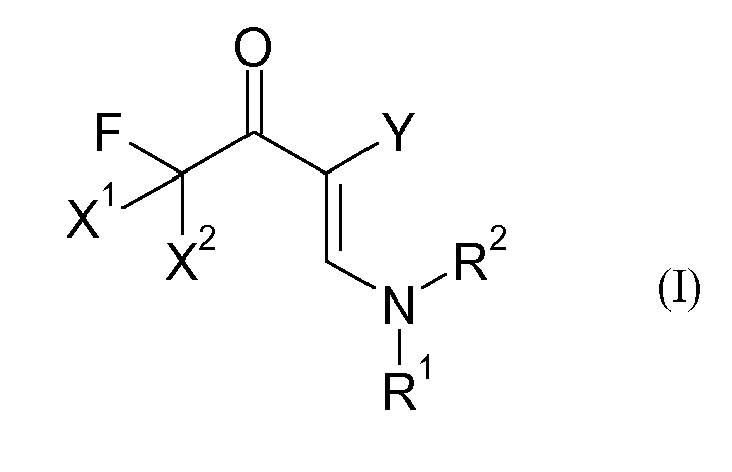
- Die Aufgabe wurde gemäß der vorliegenden Erfindung gelöst durch ein Verfahren zum Herstellen von 2-Fluoracyl-3-amino-acrylsäure-Derivaten der allgemeinen Formel (I)

- R1 und
- R2 unabhängig voneinander ausgewählt ist aus C1-12-Alkylresten, C5-18-Aryl-, C7-19-Alkylaryl-oder C7-19-Arylalkyresten, oder
- R1 und
- R2 zusammen mit dem Stickstoffatom, an das sie gebunden sind, einen 5- bis 6-gliedrigen Ring bilden können, der gegebenenfalls ein oder zwei weitere Hetero-Atome, ausgewählt aus O, S und einer SO2-Gruppe, enthalten kann;
- Y
- ausgewählt ist aus (C=O)OR3, CN und (C=O)NR4R5, wobei R3 ,R4 und R5 unabhängig von einander ausgewählt sind aus C1-12-Alkylresten, C5-18-Aryl-, C7-19-Alkylaryl- oder C7-19-Arylalkyresten und
- X1 und
- X2 unabhängig voneinander für Fluor, Chlor, Brom, Wasserstoff, C1-12-Alkylreste, C1-12-Haloalkylreste, C5-18-Aryl-, C7-19-Alkylaryl- oder C7-19-Arylalkyreste stehen,
- Überraschenderweise lassen sich die 2-Fluoracyl-3-amino-acrylsäure-Derivate der Formel (I) unter den erfindungsgemäßen Bedingungen mit guten Ausbeuten in hoher Reinheit herstellen, womit das erfindungsgemäße Verfahren die im Zusammenhang mit dem Stand der Technik beschriebenen Nachteile nicht aufweist.
-

- Allgemeine Definitionen Im Zusammenhang mit der vorliegenden Erfindung umfasst der Begriff Halogene (X), soweit nicht anders definiert, solche Elemente, die ausgewählt sind aus der Gruppe bestehend aus Fluor, Chlor, Brom und Iod, wobei Fluor, Chlor und Brom bevorzugt und Fluor und Chlor besonders bevorzugt verwendet werden.
- Gegebenenfalls substituierte Gruppen können einfach oder mehrfach substituiert sein, wobei bei Mehrfachsubstitutionen die Substituenten gleich oder verschieden sein können.
- Mit einem oder mehreren Halogenatomen (-X) substituierte Alkyl-Gruppen sind beispielsweise ausgewählt aus Trifluormethyl (CF3), Difluormethyl (CHF2), CF3CH2, ClCH2, CF3CCl2.
- Alkyl-Gruppen sind im Zusammenhang mit der vorliegenden Erfindung, soweit nicht abweichend definiert, lineare, verzweigte oder ringförmige gesättigte Kohlenwasserstoff-Gruppen.
- Die Definition C1-C12-Alkyl umfasst den größten hierin definierten Bereich für einen Alkyl-Gruppe. Im Einzelnen umfasst diese Definition beispielsweise die Bedeutungen Methyl, Ethyl, n-, iso-Propyl, n-, iso-, sec- und t-Butyl, n-Pentyl, n-Hexyl, 1,3-Dimethylbutyl, 3,3-Dimethylbutyl, n-Heptyl, n-Nonyl, n-Decyl, n-Undecyl, n-Dodecyl.
- Alkenyl-Gruppen sind im Zusammenhang mit der vorliegenden Erfindung, soweit nicht abweichend definiert, lineare, verzweigte oder ringförmige Kohlenwasserstoff-Gruppen, die wenigstens eine einfache Unsättigung (Doppelbindung) enthalten.
- Die Definition C2-C12-Alkenyl umfasst den größten hierin definierten Bereich für einen AlkenylGruppe. Im Einzelnen umfasst diese Definition beispielsweise die Bedeutungen Vinyl; Allyl (2-Propenyl), Isopropenyl (1-Methylethenyl); But-1-enyl (Crotyl), But-2-enyl, But-3-enyl; Hex-1-enyl, Hex-2-enyl, Hex-3-enyl, Hex-4-enyl, Hex-5-enyl; Hept-1-enyl, Hept-2-enyl, Hept-3-enyl, Hept-4-enyl, Hept-5-enyl, Hept-6-enyl; Oct-1-enyl, Oct-2-enyl, Oct-3-enyl, Oct-4-enyl, Oct-5-enyl, Oct-6-enyl, Oct-7-enyl; Non-1-enyl, Non-2-enyl, Non-3-enyl, Non-4-enyl, Non-5-enyl, Non-6-enyl, Non-7-enyl, Non-8-enyl; Dec-1-enyl, Dec-2-enyl, Dec-3-enyl, Dec-4-enyl, Dec-5-enyl, Dec-6-enyl, Dec-7-enyl, Dec-8-enyl, Dec-9-enyl; Undec-1-enyl, Undec-2-enyl, Undec-3-enyl, Undec-4-enyl, Undec-5-enyl, Undec-6-enyl, Undec-7-enyl, Undec-8-enyl, Undec-9-enyl, Undec-10-enyl; Dodec-1-enyl, Dodec-2-enyl, Dodec-3-enyl, Dodec-4-enyl, Dodec-5-enyl, Dodec-6-enyl, Dodec-7-enyl, Dodec-8-enyl, Dodec-9-enyl, Dodec-10-enyl, Dodec-11-enyl; Buta-1,3-dienyl, Penta-1,3-dienyl.
- Alkinyl-Gruppen sind im Zusammenhang mit der vorliegenden Erfindung, soweit nicht abweichend definiert, lineare, verzweigte oder ringförmige Kohlenwasserstoff-Gruppen, die wenigstens eine zweifache Unsättigung (Dreifachbindung) enthalten.
- Die Definition C2-C12-Alkinyl umfasst den größten hierin definierten Bereich für einen Alkinyl-Gruppe. Im Einzelnen umfasst diese Definition beispielsweise die Bedeutungen Ethinyl (Acetylenyl); Prop-1-inyl und Prop-2-inyl.
- Aryl-Gruppen sind im Zusammenhang mit der vorliegenden Erfindung, soweit nicht abweichend definiert, aromatische Kohlenwasserstoff-Gruppen, die ein, zwei oder mehrere Heteroatome, die ausgewählt sind aus O, N, P und S, aufweisen können.
- Die Definition C5-18-Aryl umfasst den größten hierin definierten Bereich für eine Aryl-Gruppe mit 5 bis 18 Gerüst-Atomen, wobei die C-Atome gegen Heteroatome ausgetauscht sein können. Im Einzelnen umfasst diese Definition beispielsweise die Bedeutungen Cyclopentadienyl, Phenyl, Cycloheptatrienyl, Cyclooctatetraenyl, Naphthyl und Anthracenyl; 2-Furyl, 3-Furyl, 2-Thienyl, 3-Thienyl, 2-Pyrrolyl, 3-Pyrrolyl, 3-Isoxazolyl, 4-Isoxazolyl, 5-Isoxazolyl, 3-Isothiazolyl, 4-Isothiazolyl, 5-Isothiazolyl, 3-Pyrazolyl, 4-Pyrazolyl, 5-Pyrazolyl, 2-Oxazolyl, 4-Oxazolyl, 5- Oxazolyl, 2-Thiazolyl, 4-Thiazolyl, 5-Thiazolyl, 2-Imidazolyl, 4-Imidazolyl, 1,2,4-Oxadiazol-3-yl, 1,2,4-Oxadiazol-5-yl, 1,2,4-Thiadiazol-3-yl, 1,2,4-Thiadiazol-5-yl, 1,2,4-Triazol-3-yl, 1,3,4-Oxadiazol-2-yl, 1,3,4-Thiadiazol-2-yl und 1,3,4-Triazol-2-yl; 1-Pyrrolyl, 1-Pyrazolyl, 1,2,4-Triazol-1-yl, 1-Imidazolyl, 1,2,3-Triazol-1-yl, 1,3,4-Triazol-1-yl; 3-Pyridazinyl, 4-Pyridazinyl, 2-Pyrimidinyl, 4-Pyrimidinyl, 5-Pyrimidinyl, 2-Pyrazinyl, 1,3,5-Triazin-2-yl und 1,2,4-Triazin-3-yl.
- Arylalkyl-Gruppen (Aralkyl-Gruppen) sind im Zusammenhang mit der vorliegenden Erfindung, soweit nicht abweichend definiert, durch Aryl-Gruppen substituierte Alkyl-Gruppen, die eine C1-8-Alkylenkette aufweisen können und im Arylgerüst ein oder mehrere Heteroatome, die ausgewählt sind aus O, N, P und S, aufweisen können.
- Die Definition C7-19-Aralkyl-Gruppe umfasst den größten hierin definierten Bereich für einen Arylalkyl-Gruppe mit insgesamt 7 bis 19 Atomen in Gerüst und Alkylenkette. Im Einzelnen umfasst diese Definition beispielsweise die Bedeutungen Benzyl- und Phenylethyl-.
- Alkylaryl-Gruppen (Alkaryl-Gruppen) sind im Zusammenhang mit der vorliegenden Erfindung, soweit nicht abweichend definiert, durch Alkyl-Gruppen substituierte Aryl-Gruppen, die eine C1-8-Alkylenkette aufweisen können und im Arylgerüst ein oder mehrere Heteroatome, die ausgewählt sind aus O, N, P und S, aufweisen können.
- Die Definition C7-19-Alkylaryl-Gruppe umfasst den größten hierin definierten Bereich für einen Alkylaryl-Gruppe mit insgesamt 7 bis 19 Atomen in Gerüst und Alkylenkette. Im Einzelnen umfasst diese Definition beispielsweise die Bedeutungen Tolyl-, 2,3-, 2,4-, 2,5-, 2,6-, 3,4- oder 3,5-Dimethylphenyl.
- Die erfindungsgemäßen Verbindungen können gegebenenfalls als Mischungen verschiedener möglicher isomerer Formen, insbesondere von Stereoisomeren, wie z.B. E- und Z-, threo- und erythro-, sowie optischen Isomeren, gegebenenfalls aber auch von Tautomeren vorliegen. Es werden sowohl die E- als auch die Z-Isomeren, wie auch die threo- und erythro-, sowie die optischen Isomeren, beliebige Mischungen dieser Isomeren, sowie die möglichen tautomeren Formen offenbart und beansprucht.
- Die bei der Durchführung des erfindungsgemäßen Verfahrens als Ausgangsstoffe verwendeten Dialkylaminoacrylsäure-Derivate sind durch die Formel (III) allgemein definiert.

- R1 und
- R2 unabhängig voneinander ausgewählt sein aus C1-12-Alkylresten, C5-18-Aryl-, C7-19-Alkylaryl- oder C7-19-Arylalkyresten, oder
- R1 und
- R2 zusammen mit dem Stickstoffatom, an das sie gebunden sind, einen 5- bis 6-gliedrigen Ring bilden, der gegebenenfalls ein oder zwei weitere Hetero-Atome, ausgewählt aus O, S und einer SO2-Gruppe enthalten kann,
- Y
- ausgewählt sein aus Carbonsäureestergruppen ((C=O)OR3), Nitrilgruppen (CN) und Amidgruppen ((C=O)NR4R5), wobei R3 ,R4 und R5 unabhängig von einander ausgewählt sind aus C1-12-Alkylresten, C5-18-Aryl-, C7-19-Alkylaryl- oder C7-19-Arylalkylresten.
- R1 und
- R2 unabhängig voneinander ausgewählt sein aus Methyl, Ethyl, n-Propyl oder iso-Propyl,
- R1 und
- R2 zusammen mit dem Stickstoffatom, an das sie gebunden sind, einen Piperidinyl-, Pyrolidinyl- oder Morpholidinyl-Ring bilden,
- Y
- ausgewählt sein aus (C=O)OR3 wobei R3 ausgewählt ist aus Methyl, Ethyl, n-Propyl oder iso-Propyl.
- R1 und
- R2 Methyl sein und
- Y
- -(C=O)OC2H5 sein.
- Beispiele für erfindungsgemäß geeignete Dialkylaminoacrylsäureester sind 3-(N,N-Dimethylamino)-acrylsäuremethylester, 3-(N,N-Dimethylamino)-acrylsäureethylester, 3-(N,N-Diethylamino)-acrylsäureethylester, 3-(N,N-Dimethylamino)-acrylsäurenitril, 3-(N,N-Dimethylamino)-acrylsäuredimethylamid und 3-(N,N-Dimethylamino)-acrylsäurediethylamid wobei 3-(N,N-Diethylamino)-acrylsäureethylester besonders bevorzugt ist.
- Verfahren zur Herstellung von Dialkylaminoacrylsäureestem sind im Stand der Technik, beispielsweise in
EP-A-0 608 725 , vorbeschrieben. - Verfahren zur Herstellung von Dialkylaminoacrylnitrilen sind im Stand der Technik, beispielsweise von Rene et al in Synthesis (1986), (5), 419-420 beschrieben.
- Die Dialkylaminoacrylsäure-Derivate können, falls notwendig, beispielsweise destillativ gereinigt werden. Dies ist im Allgemeinen jedoch im Zusammenhang mit der erfindungsgemäßen Reaktion nicht erforderlich.
- Das molare Verhältnis von Dialkylaminoacrylsäure-Derivaten zu eingesetzten fluorierten Carbonsäure kann beispielsweise 0,5 bis 3 betragen, bevorzugt 0,8 bis 2, besonders bevorzugt 1,0 bis 1,5.
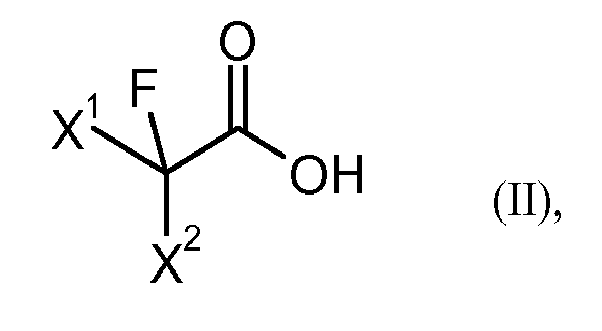
- Die gemäß der vorliegenden Erfindung verwendeten fluorierte Carbonsäuren sind Verbindungen der allgemeinen Formel (II)

- X1 und
- X2 unabhängig voneinander für Fluor, Chlor, Brom, Wasserstoff, C1-12-Alkylreste, C1-12-Haloalkylreste, C5-18-Aryl-, C7-19-Alkylaryl- oder C7-19-Arylalkyreste, vorzugsweise für Wasserstoff, Fluor und Chlor, C2-8-Alkylreste , C2-8-Haloalkylreste, besonders bevorzugt für Fluor, Chlor, Wasserstoff, C3-6-Alkylreste, CF3 und CF2H steht.
- Beispiele für erfindungsgemäß geeignete fluorierte Carbonäuren sind Trifluoressigsäure, Difluoressigsäure, Difluorchloressigsäure, Chlorfluoressigsäure, 2,3,3,3-Tetrafluorpropionsäure, 2,2,3,3-Tetrafluorpropionsäure, 2,2-Difluorpropionsäure, Pentafluorpropionsäure, 2,3,3,4,4,4-Hexafluorbutancarbonsäure.
- Die zuvor beschriebenen fluorierten Carbonsäuren werden mit dem Dialkylaminoacrylsäure-Derivat unter Zugabe eines Säurehalogenids der Formel (IV) umgesetzt.

- Beispiele für erfindungsgemäß geeignete Säurehalogenide sind Essigsäurechlorid, Pivalinsäurechlorid, Isovaleroylchlorid und Benzoylchlorid.
- Das molare Verhältnis von Säurehalogeniden der Formel (IV) zur eingesetzten fluorierten Carbonsäure der Formel (II) kann beispielsweise 0,5 bis 5 betragen, bevorzugt 1 bis 3, besonders bevorzugt 2 bis 2,5.
- Das erfindungsgemäße Verfahren wird in Gegenwart einer Base durchgeführt. Als Basen eignen sich beispielsweise tertiäre Stickstoffbasen, wie z.B, tertiäre Amine, substituierte oder unsubstituierte Pyridine und substituierte oder unsubstituierte Chinoline; Alkali- oder Erdalkalimetallhydroxyde, Hydrogencarbonate oder Carbonate und sonstige anorganische wässrige Basen. Vorzugsweise werden tertiäre Amine, substituierte oder unsubstituierte Pyridine und substituierte oder unsubstituierte Chinoline und solche der allgemeinen Formel (V) eingesetzt,

in welcher - R10 R11, und R12
- unabhängig voneinander für C1-12-Alkyl, C6-18-Aryl, C7-19-Alkylaryl- oder C7-19-
- Arylalkyl stehen können oder jeweils zwei Reste zusammen auch Teil eines 5 bis 8 gliedrigen N-heterocyclischen Restes sein können, oder alle drei Reste zusammen Teil eines N-heterobicyclischen oder N-tricyclischen Restes mit 5 bis 9 Ringatomen pro Cyclus sein können die gegebenenfalls auch andere Heteroatome wie zum Beispiel Sauerstoff enthalten können.
- Bevorzugte Beispiele für Basen der allgemeinen Formel (V) sind Triethylamin, Trimethylamin, Diisopropylethylamin, Tri-n-propylamin, Tri-n-butylamin, Tri-n-hexylamin, Tricyclohexylamin, N-Methyl-cyclohexylamin, N-Methylpyrrolidin, N-Methylpiperidin, N-Ethylpiperidin, N,N-Dimethylanilin, N-Methylmorpholin, Pyridin, 2-, 3-, 4-, Picolin, 2-Methyl-5-ethyl-pyridin, 2,6-Lutidin, 2,4,6-Collidin, 4-Dimethylaminopyridin, Chinolin, Chinaldin, N,N,N,N-Tetramethylethyldiamin, N,N-Dimethyl-1,4-diazacyclohexan, N,N-Di-ethyl-1,4-diazacyclohexan, 1,8-Bis-(Dimethylamino)naphthalin, Diazabicylooctan (DABCO), Diazabicyclononan (DBN) und Diazabicycloundecan (DBU). Weiterhin bevorzugt sind Erdalkalimetall- oder Alkalimetallhydroxyde, - carbonate oder- hydrogencarbonate, wie z.B. Natriumhydroxid, Kaliumhydroxid, Lithiumhydroxid, Calciumhydroxid, Natriumcarbonat, Kaliumcarbonat, Natriumhydrogencarbonat und Kaliumhydrogencarbonat eingesetzt. Die anorganische Base kann gegebenenfalls als wässrige Lösung in Konzentrationen zwischen 10 und 40% eingesetzt werden.
- Besonders bevorzugt werden Triethylamin, Tributylamin, Pyridin, 2-, 3-, 4-, Picolin, 2-Methyl-5-ethyl-pyridin, 2,6-Lutidin, Natriumhydroxid oder Kaliumhydroxid verwendet.
- Das molare Verhältnis von Base zu eingesetzten fluorierten Carbonsäure kann beispielsweise 0,5 bis 10 betragen, bevorzugt 1 bis 8, besonders bevorzugt 1,5 bis 6.
- Der Einsatz größerer Mengen an Base ist unkritisch aber unwirtschaftlich.
- Bei der Durchführung des erfindungsgemäßen Verfahrens arbeitet man beispielsweise bei Temperaturen von -30 bis 130°C, bevorzugt zwischen 10 und 60°C.
- Das erfindungsgemäße Verfahren wird im Allgemeinen unter Normaldruck durchgeführt. Es ist jedoch möglich , unter erhöhtem Druck oder im Vakuum zu arbeiten.
- Die Reaktion kann in Substanz oder in einem Lösungsmittel durchgeführt werden. Vorzugsweise wird die Reaktion in einem Lösungsmittel durchgeführt. Geeignete Lösungsmittel sind beispielsweise ausgewählt aus der Gruppe bestehend aus aliphatischen und aromatischen Kohlenwasserstoffen, wie z.B. n-Hexan, Benzol, Toluol und Xylol, die durch Fluor- und Chloratome substituiert sein können, wie Methylenchlorid, Dichlormethan, Trichlormethan, Tetrachlorkohlenstoff, Fluorbenzol, Chlorbenzol oder Dichlorbenzol; Ethern, wie z.B. Diethylether, Diphenylether Methyl-tert-butylether, Isopropylethylether, Dioxan, Diglym, Dimethylglycol oder THF; Nitrilen wie Methylnitril, Butylnitril oder Phenylnitril; DMF, N,N-Dimethylacetamid wobei Toluol bevorzugt ist.
- In einer bevorzugten Ausführungsform des erfindungsgemäßen Verfahrens wird die Base mit der fluorierten Carbonsäure in einem Lösungsmittel oder in Substanz vorgelegt, anschließend wird das Dialkylaminoacrylsäure-Derivat zugegeben und mit dem Carbonsäurechlorid versetzt. Man kann auch die Base mit dem Carbonsäurechlorid in einem Lösungsmittel oder in Substanz vorgelegen, anschließend das Dialkylaminoacrylsäure-Derivat zugeben und mit der fluorierten Carbonsäure versetzen.
- Bei einer weiteren erfindungsgemäßen Ausführungsform wird die Base mit der fluorierten Carbonsäure in einem Lösungsmittel oder in Substanz vorgelegt, anschließend wird das Carbonsäurechlorid zugegeben und mit dem Dialkylaminoacrylsäure-Derivat versetzt.
- Zur Aufarbeitung kann man beispielsweise so vorgehen, das man gegebenenfalls ausgefallene Salze zum Beispiel durch Filtration, Zentrifugation oder Sedimentation und Dekantieren abtrennt und die so erhaltene Reaktionslösung entweder direkt weiter umsetzt oder zur Gewinnung der 2-Fluoracyl-3-amino-acrylsäure-Derivate, vorzugsweise bis zur Trockene, einengt. Gegebenenfalls können die erhaltenen 2-Fluoracyl-3-amino-acrylsäure-Derivate auch durch Destillation gereinigt werden. Eine weitere Aufarbeitungsmethode kann durch Zugabe von Wasser zum Reaktionsansatzes und anschließender Phasentrennung erfolgen.
- Das erfindungsgemäße Verfahren zum Herstellen von 2-Fluoracyl-3-amino-acrylsäure-Derivaten wird in den nachstehenden Beispielen beschrieben, welche die obige Beschreibung weiter illustrieren. Die Beispiele sind jedoch nicht in einschränkender Weise zu interpretieren.
- Zu einer Lösung von 32,7 g Triethylamin in 60 ml Toluol werden bei Raumtemperatur zuerst 11,6 g Difluoressigsäure und anschließend 14,35 g Dimethylaminoacrylsäureethylester zugesetzt. Zu dieser Lösung werden 28 g Trimethylacetylchlorid zudosiert und 8 h bei Raumtemperatur gerührt. Die Reaktionsmischung wird auf 30 ml Wasser gegossen, die organische Phase wird abgetrennt, die organische Phase wird mit 20 ml Wasser gewaschen, die vereinigten wässrigen Phasen werden nochmals mit 10 ml Toluol extrahiert. Die vereinigten organischen Phasen werden im Vakuum eingeengt. Man erhält 21 g (94% der Theorie) an 2-(Difluoracetyl)-3-(dimethylamino)-acrylsäureethylester.
- Zu einer Lösung von 17,8 g Triethylamin in 50 ml Toluol werden bei Raumtemperatur zuerst 5,7 g Trifluoressigsäure und anschließend 7,23 g Dimethylaminoacrylsäureethylester zugesetzt. Zu dieser Lösung werden 14 g Trimethylacetylchlorid zudosiert und 6 h bei Raumtemperatur gerührt. Die Reaktionsmischung wird auf 20 ml Wasser gegossen, die organische Phase wird abgetrennt, die organische Phase wird mit 20 ml Wasser gewaschen, die vereinigten wässrigen Phasen werden nochmals mit 10 ml Toluol extrahiert. Die vereinigten organischen Phasen werden im Vakuum eingeengt. Man erhält 10,7 g (90 % der Theorie) an 2-(Trifluoracetyl)-3-(dimethylamino)-acrylsäureethylester.
- Zu einer Lösung von 17,8 g Triethylamin in 50 ml Toluol werden bei Raumtemperatur zuerst 4,8 g Difluoressigsäure und anschließend 7,23 g Dimethylaminoacrylsäureethylester zugesetzt. Zu dieser Lösung werden 16,3 g Benzoylclorid zudosiert und 6 h bei Raumtemperatur gerührt. Die Reaktionsmischung wird abfiltriert, auf 30 ml Wasser gegossen, die organische Phase wird abgetrennt, die organische Phase wird mit 20 ml Wasser gewaschen, die vereinigten wässrigen Phasen werden nochmals mit 10 ml Toluol extrahiert. Die vereinigten organischen Phasen werden im Vakuum eingeengt. Man erhält 2-(Difluoracetyl)-3-(dimethylamino)-acrylsäureethylester in Ausbeute von 81 %.


Claims (9)
- Verfahren zum Herstellen von 2-Fluoracyl-3-amino-acrylsäure-Derivaten der allgemeinen Formel (I)
 R1 und R2 unabhängig voneinander ausgewählt sind aus C1-12-Alkylresten, C5-18-Aryl-, C7-19 Alkylaryl- oder C7-19-Arylalkyresten, oderR1 und R2 zusammen mit dem Stickstoffatom, an das sie gebunden sind, einen 5- bis 6-gliedrigen Ring bilden können, der gegebenenfalls ein oder zwei weitere Hetero-Atome, ausgewählt aus O, S und einer SO2-Gruppe enthalten kann,Y ausgewählt ist aus (C=O)OR3, CN und (C=O)NR4R5, wobei R3 ,R4 und R5 unabhängig von einander ausgewählt sind aus C1-12-Alkylresten, C5-18-Aryl-, C7-19-Alkylaryl- oder C7-19-Arylalkyresten undX1 und X2 unabhängig voneinander für Fluor, Chlor, Brom, Wasserstoff, C1-12-Alkylreste, C1-12-Haloalkylreste, C5-18-Aryl-, C7-19-Alkylaryl- oder C7-19-Arylalkyreste stehen,dadurch gekennzeichnet, dass man fluorierte Carbonsäuren der Formel (II)


- Verfahren gemäß Anspruch 1, wobeiR1 und R2 unabhängig voneinander ausgewählt sind aus Methyl, Ethyl, n-Propyl oder iso-Propyl, oderR1 und R2 zusammen mit dem Stickstoffatom, an das sie gebunden sind, einen Piperidinyl- oder Pyrolidinyl-Ring bilden;Y ausgewählt ist aus (C=O)OR3, wobei R3 ausgewählt ist aus Methyl, Ethyl, n-Propyl oder iso-Propyl;X1 und Wasserstoff; X2 unabhängig voneinander ausgewählt sind aus Fluor, Chlor, Brom undHal für Chlor oder Brom steht;R9 ausgewählt ist aus C1-12-Alkylresten
- Verfahren gemäß Anspruch 1 oder 2, wobeiR1 und R2 Methyl sind,Y (C=O)OC2H5;X1 Fluor ist;X2 Wasserstoff ist;Hal Chlor ist undR9 Methyl ist.
- Verfahren gemäß irgendeinem der Ansprüche 1 bis 3, wobei die fluorierte Carbonsäuren ausgewählt sind aus der Gruppe bestehend aus Trifluoressigsäure, Difluoressigsäure, Difluorchloressigsäure, Chlorfluoressigsäure, 2,3,3,3-Tetrafluorpropionsäure, 2,2,3,3-Tetrafluorpropionsäure, 2,2-Difluorpropionsäure, Pentafluorpropionsäure, 2,3,3,4,4,4-Hexafluorbutancarbonsäure.
- Verfahren gemäß irgendeinem der Ansprüche 1 bis 4, wobei die Dialkylaminoacrylsäure-Derivate ausgewählt sind aus der Gruppe bestehend aus 3-(N,N-Dimethylamino)-acrylsäuremethylester, 3-(N,N-Dimethylamino)-acrylsäureethylester, 3-(N,N-Diethylamino)-acrylsäureethylester, 3-(N,N-Dimethylamino)-acrylsäurenitril, 3-(N,N-Dimethylamino)-acrylsäuredimethylamid und 3-(N,N-Dimethylamino)-acrylsäurediethylamid.
- Verfahren irgendeinem der Ansprüche 1 bis 5 wobei das molare Verhältnis von Dialkylaminoacrylsäure-Derivaten zu eingesetzten fluorierten Carbonsäure 0,5 bis 3 ist.
- Verfahren gemäß einem der Ansprüche 1 bis 6, wobei das Säurechlorid ausgewählt ist aus Essigsäurechlorid, Pivalinsäurechlorid, Isovaleroylchlorid und Benzoylchlorid.
- Verfahren gemäß einem der Ansprüche 1 bis 7, wobei das molare Verhältnis von Säurechlorid zur eingesetzten fluorierten Carbonsäure 0,5 bis 5 ist.
- Verfahren gemäß einem der Ansprüche 1 bis 8, wobei die Base ausgewählt ist aus Triethylamin, Trimethylamin, Diisopropylethylamin, Tri-n-propylamin, Tri-n-butylamin, Tri-n-hexylamin, Tricyclohexylamin, N-Methyl-cyclohexylamin, N-Methylpyrrolidin, N-Methylpiperidin, N-Ethylpiperidin, N,N-Dimethylanilin, N-Methylmorpholin, Pyridin, 2-, 3-, 4-, Picolin, 2-Methyl-5-ethyl-pyridin, 2,6-Lutidin, 2,4,6-Collidin, 4-Dimethylaminopyridin, Chinolin, Chinaldin, N,N,N,N-Tetramethylethyldiamin, N,N-Dimethyl-1,4-diazacyclohexan, N,N-Di-ethyl-1,4-diazacyclohexan, 1,8-Bis-(Dimethylamino)naphthalin, Diazabicylooctan (DABCO), Diazabicyclononan (DBN) und Diazabicycloundecan (DBU), Natriumhydroxid, Kaliumhydroxid, Lithiumhydroxid, Calciumhydroxid, Natriumcarbonat, Kaliumcarbonat, Natriumhydrogencarbonat und Kaliumhydrogencarbonat.
Priority Applications (12)
| Application Number | Priority Date | Filing Date | Title |
|---|---|---|---|
| EP07150357A EP2072497A1 (de) | 2007-12-21 | 2007-12-21 | Verfahren zum Herstellen von 2-Fluoracyl-3-amino-acrylsäure-Derivaten |
| KR1020107014560A KR101574143B1 (ko) | 2007-12-21 | 2008-12-16 | 2-플루오로아실-3-아미노아크릴산 유도체의 제조방법 |
| DK08866428.9T DK2245001T3 (da) | 2007-12-21 | 2008-12-16 | Fremgangsmåde til fremstilling af 2-fluoracyl-3-amino-acrylsyrederivater |
| EP08866428A EP2245001B1 (de) | 2007-12-21 | 2008-12-16 | Verfahren zum Herstellen von 2-Fluoracyl-3-amino-acrylsäure-derivaten |
| PCT/EP2008/010689 WO2009083134A1 (de) | 2007-12-21 | 2008-12-16 | Verfahren zum herstellen von 2-fluoracyl-3-amino-acrylsäure-derivaten |
| MX2010005938A MX2010005938A (es) | 2007-12-21 | 2008-12-16 | Procedimiento para la preparacion de derivados de acido 2-fluoroacil-3-amino-acrilico. |
| BRPI0821752-1A BRPI0821752B1 (pt) | 2007-12-21 | 2008-12-16 | Process for preparing 22-fluoracyl-3-amino acrylic acid derivatives |
| ES08866428T ES2405549T3 (es) | 2007-12-21 | 2008-12-16 | Procedimiento para la preparación de derivados de ácido 2-fluoroacil-3-amino-acrilico |
| CN2008801221733A CN101903333B (zh) | 2007-12-21 | 2008-12-16 | 制备2-氟酰基-3-氨基丙烯酸衍生物的方法 |
| US12/809,830 US8288582B2 (en) | 2007-12-21 | 2008-12-16 | Method for the production of 2-fluoroacyl-3-aminoacrylic acid derivatives |
| TW097149561A TWI441802B (zh) | 2007-12-21 | 2008-12-19 | 製備2-氟醯基-3-胺丙烯酸衍生物之方法 |
| IL205745A IL205745A (en) | 2007-12-21 | 2010-05-13 | METHOD FOR PREPARING HISTORY OF 2-FLUORO EASY-3-AMINO-ACRYLIC ACID |
Applications Claiming Priority (1)
| Application Number | Priority Date | Filing Date | Title |
|---|---|---|---|
| EP07150357A EP2072497A1 (de) | 2007-12-21 | 2007-12-21 | Verfahren zum Herstellen von 2-Fluoracyl-3-amino-acrylsäure-Derivaten |
Publications (1)
| Publication Number | Publication Date |
|---|---|
| EP2072497A1 true EP2072497A1 (de) | 2009-06-24 |
Family
ID=39164649
Family Applications (2)
| Application Number | Title | Priority Date | Filing Date |
|---|---|---|---|
| EP07150357A Ceased EP2072497A1 (de) | 2007-12-21 | 2007-12-21 | Verfahren zum Herstellen von 2-Fluoracyl-3-amino-acrylsäure-Derivaten |
| EP08866428A Active EP2245001B1 (de) | 2007-12-21 | 2008-12-16 | Verfahren zum Herstellen von 2-Fluoracyl-3-amino-acrylsäure-derivaten |
Family Applications After (1)
| Application Number | Title | Priority Date | Filing Date |
|---|---|---|---|
| EP08866428A Active EP2245001B1 (de) | 2007-12-21 | 2008-12-16 | Verfahren zum Herstellen von 2-Fluoracyl-3-amino-acrylsäure-derivaten |
Country Status (11)
| Country | Link |
|---|---|
| US (1) | US8288582B2 (de) |
| EP (2) | EP2072497A1 (de) |
| KR (1) | KR101574143B1 (de) |
| CN (1) | CN101903333B (de) |
| BR (1) | BRPI0821752B1 (de) |
| DK (1) | DK2245001T3 (de) |
| ES (1) | ES2405549T3 (de) |
| IL (1) | IL205745A (de) |
| MX (1) | MX2010005938A (de) |
| TW (1) | TWI441802B (de) |
| WO (1) | WO2009083134A1 (de) |
Cited By (5)
| Publication number | Priority date | Publication date | Assignee | Title |
|---|---|---|---|---|
| WO2009133178A1 (de) * | 2008-05-02 | 2009-11-05 | Basf Se | Verfahren zur herstellung von 2-(aminomethyliden)-4,4-difluor-3-oxobuttersäureestern |
| US8344157B2 (en) | 2008-07-21 | 2013-01-01 | Basf Se | Process for preparing 1,3-disubstituted pyrazolecarboxylic esters |
| US8586750B2 (en) | 2008-05-02 | 2013-11-19 | Basf Se | Method for the production of halogen-substituted 2-(aminomethylidene)-3-oxobutyric acid esters |
| US8598222B2 (en) | 2008-05-05 | 2013-12-03 | Basf Se | Method for preparing 1,3,4-substituted pyrazol compounds |
| US10273215B2 (en) | 2015-06-26 | 2019-04-30 | Bayer Cropscience Aktiengesellschaft | Process for preparing substituted pyrazoles containing haloalkoxy- and haloalkylthio groups from alpha,alpha -dihaloalkylamines and ketimines |
Families Citing this family (2)
| Publication number | Priority date | Publication date | Assignee | Title |
|---|---|---|---|---|
| EP2042482A1 (de) * | 2007-09-26 | 2009-04-01 | Bayer CropScience AG | Verfahren zur Herstellung von 2-Dihalogenacyl-3-amino-acrylsäure-Derivaten |
| EP2263999A4 (de) * | 2008-03-18 | 2012-11-07 | Mitsui Chemicals Agro Inc | Verfahren zur herstellung eines fluorhaltigen acylessigsäurederivats, verfahren zur herstellung eines fluorhaltigen pyrazolcarbonsäuresterderivats und verfahren zur herstellung eines fluorhaltigen pyrazolcarbonsäurederivats |
Citations (5)
| Publication number | Priority date | Publication date | Assignee | Title |
|---|---|---|---|---|
| EP0608725A2 (de) | 1993-01-27 | 1994-08-03 | Bayer Ag | Verfahren zur Herstellung von Aminomethylenverbindungen |
| EP1000926A1 (de) | 1998-11-10 | 2000-05-17 | Rohm And Haas Company | Verfahren zur Herstellung von 2-(Trihaloacetyl)-3-(substituiertes Amino)-2-propenoaten |
| WO2003051820A1 (de) | 2001-12-17 | 2003-06-26 | Bayer Chemicals Ag | Verfahren zur herstellung von 2-halogenacyl-3-amino-acrylsäure- derivaten |
| WO2005042468A1 (de) | 2003-10-23 | 2005-05-12 | Bayer Cropscience Aktiengesellschaft | Verfahren zum herstellen von 2-dihalogenacyl-3-amino-acrylsäureestern und 3-dihalogenmethyl-pyrazol-4-carbonsäureestern |
| US20070225280A1 (en) * | 2006-03-22 | 2007-09-27 | Kevin William Anderson | Adamantyl-pyrazole carboxamides as inhibitors of 11B-hydroxysteroid dehydrogenase |
Family Cites Families (2)
| Publication number | Priority date | Publication date | Assignee | Title |
|---|---|---|---|---|
| DE59005903D1 (de) * | 1989-09-01 | 1994-07-07 | Gretag Imaging Ag | Photoelektrischer Abtaster. |
| DE19822912A1 (de) * | 1998-05-22 | 1999-11-25 | Degussa | Verfahren zur Herstellung von 3-Amino-2-oxo-pyrrolidinen, neue Zwischenprodukte und deren Verwendung |
-
2007
- 2007-12-21 EP EP07150357A patent/EP2072497A1/de not_active Ceased
-
2008
- 2008-12-16 MX MX2010005938A patent/MX2010005938A/es active IP Right Grant
- 2008-12-16 CN CN2008801221733A patent/CN101903333B/zh active Active
- 2008-12-16 BR BRPI0821752-1A patent/BRPI0821752B1/pt active IP Right Grant
- 2008-12-16 WO PCT/EP2008/010689 patent/WO2009083134A1/de not_active Ceased
- 2008-12-16 US US12/809,830 patent/US8288582B2/en not_active Expired - Fee Related
- 2008-12-16 KR KR1020107014560A patent/KR101574143B1/ko active Active
- 2008-12-16 EP EP08866428A patent/EP2245001B1/de active Active
- 2008-12-16 DK DK08866428.9T patent/DK2245001T3/da active
- 2008-12-16 ES ES08866428T patent/ES2405549T3/es active Active
- 2008-12-19 TW TW097149561A patent/TWI441802B/zh not_active IP Right Cessation
-
2010
- 2010-05-13 IL IL205745A patent/IL205745A/en active IP Right Grant
Patent Citations (5)
| Publication number | Priority date | Publication date | Assignee | Title |
|---|---|---|---|---|
| EP0608725A2 (de) | 1993-01-27 | 1994-08-03 | Bayer Ag | Verfahren zur Herstellung von Aminomethylenverbindungen |
| EP1000926A1 (de) | 1998-11-10 | 2000-05-17 | Rohm And Haas Company | Verfahren zur Herstellung von 2-(Trihaloacetyl)-3-(substituiertes Amino)-2-propenoaten |
| WO2003051820A1 (de) | 2001-12-17 | 2003-06-26 | Bayer Chemicals Ag | Verfahren zur herstellung von 2-halogenacyl-3-amino-acrylsäure- derivaten |
| WO2005042468A1 (de) | 2003-10-23 | 2005-05-12 | Bayer Cropscience Aktiengesellschaft | Verfahren zum herstellen von 2-dihalogenacyl-3-amino-acrylsäureestern und 3-dihalogenmethyl-pyrazol-4-carbonsäureestern |
| US20070225280A1 (en) * | 2006-03-22 | 2007-09-27 | Kevin William Anderson | Adamantyl-pyrazole carboxamides as inhibitors of 11B-hydroxysteroid dehydrogenase |
Non-Patent Citations (3)
| Title |
|---|
| HOJO M ET AL: "ELECTROPHILIC SUBSTITUTIONS OF OLEFINIC HYDROGENS II. ACYLATION OF VINYL ETHERS AND N-VINYL AMIDES", CHEMISTRY LETTERS, NIPPON KAGAKUKAI, TOKYO, JP, 1976, pages 499 - 502, XP000196322, ISSN: 0366-7022 * |
| RENE ET AL., SYNTHESIS, vol. 5, 1986, pages 419 - 420 |
| TETRAHEDRON LETT., vol. 37, 1996, pages 8751 - 8754 |
Cited By (7)
| Publication number | Priority date | Publication date | Assignee | Title |
|---|---|---|---|---|
| WO2009133178A1 (de) * | 2008-05-02 | 2009-11-05 | Basf Se | Verfahren zur herstellung von 2-(aminomethyliden)-4,4-difluor-3-oxobuttersäureestern |
| US8314233B2 (en) | 2008-05-02 | 2012-11-20 | Basf Se | Process for preparing 2-(aminomethylidene)-4,4-difluoro-3-oxobutyric esters |
| US8586750B2 (en) | 2008-05-02 | 2013-11-19 | Basf Se | Method for the production of halogen-substituted 2-(aminomethylidene)-3-oxobutyric acid esters |
| US8592578B2 (en) | 2008-05-02 | 2013-11-26 | Basf Se | Process for preparing 2-(aminomethylidene)-4,4-difluoro-3-oxobutyric esters |
| US8598222B2 (en) | 2008-05-05 | 2013-12-03 | Basf Se | Method for preparing 1,3,4-substituted pyrazol compounds |
| US8344157B2 (en) | 2008-07-21 | 2013-01-01 | Basf Se | Process for preparing 1,3-disubstituted pyrazolecarboxylic esters |
| US10273215B2 (en) | 2015-06-26 | 2019-04-30 | Bayer Cropscience Aktiengesellschaft | Process for preparing substituted pyrazoles containing haloalkoxy- and haloalkylthio groups from alpha,alpha -dihaloalkylamines and ketimines |
Also Published As
| Publication number | Publication date |
|---|---|
| BRPI0821752A8 (pt) | 2015-12-22 |
| BRPI0821752B1 (pt) | 2017-10-24 |
| TW200940483A (en) | 2009-10-01 |
| CN101903333B (zh) | 2013-11-06 |
| ES2405549T3 (es) | 2013-05-31 |
| DK2245001T3 (da) | 2013-06-17 |
| EP2245001B1 (de) | 2013-03-20 |
| KR20100099237A (ko) | 2010-09-10 |
| IL205745A0 (en) | 2010-11-30 |
| MX2010005938A (es) | 2010-07-19 |
| KR101574143B1 (ko) | 2016-02-19 |
| IL205745A (en) | 2014-01-30 |
| CN101903333A (zh) | 2010-12-01 |
| BRPI0821752A2 (pt) | 2015-06-16 |
| EP2245001A1 (de) | 2010-11-03 |
| US8288582B2 (en) | 2012-10-16 |
| WO2009083134A1 (de) | 2009-07-09 |
| TWI441802B (zh) | 2014-06-21 |
| US20100274049A1 (en) | 2010-10-28 |
Similar Documents
| Publication | Publication Date | Title |
|---|---|---|
| EP2195284B1 (de) | Verfahren zur herstellung von 2-dihalogenacyl-3-amino-acrylsäure-derivaten | |
| EP2257532B1 (de) | Verfahren zur regioselektiven synthese von l-alkvl-3-haloalkyl-pvrazol-4-carbonsäure-derivaten | |
| EP2245001B1 (de) | Verfahren zum Herstellen von 2-Fluoracyl-3-amino-acrylsäure-derivaten | |
| EP2057126A2 (de) | Verfahren zum herstellen von 3-dihalomethyl-pyrazol-4-carbonsäurederivaten | |
| EP2809653B1 (de) | Verfahren zur herstellung von 3,5-bis(fluoralkyl)-pyrazol-4-carbonsäure-derivaten und 3,5-bis(fluoralkyl)-pyrazolen | |
| EP2285779A1 (de) | Verfahren zur herstellung von arylcarboxamiden | |
| EP1644314B1 (de) | Verfahren zum herstellen von difluoracetessigs urealkylestern | |
| EP2440518B1 (de) | Verfahren zur herstellung von fluoralkylnitrilen | |
| EP1858858B1 (de) | Verfahren zum herstellen von alkylaniliden | |
| DE3315524A1 (de) | Verfahren zur herstellung von oxiranen | |
| EP2253610B1 (de) | Verfahren zur Herstellung von Enaminocarbonyl-Verbindungen und deren Verwendung zur Herstellung von 4-Aminobut-2-enoliden | |
| EP4013744A1 (de) | Verfahren zur herstellung von 2-(phenylimino)-3-alkyl-1,3-thiazolidin-4-onen | |
| DE69703115T2 (de) | Zwischenprodukte um 2-imidazolin-5onederivate herzustellen. | |
| EP1309538B1 (de) | Verfahren zur herstellung von trifluorethoxysubstituierten benzoesäuren | |
| DE10208955A1 (de) | Verfahren zur Herstellung von 2-Halogenalkylnicotinsäuren | |
| EP0089485B1 (de) | Verfahren zur Herstellung von 5-Chlor-1H-tetrazol-1-carbonsäureestern sowie Verfahren zur Herstellung der erforderlichen Dichlorisonitril-carbonsäureester | |
| EP4107149A1 (de) | Verfahren zur herstellung von 2-(phenylimino)-3-alkyl-1,3-thiazolidin-4-onen | |
| DE2710382A1 (de) | Verfahren zur herstellung von 2,1,3-thiadiazin-4-on-2,2-dioxid-derivaten | |
| EP1833814B1 (de) | Verfahren zur herstellung von substituierten 2-alkoxycarbonyl-3-aminothiophenen | |
| EP0662474B1 (de) | Verfahren zur herstellung von chlorpyridinen | |
| DE4446338A1 (de) | Verfahren zur Herstellung von Chlormethylpyridinen | |
| EP0308740A1 (de) | Verfahren zur Herstellung von 2,4-Dichlor-5-dichlormethyl-thiazol | |
| WO2007065567A1 (de) | Verfahren zur herstellung von haloalkyl(thio)vinimidiniumsalzen und 4- (haloalkyl(thio))-pyrazolen und deren umsetzung zu pflanzenschutzmitteln | |
| DE4437930A1 (de) | 2-Chlor-N-[1-(2,6-dichlor-4-difluormethyl- phenyl)-1H-pyrazol-5-yl]-propanamid |
Legal Events
| Date | Code | Title | Description |
|---|---|---|---|
| PUAI | Public reference made under article 153(3) epc to a published international application that has entered the european phase |
Free format text: ORIGINAL CODE: 0009012 |
|
| AK | Designated contracting states |
Kind code of ref document: A1 Designated state(s): AT BE BG CH CY CZ DE DK EE ES FI FR GB GR HU IE IS IT LI LT LU LV MC MT NL PL PT RO SE SI SK TR |
|
| AX | Request for extension of the european patent |
Extension state: AL BA HR MK RS |
|
| STAA | Information on the status of an ep patent application or granted ep patent |
Free format text: STATUS: THE APPLICATION HAS BEEN REFUSED |
|
| 18R | Application refused |
Effective date: 20090904 |