EP2067787A1 - Method for controlling insect populations - Google Patents
Method for controlling insect populations Download PDFInfo
- Publication number
- EP2067787A1 EP2067787A1 EP07122553A EP07122553A EP2067787A1 EP 2067787 A1 EP2067787 A1 EP 2067787A1 EP 07122553 A EP07122553 A EP 07122553A EP 07122553 A EP07122553 A EP 07122553A EP 2067787 A1 EP2067787 A1 EP 2067787A1
- Authority
- EP
- European Patent Office
- Prior art keywords
- spr
- seq
- insect
- nucleic acid
- interest
- Prior art date
- Legal status (The legal status is an assumption and is not a legal conclusion. Google has not performed a legal analysis and makes no representation as to the accuracy of the status listed.)
- Withdrawn
Links
- 241000238631 Hexapoda Species 0.000 title claims abstract description 133
- 238000000034 method Methods 0.000 title claims abstract description 80
- 101710125731 Sex peptide receptor Proteins 0.000 claims abstract description 313
- 230000012995 post-mating behavior Effects 0.000 claims abstract description 18
- 101710197241 Accessory gland-specific peptide 70A Proteins 0.000 claims description 102
- 150000001875 compounds Chemical class 0.000 claims description 61
- 102000039446 nucleic acids Human genes 0.000 claims description 59
- 108020004707 nucleic acids Proteins 0.000 claims description 59
- 150000007523 nucleic acids Chemical class 0.000 claims description 59
- 230000000694 effects Effects 0.000 claims description 41
- 108090000765 processed proteins & peptides Proteins 0.000 claims description 41
- 102000005962 receptors Human genes 0.000 claims description 38
- 108020003175 receptors Proteins 0.000 claims description 38
- 150000001413 amino acids Chemical class 0.000 claims description 37
- 230000004044 response Effects 0.000 claims description 37
- 108090000623 proteins and genes Proteins 0.000 claims description 33
- 108020004414 DNA Proteins 0.000 claims description 32
- 102000004196 processed proteins & peptides Human genes 0.000 claims description 32
- 238000012360 testing method Methods 0.000 claims description 31
- 102000003688 G-Protein-Coupled Receptors Human genes 0.000 claims description 27
- 108090000045 G-Protein-Coupled Receptors Proteins 0.000 claims description 27
- 108091006099 G alpha subunit Proteins 0.000 claims description 26
- 102000034353 G alpha subunit Human genes 0.000 claims description 26
- 230000004913 activation Effects 0.000 claims description 26
- 241000255581 Drosophila <fruit fly, genus> Species 0.000 claims description 25
- 230000014509 gene expression Effects 0.000 claims description 25
- 229920001184 polypeptide Polymers 0.000 claims description 25
- 239000000203 mixture Substances 0.000 claims description 24
- 108091006027 G proteins Proteins 0.000 claims description 23
- 102000030782 GTP binding Human genes 0.000 claims description 23
- 108091000058 GTP-Binding Proteins 0.000 claims description 23
- 239000002299 complementary DNA Substances 0.000 claims description 23
- 239000012634 fragment Substances 0.000 claims description 22
- 230000019491 signal transduction Effects 0.000 claims description 21
- 102000004169 proteins and genes Human genes 0.000 claims description 20
- 241000894007 species Species 0.000 claims description 16
- 230000000295 complement effect Effects 0.000 claims description 15
- 230000003993 interaction Effects 0.000 claims description 13
- 230000003834 intracellular effect Effects 0.000 claims description 13
- OYPRJOBELJOOCE-UHFFFAOYSA-N Calcium Chemical compound [Ca] OYPRJOBELJOOCE-UHFFFAOYSA-N 0.000 claims description 12
- 108091034117 Oligonucleotide Proteins 0.000 claims description 12
- 239000011575 calcium Substances 0.000 claims description 12
- 229910052791 calcium Inorganic materials 0.000 claims description 12
- 230000013011 mating Effects 0.000 claims description 11
- 230000036961 partial effect Effects 0.000 claims description 11
- 108020004459 Small interfering RNA Proteins 0.000 claims description 10
- 230000000692 anti-sense effect Effects 0.000 claims description 9
- 230000002441 reversible effect Effects 0.000 claims description 9
- 241000255789 Bombyx mori Species 0.000 claims description 8
- 241000254113 Tribolium castaneum Species 0.000 claims description 8
- 241000256118 Aedes aegypti Species 0.000 claims description 7
- 241000256182 Anopheles gambiae Species 0.000 claims description 7
- 108091028043 Nucleic acid sequence Proteins 0.000 claims description 7
- 241000517306 Pediculus humanus corporis Species 0.000 claims description 7
- 241001414989 Thysanoptera Species 0.000 claims description 7
- 239000003112 inhibitor Substances 0.000 claims description 7
- 239000012528 membrane Substances 0.000 claims description 7
- 239000000816 peptidomimetic Substances 0.000 claims description 7
- 238000001890 transfection Methods 0.000 claims description 7
- 230000009261 transgenic effect Effects 0.000 claims description 7
- 241000256111 Aedes <genus> Species 0.000 claims description 6
- 241000255601 Drosophila melanogaster Species 0.000 claims description 6
- 241000500437 Plutella xylostella Species 0.000 claims description 6
- 230000008859 change Effects 0.000 claims description 6
- 108020001507 fusion proteins Proteins 0.000 claims description 6
- 102000037865 fusion proteins Human genes 0.000 claims description 6
- 241000256057 Culex quinquefasciatus Species 0.000 claims description 5
- 241001147381 Helicoverpa armigera Species 0.000 claims description 5
- 238000012408 PCR amplification Methods 0.000 claims description 5
- 239000013612 plasmid Substances 0.000 claims description 5
- 241000256186 Anopheles <genus> Species 0.000 claims description 4
- 241000238657 Blattella germanica Species 0.000 claims description 4
- 241000254171 Curculionidae Species 0.000 claims description 4
- 102000053602 DNA Human genes 0.000 claims description 4
- 241000257159 Musca domestica Species 0.000 claims description 4
- 241000721451 Pectinophora gossypiella Species 0.000 claims description 4
- 241000238675 Periplaneta americana Species 0.000 claims description 4
- 241000866500 Reticulitermes speratus Species 0.000 claims description 4
- 241000253973 Schistocerca gregaria Species 0.000 claims description 4
- 241000018137 Trialeurodes vaporariorum Species 0.000 claims description 4
- 230000001960 triggered effect Effects 0.000 claims description 4
- 241000566547 Agrotis ipsilon Species 0.000 claims description 3
- 108091026890 Coding region Proteins 0.000 claims description 3
- 241000256054 Culex <genus> Species 0.000 claims description 3
- 241001154603 Glossina fuscipes fuscipes Species 0.000 claims description 3
- 241001556089 Nilaparvata lugens Species 0.000 claims description 3
- 241000985245 Spodoptera litura Species 0.000 claims description 3
- 238000003752 polymerase chain reaction Methods 0.000 claims description 3
- 108010055197 Drosophila male accessory gland peptide Proteins 0.000 claims description 2
- 108010070028 Drosophila sex peptide receptor Proteins 0.000 claims description 2
- 239000004480 active ingredient Substances 0.000 claims description 2
- 230000003281 allosteric effect Effects 0.000 claims description 2
- 125000003275 alpha amino acid group Chemical group 0.000 claims 9
- 229940124276 oligodeoxyribonucleotide Drugs 0.000 claims 2
- 238000003556 assay Methods 0.000 abstract description 69
- 241000607479 Yersinia pestis Species 0.000 abstract description 23
- 210000004027 cell Anatomy 0.000 description 77
- 101100096527 Drosophila melanogaster SPR gene Proteins 0.000 description 29
- 239000013598 vector Substances 0.000 description 26
- 238000002198 surface plasmon resonance spectroscopy Methods 0.000 description 23
- 235000001014 amino acid Nutrition 0.000 description 21
- 229940024606 amino acid Drugs 0.000 description 21
- 239000003446 ligand Substances 0.000 description 18
- 239000000556 agonist Substances 0.000 description 16
- 239000003795 chemical substances by application Substances 0.000 description 16
- 235000018102 proteins Nutrition 0.000 description 16
- 241000255925 Diptera Species 0.000 description 14
- 239000002773 nucleotide Substances 0.000 description 14
- 125000003729 nucleotide group Chemical group 0.000 description 14
- 230000009368 gene silencing by RNA Effects 0.000 description 13
- 102100021131 Zinc finger and BTB domain-containing protein 22 Human genes 0.000 description 12
- 239000005557 antagonist Substances 0.000 description 12
- 241000282414 Homo sapiens Species 0.000 description 11
- 108700008625 Reporter Genes Proteins 0.000 description 11
- 239000013543 active substance Substances 0.000 description 11
- 230000006399 behavior Effects 0.000 description 11
- 230000006870 function Effects 0.000 description 11
- 239000005090 green fluorescent protein Substances 0.000 description 11
- 241000196324 Embryophyta Species 0.000 description 10
- 108091030071 RNAI Proteins 0.000 description 10
- 238000013459 approach Methods 0.000 description 10
- 210000004978 chinese hamster ovary cell Anatomy 0.000 description 10
- 235000013601 eggs Nutrition 0.000 description 10
- 239000000843 powder Substances 0.000 description 10
- 210000001519 tissue Anatomy 0.000 description 10
- 101150081864 Spr gene Proteins 0.000 description 9
- 201000010099 disease Diseases 0.000 description 9
- 208000037265 diseases, disorders, signs and symptoms Diseases 0.000 description 9
- 239000000047 product Substances 0.000 description 9
- IAZDPXIOMUYVGZ-UHFFFAOYSA-N Dimethylsulphoxide Chemical compound CS(C)=O IAZDPXIOMUYVGZ-UHFFFAOYSA-N 0.000 description 8
- 101100331192 Drosophila melanogaster Dup99B gene Proteins 0.000 description 8
- 108010043121 Green Fluorescent Proteins Proteins 0.000 description 8
- 102000004144 Green Fluorescent Proteins Human genes 0.000 description 8
- 102000030621 adenylate cyclase Human genes 0.000 description 8
- 108060000200 adenylate cyclase Proteins 0.000 description 8
- 230000004927 fusion Effects 0.000 description 8
- 230000001404 mediated effect Effects 0.000 description 8
- 210000002569 neuron Anatomy 0.000 description 8
- 239000000575 pesticide Substances 0.000 description 8
- 238000012216 screening Methods 0.000 description 8
- 108010000239 Aequorin Proteins 0.000 description 7
- DBMJMQXJHONAFJ-UHFFFAOYSA-M Sodium laurylsulphate Chemical compound [Na+].CCCCCCCCCCCCOS([O-])(=O)=O DBMJMQXJHONAFJ-UHFFFAOYSA-M 0.000 description 7
- 210000004556 brain Anatomy 0.000 description 7
- 210000003169 central nervous system Anatomy 0.000 description 7
- 238000005516 engineering process Methods 0.000 description 7
- 238000002866 fluorescence resonance energy transfer Methods 0.000 description 7
- 230000001105 regulatory effect Effects 0.000 description 7
- 239000004055 small Interfering RNA Substances 0.000 description 7
- 235000019333 sodium laurylsulphate Nutrition 0.000 description 7
- 239000007787 solid Substances 0.000 description 7
- 102100039556 Galectin-4 Human genes 0.000 description 6
- 101000608765 Homo sapiens Galectin-4 Proteins 0.000 description 6
- 108091027981 Response element Proteins 0.000 description 6
- 108700019146 Transgenes Proteins 0.000 description 6
- 230000003542 behavioural effect Effects 0.000 description 6
- 102000000072 beta-Arrestins Human genes 0.000 description 6
- 108010080367 beta-Arrestins Proteins 0.000 description 6
- 230000001413 cellular effect Effects 0.000 description 6
- 230000001276 controlling effect Effects 0.000 description 6
- 230000001419 dependent effect Effects 0.000 description 6
- 230000002401 inhibitory effect Effects 0.000 description 6
- 230000005764 inhibitory process Effects 0.000 description 6
- 238000004020 luminiscence type Methods 0.000 description 6
- 238000005259 measurement Methods 0.000 description 6
- 230000017448 oviposition Effects 0.000 description 6
- 230000010539 reproductive behavior Effects 0.000 description 6
- 238000007423 screening assay Methods 0.000 description 6
- 239000000126 substance Substances 0.000 description 6
- 230000005945 translocation Effects 0.000 description 6
- 108090000204 Dipeptidase 1 Proteins 0.000 description 5
- 241000255313 Drosophila pseudoobscura Species 0.000 description 5
- 241001465754 Metazoa Species 0.000 description 5
- 240000004808 Saccharomyces cerevisiae Species 0.000 description 5
- 235000014680 Saccharomyces cerevisiae Nutrition 0.000 description 5
- 102000014384 Type C Phospholipases Human genes 0.000 description 5
- 108010079194 Type C Phospholipases Proteins 0.000 description 5
- 108010005774 beta-Galactosidase Proteins 0.000 description 5
- 102000006635 beta-lactamase Human genes 0.000 description 5
- 238000000225 bioluminescence resonance energy transfer Methods 0.000 description 5
- 238000006243 chemical reaction Methods 0.000 description 5
- 230000007812 deficiency Effects 0.000 description 5
- 238000001514 detection method Methods 0.000 description 5
- 238000002474 experimental method Methods 0.000 description 5
- 238000009396 hybridization Methods 0.000 description 5
- 239000007788 liquid Substances 0.000 description 5
- 210000004962 mammalian cell Anatomy 0.000 description 5
- 210000000056 organ Anatomy 0.000 description 5
- 230000002829 reductive effect Effects 0.000 description 5
- 230000001850 reproductive effect Effects 0.000 description 5
- 230000035945 sensitivity Effects 0.000 description 5
- 230000011664 signaling Effects 0.000 description 5
- 238000005507 spraying Methods 0.000 description 5
- 238000010186 staining Methods 0.000 description 5
- 108700028369 Alleles Proteins 0.000 description 4
- 108700021386 Drosophila SP Proteins 0.000 description 4
- 102000004190 Enzymes Human genes 0.000 description 4
- 108090000790 Enzymes Proteins 0.000 description 4
- 241001599018 Melanogaster Species 0.000 description 4
- 241000257226 Muscidae Species 0.000 description 4
- YHIPILPTUVMWQT-UHFFFAOYSA-N Oplophorus luciferin Chemical compound C1=CC(O)=CC=C1CC(C(N1C=C(N2)C=3C=CC(O)=CC=3)=O)=NC1=C2CC1=CC=CC=C1 YHIPILPTUVMWQT-UHFFFAOYSA-N 0.000 description 4
- 108010052090 Renilla Luciferases Proteins 0.000 description 4
- VYPSYNLAJGMNEJ-UHFFFAOYSA-N Silicium dioxide Chemical compound O=[Si]=O VYPSYNLAJGMNEJ-UHFFFAOYSA-N 0.000 description 4
- 241000700605 Viruses Species 0.000 description 4
- 230000003321 amplification Effects 0.000 description 4
- 239000000872 buffer Substances 0.000 description 4
- 238000000546 chi-square test Methods 0.000 description 4
- 238000010367 cloning Methods 0.000 description 4
- 238000013270 controlled release Methods 0.000 description 4
- 238000013461 design Methods 0.000 description 4
- 210000003527 eukaryotic cell Anatomy 0.000 description 4
- 235000013305 food Nutrition 0.000 description 4
- 238000003197 gene knockdown Methods 0.000 description 4
- 239000008187 granular material Substances 0.000 description 4
- 102000034345 heterotrimeric G proteins Human genes 0.000 description 4
- 108091006093 heterotrimeric G proteins Proteins 0.000 description 4
- 238000002347 injection Methods 0.000 description 4
- 239000007924 injection Substances 0.000 description 4
- 201000004792 malaria Diseases 0.000 description 4
- 108020004999 messenger RNA Proteins 0.000 description 4
- 210000000653 nervous system Anatomy 0.000 description 4
- 238000003199 nucleic acid amplification method Methods 0.000 description 4
- 230000037361 pathway Effects 0.000 description 4
- 230000009467 reduction Effects 0.000 description 4
- 238000006467 substitution reaction Methods 0.000 description 4
- 238000013519 translation Methods 0.000 description 4
- ZWEHNKRNPOVVGH-UHFFFAOYSA-N 2-Butanone Chemical compound CCC(C)=O ZWEHNKRNPOVVGH-UHFFFAOYSA-N 0.000 description 3
- WEVYAHXRMPXWCK-UHFFFAOYSA-N Acetonitrile Chemical compound CC#N WEVYAHXRMPXWCK-UHFFFAOYSA-N 0.000 description 3
- 241000894006 Bacteria Species 0.000 description 3
- 102100026189 Beta-galactosidase Human genes 0.000 description 3
- 241000283707 Capra Species 0.000 description 3
- 108091033380 Coding strand Proteins 0.000 description 3
- 101100295886 Drosophila melanogaster Orco gene Proteins 0.000 description 3
- LYCAIKOWRPUZTN-UHFFFAOYSA-N Ethylene glycol Chemical compound OCCO LYCAIKOWRPUZTN-UHFFFAOYSA-N 0.000 description 3
- OUVXYXNWSVIOSJ-UHFFFAOYSA-N Fluo-4 Chemical compound CC1=CC=C(N(CC(O)=O)CC(O)=O)C(OCCOC=2C(=CC=C(C=2)C2=C3C=C(F)C(=O)C=C3OC3=CC(O)=C(F)C=C32)N(CC(O)=O)CC(O)=O)=C1 OUVXYXNWSVIOSJ-UHFFFAOYSA-N 0.000 description 3
- 241000258937 Hemiptera Species 0.000 description 3
- KFZMGEQAYNKOFK-UHFFFAOYSA-N Isopropanol Chemical compound CC(C)O KFZMGEQAYNKOFK-UHFFFAOYSA-N 0.000 description 3
- 108060001084 Luciferase Proteins 0.000 description 3
- 241000255588 Tephritidae Species 0.000 description 3
- -1 UV blockers Substances 0.000 description 3
- 238000007792 addition Methods 0.000 description 3
- 230000004075 alteration Effects 0.000 description 3
- 238000004458 analytical method Methods 0.000 description 3
- 239000000074 antisense oligonucleotide Substances 0.000 description 3
- 238000012230 antisense oligonucleotides Methods 0.000 description 3
- 108010041089 apoaequorin Proteins 0.000 description 3
- 230000000712 assembly Effects 0.000 description 3
- 238000000429 assembly Methods 0.000 description 3
- 210000000805 cytoplasm Anatomy 0.000 description 3
- 230000006378 damage Effects 0.000 description 3
- 230000007783 downstream signaling Effects 0.000 description 3
- 239000013604 expression vector Substances 0.000 description 3
- 238000009472 formulation Methods 0.000 description 3
- 230000036541 health Effects 0.000 description 3
- 210000000087 hemolymph Anatomy 0.000 description 3
- 238000013537 high throughput screening Methods 0.000 description 3
- 230000027157 host-seeking behavior Effects 0.000 description 3
- 230000001965 increasing effect Effects 0.000 description 3
- 230000033001 locomotion Effects 0.000 description 3
- 239000000463 material Substances 0.000 description 3
- 210000005036 nerve Anatomy 0.000 description 3
- 239000008188 pellet Substances 0.000 description 3
- 230000035515 penetration Effects 0.000 description 3
- 102000054765 polymorphisms of proteins Human genes 0.000 description 3
- 108091033319 polynucleotide Proteins 0.000 description 3
- 102000040430 polynucleotide Human genes 0.000 description 3
- 239000002157 polynucleotide Substances 0.000 description 3
- 230000003389 potentiating effect Effects 0.000 description 3
- 230000008569 process Effects 0.000 description 3
- 230000002035 prolonged effect Effects 0.000 description 3
- 238000000159 protein binding assay Methods 0.000 description 3
- 238000012163 sequencing technique Methods 0.000 description 3
- 239000000243 solution Substances 0.000 description 3
- 238000010561 standard procedure Methods 0.000 description 3
- 210000000009 suboesophageal ganglion Anatomy 0.000 description 3
- 239000000758 substrate Substances 0.000 description 3
- 239000004094 surface-active agent Substances 0.000 description 3
- 231100000331 toxic Toxicity 0.000 description 3
- 230000002588 toxic effect Effects 0.000 description 3
- 238000013518 transcription Methods 0.000 description 3
- 230000035897 transcription Effects 0.000 description 3
- 238000011282 treatment Methods 0.000 description 3
- 241000701447 unidentified baculovirus Species 0.000 description 3
- XLYOFNOQVPJJNP-UHFFFAOYSA-N water Substances O XLYOFNOQVPJJNP-UHFFFAOYSA-N 0.000 description 3
- 108091032973 (ribonucleotides)n+m Proteins 0.000 description 2
- 102000040650 (ribonucleotides)n+m Human genes 0.000 description 2
- FYGHSUNMUKGBRK-UHFFFAOYSA-N 1,2,3-trimethylbenzene Chemical compound CC1=CC=CC(C)=C1C FYGHSUNMUKGBRK-UHFFFAOYSA-N 0.000 description 2
- QPUYECUOLPXSFR-UHFFFAOYSA-N 1-methylnaphthalene Chemical compound C1=CC=C2C(C)=CC=CC2=C1 QPUYECUOLPXSFR-UHFFFAOYSA-N 0.000 description 2
- 241000590412 Agromyzidae Species 0.000 description 2
- 241000218475 Agrotis segetum Species 0.000 description 2
- 241001414896 Anthomyiidae Species 0.000 description 2
- 241001124076 Aphididae Species 0.000 description 2
- 241001600408 Aphis gossypii Species 0.000 description 2
- 241001415070 Arctiinae Species 0.000 description 2
- XKRFYHLGVUSROY-UHFFFAOYSA-N Argon Chemical compound [Ar] XKRFYHLGVUSROY-UHFFFAOYSA-N 0.000 description 2
- 241000533358 Attelabidae Species 0.000 description 2
- 241001302798 Bemisia argentifolii Species 0.000 description 2
- 241000254127 Bemisia tabaci Species 0.000 description 2
- 241001674044 Blattodea Species 0.000 description 2
- 238000003650 Calcium Assay Kit Methods 0.000 description 2
- VTYYLEPIZMXCLO-UHFFFAOYSA-L Calcium carbonate Chemical compound [Ca+2].[O-]C([O-])=O VTYYLEPIZMXCLO-UHFFFAOYSA-L 0.000 description 2
- 241000257161 Calliphoridae Species 0.000 description 2
- 241001350371 Capua Species 0.000 description 2
- 241001347511 Carposina sasakii Species 0.000 description 2
- 241001465828 Cecidomyiidae Species 0.000 description 2
- 241000255579 Ceratitis capitata Species 0.000 description 2
- 241000282693 Cercopithecidae Species 0.000 description 2
- 241000426497 Chilo suppressalis Species 0.000 description 2
- 241001124134 Chrysomelidae Species 0.000 description 2
- 241001498622 Cixius wagneri Species 0.000 description 2
- 241000254173 Coleoptera Species 0.000 description 2
- 241001509962 Coptotermes formosanus Species 0.000 description 2
- 241000258924 Ctenocephalides felis Species 0.000 description 2
- 241001635274 Cydia pomonella Species 0.000 description 2
- 241000012249 Dendrolimus spectabilis Species 0.000 description 2
- 241001222563 Empoasca onukii Species 0.000 description 2
- 102100023387 Endoribonuclease Dicer Human genes 0.000 description 2
- 201000006353 Filariasis Diseases 0.000 description 2
- OZLGRUXZXMRXGP-UHFFFAOYSA-N Fluo-3 Chemical compound CC1=CC=C(N(CC(O)=O)CC(O)=O)C(OCCOC=2C(=CC=C(C=2)C2=C3C=C(Cl)C(=O)C=C3OC3=CC(O)=C(Cl)C=C32)N(CC(O)=O)CC(O)=O)=C1 OZLGRUXZXMRXGP-UHFFFAOYSA-N 0.000 description 2
- 241000927584 Frankliniella occidentalis Species 0.000 description 2
- DHMQDGOQFOQNFH-UHFFFAOYSA-N Glycine Chemical compound NCC(O)=O DHMQDGOQFOQNFH-UHFFFAOYSA-N 0.000 description 2
- 241001441330 Grapholita molesta Species 0.000 description 2
- 241001243087 Gryllotalpidae Species 0.000 description 2
- 241000282412 Homo Species 0.000 description 2
- 101000907904 Homo sapiens Endoribonuclease Dicer Proteins 0.000 description 2
- 241001470017 Laodelphax striatella Species 0.000 description 2
- 241000255679 Lasiocampidae Species 0.000 description 2
- 241000199698 Limacodidae Species 0.000 description 2
- 241000660713 Lipaphis pseudobrassicae Species 0.000 description 2
- 239000005089 Luciferase Substances 0.000 description 2
- 241000721703 Lymantria dispar Species 0.000 description 2
- 241001124557 Lymantriidae Species 0.000 description 2
- TWRXJAOTZQYOKJ-UHFFFAOYSA-L Magnesium chloride Chemical compound [Mg+2].[Cl-].[Cl-] TWRXJAOTZQYOKJ-UHFFFAOYSA-L 0.000 description 2
- CPLXHLVBOLITMK-UHFFFAOYSA-N Magnesium oxide Chemical compound [Mg]=O CPLXHLVBOLITMK-UHFFFAOYSA-N 0.000 description 2
- 241000555303 Mamestra brassicae Species 0.000 description 2
- 241000409991 Mythimna separata Species 0.000 description 2
- 241000721621 Myzus persicae Species 0.000 description 2
- 241000358422 Nephotettix cincticeps Species 0.000 description 2
- 241000256259 Noctuidae Species 0.000 description 2
- 108050002069 Olfactory receptors Proteins 0.000 description 2
- 241000243985 Onchocerca volvulus Species 0.000 description 2
- 108700026244 Open Reading Frames Proteins 0.000 description 2
- 241000283973 Oryctolagus cuniculus Species 0.000 description 2
- 241001147398 Ostrinia nubilalis Species 0.000 description 2
- 102000015439 Phospholipases Human genes 0.000 description 2
- 108010064785 Phospholipases Proteins 0.000 description 2
- 241001674048 Phthiraptera Species 0.000 description 2
- 241001525654 Phyllocnistis citrella Species 0.000 description 2
- 241001525802 Phyllonorycter pomonella Species 0.000 description 2
- 241000227425 Pieris rapae crucivora Species 0.000 description 2
- 241000718000 Pulex irritans Species 0.000 description 2
- 241000255893 Pyralidae Species 0.000 description 2
- 238000012228 RNA interference-mediated gene silencing Methods 0.000 description 2
- FAPWRFPIFSIZLT-UHFFFAOYSA-M Sodium chloride Chemical compound [Na+].[Cl-] FAPWRFPIFSIZLT-UHFFFAOYSA-M 0.000 description 2
- 241000256247 Spodoptera exigua Species 0.000 description 2
- 101710108442 Sulfakinin Proteins 0.000 description 2
- 241000255628 Tabanidae Species 0.000 description 2
- 241000254107 Tenebrionidae Species 0.000 description 2
- WYURNTSHIVDZCO-UHFFFAOYSA-N Tetrahydrofuran Chemical compound C1CCOC1 WYURNTSHIVDZCO-UHFFFAOYSA-N 0.000 description 2
- 241000663810 Tingidae Species 0.000 description 2
- 241000255901 Tortricidae Species 0.000 description 2
- 108091023040 Transcription factor Proteins 0.000 description 2
- 102000040945 Transcription factor Human genes 0.000 description 2
- 230000003213 activating effect Effects 0.000 description 2
- 239000012190 activator Substances 0.000 description 2
- 125000000539 amino acid group Chemical group 0.000 description 2
- 238000002820 assay format Methods 0.000 description 2
- 230000001580 bacterial effect Effects 0.000 description 2
- 230000008901 benefit Effects 0.000 description 2
- WPYMKLBDIGXBTP-UHFFFAOYSA-N benzoic acid Chemical compound OC(=O)C1=CC=CC=C1 WPYMKLBDIGXBTP-UHFFFAOYSA-N 0.000 description 2
- 230000004071 biological effect Effects 0.000 description 2
- 239000008280 blood Substances 0.000 description 2
- 210000004369 blood Anatomy 0.000 description 2
- 229910052799 carbon Inorganic materials 0.000 description 2
- 239000000969 carrier Substances 0.000 description 2
- 210000000170 cell membrane Anatomy 0.000 description 2
- MVPPADPHJFYWMZ-UHFFFAOYSA-N chlorobenzene Chemical compound ClC1=CC=CC=C1 MVPPADPHJFYWMZ-UHFFFAOYSA-N 0.000 description 2
- 210000000349 chromosome Anatomy 0.000 description 2
- 239000011248 coating agent Substances 0.000 description 2
- 238000000576 coating method Methods 0.000 description 2
- 230000002508 compound effect Effects 0.000 description 2
- 238000010276 construction Methods 0.000 description 2
- 230000027326 copulation Effects 0.000 description 2
- 238000012937 correction Methods 0.000 description 2
- 230000008878 coupling Effects 0.000 description 2
- 238000010168 coupling process Methods 0.000 description 2
- 238000005859 coupling reaction Methods 0.000 description 2
- JHIVVAPYMSGYDF-UHFFFAOYSA-N cyclohexanone Chemical compound O=C1CCCCC1 JHIVVAPYMSGYDF-UHFFFAOYSA-N 0.000 description 2
- 230000001086 cytosolic effect Effects 0.000 description 2
- 230000007547 defect Effects 0.000 description 2
- 238000012217 deletion Methods 0.000 description 2
- 230000037430 deletion Effects 0.000 description 2
- 238000011161 development Methods 0.000 description 2
- 230000018109 developmental process Effects 0.000 description 2
- 239000006185 dispersion Substances 0.000 description 2
- 231100000673 dose–response relationship Toxicity 0.000 description 2
- 238000010410 dusting Methods 0.000 description 2
- 239000000975 dye Substances 0.000 description 2
- 210000002257 embryonic structure Anatomy 0.000 description 2
- 239000000839 emulsion Substances 0.000 description 2
- 108010048367 enhanced green fluorescent protein Proteins 0.000 description 2
- 239000000945 filler Substances 0.000 description 2
- 235000013312 flour Nutrition 0.000 description 2
- 230000037406 food intake Effects 0.000 description 2
- 230000005714 functional activity Effects 0.000 description 2
- 210000004907 gland Anatomy 0.000 description 2
- 239000001963 growth medium Substances 0.000 description 2
- 238000004128 high performance liquid chromatography Methods 0.000 description 2
- 230000001976 improved effect Effects 0.000 description 2
- 238000000338 in vitro Methods 0.000 description 2
- 238000001727 in vivo Methods 0.000 description 2
- 208000015181 infectious disease Diseases 0.000 description 2
- 239000002418 insect attractant Substances 0.000 description 2
- 239000002917 insecticide Substances 0.000 description 2
- 238000003780 insertion Methods 0.000 description 2
- 230000037431 insertion Effects 0.000 description 2
- 230000002452 interceptive effect Effects 0.000 description 2
- 230000007246 mechanism Effects 0.000 description 2
- 244000005700 microbiome Species 0.000 description 2
- 239000003094 microcapsule Substances 0.000 description 2
- 230000003278 mimic effect Effects 0.000 description 2
- 238000002156 mixing Methods 0.000 description 2
- 238000012986 modification Methods 0.000 description 2
- 230000004048 modification Effects 0.000 description 2
- 238000000329 molecular dynamics simulation Methods 0.000 description 2
- 239000003068 molecular probe Substances 0.000 description 2
- 244000052769 pathogen Species 0.000 description 2
- 239000000546 pharmaceutical excipient Substances 0.000 description 2
- 230000035479 physiological effects, processes and functions Effects 0.000 description 2
- UOHMMEJUHBCKEE-UHFFFAOYSA-N prehnitene Chemical compound CC1=CC=C(C)C(C)=C1C UOHMMEJUHBCKEE-UHFFFAOYSA-N 0.000 description 2
- 239000003755 preservative agent Substances 0.000 description 2
- 238000000746 purification Methods 0.000 description 2
- 108010034913 pyrokinin Proteins 0.000 description 2
- 239000011535 reaction buffer Substances 0.000 description 2
- 238000002165 resonance energy transfer Methods 0.000 description 2
- 238000003757 reverse transcription PCR Methods 0.000 description 2
- 238000002864 sequence alignment Methods 0.000 description 2
- FQENQNTWSFEDLI-UHFFFAOYSA-J sodium diphosphate Chemical compound [Na+].[Na+].[Na+].[Na+].[O-]P([O-])(=O)OP([O-])([O-])=O FQENQNTWSFEDLI-UHFFFAOYSA-J 0.000 description 2
- 229940048086 sodium pyrophosphate Drugs 0.000 description 2
- 239000007921 spray Substances 0.000 description 2
- 230000000087 stabilizing effect Effects 0.000 description 2
- 230000000638 stimulation Effects 0.000 description 2
- 238000003786 synthesis reaction Methods 0.000 description 2
- 235000019818 tetrasodium diphosphate Nutrition 0.000 description 2
- 239000001577 tetrasodium phosphonato phosphate Substances 0.000 description 2
- 238000012546 transfer Methods 0.000 description 2
- 230000009466 transformation Effects 0.000 description 2
- 241001515965 unidentified phage Species 0.000 description 2
- 238000002424 x-ray crystallography Methods 0.000 description 2
- MTCFGRXMJLQNBG-REOHCLBHSA-N (2S)-2-Amino-3-hydroxypropansäure Chemical compound OC[C@H](N)C(O)=O MTCFGRXMJLQNBG-REOHCLBHSA-N 0.000 description 1
- HBZBAMXERPYTFS-SECBINFHSA-N (4S)-2-(6,7-dihydro-5H-pyrrolo[3,2-f][1,3]benzothiazol-2-yl)-4,5-dihydro-1,3-thiazole-4-carboxylic acid Chemical compound OC(=O)[C@H]1CSC(=N1)c1nc2cc3CCNc3cc2s1 HBZBAMXERPYTFS-SECBINFHSA-N 0.000 description 1
- IGOWHGRNPLFNDJ-ZPHPHTNESA-N (z)-9-tricosene Chemical compound CCCCCCCCCCCCC\C=C/CCCCCCCC IGOWHGRNPLFNDJ-ZPHPHTNESA-N 0.000 description 1
- RYHBNJHYFVUHQT-UHFFFAOYSA-N 1,4-Dioxane Chemical compound C1COCCO1 RYHBNJHYFVUHQT-UHFFFAOYSA-N 0.000 description 1
- ZIIUUSVHCHPIQD-UHFFFAOYSA-N 2,4,6-trimethyl-N-[3-(trifluoromethyl)phenyl]benzenesulfonamide Chemical compound CC1=CC(C)=CC(C)=C1S(=O)(=O)NC1=CC=CC(C(F)(F)F)=C1 ZIIUUSVHCHPIQD-UHFFFAOYSA-N 0.000 description 1
- ODHCTXKNWHHXJC-VKHMYHEASA-N 5-oxo-L-proline Chemical compound OC(=O)[C@@H]1CCC(=O)N1 ODHCTXKNWHHXJC-VKHMYHEASA-N 0.000 description 1
- 108091027075 5S-rRNA precursor Proteins 0.000 description 1
- 240000005020 Acaciella glauca Species 0.000 description 1
- 241000238876 Acari Species 0.000 description 1
- 101150016805 Acp70A gene Proteins 0.000 description 1
- 241000254032 Acrididae Species 0.000 description 1
- 241000251468 Actinopterygii Species 0.000 description 1
- 108010054404 Adenylyl-sulfate kinase Proteins 0.000 description 1
- 241000157282 Aesculus Species 0.000 description 1
- 208000000230 African Trypanosomiasis Diseases 0.000 description 1
- 241000589158 Agrobacterium Species 0.000 description 1
- 241000254124 Aleyrodidae Species 0.000 description 1
- 102000002260 Alkaline Phosphatase Human genes 0.000 description 1
- 108020004774 Alkaline Phosphatase Proteins 0.000 description 1
- 102100024321 Alkaline phosphatase, placental type Human genes 0.000 description 1
- 239000005995 Aluminium silicate Substances 0.000 description 1
- ATRRKUHOCOJYRX-UHFFFAOYSA-N Ammonium bicarbonate Chemical compound [NH4+].OC([O-])=O ATRRKUHOCOJYRX-UHFFFAOYSA-N 0.000 description 1
- 229910000013 Ammonium bicarbonate Inorganic materials 0.000 description 1
- 241001414900 Anopheles stephensi Species 0.000 description 1
- 241001427556 Anoplura Species 0.000 description 1
- 239000004475 Arginine Substances 0.000 description 1
- DCXYFEDJOCDNAF-UHFFFAOYSA-N Asparagine Natural products OC(=O)C(N)CC(N)=O DCXYFEDJOCDNAF-UHFFFAOYSA-N 0.000 description 1
- 241001367049 Autographa Species 0.000 description 1
- 241001367035 Autographa nigrisigna Species 0.000 description 1
- 239000005711 Benzoic acid Substances 0.000 description 1
- 235000016068 Berberis vulgaris Nutrition 0.000 description 1
- 241000335053 Beta vulgaris Species 0.000 description 1
- 241000238660 Blattidae Species 0.000 description 1
- 239000005996 Blood meal Substances 0.000 description 1
- 241000255791 Bombyx Species 0.000 description 1
- 239000004255 Butylated hydroxyanisole Substances 0.000 description 1
- 239000004322 Butylated hydroxytoluene Substances 0.000 description 1
- NLZUEZXRPGMBCV-UHFFFAOYSA-N Butylhydroxytoluene Chemical compound CC1=CC(C(C)(C)C)=C(O)C(C(C)(C)C)=C1 NLZUEZXRPGMBCV-UHFFFAOYSA-N 0.000 description 1
- 102100031650 C-X-C chemokine receptor type 4 Human genes 0.000 description 1
- 241000244203 Caenorhabditis elegans Species 0.000 description 1
- UXVMQQNJUSDDNG-UHFFFAOYSA-L Calcium chloride Chemical compound [Cl-].[Cl-].[Ca+2] UXVMQQNJUSDDNG-UHFFFAOYSA-L 0.000 description 1
- 241001521494 Cameraria ohridella Species 0.000 description 1
- OKTJSMMVPCPJKN-UHFFFAOYSA-N Carbon Chemical compound [C] OKTJSMMVPCPJKN-UHFFFAOYSA-N 0.000 description 1
- 201000009030 Carcinoma Diseases 0.000 description 1
- 241001347514 Carposinidae Species 0.000 description 1
- 241001481710 Cerambycidae Species 0.000 description 1
- LZZYPRNAOMGNLH-UHFFFAOYSA-M Cetrimonium bromide Chemical compound [Br-].CCCCCCCCCCCCCCCC[N+](C)(C)C LZZYPRNAOMGNLH-UHFFFAOYSA-M 0.000 description 1
- 241000256128 Chironomus <genus> Species 0.000 description 1
- 241000983417 Chrysomya bezziana Species 0.000 description 1
- 241001414720 Cicadellidae Species 0.000 description 1
- 235000008733 Citrus aurantifolia Nutrition 0.000 description 1
- 241000098289 Cnaphalocrocis medinalis Species 0.000 description 1
- 241000008892 Cnaphalocrocis patnalis Species 0.000 description 1
- 241000202814 Cochliomyia hominivorax Species 0.000 description 1
- 208000035473 Communicable disease Diseases 0.000 description 1
- 108020004635 Complementary DNA Proteins 0.000 description 1
- 241000699800 Cricetinae Species 0.000 description 1
- 241000699802 Cricetulus griseus Species 0.000 description 1
- 244000241257 Cucumis melo Species 0.000 description 1
- 235000015510 Cucumis melo subsp melo Nutrition 0.000 description 1
- 241000256059 Culex pipiens Species 0.000 description 1
- 241000144210 Culex pipiens pallens Species 0.000 description 1
- 241000256113 Culicidae Species 0.000 description 1
- IGXWBGJHJZYPQS-SSDOTTSWSA-N D-Luciferin Chemical compound OC(=O)[C@H]1CSC(C=2SC3=CC=C(O)C=C3N=2)=N1 IGXWBGJHJZYPQS-SSDOTTSWSA-N 0.000 description 1
- 108010014303 DNA-directed DNA polymerase Proteins 0.000 description 1
- 102000016928 DNA-directed DNA polymerase Human genes 0.000 description 1
- CYCGRDQQIOGCKX-UHFFFAOYSA-N Dehydro-luciferin Natural products OC(=O)C1=CSC(C=2SC3=CC(O)=CC=C3N=2)=N1 CYCGRDQQIOGCKX-UHFFFAOYSA-N 0.000 description 1
- 241001466044 Delphacidae Species 0.000 description 1
- 235000016936 Dendrocalamus strictus Nutrition 0.000 description 1
- BVTJGGGYKAMDBN-UHFFFAOYSA-N Dioxetane Chemical compound C1COO1 BVTJGGGYKAMDBN-UHFFFAOYSA-N 0.000 description 1
- 241001517923 Douglasiidae Species 0.000 description 1
- 101000678073 Drosophila melanogaster Accessory gland-specific peptide 70A Proteins 0.000 description 1
- 101100000249 Drosophila melanogaster SP gene Proteins 0.000 description 1
- 241000255582 Drosophilidae Species 0.000 description 1
- 241000241133 Earias Species 0.000 description 1
- 102100031780 Endonuclease Human genes 0.000 description 1
- IAYPIBMASNFSPL-UHFFFAOYSA-N Ethylene oxide Chemical compound C1CO1 IAYPIBMASNFSPL-UHFFFAOYSA-N 0.000 description 1
- 241001331999 Euproctis Species 0.000 description 1
- 241000483001 Euproctis chrysorrhoea Species 0.000 description 1
- 241000086071 Euproctis fraterna Species 0.000 description 1
- 241000483002 Euproctis similis Species 0.000 description 1
- 108700024394 Exon Proteins 0.000 description 1
- 101710133767 FMRFamide-2 Proteins 0.000 description 1
- 101710133785 FMRFamide-3 Proteins 0.000 description 1
- BJGNCJDXODQBOB-UHFFFAOYSA-N Fivefly Luciferin Natural products OC(=O)C1CSC(C=2SC3=CC(O)=CC=C3N=2)=N1 BJGNCJDXODQBOB-UHFFFAOYSA-N 0.000 description 1
- 241000189565 Frankliniella Species 0.000 description 1
- 241001466042 Fulgoromorpha Species 0.000 description 1
- 241000233866 Fungi Species 0.000 description 1
- 101150096040 GNAO1 gene Proteins 0.000 description 1
- 241001454728 Gelechiidae Species 0.000 description 1
- 108700028146 Genetic Enhancer Elements Proteins 0.000 description 1
- 108700039691 Genetic Promoter Regions Proteins 0.000 description 1
- 241001502121 Glossina brevipalpis Species 0.000 description 1
- WHUUTDBJXJRKMK-UHFFFAOYSA-N Glutamic acid Natural products OC(=O)C(N)CCC(O)=O WHUUTDBJXJRKMK-UHFFFAOYSA-N 0.000 description 1
- PEDCQBHIVMGVHV-UHFFFAOYSA-N Glycerol Natural products OCC(O)CO PEDCQBHIVMGVHV-UHFFFAOYSA-N 0.000 description 1
- 239000004471 Glycine Substances 0.000 description 1
- 244000068988 Glycine max Species 0.000 description 1
- 235000010469 Glycine max Nutrition 0.000 description 1
- 241000410838 Gracillariidae Species 0.000 description 1
- 102100034155 Guanine nucleotide-binding protein G(i) subunit alpha-1 Human genes 0.000 description 1
- 102100034154 Guanine nucleotide-binding protein G(i) subunit alpha-2 Human genes 0.000 description 1
- 102100034264 Guanine nucleotide-binding protein G(i) subunit alpha-3 Human genes 0.000 description 1
- 102100025296 Guanine nucleotide-binding protein G(o) subunit alpha Human genes 0.000 description 1
- 102100034339 Guanine nucleotide-binding protein G(olf) subunit alpha Human genes 0.000 description 1
- 102100025334 Guanine nucleotide-binding protein G(q) subunit alpha Human genes 0.000 description 1
- 102100032610 Guanine nucleotide-binding protein G(s) subunit alpha isoforms XLas Human genes 0.000 description 1
- 102100039261 Guanine nucleotide-binding protein G(t) subunit alpha-1 Human genes 0.000 description 1
- 102100039214 Guanine nucleotide-binding protein G(t) subunit alpha-2 Human genes 0.000 description 1
- 102100039215 Guanine nucleotide-binding protein G(t) subunit alpha-3 Human genes 0.000 description 1
- 102100039874 Guanine nucleotide-binding protein G(z) subunit alpha Human genes 0.000 description 1
- 102100036738 Guanine nucleotide-binding protein subunit alpha-11 Human genes 0.000 description 1
- 102100023952 Guanine nucleotide-binding protein subunit alpha-14 Human genes 0.000 description 1
- 102100023954 Guanine nucleotide-binding protein subunit alpha-15 Human genes 0.000 description 1
- 239000012981 Hank's balanced salt solution Substances 0.000 description 1
- 241000255990 Helicoverpa Species 0.000 description 1
- 241000256257 Heliothis Species 0.000 description 1
- 101000922348 Homo sapiens C-X-C chemokine receptor type 4 Proteins 0.000 description 1
- 101001070526 Homo sapiens Guanine nucleotide-binding protein G(i) subunit alpha-1 Proteins 0.000 description 1
- 101001070508 Homo sapiens Guanine nucleotide-binding protein G(i) subunit alpha-2 Proteins 0.000 description 1
- 101000997034 Homo sapiens Guanine nucleotide-binding protein G(i) subunit alpha-3 Proteins 0.000 description 1
- 101000857837 Homo sapiens Guanine nucleotide-binding protein G(o) subunit alpha Proteins 0.000 description 1
- 101000997083 Homo sapiens Guanine nucleotide-binding protein G(olf) subunit alpha Proteins 0.000 description 1
- 101000857888 Homo sapiens Guanine nucleotide-binding protein G(q) subunit alpha Proteins 0.000 description 1
- 101001014590 Homo sapiens Guanine nucleotide-binding protein G(s) subunit alpha isoforms XLas Proteins 0.000 description 1
- 101001014594 Homo sapiens Guanine nucleotide-binding protein G(s) subunit alpha isoforms short Proteins 0.000 description 1
- 101000888178 Homo sapiens Guanine nucleotide-binding protein G(t) subunit alpha-1 Proteins 0.000 description 1
- 101000888142 Homo sapiens Guanine nucleotide-binding protein G(t) subunit alpha-2 Proteins 0.000 description 1
- 101000888145 Homo sapiens Guanine nucleotide-binding protein G(t) subunit alpha-3 Proteins 0.000 description 1
- 101000887490 Homo sapiens Guanine nucleotide-binding protein G(z) subunit alpha Proteins 0.000 description 1
- 101001072407 Homo sapiens Guanine nucleotide-binding protein subunit alpha-11 Proteins 0.000 description 1
- 101000904077 Homo sapiens Guanine nucleotide-binding protein subunit alpha-14 Proteins 0.000 description 1
- 101000904080 Homo sapiens Guanine nucleotide-binding protein subunit alpha-15 Proteins 0.000 description 1
- 101001014610 Homo sapiens Neuroendocrine secretory protein 55 Proteins 0.000 description 1
- 101001024391 Homo sapiens Neuromedin-U receptor 1 Proteins 0.000 description 1
- 101000604177 Homo sapiens Neuromedin-U receptor 2 Proteins 0.000 description 1
- 101000996780 Homo sapiens Probable G-protein coupled receptor 139 Proteins 0.000 description 1
- 101000887427 Homo sapiens Probable G-protein coupled receptor 142 Proteins 0.000 description 1
- 101000797903 Homo sapiens Protein ALEX Proteins 0.000 description 1
- 101000798110 Homo sapiens Thyrotropin-releasing hormone receptor Proteins 0.000 description 1
- 241000701024 Human betaherpesvirus 5 Species 0.000 description 1
- 241001124285 Hystrichopsyllidae Species 0.000 description 1
- XQFRJNBWHJMXHO-RRKCRQDMSA-N IDUR Chemical compound C1[C@H](O)[C@@H](CO)O[C@H]1N1C(=O)NC(=O)C(I)=C1 XQFRJNBWHJMXHO-RRKCRQDMSA-N 0.000 description 1
- 102000001706 Immunoglobulin Fab Fragments Human genes 0.000 description 1
- 108010054477 Immunoglobulin Fab Fragments Proteins 0.000 description 1
- 108010064593 Intercellular Adhesion Molecule-1 Proteins 0.000 description 1
- 102100037877 Intercellular adhesion molecule 1 Human genes 0.000 description 1
- 102000004310 Ion Channels Human genes 0.000 description 1
- 108090000862 Ion Channels Proteins 0.000 description 1
- 241000256602 Isoptera Species 0.000 description 1
- 240000007049 Juglans regia Species 0.000 description 1
- 235000009496 Juglans regia Nutrition 0.000 description 1
- 239000005909 Kieselgur Substances 0.000 description 1
- XUJNEKJLAYXESH-REOHCLBHSA-N L-Cysteine Chemical compound SC[C@H](N)C(O)=O XUJNEKJLAYXESH-REOHCLBHSA-N 0.000 description 1
- ONIBWKKTOPOVIA-BYPYZUCNSA-N L-Proline Chemical compound OC(=O)[C@@H]1CCCN1 ONIBWKKTOPOVIA-BYPYZUCNSA-N 0.000 description 1
- QNAYBMKLOCPYGJ-REOHCLBHSA-N L-alanine Chemical compound C[C@H](N)C(O)=O QNAYBMKLOCPYGJ-REOHCLBHSA-N 0.000 description 1
- ODKSFYDXXFIFQN-BYPYZUCNSA-P L-argininium(2+) Chemical compound NC(=[NH2+])NCCC[C@H]([NH3+])C(O)=O ODKSFYDXXFIFQN-BYPYZUCNSA-P 0.000 description 1
- DCXYFEDJOCDNAF-REOHCLBHSA-N L-asparagine Chemical compound OC(=O)[C@@H](N)CC(N)=O DCXYFEDJOCDNAF-REOHCLBHSA-N 0.000 description 1
- CKLJMWTZIZZHCS-REOHCLBHSA-N L-aspartic acid Chemical compound OC(=O)[C@@H](N)CC(O)=O CKLJMWTZIZZHCS-REOHCLBHSA-N 0.000 description 1
- WHUUTDBJXJRKMK-VKHMYHEASA-N L-glutamic acid Chemical compound OC(=O)[C@@H](N)CCC(O)=O WHUUTDBJXJRKMK-VKHMYHEASA-N 0.000 description 1
- ZDXPYRJPNDTMRX-VKHMYHEASA-N L-glutamine Chemical compound OC(=O)[C@@H](N)CCC(N)=O ZDXPYRJPNDTMRX-VKHMYHEASA-N 0.000 description 1
- HNDVDQJCIGZPNO-YFKPBYRVSA-N L-histidine Chemical compound OC(=O)[C@@H](N)CC1=CN=CN1 HNDVDQJCIGZPNO-YFKPBYRVSA-N 0.000 description 1
- AGPKZVBTJJNPAG-WHFBIAKZSA-N L-isoleucine Chemical compound CC[C@H](C)[C@H](N)C(O)=O AGPKZVBTJJNPAG-WHFBIAKZSA-N 0.000 description 1
- ROHFNLRQFUQHCH-YFKPBYRVSA-N L-leucine Chemical compound CC(C)C[C@H](N)C(O)=O ROHFNLRQFUQHCH-YFKPBYRVSA-N 0.000 description 1
- KDXKERNSBIXSRK-YFKPBYRVSA-N L-lysine Chemical compound NCCCC[C@H](N)C(O)=O KDXKERNSBIXSRK-YFKPBYRVSA-N 0.000 description 1
- FFEARJCKVFRZRR-BYPYZUCNSA-N L-methionine Chemical compound CSCC[C@H](N)C(O)=O FFEARJCKVFRZRR-BYPYZUCNSA-N 0.000 description 1
- COLNVLDHVKWLRT-QMMMGPOBSA-N L-phenylalanine Chemical compound OC(=O)[C@@H](N)CC1=CC=CC=C1 COLNVLDHVKWLRT-QMMMGPOBSA-N 0.000 description 1
- AYFVYJQAPQTCCC-GBXIJSLDSA-N L-threonine Chemical compound C[C@@H](O)[C@H](N)C(O)=O AYFVYJQAPQTCCC-GBXIJSLDSA-N 0.000 description 1
- QIVBCDIJIAJPQS-VIFPVBQESA-N L-tryptophane Chemical compound C1=CC=C2C(C[C@H](N)C(O)=O)=CNC2=C1 QIVBCDIJIAJPQS-VIFPVBQESA-N 0.000 description 1
- OUYCCCASQSFEME-QMMMGPOBSA-N L-tyrosine Chemical compound OC(=O)[C@@H](N)CC1=CC=C(O)C=C1 OUYCCCASQSFEME-QMMMGPOBSA-N 0.000 description 1
- KZSNJWFQEVHDMF-BYPYZUCNSA-N L-valine Chemical compound CC(C)[C@H](N)C(O)=O KZSNJWFQEVHDMF-BYPYZUCNSA-N 0.000 description 1
- 208000004554 Leishmaniasis Diseases 0.000 description 1
- 241000255777 Lepidoptera Species 0.000 description 1
- ROHFNLRQFUQHCH-UHFFFAOYSA-N Leucine Natural products CC(C)CC(N)C(O)=O ROHFNLRQFUQHCH-UHFFFAOYSA-N 0.000 description 1
- DDWFXDSYGUXRAY-UHFFFAOYSA-N Luciferin Natural products CCc1c(C)c(CC2NC(=O)C(=C2C=C)C)[nH]c1Cc3[nH]c4C(=C5/NC(CC(=O)O)C(C)C5CC(=O)O)CC(=O)c4c3C DDWFXDSYGUXRAY-UHFFFAOYSA-N 0.000 description 1
- 241001581015 Lyonetia clerkella Species 0.000 description 1
- 241001190778 Lyonetiidae Species 0.000 description 1
- KDXKERNSBIXSRK-UHFFFAOYSA-N Lysine Natural products NCCCCC(N)C(O)=O KDXKERNSBIXSRK-UHFFFAOYSA-N 0.000 description 1
- 239000004472 Lysine Substances 0.000 description 1
- 241000124008 Mammalia Species 0.000 description 1
- 241000254043 Melolonthinae Species 0.000 description 1
- 108090000157 Metallothionein Proteins 0.000 description 1
- 108010085220 Multiprotein Complexes Proteins 0.000 description 1
- 102000007474 Multiprotein Complexes Human genes 0.000 description 1
- 241000699666 Mus <mouse, genus> Species 0.000 description 1
- 241000699670 Mus sp. Species 0.000 description 1
- 101710130851 Myosuppressin Proteins 0.000 description 1
- FXHOOIRPVKKKFG-UHFFFAOYSA-N N,N-Dimethylacetamide Chemical compound CN(C)C(C)=O FXHOOIRPVKKKFG-UHFFFAOYSA-N 0.000 description 1
- 102100035314 Neuromedin-U receptor 1 Human genes 0.000 description 1
- 102100038814 Neuromedin-U receptor 2 Human genes 0.000 description 1
- 108090000189 Neuropeptides Proteins 0.000 description 1
- CTQNGGLPUBDAKN-UHFFFAOYSA-N O-Xylene Chemical compound CC1=CC=CC=C1C CTQNGGLPUBDAKN-UHFFFAOYSA-N 0.000 description 1
- 102000012547 Olfactory receptors Human genes 0.000 description 1
- 241000238814 Orthoptera Species 0.000 description 1
- 240000007594 Oryza sativa Species 0.000 description 1
- 235000007164 Oryza sativa Nutrition 0.000 description 1
- 229930040373 Paraformaldehyde Natural products 0.000 description 1
- 241000459456 Parapediasia teterrellus Species 0.000 description 1
- 241000517324 Pediculidae Species 0.000 description 1
- 241000517307 Pediculus humanus Species 0.000 description 1
- 241000320508 Pentatomidae Species 0.000 description 1
- 241001516675 Phlaeothripidae Species 0.000 description 1
- 241000255129 Phlebotominae Species 0.000 description 1
- 201000000239 Phlebotomus fever Diseases 0.000 description 1
- 102000004861 Phosphoric Diester Hydrolases Human genes 0.000 description 1
- 108090001050 Phosphoric Diester Hydrolases Proteins 0.000 description 1
- 241000254064 Photinus pyralis Species 0.000 description 1
- 241001190782 Phyllonorycter ringoniella Species 0.000 description 1
- 241000255964 Pieridae Species 0.000 description 1
- 206010035148 Plague Diseases 0.000 description 1
- 102100033836 Probable G-protein coupled receptor 139 Human genes 0.000 description 1
- 102100039861 Probable G-protein coupled receptor 142 Human genes 0.000 description 1
- ONIBWKKTOPOVIA-UHFFFAOYSA-N Proline Natural products OC(=O)C1CCCN1 ONIBWKKTOPOVIA-UHFFFAOYSA-N 0.000 description 1
- 102000003923 Protein Kinase C Human genes 0.000 description 1
- 108090000315 Protein Kinase C Proteins 0.000 description 1
- 241000255131 Psychodidae Species 0.000 description 1
- 241000134365 Psychodinae Species 0.000 description 1
- 241001414857 Psyllidae Species 0.000 description 1
- 241001466030 Psylloidea Species 0.000 description 1
- ODHCTXKNWHHXJC-GSVOUGTGSA-N Pyroglutamic acid Natural products OC(=O)[C@H]1CCC(=O)N1 ODHCTXKNWHHXJC-GSVOUGTGSA-N 0.000 description 1
- 238000002123 RNA extraction Methods 0.000 description 1
- 108010092799 RNA-directed DNA polymerase Proteins 0.000 description 1
- 241000700159 Rattus Species 0.000 description 1
- 241000242743 Renilla reniformis Species 0.000 description 1
- 102000042463 Rho family Human genes 0.000 description 1
- 108091078243 Rho family Proteins 0.000 description 1
- 108010057163 Ribonuclease III Proteins 0.000 description 1
- 102000003661 Ribonuclease III Human genes 0.000 description 1
- 241000283984 Rodentia Species 0.000 description 1
- 241000714474 Rous sarcoma virus Species 0.000 description 1
- 241000257185 Sarcophagidae Species 0.000 description 1
- 241000254062 Scarabaeidae Species 0.000 description 1
- 241000365764 Scirtothrips dorsalis Species 0.000 description 1
- 241001406779 Scopelodes Species 0.000 description 1
- 241000710961 Semliki Forest virus Species 0.000 description 1
- 238000012300 Sequence Analysis Methods 0.000 description 1
- MTCFGRXMJLQNBG-UHFFFAOYSA-N Serine Natural products OCC(N)C(O)=O MTCFGRXMJLQNBG-UHFFFAOYSA-N 0.000 description 1
- 241000256103 Simuliidae Species 0.000 description 1
- 241000258242 Siphonaptera Species 0.000 description 1
- 241000176086 Sogatella furcifera Species 0.000 description 1
- 102100039024 Sphingosine kinase 1 Human genes 0.000 description 1
- 229920002472 Starch Polymers 0.000 description 1
- 241000724744 Teia anartoides Species 0.000 description 1
- RYYWUUFWQRZTIU-UHFFFAOYSA-N Thiophosphoric acid Chemical class OP(O)(S)=O RYYWUUFWQRZTIU-UHFFFAOYSA-N 0.000 description 1
- AYFVYJQAPQTCCC-UHFFFAOYSA-N Threonine Natural products CC(O)C(N)C(O)=O AYFVYJQAPQTCCC-UHFFFAOYSA-N 0.000 description 1
- 239000004473 Threonine Substances 0.000 description 1
- 241000189579 Thripidae Species 0.000 description 1
- 241000339373 Thrips palmi Species 0.000 description 1
- 102000006601 Thymidine Kinase Human genes 0.000 description 1
- 108020004440 Thymidine kinase Proteins 0.000 description 1
- 102100032240 Thyrotropin-releasing hormone receptor Human genes 0.000 description 1
- 235000011941 Tilia x europaea Nutrition 0.000 description 1
- 241000130767 Tineidae Species 0.000 description 1
- 241000255985 Trichoplusia Species 0.000 description 1
- 235000021307 Triticum Nutrition 0.000 description 1
- 244000098338 Triticum aestivum Species 0.000 description 1
- QIVBCDIJIAJPQS-UHFFFAOYSA-N Tryptophan Natural products C1=CC=C2C(CC(N)C(O)=O)=CNC2=C1 QIVBCDIJIAJPQS-UHFFFAOYSA-N 0.000 description 1
- 101710176279 Tubulin beta-2 chain Proteins 0.000 description 1
- 238000010162 Tukey test Methods 0.000 description 1
- 241000700618 Vaccinia virus Species 0.000 description 1
- KZSNJWFQEVHDMF-UHFFFAOYSA-N Valine Natural products CC(C)C(N)C(O)=O KZSNJWFQEVHDMF-UHFFFAOYSA-N 0.000 description 1
- 241000251539 Vertebrata <Metazoa> Species 0.000 description 1
- 201000006449 West Nile encephalitis Diseases 0.000 description 1
- 206010057293 West Nile viral infection Diseases 0.000 description 1
- 241000604961 Wolbachia Species 0.000 description 1
- 241000244005 Wuchereria bancrofti Species 0.000 description 1
- 210000001766 X chromosome Anatomy 0.000 description 1
- 241000269370 Xenopus <genus> Species 0.000 description 1
- 208000003152 Yellow Fever Diseases 0.000 description 1
- 241000064157 Yponomeuta evonymellus Species 0.000 description 1
- 241001466336 Yponomeutidae Species 0.000 description 1
- 108010084455 Zeocin Proteins 0.000 description 1
- 229910021536 Zeolite Inorganic materials 0.000 description 1
- JLCPHMBAVCMARE-UHFFFAOYSA-N [3-[[3-[[3-[[3-[[3-[[3-[[3-[[3-[[3-[[3-[[3-[[5-(2-amino-6-oxo-1H-purin-9-yl)-3-[[3-[[3-[[3-[[3-[[3-[[5-(2-amino-6-oxo-1H-purin-9-yl)-3-[[5-(2-amino-6-oxo-1H-purin-9-yl)-3-hydroxyoxolan-2-yl]methoxy-hydroxyphosphoryl]oxyoxolan-2-yl]methoxy-hydroxyphosphoryl]oxy-5-(5-methyl-2,4-dioxopyrimidin-1-yl)oxolan-2-yl]methoxy-hydroxyphosphoryl]oxy-5-(6-aminopurin-9-yl)oxolan-2-yl]methoxy-hydroxyphosphoryl]oxy-5-(6-aminopurin-9-yl)oxolan-2-yl]methoxy-hydroxyphosphoryl]oxy-5-(6-aminopurin-9-yl)oxolan-2-yl]methoxy-hydroxyphosphoryl]oxy-5-(6-aminopurin-9-yl)oxolan-2-yl]methoxy-hydroxyphosphoryl]oxyoxolan-2-yl]methoxy-hydroxyphosphoryl]oxy-5-(5-methyl-2,4-dioxopyrimidin-1-yl)oxolan-2-yl]methoxy-hydroxyphosphoryl]oxy-5-(4-amino-2-oxopyrimidin-1-yl)oxolan-2-yl]methoxy-hydroxyphosphoryl]oxy-5-(5-methyl-2,4-dioxopyrimidin-1-yl)oxolan-2-yl]methoxy-hydroxyphosphoryl]oxy-5-(5-methyl-2,4-dioxopyrimidin-1-yl)oxolan-2-yl]methoxy-hydroxyphosphoryl]oxy-5-(6-aminopurin-9-yl)oxolan-2-yl]methoxy-hydroxyphosphoryl]oxy-5-(6-aminopurin-9-yl)oxolan-2-yl]methoxy-hydroxyphosphoryl]oxy-5-(4-amino-2-oxopyrimidin-1-yl)oxolan-2-yl]methoxy-hydroxyphosphoryl]oxy-5-(4-amino-2-oxopyrimidin-1-yl)oxolan-2-yl]methoxy-hydroxyphosphoryl]oxy-5-(4-amino-2-oxopyrimidin-1-yl)oxolan-2-yl]methoxy-hydroxyphosphoryl]oxy-5-(6-aminopurin-9-yl)oxolan-2-yl]methoxy-hydroxyphosphoryl]oxy-5-(4-amino-2-oxopyrimidin-1-yl)oxolan-2-yl]methyl [5-(6-aminopurin-9-yl)-2-(hydroxymethyl)oxolan-3-yl] hydrogen phosphate Polymers Cc1cn(C2CC(OP(O)(=O)OCC3OC(CC3OP(O)(=O)OCC3OC(CC3O)n3cnc4c3nc(N)[nH]c4=O)n3cnc4c3nc(N)[nH]c4=O)C(COP(O)(=O)OC3CC(OC3COP(O)(=O)OC3CC(OC3COP(O)(=O)OC3CC(OC3COP(O)(=O)OC3CC(OC3COP(O)(=O)OC3CC(OC3COP(O)(=O)OC3CC(OC3COP(O)(=O)OC3CC(OC3COP(O)(=O)OC3CC(OC3COP(O)(=O)OC3CC(OC3COP(O)(=O)OC3CC(OC3COP(O)(=O)OC3CC(OC3COP(O)(=O)OC3CC(OC3COP(O)(=O)OC3CC(OC3COP(O)(=O)OC3CC(OC3COP(O)(=O)OC3CC(OC3COP(O)(=O)OC3CC(OC3COP(O)(=O)OC3CC(OC3CO)n3cnc4c(N)ncnc34)n3ccc(N)nc3=O)n3cnc4c(N)ncnc34)n3ccc(N)nc3=O)n3ccc(N)nc3=O)n3ccc(N)nc3=O)n3cnc4c(N)ncnc34)n3cnc4c(N)ncnc34)n3cc(C)c(=O)[nH]c3=O)n3cc(C)c(=O)[nH]c3=O)n3ccc(N)nc3=O)n3cc(C)c(=O)[nH]c3=O)n3cnc4c3nc(N)[nH]c4=O)n3cnc4c(N)ncnc34)n3cnc4c(N)ncnc34)n3cnc4c(N)ncnc34)n3cnc4c(N)ncnc34)O2)c(=O)[nH]c1=O JLCPHMBAVCMARE-UHFFFAOYSA-N 0.000 description 1
- FJJCIZWZNKZHII-UHFFFAOYSA-N [4,6-bis(cyanoamino)-1,3,5-triazin-2-yl]cyanamide Chemical compound N#CNC1=NC(NC#N)=NC(NC#N)=N1 FJJCIZWZNKZHII-UHFFFAOYSA-N 0.000 description 1
- 210000001015 abdomen Anatomy 0.000 description 1
- 230000005856 abnormality Effects 0.000 description 1
- ODHCTXKNWHHXJC-UHFFFAOYSA-N acide pyroglutamique Natural products OC(=O)C1CCC(=O)N1 ODHCTXKNWHHXJC-UHFFFAOYSA-N 0.000 description 1
- 230000002378 acidificating effect Effects 0.000 description 1
- 239000000853 adhesive Substances 0.000 description 1
- 230000001070 adhesive effect Effects 0.000 description 1
- 235000004279 alanine Nutrition 0.000 description 1
- PNEYBMLMFCGWSK-UHFFFAOYSA-N aluminium oxide Inorganic materials [O-2].[O-2].[O-2].[Al+3].[Al+3] PNEYBMLMFCGWSK-UHFFFAOYSA-N 0.000 description 1
- 235000012211 aluminium silicate Nutrition 0.000 description 1
- 150000001412 amines Chemical class 0.000 description 1
- 235000012538 ammonium bicarbonate Nutrition 0.000 description 1
- 239000001099 ammonium carbonate Substances 0.000 description 1
- 229920005550 ammonium lignosulfonate Polymers 0.000 description 1
- 210000003484 anatomy Anatomy 0.000 description 1
- 125000000129 anionic group Chemical group 0.000 description 1
- 230000008485 antagonism Effects 0.000 description 1
- 239000003242 anti bacterial agent Substances 0.000 description 1
- ODKSFYDXXFIFQN-UHFFFAOYSA-N arginine Natural products OC(=O)C(N)CCCNC(N)=N ODKSFYDXXFIFQN-UHFFFAOYSA-N 0.000 description 1
- 229910052786 argon Inorganic materials 0.000 description 1
- 235000009582 asparagine Nutrition 0.000 description 1
- 229960001230 asparagine Drugs 0.000 description 1
- 235000003704 aspartic acid Nutrition 0.000 description 1
- 239000012131 assay buffer Substances 0.000 description 1
- 239000005667 attractant Substances 0.000 description 1
- 239000000440 bentonite Substances 0.000 description 1
- 229910000278 bentonite Inorganic materials 0.000 description 1
- 235000012216 bentonite Nutrition 0.000 description 1
- SVPXDRXYRYOSEX-UHFFFAOYSA-N bentoquatam Chemical compound O.O=[Si]=O.O=[Al]O[Al]=O SVPXDRXYRYOSEX-UHFFFAOYSA-N 0.000 description 1
- 235000010233 benzoic acid Nutrition 0.000 description 1
- 229960004365 benzoic acid Drugs 0.000 description 1
- 102000007379 beta-Arrestin 2 Human genes 0.000 description 1
- 108010032967 beta-Arrestin 2 Proteins 0.000 description 1
- WQZGKKKJIJFFOK-FPRJBGLDSA-N beta-D-galactose Chemical compound OC[C@H]1O[C@@H](O)[C@H](O)[C@@H](O)[C@H]1O WQZGKKKJIJFFOK-FPRJBGLDSA-N 0.000 description 1
- OQFSQFPPLPISGP-UHFFFAOYSA-N beta-carboxyaspartic acid Natural products OC(=O)C(N)C(C(O)=O)C(O)=O OQFSQFPPLPISGP-UHFFFAOYSA-N 0.000 description 1
- 239000011230 binding agent Substances 0.000 description 1
- 238000002306 biochemical method Methods 0.000 description 1
- 230000003115 biocidal effect Effects 0.000 description 1
- 238000003766 bioinformatics method Methods 0.000 description 1
- 230000008827 biological function Effects 0.000 description 1
- 238000005415 bioluminescence Methods 0.000 description 1
- 230000029918 bioluminescence Effects 0.000 description 1
- 229920001222 biopolymer Polymers 0.000 description 1
- 230000015572 biosynthetic process Effects 0.000 description 1
- 230000000903 blocking effect Effects 0.000 description 1
- 230000008499 blood brain barrier function Effects 0.000 description 1
- 210000001218 blood-brain barrier Anatomy 0.000 description 1
- 235000021329 brown rice Nutrition 0.000 description 1
- 201000006824 bubonic plague Diseases 0.000 description 1
- 235000019282 butylated hydroxyanisole Nutrition 0.000 description 1
- CZBZUDVBLSSABA-UHFFFAOYSA-N butylated hydroxyanisole Chemical compound COC1=CC=C(O)C(C(C)(C)C)=C1.COC1=CC=C(O)C=C1C(C)(C)C CZBZUDVBLSSABA-UHFFFAOYSA-N 0.000 description 1
- 229940043253 butylated hydroxyanisole Drugs 0.000 description 1
- 235000010354 butylated hydroxytoluene Nutrition 0.000 description 1
- 229940095259 butylated hydroxytoluene Drugs 0.000 description 1
- 210000004899 c-terminal region Anatomy 0.000 description 1
- 229910000019 calcium carbonate Inorganic materials 0.000 description 1
- 235000010216 calcium carbonate Nutrition 0.000 description 1
- 239000001110 calcium chloride Substances 0.000 description 1
- 229910001628 calcium chloride Inorganic materials 0.000 description 1
- 239000001506 calcium phosphate Substances 0.000 description 1
- 229910000389 calcium phosphate Inorganic materials 0.000 description 1
- 235000011010 calcium phosphates Nutrition 0.000 description 1
- 230000003185 calcium uptake Effects 0.000 description 1
- 238000004422 calculation algorithm Methods 0.000 description 1
- 238000004364 calculation method Methods 0.000 description 1
- 235000014633 carbohydrates Nutrition 0.000 description 1
- 150000001720 carbohydrates Chemical class 0.000 description 1
- 239000003054 catalyst Substances 0.000 description 1
- 125000002091 cationic group Chemical group 0.000 description 1
- 238000000423 cell based assay Methods 0.000 description 1
- 239000013592 cell lysate Substances 0.000 description 1
- 230000036755 cellular response Effects 0.000 description 1
- 238000005119 centrifugation Methods 0.000 description 1
- 125000003636 chemical group Chemical group 0.000 description 1
- 238000004587 chromatography analysis Methods 0.000 description 1
- 230000002759 chromosomal effect Effects 0.000 description 1
- 230000002060 circadian Effects 0.000 description 1
- 239000004927 clay Substances 0.000 description 1
- 229910052570 clay Inorganic materials 0.000 description 1
- JIAUJOOGSKJAFH-UHFFFAOYSA-N coelenteramide Chemical compound C1=CC(O)=CC=C1CC(=O)NC(N=CC(N1)=C2C=CC(=O)C=C2)=C1CC1=CC=CC=C1 JIAUJOOGSKJAFH-UHFFFAOYSA-N 0.000 description 1
- CJIIERPDFZUYPI-UHFFFAOYSA-N coelenteramide Natural products C1=CC(O)=CC=C1CC(=O)NC1=NC=C(C=2C=CC(O)=CC=2)N=C1CC1=CC=CC=C1 CJIIERPDFZUYPI-UHFFFAOYSA-N 0.000 description 1
- 238000004440 column chromatography Methods 0.000 description 1
- 230000009918 complex formation Effects 0.000 description 1
- 238000003271 compound fluorescence assay Methods 0.000 description 1
- 238000005094 computer simulation Methods 0.000 description 1
- 239000012141 concentrate Substances 0.000 description 1
- 239000007859 condensation product Substances 0.000 description 1
- 238000012790 confirmation Methods 0.000 description 1
- 239000000470 constituent Substances 0.000 description 1
- 238000007796 conventional method Methods 0.000 description 1
- 235000012343 cottonseed oil Nutrition 0.000 description 1
- 238000012258 culturing Methods 0.000 description 1
- XUJNEKJLAYXESH-UHFFFAOYSA-N cysteine Natural products SCC(N)C(O)=O XUJNEKJLAYXESH-UHFFFAOYSA-N 0.000 description 1
- 235000018417 cysteine Nutrition 0.000 description 1
- 125000000151 cysteine group Chemical group N[C@@H](CS)C(=O)* 0.000 description 1
- 230000009089 cytolysis Effects 0.000 description 1
- 239000003085 diluting agent Substances 0.000 description 1
- HNPSIPDUKPIQMN-UHFFFAOYSA-N dioxosilane;oxo(oxoalumanyloxy)alumane Chemical compound O=[Si]=O.O=[Al]O[Al]=O HNPSIPDUKPIQMN-UHFFFAOYSA-N 0.000 description 1
- 239000002270 dispersing agent Substances 0.000 description 1
- 238000009826 distribution Methods 0.000 description 1
- GVGUFUZHNYFZLC-UHFFFAOYSA-N dodecyl benzenesulfonate;sodium Chemical compound [Na].CCCCCCCCCCCCOS(=O)(=O)C1=CC=CC=C1 GVGUFUZHNYFZLC-UHFFFAOYSA-N 0.000 description 1
- 238000003182 dose-response assay Methods 0.000 description 1
- 230000032669 eclosion Effects 0.000 description 1
- 230000005014 ectopic expression Effects 0.000 description 1
- 239000012636 effector Substances 0.000 description 1
- 238000004520 electroporation Methods 0.000 description 1
- 208000006036 elephantiasis Diseases 0.000 description 1
- 230000006862 enzymatic digestion Effects 0.000 description 1
- 230000002255 enzymatic effect Effects 0.000 description 1
- 238000003173 enzyme complementation Methods 0.000 description 1
- 208000028104 epidemic louse-borne typhus Diseases 0.000 description 1
- 230000001747 exhibiting effect Effects 0.000 description 1
- 239000000284 extract Substances 0.000 description 1
- 150000002191 fatty alcohols Chemical class 0.000 description 1
- 230000002349 favourable effect Effects 0.000 description 1
- 210000005002 female reproductive tract Anatomy 0.000 description 1
- 239000007888 film coating Substances 0.000 description 1
- 238000009501 film coating Methods 0.000 description 1
- 239000013020 final formulation Substances 0.000 description 1
- 238000000799 fluorescence microscopy Methods 0.000 description 1
- 238000002189 fluorescence spectrum Methods 0.000 description 1
- 239000007850 fluorescent dye Substances 0.000 description 1
- 238000012632 fluorescent imaging Methods 0.000 description 1
- 239000003205 fragrance Substances 0.000 description 1
- 230000008014 freezing Effects 0.000 description 1
- 238000007710 freezing Methods 0.000 description 1
- 101150058652 fru gene Proteins 0.000 description 1
- 238000002825 functional assay Methods 0.000 description 1
- 230000002068 genetic effect Effects 0.000 description 1
- 235000013922 glutamic acid Nutrition 0.000 description 1
- 239000004220 glutamic acid Substances 0.000 description 1
- ZDXPYRJPNDTMRX-UHFFFAOYSA-N glutamine Natural products OC(=O)C(N)CCC(N)=O ZDXPYRJPNDTMRX-UHFFFAOYSA-N 0.000 description 1
- 235000011187 glycerol Nutrition 0.000 description 1
- 210000002149 gonad Anatomy 0.000 description 1
- 230000012010 growth Effects 0.000 description 1
- 239000010440 gypsum Substances 0.000 description 1
- 229910052602 gypsum Inorganic materials 0.000 description 1
- 231100001261 hazardous Toxicity 0.000 description 1
- 238000012203 high throughput assay Methods 0.000 description 1
- HNDVDQJCIGZPNO-UHFFFAOYSA-N histidine Natural products OC(=O)C(N)CC1=CN=CN1 HNDVDQJCIGZPNO-UHFFFAOYSA-N 0.000 description 1
- 235000010181 horse chestnut Nutrition 0.000 description 1
- 208000029080 human African trypanosomiasis Diseases 0.000 description 1
- 230000002209 hydrophobic effect Effects 0.000 description 1
- 238000002952 image-based readout Methods 0.000 description 1
- 230000002163 immunogen Effects 0.000 description 1
- 238000003364 immunohistochemistry Methods 0.000 description 1
- 238000011065 in-situ storage Methods 0.000 description 1
- 230000001939 inductive effect Effects 0.000 description 1
- 239000004615 ingredient Substances 0.000 description 1
- 229910010272 inorganic material Inorganic materials 0.000 description 1
- 239000011147 inorganic material Substances 0.000 description 1
- 229910003480 inorganic solid Inorganic materials 0.000 description 1
- 229910001867 inorganic solvent Inorganic materials 0.000 description 1
- 239000003049 inorganic solvent Substances 0.000 description 1
- 230000010354 integration Effects 0.000 description 1
- 238000005342 ion exchange Methods 0.000 description 1
- AGPKZVBTJJNPAG-UHFFFAOYSA-N isoleucine Natural products CCC(C)C(N)C(O)=O AGPKZVBTJJNPAG-UHFFFAOYSA-N 0.000 description 1
- 229960000310 isoleucine Drugs 0.000 description 1
- NLYAJNPCOHFWQQ-UHFFFAOYSA-N kaolin Chemical compound O.O.O=[Al]O[Si](=O)O[Si](=O)O[Al]=O NLYAJNPCOHFWQQ-UHFFFAOYSA-N 0.000 description 1
- 239000003350 kerosene Substances 0.000 description 1
- 210000003734 kidney Anatomy 0.000 description 1
- 210000003292 kidney cell Anatomy 0.000 description 1
- 101150066555 lacZ gene Proteins 0.000 description 1
- 238000001499 laser induced fluorescence spectroscopy Methods 0.000 description 1
- 150000002611 lead compounds Chemical class 0.000 description 1
- 208000028454 lice infestation Diseases 0.000 description 1
- 229920005610 lignin Polymers 0.000 description 1
- 239000004571 lime Substances 0.000 description 1
- 239000002502 liposome Substances 0.000 description 1
- 238000004811 liquid chromatography Methods 0.000 description 1
- 239000007791 liquid phase Substances 0.000 description 1
- 238000011068 loading method Methods 0.000 description 1
- 230000004807 localization Effects 0.000 description 1
- 230000007774 longterm Effects 0.000 description 1
- 238000003670 luciferase enzyme activity assay Methods 0.000 description 1
- 229910001629 magnesium chloride Inorganic materials 0.000 description 1
- 239000000395 magnesium oxide Substances 0.000 description 1
- 238000007726 management method Methods 0.000 description 1
- 238000004519 manufacturing process Methods 0.000 description 1
- 230000007758 mating behavior Effects 0.000 description 1
- 239000011159 matrix material Substances 0.000 description 1
- 238000000816 matrix-assisted laser desorption--ionisation Methods 0.000 description 1
- 235000013372 meat Nutrition 0.000 description 1
- 239000002609 medium Substances 0.000 description 1
- 229930182817 methionine Natural products 0.000 description 1
- 238000000520 microinjection Methods 0.000 description 1
- 238000003801 milling Methods 0.000 description 1
- 235000013379 molasses Nutrition 0.000 description 1
- 230000004001 molecular interaction Effects 0.000 description 1
- 238000000302 molecular modelling Methods 0.000 description 1
- 238000012544 monitoring process Methods 0.000 description 1
- 210000003205 muscle Anatomy 0.000 description 1
- 210000004897 n-terminal region Anatomy 0.000 description 1
- 239000013642 negative control Substances 0.000 description 1
- 230000010807 negative regulation of binding Effects 0.000 description 1
- 230000007935 neutral effect Effects 0.000 description 1
- 210000004940 nucleus Anatomy 0.000 description 1
- 208000003177 ocular onchocerciasis Diseases 0.000 description 1
- 235000019645 odor Nutrition 0.000 description 1
- 235000019198 oils Nutrition 0.000 description 1
- 208000002042 onchocerciasis Diseases 0.000 description 1
- 210000000287 oocyte Anatomy 0.000 description 1
- 239000011368 organic material Substances 0.000 description 1
- 239000003960 organic solvent Substances 0.000 description 1
- 230000008520 organization Effects 0.000 description 1
- 230000003204 osmotic effect Effects 0.000 description 1
- 210000001672 ovary Anatomy 0.000 description 1
- 210000003101 oviduct Anatomy 0.000 description 1
- 238000007254 oxidation reaction Methods 0.000 description 1
- 239000012188 paraffin wax Substances 0.000 description 1
- 229920002866 paraformaldehyde Polymers 0.000 description 1
- 230000001717 pathogenic effect Effects 0.000 description 1
- 239000008194 pharmaceutical composition Substances 0.000 description 1
- 238000011170 pharmaceutical development Methods 0.000 description 1
- COLNVLDHVKWLRT-UHFFFAOYSA-N phenylalanine Natural products OC(=O)C(N)CC1=CC=CC=C1 COLNVLDHVKWLRT-UHFFFAOYSA-N 0.000 description 1
- 239000003016 pheromone Substances 0.000 description 1
- CWCMIVBLVUHDHK-ZSNHEYEWSA-N phleomycin D1 Chemical compound N([C@H](C(=O)N[C@H](C)[C@@H](O)[C@H](C)C(=O)N[C@@H]([C@H](O)C)C(=O)NCCC=1SC[C@@H](N=1)C=1SC=C(N=1)C(=O)NCCCCNC(N)=N)[C@@H](O[C@H]1[C@H]([C@@H](O)[C@H](O)[C@H](CO)O1)O[C@@H]1[C@H]([C@@H](OC(N)=O)[C@H](O)[C@@H](CO)O1)O)C=1N=CNC=1)C(=O)C1=NC([C@H](CC(N)=O)NC[C@H](N)C(N)=O)=NC(N)=C1C CWCMIVBLVUHDHK-ZSNHEYEWSA-N 0.000 description 1
- 238000013081 phylogenetic analysis Methods 0.000 description 1
- 108010031345 placental alkaline phosphatase Proteins 0.000 description 1
- 230000003169 placental effect Effects 0.000 description 1
- 229920000642 polymer Polymers 0.000 description 1
- 238000006116 polymerization reaction Methods 0.000 description 1
- 230000032361 posttranscriptional gene silencing Effects 0.000 description 1
- 239000004540 pour-on Substances 0.000 description 1
- 235000008476 powdered milk Nutrition 0.000 description 1
- 238000001556 precipitation Methods 0.000 description 1
- 238000002360 preparation method Methods 0.000 description 1
- 230000002265 prevention Effects 0.000 description 1
- 125000002924 primary amino group Chemical group [H]N([H])* 0.000 description 1
- 238000002810 primary assay Methods 0.000 description 1
- DBABZHXKTCFAPX-UHFFFAOYSA-N probenecid Chemical compound CCCN(CCC)S(=O)(=O)C1=CC=C(C(O)=O)C=C1 DBABZHXKTCFAPX-UHFFFAOYSA-N 0.000 description 1
- 229960003081 probenecid Drugs 0.000 description 1
- 238000012545 processing Methods 0.000 description 1
- 210000001236 prokaryotic cell Anatomy 0.000 description 1
- 230000009465 prokaryotic expression Effects 0.000 description 1
- 239000011814 protection agent Substances 0.000 description 1
- 238000002005 protein protein interaction detection Methods 0.000 description 1
- 238000002762 protein-protein interaction assay Methods 0.000 description 1
- 210000001938 protoplast Anatomy 0.000 description 1
- 239000008262 pumice Substances 0.000 description 1
- 229910052903 pyrophyllite Inorganic materials 0.000 description 1
- 230000005855 radiation Effects 0.000 description 1
- 238000003127 radioimmunoassay Methods 0.000 description 1
- 230000000384 rearing effect Effects 0.000 description 1
- 235000003499 redwood Nutrition 0.000 description 1
- 230000022532 regulation of transcription, DNA-dependent Effects 0.000 description 1
- 230000010076 replication Effects 0.000 description 1
- 238000003571 reporter gene assay Methods 0.000 description 1
- 230000037195 reproductive physiology Effects 0.000 description 1
- 210000005000 reproductive tract Anatomy 0.000 description 1
- 238000011160 research Methods 0.000 description 1
- 210000002345 respiratory system Anatomy 0.000 description 1
- 238000010839 reverse transcription Methods 0.000 description 1
- 235000009566 rice Nutrition 0.000 description 1
- 239000010458 rotten stone Substances 0.000 description 1
- 239000000523 sample Substances 0.000 description 1
- 238000002821 scintillation proximity assay Methods 0.000 description 1
- 238000002805 secondary assay Methods 0.000 description 1
- 210000000582 semen Anatomy 0.000 description 1
- 230000008786 sensory perception of smell Effects 0.000 description 1
- 239000002453 shampoo Substances 0.000 description 1
- 230000007781 signaling event Effects 0.000 description 1
- 239000000377 silicon dioxide Substances 0.000 description 1
- 238000004513 sizing Methods 0.000 description 1
- 201000002612 sleeping sickness Diseases 0.000 description 1
- 239000000344 soap Substances 0.000 description 1
- 239000011780 sodium chloride Substances 0.000 description 1
- 239000001509 sodium citrate Substances 0.000 description 1
- NLJMYIDDQXHKNR-UHFFFAOYSA-K sodium citrate Chemical compound O.O.[Na+].[Na+].[Na+].[O-]C(=O)CC(O)(CC([O-])=O)C([O-])=O NLJMYIDDQXHKNR-UHFFFAOYSA-K 0.000 description 1
- 229940080264 sodium dodecylbenzenesulfonate Drugs 0.000 description 1
- 239000002689 soil Substances 0.000 description 1
- 239000011343 solid material Substances 0.000 description 1
- 239000007790 solid phase Substances 0.000 description 1
- 238000010532 solid phase synthesis reaction Methods 0.000 description 1
- 239000002904 solvent Substances 0.000 description 1
- 230000009303 sperm storage Effects 0.000 description 1
- 239000004544 spot-on Substances 0.000 description 1
- 235000019698 starch Nutrition 0.000 description 1
- 239000008107 starch Substances 0.000 description 1
- 238000003860 storage Methods 0.000 description 1
- 235000000346 sugar Nutrition 0.000 description 1
- 150000008163 sugars Chemical class 0.000 description 1
- 230000001629 suppression Effects 0.000 description 1
- 239000000725 suspension Substances 0.000 description 1
- 230000005062 synaptic transmission Effects 0.000 description 1
- 239000000454 talc Substances 0.000 description 1
- 229910052623 talc Inorganic materials 0.000 description 1
- 235000012222 talc Nutrition 0.000 description 1
- YLQBMQCUIZJEEH-UHFFFAOYSA-N tetrahydrofuran Natural products C=1C=COC=1 YLQBMQCUIZJEEH-UHFFFAOYSA-N 0.000 description 1
- 238000002560 therapeutic procedure Methods 0.000 description 1
- 239000002562 thickening agent Substances 0.000 description 1
- 239000012049 topical pharmaceutical composition Substances 0.000 description 1
- 230000002103 transcriptional effect Effects 0.000 description 1
- 238000003151 transfection method Methods 0.000 description 1
- QORWJWZARLRLPR-UHFFFAOYSA-H tricalcium bis(phosphate) Chemical compound [Ca+2].[Ca+2].[Ca+2].[O-]P([O-])([O-])=O.[O-]P([O-])([O-])=O QORWJWZARLRLPR-UHFFFAOYSA-H 0.000 description 1
- 201000002311 trypanosomiasis Diseases 0.000 description 1
- 206010061393 typhus Diseases 0.000 description 1
- OUYCCCASQSFEME-UHFFFAOYSA-N tyrosine Natural products OC(=O)C(N)CC1=CC=C(O)C=C1 OUYCCCASQSFEME-UHFFFAOYSA-N 0.000 description 1
- 241000701161 unidentified adenovirus Species 0.000 description 1
- 241001430294 unidentified retrovirus Species 0.000 description 1
- 238000011144 upstream manufacturing Methods 0.000 description 1
- 239000004474 valine Substances 0.000 description 1
- MWOOGOJBHIARFG-UHFFFAOYSA-N vanillin Chemical compound COC1=CC(C=O)=CC=C1O MWOOGOJBHIARFG-UHFFFAOYSA-N 0.000 description 1
- FGQOOHJZONJGDT-UHFFFAOYSA-N vanillin Natural products COC1=CC(O)=CC(C=O)=C1 FGQOOHJZONJGDT-UHFFFAOYSA-N 0.000 description 1
- 235000012141 vanillin Nutrition 0.000 description 1
- 235000013311 vegetables Nutrition 0.000 description 1
- 239000003981 vehicle Substances 0.000 description 1
- 239000013603 viral vector Substances 0.000 description 1
- 238000012800 visualization Methods 0.000 description 1
- 235000020234 walnut Nutrition 0.000 description 1
- 239000004562 water dispersible granule Substances 0.000 description 1
- 239000002023 wood Substances 0.000 description 1
- 239000008096 xylene Substances 0.000 description 1
- 239000010457 zeolite Substances 0.000 description 1
Images


Classifications
-
- C—CHEMISTRY; METALLURGY
- C07—ORGANIC CHEMISTRY
- C07K—PEPTIDES
- C07K14/00—Peptides having more than 20 amino acids; Gastrins; Somatostatins; Melanotropins; Derivatives thereof
- C07K14/435—Peptides having more than 20 amino acids; Gastrins; Somatostatins; Melanotropins; Derivatives thereof from animals; from humans
- C07K14/43504—Peptides having more than 20 amino acids; Gastrins; Somatostatins; Melanotropins; Derivatives thereof from animals; from humans from invertebrates
- C07K14/43563—Peptides having more than 20 amino acids; Gastrins; Somatostatins; Melanotropins; Derivatives thereof from animals; from humans from invertebrates from insects
- C07K14/43577—Peptides having more than 20 amino acids; Gastrins; Somatostatins; Melanotropins; Derivatives thereof from animals; from humans from invertebrates from insects from flies
- C07K14/43581—Peptides having more than 20 amino acids; Gastrins; Somatostatins; Melanotropins; Derivatives thereof from animals; from humans from invertebrates from insects from flies from Drosophila
-
- C—CHEMISTRY; METALLURGY
- C07—ORGANIC CHEMISTRY
- C07K—PEPTIDES
- C07K14/00—Peptides having more than 20 amino acids; Gastrins; Somatostatins; Melanotropins; Derivatives thereof
- C07K14/435—Peptides having more than 20 amino acids; Gastrins; Somatostatins; Melanotropins; Derivatives thereof from animals; from humans
- C07K14/575—Hormones
-
- C—CHEMISTRY; METALLURGY
- C07—ORGANIC CHEMISTRY
- C07K—PEPTIDES
- C07K14/00—Peptides having more than 20 amino acids; Gastrins; Somatostatins; Melanotropins; Derivatives thereof
- C07K14/435—Peptides having more than 20 amino acids; Gastrins; Somatostatins; Melanotropins; Derivatives thereof from animals; from humans
- C07K14/705—Receptors; Cell surface antigens; Cell surface determinants
-
- C—CHEMISTRY; METALLURGY
- C07—ORGANIC CHEMISTRY
- C07K—PEPTIDES
- C07K14/00—Peptides having more than 20 amino acids; Gastrins; Somatostatins; Melanotropins; Derivatives thereof
- C07K14/435—Peptides having more than 20 amino acids; Gastrins; Somatostatins; Melanotropins; Derivatives thereof from animals; from humans
- C07K14/705—Receptors; Cell surface antigens; Cell surface determinants
- C07K14/72—Receptors; Cell surface antigens; Cell surface determinants for hormones
-
- C—CHEMISTRY; METALLURGY
- C12—BIOCHEMISTRY; BEER; SPIRITS; WINE; VINEGAR; MICROBIOLOGY; ENZYMOLOGY; MUTATION OR GENETIC ENGINEERING
- C12N—MICROORGANISMS OR ENZYMES; COMPOSITIONS THEREOF; PROPAGATING, PRESERVING, OR MAINTAINING MICROORGANISMS; MUTATION OR GENETIC ENGINEERING; CULTURE MEDIA
- C12N15/00—Mutation or genetic engineering; DNA or RNA concerning genetic engineering, vectors, e.g. plasmids, or their isolation, preparation or purification; Use of hosts therefor
- C12N15/09—Recombinant DNA-technology
- C12N15/63—Introduction of foreign genetic material using vectors; Vectors; Use of hosts therefor; Regulation of expression
- C12N15/79—Vectors or expression systems specially adapted for eukaryotic hosts
- C12N15/82—Vectors or expression systems specially adapted for eukaryotic hosts for plant cells, e.g. plant artificial chromosomes (PACs)
- C12N15/8241—Phenotypically and genetically modified plants via recombinant DNA technology
- C12N15/8261—Phenotypically and genetically modified plants via recombinant DNA technology with agronomic (input) traits, e.g. crop yield
- C12N15/8271—Phenotypically and genetically modified plants via recombinant DNA technology with agronomic (input) traits, e.g. crop yield for stress resistance, e.g. heavy metal resistance
- C12N15/8279—Phenotypically and genetically modified plants via recombinant DNA technology with agronomic (input) traits, e.g. crop yield for stress resistance, e.g. heavy metal resistance for biotic stress resistance, pathogen resistance, disease resistance
- C12N15/8286—Phenotypically and genetically modified plants via recombinant DNA technology with agronomic (input) traits, e.g. crop yield for stress resistance, e.g. heavy metal resistance for biotic stress resistance, pathogen resistance, disease resistance for insect resistance
-
- Y—GENERAL TAGGING OF NEW TECHNOLOGICAL DEVELOPMENTS; GENERAL TAGGING OF CROSS-SECTIONAL TECHNOLOGIES SPANNING OVER SEVERAL SECTIONS OF THE IPC; TECHNICAL SUBJECTS COVERED BY FORMER USPC CROSS-REFERENCE ART COLLECTIONS [XRACs] AND DIGESTS
- Y02—TECHNOLOGIES OR APPLICATIONS FOR MITIGATION OR ADAPTATION AGAINST CLIMATE CHANGE
- Y02A—TECHNOLOGIES FOR ADAPTATION TO CLIMATE CHANGE
- Y02A40/00—Adaptation technologies in agriculture, forestry, livestock or agroalimentary production
- Y02A40/10—Adaptation technologies in agriculture, forestry, livestock or agroalimentary production in agriculture
- Y02A40/146—Genetically Modified [GMO] plants, e.g. transgenic plants
Definitions
- the present invention relates to methods for controlling the population of insects, in particular, for controlling their reproduction.
- Insects have a massive impact upon agriculture and human health. Damage and destruction due to insects is responsible for a significant loss of agricultural crops and stored agricultural produce worldwide. Furthermore, a number of significant and devastating infectious diseases, like malaria, are transmitted to humans by blood-feeding insects such as mosquitoes, flies and ticks.
- WO 2006/008652 describes a method for biological control of insects through the introduction of cytoplasmic incompatibility (CI) by infection with an endosymbiotic bacteria (endosymbionts) such as Wolbachia.
- CI cytoplasmic incompatibility
- US 2005/053933 describes a strategy for insect control that is based on insect behavior and the molecular neurobiology of insect olfaction. This strategy is based on recognition of specific odors by insects in the environment, specifically, the "ubiquitous" odorant receptor gene Or83b and compounds that interact with Or83b.
- SIT Sterile Insect Technique
- SIT has its limitations. Since the male insects are mostly sterilized with radiation, the newly sterilized males may be weakened and therefore not fit enough to compete with wildtype males. Also, the release of female mosquitoes, which is undesirable, can hardly be avoided. To overcome this problem, attempts have been made to rear and release only males, a process which is called "sexing". To this end, Catteruccia et al. 2005, suggest the use of transgenic sexing lines for the mosquito Anopheles stephensi , the principal vector of human malaria in Asia. Male mosquitoes, expressing enhanced green fluorescent protein (EGFP) under the control of the ⁇ 2-tubulin promoter, can be identified by their fluorescent gonads and can be efficiently separated from females using both manual methods and high-throughput automated sorting machines.
- EGFP enhanced green fluorescent protein
- the inventors took the first essential step in unraveling the effects of SP on female insect behavior by identifying and localizing the SP receptor(s) in the female insect.
- the present invention is based on the identification of the receptor for the Drosophila melanogaster sex peptide (SP), the primary trigger of the post-mating response in this species (Chen, et al., 1988; Chapman, et al., 2003). It has been found in the experiments of the invention that the sex peptide receptor (SPR) is a G protein coupled receptor (GPCR) that is encoded by the gene CG16752 and specifically activated by low nanomolar concentrations of SP. The SPR has been found to be expressed in the female's reproductive tract, and in the brain and ventral nerve cord of both sexes. Females that lack SPR function, either entirely or only in the nervous system, fail to respond to SP.
- SP Drosophila melanogaster sex peptide
- SPR orthologues in many insect species, among them several that are agricultural pests or disease vectors.
- SPR is highly conserved structurally and functionally across the insect order, the present invention provides a widely applicable novel strategy to control the reproductive and host-seeking behaviors of important agricultural pests and human disease vectors.
- the present invention relates to a method for controlling the population of an insect species of interest whose females naturally undergo a switch to post-mating behavior in response to a sex peptide, which is an analogue of the Drosophila sex peptide (SP) with the sequence shown in SEQ ID NO:18, and which is produced in the male and transferred to the female during mating, said method comprising applying to females of the species of interest one or more compounds that modulate the activity of the receptor for said sex peptide, thereby affecting said switch to said post-mating behavior, wherein said receptor, in that species of interest, is the orthologue of the Drosophila sex peptide receptor (SPR) with the amino acid sequence shown in SEQ ID NO:2.
- SPR Drosophila sex peptide receptor
- SPR serum peptide receptor
- SP serum peptide receptor
- an "analogue of the Drosophila SP” is a peptide that has, in another insect species, the same or an essentially similar function as the Drosophila SP in Drosophila.
- a functional fragment or derivative may, for example, be a fragment of the SP or a substitution, addition or deletion mutant thereof, that has the ability to bind to and activate the SPR.
- Switch to post-mating behavior means the switch from the behavior of virgin females that are receptive to courting males and retain their eggs, to the behavior of females that, as a consequence of having mated, are unreceptive to courting and do lay eggs.
- “Affecting the switch to post-mating behavior” means either a) preventing mated females from switching to post-mating behavior or b) inducing a post-mating behavior in unmated females or c) delaying mated females from switching to post-mating behavior.
- Affecting said switch in female insects reduces a population of insects by generating females that do not produce progeny.
- Control in the context of population, refers to the limitation, prevention or reduction of population growth, i.e., by at least about 10% per generation, preferably at least about 50%, 80%, or even up to and including 100% of the insect population.
- the population of pests is eliminated.
- the present invention provides isolated SPRs from insect species other than Drosophila, functional equivalents or fragments of such SPRs, as well as nucleic acid molecues encoding such insect SPRs or functional equivalents or fragments thereof.
- Drosophila refers to Drosophila melanogaster.
- the present invention provides an isolated SPR that is an orthologue of the Drosophila SPR with the amino acid sequence of SEQ ID NO:2, wherein activation of said SPR orthologue, when naturally occurring, in response to the sex peptide results in a switch to post-mating behavior in said female insect, or a functional equivalent or a biologically active fragment or derivative of said SPR.
- the present invention relates to an isolated SPR of Drosophila melanogaster with an amino acid sequence shown in SEQ ID NO:2.
- the present invention provides a representative number of orthologs of the Drosophila melanogaster SPR as set forth hereinafter.
- said SPR orthologue is the SPR of Aedes. In a further aspect, said SPR orthologue is the SPR of Aedes aegypti and has an amino acid as shown in SEQ ID NO:4. In a further aspect, said SPR orthologue is the SPR of Anopheles. In a further aspect, said SPR orthologue is the SPR of Anopheles gambiae and has an amino acid as shown in SEQ ID NO:6. In a further aspect, said SPR orthologue is the SPR of Bombyx mori and has an amino acid as shown in SEQ ID NO:8.
- said SPR orthologue is the SPR of Tribolium castaneum and has an amino acid as shown in SEQ ID NO:10.
- said SPR orthologue is the SPR of Pediculus humanus corporis that contains the partial amino acid sequence shown in SEQ ID NO:12.
- said SPR orthologue is the SPR of Culex pipiens quinquefasciatus that contains the partial amino acid sequence shown in SEQ ID NO:14.
- said SPR orthologue is the SPR of Drosophila pseudoobscura and has amino acid sequence shown in SEQ ID NO:16.
- “Functional equivalent” refers to an SPR polypeptide that is capable of exhibiting a substantially similar biological activity as a naturally occurring SPR including, but not limited to, SPRs with one with the above-recited SPR sequences. Such activity need not necessarily be the same or substantially similar to the SPR's in vivo activity; such activity may also be an activity that the SPR exhibits under given non-natural conditions, e.g. in an assay, where, by way of example, a functionally equivalent SPR molecule may replace the naturally occurring SPR as long as the equivalent exhibits the function required in that assay, e.g. binding the SP and triggering a certain signal transduction pathway.
- Functionally equivalent SPRs also include naturally occurring SPRs in a different species, i.e. the orthologues.
- a biologically active fragment is a fragment that retains at least one of the biological activities of an SPR molecule described above.
- SPR derivatives of the invention include, but are not limited to SPR variants containing, as a primary amino acid sequence, all or part of the amino acid sequence of an SPR protein including altered sequences in which functionally equivalent amino acid residues are substituted for residues within the sequence resulting in a silent change.
- one or more amino acid residues within the sequence can be substituted by another amino acid of a similar polarity which acts as a functional equivalent, resulting in a silent alteration.
- Substitutions for an amino acid within the sequence may be selected from other members of the class to which the amino acid belongs.
- the nonpolar (hydrophobic) amino acids include alanine, leucine, isoleucine, valine, proline, phenylalanine, tryptophan and methionine.
- the polar neutral amino acids include glycine, serine, threonine, cysteine, tyrosine, asparagine, and glutamine.
- the positively charged (basic) amino acids include arginine, lysine and histidine.
- the negatively charged (acidic) amino acids include aspartic acid and glutamic acid. Such substitutions are generally understood to be conservative substitutions.
- the present invention relates to an isolated nucleic acid molecule which encodes the Drosophila SPR, wherein said nucleic acid molecule has a sequence shown in SEQ ID NO:1.
- the present invention relates to an isolated nucleic acid molecule which encodes an insect SPR that is an orthologue of the Drosophilia SPR, wherein said nucleic acid molecule
- Stringent conditions are well known in the art, e.g. hybridization to filter-bound DNA in 6x sodium chloride/sodium citrate (SSC) at about 45° C, followed by one or more washes in 0.2xSSC/0.1% SDS at about 50-65° C, or hybridization to filter-bound DNA in 0.5 M sodium pyrophosphate/7% SDS at about 6° C, followed by one or more washes in 0.2xSSC/1% SDS at about 42-55° C.
- SSC sodium chloride/sodium citrate
- Highly stringent conditions are also well known in the art, e.g. hybridization to filter-bound nucleic acid in 6xSSC at about 45°C, followed by one or more washes in 0.1xSSC/0.2% SDS at about 68° C or hybridization to filter-bound DNA in 0.5 M sodium pyrophosphate/7% SDS at about 65°C, followed by one or more washes in 0.2xSSC/1% SDS at about 68° C.
- isolated when used to describe a nucleic acid molecule, means a nucleic acid molecule that is free from other nucleic acid(s) which are present in the natural source of the nucleic acid.
- an “isolated” nucleic acid is free of nucleic acid(s) which naturally flank the nucleic acid in the genomic DNA of the insect from which the nucleic acid is derived.
- isolated also includes that the molecule is substantially free of cellular material, or culture medium.
- An isolated nucleic acid does not encompass a nucleic acid present in a library, such as a cDNA, genomic, or expression library.
- isolated when used herein to describe a polypeptide (or a biologically active portion thereof), refers to a protein that is substantially free of cellular material or proteins from the cell or tissue from which the polypeptide is derived.
- the invention also relates to SPR nucleic acid molecules that encode portions of an SPR that correspond to one or more of its functional domains; nucleic acid molecules that encode one or more splice variants of an SPR and nucleic acid molecules that encode mutants of an SPR in which all or part of one of its domains is deleted or altered.
- domain refers to one or more extracellular domains (ECD), one or more transmembrane domains (TM), one or more cytoplasmic domains (CD) one or more intracellular domains (ID), and one or more SP-binding domains.
- SPR nucleic acids encoding dominant negative forms of SPRs can be tested as insect control agents in the form of recombinant viruses that direct the expression of a dominant negative SPR gene in the target pest.
- Suitable recombinant virus systems for expression of proteins in infected insect cells are known in the art, they include but are not limited to recombinant baculovirus, recombinant Semliki Forest virus, recombinant Sindbis, recombinant pantropic retrovirus, and.
- Use of recombinant baculoviruses as a means to engineer expression of proteins in insects, and as insect control agents, is well known in the art.
- transgenic insects can be made as taught by Handler, 2001; or by Atkinson et al., 2001.
- the SPR nucleic acid molecules of the present invention also include degenerate variants of the sequences described above.
- the present invention also encompasses allelic variants of the SPR nucleic acid molecules of the present invention, as well as any and all nucleotide variations and/or amino acid polymorphisms or variations that are the result of natural allelic variation of the SPR sequences of he invention.
- allelic variants include, but are not limited to, ones that do not alter the functional activity of the SPRs of the invention.
- Variants also include, but are not limited to mutant alleles, which are allelic variants which do alter the functional activity of the SPR.
- a cDNA of a mutant SPR gene can be isolated, for example, by using PCR, or by screening a genomic or cDNA library prepared from a population of insects that have the mutant allele, as described below.
- Fragments of SPR nucleic acids comprising regions conserved between (e.g., with homology to) other SPR nucleic acids of different insect species, are also provided. Sequence alignment of the amino acid sequences of SPRs and conserved regions are shown in Figure 5 .
- the SPR nucleic acid molecules of the invention still further include molecules that encode fusion proteins, such as fusion proteins containing all or a portion (preferably a biologically active one) of an SPR molecule, fused to another polypeptide, e.g. a natural or chimeric G protein alpha subunit as described below.
- fusion proteins such as fusion proteins containing all or a portion (preferably a biologically active one) of an SPR molecule, fused to another polypeptide, e.g. a natural or chimeric G protein alpha subunit as described below.
- the present invention yet further provides vectors comprising a nucleic acid molecule encoding any of the foregoing SPR polypeptides.
- the present invention yet further provides a host cell transformed with a nucleic acid molecule encoding any of the foregoing polypeptides.
- the nucleotide sequence coding for an SPR or a functional equivalent or fragment or other derivative thereof can be inserted into an appropriate expression vector, e.g., a vector which contains the elements required for transcription and translation of the inserted SPR-coding sequence.
- an appropriate expression vector e.g., a vector which contains the elements required for transcription and translation of the inserted SPR-coding sequence.
- the nucleotide sequence is operatively linked to a promoter.
- a variety of host-vector systems may be utilized to express the SPR-coding sequence.
- mammalian cell systems infected with virus e.g., vaccinia virus, adenovirus, etc.
- insect cell systems infected with virus e.g., baculovirus
- microorganisms such as yeast containing yeast vectors, or bacteria transformed with bacteriophage, DNA, plasmid DNA, or cosmid DNA.
- the expression elements of vectors vary in their strengths and specificities. Depending on the host-vector system utilized, any one of a number of suitable transcription and translation elements may be used.
- an SPR protein may be controlled by any promoter/enhancer element known in the art.
- Promoters which may be used to control SPR expression include, but are not limited to, the SV40 early promoter, the promoter contained in the 3' long terminal repeat of Rous sarcoma virus, the herpes thymidine kinase promoter, the regulatory sequences of the metallothionein gene, the regulatory sequence of the human cytomegalovirus), prokaryotic expression vectors such as the ⁇ -lactamase promoter, or the lac promoter, plant expression vectors, promoter elements from yeast or other fungi.
- a vector is used that comprises a promoter operably linked to an SPR gene nucleic acid, one or more origins of replication, and, optionally, one or more selectable markers (e.g., an antibiotic resistance gene).
- the recombinant vectors comprising these the recombinant SPR vector can be introduced into host cells, e.g. bacterial cells or higher eukaryotic cells, e.g. mammalian cells, according to transfection methods well known in the art, including liposome-mediated transfection, polycation-mediated transfection, protoplast fusion, microinjections, calcium phosphate precipitation, electroporation or transfer by viral vectors.
- host cells e.g. bacterial cells or higher eukaryotic cells, e.g. mammalian cells
- transfection methods well known in the art, including liposome-mediated transfection, polycation-mediated transfection, protoplast fusion, microinjections, calcium phosphate precipitation, electroporation or transfer by viral vectors.
- Mammalian cell lines available as hosts for expression are well known in the art and include, inter alia, Chinese hamster ovary (CHO) cells, NSO, SP2/0 cells, HeLa cells, baby hamster kidney (BHK) cells, monkey kidney cells (COS), human carcinoma cells (e. g., Hep G2), A549 cells, 3T3 cells or the derivatives/progenies of any such cell line.
- Other mammalian cells including but not limited to human, mice, rat, monkey and rodent cells lines, or other eukaryotic cells, including but not limited to yeast, insect and plant cells, or prokaryotic cells such as bacteria may be used.
- the SPRs of the invention are produced by culturing the host cells for a period of time sufficient to allow for expression of the antibody molecule in the host cells.
- the SPR protein may be isolated and purified by standard methods including chromatography (e.g., ion exchange, affinity, and sizing column chromatography), centrifugation, differential solubility, or by any other standard technique for the purification of proteins.
- chromatography e.g., ion exchange, affinity, and sizing column chromatography
- centrifugation e.g., centrifugation, differential solubility, or by any other standard technique for the purification of proteins.
- nucleic acids encoding SPR orthologues from further insect species are provided. This strategy has been successful in identifying several novel insect SPRs related to the SPR of Drosophila melanogaster, as shown in the Examples. These new SPR nucleic acid molecules, which encode highly conserved SPRs among various insect species, constitute useful targets for pest control agents.
- a method of identifying a nucleic acid molecule encoding an insect SPR polypeptide comprises PCR amplification of genomic DNA or cDNA from an insect species of interest with a forward primer comprising a degenerate oligonucleotide encoding at least six amino acids of a known SPR, e.g. taken from the Drosophila SPR encoding sequence shown in SEQ ID NO:1, or from any other of the SPR coding sequences identified in the present invention (SEQ ID NO:3, 5, 7, 9, 11, 13, 15), or its complement, and a reverse primer comprising a degenerate oligonucleotide encoding at least six amino acids of the known, e.g.
- Drosophilia SPR taken from e.g. SEQ ID NOS:1 (or SEQ ID NO:3, 5, 7, 9, 11, 13, 15), or its complement; then detection of a PCR amplification product, thereby identifying a nucleic acid encoding the SPR polypeptide of the insect species of interest.
- PCR polymerase chain reaction
- the template for the reaction can be a cDNA obtained by reverse transcription of mRNA prepared from insect whole body or specific tissue, such as brains or reproductive organs, which are expected to express the SPR.
- primer design can be based on bioinformatics methods, as described in the Examples, e.g. by doing blast searches (e.g. TBLASTN; Altschul et al., 1997) on the relevant EST databases or genome assemblies and predicting gene structures (e.g. by Genscan).
- the complete ORF of the SPR orthologue is amplified by RT-PCR.
- the PCR products are advantageously subcloned and sequenced to ensure that the amplified sequences are those encoding an SPR.
- the design of PCR primer pairs is well known in the art.
- Primers suitable in the present invention are generally capable of encoding at least five, more preferably six contiguous amino acids of the sequences found in highly conserved motifs of SPR. Thus, they are, at a minimum, preferably 15 to 18 nucleotides in length.
- the primer pair is chosen such that the reverse primer is downstream of a forward primer.
- Preferred oligonucleotides for amplification of a portion of an SPR gene or cDNA are pairs of degenerate oligonucleotide that serve as forward and reverse primers.
- Various programs for primer design are commercially available, for example, MacVector (Oxford Molecular Ltd.) and Vector NTI Suite (Informax, Inc.).
- Forward and reverse primers are preferably selected such that amplification of an SPR sequence results in a product of at least 150 nucleotides.
- Suitable amplification conditions for amplification of an SPR nucleic acid from insect genomic DNA or cDNA include, but are not limited to, using 1 ⁇ g of cDNA or genomic DNA template and 80 pmol each primer in a 50 ⁇ l reaction, cycled between 94°C for 1 min, 51° C. for 1 min, 72° C for 1 min for a total of 40 cycles.
- the PCR fragment can then be used to isolate a full length cDNA clone by a variety of well known methods, e.g. by screening a bacteriophage cDNA library. Alternatively, the labeled fragment can be used to screen a genomic library.
- PCR technology can also be utilized to isolate full length SPR cDNA sequences. Following RNA isolation from the appropriate cellular or tissue source, e.g brain, reproductive organs , well known PCR amplification methods can be used to obtain the orthologue SPR cDNA, e.g. as described in US 2005/053933 or by Chenchik et al., 1996.
- sequences of an orthologue SPR from an insect species of interest can be obtained by conventional methods, using labeled SPR nucleic acid from a known SPR encoding sequence, e.g. a probe from Drosophila SPR cDNA or genomic DNA for screening a cDNA library or a genomic DNA library of the insect species of interest.
- a known SPR encoding sequence e.g. a probe from Drosophila SPR cDNA or genomic DNA for screening a cDNA library or a genomic DNA library of the insect species of interest.
- a genomic DNA library is a clone library which contains representative nucleotide sequences (both transcribed DNA fragments as well as nontranscribed DNA fragments) from the genome of an insect of interest.
- a "cDNA library” which can be established by various methods well known to the skilled person, contains only transcribed DNA sequences.
- hybridization conditions should be of low to moderate stringency when the library has been derived from an insect that is evolutionarily distantly related to the insect from which the labeled SPR sequence has been derived.
- the suitable conditions may vary depending on the specific insects of interest; the skilled person will be able to choose the best conditions for a given situation; conditions are, for example, described in US 2005/053933 and in more detail in Sambrook et al., 1989; and Ausubel et al., 1989.
- the above-described methods also allow to identify DNA sequence polymorphisms of an SPR gene, as described above, which may typically exist within a population of individual insects. Polymorphisms, including those that lead to changes in amino acid sequence, may be due to natural allelic variation. Natural allelic variations can typically result in 1-5% variance in the nucleotide sequence of a given gene. Certain allelic variations in the nucleotide sequence of a gene may be silent variations, i.e., do not encode a variant protein.
- Alternative alleles or allelic variants can be identified by sequencing the gene of interest in a number of different insects of the same species. This can be readily carried out by using PCR amplification of SPR gene products from genomic DNA from individual insects.
- the normal SPR nucleic acid molecules or any suitable fragment thereof can then be labeled and used as a probed to identify the corresponding mutant allele in the library.
- the clone containing this mutant SPR gene can then be purified through methods routinely practiced in the art, and subjected to sequence analysis.
- the SPR cDNA can be identified from an insect pest of interest, including disease vectors, whose population is to be controlle.
- insect species are selected, without limitation, from the following:
- Lepidoptera pyralid moths (Pyralidae) such as rice stem borer (Chilo suppressalis), rice leaf roller (Cnaphalocrocis medinalis), European corn borer (Ostrinia nubilalis) and Parapediasia teterrella; owlet moths (Noctuidae) such as common cutworm (Spodoptera litura), beet armyworm (Spodoptera exigua), oriental armyworm (Pseudaletia separata), cabbage armyworm (Mamestra brassicae), black cutworm (Agrotis ipsilon), Trichoplusia spp., Heliothis spp., Helicoverpa spp.
- Earias spp. and Autographa spp. e.g., beet semi-looper (Autographa nigrisigna); whites (Pieridae) such as common cabbageworm (Pieris rapae crucivora); yponomeutids (Yponomeutidae) such as diamondback moth (Plutella xylostella); tussock moths (Lymantriidae) such as oriental tussockmoth (Euproctis taiwana), gypsy moth (Lymantria dispar), browntail moth (Euproctis similis); slug caterpillar moths (Limacodidae) such as Scopelodes contracus; tent caterpillar moths (Lasiocampidae) such as pine caterpillar (Dendrolimus spectabilis); leaf
- Coleoptera leaf beetles (Chrysomelidae), chafers (Scarabaeidae), snout beetles (Curculionidae), leaf-rolling weevils (Attelabidae), Lady Beetles (Coccinelidae), Longhorn Beetles (Cerambycidae), Darkling Beetles (tenebrionidae like Tribolium castaneum) and the like.
- Thysanoptera thrips (Thripidae such as the genus Thrips (e.g., melon thrips (Thrips palmi)), the genus Frankliniella (e.g., Western Flower Thrips (Frankliniella occidentalis)) and the genus Sciltothrips (e.g., yellow tea thrips (Sciltothrips dorsalis)); Tube-tailed Thrips (Phlaeothripidae) and the like.
- Thrips thrips
- Thrips e.g., melon thrips (Thrips palmi)
- the genus Frankliniella e.g., Western Flower Thrips (Frankliniella occidentalis)
- Sciltothrips e.g., yellow tea thrips (Sciltothrips dorsalis)
- Tube-tailed Thrips Phlaeothripidae
- Orthoptera grasshoppers (Acridiae), Desert locust ( Schistocerca gregaria ), mole crickets (Gryllotalpidae).
- Anoplura sucing lice: body lice (Pediculus humanus, transmitting Rickettsiae causing typhus), and the like.
- Isoptera Japanese termite (Reticulitermes speratus), Formosan subterranean termite (Coptotermes formosanus) and the like.
- Insects or insect families from the above list that are of special interest in view of population control due to their damage in agriculture or their role as disease vectors are Aedes, Anopheles, Culex, Nilaparvata lugens, Trialeurodes vaporariorum, various flies like Musca domestica and Glossina fuscipes fuscipes, Spodoptera litura, Agrotis ipsilon, Helicoverpa armigera, Plutella xylostella, Pectinophora gossypiella, Curculionidae, Thrips, Blattella germanica, Periplaneta Americana, Acridiae, Schistocerca gregaria, Pediculus humanus corporis, Reticulitermes speratus.
- the present invention provides a method for identifying a sex peptide (SP) from an insect species of interest, which is an analogue of the Drosophila SP (SEQ ID NO:18) and binds to the SPR from the species of interest.
- SP sex peptide
- the SPR assay methods of the present invention are useful for identifying new SPs that are not yet known to be capable of binding to an SPR polypeptide. Any of the assay methods described above may be used to identify new SP ligands based on their activation of SPR, as assessed for example using any of the read-outs described below.
- the SPRs from insects of interest that have been identified with aforementioned methods can be utilized to screen peptide compounds isolated from tissues that are expected to produce its native ligand(s), such as male accessory glands or/and seminal fluid.
- the SPR is expressed in CHO cells together with Ca 2+ sensing molecules such as aequorin, and a G-protein, e.g. a chimeric one.
- Cells expressing the transgenes are exposed to liquid chromatography fractions prepared from tissues of interest.
- SP or SP like molecules cells expressing SPR produce cellular responses, which are readily monitored by measuring luminescence.
- Compounds activating the SPR can then be further purified and characterized by biochemical methods such as PSD-MALDI, Q-TOF, or Edman-sequencing, if necessary, following enzymatic digestions.
- SPs from various insect pest species of interest provides the basis for designing SP peptidomimetics, which are useful as SP agonists or antagonists to affect the switch to post-mating behavior in female insects.
- Peptidomimetics and peptidomimetic libraries can be assessed for their effect on the SPR of interest in one or more of the assay methods described below, e.g. a competition assay employing a labeled SP.
- the present invention provides molecules that bind to an SPR, in particular antibodies to an SPR, its derivatives and analogs.
- Such anti-SPR antibodies are in particular useful as research tools, e.g. to localize receptor expressing cells and thus e.g. further elucidate the biological function of SPR signaling.
- Anti-SPR antibodies are also useful to inhibit SPR activity.
- An SPR as disclosed therein, its fragments or derivatives, or analogs thereof, may be used as an immunogen to generate antibodies which immunospecifically bind such SPR.
- Such antibodies include but are not limited to polyclonal, monoclonal, chimeric, single chain and Fab fragments.
- Various procedures known in the art may be used for the production of polyclonal or monoclonal antibodies to an SPR or derivative or analog.
- rabbit polyclonal antibodies to an epitope of an SPR can be obtained.
- Other antibodies can be obtained as e.g. described in US 2005/053933 for the insect Or83b odorant receptor.
- the invention also relates to SPR antisense molecules.
- the present invention encompasses SPR antisense nucleic acid molecules, i.e. molecules that are complementary to a sense nucleic acid encoding an SPR, e.g. complementary to the coding strand of the double-stranded SPR cDNA molecule, or complementary to the SPR mRNA.
- the antisense nucleic acid can be complementary to an entire SPR coding strand, or, preferably, to only a portion thereof, e.g. all or part of the SPR coding region (or open reading frame). Given the coding-strand sequence encoding the SPR protein, antisense nucleic acids of the invention can be designed according to the rules of Watson and Crick base pairing.
- the antisense oligonucleotide can be complementary to the region surrounding the translation start site of the SPR mRNA.
- An antisense nucleic acid of the invention can be constructed using chemical synthesis and enzymatic ligation procedures known in the art.
- an antisense oligonucleotide is chemically synthesized according to methods known in the art using naturally occurring nucleotides or nucleotides that have been modified to increase the biological stability of the molecules or to increase the physical stability of the duplex formed between the antisense and sense nucleic acids, e.g. phosphorothioate derivatives and acridine-substituted nucleotides.
- the antisense nucleic acid molecules of the invention are typically applied or generated in situ such that they hybridize with or bind to cellular mRNA and/or genomic DNA encoding the SPR protein to thereby inhibit expression of SPR, e.g. by inhibiting transcription and/or translation.
- SPR antisense molecules their use as inhibitors of the function of SPR, in particular as active ingredients in pharmaceutical compositions for human therapy, the criteria described above for anti-SPR antibodies apply.
- the invention also encompasses short interfering RNA (siRNA) molecules that down regulate expression of an SPR gene by RNA interference (“SPR siRNA”).
- siRNA short interfering RNA
- RNA interference refers to the process of sequence-specific post transcriptional gene silencing in animals mediated by short interfering RNAs (siRNA).
- siRNA molecules are short pieces of dsRNA obtained by processing of the dsRNA by Dicer, a ribonuclease III enzyme.
- Short interfering RNAs derived from Dicer activity are typically about 21-23 nucleotides in length and comprise about 19 base pair duplexes.
- SPR siRNA molecules with the ability to knock down SPR activity can be obtained by chemical synthesis.
- the present invention relates to transgenic plants comprising, integrated in their genome, an SPR inhibiting polynucleotide sequence.
- said inhibiting polynucleotide encodes a oligoribonucleotide (SPR siRNA or SPR antisense oligonucleotide), wherein ingestion by females of the insect pest of interest of said plant that comprises said inhibiting oligonucleotide inhibits expression of the SPR.
- SPR siRNA or SPR antisense oligonucleotide oligoribonucleotide
- the inhibiting polynucleotides may be introduced into a host plant cell by standard procedures known in the art for introducing recombinant sequences into a target plant host cell. Such procedures include, but are not limited to, transfection, infection, transformation and microorganism-mediated transformation, e.g. using Agrobacterium.
- assay methods for identifying, assessing and optimizing molecules that bind to and/or modulate (i.e. agonize or antagonize) the activity of an insect SPR are provided. Since the SPR is a GPCR, the assay methods of the invention take advantage of the specific properties of the GPCRs, a family of receptors that transmit signals through the activation of heterotrimeric GTP-binding proteins (G proteins). The signals generated by the binding of the specific ligand to the GPCR are transmitted into the cell through the activation of heterotrimeric GTP-binding proteins (G proteins), protein complexes consisting of alpha, beta, and gamma subunits (Hepler and Gilman, 1992).
- G proteins heterotrimeric GTP-binding proteins
- G protein can promiscuously bind to different GPCRs and transmit the generated signals, the interaction between the G protein and the GPCR is highly specific.
- the structural changes induced by the binding of an adequate ligand facilitate the exchange of GDP by GTP on the G alpha subunit of the heterotrimeric G protein. Because of these changes in the affinity for a nucleotide, the heterotrimeric G protein complex dissociates into the alpha and beta/gamma sub-complexes, which sequentially interact with their specific substrates in the cell.
- the G protein ⁇ subunits regulate the activity of several second messenger-generating systems; activated (GTP-bound) G-alpha proteins can regulate intracellular calcium, adenylyl cyclases, phospholipases, Rho-family members, protein kinase C, ion channels and phosphodiesterases.
- the present invention relates to a method for determining whether a test compound
- the cells In addition to the SPR, the cells must express alpha, beta and gamma G protein subunits for formation of the trimeric G protein complex. Since most eukaryotic cells express G protein subunits and it is the identity of the alpha subunit that is critical for the specificity and fidelity of the signal transduction pathway that is triggered upon receptor activation, it is usually not necessary to consider the beta and gamma subunits with regard to these criteria. However, by transfecting the cell with a pre-selected alpha subunit, the signal transduction pathway may be directed, in view of a desired assay design, from its genuine route to the cascade that is favored by the alpha subunit of choice.
- the cells are transfected with a DNA molecule encoding a G protein alpha subunit.
- the cells if they do not express the SPR of interest endogenously
- the cells may be co-transfected with the two separate DNA molecules (DNA encoding the SPR and DNA encoding the alpha subunit, present either on two plasmids or one plasmid carrying both DNA sequences).
- the cells may be transfected with a DNA molecule encoding a fusion protein comprising the SPR and the G protein alpha subunit ("SPR-G alpha fusion").
- SPR-G alpha fusion reference to the SPR polypeptide and the G alpha polypeptide in the context of transfection/expression also includes reference to the SPR-G alpha fusion polypeptide.
- Suitable alpha subunits may be selected e.g. from the about 20 mammalian G protein alpha subunits that have been identified and that have been divided into four families based on their primary sequence similarity: Gs, Gi, Gq, and G12.
- Gi proteins inhibit adenylate cyclase.
- Representatives of these G proteins are GNAI (GNAI1, GenBank Acc. No. NM_002069.5; GNAI2, GenBank Acc. No. NM_002070.2; GNAI3 GenBank Acc. No.NM_006496.1), GNAO (GNAO1, GenBank Acc. No. NM_020988.1), GNAT (GNAT1, GenBank Acc. No. NM_000172.2; GNAT2, GenBank Acc. No. NM_005272.3; GNAT3, GenBank Acc. No. NM_001102386.1), GNAZ (GenBank Acc. No. NM_002073.2).
- Gs proteins (alpha type 2) activate adenylate cyclase. Representatives of these G proteins are GNAS (GenBank Acc. No. NM_000516.4) and GNAL (GenBank Acc. No. NM_002071.2).
- Gq proteins (alpha type 3) stimulate phospholipase C. Representatives of these G proteins are GNAQ (GenBank Acc. No. NM_002072.2), GNA11 (GenBank Acc. No. NM_002067.2), GNA14 (GenBank Acc. No. NM_004297.2) and GNA15 (GenBank Acc. No. NM_002068.2).
- G protein chimeras have become available (e.g. Conklin, et al., 1993 and 1996; US 2004/0253675 ) that can be used to alter the signaling phenotype of receptors.
- Gs alpha-coupled receptor which normally activates adenylate cyclase
- Such chimeras are also useful in screening assays that employ a GPCR whose naturally coupling G alpha subunit is not known.
- G alpha subunits expressed either independently of the SPR or in the context of an SPR-G-alpha fusion polypeptide, additionally allows to distinguish between agonists/antagonists acting directly on SPR polypeptide and/or on a downstream signal pathways that assay format is based on.
- the effect of agonists and/or antagonists acting directly on SPR polypeptide will result in identical responses, independent of the applied G-alpha-subunit and the coupled downstream signaling pathway.
- compounds positively or negatively interfering with the downstream signaling cascade will lead to different signals depending on the employed G alpha subunit.
- the expressed SPR polypeptide may be useful to provide the expressed SPR polypeptide together with its naturally occurring SP to reconstitute the expected functional response in the assay format of interest.
- the expressed SPR is then brought into contact with a test compound to detect its binding and ability to stimulate or inhibit receptor activation, respectively, by monitoring a functional response, as described below.
- the SPR assay procedure is based on the use of cells which express a SPR polypeptide (for example, SPR-transfected CHO cells that have been co-transfected with a G protein alpha subunit or that express an SPR/alpha subunit fusion protein) and in which, upon SPR activation or inhibition, a second messenger response (signal) can be measured, such as a change in the intra- and extra-cellular pH value or alterations in the level of a second messenger molecule in the signal transduction pathway that is caused by an increase or inhibition of receptor activation.
- a SPR polypeptide for example, SPR-transfected CHO cells that have been co-transfected with a G protein alpha subunit or that express an SPR/alpha subunit fusion protein
- a second messenger response signal
- these methods involve cells which transiently or stably express the SPR polypeptide, and the respective G alpha polypeptide, for example, insect cells like Sf9 or S2 cells, Xenopus oocytes or mammalian cell lines such as CHO, HEK 293, HMEC, HIVE-55, HIVS-125, RBL-2H3.
- insect cells like Sf9 or S2 cells
- Xenopus oocytes or mammalian cell lines
- mammalian cell lines such as CHO, HEK 293, HMEC, HIVE-55, HIVS-125, RBL-2H3.
- the transfected cells are then incubated with the native (endogenous) SP (or an SP sufficiently similar to engage the SPR and induce signal transduction) and the test compound.
- Inhibition or activation of the receptor is then determined by measuring alterations of a signal that reflects changes in the receptor-coupled signal transduction pathway, such as changes in the cAMP or intracellular calcium levels or changes in the intra- and extracellular pH value.
- a signal that reflects changes in the receptor-coupled signal transduction pathway, such as changes in the cAMP or intracellular calcium levels or changes in the intra- and extracellular pH value.
- the assay method of the invention is based on a binding assay which involves, in the presence or absence of a test compound, determination of inhibition of binding of the labeled SP (competition for binding), to cells which present SPR on the surface, or cell membranes containing the SPR.
- Such a method involves transfecting a eukaryotic cell (e.g. mammalian, insect, amphibian, as described herein) with DNA encoding the SPR and the G alpha subunit in a way that the cell expresses the SPR on its surface.
- the cell, or the membrane fraction, respectively is then incubated with the test compound, e.g. a potential antagonist, in the presence of the SP, which is labeled, e.g. with radioactivity or fluorescence.
- the amount of labeled SP bound to the receptor is measured, e.g., by measuring radioactivity associated with transfected cells or membrane fractions.
- test compound binds to the SPR, binding of labeled SP to the receptor is inhibited, which results in a reduction of labeled SP bound to the SPR.
- a compound acts as an agonist or an antagonist can be determined by analyzing the downstream signaling events such as the increase of cAMP. In the case of activation, an increase in cAMP levels is observed; in the presence of an inhibitor, a decrease is observed.
- the assay methods of the present invention that employ recombinant cell lines expressing the SPR and a G alpha subunit allow to screen for specific agonists or antagonists of SPR even if the endogenous SP is not known yet. If the endogenous SP is not known, a surrogate agonist is identified in order to be able to screen for inhibitors as e.g. described in Example 6.
- An SPR assay of the invention is a reporter-based assay that measures the activity of a reporter gene product in cells genetically engineered to express the reporter molecule under the control of a regulatory sequence containing a specific promoter and associated response elements that respond to specific signals, e.g. molecules of a specific signal transduction cascade.
- An SPR reporter assay of the invention works according to the same principle as the method described in WO 93/11257 , which determines whether a compound has a modulating effect on a receptor-dependent signal transduction pathway in test cells that are transformed with a DNA coding for a receptor coupled to the phospholipase effector system, in particular a G protein-coupled receptor, and a reporter gene with a regulatory sequence ("TRE element") functionally linked thereto that is sensitive to the IP 3 /DAG concentration (IP 3 and DAG being second messenger molecules generated upon activation of the receptor-coupled signaling cascade).
- TRE element regulatory sequence
- the SPR may be co-expressed with a G alpha subunit (or expressed as a fusion protein) that stimulates phospholipase C, e.g. Gq or a chimeric G alpha subunit of the same signaling phenotype.
- a G alpha subunit or expressed as a fusion protein
- the response element may be selected from CRE elements (cAMP responsive elements), which are also described in WO 93/11257 .
- CRE elements cAMP responsive elements
- synthetic regulatory regions containing the respective response element may be used, as also described in WO 93/11161 .
- the promoter region of the ICAM-1 receptor which confers response to several signaling pathways (Voraberger et al., 1991; Stratowa and Audette, 1995), may also be used.
- An artificial multiple regulatory element containing the major response elements, through which different G proteins can signal, allows to set up a reporter assay without knowledge of the coupling mechanism of a given SPR (Chin et al., 2003).
- Specificity and sensitivity of the system are controlled by the choice of the promoter and the transcriptional control region, which determine the basal expression level and the degree of transcriptional response.
- Examples for frequently used reporter genes that are suitable in the method of the present invention are secreted alkaline phosphatase, ⁇ -galactosidase, GFP, luciferase, and ⁇ -lactamase out of a larger number of available reporter genes, which have been reviewed in Suto and Ignar , 1997).
- SEAP secreted placental alkaline phosphatase; Berger et al., 1988
- a chemiluminescent detection system e.g. a chemiluminescence assay based on the use of 1,2-dioxetane substrates.
- Another useful reporter is ⁇ -galactosidase, commonly referred to as lacZ, for which different substrates have been developed (Jain and Magrath, 1991; Naylor, 1999) including those for fluorometric analysis (Labrousse et al., 1982) or laser-induced fluorescence detection of ⁇ -gal protein levels.
- a luminescence-based assay even lowers the detection limit of ⁇ -gal to ⁇ 2fg and is about three times more sensitive than the above mentioned fluorescence assays (Bronstein et al., 1996).
- Another useful reporter gene is green fluorescent protein (GFP; Cubitt et al., 1995) and variants GFP with increased thermostability, intensity, and shifts within the fluorescence spectra (Tsien, 1998).
- the reporter gene is the widely used luciferase gene from Photinus pyralis (de Wet et al., 1987).
- Optimized reaction buffers have lead to a prolonged half-life of the signal to a so-called "glow reaction” which is stable for more than 1 hour.
- Appropriate buffers are commercially available (e.g. Dual-Glo Luciferase Assay System from Promega).
- the assay protocol is very simple and only requires the addition of the reaction buffer which contains ATP and luciferin and lyses the cells.
- Another example for a reporter is Renilla luciferase from sea pansy Renilla reniformis .
- Renilla luciferase The activity of Renilla luciferase can be monitored in live cells, thus eliminating the need for lysis of cells and allows for multiple measurements.
- EnduRenTM a novel Renilla luciferase substrate, EnduRenTM has been become available from Promega, which is significantly more stable and should allow prolonged real-time measurements.
- Another reporter enzyme useful in the SPR assay method of the invention is bacterial ⁇ -lactamase (Moore et al., 1997).
- the ⁇ -lactamase cell-based assay system couples molecular and biological events to a fluorescence resonance energy transfer (FRET)-based detection method in single live cells (GeneBLAzerTM technology, Invitrogen).
- FRET fluorescence resonance energy transfer
- Several favourable properties e.g. no background, high sensitivity
- miniaturization beyond the 384-well plate format to 3456-well format make the ⁇ -lactamase a very attractive reporter gene, especially for screening purposes.
- the SPR assay method of the invention is based on the determination of the intracellular Ca 2+ release.
- it involves the use of mammalian or insect or other suitable cells, which are transfected to express the SPR and the G alpha subunit.
- the cells are loaded with an indicator dye that produces a fluorescent signal when bound to calcium, e.g. FLUO-3 and FLUO-4 (Gee et al., 2000), or a recently developed "no-wash calcium assay kit" (Molecular Devices).
- the fluorescent signal is measured over a defined period of time using, for example, a fluorescence spectrophotometer or a fluorescence imaging plate reader. A decrease or increase in the fluorescence signal indicates that a compound is a potential antagonist or agonist, respectively, for SPR.
- the assay may be performed in a cell-based microarrayed screening format (Gopalakrishnan et al., 2003).
- the SPR assay method of the invention is based on a similar principle, i.e. the measurement of the change in intracellular calcium concentration.
- SPR and the G alpha subunit are overexpressed in the test cells.
- the test cells are contransfected with apoaequorin.
- Coelenterazine is added as cofactor to the reaction. Binding of calcium leads to an oxidation reaction generating coelenteramide, CO 2 , and luminescence at 469 nm (Brini et al., 1995).
- Another technology uses the addition of fluorescent calcium indicators, which change fluorescence intensity dependent upon calcium concentration such as FLUO-3 and FLUO-4 (Gee et al., 2000), or a novel "no-wash calcium assay kit" (Molecular Devices).
- the convenience of the second approach is that is does not require the cotransfection of apoaequorin.
- FLIPR fluorescent imaging plate reader
- Molecular Devices equipped with an argon laser, a cooled CCD camera, fast simultanoues liquid transfer, plate handling capabilities and data evaluation software, allows to run homogeneous kinetic cellular fluorescent assays with time resolution of seconds down to 1536-well plate formats in high throughput.
- SPR-G-alpha fusion polypeptide such as SPR-G q signals through the phospholipase C cascade, which subsequently leads to changes in the intracellular calcium concentration and can therefore be monitored by these approaches (Jerman et al., 2001). It has thus made this technology the first choice for high throughput applications in the field of intracellular calcium measurement. Such an approach will be very useful to identify and characterize native ligands of SPR and to screen for novel synthetic inhibitory and activating compounds for pharmaceutical development.
- the SPR assay of the invention is based on the detection of a test compound's effect on conformational changes (e.g. oligomerisation, interaction with ⁇ -arrestin and internalization etc.) of the SPR upon activation by means of FRET (fluorescence resonance energy transfer) or BRET (bioluminescence resonance energy transfer).
- FRET fluorescence resonance energy transfer
- BRET bioluminescence resonance energy transfer
- FRET may be applied to investigate conformational changes within SPR upon agonist binding by incorporating two different color variants of GFP, CFP and YFP into different parts of the receptor.
- Vilardaga and colleagues have already used this method to analyze activation of GPCRs (Vilardaga et al., 2003).
- BRET uses a bioluminescent donor molecule, which does not require an external light source. Most frequently used donor-acceptor pairs are Renilla luciferase and different color variants of green fluorescent protein (GFP) from Aequoria victoria which have been developed during the last few years.
- GFP green fluorescent protein
- BRET has been used successfully in vitro and in vivo to identify and investigate molecular interactions, e.g. hetero- and homodimerization of GPCRs (Michelini et al., 2004) or the interaction of GPCRs with ⁇ -arrestin (Angers et al., 2000), which only binds to the activated form of the receptor.
- a recent overview over the application of BRET and FRET in the area of GPCR complex formation is given by Vietnameser and Eidne, 2003. Following the protocol of Angers et al., 2000, a similar approach might be performed for SPR.
- the beta.-arrestin translocation assay is a protein-protein interaction assay, which involves a cell expressing the SPR and a ⁇ -arrestin fused to e.g. a fluorescent molecule, such as a GFP molecule.
- the SPR is located in the membrane of the cell, and the ⁇ -arrestin molecules are located in the cytoplasm.
- an agonist e.g. the SP
- the SPR will bind the ⁇ -arrestin fusion molecule.
- the present invention relates to a SPR assay that is useful for determining whether a compound has a modulating effect on a SPR-coupled signal transduction pathway, i.e. a compound that does not act by directly modulating SPR activation, but that acts on a signaling molecule further downstream in the SPR-coupled cascade.
- a reporter gene e.g. luciferase or beta-galactosidase
- the SPR assay of the invention is in the form of a translocation assay, in which, upon SPR-coupled activation, the translocation of a transcription factor from the cytoplasm to the nucleus is determined, e.g. in a high content screening.
- a translocation assay in which, upon SPR-coupled activation, the translocation of a transcription factor from the cytoplasm to the nucleus is determined, e.g. in a high content screening.
- the potential of cell-based translocation assays for GPCR discovery has been described for CXCR4 (Granas et al., 2005).
- the reporter signal is measured under similar conditions as described above after a defined period of time. The signal can be measured using a luminometer, spectrophotometer, fluorometer, or any other instrument appropriate for the signal generated by the specific reporter gene product. Reduction of the signal indicates that a compound might be a potential antagonist for the receptor.
- the SPR assay method of the invention is based on determining a decrease or increase of the cAMP level and/or inhibition or activation of adenylate cyclase mediated by SPR and the G alpha subunit.
- a decrease or increase of the cAMP level and/or inhibition or activation of adenylate cyclase mediated by SPR and the G alpha subunit depends on transiently or stably transfected cells expressing SPR and the G alpha subunit. These cells are exposed to test compounds in the presence of the SP ligand.
- the change the cAMP levels is then measured over a defined period of time, for example, by radio-immuno or protein binding assays (e.g. using Flashplates or a scintillation proximity assay).
- Changes in cAMP levels can also be determined by directly measuring the activity of the enzyme, adenylate cyclase, in cell lysate preparations. If the potential antagonist binds the receptor, the levels of SPR-mediated cAMP, or adenylate cyclase activity, will be reduced; in the case of an agonist, such activity will be found to be increased.
- the assay methods of the invention described above are run as in the high-throughput screening format for identifying compounds as SPR modulators and thus as a potential pest control agents.
- the assay methods of the invention are used for identifying lead structures and/or optimizing a compound that has been identified as a hit in an antecedent screening assay.
- the term "identifying" a compound in the context of assay methods also has the meaning of optimizing a compound, i.e. determining a compound's effect that has been obtained by modifying the structure of a lead compound.
- a compound as a modulator, in particular as an inhibitor, of the SPR can be confirmed in a secondary assay that is run after, or in a control assay that is run in parallel to the primary screening assay.
- control assay employs cells that do not express the SPR but are transfected with the G alpha subunit that is used in the primary assay.
- the present invention further provides a method for identifying a compound that modulates an SPR from a first species but not from a second or other species.
- Such method employs two or more identical cell lines, one of which is transfected with the SPR of interest and with the G alpha subunit and the other(s) are transfected with the identical G alpha subunit and an SPR of another insect species that should not be affected.
- assays which are usually run in parallel, provide a maximum flexibility in that they also allow for determining compounds that modulate SPRs from more than one insect species of interest.
- a useful sequence of assays may include, as a first step, a binding assay in a screening assay format (e.g. using a membrane fraction of SPR-expressing cells and a fluorescently labeled SP, incubating with the test compounds and determining competition for binding).
- a functional assay e.g. using cells expressing the SPR and a G alpha subunit in an assay with a cAMP readout, is employed to determine whether the hits obtained in the preceding first competition assay have an effect on SPR activation.
- a specificity assay employing cells not expressing the SPR or expressing SPRs with other species, as may follow to exclude the false positive.
- the present invention features methods based on computer modeling and searching technologies that permit identification of compounds that can modulate SPR activity. Having identified such a compound or composition, the active sites or regions are preferably identified. Such active sites might typically be SP binding sites, such as the interaction domains of the SP with the SPR.
- the active site can be identified using methods known in the art including, for example, from the amino acid sequences of peptides, from the nucleotide sequences of nucleic acids, or from study of complexes of SPR with their natural SPs. In the latter case, chemical or X-ray crystallographic methods can be used to find the active site by finding where on the SPR polypeptides the complexed SP is found.
- the three dimensional geometric structure of the active site can also be determined. This can be done by known methods, including X-ray crystallography, which can determine a complete molecular structure. Solid or liquid phase NMR can also be used to determine certain intra-molecular distances within the active site and/or in the SP/SPR complex. Any other experimental method of structure determination can be used to obtain partial or complete geometric structures.
- the geometric structures may be measured with a complexed SP, which may increase the accuracy of the active site structure determined.
- Methods of computer based numerical modeling can be used to complete the or to improve its accuracy.
- Any modeling method known in the art may be used, e.g. parameterized models specific to particular biopolymers, molecular dynamics models based on computing molecular motions, statistical mechanics models based on thermal ensembles, or combined models.
- standard molecular force fields representing the forces between constituent atoms and groups, are necessary, and can be selected from force fields known in physical chemistry.
- Exemplary forcefields that are known in the art and can be used in such methods include, but are not limited to, the Constant Valence Force Field (CVFF), the AMBER force field and the CHARM force field.
- CVFF Constant Valence Force Field
- AMBER force field the AMBER force field
- CHARM force field CHARM force field
- candidate pest agents can be identified by searching databases containing compounds along with information on their molecular structure. Such searches aim at identifying compounds with structures that match the determined active site structure and that interact with the chemical groups defining the active site. Such a search can be manual, but is usually computer assisted. Alternatively, such methods can be used to optimize compounds.
- the structure of a compound can be modified and the structural effects of modification can be determined by applying the structural modeling methods described. The altered structure is then compared to the active site structure with regard to an improved fit or interaction. By this approach, variations of a given compound can be evaluated to obtain modified compounds of improved specificity or activity.
- CHARMm performs the energy minimization and molecular dynamics functions.
- QUANTA performs the construction, graphic modelling and analysis of molecular structure. QUANTA allows interactive construction, modification, visualization, and analysis of the behavior of molecules with each other.
- Compounds identified and/or optimized as SPR modulators in one of the above assay or modeling methods can be tested for their efficacy as pest control agents that affect the switch to post-mating behavior in female insects, by subjecting females from the species of interest to behavioral assays, e.g. as described in the Examples, or for insect feeding, host-seeking, or oviposition site searching behaviors.
- the assay method for such behaviors varies depending on the life history of the insect species of interest.
- host-seeking behavior is measured using an olfactometer (e.g. as described by Klowden et al. 1978).
- the agents of choice will be antagonists/inhibitors of the SPR, while for agricultural pests, both antagonists/inhibitors and agonists/activators are useful for combating such pests.
- Agonists and antagonists of the SPR identified and/or optimized by any of the assay methods described above, or peptidometics may be formulated, as described in US 2005/05393 , as active pest control agents (in the following "active agents") with any carrier suitable for agricultural use, such as water, organic solvents and/or inorganic solvents.
- the pest control agent composition may be in the form of a solid, semi-solid or liquid composition and may be prepared by any conventional formulation process, including but not limited to dissolving, mixing, milling, granulating, and dispersing.
- granules can be formed by impregnating pellets of filler with the composition ingredients, or by pelleting a dry blend composition in admixture with a powdered filler.
- the present invention encompasses compositions containing the active agent in admixture with excipients known in the art, e.g. agriculturally acceptable excipients described in US 2005/05393 , including but not limited to vehicles, carriers, binders, UV blockers, adhesives, thickeners, dispersing agents, preservatives, surfactants and insect attractants.
- the composition may, for example, be in solid form comprising the active agent and a finely divided solid carrier.
- the active agent may be contained in liquid compositions including solutions, dispersions, emulsions and suspensions. Any suitable final formulation may be used, including for example, granules, powder, pellets (e.g. bait pellets containing the active agent and an insect attractant), microcapsules, water dispersible granules, emulsions and emulsified concentrates.
- solid diluents suitable for use with the present invention include but are not limited to organic or inorganic materials such as starch, active carbon, soybean powder, wheat powder, wood powder, fish powder, powdered milk, talc, kaolin, bentonite, calcium carbonate, zeolite, diatomaceous earth, fine silica powder, clay, alumina, pyrophyllite, kieselguhr, chalk, lime, fuller's earth, magnesia, gypsum, cottonseed hulls, pumice, tripoli, walnut shell flour, redwood flour, and lignin.
- organic or inorganic materials such as starch, active carbon, soybean powder, wheat powder, wood powder, fish powder, powdered milk, talc, kaolin, bentonite, calcium carbonate, zeolite, diatomaceous earth, fine silica powder, clay, alumina, pyrophyllite, kieselguhr, chalk, lime, fuller's earth, magnesia,
- liquid carriers suitable for a composition of the present invention and described in US 2005/053933 include but are not limited to water, isopropyl alcohol, ethylene glycol, cyclohexanone, methyl ethyl ketone, dioxane, tetrahydrofuran, kerosene, light oil, xylene, trimethylbenzene, tetramethylbenzene, methylnaphthalene, solvent naphtha, chlorobenzene, dimethylacetamide, a glycerin ester, an acetonitrile, or dimethylsulfoxide.
- compositions containing the active agents can be applied in the form of sprays, droplets, microfilms or microcapsules to the trees, plants or areas to be treated, using conventional devices known in the art.
- the agent may also be formulated for controlled release. Particularly for applications to areas that are subject to reinfestation, such as mosquito-infested ponds.
- the composition may be in the form of dispersion coating, film coating, spray coating, microencapsulated products, polymer slow release drops, globs, blocks, such as paraffin blocks, monoliths, buffers, and any such other similar form as known in the art.
- Various controlled-release systems are described in Controlled Delivery of Crop-Protection Agents, Taylor and Francis, New York, (1990), Editor R. M. Wilkins, especially chapters 3 and 9 and in Insect Suppression with Controlled Release Pheromone Systems, Vol. I and II, CRC Press, Boca Raton, Fla. (1982 ).
- Such controlled release and/or dispensing means may advantageously be employed to consistently maintain an effective concentration of one or agents in a specific pest habitat, such as a pond or other mosquito-producing body of water.
- compositions may be used.
- the SPR modulators are generally administered to the insect by oral ingestion, but may also be administered by means which permit penetration through the cuticle or penetration of the insect respiratory system. If intended for oral uptake, it is in general necessary to mix the active agent with or apply it to substances or products that the insects feed on.
- the agents are preferably associated with the food in a manner that it is not possible for the insect to feed without ingesting the agent.
- compositions may be used which contain the active agent together with appropriate foodstuff like carbohydrates, in particular sugars, proteins of animal or vegetable origin, amino acids, extracts etc.
- Various substances may be added to attract the insects.
- Such substances may be foodstuffs for which the insects have a specific preference or they may be specific attractants, e.g., brewer's yeast, vanillin, milk-powder, molasses, dyes, odorants, muscamone, etc.
- specific attractants e.g., brewer's yeast, vanillin, milk-powder, molasses, dyes, odorants, muscamone, etc.
- preservatives examples are benzoic acid, butylated hydroxyanisole, butylated hydroxytoluene, etc., may be added to improve the stability of the active agent(s).
- the agents are formulated to be orally administered to the insect pests, the agents can be administered alone or in association with an insect food.
- Surfactants may be cationic, anionic or nonionic type, or a mixture thereof.
- Suitable surfactants include, without limitation, cetyltrimethylammonium bromide; sodium lauryl sulfate; sodium dodecylbenzene-sulfonate; ammonium lignosulfonate; condensation products of ethylene oxide with fatty alcohols, amines or alkylphenols.
- compositions of the invention which may take any physical form as described above, e.g. liquid, semi-solid (e.g. pastes) or solid (e.g. powders, granulates etc.), may be applied to specific localized areas, in particular in the form of baits, or they may be sprayed over part or all of the area to be treated e.g., by dusting, spraying, smearing, etc.
- topical formulations may be used, e.g. in the form of a pour-on formulation, a spot-on formulation, a spray, a shampoo, a dusting powder, an impregnated strip, a soap or a gel.
- the concentration of the active agent may vary within wide limits. In general the concentration of the active agent will not be lower than about 0.001 %. In principle, there is no upper limit. In general, the concentration does not exceed about 50%, advantageously, it is below about 10 %.
- compositions containing SPR modulators can also be applied, as described in US 6,593,299 , as a seed-coating or root treatment or total plant treatment at later stages of the crop cycle.
- Plant and soil treatments may be employed as wettable powders, granules or dusts, by mixing with various inert organic or inorganic solid materials, as described above.
- the SPR modulators can be delivered to the environment using a variety of devices known in the art of pesticide administration; among particularly useful devices are those which permit continuous extended or pulsed extended delivery of the composition.
- a fluid-imbibing dispensing device as described in US 5,417,682 , or osmotic dispensing devices.
- UAS-SPR-IR1 UAS-CG16752-IR1
- UAS-CG16752-IR1 is obtained from the genome-wide transgenic RNAi library (Dietzl et al., 2007), maintained at the Vienna Drosophila RNAi Center.
- UAS-SPR-IR2 is generated by cloning a 352 bp PCR product from the RE15519 cDNA (Drosophila Genomics Resource Center) as an inverted repeat into a custom-designed UAS vector, and then inserting this transgene into a specific 2nd chromosome site (VIE-28b) using the ⁇ C31 system (Groth et al., 2004).
- UAS SPR is generated by cloning the entire SPR coding region from RE15519 into a similar custom-designed UAS vector, followed by integration at a different site on the 2nd chromosome (VIE-72a).
- the Df(1)Exel6234 stock (Parks et al., 2004), is obtained from the Bloomington Drosophila Stock Center and verified by a series of PCRs on genomic DNA extracted from homozygous and control flies. The original line is then recombined with white + , and crossed for 3 generations into a Canton S background. Canton S is used as wild-type in all experiments.
- Both the elav-GAL4 and fru GAL4 stocks additionally carry a UAS-Dcr-2 insertion on the X chromosome (Dietzl et al., 2007).
- Behavioral assays All flies are raised on semi-defined medium (Backhaus et al., 1984), at 25°C in a 12 h:12 h dark:light cycle. Virgin males and females are collected at eclosion. Males are aged individually for 5 days; females are aged for 4 days in groups of 10-15. All assays are performed at circadian time 6:00-10:00, and on at least 3 independent occasions. For assays performed according to the protocol in Fig.
- the Drosophila peptides used in this study are as follows ('a', amidated C termini; pQ, pyro-glutamic acid; P, hyroxyproline; C , cysteine residues linked by disulphide bridge): FMRFamide-2 (DPKQDFMRFa; SEQ ID NO:19), FMRFamide-3 (TPAEDFMRFa; SEQ ID NO:20), sulfakinin (SK)-0 (NQKTMSFa; SEQ ID NO:21), SK-1 (FDDYGHMRFa; SEQ ID NO:22), SK-2 (GGDDQFDDYGHMRFa; SEQ ID NO:23), myosuppressin (MS; TDVDHVFLRFa; SEQ ID NO:24), hugin- ⁇ (pQLQSNGEPAYRVRTPRLa; SEQ ID NO:25), pyrokinin (PK)-2 (SVPFKPRLa; SEQ ID NO:26), synthetic sex peptide (SP;
- peptides are synthesized using the Fmoc-strategy and solid-phase method on an ABI 433A Peptide Synthesizer and purified with HPLC.
- purified peptides are folded prior to a second HPLC purification by incubating them in 0.01 M ammonium bicarbonate (pH 8) containing 3% DMSO for 36 h.
- a synthetic peptide corresponding to the predicted N-terminal 21 amino acids of the mature SPR (PTNESQLEIPDYGNESLDYPNC-OH SEQ ID NO:29) is conjugated to KLH and used to generate rabbit antisera (Gramsch Laboratories).
- SPR antisera are cleaned by incubating with equal volume of Df(1)Exel6234 embryos overnight at 4°C. Wandering 3 rd instar larva and 8-10 d virgin females and males are dissected under PBS (pH7.4). Tissues are fixed for overnight at 4°C in 4% paraformaldehyde in PBS (or in some cases at room temperature for 2 h).
- the tissues are incubated in primary antibody (1:500) for 48 h at 4°C, and in secondary antibody for 24 h at 4°C.
- Other antibodies used are: rat anti-elav (1:500; O'Neill et al., 1994), mouse anti-GFP (1:1000; Chemicon), Alexa 488-conjugated goat anti-rabbit, Alexa 568-conjugated goat anti-mouse and Alex 633-conjugated goat anti-rat (all 1:1000; Molecular Probes).
- Images are acquired with a Zeiss LSM 510/Axiovert 200M and processed in Adobe Photoshop. Cloning of other insect SPR genes.
- SPR orthologues are identified by TBLASTN searches on the relevant genome assemblies, and gene structures predicted using Genscan (http://genes.mit.edu/GENSCAN.html).
- Genscan http://genes.mit.edu/GENSCAN.html.
- the complete ORF of each SPR orthologue is amplified by RT-PCR using the following primers: D . pseudoobscura , forward 5'-atgggcggcgatcaaggggt (SEQ ID NO:30), reverse 5'-ggcaccaacatcaccaatta (SEQ ID NO:31); A .
- D . pseudoobscura is obtained from the Arlington Drosophila Stock Center (stock number, 14011-0121).
- Frozen stocks of Aedes aeqypti (MRA-735B) and Anopheles gambiae (MRA-132B) are obtained from the MR4 Resource Center (VA).
- Tribolium castaneum and Bombyx mori are obtained by freezing female insects.
- the predicted protein sequences are analyzed with TMpred (http://www.ch.embnet.org/sofware/TMPRED_frrm.html) to confirm the presence of seven transmembrane domains.
- a 90 per cent redundant protein set (without recent duplications, sequencing errors and splice variants) is aligned using MUSCLE (Edgar, 2004) and graphically processed with Clustal X (Jeanmougin et al., 1998).
- the phylogenetic tree is calculated with PHYLIP (Felsenstein, 2005) using the Jones-Taylor-Thornton matrix as distance algorithm and the neighbour-joining method for tree calculation.
- the image is generated with the help of the program Phylodendron by Gilbert.
- Drosophila melanogaster CG13229 (gb
- CG16752 is required for post-mating responses induced by SP
- the gene CG16752 predicted to encode a G protein coupled receptor (GPCR), is identified in an ongoing genome-wide transgenic RNAi screen for genes required in the female nervous system for the post-mating switch in reproductive behavior.
- GPCR G protein coupled receptor
- wild-type females are used as controls that do switch, as well as females carrying either elav-GAL4 or UAS-CG16752-IR1 alone.
- wild-type females mated to SP null mutant males are used, as well as virgin females.
- all genotypes are equally receptive ( Fig. 1b ), indicating that CG16752 knock-down does not affect the mating receptivity of virgin females.
- mated CG16752 RNAi females lay dramatically fewer eggs than the negative controls ( Fig.
- mated CG16752 RNAi females are indistinguishable both from wild-type virgins and from wild-type females previously mated to SP null males ( Figs. 1c, d ).
- RNAi line UAS-CG16752-IR2 , that targets a different region of the gene ( Fig. 1e ).
- this new RNAi line gives results indistinguishable from those obtained with the original line from the genome-wide library ( Figs. 1b-d ).
- a molecularly-defined deficiency (Parks et al., 2004), Df(1)Exel6234 , is identified that removes 88 kb from the chromosomal region 4F10-5A2, including CG16752 and 4 other annotated genes ( Fig. 1e ).
- Fig. 1 shows the following protocols and results:
- CG16752 encodes a specific sex peptide receptor
- CG16752 might encode the SP receptor itself
- a CG16752 cDNA is expressed in mammalian CHO cells together with the Ca 2+ reporter aequorin.
- ligand-mediated GPCR activation triggers a luminescent flash via the G ⁇ q/11 -dependent Ca 2+ pathway (Le Poul et al., 2002). Only a very weak response to SP is detected in these cells, even at concentrations as high as 10 ⁇ M ( Fig. 2a ).
- the response to SP is highly specific, as comparable levels of activation to any of 8 other Drosophila peptides are not detected, even at 10 ⁇ M ( Fig. 2b ; see Methods).
- CG2114 and CG8784 which encode receptors for FMRFamides and hugin- ⁇ , respectively (Meeusen et al., 2002; Cazzamali and Grimmelikhuijzen, 2002; Rosenkilde et al., 2003; and Park et al., 2002).
- both SP and DUP99B specifically activate CG16752 at physiological concentrations, and in the low nanomolar range typical for such peptide-GPCR interactions (Park et al., 2002). It is thus concluded that CG16752 encodes a functional receptor for SP that couples to Ga qi and/or G ⁇ qo to regulate cAMP levels. Henceforth, this receptor is referred to as the sex peptide receptor, SPR.
- Fig. 2 shows the following results:
- SPR is expressed in the nervous system and female reproductive tract
- antisera against an N-terminal region of SPR are generated. These antisera reveal high levels of SPR expression in the female reproductive organs, in particular in the spermathecae, the primary sites for long-term sperm storage, (Bloch Qazi et al., 2003) and the lower oviduct. Staining with the anti-SPR antisera is restricted to the cell membrane and is absent in Df(1)Exel6234 homozygous females, confirming the specificity of these antisera. SPR cannot be detected in the male reproductive organs.
- CNS staining is completely absent in SPR null mutants, and greatly reduced in the elav-GAL4 UAS-SPR-IR1 females.
- the superficial localization of SPR is consistent with its role in detecting a ligand that circulates in the haemolymph and reaches central targets by crossing the blood-brain barrier.
- a very similar CNS staining is observed in males, suggesting that SPR may have additional functions unrelated to its role in female reproductive behavior. Abnormalities in the mating behavior of SPR null males cannot be detected. SPR cannot be detected in embryos or larvae, nor in any other adult tissues.
- fru GAL4 driver and UAS-SPR-IR1 are used to specifically knock-down SPR in these cells.
- These females show normal receptivity as virgins, but after mating they lay only few eggs and re-mate at high frequency ( Fig. 3 ). In both respects, these females are indistinguishable from wild-type virgins, or mated females from pairings involving either a SP null male or a SPR null female ( Figs. 1b-d ).
- interference with SPR function exclusively in fru neurons leads to a complete block in the post-mating behavioral switch.
- Fig. 3 shows the following results:
- the SPR gene has been highly conserved during the course of insect evolution, as putative orthologues can be readily identified in most sequenced insect genomes, including D . pseudoobscura , the mosquitos Aedes aegypti and Anopheles gambiae, the moth Bombyx mori , and the beetle Tribolium castaneum ( Fig. 4 ). Putative vertebrate orthologues are less apparent ( Fig. 4a ).
- SPR cDNAs from each of these 5 insect species are isolated and tested for responses to D . melanogaster SP in the CHO cell assay. SP is a potent activator of the D . pseudoobscura , A .
- aegypti and B . mori receptors, with EC 50 s of 4.3nM, 167nM and 63nM respectively ( Figs. 4b-d ). These receptors also respond to DUP99B with lower sensitivity ( Figs. 4b-d ), but not to any of the other 8 control peptides, including FMRFamides and hugin- ⁇ .
- SPR genes from Drosophila , Aedes , and Bombyx , together with the observation that D .
- melanogaster SP can induce post-mating responses in the moth Helicoverpa armigera (Fan et al., 1999 and 2000), show that the family of receptors identified in the present invention mediate post-mating changes in female reproductive behavior and physiology across much of the insect order.
- the cDNA sequences of Aedes aegypti, Anopheles gambiae , Bombyx mori and Tribolium castaneum are shown SEQ ID NO:3, 5, 7 and 9, respectively.
- SPR sequences from the additional insect species including human body louse ( Pediculus humanus corporis ) and southern house mosquito ( Culex pipiens quinquefasciatus ) are predicted by performing blast search (TBLASTN; Altschul et al., 1997) on genome assemblies of each species and predicting gene structures (e.g. by Genscan).
- the predicted partial cDNA sequences of Pediculus humanus corporis and Culex pipiens quinquefasciatus are shown SEQ ID NO:11 and 13, respectively.
- Fig. 4 (a) shows the phylogenetic tree of predicted insect SPRs and related Drosophila , C . elegans and human GPCRs. Scale bar: 0.1 amino acid replacements per site.
- CHO-K1 cells stably co-expressing both recombinant SPR and G ⁇ 16 promiscuous G-protein, as described inExample 2, are grown to near-confluence in appropriate media supplemented with 10% FBS and appropriate selection agents (e.g., 0.2 mg/mL zeocin, and 0.5 mg/mL G418).
- appropriate selection agents e.g., 0.2 mg/mL zeocin, and 0.5 mg/mL G418).
- cells are plated into black/clear bottom 384-well tissue culture-treated microplates (e.g., Becton Dickenson #353962) at 10,000-20,000 cells/well in complete media.
- Assay plates are then transported to the FLIPR plate reader where ligand (the endogonous SP or an SP sufficiently similar to engage and induce signal transduction) is added (typically to a concentration between EC 50 and EC 80 , depending on the signal window of the assay).
- Intracellular calcium flux is measured at 1-second intervals for 1-3 minutes as fluorescence intensity.
- Antagonism is scored as a percent of ligand-stimulated control wells receiving DMSO without test compound. Background response is determined in wells that receive buffer without ligand.
- the measured fluorescent signal response (Max or Max-Min within specified time frames) is calculated following continuous measurement for several minutes, and the percent inhibition (or stimulation) compared to SP alone is calculated.
- An alternative screening assay is established using the same cell line transfected stably with apoaequorin, with the difference that coelenterazine loading replaces the Fluo4 fluorescent dye, and a luminescence signal is measured following stimulation with ligand. In this case, area under the luminescence signal curve acquired in 1 minute is used to calculate the degree of ligand-induced response.
Landscapes
- Health & Medical Sciences (AREA)
- Life Sciences & Earth Sciences (AREA)
- Chemical & Material Sciences (AREA)
- Organic Chemistry (AREA)
- Genetics & Genomics (AREA)
- Zoology (AREA)
- Molecular Biology (AREA)
- Biochemistry (AREA)
- Biophysics (AREA)
- General Health & Medical Sciences (AREA)
- Gastroenterology & Hepatology (AREA)
- Medicinal Chemistry (AREA)
- Proteomics, Peptides & Aminoacids (AREA)
- Toxicology (AREA)
- Insects & Arthropods (AREA)
- Cell Biology (AREA)
- Engineering & Computer Science (AREA)
- Bioinformatics & Cheminformatics (AREA)
- Endocrinology (AREA)
- Immunology (AREA)
- Biomedical Technology (AREA)
- Biotechnology (AREA)
- General Engineering & Computer Science (AREA)
- Wood Science & Technology (AREA)
- Physics & Mathematics (AREA)
- Microbiology (AREA)
- Plant Pathology (AREA)
- Tropical Medicine & Parasitology (AREA)
- Pest Control & Pesticides (AREA)
- Agricultural Chemicals And Associated Chemicals (AREA)
- Peptides Or Proteins (AREA)
- Micro-Organisms Or Cultivation Processes Thereof (AREA)
Abstract
Description
- The present invention relates to methods for controlling the population of insects, in particular, for controlling their reproduction.
- Insects have a massive impact upon agriculture and human health. Damage and destruction due to insects is responsible for a significant loss of agricultural crops and stored agricultural produce worldwide. Furthermore, a number of significant and devastating infectious diseases, like malaria, are transmitted to humans by blood-feeding insects such as mosquitoes, flies and ticks.
- To date, the spread and activity of agricultural insect pests has mostly been controlled by the widespread application of potent, broad-spectrum chemical pesticides over agricultural fields, greenhouses, and storage warehouses. Pests that effect humans are usually combated by widespread spraying of insecticides in or near residential areas.
- Since the use of conventional pesticides is associated with significant hazards to the environment and human health, increasingly severe restrictions and bans have been placed on pesticides and their use. Furthermore, since insects develop resistance to pesticides after prolonged use, it becomes necessary to apply increasing amounts of pesticide and/or to the develop new pesticides that are more potent and, consequently, may be even more hazardous to health and environment. Therefore, the need for safer means to combat insects has been recognized.
-
WO 2006/008652 describes a method for biological control of insects through the introduction of cytoplasmic incompatibility (CI) by infection with an endosymbiotic bacteria (endosymbionts) such as Wolbachia. -
US 2005/053933 describes a strategy for insect control that is based on insect behavior and the molecular neurobiology of insect olfaction. This strategy is based on recognition of specific odors by insects in the environment, specifically, the "ubiquitous" odorant receptor gene Or83b and compounds that interact with Or83b. - Another strategy to control insect populations is the Sterile Insect Technique SIT (Krafsur, 1998), which involves the generation. rearing and mass release of sterile insects into the environment. The released insects are normally male. The sterile males compete with the wild males for female insects. If a female mates with a sterile male then it will have no offspring, thus the next generation's population is reduced. Repeated release of insects can eventually wipe out a population. SIT has successfully been used to eradicate the Screwworm fly (Cochliomyia hominivorax) in areas of North America. There has also been success in controlling species of fruit flies, most particularly the Medfly (Ceratitis capitata), and the painted apple moth. For combating insects that spread pathogens like malaria (which are therefore also called "disease vectors"), similar strategies have been used as for agricultural pest control.
- However, SIT has its limitations. Since the male insects are mostly sterilized with radiation, the newly sterilized males may be weakened and therefore not fit enough to compete with wildtype males. Also, the release of female mosquitoes, which is undesirable, can hardly be avoided. To overcome this problem, attempts have been made to rear and release only males, a process which is called "sexing". To this end, Catteruccia et al. 2005, suggest the use of transgenic sexing lines for the mosquito Anopheles stephensi, the principal vector of human malaria in Asia. Male mosquitoes, expressing enhanced green fluorescent protein (EGFP) under the control of the β2-tubulin promoter, can be identified by their fluorescent gonads and can be efficiently separated from females using both manual methods and high-throughput automated sorting machines.
- In spite of the advances brought about by biotechnological approaches like the above-described ones, to date, the majority of the pest and disease vector management programs in Europe, the US and globally are still based on massive spraying of toxic insecticides.
- Therefore, there still remains a need for methods to control insect populations, such as agricultural and other pests as well as disease vectors like mosquitoes, which can selectively destroy the target insects but which are environmentally more acceptable than the chemical methods involving mass spraying of toxic pesticides.
- It has been the object of the invention to provide an alternate, innovative approach for control of insect populations. The solution of the problem underlying the present invention targets female insects and is based on their reproductive behavior.
- At various stages in their lifespan, animals can undergo dramatic switches in their (potential) patterns of innate behavior. A striking example of such a behavioral switch occurs in the adult females of many species as a result of mating. For example, in most insect species, virgin females are receptive to courting males and retain their eggs; whereas those that have mated are unreceptive and lay eggs. These changes in female behavior and physiology are induced by factors produced in the male and transferred along with sperm during mating (Gillott, 2003). In Drosophila, the primary trigger of this behavioral switch is the sex peptide (SP), a 36 amino acid peptide produced in the male accessory gland (Chen, et al., 1988; Chapman, et al., 2003). How SP exerts its effects on female behavior and physiology is unknown.
- To solve the problem underlying the invention, the inventors took the first essential step in unraveling the effects of SP on female insect behavior by identifying and localizing the SP receptor(s) in the female insect.
- The present invention is based on the identification of the receptor for the Drosophila melanogaster sex peptide (SP), the primary trigger of the post-mating response in this species (Chen, et al., 1988; Chapman, et al., 2003). It has been found in the experiments of the invention that the sex peptide receptor (SPR) is a G protein coupled receptor (GPCR) that is encoded by the gene CG16752 and specifically activated by low nanomolar concentrations of SP. The SPR has been found to be expressed in the female's reproductive tract, and in the brain and ventral nerve cord of both sexes. Females that lack SPR function, either entirely or only in the nervous system, fail to respond to SP. Such females continue to show virgin behaviors even after mating. The inventors have identified SPR orthologues in many insect species, among them several that are agricultural pests or disease vectors. The fact that SPR is highly conserved structurally and functionally across the insect order, the present invention provides a widely applicable novel strategy to control the reproductive and host-seeking behaviors of important agricultural pests and human disease vectors.
- In a first aspect, the present invention relates to a method for controlling the population of an insect species of interest whose females naturally undergo a switch to post-mating behavior in response to a sex peptide, which is an analogue of the Drosophila sex peptide (SP) with the sequence shown in SEQ ID NO:18, and which is produced in the male and transferred to the female during mating, said method comprising applying to females of the species of interest one or more compounds that modulate the activity of the receptor for said sex peptide, thereby affecting said switch to said post-mating behavior, wherein said receptor, in that species of interest, is the orthologue of the Drosophila sex peptide receptor (SPR) with the amino acid sequence shown in SEQ ID NO:2.
"Sex peptide receptor" (SPR) designates the receptor for the sex peptide. "Sex peptide" (SP) designates a peptide that is the naturally occurring ligand of the SPR and an analogue of the Drosophila SP (Acp70A; GenBank Accession No. AAR04619; SEQ ID NO:18; encoded by SEQ ID NO:17), or a functional equivalent, fragment or derivative thereof. - An "analogue of the Drosophila SP" is a peptide that has, in another insect species, the same or an essentially similar function as the Drosophila SP in Drosophila. A functional fragment or derivative may, for example, be a fragment of the SP or a substitution, addition or deletion mutant thereof, that has the ability to bind to and activate the SPR.
- "Switch to post-mating behavior" (in the following also simply referred to as "switch" or "switching") means the switch from the behavior of virgin females that are receptive to courting males and retain their eggs, to the behavior of females that, as a consequence of having mated, are unreceptive to courting and do lay eggs.
- "Affecting the switch to post-mating behavior" means either a) preventing mated females from switching to post-mating behavior or b) inducing a post-mating behavior in unmated females or c) delaying mated females from switching to post-mating behavior.
- Affecting said switch in female insects reduces a population of insects by generating females that do not produce progeny.
- Since females of blood sucking insect species, as part of their post-mating behavior, take a blood meal only after egg laying to foster the development of the laid eggs, preventing disease vectors like mosquitoes from switching also prevents them from blood-feeding and thus from transferring the pathogen to the host.
- "Control" in the context of population, refers to the limitation, prevention or reduction of population growth, i.e., by at least about 10% per generation, preferably at least about 50%, 80%, or even up to and including 100% of the insect population. Advantageously, the population of pests is eliminated.
- In a further aspect, the present invention provides isolated SPRs from insect species other than Drosophila, functional equivalents or fragments of such SPRs, as well as nucleic acid molecues encoding such insect SPRs or functional equivalents or fragments thereof. (In the following, if not otherwise stated, "Drosophila" refers to Drosophila melanogaster.)
- Specifically, the present invention provides an isolated SPR that is an orthologue of the Drosophila SPR with the amino acid sequence of SEQ ID NO:2, wherein activation of said SPR orthologue, when naturally occurring, in response to the sex peptide results in a switch to post-mating behavior in said female insect, or a functional equivalent or a biologically active fragment or derivative of said SPR.
- In a first aspect, the present invention relates to an isolated SPR of Drosophila melanogaster with an amino acid sequence shown in SEQ ID NO:2.
- In particular, the present invention provides a representative number of orthologs of the Drosophila melanogaster SPR as set forth hereinafter.
- In one further aspect, said SPR orthologue is the SPR of Aedes.
In a further aspect, said SPR orthologue is the SPR of Aedes aegypti and has an amino acid as shown in SEQ ID NO:4.
In a further aspect, said SPR orthologue is the SPR of Anopheles.
In a further aspect, said SPR orthologue is the SPR of Anopheles gambiae and has an amino acid as shown in SEQ ID NO:6.
In a further aspect, said SPR orthologue is the SPR of Bombyx mori and has an amino acid as shown in SEQ ID NO:8.
In a further aspect, said SPR orthologue is the SPR of Tribolium castaneum and has an amino acid as shown in SEQ ID NO:10.
In a further aspect, said SPR orthologue is the SPR of Pediculus humanus corporis that contains the partial amino acid sequence shown in SEQ ID NO:12.
In a further aspect, said SPR orthologue is the SPR of Culex pipiens quinquefasciatus that contains the partial amino acid sequence shown in SEQ ID NO:14.
In a further aspect, said SPR orthologue is the SPR of Drosophila pseudoobscura and has amino acid sequence shown in SEQ ID NO:16. - It is well within the skills of one in the art to isolate additional orthologs of the Drosophila SPR based on the teachings described herein.
- "Functional equivalent" refers to an SPR polypeptide that is capable of exhibiting a substantially similar biological activity as a naturally occurring SPR including, but not limited to, SPRs with one with the above-recited SPR sequences. Such activity need not necessarily be the same or substantially similar to the SPR's in vivo activity; such activity may also be an activity that the SPR exhibits under given non-natural conditions, e.g. in an assay, where, by way of example, a functionally equivalent SPR molecule may replace the naturally occurring SPR as long as the equivalent exhibits the function required in that assay, e.g. binding the SP and triggering a certain signal transduction pathway. Functionally equivalent SPRs also include naturally occurring SPRs in a different species, i.e. the orthologues. A biologically active fragment is a fragment that retains at least one of the biological activities of an SPR molecule described above.
- SPR derivatives of the invention include, but are not limited to SPR variants containing, as a primary amino acid sequence, all or part of the amino acid sequence of an SPR protein including altered sequences in which functionally equivalent amino acid residues are substituted for residues within the sequence resulting in a silent change. For example, one or more amino acid residues within the sequence can be substituted by another amino acid of a similar polarity which acts as a functional equivalent, resulting in a silent alteration.
Substitutions for an amino acid within the sequence may be selected from other members of the class to which the amino acid belongs. For example, the nonpolar (hydrophobic) amino acids include alanine, leucine, isoleucine, valine, proline, phenylalanine, tryptophan and methionine. The polar neutral amino acids include glycine, serine, threonine, cysteine, tyrosine, asparagine, and glutamine. The positively charged (basic) amino acids include arginine, lysine and histidine. The negatively charged (acidic) amino acids include aspartic acid and glutamic acid. Such substitutions are generally understood to be conservative substitutions. - In another aspect, the present invention relates to an isolated nucleic acid molecule which encodes the Drosophila SPR, wherein said nucleic acid molecule has a sequence shown in SEQ ID NO:1.
- In a further aspect, the present invention relates to an isolated nucleic acid molecule which encodes an insect SPR that is an orthologue of the Drosophilia SPR, wherein said nucleic acid molecule
- a) has a sequence selected from SEQ ID NO:3, 5, 7 or 9 or a partial sequence shown in SEQ ID NO:11 or 13;
- b) encodes an SPR with an amino acid sequence selected from any of SEQ ID NO:4, 6, 8 or 10 or an SPR comprising a partial amino acid sequence shown in SEQ ID NO:12 or 14;
- c) hybridizes to the complement of a nucleic acid molecule defined in a) or b) under stringent conditions;
- d) hybridizes to the complement of a nucleic acid molecule defined in a) or b) under highly stringent conditions;
- e) is any nucleic acid molecule that encodes an SPR polypeptide that
- (i) comprises a protein sequence or a partial protein sequence that is at least 65% identical overall to a sequence selected from any of SEQ ID NO:2, 4, 6, 8, 10, 12, 14, 16;
- (ii) is predicted, based on its amino acid sequence, to be a GPCR and has an amino acid sequence that is more closely related to Drosophila SPR of SEQ ID NO:2 than any other GPCR encoded in the Drosophila genome;
- f) is the complement of any of the SPR sequences defined in a) to e).
- Stringent conditions are well known in the art, e.g. hybridization to filter-bound DNA in 6x sodium chloride/sodium citrate (SSC) at about 45° C, followed by one or more washes in 0.2xSSC/0.1% SDS at about 50-65° C, or hybridization to filter-bound DNA in 0.5 M sodium pyrophosphate/7% SDS at about 6° C, followed by one or more washes in 0.2xSSC/1% SDS at about 42-55° C.
- Highly stringent conditions are also well known in the art, e.g. hybridization to filter-bound nucleic acid in 6xSSC at about 45°C, followed by one or more washes in 0.1xSSC/0.2% SDS at about 68° C or hybridization to filter-bound DNA in 0.5 M sodium pyrophosphate/7% SDS at about 65°C, followed by one or more washes in 0.2xSSC/1% SDS at about 68° C.
- "Isolated" when used to describe a nucleic acid molecule, means a nucleic acid molecule that is free from other nucleic acid(s) which are present in the natural source of the nucleic acid. Preferably, an "isolated" nucleic acid is free of nucleic acid(s) which naturally flank the nucleic acid in the genomic DNA of the insect from which the nucleic acid is derived. In the case of a recombinant nucleic acid molecule, such as a cDNA molecule, "isolated" also includes that the molecule is substantially free of cellular material, or culture medium. An isolated nucleic acid does not encompass a nucleic acid present in a library, such as a cDNA, genomic, or expression library.
- "Isolated" when used herein to describe a polypeptide (or a biologically active portion thereof), refers to a protein that is substantially free of cellular material or proteins from the cell or tissue from which the polypeptide is derived.
- The invention also relates to SPR nucleic acid molecules that encode portions of an SPR that correspond to one or more of its functional domains; nucleic acid molecules that encode one or more splice variants of an SPR and nucleic acid molecules that encode mutants of an SPR in which all or part of one of its domains is deleted or altered. The term "domain" refers to one or more extracellular domains (ECD), one or more transmembrane domains (TM), one or more cytoplasmic domains (CD) one or more intracellular domains (ID), and one or more SP-binding domains.
- In one embodiment, SPR nucleic acids encoding dominant negative forms of SPRs can be tested as insect control agents in the form of recombinant viruses that direct the expression of a dominant negative SPR gene in the target pest. Suitable recombinant virus systems for expression of proteins in infected insect cells are known in the art, they include but are not limited to recombinant baculovirus, recombinant Semliki Forest virus, recombinant sindbis, recombinant pantropic retrovirus, and. Use of recombinant baculoviruses as a means to engineer expression of proteins in insects, and as insect control agents, is well known in the art. Alternatively, for testing the dominant negative activity of SPR genes, transgenic insects can be made as taught by Handler, 2001; or by Atkinson et al., 2001.
- The SPR nucleic acid molecules of the present invention also include degenerate variants of the sequences described above.
- The present invention also encompasses allelic variants of the SPR nucleic acid molecules of the present invention, as well as any and all nucleotide variations and/or amino acid polymorphisms or variations that are the result of natural allelic variation of the SPR sequences of he invention. Such allelic variants include, but are not limited to, ones that do not alter the functional activity of the SPRs of the invention. Variants also include, but are not limited to mutant alleles, which are allelic variants which do alter the functional activity of the SPR. A cDNA of a mutant SPR gene can be isolated, for example, by using PCR, or by screening a genomic or cDNA library prepared from a population of insects that have the mutant allele, as described below.
- Fragments of SPR nucleic acids comprising regions conserved between (e.g., with homology to) other SPR nucleic acids of different insect species, are also provided. Sequence alignment of the amino acid sequences of SPRs and conserved regions are shown in
Figure 5 . - The SPR nucleic acid molecules of the invention still further include molecules that encode fusion proteins, such as fusion proteins containing all or a portion (preferably a biologically active one) of an SPR molecule, fused to another polypeptide, e.g. a natural or chimeric G protein alpha subunit as described below.
- The present invention yet further provides vectors comprising a nucleic acid molecule encoding any of the foregoing SPR polypeptides. The present invention yet further provides a host cell transformed with a nucleic acid molecule encoding any of the foregoing polypeptides.
- For expression, the nucleotide sequence coding for an SPR or a functional equivalent or fragment or other derivative thereof can be inserted into an appropriate expression vector, e.g., a vector which contains the elements required for transcription and translation of the inserted SPR-coding sequence. Thus, the nucleotide sequence is operatively linked to a promoter. A variety of host-vector systems may be utilized to express the SPR-coding sequence. These include but are not limited to mammalian cell systems infected with virus (e.g., vaccinia virus, adenovirus, etc.); insect cell systems infected with virus (e.g., baculovirus); microorganisms such as yeast containing yeast vectors, or bacteria transformed with bacteriophage, DNA, plasmid DNA, or cosmid DNA. The expression elements of vectors vary in their strengths and specificities. Depending on the host-vector system utilized, any one of a number of suitable transcription and translation elements may be used.
- For example, expression of an SPR protein may be controlled by any promoter/enhancer element known in the art. Promoters which may be used to control SPR expression include, but are not limited to, the SV40 early promoter, the promoter contained in the 3' long terminal repeat of Rous sarcoma virus, the herpes thymidine kinase promoter, the regulatory sequences of the metallothionein gene, the regulatory sequence of the human cytomegalovirus), prokaryotic expression vectors such as the β-lactamase promoter, or the lac promoter, plant expression vectors, promoter elements from yeast or other fungi. In a specific embodiment, a vector is used that comprises a promoter operably linked to an SPR gene nucleic acid, one or more origins of replication, and, optionally, one or more selectable markers (e.g., an antibiotic resistance gene).
- The recombinant vectors comprising these the recombinant SPR vector can be introduced into host cells, e.g. bacterial cells or higher eukaryotic cells, e.g. mammalian cells, according to transfection methods well known in the art, including liposome-mediated transfection, polycation-mediated transfection, protoplast fusion, microinjections, calcium phosphate precipitation, electroporation or transfer by viral vectors.
- Mammalian cell lines available as hosts for expression are well known in the art and include, inter alia, Chinese hamster ovary (CHO) cells, NSO, SP2/0 cells, HeLa cells, baby hamster kidney (BHK) cells, monkey kidney cells (COS), human carcinoma cells (e. g., Hep G2), A549 cells, 3T3 cells or the derivatives/progenies of any such cell line. Other mammalian cells, including but not limited to human, mice, rat, monkey and rodent cells lines, or other eukaryotic cells, including but not limited to yeast, insect and plant cells, or prokaryotic cells such as bacteria may be used. The SPRs of the invention are produced by culturing the host cells for a period of time sufficient to allow for expression of the antibody molecule in the host cells.
- Once the SPR protein is expressed, it may be isolated and purified by standard methods including chromatography (e.g., ion exchange, affinity, and sizing column chromatography), centrifugation, differential solubility, or by any other standard technique for the purification of proteins.
- In another aspect of the present invention, methods of identifying nucleic acids encoding SPR orthologues from further insect species are provided. This strategy has been successful in identifying several novel insect SPRs related to the SPR of Drosophila melanogaster, as shown in the Examples. These new SPR nucleic acid molecules, which encode highly conserved SPRs among various insect species, constitute useful targets for pest control agents.
- In one embodiment, a method of identifying a nucleic acid molecule encoding an insect SPR polypeptide comprises PCR amplification of genomic DNA or cDNA from an insect species of interest with a forward primer comprising a degenerate oligonucleotide encoding at least six amino acids of a known SPR, e.g. taken from the Drosophila SPR encoding sequence shown in SEQ ID NO:1, or from any other of the SPR coding sequences identified in the present invention (SEQ ID NO:3, 5, 7, 9, 11, 13, 15), or its complement, and a reverse primer comprising a degenerate oligonucleotide encoding at least six amino acids of the known, e.g. Drosophilia SPR, taken from e.g. SEQ ID NOS:1 (or SEQ ID NO:3, 5, 7, 9, 11, 13, 15), or its complement; then detection of a PCR amplification product, thereby identifying a nucleic acid encoding the SPR polypeptide of the insect species of interest.
- A "polymerase chain reaction" ("PCR") is a reaction well known in the art in which replicate copies are made of a target nucleic acid using one or more primers, and a catalyst of polymerization, such as a reverse transcriptase or a DNA polymerase, and particularly a thermally stable polymerase enzyme. Methods for PCR are taught in
US 4,683,195 (Mullis ) andUS 4,683,202 (Mullis et al. ). - The template for the reaction can be a cDNA obtained by reverse transcription of mRNA prepared from insect whole body or specific tissue, such as brains or reproductive organs, which are expected to express the SPR. Alternatively, if sequences from a given species are available in databases, primer design can be based on bioinformatics methods, as described in the Examples, e.g. by doing blast searches (e.g. TBLASTN; Altschul et al., 1997) on the relevant EST databases or genome assemblies and predicting gene structures (e.g. by Genscan).
- The complete ORF of the SPR orthologue is amplified by RT-PCR. The PCR products are advantageously subcloned and sequenced to ensure that the amplified sequences are those encoding an SPR. The design of PCR primer pairs is well known in the art. Primers suitable in the present invention are generally capable of encoding at least five, more preferably six contiguous amino acids of the sequences found in highly conserved motifs of SPR. Thus, they are, at a minimum, preferably 15 to 18 nucleotides in length. The primer pair is chosen such that the reverse primer is downstream of a forward primer. Preferred oligonucleotides for amplification of a portion of an SPR gene or cDNA are pairs of degenerate oligonucleotide that serve as forward and reverse primers. Various programs for primer design are commercially available, for example, MacVector (Oxford Molecular Ltd.) and Vector NTI Suite (Informax, Inc.). Forward and reverse primers are preferably selected such that amplification of an SPR sequence results in a product of at least 150 nucleotides.
- Suitable amplification conditions for amplification of an SPR nucleic acid from insect genomic DNA or cDNA include, but are not limited to, using 1 µg of cDNA or genomic DNA template and 80 pmol each primer in a 50 µl reaction, cycled between 94°C for 1 min, 51° C. for 1 min, 72° C for 1 min for a total of 40 cycles.
- The PCR fragment can then be used to isolate a full length cDNA clone by a variety of well known methods, e.g. by screening a bacteriophage cDNA library. Alternatively, the labeled fragment can be used to screen a genomic library.
- PCR technology can also be utilized to isolate full length SPR cDNA sequences. Following RNA isolation from the appropriate cellular or tissue source, e.g brain, reproductive organs , well known PCR amplification methods can be used to obtain the orthologue SPR cDNA, e.g. as described in
US 2005/053933 or by Chenchik et al., 1996. - Alternately to using PCR technology, sequences of an orthologue SPR from an insect species of interest can be obtained by conventional methods, using labeled SPR nucleic acid from a known SPR encoding sequence, e.g. a probe from Drosophila SPR cDNA or genomic DNA for screening a cDNA library or a genomic DNA library of the insect species of interest.
- A genomic DNA library is a clone library which contains representative nucleotide sequences (both transcribed DNA fragments as well as nontranscribed DNA fragments) from the genome of an insect of interest. In contrast, a "cDNA library", which can be established by various methods well known to the skilled person, contains only transcribed DNA sequences.
- For screening DNA libraries, hybridization conditions should be of low to moderate stringency when the library has been derived from an insect that is evolutionarily distantly related to the insect from which the labeled SPR sequence has been derived. The suitable conditions may vary depending on the specific insects of interest; the skilled person will be able to choose the best conditions for a given situation; conditions are, for example, described in
US 2005/053933 and in more detail in Sambrook et al., 1989; and Ausubel et al., 1989. - The above-described methods also allow to identify DNA sequence polymorphisms of an SPR gene, as described above, which may typically exist within a population of individual insects. Polymorphisms, including those that lead to changes in amino acid sequence, may be due to natural allelic variation. Natural allelic variations can typically result in 1-5% variance in the nucleotide sequence of a given gene. Certain allelic variations in the nucleotide sequence of a gene may be silent variations, i.e., do not encode a variant protein. Alternative alleles or allelic variants can be identified by sequencing the gene of interest in a number of different insects of the same species. This can be readily carried out by using PCR amplification of SPR gene products from genomic DNA from individual insects.
- The normal SPR nucleic acid molecules or any suitable fragment thereof can then be labeled and used as a probed to identify the corresponding mutant allele in the library. The clone containing this mutant SPR gene can then be purified through methods routinely practiced in the art, and subjected to sequence analysis.
- By the above methods, the SPR cDNA can be identified from an insect pest of interest, including disease vectors, whose population is to be controlle. Examples of insect species are selected, without limitation, from the following:
- Hemiptera: planthoppers (Delphacidae) such as small brown planthopper (Laodelphax striatellus), brown rice planthopper (Nilaparvata lugens) and whitebacked rice planthopper (Sogatella furcifera); leafhoppers (Deltocephalidae) such as green rice leafhopper (Nephotettix cincticeps) and tea green leafhopper (Empoasca onukii); aphids (Aphididae) such as cotton aphid (Aphis gossypii), green peach aphid (Myzus persicae) and turnip aphid (Lipaphis pseudobrassicae); shield bugs (Pentatomidae); whiteflies (Aleyrodidae) such as greenhouse whitefly (Trialeurodes vaporariorum), sweetpotato whitefly (Bemisia tabaci) and silverleaf whitefly (Bemisia argentifolii); scales; lace bugs (Tingidae); psyllids (Psyllidae) and the like. Among the above, Diptera: Mosquitoes (Culicidae, vectors of filariasis or elephantiasis, West Nile Fever) such as Culex (e.g. common house mosquito (Culex pipiens pallens)), Aedes (the vector of yellow fever), Anopheles (the vectors of malaria) and Chironomus spp.; house flies (Muscidae) such as house fly (Musca domestica); blow flies (Calliphoridae); meat flies (Sarcophagidae); anthomyiid flies (Anthomyiidae); gall midges (Cecidomyiidae); leafminer flies (Agromyzidae); Fruit flies (Tephritidae); vinegar flies (Droophilidae); moth flies (Psychodidae); horse flies (Tabanidae); black flies (Simulidae) causing river blindness (Onchocerciasis); stable flies (Muscidae) and the like, sand flies (transmitting Leishmaniasis, sandfly fever), Tsetse fly (Glossina fuscipes fuscipes; the transmitter of Trypanosomiasis sleeping sickness).
- Lepidoptera: pyralid moths (Pyralidae) such as rice stem borer (Chilo suppressalis), rice leaf roller (Cnaphalocrocis medinalis), European corn borer (Ostrinia nubilalis) and Parapediasia teterrella; owlet moths (Noctuidae) such as common cutworm (Spodoptera litura), beet armyworm (Spodoptera exigua), oriental armyworm (Pseudaletia separata), cabbage armyworm (Mamestra brassicae), black cutworm (Agrotis ipsilon), Trichoplusia spp., Heliothis spp., Helicoverpa spp. (e.g., corn earworm (Helicoverpa armigera)) Earias spp. and Autographa spp. (e.g., beet semi-looper (Autographa nigrisigna); whites (Pieridae) such as common cabbageworm (Pieris rapae crucivora); yponomeutids (Yponomeutidae) such as diamondback moth (Plutella xylostella); tussock moths (Lymantriidae) such as oriental tussockmoth (Euproctis taiwana), gypsy moth (Lymantria dispar), browntail moth (Euproctis similis); slug caterpillar moths (Limacodidae) such as Scopelodes contracus; tent caterpillar moths (Lasiocampidae) such as pine caterpillar (Dendrolimus spectabilis); leafroller moths (Tortricidae) such as summer fruit tortrix (Adoxophyesorana fasciata), oriental fruit moth (Grapholita molesta) and Codling moth (Cydia pomonella); Carposinidae such as peach fruit moth (Carposina niponensis); Lyonetiidae such as Apple leaf miner (Lyonetia clerkella); Gracillariidae such as apple leafminer (Phyllonorycter ringoniella) and horse chestnut leaf-miner (Cameraria ohridella); Phyllocnistidae such as citrus leafminer (Phyllocnistis citrella); Yponomeuta evonymella such as cabbage moth (Plutella xylostella); gelechiid moths (Gelechii) such as Pink Bollworm (Pectinophora gossypiella); tiger moths (Arctiidae); Tineidae and the like.
- Coleoptera: leaf beetles (Chrysomelidae), chafers (Scarabaeidae), snout beetles (Curculionidae), leaf-rolling weevils (Attelabidae), Lady Beetles (Coccinelidae), Longhorn Beetles (Cerambycidae), Darkling Beetles (tenebrionidae like Tribolium castaneum) and the like.
- Thysanoptera: thrips (Thripidae such as the genus Thrips (e.g., melon thrips (Thrips palmi)), the genus Frankliniella (e.g., Western Flower Thrips (Frankliniella occidentalis)) and the genus Sciltothrips (e.g., yellow tea thrips (Sciltothrips dorsalis)); Tube-tailed Thrips (Phlaeothripidae) and the like.
- Blattaria: blattid cockroaches (Blattidae), blattellid cockroachs (blattelidiae), German cockroach (Blattella germanica), American cockroach (Periplaneta americana) and the like.
- Orthoptera: grasshoppers (Acridiae), Desert locust (Schistocerca gregaria), mole crickets (Gryllotalpidae).
- Human fleas (Pulex Irritans), and rodent fleas, the transmitters of Siphonaptera (Bubonic plague), cat fleas (Ctenocephalides felis) and the like.
- Anoplura (sucking lice): body lice (Pediculus humanus, transmitting Rickettsiae causing typhus), and the like.
- Isoptera: Japanese termite (Reticulitermes speratus), Formosan subterranean termite (Coptotermes formosanus) and the like.
- Insects or insect families from the above list that are of special interest in view of population control due to their damage in agriculture or their role as disease vectors are Aedes, Anopheles, Culex, Nilaparvata lugens, Trialeurodes vaporariorum, various flies like Musca domestica and Glossina fuscipes fuscipes, Spodoptera litura, Agrotis ipsilon, Helicoverpa armigera, Plutella xylostella, Pectinophora gossypiella, Curculionidae, Thrips, Blattella germanica, Periplaneta Americana, Acridiae, Schistocerca gregaria, Pediculus humanus corporis, Reticulitermes speratus.
- In a further aspect, the present invention provides a method for identifying a sex peptide (SP) from an insect species of interest, which is an analogue of the Drosophila SP (SEQ ID NO:18) and binds to the SPR from the species of interest.
- By way of example, the SPR assay methods of the present invention, as described below, are useful for identifying new SPs that are not yet known to be capable of binding to an SPR polypeptide. Any of the assay methods described above may be used to identify new SP ligands based on their activation of SPR, as assessed for example using any of the read-outs described below.
- The SPRs from insects of interest that have been identified with aforementioned methods can be utilized to screen peptide compounds isolated from tissues that are expected to produce its native ligand(s), such as male accessory glands or/and seminal fluid. Briefly, by way of example, the SPR is expressed in CHO cells together with Ca2+ sensing molecules such as aequorin, and a G-protein, e.g. a chimeric one. Cells expressing the transgenes are exposed to liquid chromatography fractions prepared from tissues of interest. Upon exposure to SP or SP like molecules, cells expressing SPR produce cellular responses, which are readily monitored by measuring luminescence. Compounds activating the SPR can then be further purified and characterized by biochemical methods such as PSD-MALDI, Q-TOF, or Edman-sequencing, if necessary, following enzymatic digestions.
- The availability of SPs from various insect pest species of interest provides the basis for designing SP peptidomimetics, which are useful as SP agonists or antagonists to affect the switch to post-mating behavior in female insects.
- The skilled person is familiar with methods for generating peptidomimetics and libraries containing collections of peptidomimetic compounds; e.g. the methods described in
US 2002/016010 ,WO 00/18790 WO 98/46631 - Peptidomimetics and peptidomimetic libraries can be assessed for their effect on the SPR of interest in one or more of the assay methods described below, e.g. a competition assay employing a labeled SP.
- In a further aspect, the present invention provides molecules that bind to an SPR, in particular antibodies to an SPR, its derivatives and analogs. Such anti-SPR antibodies are in particular useful as research tools, e.g. to localize receptor expressing cells and thus e.g. further elucidate the biological function of SPR signaling. Anti-SPR antibodies are also useful to inhibit SPR activity.
- An SPR as disclosed therein, its fragments or derivatives, or analogs thereof, may be used as an immunogen to generate antibodies which immunospecifically bind such SPR. Such antibodies include but are not limited to polyclonal, monoclonal, chimeric, single chain and Fab fragments. Various procedures known in the art may be used for the production of polyclonal or monoclonal antibodies to an SPR or derivative or analog. In a particular embodiment, rabbit polyclonal antibodies to an epitope of an SPR, can be obtained. Other antibodies can be obtained as e.g. described in
US 2005/053933 for the insect Or83b odorant receptor. - The invention also relates to SPR antisense molecules. The present invention encompasses SPR antisense nucleic acid molecules, i.e. molecules that are complementary to a sense nucleic acid encoding an SPR, e.g. complementary to the coding strand of the double-stranded SPR cDNA molecule, or complementary to the SPR mRNA. The antisense nucleic acid can be complementary to an entire SPR coding strand, or, preferably, to only a portion thereof, e.g. all or part of the SPR coding region (or open reading frame).
Given the coding-strand sequence encoding the SPR protein, antisense nucleic acids of the invention can be designed according to the rules of Watson and Crick base pairing. For example, the antisense oligonucleotide can be complementary to the region surrounding the translation start site of the SPR mRNA. An antisense nucleic acid of the invention can be constructed using chemical synthesis and enzymatic ligation procedures known in the art. - Usually, an antisense oligonucleotide is chemically synthesized according to methods known in the art using naturally occurring nucleotides or nucleotides that have been modified to increase the biological stability of the molecules or to increase the physical stability of the duplex formed between the antisense and sense nucleic acids, e.g. phosphorothioate derivatives and acridine-substituted nucleotides. The antisense nucleic acid molecules of the invention are typically applied or generated in situ such that they hybridize with or bind to cellular mRNA and/or genomic DNA encoding the SPR protein to thereby inhibit expression of SPR, e.g. by inhibiting transcription and/or translation. With regard to SPR antisense molecules, their use as inhibitors of the function of SPR, in particular as active ingredients in pharmaceutical compositions for human therapy, the criteria described above for anti-SPR antibodies apply.
- In a further aspect, the invention also encompasses short interfering RNA (siRNA) molecules that down regulate expression of an SPR gene by RNA interference ("SPR siRNA").
- RNA interference refers to the process of sequence-specific post transcriptional gene silencing in animals mediated by short interfering RNAs (siRNA). siRNA molecules are short pieces of dsRNA obtained by processing of the dsRNA by Dicer, a ribonuclease III enzyme. Short interfering RNAs derived from Dicer activity are typically about 21-23 nucleotides in length and comprise about 19 base pair duplexes. Based on the RNA sequence of an SPR, SPR siRNA molecules with the ability to knock down SPR activity can be obtained by chemical synthesis.
- In another embodiment, the present invention relates to transgenic plants comprising, integrated in their genome, an SPR inhibiting polynucleotide sequence. In one embodiment, said inhibiting polynucleotide encodes a oligoribonucleotide (SPR siRNA or SPR antisense oligonucleotide), wherein ingestion by females of the insect pest of interest of said plant that comprises said inhibiting oligonucleotide inhibits expression of the SPR.
- The inhibiting polynucleotides may be introduced into a host plant cell by standard procedures known in the art for introducing recombinant sequences into a target plant host cell. Such procedures include, but are not limited to, transfection, infection, transformation and microorganism-mediated transformation, e.g. using Agrobacterium.
- Methods based on transgenic plants for pest control according to the present invention and their generation have been described in
WO 2007/074405 . - In yet other aspect of the present invention, assay methods for identifying, assessing and optimizing molecules that bind to and/or modulate (i.e. agonize or antagonize) the activity of an insect SPR are provided. Since the SPR is a GPCR, the assay methods of the invention take advantage of the specific properties of the GPCRs, a family of receptors that transmit signals through the activation of heterotrimeric GTP-binding proteins (G proteins). The signals generated by the binding of the specific ligand to the GPCR are transmitted into the cell through the activation of heterotrimeric GTP-binding proteins (G proteins), protein complexes consisting of alpha, beta, and gamma subunits (Hepler and Gilman, 1992). Although one G protein can promiscuously bind to different GPCRs and transmit the generated signals, the interaction between the G protein and the GPCR is highly specific. The structural changes induced by the binding of an adequate ligand facilitate the exchange of GDP by GTP on the G alpha subunit of the heterotrimeric G protein. Because of these changes in the affinity for a nucleotide, the heterotrimeric G protein complex dissociates into the alpha and beta/gamma sub-complexes, which sequentially interact with their specific substrates in the cell. The G protein α subunits regulate the activity of several second messenger-generating systems; activated (GTP-bound) G-alpha proteins can regulate intracellular calcium, adenylyl cyclases, phospholipases, Rho-family members, protein kinase C, ion channels and phosphodiesterases.
- In a further aspect, the present invention relates to a method for determining whether a test compound
- a) binds to and activates an SPR polypeptide of interest (agonist), and/or
- b) inhibits the generation of intracellular signals generated upon activation of said SPR in response to the SP, by
- i. binding to the receptor binding site of the sex peptide, or by
- ii. allosteric hindrance, or
- c) inhibits the interaction of the SPR with the sex peptide, or
- d) acts intracellularly on a signal in the signal transduction pathway that is triggered by activation of SPR in response to an SP; or
- e) inhibits the interaction of the SPR and one or more G-protein(s),
- In addition to the SPR, the cells must express alpha, beta and gamma G protein subunits for formation of the trimeric G protein complex. Since most eukaryotic cells express G protein subunits and it is the identity of the alpha subunit that is critical for the specificity and fidelity of the signal transduction pathway that is triggered upon receptor activation, it is usually not necessary to consider the beta and gamma subunits with regard to these criteria. However, by transfecting the cell with a pre-selected alpha subunit, the signal transduction pathway may be directed, in view of a desired assay design, from its genuine route to the cascade that is favored by the alpha subunit of choice.
- Thus, in certain embodiments, the cells are transfected with a DNA molecule encoding a G protein alpha subunit. In this embodiment, the cells (if they do not express the SPR of interest endogenously) may be co-transfected with the two separate DNA molecules (DNA encoding the SPR and DNA encoding the alpha subunit, present either on two plasmids or one plasmid carrying both DNA sequences). Alternatively, the cells may be transfected with a DNA molecule encoding a fusion protein comprising the SPR and the G protein alpha subunit ("SPR-G alpha fusion"). In the following, reference to the SPR polypeptide and the G alpha polypeptide in the context of transfection/expression also includes reference to the SPR-G alpha fusion polypeptide.
- Any of the known alpha subunits may be used as long as it results in the signaling cascade of choice.
- Suitable alpha subunits may be selected e.g. from the about 20 mammalian G protein alpha subunits that have been identified and that have been divided into four families based on their primary sequence similarity: Gs, Gi, Gq, and G12.
- "Gi" proteins (alpha type 1) inhibit adenylate cyclase. Representatives of these G proteins are GNAI (GNAI1, GenBank Acc. No. NM_002069.5; GNAI2, GenBank Acc. No. NM_002070.2; GNAI3 GenBank Acc. No.NM_006496.1), GNAO (GNAO1, GenBank Acc. No. NM_020988.1), GNAT (GNAT1, GenBank Acc. No. NM_000172.2; GNAT2, GenBank Acc. No. NM_005272.3; GNAT3, GenBank Acc. No. NM_001102386.1), GNAZ (GenBank Acc. No. NM_002073.2).
- "Gs" proteins (alpha type 2) activate adenylate cyclase. Representatives of these G proteins are GNAS (GenBank Acc. No. NM_000516.4) and GNAL (GenBank Acc. No. NM_002071.2).
- "Gq" proteins (alpha type 3) stimulate phospholipase C. Representatives of these G proteins are GNAQ (GenBank Acc. No. NM_002072.2), GNA11 (GenBank Acc. No. NM_002067.2), GNA14 (GenBank Acc. No. NM_004297.2) and GNA15 (GenBank Acc. No. NM_002068.2).
- In addition to the above naturally occurring alpha subunits, G protein chimeras have become available (e.g. Conklin, et al., 1993 and 1996;
US 2004/0253675 ) that can be used to alter the signaling phenotype of receptors. By way of example, it has been shown that replacement of the five carboxyl-terminal amino acids of Gq alpha with the Gs alpha sequence permits a Gs alpha-coupled receptor (which normally activates adenylate cyclase) to stimulate phospholipase C. Such chimeras are also useful in screening assays that employ a GPCR whose naturally coupling G alpha subunit is not known. - The use of different G alpha subunits, expressed either independently of the SPR or in the context of an SPR-G-alpha fusion polypeptide, additionally allows to distinguish between agonists/antagonists acting directly on SPR polypeptide and/or on a downstream signal pathways that assay format is based on. The effect of agonists and/or antagonists acting directly on SPR polypeptide will result in identical responses, independent of the applied G-alpha-subunit and the coupled downstream signaling pathway. In contrast, compounds positively or negatively interfering with the downstream signaling cascade will lead to different signals depending on the employed G alpha subunit.
- In first instance, it may be useful to provide the expressed SPR polypeptide together with its naturally occurring SP to reconstitute the expected functional response in the assay format of interest. The expressed SPR is then brought into contact with a test compound to detect its binding and ability to stimulate or inhibit receptor activation, respectively, by monitoring a functional response, as described below.
- In some embodiments, the SPR assay procedure is based on the use of cells which express a SPR polypeptide (for example, SPR-transfected CHO cells that have been co-transfected with a G protein alpha subunit or that express an SPR/alpha subunit fusion protein) and in which, upon SPR activation or inhibition, a second messenger response (signal) can be measured, such as a change in the intra- and extra-cellular pH value or alterations in the level of a second messenger molecule in the signal transduction pathway that is caused by an increase or inhibition of receptor activation. A detailed description and summary of useful methods is given by Schnitzer and Sommergruber (2006) and references cited therein. In general, these methods involve cells which transiently or stably express the SPR polypeptide, and the respective G alpha polypeptide, for example, insect cells like Sf9 or S2 cells, Xenopus oocytes or mammalian cell lines such as CHO, HEK 293, HMEC, HIVE-55, HIVS-125, RBL-2H3.
- The transfected cells are then incubated with the native (endogenous) SP (or an SP sufficiently similar to engage the SPR and induce signal transduction) and the test compound. Inhibition or activation of the receptor is then determined by measuring alterations of a signal that reflects changes in the receptor-coupled signal transduction pathway, such as changes in the cAMP or intracellular calcium levels or changes in the intra- and extracellular pH value. For example, methods to measure changes in intracellular calcium concentration in a high throughput mode in microtiterplates have been already developed (Stables et al., 1997; Coward et al., 1999).
- In other embodiments, the assay method of the invention is based on a binding assay which involves, in the presence or absence of a test compound, determination of inhibition of binding of the labeled SP (competition for binding), to cells which present SPR on the surface, or cell membranes containing the SPR.
- Such a method involves transfecting a eukaryotic cell (e.g. mammalian, insect, amphibian, as described herein) with DNA encoding the SPR and the G alpha subunit in a way that the cell expresses the SPR on its surface. The cell, or the membrane fraction, respectively, is then incubated with the test compound, e.g. a potential antagonist, in the presence of the SP, which is labeled, e.g. with radioactivity or fluorescence. The amount of labeled SP bound to the receptor is measured, e.g., by measuring radioactivity associated with transfected cells or membrane fractions. If the test compound binds to the SPR, binding of labeled SP to the receptor is inhibited, which results in a reduction of labeled SP bound to the SPR. The same technique can be used to screen for agonists. Whether a compound acts as an agonist or an antagonist can be determined by analyzing the downstream signaling events such as the increase of cAMP. In the case of activation, an increase in cAMP levels is observed; in the presence of an inhibitor, a decrease is observed.
- The assay methods of the present invention that employ recombinant cell lines expressing the SPR and a G alpha subunit allow to screen for specific agonists or antagonists of SPR even if the endogenous SP is not known yet. If the endogenous SP is not known, a surrogate agonist is identified in order to be able to screen for inhibitors as e.g. described in Example 6.
- Since the activity of GPCRs, including SPR, initiates signaling events in the cell that may act on response elements contained in a reporter gene construct and are thus detectable via expression of a reporter molecule, the present invention relates, in a further aspect, to a reporter-based SPR assay. An SPR assay of the invention is a reporter-based assay that measures the activity of a reporter gene product in cells genetically engineered to express the reporter molecule under the control of a regulatory sequence containing a specific promoter and associated response elements that respond to specific signals, e.g. molecules of a specific signal transduction cascade.
- An SPR reporter assay of the invention works according to the same principle as the method described in
WO 93/11257 WO 93/11257 WO 93/11161 - Specificity and sensitivity of the system are controlled by the choice of the promoter and the transcriptional control region, which determine the basal expression level and the degree of transcriptional response. Examples for frequently used reporter genes that are suitable in the method of the present invention are secreted alkaline phosphatase, β-galactosidase, GFP, luciferase, and β-lactamase out of a larger number of available reporter genes, which have been reviewed in Suto and Ignar , 1997). A particularly useful reporter is SEAP (secreted placental alkaline phosphatase; Berger et al., 1988), which is a mutated form of the human placental enzyme and can easily be monitored by colorimetric, fluorescent and chemiluminescent detection systems, e.g. a chemiluminescence assay based on the use of 1,2-dioxetane substrates.
- Another useful reporter is β-galactosidase, commonly referred to as lacZ, for which different substrates have been developed (Jain and Magrath, 1991; Naylor, 1999) including those for fluorometric analysis (Labrousse et al., 1982) or laser-induced fluorescence detection of β-gal protein levels. A luminescence-based assay even lowers the detection limit of β-gal to ∼2fg and is about three times more sensitive than the above mentioned fluorescence assays (Bronstein et al., 1996). Another useful reporter gene is green fluorescent protein (GFP; Cubitt et al., 1995) and variants GFP with increased thermostability, intensity, and shifts within the fluorescence spectra (Tsien, 1998).
- In other embodiments, the reporter gene is the widely used luciferase gene from Photinus pyralis (de Wet et al., 1987). Optimized reaction buffers have lead to a prolonged half-life of the signal to a so-called "glow reaction" which is stable for more than 1 hour. Appropriate buffers are commercially available (e.g. Dual-Glo Luciferase Assay System from Promega). The assay protocol is very simple and only requires the addition of the reaction buffer which contains ATP and luciferin and lyses the cells.
Another example for a reporter is Renilla luciferase from sea pansy Renilla reniformis. The activity of Renilla luciferase can be monitored in live cells, thus eliminating the need for lysis of cells and allows for multiple measurements. Recently, a novel Renilla luciferase substrate, EnduRen™ has been become available from Promega, which is significantly more stable and should allow prolonged real-time measurements. - Another reporter enzyme useful in the SPR assay method of the invention is bacterial β-lactamase (Moore et al., 1997). The β-lactamase cell-based assay system couples molecular and biological events to a fluorescence resonance energy transfer (FRET)-based detection method in single live cells (GeneBLAzer™ technology, Invitrogen). Several favourable properties (e.g. no background, high sensitivity) and miniaturization beyond the 384-well plate format to 3456-well format (Kornienko et al., 2004) make the β-lactamase a very attractive reporter gene, especially for screening purposes.
- In another embodiment, the SPR assay method of the invention is based on the determination of the intracellular Ca2+ release. As for the methods described above, it involves the use of mammalian or insect or other suitable cells, which are transfected to express the SPR and the G alpha subunit. The cells are loaded with an indicator dye that produces a fluorescent signal when bound to calcium, e.g.
FLUO-3 and FLUO-4 (Gee et al., 2000), or a recently developed "no-wash calcium assay kit" (Molecular Devices). In the presence of the receptor ligand, and in the presence or absence of the test compound, the fluorescent signal is measured over a defined period of time using, for example, a fluorescence spectrophotometer or a fluorescence imaging plate reader. A decrease or increase in the fluorescence signal indicates that a compound is a potential antagonist or agonist, respectively, for SPR. The assay may be performed in a cell-based microarrayed screening format (Gopalakrishnan et al., 2003). - In another embodiment, the SPR assay method of the invention is based on a similar principle, i.e. the measurement of the change in intracellular calcium concentration. As in the other assay methods, SPR and the G alpha subunit are overexpressed in the test cells.
In one of the methods useful to measure changes in intracellular calcium concentration, the test cells are contransfected with apoaequorin. Coelenterazine is added as cofactor to the reaction. Binding of calcium leads to an oxidation reaction generating coelenteramide, CO2, and luminescence at 469 nm (Brini et al., 1995). Another technology uses the addition of fluorescent calcium indicators, which change fluorescence intensity dependent upon calcium concentration such as FLUO-3 and FLUO-4 (Gee et al., 2000), or a novel "no-wash calcium assay kit" (Molecular Devices). The convenience of the second approach is that is does not require the cotransfection of apoaequorin. This together with the development of a powerful fluorescent imaging plate reader (FLIPR, Molecular Devices), equipped with an argon laser, a cooled CCD camera, fast simultanoues liquid transfer, plate handling capabilities and data evaluation software, allows to run homogeneous kinetic cellular fluorescent assays with time resolution of seconds down to 1536-well plate formats in high throughput. The fluorescence or bioluminescence-based methods listed above have been described to be suitable for a high throughput mode in microtiterplates, e.g. Stables et al., 1997; Coward et al., 1999; Le Poul et al., 2002. An advantage of this approach is that the changes in concentration can be monitored very fast within seconds or minutes after activation of the signaling cascade and the measured interaction point is further upstream than a reporter gene response. Therefore, general toxic effects of compounds and unspecific interactions at the different steps of the signaling cascade are reduced. The activity of a SPR-G-alpha fusion polypeptide such as SPR-Gq signals through the phospholipase C cascade, which subsequently leads to changes in the intracellular calcium concentration and can therefore be monitored by these approaches (Jerman et al., 2001). It has thus made this technology the first choice for high throughput applications in the field of intracellular calcium measurement. Such an approach will be very useful to identify and characterize native ligands of SPR and to screen for novel synthetic inhibitory and activating compounds for pharmaceutical development. - In another embodiment, the SPR assay of the invention is based on the detection of a test compound's effect on conformational changes (e.g. oligomerisation, interaction with β-arrestin and internalization etc.) of the SPR upon activation by means of FRET (fluorescence resonance energy transfer) or BRET (bioluminescence resonance energy transfer). The general principle of these technologies is based on the transfection of the cells with genes of the interacting proteins fused to two different fusion partners between which resonance energy transfer or enzyme complementation occurs if both are in close proximity.
- FRET may be applied to investigate conformational changes within SPR upon agonist binding by incorporating two different color variants of GFP, CFP and YFP into different parts of the receptor. Vilardaga and colleagues have already used this method to analyze activation of GPCRs (Vilardaga et al., 2003).
- In contrast to FRET, where the donor molecule is fluorescent and must be excited with monochromatic light, BRET uses a bioluminescent donor molecule, which does not require an external light source. Most frequently used donor-acceptor pairs are Renilla luciferase and different color variants of green fluorescent protein (GFP) from Aequoria victoria which have been developed during the last few years.
- BRET has been used successfully in vitro and in vivo to identify and investigate molecular interactions, e.g. hetero- and homodimerization of GPCRs (Michelini et al., 2004) or the interaction of GPCRs with β-arrestin (Angers et al., 2000), which only binds to the activated form of the receptor. A recent overview over the application of BRET and FRET in the area of GPCR complex formation is given by Pfleger and Eidne, 2003. Following the protocol of Angers et al., 2000, a similar approach might be performed for SPR.
- Another SPR assay of the invention is based on agonist-mediated β-arrestin translocation by the SPR. The beta.-arrestin translocation assay is a protein-protein interaction assay, which involves a cell expressing the SPR and a β-arrestin fused to e.g. a fluorescent molecule, such as a GFP molecule. The SPR is located in the membrane of the cell, and the β-arrestin molecules are located in the cytoplasm. When the SPR is activated by an agonist (e.g. the SP) the SPR will bind the β-arrestin fusion molecule. This can be seen as a movement (translocation) of fluorescence, if a fluorescent molecule is used, from the cytoplasm to the membrane or just as a general movement of fluorescence. Utilizing this mechanism, a universally applicable screening assay has been developed (Vrecl et al., 2004; Garippa et al., 2006;
US 2006/0246507 ), which is amenable to the HTS format. This system is independent of the signaling pathway and allows ratiometric measurement and thus not dependent on the number of cells per well, which significantly reduces variability. Also, since it directly monitors the interaction of the target of interest, the number of false positive hits is reduced as compared to reporter gene assays, which measure the signal of a signaling cascade with many more steps. To establish an appropriate high quality SPR assay, which is suitable for the HTS format, different combinations ofN- and C-terminal fusion constructs of beta-arrestin 2 are tested in preliminary assays, since the resonance energy transfer efficiency is dependent on the proper orientation of donor and acceptor molecule, an unfavorable geometry can lead to a poor signal (Vrecl et al., 2004). - In a further aspect, the present invention relates to a SPR assay that is useful for determining whether a compound has a modulating effect on a SPR-coupled signal transduction pathway, i.e. a compound that does not act by directly modulating SPR activation, but that acts on a signaling molecule further downstream in the SPR-coupled cascade.
- Again, this involves the use of cells (transfected to express both the SPR and the G alpha subunit as well as a reporter gene , e.g. luciferase or beta-galactosidase) whose expression is coupled to the activation of the SPR, e.g. by being under the control of the promoter of a transcription factor at the end of the SPR signaling cascade, e.g. a STAT promoter in the case of a phospholipase C readout).
- In another embodiment, the SPR assay of the invention is in the form of a translocation assay, in which, upon SPR-coupled activation, the translocation of a transcription factor from the cytoplasm to the nucleus is determined, e.g. in a high content screening. The potential of cell-based translocation assays for GPCR discovery has been described for CXCR4 (Granas et al., 2005). The reporter signal is measured under similar conditions as described above after a defined period of time. The signal can be measured using a luminometer, spectrophotometer, fluorometer, or any other instrument appropriate for the signal generated by the specific reporter gene product. Reduction of the signal indicates that a compound might be a potential antagonist for the receptor.
- In another aspect, the SPR assay method of the invention is based on determining a decrease or increase of the cAMP level and/or inhibition or activation of adenylate cyclase mediated by SPR and the G alpha subunit. Again, such an approach depends on transiently or stably transfected cells expressing SPR and the G alpha subunit. These cells are exposed to test compounds in the presence of the SP ligand. For example, the change the cAMP levels is then measured over a defined period of time, for example, by radio-immuno or protein binding assays (e.g. using Flashplates or a scintillation proximity assay). Changes in cAMP levels can also be determined by directly measuring the activity of the enzyme, adenylate cyclase, in cell lysate preparations. If the potential antagonist binds the receptor, the levels of SPR-mediated cAMP, or adenylate cyclase activity, will be reduced; in the case of an agonist, such activity will be found to be increased.
- In certain embodiments, the assay methods of the invention described above are run as in the high-throughput screening format for identifying compounds as SPR modulators and thus as a potential pest control agents. In certain other embodiments, the assay methods of the invention are used for identifying lead structures and/or optimizing a compound that has been identified as a hit in an antecedent screening assay. Thus, for the purpose of the present invention, the term "identifying" a compound in the context of assay methods also has the meaning of optimizing a compound, i.e. determining a compound's effect that has been obtained by modifying the structure of a lead compound.
- The specificity of a compound as a modulator, in particular as an inhibitor, of the SPR can be confirmed in a secondary assay that is run after, or in a control assay that is run in parallel to the primary screening assay. By way of example, such control assay employs cells that do not express the SPR but are transfected with the G alpha subunit that is used in the primary assay.
- To identify modulators that are specific for an SPR of a species of interest, e.g. for controlling only that one insect species without affecting other insect species, e.g. a useful insect species, the present invention further provides a method for identifying a compound that modulates an SPR from a first species but not from a second or other species. Such method employs two or more identical cell lines, one of which is transfected with the SPR of interest and with the G alpha subunit and the other(s) are transfected with the identical G alpha subunit and an SPR of another insect species that should not be affected. Such assays, which are usually run in parallel, provide a maximum flexibility in that they also allow for determining compounds that modulate SPRs from more than one insect species of interest.
- A useful sequence of assays may include, as a first step, a binding assay in a screening assay format (e.g. using a membrane fraction of SPR-expressing cells and a fluorescently labeled SP, incubating with the test compounds and determining competition for binding). In a subsequent second step, a functional assay, e.g. using cells expressing the SPR and a G alpha subunit in an assay with a cAMP readout, is employed to determine whether the hits obtained in the preceding first competition assay have an effect on SPR activation. Next, a specificity assay employing cells not expressing the SPR or expressing SPRs with other species, as may follow to exclude the false positive.
- In a further aspect, the present invention features methods based on computer modeling and searching technologies that permit identification of compounds that can modulate SPR activity. Having identified such a compound or composition, the active sites or regions are preferably identified. Such active sites might typically be SP binding sites, such as the interaction domains of the SP with the SPR. The active site can be identified using methods known in the art including, for example, from the amino acid sequences of peptides, from the nucleotide sequences of nucleic acids, or from study of complexes of SPR with their natural SPs. In the latter case, chemical or X-ray crystallographic methods can be used to find the active site by finding where on the SPR polypeptides the complexed SP is found.
- The three dimensional geometric structure of the active site can also be determined. This can be done by known methods, including X-ray crystallography, which can determine a complete molecular structure. Solid or liquid phase NMR can also be used to determine certain intra-molecular distances within the active site and/or in the SP/SPR complex. Any other experimental method of structure determination can be used to obtain partial or complete geometric structures. The geometric structures may be measured with a complexed SP, which may increase the accuracy of the active site structure determined.
- Methods of computer based numerical modeling can be used to complete the or to improve its accuracy. Any modeling method known in the art may be used, e.g. parameterized models specific to particular biopolymers, molecular dynamics models based on computing molecular motions, statistical mechanics models based on thermal ensembles, or combined models. For most types of models, standard molecular force fields, representing the forces between constituent atoms and groups, are necessary, and can be selected from force fields known in physical chemistry. Exemplary forcefields that are known in the art and can be used in such methods include, but are not limited to, the Constant Valence Force Field (CVFF), the AMBER force field and the CHARM force field. The incomplete or less accurate experimental structures can serve as constraints on the complete and more accurate structures computed by these modeling methods.
- Having determined the structure of the active site, either experimentally, by modeling, or by a combination of such methods, candidate pest agents can be identified by searching databases containing compounds along with information on their molecular structure. Such searches aim at identifying compounds with structures that match the determined active site structure and that interact with the chemical groups defining the active site. Such a search can be manual, but is usually computer assisted. Alternatively, such methods can be used to optimize compounds. The structure of a compound can be modified and the structural effects of modification can be determined by applying the structural modeling methods described. The altered structure is then compared to the active site structure with regard to an improved fit or interaction. By this approach, variations of a given compound can be evaluated to obtain modified compounds of improved specificity or activity.
- Molecular modeling systems are routinely used by the skilled person, e.g. the CHARMm and QUANTA programs (Polygen Corporation, Waltham, Mass.). CHARMm performs the energy minimization and molecular dynamics functions. QUANTA performs the construction, graphic modelling and analysis of molecular structure. QUANTA allows interactive construction, modification, visualization, and analysis of the behavior of molecules with each other.
- Compounds identified and/or optimized as SPR modulators in one of the above assay or modeling methods can be tested for their efficacy as pest control agents that affect the switch to post-mating behavior in female insects, by subjecting females from the species of interest to behavioral assays, e.g. as described in the Examples, or for insect feeding, host-seeking, or oviposition site searching behaviors. The assay method for such behaviors (e.g. host seeking behavior) varies depending on the life history of the insect species of interest. In mosquitoes, host-seeking behavior is measured using an olfactometer (e.g. as described by Klowden et al. 1978).
For use in the control of insects that act as disease vectors, the agents of choice will be antagonists/inhibitors of the SPR, while for agricultural pests, both antagonists/inhibitors and agonists/activators are useful for combating such pests. - Agonists and antagonists of the SPR identified and/or optimized by any of the assay methods described above, or peptidometics, may be formulated, as described in
US 2005/05393 , as active pest control agents (in the following "active agents") with any carrier suitable for agricultural use, such as water, organic solvents and/or inorganic solvents. The pest control agent composition may be in the form of a solid, semi-solid or liquid composition and may be prepared by any conventional formulation process, including but not limited to dissolving, mixing, milling, granulating, and dispersing. By way of example, granules can be formed by impregnating pellets of filler with the composition ingredients, or by pelleting a dry blend composition in admixture with a powdered filler. - The present invention encompasses compositions containing the active agent in admixture with excipients known in the art, e.g. agriculturally acceptable excipients described in
US 2005/05393 , including but not limited to vehicles, carriers, binders, UV blockers, adhesives, thickeners, dispersing agents, preservatives, surfactants and insect attractants. According to the invention, the composition may, for example, be in solid form comprising the active agent and a finely divided solid carrier. Alternatively, the active agent may be contained in liquid compositions including solutions, dispersions, emulsions and suspensions. Any suitable final formulation may be used, including for example, granules, powder, pellets (e.g. bait pellets containing the active agent and an insect attractant), microcapsules, water dispersible granules, emulsions and emulsified concentrates. - Examples of solid diluents suitable for use with the present invention include but are not limited to organic or inorganic materials such as starch, active carbon, soybean powder, wheat powder, wood powder, fish powder, powdered milk, talc, kaolin, bentonite, calcium carbonate, zeolite, diatomaceous earth, fine silica powder, clay, alumina, pyrophyllite, kieselguhr, chalk, lime, fuller's earth, magnesia, gypsum, cottonseed hulls, pumice, tripoli, walnut shell flour, redwood flour, and lignin.
- Examples of liquid carriers suitable for a composition of the present invention and described in
US 2005/053933 , include but are not limited to water, isopropyl alcohol, ethylene glycol, cyclohexanone, methyl ethyl ketone, dioxane, tetrahydrofuran, kerosene, light oil, xylene, trimethylbenzene, tetramethylbenzene, methylnaphthalene, solvent naphtha, chlorobenzene, dimethylacetamide, a glycerin ester, an acetonitrile, or dimethylsulfoxide. - For agricultural applications, compositions containing the active agents can be applied in the form of sprays, droplets, microfilms or microcapsules to the trees, plants or areas to be treated, using conventional devices known in the art. The agent may also be formulated for controlled release. Particularly for applications to areas that are subject to reinfestation, such as mosquito-infested ponds. The composition may be in the form of dispersion coating, film coating, spray coating, microencapsulated products, polymer slow release drops, globs, blocks, such as paraffin blocks, monoliths, buffers, and any such other similar form as known in the art. Various controlled-release systems are described in Controlled Delivery of Crop-Protection Agents, Taylor and Francis, New York, (1990), Editor R. M. Wilkins, especially and in Insect Suppression with Controlled Release Pheromone Systems, Vol. I and II, CRC Press, Boca Raton, Fla. (1982).
- Such controlled release and/or dispensing means may advantageously be employed to consistently maintain an effective concentration of one or agents in a specific pest habitat, such as a pond or other mosquito-producing body of water.
- Depending on the circumstances, such as the type of the insect population, its habitat and the extent of the area to be covered, various methods of applying the composition may be used.
- The SPR modulators are generally administered to the insect by oral ingestion, but may also be administered by means which permit penetration through the cuticle or penetration of the insect respiratory system. If intended for oral uptake, it is in general necessary to mix the active agent with or apply it to substances or products that the insects feed on. The agents are preferably associated with the food in a manner that it is not possible for the insect to feed without ingesting the agent. For example, compositions may be used which contain the active agent together with appropriate foodstuff like carbohydrates, in particular sugars, proteins of animal or vegetable origin, amino acids, extracts etc. Various substances may be added to attract the insects. Such substances may be foodstuffs for which the insects have a specific preference or they may be specific attractants, e.g., brewer's yeast, vanillin, milk-powder, molasses, dyes, odorants, muscamone, etc.
- Examples for preservatives are benzoic acid, butylated hydroxyanisole, butylated hydroxytoluene, etc., may be added to improve the stability of the active agent(s). Where the agents are formulated to be orally administered to the insect pests, the agents can be administered alone or in association with an insect food.
- Surfactants may be cationic, anionic or nonionic type, or a mixture thereof.
Suitable surfactants include, without limitation, cetyltrimethylammonium bromide; sodium lauryl sulfate; sodium dodecylbenzene-sulfonate; ammonium lignosulfonate; condensation products of ethylene oxide with fatty alcohols, amines or alkylphenols. - The compositions of the invention, which may take any physical form as described above, e.g. liquid, semi-solid (e.g. pastes) or solid (e.g. powders, granulates etc.), may be applied to specific localized areas, in particular in the form of baits, or they may be sprayed over part or all of the area to be treated e.g., by dusting, spraying, smearing, etc.
- When the particular insect species completely or partially feeds on blood, it may be appropriate to administer the compound, in appropriate amounts, to the host animals.
- For controlling insects that infest mammals, e.g. lice, topical formulations may be used, e.g. in the form of a pour-on formulation, a spot-on formulation, a spray, a shampoo, a dusting powder, an impregnated strip, a soap or a gel.
- Depending on the nature of the compositions and the circumstances of its application, the concentration of the active agent may vary within wide limits. In general the concentration of the active agent will not be lower than about 0.001 %. In principle, there is no upper limit. In general, the concentration does not exceed about 50%, advantageously, it is below about 10 %.
- Compositions containing SPR modulators can also be applied, as described in
US 6,593,299 , as a seed-coating or root treatment or total plant treatment at later stages of the crop cycle. Plant and soil treatments may be employed as wettable powders, granules or dusts, by mixing with various inert organic or inorganic solid materials, as described above. - The SPR modulators can be delivered to the environment using a variety of devices known in the art of pesticide administration; among particularly useful devices are those which permit continuous extended or pulsed extended delivery of the composition. For example, a fluid-imbibing dispensing device as described in
US 5,417,682 , or osmotic dispensing devices. -
-
Fig. 1 : CG16752 is required for post-mating responses induced by SP -
Fig. 2 : CG16752 encodes a specific sex peptide receptor -
Fig. 3 : SPR function is required in fru neurons -
Fig. 4 : Structural and functional conservation of insect SPRs -
Fig. 5 : Sequence alignment of the amino acid sequences of various SPRs - Fly stocks. UAS-SPR-IR1 (UAS-CG16752-IR1) is obtained from the genome-wide transgenic RNAi library (Dietzl et al., 2007), maintained at the Vienna Drosophila RNAi Center. UAS-SPR-IR2 is generated by cloning a 352 bp PCR product from the RE15519 cDNA (Drosophila Genomics Resource Center) as an inverted repeat into a custom-designed UAS vector, and then inserting this transgene into a specific 2nd chromosome site (VIE-28b) using the φC31 system (Groth et al., 2004). UAS SPR is generated by cloning the entire SPR coding region from RE15519 into a similar custom-designed UAS vector, followed by integration at a different site on the 2nd chromosome (VIE-72a). The Df(1)Exel6234 stock (Parks et al., 2004), is obtained from the Bloomington Drosophila Stock Center and verified by a series of PCRs on genomic DNA extracted from homozygous and control flies. The original line is then recombined with white +, and crossed for 3 generations into a Canton S background. Canton S is used as wild-type in all experiments. Other stocks used are elav-GAL4 (Luo et al., 1994), fru GAL4 (Stockinger et al., 2005), SP 0 / TM3, Sb (Liu and Kubli, 2003), Δ130 / TM3, Sb (Liu and Kubli, 2003), UAS-laminGFP (Aza-Blanc et al., 2000), and dj-GFP (Backhaus et al., 1984). SP null males are SP 0 / Δ130 (Liu and Kubli, 2003). Both the elav-GAL4 and fru GAL4 stocks additionally carry a UAS-Dcr-2 insertion on the X chromosome (Dietzl et al., 2007).
Behavioral assays. All flies are raised on semi-defined medium (Backhaus et al., 1984), at 25°C in a 12 h:12 h dark:light cycle. Virgin males and females are collected at eclosion. Males are aged individually for 5 days; females are aged for 4 days in groups of 10-15. All assays are performed at circadian time 6:00-10:00, and on at least 3 independent occasions. For assays performed according to the protocol inFig. 1a , single female and male virgins are paired in 10 mm diameter chambers and videotaped for 1 h. The time to copulation is recorded for each female. Those females that copulate are then transferred to single food vials for 48 h, and the number of eggs laid by each female is counted manually. Females are then re-tested for receptivity in the same manner in pairings with naive Canton S males. The data set for the elav-GAL4 / + controls is pooled data from two separate series of experiments in which the elav-GAL4 driver is crossed to each of the respective parental strains for the two UAS-SPR-IR transgenes. These two sets of elav-GAL4 / + controls are not significant different in any of the assays.
SP injections into the abdomen of virgin females are performed as described previously (Schmidt et al., 1993). Following injection, females are transferred to individual food vials and tested after 5 h for receptivity with a naive Canton S male.
CHO cell assays. CHO-K1 cells are transiently transfected essentially as described previously (Kim et al., 2004). The relevant GPCRs are expressed from constructs prepared by cloning the entire open reading frame in a pcDNA3.1(+) vector (Invitrogen). Expression constructs for CG2114 (Johnson et al., 2003), CG8784 (Park et al., 2002), the chimeric G proteins (Gαqs/qs5-HA, Gαqi/qi5-HA, and Gαqo/qo5-HA) (Conklin, et al., 1993 and 1996), and codon-optimized aequorin (hucytaeqpcDNA3) (Vernon and Printen, 2002), have been described previously. Luminescent signals are measured with a Synergy2 photometer (BioTek). The Drosophila peptides used in this study are as follows ('a', amidated C termini; pQ, pyro-glutamic acid; P, hyroxyproline; C , cysteine residues linked by disulphide bridge): FMRFamide-2 (DPKQDFMRFa; SEQ ID NO:19), FMRFamide-3 (TPAEDFMRFa; SEQ ID NO:20), sulfakinin (SK)-0 (NQKTMSFa; SEQ ID NO:21), SK-1 (FDDYGHMRFa; SEQ ID NO:22), SK-2 (GGDDQFDDYGHMRFa; SEQ ID NO:23), myosuppressin (MS; TDVDHVFLRFa; SEQ ID NO:24), hugin-γ (pQLQSNGEPAYRVRTPRLa; SEQ ID NO:25), pyrokinin (PK)-2 (SVPFKPRLa; SEQ ID NO:26), synthetic sex peptide (SP; WEWPWNRKPTKFPIPSPNPRDKW C RLNLGPAWGGR C ; SEQ ID NO:27), and synthetic DUP99B (DUP99B; pQDRNDTEWIQSQKDREKW C RLNLGPYLGGR C ; SEQ ID NO:28). These peptides are synthesized using the Fmoc-strategy and solid-phase method on an ABI 433A Peptide Synthesizer and purified with HPLC. For SP and DUP99B, purified peptides are folded prior to a second HPLC purification by incubating them in 0.01 M ammonium bicarbonate (pH 8) containing 3% DMSO for 36 h. - Immunohistochemistry. A synthetic peptide corresponding to the predicted N-terminal 21 amino acids of the mature SPR (PTNESQLEIPDYGNESLDYPNC-OH SEQ ID NO:29) is conjugated to KLH and used to generate rabbit antisera (Gramsch Laboratories). SPR antisera are cleaned by incubating with equal volume of Df(1)Exel6234 embryos overnight at 4°C. Wandering 3rd instar larva and 8-10 d virgin females and males are dissected under PBS (pH7.4). Tissues are fixed for overnight at 4°C in 4% paraformaldehyde in PBS (or in some cases at room temperature for 2 h). The tissues are incubated in primary antibody (1:500) for 48 h at 4°C, and in secondary antibody for 24 h at 4°C. Other antibodies used are: rat anti-elav (1:500; O'Neill et al., 1994), mouse anti-GFP (1:1000; Chemicon), Alexa 488-conjugated goat anti-rabbit, Alexa 568-conjugated goat anti-mouse and Alex 633-conjugated goat anti-rat (all 1:1000; Molecular Probes). Images are acquired with a Zeiss LSM 510/Axiovert 200M and processed in Adobe Photoshop.
Cloning of other insect SPR genes. SPR orthologues are identified by TBLASTN searches on the relevant genome assemblies, and gene structures predicted using Genscan (http://genes.mit.edu/GENSCAN.html). The complete ORF of each SPR orthologue is amplified by RT-PCR using the following primers:
D. pseudoobscura, forward 5'-atgggcggcgatcaaggggt (SEQ ID NO:30), reverse 5'-ggcaccaacatcaccaatta (SEQ ID NO:31); A. aegypti forward 5'-atgtcaattgatgctgcggta (SEQ ID NO:32), reverse 5'- cgttggttctgtgtgacaaa (SEQ ID NO:33); A. gambiae forward 5'-atgattgaaaaaaataatttcaag (SEQ ID NO:34), 5'-cctgctatctaaccacagt (SEQ ID NO:35); B. mori forward 5'-atggcggtcaccatagacaa (SEQ ID NO:36), reverse 5'-ggcttaaagcacagtttcgt (SEQ ID NO:37); T. castaneum forward 5'-atgggcgagatggcgtcgaac (SEQ ID NO:38), reverse 5'-tcaacattgagtttgtcctaa (SEQ ID NO:39). D. pseudoobscura is obtained from the Tucson Drosophila Stock Center (stock number, 14011-0121). Frozen stocks of Aedes aeqypti (MRA-735B) and Anopheles gambiae (MRA-132B) are obtained from the MR4 Resource Center (VA). Tribolium castaneum and Bombyx mori are obtained by freezing female insects. The predicted protein sequences are analyzed with TMpred (http://www.ch.embnet.org/sofware/TMPRED_frrm.html) to confirm the presence of seven transmembrane domains. - Phylogenetic analysis. Using the insect SPRs, NCBI-BLASTP searches (Altschul et al., 1990), are performed against the NCBI non redundant protein database and all H.sapiens, D.melanogaster and C.elegans entries are collected that are below a highly significant e-value of 1e-5. In an alternative approach, a profile hidden Markov model (HMM) (Eddy, 1998) is built out of the insect SPR conserved region and additional proteins with a significant e-value below 0.001 are collected. A 90 per cent redundant protein set (without recent duplications, sequencing errors and splice variants) is aligned using MUSCLE (Edgar, 2004) and graphically processed with Clustal X (Jeanmougin et al., 1998). The phylogenetic tree is calculated with PHYLIP (Felsenstein, 2005) using the Jones-Taylor-Thornton matrix as distance algorithm and the neighbour-joining method for tree calculation. The image is generated with the help of the program Phylodendron by Gilbert. Sequences and NCBI accession numbers: Drosophila melanogaster: CG13229 (gb|AAM28948.1|), CG13803 (gb|AAF47633.2|), CG8985 (gb|AAF47635.2|), CG2114 (tpg|DAA00378.1|), CG33696 (ref|NP_001027122.1|), ETHRa (gb|AA020966.1|), CG8795 (ref|NP_731788.1|), CG8784 (ref|NP_731790.1|), CG14575 (ref|NP_996140.1|), CG6857 (ref|NP_523404.2|); Caenorhabditis elegans: R03A10.6 (emb|CAA93674.2|), Y69A2AR.15 (gb|AAK68559.2|), F42D1.3 (emb|CAB03091.2|), F57B7.1a (emb|CAA98492.1|), C35A5.7 (emb|CAA94909.2|), C35A11.1 (gb|AAB66039.3|), F39B3.2 (gb|AAB07577.2|); Homo sapiens: GPR142 (ref|NP_861455.1|), GPR139 (sp|Q6DWJ6|), TRHR (ref|NP_003292.1|), NMUR2 (ref|NP_064552.2|), NMUR1 (gb|AAH36543.1|), A2b_R (ref|NP_000667.1|), NK-1_R (gb|AAA59936.1|), NK-2-_R (gb|AAB05897.1|), NK-3_R (gb|AAB21706.1|), GPR50_Hs (gb|AAI03697.1|), SSTR3_Hs (ref|NP_001042.1|).
- The gene CG16752, predicted to encode a G protein coupled receptor (GPCR), is identified in an ongoing genome-wide transgenic RNAi screen for genes required in the female nervous system for the post-mating switch in reproductive behavior.
- Specifically, it is found that expression of a CG16752 RNAi transgene (Dietzl et al., 2007), (UAS-CG16752-IR1) with the pan-neuronal driver elav-GAL4 leads to a dramatic reduction in egg laying. To more carefully examine this egg-laying phenotype, and to additionally assess mating receptivity of virgin and mated females, a protocol is used in which individual virgin females first tested for receptivity to naive males. Those females that mated are then allowed to lay eggs for 48 hours before being retested for receptivity to a second naive male (
Fig. 1a ). In these assays, wild-type females are used as controls that do switch, as well as females carrying either elav-GAL4 or UAS-CG16752-IR1 alone. As controls that do not show post-mating behaviors, wild-type females mated to SP null mutant males (Liu and Kubli, 2003), are used, as well as virgin females. In the initial mating assays with virgin females, all genotypes are equally receptive (Fig. 1b ), indicating that CG16752 knock-down does not affect the mating receptivity of virgin females. In contrast, mated CG16752 RNAi females lay dramatically fewer eggs than the negative controls (Fig. 1c ), and unlike these controls, they remate at high frequency (Fig. 1d ). In both aspects, mated CG16752 RNAi females are indistinguishable both from wild-type virgins and from wild-type females previously mated to SP null males (Figs. 1c, d ). - To control for potential off-targeting effects of the initial RNAi transgene, a second independent line is generated, UAS-CG16752-IR2, that targets a different region of the gene (
Fig. 1e ). In all three assays, this new RNAi line gives results indistinguishable from those obtained with the original line from the genome-wide library (Figs. 1b-d ). Also, a molecularly-defined deficiency (Parks et al., 2004), Df(1)Exel6234, is identified that removes 88 kb from the chromosomal region 4F10-5A2, including CG16752 and 4 other annotated genes (Fig. 1e ). The molecular breakpoints of this deficiency are identified, and it is confirmed that it deletes the CG16752 gene, and found that females homozygous for this deficiency are fully viable and have no obvious defects in the gross anatomy of their nervous system or reproductive organs. When tested in parallel in the same series of receptivity and egg-laying assays, Df(1)Exel6234 homozygous females show post-mating defects indistinguishable from those obtained by RNAi knock-down of CG16752 (Figs. 1b-d ). - By mating CG16752 RNAi or deficiency females to a dj-GFP to visualize sperm, it is confirmed that sperm are transferred and stored normally in these animals. It is thus postulated that the failure of these females to switch to post-mating behaviors can be due to a lack of sensitivity to SP. To test this directly, SP is injected into the haemolymph of Df(1)Exel6234 homozygous virgins and wild-type controls, and then these virgins are paired 5 h later with naive wild-type males. As expected, wild-type virgins injected with SP are unreceptive to these males, whereas those injected with buffer alone are as receptive as uninjected virgins (
Fig. 1f ). In contrast, Df(1)Exel6234 virgins remaine receptive even following injection with SP (Fig. 1f ). Taken together, these genetic data demonstrate that the GPCR encoded by CG16752 is required for the post-mating switch in female reproductive behavior triggered by SP. -
Fig. 1 shows the following protocols and results: - (a) Protocol for behavioral experiments. The elav-GAL4 driver line additionally carried UAS-Dcr-2 to enhance RNAi potency (Dietzl et al., 2007) (genotypes 4, 5 and 7).
- (b) Receptivity of virgin females of the indicated genotypes, scored as the percentage of females that copulated within 1 h. P > 0.01 for all comparisons against +/+ (genotype 1), χ2-test with Bonferroni correction.
- (c) Number of eggs laid per female during the 48 h immediately after copulation. Data are mean ± s.e.m. ** P < 0.001, Tukey's multiple comparison test.
- (d) Re-mating frequency for females tested 48 h after the initial mating. * P < 0.01,
** P < 0.001 for all comparisons against +/+ (genotype 1), χ2-test with Bonferroni correction. - (e) Organization of the CG16752 genomic region. The region deleted in Df(1)Exel6234 is shown. This deficiency derives from a precise deletion of interval between P-element insertions P{XP}d09225 and P{XP}d00314 (Parks et al., 2004), and includes the 4 annotated genes indicated. UAS-CG16752-IR1 targets nucleotides 552-582 of the CG16752-RA transcript, and UAS-CG16752-IR2 targets nucleotides 869-1220 (spanning 4 exons).
- (f) Receptivity of wild-type or Df(1)Exel6234 homozygous virgin females assayed 5 h after injection with either 12pmol SP (+) or Ringer's solution alone (-).
** P < 0.001 for comparison to +/+, χ2-test. - To test whether CG16752 might encode the SP receptor itself, a CG16752 cDNA is expressed in mammalian CHO cells together with the Ca2+ reporter aequorin. In this assay, ligand-mediated GPCR activation triggers a luminescent flash via the Gαq/11-dependent Ca2+ pathway (Le Poul et al., 2002). Only a very weak response to SP is detected in these cells, even at concentrations as high as 10µM (
Fig. 2a ). It has been suggested that SP responses might involve the cAMP rather than the Ca2+ pathway (Harshman et al., 1999; and Chapman et al., 1996) and so it is suspected that the initial failure to detect a strong SP response might be because CG16752 couples to G proteins other than Gαq/11. Accordingly, these cells are cotransfected with constructs encoding one of three different chimeric G proteins (Gαqs, Gαqi or Gαqo) designed to divert Gαs-, Gαi- or Gαo-dependent signals, respectively, from the cAMP pathway into the Ca2+ pathway (Conklin et al., 1993 and 1996). Expression of Gαq¡ or Gαqo, but not Gαqs, results in robust Ca2+ responses to SP (Fig. 2a ). - The response to SP is highly specific, as comparable levels of activation to any of 8 other Drosophila peptides are not detected, even at 10µM (
Fig. 2b ; see Methods). Amongst the closest relatives of CG16752 in Drosophila are CG2114 and CG8784, which encode receptors for FMRFamides and hugin-γ, respectively (Meeusen et al., 2002; Cazzamali and Grimmelikhuijzen, 2002; Rosenkilde et al., 2003; and Park et al., 2002). Neither of these peptides activates CG16752, and conversely, expression of CG2114 or CG8784 in CHO cells confer sensitivity to their respective ligands, but not to SP (Fig. 2b ). In a dose-response assay, it is determined that SP activates CG16752 with an EC50 of 1.3nM (Fig. 2c ). The closely related peptide, DUP99B, which can induce the same post-mating responses as SP (Saudan et al., 2002) activates CG16752 with an EC50 of 7.3nM. Thus, both SP and DUP99B specifically activate CG16752 at physiological concentrations, and in the low nanomolar range typical for such peptide-GPCR interactions (Park et al., 2002). It is thus concluded that CG16752 encodes a functional receptor for SP that couples to Gaqi and/or Gαqo to regulate cAMP levels. Henceforth, this receptor is referred to as the sex peptide receptor, SPR. -
Fig. 2 shows the following results: - (a) Luminescence responses of CHO cells expressing CG16752, aequorin and either one of the three chimeric G proteins (Gαqs, Gαqi, or Gαqo) or no additional G protein (endogenous Gαq). Cells are treated with either 0.1µM or 10µM SP, and responses normalized against the response to 25µM ATP, which activates Ca2+ signaling via the endogenous P2Y2 receptor (100%). Data are mean ± s.d. (n = 4-8).
- (b) Luminescene responses of CHO cells expressing the indicated GPCR and aequorin upon exposure to various peptide ligands (10µM), normalized against responses to 25µM ATP (100%). Cells expressing CG16752 or no additional GPCR are co-transfected with Gaqi. Data are mean ± s.d. (n = 5-8).
- (c) Dose-response curves of CHO cells expressing CG16752, aequorin and Gαqi treated with SP or DUP99B. Each data point is mean ± s.d. (n = 8).
- To define the primary cellular targets of SP, antisera against an N-terminal region of SPR are generated. These antisera reveal high levels of SPR expression in the female reproductive organs, in particular in the spermathecae, the primary sites for long-term sperm storage, (Bloch Qazi et al., 2003) and the lower oviduct. Staining with the anti-SPR antisera is restricted to the cell membrane and is absent in Df(1)Exel6234 homozygous females, confirming the specificity of these antisera. SPR cannot be detected in the male reproductive organs.
SP is also thought to pass into the haemolymph and ultimately act directly on targets in the central nervous system (CNS) (Kubli, 2003; and Peng et al., 2005). Indeed, staining the adult female CNS with anti-SPR reveals broad expression on the surface regions of both the brain and ventral nerve cord (VNC). Expression is most prominent in ventral regions of the suboesophageal ganglion (SOG), the cervical connective (cc), and many nerve roots in the brain and VNC. The restricted staining on the surface of the CNS is not an artefact due to poor antibody penetration, as SPR can be reliably detected in central brain regions upon ectopic expression of a UAS-SPR transgene in selected brain regions. CNS staining is completely absent in SPR null mutants, and greatly reduced in the elav-GAL4 UAS-SPR-IR1 females. In contrast to receptors for neuropeptides that are released within the CNS, the superficial localization of SPR is consistent with its role in detecting a ligand that circulates in the haemolymph and reaches central targets by crossing the blood-brain barrier. A very similar CNS staining is observed in males, suggesting that SPR may have additional functions unrelated to its role in female reproductive behavior. Abnormalities in the mating behavior of SPR null males cannot be detected. SPR cannot be detected in embryos or larvae, nor in any other adult tissues. Overall, the distribution of SPR concords remarkably well with the reported binding sites of radiolabelled SP applied to whole-female tissue sections in vitro (Ottiger et al., 2000).
Post-mating responses can be induced in virgin females by blocking synaptic transmission of neurons that express the sex-specific P1 transcripts of the fru gene, leading to the speculation that SP might exert its effects in part by modulating the activity of these fru neurons (Kvitsiani and Dickson, 2006). Consistent with this hypothesis, it is found that some of the central neurons that express SPR are also positive for fru, as reported by the fru GAL4 driver. In particular, SPR appears to be expressed in many fru GAL4-positive neurons in the SOG and throughout the VNC. - To test whether SPR function is required in fru neurons to trigger a post-mating response, the fru GAL4 driver and UAS-SPR-IR1 are used to specifically knock-down SPR in these cells. These females show normal receptivity as virgins, but after mating they lay only few eggs and re-mate at high frequency (
Fig. 3 ). In both respects, these females are indistinguishable from wild-type virgins, or mated females from pairings involving either a SP null male or a SPR null female (Figs. 1b-d ). Thus, interference with SPR function exclusively in fru neurons leads to a complete block in the post-mating behavioral switch. - Receptivity (a), egg-laying (b), and re-mating (c) assays for fru GAL4 UAS-Dcr-2 / UAS-SPR-IR1 and control females assayed according to the protocol of
Fig. 1a . Data in (b) are mean ± s.e.m. ** P < 0.001 compared to control females, Mann Whitney test (b) and χ2-test (c). - The SPR gene has been highly conserved during the course of insect evolution, as putative orthologues can be readily identified in most sequenced insect genomes, including D. pseudoobscura, the mosquitos Aedes aegypti and Anopheles gambiae, the moth Bombyx mori, and the beetle Tribolium castaneum (
Fig. 4 ). Putative vertebrate orthologues are less apparent (Fig. 4a ). To test for functional conservation of the insect SPR family, SPR cDNAs from each of these 5 insect species are isolated and tested for responses to D. melanogaster SP in the CHO cell assay. SP is a potent activator of the D. pseudoobscura, A. aegypti, and B. mori receptors, with EC50s of 4.3nM, 167nM and 63nM respectively (Figs. 4b-d ). These receptors also respond to DUP99B with lower sensitivity (Figs. 4b-d ), but not to any of the other 8 control peptides, including FMRFamides and hugin-γ. The functional conservation of SPR genes from Drosophila, Aedes, and Bombyx, together with the observation that D. melanogaster SP can induce post-mating responses in the moth Helicoverpa armigera (Fan et al., 1999 and 2000), show that the family of receptors identified in the present invention mediate post-mating changes in female reproductive behavior and physiology across much of the insect order. The cDNA sequences of Aedes aegypti, Anopheles gambiae, Bombyx mori and Tribolium castaneum are shown SEQ ID NO:3, 5, 7 and 9, respectively.
SPR sequences from the additional insect species including human body louse (Pediculus humanus corporis) and southern house mosquito (Culex pipiens quinquefasciatus) are predicted by performing blast search (TBLASTN; Altschul et al., 1997) on genome assemblies of each species and predicting gene structures (e.g. by Genscan). The predicted partial cDNA sequences of Pediculus humanus corporis and Culex pipiens quinquefasciatus are shown SEQ ID NO:11 and 13, respectively.
The above sequences can be confirmed to encode functional SPRs by assays corresponding to the ones described above for the SPRs of Aedes aegypti, Anopheles gambiae, Bombyx mori and Tribolium castaneum. -
Fig. 4 (a) shows the phylogenetic tree of predicted insect SPRs and related Drosophila, C. elegans and human GPCRs. Scale bar: 0.1 amino acid replacements per site.
Fig. 4 (b-d) shows the dose-response curves of CHO cells expressing various insect SPRs, aequorin, and Gαqi treated with D. melanogaster SP or DUP99B. Each data point is mean ± s.d. (n = 6). - All steps of the high-throughput screen are performed using a robotic screening system and/or semi-automated workstations. CHO-K1 cells stably co-expressing both recombinant SPR and Gα16 promiscuous G-protein, as described
inExample 2, are grown to near-confluence in appropriate media supplemented with 10% FBS and appropriate selection agents (e.g., 0.2 mg/mL zeocin, and 0.5 mg/mL G418). One day prior to assay, cells are plated into black/clear bottom 384-well tissue culture-treated microplates (e.g., Becton Dickenson #353962) at 10,000-20,000 cells/well in complete media. On the morning of the assay, growth media is removed and 25 µL of Fluo4-NW (Molecular Probes) in assay buffer (HBSS supplemented with 1 mM CaCl2, 1 mM MgCl2, and 1 mM probenecid to inhibit efflux pumps) is added to all wells. Plates are returned to 37°C for 60 minutes, and 5 µL of appropriately diluted compound (typically sufficient to achieve a final assay concentration of 3-10 µM) is added, mixed, and incubated for 15 minutes. Assay plates are then transported to the FLIPR plate reader where ligand (the endogonous SP or an SP sufficiently similar to engage and induce signal transduction) is added (typically to a concentration between EC50 and EC80, depending on the signal window of the assay). Intracellular calcium flux is measured at 1-second intervals for 1-3 minutes as fluorescence intensity. Antagonism is scored as a percent of ligand-stimulated control wells receiving DMSO without test compound. Background response is determined in wells that receive buffer without ligand. The measured fluorescent signal response (Max or Max-Min within specified time frames) is calculated following continuous measurement for several minutes, and the percent inhibition (or stimulation) compared to SP alone is calculated. Compounds producing significant inhibition (≥ 3 standard deviations below control values) are identified as hits to be followed up with confirmation testing and concentration-response testing to quantitate their potency. To identify agonists of SPR, the above protocol is modified to add the test compound on the FLIPR device and immediately measure the fluorescent signal, without adding the natural ligand. - An alternative screening assay is established using the same cell line transfected stably with apoaequorin, with the difference that coelenterazine loading replaces the Fluo4 fluorescent dye, and a luminescence signal is measured following stimulation with ligand. In this case, area under the luminescence signal curve acquired in 1 minute is used to calculate the degree of ligand-induced response.
-
- al-Obeidi F, Hruby VJ, Sawyer TK. (1998), Mol Biotechnol. Jun;9(3):205-2.
- Altschul, S. F., W. Gish, W. Miller et al., J Mol Biol. 215 (3), 403 (1990).
- Altschul, et al., (1997), Nuc. Acids Res. 25:3389-3402.
- Angers, S., et al., Proc.Natl.Acad.Sci. USA 97.7 (2000): 3684-89.
- Atkinson et al., (2001), Annu. Rev. Entomol. 46:31746.
- Ausubel et al., (1989), Current Protocols in Molecular Biology (Green Publishing Associates and Wiley Interscience, N.Y.
- Aza-Blanc, P., Lin, H.Y., Ruiz i Altaba, A., et al., Development 127 (19), 4293 (2000).
- Backhaus, B., Sulkowski, E., and Schlote, F.W., Dros. Inf. Serv. 60, 210 (1984).
- Berger, J., et al., Gene 66.1 (1988): 1-10
- Bloch Qazi, M.C., Heifetz, Y., and Wolfner, M.F., Dev Biol 256 (2), 195 (2003).
- Brini, M., et al., J.Biol.Chem. 270.17 (1995): 9896-903.
- Bronstein, I., et al., Clin.Chem. 42.9 (1996): 1542-46.
- Bursavich, Matthew G., Daniel H. Rich, (2002). J. Med. Chem., 45 (3), 541-558.
- Catteruccia et al., (2005), Nat Biotechnol. 2005 Nov; 23(11):1414-7.
- Cazzamali, G., and Grimmelikhuijzen, C. J., Proc Natl Acad Sci USA 99 (19), 12073 (2002).
- Chapman, T., Choffat, Y., Lucas, W.E., et al., J Insect Physiol 42, 1007 (1996).
- Chapman, T., J. Bangham, G. Vinti et al., Proc Natl Acad Sci USA 100 (17), 9923 (2003).
- Chen, P.S., E. Stumm-Zollinger, T. Aigaki et al., Cell 54 (3), 291 (1988).
- Chenchik A, Diachenko L, Moqadam F, Tarabykin V, Lukyanov S, Siebert PD, (1996) Biotechniques, Sep;21(3):526-34.
- Chin, J., et al., " Assay.Drug Dev.Technol. 1.6 (2003): 777-87.
- Conklin, B.R., Farfel, Z., Lustig, K.D., et al., ).
- Conklin, B.R., Herzmark, P., Ishida, S., et al., Mol Pharmacol 50 (4), 885 (1996).
- Controlled Delivery of Crop-Protection Agents, Taylor and Francis, New York, (1990), Editor R. M. Wilkins, .
- Coward, P., et al., Anal. Biochem. 270.2 (1999): 242-48.
- Cubitt, A.B., et al., Trends Biochem.Sci. 20.11 (1995): 448-55.
- de Wet, J. R., et al., Mol. Cell Biol. 7.2 (1987): 725-37.
- Dietzl, G., Chen, D., Schnorrer, F., et al., Nature 448 (7150), 151 (2007).
- Eddy, S.R., Bioinformatics 14 (9), 755 (1998).
- Edgar, R.C., ).
- Fan, Y., Rafaeli, A., Gileadi, C., et al., J Insect Physiol 45 (2), 127 (1999).
- Fan, Y., Rafaeli, A., Moshitzky, P., et al., (2000), Insect Biochem Mol Biol. Aug-Sep; 30(8-9):805-12.
- Felsenstein, J., PHYLIP (Phylogeny Inference Package) version 3.6. Distributed by the author. (2005).
- Gante Joachim, (1994), Angew. Chem., Int. Ed. Engl., 33(17), 1699-720.
- Garippa, et al., (2006), Methods Enzymol, 414: 99-120.
- Gee, K.R., et al., Cell Calcium 27.2 (2000): 97-106.
- Gillott, C., ).
- Golebiowski, A., Klopfenstein, S.R., Portlock, D.E., Current Opinion in Drug Discovery & Development (2001), 4(4), 428-434.
- Gopalakrishnan, S.M., et al., Anal. Biochem. 321.2 (2003): 192-201.
- Granas, C., et al., Comb. Chem. High Throughput. Screen. 8.4 (2005): 301-09.
- Groth, A. C., Fish, M., Nusse, R., et al., Genetics 166 (4), 1775 (2004).
- Handler, (2001), Insect Biochem Mol Biol. 31(2):111-28.
- Harshman, LG, Loeb AM, Johnson BA., J Insect Physiol 45 (6), 571 (1999).
- Hepler, J.R., and Gilman, A.G., Trends Biochem. Sci. 17.10 (1992): 383-87.
- Insect Suppression with Controlled Release Pheromone Systems, Vol. I and II, CRC Press, Boca Raton, Fla. (1982).
- Jain, V.K., and Magrath, I.T., Anal. Biochem. 199.1 (1991): 119-24.
- Jeanmougin, F., Thompson, J. D., Gouy, M., et al., Trends Biochem Sci 23 (10), 403 (1998).
- Jerman, J.C., et al., Eur. J. Pharmacol. 414.1 (2001): 23-30.
- Johnson, E.C., Bohn, L.M., Barak, L.S., et al., J Biol Chem 278 (52), 52172 (2003).
- Kim, Y-J., Spalovská-Valachová, I., Cho, K. H., et al., Proc Natl Acad Sci USA 101 (17), 6704 (2004).
- Klowden M. J. and Lea A. 0. (1978). Am. J. Trop. Med. Hyg. 27, 827-83 1.
- Kornienko, O., et al., J. Biomol. Screen. 9.3 (2004): 186-95.
- Krafsur, E.S., (1998), Journal of Agricultural Entomology 15, 303-317.
- Kubli, E., Cell Mol Life Sci 60 (8), 1689 (2003).
- Kvitsiani, D., and Dickson, B.J., Curr Biol 16 (10), R355 (2006).
- Labrousse, H., et al., J. Immunol. Methods 48.2 (1982): 133-47.
- Le Poul, E., et al., J. Biomol. Screen. 7.1 (2002): 57-65.
- Liu, H. and Kubli, E., Proc Natl Acad Sci USA 100 (17), 9929 (2003).
- Luo, L., Liao, Y.J., Jan, L.Y., et al., Genes Dev. 8 (15), 1787 (1994).
- Meeusen, T., Mertens, I., Clynen, E., et al., Proc Natl Acad Sci USA 99 (24), 15363 (2002)
- Michelini, E., et al., Anal. Chem. 76.23 (2004): 7069-76.
- Moore, Graham J., (1994), Trends in Pharmacological Sciences, 15, 124-129.
- Moore, J.T., Davis, S.T., and Dev, I. K., Anal. Biochem. May 1; 247(2), (1997): 203-09.
- Naylor, L.H., Biochem. Pharmacol. 58.5 (1999): 749-57.
- O'Neill, E. M., I. Rebay, R. Tjian et al., Cell 78 (1), 137 (1994).
- Ottiger, M., Soller, M., Stocker, R.F., et al., J Neurobiol 44 (1), 57 (2000).
- Park, Y., Kim, Y-J., and Adams, M.E., Proc Natl Acad Sci USA 99 (17), 11423 (2002).
- Parks, A.L., Cook, K.R., Belvin, M., et al., Nat Genet 36 (3), 288 (2004).
- Peng, J., Chen, S., Busser, S., et al., Curr Biol 15 (3), 207 (2005).
- Pfleger, K.D., and Eidne, K.A., Pituitary. 6.3 (2003): 141-51.
- Rosenkilde, C., Cazzamali, G, Williamson, M., et al., Biochem Biophys Res Commun 309 (2), 485 (2003).
- Sambrook et al., (1989), Molecular Cloning, A Laboratory Manual, Cold Springs Harbor Press, N.Y.
- Saudan, P., Hauck, K., Soller, M., et al., Eur J Biochem 269 (3), 989 (2002).
- Schmidt, T., Choffat, Y., Klauser, S., et al., J Insect Physiol 39 (5), 361 (1993).
- Schnitzer, R., and Sommergruber, W. (2006) "The use of genetically engineered cell-based assays in in-vitro drug discovery." in "New Approaches to the Generation and Evaluation of Chemical Diversity", in "Exploiting Chemical Diversity for Drug Discovery" Paul A. Bartlett and Michael Entzeroth, RSC Publishing, Royal Society of Chemistry, 2006.
- Stables, J., et al., Anal. Biochem. 252.1 (1997): 115-26.
- Stockinger, P., Kvitsiani, D., Rotkopf, S., et al., Cell 121 (5), 795 (2005).
- Stratowa, C., and Audette, M., Immunobiology 193.2-4 (1995): 293-304.
- Suto, C., and Ignar, D., Journal of Biomolecular Screening 2 (1997): 7-9.
- Tsien, R.Y., Annu. Rev. Biochem. 67 (1998): 509-44.
- Vernon, W.I. and Printen, J.A., Biotechniques 33 (4), 730 (2002).
- Vilardaga, J.P., et al., Nat. Biotechnol. 21.7 (2003): 807-12.
- Voraberger, G., Schaefer, R., and Stratowa, C., J. Immunol. 147.8 (1991): 2777-86.
- Vrecl, M., et al., J. Biomol. Screen. 9.4 (2004): 322-33.


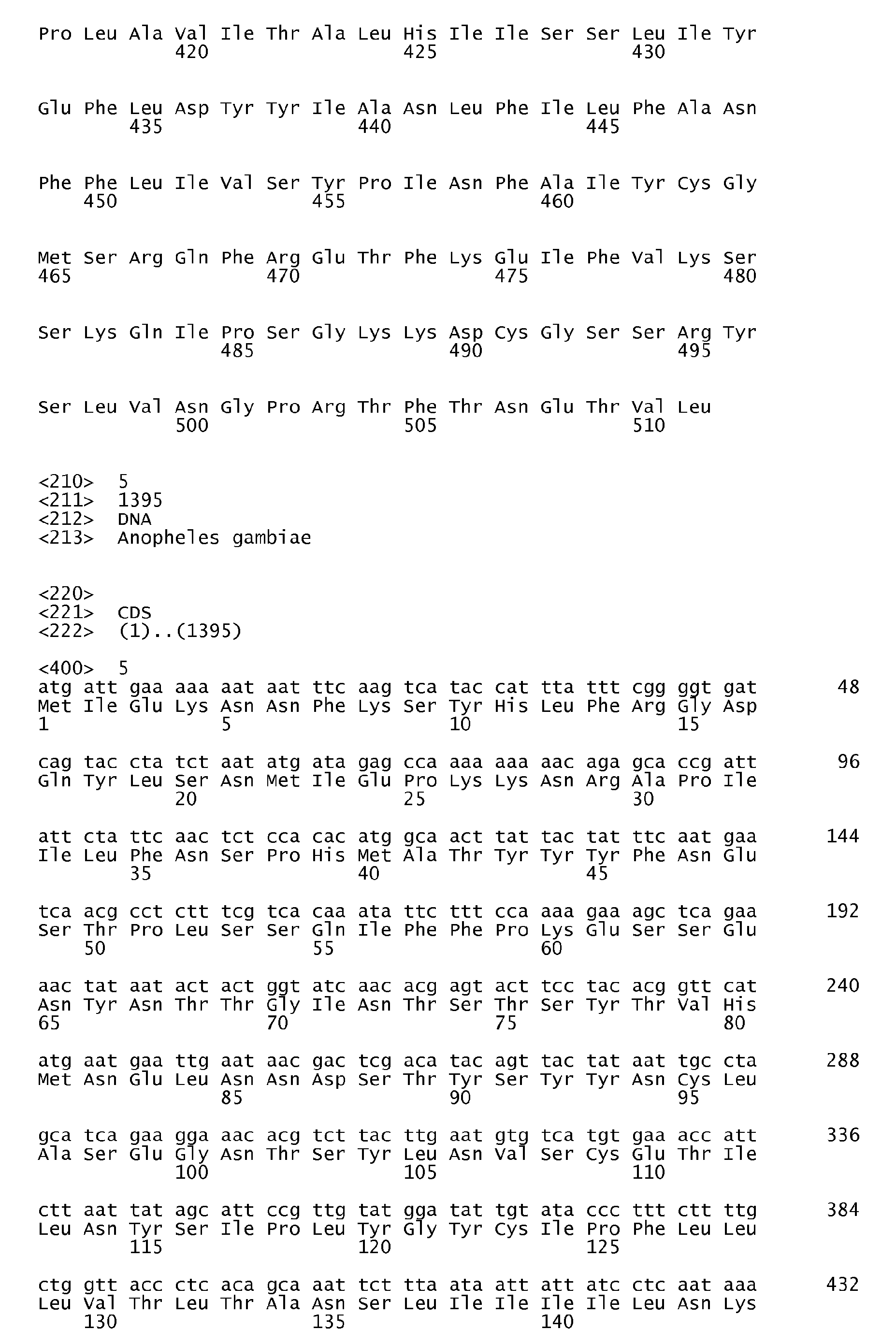


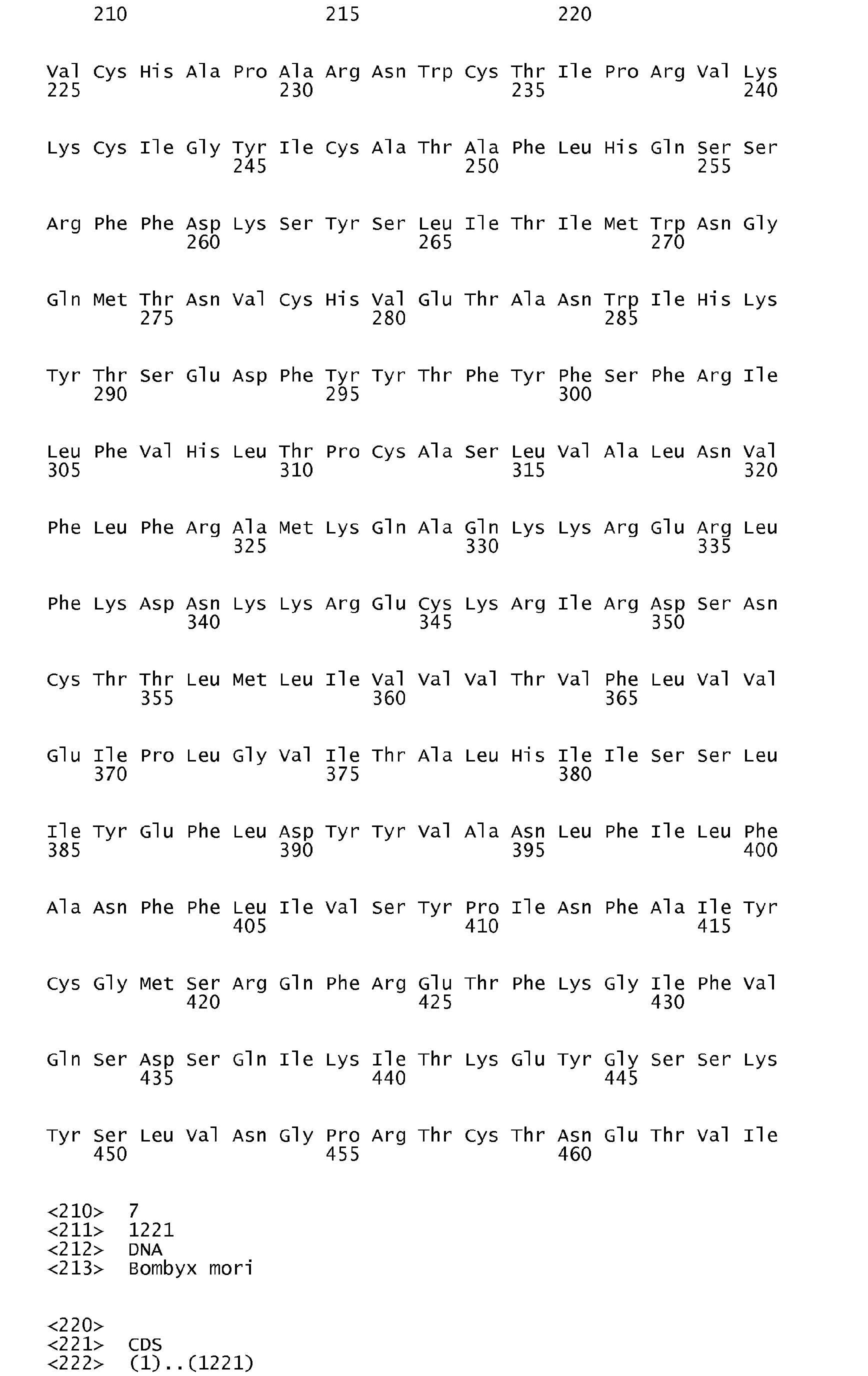


Claims (21)
- A method for controlling the population of an insect species of interest whose females naturally undergo a switch to post-mating behavior in response to a sex peptide, which is the analogue in said insect species of the Drosophila sex peptide (SP) with the sequence shown in SEQ ID NO:18, and which is produced in the male and transferred to the female during mating, said method comprising applying to females of said species of interest one or more compounds that modulate the activity of the receptor for said sex peptide, thereby affecting said switch to said post-mating behavior, wherein said receptor, in said insect species of interest, is the orthologue of the Drosophila sex peptide receptor (SPR) with the amino acid sequence shown in SEQ ID NO:2.
- The method of claim 1, wherein said compound is an inhibitor of the activity of said SPR.
- The method of claim 1, wherein said insect species is selected from Aedes, Anopheles, Culex, Nilaparvata lugens, Trialeurodes vaporariorum, Musca domestica, Glossina fuscipes fuscipes, Spodoptera litura, Agrotis ipsilon, Helicoverpa armigera, Plutella xylostella, Pectinophora gossypiella, Curculionidae, Thrips, Blattella germanica, Periplaneta Americana, Acridiae, Schistocerca gregaria, Pediculus humanus corporis, Reticulitermes speratus.
- The isolated SPR of Drosophila melanogaster with the amino acid sequence of SEQ ID NO:2, or a functional equivalent or a biologically active fragment or derivative thereof.
- An isolated insect SPR that is an orthologue of the Drosophila SPR with the amino acid sequence of SEQ ID NO:2, wherein activation of said SPR orthologue, when naturally occurring, in response to the sex peptide results in a switch to post-mating behavior in said female insect, or a functional equivalent or a biologically active fragment or derivative of said SPR.
- An isolated SPR of claim 5, wherein said orthologue is selected from an SPR of Aedes aegypti, Anopheles gambiae, Bombyx mori, Tribolium castaneum, which has the amino acid sequence shown SEQ ID NO:4, 6, 8 or 10, respectively, or from an SPR of Pediculus humanus corporis or Culex pipiens quinquefasciatus which has a partial amino acid sequence as shown in SEQ ID NO:12 or 14, respectively.
- An isolated nucleic acid molecule which encodes the SPR of Drosophila melanogaster, wherein said nucleic acid molecule has the sequence shown in SEQ ID NO:1, or a or a functional equivalent or a biologically active fragment or derivative thereof.
- An isolated nucleic acid molecule which encodes an insect SPR that is an orthologue of the Drosophila SPR, wherein said nucleic acid moleculea) has a sequence selected from SEQ ID NO:3, 5, 7, 9 or 15 or a partial sequence shown in SEQ ID NO:11 or 13;b) encodes an SPR with an amino acid sequence selected from any of SEQ ID NO:4, 6, 8, 10 or 16 or an SPR containing a partial amino acid sequence shown in SEQ ID NO:12 or 14;c) hybridizes to the complement of a nucleic acid molecule defined in a) or b) under stringent conditions;d) hybridizes to the complement of a nucleic acid molecule defined in a) or b) under highly stringent conditions;e) is any nucleic acid molecule that encodes an SPR polypeptide thati) comprises a protein sequence or a partial protein sequence that is at least 65% identical overall to a sequence selected from any of SEQ ID NO:2, 4, 6, 8, 10, 12, 14, 16;ii) is predicted, based on its amino acid sequence, to be a GPCR and has an amino acid sequence that is more closely related to the Drosophila SPR of SEQ ID NO:2 than any other GPCR encoded in the Drosophila genome;f) is the complement of any of the SPR sequences defined in a) to e).
- A method of identifying a nucleic acid molecule encoding the SPR of an insect species of interest, said method comprisinga) amplifying by polymerase chain reaction genomic DNA or cDNA from said insect species of interest with a forward primer comprising a degenerate oligonucleotide encoding at least six amino acids of a known SPR, taken from the Drosophila SPR encoding sequence shown in SEQ ID NO:1, or from an SPR coding sequence selected from SEQ ID NO:3, 5, 7, 9, 11, 13 or 15, respectively, or its complement, and a reverse primer comprising a degenerate oligonucleotide encoding at least six amino acids of the known SPR, taken from SEQ ID NO:1 or SEQ ID NO:3, 5, 7, 9, 11, 13 or 15 respectively, or its complement andb) detecting a PCR amplification product, thereby identifying a nucleic acid encoding the SPR polypeptide of the insect species of interest.
- A method for identifying a compound that modulates the activity of an SPR of an insect species of interest for use in the method of claim 1, said method comprising determining whether a test compounda) binds to and activates said SPR, and/orb) inhibits the generation of intracellular signals generated upon activation of said SPR in response to the SP, byi. binding to the receptor binding site of the sex peptide, or byii. allosteric hindrance, orc) inhibits the interaction of said SPR with the sex peptide, ord) acts intracellularly on a signal in the signal transduction pathway that is triggered by activation of said SPR in response to an SP; ore) inhibits the interaction of said SPR and one or more G-protein(s), wherein cells expressing on their surface said SPR, either endogenously or upon transfection with a nucleic acid molecule encoding said SPR, or a functional equivalent or a biologically active fragment or derivative of said SPR, or a membrane fraction of such cells, are incubated with said test compound and said test compound's ability to modulate SPR activity as defined in a) to e) is determined.
- The method of claim 10, wherein said cells are transfected with a DNA molecule encoding a G protein alpha subunit selected from naturally occurring or chimeric Gs, Gi or Gq alpha subunits.
- The method of claim 10, wherein said cells are co-transfected with two separate DNA molecules, one of which encodes said SPR and the other one encodes said G protein alpha subunit, wherein said DNA molecules are present on two plasmids or one plasmid carrying both DNA sequences.
- The method of claim 10, wherein said cells are transfected with a DNA molecule encoding a fusion protein comprising the SPR and a G protein alpha subunit selected from naturally occurring or chimeric Gs, Gi or Gq alpha subunits.
- The method of claim 10, wherein said test compound is tested for its ability to inhibit binding of the endogenous SP to said SPR.
- The method of claim 10, wherein said test compound's ability to modulate SPR activity is determined by measuring the change in intracellular calcium concentration.
- The method of claim 10, wherein said test compound is a peptidomimetic that is based on the SP that naturally binds to said SPR, or a functional Sfragment or derivative of said SP.
- The method of claim 10, comprising, in addition, the step of applying the identified compound to females of one or more insect species of interest, determining the compound's abililty to affect the post-mating behavior of said females and selecting compounds with such ability.
- A composition for controlling the population an insect species of interest, wherein said composition contains, as the active ingredient(s), one or more compounds that modulate the activity of the sex peptide receptor that is expressed by females of said insect species of interest.
- An antibody that binds to an SPR of claim 4, 5 or 6 or to a functional equivalent or a biologically active fragment or derivative of said SPR.
- An oligodeoxyribonucleotide molecule that inhibits expression of an SPR molecule, selected from antisense molecules or from DNA molecules encoding an siRNA.
- A transgenic plant, containing integrated in its genome, an oligodeoxyribonucleotide molecule of claim 20.
Priority Applications (2)
| Application Number | Priority Date | Filing Date | Title |
|---|---|---|---|
| EP07122553A EP2067787A1 (en) | 2007-12-06 | 2007-12-06 | Method for controlling insect populations |
| PCT/EP2008/066907 WO2009071672A1 (en) | 2007-12-06 | 2008-12-05 | Method for controlling insect populations |
Applications Claiming Priority (1)
| Application Number | Priority Date | Filing Date | Title |
|---|---|---|---|
| EP07122553A EP2067787A1 (en) | 2007-12-06 | 2007-12-06 | Method for controlling insect populations |
Publications (1)
| Publication Number | Publication Date |
|---|---|
| EP2067787A1 true EP2067787A1 (en) | 2009-06-10 |
Family
ID=38999869
Family Applications (1)
| Application Number | Title | Priority Date | Filing Date |
|---|---|---|---|
| EP07122553A Withdrawn EP2067787A1 (en) | 2007-12-06 | 2007-12-06 | Method for controlling insect populations |
Country Status (2)
| Country | Link |
|---|---|
| EP (1) | EP2067787A1 (en) |
| WO (1) | WO2009071672A1 (en) |
Cited By (6)
| Publication number | Priority date | Publication date | Assignee | Title |
|---|---|---|---|---|
| WO2013067519A3 (en) * | 2011-11-04 | 2013-07-11 | Purdue Research Foundation | Insect and tick g-coupled receptors useful as targets for insecticides and compounds and reagents identified using the same |
| CN105754993A (en) * | 2016-04-14 | 2016-07-13 | 中国林业科学研究院木材工业研究所 | DNA extraction method for dried wood |
| CN109169533A (en) * | 2018-10-12 | 2019-01-11 | 贵阳学院 | A method of quickly sorting Stegobium paniceum adult according to gender |
| CN109258578A (en) * | 2018-11-21 | 2019-01-25 | 北京阔野田园生物技术有限公司 | A kind of method of Larva Harmonia Axyridis indoor industrially raising |
| CN111808168A (en) * | 2020-07-21 | 2020-10-23 | 南京农业大学 | Synthesis and application of a class of brown planthopper thiokinin analogs |
| CN118086313A (en) * | 2024-04-29 | 2024-05-28 | 华南师范大学 | Application of ionotropic receptor gene IR720 in controlling courtship behavior of German cockroach |
Families Citing this family (14)
| Publication number | Priority date | Publication date | Assignee | Title |
|---|---|---|---|---|
| KR101892085B1 (en) | 2017-08-01 | 2018-08-27 | 대한민국(농촌진흥청장) | Primers for loop-mediated isothermal amplification to detect Nilaparvata lugens and detection method for Nilaparvata lugens by using the same |
| CN111848769A (en) * | 2020-07-31 | 2020-10-30 | 中国农业科学院深圳农业基因组研究所 | Application of a protein in affecting the mating behavior and/or egg production of Helicoverpa armigera females |
| CN113122545B (en) * | 2021-04-13 | 2023-03-14 | 东北林业大学 | Gypsy moth odor receptor OR2 gene and dsRNA and application in controlling gypsy moth |
| CN114685647B (en) * | 2022-04-07 | 2023-09-19 | 天津大学 | An odor receptor-derived peptide and its biosensor that can effectively monitor East Asian migratory locusts |
| CN116250548A (en) * | 2022-08-30 | 2023-06-13 | 华南师范大学 | Application of Pharyngeal Inhibitory Lateral Body Neuropeptide in Controlling Periplaneta americana |
| GB202215797D0 (en) | 2022-10-25 | 2022-12-07 | Solasta Bio Ltd | Insect neuropeptide analogues |
| US12302908B2 (en) | 2023-10-23 | 2025-05-20 | Solasta Bio Limited | Insect neuropeptides 4 |
| US12245588B1 (en) | 2023-10-23 | 2025-03-11 | Solasta Bio Limited | Insect neuropeptides 2 |
| MA71223B1 (en) * | 2023-10-23 | 2026-02-27 | Solasta Bio Limited | Insect neuropeptides |
| EP4725314A3 (en) * | 2023-10-23 | 2026-04-22 | Solasta Bio Limited | Insect neuropeptides |
| US12356995B2 (en) | 2023-10-23 | 2025-07-15 | Solasta Bio Limited | Insect neuropeptides 9 |
| US12279621B1 (en) | 2023-10-23 | 2025-04-22 | Solasta Bio Limited | Insect neuropeptides 3 |
| US12245596B1 (en) | 2023-10-23 | 2025-03-11 | Solasta Bio Limited | Insect neuropeptides 8 |
| US12281143B1 (en) | 2023-10-23 | 2025-04-22 | Solasta Bio Limited | Insect neuropeptides 1 |
Citations (14)
| Publication number | Priority date | Publication date | Assignee | Title |
|---|---|---|---|---|
| US4683202A (en) | 1985-03-28 | 1987-07-28 | Cetus Corporation | Process for amplifying nucleic acid sequences |
| US4683195A (en) | 1986-01-30 | 1987-07-28 | Cetus Corporation | Process for amplifying, detecting, and/or-cloning nucleic acid sequences |
| WO1993011161A1 (en) | 1991-11-25 | 1993-06-10 | Enzon, Inc. | Multivalent antigen-binding proteins |
| WO1993011257A2 (en) | 1991-11-25 | 1993-06-10 | Boehringer Ingelheim International Gmbh | Process for screening substances capable of modulating a receptor-dependent cellular signal transmission path |
| US5417682A (en) | 1991-01-30 | 1995-05-23 | Alza Corporation | Device for administering active agent to biological environment |
| WO1998046631A1 (en) | 1997-04-11 | 1998-10-22 | Eli Lilly And Company | Combinatorial libraries of peptidomimetic macrocycles and processes therefor |
| WO2000018790A1 (en) | 1998-09-25 | 2000-04-06 | The University Of Queensland | Synthesis of cyclic peptides |
| US20020016010A1 (en) | 1998-03-23 | 2002-02-07 | President And Fellows Of Harvard College | Synthesis of compounds and libraries of compounds |
| US6593299B1 (en) | 1999-04-21 | 2003-07-15 | University Of Florida Research Foundation, Inc. | Compositions and methods for controlling pests |
| US20040253675A1 (en) | 2003-06-13 | 2004-12-16 | Hitachi, Ltd. | Method for GPCR assay with a coexpressed Galpha protein |
| US20050053933A1 (en) | 2001-08-14 | 2005-03-10 | Lee Kevin J. | Nucleic acids and proteins of insect or83b odorant receptor genes and uses thereof |
| WO2006008652A1 (en) | 2004-07-15 | 2006-01-26 | Institute Of Molecular Biology And Biotechnology -Forth | Insect population control |
| US20060246507A1 (en) | 2003-01-22 | 2006-11-02 | 7Tm Pharma A/S | Beta-arrestin based screening assays |
| WO2007074405A2 (en) | 2005-09-16 | 2007-07-05 | Devgen Nv | Dsrna as insect control agent |
-
2007
- 2007-12-06 EP EP07122553A patent/EP2067787A1/en not_active Withdrawn
-
2008
- 2008-12-05 WO PCT/EP2008/066907 patent/WO2009071672A1/en not_active Ceased
Patent Citations (16)
| Publication number | Priority date | Publication date | Assignee | Title |
|---|---|---|---|---|
| US4683202B1 (en) | 1985-03-28 | 1990-11-27 | Cetus Corp | |
| US4683202A (en) | 1985-03-28 | 1987-07-28 | Cetus Corporation | Process for amplifying nucleic acid sequences |
| US4683195A (en) | 1986-01-30 | 1987-07-28 | Cetus Corporation | Process for amplifying, detecting, and/or-cloning nucleic acid sequences |
| US4683195B1 (en) | 1986-01-30 | 1990-11-27 | Cetus Corp | |
| US5417682A (en) | 1991-01-30 | 1995-05-23 | Alza Corporation | Device for administering active agent to biological environment |
| WO1993011161A1 (en) | 1991-11-25 | 1993-06-10 | Enzon, Inc. | Multivalent antigen-binding proteins |
| WO1993011257A2 (en) | 1991-11-25 | 1993-06-10 | Boehringer Ingelheim International Gmbh | Process for screening substances capable of modulating a receptor-dependent cellular signal transmission path |
| WO1998046631A1 (en) | 1997-04-11 | 1998-10-22 | Eli Lilly And Company | Combinatorial libraries of peptidomimetic macrocycles and processes therefor |
| US20020016010A1 (en) | 1998-03-23 | 2002-02-07 | President And Fellows Of Harvard College | Synthesis of compounds and libraries of compounds |
| WO2000018790A1 (en) | 1998-09-25 | 2000-04-06 | The University Of Queensland | Synthesis of cyclic peptides |
| US6593299B1 (en) | 1999-04-21 | 2003-07-15 | University Of Florida Research Foundation, Inc. | Compositions and methods for controlling pests |
| US20050053933A1 (en) | 2001-08-14 | 2005-03-10 | Lee Kevin J. | Nucleic acids and proteins of insect or83b odorant receptor genes and uses thereof |
| US20060246507A1 (en) | 2003-01-22 | 2006-11-02 | 7Tm Pharma A/S | Beta-arrestin based screening assays |
| US20040253675A1 (en) | 2003-06-13 | 2004-12-16 | Hitachi, Ltd. | Method for GPCR assay with a coexpressed Galpha protein |
| WO2006008652A1 (en) | 2004-07-15 | 2006-01-26 | Institute Of Molecular Biology And Biotechnology -Forth | Insect population control |
| WO2007074405A2 (en) | 2005-09-16 | 2007-07-05 | Devgen Nv | Dsrna as insect control agent |
Non-Patent Citations (95)
| Title |
|---|
| "Controlled Delivery of Crop-Protection Agents", 1990, TAYLOR AND FRANCIS |
| "Insect Suppression with Controlled Release Pheromone Systems", vol. I AND II, 1982, CRC PRESS |
| AL-OBEIDI F; HRUBY VJ; SAWYER TK, MOL BIOTECHNOL., vol. 9, no. 3, 1998, pages 205 - 2 |
| ALTSCHUL ET AL., NUC. ACIDS RES, vol. 25, 1997, pages 3389 - 3402 |
| ALTSCHUL, S. F.; W. GISH; W. MILLER ET AL., JMOL BIOL, vol. 215, no. 3, 1990, pages 403 |
| ANGERS, S ET AL., PROC.NATL.ACAD.SCI. USA, vol. 97.7, 2000, pages 3684 - 89 |
| ATKINSON ET AL., ANNU. REV. ENTOMOL, vol. 46, 2001, pages 31746 |
| AUSUBEL ET AL.: "Current Protocols in Molecular Biology", 1989, GREEN PUBLISHING ASSOCIATES AND WILEY INTERSCIENCE |
| AZA-BLANC, P.; LIN, H.Y.; RUIZ I ALTABA, A. ET AL., DEVELOPMENT, vol. 127, no. 19, 2000, pages 4293 |
| BACKHAUS, B.; SULKOWSKI, E.; SCHLOTE, F.W., DROS. INF. SERV., vol. 60, 1984, pages 210 |
| BERGER, J. ET AL., GENE, vol. 66.1, 1988, pages 1 - 10 |
| BLOCH QAZI, M.C.; HEIFETZ, Y.; WOLFNER, M.F., DEV BIOL, vol. 256, no. 2, 2003, pages 195 |
| BRINI, M. ET AL., J.BIOL.CHEM., vol. 270.17, 1995, pages 9896 - 903 |
| BRONSTEIN, I. ET AL., CLIN. CHEM., vol. 42.9, 1996, pages 1542 - 46 |
| BURSAVICH, MATTHEW G.; DANIEL H. RICH, J. MED. CHEM., vol. 45, no. 3, 2002, pages 541 - 558 |
| CATTERUCCIA ET AL., NAT BIOTECHNOL., vol. 23, no. 11, November 2005 (2005-11-01), pages 1414 - 7 |
| CATTERUCCIA ET AL.: "suggest the use of transgenic sexing lines for the mosquito", ANOPHELES STEPHENSI, 2005 |
| CAZZAMALI, G.; GRIMMELIKHUIJZEN, C. J., PROC NATL ACAD SCI USA, vol. 99, no. 19, 2002, pages 12073 |
| CHAPMAN, T.; CHOFFAT, Y.; LUCAS, W.E. ET AL., JLNSECT PHYSIOL, vol. 42, 1996, pages 1007 |
| CHAPMAN, T.; J. BANGHAM; G. VINTI ET AL., PROC NATL ACAD SCI USA, vol. 100, no. 17, 2003, pages 9923 |
| CHEN P S ET AL: "A MALE ACCESSORY GLAND PEPTIDE THAT REGULATES REPRODUCTIVE BEHAVIOR OF FEMALE DROSOPHILA-MELANOGASTER", CELL, vol. 54, no. 3, 1988, pages 291 - 298, XP002468586, ISSN: 0092-8674 * |
| CHEN, P.S.; E. STUMM-ZOLLINGER; T. AIGAKI ET AL., CELL, vol. 54, no. 3, 1988, pages 291 |
| CHENCHIK A ET AL., BIOTECHNIQUES, vol. 21, no. 3, 1996, pages 526 - 34 |
| CHIN, J. ET AL., ASSAY.DRUG DEV.TECHNOL., vol. 1.6, 2003, pages 777 - 87 |
| CONKLIN, B.R.; FARFEL, Z.; LUSTIG, K.D. ET AL., NATURE, vol. 363, 1993, pages 274 |
| CONKLIN, B.R.; HERZMARK, P.; ISHIDA, S. ET AL., MOL PHARMACOL, vol. 50, no. 4, 1996, pages 885 |
| COWARD, P. ET AL., ANAL. BIOCHEM., vol. 270.2, 1999, pages 242 - 48 |
| CUBITT, A.B. ET AL., TRENDS BIOCHEM.SCI., vol. 20.11, 1995, pages 448 - 55 |
| DATABASE EMBL [online] 1 March 2002 (2002-03-01), "17000687441047 A.Gam.ad.cDNA.blood1 Anopheles gambiae cDNA clone 19600449693106 5', mRNA sequence.", XP002468593, retrieved from EBI accession no. EMBL:BM592927 Database accession no. BM592927 * |
| DATABASE EMBL [online] 22 January 2006 (2006-01-22), "AEM-PLATE42_C12 Aedes aegypti adult female salivary glands Aedes aegypti cDNA, mRNA sequence.", XP002468591, retrieved from EBI accession no. EMBL:DW715703 Database accession no. DW715703 * |
| DATABASE Geneseq [online] 20 November 2003 (2003-11-20), "Fruit fly G protein-coupled receptor (GPCR) DNA #4.", XP002468589, retrieved from EBI accession no. GSN:AAD57432 Database accession no. AAD57432 * |
| DATABASE Geneseq [online] 20 November 2003 (2003-11-20), "Fruit fly G protein-coupled receptor (GPCR) protein #4.", XP002468590, retrieved from EBI accession no. GSP:AAE38155 Database accession no. AAE38155 * |
| DATABASE UniProt [online] 15 December 2003 (2003-12-15), "Putative GPCR class a orphan receptor 16 (AGAP012427-PA) (Fragment) from Anopheles gambiae", XP002468594, retrieved from EBI accession no. UNIPROT:Q7Q0F8 Database accession no. Q7Q0F8 * |
| DATABASE UniProt [online] 25 July 2006 (2006-07-25), "Putative uncharacterized protein. (from Aedes aegypti (Yellowfever mosquito).", XP002468592, retrieved from EBI accession no. UNIPROT:Q172F1 Database accession no. Q172F1 * |
| DE WET, J. R. ET AL., MOL. CELL BIOL., vol. 7.2, 1987, pages 725 - 37 |
| DIETZL, G.; CHEN, D.; SCHNORRER, F. ET AL., NATURE, vol. 448, no. 7150, 2007, pages 151 |
| DING ZHAOBING ET AL: "Sex-peptides bind to two molecularly different targets in Drosophila melanogaster females.", JOURNAL OF NEUROBIOLOGY JUN 2003, vol. 55, no. 3, June 2003 (2003-06-01), pages 372 - 384, XP002468588, ISSN: 0022-3034 * |
| EDDY, S.R., BIOINFORMATICS, vol. 14, no. 9, 1998, pages 755 |
| EDGAR, R.C., BMC BIOINFORMATICS, vol. 5, 2004, pages 113 |
| FAN, Y.; RAFAELI, A.; GILEADI, C. ET AL., J INSECT PHYSIOL, vol. 45, no. 2, 1999, pages 127 |
| FAN, Y.; RAFAELI, A.; MOSHITZKY, P. ET AL., INSECT BIOCHEM MOL BIOL., vol. 30, no. 8-9, 2000, pages 805 - 12 |
| FELSENSTEIN, J., PHYLIP, PHYLOGENY INFERENCE PACKAGE, 2005 |
| GANTE JOACHIM: "Angew. Chem.", INT. ED. ENGL, vol. 33, no. 17, 1994, pages 1699 - 720 |
| GARIPPA ET AL., METHODS ENZYMOL, vol. 414, 2006, pages 99 - 120 |
| GEE, K.R. ET AL., CELL CALCIUM, vol. 27, no. 2, 2000, pages 97 - 106 |
| GILLOTT, C., ANNU REV ENTOMOL, vol. 48, 2003, pages 163 |
| GOLEBIOWSKI, A.; KLOPFENSTEIN, S.R.; PORTLOCK, D.E., CURRENT OPINION IN DRUG DISCOVERY & DEVELOPMENT, vol. 4, no. 4, 2001, pages 428 - 434 |
| GOPALAKRISHNAN, S.M. ET AL., ANAL. BIOCHEM., vol. 321, no. 2, 2003, pages 192 - 201 |
| GRANAS, C. ET AL., COMB. CHEM. HIGH THROUGHPUT. SCREEN, vol. 8, no. 4, 2005, pages 301 - 09 |
| GROTH, A. C.; FISH, M.; NUSSE, R. ET AL., GENETICS, vol. 166, no. 4, 2004, pages 1775 |
| HANDLER, INSECT BIOCHEM MOL BIOL., vol. 31, no. 2, 2001, pages 111 - 28 |
| HARSHMAN, LG; LOEB AM; JOHNSON BA, J INSECT PHYSIOL, vol. 45, no. 6, 1999, pages 571 |
| HEPLER, J.R.; GILMAN, A.G., TRENDS BIOCHEM. SCI., vol. 17.10, 1992, pages 383 - 87 |
| JAIN, V.K.; MAGRATH, I.T., ANAL. BIOCHEM., vol. 199.1, 1991, pages 119 - 24 |
| JEANMOUGIN, F.; THOMPSON, J. D.; GOUY, M. ET AL., TRENDS BIOCHEM SCI, vol. 23, no. 10, 1998, pages 403 |
| JERMAN, J.C. ET AL., EUR. J. PHARMACOL., vol. 414.1, 2001, pages 23 - 30 |
| JOHNSON, E.C.; BOHN, L.M.; BARAK, L.S. ET AL., JBIOL CHEM, vol. 278, no. 52, 2003, pages 52172 |
| KIM, Y-J.; SPALOVSKÁ-VALACHOVÁ, 1.; CHO, K. H. ET AL., PROC NATL ACAD SCI USA, vol. 101, no. 17, 2004, pages 6704 |
| KLOWDEN M. J.; LEA A. 0., AM. J. TROP. MED. HYG., vol. 27, 1978, pages 827 - 83 1 |
| KORNIENKO, 0. ET AL., J. BIOMOL. SCREEN., vol. 9.3, 2004, pages 186 - 95 |
| KRAFSUR, E.S., JOURNAL OF AGRICULTURAL ENTOMOLOGY, vol. 15, 1998, pages 303 - 317 |
| KRAFSUR, THE STERILE INSECT TECHNIQUE SIT, 1998 |
| KUBLI, E., CELL MOL LIFE SCI, vol. 60, no. 8, 2003, pages 1689 |
| KVITSIANI, D.; DICKSON, B, J., CURR BIOL, vol. 16, no. 10, 2006, pages R355 |
| LABROUSSE, H. ET AL., J. IMMUNOL. METHODS, vol. 48.2, 1982, pages 133 - 47 |
| LE POUL, E. ET AL., J. BIOMOL. SCREEN., vol. 7.1, 2002, pages 57 - 65 |
| LIU, H.; KUBLI, E., PROC NATL ACAD SCI USA, vol. 100, no. 17, 2003, pages 9929 |
| LUO, L.; LIAO, Y.J.; JAN, L.Y. ET AL., GENES DEV., vol. 8, no. 15, 1994, pages 1787 |
| MEEUSEN, T.; MERTENS, I.; CLYNEN, E. ET AL., PROC NATL ACAD SCI USA, vol. 99, no. 24, 2002, pages 15363 |
| MICHELINI, E. ET AL., ANAL. CHEM., vol. 76.23, 2004, pages 7069 - 76 |
| MOORE, GRAHAM J., TRENDS IN PHARMACOLOGICAL SCIENCES, vol. 15, 1994, pages 124 - 129 |
| MOORE, J.T.; DAVIS, S.T.; DEV, I. K., ANAL. BIOCHEM., vol. 247, no. 2, 1997, pages 203 - 09 |
| NAYLOR, L.H., BIOCHEM. PHARMACOL., vol. 58.5, 1999, pages 749 - 57 |
| O'NEILL, E. M.; 1. REBAY; R. TJIAN ET AL., CELL, vol. 78, no. 1, 1994, pages 137 |
| OTTIGER, M.; SOLLER, M.; STOCKER, R.F. ET AL., J NEUROBIOL, vol. 44, no. 1, 2000, pages 57 |
| PARK, Y.; KIM, Y-J.; ADAMS, M.E., PROC NATL ACAD SCI USA, vol. 99, no. 17, 2002, pages 11423 |
| PARKS, A.L.; COOK, K.R.; BELVIN, M. ET AL., NAT GENET, vol. 36, no. 3, 2004, pages 288 |
| PAUL A. BARTLETT; MICHAEL ENTZEROTH: "Exploiting Chemical Diversity for Drug Discovery", 2006, RSC PUBLISHING, ROYAL SOCIETY OF CHEMISTRY, article "New Approaches to theGeneration and Evaluation of Chemical Diversity" |
| PENG, J.; CHEN, S.; BUSSER, S. ET AL., CURR BIOL, vol. 15, no. 3, 2005, pages 207 |
| PFLEGER, K.D.; EIDNE, K.A., PITUITARY, vol. 6.3, 2003, pages 141 - 51 |
| ROSENKILDE, C.; CAZZAMALI, G; WILLIAMSON, M. ET AL., BIOCHEM BIOPHYS RES COMMUN, vol. 309, no. 2, 2003, pages 485 |
| SAMBROOK ET AL.: "Molecular Cloning, A Laboratory Manual", 1989, COLD SPRINGS HARBOR PRESS |
| SAUDAN PHILIPPE ET AL: "Ductus ejaculatorius peptide 99B (DUP99B), a novel Drosophila melanogaster sex-peptide pheromone.", EUROPEAN JOURNAL OF BIOCHEMISTRY / FEBS FEB 2002, vol. 269, no. 3, February 2002 (2002-02-01), pages 989 - 997, XP002468587, ISSN: 0014-2956 * |
| SAUDAN, P.; HAUCK, K.; SOLLER, M. ET AL., EUR JBIOCHEM, vol. 269, no. 3, 2002, pages 989 |
| SCHMIDT, T.; CHOFFAT, Y.; KLAUSER, S. ET AL., J INSECT PHYSIOL, vol. 39, no. 5, 1993, pages 361 |
| SCHNITZER, R.; SOMMERGRUBER, W., THE USE OF GENETICALLY ENGINEERED CELL-BASED ASSAYS IN IN-VITRO DRUG DISCOVERY., 2006 |
| STABLES, J. ET AL., ANAL. BIOCHEM., vol. 252.1, 1997, pages 115 - 26 |
| STOCKINGER, P.; KVITSIANI, D.; ROTKOPF, S. ET AL., CELL, vol. 121, no. 5, 2005, pages 795 |
| STRATOWA, C.; AUDETTE, M., IMMUNOBIOLOGY, vol. 193, no. 2-4, 1995, pages 293 - 304 |
| SUTO, C.; IGNAR, D., JOURNAL OF BIOMOLECULAR SCREENING, vol. 2, 1997, pages 7 - 9 |
| TSIEN, R.Y., ANNU. REV. BIOCHEM., vol. 67, 1998, pages 509 - 44 |
| VERNON, W.I.; PRINTEN, J.A., BIOTECHNIQUES, vol. 33, no. 4, 2002, pages 730 |
| VILARDAGA, J.P. ET AL., NAT. BIOTECHNOL., vol. 21.7, 2003, pages 807 - 12 |
| VORABERGER, G.; SCHAEFER, R.; STRATOWA, C., J. IMMUNOL., vol. 147, no. 8, 1991, pages 2777 - 86 |
| VRECL, M. ET AL., J. BIOMOL. SCREEN., vol. 9.4, 2004, pages 322 - 33 |
Cited By (7)
| Publication number | Priority date | Publication date | Assignee | Title |
|---|---|---|---|---|
| WO2013067519A3 (en) * | 2011-11-04 | 2013-07-11 | Purdue Research Foundation | Insect and tick g-coupled receptors useful as targets for insecticides and compounds and reagents identified using the same |
| CN105754993A (en) * | 2016-04-14 | 2016-07-13 | 中国林业科学研究院木材工业研究所 | DNA extraction method for dried wood |
| CN109169533A (en) * | 2018-10-12 | 2019-01-11 | 贵阳学院 | A method of quickly sorting Stegobium paniceum adult according to gender |
| CN109258578A (en) * | 2018-11-21 | 2019-01-25 | 北京阔野田园生物技术有限公司 | A kind of method of Larva Harmonia Axyridis indoor industrially raising |
| CN109258578B (en) * | 2018-11-21 | 2023-12-05 | 北京阔野田园生物技术有限公司 | Indoor industrial breeding method for ladybug larvae |
| CN111808168A (en) * | 2020-07-21 | 2020-10-23 | 南京农业大学 | Synthesis and application of a class of brown planthopper thiokinin analogs |
| CN118086313A (en) * | 2024-04-29 | 2024-05-28 | 华南师范大学 | Application of ionotropic receptor gene IR720 in controlling courtship behavior of German cockroach |
Also Published As
| Publication number | Publication date |
|---|---|
| WO2009071672A1 (en) | 2009-06-11 |
Similar Documents
| Publication | Publication Date | Title |
|---|---|---|
| WO2009071672A1 (en) | Method for controlling insect populations | |
| Cordova et al. | Anthranilic diamides: a new class of insecticides with a novel mode of action, ryanodine receptor activation | |
| Chew et al. | The apical caspase dronc governs programmed and unprogrammed cell death in Drosophila | |
| Jacquin-Joly et al. | Insect olfactory receptors: contributions of molecular biology to chemical ecology | |
| Yapici et al. | A receptor that mediates the post-mating switch in Drosophila reproductive behaviour | |
| US7205147B2 (en) | Nucleic acids encoding ryanodine receptors | |
| Poels et al. | Myoinhibiting peptides are the ancestral ligands of the promiscuous Drosophila sex peptide receptor | |
| Qi et al. | Diamide insecticide target site specificity in the Heliothis and Musca ryanodine receptors relative to toxicity | |
| Li et al. | Structure-based analysis of the ligand-binding mechanism for DhelOBP21, a C-minus odorant binding protein, from Dastarcus helophoroides (Fairmaire; Coleoptera: Bothrideridae) | |
| Duan et al. | Homeotic protein distal-less regulates NlObp8 and NlCsp10 to impact the recognition of linalool in the brown planthopper Nilaparvata lugens | |
| US6008046A (en) | Drug and pesticide screening | |
| Sun et al. | Bursicon receptor gene HLGR2 as a potential RNA interference target for control of the fall webworm Hyphantria cunea | |
| Hariton-Shalev et al. | Structural and functional differences between pheromonotropic and melanotropic PK/PBAN receptors | |
| US20040213771A1 (en) | Targets and screens for agents useful in controlling parasitic nematodes | |
| Ahn et al. | Identification and functional characterization of the first molluscan neuromedin U receptor in the slug, Deroceras reticulatum | |
| Ahmed et al. | C-terminus methionene specifically involved in binding corn odorants to odorant binding protein4 in Macrocentrus cingulum | |
| US20040248791A1 (en) | Insect g protein-coupled receptor genes and uses thereof | |
| US20070003926A1 (en) | Nucleic acid sequences from drosophila melanogaster that encode proteins essential for viability and uses thereof | |
| Pilon et al. | Pharmacological and molecular characterization of the A‐type muscarinic acetylcholine receptor from Anopheles gambiae | |
| Sun et al. | A tachykinin receptor affects starvation tolerance and feeding behavior in the fall webworm, Hyphantria cunea. | |
| Ohta et al. | Functional characterization of dopamine and neuropeptide G protein-coupled receptors from the silkworm Bombyx mori by aequorin bioluminescence-based calcium assay | |
| Lismont et al. | Using BRET-based G protein biosensors to unravel the G protein mediated pathways in insects | |
| Yoon | Molecular dissection of diuretic hormones and their receptors in Drosophila suzukii | |
| Zhou et al. | Bursicon regulates wing expansion via PKA | |
| JP2007000061A (en) | Drugs that alter the physiological state of pests associated with c-Jun amino-terminal kinase activity from insects |
Legal Events
| Date | Code | Title | Description |
|---|---|---|---|
| PUAI | Public reference made under article 153(3) epc to a published international application that has entered the european phase |
Free format text: ORIGINAL CODE: 0009012 |
|
| AK | Designated contracting states |
Kind code of ref document: A1 Designated state(s): AT BE BG CH CY CZ DE DK EE ES FI FR GB GR HU IE IS IT LI LT LU LV MC MT NL PL PT RO SE SI SK TR |
|
| AX | Request for extension of the european patent |
Extension state: AL BA HR MK RS |
|
| 17P | Request for examination filed |
Effective date: 20091210 |
|
| AKX | Designation fees paid |
Designated state(s): AT BE BG CH CY CZ DE DK EE ES FI FR GB GR HU IE IS IT LI LT LU LV MC MT NL PL PT RO SE SI SK TR |
|
| 17Q | First examination report despatched |
Effective date: 20100120 |
|
| STAA | Information on the status of an ep patent application or granted ep patent |
Free format text: STATUS: THE APPLICATION IS DEEMED TO BE WITHDRAWN |
|
| 18D | Application deemed to be withdrawn |
Effective date: 20100601 |