EP2065363A1 - Dentalmaterialien auf der Basis von Alkylendiamin-N,N,N',N'-tetraessigsäure-(meth)acrylamiden - Google Patents
Dentalmaterialien auf der Basis von Alkylendiamin-N,N,N',N'-tetraessigsäure-(meth)acrylamiden Download PDFInfo
- Publication number
- EP2065363A1 EP2065363A1 EP07023228A EP07023228A EP2065363A1 EP 2065363 A1 EP2065363 A1 EP 2065363A1 EP 07023228 A EP07023228 A EP 07023228A EP 07023228 A EP07023228 A EP 07023228A EP 2065363 A1 EP2065363 A1 EP 2065363A1
- Authority
- EP
- European Patent Office
- Prior art keywords
- weight
- meth
- composition according
- alkylenediamine
- tetraacetic acid
- Prior art date
- Legal status (The legal status is an assumption and is not a legal conclusion. Google has not performed a legal analysis and makes no representation as to the accuracy of the status listed.)
- Granted
Links
- 150000003926 acrylamides Chemical class 0.000 title claims abstract description 20
- 239000005548 dental material Substances 0.000 title claims description 9
- 239000000203 mixture Substances 0.000 claims abstract description 52
- UFHFLCQGNIYNRP-UHFFFAOYSA-N Hydrogen Chemical compound [H][H] UFHFLCQGNIYNRP-UHFFFAOYSA-N 0.000 claims abstract description 24
- 229910052739 hydrogen Inorganic materials 0.000 claims abstract description 24
- 239000001257 hydrogen Substances 0.000 claims abstract description 24
- 229910052760 oxygen Inorganic materials 0.000 claims abstract description 6
- 229910052717 sulfur Inorganic materials 0.000 claims abstract description 6
- 229910052757 nitrogen Inorganic materials 0.000 claims description 94
- 239000000178 monomer Substances 0.000 claims description 44
- 239000000945 filler Substances 0.000 claims description 22
- HRPVXLWXLXDGHG-UHFFFAOYSA-N Acrylamide Chemical compound NC(=O)C=C HRPVXLWXLXDGHG-UHFFFAOYSA-N 0.000 claims description 21
- 239000003999 initiator Substances 0.000 claims description 15
- 239000000853 adhesive Substances 0.000 claims description 14
- 230000001070 adhesive effect Effects 0.000 claims description 14
- 230000002378 acidificating effect Effects 0.000 claims description 12
- 239000002904 solvent Substances 0.000 claims description 10
- 239000002245 particle Substances 0.000 claims description 9
- 238000010526 radical polymerization reaction Methods 0.000 claims description 8
- VYPSYNLAJGMNEJ-UHFFFAOYSA-N silicon dioxide Inorganic materials O=[Si]=O VYPSYNLAJGMNEJ-UHFFFAOYSA-N 0.000 claims description 8
- 239000004568 cement Substances 0.000 claims description 7
- 238000002360 preparation method Methods 0.000 claims description 6
- 229910004298 SiO 2 Inorganic materials 0.000 claims description 4
- 229910018072 Al 2 O 3 Inorganic materials 0.000 claims description 3
- 239000000919 ceramic Substances 0.000 claims description 3
- 239000011521 glass Substances 0.000 claims description 3
- 239000002241 glass-ceramic Substances 0.000 claims description 3
- 239000000843 powder Substances 0.000 claims description 3
- 239000010453 quartz Substances 0.000 claims description 3
- 150000002431 hydrogen Chemical class 0.000 claims description 2
- 239000007870 radical polymerization initiator Substances 0.000 claims 1
- 125000000217 alkyl group Chemical group 0.000 abstract description 5
- 125000002947 alkylene group Chemical group 0.000 abstract 1
- XLYOFNOQVPJJNP-UHFFFAOYSA-N water Substances O XLYOFNOQVPJJNP-UHFFFAOYSA-N 0.000 description 17
- -1 C 1 - to C 10 -alkyl radical Chemical class 0.000 description 13
- 230000007062 hydrolysis Effects 0.000 description 11
- 238000006460 hydrolysis reaction Methods 0.000 description 11
- LFQSCWFLJHTTHZ-UHFFFAOYSA-N Ethanol Chemical compound CCO LFQSCWFLJHTTHZ-UHFFFAOYSA-N 0.000 description 10
- 210000004268 dentin Anatomy 0.000 description 7
- WFDIJRYMOXRFFG-UHFFFAOYSA-N Acetic anhydride Chemical compound CC(=O)OC(C)=O WFDIJRYMOXRFFG-UHFFFAOYSA-N 0.000 description 6
- CSCPPACGZOOCGX-UHFFFAOYSA-N Acetone Chemical compound CC(C)=O CSCPPACGZOOCGX-UHFFFAOYSA-N 0.000 description 6
- NBIIXXVUZAFLBC-UHFFFAOYSA-N Phosphoric acid Chemical compound OP(O)(O)=O NBIIXXVUZAFLBC-UHFFFAOYSA-N 0.000 description 6
- WYURNTSHIVDZCO-UHFFFAOYSA-N Tetrahydrofuran Chemical compound C1CCOC1 WYURNTSHIVDZCO-UHFFFAOYSA-N 0.000 description 6
- 238000006243 chemical reaction Methods 0.000 description 6
- 238000004132 cross linking Methods 0.000 description 6
- 125000004435 hydrogen atom Chemical group [H]* 0.000 description 6
- KCXVZYZYPLLWCC-UHFFFAOYSA-N EDTA Chemical compound OC(=O)CN(CC(O)=O)CCN(CC(O)=O)CC(O)=O KCXVZYZYPLLWCC-UHFFFAOYSA-N 0.000 description 5
- CERQOIWHTDAKMF-UHFFFAOYSA-N Methacrylic acid Chemical compound CC(=C)C(O)=O CERQOIWHTDAKMF-UHFFFAOYSA-N 0.000 description 5
- 125000005842 heteroatom Chemical group 0.000 description 4
- 230000003301 hydrolyzing effect Effects 0.000 description 4
- 239000000463 material Substances 0.000 description 4
- 238000000425 proton nuclear magnetic resonance spectrum Methods 0.000 description 4
- 239000013558 reference substance Substances 0.000 description 4
- POLIXZIAIMAECK-UHFFFAOYSA-N 4-[2-(2,6-dioxomorpholin-4-yl)ethyl]morpholine-2,6-dione Chemical compound C1C(=O)OC(=O)CN1CCN1CC(=O)OC(=O)C1 POLIXZIAIMAECK-UHFFFAOYSA-N 0.000 description 3
- WEVYAHXRMPXWCK-UHFFFAOYSA-N Acetonitrile Chemical compound CC#N WEVYAHXRMPXWCK-UHFFFAOYSA-N 0.000 description 3
- BHPQYMZQTOCNFJ-UHFFFAOYSA-N Calcium cation Chemical compound [Ca+2] BHPQYMZQTOCNFJ-UHFFFAOYSA-N 0.000 description 3
- YMWUJEATGCHHMB-UHFFFAOYSA-N Dichloromethane Chemical compound ClCCl YMWUJEATGCHHMB-UHFFFAOYSA-N 0.000 description 3
- XEKOWRVHYACXOJ-UHFFFAOYSA-N Ethyl acetate Chemical compound CCOC(C)=O XEKOWRVHYACXOJ-UHFFFAOYSA-N 0.000 description 3
- WOBHKFSMXKNTIM-UHFFFAOYSA-N Hydroxyethyl methacrylate Chemical compound CC(=C)C(=O)OCCO WOBHKFSMXKNTIM-UHFFFAOYSA-N 0.000 description 3
- AMFGWXWBFGVCKG-UHFFFAOYSA-N Panavia opaque Chemical compound C1=CC(OCC(O)COC(=O)C(=C)C)=CC=C1C(C)(C)C1=CC=C(OCC(O)COC(=O)C(C)=C)C=C1 AMFGWXWBFGVCKG-UHFFFAOYSA-N 0.000 description 3
- ABLZXFCXXLZCGV-UHFFFAOYSA-N Phosphorous acid Chemical compound OP(O)=O ABLZXFCXXLZCGV-UHFFFAOYSA-N 0.000 description 3
- ZMANZCXQSJIPKH-UHFFFAOYSA-N Triethylamine Chemical compound CCN(CC)CC ZMANZCXQSJIPKH-UHFFFAOYSA-N 0.000 description 3
- 125000005263 alkylenediamine group Chemical group 0.000 description 3
- 229910000147 aluminium phosphate Inorganic materials 0.000 description 3
- 230000015572 biosynthetic process Effects 0.000 description 3
- 229910001424 calcium ion Inorganic materials 0.000 description 3
- 125000004432 carbon atom Chemical group C* 0.000 description 3
- 150000001732 carboxylic acid derivatives Chemical class 0.000 description 3
- 239000003795 chemical substances by application Substances 0.000 description 3
- 210000003298 dental enamel Anatomy 0.000 description 3
- 150000002148 esters Chemical class 0.000 description 3
- 238000000034 method Methods 0.000 description 3
- WCYWZMWISLQXQU-UHFFFAOYSA-N methyl Chemical compound [CH3] WCYWZMWISLQXQU-UHFFFAOYSA-N 0.000 description 3
- 150000003254 radicals Chemical class 0.000 description 3
- YLQBMQCUIZJEEH-UHFFFAOYSA-N tetrahydrofuran Natural products C=1C=COC=1 YLQBMQCUIZJEEH-UHFFFAOYSA-N 0.000 description 3
- JHPBZFOKBAGZBL-UHFFFAOYSA-N (3-hydroxy-2,2,4-trimethylpentyl) 2-methylprop-2-enoate Chemical group CC(C)C(O)C(C)(C)COC(=O)C(C)=C JHPBZFOKBAGZBL-UHFFFAOYSA-N 0.000 description 2
- ATOUXIOKEJWULN-UHFFFAOYSA-N 1,6-diisocyanato-2,2,4-trimethylhexane Chemical compound O=C=NCCC(C)CC(C)(C)CN=C=O ATOUXIOKEJWULN-UHFFFAOYSA-N 0.000 description 2
- VNQXSTWCDUXYEZ-UHFFFAOYSA-N 1,7,7-trimethylbicyclo[2.2.1]heptane-2,3-dione Chemical compound C1CC2(C)C(=O)C(=O)C1C2(C)C VNQXSTWCDUXYEZ-UHFFFAOYSA-N 0.000 description 2
- BVQVLAIMHVDZEL-UHFFFAOYSA-N 1-phenyl-1,2-propanedione Chemical compound CC(=O)C(=O)C1=CC=CC=C1 BVQVLAIMHVDZEL-UHFFFAOYSA-N 0.000 description 2
- 238000005160 1H NMR spectroscopy Methods 0.000 description 2
- AAMTXHVZOHPPQR-UHFFFAOYSA-N 2-(hydroxymethyl)prop-2-enoic acid Chemical compound OCC(=C)C(O)=O AAMTXHVZOHPPQR-UHFFFAOYSA-N 0.000 description 2
- UEKHZPDUBLCUHN-UHFFFAOYSA-N 2-[[3,5,5-trimethyl-6-[2-(2-methylprop-2-enoyloxy)ethoxycarbonylamino]hexyl]carbamoyloxy]ethyl 2-methylprop-2-enoate Chemical compound CC(=C)C(=O)OCCOC(=O)NCCC(C)CC(C)(C)CNC(=O)OCCOC(=O)C(C)=C UEKHZPDUBLCUHN-UHFFFAOYSA-N 0.000 description 2
- CIWBSHSKHKDKBQ-JLAZNSOCSA-N Ascorbic acid Chemical compound OC[C@H](O)[C@H]1OC(=O)C(O)=C1O CIWBSHSKHKDKBQ-JLAZNSOCSA-N 0.000 description 2
- 241000283690 Bos taurus Species 0.000 description 2
- 239000004971 Cross linker Substances 0.000 description 2
- 229910019142 PO4 Inorganic materials 0.000 description 2
- 229910010413 TiO 2 Inorganic materials 0.000 description 2
- MCMNRKCIXSYSNV-UHFFFAOYSA-N Zirconium dioxide Chemical compound O=[Zr]=O MCMNRKCIXSYSNV-UHFFFAOYSA-N 0.000 description 2
- 150000001252 acrylic acid derivatives Chemical class 0.000 description 2
- NIXOWILDQLNWCW-UHFFFAOYSA-N acrylic acid group Chemical group C(C=C)(=O)O NIXOWILDQLNWCW-UHFFFAOYSA-N 0.000 description 2
- 239000000654 additive Substances 0.000 description 2
- 150000001408 amides Chemical class 0.000 description 2
- 150000001412 amines Chemical class 0.000 description 2
- TZCXTZWJZNENPQ-UHFFFAOYSA-L barium sulfate Chemical compound [Ba+2].[O-]S([O-])(=O)=O TZCXTZWJZNENPQ-UHFFFAOYSA-L 0.000 description 2
- ISAOCJYIOMOJEB-UHFFFAOYSA-N benzoin Chemical compound C=1C=CC=CC=1C(O)C(=O)C1=CC=CC=C1 ISAOCJYIOMOJEB-UHFFFAOYSA-N 0.000 description 2
- 229930006711 bornane-2,3-dione Natural products 0.000 description 2
- 239000003638 chemical reducing agent Substances 0.000 description 2
- 230000000052 comparative effect Effects 0.000 description 2
- 239000002131 composite material Substances 0.000 description 2
- 239000004567 concrete Substances 0.000 description 2
- 239000003479 dental cement Substances 0.000 description 2
- NBIIXXVUZAFLBC-UHFFFAOYSA-M dihydrogenphosphate Chemical compound OP(O)([O-])=O NBIIXXVUZAFLBC-UHFFFAOYSA-M 0.000 description 2
- 239000003085 diluting agent Substances 0.000 description 2
- 238000005530 etching Methods 0.000 description 2
- 239000010410 layer Substances 0.000 description 2
- 239000007788 liquid Substances 0.000 description 2
- FQPSGWSUVKBHSU-UHFFFAOYSA-N methacrylamide Chemical class CC(=C)C(N)=O FQPSGWSUVKBHSU-UHFFFAOYSA-N 0.000 description 2
- VYHUMZYFJVMWRC-UHFFFAOYSA-N n-(2-hydroxyethyl)-n-methylprop-2-enamide Chemical compound OCCN(C)C(=O)C=C VYHUMZYFJVMWRC-UHFFFAOYSA-N 0.000 description 2
- YXAKNAQXSTZETP-UHFFFAOYSA-N n-(5-hydroxypentyl)-2-methylprop-2-enamide Chemical compound CC(=C)C(=O)NCCCCCO YXAKNAQXSTZETP-UHFFFAOYSA-N 0.000 description 2
- 239000010452 phosphate Substances 0.000 description 2
- 235000021317 phosphate Nutrition 0.000 description 2
- 239000004033 plastic Substances 0.000 description 2
- 238000006116 polymerization reaction Methods 0.000 description 2
- 239000000047 product Substances 0.000 description 2
- 239000000377 silicon dioxide Substances 0.000 description 2
- 239000011877 solvent mixture Substances 0.000 description 2
- 238000003860 storage Methods 0.000 description 2
- 125000000542 sulfonic acid group Chemical group 0.000 description 2
- 238000003786 synthesis reaction Methods 0.000 description 2
- JZNDTNIMGJMICF-UHFFFAOYSA-N (2,4,6-trimethylphenyl) 2-methylprop-2-enoate Chemical compound CC(=C)C(=O)OC1=C(C)C=C(C)C=C1C JZNDTNIMGJMICF-UHFFFAOYSA-N 0.000 description 1
- UILJLCFPJOIGLP-BYPYZUCNSA-N (2s)-2-(prop-2-enoylamino)butanedioic acid Chemical compound OC(=O)C[C@@H](C(O)=O)NC(=O)C=C UILJLCFPJOIGLP-BYPYZUCNSA-N 0.000 description 1
- IJAOUFAMBRPHSJ-UHFFFAOYSA-N (4-ethenylphenyl)methylphosphonic acid Chemical compound OP(O)(=O)CC1=CC=C(C=C)C=C1 IJAOUFAMBRPHSJ-UHFFFAOYSA-N 0.000 description 1
- MFEWNFVBWPABCX-UHFFFAOYSA-N 1,1,2,2-tetraphenylethane-1,2-diol Chemical compound C=1C=CC=CC=1C(C(O)(C=1C=CC=CC=1)C=1C=CC=CC=1)(O)C1=CC=CC=C1 MFEWNFVBWPABCX-UHFFFAOYSA-N 0.000 description 1
- YZTDRUCJEUCHIC-UHFFFAOYSA-N 1-(4,4-dichlorocyclohexa-1,5-dien-1-yl)-2-phenylethane-1,2-dione Chemical compound C1=CC(Cl)(Cl)CC=C1C(=O)C(=O)C1=CC=CC=C1 YZTDRUCJEUCHIC-UHFFFAOYSA-N 0.000 description 1
- YERHJBPPDGHCRJ-UHFFFAOYSA-N 1-[4-(1-oxoprop-2-enyl)-1-piperazinyl]-2-propen-1-one Chemical compound C=CC(=O)N1CCN(C(=O)C=C)CC1 YERHJBPPDGHCRJ-UHFFFAOYSA-N 0.000 description 1
- CFKBCVIYTWDYRP-UHFFFAOYSA-N 10-phosphonooxydecyl 2-methylprop-2-enoate Chemical compound CC(=C)C(=O)OCCCCCCCCCCOP(O)(O)=O CFKBCVIYTWDYRP-UHFFFAOYSA-N 0.000 description 1
- KWVGIHKZDCUPEU-UHFFFAOYSA-N 2,2-dimethoxy-2-phenylacetophenone Chemical compound C=1C=CC=CC=1C(OC)(OC)C(=O)C1=CC=CC=C1 KWVGIHKZDCUPEU-UHFFFAOYSA-N 0.000 description 1
- SMZOUWXMTYCWNB-UHFFFAOYSA-N 2-(2-methoxy-5-methylphenyl)ethanamine Chemical compound COC1=CC=C(C)C=C1CCN SMZOUWXMTYCWNB-UHFFFAOYSA-N 0.000 description 1
- XXEYEDZRUQKMLI-UHFFFAOYSA-N 2-(2-phosphonoethoxymethyl)prop-2-enoic acid Chemical compound OC(=O)C(=C)COCCP(O)(O)=O XXEYEDZRUQKMLI-UHFFFAOYSA-N 0.000 description 1
- CHLIEYMSXLYEBR-UHFFFAOYSA-N 2-(2-phosphonooxyphenyl)ethyl 2-methylprop-2-enoate Chemical compound CC(=C)C(=O)OCCC1=CC=CC=C1OP(O)(O)=O CHLIEYMSXLYEBR-UHFFFAOYSA-N 0.000 description 1
- JKNCOURZONDCGV-UHFFFAOYSA-N 2-(dimethylamino)ethyl 2-methylprop-2-enoate Chemical compound CN(C)CCOC(=O)C(C)=C JKNCOURZONDCGV-UHFFFAOYSA-N 0.000 description 1
- IZNVNFGCUTXHEH-UHFFFAOYSA-N 2-(ethoxymethyl)prop-2-enoic acid Chemical compound CCOCC(=C)C(O)=O IZNVNFGCUTXHEH-UHFFFAOYSA-N 0.000 description 1
- GPLACOONWGSIIP-UHFFFAOYSA-N 2-(n-[2-hydroxy-3-(2-methylprop-2-enoyloxy)propyl]anilino)acetic acid Chemical compound CC(=C)C(=O)OCC(O)CN(CC(O)=O)C1=CC=CC=C1 GPLACOONWGSIIP-UHFFFAOYSA-N 0.000 description 1
- JDKSTARXLKKYPS-UHFFFAOYSA-N 2-[10-(2-methylprop-2-enoyloxy)decyl]propanedioic acid Chemical compound CC(=C)C(=O)OCCCCCCCCCCC(C(O)=O)C(O)=O JDKSTARXLKKYPS-UHFFFAOYSA-N 0.000 description 1
- XQLIXIMAPOYOBV-UHFFFAOYSA-N 2-[2-(2,4,6-trimethylphenoxy)carbonylprop-2-enoxy]ethylphosphonic acid Chemical compound CC1=CC(C)=C(OC(=O)C(=C)COCCP(O)(O)=O)C(C)=C1 XQLIXIMAPOYOBV-UHFFFAOYSA-N 0.000 description 1
- TXBCBTDQIULDIA-UHFFFAOYSA-N 2-[[3-hydroxy-2,2-bis(hydroxymethyl)propoxy]methyl]-2-(hydroxymethyl)propane-1,3-diol Chemical compound OCC(CO)(CO)COCC(CO)(CO)CO TXBCBTDQIULDIA-UHFFFAOYSA-N 0.000 description 1
- CDIYIEKBGHJSDO-UHFFFAOYSA-N 2-methyl-n-[3-(2-methylprop-2-enoylamino)propyl]prop-2-enamide Chemical compound CC(=C)C(=O)NCCCNC(=O)C(C)=C CDIYIEKBGHJSDO-UHFFFAOYSA-N 0.000 description 1
- GTTOHGBENKZJEL-UHFFFAOYSA-N 3-[2-(carboxymethyl)prop-2-enoxymethyl]but-3-enoic acid Chemical compound OC(=O)CC(=C)COCC(=C)CC(O)=O GTTOHGBENKZJEL-UHFFFAOYSA-N 0.000 description 1
- DSWAQZBIVDRGLP-UHFFFAOYSA-N 3-ethenyl-1-[6-(3-ethenyl-2-oxopyrrolidin-1-yl)hexyl]pyrrolidin-2-one Chemical compound O=C1C(C=C)CCN1CCCCCCN1C(=O)C(C=C)CC1 DSWAQZBIVDRGLP-UHFFFAOYSA-N 0.000 description 1
- ATVJXMYDOSMEPO-UHFFFAOYSA-N 3-prop-2-enoxyprop-1-ene Chemical compound C=CCOCC=C ATVJXMYDOSMEPO-UHFFFAOYSA-N 0.000 description 1
- LGWJDYLELXONSY-UHFFFAOYSA-N 4-(2-methylprop-2-enoylamino)pentanoic acid Chemical compound OC(=O)CCC(C)NC(=O)C(C)=C LGWJDYLELXONSY-UHFFFAOYSA-N 0.000 description 1
- YDIYEOMDOWUDTJ-UHFFFAOYSA-N 4-(dimethylamino)benzoic acid Chemical class CN(C)C1=CC=C(C(O)=O)C=C1 YDIYEOMDOWUDTJ-UHFFFAOYSA-N 0.000 description 1
- MAGFQRLKWCCTQJ-UHFFFAOYSA-N 4-ethenylbenzenesulfonic acid Chemical compound OS(=O)(=O)C1=CC=C(C=C)C=C1 MAGFQRLKWCCTQJ-UHFFFAOYSA-N 0.000 description 1
- IRQWEODKXLDORP-UHFFFAOYSA-N 4-ethenylbenzoic acid Chemical compound OC(=O)C1=CC=C(C=C)C=C1 IRQWEODKXLDORP-UHFFFAOYSA-N 0.000 description 1
- LQGKDMHENBFVRC-UHFFFAOYSA-N 5-aminopentan-1-ol Chemical compound NCCCCCO LQGKDMHENBFVRC-UHFFFAOYSA-N 0.000 description 1
- YYVYAPXYZVYDHN-UHFFFAOYSA-N 9,10-phenanthroquinone Chemical compound C1=CC=C2C(=O)C(=O)C3=CC=CC=C3C2=C1 YYVYAPXYZVYDHN-UHFFFAOYSA-N 0.000 description 1
- AIRCTMFFNKZQPN-UHFFFAOYSA-N AlO Inorganic materials [Al]=O AIRCTMFFNKZQPN-UHFFFAOYSA-N 0.000 description 1
- 239000004342 Benzoyl peroxide Substances 0.000 description 1
- OMPJBNCRMGITSC-UHFFFAOYSA-N Benzoylperoxide Chemical compound C=1C=CC=CC=1C(=O)OOC(=O)C1=CC=CC=C1 OMPJBNCRMGITSC-UHFFFAOYSA-N 0.000 description 1
- LCFVJGUPQDGYKZ-UHFFFAOYSA-N Bisphenol A diglycidyl ether Chemical compound C=1C=C(OCC2OC2)C=CC=1C(C)(C)C(C=C1)=CC=C1OCC1CO1 LCFVJGUPQDGYKZ-UHFFFAOYSA-N 0.000 description 1
- 0 CC(C)(C**(CC(O)=O)CC(OCCCCCNC(C(C)=C)=O)=O)N(CC(O)=O)CC(OCCCCC=NC(C(C)=C)=O)=O Chemical compound CC(C)(C**(CC(O)=O)CC(OCCCCCNC(C(C)=C)=O)=O)N(CC(O)=O)CC(OCCCCC=NC(C(C)=C)=O)=O 0.000 description 1
- OKTJSMMVPCPJKN-UHFFFAOYSA-N Carbon Chemical group [C] OKTJSMMVPCPJKN-UHFFFAOYSA-N 0.000 description 1
- QSJXEFYPDANLFS-UHFFFAOYSA-N Diacetyl Chemical group CC(=O)C(C)=O QSJXEFYPDANLFS-UHFFFAOYSA-N 0.000 description 1
- VGGSQFUCUMXWEO-UHFFFAOYSA-N Ethene Chemical compound C=C VGGSQFUCUMXWEO-UHFFFAOYSA-N 0.000 description 1
- 235000004694 Eucalyptus leucoxylon Nutrition 0.000 description 1
- 244000166102 Eucalyptus leucoxylon Species 0.000 description 1
- KRHYYFGTRYWZRS-UHFFFAOYSA-M Fluoride anion Chemical compound [F-] KRHYYFGTRYWZRS-UHFFFAOYSA-M 0.000 description 1
- 239000005058 Isophorone diisocyanate Substances 0.000 description 1
- WHNWPMSKXPGLAX-UHFFFAOYSA-N N-Vinyl-2-pyrrolidone Chemical compound C=CN1CCCC1=O WHNWPMSKXPGLAX-UHFFFAOYSA-N 0.000 description 1
- PMZURENOXWZQFD-UHFFFAOYSA-L Sodium Sulfate Chemical compound [Na+].[Na+].[O-]S([O-])(=O)=O PMZURENOXWZQFD-UHFFFAOYSA-L 0.000 description 1
- FAPWRFPIFSIZLT-UHFFFAOYSA-M Sodium chloride Chemical class [Na+].[Cl-] FAPWRFPIFSIZLT-UHFFFAOYSA-M 0.000 description 1
- 244000028419 Styrax benzoin Species 0.000 description 1
- 235000000126 Styrax benzoin Nutrition 0.000 description 1
- 235000008411 Sumatra benzointree Nutrition 0.000 description 1
- GSEJCLTVZPLZKY-UHFFFAOYSA-N Triethanolamine Chemical compound OCCN(CCO)CCO GSEJCLTVZPLZKY-UHFFFAOYSA-N 0.000 description 1
- UKMBKKFLJMFCSA-UHFFFAOYSA-N [3-hydroxy-2-(2-methylprop-2-enoyloxy)propyl] 2-methylprop-2-enoate Chemical compound CC(=C)C(=O)OCC(CO)OC(=O)C(C)=C UKMBKKFLJMFCSA-UHFFFAOYSA-N 0.000 description 1
- 239000006096 absorbing agent Substances 0.000 description 1
- 239000002253 acid Substances 0.000 description 1
- 150000001253 acrylic acids Chemical class 0.000 description 1
- 239000002318 adhesion promoter Substances 0.000 description 1
- 239000012790 adhesive layer Substances 0.000 description 1
- 238000006136 alcoholysis reaction Methods 0.000 description 1
- 125000004849 alkoxymethyl group Chemical group 0.000 description 1
- PNEYBMLMFCGWSK-UHFFFAOYSA-N aluminium oxide Inorganic materials [O-2].[O-2].[O-2].[Al+3].[Al+3] PNEYBMLMFCGWSK-UHFFFAOYSA-N 0.000 description 1
- 150000008064 anhydrides Chemical class 0.000 description 1
- 235000010323 ascorbic acid Nutrition 0.000 description 1
- 229960005070 ascorbic acid Drugs 0.000 description 1
- 239000011668 ascorbic acid Substances 0.000 description 1
- 229940125717 barbiturate Drugs 0.000 description 1
- 229960002130 benzoin Drugs 0.000 description 1
- RWCCWEUUXYIKHB-UHFFFAOYSA-N benzophenone Chemical compound C=1C=CC=CC=1C(=O)C1=CC=CC=C1 RWCCWEUUXYIKHB-UHFFFAOYSA-N 0.000 description 1
- 239000012965 benzophenone Substances 0.000 description 1
- 235000019400 benzoyl peroxide Nutrition 0.000 description 1
- 239000012620 biological material Substances 0.000 description 1
- 229910052799 carbon Inorganic materials 0.000 description 1
- 125000003178 carboxy group Chemical group [H]OC(*)=O 0.000 description 1
- 150000001244 carboxylic acid anhydrides Chemical class 0.000 description 1
- 239000013522 chelant Substances 0.000 description 1
- 239000007795 chemical reaction product Substances 0.000 description 1
- 239000011248 coating agent Substances 0.000 description 1
- 238000000576 coating method Methods 0.000 description 1
- 229910052681 coesite Inorganic materials 0.000 description 1
- 239000003086 colorant Substances 0.000 description 1
- 238000010668 complexation reaction Methods 0.000 description 1
- 150000001875 compounds Chemical class 0.000 description 1
- 229910052593 corundum Inorganic materials 0.000 description 1
- 229910052906 cristobalite Inorganic materials 0.000 description 1
- 229920006037 cross link polymer Polymers 0.000 description 1
- 239000011350 dental composite resin Substances 0.000 description 1
- 125000005442 diisocyanate group Chemical group 0.000 description 1
- 238000001035 drying Methods 0.000 description 1
- 230000008030 elimination Effects 0.000 description 1
- 238000003379 elimination reaction Methods 0.000 description 1
- 238000010931 ester hydrolysis Methods 0.000 description 1
- IQIJRJNHZYUQSD-UHFFFAOYSA-N ethenyl(phenyl)diazene Chemical compound C=CN=NC1=CC=CC=C1 IQIJRJNHZYUQSD-UHFFFAOYSA-N 0.000 description 1
- 239000000835 fiber Substances 0.000 description 1
- 229910021485 fumed silica Inorganic materials 0.000 description 1
- 235000019382 gum benzoic Nutrition 0.000 description 1
- 229910052736 halogen Inorganic materials 0.000 description 1
- 150000002367 halogens Chemical class 0.000 description 1
- 125000002887 hydroxy group Chemical group [H]O* 0.000 description 1
- 239000010954 inorganic particle Substances 0.000 description 1
- 238000011835 investigation Methods 0.000 description 1
- NIMLQBUJDJZYEJ-UHFFFAOYSA-N isophorone diisocyanate Chemical compound CC1(C)CC(N=C=O)CC(C)(CN=C=O)C1 NIMLQBUJDJZYEJ-UHFFFAOYSA-N 0.000 description 1
- 238000004519 manufacturing process Methods 0.000 description 1
- 229910044991 metal oxide Inorganic materials 0.000 description 1
- 150000004706 metal oxides Chemical class 0.000 description 1
- DCUFMVPCXCSVNP-UHFFFAOYSA-N methacrylic anhydride Chemical compound CC(=C)C(=O)OC(=O)C(C)=C DCUFMVPCXCSVNP-UHFFFAOYSA-N 0.000 description 1
- 125000000325 methylidene group Chemical group [H]C([H])=* 0.000 description 1
- 230000003641 microbiacidal effect Effects 0.000 description 1
- 125000000896 monocarboxylic acid group Chemical group 0.000 description 1
- GYVGXEWAOAAJEU-UHFFFAOYSA-N n,n,4-trimethylaniline Chemical compound CN(C)C1=CC=C(C)C=C1 GYVGXEWAOAAJEU-UHFFFAOYSA-N 0.000 description 1
- 229940088644 n,n-dimethylacrylamide Drugs 0.000 description 1
- YLGYACDQVQQZSW-UHFFFAOYSA-N n,n-dimethylprop-2-enamide Chemical compound CN(C)C(=O)C=C YLGYACDQVQQZSW-UHFFFAOYSA-N 0.000 description 1
- BSCJIBOZTKGXQP-UHFFFAOYSA-N n-(2-hydroxyethyl)-2-methylprop-2-enamide Chemical compound CC(=C)C(=O)NCCO BSCJIBOZTKGXQP-UHFFFAOYSA-N 0.000 description 1
- UUORTJUPDJJXST-UHFFFAOYSA-N n-(2-hydroxyethyl)prop-2-enamide Chemical compound OCCNC(=O)C=C UUORTJUPDJJXST-UHFFFAOYSA-N 0.000 description 1
- JKGFLKYTUYKLQL-UHFFFAOYSA-N n-[4-(prop-2-enoylamino)butyl]prop-2-enamide Chemical compound C=CC(=O)NCCCCNC(=O)C=C JKGFLKYTUYKLQL-UHFFFAOYSA-N 0.000 description 1
- ZIWDVJPPVMGJGR-UHFFFAOYSA-N n-ethyl-2-methylprop-2-enamide Chemical compound CCNC(=O)C(C)=C ZIWDVJPPVMGJGR-UHFFFAOYSA-N 0.000 description 1
- NCOOVOHQKQGDSY-UHFFFAOYSA-N n-ethyl-n-[3-[ethyl(prop-2-enoyl)amino]propyl]prop-2-enamide Chemical compound C=CC(=O)N(CC)CCCN(CC)C(=O)C=C NCOOVOHQKQGDSY-UHFFFAOYSA-N 0.000 description 1
- SWPMNMYLORDLJE-UHFFFAOYSA-N n-ethylprop-2-enamide Chemical compound CCNC(=O)C=C SWPMNMYLORDLJE-UHFFFAOYSA-N 0.000 description 1
- TVQIXFFCPKIFOJ-UHFFFAOYSA-N n-methyl-n-[6-[methyl(prop-2-enoyl)amino]hexyl]prop-2-enamide Chemical compound C=CC(=O)N(C)CCCCCCN(C)C(=O)C=C TVQIXFFCPKIFOJ-UHFFFAOYSA-N 0.000 description 1
- 230000003287 optical effect Effects 0.000 description 1
- 239000011146 organic particle Substances 0.000 description 1
- BPUBBGLMJRNUCC-UHFFFAOYSA-N oxygen(2-);tantalum(5+) Chemical compound [O-2].[O-2].[O-2].[O-2].[O-2].[Ta+5].[Ta+5] BPUBBGLMJRNUCC-UHFFFAOYSA-N 0.000 description 1
- FZUGPQWGEGAKET-UHFFFAOYSA-N parbenate Chemical compound CCOC(=O)C1=CC=C(N(C)C)C=C1 FZUGPQWGEGAKET-UHFFFAOYSA-N 0.000 description 1
- 239000011236 particulate material Substances 0.000 description 1
- 150000002978 peroxides Chemical class 0.000 description 1
- NBIIXXVUZAFLBC-UHFFFAOYSA-K phosphate Chemical compound [O-]P([O-])([O-])=O NBIIXXVUZAFLBC-UHFFFAOYSA-K 0.000 description 1
- NGYODCLSOQFYAO-UHFFFAOYSA-N phosphoric acid;prop-2-enamide Chemical class NC(=O)C=C.OP(O)(O)=O NGYODCLSOQFYAO-UHFFFAOYSA-N 0.000 description 1
- 239000004014 plasticizer Substances 0.000 description 1
- 239000002798 polar solvent Substances 0.000 description 1
- 229920000642 polymer Polymers 0.000 description 1
- ARJOQCYCJMAIFR-UHFFFAOYSA-N prop-2-enoyl prop-2-enoate Chemical compound C=CC(=O)OC(=O)C=C ARJOQCYCJMAIFR-UHFFFAOYSA-N 0.000 description 1
- QLNJFJADRCOGBJ-UHFFFAOYSA-N propionamide Chemical compound CCC(N)=O QLNJFJADRCOGBJ-UHFFFAOYSA-N 0.000 description 1
- 150000004040 pyrrolidinones Chemical class 0.000 description 1
- 239000012966 redox initiator Substances 0.000 description 1
- 150000003839 salts Chemical class 0.000 description 1
- 239000007787 solid Substances 0.000 description 1
- 239000003381 stabilizer Substances 0.000 description 1
- 229910052682 stishovite Inorganic materials 0.000 description 1
- 239000000126 substance Substances 0.000 description 1
- 150000003455 sulfinic acids Chemical class 0.000 description 1
- 230000008961 swelling Effects 0.000 description 1
- PBCFLUZVCVVTBY-UHFFFAOYSA-N tantalum pentoxide Inorganic materials O=[Ta](=O)O[Ta](=O)=O PBCFLUZVCVVTBY-UHFFFAOYSA-N 0.000 description 1
- 229910052905 tridymite Inorganic materials 0.000 description 1
- 150000003673 urethanes Chemical class 0.000 description 1
- NLVXSWCKKBEXTG-UHFFFAOYSA-N vinylsulfonic acid Chemical compound OS(=O)(=O)C=C NLVXSWCKKBEXTG-UHFFFAOYSA-N 0.000 description 1
- 229910001845 yogo sapphire Inorganic materials 0.000 description 1
- XASAPYQVQBKMIN-UHFFFAOYSA-K ytterbium(iii) fluoride Chemical compound F[Yb](F)F XASAPYQVQBKMIN-UHFFFAOYSA-K 0.000 description 1
Classifications
-
- C—CHEMISTRY; METALLURGY
- C07—ORGANIC CHEMISTRY
- C07C—ACYCLIC OR CARBOCYCLIC COMPOUNDS
- C07C233/00—Carboxylic acid amides
- C07C233/01—Carboxylic acid amides having carbon atoms of carboxamide groups bound to hydrogen atoms or to acyclic carbon atoms
- C07C233/16—Carboxylic acid amides having carbon atoms of carboxamide groups bound to hydrogen atoms or to acyclic carbon atoms having the nitrogen atom of at least one of the carboxamide groups bound to a carbon atom of a hydrocarbon radical substituted by singly-bound oxygen atoms
- C07C233/17—Carboxylic acid amides having carbon atoms of carboxamide groups bound to hydrogen atoms or to acyclic carbon atoms having the nitrogen atom of at least one of the carboxamide groups bound to a carbon atom of a hydrocarbon radical substituted by singly-bound oxygen atoms with the substituted hydrocarbon radical bound to the nitrogen atom of the carboxamide group by an acyclic carbon atom
- C07C233/20—Carboxylic acid amides having carbon atoms of carboxamide groups bound to hydrogen atoms or to acyclic carbon atoms having the nitrogen atom of at least one of the carboxamide groups bound to a carbon atom of a hydrocarbon radical substituted by singly-bound oxygen atoms with the substituted hydrocarbon radical bound to the nitrogen atom of the carboxamide group by an acyclic carbon atom having the carbon atom of the carboxamide group bound to a carbon atom of an acyclic unsaturated carbon skeleton
-
- A—HUMAN NECESSITIES
- A61—MEDICAL OR VETERINARY SCIENCE; HYGIENE
- A61K—PREPARATIONS FOR MEDICAL, DENTAL OR TOILETRY PURPOSES
- A61K6/00—Preparations for dentistry
- A61K6/30—Compositions for temporarily or permanently fixing teeth or palates, e.g. primers for dental adhesives
-
- A—HUMAN NECESSITIES
- A61—MEDICAL OR VETERINARY SCIENCE; HYGIENE
- A61K—PREPARATIONS FOR MEDICAL, DENTAL OR TOILETRY PURPOSES
- A61K6/00—Preparations for dentistry
- A61K6/80—Preparations for artificial teeth, for filling teeth or for capping teeth
- A61K6/884—Preparations for artificial teeth, for filling teeth or for capping teeth comprising natural or synthetic resins
- A61K6/887—Compounds obtained by reactions only involving carbon-to-carbon unsaturated bonds
-
- C—CHEMISTRY; METALLURGY
- C09—DYES; PAINTS; POLISHES; NATURAL RESINS; ADHESIVES; COMPOSITIONS NOT OTHERWISE PROVIDED FOR; APPLICATIONS OF MATERIALS NOT OTHERWISE PROVIDED FOR
- C09J—ADHESIVES; NON-MECHANICAL ASPECTS OF ADHESIVE PROCESSES IN GENERAL; ADHESIVE PROCESSES NOT PROVIDED FOR ELSEWHERE; USE OF MATERIALS AS ADHESIVES
- C09J133/00—Adhesives based on homopolymers or copolymers of compounds having one or more unsaturated aliphatic radicals, each having only one carbon-to-carbon double bond, and at least one being terminated by only one carboxyl radical, or of salts, anhydrides, esters, amides, imides, or nitriles thereof; Adhesives based on derivatives of such polymers
- C09J133/24—Homopolymers or copolymers of amides or imides
- C09J133/26—Homopolymers or copolymers of acrylamide or methacrylamide
Definitions
- R 4 is hydrogen or a C 1 - to C 4 -alkyl radical, in particular hydrogen or a methyl radical.
- R 6 is particularly preferably hydrogen or a C 1 - to C 3 -alkyl radical, in particular hydrogen or a methyl radical.
Landscapes
- Health & Medical Sciences (AREA)
- Chemical & Material Sciences (AREA)
- Organic Chemistry (AREA)
- Oral & Maxillofacial Surgery (AREA)
- Life Sciences & Earth Sciences (AREA)
- General Health & Medical Sciences (AREA)
- Public Health (AREA)
- Veterinary Medicine (AREA)
- Animal Behavior & Ethology (AREA)
- Epidemiology (AREA)
- Plastic & Reconstructive Surgery (AREA)
- Dental Preparations (AREA)
- Addition Polymer Or Copolymer, Post-Treatments, Or Chemical Modifications (AREA)
Abstract
Description
- Die vorliegende Erfindung betrifft Zusammensetzungen auf der Basis von Alkylendiamin-N,N,N',N'-tetraessigsäure-(meth)acrylamiden, die sich durch eine hohe Hydrolysestabilität auszeichnen und sich besonders als Dentalmaterialien eignen. Die Erfindung betrifft außerdem Alkylendiamin-N,N,N',N'-tetraessigsäure-(meth)acrylamide und deren Verwendung.
- Monofunktionelle Amide der Acryl- bzw. Methacrylsäure finden in unterschiedlichen Bereichen der Zahnmedizin Verwendung. So wurden verschiedene Acryl- oder Methacrylamide als Comonomere für die Herstellung von Polymeren für Prothesen vorgesehen (
GB 1 039 750 US 2002/014138 A1 undWO 02/13768 A2 EP 1 374 828 A1 beschrieben ist. - Aus der Komplexometrie ist die Chelatkomplexbildung der Ethylendiamintetraessigsäure (EDTA) und die große Affinität des Dinatriumsalzes der EDTA zu Calcium-Ionen bekannt (vgl. RÖMPP Lexikon Chemie, 10 Aufl., Georg Thieme Verlag, Stuttgart und New York, 1997, S. 2221). Adhäsive Zusammensetzungen auf der Basis von (Meth)acrylsäureester-Derivaten von EDTA sind in
DE 10 2005 022 172 A1 beschrieben, jedoch zeichnen sich diese Haftvermittlerkomponenten durch eine schlechte Hydrolysebeständigkeit aus. - Der Erfindung liegt die Aufgabe zugrunde, Dentalmaterialien bereitzustellen, die polymerisationsfähig sind, sich durch eine gute Löslichkeit auszeichnen und in Gegenwart von Wasser eine verbesserte Lagerstabilität zeigen. Zudem sollen die Materialien eine gute Haftung auf Dentin und Zahnschmelz zeigen.
- Die Aufgabe wird erfindungsgemäß durch eine polymerisierbare Zusammensetzung gelöst, die mindestens ein Alkylendiamin-N,N,N',N'-tetraessigsäure-(meth)acrylamid mit der Formel (I) enthält

- X
- jeweils unabhängig für O oder vorzugsweise NR6 steht,
- R1, R2 und R3
- unabhängig voneinander für Wasserstoff oder

- Y
- jeweils unabhängig für einen linearen oder verzweigten C1- bis C15-Alkylenrest steht, der durch ein oder mehrere O oder S unterbrochen sein kann,
- R4
- jeweils unabhängig für Wasserstoff oder einen C1- bis C10-Alkylrest steht,
- R5
- jeweils unabhängig für Wasserstoff oder einen C1- bis C8-Alkylrest steht,
- R6
- jeweils unabhängig für Wasserstoff oder einen C1- bis C6-Alkylrest steht und
- p
- 2 bis 10 ist.
- Der Hinweis, dass ein Rest durch ein Heteroatom wie O oder S unterbrochen sein kann, ist so zu verstehen, dass die Heteroatome in die Kohlenstoffkette des Restes eingeschoben werden, d.h. beidseitig von Kohlenstoffatomen begrenzt werden. Die Anzahl der Heteroatome ist daher um mindestens 1 kleiner als die Zahl der Kohlenstoffatome, und die Heteroatome können nicht endständig sein.
- Eine bevorzugte Ausführungsform der polymerisierbaren Zusammensetzung ist dadurch gekennzeichnet, dass
- Y
- jeweils unabhängig für einen linearen oder verzweigten C1-bis C10-Alkylenrest steht, der durch ein oder mehrere O oder S unterbrochen sein kann,
- R4
- jeweils unabhängig für Wasserstoff oder einen C1- bis C8-Alkylrest steht,
- R5
- jeweils unabhängig für Wasserstoff oder einen C1- bis C6-Alkylrest steht,
- R6
- jeweils unabhängig für Wasserstoff oder einen C1- bis C4-Alkylrest steht und
- p
- 2 bis 6 ist.
- Besonders bevorzugt steht Y für einen linearen oder verzweigten C1- bis C6-Alkylenrest, insbesondere einen linearen oder verzweigten C2- bis C5-Alkylenrest, am meisten bevorzugt einen Ethylenrest.
- Besonders bevorzugt steht R4 für Wasserstoff oder einen C1- bis C4-Alkylrest, insbesondere für Wasserstoff oder einen Methylrest.
- Besonders bevorzugt steht R5 für Wasserstoff oder einen C1- bis C4-Alkylrest, insbesondere für Wasserstoff oder einen Methylrest.
- Besonders bevorzugt steht R6 für Wasserstoff oder einen C1- bis C3-Alkylrest, insbesondere für Wasserstoff oder einen Methylrest.
- Besonders bevorzugt ist p 2 bis 4, am meisten bevorzugt 2.
- Bei den genannten Alkyl- und Alkylenresten handelt es sich vorzugsweise um lineare Gruppen.
- Es ist besonders bevorzugt, dass R1 für Wasserstoff steht und R2 und R3 jeweils für

- Alkylendiamin-N,N,N',N'-tetraessigsäure-(meth)acrylamide mit der Formel (I) lassen sich analog zu grundsätzlich bekannten Syntheseverfahren herstellen.
- So erfolgt zunächst ausgehend von der Alkylendiamin-N,N,N',N'-tetraessigsäure die Herstellung des entsprechenden bicyclischen Anhydrids durch Umsetzung mit Acetanhydrid (Ac2O), z.B. analog der
CS 272 584 B1 
-

- Das bicyclische Anhydrid der Alkylendiamin-N,N,N',N'-tetraessigsäure wird dann in einer zweiten Reaktionsstufe mit einem oder mehreren geeigneten XH-funktionalisierten. (X = O, NR6) (Meth)acrylamiden zu einem entsprechenden Alkylendiamin-N,N,N',N'-tetraessigsäure-(meth)acrylamid mit der Formel (I) umgesetzt:

- Die in der 2. Reaktionsstufe eingesetzten XH-Gruppen-haltigen (Meth)acrylamid-Derivate (X = O, NR6) lassen sich in einfacher Weise aus den entsprechenden Aminoalkanolen (X = O) bzw. linearen oder verzweigten aliphatischen Diaminen (X = NH oder NR) unter Anwendung der aus der organischen Chemie bekannten Methoden für die Knüpfung von Amid-Bindungen (vgl. Methoden der Organischen Chemie, HOUBEN-WEYL Bd. E5 1985, Georg Thieme Verlag S. 941 ff.) durch Umsetzung mit (Meth)acrylsäurechlorid bzw. -anhydrid herstellen.
-


- Die Alkylendiamin-N,N,N',N'-tetraessigsäure-(meth)acrylamide sind sehr gut in Wasser oder Mischungen von Wasser mit polaren Lösungsmitteln, wie Aceton, Ethanol, Acetonitril oder Tetrahydrofuran (THF) löslich. Sie weisen insbesondere eine hohe Affinität zu Calciumionen auf, die sie unter Bildung entsprechender Salze komplexieren können. Aufgrund ihrer hohen Affinität zu Calciumionen sind die Alkylendiamin-N,N,N',N'-tetraessigsäure-(meth)acrylamide in der Lage, Haftung auf Zahnschmelz und Dentin zu vermitteln.
- In den Monomeren der Formel (I) ist mindestens eine saure COOH-Gruppe kovalent mit mindestens einer polymerisationsfähigen (Meth)acrylamidgruppe verbunden, die unter wässrigen Bedingungen bei Raumtemperatur eine hohe Hydrolysestabilität aufweist. Aufgrund der Hydrolysestabilität der Alkylendiamin-N,N,N',N'-tetraessigsäure-(meth)acrylamide lassen sich daraus bei Raumtemperatur lagerstabile Mischungen mit Wasser und anderen hydrolysestabilen Komponenten herstellen, die als Adhäsive, Zemente, Beschichtungsmaterialien oder Komposite vor allem im Dentalbereich verwendet werden können.
- Die erfindungsgemäßen Zusammensetzungen enthalten vorzugsweise 0,5 bis 50 Gew.-%, vorzugsweise 5 bis 40 Gew.-% und ganz besonders bevorzugt 5 bis 30 Gew.-% Alkylendiamin-N,N,N',N'-tetraessigsäure-(meth)acrylamid gemäß Formel (I).
- Neben dem Alkylendiamin-N,N,N',N'-tetraessigsäure-(meth)acrylamid gemäß Formel (I) enthalten die erfindungsgemäßen Zusammensetzungen vorzugsweise mindestens ein weiteres polymerisierbares Monomer. Als weitere polymerisierbare Monomere eignen sich besonders radikalisch polymerisierbare Monomere.
- Diese radikalisch polymerisierbaren Monomere können eine oder mehrere radikalisch polymerisierbare Gruppen aufweisen, wobei Zusammensetzungen, die mindestens ein Monomer mit 2 oder mehr, vorzugsweise 2 bis 5 radikalisch polymerisierbaren Gruppen enthalten, bevorzugt sind. Monomere mit 2 oder mehr polymerisierbaren Gruppen wirken als Vernetzer und erhöhen so die mechanische Stabilität der gehärteten Zusammensetzungen.
- Bevorzugte Vernetzermonomere sind Bis-GMA, Glycerindimethacrylat, und besonders Urethane aus 2-(Hydroxymethyl)acrylsäure und Diisocyanaten, wie 2,2,4-Trimethyl-hexamethy-lendiisocyanat oder Isophorondiisocyanat, vernetzende Pyrrolidone, wie z.B. 1,6-Bis(3-vinyl-2-pyrrolidonyl)-hexan, oder kommerziell zugängliche Bis(meth)acrylamide, wie Methylen- oder Ethylen bisacrylamid, N,N'-Diethyl-1,3-bis(acrylamido)-propan, 1,3-Bis(methacrylamido)-propan, 1,4-Bis(acrylamido)-butan, 1,4-Bis-(acryloyl)-piperazin, 2,6-Dimethylen-4-oxa-heptan-1,7-dicarbonsäure-bis-(propylamid), 1,6-Bis-(acrylamido)-2,2,4(2,4,4)-trimethylhexan und N,N'-Dimethyl-1,6-bis-(acrylamido)-hexan.
- Zusammensetzungen, die neben dem Alkylendiamin-N,N,N',N'-tetraessigsäure-(meth)acrylamid gemäß Formel (I) 1 bis 45 Gew.-%, vorzugsweise 5 bis 30 Gew.-% und ganz besonders bevorzugt 5 bis 20 Gew.-% Vernetzermonomer enthalten, insbesondere Bis(meth)acrylamid, sind erfindungsgemäß besonders bevorzugt. Diese und, wenn nicht anders angegeben, alle anderen Prozentangaben beziehen sich auf die Gesamtmasse der Zusammensetzung.
- Als radikalisch polymerisierbare Monomere sind weiterhin bei Raumtemperatur flüssige Monomere bevorzugt, die sich als Verdünnermonomere eignen. Bevorzugt sind Monomere mit einer Viskosität von 0,01 bis 10 Pa·s bei Raumtemperatur, insbesondere mono- oder mehrfach funktionelle (Meth)acrylate. Besonders bevorzugt sind Mono(meth)acrylate und auf Grund ihrer Hydrolysebeständigkeit insbesondere Mesitylmethacrylat und 2-(Alkoyxymethyl)acrylsäuren, z.B. 2-(Ethoxymethyl)acrylsäure, 2-(Hydroxymethyl)acrylsäure und Allylether. Weitere bevorzugte hydrolysestabile Monomere sind N-Vinylpyrrolidon, N-monoalkylsubstituierte (Meth)acrylamide, wie z.B. N-Ethylacrylamid, N-(2-Hydroxyethyl)acrylamid, N-Ethylmethacrylamid oder N-(2-Hydroxyethyl)methacrylamid, und N,N-dialkylsubstituierte Acrylamide, wie z.B. N-Methyl-N-(2-hydroxyethyl)-acrylamid oder das kommerziell zugängliche, dünnflüssige N,N-Dimethylacrylamid. Unter Alkyl werden bevorzugt Reste mit 1 bis 6, insbesondere 1 bis 3 Kohlenstoffatomen verstanden.
- Die erfindungsgemäßen Zusammensetzungen enthalten neben dem Alkylendiamin-N,N,N',N'-tetraessigsäure-(meth)acrylamid gemäß Formel (I) vorzugsweise 0 bis 50 Gew.-%, vorzugsweise 10 bis 40 Gew.-% und ganz besonders bevorzugt 10 bis 30 Gew.-% Verdünnungsmonomer.
- Gemäß einer weiteren bevorzugten Ausführungsform enthalten die Zusammensetzungen mindestens ein acides radikalisch polymerisierbares Monomer, d.h. ein Monomer mit einer oder mehreren aciden Gruppen, wie Carbonsäureanhydrid-, Carbonsäure-, Phosphorsäure-, Dihydrogenphosphat-, Phosphonsäure- und Sulfonsäuregruppen. Bevorzugte acide Gruppen sind Carbonsäure-, Phosphorsäure- und Phosphonsäuregruppen. Besonders bevorzugte acide Monomere sind 4-(Meth)acryloyloxyethyltrimellitsäureanhydrid, 10-Methacryloyloxydecylmalonsäure, N-(2-Hydroxy-3-methacryloyloxypropyl)-N-phenylglycin, 4-Vinylbenzoesäure, 2-Methacryloyloxyethyl-phenyl-hydrogenphosphat, 10-Methacryloyloxydecyl-dihydrogenphosphat oder Dipentaerythritol-pentamethacryloyloxyphosphat (PENTA), Vinylsulfonsäure und 4-Vinylbenzolsulfonsäure. Auf Grund ihrer Hydrolysestabilität sind 4-Vinylbenzylphosphonsäure und 2-[4-(Dihydroxyphosphoryl)-2-oxabutyl]-acrylsäure (DHPOBAE) sowie deren Amide und hydrolysestabile Ester, wie z.B. 2-[4-(Dihydroxyphosphoryl)-2-oxa-butyl]-acrylsäure-2,4,6-trimethylphenylester, sowie (Meth)acrylamid-dihydrogenphosphate, wie z.B. 6-Methacrylamidohexanyl- oder 1,3-Bis(methacrylamido)-propan-2-yl-dihydrogenphosphat, besonders bevorzugt.
- Zusammensetzungen, die neben dem Alkylendiamin-N,N,N',N'-tetraessigsäure-.(meth)acrylamid gemäß Formel (I) 1 bis 50 Gew.-%, vorzugsweise 5 bis 40 Gew.-% und ganz besonders bevorzugt 10 bis 30 Gew.-% acides Monomer enthalten, insbesondere acides Monomer mit Dihydrogenphosphat-, Phosphonsäure- und/oder Sulfonsäuregruppen, sind erfindungsgemäß besonders bevorzugt.
- Die genannten Monomere können jeweils allein oder als Mischung eingesetzt werden. Erfindungsgemäß sind besonders solche Monomere bevorzugt, die eine hohe Hydrolysestabilität aufweisen. Im Zusammenhang mit der vorliegenden Erfindung werden solche Verbindungen als hydrolysestabil bezeichnet, die in Wasser oder in Mischungen von Wasser und wassermischbaren Lösungsmitteln bei einer Konzentration von ca. 20 Masse-% bei 37 °C für mindestens 8 Wochen stabil sind. Diese Hydrolysestabilität zeigen vor allem polymerisierbare Carbonsäureamide und Mesitylester, deren Esterhydrolyse sterisch gehemmt ist.
- Zur Initiierung der Polymerisation enthalten die erfindungsgemäßen Zusammensetzungen vorzugsweise einen Initiator für die radikalische Polymerisation, besonders bevorzugt einen Initiator für die Photopolymerisation. Hierzu eignen sich insbesondere Benzophenon, Benzoin sowie deren Derivate oder α-Diketone oder deren Derivate, wie 9,10-Phenanthrenchinon, 1-Phenylpropan-1,2-dion, Diacetyl oder 4,4-Dichlorbenzil. Besonders bevorzugt werden Campherchinon und 2,2-Dimethoxy-2-phenylacetophenon und ganz besonders bevorzugt α-Diketone in Kombination mit Aminen als Reduktionsmittel eingesetzt. Bevorzugte Amine sind 4-(Dimethylamino)-benzoesäureester, N,N-Dimethylaminoethylmethacrylat, N,N-Dimethyl-sym.-xylidin und Triethanolamin.
- Als Initiatoren für die Heisshärtung eignen sich auch Benzpinakol und 2,2'-Dialkylbenzpinakole. Als Initiatoren für eine bei Raumtemperatur durchgeführte Polymerisation werden Redox-Initiatorkombinationen, wie z.B. Kombinationen von Benzoylperoxid mit N,N-Dimethyl-sym.-xylidin oder N,N-Dimethyl-p-toluidin, verwendet. Darüber hinaus sind auch Redoxsysteme bestehend aus Peroxiden und solchen Reduktionsmitteln, wie z.B. Ascorbinsäure, Barbiturate oder Sulfinsäuren, besonders geeignet.
- Zusammensetzungen, die neben dem Alkylendiamin-N,N,N',N'-tetraessigsäure-(meth)acrylamid gemäß Formel (I) 0,01 bis 15 Gew.-%, vorzugsweise 0,1 bis 5,0 Gew.-% und ganz besonders bevorzugt 0,3 bis 3,0 Gew.-% Initiator für die radikalische Polymerisation enthalten sind erfindungsgemäß besonders bevorzugt.
- Weiterhin können die erfindungsgemäß eingesetzten Zusammensetzungen zur Verbesserung der mechanischen Eigenschaften oder zur Einstellung der Viskosität Füllstoff enthalten. Als Füllstoffe eignen sich organische und anorganische Partikel und Fasern.
- Bevorzugt werden als Füllstoff partikuläre Materialien mit einer mittleren Partikelgröße von 1 nm bis 10 µm, vorzugsweise von 5 nm bis 5 µm verwendet. Der Begriff mittlere Partikelgröße bezieht sich hier auf das Volumenmittel.
- Bevorzugte anorganische partikuläre Füllstoffe sind amorphe kugelförmige Materialien auf der Basis von Metalloxiden, wie ZrO2 und TiO2 bzw. Mischoxiden aus SiO2, ZrO2 und/oder TiO2; monodisperse, nanopartikuläre Füllstoffe, vorzugsweise auf Basis von SiO2 ZrO2 Al2O3, AlO (OH) oder deren Mischoxiden, wie pyrogene Kieselsäure oder Fällungskieselsäure, vorzugsweise mit einer mittleren Partikelgröße von 5 bis 200 nm, besonders bevorzugt 10 bis 100 nm, ganz besonders bevorzugt 10 bis 50 nm; mikrofeine Füllstoffe, vorzugsweise auf Basis von Quarz-, Keramik-, Glaskeramik- oder Glaspulver, vorzugsweise mit einer mittleren Partikelgröße von 0,01 bis 5 µm, insbesondere 0,3 bis 5 µm, besonders bevorzugt 0,4 bis 3 µm und ganz besonders bevorzugt 0,4 bis 1 µm; sowie röntgenopake Füllstoffe, wie Ytterbiumtrifluorid oder nanopartikuläres Tantal(V)-oxid bzw. Bariumsulfat.
- Die erfindungsgemäßen Zusammensetzungen können zudem Lösungsmittel, wie Wasser, Ethylacetat oder Ethanol, oder Lösungsmittelgemische enthalten. Dabei sind hydrolysestabile Lösungsmittel, wie Wasser oder Ethanol, oder Lösungsmittelgemische bevorzugt.
- Darüber hinaus können die erfindungsgemäßen Zusammensetzungen weitere Additive enthalten, insbesondere Stabilisatoren, Aromastoffe, Farbmittel, mikrobiocide Wirkstoffe, fluoridionenabgebende Additive, optische Aufheller, Weichmacher und UV-Absorber.
- Erfindungsgemäß sind solche Zusammensetzungen bevorzugt, die die folgenden Komponenten enthalten:
- a) 0,5 bis 50 Gew.-%, bevorzugt 5 bis 40 Gew.-% und besonders bevorzugt 5 bis 30 Gew.-% Alkylendiamin-N,N,N-',N'-tetraessigsäure-(meth)acrylamid gemäß Formel (I),
- b) 0,01 bis 15 Gew.-%, bevorzugt 0,1 bis 5,0 Gew.-%, besonders bevorzugt 0,3 bis 3,0 Gew.-% Initiator für die radikalische Polymerisation,
- c) 0 bis 80 Gew.-%, bevorzugt 0 bis 60 Gew.-% und besonders bevorzugt 10 bis 50 Gew.-%,weitere polymerisierbare Monomere,
- d) 0 bis 95 Gew.-%, bevorzugt 0 bis 80 Gew.-% und besonders bevorzugt 10 bis 60 Gew.-% Lösungsmittel, vorzugsweise Wasser,
- e) 0 bis 75 Gew.-% Füllstoff.
- Die erfindungsgemäßen Zusammensetzungen eignen sich besonders als Dentalmaterialien, insbesondere als Adhäsive und Zemente, wie z.B. Befestigungszemente. Solche Adhäsive zeichnen sich durch eine sehr gute Haftung auf der Zahnhartsubstanz, d.h. auf Schmelz und Dentin, aus und sind in Gegenwart von Wasser oder Alkohol hydrolyse- und alkoholysestabil.
- Die bevorzugte Zusammensetzung der Materialien für dentale Anwendungen richtet sich nach dem gewünschten Verwendungszweck.
- Bevorzugte Adhäsive enthalten die folgenden Komponenten:
- a) 0,5 bis 50 Gew.-%, bevorzugt 5 bis 40 Gew.-% und besonders bevorzugt 5 bis 30 Gew.-% Alkylendiamin-N,N,N',N'-tetraessigsäure-(meth)acrylamid gemäß Formel (I),
- b) 0,01 bis 15 Gew.-%, bevorzugt 0,1 bis 5,0 Gew.-%, besonders bevorzugt 0,3 bis 3,0 Gew.-% Initiator für die radikalische Polymerisation,
- c) 0 bis 80 Gew.-%, bevorzugt 0 bis 60 Gew.-% und besonders bevorzugt 10 bis 50 Gew.-% weitere polymerisierbare Monomere,
- d) 0 bis 95 Gew.-%, bevorzugt 0 bis 80 Gew.-% und besonders bevorzugt 10 bis 60 Gew.-% Lösungsmittel, vorzugsweise Wasser,
- e) 0 bis 60 Gew.-%, bevorzugt 0 bis 50 Gew.-% und besonders bevorzugt 0 bis 20 Gew.-% Füllstoff, vorzugsweise monodispersen, nanopartikulären Füllstoff auf Basis von SiO2, ZrO2, Al2O3, AlO (OH) oder deren Mischoxiden, vorzugsweise mit einer mittleren Partikelgröße von 5 bis 200 nm, besonders bevorzugt 10 bis 100 nm, ganz besonders bevorzugt 10 bis 50 nm.
- Bevorzugte Zemente enthalten die folgenden Komponenten:
- a) 0,5 bis 50 Gew.-%, bevorzugt 5 bis 40 Gew.-% und besonders bevorzugt 5 bis 30 Gew.-% Alkylendiamin-N,N,N',N'-tetraessigsäure-(meth)acrylamid gemäß Formel (I),
- b) 0,01 bis 15 Gew.-%, bevorzugt 0,1 bis 5,0 Gew.-%, besonders bevorzugt 0,3 bis 3,0 Gew.-% Initiator für die radikalische Polymerisation,
- c) 0 bis 80 Gew.-%, bevorzugt 0 bis 60 Gew.-% und besonders bevorzugt 10 bis 50 Gew.-% weitere polymerisierbare Monomere,
- d) 1 bis 75 Gew.-%, bevorzugt 20 bis 75 Gew.-% und besonders bevorzugt 40 bis 65 Gew.-% Füllstoff, vorzugsweise mikrofeinen Füllstoff auf Basis von Quarz-, Keramik-, Glaskeramik- oder Glaspulver, vorzugsweise mit einer mittleren Teilchengröße von 0,01 bis 5 µm, insbesondere 0,3 bis 5 µm, besonders bevorzugt 0,4 bis 3 µm und ganz besonders bevorzugt 0,4 bis 1 µm.
- Alle Prozentangaben beziehen sich auf die Gesamtmasse der Zusammensetzung. Als weitere polymerisierbare Monomere werden vorzugsweise eines oder mehrere der oben definierten Monomere eingesetzt, besonders bevorzugt in den dort jeweils definierten Mengen, wobei die Mengen der einzelnen Monomere so gewählt werden, dass die Gesamtmenge an zusätzlichem Monomer die oben definierten Bereiche nicht überschreitet. Ganz besonders bevorzugt sind Zusammensetzungen, die mindestens ein acides Monomer oder mindestens ein Vernetzermonomer, insbesondere mindestens ein acides Monomer und mindestens ein Vernetzermonomer oder mindestens ein acides Vernetzermonomer enthalten.
- Die bevorzugten erfindungsgemäßen Zusammensetzungen härten unter Ausbildung von stark vernetzten Polymernetzwerken aus, die in Wasser wenig oder gar nicht quellen.
- Die Erfindung betrifft auch ein Alkylendiamin-N,N,N',N'-tetraessigsäure-(meth)acrylamid mit der Formel (I) sowie dessen Verwendung zur Herstellung eines Dentalmaterials, insbesondere zur Herstellung eines Adhäsivs oder Zements.
- Die Erfindung wird im Folgenden anhand von Beispielen näher erläutert.
-

CS 272 584 B1 - Zu einer Lösung von 17,0 g (66,0 mmol) EDTA-Dianhydrid, 25,4 g (148 mmol) N-(5-Hydroxypentyl)methacrylamid und 50 mg BHT in 100 ml wasserfreiem Methylenchlorid wurden 3 ml Triethylamin getropft und das Gemisch anschließend bei Raumtemperatur 18 h gerührt. Die nach der Entfernung des Lösungsmittels (40 °C, 500-12 mbar) erhaltene braune, hochviskose Flüssigkeit wurde in 100 ml gesättigter Natriumchloridlösung aufgenommen und dreimal mit je 100 ml Tetrahydrofuran extrahiert. Nach dem Trocknen mit wasserfreiem Natriumsulfat und der Entfernung des Lösungsmittels (40°C, 300-12 mbar, anschließend Feinvakuum) wurden 27,5 g (70 % Ausbeute) an MAM-EDTA als klares, gelbes Harz erhalten.
- 1H-NMR (400 MHz, DMSO-d6): δ = 1,23-1,35, 1,39-1,50, 1,52-1,65 [3 m, je 4H, (CH2)3CH2N], 1,84 (s, 6H, CH3) , 2,78 [s, 4H, (CH2)2N], 3,07-3,12 [m, 4H, (CH2)3CH2N], 3,47, 3,58 (2 s, je 4H, NCH2C=O) , 4,01-4,04 (t, J = 6,6 Hz, 4H, OCH2), 5, 29, 5, 62 (2 s, je 2H, =CH2), 7,89 (t, J = 5,5 Hz, 2H, NH), 12,1 (br. s, 2H, OH).
- (Referenzsubstanz)

- Die Synthese von MA-EDTA erfolgte analog der in der Offenlegungsschrift
DE 10 2005 022 172 A1 angegebenen Vorschrift durch Umsetzung von EDTA-Dianhydrid mit 2-Hydroxyethylmethacrylat (HEMA). Dabei wurde MA-EDTA als weißer Feststoff (Schmp. 74-76°C) mit einer Ausbeute von 82 % erhalten. - 1H-NMR (400 MHz, DMSO-d6): δ = 1,87 (s, 6H, CH3) , 2,51 [s, 4H, (CH2)2N], 3,44, 3,58 (2 s, je 4H, NCH2C=O) , 4,30 (s, 8H, OCH2), 5,68, 6,04 (2 s, je 2H, =CH2), 11, 1 (br. s, 2H, OH).
- Zur Untersuchung der Hydrolysestabilitäten der Monomeren MAM-EDTA bzw. MA-EDTA wurde je eine 20 %ige Lösung in DMSO-d6/D2O (1:1) bei 37°C gelagert. In bestimmten Zeitabständen wurden die 1H-NMR-Spektren dieser Lösungen aufgenommen. Dabei zeigte sich, dass bei der HEMA-substituierten Referenzsubstanz MA-EDTA im 1H-NMR-Spektrum sofort ein zweites Doppelbindungssignal zu beobachten war, welches durch die Hydrolyse der Methacrylestergruppe unter Abspaltung von Methacrylsäure hervorgerufen wird. Nach 119 Tagen Lagerung bei 37°C waren ca. 50 % der Methacrylestergruppen hydrolysiert. Demgegenüber war das erfindungsgemäße Monomer MAM-EDTA deutlich hydrolysestabiler. Zu Untersuchungsbeginn waren im 1H-NMR-Spektrum von MAM-EDTA keine Hydrolyseprodukte erkennbar. Auch nach 119 Tagen bei 37°C konnten im 1H-NMR-Spektrum keine zusätzlichen Doppelbindungssignale detektiert werden.
- Herstellung eines Dentinadhäsivs auf der Basis von MAM-EDTA bzw. der Referenzsubstanz MA-EDTA
- Zur Untersuchung der Dentinhaftung auf Rinderzahndentin wurden zwei Adhäsive folgender Zusammensetzung (Angabe in Masse-%) hergestellt, die entweder MAM-EDTA oder MA-EDTA (Vergleichsbeispiel) enthalten:
Komponente erfindungsgemäßes Beispiel Vergleichs beispiel MAM-EDTA 30,7 % - MA-EDTA - 30,7 % HEMA 14,8 % 14,8 % UDMA1) 7,4 % 7,4 % Bis-GMA2) 7,4 % 7,4 % Aceton 29,6 % 29,6 % Wasser 7,4 % 7,4 % Photoinitiator 3) 2,7 % 2,7 % UDMA - Umsetzungsprodukt von 2 mol HEMA mit 1 mol 2,2,4-Trimethylhexa-methylendiisocyanat
Bis-GMA = Additionsprodukt aus Methacrylsäure und Bisphenol-A-diglycidylether
3) Mischung aus Campherchinon (0,2 Gew.-%) und 4-(N,N-Dimethylamino)benzoesäureethylester (2,5 Gew.-%) - Rinderzähne wurden so in Kunststoffzylinder eingebettet, dass sich das Dentin und der Kunststoff in einer Ebene befanden. Nach 15 s Ätzen mit 37 %-iger Phosphorsäure wurde gründlich mit Wasser gespült. Durch die Säureätzung wurden die Dentubuli geöffnet. Dann wurde mit einem kleinen Pinsel (Microbrush) eine Schicht Adhäsiv obiger Zusammensetzung aufgebracht, mit dem Luftbläser zur Entfernung des Lösungsmittels kürz verblasen und für 40 s mit einer Halogenlampe (Astralis® 7, Ivoclar Vivadent AG) belichtet. Auf die Adhäsivschicht wurde ein Zylinder aus einem handelsüblichen Komposit (Tetric® Ceram, Ivoclar Vivadent AG) in zwei Schichten von je 1-2 mm aufpolymerisert.
- Anschließend wurden die Prüfkörper 24 h bei 37 °C in Wasser gelagert und die Scherhaftfestigkeit gemäß der ISO-Richtlinie "ISO 1994-ISO TR 11405: Dental materials Guidance on testing of adhesion to tooth structure" bestimmt. Dabei ergab sich für das Adhäsiv mit MAM-EDTA eine Scherhaftfestigkeit von 8,6 MPa, für das Adhäsiv mit MA-EDTA 9,6 MPa. Die Ergebnisse zeigen, dass die erfindungsgemäß verwendeten Alkylendiamin-N,N,N',N'-tetraessigsäure-(meth)acrylamide bei deutlich verbesserter Hydrolysestabilität (vgl. Beispiel 3) eine mit MA-EDTA vergleichbare Scherhaftfestigkeit ergeben.
Claims (22)
- Alkylendiamin-N,N,N',N'-tetraessigsäure-(meth)acrylamid mit der Formel (I)
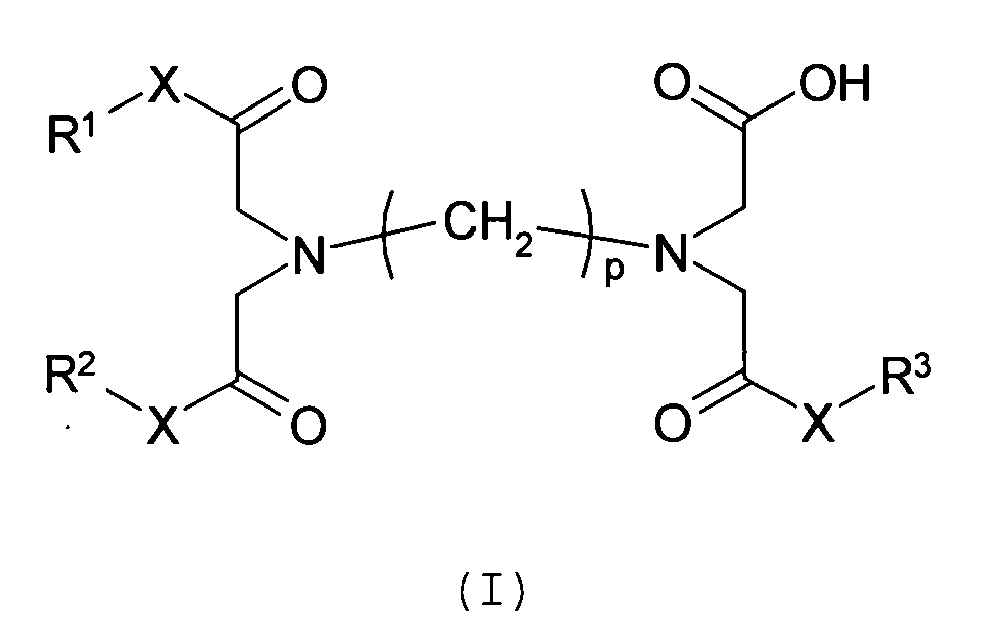 X jeweils unabhängig für O oder NR6 steht,R1, R2, R3 unabhängig voneinander für Wasserstoff oder
 Y jeweils unabhängig für einen linearen oder verzweigten C1- bis C15-Alkylenrest steht, der durch ein oder mehrere O oder S unterbrochen sein kann,R4 jeweils unabhängig für Wasserstoff oder einen C1- bis C10-Alkylrest steht,R5 jeweils unabhängig für Wasserstoff oder einen C1- bis C8-Alkylrest steht,R6 jeweils unabhängig für Wasserstoff oder einen C1- bis C6-Alkylrest steht undp 2 bis 10 ist.
 - Alkylendiamin-N,N,N',N'-tetraessigsäure-(meth)acrylamid nach Anspruch 1, bei demY jeweils unabhängig für einen linearen oder verzweigten C1- bis C10-Alkylenrest steht, der durch ein oder mehrere O oder S unterbrochen sein kann,R4 jeweils unabhängig für Wasserstoff oder einen C1- bis C8-Alkylrest steht,R5 jeweils unabhängig für Wasserstoff oder einen C1- bis C6-Alkylrest steht,R6 jeweils unabhängig für Wasserstoff oder einen C1- bis C4-Alkylrest steht undp 2 bis 6 ist.
- Polymerisierbare Zusammensetzung, dadurch gekennzeichnet, dass sie mindestens ein Alkylendiamin-N,N,N',N'-tetraessigsäure-(meth)acrylamid gemäß Anspruch 1 oder 2 enthält.
- Zusammensetzung nach Anspruch 3, dadurch gekennzeichnet, dass sie neben dem Alkylendiamin-N,N,N',N'-tetraessigsäure-(meth)acrylamid mindestens ein weiteres radikalisch polymerisierbares Monomer enthält.
- Zusammensetzung nach Anspruch 3 oder 4, dadurch gekennzeichnet, dass sie einen Initiator für die radikalische Polymerisation enthält.
- Zusammensetzung nach Anspruch 4 oder 5, dadurch gekennzeichnet, dass sie mindestens ein Monomer mit 2 oder mehr polymerisierbaren Gruppen und/oder mindestens ein Monomer mit einer oder mehreren aciden Gruppen enthält.
- Zusammensetzung nach Anspruch 5 oder 6, dadurch gekennzeichnet, dass sie einen Initiator für die Photopolymerisation enthält.
- Zusammensetzung nach einem der Ansprüche 3 bis 7, dadurch gekennzeichnet, dass sie Füllstoff enthält.
- Zusammensetzung nach Anspruch 8, dadurch gekennzeichnet, dass der Füllstoff ein partikulärer Füllstoff mit einer mittleren Partikelgröße von 1 nm bis 10 µm ist.
- Zusammensetzung nach einem der Ansprüche 3 bis 9, dadurch gekennzeichnet, dass sie
a) 0,5 - 50 Gew.-% Alkylendiamin-N,N,N',N'-tetraessigsäure-(meth)acrylamid gemäß Formel (I), b) 0,01 - 15 Gew.-% Initiator für die radikalische Polymerisation, c) 0 - 80 Gew.-% weitere polymerisierbare Monomere, d) 0 - 95 Gew.-% Lösungsmittel, e) 0 - 75 Gew.-% Füllstoff - Zusammensetzung nach Anspruch 10, dadurch gekennzeichnet, dass sie
a) 5 bis 40 Gew.-% Alkylendiamin-N,N,N',N'-tetraessigsäure-(meth)acrylamid gemäß Formel (I), b) 0,1 bis 5 Gew.-% Initiator für die radikalische Polymerisation, c) 0 bis 60 Gew.-% weitere polymerisierbare Monomere, d) 0 bis 80 Gew.-% Lösungsmittel, e) 0 bis 60 Gew.-% Füllstoff enthält. - Zusammensetzung nach Anspruch 11, dadurch gekennzeichnet, dass sie monodispersen, nanopartikulären Füllstoff auf Basis von SiO2, ZrO2, Al2O3, AlO (OH) oder deren Mischoxiden enthält.
- Zusammensetzung nach Anspruch 11 oder 12, dadurch gekennzeichnet, dass der Füllstoff eine mittlere Partikelgröße von 5 bis 200 nm aufweist.
- Zusammensetzung nach Anspruch 10, dadurch gekennzeichnet, dass sie
a) 5 bis 40 Gew.-% Alkylendiamin-N,N,N',N'-tetraessigsäure-(meth)acrylamid gemäß Formel (I), b) 0,1 bis 5 Gew.-% Initiator für die radikalische Polymerisation, c) 0 bis 60 Gew.-% weitere polymerisierbare Monomere, d) 1 bis 75 Gew.-% Füllstoff enthält. - Zusammensetzung nach Anspruch 14, dadurch gekennzeichnet, dass sie mikrofeinen Füllstoff auf Basis von Quarz-, Keramik-, Glaskeramik- oder Glaspulver enthält.
- Zusammensetzung nach Anspruch 14 oder 15, dadurch gekennzeichnet, dass der Füllstoff eine mittlere Teilchengröße von 0,01 bis 5 µm aufweist.
- Zusammensetzung nach einem der Ansprüche 10 bis 16, dadurch gekennzeichnet, dass die Komponente (c) 1 bis 50 Gew.-% Monomer mit einer oder mehreren aciden Gruppen enthält, bezogen auf die Gesamtmasse der Zusammensetzung.
- Zusammensetzung nach einem der Ansprüche 10 bis 17, dadurch gekennzeichnet, dass die Komponente (c) 1 bis 45 Gew.-% Monomer mit 2 oder mehr polymerisierbaren Gruppen enthält, bezogen auf die Gesamtmasse der Zusammensetzung.
- Verwendung einer Zusammensetzung gemäß einem der Ansprüche 3 bis 18 als Dentalmaterial.
- Verwendung nach Anspruch 19 als Adhäsiv oder Zement.
- Verwendung von einem oder mehreren Alkylendiamin-N,N,N',N'-tetraessigsäure-(meth)acrylamiden gemäß Anspruch 1 oder 2 zur Herstellung eines Dentalmaterials.
- Verwendung nach Anspruch 21, zur Herstellung eines Adhäsivs oder Zements.
Priority Applications (3)
| Application Number | Priority Date | Filing Date | Title |
|---|---|---|---|
| EP07023228.5A EP2065363B1 (de) | 2007-11-30 | 2007-11-30 | Dentalmaterialien auf der Basis von Alkylendiamin-N,N,N',N'-tetraessigsäure-(meth)acrylamiden |
| US12/207,622 US20090139433A1 (en) | 2007-11-30 | 2008-09-10 | Dental materials based on alkylenediamine-n,n,n',n'- tetraacetic acid- (meth)acrylamides |
| JP2008305652A JP5323460B2 (ja) | 2007-11-30 | 2008-11-28 | アルキレンジアミン−n,n,n’,n’−四酢酸−(メタ)アクリルアミドに基づく歯科材料 |
Applications Claiming Priority (1)
| Application Number | Priority Date | Filing Date | Title |
|---|---|---|---|
| EP07023228.5A EP2065363B1 (de) | 2007-11-30 | 2007-11-30 | Dentalmaterialien auf der Basis von Alkylendiamin-N,N,N',N'-tetraessigsäure-(meth)acrylamiden |
Publications (2)
| Publication Number | Publication Date |
|---|---|
| EP2065363A1 true EP2065363A1 (de) | 2009-06-03 |
| EP2065363B1 EP2065363B1 (de) | 2015-07-22 |
Family
ID=39272140
Family Applications (1)
| Application Number | Title | Priority Date | Filing Date |
|---|---|---|---|
| EP07023228.5A Not-in-force EP2065363B1 (de) | 2007-11-30 | 2007-11-30 | Dentalmaterialien auf der Basis von Alkylendiamin-N,N,N',N'-tetraessigsäure-(meth)acrylamiden |
Country Status (3)
| Country | Link |
|---|---|
| US (1) | US20090139433A1 (de) |
| EP (1) | EP2065363B1 (de) |
| JP (1) | JP5323460B2 (de) |
Cited By (3)
| Publication number | Priority date | Publication date | Assignee | Title |
|---|---|---|---|---|
| EP3296368A1 (de) | 2016-09-14 | 2018-03-21 | Agfa-Gevaert | Ätzresistente tintenstrahltinten zur herstellung von leiterplatten |
| EP4205724A1 (de) | 2021-12-29 | 2023-07-05 | Ivoclar Vivadent AG | Selbsthaftende dentale kompositzemente mit guter transparenz auf basis säurebehandelter füllstoffe |
| EP4205722A1 (de) | 2021-12-29 | 2023-07-05 | Ivoclar Vivadent AG | Selbsthaftender dentaler kompositzement mit guter transparenz |
Families Citing this family (2)
| Publication number | Priority date | Publication date | Assignee | Title |
|---|---|---|---|---|
| JP5463098B2 (ja) * | 2009-08-19 | 2014-04-09 | クラレノリタケデンタル株式会社 | 歯科用組成物及びそれを用いた歯科用接着性材料 |
| US12435249B2 (en) * | 2020-08-05 | 2025-10-07 | Nitto Denko Corporation | Method for separating joined object |
Citations (7)
| Publication number | Priority date | Publication date | Assignee | Title |
|---|---|---|---|---|
| GB1039750A (en) | 1965-04-29 | 1966-08-24 | Bayer Ag | Dental prostheses |
| CS272584B1 (en) | 1988-06-21 | 1991-02-12 | Budsky Frantisek | Method of diethylenetriaminopentaacetic acid's and ethylenediaminotetraacetic acid's bicyclic anhydrides preparation |
| US5770637A (en) * | 1996-05-01 | 1998-06-23 | Johnson & Johnson Vision Products, Inc. | Anti-bacterial, UV absorbable, tinted, metal-chelating polymers |
| US20020014138A1 (en) | 2000-06-23 | 2002-02-07 | Tsunehiko Yamazaki | Method of machining workpiece with complex tool |
| WO2002013768A2 (en) | 2000-08-11 | 2002-02-21 | Dentsply International, Inc. | Dental compositions comprising bisacrylamides and use thereof |
| EP1374828A1 (de) | 2002-06-26 | 2004-01-02 | Ivoclar Vivadent AG | Dentalmaterialien auf der Basis von Hydroxyalkylacrylamiden |
| EP1721949A1 (de) * | 2005-05-13 | 2006-11-15 | VOCO GmbH | Haftverbessernde Additive für polymerisierbare Zusammensetzungen |
Family Cites Families (1)
| Publication number | Priority date | Publication date | Assignee | Title |
|---|---|---|---|---|
| US20030069327A1 (en) * | 2001-08-09 | 2003-04-10 | Uwe Walz | Dental compostions comprising bisacrylamides and use thereof |
-
2007
- 2007-11-30 EP EP07023228.5A patent/EP2065363B1/de not_active Not-in-force
-
2008
- 2008-09-10 US US12/207,622 patent/US20090139433A1/en not_active Abandoned
- 2008-11-28 JP JP2008305652A patent/JP5323460B2/ja not_active Expired - Fee Related
Patent Citations (8)
| Publication number | Priority date | Publication date | Assignee | Title |
|---|---|---|---|---|
| GB1039750A (en) | 1965-04-29 | 1966-08-24 | Bayer Ag | Dental prostheses |
| CS272584B1 (en) | 1988-06-21 | 1991-02-12 | Budsky Frantisek | Method of diethylenetriaminopentaacetic acid's and ethylenediaminotetraacetic acid's bicyclic anhydrides preparation |
| US5770637A (en) * | 1996-05-01 | 1998-06-23 | Johnson & Johnson Vision Products, Inc. | Anti-bacterial, UV absorbable, tinted, metal-chelating polymers |
| US20020014138A1 (en) | 2000-06-23 | 2002-02-07 | Tsunehiko Yamazaki | Method of machining workpiece with complex tool |
| WO2002013768A2 (en) | 2000-08-11 | 2002-02-21 | Dentsply International, Inc. | Dental compositions comprising bisacrylamides and use thereof |
| EP1374828A1 (de) | 2002-06-26 | 2004-01-02 | Ivoclar Vivadent AG | Dentalmaterialien auf der Basis von Hydroxyalkylacrylamiden |
| EP1721949A1 (de) * | 2005-05-13 | 2006-11-15 | VOCO GmbH | Haftverbessernde Additive für polymerisierbare Zusammensetzungen |
| DE102005022172A1 (de) | 2005-05-13 | 2006-11-16 | Voco Gmbh | Haftverbessernde Additive für polymerisierbare Zusammensetzungen |
Non-Patent Citations (4)
| Title |
|---|
| "Methoden der Organischen Chemie", vol. E5, 1985, GEORG THIEME VERLAG, pages: 941 |
| "RÖMPP Lexikon Chemie", 1997, GEORG THIEME VERLAG, pages: 2221 |
| N. NISHIYAMA ET AL., BIOMATERIALS, vol. 25, 2004, pages 5441 - 5447 |
| Y. TOTTI ET AL., DENTAL MATERIALS, vol. 19, 2003, pages 253 - 258 |
Cited By (5)
| Publication number | Priority date | Publication date | Assignee | Title |
|---|---|---|---|---|
| EP3296368A1 (de) | 2016-09-14 | 2018-03-21 | Agfa-Gevaert | Ätzresistente tintenstrahltinten zur herstellung von leiterplatten |
| WO2018050457A1 (en) | 2016-09-14 | 2018-03-22 | Agfa-Gevaert N.V. | Etch-resistant inkjet inks for manufacturing printed circuit boards |
| US11466166B2 (en) | 2016-09-14 | 2022-10-11 | Agfa-Gevaert Nv | Etch-resistant inkjet inks for manufacturing printed circuit boards |
| EP4205724A1 (de) | 2021-12-29 | 2023-07-05 | Ivoclar Vivadent AG | Selbsthaftende dentale kompositzemente mit guter transparenz auf basis säurebehandelter füllstoffe |
| EP4205722A1 (de) | 2021-12-29 | 2023-07-05 | Ivoclar Vivadent AG | Selbsthaftender dentaler kompositzement mit guter transparenz |
Also Published As
| Publication number | Publication date |
|---|---|
| US20090139433A1 (en) | 2009-06-04 |
| EP2065363B1 (de) | 2015-07-22 |
| JP2009132720A (ja) | 2009-06-18 |
| JP5323460B2 (ja) | 2013-10-23 |
Similar Documents
| Publication | Publication Date | Title |
|---|---|---|
| EP1674066B1 (de) | Selbstätzende Dentalmaterialien auf Basis von (Meth)acrylamidophosphaten | |
| EP1374829B1 (de) | Dentalmaterialien auf der Basis von Acrylesterphosphonsäuren | |
| EP1222910B1 (de) | Dentalmaterialien auf der Basis polyfunktioneller Amide | |
| EP2823801B1 (de) | Dentalmaterialien auf der Basis von harnstoffgruppenhaltigen Monomeren | |
| EP1849450B1 (de) | Dentalwerkstoffe auf der Basis radikalisch polymerisierbarer Makromere mit antimikrobieller Wirkung | |
| DE102004061924B4 (de) | Hydrolysestabiles selbstätzendes Einkomponentendentaladhäsiv | |
| EP4039220B1 (de) | Dentalmaterialien auf der basis von polymerisationsfähigen thioharnstoff-derivaten | |
| EP2065363B1 (de) | Dentalmaterialien auf der Basis von Alkylendiamin-N,N,N',N'-tetraessigsäure-(meth)acrylamiden | |
| EP3064192B1 (de) | Dentalmaterialien auf der Basis von Hybridmonomeren | |
| EP1148060B1 (de) | Hydrolysestabile und polymerisierbare Acrylphosphonsäure | |
| EP2289483B1 (de) | Verwendung von polymerisierbaren makrocyclischen Polyethern und makrocyclischen heteroanalogen Polyethern in Dentalmaterialien | |
| EP2324810B1 (de) | Gefüllter Dentalwerkstoff auf der Basis von polymerisationsfähigen Dihydroxyphenylalanin-Derivaten | |
| EP1374828A1 (de) | Dentalmaterialien auf der Basis von Hydroxyalkylacrylamiden | |
| EP2816049A1 (de) | ß-Ketophosphonsäuren und Dentalmateriallen auf deren Basis | |
| EP3861976B1 (de) | Dentalmaterialien auf basis von cyclopolymerisierbaren vernetzern | |
| DE102008006717B4 (de) | Polymerisierbare Phosphonsäurederivate und Klebstoffzusammensetzungen enthaltend dieselben | |
| DE10234326B3 (de) | Dentalmaterialien auf der Basis von Acrylesterphosphonsäuren | |
| EP2578201B1 (de) | Dentalmaterialien mit verbesserter Hydrolysestabilität auf der Basis von Phthalsäuremonomeren | |
| EP1825843B1 (de) | Dentalmaterialien auf der Basis von multicyclischen Allylsulfiden | |
| EP1148071B1 (de) | Hydrolysestabile und polymerisierbare Acrylphosphonsäuremonoester |
Legal Events
| Date | Code | Title | Description |
|---|---|---|---|
| PUAI | Public reference made under article 153(3) epc to a published international application that has entered the european phase |
Free format text: ORIGINAL CODE: 0009012 |
|
| AK | Designated contracting states |
Kind code of ref document: A1 Designated state(s): AT BE BG CH CY CZ DE DK EE ES FI FR GB GR HU IE IS IT LI LT LU LV MC MT NL PL PT RO SE SI SK TR |
|
| AX | Request for extension of the european patent |
Extension state: AL BA HR MK RS |
|
| 17P | Request for examination filed |
Effective date: 20091201 |
|
| AKX | Designation fees paid |
Designated state(s): AT BE BG CH CY CZ DE DK EE ES FI FR GB GR HU IE IS IT LI LT LU LV MC MT NL PL PT RO SE SI SK TR |
|
| 17Q | First examination report despatched |
Effective date: 20120111 |
|
| GRAP | Despatch of communication of intention to grant a patent |
Free format text: ORIGINAL CODE: EPIDOSNIGR1 |
|
| INTG | Intention to grant announced |
Effective date: 20150309 |
|
| GRAS | Grant fee paid |
Free format text: ORIGINAL CODE: EPIDOSNIGR3 |
|
| GRAA | (expected) grant |
Free format text: ORIGINAL CODE: 0009210 |
|
| AK | Designated contracting states |
Kind code of ref document: B1 Designated state(s): AT BE BG CH CY CZ DE DK EE ES FI FR GB GR HU IE IS IT LI LT LU LV MC MT NL PL PT RO SE SI SK TR |
|
| REG | Reference to a national code |
Ref country code: GB Ref legal event code: FG4D Free format text: NOT ENGLISH |
|
| REG | Reference to a national code |
Ref country code: CH Ref legal event code: NV Representative=s name: KELLER AND PARTNER PATENTANWAELTE AG, CH Ref country code: CH Ref legal event code: EP |
|
| REG | Reference to a national code |
Ref country code: IE Ref legal event code: FG4D Free format text: LANGUAGE OF EP DOCUMENT: GERMAN |
|
| REG | Reference to a national code |
Ref country code: AT Ref legal event code: REF Ref document number: 737798 Country of ref document: AT Kind code of ref document: T Effective date: 20150815 |
|
| REG | Reference to a national code |
Ref country code: DE Ref legal event code: R096 Ref document number: 502007014076 Country of ref document: DE |
|
| REG | Reference to a national code |
Ref country code: FR Ref legal event code: PLFP Year of fee payment: 9 |
|
| REG | Reference to a national code |
Ref country code: LT Ref legal event code: MG4D |
|
| REG | Reference to a national code |
Ref country code: NL Ref legal event code: MP Effective date: 20150722 |
|
| PG25 | Lapsed in a contracting state [announced via postgrant information from national office to epo] |
Ref country code: LT Free format text: LAPSE BECAUSE OF FAILURE TO SUBMIT A TRANSLATION OF THE DESCRIPTION OR TO PAY THE FEE WITHIN THE PRESCRIBED TIME-LIMIT Effective date: 20150722 Ref country code: GR Free format text: LAPSE BECAUSE OF FAILURE TO SUBMIT A TRANSLATION OF THE DESCRIPTION OR TO PAY THE FEE WITHIN THE PRESCRIBED TIME-LIMIT Effective date: 20151023 Ref country code: LV Free format text: LAPSE BECAUSE OF FAILURE TO SUBMIT A TRANSLATION OF THE DESCRIPTION OR TO PAY THE FEE WITHIN THE PRESCRIBED TIME-LIMIT Effective date: 20150722 Ref country code: FI Free format text: LAPSE BECAUSE OF FAILURE TO SUBMIT A TRANSLATION OF THE DESCRIPTION OR TO PAY THE FEE WITHIN THE PRESCRIBED TIME-LIMIT Effective date: 20150722 |
|
| PG25 | Lapsed in a contracting state [announced via postgrant information from national office to epo] |
Ref country code: SE Free format text: LAPSE BECAUSE OF FAILURE TO SUBMIT A TRANSLATION OF THE DESCRIPTION OR TO PAY THE FEE WITHIN THE PRESCRIBED TIME-LIMIT Effective date: 20150722 Ref country code: ES Free format text: LAPSE BECAUSE OF FAILURE TO SUBMIT A TRANSLATION OF THE DESCRIPTION OR TO PAY THE FEE WITHIN THE PRESCRIBED TIME-LIMIT Effective date: 20150722 Ref country code: IS Free format text: LAPSE BECAUSE OF FAILURE TO SUBMIT A TRANSLATION OF THE DESCRIPTION OR TO PAY THE FEE WITHIN THE PRESCRIBED TIME-LIMIT Effective date: 20151122 Ref country code: PL Free format text: LAPSE BECAUSE OF FAILURE TO SUBMIT A TRANSLATION OF THE DESCRIPTION OR TO PAY THE FEE WITHIN THE PRESCRIBED TIME-LIMIT Effective date: 20150722 Ref country code: PT Free format text: LAPSE BECAUSE OF FAILURE TO SUBMIT A TRANSLATION OF THE DESCRIPTION OR TO PAY THE FEE WITHIN THE PRESCRIBED TIME-LIMIT Effective date: 20151123 |
|
| REG | Reference to a national code |
Ref country code: DE Ref legal event code: R097 Ref document number: 502007014076 Country of ref document: DE |
|
| PG25 | Lapsed in a contracting state [announced via postgrant information from national office to epo] |
Ref country code: CZ Free format text: LAPSE BECAUSE OF FAILURE TO SUBMIT A TRANSLATION OF THE DESCRIPTION OR TO PAY THE FEE WITHIN THE PRESCRIBED TIME-LIMIT Effective date: 20150722 Ref country code: IT Free format text: LAPSE BECAUSE OF FAILURE TO SUBMIT A TRANSLATION OF THE DESCRIPTION OR TO PAY THE FEE WITHIN THE PRESCRIBED TIME-LIMIT Effective date: 20150722 Ref country code: DK Free format text: LAPSE BECAUSE OF FAILURE TO SUBMIT A TRANSLATION OF THE DESCRIPTION OR TO PAY THE FEE WITHIN THE PRESCRIBED TIME-LIMIT Effective date: 20150722 Ref country code: SK Free format text: LAPSE BECAUSE OF FAILURE TO SUBMIT A TRANSLATION OF THE DESCRIPTION OR TO PAY THE FEE WITHIN THE PRESCRIBED TIME-LIMIT Effective date: 20150722 Ref country code: EE Free format text: LAPSE BECAUSE OF FAILURE TO SUBMIT A TRANSLATION OF THE DESCRIPTION OR TO PAY THE FEE WITHIN THE PRESCRIBED TIME-LIMIT Effective date: 20150722 |
|
| PLBE | No opposition filed within time limit |
Free format text: ORIGINAL CODE: 0009261 |
|
| STAA | Information on the status of an ep patent application or granted ep patent |
Free format text: STATUS: NO OPPOSITION FILED WITHIN TIME LIMIT |
|
| PG25 | Lapsed in a contracting state [announced via postgrant information from national office to epo] |
Ref country code: RO Free format text: LAPSE BECAUSE OF FAILURE TO SUBMIT A TRANSLATION OF THE DESCRIPTION OR TO PAY THE FEE WITHIN THE PRESCRIBED TIME-LIMIT Effective date: 20150722 |
|
| 26N | No opposition filed |
Effective date: 20160425 |
|
| PG25 | Lapsed in a contracting state [announced via postgrant information from national office to epo] |
Ref country code: LU Free format text: LAPSE BECAUSE OF FAILURE TO SUBMIT A TRANSLATION OF THE DESCRIPTION OR TO PAY THE FEE WITHIN THE PRESCRIBED TIME-LIMIT Effective date: 20151130 Ref country code: MC Free format text: LAPSE BECAUSE OF FAILURE TO SUBMIT A TRANSLATION OF THE DESCRIPTION OR TO PAY THE FEE WITHIN THE PRESCRIBED TIME-LIMIT Effective date: 20150722 |
|
| REG | Reference to a national code |
Ref country code: IE Ref legal event code: MM4A |
|
| PG25 | Lapsed in a contracting state [announced via postgrant information from national office to epo] |
Ref country code: SI Free format text: LAPSE BECAUSE OF FAILURE TO SUBMIT A TRANSLATION OF THE DESCRIPTION OR TO PAY THE FEE WITHIN THE PRESCRIBED TIME-LIMIT Effective date: 20150722 |
|
| PG25 | Lapsed in a contracting state [announced via postgrant information from national office to epo] |
Ref country code: IE Free format text: LAPSE BECAUSE OF NON-PAYMENT OF DUE FEES Effective date: 20151130 |
|
| REG | Reference to a national code |
Ref country code: FR Ref legal event code: PLFP Year of fee payment: 10 |
|
| REG | Reference to a national code |
Ref country code: AT Ref legal event code: MM01 Ref document number: 737798 Country of ref document: AT Kind code of ref document: T Effective date: 20151130 |
|
| PG25 | Lapsed in a contracting state [announced via postgrant information from national office to epo] |
Ref country code: AT Free format text: LAPSE BECAUSE OF NON-PAYMENT OF DUE FEES Effective date: 20151130 |
|
| PG25 | Lapsed in a contracting state [announced via postgrant information from national office to epo] |
Ref country code: HU Free format text: LAPSE BECAUSE OF FAILURE TO SUBMIT A TRANSLATION OF THE DESCRIPTION OR TO PAY THE FEE WITHIN THE PRESCRIBED TIME-LIMIT; INVALID AB INITIO Effective date: 20071130 Ref country code: BG Free format text: LAPSE BECAUSE OF FAILURE TO SUBMIT A TRANSLATION OF THE DESCRIPTION OR TO PAY THE FEE WITHIN THE PRESCRIBED TIME-LIMIT Effective date: 20150722 |
|
| PG25 | Lapsed in a contracting state [announced via postgrant information from national office to epo] |
Ref country code: NL Free format text: LAPSE BECAUSE OF FAILURE TO SUBMIT A TRANSLATION OF THE DESCRIPTION OR TO PAY THE FEE WITHIN THE PRESCRIBED TIME-LIMIT Effective date: 20150722 Ref country code: CY Free format text: LAPSE BECAUSE OF FAILURE TO SUBMIT A TRANSLATION OF THE DESCRIPTION OR TO PAY THE FEE WITHIN THE PRESCRIBED TIME-LIMIT Effective date: 20150722 |
|
| PG25 | Lapsed in a contracting state [announced via postgrant information from national office to epo] |
Ref country code: BE Free format text: LAPSE BECAUSE OF NON-PAYMENT OF DUE FEES Effective date: 20151130 |
|
| PG25 | Lapsed in a contracting state [announced via postgrant information from national office to epo] |
Ref country code: TR Free format text: LAPSE BECAUSE OF FAILURE TO SUBMIT A TRANSLATION OF THE DESCRIPTION OR TO PAY THE FEE WITHIN THE PRESCRIBED TIME-LIMIT Effective date: 20150722 Ref country code: MT Free format text: LAPSE BECAUSE OF FAILURE TO SUBMIT A TRANSLATION OF THE DESCRIPTION OR TO PAY THE FEE WITHIN THE PRESCRIBED TIME-LIMIT Effective date: 20150722 |
|
| REG | Reference to a national code |
Ref country code: FR Ref legal event code: PLFP Year of fee payment: 11 |
|
| REG | Reference to a national code |
Ref country code: FR Ref legal event code: PLFP Year of fee payment: 12 |
|
| REG | Reference to a national code |
Ref country code: CH Ref legal event code: PFA Owner name: IVOCLAR VIVADENT AG, LI Free format text: FORMER OWNER: IVOCLAR VIVADENT AG, LI |
|
| PGFP | Annual fee paid to national office [announced via postgrant information from national office to epo] |
Ref country code: GB Payment date: 20200916 Year of fee payment: 14 Ref country code: FR Payment date: 20200916 Year of fee payment: 14 |
|
| PGFP | Annual fee paid to national office [announced via postgrant information from national office to epo] |
Ref country code: CH Payment date: 20200928 Year of fee payment: 14 |
|
| PGFP | Annual fee paid to national office [announced via postgrant information from national office to epo] |
Ref country code: DE Payment date: 20200916 Year of fee payment: 14 |
|
| REG | Reference to a national code |
Ref country code: DE Ref legal event code: R119 Ref document number: 502007014076 Country of ref document: DE |
|
| REG | Reference to a national code |
Ref country code: CH Ref legal event code: PL |
|
| GBPC | Gb: european patent ceased through non-payment of renewal fee |
Effective date: 20211130 |
|
| PG25 | Lapsed in a contracting state [announced via postgrant information from national office to epo] |
Ref country code: GB Free format text: LAPSE BECAUSE OF NON-PAYMENT OF DUE FEES Effective date: 20211130 Ref country code: DE Free format text: LAPSE BECAUSE OF NON-PAYMENT OF DUE FEES Effective date: 20220601 |
|
| PG25 | Lapsed in a contracting state [announced via postgrant information from national office to epo] |
Ref country code: FR Free format text: LAPSE BECAUSE OF NON-PAYMENT OF DUE FEES Effective date: 20211130 |
|
| PG25 | Lapsed in a contracting state [announced via postgrant information from national office to epo] |
Ref country code: LI Free format text: LAPSE BECAUSE OF NON-PAYMENT OF DUE FEES Effective date: 20220630 Ref country code: CH Free format text: LAPSE BECAUSE OF NON-PAYMENT OF DUE FEES Effective date: 20220630 |