EP2065054A1 - Combinations comprising a prostaglandin and uses thereof - Google Patents
Combinations comprising a prostaglandin and uses thereof Download PDFInfo
- Publication number
- EP2065054A1 EP2065054A1 EP07076033A EP07076033A EP2065054A1 EP 2065054 A1 EP2065054 A1 EP 2065054A1 EP 07076033 A EP07076033 A EP 07076033A EP 07076033 A EP07076033 A EP 07076033A EP 2065054 A1 EP2065054 A1 EP 2065054A1
- Authority
- EP
- European Patent Office
- Prior art keywords
- group
- alkyl
- combination
- hydrogen
- methyl
- Prior art date
- Legal status (The legal status is an assumption and is not a legal conclusion. Google has not performed a legal analysis and makes no representation as to the accuracy of the status listed.)
- Withdrawn
Links
- 150000003180 prostaglandins Chemical class 0.000 title abstract description 41
- 150000001875 compounds Chemical class 0.000 abstract description 40
- 102000029749 Microtubule Human genes 0.000 abstract description 24
- 108091022875 Microtubule Proteins 0.000 abstract description 24
- 210000004688 microtubule Anatomy 0.000 abstract description 24
- 239000003795 chemical substances by application Substances 0.000 abstract description 22
- 230000002452 interceptive effect Effects 0.000 abstract description 22
- 102000004243 Tubulin Human genes 0.000 abstract description 21
- 108090000704 Tubulin Proteins 0.000 abstract description 21
- 239000002599 prostaglandin synthase inhibitor Substances 0.000 abstract description 19
- 229940094443 oxytocics prostaglandins Drugs 0.000 abstract description 17
- -1 prostaglandin compounds Chemical class 0.000 description 74
- 229930013356 epothilone Natural products 0.000 description 56
- 229910052739 hydrogen Inorganic materials 0.000 description 54
- 239000001257 hydrogen Substances 0.000 description 52
- 125000004435 hydrogen atom Chemical class [H]* 0.000 description 49
- 150000003883 epothilone derivatives Chemical class 0.000 description 46
- 229960002240 iloprost Drugs 0.000 description 37
- HIFJCPQKFCZDDL-ACWOEMLNSA-N iloprost Chemical compound C1\C(=C/CCCC(O)=O)C[C@@H]2[C@@H](/C=C/[C@@H](O)C(C)CC#CC)[C@H](O)C[C@@H]21 HIFJCPQKFCZDDL-ACWOEMLNSA-N 0.000 description 37
- 125000003118 aryl group Chemical group 0.000 description 32
- 150000003839 salts Chemical class 0.000 description 30
- 206010028980 Neoplasm Diseases 0.000 description 28
- 125000000008 (C1-C10) alkyl group Chemical group 0.000 description 25
- BSYNRYMUTXBXSQ-UHFFFAOYSA-N Aspirin Chemical compound CC(=O)OC1=CC=CC=C1C(O)=O BSYNRYMUTXBXSQ-UHFFFAOYSA-N 0.000 description 23
- 125000003710 aryl alkyl group Chemical group 0.000 description 21
- 125000000217 alkyl group Chemical group 0.000 description 17
- 125000002887 hydroxy group Chemical group [H]O* 0.000 description 16
- HESCAJZNRMSMJG-KKQRBIROSA-N epothilone A Chemical class C/C([C@@H]1C[C@@H]2O[C@@H]2CCC[C@@H]([C@@H]([C@@H](C)C(=O)C(C)(C)[C@@H](O)CC(=O)O1)O)C)=C\C1=CSC(C)=N1 HESCAJZNRMSMJG-KKQRBIROSA-N 0.000 description 15
- 125000003837 (C1-C20) alkyl group Chemical group 0.000 description 14
- 229910052736 halogen Inorganic materials 0.000 description 14
- 150000002367 halogens Chemical group 0.000 description 14
- 229940122204 Cyclooxygenase inhibitor Drugs 0.000 description 13
- 239000002253 acid Substances 0.000 description 13
- 239000000203 mixture Substances 0.000 description 12
- 230000000694 effects Effects 0.000 description 11
- 125000002496 methyl group Chemical group [H]C([H])([H])* 0.000 description 11
- 125000004178 (C1-C4) alkyl group Chemical group 0.000 description 10
- IJGRMHOSHXDMSA-UHFFFAOYSA-N Atomic nitrogen Chemical compound N#N IJGRMHOSHXDMSA-UHFFFAOYSA-N 0.000 description 10
- 125000002252 acyl group Chemical group 0.000 description 9
- ARUGKOZUKWAXDS-SEWALLKFSA-N cicaprost Chemical compound C1\C(=C/COCC(O)=O)C[C@@H]2[C@@H](C#C[C@@H](O)[C@@H](C)CC#CCC)[C@H](O)C[C@@H]21 ARUGKOZUKWAXDS-SEWALLKFSA-N 0.000 description 9
- 238000002474 experimental method Methods 0.000 description 9
- 125000001997 phenyl group Chemical group [H]C1=C([H])C([H])=C(*)C([H])=C1[H] 0.000 description 9
- 229910052760 oxygen Inorganic materials 0.000 description 8
- ROUDCKODIMKLNO-CTBSXBMHSA-N 6-oxoprostaglandin E1 Chemical compound CCCCC[C@H](O)\C=C\[C@H]1[C@H](O)CC(=O)[C@@H]1CC(=O)CCCCC(O)=O ROUDCKODIMKLNO-CTBSXBMHSA-N 0.000 description 7
- 241000699660 Mus musculus Species 0.000 description 7
- 201000011510 cancer Diseases 0.000 description 7
- 125000004432 carbon atom Chemical group C* 0.000 description 7
- 125000001153 fluoro group Chemical group F* 0.000 description 7
- 208000002154 non-small cell lung carcinoma Diseases 0.000 description 7
- 238000011580 nude mouse model Methods 0.000 description 7
- 230000002829 reductive effect Effects 0.000 description 7
- 239000012453 solvate Substances 0.000 description 7
- 230000004614 tumor growth Effects 0.000 description 7
- 208000029729 tumor suppressor gene on chromosome 11 Diseases 0.000 description 7
- 239000004593 Epoxy Substances 0.000 description 6
- NQPDZGIKBAWPEJ-UHFFFAOYSA-N Valeric acid Natural products CCCCC(O)=O NQPDZGIKBAWPEJ-UHFFFAOYSA-N 0.000 description 6
- 230000000259 anti-tumor effect Effects 0.000 description 6
- QVGXLLKOCUKJST-UHFFFAOYSA-N atomic oxygen Chemical compound [O] QVGXLLKOCUKJST-UHFFFAOYSA-N 0.000 description 6
- 208000037265 diseases, disorders, signs and symptoms Diseases 0.000 description 6
- 125000001570 methylene group Chemical group [H]C([H])([*:1])[*:2] 0.000 description 6
- 229910052757 nitrogen Inorganic materials 0.000 description 6
- 125000001181 organosilyl group Chemical group [SiH3]* 0.000 description 6
- 239000001301 oxygen Substances 0.000 description 6
- 229940005605 valeric acid Drugs 0.000 description 6
- 125000006374 C2-C10 alkenyl group Chemical group 0.000 description 5
- 125000005865 C2-C10alkynyl group Chemical group 0.000 description 5
- XZFRIPGNUQRGPI-WLPVIMDJSA-N Carbacyclin Chemical class C1\C(=C\CCCC(O)=O)C[C@@H]2[C@@H](/C=C/[C@@H](O)CCCCC)[C@H](O)C[C@@H]21 XZFRIPGNUQRGPI-WLPVIMDJSA-N 0.000 description 5
- UFHFLCQGNIYNRP-UHFFFAOYSA-N Hydrogen Chemical compound [H][H] UFHFLCQGNIYNRP-UHFFFAOYSA-N 0.000 description 5
- 206010058467 Lung neoplasm malignant Diseases 0.000 description 5
- 125000001797 benzyl group Chemical group [H]C1=C([H])C([H])=C(C([H])=C1[H])C([H])([H])* 0.000 description 5
- 125000003178 carboxy group Chemical group [H]OC(*)=O 0.000 description 5
- 229950000634 cicaprost Drugs 0.000 description 5
- 239000013078 crystal Substances 0.000 description 5
- XEYBRNLFEZDVAW-ARSRFYASSA-N dinoprostone Chemical compound CCCCC[C@H](O)\C=C\[C@H]1[C@H](O)CC(=O)[C@@H]1C\C=C/CCCC(O)=O XEYBRNLFEZDVAW-ARSRFYASSA-N 0.000 description 5
- 201000010099 disease Diseases 0.000 description 5
- 125000000623 heterocyclic group Chemical group 0.000 description 5
- 230000002401 inhibitory effect Effects 0.000 description 5
- 201000005202 lung cancer Diseases 0.000 description 5
- 208000020816 lung neoplasm Diseases 0.000 description 5
- 238000005259 measurement Methods 0.000 description 5
- 238000000034 method Methods 0.000 description 5
- 238000012986 modification Methods 0.000 description 5
- 230000004048 modification Effects 0.000 description 5
- 125000004430 oxygen atom Chemical group O* 0.000 description 5
- GMVPRGQOIOIIMI-DWKJAMRDSA-N prostaglandin E1 Chemical compound CCCCC[C@H](O)\C=C\[C@H]1[C@H](O)CC(=O)[C@@H]1CCCCCCC(O)=O GMVPRGQOIOIIMI-DWKJAMRDSA-N 0.000 description 5
- 125000001424 substituent group Chemical group 0.000 description 5
- 231100000419 toxicity Toxicity 0.000 description 5
- 230000001988 toxicity Effects 0.000 description 5
- 125000006527 (C1-C5) alkyl group Chemical group 0.000 description 4
- 125000002373 5 membered heterocyclic group Chemical group 0.000 description 4
- 125000004070 6 membered heterocyclic group Chemical group 0.000 description 4
- QTBSBXVTEAMEQO-UHFFFAOYSA-N Acetic acid Chemical compound CC(O)=O QTBSBXVTEAMEQO-UHFFFAOYSA-N 0.000 description 4
- 208000003174 Brain Neoplasms Diseases 0.000 description 4
- 102100021888 Helix-loop-helix protein 1 Human genes 0.000 description 4
- 101000897691 Homo sapiens Helix-loop-helix protein 1 Proteins 0.000 description 4
- 102000004005 Prostaglandin-endoperoxide synthases Human genes 0.000 description 4
- 108090000459 Prostaglandin-endoperoxide synthases Proteins 0.000 description 4
- BFZKMNSQCNVFGM-UCEYFQQTSA-N Sagopilone Chemical compound O1C(=O)C[C@H](O)C(C)(C)C(=O)[C@H](CC=C)[C@@H](O)[C@@H](C)CCC[C@@]2(C)O[C@H]2C[C@H]1C1=CC=C(SC(C)=N2)C2=C1 BFZKMNSQCNVFGM-UCEYFQQTSA-N 0.000 description 4
- NINIDFKCEFEMDL-UHFFFAOYSA-N Sulfur Chemical group [S] NINIDFKCEFEMDL-UHFFFAOYSA-N 0.000 description 4
- 229960001138 acetylsalicylic acid Drugs 0.000 description 4
- 125000003435 aroyl group Chemical group 0.000 description 4
- 210000004027 cell Anatomy 0.000 description 4
- 125000000753 cycloalkyl group Chemical group 0.000 description 4
- 239000003814 drug Substances 0.000 description 4
- 125000001495 ethyl group Chemical group [H]C([H])([H])C([H])([H])* 0.000 description 4
- LZWPOLSJFGLQCE-UHFFFAOYSA-N heptadecane-5,9-dione Chemical compound CCCCCCCCC(=O)CCCC(=O)CCCC LZWPOLSJFGLQCE-UHFFFAOYSA-N 0.000 description 4
- 150000004702 methyl esters Chemical class 0.000 description 4
- 125000002971 oxazolyl group Chemical group 0.000 description 4
- 125000006239 protecting group Chemical group 0.000 description 4
- 125000004076 pyridyl group Chemical group 0.000 description 4
- 238000002560 therapeutic procedure Methods 0.000 description 4
- 125000000335 thiazolyl group Chemical group 0.000 description 4
- 125000006701 (C1-C7) alkyl group Chemical group 0.000 description 3
- 229940124638 COX inhibitor Drugs 0.000 description 3
- VEXZGXHMUGYJMC-UHFFFAOYSA-N Hydrochloric acid Chemical class Cl VEXZGXHMUGYJMC-UHFFFAOYSA-N 0.000 description 3
- XBDQKXXYIPTUBI-UHFFFAOYSA-N Propionic acid Chemical compound CCC(O)=O XBDQKXXYIPTUBI-UHFFFAOYSA-N 0.000 description 3
- 102000001708 Protein Isoforms Human genes 0.000 description 3
- 108010029485 Protein Isoforms Proteins 0.000 description 3
- 229940123237 Taxane Drugs 0.000 description 3
- ZMANZCXQSJIPKH-UHFFFAOYSA-N Triethylamine Chemical compound CCN(CC)CC ZMANZCXQSJIPKH-UHFFFAOYSA-N 0.000 description 3
- 108091008605 VEGF receptors Proteins 0.000 description 3
- 102000009484 Vascular Endothelial Growth Factor Receptors Human genes 0.000 description 3
- 229940122803 Vinca alkaloid Drugs 0.000 description 3
- 125000003545 alkoxy group Chemical group 0.000 description 3
- 239000002246 antineoplastic agent Substances 0.000 description 3
- 125000004391 aryl sulfonyl group Chemical group 0.000 description 3
- 230000015572 biosynthetic process Effects 0.000 description 3
- 230000037396 body weight Effects 0.000 description 3
- 125000001309 chloro group Chemical group Cl* 0.000 description 3
- KRKNYBCHXYNGOX-UHFFFAOYSA-N citric acid Chemical compound OC(=O)CC(O)(C(O)=O)CC(O)=O KRKNYBCHXYNGOX-UHFFFAOYSA-N 0.000 description 3
- 229940111134 coxibs Drugs 0.000 description 3
- 239000003255 cyclooxygenase 2 inhibitor Substances 0.000 description 3
- 125000004005 formimidoyl group Chemical group [H]\N=C(/[H])* 0.000 description 3
- 238000009472 formulation Methods 0.000 description 3
- 125000005843 halogen group Chemical group 0.000 description 3
- 125000005842 heteroatom Chemical group 0.000 description 3
- 238000001727 in vivo Methods 0.000 description 3
- 230000005764 inhibitory process Effects 0.000 description 3
- 125000000555 isopropenyl group Chemical group [H]\C([H])=C(\*)C([H])([H])[H] 0.000 description 3
- 238000004519 manufacturing process Methods 0.000 description 3
- KAQKFAOMNZTLHT-OZUDYXHBSA-N prostaglandin I2 Chemical compound O1\C(=C/CCCC(O)=O)C[C@@H]2[C@@H](/C=C/[C@@H](O)CCCCC)[C@H](O)C[C@@H]21 KAQKFAOMNZTLHT-OZUDYXHBSA-N 0.000 description 3
- 230000000087 stabilizing effect Effects 0.000 description 3
- 238000003786 synthesis reaction Methods 0.000 description 3
- 231100000331 toxic Toxicity 0.000 description 3
- 230000002588 toxic effect Effects 0.000 description 3
- 125000002023 trifluoromethyl group Chemical group FC(F)(F)* 0.000 description 3
- 230000003442 weekly effect Effects 0.000 description 3
- 125000000027 (C1-C10) alkoxy group Chemical group 0.000 description 2
- 125000006273 (C1-C3) alkyl group Chemical group 0.000 description 2
- 125000006699 (C1-C3) hydroxyalkyl group Chemical group 0.000 description 2
- 125000000229 (C1-C4)alkoxy group Chemical group 0.000 description 2
- XXJGBENTLXFVFI-UHFFFAOYSA-N 1-amino-methylene Chemical compound N[CH2] XXJGBENTLXFVFI-UHFFFAOYSA-N 0.000 description 2
- LJCZNYWLQZZIOS-UHFFFAOYSA-N 2,2,2-trichlorethoxycarbonyl chloride Chemical compound ClC(=O)OCC(Cl)(Cl)Cl LJCZNYWLQZZIOS-UHFFFAOYSA-N 0.000 description 2
- HUHXLHLWASNVDB-UHFFFAOYSA-N 2-(oxan-2-yloxy)oxane Chemical compound O1CCCCC1OC1OCCCC1 HUHXLHLWASNVDB-UHFFFAOYSA-N 0.000 description 2
- 125000001960 7 membered carbocyclic group Chemical group 0.000 description 2
- CIWBSHSKHKDKBQ-JLAZNSOCSA-N Ascorbic acid Chemical compound OC[C@H](O)[C@H]1OC(=O)C(O)=C1O CIWBSHSKHKDKBQ-JLAZNSOCSA-N 0.000 description 2
- WKBOTKDWSSQWDR-UHFFFAOYSA-N Bromine atom Chemical compound [Br] WKBOTKDWSSQWDR-UHFFFAOYSA-N 0.000 description 2
- 125000000882 C2-C6 alkenyl group Chemical group 0.000 description 2
- 125000003601 C2-C6 alkynyl group Chemical group 0.000 description 2
- 125000000041 C6-C10 aryl group Chemical group 0.000 description 2
- 125000006519 CCH3 Chemical group 0.000 description 2
- ZAMOUSCENKQFHK-UHFFFAOYSA-N Chlorine atom Chemical compound [Cl] ZAMOUSCENKQFHK-UHFFFAOYSA-N 0.000 description 2
- 206010009944 Colon cancer Diseases 0.000 description 2
- 229930188224 Cryptophycin Natural products 0.000 description 2
- 102000010907 Cyclooxygenase 2 Human genes 0.000 description 2
- 108010037462 Cyclooxygenase 2 Proteins 0.000 description 2
- 108010002156 Depsipeptides Proteins 0.000 description 2
- QUSNBJAOOMFDIB-UHFFFAOYSA-N Ethylamine Chemical compound CCN QUSNBJAOOMFDIB-UHFFFAOYSA-N 0.000 description 2
- PXGOKWXKJXAPGV-UHFFFAOYSA-N Fluorine Chemical compound FF PXGOKWXKJXAPGV-UHFFFAOYSA-N 0.000 description 2
- VZCYOOQTPOCHFL-OWOJBTEDSA-N Fumaric acid Chemical compound OC(=O)\C=C\C(O)=O VZCYOOQTPOCHFL-OWOJBTEDSA-N 0.000 description 2
- 206010061218 Inflammation Diseases 0.000 description 2
- 206010059282 Metastases to central nervous system Diseases 0.000 description 2
- 241001465754 Metazoa Species 0.000 description 2
- AFVFQIVMOAPDHO-UHFFFAOYSA-N Methanesulfonic acid Chemical class CS(O)(=O)=O AFVFQIVMOAPDHO-UHFFFAOYSA-N 0.000 description 2
- 241000699670 Mus sp. Species 0.000 description 2
- ZDZOTLJHXYCWBA-VCVYQWHSSA-N N-debenzoyl-N-(tert-butoxycarbonyl)-10-deacetyltaxol Chemical compound O([C@H]1[C@H]2[C@@](C([C@H](O)C3=C(C)[C@@H](OC(=O)[C@H](O)[C@@H](NC(=O)OC(C)(C)C)C=4C=CC=CC=4)C[C@]1(O)C3(C)C)=O)(C)[C@@H](O)C[C@H]1OC[C@]12OC(=O)C)C(=O)C1=CC=CC=C1 ZDZOTLJHXYCWBA-VCVYQWHSSA-N 0.000 description 2
- 125000004633 N-oxo-pyridyl group Chemical group 0.000 description 2
- CMWTZPSULFXXJA-UHFFFAOYSA-N Naproxen Natural products C1=C(C(C)C(O)=O)C=CC2=CC(OC)=CC=C21 CMWTZPSULFXXJA-UHFFFAOYSA-N 0.000 description 2
- 206010029113 Neovascularisation Diseases 0.000 description 2
- 229930012538 Paclitaxel Natural products 0.000 description 2
- NBIIXXVUZAFLBC-UHFFFAOYSA-N Phosphoric acid Chemical class OP(O)(O)=O NBIIXXVUZAFLBC-UHFFFAOYSA-N 0.000 description 2
- 206010060862 Prostate cancer Diseases 0.000 description 2
- 208000000236 Prostatic Neoplasms Diseases 0.000 description 2
- 206010041067 Small cell lung cancer Diseases 0.000 description 2
- FAPWRFPIFSIZLT-UHFFFAOYSA-M Sodium chloride Chemical compound [Na+].[Cl-] FAPWRFPIFSIZLT-UHFFFAOYSA-M 0.000 description 2
- QAOWNCQODCNURD-UHFFFAOYSA-N Sulfuric acid Chemical class OS(O)(=O)=O QAOWNCQODCNURD-UHFFFAOYSA-N 0.000 description 2
- DTQVDTLACAAQTR-UHFFFAOYSA-N Trifluoroacetic acid Chemical compound OC(=O)C(F)(F)F DTQVDTLACAAQTR-UHFFFAOYSA-N 0.000 description 2
- 239000007983 Tris buffer Substances 0.000 description 2
- 125000003342 alkenyl group Chemical group 0.000 description 2
- 125000000304 alkynyl group Chemical group 0.000 description 2
- 230000033115 angiogenesis Effects 0.000 description 2
- YZXBAPSDXZZRGB-DOFZRALJSA-N arachidonic acid Chemical compound CCCCC\C=C/C\C=C/C\C=C/C\C=C/CCCC(O)=O YZXBAPSDXZZRGB-DOFZRALJSA-N 0.000 description 2
- 125000005104 aryl silyl group Chemical group 0.000 description 2
- 125000003785 benzimidazolyl group Chemical group N1=C(NC2=C1C=CC=C2)* 0.000 description 2
- WPYMKLBDIGXBTP-UHFFFAOYSA-N benzoic acid Chemical compound OC(=O)C1=CC=CC=C1 WPYMKLBDIGXBTP-UHFFFAOYSA-N 0.000 description 2
- 125000001164 benzothiazolyl group Chemical group S1C(=NC2=C1C=CC=C2)* 0.000 description 2
- 125000004541 benzoxazolyl group Chemical group O1C(=NC2=C1C=CC=C2)* 0.000 description 2
- 125000003236 benzoyl group Chemical group [H]C1=C([H])C([H])=C(C([H])=C1[H])C(*)=O 0.000 description 2
- GDTBXPJZTBHREO-UHFFFAOYSA-N bromine Substances BrBr GDTBXPJZTBHREO-UHFFFAOYSA-N 0.000 description 2
- 229910052794 bromium Inorganic materials 0.000 description 2
- 229910052799 carbon Inorganic materials 0.000 description 2
- 150000004653 carbonic acids Chemical class 0.000 description 2
- RZEKVGVHFLEQIL-UHFFFAOYSA-N celecoxib Chemical compound C1=CC(C)=CC=C1C1=CC(C(F)(F)F)=NN1C1=CC=C(S(N)(=O)=O)C=C1 RZEKVGVHFLEQIL-UHFFFAOYSA-N 0.000 description 2
- 229960000590 celecoxib Drugs 0.000 description 2
- 238000002512 chemotherapy Methods 0.000 description 2
- 239000000460 chlorine Substances 0.000 description 2
- 229910052801 chlorine Inorganic materials 0.000 description 2
- 125000004218 chloromethyl group Chemical group [H]C([H])(Cl)* 0.000 description 2
- 210000001072 colon Anatomy 0.000 description 2
- 208000029742 colonic neoplasm Diseases 0.000 description 2
- 231100000433 cytotoxic Toxicity 0.000 description 2
- 230000001472 cytotoxic effect Effects 0.000 description 2
- 229960001259 diclofenac Drugs 0.000 description 2
- DCOPUUMXTXDBNB-UHFFFAOYSA-N diclofenac Chemical compound OC(=O)CC1=CC=CC=C1NC1=C(Cl)C=CC=C1Cl DCOPUUMXTXDBNB-UHFFFAOYSA-N 0.000 description 2
- 229960003668 docetaxel Drugs 0.000 description 2
- 210000002889 endothelial cell Anatomy 0.000 description 2
- HESCAJZNRMSMJG-HGYUPSKWSA-N epothilone A Natural products O=C1[C@H](C)[C@H](O)[C@H](C)CCC[C@H]2O[C@H]2C[C@@H](/C(=C\c2nc(C)sc2)/C)OC(=O)C[C@H](O)C1(C)C HESCAJZNRMSMJG-HGYUPSKWSA-N 0.000 description 2
- 229910052731 fluorine Inorganic materials 0.000 description 2
- 239000011737 fluorine Substances 0.000 description 2
- 125000002485 formyl group Chemical group [H]C(*)=O 0.000 description 2
- 125000002541 furyl group Chemical group 0.000 description 2
- CBOIHMRHGLHBPB-UHFFFAOYSA-N hydroxymethyl Chemical compound O[CH2] CBOIHMRHGLHBPB-UHFFFAOYSA-N 0.000 description 2
- 125000003453 indazolyl group Chemical group N1N=C(C2=C1C=CC=C2)* 0.000 description 2
- 229960000905 indomethacin Drugs 0.000 description 2
- CGIGDMFJXJATDK-UHFFFAOYSA-N indomethacin Chemical compound CC1=C(CC(O)=O)C2=CC(OC)=CC=C2N1C(=O)C1=CC=C(Cl)C=C1 CGIGDMFJXJATDK-UHFFFAOYSA-N 0.000 description 2
- 230000004054 inflammatory process Effects 0.000 description 2
- 239000003112 inhibitor Substances 0.000 description 2
- 238000007912 intraperitoneal administration Methods 0.000 description 2
- 125000001449 isopropyl group Chemical group [H]C([H])([H])C([H])(*)C([H])([H])[H] 0.000 description 2
- DKYWVDODHFEZIM-UHFFFAOYSA-N ketoprofen Chemical compound OC(=O)C(C)C1=CC=CC(C(=O)C=2C=CC=CC=2)=C1 DKYWVDODHFEZIM-UHFFFAOYSA-N 0.000 description 2
- 229960000991 ketoprofen Drugs 0.000 description 2
- JVTAAEKCZFNVCJ-UHFFFAOYSA-N lactic acid Chemical compound CC(O)C(O)=O JVTAAEKCZFNVCJ-UHFFFAOYSA-N 0.000 description 2
- 201000001441 melanoma Diseases 0.000 description 2
- 239000002207 metabolite Substances 0.000 description 2
- 125000000956 methoxy group Chemical group [H]C([H])([H])O* 0.000 description 2
- BUSSAKAXODYVOX-AKQSQHNNSA-N methyl 7-[(1S,2S)-2-(4-methyloct-1-en-6-ynyl)cyclopentyl]heptanoate Chemical compound COC(=O)CCCCCC[C@H]1CCC[C@@H]1C=CCC(C)CC#CC BUSSAKAXODYVOX-AKQSQHNNSA-N 0.000 description 2
- OJLOPKGSLYJEMD-URPKTTJQSA-N methyl 7-[(1r,2r,3r)-3-hydroxy-2-[(1e)-4-hydroxy-4-methyloct-1-en-1-yl]-5-oxocyclopentyl]heptanoate Chemical compound CCCCC(C)(O)C\C=C\[C@H]1[C@H](O)CC(=O)[C@@H]1CCCCCCC(=O)OC OJLOPKGSLYJEMD-URPKTTJQSA-N 0.000 description 2
- SNVLJLYUUXKWOJ-UHFFFAOYSA-N methylidenecarbene Chemical group C=[C] SNVLJLYUUXKWOJ-UHFFFAOYSA-N 0.000 description 2
- 229960005249 misoprostol Drugs 0.000 description 2
- 229960002009 naproxen Drugs 0.000 description 2
- CMWTZPSULFXXJA-VIFPVBQESA-N naproxen Chemical compound C1=C([C@H](C)C(O)=O)C=CC2=CC(OC)=CC=C21 CMWTZPSULFXXJA-VIFPVBQESA-N 0.000 description 2
- 229960001592 paclitaxel Drugs 0.000 description 2
- 239000008194 pharmaceutical composition Substances 0.000 description 2
- IUGYQRQAERSCNH-UHFFFAOYSA-N pivalic acid Chemical compound CC(C)(C)C(O)=O IUGYQRQAERSCNH-UHFFFAOYSA-N 0.000 description 2
- 229940002612 prodrug Drugs 0.000 description 2
- 239000000651 prodrug Substances 0.000 description 2
- 150000003165 prostaglandin E1 derivatives Chemical class 0.000 description 2
- 125000003373 pyrazinyl group Chemical group 0.000 description 2
- 125000003226 pyrazolyl group Chemical group 0.000 description 2
- 125000002098 pyridazinyl group Chemical group 0.000 description 2
- 125000000714 pyrimidinyl group Chemical group 0.000 description 2
- 125000005493 quinolyl group Chemical group 0.000 description 2
- 150000003254 radicals Chemical class 0.000 description 2
- RZJQGNCSTQAWON-UHFFFAOYSA-N rofecoxib Chemical compound C1=CC(S(=O)(=O)C)=CC=C1C1=C(C=2C=CC=CC=2)C(=O)OC1 RZJQGNCSTQAWON-UHFFFAOYSA-N 0.000 description 2
- YGSDEFSMJLZEOE-UHFFFAOYSA-N salicylic acid Chemical group OC(=O)C1=CC=CC=C1O YGSDEFSMJLZEOE-UHFFFAOYSA-N 0.000 description 2
- 208000000587 small cell lung carcinoma Diseases 0.000 description 2
- 239000000243 solution Substances 0.000 description 2
- 230000003637 steroidlike Effects 0.000 description 2
- 125000003107 substituted aryl group Chemical group 0.000 description 2
- KDYFGRWQOYBRFD-UHFFFAOYSA-N succinic acid Chemical compound OC(=O)CCC(O)=O KDYFGRWQOYBRFD-UHFFFAOYSA-N 0.000 description 2
- RCINICONZNJXQF-MZXODVADSA-N taxol Chemical compound O([C@@H]1[C@@]2(C[C@@H](C(C)=C(C2(C)C)[C@H](C([C@]2(C)[C@@H](O)C[C@H]3OC[C@]3([C@H]21)OC(C)=O)=O)OC(=O)C)OC(=O)[C@H](O)[C@@H](NC(=O)C=1C=CC=CC=1)C=1C=CC=CC=1)O)C(=O)C1=CC=CC=C1 RCINICONZNJXQF-MZXODVADSA-N 0.000 description 2
- 125000003718 tetrahydrofuranyl group Chemical group 0.000 description 2
- 125000001544 thienyl group Chemical group 0.000 description 2
- 230000000699 topical effect Effects 0.000 description 2
- VZCYOOQTPOCHFL-UHFFFAOYSA-N trans-butenedioic acid Natural products OC(=O)C=CC(O)=O VZCYOOQTPOCHFL-UHFFFAOYSA-N 0.000 description 2
- 229930184737 tubulysin Natural products 0.000 description 2
- 239000002525 vasculotropin inhibitor Substances 0.000 description 2
- XLYOFNOQVPJJNP-UHFFFAOYSA-N water Substances O XLYOFNOQVPJJNP-UHFFFAOYSA-N 0.000 description 2
- GMVPRGQOIOIIMI-UHFFFAOYSA-N (8R,11R,12R,13E,15S)-11,15-Dihydroxy-9-oxo-13-prostenoic acid Natural products CCCCCC(O)C=CC1C(O)CC(=O)C1CCCCCCC(O)=O GMVPRGQOIOIIMI-UHFFFAOYSA-N 0.000 description 1
- 125000006697 (C1-C3) aminoalkyl group Chemical group 0.000 description 1
- 125000006376 (C3-C10) cycloalkyl group Chemical group 0.000 description 1
- BJEPYKJPYRNKOW-REOHCLBHSA-N (S)-malic acid Chemical compound OC(=O)[C@@H](O)CC(O)=O BJEPYKJPYRNKOW-REOHCLBHSA-N 0.000 description 1
- PAMIQIKDUOTOBW-UHFFFAOYSA-N 1-methylpiperidine Chemical compound CN1CCCCC1 PAMIQIKDUOTOBW-UHFFFAOYSA-N 0.000 description 1
- HZAXFHJVJLSVMW-UHFFFAOYSA-N 2-Aminoethan-1-ol Chemical compound NCCO HZAXFHJVJLSVMW-UHFFFAOYSA-N 0.000 description 1
- 125000005273 2-acetoxybenzoic acid group Chemical group 0.000 description 1
- 125000003903 2-propenyl group Chemical group [H]C([*])([H])C([H])=C([H])[H] 0.000 description 1
- BMYNFMYTOJXKLE-UHFFFAOYSA-N 3-azaniumyl-2-hydroxypropanoate Chemical class NCC(O)C(O)=O BMYNFMYTOJXKLE-UHFFFAOYSA-N 0.000 description 1
- 125000001331 3-methylbutoxy group Chemical group [H]C([H])([H])C([H])(C([H])([H])[H])C([H])([H])C([H])([H])O* 0.000 description 1
- MAUUNYHAXGTMMQ-AMXXQSRZSA-N 4-[(2e)-2-[(3as,4s,5r,6as)-5-hydroxy-4-[(3s,4s)-3-hydroxy-4-methylnona-1,6-diynyl]-3,3a,4,5,6,6a-hexahydro-1h-pentalen-2-ylidene]ethoxy]butanoic acid Chemical compound C1\C(=C/COCCCC(O)=O)C[C@@H]2[C@@H](C#C[C@@H](O)[C@@H](C)CC#CCC)[C@H](O)C[C@@H]21 MAUUNYHAXGTMMQ-AMXXQSRZSA-N 0.000 description 1
- ROUDCKODIMKLNO-UHFFFAOYSA-N 6-oxo-PGE1 Natural products CCCCCC(O)C=CC1C(O)CC(=O)C1CC(=O)CCCCC(O)=O ROUDCKODIMKLNO-UHFFFAOYSA-N 0.000 description 1
- ZCYVEMRRCGMTRW-UHFFFAOYSA-N 7553-56-2 Chemical compound [I] ZCYVEMRRCGMTRW-UHFFFAOYSA-N 0.000 description 1
- HBAQYPYDRFILMT-UHFFFAOYSA-N 8-[3-(1-cyclopropylpyrazol-4-yl)-1H-pyrazolo[4,3-d]pyrimidin-5-yl]-3-methyl-3,8-diazabicyclo[3.2.1]octan-2-one Chemical class C1(CC1)N1N=CC(=C1)C1=NNC2=C1N=C(N=C2)N1C2C(N(CC1CC2)C)=O HBAQYPYDRFILMT-UHFFFAOYSA-N 0.000 description 1
- ODKSFYDXXFIFQN-UHFFFAOYSA-N Arginine Chemical compound OC(=O)C(N)CCCNC(N)=N ODKSFYDXXFIFQN-UHFFFAOYSA-N 0.000 description 1
- 239000005711 Benzoic acid Substances 0.000 description 1
- 206010006187 Breast cancer Diseases 0.000 description 1
- 208000026310 Breast neoplasm Diseases 0.000 description 1
- 125000006725 C1-C10 alkenyl group Chemical group 0.000 description 1
- 125000003358 C2-C20 alkenyl group Chemical group 0.000 description 1
- 201000009030 Carcinoma Diseases 0.000 description 1
- 101000862089 Clarkia lewisii Glucose-6-phosphate isomerase, cytosolic 1A Proteins 0.000 description 1
- ZZZCUOFIHGPKAK-UHFFFAOYSA-N D-erythro-ascorbic acid Natural products OCC1OC(=O)C(O)=C1O ZZZCUOFIHGPKAK-UHFFFAOYSA-N 0.000 description 1
- FEWJPZIEWOKRBE-JCYAYHJZSA-N Dextrotartaric acid Chemical compound OC(=O)[C@H](O)[C@@H](O)C(O)=O FEWJPZIEWOKRBE-JCYAYHJZSA-N 0.000 description 1
- BWLUMTFWVZZZND-UHFFFAOYSA-N Dibenzylamine Chemical compound C=1C=CC=CC=1CNCC1=CC=CC=C1 BWLUMTFWVZZZND-UHFFFAOYSA-N 0.000 description 1
- XBPCUCUWBYBCDP-UHFFFAOYSA-N Dicyclohexylamine Chemical compound C1CCCCC1NC1CCCCC1 XBPCUCUWBYBCDP-UHFFFAOYSA-N 0.000 description 1
- QXRSDHAAWVKZLJ-OXZHEXMSSA-N Epothilone B Natural products O=C1[C@H](C)[C@H](O)[C@@H](C)CCC[C@@]2(C)O[C@H]2C[C@@H](/C(=C\c2nc(C)sc2)/C)OC(=O)C[C@H](O)C1(C)C QXRSDHAAWVKZLJ-OXZHEXMSSA-N 0.000 description 1
- BEFZAMRWPCMWFJ-JRBBLYSQSA-N Epothilone C Natural products O=C1[C@H](C)[C@@H](O)[C@@H](C)CCC/C=C\C[C@@H](/C(=C\c2nc(C)sc2)/C)OC(=O)C[C@H](O)C1(C)C BEFZAMRWPCMWFJ-JRBBLYSQSA-N 0.000 description 1
- XOZIUKBZLSUILX-SDMHVBBESA-N Epothilone D Natural products O=C1[C@H](C)[C@@H](O)[C@@H](C)CCC/C(/C)=C/C[C@@H](/C(=C\c2nc(C)sc2)/C)OC(=O)C[C@H](O)C1(C)C XOZIUKBZLSUILX-SDMHVBBESA-N 0.000 description 1
- PIICEJLVQHRZGT-UHFFFAOYSA-N Ethylenediamine Chemical compound NCCN PIICEJLVQHRZGT-UHFFFAOYSA-N 0.000 description 1
- 241000282412 Homo Species 0.000 description 1
- 206010021033 Hypomenorrhoea Diseases 0.000 description 1
- HEFNNWSXXWATRW-UHFFFAOYSA-N Ibuprofen Chemical compound CC(C)CC1=CC=C(C(C)C(O)=O)C=C1 HEFNNWSXXWATRW-UHFFFAOYSA-N 0.000 description 1
- KDXKERNSBIXSRK-YFKPBYRVSA-N L-lysine Chemical compound NCCCC[C@H](N)C(O)=O KDXKERNSBIXSRK-YFKPBYRVSA-N 0.000 description 1
- KDXKERNSBIXSRK-UHFFFAOYSA-N Lysine Natural products NCCCCC(N)C(O)=O KDXKERNSBIXSRK-UHFFFAOYSA-N 0.000 description 1
- 229920004011 Macrolon® Polymers 0.000 description 1
- 206010027476 Metastases Diseases 0.000 description 1
- JGFZNNIVVJXRND-UHFFFAOYSA-N N,N-Diisopropylethylamine (DIPEA) Chemical compound CCN(C(C)C)C(C)C JGFZNNIVVJXRND-UHFFFAOYSA-N 0.000 description 1
- SJRJJKPEHAURKC-UHFFFAOYSA-N N-Methylmorpholine Chemical compound CN1CCOCC1 SJRJJKPEHAURKC-UHFFFAOYSA-N 0.000 description 1
- UEEJHVSXFDXPFK-UHFFFAOYSA-N N-dimethylaminoethanol Chemical compound CN(C)CCO UEEJHVSXFDXPFK-UHFFFAOYSA-N 0.000 description 1
- 150000001204 N-oxides Chemical class 0.000 description 1
- 238000011786 NMRI nude mouse Methods 0.000 description 1
- GRYLNZFGIOXLOG-UHFFFAOYSA-N Nitric acid Chemical class O[N+]([O-])=O GRYLNZFGIOXLOG-UHFFFAOYSA-N 0.000 description 1
- 208000001132 Osteoporosis Diseases 0.000 description 1
- 206010061535 Ovarian neoplasm Diseases 0.000 description 1
- OFOBLEOULBTSOW-UHFFFAOYSA-N Propanedioic acid Natural products OC(=O)CC(O)=O OFOBLEOULBTSOW-UHFFFAOYSA-N 0.000 description 1
- 201000004681 Psoriasis Diseases 0.000 description 1
- JUJWROOIHBZHMG-UHFFFAOYSA-N Pyridine Chemical group C1=CC=NC=C1 JUJWROOIHBZHMG-UHFFFAOYSA-N 0.000 description 1
- FEWJPZIEWOKRBE-UHFFFAOYSA-N Tartaric acid Natural products [H+].[H+].[O-]C(=O)C(O)C(O)C([O-])=O FEWJPZIEWOKRBE-UHFFFAOYSA-N 0.000 description 1
- GSEJCLTVZPLZKY-UHFFFAOYSA-N Triethanolamine Chemical compound OCCN(CCO)CCO GSEJCLTVZPLZKY-UHFFFAOYSA-N 0.000 description 1
- 102000005789 Vascular Endothelial Growth Factors Human genes 0.000 description 1
- 108010019530 Vascular Endothelial Growth Factors Proteins 0.000 description 1
- JXLYSJRDGCGARV-WWYNWVTFSA-N Vinblastine Natural products O=C(O[C@H]1[C@](O)(C(=O)OC)[C@@H]2N(C)c3c(cc(c(OC)c3)[C@]3(C(=O)OC)c4[nH]c5c(c4CCN4C[C@](O)(CC)C[C@H](C3)C4)cccc5)[C@@]32[C@H]2[C@@]1(CC)C=CCN2CC3)C JXLYSJRDGCGARV-WWYNWVTFSA-N 0.000 description 1
- 229930003268 Vitamin C Natural products 0.000 description 1
- 230000001133 acceleration Effects 0.000 description 1
- 125000002777 acetyl group Chemical group [H]C([H])([H])C(*)=O 0.000 description 1
- 150000007513 acids Chemical class 0.000 description 1
- 230000001154 acute effect Effects 0.000 description 1
- 125000004423 acyloxy group Chemical group 0.000 description 1
- 239000000654 additive Substances 0.000 description 1
- 125000004390 alkyl sulfonyl group Chemical group 0.000 description 1
- BJEPYKJPYRNKOW-UHFFFAOYSA-N alpha-hydroxysuccinic acid Natural products OC(=O)C(O)CC(O)=O BJEPYKJPYRNKOW-UHFFFAOYSA-N 0.000 description 1
- 229960000711 alprostadil Drugs 0.000 description 1
- 229910000147 aluminium phosphate Inorganic materials 0.000 description 1
- 150000001412 amines Chemical class 0.000 description 1
- 150000003863 ammonium salts Chemical class 0.000 description 1
- 239000005557 antagonist Substances 0.000 description 1
- 125000005428 anthryl group Chemical group [H]C1=C([H])C([H])=C2C([H])=C3C(*)=C([H])C([H])=C([H])C3=C([H])C2=C1[H] 0.000 description 1
- 230000001093 anti-cancer Effects 0.000 description 1
- 229940041181 antineoplastic drug Drugs 0.000 description 1
- 229940114079 arachidonic acid Drugs 0.000 description 1
- 235000021342 arachidonic acid Nutrition 0.000 description 1
- 206010003246 arthritis Diseases 0.000 description 1
- 150000005840 aryl radicals Chemical class 0.000 description 1
- 125000004429 atom Chemical group 0.000 description 1
- SRSXLGNVWSONIS-UHFFFAOYSA-N benzenesulfonic acid Chemical compound OS(=O)(=O)C1=CC=CC=C1 SRSXLGNVWSONIS-UHFFFAOYSA-N 0.000 description 1
- 229940092714 benzenesulfonic acid Drugs 0.000 description 1
- 125000000499 benzofuranyl group Chemical group O1C(=CC2=C1C=CC=C2)* 0.000 description 1
- 235000010233 benzoic acid Nutrition 0.000 description 1
- 125000003354 benzotriazolyl group Chemical group N1N=NC2=C1C=CC=C2* 0.000 description 1
- 125000004622 benzoxazinyl group Chemical group O1NC(=CC2=C1C=CC=C2)* 0.000 description 1
- 229960002890 beraprost Drugs 0.000 description 1
- CTPOHARTNNSRSR-APJZLKAGSA-N beraprost Chemical compound O([C@H]1C[C@@H](O)[C@@H]([C@@H]21)/C=C/[C@@H](O)C(C)CC#CC)C1=C2C=CC=C1CCCC(O)=O CTPOHARTNNSRSR-APJZLKAGSA-N 0.000 description 1
- 125000002619 bicyclic group Chemical group 0.000 description 1
- 230000017531 blood circulation Effects 0.000 description 1
- 210000000481 breast Anatomy 0.000 description 1
- 125000004063 butyryl group Chemical group O=C([*])C([H])([H])C([H])([H])C([H])([H])[H] 0.000 description 1
- ZFXVRMSLJDYJCH-UHFFFAOYSA-N calcium magnesium Chemical class [Mg].[Ca] ZFXVRMSLJDYJCH-UHFFFAOYSA-N 0.000 description 1
- 125000002837 carbocyclic group Chemical group 0.000 description 1
- 230000032823 cell division Effects 0.000 description 1
- 230000010261 cell growth Effects 0.000 description 1
- 230000004663 cell proliferation Effects 0.000 description 1
- 239000007795 chemical reaction product Substances 0.000 description 1
- 208000037976 chronic inflammation Diseases 0.000 description 1
- 208000037893 chronic inflammatory disorder Diseases 0.000 description 1
- 230000004087 circulation Effects 0.000 description 1
- 235000015165 citric acid Nutrition 0.000 description 1
- 208000035250 cutaneous malignant susceptibility to 1 melanoma Diseases 0.000 description 1
- 150000004292 cyclic ethers Chemical class 0.000 description 1
- 125000001995 cyclobutyl group Chemical group [H]C1([H])C([H])([H])C([H])(*)C1([H])[H] 0.000 description 1
- 125000000113 cyclohexyl group Chemical group [H]C1([H])C([H])([H])C([H])([H])C([H])(*)C([H])([H])C1([H])[H] 0.000 description 1
- 125000001511 cyclopentyl group Chemical group [H]C1([H])C([H])([H])C([H])([H])C([H])(*)C1([H])[H] 0.000 description 1
- 229960002887 deanol Drugs 0.000 description 1
- 125000002704 decyl group Chemical group [H]C([H])([H])C([H])([H])C([H])([H])C([H])([H])C([H])([H])C([H])([H])C([H])([H])C([H])([H])C([H])([H])C([H])([H])* 0.000 description 1
- BEFZAMRWPCMWFJ-UHFFFAOYSA-N desoxyepothilone A Natural products O1C(=O)CC(O)C(C)(C)C(=O)C(C)C(O)C(C)CCCC=CCC1C(C)=CC1=CSC(C)=N1 BEFZAMRWPCMWFJ-UHFFFAOYSA-N 0.000 description 1
- XOZIUKBZLSUILX-UHFFFAOYSA-N desoxyepothilone B Natural products O1C(=O)CC(O)C(C)(C)C(=O)C(C)C(O)C(C)CCCC(C)=CCC1C(C)=CC1=CSC(C)=N1 XOZIUKBZLSUILX-UHFFFAOYSA-N 0.000 description 1
- ZBCBWPMODOFKDW-UHFFFAOYSA-N diethanolamine Chemical compound OCCNCCO ZBCBWPMODOFKDW-UHFFFAOYSA-N 0.000 description 1
- HPNMFZURTQLUMO-UHFFFAOYSA-N diethylamine Chemical compound CCNCC HPNMFZURTQLUMO-UHFFFAOYSA-N 0.000 description 1
- 125000001070 dihydroindolyl group Chemical group N1(CCC2=CC=CC=C12)* 0.000 description 1
- 239000012895 dilution Substances 0.000 description 1
- 238000010790 dilution Methods 0.000 description 1
- 230000035622 drinking Effects 0.000 description 1
- 239000003651 drinking water Substances 0.000 description 1
- 235000020188 drinking water Nutrition 0.000 description 1
- 229940079593 drug Drugs 0.000 description 1
- 239000003937 drug carrier Substances 0.000 description 1
- 229960001123 epoprostenol Drugs 0.000 description 1
- KAQKFAOMNZTLHT-VVUHWYTRSA-N epoprostenol Chemical compound O1C(=CCCCC(O)=O)C[C@@H]2[C@@H](/C=C/[C@@H](O)CCCCC)[C@H](O)C[C@@H]21 KAQKFAOMNZTLHT-VVUHWYTRSA-N 0.000 description 1
- QXRSDHAAWVKZLJ-PVYNADRNSA-N epothilone B Chemical compound C/C([C@@H]1C[C@@H]2O[C@]2(C)CCC[C@@H]([C@@H]([C@@H](C)C(=O)C(C)(C)[C@@H](O)CC(=O)O1)O)C)=C\C1=CSC(C)=N1 QXRSDHAAWVKZLJ-PVYNADRNSA-N 0.000 description 1
- BEFZAMRWPCMWFJ-QJKGZULSSA-N epothilone C Chemical compound O1C(=O)C[C@H](O)C(C)(C)C(=O)[C@H](C)[C@@H](O)[C@@H](C)CCC\C=C/C[C@H]1C(\C)=C\C1=CSC(C)=N1 BEFZAMRWPCMWFJ-QJKGZULSSA-N 0.000 description 1
- XOZIUKBZLSUILX-GIQCAXHBSA-N epothilone D Chemical compound O1C(=O)C[C@H](O)C(C)(C)C(=O)[C@H](C)[C@@H](O)[C@@H](C)CCC\C(C)=C/C[C@H]1C(\C)=C\C1=CSC(C)=N1 XOZIUKBZLSUILX-GIQCAXHBSA-N 0.000 description 1
- 229950006293 eptaloprost Drugs 0.000 description 1
- CCIVGXIOQKPBKL-UHFFFAOYSA-M ethanesulfonate Chemical class CCS([O-])(=O)=O CCIVGXIOQKPBKL-UHFFFAOYSA-M 0.000 description 1
- 125000001301 ethoxy group Chemical group [H]C([H])([H])C([H])([H])O* 0.000 description 1
- 125000005448 ethoxyethyl group Chemical group [H]C([H])([H])C([H])([H])OC([H])([H])C([H])([H])* 0.000 description 1
- VJJPUSNTGOMMGY-MRVIYFEKSA-N etoposide Chemical compound COC1=C(O)C(OC)=CC([C@@H]2C3=CC=4OCOC=4C=C3[C@@H](O[C@H]3[C@@H]([C@@H](O)[C@@H]4O[C@H](C)OC[C@H]4O3)O)[C@@H]3[C@@H]2C(OC3)=O)=C1 VJJPUSNTGOMMGY-MRVIYFEKSA-N 0.000 description 1
- 229960005420 etoposide Drugs 0.000 description 1
- 239000001530 fumaric acid Substances 0.000 description 1
- 235000011087 fumaric acid Nutrition 0.000 description 1
- 230000012010 growth Effects 0.000 description 1
- 201000003911 head and neck carcinoma Diseases 0.000 description 1
- 125000003187 heptyl group Chemical group [H]C([*])([H])C([H])([H])C([H])([H])C([H])([H])C([H])([H])C([H])([H])C([H])([H])[H] 0.000 description 1
- 125000004051 hexyl group Chemical group [H]C([H])([H])C([H])([H])C([H])([H])C([H])([H])C([H])([H])C([H])([H])* 0.000 description 1
- 150000004677 hydrates Chemical class 0.000 description 1
- 230000003463 hyperproliferative effect Effects 0.000 description 1
- 229960001680 ibuprofen Drugs 0.000 description 1
- 125000002883 imidazolyl group Chemical group 0.000 description 1
- 125000001041 indolyl group Chemical group 0.000 description 1
- 230000006698 induction Effects 0.000 description 1
- 230000001939 inductive effect Effects 0.000 description 1
- 238000001802 infusion Methods 0.000 description 1
- 229910052500 inorganic mineral Inorganic materials 0.000 description 1
- 238000009434 installation Methods 0.000 description 1
- 238000001990 intravenous administration Methods 0.000 description 1
- 238000010253 intravenous injection Methods 0.000 description 1
- PNDPGZBMCMUPRI-UHFFFAOYSA-N iodine Chemical compound II PNDPGZBMCMUPRI-UHFFFAOYSA-N 0.000 description 1
- 229910052740 iodine Inorganic materials 0.000 description 1
- 239000011630 iodine Substances 0.000 description 1
- 125000001972 isopentyl group Chemical group [H]C([H])([H])C([H])(C([H])([H])[H])C([H])([H])C([H])([H])* 0.000 description 1
- 125000005956 isoquinolyl group Chemical group 0.000 description 1
- 125000001786 isothiazolyl group Chemical group 0.000 description 1
- 125000000842 isoxazolyl group Chemical group 0.000 description 1
- 239000004310 lactic acid Substances 0.000 description 1
- 235000014655 lactic acid Nutrition 0.000 description 1
- 239000007788 liquid Substances 0.000 description 1
- 230000007774 longterm Effects 0.000 description 1
- 210000004072 lung Anatomy 0.000 description 1
- 230000000527 lymphocytic effect Effects 0.000 description 1
- VZCYOOQTPOCHFL-UPHRSURJSA-N maleic acid Chemical compound OC(=O)\C=C/C(O)=O VZCYOOQTPOCHFL-UPHRSURJSA-N 0.000 description 1
- 239000011976 maleic acid Substances 0.000 description 1
- 239000001630 malic acid Substances 0.000 description 1
- 235000011090 malic acid Nutrition 0.000 description 1
- 230000001404 mediated effect Effects 0.000 description 1
- 229910052751 metal Inorganic materials 0.000 description 1
- 239000002184 metal Substances 0.000 description 1
- 229940098779 methanesulfonic acid Drugs 0.000 description 1
- 125000004184 methoxymethyl group Chemical group [H]C([H])([H])OC([H])([H])* 0.000 description 1
- 125000004170 methylsulfonyl group Chemical group [H]C([H])([H])S(*)(=O)=O 0.000 description 1
- 239000011707 mineral Substances 0.000 description 1
- 208000025113 myeloid leukemia Diseases 0.000 description 1
- 125000004108 n-butyl group Chemical group [H]C([H])([H])C([H])([H])C([H])([H])C([H])([H])* 0.000 description 1
- 125000000740 n-pentyl group Chemical group [H]C([H])([H])C([H])([H])C([H])([H])C([H])([H])C([H])([H])* 0.000 description 1
- 125000001624 naphthyl group Chemical group 0.000 description 1
- 125000004998 naphthylethyl group Chemical group C1(=CC=CC2=CC=CC=C12)CC* 0.000 description 1
- 125000004923 naphthylmethyl group Chemical group C1(=CC=CC2=CC=CC=C12)C* 0.000 description 1
- 230000001338 necrotic effect Effects 0.000 description 1
- 125000001971 neopentyl group Chemical group [H]C([*])([H])C(C([H])([H])[H])(C([H])([H])[H])C([H])([H])[H] 0.000 description 1
- 229910017604 nitric acid Inorganic materials 0.000 description 1
- 125000004433 nitrogen atom Chemical group N* 0.000 description 1
- 201000008482 osteoarthritis Diseases 0.000 description 1
- 230000002611 ovarian Effects 0.000 description 1
- 125000001715 oxadiazolyl group Chemical group 0.000 description 1
- 230000003647 oxidation Effects 0.000 description 1
- 238000007254 oxidation reaction Methods 0.000 description 1
- 125000006503 p-nitrobenzyl group Chemical group [H]C1=C([H])C(=C([H])C([H])=C1[N+]([O-])=O)C([H])([H])* 0.000 description 1
- FJKROLUGYXJWQN-UHFFFAOYSA-N papa-hydroxy-benzoic acid Natural products OC(=O)C1=CC=C(O)C=C1 FJKROLUGYXJWQN-UHFFFAOYSA-N 0.000 description 1
- 125000000286 phenylethyl group Chemical group [H]C1=C([H])C([H])=C(C([H])=C1[H])C([H])([H])C([H])([H])* 0.000 description 1
- 229930001119 polyketide Natural products 0.000 description 1
- 150000003881 polyketide derivatives Chemical class 0.000 description 1
- BITYAPCSNKJESK-UHFFFAOYSA-N potassiosodium Chemical class [Na].[K] BITYAPCSNKJESK-UHFFFAOYSA-N 0.000 description 1
- 230000003389 potentiating effect Effects 0.000 description 1
- 238000002360 preparation method Methods 0.000 description 1
- 125000002924 primary amino group Chemical group [H]N([H])* 0.000 description 1
- 230000008569 process Effects 0.000 description 1
- 239000000047 product Substances 0.000 description 1
- 230000002062 proliferating effect Effects 0.000 description 1
- 235000019260 propionic acid Nutrition 0.000 description 1
- 125000001501 propionyl group Chemical group O=C([*])C([H])([H])C([H])([H])[H] 0.000 description 1
- 125000001436 propyl group Chemical group [H]C([*])([H])C([H])([H])C([H])([H])[H] 0.000 description 1
- 150000003815 prostacyclins Chemical class 0.000 description 1
- 229940127293 prostanoid Drugs 0.000 description 1
- 150000003814 prostanoids Chemical class 0.000 description 1
- ILVXOBCQQYKLDS-UHFFFAOYSA-N pyridine N-oxide Chemical compound [O-][N+]1=CC=CC=C1 ILVXOBCQQYKLDS-UHFFFAOYSA-N 0.000 description 1
- 125000000168 pyrrolyl group Chemical group 0.000 description 1
- IUVKMZGDUIUOCP-BTNSXGMBSA-N quinbolone Chemical compound O([C@H]1CC[C@H]2[C@H]3[C@@H]([C@]4(C=CC(=O)C=C4CC3)C)CC[C@@]21C)C1=CCCC1 IUVKMZGDUIUOCP-BTNSXGMBSA-N 0.000 description 1
- 125000001567 quinoxalinyl group Chemical group N1=C(C=NC2=CC=CC=C12)* 0.000 description 1
- 230000009467 reduction Effects 0.000 description 1
- 230000004044 response Effects 0.000 description 1
- 230000000717 retained effect Effects 0.000 description 1
- 230000033764 rhythmic process Effects 0.000 description 1
- 125000006413 ring segment Chemical group 0.000 description 1
- 229960004889 salicylic acid Drugs 0.000 description 1
- 229920006395 saturated elastomer Polymers 0.000 description 1
- 231100000004 severe toxicity Toxicity 0.000 description 1
- 239000011780 sodium chloride Substances 0.000 description 1
- 239000007790 solid phase Substances 0.000 description 1
- 239000002904 solvent Substances 0.000 description 1
- 210000002784 stomach Anatomy 0.000 description 1
- 239000001384 succinic acid Substances 0.000 description 1
- 150000003460 sulfonic acids Chemical class 0.000 description 1
- 230000004083 survival effect Effects 0.000 description 1
- 230000002195 synergetic effect Effects 0.000 description 1
- 239000008399 tap water Substances 0.000 description 1
- 235000020679 tap water Nutrition 0.000 description 1
- 239000011975 tartaric acid Substances 0.000 description 1
- 235000002906 tartaric acid Nutrition 0.000 description 1
- NRUKOCRGYNPUPR-QBPJDGROSA-N teniposide Chemical compound COC1=C(O)C(OC)=CC([C@@H]2C3=CC=4OCOC=4C=C3[C@@H](O[C@H]3[C@@H]([C@@H](O)[C@@H]4O[C@@H](OC[C@H]4O3)C=3SC=CC=3)O)[C@@H]3[C@@H]2C(OC3)=O)=C1 NRUKOCRGYNPUPR-QBPJDGROSA-N 0.000 description 1
- 229960001278 teniposide Drugs 0.000 description 1
- 125000000999 tert-butyl group Chemical group [H]C([H])([H])C(*)(C([H])([H])[H])C([H])([H])[H] 0.000 description 1
- ILMRJRBKQSSXGY-UHFFFAOYSA-N tert-butyl(dimethyl)silicon Chemical group C[Si](C)C(C)(C)C ILMRJRBKQSSXGY-UHFFFAOYSA-N 0.000 description 1
- 238000012360 testing method Methods 0.000 description 1
- 125000003039 tetrahydroisoquinolinyl group Chemical group C1(NCCC2=CC=CC=C12)* 0.000 description 1
- 125000001412 tetrahydropyranyl group Chemical group 0.000 description 1
- 125000000147 tetrahydroquinolinyl group Chemical group N1(CCCC2=CC=CC=C12)* 0.000 description 1
- 230000001225 therapeutic effect Effects 0.000 description 1
- 125000001113 thiadiazolyl group Chemical group 0.000 description 1
- 125000004568 thiomorpholinyl group Chemical group 0.000 description 1
- 125000002088 tosyl group Chemical group [H]C1=C([H])C(=C([H])C([H])=C1C([H])([H])[H])S(*)(=O)=O 0.000 description 1
- ODLHGICHYURWBS-LKONHMLTSA-N trappsol cyclo Chemical compound CC(O)COC[C@H]([C@H]([C@@H]([C@H]1O)O)O[C@H]2O[C@@H]([C@@H](O[C@H]3O[C@H](COCC(C)O)[C@H]([C@@H]([C@H]3O)O)O[C@H]3O[C@H](COCC(C)O)[C@H]([C@@H]([C@H]3O)O)O[C@H]3O[C@H](COCC(C)O)[C@H]([C@@H]([C@H]3O)O)O[C@H]3O[C@H](COCC(C)O)[C@H]([C@@H]([C@H]3O)O)O3)[C@H](O)[C@H]2O)COCC(O)C)O[C@@H]1O[C@H]1[C@H](O)[C@@H](O)[C@@H]3O[C@@H]1COCC(C)O ODLHGICHYURWBS-LKONHMLTSA-N 0.000 description 1
- 125000004306 triazinyl group Chemical group 0.000 description 1
- 125000001425 triazolyl group Chemical group 0.000 description 1
- 125000000025 triisopropylsilyl group Chemical group C(C)(C)[Si](C(C)C)(C(C)C)* 0.000 description 1
- 125000000026 trimethylsilyl group Chemical group [H]C([H])([H])[Si]([*])(C([H])([H])[H])C([H])([H])[H] 0.000 description 1
- 230000024883 vasodilation Effects 0.000 description 1
- 239000003981 vehicle Substances 0.000 description 1
- 229960003048 vinblastine Drugs 0.000 description 1
- JXLYSJRDGCGARV-XQKSVPLYSA-N vincaleukoblastine Chemical compound C([C@@H](C[C@]1(C(=O)OC)C=2C(=CC3=C([C@]45[C@H]([C@@]([C@H](OC(C)=O)[C@]6(CC)C=CCN([C@H]56)CC4)(O)C(=O)OC)N3C)C=2)OC)C[C@@](C2)(O)CC)N2CCC2=C1NC1=CC=CC=C21 JXLYSJRDGCGARV-XQKSVPLYSA-N 0.000 description 1
- OGWKCGZFUXNPDA-XQKSVPLYSA-N vincristine Chemical compound C([N@]1C[C@@H](C[C@]2(C(=O)OC)C=3C(=CC4=C([C@]56[C@H]([C@@]([C@H](OC(C)=O)[C@]7(CC)C=CCN([C@H]67)CC5)(O)C(=O)OC)N4C=O)C=3)OC)C[C@@](C1)(O)CC)CC1=C2NC2=CC=CC=C12 OGWKCGZFUXNPDA-XQKSVPLYSA-N 0.000 description 1
- 229960004528 vincristine Drugs 0.000 description 1
- OGWKCGZFUXNPDA-UHFFFAOYSA-N vincristine Natural products C1C(CC)(O)CC(CC2(C(=O)OC)C=3C(=CC4=C(C56C(C(C(OC(C)=O)C7(CC)C=CCN(C67)CC5)(O)C(=O)OC)N4C=O)C=3)OC)CN1CCC1=C2NC2=CC=CC=C12 OGWKCGZFUXNPDA-UHFFFAOYSA-N 0.000 description 1
- GBABOYUKABKIAF-GHYRFKGUSA-N vinorelbine Chemical compound C1N(CC=2C3=CC=CC=C3NC=22)CC(CC)=C[C@H]1C[C@]2(C(=O)OC)C1=CC([C@]23[C@H]([C@]([C@H](OC(C)=O)[C@]4(CC)C=CCN([C@H]34)CC2)(O)C(=O)OC)N2C)=C2C=C1OC GBABOYUKABKIAF-GHYRFKGUSA-N 0.000 description 1
- 229960002066 vinorelbine Drugs 0.000 description 1
- 235000019154 vitamin C Nutrition 0.000 description 1
- 239000011718 vitamin C Substances 0.000 description 1
Images
Classifications
-
- A—HUMAN NECESSITIES
- A61—MEDICAL OR VETERINARY SCIENCE; HYGIENE
- A61K—PREPARATIONS FOR MEDICAL, DENTAL OR TOILETRY PURPOSES
- A61K31/00—Medicinal preparations containing organic active ingredients
- A61K31/557—Eicosanoids, e.g. leukotrienes or prostaglandins
- A61K31/5578—Eicosanoids, e.g. leukotrienes or prostaglandins having a pentalene ring system, e.g. carbacyclin, iloprost
-
- A—HUMAN NECESSITIES
- A61—MEDICAL OR VETERINARY SCIENCE; HYGIENE
- A61K—PREPARATIONS FOR MEDICAL, DENTAL OR TOILETRY PURPOSES
- A61K31/00—Medicinal preparations containing organic active ingredients
- A61K31/60—Salicylic acid; Derivatives thereof
-
- A—HUMAN NECESSITIES
- A61—MEDICAL OR VETERINARY SCIENCE; HYGIENE
- A61K—PREPARATIONS FOR MEDICAL, DENTAL OR TOILETRY PURPOSES
- A61K45/00—Medicinal preparations containing active ingredients not provided for in groups A61K31/00 - A61K41/00
- A61K45/06—Mixtures of active ingredients without chemical characterisation, e.g. antiphlogistics and cardiaca
-
- A—HUMAN NECESSITIES
- A61—MEDICAL OR VETERINARY SCIENCE; HYGIENE
- A61P—SPECIFIC THERAPEUTIC ACTIVITY OF CHEMICAL COMPOUNDS OR MEDICINAL PREPARATIONS
- A61P35/00—Antineoplastic agents
Definitions
- the invention relates to a combination comprising (a) a compound selected from the class of prostaglandins and (b) a compound selected from the class of tubulin/microtubule interfering agent and a combination comprising (a) a compound selected from the class of prostaglandins and (b) a compound selected from the class of tubulin/microtubule interfering agent and (c) a compound selected from the class of cyclooxygenase inhibitors .
- the invention further relates to a method for the therapy of solid tumors and other tumor diseases with said combinations and the use of the combinations for the treatment of solid tumors and other tumor diseases.
- One aspect of the invention relates to a method for treating lung cancer with the combinations of the invention.
- Another aspect of the invention relates to a method for treating non-small-cell lung cancer with the combinations of the invention.
- the invention further relates to a pharmaceutical composition of a combination comprising (a) a prostaglandin, (b) a tubulin/microtubule interfering agent and a combination comprising (a) a prostaglandin, (b) a tubulin/microtubule interfering agent and (c) a cyclooxygenase inhibitor and a pharmaceutically acceptable carrier.
- the present invention relates to a kit comprising (a) a prostaglandin, (b) a tubulin/microtubule interfering agent and a kit comprising (a) a prostaglandin, (b) a tubulin/microtubule interfering agent and (c) a cyclooxygenase inhibitor wherein optionally some components or all of them are in the form of a pharmaceutical formulation ready for use to be administered simultaneously, concurrently, separately or sequentially.
- the drugs may be administered independently of one another by oral, intravenious, topical, local installations, intraperitoneal or nasal application routes.
- Cyclooxygenease-2 (COX-2) is expressed. Cyclooxygenase-2 however induces PGE 2 or PGl 2 synthesis.
- the prostaglandins mentioned accelerate angiogenesis via VEGF induction.
- WO 03/035047 disclosing a combination of a specific COX-2 inhibitor and a VEGF-inhibitor that said combination is suitable for treatment of colon or prostate cancer due to the fact that the COX-2 inhibitor/VEGF inhibitor combination has effects on neovascularisation by reducing the number of VEGF receptors and at the same time inhibiting the VEGF receptors present.
- Prostaglandins are known in the art, such as e.g. PGl 2 , PGE 1 , 6-oxo-PGE 1 , PGE 2 as well as their more stable derivatives, such as e.g. Iloprost, Cicaprost, Misoprostol.
- PGE 2 and PGl 2 induce VEGF receptors in endothelial cells and are thus involved in acceleration of angiogenesis.
- One aspect of the present invention therefore relates to a combination of (a) a compound selected from the class of tubulin/microtubule interfering agents and (b) a compound selected from the class of prostaglandins.
- a further surprising effect found in the present invention is that adding to the mentioned combination comprising and (a) a prostaglandin or any of its derivatives and (b) a tubulin/microtubule interfering agent a further component (c) a compound selected from the class of cyclooxygenase inhibitors also results in a combination having synergistic effects.
- Another aspect of the present invention relates to a combination of (a) compound selected from the class of prostaglandins and (b) a compound selected from the class of tubulin/microtubule interfering agents and (c) a compound selected from the class of cyclooxygenase inhibitors.
- Another aspect of the invention relates to a combination of (a) compound selected from the class of prostaglandins and (b) a compound selected from the class of epothilones and/or (c) a compound selected from the class of cyclooxygenase inhibitors.
- the present invention further relates to a combination comprising (a) a prostaglandin which is preferentially 6-Oxo-PGE 1 , PGE 2 , PGl 2 or TXA 2 -antagonist or any of their analogs or derivatives and (b) a microtubule stabilizing/interfering agent and/or (c) a cyclooxygenase inhibitor, being a non-steroidal inflammation inhibitor with cyclooxygenase inhibiting activity.
- a prostaglandin which is preferentially 6-Oxo-PGE 1 , PGE 2 , PGl 2 or TXA 2 -antagonist or any of their analogs or derivatives
- a microtubule stabilizing/interfering agent and/or a cyclooxygenase inhibitor, being a non-steroidal inflammation inhibitor with cyclooxygenase inhibiting activity.
- prostaglandins are often not stable enough for administration and are to be derivatized to be useful for the treatment of animals or humans.
- the different classes of prostaglandin compounds and their suitabilities are well known in the art.
- PGE 1 , 6-Oxo-PGE 1 , PGE 2 , PGl 2 and their analogs and derivatives are preferred , especially the chemically and metabolically more stable prostacycline (PGl 2 ) derivatives, the carbacyclines, Eptaloprost, Beraprost, especially Iloprost (ILOMEDIN TM , VENTAVIS TM ).
- microtubule interfering agents the following compounds selected from the structural classes of taxanes, vinca alkaloids, podophyllotoxins, discodermolides, cryptophycins, tubulysins, laulimalides, dictyostatins and epothilones can be used.
- Epothilone derivatives are known from the art e.g. from WO 93/10102 , WO 93/10121 and DE 41 38 042 A2 , WO 97/19086 and WO 98/25929 , WO 99/43320 , WO 2000/066589 , WO 00/49021 WO 00/71521 , WO 2001027308 , WO 99/02514 , WO 2002080846 .
- the present invention further relates to a combination of (a) a prostaglandin, preferetially selected from the prostaglandin subtypes PGE 1 , 6-Oxo-PGE 1 , PGl 2 , preferably PGl 2 and any of their analogs or derivatives, (b) one tubulin/microtubule interfering agent such as e.g.
- taxanes vinca alkaloids, podophyllotoxins, discodermolides, cryptophycins, tubulysins, laulimalides, dictyostatins, epothilones and/or (c) a cyclooxygenase inhibitor or all non-steroidal inflammation inhibitors with cyclooxygenase inhibiting activity e.g.
- Diclofenac Voltaren TM
- Indometacin Amuno TM
- lbuprofen B-40 TM
- Ketoprofen Naproxen
- O-acetyl salicylic acid Celecoxib
- Refecoxib preferably O-acetylsalicylic acid (ASPIRIN TM ) as well as any derivatives, prodrugs, pharmaceutically acceptable salts and crystal modifications such as e.g. solvates, polymorphs thereof.
- One aspect of the invention are combinations of (a) a prostaglandin and (b) a tubulin/microtubule interfering agent and any of the currently marketed products containing O-acetylsalicylic acid or any of its combinations
- a combination of acetylsalicylic acid on the market suitable for the present combination is e.g. the combination of acetylsalicylic acid with vitamin C.
- Cyclooxygenase is known to be constituted of two different isoforms, a constitutive isoform, designated as cyclooxygensase-1 (COX-1) and an inducible isoform designated as cyclooxygenase-2 (COX-2).
- Cyclooxygenase inhibitors are known from the art and marketed for a long time e.g. such as Diclofenac (Voltaren TM ), Indometacin (Amuno TM ), Ibuprofen (B-40 TM ), Ketoprofen, Naproxen, Aspirin TM , Celecoxib, Refecoxib .
- the prostaglandin is selected from the group of PGE 1 and PGE 1 derivatives of the compounds represented in the following formula (I) or the 6-oxo-PGE 1 derivatives of the formula (II) wherein
- the prostaglandin or prostaglandin derivative (a) of the combination as claimed in claim 1 or 2 is a prostacyclin or carbacyclin derivative or analog.
- the prostaglandin is selected from the group of prostacyclin derivatives of formula (IV) wherein
- One aspect of the invention are combinations comprising prostacyclines which in the sense of the present invention are compounds of formula IV above wherein X is oxygen.
- Another aspect of the invention are combinations comprising carbacyclines which in the sense of the present invention are compounds of formula IV wherein X is a methylen group -CH 2 -.
- the prostaglandin is a compound of formula IV wherein R 2 is a C 1 -C 7 alkyl group which optionally may be substituted by halogen, an optionally substituted phenyl group, a C 5 -C 6 -cycloalkyl group, C 1 -C 4 -alkyl, chloromethyl, or a 5 or 6-membered heterocyclic ring having at least one nitrogen, oxygen or sulphur atom.
- the prostaglandin used for the combination of the present invention is selected from the group consisting of 6-Oxo-PGE 1 derivatives
- the prostaglandin suitable for the combination of the present invention is selected from the group consisting of PGE 1 derivatives
- One aspect of the invention is a combination wherein the prostaglandin is selected from the group consisting of ((E)-5- ⁇ (3aS,4R,5R,6aS)-5-Hydroxy-4-[(E)-(3S,4RS)-3-hydroxy)-4-methyl-1-octen-6-ynyl]perhydropentalen-2-ylidene ⁇ valeric acid and (5- ⁇ (E)-(1S,5S,6S,7R)-7-Hydroxy-6-[(3S,4S)-3-hydroxy-4-methyl-nona-1,6-diynyl]-bicyclo[3.3.0]oct-3-ylidene ⁇ -3-oxapentanoic acid)or (9-Oxo-11a. 16-dihydroxy-16-methyl-prost-13(E)-en-1-oic acid) (Misoprostol).
- Iloprost ((E)-5- ⁇ (3aS,4R,5R,6aS)-5-Hydroxy-4-[(E)-(3S,4RS)-3-hydroxy)-4-methyl-1-octen-6-ynyl]perhydropentalen-2-ylidene ⁇ valeric acid and Cicaprost (5- ⁇ (E)-(1 S,5S,6S,7R)-7-Hydroxy-6-[(3S,4S)-3-hydroxy-4-methyl-nona-1,6-diynyl]-bicyclo[3.3.0]oct-3-ylidene ⁇ -3-oxapentanoic acid).
- epothilones as disclosed in the art e.g. WO 93/10102 , WO 2000/066589 , WO 2001027308 , WO 99/02514 , WO 2002080846 are suitable for use in the present invention.
- epothilones and their derivatives as being suitable for the present invention as well as the production thereof is disclosed, for example in DE 19907588 , WO 98/25929 , WO 99/58534 , WO 99/2514 , WO 99/67252 , WO 99/67253 , WO 99/7692 , EP 99/4915 , WO 00/1333 , WO 00/66589 , WO 00/49019 , WO 00/49020 , WO 00/49021 , WO 00/71521 , WO 00/37473 , WO 00/57874 , WO 01/92255 , WO 01/81342 , WO 01/73103 , WO 01/64650 , WO 01/70716 , US 6204388 , US 6387927 , US 6380394 , US 02/52028 , US 02/58286 , US 02/62030 , WO 02/32844 ,
- tubulin/microtubule interfering agent is paclitaxel, docetaxel or an epothilone.
- tubulin/microtubule interfering agents are epothilones as described by formula (V) wherein:
- Still another aspect of the invention are combinations comprising epothilones of formula (V), wherein
- a further embodiment of the invention are combinations comprising compounds of formula V wherein W is a bi- or tricyclic aromatic radical.
- a further embodiment of the invention are combinations comprising compounds of formula V wherein W is a bicyclic aromatic radical.
- a further embodiment of the invention are combinations comprising compounds of formula V wherein W is a monocyclic aromatic radical.
- Another embodiment of the invention are combinations comprising compounds of the general formula (V), wherein R 2a , R 2b are each independently hydrogen, C 2 -C 10 alkenyl or C 2 -C 10 alkynyl; R 6 , R 7 form an epoxy function or together form an additional bond.
- Still a further aspect of the invention are combinations comprising compounds of formula (V) wherein W is a 2-Methylbenzothiazol-5-yl radical or a 2-Methylbenzoxazol-5-yl radical or a Quinoline-7-yl radical.
- R 2a , R 2b are each independently hydrogen, C 2 -C 10 alkenyl or C 2 -C 10 alkynyl; R 6 , R 7 form an epoxy function and W is a 2-Methylbenzothiazol-5-yl radical or a 2-Methylbenzoxazol-5-yl radical or a Quinoline-7-yl radical.
- a special aspect of the invention are combinations comprising epothilones selected from the group consisting of
- One aspect of the invention is the combination of (a) prostaglandin and any subgroup thereof as defined in the description and (b) tubulin/microtubule interfering agent and any subgroup thereof as defined in the description and (c) a cyclooxygenase inhibitor which is an unspecific cyclooxygenase inhibitor.
- One aspect of the invention are combinations wherein the cyclooxygenase inhibitor is salicylic acid or any derivative, prodrug, pharmaceutically acceptable salt and crystal modification or solvate thereof.
- cyclooxygenase inhibitor is acetyl salicylic acid or any derivatives thereof, pharmaceutically acceptable salts and crystal modifications such as solvates, polymorphs thereof.
- a further apect of the invention is a combination wherein the unspecific cyclooxygenase inhibitor (c) is acetyl salicyclic acid.
- acyl means -C(O)alkyl or -C(O)phenyl or -C(O)benzyl, the alkyl chain may be straight or branched and has up to 12 carbon atoms and the phenyl ring may optionally be substituted and the acyl residue is derived from the known carbonic acids such as, e.g. CH(O)OH, CH 3 -COOH, CH 3 -CH 2 -COOH, CH 3 -CH 2 -CH 2 -COOH, CH 3 -CH 2 -CH 2 -COOH, CH 3 -CH 2 -CH 2 -COOH, pivalic acid.
- alkyl refers to straight-chain or branched-chain alkyl groups with 1-20 carbon atoms, e. g., methyl, ethyl, propyl, isopropyl, n -butyl, t- butyl, n -pentyl, isopentyl, neopentyl, heptyl, hexyl and decyl.
- Alkyl groups can be perfluorated or substituted by one to five substituents selected from the group consisting of halogen atoms, hydroxyl groups, C 1 -C 4 alkoxy groups, or C 6 -C 12 aryl groups (which can be substituted by one to three halogen atoms). If the term alkyl alone or in combination with other terms is used without giving any hint to the length of the chain the chain is meant to have at least one to five carbon atoms and the chain may be straight or branched and can optionally be substituted by hydroxy, halogen, methoxy.
- the C 1 -C 7 alkyl group of R 2 in the definition of prostaglandins may in addition be saturated or unsaturated.
- alkenyl refers to straight or branched alkenyl groups, e.g. Vinyl-, Allyl-, Homoallyl-, ( E )-But-2-enyl-, (Z)-But-2-enyl-, ( E )-But-1-enyl-, ( Z )-But-1-enyl-, Pent-4-enyl-, ( E )-Pent-3-enyl-, (Z)-Pent-3-enyl-, (E)-Pent-2-enyl-, (Z)-Pent-2-enyl-, (Z)-Pent-2-enyl-, ( E )-Pent-1-enyl-, ( Z )-Pent-1-enyl-, 2-Methylvinyl-, 3-Methylbut-3-enyl-, 2-Methylbut-3-enyl-, ( E )-2-Methylbut-2-enyl-, (Z)-2-Methy
- alkynyl refers to straight or branched alkynyl groups, e.g. C ⁇ C, -CH 2 -C ⁇ CH, -C ⁇ C-CH 3 , -CH(CH 3 )-C ⁇ CH, -C ⁇ C-CH 2 (CH 3 ), -C(CH 3 ) 2 -C ⁇ CH, -C ⁇ C-CH(CH 3 ) 2 -, -CH(CH 3 )-C ⁇ C-CH 3 , -CH 2 -C ⁇ C-CH 2 (CH 3 ).
- alkoxy refers to C 1 -C 10 -alkoxy groups, preferably C 1 -C 5 -alkoxy groups, that can be straight-chain or branched e.g. methoxy, ethoxy, n-propoxy, iso-propoxy, n-butoxy, iso-butoxy, tert-butoxy or n-pentoxy, 2,2-dimethylpropoxy, 2-methylbutoxy or 3-methylbutoxy group.
- a methoxy or ethoxy group is preferred.
- aryl refers to a monocyclic aromatic carbocyclic e.g., phenyl, or heterocyclic ring moiety e.g. furyl, thienyl, pyridyl, pyrazolyl, pyrimidinyl, oxazolyl, pyridazinyl, pyrazinyl, thiazolyl, containing five to 14 ring atoms.
- Aryl groups can be substituted by one or more substituents selected from the group consisting of halogen, hydroxy, (C 1 -C 10 )alkoxy, -CO 2 H, -CO 2 (C 1 -
- C 10 C 10 )alkyl, -NH 2 , -NO 2 , -N 3 , -CN, (C 1 -C 20 )alkyl, (C 1 -C 20 )acyl, or (C 1 -C 20 )acyloxy.
- the heteroatoms can be oxidized, if as a result the aromatic character is not lost, e. g., a pyridine moiety can be oxidized to a pyridine N-oxide.
- aryl refers to a bi- and tricyclic aryl radical, which can be a substituted or unsubstituted carbocyclic or heterocyclic aryl radical with one or more heteroatoms, such as naphthyl, anthryl, benzoxazolyl, benzothiazolyl, benzimidazolyl, quinolyl, isoquinolyl, benzoxazinyl, benzofuranyl, indolyl, indazolyl, quinoxalinyl, tetrahydroisoquinolinyl, tetrahydroquinolinyl, thienopyridinyl, pyridopyridinyl, benzopyrazolyl, benzotriazolyl, or dihydroindolyl, which can be substituted in one or more places by halogen, OH, O-alkyl, CO 2 H, CO 2 -alkyl, -NH 2 , -NO
- aromatic or heteroaromatic radical refers to mono-, bi- or tricyclic aromatic or heteroaromatic radicals whereby the bi- and tricyclic radicals are already defined under the term "aryl” and mono cyclic aromatic or heteroaromatic radicals can be selected from the group consisting of e.g.
- thienyl furanyl, pyrrolyl, oxazolyl, thiazolyl, imidazolyl, pyrazolyl, isoxazolyl, isothiazolyl, oxadiazolyl, triazolyl, thiadiazolyl, phenyl, pyridyl, pyridazinyl, pyrimidinyl, pyrazinyl, triazinyl which also maybe substituted where possible by the substitutents mentioned for "aryl".
- aralkyl refers to a group which can contain up to 14 atoms in the aryl ring (preferred five to ten) and one to eight carbon atoms in the alkyl chain (preferred one to four), e.g., benzyl, phenylethyl, naphthylmethyl, naphthylethyl, furylmethyl, thienylethyl, or pyridylpropyl.
- the rings can be substituted by one or more substituents selected from the group consisting of halogen, hydroxy, alkoxy, -CO 2 H, -CO 2 Alkyl, -NH 2 , -NO 2 , -N 3 , -CN, C 1 -C 20 alkyl, C 1 -C 20 acyl, or C 1 -C 20 acyloxy.
- aroyl means (CO)aryl, e.g. benzoyl.
- a "(C 4 -C 7 )cycloalkyl group” is e.g. cyclobutyl, cyclopentyl, cyclohexyl which may be optionally substituted by (C 1 -C 5 )alkyl, (C 1 -C 5 )alkoxy, halogen or hydroxy. If it contains an oxygen in the ring it is e.g. tetrahydrofuranyl.
- hal or halogen means fluorine, chlorine, bromine or iodine, preferably in end products fluorine or chlorine, as a leaving group preferably iodine or bromine.
- 5- or 6-membered heterocyclic ring having at least one nitrogen, oxygen or sulphur atom can be one of the following ring moieties being bound at any position chemically possible: piperidinyl-, morpholinyl-, thiomorpholinyl-, piperazinyl-, tetrahydrofuranyl-, tetrahydrothienyl-, imidazolidinyl- or a pyrrolidinyl ring system.
- substituents of the heterocylic group mentioned above can be selected from the group consisting of optionally substituted C 1 -C 5 -alkyl, hydroxy-, C 1 -C 5 -alkoxy-, NR 4 R 5 -, halogen, cyano-, COOR 8 -, CHO-.
- the substituents can be bound optionally also to the nitrogen atom if any; consequently also N-oxides are included in this definition.
- the protecting groups "PG x,z " can be alkyl- and/or aryl-substituted silyl moieties, such as tris(C 1 -C 20 alkyl)silyl, bis(C 1 -C 20 alkyl)-arylsilyl, (C 1 -C 20 alkyl)-diarylsilyl, tris(aralkyl)-silyl, C 1 -C 20 alkyl, C 2 -C 20 -alkenyl, C 4 -C 7 cycloalkyl, which may contain an oxygen atom in the ring, aryl, aralkyl, C 1 -C 20 acyl, aroyl, C 1 -C 20 alkoxycarbonyl C 1 -C 20 alkylsulfonyl or C 1 -C 20 arylsulfonyl.
- Protecting groups which can be easily be removed from the molecule are preferred, e.g., methoxymethyl, methoxyethyl, ethoxyethyl, tetrahydropyranyl, tetrahydrofuranyl, trimethylsilyl, triethylsilyl, triisopropylsilyl, t- butyldimethylsilyl, t-butyl-diphenylsilyl, triphenylsilyl, tribenzylsilyl, benzyl, p -nitrobenzyl, p -methoxybenzyl, as well as alkylsulfonyl e.g.
- acyl groups are formyl, acetyl, propionyl, isopropionyl, trichloromethylcarbonyl pivaloyl, butyryl, or benzoyl, which all can be substituted by one or more amino and/or hydroxy moieties.
- the "etherified or esterified hydroxy groups" result e.g. in (C 1 -C 5 )-alkoxy or (C 1 -C 5 )-alkoxy(C 1 -C 5 )alkyl groups e.g. MEM (Methylethoxymethyl), MOM (Methyloxymethyl), or cyclic ethers as e.g.THP (Tetrahydropyranylether), O(CO)(C 1 -C 10 )alkyl groups, O(CO)benzyl, O(CO)phenyl, with the used term alkyl as defined above.
- amino protective groups PG the radicals that are known to one skilled in the art are considered.
- Alloc, Boc, Z, benzyl, f-Moc, Troc, Stabase or benzostabase group can be mentioned.
- prostaglandins means structurally analogs of prostaglandins.
- carbacyclin means any PGl 2 -derivative having a carbon atom instead of the oxygen atom in the bicyclic ring skeleton.
- carbacyclins are included in the term “PGl 2 -derivatives or analogs”.
- carbacyclin can be derivatized to yield carbacyclin derivatives which also are included in the term “PGl 2 -derivatives or analogs”.
- tubulin/microtubule interfering is used synonymously for microtubule stabilizing or tubulin stabilizing / microtubule depolymerizing.
- physiologically acceptable salts of the components of the combination includes addition salts of mineral acids, carbonic acids, sulfonic acids, e.g. salts of hydrochloric acid, hydrobromic acid, sulfuric acid, phosphoric acid, nitric acid, methanesulfonic acid, ethanesulfonic acid, toluolsulfonic acid, benzenesulfonic acid, naphthalinesulfonic acid, acetic acid, trifluoroacetic acid, propionic acid, pivalic acid, lactic acid, tartaric acid, malic acid, citric acid, fumaric acid, maleic acid, succinic acid and benzoic acid.
- mineral acids e.g. salts of hydrochloric acid, hydrobromic acid, sulfuric acid, phosphoric acid, nitric acid, methanesulfonic acid, ethanesulfonic acid, toluolsulfonic acid, benzenesulfonic acid, na
- physiologically acceptable salts of the components of the combination includes salts of commonly suitable bases, e.g. salts of alkalimetall (e.g.. sodium- and potassium salts), alkaline earth salts (e.g. calcium- and magnesium salts) and ammonium salts, derivatized from NH 3 or organic amines with 1 to 16 carbon atoms, e.g.
- alkalimetall e.g. sodium- and potassium salts
- alkaline earth salts e.g. calcium- and magnesium salts
- ammonium salts derivatized from NH 3 or organic amines with 1 to 16 carbon atoms, e.g.
- ethylamine diethylamine, triethylamine, ethyldiisopropylamine, monoethanolamine, diethanolamine, triethanolamine, dicyclohexylamine, dimethylaminoethanol, prokaine, dibenzylamine, N-methylmorpholin, arginin, lysin, ethylendiamine and N-methylpiperidin.
- Solids in the sense of the invention are such forms of the compounds of the present combinations which build complexes by coordination of solvent molecules in a liquid or a solid phase. Hydrates are special forms of a solvate wherein water molecules are coordinated.
- Stereoisomers or a mixture of different stereoisomers which means for compounds having one or more than one asymmetry center their enantiomers, diastereomers and racemates as well as E- and Z-Isomers for compounds containing double bonds
- the kit of parts may contain ready-to-use formulations of one, two or all three components (a), (b), (c). It also may contain lyophylisates of one or more components which must be reconstituted before use. Its components may be administered simultanously, concurrently, separately or sequentially. The components of the combination may be administered independently of one another by oral, intravenious, topical or nasal application routes.
- the combination of the present invention is useful for the treatment of a disease or condition associated with cell growth, division and/or proliferation, such as for treating malignant tumors in an individual in need thereof.
- a disease or condition associated with cell growth, division and/or proliferation such as for treating malignant tumors in an individual in need thereof.
- the treatment of osteoporosis or osteoarthritis the therapy of ovarian, stomach, colon, adeno-, breast, lung, head and neck carcinomas, malignant melanoma, acute lymphocytic, myelocytic leukaemia, bone-metastasis, brain tumours and brain metastases.
- the combination can be used for the manufacture of a medicament for the treatment of a proliferative disease.
- the combination can be used for the manufacture of a medicament for the treatment of a malignant tumor disease.
- the combination is useful for the treatment of solid tumors.
- the combination is useful for the tretment of breast-, lung-, prostate-, ovarian cancers, melanoma, brain tumors and brain metastases.
- the combination is useful for the treatment of lung cancer including SCLC (Small Cell Lung Cancer) and NSCLC (Non Small Cell Lung Cancer).
- the combination is especially useful for the treatment of NSCLC (Non Small Cell Lung Cancer).
- the combinations according to the invention are also suitable for treatment of chronic inflammatory diseases, such as, for example, psoriasis or arthritis. It follows that the combinations may be used for the preparation of a medicament for the treatment of the above-mentioned diseases.
- Another further aspect of the invention relates to methods of treating diseases and conditions associated with hyper-proliferative processes in patients and more specific diseases as mentioned above comprising administering to the patient a therapeutically effective of the combination of the present invention.
- a still further aspect of the invention is that the epothilone of the combination may be administered by intravenous injection or intravenous infusion over a period of about 5 minutes to 24 hours, preferentially 5 minutes to 3 hours or 30 minutes to 3 hours in a dose ranging from 5 mg/m 2 to 40 mg/m 2 , preferentially from 12 mg/m 2 to 30 mg/m 2 , especially 12mg/m 2 , 16mg/m 2 or 22mg/m 2
- the epothilone of the combination may be administered i.p.
- Another aspect of the invention is that the prostanoid of the invention may be administred orally together with the commonly suitable additives, by an intravascular route, topically or by inhalation.
- the recommended dose should lead to a systemical availability of 1-1000 ⁇ g/kg/day depending on the actual formulation and use.”
- mice Animals and strain female, 50-days-old NMRI nude mice, body weight 20 g Supplier Taconics, Bomholdtgard; DK Acclimatization 4 days Caging Macrolon type III wire-mesh bottom under germ poor conditions Feed type Altromin R in metal hoppers Drinking water autoclaved tap water in water bottles (acidified to ph 2 with HCl) Feeding and drinking time ad libitum 24 hours per day Room temperature 24 °C Relative humidity 50-60 % Light period artificial; 10-hours dark/14 hours light rhythm (light 06.30 to 20.30 hours) Identification by cage labels Tumor model B52 human NSCLC cells were derived from a lung cancer patient and transplanted on nude mice
- B-52 NSCL tumor pieces obtained from in vivo passage were implanted s.c. in the inguinal region of female nude mice. Treatment was started when the tumors were approximately 25 mm 2 in size. Tumor area was determined by caliper measurements twice weekly. Treatment groups are shown in the table below.
- epothilone in the table and experimental description below is (1S,3S,7S,10R,11 S,12S,16R)-7,11-d ihydroxy-3-(2-methyl-benzothiazol-5-yl)-10-(prop-2-en-1-yl)-8,8,12,16-tetramethyl-4,17-dioxabicyclo[14.1.0]heptadecane-5,9-dione.
- prostaglandins selected from the subtypes PGI2, PGE1 or 6-Oxo-PGE1 induce vasodilation resulting in an improved blood flow. Therefore, treatment of tumor bearing mice with a prostaglandin before and after application of a potent anti-tumor agent epothilone should result in an improved circulation also in the necrotic parts of the solid tumors. By this, the antitumor agent should reach its target faster and more efficiently resulting in an improved antitumor effect.
- B-52 tumor pieces obtained from in vivo passage were implanted s.c. in the inguinal region of female nude mice. Treatment was started when the tumors were approximately 25 mm 2 in size. Tumor area was determined by caliper measurements twice weekly. Tumor area was determined by caliper measurements.
- the study was designed to determine the response of a lung cancer model to a cytotoxic treatment regime with the epothilone derivative in combination with Iloprost, O-acetyl salicylic acid or the combination there'of. Basis for these additional combination are observations from experiment shown before, where Iloprost protected against the side effects the epothilone..
- the tumor-inhibiting effect of, O-acetyl salicylic acid (ASS) and iloprost was investigated in the human B-52 NSCL cancer model, xenografted in nude mice. Description of study B-52 tumor pieces obtained from in vivo passage, were implanted s.c. in the inguinal region of female nude mice. Treatment was started when the tumors were approximately 25 mm 2 in size. Tumor area was determined by caliper measurements twice weekly. Treatment groups were:
- Tumor area was determined by caliper measurements.
- compound Admin. Regime Dose 1. Untreated control, i.v. At day24 2. epothilone i.v. once day 24 8 mg/kg 3. Iloprost i.v. Once each day from day 22-26 0.2 mg/kg 4. O-Acetyl salicylic acid p.o. Once each day from day 19-29 60 mg/kg 5. Iloprost + epothilone i.v. Iloprost: Once each day from day 22-26 Iloprost: 0.2 mg/kg epothilone: once day 24 epothilone 8 mg/kg 6. O-Acetyl salicylic acid + p.o.
- O-Acetyl salicylic acid Once each day from day 19-29 O-Acetyl salicylic acid : 60 mg/kg epothilone i.v. once day 24 8 mg/kg 7. Iloprost + i.v. Once each day from day 22-26; Once each day from day 19-29 0.2 mg/dakg O-Acetyl salicylic acid + p.o. once day 24 60 mg/kg epothilone i.v. 8 mg/kg 8. Iloprost + i.v. Once each day from day 22-26 0.2 mg/kg O-Acetyl salicylic acid p.o. Once each day from day 19-29 60 mg/kg
- the epothilone was effective in growth inhibiting the B-52 NSCL cancer model, whereas Iloprost had no effects.
- the cotreatment of the epothilone with the unspecific COX-inhibitor O-acetyl salicylic acid resulted in a synergistically increased tumor growth inhibition.
- the cotreatment of the epothilone with Iloprost resulted in an unexpected reduction of toxicity.
- the addition of Iloprost to the combination of epothilone and O-acetyl salicylic acid unexpectedly reduced the toxicity without abating the antitumor effect.
Landscapes
- Health & Medical Sciences (AREA)
- Animal Behavior & Ethology (AREA)
- Public Health (AREA)
- Pharmacology & Pharmacy (AREA)
- Veterinary Medicine (AREA)
- Life Sciences & Earth Sciences (AREA)
- Chemical & Material Sciences (AREA)
- General Health & Medical Sciences (AREA)
- Medicinal Chemistry (AREA)
- Epidemiology (AREA)
- Chemical Kinetics & Catalysis (AREA)
- General Chemical & Material Sciences (AREA)
- Nuclear Medicine, Radiotherapy & Molecular Imaging (AREA)
- Organic Chemistry (AREA)
- Pharmaceuticals Containing Other Organic And Inorganic Compounds (AREA)
Abstract
The invention relates to a combination comprising (a) a compound selected from the class of prostaglandins and (b) a compound selected from the class of tubulin/microtubule interfering agents and/or (c) a compound selected from the class of cyclooxygenase inhibitors.
Description
- The invention relates to a combination comprising (a) a compound selected from the class of prostaglandins and (b) a compound selected from the class of tubulin/microtubule interfering agent and a combination comprising (a) a compound selected from the class of prostaglandins and (b) a compound selected from the class of tubulin/microtubule interfering agent and (c) a compound selected from the class of cyclooxygenase inhibitors .
- The invention further relates to a method for the therapy of solid tumors and other tumor diseases with said combinations and the use of the combinations for the treatment of solid tumors and other tumor diseases.
- One aspect of the invention relates to a method for treating lung cancer with the combinations of the invention.
- Another aspect of the invention relates to a method for treating non-small-cell lung cancer with the combinations of the invention.
- The invention further relates to a pharmaceutical composition of a combination comprising (a) a prostaglandin, (b) a tubulin/microtubule interfering agent and a combination comprising (a) a prostaglandin, (b) a tubulin/microtubule interfering agent and (c) a cyclooxygenase inhibitor and a pharmaceutically acceptable carrier.
- Furthermore the present invention relates to a kit comprising (a) a prostaglandin, (b) a tubulin/microtubule interfering agent and a kit comprising (a) a prostaglandin, (b) a tubulin/microtubule interfering agent and (c) a cyclooxygenase inhibitor wherein optionally some components or all of them are in the form of a pharmaceutical formulation ready for use to be administered simultaneously, concurrently, separately or sequentially. The drugs may be administered independently of one another by oral, intravenious, topical, local installations, intraperitoneal or nasal application routes.
- During the last decades the use of cytotoxic compounds has become a cornerstone in the treatment of various solid tumors in first, second and third line settings as single agents or in combinations. Although the increased number of treatment options led to some increase of the survival time, the therapies are still connected with considerable side effects which often prevents the application of sufficient doses and/or number of treatment cycles.
- Therefore, there is still a tremendous need to improve the therapeutic window of chemotherapies.
- It was thus the object of the present invention to provide a combination which showed superior effects over the components administered alone.
- It is known in the art that during neovascularisation in endothelial cells as well as in epithelial cancer cells being present in human lung-, breast-, colon- and prostate cancer cells cyclooxygenease-2 (COX-2) is expressed. Cyclooxygenase-2 however induces PGE2 or PGl2 synthesis. The prostaglandins mentioned accelerate angiogenesis via VEGF induction.
- It is further postulated in
WO 03/035047 - Prostaglandins (PG) are known in the art, such as e.g. PGl2, PGE1, 6-oxo-PGE1, PGE2 as well as their more stable derivatives, such as e.g. Iloprost, Cicaprost, Misoprostol. PGE2 and PGl2 induce VEGF receptors in endothelial cells and are thus involved in acceleration of angiogenesis.
- From these facts it seems to be rather unfavourable to add prostaglandins to a composition intented for use in antitumor therapy.
- It is thus more than surprising that combining a prostaglandin and a tubulin/microtubule interfering agent results in a combination being well suitable for the treatment of solid tumors.
- One aspect of the present invention therefore relates to a combination of (a) a compound selected from the class of tubulin/microtubule interfering agents and (b) a compound selected from the class of prostaglandins.
- A further surprising effect found in the present invention is that adding to the mentioned combination comprising and (a) a prostaglandin or any of its derivatives and (b) a tubulin/microtubule interfering agent a further component (c) a compound selected from the class of cyclooxygenase inhibitors also results in a combination having synergistic effects.
- Thus another aspect of the present invention relates to a combination of (a) compound selected from the class of prostaglandins and (b) a compound selected from the class of tubulin/microtubule interfering agents and (c) a compound selected from the class of cyclooxygenase inhibitors.
- Another aspect of the invention relates to a combination of (a) compound selected from the class of prostaglandins and (b) a compound selected from the class of epothilones and/or (c) a compound selected from the class of cyclooxygenase inhibitors.
- The present invention further relates to a combination comprising (a) a prostaglandin which is preferentially 6-Oxo-PGE1, PGE2, PGl2 or TXA2-antagonist or any of their analogs or derivatives and (b) a microtubule stabilizing/interfering agent and/or (c) a cyclooxygenase inhibitor, being a non-steroidal inflammation inhibitor with cyclooxygenase inhibiting activity.
- The naturally occurring prostaglandins are often not stable enough for administration and are to be derivatized to be useful for the treatment of animals or humans. The different classes of prostaglandin compounds and their suitabilities are well known in the art. For the use in the present invention PGE1, 6-Oxo-PGE1, PGE2, PGl2 and their analogs and derivatives are preferred , especially the chemically and metabolically more stable prostacycline (PGl2) derivatives, the carbacyclines, Eptaloprost, Beraprost, especially Iloprost (ILOMEDIN™, VENTAVIS™). and Cicaprost, a stable carbacyclin derivative (X= -CH2- in formula II described below), being disclosed in the same patent as Iloprost,
EP 11 591 US 4,692,464 which are incorporated by reference herein. - As microtubule interfering agents the following compounds selected from the structural classes of taxanes, vinca alkaloids, podophyllotoxins, discodermolides, cryptophycins, tubulysins, laulimalides, dictyostatins and epothilones can be used.
- ■ Taxanes are known to be useful for the treamtent of cancer, especially paclitaxel and docetaxel.
- ■ Vinca alkaloids are broadly used for the treatment of cancer. Especially mentioned are vincristine (FARMISTIN™), vinblastine (VINBLASTIN™), vinorelbine as well as their pharmaceutically acceptable salts.
- ■ Podophyllotoxins are also marketed, such as etoposide (ETOPOPHOS™) and teniposide (VM 26-BRISTOL™).
- ■ Discodermolides are polyketide anticancer drug compounds whose synthesis is disclosed in e.g.
WO 98/24429 - ■ Epothilones represent a novel class of tubulin/microtubule interfering agents. Different publications and reports on study results (e.g. IDrugs, 2002, 5(10):949-954) have proven their anticancer activity. Dose regimens are known from the study reports or from other publications e.g. for epothilones A and B from
WO 99/43320 - Epothilone derivatives are known from the art e.g. from
WO 93/10102 WO 93/10121 DE 41 38 042 A2 ,WO 97/19086 WO 98/25929 WO 99/43320 WO 2000/066589 ,WO 00/49021 WO 00/71521 WO 2001027308 ,WO 99/02514 WO 2002080846 . - The present invention further relates to a combination of (a) a prostaglandin, preferetially selected from the prostaglandin subtypes PGE1, 6-Oxo-PGE1, PGl2, preferably PGl2 and any of their analogs or derivatives, (b) one tubulin/microtubule interfering agent such as e.g. taxanes, vinca alkaloids, podophyllotoxins, discodermolides, cryptophycins, tubulysins, laulimalides, dictyostatins, epothilones and/or (c) a cyclooxygenase inhibitor or all non-steroidal inflammation inhibitors with cyclooxygenase inhibiting activity e.g. Diclofenac (Voltaren™), Indometacin (Amuno™), lbuprofen (Brufen™), Ketoprofen, Naproxen, O-acetyl salicylic acid, Celecoxib, Refecoxib preferably O-acetylsalicylic acid (ASPIRIN™) as well as any derivatives, prodrugs, pharmaceutically acceptable salts and crystal modifications such as e.g. solvates, polymorphs thereof.
- One aspect of the invention are combinations of (a) a prostaglandin and (b) a tubulin/microtubule interfering agent and any of the currently marketed products containing O-acetylsalicylic acid or any of its combinations
- A combination of acetylsalicylic acid on the market suitable for the present combination is e.g. the combination of acetylsalicylic acid with vitamin C.
- The target cyclooxygenase is involved in the natural synthesis of prostaglandins. Cyclooxygenase is known to be constituted of two different isoforms, a constitutive isoform, designated as cyclooxygensase-1 (COX-1) and an inducible isoform designated as cyclooxygenase-2 (COX-2). Cyclooxygenase inhibitors are known from the art and marketed for a long time e.g. such as Diclofenac (Voltaren™), Indometacin (Amuno™), Ibuprofen (Brufen™), Ketoprofen, Naproxen, Aspirin™, Celecoxib, Refecoxib .
- It has now surprisingly been found that if a prostaglandin is added to the combination of an epothilone and a COX inhibitor a reduced toxic effect can be observed while the desired antitumor effects are retained.
- In one aspect of the invention the prostaglandin is selected from the group of PGE1 and PGE1 derivatives of the compounds represented in the following formula (I)

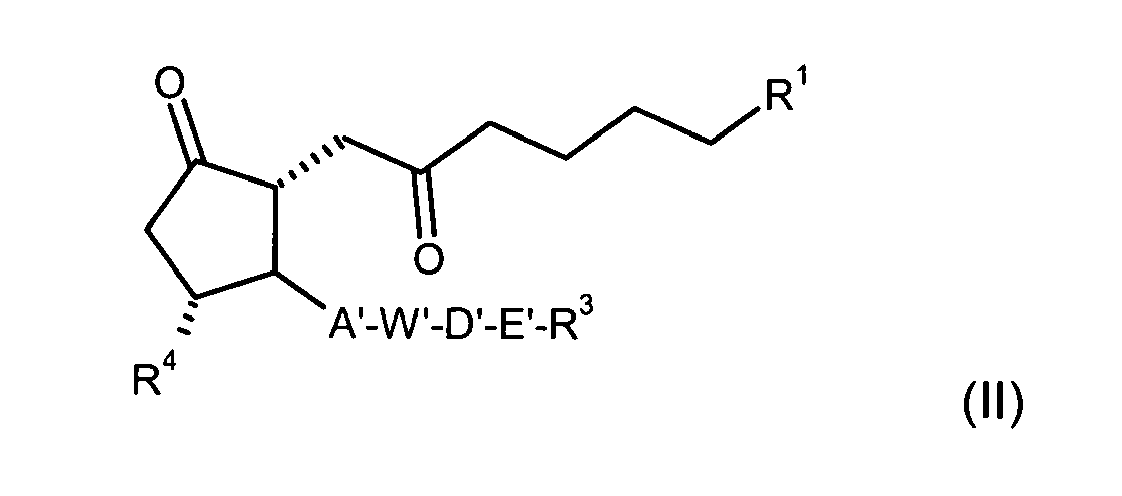
- R1 is COOR2
whereby R2 means hydrogen, a C1-C10-alkyl group, a C5-C6-cycloalkyl group, or a C6-C10-aryl group or a 5- or six-membered heterocyclic ring or a C(O)NHSO2-R5 group
whereby R5 is C1-C10-alkyl, C5-C6-cycloalkyl or C6-C10 aryl, - A' is a CH=CH-group having E-configuration or a -C≡C- group,
- W' is a free or protected hydroxymethylen group or a free or protected

whereby the hydroxyl group may be in α- or β-position, - D'is a straight or branched C1-C5 alkylen group
- E' is a -C≡C- group or a C2-C4-alkenylen group,
- R3 is a C1-C10-alkyl group, a C3-C10-cydoalkyl group or an optionally substituted aryl group or a 5- or six-membered heterocyclic ring,
- R4 is a free or protected hydroxy group
- and if R2 is hydrogen, its salts with physiologically suitable bases as well as α-, β-, or γ-Cyciodextrinclathrates of thereof
- R1 is COOR2 or C(O)NHSO2R2
whereby R2 means a C1-C10-alkyl group, a C5-C6-cycloalkyl
group, or a C6-C12-aryl group or a 5- or six-membered heterocyclic ring and if R2 is COOR2, R2 means additionally hydrogen or a phenacyl group which is optionally substituted by 1-3 halogen atoms, - A' is a CH=CH-group having E-configuration or a -C≡C- group,
- W' is a free or protected hydroxymethylen group or a free or protected

whereby the hydroxyl group may be in α- or β-position, - D'is a straight or branched C1-C5 alkylen group or a direct bond
- E' is a -C≡C- group or a C2-C4-alkenylen group or a group

- R3 is a hydrogen atom, a C1-C10-alkyl group, a C1-C10-alkenyl group, a C3-C10-cycloalkyl group or an optionally substituted aryl group or a 5- or six-membered heterocyclic ring,
- R4 is a hydrogen atom, a methyl group, a free or protected hydroxy group and if R2 is hydrogen, its salts with physiologically suitable bases as well as α-,
- β-, or γ-Cyclodextrinclathrates of thereof
- In one aspect of the invention the prostaglandin or prostaglandin derivative (a) of the combination as claimed in claim 1 or 2 is a prostacyclin or carbacyclin derivative or analog.
- In one aspect of the invention the prostaglandin is selected from the group of prostacyclin derivatives of formula (IV)

- R1 is hydrogen,
a C1-C10-alkyl group being optionally substituted by halogen, phenyl, dimethylamino, diethylamino, C1-C5-alkoxy,
a C5-C6-cycloalkyl group,
a phenyl group being optionally substituted by halogen, C1-C4-alkoxy, hydroxyl or trifluoromethyl,
or a 5 or 6 membered heterocyclic ring having at least one nitrogen, oxygen or sulphur atom, - A is a group selected from -CH2-CH2-, trans -CH=CH- or -C≡C-,
- W is a hydroxy group which optionally may be etherified or esterified or a group

- D and E together form an additional bond or
- D is a straight or branched C1-C10- alkylen group or an unsaturated
- C2-C10-alkenylene group which optionally may be substituted by fluorine atoms,
- E is an oxygen atom or the group -C≡C-, or a direct bond and
- R2 is a C1-C7 alkyl group or a C5-C6-cycloalkyl group which both optionally may be substituted by
halogen, an optionally substituted phenyl group, a C5-C6-cycloalkyl group, C1-C4-alkyl, chloromethyl, or a 5 or 6-membered heterocyclic ring having at least one nitrogen, oxygen or sulphur atom, - R3 is a hydroxyl group which optionally can be etherified or esterified and
- X is a group selected from -CH2- or -O-.
- One aspect of the invention are combinations comprising prostacyclines which in the sense of the present invention are compounds of formula IV above wherein X is oxygen.
Another aspect of the invention are combinations comprising carbacyclines which in the sense of the present invention are compounds of formula IV wherein X is a methylen group -CH2-. - In yet another aspect of the invention the prostaglandin is a compound of formula IV wherein R2 is a C1-C7 alkyl group which optionally may be substituted by halogen, an optionally substituted phenyl group, a C5-C6-cycloalkyl group, C1-C4-alkyl, chloromethyl, or a 5 or 6-membered heterocyclic ring having at least one nitrogen, oxygen or sulphur atom.
- In another aspect of the invention the prostaglandin used for the combination of the present invention is selected from the group consisting of 6-Oxo-PGE1 derivatives
- (13E)-(11R, 15S, 16RS)-6,9-Dioxo-11,15-dihydroxy-16-methyl-18,18,19,19-tetradehydro-13-prostenoic acid,
- (13E)-(11R, 15S, 16RS)-6,9-Dioxo-11,15-dihydroxy, 16-methyl-18,18,19,19-tetradehydro-13-prostenoic acid methylester,
- (11 R, 15S, 16S)-6,9-Dioxo-16,20-dimethyl-13,14,18,18,19,19-hexadehydro-13-prostenoic acid
- (11R, 15S, 16S)-6,9-Dioxo-16,20-dimethyl-13,14,18,18,19,19-hexadehydro-13-prostenoic acid methylester, (9R, 11 R, 13E, 15S, 16S)-6-Oxo-9-fluoro-11,15-dihydroxy-16-methyl-18,18,19,19-tetradehydro-13-prostenoic acid, (9R, 11R, 13E, 15S, 16S)-6-Oxo-9-fluoro-11,15-dihydroxy-16-methyl-18,18,19,19-tetradehydro-13-prostenoic acid methylester,
- (9S, 11R, 13E, 15S, 16S)-6-Oxo-9-fluoro-11,15-dihydroxy-16-methyl-18,18,19,19-tetradehydro-13-prostenoic acid,
- (9S, 11R, 13E, 15S, 16S)-6-Oxo-9-fluoro-11,15-dihydroxy-16-methyl-18,18,19,19-tetradehydro-13-prostenoic acid methylester,
- (9R, 11R, 15S, 16S)-6-Oxo-9-fluoro-11,15-dihydroxy-16,20-dimethyl-13,14,18,18,19,19-hexadehydro-13-prostenioc acid,
- (9S, 11R, 15S, 16S)-6-Oxo-9-fluoro-11,15-dihydroxy-16,20-dimethyl-13,14,18,18,19,19-hexadehydro-13-prostenioc acid,
- (9R, 11R, 15S, 16S)-6-Oxo-9-fluoro-11,15-dihydroxy-16,20-dimethyl-13,14,18,18,19,19-hexadehydro-13-prostenioc acid methylester,
- (9S, 11R, 15S, 16S)-6-Oxo-9-fluoro-11,15-dihydroxy-16,20-dimethyl-13,14,18,18,19,19-hexadehydro-13-prostenioc acid methylester,
- In yet another aspect of the invention the prostaglandin suitable for the combination of the present invention is selected from the group consisting of PGE1 derivatives
- (13E)-(11R, 15S, 16RS)- 9-Oxo-11,15-dihydroxy-16-methyl-18,18,19,19-tetradehydro-13-prostenoic acid
- (13E)-(11R, 15S, 16RS)-9-Oxo-11,15-dihydroxy, 16-methyl-18,18,19,19-tetradehydro-13-prostenoic acid methylester,
- (11R, 15S, 16S)-9-Oxo-16,20-dimethyl-13,14,18,18,19,19-hexadehydro-13-prostenoic acid
- (11R, 15S, 16S)-9-Oxo-16,20-dimethyl-13,14,18,18,19,19-hexadehydro-13-prostenoic acid methylester,(9R, 11R, 13E, 15S, 16S)-11,15-Dihydroxy-9-fluoro-16-methyl-18,18,19,19-tetradehydro-13-prostenoic acid, (9R, 11R, 13E, 15S, 16S)-11,15-Dihydroxy-9-fluoro-16-methyl-18,18,19,19-tetradehydro-13-prostenoic acid methylester,
- (9S, 11R, 13E, 15S, 16S)-11,15-Dihydroxy-9-fluoro-16-methyl-18,18,19,19-tetradehydro-13-prostenoic acid,
- (9S, 11R, 13E, 15S, 16S)-11,15-dihydroxy-9-fluoro-16-methyl-18,18,19,19-tetradehydro-13-prostenoic acid methylester
- (9R, 11R, 15S, 16S)-11,15-Dihydroxy-9-fluoro-16,20-dimethyl-13,14,18,18,19,19-hexadehydro-13-prostenioc acid,
- (9S, 11R, 15S, 16S)-11,15-dihydroxy-9-fluoro-16,20-dimethyl-13,14,18,18,19,19-hexadehydro-13-prostenioc acid,
- (9R, 11R, 15S, 16S)-11,15-Dihydroxy-9-fluoro-16,20-dimethyl-13,14,18,18,19,19-hexadehydro-13-prostenioc acid methylester,
- (9S, 11R, 15S, 16S)-11,15-Dihydroxy-9-fluoro-16,20-dimethyl-13,14,18,18,19,19-hexadehydro-13-prostenioc acid methylester,
- One aspect of the invention is a combination wherein the prostaglandin is selected from the group consisting of ((E)-5-{(3aS,4R,5R,6aS)-5-Hydroxy-4-[(E)-(3S,4RS)-3-hydroxy)-4-methyl-1-octen-6-ynyl]perhydropentalen-2-ylidene}valeric acid and (5-{(E)-(1S,5S,6S,7R)-7-Hydroxy-6-[(3S,4S)-3-hydroxy-4-methyl-nona-1,6-diynyl]-bicyclo[3.3.0]oct-3-ylidene}-3-oxapentanoic acid)or (9-Oxo-11a. 16-dihydroxy-16-methyl-prost-13(E)-en-1-oic acid) (Misoprostol).
- Especially preferred in the sense of the present invention are Iloprost ((E)-5-{(3aS,4R,5R,6aS)-5-Hydroxy-4-[(E)-(3S,4RS)-3-hydroxy)-4-methyl-1-octen-6-ynyl]perhydropentalen-2-ylidene}valeric acid and Cicaprost (5-{(E)-(1 S,5S,6S,7R)-7-Hydroxy-6-[(3S,4S)-3-hydroxy-4-methyl-nona-1,6-diynyl]-bicyclo[3.3.0]oct-3-ylidene}-3-oxapentanoic acid).
- The epothilones as disclosed in the art e.g.
WO 93/10102 WO 2000/066589 ,WO 2001027308 ,WO 99/02514 WO 2002080846 are suitable for use in the present invention. - The epothilones and their derivatives as being suitable for the present invention as well as the production thereof is disclosed, for example in
DE 19907588 ,WO 98/25929 WO 99/58534 WO 99/2514 WO 99/67252 WO 99/67253 WO 99/7692 EP 99/4915 WO 00/1333 WO 00/66589 WO 00/49019 WO 00/49020 WO 00/49021 WO 00/71521 WO 00/37473 WO 00/57874 WO 01/92255 WO 01/81342 WO 01/73103 WO 01/64650 WO 01/70716 US 6204388 ,US 6387927 ,US 6380394 ,US 02/52028 ,US 02/58286 ,US 02/62030 ,WO 02/32844 WO 02/30356 WO 02/32844 WO 02/14323 WO 02/8440 WO 00/66589 - One aspect of the present invention are combinations according to the claims wherein the tubulin/microtubule interfering agent is paclitaxel, docetaxel or an epothilone.
- One aspect of the present invention are combinations wherein the tubulin/microtubule interfering agents are epothilones as described by formula (V)

- R1a, R1b
- are each independently hydrogen, C1-C10 alkyl, aryl, aralkyl, or together form a -(CH2)m-group where m is 2 to 5;
- R2a, R2b
- are each independently hydrogen, C1-C10 alkyl, aryl, aralkyl, or together form a -(CH2)n-group where n is 2 to 5, or are C2-C10 alkenyl or C2-C10 alkynyl;
- R3
- is hydrogen, C1-C10 alkyl, aryl, aralkyl;
- R4a, R4b
- are each independently hydrogen, C1-C10 alkyl, aryl, aralkyl, or together form a -(CH2)p- group where p is 2 to 5;
- R5
- is hydrogen, C1-C10 alkyl, aryl, aralkyl, CO2H, CO2alkyl, CH2OH, CH2Oalkyl, CH2Oacyl, CN, CH2NH2, CH2N(alkyl, acyl)1,2, or CH2Hal, CHal3;
- R6, R7
- are each hydrogen, or together form an additional bond, or together form an epoxy function;
- G
- is O or CH2;
- D-E
- together is a group -H2C-CH2-, -HC=CH-, -C≡C-, -CH(OH)-CH(OH)-, -CH(OH)-CH2-, -CH2-CH(OH)-, -CH2-O-, -O-CH2- or CH-CH
whereby if G is O then D-E cannot be CH2-O; or
D-E-G together is a group H2C-CH=CH - W
- is a group C(=X)R8, or is an aromatic or heteroaromatic radical;
X is O or a group CR9R10; - R8
- is hydrogen, C1-C10 alkyl, aryl, aralkyl, halogen, CN;
- R9, R10
- are each independently hydrogen, C1-C20 alkyl, aryl, aralkyl, or together with the methylene carbon form a 5- to 7-membered carbocyclic ring;
- Z
- is O or H and the group OR11;
- R11
- is hydrogen or a protecting group PGz;
- A-Y
- is a group O-C(=O), O-CH2, CH2-C(=O), NR12-C(=O), NR12-SO2;
- R12
- is hydrogen, or C1-C10 alkyl;
- PGz
- is C1-C20 alkyl, C4-C7 cycloalkyl, which may contain one or more oxygen atoms in the ring, aryl, aralkyl, C1-C20 acyl, aroyl, C1-C20 alkylsulfonyl, arylsulfonyl, tri(C1-C20 alkyl)silyl, di(C1-C20 alkyl) arylsilyl, (C1-C20 alkyl)diarylsilyl, or tri(aralkyl)silyl;
- Another embodiment for the combination of the invention are epothilones of formula (V)
wherein: - R1a, R1b
- are each independently hydrogen, C1-C10 alkyl, aryl, aralkyl, or together form a -(CH2)m-group where m is 2 to 5;
- R2a, R2b
- are each independently hydrogen, C1-C10 alkyl, aryl, aralkyl, or together form a -(CH2)n-group where n is 2 to 5, or are C2-C10 alkenyl or C2-C10 alkynyl;
- R3
- is hydrogen, C1-C10 alkyl, aryl, aralkyl;
- R4a, R4b
- are each independently hydrogen, C1-C10 alkyl, aryl, aralkyl, or
- R5
- together form a -(CH2)p- group where p is 2 to 5; is hydrogen, C1-C10 alkyl, aryl, aralkyl, CO2H, CO2alkyl, CH2OH, CH2Oalkyl, CH2Oacyl, CN, CH2NH2, CH2N(alkyl, acyl)1,2, or CH2Hal, CHal3;
- R6, R7
- are each hydrogen, or together form an additional bond, or together form an epoxy function;
- G
- is O or CH2;
- D-E
- together is a group -H2C-CH2-, -HC=CH-, -C≡C-, -CH(OH)-CH(OH)-, -CH(OH)-CH2-, -CH2-CH(OH)-, -CH2-O-, -O-CH2- or

D-E-G together is a group H2C-CH=CH - W
- is a group C(=X)R8, or is a bi- or tricyclic aromatic or heteroaromatic radical;
X is O or a group CR9R10; - R8
- is hydrogen, C1-C10 alkyl, aryl, aralkyl, halogen, CN; R9, R10 are each independently hydrogen, C1-C20 alkyl, aryl, aralkyl, or together with the methylene carbon form a 5- to 7-membered carbocyclic ring;
- Z
- is O or H and the group OR11;
- R11
- is hydrogen or a protecting group PGz;
- A-Y
- is a group O-C(=O), O-CH2, CH2-C(=O), NR12-C(=O), NR12-SO2;
- R12
- is hydrogen, or C1-C10 alkyl;
- PGz
- is C1-C20 alkyl, C4-C7 cycloalkyl, which may contain one or more oxygen atoms in the ring, aryl, aralkyl, C1-C20 acyl, aroyl, C1-C20 alkylsulfonyl, arylsulfonyl, tri(C1-C20 alkyl)silyl, di(C1-C20 alkyl) arylsilyl, (C1-C20 alkyl)diarylsilyl, or tri(aralkyl)silyl;
- Another embodiment for the combination of the invention are epothilones of formula (V)
wherein - R1a, R1b
- are each independently hydrogen, C1-C4 alkyl, or together form a-(CH2)m-group where m is 2 to 5;
- R2a, R2b
- are each independently hydrogen, C1-C5 alkyl, or together form a-(CH2)n-group where n is 2 to 5, or C2-C6 alkenyl, or C2-C6 alkynyl;
- R3
- is hydrogen,
- R4a, R4b
- are each independently hydrogen, C1-C4 alkyl,
- R5
- is hydrogen, C1-C4 alkyl, C(Hal)3
- R6, R7
- are each hydrogen, or together form an additional bond, or together form an epoxy function;
- G
- is CH2;
- D-E
- is a group H2C-CH2, or
- D-E-G
- together is a group H2C-CH=CH
- W
- is a group C(=X)R8, or is a bi- or tricyclic aromatic or heteroaromatic radical;
- X
- is a group CR9R10;
- R8
- is hydrogen, C1-C4 alkyl, halogen,
- R9, R10
- are each independently hydrogen, C1-C4 alkyl, aryl, aralkyl,
- Z
- is O
- A-Y
- is a group O-C(=O), NR12-C(=O)
- R12
- is hydrogen, or C1-C4 alkyl;
- Still another aspect of the invention are combinations comprising epothilones of formula (V),
wherein - R1a, R1b are
- each independently hydrogen, C1-C2 alkyl, or together form a-(CH2)m-group where m is 2 to 5,
- R2a, R2b are
- each independently hydrogen, C1-C5 alkyl, or together form a-(CH2)n-group where n is 2 to 5, or C2-C6 alkenyl, or C2-C6 alkynyl;
- R3
- is hydrogen,
- R4a, R4b are
- each independently hydrogen, C1-C2 alkyl,
- R5
- is hydrogen or methyl or trifluormethyl,
- R6, R7
- together form an additional bond, or together form an epoxy function;
- G
- is CH2;
- D-E
- is a group H2C-CH2, or
- D-E-G
- together is a group H2C-CH=CH
- W
- is a group C(=X)R8, or is thiazolyl, oxazolyl, pyridyl, N-oxo-pyridyl; benzothiazolyl, benzoxazolyl, benzimidazolyl, which are optionally substituted by C1-C3-alkyl, C1-C3-hydroxyalkyl, C1-C3-aminoalkyl, C1-C3-alkylsulfonyl
- X
- is a group CR9R10;
- R8
- is hydrogen, methyl, chloro, fluoro,
- R9, R10
- are each independently hydrogen, C1-C4 alkyl, thiazolyl, oxazolyl, pyridyl, N-oxo-pyridyl, which are optionally substituted by C1-C3-alkyl, C1-C3-hydroxyalkyl, aralkyl,
- Z
- is O
- A-Y
- is a group O-C(=O), NR12-C(=O)
- R12
- is hydrogen, or C1-C4 alkyl;
- One embodiment of the invention are combinations comprising compounds of formula V wherein W is C(=X)R8 and X is CR9R10 or W is a mono-, bi- or tricyclic aromatic radical.
- A further embodiment of the invention are combinations comprising compounds of formula V wherein W is a bi- or tricyclic aromatic radical.
- A further embodiment of the invention are combinations comprising compounds of formula V wherein W is a bicyclic aromatic radical.
- A further embodiment of the invention are combinations comprising compounds of formula V wherein W is a monocyclic aromatic radical.
- An embodiment of the invention are combinations comprising compounds of general formula (V), wherein A-Y is O-C(=O); D-E is H2C-CH2; G is CH2; Z is O; R1a, R1b are both C1-C10 alkyl or form together a -(CH2)p- group where p is 2 to 3; R2a, R2b are each independently hydrogen, C1-C10 alkyl, C2-C10 alkenyl, or C2-C10 alkynyl; R3 is hydrogen; R4a, R4b are each independently hydrogen or C1-C10 alkyl; R5 is C1-C10 alkyl.
- Another embodiment of the invention are combinations comprising compounds of the general formula (V), wherein R2a, R2b are each independently hydrogen, C2-C10 alkenyl or C2-C10 alkynyl; R6, R7 form an epoxy function or together form an additional bond.
- Still a further aspect of the invention are combinations comprising compounds of formula (V) wherein W is a 2-Methylbenzothiazol-5-yl radical or a 2-Methylbenzoxazol-5-yl radical or a Quinoline-7-yl radical.
- Another aspect of the invention are combinations comprising compounds of formula (V) wherein R2a, R2b are each independently hydrogen, C2-C10 alkenyl or C2-C10 alkynyl; R6, R7 form an epoxy function and W is a 2-Methylbenzothiazol-5-yl radical or a 2-Methylbenzoxazol-5-yl radical or a Quinoline-7-yl radical.
- A special aspect of the invention are combinations comprising epothilones selected from the group consisting of
- (4S,7R,8S,9S,13E/Z,16S)-4,8-dihydroxy-16-(2-methyl-benzoxazol-5-yl)-1-oxa-5,5,9,13-tetramethyl-7-(prop-2-en-1-yl)-cyclohexadec-13-ene-2,6-dione;
- (1S/R,3S,7S,1 0R,11 R,12S,16R/S)-7,11-dihydroxy-10-(prop-2-en-1-yl)-3-(2-methyl-benzoxazol-5-yl)-8,8,12,16-tetramethyl-4,17-dioxabicyclo[14.1.0]heptadecane-5,9-dione;
- (4S,7R,8S,9S,13E/Z,16S)-4,8-dihydroxy-16-(2-methyl-benzothiazol-5-yl)-1-oxa-5,5,9,13-tetramethyl-7-(prop-2-en-1-yl)-cyclohexadec-13-ene-2,6-dione;
- (1S/R,3S,7S,10R,11S,12S,16R/S)-7,11-dihydroxy-10-(prop-2-en-1-yl)-3-(2-methyl-benzothiazol-5-yl)-8,8,12,16-tetramethyl-4,17-dioxabicyclo[14.1.0]heptadecane-5,9-dione;
- (1S/R,3S,7S,10R,11R,12S,16R/S)-7,11-dihydroxy-10-(prop-2-en-1-yl)-3-(2-methyl-benzothiazol-5-yl)-8,8,12,16-tetramethyl-4,17-dioxabicyclo[14.1.0]heptadecane-5,9-dione;
- (4S,7R,8S,9S,13E/Z,16S)-4,8-dihydroxy-16-(2-methyl-benzothiazol-5-yl)-1-oxa-9,13-dimethyl-5,5-(1,3-trimethylen)-7-(prop-2-en-1-yl)-cyclohexadec-13-ene-2,6-dione;
- (1S/R,3S,7S,10R,11R,12S,16R/S)-7,11-dihydroxy-10-(prop-2-en-1-yl)-3-(2-methyl-benzothiazol-5-yl)-12,16-dimethyl-8,8-(1,3-trimethylen)-4,17-dioxabicyclo[14.1.0]heptadecane-5,9-dione;
- (4S,7R,8S,9S, 13E/Z, 16S)-4,8-dihydroxy-16-(2-methyl-benzothiazol-5-yl)-1-oxa-5,5,9,13-tetramethyl-7-(prop-2-in-1-yl)-cyclohexadec-13-ene-2,6-dione;
- (1S/R,3S,7S,1 0R,11R,12S,16R/S)-7,11-dihydroxy-10-(prop-2-in-1-yl)-3-(2-methyl-benzothiazol-5-yl)-8,8,12,16-tetramethyl-4,17-dioxabicyclo[14.1.0]heptadecane-5,9-dione;
- (4S,7R,8S,9S, 13E/Z, 16S)-4,8-dihydroxy-16-(quinolin-7-yl)-1-oxa-5,5,9,13-tetramethyl-7-(prop-2-en-1-yl)-cyclohexadec-13-ene-2,6-dione;
- (1 S/R,3S,7S,10R,11R,12S,16R/S)-7,11-dihydroxy-10-(prop-2-en-1-yl)-3-(quinolin-7-yl)-8,8,12,16-tetramethyl-4,17-dioxabicyclo[14.1.0]heptadecane-5,9-dione;
- (4S,7R,8S,9S,13E/Z,16S)-4,8-dihydroxy-16-(1,2-dimethyl-1 H-benzoimidazol-5-yl)-1-oxa-5,5,9,13-tetramethyl-7-(prop-2-en-1-yl)-cyclohexadec-13-ene-2,6-dione;
- (1S/R,3S,7S,10R,11R,12S,16R/S)-7,11-dihydroxy-10-(prop-2-en-1-yl)-3-(1,2-dimethyl-1 H-benzoimidazol-5-yl)-8,8,12,16-tetramethyl-4,17-dioxabicyclo[14.1.0]heptadecane-5,9-dione;
- (4S,7R,8S,9S,13E/Z,16S)-4,8-dihydroxy-16-(2-methyl-benzothiazol-5-yl)-1-aza-5,5,9,13-tetramethyl-7-(prop-2-en-1-yl)-cyclohexadec-13-ene-2,6-dione; (1S/R,3S,7S,10R,11S,12S,16R/S)-7,11-dihydroxy-10-(prop-2-en-1-yl)-3-(2-methyl-benzothiazol-5-yl)-8,8,12,16-tetramethyl-4-aza-17-oxabicyclo[14.1.0]heptadecane-5,9-dione, and (1S/R,3S,7S,10R,11R,12S,16R/S)-7,11-dihydroxy-10-(prop-2-en-1-yl)-3_(2-methyl-benzothiazol-5-yl)-8,8,12,16-tetramethyl-4-aza-17-oxabicyclo[14.1.0]heptadecane-5,9-dione,
- (1S,3S(E),7S,10R,11S,12S,16R)-7,11-Dihydroxy-8,8,10,12,16-pentamethyl-3-[1-(2-methyl-1,3-thiazol-4-yl)prop-1-en-2-yl]-4,17-dioxabicyclo[14.1.0]heptadecane-5,9-dione ,
- (1S,3S(E),7S,10R,11S,12S,16R)-7,11-Dihydroxy-8,8,10,12,16-pentamethy)-3-[1-(2-methyl-1,3-thiazol-4-yl)prop-1-en-2-yl]-17-oxa-4-azabicyclo[14.1.0]heptadecane-5,9-dione ,
- (4S,7R,8S,9S,13Z,16S(E))-4,8-dihydroxy-5,5,7,9,13-pentamethyl-16-[1-(2-methyl-1,3-thiazol-4-yl)prop-1-en-2-yl]-oxacyclohexadec-13-ene-2,6-dione , (4S,7R,8S,9S,10E,13Z,16S(E))-4,8-dihydroxy-5,5,7,9,13-pentamethyl-16-[1-(2-methyl-1,3-thiazol-4-yl)prop-1-en-2-yl]-oxacyclohexadec-10,13-diene-2,6-dione , (4S,7R,8S,9S,10E,13Z,16S(E))-4,8-dihydroxy-5,5,7,9-tetramethyl-13-trifluormethyl-16-[1-(2-methyl-1,3-thiazol-4-yl)prop-1-en-2-yl]-oxacyclohexadec-10,13-diene-2,6-dione ,
- (1 S,3S(E),7S,10R,11S,12S,16R)-7,11-Dihydroxy-8,8,10,12,16-pentamethyl-3-[1-(2-methylsulfanyl-1,3-thiazol-4-yl)prop-1-en-2-yl]-4,17-dioxabicyclo[14.1.0]heptadecane-5,9-dione
- Most preferred for the combination of the present invention are
- (4S,7R,8S,9S,13E/Z,16S)-4,8-dihydroxy-16-(2-methyl-benzothiazol-5-yl)-1-oxa-5,5,9,13-tetramethyl-7-(prop-2-en-1-yl)-cyclohexadec-13-ene-2,6-dione;
- (1S/R,3S,7S,110R,11R,12S,16R/S)-7,11-d ihydroxy-10-(prop-2-en-1-yl)-3-(2-methyl-benzothiazol-5-yl)-8,8,12,16-tetramethyl-4,17-dioxabicyclo[14.1.0]heptadecane-5,9-dione;
- (1S/R,3S,7S,10R,11 S,12S,16R/S)-7,11-dihydroxy-10-(prop-2-en-1-yl)-3-(2-methyl-benzothiazol-5-yl)-8,8,12,16-tetramethyl-4,17-dioxabicyclo[14.1.0]heptadecane-5,9-dione or any stereoisomer thereof as a single stereoisomer or a mixture of different stereoisomers, and / or as a pharmaceutically acceptable salt thereof..
One embodiment of the invention is any of the disclosed combinations comprising (a), a prostaglandin, (b) an epothilone and (c) a cyclooxygenase inhibitor with the proviso that the epothilone is not epothilone A, B, C or D.
Another embodiment of the disclosed combinations is a combination comprising as epothilone (b) (1S,3S,7S,10R,11S,12S,16R)-7,11-dihydroxy-10-(prop-2-en-1-yl)-3-(2-methyl-benzothiazol-5-yl)-8,8,12,16-tetramethyl-4,17-dioxabicyclo[14.1.0]heptadecane-5,9-dione.
or any stereoisomer or diastereoisomer thereof as a single stereoisomer or a mixture of different stereoisomers, and / or as a pharmaceutically acceptable salt thereof..
One embodiment is the combination of (a) Iloprost [((E)-5-{(3aS,4R,5R,6aS)-5-Hydroxy-4-[(E)-(3S,4RS)-3-hydroxy)-4-methyl-1-octen-6-ynyl]perhydropentalen-2-ylidene}valeric acid] or Cicaprost [(5-{(E)-(1S,5S,6S,7R)-7-Hydroxy-6-[(3S,4S)-3-hydroxy-4-methyl-nona-1,6-diynyl]-bicyclo[3.3.0]oct-3-ylidene}-3-oxapentanoic acid)] or any pharmaceutically acceptable salt thereof and one of the epothilones(1S,3S,7S,10R,11S,12S,16R)-7,11-dihydroxy-10-(prop-2-en-1-yl)-3-(2-methyl-benzothiazol-5-yl)-8,8,12,10-tetramethyl-4,17-dioxabicyclo[14.1.0]heptadecane-5,9-dione or a pharmaceutically acceptable salt thereof Another embodiment is the combination of (a) Iloprost [((E)-5-{(3aS,4R,5R,6aS)-5-Hydroxy-4-[(E)-(3S,4RS)-3-hydroxy)-4-methyl-1-octen-6-ynyl]perhydropentalen-2-ylidene}valeric acid] or Cicaprost [(5-{(E)-(1 S,5S,6S,7R)-7-Hydroxy-6-[(3S,4S)-3-hydroxy-4-methyl-nona-1,6-diynyl]-bicyclo[3.3.0]oct-3-ylidene}-3-oxapentanoic acid)] or a pharmaceutically acceptable salt thereof and the epothilone (1S,3S,7S,10R,11S,12S,16R)-7,11-dihydroxy-10-(prop-2-en-1-yl)-3-(2-methyl-benzothiazol-5-yl)-8,8,12,16-tetramethyl-4,17-dioxabicyclo[14.1.0]heptadecane-5,9-dione or a pharmaceutically acceptable salt thereof and (c) acetylsalicylic acid or any of its derivatives, pharmaceutically acceptable salts and crystal modifications such as e.g. solvates, polymorphs thereof.
One preferred embodiment is the combination of (a) Iloprost [((E)-5-{(3aS,4R,5R,6aS)-5-Hydroxy-4-[(E)-(3S,4RS)-3-hydroxy)-4-methyl-1-octen-6-ynyl]perhydropentalen-2-ylidene}valeric acid] or a pharmaceutically acceptable salt thereof and the epothilone (1S,3S,7S,10R,11S,12S,16R)-7,11-dihydroxy-10-(prop-2-en-1-yl)-3-(2-methyl-benzothiazol-5-yl)-8,8,12,16-tetramethyl-4,17-dioxabicyclo[14.1.0]heptadecane-5,9-dione or a pharmaceutically acceptable salt thereof
Another preferred embodiment is the combination of (a) Iloprost [((E)-5-{(3aS,4R,5R,6aS)-5-Hydroxy-4-[(E)-(3S,4RS)-3-hydroxy)-4-methyl-1-octen-6-ynyl]perhydropentalen-2-ylidene}valeric acid] or a pharmaceutically acceptable salt thereof and the epothilone (1S,3S,7S,10R,11S,12S,16R)-7,11-dihydroxy-10-(prop-2-en-1-yl)-3-(2-methyl-benzothiazol-5-yl)-8,8,12,16-tetramethyl-4,17-dioxabicyclo[14.1.0]heptadecane-5,9-dione or a pharmaceutically acceptable salt thereof and (c) O-acetylsalicylic acid, or pharmaceutically acceptable salts or crystal modifications such as e.g. solvates, polymorphs thereof
One aspect of the invention is the combination of (a) a prostaglandin and any subgroup thereof as defined in the description and (b) a tubulin/microtubule interfering agent and any subgroup thereof as defined in the description and (c) a cyclooxygenase inhibitor which is not a specific COX-2 inhibitor.
One aspect of the invention is the combination of (a) a prostaglandin and any subgroup thereof as defined in the description and (b) a tubulin/microtubule interfering agent and any subgroup thereof as defined in the description and (c) a cyclooxygenase inhibitor which does not include compounds of formula VI
- R is methyl or ethyl
- R1 is chloro or fluoro
- R2 is hydrogen or fluoro
- R3 is hydrogen, fluoro, chloro, methyl, ethyl, methoxy, ethoxy, hydroxyl
- R4 is hydrogen or fluoro,
- R5 is chloro, fluoro, trifluoromethyl or methyl and
- R6 COOR7 or COOCH2COOH.
- R7 is hydrogen, methyl, ethyl, 4-nitrooxybutyl.
- One aspect of the invention is the combination of (a) prostaglandin and any subgroup thereof as defined in the description and (b) tubulin/microtubule interfering agent and any subgroup thereof as defined in the description and (c) a cyclooxygenase inhibitor which is an unspecific cyclooxygenase inhibitor. One aspect of the invention are combinations wherein the cyclooxygenase inhibitor is salicylic acid or any derivative, prodrug, pharmaceutically acceptable salt and crystal modification or solvate thereof.
- Another aspect of the invention are combinations wherein the cyclooxygenase inhibitor is acetyl salicylic acid or any derivatives thereof, pharmaceutically acceptable salts and crystal modifications such as solvates, polymorphs thereof.
- A further apect of the invention is a combination wherein the unspecific cyclooxygenase inhibitor (c) is acetyl salicyclic acid.
- If somewere in the specification a carbon atom has only three of necessary four bonds actually defined and no further analogy can be found as to what should be added there a hydrogen should be regarded as intended.
- The term "acyl" means -C(O)alkyl or -C(O)phenyl or -C(O)benzyl, the alkyl chain may be straight or branched and has up to 12 carbon atoms and the phenyl ring may optionally be substituted and the acyl residue is derived from the known carbonic acids such as, e.g. CH(O)OH, CH3-COOH, CH3-CH2-COOH, CH3-CH2-CH2-COOH, CH3-CH2-CH2-CH2-COOH, pivalic acid.
- The term "alkyl" as used herein refers to straight-chain or branched-chain alkyl groups with 1-20 carbon atoms, e. g., methyl, ethyl, propyl, isopropyl, n-butyl, t-butyl, n-pentyl, isopentyl, neopentyl, heptyl, hexyl and decyl. Alkyl groups can be perfluorated or substituted by one to five substituents selected from the group consisting of halogen atoms, hydroxyl groups, C1-C4 alkoxy groups, or C6-C12 aryl groups (which can be substituted by one to three halogen atoms). If the term alkyl alone or in combination with other terms is used without giving any hint to the length of the chain the chain is meant to have at least one to five carbon atoms and the chain may be straight or branched and can optionally be substituted by hydroxy, halogen, methoxy.
The C1-C7 alkyl group of R2 in the definition of prostaglandins may in addition be saturated or unsaturated. - The term "alkenyl" as used herein refers to straight or branched alkenyl groups, e.g. Vinyl-, Allyl-, Homoallyl-, (E)-But-2-enyl-, (Z)-But-2-enyl-, (E)-But-1-enyl-, (Z)-But-1-enyl-, Pent-4-enyl-, (E)-Pent-3-enyl-, (Z)-Pent-3-enyl-, (E)-Pent-2-enyl-, (Z)-Pent-2-enyl-, (E)-Pent-1-enyl-, (Z)-Pent-1-enyl-, 2-Methylvinyl-, 3-Methylbut-3-enyl-, 2-Methylbut-3-enyl-, (E)-2-Methylbut-2-enyl-, (Z)-2-Methylbut-2-enyl-, 3-Methylbut-2-enyl-Gruppe.
- The term "alkynyl" as used herein refers to straight or branched alkynyl groups, e.g. C≡C, -CH2-C≡CH, -C≡C-CH3, -CH(CH3)-C≡CH, -C≡C-CH2(CH3), -C(CH3)2-C≡CH, -C≡C-CH(CH3)2-, -CH(CH3)-C≡C-CH3, -CH2-C≡C-CH2(CH3).
- The term "alkoxy" as used herein refers to C1-C10-alkoxy groups, preferably C1-C5-alkoxy groups, that can be straight-chain or branched e.g. methoxy, ethoxy, n-propoxy, iso-propoxy, n-butoxy, iso-butoxy, tert-butoxy or n-pentoxy, 2,2-dimethylpropoxy, 2-methylbutoxy or 3-methylbutoxy group. A methoxy or ethoxy group is preferred.
- The term "aryl" as used herein refer to a monocyclic aromatic carbocyclic e.g., phenyl, or heterocyclic ring moiety e.g. furyl, thienyl, pyridyl, pyrazolyl, pyrimidinyl, oxazolyl, pyridazinyl, pyrazinyl, thiazolyl, containing five to 14 ring atoms. Aryl groups can be substituted by one or more substituents selected from the group consisting of halogen, hydroxy, (C1-C10)alkoxy, -CO2H, -CO2(C1-
- C10)alkyl, -NH2, -NO2, -N3, -CN, (C1-C20)alkyl, (C1-C20)acyl, or (C1-C20)acyloxy. The heteroatoms can be oxidized, if as a result the aromatic character is not lost, e. g., a pyridine moiety can be oxidized to a pyridine N-oxide. Or the term "aryl" as used herein refers to a bi- and tricyclic aryl radical, which can be a substituted or unsubstituted carbocyclic or heterocyclic aryl radical with one or more heteroatoms, such as naphthyl, anthryl, benzoxazolyl, benzothiazolyl, benzimidazolyl, quinolyl, isoquinolyl, benzoxazinyl, benzofuranyl, indolyl, indazolyl, quinoxalinyl, tetrahydroisoquinolinyl, tetrahydroquinolinyl, thienopyridinyl, pyridopyridinyl, benzopyrazolyl, benzotriazolyl, or dihydroindolyl, which can be substituted in one or more places by halogen, OH, O-alkyl, CO2H, CO2-alkyl, -NH2, -NO2, -N3, -CN, C1-C20-alkyl, C1-C20-acyl, or C1-C20-acyloxy groups, are suitable. The heteroatoms can be oxidized if as a result the aromatic character is not lost, such as, for example, the oxidation of a quinolyl to a quinolyl-N-oxide.
- The term "aromatic or heteroaromatic radical" as used herein refers to mono-, bi- or tricyclic aromatic or heteroaromatic radicals whereby the bi- and tricyclic radicals are already defined under the term "aryl" and mono cyclic aromatic or heteroaromatic radicals can be selected from the group consisting of e.g. thienyl, furanyl, pyrrolyl, oxazolyl, thiazolyl, imidazolyl, pyrazolyl, isoxazolyl, isothiazolyl, oxadiazolyl, triazolyl, thiadiazolyl, phenyl, pyridyl, pyridazinyl, pyrimidinyl, pyrazinyl, triazinyl which also maybe substituted where possible by the substitutents mentioned for "aryl".
- The term "aralkyl" as used herein refers to a group which can contain up to 14 atoms in the aryl ring (preferred five to ten) and one to eight carbon atoms in the alkyl chain (preferred one to four), e.g., benzyl, phenylethyl, naphthylmethyl, naphthylethyl, furylmethyl, thienylethyl, or pyridylpropyl. The rings can be substituted by one or more substituents selected from the group consisting of halogen, hydroxy, alkoxy, -CO2H, -CO2Alkyl, -NH2, -NO2, -N3, -CN, C1-C20 alkyl, C1-C20 acyl, or C1-C20 acyloxy.
- The term "aroyl" means (CO)aryl, e.g. benzoyl.
- A "(C4-C7)cycloalkyl group" is e.g. cyclobutyl, cyclopentyl, cyclohexyl which may be optionally substituted by (C1-C5)alkyl, (C1-C5)alkoxy, halogen or hydroxy. If it contains an oxygen in the ring it is e.g. tetrahydrofuranyl.
- The term "hal" or "halogen" means fluorine, chlorine, bromine or iodine, preferably in end products fluorine or chlorine, as a leaving group preferably iodine or bromine.
- The term "5- or 6-membered heterocyclic ring having at least one nitrogen, oxygen or sulphur atom can be one of the following ring moieties being bound at any position chemically possible: piperidinyl-, morpholinyl-, thiomorpholinyl-, piperazinyl-, tetrahydrofuranyl-, tetrahydrothienyl-, imidazolidinyl- or a pyrrolidinyl ring system.
- As substituents of the heterocylic group mentioned above can be selected from the group consisting of optionally substituted C1-C5-alkyl, hydroxy-, C1-C5-alkoxy-, NR4R5-, halogen, cyano-, COOR8-, CHO-. The substituents can be bound optionally also to the nitrogen atom if any; consequently also N-oxides are included in this definition.
- The residue "CH2N(alkyl, acyl)1,2" means that the nitrogen can bear one or two same or different residues selected from alkyl or acyl and both terms, alkyl and acyl have the meaning as defined above.
- The protecting groups "PGx,z" can be alkyl- and/or aryl-substituted silyl moieties, such as tris(C1-C20 alkyl)silyl, bis(C1-C20 alkyl)-arylsilyl, (C1-C20 alkyl)-diarylsilyl, tris(aralkyl)-silyl, C1-C20 alkyl, C2-C20-alkenyl, C4-C7 cycloalkyl, which may contain an oxygen atom in the ring, aryl, aralkyl, C1-C20 acyl, aroyl, C1-C20 alkoxycarbonyl C1-C20 alkylsulfonyl or C1-C20 arylsulfonyl. Protecting groups which can be easily be removed from the molecule are preferred, e.g., methoxymethyl, methoxyethyl, ethoxyethyl, tetrahydropyranyl, tetrahydrofuranyl, trimethylsilyl, triethylsilyl, triisopropylsilyl, t-butyldimethylsilyl, t-butyl-diphenylsilyl, triphenylsilyl, tribenzylsilyl, benzyl, p-nitrobenzyl, p-methoxybenzyl, as well as alkylsulfonyl e.g. methylsulfonyl or arylsulfonyl e.g. p-tolylsulfonyl. As an alkoxycarbonyl radical, e.g., trichloroethyloxycarbonyl (Troc) is suitable. Preferred acyl groups are formyl, acetyl, propionyl, isopropionyl, trichloromethylcarbonyl pivaloyl, butyryl, or benzoyl, which all can be substituted by one or more amino and/or hydroxy moieties.
- The "etherified or esterified hydroxy groups" result e.g. in (C1-C5)-alkoxy or (C1-C5)-alkoxy(C1-C5)alkyl groups e.g. MEM (Methylethoxymethyl), MOM (Methyloxymethyl), or cyclic ethers as e.g.THP (Tetrahydropyranylether), O(CO)(C1-C10)alkyl groups, O(CO)benzyl, O(CO)phenyl, with the used term alkyl as defined above.
- As "amino protective groups PG", the radicals that are known to one skilled in the art are considered. For example, the Alloc, Boc, Z, benzyl, f-Moc, Troc, Stabase or benzostabase group can be mentioned.
- The term "derivative" as used in combination with a class of compounds e.g. prostaglandins means structurally analogs of prostaglandins.
- The term "carbacyclin" means any PGl2-derivative having a carbon atom instead of the oxygen atom in the bicyclic ring skeleton. Thus carbacyclins are included in the term "PGl2-derivatives or analogs". In addition the carbacyclin can be derivatized to yield carbacyclin derivatives which also are included in the term "PGl2-derivatives or analogs"..
- The term "tubulin/microtubule interfering" is used synonymously for microtubule stabilizing or tubulin stabilizing / microtubule depolymerizing.
- The term "physiologically acceptable salts" of the components of the combination includes addition salts of mineral acids, carbonic acids, sulfonic acids, e.g. salts of hydrochloric acid, hydrobromic acid, sulfuric acid, phosphoric acid, nitric acid, methanesulfonic acid, ethanesulfonic acid, toluolsulfonic acid, benzenesulfonic acid, naphthalinesulfonic acid, acetic acid, trifluoroacetic acid, propionic acid, pivalic acid, lactic acid, tartaric acid, malic acid, citric acid, fumaric acid, maleic acid, succinic acid and benzoic acid.
- In addition the term "physiologically acceptable salts" of the components of the combination includes salts of commonly suitable bases, e.g. salts of alkalimetall (e.g.. sodium- and potassium salts), alkaline earth salts (e.g. calcium- and magnesium salts) and ammonium salts, derivatized from NH3 or organic amines with 1 to 16 carbon atoms, e.g. ethylamine, diethylamine, triethylamine, ethyldiisopropylamine, monoethanolamine, diethanolamine, triethanolamine, dicyclohexylamine, dimethylaminoethanol, prokaine, dibenzylamine, N-methylmorpholin, arginin, lysin, ethylendiamine and N-methylpiperidin.
- "Solvates" in the sense of the invention are such forms of the compounds of the present combinations which build complexes by coordination of solvent molecules in a liquid or a solid phase. Hydrates are special forms of a solvate wherein water molecules are coordinated.
- Stereoisomers or a mixture of different stereoisomers which means for compounds having one or more than one asymmetry center their enantiomers, diastereomers and racemates as well as E- and Z-Isomers for compounds containing double bonds
- The kit of parts may contain ready-to-use formulations of one, two or all three components (a), (b), (c). It also may contain lyophylisates of one or more components which must be reconstituted before use. Its components may be administered simultanously, concurrently, separately or sequentially. The components of the combination may be administered independently of one another by oral, intravenious, topical or nasal application routes.
- The combination of the present invention is useful for the treatment of a disease or condition associated with cell growth, division and/or proliferation, such as for treating malignant tumors in an individual in need thereof. As more specific applications, there can be mentioned, for example, the treatment of osteoporosis or osteoarthritis, the therapy of ovarian, stomach, colon, adeno-, breast, lung, head and neck carcinomas, malignant melanoma, acute lymphocytic, myelocytic leukaemia, bone-metastasis, brain tumours and brain metastases.
- Thus in one aspect of the invention the combination can be used for the manufacture of a medicament for the treatment of a proliferative disease. In another aspect of the invention the combination can be used for the manufacture of a medicament for the treatment of a malignant tumor disease. In one aspect the combination is useful for the treatment of solid tumors.
- In yet another aspect the combination is useful for the tretment of breast-, lung-, prostate-, ovarian cancers, melanoma, brain tumors and brain metastases.
- In another aspect of the invention the combination is useful for the treatment of lung cancer including SCLC (Small Cell Lung Cancer) and NSCLC (Non Small Cell Lung Cancer).
- In yet another aspect of the invention the combination is especially useful for the treatment of NSCLC (Non Small Cell Lung Cancer).
- The combinations according to the invention are also suitable for treatment of chronic inflammatory diseases, such as, for example, psoriasis or arthritis. It follows that the combinations may be used for the preparation of a medicament for the treatment of the above-mentioned diseases.
- Another further aspect of the invention relates to methods of treating diseases and conditions associated with hyper-proliferative processes in patients and more specific diseases as mentioned above comprising administering to the patient a therapeutically effective of the combination of the present invention.
- A still further aspect of the invention is that the epothilone of the combination may be administered by intravenous injection or intravenous infusion over a period of about 5 minutes to 24 hours, preferentially 5 minutes to 3 hours or 30 minutes to 3 hours in a dose ranging from 5 mg/m2 to 40 mg/m2, preferentially from 12 mg/m2 to 30 mg/m2, especially 12mg/m2, 16mg/m2 or 22mg/m2
- Alternatively the epothilone of the combination may be administered i.p. Another aspect of the invention is that the prostanoid of the invention may be administred orally together with the commonly suitable additives, by an intravascular route, topically or by inhalation. The recommended dose should lead to a systemical availability of 1-1000µg/kg/day depending on the actual formulation and use."
- The following equipment is used for conducting the experiments:
Animals and strain female, 50-days-old NMRI nude mice, body weight 20 g Supplier Taconics, Bomholdtgard; DK Acclimatization 4 days Caging Macrolon type III wire-mesh bottom under germ poor conditions Feed type Altromin R in metal hoppers Drinking water autoclaved tap water in water bottles (acidified to ph 2 with HCl) Feeding and drinking time ad libitum 24 hours per day Room temperature 24 °C Relative humidity 50-60 % Light period artificial; 10-hours dark/14 hours light rhythm (light 06.30 to 20.30 hours) Identification by cage labels Tumor model B52 human NSCLC cells were derived from a lung cancer patient and transplanted on nude mice - B-52 NSCL tumor pieces obtained from in vivo passage, were implanted s.c. in the inguinal region of female nude mice. Treatment was started when the tumors were approximately 25 mm2 in size. Tumor area was determined by caliper measurements twice weekly. Treatment groups are shown in the table below.
- For the purposes of the following experiment the epothilone derivative called "epothilone" in the table and experimental description below is (1S,3S,7S,10R,11 S,12S,16R)-7,11-d ihydroxy-3-(2-methyl-benzothiazol-5-yl)-10-(prop-2-en-1-yl)-8,8,12,16-tetramethyl-4,17-dioxabicyclo[14.1.0]heptadecane-5,9-dione.
- The following solutions/formulations are used for conducting the experiments:
compound dose/ concentration vehicel % amount/ dilution epothilone 8mg/kg
0,08ml/10gKGAmpuwa 1 vial + 4,6 ml Ampuwa comply with 10 mg/kg O-acetyl- salicylic acid 60 mg/kg
0,1 ml/10gKGHP-β-CD 30% 600 mg/100 ml Iloprost 0,2mg/kg
0,1ml/10gKGNaCl 0.90% solution.(Amp ulle=0,5 ml) 0,1mg/ml Verd.1:5 - The expectation for the experiment was:
It is known that prostaglandins selected from the subtypes PGI2, PGE1 or 6-Oxo-PGE1 induce vasodilation resulting in an improved blood flow. Therefore, treatment of tumor bearing mice with a prostaglandin before and after application of a potent anti-tumor agent epothilone should result in an improved circulation also in the necrotic parts of the solid tumors. By this, the antitumor agent should reach its target faster and more efficiently resulting in an improved antitumor effect. - To demonstrate such an effect, human B52 NSCLC cells xenografted to nude mice were chosen as a model which is less sensitiv to chemotherapy.
- B-52 tumor pieces obtained from in vivo passage, were implanted s.c. in the inguinal region of female nude mice. Treatment was started when the tumors were approximately 25 mm2 in size. Tumor area was determined by caliper measurements twice weekly. Tumor area was determined by caliper measurements.
- 6 groups were tested:
compound Admin. Regime Dose 1. Untreated control, i.v. 1 x day29 Vehicle 2. epothilone i.v. 1 x day29 7 mg/kg 3. epothilone i.v. 1 x day29 10 mg/kg 4. Iloprost i.v. 1x/day, days 27-31 0.2 mg/kg 5. epothilone + Iloprost i.v. Epothilone: 1 x day29 Iloprost: 1x/day, days 27-31 7 mg/kg // 0.2 mg/kg 6. epothilone + Iloprost i.v. Epothilone: 1 x day29 Iloprost: 1x/day, days 27-31 10 mg/kg // 0.2 mg/kg -
- 1. The stable IP-analog Iloprost alone had no significant effect on tumor growth.
- 2. The epothilone reduced tumor growth at the highest dose of 10 mg/kg which proved to be toxic in this model.
- 3. In contrast to the expectations described above the pretreatment with the stable PGl2-analog Iloprost did not increase the anti-tumor effect of the epothilone.
- 4. Unexpectedly, the pretreatment with the stable PGl2-analog Iloprost reduced the toxicity of the epothilone.
- To test if the effect observed with the stable IP-analog Iloprost is mediated by endogenous metabolites of the arachidonic acid cascade, it was planned to inhibit these metabolites by pretreatment with the unspecific cyclooxygenase inhibitor O-acetyl salicylic acid and a COX inhibitor.
- The 2nd Experiment was made to evaluate in a human B-52 NSCL cancer model, xenografted in nude mice the effect of:
- Iloprost and O-acetyl salicyclic acid alone,
- the combination of Iloprost and epothilone,
- the combination of O-acetyl salicyclic acid and epothilone,
- the combination of Iloprost and O-acetyl salicyclic acid as well as
- the combination of Iloprost, O-acetyl salicyclic acid and epothilone.
- The study was designed to determine the response of a lung cancer model to a cytotoxic treatment regime with the epothilone derivative in combination with Iloprost, O-acetyl salicylic acid or the combination there'of. Basis for these additional combination are observations from experiment shown before, where Iloprost protected against the side effects the epothilone..
The tumor-inhibiting effect of, O-acetyl salicylic acid (ASS) and iloprost was investigated in the human B-52 NSCL cancer model, xenografted in nude mice. Description of study
B-52 tumor pieces obtained from in vivo passage, were implanted s.c. in the inguinal region of female nude mice. Treatment was started when the tumors were approximately 25 mm2 in size. Tumor area was determined by caliper measurements twice weekly. Treatment groups were: - Tumor area was determined by caliper measurements.
compound Admin. Regime Dose 1. Untreated control, i.v. At day24 2. epothilone i.v. once day 24 8 mg/kg 3. Iloprost i.v. Once each day from day 22-26 0.2 mg/kg 4. O-Acetyl salicylic acid p.o. Once each day from day 19-29 60 mg/kg 5. Iloprost + epothilone i.v. Iloprost: Once each day from day 22-26 Iloprost: 0.2 mg/kg epothilone: once day 24 epothilone 8 mg/kg 6. O-Acetyl salicylic acid + p.o. O-Acetyl salicylic acid : Once each day from day 19-29 O-Acetyl salicylic acid : 60 mg/kg epothilone i.v. once day 24 8 mg/kg 7. Iloprost + i.v. Once each day from day 22-26; Once each day from day 19-29 0.2 mg/dakg O-Acetyl salicylic acid + p.o. once day 24 60 mg/kg epothilone i.v. 8 mg/kg 8. Iloprost + i.v. Once each day from day 22-26 0.2 mg/kg O-Acetyl salicylic acid p.o. Once each day from day 19-29 60 mg/kg -
- 1. Treatment with Iloprost, O-acetyl salicylic acid or their combination without epothilone had no effect on tumor growth or bodyweight.
- 2. The epothilone slightly reduced tumor growth but showed already toxic effects.
- 3. The cotreatment of epothilone with O-acetyl salicylic acid resulted in a tumor regression and long term tumor growth inhibition. But this combination was still acompanied by severe toxicity (body weight loss> 15%, 3 mice died).
- 4. As before, the pretreatment with the stable PGl2-analog Iloprost did not improve the anti-tumor effect of the epothilone but again significantly reduced its toxicity.
- 5. The treatment with O-acetyl salicylic acid Iloprost and epothilone resulted in a significant tumor growth inhibition (regression) compared to the epothilone alone, while the toxicity was also significantly reduced compared to the epothilone alone.
- The epothilone was effective in growth inhibiting the B-52 NSCL cancer model, whereas Iloprost had no effects.
The cotreatment of the epothilone with the unspecific COX-inhibitor O-acetyl salicylic acid resulted in a synergistically increased tumor growth inhibition.
The cotreatment of the epothilone with Iloprost resulted in an unexpected reduction of toxicity.
The addition of Iloprost to the combination of epothilone and O-acetyl salicylic acid unexpectedly reduced the toxicity without abating the antitumor effect.
the fluoro-PGE1 derivatives of formula III

9-Oxo-11 α, 16-dihydroxy-16-methyl-prost-13(E)-en-1-oic acid
Claims (18)
- A combination comprising(a) a prostaglandin or prostaglandine derivative, and(b) a tubulin/microtubule interfering agent,the compounds of the combination independently being in free form or in the form of their pharmaceutically acceptable salts.
- A combination according to claim 1 further comprising(c) a cyclooxygenase inhibitor in free form or in the form of its pharmaceutically acceptable salt.
- A combination according to claims 1 or 2 wherein the prostaglandin or its derivative are selected from the group consisting of PGE1, 6-Oxo-PGE1, PGE2, PGl2 or analogs or derivatives thereof.
- A combination according to claim 3 wherein the prostaglandin or prostaglandin derivative (a) is a PGl2 derivative or analog thereof or a carbacyclin or a derivative or analog thereof.
- A combination according to claim 4 wherein the carbacyclin derivative is a compound of formula (IV)
 R1 is hydrogen, a C1-C10-alkyl group being optionally substituted by halogen, phenyl, dimethylamino, diethylamino, C1-C5-alkoxy, a C5-C6-cycloalkyl group, a phenyl group being optionally substituted by halogen, C1-C4-alkoxy, hydroxyl or trifluoromethyl, or a 5 or 6 membered heterocyclic ring having at least one nitrogen, oxygen or sulphur atom,A is a group selected from -CH2-CH2-, trans -CH=CH- or -C≡C-,W is a hydroxy group which optionally may be etherified or esterified
or a group D and E together form an additional bond orD is a straight or branched C1-C10- alkylen group or an unsaturated C2-C10-alkenylene group which optionally may be substituted by fluorine atoms,E is an oxygen atom or the group -C≡C-, or a direct bond andR2 is a C1-C7 alkyl group or a C5-C6-cycloalkyl group which both optionally may be substituted by halogen, an optionally substituted phenyl group, a C5-C6-cycloalkyl group, C1-C4-alkyl, chloromethyl, or a 5 or 6-membered heterocyclic ring having at least one nitrogen, oxygen or sulphur atom,R3 is a hydroxyl group which optionally can be etherified or esterified andX is a group selected from -CH2- or -O-
 - A combination according to claim 4 wherein the prostaglandin or prostaglandin derivative is ((E)-5-{(3aS,4R,5R,6aS)-5-Hydroxy-4-[(E)-(3S,4RS)-3-hydroxy)-4-methyl-1-octen-6-ynyl]perhydropentalen-2-ylidene}valeric acid and (5-{(E)-(1S,5S,6S,7R)-7-Hydroxy-6-[(3S,4S)-3-hydroxy-4-methyl-nona-1,6-diynyl]-bicyclo[3.3.0]oct-3-ylidene}-3-oxapentanoic acid)or Misoprostol (9-Oxo-11α,16-dihydroxy-16-methyl-prost-13(E)-en-1-oic acid).
- A combination according to claim 2 wherein the cylcooxygenase inhibitor (c) is an unspecific cyclooxygenase inhibitor.
- A combination according to claim 7 wherein the cyclooxygenase inhibitor is salicylic acid or any derivative, prodrug, pharmaceutically acceptable salt and crystal modification or solvate thereof.
- A combination according to claim 7 wherein the cyclooxygenase inhibitor is acetyl salicylic acid or any derivatives thereof, pharmaceutically acceptable salts and crystal modifications such as solvates, polymorphs thereof.
- A combination according to any of the preceding claims wherein the microtubule inhibiting agent (b) is paclitaxel, docetaxel or an epothilone.
- A combination according to any of the preceding claims wherein the microtubule inhibiting agent (b) is a compound of formula (V)
 R1a, R1b are each independently hydrogen, C1-C10 alkyl, aryl, aralkyl, or together form a -(CH2)m-group where m is 2 to 5;R2a, R2b are each independently hydrogen, C1-C10 alkyl, aryl, aralkyl, or together form a -(CH2)n-group where n is 2 to 5, or are C2-C10 alkenyl or C2-C10 alkynyl;R3 is hydrogen, C1-C10 alkyl, aryl, aralkyl;R4a, R4b are each independently hydrogen, C1-C10 alkyl, aryl, aralkyl, or together form a -(CH2)p- group where p is 2 to 5;R5 is hydrogen, C1-C10 alkyl, aryl, aralkyl, CO2H, CO2alkyl, CH2OH, CH2Oalkyl, CH2Oacyl, CN, CH2NH2, CH2N(alkyl, acyl)1,2, or CH2Hal, CHal3;R6, R7 are each hydrogen, or together form an additional bond, or together form an epoxy function;G is O or CH2;D-E together is a group -H2C-CH2-, -HC=CH-, -C≡C-, -CH(OH)-CH(OH)-, -CH(OH)-CH2-, -CH2-CH(OH)-, -CH2-O-, -O-CH2- or CH-CH
whereby if G is O then D-E cannot be CH2-O; orD-E-G together is a group H2C-CH=CHW is a group C(=X)R8, or is an aromatic or heteroaromatic radical;
X is O or a group CR9R10;R8 is hydrogen, C1-C10 alkyl, aryl, aralkyl, halogen, CN;R9, R10 are each independently hydrogen, C1-C20 alkyl, aryl, aralkyl, or together with the methylene carbon form a 5- to 7-membered carbocyclic ring;Z is O or H and the group OR11;R11 is hydrogen or a protecting group PGz;A-Y is a group O-C(=O), O-CH2, CH2-C(=O), NR12-C(=O), NR12-SO2;R12 is hydrogen, or C1-C10 alkyl;PGz is C1-C20 alkyl, C4-C7 cycloalkyl, which may contain one or more oxygen atoms in the ring, aryl, aralkyl, C1-C20 acyl, aroyl, C1-C20 alkylsulfonyl, arylsulfonyl, tri(C1-C20 alkyl)silyl, di(C1-C20 alkyl) arylsilyl, (C1-C20 alkyl)diarylsilyl, or tri(aralkyl)silyl;as a single stereoisomer or a mixture of different stereoisomers,and / or as a pharmaceutically acceptable salt thereof. - A combination of claim 11 wherein the epothilone is (1S, 3S, 7S, 10R, 11S, 12S, 16R)-7,11-dihydroxy-3-(2-methyl-benzothiazol-5-yl)-10-(prop-2-en-1-yl)-8,8,12,16-tetramethyl-4,17-dioxabicyclo[14.1.0]heptadecane-5,9-dione or a pharmaceutically acceptable salt thereof.
- A combination of claim 2 wherein the compounds of the combination are(a) ((E)-5-{(3aS,4R,5R,6aS)-5-Hydroxy-4-[(E)-(3S,4RS)-3-hydroxy)-4-methyl-1-octen-6-ynyl]perhydropentalen-2-ylidene}valeric acid] or a pharmaceutically acceptable salt thereof,(b) (1S,3S,7S,10R,11S,12S,16R)-7,11-dihydroxy-3-(2-methyl-benzothiazol-5-yl)-10-(prop-2-en-1-yl)-8,8,12,16-tetramethyl-4,17-dioxabicyclo[14.1.0]heptadecane-5,9-dione or a pharmaceutically acceptable salt thereof and(c) acetyl salicylic acid or any salts, crystal modification or polymorphs thereof.
- Use of the combination of any of the preceding claims for the manufacture of a medicament for the treatment of a proliferative disease.
- Use of claim 14, wherein the proliferative disease is a malignant tumor disease.
- Use of claim 14, wherein the malignant tumor disease is lung cancer.
- A Kit comprising a combination according to claim 1 or 2.
- A kit according to claim 17 wherein optionally some components or all of them are in the form of a pharmaceutical formulation ready for use to be administered simultaneously, concurrently, separately or sequentially.
Priority Applications (3)
| Application Number | Priority Date | Filing Date | Title |
|---|---|---|---|
| EP07076033A EP2065054A1 (en) | 2007-11-29 | 2007-11-29 | Combinations comprising a prostaglandin and uses thereof |
| PCT/EP2008/009639 WO2009068190A2 (en) | 2007-11-29 | 2008-11-14 | Combinations comprising a prostaglandin and uses thereof |
| US12/276,494 US20090163450A1 (en) | 2007-11-29 | 2008-11-24 | Combinations comprising a prostaglandin and uses thereof |
Applications Claiming Priority (1)
| Application Number | Priority Date | Filing Date | Title |
|---|---|---|---|
| EP07076033A EP2065054A1 (en) | 2007-11-29 | 2007-11-29 | Combinations comprising a prostaglandin and uses thereof |
Publications (1)
| Publication Number | Publication Date |
|---|---|
| EP2065054A1 true EP2065054A1 (en) | 2009-06-03 |
Family
ID=39828263
Family Applications (1)
| Application Number | Title | Priority Date | Filing Date |
|---|---|---|---|
| EP07076033A Withdrawn EP2065054A1 (en) | 2007-11-29 | 2007-11-29 | Combinations comprising a prostaglandin and uses thereof |
Country Status (3)
| Country | Link |
|---|---|
| US (1) | US20090163450A1 (en) |
| EP (1) | EP2065054A1 (en) |
| WO (1) | WO2009068190A2 (en) |
Families Citing this family (3)
| Publication number | Priority date | Publication date | Assignee | Title |
|---|---|---|---|---|
| US9445993B2 (en) * | 2012-04-16 | 2016-09-20 | Rutgers, The State University Of New Jersey | Nanotechnology approach for inhalation therapies |
| WO2017079402A1 (en) * | 2015-11-04 | 2017-05-11 | Beijing Normal University Hong Kong Baptist University United International College | Substrates of akr1b1/akr1b10 as anti-cancer drugs |
| CN117100731A (en) * | 2023-08-24 | 2023-11-24 | 郑州大学第五附属医院 | Application of intestinal flora metabolites in the prevention and treatment of prostate cancer |
Citations (39)
| Publication number | Priority date | Publication date | Assignee | Title |
|---|---|---|---|---|
| EP0011591A1 (en) | 1978-10-19 | 1980-05-28 | Schering Aktiengesellschaft | Prostane derivatives, their production and pharmaceutical compositions containing them |
| WO1993010121A1 (en) | 1991-11-19 | 1993-05-27 | GESELLSCHAFT FüR BIOTECHNOLOGISCHE FORSCHUNG MBH (GBF) | Epothilones, process for preparing the same and their use as medicaments and as plant protecting agents |
| WO1993010102A1 (en) | 1991-11-22 | 1993-05-27 | Centre National De La Recherche Scientifique (C.N.R.S) | Novel compounds having a guanidine structure and pharmaceutical composition containing same |
| WO1997019086A1 (en) | 1995-11-17 | 1997-05-29 | GESELLSCHAFT FüR BIOTECHNOLOGISCHE FORSCHUNG MBH (GBF) | Epothilone derivatives, preparation and use |
| WO1998024429A1 (en) | 1996-12-03 | 1998-06-11 | The Trustees Of The University Of Pennsylvania | Synthetic techniques and intermediates for polyhydroxy, dienyllactones and mimics thereof |
| WO1998025929A1 (en) | 1996-12-13 | 1998-06-18 | Novartis Ag | Epothilone analogs |
| WO1999002514A2 (en) | 1997-07-08 | 1999-01-21 | Bristol-Myers Squibb Company | Epothilone derivatives |
| WO1999007692A2 (en) | 1997-08-09 | 1999-02-18 | Schering Aktiengesellschaft | New epothilone derivatives, method for producing same and their pharmaceutical use |
| DE19744135C1 (en) * | 1997-09-29 | 1999-03-25 | Schering Ag | Medical implants coated with epothilone |
| WO1999043320A1 (en) | 1998-02-25 | 1999-09-02 | Novartis Ag | Use of epothilones for the treatment of cancer |
| WO1999058534A2 (en) | 1998-05-08 | 1999-11-18 | GESELLSCHAFT FüR BIOTECHNOLOGISCHE FORSCHUNG MBH (GBF) | Epothilone derivatives, a method for the production thereof, and their use |
| WO1999067253A2 (en) | 1998-06-22 | 1999-12-29 | Novartis Ag | Desmethyl epothilones |
| WO1999067252A2 (en) | 1998-06-22 | 1999-12-29 | Novartis Ag | Epothilone derivatives and their synthesis and use |
| WO2000001333A2 (en) | 1998-07-02 | 2000-01-13 | Sca Hygiene Products Ab | A method of producing an outer sheet that includes barrier flaps, and an outer sheet produced in accordance therewith |
| EP0994915A1 (en) | 1997-07-07 | 2000-04-26 | Basf Aktiengesellschaft | Metallic-coloured polyamides |
| WO2000037473A1 (en) | 1998-12-22 | 2000-06-29 | Novartis Ag | Epothilone derivatives and their use as antitumor agents |
| WO2000049019A2 (en) | 1999-02-18 | 2000-08-24 | Schering Aktiengesellschaft | Novel epothilone derivatives, method for producing them and their pharmaceutical use |
| DE19907588A1 (en) | 1999-02-22 | 2000-08-24 | Biotechnolog Forschung Gmbh | New C-21 modified epothilone derivatives useful for treating e.g. cancer and other proliferative diseases and inhibiting angiogenesis and inducing apoptosis |
| WO2000049021A2 (en) | 1999-02-18 | 2000-08-24 | Schering Aktiengesellschaft | 16-halogen-epothilone derivatives, method for producing them and their pharmaceutical use |
| WO2000049020A2 (en) | 1999-02-18 | 2000-08-24 | Schering Aktiengesellschaft | Novel epothilon derivatives, method for the production thereof and their pharmaceutical application |
| WO2000057874A1 (en) | 1999-03-29 | 2000-10-05 | Bristol-Myers Squibb Co. | A process for the preparation of aziridinyl epothilones from oxiranyl epothilones |
| WO2000066589A1 (en) | 1999-04-30 | 2000-11-09 | Schering Aktiengesellschaft | 6-alkenyl-, 6-alkinyl- and 6-epoxy-epothilone derivatives, process for their production, and their use in pharmaceutical preparations |
| WO2000071521A1 (en) | 1999-05-21 | 2000-11-30 | Bristol-Myers Squibb Co. | A process for the reduction of oxiranyl epothilones to olefinic epothilones |
| US6204388B1 (en) | 1996-12-03 | 2001-03-20 | Sloan-Kettering Institute For Cancer Research | Synthesis of epothilones, intermediates thereto and analogues thereof |
| WO2001027308A2 (en) | 1999-10-08 | 2001-04-19 | Novartis Ag | 13-alkyl epothilone derivatives |
| WO2001064650A2 (en) | 2000-03-01 | 2001-09-07 | Sloan-Kettering Institute For Cancer Research Center | Synthesis of epothilones, intermediates thereto and analogues thereof |
| WO2001070716A1 (en) | 2000-03-20 | 2001-09-27 | Bristol-Myers Squibb Company | A process for the preparation of epothilone analogs and intermediates |
| WO2001073103A2 (en) | 2000-03-24 | 2001-10-04 | Bristol-Myers Squibb Company | Preparation of epothilone intermediates |
| WO2001081342A2 (en) | 2000-04-19 | 2001-11-01 | Schering Aktiengesellschaft | Novel epothilone derivatives, method for the preparation thereof and their pharmaceutical use |
| WO2001092255A2 (en) | 2000-05-26 | 2001-12-06 | Kosan Biosciences, Inc. | Epothilone derivatives and methods for making and using the same |
| WO2002008440A2 (en) | 2000-07-25 | 2002-01-31 | Kosan Biosciences, Inc. | Fermentation process for epothilones |
| WO2002014323A2 (en) | 2000-08-16 | 2002-02-21 | Bristol-Myers Squibb Company | Polymorphs of an epothilone analog |
| WO2002030356A2 (en) | 2000-10-13 | 2002-04-18 | The University Of Mississipi | Synthesis of epothilones and relates analogs |
| WO2002032844A2 (en) | 2000-10-16 | 2002-04-25 | Morphochem Ag | Epothilone synthesis components iii and iv: asymmetrically substituted acyloins and acyloin derivatives, method for the production thereof and method for the production of epithilone b, d and epothilone derivatives |
| US20020052028A1 (en) | 2000-08-09 | 2002-05-02 | Daniel Santi | Bio-intermediates for use in the chemical synthesis of polyketides |
| US20020058286A1 (en) | 1999-02-24 | 2002-05-16 | Danishefsky Samuel J. | Synthesis of epothilones, intermediates thereto and analogues thereof |
| US20020062030A1 (en) | 2000-02-07 | 2002-05-23 | White James David | Method for synthesizing epothilones and epothilone analogs |
| WO2002080846A2 (en) | 2001-04-03 | 2002-10-17 | Kosan Biosciences, Inc. | Epothilone derivatives and methods for making and using the same |
| WO2003035047A2 (en) | 2001-10-25 | 2003-05-01 | Novartis Ag | Combinations comprising a selective cyclooxygenase-2 inhibitor |
-
2007
- 2007-11-29 EP EP07076033A patent/EP2065054A1/en not_active Withdrawn
-
2008
- 2008-11-14 WO PCT/EP2008/009639 patent/WO2009068190A2/en not_active Ceased
- 2008-11-24 US US12/276,494 patent/US20090163450A1/en not_active Abandoned
Patent Citations (44)
| Publication number | Priority date | Publication date | Assignee | Title |
|---|---|---|---|---|
| EP0011591A1 (en) | 1978-10-19 | 1980-05-28 | Schering Aktiengesellschaft | Prostane derivatives, their production and pharmaceutical compositions containing them |
| US4692464A (en) | 1978-10-19 | 1987-09-08 | Schering Aktiengesellschaft | Novel prostacyclin derivatives and a process for the preparation thereof |
| WO1993010121A1 (en) | 1991-11-19 | 1993-05-27 | GESELLSCHAFT FüR BIOTECHNOLOGISCHE FORSCHUNG MBH (GBF) | Epothilones, process for preparing the same and their use as medicaments and as plant protecting agents |
| DE4138042A1 (en) | 1991-11-19 | 1993-05-27 | Biotechnolog Forschung Gmbh | EPOTHILONES, THEIR PRODUCTION PROCESS AND MEANS CONTAINING THEM |
| WO1993010102A1 (en) | 1991-11-22 | 1993-05-27 | Centre National De La Recherche Scientifique (C.N.R.S) | Novel compounds having a guanidine structure and pharmaceutical composition containing same |
| WO1997019086A1 (en) | 1995-11-17 | 1997-05-29 | GESELLSCHAFT FüR BIOTECHNOLOGISCHE FORSCHUNG MBH (GBF) | Epothilone derivatives, preparation and use |
| WO1998024429A1 (en) | 1996-12-03 | 1998-06-11 | The Trustees Of The University Of Pennsylvania | Synthetic techniques and intermediates for polyhydroxy, dienyllactones and mimics thereof |
| US6204388B1 (en) | 1996-12-03 | 2001-03-20 | Sloan-Kettering Institute For Cancer Research | Synthesis of epothilones, intermediates thereto and analogues thereof |
| WO1998025929A1 (en) | 1996-12-13 | 1998-06-18 | Novartis Ag | Epothilone analogs |
| US6380394B1 (en) | 1996-12-13 | 2002-04-30 | The Scripps Research Institute | Epothilone analogs |
| EP0994915A1 (en) | 1997-07-07 | 2000-04-26 | Basf Aktiengesellschaft | Metallic-coloured polyamides |
| WO1999002514A2 (en) | 1997-07-08 | 1999-01-21 | Bristol-Myers Squibb Company | Epothilone derivatives |
| WO1999007692A2 (en) | 1997-08-09 | 1999-02-18 | Schering Aktiengesellschaft | New epothilone derivatives, method for producing same and their pharmaceutical use |
| DE19744135C1 (en) * | 1997-09-29 | 1999-03-25 | Schering Ag | Medical implants coated with epothilone |
| WO1999043320A1 (en) | 1998-02-25 | 1999-09-02 | Novartis Ag | Use of epothilones for the treatment of cancer |
| WO1999058534A2 (en) | 1998-05-08 | 1999-11-18 | GESELLSCHAFT FüR BIOTECHNOLOGISCHE FORSCHUNG MBH (GBF) | Epothilone derivatives, a method for the production thereof, and their use |
| WO1999067252A2 (en) | 1998-06-22 | 1999-12-29 | Novartis Ag | Epothilone derivatives and their synthesis and use |
| WO1999067253A2 (en) | 1998-06-22 | 1999-12-29 | Novartis Ag | Desmethyl epothilones |
| WO2000001333A2 (en) | 1998-07-02 | 2000-01-13 | Sca Hygiene Products Ab | A method of producing an outer sheet that includes barrier flaps, and an outer sheet produced in accordance therewith |
| WO2000037473A1 (en) | 1998-12-22 | 2000-06-29 | Novartis Ag | Epothilone derivatives and their use as antitumor agents |
| US6387927B1 (en) | 1998-12-22 | 2002-05-14 | Novatis Ag | Epothilone derivatives and their use as antitumor agents |
| WO2000049019A2 (en) | 1999-02-18 | 2000-08-24 | Schering Aktiengesellschaft | Novel epothilone derivatives, method for producing them and their pharmaceutical use |
| WO2000049021A2 (en) | 1999-02-18 | 2000-08-24 | Schering Aktiengesellschaft | 16-halogen-epothilone derivatives, method for producing them and their pharmaceutical use |
| WO2000049020A2 (en) | 1999-02-18 | 2000-08-24 | Schering Aktiengesellschaft | Novel epothilon derivatives, method for the production thereof and their pharmaceutical application |
| US6610736B1 (en) * | 1999-02-18 | 2003-08-26 | Schering Ag | 16-Halogen-epothilone derivatives, method for producing them and their pharmaceutical use |
| DE19907588A1 (en) | 1999-02-22 | 2000-08-24 | Biotechnolog Forschung Gmbh | New C-21 modified epothilone derivatives useful for treating e.g. cancer and other proliferative diseases and inhibiting angiogenesis and inducing apoptosis |
| US20020058286A1 (en) | 1999-02-24 | 2002-05-16 | Danishefsky Samuel J. | Synthesis of epothilones, intermediates thereto and analogues thereof |
| WO2000057874A1 (en) | 1999-03-29 | 2000-10-05 | Bristol-Myers Squibb Co. | A process for the preparation of aziridinyl epothilones from oxiranyl epothilones |
| WO2000066589A1 (en) | 1999-04-30 | 2000-11-09 | Schering Aktiengesellschaft | 6-alkenyl-, 6-alkinyl- and 6-epoxy-epothilone derivatives, process for their production, and their use in pharmaceutical preparations |
| WO2000071521A1 (en) | 1999-05-21 | 2000-11-30 | Bristol-Myers Squibb Co. | A process for the reduction of oxiranyl epothilones to olefinic epothilones |
| WO2001027308A2 (en) | 1999-10-08 | 2001-04-19 | Novartis Ag | 13-alkyl epothilone derivatives |
| US20020062030A1 (en) | 2000-02-07 | 2002-05-23 | White James David | Method for synthesizing epothilones and epothilone analogs |
| WO2001064650A2 (en) | 2000-03-01 | 2001-09-07 | Sloan-Kettering Institute For Cancer Research Center | Synthesis of epothilones, intermediates thereto and analogues thereof |
| WO2001070716A1 (en) | 2000-03-20 | 2001-09-27 | Bristol-Myers Squibb Company | A process for the preparation of epothilone analogs and intermediates |
| WO2001073103A2 (en) | 2000-03-24 | 2001-10-04 | Bristol-Myers Squibb Company | Preparation of epothilone intermediates |
| WO2001081342A2 (en) | 2000-04-19 | 2001-11-01 | Schering Aktiengesellschaft | Novel epothilone derivatives, method for the preparation thereof and their pharmaceutical use |
| WO2001092255A2 (en) | 2000-05-26 | 2001-12-06 | Kosan Biosciences, Inc. | Epothilone derivatives and methods for making and using the same |
| WO2002008440A2 (en) | 2000-07-25 | 2002-01-31 | Kosan Biosciences, Inc. | Fermentation process for epothilones |
| US20020052028A1 (en) | 2000-08-09 | 2002-05-02 | Daniel Santi | Bio-intermediates for use in the chemical synthesis of polyketides |
| WO2002014323A2 (en) | 2000-08-16 | 2002-02-21 | Bristol-Myers Squibb Company | Polymorphs of an epothilone analog |
| WO2002030356A2 (en) | 2000-10-13 | 2002-04-18 | The University Of Mississipi | Synthesis of epothilones and relates analogs |
| WO2002032844A2 (en) | 2000-10-16 | 2002-04-25 | Morphochem Ag | Epothilone synthesis components iii and iv: asymmetrically substituted acyloins and acyloin derivatives, method for the production thereof and method for the production of epithilone b, d and epothilone derivatives |
| WO2002080846A2 (en) | 2001-04-03 | 2002-10-17 | Kosan Biosciences, Inc. | Epothilone derivatives and methods for making and using the same |
| WO2003035047A2 (en) | 2001-10-25 | 2003-05-01 | Novartis Ag | Combinations comprising a selective cyclooxygenase-2 inhibitor |
Non-Patent Citations (9)
| Title |
|---|
| ARGIRIS ATHANASSIOS ET AL: "Phase I and pharmacokinetic study of docetaxel, irinotecan, and celecoxib in patients with advanced non-small cell lung cancer.", INVESTIGATIONAL NEW DRUGS MAY 2006, vol. 24, no. 3, May 2006 (2006-05-01), pages 203 - 212, XP002500709, ISSN: 0167-6997 * |
| BOLLER YOONKYUNG C ET AL: "Prostaglandin A1 reverses stress-induced resistance to teniposide", PROCEEDINGS OF THE AMERICAN ASSOCIATION FOR CANCER RESEARCH ANNUAL MEETING, no. 41, March 2000 (2000-03-01), & 91ST ANNUAL MEETING OF THE AMERICAN ASSOCIATION FOR CANCER RESEARCH.; SAN FRANCISCO, CALIFORNIA, USA; APRIL 01-05, 2000, pages 867, XP001536871, ISSN: 0197-016X * |
| BOSTANO GLU S ET AL: "Beneficial effect of Iloprost on impaired colonic anastomotic healing induced by intraperitoneal 5-fluorouracil infusion.", DISEASES OF THE COLON AND RECTUM MAY 1998, vol. 41, no. 5, May 1998 (1998-05-01), pages 642 - 648, XP002500711, ISSN: 0012-3706 * |
| DOWD N P ET AL: "Inhibition of cyclooxygenase-2 aggravates doxorubicin-mediated cardiac injury in vivo.", THE JOURNAL OF CLINICAL INVESTIGATION AUG 2001, vol. 108, no. 4, August 2001 (2001-08-01), pages 585 - 590, XP002500710, ISSN: 0021-9738 * |
| FULZELE SUNIKET V ET AL: "15-Deoxy-Delta(12),(14)-prostaglandin J(2) enhances docetaxel anti-tumor activity against A549 and H460 non-small-cell lung cancer cell lines and xenograft tumors", ANTI-CANCER DRUGS, vol. 18, no. 1, January 2007 (2007-01-01), pages 65 - 78, XP009107332, ISSN: 0959-4973 * |
| IDRUGS, vol. 5, no. 10, 2002, pages 949 - 954 |
| NEILAN TOMAS G ET AL: "Iloprost attenuates doxorubicin-induced cardiac injury in a murine model without compromising tumour suppression.", EUROPEAN HEART JOURNAL MAY 2006, vol. 27, no. 10, May 2006 (2006-05-01), pages 1251 - 1256, XP002500460, ISSN: 0195-668X * |
| SHAIK MADHU SUDHAN ET AL: "Enhancement of antitumor activity of docetaxel by celecoxib in lung tumors.", INTERNATIONAL JOURNAL OF CANCER. JOURNAL INTERNATIONAL DU CANCER 15 JAN 2006, vol. 118, no. 2, 15 January 2006 (2006-01-15), pages 396 - 404, XP002500708, ISSN: 0020-7136 * |
| VOISARD R ET AL: "Triple-coated stents (Hirudin/Iloprost/Paclitaxel): an in vitro approach for characterizing the antiproliferative potential of each individual compound", INTERNATIONAL JOURNAL OF CARDIOLOGY, ELSEVIER SCIENCE PUBLISHERS, AMSTERDAM, NL, vol. 102, no. 3, 20 July 2005 (2005-07-20), pages 425 - 433, XP004970427, ISSN: 0167-5273 * |
Also Published As
| Publication number | Publication date |
|---|---|
| WO2009068190A2 (en) | 2009-06-04 |
| WO2009068190A3 (en) | 2009-09-17 |
| US20090163450A1 (en) | 2009-06-25 |
Similar Documents
| Publication | Publication Date | Title |
|---|---|---|
| US10501442B2 (en) | Quinoline derivative | |
| US9974777B2 (en) | Tetrahydrocarboline derivative | |
| US20240252665A1 (en) | Chemical coupling linker and use thereof | |
| ES2336937T3 (en) | SYNTHESIS OF EPOTILONES, THEIR INTERMEDIATES, ANALOGS AND USES. | |
| ES2273502T3 (en) | DERIVATIVES OF EPOTILONE AND ITS SYNTHESIS AND USE. | |
| TWI885983B (en) | Use of tricyclic spiro compound | |
| ES2336911T3 (en) | TRANS-9,10-DEHYDROEPOTILONES C AND D, ITS ANALOGS AND PREPARATION PROCEDURES. | |
| JP2021513534A (en) | Tetrahydroquinazoline derivative useful as an anticancer agent | |
| US20050192440A1 (en) | Method for synthesizing epothilones and epothilone analogs | |
| US20240116908A1 (en) | Bryostatin compounds and methods of preparing the same | |
| EP2065054A1 (en) | Combinations comprising a prostaglandin and uses thereof | |
| JP2025538358A (en) | Compounds that can be used in conjugation reactions and their complexes | |
| JP4884228B2 (en) | Taxoid-fatty acid conjugate and pharmaceutical composition thereof | |
| WO2005053707A1 (en) | Blood flow promoters for cauda equina tissues | |
| KR20140048113A (en) | Taxane and abeo-taxane analogs | |
| JP2026506849A (en) | Chemical bond linkers and their uses | |
| Pepe | Synthetic and biological studies on new anti-tumor agents | |
| HK40001093A (en) | Quinoline derivative |
Legal Events
| Date | Code | Title | Description |
|---|---|---|---|
| PUAI | Public reference made under article 153(3) epc to a published international application that has entered the european phase |
Free format text: ORIGINAL CODE: 0009012 |
|
| AK | Designated contracting states |
Kind code of ref document: A1 Designated state(s): AT BE BG CH CY CZ DE DK EE ES FI FR GB GR HU IE IS IT LI LT LU LV MC MT NL PL PT RO SE SI SK TR |
|
| AX | Request for extension of the european patent |
Extension state: AL BA HR MK RS |
|
| AKX | Designation fees paid | ||
| STAA | Information on the status of an ep patent application or granted ep patent |
Free format text: STATUS: THE APPLICATION IS DEEMED TO BE WITHDRAWN |
|
| 18D | Application deemed to be withdrawn |
Effective date: 20091204 |
|
| REG | Reference to a national code |
Ref country code: DE Ref legal event code: 8566 |