EP2064222B1 - Benzylic glycoside derivatives and methods of use - Google Patents
Benzylic glycoside derivatives and methods of use Download PDFInfo
- Publication number
- EP2064222B1 EP2064222B1 EP08744883.3A EP08744883A EP2064222B1 EP 2064222 B1 EP2064222 B1 EP 2064222B1 EP 08744883 A EP08744883 A EP 08744883A EP 2064222 B1 EP2064222 B1 EP 2064222B1
- Authority
- EP
- European Patent Office
- Prior art keywords
- chloro
- pyran
- tetrahydro
- phenyl
- hydroxymethyl
- Prior art date
- Legal status (The legal status is an assumption and is not a legal conclusion. Google has not performed a legal analysis and makes no representation as to the accuracy of the status listed.)
- Active
Links
- WEIARCOATSJICC-UHFFFAOYSA-N CCOc1ccc(Cc2cc(Br)c(CBr)cc2Cl)cc1 Chemical compound CCOc1ccc(Cc2cc(Br)c(CBr)cc2Cl)cc1 WEIARCOATSJICC-UHFFFAOYSA-N 0.000 description 1
- TULLZRMVZXFBQU-UHFFFAOYSA-N CCc1ccc(Cc(c(Cl)c2)cc(Br)c2OC)cc1 Chemical compound CCc1ccc(Cc(c(Cl)c2)cc(Br)c2OC)cc1 TULLZRMVZXFBQU-UHFFFAOYSA-N 0.000 description 1
- ZTLVACFFIKDIPN-UHFFFAOYSA-N CCc1ccc(Cc(c(Cl)c2)cc(Br)c2OCCO)cc1 Chemical compound CCc1ccc(Cc(c(Cl)c2)cc(Br)c2OCCO)cc1 ZTLVACFFIKDIPN-UHFFFAOYSA-N 0.000 description 1
- 0 CCc1ccc(Cc(c(Cl)c2)cc([C@@]([C@]([C@@]3O)O)O[C@](CO)[C@]3O)c2OCCOCC#*)cc1 Chemical compound CCc1ccc(Cc(c(Cl)c2)cc([C@@]([C@]([C@@]3O)O)O[C@](CO)[C@]3O)c2OCCOCC#*)cc1 0.000 description 1
- DGGZVTOTLFJBFE-SJSRKZJXSA-N CCc1ccc(Cc2cc([C@@H]([C@@H]([C@H]3O)O)O[C@H](CO)[C@H]3O)c(COCC(C)(F)F)cc2Cl)cc1 Chemical compound CCc1ccc(Cc2cc([C@@H]([C@@H]([C@H]3O)O)O[C@H](CO)[C@H]3O)c(COCC(C)(F)F)cc2Cl)cc1 DGGZVTOTLFJBFE-SJSRKZJXSA-N 0.000 description 1
- NUWLVZQUHDWTIJ-LNALEXQMSA-N CCc1ccc(Cc2cc([C@@H]([C@@H]([C@H]3OC(C)=O)OC(C)=O)O[C@H](COC(C)=O)[C@H]3OC(C)=O)c(CCOCC=O)cc2Cl)cc1 Chemical compound CCc1ccc(Cc2cc([C@@H]([C@@H]([C@H]3OC(C)=O)OC(C)=O)O[C@H](COC(C)=O)[C@H]3OC(C)=O)c(CCOCC=O)cc2Cl)cc1 NUWLVZQUHDWTIJ-LNALEXQMSA-N 0.000 description 1
- YJEMGNGXFDRCEO-CARKTHRNSA-N CCc1ccc(Cc2cc([C@@H]([C@@H]([C@H]3OCc4ccccc4)OCc4ccccc4)O[C@H](COCc4ccccc4)[C@H]3OCc3ccccc3)c(CCOCC(F)(F)F)cc2Cl)cc1 Chemical compound CCc1ccc(Cc2cc([C@@H]([C@@H]([C@H]3OCc4ccccc4)OCc4ccccc4)O[C@H](COCc4ccccc4)[C@H]3OCc3ccccc3)c(CCOCC(F)(F)F)cc2Cl)cc1 YJEMGNGXFDRCEO-CARKTHRNSA-N 0.000 description 1
- YKXOOPCKGHPWDJ-BYOMOOIQSA-N CCc1ccc(Cc2cc([C@@H]([C@@H]([C@H]3OCc4ccccc4)OCc4ccccc4)O[C@H](COCc4ccccc4)[C@H]3OCc3ccccc3)c(COCC(C)=O)cc2Cl)cc1 Chemical compound CCc1ccc(Cc2cc([C@@H]([C@@H]([C@H]3OCc4ccccc4)OCc4ccccc4)O[C@H](COCc4ccccc4)[C@H]3OCc3ccccc3)c(COCC(C)=O)cc2Cl)cc1 YKXOOPCKGHPWDJ-BYOMOOIQSA-N 0.000 description 1
- RMMIRJGJWKGDOV-CRYJPXJJSA-N CCc1ccc(Cc2cc([C@@H]([C@@H]3OCc4ccccc4)O[C@H](COCc4ccccc4)C[C@@H]3OCc3ccccc3)c(COCC(F)F)cc2Cl)cc1 Chemical compound CCc1ccc(Cc2cc([C@@H]([C@@H]3OCc4ccccc4)O[C@H](COCc4ccccc4)C[C@@H]3OCc3ccccc3)c(COCC(F)F)cc2Cl)cc1 RMMIRJGJWKGDOV-CRYJPXJJSA-N 0.000 description 1
- WXEDVFCZCKWBCL-UHFFFAOYSA-N Cc(c(N)c1)cc(Br)c1C(O)=O Chemical compound Cc(c(N)c1)cc(Br)c1C(O)=O WXEDVFCZCKWBCL-UHFFFAOYSA-N 0.000 description 1
Images






Classifications
-
- C—CHEMISTRY; METALLURGY
- C07—ORGANIC CHEMISTRY
- C07H—SUGARS; DERIVATIVES THEREOF; NUCLEOSIDES; NUCLEOTIDES; NUCLEIC ACIDS
- C07H7/00—Compounds containing non-saccharide radicals linked to saccharide radicals by a carbon-to-carbon bond
- C07H7/04—Carbocyclic radicals
-
- C—CHEMISTRY; METALLURGY
- C07—ORGANIC CHEMISTRY
- C07G—COMPOUNDS OF UNKNOWN CONSTITUTION
- C07G3/00—Glycosides
-
- A—HUMAN NECESSITIES
- A61—MEDICAL OR VETERINARY SCIENCE; HYGIENE
- A61P—SPECIFIC THERAPEUTIC ACTIVITY OF CHEMICAL COMPOUNDS OR MEDICINAL PREPARATIONS
- A61P13/00—Drugs for disorders of the urinary system
- A61P13/12—Drugs for disorders of the urinary system of the kidneys
-
- A—HUMAN NECESSITIES
- A61—MEDICAL OR VETERINARY SCIENCE; HYGIENE
- A61P—SPECIFIC THERAPEUTIC ACTIVITY OF CHEMICAL COMPOUNDS OR MEDICINAL PREPARATIONS
- A61P19/00—Drugs for skeletal disorders
- A61P19/06—Antigout agents, e.g. antihyperuricemic or uricosuric agents
-
- A—HUMAN NECESSITIES
- A61—MEDICAL OR VETERINARY SCIENCE; HYGIENE
- A61P—SPECIFIC THERAPEUTIC ACTIVITY OF CHEMICAL COMPOUNDS OR MEDICINAL PREPARATIONS
- A61P25/00—Drugs for disorders of the nervous system
-
- A—HUMAN NECESSITIES
- A61—MEDICAL OR VETERINARY SCIENCE; HYGIENE
- A61P—SPECIFIC THERAPEUTIC ACTIVITY OF CHEMICAL COMPOUNDS OR MEDICINAL PREPARATIONS
- A61P27/00—Drugs for disorders of the senses
- A61P27/02—Ophthalmic agents
-
- A—HUMAN NECESSITIES
- A61—MEDICAL OR VETERINARY SCIENCE; HYGIENE
- A61P—SPECIFIC THERAPEUTIC ACTIVITY OF CHEMICAL COMPOUNDS OR MEDICINAL PREPARATIONS
- A61P3/00—Drugs for disorders of the metabolism
-
- A—HUMAN NECESSITIES
- A61—MEDICAL OR VETERINARY SCIENCE; HYGIENE
- A61P—SPECIFIC THERAPEUTIC ACTIVITY OF CHEMICAL COMPOUNDS OR MEDICINAL PREPARATIONS
- A61P3/00—Drugs for disorders of the metabolism
- A61P3/04—Anorexiants; Antiobesity agents
-
- A—HUMAN NECESSITIES
- A61—MEDICAL OR VETERINARY SCIENCE; HYGIENE
- A61P—SPECIFIC THERAPEUTIC ACTIVITY OF CHEMICAL COMPOUNDS OR MEDICINAL PREPARATIONS
- A61P3/00—Drugs for disorders of the metabolism
- A61P3/06—Antihyperlipidemics
-
- A—HUMAN NECESSITIES
- A61—MEDICAL OR VETERINARY SCIENCE; HYGIENE
- A61P—SPECIFIC THERAPEUTIC ACTIVITY OF CHEMICAL COMPOUNDS OR MEDICINAL PREPARATIONS
- A61P3/00—Drugs for disorders of the metabolism
- A61P3/08—Drugs for disorders of the metabolism for glucose homeostasis
- A61P3/10—Drugs for disorders of the metabolism for glucose homeostasis for hyperglycaemia, e.g. antidiabetics
-
- A—HUMAN NECESSITIES
- A61—MEDICAL OR VETERINARY SCIENCE; HYGIENE
- A61P—SPECIFIC THERAPEUTIC ACTIVITY OF CHEMICAL COMPOUNDS OR MEDICINAL PREPARATIONS
- A61P35/00—Antineoplastic agents
-
- A—HUMAN NECESSITIES
- A61—MEDICAL OR VETERINARY SCIENCE; HYGIENE
- A61P—SPECIFIC THERAPEUTIC ACTIVITY OF CHEMICAL COMPOUNDS OR MEDICINAL PREPARATIONS
- A61P43/00—Drugs for specific purposes, not provided for in groups A61P1/00-A61P41/00
-
- A—HUMAN NECESSITIES
- A61—MEDICAL OR VETERINARY SCIENCE; HYGIENE
- A61P—SPECIFIC THERAPEUTIC ACTIVITY OF CHEMICAL COMPOUNDS OR MEDICINAL PREPARATIONS
- A61P5/00—Drugs for disorders of the endocrine system
- A61P5/48—Drugs for disorders of the endocrine system of the pancreatic hormones
- A61P5/50—Drugs for disorders of the endocrine system of the pancreatic hormones for increasing or potentiating the activity of insulin
-
- A—HUMAN NECESSITIES
- A61—MEDICAL OR VETERINARY SCIENCE; HYGIENE
- A61P—SPECIFIC THERAPEUTIC ACTIVITY OF CHEMICAL COMPOUNDS OR MEDICINAL PREPARATIONS
- A61P7/00—Drugs for disorders of the blood or the extracellular fluid
- A61P7/10—Antioedematous agents; Diuretics
-
- A—HUMAN NECESSITIES
- A61—MEDICAL OR VETERINARY SCIENCE; HYGIENE
- A61P—SPECIFIC THERAPEUTIC ACTIVITY OF CHEMICAL COMPOUNDS OR MEDICINAL PREPARATIONS
- A61P9/00—Drugs for disorders of the cardiovascular system
-
- A—HUMAN NECESSITIES
- A61—MEDICAL OR VETERINARY SCIENCE; HYGIENE
- A61P—SPECIFIC THERAPEUTIC ACTIVITY OF CHEMICAL COMPOUNDS OR MEDICINAL PREPARATIONS
- A61P9/00—Drugs for disorders of the cardiovascular system
- A61P9/04—Inotropic agents, i.e. stimulants of cardiac contraction; Drugs for heart failure
-
- A—HUMAN NECESSITIES
- A61—MEDICAL OR VETERINARY SCIENCE; HYGIENE
- A61P—SPECIFIC THERAPEUTIC ACTIVITY OF CHEMICAL COMPOUNDS OR MEDICINAL PREPARATIONS
- A61P9/00—Drugs for disorders of the cardiovascular system
- A61P9/10—Drugs for disorders of the cardiovascular system for treating ischaemic or atherosclerotic diseases, e.g. antianginal drugs, coronary vasodilators, drugs for myocardial infarction, retinopathy, cerebrovascula insufficiency, renal arteriosclerosis
-
- A—HUMAN NECESSITIES
- A61—MEDICAL OR VETERINARY SCIENCE; HYGIENE
- A61P—SPECIFIC THERAPEUTIC ACTIVITY OF CHEMICAL COMPOUNDS OR MEDICINAL PREPARATIONS
- A61P9/00—Drugs for disorders of the cardiovascular system
- A61P9/12—Antihypertensives
-
- C—CHEMISTRY; METALLURGY
- C07—ORGANIC CHEMISTRY
- C07D—HETEROCYCLIC COMPOUNDS
- C07D309/00—Heterocyclic compounds containing six-membered rings having one oxygen atom as the only ring hetero atom, not condensed with other rings
- C07D309/02—Heterocyclic compounds containing six-membered rings having one oxygen atom as the only ring hetero atom, not condensed with other rings having no double bonds between ring members or between ring members and non-ring members
- C07D309/08—Heterocyclic compounds containing six-membered rings having one oxygen atom as the only ring hetero atom, not condensed with other rings having no double bonds between ring members or between ring members and non-ring members with hetero atoms or with carbon atoms having three bonds to hetero atoms with at the most one bond to halogen, e.g. ester or nitrile radicals, directly attached to ring carbon atoms
- C07D309/10—Oxygen atoms
-
- A—HUMAN NECESSITIES
- A61—MEDICAL OR VETERINARY SCIENCE; HYGIENE
- A61K—PREPARATIONS FOR MEDICAL, DENTAL OR TOILETRY PURPOSES
- A61K38/00—Medicinal preparations containing peptides
Definitions
- diabetes mellitus According to the World Health Organization, approximately 150 million people worldwide have diabetes mellitus. The two principal forms of diabetes are type 1 diabetes, in which the pancreas fails to produce insulin, and type 2 diabetes, in which the body fails to respond properly to the insulin produced (insulin resistance). Accounting for about 90% of all diabetes cases, type 2 diabetes is by far the most common. In both types of diabetes, the absence of insulin action or proper response to insulin results in elevated levels of serum glucose (hyperglycemia). Serious complications associated with diabetes include retinopathy (leading to visual impairment or blindness), cardiovascular disease, nephropathy, neuropathy, ulcers and diabetic foot disease.
- type 1 diabetes currently require insulin therapy. While in many cases type 2 diabetes can be managed with diet and exercise, drug intervention also frequently is required. Besides insulin, which is needed by about one-third of patients with type 2 diabetes, current antidiabetic therapies include biguanides (which decrease glucose production in the liver and increase sensitivity to insulin), sulfonylureas and meglitinides (which stimulate insulin production), alpha-glucosidase inhibitors (which slow starch absorption and glucose production), and thiazolidinediones (which increase insulin sensitivity). These medicines are often used in combination, and even then may not provide adequate glycemic control or may produce undesired side effects.
- biguanides which decrease glucose production in the liver and increase sensitivity to insulin
- sulfonylureas and meglitinides which stimulate insulin production
- alpha-glucosidase inhibitors which slow starch absorption and glucose production
- thiazolidinediones which increase insulin sensitivity
- Such side effects include lactic acidosis (biguanides), hypoglycemia (sulfonylureas), and edema and weight gain (thiazolidinediones). Therefore, new antidiabetic agents providing improved glycemic control and lacking these adverse effects are highly desired.
- SGLT1 is found predominantly in the intestinal brush border, while SGLT2 is localized in the renal proximal tubule and is reportedly responsible for the majority of glucose reuptake by the kidneys.
- SGLT2 is localized in the renal proximal tubule and is reportedly responsible for the majority of glucose reuptake by the kidneys.
- Recent studies suggest that inhibition of renal SGLT may be a useful approach to treating hyperglycemia by increasing the amount of glucose excreted in the urine ( Arakawa K, et al, Br J Pharmacol 132:578-86, 2001 ; Oku A, et al., Diabetes 48:1794-1800, 1999 ).
- Compounds previously described as useful for inhibiting SGLT include C-glycoside derivatives (such as those described in US6414126 , US6936590 , US20050209166 , US20050233988 , WO2005085237 , US7094763 , US20060122126 and WO2006108842 ), O-glycoside derivatives (such as those described in US6683056 , US20050187168 , US20060166899 , US20060234954 and US20060247179 ), cyclohexane derivatives (such as those described in W02006011469 ), and thio-glucopyranoside derivatives (such as those described in US20050209309 and WO2006073197 ).
- C-glycoside derivatives such as those described in US6414126 , US6936590 , US20050209166 , US20050233988 , WO2005085237 , US7094763 , US20060122126 and
- the present invention provides compounds having an inhibitory effect on sodium-dependent glucose cotransporter SGLT.
- the invention also provides pharmaceutical compositions, methods of preparing the compounds, synthetic intermediates, and the compounds for use, independently or in combination with other therapeutic agents, in a method for treating diseases and conditions which are affected by SGLT inhibition.
- halo means a monovalent halogen radical or atom selected from fluoro, chloro, bromo and iodo. Preferred halo groups are fluoro, chloro and bromo.
- suitable substituent means a chemically and pharmaceutically acceptable group, i.e., a moiety that does not significantly interfere with the preparation of or negate the efficacy of the inventive compounds.
- suitable substituents may be routinely chosen by those skilled in the art.
- Suitable substituents may be selected from the group consisting of halo, C 1 -C 6 alkyl, C 2 -C 6 alkenyl, C 1 -C 6 haloalkyl, C 1 -C 6 alkoxy, C 1 -C 6 haloalkoxy, C 2 -C 6 alkynyl, C 3 -C 8 cycloalkenyl, (C 3 -C 8 cycloalkyl)C 1 -C 6 alkyl, (C 3 -C 8 cycloalkyl)C 2 -C 6 alkenyl, (C 3 -C 8 cycloalkyl)C 1 -C 6 alkoxy, C 3 -C 7 heterocycloalkyl, (C 3 -C 7 heterocycloalkyl)C 1 -C 6 alkyl, (C 3 -C 7 heterocycloalkyl)C 2 -C 6 alkenyl, (C 3 -C 7 heterocycloalkyl)C 1 -
- alkyl alone or in combination refers to a monovalent saturated aliphatic hydrocarbon radical having the indicated number of carbon atoms.
- the radical may be a linear or branched chain and, where specified, optionally substituted with one to three suitable substituents as defined above.
- alkyl groups include, but are not limited to, methyl, ethyl, n-propyl, n-butyl, n-pentyl, n-hexyl, isopropyl, isobutyl, isopentyl, amyl, sec-butyl, tert-butyl, tert-pentyl, n-heptyl, n-octyl, n-nonyl, n-decyl, n-dodecyl, n-tetradecyl, n-hexadecyl, n-octadecyl, n-eicosyl and the like.
- Preferred alkyl groups include methyl, ethyl, n-propyl and isopropyl.
- Preferred optional suitable substituents include halo, methoxy, ethoxy, cyano, nitro and amino.
- alkenyl alone or in combination refers to a monovalent aliphatic hydrocarbon radical having the indicated number of carbon atoms and at least one carbon-carbon double bond.
- the radical may be a linear or branched chain, in the E or Z form, and where specified, optionally substituted with one to three suitable substituents as defined above.
- alkenyl groups include, but are not limited to, vinyl, 1-propenyl, 2-propenyl, isopropenyl, 1-butenyl, 2-butenyl, isobutenyl, 2-methyl-1-propenyl, 1-pentenyl, 2-pentenyl, 4-methyl-2-pentenyl, 1,3-pentadienyl, 2,4-pentadienyl, 1,3-butadienyl and the like.
- Preferred alkenyl groups include vinyl, 1-propenyl and 2-propenyl.
- Preferred optional suitable substituents include halo, methoxy, ethoxy, cyano, nitro and amino.
- alkynyl alone or in combination refers to a monovalent aliphatic hydrocarbon radical having the indicated number of carbon atoms and at least one carbon-carbon triple bond.
- the radical may be a linear or branched chain, and where specified, optionally substituted with one to three suitable substituents as defined above.
- alkynyl groups include, but are not limited to, ethynyl, 1-propynyl, 2-propynyl, 1-butynyl, 2-butynyl, 1-pentynyl, 2-pentynyl, 3-methyl-1-pentynyl, 3-pentynyl, 1-hexynyl, 2-hexynyl, 3-hexynyl and the like.
- Preferred alkynyl groups include ethynyl, 1-propynyl and 2-propynyl.
- Preferred optional suitable substituents include halo, methoxy, ethoxy, cyano, nitro and amino.
- cycloalkyl alone or in combination refers to a monovalent alicyclic saturated hydrocarbon radical having three or more carbons forming a carbocyclic ring, and where specified, optionally substituted with one to three suitable substituents as defined above.
- Illustrative examples of cycloalkyl groups include, but are not limited to, cyclopropyl, cyclobutyl, cyclopentyl, cyclohexyl, cycloheptyl, cyclooctyl, cyclononyl and the like.
- Preferred optional suitable substituents include halo, methyl, ethyl, methoxy, ethoxy, cyano, nitro and amino.
- cycloalkenyl alone or in combination refers to a monovalent alicyclic hydrocarbon radical having three or more carbons forming a carbocyclic ring and at least one carbon-carbon double bond, and where specified, optionally substituted with one to three suitable substituents as defined above.
- Illustrative examples of cycloalkenyl groups include, but are not limited to, cyclopentenyl, cyclohexenyl and the like.
- Preferred optional suitable substituents include halo, methyl, ethyl, methoxy, ethoxy, cyano, nitro and amino.
- alkylene alkenylene, alkynylene, cycloalkylene and cycloalkenylene refer to a divalent hydrocarbon radical that is formed by removal of a hydrogen atom from an alkyl, alkenyl, alkynyl, cycloalkyl or cycloalkenyl radical, respectively, as such terms are defined above.
- aryl alone or in combination refers to a monovalent aromatic hydrocarbon radical having six to ten carbon atoms forming a carbocyclic ring, and where specified, optionally substituted with one to three suitable substituents as defined above.
- aryl groups include, but are not limited to, phenyl, naphthyl, tetrahydronaphthyl, indanyl and the like.
- Preferred aryl groups are phenyl and naphthyl, optionally mono- or disubstituted by identical or different suitable substituents selected from halo, cyano, C 1 -C 3 alkyl, C 3 -C 6 cycloalkyl, difluoromethyl, trifluoromethyl, C 1 -C 3 alkoxy, difluoromethoxy and trifluoromethoxy.
- heterocycloalkyl alone or in combination refers to a cycloalkyl group as defined above in which one or more carbons in the ring is replaced by a heteroatom selected from N, S and O.
- heterocycloalkyl groups include, but are not limited to, pyrrolidinyl, tetrahydrofuranyl, piperazinyl, tetrahydropyranyl, and the like.
- heteroaryl alone or in combination refers to a monovalent aromatic heterocyclic radical having two to nine carbons and one to four heteroatoms selected from N, S and O forming a five- to ten-membered monocyclic or fused bicyclic ring, and where specified, optionally substituted with one to three suitable substituents as defined above.
- heteroaryl groups include, but are not limited to, pyridyl, pyridazinyl, pyrazinyl, pyrimidinyl, triazinyl, quinolinyl, isoquinolinyl, quinoxalinyl, quinazolinyl, benzotriazinyl, benzimidazolyl, benzopyrazolyl, benzotriazolyl, benzisoxazolyl, isobenzofuryl, isoindolyl, indolizinyl, thienopyridinyl, thienopyrimidinyl, pyrazolopyrimidinyl, imidazopyridines, benzothiaxolyl, benzofuranyl, benzothienyl, indolyl, isothiazolyl, pyrazolyl, indazolyl, imidazolyl, triazolyl, tetrazolyl, oxazolyl,
- Five- or six-membered monocyclic heteroaryl rings include: pyridyl, pyridazinyl, pyrazinyl, pyrimidinyl, triazinyl, isothiazolyl, pyrazolyl, imidazolyl, triazolyl, tetrazolyl, oxazolyl, isoxazolyl, oxadiazolyl, thiadiazolyl, pyrrolyl, thiazolyl, furyl, thienyl and the like.
- Eight- to ten-membered bicyclic heteroaryl rings having one to four heteroatoms include: quinolinyl, isoquinolinyl, quinoxalinyl, quinazolinyl, benzotriazinyl, benzimidazolyl, benzopyrazolyl, benzotriazolyl, benzisoxazolyl, isobenzofuryl, isoindolyl, indolizinyl, thienopyridinyl, thienopyrimidinyl, pyrazolopyrimidinyl, imidazopyridinyl, benzothiaxolyl, benzofuranyl, benzothienyl, indolyl, indazolyl, and the like.
- Preferred optional suitable substitutions include one or two identical or different substituents selected from halo, cyano, C 1 -C 3 alkyl, C 3 -C 6 cycloalkyl, difluoromethyl, trifluoromethyl, C 1 -C 3 alkoxy, difluoromethoxy and trifluoromethoxy.
- alkoxy and alkyloxy alone or in combination refer to an aliphatic radical of the form alkyl-O-, wherein alkyl is as defined above.
- alkoxy groups include, but are not limited to, methoxy, ethoxy, propoxy, isopropoxy, butoxy, isobutoxy, tertiary butoxy, pentoxy, isopentoxy, neopentoxy, tertiary pentoxy, hexoxy, isohexoxy, heptoxy, octoxy and the like.
- Preferred alkoxy groups include methoxy and ethoxy.
- haloalkyl refers to an alkyl radical as described above substituted with one or more halogens.
- Illustrative examples of haloalkyl groups include, but are not limited to, chloromethyl, dichloromethyl, fluoromethyl, difluoromethyl, trifluoromethyl, 2,2,2-trichloroethyl and the like.
- haloalkoxy refers to an alkoxy radical as described above substituted with one or more halogens.
- Illustrative examples of haloalkoxy groups include, but are not limited to, trifluoromethoxy, difluoromethoxy and the like.
- carbamoyl refers to a monovalent radical of the form -C(O)NH(R), wherein R is hydrogen, C 1 -C 6 alkyl, C 2 -C 6 alkenyl, C 3 -C 6 cycloalkyl, or aryl as such terms are defined above.
- di-(C 1 -C 3 alkyl)amino and "di-(C 1 -C 6 alkyl)amino" alone or in combination refer to an amino group that is substituted with two groups independently selected from C 1 -C 3 alkyl or C 1 -C 6 alkyl, respectively.
- treating and “treatment” refer to delaying the onset of, retarding or reversing the progress of, or alleviating or preventing either the disease or condition to which the term applies, or one or more symptoms of such disease or condition.
- administering means oral administration, administration as a suppository, topical contact, intravenous, intraperitoneal, intramuscular, intralesional, intranasal or subcutaneous administration, or the implantation of a slow-release device, e.g., a mini-osmotic pump, to a subject.
- Administration is by any route including parenteral, and transmucosal (e.g., oral, nasal, vaginal, rectal, or transdermal).
- Parenteral administration includes, e.g., intravenous, intramuscular, intra-arteriole, intradermal, subcutaneous, intraperitoneal, intraventricular, and intracranial.
- Other modes of delivery include, but are not limited to, the use of liposomal formulations, intravenous infusion, transdermal patches, and the like.
- prodrug refers to a precursor compound that, following administration, releases the biologically active compound in vivo via some chemical or physiological process (e.g., a prodrug on reaching physiological pH or through enzyme action is converted to the biologically active compound).
- a prodrug itself may either lack or possess the desired biological activity.
- the term "compound” refers to a molecule produced by any means including, without limitation, synthesis in vitro or generation in situ or in vivo.
- controlled release sustained release
- extended release extended release
- timed release any drug-containing formulation in which release of the drug is not immediate, i.e., with a “controlled release” formulation, oral administration does not result in immediate release of the drug into an absorption pool.
- controlled release as defined in Remington: The Science and Practice of Pharmacy, 21st Ed., Gennaro, Ed., Lippencott Williams & Wilkins (2003 ).
- immediate and nonimmediate release can be defined kinetically by reference to the following equation:
- the "absorption pool" represents a solution of the drug administered at a particular absorption site, and k r , k a and k e are first-order rate constants for (1) release of the drug from the formulation, (2) absorption, and (3) elimination, respectively.
- the rate constant for drug release k r is far greater than the absorption rate constant k a .
- the opposite is true, i.e., k r ⁇ k a , such that the rate of release of drug from the dosage form is the rate-limiting step in the delivery of the drug to the target area.
- sustained release and extended release are used in their conventional sense to refer to a drug formulation that provides for gradual release of a drug over an extended period of time, for example, 12 hours or more, and that preferably, although not necessarily, results in substantially constant blood levels of a drug over an extended time period.
- delayed release refers to a pharmaceutical preparation that passes through the stomach intact and dissolves in the small intestine.
- the present invention provides compounds having an inhibitory effect on sodium-dependent glucose cotransporter SGLT, preferably SGLT2. Some compounds according to the present invention also have an inhibitory effect on sodium-dependent glucose cotransporter SGLT1. Owing to their ability to inhibit SGLT, the compounds of the present invention are suitable for the treatment and/or prevention of any and all conditions and diseases that are affected by inhibition of SGLT activity, particularly SGLT2 activity.
- the compounds of the present invention are suitable for the prevention and treatment of diseases and conditions, particularly metabolic disorders, including but not limited to type 1 and type 2 diabetes mellitus, hyperglycemia, diabetic complications (such as retinopathy, nephropathy [e.g., progressive renal disease], neuropathy, ulcers, micro- and macroangiopathies, and diabetic foot disease), insulin resistance, metabolic syndrome (Syndrome X), hyperinsulinemia, hypertension, hyperuricemia, obesity, edema, dyslipidemia, chronic heart failure, atherosclerosis and related diseases.
- metabolic disorders including but not limited to type 1 and type 2 diabetes mellitus, hyperglycemia, diabetic complications (such as retinopathy, nephropathy [e.g., progressive renal disease], neuropathy, ulcers, micro- and macroangiopathies, and diabetic foot disease), insulin resistance, metabolic syndrome (Syndrome X), hyperinsulinemia, hypertension, hyperuricemia, obesity, edema, dyslipidemia, chronic heart failure,
- the present invention also provides pharmaceutically acceptable salts of compounds according to the present invention.
- the present invention further provides pharmaceutical compositions comprising an effective amount of a compound or mixture of compounds according to the present invention, or a pharmaceutically acceptable salt thereof, in a pharmaceutically acceptable carrier.
- the present invention also provides the compounds according to the present invention for use, independently or in combination with other therapeutic agents, in a method for treating diseases and conditions which may be affected by SGLT inhibition.
- the present invention also provides methods of using the compounds according to the present invention for the preparation of a medicament for treating diseases and conditions which may be affected by SGLT inhibition.
- the present invention provides compounds having the formula IA: wherein
- the present invention includes all tautomers and stereoisomers of compounds of Formula IA, either in admixture or in pure or substantially pure form.
- the compounds of the present invention can have asymmetric centers at the carbon atoms, and therefore the compounds of Formula IA can exist in diastereomeric or enantiomeric forms or mixtures thereof. All conformational isomers (e.g., cis and trans isomers) and all optical isomers (e.g., enantiomers and diastereomers), racemic, diastereomeric and other mixtures of such isomers, as well as solvates, hydrates, isomorphs, polymorphs and tautomers are within the scope of the present invention.
- Prodrugs of compounds of the invention include, but are not limited to, carboxylate esters, carbonate esters, hemi-esters, phosphorus esters, nitro esters, sulfate esters, sulfoxides, amides, carbamates, azo compounds, phosphamides, glycosides, ethers, acetals, and ketals.
- Prodrug esters and carbonates may be formed, for example, by reacting one or more hydroxyl groups of compounds of Formula IA with alkyl, alkoxy or aryl substituted acylating reagents using methods known to those of skill in the art to produce methyl carbonates, acetates, benzoates, pivalates and the like.
- prodrug esters of the disclosed compounds include, but are not limited to, compounds of Formula IA having a carboxyl moiety wherein the free hydrogen is replaced by C 1 -C 4 alkyl, C 1 -C 7 alkanoyloxymethyl, 1-((C 1 -C 5 )alkanoyloxy)ethyl, 1-methyl-1-((C 1 -C 5 )alkanoyloxy)-ethyl, C 1 -C 5 alkoxycarbonyloxymethyl, 1-((C 1 -C 5 )alkoxycarbonyloxy)ethyl, 1-methyl-1-((C 1 -C 5 )alkoxycarbonyloxy)ethyl, N-((C 1 -C 5 )alkoxycarbonyl)aminomethyl, 1-(N-((C 1 -C 5 )alkoxycarbonyl)amino)ethyl, 3-phthalidyl, 4-crotonolactonyl
- Oligopeptide modifications and biodegradable polymer derivatives are within the scope of the invention.
- Methods for selecting and preparing suitable prodrugs are provided, for example, in the following: T. Higuchi and V. Stella, "Prodrugs as Novel Delivery Systems," Vol. 14, ACS Symposium Series, 1975 ; H. Bundgaard, “Design of Prodrugs,” Elsevier, 1985 ; and “ Bioreversible Carriers in Drug Design,” ed. Edward Roche, American Pharmaceutical Association and Pergamon Press, 1987 .
- the present invention also provides for the pharmaceutically acceptable salts of compounds of Formula IA.
- the acids that can be used as reagents to prepare the pharmaceutically acceptable acid addition salts of the basic compounds of this invention are those which form non-toxic acid addition salts, i.e., salts containing pharmacologically acceptable anions (such as the hydrochloride, hydrobromide, hydroiodide, nitrate, sulfate, bisulfate, phosphate, acid phosphate, acetate, lactate, citrate, acid citrate, tartrate, bitartrate, succinate, maleate, fumarate, gluconate, saccharate, benzoate, methanesulfonate, ethanesulfonate, benzenesulfonate, p-toluenesulfonate and pamoate (1,1'-methylene-bis-2-hydroxy-3-naphthoate) salts).
- pharmacologically acceptable anions such as the hydro
- the bases that can be used as reagents to prepare the pharmaceutically acceptable base salts of the acidic compounds of the present invention are those that form non-toxic base salts with such compounds, including, but not limited to, those derived from pharmacologically acceptable cations such as alkali metal cations (e.g., potassium, lithium and sodium) and alkaline earth metal cations (e.g., calcium and magnesium), ammonium or water-soluble amine addition salts such as N-methylglucamine (meglumine), and the lower alkanolammonium and other base salts of pharmaceutically acceptable organic amines (e.g., methylamine, ethylamine, propylamine, dimethylamine, triethanolamine, diethylamine, t-butylamine, t-octylamine, trimethylamine, triethylamine, ethylenediamine, hydroxyethylamine, morpholine, piperazine, dehydroabietylamine, lysine and
- the present invention also discloses isotopically-labeled compounds of Formula IA, wherein one or more atoms are replaced by one or more atoms having specific atomic mass or mass numbers.
- isotopes that can be incorporated into compounds of the invention include, but are not limited to, isotopes of hydrogen, carbon, nitrogen, oxygen, fluorine, sulfur, and chlorine (such as 2 H, 3 H, 13 C, 14 C, 15 N, 18 O, 17 O, 18 F, 35 S and 36 Cl).
- Isotopically-labeled compounds of Formula IA, as well as isotopically-labeled, pharmaceutically acceptable salts of compounds of Formula IA are disclosed.
- Isotopically-labeled compounds of the present invention are useful in assays of the tissue distribution of the compounds and their prodrugs and metabolites; preferred isotopes for such assays include 3 H and 14 C.
- preferred isotopes for such assays include 3 H and 14 C.
- substitution with heavier isotopes, such as deuterium ( 2 H) can provide increased metabolic stability, which offers therapeutic advantages such as increased in vivo half-life or reduced dosage requirements.
- Isotopically-labeled compounds of this invention and prodrugs thereof can generally be prepared according to the methods described herein by substituting an isotopically-labeled reagent for a non-isotopically labeled reagent.
- R 1 represents hydrogen, halo or C 1 -C 6 alkyl.
- R 3 represents hydrogen, halo, C 1 -C 6 alkyl, C 1 -C 6 alkyloxy, C 2 -C 6 alkenyl, C 2 -C 6 alkynyl, C 3 -C 10 cycloalkyl, or C 3 -C 10 cycloalkyloxy, wherein alkyl and cycloalkyl groups or portions optionally may be partly or completely fluorinated, and in cycloalkyl groups a methylene group is optionally replaced by O, S, CO, SO or SO 2 .
- compounds of the invention can be prepared from other compounds of the invention by elaboration, transformation, exchange and the like of the functional groups present.
- elaboration includes, but is not limited to, hydrolysis, reduction, oxidation, alkylation, acylation, esterification, amidation and dehydration.
- transformations can in some instances require the use of protecting groups by the methods disclosed in T. W. Greene and P.G.M. Wuts, Protective Groups in Organic Synthesis; Wiley: New York, (1999 ). Such methods would be initiated after synthesis of the desired compound or at another place in the synthetic route that would be readily apparent to one skilled in the art.
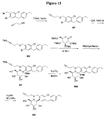
- Inventive compounds of formula 16 can be conveniently prepared according to the reaction sequences as shown in Scheme I ( Figure 1 ).
- the meso-amino benzoic acid 1 is halogenated by NBS, or NIS, or other reagent to afford i ntermediate 2, which is then converted to its corresponding ester 3 using standard esterification procedures, such as refluxing with H 2 SO 4 /MeOH or SOCl 2 /MeOH.
- ester 3 is converted to compound 4. Oxidation of ester 4 with CrO 3 , K 2 CrO 4 or KMnO 4 produces benzoic acid 5.
- ester 8 After treatment with an acylation reagent, such as (COCl) 2 or SOCl 2 , acid 5 reacts with substituted aromatic ring 6 in the presence of a Lewis acid, such as FeCl 3 or AlCl 3 , to give diphenylketone 7.
- a Lewis acid such as FeCl 3 or AlCl 3
- the ketone on compound 7 is reduced with reductant, such as Et 3 SiH, catalyzed by acid, such as TFA or BF 3 ⁇ Et 2 O, to give ester 8. Further reduction of ester 8 affords alcohol 9.
- the free alcohol 9 is then protected with alkylsilyl or ether and treated with activating reagent, such as n -BuLi or t -BuOK, followed by condensation with protected lactone 11 to give adduct 12, which is reduced with alkylsilane or other reductant in the presence of acid, such as TFA, MeSO 3 H or BF 3 ⁇ Et 2 O.
- activating reagent such as n -BuLi or t -BuOK
- adduct 12 which is reduced with alkylsilane or other reductant in the presence of acid, such as TFA, MeSO 3 H or BF 3 ⁇ Et 2 O.
- Deprotection of the resulting intermediate 13 gives benzyl alcohol 14.
- Alkylation of benzyl alcohol 14 and deprotection of the resulting product 15 give the inventive compounds of formula 16.
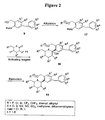
- Inventive compounds of formula 19 can be conveniently prepared according to the reaction sequences as shown in Scheme II ( Figure 2 ).
- the benzyl alcohol 9 is alkylated with reagent such as allyl bromide or aceylenemethyl bromide to form intermediate 17, which is condensed with ketone 11 after treatment with activating reagent, such as n -BuLi or t -BuOK.
- activating reagent such as n -BuLi or t -BuOK.
- the resulting adduct 18 is then reduced with alkylsilane or other reductant in the presence of acid, such as TFA, MeSO 3 H or BF 3 ⁇ Et 2 O to generate the inventive compounds of formula 19.
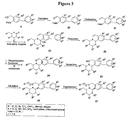
- inventive compounds of formula 27 can also be prepared using an alternative route.
- the benzyl alcohol 9 is oxidized to the corresponding aldehyde 20 using PCC, Dess-Martin reagent, or Swern reaction.
- aldehyde 20 Upon olefination under Wittig or HWE reaction conditions, aldehyde 20 is converted to the corresponding styrene 21, which is allowed to react with ketone 11 after treatment with activating reagent, such as n -BuLi or t -BuOK, to give adduct 22.
- activating reagent such as n -BuLi or t -BuOK
- Compound 22 is reduced with alkylsilane or other reductant in the presence of acid, such as TFA, MeSO 3 H or BF 3 ⁇ Et 2 O to form intermediate 23.
- Styrene 23 is then converted to the corresponding aldehyde 24 by dihydroxylation followed by oxidation with NaIO 4 , or treatment with ozonolysis.
- Reduction of aldehyde 24 with NaBH 4 or other reducing agent gives benzyl alcohol 25, which is alkylated with a reagent such as allyl bromide or acetylenemethyl bromide to form intermediate 26.
- a reagent such as allyl bromide or acetylenemethyl bromide
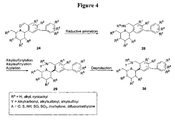
- reference compounds of formula 30 can also be prepared by the following the reaction sequence.
- the aldehyde 24 is converted to the corresponding amino derivative 28 by reductive amination. Alkylation or acylation of the intermediate 28 leads to compound 29, which is deprotected to form the reference compounds of formula of 30.
- inventive compounds of formula 34 can be synthesized according to the outlined reaction sequence.
- the olefin 21 is converted to the corresponding alcohol 31 by using Brown's boron-hydroxylation method or ring-closure-metathesis (RCM) in the presence of Grubb's catalyst, followed by hydrogenation.
- the alcohol 31 is alkylated or acylated to generate intermediate 32, which is debrominated with n -BuLi or t -BuOK and condensed with ketone 11.
- the adduct 33 is dehydrolyzed with alkylsilane or other reductant in the presence of acid, such as TFA, MeSO 3 H or BF 3 ⁇ Et 2 O to form the inventive compounds of formula 34.
- inventive compounds of formula 43 can be synthesized using an alternative synthetic route.
- the meso-amino benzoic acid 35 is halogenated by NBS, or NIS, or other reagent to afford intermediate 36.
- intermediate 36 is treated with acylation reagent, such as (COCl) 2 or SOCl 2 , followed by reaction with substituted aromatic ring 6 in the presence of a Lewis acid, such as FeCl 3 or AlCl 3 , to give ketone 39.
- acylation reagent such as (COCl) 2 or SOCl 2
- substituted aromatic ring 6 in the presence of a Lewis acid, such as FeCl 3 or AlCl 3
- ketone 39 is also obtained through Sandmeyer reaction starting from intermediate 38, which is synthesized by treatment of amino benzoic acid 36 with acylation reagent followed by condensation of the resulting benzoyl chloride with substituted aromatic ring 6.
- Ketone 39 is then allowed to react with nucleophiles, such as alcohols or CuCN to give intermediate 40, which is reduced with alkylsilane in the presence of either Bronst acid or Lewis acid, such as TFA, MeSO 3 H or BF 3 ⁇ Et 2 O.
- Bronst acid or Lewis acid such as TFA, MeSO 3 H or BF 3 ⁇ Et 2 O.
- Debromination of the resulting intermediate 41 with n -BuLi or t -BuOK and condensation of the product in situ with ketone 11 gives adduct 42.
- Dehydroxylation of compound 42 with alkylsilane or other reductant in the presence of acid, such as TFA, MeSO 3 H or BF 3 ⁇ Et 2 O forms the inventive compounds of formula 43.
- inventive compounds of formula 54 can be synthesized using the outlined reaction sequence.
- the substituted benzoic acid 45 is treated with acylation reagent, such as (COCl) 2 or SOCl 2 , followed by reaction with protected phenol ring 44 in the presence of a Lewis acid, such as FeCl 3 or AlCl 3 , to give ketone 46, which is reduced by alkylsilane or other reductant with the catalysis of Lewis acid, such as TFA, MeSO 3 H or BF 3 ⁇ Et 2 O.
- ketone 46 which is reduced by alkylsilane or other reductant with the catalysis of Lewis acid, such as TFA, MeSO 3 H or BF 3 ⁇ Et 2 O.
- the resulting diphenyl methane 47 is then halogenated with NBS, NIS or other reagent to afford intermediate 50.
- intermediate 50 can also be synthesized starting from ketone 49, which is the condensed product of protected phenol 48 and substituted benzoic acid 45 through a Friedel-Crafts reaction with the catalysis of Lewis acid, such as FeCl 3 or AlCl 3 .
- the intermediates, 48 and 49 can both be prepared starting from compounds 44 and 46, respectively, using halogenation reagent, such as NBS or NIS.
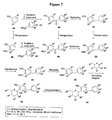
- inventive compounds of formula 61 can be synthesized using the outlined reaction sequence.
- the aldehyde 20 is treated with an organometallic reagent, such as MeMgI, to generate benzylic alcohol 55, which is oxidized to the corresponding ketone 56 using Swem or Dess-Martin reaction procedures. Ketone 56 is then converted to its enolate 57. Propanation or cycloaddition of the olefin on intermediate 57 leads to tri-cyclic compound 58. Removal of the protection group on the alcohol of intermediate 58 and alkylation of the resulting free alcohol give intermediate 59. Treatment of the halophenyl compound 59 with activating reagent, such as n -BuLi or t -BuOK, followed by condensation with protected lactone 11 give the adduct 60. Dehydroxylation of compound 53 with alkylsilane or other reductant in the presence of acid, such as TFA, MeSO 3 H or BF 3 ⁇ Et 2 O, generates the inventive compounds as of formula 61.
- organometallic reagent such as MeMgI
- the present invention further provides a pharmaceutical composition
- a pharmaceutical composition comprising an effective amount of a compound or mixture of compounds of Formula IA, or a pharmaceutically acceptable salt thereof, in a pharmaceutically acceptable carrier.
- a compound of this invention can be incorporated into a variety of formulations for therapeutic administration. More particularly, a compound of the present invention can be formulated into pharmaceutical compositions, together or separately, by formulation with appropriate pharmaceutically acceptable carriers or diluents, and can be formulated into preparations in solid, semi-solid, liquid or gaseous forms, such as tablets, capsules, pills, powders, granules, dragees, gels, slurries, ointments, solutions, suppositories, injections, inhalants and aerosols.
- administration of a compound of the present invention can be achieved in various ways, including oral, buccal, parenteral, intravenous, intradermal (e.g., subcutaneous, intramuscular), transdermal, etc., administration.
- the compound can be administered in a local rather than systemic manner, for example, in a depot or sustained release formulation.
- Suitable formulations for use in the present invention are found in Remington: The Science and Practice of Pharmacy, 21st Ed., Gennaro, Ed., Lippencott Williams & Wilkins (2003 ).
- the pharmaceutical compositions described herein can be manufactured in a manner that is known to those of skill in the art, i.e., by means of conventional mixing, dissolving, granulating, dragee-making, levigating, emulsifying, encapsulating, entrapping or lyophilizing processes.
- the following methods and excipients are merely exemplary and are in no way limiting.
- a compound of the present invention is prepared for delivery in a sustained-release, controlled release, extended-release, timed-release or delayed-release formulation, for example, in semipermeable matrices of solid hydrophobic polymers containing the therapeutic agent.
- sustained-release materials have been established and are well known by those skilled in the art.
- Current extended-release formulations include film-coated tablets, multiparticulate or pellet systems, matrix technologies using hydrophilic or lipophilic materials and wax-based tablets with pore-forming excipients ( see , for example, Huang, et al. Drug Dev. Ind. Pharm. 29:79 (2003 ); Pearnchob, et al. Drug Dev. Ind. Pharm.
- Sustained-release delivery systems can, depending on their design, release the compounds over the course of hours or days, for instance, over 4, 6, 8, 10, 12, 16, 20, 24 hours or more.
- sustained release formulations can be prepared using naturally-occurring or synthetic polymers, for instance, polymeric vinyl pyrrolidones, such as polyvinyl pyrrolidone (PVP); carboxyvinyl hydrophilic polymers; hydrophobic and/or hydrophilic hydrocolloids, such as methylcellulose, ethylcellulose, hydroxypropylcellulose, and hydroxypropylmethylcellulose; and carboxypo lymethylene.
- polymeric vinyl pyrrolidones such as polyvinyl pyrrolidone (PVP); carboxyvinyl hydrophilic polymers; hydrophobic and/or hydrophilic hydrocolloids, such as methylcellulose, ethylcellulose, hydroxypropylcellulose, and hydroxypropylmethylcellulose
- PVP polyvinyl pyrrolidone
- hydrophobic and/or hydrophilic hydrocolloids such as methylcellulose, ethylcellulose, hydroxypropylcellulose, and hydroxypropylmethylcellulose
- the sustained or extended-release formulations can also be prepared using natural ingredients, such as minerals, including titanium dioxide, silicon dioxide, zinc oxide, and clay ( see , U.S. Patent 6,638,521 ).
- Exemplified extended release formulations that can be used in delivering a compound of the present invention include those described in U.S. Patent Nos. 6,635,680 ; 6,624,200 ; 6,613,361 ; 6,613,358 , 6,596,308 ; 6,589,563 ; 6,562,375 ; 6,548,084 ; 6,541,020 ; 6,537,579 ; 6,528,080 and 6,524,621 .
- Controlled release formulations of particular interest include those described in U.S. Patent Nos.
- a compound of the present invention can be formulated readily by combining with pharmaceutically acceptable carriers that are well known in the art.
- Such carriers enable the compounds to be formulated as tablets, pills, dragees, capsules, emulsions, lipophilic and hydrophilic suspensions, liquids, gels, syrups, slurries, suspensions and the like, for oral ingestion by a patient to be treated.
- Pharmaceutical preparations for oral use can be obtained by mixing the compounds with a solid excipient, optionally grinding a resulting mixture, and processing the mixture of granules, after adding suitable auxiliaries, if desired, to obtain tablets or dragee cores.
- Suitable excipients are, in particular, fillers such as sugars, including lactose, sucrose, mannitol, or sorbitol; cellulose preparations such as, for example, maize starch, wheat starch, rice starch, potato starch, gelatin, gum tragacanth, methyl cellulose, hydroxypropylmethyl-cellulose, sodium carboxymethylcellulose, and/or polyvinylpyrrolidone (PVP).
- disintegrating agents can be added, such as a crosslinked polyvinyl pyrrolidone, agar, or alginic acid or a salt thereof such as sodium alginate.
- compositions which can be used orally include push-fit capsules made of gelatin, as well as soft, sealed capsules made of gelatin and a plasticizer, such as glycerol or sorbitol.
- the push-fit capsules can contain the active ingredients in admixture with filler such as lactose, binders such as starches, and/or lubricants such as talc or magnesium stearate and, optionally, stabilizers.
- the active compounds can be dissolved or suspended in suitable liquids, such as fatty oils, liquid paraffin, or liquid polyethylene glycols.
- stabilizers can be added. All formulations for oral administration should be in dosages suitable for such administration.
- Dragee cores are provided with suitable coatings.
- suitable coatings can be used, which can optionally contain gum arabic, talc, polyvinyl pyrrolidone, carbopol gel, polyethylene glycol, and/or titanium dioxide, lacquer solutions, and suitable organic solvents or solvent mixtures.
- Dyestuffs or pigments can be added to the tablets or dragee coatings for identification or to characterize different combinations of active compound doses.
- the compounds can be formulated for parenteral administration by injection, e.g., by bolus injection or continuous infusion.
- the compound can be formulated into preparations by dissolving, suspending or emulsifying them in an aqueous or nonaqueous solvent, such as vegetable or other similar oils, synthetic aliphatic acid glycerides, esters of higher aliphatic acids or propylene glycol; and if desired, with conventional additives such as solubilizers, isotonic agents, suspending agents, emulsifying agents, stabilizers and preservatives.
- a compound of the invention can be formulated in aqueous solutions, preferably in physiologically compatible buffers such as Hanks's solution, Ringer's solution, or physiological saline buffer.
- physiologically compatible buffers such as Hanks's solution, Ringer's solution, or physiological saline buffer.
- Formulations for injection can be presented in unit dosage form, e.g., in ampules or in multi-dose containers, with an added preservative.
- the compositions can take such forms as suspensions, solutions or emulsions in oily or aqueous vehicles, and can contain formulatory agents such as suspending, stabilizing and/or dispersing agents.
- compositions for parenteral administration include aqueous solutions of the active compounds in water-soluble form.
- suspensions of the active compounds can be prepared as appropriate oily injection suspensions.
- Suitable lipophilic solvents or vehicles include fatty oils such as sesame oil, or synthetic fatty acid esters, such as ethyl oleate or triglycerides, or liposomes.
- Aqueous injection suspensions can contain substances which increase the viscosity of the suspension, such as sodium carboxymethyl cellulose, sorbitol, or dextran.
- the suspension can also contain suitable stabilizers or agents which increase the solubility of the compounds to allow for the preparation of highly concentrated solutions.
- the active ingredient can be in powder form for constitution with a suitable vehicle, e.g., sterile pyrogen-free water, before use.
- Systemic administration can also be by transmucosal or transdermal means.
- penetrants appropriate to the barrier to be permeated are used in the formulation.
- the agents are formulated into ointments, creams, salves, powders and gels.
- the transdermal delivery agent can be DMSO.
- Transdermal delivery systems can include, e.g., patches.
- penetrants appropriate to the barrier to be permeated are used in the formulation. Such penetrants are generally known in the art. Exemplified transdermal delivery formulations that can find use in the present invention include those described in U.S. Patent Nos. 6,589,549 ; 6,544,548 ; 6,517,864 ; 6,512,010 ; 6,465,006 ; 6,379,696 ; 6,312,717 and 6,310,177 .
- compositions can take the form of tablets or lozenges formulated in conventional manner.
- a compound of the present invention can also be formulated as a depot preparation.
- Such long acting formulations can be administered by implantation (for example subcutaneously or intramuscularly) or by intramuscular injection.
- the compounds can be formulated with suitable polymeric or hydrophobic materials (for example as an emulsion in an acceptable oil) or ion exchange resins, or as sparingly soluble derivatives, for example, as a sparingly soluble salt.
- compositions also can comprise suitable solid or gel phase carriers or excipients.
- suitable solid or gel phase carriers or excipients include but are not limited to calcium carbonate, calcium phosphate, various sugars, starches, cellulose derivatives, gelatin, and polymers such as polyethylene glycols.
- compositions suitable for use in the present invention include compositions wherein the active ingredients are contained in a therapeutically effective amount.
- the present invention also contemplates pharmaceutical compositions comprising a claimed compound in admixture with an effective amount of other therapeutic agents as combination partners, particularly those used for treating diseases and conditions which can be affected by SGLT inhibition, such as antidiabetic agents, lipid-lowering/lipid-modulating agents, agents for treating diabetic complications, anti-obesity agents, antihypertensive agents, antihyperuricemic agents, and agents for treating chronic heart failure, atherosclerosis or related disorders.
- An effective amount of the compound and/or combination partner will, of course, be dependent on the subject being treated, the severity of the affliction and the manner of administration.
- an efficacious or effective amount of a compound is determined by first administering a low dose or small amount, and then incrementally increasing the administered dose or dosages until a desired therapeutic effect is observed in the treated subject, with minimal or no toxic side effects.
- Applicable methods for determining an appropriate dose and dosing schedule for administration of the present invention are described, for example, in Goodman and Giltiman's The Pharmacological Basis of Therapeutics, 11th Ed., Brunton, Lazo and Parker, Eds., McGraw-Hill (2006 ), and in Remington: The Science and Practice of Pharmacy, 21st Ed., Gennaro, Ed., Lippencott Williams & Wilkins (2003 ).
- the compounds of Formula I may be used for the prevention and treatment of disease.
- the invention provides a compound of Formula IA or a salt thereof for use in a method of treating type 1 and type 2 diabetes mellitus, hyperglycemia, diabetic complications (such as retinopathy, nephropathy, neuropathy, ulcers, micro- and macroangiopathies, gout and diabetic foot disease), insulin resistance, metabolic syndrome (Syndrome X), hyperinsulinemia, hypertension, hyperuricemia, obesity, edema, dyslipidemia, chronic heart failure, atherosclerosis and related diseases, which comprises administering an effective amount of a compound or mixture of compounds of Formula IA, or a pharmaceutically acceptable salt thereof, to a subject in need thereof.
- the invention provides use of a compound or mixture of compounds of Formula IA, or a pharmaceutically acceptable salt thereof, for the preparation of a medicament for treating type 1 and type 2 diabetes mellitus, hyperglycemia, diabetic complications, insulin resistance, metabolic syndrome, hyperinsulinemia, hypertension, hyperuricemia, obesity, edema, dyslipidemia, chronic heart failure, atherosclerosis and related diseases.
- the present invention also contemplates the use of the compounds of Formula IA, or pharmaceutically acceptable salts thereof, in combination with other therapeutic agents, particularly those used for treating the above-mentioned diseases and conditions, such as antidiabetic agents, lipid-lowering/lipid-modulating agents, agents for treating diabetic complications, anti-obesity agents, antihypertensive agents, antihyperuricemic agents, and agents for treating chronic heart failure, atherosclerosis or related disorders.
- therapeutic agents particularly those used for treating the above-mentioned diseases and conditions, such as antidiabetic agents, lipid-lowering/lipid-modulating agents, agents for treating diabetic complications, anti-obesity agents, antihypertensive agents, antihyperuricemic agents, and agents for treating chronic heart failure, atherosclerosis or related disorders.
- Examples of antidiabetic agents suitable for use in combination with compounds of the present invention include insulin and insulin mimetics, sulfonylureas (such as acetohexamide, carbutamide, chlorpropamide, glibenclamide, glibomuride, gliclazide, glimepiride, glipizide, gliquidone, glisoxepide, glyburide, glyclopyramide, tolazamide, tolcyclamide, tolbutamide and the like), insulin secretion enhancers (such as JTT -608, glybuzole and the like), biguanides (such as metformin, buformin, phenformin and the like), sulfonylurea/biguanide combinations (such as glyburide/metformin and the like), meglitinides (such as repaglinide, nateglinide, mitiglinide and the like), thiazolidinediones (such as ros
- protein tyrosine phosphatase-1B inhibitors such as KR61639, IDD-3, PTP-3848, PTP-112, OC-86839, PNU-177496, compounds described in Vats, R.K., et al., Current Science, Vol. 88, No. 2, 25 January 2005, pp.
- glycogen phosphorylase inhibitors such as NN-4201, CP-368296 and the like
- glucose-6-phosphatase inhibitors such as NN-4201, CP-368296 and the like
- fructose 1,6-bisphosphatase inhibitors such as CS-917, MB05032 and the like
- pyruvate dehydrogenase inhibitors such as AZD-7545 and the like
- imidazoline derivatives such as BL11282 and the like
- hepatic gluconeogenesis inhibitors such as FR-225659 and the like
- D-chiroinositol glycogen synthase kinase-3 inhibitors (such as compounds described in Vats, R.K., et al., Current Science, Vol.
- incretin mimetics such as exenatide and the like
- glucagon receptor antagonists such as BAY-27-9955, NN-2501, NNC-92-1687 and the like
- glucagon-like peptide-1 GLP-1
- GLP-1 analogs such as liraglutide, CJC-1131, AVE-0100 and the like
- GLP-1 receptor agonists such as AZM-134, LY-315902, GlaxoSmithKline 716155 and the like
- amylin, amylin analogs and agonists such as pramlintide and the like
- fatty acid binding protein (aP2) inhibitors such as compounds described in U.S.
- beta-3 adrenergic receptor agonists such as solabegron, CL-316243, L-771047, FR-149175 and the like
- agents for treating diabetic complications suitable for use in combination with compounds of the present invention include aldose reductase inhibitors (such as epalrestat, imirestat, tolrestat, minalrestat, ponalrestat, zopolrestat, fidarestat, ascorbyl gamolenate, ADN-138, BAL-ARI8, ZD-5522, ADN-311, GP-1447, IDD-598, risarestat, zenarestat, methosorbinil, AL-1567, M-16209, TAT, AD-5467, AS-3201, NZ-314, SG-210, JTT-811, lindolrestat, sorbinil and the like), inhibitors of advanced glycation end-products (AGE) formation (such as pyridoxamine, OPB-9195, ALT-946, ALT-711, pimagedine and the like), AGE breakers (such as ALT-711 and the like), sulodexide, 5-hydroxy-1
- antihyperuricemic agents suitable for use in combination with compounds of the present invention include uric acid synthesis inhibitors (such as allopurinol, oxypurinol and the like), uricosuric agents (such as probenecid, sulfinpyrazone, benzbromarone and the like) and urinary alkalinizers (such as sodium hydrogen carbonate, potassium citrate, sodium citrate and the like).
- uric acid synthesis inhibitors such as allopurinol, oxypurinol and the like
- uricosuric agents such as probenecid, sulfinpyrazone, benzbromarone and the like
- urinary alkalinizers such as sodium hydrogen carbonate, potassium citrate, sodium citrate and the like.
- hydroxymethylglutaryl coenzyme A reductase inhibitors such as acitemate,
- Patent Nos. 5,712,396 ; 4,924,024 ; 4,871,721 and the like nicotinic acid derivatives (such as acipimox, nicotinic acid, ricotinamide, nicomol, niceritrol, nicorandil and the like), bile acid sequestrants (such as colestipol, cholestyramine, colestilan, colesevelam, GT-102-279 and the like), sodium/bile acid cotransporter inhibitors (such as 264W94, S-8921, SD-5613 and the like), and cholesterol ester transfer protein inhibitors (such as torcetrapib, JTT-705, PNU-107368E, SC-795, CP-529414 and the like).
- nicotinic acid derivatives such as acipimox, nicotinic acid, ricotinamide, nicomol, niceritrol, nicorandil and the like
- anti-obesity agents suitable for use in combination with compounds of the present invention include serotonin-norepinephrine reuptake inhibitors (such as sibutramine, milnacipran, mirtazapine, venlafaxine, duloxetine, desvenlafaxine and the like), norepinephrine-dopamine reuptake inhibitors (such as radafaxine, bupropion, amineptine and the like), selective serotonin reuptake inhibitors (such as citalopram, escitalopram, fluoxetine, fluvoxamine, paroxetine, sertraline and the like), selective norepinephrine reuptake inhibitors (such as reboxetine, atomoxetine and the like), norepinephrine releasing stimulants (such as rolipram, YM-992 and the like), anorexiants (such as amphetamine, methamphetamine, dextroamphet
- beta-3 adrenergic receptor agonists such as L-796568, CGP 12177, BRL-28410, SR-58611A, ICI-198157, ZD-2079, BMS-194449, BRL-37344, CP-331679, CP-331648, CP-114271, L-750355, BMS-187413, SR-59062A, BMS-210285, LY-377604, SWR-0342SA, AZ-40140, SB-226552, D-7114, BRL-35135, FR-149175, BRL-26830A, CL-316243, AJ-9677, GW-427353, N-5984, GW-2696 and the like), cholecystokinin agonists (such as SR-146131, SSR-125180, BP-3.200, A-71623, FPL-15849, GI-248573, GW-7178, GI
- antihypertensive agents and agents for treating chronic heart failure, atherosclerosis or related diseases suitable for use in combination with compounds of the present invention include bimoclomol, angiotensin-converting enzyme inhibitors (such as captopril, enalapril, fosinopril, lisinopril, perindopril, quinapril, ramipril and the like), neutral endopeptidase inhibitors (such as thiorphan, omapatrilat, MDL-100240, fasidotril, sampatrilat, GW-660511, mixanpril, SA-7060, E-4030, SLV-306, ecadotril and the like), angiotensin II receptor antagonists (such as candesartan cilexetil, eprosartan, irbesartan, losartan, olmesartan medoxomil, telmisartan, valsartan,
- the invention provides for a pharmaceutical composition
- a pharmaceutical composition comprising effective amounts of a compound or mixture of compounds of Formula IA, or a pharmaceutically acceptable salt thereof, and at least one member selected from the group of therapeutic agents listed above as combination partners, in a pharmaceutically acceptable carrier.
- the treatment for which the present invention is used can be administered prophylactically to prevent or delay the onset or progression of a disease or condition (such as hyperglycemia), or therapeutically to achieve a desired effect (such as a desired level of serum glucose) for a sustained period of time.
- a disease or condition such as hyperglycemia
- a desired effect such as a desired level of serum glucose
- the compounds of the present invention can be administered to a subject, e.g., a human patient, a domestic animal such as a cat or a dog, independently or together with a combination partner, in the form of their pharmaceutically acceptable salts or prodrugs, or in the form of a pharmaceutical composition where the compounds and/or combination partners are mixed with suitable carriers or excipient(s) in a therapeutically effective amount. Consequently, a compound or mixture of compounds of Formula IA, or a pharmaceutically acceptable salt thereof, and an additional active agent to be combined therewith, can be present in a single formulation, for example a capsule or tablet, or in two separate formulations, which can be the same or different, for example, in the form of a kit comprising selected numbers of doses of each agent.
- the appropriate dosage of compound will vary according to the chosen route of administration and formulation of the composition, among other factors, such as patient response.
- the dosage can be increased or decreased over time, as required by an individual patient.
- a patient initially may be given a low dose, which is then increased to an efficacious dosage tolerable to the patient.
- a useful dosage for adults may be from 1 to 2000 mg, preferably 1 to 200 mg, when administered by oral route, and from 0.1 to 100 mg, preferably 1 to 30 mg, when administered by intravenous route, in each case administered from 1 to 4 times per day.
- a useful dosage of the combination partner may be from 20% to 100% of the normally recommended dose.
- Dosage amount and interval can be adjusted individually to provide plasma levels of the active compounds which are sufficient to maintain therapeutic effect.
- therapeutically effective serum levels will be achieved by administering single daily doses, but efficacious multiple daily dose schedules are included in the invention.
- the effective local concentration of the drug may not be related to plasma concentration.
- One having skill in the art will be able to optimize therapeutically effective local dosages without undue experimentation.
- MS ESI Gas chromatography mass spectra with electrospray ionization
- n-BuLi (3.7 mL, 9.4 mmol, 2.5M in hexane) was added into a solution of 1-(allyloxymethyl)-2-bromo-5-chloro-4-(4-ethylbenzyl)benzene (intermediate G ) (3.22 g, 8.5 mmol) in anhydrous THF (30 mL) at -78°C under argon, and stirred for 2h at the same temperature.
- Compound R was prepared from (2R,3R,4R,5S,6S)-3,4,5-tris(benzyloxy)-2-(benzyloxymethyl)-6-(4-chloro-2-((2,2-difluoroethoxy)methyl)-5-(4-ethylbenzyl)phenyl)tetrahydro-2H-pyran (intermediate R-1 ) using debenzylation methods analogous to those described in Example 6 above.
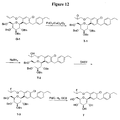
- This example illustrates the preparation of compound T according to the approach provided in Figure 12 .
- a solution of NaOEt (freshly prepared from 0.84g Na and 10 mL of ethanol) was added to diethyl malonate (5.53 mL, 0.036 mol) in 10 mL of ethanol. After stirring for 1h at room temperature, the resulting solution was added to a suspension of 1-bromo-2-(bromomethyl)-4-chloro-5-(4-ethoxybenzyl)benzene ( BJ ) (2.8 g, 0.0067 mol) in 10 mL of ethanol and heated to 80°C overnight. The ethanol was removed by distillation. The remaining solution was cooled to 0°C, diluted with water, and acidified to pH 2 with conc. HCl.
- the aqueous solution was extracted with ethyl acetate, and the organic layer was washed with water and brine, dried over Na 2 SO 4 , concentrated, and the residue was taken up in 40 mL of ethanol and 50 mL of aqueous NaOH solution.
- the mixture was heated to reflux for 4h, and then the ethanol was removed by distillation.
- the solution was cooled to 0°C, acidified with 50 mL of conc. HCl and then heated to reflux overnight.
- the solution was basified to pH 12 and extracted with ethyl acetate.
- the aqueous solution was acidified to pH 2 and the precipitate collected.
- the filter cake was washed with water and dried under vacuum to obtain 1.07 g of intermediate BK.
- reaction mixture was taken up in 20 mL of ethyl acetate, washed with saturated Na 2 CO 3 , water and brine, and then dried over Na 2 SO 4 , filtered and concentrated to obtain 0.268 g of crude intermediate BL, which was used in the next step without further purification.
- Examples 37 and 38 the structures of compounds synthesized were confirmed using the following procedures: 1 H-NMR data were acquired on a Varian Mercury 300 spectrometer at 300 MHz, with chemical shifts referenced to internal TMS. Liquid chromatography electrospray ionization mass spectrometry (LC-ESI-MS) analysis was performed on instrumentation consisting of Shimadzu LC-10AD vp series HPLC pumps and dual wavelength UV detector, a Gilson 215 autosampler, a Sedex 75c evaporative light scattering (ELS) detector, and a PE/Sciex API 150EX mass spectrometer.
- LC-ESI-MS Liquid chromatography electrospray ionization mass spectrometry
- the ELS detector was set to a temperature of 40°C, a gain setting of 7, and a N 2 pressure of 3.3 atm.
- the Turbo IonSpray source was employed on the API 150 with an ion spray voltage of 5 kV, a temperature of 300°C, and orifice and ring voltages of 5 V and 175 V respectively. Positive ions were scanned in Q1 from 160 to 650 m/z. 5.0 ⁇ L injections were performed for each sample, on a Phenomenex Gemini 5 ⁇ m C18 column.
- Mobile phases consisted of 0.05% formic acid in both HPLC grade water (A) and HPLC grade acetonitrile (B) using the following gradients with a flow rate of 2 mL/min: 0.00 min, 95% A, 5% B; 4.00 min, 0% A, 100% B; 5.80 min, 0% A, 100% B; 6.00 min, 95% A, 5% B; 7.00 min, 95% A, 5% B.
- a full-length cDNA clone expressing human SGLT2 (GenScript Corporation) was subcloned into Hind III and Not I sites of pEAK15 expression vector. Clones harboring the cDNA inserts were identified by restriction analysis.
- Plasmid containing human SGLT2 was linearized with Nsi I and purified by agarose gel electrophoresis. Using Lipofectamine 2000 Transfection Reagent (Invitrogen Corporation), DNA was transfected into HEK293.ETN cells and cultured in Dulbecco's Modified Eagle Medium (DMEM) containing 10% fetal bovine serum (FBS) at 37°C under 5% CO 2 for 24 h. Transfectants were selected in the same growth medium supplemented with puromycin (Invitrogen Corporation) for two weeks. Puromycin-resistant cells were recovered and seeded on a fresh 96-well plate (single cell per well) and cultured in the presence of puromycin until cells became confluent.
- DMEM Dulbecco's Modified Eagle Medium
- FBS fetal bovine serum
- Full-length human SGLT1 cDNA on pDream2.1 expression vector was obtained from GenScript Corporation and propagated in Escherichia coli strain DH5 ⁇ using Luria-Bertani (LB) medium containing ampicillin. Plasmid DNA was isolated using the QIAGEN Plasmid Midi Kit (QIAGEN Inc.). Human SGLT1 expression plasmid DNA was transfected into COS-7 cells (American Type Culture Collection) using Lipofectamine 2000 Transfection Reagent according to a manufacturer suggested protocol. Transfected cells were stored in DMEM containing 10% dimethyl sulfoxide (DMSO) at -80°C.
- DMSO dimethyl sulfoxide
- Cells expressing SGLT1 or SGLT2 were seeded on 96-well ScintiPlate scintillating plates (PerkinElmer, Inc.) in DMEM containing 10% FBS (1x10 5 cells per well in 100 ⁇ L medium) incubated at 37°C under 5% CO 2 for 48 h prior to the assay.
- Test compound in 50 ⁇ L each of sodium or sodium-free buffer containing 40 ⁇ Ci/mL methyl- ⁇ -D-[U- 14 C]glucopyranoside was added per well of a 96-well plate and incubated at 37°C with shaking for either 2 h (SGLT1 assay) or 1.5 h (SGLT2 assay).
Landscapes
- Health & Medical Sciences (AREA)
- Chemical & Material Sciences (AREA)
- Organic Chemistry (AREA)
- Engineering & Computer Science (AREA)
- General Health & Medical Sciences (AREA)
- Life Sciences & Earth Sciences (AREA)
- Bioinformatics & Cheminformatics (AREA)
- Chemical Kinetics & Catalysis (AREA)
- Medicinal Chemistry (AREA)
- Nuclear Medicine, Radiotherapy & Molecular Imaging (AREA)
- General Chemical & Material Sciences (AREA)
- Pharmacology & Pharmacy (AREA)
- Public Health (AREA)
- Animal Behavior & Ethology (AREA)
- Veterinary Medicine (AREA)
- Diabetes (AREA)
- Cardiology (AREA)
- Hematology (AREA)
- Heart & Thoracic Surgery (AREA)
- Obesity (AREA)
- Biochemistry (AREA)
- Urology & Nephrology (AREA)
- Molecular Biology (AREA)
- Genetics & Genomics (AREA)
- Endocrinology (AREA)
- Biotechnology (AREA)
- Emergency Medicine (AREA)
- Neurosurgery (AREA)
- Physical Education & Sports Medicine (AREA)
- Rheumatology (AREA)
- Hospice & Palliative Care (AREA)
- Biomedical Technology (AREA)
- Neurology (AREA)
- Child & Adolescent Psychology (AREA)
- Ophthalmology & Optometry (AREA)
- Pain & Pain Management (AREA)
- Vascular Medicine (AREA)
- Pharmaceuticals Containing Other Organic And Inorganic Compounds (AREA)
- Pyrane Compounds (AREA)
- Plural Heterocyclic Compounds (AREA)
Description
- According to the World Health Organization, approximately 150 million people worldwide have diabetes mellitus. The two principal forms of diabetes are
type 1 diabetes, in which the pancreas fails to produce insulin, andtype 2 diabetes, in which the body fails to respond properly to the insulin produced (insulin resistance). Accounting for about 90% of all diabetes cases,type 2 diabetes is by far the most common. In both types of diabetes, the absence of insulin action or proper response to insulin results in elevated levels of serum glucose (hyperglycemia). Serious complications associated with diabetes include retinopathy (leading to visual impairment or blindness), cardiovascular disease, nephropathy, neuropathy, ulcers and diabetic foot disease. - Individuals with
type 1 diabetes currently require insulin therapy. While inmany cases type 2 diabetes can be managed with diet and exercise, drug intervention also frequently is required. Besides insulin, which is needed by about one-third of patients withtype 2 diabetes, current antidiabetic therapies include biguanides (which decrease glucose production in the liver and increase sensitivity to insulin), sulfonylureas and meglitinides (which stimulate insulin production), alpha-glucosidase inhibitors (which slow starch absorption and glucose production), and thiazolidinediones (which increase insulin sensitivity). These medicines are often used in combination, and even then may not provide adequate glycemic control or may produce undesired side effects. Such side effects include lactic acidosis (biguanides), hypoglycemia (sulfonylureas), and edema and weight gain (thiazolidinediones). Therefore, new antidiabetic agents providing improved glycemic control and lacking these adverse effects are highly desired. - One promising target for therapeutic intervention in diabetes and related disorders is the glucose transport system of the kidneys. Cellular glucose transport is conducted by either facilitative ("passive") glucose transporters (GLUTs) or sodium-dependent ("active") glucose cotransporters (SGLTs). SGLT1 is found predominantly in the intestinal brush border, while SGLT2 is localized in the renal proximal tubule and is reportedly responsible for the majority of glucose reuptake by the kidneys. Recent studies suggest that inhibition of renal SGLT may be a useful approach to treating hyperglycemia by increasing the amount of glucose excreted in the urine (Arakawa K, et al, Br J Pharmacol 132:578-86, 2001; Oku A, et al., Diabetes 48:1794-1800, 1999). The potential of this therapeutic approach is further supported by recent findings that mutations in the SGLT2 gene occur in cases of familial renal glucosuria, an apparently benign syndrome characterized by urinary glucose excretion in the presence of normal serum glucose levels and the absence of general renal dysfunction or other disease (Santer R, et al., J Am Soc Nephrol.14:2873-82, 2003). Therefore, compounds which inhibit SGLT, particularly SGLT2, are promising candidates for use as antidiabetic drugs. Compounds previously described as useful for inhibiting SGLT include C-glycoside derivatives (such as those described in
US6414126 ,US6936590 ,US20050209166 ,US20050233988 ,WO2005085237 ,US7094763 ,US20060122126 andWO2006108842 ), O-glycoside derivatives (such as those described inUS6683056 ,US20050187168 ,US20060166899 ,US20060234954 andUS20060247179 ), cyclohexane derivatives (such as those described inW02006011469 ), and thio-glucopyranoside derivatives (such as those described inUS20050209309 andWO2006073197 ). - The present invention provides compounds having an inhibitory effect on sodium-dependent glucose cotransporter SGLT. The invention also provides pharmaceutical compositions, methods of preparing the compounds, synthetic intermediates, and the compounds for use, independently or in combination with other therapeutic agents, in a method for treating diseases and conditions which are affected by SGLT inhibition.
-
-
Figures 1-8 provide generic synthesis schemes for compounds of the invention. -
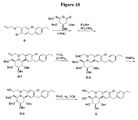
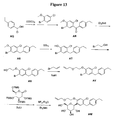
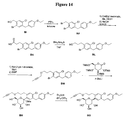
Figures 9-15 provide more specific synthesis schemes for compounds in the Examples below. - As used herein, the term "halo" means a monovalent halogen radical or atom selected from fluoro, chloro, bromo and iodo. Preferred halo groups are fluoro, chloro and bromo.
- As used herein, the term "suitable substituent" means a chemically and pharmaceutically acceptable group, i.e., a moiety that does not significantly interfere with the preparation of or negate the efficacy of the inventive compounds. Such suitable substituents may be routinely chosen by those skilled in the art. Suitable substituents may be selected from the group consisting of halo, C1-C6 alkyl, C2-C6 alkenyl, C1-C6 haloalkyl, C1-C6 alkoxy, C1-C6 haloalkoxy, C2-C6 alkynyl, C3-C8 cycloalkenyl, (C3-C8 cycloalkyl)C1-C6 alkyl, (C3-C8 cycloalkyl)C2-C6 alkenyl, (C3-C8 cycloalkyl)C1-C6 alkoxy, C3-C7 heterocycloalkyl, (C3-C7 heterocycloalkyl)C1-C6 alkyl, (C3-C7 heterocycloalkyl)C2-C6 alkenyl, (C3-C7 heterocycloalkyl)C1-C6 alkoxy, hydroxy, carboxy, oxo, sulfanyl, C1-C6 alkylsulfanyl, aryl, heteroaryl, aryloxy, heteroaryloxy, aralkyl, heteroaralkyl, aralkoxy, heteroaralkoxy, nitro, cyano, amino, C1-C6 alkylamino, di-(C1-C6 alkyl)amino, carbamoyl, (C1-C6 alkyl)carbonyl, (C1-C6 alkoxy)carbonyl, (C1-C6 alkyl)aminocarbonyl, di-(C1-C6 alkyl)aminocarbonyl, arylcarbonyl, aryloxycarbonyl, (C1-C6 alkyl)sulfonyl, and arylsulfonyl. The groups listed above as suitable substituents are as defined hereinafter except that a suitable substituent may not be further optionally substituted.
- As used herein, unless otherwise indicated, the term "alkyl" alone or in combination refers to a monovalent saturated aliphatic hydrocarbon radical having the indicated number of carbon atoms. The radical may be a linear or branched chain and, where specified, optionally substituted with one to three suitable substituents as defined above. Illustrative examples of alkyl groups include, but are not limited to, methyl, ethyl, n-propyl, n-butyl, n-pentyl, n-hexyl, isopropyl, isobutyl, isopentyl, amyl, sec-butyl, tert-butyl, tert-pentyl, n-heptyl, n-octyl, n-nonyl, n-decyl, n-dodecyl, n-tetradecyl, n-hexadecyl, n-octadecyl, n-eicosyl and the like. Preferred alkyl groups include methyl, ethyl, n-propyl and isopropyl. Preferred optional suitable substituents include halo, methoxy, ethoxy, cyano, nitro and amino.
- As used herein, unless otherwise indicated, the term "alkenyl" alone or in combination refers to a monovalent aliphatic hydrocarbon radical having the indicated number of carbon atoms and at least one carbon-carbon double bond. The radical may be a linear or branched chain, in the E or Z form, and where specified, optionally substituted with one to three suitable substituents as defined above. Illustrative examples of alkenyl groups include, but are not limited to, vinyl, 1-propenyl, 2-propenyl, isopropenyl, 1-butenyl, 2-butenyl, isobutenyl, 2-methyl-1-propenyl, 1-pentenyl, 2-pentenyl, 4-methyl-2-pentenyl, 1,3-pentadienyl, 2,4-pentadienyl, 1,3-butadienyl and the like. Preferred alkenyl groups include vinyl, 1-propenyl and 2-propenyl. Preferred optional suitable substituents include halo, methoxy, ethoxy, cyano, nitro and amino.
- As used herein, unless otherwise indicated, the term "alkynyl" alone or in combination refers to a monovalent aliphatic hydrocarbon radical having the indicated number of carbon atoms and at least one carbon-carbon triple bond. The radical may be a linear or branched chain, and where specified, optionally substituted with one to three suitable substituents as defined above. Illustrative examples of alkynyl groups include, but are not limited to, ethynyl, 1-propynyl, 2-propynyl, 1-butynyl, 2-butynyl, 1-pentynyl, 2-pentynyl, 3-methyl-1-pentynyl, 3-pentynyl, 1-hexynyl, 2-hexynyl, 3-hexynyl and the like. Preferred alkynyl groups include ethynyl, 1-propynyl and 2-propynyl. Preferred optional suitable substituents include halo, methoxy, ethoxy, cyano, nitro and amino.
- As used herein, unless otherwise indicated, the term "cycloalkyl" alone or in combination refers to a monovalent alicyclic saturated hydrocarbon radical having three or more carbons forming a carbocyclic ring, and where specified, optionally substituted with one to three suitable substituents as defined above. Illustrative examples of cycloalkyl groups include, but are not limited to, cyclopropyl, cyclobutyl, cyclopentyl, cyclohexyl, cycloheptyl, cyclooctyl, cyclononyl and the like. Preferred optional suitable substituents include halo, methyl, ethyl, methoxy, ethoxy, cyano, nitro and amino.
- As used herein, unless otherwise indicated, the term "cycloalkenyl" alone or in combination refers to a monovalent alicyclic hydrocarbon radical having three or more carbons forming a carbocyclic ring and at least one carbon-carbon double bond, and where specified, optionally substituted with one to three suitable substituents as defined above. Illustrative examples of cycloalkenyl groups include, but are not limited to, cyclopentenyl, cyclohexenyl and the like. Preferred optional suitable substituents include halo, methyl, ethyl, methoxy, ethoxy, cyano, nitro and amino.
- As used herein, unless otherwise indicated, the terms "alkylene", "alkenylene", "alkynylene", "cycloalkylene" and "cycloalkenylene" refer to a divalent hydrocarbon radical that is formed by removal of a hydrogen atom from an alkyl, alkenyl, alkynyl, cycloalkyl or cycloalkenyl radical, respectively, as such terms are defined above.
- As used herein, unless otherwise indicated, the term "aryl" alone or in combination refers to a monovalent aromatic hydrocarbon radical having six to ten carbon atoms forming a carbocyclic ring, and where specified, optionally substituted with one to three suitable substituents as defined above. Illustrative examples of aryl groups include, but are not limited to, phenyl, naphthyl, tetrahydronaphthyl, indanyl and the like. Preferred aryl groups are phenyl and naphthyl, optionally mono- or disubstituted by identical or different suitable substituents selected from halo, cyano, C1-C3 alkyl, C3-C6 cycloalkyl, difluoromethyl, trifluoromethyl, C1-C3 alkoxy, difluoromethoxy and trifluoromethoxy.
- As used herein, unless otherwise indicated, the term "heterocycloalkyl" alone or in combination refers to a cycloalkyl group as defined above in which one or more carbons in the ring is replaced by a heteroatom selected from N, S and O. Illustrative examples of heterocycloalkyl groups include, but are not limited to, pyrrolidinyl, tetrahydrofuranyl, piperazinyl, tetrahydropyranyl, and the like.
- As used herein, unless otherwise indicated, the term "heteroaryl" alone or in combination refers to a monovalent aromatic heterocyclic radical having two to nine carbons and one to four heteroatoms selected from N, S and O forming a five- to ten-membered monocyclic or fused bicyclic ring, and where specified, optionally substituted with one to three suitable substituents as defined above. Illustrative examples of heteroaryl groups include, but are not limited to, pyridyl, pyridazinyl, pyrazinyl, pyrimidinyl, triazinyl, quinolinyl, isoquinolinyl, quinoxalinyl, quinazolinyl, benzotriazinyl, benzimidazolyl, benzopyrazolyl, benzotriazolyl, benzisoxazolyl, isobenzofuryl, isoindolyl, indolizinyl, thienopyridinyl, thienopyrimidinyl, pyrazolopyrimidinyl, imidazopyridines, benzothiaxolyl, benzofuranyl, benzothienyl, indolyl, isothiazolyl, pyrazolyl, indazolyl, imidazolyl, triazolyl, tetrazolyl, oxazolyl, isoxazolyl, oxadiazolyl, thiadiazolyl, pyrrolyl, thiazolyl, furyl, thienyl and the like. Five- or six-membered monocyclic heteroaryl rings include: pyridyl, pyridazinyl, pyrazinyl, pyrimidinyl, triazinyl, isothiazolyl, pyrazolyl, imidazolyl, triazolyl, tetrazolyl, oxazolyl, isoxazolyl, oxadiazolyl, thiadiazolyl, pyrrolyl, thiazolyl, furyl, thienyl and the like. Eight- to ten-membered bicyclic heteroaryl rings having one to four heteroatoms include: quinolinyl, isoquinolinyl, quinoxalinyl, quinazolinyl, benzotriazinyl, benzimidazolyl, benzopyrazolyl, benzotriazolyl, benzisoxazolyl, isobenzofuryl, isoindolyl, indolizinyl, thienopyridinyl, thienopyrimidinyl, pyrazolopyrimidinyl, imidazopyridinyl, benzothiaxolyl, benzofuranyl, benzothienyl, indolyl, indazolyl, and the like. Preferred optional suitable substitutions include one or two identical or different substituents selected from halo, cyano, C1-C3 alkyl, C3-C6 cycloalkyl, difluoromethyl, trifluoromethyl, C1-C3 alkoxy, difluoromethoxy and trifluoromethoxy.
- As used herein, unless otherwise indicated, the terms "alkoxy" and "alkyloxy" alone or in combination refer to an aliphatic radical of the form alkyl-O-, wherein alkyl is as defined above. Illustrative examples of alkoxy groups include, but are not limited to, methoxy, ethoxy, propoxy, isopropoxy, butoxy, isobutoxy, tertiary butoxy, pentoxy, isopentoxy, neopentoxy, tertiary pentoxy, hexoxy, isohexoxy, heptoxy, octoxy and the like. Preferred alkoxy groups include methoxy and ethoxy.
- As used herein, unless otherwise indicated,, the term "haloalkyl" refers to an alkyl radical as described above substituted with one or more halogens. Illustrative examples of haloalkyl groups include, but are not limited to, chloromethyl, dichloromethyl, fluoromethyl, difluoromethyl, trifluoromethyl, 2,2,2-trichloroethyl and the like.
- As used herein, unless otherwise indicated, the term "haloalkoxy" refers to an alkoxy radical as described above substituted with one or more halogens. Illustrative examples of haloalkoxy groups include, but are not limited to, trifluoromethoxy, difluoromethoxy and the like.
- As used herein, unless otherwise indicated, the term "carbamoyl" refers to a monovalent radical of the form -C(O)NH(R), wherein R is hydrogen, C1-C6 alkyl, C2-C6 alkenyl, C3-C6 cycloalkyl, or aryl as such terms are defined above.
- As used herein, unless otherwise indicated, the terms "di-(C1-C3 alkyl)amino" and "di-(C1-C6 alkyl)amino" alone or in combination refer to an amino group that is substituted with two groups independently selected from C1-C3 alkyl or C1-C6 alkyl, respectively.
- As used herein, the terms "treating" and "treatment" refer to delaying the onset of, retarding or reversing the progress of, or alleviating or preventing either the disease or condition to which the term applies, or one or more symptoms of such disease or condition.
- As used herein, the term "administering" means oral administration, administration as a suppository, topical contact, intravenous, intraperitoneal, intramuscular, intralesional, intranasal or subcutaneous administration, or the implantation of a slow-release device, e.g., a mini-osmotic pump, to a subject. Administration is by any route including parenteral, and transmucosal (e.g., oral, nasal, vaginal, rectal, or transdermal). Parenteral administration includes, e.g., intravenous, intramuscular, intra-arteriole, intradermal, subcutaneous, intraperitoneal, intraventricular, and intracranial. Other modes of delivery include, but are not limited to, the use of liposomal formulations, intravenous infusion, transdermal patches, and the like.
- As used herein, the term "prodrug" refers to a precursor compound that, following administration, releases the biologically active compound in vivo via some chemical or physiological process (e.g., a prodrug on reaching physiological pH or through enzyme action is converted to the biologically active compound). A prodrug itself may either lack or possess the desired biological activity.
- As used herein, the term "compound" refers to a molecule produced by any means including, without limitation, synthesis in vitro or generation in situ or in vivo.
- The terms "controlled release," "sustained release," "extended release," and "timed release" are intended to refer interchangeably to any drug-containing formulation in which release of the drug is not immediate, i.e., with a "controlled release" formulation, oral administration does not result in immediate release of the drug into an absorption pool. The terms are used interchangeably with "nonimmediate release" as defined in Remington: The Science and Practice of Pharmacy, 21st Ed., Gennaro, Ed., Lippencott Williams & Wilkins (2003). As discussed therein, immediate and nonimmediate release can be defined kinetically by reference to the following equation:

- The "absorption pool" represents a solution of the drug administered at a particular absorption site, and kr, ka and ke are first-order rate constants for (1) release of the drug from the formulation, (2) absorption, and (3) elimination, respectively. For immediate release dosage forms, the rate constant for drug release kr is far greater than the absorption rate constant ka. For controlled release formulations, the opposite is true, i.e., kr <<ka, such that the rate of release of drug from the dosage form is the rate-limiting step in the delivery of the drug to the target area.
- The terms "sustained release" and "extended release" are used in their conventional sense to refer to a drug formulation that provides for gradual release of a drug over an extended period of time, for example, 12 hours or more, and that preferably, although not necessarily, results in substantially constant blood levels of a drug over an extended time period.
- As used herein, the term "delayed release" refers to a pharmaceutical preparation that passes through the stomach intact and dissolves in the small intestine.
- The present invention provides compounds having an inhibitory effect on sodium-dependent glucose cotransporter SGLT, preferably SGLT2. Some compounds according to the present invention also have an inhibitory effect on sodium-dependent glucose cotransporter SGLT1. Owing to their ability to inhibit SGLT, the compounds of the present invention are suitable for the treatment and/or prevention of any and all conditions and diseases that are affected by inhibition of SGLT activity, particularly SGLT2 activity. Therefore, the compounds of the present invention are suitable for the prevention and treatment of diseases and conditions, particularly metabolic disorders, including but not limited to
type 1 andtype 2 diabetes mellitus, hyperglycemia, diabetic complications (such as retinopathy, nephropathy [e.g., progressive renal disease], neuropathy, ulcers, micro- and macroangiopathies, and diabetic foot disease), insulin resistance, metabolic syndrome (Syndrome X), hyperinsulinemia, hypertension, hyperuricemia, obesity, edema, dyslipidemia, chronic heart failure, atherosclerosis and related diseases. - The present invention also provides pharmaceutically acceptable salts of compounds according to the present invention.
- The present invention further provides pharmaceutical compositions comprising an effective amount of a compound or mixture of compounds according to the present invention, or a pharmaceutically acceptable salt thereof, in a pharmaceutically acceptable carrier.
- Synthetic intermediates and processes for preparing the compounds of the present invention are described.
- The present invention also provides the compounds according to the present invention for use, independently or in combination with other therapeutic agents, in a method for treating diseases and conditions which may be affected by SGLT inhibition.
- The present invention also provides methods of using the compounds according to the present invention for the preparation of a medicament for treating diseases and conditions which may be affected by SGLT inhibition.
- Compounds are described of Formula I:

- A represents oxygen; sulfur; SO; SO2; methylene optionally substituted with one to two substituents independently selected from halo, hydroxy, C1-C6 alkyl, C1-C6 alkoxy, C3-C6 cycloalkyl and C3-C6 cycloalkyloxy; C3-
C 5 1,1-cycloalkylene optionally substituted with one to two substituents independently selected from halo, C1-C6 alkyl, C1-C6 alkoxy, C3-C6 cycloalkyl and C3-C6 cycloalkyloxy; or NRa; - V represents oxygen; sulfur; SO; SO2; or a single bond;
- W represents C1-C6 alkylene, C2-C6 alkenylene, C2-C6 alkynylene, C3-C10 cycloalkylene or C5-C10 cycloalkenylene;
- wherein alkylene, alkenylene, alkynylene, cycloalkylene and cycloalkenylene groups optionally may be partly or completely fluorinated and may be mono- or disubstituted by identical or different substituents selected from chlorine, hydroxy, C1-C3 alkyl, C1-C3 alkoxy, C3-C6 cycloalkyl, C3-C6 cycloalkyloxy, C5-C10 cycloalkenyl or C5-C10 cycloalkenyloxy, and
- in cycloalkylene and cycloalkenylene groups one or two methylene groups are optionally replaced independently of one another by O, S, CO, SO, SO2 or NRb, and one or two methyne groups are optionally replaced by N;
- X represents oxygen; sulfur; SO; or SO2;
- Y represents C1-C6 alkyl, C1-C6 haloalkyl, C1-C6 hydroxyalkyl, C2-C6 alkenyl, C2-C6 alkynyl, C3-C10 cycloalkyl, C5-C10 cycloalkenyl, (C5-C10 cycloalkenyl)C1-C3 alkyl, (C3-C10 cycloalkyl)C2-C4 alkenyl, C3-C6 cycloalkylidenmethyl, (C5-C10 cycloalkenyl)C2-C4 alkenyl, (C1-C4 alkyloxy)C1-C3 alkyl, (C2-C4 alkenyloxy)C1-C3 alkyl, (C3-C10 cycloalkyloxy)C1-C3 alkyl, (C5-C10 cycloalkenyloxy)C1-C3 alkyl, (C1-C4 alkylamino)C1-C3 alkyl, di-(C1-C3 alkylamino)C1-C3 alkyl, (C1-C6 alkyl)carbonyl(C1-C3)alkyl, (C2-C6 alkenyl)carbonyl(C1-C3)alkyl, (C2-C6 alkynyl)carbonyl(C1-C3)alkyl, (arylcarbonyl)C1-C3 alkyl, (heteroarylcarbonyl)C1-C3 alkyl, (C1-C6 alkylsulfonyl)C1-C3 alkyl, (C2-C6 alkenylsulfonyl)C1-C3 alkyl, (C2-C6 alkynylsulfonyl)C1-C3 alkyl, (arylsulfonyl)C1-C3 alkyl, (heteroarylsulfonyl)C1-C3 alkyl, (C1-C6 alkyl)aminocarbonyl(C1-C3)alkyl, (C2-C6 alkenyl)aminocarbonyl(C1-C3)alkyl, (C2-C6 alkynyl)aminocarbonyl(C1-C3)alkyl, (arylaminocarbonyl)C1-C3 alkyl, (heteroarylaminocarbonyl)C1-C3 alkyl, (C1-C6 alkyl)carbonyl, (C2-C6 alkenyl)carbonyl, (C2-C6 alkynyl)carbonyl, arylcarbonyl or heteroarylcarbonyl;
- wherein alkyl, alkenyl, alkynyl, cycloalkyl and cycloalkenyl groups or portions optionally may be partly or completely fluorinated and may be mono- or disubstituted by identical or different substituents selected from chlorine, hydroxy, C1-C3 alkyl, C1-C3 alkoxy, C3-C6 cycloalkyl, C3-C6 cycloalkyloxy, C5-C10 cycloalkenyl, C5-C10 cycloalkenyloxy, and NRbRc, and
- in cycloalkyl and cycloalkenyl groups or portions one or two methylene groups are optionally replaced independently of one another by O, S, CO, SO, SO2 or NRb, and one or two methyne groups are optionally replaced by N, wherein the heterocycle formed by said optional replacement is other than heteroaryl, and wherein when V represents oxygen, sulfur or a single bond and W represents C1-C6 alkylene, C2-C6 alkenylene or C2-C6 alkynylene, then Y is other than C1-C6 alkyl;
- or X represents NRa and Y represents C1-C6 alkylsulfonyl, C2-C6 alkenylsulfonyl, C2-C6 alkynylsulfonyl, arylsulfonyl, heteroarylsulfonyl, C1-C6 alkylsulfinyl, arylsulfinyl, heteroarylsulfinyl, (C1-C6 alkyl)carbonyl, (C2-C6 alkenyl)carbonyl, (C2-C6 alkynyl)carbonyl, arylcarbonyl, heteroarylcarbonyl, (C1-C6 alkyl)aminocarbonyl, (C2-C6 alkenyl)aminocarbonyl, (C2-C6 alkynyl)aminocarbonyl, arylaminocarbonyl, heteroarylaminocarbonyl, (C1-C6 alkylsulfonyl)C1-C3 alkyl, (C2-C6 alkenylsulfonyl)C1-C3 alkyl, (C2-C6 alkynylsulfonyl)C1-C3 alkyl, (arylsulfonyl)C1-C3 alkyl, (heteroarylsulfonyl)C1-C3 alkyl, (C1-C6 alkylsulfinyl)C1-C3 alkyl, (arylsulfinyl)C1-C3 alkyl, (heteroarylsulfinyl)C1-C3 alkyl, (C1-C6 alkyl)aminocarbonyl(C1-C3)alkyl, (C2-C6 alkenyl)aminocarbonyl(C1-C3)alkyl, (C2-C6 alkynyl)aminocarbonyl(C1-C3)alkyl, (arylaminocarbonyl)C1-C3 alkyl or (heteroarylaminocarbonyl)C1-C3 alkyl;
- wherein alkyl, alkenyl and alkynyl portions may be partly or completely fluorinated, and
- when Ra represents H or (C1-C4 alkyl)carbonyl, then Y is other than (C1-C6 alkyl)carbonyl or arylcarbonyl;
- Z represents oxygen; sulfur; SO; SO2; 1,1-cyclopropylene; carbonyl; or methylene optionally substituted with one to two substituents independently selected from halo, hydroxy, C1-C6 alkyl, C1-C6 alkoxy, C3-C6 cycloalkyl and C3-C6 cycloalkyloxy;
- R1 represents hydrogen, halo, C1-C6 alkyl, C2-C6 alkenyl, C2-C6 alkynyl, C3-C10 cycloalkyl, (C3-C10)cycloalkyl-(C1-C3)alkyl, (C2-C4 alkenyl)C1-C3 alkyloxy, (C2-C4 alkynyl)C1-C3 alkyloxy, (C3-C10 cycloalkyl)C2-C4 alkenyl, C3-C6 cycloalkylidenmethyl, (C3-C10 cycloalkyloxy)C1-C3 alkyl, C5-C10 cycloalkenyl, (C5-C10)cycloalkenyl-(C1-C3)alkyl, (C1-C4 alkyloxy)C1-C3 alkyl, (C1-C4 alkylamino)C1-C3 alkyl, di-(C1-C3 alkylamino)C1-C3 alkyl, aryl, heteroaryl, (C1-C4 alkyl)carbonyl, arylcarbonyl, heteroarylcarbonyl, hydroxycarbonyl, aminocarbonyl, (C1-C4 alkyl)aminocarbonyl, di-(C1-C3 alkyl)aminocarbonyl, pyrrolidin-1-ylcarbonyl, piperidin-1-ylcarbonyl, morpholin-4-ylcarbonyl, piperazin-1-ylcarbonyl, 4-(C1-C4 alkyl)piperazin-1-ylcarbonyl, (C1-C4 alkyloxy)carbonyl, amino, C1-C4 alkylamino, di-(C1-C3 alkyl)amino, pyrrolidin-1-yl, piperidin-1-yl, morpholin-4-yl, piperazin-1-yl, 4-(C1-C4 alkyl)piperazin-1-yl, (C1-C4 alkyl)carbonylamino, arylcarbonylamino, C1-C4 alkylsulfonylamino, arylsulfonylamino, heteroarylcarbonylamino, C1-C6 alkyloxy, C3-C10 cycloalkyloxy, C5-C7 cycloalkenyloxy, aryloxy, heteroaryloxy, (aryl)C1-C3 alkyloxy, (heteroaryl)C1-C3 alkyloxy, C1-C4 alkylsulfanyl, C1-C4 alkylsulfinyl, C1-C4 alkylsulfonyl, C3-C10 cycloalkylsulfanyl, C3-C10 cycloalkylsulfinyl, C3-C10 cycloalkylsulfonyl, C5-C10 cycloalkenylsulfanyl, C5-C10 cycloalkenylsulfinyl, C5-C10 cycloalkenylsulfonyl, arylsulfanyl, arylsulfinyl, arylsulfonyl, hydroxy, cyano or nitro;
- wherein alkyl, alkenyl, alkynyl, cycloalkyl and cycloalkenyl groups or portions optionally may be partly or completely fluorinated and may be mono- or disubstituted by identical or different substituents selected from chlorine, hydroxy, C1-C3 alkoxy and C1-C3 alkyl, and in cycloalkyl and cycloalkenyl groups or portions one or two methylene groups are optionally replaced independently of one another by O, S, CO, SO or SO2, and
- in N-heterocycloalkyl groups or portions a methylene group opotionally may be replaced by CO or SO2;
- R2 represents hydrogen, halo, hydroxy, C1-C4 alkyl, C2-C6 alkenyl, C2-C6 alkynyl, C3-C10 cycloalkyl, C5-C10 cycloalkenyl, C1-C4 alkyloxy, C3-C10 cycloalkyloxy, cyano or nitro, wherein alkyl and cycloalkyl groups or portions optionally may be mono- or polysubstituted by fluorine, or
- in the event that R1 and R2 are bound to two adjacent C atoms of the phenyl ring, R1 and R2 may be joined together such that R1 and R2 together form a C3-C5 alkylene, C3-C5 alkenylene or butadienylene bridge, which may be partly or completely fluorinated and may be mono- or disubstituted by identical or different substituents selected from chlorine, hydroxy, C1-C3 alkoxy and C1-C3 alkyl, and wherein one or two methylene groups are optionally replaced independently of one another by O, S, CO, SO, SO2 or NRb, and wherein one or two methyne groups optionally may be replaced by N;
- R3 represents hydrogen, halo, C1-C6 alkyl, C2-C6 alkenyl, C2-C6 alkynyl, C3-C10 cycloalkyl, (C3-C10)cycloalkyl-(C1-C3)alkyl, C5-C10 cycloalkenyl, (C5-C10)cycloalkenyl-(C1-C3)alkyl, (C1-C4 alkyloxy)C1-C3 alkyl, (C3-C10 cycloalkyloxy)C1-C3 alkyl, (C1-C4 alkylamino)C1-C3 alkyl, di-(C1-C3 alkylamino)C1-C3 alkyl, (C3-C10 cycloalkyl)C2-C4 alkenyl, C3-C6 cycloalkylidenmethyl, aryl, heteroaryl, (C1-C4 alkyl)carbonyl, arylcarbonyl, heteroarylcarbonyl, aminocarbonyl, (C1-C4 alkyl)aminocarbonyl, di-(C1-C3 alkyl)aminocarbonyl, pyrrolidin-1-ylcarbonyl, piperidin-1-ylcarbonyl, morpholin-4-ylcarbonyl, piperazin-1-ylcarbonyl, 4-(C1-C4 alkyl)piperazin-1-ylcarbonyl, hydroxycarbonyl, (C1-C4 alkyloxy)carbonyl, C1-C4 alkylamino, di-(C1-C3 alkyl)amino, pyrrolidin-1-yl, piperidin-1-yl, morpholin-4-yl, piperazin-1-yl, 4-(C1-C4 alkyl)piperazin-1-yl, (C1-C4 alkyl)carbonylamino, arylcarbonylamino, heteroaryl-carbonylamino, C1-C4 alkylsulfonylamino, arylsulfonylamino, C1-C6 alkyloxy, C3-C10 cycloalkyloxy, C5-C7 cycloalkenyloxy, aryloxy, heteroaryloxy, (C2-C4 alkenyl)C1-C3 alkyloxy, (C2-C4 alkynyl)C1-C3 alkyloxy, (aryl)C1-C3 alkyloxy, (heteroaryl)C1-C3 alkyloxy, C1-C4 alkylsulfanyl, C1-C4 alkylsulfinyl, C1-C4 alkylsulfonyl, C3-C10 cycloalkylsulfanyl, C3-C10 cycloalkylsulfinyl, C3-C10 cycloalkylsulfonyl, C5-C10 cycloalkenylsulfanyl, C5-C10 cycloalkenylsulfinyl, C5-C10 cycloalkenylsulfonyl, arylsulfanyl, arylsulfinyl, arylsulfonyl, amino, hydroxy, cyano or nitro,
- wherein alkyl, alkenyl, alkynyl, cycloalkyl and cycloalkenyl groups or portions optionally may be partly or completely fluorinated and mono- or disubstituted by identical or different substituents selected from chlorine, hydroxy, C1-C3 alkoxy and C1-C3 alkyl, and in cycloalkyl and cycloalkenyl groups or portions one or two methylene groups are optionally replaced independently of one another by O, S, CO, SO or SO2, and
- in N-heterocycloalkyl groups or portions a methylene group optionally may be replaced by CO or SO2;
- R4 independently represents hydrogen, halo, cyano, nitro, hydroxy, C1-C3 alkyl, C3-C10 cycloalkyl, C1-C3 alkyloxy or C3-C10 cycloalkyloxy, wherein alkyl and cycloalkyl groups or portions optionally may be mono- or polysubstituted by fluorine, or if R3 and R4 are bound to two adjacent C atoms of the phenyl ring, R3 and R4 optionally may be joined together such that R3 and R4 together form a C3-C5 alkylene, C3-C5 alkenylene or butadienylene bridge, which may be partly or completely fluorinated and mono- or disubstituted by identical or different substituents selected from chlorine, hydroxy, C1-C3 alkoxy and C1-C3 alkyl, and wherein one or two methylene groups are optionally replaced independently of one another by O, S, CO, SO, SO2 or NRb, and wherein one or two methyne groups may be replaced by N;
- R5 independently represents hydrogen, halo, cyano, nitro, hydroxy, C1-C3 alkyl, C3-C10 cycloalkyl or C1-C3 alkyloxy, wherein alkyl and cycloalkyl groups or portions optionally may be mono- or polysubstituted by fluorine; and
- R6, R7, R8 and R9 each independently represent hydroxy, (C1-C18 alkyl)carbonyloxy, (C1-C18 alkyl)oxycarbonyloxy, arylcarbonyloxy, aryl-(C1-C3 alkyl)carbonyloxy, (C3-C10 cycloalkyl)carbonyloxy, hydrogen, halo, C1-C6 alkyl, C2-C6 alkenyl, C2-C6 alkynyl, (C3-C10)cycloalkyl-(C1-C3)alkyl, (C5-C7)cycloalkenyl-(C1-C3)alkyl, aryl-(C1-C3)alkyl, heteroaryl-(C1-C3)alkyl, C1-C6 alkyloxy, C2-C6 alkenyloxy, C2-C6 alkynyloxy, C3-C7 cycloalkyloxy, C5-C7 cycloalkenyloxy, aryloxy, heteroaryloxy, (C3-C7)cycloalkyl-(C1-C3)alkyloxy, (C5-C7)cycloalkenyl-(C1-C3)alkyloxy, aryl-(C1-C3)alkyloxy, heteroaryl-(C1-C3)alkyloxy, aminocarbonyl, hydroxycarbonyl, (C1-C4 alkyl)aminocarbonyl, di-(C1-C3 alkyl)aminocarbonyl, (C1-C4 alkyloxy)carbonyl, aminocarbonyl-(C1-C3)alkyl, (C1-C4 alkyl)aminocarbonyl-(C1-C3)alkyl, di-(C1-C3 alkyl)aminocarbonyl-(C1-C3)alkyl, hydroxycarbonyl-(C1-C3)alkyl, (C1-C4 alkyloxy)carbonyl-(C1-C3)alkyl, (C3-C7)cycloalkyloxy-(C1-C3)alkyl, (C5-C7)cycloalkenyloxy-(C1-C3)alkyl, aryloxy-(C1-C3)alkyl, heteroaryloxy-(C1-C3)alkyl, C1-C4 alkylsulfonyloxy, arylsulfonyloxy, aryl-(C1-C3)alkyl-sulfonyloxy, trimethylsilyloxy, t-butyldimethylsilyloxy, or cyano;
- wherein alkyl, alkenyl, alkynyl, cycloalkyl and cycloalkenyl groups or portions optionally may be partly or completely fluorinated and may be mono- or disubstituted by identical or different substituents selected from chlorine, hydroxy, C1-C3 alkoxy and C1-C3 alkyl, and in cycloalkyl and cycloalkenyl groups or portions one or two methylene groups are optionally replaced independently of one another by NRb, O, S, CO, SO or SO2;
- Ra independently represents H, C1-C6 alkyl, C3-C6 cycloalkyl or (C1-C4 alkyl)carbonyl, wherein alkyl and cycloalkyl groups or portions optionally may be partly or completely fluorinated;
- Rb independently represents H, C1-C4 alkyl or (C1-C4 alkyl)carbonyl, wherein alkyl groups or portions optionally may be partly or completely fluorinated;
- Rc independently represents H, C1-C4 alkyl, C3-C6 cycloalkyl, CHRdRe, SO2Rd, C(O)ORd or C(O)NRdRe, wherein alkyl and cycloalkyl groups optionally may be partly or completely fluorinated; and
- Rd and Re each independently represent H or C1-C6 alkyl, wherein alkyl groups optionally may be partly or completely fluorinated.
- The style used above and hereinafter, in which a bond of a substituent on a phenyl group is shown ending near the center of the phenyl ring, denotes, unless otherwise stated, that this substituent may be bound to any free position of the phenyl group bearing a hydrogen atom.
- The present invention provides compounds having the formula IA:

- V is oxygen or a single bond; W is C1-C6 alkylene; X is oxygen or sulfur; Y is a member selected from the group consisting of C1-C6 haloalkyl, C1-C6 hydroxyalkyl, C2-C6 alkenyl, C2-C6 alkynyl, C3-C10 cycloalkyl, C5-C10 cycloalkenyl, (C1-C4 alkyloxy)C1-C3 alkyl, (C2-C4 alkenyloxy)C1-C3 alkyl and (C3-C10 cycloalkyloxy)C1-C3 alkyl; wherein alkyl, alkenyl, alkynyl, cycloalkyl and cycloalkenyl groups or portions of Y are optionally partly or completely fluorinated and are optionally mono- or disubstituted by identical or different substituents selected from chlorine, hydroxy, C1-C3 alkyl and C1-C3 alkoxy, and in cycloalkyl and cycloalkenyl groups or portions of Y, one or two methylene groups are optionally replaced independently of one another by O, S, CO, SO, SO2 or NRb, and one or two methyne groups are optionally replaced by N, wherein the heterocycle formed by said optional replacement is other than heteroaryl;
- R1 is selected from the group consisting of hydrogen, halo, C1-C6 alkyl and C3-C10 cycloalkyl;
- R3 is selected from the group consisting of hydrogen, halo, hydroxy, C1-C6 alkyl, C1-C6 alkyloxy, C2-C6 alkenyl, C2-C6 alkynyl, C3-C10 cycloalkyl and C3-C10 cycloalkyloxy, wherein alkyl and cycloalkyl groups or portions of R3 are optionally partly or completely fluorinated, and in cycloalkyl groups of R3 a methylene group is optionally replaced by O, S, CO, SO or SO2; and
- each Rb is a member independently selected from the group consisting of H, C1-C4 alkyl and (C1-C4 alkyl)carbonyl, wherein alkyl groups or portions of Rb are optionally partly or completely fluorinated;
- The present invention includes all tautomers and stereoisomers of compounds of Formula IA, either in admixture or in pure or substantially pure form. The compounds of the present invention can have asymmetric centers at the carbon atoms, and therefore the compounds of Formula IA can exist in diastereomeric or enantiomeric forms or mixtures thereof. All conformational isomers (e.g., cis and trans isomers) and all optical isomers (e.g., enantiomers and diastereomers), racemic, diastereomeric and other mixtures of such isomers, as well as solvates, hydrates, isomorphs, polymorphs and tautomers are within the scope of the present invention. Compounds according to the present invention can be prepared using diastereomers, enantiomers or racemic mixtures as starting materials. Furthermore, diastereomer and enantiomer products can be separated by chromatography, fractional crystallization or other methods known to those of skill in the art.
- Prodrugs of compounds of the invention include, but are not limited to, carboxylate esters, carbonate esters, hemi-esters, phosphorus esters, nitro esters, sulfate esters, sulfoxides, amides, carbamates, azo compounds, phosphamides, glycosides, ethers, acetals, and ketals. Prodrug esters and carbonates may be formed, for example, by reacting one or more hydroxyl groups of compounds of Formula IA with alkyl, alkoxy or aryl substituted acylating reagents using methods known to those of skill in the art to produce methyl carbonates, acetates, benzoates, pivalates and the like. Illustrative examples of prodrug esters of the disclosed compounds include, but are not limited to, compounds of Formula IA having a carboxyl moiety wherein the free hydrogen is replaced by C1-C4 alkyl, C1-C7 alkanoyloxymethyl, 1-((C1-C5)alkanoyloxy)ethyl, 1-methyl-1-((C1-C5)alkanoyloxy)-ethyl, C1-C5 alkoxycarbonyloxymethyl, 1-((C1-C5)alkoxycarbonyloxy)ethyl, 1-methyl-1-((C1-C5)alkoxycarbonyloxy)ethyl, N-((C1-C5)alkoxycarbonyl)aminomethyl, 1-(N-((C1-C5)alkoxycarbonyl)amino)ethyl, 3-phthalidyl, 4-crotonolactonyl, gamma-butyrolacton-4-yl, di-N,N-(C1-C2)alkylamino(C2-C3)alkyl (e.g., beta-dimethylaminoethyl), carbamoyl-(C1-C2)alkyl, N,N-di(C1-C2)alkylcarbamoyl-(C1-C2)alkyl and piperidino-, pyrrolidino- or morpholino(C2-C3)alkyl. Oligopeptide modifications and biodegradable polymer derivatives (as described, for example, in Int. J. Pharm. 115, 61-67, 1995) are within the scope of the invention. Methods for selecting and preparing suitable prodrugs are provided, for example, in the following: T. Higuchi and V. Stella, "Prodrugs as Novel Delivery Systems," Vol. 14, ACS Symposium Series, 1975; H. Bundgaard, "Design of Prodrugs," Elsevier, 1985; and "Bioreversible Carriers in Drug Design," ed. Edward Roche, American Pharmaceutical Association and Pergamon Press, 1987.
- The present invention also provides for the pharmaceutically acceptable salts of compounds of Formula IA. The acids that can be used as reagents to prepare the pharmaceutically acceptable acid addition salts of the basic compounds of this invention are those which form non-toxic acid addition salts, i.e., salts containing pharmacologically acceptable anions (such as the hydrochloride, hydrobromide, hydroiodide, nitrate, sulfate, bisulfate, phosphate, acid phosphate, acetate, lactate, citrate, acid citrate, tartrate, bitartrate, succinate, maleate, fumarate, gluconate, saccharate, benzoate, methanesulfonate, ethanesulfonate, benzenesulfonate, p-toluenesulfonate and pamoate (1,1'-methylene-bis-2-hydroxy-3-naphthoate) salts). The bases that can be used as reagents to prepare the pharmaceutically acceptable base salts of the acidic compounds of the present invention are those that form non-toxic base salts with such compounds, including, but not limited to, those derived from pharmacologically acceptable cations such as alkali metal cations (e.g., potassium, lithium and sodium) and alkaline earth metal cations (e.g., calcium and magnesium), ammonium or water-soluble amine addition salts such as N-methylglucamine (meglumine), and the lower alkanolammonium and other base salts of pharmaceutically acceptable organic amines (e.g., methylamine, ethylamine, propylamine, dimethylamine, triethanolamine, diethylamine, t-butylamine, t-octylamine, trimethylamine, triethylamine, ethylenediamine, hydroxyethylamine, morpholine, piperazine, dehydroabietylamine, lysine and guanidine).
- The present invention also discloses isotopically-labeled compounds of Formula IA, wherein one or more atoms are replaced by one or more atoms having specific atomic mass or mass numbers. Examples of isotopes that can be incorporated into compounds of the invention include, but are not limited to, isotopes of hydrogen, carbon, nitrogen, oxygen, fluorine, sulfur, and chlorine (such as 2H, 3H, 13C, 14C, 15N, 18O, 17O, 18F, 35S and 36Cl). Isotopically-labeled compounds of Formula IA, as well as isotopically-labeled, pharmaceutically acceptable salts of compounds of Formula IA, are disclosed. Isotopically-labeled compounds of the present invention are useful in assays of the tissue distribution of the compounds and their prodrugs and metabolites; preferred isotopes for such assays include 3H and 14C. In addition, in certain circumstances substitution with heavier isotopes, such as deuterium (2H), can provide increased metabolic stability, which offers therapeutic advantages such as increased in vivo half-life or reduced dosage requirements. Isotopically-labeled compounds of this invention and prodrugs thereof can generally be prepared according to the methods described herein by substituting an isotopically-labeled reagent for a non-isotopically labeled reagent.
- In particularly preferred embodiments, R1 represents hydrogen, halo or C1-C6 alkyl.
- In particularly preferred embodiments, R3 represents hydrogen, halo, C1-C6 alkyl, C1-C6 alkyloxy, C2-C6 alkenyl, C2-C6 alkynyl, C3-C10 cycloalkyl, or C3-C10 cycloalkyloxy, wherein alkyl and cycloalkyl groups or portions optionally may be partly or completely fluorinated, and in cycloalkyl groups a methylene group is optionally replaced by O, S, CO, SO or SO2.
- As noted above, still other particularly preferred embodiments are represented by Formula IB:

- wherein, V represents oxygen or a single bond;
- W represents C1-C6 alkylene;
- X represents oxygen or sulfur;
- Y represents C1-C6 haloalkyl, C1-C6 hydroxyalkyl, C2-C6 alkenyl, C2-C6 alkynyl, C3-C10 cycloalkyl, (C1-C4 alkyloxy)C1-C3 alkyl, (C2-C4 alkenyloxy)C1-C3 alkyl or (C3-C10 cycloalkyloxy)C1-C3 alkyl;
- wherein alkyl, alkenyl, alkynyl and cycloalkyl groups or portions optionally may be partly or completely fluorinated and may be mono- or disubstituted by identical or different substituents selected from chlorine, hydroxy, C1-C3 alkyl and C1-C3 alkoxy, and
- in cycloalkyl groups or portions one or two methylene groups are optionally replaced independently of one another by O, S, CO or NRb;
- R3 represents ethyl, ethenyl, ethynyl or ethoxy.
- Intermediates and processes useful for preparing the intermediates are described below as well as the compounds of Formula I, and pharmaceutically acceptable salts and prodrugs thereof.
- Such processes are outlined in the following general preparative methods depicted in Schemes I - VIII (
Figures 1 - 8 ), with more detailed particular examples being presented below in the experimental section describing the working examples. By following the general preparative methods discussed below, or employing variations or alternative methods, the compounds of the invention can be readily prepared by the use of chemical reactions and procedures known to those of skill in the art. Unless otherwise specified, the variables (e.g., R groups) denoting groups in the general methods described below have the meanings as hereinbefore defined. - Those of skill in the art will recognize that compounds of the invention with each described functional group are generally prepared using slight variations of the below-listed general methods. Within the scope of each method, functional groups which are suitable to the reaction conditions are used. Functional groups which might interfere with certain reactions are presented in protected forms where necessary, and the removal of such protective groups is completed at appropriate stages by methods well known to those skilled in the art.
- In certain cases compounds of the invention can be prepared from other compounds of the invention by elaboration, transformation, exchange and the like of the functional groups present. Such elaboration includes, but is not limited to, hydrolysis, reduction, oxidation, alkylation, acylation, esterification, amidation and dehydration. Such transformations can in some instances require the use of protecting groups by the methods disclosed in T. W. Greene and P.G.M. Wuts, Protective Groups in Organic Synthesis; Wiley: New York, (1999). Such methods would be initiated after synthesis of the desired compound or at another place in the synthetic route that would be readily apparent to one skilled in the art.
- When the following abbreviations and acronyms are used throughout the disclosure, they have the following meanings: 18-Crown-6, 1,4,7,10,13,16-hexaoxacyclooctadecane; ADDP, 1,1'-(azodicarbonyl)dipiperidine; 9-BBN, 9-borabicyclo[3.3.1]nonane; BF3·Et2O, boron trifluoride diethyl etherate; Bu3P, tri-n-butylphosphine; n-BuLi, n-butyllithium; t-BuLi, t-butyllithium; t-BuOK, potassium tert-butoxide; calc., calculated; CD3OD, methanol-d4 ; CDCl3, chloroform-d; CH2Cl2, methylene chloride; CH3CN, acetonitrile; (COCl)2, oxalyl dichloride; conc., concentrated; Cr03, chromium trioxide; DAST, (diethylamino)sulfur trifluoride; DMAP, 4-dimethylaminopyridine; DMF, N,N-dimethylformamide; DMSO, dimethylsulfoxide; Et, ethyl; Et3N, triethylamine; EtOAc, ethyl acetate; EtOH, ethanol; h, hour; H2, hydrogen gas; HCl, hydrochloric acid; 1H-NMR, proton nuclear magnetic resonance; HPLC, high performance liquid chromatography; H2SO4, sulfuric acid; HWE, Horner-Wadswoth-Emmons; K2CrO4, potassium chromate; KMnO4, potassium permanganate; KOH, potassium hydroxide; LC-MS, liquid chromatography mass spectroscopy; LDA, lithium diisopropylamide; Me, methyl; MeOH, methanol; MeSO3H, methanesulfonic acid; min, minute; MS ESI, mass spectroscopy with electrospray ionization; NaH, sodium hydride; NaHCO3, sodium bicarbonate; NaOH, sodium hydroxide; Na2SO4, sodium sulfate; NBS, N-bromosuccinimide; NH3, ammonia; NIS, N-iodosuccinimide; PCC, pyridinium chlorochromate; Pd/C, palladium on carbon; PDC, pyridinium dichromate; PE, petroleum ether; Rf, retention factor; satd, saturated; SOCl2, thionyl chloride; TBAI, tetrabutylammonium iodide; TFA, trifluoroacetic acid; THF, tetrahydrofuran; TLC, thin layer chromatography; TMS-Cl, trimethylsilyl chloride (chlorotrimethylsilane).
- Inventive compounds of
formula 16 can be conveniently prepared according to the reaction sequences as shown in Scheme I (Figure 1 ). - As shown in Scheme I, the meso-
amino benzoic acid 1 is halogenated by NBS, or NIS, or other reagent to afford intermediate 2, which is then converted to itscorresponding ester 3 using standard esterification procedures, such as refluxing with H2SO4/MeOH or SOCl2/MeOH. Using Sandmeyer reaction conditions,ester 3 is converted tocompound 4. Oxidation ofester 4 with CrO3, K2CrO4 or KMnO4 producesbenzoic acid 5. After treatment with an acylation reagent, such as (COCl)2 or SOCl2,acid 5 reacts with substitutedaromatic ring 6 in the presence of a Lewis acid, such as FeCl3 or AlCl3, to givediphenylketone 7. The ketone oncompound 7 is reduced with reductant, such as Et3SiH, catalyzed by acid, such as TFA or BF3·Et2O, to giveester 8. Further reduction ofester 8 affordsalcohol 9. Thefree alcohol 9 is then protected with alkylsilyl or ether and treated with activating reagent, such as n-BuLi or t-BuOK, followed by condensation with protectedlactone 11 to giveadduct 12, which is reduced with alkylsilane or other reductant in the presence of acid, such as TFA, MeSO3H or BF3·Et2O. Deprotection of the resulting intermediate 13 givesbenzyl alcohol 14. Alkylation ofbenzyl alcohol 14 and deprotection of the resultingproduct 15 give the inventive compounds offormula 16. - In Scheme I and in other schemes below, the symbols P and P1 denote protecting groups (typically ester- or ether-forming groups and the like). Additionally, the last step in Scheme I and in other schemes below shows a deprotection step. This step can be applied to any protecting group present on functional groups in the molecule (e.g., in R1, R2, R3 and the like).
- Inventive compounds of
formula 19 can be conveniently prepared according to the reaction sequences as shown in Scheme II (Figure 2 ). - The
benzyl alcohol 9 is alkylated with reagent such as allyl bromide or aceylenemethyl bromide to form intermediate 17, which is condensed withketone 11 after treatment with activating reagent, such as n-BuLi or t-BuOK. The resultingadduct 18 is then reduced with alkylsilane or other reductant in the presence of acid, such as TFA, MeSO3H or BF3·Et2O to generate the inventive compounds offormula 19. - As shown in Scheme III (
Figure 3 ), the inventive compounds offormula 27 can also be prepared using an alternative route. - The
benzyl alcohol 9 is oxidized to the correspondingaldehyde 20 using PCC, Dess-Martin reagent, or Swern reaction. Upon olefination under Wittig or HWE reaction conditions,aldehyde 20 is converted to the correspondingstyrene 21, which is allowed to react withketone 11 after treatment with activating reagent, such as n-BuLi or t-BuOK, to giveadduct 22.Compound 22 is reduced with alkylsilane or other reductant in the presence of acid, such as TFA, MeSO3H or BF3·Et2O to form intermediate 23.Styrene 23 is then converted to the correspondingaldehyde 24 by dihydroxylation followed by oxidation with NaIO4, or treatment with ozonolysis. Reduction ofaldehyde 24 with NaBH4 or other reducing agent givesbenzyl alcohol 25, which is alkylated with a reagent such as allyl bromide or acetylenemethyl bromide to form intermediate 26. Deprotection and derivatization of intermediate 26 generates inventive compounds offormula 27. - As shown in Scheme IV (
Figure 4 ), reference compounds offormula 30 can also be prepared by the following the reaction sequence. - The
aldehyde 24 is converted to thecorresponding amino derivative 28 by reductive amination. Alkylation or acylation of the intermediate 28 leads to compound 29, which is deprotected to form the reference compounds of formula of 30. - As shown in Scheme V (
Figure 5 ), the inventive compounds offormula 34 can be synthesized according to the outlined reaction sequence. - The
olefin 21 is converted to the correspondingalcohol 31 by using Brown's boron-hydroxylation method or ring-closure-metathesis (RCM) in the presence of Grubb's catalyst, followed by hydrogenation. Thealcohol 31 is alkylated or acylated to generate intermediate 32, which is debrominated with n-BuLi or t-BuOK and condensed withketone 11. Theadduct 33 is dehydrolyzed with alkylsilane or other reductant in the presence of acid, such as TFA, MeSO3H or BF3·Et2O to form the inventive compounds offormula 34. - As shown in Scheme VI (
Figure 6 ), the inventive compounds offormula 43 can be synthesized using an alternative synthetic route. - The meso-
amino benzoic acid 35 is halogenated by NBS, or NIS, or other reagent to afford intermediate 36. Using Sandmeyer reaction, the amino group ofcompound 36 is converted to halogen to form intermediate 37, which is treated with acylation reagent, such as (COCl)2 or SOCl2, followed by reaction with substitutedaromatic ring 6 in the presence of a Lewis acid, such as FeCl3 or AlCl3, to giveketone 39. Alternatively,ketone 39 is also obtained through Sandmeyer reaction starting from intermediate 38, which is synthesized by treatment of aminobenzoic acid 36 with acylation reagent followed by condensation of the resulting benzoyl chloride with substitutedaromatic ring 6.Ketone 39 is then allowed to react with nucleophiles, such as alcohols or CuCN to give intermediate 40, which is reduced with alkylsilane in the presence of either Bronst acid or Lewis acid, such as TFA, MeSO3H or BF3·Et2O. Debromination of the resulting intermediate 41 with n-BuLi or t-BuOK and condensation of the product in situ withketone 11 givesadduct 42. Dehydroxylation ofcompound 42 with alkylsilane or other reductant in the presence of acid, such as TFA, MeSO3H or BF3·Et2O, forms the inventive compounds offormula 43. - As shown in Scheme VII (
Figure 7 ), the inventive compounds offormula 54 can be synthesized using the outlined reaction sequence. - The substituted
benzoic acid 45 is treated with acylation reagent, such as (COCl)2 or SOCl2, followed by reaction with protectedphenol ring 44 in the presence of a Lewis acid, such as FeCl3 or AlCl3, to giveketone 46, which is reduced by alkylsilane or other reductant with the catalysis of Lewis acid, such as TFA, MeSO3H or BF3·Et2O. The resultingdiphenyl methane 47 is then halogenated with NBS, NIS or other reagent to afford intermediate 50. Deprotection ofcompound 50 and alkylation of the resultingphenol 51 leads to intermediate 52, which is then treated with activating reagent, such as n-BuLi or t-BuOK, followed by condensation with protectedlactone 11 to giveadduct 53. Dehydroxylation of intermediate 53 with alkylsilane or other reductant in the presence of acid, such as TFA, MeSO3H or BF3·Et2O, and removal of the protection groups form the inventive compounds offormula 54. By reduction with alkylsilane in the presence of acid, such as TFA, MeSO3H or BF3·Et2O, intermediate 50 can also be synthesized starting fromketone 49, which is the condensed product of protectedphenol 48 and substitutedbenzoic acid 45 through a Friedel-Crafts reaction with the catalysis of Lewis acid, such as FeCl3 or AlCl3. The intermediates, 48 and 49, can both be prepared starting fromcompounds - As shown in Scheme VIII (
Figure 8 ), the inventive compounds offormula 61 can be synthesized using the outlined reaction sequence. - The
aldehyde 20 is treated with an organometallic reagent, such as MeMgI, to generatebenzylic alcohol 55, which is oxidized to the correspondingketone 56 using Swem or Dess-Martin reaction procedures.Ketone 56 is then converted to itsenolate 57. Propanation or cycloaddition of the olefin on intermediate 57 leads totri-cyclic compound 58. Removal of the protection group on the alcohol of intermediate 58 and alkylation of the resulting free alcohol give intermediate 59. Treatment of thehalophenyl compound 59 with activating reagent, such as n-BuLi or t-BuOK, followed by condensation with protectedlactone 11 give theadduct 60. Dehydroxylation ofcompound 53 with alkylsilane or other reductant in the presence of acid, such as TFA, MeSO3H or BF3·Et2O, generates the inventive compounds as offormula 61. - The present invention further provides a pharmaceutical composition comprising an effective amount of a compound or mixture of compounds of Formula IA, or a pharmaceutically acceptable salt thereof, in a pharmaceutically acceptable carrier.
- A compound of this invention can be incorporated into a variety of formulations for therapeutic administration. More particularly, a compound of the present invention can be formulated into pharmaceutical compositions, together or separately, by formulation with appropriate pharmaceutically acceptable carriers or diluents, and can be formulated into preparations in solid, semi-solid, liquid or gaseous forms, such as tablets, capsules, pills, powders, granules, dragees, gels, slurries, ointments, solutions, suppositories, injections, inhalants and aerosols. As such, administration of a compound of the present invention can be achieved in various ways, including oral, buccal, parenteral, intravenous, intradermal (e.g., subcutaneous, intramuscular), transdermal, etc., administration. Moreover, the compound can be administered in a local rather than systemic manner, for example, in a depot or sustained release formulation.
- Suitable formulations for use in the present invention are found in Remington: The Science and Practice of Pharmacy, 21st Ed., Gennaro, Ed., Lippencott Williams & Wilkins (2003). The pharmaceutical compositions described herein can be manufactured in a manner that is known to those of skill in the art, i.e., by means of conventional mixing, dissolving, granulating, dragee-making, levigating, emulsifying, encapsulating, entrapping or lyophilizing processes. The following methods and excipients are merely exemplary and are in no way limiting.
- In one preferred embodiment, a compound of the present invention is prepared for delivery in a sustained-release, controlled release, extended-release, timed-release or delayed-release formulation, for example, in semipermeable matrices of solid hydrophobic polymers containing the therapeutic agent. Various types of sustained-release materials have been established and are well known by those skilled in the art. Current extended-release formulations include film-coated tablets, multiparticulate or pellet systems, matrix technologies using hydrophilic or lipophilic materials and wax-based tablets with pore-forming excipients (see, for example, Huang, et al. Drug Dev. Ind. Pharm. 29:79 (2003); Pearnchob, et al. Drug Dev. Ind. Pharm. 29:925 (2003); Maggi, et al. Euro. J. Pharm. Biopharm. 55:99 (2003); Khanvilkar, et al., Drug Dev. Ind. Pharm. 228:601 (2002); and Schmidt, et al., Int. J. Pharm. 216:9 (2001)). Sustained-release delivery systems can, depending on their design, release the compounds over the course of hours or days, for instance, over 4, 6, 8, 10, 12, 16, 20, 24 hours or more. Usually, sustained release formulations can be prepared using naturally-occurring or synthetic polymers, for instance, polymeric vinyl pyrrolidones, such as polyvinyl pyrrolidone (PVP); carboxyvinyl hydrophilic polymers; hydrophobic and/or hydrophilic hydrocolloids, such as methylcellulose, ethylcellulose, hydroxypropylcellulose, and hydroxypropylmethylcellulose; and carboxypo lymethylene.
- The sustained or extended-release formulations can also be prepared using natural ingredients, such as minerals, including titanium dioxide, silicon dioxide, zinc oxide, and clay (see,
U.S. Patent 6,638,521 ). Exemplified extended release formulations that can be used in delivering a compound of the present invention include those described inU.S. Patent Nos. 6,635,680 ;6,624,200 ;6,613,361 ;6,613,358 ,6,596,308 ;6,589,563 ;6,562,375 ;6,548,084 ;6,541,020 ;6,537,579 ;6,528,080 and6,524,621 . Controlled release formulations of particular interest include those described inU.S. Patent Nos. 6,607,751 ;6,599,529 ;6,569,463 ;6,565,883 ;6,482,440 ;6,403,597 ;6,319,919 ;6,150,354 ;6,080,736 ;5,672,356 ;5,472,704 ;5,445,829 ;5,312,817 and5,296,483 . Those skilled in the art will readily recognize other applicable sustained release formulations. - For oral administration, a compound of the present invention can be formulated readily by combining with pharmaceutically acceptable carriers that are well known in the art. Such carriers enable the compounds to be formulated as tablets, pills, dragees, capsules, emulsions, lipophilic and hydrophilic suspensions, liquids, gels, syrups, slurries, suspensions and the like, for oral ingestion by a patient to be treated. Pharmaceutical preparations for oral use can be obtained by mixing the compounds with a solid excipient, optionally grinding a resulting mixture, and processing the mixture of granules, after adding suitable auxiliaries, if desired, to obtain tablets or dragee cores. Suitable excipients are, in particular, fillers such as sugars, including lactose, sucrose, mannitol, or sorbitol; cellulose preparations such as, for example, maize starch, wheat starch, rice starch, potato starch, gelatin, gum tragacanth, methyl cellulose, hydroxypropylmethyl-cellulose, sodium carboxymethylcellulose, and/or polyvinylpyrrolidone (PVP). If desired, disintegrating agents can be added, such as a crosslinked polyvinyl pyrrolidone, agar, or alginic acid or a salt thereof such as sodium alginate.
- Pharmaceutical preparations which can be used orally include push-fit capsules made of gelatin, as well as soft, sealed capsules made of gelatin and a plasticizer, such as glycerol or sorbitol. The push-fit capsules can contain the active ingredients in admixture with filler such as lactose, binders such as starches, and/or lubricants such as talc or magnesium stearate and, optionally, stabilizers. In soft capsules, the active compounds can be dissolved or suspended in suitable liquids, such as fatty oils, liquid paraffin, or liquid polyethylene glycols. In addition, stabilizers can be added. All formulations for oral administration should be in dosages suitable for such administration.
- Dragee cores are provided with suitable coatings. For this purpose, concentrated sugar solutions can be used, which can optionally contain gum arabic, talc, polyvinyl pyrrolidone, carbopol gel, polyethylene glycol, and/or titanium dioxide, lacquer solutions, and suitable organic solvents or solvent mixtures. Dyestuffs or pigments can be added to the tablets or dragee coatings for identification or to characterize different combinations of active compound doses.
- The compounds can be formulated for parenteral administration by injection, e.g., by bolus injection or continuous infusion. For injection, the compound can be formulated into preparations by dissolving, suspending or emulsifying them in an aqueous or nonaqueous solvent, such as vegetable or other similar oils, synthetic aliphatic acid glycerides, esters of higher aliphatic acids or propylene glycol; and if desired, with conventional additives such as solubilizers, isotonic agents, suspending agents, emulsifying agents, stabilizers and preservatives. Preferably, a compound of the invention can be formulated in aqueous solutions, preferably in physiologically compatible buffers such as Hanks's solution, Ringer's solution, or physiological saline buffer. Formulations for injection can be presented in unit dosage form, e.g., in ampules or in multi-dose containers, with an added preservative. The compositions can take such forms as suspensions, solutions or emulsions in oily or aqueous vehicles, and can contain formulatory agents such as suspending, stabilizing and/or dispersing agents.
- Pharmaceutical formulations for parenteral administration include aqueous solutions of the active compounds in water-soluble form. Additionally, suspensions of the active compounds can be prepared as appropriate oily injection suspensions. Suitable lipophilic solvents or vehicles include fatty oils such as sesame oil, or synthetic fatty acid esters, such as ethyl oleate or triglycerides, or liposomes. Aqueous injection suspensions can contain substances which increase the viscosity of the suspension, such as sodium carboxymethyl cellulose, sorbitol, or dextran. Optionally, the suspension can also contain suitable stabilizers or agents which increase the solubility of the compounds to allow for the preparation of highly concentrated solutions. Alternatively, the active ingredient can be in powder form for constitution with a suitable vehicle, e.g., sterile pyrogen-free water, before use.
- Systemic administration can also be by transmucosal or transdermal means. For transmucosal or transdermal administration, penetrants appropriate to the barrier to be permeated are used in the formulation. For topical administration, the agents are formulated into ointments, creams, salves, powders and gels. In one embodiment, the transdermal delivery agent can be DMSO. Transdermal delivery systems can include, e.g., patches. For transmucosal administration, penetrants appropriate to the barrier to be permeated are used in the formulation. Such penetrants are generally known in the art. Exemplified transdermal delivery formulations that can find use in the present invention include those described in
U.S. Patent Nos. 6,589,549 ;6,544,548 ;6,517,864 ;6,512,010 ;6,465,006 ;6,379,696 ;6,312,717 and6,310,177 . - For buccal administration, the compositions can take the form of tablets or lozenges formulated in conventional manner.
- In addition to the formulations described previously, a compound of the present invention can also be formulated as a depot preparation. Such long acting formulations can be administered by implantation (for example subcutaneously or intramuscularly) or by intramuscular injection. Thus, for example, the compounds can be formulated with suitable polymeric or hydrophobic materials (for example as an emulsion in an acceptable oil) or ion exchange resins, or as sparingly soluble derivatives, for example, as a sparingly soluble salt.
- The pharmaceutical compositions also can comprise suitable solid or gel phase carriers or excipients. Examples of such carriers or excipients include but are not limited to calcium carbonate, calcium phosphate, various sugars, starches, cellulose derivatives, gelatin, and polymers such as polyethylene glycols.
- Pharmaceutical compositions suitable for use in the present invention include compositions wherein the active ingredients are contained in a therapeutically effective amount. The present invention also contemplates pharmaceutical compositions comprising a claimed compound in admixture with an effective amount of other therapeutic agents as combination partners, particularly those used for treating diseases and conditions which can be affected by SGLT inhibition, such as antidiabetic agents, lipid-lowering/lipid-modulating agents, agents for treating diabetic complications, anti-obesity agents, antihypertensive agents, antihyperuricemic agents, and agents for treating chronic heart failure, atherosclerosis or related disorders. An effective amount of the compound and/or combination partner will, of course, be dependent on the subject being treated, the severity of the affliction and the manner of administration. Determination of an effective amount is well within the capability of those skilled in the art, especially in light of the detailed disclosure provided herein. Generally, an efficacious or effective amount of a compound is determined by first administering a low dose or small amount, and then incrementally increasing the administered dose or dosages until a desired therapeutic effect is observed in the treated subject, with minimal or no toxic side effects. Applicable methods for determining an appropriate dose and dosing schedule for administration of the present invention are described, for example, in Goodman and Giltiman's The Pharmacological Basis of Therapeutics, 11th Ed., Brunton, Lazo and Parker, Eds., McGraw-Hill (2006), and in Remington: The Science and Practice of Pharmacy, 21st Ed., Gennaro, Ed., Lippencott Williams & Wilkins (2003).
- The compounds of Formula I may be used for the prevention and treatment of disease. The invention provides a compound of Formula IA or a salt thereof for use in a method of treating
type 1 andtype 2 diabetes mellitus, hyperglycemia, diabetic complications (such as retinopathy, nephropathy, neuropathy, ulcers, micro- and macroangiopathies, gout and diabetic foot disease), insulin resistance, metabolic syndrome (Syndrome X), hyperinsulinemia, hypertension, hyperuricemia, obesity, edema, dyslipidemia, chronic heart failure, atherosclerosis and related diseases, which comprises administering an effective amount of a compound or mixture of compounds of Formula IA, or a pharmaceutically acceptable salt thereof, to a subject in need thereof. The invention provides use of a compound or mixture of compounds of Formula IA, or a pharmaceutically acceptable salt thereof, for the preparation of a medicament for treatingtype 1 andtype 2 diabetes mellitus, hyperglycemia, diabetic complications, insulin resistance, metabolic syndrome, hyperinsulinemia, hypertension, hyperuricemia, obesity, edema, dyslipidemia, chronic heart failure, atherosclerosis and related diseases. - The present invention also contemplates the use of the compounds of Formula IA, or pharmaceutically acceptable salts thereof, in combination with other therapeutic agents, particularly those used for treating the above-mentioned diseases and conditions, such as antidiabetic agents, lipid-lowering/lipid-modulating agents, agents for treating diabetic complications, anti-obesity agents, antihypertensive agents, antihyperuricemic agents, and agents for treating chronic heart failure, atherosclerosis or related disorders. Those skilled in the art will appreciate that other therapeutic agents discussed below can have multiple therapeutic uses and the listing of an agent in one particular category should not be construed to limit in any way its usefulness in combination therapy with compounds of the present invention.
- Examples of antidiabetic agents suitable for use in combination with compounds of the present invention include insulin and insulin mimetics, sulfonylureas (such as acetohexamide, carbutamide, chlorpropamide, glibenclamide, glibomuride, gliclazide, glimepiride, glipizide, gliquidone, glisoxepide, glyburide, glyclopyramide, tolazamide, tolcyclamide, tolbutamide and the like), insulin secretion enhancers (such as JTT -608, glybuzole and the like), biguanides (such as metformin, buformin, phenformin and the like), sulfonylurea/biguanide combinations (such as glyburide/metformin and the like), meglitinides (such as repaglinide, nateglinide, mitiglinide and the like), thiazolidinediones (such as rosiglitazone, pioglitazone, isaglitazone, netoglitazone, rivoglitazone, balaglitazone, darglitazone, CLX-0921 and the like), thiazolidinedione/biguanide combinations (such as pioglitazone/metformin and the like), oxadiazolidinediones (such as YM440 and the like), peroxisome proliferator-activated receptor (PPAR)-gamma agonists (such as farglitazar, metaglidasen, MBX-2044, GI 262570, GW1929, GW7845 and the like), PPAR- alpha/gamma dual agonists (such as muraglitazar, naveglitazar, tesaglitazar, peliglitazar, JTT-501, GW-409544, GW-501516 and the like), PPAR-alpha/gamma/delta pan agonists (such as PLX204, GlaxoSmithKline 625019, GlaxoSmithKline 677954 and the like), retinoid X receptor agonists (such as ALRT-268, AGN-4204, MX-6054, AGN-194204, LG-100754, bexarotene and the like), alpha-glucosidase inhibitors (such as acarbose, miglitol and the like), stimulants of insulin receptor tyrosine kinase (such as TER-17411, L-783281, KRX-613 and the like), tripeptidyl peptidase II inhibitors (such as UCL-1397 and the like), dipeptidyl peptidase IV inhibitors (such as sitagliptin, vildagliptin, denagliptin, saxagliptin, NVP-DPP728, P93/01, P32/98, FE 99901, TS-021, TSL-225, GRC8200, compounds described in
U.S. Patent Nos. 6,869,947 ;6,727,261 ;6,710,040 ;6,432,969 ;6,172,081 ;6,011,155 and the like), protein tyrosine phosphatase-1B inhibitors (such as KR61639, IDD-3, PTP-3848, PTP-112, OC-86839, PNU-177496, compounds described in Vats, R.K., et al., Current Science, Vol. 88, No. 2, 25 January 2005, pp. 241-249, and the like), glycogen phosphorylase inhibitors (such as NN-4201, CP-368296 and the like), glucose-6-phosphatase inhibitors, fructose 1,6-bisphosphatase inhibitors (such as CS-917, MB05032 and the like), pyruvate dehydrogenase inhibitors (such as AZD-7545 and the like), imidazoline derivatives (such as BL11282 and the like), hepatic gluconeogenesis inhibitors (such as FR-225659 and the like), D-chiroinositol, glycogen synthase kinase-3 inhibitors (such as compounds described in Vats, R.K., et al., Current Science, Vol. 88, No. 2, 25 January 2005, pp. 241-249, and the like), incretin mimetics (such as exenatide and the like), glucagon receptor antagonists (such as BAY-27-9955, NN-2501, NNC-92-1687 and the like), glucagon-like peptide-1 (GLP-1), GLP-1 analogs (such as liraglutide, CJC-1131, AVE-0100 and the like), GLP-1 receptor agonists (such as AZM-134, LY-315902, GlaxoSmithKline 716155 and the like), amylin, amylin analogs and agonists (such as pramlintide and the like), fatty acid binding protein (aP2) inhibitors (such as compounds described inU.S. Patent Nos. 6,984,645 ;6,919,323 ;6,670,380 ;6,649,622 ;6,548,529 and the like), beta-3 adrenergic receptor agonists (such as solabegron, CL-316243, L-771047, FR-149175 and the like), and other insulin sensitivity enhancers (such as reglixane, ONO-5816, MBX-102, CRE-1625, FK-614, CLX-0901, CRE-1633, NN-2344, BM-13125, BM-501050, HQL-975, CLX-0900, MBX-668, MBX-675, S-15261, GW-544, AZ-242, LY-510929, AR-H049020, GW-501516 and the like). - Examples of agents for treating diabetic complications suitable for use in combination with compounds of the present invention include aldose reductase inhibitors (such as epalrestat, imirestat, tolrestat, minalrestat, ponalrestat, zopolrestat, fidarestat, ascorbyl gamolenate, ADN-138, BAL-ARI8, ZD-5522, ADN-311, GP-1447, IDD-598, risarestat, zenarestat, methosorbinil, AL-1567, M-16209, TAT, AD-5467, AS-3201, NZ-314, SG-210, JTT-811, lindolrestat, sorbinil and the like), inhibitors of advanced glycation end-products (AGE) formation (such as pyridoxamine, OPB-9195, ALT-946, ALT-711, pimagedine and the like), AGE breakers (such as ALT-711 and the like), sulodexide, 5-hydroxy-1-methylhydantoin, insulin-like growth factor-I, platelet-derived growth factor, platelet-derived growth factor analogs, epidermal growth factor, nerve growth factor, uridine, protein kinase C inhibitors (such as ruboxistaurin, midostaurin and the like), sodium channel antagonists (such as mexiletine, oxcarbazepine and the like), nuclear factor-kappaB (NF-kappaB) inhibitors (such as dexlipotam and the like), lipid peroxidase inhibitors (such as tirilazad mesylate and the like), N-acetylated-alpha-linked-acid-dipeptidase inhibitors (such as GPI-5232, GPI-5693 and the like), and carnitine derivatives (such as carnitine, levacecamine, levocamitine, ST-261 and the like).
- Examples of antihyperuricemic agents suitable for use in combination with compounds of the present invention include uric acid synthesis inhibitors (such as allopurinol, oxypurinol and the like), uricosuric agents (such as probenecid, sulfinpyrazone, benzbromarone and the like) and urinary alkalinizers (such as sodium hydrogen carbonate, potassium citrate, sodium citrate and the like).
- Examples of lipid-lowering/lipid-modulating agents suitable for use in combination with compounds of the present invention include hydroxymethylglutaryl coenzyme A reductase inhibitors (such as acitemate, atorvastatin, bervastatin, carvastatin, cerivastatin, colestolone, crilvastatin, dalvastatin, fluvastatin, glenvastatin, lovastatin, mevastatin, nisvastatin, pitavastatin, pravastatin, ritonavir, rosuvastatin, saquinavir, simvastatin, visastatin, SC-45355, SQ-33600, CP-83101, BB-476, L-669262, S-2468, DMP-565, U-20685, BMS-180431, BMY-21950, compounds described in
U.S. Patent Nos. 5,753,675 ;5,691,322 ;5,506,219 ;4,686,237 ;4,647,576 ;4,613,610 ;4,499,289 and the like), fibric acid derivatives (such as gemfibrozil, fenofibrate, bezafibrate, beclobrate, binifibrate, ciprofibrate, clinofibrate, clofibrate, etofibrate, nicofibrate, pirifibrate, ronifibrate, simfibrate, theofibrate, AHL-157 and the like), PPAR-alpha agonists (such as GlaxoSmithKline 590735 and the like), PPAR-delta agonists (such as GlaxoSmithKIine 501516 and the like), acyl-coenzyme A:cholesterol acyltransferase inhibitors (such as avasimibe, eflucimibe, eldacimibe, lecimibide, NTE-122, MCC-147, PD-132301-2, Cl-1011, DUP-129, U-73482, U-76807, TS-962, RP-70676, P-06139, CP-113818, RP-73163, FR-129169, FY-038, EAB-309, KY-455, LS-3115, FR-145237, T-2591, J-104127, R-755, FCE-27677, FCE-28654, YIC-C8-434, CI-976, RP-64477, F-1394, CS-505, CL-283546, YM-17E, 447C88, YM-750, E-5324, KW-3033, HL-004 and the like), probucol, thyroid hormone receptor agonists (such as liothyronine, levothyroxine, KB-2611, GC-1 and the like), cholesterol absorption inhibitors (such as ezetimibe, SCH48461 and the like), lipoprotein-associated phospholipase A2 inhibitors (such as rilapladib, darapladib and the like), microsomal triglyceride transfer protein inhibitors (such as CP-346086, BMS-201038, compounds described inU.S. Patent Nos. 5,595,872 ;5,739,135 ;5,712,279 ;5,760,246 ;5,827,875 ;5,885,983 ;5,962,440 ;6,197,798 ;6,617,325 ;6,821,967 ;6,878,707 and the like), low density lipoprotein receptor activators (such as LY295427, MD-700 and the like), lipoxygenase inhibitors (such as compounds described inWO 97/12615 WO 97/12613 WO 96/38144 U.S. Patent Nos. 5,712,396 ;4,924,024 ;4,871,721 and the like), nicotinic acid derivatives (such as acipimox, nicotinic acid, ricotinamide, nicomol, niceritrol, nicorandil and the like), bile acid sequestrants (such as colestipol, cholestyramine, colestilan, colesevelam, GT-102-279 and the like), sodium/bile acid cotransporter inhibitors (such as 264W94, S-8921, SD-5613 and the like), and cholesterol ester transfer protein inhibitors (such as torcetrapib, JTT-705, PNU-107368E, SC-795, CP-529414 and the like). - Examples of anti-obesity agents suitable for use in combination with compounds of the present invention include serotonin-norepinephrine reuptake inhibitors (such as sibutramine, milnacipran, mirtazapine, venlafaxine, duloxetine, desvenlafaxine and the like), norepinephrine-dopamine reuptake inhibitors (such as radafaxine, bupropion, amineptine and the like), selective serotonin reuptake inhibitors (such as citalopram, escitalopram, fluoxetine, fluvoxamine, paroxetine, sertraline and the like), selective norepinephrine reuptake inhibitors (such as reboxetine, atomoxetine and the like), norepinephrine releasing stimulants (such as rolipram, YM-992 and the like), anorexiants (such as amphetamine, methamphetamine, dextroamphetamine, phentermine, benzphetamine, phendimetrazine, phenmetrazine, diethylpropion, mazindol, fenfluramine, dexfenfluramine, phenylpropanolamine and the like), dopamine agonists (such as ER-230, doprexin, bromocriptine mesylate and the like), H3-histamine antagonists (such as impentamine, thioperamide, ciproxifan, clobenpropit, GT-2331, GT-2394, A-331440, and the like), 5-HT2c receptor agonists (such as 1-(m-chlorophenyl)piperazine (m-CPP), mirtazapine, APD-356 (lorcaserin), SCA-136 (vabicaserin), ORG-12962, ORG-37684, ORG-36262, ORG-8484, Ro-60-175, Ro-60-0332, VER-3323, VER-5593, VER-5384, VER-8775, LY-448100, WAY-161503, WAY-470, WAY-163909, BVT.933, YM-348, IL-639, IK-264, ATH-88651, ATHX-105 and the like (see, e.g., Nilsson BM, J. Med. Chem. 2006, 49:4023-4034)), beta-3 adrenergic receptor agonists (such as L-796568, CGP 12177, BRL-28410, SR-58611A, ICI-198157, ZD-2079, BMS-194449, BRL-37344, CP-331679, CP-331648, CP-114271, L-750355, BMS-187413, SR-59062A, BMS-210285, LY-377604, SWR-0342SA, AZ-40140, SB-226552, D-7114, BRL-35135, FR-149175, BRL-26830A, CL-316243, AJ-9677, GW-427353, N-5984, GW-2696 and the like), cholecystokinin agonists (such as SR-146131, SSR-125180, BP-3.200, A-71623, FPL-15849, GI-248573, GW-7178, GI-181771, GW-7854, A-71378 and the like), antidepressant/acetylcholinesterase inhibitor combinations (such as venlafaxine/rivastigmine, sertraline/galanthamine and the like), lipase inhibitors (such as orlistat, ATL-962 and the like), anti-epileptic agents (such as topiramate, zonisamide and the like), leptin, leptin analogs and leptin receptor agonists (such as LY-355101 and the like), neuropeptide Y (NPY) receptor antagonists and modulators (such as SR-120819-A, PD-160170, NGD-95-1, BIBP-3226, 1229-U-91, CGP-71683, BIBO-3304, CP-671906-01, J-115814 and the like), ciliary neurotrophic factor (such as Axokine and the like), thyroid hormone receptor-beta agonists (such as KB-141, GC-1, GC-24, GB98/284425 and the like), cannabinoid CB1 receptor antagonists (such as rimonabant, SR147778, SLV 319 and the like (see, e.g., Antel J et al., J. Med. Chem. 2006, 49:4008-4016)), melanin-concentrating hormone receptor antagonists (including GlaxoSmithKline 803430X, GlaxoSmithKline 856464, SNAP-7941, T-226296 and the like (see, e.g., Handlon AL and Zhou H, J. Med. Chem. 2006, 49:4017-4022)), melanocortin-4 receptor agonists (including PT-15, Ro27-3225, THIQ, NBI 55886, NBI 56297, NBI 56453, NBI 58702, NBI 58704, MB243 and the like (see, e.g., Nargund RP et al., J. Med. Chem. 2006, 49:4035-4043)), selective muscarinic receptor M1 antagonists (such as telenzepine, pirenzepine and the like), and combinations thereof.
- Examples of antihypertensive agents and agents for treating chronic heart failure, atherosclerosis or related diseases suitable for use in combination with compounds of the present invention include bimoclomol, angiotensin-converting enzyme inhibitors (such as captopril, enalapril, fosinopril, lisinopril, perindopril, quinapril, ramipril and the like), neutral endopeptidase inhibitors (such as thiorphan, omapatrilat, MDL-100240, fasidotril, sampatrilat, GW-660511, mixanpril, SA-7060, E-4030, SLV-306, ecadotril and the like), angiotensin II receptor antagonists (such as candesartan cilexetil, eprosartan, irbesartan, losartan, olmesartan medoxomil, telmisartan, valsartan, tasosartan, enoltasosartan and the like), endothelin-converting enzyme inhibitors (such as CGS 35066, CGS 26303, CGS-31447, SM-19712 and the like), endothelin receptor antagonists (such as tracleer, sitaxsentan, ambrisentan, L-749805, TBC-3214, BMS-182874, BQ-610, TA-0201, SB-215355, PD-180988, BMS-193884, darusentan, TBC-3711, bosentan, tezosentan, J-104132, YM-598, S-0139, SB-234551, RPR-118031A, ATZ-1993, RO-61-1790, ABT-546, enlasentan, BMS-207940 and the like), diuretic agents (such as hydrochlorothiazide, bendroflumethiazide, trichlormethiazide, indapamide, metolazone, furosemide, bumetanide, torsemide, chlorthalidone, metolazone, cyclopenthiazide, hydroflumethiazide, tripamide, mefruside, benzylhydrochlorothiazide, penflutizide, methyclothiazide, azosemide, etacrynic acid, torasemide, piretanide, meticrane, potassium canrenoate, spironolactone, triamterene, aminophylline, cicletanine, LLU-alpha, PNU-80873A, isosorbide, D-mannitol, D-sorbitol, fructose, glycerin, acetazolamide, methazolamide, FR-179544, OPC-31260, lixivaptan, conivaptan and the like), calcium channel antagonists (such as amlodipine, bepridil, diltiazem, felodipine, isradipine, nicardipen, nimodipine, verapamil, S-verapamil, aranidipine, efonidipine, bamidipine, benidipine, manidipine, cilnidipine, nisoldipine, nitrendipine, nifedipine, nilvadipine, felodipine, pranidipine, lercanidipine, isradipine, elgodipine, azelnidipine, lacidipine, vatanidipine, lemildipine, diltiazem, clentiazem, fasudil, bepridil, gallopamil and the like), vasodilating antihypertensive agents (such as indapamide, todralazine, hydralazine, cadralazine, budralazine and the like), beta blockers (such as acebutolol, bisoprolol, esmolol, propanolol, atenolol, labetalol, carvedilol, metoprolol and the like), sympathetic blocking agents (such as amosulalol, terazosin, bunazosin, prazosin, doxazosin, propranolol, atenolol, metoprolol, carvedilol, nipradilol, celiprolol, nebivolol, betaxolol, pindolol, tertatolol, bevantolol, timolol, carteolol, bisoprolol, bopindolol, nipradilol, penbutolol, acebutolol, tilisolol, nadolol, urapidil, indoramin and the like), alpha-2-adrenoceptor agonists (such as clonidine, methyldopa, CHF-1035, guanabenz acetate, guanfacine, moxonidine, lofexidine, talipexole and the like), centrally acting antihypertensive agents (such as reserpine and the like), thrombocyte aggregation inhibitors (such as warfarin, dicumarol, phenprocoumon, acenocoumarol, anisindione, phenindione, ximelagatran and the like), and antiplatelets agents (such as aspirin, clopidogrel, ticlopidine, dipyridamole, cilostazol, ethyl icosapentate, sarpogrelate, dilazep, trapidil, beraprost and the like).
- Furthermore, in another aspect, the invention provides for a pharmaceutical composition comprising effective amounts of a compound or mixture of compounds of Formula IA, or a pharmaceutically acceptable salt thereof, and at least one member selected from the group of therapeutic agents listed above as combination partners, in a pharmaceutically acceptable carrier.
- The treatment for which the present invention is used can be administered prophylactically to prevent or delay the onset or progression of a disease or condition (such as hyperglycemia), or therapeutically to achieve a desired effect (such as a desired level of serum glucose) for a sustained period of time.
- The compounds of the present invention can be administered to a subject, e.g., a human patient, a domestic animal such as a cat or a dog, independently or together with a combination partner, in the form of their pharmaceutically acceptable salts or prodrugs, or in the form of a pharmaceutical composition where the compounds and/or combination partners are mixed with suitable carriers or excipient(s) in a therapeutically effective amount. Consequently, a compound or mixture of compounds of Formula IA, or a pharmaceutically acceptable salt thereof, and an additional active agent to be combined therewith, can be present in a single formulation, for example a capsule or tablet, or in two separate formulations, which can be the same or different, for example, in the form of a kit comprising selected numbers of doses of each agent.
- The appropriate dosage of compound will vary according to the chosen route of administration and formulation of the composition, among other factors, such as patient response. The dosage can be increased or decreased over time, as required by an individual patient. A patient initially may be given a low dose, which is then increased to an efficacious dosage tolerable to the patient. Typically, a useful dosage for adults may be from 1 to 2000 mg, preferably 1 to 200 mg, when administered by oral route, and from 0.1 to 100 mg, preferably 1 to 30 mg, when administered by intravenous route, in each case administered from 1 to 4 times per day. When a compound of the invention is administered in combination with another therapeutic agent, a useful dosage of the combination partner may be from 20% to 100% of the normally recommended dose.
- Dosage amount and interval can be adjusted individually to provide plasma levels of the active compounds which are sufficient to maintain therapeutic effect. Preferably, therapeutically effective serum levels will be achieved by administering single daily doses, but efficacious multiple daily dose schedules are included in the invention. In cases of local administration or selective uptake, the effective local concentration of the drug may not be related to plasma concentration. One having skill in the art will be able to optimize therapeutically effective local dosages without undue experimentation.
- The invention will be described in greater detail by way of specific examples.
- The following examples are offered for illustrative purposes, and are not intended to limit the invention in any manner. Those of skill in the art will readily recognize a variety of noncritical parameters which can be changed or modified to yield essentially the same results.
- The names of compounds shown in the following examples were derived from the structures shown using the CambridgeSoft Struct=Name algorithm as implemented in ChemDraw Ultra version 10.0. Unless otherwise specified, the structures of compounds synthesized in the examples below were confirmed using the following procedures:
- (1) Gas chromatography mass spectra with electrospray ionization (MS ESI) were obtained with an Agilent 5973N mass spectrometer equipped with an Agilent 6890 gas chromatograph with an HP-5 MS column (0.25 µm coating; 30 m x 0.25 mm). The ion source was maintained at 230°C and spectra were scanned from 25-500 amu at 3.09 sec per scan.
- (2) High pressure liquid chromatography mass spectra (LC-MS) were obtained using Finnigan Surveyor HPLC equipped with a quaternary pump, a variable wavelength detector set at 254 nm, an XB-C18 column (4.6 x 50mm, 5µm), and a Finnigan LCQ ion trap mass spectrometer with electrospray ionization. Spectra were scanned from 80-2000 amu using a variable ion time according to the number of ions in the source. The eluents were B: acetonitrile and D: water. Gradient elution from 10% B to 90% in 8 min at a flow rate of 1.0 mL/min is used with a final hold at 90% B of 7 min. Total run time was 15 min.
- (3) Routine one-dimensional NMR spectroscopy is performed on 400 MHz or 300 MHz Varian Mercury-Plus spectrometers. The samples were dissolved in deuterated solvents obtained from Qingdao Tenglong Weibo Technology Co., Ltd., and transferred to 5 mm ID NMR tubes. The spectra were acquired at 293 K. The chemical shifts were recorded on the ppm scale and were referenced to the appropriate solvent signals, such as 2.49 ppm for DMSO-d6, 1.93 ppm for CD3CN, 3.30 ppm for CD3OD, 5.32 ppm for CD2Cl2 and 7.26 ppm for CDCl3 for 1H spectra.
- This example illustrates the preparation of compound I according to the approach provided in
Figure 9 . The general method is applicable to other compounds of the present invention. -

- To a cooled solution (5°C) of 3-amino-4-methylbenzoic acid (412.2 g, 2.72 mole) in DMF (2.2 L) was added N-bromosuccinimide (495.1 g, 2.78 mole) in small portions at such a rate that the reaction mixture temperature was kept below 15°C. After being stirred for one hour, the reaction mixture was poured onto ice water (1.2 L) with stirring. The solid that formed was filtered, and the filter cake was washed with ice water (3 × 2 L) and then dried at 60°C to give a pink solid. Yield: 546 g (87%). 1H-NMR (DMSO-d6, 300 MHz): δ 7.20 (s, 1H), 7.04 (s, 1H), 2.05 (s, 3H).
-

- To a cooled solution (5°C) of 5-amino-2-bromo-4-methylbenzoic acid (100.0 g, 0.434 mmol) in anhydrous methanol (1.6 L) was added dropwise thionyl chloride (112.4 g). The reaction mixture was refluxed and monitored by TLC. After refluxing for 6 h, the reaction was complete. The reaction solution was concentrated under reduced pressure. The residue was diluted with ice water (1.2 L) and neutralized with 5% NaHCO3 to pH 7.5. The aqueous layer was extracted with EtOAc (3 × 600 mL), and the combined organic layers were washed with brine (2 × 500 mL), and dried over anhydrous Na2SO4. Concentration under reduced pressure provided the title compound as a pale solid. Yield: 99 %. 1H-NMR (DMSO-d6 , 300 MHz): δ 7.25 (s, 1H), 7.14 (s, 1H), 3.30 (s, 3H), 2.15 (s, 3H); MS ESI (m/z) 244 [M+1]+, calc. 243.
-

- To a cooled solution (15°C) of methyl 5-amino-2-bromo-4-methylbenzoate (122 g, 0.5 mol) in 1,4-dioxane (633 mL), was added conc. hydrochloric acid (550 mL). After the mixture was cooled to 5°C, a solution of sodium nitrite (35.53 g, 0.515 mol) in 83 mL of H2O was added dropwise at such a rate that the reaction temperature was kept below 0°C. After being stirred at 0°C for 2 h, the reaction mixture was added slowly to a flask containing copper (I) chloride (59.4 g, 0.6 mol) and conc. hydrochloric acid (275 mL). It was stirred for 40 min, at which time TLC demonstrated that the reaction was complete. The reaction mixture was poured over ice water (2 L) and then filtered. The filter cake was dissolved in EtOAc (1.5 L). The organic layer was washed with brine (3 × 500 mL) and then dried over anhydrous Na2SO4. Concentration under reduced pressure provided the title compound as light yellow crystals. Yield: 120 g (92.6%). 1H-NMR (CDCl3, 300 MHz): δ 7.82 (s, 1H), 7.54 (s, 1H), 3.92 (s, 3H), 2.38 (s, 3H); MS ESI (m/z) 262 (M)+, calc. 262.
-
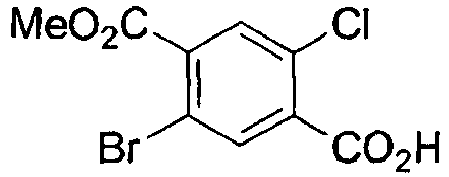
- A mixture of methyl 2-bromo-5-chloro-4-methylbenzoate (39.53 g, 0.15 mol), 18-Crown-6 (3.95 g), tert-butyl alcohol (350 mL), and water (750 mL) was combined together with mechanical stirring. The reaction mixture was heated to reflux and monitored by TLC. After refluxing overnight, the reaction was cooled to 55°C and filtered. The filter cake was washed with hot water (2 x 100 mL, 50°C). The filtrate was neutralized with 18% hydrochloric acid to
pH 1 and stored in a refrigerator (0∼5°C) for 3 h. It was filtered, and then washed with ice water (2 x 50 mL) and petroleum ether (2 x 50 mL). The filter cake was dried under vacuum to give the title compound as a white crystalline solid. Yield: 32.1 g (73%). 1H-NMR (DMSO-d 6, 300 MHz): δ 8.10 (s, 1H), 7.89 (s, 1H), 3.86 (s, 3H). -

- To a solution of 5-bromo-2-chloro-4-(methoxycarbonyl)benzoic acid (1.21 g, 4.15 mmol) in dry dichloromethane (22.5 mL) was added dropwise oxalyl chloride (0.43 mL, 4.96 mmol) followed by N,N-dimethylformamide (1 mL). After being stirred for 2 h at room temperature, the reaction mixture was evaporated and the residue was dissolved in dry dichloromethane (20 mL) at room temperature under agron. After cooling to -5°C, ethylbenzene (0.46 g, 4.35 mmol) was added. Then AlCl3 (1.72 g, 12.8 mmol) was added portionwise and the reaction temperature was kept between -5°C and 0°C. After being stirred at the same temperature for two hours, the reaction mixture was poured onto ice water and extracted with dichloromethane (100 mL). The combined organic layers were washed with 1 M HCl (60 mL), water (30 mL) and brine (60 mL), and dried over anhydrous Na2SO4. Concentration under reduced pressure provided the title compound as a yellow solid. Yield: 1.37 g (87%). 1H-NMR (CDCl3, 300 MHz): δ 7.89 (s, 1H), 7.72 (d, J = 2.0 Hz, 1H), 7.70 (d, J = 2.0 Hz, 1H), 7.64 (s, 1H), 7.33 (s, 1H), 7.30 (s, 1H), 3.98 (s, 3H), 2.70 (q, J = 7.8 Hz, 2H), 1.27 (t, J = 7.8 Hz, 3H).
-

- To a solution of methyl 2-bromo-5-chloro-4-(4-ethylbenzoyl)benzoate (7.64 g, 20 mmol) in 2,2,2-trifluoroacetic acid (38 mL) was added triethylsilane (5.88 mL, 40 mmol) under argon. After it was stirred for 10 min at room temperature, trifluoromethanesulfonic acid (0.1 mL) was added. The reaction temperature was raised from 26°C to reflux. After stirring for 2 h, TLC (PE:EtOAc = 6:1, Rf = 0.7) showed the reaction was complete. The reaction mixture was evaporated and the residue was dissolved in EtOAc (150 mL). The organic layer was washed 2X with H2O, 2X with NaHCO3, and 2X with brine, and then dried over anhydrous Na2SO4. Concentration under reduced pressure provided the title compound as a white solid. Yield: 7.2 g (100%). 1H-NMR (CDCl3, 300 MHz) δ 7.85 (s, 1H), 7.44 (s, 1H), 7.17 (s, 1H), 7.14 (s, 1H), 7.10 (s, H), 7.07 (s, 1H), 4.05 (s, 2H), 3.92 (s, 3H), 2.63 (q, J = 7.8 Hz, 2H), 1.24 (t, J = 7.8 Hz, 3H).
-

- To a solution of (2-bromo-5-chloro-4-(4-ethylbenzyl)phenyl)methanol (3.4 g, 10 mmol) in DMF (50 mL) was added NaH (0.8 g, 20 mmol, 60% in miner oil) in portions at -5°C. After being stirred for 1 h at the same temperature, the reaction mixture was cooled to -10°C, TBAI (0.37 g, 1 mmol) and a solution of allyl bromide (1.45 g, 12 mmol) in DMF (10 mL) was added. The reaction mixture was stirred for another 1 h prior to quenching by ice water and extracted 3X with EtOAc. The combined organic layers were washed with brine and then dried over Na2SO4. Concentration gave the crude product, which was purified by silica column chromatography (elution with PE:EtOAc = 10:1) to afford the title compound (3.22 g, yield 84.8%).
-

- To a solution of 1-(allyloxymethyl)-2-bromo-5-chloro-4-(4-ethylbenzyl)benzene in dry THF:toluene (1:2, 2.4 mL) was added n-BuLi (0.3 mL, 2.5 M in hexane) dropwise under argon. After it was stirred for 1 h, a cooled solution (-70°C) of (3R,4S,5R,6R)-3,4,5-tris(trimethylsilyloxy)-6-((trimethylsilyloxy)methyl)-tetrahydropyran-2-one in dry toluene (1.8 mL) was added dropwise to the reaction mixture. After being stirred for 3 h, the reaction was quenched by addition of ice water and extracted with EtOAc. The combined organic layers were washed 2x with water, 2x with brine, and then dried over Na2SO4. Concentration gave a yellow oil, which was dissolved in 20 mL of methanol, and methanesulfonic acid in 5 mL of methanol was added. The reaction mixture was stirred over 50 h under argon prior to being quenched by addition of satd NaHCO3 to pH 7.5. Concentration gave a residue, which was purified by preparative TLC to yield 14 mg of title compound as a white solid. 1H-NMR (CD3OD, 400 MHz) δ 7.48 (s, 1H), 7.36 (s, 1H), 7.03 (s, 4H),5.93-5.87 (m, 1H), 5.24 (dd, J=17.2Hz, 1.6Hz, 1H), 5.11 (dd, J=1.6Hz, 10.4Hz, 1H), 4.70 (m, 3H), 4.06-3.89 (m, 4H), 3.82 (dd, J=2.4Hz, 12.4Hz, 1H), 3.71-3.62 (m, 2H), 3.50-3.46 (m,1H), 3.26-3.22 (m, 1H), 3.00 (s, 3H), 2.78-2.74 (m, 1H), 1.12 (d, J=7.2Hz, 6H); LC-MS (m/z) 493 [(M+1)+].
-

- To a cooled solution (-15°C) of (3R,4S,5S,6R)-2-(2-(allyloxymethyl)-4-chloro-5-(4-ethylbenzyl)phenyl)-6-(hydroxymethyl)-2-methoxytetrahydro-2H-pyran-3,4,5-triol in 1:1 CH2Cl2:CH3CN was added triethylsilane followed by addition of BF3·Et2O at a rate such that the temperature was maintained between -15°C and -10°C under argon. The reaction mixture was stirred for 4 h prior to being quenched by satd NaHCO3. It was evaporated and the residue was partitioned between EtOAc and water. The organic layer was separated, washed 2x with brine and dried over Na2SO4. Concentration gave a residue, which was purified by preparative TLC (EtOAc:MeOH = 20:1, Rf= 0.6) to yield 58 mg of title compound as a white solid. 1H-NMR (CD3OD, 400 MHz) δ 7.46 (s, 1H), 7.35 (s, 1H), 7.04 (s, 4H), 5.92-5.86 (m, 1H), 5.25 (dd, J=17.2 Hz, 1.6MHz, 1H), 5.09 (dd, J=10.4 Hz, 1.6MHz, 1H), 4.68 (m, 3H), 4.48 (d, J=9.2 Hz, 1H), 4.05-3.86 (m, 4H), 3.83 (dd, J=12.4 Hz, 2.4Hz, 1H), 3.71-3.62 (m, 2H), 3.50-3.46 (m, 1H), 3.26-3.22 (m, 1H), 2.78-2.74 (m, 1H), 1.13 (d, J=7.2 Hz, 6H); LC-MS (m/z) 463 [(M+1)+].
- Compound I was repurified by the following steps.
-

- To a solution of (2S,3R,4R,5S,6R)-2-(2-(allyloxymethyl)-4-chloro-5-(4-ethylbenzyl)phenyl)-6-(hydroxymethyl)tetrahydro-2H-pyran-3,4,5-triol (1.2 g, 2.6 mmol) in dry dichloromethane (18 mL), was added pyridine (2.1 mL, 26 mmol) followed by acetic anhydride (2.7 mL, 28.6 mmol). After it was stirred for 20 min, DMAP (31.7 mg) was added and the reaction mixture was stirred overnight under argon. The reaction was quenched by addition of 10 mL of water and extracted 2x with CH2Cl2. The combined organic layers were washed 2x with 1M HCl, 2x with brine, and then dried over Na2SO4. Concentration gave a residue, which was purified by preparative TLC (PE:EtOAc = 3:1, Rf= 0.6) to yield 1.1 g of title compound as a white solid. LC-MS (m/z) 631 [(M+1)+], 675 [(M+45)-].
-

- To (2R,3R,4R,5S,6S)-2-(acetoxymethyl)-6-(2-(allyloxymethyl)-4-chloro-5-(4-ethylbenzyl)phenyl)tetrahydro-2H-pyran-3,4,5-triyl triacetate (246 mg, 0.39 mmol) in THF:MeOH:H2O (2:3:1, 6 mL) was added LiOH·H2O (16.4 mg, 0.47 mmol). After being stirred for 12 h at room temperature, the reaction mixture was concentrated and the residue was dissolved in 20 mL of EtOAc. The organic layer was washed with brine and dried over Na2SO4. Concentration gave a residue, which was purified by preparative TLC (PE:EtOAc:MeOH = 8:80:1, Rf= 0.5) to yield 132 mg of title compound as a white solid. 1H-NMR (CD3OD, 400 MHz) δ 7.48 (s, 1H), 7.42 (s, 1H), 7.11 (s, 4H), 5.93-5.87 (m, 1H), 5.24 (dd, J=17.2 Hz, 1.6Hz, 1H), 5.11 (dd, J=1.6 Hz, 10.4Hz, 1H), 4.85 (d, J=12.0 Hz, 1H), 4.62 (d, J=12.0 Hz, 1H), 4.51 (d, J=9.2 Hz, 1H), 4.23 (s, 2H), 4.10 (d, J=14.8 Hz, 1H), 4.05 (d, J=14.8 Hz, 1H), 3.88 (d, J=12.4 Hz, 1H), 3.71-3.67 (m, 1H), 3.52-3.41 (m, 4H), 2.60 (q, J=7.6 Hz, 2H), 1.21 (t, J=7.6 Hz, 3H); LC-MS (m/z) 463 [(M+1)+], 507 [(M+45)-].
-

- To a stirred solution of (2R,3R,4R,5S,6S)-2-(acetoxymethyl)-6-(4-chloro-5-(4-ethylbenzyl)-2-((2-oxopropoxy)methyl)phenyl)tetrahydro-2H-pyran-3,4,5-triyl triacetate (36.8 g, 0.057 mmol) (prepared from intermediate J using a Wacker oxidation as described for the preparation of intermediate T-1 below) in THF:MeOH:H2O (2:3:1, 1.2 mL) was added lithium hydroxide (3.71 mg). The reaction was stirred overnight at 20°C. The volatiles were removed and the residue was dissolved in EtOAc (20 mL), washed 1x with brine, 1x with brine containing 2 mL of 5% aqueous KHSO4 and dried over Na2SO4. Concentration gave 16 mg of pure product as a white solid. 1H-NMR (CD3OD, 300 MHz) δ 7.47 (s, 1H), 7.44 (s, 1H), 7.08 (s, 4H), 4.80 (d, J=12.3 Hz, 1H), 4.55 (d, J=9.6 Hz, 1H), 4.22 (s, 2H), 4.10 (d, J=14.8 Hz, 1H), 4.05 (d, J=14.8 Hz, 1H), 3.85 (dd, J=11.7 Hz, 2.1 Hz, 1H), 387-3.83 (m, 1H), 3.68-3.63 (m, 1H), 3.50-3.36 (m, 4H), 2.58 (q, J=7.8 Hz, 2H), 2.12 (s, 3H), 1.19 (t, J=7.8 Hz, 3H); LC-MS (m/z) 479 [(M+1)+], 523 [(M+45)-].
-

- To a stirred solution of (2R,3R,4R,5S,6S)-2-(acetoxymethyl)-6-(4-chloro-2-((2,3-dihydroxypropoxy)methyl)-5-(4-ethylbenzyl)phenyl)tetrahydro-2H-pyran-3,4,5-triyl triacetate (50 mg, 0.076 mmol) (prepared from intermediate J using a Sharpless dihydroxylation) in THF:MeOH:H2O (2:3:1, 1.2 mL) was added lithium hydroxide (3.71 mg). The reaction was stirred overnight at 20°C. The volatiles were removed and the residue was dissolved in EtOAc (20 mL), washed 1x with brine,1x with brine containing 2 mL of 5% aqueos KHSO4 and dried over Na2SO4. Concentration gave 3.5 mg of pure product as a white solid. 1H-NMR (CD3OD, 300 MHz) δ 7.45 (s, 1H), 7.43 (s, 1H), 7.08 (s, 4H), 4.75-4.70 (m, 2H), 4.60-4.45 (m, 2H), 4.10 (d, J=14.8 Hz, 1H), 4.05 (d, J= 14.8 Hz, 1H), 3.93-3.83 (m, 2H), 3.87-3.77 (m, 2H), 3.66-3.36 (m, 7H), 2.60 (q, J=7.8Hz, 2H), 1.21 (t, J=7.8 Hz, 3H), 1.15 (d, J=7.8 Hz, 3H); LC-MS (m/z) 497 [(M+1)+], 541 [(M+45)-].
-

- To a solution of 1-(5-chloro-4-(4-ethylbenzyl)-2-((2S,3R,4R,5S,6R)-3,4,5-trihydroxy-6-(hydroxymethyl)tetrahydro-2H-pyran-2-yl)benzyloxy)propan-2-one (compound K) (3.7 mg, 0.0077 mmol) in dry THF (0.5 mL) was added NaBH4 (1.76 mg, 0.0045 mmol) with stirring under argon at room temperature. After the mixture was stirred for 20 min, anhydrous methanol was added dropwise, and the resulting mixture was stirred at 20°C for 2 h, then quenched by addition of sat. NH4Cl. The mixture was extracted with EtOAcand the combined organic layers were washed with water, brine, dried over Na2SO4, filtered and concentrated to provide the crude product, which was purified by preparative TLC to yield 2.5 mg of the product. 1H-NMR (CD3OD, 300 MHz) δ 7.45 (s, 1H), 7.43 (s,1H), 7.08 (s,4H), 4.75-4.56 (m,1H), 4.47 (dd, J=9.3 Hz, 3.3Hz,1H), 4.10 (d, J=14.8 Hz,1H), 4.05 (d, J=14.8 Hz, 1H), 3.93-3.83 (m, 2H), 3.68-3.66 (m,1H), 3.47-3.37 (m, 6H), 2.60 (q, J=7.8 Hz, 2H), 1.21 (t, J=7.8 Hz, 3H), 1.15 (d, J=7.8 Hz, 3H); LC-MS (m/z) 481 [(M+1)+], 525 [(M+45)-].
-

- To a solution of (2S,3R,4R,5S,6R)-2-(4-chloro-2-((2,3-dibromopropoxy)methyl)-5-(4-ethylbenzyl)phenyl)-6-(hydroxymethyl)tetrahydro-2H-pyran-3,4,5-triol (53.3 mg, 0.086 mmol) (prepared by bromination of compound I) in anhydrous ethanol (1.0 mL) was added potassium hydroxide (10.6 mg). The reaction mixture was refluxed and monitored by LC-MS. After 6 h, LC-MS showed the reaction was complete. The reaction mixture was concentrated and the residue was partitioned between EtOAc and water, the organic layer was separated, washed 2x with IN HCl, 3x with brine, and dried over Na2SO4. Concentration gave the crude product, which was purified by preparative HPLC to yield 21 mg of title compound as a white solid. 1H-NMR (CD3OD, 400 MHz) δ 7.48 (s, 1H), 7.42 (s, 1H), 7.11 (s, 4H), 4.85 (d, J=12.0 Hz, 1H), 4.62 (d, J=12.0 Hz, 1H), 4.51 (d, J=9.2 Hz, 1H), 4.23 (s, 2H), 4.10 (d, J=14.8 Hz, 1H), 4.05 (d, J=14.8 Hz, 1H), 3.88 (d, J=12.4 Hz, 1H), 3.71-3.67 (m, 1H), 3.52-3.41 (m, 4H), 2.94 (s, 1H), 2.60 (q, J=7.6 Hz, 2H), 1.21 (t, J= 7.6Hz, 3H); LC-MS (m/z) 461 [(M+1)+], 515 [(M+45)-].
- This example illustrates the preparation of compound O according to the approach provided in
Figure 10 . The general method is applicable to other compounds of the present invention. -

- n-BuLi (3.7 mL, 9.4 mmol, 2.5M in hexane) was added into a solution of 1-(allyloxymethyl)-2-bromo-5-chloro-4-(4-ethylbenzyl)benzene (intermediate G) (3.22 g, 8.5 mmol) in anhydrous THF (30 mL) at -78°C under argon, and stirred for 2h at the same temperature. A solution of (3R,4S,5R,6R)-3,4,5-tris(benzyloxy)-6-(benzyloxymethyl)tetrahydro-2H-pyran-2-one (6.87 g, 2.8 mmol) in anhydrous THF (20 mL) at -78°C was slowly added dropwise into the reaction mixture at -78°C under argon and stirring was continued for another 2h. The reaction mixture was quenched by addition of saturated NH4Cl (10 mL), extracted with ethyl acetate (100 mL x 3), and the combined extracts were then dried over Na2SO4. The dried extracts were filtered and evaporated to dryness. Without further purification, BF3·Et2O (1.81 g, 12.8 mmol) and Et3SiH (1.48 g, 12.8 mmol) were added to the solution of the residue in CH3CN (30 mL) at -40°C, and the mixture was stirred for 2h. The reaction mixture was evaporated to dryness. Water was poured into the residue and the aqueous mixture was extracted with ethyl acetate (100 mL x 3), dried over Na2SO4, and evaporated to dryness. The residue was purified by silica column chromatography (elution PE:EtOAc = 40:1), and afforded (2S,3S,4R,5R,6R)-2-(2-(allyloxymethyl)-4-chloro-5-(4-ethylbenzyl)phenyl)-3,4,5-tris(benzyloxy)-6-(benzyloxymethyl)tetrahydro-2H-pyran (intermediate O-1) (1.96 g, 2.4 mmol, yield 28.2%).
-

- O3 was bubbled into the solution of (2S,3S,4R,5R,6R)-2-(2-(allyloxymethyl)-4-chloro-5-(4-ethylbenzyl)phenyl)-3,4,5-tris(benzyloxy)-6-(benzyloxymethyl)tetrahydro-2H-pyran (intermediate O-1) (200 mg, 0.24 mmol) in anhydrous CH2Cl2 at -78°C for 5 min, and then argon was bubbled into the reaction solution for another 30 min, the solution of PPh3 (191 mg, 0.72 mmol) in CH2Cl2 was added, and the mixture was warmed to room temperature, stirred for another 30 min, and evaporated to dryness. The residue was purified by preparative TLC, which afforded 2-(5-chloro-4-(4-ethylbenzyl)-2-((2S,3S,4R,5R,6R)-3,4,5-tris(benzyloxy)-6-(benzyloxymethyl)tetrahydro-2H-pyran-2-yl)benzyloxy)acetaldehyde (intermediate O-2) (152 mg, 0.18 mmol, yield 75%). 1H-NMR (CDCl3, 300Hz) δ 1.759 (t, J=7.5 Hz, 3H), 2.561 (dd, J=7.5 Hz, 2H), 3.709 (m, 2H), 3.774 (m, 5H), 3.955 (m,5H), 4.046
- (dd, J=18, 15 Hz, 2H), 4.433 (m, 5H), 4.518 (m, 1H), 4.873 (m, 4H), 6.841 (m, 2H), 7.044 (m, 4H), 7.215 (m, 6H), 7.287 (m, 13H), 9.568 (s, 1H).
-

- NaBH4 (13 mg, 0.34 mmol) was added into a solution of2-(5-chloro-4-(4-ethylbenzyl)-2-((2S,3S,4R,5R,6R)-3,4,5-tris(benzyloxy)-6-(benzyloxymethyl)tetrahydro-2H-pyran-2-yl)benzyloxy)acetaldehyde (intermediate O-2) (140 mg, 0.17 mmol) in THF (10 mL) and stirred for 1.5h. The reaction mixture was quenched by MeOH (2 mL), then evaporated to dryness. The residue was purified by preparative TLC, which afforded 2-(5-chloro-4-(4-ethylbenzyl)-2-((2S,3S,4R,5R,6R)-3,4,5-tris(benzyloxy)-6-(benzyloxymethyl)tetrahydro-2H-pyran-2-yl)benzyloxy)ethanol (intermediate O-3) (135 mg, 0.169 mmol, yield 96.2%).
-

- To a solution of 2-(5-chloro-4-(4-ethylbenzyl)-2-((2S,3S,4R,5R,6R)-3,4,5-tris(benzyloxy)-6-(benzyloxymethyl)tetrahydro-2H-pyran-2-yl)benzyloxy)ethanol (intermediate O-3) (50 mg, 0.06 mmol) in THF:CH3OH = 2:1 (3 mL) was added 1,2-dichlorobenzene (17.4 mg, 0.12 mmol) and Pd/C (50 mg, 10% Pd/C), and the mixture was stirred 3h under H2 atmosphere at room temperature (about 25°C). The reaction was monitored by LC-MS to confirm completion, the mixture was filtered, and the filtrate was evaporated to dryness. The residue was purified by preparative HPLC to give compound O (20 mg, 0.043 mmol, yield 71.5%). 1H-NMR (CD3OD, 300 MHz) δ 1.180 (t, J =7.5 Hz, 3H), 2.572 (dd, J=7.5 Hz, 2H), 3.419 (m, 4H), 3.631 (m, 5H), 3.853 (d, J=11.4 Hz, 1H), 4.046 (dd, J=18, 15 Hz, 2H), 4.469 (d, J=9 Hz, 1H), 4.597 (d, J =12.3 Hz, 1H), 4.737 (d, J=12 Hz, 1H), 7.074 (s, 4H), 7.447 (s, 1H), 7.458 (s,1H). MS ESI m/z (%) 467 (M+H)+, 933 (2M+H)+, 511 (M+HCOOH-H)-, 977 (2M+HCOOH-H)-.
- This example illustrates the preparation of compound R according to the approach provided in
Figure 11 . -

- DAST (29 mg, 18 mmol) was added dropwise to a solution of 2-(5-chloro-4-(4-ethylbenzyl)-2-((2S,3S,4R,SR,6R)-3,4,5-tris(benzyloxy)-6-(benzyloxymethyl)tetrahydro-2H-pyran-2-yl)benzyloxy)acetaldehyde (intermediate O-2) (50 mg ,0.06 mmol) in anhydrous CH2Cl2 (5 mL) at -78°C under argon, and the mixture was stirred overnight while the temperature was warmed to room temperature. The reaction mixture was quenched by MeOH (1 mL) and evaporated to dryness. The residue was purified by preparative TLC, which afforded (2R,3R,4R,5S,6S)-3,4,5-tris(benzyloxy)-2-(benzyloxymethyl)-6-(4-chloro-2-((2,2-difluoroethoxy)methyl)-5-(4-ethylbenzyl)phenyl)tetrahydro-2H-pyran (intermediate R-1) (51 mg, 0.06 mmol, yield 100%).
-

- Compound R was prepared from (2R,3R,4R,5S,6S)-3,4,5-tris(benzyloxy)-2-(benzyloxymethyl)-6-(4-chloro-2-((2,2-difluoroethoxy)methyl)-5-(4-ethylbenzyl)phenyl)tetrahydro-2H-pyran (intermediate R-1) using debenzylation methods analogous to those described in Example 6 above. MS ESI m/z (%) 504 (M+NH4)+, 973 (2M+H)+, 531 (M+HCOOH-H)-, 971 (2M-H)-. 1H-NMR (CD3OD, 300 MHz) δ 1.186 (t, J=7.5 Hz, 3H), 2.580 (dd, J=7.5 Hz, 2H), 3.415 (m, 4H), 3.694 (m, 3H), 3.855 (d, J=11.7 Hz, 1H), 4.056 (dd, J=18, 15 Hz, 2H), 4.438 (d, J=8.7 Hz, 1H), 4.649 (d, J=12.6 Hz, 1H), 4.864 (d, J=12.3 Hz, 1H), 4.787 (tt, J=55.2, 3.9 Hz, 1H), 7.068 (s, 4H), 7.416 (s,1H), 7.460 (s,1H).
-

- NaH (2 mg, 0.087 mmol) was added to a solution of 2-(5-chloro-4-(4-ethylbenzyl)-2-((2S,3S,4R,5R,6R)-3,4,5-tris(benzyloxy)-6-(benzyloxymethyl)tetrahydro-2H-pyran-2-yl)benzyloxy)ethanol (intermediate O-3) (60 mg , 0.073 mmol) in anhydrous THF (10 mL) at 0°C, and stirred for 1h, then TBAI (2.6 mg, 0.007 mmol) and CH3I (1.5 mg, 0.11 mmol) were added to the reaction mixture at the same temperature and stirred overnight. Then the mixture was washed with water (10 mL x 3), then brine, and the organic layer was dried over Na2SO4, filtered, and evaporated to dryness. The residue (intermediate S-1) was used in the next step without further purification.
-

- Compound S was prepared from intermediate S-1 using debenzylation methods analogous to those described in Example 6 above. MS ESI m/z (%) 481 (M+H)+, 498 (M+NH4)+, 961 (2M+1)+, 525 (M+HCOOH-H)-. 1H-NMR (CD3OD, 300 MHz) δ 1.186 (t, J=7.5 Hz, 3H), 2.577 (dd, J=7.5 Hz, 2H), 3.404 (m, 7H), 3.601 (m, 5H), 3.844 (d, J=11.1 Hz, 1H), 4.049 (dd, J=18, 15 Hz, 2H), 4.459 (d, J=9.3 Hz, 1H), 4.537 (d, J=12 Hz, 1H), 4.743 (d, J=12 Hz, 1H), 7.073 (s, 4H), 7.415 (s, 1H), 7.459 (s,1H).
- This example illustrates the preparation of compound T according to the approach provided in
Figure 12 . -

- A mixture of palladium chloride (159 mg, 0.053 mmol) and copper chloride (267 mg, 0.27 mmol) in DMF (3 mL) was stirred for 2.5h at room temperature. (2S,3S,4R,5R,6R)-2-(2-(allyloxymethyl)-4-chloro-5-(4-ethylbenzyl)phenyl)-3,4,5-tris(benzyloxy)-6-(benzyloxymethyl)tetrahydro-2H-pyran (intermediate O-1) (300 mg, 0.36 mmol) was added to the mixture and stirred overnight under oxygen. The reaction mixture was filtered, the filtrate was poured into water and extracted with ethyl acetate (20 mL x 3). The combined extracts were dried over Na2SO4, filtered, and evaporated to dryness. The residue was purified by preparative TLC, which afforded 1-(5-chloro-4-(4-ethylbenzyl)-2-((25,3S,4R,5R,6R)-3,4,5-tris(benzyloxy)-6-(benzyloxymethyl)tetrahydro-2H-pyran-2-yl)benzyloxy)propan-2-one (intermediate T-1) (178 mg, 0.33 mmol, yield 58.2%). 1H-NMR (DMSO-d6, 300 MHz) δ 1.062 (t, J = 8.1 Hz, 3H), 1.988 (s, 3H), 2.452 (dd, J = 8.1 Hz, 2H), 3.603 (m, 6H), 3.793 (m, 2H), 3.997 (s, 2H), 4.125 (s, 2H), 4.491 (m, 7H), 4.744 (m, 4H), 6.789 (m, 2H), 7.015 (m, 4H), 7.169 (m, 5H), 7.288 (m, 13H), 7.457 (s, 2H).
-

- NaBH4 (4.5 mg, 0.12 mmol) was added to a solution of 1-(5-chloro-4-(4-ethylbenzyl)-2-((2S,3S,4R,5R,6R)-3,4,5-tris(benzyloxy)-6-(benzyloxymethyl)tetrahydro-2H-pyran-2-yl)benzyloxy)propan-2-one (intermediate T-1) (50 mg ,0.06 mmol) in THF (5 mL) and stirred for 1h at room temperature. The reaction was quenched by the addition of saturated NH4Cl; (2 mL), and the mixture was then extracted with ethyl acetate (10 mL x 3). The combined extracts were dried over Na2SO4, filtered, and evaporated to dryness. The residue was purified by preparative TLC, which afforded 1-(5-chloro-4-(4-ethylbenzyl)-2-((2S,3S,4R,5R,6R)-3,4,5-tris(benzyloxy)-6-(benzyloxymethyl)tetrahydro-2H-pyran-2-yl)benzyloxy)propan-2-ol (intermediate T-2) (49 mg, 0.058 mmol, yield 97.8%).
-

- Intermediate T3 was prepared from intermediate T2 using DAST reagent, and compound T was prepared from intermediate T3 by debenzylation using methods analogous to those described in Example 7. MS ESI m/z (%) 482 (M+H)+, 500 (M+NH4)+, 527 (M+HCOOH-H)-. 1H-NMR (CD3OD, 300 MHz) δ 1.186 (t, J=7.5 Hz, 3H), 1.306 (ddd, J=23.4, 6.5, 0.6 Hz, 3H), 2.578 (dd, J=7.5 Hz, 2H), 3.409 (m, 4H), 3.553 (d, J=4.8 Hz, 1H), 3.646 (m, 2H), 3.850 (d, J=12 Hz, 1H), 1H, 4.050 (dd, J=18, 15 Hz, 2H), 4.462 (dd, J=9.3, 2.4 Hz, 1H), 4.595 (d, J=12.3 Hz, 1H), 4.799 (d, J=12.6 Hz, 1H), 7.076 (s, 4H), 7.411 (s, 1H), 7.457 (s, 1H).
-

- Compound U was prepared from intermediate T-2 using methods analogous to those described in Example 8 above. MS ESI m/z (%) 495 (M+H)+, 512 (M+NH4)+, 989 (2M+H)+, 539 (M+HCOOH-H)-. 1H-NMR (CD3OD, 300 MHz) δ 1.145 (dd, J=6.3, 1.2 Hz, 3H), 1.185 (t, J=7.5 Hz, 3H), 2.578 (dd, J=7.5 Hz, 2H), 3.440 (m, 11H), 3.856 (d, J=11.4 Hz, 1H), 4.049 (dd, J=18, 15 Hz, 2H), 4.462 (d, J= 9.3 Hz, 1H), 4.561 (dd, J=12.3, 1.8 Hz, 1H), 4.748 (dd, J =12.3, 1.8 Hz, 1H), 7.075 (s, 4H), 7.049 (s, 1H), 7.456 (s, 1H).
-

- PdCl2 (23.7 mg, 0.133 mmol, 2.2 eq) and NaOAc (76 mg, 0.285 mmol, 4 eq) were added to a solution of (2S,3S,4R,5R,6R)-2-(2-(allyloxymethyl)-4-chloro-5-(4-ethylbenzyl)phenyl)-3,4,5-tris(benzyloxy)-6-(benzyloxymethyl)tetrahydro-2H-pyran (intermediate O-1) (50 mg, 0.061 mmol) in HOAc:H2O (9:1) (1 mL), and the mixture was stirred at 70°C for 1h. Then the mixture was cooled to room temperature, extracted with ethyl acetate, and the combined organic layers were washed with water, dried over anhydrous Na2SO4, concentrated and purified by preparative TLC to obtain 30 mg of intermediate V-1.
-

- To a solution of (5-chloro-4-(4-ethylbenzyl)-2-((2S,3S,4R,5R,6R)-3,4,5-tris(benzyloxy)-6-(benzyloxymethyl)tetrahydro-2H-pyran-2-yl)phenyl)methanol (0.783 g, 1 mmol) (V-1) in toluene (2 mL) was added ADDP (2 mmol) at room temperature. The mixture was stirred for 10 min and then Bu3P (2 mmol) was added. After stirring for 1h, CF3CH2OH (:1.0 g, 10 mmol) was added. The mixture was stirred overnight. After removal of volatiles under reduced pressure, the residue was purified by preparative LC-MS to obtain (2R,3R,4R,5S,6S)-3,4,5-tris(benzyloxy)-2-(benzyloxymethyl)-6-(4-chloro-5-(4-ethylbenzyl)-2-((2,2,2-trifluoroethoxy)methyl)phenyl)tetrahydro-2H-pyran (intermediate V-2).
-

- Compound V was prepared from intermediate V-2 using debenzylation methods analogous to those described in Example 6 above. 1H-NMR (300 MHz, CD3OD): δ 1.18 (3H, t, J=7.8 Hz), 2.58 (2H, q, J=7.5 Hz), 3.36-3.46 (4H, m), 3.63-3.69 (1H, m), 3.85 (1H, d, J=1.2 Hz), 3.98 (2H, t, J=8.7 Hz), 4.064 (2H, d, J=6.6 Hz), 4.42 (1H, d, J=9.3 Hz), 4.71 (1H, d, J=12.0 Hz), 4.94, (1H, d, J=12.0 Hz), 7.084 (4H, s), 7.47 (1H, s), 7.41 (1H, s).
-

- Compound W was prepared from a mixture of compounds Q-1 and Q-2 using methods evident to those skilled in the art. 1H-NMR (300 MHz, CDCl3): δ 1.17 (3H, t, J=7.5 Hz), 2.57 (2H, t, J=7.5 Hz), 3.23 (3H, s), 3.25-3.91 (11H, m), 4.02 (2H, s), 3.40-3.57 (3H, m), 7.60 (4H, m), 7.27 (1H, s), 7.37 (1H, d, J=4.2 Hz).
-

- Compound AA was prepared from a mixture of compounds Q-1 and Q-2 using methods evident to those skilled in the art. 1H-NMR (300 MHz, CD3OD): δ 1.190 (3H, m, 7.5 Hz), 2.58 (2H, q, J=7.8 Hz), 3.37-4.13 (14H, m), 4.27 (1H, d, J=3 Hz), 4.49 (1H, dd, J=8.4 Hz), 4.58 (1H, dd, J=4.8 Hz), 4.75 (1H, dd, J=6.9 Hz), 7.08-7.11 (4H, m), 7.42 (1H, s), 7.46 (1H, s).
-

- To a cooled (0°C) solution of olefin (453 mg, 1.35 mmol) in THF (5 mL), was added dropwise 9-BBN (3.24 mL, 1.62 mmol, 0.5 M in THF) over 30 min. After the addition was complete, the ice bath was removed and the reaction mixture was stirred at room temperature overnight. The mixture was recooled to 0°C and quenched by dropwise addition of MeOH (2.2 mL). Aqueous NaOH (2 M, 5.6 mL) and 30% H2O2 (1.2 mL) were added to the stirred mixture. After being stirred for 3 h, the mixture was extracted 3x with EtOAc. The combined organic extracts were washed with brine and dried over NaZSO4. Concentration gave the crude product, which was purified by flash chromatography (using 100% petroleum ether to 5:1 PE:EtOAc as eluent) to yield 336 mg of title product. 1H-NMR (CDCl3, 300 MHz) δ 7.34 (s, 1H), 7.30 (s, 1H), 7.13 (q, 4H), 4.00 (s, 2H), 3.87 (t, J = 6.6 Hz, 2H), 2.96 (t, J = 6.6 Hz, 2H), 2.63 (q, J = 7.6 Hz, 2H), 1.23 (t, J = 7.6 Hz, 3H).
-

- Compound AD was prepared using intermediate AC and methods analogous to those described in Example 1 above. 1H-NMR (CD3OD, 300 MHz) δ 7.39 (s, 1H), 7.26 (s, 1H), 7.08 (s, 4H), 5.97-5.84 (m, 1H), 5.29-5.12 (m, 2H), 4.44 (d, J = 9.0 Hz, 1H), 4.03-3.97 (m, 4H), 3.85 (d, J = 11.1 Hz, 1H), 3.70-3.62 (m, 3H), 3.48-3.37 (m, 4H), 3.12-3.03 (m, 1H), 2.95-2.86 (m, 1H), 2.58 (q, J = 7.6 Hz, 2H), 1.19 (t, J = 7.6 Hz, 3H); MS ESI (m/z) 477 (M+1)+, calc. 476.
-

- O3 was bubbled through a cooled (-78°C) solution of (2R,3R,4R,5S,6S)-2-(acetoxymethyl)-6-(2-(2-(allyloxy)ethyl)-4-chloro-5-(4-ethylbenzyl)phenyl)tetrahydro-2H-pyran-3,4,5-triyl triacetate (104 mg, 0.16 mmol) in CH2Cl2 (8 mL) until the color changed to blue. Then argon was bubbled through the reaction solution until the solution became colorless. Me2S (0.12 mL, 1.6 mmol) was added to the reaction solution, which was allowed to warm to room temperature and stirred for 30 min. The solution was concentrated and the residue was purified by preparative TLC to yield 63 mg of title compound. 1H-NMR (CD3OD, 300 MHz) δ 9.69 (s, 1H), 7.23 (s, 1H), 7.22 (s, 1H), 7.13-7.06 (m, 4H), 5.36-5.12 (m, 3H), 4.72 (d, J = 9.3 Hz, 1H), 4.26-4.07 (m, 4H), 4.01 (s, 2H), 3.88-3.64 (m, 3H), 3.16-3.06 (m, 1H), 2.98-2.89 (m, 1H), 2.60 (q, J = 7.5 Hz, 2H), 2.04 (s, 6H), 2.00 (s, 3H), 1.71 (s, 3H), 1.20 (t, J = 7.5 Hz, 3H).
-

- To a cooled (0°C) solution of (2R,3R,4R,5S,6S)-2-(acetoxymethyl)-6-(4-chloro-5-(4-ethylbenzyl)-2-(2-(2-oxoethoxy)ethyl)phenyl)tetrahydro-2H-pyran-3,4,5-triyl triacetate (25 mg, 0.039 mmol) and NaBH4 (5.5 mg, 0.145 mmol) in THF (0.8 mL), was added MeOH (0.03 mL) dropwise. After being stirred for 1 h at the same temperature, the reaction was quenched by addition of saturated NH4Cl. The mixture was extracted 3x with EtOAc. The combined organic layers were washed with brine and dried over Na2SO4. Concentration gave the pure product in quantitative yield. MS ESI (m/z) 649 (M+1)+, calc. 648.
-

- To a solution of (2R,3R,4R,5S,6S)-2-(acetoxymethyl)-6-(4-chloro-5-(4-ethylbenzyl)-2-(2-(2-hydroxyethoxy)ethyl)phenyl)tetrahydro-2H-pyran-3,4,5-triyl triacetate (31 mg, 0.048 mmol) in THF:MeOH:H2O (2:3:1, 0.6 mL) was added LiOH·H2O (2.8 mg, 0.067 mmol). After being stirred overnight at room temperature, the reaction mixture was concentrated. The residue was dissolved in EtOAc, washed 1x with brine, 1x with brine containing 1% NaHSO4 and 1X with brine prior to drying over Na2SO4. Concentration gave 22 mg of title compound. 1H-NMR (CD3OD, 300 MHz) δ 7.38 (s, 1H), 7.27 (s, 1H), 7.07 (s, 4H), 4.47 (dd, J = 9.6, 3.0 Hz, 1H), 4.02 (s, 2H), 3.85 (d, J = 12.3 Hz, 1H), 3.71-3.62 (m, 5H), 3.53-3.46 (m, 4H), 3.39-3.37 (m, 2H), 3.13-3.03 (m, 1H), 2.97-2.87 (m, 1H), 2.58 (q, J = 7.5 Hz, 2H), 1.19 (t, J = 7.5 Hz, 3H); MS ESI (m/z) 481 (M+1)+, calc. 480.
-

- To a cooled (-78°C) solution of (2R,3R,4R,5S,6S)-2-(acetoxymethyl)-6-(4-chloro-5-(4-ethylbenzyl)-2-(2-(2-hydroxyethoxy)ethyl)phenyl)tetrahydro-2H-pyran-3,4,5-triyl triacetate (28.7 mg, 0.044 mmol) in CH2Cl2 (1 mL) was added DAST (0.04 mL, 0.3 mmol) dropwise. After being stirred for 2.5 h at the same temperature, the reaction was quenched by addition of saturated Na2CO3. The mixture was extracted 3x with CH2Cl2, and the combined organic layers were washed 1 x with brine and dried over Na2SO4. Concentration gave the crude product, which was used for the next step without further purification. To a solution of the crude product in THF:MeOH:H2O (2:3:1, 0.8 mL), was added LiOH·H2O (3.7 mg, 0.088 mmol). After being stirred overnight at room temperature, the reaction mixture was concentrated. The residue was dissolved in EtOAc, washed 1x with brine, 1x with brine containing 1% NaHSO4 and 1x with brine prior to drying over Na2SO4. Concentration gave the crude product, which was purified by preparative HPLC to yield 5.7 mg of title compound. 1H-NMR (CD3OD, 300 MHz) δ 7.38 (s, 1H), 7.26 (s, 1H), 7.08 (s, 4H), 4.59-4.56 (m, 1H), 4.46-4.40 (m, 2H), 4.05 (d, J = 15.1 Hz, 1H), 3.99 (d, J = 15.1 Hz, 1H), 3.84 (d, J = 12.0 Hz, 1H), 3.75-3.61 (m, 5H), 3.48-3.36 (m, 4H), 3.13-3.03 (m, 1H), 2.96-2.87 (m, 1H), 2.57 (q, J= 7.6 Hz, 2H), 1.18 (t, J= 7.6 Hz, 3H); MS ESI (m/z) 483 (M+1)+, calc. 482.
-

- Compound AI was prepared from intermediate AE using methods analogous to those described in Example 16 above. 1H-NMR (CD3OD, 300 MHz) δ 7.38 (s, 1H), 7.26 (s, 1H), 7.08 (s, 4H), 6.10-5.70 (m, 1H), 4.45-4.42 (m, 1H), 4.05 (d, J = 15.1 Hz, 1H), 3.99 (d, J = 15.1 Hz, 1H), 3.85 (d, J = 12.0 Hz, 1H), 3.80-3.59 (m, 5H), 3.48-3.36 (m, 4H), 3.13-3.03 (m, 1H), 2.96-2.86 (m, 1H), 2.58 (q, J = 7.6 Hz, 2H), 1.18 (t, J = 7.6 Hz, 3H); MS ESI (m/z) 501 (M+1)+, calc. 500.
-

- The solution of 5-chloro-4-(4-ethylbenzyl)-2-((2S,3S,4R,5R,6R)-3,4,5-tris(benzyloxy)-6-(benzyloxymethyl)tetrahydro-2H-pyran-2-yl)phenethyl methanesulfonate (58 mg, 0.066 mmol) in 0.8 mL of 1.5 M CF3CH2ONa in CF3CH2OH was stirred at 60°C under argon. After it was stirred for about 9 h, an additional 0.6 mL of 1.5 M of CF3CH2ONa in CF3CH2OH was added and the mixture was stirred for another 15 h at 60°C. After removal of the volatiles with a rotary evaporator under vacuum, the residue was partitioned between water and EtOAC. The organic layer was separated, washed with brine and dried over Na2SO4. Concentration gave the crude product, which was purified by preparative TLC to yield 30 mg of title compound. MS ESI (m/z) 896 (M+NH4)+, calc. 878.
-

- A mixture of (2R,3R,4R,5S,6S)-3,4,5-tris(benzyloxy)-2-(benzyloxymethyl)-6-(4-chloro-5-(4-ethylbenzyl)-2-(2-(2,2,2-trifluoroethoxy)ethyl)phenyl)tetrahydro-2H-pyran (30 mg, 0.034 mmol) and 10% Pd/C (30 mg) in 6 mL of MeOH:THF (1:1) was stirred under H2 atmosphere (1 atm) for 2 h. The mixture was filtered, and the filtrate was concentrated to provide the crude product, which was purified by HPLC to yield 9 mg of title compound. 1H-NMR (CD3OD, 300 MHz) δ 7.40 (s, 1H), 7.27 (s, 1H), 7.10 (s, 4H), 4.44-4.41 (m, 1H), 4.06 (d, J = 15.3 Hz, 1H), 4.00 (d, J = 15.3 Hz, 1H), 3.95-3.79 (m, 5H), 3.67-3.61 (m, 1H), 3.48-3.46 (m, 2H), 3.39-3.36 (m, 2H), 3.15-3.05 (m, 1H), 2.98-2.91 (m, 1H), 2.58 (q, J = 7.6 Hz, 2H), 1.19 (t, J = 7.6 Hz, 3H); MS ESI (m/z) 519 (M+1)+, calc. 518.
-
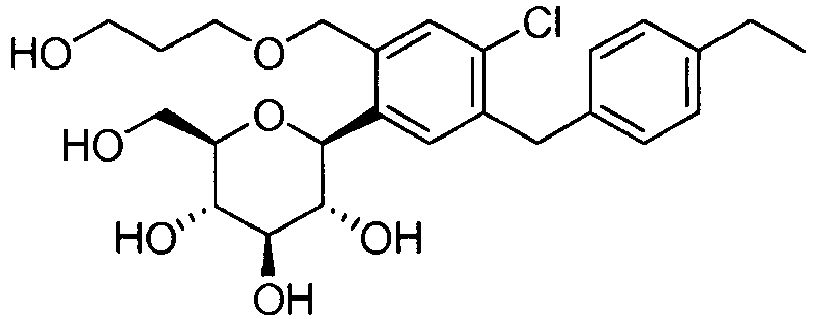
- Compound AL was prepared from compound I using methods analogous to those described above as will be evident to those skilled in the art. 1H-NMR (CD3OD, 300 MHz) δ 7.46 (s, 1H), 7.40 (s, 1H), 7.08 (s, 4H), 4.73 (d, J = 12.2 Hz, 1H), 4.53 (d, J = 12.2 Hz, 1H), 4.45 (d, J = 9.0 Hz, 1H), 4.08 (d, J = 15.0 Hz, 1H), 4.02 (d, J = 15.0 Hz, 1H), 3.86 (d, J = 12.0 Hz, 1H), 3.68-3.60 (m, 4H), 3.44-3.29 (m, 5H), 2.58 (q, J = 7.6 Hz, 2H), 1.86-1.79 (m, 2H), 1.19 (t, J = 7.6 Hz, 3H); MS ESI (m/z) 481 (M+1)+, calc. 480.
-

- Compound AM was prepared from compound AD using methods analogous to those described in Example 5 above. 1H-NMR (CD3OD, 300 MHz) δ 7.38 (s, 1H), 7.26 (s, 1H), 7.10 (s, 4H), 4.45-4.42 (m, 1H), 4.15 (d, J = 2.4 Hz, 2H), 4.05 (d, J = 15.6 Hz, 1H), 3.99 (d, J = 15.6 Hz, 1H), 3.85 (dd, J = 12.3, 1.5 Hz, 1H), 3.74 (t, J = 7.1 Hz, 2H), 3.67-3.62 (m, 1H), 3.48-3.45 (m, 2H), 3.40-3.37 (m, 2H), 3.13-3.04 (m, 1H), 2.96-2.89 (m, 1H), 2.83 (t, J = 2.4 Hz, 1H), 2.57 (q, J = 7.6 Hz, 2H), 1.18 (t, J = 7.6 Hz, 3H); MS ESI (m/z) 475 (M+1)+, calc. 474.
-
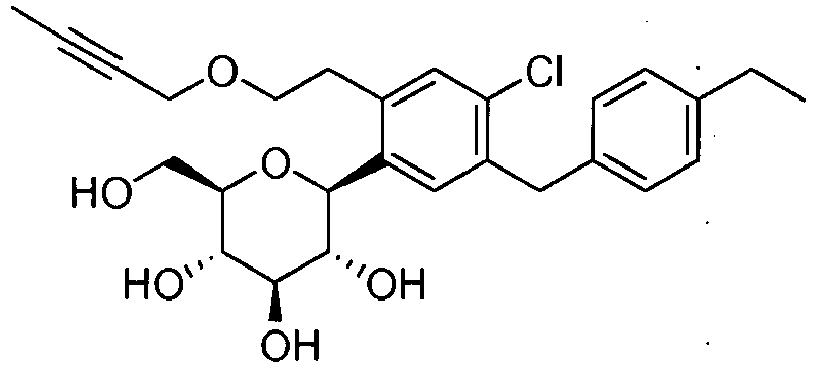
- Compound AN was prepared using methods analogous to those described in Example 14 above. 1H-NMR (CD3OD, 300 MHz) δ 7.39 (s, 1H), 7.27 (s, 1H), 7.08 (s, 4H), 4.45-4.42 (m, 1H), 4.10 (q, J = 2.4 Hz, 2H), 4.06 (d, J = 15.6 Hz, 1H), 4.00 (d, J = 15.6 Hz, 1H), 3.86 (d, J = 11.1 Hz, 1H), 3.74-3.62 (m, 3H), 3.49-3.47 (m, 2H), 3.40-3.38 (m, 2H), 3.12-3.02 (m, 1H), 2.95-2.86 (m, 1H), 2.58 (q, J = 7.5 Hz, 2H), 1.82 (t, J = 2.4 Hz, 3H), 1.19 (t, J = 7.5 Hz, 3H); MS ESI (m/z) 489 (M+1)+, calc. 488.
-

- Compound AO was prepared using methods analogous to those described in Example 5 above. 1H-NMR (CD3OD, 300 MHz) δ 7.37 (s, 1H), 7.26 (s, 1H), 7.08 (d, J = 8.7 Hz, 2H), 6.78 (d, J = 8.7 Hz, 2H), 4.45-4.42 (m, 1H), 4.15 (d, J = 2.1 Hz, 2H), 4.01-3.94 (m, 4H), 3.85 (d, J = 12.3 Hz, 1H), 3.74 (t, J = 7.1 Hz, 2H), 3.68-3.62 (m, 1H), 3.48-3.45 (m, 2H), 3.40-3.38 (m, 2H), 3.13-3.04 (m, 1H), 2.96-2.87 (m, 1H), 2.83 (t, J = 2.1 Hz, 1H), 1.35 (t, J = 7.1 Hz, 3H); MS ESI (m/z) 491 (M+1)+, calc. 490.
-

- Compound AP was prepared using methods analogous to those described in Examples 14 and 15 above. 1H-NMR (CD3OD, 300 MHz) δ 7.37 (s, 1H), 7.27 (s, 1H), 7.08 (d, J = 8.7 Hz, 2H), 6.78 (d, J = 8.7 Hz, 2H), 4.49-4.46 (m, 1H), 4.01-3.94 (m, 4H), 3.85 (dd, J = 12.3, 1.5 Hz, 1H), 3.72-3.62 (m, 5H), 3.54-3.46 (m, 4H), 3.41-3.37 (m, 2H), 3.12-3.03 (m, 1H), 2.97-2.87 (m, 1H), 1.35 (t, J = 7.1 Hz, 3H); MS ESI (m/z) 497 (M+1)+, calc. 496.
- This example illustrates the preparation of compound AW according to the approach provided in
Figure 13 . The general method is applicable to other compounds of the present invention. -

- To a solution of 4-ethyl benzoic acid (AQ) (0.50 g, 3.33 mmol) in dry dichloromethane (20 mL) was added dropwise oxalyl chloride (0.32 mL, 3.68 mmol) followed by N,N-dimethylformamide (0.1 mL). After being stirred for 2 h at room temperature, the reaction mixture was evaporated and the residue was dissolved in dry dichloromethane (20 mL) at room temperature under agron. After cooling to -5°C, 1-bromo-4-chloro-2-methoxybenzene (0.6 g, 2.78 mmol) was added. Then AlCl3 (0.43 g, 3.33 mmol) was added portionwise and the reaction temperature was kept between -5°C and 0°C. After being stirred at room temperature for four hours, the reaction mixture was poured onto ice water and extracted with dichloromethane (80 mL). The combined organic layers were washed with 1 M HCl (10 mL), water (10 mL) and brine (10 mL), and then dried over anhydrous Na2SO4. Concentration under reduced pressure gave AR as a white solid. Yield: 0.5 g (52.3%). 1H-NMR (CDCl3, 400 MHz): δ 7.75 (d, J = 8.4 Hz, 2H), 7.60 (s, 1H), 7.32 (d, J = 8.0 Hz, 2H), 6.98 (s, 1H), 3.99 (s, 3H), 2.76 (q, J = 7.5 Hz, 2H), 1.29 (t, J = 7.5 Hz, 3H).
-

- To a solution of (5-bromo-2-chloro-4-methoxyphenyl)(4-ethylphenyl)methanone (AR) (7.08 g, 20 mmol) in 2,2,2-trifluoroacetic acid (50 mL) was added triethylsilane (4.65g , 40 mmol) under argon. After stirring for 10 min at room temperature, trifluoromethane-sulfonic acid (0.1 mL) was added. The reaction temperature was raised to reflux. After stirring for 2 h, TLC showed the reaction was complete. The reaction mixture was evaporated and the residue was dissolved in EtOAc (150 mL). The organic layer was washed with H2O, NaHCO3 and brine. After drying over anhydrous Na2SO4, it was filtered and concentrated to give AS as a yellow oil (6.18 g, yield 91%). 1H-NMR (CDCl3, 300 MHz) δ 7.33 (s, 1H), 7.13 (m, 4H), 6.92 (s, 1H), 3.99 (s, 2H), 3.87 (s, 3H), 2.52 (q, J = 7.5 Hz, 2H), 1.23(t, J = 7.5 Hz, 3H).
-
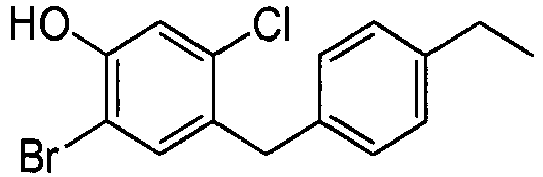
- To a solution of 1-bromo-4-chloro-5-(4-ethylbenzyl)-2-methoxybenzene (AS) (5.1 g, 15 mmol) in anhydrous CH2Cl2 (15 mL), the solution of BBr3 in CH2Cl2 (1M, 20 mL) was added dropwise at -5°C. After BBr3 was added, the reaction mixture was allowed to warm to room temperature and stirred for 2 h, after which TLC showed the reaction was complete. The reaction was quenched with saturated NaHCO3. The organic phase was separated and washed with water and brine. After drying with anhydrous Na2SO4, the organic portion was filtered and concentrated to give AT as an oil (4.49 g, yield 92%). 1H-NMR (CDCl3, 300 MHz) δ 7.22 (s, 1H), 7.13 (m, 4H), 7.07 (s, 1H), 5.42 (s, 1H), 3.99 (s, 2H), 2.54 (q, J = 7.5 Hz, 2H), 1.23 (t, J = 7.5 Hz, 3H).
-

- To a solution of 2-bromo-5-chloro-4-(4-ethylbenzyl)phenol (AT) (3.26 g, 10 mmol) in anhydrous DMF (15 mL), NaH (0.72 g, 30 mmol) was added in portions. The reaction mixture was stirred for 2 h at room temperature, and then 2-bromoethanol (3.75 g, 30 mmol) was added dropwise, and the reaction mixture was heated to 45°C overnight. TLC showed the reaction was complete. The reaction was quenched with the saturated NH4Cl, the mixture was extracted with EtOAc, and then washed with water and brine. After drying with anhydrous Na2SO4, the organic portion was filtered and concentrated. The residue was purified by flash chromatography to give AU as an oil (3.00 g, yield 81%). 1H-NMR (CDCl3, 300 MHz) δ 7.32 (s, 1H), 7.13 (m, 4H), 6.94 (s, 1H), 4.11 (m, 2H), 3.57~3.99 (m, 4H), 2.64 (q, J = 7.5 Hz, 2H), 1.22 (t, J = 7.5 Hz, 3H).
-

- To a solution of 2-(2-bromo-5-chloro-4-(4-ethylbenzyl)phenoxy)ethanol (AU) (1.85 g, 5 mmol) in anhydrous DMF (10 mL), NaH (0.36
g 15 mmol) was added in portions, and the mixture was stirred at room temperature for 2 hours. Then allyl bromide (1.82 g, 15 mmol) was added dropwise, and the mixture was heated to 45°C overnight. The reaction was quenched with the saturated NH4Cl and the mixture was extracted with EtOAc, and then washed with water and brine. After drying with anhydrous Na2SO4, the organic portion was filtered and concentrated. The residue was purified by flash chromatography to give AV as an oil (1.74 g, yield 85%). 1H-NMR (CDCl3, 300 MHz) δ 7.31 (s, 1H), 7.13 (m, 4H), 6.94 (s, 1H), 5.94 (m, 1 H), 5.26 (m, 2H), 4.14 (m, 4H), 3.96 (s, 2H), 3.84 (m, 2H), 2.64 (q, J = 7.5 Hz, 2H), 1.22(t, J = 7.5 Hz, 3H). -

- To a solution of 1-(2-(allyloxy)ethoxy)-2-bromo-5-chloro-4-(4-ethylbenzyl)benzene (AV) (1.74 g, 4.25 mmol) in anhydrous THF (10 mL) at -78°C, was added dropwise n-BuLi (2.9 M, 1.76 mL) and stirring was continued at -78°C for 1 hour. The mixture was transferred to a solution of (3R,4S,5R,6R)-3,4,5-tris(trimethylsilyloxy)-6-((trimethylsilyloxy)methyl)-tetrahydropyran-2-one (2.18 g, 4.68 mmol) in anhydrous THF (10 mL) at -78°C, and stirring was continued at -78°C for 2 hours until the starting material was consumed. After quenching with methanesulfonic acid (1 g in 10 mL MeOH), the mixture was allowed to warm to room temperature and stirred overnight. H2O (20 mL) was added, and the organic phase was separated. The aqueous phase was extracted with EtOAc. The combined organic phases were washed with saturated NaHCO3, water and brine, and then dried with anhydrous Na2SO4, filtered and concentrated. The residue was purified by flash chromatography to provide crude product (0.8 g, Rf= 0.1-0.2, EtOAc:PE = 2:1). The crude product was dissolved in anhydrous CH3CN (10 mL), Et3SiH (1 mL) was added, the mixture was cooled to -5°C, and BF3·Et2O (0.6 mL) was added dropwise. The reaction was allowed to warm to 20°C and stirred overnight. After the reaction was complete, it was quenched with saturated aqueous NaHCO3. The solvent was removed under vacuum and the residue was extracted with EtOAc and washed with water and brine. The residue was then dried with anhydrous Na2SO4, filtered and concentrated to give a solid, which was purified by preparative HPLC and freeze-dried to give final product AW as a white powder. 1H-NMR (CDCl3, 300 MHz) δ 7.34 (s, 1H), 7.07 (s, 4H), 7.04 (s, 1H), 5.96 (m, 1H), 5.28~5.35 (m, 1H), 5.17~5.22 (m, 1H), 4.54 (d, J = 9.0Hz, 1H), 4.03~4.15 (m, 4H), 3.97 (d, J = 2.1 Hz, 2H), 3.79~3.87 (m, 2H), 3.62~3.72 (m, 1H), 3.45~3.51 (m, 2H), 3.35~3.44 (m, 2H), 3.29~3.31 (m, 4H), 2.56 (q, J = 7.5 Hz, 2H), 1.18 (t, J = 7.5 Hz, 3H).
-

- Compound AX was prepared using methods analogous to those described in Example 1 above. 1H-NMR (CD3OD, 400 MHz) δ 7.47 (s, 1H), 7.42 (s, 1H), 7.11 (s, 4H), 4.84 (d, J = 11.6Hz, 1H), 4.59 (d, J = 11.6Hz, 1H), 4.51 (d, J = 9.2Hz, 1H), 4.18 (d, J = 2.4Hz, 2H), 4.10 (d, J = 15.2Hz, 1H), 4.05 (d, J = 15.2Hz, 1H), 3.88 (d, J = 12.4Hz, 1H), 3.71-3.67 (m, 1H), 3.52-3.41 (m, 4H), 2.61 (q, J = 7.6Hz, 2H), 1.90 (t, J = 2.4Hz, 3H), 1.21 (t, J = 7.6Hz, 3H); LC-MS (m/z) 475 [(M+1)+], 492 [(M+18)+], 519 [(M+45)-].
-

- Compound AY was prepared using methods analogous to those described in Example 1 above. 1H-NMR (CD3OD, 400 MHz) δ 7.45 (s, 1H), 7.38 (s, 1H), 7.08 (d, J = 8.4Hz, 2H), 6.78 (d, J = 8.4Hz, 2H), 4.80 (d, J = 12.0Hz, 1H), 4.56 (d, J = 12.0Hz, 1H), 4.48 (d, J = 9.2Hz, 1H), 4.15-4.16 (m,2H), 4.00 (dd, J = 14.8Hz, 20.8Hz, 2H), 3.96 (q, J = 6.8Hz, 2H), 3.86 (d, J = 11.6Hz, 1H), 3.64-4.69 (m, 1H), 3.39-3.48 (m,4H), 1.87 (t, J = 2.0Hz, 3H), 1.34 (t, J = 6.8Hz, 3H); LC-MS (m/z) 491 [(M+1)+], 535 [(M+45)-].
-

- Compound AZ was prepared using methods analogous to those described in Example 1 above. 1H-NMR (CD3OD, 400 MHz) δ 7.48 (s, 1H), 7.42 (s, 1H), 7.11 (s, 4H), 5.93-5.87 (m, 1H), 5.24 (dd, J=17.2, 1.6 Hz, 1H), 5.11 (dd, J=1.6, 10.4 Hz, 1H), 4.85 (d, J=12.0 Hz, 1H), 4.62 (d, J=12.0 Hz, 1H), 4.51 (d, J=9.2 Hz, 1 H), 4.23 (s, 2H), 4.10 (d, J=14.8 Hz, 1H), 4.05 (d, J=14.8 Hz, 1H), 3.96 (q, J=6.8 Hz ,2H), 3.88 (d, J=1.2.4Hz, 1H), 3.71-3.67 (m, 1H), 3.52-3.41 (m, 4H), 1.34 (t, J=6.8 Hz, 3H); LC-MS (m/z) 479 [(M+1)+], 523 [(M+45)-].
-

- Compound BA was prepared using methods analogous to those described in Example 1 above. 1H-NMR (CD3OD, 400 MHz) δ 7.45 (s, 1H), 7.38 (s, 1H), 7.08 (d, J=8.4 Hz, 2H), 6.78 (d, J=8.4 Hz, 2H), 4.80 (d, J=12.0 Hz, 1H), 4.56 (d, J=12.0 Hz, 1H), 4.48 (d, J=9.2 Hz, 1H), 4.15-4.16 (m, 2H), 4.00 (dd, J=14.8, 20.8 Hz, 2H), 3.86 (d, J=11.6 Hz, 1H), 3.73 (s, 3H), 3.64-4.69 (m, 1H), 3.39-3.48 (m, 4H), 1.87 (t, J=2.0 Hz, 3H); LC-MS (m/z) 477 [(M+1)+], 521 [(M+45)-].
-

- Compound BB was prepared using methods analogous to those described in Example 1 above. 1H-NMR (CD3OD, 400 MHz) δ 7.48 (s, 1H), 7.42 (s, 1H), 7.11 (s, 4H), 5.93-5.87 (m, 2H), 5.24 (m, 4H), 4.85 (d, J=12.0 Hz, 1H), 4.62 (d, J=12.0 Hz, 1H), 4.60 (d; J=14.8 Hz, 1H), 4.55 (d, J=14.8 Hz, 1H), 4.51 (d, J=9.2 Hz, 1H), 4.23 (s, 2H), 4.10 (d, J=14.8 Hz, 1H), 4.05 (d, J=14.8 Hz, 1H), 3.88 (d, J=12.4 Hz, 1H), 3.71-3.67 (m, 1H), 3.52-3.41 (m, 4H); LC-MS (m/z) 491 [(M+1)+], 535 [(M+45)-].
-

- Compound BC was prepared using methods analogous to those described in Example 1 above. 1H-NMR (CD3OD, 400 MHz) δ 7.45 (s, 1H), 7.38 (s, 1H), 7.08 (d, J=8.4 Hz, 2H), 6.78 (d, J=8.4 Hz, 2H), 4.80 (d, J=12.0 Hz, 1H), 4.56 (d, J=12.0 Hz, 1H), 4.48 (d, J=9.2 Hz, 1H), 4.15-4.16 (m, 2H), 4.00 (dd, J=14.8 Hz, 20.8 Hz, 2H), 3.86 (d, J=11.6 Hz, 1H), 3.64-4.69 (m, 1H), 3.39-3.48 (m, 4H), 1.87 (t, J=2.0 Hz, 3H); LC-MS (m/z) 463 [(M+1)+], 507 [(M+45)-].
-

- Compound BD was prepared using methods analogous to those described above as will be evident to those skilled in the art. 1H=NMR (CD3OD, 400 MHz) δ 7.48 (s, 1H), 7.42 (s, 1H), 7.11 (s, 4H), 4.85 (d, J=12.0 Hz, 1H), 4.62 (d, J=12.0 Hz, 1H), 4.51 (d, J=9.2 Hz, 1H), 4.23 (s, 2H), 4.10 (d, J=14.8 Hz, 1H), 4.05 (d, J=14.8 Hz, 1H), 3.88 (d, J=12.4 Hz, 1 H), 3.71-3.67 (m, 1H), 3.52-3.41 (m, 4H), 2.94 (s, 1H), 2.60 (q, J=7.6 Hz, 2H), 2.15 (s, 3H), 1.2.1 (t, J=7.6 Hz, 3H); LC-MS (m/z) 503 [(M+1)+], 547 [(M+45)-].
-

- Compound BE was prepared using methods analogous to those described in Example 24 above. 1H-NMR (CD3OD, 400 MHz) δ 7.36 (d, J=9.2 Hz, 1H), 7.10 (s, 4H), 7.05 (d, J=6.8 Hz, 1H), 5.51 (d, J=6.0 Hz, 1H), 4.21 (m, 1H), 4.08 (m, 1H), 4.01 (m, 2H), 3.84~3.96 (m, 3H), 3.68 (m, 1H), 3.39~3.54 (m, 4H), 3.33 (m, 3H), 2.61 (dd, J=7.6 Hz, 2H), 1.21 (t, J=7.6 Hz, 3H); LC-MS (m/z) 491 [(M+1)+], 535 [(M+45)-].
-

- Compound BF was prepared using methods analogous to those described in Example 24 above. 1H-NMR (CD3OD, 400 MHz) δ 7.35 (s, 1H), 7.10 (s, 4H), 7.04 (s, 1H), 4.63 (m, 1H), 4.23 (m, 2H), 4.13 (m, 2H), 4.00 (m, 2H), 3.84~3.89 (m, 3H), 3.67 (m, 1H), 3.48~3.50 (m, 2H), 3.40 (m, 2H), 2.59 (dd, J=7.6 Hz, 2H), 1.85 (t, J=2.4 Hz, 3H), 1.20 (t, J=7.6 Hz, 3H); LC-MS (m/z) 505 [(M+1)+], 522 [(M+18)+], 549 [(M+45)-].
-

- Compound BG was prepared using methods analogous to those described in Example 24 above. 1H-NMR (CD3OD, 400 MHz) δ 7.35 (s, 1H), 7.09 (s, 4H), 7.06 (s, 1H), 4.64 (m, 1H), 4.11 (m, 2H), 4.08 (m, 1H), 4.01 (d, J=3.2 Hz, 2H), 3.84~3.87 (m, 1H), 3.78 (m, 2H), 3.65~3.69 (m, 1H), 3.48 (m, 2H), 3.39 (m, 2H), 2.60 (dd, J=7.6 Hz, 2H), 1.72~1.81 (m, 6H), 1.57~1.59 (m, 2H), 1.20 (t, J=7.6 Hz, 3H); LC-MS (m/z) 521 [(M+1)+], 565 [(M+45)-].
-

- Compound BH was prepared using methods analogous to those described in Example 7 and 14 above. 1H-NMR (CD3OD, 300 MHz) δ 7.38 (s, 1H), 7.26 (s, 1H), 7.08 (d, J=6.9 Hz, 2H), 6.78 (d, J=6.9 Hz, 2H), 4.58 (m, 1H), 4.43 (m, 2H), 3.98 (m, 4H), 3.85 (m, 1H), 3.68 (m, 5H), 3.47 (m, 4H), 3.07 (m, 1H), 2.93 (m, 1H), 1.35 (t, J=7.2 Hz, 3H); MS ESI+ (m/z) 499 (M+1)+, 516 (M+18)+; ESI- (m/z) 543 (M+45)-.
- This example illustrates the preparation of compound BO according to the approach provided in
Figure 14 . The general method is applicable to other compounds of the present invention. -

- Intermediate BI was prepared using methods analogous to those described in Example 1 above by substituting ethoxybenzene for ethylenzene in the preparation of intermediate F.
-

- To a stirred 0°C solution of intermediate BI (3.12 g, 8.776 mmol) in toluene (20 mL) was added PBr3 (0.91 mL, 9.654 mmol). After addition, the mixture was heated to 100°C and stirred for 4.5h. An additional 0.2 mL of PBr3 was added and the solution was continuously stirred for 4h at 100°C. The mixture was cooled to room temperature and quenched by the addition of 20 mL of water. The resultant solution was extracted with ethyl acetate (30 mL x 3), and the combined organic layers were washed with water and brine, and then dried over Na2SO4. After removal of volatiles, the residue was purified by column chromatography (eluting with EtOAc:PE = 1:30) to obtain 2.8 g of intermediate BJ.
-

- A solution of NaOEt (freshly prepared from 0.84g Na and 10 mL of ethanol) was added to diethyl malonate (5.53 mL, 0.036 mol) in 10 mL of ethanol. After stirring for 1h at room temperature, the resulting solution was added to a suspension of 1-bromo-2-(bromomethyl)-4-chloro-5-(4-ethoxybenzyl)benzene (BJ) (2.8 g, 0.0067 mol) in 10 mL of ethanol and heated to 80°C overnight. The ethanol was removed by distillation. The remaining solution was cooled to 0°C, diluted with water, and acidified to
pH 2 with conc. HCl. The aqueous solution was extracted with ethyl acetate, and the organic layer was washed with water and brine, dried over Na2SO4, concentrated, and the residue was taken up in 40 mL of ethanol and 50 mL of aqueous NaOH solution. The mixture was heated to reflux for 4h, and then the ethanol was removed by distillation. The solution was cooled to 0°C, acidified with 50 mL of conc. HCl and then heated to reflux overnight. The solution was basified topH 12 and extracted with ethyl acetate. The aqueous solution was acidified topH 2 and the precipitate collected. The filter cake was washed with water and dried under vacuum to obtain 1.07 g of intermediate BK. -

- To a stirred 0°C solution of 3-(2-bromo-5-chloro-4-(4-ethoxybenzyl)phenyl) propanoic acid (BK) (0.5 g, 1.26 mmol) in 8 mL of THF was added BH3 in Me2S (2M, 3.15 mL, 6.29 mmol). After stirring for 30 min at 0°C, the mixture was warmed to room temperature and stirred overnight. The reaction solution was slowly quenched with dropwise addition of water until no more gas evolved. The reaction mixture was taken up in 20 mL of ethyl acetate, washed with saturated Na2CO3, water and brine, and then dried over Na2SO4, filtered and concentrated to obtain 0.268 g of crude intermediate BL, which was used in the next step without further purification.
-

- To a stirred solution of 3-(2-bromo-5-chloro-4-(4-ethoxybenzyl)phenyl)propan-1-ol (BL) (0.268 g, 0.70 mmol) in 5 mL of THF was added NaH (0.034 g, 0.84 mmol, 60%) and stirred for 40 min. 1-bromo-2-butyne (0.094 mL, 1.05 mmol) was added and the mixture was stirred overnight at room temperature. The reaction was quenched with water and extracted with ethyl acetate. The combined organic layers were washed with water and brine, dried over Na2SO4, concentrarted and purified by preparative TLC (eluting with EtOAc:PE = 1:10) to obtain 0.2 g of intermediate BM.
-

- To a stirred -78°C solution of 1-bromo-2-(3-(but-2-ynyloxy)propyl)-4-chloro-5-(4-ethoxybenzyl)benzene (BM) (0.2 g, 0.459 mmol) in 3 mL of 1:2 dry THF:toluene under Ar was added 0.22 mL of 2.5M n-BuLi in hexane (precooled to -78°C) dropwise to insure the temperature remained below -70°C. After stirring for 40 min, the solution was transferred by cannula to a stirred -78°C solution of (3R,4S,5R,6R)-3,4,5-tris(trimethylsilyloxy)-6-((trimethylsilyloxy)methyl)-tetrahydropyran-2-one (0.279 g, 0.597 mmol) in 2.5 mL of toluene at a rate that maintained the reaction below -70°C. The mixture was stirred for 3h at -78°C prior to addition of MeSO3H (0.093 g, 0.964 mmol) in 2.5mL of methanol below -75°C. After complete addition, the reaction solution was gradually warmed to room temperature and stirred overnight. After quenching by saturated aq. NaHCO3, the aqueous layer was extracted twice with EtOAc. The combined organic portions were washed with brine and dried over Na2SO4. After concentration, the residue was purified by preparative TLC (eluting with EtOAc:PE = 1:5) to obtain 0.11 g of intermediate BN.
-

- To a -20°C solution of intermediate BN (0.11 g) in 3mL of 1:1 anhydrous CH3CN:CH2Cl2 was added Et3SiH (0.13 mL, 0.802 mmol). Then BF3·Et2O (0.076 mL, 0.601 mmol) was added dropwise. After addition, the mixture was stirred for 3.5h at -15°C, and then the reaction was quenched with saturated aqueous NaHCO3. The vo latiles were removed under reduced pressure, and the residue was extracted with EtOAc. The combined organic portions were washed with water and brine, dried over anhydrous Na2SO4, concentrated, and purified by preparative LC-MS to obtain compound BO (0.045 g). 1H-NMR (CD3OD): δ 7.38 (s, 1H), 7.22 (s, 2H), 7.11~7.08 (d, J= 11.6 Hz, 2H), 6.81~6.78 (d, J = 11.6 Hz ,1H), 4.44 (d, J = 9.2 Hz, 2H), 4.10 (q, J = 4.8, 2 Hz, 2H), 4.01~3.96 (m, 4H), 3.87~3.84 (m, 1H), 3.68~3.64 (m, 1H), 3.52~3.48 (m, 4H), 3.41~3.39 (m, 2H), 2.89~2.84 (dt, 1H), 2.74~2.69 (dt, 1H), 1.90~1.82 (m, 5H), 1.37~1.34 (t, J = 7.2 Hz, 3H); MS ESI (m/z): 519 (M+H)+.
- In Examples 37 and 38, the structures of compounds synthesized were confirmed using the following procedures: 1H-NMR data were acquired on a Varian Mercury 300 spectrometer at 300 MHz, with chemical shifts referenced to internal TMS. Liquid chromatography electrospray ionization mass spectrometry (LC-ESI-MS) analysis was performed on instrumentation consisting of Shimadzu LC-10AD vp series HPLC pumps and dual wavelength UV detector, a Gilson 215 autosampler, a Sedex 75c evaporative light scattering (ELS) detector, and a PE/Sciex API 150EX mass spectrometer. The ELS detector was set to a temperature of 40°C, a gain setting of 7, and a N2 pressure of 3.3 atm. The Turbo IonSpray source was employed on the API 150 with an ion spray voltage of 5 kV, a temperature of 300°C, and orifice and ring voltages of 5 V and 175 V respectively. Positive ions were scanned in Q1 from 160 to 650 m/z. 5.0 µL injections were performed for each sample, on a
Phenomenex Gemini 5 µm C18 column. Mobile phases consisted of 0.05% formic acid in both HPLC grade water (A) and HPLC grade acetonitrile (B) using the following gradients with a flow rate of 2 mL/min: 0.00 min, 95% A, 5% B; 4.00 min, 0% A, 100% B; 5.80 min, 0% A, 100% B; 6.00 min, 95% A, 5% B; 7.00 min, 95% A, 5% B. -

- To a solution of 2-bromo-5-chloro-4-(4-ethylbenzyl)phenol (AT) (0.12 g, 0.38 mmol) in anhydrous CH3CN (4 mL), was added potassium tert-butoxide [1.0 M solution in tert-butanol] (380 µL, 0.38 mmol) followed by 2-(trifluoromethoxy)ethyl trifluoromethanesulfonate (0.10 g, 0.38 mmol) [prepared as described in the Journal of Organic Chemistry, 2001, 66, 1061-1063]. The reaction mixture was stirred for 15 h at room temperature, after which saturated NH4Cl was added and the mixture was partitioned between EtOAc and brine. The organic layer was dried with anhydrous Na2SO4, filtered and concentrated. The residue was purified by preparative TLC to give intermediate BP (0.06 g, 36%). 1H-NMR (CDCl3, 300 MHz) δ 7.31 (s, 1H), 7.10 (m, 4H), 6.89 (s, 1H), 4.31 (m, 2H), 4.20 (m, 2H), 3.96 (s, 2 H), 2.61 (q, J= 7.5 Hz, 2H), 1.22 (t, J = 7.5 Hz, 3H).
-

- To a solution of 1-bromo-4-chloro-5-(4-ethylbenzyl)-2-(2-(trifluoromethoxy)-ethoxy)benzene (BP) (60 mg, 0.14 mmol) and (3R,4S,5R,6R)-3,4,5-tris(trimethylsilyloxy)-6-((trimethylsilyloxy)methyl)-tetrahydropyran-2-one (0.19 g, 0.41 mmol) in anhydrous THF (2 mL), was added n-BuLi (2.5 M, 0.11 mL) in a dropwise fashion at -78°C over 15 min. The resulting solution was stirred at -78°C for 1 h. Methanesulfonic acid (20 µL in 0.5 mL MeOH) was added and the mixture was allowed to warm to room temperature and stirred overnight. The reaction mixture was partitioned between EtOAc and saturated NaHCO3. The organic layer was dried with anhydrous Na2SO4, filtered and concentrated. The residue was purified by preparative TLC eluting with 5% MeOH in CH2Cl2 to collect the crude product. To a solution of the crude product (10 mg, 0.018 mmol) in anhydrous CH2Cl2 (2 mL) at 0°C was added Et3SiH (6.3 mg, 0.05 mmol) and BF3·Et2O (3.7 mg, 0.05 mmol). After stirring the resulting mixture for 1 h at 0°C, it was partitioned between water and EtOAc. The organic layer was dried over Na2SO4 and evaporated under vacuum. The residue was purified by preparative HPLC to give compound BQ. 1H-NMR (CDCl3, 300 MHz) δ 7.21 (s, 1H), 7.07 (m, 4H), 6.89 (s, 1H), 4.29 (d, J = 3.9 Hz, 1H), 4.17 (m, 2H), 4.01 (m, 2H), 3.81 (m, 2H), 3.76 (m, 1H), 3.74-3.49 (m, 6H), 2.61 (m, 3H), 1.20 (m, 3H).
-

- To a solution of 2-(2-bromo-5-chloro-4-(4-ethylbenzyl)phenoxy)ethanol (AU) (0.53 g, 1.4 mmol) in anhydrous CH2Cl2 (4 mL), was added 2,2,2-trifluoroethanol (0.43 g, 4.3 mmol) and triphenylphosphine polystyrene resin (0.57 g, 2.2 mmol). The resulting mixture was stirred overnight at room temperature, after which it was heated for 2 h at 45°C. The mixture was absorbed onto Celite and purified using silica gel column chromatography eluting with a gradient of EtOAc in hexanes to give intermediate BR. 1H-NMR (CDCl3, 300MHz) δ 7.36 (s, 1H), 7.14 (m, 4H), 6.94 (s, 1H), 4.17-4.01 (m, 8H), 2.67 (q, J = 7.5 Hz, 2H), 1.27 (t, J= 7.5 Hz, 3H).
-

- To a solution of 1-bromo-4-chloro-5-(4-ethylbenzyl)-2-(2-(2,2,2-trifluoroethoxy)ethoxy)benzene (BR) (96 mg, 0.21 mmol) and (3R,4S,5R,6R)-3,4,5-tris(trimethylsilyloxy)-6-((trimethylsilyloxy)methyl)-tetrahydropyran-2-one (0.20 g, 0.43 mmol) in anhydrous THF (3 mL), was added n-BuLi (1.6 M, 0.40 mL) in a dropwise fashion at -78°C over 15 min. The resulting solution was stirred at -78°C for 30 min. After quenching with methanesulfonic acid (61 µL in 1.0 mL MeOH), the mixture was allowed to warm to room temperature and stirred overnight. The reaction mixture was filtered through silica and purified by preparative TLC eluting with 7% MeOH in CH2Cl2 to collect the crude product. To a solution of the crude product in a mixture of 1:1 CH3CN:CH2Cl2 (4 mL) was added Et3SiH (200 µL), followed by cooling to -40°C. To the cooled mixture was added BF3·Et2O (40 µL), and it was allowed to warm to 0°C over 2 h. Triethylamine (100 µL) was then added, the mixture was evaporated, and the residue was purified by preparative HPLC to give compound BS. 1H-NMR (CD3OD, 300 MHz) δ 7.32 (s, 1H), 7.04 (m, 5H), 4.59 (d, J = 9.3 Hz, 1H), 416-3.96 (m, 8 H), 3.66-3.30 (m, 7 H), 2.57 (q, J = 7.5, 2H), 1.19 (t, J= 7.2 Hz, 3H); MS ESI m/z 532.8 (M-1).
- This example illustrates the preparation of compound BX according to the approach provided in
Figure 15 . The general method is applicable to other compounds of the present invention. -

- To a solution of 1-bromo-2-(bromomethyl)-4-chloro-5-(4-ethylbenzyl)benzene (200 mg, 0.497 mmol) in toluene (2 mL) was added NaOH (60 mg, 1.5 mmol), but-3-yn-l-ol (53 mg, 1.17 mmol) and TBAI (8.5 mg, 0.023 mmol) successively. After stirring overnight at 70°C, the solution was diluted with water. The solution was extracted with ethyl acetate and the extracts were washed with a saturated solution of NH4Cl, followed by drying over Na2SO4. The solution was concentrated and the resulting residue was purified by preparative TLC to afford 96 mg of title product.
-

- To a cooled solution (-78°C) of 1-bromo-2-((but-3-ynyloxy)methyl)-4-chloro-5-(4-ethylbenzyl)benzene (BT) (96 mg, 0.245 mmol) was added LDA (2M in THF, 0.18 mL, 0.36 mmol). After stirring for 20 min, TMS-Cl (50 µL, 0.393 mmol) was added. After stirring for another 2.5 h, additional TMS-Cl (30 µL, 0.236 mmol) was added. The reaction solution was stirred at -78°C for 70 min and then warmed to room temperature with stirring for 1.5 h. Water was added and the mixture was extracted with ethyl acetate and the extracts were washed with brine, and dried over Na2SO4. The solution was concentrated and the resulting residue was purified by preparative TLC to afford 72 mg of title product.
-

- (4-(2-bromo-5-chloro-4-(4-ethylbenzyl)benzyloxy)but-1-ynyl)trimethylsilane (BU) (72 mg) was condensed with (3R,4S,5R,6R)-3,4,5-tris(trimethylsilyloxy)-6-((trimethylsilyloxy)methyl)-tetrahydropyran-2-one using methods analogous to those for the preparation of intermediate H described in Example 1 above. From this procedure 94 mg of crude title product was obtained. LC-MS (m/z): 621 [M+HCO2]-.
-

- To a solution of the crude product from the previous step (BV) in MeOH (1 mL) was added K2CO3 (33 mg, 0.239 mmol). The mixture was stirred overnight and then the volatiles were removed. The resulting residue was taken up with water, the solution was extracted with ethyl acetate and the extracts were washed with brine, followed by drying over Na2SO4. The solution was concentrated and the resulting residue was purified by preparative HPLC to afford 12 mg of title product. LC-MS (m/z): 549 [M+HCO2]-.
-

- To a cooled solution (-30°C) of (3R,4S,5S,6R)-2-(2-((but-3-ynyloxy)methyl)-4-chloro-5-(4-ethylbenzyl)phenyl)-6-(hydroxymethyl)-2-methoxytetrahydro-2H-pyran-3,4,5-triol (BW) (12 mg, 0.0238 mmol) in 0.5 mL of 1:1 CH2Cl2:CH3CN was added Et3SiH (16 µL, 0.1 mmol) followed by addition of BF3·OEt2 (10 µL, 0.0789 mmol). After stirring for about 4 h, the reaction was quenched with a saturated solution of NaHCO3. The solution was extracted with ethyl acetate and the extracts were washed with brine, followed by drying over Na2SO4. The solution was concentrated and the resulting residue was purified by preparative HPLC to afford 3.5 mg of title product. 1H-NMR (CD3OD, 400 MHz) δ 7.47 (s, 1H), 7.45 (s, 1H), 7.10 (s, 4H), 4.80 (d, J = 12.4 Hz, 1H), 4.61 (d, J = 12.4 Hz, 1H), 4.49 (d, J = 8.8 Hz, 1H), 4.10 (d, J = 15.0 Hz, 1H), 4.05 (d, J= 15.0 Hz, 1H), 3.88 (dd, J= 12.0, 2.0 Hz, 1H), 3.70-3.64 (m, 3H), 3.50 (t, J= 8.4 Hz, 1H), 3.46-3.40 (m, 3H), 2.60 (q, J= 7.4 Hz, 2H), 2.53-2.49 (m, 2H), 2.30 (t, J= 2.6 Hz, 1H), 1.21 (t, J= 7.4 Hz, 3H); LC-MS (m/z): 475 [M+H]+, 519 [M+HCO2]-.
-

- To a solution of 2-(5-ehloro-4-(4-ethylbenzyl)-2-((2S,3S,4R,SR,6R)-3,4,5-tris(benzyloxy)-6-(benzyloxymethyl)tetrahydro-2H-pyran-2-yl)benzyloxy)ethanol (intermediate O-3) (60 mg, 0.07 mmol) in 5 mL of CH2Cl2 at -78°C, was added dropwise DAST (17 mg, 0.011 mmol). The resulting solution was slowly warmed to room temperature and stirred for 3h. The reaction was quenched by addition of MeOH (2 mL), the solution was evaporated to dryness, and the residue was purified by preparative TLC to obtain (2R,3R,4R,5S,6S)-3,4,5-tris(benzyloxy)-2-(benzyloxymethyl)-6-(4-chloro-5-(4-ethylbenzyl)-2-((2-fluoroethoxy)methyl)phenyl)tetrahydro-2H-pyran (intermediate BY) (30 mg, 0.07 mmol, yield 4.9.9%)
-

- Compound BZ was prepared from intermediate BY by debenzylation using methods analogous to those described in Example 6 above. 1H-NMR (DMSO-d6, 300 MHz) δ 7.45 (s, 1H), 7.43 (s, 1H), 7.06 (s, 4H), 4.81 (m, 1H), 4.65 (m, 2H), 4.48 (m, 2H), 4.05 (m, 2H), 3.82 (m, 2H), 3.70 (m, 2H), 3.96 (m, 4H), 2.58 (dd, J = 7.8 Hz, 2H), 1.19 (t, J = 7.8 Hz, 3H); MS (m/z) (ESI+) 469 [M+1]+, 486 [M+18]+, (ESI)- 513 [M+45]-.
-
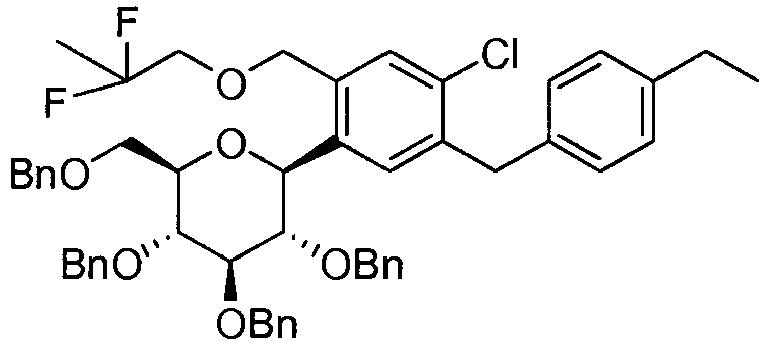
- To a solution of 1-(5-chloro-4-(4-ethylbenzyl)-2-((2S,3S,4R,5R,6R)-3,4,5-tris(benzyloxy)-6-(benzyloxymethyl)tetrahydro-2H-pyran-2-yl)benzyloxy)propan-2-one (intermediate T-1) (60 mg, 0.07 mmol) in 6 mL of CH2Cl2 at -78°C, was added dropwise DAST (1.22 mL, 0.18 mmol). The resulting solution was slowly warmed to room temperature and stirred for 3h. The reaction was quenched by addition of MeOH (2 mL), the solution was evaporated to dryness, and the residue was purified by preparative TLC to obtain (2R,3R,4R,5S,6S)-3,4,5-tris(benzyloxy)-2-(benzyloxymethyl)-6-(4-chloro-2-((2,2-difluoropropoxy)methyl)-5-(4-ethylbenzyl)phenyl)tetrahydro-2H-pyran (intermediate CA) (42 mg, 0.048 mmol, yield 68.1%).
-

- Compound CB was prepared from intermediate CA by debenzylation using methods analogous to those described in Example 6 above. 1H-NMR (DMSO-d6, 300 MHz) δ 7.46 (s, 1H), 7.41 (s, 1H), 7.08 (s, 4H), 4.80 (s, 1H), 4.62 (m, 2H), 4.45 (m, 1H), 4.06 (m, 2H), 3.83 (s, 1H), 3.67 (t, J = 12.3 Hz, 2H), 3.40 (m, 4H), 2.58 (dd, J= 7.8 Hz, 2H), 1.64 (t, J = 18.4 Hz, 3H), 1.18 (t, J= 7.8 Hz, 3H); MS (m/z) (ESI)+ 518 [M+18]+, (ESI)- 545 [M+45]-.
-

- To a stirred solution of (2R,3R,4R,5S,6S)-2-(acetoxymethyl)-6-(4-chloro-5-(4-ethoxybenzyl)-2-((prop-2-ynyloxy)methyl)phenyl)tetrahydro-2H-pyran-3,4,5-triyl triacetate (prepared using methods analogous to those in Example 1 and Example 5 above, 251 mg, 0.39 mmol) in THF:MeOH:H2O (2:3:1, 6.0 mL) at 15°C, was added LiOH·H2O (19.7 mg, 0.47 mmol). After stirring for 12 h at room temperature, the reaction was complete, as indicated by HPLC. The reaction mixture was concentrated and the residue was dissolved in 20 mL of ethyl acetate. The organic layer was washed with brine (20 mL), 5% KHSO4 in brine (20 mL), dried over anhydrous sodium sulfate, evaporated, and the residue was purified by preparative TLC (PE:EtOAc:MeOH = 8:80:1, Rf= 0.45) to obtain 156 mg of title compound as a white solid (yield 84%; purity 99.2%, as determined by HPLC). 1H-NMR (CD3OD, 400 MHz) δ 7.48 (s, 1H), 7.42 (s, 1H), 7.11 (s, 4H), 4.86 (d, J=12.4 Hz, 1H), 4.60 (d, J=12.4 Hz, 1H), 4.52 (d, J=9.2 Hz, 1H), 4.20 (s, 2H), 4.12 (d, J=14.8 Hz, 1H), 4.06 (d, J=14.8 Hz, 1H), 3.98 (q, J=6.8 Hz, 2H), 3.86 (d, J=12.4 Hz, 1H), 3.70-3.66 (m, 1H), 3.52-3.41 (m, 4H), 2.63 (s, 1H),1.36 (t, J=6.8Hz, 3H); LC-MS (m/z) 477 [(M+I)+], 521 [(M+45)-].
-

- To a stirred solution of (2R,3R,4R,5S,6S)-2-(acetoxymethyl)-6-(4-chloro-5-(4- ethoxybenzyl)-2-((prop-2-ynyloxy)methyl)phenyl)tetrahydro-2H-pyran-3,4,5-triyl triacetate (prepared using methods analogous to those in Example I and Example 5 above,
- 251 mg, 0.39 mmol) in THF:MeOH:H2O (2:3:1, 6.0 mL) at 15°C, was added LiOH-H2O (16.4 mg, 0.39 mmol). After stirring for 5 h at room temperature, the reaction was complete, as indicated by HPLC. The reaction mixture was concentrated and the residue was dissolved in 20 mL of ethyl acetate. The organic layer was washed with brine (20 mL), 5% KHSO4 in brine (20 mL), dried over anhydrous sodium sulfate, evaporated, and the residue was purified by preparative TLC (PE:EtOAc:MeOH = 8:80:1, Rf= 0.45) to afford 160 mg of title compound as a white solid (yield 79.2%; purity 99.1%, as determined by HPLC). 1H-NMR (CD3OD, 400 MHz) δ 7.48 (s, 1H), 7.40 (s, 1H), 7.12 (s, 4H), 4.85 (d, J=12.0 Hz, 1H), 4.62 (d, J=12.0 Hz, 1H), 4.51(d, J=9.2 Hz, 1H), 4.23 (s, 2H), 4.10 (d, J=14.8 Hz, 1H), 4.05 (d, J=14.8 Hz, 1H), 3.96 (q, J=6.8 Hz, 2H), 3.88 (d, J=12.4 Hz, 1H), 3.71-3.67 (m, 1H), 3.52-3.41 (m, 4H), 2.94 (s, 1H), 2.15 (s, 3H), 1.34 (t, J=6.8 Hz, 3H); LC-MS (m/z) 519 [(M+1)+], 563 [(M+45)-].
- The SGLT inhibitory effects of the compounds of the present invention were demonstrated by the following procedures.
- A full-length cDNA clone expressing human SGLT2 (GenScript Corporation) was subcloned into Hind III and Not I sites of pEAK15 expression vector. Clones harboring the cDNA inserts were identified by restriction analysis.
- Plasmid containing human SGLT2 was linearized with Nsi I and purified by agarose gel electrophoresis. Using Lipofectamine 2000 Transfection Reagent (Invitrogen Corporation), DNA was transfected into HEK293.ETN cells and cultured in Dulbecco's Modified Eagle Medium (DMEM) containing 10% fetal bovine serum (FBS) at 37°C under 5% CO2 for 24 h. Transfectants were selected in the same growth medium supplemented with puromycin (Invitrogen Corporation) for two weeks. Puromycin-resistant cells were recovered and seeded on a fresh 96-well plate (single cell per well) and cultured in the presence of puromycin until cells became confluent. Puromycin-resistant clones were evaluated for SGLT2 activity in the methyl-α-D-[U-14C]glucopyranoside uptake assay described below. The clone that exhibited the highest signal-to-background ratio was used for the methyl-α-D-[U-14C]glucopyranoside uptake assay.
- Full-length human SGLT1 cDNA on pDream2.1 expression vector was obtained from GenScript Corporation and propagated in Escherichia coli strain DH5α using Luria-Bertani (LB) medium containing ampicillin. Plasmid DNA was isolated using the QIAGEN Plasmid Midi Kit (QIAGEN Inc.). Human SGLT1 expression plasmid DNA was transfected into COS-7 cells (American Type Culture Collection) using Lipofectamine 2000 Transfection Reagent according to a manufacturer suggested protocol. Transfected cells were stored in DMEM containing 10% dimethyl sulfoxide (DMSO) at -80°C.
- Cells expressing SGLT1 or SGLT2 were seeded on 96-well ScintiPlate scintillating plates (PerkinElmer, Inc.) in DMEM containing 10% FBS (1x10⁵ cells per well in 100 µL medium) incubated at 37°C under 5% CO2 for 48 h prior to the assay. Cells were washed twice with 150 µL of either sodium buffer (137 mM NaCl, 5.4 mM KCl, 2.8 mM CaCl2, 1.2 mM MgCl2, 10 mM tris(hydroxymethyl)aminomethane/N-2-hydroxyethylpiperazine-N'-ethanesulfonic acid [Tris/Hepes], pH 7.2) or sodium-free buffer (137 mM N-methylglucamine, 5.4 mM KCl, 2.8 mM CaCl2, 1.2 mM MgCl2, 10 mM Tris/Hepes, pH 7.2). Test compound in 50 µL each of sodium or sodium-free buffer containing 40 µCi/mL methyl-α-D-[U-14C]glucopyranoside (Amersham Biosciences/GE Healthcare), either with (symbols in parentheses) or without (symbols without parentheses) 25% human serum, was added per well of a 96-well plate and incubated at 37°C with shaking for either 2 h (SGLT1 assay) or 1.5 h (SGLT2 assay). Cells were washed twice with 150 µL of wash buffer (137 mM N-methylglucamine, 10 mM Tris/Hepes, pH 7.2) and methyl-α-D-[U-14C]glucopyranoside uptake was quantitated using a TopCount scintillation counter (PerkinElmer, Inc.). Sodium-dependent glucopyranoside uptake was measured by subtracting the values obtained with sodium-free buffer from those obtained using sodium buffer (average of triplicate determinations).
Table 1 IC50* Compound SGLT2 SGLT1 I + +++ K + +++ L + +++ M + +++ N + +++ O + ++ R + +++ S + +++ T + ++ W + +++ AD + +++ AG + ++ AH + ++ AI + +++ AK + +++ AL + +++ AM + +++ AN + ++ AO + +++ AW + +++ AX (+) (+++) AY + +++ AZ + +++ BA (+) (+++) BB (+) (+++) BC (+) (+++) BD + +++ BF (+) (+++) BG (+) (+++) BH (+) (++) BO (+) (+++) BQ (+) (+++) BS (+) (+++) BZ + +++ CB + +++ CC (+) (+++) CD (+) (+++) *Key: ( ) indicates incubation with 25% human serum + <1 µM ++ 1 µM to 10 µM +++ > 10 µM
Claims (12)
- A compound having the formula:
 V is oxygen or a single bond; W is C1-C6 alkylene; X is oxygen or sulfur; Y is a member selected from the group consisting of C1-C6 haloalkyl, C1-C6 hydroxyalkyl, C2-C6 alkenyl, C2-C6 alkynyl, C3-C10 cycloalkyl, C5-C10 cycloalkenyl, (C1-C4 alkyloxy)C1-C3 alkyl, (C2-C4 alkenyloxy)C1-C3 alkyl and (C3-C10 cycloalkyloxy)C1-C3 alkyl; wherein alkyl, alkenyl, alkynyl, cycloalkyl and cycloalkenyl groups or portions of Y are optionally partly or completely fluorinated and are optionally mono- or disubstituted by identical or different substituents selected from chlorine, hydroxy, C1-C3 alkyl and C1-C3 alkoxy, and in cycloalkyl and cycloalkenyl groups or portions ofY, one or two methylene groups are optionally replaced independently of one another by O, S, CO, SO, SO2 or NRb, and one or two methyne groups are optionally replaced by N, wherein the heterocycle formed by said optional replacement is other than heteroaryl;R1 is selected from the group consisting of hydrogen, halo, C1-C6 alkyl and C3-C10 cycloalkyl;R3 is selected from the group consisting of hydrogen, halo, hydroxy, C1-C6 alkyl, C1-C6 alkyloxy, C2-C6 alkenyl, C2-C6 alkynyl, C3-C10 cycloalkyl and C3-C10 cycloalkyloxy, wherein alkyl and cycloalkyl groups or portions of R3 are optionally partly or completely fluorinated, and in cycloalkyl groups of R3 a methylene group is optionally replaced by O, S, CO, SO or SO2; andeach Rb is a member independently selected from the group consisting of H, C1-C4 alkyl and (C1-C4 alkyl)carbonyl, wherein alkyl groups or portions of Rb are optionally partly or completely fluorinated;or a pharmaceutically acceptable salt thereof.
 - A compound of claim 1, having the formula:
 V is oxygen or a single bond; W is C1-C6 alkylene; X is oxygen or sulfur; Y is a member selected from the group consisting of C1-C6 haloalkyl, C1-C6 hydroxyalkyl, C2-C6 alkenyl, C2-C6 alkynyl, C3-C10 cycloalkyl, (C1-C4 alkyloxy)C1-C3 alkyl, (C2-C4 alkenyloxy)C1-C3 alkyl and (C3-C10 cycloalkyloxy)C1-C3 alkyl; wherein alkyl, alkenyl, alkynyl and cycloalkyl groups or portions of Y are optionally partly or completely fluorinated and are optionally mono- or disubstituted by identical or different substituents selected from chlorine, hydroxy, C1-C3 alkyl and C1-C3 alkoxy, and in cycloalkyl groups or portions of Y, one or two methylene groups are optionally replaced independently of one another by O, S, CO or NRb; andR3 is selected from the group consisting of ethyl, ethenyl, ethynyl and ethoxy.
 - A compound of claim 2, selected from the group consisting of:(2S, 3R,4R,5S,6R)-2-(2-(allyloxymethyl)-4-chloro-5-(4-ethylbenzyl)phenyl)-6-(hydroxymethyl)tetrahydro-2H-pyran-3,4,5-triol;(2S,3R,4R,5S,6R)-2-(2-(2-(allyloxy)ethyl)-4-chloro-5-(4-ethylbenzyl)phenyl)-6-(hydroxymethyl)tetrahydro-2H-pyran-3,4,5-triol;(2S,3R,4R,5S,6R)-2-(4-chloro-5-(4-ethylbenzyl)-2-(2-(2-fluoroethoxy)ethyl)phenyl)-6-(hydroxymethyl)tetrahydro-2H-pyran-3,4,5-triol;(2S,3R,4R,5S,6R)-2-(4-chloro-5-(4-ethylbenzyl)-2-(2-(prop-2-ynyloxy)ethyl)phenyl)-6-(hydroxymethyl)tetrahydro-2H-pyran-3,4,5-triol;(2S,3R,4R,5S,6R)-2-(2-(2-(but-2-ynyloxy)ethyl)-4-chloro-5-(4-ethylbenzyl)phenyl)-6-(hydroxymethyl)tetrahydro-2H-pyran-3,4,5-triol;(2S,3R,4R,5S,6R)-2-(4-chloro-5-(4-ethoxybenzyl)-2-(2-(prop-2-ynyloxy)ethyl)phenyl)-6-(hydroxymethyl)tetrahydro-2H-pyran-3,4,5-triol;(2S,3R,4R,5S,6R)-2-(2-(2-(allyloxy)ethoxy)-4-chloro-5-(4-ethylbenzyl)phenyl)-6-(hydroxymethyl)tetrahydro-2H-pyran-3,4,5-triol;(2S,3R,4R,5S,6R)-2-(4-chloro-5-(4-ethylbenzyl)-2-(2-(prop-2-ynyloxy)ethoxy)phenyl)-6-(hydroxymethyl)tetrahydro-2H-pyran-3,4,5-triol;(2S,3R,4R,5S,6R)-2-(2-(3-(but-2-ynyloxy)propyl)-4-chloro-5-(4-ethoxybenzyl)phenyl)-6-(hydroxymethyl)tetrahydro-2H-pyran-3,4,5-triol; and(2S,3R,4R,5S,6R)-2-(4-chloro-5-(4-ethylbenzyl)-2-(2-(2,2,2-trifluoroethoxy)ethoxy)phenyl)-6-(hydroxymethyl)tetrahydro-2H-pyran-3,4,5-triol;or a pharmaceutically acceptable salt thereof.
- A compound selected from the group consisting of:(2S, 3R,4R,5S,6R)-2-(2-(allyloxymethyl)-4-chloro-5-(4-ethylbenzyl)phenyl)-6-(hydroxymethyl)tetrahydro-2H-pyran-3,4,5-triol;1-((5-chloro-4-(4-ethylbenzyl)-2-((2S,3R,4R,5S,6R)-3,4,5-trihydroxy-6-(hydroxymethyl)tetrahydro-2H-pyran-2-yl)benzyloxy)propan-2-one;(2S,3R,4R,5S,6R)-2-(4-chloro-2-((2,3-dihydroxypropoxy)methyl)-5-(4-ethylbenzyl)phenyl)-6-(hydroxymethyl)tetrahydro-2H-pyran-3,4,5-triol;(2S,3R,4R,5S,6R)-2-(4-chloro-5-(4-ethylbenzyl)-2-((2-hydroxypropoxy)methyl)phenyl)-6-(hydroxymethyl)tetrahydro-2H-pyran-3,4,5-triol;(2S,3R,4R,5S,6R)-2-(4-chloro-5-(4-ethylbenzyl)-2-((prop-2-ynytoxy)methyl)phenyl)-6-(hydroxymethyl)tetrahydro-2H-pyran-3,4,5-triol;(2S,3R,4R,5S,6R)-2-(4-chloro-5-(4-ethylbenzyl)-2-((2-hydroxyethoxy)methyl)phenyl)-6-(hydroxymethyl)tetrahydro-2H-pyran-3,4,5-triol;(2S,3R,4R,5S,6R)-2-(4-chloro-2-((2,2-difluoroethoxy)methyl)-5-(4-ethylbenzyl)phenyl)-6-(hydroxymethyl)tetrahydro-2H-pyran-3,4,5-triol;(2S,3R,4R,5S,6R)-2-(4-chloro-5-(4-ethylbenzyl)-2-((2-methoxyethoxy)methyl)phenyl)-6-(hydroxymethyl)tetrahydro-2H-pyran-3,4,5-triol;(2S,3R,4R,5S,6R)-2-(4-chloro-5-(4-ethylbenzyl)-2-((2-fluoropropoxy)methyl)phenyl)-6-(hydroxymethyl)tetrahydro-2H-pyran-3,4,5-triol;(2S,3R,4R,5S,6R)-2-(4-chloro-5-(4-ethylbenzyl)-2-((2-hydroxy-3-methoxypropoxy)methyl)phenyl)-6-(hydroxymethyl)tetrahydro-2H-pyran-3,4, 5-triol;(2S,3R,4R,5S,6R)-2-(2-(2-(allyloxy)ethyl)-4-chloro-5-(4-ethylbenzyl)phenyl)-6-(hydroxymethyl)tetrahydro-2H-pyran-3,4,5-triol;(2S,3R,4R,5S,6R)-2-(4-chloro-5-(4-ethylbenzyl)-2-(2-(2-hydroxyethoxy)ethyl)phenyl)-6-(hydroxymethyl)tetrahydro-2H-pyran-3,4,5-triol;(2S,3R,4R,5S,6R)-2-(4-chloro-5-(4-ethylbenzyl)-2-(2-(2-fluoroethoxy)ethyl)phenyl)-6-(hydroxymethyl)tetrahydro-2H-pyran-3,4,5-triol;(2S,3R,4R,5S,6R)-2-(4-chloro-2-(2-(2,2-difluoroethoxy)ethyl)-5-(4-ethylbenzyl)phenyl)-6-(hydroxymethyl)tetrahydro-2H-pyran-3,4,5-triol;(2S,3R,4R,5S,6R)-2-(4-chloro-5-(4-ethylbenzyl)-2-(2-(2,2,2-trifluoroethoxy)ethyl)phenyl)-6-(hydroxymethyl)tetrahydro-2H-pyran-3,4,5-triol;(2S,3R,4R,5S,6R)-2-(4-chloro-5-(4-ethylbenzyl)-2-((3-hydroxypropoxy)methyl)phenyl)-6-(hydroxymethyl)tetrahydro-2H-pyran-3,4,5-triol;(2S,3R,4R,5S,6R)-2-(4-chloro-5-(4-ethylbenzyl)-2-(2-(prop-2-ynyloxy)ethyl)phenyl)-6-(hydroxymethyl)tetrahydro-2H-pyran-3,4,5-triol;(2S,3R,4R,5S,6R)-2-(2-(2-(but-2-ynyloxy)ethyl)-4-chloro-5-(4-ethylbenzyl)phenyl)-6-(hydroxymethyl)tetrahydro-2H-pyran-3,4,5-triol;(2S,3R,4R,5S,6R)-2-(4-chloro-5-(4-ethoxybenzyl)-2-(2-(prop-2-ynyloxy)ethyl)phenyl)-6-(hydroxymethyl)tetrahydro-2H-pyran-3,4,5-triol;(2S,3R,4R,5S,6R)-2-(2-(2-(allyloxy)ethoxy)-4-chloro-5-(4-ethylbenzyl)phenyl)-6-(hydroxymethyl)tetrahydro-2H-pyran-3,4,5-triol;(2S,3R,4R,5S,6R)-2-(2-((but-2-ynyloxy)methyl)-4-chloro-5-(4-ethylbenzyl)phenyl)-6-(hydroxymethyl)tetrahydro-2H-pyran-3,4,5-triol;(2S,3R,4R,5S,6R)-2-(2-((but-2-ynyloxy)methyl)-4-chloro-5-(4-ethoxybenzyl)phenyl)-6-(hydroxymethyl)tetrahydro-2H-pyran-3,4,5-triol;(2S,3R,4R,5S,6R)-2-(2-(allyloxymethyl)-4-chloro-5-(4-ethoxybenzyl)phenyl)-6-(hydroxymethyl)tetrahydro-2H-pyran-3,4,5-triol;(2S,3R,4R,5S,6R)-2-(2-((but-2-ynyloxy)methyl)-4-chloro-5-(4-methoxybenzyl)phenyl)-6-(hydroxymethyl)tetrahydro-2H-pyran-3,4,5-triol;(2S,3R,4R,5S,6R)-2-(5-(4-(allyloxy)benzyl)-2-(allyloxymethyl)-4-chlorophenyl)-6-(hydroxymethyl)tetrahydro-2H-pyran-3,4,5-triol;(2S,3R,4R,5S,6R)-2-(2-((but-2-ynyloxy)methyl)-4-chloro-5-(4-hydroxybenzyl)phenyl)-6-(hydroxymethyl)tetrahydro-2H-pyran-3,4,5-triol;((2R,3S,4R,5R,6S)-6-(4-chloro-5-(4-ethylbenzyl)-2-((prop-2-ynyloxy)methyl)phenyl)-3,4,5-trihydroxytetrahydro-2H-pyran-2-yl)methyl acetate;(2S,3R,4R,5S,6R)-2-(4-chloro-5-(4-ethylbenzyl)-2-(2-(prop-2-ynyloxy)ethoxy)phenyl)-6-(hydroxymethyl)tetrahydro-2H-pyran-3,4,5-triol;(2S,3R,4R,5S,6R)-2-(2-(2-(but-2-ynyloxy)ethoxy)-4-chloro-5-(4-ethylbenzyl)phenyl)-6-(hydroxymethyl)tetrahydro-2H-pyran-3,4,5-triol;(2S,3R,4R,5S,6R)-2-(4-chloro-2-(2-(cyclopentyloxy)ethoxy)-5-(4-ethylbenzyl)phenyl)-6-(hydroxymethyl)tetrahydro-2H-pyran-3,4,5-triol;(2S,3R,4R,5S,6R)-2-(4-chloro-5-(4-ethoxybenzyl)-2-(2-(2-fluoroethoxy)ethyl)phenyl)-6-(hydroxymethyl)tetrahydro-2H-pyran-3,4,5-triol;(2S,3R,4R,5S,6R)-2-(2-(3-(but-2-ynyloxy)propyl)-4-chloro-5-(4-ethoxybenzyl)phenyl)-6-(hydroxymethyl)tetrahydro-2H-pyran-3,4,5-triol;(2S,3R,4R,5S,6R)-2-(4-chloro-5-(4-ethylbenzyl)-2-(2-(trifluoromethoxy)ethoxy)phenyl)-6-(hydroxymethyl)tetrahydro-2H-pyran-3,4,5-triol;(2S,3R,4R,5S,6R)-2-(4-chloro-5-(4-ethylbenzyl)-2-(2-(2,2,2-trifluoroethoxy)ethoxy)phenyl)-6-(hydroxymethyl)tetrahydro-2H-pyran-3,4,5-triol;(2S,3R,4R,5S,6R)-2-(2-((but-3-ynyloxy)methyl)-4-chloro-5-(4-ethylbenzyl)phenyl)-6-(hydroxymethyl)tetrahydro-2H-pyran-3,4,5-triol;(2S,3R,4R,5S,6R)-2-(4-chloro-5-(4-ethylbenzyl)-2-((2-fluoroethoxy)methyl)phenyl)-6-(hydroxymethyl)tetrahydro-2H-pyran-3,4,5-triol;(2S,3R,4R,5S,6R)-2-(4-chloro-2-((2,2-difluoropropoxy)methyl)-5-(4-ethylbenzyl)phenyl)-6-(hydroxymethyl)tetrahydro-2H-pyran-3,4,5-triol;(2S,3R,4R,5S,6R)-2-(4-chloro-5-(4-ethoxybenzyl)-2-((prop-2-ynyloxy)methyl)phenyl)-6-(hydroxymethyl)tetrahydro-2H-pyran-3,4,5-triol; and((2R,3S,4R,5R,6S)-6-(4-chloro-5-(4-ethoxybenzyl)-2-((prop-2-ynyloxy)methyl)phenyl)-3,4,5-trihydroxytetrahydro-2H-pyran-2-yl)methyl acetate;or a pharmaceutically acceptable salt thereof
- A compound according to any preceding claim, which is isotopically labeled.
- A pharmaceutical composition comprising a pharmaceutically acceptable excipient and a compound according to any one of claims 1 to 5 or a pharmaceutically acceptable salt thereof.
- A pharmaceutical combination comprising a compound of any one of claims 1 to 5 or a pharmaceutically acceptable salt thereof, and at least one therapeutic agent selected from the group consisting of an antidiabetic agent, a lipid-lowering/lipid-modulating agent, an agent for treating diabetic complications, an anti-obesity agent, an antihypertensive agent, an antihyperuricemic agent, and an agent for treating chronic heart failure, atherosclerosis or related disorders.
- The pharmaceutical combination of claim 7, wherein the therapeutic agent is at least one antidiabetic agent.
- The pharmaceutical combination of claim 7, wherein(a) the antidiabetic agent is selected from the group consisting of insulin, a sulfonylurea, an insulin secretion enhancer, a biguanide, a sulfonylurea/biguanide combination, a meglitinide, a thiazolidinedione, a thiazolidinedione/biguanide combination, an oxadiazolidinedione, a PPAR-gamma agonist, a PPAR-alpha/gamma dual agonist, a PPAR-alpha/gamma/delta pan agonist, a retinoid X receptor agonist, an alpha-glucosidase inhibitor, a stimulant of insulin receptor tyrosine kinase, a tripeptidyl peptidase II inhibitor, a dipeptidyl peptidase IV inhibitor, a protein tyrosine phosphatase-1B inhibitor, a glycogen phosphorylase inhibitor, a glucose-6-phosphatase inhibitor, a fructose 1,6-bisphosphatase inhibitor, a pyruvate dehydrogenase inhibitor, an imidazoline derivative, a hepatic gluconeogenesis inhibitor, D-chiroinositol, a glycogen synthase kinase-3 inhibitor, an incretin mimetic, a glucagon receptor antagonist, GLP-1, a GLP-1 analog, a GLP-1 receptor agonist, amylin, an amylin analog or agonist, an aP2 inhibitor, a beta-3 adrenergic receptor agonist and an insulin sensitivity enhancer;(b) the antidiabetic agent is selected from the group consisting of insulin, metformin, glyburide, glimepiride, glipyride, glipizide, chlorpropamide, gliclazide, acarbose, miglitol, pioglitazone, rosiglitazone, isaglitazone, netoglitazone, rivoglitazone, repaglinide, nateglinide, exenatide, muraglitazar, naveglitazar, tesaglitazar, peliglitazar, farglitazar, metaglidasen, sitagliptin, vildagliptin, denagliptin, saxagliptin, solabegron and pramlintide;(c) the therapeutic agent is at least one anti-obesity agent selected from the group consisting of a serotonin-norepinephrine reuptake inhibitor, a norepinephrine-dopamine reuptake inhibitor, a selective serotonin reuptake inhibitor, a selective norepinephrine reuptake inhibitor, a norepinephrine releasing stimulant, an anorexiant, a dopamine agonist, an H3-histamine antagonist, a 5-HT2c receptor agonist, a beta-3 adrenergic receptor agonist, a cholecystokinin agonist, a lipase inhibitor, an antidepressant/acetylcholinesterase inhibitor combination, an anti-epileptic agent, leptin, a leptin analog or leptin receptor agonist, an NPY receptor antagonist or modulator, ciliary neurotrophic factor, a thyroid hormone receptor-beta agonist, a cannabinoid CB1 receptor antagonist, a melanin-concentrating hormone receptor antagonist, a melanocortin-4 receptor agonist and a selective muscarinic receptor M1 antagonist;(d) the anti-obesity agent is at least one agent selected from the group consisting of rimonabant, orlistat, sibutramine, topiramate, zonisamide, dextroamphetamine, phentermine, phenylpropanolamine, diethylpropion, mazindol, doprexin and Axokine;(e) the therapeutic agent is at least one lipid-lowering/lipid-modulating agent selected from the group consisting of a hydroxymethylglutaryl coenzyme A reductase inhibitor, a fibric acid derivative, a PPAR-alpha agonist, a PPAR-delta agonist, an acyl-coenzyme A:cholesterol acyltransferase inhibitor, probucol, a thyroid hormone receptor agonist, a cholesterol absorption inhibitor, a lipase inhibitor, a lipoprotein-associated phospholipase A2 inhibitor, a microsomal triglyceride transfer protein inhibitor, a low density lipoprotein receptor activator, a lipoxygenase inhibitor, a carnitine palmitoyl-transferase inhibitor, a squalene synthase inhibitor, a nicotinic acid derivative, a bile acid sequestrant, a sodium/bile acid cotransporter inhibitor, and a cholesterol ester transfer protein inhibitor; or(f) the lipid-lowering/lipid-modulating agent is at least one agent selected from the group consisting of pravastatin, lovastatin, simvastatin, atorvastatin, cerivastatin, fluvastatin, nisvastatin, visastatin, atavastatin, rosuvastatin, colestipol, cholestyramine, colestilan, colesevelam, fenofibrate, gemfibrozil, clofibrate, avasimibe, eflucimibe, eldacimibe, lecimibide, liothyronine, levothyroxine, rilapladib, darapladib, etomoxir, acipimox and torcetrapib.
- A compound according to any one of claims 1 to 5 for use in a method for treating type 1 or type 2 diabetes mellitus, hyperglycemia, diabetic complications, insulin resistance, metabolic syndrome, hyperinsulinemia, hypertension, hyperuricemia, obesity, edema, dyslipidemia, chronic heart failure, atherosclerosis or related diseases.
- The compound for use according to claim 10 in method for treating type 1 or type 2 diabetes mellitus.
- The compound for use according to claim 10, wherein the compound is administered concurrently or sequentially, with at least one additional therapeutic agent selected from the group consisting of an antidiabetic agent, a lipid-lowering/lipid-modulating agent, an agent for treating diabetic complications, an anti-obesity agent, an antihypertensive agent, an antihyperuricemic agent, and an agent for treating chronic heart failure, atherosclerosis or related disorders.
Applications Claiming Priority (2)
| Application Number | Priority Date | Filing Date | Title |
|---|---|---|---|
| US90967207P | 2007-04-02 | 2007-04-02 | |
| PCT/US2008/059047 WO2008122014A1 (en) | 2007-04-02 | 2008-04-01 | Benzylic glycoside derivatives and methods of use |
Publications (3)
| Publication Number | Publication Date |
|---|---|
| EP2064222A1 EP2064222A1 (en) | 2009-06-03 |
| EP2064222A4 EP2064222A4 (en) | 2011-12-14 |
| EP2064222B1 true EP2064222B1 (en) | 2014-05-07 |
Family
ID=39795470
Family Applications (1)
| Application Number | Title | Priority Date | Filing Date |
|---|---|---|---|
| EP08744883.3A Active EP2064222B1 (en) | 2007-04-02 | 2008-04-01 | Benzylic glycoside derivatives and methods of use |
Country Status (16)
| Country | Link |
|---|---|
| US (1) | US7838498B2 (en) |
| EP (1) | EP2064222B1 (en) |
| JP (1) | JP5583003B2 (en) |
| KR (1) | KR101506935B1 (en) |
| CN (2) | CN104803957A (en) |
| AR (2) | AR065913A1 (en) |
| AU (1) | AU2008232419B2 (en) |
| BR (1) | BRPI0809607A2 (en) |
| CA (1) | CA2682202C (en) |
| DK (1) | DK2064222T3 (en) |
| ES (1) | ES2466672T3 (en) |
| HK (1) | HK1212982A1 (en) |
| IL (1) | IL201065A (en) |
| RU (1) | RU2492175C2 (en) |
| TW (1) | TWI405575B (en) |
| WO (1) | WO2008122014A1 (en) |
Families Citing this family (37)
| Publication number | Priority date | Publication date | Assignee | Title |
|---|---|---|---|---|
| AR051446A1 (en) * | 2004-09-23 | 2007-01-17 | Bristol Myers Squibb Co | C-ARYL GLUCOSIDS AS SELECTIVE INHIBITORS OF GLUCOSE CONVEYORS (SGLT2) |
| UA101004C2 (en) * | 2007-12-13 | 2013-02-25 | Теракос, Инк. | Derivatives of benzylphenylcyclohexane and use thereof |
| WO2009097995A1 (en) * | 2008-02-07 | 2009-08-13 | Sanofi-Aventis | Novel phenyl-substituted imidazolidines, method for the production thereof, medicaments containing said compounds and use thereof |
| WO2010009243A1 (en) * | 2008-07-15 | 2010-01-21 | Theracos, Inc. | Deuterated benzylbenzene derivatives and methods of use |
| PT2324002T (en) * | 2008-08-22 | 2016-11-09 | Theracos Sub Llc | Processes for the preparation of sglt2 inhibitors |
| US8778998B2 (en) * | 2009-04-10 | 2014-07-15 | Auspex Pharmaceuticals, Inc. | Biphenyl-3-carboxylic acid modulators of beta-3-adrenoreceptor |
| WO2011070592A2 (en) | 2009-12-09 | 2011-06-16 | Panacea Biotec Ltd. | Novel sugar derivatives |
| US20110160143A1 (en) * | 2009-12-28 | 2011-06-30 | Perricone Nicholas V | Topical Acyl Glutathione Psoriasis Compositions |
| CN102134226B (en) * | 2010-01-26 | 2013-06-12 | 天津药物研究院 | Phenyl C-glucoside derivatives, preparation method and use thereof |
| WO2011107494A1 (en) | 2010-03-03 | 2011-09-09 | Sanofi | Novel aromatic glycoside derivatives, medicaments containing said compounds, and the use thereof |
| WO2011153712A1 (en) | 2010-06-12 | 2011-12-15 | Theracos, Inc. | Crystalline form of benzylbenzene sglt2 inhibitor |
| US8933024B2 (en) | 2010-06-18 | 2015-01-13 | Sanofi | Azolopyridin-3-one derivatives as inhibitors of lipases and phospholipases |
| US8530413B2 (en) | 2010-06-21 | 2013-09-10 | Sanofi | Heterocyclically substituted methoxyphenyl derivatives with an oxo group, processes for preparation thereof and use thereof as medicaments |
| TW201221505A (en) | 2010-07-05 | 2012-06-01 | Sanofi Sa | Aryloxyalkylene-substituted hydroxyphenylhexynoic acids, process for preparation thereof and use thereof as a medicament |
| TW201215387A (en) | 2010-07-05 | 2012-04-16 | Sanofi Aventis | Spirocyclically substituted 1,3-propane dioxide derivatives, processes for preparation thereof and use thereof as a medicament |
| TW201215388A (en) | 2010-07-05 | 2012-04-16 | Sanofi Sa | (2-aryloxyacetylamino)phenylpropionic acid derivatives, processes for preparation thereof and use thereof as medicaments |
| US9907767B2 (en) | 2010-08-03 | 2018-03-06 | Velicept Therapeutics, Inc. | Pharmaceutical compositions and the treatment of overactive bladder |
| WO2012025857A1 (en) | 2010-08-23 | 2012-03-01 | Hetero Research Foundation | Cycloalkyl methoxybenzyl phenyl pyran derivatives as sodium dependent glucose co transporter (sglt2) inhibitors |
| AU2011296737A1 (en) | 2010-08-31 | 2013-04-11 | Snu R&Db Foundation | Use of the fetal reprogramming of a PPAR delta agonist |
| WO2012109996A1 (en) | 2011-02-18 | 2012-08-23 | 上海璎黎科技有限公司 | Aryl glycoside compound, preparation method and use thereof |
| CN102675378A (en) * | 2011-03-09 | 2012-09-19 | 天津药物研究院 | C-glucoside derivative containing cyclopropane structure and method and application of C- glucoside derivative |
| WO2013037390A1 (en) | 2011-09-12 | 2013-03-21 | Sanofi | 6-(4-hydroxy-phenyl)-3-styryl-1h-pyrazolo[3,4-b]pyridine-4-carboxylic acid amide derivatives as kinase inhibitors |
| EP2755722B1 (en) | 2011-09-13 | 2017-05-24 | Panacea Biotec Ltd. | Novel sglt inhibitors |
| WO2013045413A1 (en) | 2011-09-27 | 2013-04-04 | Sanofi | 6-(4-hydroxy-phenyl)-3-alkyl-1h-pyrazolo[3,4-b]pyridine-4-carboxylic acid amide derivatives as kinase inhibitors |
| WO2013152476A1 (en) | 2012-04-10 | 2013-10-17 | Theracos, Inc. | Process for the preparation of benzylbenzene sglt2 inhibitors |
| CN103910769B (en) | 2012-12-31 | 2018-10-02 | 上海璎黎药业有限公司 | The compound of glucosan derivative and proline, crystal, preparation method and application |
| US8652527B1 (en) | 2013-03-13 | 2014-02-18 | Upsher-Smith Laboratories, Inc | Extended-release topiramate capsules |
| US9101545B2 (en) | 2013-03-15 | 2015-08-11 | Upsher-Smith Laboratories, Inc. | Extended-release topiramate capsules |
| CN105611920B (en) | 2013-10-12 | 2021-07-16 | 泰拉科斯萨普有限责任公司 | Preparation of hydroxy-diphenylmethane derivatives |
| CN104387428A (en) * | 2014-12-09 | 2015-03-04 | 济南卡博唐生物科技有限公司 | Method for preparing 3,5,6-tri-oxy-benzyl-1,2-isopropylidene-D-glucose |
| CN104478967A (en) * | 2015-01-14 | 2015-04-01 | 佛山市赛维斯医药科技有限公司 | O-galactoside derivative with nitrile group benzene thiazolyl and preparation method and application thereof |
| US10065922B2 (en) | 2015-10-23 | 2018-09-04 | Velicept Therapeutics, Inc. | Solabegron zwitterion and uses thereof |
| CN105770861B (en) * | 2016-04-08 | 2020-02-28 | 吴一行 | Medicine for treating erectile dysfunction of male diabetic patient |
| JP7160821B2 (en) * | 2017-02-24 | 2022-10-25 | ドン-ア エスティ カンパニー リミテッド | Novel glucose derivatives that are SGLT-2 inhibitors |
| TWI805699B (en) * | 2018-03-01 | 2023-06-21 | 日商日本煙草產業股份有限公司 | Methyllactam ring compound and pharmaceutical use thereof |
| CN110551088B (en) * | 2018-06-01 | 2022-10-21 | 北京惠之衡生物科技有限公司 | Deuterium-modified benzyl-4-chlorophenyl C-glycoside derivatives |
| CN112294787B (en) * | 2020-11-17 | 2021-10-19 | 四川大学华西医院 | A combination drug for the treatment of liver cancer |
Family Cites Families (58)
| Publication number | Priority date | Publication date | Assignee | Title |
|---|---|---|---|---|
| US4933438A (en) | 1984-02-29 | 1990-06-12 | University Of Florida | Brain-specific analogues of centrally acting amines |
| US6150354A (en) | 1987-01-15 | 2000-11-21 | Bonnie Davis | Compounds for the treatment of Alzheimer's disease |
| US5133974A (en) | 1989-05-05 | 1992-07-28 | Kv Pharmaceutical Company | Extended release pharmaceutical formulations |
| AU668505B2 (en) * | 1991-03-18 | 1996-05-09 | Scripps Research Institute, The | Oligosaccharide enzyme substrates and inhibitors: methods and compositions |
| EP0584185B1 (en) | 1991-05-14 | 1999-08-11 | Ernir Snorrason | Treatment of fatigue syndrome with cholinesterase inhibitors |
| IT1250421B (en) | 1991-05-30 | 1995-04-07 | Recordati Chem Pharm | CONTROLLED RELEASE PHARMACEUTICAL COMPOSITION WITH BIO-ADHESIVE PROPERTIES. |
| US6537579B1 (en) | 1993-02-22 | 2003-03-25 | American Bioscience, Inc. | Compositions and methods for administration of pharmacologically active compounds |
| FR2710265B1 (en) | 1993-09-22 | 1995-10-20 | Adir | Bioadhesive pharmaceutical composition for the controlled release of active ingredients. |
| US6548084B2 (en) | 1995-07-20 | 2003-04-15 | Smithkline Beecham Plc | Controlled release compositions |
| US6245347B1 (en) | 1995-07-28 | 2001-06-12 | Zars, Inc. | Methods and apparatus for improved administration of pharmaceutically active compounds |
| DE19541260A1 (en) | 1995-11-06 | 1997-05-07 | Lohmann Therapie Syst Lts | Therapeutic preparation for transdermal application of active ingredients through the skin |
| US6512010B1 (en) | 1996-07-15 | 2003-01-28 | Alza Corporation | Formulations for the administration of fluoxetine |
| US6224036B1 (en) | 1997-01-17 | 2001-05-01 | Applied Power Inc. | Concrete reinforcement cable tensioner |
| EA002806B1 (en) | 1997-09-11 | 2002-10-31 | Нюкомед Данмарк А/С | Modified release multiple-units compositions of non-steroid anti-inflammatory drug substances (nsaid) |
| US6624200B2 (en) | 1998-08-25 | 2003-09-23 | Columbia Laboratories, Inc. | Bioadhesive progressive hydration tablets |
| US6607751B1 (en) | 1997-10-10 | 2003-08-19 | Intellipharamaceutics Corp. | Controlled release delivery device for pharmaceutical agents incorporating microbial polysaccharide gum |
| US6403597B1 (en) | 1997-10-28 | 2002-06-11 | Vivus, Inc. | Administration of phosphodiesterase inhibitors for the treatment of premature ejaculation |
| US6248864B1 (en) | 1997-12-31 | 2001-06-19 | Adherex Technologies, Inc. | Compounds and methods and modulating tissue permeability |
| US6613358B2 (en) | 1998-03-18 | 2003-09-02 | Theodore W. Randolph | Sustained-release composition including amorphous polymer |
| US6312717B1 (en) | 1998-07-07 | 2001-11-06 | Bristol-Myers Squibb Company | Method for treatment of anxiety and depression |
| US20020009478A1 (en) | 1998-08-24 | 2002-01-24 | Douglas Joseph Dobrozsi | Oral liquid mucoadhesive compositions |
| SE9802864D0 (en) | 1998-08-27 | 1998-08-27 | Pharmacia & Upjohn Ab | Transdermally administered tolterodine as an antimuscarinic agent for the treatment of overactive bladder |
| CN1406126A (en) | 1998-10-01 | 2003-03-26 | 诺瓦提斯公司 | New sustained release oral formulations |
| US6248363B1 (en) | 1999-11-23 | 2001-06-19 | Lipocine, Inc. | Solid carriers for improved delivery of active ingredients in pharmaceutical compositions |
| FR2792527B1 (en) | 1999-04-22 | 2004-08-13 | Ethypharm Lab Prod Ethiques | KETOPROFENE MICROGRANULES, PREPARATION METHOD AND PHARMACEUTICAL COMPOSITIONS |
| US6541020B1 (en) | 1999-07-09 | 2003-04-01 | Trimeris, Inc. | Methods and compositions for administration of therapeutic reagents |
| US6562375B1 (en) | 1999-08-04 | 2003-05-13 | Yamanouchi Pharmaceuticals, Co., Ltd. | Stable pharmaceutical composition for oral use |
| DE60036874T2 (en) | 1999-09-02 | 2008-06-26 | Nostrum Pharmaceuticals Inc. | PELLET FORMULATION WITH CONTROLLED RELEASE |
| US6544548B1 (en) | 1999-09-13 | 2003-04-08 | Keraplast Technologies, Ltd. | Keratin-based powders and hydrogel for pharmaceutical applications |
| PH12000002657B1 (en) * | 1999-10-12 | 2006-02-21 | Bristol Myers Squibb Co | C-aryl glucoside SGLT2 inhibitors |
| US6080736A (en) | 1999-10-27 | 2000-06-27 | Janus Pharmaceuticals, Inc. | Methods and compositions for treating and preventing anxiety and anxiety disorders using optically pure (R) tofisopam |
| US6461631B1 (en) | 1999-11-16 | 2002-10-08 | Atrix Laboratories, Inc. | Biodegradable polymer composition |
| US6482439B2 (en) | 1999-12-29 | 2002-11-19 | Nanodelivery, Inc. | Drug delivery system exhibiting permeability control |
| US6683056B2 (en) | 2000-03-30 | 2004-01-27 | Bristol-Myers Squibb Company | O-aryl glucoside SGLT2 inhibitors and method |
| US6589549B2 (en) | 2000-04-27 | 2003-07-08 | Macromed, Incorporated | Bioactive agent delivering system comprised of microparticles within a biodegradable to improve release profiles |
| US6524621B2 (en) | 2000-05-01 | 2003-02-25 | Aeropharm Technology Inc. | Core formulation |
| US6482440B2 (en) | 2000-09-21 | 2002-11-19 | Phase 2 Discovery, Inc. | Long acting antidepressant microparticles |
| US7022725B2 (en) * | 2000-11-17 | 2006-04-04 | Takeda Pharmaceutical Company Limited | Isoxazole derivatives |
| DE60106489T2 (en) * | 2000-12-20 | 2005-10-13 | Schering Corp. | SUGAR SUBSTITUTED 2-AZETIDINONE USE AS HYPOCHOLESTERDENIC DRUGS |
| US6524615B2 (en) | 2001-02-21 | 2003-02-25 | Kos Pharmaceuticals, Incorporated | Controlled release pharmaceutical composition |
| US6936590B2 (en) * | 2001-03-13 | 2005-08-30 | Bristol Myers Squibb Company | C-aryl glucoside SGLT2 inhibitors and method |
| US7375087B2 (en) | 2002-08-08 | 2008-05-20 | Kissei Pharmaceutical Co., Ltd. | Pyrazole derivative, medicinal composition containing the same, medicinal use thereof, and intermediate for production thereof |
| AU2003254903B9 (en) * | 2002-08-09 | 2008-08-21 | Taisho Pharmaceutical Co., Ltd. | Method for selective preparation of aryl 5-thio-beta-D-aldohexopyranosides |
| DE10258007B4 (en) * | 2002-12-12 | 2006-02-09 | Sanofi-Aventis Deutschland Gmbh | Aromatic fluoroglycoside derivatives, medicaments containing these compounds and methods for the preparation of these medicaments |
| CN1802366B (en) * | 2003-03-14 | 2010-12-22 | 安斯泰来制药有限公司 | C-glycoside derivatives and their salts |
| JP2004300102A (en) * | 2003-03-31 | 2004-10-28 | Kissei Pharmaceut Co Ltd | Condensed heterocyclic derivative, pharmaceutical composition containing the same and its pharmaceutical application |
| JP2004359630A (en) * | 2003-06-06 | 2004-12-24 | Yamanouchi Pharmaceut Co Ltd | Difluorodiphenylmethane derivatives and their salts |
| TW200524951A (en) * | 2003-08-01 | 2005-08-01 | Janssen Pharmaceutica Nv | Substituted benzimidazole-, benztriazole-, and benzimidazolone-O-glucosides |
| MXPA06001274A (en) * | 2003-08-01 | 2006-04-11 | Tanabe Seiyaku Co | NEW COMPOUNDS THAT HAVE INHIBITORY ACTIVITY AGAINST SODIUM-DEPENDENT CARRIER. |
| AU2004261660A1 (en) * | 2003-08-01 | 2005-02-10 | Janssen Pharmaceutica N.V. | Substituted fused heterocyclic C-glycosides |
| US7371732B2 (en) * | 2003-12-22 | 2008-05-13 | Boehringer Ingelheim International Gmbh | Glucopyranosyloxy-substituted aromatic compounds, medicaments containing such compounds, their use and process for their manufacture |
| WO2005085237A1 (en) | 2004-03-04 | 2005-09-15 | Kissei Pharmaceutical Co., Ltd. | Fused heterocycle derivative, medicinal composition containing the same, and medicinal use thereof |
| EP2360165A3 (en) * | 2004-03-16 | 2012-01-04 | Boehringer Ingelheim International GmbH | Glucopyranosyl-substituted benzene derivatives, medicaments containing such compounds, their use and process for their manufacture |
| DE102004012676A1 (en) * | 2004-03-16 | 2005-10-06 | Boehringer Ingelheim Pharma Gmbh & Co. Kg | New glucopyranosyl-substituted benzene derivatives are sodium-dependent glucose cotransporter inhibitors, useful for treating e.g. metabolic disorders (type 1 and type 2 diabetes mellitus or metabolic acidosis) |
| TW200606129A (en) * | 2004-07-26 | 2006-02-16 | Chugai Pharmaceutical Co Ltd | Novel cyclohexane derivative, its prodrug, its salt and diabetic therapeutic agent containing the same |
| WO2006064033A2 (en) * | 2004-12-16 | 2006-06-22 | Boehringer Ingelheim International Gmbh | Glucopyranosyl-substituted benzene derivatives, medicaments containing such compounds, their use and process for their manufacture |
| TW200637839A (en) | 2005-01-07 | 2006-11-01 | Taisho Pharmaceutical Co Ltd | 1-thio-d-glucitol derivatives |
| ATE453656T1 (en) | 2005-04-15 | 2010-01-15 | Boehringer Ingelheim Int | GLUCOPYRANOSYL-SUBSTITUTED (HETEROARYLOXY-BENZYL)-BENZENE DERIVATIVES AS SGLT INHIBITORS |
-
2008
- 2008-04-01 CN CN201510041214.8A patent/CN104803957A/en active Pending
- 2008-04-01 WO PCT/US2008/059047 patent/WO2008122014A1/en not_active Ceased
- 2008-04-01 US US12/060,767 patent/US7838498B2/en not_active Expired - Fee Related
- 2008-04-01 AU AU2008232419A patent/AU2008232419B2/en not_active Ceased
- 2008-04-01 KR KR1020097022926A patent/KR101506935B1/en not_active Expired - Fee Related
- 2008-04-01 CN CN200880011535A patent/CN101652377A/en active Pending
- 2008-04-01 BR BRPI0809607-4A patent/BRPI0809607A2/en not_active IP Right Cessation
- 2008-04-01 CA CA2682202A patent/CA2682202C/en not_active Expired - Fee Related
- 2008-04-01 DK DK08744883.3T patent/DK2064222T3/en active
- 2008-04-01 JP JP2010502246A patent/JP5583003B2/en not_active Expired - Fee Related
- 2008-04-01 ES ES08744883.3T patent/ES2466672T3/en active Active
- 2008-04-01 EP EP08744883.3A patent/EP2064222B1/en active Active
- 2008-04-01 AR ARP080101366A patent/AR065913A1/en not_active Application Discontinuation
- 2008-04-01 RU RU2009140298/04A patent/RU2492175C2/en not_active IP Right Cessation
- 2008-04-02 TW TW097112029A patent/TWI405575B/en not_active IP Right Cessation
-
2009
- 2009-09-21 IL IL201065A patent/IL201065A/en active IP Right Grant
-
2016
- 2016-01-29 HK HK16101045.5A patent/HK1212982A1/en unknown
-
2018
- 2018-02-08 AR ARP180100299A patent/AR110968A2/en unknown
Also Published As
| Publication number | Publication date |
|---|---|
| IL201065A (en) | 2015-09-24 |
| KR20100016151A (en) | 2010-02-12 |
| TW200846012A (en) | 2008-12-01 |
| AR110968A2 (en) | 2019-05-22 |
| EP2064222A1 (en) | 2009-06-03 |
| US20080242596A1 (en) | 2008-10-02 |
| RU2009140298A (en) | 2011-05-10 |
| JP2010523583A (en) | 2010-07-15 |
| ES2466672T3 (en) | 2014-06-10 |
| CA2682202A1 (en) | 2008-10-09 |
| EP2064222A4 (en) | 2011-12-14 |
| JP5583003B2 (en) | 2014-09-03 |
| CN104803957A (en) | 2015-07-29 |
| KR101506935B1 (en) | 2015-03-31 |
| CN101652377A (en) | 2010-02-17 |
| AU2008232419A1 (en) | 2008-10-09 |
| RU2492175C2 (en) | 2013-09-10 |
| CA2682202C (en) | 2016-01-12 |
| WO2008122014A1 (en) | 2008-10-09 |
| DK2064222T3 (en) | 2014-07-21 |
| US7838498B2 (en) | 2010-11-23 |
| BRPI0809607A2 (en) | 2014-09-30 |
| HK1212982A1 (en) | 2016-06-24 |
| IL201065A0 (en) | 2010-05-17 |
| TWI405575B (en) | 2013-08-21 |
| AU2008232419B2 (en) | 2013-06-20 |
| AR065913A1 (en) | 2009-07-08 |
Similar Documents
| Publication | Publication Date | Title |
|---|---|---|
| US7838498B2 (en) | Benzylic glycoside derivatives and methods of use | |
| EP2019679B1 (en) | Glucose transport inhibitors and methods of use | |
| EP2187742B1 (en) | (2s,3r,4r,5s,6r)-2-(4-chloro-3-benzylphenyl)-6-(hydroxymethyl)tetrahydro-2h-pyran-3,4,5-triol derivatives for use in the treatment of diabetes | |
| EP2230907B1 (en) | Benzylphenyl cyclohexane derivatives and methods of use | |
| US7795228B2 (en) | Spiroheterocyclic glycosides and methods of use | |
| HK1142229B (en) | (2s,3r,4r,5s,6r)-2-(4-chloro-3-benzylphenyl)-6-(hydroxymethyl)tetrahydro-2h-pyran-3,4,5-triol derivatives for use in the treatment of diabetes | |
| HK1142229A (en) | (2s,3r,4r,5s,6r)-2-(4-chloro-3-benzylphenyl)-6-(hydroxymethyl)tetrahydro-2h-pyran-3,4,5-triol derivatives for use in the treatment of diabetes |
Legal Events
| Date | Code | Title | Description |
|---|---|---|---|
| PUAI | Public reference made under article 153(3) epc to a published international application that has entered the european phase |
Free format text: ORIGINAL CODE: 0009012 |
|
| 17P | Request for examination filed |
Effective date: 20090330 |
|
| AK | Designated contracting states |
Kind code of ref document: A1 Designated state(s): AT BE BG CH CY CZ DE DK EE ES FI FR GB GR HR HU IE IS IT LI LT LU LV MC MT NL NO PL PT RO SE SI SK TR |
|
| AX | Request for extension of the european patent |
Extension state: AL BA MK RS |
|
| RIN1 | Information on inventor provided before grant (corrected) |
Inventor name: ZHANG, LILI Inventor name: XU, MIN Inventor name: XU, BAIHUA Inventor name: HADD, MICHAEL J. Inventor name: DU, JIYAN Inventor name: FENG, YAN Inventor name: LV, BINHUA Inventor name: XU, GE Inventor name: CHENG, HUAWEI Inventor name: WANG, CONGNA Inventor name: WU, YUELIN Inventor name: SHENG, ZELIN Inventor name: CHEN, YUANWEI Inventor name: SEED, BRIAN |
|
| A4 | Supplementary search report drawn up and despatched |
Effective date: 20111114 |
|
| RIC1 | Information provided on ipc code assigned before grant |
Ipc: C07G 3/00 20060101AFI20111108BHEP |
|
| 17Q | First examination report despatched |
Effective date: 20130411 |
|
| REG | Reference to a national code |
Ref country code: DE Ref legal event code: R079 Ref document number: 602008032073 Country of ref document: DE Free format text: PREVIOUS MAIN CLASS: C07G0003000000 Ipc: C07D0309100000 |
|
| GRAP | Despatch of communication of intention to grant a patent |
Free format text: ORIGINAL CODE: EPIDOSNIGR1 |
|
| INTG | Intention to grant announced |
Effective date: 20131111 |
|
| RIC1 | Information provided on ipc code assigned before grant |
Ipc: C07D 309/10 20060101AFI20131030BHEP |
|
| GRAS | Grant fee paid |
Free format text: ORIGINAL CODE: EPIDOSNIGR3 |
|
| RAP1 | Party data changed (applicant data changed or rights of an application transferred) |
Owner name: THERACOS, INC. |
|
| GRAA | (expected) grant |
Free format text: ORIGINAL CODE: 0009210 |
|
| AK | Designated contracting states |
Kind code of ref document: B1 Designated state(s): AT BE BG CH CY CZ DE DK EE ES FI FR GB GR HR HU IE IS IT LI LT LU LV MC MT NL NO PL PT RO SE SI SK TR |
|
| AX | Request for extension of the european patent |
Extension state: AL BA MK RS |
|
| REG | Reference to a national code |
Ref country code: GB Ref legal event code: FG4D |
|
| REG | Reference to a national code |
Ref country code: AT Ref legal event code: REF Ref document number: 666579 Country of ref document: AT Kind code of ref document: T Effective date: 20140515 |
|
| REG | Reference to a national code |
Ref country code: IE Ref legal event code: FG4D |
|
| REG | Reference to a national code |
Ref country code: ES Ref legal event code: FG2A Ref document number: 2466672 Country of ref document: ES Kind code of ref document: T3 Effective date: 20140610 |
|
| REG | Reference to a national code |
Ref country code: CH Ref legal event code: NV Representative=s name: OFFICE ERNEST T. FREYLINGER S.A., CH |
|
| REG | Reference to a national code |
Ref country code: DE Ref legal event code: R096 Ref document number: 602008032073 Country of ref document: DE Effective date: 20140618 |
|
| REG | Reference to a national code |
Ref country code: NL Ref legal event code: T3 |
|
| REG | Reference to a national code |
Ref country code: DK Ref legal event code: T3 Effective date: 20140718 |
|
| REG | Reference to a national code |
Ref country code: SE Ref legal event code: TRGR |
|
| REG | Reference to a national code |
Ref country code: AT Ref legal event code: MK05 Ref document number: 666579 Country of ref document: AT Kind code of ref document: T Effective date: 20140507 |
|
| REG | Reference to a national code |
Ref country code: LT Ref legal event code: MG4D |
|
| PG25 | Lapsed in a contracting state [announced via postgrant information from national office to epo] |
Ref country code: IS Free format text: LAPSE BECAUSE OF FAILURE TO SUBMIT A TRANSLATION OF THE DESCRIPTION OR TO PAY THE FEE WITHIN THE PRESCRIBED TIME-LIMIT Effective date: 20140907 Ref country code: GR Free format text: LAPSE BECAUSE OF FAILURE TO SUBMIT A TRANSLATION OF THE DESCRIPTION OR TO PAY THE FEE WITHIN THE PRESCRIBED TIME-LIMIT Effective date: 20140808 Ref country code: NO Free format text: LAPSE BECAUSE OF FAILURE TO SUBMIT A TRANSLATION OF THE DESCRIPTION OR TO PAY THE FEE WITHIN THE PRESCRIBED TIME-LIMIT Effective date: 20140807 Ref country code: LT Free format text: LAPSE BECAUSE OF FAILURE TO SUBMIT A TRANSLATION OF THE DESCRIPTION OR TO PAY THE FEE WITHIN THE PRESCRIBED TIME-LIMIT Effective date: 20140507 Ref country code: CY Free format text: LAPSE BECAUSE OF FAILURE TO SUBMIT A TRANSLATION OF THE DESCRIPTION OR TO PAY THE FEE WITHIN THE PRESCRIBED TIME-LIMIT Effective date: 20140507 |
|
| PG25 | Lapsed in a contracting state [announced via postgrant information from national office to epo] |
Ref country code: LV Free format text: LAPSE BECAUSE OF FAILURE TO SUBMIT A TRANSLATION OF THE DESCRIPTION OR TO PAY THE FEE WITHIN THE PRESCRIBED TIME-LIMIT Effective date: 20140507 Ref country code: AT Free format text: LAPSE BECAUSE OF FAILURE TO SUBMIT A TRANSLATION OF THE DESCRIPTION OR TO PAY THE FEE WITHIN THE PRESCRIBED TIME-LIMIT Effective date: 20140507 Ref country code: HR Free format text: LAPSE BECAUSE OF FAILURE TO SUBMIT A TRANSLATION OF THE DESCRIPTION OR TO PAY THE FEE WITHIN THE PRESCRIBED TIME-LIMIT Effective date: 20140507 Ref country code: PL Free format text: LAPSE BECAUSE OF FAILURE TO SUBMIT A TRANSLATION OF THE DESCRIPTION OR TO PAY THE FEE WITHIN THE PRESCRIBED TIME-LIMIT Effective date: 20140507 |
|
| PG25 | Lapsed in a contracting state [announced via postgrant information from national office to epo] |
Ref country code: PT Free format text: LAPSE BECAUSE OF FAILURE TO SUBMIT A TRANSLATION OF THE DESCRIPTION OR TO PAY THE FEE WITHIN THE PRESCRIBED TIME-LIMIT Effective date: 20140908 |
|
| PG25 | Lapsed in a contracting state [announced via postgrant information from national office to epo] |
Ref country code: BE Free format text: LAPSE BECAUSE OF FAILURE TO SUBMIT A TRANSLATION OF THE DESCRIPTION OR TO PAY THE FEE WITHIN THE PRESCRIBED TIME-LIMIT Effective date: 20140507 Ref country code: EE Free format text: LAPSE BECAUSE OF FAILURE TO SUBMIT A TRANSLATION OF THE DESCRIPTION OR TO PAY THE FEE WITHIN THE PRESCRIBED TIME-LIMIT Effective date: 20140507 Ref country code: RO Free format text: LAPSE BECAUSE OF FAILURE TO SUBMIT A TRANSLATION OF THE DESCRIPTION OR TO PAY THE FEE WITHIN THE PRESCRIBED TIME-LIMIT Effective date: 20140507 Ref country code: SK Free format text: LAPSE BECAUSE OF FAILURE TO SUBMIT A TRANSLATION OF THE DESCRIPTION OR TO PAY THE FEE WITHIN THE PRESCRIBED TIME-LIMIT Effective date: 20140507 Ref country code: CZ Free format text: LAPSE BECAUSE OF FAILURE TO SUBMIT A TRANSLATION OF THE DESCRIPTION OR TO PAY THE FEE WITHIN THE PRESCRIBED TIME-LIMIT Effective date: 20140507 |
|
| REG | Reference to a national code |
Ref country code: DE Ref legal event code: R097 Ref document number: 602008032073 Country of ref document: DE |
|
| PLBE | No opposition filed within time limit |
Free format text: ORIGINAL CODE: 0009261 |
|
| STAA | Information on the status of an ep patent application or granted ep patent |
Free format text: STATUS: NO OPPOSITION FILED WITHIN TIME LIMIT |
|
| 26N | No opposition filed |
Effective date: 20150210 |
|
| REG | Reference to a national code |
Ref country code: DE Ref legal event code: R097 Ref document number: 602008032073 Country of ref document: DE Effective date: 20150210 |
|
| PG25 | Lapsed in a contracting state [announced via postgrant information from national office to epo] |
Ref country code: SI Free format text: LAPSE BECAUSE OF FAILURE TO SUBMIT A TRANSLATION OF THE DESCRIPTION OR TO PAY THE FEE WITHIN THE PRESCRIBED TIME-LIMIT Effective date: 20140507 |
|
| REG | Reference to a national code |
Ref country code: FR Ref legal event code: PLFP Year of fee payment: 9 |
|
| PG25 | Lapsed in a contracting state [announced via postgrant information from national office to epo] |
Ref country code: MT Free format text: LAPSE BECAUSE OF FAILURE TO SUBMIT A TRANSLATION OF THE DESCRIPTION OR TO PAY THE FEE WITHIN THE PRESCRIBED TIME-LIMIT Effective date: 20140507 |
|
| REG | Reference to a national code |
Ref country code: FR Ref legal event code: PLFP Year of fee payment: 10 |
|
| PG25 | Lapsed in a contracting state [announced via postgrant information from national office to epo] |
Ref country code: HU Free format text: LAPSE BECAUSE OF FAILURE TO SUBMIT A TRANSLATION OF THE DESCRIPTION OR TO PAY THE FEE WITHIN THE PRESCRIBED TIME-LIMIT; INVALID AB INITIO Effective date: 20080401 Ref country code: BG Free format text: LAPSE BECAUSE OF FAILURE TO SUBMIT A TRANSLATION OF THE DESCRIPTION OR TO PAY THE FEE WITHIN THE PRESCRIBED TIME-LIMIT Effective date: 20140507 |
|
| PG25 | Lapsed in a contracting state [announced via postgrant information from national office to epo] |
Ref country code: TR Free format text: LAPSE BECAUSE OF FAILURE TO SUBMIT A TRANSLATION OF THE DESCRIPTION OR TO PAY THE FEE WITHIN THE PRESCRIBED TIME-LIMIT Effective date: 20140507 |
|
| REG | Reference to a national code |
Ref country code: FR Ref legal event code: PLFP Year of fee payment: 11 |
|
| PGFP | Annual fee paid to national office [announced via postgrant information from national office to epo] |
Ref country code: LU Payment date: 20190325 Year of fee payment: 12 Ref country code: FR Payment date: 20190327 Year of fee payment: 12 Ref country code: MC Payment date: 20190326 Year of fee payment: 12 Ref country code: GB Payment date: 20190327 Year of fee payment: 12 |
|
| PGFP | Annual fee paid to national office [announced via postgrant information from national office to epo] |
Ref country code: NL Payment date: 20190326 Year of fee payment: 12 |
|
| PGFP | Annual fee paid to national office [announced via postgrant information from national office to epo] |
Ref country code: DE Payment date: 20190319 Year of fee payment: 12 Ref country code: IT Payment date: 20190419 Year of fee payment: 12 Ref country code: ES Payment date: 20190503 Year of fee payment: 12 Ref country code: FI Payment date: 20190409 Year of fee payment: 12 Ref country code: DK Payment date: 20190410 Year of fee payment: 12 Ref country code: IE Payment date: 20190410 Year of fee payment: 12 |
|
| PGFP | Annual fee paid to national office [announced via postgrant information from national office to epo] |
Ref country code: SE Payment date: 20190410 Year of fee payment: 12 |
|
| PGFP | Annual fee paid to national office [announced via postgrant information from national office to epo] |
Ref country code: CH Payment date: 20190416 Year of fee payment: 12 |
|
| REG | Reference to a national code |
Ref country code: DE Ref legal event code: R119 Ref document number: 602008032073 Country of ref document: DE |
|
| REG | Reference to a national code |
Ref country code: FI Ref legal event code: MAE |
|
| REG | Reference to a national code |
Ref country code: DK Ref legal event code: EBP Effective date: 20200430 |
|
| PG25 | Lapsed in a contracting state [announced via postgrant information from national office to epo] |
Ref country code: MC Free format text: LAPSE BECAUSE OF NON-PAYMENT OF DUE FEES Effective date: 20200430 |
|
| REG | Reference to a national code |
Ref country code: CH Ref legal event code: PL |
|
| REG | Reference to a national code |
Ref country code: NL Ref legal event code: MM Effective date: 20200501 |
|
| PG25 | Lapsed in a contracting state [announced via postgrant information from national office to epo] |
Ref country code: SE Free format text: LAPSE BECAUSE OF NON-PAYMENT OF DUE FEES Effective date: 20200402 Ref country code: CH Free format text: LAPSE BECAUSE OF NON-PAYMENT OF DUE FEES Effective date: 20200430 Ref country code: FI Free format text: LAPSE BECAUSE OF NON-PAYMENT OF DUE FEES Effective date: 20200401 Ref country code: LU Free format text: LAPSE BECAUSE OF NON-PAYMENT OF DUE FEES Effective date: 20200401 Ref country code: DE Free format text: LAPSE BECAUSE OF NON-PAYMENT OF DUE FEES Effective date: 20201103 Ref country code: LI Free format text: LAPSE BECAUSE OF NON-PAYMENT OF DUE FEES Effective date: 20200430 Ref country code: FR Free format text: LAPSE BECAUSE OF NON-PAYMENT OF DUE FEES Effective date: 20200430 |
|
| GBPC | Gb: european patent ceased through non-payment of renewal fee |
Effective date: 20200401 |
|
| PG25 | Lapsed in a contracting state [announced via postgrant information from national office to epo] |
Ref country code: NL Free format text: LAPSE BECAUSE OF NON-PAYMENT OF DUE FEES Effective date: 20200501 |
|
| PG25 | Lapsed in a contracting state [announced via postgrant information from national office to epo] |
Ref country code: DK Free format text: LAPSE BECAUSE OF NON-PAYMENT OF DUE FEES Effective date: 20200430 Ref country code: IE Free format text: LAPSE BECAUSE OF NON-PAYMENT OF DUE FEES Effective date: 20200401 Ref country code: GB Free format text: LAPSE BECAUSE OF NON-PAYMENT OF DUE FEES Effective date: 20200401 |
|
| REG | Reference to a national code |
Ref country code: ES Ref legal event code: FD2A Effective date: 20210826 |
|
| REG | Reference to a national code |
Ref country code: ES Ref legal event code: FD2A Effective date: 20210827 |
|
| PG25 | Lapsed in a contracting state [announced via postgrant information from national office to epo] |
Ref country code: IT Free format text: LAPSE BECAUSE OF NON-PAYMENT OF DUE FEES Effective date: 20200401 |
|
| PG25 | Lapsed in a contracting state [announced via postgrant information from national office to epo] |
Ref country code: ES Free format text: LAPSE BECAUSE OF NON-PAYMENT OF DUE FEES Effective date: 20200402 |