EP2061101A2 - Piezoelectric device, angular velocity sensor, and method of manufacturing a piezoelectric device - Google Patents
Piezoelectric device, angular velocity sensor, and method of manufacturing a piezoelectric device Download PDFInfo
- Publication number
- EP2061101A2 EP2061101A2 EP08018395A EP08018395A EP2061101A2 EP 2061101 A2 EP2061101 A2 EP 2061101A2 EP 08018395 A EP08018395 A EP 08018395A EP 08018395 A EP08018395 A EP 08018395A EP 2061101 A2 EP2061101 A2 EP 2061101A2
- Authority
- EP
- European Patent Office
- Prior art keywords
- piezoelectric
- film
- less
- piezoelectric device
- electrode film
- Prior art date
- Legal status (The legal status is an assumption and is not a legal conclusion. Google has not performed a legal analysis and makes no representation as to the accuracy of the status listed.)
- Withdrawn
Links
Images







Classifications
-
- H—ELECTRICITY
- H10—SEMICONDUCTOR DEVICES; ELECTRIC SOLID-STATE DEVICES NOT OTHERWISE PROVIDED FOR
- H10N—ELECTRIC SOLID-STATE DEVICES NOT OTHERWISE PROVIDED FOR
- H10N30/00—Piezoelectric or electrostrictive devices
- H10N30/30—Piezoelectric or electrostrictive devices with mechanical input and electrical output, e.g. functioning as generators or sensors
- H10N30/302—Sensors
-
- C—CHEMISTRY; METALLURGY
- C04—CEMENTS; CONCRETE; ARTIFICIAL STONE; CERAMICS; REFRACTORIES
- C04B—LIME, MAGNESIA; SLAG; CEMENTS; COMPOSITIONS THEREOF, e.g. MORTARS, CONCRETE OR LIKE BUILDING MATERIALS; ARTIFICIAL STONE; CERAMICS; REFRACTORIES; TREATMENT OF NATURAL STONE
- C04B35/00—Shaped ceramic products characterised by their composition; Ceramics compositions; Processing powders of inorganic compounds preparatory to the manufacturing of ceramic products
- C04B35/01—Shaped ceramic products characterised by their composition; Ceramics compositions; Processing powders of inorganic compounds preparatory to the manufacturing of ceramic products based on oxide ceramics
- C04B35/46—Shaped ceramic products characterised by their composition; Ceramics compositions; Processing powders of inorganic compounds preparatory to the manufacturing of ceramic products based on oxide ceramics based on titanium oxides or titanates
- C04B35/462—Shaped ceramic products characterised by their composition; Ceramics compositions; Processing powders of inorganic compounds preparatory to the manufacturing of ceramic products based on oxide ceramics based on titanium oxides or titanates based on titanates
- C04B35/472—Shaped ceramic products characterised by their composition; Ceramics compositions; Processing powders of inorganic compounds preparatory to the manufacturing of ceramic products based on oxide ceramics based on titanium oxides or titanates based on titanates based on lead titanates
-
- C—CHEMISTRY; METALLURGY
- C04—CEMENTS; CONCRETE; ARTIFICIAL STONE; CERAMICS; REFRACTORIES
- C04B—LIME, MAGNESIA; SLAG; CEMENTS; COMPOSITIONS THEREOF, e.g. MORTARS, CONCRETE OR LIKE BUILDING MATERIALS; ARTIFICIAL STONE; CERAMICS; REFRACTORIES; TREATMENT OF NATURAL STONE
- C04B35/00—Shaped ceramic products characterised by their composition; Ceramics compositions; Processing powders of inorganic compounds preparatory to the manufacturing of ceramic products
- C04B35/01—Shaped ceramic products characterised by their composition; Ceramics compositions; Processing powders of inorganic compounds preparatory to the manufacturing of ceramic products based on oxide ceramics
- C04B35/48—Shaped ceramic products characterised by their composition; Ceramics compositions; Processing powders of inorganic compounds preparatory to the manufacturing of ceramic products based on oxide ceramics based on zirconium or hafnium oxides, zirconates, zircon or hafnates
- C04B35/49—Shaped ceramic products characterised by their composition; Ceramics compositions; Processing powders of inorganic compounds preparatory to the manufacturing of ceramic products based on oxide ceramics based on zirconium or hafnium oxides, zirconates, zircon or hafnates containing also titanium oxides or titanates
- C04B35/491—Shaped ceramic products characterised by their composition; Ceramics compositions; Processing powders of inorganic compounds preparatory to the manufacturing of ceramic products based on oxide ceramics based on zirconium or hafnium oxides, zirconates, zircon or hafnates containing also titanium oxides or titanates based on lead zirconates and lead titanates, e.g. PZT
-
- G—PHYSICS
- G01—MEASURING; TESTING
- G01C—MEASURING DISTANCES, LEVELS OR BEARINGS; SURVEYING; NAVIGATION; GYROSCOPIC INSTRUMENTS; PHOTOGRAMMETRY OR VIDEOGRAMMETRY
- G01C19/00—Gyroscopes; Turn-sensitive devices using vibrating masses; Turn-sensitive devices without moving masses; Measuring angular rate using gyroscopic effects
- G01C19/56—Turn-sensitive devices using vibrating masses, e.g. vibratory angular rate sensors based on Coriolis forces
- G01C19/5642—Turn-sensitive devices using vibrating masses, e.g. vibratory angular rate sensors based on Coriolis forces using vibrating bars or beams
- G01C19/5663—Manufacturing; Trimming; Mounting; Housings
-
- H—ELECTRICITY
- H10—SEMICONDUCTOR DEVICES; ELECTRIC SOLID-STATE DEVICES NOT OTHERWISE PROVIDED FOR
- H10N—ELECTRIC SOLID-STATE DEVICES NOT OTHERWISE PROVIDED FOR
- H10N30/00—Piezoelectric or electrostrictive devices
- H10N30/80—Constructional details
- H10N30/85—Piezoelectric or electrostrictive active materials
- H10N30/853—Ceramic compositions
- H10N30/8548—Lead-based oxides
- H10N30/8554—Lead-zirconium titanate [PZT] based
-
- C—CHEMISTRY; METALLURGY
- C04—CEMENTS; CONCRETE; ARTIFICIAL STONE; CERAMICS; REFRACTORIES
- C04B—LIME, MAGNESIA; SLAG; CEMENTS; COMPOSITIONS THEREOF, e.g. MORTARS, CONCRETE OR LIKE BUILDING MATERIALS; ARTIFICIAL STONE; CERAMICS; REFRACTORIES; TREATMENT OF NATURAL STONE
- C04B2235/00—Aspects relating to ceramic starting mixtures or sintered ceramic products
- C04B2235/70—Aspects relating to sintered or melt-casted ceramic products
- C04B2235/74—Physical characteristics
- C04B2235/76—Crystal structural characteristics, e.g. symmetry
-
- C—CHEMISTRY; METALLURGY
- C04—CEMENTS; CONCRETE; ARTIFICIAL STONE; CERAMICS; REFRACTORIES
- C04B—LIME, MAGNESIA; SLAG; CEMENTS; COMPOSITIONS THEREOF, e.g. MORTARS, CONCRETE OR LIKE BUILDING MATERIALS; ARTIFICIAL STONE; CERAMICS; REFRACTORIES; TREATMENT OF NATURAL STONE
- C04B2235/00—Aspects relating to ceramic starting mixtures or sintered ceramic products
- C04B2235/70—Aspects relating to sintered or melt-casted ceramic products
- C04B2235/74—Physical characteristics
- C04B2235/76—Crystal structural characteristics, e.g. symmetry
- C04B2235/765—Tetragonal symmetry
-
- C—CHEMISTRY; METALLURGY
- C04—CEMENTS; CONCRETE; ARTIFICIAL STONE; CERAMICS; REFRACTORIES
- C04B—LIME, MAGNESIA; SLAG; CEMENTS; COMPOSITIONS THEREOF, e.g. MORTARS, CONCRETE OR LIKE BUILDING MATERIALS; ARTIFICIAL STONE; CERAMICS; REFRACTORIES; TREATMENT OF NATURAL STONE
- C04B2235/00—Aspects relating to ceramic starting mixtures or sintered ceramic products
- C04B2235/70—Aspects relating to sintered or melt-casted ceramic products
- C04B2235/74—Physical characteristics
- C04B2235/79—Non-stoichiometric products, e.g. perovskites (ABO3) with an A/B-ratio other than 1
-
- H—ELECTRICITY
- H10—SEMICONDUCTOR DEVICES; ELECTRIC SOLID-STATE DEVICES NOT OTHERWISE PROVIDED FOR
- H10N—ELECTRIC SOLID-STATE DEVICES NOT OTHERWISE PROVIDED FOR
- H10N30/00—Piezoelectric or electrostrictive devices
- H10N30/80—Constructional details
- H10N30/87—Electrodes or interconnections, e.g. leads or terminals
Definitions
- the present invention contains subject matter related to Japanese Patent Application JP 2007-297321 filed in the Japanese Patent Office on November 15, 2007, Japanese Patent Application JP 2007-297323 filed in the Japanese Patent Office on November 15, 2007, and Japanese Patent Application JP 2007-297325 filed in the Japanese Patent Office on November 15, 2007, the entire contents of which being incorporated herein by reference.
- the present invention relates to a piezoelectric device used in a piezoelectric sensor, a piezoelectric actuator, and a pyroelectric infrared ray sensor, an angular velocity sensor including the piezoelectric device, and a method of manufacturing a piezoelectric device.
- PZT lead zirconium titanate
- a piezoelectric material of a piezoelectric thin film used for a piezoelectric sensor such as an angular velocity sensor, an ink jet head, and the like.
- Various techniques are proposed for improving piezoelectric characteristics, ferromagnetic material characteristics, pyroelectric characteristics, and the like of the PZT (see, for example, Japanese Patent Application Laid-open No. Hei 06-350154 (paragraphs (0030) to (0044), (0060) to (0073), Figs.
- Patent Document 1 Japanese Patent Application Laid-open No. Hei 09-298324 (paragraphs (0007) to (0009), Fig. 5 ); hereinafter, will respectively be referred to as Patent Document 1 and Patent Document 2).
- Patent Document 1 discloses a PZT thin film whose crystalline structure is rhombohedral, in which, when lead zirconium titanate is represented by Pb 1+Y (Zr X Ti 1-X )O 3+Y , a PbO excessive composition ratio Y is within a range of 0 ⁇ Y ⁇ 0.5, and a Zr composition ratio X is within a range of 0 ⁇ X ⁇ 0.55.
- the PZT thin film of Patent Document 1 exhibits favorable piezoelectric characteristics.
- a PZT thin film whose crystalline structure is tetragonal, in which the PbO excessive composition ratio Y is within a range of 0 ⁇ Y ⁇ 0.5, and the Zr composition ratio X is within a range of 0.55 ⁇ X ⁇ 1.
- Patent Document 2 discloses a piezoelectric thin film having a thickness of 1 ⁇ m or more and 10 ⁇ m or less, a crystal grain size of 0.55 ⁇ m or less, and surface roughness of 1 ⁇ m or less at R MAX .
- the piezoelectric thin film is useful as a piezoelectric thin film for an inkjet-type storage apparatus that requires a predetermined film thickness or more.
- the piezoelectric material when heated, the piezoelectric material is known to deteriorate in piezoelectric performance, which is called depolarization.
- heating processing by solder reflow and the like is generally carried out in a process of manufacturing an electronic apparatus that includes the piezoelectric material, there is a problem that the piezoelectric performance of the piezoelectric material deteriorates due to the heat.
- Patent Documents 1 and 2 above give no consideration to the effect of heat.
- a piezoelectric device including a piezoelectric film and an electrode film.
- the piezoelectric film is constituted of lead zirconium titanate represented by Pb 1+X (Zr Y Ti 1-Y )O 3+X , where X is 0 or more and 0.3 or less and Y is 0 or more and 0.55 or less, the piezoelectric film having a tension stress.
- the electrode film applies a voltage to the piezoelectric film.
- a piezoelectric device excellent in piezoelectric characteristics can be obtained. If the Zr composition ratio Y is 0 or more and 0.55 or less, depolarization hardly occurs and excellent heat resistance can be obtained.
- the tension stress of the piezoelectric film may be 50 MPa or more and 500 MPa or less. Accordingly, a piezoelectric device with additionally-improved heat resistance can be obtained.
- the piezoelectric film may have a film thickness of 400 nm or more and 1,000 nm or less.
- the electrode film may have a tension stress of 500 MPa or more and 1,500 MPa or less.
- the piezoelectric film may have an orientation of 80% or more in a ⁇ 111> direction.
- the piezoelectric film may include at least one of additive elements selected from the group consisting of Cr, Mn, Fe, Ni, Mg, Sn, Cu, Ag, Nb, Sb, and N.
- the electrode film may be formed of at least one of Ti and Pt.
- the electrode film may also be formed of Ir, Au, and Ru, or oxides of Ti, Pt, Ir, Au, and Ru.
- a piezoelectric device including a piezoelectric film and an electrode film.
- the piezoelectric film is constituted of lead zirconium titanate represented by Pb 1+X (Zr Y Ti 1-Y )O 3+X , where X is 0 or more and 0.3 or less and Y is 0 or more and 0.55 or less.
- the electrode film has a tension stress of 500 MPa or more and 1,500 MPa or less and applies a voltage to the piezoelectric film.
- the PbO excessive composition ratio X of the PZT is 0 or more and 0.3 or less and the Zr composition ratio Y to be 0 or more and 0.55 or less, a piezoelectric device excellent in piezoelectric characteristics can be obtained. If the Zr composition ratio Y is 0 or more and 0.55 or less, depolarization hardly occurs and excellent heat resistance can be obtained.
- the piezoelectric film may have a film thickness of 400 nm or more and 1,000 nm or less.
- the piezoelectric film may have a tension stress of 50 MPa or more and 500 MPa or less.
- the piezoelectric film may have an orientation of 80% or more in a ⁇ 111> direction.
- the piezoelectric film may include at least one of additive elements selected from the group consisting of Cr, Mn, Fe, Ni, Mg, Sn, Cu, Ag, Nb, Sb, and N.
- the electrode film may be formed of at least one of Ti and Pt.
- the electrode film may also be formed of Ir, Au, and Ru, or oxides of Ti, Pt, Ir, Au, and Ru.
- a piezoelectric device including a piezoelectric film and an electrode film.
- the piezoelectric film is constituted of lead zirconium titanate represented by Pb 1+X (Zr Y Ti 1-Y )O 3+X , where X is 0 or more and 0.3 or less and Y is 0 or more and 0.55 or less, the piezoelectric film having a film thickness of 400 nm or more and 1,000 nm or less.
- the electrode film applies a voltage to the piezoelectric film.
- the PbO excessive composition ratio X of the PZT is 0 or more and 0.3 or less and the Zr composition ratio Y to be 0 or more and 0.55 or less, a piezoelectric device excellent in piezoelectric characteristics can be obtained. If the Zr composition ratio Y is 0 or more and 0.55 or less, depolarization hardly occurs and excellent heat resistance can be obtained.
- the film thickness is 400 nm or more and 1,000 nm or less, a piezoelectric device with additionally-improved piezoelectric characteristics can be obtained.
- the piezoelectric film may have an orientation of 80% or more in a ⁇ 111> direction.
- the piezoelectric film may include at least one of additive elements selected from the group consisting of Cr, Mn, Fe, Ni, Mg, Sn, Cu, Ag, Nb, Sb, and N.
- the electrode film may be formed of at least one of Ti and Pt.
- the electrode film may also be formed of Ir, Au, and Ru, or oxides of Ti, Pt, Ir, Au, and Ru.
- an angular velocity sensor including a substrate, a first electrode film, a piezoelectric film, and a second electrode film.
- the first electrode film is formed on the substrate.
- the piezoelectric film is constituted of lead zirconium titanate represented by Pb 1+X (Zr Y Ti 1-Y )O 3+X , where X is 0 or more and 0.3 or less and Y is 0 or more and 0.55 or less, the piezoelectric film having a tension stress and formed on the first electrode film.
- the second electrode film is formed on the piezoelectric film.
- an angular velocity sensor including a substrate, a first electrode film, a piezoelectric film, and a second electrode film.
- the first electrode film has a tension stress of 500 MPa or more and 1,500 MPa or less and is formed on the substrate.
- the piezoelectric film is constituted of lead zirconium titanate represented by Pb 1+X (Zr Y Ti 1-Y )O 3+X , where X is 0 or more and 0.3 or less and Y is 0 or more and 0.55 or less, the piezoelectric film formed on the first electrode film.
- the second electrode film is formed on the piezoelectric film.
- an angular velocity sensor including a substrate, a first electrode film, a piezoelectric film, and a second electrode film.
- the first electrode film is formed on the substrate.
- the piezoelectric film is constituted of lead zirconium titanate represented by Pb 1+X (Zr Y Ti 1-Y )O 3+X , where X is 0 or more and 0.3 or less and Y is 0 or more and 0.55 or less, the piezoelectric film having a film thickness of 400 nm or more and 1,000 nm or less and formed on the first electrode film.
- the second electrode film is formed on the piezoelectric film.
- a piezoelectric device excellent in piezoelectric characteristics and heat resistance an angular velocity sensor including the piezoelectric device, and a method of manufacturing a piezoelectric device can be provided.
- FIGs. 1 are diagrams showing a piezoelectric device and an angular velocity sensor including the piezoelectric device according to the first embodiment of the present invention.
- An angular velocity sensor 31 includes a base body 130 and a vibration arm 132 that extends from the base body 130 and is capable of vibrating.
- Fig. 1B is a cross-sectional diagram of a surface vertical to a longitudinal axis (Z axis) of the vibration arm 132.
- the angular velocity sensor 31 includes a semiconductor arm base 133 made of, for example, silicon, and a piezoelectric device 139 disposed on the arm base 133.
- a first electrode film 34a as a common electrode is laminated on a silicon substrate, and a piezoelectric film 33 is laminated on the first electrode film 34a.
- a second electrode film 34b, a first detection electrode 34c, and a second detection electrode 34d are formed on a first surface 33a as an upper surface of the piezoelectric film 33.
- a lead electrode including lead wires 136, electrode pads 138, bumps 134a to 134d, and the like is formed on the base body 130.
- the bump 134a is connected to the second electrode film 34b
- the bumps 134b and 134c are respectively connected to the first detection electrode 34c and the second detection electrode 34d
- the bump 134d is connected to the first electrode film 34a.
- An external connection to a control circuit (not shown) such as an IC is made via the bumps 134a to 134d.
- the bumps 134a to 134d are each formed of metal, for example, but are not limited thereto.
- the angular velocity sensor 31 of a shape as shown in Fig. 1A is cut out from a silicon wafer.
- the first electrode film 34a of the piezoelectric device 139 is connected to a DC power supply, and an AC power supply is connected between a first electrode film 34a and the second electrode film 34b. Accordingly, a voltage is applied to the piezoelectric film 33 disposed between the first electrode film 34a and the second electrode film 34b so that the vibration arm 132 is caused of a flexion movement in a vertical direction (Y direction).
- Coriolis force is generated in the vibration arm 132.
- the Coriolis force is generated in a direction vertical (X direction) to a direction of the flexion movement of the vibration arm 132 (Y direction), a magnitude of which is proportional to a value of the applied angular velocity ⁇ 0 .
- the Coriolis force is converted into an electric signal by the piezoelectric film 33, and the converted signal is detected by the first detection electrode 34c and the second detection electrode 34d.
- piezoelectric performance and heat resistance performance of the piezoelectric device 139 will be described while describing a method of manufacturing the angular velocity sensor 31. It should be noted that descriptions will mainly be given on a method of forming the piezoelectric device 139 formed on the arm base 133.
- a silicon wafer is prepared.
- An oxidation protection film may be formed on the silicon wafer by thermal oxidation processing.
- the first electrode film 34a is formed by depositing Ti of 30 nm on the silicon wafer by a sputtering method, and then depositing Pt of 100 nm thereon, for example.
- the deposition method of the first electrode film 34a is not limited to the sputtering method, and a vacuum vapor deposition method or other deposition methods may be used.
- the metal materials that constitute the first electrode film 34a are not limited to Ti and Pt, and examples thereof include Ir, Au, and Ru, or oxides of Ti, Pt, Ir, Au, and Ru.
- the second electrode film 34b may also be constituted of those metal materials.
- the piezoelectric film 33 is formed by forming a PZT thin film on the first electrode film 34a by, for example, the sputtering method.
- the deposition method of the piezoelectric film 33 is not limited to the sputtering method, and deposition methods such as a vacuum vapor deposition method, a PLD (pulsed laser deposition) method, a sol-gel method, an aerosol deposition method, and the like may be used.
- a substrate temperature when depositing the PZT thin film 33 may either be at room temperature or at a high temperature.
- a PbO excessive composition ratio X is set to be -0.1 or more and 0.5 or less
- a Zr composition ratio Y is set to be 0.35 or more and 0.65 or less.
- a target composition, sputtering conditions, annealing conditions, and the like are set appropriately.
- heating processing at 700° for example, may be carried out on the PZT thin film 33.
- a crystalline structure of the PZT thin film 33 in this case is tetragonal.
- a film thickness of the PZT thin film 33 formed as described above is 100 nm to 1,400 nm.
- the second electrode film 34b is deposited on the PZT thin film 33 by the sputtering method to thus form the second electrode film 34b.
- the deposition method of the second electrode film 34b in this case is not limited to the sputtering method, and a vacuum vapor deposition method or other deposition methods may be used.
- a voltage is applied between the first electrode film 34a and the second electrode film 34b in an atmosphere heated to 240°, and polarization processing is carried out on the PZT thin film 33.
- the voltage applied between the first electrode film 34a and the second electrode film 34b is 1 to 20-times as large as a coercive electric field E c .
- a polarization temperature in the polarization processing is, compared to a Curie temperature, 1/16 to 5/4 the Curie temperature. It should be noted that the polarization processing may be carried out in any of an atmosphere, an oxygen atmosphere, and a nitrogen atmosphere.
- prebake processing is carried out on the deposited PZT thin film 33.
- a prebake temperature of the prebake processing is 1/2 to 5/4 the Curie temperature.
- the PZT thin film 33 described above may have a tension stress.
- the PZT thin film 33 may be subjected to heating processing at, for example, 650°C to 750°C after being formed on the first electrode film 34a. Accordingly, crystallization of the PZT thin film 33 is accelerated, thus obtaining the tension stress.
- the target composition, the sputtering conditions, the annealing conditions, and the like are set appropriately such that the PbO excessive composition ratio X of the PZT becomes 0.04, the Zr composition ratio Y thereof becomes 0.35 to 0.65, and the tension stress becomes -100 MPa to 600 MPa, for example.
- the first electrode film 34a described above may also have the tension stress.
- the first electrode film 34a may be subjected to the heating processing at, for example, 100°C to 800°C after the PZT thin film 33 is formed thereon.
- the tension stress of the first electrode film 34a formed as described above is -200 MPa to 2,000 MPa.
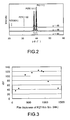
- Fig. 2 is a diagram showing an XRD (X-ray diffraction) pattern of the PZT thin film 33.
- the PZT is oriented to a ⁇ 111> surface and has an orientation degree of 97%.
- the film thickness of the PZT thin film 33 whose XRD pattern has been measured is 900 nm
- the voltage used in the polarization processing is 6-times the coercive electric field
- the polarization temperature is 240°C.
- the prebake temperature is 200°C for 100s.
- the film thickness of the PZT thin film 33 is 900 nm.
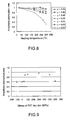
- Fig. 3 is a diagram showing a relationship between the film thickness (100 nm to 1,400 nm) of the PZT thin film 33 and a piezoelectric constant d31.
- the PZT thin film 33 shows favorable piezoelectric characteristics when the film thickness is 400 nm to 1,000 nm. Consequently, piezoelectric characteristics sufficient for the piezoelectric device 139 of the angular velocity sensor 31 can be obtained when the film thickness is within the range of 400 nm to 1,000 nm.
- the piezoelectric constant d31 decreases when the film thickness of the PZT thin film 33 is 1,000 nm or more. This is probably because when the film thickness is 1,000 nm or more, crystals grow in a direction other than the ⁇ 111> surface direction, such as a ⁇ 001> surface direction, and thus a peak intensity in the ⁇ 111> surface direction is saturated. Therefore, by setting the film thickness of the PZT thin film 33 to be less than 1,000 nm, peak growths in directions other than the ⁇ 111> surface direction can be suppressed. It should be noted that a main peak of a crystal mainly contributes to the piezoelectric characteristics.
- the film thickness of less than 400 nm leads to an increase in leak current, whereby it becomes difficult to obtain piezoelectric characteristics sufficient for the piezoelectric device 139.
- Fig. 4 is a diagram showing relationships of the PbO excessive composition ratio X (-0.1 to 0.5) of the PZT thin film 33 with the piezoelectric constant d31 and a loss rate tan ⁇ .
- the orientation degree of the PZT thin film 33 in the ⁇ 111> surface direction is 80% or more and less than 100%, and the Zr composition ratio Y is 0.5.
- the piezoelectric constant d31 and the loss rate tan ⁇ are both favorable when the PbO excessive composition ratio X is within the range of 0 to 0.3.
- the piezoelectric characteristics deteriorate when the PbO excessive composition ratio X is less than 0. This is probably because PZT crystallinity deteriorates when the PbO excessive composition ratio X is small.
- the loss rate tan ⁇ increases and the piezoelectric characteristics deteriorate when the PbO excessive composition ratio X is 0.3 or more. This is probably because an insulation property of the PZT thin film 33 deteriorates when the PbO excessive composition ratio X is large, thus resulting in a decrease in piezoelectric characteristics.
- Fig. 5 is a diagram showing a relationship between the Zr composition ratio Y (0.35 to 0.65) of the PZT thin film 33 and the piezoelectric constant d31.
- the PZT thin film 33 shows maximum piezoelectric characteristics when the Zr composition ratio Y is 0.51 and favorable piezoelectric characteristics when the Zr composition ratio Y is 0.4 or more and 0.55 or less.
- the Zr composition ratio Y is 0.4 or more and 0.55 or less, piezoelectric characteristics sufficient for the piezoelectric device 139 of the angular velocity sensor 31 can be obtained.
- a bulk PZT shows favorable piezoelectric characteristics when the Zr composition ratio Y thereof is 0.5 or more and 0.53 or less.
- the piezoelectric characteristics of the bulk PZT deteriorate precipitously when the Zr composition ratio Y becomes less than 0.5.
- the PZT thin film deposited by, for example, the sputtering method shows favorable piezoelectric characteristics even when the Zr composition ratio Y is 0.4 or more and 0.5 or less.
- the angular velocity sensor 31 of a shape as shown in Fig. 1A is cut out from the silicon wafer on which the piezoelectric device 139 including the first electrode film 34a, the PZT thin film 33, and second electrode film 34b, the lead wires 136, and the like are formed.
- An MEMS (Micro Electro Mechanical Systems) technique is typically used for the cutout from the silicon wafer. It should be noted that length, width, and thickness of the vibration arm 132 are, for example, 2,000 ⁇ m, 150 ⁇ m, and 150 ⁇ m, respectively.
- the heat resistance is evaluated by measuring an amplitude of the vibration arm 132 of the thus-formed angular velocity sensor 31 in the Y direction.
- the heat resistance of the piezoelectric device 139 is evaluated by measuring the amplitude of the vibration arm 132 in the Y direction, applying to the PZT thin film 33 heat that takes into account the heating processing carried out at the time of manufacturing the device, such as solder reflow, and re-measuring the amplitude of the vibration arm 132 in the Y direction thereafter.
- the heat applied to the PZT thin film 33 is, considering the heating processing at the time of manufacturing the device, 180°C to 300°C, and a heating time thereof is 30s to 300s.
- the voltage applied between the first electrode film 34a and second electrode film 34b is an AC voltage of, for example, 1kHz, 1V.
- Fig. 6 is a diagram showing a relationship between the Zr composition ratio Y (0.35 to 0.7) of the PZT thin film 33 and an attenuation rate of the vibration arm 132 after application of heat.
- the heating temperature and the heating time are 240°C and 90s, respectively.
- Fig. 7 is a diagram showing a relationship between the heating time and the amplitude attenuation rate after application of heat in a case where the heating temperature is set to 240°.
- the Zr composition ratio Y of the PZT thin film 33 is within the range of 0.35 to 0.60. It can be seen from Fig. 7 that when the Zr composition ratio Y is 0.55 or less, the amplitude attenuation after application of heat hardly occurs even when the heating time is extended, which implies excellent heat resistance.
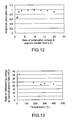
- Fig. 8 is a diagram showing a relationship between the heating temperature and the amplitude attenuation rate after application of heat.
- the Zr composition ratio Y of the PZT thin film 33 is within the range of 0.35 to 0.60. It can be seen from Fig. 8 that when the Zr composition ratio Y is 0.55 or less, the amplitude attenuation after application of heat hardly occurs even when the heating temperature is increased, which implies excellent heat resistance.
- Fig. 9 is a diagram showing a relationship between a stress (-100 MPa to 600 MPa) of the PZT thin film 33 and the amplitude attenuation rate after application of heat.
- the tension stress of the first electrode film 34a is 1,000 MPa.
- the heating temperature and heating time of the PZT thin film 33 are 240°C and 90s, respectively. It should be noted that in Fig. 9 , a stress of a positive value represents a tension stress, and a stress of a negative value represents a compression stress.
- An X-ray reciprocal lattice map measurement method is used as the method of measuring a stress of the PZT thin film 33, and an X-ray diffraction apparatus X'pert PRO MRD (registered trademark) from PANalytical (registered trademark) is used as a measurement apparatus therefor.
- X'pert PRO MRD registered trademark
- PANalytical registered trademark
- a measurement target sample is tilted about a ⁇ axis orthogonal to a ⁇ axis, and diffraction from a crystal surface of the sample is detected. Identification of the measurement target sample is made based on the detected diffraction peak.
- the method of measuring a stress of the PZT thin film 33 is not limited to the X-ray reciprocal lattice map measurement method, and other methods may be used instead.
- a value of the stress may be evaluated by using Stoney Expression after measuring a warpage of a substrate on which a film is deposited (reference: "Basics and Application of Thin Films by a Plasma Process", Hiroshi Ichimura, Masaru Ikenaga, THE NIKKAN KOGYO SHIMBUN, LTD., 2005).
- a nanoindentation method is used as described in the reference, for example.
- the X-ray reciprocal lattice map measurement method, the measurement method described in the reference, or the like is also used as a measurement method of the first electrode film 34a to be described later.
- the amplitude after application of heat is not attenuated when the tension stress of the PZT thin film 33 is 50 MPa or more and 500 MPa or less.
- the PZT thin film 33 with the tension stress of 50 MPa to 500 MPa has favorable heat resistance.
- the PZT thin film 33 with the tension stress of 100 MPa to 300 MPa has favorable heat resistance.
- the reason why the PZT thin film 33 has favorable heat resistance when provided with the tension stress that is within the range described above is that a crystal lattice of the PZT is distorted to thus suppress a movement of domains.
- the amplitude after application of heat is attenuated when the tension stress of the PZT thin film 33 exceeds 500 MPa. This is probably because cracks increase due to the stress of the PZT thin film 33, and the distortion of the crystal lattice is thus eliminated.
- the amplitude after application of heat is attenuated when the tension stress is less than 50 MPa. This is probably because the movement of domains is facilitated since there is no distortion in crystal lattice due to a low stress of the PZT thin film 33.
- Fig. 10 is a diagram showing a relationship between a stress (-500 MPa to 2,000 MPa) of the first electrode film 34a and the amplitude attenuation rate after application of heat.
- the tension stress of the PZT thin film 33 is 200 MPa.
- the heating temperature and heating time of the PZT thin film 33 are 240°C and 90s, respectively.
- the amplitude after application of heat is not attenuated when the tension stress of the first electrode film 34a is 500 MPa or more and 1,500 MPa or less.
- the piezoelectric device 139 including the first electrode film 34a with the tension stress of 500 MPa to 1,500 MPa has favorable heat resistance.
- the PZT thin film 33 formed on the first electrode film 34a has favorable heat resistance.
- the reason why the piezoelectric device 139 has favorable heat resistance when the first electrode film 34a is provided with the tension stress that is within the range described above is that a crystal lattice of the PZT thin film 33 is distorted to an appropriate degree by the tension stress of the first electrode film 34a, to thus suppress the movement of domains.
- the amplitude after application of heat is attenuated when the tension stress of the first electrode film 34a exceeds 1,500 MPa. This is probably because cracks of the PZT thin film 33 increase by the tension stress of first electrode film 34a, and the distortion of the crystal lattice is thus eliminated. In this case, cracks have actually been observed on the surface of the PZT thin film 33. Moreover, a peeling has been observed between the first electrode film 34a having the tension stress of more than 1,500 MPa and the arm base 133.
- the amplitude after application of heat is attenuated also when the tension stress of the first electrode film 34a is less than 500 MPa. This is probably because the movement of domains is facilitated since there is no distortion in crystal lattice due to a low stress of the first electrode film 34a.
- Fig. 11 is a diagram showing a relationship between an orientation degree of the PZT in the ⁇ 111> surface direction and the amplitude attenuation rate of the vibration arm 132 after application of heat.
- the PbO excessive composition ratio X and Zr composition ratio Y of the PZT thin film 33 are 0.04 and 0.48, respectively. It can be seen from Fig. 11 that when the orientation degree of the PZT in the ⁇ 111> surface direction is 80% or more, the amplitude attenuation after application of heat hardly occurs, which implies excellent heat resistance. On the other hand, it can be seen that when the orientation degree of the PZT in the ⁇ 111> surface direction is less than 80%, the amplitude attenuation after application of heat is apt to occur.
- Fig. 12 is a diagram showing a relationship between a ratio of a polarization voltage in the polarization processing with respect to a coercive electric field (1 to 20-times the coercive electric field E c ) and the amplitude attenuation rate of the vibration arm 132 after application of heat.
- the amplitude attenuation after application of heat hardly occurs when the polarization voltage is 2 to 20-times the coercive electric field E c , which implies excellent heat resistance.
- Fig. 13 shows a relationship between a ratio of a withstanding voltage of the PZT thin film 33 with respect to the coercive electric field and the polarization temperature. As shown in Fig.
- an increase in polarization temperature leads to a decrease in ratio of the withstanding voltage of the PZT with respect to the coercive electric field.
- a dielectric breakdown of the PZT occurs when a polarization voltage that is 20-times or more the coercive electric field is applied to the PZT at the polarization temperature of 180°C or more. Therefore, it can be seen that applying the polarization voltage that is 20-times or more the coercive electric field E c to the PZT is inappropriate, and an appropriate polarization voltage is a voltage that is 2 to 20-times the coercive electric field E c .
- Fig. 14 is a diagram showing a relationship between a ratio of the polarization temperature in the polarization processing with respect to a Curie temperature (1/16 to 5/4 the Curie temperature T c ) and the amplitude attenuation rate after application of heat.
- the polarization voltage is 6-times the coercive electric field E c .
- the amplitude attenuation after application of heat hardly occurs, which implies excellent heat resistance.
- Fig. 15 is a diagram showing relationships of a ratio of a prebake temperature Ta with respect to the Curie temperature (1/2 to 5/4 the Curie temperature T c ), with the amplitude attenuation rate after application of heat (abscissa axis and right-hand side ordinate axis) and a post-baking/post-polarization amplitude attenuation rate (abscissa axis and left-hand side ordinate axis).
- the amplitude attenuation rate in the prebake processing is evaluated by measuring the amplitude of the vibration arm 132 after the polarization processing, and re-measuring the amplitude of the vibration arm 132 after the prebake processing (1/2 to 5/4 the Curie temperature T c ) (abscissa axis and left-hand side ordinate axis).
- the amplitude of the vibration arm 132 after application of heat is measured, and the amplitude attenuation rate after application of heat is thus measured (abscissa axis and right-hand side ordinate axis).
- the polarization voltage is 6-times the coercive electric field E c
- the polarization temperature is 260°C.
- Fig. 16 is a plan diagram showing an angular velocity sensor according to this embodiment.
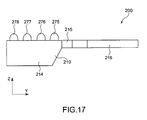
- Fig. 17 is a schematic diagram of the angular velocity sensor according to this embodiment
- Fig. 18 is a cross-sectional diagram taken along the line A-A of Fig. 16 .
- an angular velocity sensor 200 includes a base body 214, an arm retention portion 215 provided on one side of the base body 214, and a vibration arm portion 216 provided on a tip end side of the arm retention portion 215.
- the vibration arm portion 216 includes a first vibration arm 211, and second and third vibration arms 212 and 213 sandwiching the first vibration arm 211.
- the first vibration arm 211 is constituted of an arm base 210a and a piezoelectric device 239a formed thereon
- the second vibration arm 212 is constituted of an arm base 210b and a piezoelectric device 239b formed thereon
- the third vibration arm 213 is constituted of an arm base 210c and a piezoelectric device 239c formed thereon.
- the angular velocity sensor 200 according to this embodiment is a so-called triple-branch tuning-fork type angular velocity sensor.
- the first to third vibration arms 211 to 213 have the same width and thickness, for example. Moreover, a gap between the first and second vibration arms 211 and 212 and a gap between the first and third vibration arms 211 and 213 are the same.
- first electrode films 221 to 223 are respectively formed on the arm bases 210a to 210c, and PZT thin films 231 to 233 each as a piezoelectric film are respectively formed on the first electrode films 221 to 223. Further, second electrode films 241 to 243 each as a drive electrode are respectively formed on the PZT thin films 231 to 233. Moreover, a first detection electrode 251 and a second detection electrode 252 are formed on the piezoelectric thin film 231 of the first vibration arm 211 in the middle of the vibration arm portion 216.
- a film thickness of each of the PZT thin films 231 to 233 and the PbO excessive composition ratio X and Zr composition ratio Y of the PZT are the same as that of the PZT thin film 33 according to the first embodiment. Further, the PZT thin films 231 to 233 each have a tension stress of the same level as the PZT thin film 33. Furthermore, the first electrode films 221 to 223 also have a tension stress of the same level as the first electrode film 34a of the first embodiment.
- the plurality of electrodes 221 to 223, 241 to 243, 251, and 252 included in the respective piezoelectric devices 239 are respectively connected to lead wires 261 to 268.
- the lead wires 261 to 268 pass through a surface of the arm retention portion 215 to be respectively connected to lead terminals 271 to 278 provided on a surface of the base body 214.
- the lead terminals 271 to 278 are provided four each on both sides in an X direction on the surface of the base body 214.
- the first vibration arm 211 is caused of a flexion movement in the vertical direction of Fig. 18 when a voltage is applied to the first electrode film 221 and the second electrode film 241.
- the second and third vibration arms 212 and 213 are caused of a flexion movement in the vertical direction at a phase opposite to that of the first vibration arm 211, when a voltage is applied to the first electrode films 222 and 223 and second electrode films 242 and 243.
- the second and third vibration arms 212 and 213 move downward when the first vibration arm 211 move upward, and the second and third vibration arms 212 and 213 move upward when the first vibration arm 211 move downward. Moreover, by the second and third vibration arms 212 and 213 being caused of the flexion movement at an amplitude half the amplitude of the first vibration arm 211, moments generated by the first to third vibration arms 211 to 213 are canceled out.
- each of the piezoelectric devices 239 has the same piezoelectric performance and heat resistance as the piezoelectric device 139 of the angular velocity sensor 31 according to the first embodiment.
- the second electrode films 241 to 243 for driving the respective vibration arms are provided to the respective vibration arms in this embodiment, it is also possible to form the second electrode film on only the first vibration arm 211, for example.
- the second and third vibration arms 212 and 213 vibrate at phases opposite to that of the first vibration arm 211 by a counteraction of the vibration of the first vibration arm 211.
- the second electrode films on only the second and third vibration arms 212 and 213.
- the first vibration arm 211 vibrates at a phase opposite to that of the second and third vibration arms 212 and 213 by a counteraction of the vibration of the second and third vibration arms 212 and 213.
- the piezoelectric device and angular velocity sensor described above are not limited to the above embodiments, and various modifications can be made.
- the PZT is formed so as to have an orientation in the ⁇ 111> surface direction
- the present invention is not limited thereto, and the PZT may be deposited so as to have an orientation in a ⁇ 100> surface direction or a ⁇ 001> surface direction. Even when the PZT is deposited as described above, a piezoelectric device 139 with excellent piezoelectric characteristics and heat resistance can still be obtained.
- the crystalline structure of the PZT thin film 33 is tetragonal.
- the crystalline structure of the PZT thin film 33 may be rhombohedral, pseudo tetragonal, pseudo rhombohedral, or the like.
- the PZT thin film 33 may include at least one of additive elements selected from the group consisting of Cr, Mn, Fe, Ni, Mg, Sn, Cu, Ag, Nb, Sb, and N.
- the piezoelectric device 139 can also be applied to, for example, a pyroelectric infrared ray sensor, a liquid injection apparatus, a semiconductor storage apparatus, and the like. It should be noted that in this case, the piezoelectric device 139 only needs to be provided with at least one of the first and second electrode films, and the first and second detection electrodes do not necessarily need to be provided thereto.
- the above embodiments respectively illustrate the so-called single-branch tuning-fork type angular velocity sensor 31 and triple-branch tuning-fork type angular velocity sensor 200.
- the number of vibration arms may be 2 or more than 3.
- the angular velocity sensors 31 and 200 each have a cantilever structure, the sensors may each have a center impeller structure.
Landscapes
- Engineering & Computer Science (AREA)
- Chemical & Material Sciences (AREA)
- Ceramic Engineering (AREA)
- Manufacturing & Machinery (AREA)
- Organic Chemistry (AREA)
- Structural Engineering (AREA)
- Materials Engineering (AREA)
- Physics & Mathematics (AREA)
- General Physics & Mathematics (AREA)
- Radar, Positioning & Navigation (AREA)
- Remote Sensing (AREA)
- Composite Materials (AREA)
- Gyroscopes (AREA)
- Compositions Of Oxide Ceramics (AREA)
Abstract
Description
- The present invention contains subject matter related to Japanese Patent Application
JP 2007-297321 JP 2007-297323 JP 2007-297325 - The present invention relates to a piezoelectric device used in a piezoelectric sensor, a piezoelectric actuator, and a pyroelectric infrared ray sensor, an angular velocity sensor including the piezoelectric device, and a method of manufacturing a piezoelectric device.
- From the past, lead zirconium titanate (Pb1+X(ZrYTi1-Y)O3+X) (hereinafter, referred to as PZT) is used as a piezoelectric material of a piezoelectric thin film used for a piezoelectric sensor such as an angular velocity sensor, an ink jet head, and the like. Various techniques are proposed for improving piezoelectric characteristics, ferromagnetic material characteristics, pyroelectric characteristics, and the like of the PZT (see, for example, Japanese Patent Application Laid-open No.
Hei 06-350154 Figs. 3 ,4 , etc.) and Japanese Patent Application Laid-open No.Hei 09-298324 Fig. 5 ); hereinafter, will respectively be referred to asPatent Document 1 and Patent Document 2). -
Patent Document 1 discloses a PZT thin film whose crystalline structure is rhombohedral, in which, when lead zirconium titanate is represented by Pb1+Y(ZrXTi1-X)O3+Y, a PbO excessive composition ratio Y is within a range of 0 ≤ Y ≤ 0.5, and a Zr composition ratio X is within a range of 0 ≤ X ≤ 0.55. The PZT thin film ofPatent Document 1 exhibits favorable piezoelectric characteristics. Moreover, there is also disclosed a PZT thin film whose crystalline structure is tetragonal, in which the PbO excessive composition ratio Y is within a range of 0 ≤ Y < 0.5, and the Zr composition ratio X is within a range of 0.55 ≤ X < 1. - Patent Document 2 discloses a piezoelectric thin film having a thickness of 1 µm or more and 10 µm or less, a crystal grain size of 0.55 µm or less, and surface roughness of 1 µm or less at RMAX. The piezoelectric thin film is useful as a piezoelectric thin film for an inkjet-type storage apparatus that requires a predetermined film thickness or more.
- Incidentally, when heated, the piezoelectric material is known to deteriorate in piezoelectric performance, which is called depolarization. However, because heating processing by solder reflow and the like is generally carried out in a process of manufacturing an electronic apparatus that includes the piezoelectric material, there is a problem that the piezoelectric performance of the piezoelectric material deteriorates due to the heat.
- Particularly in recent years, a solder reflow temperature is increasing due to lead-free soldering in consideration of environmental problems, and heat caused by the solder reflow causes the piezoelectric performance of the piezoelectric material to deteriorate, which is problematic. However,
Patent Documents 1 and 2 above give no consideration to the effect of heat. - Further, there is a problem that when the piezoelectric member is to have a film thickness of 1 µm or more as described in Patent Document 2, a possibility of cracks being caused or crystallinity being deteriorated increases. The deterioration of the crystallinity may also become a cause of the depolarization due to the heating processing.
- In view of the above circumstances, there is a need for a piezoelectric device excellent in piezoelectric characteristics and heat resistance, an angular velocity sensor including the piezoelectric device, and a method of manufacturing a piezoelectric device.
- According to an embodiment of the present invention, there is provided a piezoelectric device including a piezoelectric film and an electrode film. The piezoelectric film is constituted of lead zirconium titanate represented by Pb1+X(ZrYTi1-Y)O3+X, where X is 0 or more and 0.3 or less and Y is 0 or more and 0.55 or less, the piezoelectric film having a tension stress. The electrode film applies a voltage to the piezoelectric film.
- By setting a PbO excessive composition ratio X of the PZT to be 0 or more and 0.3 or less and a Zr composition ratio Y to be 0 or more and 0.55 or less, a piezoelectric device excellent in piezoelectric characteristics can be obtained. If the Zr composition ratio Y is 0 or more and 0.55 or less, depolarization hardly occurs and excellent heat resistance can be obtained.
- In addition, by providing the tension stress to the piezoelectric film, a piezoelectric device with additionally-improved heat resistance can be obtained.
- In the piezoelectric device according to the embodiment of the present invention, the tension stress of the piezoelectric film may be 50 MPa or more and 500 MPa or less. Accordingly, a piezoelectric device with additionally-improved heat resistance can be obtained.
- In the piezoelectric device according to the embodiment of the present invention, the piezoelectric film may have a film thickness of 400 nm or more and 1,000 nm or less.
- Accordingly, a piezoelectric device with additionally-improved piezoelectric characteristics can be obtained.
- In the piezoelectric device according to the embodiment of the present invention, the electrode film may have a tension stress of 500 MPa or more and 1,500 MPa or less.
- Accordingly, a piezoelectric device with additionally-improved heat resistance can be obtained.
- In the piezoelectric device according to the embodiment of the present invention, the piezoelectric film may have an orientation of 80% or more in a <111> direction.
- Accordingly, a piezoelectric device with additionally-improved heat resistance can be obtained.
- In the piezoelectric device according to the embodiment of the present invention, the piezoelectric film may include at least one of additive elements selected from the group consisting of Cr, Mn, Fe, Ni, Mg, Sn, Cu, Ag, Nb, Sb, and N.
- In the piezoelectric device according to the embodiment of the present invention, the electrode film may be formed of at least one of Ti and Pt. The electrode film may also be formed of Ir, Au, and Ru, or oxides of Ti, Pt, Ir, Au, and Ru.
- According to another embodiment of the present invention, there is provided a piezoelectric device including a piezoelectric film and an electrode film. The piezoelectric film is constituted of lead zirconium titanate represented by Pb1+X(ZrYTi1-Y)O3+X, where X is 0 or more and 0.3 or less and Y is 0 or more and 0.55 or less. The electrode film has a tension stress of 500 MPa or more and 1,500 MPa or less and applies a voltage to the piezoelectric film.
- By setting the PbO excessive composition ratio X of the PZT to be 0 or more and 0.3 or less and the Zr composition ratio Y to be 0 or more and 0.55 or less, a piezoelectric device excellent in piezoelectric characteristics can be obtained. If the Zr composition ratio Y is 0 or more and 0.55 or less, depolarization hardly occurs and excellent heat resistance can be obtained.
- In addition, by providing the tension stress of 500 MPa or more and 1,500 MPa or less to the electrode film, a piezoelectric device with additionally-improved heat resistance can be obtained.
- In the piezoelectric device according to the embodiment of the present invention, the piezoelectric film may have a film thickness of 400 nm or more and 1,000 nm or less.
- Accordingly, a piezoelectric device with additionally-improved piezoelectric characteristics can be obtained.
- In the piezoelectric device according to the embodiment of the present invention, the piezoelectric film may have a tension stress of 50 MPa or more and 500 MPa or less.
- Accordingly, a piezoelectric device with additionally-improved heat resistance can be obtained.
- In the piezoelectric device according to the embodiment of the present invention, the piezoelectric film may have an orientation of 80% or more in a <111> direction.
- Accordingly, a piezoelectric device with additionally-improved heat resistance can be obtained.
- In the piezoelectric device according to the embodiment of the present invention, the piezoelectric film may include at least one of additive elements selected from the group consisting of Cr, Mn, Fe, Ni, Mg, Sn, Cu, Ag, Nb, Sb, and N.
- In the piezoelectric device according to the embodiment of the present invention, the electrode film may be formed of at least one of Ti and Pt. The electrode film may also be formed of Ir, Au, and Ru, or oxides of Ti, Pt, Ir, Au, and Ru.
- According to another embodiment of the present invention, there is provided a piezoelectric device including a piezoelectric film and an electrode film. The piezoelectric film is constituted of lead zirconium titanate represented by Pb1+X(ZrYTi1-Y)O3+X, where X is 0 or more and 0.3 or less and Y is 0 or more and 0.55 or less, the piezoelectric film having a film thickness of 400 nm or more and 1,000 nm or less. The electrode film applies a voltage to the piezoelectric film.
- By setting the PbO excessive composition ratio X of the PZT to be 0 or more and 0.3 or less and the Zr composition ratio Y to be 0 or more and 0.55 or less, a piezoelectric device excellent in piezoelectric characteristics can be obtained. If the Zr composition ratio Y is 0 or more and 0.55 or less, depolarization hardly occurs and excellent heat resistance can be obtained.
- In addition, by setting the film thickness to be 400 nm or more and 1,000 nm or less, a piezoelectric device with additionally-improved piezoelectric characteristics can be obtained.
- In the piezoelectric device according to the embodiment of the present invention, the piezoelectric film may have an orientation of 80% or more in a <111> direction.
- Accordingly, a piezoelectric device with additionally-improved heat resistance can be obtained.
- In the piezoelectric device according to the embodiment of the present invention, the piezoelectric film may include at least one of additive elements selected from the group consisting of Cr, Mn, Fe, Ni, Mg, Sn, Cu, Ag, Nb, Sb, and N.
- In the piezoelectric device according to the embodiment of the present invention, the electrode film may be formed of at least one of Ti and Pt. The electrode film may also be formed of Ir, Au, and Ru, or oxides of Ti, Pt, Ir, Au, and Ru.
- According to another embodiment of the present invention, there is provided an angular velocity sensor including a substrate, a first electrode film, a piezoelectric film, and a second electrode film. The first electrode film is formed on the substrate. The piezoelectric film is constituted of lead zirconium titanate represented by Pb1+X(ZrYTi1-Y)O3+X, where X is 0 or more and 0.3 or less and Y is 0 or more and 0.55 or less, the piezoelectric film having a tension stress and formed on the first electrode film. The second electrode film is formed on the piezoelectric film.
- According to another embodiment of the present invention, there is provided an angular velocity sensor including a substrate, a first electrode film, a piezoelectric film, and a second electrode film. The first electrode film has a tension stress of 500 MPa or more and 1,500 MPa or less and is formed on the substrate. The piezoelectric film is constituted of lead zirconium titanate represented by Pb1+X(ZrYTi1-Y)O3+X, where X is 0 or more and 0.3 or less and Y is 0 or more and 0.55 or less, the piezoelectric film formed on the first electrode film. The second electrode film is formed on the piezoelectric film.
- According to another embodiment of the present invention, there is provided an angular velocity sensor including a substrate, a first electrode film, a piezoelectric film, and a second electrode film. The first electrode film is formed on the substrate. The piezoelectric film is constituted of lead zirconium titanate represented by Pb1+X(ZrYTi1-Y)O3+X, where X is 0 or more and 0.3 or less and Y is 0 or more and 0.55 or less, the piezoelectric film having a film thickness of 400 nm or more and 1,000 nm or less and formed on the first electrode film. The second electrode film is formed on the piezoelectric film.
- According to the embodiments of the present invention, a piezoelectric device excellent in piezoelectric characteristics and heat resistance, an angular velocity sensor including the piezoelectric device, and a method of manufacturing a piezoelectric device can be provided.
- These and other objects, features and advantages of the present invention will become more apparent in light of the following detailed description of best mode embodiments thereof, as illustrated in the accompanying drawings.
-
-
Figs. 1 are diagrams showing a piezoelectric device and an angular velocity sensor including the piezoelectric device according to a first embodiment of the present invention; -
Fig. 2 is a diagram showing an XRD (X-ray diffraction) pattern of a PZT thin film; -
Fig. 3 is a diagram showing a relationship between a film thickness (100 nm to 1,400 nm) of the PZT thin film and a piezoelectric constant d31; -
Fig. 4 is a diagram showing relationships of a PbO excessive composition ratio X (-0.1 to 0.5) of the PZT thin film with the piezoelectric constant d31 and a loss rate tanδ; -
Fig. 5 is a diagram showing a relationship between a Zr composition ratio Y (0.35 to 0.65) of the PZT thin film and the piezoelectric constant d31; -
Fig. 6 is a diagram showing a relationship between the Zr composition ratio Y (0.35 to 0.7) of the PZT thin film and an attenuation rate of a vibration arm after application of heat; -
Fig. 7 is a diagram showing a relationship between a heating time and the amplitude attenuation rate after application of heat in a case where a heating temperature is set to 240°; -
Fig. 8 is a diagram showing a relationship between the heating temperature and the amplitude attenuation rate after application of heat; -
Fig. 9 is a diagram showing a relationship between a stress (-100 MPa to 600 MPa) of the PZT thin film and the amplitude attenuation rate after application of heat; -
Fig. 10 is a diagram showing a relationship between a stress (-500 MPa to 2,000 MPa) of a first electrode film and the amplitude attenuation rate after application of heat; -
Fig. 11 is a diagram showing a relationship between an orientation degree of the PZT in a <111> surface direction and the amplitude attenuation rate of the vibration arm after application of heat; -
Fig. 12 is a diagram showing a relationship between a ratio of a polarization voltage in polarization processing with respect to a coercive electric field (1 to 20-times the coercive electric field Ec) and the amplitude attenuation rate of the vibration arm after application of heat; -
Fig. 13 is a diagram showing a relationship between a ratio of a withstanding voltage of the PZT thin film with respect to the coercive electric field and a polarization temperature; -
Fig. 14 is a diagram showing a relationship between a ratio of the polarization temperature in the polarization processing with respect to the Curie temperature (1/16 to 5/4-times the Curie temperature Tc) and the amplitude attenuation rate after application of heat; -
Fig. 15 is a diagram showing relationships of a ratio of a prebake temperature with respect to the Curie temperature (1/2 to 5/4 the Curie temperature Tc), with the amplitude attenuation rate after application of heat and a post-baking/post-polarization amplitude attenuation rate; -
Fig. 16 is a plan diagram showing an angular velocity sensor according to a second embodiment of the present invention; -
Fig. 17 is a schematic diagram of the angular velocity sensor shown inFig. 16 ; and -
Fig. 18 is a cross-sectional diagram taken along the line A-A ofFig. 16 . - Hereinafter, embodiments of the present invention will be described with reference to the drawings.
- First, a first embodiment of the present invention will be described.
Figs. 1 are diagrams showing a piezoelectric device and an angular velocity sensor including the piezoelectric device according to the first embodiment of the present invention. - An
angular velocity sensor 31 includes abase body 130 and avibration arm 132 that extends from thebase body 130 and is capable of vibrating.Fig. 1B is a cross-sectional diagram of a surface vertical to a longitudinal axis (Z axis) of thevibration arm 132. - The
angular velocity sensor 31 includes asemiconductor arm base 133 made of, for example, silicon, and apiezoelectric device 139 disposed on thearm base 133. As shown inFig. 1B , for example, afirst electrode film 34a as a common electrode is laminated on a silicon substrate, and apiezoelectric film 33 is laminated on thefirst electrode film 34a. On afirst surface 33a as an upper surface of thepiezoelectric film 33, asecond electrode film 34b, afirst detection electrode 34c, and asecond detection electrode 34d each having a predetermined elongated shape are formed. - Also on the
base body 130, a lead electrode includinglead wires 136,electrode pads 138,bumps 134a to 134d, and the like is formed. Thebump 134a is connected to thesecond electrode film 34b, thebumps first detection electrode 34c and thesecond detection electrode 34d, and thebump 134d is connected to thefirst electrode film 34a. An external connection to a control circuit (not shown) such as an IC is made via thebumps 134a to 134d. Thebumps 134a to 134d are each formed of metal, for example, but are not limited thereto. - After the
first electrode film 34a, thesecond electrode film 34b, thefirst detection electrode 34c, thesecond detection electrode 34d, thelead wires 136, and the like are formed as described above, theangular velocity sensor 31 of a shape as shown inFig. 1A is cut out from a silicon wafer. - Next, a typical example of an operation of the
angular velocity sensor 31 will be described. - The
first electrode film 34a of thepiezoelectric device 139 is connected to a DC power supply, and an AC power supply is connected between afirst electrode film 34a and thesecond electrode film 34b. Accordingly, a voltage is applied to thepiezoelectric film 33 disposed between thefirst electrode film 34a and thesecond electrode film 34b so that thevibration arm 132 is caused of a flexion movement in a vertical direction (Y direction). - When an angular velocity ω0 is applied to the
vibration arm 132 during the flexion movement, Coriolis force is generated in thevibration arm 132. The Coriolis force is generated in a direction vertical (X direction) to a direction of the flexion movement of the vibration arm 132 (Y direction), a magnitude of which is proportional to a value of the applied angular velocity ω0. The Coriolis force is converted into an electric signal by thepiezoelectric film 33, and the converted signal is detected by thefirst detection electrode 34c and thesecond detection electrode 34d. - Next, piezoelectric performance and heat resistance performance of the
piezoelectric device 139 will be described while describing a method of manufacturing theangular velocity sensor 31. It should be noted that descriptions will mainly be given on a method of forming thepiezoelectric device 139 formed on thearm base 133. - First, a silicon wafer is prepared. An oxidation protection film may be formed on the silicon wafer by thermal oxidation processing.
- The
first electrode film 34a is formed by depositing Ti of 30 nm on the silicon wafer by a sputtering method, and then depositing Pt of 100 nm thereon, for example. The deposition method of thefirst electrode film 34a is not limited to the sputtering method, and a vacuum vapor deposition method or other deposition methods may be used. Moreover, the metal materials that constitute thefirst electrode film 34a are not limited to Ti and Pt, and examples thereof include Ir, Au, and Ru, or oxides of Ti, Pt, Ir, Au, and Ru. Thesecond electrode film 34b may also be constituted of those metal materials. - Subsequently, the
piezoelectric film 33 is formed by forming a PZT thin film on thefirst electrode film 34a by, for example, the sputtering method. The deposition method of thepiezoelectric film 33 is not limited to the sputtering method, and deposition methods such as a vacuum vapor deposition method, a PLD (pulsed laser deposition) method, a sol-gel method, an aerosol deposition method, and the like may be used. A substrate temperature when depositing the PZTthin film 33 may either be at room temperature or at a high temperature. - In the deposition of the PZT
thin film 33, a PbO excessive composition ratio X is set to be -0.1 or more and 0.5 or less, and a Zr composition ratio Y is set to be 0.35 or more and 0.65 or less. For realizing such a PZT composition ratio, a target composition, sputtering conditions, annealing conditions, and the like are set appropriately. For increasing a perovskite structure of the PZT after the PZTthin film 33 is formed on thefirst electrode film 34a, heating processing at 700°, for example, may be carried out on the PZTthin film 33. A crystalline structure of the PZTthin film 33 in this case is tetragonal. - A film thickness of the PZT
thin film 33 formed as described above is 100 nm to 1,400 nm. - After the PZT
thin film 33 is formed, Pt of 200 nm is deposited on the PZTthin film 33 by the sputtering method to thus form thesecond electrode film 34b. The deposition method of thesecond electrode film 34b in this case is not limited to the sputtering method, and a vacuum vapor deposition method or other deposition methods may be used. - Next, a voltage is applied between the
first electrode film 34a and thesecond electrode film 34b in an atmosphere heated to 240°, and polarization processing is carried out on the PZTthin film 33. The voltage applied between thefirst electrode film 34a and thesecond electrode film 34b is 1 to 20-times as large as a coercive electric field Ec. Moreover, a polarization temperature in the polarization processing is, compared to a Curie temperature, 1/16 to 5/4 the Curie temperature. It should be noted that the polarization processing may be carried out in any of an atmosphere, an oxygen atmosphere, and a nitrogen atmosphere. - After the polarization processing, prebake processing is carried out on the deposited PZT
thin film 33. A prebake temperature of the prebake processing is 1/2 to 5/4 the Curie temperature. - The PZT
thin film 33 described above may have a tension stress. For providing the tension stress to the PZTthin film 33, the PZTthin film 33 may be subjected to heating processing at, for example, 650°C to 750°C after being formed on thefirst electrode film 34a. Accordingly, crystallization of the PZTthin film 33 is accelerated, thus obtaining the tension stress. In addition, in this case, the target composition, the sputtering conditions, the annealing conditions, and the like are set appropriately such that the PbO excessive composition ratio X of the PZT becomes 0.04, the Zr composition ratio Y thereof becomes 0.35 to 0.65, and the tension stress becomes -100 MPa to 600 MPa, for example. - Further, the
first electrode film 34a described above may also have the tension stress. For providing the tension stress to thefirst electrode film 34a, thefirst electrode film 34a may be subjected to the heating processing at, for example, 100°C to 800°C after the PZTthin film 33 is formed thereon. Alternatively, it is also possible to provide the tension stress to thefirst electrode film 34a by the heating processing carried out during deposition instead of after the deposition of thefirst electrode film 34a and the PZTthin film 33. By changing deposition conditions, heating processing conditions, and the like, a tension stress of a wide range can be provided to thefirst electrode film 34a. The tension stress of thefirst electrode film 34a formed as described above is -200 MPa to 2,000 MPa. - Next, descriptions will be given on piezoelectric characteristics of the
piezoelectric device 139 thus formed on the silicon wafer. -
Fig. 2 is a diagram showing an XRD (X-ray diffraction) pattern of the PZTthin film 33. The PZT is oriented to a <111> surface and has an orientation degree of 97%. InFig. 2 , the film thickness of the PZTthin film 33 whose XRD pattern has been measured is 900 nm, the voltage used in the polarization processing is 6-times the coercive electric field, and the polarization temperature is 240°C. In addition, the prebake temperature is 200°C for 100s. - It should be noted that in the following descriptions made on the figures, unless specified otherwise, the film thickness of the PZT
thin film 33 is 900 nm. -
Fig. 3 is a diagram showing a relationship between the film thickness (100 nm to 1,400 nm) of the PZTthin film 33 and a piezoelectric constant d31. As shown inFig. 3 , the PZTthin film 33 shows favorable piezoelectric characteristics when the film thickness is 400 nm to 1,000 nm. Consequently, piezoelectric characteristics sufficient for thepiezoelectric device 139 of theangular velocity sensor 31 can be obtained when the film thickness is within the range of 400 nm to 1,000 nm. - The piezoelectric constant d31 decreases when the film thickness of the PZT
thin film 33 is 1,000 nm or more. This is probably because when the film thickness is 1,000 nm or more, crystals grow in a direction other than the <111> surface direction, such as a <001> surface direction, and thus a peak intensity in the <111> surface direction is saturated. Therefore, by setting the film thickness of the PZTthin film 33 to be less than 1,000 nm, peak growths in directions other than the <111> surface direction can be suppressed. It should be noted that a main peak of a crystal mainly contributes to the piezoelectric characteristics. - Meanwhile, the film thickness of less than 400 nm leads to an increase in leak current, whereby it becomes difficult to obtain piezoelectric characteristics sufficient for the
piezoelectric device 139. -
Fig. 4 is a diagram showing relationships of the PbO excessive composition ratio X (-0.1 to 0.5) of the PZTthin film 33 with the piezoelectric constant d31 and a loss rate tanδ. The orientation degree of the PZTthin film 33 in the <111> surface direction is 80% or more and less than 100%, and the Zr composition ratio Y is 0.5. - It can be seen from
Fig. 4 that the piezoelectric constant d31 and the loss rate tanδ are both favorable when the PbO excessive composition ratio X is within the range of 0 to 0.3. The piezoelectric characteristics deteriorate when the PbO excessive composition ratio X is less than 0. This is probably because PZT crystallinity deteriorates when the PbO excessive composition ratio X is small. On the other hand, the loss rate tanδ increases and the piezoelectric characteristics deteriorate when the PbO excessive composition ratio X is 0.3 or more. This is probably because an insulation property of the PZTthin film 33 deteriorates when the PbO excessive composition ratio X is large, thus resulting in a decrease in piezoelectric characteristics. -
Fig. 5 is a diagram showing a relationship between the Zr composition ratio Y (0.35 to 0.65) of the PZTthin film 33 and the piezoelectric constant d31. As shown inFig. 5 , the PZTthin film 33 shows maximum piezoelectric characteristics when the Zr composition ratio Y is 0.51 and favorable piezoelectric characteristics when the Zr composition ratio Y is 0.4 or more and 0.55 or less. As long as the Zr composition ratio Y is 0.4 or more and 0.55 or less, piezoelectric characteristics sufficient for thepiezoelectric device 139 of theangular velocity sensor 31 can be obtained. - Incidentally, it is known that a bulk PZT shows favorable piezoelectric characteristics when the Zr composition ratio Y thereof is 0.5 or more and 0.53 or less. However, the piezoelectric characteristics of the bulk PZT deteriorate precipitously when the Zr composition ratio Y becomes less than 0.5. On the other hand, as shown in
Fig. 5 , the PZT thin film deposited by, for example, the sputtering method shows favorable piezoelectric characteristics even when the Zr composition ratio Y is 0.4 or more and 0.5 or less. - Next, an evaluation on the heat resistance will be described, but first, descriptions will be given on a method of evaluating heat resistance.
- The
angular velocity sensor 31 of a shape as shown inFig. 1A is cut out from the silicon wafer on which thepiezoelectric device 139 including thefirst electrode film 34a, the PZTthin film 33, andsecond electrode film 34b, thelead wires 136, and the like are formed. An MEMS (Micro Electro Mechanical Systems) technique is typically used for the cutout from the silicon wafer. It should be noted that length, width, and thickness of thevibration arm 132 are, for example, 2,000 µm, 150 µm, and 150 µm, respectively. - The heat resistance is evaluated by measuring an amplitude of the
vibration arm 132 of the thus-formedangular velocity sensor 31 in the Y direction. Specifically, the heat resistance of thepiezoelectric device 139 is evaluated by measuring the amplitude of thevibration arm 132 in the Y direction, applying to the PZTthin film 33 heat that takes into account the heating processing carried out at the time of manufacturing the device, such as solder reflow, and re-measuring the amplitude of thevibration arm 132 in the Y direction thereafter. It should be noted that the heat applied to the PZTthin film 33 is, considering the heating processing at the time of manufacturing the device, 180°C to 300°C, and a heating time thereof is 30s to 300s. In addition, the voltage applied between thefirst electrode film 34a andsecond electrode film 34b is an AC voltage of, for example, 1kHz, 1V. -
Fig. 6 is a diagram showing a relationship between the Zr composition ratio Y (0.35 to 0.7) of the PZTthin film 33 and an attenuation rate of thevibration arm 132 after application of heat. The heating temperature and the heating time are 240°C and 90s, respectively. - It can be seen from
Fig. 6 that attenuation of the amplitude of thevibration arm 132 after application of heat increases when the Zr composition ratio Y exceeds 0.55, whereas the attenuation thereof is hardly observed when the Zr composition ratio Y is 0.55 or less. In other words, the PZTthin film 33 with the Zr composition ratio Y of 0.55 or less has excellent heat resistance. -
Fig. 7 is a diagram showing a relationship between the heating time and the amplitude attenuation rate after application of heat in a case where the heating temperature is set to 240°. The Zr composition ratio Y of the PZTthin film 33 is within the range of 0.35 to 0.60. It can be seen fromFig. 7 that when the Zr composition ratio Y is 0.55 or less, the amplitude attenuation after application of heat hardly occurs even when the heating time is extended, which implies excellent heat resistance. -
Fig. 8 is a diagram showing a relationship between the heating temperature and the amplitude attenuation rate after application of heat. The Zr composition ratio Y of the PZTthin film 33 is within the range of 0.35 to 0.60. It can be seen fromFig. 8 that when the Zr composition ratio Y is 0.55 or less, the amplitude attenuation after application of heat hardly occurs even when the heating temperature is increased, which implies excellent heat resistance. -
Fig. 9 is a diagram showing a relationship between a stress (-100 MPa to 600 MPa) of the PZTthin film 33 and the amplitude attenuation rate after application of heat. In this case, the tension stress of thefirst electrode film 34a is 1,000 MPa. In addition, the heating temperature and heating time of the PZTthin film 33 are 240°C and 90s, respectively. It should be noted that inFig. 9 , a stress of a positive value represents a tension stress, and a stress of a negative value represents a compression stress. - Now, a method of measuring a stress of the PZT
thin film 33 will be described. An X-ray reciprocal lattice map measurement method is used as the method of measuring a stress of the PZTthin film 33, and an X-ray diffraction apparatus X'pert PRO MRD (registered trademark) from PANalytical (registered trademark) is used as a measurement apparatus therefor. In the reciprocal lattice map technique, a measurement target sample is tilted about a ϕ axis orthogonal to a θ axis, and diffraction from a crystal surface of the sample is detected. Identification of the measurement target sample is made based on the detected diffraction peak. - For example, in a case where there is no distortion or stress in the crystal of the measurement target sample, no change in diffraction angle occurs at any ϕ angle regarding a main orientation peak of the PZT <111> diffraction (in the vicinity of (2θ, ϕ) = (38°, 0°), (2θ, ϕ) = (38°, 70°)). However, in a case where there is a tension stress in the measurement target sample, the diffraction angle when ϕ = 70° shifts more on a low-angle side than the diffraction angle when ϕ = 0. On the other hand, in a case where there is a compression stress in the measurement target sample, the diffraction angle when ϕ = 70° shifts more on a wide-angle side than the diffraction angle when ϕ = 0. By evaluating a magnitude of the shift, it is possible to measure the stress of the PZT
thin film 33. - The method of measuring a stress of the PZT
thin film 33 is not limited to the X-ray reciprocal lattice map measurement method, and other methods may be used instead. For example, as described in the following reference, a value of the stress may be evaluated by using Stoney Expression after measuring a warpage of a substrate on which a film is deposited (reference:
"Basics and Application of Thin Films by a Plasma Process", Hiroshi Ichimura, Masaru Ikenaga, THE NIKKAN KOGYO SHIMBUN, LTD., 2005). For measuring Young's modulus necessary for derivation of a stress, a nanoindentation method is used as described in the reference, for example. The X-ray reciprocal lattice map measurement method, the measurement method described in the reference, or the like is also used as a measurement method of thefirst electrode film 34a to be described later. - As shown in
Fig. 9 , the amplitude after application of heat is not attenuated when the tension stress of the PZTthin film 33 is 50 MPa or more and 500 MPa or less. In other words, the PZTthin film 33 with the tension stress of 50 MPa to 500 MPa has favorable heat resistance. In particular, the PZTthin film 33 with the tension stress of 100 MPa to 300 MPa has favorable heat resistance. - The reason why the PZT
thin film 33 has favorable heat resistance when provided with the tension stress that is within the range described above is that a crystal lattice of the PZT is distorted to thus suppress a movement of domains. - As shown in
Fig. 9 , the amplitude after application of heat is attenuated when the tension stress of the PZTthin film 33 exceeds 500 MPa. This is probably because cracks increase due to the stress of the PZTthin film 33, and the distortion of the crystal lattice is thus eliminated. On the other hand, the amplitude after application of heat is attenuated when the tension stress is less than 50 MPa. This is probably because the movement of domains is facilitated since there is no distortion in crystal lattice due to a low stress of the PZTthin film 33. -
Fig. 10 is a diagram showing a relationship between a stress (-500 MPa to 2,000 MPa) of thefirst electrode film 34a and the amplitude attenuation rate after application of heat. In this case, the tension stress of the PZTthin film 33 is 200 MPa. In addition, the heating temperature and heating time of the PZTthin film 33 are 240°C and 90s, respectively. - As shown in
Fig. 10 , the amplitude after application of heat is not attenuated when the tension stress of thefirst electrode film 34a is 500 MPa or more and 1,500 MPa or less. In other words, it can be seen that thepiezoelectric device 139 including thefirst electrode film 34a with the tension stress of 500 MPa to 1,500 MPa has favorable heat resistance. In particular, it can be seen that when thefirst electrode film 34a has a tension stress of 700 MPa to 1,200 MPa, the PZTthin film 33 formed on thefirst electrode film 34a has favorable heat resistance. - The reason why the
piezoelectric device 139 has favorable heat resistance when thefirst electrode film 34a is provided with the tension stress that is within the range described above is that a crystal lattice of the PZTthin film 33 is distorted to an appropriate degree by the tension stress of thefirst electrode film 34a, to thus suppress the movement of domains. - The amplitude after application of heat is attenuated when the tension stress of the
first electrode film 34a exceeds 1,500 MPa. This is probably because cracks of the PZTthin film 33 increase by the tension stress offirst electrode film 34a, and the distortion of the crystal lattice is thus eliminated. In this case, cracks have actually been observed on the surface of the PZTthin film 33. Moreover, a peeling has been observed between thefirst electrode film 34a having the tension stress of more than 1,500 MPa and thearm base 133. - On the other hand, the amplitude after application of heat is attenuated also when the tension stress of the
first electrode film 34a is less than 500 MPa. This is probably because the movement of domains is facilitated since there is no distortion in crystal lattice due to a low stress of thefirst electrode film 34a. -
Fig. 11 is a diagram showing a relationship between an orientation degree of the PZT in the <111> surface direction and the amplitude attenuation rate of thevibration arm 132 after application of heat. The PbO excessive composition ratio X and Zr composition ratio Y of the PZTthin film 33 are 0.04 and 0.48, respectively. It can be seen fromFig. 11 that when the orientation degree of the PZT in the <111> surface direction is 80% or more, the amplitude attenuation after application of heat hardly occurs, which implies excellent heat resistance. On the other hand, it can be seen that when the orientation degree of the PZT in the <111> surface direction is less than 80%, the amplitude attenuation after application of heat is apt to occur. - Next, descriptions will be given on relationships of the amplitude attenuation rate of the
vibration arm 132 after application of heat with polarization processing conditions and prebake conditions. It should be noted that inFigs. 12 to 15 in descriptions below, the PbO excessive composition ratio X and Zr composition ratio Y of the PZTthin film 33 are 0.04 and 0.48, respectively. Moreover, the heating temperature and heating time of the PZTthin film 33 are 240°C and 90s, respectively. -
Fig. 12 is a diagram showing a relationship between a ratio of a polarization voltage in the polarization processing with respect to a coercive electric field (1 to 20-times the coercive electric field Ec) and the amplitude attenuation rate of thevibration arm 132 after application of heat. As shown inFig. 12 , the amplitude attenuation after application of heat hardly occurs when the polarization voltage is 2 to 20-times the coercive electric field Ec, which implies excellent heat resistance.Fig. 13 shows a relationship between a ratio of a withstanding voltage of the PZTthin film 33 with respect to the coercive electric field and the polarization temperature. As shown inFig. 13 , an increase in polarization temperature leads to a decrease in ratio of the withstanding voltage of the PZT with respect to the coercive electric field. A dielectric breakdown of the PZT occurs when a polarization voltage that is 20-times or more the coercive electric field is applied to the PZT at the polarization temperature of 180°C or more. Therefore, it can be seen that applying the polarization voltage that is 20-times or more the coercive electric field Ec to the PZT is inappropriate, and an appropriate polarization voltage is a voltage that is 2 to 20-times the coercive electric field Ec. -
Fig. 14 is a diagram showing a relationship between a ratio of the polarization temperature in the polarization processing with respect to a Curie temperature (1/16 to 5/4 the Curie temperature Tc) and the amplitude attenuation rate after application of heat. The polarization voltage is 6-times the coercive electric field Ec. As shown inFig. 14 , when the polarization temperature is 1/4 or more and equal to or smaller than the Curie temperature Tc, the amplitude attenuation after application of heat hardly occurs, which implies excellent heat resistance. The reason why the amplitude attenuation is large when the polarization temperature is less than 1/4 the Curie temperature Tc is probably because, due to insufficient polarization processing, the movement of domains of the PZTthin film 33 is suppressed. On the other hand, the reason why the amplitude attenuation is large when the polarization temperature exceeds the Curie temperature Tc is probably because, due to a cubic crystalline structure of the PZTthin film 33, the movement of domains is facilitated after the polarization processing. -
Fig. 15 is a diagram showing relationships of a ratio of a prebake temperature Ta with respect to the Curie temperature (1/2 to 5/4 the Curie temperature Tc), with the amplitude attenuation rate after application of heat (abscissa axis and right-hand side ordinate axis) and a post-baking/post-polarization amplitude attenuation rate (abscissa axis and left-hand side ordinate axis). - Specifically, in
Fig. 15 , the amplitude attenuation rate in the prebake processing is evaluated by measuring the amplitude of thevibration arm 132 after the polarization processing, and re-measuring the amplitude of thevibration arm 132 after the prebake processing (1/2 to 5/4 the Curie temperature Tc) (abscissa axis and left-hand side ordinate axis). After that, heat that takes into account the heating processing at the time of manufacturing the device is applied to the PZTthin film 33 that has been subjected to the prebake processing, the amplitude of thevibration arm 132 after application of heat is measured, and the amplitude attenuation rate after application of heat is thus measured (abscissa axis and right-hand side ordinate axis). It should be noted that the polarization voltage is 6-times the coercive electric field Ec, and the polarization temperature is 260°C. - As shown in
Fig. 15 , it can be seen that when the prebake temperature Ta is 3/4 or less the Curie temperature Tc, the amplitude of thevibration arm 132 after the prebake processing is not attenuated as much as that after the polarization processing. Moreover, it can be seen that when the prebake temperature Ta is 1/4 or more the Curie temperature Tc, the amplitude after application of heat is not attenuated as much as that after the polarization processing, meaning that thepiezoelectric device 139 has excellent heat resistance. Therefore, by setting the prebake temperature Ta in the prebake processing to be 1/4 or more and 3/4 or less the Curie temperature Tc, it becomes possible to obtain apiezoelectric device 139 with excellent heat resistance. - Next, a second embodiment of the present invention will be described.
-
Fig. 16 is a plan diagram showing an angular velocity sensor according to this embodiment. In addition,Fig. 17 is a schematic diagram of the angular velocity sensor according to this embodiment, andFig. 18 is a cross-sectional diagram taken along the line A-A ofFig. 16 . - As shown in the figures, an
angular velocity sensor 200 includes abase body 214, anarm retention portion 215 provided on one side of thebase body 214, and avibration arm portion 216 provided on a tip end side of thearm retention portion 215. - The
vibration arm portion 216 includes afirst vibration arm 211, and second andthird vibration arms first vibration arm 211. Thefirst vibration arm 211 is constituted of anarm base 210a and a piezoelectric device 239a formed thereon, thesecond vibration arm 212 is constituted of anarm base 210b and a piezoelectric device 239b formed thereon, and thethird vibration arm 213 is constituted of anarm base 210c and a piezoelectric device 239c formed thereon. In other words, theangular velocity sensor 200 according to this embodiment is a so-called triple-branch tuning-fork type angular velocity sensor. - The first to
third vibration arms 211 to 213 have the same width and thickness, for example. Moreover, a gap between the first andsecond vibration arms third vibration arms - As shown in
Fig. 18 , first electrode films 221 to 223 are respectively formed on thearm bases 210a to 210c, and PZTthin films 231 to 233 each as a piezoelectric film are respectively formed on the first electrode films 221 to 223. Further,second electrode films 241 to 243 each as a drive electrode are respectively formed on the PZTthin films 231 to 233. Moreover, afirst detection electrode 251 and asecond detection electrode 252 are formed on the piezoelectricthin film 231 of thefirst vibration arm 211 in the middle of thevibration arm portion 216. - A film thickness of each of the PZT
thin films 231 to 233 and the PbO excessive composition ratio X and Zr composition ratio Y of the PZT are the same as that of the PZTthin film 33 according to the first embodiment. Further, the PZTthin films 231 to 233 each have a tension stress of the same level as the PZTthin film 33. Furthermore, the first electrode films 221 to 223 also have a tension stress of the same level as thefirst electrode film 34a of the first embodiment. - The plurality of electrodes 221 to 223, 241 to 243, 251, and 252 included in the respective piezoelectric devices 239 are respectively connected to lead
wires 261 to 268. Thelead wires 261 to 268 pass through a surface of thearm retention portion 215 to be respectively connected to leadterminals 271 to 278 provided on a surface of thebase body 214. Thelead terminals 271 to 278 are provided four each on both sides in an X direction on the surface of thebase body 214. - Next, an operation of the
angular velocity sensor 200 according to this embodiment will be described. - The
first vibration arm 211 is caused of a flexion movement in the vertical direction ofFig. 18 when a voltage is applied to the first electrode film 221 and thesecond electrode film 241. Meanwhile, the second andthird vibration arms first vibration arm 211, when a voltage is applied to thefirst electrode films second electrode films - Specifically, the second and
third vibration arms first vibration arm 211 move upward, and the second andthird vibration arms first vibration arm 211 move downward. Moreover, by the second andthird vibration arms first vibration arm 211, moments generated by the first tothird vibration arms 211 to 213 are canceled out. - As a result of evaluating the piezoelectric devices 239 of the thus-structured
angular velocity sensor 200 in the same manner as inFigs. 2 to 15 , it has been confirmed that each of the piezoelectric devices 239 has the same piezoelectric performance and heat resistance as thepiezoelectric device 139 of theangular velocity sensor 31 according to the first embodiment. - It should be noted that although the
second electrode films 241 to 243 for driving the respective vibration arms are provided to the respective vibration arms in this embodiment, it is also possible to form the second electrode film on only thefirst vibration arm 211, for example. In this case, the second andthird vibration arms first vibration arm 211 by a counteraction of the vibration of thefirst vibration arm 211. - Alternatively, it is also possible to form the second electrode films on only the second and
third vibration arms first vibration arm 211 vibrates at a phase opposite to that of the second andthird vibration arms third vibration arms - The piezoelectric device and angular velocity sensor described above are not limited to the above embodiments, and various modifications can be made.
- For example, in the deposition of the PZT
thin film 33 above, although the PZT is formed so as to have an orientation in the <111> surface direction, the present invention is not limited thereto, and the PZT may be deposited so as to have an orientation in a <100> surface direction or a <001> surface direction. Even when the PZT is deposited as described above, apiezoelectric device 139 with excellent piezoelectric characteristics and heat resistance can still be obtained. - In the above embodiments, descriptions have been given on the case where the crystalline structure of the PZT
thin film 33 is tetragonal. However, the crystalline structure of the PZTthin film 33 may be rhombohedral, pseudo tetragonal, pseudo rhombohedral, or the like. Moreover, the PZTthin film 33 may include at least one of additive elements selected from the group consisting of Cr, Mn, Fe, Ni, Mg, Sn, Cu, Ag, Nb, Sb, and N. - Instead of the
angular velocity sensor 31, thepiezoelectric device 139 can also be applied to, for example, a pyroelectric infrared ray sensor, a liquid injection apparatus, a semiconductor storage apparatus, and the like. It should be noted that in this case, thepiezoelectric device 139 only needs to be provided with at least one of the first and second electrode films, and the first and second detection electrodes do not necessarily need to be provided thereto. - The above embodiments respectively illustrate the so-called single-branch tuning-fork type
angular velocity sensor 31 and triple-branch tuning-fork typeangular velocity sensor 200. However, the number of vibration arms may be 2 or more than 3. Alternatively, although theangular velocity sensors
Claims (20)
- A piezoelectric device, comprising:a piezoelectric film constituted of lead zirconium titanate represented by Pb1+X(ZrYTi1-Y)O3+X, where X is 0 or more and 0.3 or less and Y is 0 or more and 0.55 or less, the piezoelectric film having a tension stress; andan electrode film that applies a voltage to the piezoelectric film.
- The piezoelectric device according to claim 1, wherein the tension stress of the piezoelectric film is 50 MPa or more and 500 MPa or less.
- The piezoelectric device according to claim 1, wherein the piezoelectric film has a film thickness of 400 nm or more and 1,000 nm or less.
- The piezoelectric device according to claim 1, wherein the electrode film has a tension stress of 500 MPa or more and 1,500 MPa or less.
- The piezoelectric device according to claim 1, wherein the piezoelectric film has an orientation of 80% or more in a <111> direction.
- The piezoelectric device according to claim 1, wherein the piezoelectric film includes at least one of additive elements selected from the group consisting of Cr, Mn, Fe, Ni, Mg, Sn, Cu, Ag, Nb, Sb, and N.
- The piezoelectric device according to claim 1, wherein the electrode film is formed of at least one of Ti and Pt.
- A piezoelectric device, comprising:a piezoelectric film constituted of lead zirconium titanate represented by Pb1+X(ZrYTi1-Y)O3+X, where X is 0 or more and 0.3 or less and Y is 0 or more and 0.55 or less; andan electrode film that has a tension stress of 500 MPa or more and 1,500 MPa or less and applies a voltage to the piezoelectric film.
- The piezoelectric device according to claim 8, wherein the piezoelectric film has a film thickness of 400 nm or more and 1,000 nm or less.
- The piezoelectric device according to claim 8, wherein the piezoelectric film has a tension stress of 50 MPa or more and 500 MPa or less.
- The piezoelectric device according to claim 8, wherein the piezoelectric film has an orientation of 80% or more in a <111> direction.
- The piezoelectric device according to claim 8, wherein the piezoelectric film includes at least one of additive elements selected from the group consisting of Cr, Mn, Fe, Ni, Mg, Sn, Cu, Ag, Nb, Sb, and N.
- The piezoelectric device according to claim 8, wherein the electrode film is formed of at least one of Ti and Pt.
- A piezoelectric device, comprising:a piezoelectric film constituted of lead zirconium titanate represented by Pb1+X(ZrYT1-Y)O3+X, where X is 0 or more and 0.3 or less and Y is 0 or more and 0.55 or less, the piezoelectric film having a film thickness of 400 nm or more and 1,000 nm or less; andan electrode film that applies a voltage to the piezoelectric film.
- The piezoelectric device according to claim 14, wherein the piezoelectric film has an orientation of 80% or more in a <111> direction.
- The piezoelectric device according to claim 14, wherein the piezoelectric film includes at least one of additive elements selected from the group consisting of Cr, Mn, Fe, Ni, Mg, Sn, Cu, Ag, Nb, Sb, and N.
- The piezoelectric device according to claim 14, wherein the electrode film is formed of at least one of Ti and Pt.
- An angular velocity sensor, comprising:a substrate;a first electrode film formed on the substrate;a piezoelectric film constituted of lead zirconium titanate represented by Pb1+X(ZrYTi1-Y)O3+X, where X is 0 or more and 0.3 or less and Y is 0 or more and 0.55 or less, the piezoelectric film having a tension stress and formed on the first electrode film; anda second electrode film formed on the piezoelectric film.
- An angular velocity sensor, comprising:a substrate;a first electrode film that has a tension stress of 500 MPa or more and 1,500 MPa or less and formed on the substrate;a piezoelectric film constituted of lead zirconium titanate represented by Pb1+X(ZrYTi1-Y)O3+X, where X is 0 or more and 0.3 or less and Y is 0 or more and 0.55 or less, the piezoelectric film formed on the first electrode film; anda second electrode film formed on the piezoelectric film.
- An angular velocity sensor, comprising:a substrate;a first electrode film formed on the substrate;a piezoelectric film constituted of lead zirconium titanate represented by Pb1-X(ZrYTi1-Y)O3+X, where X is 0 or more and 0.3 or less and Y is 0 or more and 0.55 or less, the piezoelectric film having a film thickness of 400 nm or more and 1,000 nm or less and formed on the first electrode film; anda second electrode film formed on the piezoelectric film.
Applications Claiming Priority (3)
| Application Number | Priority Date | Filing Date | Title |
|---|---|---|---|
| JP2007297323A JP4715836B2 (en) | 2007-11-15 | 2007-11-15 | Piezoelectric element, angular velocity sensor, and method of manufacturing piezoelectric element |
| JP2007297321A JP4737185B2 (en) | 2007-11-15 | 2007-11-15 | Piezoelectric element, angular velocity sensor, and method of manufacturing piezoelectric element |
| JP2007297325A JP4735639B2 (en) | 2007-11-15 | 2007-11-15 | Piezoelectric element, angular velocity sensor, and method of manufacturing piezoelectric element |
Publications (2)
| Publication Number | Publication Date |
|---|---|
| EP2061101A2 true EP2061101A2 (en) | 2009-05-20 |
| EP2061101A3 EP2061101A3 (en) | 2013-01-23 |
Family
ID=40043011
Family Applications (1)
| Application Number | Title | Priority Date | Filing Date |
|---|---|---|---|
| EP08018395A Withdrawn EP2061101A3 (en) | 2007-11-15 | 2008-10-21 | Piezoelectric device, angular velocity sensor, and method of manufacturing a piezoelectric device |
Country Status (3)
| Country | Link |
|---|---|
| US (1) | US7915794B2 (en) |
| EP (1) | EP2061101A3 (en) |
| TW (1) | TWI389360B (en) |
Cited By (1)
| Publication number | Priority date | Publication date | Assignee | Title |
|---|---|---|---|---|
| JP2024010990A (en) * | 2022-07-13 | 2024-01-25 | 富士フイルム株式会社 | Piezoelectric laminate and piezoelectric element |
Families Citing this family (6)
| Publication number | Priority date | Publication date | Assignee | Title |
|---|---|---|---|---|
| US8040024B2 (en) * | 2008-03-05 | 2011-10-18 | Ngk Spark Plug Co., Ltd. | Piezoceramic material, piezoelectric element and non-resonance knock sensor |
| US20110001394A1 (en) * | 2009-07-02 | 2011-01-06 | Eta Sa | Piezoelectric thin-film tuning fork resonator |
| JP5737848B2 (en) * | 2010-03-01 | 2015-06-17 | セイコーエプソン株式会社 | Sensor device, sensor device manufacturing method, motion sensor, and motion sensor manufacturing method |
| JP5696424B2 (en) | 2010-10-13 | 2015-04-08 | セイコーエプソン株式会社 | Liquid ejecting head, liquid ejecting apparatus, and piezoelectric element |
| US20130264913A1 (en) * | 2012-04-10 | 2013-10-10 | Seiko Epson Corporation | Vibrator element, vibration device and electronic apparatus |
| WO2020044919A1 (en) | 2018-08-30 | 2020-03-05 | 富士フイルム株式会社 | Piezoelectric device and method of manufacturing piezoelectric device |
Citations (5)
| Publication number | Priority date | Publication date | Assignee | Title |
|---|---|---|---|---|
| JPH06350154A (en) | 1993-06-08 | 1994-12-22 | Seiko Epson Corp | Piezoelectric thin film element |
| JPH09298324A (en) | 1996-03-06 | 1997-11-18 | Seiko Epson Corp | Piezoelectric thin film element, manufacturing method thereof, and ink jet recording head using the same |
| JP2007297321A (en) | 2006-04-28 | 2007-11-15 | Daiso Co Ltd | Method for producing aryl 2-methylglycidyl ether |
| JP2007297323A (en) | 2006-04-28 | 2007-11-15 | Saiseido Yakuhin Kk | Oyster shell fine powder |
| JP2007297325A (en) | 2006-04-28 | 2007-11-15 | Dainippon Ink & Chem Inc | Peptide and method for producing the same, and angiotensin converting enzyme inhibitor |
Family Cites Families (21)
| Publication number | Priority date | Publication date | Assignee | Title |
|---|---|---|---|---|
| US4169803A (en) * | 1973-11-30 | 1979-10-02 | Tdk Electronic Company | Ferromagnetic piezoelectric ceramic composition |
| JPH0482309A (en) | 1990-07-24 | 1992-03-16 | Murata Mfg Co Ltd | Polarization method for piezoelectric body |
| US5767405A (en) * | 1992-04-07 | 1998-06-16 | The Charles Stark Draper Laboratory, Inc. | Comb-drive micromechanical tuning fork gyroscope with piezoelectric readout |
| JP4327942B2 (en) * | 1999-05-20 | 2009-09-09 | Tdk株式会社 | Thin film piezoelectric element |
| JP3541877B2 (en) | 1999-09-22 | 2004-07-14 | セイコーエプソン株式会社 | Piezoelectric element, method of manufacturing the same, ink jet recording head and ink jet printer |
| JP2003023187A (en) | 2001-07-10 | 2003-01-24 | Murata Mfg Co Ltd | Highly heat resistant piezoelectric element and piezoelectric device comprising it |
| WO2003052840A1 (en) | 2001-12-18 | 2003-06-26 | Matsushita Electric Industrial Co., Ltd. | Piezoelectric element, ink jet head, angular velocity sensor, manufacturing method thereof, and ink jet type recording apparatus |
| JP2003212545A (en) | 2002-01-18 | 2003-07-30 | Victor Co Of Japan Ltd | Pzt film and manufacturing method for pzt film |
| US6853315B2 (en) * | 2002-01-23 | 2005-02-08 | Triad Sensors, Inc. | Piezoelectric rate sensor system and method |
| US7083270B2 (en) * | 2002-06-20 | 2006-08-01 | Matsushita Electric Industrial Co., Ltd. | Piezoelectric element, ink jet head, angular velocity sensor, method for manufacturing the same, and ink jet recording apparatus |
| KR20040010327A (en) | 2002-07-24 | 2004-01-31 | 애질런트 테크놀로지스, 인크. | Electrode materials for ferroelectric semiconductor device and manufacturing method therefor |
| JP2004282913A (en) | 2003-03-17 | 2004-10-07 | Matsushita Electric Ind Co Ltd | Thin film piezoelectric actuator for disk device and method of manufacturing the same |
| US20060273697A1 (en) | 2003-09-25 | 2006-12-07 | Tdk Corporation | Piezoelectric ceramic composition and piezoelectric device |
| JP3891190B2 (en) | 2004-05-21 | 2007-03-14 | ソニー株式会社 | Piezoelectric element, piezoelectric device and angular velocity sensor |
| JP2005340631A (en) | 2004-05-28 | 2005-12-08 | Sony Corp | Piezoelectric element parts and electronic device |
| DE102004031307A1 (en) * | 2004-06-29 | 2006-01-19 | Robert Bosch Gmbh | Process for the production of PZT-based high-performance piezoceramics |
| JP2006147839A (en) | 2004-11-19 | 2006-06-08 | Ngk Insulators Ltd | Piezoelectric / electrostrictive device |
| JP2006284551A (en) * | 2005-02-23 | 2006-10-19 | Sony Corp | Vibration type gyro sensor |
| JP2007043054A (en) * | 2005-03-04 | 2007-02-15 | Sony Corp | Piezoelectric element and manufacturing method thereof |
| JP2007123683A (en) | 2005-10-31 | 2007-05-17 | National Institute Of Advanced Industrial & Technology | Ferroelectric thin film manufacturing method, ferroelectric thin film |
| JP2007250626A (en) | 2006-03-14 | 2007-09-27 | Seiko Epson Corp | Piezoelectric element manufacturing method, actuator device manufacturing method, liquid ejecting head manufacturing method, liquid ejecting apparatus manufacturing method, and piezoelectric element |
-
2008
- 2008-10-16 US US12/252,886 patent/US7915794B2/en active Active
- 2008-10-21 EP EP08018395A patent/EP2061101A3/en not_active Withdrawn
- 2008-10-30 TW TW097141854A patent/TWI389360B/en not_active IP Right Cessation
Patent Citations (5)
| Publication number | Priority date | Publication date | Assignee | Title |
|---|---|---|---|---|
| JPH06350154A (en) | 1993-06-08 | 1994-12-22 | Seiko Epson Corp | Piezoelectric thin film element |
| JPH09298324A (en) | 1996-03-06 | 1997-11-18 | Seiko Epson Corp | Piezoelectric thin film element, manufacturing method thereof, and ink jet recording head using the same |
| JP2007297321A (en) | 2006-04-28 | 2007-11-15 | Daiso Co Ltd | Method for producing aryl 2-methylglycidyl ether |
| JP2007297323A (en) | 2006-04-28 | 2007-11-15 | Saiseido Yakuhin Kk | Oyster shell fine powder |
| JP2007297325A (en) | 2006-04-28 | 2007-11-15 | Dainippon Ink & Chem Inc | Peptide and method for producing the same, and angiotensin converting enzyme inhibitor |
Cited By (1)
| Publication number | Priority date | Publication date | Assignee | Title |
|---|---|---|---|---|
| JP2024010990A (en) * | 2022-07-13 | 2024-01-25 | 富士フイルム株式会社 | Piezoelectric laminate and piezoelectric element |
Also Published As
| Publication number | Publication date |
|---|---|
| US20090127981A1 (en) | 2009-05-21 |
| TWI389360B (en) | 2013-03-11 |
| US7915794B2 (en) | 2011-03-29 |
| TW200931697A (en) | 2009-07-16 |
| EP2061101A3 (en) | 2013-01-23 |
Similar Documents
| Publication | Publication Date | Title |
|---|---|---|
| EP2061101A2 (en) | Piezoelectric device, angular velocity sensor, and method of manufacturing a piezoelectric device | |
| US7902730B2 (en) | Piezoelectric thin film device | |
| JP5616130B2 (en) | Piezoelectric element, piezoelectric actuator including the same, liquid ejection device, and power generation device | |
| CN102157678B (en) | Piezoelectric thin film element and piezoelectric thin film device | |
| KR100978145B1 (en) | Epitaxial oxide film, piezoelectric film, piezoelectric film element, liquid discharge head and liquid discharge device using piezoelectric film element | |
| CN101490316B (en) | Piezoelectric substance, piezoelectric element, and liquid discharge head and liquid discharge apparatus using piezoelectric element | |
| US8035281B2 (en) | Physical quantity detecting sensor and actuator | |
| US10944040B2 (en) | Piezoelectric thin film-stacked body, piezoelectric thin film substrate, piezoelectric thin film device, piezoelectric actuator, piezoelectric sensor, head assembly, head stack assembly, hard disk drive, printer head, and ink-jet printer device | |
| CN101436642B (en) | Piezoelectric device, angular velocity sensor, and method of manufacturing a piezoelectric device | |
| JP5444662B2 (en) | Method for manufacturing piezoelectric device | |
| US20090021119A1 (en) | Angular velocity sensor and manufacturing method thereof | |
| JP5157411B2 (en) | Piezoelectric thin film element | |
| CN103222080A (en) | Ink jet head, method of forming image using ink jet head, angular velocity sensor, method of measuring angular velocity using angular velocity sensor, piezoelectric power generating element, and power generation method using piezoelectric power generating element | |
| CN102844901A (en) | Piezoelectric membrane, inkjet head, method using an inkjet head to form images, angular-velocity sensor, method using an angular-velocity sensor to measure angular velocity, piezoelectric generation element, and electricity-generation method using piezoelectric generation element | |
| JP4735639B2 (en) | Piezoelectric element, angular velocity sensor, and method of manufacturing piezoelectric element | |
| JP2021064733A (en) | Stacked thin film and electronic device | |
| JP4737185B2 (en) | Piezoelectric element, angular velocity sensor, and method of manufacturing piezoelectric element | |
| US10790434B2 (en) | Piezoelectric thin film-stacked body, piezoelectric thin film substrate, piezoelectric thin film device, piezoelectric actuator, piezoelectric sensor, head assembly, head stack assembly, hard disk drive, printer head, and ink-jet printer device | |
| JP2021064735A (en) | Electronic device element | |
| JP2021064734A (en) | Electronic device element | |
| JP2021129472A (en) | Magnetoelectric conversion device | |
| CN103443946B (en) | Piezoelectric film, ink jet head, method of forming image by the ink jet head, angular velocity sensor, method of measuring angular velocity by the angular velocity sensor, piezoelectric generating element, and method of generating electric power using the piezoelectric generating element |
Legal Events
| Date | Code | Title | Description |
|---|---|---|---|
| PUAI | Public reference made under article 153(3) epc to a published international application that has entered the european phase |
Free format text: ORIGINAL CODE: 0009012 |
|
| AK | Designated contracting states |
Kind code of ref document: A2 Designated state(s): AT BE BG CH CY CZ DE DK EE ES FI FR GB GR HR HU IE IS IT LI LT LU LV MC MT NL NO PL PT RO SE SI SK TR |
|
| AX | Request for extension of the european patent |
Extension state: AL BA MK RS |
|
| PUAL | Search report despatched |
Free format text: ORIGINAL CODE: 0009013 |
|
| AK | Designated contracting states |
Kind code of ref document: A3 Designated state(s): AT BE BG CH CY CZ DE DK EE ES FI FR GB GR HR HU IE IS IT LI LT LU LV MC MT NL NO PL PT RO SE SI SK TR |
|
| AX | Request for extension of the european patent |
Extension state: AL BA MK RS |
|
| RIC1 | Information provided on ipc code assigned before grant |
Ipc: H01L 41/187 20060101AFI20121219BHEP Ipc: H01L 41/113 20060101ALI20121219BHEP Ipc: C04B 35/491 20060101ALI20121219BHEP Ipc: G01C 19/56 20120101ALI20121219BHEP |
|
| 17P | Request for examination filed |
Effective date: 20130513 |
|
| AKX | Designation fees paid |
Designated state(s): DE FR GB |
|
| 17Q | First examination report despatched |
Effective date: 20130923 |
|
| STAA | Information on the status of an ep patent application or granted ep patent |
Free format text: STATUS: THE APPLICATION IS DEEMED TO BE WITHDRAWN |
|
| 18D | Application deemed to be withdrawn |
Effective date: 20150226 |