EP2058317A1 - Aminophosphoric acid ester derivative and s1p receptor modulator containing the same as active ingredient - Google Patents
Aminophosphoric acid ester derivative and s1p receptor modulator containing the same as active ingredient Download PDFInfo
- Publication number
- EP2058317A1 EP2058317A1 EP07792066A EP07792066A EP2058317A1 EP 2058317 A1 EP2058317 A1 EP 2058317A1 EP 07792066 A EP07792066 A EP 07792066A EP 07792066 A EP07792066 A EP 07792066A EP 2058317 A1 EP2058317 A1 EP 2058317A1
- Authority
- EP
- European Patent Office
- Prior art keywords
- chloro
- amino
- phenyl
- general formula
- compound
- Prior art date
- Legal status (The legal status is an assumption and is not a legal conclusion. Google has not performed a legal analysis and makes no representation as to the accuracy of the status listed.)
- Granted
Links
- 0 CC1C(CC*)=CC#CC1*c(cc1*)ccc1N1*(CO*)C1 Chemical compound CC1C(CC*)=CC#CC1*c(cc1*)ccc1N1*(CO*)C1 0.000 description 5
- PPAIFZLEBQWXJC-GDLZYMKVSA-N CC(C)(C)OC(N[C@](C)(CCCc(c(Cl)c1)ccc1Oc1cccc(-c2ccccc2)c1)CO)=O Chemical compound CC(C)(C)OC(N[C@](C)(CCCc(c(Cl)c1)ccc1Oc1cccc(-c2ccccc2)c1)CO)=O PPAIFZLEBQWXJC-GDLZYMKVSA-N 0.000 description 1
- MVBUXKFCWKRUFB-LBNVMWSVSA-N CCc1cc(Sc2cc(Cl)c(CC[C@](C)(C(OCC)=N[C@H]3C(C)C)N=C3OCC)cc2)ccc1 Chemical compound CCc1cc(Sc2cc(Cl)c(CC[C@](C)(C(OCC)=N[C@H]3C(C)C)N=C3OCC)cc2)ccc1 MVBUXKFCWKRUFB-LBNVMWSVSA-N 0.000 description 1
Classifications
-
- C—CHEMISTRY; METALLURGY
- C07—ORGANIC CHEMISTRY
- C07F—ACYCLIC, CARBOCYCLIC OR HETEROCYCLIC COMPOUNDS CONTAINING ELEMENTS OTHER THAN CARBON, HYDROGEN, HALOGEN, OXYGEN, NITROGEN, SULFUR, SELENIUM OR TELLURIUM
- C07F9/00—Compounds containing elements of Groups 5 or 15 of the Periodic Table
- C07F9/02—Phosphorus compounds
- C07F9/06—Phosphorus compounds without P—C bonds
- C07F9/08—Esters of oxyacids of phosphorus
- C07F9/09—Esters of phosphoric acids
- C07F9/091—Esters of phosphoric acids with hydroxyalkyl compounds with further substituents on alkyl
-
- C—CHEMISTRY; METALLURGY
- C07—ORGANIC CHEMISTRY
- C07F—ACYCLIC, CARBOCYCLIC OR HETEROCYCLIC COMPOUNDS CONTAINING ELEMENTS OTHER THAN CARBON, HYDROGEN, HALOGEN, OXYGEN, NITROGEN, SULFUR, SELENIUM OR TELLURIUM
- C07F9/00—Compounds containing elements of Groups 5 or 15 of the Periodic Table
- C07F9/02—Phosphorus compounds
- C07F9/06—Phosphorus compounds without P—C bonds
- C07F9/08—Esters of oxyacids of phosphorus
- C07F9/09—Esters of phosphoric acids
-
- A—HUMAN NECESSITIES
- A61—MEDICAL OR VETERINARY SCIENCE; HYGIENE
- A61K—PREPARATIONS FOR MEDICAL, DENTAL OR TOILETRY PURPOSES
- A61K31/00—Medicinal preparations containing organic active ingredients
- A61K31/66—Phosphorus compounds
- A61K31/661—Phosphorus acids or esters thereof not having P—C bonds, e.g. fosfosal, dichlorvos, malathion or mevinphos
-
- A—HUMAN NECESSITIES
- A61—MEDICAL OR VETERINARY SCIENCE; HYGIENE
- A61P—SPECIFIC THERAPEUTIC ACTIVITY OF CHEMICAL COMPOUNDS OR MEDICINAL PREPARATIONS
- A61P1/00—Drugs for disorders of the alimentary tract or the digestive system
-
- A—HUMAN NECESSITIES
- A61—MEDICAL OR VETERINARY SCIENCE; HYGIENE
- A61P—SPECIFIC THERAPEUTIC ACTIVITY OF CHEMICAL COMPOUNDS OR MEDICINAL PREPARATIONS
- A61P1/00—Drugs for disorders of the alimentary tract or the digestive system
- A61P1/04—Drugs for disorders of the alimentary tract or the digestive system for ulcers, gastritis or reflux esophagitis, e.g. antacids, inhibitors of acid secretion, mucosal protectants
-
- A—HUMAN NECESSITIES
- A61—MEDICAL OR VETERINARY SCIENCE; HYGIENE
- A61P—SPECIFIC THERAPEUTIC ACTIVITY OF CHEMICAL COMPOUNDS OR MEDICINAL PREPARATIONS
- A61P1/00—Drugs for disorders of the alimentary tract or the digestive system
- A61P1/16—Drugs for disorders of the alimentary tract or the digestive system for liver or gallbladder disorders, e.g. hepatoprotective agents, cholagogues, litholytics
-
- A—HUMAN NECESSITIES
- A61—MEDICAL OR VETERINARY SCIENCE; HYGIENE
- A61P—SPECIFIC THERAPEUTIC ACTIVITY OF CHEMICAL COMPOUNDS OR MEDICINAL PREPARATIONS
- A61P11/00—Drugs for disorders of the respiratory system
-
- A—HUMAN NECESSITIES
- A61—MEDICAL OR VETERINARY SCIENCE; HYGIENE
- A61P—SPECIFIC THERAPEUTIC ACTIVITY OF CHEMICAL COMPOUNDS OR MEDICINAL PREPARATIONS
- A61P11/00—Drugs for disorders of the respiratory system
- A61P11/02—Nasal agents, e.g. decongestants
-
- A—HUMAN NECESSITIES
- A61—MEDICAL OR VETERINARY SCIENCE; HYGIENE
- A61P—SPECIFIC THERAPEUTIC ACTIVITY OF CHEMICAL COMPOUNDS OR MEDICINAL PREPARATIONS
- A61P11/00—Drugs for disorders of the respiratory system
- A61P11/06—Antiasthmatics
-
- A—HUMAN NECESSITIES
- A61—MEDICAL OR VETERINARY SCIENCE; HYGIENE
- A61P—SPECIFIC THERAPEUTIC ACTIVITY OF CHEMICAL COMPOUNDS OR MEDICINAL PREPARATIONS
- A61P13/00—Drugs for disorders of the urinary system
-
- A—HUMAN NECESSITIES
- A61—MEDICAL OR VETERINARY SCIENCE; HYGIENE
- A61P—SPECIFIC THERAPEUTIC ACTIVITY OF CHEMICAL COMPOUNDS OR MEDICINAL PREPARATIONS
- A61P13/00—Drugs for disorders of the urinary system
- A61P13/12—Drugs for disorders of the urinary system of the kidneys
-
- A—HUMAN NECESSITIES
- A61—MEDICAL OR VETERINARY SCIENCE; HYGIENE
- A61P—SPECIFIC THERAPEUTIC ACTIVITY OF CHEMICAL COMPOUNDS OR MEDICINAL PREPARATIONS
- A61P17/00—Drugs for dermatological disorders
-
- A—HUMAN NECESSITIES
- A61—MEDICAL OR VETERINARY SCIENCE; HYGIENE
- A61P—SPECIFIC THERAPEUTIC ACTIVITY OF CHEMICAL COMPOUNDS OR MEDICINAL PREPARATIONS
- A61P17/00—Drugs for dermatological disorders
- A61P17/02—Drugs for dermatological disorders for treating wounds, ulcers, burns, scars, keloids, or the like
-
- A—HUMAN NECESSITIES
- A61—MEDICAL OR VETERINARY SCIENCE; HYGIENE
- A61P—SPECIFIC THERAPEUTIC ACTIVITY OF CHEMICAL COMPOUNDS OR MEDICINAL PREPARATIONS
- A61P19/00—Drugs for skeletal disorders
- A61P19/02—Drugs for skeletal disorders for joint disorders, e.g. arthritis, arthrosis
-
- A—HUMAN NECESSITIES
- A61—MEDICAL OR VETERINARY SCIENCE; HYGIENE
- A61P—SPECIFIC THERAPEUTIC ACTIVITY OF CHEMICAL COMPOUNDS OR MEDICINAL PREPARATIONS
- A61P21/00—Drugs for disorders of the muscular or neuromuscular system
-
- A—HUMAN NECESSITIES
- A61—MEDICAL OR VETERINARY SCIENCE; HYGIENE
- A61P—SPECIFIC THERAPEUTIC ACTIVITY OF CHEMICAL COMPOUNDS OR MEDICINAL PREPARATIONS
- A61P21/00—Drugs for disorders of the muscular or neuromuscular system
- A61P21/04—Drugs for disorders of the muscular or neuromuscular system for myasthenia gravis
-
- A—HUMAN NECESSITIES
- A61—MEDICAL OR VETERINARY SCIENCE; HYGIENE
- A61P—SPECIFIC THERAPEUTIC ACTIVITY OF CHEMICAL COMPOUNDS OR MEDICINAL PREPARATIONS
- A61P25/00—Drugs for disorders of the nervous system
-
- A—HUMAN NECESSITIES
- A61—MEDICAL OR VETERINARY SCIENCE; HYGIENE
- A61P—SPECIFIC THERAPEUTIC ACTIVITY OF CHEMICAL COMPOUNDS OR MEDICINAL PREPARATIONS
- A61P27/00—Drugs for disorders of the senses
-
- A—HUMAN NECESSITIES
- A61—MEDICAL OR VETERINARY SCIENCE; HYGIENE
- A61P—SPECIFIC THERAPEUTIC ACTIVITY OF CHEMICAL COMPOUNDS OR MEDICINAL PREPARATIONS
- A61P27/00—Drugs for disorders of the senses
- A61P27/02—Ophthalmic agents
-
- A—HUMAN NECESSITIES
- A61—MEDICAL OR VETERINARY SCIENCE; HYGIENE
- A61P—SPECIFIC THERAPEUTIC ACTIVITY OF CHEMICAL COMPOUNDS OR MEDICINAL PREPARATIONS
- A61P27/00—Drugs for disorders of the senses
- A61P27/02—Ophthalmic agents
- A61P27/14—Decongestants or antiallergics
-
- A—HUMAN NECESSITIES
- A61—MEDICAL OR VETERINARY SCIENCE; HYGIENE
- A61P—SPECIFIC THERAPEUTIC ACTIVITY OF CHEMICAL COMPOUNDS OR MEDICINAL PREPARATIONS
- A61P29/00—Non-central analgesic, antipyretic or antiinflammatory agents, e.g. antirheumatic agents; Non-steroidal antiinflammatory drugs [NSAID]
-
- A—HUMAN NECESSITIES
- A61—MEDICAL OR VETERINARY SCIENCE; HYGIENE
- A61P—SPECIFIC THERAPEUTIC ACTIVITY OF CHEMICAL COMPOUNDS OR MEDICINAL PREPARATIONS
- A61P3/00—Drugs for disorders of the metabolism
-
- A—HUMAN NECESSITIES
- A61—MEDICAL OR VETERINARY SCIENCE; HYGIENE
- A61P—SPECIFIC THERAPEUTIC ACTIVITY OF CHEMICAL COMPOUNDS OR MEDICINAL PREPARATIONS
- A61P3/00—Drugs for disorders of the metabolism
- A61P3/08—Drugs for disorders of the metabolism for glucose homeostasis
- A61P3/10—Drugs for disorders of the metabolism for glucose homeostasis for hyperglycaemia, e.g. antidiabetics
-
- A—HUMAN NECESSITIES
- A61—MEDICAL OR VETERINARY SCIENCE; HYGIENE
- A61P—SPECIFIC THERAPEUTIC ACTIVITY OF CHEMICAL COMPOUNDS OR MEDICINAL PREPARATIONS
- A61P31/00—Antiinfectives, i.e. antibiotics, antiseptics, chemotherapeutics
-
- A—HUMAN NECESSITIES
- A61—MEDICAL OR VETERINARY SCIENCE; HYGIENE
- A61P—SPECIFIC THERAPEUTIC ACTIVITY OF CHEMICAL COMPOUNDS OR MEDICINAL PREPARATIONS
- A61P31/00—Antiinfectives, i.e. antibiotics, antiseptics, chemotherapeutics
- A61P31/04—Antibacterial agents
-
- A—HUMAN NECESSITIES
- A61—MEDICAL OR VETERINARY SCIENCE; HYGIENE
- A61P—SPECIFIC THERAPEUTIC ACTIVITY OF CHEMICAL COMPOUNDS OR MEDICINAL PREPARATIONS
- A61P35/00—Antineoplastic agents
-
- A—HUMAN NECESSITIES
- A61—MEDICAL OR VETERINARY SCIENCE; HYGIENE
- A61P—SPECIFIC THERAPEUTIC ACTIVITY OF CHEMICAL COMPOUNDS OR MEDICINAL PREPARATIONS
- A61P37/00—Drugs for immunological or allergic disorders
-
- A—HUMAN NECESSITIES
- A61—MEDICAL OR VETERINARY SCIENCE; HYGIENE
- A61P—SPECIFIC THERAPEUTIC ACTIVITY OF CHEMICAL COMPOUNDS OR MEDICINAL PREPARATIONS
- A61P37/00—Drugs for immunological or allergic disorders
- A61P37/02—Immunomodulators
-
- A—HUMAN NECESSITIES
- A61—MEDICAL OR VETERINARY SCIENCE; HYGIENE
- A61P—SPECIFIC THERAPEUTIC ACTIVITY OF CHEMICAL COMPOUNDS OR MEDICINAL PREPARATIONS
- A61P37/00—Drugs for immunological or allergic disorders
- A61P37/02—Immunomodulators
- A61P37/06—Immunosuppressants, e.g. drugs for graft rejection
-
- A—HUMAN NECESSITIES
- A61—MEDICAL OR VETERINARY SCIENCE; HYGIENE
- A61P—SPECIFIC THERAPEUTIC ACTIVITY OF CHEMICAL COMPOUNDS OR MEDICINAL PREPARATIONS
- A61P37/00—Drugs for immunological or allergic disorders
- A61P37/08—Antiallergic agents
-
- A—HUMAN NECESSITIES
- A61—MEDICAL OR VETERINARY SCIENCE; HYGIENE
- A61P—SPECIFIC THERAPEUTIC ACTIVITY OF CHEMICAL COMPOUNDS OR MEDICINAL PREPARATIONS
- A61P43/00—Drugs for specific purposes, not provided for in groups A61P1/00-A61P41/00
-
- A—HUMAN NECESSITIES
- A61—MEDICAL OR VETERINARY SCIENCE; HYGIENE
- A61P—SPECIFIC THERAPEUTIC ACTIVITY OF CHEMICAL COMPOUNDS OR MEDICINAL PREPARATIONS
- A61P5/00—Drugs for disorders of the endocrine system
- A61P5/14—Drugs for disorders of the endocrine system of the thyroid hormones, e.g. T3, T4
-
- A—HUMAN NECESSITIES
- A61—MEDICAL OR VETERINARY SCIENCE; HYGIENE
- A61P—SPECIFIC THERAPEUTIC ACTIVITY OF CHEMICAL COMPOUNDS OR MEDICINAL PREPARATIONS
- A61P7/00—Drugs for disorders of the blood or the extracellular fluid
-
- A—HUMAN NECESSITIES
- A61—MEDICAL OR VETERINARY SCIENCE; HYGIENE
- A61P—SPECIFIC THERAPEUTIC ACTIVITY OF CHEMICAL COMPOUNDS OR MEDICINAL PREPARATIONS
- A61P7/00—Drugs for disorders of the blood or the extracellular fluid
- A61P7/02—Antithrombotic agents; Anticoagulants; Platelet aggregation inhibitors
-
- A—HUMAN NECESSITIES
- A61—MEDICAL OR VETERINARY SCIENCE; HYGIENE
- A61P—SPECIFIC THERAPEUTIC ACTIVITY OF CHEMICAL COMPOUNDS OR MEDICINAL PREPARATIONS
- A61P7/00—Drugs for disorders of the blood or the extracellular fluid
- A61P7/10—Antioedematous agents; Diuretics
-
- A—HUMAN NECESSITIES
- A61—MEDICAL OR VETERINARY SCIENCE; HYGIENE
- A61P—SPECIFIC THERAPEUTIC ACTIVITY OF CHEMICAL COMPOUNDS OR MEDICINAL PREPARATIONS
- A61P9/00—Drugs for disorders of the cardiovascular system
-
- A—HUMAN NECESSITIES
- A61—MEDICAL OR VETERINARY SCIENCE; HYGIENE
- A61P—SPECIFIC THERAPEUTIC ACTIVITY OF CHEMICAL COMPOUNDS OR MEDICINAL PREPARATIONS
- A61P9/00—Drugs for disorders of the cardiovascular system
- A61P9/04—Inotropic agents, i.e. stimulants of cardiac contraction; Drugs for heart failure
-
- A—HUMAN NECESSITIES
- A61—MEDICAL OR VETERINARY SCIENCE; HYGIENE
- A61P—SPECIFIC THERAPEUTIC ACTIVITY OF CHEMICAL COMPOUNDS OR MEDICINAL PREPARATIONS
- A61P9/00—Drugs for disorders of the cardiovascular system
- A61P9/10—Drugs for disorders of the cardiovascular system for treating ischaemic or atherosclerotic diseases, e.g. antianginal drugs, coronary vasodilators, drugs for myocardial infarction, retinopathy, cerebrovascula insufficiency, renal arteriosclerosis
-
- A—HUMAN NECESSITIES
- A61—MEDICAL OR VETERINARY SCIENCE; HYGIENE
- A61P—SPECIFIC THERAPEUTIC ACTIVITY OF CHEMICAL COMPOUNDS OR MEDICINAL PREPARATIONS
- A61P9/00—Drugs for disorders of the cardiovascular system
- A61P9/14—Vasoprotectives; Antihaemorrhoidals; Drugs for varicose therapy; Capillary stabilisers
Definitions
- the present invention relates to a highly safe amino phosphate derivative useful as an S1P (sphingosine-1-phosphate) receptor modulator, and a salt and a hydrate thereof.
- S1P sphingosine-1-phosphate
- S1P sphingosine-1-phosphate
- Non-patent Documents 1 and 3 There been reported that signaling is carried out via a plurality of G protein-conjugated receptors (Endothelial Differentiation Gene, EDG) which are present on the cell membrane surface (Non-patent Documents 1 and 3).
- EDG Endothelial Differentiation Gene
- S1P receptor subtypes are known, Edg-1, Edg-3, Edg-5, Edg-6, and Edg-8, which are respectively referred to as S1P 1 , S1P 3 , S1P 2 , S1P 4 , and S1P 5 .
- S1P 2 a compound which acts on Edg-5
- Patent Document 1 a compound which acts on Edg-5
- a compound which acts on Edg-1 (S1P 1 ), Edg-3 (S1P 3 ), or Edg-5 is effective as a treatment and a preventive agent for respiratory illnesses such as chronic bronchial asthma, diffuse pulmonary hamartoangiomyomatosis, adult respiratory distress syndrome (ARDS), chronic obstructive pulmonary disease (COPD), pneumonitis, idiopathic interstitial pneumonia, lung cancer, and pneumonia hypersensitivity (Patent Document 2).
- a compound which has an Edg-1 agonistic activity is effective as a treatment and a preventive agent for arteriosclerosis obliterans, thromboangiitis obliterans, Buerger's disease, diabetic neuropathy peripheral arterial disease, septicemia, angiitis, nephritis, pneumonia, cerebral infarction, myocardial infarction, edematous state, arteriosclerosis, varices such as hemorrhoids, anal fissures, and anal fistula, dissecting aortic aneurysm, angina pectoris, DIC, pleurisy, congestive heart failure, multiple organ failure, bedsores, burns, ulcerative colitis, Crohn's disease, heart transplantation, kidney transplantation, skin grafts, liver transplantation, bone marrow transplantation, bone loss, chronic hepatitis, liver cirrhosis, chronic renal failure, and focal glomerular sclerosis (Patent
- Non-patent Documents 4 and 5 compounds having an S1P receptor agonistic activity regulate leukocyte migration. It has also been disclosed that, in addition to being effective for various organ transplants and GVHD, the series of derivatives introduced in these Non-patent documents are effective for rheumatoid arthritis, lupus nephritis, systemic lupus erythematosus, Hashimoto's disease, multiple sclerosis, myasthenia gravis, type I and II diabetes mellitus, autoimmune diseases such as Crohn' s disease, allergic diseases such as atopic dermatitis, allergic rhinitis, allergic conjunctivitis, and allergic contact dermatitis, and inflammatory diseases such as inflammatory bowel disease or ulcerative colitis (Non-patent Documents 4 and 5).
- Non-patent Document 6 a phosphate derivative analogous to what is disclosed in Non-patent Documents 4 and 5 has also been disclosed as an S1P receptor antagonist (Non-patent Document 6).
- various compounds, such as amino alcohol derivatives, phosphate derivatives, and carboxylate derivatives have been disclosed as S1P 1 to S1P 5 receptor modulators focused on S1P 1 receptors, or as immunosuppressive agents (Patent Documents 7 to 62).
- S1P 4 receptors are largely concentrated in immunocompetent cells, such as leukocytes, and in organs which greatly contribute to the immune system, it is suggested that S1P 4 receptors have a strong contribution to the immune system.
- compounds having an S1P 4 agonistic activity have been disclosed for autoimmune diseases such as SLE and rheumatism, asthma, allergic diseases such as atopic dermatitis, and inflammatory disease remedies (Patent Documents 30, 35, and 46).
- S1P receptor agonist drugs which may have hidden potential in a wide variety of medical applications, not all S1P receptor agonist drugs provide a desirable action on the body.
- an S1P receptor agonist which has exhibited effectiveness in clinical trials in suppressing organ transplant rejection was found to produce bradycardia as a side effect after administration. This effect was reported to probably be caused by agonistic activity against the S1P 3 receptor (Non-patent Documents 6 and 7). Furthermore, agonistic activity against the S1P 3 receptor has also been reported to obstruct myocardial blood flow (Non-patent Document 8), and cause cerebral arterial spasms (Non-patent Document 9), and pulmonary edema (Non-patent Document 10).
- the present invention relates to:
- R 1 represents a chlorine atom or a straight-chain alkyl group having 1 to 3 carbon atoms optionally substituted with halogens
- R 2 represents a fluorine atom or a chlorine atom
- R 3 represents a straight-chain alkyl group having 1 to 3 carbon atoms
- X represents an oxygen atom or a sulfur atom
- n denotes 2 or 3
- R 1 represents a chlorine atom or a straight-chain alkyl group having 1 to 3 carbon atoms optionally substituted with halogens
- R 2 represents a fluorine atom or a chlorine atom
- A represents a halogen atom
- X represents an oxygen atom or a sulfur atom
- n denotes 2 or 3
- R 3 represents a straight-chain alkyl group having 1 to 3 carbon atoms and R 4 represents an alkyl group having 1 to 6 carbon atoms
- R 4 represents an alkyl group having 1 to 6 carbon atoms
- the present invention has led to the discovery of a novel amino phosphate derivative having an excellent S1P receptor modulatory action.
- a compound having such an S1P receptor modulatory action is effective as a treatment agent and a preventive agent for arteriosclerosis, arteriosclerosis obliterans, thromboangiitis obliterans, renal fibrosis, hepatic fibrosis, chronic bronchial asthma, diffuse pulmonary hamartoangiomyomatosis, adult respiratory distress syndrome (ARDS), chronic obstructive pulmonary disease (COPD), pneumonitis, idiopathic interstitial pneumonia, lung cancer, pneumonia hypersensitivity, Buerger's disease, diabetic neuropathy, peripheral arterial disease, septicemia, angiitis, nephritis, pneumonia, cerebral infarction, myocardial infarction, edematous state, varices, dissecting aortic aneurysm, angina pectoris, DIC, pleurisy, congestive
- a compound having such an S1P receptor modulatory action is effective as a treatment and a preventive agent for rejection of heart transplants, kidney transplants, skin grafts, liver transplants, and bone marrow transplants, and is also an effective as a treatment and a preventive agent for rheumatoid arthritis, lupus nephritis, systemic lupus erythematosus, Hashimoto's disease, multiple sclerosis, myasthenia gravis, diabetes mellitus, atopic dermatitis, allergic rhinitis, allergic conjunctivitis, allergic contact dermatitis and the like.
- the straight-chain alkyl group having 1 to 3 carbon atoms of R 1 and R 3 is a methyl group, an ethyl group, or an n-propyl group.
- the halogen in the "lower alkyl group having 1 to 3 carbon atoms optionally substituted with halogens" of R 1 is a fluorine atom or a chlorine atom.
- R 1 is preferably an ethyl group, a propyl group, or a trifluoromethyl group, and more preferably is a trifluoromethyl group.
- R 3 is preferably a methyl group, and n is preferably 3.
- X is preferably a sulfur atom
- the configuration of R 3 is preferably a configuration produced as the main product via the below-described synthesis route B (using the compound (12)).
- examples of pharmaceutically acceptable salts include alkali metal salts such as sodium salts, potassium salts, magnesium salts, calcium salts, and aluminum salts.
- the compound represented by the general formula (1) can be produced, for example, via the route A shown below.
- step A-1 [wherein R 3 and R 4 are as described above] to act in the presence of a base (step A-1).
- the reaction can be carried out using methanol, ethanol, 1,4-dioxane, dimethylsulfoxide (DMSO), N,N-dimethylformamide (DMF), tetrahydrofuran (THF) or the like as a reaction solvent, in the presence of an inorganic base such as sodium hydride, potassium hydride, sodium methoxide, sodium ethoxide, sodium t-butoxide, potassium methoxide, potassium ethoxide, potassium t-butoxide, and potassium carbonate, at 0°C to reflux temperature as the reaction temperature, and preferably at 80°C to 100°C.
- an inorganic base such as sodium hydride, potassium hydride, sodium methoxide, sodium ethoxide, sodium t-butoxide, potassium methoxide, potassium ethoxide, potassium t-butoxide, and potassium carbonate, at 0°C to reflux temperature as the reaction temperature, and preferably at 80°C to 100°C.
- step A-2 [wherein R 1 , R 2 , R 3 , R 4 , X, and n are as described above], can be produced by hydrolyzing the compound represented by the general formula (3) (step A-2).
- the reaction can be carried out in the presence of a base such as aqueous sodium hydroxide, aqueous potassium hydroxide, and aqueous lithium hydroxide, using methanol, ethanol, 1,4-dioxane, DMF, DMSO, THF or the like as a reaction solvent, at a reaction temperature of 0°C to reflux temperature.
- a base such as aqueous sodium hydroxide, aqueous potassium hydroxide, and aqueous lithium hydroxide
- the reaction is especially preferably carried out using potassium hydroxide as the base, in an ethanol solvent, by reacting at 50°C.
- the compound according to the present invention is preferably an optically-active compound
- the optical resolution timing is not especially limited.
- optical resolution may be carried out by HPLC using a chiral column, whereby the desired compound having a chiral center can be obtained.
- R 5 represents an alkyl group having 1 to 6 carbon atoms
- R 1 , R 2 , R 3 , R 4 , X, and n are as described above
- typical techniques for converting a carboxyl group into a carbamate may be employed.
- a technique which combines, for example, chloroethyl carbonate and NaN 3 , or oxalyl chloride and NaN 3 , or a technique which uses only diphenylphosphoryl azide (DPPA) may be utilized.
- the reaction is preferably carried out by, after heating diphenylphosphoryl azide to reflux in the presence of an organic base, such as triethylamine, in benzene or toluene solvent, charging the resultant product with an alcohol represented by the general formula (9), R 5 OH (9) [wherein R 5 is as described above], and continuing to heat the resultant solution under stirring, or after removing the benzene or toluene by distillation, reacting by heating to reflux using the alcohol represented by the general formula (9) as a reaction solvent (step A-3).
- an organic base such as triethylamine
- optical resolution may be carried out by HPLC using a chiral column, whereby the desired compound having a chiral center can be obtained.
- step A-4 [wherein R 1 , R 2 , R 3 , R 5 , X, and n are as described above], can be produced by reducing the compound represented by the general formula (5) (step A-4).
- the reaction can be carried out using borane, an alkyl borane derivative like 9-borabicyclo[3.3.1]nonane (9-BBN), or a metal hydride complex compound, such as diisobutylaluminum hydride ((iBu) 2 AlH), sodiumborohydride (NaBH 4 ), lithiumborohydride (LiBH 4 ), and lithium aluminum hydride (LiAlH 4 ), preferably LiBH 4 , using THF, 1,4-dioxane, ethanol, or methanol as a reaction solvent, at a temperature of 0°C to reflux temperature, and preferably at room temperature.
- a metal hydride complex compound such as diisobutylaluminum hydride ((iBu) 2 AlH), sodiumborohydride (NaBH 4 ), lithiumborohydride (LiBH 4 ), and lithium aluminum hydride (LiAlH 4 ), preferably LiBH 4 , using THF, 1,4-dioxane,
- optical resolution may be carried out by HPLC using a chiral column, whereby the desired compound having a chiral center can be obtained.
- R 6 represents an alkyl group having 1 to 6 carbon atoms or a benzyl group, and R 1 , R 2 , R 3 , R 5 , X, and n are as described above
- R 1 , R 2 , R 3 , R 5 , X, and n are as described above
- the reaction may be carried out in the presence of carbon tetrabromide and pyridine, without a solvent or using a small amount of a solvent such as methylene chloride, chloroform, acetonitrile, ethyl acetate, THF, and ether, at 0°C to room temperature.
- a solvent such as methylene chloride, chloroform, acetonitrile, ethyl acetate, THF, and ether
- optical resolution may be carried out by HPLC using a chiral column, whereby the desired compound having a chiral center can be obtained.
- the compound represented by the general formula (1) can be produced by subjecting the compound represented by the general formula (7) to acidolysis or by treating it with a halogenosilane such as trimethylsilyl bromide or trimethylsilyl iodide (step A-6).
- a halogenosilane such as trimethylsilyl bromide or trimethylsilyl iodide
- the reaction can be carried out in an inorganic acid such as hydrochloric acid or hydrobromic acid, or in a mixed solution of an organic solvent such as methanol or ethanol and an inorganic acid, under heating to reflux.
- an organic solvent such as methanol or ethanol and an inorganic acid
- methylene chloride or acetonitrile is used as the reaction solvent, and trimethylsilyl bromide or trimethylsilyl iodide are used at a temperature of 0°C to room temperature, or trimethylsilyl chloride and sodium bromide or sodium iodide are allowed to act.
- step B-1 [wherein R 3 and R 4 are as described above] to act in the presence of a base (step B-1).
- the reaction can be carried out using a reaction solvent such as 1,4- dioxane, THF, and ether, using a base such as n-butyllithium and lithium diisopropyl amide, preferably n-butyllithium, and treating a compound represented by the general formula (12) at -78°C, then allowing a compound represented by the general formula (2) to act at -78°C, and reacting while gradually increasing the temperature to room temperature.
- a reaction solvent such as 1,4- dioxane, THF, and ether
- a base such as n-butyllithium and lithium diisopropyl amide, preferably n-butyllithium
- the compound represented by the general formula (5a) can be produced by subjecting the compound represented by the general formula (11) to acid decomposition, and then protecting the nitrogen atom with a t-butoxycarbonyl group (Boc group) (step B-2).
- the compound represented by the general formula (6a) can be produced by reducing the compound represented by the general formula (5a) (step B-3).
- the reaction can be carried out using borane, an alkyl borane derivative like 9-BBN, or a metal hydride complex compound, such as (iBu) 2 AlH, NaBH 4 , LiBH 4 , and LiAlH 4 , preferably LiBH 4 , using THF, 1,4-dioxane, ethanol, or methanol as a reaction solvent, at a temperature of 0°C to reflux temperature, and preferably at room temperature.
- a metal hydride complex compound such as (iBu) 2 AlH, NaBH 4 , LiBH 4 , and LiAlH 4 , preferably LiBH 4
- the compound represented by the general formula (7a) can be produced by reacting the compound represented by the general formula (6a) and the compound represented by the general formula (10) (step B-4).
- the reaction may be carried out in the presence of carbon tetrabromide and pyridine, without a solvent or using a small amount of a solvent such as methylene chloride, chloroform, acetonitrile, ethyl acetate, THF, and ether, at 0°C to room temperature.
- a solvent such as methylene chloride, chloroform, acetonitrile, ethyl acetate, THF, and ether
- the compound may be produced by the methods described in the respective pamphlets of WO 03029184 , WO 03029205 , WO 04026817 , WO 04074297 , and WO 050444780 .
- the compound according to the present invention is effective as a treatment agent and a preventive agent for arteriosclerosis, arteriosclerosis obliterans, thromboangiitis obliterans, renal fibrosis, hepatic fibrosis, chronic bronchial asthma, diffuse pulmonary hamartoangiomyomatosis, adult respiratory distress syndrome (ARDS), chronic obstructive pulmonary disease (COPD), pneumonitis, idiopathic interstitial pneumonia, lung cancer, pneumonia hypersensitivity, Buerger's disease, diabetic neuropathy peripheral arterial disease, septicemia, angiitis, nephritis, pneumonia, cerebral infarction, myocardial infarction, edematous state, varices, dissecting aortic aneurysm, angina pectoris, DIC, pleurisy, congestive heart failure, multiple organ failure, bedsores, burns, ulcerative colitis, Crohn's disease and the like.
- the compound according to the present invention is effective as a treatment and a preventive agent for rejection of heart transplants, kidney transplants, skin grafts, liver transplants, and bone marrow transplants, and is also an effective as a treatment and a preventive agent for rheumatoid arthritis, lupus nephritis, systemic lupus erythematosus, Hashimoto's disease, multiple sclerosis, myasthenia gravis, diabetes mellitus, atopic dermatitis, allergic rhinitis, allergic conjunctivitis, allergic contact dermatitis and the like.
- the required dose of course depends on the administration method, the specific condition to be treated, and the desired effects. However, generally, a daily dose of about 0.03 to 2.5 mg per kg of body weight is preferred. For mammals such as humans, the recommended daily dose is in the range of about 0.5 mg to about 100 mg. Preferably, administration is carried out in divided doses of four times or less per day, or in retard form.
- a suitable unit dose form for oral administration includes about 1 to 50 mg of active ingredient.
- the compound of the present invention may be administered by an arbitrary conventional route, especially enterally, for example orally, for example in the form of a tablet or a capsule, or parenterally, for example in the form of an injectable solution or a suspension, locally, for example in the form of a lotion, a gel, an ointment, or a cream, or nasally or in the form of a suppository.
- a pharmaceutical composition containing the compound of the present invention in free form or a pharmaceutically acceptable salt thereof together with at least one kind of pharmaceutically acceptable carrier or diluent may be produced by a conventional method of mixing with the pharmaceutically acceptable carrier or diluent.
- the present invention can express even higher effects by using together with an immunosuppressive agent and/or a pharmaceutical which has an anti-inflammatory activity based on another mechanism.
- substances which can be used together include immunosuppressive agents used in the treatment and prevention of acute or chronic rejection of allogeneic transplants and heterologous transplantats, inflammatory diseases, and autoimmune diseases, immunosuppressive agents having an immunomodulatory activity and/or anti-inflammatory agents having an anti-inflammatory or malignant cell growth inhibition activity.
- antifolate methotrexate adrenal cortical steroids which exhibit broad anti-inflammatory activity, auranofin, actarit, mesalazine, or sulfasalazine and the like which have an immunomodulatory activity
- infliximab which is an anti-TNF ⁇ antibody
- MRA which is an anti-IL-6 receptor antibody
- natalizumab which is an anti-integrin antibody and the like.
- the compounds in the pamphlets of WO 03029184 , WO 03029205 , WO 04026817 , WO 04074297 , and WO 050444780 may be utilized.
- (5S)-3,6-diethoxy-5-isopropyl-2-methyl-2,5-dihydropyrazine, (5S)-3,6-dimethoxy-5-isopropyl-2-methyl-2,5-dihydropyrazine, and (5S)-2-allyl-3,6-diethoxy-5-isopropyl-2,5-dihydropyrazine may be synthesized according to Ulrich Shollkopf et.
- 1,4-diazabicyclo[2.2.2]octane (9.03 g) and dimethylthiocarbamoyl chloride (9.95 g) were added into a solution of 3-difluoromethylphenol (6.44 g) in N,N-dimethylformamide (149 mL), and the resultant solution was stirred for 4 hours at room temperature. Water was added into the reaction mixture, extracted with ethyl acetate, washed with water and saturated brine in that order, and then dried over anhydrous sodium sulfate.
- Example 9 The compound of Example 9 was reacted in the same manner as in Example 12 to obtain the target product as a colorless oil.
- Example 10 The compound of Example 10 was reacted in the same manner as in Example 12 to obtain the target product as a colorless oil.
- Example 2 The compound of Example 2 was reacted in the same manner as in Example 12 to obtain an ester, which was then reacted in the same manner as in Example 16 to obtain the target product as a colorless oil.
- Optical Rotation [ ⁇ ] D 27 +14.31 (c 0.63, CHCl 3 ).
- Example 3 The compound of Example 3 was reacted in the same manner as in Example 12 to obtain an ester, which was then reacted in the same manner as in Example 16 to obtain the target product as a colorless oil.
- FABMS (+) 474 [M+H
- Example 4 The compound of Example 4 was reacted in the same manner as in Example 12 to obtain an ester, which was then reacted in the same manner as in Example 16 to obtain the target product as a colorless oil.
- Example 5 The compound of Example 5 was reacted in the same manner as in Example 12 to obtain an ester, which was then reacted in the same manner as in Example 16 to obtain the target product as a colorless oil.
- ESIMS (+) 450 [M+H] + .
- Example 6 The compound of Example 6 was reacted in the same manner as in Example 12 to obtain an ester, which was then reacted in the same manner as in Example 16 to obtain the target product as a colorless oil.
- ESIMS (+) 434 [M+H] + .
- Example 7 The compound of Example 7 was reacted in the same manner as in Example 12 to obtain an ester, which was then reacted in the same manner as in Example 16 to obtain the target product as a colorless oil.
- ESIMS (+) 464 [M+H] + .
- Example 8 The compound of Example 8 was reacted in the same manner as in Example 12 to obtain an ester, which was then reacted in the same manner as in Example 16 to obtain the target product as a colorless oil.
- ESIMS (+) 470 [M+H] + .
- Example 13 The compound of Example 13 was reacted in the same manner as in Example 16 to obtain the target product as a colorless oil.
- Example 15 The compound of Example 15 was reacted in the same manner as in Example 16 to obtain the target product as a colorless oil.
- FABMS (+) 532 [M+H] + .
- Example 11 The compound of Example 11 was reacted in the same manner as in Example 12 to obtain an ester, which was then reacted in the same manner as in Example 16 to obtain the target product as a colorless oil.
- Example 17 The compound of Example 17 was reacted in the same manner as in Example 28 to obtain the target product as a colorless oil.
- Example 18 The compound of Example 18 was reacted in the same manner as in Example 28 to obtain the target product as a colorless oil.
- Example 19 The compound of Example 19 was reacted in the same manner as in Example 28 to obtain the target product as a colorless oil.
- Example 20 The compound of Example 20 was reacted in the same manner as in Example 28 to obtain the target product as a colorless oil.
- ESIMS (+) 558 [M+H] + .
- Example 21 The compound of Example 21 was reacted in the same manner as in Example 28 to obtain the target product as a yellow oil.
- ESIMS (+) 542 [M+H
- Example 22 The compound of Example 22 was reacted in the same manner as in Example 28 to obtain the target product as a colorless oil.
- ESIMS(+) 572 [M+H] + .
- Example 23 The compound of Example 23 was reacted in the same manner as in Example 28 to obtain the target product as a colorless oil.
- Example 24 The compound of Example 24 was reacted in the same manner as in Example 28 to obtain the target product as a colorless oil.
- Example 25 The compound of Example 25 was reacted in the same manner as in Example 28 to obtain the target product as a colorless oil.
- Example 26 The compound of Example 26 was reacted in the same manner as in Example 28 to obtain the target product as a colorless oil.
- FABMS (+) 640 [M+H]
- Example 27 The compound of Example 27 was reacted in the same manner as in Example 28 to obtain the target product as a colorless oil.
- ESIMS (+) 594 [M+H] + .
- Example 29 The compound of Example 29 was reacted in the same manner as in Example 40 to obtain the target product as a white powder.
- Example 30 The compound of Example 30 was reacted in the same manner as in Example 40 to obtain the target product as a white powder.
- Example 31 The compound of Example 31 was reacted in the same manner as in Example 40 to obtain the target product as a white powder.
- FABMS (+) 470 [M+H] + . Elemental Analysis: Measured: C 45.32%, H 4.09%, N 2.90%, Calcd. for C 18 H 20 ClF 3 NO 4 PS.1/4 H 2 O: C 45.57%, H 4.36%, N 2.95%.
- Example 32 The compound of Example 32 was reacted in the same manner as in Example 40 to obtain the target product as a white powder.
- Example 33 The compound of Example 33 was reacted in the same manner as in Example 40 to obtain the target product as a white powder.
- Example 34 The compound of Example 34 was reacted in the same manner as in Example 40 to obtain the target product as a white powder.
- ESIMS(+) 444 [M+H] + . Elemental Analysis: Measured: C 53.87%, H 6.04%, N 3.11%, Calcd. for C 20 H 27 ClNO 4 PS: C 54.11%, H 6.13%, N 3.16%.
- Example 35 The compound of Example 35 was reacted in the same manner as in Example 40 to obtain the target product as a pale yellow powder.
- Example 36 The compound of Example 36 was reacted in the same manner as in Example 40 to obtain the target product as a white powder.
- ESIMS (+) 450 [M+H] + .
- Example 37 The compound of Example 37 was reacted in the same manner as in Example 40 to obtain the target product as a white powder.
- Example 38 The compound of Example 38 was reacted in the same manner as in Example 40 to obtain the target product as a white powder.
- Example 39 The compound of Example 39 was reacted in the same manner as in Example 40 to obtain the target product as a white powder.
- Example 57 The compound of Example 57 was reacted in the same manner as in Example 16, and the resultant compound was then reacted in the same manner as in Example 28 to obtain a phosphate, which was then reacted in the same manner as in Example 40 to obtain the target product as a white powder.
- FABMS (+) 484 [M+H] + Optical Rotation: [ ⁇ ] D 25 +8.86 (c 1.00, DMSO -1% TFA)
- Human S1P receptors expressing CHO-K1 cells (hS1P 1 receptors expressing CHO-K1 cells, hS1P 3 receptors expressing CHO-K1 cells, and hS1P 4 receptors expressing CHO-K1 cells), were maintained in Ham's F-12 medium containing 10% fetal bovine serum and 400 ⁇ g/mL Geneticin.
- Ham's F-12 medium containing 10% fetal bovine serum and 400 ⁇ g/mL Geneticin.
- 7 ⁇ 10 4 cells/well of the hS1P 1 and hS1P 3 receptors expressing CHO-K1 cells were plated, and ⁇ 10 4 cells/well of the hS1P 4 receptors expressing CHO-K1 cells were plated.
- the cells were incubated overnight at 37 °C at 5% CO 2 .
- the medium in the wells were removed by suction.
- a loading buffer included in a Calcium Kit-Fluo 3 reagent (Dojindo Laboratories) was added as a fluorescent Ca 2+ -binding indicator.
- the cells were incubated for 80 minutes at 37°C at 5% CO 2 .
- the wells were washed with PBS.
- a recording buffer included in a Calcium Kit-Fluo 3 reagent was added, and the cells were incubated for 20 minutes at 37°C at 5% CO 2 .
- the fluorescence intensity at an excitation wavelength of 485 nm and a detection wavelength of 525 nm was measured.
- S1P and the subject compound prepared in medium so that the concentration was 10-fold that of the final concentration(final DMSO concentration of 0.1%).
- the solution was added 18 seconds after the fluorescence measurement was started, and then fluorescence intensity was continuously measured every 1.5 seconds until 100 seconds after addition.
- a value (fluorescence increase) obtained by subtracting the minimum fluorescence intensity from the maximum fluorescence intensity was calculated from the measurement data.
- the fluorescence increase ratio (%) of the subject compound was calculated. Taking this value as the intracellular calcium mobilization induced activity of the subject compound, the EC 50 value was determined using PRISM software (GraphPad). In Table 1, 10 nmol/L > EC 50 value ⁇ 1 nmol/L is indicated as a +, and 1 nmol/L > EC 50 value is indicated as a ++.
- the compound of the present invention has a weak activity on a human S1P 3 receptor, and a strong activity on S1P 1 and S1P 4 receptors.
- the present invention has led to the discovery of a novel amino phosphate derivative and addition salt thereof, which have an excellent S1P receptor modulatory action.
- a compound having such an S1P receptor modulatory action is effective as a treatment and a preventive agent for arteriosclerosis, arteriosclerosis obliterans, thromboangiitis obliterans, renal fibrosis, hepatic fibrosis, chronic bronchial asthma, diffuse pulmonary hamartoangiomyomatosis, adult respiratory distress syndrome (ARDS), chronic obstructive pulmonary disease (COPD), pneumonitis, idiopathic interstitial pneumonia, lung cancer, pneumonia hypersensitivity, Buerger's disease, diabetic neuropathy peripheral arterial disease, septicemia, angiitis, nephritis, pneumonia, cerebral infarction, myocardial infarction, edematous state, varices, dissecting aortic aneurysm, angina pectoris, DIC, pleurisy
- a compound having such an S1P receptor modulatory action is effective as a treatment and a preventive agent for rejection of heart transplants, kidney transplants, skin grafts, liver transplants, and bone marrow transplants, and is also an effective as a treatment and a preventive agent for rheumatoid arthritis, lupus nephritis, systemic lupus erythematosus, Hashimoto's disease, multiple sclerosis, myasthenia gravis, diabetes mellitus, atopic dermatitis, allergic rhinitis, allergic conjunctivitis, allergic contact dermatitis and the like.
Landscapes
- Health & Medical Sciences (AREA)
- Chemical & Material Sciences (AREA)
- Organic Chemistry (AREA)
- General Health & Medical Sciences (AREA)
- Life Sciences & Earth Sciences (AREA)
- Veterinary Medicine (AREA)
- Medicinal Chemistry (AREA)
- Public Health (AREA)
- Animal Behavior & Ethology (AREA)
- Pharmacology & Pharmacy (AREA)
- Bioinformatics & Cheminformatics (AREA)
- Chemical Kinetics & Catalysis (AREA)
- Nuclear Medicine, Radiotherapy & Molecular Imaging (AREA)
- General Chemical & Material Sciences (AREA)
- Engineering & Computer Science (AREA)
- Diabetes (AREA)
- Immunology (AREA)
- Cardiology (AREA)
- Pulmonology (AREA)
- Hematology (AREA)
- Heart & Thoracic Surgery (AREA)
- Neurology (AREA)
- Biochemistry (AREA)
- Urology & Nephrology (AREA)
- Molecular Biology (AREA)
- Physical Education & Sports Medicine (AREA)
- Orthopedic Medicine & Surgery (AREA)
- Oncology (AREA)
- Dermatology (AREA)
- Vascular Medicine (AREA)
- Ophthalmology & Optometry (AREA)
- Communicable Diseases (AREA)
- Obesity (AREA)
- Endocrinology (AREA)
- Rheumatology (AREA)
- Pain & Pain Management (AREA)
- Hospice & Palliative Care (AREA)
- Otolaryngology (AREA)
- Neurosurgery (AREA)
- Emergency Medicine (AREA)
Abstract
Description
- The present invention relates to a highly safe amino phosphate derivative useful as an S1P (sphingosine-1-phosphate) receptor modulator, and a salt and a hydrate thereof.
- Although it was considered that sphingosine-1-phosphate (S1P) was only an intermediate metabolite in sphingosine metabolism, it has been reported that S1P has a cell growth stimulatory activity and a control action of cell movement function. Thus, it is becoming clear that S1P is a new lipid mediator which demonstrates a variety of physiological functions, such as an apoptotic activity, cell morphology regulatory action, and vasoconstriction (Non-patent Documents 1 and 2). Although this lipid has two actions, as an intracellular second messenger and as an intercellular mediator, research concerning its action as an intercellular mediator is especially active. It has been reported that signaling is carried out via a plurality of G protein-conjugated receptors (Endothelial Differentiation Gene, EDG) which are present on the cell membrane surface (Non-patent Documents 1 and 3). Currently, five S1P receptor subtypes are known, Edg-1, Edg-3, Edg-5, Edg-6, and Edg-8, which are respectively referred to as S1P1, S1P3, S1P2, S1P4, and S1P5.
- From the various research concerning these S1P receptors, it has been reported that a so-called S1P receptor modulator, which exhibits an agonistic activity or an antagonistic activity against such receptors, demonstrates effectiveness against a wide variety of diseases. For example, it has been disclosed that a compound which acts on Edg-5 (S1P2) is effective against arteriosclerosis, renal fibrosis, hepatic fibrosis, and hepatic fibrosis (Patent Document 1). Furthermore, it has been disclosed that a compound which acts on Edg-1 (S1P1), Edg-3 (S1P3), or Edg-5 is effective as a treatment and a preventive agent for respiratory illnesses such as chronic bronchial asthma, diffuse pulmonary hamartoangiomyomatosis, adult respiratory distress syndrome (ARDS), chronic obstructive pulmonary disease (COPD), pneumonitis, idiopathic interstitial pneumonia, lung cancer, and pneumonia hypersensitivity (Patent Document 2). Furthermore, it has been disclosed that a compound which has an Edg-1 agonistic activity is effective as a treatment and a preventive agent for arteriosclerosis obliterans, thromboangiitis obliterans, Buerger's disease, diabetic neuropathy peripheral arterial disease, septicemia, angiitis, nephritis, pneumonia, cerebral infarction, myocardial infarction, edematous state, arteriosclerosis, varices such as hemorrhoids, anal fissures, and anal fistula, dissecting aortic aneurysm, angina pectoris, DIC, pleurisy, congestive heart failure, multiple organ failure, bedsores, burns, ulcerative colitis, Crohn's disease, heart transplantation, kidney transplantation, skin grafts, liver transplantation, bone marrow transplantation, bone loss, chronic hepatitis, liver cirrhosis, chronic renal failure, and focal glomerular sclerosis (Patent Document 3).
- Furthermore, it has been reported that compounds having an S1P receptor agonistic activity regulate leukocyte migration (Non-patent Documents 4 and 5). It has also been disclosed that, in addition to being effective for various organ transplants and GVHD, the series of derivatives introduced in these Non-patent documents are effective for rheumatoid arthritis, lupus nephritis, systemic lupus erythematosus, Hashimoto's disease, multiple sclerosis, myasthenia gravis, type I and II diabetes mellitus, autoimmune diseases such as Crohn' s disease, allergic diseases such as atopic dermatitis, allergic rhinitis, allergic conjunctivitis, and allergic contact dermatitis, and inflammatory diseases such as inflammatory bowel disease or ulcerative colitis (Non-patent Documents 4 and 5). Furthermore, a phosphate derivative analogous to what is disclosed in Non-patent Documents 4 and 5 has also been disclosed as an S1P receptor antagonist (Non-patent Document 6). Recently, various compounds, such as amino alcohol derivatives, phosphate derivatives, and carboxylate derivatives, have been disclosed as S1P1 to S1P5 receptor modulators focused on S1P1 receptors, or as immunosuppressive agents (Patent Documents 7 to 62).
- Furthermore, since S1P4 receptors are largely concentrated in immunocompetent cells, such as leukocytes, and in organs which greatly contribute to the immune system, it is suggested that S1P4 receptors have a strong contribution to the immune system. In fact, compounds having an S1P4 agonistic activity have been disclosed for autoimmune diseases such as SLE and rheumatism, asthma, allergic diseases such as atopic dermatitis, and inflammatory disease remedies (Patent Documents 30, 35, and 46).
- Thus, while a great deal of attention is being paid to S1P receptor agonist drugs which may have hidden potential in a wide variety of medical applications, not all S1P receptor agonist drugs provide a desirable action on the body.
- For example, an S1P receptor agonist which has exhibited effectiveness in clinical trials in suppressing organ transplant rejection was found to produce bradycardia as a side effect after administration. This effect was reported to probably be caused by agonistic activity against the S1P3 receptor (Non-patent Documents 6 and 7). Furthermore, agonistic activity against the S1P3 receptor has also been reported to obstruct myocardial blood flow (Non-patent Document 8), and cause cerebral arterial spasms (Non-patent Document 9), and pulmonary edema (Non-patent Document 10).
- [Patent Document 1]
WO 0198301 - [Patent Document 2]
WO 03020313 - [Patent Document 3]
WO 02092068 - [Patent Document 4]
WO 0218395 - [Patent Document 5]
WO 02076995 - [Patent Document 6] Japanese Patent Application Laid-Open No.
2003-137894 - [Patent Document 7]
WO 03040097 - [Patent Document 8]
WO 02064616 - [Patent Document 9]
WO 02062389 - [Patent Document 10] Japanese Patent Application Laid-Open No.
2002-316985 - [Patent Document 11] Japanese Patent Application Laid-Open No.
2003-267936 - [Patent Document 12]
WO 03051876 - [Patent Document 13]
WO 03061567 - [Patent Document 14]
WO 03062248 - [Patent Document 15]
WO 03062252 - [Patent Document 16]
WO 03073986 - [Patent Document 17]
WO 03074008 - [Patent Document 18]
WO 03105771 - [Patent Document 19]
WO 04010949 - [Patent Document 20]
WO 04024673 - [Patent Document 21]
WO 04058149 - [Patent Document 22]
WO 04071442 - [Patent Document 23]
WO 04096752 - [Patent Document 24]
WO 04096757 - [Patent Document 25]
WO 04103279 - [Patent Document 26]
WO 04103306 - [Patent Document 27]
WO 04103309 - [Patent Document 28]
WO 04110979 - [Patent Document 29]
WO 04113330 - [Patent Document 30]
WO 04074297 - [Patent Document 31]
WO 05014603 - [Patent Document 32]
WO 05020882 - [Patent Document 33]
WO 04002531 - [Patent Document 34]
WO 05032465 - [Patent Document 35]
WO 05041899 - [Patent Document 36]
WO 05058848 - [Patent Document 37]
WO 05070886 - [Patent Document 38]
WO 05082089 - [Patent Document 39]
WO 05082841 - [Patent Document 40]
WO 05021503 - [Patent Document 41]
WO 05040091 - [Patent Document 42]
WO 05085179 - [Patent Document 43]
WO 05118523 - [Patent Document 44]
WO 05014525 - [Patent Document 45]
WO 06020951 - [Patent Document 46]
WO 06001463 - [Patent Document 47]
WO 03029184 - [Patent Document 48]
WO 03029205 - [Patent Document 49]
WO 04026817 - [Patent Document 50]
WO 04074297 - [Patent Document 51]
WO 05021503 - [Patent Document 52] Japanese Patent Application Laid-Open No.
2004-307439 - [Patent Document 53] Japanese Patent Application Laid-Open No.
2004-307440 - [Patent Document 54] Japanese Patent Application Laid-Open No.
2004-307441 - [Patent Document 55] Japanese Patent Application Laid-Open No.
2004-307442 - [Patent Document 56]
WO 06041015 - [Patent Document 57] Japanese Patent Application Laid-Open No.
2004-137208 - [Patent Document 58] Japanese Patent Application Laid-Open No.
2005-41867 - [Patent Document 59] Japanese Patent Application Laid-Open No.
2005-47899 - [Patent Document 60]
WO 05040091 - [Patent Document 61]
WO 05063671 - [Patent Document 62]
WO 05079788 - [Non-patent Document 1] Y. Takuma et al., Mol. Cell. Endocrinol., 177, 3 (2001).
- [Non-patent Document 2] Y. Igarashi, Ann, N. Y. Acad. Sci., 845, 19 (1998).
- [Non-patent Document 3] H. Okazaki et al., Biochem. Biophs. Res. Commun., 190, 1104 (1993).
- [Non-patent Document 4] S. Mandala et al., Science, 296, 346 (2002).
- [Non-patent Document 5] V. Brinkmann et al., J. Biol. Chem., 277 and 21453 (2002).
- [Non-patent Document 6] M. G. Sanna et al., J. Biol. Chem., 279, 13839 (2004).
- [Non-patent Document 7] M. Forrest et al., J. Pharmacol. Exp. Ther., 309, 758 (2004).
- [Non-patent Document 8] B. Levkau et al., Circulation, 110, 3358 (2004).
- [Non-patent Document 9] S. Salomone et al., Eur. J. Pharmacol. 469, 125 (2003).
- [None-patent Document 10] Y. Gon et al., PNAS 102, 9270(2005).
- It is an object of the present invention to provide an amino phosphate derivative having a weak agonistic activity against S1P3, an excellent agonistic activity against S1P1 and/or S1P4 receptors, and few side effects.
- As a result of continued intensive research to create a highly safe compound which has an agonistic activity against S1P1 and S1P4 receptors, and a weak agonistic activity against an S1P3 receptor, the present inventors discovered that a novel amino phosphate derivative can achieve the above object, thereby completing the present invention.
- Specifically, the present invention relates to:
- 1) An amino phosphate derivative represented by the general formula (1),
-

- [wherein R1 represents a chlorine atom or a straight-chain alkyl group having 1 to 3 carbon atoms optionally substituted with halogens, R2 represents a fluorine atom or a chlorine atom, R3 represents a straight-chain alkyl group having 1 to 3 carbon atoms, X represents an oxygen atom or a sulfur atom, and n denotes 2 or 3], or a pharmaceutically acceptable salt or hydrate thereof.
-
- 2) The amino phosphate derivative according to 1), wherein the compound represented by the general formula (1) is represented by the general formula (1a),
-

- [wherein R3, X, and n are as described above], or a pharmaceutically acceptable salt or hydrate thereof.
-
- 3) The amino phosphate derivative according to 1) or 2), wherein in the general formula (1) or (1a), R3 is a methyl group, or a pharmaceutically acceptable salt or hydrate thereof.
-
- 4) The amino phosphate derivative according to 1), wherein the compound represented by the general formula (1) is,
(R)-2-amino-5-[2-chloro-4-(3-trifluoromethylphenoxy)phenyl]-2-methylpentyl phosphonic acid monoester,
(R)-2-amino-5-[2-chloro-4-(3-trifluoromethylphenylthio)phenyl] -2-methylpentyl phosphonic acid monoester,
(R)-2-amino-4-[2-chloro-4-(3-trifluoromethylphenoxy)phenyl]-2-methylbutyl phosphonic acid monoester,
(R)-2-amino-4-[2-chloro-4-(3-trifluoromethylphenylthio)phenyl] -2-methylbutyl phosphonic acid monoester,
(R)-2-amino-5-[2-chloro-4-(3-ethylphenylthio)phenyl]-2-methylp entyl phosphonic acid monoester,
(R)-2-amino-5-[2-chloro-4-(3-trifluoromethylphenylthio)phenyl] -2-methylpentyl phosphonic acid monoester, or
(R)-2-amino-5-[2-chloro-4-(3-trifluoromethylphenylthio)phenyl] -2-propylpentyl phosphonic acid monoester, or a pharmaceutically acceptable salt or hydrate thereof. -
- 5) The amino phosphate derivative according to 1) which is produced by a step of allowing a compound represented by the general formula (2),
-

- [wherein R1 represents a chlorine atom or a straight-chain alkyl group having 1 to 3 carbon atoms optionally substituted with halogens, R2 represents a fluorine atom or a chlorine atom, A represents a halogen atom, X represents an oxygen atom or a sulfur atom, and n denotes 2 or 3], and a compound represented by the general formula (12),
-

- [wherein R3 represents a straight-chain alkyl group having 1 to 3 carbon atoms and R4 represents an alkyl group having 1 to 6 carbon atoms] to act in the presence of a base, a step of subjecting the resultant product to acid decomposition, protecting a nitrogen atom with a t-butoxycarbonyl group, and then reducing the product, a step of reacting the reduction product with a compound represented by the general formula (10),
P(OR6)3 (10)
[wherein R6 represents an alkyl group having 1 to 6 carbon atoms or a benzyl group], and a step of subjecting the resultant product obtained by the previous steps to acidolysis or a halogenosilane treatment, or a pharmaceutically acceptable salt or hydrate thereof. -
- 6) An S1P receptor modulator comprising the amino phosphate derivative, or a pharmaceutically acceptable salt or hydrate thereof, according to any of 1) to 5) as an active ingredient.
-
- 7) A pharmaceutical comprising the amino phosphate derivative, or a pharmaceutically acceptable salt or hydrate thereof, according to any of 1) to 5) as an active ingredient.
- The present invention has led to the discovery of a novel amino phosphate derivative having an excellent S1P receptor modulatory action. A compound having such an S1P receptor modulatory action is effective as a treatment agent and a preventive agent for arteriosclerosis, arteriosclerosis obliterans, thromboangiitis obliterans, renal fibrosis, hepatic fibrosis, chronic bronchial asthma, diffuse pulmonary hamartoangiomyomatosis, adult respiratory distress syndrome (ARDS), chronic obstructive pulmonary disease (COPD), pneumonitis, idiopathic interstitial pneumonia, lung cancer, pneumonia hypersensitivity, Buerger's disease, diabetic neuropathy, peripheral arterial disease, septicemia, angiitis, nephritis, pneumonia, cerebral infarction, myocardial infarction, edematous state, varices, dissecting aortic aneurysm, angina pectoris, DIC, pleurisy, congestive heart failure, multiple organ failure, bedsores, burns, ulcerative colitis, Crohn's disease and the like. Furthermore, a compound having such an S1P receptor modulatory action is effective as a treatment and a preventive agent for rejection of heart transplants, kidney transplants, skin grafts, liver transplants, and bone marrow transplants, and is also an effective as a treatment and a preventive agent for rheumatoid arthritis, lupus nephritis, systemic lupus erythematosus, Hashimoto's disease, multiple sclerosis, myasthenia gravis, diabetes mellitus, atopic dermatitis, allergic rhinitis, allergic conjunctivitis, allergic contact dermatitis and the like.
- In the present invention, the straight-chain alkyl group having 1 to 3 carbon atoms of R1 and R3 is a methyl group, an ethyl group, or an n-propyl group.
- In the present invention, the halogen in the "lower alkyl group having 1 to 3 carbon atoms optionally substituted with halogens" of R1 is a fluorine atom or a chlorine atom.
- From the perspective of obtaining high safety, R1 is preferably an ethyl group, a propyl group, or a trifluoromethyl group, and more preferably is a trifluoromethyl group. Furthermore, R3 is preferably a methyl group, and n is preferably 3.
- Furthermore, from the perspective of obtaining high agonistic activity against the S1P1 receptor, X is preferably a sulfur atom, and the configuration of R3 is preferably a configuration produced as the main product via the below-described synthesis route B (using the compound (12)).
- In the present invention, examples of pharmaceutically acceptable salts include alkali metal salts such as sodium salts, potassium salts, magnesium salts, calcium salts, and aluminum salts.
- According to the present invention, the compound represented by the general formula (1) can be produced, for example, via the route A shown below.
- <Synthesis Route A>
-

- In the synthesis route A, the compound represented by the general formula (3),
-

- [wherein R1, R2, R3, R4, X, and n are as described above], can be produced by allowing a compound represented by the general formula (2),
-

- [wherein R1, R2, A, X, and n are as described above], and a compound represented by the general formula (8),
-

- [wherein R3 and R4 are as described above] to act in the presence of a base (step A-1).
- The reaction can be carried out using methanol, ethanol, 1,4-dioxane, dimethylsulfoxide (DMSO), N,N-dimethylformamide (DMF), tetrahydrofuran (THF) or the like as a reaction solvent, in the presence of an inorganic base such as sodium hydride, potassium hydride, sodium methoxide, sodium ethoxide, sodium t-butoxide, potassium methoxide, potassium ethoxide, potassium t-butoxide, and potassium carbonate, at 0°C to reflux temperature as the reaction temperature, and preferably at 80°C to 100°C.
- In the synthesis route A, the compound represented by the general formula (4),
-

- [wherein R1, R2, R3, R4, X, and n are as described above], can be produced by hydrolyzing the compound represented by the general formula (3) (step A-2).
- The reaction can be carried out in the presence of a base such as aqueous sodium hydroxide, aqueous potassium hydroxide, and aqueous lithium hydroxide, using methanol, ethanol, 1,4-dioxane, DMF, DMSO, THF or the like as a reaction solvent, at a reaction temperature of 0°C to reflux temperature. The reaction is especially preferably carried out using potassium hydroxide as the base, in an ethanol solvent, by reacting at 50°C.
- Although the compound according to the present invention is preferably an optically-active compound, the optical resolution timing is not especially limited. At this stage, optical resolution may be carried out by HPLC using a chiral column, whereby the desired compound having a chiral center can be obtained.
- In the synthesis route 1, the compound represented by the general formula (5),
-

- [wherein R5 represents an alkyl group having 1 to 6 carbon atoms, and R1, R2, R3, R4, X, and n are as described above], can be produced by subjecting the compound represented by the general formula (4) to Curtius rearrangement (step A-3).
- In the reaction, typical techniques for converting a carboxyl group into a carbamate may be employed. For example, a technique which combines, for example, chloroethyl carbonate and NaN3, or oxalyl chloride and NaN3, or a technique which uses only diphenylphosphoryl azide (DPPA) may be utilized. The reaction is preferably carried out by, after heating diphenylphosphoryl azide to reflux in the presence of an organic base, such as triethylamine, in benzene or toluene solvent, charging the resultant product with an alcohol represented by the general formula (9),
R5OH (9)
[wherein R5 is as described above], and continuing to heat the resultant solution under stirring, or after removing the benzene or toluene by distillation, reacting by heating to reflux using the alcohol represented by the general formula (9) as a reaction solvent (step A-3). - At this stage, optical resolution may be carried out by HPLC using a chiral column, whereby the desired compound having a chiral center can be obtained.
- In the synthesis route A, the compound represented by the general formula (6),
-

- [wherein R1, R2, R3, R5, X, and n are as described above], can be produced by reducing the compound represented by the general formula (5) (step A-4).
- The reaction can be carried out using borane, an alkyl borane derivative like 9-borabicyclo[3.3.1]nonane (9-BBN), or a metal hydride complex compound, such as diisobutylaluminum hydride ((iBu)2AlH), sodiumborohydride (NaBH4), lithiumborohydride (LiBH4), and lithium aluminum hydride (LiAlH4), preferably LiBH4, using THF, 1,4-dioxane, ethanol, or methanol as a reaction solvent, at a temperature of 0°C to reflux temperature, and preferably at room temperature.
- Furthermore, at this stage, optical resolution may be carried out by HPLC using a chiral column, whereby the desired compound having a chiral center can be obtained.
- In the synthesis route A, the compound represented by the general formula (7),
-

- [wherein R6 represents an alkyl group having 1 to 6 carbon atoms or a benzyl group, and R1, R2, R3, R5, X, and n are as described above], can be produced by reacting the compound represented by the general formula (6) with a compound represented by the general formula (10),
P(OR6)3 (10),
[wherein R6 is as described above] (step A-5). - The reaction may be carried out in the presence of carbon tetrabromide and pyridine, without a solvent or using a small amount of a solvent such as methylene chloride, chloroform, acetonitrile, ethyl acetate, THF, and ether, at 0°C to room temperature.
- Furthermore, at this stage, optical resolution may be carried out by HPLC using a chiral column, whereby the desired compound having a chiral center can be obtained.
- In the synthesis route A, the compound represented by the general formula (1) can be produced by subjecting the compound represented by the general formula (7) to acidolysis or by treating it with a halogenosilane such as trimethylsilyl bromide or trimethylsilyl iodide (step A-6).
- In the case of an acidolysis reaction, the reaction can be carried out in an inorganic acid such as hydrochloric acid or hydrobromic acid, or in a mixed solution of an organic solvent such as methanol or ethanol and an inorganic acid, under heating to reflux. Furthermore, preferably methylene chloride or acetonitrile is used as the reaction solvent, and trimethylsilyl bromide or trimethylsilyl iodide are used at a temperature of 0°C to room temperature, or trimethylsilyl chloride and sodium bromide or sodium iodide are allowed to act.
- In the synthesis route A, among the compounds represented by the general formula (5), compounds in which R5 represents a t-butyl group, specifically, a compound represented by the general formula (5a),
-

- [wherein Boc represents a t-butoxycarbonyl group, and R1, R2, R3, R4, X, and n are as described above], among the compounds represented by the general formula (6) in the synthesis route A, a compound in which R5 represents a t-butyl group, specifically, a compound represented by the general formula (6a),
-

- [wherein R1, R2, R3, X, Boc, and n are as described above], and among the compounds represented by the general formula (7) in the synthesis route A, a compound in which R5 represents a t-butyl group, specifically, a compound represented by the general formula (7a),
-


- [wherein R1, R2, R3, R6, X, Boc, and n are as described above], can be produced by the synthesis route B.
-

- In the synthesis route B, the compound represented by the general formula (11),
-


- [wherein R1, R2, R3, R4, X, and n are as described above], can be produced by allowing the compound represented by the general formula (2) and a compound represented by the general formula (12),
-
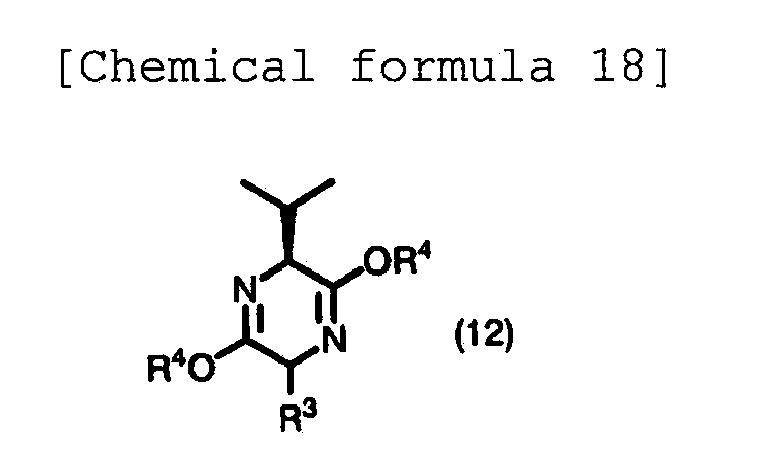
- [wherein R3 and R4 are as described above] to act in the presence of a base (step B-1).
- The reaction can be carried out using a reaction solvent such as 1,4- dioxane, THF, and ether, using a base such as n-butyllithium and lithium diisopropyl amide, preferably n-butyllithium, and treating a compound represented by the general formula (12) at -78°C, then allowing a compound represented by the general formula (2) to act at -78°C, and reacting while gradually increasing the temperature to room temperature.
- In the synthesis route B, the compound represented by the general formula (5a) can be produced by subjecting the compound represented by the general formula (11) to acid decomposition, and then protecting the nitrogen atom with a t-butoxycarbonyl group (Boc group) (step B-2).
- It is preferred to carry out the reaction using methanol, ethanol, THF, 1,4-dioxane, or ethyl acetate in which hydrochloric acid is dissolved, and preferably 1,4-dioxane containing hydrochloric acid, by reacting at reflux temperature, then neutralizing with a base to obtain an amino ester, and then using ethyl acetate, THF, DMF, 1, 4-dioxane, methylene chloride, chloroform, methanol, ethanol, acetonitrile or the like as a solvent, allowing it to act with Boc2O at 0°C to room temperature.
- In the synthesis route B, the compound represented by the general formula (6a) can be produced by reducing the compound represented by the general formula (5a) (step B-3).
- The reaction can be carried out using borane, an alkyl borane derivative like 9-BBN, or a metal hydride complex compound, such as (iBu)2AlH, NaBH4, LiBH4, and LiAlH4, preferably LiBH4, using THF, 1,4-dioxane, ethanol, or methanol as a reaction solvent, at a temperature of 0°C to reflux temperature, and preferably at room temperature.
- In the synthesis route B, the compound represented by the general formula (7a) can be produced by reacting the compound represented by the general formula (6a) and the compound represented by the general formula (10) (step B-4).
- The reaction may be carried out in the presence of carbon tetrabromide and pyridine, without a solvent or using a small amount of a solvent such as methylene chloride, chloroform, acetonitrile, ethyl acetate, THF, and ether, at 0°C to room temperature.
- It is noted that concerning the synthesis method of the compound represented by the general formula (2), the compound may be produced by the methods described in the respective pamphlets of
WO 03029184 WO 03029205 WO 04026817 WO 04074297 WO 050444780 - The compound according to the present invention is effective as a treatment agent and a preventive agent for arteriosclerosis, arteriosclerosis obliterans, thromboangiitis obliterans, renal fibrosis, hepatic fibrosis, chronic bronchial asthma, diffuse pulmonary hamartoangiomyomatosis, adult respiratory distress syndrome (ARDS), chronic obstructive pulmonary disease (COPD), pneumonitis, idiopathic interstitial pneumonia, lung cancer, pneumonia hypersensitivity, Buerger's disease, diabetic neuropathy peripheral arterial disease, septicemia, angiitis, nephritis, pneumonia, cerebral infarction, myocardial infarction, edematous state, varices, dissecting aortic aneurysm, angina pectoris, DIC, pleurisy, congestive heart failure, multiple organ failure, bedsores, burns, ulcerative colitis, Crohn's disease and the like. Furthermore, the compound according to the present invention is effective as a treatment and a preventive agent for rejection of heart transplants, kidney transplants, skin grafts, liver transplants, and bone marrow transplants, and is also an effective as a treatment and a preventive agent for rheumatoid arthritis, lupus nephritis, systemic lupus erythematosus, Hashimoto's disease, multiple sclerosis, myasthenia gravis, diabetes mellitus, atopic dermatitis, allergic rhinitis, allergic conjunctivitis, allergic contact dermatitis and the like.
- In the case of using as above, the required dose of course depends on the administration method, the specific condition to be treated, and the desired effects. However, generally, a daily dose of about 0.03 to 2.5 mg per kg of body weight is preferred. For mammals such as humans, the recommended daily dose is in the range of about 0.5 mg to about 100 mg. Preferably, administration is carried out in divided doses of four times or less per day, or in retard form. A suitable unit dose form for oral administration includes about 1 to 50 mg of active ingredient.
- The compound of the present invention may be administered by an arbitrary conventional route, especially enterally, for example orally, for example in the form of a tablet or a capsule, or parenterally, for example in the form of an injectable solution or a suspension, locally, for example in the form of a lotion, a gel, an ointment, or a cream, or nasally or in the form of a suppository. A pharmaceutical composition containing the compound of the present invention in free form or a pharmaceutically acceptable salt thereof together with at least one kind of pharmaceutically acceptable carrier or diluent may be produced by a conventional method of mixing with the pharmaceutically acceptable carrier or diluent.
- The present invention can express even higher effects by using together with an immunosuppressive agent and/or a pharmaceutical which has an anti-inflammatory activity based on another mechanism. Examples of substances which can be used together include immunosuppressive agents used in the treatment and prevention of acute or chronic rejection of allogeneic transplants and heterologous transplantats, inflammatory diseases, and autoimmune diseases, immunosuppressive agents having an immunomodulatory activity and/or anti-inflammatory agents having an anti-inflammatory or malignant cell growth inhibition activity. Specific examples include the calcineurin inhibitors cyclosporin A and FK506, the mTOR inhibitors rapamycin, 40-O-(2-hydroxymethyl)-rapamycin, CCI779, and ABT578, the ascomycins ABT281 and ASM981 which have an immunosuppressive activity, mycophenolic acid, mycophenolate mofetil, azathioprine, mizoribine, cyclophosphamide and the like. Further examples include the antifolate methotrexate, adrenal cortical steroids which exhibit broad anti-inflammatory activity, auranofin, actarit, mesalazine, or sulfasalazine and the like which have an immunomodulatory activity, infliximab which is an anti-TNFα antibody, MRA which is an anti-IL-6 receptor antibody, natalizumab which is an anti-integrin antibody and the like.
- Next, the present invention will be described with the following specific examples. However, the present invention is not limited by these examples.
- Furthermore, as the intermediates and the like represented by the general formula (2), the compounds in the pamphlets of
WO 03029184 WO 03029205 WO 04026817 WO 04074297 WO 050444780 -

- 1,4-diazabicyclo[2.2.2]octane (9.03 g) and dimethylthiocarbamoyl chloride (9.95 g) were added into a solution of 3-difluoromethylphenol (6.44 g) in N,N-dimethylformamide (149 mL), and the resultant solution was stirred for 4 hours at room temperature. Water was added into the reaction mixture, extracted with ethyl acetate, washed with water and saturated brine in that order, and then dried over anhydrous sodium sulfate. The solvent was removed by distillation, and the resultant residue was purified by silica gel column chromatography (hexane : ethyl acetate = 3 : 1) to obtain the target product (7.04 g) as a colorless oil.
1H-NMR (CDCl3, 400 MHz): δ 3.36 (3H, s), 3.46 (3H, s), 6.66 (1H, t, J = 57 Hz), 7.19 (1H, dt, J = 7.9, 1.2 Hz), 7.23 (1H, br s), 7.39 (1H, d, J = 7.9 Hz), 7.48 (1H, t, J = 7.9 Hz).
EIMS (+) : 231 [M]+. -

- A solution of the compound of Reference Example 1 (2.34 g) in diphenyl ether (12 g) was stirred at 250°C for 2.5 hours. The temperature of the reaction solution was returned to room temperature, and the resultant residue was purified by silica gel column chromatography (hexane : ethyl acetate = 3 : 2) to obtain the target product (1.92 g) as a yellow oil.
1H-NMR (CDCl3, 400 MHz): δ 3.04 (3H, s), 3.10 (3H, s), 6.65 (1H, t, J = 57 Hz), 7.48 (1H, t, J = 7.9 Hz), 7.54 (1H, d, J = 7.9 Hz), 7.61 (1H, t, J= 7.9 Hz), 7.64 (1H, s).
EIMS (+) : 231 [M]+. -

- A solution of the compound of Reference Example 2 (4.17 g) in diethyl ether (12 mL) was added dropwise under ice cooling to a solution of lithium aluminum hydride (959 mg) in diethyl ether (48 mL). The resultant solution was then stirred for 20 minutes under ice cooling. 0.5 mol/L hydrochloric acid (30 mL)was added to the reaction mixture, extracted with diethyl ether, washed with water and saturated brine in that order, and then dried over anhydrous sodium sulfate. The solvent was evaporated, and the resultant residue was reacted with 2-chloro-4-fluorobenzaldehyde according to the same experiment procedures as in Reference Example 1 of the pamphlet of
WO 03029184
1H-NMR (CDCl3, 400 MHz): δ 6.67 (1H, t, J = 56 Hz), 7.09 (1H, dd, J = 7.9, 1.8 Hz), 7.16 (1H, d, J = 7.9 Hz), 7.53-7.64 (3H, m), 7.68 (1H, s), 7.79 (1H, d, J = 7.9 Hz), 10.37 (1H, s)
EIMS (+) : 298 [M]+. -

- Under an argon atmosphere, ethyldiisopropylamine (7.0 mL), tris(dibenzylideneacetone) dipalladium(0) chloroform adduct (518 mg), xantphos (578 mg), and 3-trifluoromethylthiophenol (3.56 g) were added at room temperature into a solution of 4-bromo-2-fluorobenzaldehyde (4.06 g) in 1,4-dioxane (42 mL), and the resultant solution was heated to reflux for 5 hours. Water was added to the reaction mixture, extracted with ethyl acetate, washed with water and saturated brine in that order, and then dried over anhydrous sodium sulfate. The solvent was evaporated, and the resultant residue was purified by silica gel column chromatography (hexane : ethyl acetate = 30 : 1) to obtain the target product (4.08 g) as a colorless oil.
1H-NMR (CDCl3, 400 MHz) : δ 6.86 (1H, dd, J = 10, 1.8 Hz), 7.02 (1H, dd, J = 7.9, 1.8 Hz), 7.58 (1H, t, J = 7.9 Hz), 7.68-7.73 (2H, m), 7.76 (1H, t, J = 7.9 Hz), 7.80 (1H, s), 10.26 (1H, s)
EIMS (+) : 300 [M]+. -

- 3-Chlorobenzenethioland2-chloro-4-fluorobenzaldehyde were reacted according to the same experiment procedures as in Reference Example 1 of the pamphlet of
WO 03029205
1H-NMR (CDCl3, 400 MHz): δ 7.11 (1H, dd, J = 9.2, 1.8 Hz), 7.17 (1H, d, J = 1.8 Hz), 7.36-7.44 (3H, m), 7.52 (1H, t, J = 1.8 Hz), 7.80 (1H, d, J = 7.9 Hz), 10.37 (1H, s)
EIMS (+) : 282 [M]+. -

- m-Cresol and 2-chloro-4-fluorobenzaldehyde were reacted according to the same experiment procedures as in Reference Example 1 of the pamphlet of
WO 03029184
1H-NMR (CDCl3, 400 MHz): δ 2.38 (3H, s), 6.87-6.96 (4H, m), 7.07 (1H, d, J = 7.3 Hz), 7.31 (1H, t, J = 7.6 Hz), 7.90 (1H, d, J = 8.6 Hz), 10.36 (1H, s).
EIMS (+) : 246 [M]+. -

- 3-Ethylbenzenethiol and 2-chloro-4-fluorobenzaldehyde were reacted according to the same experiment procedures as in Reference Example 1 of the pamphlet of
WO 03029205
1H-NMR (CDCl3, 400 MHz): δ 1.26 (3H, t, J = 7.3 Hz), 2.680 (2H, q, J = 7.3 Hz), 7.04-7.11 (2H, m), 7.28-7.40 (4H, m), 7.76 (1H, d, J = 8.6 Hz), 10.35 (1H, s).
EIMS (+) : 276 [M]+. -

- 3-Propylphenol and 2-chloro-4-fluorobenzaldehyde were reacted according to the same experiment procedures as in Reference Example 1 of the pamphlet of
WO 03029184
1H-NMR (CDCl3, 400 MHz) : δ 0.95 (3H, t, J = 7.3 Hz), 1.62-1.68 (2H, m), 2.61 (2H, t, J = 7.3 Hz), 6.89-6.94 (3H, m), 6.96 (1H, d, J = 2.1 Hz), 7.08 (1H, d, J = 7.9 Hz), 7.31-7.35 (1H, m), 7.90 (1H, d, J = 8. 9 Hz), 10.36 (1H, d, J = 0.6 Hz).
EIMS (+) : 274 [M]+. -

- The compound of Reference Example 7 was reacted according to the same experiment procedures as in Reference Example 326 of the pamphlet of
WO 04074297 -

- The compound of Reference Example 7 was reacted according to the same experiment procedures as in Reference Example 10 of the pamphlet of
WO 03029205
EIMS (+) : 346 [M]+. -

- The compound of Reference Example 10 was reacted according to the same experiment procedures as in Reference Example 19 of the pamphlet of
WO 03029205 WO 03029205
1H-NMR (CDCl3, 400 MHz,): δ 1.22 (3H, t, J = 7.3 Hz), 1.84 -1.90 (2H, m), 2.62 (2H, q, J = 7.6 Hz), 2.78-2.82 (2H, m), 3.69 (2H, t, J = 6.1 Hz), 7.10-7.18 (4H, m), 7.23-7.29 (3H, m). -

- The compound of Reference Example 8 was successively reacted according to the same experiment procedures as in Reference Example 10 and then Reference Example 11 to obtain the target product as a colorless oil.
1H-NMR (CDCl3, 400 MHz,): δ 0.94 (3H, t, J = 7.3 Hz), 1.37 (1H, br s), 1. 58-1. 68 (2H, m), 1. 85-1. 92 (2H, m), 2.57 (2H, t, J = 7.6 Hz), 2.80 (2H, t, J=7.6Hz), 3.70 (2H, dt, J= 6.1, 4.6 Hz), 6.80-6.85 (3H, m), 6.95 (1H, d, J = 7.9 Hz), 7.00 (1H, d, J = 2.8 Hz), 7.17 (1H, d, J = 8.3 Hz), 7.24 (1H, t, J = 7.9 Hz).
EIMS (+) : 304 [M]+. -

- The compound of Reference Example 4 was successively reacted according to the same experiment procedures as in Reference Example 10 and then Reference Example 11 to obtain the target product as a colorless oil.
1H-NMR (CDCl3, 400 MHz): δ 1.88 (2H, tt, J = 6.7, 6.1 Hz), 2.75 (2H, t, J = 6.7 Hz), 3.69 (2H, t, J = 6.1 Hz), 7.05 (1H, dd, J = 10, 1.8 Hz), 7.10 (1H, dd, J =7.9, 1.8 Hz), 7.20 (1H, t, J = 7.9 Hz), 7.38-7.51 (3H, m), 7.55 (1H, s). -

- The compound of Reference Example 5 was successively reacted according to the same experiment procedures as in Reference Example 10 and then Reference Example 11 to obtain the target product as a colorless oil.
1H-NMR (CDCl3, 400 MHz): δ1.33 (1H, br s), 1. 83-1. 95 (2H, m), 2.81-2.85 (2H, m), 3.70 (2H, br s), 7.15-7.23 (5H, m), 7.24-7.29 (1H, m), 7.38 (1H, d, J = 1.8 Hz). -

- The compound of Reference Example 6 was successively reacted according to the same experiment procedures as in Reference Example 10 and then Reference Example 11 to obtain the target product as a colorless oil.
1H-NMR (CDCl3, 400 MHz): δ 1.31 (1H, brs), 1.87-1.90 (2H, m), 2.34 (3H, s), 2.80 (2H, t, J = 7.3 Hz), 3.70 (2H, dd, J = 11.6, 6.1 Hz), 6.79-6.86 (3H, m), 6.94 (1H, d, J = 7.3 Hz), 6.99 (1H, d, J = 2.4 Hz), 7.18 (1H, d, J = 7.9 Hz), 7.22 (1H, t, J = 7.3 Hz).
EIMS (+) : 276 [M]+. -

- The compound of Reference Example 3 was successively reacted according to the same experiment procedures as in Reference Example 10 and then Reference Example 11 to obtain the target product as a colorless oil.
1H-NMR (CDCl3, 400 MHz) : δ 1.32 (1H, t, J = 4.9 Hz), 1.85-1.93 (2H, m), 2.81-2.85 (2H, m), 3.70 (2H, q, J = 6.7 Hz), 6.59 (1H, t, J = 56 Hz), 7.17-7.23 (2H, m), 7.36-7.41 (4H, m), 7.45 (1H, s). -

- The compound of Reference Example 9 was reacted according to the same experiment procedures as in Reference Example 327 of the pamphlet of
WO 04074297
1H-NMR (CDCl3, 400 MHz): δ 1.22 (3H, t, J = 7.3 Hz), 2.63 (2H, q, J = 7.3 Hz), 3.23-3.28 (2H, m), 3.32-3.35 (2H, m), 7.09-7.29 (7H, m).
EIMS (+) : 402 [M]+. -

- The compound of Reference Example 11 was reacted according to the same experiment procedures as in Reference Example 164 of the pamphlet of
WO 03029184
1H-NMR (CDCl3, 400 MHz) : δ 1.22 (3H, t, J = 7.3 Hz), 2. 12 (2H, quintet, J = 7.3 Hz), 2.63 (2H, q, J = 7.3 Hz), 2.81 (2H, t, J = 7.3 Hz), 3.19 (2H, t, J = 7.3 Hz), 7.09-7.19 (4H, m), 7.24-7.28 (3H, m).
EIMS (+) : 416 [M]+. -

- The compound of Reference Example 12 was reacted according to the same experiment procedures as in Reference Example 164 of the pamphlet of
WO 03029184
1H-NMR (CDCl3, 400 Hz): δ 0.94 (3H, t, J = 7.3 Hz), 1.60-1.68 (2H, m), 2.10-2.17 (2H, m), 2.57 (2H, t, J = 7.6 Hz), 2.81 (2H, t, J = 7.6 Hz), 3.21 (2H, t, J = 7.0 Hz), 6.80-6.85 (3H, m), 6.96 (1H, d, J = 7.9 Hz), 6.99 (1H, d, J = 2.4 Hz), 7.19 (1H, d, J = 8.3 Hz), 7.25 (1H, t, J = 7.9 Hz).
EIMS (+) : 414 [M]+. -

- The compound of Reference Example 13 was reacted according to the same experiment procedures as in Reference Example 164 of the pamphlet of
WO 03029184
1H-NMR (CDCl3, 400 MHz) : δ 2.13 (2H, quintet, J = 7.3 Hz), 2.76 (2H, t, J = 7.3 Hz), 3.18 (2H, t, J = 6.7 Hz), 7.03 (1H, dd, J = 10, 1.8 Hz), 7.09 (1H, dd, J = 7.9, 1.8 Hz), 7.20 (1H, t, J = 7.9 Hz), 7.39-7.52 (3H, m), 7.57 (1H, s).
EIMS (+) : 404 [M]+. -

- The compound of Reference Example 14 was reacted according to the same experiment procedures as in Reference Example 164 of the pamphlet of
WO 03029184
1H-NMR (CDCl3, 400 MHz): δ 2.14 (2H, tt, J = 7.3, 6.7 Hz), 2.84 (2H, t, J= 7.3 Hz), 3.20 (2H, t, J = 6.7 Hz), 7.16-7.25 (5H, m), 7.28 (1H, t, J = 1.8 Hz), 7.36 (1H, d, J = 1.8 Hz).
EIMS (+) : 422 [M]+ -

- The compound of Reference Example 15 was reacted according to the same experiment procedures as in Reference Example 164 of the pamphlet of
WO 03029184
1H-NMR (CDCl3, 400 MHz): δ 2.13 (2H, quint, J = 7.3 Hz), 2.34 (3H, s), 2.81 (2H, t, J = 7.3 Hz), 3.21 (2H, t, J = 7.3 Hz), 6.81-6.84 (3H, m), 6.95 (1H, d, J = 7.9 Hz), 6.99 (1H, d, J = 2.4 Hz), 7.18 (1H, d, J = 7.9 Hz), 7.23 (1H, t, J = 7.9 Hz).
EIMS (+) : 386 [M]+. -

- The compound of Reference Example 16 was reacted according to the same experiment procedures as in Reference Example 164 of the pamphlet of
WO 03029184
1H-NMR (CDCl3, 400 MHz): δ 2.10-2.17 (2H, m), 2.84 (2H, t, J = 7.3 Hz), 3.20 (2H, t, J = 6.7 Hz), 6.60 (1H, t, J = 56 Hz), 7.18 (1H, dd, J = 7.9, 1.2 Hz), 7.22 (1H, d, J = 7.9 Hz), 7.36 (1H, d, J = 1.2 Hz), 7.41 (3H, d, J = 1.2 Hz), 7.47 (1H, s). -


- Under an argon atmosphere, a solution of n-butyllithium in hexane (1.54 mol/L, 3.59 mL) was added at -78°C into a solution of (5S)-3,6-diethoxy-5-isopropyl-2-methyl-2,5-dihydropyrazine (905 mg) in THF (16 mL), and the resultant solution was stirred at -78°C for 30 minutes. Next, A solution of 2-chloro-1-(3-iodopropyl)-4-(3-trifluoromethylphenoxy)benzene (2.47 g) in THF (4 mL) was added to the reaction mixture, and the resultant solution was stirred at -78°C for 30 minutes and then at 0 °C for 1 hour. Water was added to the reaction mixture, extracted with ethyl acetate, washed with water and saturated brine in that order, and then dried over anhydrous sodium sulfate. The solvent was evaporated, and the resultant residue was purified by silica gel column chromatography (hexane : ethyl acetate = 60 : 1) to obtain the target product (1.59 g) as a colorless oil.
1H-NMR (CDCl3, 400 MHz): δ 0.70 (3H, d, J = 6.7 Hz), 1.05 (3H, d, J = 6.7 Hz), 1.18-1.50 (9H, m), 1.32 (3H, s), 1.86-1.97 (1H, m), 2.21-2.30 (1H, m), 2.65 (2H, t, J = 7.6 Hz), 3.90 (1H, d, J = 2.1 Hz), 3.97-4.21 (4H, m), 6.84 (1H, dd, J = 7.9, 2.4 Hz), 7.00 (1H, d, J = 2.4 Hz), 7.15 (2H, d, J = 7.9 Hz), 7.24 (1H, br s), 7.36 (1H, d, J = 7.9 Hz), 7.44 (1H, t, J = 7.9 Hz). -
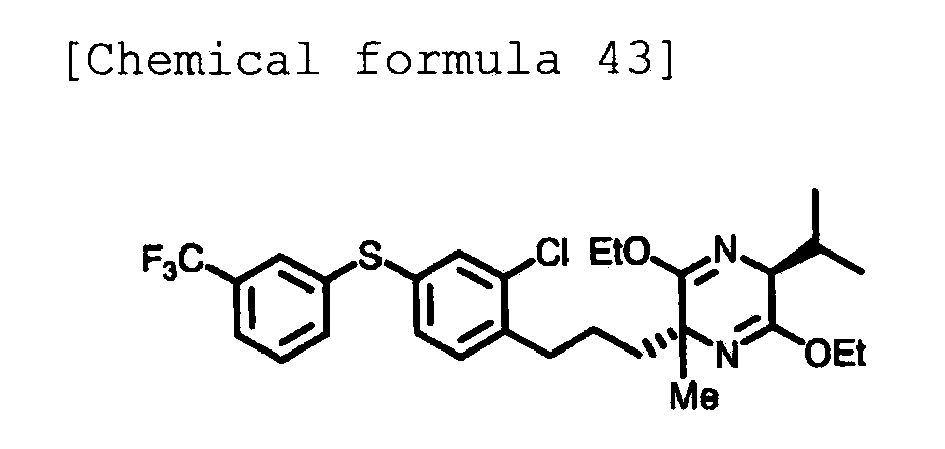
- (5S)-3,6-diethoxy-5-isopropyl-2-methyl-2,5-dihydropyrazin e and 2-chloro-1-(3-iodopropyl)-4-(3-trifluoromethylphenylthio)benze ne were reacted in the same manner as in Example 1 to obtain the target product as a colorless oil.
1H-NMR (CDCl3, 400 MHz): δ 0.63 (3H, d, J = 6.7 Hz), 1.07 (3H, d, J = 6.7 Hz), 1.18-1.29 (10H, m), 1.34-1.66 (2H, m), 1.79-1.91 (1H, m), 2.25-2.33 (1H, m), 2.70 (2H, t, J = 7.6 Hz), 3.85 (1H, br s), 3.99-4.23 (4H, m), 7.16 (2H, d, J = 7.9 Hz), 7.20 (1H, dd, J = 7.9, 1.8 Hz), 7.36-7.42 (3H, m), 7.44-7.50 (1H, m), 7.52 (1H, br s). -


- (5S)-3,6-diethoxy-5-isopropyl-2-methyl-2,5-dihydropyrazin e and 2-chloro-1-(2-iodoethyl)-4-(3-trifluoromethylphenoxy)benzene were reacted in the same manner as in Example 1 to obtain the target product as a colorless oil.
1H-NMR (CDCl3, 400 MHz): δ 0.72 (3H, d, J = 6.7 Hz), 1.08 (3H, d, J = 6.7 Hz), 1.29 (6H, t, J = 7.3 Hz), 1.36 (3H, s), 1.74-1.82 (1H, m), 2.13-2.20 (1H, m), 2.25-2.32 (1H, m), 2.39-2.56 (2H, m), 3.95 (1H, d, J = 3.1 Hz), 4.02-4.22 (4H, m), 6.83 (1H, dd, J = 8.6, 2.4 Hz), 6.99 (1H, d, J = 2.4 Hz), 7.12-7.15 (2H, m), 7.23 (1H, br s), 7.35 (1H, d, J = 7.8 Hz), 7.44 (1H, t, J = 7.8 Hz).
EIMS (+) : 524 [M]+. -

- (5S)-3,6-diethoxy-5-isopropyl-2-methyl-2,5-dihydropyrazin e and 2-chloro-1-(2-iodoethyl)-4-(3-trifluoromethylphenylthio)benzen e were reacted in the same manner as in Example 1 to obtain the target product as a colorless oil.
1H-NMR (CDCl3, 400 MHz): δ 0.72 (3H, d, J = 6.7 Hz), 1.08 (3H, d, J = 6.7 Hz), 1.28 (6H, t, J = 7.3 Hz), 1.35 (3H, s), 1.68-1.90 (1H, m), 2.10-2.19 (1H, m), 2.38-2.57 (1H, m), 3.95 (1H, d, J = 3.1 Hz), 4.02-4.22 (4H, m), 7.13 (1H, d, J = 7.9 Hz), 7.18 (1H, dd, J = 7.9, 2.4 Hz), 7.35-7.42 (3H, m), 7.43-7.48 (1H, m), 7.54 (1H, br s). -

- (5S)-3,6-diethoxy-5-isopropyl-2-methyl-2,5-dihydropyrazin e and the compound of Reference Example 17 were reacted in the same manner as in Example 1 to obtain the target product as a colorless oil.
1H-NMR (CDCl3, 400 MHz): δ 0.72 (3H, d, J = 6.7 Hz), 1.07 (3H, d, J = 6.7 Hz), 1.21 (3H, t, J = 7.3 Hz), 1.28 (3H, t, J = 7.3 Hz), 1.29 (3H, t, J = 7.3 Hz), 1.34 (3H, s), 1.70-1.79 (1H, m), 2.09-2.16 (1H, m), 2.24-2.32 (1H, m), 2.35-2.52 (2H, m), 2.61 (2H, q, J = 7.3 Hz), 3.95 (1H, d, J = 3.1 Hz), 4.03-4.20 (4H, m), 7.04-7.15 (4H, m), 7.21-7.26 (3H, m).
ESIMS (+) : 501 [M+H]+. -

- (5S)-3,6-dimethoxy-5-isopropyl-2-methyl-2,5-dihydropyrazi ne and the compound of Reference Example 22 were reacted in the same manner as in Example 1 to obtain the target product as a colorless oil.
1H-NMR (CDCl3, 400 MHz): δ 0.68 (3H, d, J = 6.7 Hz), 1.07 (3H, d, J = 6.7 Hz), 1.33 (3H, s), 1.36-1.43 (1H, m), 1.55-1.62 (1H, m), 1.86-1.92 (1H, m), 2.24-2.26 (1H, m), 2.34 (3H, s), 2.62 (2H, t, J = 7.9 Hz), 3.65 (3H, s), 3.66 (3H, s), 3.94 (1H, d, J = 3.7 Hz), 6.79-6.82 (3H, m), 6.93 (1H, d, J = 7.3 Hz), 6.96 (1H, d, J = 2.4 Hz), 7.09 (1H, d, J = 7.9 Hz), 7.22 (1H, t, J = 7.9 Hz).
EIMS (+) : 456 [M]+. -

- (5S)-3,6-diethoxy-5-isopropyl-2-methyl-2,5-dihydropyrazin e and the compound of Reference Example 18 were reacted in the same manner as in Example 1 to obtain the target product as a colorless oil.
1H-NMR (CDCl3, 400 MHz): δ 0.68 (3H, d, J = 6.7 Hz), 1.04 (3H, d, J = 6.7 Hz), 1.20-1.26 (9H, m), 1.31 (3H, s), 1.36-1.43 (1H, m), 1.50-1.57 (1H, m), 1.85-1.92 (1H, m), 2.21-2.28 (1H, m), 2.60-2.65 (4H, m), 3.88 (1H, d, J = 3.7 Hz), 4.00-4.16 (4H, m), 7.06-7.16 (4H, m), 7.22-7.27 (3H, m).
ESIMS (+) : 515 [M+H]+. -

- (5S)-3,6-diethoxy-5-isopropyl-2-methyl-2,5-dihydropyrazin e and the compound of Reference Example 21 were reacted in the same manner as in Example 1 to obtain the target product as a colorless oil.
1H-NMR (CDCl3, 400 MHz): δ 0.69 (3H, d, J = 6.7 Hz), 1.08 (3H, d, J = 6.7 Hz), 1.18-1.29 (7H, m), 1.31 (3H, s), 1.34-1.47 (1H, m), 1.50-1.63 (1H, m), 1.85-1.95 (1H, m), 2.20-2.30 (1H, m), 2.65 (2H, t, J = 7.6 Hz), 3.89 (1H, d, J = 3.1 Hz), 3.99-4.23 (4H, m), 7.11-7.23 (6H, m), 7.35 (1H, d, J = 1.8 Hz).
ESIMS (+) : 521 [M+H]+. -


- (5S)-3,6-diethoxy-5-isopropyl-2-methyl-2,5-dihydropyrazin e and the compound of Reference Example 20 were reacted in the same manner as in Example 1 to obtain the target product as a colorless oil.
1H-NMR (CDCl3, 400 MHz): δ 0.67 (3H, d, J = 6.7 Hz), 1.06 (3H, d, J = 6.7 Hz), 1.18-1.29 (7H, m), 1.33 (3H, s), 1.36-1.66 (2H, m), 1.85-1.95 (1H, m), 2.23-2.33 (1H, m), 2.67 (2H, t, J = 7.6 Hz), 3.89 (1H, d, J = 3.1 Hz), 3.99-4.23 (4H, m), 7.02 (1H, dd, J = 9.8 Hz, 1.8 Hz), 7.08 (1H, dd, J = 7.9 Hz, 2.4 Hz), 7.13 (1H, t, J = 7.9 Hz), 7.38-7.50 (3H, m), 7.55 (1H, s). -

- (5S)-2-allyl-3,6-diethoxy-5-isopropyl-2,5-dihydropyrazine and
2-chloro-1-(3-iodopropyl)-4-(3-trifluoromethylphenylthio)benze ne were reacted in the same manner as in Example 1 to obtain the target product as a colorless oil.
1H-NMR (CDCl3, 400 MHz): δ 0.67 (3H, d, J = 6.7 Hz), 1.05 (3H, d, J = 6.7 Hz), 1.23 (3H, t, J = 6.4 Hz), 1.25 (3H, t, J = 6.4 Hz), 1.30-1.64 (3H, m), 1.80-1.90 (1H, m), 2.23-2.39 (2H, m), 2.53 (1H, dd, J = 12.4, 7.3 Hz), 2.65 (2H, t, J = 7.6 Hz), 3.83 (1H, d, J = 3.1 Hz), 4.03-4.18 (4H, m), 4.92-5.04 (2H, m), 5.60-5.73 (1H, m), 7.13 (2H, d, J = 7.9 Hz), 7.18 (1H, dd, J = 7.9 Hz, 1.8 Hz), 7.36 (1H, d, J = 1.8 Hz), 7.38-7.42 (2H, m), 7.44-7.49 (1H, m), 7.55 (1H, br s). -

- 5S)-3,6-diethoxy-5-isopropyl-2-methyl-2,5-dihydropyrazine and the compound of Reference Example 23 were reacted in the same manner as in Example 1 to obtain the target product as a colorless oil.
1H-NMR (CDCl3, 400 MHz): δ 0.70 (3H, d, J = 6.7 Hz), 1.06 (3H, d, J = 6.7 Hz), 1.20-1.32 (7H, m), 1.33 (3H, s), 1.35-1.48 (1H, m), 1.58-1.60 (1H, m), 1.85-1.95 (1H, m), 2.24-2.32 (1H, m), 2.66 (2H, t, J = 7.3 Hz), 3.90 (1H, d, J = 3.7 Hz), 3.99-4.22 (4H, m), 6.61 (1H, t, J = 56 Hz), 7.14 (1H, d, J = 7.9 Hz), 7.19 (1H, dd, J = 7.9, 1.8 Hz), 7.36 (1H, d, J = 1.8 Hz), 7.39 (3H, s), 7.46 (1H, s).
ESIMS (+) : [M+H]+. -

- To A solution of the compound of Example 1 (1. 59g) in 1,4-dioxane (60 mL) was added 0.5 mol/L hydrochloric acid (30 mL). The resultant solution was stirred at room temperature for 1 hour, and then left to stand at room temperature overnight. The solution was concentrated, neutralized with saturated aqueous sodium hydrogen carbonate solution, and extracted with ethyl acetate. The extract was washed with water and saturated brine, and then dried over anhydrous sodium sulfate. The extract was concentrated, and the resultant residue was dissolved in acetonitrile (15 mL). To this solution was added di-tert-butoxydicarbonate (1.55 g), and the resultant solution was stirred at room temperature for 4 hours and then left to stand at room temperature overnight. To the reaction solution was added water, extracted with ethyl acetate, washed with water and saturated brine in that order, and then dried over anhydrous sodium sulfate. The solvent was evaporated, and the resultant residue was purified by silica gel column chromatography (hexane : ethyl acetate = 9 : 1) to obtain the target product (1.00 g) as a colorless oil.
1H-NMR (CDCl3, 400 MHz): δ 1.26 (3H, t, J = 7.3 Hz), 1.43 (9H, s), 1.53 (3H, s), 1.45-1.68 (2H, m), 1.80-1.90 (1H, m), 2.12-2.30 (1H, m), 2.69 (2H, t, J = 7.6 Hz), 4.16-4.24 (2H, m), 5.33 (1H, br s), 6.85 (1H, dd, J = 7.9 Hz, 2.4 Hz), 7.02 (1H, d, J = 2.4 Hz), 7.15 (1H, dd, J = 7.9 Hz, 2.4 Hz), 7.17 (1H, d, J = 7.9 Hz), 7.24 (1H, br s), 7.37 (1H, d, J = 7.9 Hz), 7.45 (1H, t, J = 7.9 Hz). -


- The compound of Example 9 was reacted in the same manner as in Example 12 to obtain the target product as a colorless oil.
1H-NMR (CDCl3, 400 MHz): δ 1.26 (3H, t, J = 7.3 Hz), 1.42 (9H, s), 1.51 (3H, s), 1.45-1.68 (2H, m), 1.77-1.86 (1H, m), 2.09-2.20 (1H, m), 2.69 (2H, t, J = 7.6 Hz), 4.13-4.23 (2H, m), 5.29 (1H, br s), 7.02 (1H, dd, J = 9.8 Hz, 1.8 Hz), 7.08 (1H, dd, J = 7.9 Hz, 2.4 Hz), 7.13 (1H, t, J = 7.9 Hz), 7.38-7.50 (3H, m), 7.55 (1H, s). -

- The compound of Example 10 was reacted in the same manner as in Example 12 to obtain the target product as a colorless oil.
1H-NMR (CDCl3, 400 MHz) δ 1.24 (3H, t, J = 7.3 Hz), 1.29 - 1.39 (1H, m), 1.43 (9H, s), 1.60-1.70 (1H, m), 1.78-1.86 (1H, m), 2.32-2.50 (2H, m), 2.66-2.73 (2H, m), 2.99-3.10 (1H, m), 4.19 (2H, q), 5.03 (1H, d, J = 3.1 Hz), 5.09 (1H, s), 5.49 (1H, br s), 5.54-5.68 (1H, m), 7.16 (1H, d, J = 7.9 Hz), 7.19 (1H, dd, J = 7.9, 1.8 Hz), 7.35 (1H, d, J = 1.8 Hz), 7.39-7.44 (2H, m), 7.45-7.50 (1H, m), 7.54 (1H, br s). -

- To a solution of the compound of Example 14 (400 mg) in ethyl acetate (20 mL) was added palladium- carbon/ethylene diamine complex (100 mg), and the resultant solution was stirred at room temperature for 24 hours under hydrogen atmosphere. The reaction solution was filtered through Celite, and the solvent was evaporated. The resultant residue was purified by silica gel column chromatography (hexane : ethyl acetate = 30 : 1) to obtain the target product (293 mg) as a colorless oil.
1H-NMR (CDCl3, 400 MHz): δ 0.91 (3H, t, J = 7.3 Hz), 1.42 (9H, s), 1.15-1.77 (8H, m), 2.72 (2H, t, J = 7.3 Hz), 3.63 (1H, d, J = 12 Hz), 3.67 (1H, d, J = 12 Hz), 4.52 (1H, br s), 7.19-7.22 (2H, m), 7.39 (1H, s), 7.40-7.50 (3H, m), 7.54 (1H, br s).
FABMS (+) : 532 [M+H]+. -
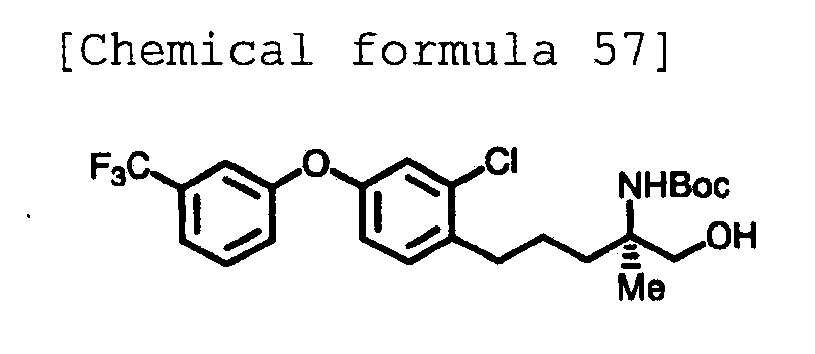
- To a solution of the compound of Example 12 (1.00 g) in THF (14 mL) was added under ice cooling lithium borohydride (229 mg), and then ethanol (1.4mL) was added dropwise. The resultant solution was then stirred for 1 hour under ice cooling. To the reaction solution was added 10% aqueous citric acid, extracted with ethyl acetate, washed with water and saturated brine in that order, and then dried over anhydrous sodium sulfate. The solvent was evaporated, and the resultant residue was purified by silica gel column chromatography (hexane : ethyl acetate = 4 : 1) to obtain the target product (910 mg) as a colorless oil.
1H-NMR (CDCl3, 400 MHz): δ 1.16 (3H, s), 1.43 (9H, s), 1.53-1.74 (3H, m), 1.81-1.93 (1H, m), 2.73 (2H, t, J = 7.3 Hz), 3.61 (1H, d, J = 12 Hz), 3.65 (1H, d, J = 12 Hz), 4.58 (1H, br s), 4.58 (1H, br s), 6.86 (1H, dd, J = 7.9, 2.4 Hz), 7.03 (1H, d, J = 2.4 Hz), 7.16 (1H, dd, J = 7.9 Hz, 2.4 Hz), 7.21 (1H, d, J = 7.9 Hz), 7.24 (1H, br s), 7.37 (1H, d, J = 7.9 Hz), 7.45 (1H, t, J = 7.9 Hz). -

- The compound of Example 2 was reacted in the same manner as in Example 12 to obtain an ester, which was then reacted in the same manner as in Example 16 to obtain the target product as a colorless oil.
1H-NMR (CDCl3, 400 MHz): δ 1.14 (3H, s), 1.42 (9H, s), 1.48-1.76 (4H, m), 1.81-1.90 (1H, m), 2.74 (2H, t, J = 6.7 Hz), 3.61 (1H, d, J = 12 Hz), 3.65 (1H, d, J = 12 Hz), 4.56 (1H, br s), 4.58 (1H, br s), 7.20 (2H, d, J = 1.2 Hz), 7.37-7.50 (4H, m), 7.54 (1H, br s).
Optical Rotation: [α]D 27+14.31 (c 0.63, CHCl3). -

- The compound of Example 3 was reacted in the same manner as in Example 12 to obtain an ester, which was then reacted in the same manner as in Example 16 to obtain the target product as a colorless oil.
1H-NMR (CDCl3, 400 MHz): δ 1.26 (3H, s), 1.45 (9H, s), 1.80-1.88 (1H, m), 2.05-2.12 (1H, m), 2.66-2.80 (2H, m), 3.68 (1H, d, J = 11.6 Hz), 3.73 (1H, d, J = 11.6 Hz), 4.70 (1H, br s), 6.86 (1H, dd, J = 8.5, 2.5 Hz), 7.03 (1H, d, J = 2.5 Hz), 7.13-7.16 (1H, m), 7.22-7.24 (2H, m), 7.37 (1H, d, J = 7.9 Hz), 7.45 (1H, t, J = 7.9 Hz).
FABMS (+) : 474 [M+H]+. -


- The compound of Example 4 was reacted in the same manner as in Example 12 to obtain an ester, which was then reacted in the same manner as in Example 16 to obtain the target product as a colorless oil.
1H-NMR (CDCl3, 400 MHz): δ 1.25 (3H, s), 1.44 (9H, s), 1.79-1.89 (1H, m), 2.05-2.13 (1H, m), 2.66-2.83 (2H, m), 3.68 (1H, d, J = 12 Hz), 3.71 (1H, d, J = 12 Hz), 4.69 (1H, br s), 7.20-7.23 (2H, m), 7.37-7.42 (3H, m), 7.45-7.50 (2H, m), 7.55 (1H, br s). -

- The compound of Example 5 was reacted in the same manner as in Example 12 to obtain an ester, which was then reacted in the same manner as in Example 16 to obtain the target product as a colorless oil.
1H-NMR (CDCl3, 400 MHz): δ 1.22 (3H, t, J = 7.3 Hz), 1.24 (3H, s), 1.44 (9H, s), 1.77-1.85 (1H, m), 2.02-2.09 (1H, m), 2.62 (2H, q, J = 7.3 Hz), 2.63-2.78 (2H, m), 3.64-3.73 (2H, m), 4.08 (1H, br), 4.68 (1H, br s), 7.10-7.17 (4H, m), 7.22-7.28 (3H, m).
ESIMS (+) : 450 [M+H]+. -

- The compound of Example 6 was reacted in the same manner as in Example 12 to obtain an ester, which was then reacted in the same manner as in Example 16 to obtain the target product as a colorless oil.
1H-NMR (CDCl3, 400 MHz): δ 1.15 (3H, s), 1.43 (9H, s), 1.61-1.67 (3H, m), 1.83-1.87 (1H, m), 2.34 (3H, s), 2.70 (2H, t, J = 7.0 Hz), 3.62-3.65 (2H, m), 4.57 (1H, s), 6.81-6.84 (3H, m), 6.94 (1H, d, J = 7.3 Hz), 6.98 (1H, d, J = 3.1 Hz), 7.15 (1H, d, J = 7.9 Hz), 7.22 (1H, t, J = 7.9 Hz).
ESIMS (+) : 434 [M+H]+. -

- The compound of Example 7 was reacted in the same manner as in Example 12 to obtain an ester, which was then reacted in the same manner as in Example 16 to obtain the target product as a colorless oil.
1H-NMR (CDCl3, 400 MHz): δ 1.14 (3H, s), 1.22 (3H, t, J = 7.3 Hz), 1.43 (9H, s), 1.54-1.70 (3H, m), 1.79-1.89 (1H, m), 2.62 (2H, q, J = 7.3 Hz), 2.70 (2H, t, J = 7.0 Hz), 3.57-3.66 (2H, m), 4.05 (1H, br), 4.55 (1H, br s), 7.10-7.17 (4H, m), 7.17-7.28 (3H, m).
ESIMS (+) : 464 [M+H]+. -


- The compound of Reference Example 19 and (5S)-3,6-diethoxy-5-isopropyl-2-methyl-2,5-dihydropyrazine were reacted in the same manner as in Example 1. The resultant compound was reacted in the same manner as in Example 12 to obtain an ester, which was then reacted in the same manner as in Example 16 to obtain the target product as a colorless oil.
1H-NMR (CDCl3, 400 MHz): δ 0.94 (3H, t, J = 7.3 Hz), 1.15 (3H, s), 1.24-1.28 (2H, m), 1.43 (9H, s), 1.60-1.69 (3H, m), 1.80-1.90 (1H, m), 2.57 (2H, t, J = 7.6 Hz), 2.70 (2H, t, J = 7.6 Hz), 3.58-3.67 (2H, m), 4.11 (1H, br s), 4.58 (1H, br s), 6.79-6.85 (3H, m), 6.95 (1H, d, J = 7.9 Hz), 6.99 (1H, d, J = 2.8 Hz), 7.15 (1H, d, J = 8.3 Hz), 7.24 (1H, t, J = 7.9 Hz). -

- The compound of Example 8 was reacted in the same manner as in Example 12 to obtain an ester, which was then reacted in the same manner as in Example 16 to obtain the target product as a colorless oil.
1H-NMR (CDCl3, 400 MHz): δ 1.14 (3H, s), 1.43 (9H, s), 1.58-1.74 (3H, m), 1.79-1.92 (1H, m), 2.73 (2H, t, J = 6.7 Hz), 3.61 (1H, d, J = 12 Hz), 3.64 (1H, d, J = 12 Hz), 4.08 (1H, br s), 4.57 (1H, br s), 7.17-7.27 (6H, m), 7.37 (1H, s).
ESIMS (+) : 470 [M+H]+. -

- The compound of Example 13 was reacted in the same manner as in Example 16 to obtain the target product as a colorless oil.
1H-NMR (CDCl3, 400 MHz): δ 1.14 (3H, s), 1.42 (9H, s), 1.55-1.74 (3H, m), 1.75-1.85 (1H, m), 2.65 (2H, t, J = 6.7 Hz), 3.58-3.64 (2H, m), 4.03 (1H, br s), 4.55 (1H, br s), 7.04 (1H, dd, J = 9.8 Hz, 1.8 Hz), 7.10 (1H, dd, J = 7.9 Hz, 1.8 Hz), 7.17 (1H, t, J = 7.9 Hz), 7.38-7.50 (3H, m), 7.54 (1H, br s). -
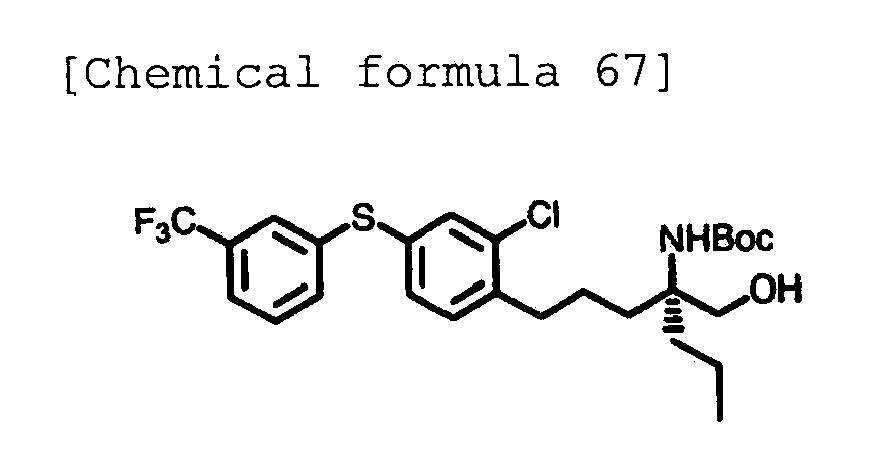
- The compound of Example 15 was reacted in the same manner as in Example 16 to obtain the target product as a colorless oil.
1H-NMR (CDCl3, 400 MHz): δ 0.92 (3H, t, J = 7.3 Hz), 1.42 (9H, s), 1.14-1.80 (8H, m), 2.72 (2H, t, J = 7.3 Hz), 3.62 (1H, d, J = 12 Hz), 3.66 (1H, d, J = 12 Hz), 4.54 (1H, br s), 7.16-7.22 (2H, m), 7.39 (1H, s), 7.40-7.48 (3H, m), 7.55 (1H, br s).
FABMS (+) : 532 [M+H]+. -

- The compound of Example 11 was reacted in the same manner as in Example 12 to obtain an ester, which was then reacted in the same manner as in Example 16 to obtain the target product as a colorless oil.
1H-NMR (CDCl3, 400 MHz): δ 1.14 (3H, s), 1.42 (9H, s), 1.51-1.73 (3H, m), 1.79-1.92 (1H, m), 2.73 (2H, t, J = 6.7 Hz), 3.57-3.67 (2H, m), 4.05 (1H, br s), 4.57 (1H, br s), 6.60 (1H, t, J = 56 Hz), 7.19 (2H, d, J = 1.2 Hz), 7.36 (1H, s), 7.39 (3H, br s), 7.44 (1H, s).
ESIMS (+): 537[M+H]+. -
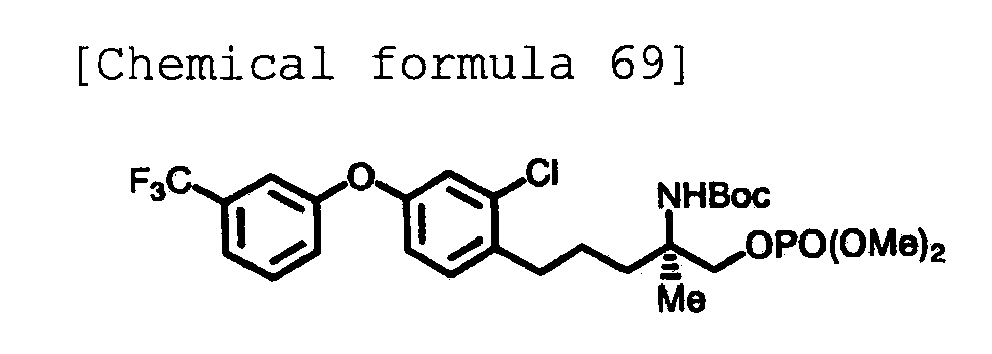
- To a solution of the compound of Example 16 (456 mg) in pyridine (5 mL) was added under ice cooling carbon tetrabromide (620 mg) and trimethyl phosphite (219 µL), and the resultant solution was then stirred at 0°C for 1 hour. To the reaction solution was added 10% aqueous citric acid, extracted with ethyl acetate, washed with water and saturated brine in that order, and then dried over anhydrous sodium sulfate. The solvent was evaporated, and the resultant residue was purified by silica gel column chromatography (hexane : ethyl acetate = 1 : 2) to obtain the target product (533 mg) as a colorless oil.
1H-NMR (CDCl3, 400 MHz): δ 1.26 (3H, s), 1.42 (9H, s), 1.52-1.70 (3H, m), 1.86-1.97 (1H, m), 2.71 (2H, t, J = 7.6 Hz), 3.78 (6H, d, J = 11 Hz), 4.00 (1H, dd, J = 9.8, 4.9 Hz), 4.16 (1H, dd, J = 9.8, 4.9 Hz), 4.52 (1H, br s), 6.86 (1H, dd, J = 7.9, 2.4 Hz), 7.03 (1H, d, J = 2.4 Hz), 7.16 (1H, dd, J = 7.9, 2.4 Hz), 7.19 (1H, d, J = 7.9 Hz), 7.24 (1H, br s), 7.37 (1H, d, J = 7.9 Hz), 7.45 (1H, t, J = 7.9 Hz). -

- The compound of Example 17 was reacted in the same manner as in Example 28 to obtain the target product as a colorless oil.
1H-NMR (CDCl3, 400 MHz): δ 1.25 (3H, s), 1.42 (9H, s), 1.53-1.68 Hz (3H, m), 1.85-1.97 (1H, m), 2.73 (2H, t, J = 7.6 Hz), 3.77 (6H, d, J = 11 Hz), 3.98 (1H, dd, J = 9.8, 4.9 Hz), 4.15 (1H, dd, J = 9.8, 4.9 Hz), 4.52 (1H, br s), 7.18-7.21 (2H, m), 7.38 (1H, d, J = 2.4 Hz), 7.40-7.43 (2H, m), 7.46 7.50 (1H, m), 7.54 (1H, br s). -

- The compound of Example 18 was reacted in the same manner as in Example 28 to obtain the target product as a colorless oil.
1H-NMR (CDCl3, 400 MHz): δ 1.38 (3H, s), 1.45 (9H, s), 1.77-1.85 Hz (1H, m), 2.04-2.17 (1H, m), 2.66-2.79 (2H, m), 3.79 (6H, d, J = 11 Hz), 4.04 (1H, dd, J = 9.8, 4.9 Hz), 4.24 (1H, dd, J = 9.8, 4.9 Hz), 4.64 (1H, br s), 6.86 (1H, dd, J = 8.5, 2.5 Hz), 7.02 (1H, d, J = 2.5 Hz), 7.14-7.16 (1H, m), 7.21 (1H, d, J = 8.5 Hz), 7.24 (1H, bs s), 7.36-7.38 (1H, m), 7.45 (1H, t , J = 8.0 Hz).
FABMS (+) : 582 [M+H]+. -

- The compound of Example 19 was reacted in the same manner as in Example 28 to obtain the target product as a colorless oil.
1H-NMR (CDCl3, 400 MHz): δ 1.37 (3H, s), 1.45 (9H, s), 1.74-1.84 (1H, m), 2.06-2.18 (1H, m), 2.64-2.81 (2H, m), 3.79 (6H, d, J = 11.0 Hz), 4.03 (1H, dd, J = 9.8, 4.9 Hz), 4.23 (1H, dd, J = 9.8, 4.9 Hz), 4.64 (1H, br s), 7.20 (2H, d, J = 1.2 Hz), 7.38 (1H, d, J = 2.4 Hz), 7.40-7.42 (1H, m), 7.42 (1H, d, J = 1.2 Hz), 7.45-7.50 (1H, m), 7.55 (1H, br s). -

- The compound of Example 20 was reacted in the same manner as in Example 28 to obtain the target product as a colorless oil.
1H-NMR (CDCl3, 400 MHz): δ 1.22(3H, t, J = 7.3 Hz), 1.36 (3H, s), 1.44 (9H, s), 1.73-1.81 (1H, m), 2.06-2.18 (1H, m), 2.64 (2H, q, J = 7.3 Hz), 2.65-2.76 (2H, m), 3.78 (6H, d, J = 11.0 Hz), 4.03 (1H, dd, J = 9.8, 4.9 Hz), 4.22 (1H, dd, J = 9.8, 4.9 Hz), 4.62 (1H, br s), 7.09-7.17 (4H, m), 7.22-7.27 (3H, m).
ESIMS (+) : 558 [M+H]+. -

- The compound of Example 21 was reacted in the same manner as in Example 28 to obtain the target product as a yellow oil.
1H-NMR (CDCl3, 400 MHz): δ 1.26 (3H, s), 1.42 (9H, s), 1.58-1.65 (3H, m), 1.89-1.91 (1H, m), 2.34 (3H, s), 2.69 (2H, t, J = 7.3 Hz), 3.77 (6H, t, J = 11.0 Hz), 4.00 (1H, dd, J = 9.8, 4.9 Hz), 4.15 (1H, dd, J = 9.8, 4.9 Hz), 4.52 (1H, brs), 6.79-6.84 (3H, m), 6.94 (1H, d, J = 7.3 Hz), 6.98 (1H, d, J = 2.4 Hz), 7.13 (1H, d, J = 7.9 Hz), 7.22 (1H, t, J = 7.9 Hz).
ESIMS (+) : 542 [M+H]+. -

- The compound of Example 22 was reacted in the same manner as in Example 28 to obtain the target product as a colorless oil.
1H-NMR (CDCl3, 400 MHz): δ 1.22 (3H, t, J = 7.3 Hz), 1.26 (3H, s), 1.41 (9H, s), 1.53-1.65 (3H, m), 1.84-1.93 (1H, m), 2.63 (2H, q, J = 7.3.Hz), 2.66-2.71 (2H, m), 3.76 (3H, d, J = 11.0 Hz), 3.78 (3H, d, J = 11.0 Hz), 3.98 (1H, dd, J = 9.8, 4.9 Hz), 4.14 (1H, dd, J = 9.8, 4.9 Hz), 4.50 (1H, br s), 7.11-7.27 (7H, m).
ESIMS(+) : 572 [M+H]+. -


- The compound of Example 23 was reacted in the same manner as in Example 28 to obtain the target product as a colorless oil.
1H-NMR (CDCl3, 400 MHz): δ 0.94 (3H, t, J = 7.3 Hz), 1.26 (3H, s), 1.42 (9H, s), 1.56-1.68 (5H, m), 1.85-1.95 (1H, m), 2.57 (2H, t, J = 7.6 Hz), 2.69 (2H, t, J = 7.3 Hz), 3.77 (3H, d, J = 11.0 Hz), 3.78 (3H, d, J = 11.0 Hz), 4.00 (1H, dd, J = 9.8, 4.9 Hz), 4.15 (1H, dd, J= 9.8, 4.9 Hz), 4.52 (1H, br s), 6.79-6.85 (3H, m), 6.95 (1H, d, J = 7.9 Hz), 6.98 (1H, d, J = 2.4 Hz), 7.13 (1H, d, J = 8.3 Hz), 7.24 (1H, t, J= 7.9 Hz).
ESIMS(+) : 570 [M+H]+. -
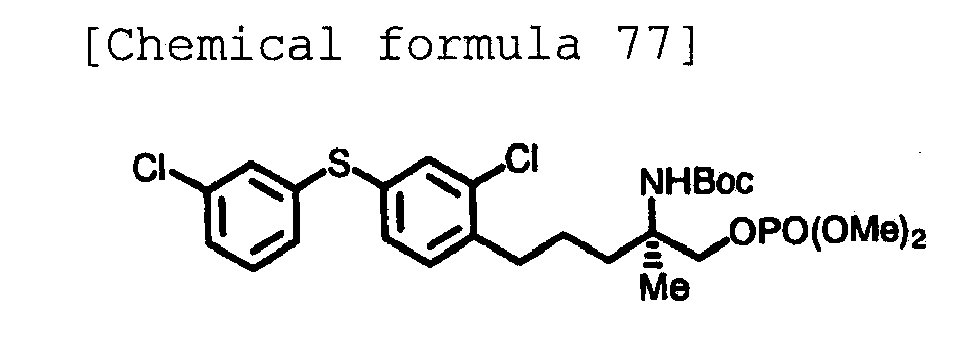
- The compound of Example 24 was reacted in the same manner as in Example 28 to obtain the target product as a colorless oil.
1H-NMR (CDCl3, 400 MHz): δ 1.25 (3H, s), 1.42 (9H, s), 1.58-1.67 Hz (3H, m), 1.86-1.96 (1H, m), 2.72 (2H, t, J = 6.7 Hz), 3.77 (6H, d, J = 11 Hz), 3.98 (1H, dd, J = 9.8, 4.9 Hz), 4.15 (1H, dd, J = 9.8, 4.9 Hz), 4.52 (1H, br s), 7.15-7.24 (5H, m), 7.36 (1H, d, J = 1.8 Hz).
ESIMS (+) 578 [M+H] +. -
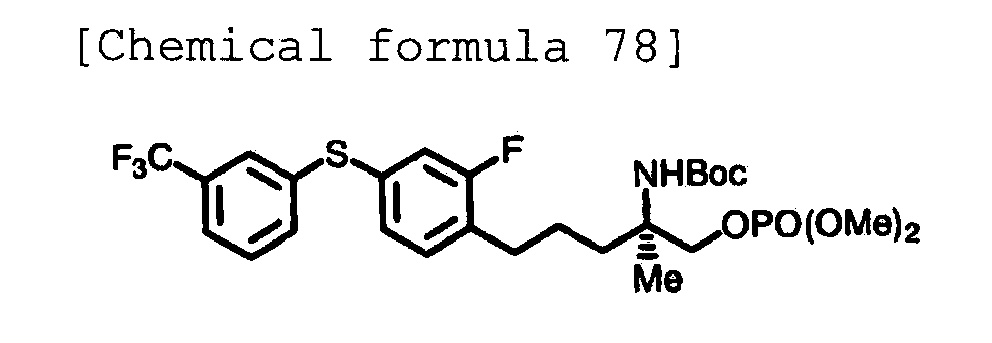
- The compound of Example 25 was reacted in the same manner as in Example 28 to obtain the target product as a colorless oil.
1H-NMR (CDCl3, 400 MHz): δ 1.25 (3H, s), 1.42 (9H, s), 1.53-1.68 Hz (3H, m), 1.85-1.97 (1H, m), 2.73 (2H, t, J = 6.7 Hz), 3.56 (3H, d, J = 11 Hz), 3.57 (3H, d, J = 11 Hz), 3.98 (1H, dd, J = 9.8, 4.9 Hz), 4.13 (1H, dd, J = 9.8, 4.9 Hz), 4.50 (1H, br s), 7.03 (1H, dd, J = 9.8 Hz, 1.8 Hz), 7.08 (1H, dd, J = 7.9 Hz, 1.8 Hz), 7.16 (1H, t, J = 7.9 Hz), 7.38-7.51 (3H, m), 7.55 (1H, br s).
ESIMS (+) 596 [M+H]+. -

- The compound of Example 26 was reacted in the same manner as in Example 28 to obtain the target product as a colorless oil.
1H-NMR (CDCl3, 400 MHz): δ 0.91 (3H, t, J = 7.3 Hz), 1.18-1.31 (3H, m), 1.41 (9H, s), 1.48-1.58 (4H, m), 1.75-1.88 (1H, m), 2.71 (2H, t, J = 7.3 Hz), 3.76 (6H, d, J = 10 Hz), 4.07 (1H, dd, J = 9.7, 4.3 Hz), 4.14 (1H, dd, J= 9.7, 4.3 Hz), 4.40 (1H, br s), 7.19 (1H, s), 7.20 (1H, d, J = 1.8 Hz), 7.38 (1H, d, J = 1.8 Hz), 7.41-7.49 (3H, m), 7.55 (1H, br s).
FABMS (+) : 640 [M+H]+. -

- The compound of Example 27 was reacted in the same manner as in Example 28 to obtain the target product as a colorless oil.
1H-NMR (CDCl3, 400 MHz): δ 1.24 (3H, s), 1.42 (9H, s), 1.51-1.67 Hz (3H, m), 1.83-1.99 (1H, m), 2.73 (2H, t, J = 7.6 Hz), 3.77 (6H, d, J = 11 Hz), 4.00 (1H, dd, J = 9.8, 4.9 Hz), 4.17 (1H, dd, J = 9.8, 4.9 Hz), 4.54 (1H, br s), 6.61 (1H, t, J = 56 Hz), 7.19 (2H, d, J = 1.2 Hz), 7.34-7.42 (4H, m), 7.45 (1H, s).
ESIMS (+) : 594 [M+H]+. -

- Iodotrimethylsilane (478 µL) was added dropwise under ice cooling and under an argon atmosphere to a solution of the compound of Example 28 (533 mg) in acetonitrile (8 mL), and the resultant solution was stirred under ice cooling for 30 minutes. The solution was charged with water (100 mL), and then further stirred under ice cooling for 30 minutes. The precipitated crystals were then filtered off, thoroughly washed with water and ethyl acetate, and then dried to obtain the target product (310 mg) as a white powder.
1H-NMR (DMSO-d6-dTFA, 400MHz): δ 1.16 (3H, s), 1.51-1.71 (4H, m), 2.66 (2H, t, J = 7.9 Hz), 3.78 (1H, dd, J = 11.0, 4.9 Hz), 3.83 (1H, dd, J = 11.0, 4.9 Hz), 6.98 (1H, d, J = 7.9 Hz), 7.13 (1H, br s), 7.26 (1H, d, J = 7.9 Hz), 7.27 (1H, br s), 7.35 (1H, d, J = 7.9 Hz), 7.44 (1H, d, J = 7.9 Hz), 7.57 (1H, t, J = 7.9 Hz).
FABMS (+) : 468 [M+H]+.
Elemental Analysis: Measured: C 48.28%, H 4.62%, N 2.86%, Calcd. for C19H22ClF3NO5P.1/4 H2O: C 48.32%, H 4.80%, N 2.97%.
Optical Rotation: [α]D 25+6.62 (c 0.55, DMSO - 1% TFA) -
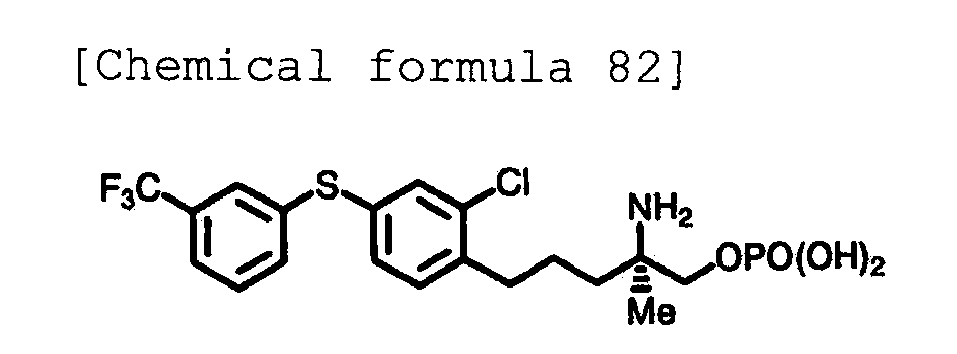
- The compound of Example 29 was reacted in the same manner as in Example 40 to obtain the target product as a white powder.
1H-NMR (DMSO-d6-dTFA, 400 MHz): δ 1.15 (3H, s), 1.49-1.68 (4H, m), 2.67 (2H, t, J = 7.4 Hz), 3.76 (1H, dd, J = 11.0, 4.9 Hz), 3.81 (1H, dd, J = 11.0, 4.9 Hz), 7.32 (1H, dd, J = 7.9, 2.4 Hz), 7.38 (1H, d, J = 7.9 Hz), 7.46 (1H, d, J = 2.4 Hz), 7.53 (1H, d, J = 7.9 Hz), 7.56 (1H, d, J = 7.9 Hz), 7.60 (1H, br s), 7.62 (1H, t, J = 7.9 Hz).
FABMS (+) : 484 [M+H]+.
Elemental Analysis: Measured: C 46.85%, H 4.35%, N 2.66%, Calcd. for C19H22ClF3NO4PS: C 47.16%, H 4.58%, N 2.89%
Optical Rotation: [α]D 25+7.27 (c0.55, DMSO-1%TFA). -

- The compound of Example 30 was reacted in the same manner as in Example 40 to obtain the target product as a white powder.
1H-NMR (DMSO-d6-dTFA, 400 Hz): δ 1.30 (3H, s), 1.70-1.90 (2H, m), 2.72 (2H, t, J = 8.6 Hz), 3.88 (1H, dd, J = 11.0, 5.5 Hz), 3.94 (1H, dd, J= 11.0 Hz, 5.5 Hz), 7.04 (1H, dd, J = 7.9, 2.4 Hz), 7.20 (1H, d, J = 2.4 Hz), 7.30 (1H, dd, J = 7.9, 2.4 Hz), 7.34 (1H, br s), 7.39 (1H, d, J = 7.9 Hz), 7.51 (1H, d, J = 7.9 Hz), 7.62(1H, d, J = 7.9 Hz).
FABMS (+) : 454 [M+H]+.
Elemental Analysis: Measured: C 47.83%, H 4.33%, N 3.02%, Calcd. for C18H20ClF3NO5P.1/2 H2O: C 46.72%, H 4.57%, N 3.03%. -
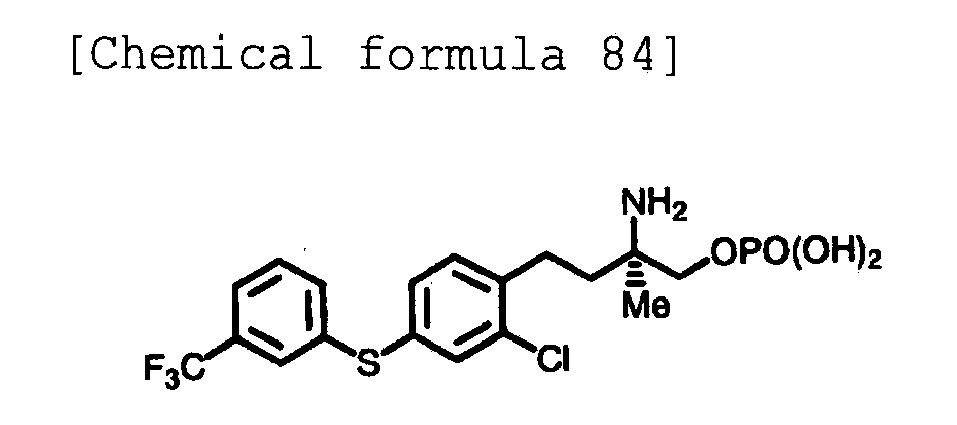
- The compound of Example 31 was reacted in the same manner as in Example 40 to obtain the target product as a white powder.
1H-NMR (DMSO-d6-dTFA, 400 MHz): δ 1.28 (3H, s), 1.70-1.90 (2H, m), 2.73 (2H, t, J = 8.6 Hz), 3.87 (1H, dd, J = 11.0, 4.9 Hz), 3.94 (1H, dd, J = 11.0, 4.9 Hz), 7.33 (1H, d, J = 7.9 Hz), 7.39 (1H, d, J = 7.9 Hz), 7.46 (1H, br s), 7.50-7.58 (3H, m).
FABMS (+) : 470 [M+H]+.
Elemental Analysis: Measured: C 45.32%, H 4.09%, N 2.90%, Calcd. for C18H20ClF3NO4PS.1/4 H2O: C 45.57%, H 4.36%, N 2.95%. -

- The compound of Example 32 was reacted in the same manner as in Example 40 to obtain the target product as a white powder.
1H-NMR (DMSO-d6-dTFA, 400 MHz): δ 1.37 (3H, t, J = 7.3 Hz), 1.28 (3H, s), 1.72-1.85 (2H, m), 2.58 (2H, t, J = 7.3 Hz), 2.67-2.72 (2H, m), 3.86 (1H, dd, J = 11.0, 4.9 Hz), 3.93 (1H, dd, J = 11.0, 4.9 Hz), 7.17-7.21 (3H, m), 7.25-7.26 (2H, m), 7.31 (2H, t, J = 7.3 Hz).
ESIMS(+) : 430 [M+H]+.
Elemental Analysis: Measured: C 52.56%, H 5.79%, N 3.21%, Calcd. for C19H25ClNO4PS.1/4H2O: C 52.53%, H 5.79%, N 3.21%. -

- The compound of Example 33 was reacted in the same manner as in Example 40 to obtain the target product as a white powder.
1H-NMR (DMSO-d6-dTFA, 400 MHz) : δ 1.17 (3H, s), 1.53-1.71 (4H, m), 2.28 (3H, s), 2.59-2.69 (2H, m), 3.78-3.83 (2H, m), 6.80 (1H, dd, J = 7.9, 2.4 Hz), 6.84 (1H, s), 6.92 (1H, dd, J = 7.9, 2.4 Hz), 6.98 (1H, d, J = 7.9 Hz), 7.02 (1H, d, J = 2.4 Hz), 7.27 (1H, t, J = 7.9 Hz), 7.33 (1H, d, J = 7.9 Hz).
HRESIMS (+) : 414.12313 (Calcd. for C19H26ClNO5P 414.12371).
Elemental Analysis: Measured: C 54.87%, H 5.89%, N 3.27%, Calcd. for C19H25ClNO5P: C 55.14%, H 6.09%, N 3.38%.
Optical Rotation: [α]D 25+7.93 (c 1.20, DMSO-1%TFA). -

- The compound of Example 34 was reacted in the same manner as in Example 40 to obtain the target product as a white powder.
1H-NMR (DMSO-d6-dTFA, 400 MHz): δ 1.41 (3H, t, J = 7.3 Hz), 1.16 (3H, s), 1.51-1.69 (4H, m), 2.58 (2H, t, J = 7.3 Hz), 2.63-2.80 (2H, m), 3.78 (1H, dd, J = 11.0 , 4.9 Hz), 3.81 (1H, dd, J = 11.0, 4.9 Hz), 7.16-7.33 (7H, m).
ESIMS(+) : 444 [M+H]+.
Elemental Analysis: Measured: C 53.87%, H 6.04%, N 3.11%, Calcd. for C20H27ClNO4PS: C 54.11%, H 6.13%, N 3.16%. -

- The compound of Example 35 was reacted in the same manner as in Example 40 to obtain the target product as a pale yellow powder. 1H-NMR (DMSO-d6-dTFA, 400 MHz): δ 0.86 (3H, t, J = 7.3 Hz), 1.17 (3H, s), 1.51-1.67 (6H, m), 2.53 (2H, t, J = 7.3 Hz), 2.64 (2H, t, J = 7.3 Hz), 3.78 (1H, dd, J = 11.0, 4.9 Hz), 3.83 (1H, dd, J = 11.0, 4.9 Hz), 6.81 (1H, dd, J = 7.9, 1.8 Hz), 6.86 (1H, t, J = 1.8 Hz), 6.91 (1H, dd, J = 8.6, 2.4 Hz), 7.00 (1H, d, J = 7.9 Hz), 7.02 (1H, d, J = 2.4 Hz), 7.29 (1H, t, J = 7.9 Hz), 7.33 (1H, t, J = 8.6 Hz).
ESIMS (+) : 442 [M+H]+.
Elemental Analysis: Measured: C 56.80%, H 6.40%, N 3.04%, Calcd. for C21H29ClNO5P: C 57.08%, H 6.61%, N 3.17%.
Optical Rotation: [α]D25+8.33 (c 0.90, DMSO-1%TFA). -

- The compound of Example 36 was reacted in the same manner as in Example 40 to obtain the target product as a white powder.
1H-NMR (DMSO-d6-dTFA, 400 MHz): δ 1.17 (3H, s), 1.53-1.71 (4H, m), 2.68 (2H, t, J = 6.7 Hz), 3.78 (1H, dd, J = 11, 4.9 Hz), 3.83 (1H, dd, J = 11, 4.9 Hz), 7.24 (1H, dt, J = 7.3, 1.8 Hz), 7.28-7.40 (5H, m), 7.43 (1H, d, J = 1.8 Hz).
ESIMS (+) : 450 [M+H]+.
Elemental Analysis: Measured: C 47.64%, H 4.72%, N 3.07%, Calcd. for C18H22Cl2NO4PS: C 48.01%, H 4.92%, N 3.11%.
Optical Rotation: [α]D 25+8.12 (c 0.55, DMSO-1%TFA). -

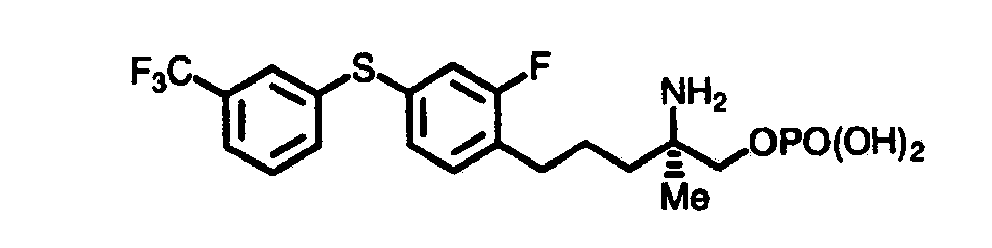
- The compound of Example 37 was reacted in the same manner as in Example 40 to obtain the target product as a white powder.
1H-NMR (DMSO-d6-dTFA, 400 MHz): δ 1.16 (3H, s), 1.54-1.66 (4H, m), 2.60 (2H, br s), 3.77 (1H, dd, J = 11, 4.9 Hz), 3.82 (1H, dd, J = 11, 4.9 Hz), 7.19 (1H, dd, J = 7.9, 1.8 Hz), 7.23 (1H, dd, J = 9.8, 1.8 Hz), 7.36 (1H, t, J = 7.9 Hz), 7.52-7.66 (4H, m).
ESIMS (+) : 468 [M+H]+.
Elemental Analysis: Measured: C 48.00%, H 4.59%, N 2.88%, Calcd. for C19H22F4NO4PS.1/2H2O: C 47.90%, H 4.87%, N 2.94%. -

- The compound of Example 38 was reacted in the same manner as in Example 40 to obtain the target product as a white powder.
1H-NMR (DMSO-d6-dTFA, 400 MHz): 0.84 (3H, t, J = 7.3 Hz), 1.21 (2H, q, J = 7.4 Hz), 1.42-1.62 (6H, m), 2.64-2.71 (2H, m), 3.81 (2H, d, J = 4.9 Hz), 7.34 (1H, dd, J = 7.9, 1.8 Hz), 7.40 (1H, d, J = 7.9 Hz), 7.48 (1H, d, J = 1.8 Hz), 7.53 (1H, d, J = 7.9 Hz), 7.54-7.66 (3H, m).
FABMS (+) : 512 [M+H]+.
Elemental Analysis: Measured: C 47.89%, H 4.94%, N 2.65, Calcd. for C21H26ClF3NO4PS.H2O: C 47.65%, H 5.33%, N 2.65%. -

- The compound of Example 39 was reacted in the same manner as in Example 40 to obtain the target product as a white powder.
1H-NMR (DMSO-d6-dTFA, 400 MHz): δ 1.16 (3H, s), 1.50-1.71 (4H, m), 2.62-2.73 (2H, m), 3.78 (1H, dd, J = 11.0, 4.9 Hz), 3.83 (1H, dd, J = 11.0, 4.9 Hz), 6.98 (1H, dd, J = 56, 1.8 Hz), 7.27 (1H, dd, J = 7.9, 1.8 Hz), 7.37 (1H, d, J = 7.9 Hz), 7.39 (1H, d, J = 1.8 Hz), 7.43-7.56 (4H, m).
ESIMS (+) : 466 [M+H]+.
Elemental Analysis: Measured: C 48.51%, H 4.79%, N 2.93%, Calcd. for C19H23ClF2NO4PS.1/5H2O: C 48.51%, H 5.02%, N 2.98%.
Optical Rotation: [α]D 25+5.32 (c0.50, DMSO-1%TFA). -

- 2-Chloro-1-(3-iodopropyl)-4-(3-trifluoromethylphenylthio) benzene and diethyl 2-methylmalonate were reacted according to the same procedures as in Example 152 of
WO 04026817
1H-NMR (CDCl3, 400 MHz): δ 1.25 (6H, t, J = 7.4 Hz), 1.40 (3H, s), 1.51-1.63 (2H, m), 1.90-1.97 (2H, m), 2.73 (2H, t, J = 7.9 Hz), 4.17 (4H, q, J = 7.4 Hz), 7.17-7.23 (2H, m), 7.38 (1H, d, J = 2.2 Hz), 7.39-7.44 (2H, m), 7.45-7.50 (1H, m),
7.55 (1H, s).
EIMS (+) : 502 [M]+. -

- To a solution of the compound of Example 52 (16.8 g) in ethanol (167 mL) was added potassium hydroxide (2.40 g), and the resultant solution was stirred at 50 °C for 24 hours. To the reaction solution was added water, neutralized with 2 mol/L hydrochloric acid, and extracted with ethyl acetate. The organic layer was washed with water and saturated brine in that order, and then dried over anhydrous sodium sulfate. The solvent was evaporated, and the resultant residue was purified by silica gel column chromatography (hexane : ethyl acetate = 1 : 1) to obtain the target product (11.2 g) as a colorless oil.
1H-NMR (CDCl3, 400 MHz): δ 1.26 (3H, t, J = 7.4 Hz), 1.47 (3H, s), 1.55-1.66 (2H, m), 1.87-2.06 (2H, m), 2.73 (2H, t, J = 7.9 Hz), 4.22 (2H, q, J = 7.4 Hz), 7.18 (1H, d, J = 7.9 Hz), 7.20 (1H, dd, J = 7.9, 1.8 Hz), 7.38 (1H, d, J = 1.8 Hz), 7.39 - 7.44 (2H, m), 7.45-7.50 (1H, m), 7.54 (1H, s).
ESIMS (+) : 475 [M+H]+. -

- To a solution of the compound of Example 53 (15.8 g) in benzene (166 mL) was added diphenylphosphoryl azide (7.86 mL) and triethylamine (6.01 mL), and the resultant solution was heated to reflux for 1.5 hours. The temperature of the reaction solution was returned to room temperature, and methanol (20 mL) was added dropwise thereto over 20 minutes. The resultant solution was heated to reflux for 30 minutes, and then sodium methoxide (3.58 g) was added to the reaction mixture. The resultant solution was heated to reflux for 1.5 hours. To the reaction solution was added saturated aqueous ammonium chloride, and extracted with ethyl acetate. The organic layer was washed with water and saturated brine in that order, and then dried over anhydrous sodium sulfate. The solvent was evaporated, and the resultant residue was purified by silica gel column chromatography (hexane : ethyl acetate = 5 : 1) to obtain the target product (15.6 g) as a colorless oil.
1H-NMR (CDCl3, 400 MHz): δ 1.25 (3H, t, J = 7.3 Hz), 1.32-1.47 (1H, m), 1.52-1.67 (1H, m), 1.57 (3H, s), 1.80-1.90 (1H, m), 2.20-2.37 (1H, m), 2.62-2.76 (2H, m), 3.64 (3H, s), 4.15-4.25 (2H, m), 5.62 (1H, br s), 7.16 (1H, d, J = 7.9 Hz), 7.20 (1H, dd, J = 7.9, 1.8 Hz), 7.38 (1H, d, J = 1.8 Hz), 7.40-7.44 (2H, m), 7.45-7.50 (1H, m), 7.55 (1H, s).
ESIMS (+) : 504 [M+H]+. -

- To a solution of the compound of Example 54 (15.6 g) in THF (249 mL) was added under ice cooling lithium borohydride (3.75 g), and then ethanol (16.6 mL) was added dropwise . The resultant solution was then stirred for 1 hour under ice cooling. To the reaction solution was added 10% aqueous citric acid, extracted with ethyl acetate, washed with water and saturated brine in that order, and then dried over anhydrous sodium sulfate. The solvent was evaporated, and the resultant residue was purified by silica gel column chromatography (hexane : ethyl acetate = 1 : 1) to obtain the target product (12.9 g) as a colorless oil.
1H-NMR (CDCl3, 400 MHz) : δ 1.18 (3H, s), 1.54-1.74 (3H, m), 1.78-1.89 (1H, m), 2.73 (2H, t, J = 7.9 Hz), 3.63 (3H, s), 3.56-3.70 (2H, m), 4.23 (1H, br s), 7.17-7.22 (2H, m), 7.38-7.50 (4H, m), 7.54 (1H, s).
ESIMS (+) : 462 [M+H]+. -

- To a solution of the compound of Example 55 (12.9 g) in THF (60 mL) and methanol (120 mL) was added under ice cooling 5 mol/L aqueous potassium hydroxide solution (60 mL), and the resultant solution was heated to reflux for 86 hours. To the reaction solution was added water, extracted with ethyl acetate, washed with water and saturated brine in that order, and then dried over anhydrous sodium sulfate. The extract was concentrated, the residue was dissolved in 1,4-dioxane (279 mL), and the resultant solution was charged with di-tert-butoxydicarbonate (9.13 g). The solution was stirred at room temperature for 2 hours and then left to stand at room temperature overnight. To the reaction solution was added water, extracted with ethyl acetate, washed with water and saturated brine in that order, and then dried over anhydrous sodium sulfate. The solvent was evaporated, and the resultant residue was purified by silica gel column chromatography (hexane : ethyl acetate = 2 : 1) to obtain the target product (13.0 g) as a colorless oil.
1H-NMR (CDCkl3, 400 MHz): δ 1.14 (3H, s), 1.42 (9H, s), 1.53-1.74 (3H, m), 1.79-1.92 (1H, m), 2.74 (2H, t, J = 7.9 Hz), 3.58-3.69 (2H, m), 4.05 (1H, brs), 4.57 (1H, br s), 7.20-7.22 (2H, m), 7.38-7.50 (4H, m), 7.54 (1H, s).
ESIMS (+) : 504 [M+H]+. - The compound of Example 56 was subjected to optical resolution using high performance liquid chromatography (CHIRALCEL OJ-H, hexane : isopropanol : diethylamine = 98 : 2 : 0.1 (v/v), measurement wavelength: UV 278 nm, flow rate: 1.0 mL/min). From the pre-elution portion, a colorless oil having [α]D 25+15.08 (c 0.63, CHCl3) was obtained (Example 57), and from the post-elution portion, a colorless oil with [α]D 26-13.91 (c 0.63, CHCl3) was obtained (Example 58).
- The compound of Example 57 was reacted in the same manner as in Example 16, and the resultant compound was then reacted in the same manner as in Example 28 to obtain a phosphate, which was then reacted in the same manner as in Example 40 to obtain the target product as a white powder.
FABMS (+) : 484 [M+H]+
Optical Rotation: [α]D 25+8.86 (c 1.00, DMSO -1% TFA)
Next, results which support the utility of the compound of the present invention will be shown by an experiment example. - Human S1P receptors expressing CHO-K1 cells (hS1P1 receptors expressing CHO-K1 cells, hS1P3 receptors expressing CHO-K1 cells, and hS1P4 receptors expressing CHO-K1 cells), were maintained in Ham's F-12 medium containing 10% fetal bovine serum and 400 µg/mL Geneticin. Into a black, clear bottom, culture plate (BD Falcon) with 96 wells, 7×10⁴ cells/well of the hS1P1 and hS1P3 receptors expressing CHO-K1 cells were plated, and ×104 cells/well of the hS1P4 receptors expressing CHO-K1 cells were plated. The cells were incubated overnight at 37 °C at 5% CO2. The medium in the wells were removed by suction. A loading buffer included in a Calcium Kit-Fluo 3 reagent (Dojindo Laboratories) was added as a fluorescent Ca2+-binding indicator. The cells were incubated for 80 minutes at 37°C at 5% CO2. After the incubation, the wells were washed with PBS. A recording buffer included in a Calcium Kit-Fluo 3 reagent was added, and the cells were incubated for 20 minutes at 37°C at 5% CO2. Using a microplate spectrophotofluorometer (FLEX Station, Molecular Devices), the fluorescence intensity at an excitation wavelength of 485 nm and a detection wavelength of 525 nm was measured. S1P and the subject compound prepared in medium so that the concentration was 10-fold that of the final concentration(final DMSO concentration of 0.1%). The solution was added 18 seconds after the fluorescence measurement was started, and then fluorescence intensity was continuously measured every 1.5 seconds until 100 seconds after addition. A value (fluorescence increase) obtained by subtracting the minimum fluorescence intensity from the maximum fluorescence intensity was calculated from the measurement data. Taking the difference between the fluorescence increase when the solvent was added and the fluorescence increase when the S1P was allowed to act at 10-6 M as 100%, the fluorescence increase ratio (%) of the subject compound was calculated. Taking this value as the intracellular calcium mobilization induced activity of the subject compound, the EC50 value was determined using PRISM software (GraphPad). In Table 1, 10 nmol/L > EC50 value ≥ 1 nmol/L is indicated as a +, and 1 nmol/L > EC50 value is indicated as a ++.
-
[Table 1] Example No. S1P1 S1P3 S1P4 40 ++ >10µmol/L + 41 ++ >10µmol/L + 42 ++ >10µmol/L + 43 ++ >10µmol/L + 44 ++ >10µmol/L + 45 ++ >10µmol/L + 46 ++ >10µmol/L + 47 ++ >10µmol/L + 48 + >10µmol/L ++ 49 ++ >10µmol/L + 50 ++ >10µmol/L + 51 + >10µmol/L + - From the above results, it was determined that the compound of the present invention has a weak activity on a human S1P3 receptor, and a strong activity on S1P1 and S1P4 receptors.
- The present invention has led to the discovery of a novel amino phosphate derivative and addition salt thereof, which have an excellent S1P receptor modulatory action. A compound having such an S1P receptor modulatory action is effective as a treatment and a preventive agent for arteriosclerosis, arteriosclerosis obliterans, thromboangiitis obliterans, renal fibrosis, hepatic fibrosis, chronic bronchial asthma, diffuse pulmonary hamartoangiomyomatosis, adult respiratory distress syndrome (ARDS), chronic obstructive pulmonary disease (COPD), pneumonitis, idiopathic interstitial pneumonia, lung cancer, pneumonia hypersensitivity, Buerger's disease, diabetic neuropathy peripheral arterial disease, septicemia, angiitis, nephritis, pneumonia, cerebral infarction, myocardial infarction, edematous state, varices, dissecting aortic aneurysm, angina pectoris, DIC, pleurisy, congestive heart failure, multiple organ failure, bedsores, burns, ulcerative colitis, Crohn's disease and the like. Furthermore, a compound having such an S1P receptor modulatory action is effective as a treatment and a preventive agent for rejection of heart transplants, kidney transplants, skin grafts, liver transplants, and bone marrow transplants, and is also an effective as a treatment and a preventive agent for rheumatoid arthritis, lupus nephritis, systemic lupus erythematosus, Hashimoto's disease, multiple sclerosis, myasthenia gravis, diabetes mellitus, atopic dermatitis, allergic rhinitis, allergic conjunctivitis, allergic contact dermatitis and the like.
Claims (7)
- An amino phosphate derivative represented by the general formula (1),
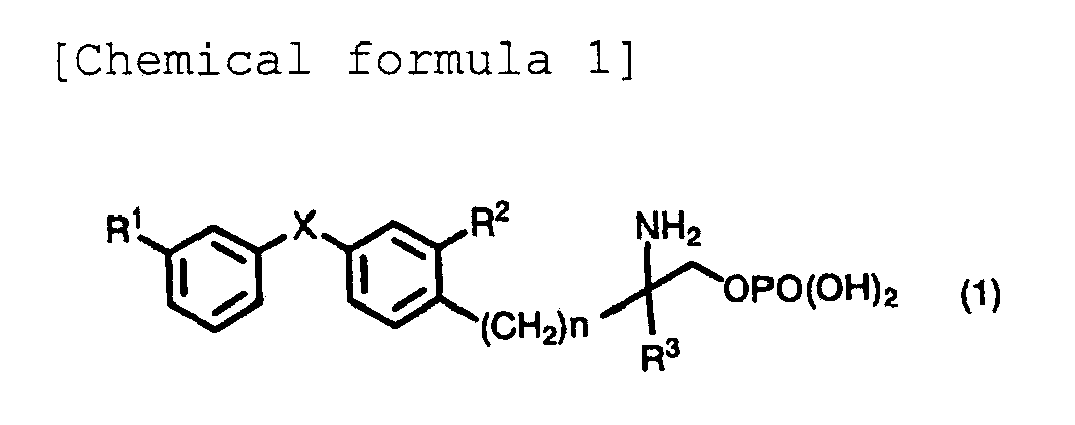
- The amino phosphate derivative according to claim 1, wherein the compound represented by the general formula (1) is represented by the general formula (1a),

- The amino phosphate derivative according to claim 1 or 2, wherein in the general formula (1) or (1a), R3 is a methyl group, or a pharmaceutically acceptable salt or hydrate thereof.
- The amino phosphate derivative according to claim 1, wherein the compound represented by the general formula (1) is:1) (R)-2-amino-5-[2-chloro-4-(3-trifluoromethylphenoxy)phenyl]-2-methylpentyl phosphonic acid monoester,2) (R)-2-amino-5-[2-chloro-4-(3-trifluoromethylphenylthio)phenyl] -2-methylpentyl phosphonic acid monoester,3) (R)-2-amino-4-[2-chloro-4-(3-trifluoromethylphenoxy)phenyl]-2-methylbutyl phosphonic acid monoester,4) (R)-2-amino-4--[2-chloro-4-(3-trifluoromethylphenylthio)phenyl] -2-methylbutyl phosphonic acid monoester,5) (R)-2-amino-5-[2-chloro-4-(3-ethylphenylthio)phenyl]-2-methylp entyl phosphonic acid monoester,6) (R)-2-amino-5-[2-chloro-4-(3-trifluoromethylphenylthio)phenyl] -2-methylpentyl phosphonic acid monoester, or7) (R)-2-amino-5-[2-chloro-4-(3-trifluoromethylphenylthio)phenyl] -2-propylpentyl phosphonic acid monoester, or a pharmaceutically acceptable salt or hydrate thereof.
- The amino phosphate derivative according to claim 1 produced by a step of allowing a compound represented by the general formula (2),


P(OR6)3 (10)
[wherein R6 represents an alkyl group having 1 to 6 carbon atoms or a benzyl group], and a step of subjecting the resultant product obtained by the previous steps to acid decomposition or a halogenosilane treatment, or a pharmaceutically acceptable salt or hydrate thereof. - An S1P receptor modulator comprising the amino phosphate derivative, or a pharmaceutically acceptable salt or hydrate thereof according to any of claims 1 to 5 as an active ingredient.
- A pharmaceutical comprising the amino phosphate derivative, or a pharmaceutically acceptable salt or hydrate thereof according to any of claims 1 to 5 as an active ingredient.
Priority Applications (3)
| Application Number | Priority Date | Filing Date | Title |
|---|---|---|---|
| PL07792066T PL2058317T3 (en) | 2006-08-08 | 2007-08-07 | Aminophosphoric acid ester derivative and s1p receptor modulator containing the same as active ingredient |
| SI200731372T SI2058317T1 (en) | 2006-08-08 | 2007-08-07 | Aminophosphoric acid ester derivative and s1p receptor modulator containing the same as active ingredient |
| CY20131101071T CY1114681T1 (en) | 2006-08-08 | 2013-11-28 | STAGE PRODUCT OF THE AMINOSPHORIC ACID AND MODIFIER OF THE 1-PHOSPHORIC CARPINE CONTAINER CONTAINING IT AS AN ACTIVE INGREDIENT |
Applications Claiming Priority (2)
| Application Number | Priority Date | Filing Date | Title |
|---|---|---|---|
| JP2006215280 | 2006-08-08 | ||
| PCT/JP2007/065397 WO2008018427A1 (en) | 2006-08-08 | 2007-08-07 | Aminophosphoric acid ester derivative and s1p receptor modulator containing the same as active ingredient |
Publications (3)
| Publication Number | Publication Date |
|---|---|
| EP2058317A1 true EP2058317A1 (en) | 2009-05-13 |
| EP2058317A4 EP2058317A4 (en) | 2011-06-29 |
| EP2058317B1 EP2058317B1 (en) | 2013-10-16 |
Family
ID=39032957
Family Applications (1)
| Application Number | Title | Priority Date | Filing Date |
|---|---|---|---|
| EP07792066.8A Active EP2058317B1 (en) | 2006-08-08 | 2007-08-07 | Aminophosphoric acid ester derivative and s1p receptor modulator containing the same as active ingredient |
Country Status (26)
| Country | Link |
|---|---|
| US (1) | US8232319B2 (en) |
| EP (1) | EP2058317B1 (en) |
| JP (1) | JP5188972B2 (en) |
| KR (1) | KR101339976B1 (en) |
| CN (1) | CN101501049B (en) |
| CA (1) | CA2659598A1 (en) |
| CY (1) | CY1114681T1 (en) |
| DK (1) | DK2058317T3 (en) |
| ES (1) | ES2438265T3 (en) |
| HR (1) | HRP20131172T1 (en) |
| IL (1) | IL196275A (en) |
| MA (1) | MA30663B1 (en) |
| ME (1) | ME02095B (en) |
| MX (1) | MX2009001456A (en) |
| MY (1) | MY152176A (en) |
| NO (1) | NO20090606L (en) |
| NZ (1) | NZ574011A (en) |
| PL (1) | PL2058317T3 (en) |
| PT (1) | PT2058317E (en) |
| RS (1) | RS53080B (en) |
| RU (1) | RU2430925C2 (en) |
| SG (1) | SG174028A1 (en) |
| SI (1) | SI2058317T1 (en) |
| TN (1) | TNSN08545A1 (en) |
| WO (1) | WO2008018427A1 (en) |
| ZA (1) | ZA200900206B (en) |
Cited By (2)
| Publication number | Priority date | Publication date | Assignee | Title |
|---|---|---|---|---|
| CN102471355A (en) * | 2009-07-09 | 2012-05-23 | 杏林制药株式会社 | Diphenyl sulfide derivatives and medicaments containing them as active ingredients |
| EP2305305A4 (en) * | 2008-05-20 | 2013-02-13 | Kyorin Seiyaku Kk | INDUCTION / MAINTENANCE TRANSMITTER |
Families Citing this family (21)
| Publication number | Priority date | Publication date | Assignee | Title |
|---|---|---|---|---|
| TW200946105A (en) | 2008-02-07 | 2009-11-16 | Kyorin Seiyaku Kk | Therapeutic agent or preventive agent for inflammatory bowel disease containing amino alcohol derivative as active ingredient |
| CA2724450A1 (en) * | 2008-05-19 | 2009-11-26 | Takeshi Tsubuki | Method for producing optically active aminoalcohol derivative |
| HRP20161133T1 (en) | 2008-07-23 | 2016-12-02 | Arena Pharmaceuticals, Inc. | DERIVATIVES OF SUBSTITUTED 1,2,3,4-TETRAHYDROCYCLOPENT [b] INDOL-3-IL-ACETIC ACIDS USED IN THE TREATMENT OF AUTOIMMUNE AND INFLAMMATORY DISORDERS |
| CN105816453B (en) | 2008-08-27 | 2021-03-05 | 艾尼纳制药公司 | Substituted tricyclic acid derivatives as S1P1 receptor agonists for the treatment of autoimmune and inflammatory disorders |
| CA2786994C (en) | 2010-01-27 | 2018-01-16 | Arena Pharmaceuticals, Inc. | Processes for the preparation of (r)-2-(7-(4-cyclopentyl-3-(trifluoromethyl)benzyloxy)-1,2,3,4-tetrahydrocyclopenta[b]indol-3-yl)acetic acid and salts thereof |
| CN105503882B (en) | 2010-03-03 | 2019-07-05 | 艾尼纳制药公司 | The method for preparing S1P1 receptor modulators and its crystal form |
| TWI519539B (en) | 2010-12-21 | 2016-02-01 | Kyorin Seiyaku Kk | Diphenyl sulfide derivatives and pharmaceuticals as an active ingredient |
| AU2012245683A1 (en) * | 2011-04-18 | 2013-11-07 | Allergan, Inc. | Substituted bicyclic methyl amine derivatives as sphingosine-1 phosphate receptors modulators |
| CN102863345A (en) * | 2011-07-06 | 2013-01-09 | 中国医学科学院药物研究所 | Amino propylene glycol derivative, preparation method of amino propylene glycol derivative, medicine composition of amino propylene glycol derivative and application of amino propylene glycol derivative |
| WO2015194157A1 (en) * | 2014-06-16 | 2015-12-23 | 杏林製薬株式会社 | Manufacturing method and manufacturing intermediate for diphenylsulfide derivative |
| AU2016205361C1 (en) | 2015-01-06 | 2021-04-08 | Arena Pharmaceuticals, Inc. | Methods of treating conditions related to the S1P1 receptor |
| PL3310760T3 (en) | 2015-06-22 | 2023-03-06 | Arena Pharmaceuticals, Inc. | Crystalline l-arginine salt of (r)-2-(7-(4-cyclopentyl-3-(trifluoromethyl)benzyloxy)-1,2,3,4-tetrahydrocyclo-penta[b]indol-3-yl)acetic acid for use in s1p1 receptor-associated disorders |
| HUE060485T2 (en) | 2016-06-07 | 2023-03-28 | Tesla Inc | Electric motor cooling system |
| JP2020507610A (en) | 2017-02-16 | 2020-03-12 | アリーナ ファーマシューティカルズ, インコーポレイテッド | Compounds and methods for the treatment of inflammatory bowel disease with parenteral symptoms |
| KR20190116416A (en) | 2017-02-16 | 2019-10-14 | 아레나 파마슈티칼스, 인크. | Compounds and Methods for Treating Primary Bile Cholangitis |
| US10967702B2 (en) | 2017-09-07 | 2021-04-06 | Tesla, Inc. | Optimal source electric vehicle heat pump with extreme temperature heating capability and efficient thermal preconditioning |
| AU2019280822A1 (en) | 2018-06-06 | 2021-01-07 | Arena Pharmaceuticals, Inc. | Methods of treating conditions related to the S1P1 receptor |
| EP3847158A1 (en) | 2018-09-06 | 2021-07-14 | Arena Pharmaceuticals, Inc. | Compounds useful in the treatment of autoimmune and inflammatory disorders |
| JP7535532B2 (en) | 2019-02-26 | 2024-08-16 | バイエル・アクチエンゲゼルシヤフト | Fused bicyclic heterocyclic derivatives as pest control agents. |
| EP4240350A4 (en) * | 2020-11-09 | 2024-09-18 | Arena Pharmaceuticals, Inc. | <sup2/>? <sub2/>?1?methods of treating conditions related to the s1preceptor |
| US11932078B2 (en) | 2021-03-31 | 2024-03-19 | Tesla, Inc. | Electric vehicle heat pump using enhanced valve unit |
Family Cites Families (91)
| Publication number | Priority date | Publication date | Assignee | Title |
|---|---|---|---|---|
| US4444766A (en) * | 1980-10-21 | 1984-04-24 | Boehringer Mannheim Gmbh | Sulfur-containing phospholipid compounds and therapeutic compositions |
| EP0627406B1 (en) | 1992-10-21 | 1998-10-28 | Yoshitomi Pharmaceutical Industries, Ltd. | 2-amino-1,3-propanediol compound and immunosuppressant |
| US5948820A (en) | 1994-08-22 | 1999-09-07 | Yoshitomi Pharmaceutical Industries, Ltd. | Benzene compound and pharmaceutical use thereof |
| US5447922A (en) | 1994-08-24 | 1995-09-05 | Bristol-Myers Squibb Company | α-phosphonosulfinic squalene synthetase inhibitors |
| CA2286315C (en) | 1997-04-04 | 2007-03-06 | Yoshitomi Pharmaceutical Industries Ltd. | 2-aminopropane-1,3-diol compound, pharmaceutical use thereof and synthetic intermediates therefor |
| JPH1180026A (en) | 1997-09-02 | 1999-03-23 | Yoshitomi Pharmaceut Ind Ltd | Novel immunosuppressants, methods of use and methods of identification thereof |
| WO2000001388A1 (en) | 1998-07-02 | 2000-01-13 | Kyowa Hakko Kogyo Co., Ltd. | Remedies for diabetes |
| AU767241B2 (en) | 1998-09-14 | 2003-11-06 | Qiang Xu | Immunosuppressive agents |
| US20020143034A1 (en) | 1998-12-30 | 2002-10-03 | Fujisawa Pharmaceutical Co. Ltd. | Aminoalcohol derivatives and their use as beta 3 adrenergic agonists |
| AU2001264313A1 (en) | 2000-06-20 | 2002-01-02 | Japan Tobacco Inc. | Pyrazolopyridine compounds and use thereof as drugs |
| NZ533997A (en) | 2000-07-13 | 2005-11-25 | Sankyo Co | Amino alcohol derivatives |
| JP2002053575A (en) | 2000-08-09 | 2002-02-19 | Sankyo Co Ltd | Aminoalcohols |
| AU8533101A (en) | 2000-08-31 | 2002-03-13 | Merck & Co Inc | Phosphate derivatives as immunoregulatory agents |
| EP1383778B1 (en) | 2001-01-30 | 2009-10-21 | University Of Virginia Patent Foundation | Agonists and antagonists of sphingosine-1-phosphate receptors |
| EP1364659B1 (en) | 2001-02-08 | 2009-11-11 | Ono Pharmaceutical Co., Ltd. | Remedies for urinary diseases comprising lpa receptor controlling agents |
| CA2435739A1 (en) | 2001-02-22 | 2002-09-06 | Novartis Ag | Use of accelerated lymphocyte homing agents for the manufacture of a medicament for the treatment of delayed graft function |
| US7326801B2 (en) | 2001-03-26 | 2008-02-05 | Novartis Ag | 2-amino-propanol derivatives |
| JP2002316985A (en) | 2001-04-20 | 2002-10-31 | Sankyo Co Ltd | Benzothiophene derivative |
| US7179817B2 (en) | 2001-05-10 | 2007-02-20 | Ono Pharmaceutical Co., Ltd. | Carboxylic acid derivatives and drugs containing the same as the active ingredient |
| US20040138462A1 (en) | 2001-05-24 | 2004-07-15 | Minoru Sakurai | Aminoalcohol derivatives |
| US20040235794A1 (en) | 2001-09-04 | 2004-11-25 | Shinji Nakade | Remedies for respiratory diseases comprising sphingosine-1-phosphate receptor controller |
| ATE463478T1 (en) | 2001-09-27 | 2010-04-15 | Kyorin Seiyaku Kk | DIARYL ETHER DERIVATIVE, ITS ADDITION SALT AND IMMUNOSUPPRESSANT |
| AU2002332289B2 (en) | 2001-09-27 | 2007-05-10 | Kyorin Pharmaceutical Co., Ltd. | Diaryl sulfide derivative, addition salt thereof, and immunosuppressant |
| JP2005112721A (en) | 2001-11-06 | 2005-04-28 | Maruha Corp | Nitrogen-containing compound, production method, and use thereof |
| JP4035759B2 (en) | 2001-11-06 | 2008-01-23 | 独立行政法人産業技術総合研究所 | Aminoalcohol phosphate compound, production method, and method of use thereof |
| WO2003051876A1 (en) | 2001-12-14 | 2003-06-26 | Japan Tobacco Inc. | Pyrazolopyridine derivatives and medicinal use thereof |
| JP4771511B2 (en) | 2003-07-08 | 2011-09-14 | 第一三共株式会社 | Pharmaceutical composition containing amino alcohol derivative or phosphonic acid derivative |
| JP2003267936A (en) | 2002-01-11 | 2003-09-25 | Sankyo Co Ltd | Benzene ring compound |
| RU2330839C2 (en) | 2002-01-11 | 2008-08-10 | Санкио Компани, Лимитед | Amino alcohol derivatives or phosphoric acid derivatives and pharmaceutical compositions containing specified derivatives |
| US20050070506A1 (en) | 2002-01-18 | 2005-03-31 | Doherty George A. | Selective s1p1/edg1 receptor agonists |
| ATE441654T1 (en) | 2002-01-18 | 2009-09-15 | Merck & Co Inc | EDG RECEPTOR AGONISTS |
| US20040058894A1 (en) | 2002-01-18 | 2004-03-25 | Doherty George A. | Selective S1P1/Edg1 receptor agonists |
| AU2003202994B2 (en) | 2002-01-18 | 2007-11-22 | Merck Sharp & Dohme Corp. | N-(benzyl)aminoalkylcarboxylates, phosphinates, phosphonates and tetrazoles as Edg receptor agonists |
| EP1482896A4 (en) | 2002-03-01 | 2005-11-23 | Merck & Co Inc | AMINOALKYLPHOSPHONATES AND ASSOCIATED COMPOUNDS AS EDG RECEPTOR AGONISTS |
| JP2005531506A (en) | 2002-03-01 | 2005-10-20 | メルク エンド カムパニー インコーポレーテッド | Aminoalkylphosphonates and related compounds as agonists of EDG receptors |
| JP2005533058A (en) | 2002-06-17 | 2005-11-04 | メルク エンド カムパニー インコーポレーテッド | 1-((5-Aryl-1,2,4-oxadiazol-3-yl) benzyl) azetidine-3-carboxylate and 1-((5-aryl-1,2,4) as EDG receptor agonists -Oxadiazol-3-yl) benzyl) pyrrolidine-3-carboxylate |
| WO2004002531A1 (en) | 2002-06-26 | 2004-01-08 | Ono Pharmaceutical Co., Ltd. | Remedies for diseases caused by vascular contraction or dilation |
| US7241790B2 (en) | 2002-07-30 | 2007-07-10 | University Of Virginia Patent Foundation | Compounds active in spinigosine 1-phosphate signaling |
| AU2003273865A1 (en) | 2002-09-13 | 2004-04-30 | Novartis Ag | Amino-propanol derivatives |
| AU2003264430B2 (en) | 2002-09-19 | 2009-03-19 | Kyorin Pharmaceutical Co., Ltd. | Amino alcohol derivative, addition salt thereof, and immunosuppressant |
| MXPA05003254A (en) | 2002-09-24 | 2005-06-08 | Novartis Ag | Sphingosine-1-phosphate receptor agonists in the treatment of demyelinating disorders. |
| TW200408393A (en) | 2002-10-03 | 2004-06-01 | Ono Pharmaceutical Co | Antagonist of lysophosphatidine acid receptor |
| JP4140698B2 (en) | 2002-10-18 | 2008-08-27 | 第一三共株式会社 | Phosphoric acid or phosphonic acid derivatives |
| JP4516430B2 (en) | 2002-12-20 | 2010-08-04 | メルク・シャープ・エンド・ドーム・コーポレイション | 1- (Amino) indane and (1,2-dihydro-3-amino) -benzofuran, benzothiophene and indole |
| JP4505449B2 (en) | 2003-02-11 | 2010-07-21 | アイアールエム・リミテッド・ライアビリティ・カンパニー | Novel bicyclic compounds and compositions |
| DK1602660T3 (en) * | 2003-02-18 | 2011-05-23 | Kyorin Seiyaku Kk | Aminophosphonic acid derivatives, addition salts thereof, and S1P receptor modulators |
| JP2004307440A (en) | 2003-04-10 | 2004-11-04 | Kyorin Pharmaceut Co Ltd | 2-amino-1,3-propanediol derivatives and their addition salts |
| JP2004307439A (en) | 2003-04-10 | 2004-11-04 | Kyorin Pharmaceut Co Ltd | Aminodiol derivative, its addition salt and immunosuppressant |
| JP2004307442A (en) | 2003-04-10 | 2004-11-04 | Kyorin Pharmaceut Co Ltd | Heterocyclic derivatives, their addition salts and immunosuppressants |
| JP2004307441A (en) | 2003-04-10 | 2004-11-04 | Kyorin Pharmaceut Co Ltd | Benzene derivative, its addition salt and immunosuppressant |
| ATE547395T1 (en) | 2003-04-30 | 2012-03-15 | Novartis Pharma Gmbh | AMINOPROPANOL DERIVATIVES AS MODULATORS OF THE SPHINGOSINE-1 PHOSPHATE RECEPTOR |
| ES2392167T3 (en) | 2003-04-30 | 2012-12-05 | Novartis Ag | Aminopropanol derivatives as sphingosine-1-phosphate receptor modulators |
| CA2524867A1 (en) | 2003-05-15 | 2004-12-02 | Merck & Co., Inc. | 3-(2-amino-1-azacyclyl)-5-aryl-1,2,4-oxadiazoles as s1p receptor agonists |
| MY150088A (en) | 2003-05-19 | 2013-11-29 | Irm Llc | Immunosuppressant compounds and compositions |
| CN1787817B (en) | 2003-05-19 | 2011-09-07 | Irm责任有限公司 | Immunosuppressant compounds and compositions |
| WO2004113330A1 (en) | 2003-05-19 | 2004-12-29 | Irm Llc | Immunosuppressant compounds and compositions |
| GB0313612D0 (en) | 2003-06-12 | 2003-07-16 | Novartis Ag | Organic compounds |
| JP2005047899A (en) | 2003-07-11 | 2005-02-24 | Sankyo Co Ltd | Amino alcohol compound |
| WO2005014525A2 (en) | 2003-08-12 | 2005-02-17 | Mitsubishi Pharma Corporation | Bi-aryl compound having immunosuppressive activity |
| WO2005014603A1 (en) | 2003-08-12 | 2005-02-17 | Mitsubishi Pharma Corporation | Phosphinane compounds with immunomodulating activity |
| MXPA06002349A (en) | 2003-08-28 | 2006-05-22 | Novartis Ag | Aminopropanol derivatives. |
| US7825109B2 (en) | 2003-08-29 | 2010-11-02 | Ono Pharmaceutical Co., Ltd. | Compound capable of binding S1P receptor and pharmaceutical use thereof |
| CN1859908A (en) | 2003-10-01 | 2006-11-08 | 默克公司 | 3,5-aryl, heteroaryl or cycloalkyl substituted-1,2,4-oxadiazoles as S1P receptor agonists |
| GB0324210D0 (en) | 2003-10-15 | 2003-11-19 | Novartis Ag | Organic compounds |
| WO2005041899A2 (en) | 2003-11-03 | 2005-05-12 | University Of Virginia Patent Foundation | Orally available sphingosine 1-phosphate receptor agonists and antagonists |
| WO2005044780A1 (en) | 2003-11-10 | 2005-05-19 | Kyorin Pharmaceutical Co., Ltd. | Aminocarboxylic acid derivative, addition salt thereof, and s1p receptor control agent |
| AU2004299456B2 (en) | 2003-12-17 | 2010-10-07 | Merck Sharp & Dohme Corp. | (3,4-disubstituted)propanoic carboxylates as S1P (Edg) receptor agonists |
| TW200526548A (en) | 2003-12-25 | 2005-08-16 | Sankyo Co | Ether derivatives |
| GB0401332D0 (en) | 2004-01-21 | 2004-02-25 | Novartis Ag | Organic compounds |
| TWI355934B (en) | 2004-02-24 | 2012-01-11 | Sankyo Co | Pharmaceutical composition for treatment or prophy |
| TW200538433A (en) | 2004-02-24 | 2005-12-01 | Irm Llc | Immunosuppressant compounds and compositiions |
| US7718704B2 (en) | 2004-02-24 | 2010-05-18 | Irm Llc | Immunosuppressant compounds and compositions |
| JP2005247691A (en) | 2004-03-01 | 2005-09-15 | Toa Eiyo Ltd | S1P3 receptor antagonist |
| GB0405289D0 (en) | 2004-03-09 | 2004-04-21 | Novartis Ag | Organic compounds |
| GB0411929D0 (en) | 2004-05-27 | 2004-06-30 | Novartis Ag | Organic compounds |
| JP5315611B2 (en) | 2004-06-23 | 2013-10-16 | 小野薬品工業株式会社 | Compound having S1P receptor binding ability and use thereof |
| ATE502630T1 (en) | 2004-07-16 | 2011-04-15 | Kyorin Seiyaku Kk | METHOD FOR EFFECTIVE USE OF A MEDICATION AND METHOD FOR PREVENTING SIDE EFFECTS |
| TW200611687A (en) | 2004-07-29 | 2006-04-16 | Sankyo Co | Pharmaceutical compositions used for immunosuppressant |
| AU2005272619A1 (en) | 2004-08-13 | 2006-02-23 | Praecis Pharmaceuticals, Inc. | Methods and compositions for modulating sphingosine-1-phosphate (SIP) receptor activity |
| AU2005292984B2 (en) | 2004-10-12 | 2011-01-20 | Kyorin Pharmaceutical Co., Ltd. | Process for producing 2-amino-2-[2-[4-(3-benzyloxyphenylthio)-2-chlorophenyl]ethyl]-1,3-propanediol hydrochloride or hydrate thereof and intermediate for the same |
| WO2006041015A1 (en) * | 2004-10-12 | 2006-04-20 | Kyorin Pharmaceutical Co., Ltd. | Amino alcohol derivative, addition salt thereof and immunosuppressive agent |
| JP2008522977A (en) | 2004-12-06 | 2008-07-03 | ユニバーシティ オブ バージニア パテント ファンデーション | Sphingosine = 1-phosphate arylamide analog |
| TW200702326A (en) | 2005-05-31 | 2007-01-16 | Mitsubishi Pharma Corp | 2-aminobutanol compound and its pharmaceutical use |
| TWI418350B (en) | 2005-06-24 | 2013-12-11 | Sankyo Co | Use of pharmaceutical compositions comprising ppar modulator |
| NZ588372A (en) | 2005-09-09 | 2012-03-30 | Novartis Ag | Diphenyl ether or thioether derivatives for treatment of autoimmune diseases |
| RU2421214C2 (en) | 2005-10-07 | 2011-06-20 | Киорин Фармасьютикал Ко., Лтд. | Therapeutic agent for treating hepatitis, and method of treating hepatitis |
| JP5140854B2 (en) | 2005-10-12 | 2013-02-13 | トーアエイヨー株式会社 | S1P3 receptor antagonist |
| TWI389683B (en) | 2006-02-06 | 2013-03-21 | Kyorin Seiyaku Kk | A therapeutic agent for an inflammatory bowel disease or an inflammatory bowel disease treatment using a 2-amino-1,3-propanediol derivative as an active ingredient |
| JP5100641B2 (en) | 2006-04-28 | 2012-12-19 | 田辺三菱製薬株式会社 | 2-Aminobutanol compound and pharmaceutical use thereof |
| BRPI0714593A2 (en) | 2006-07-25 | 2013-05-07 | Alcon Res Ltd | endothelial differentiation gene subfamily 3 receptor antagonists (edg-3, s1p3) for the prevention and treatment of eye diseases, compositions comprising said antagonists, and uses thereof |
| US7877152B2 (en) | 2006-07-31 | 2011-01-25 | JusJas LLC | Bipolar stimulation/recording device with widely spaced electrodes |
-
2007
- 2007-08-07 US US12/310,007 patent/US8232319B2/en not_active Expired - Fee Related
- 2007-08-07 PL PL07792066T patent/PL2058317T3/en unknown
- 2007-08-07 RS RS20130551A patent/RS53080B/en unknown
- 2007-08-07 CN CN2007800295082A patent/CN101501049B/en not_active Expired - Fee Related
- 2007-08-07 HR HRP20131172TT patent/HRP20131172T1/en unknown
- 2007-08-07 NZ NZ574011A patent/NZ574011A/en not_active IP Right Cessation
- 2007-08-07 WO PCT/JP2007/065397 patent/WO2008018427A1/en not_active Ceased
- 2007-08-07 KR KR1020097004756A patent/KR101339976B1/en not_active Expired - Fee Related
- 2007-08-07 EP EP07792066.8A patent/EP2058317B1/en active Active
- 2007-08-07 RU RU2009106934/04A patent/RU2430925C2/en not_active IP Right Cessation
- 2007-08-07 MX MX2009001456A patent/MX2009001456A/en active IP Right Grant
- 2007-08-07 DK DK07792066.8T patent/DK2058317T3/en active
- 2007-08-07 ME MEP-2013-551A patent/ME02095B/en unknown
- 2007-08-07 CA CA002659598A patent/CA2659598A1/en not_active Abandoned
- 2007-08-07 ES ES07792066.8T patent/ES2438265T3/en active Active
- 2007-08-07 MY MYPI20085394 patent/MY152176A/en unknown
- 2007-08-07 SG SG2011055589A patent/SG174028A1/en unknown
- 2007-08-07 JP JP2008528818A patent/JP5188972B2/en not_active Expired - Fee Related
- 2007-08-07 SI SI200731372T patent/SI2058317T1/en unknown
- 2007-08-07 PT PT77920668T patent/PT2058317E/en unknown
-
2008
- 2008-12-30 IL IL196275A patent/IL196275A/en not_active IP Right Cessation
- 2008-12-31 TN TNP2008000545A patent/TNSN08545A1/en unknown
-
2009
- 2009-01-09 ZA ZA200900206A patent/ZA200900206B/en unknown
- 2009-02-10 NO NO20090606A patent/NO20090606L/en not_active Application Discontinuation
- 2009-02-26 MA MA31663A patent/MA30663B1/en unknown
-
2013
- 2013-11-28 CY CY20131101071T patent/CY1114681T1/en unknown
Cited By (5)
| Publication number | Priority date | Publication date | Assignee | Title |
|---|---|---|---|---|
| EP2305305A4 (en) * | 2008-05-20 | 2013-02-13 | Kyorin Seiyaku Kk | INDUCTION / MAINTENANCE TRANSMITTER |
| CN102471355A (en) * | 2009-07-09 | 2012-05-23 | 杏林制药株式会社 | Diphenyl sulfide derivatives and medicaments containing them as active ingredients |
| EP2452944A4 (en) * | 2009-07-09 | 2013-04-03 | Kyorin Seiyaku Kk | DIPHENYL SULFIDE DERIVATIVES AND MEDICAMENTS CONTAINING THE SAME AS ACTIVE INGREDIENT |
| US8569270B2 (en) | 2009-07-09 | 2013-10-29 | Kyorin Pharmaceutical Co., Ltd. | Diphenyl sulfide derivatives and medicines containing same as active ingredient |
| CN102471355B (en) * | 2009-07-09 | 2015-10-07 | 杏林制药株式会社 | Diphenyl sulfide derivatives and medicaments containing them as active ingredients |
Also Published As
Similar Documents
| Publication | Publication Date | Title |
|---|---|---|
| EP2058317B1 (en) | Aminophosphoric acid ester derivative and s1p receptor modulator containing the same as active ingredient | |
| RS55703B1 (en) | BICYCLE UNITS | |
| EP2053038B1 (en) | Amino alcohol derivative and immunosuppressive agent having same as an active ingredient | |
| JP5616342B2 (en) | Diphenyl sulfide derivatives and pharmaceuticals containing them as active ingredients | |
| KR20130127479A (en) | Novel oxime derivatives as sphingosine 1-phosphate (s1p) receptor modulators | |
| JP2008239546A (en) | Amino alcohol derivatives and immunosuppressants containing them as active ingredients | |
| JP2010077053A (en) | Phenol derivative and medicine containing the derivative as active ingredient | |
| HK1131154B (en) | Aminophosphoric acid ester derivative and s1p receptor modulator containing the same as active ingredient | |
| EP2657241A1 (en) | Diphenyl sulfide derivative and pharmaceutical product which contains same as active ingredient | |
| JP2008231027A (en) | Amino alcohol derivatives and immunosuppressants containing them as active ingredients | |
| JP2011032226A (en) | Diphenylsulfide derivative and medicine containing the same as active component | |
| HK1131120B (en) | Aminoalcohol derivative and immunosuppressant containing the same as active ingredient | |
| PL233938B1 (en) | Derivatives of 3-phenyl-4-hexynoic acid as GPR40 agonists | |
| JP2008208034A (en) | Benzothiophene derivatives and their addition salts and sphingosine-1-phosphate (S1P4) receptor modulators |
Legal Events
| Date | Code | Title | Description |
|---|---|---|---|
| PUAI | Public reference made under article 153(3) epc to a published international application that has entered the european phase |
Free format text: ORIGINAL CODE: 0009012 |
|
| 17P | Request for examination filed |
Effective date: 20090218 |
|
| AK | Designated contracting states |
Kind code of ref document: A1 Designated state(s): AT BE BG CH CY CZ DE DK EE ES FI FR GB GR HU IE IS IT LI LT LU LV MC MT NL PL PT RO SE SI SK TR |
|
| AX | Request for extension of the european patent |
Extension state: AL BA HR MK RS |
|
| A4 | Supplementary search report drawn up and despatched |
Effective date: 20110531 |
|
| 17Q | First examination report despatched |
Effective date: 20120903 |
|
| GRAP | Despatch of communication of intention to grant a patent |
Free format text: ORIGINAL CODE: EPIDOSNIGR1 |
|
| INTG | Intention to grant announced |
Effective date: 20130425 |
|
| GRAS | Grant fee paid |
Free format text: ORIGINAL CODE: EPIDOSNIGR3 |
|
| GRAA | (expected) grant |
Free format text: ORIGINAL CODE: 0009210 |
|
| AK | Designated contracting states |
Kind code of ref document: B1 Designated state(s): AT BE BG CH CY CZ DE DK EE ES FI FR GB GR HU IE IS IT LI LT LU LV MC MT NL PL PT RO SE SI SK TR |
|
| AX | Request for extension of the european patent |
Extension state: AL BA HR MK RS |
|
| REG | Reference to a national code |
Ref country code: GB Ref legal event code: FG4D |
|
| REG | Reference to a national code |
Ref country code: CH Ref legal event code: EP |
|
| REG | Reference to a national code |
Ref country code: IE Ref legal event code: FG4D |
|
| REG | Reference to a national code |
Ref country code: AT Ref legal event code: REF Ref document number: 636465 Country of ref document: AT Kind code of ref document: T Effective date: 20131115 |
|
| RAP2 | Party data changed (patent owner data changed or rights of a patent transferred) |
Owner name: KYORIN PHARMACEUTICAL CO., LTD. |
|
| REG | Reference to a national code |
Ref country code: HR Ref legal event code: TUEP Ref document number: P20131172 Country of ref document: HR |
|
| REG | Reference to a national code |
Ref country code: PT Ref legal event code: SC4A Free format text: AVAILABILITY OF NATIONAL TRANSLATION Effective date: 20131204 |
|
| REG | Reference to a national code |
Ref country code: DE Ref legal event code: R096 Ref document number: 602007033370 Country of ref document: DE Effective date: 20131212 |
|
| REG | Reference to a national code |
Ref country code: NL Ref legal event code: T3 |
|
| REG | Reference to a national code |
Ref country code: CH Ref legal event code: NV Representative=s name: VOSSIUS AND PARTNER, CH |
|
| REG | Reference to a national code |
Ref country code: DK Ref legal event code: T3 Effective date: 20131217 |
|
| REG | Reference to a national code |
Ref country code: RO Ref legal event code: EPE |
|
| REG | Reference to a national code |
Ref country code: ES Ref legal event code: FG2A Ref document number: 2438265 Country of ref document: ES Kind code of ref document: T3 Effective date: 20140116 |
|
| REG | Reference to a national code |
Ref country code: HR Ref legal event code: T1PR Ref document number: P20131172 Country of ref document: HR |
|
| REG | Reference to a national code |
Ref country code: SE Ref legal event code: TRGR |
|
| REG | Reference to a national code |
Ref country code: EE Ref legal event code: FG4A Ref document number: E008752 Country of ref document: EE Effective date: 20131216 |
|
| REG | Reference to a national code |
Ref country code: GR Ref legal event code: EP Ref document number: 20130402492 Country of ref document: GR Effective date: 20140102 |
|
| REG | Reference to a national code |
Ref country code: SK Ref legal event code: T3 Ref document number: E 15768 Country of ref document: SK |
|
| REG | Reference to a national code |
Ref country code: DE Ref legal event code: R097 Ref document number: 602007033370 Country of ref document: DE |
|
| PLBE | No opposition filed within time limit |
Free format text: ORIGINAL CODE: 0009261 |
|
| STAA | Information on the status of an ep patent application or granted ep patent |
Free format text: STATUS: NO OPPOSITION FILED WITHIN TIME LIMIT |
|
| 26N | No opposition filed |
Effective date: 20140717 |
|
| REG | Reference to a national code |
Ref country code: HU Ref legal event code: AG4A Ref document number: E020241 Country of ref document: HU |
|
| REG | Reference to a national code |
Ref country code: DE Ref legal event code: R097 Ref document number: 602007033370 Country of ref document: DE Effective date: 20140717 |
|
| REG | Reference to a national code |
Ref country code: HR Ref legal event code: PBON Ref document number: P20131172 Country of ref document: HR Effective date: 20140807 |
|
| REG | Reference to a national code |
Ref country code: NL Ref legal event code: V1 Effective date: 20150301 |
|
| REG | Reference to a national code |
Ref country code: LT Ref legal event code: MM4D Effective date: 20140807 |
|
| REG | Reference to a national code |
Ref country code: DK Ref legal event code: EBP Effective date: 20140831 |
|
| PG25 | Lapsed in a contracting state [announced via postgrant information from national office to epo] |
Ref country code: MC Free format text: LAPSE BECAUSE OF FAILURE TO SUBMIT A TRANSLATION OF THE DESCRIPTION OR TO PAY THE FEE WITHIN THE PRESCRIBED TIME-LIMIT Effective date: 20131016 Ref country code: LU Free format text: LAPSE BECAUSE OF FAILURE TO SUBMIT A TRANSLATION OF THE DESCRIPTION OR TO PAY THE FEE WITHIN THE PRESCRIBED TIME-LIMIT Effective date: 20140807 |
|
| REG | Reference to a national code |
Ref country code: SE Ref legal event code: EUG Ref country code: CH Ref legal event code: PL |
|
| REG | Reference to a national code |
Ref country code: EE Ref legal event code: MM4A Ref document number: E008752 Country of ref document: EE Effective date: 20140831 |
|
| REG | Reference to a national code |
Ref country code: GR Ref legal event code: ML Ref document number: 20130402492 Country of ref document: GR Effective date: 20150304 |
|
| PG25 | Lapsed in a contracting state [announced via postgrant information from national office to epo] |
Ref country code: SK Free format text: LAPSE BECAUSE OF NON-PAYMENT OF DUE FEES Effective date: 20140807 Ref country code: EE Free format text: LAPSE BECAUSE OF NON-PAYMENT OF DUE FEES Effective date: 20140831 Ref country code: CZ Free format text: LAPSE BECAUSE OF NON-PAYMENT OF DUE FEES Effective date: 20140807 Ref country code: LI Free format text: LAPSE BECAUSE OF NON-PAYMENT OF DUE FEES Effective date: 20140831 Ref country code: LT Free format text: LAPSE BECAUSE OF NON-PAYMENT OF DUE FEES Effective date: 20140807 Ref country code: FI Free format text: LAPSE BECAUSE OF NON-PAYMENT OF DUE FEES Effective date: 20140807 Ref country code: IS Free format text: LAPSE BECAUSE OF FAILURE TO SUBMIT A TRANSLATION OF THE DESCRIPTION OR TO PAY THE FEE WITHIN THE PRESCRIBED TIME-LIMIT Effective date: 20150301 Ref country code: NL Free format text: LAPSE BECAUSE OF NON-PAYMENT OF DUE FEES Effective date: 20150301 Ref country code: BG Free format text: LAPSE BECAUSE OF NON-PAYMENT OF DUE FEES Effective date: 20150331 Ref country code: BE Free format text: LAPSE BECAUSE OF NON-PAYMENT OF DUE FEES Effective date: 20140831 Ref country code: CH Free format text: LAPSE BECAUSE OF NON-PAYMENT OF DUE FEES Effective date: 20140831 Ref country code: HU Free format text: LAPSE BECAUSE OF NON-PAYMENT OF DUE FEES Effective date: 20140808 |
|
| REG | Reference to a national code |
Ref country code: SK Ref legal event code: MM4A Ref document number: E 15768 Country of ref document: SK Effective date: 20140807 |
|
| REG | Reference to a national code |
Ref country code: PT Ref legal event code: MM4A Free format text: LAPSE DUE TO NON-PAYMENT OF FEES Effective date: 20150507 |
|
| REG | Reference to a national code |
Ref country code: IE Ref legal event code: MM4A |
|
| PG25 | Lapsed in a contracting state [announced via postgrant information from national office to epo] |
Ref country code: LV Free format text: LAPSE BECAUSE OF NON-PAYMENT OF DUE FEES Effective date: 20140807 Ref country code: CY Free format text: LAPSE BECAUSE OF NON-PAYMENT OF DUE FEES Effective date: 20140807 Ref country code: SI Free format text: LAPSE BECAUSE OF NON-PAYMENT OF DUE FEES Effective date: 20140808 Ref country code: GR Free format text: LAPSE BECAUSE OF NON-PAYMENT OF DUE FEES Effective date: 20150304 Ref country code: SE Free format text: LAPSE BECAUSE OF NON-PAYMENT OF DUE FEES Effective date: 20140808 |
|
| REG | Reference to a national code |
Ref country code: SI Ref legal event code: KO00 Effective date: 20150408 |
|
| REG | Reference to a national code |
Ref country code: FR Ref legal event code: PLFP Year of fee payment: 9 |
|
| PG25 | Lapsed in a contracting state [announced via postgrant information from national office to epo] |
Ref country code: RO Free format text: LAPSE BECAUSE OF NON-PAYMENT OF DUE FEES Effective date: 20131016 Ref country code: PT Free format text: LAPSE BECAUSE OF NON-PAYMENT OF DUE FEES Effective date: 20150507 Ref country code: DK Free format text: LAPSE BECAUSE OF NON-PAYMENT OF DUE FEES Effective date: 20140831 |
|
| PG25 | Lapsed in a contracting state [announced via postgrant information from national office to epo] |
Ref country code: IE Free format text: LAPSE BECAUSE OF NON-PAYMENT OF DUE FEES Effective date: 20140807 |
|
| REG | Reference to a national code |
Ref country code: AT Ref legal event code: MM01 Ref document number: 636465 Country of ref document: AT Kind code of ref document: T Effective date: 20140807 |
|
| PGFP | Annual fee paid to national office [announced via postgrant information from national office to epo] |
Ref country code: DE Payment date: 20150804 Year of fee payment: 9 Ref country code: GB Payment date: 20150805 Year of fee payment: 9 Ref country code: ES Payment date: 20150713 Year of fee payment: 9 |
|
| PG25 | Lapsed in a contracting state [announced via postgrant information from national office to epo] |
Ref country code: AT Free format text: LAPSE BECAUSE OF NON-PAYMENT OF DUE FEES Effective date: 20140807 Ref country code: PL Free format text: LAPSE BECAUSE OF NON-PAYMENT OF DUE FEES Effective date: 20140807 |
|
| PGFP | Annual fee paid to national office [announced via postgrant information from national office to epo] |
Ref country code: FR Payment date: 20150629 Year of fee payment: 9 |
|
| REG | Reference to a national code |
Ref country code: PL Ref legal event code: LAPE |
|
| PGFP | Annual fee paid to national office [announced via postgrant information from national office to epo] |
Ref country code: IT Payment date: 20150827 Year of fee payment: 9 |
|
| PG25 | Lapsed in a contracting state [announced via postgrant information from national office to epo] |
Ref country code: MT Free format text: LAPSE BECAUSE OF FAILURE TO SUBMIT A TRANSLATION OF THE DESCRIPTION OR TO PAY THE FEE WITHIN THE PRESCRIBED TIME-LIMIT Effective date: 20131016 |
|
| PG25 | Lapsed in a contracting state [announced via postgrant information from national office to epo] |
Ref country code: TR Free format text: LAPSE BECAUSE OF FAILURE TO SUBMIT A TRANSLATION OF THE DESCRIPTION OR TO PAY THE FEE WITHIN THE PRESCRIBED TIME-LIMIT Effective date: 20131016 |
|
| REG | Reference to a national code |
Ref country code: DE Ref legal event code: R119 Ref document number: 602007033370 Country of ref document: DE |
|
| GBPC | Gb: european patent ceased through non-payment of renewal fee |
Effective date: 20160807 |
|
| REG | Reference to a national code |
Ref country code: FR Ref legal event code: ST Effective date: 20170428 |
|
| PG25 | Lapsed in a contracting state [announced via postgrant information from national office to epo] |
Ref country code: FR Free format text: LAPSE BECAUSE OF NON-PAYMENT OF DUE FEES Effective date: 20160831 Ref country code: DE Free format text: LAPSE BECAUSE OF NON-PAYMENT OF DUE FEES Effective date: 20170301 Ref country code: GB Free format text: LAPSE BECAUSE OF NON-PAYMENT OF DUE FEES Effective date: 20160807 |
|
| PG25 | Lapsed in a contracting state [announced via postgrant information from national office to epo] |
Ref country code: IT Free format text: LAPSE BECAUSE OF NON-PAYMENT OF DUE FEES Effective date: 20160807 |
|
| PG25 | Lapsed in a contracting state [announced via postgrant information from national office to epo] |
Ref country code: ES Free format text: LAPSE BECAUSE OF NON-PAYMENT OF DUE FEES Effective date: 20160808 |
|
| REG | Reference to a national code |
Ref country code: ES Ref legal event code: FD2A Effective date: 20181129 |