EP2056302B1 - Decontamination method of metal surface contaminated by radioactive element - Google Patents
Decontamination method of metal surface contaminated by radioactive element Download PDFInfo
- Publication number
- EP2056302B1 EP2056302B1 EP07119543A EP07119543A EP2056302B1 EP 2056302 B1 EP2056302 B1 EP 2056302B1 EP 07119543 A EP07119543 A EP 07119543A EP 07119543 A EP07119543 A EP 07119543A EP 2056302 B1 EP2056302 B1 EP 2056302B1
- Authority
- EP
- European Patent Office
- Prior art keywords
- decontamination
- gel
- group
- film
- acid
- Prior art date
- Legal status (The legal status is an assumption and is not a legal conclusion. Google has not performed a legal analysis and makes no representation as to the accuracy of the status listed.)
- Not-in-force
Links
- 238000005202 decontamination Methods 0.000 title claims abstract description 93
- 230000002285 radioactive effect Effects 0.000 title claims description 10
- 229910052751 metal Inorganic materials 0.000 title claims description 8
- 239000002184 metal Substances 0.000 title claims description 8
- 230000003588 decontaminative effect Effects 0.000 claims abstract description 85
- 238000011109 contamination Methods 0.000 claims abstract description 35
- 229910052792 caesium Inorganic materials 0.000 claims abstract description 21
- 229910052712 strontium Inorganic materials 0.000 claims abstract description 21
- 239000000463 material Substances 0.000 claims abstract description 20
- 239000000499 gel Substances 0.000 claims description 63
- 239000000243 solution Substances 0.000 claims description 29
- 239000003283 colorimetric indicator Substances 0.000 claims description 27
- 239000003153 chemical reaction reagent Substances 0.000 claims description 24
- LFQSCWFLJHTTHZ-UHFFFAOYSA-N Ethanol Chemical compound CCO LFQSCWFLJHTTHZ-UHFFFAOYSA-N 0.000 claims description 22
- RGCKGOZRHPZPFP-UHFFFAOYSA-N alizarin Chemical compound C1=CC=C2C(=O)C3=C(O)C(O)=CC=C3C(=O)C2=C1 RGCKGOZRHPZPFP-UHFFFAOYSA-N 0.000 claims description 18
- 238000000034 method Methods 0.000 claims description 17
- 239000012530 fluid Substances 0.000 claims description 16
- XLYOFNOQVPJJNP-UHFFFAOYSA-N water Substances O XLYOFNOQVPJJNP-UHFFFAOYSA-N 0.000 claims description 15
- 229920000642 polymer Polymers 0.000 claims description 14
- ZMXDDKWLCZADIW-UHFFFAOYSA-N N,N-Dimethylformamide Chemical compound CN(C)C=O ZMXDDKWLCZADIW-UHFFFAOYSA-N 0.000 claims description 11
- 239000011521 glass Substances 0.000 claims description 11
- PEDCQBHIVMGVHV-UHFFFAOYSA-N Glycerine Chemical compound OCC(O)CO PEDCQBHIVMGVHV-UHFFFAOYSA-N 0.000 claims description 10
- NBIIXXVUZAFLBC-UHFFFAOYSA-N Phosphoric acid Chemical compound OP(O)(O)=O NBIIXXVUZAFLBC-UHFFFAOYSA-N 0.000 claims description 10
- WEVYAHXRMPXWCK-UHFFFAOYSA-N Acetonitrile Chemical compound CC#N WEVYAHXRMPXWCK-UHFFFAOYSA-N 0.000 claims description 9
- ATHHXGZTWNVVOU-UHFFFAOYSA-N N-methylformamide Chemical compound CNC=O ATHHXGZTWNVVOU-UHFFFAOYSA-N 0.000 claims description 8
- WYURNTSHIVDZCO-UHFFFAOYSA-N Tetrahydrofuran Chemical compound C1CCOC1 WYURNTSHIVDZCO-UHFFFAOYSA-N 0.000 claims description 8
- 239000004014 plasticizer Substances 0.000 claims description 8
- 239000000203 mixture Substances 0.000 claims description 7
- BELBBZDIHDAJOR-UHFFFAOYSA-N Phenolsulfonephthalein Chemical compound C1=CC(O)=CC=C1C1(C=2C=CC(O)=CC=2)C2=CC=CC=C2S(=O)(=O)O1 BELBBZDIHDAJOR-UHFFFAOYSA-N 0.000 claims description 6
- QAOWNCQODCNURD-UHFFFAOYSA-N Sulfuric acid Chemical compound OS(O)(=O)=O QAOWNCQODCNURD-UHFFFAOYSA-N 0.000 claims description 6
- 150000001875 compounds Chemical class 0.000 claims description 6
- 239000003960 organic solvent Substances 0.000 claims description 6
- 229960003531 phenolsulfonphthalein Drugs 0.000 claims description 6
- QPCDCPDFJACHGM-UHFFFAOYSA-N N,N-bis{2-[bis(carboxymethyl)amino]ethyl}glycine Chemical compound OC(=O)CN(CC(O)=O)CCN(CC(=O)O)CCN(CC(O)=O)CC(O)=O QPCDCPDFJACHGM-UHFFFAOYSA-N 0.000 claims description 5
- 229920003171 Poly (ethylene oxide) Polymers 0.000 claims description 5
- 229910000147 aluminium phosphate Inorganic materials 0.000 claims description 5
- 235000011187 glycerol Nutrition 0.000 claims description 5
- 150000007522 mineralic acids Chemical class 0.000 claims description 5
- 229960003330 pentetic acid Drugs 0.000 claims description 5
- -1 phthalate ester Chemical class 0.000 claims description 5
- VEXZGXHMUGYJMC-UHFFFAOYSA-N Hydrochloric acid Chemical compound Cl VEXZGXHMUGYJMC-UHFFFAOYSA-N 0.000 claims description 4
- MHAJPDPJQMAIIY-UHFFFAOYSA-N Hydrogen peroxide Chemical compound OO MHAJPDPJQMAIIY-UHFFFAOYSA-N 0.000 claims description 4
- 239000004372 Polyvinyl alcohol Substances 0.000 claims description 4
- UUIRDIWGVMSEBE-UHFFFAOYSA-N acetylene propan-2-one Chemical compound C#C.CC(C)=O UUIRDIWGVMSEBE-UHFFFAOYSA-N 0.000 claims description 4
- BDAGIHXWWSANSR-UHFFFAOYSA-N methanoic acid Natural products OC=O BDAGIHXWWSANSR-UHFFFAOYSA-N 0.000 claims description 4
- 239000011259 mixed solution Substances 0.000 claims description 4
- 238000002156 mixing Methods 0.000 claims description 4
- 239000001814 pectin Substances 0.000 claims description 4
- 235000010987 pectin Nutrition 0.000 claims description 4
- 229920001277 pectin Polymers 0.000 claims description 4
- 229920002451 polyvinyl alcohol Polymers 0.000 claims description 4
- YLQBMQCUIZJEEH-UHFFFAOYSA-N tetrahydrofuran Natural products C=1C=COC=1 YLQBMQCUIZJEEH-UHFFFAOYSA-N 0.000 claims description 4
- LNIGBQNXJNNICD-UHFFFAOYSA-N 2-[(5-bromopyridin-2-yl)diazenyl]-5-(dimethylamino)phenol Chemical compound OC1=CC(N(C)C)=CC=C1N=NC1=CC=C(Br)C=N1 LNIGBQNXJNNICD-UHFFFAOYSA-N 0.000 claims description 3
- KCXVZYZYPLLWCC-UHFFFAOYSA-N EDTA Chemical compound OC(=O)CN(CC(O)=O)CCN(CC(O)=O)CC(O)=O KCXVZYZYPLLWCC-UHFFFAOYSA-N 0.000 claims description 3
- YVBOZGOAVJZITM-UHFFFAOYSA-P ammonium phosphomolybdate Chemical compound [NH4+].[NH4+].[NH4+].[NH4+].[O-]P([O-])=O.[O-][Mo]([O-])(=O)=O YVBOZGOAVJZITM-UHFFFAOYSA-P 0.000 claims description 3
- 229960001484 edetic acid Drugs 0.000 claims description 3
- 229920002239 polyacrylonitrile Polymers 0.000 claims description 3
- 229920000036 polyvinylpyrrolidone Polymers 0.000 claims description 3
- 239000001267 polyvinylpyrrolidone Substances 0.000 claims description 3
- 235000013855 polyvinylpyrrolidone Nutrition 0.000 claims description 3
- 239000010935 stainless steel Substances 0.000 claims description 3
- 229910001220 stainless steel Inorganic materials 0.000 claims description 3
- OSWFIVFLDKOXQC-UHFFFAOYSA-N 4-(3-methoxyphenyl)aniline Chemical compound COC1=CC=CC(C=2C=CC(N)=CC=2)=C1 OSWFIVFLDKOXQC-UHFFFAOYSA-N 0.000 claims description 2
- 229910000975 Carbon steel Inorganic materials 0.000 claims description 2
- 229920002134 Carboxymethyl cellulose Polymers 0.000 claims description 2
- RYGMFSIKBFXOCR-UHFFFAOYSA-N Copper Chemical compound [Cu] RYGMFSIKBFXOCR-UHFFFAOYSA-N 0.000 claims description 2
- 108010010803 Gelatin Proteins 0.000 claims description 2
- 239000002202 Polyethylene glycol Substances 0.000 claims description 2
- 235000010489 acacia gum Nutrition 0.000 claims description 2
- 239000001785 acacia senegal l. willd gum Substances 0.000 claims description 2
- 229910052782 aluminium Inorganic materials 0.000 claims description 2
- XAGFODPZIPBFFR-UHFFFAOYSA-N aluminium Chemical compound [Al] XAGFODPZIPBFFR-UHFFFAOYSA-N 0.000 claims description 2
- TVFDJXOCXUVLDH-UHFFFAOYSA-N caesium atom Chemical compound [Cs] TVFDJXOCXUVLDH-UHFFFAOYSA-N 0.000 claims description 2
- 239000010962 carbon steel Substances 0.000 claims description 2
- 239000001768 carboxy methyl cellulose Substances 0.000 claims description 2
- 235000010948 carboxy methyl cellulose Nutrition 0.000 claims description 2
- 239000008112 carboxymethyl-cellulose Substances 0.000 claims description 2
- 239000010949 copper Substances 0.000 claims description 2
- 229910052802 copper Inorganic materials 0.000 claims description 2
- 235000019253 formic acid Nutrition 0.000 claims description 2
- 229920000159 gelatin Polymers 0.000 claims description 2
- 239000008273 gelatin Substances 0.000 claims description 2
- 235000019322 gelatine Nutrition 0.000 claims description 2
- 235000011852 gelatine desserts Nutrition 0.000 claims description 2
- DCYOBGZUOMKFPA-UHFFFAOYSA-N iron(2+);iron(3+);octadecacyanide Chemical compound [Fe+2].[Fe+2].[Fe+2].[Fe+3].[Fe+3].[Fe+3].[Fe+3].N#[C-].N#[C-].N#[C-].N#[C-].N#[C-].N#[C-].N#[C-].N#[C-].N#[C-].N#[C-].N#[C-].N#[C-].N#[C-].N#[C-].N#[C-].N#[C-].N#[C-].N#[C-] DCYOBGZUOMKFPA-UHFFFAOYSA-N 0.000 claims description 2
- 229920003023 plastic Polymers 0.000 claims description 2
- 239000004033 plastic Substances 0.000 claims description 2
- 229920001223 polyethylene glycol Polymers 0.000 claims description 2
- 229920002689 polyvinyl acetate Polymers 0.000 claims description 2
- 239000011118 polyvinyl acetate Substances 0.000 claims description 2
- 239000013225 prussian blue Substances 0.000 claims description 2
- 229960003351 prussian blue Drugs 0.000 claims description 2
- CIOAGBVUUVVLOB-UHFFFAOYSA-N strontium atom Chemical compound [Sr] CIOAGBVUUVVLOB-UHFFFAOYSA-N 0.000 claims description 2
- 239000003086 colorant Substances 0.000 description 12
- 239000003795 chemical substances by application Substances 0.000 description 7
- 230000000694 effects Effects 0.000 description 7
- 238000005516 engineering process Methods 0.000 description 5
- 239000000126 substance Substances 0.000 description 5
- 239000002253 acid Substances 0.000 description 4
- 238000006243 chemical reaction Methods 0.000 description 4
- HEMHJVSKTPXQMS-UHFFFAOYSA-M Sodium hydroxide Chemical compound [OH-].[Na+] HEMHJVSKTPXQMS-UHFFFAOYSA-M 0.000 description 3
- 238000004140 cleaning Methods 0.000 description 3
- 239000002699 waste material Substances 0.000 description 3
- XMGQYMWWDOXHJM-JTQLQIEISA-N (+)-α-limonene Chemical compound CC(=C)[C@@H]1CCC(C)=CC1 XMGQYMWWDOXHJM-JTQLQIEISA-N 0.000 description 2
- YXFVVABEGXRONW-UHFFFAOYSA-N Toluene Chemical compound CC1=CC=CC=C1 YXFVVABEGXRONW-UHFFFAOYSA-N 0.000 description 2
- 239000000654 additive Substances 0.000 description 2
- 239000002738 chelating agent Substances 0.000 description 2
- 238000009390 chemical decontamination Methods 0.000 description 2
- 230000007423 decrease Effects 0.000 description 2
- 239000006185 dispersion Substances 0.000 description 2
- 229910052500 inorganic mineral Inorganic materials 0.000 description 2
- 229920000609 methyl cellulose Polymers 0.000 description 2
- 239000001923 methylcellulose Substances 0.000 description 2
- 239000011707 mineral Substances 0.000 description 2
- 238000005507 spraying Methods 0.000 description 2
- 239000004215 Carbon black (E152) Substances 0.000 description 1
- CERQOIWHTDAKMF-UHFFFAOYSA-N Methacrylic acid Chemical compound CC(=C)C(O)=O CERQOIWHTDAKMF-UHFFFAOYSA-N 0.000 description 1
- GRYLNZFGIOXLOG-UHFFFAOYSA-N Nitric acid Chemical compound O[N+]([O-])=O GRYLNZFGIOXLOG-UHFFFAOYSA-N 0.000 description 1
- CTQNGGLPUBDAKN-UHFFFAOYSA-N O-Xylene Chemical compound CC1=CC=CC=C1C CTQNGGLPUBDAKN-UHFFFAOYSA-N 0.000 description 1
- 239000006096 absorbing agent Substances 0.000 description 1
- 239000003513 alkali Substances 0.000 description 1
- 125000000129 anionic group Chemical group 0.000 description 1
- 239000003945 anionic surfactant Substances 0.000 description 1
- 125000002915 carbonyl group Chemical group [*:2]C([*:1])=O 0.000 description 1
- 239000002826 coolant Substances 0.000 description 1
- LVYZJEPLMYTTGH-UHFFFAOYSA-H dialuminum chloride pentahydroxide dihydrate Chemical compound [Cl-].[Al+3].[OH-].[OH-].[Al+3].[OH-].[OH-].[OH-].O.O LVYZJEPLMYTTGH-UHFFFAOYSA-H 0.000 description 1
- 238000001704 evaporation Methods 0.000 description 1
- 230000008020 evaporation Effects 0.000 description 1
- 230000004992 fission Effects 0.000 description 1
- 239000004519 grease Substances 0.000 description 1
- 229930195733 hydrocarbon Natural products 0.000 description 1
- 150000002430 hydrocarbons Chemical class 0.000 description 1
- 238000009392 mechanical decontamination Methods 0.000 description 1
- 238000012986 modification Methods 0.000 description 1
- 230000004048 modification Effects 0.000 description 1
- 239000000178 monomer Substances 0.000 description 1
- 229910017604 nitric acid Inorganic materials 0.000 description 1
- 239000002736 nonionic surfactant Substances 0.000 description 1
- 150000007524 organic acids Chemical class 0.000 description 1
- 235000005985 organic acids Nutrition 0.000 description 1
- 229920000620 organic polymer Polymers 0.000 description 1
- 239000007800 oxidant agent Substances 0.000 description 1
- 239000003208 petroleum Substances 0.000 description 1
- 239000012286 potassium permanganate Substances 0.000 description 1
- 230000001681 protective effect Effects 0.000 description 1
- 239000011241 protective layer Substances 0.000 description 1
- 238000003904 radioactive pollution Methods 0.000 description 1
- 239000000941 radioactive substance Substances 0.000 description 1
- 239000002901 radioactive waste Substances 0.000 description 1
- 230000002829 reductive effect Effects 0.000 description 1
- 239000002904 solvent Substances 0.000 description 1
- 239000004094 surface-active agent Substances 0.000 description 1
- 150000003505 terpenes Chemical class 0.000 description 1
- 235000007586 terpenes Nutrition 0.000 description 1
- 238000002604 ultrasonography Methods 0.000 description 1
- 239000008096 xylene Substances 0.000 description 1
Images




Classifications
-
- G—PHYSICS
- G21—NUCLEAR PHYSICS; NUCLEAR ENGINEERING
- G21F—PROTECTION AGAINST X-RADIATION, GAMMA RADIATION, CORPUSCULAR RADIATION OR PARTICLE BOMBARDMENT; TREATING RADIOACTIVELY CONTAMINATED MATERIAL; DECONTAMINATION ARRANGEMENTS THEREFOR
- G21F9/00—Treating radioactively contaminated material; Decontamination arrangements therefor
- G21F9/001—Decontamination of contaminated objects, apparatus, clothes, food; Preventing contamination thereof
- G21F9/002—Decontamination of the surface of objects with chemical or electrochemical processes
- G21F9/004—Decontamination of the surface of objects with chemical or electrochemical processes of metallic surfaces
-
- G—PHYSICS
- G21—NUCLEAR PHYSICS; NUCLEAR ENGINEERING
- G21F—PROTECTION AGAINST X-RADIATION, GAMMA RADIATION, CORPUSCULAR RADIATION OR PARTICLE BOMBARDMENT; TREATING RADIOACTIVELY CONTAMINATED MATERIAL; DECONTAMINATION ARRANGEMENTS THEREFOR
- G21F9/00—Treating radioactively contaminated material; Decontamination arrangements therefor
- G21F9/28—Treating solids
Definitions
- the present invention relates to a decontamination method of a metal surface contaminated by radioactive element; more particularly, relates to mixing a blend of polymers, characteristic additives and a decontamination reagent to obtain a decontamination gel for indicating contaminations of Co, Cs and Sr and to obtain good decontamination effect by cleaning the contaminations by removing a film of the decontamination gel dried-up
- Different decontamination reagents are used for cleansing.
- distilled products from petroleum are used to clean contaminations on surfaces of tire, break, etc.
- These reagents usually contain hydrocarbon solvents like methylbenzene and xylene.
- environmental-friendly products are developed and widely used in the modern time.
- D-limonene is used to cleanse oil and earth on mechanical facilities.
- 2 to 8 weight percents (wt%) of terpene, or 5 to 25 wt% of anionic or nonionic surfactant is used to effectively remove grease or tar on a surface.
- a surface having a pollution of radionuclides is not effectively cleansed.
- a solution obtained after cleansing the surface may need further treatment.
- the chemical decontamination technologies use chemical reagents, such as organic acids having reduction property, chelating agents, oxidants, reductive agent, etc. These chemical reagents are soft and are used for precision machines such as reactor coolant pump (RCP). But its decontamination factor is usually small.
- RCP reactor coolant pump
- the later non-chemical technologies are more widely used, such as electrochemical decontamination, abrading decontamination, high pressure water-jet decontamination, mechanical decontamination, etc. These methods are usually severe and may even ruin machine; though the decontamination factors may reach 103 to 104.
- Traditional decontamination reagent for radioactive waste usually contains strong acid or alkali to improve decontamination effect, like phosphoric acid, sulfuric acid, nitric acid, fluorboric acid, potassium permanganate or sodium hydroxide. And the operation is usually processed under a high temperature.
- contaminations are gradually accumulated in the decontamination reagent, its decontamination effect decreases while radioactive activity of the accumulated contaminations increases.
- the decontamination reagent needs further treatment or becomes a waste. But, the treatment may not be easy owing to the complex components contained in the used decontamination reagent. And, the waste may be a great amount. All these may greatly heighten the cost.
- surface protective films are developed. They are usually used as protective layers on industrial objects to prevent from contamination and collision, and thus are soft.
- US 5,891,261 discloses (meth)acrylic acid ester combined with other polymer monomers, like less than 5%wt of carbonyl group, to form a gel. And the gel is pasted on a surface to be dried for obtaining a film. Then cold or hot water (even vapor) are spayed on the dried film to remove it.
- US 2003/172959 A1 discloses a method for removing a wide variety of radioactive contaminats from a contaminated surface.
- US 5,763,734 discloses another method of deconatminating devices in nuclear power plants.
- US 6,689,226 B1 discloses a decontamination gel including a decontamination agent, two organic polymers and water.
- US 6,203,624 B1 discloses a decontamination gel that can be used to decontaminate metal surfaces, while decontamination is understood to be related to the removal of radioactive elements.
- Conventional decontaminations gels comprise a viscosing agent that is generally mineral and a decontamination agent choosen in relation to the type of the surface. Because of the viscosing agent spraying of the gel is difficult.
- US 6,203,624 B1 therefore suggests combining a mineral viscosing agent and an organic viscosing agent choosen from hydosoluble organic polymenrs and surfactants.
- the present invention provides a decontamination method comprising the steps of claim 1.
- Advantageous embodiments of the claimed method are laid down in further claims.
- the present invention provides a decontamination gel according to claim 15.
- the decontamination reagent contains at least one polymer to be sprayed on a contaminated material for forming a film for cleaning contamination.
- Evaporable organic solvent is added to increase fluidity of gel and to control time for obtaining the film.
- a colorimetric indicator is added in the decontamination gel to be sprayed on the contaminated material to show places of contaminations.
- the decontamination reagent has abilities of physical absorbing or chemical chelating to Co, Cs and Sr.
- FIG.1 is a flow view showing a preferred embodiment according to the present invention.
- the present invention is a decontamination method of a metal surface contaminated by radioactive element, comprising the following steps:
- FIG.2 is a flow view showing fabricating a gel fluid.
- a mixed solution with a physical ratio of water to an evaporable organic solution [21] between 1 and 5 is obtained in a reactor.
- a first polymer [22] such as methylcellulose
- the methylcellulose is blended to be fully solved with temperature heated up.
- a condenser is then further used to prevent an evaporation of the organic solution and water.
- a second polymer [23] such as PVA, is gradually added with blending under 85°C during 4 to 5hrs to be fully solved into water for obtaining a proper weight ratio of the first polymer to the second polymer.
- a plasticizer [24] such as glycerin
- glycerin a plasticizer added at a temperature between 80°C and 95°C to obtain a proper volume ratio of glycerin to water.
- a gel fluid [26] is obtained after a continuous blending [25].
- FIG.3 is a flow view showing a decontamination gel.
- a decontamination reagent [27] such as DTPA
- DTPA a decontamination reagent
- a solution of phosphoric acid and water [28] is solved into a solution of phosphoric acid and water [28] to be fully blended for obtaining a molar ratio of 1:8:175 for DTPA to phosphoric acid to water in the decontamination reagent solution [29].
- 6500 volumes of gel fluid [26] is added with 200 volumes of the decontamination reagent solution [29] to obtain a ratio of 33 to 1.
- the solution is blended [31] under 85°C [30] in the reactor.
- the decontamination reagent solution [34] is obtained after being placed still [32] for 1hr to be cooled down [33] to room temperature.
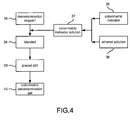
- FIG.4 is a flow view showing a colorimetric decontamination gel.
- a colorimetric indicator [35] such as alizarin
- ethanol solution [36] is added into an ethanol solution [36] to obtain a colorimetric indicator solution [37] with a ratio of alizarin to the ethanol solution between 0.01 and 0.03.
- 50 volumes of the colorimetric indicator solution [37] are mixed with 4800 volumes of a decontamination reagent [34] to obtain a proper ratio.
- the solution is blended [38] and then is placed still [39] to obtain a colorimetric decontamination gel [40].
- the decontamination gel is sprayed on a surface of a material.
- a film is formed and radioactive substances like cobalum (Co), cesium (Cs) and strontium (Sr) are soaked in the film and are shown by the colorimetric indicator with different colors. In this way, positions of the contaminations are observed and are cleaned by removing the film. In addition, densities of the contamination are recognized by the colors.
- FIG.5 is a view showing colors of a first state of use.
- different colorimetric indicators have different color reactions.
- decontamination gels separately having colorimetric indicators are obtained.
- materials of stainless steel are used to be sunk in a cleanser.
- the materials are cleansed with ultrasound before being hot-dried in an oven.
- solutions separately having contaminations of Co, Cs and Sr are obtained and dropped on glasses to be hot-dried.
- the decontamination gels separately having colorimetric indicators are sprayed on the glasses having contaminations of Co, Cs and Sr to show different colors.
- the glasses having the contaminations of Co show obvious colors by the decontamination gels having alizarin and BrPADAP; and the glasses having the contaminations of Cs and Sr show obvious colors by the decontamination gels having alizarin and arsenazo III.
- different decontamination gels separately having different colorimetric indicators detect materials separately having contaminations of Co, Cs and Sr for preventing pollution dispersion and protecting environment.
- FIG.6 is a view showing colors of a second state of use.
- a decontamination gel having more than two colorimetric indicators is used to show colors of materials having contaminations of Co, Cs and Sr.
- two different colorimetric indicators are solved in an ethanol solution.
- the mixed colorimetric indicators are added to a decontamination gel.
- solutions separately having contaminations of Co, Cs and Sr are obtained and the mixed colorimetric indicators are dropped on glasses to be hot-dried to show different colors.
- the colorimetric indicators are BrPADAP and arsenazo III; PR and alizarin; PR and arsenazo III; or alizarin and arsenazo III.
- the glasses having the contaminations of Co, Cs and Sr show obvious colors by the decontamination gel having the colorimetric indicators.
- the decontamination gel having the colorimetric indicators detects materials having contaminations of Co, Cs and Sr for preventing pollution dispersion and protecting environment.
- a decontamination gel according to the present invention is obtained. Solutions having contaminations of Co, Cs and Sr are obtained and dropped on a glass to be hot-dried. After the temperature is cooled down to room temperature, the decontamination gel is sprayed on a glass having contaminations of Co, Cs and Sr to form a film after being dried up naturally. Thus, the contaminations of Co, Cs and Sr are cleaned by removing the film. By sinking the glass in an acid solution and analyze the acid solution afterward, a decontamination effect of the decontamination gel to materials having contaminations of Co, Cs and Sr is shown. As a result, it is shown that the decontamination gel has decontamination effects of 99%, 96% and 97% to Co, Cs and Sr separately.
- the present invention is a decontamination method of a metal surface contaminated by radioactive element, where a blend of polymers, characteristic additives and a decontamination reagent are mixed to obtain a decontamination gel for indicating contaminations of Co, Cs and Sr and to obtain good decontamination effect by cleaning the contaminations by removing a film of the decontamination gel dried-up.
Landscapes
- Engineering & Computer Science (AREA)
- High Energy & Nuclear Physics (AREA)
- General Engineering & Computer Science (AREA)
- Physics & Mathematics (AREA)
- General Chemical & Material Sciences (AREA)
- Life Sciences & Earth Sciences (AREA)
- Food Science & Technology (AREA)
- Chemical & Material Sciences (AREA)
- Electrochemistry (AREA)
- Chemical Kinetics & Catalysis (AREA)
- Detergent Compositions (AREA)
- Physical Or Chemical Processes And Apparatus (AREA)
- Solid-Sorbent Or Filter-Aiding Compositions (AREA)
Abstract
Description
- The present invention relates to a decontamination method of a metal surface contaminated by radioactive element; more particularly, relates to mixing a blend of polymers, characteristic additives and a decontamination reagent to obtain a decontamination gel for indicating contaminations of Co, Cs and Sr and to obtain good decontamination effect by cleaning the contaminations by removing a film of the decontamination gel dried-up
- Different decontamination reagents are used for cleansing. For example, distilled products from petroleum are used to clean contaminations on surfaces of tire, break, etc. These reagents usually contain hydrocarbon solvents like methylbenzene and xylene. Yet, environmental-friendly products are developed and widely used in the modern time. As disclosed in
US 4,511,488 , D-limonene is used to cleanse oil and earth on mechanical facilities. InUS 5,660,641 , 2 to 8 weight percents (wt%) of terpene, or 5 to 25 wt% of anionic or nonionic surfactant, is used to effectively remove grease or tar on a surface. However, a surface having a pollution of radionuclides is not effectively cleansed. And, a solution obtained after cleansing the surface may need further treatment. - Technologies of decontamination, including chemical and non-chemical decontamination technologies, are developed. The chemical decontamination technologies use chemical reagents, such as organic acids having reduction property, chelating agents, oxidants, reductive agent, etc. These chemical reagents are soft and are used for precision machines such as reactor coolant pump (RCP). But its decontamination factor is usually small. The later non-chemical technologies are more widely used, such as electrochemical decontamination, abrading decontamination, high pressure water-jet decontamination, mechanical decontamination, etc. These methods are usually severe and may even ruin machine; though the decontamination factors may reach 103 to 104.
- The above technologies are usually used for decontamination of removable material. Yet, fission products from nuclear reactions, like 60Co, 137Cs and 90Sr, may be adhered on irremovable materials, like industrial facilities, floor, ceiling, wall, etc. Hence, an on-the-spot decontamination method is required.
- Traditional decontamination reagent for radioactive waste usually contains strong acid or alkali to improve decontamination effect, like phosphoric acid, sulfuric acid, nitric acid, fluorboric acid, potassium permanganate or sodium hydroxide. And the operation is usually processed under a high temperature. When contaminations are gradually accumulated in the decontamination reagent, its decontamination effect decreases while radioactive activity of the accumulated contaminations increases. At the minute, the decontamination reagent needs further treatment or becomes a waste. But, the treatment may not be easy owing to the complex components contained in the used decontamination reagent. And, the waste may be a great amount. All these may greatly heighten the cost.
- To decrease the amount of the waste, surface protective films are developed. They are usually used as protective layers on industrial objects to prevent from contamination and collision, and thus are soft. For example,
US 5,891,261 discloses (meth)acrylic acid ester combined with other polymer monomers, like less than 5%wt of carbonyl group, to form a gel. And the gel is pasted on a surface to be dried for obtaining a film. Then cold or hot water (even vapor) are spayed on the dried film to remove it. - However, the above prior arts are not suitable to radioactive pollutions.
-
US 2003/172959 A1 discloses a method for removing a wide variety of radioactive contaminats from a contaminated surface. -
US 5,763,734 discloses another method of deconatminating devices in nuclear power plants. -
US 6,689,226 B1 discloses a decontamination gel including a decontamination agent, two organic polymers and water. -
US 6,203,624 B1 discloses a decontamination gel that can be used to decontaminate metal surfaces, while decontamination is understood to be related to the removal of radioactive elements. Conventional decontaminations gels comprise a viscosing agent that is generally mineral and a decontamination agent choosen in relation to the type of the surface. Because of the viscosing agent spraying of the gel is difficult.US 6,203,624 B1 therefore suggests combining a mineral viscosing agent and an organic viscosing agent choosen from hydosoluble organic polymenrs and surfactants. - The present invention provides a decontamination method comprising the steps of claim 1. Advantageous embodiments of the claimed method are laid down in further claims.
- Further, the present invention provides a decontamination gel according to claim 15.
- The decontamination reagent contains at least one polymer to be sprayed on a contaminated material for forming a film for cleaning contamination.
- Evaporable organic solvent is added to increase fluidity of gel and to control time for obtaining the film.
- A colorimetric indicator is added in the decontamination gel to be sprayed on the contaminated material to show places of contaminations.
- Preferably, the decontamination reagent has abilities of physical absorbing or chemical chelating to Co, Cs and Sr.
- The present invention will be better understood from the following detailed description of the preferred embodiment according to the present invention, taken in conjunction with the accompanying drawings, in which
- FIG.1
- is the flow view showing the preferred embodiment according to the present invention;
- FIG.2
- is the flow view showing fabricating the gel fluid;
- FIG.3
- is the flow view showing fabricating the decontamination gel;
- FIG.4
- is the flow view showing fabricating the colorimetric decontamination gel;
- FIG.5
- is the view showing the colors of the first state of use; and
- FIG.6
- is the view showing the colors of the second state of use.
- The following description of the preferred embodiment is provided to understand the features and the structures of the present invention.
- Please refer to
FIG.1 , which is a flow view showing a preferred embodiment according to the present invention. As shown in the figures, the present invention is a decontamination method of a metal surface contaminated by radioactive element, comprising the following steps: - (a) Fabricating gel fluid [11]: A mixed solution with a proper ratio of an evaporable organic solution to water is obtained at first. Then, at least one polymer with different weight ratio is mixed at 80 to 95 Celsius degrees (°C) to obtain a gel fluid. With the organic solution, a density of the gel fluid is controlled and a decontamination ability to a surface of a material is increased. Therein, the organic solution is acetylene acetone (ACAC), acetonitrile or ethanol; and the polymer is polyethylene oxide (PEO), polyacrylonitrile (PAN), polyvinyl alcohol (PVA), polyvinyl pyrrolidone (PVP), polyvinyl acetate, carboxymethyl cellulose, polyethylene oxide, polyethylene glycol, gelatin, apple pectin or arabic gum.
- (b)Fabricating decontamination gel [12]: A decontamination reagent is added in the gel fluid as an absorbing agent or a chelating agent to change a density of the gel fluid for controlling time for forming a film. A plasticizer is further added to change a fragile property of the gel fluid for improving plasticity of the gel fluid. After the above added substances are fully mixed, the temperature of the mixed solution is cooled down to room temperature; and then at least one colorimetric indicator is added into an ethanol solution with a certain ratio and is added into the decontamination gel to obtain a decontamination gel having at least one colorimetric indicator. Therein, the decontamination gel is a mixture of at least one first compound, an inorganic acid and water; the first compound is diethylene triamine pentaacetic acid (DTPA), ethylene diamine tetraacetic acid (EDTA), apple pectin, prussian blue, ammonium phosphomolybdate (AMP), Ce4+/Ce3+, hydrogen peroxide or ferrocyanide; the inorganic acid is phosphoric acid, hydrochloric acid, formic acid or sulfuric acid; the plasticizer is tetrahydrofuran (THF), N-methyl formamide (NMF), N,N-dimethyl formamide (DMF), glycerin or phthalate ester; the colorimetric indicator is a mixture of at least one second compound and an ethanol solution; and the second compound is alizarin, phenol red (PR), arsenazo III or 2-(5-bromo-2-pyridylazo)-5-dimethylaminophenol (BrPADAP).
- (c)Decontaminating contamination [13]: Pasting the decontamination gel on the contaminated surface of the material by a brush or a spraying tool. A film is thus naturally formed at a temperature between 10 and 40°C after 3 to 24 hours (hrs). The film shows contaminated areas on the surface and contamination is soaked in the film by physical absorbing and chemical chelating. Hence, the contamination is decontaminated by removing the film. Therein, the material is stainless steel, carbon steel, aluminum, copper, plastics or glass.
- Accordingly, a novel decontamination method of a metal surface contaminated by radioactive element is obtained.
- Please refer to
FIG.2 , which is a flow view showing fabricating a gel fluid. As shown in the figure, on using the present invention, a mixed solution with a physical ratio of water to an evaporable organic solution [21] between 1 and 5 is obtained in a reactor. Then a first polymer [22], such as methylcellulose, is added to obtain a proper weight ratio. The methylcellulose is blended to be fully solved with temperature heated up. A condenser is then further used to prevent an evaporation of the organic solution and water. Then a second polymer [23], such as PVA, is gradually added with blending under 85°C during 4 to 5hrs to be fully solved into water for obtaining a proper weight ratio of the first polymer to the second polymer. Then a plasticizer [24], such as glycerin, is added at a temperature between 80°C and 95°C to obtain a proper volume ratio of glycerin to water. Thus, a gel fluid [26] is obtained after a continuous blending [25]. - Please refer to
FIG.3 , which is a flow view showing a decontamination gel. As shown in the figure, on fabricating a decontamination reagent solution, a decontamination reagent [27], such as DTPA, is solved into a solution of phosphoric acid and water [28] to be fully blended for obtaining a molar ratio of 1:8:175 for DTPA to phosphoric acid to water in the decontamination reagent solution [29]. Then 6500 volumes of gel fluid [26] is added with 200 volumes of the decontamination reagent solution [29] to obtain a ratio of 33 to 1. Then the solution is blended [31] under 85°C [30] in the reactor. Thus, the decontamination reagent solution [34] is obtained after being placed still [32] for 1hr to be cooled down [33] to room temperature. - Please refer to
FIG.4 , which is a flow view showing a colorimetric decontamination gel. As shown in the figure, a colorimetric indicator [35], such as alizarin, is added into an ethanol solution [36] to obtain a colorimetric indicator solution [37] with a ratio of alizarin to the ethanol solution between 0.01 and 0.03. Then, 50 volumes of the colorimetric indicator solution [37] are mixed with 4800 volumes of a decontamination reagent [34] to obtain a proper ratio. Then the solution is blended [38] and then is placed still [39] to obtain a colorimetric decontamination gel [40]. - Then, the decontamination gel is sprayed on a surface of a material. After the decontamination gel is dried up, a film is formed and radioactive substances like cobalum (Co), cesium (Cs) and strontium (Sr) are soaked in the film and are shown by the colorimetric indicator with different colors. In this way, positions of the contaminations are observed and are cleaned by removing the film. In addition, densities of the contamination are recognized by the colors.
- Please refer to
FIG.5 , which is a view showing colors of a first state of use. As shown in the figure, different colorimetric indicators have different color reactions. At first, decontamination gels separately having colorimetric indicators are obtained. And materials of stainless steel are used to be sunk in a cleanser. Then the materials are cleansed with ultrasound before being hot-dried in an oven. After the temperature is cooled down to room temperature, solutions separately having contaminations of Co, Cs and Sr are obtained and dropped on glasses to be hot-dried. After the temperature is cooled down to room temperature, the decontamination gels separately having colorimetric indicators are sprayed on the glasses having contaminations of Co, Cs and Sr to show different colors. - As a result, the glasses having the contaminations of Co show obvious colors by the decontamination gels having alizarin and BrPADAP; and the glasses having the contaminations of Cs and Sr show obvious colors by the decontamination gels having alizarin and arsenazo III. Hence, different decontamination gels separately having different colorimetric indicators detect materials separately having contaminations of Co, Cs and Sr for preventing pollution dispersion and protecting environment.
- Please refer to
FIG.6 , which is a view showing colors of a second state of use. As shown in the figure, a decontamination gel having more than two colorimetric indicators is used to show colors of materials having contaminations of Co, Cs and Sr. At first, two different colorimetric indicators are solved in an ethanol solution. The mixed colorimetric indicators are added to a decontamination gel. Then solutions separately having contaminations of Co, Cs and Sr are obtained and the mixed colorimetric indicators are dropped on glasses to be hot-dried to show different colors. Therein, the colorimetric indicators are BrPADAP and arsenazo III; PR and alizarin; PR and arsenazo III; or alizarin and arsenazo III. - As a result, the glasses having the contaminations of Co, Cs and Sr show obvious colors by the decontamination gel having the colorimetric indicators. Hence, the decontamination gel having the colorimetric indicators detects materials having contaminations of Co, Cs and Sr for preventing pollution dispersion and protecting environment.
- For removing contaminations of Co, Cs and Sr, a decontamination gel according to the present invention is obtained. Solutions having contaminations of Co, Cs and Sr are obtained and dropped on a glass to be hot-dried. After the temperature is cooled down to room temperature, the decontamination gel is sprayed on a glass having contaminations of Co, Cs and Sr to form a film after being dried up naturally. Thus, the contaminations of Co, Cs and Sr are cleaned by removing the film. By sinking the glass in an acid solution and analyze the acid solution afterward, a decontamination effect of the decontamination gel to materials having contaminations of Co, Cs and Sr is shown. As a result, it is shown that the decontamination gel has decontamination effects of 99%, 96% and 97% to Co, Cs and Sr separately.
- To sum up, the present invention is a decontamination method of a metal surface contaminated by radioactive element, where a blend of polymers, characteristic additives and a decontamination reagent are mixed to obtain a decontamination gel for indicating contaminations of Co, Cs and Sr and to obtain good decontamination effect by cleaning the contaminations by removing a film of the decontamination gel dried-up.
- The preferred embodiment herein disclosed is not intended to unnecessarily limit the scope of the invention. Modifications or variations belonging to the scope of the claims are all within the scope of the present invention.
Claims (15)
- A decontamination method for decontamination of a metal surface contaminated by radioactive elements, comprising steps of:(a) mixing an organic solvent, more than one polymer and water to obtain a gel fluid;(b) adding a decontamination reagent and a plasticizer into said gel fluid to be fully blended then adding a solution of at least one colorimetric indicator to obtain a colorimetric decontamination gel; and(c) pasting said decontamination gel on a contaminated surface of a material to obtain a film and removing said film to decontaminate said surface;wherein
said organic solvent is selected from a group consisting of acetylene acetone, acetonitrile and ethanol;
said plasticizer is selected from a group consisting of tetrahydrofuran, N-methyl formamide, N,N-dimethyl formamide, glycerin and phthalate ester; and
said colorimetric indicator is a mixture of an ethanol solution and at least one selected from a group consisting of alizarin, phenol red, arsenazo III and 2-(5-bromo-2-pyridylazo)-5-dimethylaminophenol. - The method according to claim 1,
wherein said gel fluid has a temperature between 80 °C and 95°C. - The method according to claim 1 or 2,
wherein said water and said organic solvent has a physical ratio between 1 and 5. - The method according to one of claims 1 to 3,
wherein said polymer is selected from a group consisting of polyethylene oxide, polyacrylonitrile, polyvinyl alcohol, polyvinyl pyrrolidone, polyvinyl acetate, carboxymethyl cellulose, polyethylene oxide, polyethylene glycol, gelatin, apple pectin and arabic gum. - The method according to one of claims 1 to 4,
wherein said plasticizer is mixed with said polymer at a temperature between 80°C and 95°C. - The method according to one of claims 1 to 5,
wherein said decontamination reagent is a mixture of at least one first compound, an inorganic acid and water; and
wherein said first compound is selected from a group consisting of diethylene triamine pentaacetic acid, ethylene diamine tetraacetic acid, apple pectin, prussian blue, ammonium phosphomolybdate, Ce4+/Ce3+, hydrogen peroxide and ferrocyanide. - The method according to one of claims 1 to 6,
wherein said inorganic acid is selected from a group consisting of phosphoric acid, hydrochloric acid, formic acid and sulfuric acid. - The method according to claim 6,
wherein a molar ratio of said decontamination reagent to said inorganic acid to water is 1 to 8 to 175. - The method according to one of claims 1 to 8,
wherein said colorimetric indicator and said ethanol solution is mixed to obtain a ratio between 0.01 and 0.03. - The method according to one of claims 1 to 9,
wherein said decontamination gel is exposed in air for 3 to 24 hours at a temperature between 10°C and 40°C to obtain said film. - The method according to one of claims 1 to 10,
wherein said film has a decontamination efficiency, which is greater than 96%, to a contamination containing an element selected from a group consisting of cobalum, cesium and strontium; and - The method according to one of claims 1 to 11,
wherein said material is selected from a group consisting of stainless steel, carbon steel, aluminum, copper, plastics and glass. - The method according to one of claims 1 to 12,
wherein said colorimetric indicator colorizes contaminations on said surface of said material and thus shows positions of said contaminations. - The method according to one of claims 1 to 13,
wherein a physical ratio of said decontamination reagent to said gel fluid in a mixed solution is 1 to 33. - Decontamination gel for decontamination of a metal surface contaminated by radioactive elements, consisting of:(a) an organic solvent, more than one polymer and water mixed to form a gel fluid; and(b) a decontamination reagent, a plasticizer and at least one colorimetric indicator in said gel to form a colorimetric decontamination gel; and(c) that is suitable for being pasted on a contaminated surface of a material to obtain a film and removing said film to decontaminate said surfacewherein
said organic solvent is selected from a group consisting of acetylene acetone, acetonitrile and ethanol;
said plasticizer is selected from a group consisting of tetrahydrofuran, N-methyl formamide, N,N-dimethyl formamide, glycerin and phthalate ester; and
said colorimetric indicator is a mixture of an ethanol solution and at least one selected from a group consisting of alizarin, phenol red, arsenazo III and 2-(5-bromo-2-pyridylazo)-5-dimethylaminophenol.
Priority Applications (2)
| Application Number | Priority Date | Filing Date | Title |
|---|---|---|---|
| EP07119543A EP2056302B1 (en) | 2007-10-29 | 2007-10-29 | Decontamination method of metal surface contaminated by radioactive element |
| AT07119543T ATE538478T1 (en) | 2007-10-29 | 2007-10-29 | DECONTAMINATION METHOD FOR A METAL SURFACE CONTAMINATED BY RADIOACTIVE ELEMENTS |
Applications Claiming Priority (1)
| Application Number | Priority Date | Filing Date | Title |
|---|---|---|---|
| EP07119543A EP2056302B1 (en) | 2007-10-29 | 2007-10-29 | Decontamination method of metal surface contaminated by radioactive element |
Publications (2)
| Publication Number | Publication Date |
|---|---|
| EP2056302A1 EP2056302A1 (en) | 2009-05-06 |
| EP2056302B1 true EP2056302B1 (en) | 2011-12-21 |
Family
ID=39111513
Family Applications (1)
| Application Number | Title | Priority Date | Filing Date |
|---|---|---|---|
| EP07119543A Not-in-force EP2056302B1 (en) | 2007-10-29 | 2007-10-29 | Decontamination method of metal surface contaminated by radioactive element |
Country Status (2)
| Country | Link |
|---|---|
| EP (1) | EP2056302B1 (en) |
| AT (1) | ATE538478T1 (en) |
Families Citing this family (5)
| Publication number | Priority date | Publication date | Assignee | Title |
|---|---|---|---|---|
| TWI457948B (en) * | 2011-09-29 | 2014-10-21 | Atomic Energy Council | Device of chemical and electrochemical decontaminations |
| KR20140095266A (en) | 2013-01-24 | 2014-08-01 | 한국원자력연구원 | Chelate free chemical decontamination reagent for removal of the dense radioactive oxide layer on the metal surface and chemical decontamination method using the same |
| KR101601201B1 (en) * | 2015-04-15 | 2016-03-09 | 한국원자력연구원 | Chelate free chemical decontamination reagent for removal of the dense radioactive oxide layer on the metal surface and chemical decontamination method using the same |
| IT201800004473A1 (en) * | 2018-04-13 | 2019-10-13 | DETERGENT COMPOSITION FOR THE DECONTAMINATION OF SURFACES, IN PARTICULAR OF RADIOACTIVE SURFACES, AND RELATIVE DECONTAMINATION METHOD | |
| CN116504432B (en) * | 2023-03-29 | 2026-04-21 | 中国原子能科学研究院 | A method for preparing a stain-removing composite solution and its gel membrane, and its application. |
Family Cites Families (6)
| Publication number | Priority date | Publication date | Assignee | Title |
|---|---|---|---|---|
| US4511488A (en) | 1983-12-05 | 1985-04-16 | Penetone Corporation | D-Limonene based aqueous cleaning compositions |
| US5494611A (en) | 1993-11-24 | 1996-02-27 | Armor All Products Corporation | Dual-purpose cleaning composition for painted and waxed surfaces |
| US5763734A (en) | 1995-10-19 | 1998-06-09 | Nachtman; Thomas J. | Method for containing or removing contaminants from a substrate |
| JPH105684A (en) | 1996-04-23 | 1998-01-13 | Fuji Heavy Ind Ltd | Stripping method for strippable coating film |
| FR2798603B1 (en) | 1999-09-20 | 2002-03-01 | Tech En Milieu Ionisant Stmi S | ORGANIC DECONTAMINATION GEL AND ITS USE FOR DECONTAMINATION OF SURFACES |
| US6652661B2 (en) | 2001-10-12 | 2003-11-25 | Bobolink, Inc. | Radioactive decontamination and translocation method |
-
2007
- 2007-10-29 EP EP07119543A patent/EP2056302B1/en not_active Not-in-force
- 2007-10-29 AT AT07119543T patent/ATE538478T1/en active
Also Published As
| Publication number | Publication date |
|---|---|
| ATE538478T1 (en) | 2012-01-15 |
| EP2056302A1 (en) | 2009-05-06 |
Similar Documents
| Publication | Publication Date | Title |
|---|---|---|
| US20090112042A1 (en) | Decontamination method of metal surface contaminated by radioactive element | |
| EP2056302A1 (en) | Decontamination method of metal surface contaminated by radioactive element | |
| KR101282748B1 (en) | Vacuumable gel for decontaminating surfaces and use thereof | |
| CN108342738B (en) | Water-based cleaning agent for nuclear power equipment and preparation method thereof | |
| CN112176145B (en) | Method for recovering radioactive waste metal | |
| CN111363635B (en) | Preparation and use method of antifreeze foam decontamination agent for decontamination of radioactive contamination | |
| CN113563980A (en) | Uranium radioactive decontaminant and uranium removing method of uranium-containing device | |
| CN107033986A (en) | Conduction oil carbon remover and sweep-out method | |
| CN102296001A (en) | Cleaning fluid for panel display and preparation method thereof | |
| CA2054234A1 (en) | Reagent for dissolving radioactively contaminated surfaces from metal articles | |
| CN107740121A (en) | A kind of preparation method of high-efficiency environment friendly multifunctional safety cleaning agent | |
| CN106497213A (en) | A kind of alkali paint remover | |
| CN108114608A (en) | A kind of cleaning agent and cleaning method for handling oily waste water tubular ceramic membrane | |
| CN115926515A (en) | Strippable membrane detergent and application method thereof | |
| CN113881513A (en) | Detergent for decontamination of nuclear power station reactor components and use method thereof | |
| Kinnunen | ANTIOXI–Decontamination techniques for activity removal in nuclear environments | |
| CN113025445A (en) | Cleaning agent for cleaning high-temperature sintered metal filter | |
| CN105274544B (en) | A kind of method of quick processing rolling state molybdenum product surface oxide layer | |
| RU2017244C1 (en) | Method for treating radioactively-contaminated stainless steel surfaces | |
| US5205864A (en) | Inorganic based strippable coatings for isolating hazardous materials and method for making and using the same | |
| KR101657529B1 (en) | Chemical decontamination agents having high decontamination efficiency and low corrosivity, preparation method thereof and decontamination method thereof | |
| CN206321130U (en) | Tubular heat exchanger giant cleans waterproof splinter device | |
| CN115458198A (en) | A method of decontamination of peelable film by airless spraying | |
| CN101260528B (en) | Removal of niobium second phase particle deposits from pickled zirconium-niobium alloys | |
| Wu et al. | Research Progress of Radioactive Decontamination Methods |
Legal Events
| Date | Code | Title | Description |
|---|---|---|---|
| PUAI | Public reference made under article 153(3) epc to a published international application that has entered the european phase |
Free format text: ORIGINAL CODE: 0009012 |
|
| 17P | Request for examination filed |
Effective date: 20071129 |
|
| AK | Designated contracting states |
Kind code of ref document: A1 Designated state(s): AT BE BG CH CY CZ DE DK EE ES FI FR GB GR HU IE IS IT LI LT LU LV MC MT NL PL PT RO SE SI SK TR |
|
| AX | Request for extension of the european patent |
Extension state: AL BA HR MK RS |
|
| 17Q | First examination report despatched |
Effective date: 20091201 |
|
| AKX | Designation fees paid |
Designated state(s): AT BE BG CH CY CZ DE DK EE ES FI FR GB GR HU IE IS IT LI LT LU LV MC MT NL PL PT RO SE SI SK TR |
|
| GRAP | Despatch of communication of intention to grant a patent |
Free format text: ORIGINAL CODE: EPIDOSNIGR1 |
|
| RIN1 | Information on inventor provided before grant (corrected) |
Inventor name: LIN, KOU-MIN Inventor name: CHUNG, JEN-CHIEH Inventor name: WEI, TSONG-YANG Inventor name: CHEN, CHE-NAN |
|
| GRAS | Grant fee paid |
Free format text: ORIGINAL CODE: EPIDOSNIGR3 |
|
| GRAA | (expected) grant |
Free format text: ORIGINAL CODE: 0009210 |
|
| AK | Designated contracting states |
Kind code of ref document: B1 Designated state(s): AT BE BG CH CY CZ DE DK EE ES FI FR GB GR HU IE IS IT LI LT LU LV MC MT NL PL PT RO SE SI SK TR |
|
| REG | Reference to a national code |
Ref country code: GB Ref legal event code: FG4D |
|
| REG | Reference to a national code |
Ref country code: CH Ref legal event code: EP |
|
| REG | Reference to a national code |
Ref country code: AT Ref legal event code: REF Ref document number: 538478 Country of ref document: AT Kind code of ref document: T Effective date: 20120115 |
|
| REG | Reference to a national code |
Ref country code: IE Ref legal event code: FG4D |
|
| REG | Reference to a national code |
Ref country code: DE Ref legal event code: R096 Ref document number: 602007019472 Country of ref document: DE Effective date: 20120308 |
|
| REG | Reference to a national code |
Ref country code: NL Ref legal event code: VDEP Effective date: 20111221 |
|
| PG25 | Lapsed in a contracting state [announced via postgrant information from national office to epo] |
Ref country code: LT Free format text: LAPSE BECAUSE OF FAILURE TO SUBMIT A TRANSLATION OF THE DESCRIPTION OR TO PAY THE FEE WITHIN THE PRESCRIBED TIME-LIMIT Effective date: 20111221 |
|
| LTIE | Lt: invalidation of european patent or patent extension |
Effective date: 20111221 |
|
| PG25 | Lapsed in a contracting state [announced via postgrant information from national office to epo] |
Ref country code: LV Free format text: LAPSE BECAUSE OF FAILURE TO SUBMIT A TRANSLATION OF THE DESCRIPTION OR TO PAY THE FEE WITHIN THE PRESCRIBED TIME-LIMIT Effective date: 20111221 Ref country code: SI Free format text: LAPSE BECAUSE OF FAILURE TO SUBMIT A TRANSLATION OF THE DESCRIPTION OR TO PAY THE FEE WITHIN THE PRESCRIBED TIME-LIMIT Effective date: 20111221 Ref country code: NL Free format text: LAPSE BECAUSE OF FAILURE TO SUBMIT A TRANSLATION OF THE DESCRIPTION OR TO PAY THE FEE WITHIN THE PRESCRIBED TIME-LIMIT Effective date: 20111221 Ref country code: SE Free format text: LAPSE BECAUSE OF FAILURE TO SUBMIT A TRANSLATION OF THE DESCRIPTION OR TO PAY THE FEE WITHIN THE PRESCRIBED TIME-LIMIT Effective date: 20111221 Ref country code: GR Free format text: LAPSE BECAUSE OF FAILURE TO SUBMIT A TRANSLATION OF THE DESCRIPTION OR TO PAY THE FEE WITHIN THE PRESCRIBED TIME-LIMIT Effective date: 20120322 |
|
| PG25 | Lapsed in a contracting state [announced via postgrant information from national office to epo] |
Ref country code: CY Free format text: LAPSE BECAUSE OF FAILURE TO SUBMIT A TRANSLATION OF THE DESCRIPTION OR TO PAY THE FEE WITHIN THE PRESCRIBED TIME-LIMIT Effective date: 20111221 Ref country code: BE Free format text: LAPSE BECAUSE OF FAILURE TO SUBMIT A TRANSLATION OF THE DESCRIPTION OR TO PAY THE FEE WITHIN THE PRESCRIBED TIME-LIMIT Effective date: 20111221 |
|
| PG25 | Lapsed in a contracting state [announced via postgrant information from national office to epo] |
Ref country code: IS Free format text: LAPSE BECAUSE OF FAILURE TO SUBMIT A TRANSLATION OF THE DESCRIPTION OR TO PAY THE FEE WITHIN THE PRESCRIBED TIME-LIMIT Effective date: 20120421 Ref country code: EE Free format text: LAPSE BECAUSE OF FAILURE TO SUBMIT A TRANSLATION OF THE DESCRIPTION OR TO PAY THE FEE WITHIN THE PRESCRIBED TIME-LIMIT Effective date: 20111221 Ref country code: BG Free format text: LAPSE BECAUSE OF FAILURE TO SUBMIT A TRANSLATION OF THE DESCRIPTION OR TO PAY THE FEE WITHIN THE PRESCRIBED TIME-LIMIT Effective date: 20120321 Ref country code: SK Free format text: LAPSE BECAUSE OF FAILURE TO SUBMIT A TRANSLATION OF THE DESCRIPTION OR TO PAY THE FEE WITHIN THE PRESCRIBED TIME-LIMIT Effective date: 20111221 Ref country code: CZ Free format text: LAPSE BECAUSE OF FAILURE TO SUBMIT A TRANSLATION OF THE DESCRIPTION OR TO PAY THE FEE WITHIN THE PRESCRIBED TIME-LIMIT Effective date: 20111221 |
|
| PG25 | Lapsed in a contracting state [announced via postgrant information from national office to epo] |
Ref country code: RO Free format text: LAPSE BECAUSE OF FAILURE TO SUBMIT A TRANSLATION OF THE DESCRIPTION OR TO PAY THE FEE WITHIN THE PRESCRIBED TIME-LIMIT Effective date: 20111221 Ref country code: PL Free format text: LAPSE BECAUSE OF FAILURE TO SUBMIT A TRANSLATION OF THE DESCRIPTION OR TO PAY THE FEE WITHIN THE PRESCRIBED TIME-LIMIT Effective date: 20111221 Ref country code: PT Free format text: LAPSE BECAUSE OF FAILURE TO SUBMIT A TRANSLATION OF THE DESCRIPTION OR TO PAY THE FEE WITHIN THE PRESCRIBED TIME-LIMIT Effective date: 20120423 |
|
| REG | Reference to a national code |
Ref country code: AT Ref legal event code: MK05 Ref document number: 538478 Country of ref document: AT Kind code of ref document: T Effective date: 20111221 |
|
| PLBE | No opposition filed within time limit |
Free format text: ORIGINAL CODE: 0009261 |
|
| STAA | Information on the status of an ep patent application or granted ep patent |
Free format text: STATUS: NO OPPOSITION FILED WITHIN TIME LIMIT |
|
| PG25 | Lapsed in a contracting state [announced via postgrant information from national office to epo] |
Ref country code: DK Free format text: LAPSE BECAUSE OF FAILURE TO SUBMIT A TRANSLATION OF THE DESCRIPTION OR TO PAY THE FEE WITHIN THE PRESCRIBED TIME-LIMIT Effective date: 20111221 |
|
| 26N | No opposition filed |
Effective date: 20120924 |
|
| PG25 | Lapsed in a contracting state [announced via postgrant information from national office to epo] |
Ref country code: IT Free format text: LAPSE BECAUSE OF FAILURE TO SUBMIT A TRANSLATION OF THE DESCRIPTION OR TO PAY THE FEE WITHIN THE PRESCRIBED TIME-LIMIT Effective date: 20111221 |
|
| REG | Reference to a national code |
Ref country code: DE Ref legal event code: R097 Ref document number: 602007019472 Country of ref document: DE Effective date: 20120924 |
|
| PG25 | Lapsed in a contracting state [announced via postgrant information from national office to epo] |
Ref country code: AT Free format text: LAPSE BECAUSE OF FAILURE TO SUBMIT A TRANSLATION OF THE DESCRIPTION OR TO PAY THE FEE WITHIN THE PRESCRIBED TIME-LIMIT Effective date: 20111221 |
|
| PG25 | Lapsed in a contracting state [announced via postgrant information from national office to epo] |
Ref country code: ES Free format text: LAPSE BECAUSE OF FAILURE TO SUBMIT A TRANSLATION OF THE DESCRIPTION OR TO PAY THE FEE WITHIN THE PRESCRIBED TIME-LIMIT Effective date: 20120401 |
|
| PG25 | Lapsed in a contracting state [announced via postgrant information from national office to epo] |
Ref country code: MC Free format text: LAPSE BECAUSE OF NON-PAYMENT OF DUE FEES Effective date: 20121031 |
|
| REG | Reference to a national code |
Ref country code: CH Ref legal event code: PL |
|
| PG25 | Lapsed in a contracting state [announced via postgrant information from national office to epo] |
Ref country code: FI Free format text: LAPSE BECAUSE OF FAILURE TO SUBMIT A TRANSLATION OF THE DESCRIPTION OR TO PAY THE FEE WITHIN THE PRESCRIBED TIME-LIMIT Effective date: 20111221 |
|
| PG25 | Lapsed in a contracting state [announced via postgrant information from national office to epo] |
Ref country code: CH Free format text: LAPSE BECAUSE OF NON-PAYMENT OF DUE FEES Effective date: 20121031 Ref country code: LI Free format text: LAPSE BECAUSE OF NON-PAYMENT OF DUE FEES Effective date: 20121031 |
|
| REG | Reference to a national code |
Ref country code: IE Ref legal event code: MM4A |
|
| PG25 | Lapsed in a contracting state [announced via postgrant information from national office to epo] |
Ref country code: IE Free format text: LAPSE BECAUSE OF NON-PAYMENT OF DUE FEES Effective date: 20121029 |
|
| PG25 | Lapsed in a contracting state [announced via postgrant information from national office to epo] |
Ref country code: MT Free format text: LAPSE BECAUSE OF FAILURE TO SUBMIT A TRANSLATION OF THE DESCRIPTION OR TO PAY THE FEE WITHIN THE PRESCRIBED TIME-LIMIT Effective date: 20111221 |
|
| PG25 | Lapsed in a contracting state [announced via postgrant information from national office to epo] |
Ref country code: TR Free format text: LAPSE BECAUSE OF FAILURE TO SUBMIT A TRANSLATION OF THE DESCRIPTION OR TO PAY THE FEE WITHIN THE PRESCRIBED TIME-LIMIT Effective date: 20111221 |
|
| PG25 | Lapsed in a contracting state [announced via postgrant information from national office to epo] |
Ref country code: LU Free format text: LAPSE BECAUSE OF NON-PAYMENT OF DUE FEES Effective date: 20121029 |
|
| PG25 | Lapsed in a contracting state [announced via postgrant information from national office to epo] |
Ref country code: HU Free format text: LAPSE BECAUSE OF FAILURE TO SUBMIT A TRANSLATION OF THE DESCRIPTION OR TO PAY THE FEE WITHIN THE PRESCRIBED TIME-LIMIT Effective date: 20071029 |
|
| PGFP | Annual fee paid to national office [announced via postgrant information from national office to epo] |
Ref country code: FR Payment date: 20141021 Year of fee payment: 8 Ref country code: DE Payment date: 20141031 Year of fee payment: 8 Ref country code: GB Payment date: 20141024 Year of fee payment: 8 |
|
| REG | Reference to a national code |
Ref country code: DE Ref legal event code: R119 Ref document number: 602007019472 Country of ref document: DE |
|
| GBPC | Gb: european patent ceased through non-payment of renewal fee |
Effective date: 20151029 |
|
| PG25 | Lapsed in a contracting state [announced via postgrant information from national office to epo] |
Ref country code: DE Free format text: LAPSE BECAUSE OF NON-PAYMENT OF DUE FEES Effective date: 20160503 Ref country code: GB Free format text: LAPSE BECAUSE OF NON-PAYMENT OF DUE FEES Effective date: 20151029 |
|
| REG | Reference to a national code |
Ref country code: FR Ref legal event code: ST Effective date: 20160630 |
|
| PG25 | Lapsed in a contracting state [announced via postgrant information from national office to epo] |
Ref country code: FR Free format text: LAPSE BECAUSE OF NON-PAYMENT OF DUE FEES Effective date: 20151102 |