EP2055671A1 - Metal phosphate - Google Patents
Metal phosphate Download PDFInfo
- Publication number
- EP2055671A1 EP2055671A1 EP07791797A EP07791797A EP2055671A1 EP 2055671 A1 EP2055671 A1 EP 2055671A1 EP 07791797 A EP07791797 A EP 07791797A EP 07791797 A EP07791797 A EP 07791797A EP 2055671 A1 EP2055671 A1 EP 2055671A1
- Authority
- EP
- European Patent Office
- Prior art keywords
- group
- metal phosphate
- proton conductivity
- manufactured
- chemical industries
- Prior art date
- Legal status (The legal status is an assumption and is not a legal conclusion. Google has not performed a legal analysis and makes no representation as to the accuracy of the status listed.)
- Withdrawn
Links
Images
Classifications
-
- H—ELECTRICITY
- H01—ELECTRIC ELEMENTS
- H01M—PROCESSES OR MEANS, e.g. BATTERIES, FOR THE DIRECT CONVERSION OF CHEMICAL ENERGY INTO ELECTRICAL ENERGY
- H01M8/00—Fuel cells; Manufacture thereof
- H01M8/10—Fuel cells with solid electrolytes
-
- C—CHEMISTRY; METALLURGY
- C01—INORGANIC CHEMISTRY
- C01B—NON-METALLIC ELEMENTS; COMPOUNDS THEREOF; METALLOIDS OR COMPOUNDS THEREOF NOT COVERED BY SUBCLASS C01C
- C01B25/00—Phosphorus; Compounds thereof
- C01B25/16—Oxyacids of phosphorus; Salts thereof
- C01B25/26—Phosphates
- C01B25/38—Condensed phosphates
- C01B25/42—Pyrophosphates
-
- C—CHEMISTRY; METALLURGY
- C01—INORGANIC CHEMISTRY
- C01B—NON-METALLIC ELEMENTS; COMPOUNDS THEREOF; METALLOIDS OR COMPOUNDS THEREOF NOT COVERED BY SUBCLASS C01C
- C01B25/00—Phosphorus; Compounds thereof
- C01B25/16—Oxyacids of phosphorus; Salts thereof
- C01B25/26—Phosphates
- C01B25/45—Phosphates containing plural metal, or metal and ammonium
-
- H—ELECTRICITY
- H01—ELECTRIC ELEMENTS
- H01M—PROCESSES OR MEANS, e.g. BATTERIES, FOR THE DIRECT CONVERSION OF CHEMICAL ENERGY INTO ELECTRICAL ENERGY
- H01M8/00—Fuel cells; Manufacture thereof
- H01M8/10—Fuel cells with solid electrolytes
- H01M8/1016—Fuel cells with solid electrolytes characterised by the electrolyte material
-
- H—ELECTRICITY
- H01—ELECTRIC ELEMENTS
- H01M—PROCESSES OR MEANS, e.g. BATTERIES, FOR THE DIRECT CONVERSION OF CHEMICAL ENERGY INTO ELECTRICAL ENERGY
- H01M8/00—Fuel cells; Manufacture thereof
- H01M8/10—Fuel cells with solid electrolytes
- H01M8/12—Fuel cells with solid electrolytes operating at high temperature, e.g. with stabilised ZrO2 electrolyte
- H01M8/124—Fuel cells with solid electrolytes operating at high temperature, e.g. with stabilised ZrO2 electrolyte characterised by the process of manufacturing or by the material of the electrolyte
-
- H—ELECTRICITY
- H01—ELECTRIC ELEMENTS
- H01M—PROCESSES OR MEANS, e.g. BATTERIES, FOR THE DIRECT CONVERSION OF CHEMICAL ENERGY INTO ELECTRICAL ENERGY
- H01M4/00—Electrodes
- H01M4/86—Inert electrodes with catalytic activity, e.g. for fuel cells
- H01M4/8605—Porous electrodes
-
- Y—GENERAL TAGGING OF NEW TECHNOLOGICAL DEVELOPMENTS; GENERAL TAGGING OF CROSS-SECTIONAL TECHNOLOGIES SPANNING OVER SEVERAL SECTIONS OF THE IPC; TECHNICAL SUBJECTS COVERED BY FORMER USPC CROSS-REFERENCE ART COLLECTIONS [XRACs] AND DIGESTS
- Y02—TECHNOLOGIES OR APPLICATIONS FOR MITIGATION OR ADAPTATION AGAINST CLIMATE CHANGE
- Y02E—REDUCTION OF GREENHOUSE GAS [GHG] EMISSIONS, RELATED TO ENERGY GENERATION, TRANSMISSION OR DISTRIBUTION
- Y02E60/00—Enabling technologies; Technologies with a potential or indirect contribution to GHG emissions mitigation
- Y02E60/30—Hydrogen technology
- Y02E60/50—Fuel cells
-
- Y—GENERAL TAGGING OF NEW TECHNOLOGICAL DEVELOPMENTS; GENERAL TAGGING OF CROSS-SECTIONAL TECHNOLOGIES SPANNING OVER SEVERAL SECTIONS OF THE IPC; TECHNICAL SUBJECTS COVERED BY FORMER USPC CROSS-REFERENCE ART COLLECTIONS [XRACs] AND DIGESTS
- Y02—TECHNOLOGIES OR APPLICATIONS FOR MITIGATION OR ADAPTATION AGAINST CLIMATE CHANGE
- Y02P—CLIMATE CHANGE MITIGATION TECHNOLOGIES IN THE PRODUCTION OR PROCESSING OF GOODS
- Y02P70/00—Climate change mitigation technologies in the production process for final industrial or consumer products
- Y02P70/50—Manufacturing or production processes characterised by the final manufactured product
Definitions
- the present invention relates to a metal phosphate. More specifically, the present invention relates to a proton-conductive metal phosphate used as a solid electrolyte for fuel cells.
- Metal phosphates are known to have proton conductivity, and used as a solid electrolyte in fuel cells.
- the solid electrolyte are polymers, phosphoric acid, molten salts and solid oxides, and fuel cells using them are investigated.
- solid polymer type fuel cells using polymers PEFC: Polymer Electrolyte Fuel Cell
- PEFC Polymer Electrolyte Fuel Cell
- solid polymer type fuel cells using polymers PEFC: Polymer Electrolyte Fuel Cell
- solid polymer type fuel cells using polymers are operable at low temperatures of from room temperature to about 100°C, easily formed into film and receive little influence by carbon dioxide, thus, said to be suitable for portable electric sources or small size stationary electric sources, among these solid electrolytes.
- solid polymer type fuel cells are operated at low temperatures, a large amount of platinum is necessary as a catalyst, generating interference against popularization thereof from the standpoint of securing of resources and cost.
- solid oxide fuel cells using a solid oxide such as zirconia or the like as a solid electrolyte are operated at high temperatures of about 900 to 1000°C, thus, there is no necessity of use of platinum as a catalyst, catalyst poisoning is solved and high output is expected.
- SOFC Solid Oxide Fuel Cell
- Such solid oxide fuel cells are said to be suitable for large scale stationary electric sources because of necessity of high operation temperatures, among these solid electrolytes.
- metal phosphates have proton conductivity at temperatures (low to middle temperatures) lower than the operation temperature of zirconia though the metal phosphates are solid oxides, and provide a possibility of reduction of the use amount of platinum or displacement thereof and solution of catalyst poisoning, thus, are expected for portable electric sources to be mounted on automobiles and the like or small size stationary electric sources.
- JP-A No. 2005-294245 discloses specifically SnP 2 O 7
- Electrochemical and Solid State Letters, vol. 9, p. A105 to A109 (2006 ) discloses specifically SnP 2 O 7 using In as a dopant element.
- SnP 2 O 7 using In as a dopant element tends to be higher in proton conductivity than SnP 2 O 7 using no dopant element, however, In is a rare and expensive metal like platinum and further there is a significant reduction in feeding amount thereof due to enlargement of demand for transparent electric conductive films and the like, that is, SnP 2 O 7 using In as a dopant element is not satisfactory also from the standpoint of cost.
- the present invention has an object of providing a metal phosphate having high proton conductivity, which is useful for a fuel cell having higher output and produced at lower cost.
- the present inventors have intensively studied and resultantly completed the present invention.
- the present invention provides the following inventions.
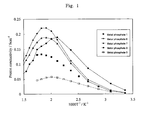
- Fig. 1 shows temperature-dependency of proton conductivity of metal phosphates 1, 6, 7, 8 and 9 in the examples and comparative examples.
- T represents absolute temperature (K).
- the present invention provides a proton-conductive metal phosphate which is a compound containing M (wherein M represents at least one selected from the group consisting of group 4A and group 4B elements in the long form of the periodic table), P and O, wherein a part of M is substituted with a dopant element J (wherein, J represents at least one selected from the group consisting of group 3A, group 3B, group 5A and group 5B elements in the long form of the periodic table and at least contains an element selected from B, Al, Ga, Sc, Yb, Y, La, Ce, Sb, Bi, V, Ta and Nb).
- the metal phosphate of the present invention has high proton conductivity owing to the above-described constitution.
- P and O are compounds such as orthophosphates, pyrophosphates and the like, and specifically, tin phosphate, titanium phosphate, silicon phosphate, germanium phosphate, zirconium phosphate and the like are mentioned.
- pyrophosphates can be preferably used among the above-described compounds, and the pyrophosphate is substantially represented by the formula (1).
- the metal phosphate of the present invention is preferably represented substantially by the formula (2).
- M 1-x J x P 2 O 7 (2) (wherein, x in the formula (2) is from not less than 0.001 to not more than 0.5, and M and J have the same meanings as described above.)
- Substantial representation by the formula (2) means that: at the composition ratio of the formula (2), namely, at the molar ratio of M:J:P:O of (1-x):x:2:7, components P and O may be increased or decreased in slight proportion with respect to respective molar ratios of 2 and 7, in a range not disturbing the effect. Slight proportion is usually within about 10%, depending on the kind of M and J to be used. It is preferable that this proportion is smaller.
- x in the formula (2) corresponds to the substitution proportion of a dopant element J, and is usually from not less than 0.001 to not more than 0.5, preferably from not less than 0.001 to not more than 0.3, more preferably from not less than 0.02 to not more than 0.3, further more preferably from not less than 0.02 to not more than 0.2, depending on the kind of M.
- M represents Sn
- J represents Al
- x is preferably from not less than 0.01 to not more than 0.1, more preferably from not less than 0.02 to not more than 0.08, further more preferably from not less than 0.03 to not more than 0.07, for having higher proton conductivity.
- M represents at least one selected from the group consisting of group 4A and group 4B elements in the long form of the periodic table, and at least one selected from the group consisting of Sn, Ti, Si, Ge, Pb, Zr and Hf are preferably used.
- M represents more preferably at least one selected from the group consisting of Sn, Ti and Zr, further more preferably Sn and/or Ti, particularly preferably Sn, from the standpoint of stability and proton conductivity of the metal phosphate.
- J represents at least one selected from the group consisting of group 3A, group 3B, group 5A and group 5B elements in the long form of the periodic table and at least contains an element selected from B, Al, Ga, Sc, Yb, Y, La, Ce, Sb, Bi, V, Ta and Nb.
- J represents preferably at least one selected from the group consisting of B, Al, Ga, Sc, Yb, Y, La, Ce, Sb, Bi, V, Ta and Nb, more preferably at least one selected from B, Al, Ga, Sc, Y and Nb, further more preferably at least one selected from Al, Ga, Sc, Y and Nb, depending on the kind of M.
- J represents further more preferably Al and/or Ga from the standpoint of stability and proton conductivity of the metal phosphate, and particularly preferably represents Al if also the standpoint of cost is included. In any cases, it is preferable that J contains at least Al from the standpoint of cost.
- the metal phosphate of the present invention can be produced, for example, as described below. It can be produced by a production method using, as a raw material, a compound containing M (wherein, M represents at least one selected from the group consisting of group 4A and group 4B elements in the long form of the periodic table), a compound containing J (wherein, J represents at least one selected from the group consisting of group 3A, group 3B, group 5A and group 5B elements in the long form of the periodic table), and a compound containing P.
- M represents at least one selected from the group consisting of group 4A and group 4B elements in the long form of the periodic table
- J represents at least one selected from the group consisting of group 3A, group 3B, group 5A and group 5B elements in the long form of the periodic table
- P a compound containing P
- the compound containing M may be selected appropriately depending on the kind of M, and oxides can be used, or those which can be decomposed and/or oxidized at high temperatures to become oxides such as hydroxides, carbonates, nitrates, halides, oxalates and the like can be used.
- oxides can be used, or those which can be decomposed and/or oxidized at high temperatures to become oxides such as hydroxides, carbonates, nitrates, halides, oxalates and the like can be used.
- oxides can be used, or those which can be decomposed and/or oxidized at high temperatures to become oxides such as hydroxides, carbonates, nitrates, halides, oxalates and the like can be used.
- Sn is used as M
- various tin oxides and hydrates thereof can be used, and tin dioxide or its hydrate can be preferably used.
- the compound containing P phosphoric acid, phosphonic acid and the like are mentioned, and preferable from the standpoint of reactivity with M and J is phosphoric acid.
- phosphoric acid usually, a concentrated phosphoric acid aqueous solution having a concentration of 50% or more is used, and preferable from the standpoint of operability is a 80 to 90% concentrated phosphoric acid aqueous solution.
- the compound containing J may be selected appropriately from conventional compounds, and specifically, it is advantageous to use oxides, or those which can be decomposed and/or oxidized at high temperature to become oxides such as carbonates, oxalates and the like.
- oxides or those which can be decomposed and/or oxidized at high temperature to become oxides such as carbonates, oxalates and the like.
- J contains Al
- aluminas such as ⁇ -Al 2 O 3 , ⁇ -Al 2 O 3 and the like can be used.
- boron oxide, gallium oxide, scandium oxide, ytterbium oxide, yttrium oxide, lanthanum oxide, cerium oxide, niobium oxide and the like can be used.
- a metal phosphate can be produced by a method including the steps (a) and (b) in this order.
- the reaction temperature is appropriately selected depending on the composition of the metal phosphate to be synthesized, and usually, temperatures in the range of 200 to 400°C are usually used. When, for example, M contains Sn, temperatures in the range of 250 to 350°C are preferably used, temperatures in the range of 270 to 330°C are more preferably used.
- M contains Sn
- temperatures in the range of 250 to 350°C are preferably used
- temperatures in the range of 270 to 330°C are more preferably used.
- the reaction time is appropriately selected depending on the composition of the metal phosphate to be synthesized, and times as long as possible are advantageous. If productivity is taken into consideration, times in the range of 1 to 20 hours are preferable when M is Sn.
- the reaction product to be obtained in the step (a) is in the form of paste, and a metal phosphate can be obtained by thermally treating this reaction product in the step (b).
- the thermal treatment temperature is appropriately selected depending on the composition of the metal phosphate to be synthesized, and when, for example, M is Sn, temperatures in the range of 500 to 800°C are preferable, temperatures in the range of 600 to 700°C are more preferable, temperatures in the range of 630 to 680°C are further more preferable.
- the thermal treatment time is appropriately selected depending on the composition of the metal phosphate to be synthesized, and when, for example, M is Sn, times in the range of 1 to 20 hours are usual, times in the range of 1 to 5 hours are preferable, times in the range of 2 to 5 hours are more preferable.
- the metal phosphate of the present invention can be used as a solid electrolyte of a fuel cell.
- a solid electrolyte of a fuel cell it is necessary to form the metal phosphate into a prescribed shape, for example, a molded body or film. Since the metal phosphate of the present invention is often solidified, it is advantageous to once grind this to give a powder. This powder is molded into a prescribed shape or formed into a film, to obtain a solid electrolyte of a fuel cell.
- the dehydration method include a method of heating in an inert gas such as argon containing no water vapor.
- Examples of a method of producing a film include a method of mixing a powder of the above-described metal phosphate and a binder and molding the mixture under pressure.
- Examples of the binder include conventional resins, silicon compounds (organosilicon compounds and the like), organic acidic compounds, and from the standpoint of moldability, a fluorine resin is preferably contained.
- the fluorine resin may be advantageously selected appropriately from conventional fluorine resins, and specific examples thereof include polytetrafluoroethylene and copolymers thereof (tetrafluoroethylene•perfluoroalkyl vinyl ether copolymer, tetrafluoroethylene•hexafluoropropylene copolymer, tetrafluoroethylene•ethylene copolymer, and the like), polyvinylidene fluoride, polychlorotrifluoroethylene, chlorotrifluoroethylene•ethylene copolymer.
- polytetrafluoroethylene and polyvinylidene fluoride can be preferably used, and polytetrafluoroethylene can be particularly preferably used.
- At least one silicon compound such as organosilicon compounds may be contained as the binder. It is advantageous that the silicon compound is contained in a film by adding the silicon compound in the above-described mixing.
- the organosilicon compound may be advantageously selected appropriately from conventional compounds, and specific examples thereof include vinylsilanes [allkyltriethoxysilane, vinyltrimethoxysilane and the like], aminosilanes, alkylsilanes [1,8-bis(triethoxysilyl)octane, 1,8-bis(diethoxymethylsilyl)octane, n-octyltriethoxysilane], 3-(trihydroxysilyl)-1-propanesulfonic acid.
- organosilicon compounds Preferable among these organosilicon compounds are alkylsilanes having a plurality of silyl groups at the end such as 1,8-bis(triethoxysilyl)octane, 1,8-bis(diethoxymethylsilyl)octane.
- a plurality of organosilicon compounds may be used.
- At least one organic acidic compound may be contained as the binder.
- the organic acidic compound include organic sulfonic acid compounds, organic phosphoric acid compounds.
- a fuel cell By using the above-described molded body or film as a solid electrolyte of a fuel cell, a fuel cell can be obtained. That is, typically, a fuel cell can be obtained by using a molded body or film of the metal phosphate of the present invention as a solid electrolyte between a couple of anode and cathode.
- Other constitutional members of a fuel cell for example, catalyst, fuel feeding part, air feeding part
- a viscous paste obtained by heating for 1 hour was charged in an alumina crucible, and heated up to 650°C over a period of 1.5 hours in an electric furnace and kept for 2.5 hours, then, cooled down to room temperature over a period of 1.5 hours, to synthesize a metal phosphate 1.
- the metal phosphate 1 was scraped out of the crucible, and ground in an alumina mortar.
- the resultant powder was filled in a mold, and mono-axially molded, then, molded by CIP (cold isostatic press) under a pressure of 2 t/cm 2 , to obtain pellets.
- the pellet was clipped by platinum foil electrodes, and an impedance spectrum was measured under experiment conditions of a frequency of 1 MHz to 0.1 Hz and a voltage of 10 mV while changing the temperature from 50°C to 300°C, using a four-terminal conductivity measuring apparatus.
- the values of proton conductivity obtained from this spectrum are shown in Fig. 1 .
- the proton conductivity at 250°C was 0.13 Scm -1
- the proton conductivity at 200°C was 0.11 Scm -1 .
- a metal phosphate 2 was synthesized in the same manner as in Example 1 excepting that 143.2 g of SnO 2 (manufactured by Wako Pure Chemical Industries, Ltd.), 4.686 g of Ga 2 O 3 (99.99%, manufactured by Wako Pure Chemical Industries, Ltd.) and 322.7 g of H 3 PO 4 (85% concentrated phosphoric acid aqueous solution, manufactured by Wako Pure Chemical Industries, Ltd.) were used as the raw materials, and pellets were produced and proton conductivity thereof was measured.
- SnO 2 manufactured by Wako Pure Chemical Industries, Ltd.
- 4.686 g of Ga 2 O 3 99.99%, manufactured by Wako Pure Chemical Industries, Ltd.
- H 3 PO 4 85% concentrated phosphoric acid aqueous solution, manufactured by Wako Pure Chemical Industries, Ltd.
- the proton conductivity at 200°C was 0.23 Scm -1 .
- a metal phosphate 3 was synthesized in the same manner as in Example 1 excepting that 143.2 g of SnO 2 (manufactured by Wako Pure Chemical Industries, Ltd.), 3.448 g of Sc 2 O 3 (99.9%, manufactured by Wako Pure Chemical Industries, Ltd.) and 322.7 g of H 3 PO 4 (85% concentrated phosphoric acid aqueous solution, manufactured by Wako Pure Chemical Industries, Ltd.) were used as the raw materials, and pellets were produced and proton conductivity thereof was measured.
- SnO 2 manufactured by Wako Pure Chemical Industries, Ltd.
- Sc 2 O 3 99.9%, manufactured by Wako Pure Chemical Industries, Ltd.
- H 3 PO 4 85% concentrated phosphoric acid aqueous solution, manufactured by Wako Pure Chemical Industries, Ltd.
- the proton conductivity at 200°C was 0.17 Scm -1 .
- a metal phosphate 4 was synthesized in the same manner as in Example 1 excepting that 7.159 g of SnO 2 (manufactured by Wako Pure Chemical Industries, Ltd.), 0.497 g of Yb 2 O 3 (manufactured by Wako Pure Chemical Industries, Ltd.) and 16.141 g of H 3 PO 4 (85% concentrated phosphoric acid aqueous solution, manufactured by Wako Pure Chemical Industries, Ltd.) were used as the raw materials and further, 80 g of ion exchanged water was charged in the beaker, and pellets were produced and proton conductivity thereof was measured.
- SnO 2 manufactured by Wako Pure Chemical Industries, Ltd.
- Yb 2 O 3 manufactured by Wako Pure Chemical Industries, Ltd.
- H 3 PO 4 85% concentrated phosphoric acid aqueous solution, manufactured by Wako Pure Chemical Industries, Ltd.
- the proton conductivity at 200°C was 0.21 Scm -1 .
- a metal phosphate 5 was synthesized in the same manner as in Example 1 excepting that 7.159 g of SnO 2 (manufactured by Wako Pure Chemical Industries, Ltd.), 0.282 g of Y 2 O 3 (manufactured by Wako Pure Chemical Industries, Ltd.) and 16.141 g of H 3 PO 4 (85% concentrated phosphoric acid aqueous solution, manufactured by Wako Pure Chemical Industries, Ltd.) were used as the raw materials and further, 80 g of ion exchanged water was charged in the beaker, and pellets were produced and proton conductivity thereof was measured.
- SnO 2 manufactured by Wako Pure Chemical Industries, Ltd.
- Y 2 O 3 manufactured by Wako Pure Chemical Industries, Ltd.
- H 3 PO 4 85% concentrated phosphoric acid aqueous solution, manufactured by Wako Pure Chemical Industries, Ltd.
- the proton conductivity at 200°C was 0.13 Scm -1 .
- a metal phosphate 6 was synthesized in the same manner as in Example 1 excepting that 5.27 g of SnO 2 (manufactured by Wako Pure Chemical Industries, Ltd.), 1.99 g of Nb 2 O 5 (manufactured by Wako Pure Chemical Industries, Ltd.) and 15.56 g of H 3 PO 4 (85% concentrated phosphoric acid aqueous solution, manufactured by Wako Pure Chemical Industries, Ltd.) were used as the raw materials, further, 80 g of ion exchanged water was charged in the beaker and an alumina square sheath was used instead of the alumina crucible, and pellets were produced and proton conductivity thereof was measured.
- SnO 2 manufactured by Wako Pure Chemical Industries, Ltd.
- Nb 2 O 5 manufactured by Wako Pure Chemical Industries, Ltd.
- H 3 PO 4 85% concentrated phosphoric acid aqueous solution, manufactured by Wako Pure Chemical Industries, Ltd.
- the proton conductivity at 200°C was 0.18 Scm -1
- the proton conductivity at 250°C was 0.22 Scm -1 .
- a metal phosphate 7 was synthesized in the same manner as in Example 6 excepting that 6.78 g of SnO 2 (manufactured by Wako Pure Chemical Industries, Ltd.) and 0.66 g of Nb 2 O 5 (manufactured by Wako Pure Chemical Industries, Ltd.) were used as the raw materials, and pellets were produced and proton conductivity thereof was measured.
- the proton conductivity at 200°C was 0.17 Scm -1
- the proton conductivity at 250°C was 0.19 Scm -1 .
- a metal phosphate 8 was synthesized in the same manner as in Example 6 excepting that 3.76 g of SnO 2 (manufactured by Wako Pure Chemical Industries, Ltd.) and 3.32 g of Nb 2 O 5 (manufactured by Wako Pure Chemical Industries, Ltd.) were used as the raw materials, and pellets were produced and proton conductivity thereof was measured.
- the proton conductivity at 200°C was 0.19 Scm -1
- the proton conductivity at 250°C was 0.17 Scm -1 .
- a powder of the metal phosphate 1 synthesized in Example 1 was ground in a mortar, and a small amount of a mixture of 1,8-bistriethoxysilyloctane and 3-trihydroxysilyl-1-propanesulfonic acid 30-35% aqueous solution was added. Further, a small amount of a powder of polytetrafluoroethylene was added and kneaded thoroughly using a mortar until it became an agglomerate, and this was vacuum-packed and drawn using a roller, thereby a film can be obtained. The resultant film shows a nature of conducting protons.
- a metal phosphate 9 was synthesized in the same manner as in Example 1 excepting that 150.7 g of SnO 2 (manufactured by Wako Pure Chemical Industries, Ltd.) and 322.7 g of H 3 PO 4 (85% concentrated phosphoric acid aqueous solution, manufactured by Wako Pure Chemical Industries, Ltd.) were used as the raw materials, and pellets were produced and proton conductivity thereof was measured.
- the proton conductivity at 200°C was 0.056 Scm -1 .
- the results are shown in Fig. 1 .
- the metal phosphate of the present invention has high proton conductivity, is suitably used as a solid electrolyte for fuel cells, and particularly suitably used for a portable electric source to be mounted on an automobile and the like or for a small size stationary electric source, and a metal phosphate showing high proton conductivity can be produced at lower cost.
Landscapes
- Chemical & Material Sciences (AREA)
- Organic Chemistry (AREA)
- Engineering & Computer Science (AREA)
- Manufacturing & Machinery (AREA)
- Sustainable Development (AREA)
- Life Sciences & Earth Sciences (AREA)
- Inorganic Chemistry (AREA)
- Sustainable Energy (AREA)
- Chemical Kinetics & Catalysis (AREA)
- Electrochemistry (AREA)
- General Chemical & Material Sciences (AREA)
- Conductive Materials (AREA)
- Fuel Cell (AREA)
Abstract
wherein M represents at least one selected from the group consisting of group 4A and group 4B elements in the long form of the periodic table,
a part of M is substituted with a dopant element J
J represents at least one selected from the group consisting of group 3A, group 3B, group 5A and group 5B elements in the long form of the periodic table and at least contains an element selected from B, Al, Ga, Sc, Yb, Y, La, Ce, Sb, Bi, V, Ta and Nb.
Description
- The present invention relates to a metal phosphate. More specifically, the present invention relates to a proton-conductive metal phosphate used as a solid electrolyte for fuel cells.
- Metal phosphates are known to have proton conductivity, and used as a solid electrolyte in fuel cells. Known as the solid electrolyte are polymers, phosphoric acid, molten salts and solid oxides, and fuel cells using them are investigated. Of these solid electrolytes, solid polymer type fuel cells using polymers (PEFC: Polymer Electrolyte Fuel Cell) are operable at low temperatures of from room temperature to about 100°C, easily formed into film and receive little influence by carbon dioxide, thus, said to be suitable for portable electric sources or small size stationary electric sources, among these solid electrolytes. However, since solid polymer type fuel cells are operated at low temperatures, a large amount of platinum is necessary as a catalyst, generating interference against popularization thereof from the standpoint of securing of resources and cost. In contrast, solid oxide fuel cells using a solid oxide such as zirconia or the like as a solid electrolyte (SOFC: Solid Oxide Fuel Cell) are operated at high temperatures of about 900 to 1000°C, thus, there is no necessity of use of platinum as a catalyst, catalyst poisoning is solved and high output is expected. Such solid oxide fuel cells are said to be suitable for large scale stationary electric sources because of necessity of high operation temperatures, among these solid electrolytes.
- Under such conditions, metal phosphates have proton conductivity at temperatures (low to middle temperatures) lower than the operation temperature of zirconia though the metal phosphates are solid oxides, and provide a possibility of reduction of the use amount of platinum or displacement thereof and solution of catalyst poisoning, thus, are expected for portable electric sources to be mounted on automobiles and the like or small size stationary electric sources.
- As conventional proton-conductive metal phosphates,
JP-A No. 2005-294245 - However, since the conventional metal phosphate SnP2O7 has insufficient proton conductivity, it is necessary to further enhance proton conductivity. Further, SnP2O7 using In as a dopant element tends to be higher in proton conductivity than SnP2O7 using no dopant element, however, In is a rare and expensive metal like platinum and further there is a significant reduction in feeding amount thereof due to enlargement of demand for transparent electric conductive films and the like, that is, SnP2O7 using In as a dopant element is not satisfactory also from the standpoint of cost.
- The present invention has an object of providing a metal phosphate having high proton conductivity, which is useful for a fuel cell having higher output and produced at lower cost.
- The present inventors have intensively studied and resultantly completed the present invention.
- That is, the present invention provides the following inventions.
- <1> A proton-conductive metal phosphate which is a compound containing M, P and O,
wherein M represents at least one selected from the group consisting of group 4A and group 4B elements in the long form of the periodic table,
a part of M is substituted with a dopant element J, and
J represents at least one selected from the group consisting of group 3A, group 3B, group 5A and group 5B elements in the long form of the periodic table and contains an element selected from B, Al, Ga, Sc, Yb, Y, La, Ce, Sb, Bi, V, Ta and Nb. - <2> The metal phosphate according to the above-described <1>, wherein the compound containing M, P and O is substantially represented by the formula (1):
MP2O7 (1).
wherein M has the same meaning as described above. - <3> The metal phosphate according to the above-described <1> or <2>, substantially represented by the formula (2):
M1-xJxP2O7 (2)
wherein x in the formula (2) is from not less than 0.001 to not more than 0.5, and M and J have the same meanings as described above. - <4> The metal phosphate according to any one of the above-described <1> to <3>, wherein J represents at least one selected from the group consisting of B, Al, Ga, Sc, Yb, Y, La, Ce, Sb, Bi, V, Ta and Nb.
- <5> The metal phosphate according to any one of the above-described <1> to <4>, wherein J contains at least Al.
- <6> The metal phosphate according to any one of the above-described <1> to <5>, wherein J represents Al.
- <7> The metal phosphate according to any one of the above-described <1> to <6>, wherein M represents at least one selected from the group consisting of Sn, Ti, Pb, Zr and Hf.
- <8> The metal phosphate according to any one of the above-described <1> to <7>, wherein M represents Sn.
- <9> A film comprising the metal phosphate according to any one of the above-described <1> to <8>, and a binder.
- <10> The film according to the above-described <9>, wherein the binder is a fluorine resin.
- <11> The film according to the above-described <10>, wherein the fluorine resin is polytetrafluoroethylene.
- <12> A fuel cell having as a solid electrolyte the metal phosphate according to any one of the above-described <1> to <8> or the film according to any one of the above-described <9> to <11>.
-
Fig. 1 shows temperature-dependency of proton conductivity ofmetal phosphates Fig. 1 , T represents absolute temperature (K). - The present invention provides a proton-conductive metal phosphate which is a compound containing M (wherein M represents at least one selected from the group consisting of group 4A and group 4B elements in the long form of the periodic table), P and O, wherein a part of M is substituted with a dopant element J (wherein, J represents at least one selected from the group consisting of group 3A, group 3B, group 5A and group 5B elements in the long form of the periodic table and at least contains an element selected from B, Al, Ga, Sc, Yb, Y, La, Ce, Sb, Bi, V, Ta and Nb). The metal phosphate of the present invention has high proton conductivity owing to the above-described constitution.
- As the compound containing M (wherein, M has the same meaning as described above), P and O, mentioned are compounds such as orthophosphates, pyrophosphates and the like, and specifically, tin phosphate, titanium phosphate, silicon phosphate, germanium phosphate, zirconium phosphate and the like are mentioned. In the present invention, pyrophosphates can be preferably used among the above-described compounds, and the pyrophosphate is substantially represented by the formula (1).
MP2O7 (1)
- The metal phosphate of the present invention is preferably represented substantially by the formula (2).
M1-xJxP2O7 (2)
(wherein, x in the formula (2) is from not less than 0.001 to not more than 0.5, and M and J have the same meanings as described above.) - Substantial representation by the formula (2) means that: at the composition ratio of the formula (2), namely, at the molar ratio of M:J:P:O of (1-x):x:2:7, components P and O may be increased or decreased in slight proportion with respect to respective molar ratios of 2 and 7, in a range not disturbing the effect. Slight proportion is usually within about 10%, depending on the kind of M and J to be used. It is preferable that this proportion is smaller.
- x in the formula (2) corresponds to the substitution proportion of a dopant element J, and is usually from not less than 0.001 to not more than 0.5, preferably from not less than 0.001 to not more than 0.3, more preferably from not less than 0.02 to not more than 0.3, further more preferably from not less than 0.02 to not more than 0.2, depending on the kind of M. When M represents Sn and J represents Al, x is preferably from not less than 0.01 to not more than 0.1, more preferably from not less than 0.02 to not more than 0.08, further more preferably from not less than 0.03 to not more than 0.07, for having higher proton conductivity.
- In the present invention, M represents at least one selected from the group consisting of group 4A and group 4B elements in the long form of the periodic table, and at least one selected from the group consisting of Sn, Ti, Si, Ge, Pb, Zr and Hf are preferably used. M represents more preferably at least one selected from the group consisting of Sn, Ti and Zr, further more preferably Sn and/or Ti, particularly preferably Sn, from the standpoint of stability and proton conductivity of the metal phosphate.
- In the present invention, J represents at least one selected from the group consisting of group 3A, group 3B, group 5A and group 5B elements in the long form of the periodic table and at least contains an element selected from B, Al, Ga, Sc, Yb, Y, La, Ce, Sb, Bi, V, Ta and Nb. J represents preferably at least one selected from the group consisting of B, Al, Ga, Sc, Yb, Y, La, Ce, Sb, Bi, V, Ta and Nb, more preferably at least one selected from B, Al, Ga, Sc, Y and Nb, further more preferably at least one selected from Al, Ga, Sc, Y and Nb, depending on the kind of M. When M contains Sn, J represents further more preferably Al and/or Ga from the standpoint of stability and proton conductivity of the metal phosphate, and particularly preferably represents Al if also the standpoint of cost is included. In any cases, it is preferable that J contains at least Al from the standpoint of cost.
- The metal phosphate of the present invention can be produced, for example, as described below. It can be produced by a production method using, as a raw material, a compound containing M (wherein, M represents at least one selected from the group consisting of group 4A and group 4B elements in the long form of the periodic table), a compound containing J (wherein, J represents at least one selected from the group consisting of group 3A, group 3B, group 5A and group 5B elements in the long form of the periodic table), and a compound containing P.
- The compound containing M may be selected appropriately depending on the kind of M, and oxides can be used, or those which can be decomposed and/or oxidized at high temperatures to become oxides such as hydroxides, carbonates, nitrates, halides, oxalates and the like can be used. When, for example, Sn is used as M, various tin oxides and hydrates thereof can be used, and tin dioxide or its hydrate can be preferably used.
- As the compound containing P, phosphoric acid, phosphonic acid and the like are mentioned, and preferable from the standpoint of reactivity with M and J is phosphoric acid. As the phosphoric acid, usually, a concentrated phosphoric acid aqueous solution having a concentration of 50% or more is used, and preferable from the standpoint of operability is a 80 to 90% concentrated phosphoric acid aqueous solution.
- The compound containing J may be selected appropriately from conventional compounds, and specifically, it is advantageous to use oxides, or those which can be decomposed and/or oxidized at high temperature to become oxides such as carbonates, oxalates and the like. When, for example, J contains Al, aluminas such as α-Al2O3, γ-Al2O3 and the like can be used. Likewise, for example, boron oxide, gallium oxide, scandium oxide, ytterbium oxide, yttrium oxide, lanthanum oxide, cerium oxide, niobium oxide and the like can be used.
- Using the above-described raw materials, a metal phosphate can be produced by a method including the steps (a) and (b) in this order.
- (a) reacting a compound containing M, a compound containing J and phosphoric acid, to obtain a reaction product.
- (b) thermally treating the reaction product.
- In the step (a), the reaction temperature is appropriately selected depending on the composition of the metal phosphate to be synthesized, and usually, temperatures in the range of 200 to 400°C are usually used. When, for example, M contains Sn, temperatures in the range of 250 to 350°C are preferably used, temperatures in the range of 270 to 330°C are more preferably used. In the reaction, it is advantageous to carry out mixing sufficiently by stirring. From the standpoint of the operability of the resultant reaction product, it is effective to add a suitable amount of water in the reaction in some cases, for maintaining the suitable viscosity of the reaction product and preventing solidification thereof. The reaction time is appropriately selected depending on the composition of the metal phosphate to be synthesized, and times as long as possible are advantageous. If productivity is taken into consideration, times in the range of 1 to 20 hours are preferable when M is Sn.
- The reaction product to be obtained in the step (a) is in the form of paste, and a metal phosphate can be obtained by thermally treating this reaction product in the step (b). The thermal treatment temperature is appropriately selected depending on the composition of the metal phosphate to be synthesized, and when, for example, M is Sn, temperatures in the range of 500 to 800°C are preferable, temperatures in the range of 600 to 700°C are more preferable, temperatures in the range of 630 to 680°C are further more preferable. The thermal treatment time is appropriately selected depending on the composition of the metal phosphate to be synthesized, and when, for example, M is Sn, times in the range of 1 to 20 hours are usual, times in the range of 1 to 5 hours are preferable, times in the range of 2 to 5 hours are more preferable.
- Next, a film and a fuel cell to be obtained using the metal phosphate of the present invention will be illustrated. The metal phosphate of the present invention can be used as a solid electrolyte of a fuel cell. For use of the metal phosphate of the present invention as a solid electrolyte of a fuel cell, it is necessary to form the metal phosphate into a prescribed shape, for example, a molded body or film. Since the metal phosphate of the present invention is often solidified, it is advantageous to once grind this to give a powder. This powder is molded into a prescribed shape or formed into a film, to obtain a solid electrolyte of a fuel cell.
- For production of a molded body, it is advantageous to mold a powder under pressure. It is preferable to dehydrate a powder before molding under pressure. Examples of the dehydration method include a method of heating in an inert gas such as argon containing no water vapor.
- Examples of a method of producing a film include a method of mixing a powder of the above-described metal phosphate and a binder and molding the mixture under pressure. Examples of the binder include conventional resins, silicon compounds (organosilicon compounds and the like), organic acidic compounds, and from the standpoint of moldability, a fluorine resin is preferably contained. The fluorine resin may be advantageously selected appropriately from conventional fluorine resins, and specific examples thereof include polytetrafluoroethylene and copolymers thereof (tetrafluoroethylene•perfluoroalkyl vinyl ether copolymer, tetrafluoroethylene•hexafluoropropylene copolymer, tetrafluoroethylene•ethylene copolymer, and the like), polyvinylidene fluoride, polychlorotrifluoroethylene, chlorotrifluoroethylene•ethylene copolymer. Of these fluorine resins, polytetrafluoroethylene and polyvinylidene fluoride can be preferably used, and polytetrafluoroethylene can be particularly preferably used.
- At least one silicon compound such as organosilicon compounds may be contained as the binder. It is advantageous that the silicon compound is contained in a film by adding the silicon compound in the above-described mixing. The organosilicon compound may be advantageously selected appropriately from conventional compounds, and specific examples thereof include vinylsilanes [allkyltriethoxysilane, vinyltrimethoxysilane and the like], aminosilanes, alkylsilanes [1,8-bis(triethoxysilyl)octane, 1,8-bis(diethoxymethylsilyl)octane, n-octyltriethoxysilane], 3-(trihydroxysilyl)-1-propanesulfonic acid. Preferable among these organosilicon compounds are alkylsilanes having a plurality of silyl groups at the end such as 1,8-bis(triethoxysilyl)octane, 1,8-bis(diethoxymethylsilyl)octane. A plurality of organosilicon compounds may be used.
- At least one organic acidic compound may be contained as the binder. Examples of the organic acidic compound include organic sulfonic acid compounds, organic phosphoric acid compounds.
- By using the above-described molded body or film as a solid electrolyte of a fuel cell, a fuel cell can be obtained. That is, typically, a fuel cell can be obtained by using a molded body or film of the metal phosphate of the present invention as a solid electrolyte between a couple of anode and cathode. Other constitutional members of a fuel cell (for example, catalyst, fuel feeding part, air feeding part) may be used according to convnetional technologies appropriately selected.
- The present invention will be illustrated further in detail by examples.
- 143.2 g of SnO2 (manufactured by Wako Pure Chemical Industries, Ltd.), 2.549 g of Al2O3 (α-alumina manufactured by Wako Pure Chemical Industries, Ltd.) and 322.7 g of H3PO4 (85% concentrated phosphoric acid aqueous solution, manufactured by Wako Pure Chemical Industries, Ltd.) were charged in a beaker, and heated at 300°C by a hot plate while stirring by a magnetic stirrer. Ion exchanged water was appropriately added for controlling viscosity during heating. A viscous paste obtained by heating for 1 hour was charged in an alumina crucible, and heated up to 650°C over a period of 1.5 hours in an electric furnace and kept for 2.5 hours, then, cooled down to room temperature over a period of 1.5 hours, to synthesize a
metal phosphate 1. - The
metal phosphate 1 was scraped out of the crucible, and ground in an alumina mortar. The resultant powder was filled in a mold, and mono-axially molded, then, molded by CIP (cold isostatic press) under a pressure of 2 t/cm2, to obtain pellets. - The pellet was clipped by platinum foil electrodes, and an impedance spectrum was measured under experiment conditions of
a frequency of 1 MHz to 0.1 Hz and
a voltage of 10 mV
while changing the temperature from 50°C to 300°C, using a four-terminal conductivity measuring apparatus. The values of proton conductivity obtained from this spectrum are shown inFig. 1 . - The proton conductivity at 250°C was 0.13 Scm-1, and the proton conductivity at 200°C was 0.11 Scm-1.
- A
metal phosphate 2 was synthesized in the same manner as in Example 1 excepting that 143.2 g of SnO2 (manufactured by Wako Pure Chemical Industries, Ltd.), 4.686 g of Ga2O3 (99.99%, manufactured by Wako Pure Chemical Industries, Ltd.) and 322.7 g of H3PO4 (85% concentrated phosphoric acid aqueous solution, manufactured by Wako Pure Chemical Industries, Ltd.) were used as the raw materials, and pellets were produced and proton conductivity thereof was measured. - The proton conductivity at 200°C was 0.23 Scm-1.
- A
metal phosphate 3 was synthesized in the same manner as in Example 1 excepting that 143.2 g of SnO2 (manufactured by Wako Pure Chemical Industries, Ltd.), 3.448 g of Sc2O3 (99.9%, manufactured by Wako Pure Chemical Industries, Ltd.) and 322.7 g of H3PO4 (85% concentrated phosphoric acid aqueous solution, manufactured by Wako Pure Chemical Industries, Ltd.) were used as the raw materials, and pellets were produced and proton conductivity thereof was measured. - The proton conductivity at 200°C was 0.17 Scm-1.
- A metal phosphate 4 was synthesized in the same manner as in Example 1 excepting that 7.159 g of SnO2 (manufactured by Wako Pure Chemical Industries, Ltd.), 0.497 g of Yb2O3 (manufactured by Wako Pure Chemical Industries, Ltd.) and 16.141 g of H3PO4 (85% concentrated phosphoric acid aqueous solution, manufactured by Wako Pure Chemical Industries, Ltd.) were used as the raw materials and further, 80 g of ion exchanged water was charged in the beaker, and pellets were produced and proton conductivity thereof was measured.
- The proton conductivity at 200°C was 0.21 Scm-1.
- A metal phosphate 5 was synthesized in the same manner as in Example 1 excepting that 7.159 g of SnO2 (manufactured by Wako Pure Chemical Industries, Ltd.), 0.282 g of Y2O3 (manufactured by Wako Pure Chemical Industries, Ltd.) and 16.141 g of H3PO4 (85% concentrated phosphoric acid aqueous solution, manufactured by Wako Pure Chemical Industries, Ltd.) were used as the raw materials and further, 80 g of ion exchanged water was charged in the beaker, and pellets were produced and proton conductivity thereof was measured.
- The proton conductivity at 200°C was 0.13 Scm-1.
- A
metal phosphate 6 was synthesized in the same manner as in Example 1 excepting that 5.27 g of SnO2 (manufactured by Wako Pure Chemical Industries, Ltd.), 1.99 g of Nb2O5 (manufactured by Wako Pure Chemical Industries, Ltd.) and 15.56 g of H3PO4 (85% concentrated phosphoric acid aqueous solution, manufactured by Wako Pure Chemical Industries, Ltd.) were used as the raw materials, further, 80 g of ion exchanged water was charged in the beaker and an alumina square sheath was used instead of the alumina crucible, and pellets were produced and proton conductivity thereof was measured. - The proton conductivity at 200°C was 0.18 Scm-1, and the proton conductivity at 250°C was 0.22 Scm-1.
- A
metal phosphate 7 was synthesized in the same manner as in Example 6 excepting that 6.78 g of SnO2 (manufactured by Wako Pure Chemical Industries, Ltd.) and 0.66 g of Nb2O5 (manufactured by Wako Pure Chemical Industries, Ltd.) were used as the raw materials, and pellets were produced and proton conductivity thereof was measured. - The proton conductivity at 200°C was 0.17 Scm-1, and the proton conductivity at 250°C was 0.19 Scm-1.
- A
metal phosphate 8 was synthesized in the same manner as in Example 6 excepting that 3.76 g of SnO2 (manufactured by Wako Pure Chemical Industries, Ltd.) and 3.32 g of Nb2O5 (manufactured by Wako Pure Chemical Industries, Ltd.) were used as the raw materials, and pellets were produced and proton conductivity thereof was measured. - The proton conductivity at 200°C was 0.19 Scm-1, and the proton conductivity at 250°C was 0.17 Scm-1.
- A powder of the
metal phosphate 1 synthesized in Example 1 was ground in a mortar, and a small amount of a mixture of 1,8-bistriethoxysilyloctane and 3-trihydroxysilyl-1-propanesulfonic acid 30-35% aqueous solution was added. Further, a small amount of a powder of polytetrafluoroethylene was added and kneaded thoroughly using a mortar until it became an agglomerate, and this was vacuum-packed and drawn using a roller, thereby a film can be obtained. The resultant film shows a nature of conducting protons. - A
metal phosphate 9 was synthesized in the same manner as in Example 1 excepting that 150.7 g of SnO2 (manufactured by Wako Pure Chemical Industries, Ltd.) and 322.7 g of H3PO4 (85% concentrated phosphoric acid aqueous solution, manufactured by Wako Pure Chemical Industries, Ltd.) were used as the raw materials, and pellets were produced and proton conductivity thereof was measured. - The proton conductivity at 200°C was 0.056 Scm-1. The results are shown in
Fig. 1 . - The metal phosphate of the present invention has high proton conductivity, is suitably used as a solid electrolyte for fuel cells, and particularly suitably used for a portable electric source to be mounted on an automobile and the like or for a small size stationary electric source, and a metal phosphate showing high proton conductivity can be produced at lower cost.
Claims (12)
- A proton-conductive metal phosphate which is a compound containing M, P and O,
wherein M represents at least one selected from the group consisting of group 4A and group 4B elements in the long form of the periodic table,
a part of M is substituted with a dopant element J
J represents at least one selected from the group consisting of group 3A, group 3B, group 5A and group 5B elements in the long form of the periodic table and at least contains an element selected from B, Al, Ga, Sc, Yb, Y, La, Ce, Sb, Bi, V, Ta and Nb. - The metal phosphate according to Claim 1, wherein the compound containing M, P and O is substantially represented by the formula (1):
MP2O7 (1).
wherein M has the same meaning as described above. - The metal phosphate according to Claim 1 or 2, substantially represented by the formula (2):
M1-xJxP2O7 (2)
wherein x in the formula (2) is from not less than 0.001 to not more than 0.5, and M and J have the same meanings as described above. - The metal phosphate according to any one of Claims 1 to 3, wherein J represents at least one selected from the group consisting of B, Al, Ga, Sc, Yb, Y, La, Ce, Sb, Bi, V, Ta and Nb.
- The metal phosphate according to any one of Claims 1 to 4, wherein J contains at least Al.
- The metal phosphate according to any one of Claims 1 to 5, wherein J represents Al.
- The metal phosphate according to any one of Claims 1 to 6, wherein M represents at least one selected from the group consisting of Sn, Ti, Si, Ge, Pb, Zr and Hf.
- The metal phosphate according to any one of Claims 1 to 7, wherein M represents Sn.
- A film comprising the metal phosphate according to any one of Claims 1 to 8, and a binder.
- The film according to Claim 9, wherein the binder is a fluorine resin.
- The film according to Claim 10, wherein the fluorine resin is polytetrafluoroethylene.
- A fuel cell having as a solid electrolyte the metal phosphate according to any one of Claims 1 to 8, or the film according to any one of Claims 9 to 11.
Applications Claiming Priority (2)
| Application Number | Priority Date | Filing Date | Title |
|---|---|---|---|
| JP2006205874 | 2006-07-28 | ||
| PCT/JP2007/065117 WO2008013317A1 (en) | 2006-07-28 | 2007-07-26 | Metal phosphate |
Publications (2)
| Publication Number | Publication Date |
|---|---|
| EP2055671A1 true EP2055671A1 (en) | 2009-05-06 |
| EP2055671A4 EP2055671A4 (en) | 2010-12-01 |
Family
ID=38981622
Family Applications (2)
| Application Number | Title | Priority Date | Filing Date |
|---|---|---|---|
| EP07791797A Withdrawn EP2055671A4 (en) | 2006-07-28 | 2007-07-26 | METAL PHOSPHATE |
| EP07791793A Withdrawn EP2050717A4 (en) | 2006-07-28 | 2007-07-26 | METAL PHOSPHATE AND METHOD OF PRODUCING THE SAME |
Family Applications After (1)
| Application Number | Title | Priority Date | Filing Date |
|---|---|---|---|
| EP07791793A Withdrawn EP2050717A4 (en) | 2006-07-28 | 2007-07-26 | METAL PHOSPHATE AND METHOD OF PRODUCING THE SAME |
Country Status (7)
| Country | Link |
|---|---|
| US (2) | US20090297912A1 (en) |
| EP (2) | EP2055671A4 (en) |
| KR (2) | KR20090048450A (en) |
| CN (2) | CN101495405A (en) |
| CA (2) | CA2659375A1 (en) |
| TW (2) | TW200808650A (en) |
| WO (2) | WO2008013315A1 (en) |
Cited By (1)
| Publication number | Priority date | Publication date | Assignee | Title |
|---|---|---|---|---|
| US8298718B2 (en) | 2008-11-21 | 2012-10-30 | Panasonic Corporation | Proton-conducting structure and method for manufacturing the same |
Families Citing this family (5)
| Publication number | Priority date | Publication date | Assignee | Title |
|---|---|---|---|---|
| GB0921451D0 (en) | 2009-12-08 | 2010-01-20 | Univ St Andrews | Membrane |
| JP2011138688A (en) * | 2009-12-28 | 2011-07-14 | Fuji Electric Co Ltd | Fuel cell |
| CN108695533A (en) * | 2017-04-11 | 2018-10-23 | 阜阳师范学院 | A kind of organo-mineral complexing electrolyte and preparation method thereof |
| CN110137437B (en) * | 2018-02-02 | 2022-04-29 | 天津国安盟固利新材料科技股份有限公司 | Lithium cobaltate positive electrode material of lithium ion battery and coating method thereof |
| CN113224286B (en) * | 2021-04-25 | 2022-11-08 | 浙江大学自贡创新中心 | High-capacity lithium ion battery silicon-based composite negative electrode material and preparation method thereof |
Family Cites Families (8)
| Publication number | Priority date | Publication date | Assignee | Title |
|---|---|---|---|---|
| US3462314A (en) * | 1965-05-26 | 1969-08-19 | Mc Donnell Douglas Corp | Production of ion exchange membrane |
| WO2000066652A1 (en) * | 1999-04-30 | 2000-11-09 | University Of Connecticut | Membranes, membrane electrode assemblies and fuel cells employing same, and process for preparing |
| EP1456895B1 (en) * | 2001-12-21 | 2017-03-29 | Massachusetts Institute Of Technology | Conductive lithium storage electrode |
| US20030190527A1 (en) * | 2002-04-03 | 2003-10-09 | James Pugh | Batteries comprising alkali-transition metal phosphates and preferred electrolytes |
| JP2004165018A (en) * | 2002-11-13 | 2004-06-10 | Toyota Central Res & Dev Lab Inc | Active material for lithium battery, method for producing the same, and lithium battery |
| KR100657893B1 (en) | 2004-04-03 | 2006-12-14 | 삼성전자주식회사 | Proton conductor |
| JP4977338B2 (en) * | 2004-07-07 | 2012-07-18 | 一般財団法人電力中央研究所 | Proton conductive oxide membrane-hydrogen permeable membrane composite membrane type electrolyte and electrochemical device using the same |
| JP2006164644A (en) * | 2004-12-03 | 2006-06-22 | Techno Rashi Kogyo Kk | Fuel cell |
-
2007
- 2007-07-26 EP EP07791797A patent/EP2055671A4/en not_active Withdrawn
- 2007-07-26 KR KR1020097002735A patent/KR20090048450A/en not_active Ceased
- 2007-07-26 TW TW096127232A patent/TW200808650A/en unknown
- 2007-07-26 CA CA002659375A patent/CA2659375A1/en not_active Abandoned
- 2007-07-26 EP EP07791793A patent/EP2050717A4/en not_active Withdrawn
- 2007-07-26 CA CA002659182A patent/CA2659182A1/en not_active Abandoned
- 2007-07-26 WO PCT/JP2007/065113 patent/WO2008013315A1/en not_active Ceased
- 2007-07-26 WO PCT/JP2007/065117 patent/WO2008013317A1/en not_active Ceased
- 2007-07-26 TW TW096127230A patent/TW200811033A/en unknown
- 2007-07-26 KR KR1020097002217A patent/KR20090051164A/en not_active Ceased
- 2007-07-26 CN CNA2007800281639A patent/CN101495405A/en active Pending
- 2007-07-26 CN CN2007800359031A patent/CN101516773B/en not_active Expired - Fee Related
- 2007-07-26 US US12/373,376 patent/US20090297912A1/en not_active Abandoned
- 2007-07-26 US US12/375,334 patent/US20100009235A1/en not_active Abandoned
Non-Patent Citations (2)
| Title |
|---|
| M. NAGAO ET.AL.: "Proton Conduction in In3+ - Doped SnP2O7 at Intermediate Temperatures" JOURNAL OF THE ELECTROCHEMICAL SOCIETY, vol. 153, no. 8, 15 June 2006 (2006-06-15) , pages A1604-A1609, XP002604637 * |
| See also references of WO2008013317A1 * |
Cited By (2)
| Publication number | Priority date | Publication date | Assignee | Title |
|---|---|---|---|---|
| US8298718B2 (en) | 2008-11-21 | 2012-10-30 | Panasonic Corporation | Proton-conducting structure and method for manufacturing the same |
| US8518595B2 (en) | 2008-11-21 | 2013-08-27 | Panasonic Corporation | Proton-conducting structure and method for manufacturing the same |
Also Published As
| Publication number | Publication date |
|---|---|
| TW200808650A (en) | 2008-02-16 |
| US20090297912A1 (en) | 2009-12-03 |
| CA2659375A1 (en) | 2008-01-31 |
| EP2050717A1 (en) | 2009-04-22 |
| EP2050717A4 (en) | 2010-12-01 |
| US20100009235A1 (en) | 2010-01-14 |
| KR20090051164A (en) | 2009-05-21 |
| TW200811033A (en) | 2008-03-01 |
| KR20090048450A (en) | 2009-05-13 |
| CA2659182A1 (en) | 2008-01-31 |
| WO2008013317A1 (en) | 2008-01-31 |
| CN101516773B (en) | 2012-07-04 |
| CN101516773A (en) | 2009-08-26 |
| EP2055671A4 (en) | 2010-12-01 |
| WO2008013315A1 (en) | 2008-01-31 |
| CN101495405A (en) | 2009-07-29 |
Similar Documents
| Publication | Publication Date | Title |
|---|---|---|
| TWI434452B (en) | Ion conductor having a garnet structure | |
| US11133527B2 (en) | Solid electrolyte | |
| Sudo et al. | Interface behavior between garnet-type lithium-conducting solid electrolyte and lithium metal | |
| JP2008053224A (en) | Metal phosphate | |
| US20090297912A1 (en) | Metal phosphate | |
| JP7285013B2 (en) | Composite oxides and electrochemical devices using them as electrolyte materials | |
| JP6887124B2 (en) | Membrane electrode assembly of electrochemical devices, fuel cells, electrochemical hydrogen pumps, and hydrogen sensors | |
| JP2008218408A (en) | Composite ion conducting material | |
| KR20150137213A (en) | Oxide Based Solid Electrolyte and Methods of the same | |
| EP2637243B1 (en) | Inorganic ion conductor, method of forming the same, and fuel cell including the inorganic ion conductor | |
| JP2008053225A (en) | Metal phosphate and method for producing the same | |
| Yu et al. | High‐entropy solid‐state electrolytes for rechargeable batteries: mechanism, structural designs, characterizations, and applications | |
| US10669159B2 (en) | Proton-conductive complex oxide and fuel cell using same as electrolyte | |
| KR102021251B1 (en) | Proton conductive composite oxide and fuel cell using same as electrolyte | |
| WO2013129749A1 (en) | Method for synthesizing air electrode powder for mid- and low-temperature solid oxide fuel cell according to sol-gel process | |
| KR101604083B1 (en) | Inorganic proton conductor | |
| Mori et al. | Lanthanum Alkaline‐Earth Manganites as a Cathode Material in High‐Temperature Solid Oxide Fuel Cells | |
| Ito et al. | Synthesis of new brownmillerite-type systems A2 (M, M') 2O5 (A= Ba, Sr; M= Zn; M'= Zr, Ce, Ti, Hf, Sn) | |
| KR20260033015A (en) | Composite electrolytes and storage devices | |
| WO2025005090A1 (en) | Composite electrolyte, method for producing same, and power storage device | |
| JP2003342072A (en) | Sodium ion conductor and method for producing the same | |
| Kim et al. | Strategy of Enhancing Ionic Conductivity with Accurate Sintering Conditions in Li7la3zr2o12 |
Legal Events
| Date | Code | Title | Description |
|---|---|---|---|
| PUAI | Public reference made under article 153(3) epc to a published international application that has entered the european phase |
Free format text: ORIGINAL CODE: 0009012 |
|
| 17P | Request for examination filed |
Effective date: 20090220 |
|
| AK | Designated contracting states |
Kind code of ref document: A1 Designated state(s): AT BE BG CH CY CZ DE DK EE ES FI FR GB GR HU IE IS IT LI LT LU LV MC MT NL PL PT RO SE SI SK TR |
|
| AX | Request for extension of the european patent |
Extension state: AL BA HR MK RS |
|
| A4 | Supplementary search report drawn up and despatched |
Effective date: 20101104 |
|
| DAX | Request for extension of the european patent (deleted) | ||
| GRAP | Despatch of communication of intention to grant a patent |
Free format text: ORIGINAL CODE: EPIDOSNIGR1 |
|
| STAA | Information on the status of an ep patent application or granted ep patent |
Free format text: STATUS: THE APPLICATION IS DEEMED TO BE WITHDRAWN |
|
| 18D | Application deemed to be withdrawn |
Effective date: 20130611 |