EP2053556A1 - Billing based on the type of printed document - Google Patents
Billing based on the type of printed document Download PDFInfo
- Publication number
- EP2053556A1 EP2053556A1 EP08160808A EP08160808A EP2053556A1 EP 2053556 A1 EP2053556 A1 EP 2053556A1 EP 08160808 A EP08160808 A EP 08160808A EP 08160808 A EP08160808 A EP 08160808A EP 2053556 A1 EP2053556 A1 EP 2053556A1
- Authority
- EP
- European Patent Office
- Prior art keywords
- documents
- request
- billing
- printed
- Prior art date
- Legal status (The legal status is an assumption and is not a legal conclusion. Google has not performed a legal analysis and makes no representation as to the accuracy of the status listed.)
- Withdrawn
Links
Images
Classifications
-
- G—PHYSICS
- G06—COMPUTING OR CALCULATING; COUNTING
- G06Q—INFORMATION AND COMMUNICATION TECHNOLOGY [ICT] SPECIALLY ADAPTED FOR ADMINISTRATIVE, COMMERCIAL, FINANCIAL, MANAGERIAL OR SUPERVISORY PURPOSES; SYSTEMS OR METHODS SPECIALLY ADAPTED FOR ADMINISTRATIVE, COMMERCIAL, FINANCIAL, MANAGERIAL OR SUPERVISORY PURPOSES, NOT OTHERWISE PROVIDED FOR
- G06Q30/00—Commerce
- G06Q30/04—Billing or invoicing
-
- G—PHYSICS
- G06—COMPUTING OR CALCULATING; COUNTING
- G06Q—INFORMATION AND COMMUNICATION TECHNOLOGY [ICT] SPECIALLY ADAPTED FOR ADMINISTRATIVE, COMMERCIAL, FINANCIAL, MANAGERIAL OR SUPERVISORY PURPOSES; SYSTEMS OR METHODS SPECIALLY ADAPTED FOR ADMINISTRATIVE, COMMERCIAL, FINANCIAL, MANAGERIAL OR SUPERVISORY PURPOSES, NOT OTHERWISE PROVIDED FOR
- G06Q20/00—Payment architectures, schemes or protocols
- G06Q20/08—Payment architectures
- G06Q20/10—Payment architectures specially adapted for electronic funds transfer [EFT] systems; specially adapted for home banking systems
-
- G—PHYSICS
- G06—COMPUTING OR CALCULATING; COUNTING
- G06Q—INFORMATION AND COMMUNICATION TECHNOLOGY [ICT] SPECIALLY ADAPTED FOR ADMINISTRATIVE, COMMERCIAL, FINANCIAL, MANAGERIAL OR SUPERVISORY PURPOSES; SYSTEMS OR METHODS SPECIALLY ADAPTED FOR ADMINISTRATIVE, COMMERCIAL, FINANCIAL, MANAGERIAL OR SUPERVISORY PURPOSES, NOT OTHERWISE PROVIDED FOR
- G06Q20/00—Payment architectures, schemes or protocols
- G06Q20/08—Payment architectures
- G06Q20/10—Payment architectures specially adapted for electronic funds transfer [EFT] systems; specially adapted for home banking systems
- G06Q20/102—Bill distribution or payments
-
- G—PHYSICS
- G06—COMPUTING OR CALCULATING; COUNTING
- G06Q—INFORMATION AND COMMUNICATION TECHNOLOGY [ICT] SPECIALLY ADAPTED FOR ADMINISTRATIVE, COMMERCIAL, FINANCIAL, MANAGERIAL OR SUPERVISORY PURPOSES; SYSTEMS OR METHODS SPECIALLY ADAPTED FOR ADMINISTRATIVE, COMMERCIAL, FINANCIAL, MANAGERIAL OR SUPERVISORY PURPOSES, NOT OTHERWISE PROVIDED FOR
- G06Q20/00—Payment architectures, schemes or protocols
- G06Q20/08—Payment architectures
- G06Q20/10—Payment architectures specially adapted for electronic funds transfer [EFT] systems; specially adapted for home banking systems
- G06Q20/105—Payment architectures specially adapted for electronic funds transfer [EFT] systems; specially adapted for home banking systems involving programming of a portable memory device, e.g. IC cards, "electronic purses"
Definitions
- the present invention relates to billing for printing services.
- billing models For printing device manufacturers (or vendors who service and support printing devices), many different billing models are used to generate revenue from their respective printing devices.
- the "low-end" e.g., home user or desktop printer user
- one billing model focuses on the sale of the consumables (e.g., toner, ink, fusers, drums, cleaners) for the device as the primary mode of revenue generation.
- Another billing model at the low-end focuses on offering extended warranties in return for service and support.
- support plans and billing models may focus on both consumable usage as well as service and support.
- a printing device manufacturer (hereinafter referred to as a "print vendor") is to charge customers for the "wear and tear" of a printing device, referred to hereinafter as “machine usage.”
- machine usage One possible measure of machine usage is consumable usage.
- consumable usage tends to be highly unpredictable for a print vendor because consumable usage can vary considerably from one type of printed document (e.g., a book) to another type of printed document (e.g., a photograph).
- Another rough measure of machine usage is the number of sheets that are fed through the printing device. Thus, customers may be charged for the number of sheets that are required for printing documents. The charge for a single printed sheet is known as a "click charge.”
- a page counter tracks the number of sheets that are printed.
- a printing device may have a different page counter for each sheet size and for color prints. For example, a click charge for each monochrome letter size sheet costs the customer $0.05, whereas a click charge for each color letter size sheet costs the customer $0.085.
- One page counter might track how many monochrome letter size sheets were printed while another page counter might track how many color letter size sheets were printed.
- a print vendor might read the various page counters on a printing device and bill the customer for the usage of the printing device based on the each page counter and the click charge associated with each page counter. Often, a monthly fee is charged in addition to the overall click charge.
- page counters are a rough measure of machine usage
- many printing devices have recommended service actions at specific page counter values. For example, general maintenance might be performed at 60,000 prints.
- billing based on page counters is more reliable than billing based solely on consumable usage because the cost of a printed sheet is well defined. If a customer were required to buy consumables separately, then the cost per sheet could vary considerably from one type of printed document to another because the amount of consumables used (e.g., toner, ink) can vary from one type of printed document to another.
- consumables used e.g., toner, ink
- printing photographs typically requires more consumables than a typical printed page of a manual.
- billing models that have attempted to account for consumable usage have generally been unsuccessful, which is most likely due to the variable and unpredictable cost for the professional printer.
- the page counter billing model has an advantage to the customer in that the billing model allows the customer to compare costs between vendors' products. For example, it might cost $0.05 to print a page on a printing device from vendor X, whereas it might cost $0.08 to print the same size page on a printing device from vendor Y.
- the model is based on sheet size.
- the cost of printing a particular document can vary significantly based on the sheet size used.
- color business cards printed on letter-sized sheets would have a different cost than the same color business cards printed on a 12x18 sized sheet.
- this billing model drives the professional printer to use larger sheet sizes and imposition to print multi-up documents in order to lower the cost of the printed document, which increases labor costs.
- Imposition refers to the printing of multiple documents on a single sheet in a particular order so that the multiple documents come out in the correct sequence when the sheet is cut and folded. Encouraging a professional printer to use larger sheet sizes and imposition also makes computing the costs of printing documents more complex since different sheet sizes may be used.
- the cost of printing a document is based, at least in part, on the type of documents printed.
- Different types of documents may include business cards, postcards, books, photographs, and marketing materials.
- a set of photographs may be printed on a number of sheets and a set of business cards may be printed on the same number of sheets, the cost for printing each set may vary widely.
- a first amount is calculated according to a page counter billing model and a second amount is calculated according to a billing model that accounts for the type of document printed. If the second amount is less than the first amount, then a customer may be refunded the difference or may have a credit applied to the customer's bill or account for the difference.
- customers i.e., users of printing devices are billed based, at least in part, on the type of documents printed and the number of printed documents of each type.
- This type of billing is referred to hereinafter as “application billing” where "application” refers to the type of document.
- customers are not billed based solely on the number of sheets printed and the sheet size used.
- Billing that is based primarily on the number of sheets printed and, optionally, on sheet size (without taking into account the type of document printed) is referred to hereinafter as "page counter billing.”
- Non-limiting examples of types of documents include business cards, photographs, books, postcards, brochures, manuals, newsletters, catalogs, booklets, envelopes, labels, flyers, pamphlets, ID cards, any type of marketing material, and any combination or variation of the above.
- each printed business card costs a customer $.01 while a 50-page book costs $1.
- a business card is one application and a book is another application.
- a document type, or application is not just a sheet from the printer.
- Non-limiting examples of other factors include two-sided/one-sided, color/black and white, (e.g., UV) coatings, embossings, and laminations.
- a "document” refers to a single completed document of a particular type, regardless of the number of sheets required to print the document.
- Examples of a single document include a single business card and a single book.
- a document is either (1) cut from a sheet where one or more of these documents have been printed on a single sheet or (2) from multiple sheets that are assembled into one final document.
- a document does not necessarily correspond to a PDF (or other type of PDL) document.
- a single PDF file may correspond to a single printed document. However, that is not always the case.
- a book may be created from multiple PDF files.
- multiple business cards may be created from a single PDF file.
- a "set of documents” refers to the completed documents (of a particular type) for a particular print request.
- the "number of documents” refers to the number of documents in a set of documents. For example, a particular print request is for 100 business cards. In this example, the "set of documents” refers to the 100 business cards and the “number of documents" is 100.
- a "sheet” refers to a singe printed sheet.
- a sheet has multiple attributes, such as size (e.g., 8.5x11, 11x17, and 12x18), weight, and color.
- size e.g., 8.5x11, 11x17, and 12x18
- weight e.g., 8.5x11, 11x17, and 12x18
- color e.g., 8.5x11, 11x17, and 12x18
- relatively complex applications such as books, multiple sheet sizes are typically used to create the finished application.
- pages refers to a number of pages in a completed document. Pages are typically referred to in the context of a book. The number of sheets required to print a multiple-page document, such as a book, is not necessarily the same as the number of pages in the completed book. For example, a 100-page book may have only required 25 sheets.
- an application billing model may be implemented in conjunction with an existing billing model, such as page counter billing.
- a billing module computes a first amount according to a page counter billing model, i.e., by determining the number of sheets that were used for a particular print job.
- the billing module also computes a second amount according to an application billing model, i.e., by determining the type and number of documents printed. The billing module then determines the difference between the first amount and the second amount.
- the billing module (or another module related to billing) may then (1) issue a refund to the customer, (2) apply a credit to the bill of the customer, or (3) apply a credit to the account of the customer.
- a different counter is maintained for each application (or type of document) in order to track the number of documents of a particular type that are printed.
- an application counter is referred to hereinafter as an "application counter.”
- one application counter might be maintained for photographs, another for postcards, another for business cards, another for text documents, and another for books.
- a set of application templates are provided to a user (e.g., the customer, or an associate thereof) of the printing device.
- Each application template corresponds to a different application (or type of document).
- a user interface provided by a program that provides multiple application templates, a user selects a particular application template.
- Such a program is referred to hereinafter as a "print job generator.”
- the print job generator knows the application being created and the number of documents requested.
- the print job generator or a billing module associated with the print job generator, determines an amount to bill for the print job based on the type and number of documents printed.
- the print job generator uses the page count (e.g., received from the printing device) and adjusts the final amount to bill for the print job.
- a user selects a postcard template to create a postcard print job.
- the user manipulates a copy of the postcard template to create a particular postcard and selects 50 as the number of postcards to print.
- the user uses the print job generator to send the print job to the printing device.
- the print job generator knows that the application is postcards and that 50 postcards are to be printed.
- the print job generator (or billing module) determines the amount to bill the customer for that particular print job based on the determination that the application is postcards and the number of postcards is 50.
- the number of sheets that are used to print the 50 postcards may be taken into account when determining the final amount to bill.
- VDP variable data printing
- a printing device that processes print jobs that include a VDP language may track (1) the number of times a VDP language is used, (2) the number of each unique marketing piece, and (3) the number of pages in each marketing piece. Therefore, in an embodiment, an application counter may be assigned to track only print jobs that include a VDP language.
- an application billing model is not required to be fixed. Rather, an application billing model may be relatively flexible.
- the amount billed per printed document of a particular type varies based on the total number of printed documents of that particular type. For example, as a special promotion, each business card of the first 1000 business cards printed is half (e.g., $0.005) of the normal business card price (e.g., $0.01).
- the amount billed per printed document of a particular type varies based on the when the documents of that particular type are printed. For example, postcards that are printed during the month of October are half of the normal price.
- the amount billed for some printed documents may include many additional costs.
- additional costs include usage of finishing equipment provided by the print vendor, royalty charges, postal costs, and usage of printing equipment provided by another vendor. It is typical for a print shop to outsource specialized printing. For example, a print shop with only digital laser printing equipment may outsource the printing of a cover page of a book that requires very precise color matching typically done on an offset printing press. This type of printing may be an additional charge not comprehended in the application billing.
- the amount billed for some printed document may exclude certain costs, such as charges associated with printing equipment provided by another vendor. It is typical for print shops (1) to engage in multi-year leasing arrangements with print vendors or (2) to have purchased equipment from a print vendor. In particular, monochrome laser printers are more of a commodity. Therefore, the billing model may account for leased and purchased equipment (e.g., typically monochrome laser printers) "click charges" from another vendor and factor in such click charges to enable the placement of new equipment in the print shops (e.g., many print shops are acquiring full color laser printing machines).
- leased and purchased equipment e.g., typically monochrome laser printers
- the amount billed for some printed documents may include credits. For example, if a customer agrees to include one or more advertisements in some printed documents, then the amount billed for those printed documents may account for the one or more advertisements by billing at a lower rate relative to other printed documents of the same type that do not include any advertisements. Advertisements included in printed documents may be provided by a third party who pays the print vendor for the advertisements. The print vendor, in turn, bills the customer less for those printed documents that include any of the advertisements.
- company X wants to include a coupon on postcards generated by printing devices of vendor Y.
- Customer Z leases a printing device of vendor Y.
- vendor Y bills customer Z $0.03 for each printed postcard.
- Vendor Y informs customer Z that if customer Z includes a coupon from company X on each printed postcard, the billing rate per postcard will be reduced to $0.025.
- Vendor Y and company X arrange that company X will pay vendor Y $1 for each 100 postcards that include the coupon.
- vendor Y makes $0.50 and customer Z saves $0.50.
- a print vendor may gather print statistics from the printing device (or overall print system), which statistics are used to determine how much the print vendor should charge the customer.
- the customer may have an account with a (pre-paid) balance. As the customer uses the printing device to generate printed documents, the balance decreases. If the customer desires to generate additional printed documents using the printing device, then the customer pays the print vendor in order to increase the account balance.
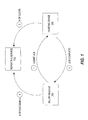
- FIG. 1 is a system diagram that illustrates how a print vendor may determine how much to bill a customer, according to an embodiment of the invention.
- a billing module 102 is communicatively coupled to a printing device 104.
- Billing module 102 and printing device 104 are each communicatively coupled to a reporting service 106.
- the communication links between the components illustrated in FIG. 1 may be implemented by any medium or mechanism that provides for the exchange of data between billing module 102 and printing device 104, between billing module 102 and reporting service 106, and between printing device 104 and reporting service 106.
- Examples of communication links include, without limitation, a network such as a Local Area Network (LAN), Wide Area Network (WAN), Ethernet or the Internet, or one or more terrestrial, satellite, or wireless links.
- Billing module 102 is a program that submits print jobs (or at least tracks print jobs that are sent) to printing device 104. Thus, billing module 102 may receive print jobs from a program (e.g., executing on another machine) that provides application templates from which print jobs are created. Billing module 102 also reports (step 4) the type and number of documents that are printed to reporting service 106.
- a program e.g., executing on another machine
- Billing module 102 also reports (step 4) the type and number of documents that are printed to reporting service 106.
- billing module 102 executes on the same machine as printing device 104 as a separate process. In a related embodiment, billing module 102 is integrated within the printing functionality of printing device 104.
- billing module 102 submits a print job, such as 20 postcards on four sheets.
- printing device 104 sends reporting service 106 data that indicates the number of clicks (i.e., four in this example) associated with the print job.
- printing device 104 sends data that indicates that the print job has successfully completed to billing module 102.
- Printing device 104 may also send data that indicates the number of clicks to billing module 102.
- billing module 102 sends reporting service 106 data that indicates that the desired type and number of documents were printed. From the data received from printing device 104 and/or billing module 102, reporting service 106 may determine how much to bill the customer according to an application billing model and, optionally, a page counter billing model. Thus, in this embodiment, the reporting service 106 provides the billing functionality. In another embodiment, billing module 102 provides the billing functionality, i.e., determines how much to bill the customer for the print job. In either embodiment, reporting service 106 may act as a repository to which a vendor may submit queries (e.g., via an Internet connection) to retrieve pertinent billing data.
- queries e.g., via an Internet connection
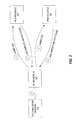
- FIG. 2 is a system diagram that illustrates how billing information is sent to a customer, according to an embodiment of the invention.
- a billing module 202 sends a print job to a printing device 204.
- printing device 204 sends data that indicates that the print job has completed to billing module 202.
- Printing device 204 also sends data that indicates the number of clicks associated with the print job to billing module 202.
- billing module 202 sends a second print job to a printing device 206, which may be of a different type, or at least may communicate using a different language, such as job definition format (JDF).
- JDF is an XML format and technical standard to facilitate cross-vendor workflow implementations.
- printing device 204 may communicate in one format while printing device 206 may communicate in a different format.
- printing device 206 sends data that indicates that the second print job has completed to billing module 202.
- Printing device 206 also sends data that indicates the number of clicks associated with the second print job, to billing module 202.
- billing module 202 sends the completed print job information to a customer billing program 208 that analyzes the data to generate billing data for the customer.
- billing module 202 analyzes the data sent to and received from printing devices 204 and 206 to generate billing data for the customer.
- customer billing program 208 may act as a repository to which a customer may submit billing data queries (e.g., via a LAN connection) to determine how much they have been (or will be) billed for use of printing devices 204 and 206.
- business arrangements are developed such that revenue for specific application usage is shared with other companies or partner companies, such as marketing firms, finishing vendors, and mail server providers.
- companies may develop or contribute to specific print applications that will be created on the print vendor's systems. For example, part of the fee (or total billed amount to the customer) for printing a book may be shared with the publisher that owns the IP rights.
- An application billing model allows a customer to easily factor in their own costs, such as labor, which typically varies based on the specific print application being created.
- An application billing model provides a customer a more consistent cost and is more predictable than consumable usage.
- application billing allows a customer to use any desired sheet size, without a financial "click" penalty. For example, if a customer wanted to create a 6x9 book, the customer could use a 8.5x11 sheet size without having to perform any imposition or collation. If the customer ran the same job using page counter billing, the cost of creating a 7x10 book may be too high. Instead, the customer would desire to print 2-up pages (e.g., using 17x11 sheets). However, this requires an extra cutting step, which results in more labor and more time. Application billing thus provides a customer with more options and the ability to standardize on a few specific paper sizes for all applications (i.e., types of documents).
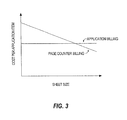
- FIG. 3 is a graph that illustrates a cost difference between application billing and page counter billing.
- page counter billing is typically heavily dependent on the sheet size used to print documents.
- FIG. 3 illustrates that, under page counter billing, as the sheet size increases for an application (i.e., type of document), the cost for that application decreases.
- the time and labor required to know how to use larger sheet sizes is a non-monetized cost absorbed by the customer, but hidden to the print vendor.
- the cost of an application may be constant regardless of the sheet size used. Therefore, customers may focus on the number of documents printed of a particular type rather than having to account for the sheet size.
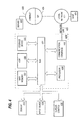
- FIG. 4 is a block diagram that illustrates a computer system 400 upon which an embodiment of the invention may be implemented.
- Computer system 400 includes a bus 402 or other communication mechanism for communicating information, and a processor 404 coupled with bus 402 for processing information.
- Computer system 400 also includes a main memory 406, such as a random access memory (RAM) or other dynamic storage device, coupled to bus 402 for storing information and instructions to be executed by processor 404.
- Main memory 406 also may be used for storing temporary variables or other intermediate information during execution of instructions to be executed by processor 404.
- Computer system 400 further includes a read only memory (ROM) 408 or other static storage device coupled to bus 402 for storing static information and instructions for processor 404.
- ROM read only memory
- a storage device 410 such as a magnetic disk or optical disk, is provided and coupled to bus 402 for storing information and instructions.
- Computer system 400 may be coupled via bus 402 to a display 412, such as a cathode ray tube (CRT), for displaying information to a computer user.
- a display 412 such as a cathode ray tube (CRT)
- An input device 414 is coupled to bus 402 for communicating information and command selections to processor 404.
- cursor control 416 is Another type of user input device
- cursor control 416 such as a mouse, a trackball, or cursor direction keys for communicating direction information and command selections to processor 404 and for controlling cursor movement on display 412.
- This input device typically has two degrees of freedom in two axes, a first axis (e.g., x) and a second axis (e.g., y), that allows the device to specify positions in a plane.
- the invention is related to the use of computer system 400 for implementing the techniques described herein. According to one embodiment of the invention, those techniques are performed by computer system 400 in response to processor 404 executing one or more sequences of one or more instructions contained in main memory 406. Such instructions may be read into main memory 406 from another machine-readable medium, such as storage device 410. Execution of the sequences of instructions contained in main memory 406 causes processor 404 to perform the process steps described herein. In alternative embodiments, hard-wired circuitry may be used in place of or in combination with software instructions to implement the invention. Thus, embodiments of the invention are not limited to any specific combination of hardware circuitry and software.
- machine-readable medium refers to any medium that participates in providing data that causes a machine to operation in a specific fashion.
- various machine-readable media are involved, for example, in providing instructions to processor 404 for execution.
- Such a medium may take many forms, including but not limited to, non-volatile media, volatile media, and transmission media.
- Non-volatile media includes, for example, optical or magnetic disks, such as storage device 410.
- Volatile media includes dynamic memory, such as main memory 406.
- Transmission media includes coaxial cables, copper wire and fiber optics, including the wires that comprise bus 402. Transmission media can also take the form of acoustic or light waves, such as those generated during radio-wave and infra-red data communications.
- Machine-readable media include, for example, a floppy disk, a flexible disk, hard disk, magnetic tape, or any other magnetic medium, a CD-ROM, any other optical medium, any other physical medium with patterns of holes, a RAM, a PROM, and EPROM, a FLASH-EPROM, any other memory chip or cartridge, a carrier wave as described hereinafter, or any other medium from which a computer can read.
- Various forms of machine-readable media may be involved in carrying one or more sequences of one or more instructions to processor 404 for execution.
- the instructions may initially be carried on a magnetic disk of a remote computer.
- the remote computer can load the instructions into its dynamic memory and send the instructions over a telephone line using a modem.
- a modem local to computer system 400 can receive the data on the telephone line and use an infra-red transmitter to convert the data to an infra-red signal.
- An infra-red detector can receive the data carried in the infra-red signal and appropriate circuitry can place the data on bus 402.
- Bus 402 carries the data to main memory 406, from which processor 404 retrieves and executes the instructions.
- the instructions received by main memory 406 may optionally be stored on storage device 410 either before or after execution by processor 404.
- Computer system 400 also includes a communication interface 418 coupled to bus 402.
- Communication interface 418 provides a two-way data communication coupling to a network link 420 that is connected to a local network 422.
- communication interface 418 may be an integrated services digital network (ISDN) card or a modem to provide a data communication connection to a corresponding type of telephone line.
- ISDN integrated services digital network
- communication interface 418 may be a local area network (LAN) card to provide a data communication connection to a compatible LAN.
- LAN local area network
- Wireless links may also be implemented.
- communication interface 418 sends and receives electrical, electromagnetic or optical signals that carry digital data streams representing various types of information.
- Network link 420 typically provides data communication through one or more networks to other data devices.
- network link 420 may provide a connection through local network 422 to a host computer 424 or to data equipment operated by an Internet Service Provider (ISP) 426.
- ISP 426 in turn provides data communication services through the world wide packet data communication network now commonly referred to as the "Internet" 428.
- Internet 428 uses electrical, electromagnetic or optical signals that carry digital data streams.
- the signals through the various networks and the signals on network link 420 and through communication interface 418, which carry the digital data to and from computer system 400, are exemplary forms of carrier waves transporting the information.
- Computer system 400 can send messages and receive data, including program code, through the network(s), network link 420 and communication interface 418.
- a server 430 might transmit a requested code for an application program through Internet 428, ISP 426, local network 422 and communication interface 418.
- the received code may be executed by processor 404 as it is received, and/or stored in storage device 410, or other non-volatile storage for later execution. In this manner, computer system 400 may obtain application code in the form of a carrier wave.
Landscapes
- Business, Economics & Management (AREA)
- Accounting & Taxation (AREA)
- Finance (AREA)
- Development Economics (AREA)
- Economics (AREA)
- Strategic Management (AREA)
- Physics & Mathematics (AREA)
- General Business, Economics & Management (AREA)
- General Physics & Mathematics (AREA)
- Engineering & Computer Science (AREA)
- Theoretical Computer Science (AREA)
- Marketing (AREA)
- Accessory Devices And Overall Control Thereof (AREA)
- Management, Administration, Business Operations System, And Electronic Commerce (AREA)
Applications Claiming Priority (1)
| Application Number | Priority Date | Filing Date | Title |
|---|---|---|---|
| US11/829,604 US7856400B2 (en) | 2007-07-27 | 2007-07-27 | Billing based on the type of printed document |
Publications (1)
| Publication Number | Publication Date |
|---|---|
| EP2053556A1 true EP2053556A1 (en) | 2009-04-29 |
Family
ID=40296241
Family Applications (1)
| Application Number | Title | Priority Date | Filing Date |
|---|---|---|---|
| EP08160808A Withdrawn EP2053556A1 (en) | 2007-07-27 | 2008-07-21 | Billing based on the type of printed document |
Country Status (3)
| Country | Link |
|---|---|
| US (1) | US7856400B2 (enExample) |
| EP (1) | EP2053556A1 (enExample) |
| JP (1) | JP5245601B2 (enExample) |
Families Citing this family (11)
| Publication number | Priority date | Publication date | Assignee | Title |
|---|---|---|---|---|
| JP4569672B2 (ja) * | 2008-06-20 | 2010-10-27 | コニカミノルタビジネステクノロジーズ株式会社 | 課金・印刷システム、画像形成装置、および、画像形成装置におけるジョブ処理方法 |
| JP5458680B2 (ja) * | 2009-06-04 | 2014-04-02 | 富士ゼロックス株式会社 | 情報処理プログラム及び情報処理装置 |
| US8494930B2 (en) * | 2009-10-14 | 2013-07-23 | Xerox Corporation | Pay for use and anti counterfeit system and method for ink cartridges and other consumables |
| US9082139B2 (en) * | 2010-03-10 | 2015-07-14 | Hewlett-Packard Development Company, L.P. | Printer credit management |
| JP5811712B2 (ja) * | 2011-09-07 | 2015-11-11 | 株式会社リコー | 機器連携システム、画像形成装置、機能提供方法 |
| US9183375B2 (en) | 2013-01-30 | 2015-11-10 | Hewlett-Packard Development Company, L.P. | Use of resource up to extension value by subscription device |
| US9715645B2 (en) | 2013-06-03 | 2017-07-25 | Hewlett-Packard Development Company, L.P. | Marking agent subscription credits |
| US9898235B2 (en) | 2013-07-24 | 2018-02-20 | Hewlett-Packard Development Company, L.P. | Marking agent credit adjustments |
| US9189262B2 (en) * | 2013-12-05 | 2015-11-17 | Xerox Corporation | Methods and systems for recommending solutions to performance issues in a print production environment |
| WO2019212468A1 (en) * | 2018-04-30 | 2019-11-07 | Hewlett-Packard Development Company, L.P. | Print job management across subscription services |
| CN112041807A (zh) | 2018-05-14 | 2020-12-04 | 惠普发展公司,有限责任合伙企业 | 经修改的跟踪度量 |
Citations (4)
| Publication number | Priority date | Publication date | Assignee | Title |
|---|---|---|---|---|
| US20030140185A1 (en) * | 2002-01-22 | 2003-07-24 | Darrel Cherry | Method and system for client-side print job meta-data collection and open billing |
| US20050039091A1 (en) * | 2002-08-30 | 2005-02-17 | Masaaki Hanaoka | Monitoring printer via network |
| US20060215192A1 (en) * | 2005-03-22 | 2006-09-28 | Seiko Epson Corporation | Printing system, printing program, printing method, server apparatus, server apparatus program, printer, printing system program, and recording medium having programs stored therein |
| US20070103716A1 (en) * | 2005-11-07 | 2007-05-10 | Seiko Epson Corporation | Ink Billing System With Changeable Billing Rate Table |
Family Cites Families (27)
| Publication number | Priority date | Publication date | Assignee | Title |
|---|---|---|---|---|
| US4229100A (en) * | 1978-07-03 | 1980-10-21 | International Business Machines Corporation | Automatic copy recovery |
| US4313673A (en) * | 1979-10-30 | 1982-02-02 | Xerox Corporation | Duplex operation in a reproduction machine |
| JP2659896B2 (ja) * | 1992-04-29 | 1997-09-30 | インターナショナル・ビジネス・マシーンズ・コーポレイション | 構造化文書複製管理方法及び構造化文書複製管理装置 |
| US6216113B1 (en) * | 1994-10-17 | 2001-04-10 | Xerox Corporation | Auditron access printer |
| US5832460A (en) * | 1995-06-02 | 1998-11-03 | International Business Machines Corporation | Method and system for bill presentation and payment reconciliation |
| US5826244A (en) * | 1995-08-23 | 1998-10-20 | Xerox Corporation | Method and system for providing a document service over a computer network using an automated brokered auction |
| JPH11134137A (ja) * | 1997-10-27 | 1999-05-21 | Canon Inc | 課金装置、課金方法、及び記憶媒体 |
| US6023499A (en) * | 1997-11-26 | 2000-02-08 | International Business Machines Corporation | Real time billing via the internet for advanced intelligent network services |
| US6102287A (en) * | 1998-05-15 | 2000-08-15 | International Business Machines Corporation | Method and apparatus for providing product survey information in an electronic payment system |
| US6052547A (en) * | 1998-10-23 | 2000-04-18 | Hewlett-Packard Company | Method and apparatus for metering printer/copier usage |
| US6411697B1 (en) * | 1999-05-20 | 2002-06-25 | International Business Machines Corp. | System and method for providing customer personalized and modifiable subscriber services |
| US6844937B2 (en) * | 1999-08-30 | 2005-01-18 | Xerox Corporation | Digital printing apparatus with remotely selectable operating speeds and features |
| US6112039A (en) * | 1999-10-14 | 2000-08-29 | Xerox Corporation | Auditing system for a digital copier-printer |
| US7082408B1 (en) * | 1999-11-30 | 2006-07-25 | International Business Machines Corporation | System and method for ordering items using a electronic catalog via the internet |
| US6591253B1 (en) * | 1999-12-17 | 2003-07-08 | International Business Machines Corporation | Method and system for real time pricing of fine-grained resource purchases |
| US6795205B1 (en) * | 2000-03-15 | 2004-09-21 | Canon Kabushiki Kaisha | Third-party authorization for home-based printing |
| US6701845B2 (en) * | 2000-03-17 | 2004-03-09 | Nikon Corporation & Nikon Technologies Inc. | Print system and handy phone |
| JP2001338046A (ja) * | 2000-05-29 | 2001-12-07 | Wise Business Kk | 印刷システム及び印刷管理装置 |
| US6801333B1 (en) * | 2000-06-15 | 2004-10-05 | Colorquick, L.L.C. | Automated system for comparing a job quote for a print job with production data for an actual print job |
| JP4135327B2 (ja) * | 2001-03-09 | 2008-08-20 | 富士ゼロックス株式会社 | ウェブデータ出力管理装置、印刷サービスシステム及び印刷サービス方法 |
| US6941272B2 (en) * | 2001-06-14 | 2005-09-06 | International Business Machines Corporation | Calculating cost discounts for mobile phone internet access |
| US20040008368A1 (en) * | 2001-09-07 | 2004-01-15 | Plunkett Michael K | Mailing online operation flow |
| JP2004072503A (ja) * | 2002-08-07 | 2004-03-04 | Sony Corp | 画像プリントシステム |
| US7020408B2 (en) * | 2003-12-10 | 2006-03-28 | Hewlett-Packard Development Company, L.P. | Secure print production cost accounting |
| US6968150B2 (en) * | 2003-12-23 | 2005-11-22 | Sharp Laboratories Of America, Inc. | Systems and methods for adding post-collation operations and interleaved imaging jobs to an imaging job |
| JP4305198B2 (ja) * | 2004-01-30 | 2009-07-29 | セイコーエプソン株式会社 | 印刷装置サポートシステム及び印刷情報収集装置、ならびに、コンピュータプログラム |
| JP4455550B2 (ja) * | 2005-07-29 | 2010-04-21 | シャープ株式会社 | 課金方法および課金システム |
-
2007
- 2007-07-27 US US11/829,604 patent/US7856400B2/en not_active Expired - Fee Related
-
2008
- 2008-07-16 JP JP2008185341A patent/JP5245601B2/ja not_active Expired - Fee Related
- 2008-07-21 EP EP08160808A patent/EP2053556A1/en not_active Withdrawn
Patent Citations (4)
| Publication number | Priority date | Publication date | Assignee | Title |
|---|---|---|---|---|
| US20030140185A1 (en) * | 2002-01-22 | 2003-07-24 | Darrel Cherry | Method and system for client-side print job meta-data collection and open billing |
| US20050039091A1 (en) * | 2002-08-30 | 2005-02-17 | Masaaki Hanaoka | Monitoring printer via network |
| US20060215192A1 (en) * | 2005-03-22 | 2006-09-28 | Seiko Epson Corporation | Printing system, printing program, printing method, server apparatus, server apparatus program, printer, printing system program, and recording medium having programs stored therein |
| US20070103716A1 (en) * | 2005-11-07 | 2007-05-10 | Seiko Epson Corporation | Ink Billing System With Changeable Billing Rate Table |
Also Published As
| Publication number | Publication date |
|---|---|
| JP2009032255A (ja) | 2009-02-12 |
| US20090030837A1 (en) | 2009-01-29 |
| US7856400B2 (en) | 2010-12-21 |
| JP5245601B2 (ja) | 2013-07-24 |
Similar Documents
| Publication | Publication Date | Title |
|---|---|---|
| US7856400B2 (en) | Billing based on the type of printed document | |
| JP3807249B2 (ja) | 情報処理装置及び情報処理方法、並びに課金処理装置及び課金処理方法 | |
| US6882439B2 (en) | Printing service method, system, and printer | |
| US6795205B1 (en) | Third-party authorization for home-based printing | |
| CA2546597C (en) | Method and system for providing a shipping label via an electronic procurement system | |
| CN1312594C (zh) | 实施对电子图书的请求的方法 | |
| CN100583062C (zh) | 使用数字权利管理系统处理电子分发的内容 | |
| US7085725B1 (en) | Methods of distributing postage label sheets with security features | |
| US7474433B2 (en) | Print driver based marketing system and method | |
| WO2010034008A2 (en) | Hosting platform | |
| JP2003524261A (ja) | プリンタサービス拒否 | |
| EP1197838A2 (en) | Internet print managing system and method with print job distribution | |
| US20030078863A1 (en) | Discounted printing | |
| US20030140185A1 (en) | Method and system for client-side print job meta-data collection and open billing | |
| JP2017049803A (ja) | 情報処理装置及びプログラム | |
| US20050240518A1 (en) | Method and system for on-line communication based on an off-line transaction | |
| JP2003196693A (ja) | インテリジェント郵便料金計算機 | |
| JP2008210144A (ja) | 請求書発行システム及び請求書発行方法 | |
| EP1197837A2 (en) | Internet print managing system and method with print services cost accounting | |
| US7416116B2 (en) | Printed user activity at digital copier or network-connected device for pay-for-print/copy customers | |
| JP3507408B2 (ja) | 印刷システム、印刷制御方法、サーバ装置、端末装置および記憶媒体 | |
| EP1197842A2 (en) | Internet print managing system and method with print services consumables management | |
| JP2003223308A (ja) | 印刷物の印刷・郵送費用予測器 | |
| US20050038668A1 (en) | System and method for document processing and charging for such processing on a per page basis | |
| JP2000015954A (ja) | 自動製本システム |
Legal Events
| Date | Code | Title | Description |
|---|---|---|---|
| PUAI | Public reference made under article 153(3) epc to a published international application that has entered the european phase |
Free format text: ORIGINAL CODE: 0009012 |
|
| 17P | Request for examination filed |
Effective date: 20080721 |
|
| AK | Designated contracting states |
Kind code of ref document: A1 Designated state(s): AT BE BG CH CY CZ DE DK EE ES FI FR GB GR HR HU IE IS IT LI LT LU LV MC MT NL NO PL PT RO SE SI SK TR |
|
| AX | Request for extension of the european patent |
Extension state: AL BA MK RS |
|
| STAA | Information on the status of an ep patent application or granted ep patent |
Free format text: STATUS: THE APPLICATION HAS BEEN WITHDRAWN |
|
| 18W | Application withdrawn |
Effective date: 20090916 |