EP2053527A2 - Systeme, Verfahren und Programmierung zum Routen und Indizieren global adressierbarer Objekte und assoziierter Unternehmensmodelle - Google Patents
Systeme, Verfahren und Programmierung zum Routen und Indizieren global adressierbarer Objekte und assoziierter Unternehmensmodelle Download PDFInfo
- Publication number
- EP2053527A2 EP2053527A2 EP09001918A EP09001918A EP2053527A2 EP 2053527 A2 EP2053527 A2 EP 2053527A2 EP 09001918 A EP09001918 A EP 09001918A EP 09001918 A EP09001918 A EP 09001918A EP 2053527 A2 EP2053527 A2 EP 2053527A2
- Authority
- EP
- European Patent Office
- Prior art keywords
- node
- nodes
- index
- network
- index address
- Prior art date
- Legal status (The legal status is an assumption and is not a legal conclusion. Google has not performed a legal analysis and makes no representation as to the accuracy of the status listed.)
- Withdrawn
Links
Images










Classifications
-
- H—ELECTRICITY
- H04—ELECTRIC COMMUNICATION TECHNIQUE
- H04L—TRANSMISSION OF DIGITAL INFORMATION, e.g. TELEGRAPHIC COMMUNICATION
- H04L67/00—Network arrangements or protocols for supporting network services or applications
- H04L67/01—Protocols
- H04L67/10—Protocols in which an application is distributed across nodes in the network
- H04L67/104—Peer-to-peer [P2P] networks
-
- G—PHYSICS
- G06—COMPUTING OR CALCULATING; COUNTING
- G06F—ELECTRIC DIGITAL DATA PROCESSING
- G06F16/00—Information retrieval; Database structures therefor; File system structures therefor
- G06F16/10—File systems; File servers
- G06F16/13—File access structures, e.g. distributed indices
- G06F16/134—Distributed indices
-
- G—PHYSICS
- G06—COMPUTING OR CALCULATING; COUNTING
- G06F—ELECTRIC DIGITAL DATA PROCESSING
- G06F16/00—Information retrieval; Database structures therefor; File system structures therefor
- G06F16/10—File systems; File servers
- G06F16/18—File system types
- G06F16/182—Distributed file systems
- G06F16/1834—Distributed file systems implemented based on peer-to-peer networks, e.g. gnutella
-
- H—ELECTRICITY
- H04—ELECTRIC COMMUNICATION TECHNIQUE
- H04L—TRANSMISSION OF DIGITAL INFORMATION, e.g. TELEGRAPHIC COMMUNICATION
- H04L61/00—Network arrangements, protocols or services for addressing or naming
- H04L61/45—Network directories; Name-to-address mapping
- H04L61/4552—Lookup mechanisms between a plurality of directories; Synchronisation of directories, e.g. metadirectories
-
- H—ELECTRICITY
- H04—ELECTRIC COMMUNICATION TECHNIQUE
- H04L—TRANSMISSION OF DIGITAL INFORMATION, e.g. TELEGRAPHIC COMMUNICATION
- H04L67/00—Network arrangements or protocols for supporting network services or applications
- H04L67/01—Protocols
- H04L67/10—Protocols in which an application is distributed across nodes in the network
- H04L67/104—Peer-to-peer [P2P] networks
- H04L67/1044—Group management mechanisms
- H04L67/1048—Departure or maintenance mechanisms
Definitions
- the present invention relates to systems, methods and programming for routing and indexing globally addressable objects and associated business models.
- the client-server model suffers from numerous problems. Servers are expensive to maintain, requiring money for hardware, bandwidth, and operations costs. Traffic on the Internet is unpredictable: In what is known as the "Slashdot Effect", content on a site may quickly become popular, flooding the site's servers with requests to the extent that no further client requests can be served. Similarly, centralized sites may suffer from Denial-of-Service (DoS) attacks, malicious traffic which can take down a site by similarly flooding the, .site's connection to the network. Furthermore, some network services, particularly bandwidth-intensive ones, such as providing video or audio on a large scale, are simply impossible in a centralized model, since the bandwidth demands exceed the capacity of any single site.
- DoS Denial-of-Service
- Freenet is relatively slow, and it is rather difficult to actually download any content off of Gnutella, since the protocol does not scale beyond a few thousand hosts, so the amount of accessible content on the network is limited.
- log n O (log n ) time to look up an object (where n is the number of nodes participating in the network and each time step consists of a peer machine contacting another peer machine) are in various stages of development, including OceanStore at Berkeley and Chord at MTT. However, log n is 10 hops even for a network as small as 1000 hosts, which suggests lookup times in excess of half a minute. Furthermore, these systems are designed for scalability, but not explicitly for reliability, and their reliability is untested under real-world conditions running on unreliable machines.
- Skyris Networks, Inc. the intended assignee of this patent application, has developed new, more efficient algorithms for distributed indexing which meet the needs of distributed network services by being scalable and fault tolerant.
- this paper we propose a new routing and search scheme which we call "transparent indexing", in which the search index is embedded in a highly scalable, fault tolerant, randomized, distributed routing layer.
- This routing and indexing layer serves as a distributed directory service, a platform on which to build network services which share these properties and are reliable, efficient, and load balanced.
- SKYRIS can run efficiently on a network with billions of servers. Furthermore, the SKYRIS network can handle any distribution of hot spots (small pieces of popular content), or suddenly popular content, with minor latency compromises, and can do so transparently.
- Scalability is one of the most important features of SKYRIS. From the beginning, the SKYRIS project has been designed to scale to a global system, with potentially billions of peer machines.
- EFFICIENT RETRIEVAL Our goal is to make SKYRIS as fast as the Web, if not faster.
- DNS system which can make several hierarchical contacts before serving you the IP address.
- the aim has been to keep the SKYRIS system similarly within several hops, where a hop consists of a message passed from one peer machine to the next.
- a hop consists of a message passed from one peer machine to the next.
- LOAD BALANCING The entire network has tremendous capacity, but individual machines lack power. Skyris must spread the load (primarily bandwidth) evenly across the system in order to avoid overloading machines. Skyris is unique in that it has managed to achieve the first system which is both scalable and fault tolerant; furthermore, the platform happens to be efficient and load balanced with some additional effort.
- This routing and indexing scheme is the core enabling piece of the SKYRIS project Together with a new, related method of hot spot management, our routing and indexing scheme allows the construction of many useful, efficient, scalable, and fault tolerant services, including keyword search as well as distributed information retrieval and delivery, with the properties of the Skyris network.
- the core of the system consists of several distinct layers:
- the interface to the platform is simple, thus additional layers, such as search and storage of content, can easily be built on this central framework.
- Fig. 1 provides a highly schematic illustration of a Skyris network 100.
- a plurality of nodes 102 are connected via a network such as the Internet 104 shown in Fig. 1 .
- the Skyris network work can have a central server note 106 in some embodiments. In other embodiments each can operate without such a central server.
- the Skyris network can be used with many different types of computing devices.
- the most common types of computing devices which would have the capacity to act as nodes in the Skyris network would tend to be desktop computers, such as the computer 1 on to be shown in Fig. 1 , laptop computers, and other larger computers.
- the Skyris network will be capable of being used with smaller types of computers, such as portable tablet computers 102C, personal digital assistant computers 102D, computers based in cellular telephones 102E, and computers in even smaller devices, such as wearable computers like the wristwatch computer 102F shown in Fig. 1 .
- the nodes of the Skyris network can be connected to the network with relatively slow connections such as cable modems or currently common forms of cellular communication.
- a node will receive better service from the network and be more valuable to the network if it has to higher speed connection, such as a cable modem, DSL, wireless LAN, or high-speed wireless connection.
- node 102A is represented with a schematic block diagram.
- This diagram illustrates that the note has a central processor 110; random access memory 112; a bus 114 connecting the CPU and the memory; and a video interface 116 for driving a visual display 118.
- This computer also includes an I/O interface 120 for interfacing with user input devices, such as a keyboard 122 a mouse 124. It also includes a network interface 126 for enabling the node 102A to communicate with other nodes 102 of the Skyris network.
- the node 102A also includes a mass storage device, such as a hard disk, floppy disk, CD ROM, or a large solid-state memory.
- This mass storage device stores the programming instructions of an operating system 130; a browser program 132; and Skyris programming in the form of a plug-in 134.
- the Skyris program will run as an independent application, but in many embodiments it will operate as a plug and which will enable users to access content using the Skyris network from within the browser interface generated by the browser program 132.
- the SKYRIS network is designed to scale to millions, perhaps billions, of PCs and other types of computers.
- each host will have a fixed storage capacity, a far smaller memory capacity, and a varying network bandwidth, possibly as slow as a modem.
- one of the foundations of the network must be a routing algorithm with a low diameter and variable network overhead.
- our routing system needs to be not only fault tolerant (capable of deleting nodes), but also capable of adding new machines to the network on the fly.
- hypercube model we have generalized two classic network models to the Skyris framework. They are the hypercube model and de Bruijn networks of size 2 k . Advantages of the hypercube are throughput efficiency, at the cost of a large number of links, and simpler neighborhood management. Advantages of de Bruijn are the tiny number of links, but throughput efficiency is reduced, and fault tolerance is lessened,
- the two main requirements for a network model are that there is enough locality (adjacent neighborhoods are close to one another) and enough flexibility in the family of parameters describing the network.
- Hypercube is the best network model for both locality and ease of splitting, but the de Bruijn model is one example of another classic network model which can be adapted. In this case the difficulty is greater - splitting neighborhoods requires reassignment of half the contacts of a machine, for example - but the number of contacts is fewer.
- the neighborhood concept may be altered so that adjacent neighborhoods overlap to some extent, perhaps in a probabilistic manner; or so that each machine be assigned to two or more neighborhoods, perhaps based on the bandwidth of the machine, et cetera; there are various simple modifications of the concept.
- a thread that ties these together is that they retain some notion of locality of machines, perhaps through a distance function, which replicate information among some collection of nearby hosts.
- the set of hosts receiving information may vary according to connection speed or usefulness of the machine, and may also vary according to the information. Indeed, in order to handle 'hot spots' of popular content, we will replicate the information to larger and neighborhoods based on the popularity of the content.
- each of the n servers obtains a unique 160-bit hash key in the interval [0,1) using the SHA1 hash function.
- SHA1 was chosen for its cryptographic properties of collision resistance; it is easy to use a different hash function instead if desired, even one with fewer bits.
- This hash key (the node ID ) describes the server's "location" in the interval. Each server is assigned a list of contacts (a contact is a server that the server "knows" exists) with which it communicates directly.
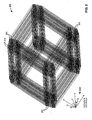
- Fig. 2 illustrates nine dimensions of a hypercube 200.
- a hypercube is a networked topology in which each node 201 is connected to another node along each of the multiple dimensions of the hypercube.
- each node 201 is connected to nine other nodes, with the connection to each of those nine nodes being along a different dimension.
- each of the nine dimensions shown in that figure is indicated at 202. Since it is difficult to represent more than three dimensions on a two-dimensional piece of paper, the connections associated with the dimensions 0, 1, and 2, are shown having a larger space between nodes than connections at dimensions 3 4 and 5, and these dimensions in turn are shown having larger spacing between contacts that exists in dimensions 6, 7, and 8.
- Fig. 3 provides a less cluttered view of the hypercube of Fig. 2 .
- most of the lines connecting each node 201 of a hypercube along each of its dimensions have been removed so that the individual nodes 201 are more visible and so that the representation of the hypercube as a cube 306 made up of intermediate size cubes 304 which in turn are made of smaller cubes 304 can be seen.
- Fig. 4 uses the same method of representing a hypercube shown in Fig. 3 , except that it provides three different views of this hypercube representing different subsets of its dimensions.
- the portion of Fig. 4 encircled within the dotted line 400 corresponds to that shown in Fig. 3 , which illustrates the first nine dimensions of the hypercube.
- the portion of Fig. 4 shown within the dotted line 402 is a blowup of what appears to be an individual node 201a within the dotted circle 400. This blowup shows the next nine dimensions 9 through 17, for the hypercube.
- each individual corner of each of the small rectangles 302 shown in Fig. 3 and Fig. 4 actually correspond to a hierarchy of cubes defined by the smaller dimensions of the hypercube representation.
- each actual node in this higher dimensional hypercube is connected by all dimensions of the hypercube to any other node which varies from it only by the value of the bit represented by that given dimension.
- the 160 bit hash value used in the current embodiment of the Skyris network represents a binary number large enough to represent over a trillion trillion trillion possible values. Thus even if a given Skyris network has a large number of nodes, only a very small percent of the possible values that can be defined by such a large binary value will actually have a node associated with them. For this reason, if the 160 bit hash value is represented as a hypercube, that hypercube will be largely empty. This is illustrated by Fig.
- the portion of Fig. 4 encircled by the dotted line 404 shows a blowup of that portion of the hypercube space surrounded by the circle 406 within the view of the hypercube space shown encircled by the dotted line 402.
- the portion of the hypercube space shown encircled by the dotted lines 404 represents the 18th through 26th dimensions out of the 160 dimensional space represented by all possible hash values. In the example shown in Fig. 4 this portion of the hypercube space is sparsely populated causing it to look quite sparse and irregular.
- x and y be two node IDs, and assume we use SHA1.
- x x 0 x 1 ...x 159 , where x i represents the i th bit of x .
- f ( x,y ) is the location of the first high-order bit for which x and y differ.
- each node has a contact in the other half of the search space, the other half of its half, the other half of its quarter, and so on.
- Fig. 5 This is illustrated in Fig. 5 , which is similar to the hypercube representation shown in Fig. 3 . If the giving node X has the position 500 shown in Fig. 5 , then the contact x 0 ⁇ ⁇ - - ... - ⁇ 159 will be at some random location in the portion of Fig.
- Fig. 6 illustrates another way in which the hash address space use with most embodiments of the Skyris network can be represented.
- a binary decimal point is placed before the 160 bit hash value so that its bits represents a value in range 0 and a number that varies only by less than one trillionth of one trillionth of one trillionth from the number one.
- Fig. 6 a portion 602 of this range is shown in expanded form.
- This portion of the address space range corresponds to approximately 1/32768 of the address space. It corresponds to the part of the address range that between 0.1000000000000010 and 0.1000000000000000.
- individual nodes are represented by the small circles 604. It can be seen that the distribution of the nodes across this subset of the range involves a fair amount of statistical unevenness.
- portions of the address range corresponding to neighborhoods are indicated by the dotted lines 606.
- the portion of the hash address space which corresponds to a given neighborhood varies so each neighborhood can maintain a relatively constant population despite statistical variation in node populations in different sub portions of the hash value address space.
- the node therefore has a set of direct contacts with exponentially increasing density as you get closer to it.
- the basic hypercube model (which will be extended) is quite comparable to the routing model of the Chord project, and achieves the same results: O (log n ) lookup time with log n contacts per node.
- each local neighborhood (the set of approximately n /2 m nodes who share the same first m bits, for some small m ) keeps track of all nodes within it. So once the searcher contacts a node in the local neighborhood, that node knows the final destination and can forward it directly on. Of course, since each node in a neighborhood maintains copies of the same index information, most searches need to go no further than reaching any node within the same neighborhood as a desired node address or hash value.
- seek time is at most log( n - m +1), with average seek time log ⁇ n - m + 1 2 .
- y looks at the interval of its contacts z which it is authoritative for, divides it into intervals of length 2 - i -d+1 , and passes one contact from each interval on to x .
- Fig. 7 represents the hash address space in the same linear manner as was used in Fig. 6 . It shows a node 700 and has direct contacts 702A through 702D. Actually it would include other direct contacts that are even closer to it, but drawing them in Fig. 7 would have been difficult because of their closeness to the node 700.
- Each of the direct contacts such as the direct contacts 702a through 702D shown in Fig. 7 supply the node 700 with a corresponding list of indirect contacts 704.
- the indirect contacts returned by each direct contact lie within the sub-portion of the hash address space in which the direct contact was randomly chosen.
- the indirect contacts have all values for the set of D-1 bits immediately after the most significant bit by which the direct contact first differs from the node 700 that is being supplied with contacts, the indirect contacts supplied by a given direct contact will be distributed in a substantially even manner over the sub-range of the address space associated with their corresponding direct contact.
- Fig. 8 illustrates in more detail the nature of the set of indirect contacts which are returned by a given direct contact.
- the row of bits pointed to by the numeral 800 is defined as the bit pattern of the node x, to which a set of contacts is to be supplied by a node y.
- the row 802 illustrates the bits of the address value of the node y.
- the first two bits of y's address are identical to x's address but the third bit of y, x2 bar, is the inverse other third bit out of x, which is x2.
- node x wants from node y a set of indirect contacts that have the same bits in their hash address as y itself does up to the first bit by which y differs from x. In the example, it wants a set of 64 such contacts from y, which have all possible values for the bits d1 through d6.
- the table 804 shows a subset of y's contact list, which is a list of both its direct and indirect contacts.
- the values b0 through b6 represent a set of all possible values for the high order bits of the hash address space they occupy.
- Row R-4 has all of the contacts sought by x except the ones with x3' rather than bar x3'.
- R5 has all of the requested contacts not contained in R-4 except those with x4' rather than bar x4'.
- R-6 has all of the requested contacts not contained in R4 and R5 except those with x5' rather than bar x5'.
- R7 has all of the contacts not contained in R4 through R-6 except those with x6' rather than bar x6'.
- R8 has all the requested contacts not contained in R4 through R7 except those with x7' rather than bar x7'. In most cases the direct contact will have enough rows such as the rows R4 through R8 that it can supply a node requesting contacts with all of the contacts that it needs.
- node X has (log n ) d - 1 i contacts at level i.
- path lengths are bounded by log n d
- the average path has length log n d + 1
- the amount of network traffic per host sent to maintain contacts is O (log n ).
- we cache contacts has numerous nice properties which distinguish it from previous routing mechanisms.
- it preserves and enhances locality; it maintains routing tables which are up-to-date (a node knows that it's d -th level contact was alive a short time ago, since contacts are replaced in successive layers after inactivity); and its performance benefits are high, requiring only a constant factor more activity.
- bandwidth counted as number of bits sent
- the number of messages remains the same, since nodes still talk to their direct contracts at various time intervals, only exchanging more information. This shows that a simple ping/ack scheme is wasteful, since this scheme not only sends better information, but sends it in the same number of messages, perhaps even the same number of packets and therefore the same amount of network traffic.
- this network should be relatively easy to maintain. If a node goes down, the nodes that use it as a direct or indirect contact will have enough other contacts to reach the rest of the network. When a node is added, it can find appropriately located nodes to build its list of contacts. Indeed, our queuing-time based simulations confirm this.
- a single node as the oracle, or host cache, which will likely be running on our hardware (although it can be any known node, as will be explained below in greater detail)).
- the oracle will maintain a radix search tree or other optimized data structure of all current servers registered on the network and will answer closest node queries.
- the node sends the oracle its node ID and a list of desired locations of contacts.
- the oracle then inserts the node into the search tree and sends back the node IDs of the closest matches.
- An index must be of such a form that it allows high availability and low latency. Furthermore, the index must allow high availability and be load balanced.
- Bloom Filters cut the storage requirements for building an index, but only by a constant factor: they still require O( n ) space, where n is the number of items in the index.
- Another form of flooding is multicast, which can be optimized so that each server receives each piece of information only some small constant number of times, even once with perfect reliability.
- Gnutella is perhaps the best-known network that builds no index, but instead floods searches to all nodes. In a sense, Gnutella is the dual of USENET, which floods the index and keeps searches local.
- the SKYRIS model is remarkably simple: We embed the index within the existing routing infrastructure. We already have a routing infrastructure that allows high availability, low latency, and load balancing, using only local information, so it is natural to use the same system for indexing. Thus we create a globally known one-to-one map from documents to neighborhoods. We can do this by taking the neighborhood to be given by the first log n bits of the document's 160-bit SHA1 Unique ID (UID).
- UID SHA1 Unique ID
- Our method is to use best-of- d lookup with d probably equal to 2.
- We generate 2 hash values for a new node based on the SHA1 hash of a public key generated for that node, and the node's IP address.
- each server Since each server caches at least d levels, each server knows all servers swithin graph distance d , and it knows that all servers at distance i ⁇ d were alive within ic i seconds.
- broadband users have larger d .
- the broadband user's traffic increases by a factor of two for each subsequent decrease in the contact's level. This can be further remedied by biasing the distance function so that broadband users choose other broadband users as their contacts; given this model, modem (or wireless) users may decrease their d considerably and limit themselves to the edge of the network.
- a node shall keep redundant backup first level contacts, slightly beyond d levels. Furthermore, when a node's contact goes down, a node's second or third level contacts are not necessarily down either (unless we have a network partition or some similar correlated event). Thus, a node can trade off larger d by slowly phasing out its old contacts while phasing in the new.
- the fault tolerance simulator actually implements the entire routing protocol, with the exception of the local indexing. It is based on queuing time, the standard way to simulate a network or a chain of events - the simulator contains a global priority queue of events, sorted by time. New events are placed in the queue to occur at some point in the near future, and after each event is handled, time instantly fast-forwards to the next event time.
- Fault Tolerance simulations reveal that the network is highly fault tolerant.
- Three properties of the network make it highly fault tolerant: firstly, each machine has numerous secondary contacts to fall back upon if its primary contacts fail; secondly, information about these contacts is very frequently propagated in a manner near the most efficient possible, and finally, the deflection penalty is small, since all machines have a short path to all machines in the routing structure.
- Skyris' technology is able for the first time to build a platform for large-scale, reliable network services running on users' devices.
- This platform provides the useful primitive operation of a reliable index, which can be used for many applications, many of which are new due to the distributed nature of the index.
- the applications include the following:
- Skyris' platform for the first time allows reliable content distribution on a large scale using the capacities of users' devices, such as PCs, notebook computers, or wireless devices such as PDAs or cell phones.
- Skyris' revenue model involves charging content providers on a per bandwidth or per unit model. Charging consumers for certain downloads, as in pay-per-view, is also possible.
- FILE SHARING File sharing includes sharing video, audio, and other documents with a small group of people or with the world. It is a simple form of content distribution, in which the content is static. Skyris supports file sharing with keyword search.
- Skyris' distributed index can act as a reliable hash table, which can be useful to schedule tasks in a distributed computing environment.
- DISTRIBUTED KNOWLEDGE MANAGEMENT Distributed Knowledge Management includes applications for interacting and sharing documents among coworkers. Existing solutions have limited scalability due to indexes with limited scalability; Skyris' distributed index can provide a scalable distributed platform for knowledge management.
- Skyris' reliable neighborhoods allow one to build wide-scale distributed databases.
- the major activity of a database is in the transaction;
- Skyris' architecture can be adapted for use by a database through the use of two-phase commits, with neighborhoods being responsible for objects according to the hash function.
- HIERARCHIES OF CONTENT Most content on the Internet is not single documents, but rather hierarchies, which are usually modeled by folders in filesystems.
- the Skyris system can be adapted to serve hierarchies in a distributed manner. The trivial way is to mark all content in a hierarchy with the hash of the root, in order to serve the content from a single place.
- a more scalable way is to contain the hash value of an object's parent in the object.
- SECURITY Since we are using a secure hash, it is simple to rely on this hash in order to trust that content the user downloads matches the hash in the index. We can furthermore hash blocks of small size, say 64 kilobytes, and then hash the hashes to achieve a secure hash which is resilient against errors when different blocks are transmitted from different hosts. Then the problem reduces to whether one can trust the indexed data.
- a public key infrastructure and may use Skyris as a trusted third party. The system can sign content with a public key, and insert with the hash of the encrypted content.
- HYBRID NETWORK With this decentralized infrastructure built, it is simple to insert some number of servers into the network, either acting as a single centralized entity or with some simple failover mechanism or even running a Skyris decentralized network of their own. These servers may be used to provide additional capacity, to provide geographic location services, or to run other services, such as an index of content. They may be assumed to be more reliable than a typical client machine, although any networked resource has some measure of unreliability.
- Skyris' network consists of a program which runs on users' PCs, it is possible to integrate into the network computationally intensive projects, such as protein folding or other massively parallel computations which previously would have run on supercomputers.
- Skyris' index allows a reliable distributed hash table primitive which is available for computationally intensive programs. Such a primitive can allow better job scheduling or load balancing for computational jobs.
- a distributed geographic or network location service can be built on top of the network or accessed from various central servers. This service can be used when choosing which client to download from, in order to conserve bandwidth.
- MOTIVATING USERS The value received by Skyris from users' running the application is too low to consider direct payments to users at the moment, although for more value-added tasks, such a scheme could be implemented, for example for cash back when shopping for expensive items.
- Other more effective ways to reward users for participating in a distributed system include lotteries and donating to charities chosen from a list by the user. Teams donating to charities or playing in lotteries can also be used.
- Skyris' core level of infrastructure based on new algorithms, is both globally scalable and highly fault tolerant. These two properties are not found in other distributed networks, which must make choices between being scalable but not fault tolerant, such as the inter-domain routing protocol BGP, or being fault tolerant but not scalable, such as the RON project at MIT, which is able to achieve better routing on a small scale than BGP.
- BGP inter-domain routing protocol
- RON project at MIT which is able to achieve better routing on a small scale than BGP.
- Skyris' scalability and fault tolerance allow the infrastructure to create new applications that were previously impossible - reliable network services running on unreliable desktop machines, based on a flexible primitive, the distributed directory service.
- Fig. 9 illustrates the data structures 900 that are stored in association with the Skyris software 134 shown in Fig. 1 .
- This data includes a contact list 902 which includes a list of direct contacts 904, a list of indirect contacts 912, and a shared contact list 918.
- the direct contact list stores the UID, or hash address value for each direct contact of the current node, as well as its network, or IP, address 908, and information about its contact status history 910.
- the contact status history 910 provides information about how many attempts that have been made to contact the node in the recent past have failed, so that if more than a certain number of attempts to contact a given direct contact have failed, the current node will know that it needs to replace that given direct contact with a new direct contact.
- the indirect contact list includes for each indirect contact its UID 914 and its network address 916.
- the shared contact list is a list of other nodes for which the current node is a direct contact, and it includes for each such other node a list of all the current node's contacts that the other node has been given by the current node in a process such as that which was discussed with regard to Fig. 8 .
- the shared contact list is used to enable a node to provide to another node update information about any contact that it has provided to that other node.
- the shared neighborhood data 922 shown in Fig. 9 lists the data which is shared by all nodes that belong to a common neighborhood. The fact that this data is shared by a plurality of nodes provides redundancy that tends to ensure that such information is not lost even though hodes may be leaving and entering the neighborhood at a relatively high rate.
- the shared neighborhood data includes a neighborhood address mask 924, which contains the set of most significant bits which are shared by all members of the current node's neighborhood. If the current node receives a request relating to a given hash address, and if the most significant bits of that hash address match the current node's address mask, the current node will normally respond to the request directly, since it, like all other nodes in its neighborhood, should have a copy of all information relating to that hash address.
- the shared neighborhood data also includes a rumor list 926.
- this is a list of the UIDs, or hash addresses, of all nodes in the neighborhood, including the current node, and it includes in association with each such hash address, a list of all the recent rum that have originated from that node.
- it includes for each such rumor a timestamp indicating its time of origin and the content of the rumor.
- Such rumor are used to convey all the information which is to be commonly indexed by the nodes in the neighborhood as well as other communications which are relevant to the operation of neighborhoods.
- the shared neighborhood data includes a keyword entry list 936 for each of a plurality of keywords that can be used to index data objects such as files.
- a list of associated files 938 is stored. This list includes for each file the file's hash value 940, the file's named 942, the file's size 944, the file's type 946 (such as whether it is a text file, and audio file, a video file), other descriptive text based metadata 948, the number of nodes storing a copy of the file 950, and a list of the other keywords that are associated with the file, 952.
- a keyword entry also stores an ordered list of the files associated with the keyword, ordered by the number of nodes that stored the file, as indicated 954. This is used to help the keyword entry determine which files are most popular, as indicated by the number of times that they are stored in the network, and to give preference in keyword indexing to those files.
- the shared neighborhood data also includes a file entry list 956.
- This list includes for each of one or more file entries a hash value 958, a list of hash value chunks 960, a list of keywords associated with the file 962, and a list of nodes storing the file 964.
- the list 964 stores for each nodes storing a copy of the file the node's IP address 966, that node's port number 968, the Internet connection speed 970 for the node, the network location of the node 972, which is used for determining the proximity of the pair of nodes so as to determine which copy would be most appropriate for download to a given requesting node.
- the entry for each node storing a copy of a file also includes an indication of whether or not the node is behind a firewall, and if so it's relay contact information 974, and an entry expiration date 976, which is a time at which the entry for the given copy of the file will be removed from the list of nodes storing the file unless a refresh message is received from that node indicating that the copy is still available at its location.
- a given node stores a copy of a given file, of the type that is referenced in the list of nodes storing the file 964 described above with regard to the shared network data, that node will have an entry for that copy in a list of file copy entries 980.
- Each such file copy entry includes the file's hash value 982, a list of the hash values of each of a set of chunks, or sub-portions of the file, which in the preferred embodiment are each approximately 128 kilobytes long, the actual contents of the file itself 986, and a list of keywords 988 associated with the file.
- the file copy entry also includes other text based metadata associated with the file, and an index refresh time which corresponds to the entry expiration date 976 described above in the file entry in the shared network data.
- This index refresh time is preferably set to shorter periods of time when the file is first stored on a given node and its refresh time grows longer as the length of time the file has been continuously available on that node grows.
- the consecutive refresh number 994 shown in Fig. 9 indicates the number of refresh periods that the file copy has been continuously available to the network from the current node, and it is used in determining how long index refresh times should be set.
- each node should refresh the entry expiration date 976 associated with each of its files, by the index refresh time so as to prevent the entry for any associated file copies from being removed from the list of nodes storing a copy of those files 964 that has been described above.
- Fig. 10 illustrates how a node enters the Skyris network, either when it is entering it for the first time or reentering it after having left the network.
- First function 1002 establishes contact with a known node in the network.
- the known node is one or more nodes contained in a list of nodes that has been given to the node which is trying to enter the network.
- a node commonly enters the network after having downloaded Skyris software, and such software normally would contain a list of a plurality of known nodes that can be called to for the purpose of function 1002.
- the known node is one of one or more central servers that are associated with the system and which are sufficiently reliable that at any given time at least one or two of such known servers would be available.
- a new node is given a network name which is mapped to an actual current node by use of dynamic name resolution, a service that is provided to dynamically map a URL to an IP address.
- This service is available on the Internet from various service providers for a fee.
- functioned 1006 causes functioned 10008 to perform a hash address search, of the type that will be described below with regard to Fig. 11 , for a node in a neighborhood that handles the portion of the hash address space corresponding to each such new hash address.
- the hash address search perform by functioned 1008 queries each node that is found to be in the neighborhood of one of the potential new hash addresses for the neighborhood mask associated with that node's neighborhood. Once such a mask has been returned in association with each of the potential hash addresses, function 1010 selects the neighborhood returned by the searches having the fewest high order bits in its neighborhood mask. Normally this will correspond to the neighborhood in the region of the address space having the smallest population. Once this selection is been made function 1012 assigns the current node to the hash address corresponding to the selected neighborhood. Function 1014 then downloads a complete copy of the shared neighborhood data 922 described above with regard to Fig. 9 , from the node contacted in the selected neighborhood by the search of function 1008. Once this has been done function 1016 creates a contact list for the node's new hash address, as will be described below with regard to Figs. 12 and 13 .
- Fig. 11 describes how a node performs a hash address search of the type described above with regard to function 1008.
- the hash address search 1100 shown in Fig. 11 starts by testing to see if the neighborhood address mask associated with the node performing the search matches the high order bits of the hash address which is to be searched for. If so function 1102 causes functioned 1104 to return from the search with the current node's UID and neighborhood mask and network address. This is done because if the current node's address mask matches the high order bits of the hash address being searched for, it should have a copy of all of the shared neighborhood information necessary to deal with the searched for hash address.
- function 1106 makes the current node's contact list the current contact list for the purpose of the iteration performed by function 1108.
- Function 1108 performs an until loop until one of its iterations gets a return from another node that includes a neighborhood mask matching the high order bits of the search address, the UID of a node having that matching neighborhood mask, and that node's IP address.
- function 1108 causes functions 1110 through 1120 to be performed.
- Function 1110 tests to see if there is a set of one or more contacts in the current contact list to which a search request has not previously been sent by an iteration of the loop 1108. If there are one or more such untried contacts, function 1112 sends a search request for the hash address being searched for to that one of such untried contacts who's UID value has the largest number of most significant bits matching the address being searched for.
- functions 1114 and 1116 start again at the top of the until loop 1108, which will cause function 1112 to send a search request to another entry in the current contact list being used by the search.
- function 1118 and 1120 merge the new contact list with the current contact list. If the node to which a search request was sent by function 1112 is closer to the hash address being searched for than the current node, the contact list which is merged into the search's current contact list by function 1120 will probably contain a set of contacts which are closer to the hash address being searched for than those that were previously in the search's current contact list.
- a reply will be received in response to one of the search request sent by function 1112 that includes a neighborhood mask matching the search address, along with the UID and IP address of the node returning that matching mask.
- Fig. 12 describes the contact list creation function 1200 which is used to create a contact list for a new node.
- the function includes a loop 1202 which is performed for each possible value of index i ranging from 0 to k.
- k is the log of the number of nodes in the neighborhood. In other embodiments, such as the one shown in this pseudocode, k is equal to the length of the neighborhood mask for the node for which the contact list is being created.
- function 1204 For each iteration of the loop 1202 function 1204 creates a new UID, or hash address value, by performing functions 1206 to 1210. Function 1206 copies the first i-1 significant bits from the current node for which the contact list is being created. Then function 1208 inverts the i th most significant bit of the current node's UID. Then function 1210 picks a random value for all of the bits less significant than the i th bit in the new hash value to be created.
- the new direct contact creation function is comprised of functions 1302 to 1320.
- the function at 1302 performs a hash address search of the type described above with regard to the Fig. 11 , for the UID for which the new direct contact creation function has been called. As has been described above with regard to Fig. 11 this function will search to find a node in a neighborhood that handles the UID is being search for.
- function 1304 makes that node that has been returned by the search of function 1302 as the i th direct contact for the current node, where i is equal to the number of the most significant bit by which the returned contact differs from the new UID of the current node.
- Functions 1306 through 1312 store the UID, the IP address, and an initially empty contact status history entry for the new direct contact. This corresponds to the information 906 through 910 which is indicated as being stored for each direct contact in Fig. 9 .
- function 1314 sends a contact request to the i th contact requesting a list of indirect contacts having the same most significant bits as the i th contact up to and including the i th bit, and having all possible combination of the d-1 most significant bits. This corresponds to the type of contact request which was discussed above with regard to Fig. 8 .
- functions 1316 through 1320 cause the UID and IP address of each such indirect contact to be stored in the indirect contact list 912, described above with regard to Fig. 9 , in the current nodes data structures.
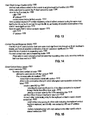
- Fig. 14 is a contact request response function 1400 which a node performs when it receives a contact request of the type sent by a node when performing function 1314 described above with regard to Fig. 13 .
- a function 1402 finds list of all node contacts that have the same most significant bit through the i th bit identified in the request and have all possible combinations of the d-1 next most significant bits. This is similar to the list of contacts as was discussed above with regard to Fig. 8 .
- function 1404 sends this list of contacts to the requesting nodes.
- function 1406 is performed for each contact node sent to the requesting node by function 1404. For each such contact node that has been sent to the requesting node function 1406 causes function 1408 to place an entry in the node's shared contact list under the requesting node, recording the contact that has been sent to it.
- the shared contact list entries are used to enable a node to know which other nodes it has to update when it finds that a contact in its contact list is no longer valid.
- Fig. 15 describes the direct contact status update function 1500.
- This function includes a function 1502 which every n seconds performs a loop 1504 for every direct contact of the current node. In one current embodiment n equals 5 seconds.
- function 1504 For every direct contact of the current node function 1504 causes function 1506 through 1526 to be performed. Function 1506 attempts to communicate with the current direct contact of the current iteration of the loop 1504. If no communication is established in response to the attempt of function 1506 function 1508 causes function 1510 to 1526 to be performed. Function 1510 records that communication has failed with the contact. Then function 1512 tests to see if this is the n th consecutive attempt in which attempted communication with the contact has failed. If so it determines that the node is no longer a valid direct contact and causes function 1514 to 1526 to be performed. It should be appreciated that in other embodiments of the invention different criteria can be used to determine exactly when a direct contact should be considered to be no longer valid.
- Functions 1514 to 1518 create a new UID to be used by a new direct contact to replace the one that function 1512 has determined to be invalid.
- This new UID includes the same most significant bits as the direct contact to be replaced up to and including the first most significant bit that differs from the UID of the current node. The remaining bits of the new UID are picked at random.
- function 1300 Once function 1300 has found a new direct contact from a given node in a neighborhood with a neighborhood mask that matches the most significant bits of the new UID, it will make that given node the new direct contact to replace the direct contact which function 1512 has found to have failed, and it will obtain a corresponding set of indirect contacts associated with the new direct contacts portion of the hash address space. The function 1300 will cause this new direct contact and its corresponding indirect contacts to be entered into the current nodes contact list.
- function 1522 performs a loop for each other node having an entry for a replaced contact in the current node's shared contact list 918 described above with regard to Fig. 9 .
- function 1524 sends a contact change message to that other node indicating that the replaced contact has been replaced, identifying the contact that is to replace it by UID and IP address.
- a function 1526 then updates the shared contact list to reflect that the new replacement contact has been sent to the other node that has just been notified about the replacement.
- Fig. 16 illustrates the contact change message response function 1600 which a node performs when it receives a contact change message of the type described above with regard to function 1524 of Fig. 15 .
- a node When a node receives such a contact change message function 1602 it replaces the replaced contact indicated in the message with the new replacement contact indicated in the message in the node's contact list 902, described above with regard to Fig. 9 .
- a function 1604 performs a loop for each other node associated with the replaced contact in the current node's shared contact list. For each such node a function 1606 sends a contact change message to that other node indicating the replaced contact and the UID and IP address of the contact that is replacing it. Then a function 1608 updates the current node's shared contact list to indicate that it has sent the new, replacing, contact to that other node.
- Figs. 17 and 18 relate to rumor communication, which is a very efficient mechanism for communicating information between nodes of a given neighborhood, or logical node, of the Skyris network.
- Fig. 17 illustrates the rumor creation function 1700. If there is a change to a given node's shared neighborhood data, function 1702 causes functions 1704 to 1708 to be performed. As will be described below with regard to Figs. 25 and 26 such a change commonly occurs when new information is indexed in a given node.
- Function 1704 creates a new rumor detailing the change in the node's shared neighborhood data.
- Function 1706 labels a rumor with a given node's UID and a timestamp corresponding to the time at which this new rumor was created. Then function 1708 places this rumor on the given node's rumor list under the given node's own UID.
- Fig. 18 describes the rumor propagation function 1800 which is used to communicate rumors between nodes of a given neighborhood.
- Function 1802 performs a loop every n seconds, which in one embodiment is 5 seconds. This loop comprises forming an inner loop 1804 for each node in the current node's rumor list. For each such node functions 1806 to 1830 are performed.
- Function 1806 performs a loop for each rumor associated with the current node in the iteration of the loop 1804, in which a test to see whether that rumor is older than a given timeline, and if so it causes function 1808 to delete it. This is done to remove old rumor from the node's rumor list so as to prevent that list from growing to be wastefully large over time.
- Next function 1810 tests to see if the current node of the current iteration of loop 1804 is the current node executing function 1800, and whether or not there are any rumors associated with its UID in the current node's rumor list which are newer than a second timeline. If there are no such relatively recent rumors associated with the current node in the current node's UID list function 1812 adds a "still here" rumor to the current node's rumor list with a current timestamp so that rumor propagation will inform other nodes that the current node is still functioning as part of the neighborhood.
- Next function 1814 tests to see if the current node of the loop 1804 is another node and that other node has no rumor associated with its UID in the current node's rumor list that is newer than a third timeline. If these conditions are matched it means that the current node has not heard anything about that other node for a period sufficiently long as to indicate that other node is no longer participating in the current neighborhood and thus function 1816 deletes that other node from the current node's rumor list.
- function 1818 attempts to communicate with another node that is randomly picked from the current node's rumor list. If communication is achieved with a randomly picked node function 1820 causes functions 1822 through 1827 to be performed.
- Function 1822 tests to see if the node UID on each side of the communication matches the other node's neighborhood mask. If one side's neighborhood mask contains the other, that is, has a smaller number of significant bits, then the node with a smaller number of significant bits exchanges only rumors that correspond with node UID's that match the other node's longer neighborhood mask. The node with the longer neighborhood mask will send all rumors relating to the node UID's in its rumor list to the node with the shorter neighborhood mask since the UID's of all such nodes will fall within the portion of the hash address space corresponding to the other node's shorter neighborhood mask. If any of the bits of the neighborhood masks of the nodes in the communication conflict with each other than neither node will communicate any rumors to the other.
- Fig. 19 illustrates a neighborhood splitting function 1900.
- This function includes a test 1902 which tests to see if the number of neighbors listed in the current node's rumor list exceeds an upper neighbor limit.
- nodes try to keep their neighborhoods in a population range between roughly 32 and 64 nodes. In such a case the upper neighbor limit would be 64. If the test of function 1902 is met functions 1904 through 1908 are performed.
- Function 1903 increases the length of the current node's neighborhood mask by one bit.
- Function 1904 adds a rumor to the node's rumor list under the current node's UID indicating that the current node has extended the length of its neighborhood mask by one bit.
- rumor propagation will cause this rumor to be sent out to other nodes in the current node's neighborhood If the current node is one of the first nodes to sense that its neighborhood's population has exceeded the upper neighbor limit, most of the other nodes in its former neighborhood will have a shorter address mask than the current node does as a result of function 1903. As stated above with regard to the rumor propagation function Fig. 18 , such other nodes having shorter neighborhood mask will receive rumors from the current node since that portion of the address space corresponding to its new neighborhood mask falls within the portion of the address space represented by their shorter address mask. This will cause such other nodes to receive the message that the current node has decided to split its neighborhood. But any such nodes whose UID's do not match the new longer address mask of the current node will no longer send rum to the current node, since they have been informed that it is no longer interested in their half of their current neighborhood.
- function 1906 tests to see if the current node includes a full contact list, that includes a direct contact and a corresponding set of indirect contacts in which the first most significant bit that differs from the address of the current node corresponds to the position of new bit that has just been added to the current node's address mask.
- function 1908 calls the new direct contact creation function 1300, described above with regard to Fig. 13 , to create such a direct contact and a corresponding set of indirect contacts.
- Fig. 20 describes the neighborhood-split rumor response function 2000.
- function 2002 if a current node receives a rumor associated with another node's UID indicating that that other node has changed its neighborhood mask so as to no longer match the current node's UID, functions 2004 to 2008 are performed. These functions place an indication in the other node's entry in the current node's rumor list indicating that the other node has left the current node's network as of the timestamp associated with the rumor indicating the other nodes change. And it indicates that no rumor communication should be made from the current node to that other node until a new or rumor is received from that other node saying that it has a neighborhood mask that matches the current node's UID.
- Fig. 21 describes the neighborhood merging function 2100. If the number of neighbors in a node's rumor list falls below a lower neighbor limit function 2102 causes a loop 2104 to be performed. The loop 2104 is performed for each of one or more randomly picked hash addresses in the other half of the part of the hash space defined by one less bit in the neighborhood mask in the current node's neighborhood mask.
- a function 2106 performs a hash address search for each such randomly picked hash address.
- a function 2108 tests to see if the node found by the hash address search has a longer neighborhood mask than the current node. If this is the case function 21 is performed.
- Function 2110 probabilistically decides whether to send a message to the other node returned by the search asking it to re-enter the network with UID corresponding to the current node's neighborhood mask. Such a message is sent with a 1/n probability, where n the size of the nodes neighborhood.
- n the size of the nodes neighborhood.
- Function 2216 sends a merge request the via rumor communication to nodes in the current node's neighborhood This will cause all nodes that receive this rumor to perform the merge request response function of Fig. 22 themselves. Then function 2218 causes the current node to decrease the length of its neighborhood mask by one bit. Function 2220 deletes from the current node's contact list the direct contact that first differs from the current node's hash address by the lowest order bit, and all of its associated indirect contacts.
- function 2220 causes the current node to perform its next rumor communication with a node from the other half of the new neighborhood, so that the current node will receive all shared neighborhood data that up until the merger has been indexed by the other half of the newly formed neighborhood, but not by the current node's half.
- Fig. 23 illustrates the new file network entry function 2300. This function is executed by a node when it seeks to enter a file into the Skyris network, which, as far as it knows, has not been entered into the network before.
- the new file network entry function includes a function 2302 that breaks the file to be entered up into one or more chunks each having no more than a given size. In one embodiment of the invention file chunks are limited to 128 kB. Next the function 2304 performs a hash on each chunk. Next function 2306 sets the files hash value to a hash of the chunks associated with the given file.
- a function 2308 finds a list of one or more keywords to be associated with the file. Different functions can be used for obtaining keywords for different types of files. For example many non-text files would base their keywords largely on the title of the file. Files that contain metadata would often have their keywords defined by such metadata. Pure text files might be defined by keywords corresponding to text words in the file that occur with a much higher relative frequency in the text file than they do in files in general.
- a function 2314 calls the copy file network entry function 2400 that is illustrated in Fig. 24 to complete the entry of the file into the network.
- the copied file network entry function includes a function 2402 that forms a hash address search for the hash value associated with the file for which the function of Fig. 24 is being performed.
- function 2404 sends a file index insert request for the file to that node, along with the current nodes IP address 2412 that sends a keyword index insert request for the keywords hash value to the node returned by the hash address search, which request includes the current nodes IP address and other information to be included in a file entry for the current file. Then a function 2406 stores the number of nodes storing the current file that is returned in response to the file index insert request.
- Next function 2408 performs a loop for each of the current file's keywords.
- This loop includes function 2410 which performs a hash address search for the keyword's hash value, and function 2412 sends a keyword index insert request for the keyword's hash value to the node returned by the hash address search.
- This request includes the current node's IP address and information for a keyword entry associated with the current keyword of the loop 2408 including the number of nodes storing the current file returned by the file index insert request.
- function 2414 causes the items of information indicated by numerals 2416 to 2424 to be stored on the current node in association with the hash value of the file for which the copied file network entry function is being performed.
- This includes a list of the hash values of the current file's associated chunks, the data of the file itself, the list of keywords associated with the file and their hash values, an index refreshed number that has been set to 0 and index refresh time which is initially sat with a short refresh length, that indicates the time by which the current node must refresh the indexed file entry that has been created by the network for the copy of the file stored on the current node.
- Fig. 25 illustrates the file index insert request response function 2500. This is the function that is performed by a node that receives a file index insert request of the type that is sent by function 2404 described above with regard to Fig. 24 .
- function 2502 tests to see if there is any file entry for the requested file on the current node. If not functions 2504 and 2506 are performed. Function 2504 creates a file entry for the file, including information about the node originating the request. This corresponds to the file entry data 956 described above with regard to Fig. 9 . Function 2506 places the rumor in the node's rumor list under the node's own UID with the current timestamp containing the new file entry. This corresponds to the rumor creation described above with regard to Fig. 17 .
- function 2508 causes functions 2510 and 2512 to be performed.
- Function 2510 adds to the list of file copy entries for the current file a new file copy entry indicating the network location information for the node that is sent the request that is being responded to.
- function 2512 places the rumor in the current nodes were list under the node's own UID with a current timestamp containing the new file copy entry information. This also corresponds to a rumor creation of the type described above with regard to Fig. 17 .
- function 2514 returns information to the requesting node indicating the number of file copy entries for the file corresponding to the request.
- Fig. 26 describes a keyword index insert request response. This is somewhat similar to the response function described in Fig. 25 , except that it describes a node's response to a request to insert keyword index information, rather than file index information.
- function 2602 tests to see if there is already any keyword entry for the keyword associated with the request on the current node. If not function 2604 creates a keyword entry of the type described above with regard to the keyword entry list 936 described above with regard to Fig. 9 for the current keyword.
- a keyword entry only stores information about the 5000 most frequently stored files that are associated with that keyword. In other embodiments different requirements could be used to determine which files are to be indexed in association with a given keyword.
- functions 2608 through 2616 are performed. Function 2608 checks to see if there is any associated file entry for the file associated with the current keyword in the keyword entry on the current node for that keyword. If so function 2610 creates a new associated file entry for the file associated with the current request in the current keyword entry's list of associated files.
- function 2612 causes functions 2614 and 2616 to be performed.
- Function 2614 replaces the count of nodes storing the file to the count contained in the current keyword index insert request, and function 2616 reorders the file's location in the ordered list of files by storage count, 954 shown in Fig. 9 . This is the list that is used by the test 2606 determine whether or not the number of copies associated with a given file falls within the top 5000 largest number of copies for any files associated with the current keyword.
- function 2618 places a rumor in the current node's rumor list under the nodes own UID with the current timestamp containing any changes to a keyword entry that have resulted from the response to the keyword index insert request. This also corresponds to the type of rumor creation described above with regard to Fig. 17 .
- Figs. 27 through 29 illustrate functions used by the network to increase the chance that information that is indexed by the networks distributed index is currently valid.
- Fig. 27 illustrates the file expiration response function 2700.
- This function includes a test 2702 to test to see if the expiration date for a node-storing-file entry in the list of nodes storing a copy of the file has expired. If so it causes functions 2704 through 2714 to be performed.
- Function 2704 deletes the node-storing-file entry of the type described above in association with the list 964 shown in Fig. 9 .
- a function 2706 tests to see if the list of nodes storing the file has been made empty by the deletion. If so functions 2708 through 2714 perform.
- Function 2708 forms a loop for each keyword associated with the file entry.
- This loop comprises functions 2710 which performs a hash address search for the hash of the keyword, and function 2712 which sends a message to the node returned by the keyword search informing it to remove the file from the associated file list of the keywords associated entry on that node.
- a function 2704 responds to the situation detected by function 2706 by deleting the associated file entry.
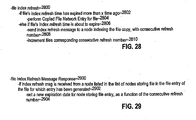
- Fig. 28 illustrates the file index refresh function 2800 that is performed by an individual node storing a copy of a given file. If the file index refresh time indicated by the value 992, shown in Fig. 9 , stored in association with a given copy of the file has expired more than x time ago, function 2802 will cause function 2804 to perform a copy to file network entry, of the type described above with regard to Fig. 24 , to be performed for the file so as the closet to be reentered into the networks distributed indexing scheme.
- the time x used in the test of function 2802 corresponds to a slight time difference that normally exists between the index refreshed times stored by nodes storing copies of files and the associated expiration dates stored by the nodes that index the location of file copies.
- the files index refresh time has not yet expired. If this is the case, function 2806 tasks to see if the files index refreshed time is about to expire. If so, functions 2808 and 2810 are performed.
- Function 2808 sends an index refreshed message to a node indexing the file copy with a consecutive refreshed number to indicate to that node how far in advance the newly extended expiration date should be set.
- Function 2810 increments the files corresponding consecutive refreshed number 994, shown in Fig. 9 , so that the node will be giving credit for having consecutively maintained a copy of the current file when the next expiration date extension is set.
- Fig. 29 illustrates a file index refreshed message response function 2900 which is performed by a node that receives any index refreshed message of the type described above with regard to function 2808 in Fig. 28 .
- functions 2902 and 2904 set a new expiration date for the node's copy of the file as a function of the consecutive refresh number associated with the refresh message.
- the length of time into the future at which the new expiration date is set is a function of the consecutive refresh number.
- new expiration dates will be set only a few minutes into the future.
- the new expiration dates will be extended into the future by much longer periods of time, as much as 12 or 24 hours in some embodiments.
- the invention of the present application is not limited to use with any one type of operating system, computer hardware, or computer network, and, thus, other embodiments of the invention could use differing software and hardware systems.
Landscapes
- Engineering & Computer Science (AREA)
- Theoretical Computer Science (AREA)
- Physics & Mathematics (AREA)
- Databases & Information Systems (AREA)
- General Engineering & Computer Science (AREA)
- General Physics & Mathematics (AREA)
- Data Mining & Analysis (AREA)
- Computer Networks & Wireless Communication (AREA)
- Signal Processing (AREA)
- Computer And Data Communications (AREA)
- Data Exchanges In Wide-Area Networks (AREA)
- Information Transfer Between Computers (AREA)
- Hardware Redundancy (AREA)
- Small-Scale Networks (AREA)
- Information Retrieval, Db Structures And Fs Structures Therefor (AREA)
Applications Claiming Priority (2)
| Application Number | Priority Date | Filing Date | Title |
|---|---|---|---|
| US10/246,793 US7054867B2 (en) | 2001-09-18 | 2002-09-18 | Systems, methods and programming for routing and indexing globally addressable objects and associated business models |
| EP03759498A EP1546931A4 (de) | 2002-09-18 | 2003-09-18 | Systeme, verfahren und programmierung zum routen und indizieren global adressierbarer objekte und assoziierte unternehmensmodelle |
Related Parent Applications (1)
| Application Number | Title | Priority Date | Filing Date |
|---|---|---|---|
| EP03759498A Division EP1546931A4 (de) | 2002-09-18 | 2003-09-18 | Systeme, verfahren und programmierung zum routen und indizieren global adressierbarer objekte und assoziierte unternehmensmodelle |
Publications (1)
| Publication Number | Publication Date |
|---|---|
| EP2053527A2 true EP2053527A2 (de) | 2009-04-29 |
Family
ID=32028963
Family Applications (2)
| Application Number | Title | Priority Date | Filing Date |
|---|---|---|---|
| EP03759498A Withdrawn EP1546931A4 (de) | 2002-09-18 | 2003-09-18 | Systeme, verfahren und programmierung zum routen und indizieren global adressierbarer objekte und assoziierte unternehmensmodelle |
| EP09001918A Withdrawn EP2053527A2 (de) | 2002-09-18 | 2003-09-18 | Systeme, Verfahren und Programmierung zum Routen und Indizieren global adressierbarer Objekte und assoziierter Unternehmensmodelle |
Family Applications Before (1)
| Application Number | Title | Priority Date | Filing Date |
|---|---|---|---|
| EP03759498A Withdrawn EP1546931A4 (de) | 2002-09-18 | 2003-09-18 | Systeme, verfahren und programmierung zum routen und indizieren global adressierbarer objekte und assoziierte unternehmensmodelle |
Country Status (7)
| Country | Link |
|---|---|
| US (3) | US7054867B2 (de) |
| EP (2) | EP1546931A4 (de) |
| JP (2) | JP2006500831A (de) |
| CN (1) | CN1703697A (de) |
| AU (2) | AU2003275226A1 (de) |
| RU (1) | RU2321885C2 (de) |
| WO (1) | WO2004027581A2 (de) |
Cited By (2)
| Publication number | Priority date | Publication date | Assignee | Title |
|---|---|---|---|---|
| US8600951B2 (en) | 2001-09-18 | 2013-12-03 | Skype | Systems, methods and programming for routing and indexing globally addressable objects and associated business models |
| US8793347B2 (en) | 2008-12-03 | 2014-07-29 | Mobophiles, Inc. | System and method for providing virtual web access |
Families Citing this family (126)
| Publication number | Priority date | Publication date | Assignee | Title |
|---|---|---|---|---|
| JP4039158B2 (ja) * | 2002-07-22 | 2008-01-30 | ソニー株式会社 | 情報処理装置および方法、情報処理システム、記録媒体、並びにプログラム |
| US7206934B2 (en) * | 2002-09-26 | 2007-04-17 | Sun Microsystems, Inc. | Distributed indexing of identity information in a peer-to-peer network |
| US8204992B2 (en) * | 2002-09-26 | 2012-06-19 | Oracle America, Inc. | Presence detection using distributed indexes in peer-to-peer networks |
| US7657597B2 (en) * | 2002-09-26 | 2010-02-02 | Sun Microsystems, Inc. | Instant messaging using distributed indexes |
| US8259121B2 (en) * | 2002-10-22 | 2012-09-04 | Broadcom Corporation | System and method for processing data using a network |
| JP2004234157A (ja) * | 2003-01-29 | 2004-08-19 | Sony Corp | 情報処理装置、および情報処理方法、並びにコンピュータ・プログラム |
| US7424021B2 (en) * | 2003-01-31 | 2008-09-09 | Hewlett-Packard Development Company, L.P. | Method and apparatus for processing network topology data |
| US7478096B2 (en) * | 2003-02-26 | 2009-01-13 | Burnside Acquisition, Llc | History preservation in a computer storage system |
| US20070276823A1 (en) * | 2003-05-22 | 2007-11-29 | Bruce Borden | Data management systems and methods for distributed data storage and management using content signatures |
| US9678967B2 (en) | 2003-05-22 | 2017-06-13 | Callahan Cellular L.L.C. | Information source agent systems and methods for distributed data storage and management using content signatures |
| US7668735B2 (en) * | 2003-05-30 | 2010-02-23 | Mdrxdirect Inc. | Compensated electronic consults |
| US8095500B2 (en) | 2003-06-13 | 2012-01-10 | Brilliant Digital Entertainment, Inc. | Methods and systems for searching content in distributed computing networks |
| US7620624B2 (en) * | 2003-10-17 | 2009-11-17 | Yahoo! Inc. | Systems and methods for indexing content for fast and scalable retrieval |
| US20050108368A1 (en) * | 2003-10-30 | 2005-05-19 | Aditya Mohan | Method and apparatus for representing data available in a peer-to-peer network using bloom-filters |
| US7844731B1 (en) * | 2003-11-14 | 2010-11-30 | Symantec Corporation | Systems and methods for address spacing in a firewall cluster |
| US7313565B2 (en) * | 2004-02-19 | 2007-12-25 | Microsoft Corporation | Data overlay, self-organized metadata overlay, and associated methods |
| US7730207B2 (en) | 2004-03-31 | 2010-06-01 | Microsoft Corporation | Routing in peer-to-peer networks |
| US7418454B2 (en) * | 2004-04-16 | 2008-08-26 | Microsoft Corporation | Data overlay, self-organized metadata overlay, and application level multicasting |
| JP4561283B2 (ja) * | 2004-09-30 | 2010-10-13 | ブラザー工業株式会社 | ノード装置、共用情報更新方法、共用情報保存方法、共用情報更新処理プログラム、及び共用情報保存処理プログラム |
| JP4546538B2 (ja) * | 2004-11-16 | 2010-09-15 | 株式会社エヌ・ティ・ティ・ドコモ | モバイルネットワーク内の共有ファイルに関する情報を管理する方法、装置およびプログラム製品 |
| US7639681B2 (en) * | 2004-11-23 | 2009-12-29 | Microsoft Corporation | System and method for a distributed server for peer-to-peer networks |
| US8275804B2 (en) | 2004-12-15 | 2012-09-25 | Applied Minds, Llc | Distributed data store with a designated master to ensure consistency |
| US11321408B2 (en) | 2004-12-15 | 2022-05-03 | Applied Invention, Llc | Data store with lock-free stateless paging capacity |
| US8996486B2 (en) | 2004-12-15 | 2015-03-31 | Applied Invention, Llc | Data store with lock-free stateless paging capability |
| US7774308B2 (en) * | 2004-12-15 | 2010-08-10 | Applied Minds, Inc. | Anti-item for deletion of content in a distributed datastore |
| US20060209819A1 (en) * | 2005-03-21 | 2006-09-21 | Jennings Raymond B Iii | Method and apparatus for efficiently expanding a P2P network |
| US7895270B2 (en) * | 2005-04-21 | 2011-02-22 | Microsoft Corporation | Transport abstraction for multiparty replication |
| US7539661B2 (en) * | 2005-06-02 | 2009-05-26 | Delphi Technologies, Inc. | Table look-up method with adaptive hashing |
| DE502005001390D1 (de) * | 2005-07-14 | 2007-10-11 | Konrad Zuse Zentrum Fuer Infor | Vorrichtung und Verfahren zum Abrufen/Speichern von elektronischen Daten in einem System mit mehreren Datenverarbeitungseinheiten |
| JP2007148545A (ja) * | 2005-11-24 | 2007-06-14 | Brother Ind Ltd | 情報配信システム、情報配信方法、ノード装置、及びノード処理プログラム |
| US7904759B2 (en) * | 2006-01-11 | 2011-03-08 | Amazon Technologies, Inc. | System and method for service availability management |
| DE102006011291A1 (de) * | 2006-03-10 | 2007-09-27 | Siemens Ag | Verfahren zum Betrieb eines dezentralen Datennetzes |
| US9037698B1 (en) | 2006-03-14 | 2015-05-19 | Amazon Technologies, Inc. | Method and system for collecting and analyzing time-series data |
| US8601112B1 (en) * | 2006-03-14 | 2013-12-03 | Amazon Technologies, Inc. | Method and system for collecting and analyzing time-series data |
| US7979439B1 (en) * | 2006-03-14 | 2011-07-12 | Amazon Technologies, Inc. | Method and system for collecting and analyzing time-series data |
| JP4864508B2 (ja) * | 2006-03-31 | 2012-02-01 | 富士通株式会社 | 情報検索プログラム、情報検索方法および情報検索装置 |
| JP4862463B2 (ja) * | 2006-04-11 | 2012-01-25 | ブラザー工業株式会社 | 情報通信システム、コンテンツカタログ情報検索方法、及びノード装置等 |
| JP2007280303A (ja) * | 2006-04-11 | 2007-10-25 | Brother Ind Ltd | 情報通信システム、コンテンツカタログ情報配信方法、及びノード装置等 |
| JP4655986B2 (ja) * | 2006-04-12 | 2011-03-23 | ブラザー工業株式会社 | ノード装置、記憶制御プログラム及び情報記憶方法 |
| EP1868114B1 (de) * | 2006-06-12 | 2015-11-18 | Konrad-Zuse-Zentrum für Informationstechnik Berlin | Vorrichtung und Verfahren zum Speichern und Abrufen von Objekten mit mehrdimensional adressierten, elektronischen Daten |
| US9325786B2 (en) | 2006-07-27 | 2016-04-26 | The Hong Kong University Of Science And Technology | Peer-to-peer interactive media-on-demand |
| JP4950295B2 (ja) * | 2006-08-21 | 2012-06-13 | テレフオンアクチーボラゲット エル エム エリクソン(パブル) | エンドユーザにトリプルプレイサービスを提供するための分散型サーバネットワーク |
| JP2008059398A (ja) * | 2006-08-31 | 2008-03-13 | Brother Ind Ltd | 識別情報割当装置及びその情報処理方法並びにそのプログラム |
| CN101197741B (zh) * | 2006-12-07 | 2010-05-19 | 华为技术有限公司 | 个人域网络内节点间的关联方法及获取关联方式的方法及装置 |
| US7774329B1 (en) | 2006-12-22 | 2010-08-10 | Amazon Technologies, Inc. | Cross-region data access in partitioned framework |
| US8150870B1 (en) | 2006-12-22 | 2012-04-03 | Amazon Technologies, Inc. | Scalable partitioning in a multilayered data service framework |
| US7613707B1 (en) * | 2006-12-22 | 2009-11-03 | Amazon Technologies, Inc. | Traffic migration in a multilayered data service framework |
| CN101005606B (zh) * | 2006-12-31 | 2012-07-04 | 华为技术有限公司 | 一种减少媒体播放延时的方法和装置 |
| JP4877107B2 (ja) * | 2007-07-06 | 2012-02-15 | ブラザー工業株式会社 | 情報配信システムにおける端末装置及び情報処理プログラム、並びに端末装置の情報処理方法 |
| CN101344882B (zh) * | 2007-07-10 | 2010-06-02 | 中国移动通信集团公司 | 数据查询方法、插入方法及删除方法 |
| US20090254422A1 (en) * | 2007-10-22 | 2009-10-08 | Paul Thomas Jenkins | Method and system for managing enterprise content |
| US7440952B1 (en) * | 2007-12-18 | 2008-10-21 | International Business Machines Corporation | Systems, methods, and computer products for information sharing using personalized index caching |
| JP5151511B2 (ja) * | 2008-01-30 | 2013-02-27 | ソニー株式会社 | 検索サービス提供システム及び検索サービス提供方法 |
| US8114117B2 (en) * | 2008-09-30 | 2012-02-14 | Tyco Healthcare Group Lp | Compression device with wear area |
| US20090276440A1 (en) * | 2008-04-29 | 2009-11-05 | Grasstell Networks Llc | Embodiments of practical distributed computing |
| US7872990B2 (en) | 2008-04-30 | 2011-01-18 | Microsoft Corporation | Multi-level interconnection network |
| US7995504B2 (en) * | 2008-05-12 | 2011-08-09 | Microsoft Corporation | Locality-based routing table generation |
| US8335776B2 (en) | 2008-07-02 | 2012-12-18 | Commvault Systems, Inc. | Distributed indexing system for data storage |
| KR100962653B1 (ko) * | 2008-07-24 | 2010-06-11 | 이화여자대학교 산학협력단 | 블룸 필터 및 복수 해싱 구조를 사용한 ip 주소 검색방법 및 장치 |
| US8804950B1 (en) | 2008-09-30 | 2014-08-12 | Juniper Networks, Inc. | Methods and apparatus for producing a hash value based on a hash function |
| US7961734B2 (en) | 2008-09-30 | 2011-06-14 | Juniper Networks, Inc. | Methods and apparatus related to packet classification associated with a multi-stage switch |
| US8675648B1 (en) | 2008-09-30 | 2014-03-18 | Juniper Networks, Inc. | Methods and apparatus for compression in packet classification |
| US8798057B1 (en) | 2008-09-30 | 2014-08-05 | Juniper Networks, Inc. | Methods and apparatus to implement except condition during data packet classification |
| US7796541B1 (en) | 2008-09-30 | 2010-09-14 | Juniper Networks, Inc. | Methods and apparatus for range matching during packet classification based on a linked-node structure |
| US7738454B1 (en) * | 2008-09-30 | 2010-06-15 | Juniper Networks, Inc. | Methods and apparatus related to packet classification based on range values |
| US7835357B2 (en) * | 2008-09-30 | 2010-11-16 | Juniper Networks, Inc. | Methods and apparatus for packet classification based on policy vectors |
| RU2396592C2 (ru) * | 2008-10-21 | 2010-08-10 | Открытое акционерное общество "Научно-исследовательский центр электронной вычислительной техники" (ОАО "НИЦЭВТ") | Способ организации глобально адресуемой общей памяти в многопроцессорной эвм |
| SE533007C2 (sv) * | 2008-10-24 | 2010-06-08 | Ilt Productions Ab | Distribuerad datalagring |
| US8488588B1 (en) | 2008-12-31 | 2013-07-16 | Juniper Networks, Inc. | Methods and apparatus for indexing set bit values in a long vector associated with a switch fabric |
| US8111697B1 (en) | 2008-12-31 | 2012-02-07 | Juniper Networks, Inc. | Methods and apparatus for packet classification based on multiple conditions |
| US7889741B1 (en) | 2008-12-31 | 2011-02-15 | Juniper Networks, Inc. | Methods and apparatus for packet classification based on multiple conditions |
| US8660247B1 (en) | 2009-04-06 | 2014-02-25 | Wendell Brown | Method and apparatus for content presentation in association with a telephone call |
| US8032551B2 (en) * | 2009-05-11 | 2011-10-04 | Red Hat, Inc. | Searching documents for successive hashed keywords |
| US20100312749A1 (en) * | 2009-06-04 | 2010-12-09 | Microsoft Corporation | Scalable lookup service for distributed database |
| US8739125B2 (en) * | 2009-06-16 | 2014-05-27 | Red Hat, Inc. | Automated and unattended process for testing software applications |
| US8996568B2 (en) * | 2009-07-14 | 2015-03-31 | Qualcomm Incorporated | Methods and apparatus for efficiently processing multiple keyword queries on a distributed network |
| JP4947106B2 (ja) * | 2009-07-27 | 2012-06-06 | ブラザー工業株式会社 | 情報通信システム、情報通信方法、情報通信システムに含まれるノード装置、情報処理プログラムおよびノード装置のプログラム |
| CN101645856A (zh) * | 2009-08-19 | 2010-02-10 | 深圳华为通信技术有限公司 | 联系人信息处理方法及移动终端 |
| EP2497250B1 (de) * | 2009-11-03 | 2018-02-28 | Telecom Italia S.p.A. | Gemeinsame nutzung von digitalen inhalten in p2p-netzen unter auswertng von lokalisierungsdaten |
| WO2011054376A1 (en) * | 2009-11-03 | 2011-05-12 | Telecom Italia S.P.A. | Improved caching of digital contents in p2p networks |
| CN102104526A (zh) * | 2009-12-16 | 2011-06-22 | 华为技术有限公司 | 一种内容发布与获取的方法、装置和系统 |
| US8589475B2 (en) * | 2010-01-28 | 2013-11-19 | Hewlett-Packard Development Company, L.P. | Modeling a cloud computing system |
| EP2712149B1 (de) | 2010-04-23 | 2019-10-30 | Compuverde AB | Verteilte datenspeicherung |
| CN101854391B (zh) * | 2010-05-25 | 2013-01-02 | 南京邮电大学 | 一种基于对等网络的阿瑞斯协议分析系统的实现方法 |
| EP2410440B1 (de) * | 2010-07-20 | 2012-10-03 | Siemens Aktiengesellschaft | Verteiltes System |
| US9282060B2 (en) | 2010-12-15 | 2016-03-08 | Juniper Networks, Inc. | Methods and apparatus for dynamic resource management within a distributed control plane of a switch |
| US8606771B2 (en) | 2010-12-21 | 2013-12-10 | Microsoft Corporation | Efficient indexing of error tolerant set containment |
| US9021053B2 (en) | 2011-09-02 | 2015-04-28 | Compuverde Ab | Method and device for writing data to a data storage system comprising a plurality of data storage nodes |
| US8997124B2 (en) | 2011-09-02 | 2015-03-31 | Compuverde Ab | Method for updating data in a distributed data storage system |
| US8645978B2 (en) | 2011-09-02 | 2014-02-04 | Compuverde Ab | Method for data maintenance |
| US9626378B2 (en) | 2011-09-02 | 2017-04-18 | Compuverde Ab | Method for handling requests in a storage system and a storage node for a storage system |
| US8769138B2 (en) | 2011-09-02 | 2014-07-01 | Compuverde Ab | Method for data retrieval from a distributed data storage system |
| CN103309860A (zh) * | 2012-03-06 | 2013-09-18 | 毛新华 | 多个目标的查找方法及相关装置 |
| RU2513721C1 (ru) * | 2012-11-29 | 2014-04-20 | Федеральное государственное бюджетное учреждение науки Институт системного анализа Российской академии наук | Технологическая платформа интеграции ресурсов сети интернет для проведения федеральных выборов и референдумов |
| US9226231B2 (en) * | 2013-01-30 | 2015-12-29 | Qualcomm Incorporated | Systems and methods for monitoring the size of a wireless network |
| US10944713B1 (en) * | 2018-05-24 | 2021-03-09 | Wickr Inc. | Secure directory services |
| CN103942262A (zh) * | 2014-03-26 | 2014-07-23 | 浪潮电子信息产业股份有限公司 | 一种视频存储系统中元数据的优化分配方法 |
| US9606870B1 (en) | 2014-03-31 | 2017-03-28 | EMC IP Holding Company LLC | Data reduction techniques in a flash-based key/value cluster storage |
| US9396243B1 (en) * | 2014-06-27 | 2016-07-19 | Emc Corporation | Hash-based replication using short hash handle and identity bit |
| US10025843B1 (en) | 2014-09-24 | 2018-07-17 | EMC IP Holding Company LLC | Adjusting consistency groups during asynchronous replication |
| DE102014019534A1 (de) * | 2014-12-24 | 2016-06-30 | Christopher Bentley | Vorrichtung zur verwendung in einem dynamischen netzwerk und dynamisches netzwerk |
| US10810168B2 (en) * | 2015-11-24 | 2020-10-20 | Red Hat, Inc. | Allocating file system metadata to storage nodes of distributed file system |
| US10740309B2 (en) * | 2015-12-18 | 2020-08-11 | Cisco Technology, Inc. | Fast circular database |
| US10152527B1 (en) | 2015-12-28 | 2018-12-11 | EMC IP Holding Company LLC | Increment resynchronization in hash-based replication |
| US10310951B1 (en) | 2016-03-22 | 2019-06-04 | EMC IP Holding Company LLC | Storage system asynchronous data replication cycle trigger with empty cycle detection |
| US10324635B1 (en) | 2016-03-22 | 2019-06-18 | EMC IP Holding Company LLC | Adaptive compression for data replication in a storage system |
| US9959063B1 (en) | 2016-03-30 | 2018-05-01 | EMC IP Holding Company LLC | Parallel migration of multiple consistency groups in a storage system |
| US10565058B1 (en) | 2016-03-30 | 2020-02-18 | EMC IP Holding Company LLC | Adaptive hash-based data replication in a storage system |
| US9959073B1 (en) | 2016-03-30 | 2018-05-01 | EMC IP Holding Company LLC | Detection of host connectivity for data migration in a storage system |
| US10095428B1 (en) | 2016-03-30 | 2018-10-09 | EMC IP Holding Company LLC | Live migration of a tree of replicas in a storage system |
| US10862755B2 (en) * | 2017-06-30 | 2020-12-08 | Oracle International Corporation | High-performance data repartitioning for cloud-scale clusters |
| US11238357B2 (en) * | 2017-07-21 | 2022-02-01 | Google Llc | Generating computationally-efficient representations of large datasets |
| CN107704202B (zh) * | 2017-09-18 | 2021-09-07 | 北京京东尚科信息技术有限公司 | 一种数据快速读写的方法和装置 |
| US10426424B2 (en) | 2017-11-21 | 2019-10-01 | General Electric Company | System and method for generating and performing imaging protocol simulations |
| US11593496B2 (en) * | 2018-04-23 | 2023-02-28 | EMC IP Holding Company LLC | Decentralized data protection system for multi-cloud computing environment |
| US10824740B2 (en) * | 2018-07-30 | 2020-11-03 | EMC IP Holding Company LLC | Decentralized policy publish and query system for multi-cloud computing environment |
| CN109474970A (zh) * | 2018-12-07 | 2019-03-15 | 天津津航计算技术研究所 | 一种适用于无线通信网络的路由方法 |
| CN109688459B (zh) * | 2018-12-13 | 2020-12-22 | 福建天晴数码有限公司 | 一种视频文件清理方法及终端 |
| US11909509B2 (en) * | 2019-04-05 | 2024-02-20 | Tls Corp. | Distributed audio mixing |
| CN114631088B (zh) | 2019-09-12 | 2025-12-16 | 甲骨文国际公司 | 自主分区数据库表 |
| CN111109657B (zh) * | 2020-02-06 | 2020-12-08 | 广芯微电子(广州)股份有限公司 | 一种电子烟及其加解密认证方法 |
| CN111581534B (zh) * | 2020-05-22 | 2022-12-13 | 哈尔滨工程大学 | 一种基于立场一致的谣言传播树结构优化方法 |
| RU2753169C1 (ru) * | 2020-12-23 | 2021-08-12 | федеральное государственное автономное образовательное учреждение высшего образования "Санкт-Петербургский политехнический университет Петра Великого" (ФГАОУ ВО "СПбПУ") | Способ саморегуляции сетевой инфраструктуры промышленных объектов при воздействии угроз безопасности |
| US12405820B2 (en) | 2022-03-30 | 2025-09-02 | International Business Machines Corporation | Central randomized scheduler for hypothesis-based workloads |
| US12360942B2 (en) | 2023-01-19 | 2025-07-15 | Commvault Systems, Inc. | Selection of a simulated archiving plan for a desired dataset |
| EP4447391A4 (de) * | 2023-03-02 | 2025-01-08 | Hangzhou Pingpong Intelligence Technology Co., Ltd. | Betriebs- und wartungsverfahren und system zur automatischen und gleichmässigen verwaltung von knoten eines begrünungshosts |
Family Cites Families (22)
| Publication number | Priority date | Publication date | Assignee | Title |
|---|---|---|---|---|
| US5276871A (en) * | 1991-03-18 | 1994-01-04 | Bull Hn Information Systems Inc. | Method of file shadowing among peer systems |
| DE4497149T1 (de) * | 1993-09-24 | 1996-10-17 | Oracle Corp | Verfahren und Vorrichtung zum Replizieren von Daten |
| AU734747B2 (en) * | 1996-01-31 | 2001-06-21 | Ipsilon Networks, Inc. | Improved method and apparatus for dynamically shifting between routing and switching packets in a transmission network |
| RU2118051C1 (ru) * | 1996-04-30 | 1998-08-20 | Лихачев Александр Геннадьевич | Способ доступа к ресурсам "всемирной паутины" через шлюзы-представители |
| US5987506A (en) * | 1996-11-22 | 1999-11-16 | Mangosoft Corporation | Remote access and geographically distributed computers in a globally addressable storage environment |
| GB9720152D0 (en) * | 1996-12-18 | 1997-11-26 | Mayup Limited | Communications system and method |
| JPH10240757A (ja) * | 1997-02-27 | 1998-09-11 | Hitachi Ltd | 協調分散検索システム |
| US7756892B2 (en) * | 2000-05-02 | 2010-07-13 | Digimarc Corporation | Using embedded data with file sharing |
| US7233978B2 (en) * | 1998-07-08 | 2007-06-19 | Econnectix, Llc | Method and apparatus for managing location information in a network separate from the data to which the location information pertains |
| US7296091B1 (en) * | 1999-06-18 | 2007-11-13 | The Trustees Of Columbia University In The City Of New York | System and method for receiving over a network a broadcast from a broadcast source |
| US6680942B2 (en) * | 1999-07-02 | 2004-01-20 | Cisco Technology, Inc. | Directory services caching for network peer to peer service locator |
| US6636242B2 (en) * | 1999-08-31 | 2003-10-21 | Accenture Llp | View configurer in a presentation services patterns environment |
| US7966421B2 (en) * | 2000-06-21 | 2011-06-21 | SAtech Group, A.B. Limited Liability Company | Method and apparatus for logically expanding the length of a search key |
| US6754776B2 (en) * | 2001-05-17 | 2004-06-22 | Fujitsu Limited | Method and system for logical partitioning of cache memory structures in a partitoned computer system |
| US6671694B2 (en) * | 2001-06-04 | 2003-12-30 | Hewlett-Packard Development Company, L.P. | System for and method of cache-efficient digital tree with rich pointers |
| US7827257B2 (en) * | 2001-06-19 | 2010-11-02 | Intel Corporation | System and method for automatic and adaptive use of active network performance measurement techniques to find the fastest source |
| US6782464B2 (en) * | 2001-07-17 | 2004-08-24 | International Business Machines Corporation | Mapping a logical address to a plurality on non-logical addresses |
| US6725296B2 (en) * | 2001-07-26 | 2004-04-20 | International Business Machines Corporation | Apparatus and method for managing work and completion queues using head and tail pointers |
| DE10143754A1 (de) * | 2001-09-06 | 2003-04-03 | Siemens Ag | Skalierbares Peer-to-Peer-Netzwerk mit einem Verzeichnisdienst |
| US7054867B2 (en) | 2001-09-18 | 2006-05-30 | Skyris Networks, Inc. | Systems, methods and programming for routing and indexing globally addressable objects and associated business models |
| US20030182428A1 (en) * | 2002-03-19 | 2003-09-25 | Jiang Li | Peer-to-peer (P2P) communication system |
| US7571251B2 (en) * | 2002-05-06 | 2009-08-04 | Sandvine Incorporated Ulc | Path optimizer for peer to peer networks |
-
2002
- 2002-09-18 US US10/246,793 patent/US7054867B2/en not_active Expired - Fee Related
-
2003
- 2003-09-18 AU AU2003275226A patent/AU2003275226A1/en not_active Abandoned
- 2003-09-18 JP JP2004538472A patent/JP2006500831A/ja not_active Withdrawn
- 2003-09-18 EP EP03759498A patent/EP1546931A4/de not_active Withdrawn
- 2003-09-18 EP EP09001918A patent/EP2053527A2/de not_active Withdrawn
- 2003-09-18 WO PCT/US2003/030122 patent/WO2004027581A2/en not_active Ceased
- 2003-09-18 RU RU2005111591/09A patent/RU2321885C2/ru not_active IP Right Cessation
- 2003-09-18 CN CNA03825218XA patent/CN1703697A/zh active Pending
-
2006
- 2006-05-26 US US11/441,862 patent/US20060218167A1/en not_active Abandoned
-
2008
- 2008-04-16 US US12/104,289 patent/US8600951B2/en not_active Expired - Fee Related
-
2010
- 2010-10-21 AU AU2010235939A patent/AU2010235939B2/en not_active Expired
-
2011
- 2011-02-07 JP JP2011024048A patent/JP5538258B2/ja not_active Expired - Lifetime
Cited By (3)
| Publication number | Priority date | Publication date | Assignee | Title |
|---|---|---|---|---|
| US8600951B2 (en) | 2001-09-18 | 2013-12-03 | Skype | Systems, methods and programming for routing and indexing globally addressable objects and associated business models |
| US8793347B2 (en) | 2008-12-03 | 2014-07-29 | Mobophiles, Inc. | System and method for providing virtual web access |
| US9241047B2 (en) | 2008-12-03 | 2016-01-19 | Mobophiles, Inc. | System and method for providing virtual web access |
Also Published As
| Publication number | Publication date |
|---|---|
| US20090100069A1 (en) | 2009-04-16 |
| JP5538258B2 (ja) | 2014-07-02 |
| CN1703697A (zh) | 2005-11-30 |
| RU2321885C2 (ru) | 2008-04-10 |
| US8600951B2 (en) | 2013-12-03 |
| WO2004027581A3 (en) | 2004-04-22 |
| JP2011150702A (ja) | 2011-08-04 |
| US20030126122A1 (en) | 2003-07-03 |
| JP2006500831A (ja) | 2006-01-05 |
| AU2010235939A1 (en) | 2010-11-11 |
| AU2010235939B2 (en) | 2012-06-21 |
| AU2003275226A1 (en) | 2004-04-08 |
| EP1546931A2 (de) | 2005-06-29 |
| EP1546931A4 (de) | 2008-07-16 |
| WO2004027581A2 (en) | 2004-04-01 |
| RU2005111591A (ru) | 2006-01-27 |
| US7054867B2 (en) | 2006-05-30 |
| US20060218167A1 (en) | 2006-09-28 |
Similar Documents
| Publication | Publication Date | Title |
|---|---|---|
| US7054867B2 (en) | Systems, methods and programming for routing and indexing globally addressable objects and associated business models | |
| Castro et al. | Debunking some myths about structured and unstructured overlays | |
| Risson et al. | Survey of research towards robust peer-to-peer networks: Search methods | |
| EP1398924B1 (de) | Vorrichtung und Verfahren zur Erzeugung von verbesserten Übertragungsnetzen mit einer effizienten verteilten Datenstruktur | |
| CN101232415B (zh) | 对等网络节点访问装置、方法和系统 | |
| CN113687964B (zh) | 数据处理方法、装置、电子设备、存储介质及程序产品 | |
| Abraham et al. | Probabilistic quorums for dynamic systems | |
| US7565405B2 (en) | Method and apparatus for providing data storage in peer-to-peer networks | |
| Hildrum et al. | Object location in realistic networks | |
| EP1595217A2 (de) | System und verfahren zum ausführen einer abfrage mit mehreren datenbankeinheiten | |
| Spence et al. | Location based placement of whole distributed systems | |
| Yang et al. | DSI: distributed service integration for service grid | |
| Joung et al. | Wildcard search in structured peer-to-peer networks | |
| Lu et al. | Panache: A scalable distributed index for keyword search | |
| Gao | A distributed and scalable peer-to-peer content discovery system supporting complex queries | |
| Perera et al. | Broadcast Updates with Local Look-up Search (BULLS) a new peer-to-peer protocol | |
| SEQUEIRA | GENERAL PURPOSE SEARCH IN LARGE-SCALE UNSTRUCTRED OVERLAY NETWORKS | |
| Iqbal et al. | Simplistic hashing for building a better Bloom filter on randomized data | |
| Gallardo et al. | Scalable Self-Configuring Resource Discovery for Grids | |
| Mohamed et al. | Resource discovery mechanisms for peer-to-peer systems | |
| Li et al. | Performing efficient keyword search by keyword grouping in DHT peer-to-peer network | |
| Subhash et al. | Range and knn searching in p2p | |
| Drosos et al. | BDT-Grid: An Efficient Scalable Peer-to-Peer Lookup System for Web Service Discovery | |
| Shen | Toward scalable and efficient structured P2P systems | |
| Jiang et al. | Hierarchical Replica Location Service Based on Hybrid Overlay Platform |
Legal Events
| Date | Code | Title | Description |
|---|---|---|---|
| PUAI | Public reference made under article 153(3) epc to a published international application that has entered the european phase |
Free format text: ORIGINAL CODE: 0009012 |
|
| 17P | Request for examination filed |
Effective date: 20090211 |
|
| AC | Divisional application: reference to earlier application |
Ref document number: 1546931 Country of ref document: EP Kind code of ref document: P |
|
| AK | Designated contracting states |
Kind code of ref document: A2 Designated state(s): AT BE BG CH CY CZ DE DK EE ES FI FR GB GR HU IE IT LI LU MC NL PT RO SE SI SK TR |
|
| RIN1 | Information on inventor provided before grant (corrected) |
Inventor name: WILKEN, BENJAMIN B. Inventor name: BOSLEY, CARLETON J. Inventor name: SRIVASTAVA GITIKA |
|
| RAP1 | Party data changed (applicant data changed or rights of an application transferred) |
Owner name: EUROSKOON, LLC |
|
| RAP1 | Party data changed (applicant data changed or rights of an application transferred) |
Owner name: SKYPE LIMITED |
|
| RAP1 | Party data changed (applicant data changed or rights of an application transferred) |
Owner name: SKYPE |
|
| STAA | Information on the status of an ep patent application or granted ep patent |
Free format text: STATUS: THE APPLICATION IS DEEMED TO BE WITHDRAWN |
|
| 18D | Application deemed to be withdrawn |
Effective date: 20130403 |