EP2052819A1 - Charging apparatus for robot with legs - Google Patents
Charging apparatus for robot with legs Download PDFInfo
- Publication number
- EP2052819A1 EP2052819A1 EP08251291A EP08251291A EP2052819A1 EP 2052819 A1 EP2052819 A1 EP 2052819A1 EP 08251291 A EP08251291 A EP 08251291A EP 08251291 A EP08251291 A EP 08251291A EP 2052819 A1 EP2052819 A1 EP 2052819A1
- Authority
- EP
- European Patent Office
- Prior art keywords
- connector
- control unit
- backward
- charge control
- robot
- Prior art date
- Legal status (The legal status is an assumption and is not a legal conclusion. Google has not performed a legal analysis and makes no representation as to the accuracy of the status listed.)
- Granted
Links
- 230000007246 mechanism Effects 0.000 claims description 59
- 238000006073 displacement reaction Methods 0.000 claims description 9
- 230000036544 posture Effects 0.000 description 49
- 230000002159 abnormal effect Effects 0.000 description 10
- 230000000977 initiatory effect Effects 0.000 description 5
- 230000004044 response Effects 0.000 description 4
- 230000008859 change Effects 0.000 description 2
- 230000003247 decreasing effect Effects 0.000 description 2
- 238000001514 detection method Methods 0.000 description 2
- 238000000034 method Methods 0.000 description 1
- 230000008569 process Effects 0.000 description 1
Images



Classifications
-
- B—PERFORMING OPERATIONS; TRANSPORTING
- B25—HAND TOOLS; PORTABLE POWER-DRIVEN TOOLS; MANIPULATORS
- B25J—MANIPULATORS; CHAMBERS PROVIDED WITH MANIPULATION DEVICES
- B25J19/00—Accessories fitted to manipulators, e.g. for monitoring, for viewing; Safety devices combined with or specially adapted for use in connection with manipulators
- B25J19/005—Accessories fitted to manipulators, e.g. for monitoring, for viewing; Safety devices combined with or specially adapted for use in connection with manipulators using batteries, e.g. as a back-up power source
-
- H—ELECTRICITY
- H01—ELECTRIC ELEMENTS
- H01M—PROCESSES OR MEANS, e.g. BATTERIES, FOR THE DIRECT CONVERSION OF CHEMICAL ENERGY INTO ELECTRICAL ENERGY
- H01M10/00—Secondary cells; Manufacture thereof
- H01M10/42—Methods or arrangements for servicing or maintenance of secondary cells or secondary half-cells
- H01M10/46—Accumulators structurally combined with charging apparatus
-
- H—ELECTRICITY
- H01—ELECTRIC ELEMENTS
- H01M—PROCESSES OR MEANS, e.g. BATTERIES, FOR THE DIRECT CONVERSION OF CHEMICAL ENERGY INTO ELECTRICAL ENERGY
- H01M10/00—Secondary cells; Manufacture thereof
- H01M10/42—Methods or arrangements for servicing or maintenance of secondary cells or secondary half-cells
- H01M10/44—Methods for charging or discharging
-
- Y—GENERAL TAGGING OF NEW TECHNOLOGICAL DEVELOPMENTS; GENERAL TAGGING OF CROSS-SECTIONAL TECHNOLOGIES SPANNING OVER SEVERAL SECTIONS OF THE IPC; TECHNICAL SUBJECTS COVERED BY FORMER USPC CROSS-REFERENCE ART COLLECTIONS [XRACs] AND DIGESTS
- Y02—TECHNOLOGIES OR APPLICATIONS FOR MITIGATION OR ADAPTATION AGAINST CLIMATE CHANGE
- Y02E—REDUCTION OF GREENHOUSE GAS [GHG] EMISSIONS, RELATED TO ENERGY GENERATION, TRANSMISSION OR DISTRIBUTION
- Y02E60/00—Enabling technologies; Technologies with a potential or indirect contribution to GHG emissions mitigation
- Y02E60/10—Energy storage using batteries
Definitions
- the present invention relates to an apparatus for charging a battery mounted on a robot.
- an object of the present invention is to provide an apparatus capable of charging a battery mounted on a robot while allowing the robot to remain stably still in the state of standing on its legs.
- a charging apparatus in accordance with a first aspect of the invention comprises an apparatus for charging a battery mounted on a robot, the robot having a plurality of legs extended from its body and capable of being still or moving in a state of standing on the legs, with operations of the legs controlled by a control system, the apparatus comprising a charging power source, a first connector, a connector driving mechanism which drives the first connector, and a charge control unit which controls an operation of the connector driving mechanism, the first connector having a first charging terminal and a first signal terminal, wherein the body has a second connector connected to the first connector, the second connector having a second charging terminal and a second signal terminal, and the first and second charging terminals are connected and the first and second signal terminals are connected in a connected state of the first and second connectors, whereas the first and second charging terminals are disconnected and the first and second signal terminals are disconnected in a disconnected state of the first and second connectors, and wherein the charge control unit causes the connector driving mechanism to drive the first connector forward to attain the connected state of the first and second
- the first connector is driven forward on the condition that it is confirmed that the position and posture of the robot correspond respectively to a predetermined position and a predetermined posture. Therefore, if the condition is satisfied that the robot is standing still in the predetermined position and at the predetermined posture, the first connector is driven forward to ensure connection between the first and second connectors, without forcing any further operation to the robot for posture change or the like.
- the current output from the charging power source is supplied to the battery via the first and second charging terminals on the condition that the connected state is confirmed as the charge control unit communicates with the control system of the robot via the first and second signal terminals. This prevents the abnormal event that the charge control unit misunderstands that the battery is being charged despite the disconnected state of the first and second connectors.
- the first connector is driven backward at the time of completion of battery charge or the like, which ensures disconnection between the first and second connectors. Then, the robot is capable of moving away from the charging apparatus by the operation of the legs.
- the body of the robot will be tilted as if being pulled by the first connector.
- the undesirable event that the posture of the robot becomes unstable can be prevented by utilizing the fact that the connected state of the first and second signal terminals is maintained as the first and second connectors remain connected to each other.
- the backward movement of the first connector is restricted in the state where the charge control unit is capable of communicating with the control system via the first and second signal terminals. This prevents the robot from becoming unstable in posture due to the first connector being driven backward unconditionally.
- the charge control unit causes the connector driving mechanism to drive the first connector backward, in the case where the charge control unit is capable of receiving via the first and second signal terminals an angle signal output from a tilt sensor provided in the robot and in the case where a tilt angle of the body with respect to a vertical direction represented by the angle signal is not less than a first predetermined angle, the charge control unit causes the connector driving mechanism to stop driving the first connector backward.
- the tilt angle of the body represented by the angle signal can be recognized. That the angle signal can be received means that the connected state of the first and second connectors is maintained, and hence, it is highly likely that the posture of the robot will become unstable if the first connector is further driven backward. Thus, the backward movement of the first connector is stopped in response to the determination result that the tilt angle is not smaller than the first predetermined angle. This prevents the robot, which is standing still, from becoming unstable in posture when the first connector is disconnected from the second connector.
- the charge control unit causes the connector driving mechanism to stop driving the first connector backward and to drive the first connector forward, and in the case where the tilt angle of the body with respect to the vertical direction represented by the angle signal becomes not more than a second predetermined angle that is smaller than the first predetermined angle, the charge control unit causes the connector driving mechanism to stop driving the first connector forward and to drive the first connector backward again.
- the posture of the robot is made closer to the original posture upon initiation of the backward movement of the first connector before it becomes stable, and then the first connector is driven backward again. That is, even if disconnection of the first connector from the second connector failed, it is tried again to disconnect the first connector from the second connector while maintaining the stable posture of the robot.
- the charge control unit causes the connector driving mechanism to stop driving the first connector further backward in the case where the number of times the connected state of the first and second connectors is tried to be changed to the disconnected state or an accumulated time exceeds a threshold value.
- the charging apparatus of the fourth aspect in the abnormal situation where it is not possible to disconnect the first connector from the second connector after repeatedly driving the first connector backward or the like, it is prohibited to drive the first connector further backward. This ensures motion economy of the charging apparatus.
- the charge control unit causes the connector driving mechanism to drive the first connector backward and to stop the first connector in a first predetermined position, determines whether communication with the control system is possible, and, on the condition that the communication is possible, prohibits the connector driving mechanism from driving the first connector further backward.
- the charge control unit determines whether communication with the control system of the robot is possible. That the communication is possible in this state means that the connected state of the first and second connectors is maintained, and hence, it is highly likely that the posture of the robot will become unstable if the first connector is driven further backward. Thus, it is prohibited to drive the first connector further backward in response to the determination result that the communication is possible. This prevents the robot, which is standing still, from becoming unstable in posture when the first connector is disconnected from the second connector.
- the charge control unit after prohibiting the connector driving mechanism from driving the first connector further backward, causes the connector driving mechanism to drive the first connector forward and to stop the first connector in a second predetermined position, and causes the connector driving mechanism to drive the first connector backward again.
- the posture of the robot is made closer to the original posture at the time of initiation of the backward movement of the first connector to prevent the robot from suffering unstable posture, and then the first connector is driven backward again. That is, even if disconnection of the first connector from the second connector failed, it is tried again to disconnect the first connector from the second connector while securing the stable posture of the robot.
- the charge control unit causes the connector driving mechanism to stop driving the first connector further backward in the case where the number of times the connected state of the first and second connectors is tried to be changed to the disconnected state or an accumulated time exceeds a threshold value.
- the charging apparatus of the seventh aspect in the abnormal situation where it is not possible to disconnect the first connector from the second connector after repeatedly driving the first connector backward or the like, further backward driving of the first connector is stopped. This ensures motion economy of the charging apparatus.
- the charge control unit causes the connector driving mechanism to stepwise or steplessly decrease a speed of driving the first connector backward.
- the first connector is driven backward with a gradually decreased speed. This prevents the robot, which is standing still, from becoming unstable in posture due to the event that, at the time when the first connector is disconnected from the second connector while the robot's body is tilted with respect to the vertical direction, the robot continues to move by inertia caused by the force applied to the body from the first connector to that time.
- the first connector has a first engagement portion and the second connector has a second engagement portion, and the first and second engagement portions are engaged in the connected state of the first and second connectors, whereas the first and second engagement portions are disengaged in the disconnected state of the first and second connectors.
- engagement between the first and second engagement portions ensures the connected state of the first and second connectors.
- the backward driving of the first connector is stopped as described above. This prevents the robot from becoming unstable in posture.
- the first engagement portion corresponds to a pin protruding in a radial direction from a sidewall of a rod provided in the first connector, the rod having a tip end located closer to the second connector than the first charging terminal and the first signal terminal in the state where the robot is in the predetermined position and at the predetermined posture, the rod being rotated about an axis by a rod rotating mechanism
- the second engagement portion corresponds to a terminal end of a guide formed on a sidewall of a tube to and from which the rod is inserted and extracted in an axial direction, the guide being adapted to guide the pin in a circumferential direction of the tube as the rod is moved in the axial direction while being rotated about the axis to be inserted to or extracted from the tube
- the charge control unit causes the rod rotating mechanism to rotate the rod about the axis, and causes the connector driving mechanism to drive the first connector forward or backward such that the rod moves in
- the first connector is driven forward while the rod is being rotated about the axis, in the clockwise direction for example.
- This allows the rod to be inserted into the tube gradually, with the pin protruding from the sidewall of the rod being guided by the guide formed on the sidewall of the tube toward the terminal end of the guide.
- the first charging terminal and the first signal terminal are connected to the second charging terminal and the second signal terminal, respectively. Even if there occurs more or less misalignment between the first and second connectors, such misalignment is corrected during the process where the rod is inserted into the tube.
- the engagement of the pin with the terminal end of the guide ensures the connected state of the first and second connectors.
- the first connector is driven backward while the rod is rotated about the axis, in the anti-clockwise direction for example. As such, the rod is gradually extracted from the rod, with the pin being guided by the guide toward the leading end of the guide. Further, the first charging terminal and the first signal terminal are disconnected from the second charging terminal and the second signal terminal, respectively. If the first connector is not disconnected from the second connector due to the pin getting stuck in the guide or the like, the backward movement of the first connector is stopped, thereby preventing the robot from suffering unstable posture.
- the charging apparatus further comprises a compliance mechanism which holds the first connector in a manner allowing the first connector to follow displacement of the second connector due to displacement of the body in the connected state of the first and second connectors.
- the first connector in the case where the robot moves while the first and second connectors are connected to each other and thus causes displacement of the body, the first connector is allowed to follow the displacement of the second connector accompanying the displacement of the body. This prevents the undesirable event that the movement of the robot exerts excessive force on the first and second connectors that would cause damages to the connectors.
- the charging apparatus 1 shown in Fig. 1 is for charging a battery 20 mounted on a robot 2 by a current output from a charging power source 10.
- the charging apparatus 1 includes: the charging power source 10; a charge control unit 11 which primarily controls an operation of the charging apparatus 1; a first connector 12; and a connector driving mechanism 13.
- the charging apparatus 1 further includes: a first sensor 111 which uses infrared light or other light to detect a first mark M 1 provided at a heel of the robot 2; and a second sensor 112 which uses infrared light or other light to detect a second mark M 2 provided at the back of a body P0 of the robot 2.
- the first connector 12 is provided with first charging terminals 122, first signal terminals 124, and rods 126, which are arranged side by side to protrude in a horizontal direction.
- a pair of pins (first engagement portion) 127 is provided on a sidewall of each rod 126, to protrude therefrom.
- the rods 126 are each attached to the first connector 12 in a manner allowing movement or deflection in its radial direction by virtue of a compliance mechanism.
- the connector driving mechanism 13 is of a cylindrical type. As shown in Fig. 3 , the connector driving mechanism 13 includes: a base 130; a slider 131 having an end to which the first connector 12 is attached; a cylinder rod 132 which causes the slider 131 to slide back and forth on the base 130; a compliance mechanism 134 which secures the cylinder rod 132 in a manner allowing its radial movement or deflection; and a rod rotating mechanism 136 which rotates the rods 126 about the axis. The position of the first connector 12 is measured based on the driven amount of the slider 131 by the cylinder rod 132.
- the robot 2 is a humanoid robot, which is provided with: a head P1 provided on top of the body P0; left and right arms P2 extended from the respective sides of an upper part of the body P0; a hand P4 provided at an end of each of the left and right arms P2; left and right legs P3 extended downward from a lower part of the body P0; and a foot P5 provided at an end of each of the left and right legs P3.
- the robot 2 includes: a battery 20; a control system 21 which primarily controls an operation of the robot 2; and a second connector 22 provided on the backside of the body P0.
- the robot 2 includes a head camera 211 mounted on the head P1 and a waist camera 212 provided on the front side of the lower part of the body P0.
- the robot 2 further includes various sensors including: a tilt sensor 216 which outputs a signal responsive to the tilt angle of the body P0 with respect to its vertical direction, a rotary encoder which outputs a signal responsive to the joint angle of each of the arms P2, legs P3 and the like, and a 6-axis force sensor which outputs a signal responsive to the force acting on the hands P4, feet P5 and the like.
- the robot 2 further includes actuators provided at the respective joints as the driving sources of the arms P2, hands P4, legs P3, and the like.
- the second connector 22 has second charging terminals 222, second signal terminals 224, and tubes 226, which are provided side by side.
- the sidewall of each tube 226 is partially notched to provide a guide (second engagement portion) 227.
- the first charging terminals 122 and the first signal terminals 124 are connected to the second charging terminals 222 and the second signal terminals 224, respectively, the rods 126 are inserted into the tubes 226, and the pins 127 are each engaged with the terminal end of the corresponding guide 227.
- the first charging terminals 122 and the first signal terminals 124 are separated from the second charging terminals 222 and the second signal terminals 224, respectively, the pins 127 are disengaged from the terminal ends of the guides 227, and the rods 126 are pulled out of the tubes 226.
- the robot 2 carries out control such that its position and posture match a predetermined position and a predetermined posture, respectively.
- the robot 2 moves to come closer to the charging apparatus 1 as shown in Fig. 5(a) , stands with its back facing the charging apparatus 1 as shown in Fig. 5(b) , and moves backward and then stands still as shown in Fig. 5(c) .
- the control system 21 of the robot 2 is capable of recognizing the existence of the charging apparatus 1 from an image picked up by the head camera 211, and capable of recognizing the standing position and posture with respect to the charging apparatus 1 based on the positions and postures of floor marks FM 1 and FM 2 picked up by the waist camera 212.
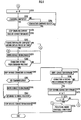
- first control processing is carried out by the charge control unit 11. Specifically, at the time when the charging apparatus 1 is connected to a commercial power supply for example, the first sensor 111 is switched from OFF to ON (S102 in Fig. 6 ), and an index "m" representing the number of times the first connector 12 is tried to be connected to the second connector 22 is reset to an initial value "0" (S104 in Fig. 6 ). It is noted that the first sensor 111 may be maintained at ON continuously. On the condition that the first sensor 111 detects the first mark M 1 provided at the heel (backside of the foot P5) of the robot 2 (YES in S106 in Fig. 6 ), the second sensor 112 is switched from OFF to ON (S108 in Fig. 6 ).
- the connector driving mechanism 13 drives the first connector 12 forward or in the direction approaching the second connector 22 (S114 in Fig. 6 ).
- the first connector 12 is determined whether the first connector 12 has reached an intermediate position within a predetermined period of time (S116 in Fig. 6 ). If the determination result is positive (YES in S116 in Fig. 6 ), the first connector 12 is further driven forward (S118 in Fig. 6 ). It is then determined whether the first connector 12 has reached a connection position within a predetermined period of time (S120 in Fig. 6 ). At the time when the first connector 12 is in the connection position, the tip end of each rod 126 is inserted to the corresponding tube 226, and the pins 127 are each guided to the leading end of the corresponding guide 227.
- the second sensor 112 If the second mark M 2 is not detected by the second sensor 112 (NO in S112 in Fig. 6 ), the second sensor 112 is switched from ON to OFF (S136 in Fig. 6 ). Then, on the condition that the index "m" is not greater than the threshold value "3" (NO in S148 in Fig. 6 ), the detection of the first mark M 1 by the first sensor 111 (see S106 in Fig. 6 ) and the subsequent processing are repeated. On the other hand, if the index "m" has exceeded the threshold value "3", execution of the first control processing is prohibited, and the processing under abnormal conditions, such as an output of sound from a speaker (not shown) or the like, is carried out (YES in S148, and S150 in Fig. 6 ).
- the forward movement of the first connector 12 is stopped (S138 in Fig. 6 ).
- the second sensor 112 is switched from ON to OFF (S140 in Fig. 6 ), and the first connector 12 is driven backward (S142 in Fig. 6 ). Further, it is determined whether the first connector 12 has returned to an initial position within a predetermined period of time (S144 in Fig. 6 ). If the determination result is positive (YES in S144 in Fig. 6 ), the backward movement of the first connector 12 is stopped (S146 in Fig. 6 ).
- "second control processing” is carried out by the charge control unit 11. Specifically, an index “n” representing the number of times the first connector 12 is tried to be disconnected from the second connector 22 is reset to an initial value "0" (S202 in Fig. 7 ). It is further determined whether a charging completion signal indicating that the charging of the battery 20 is complete has been output from the control system 21 (S204 in Fig. 7 ). If the determination result is negative (NO in S204 in Fig. 7 ), it is then determined whether a charging termination command signal indicating that the robot 2 moves away from the charging apparatus 1 has been output from the control system 21 (S206 in Fig. 7 ).
- driving for connector unlock is carried out (S210 in Fig. 7 ), and it is determined whether the connector unlock was completed within a predetermined period of time (S212 in Fig. 7 ). If it is determined that the connector unlock was completed within the predetermined period of time (YES in S212 in Fig. 7 ), the first connector 12 is driven backward by the connector driving mechanism 13 (S214 in Fig. 7 ).
- the tilt angle ⁇ of the body P0 has become equal to or less than a second predetermined angle ⁇ 2 that is smaller than the first predetermined angle ⁇ 1 (S228 in Fig. 7 ). If it is determined that the tilt angle ⁇ of the body P0 is greater than the second predetermined angle ⁇ 2 (NO in S228 in Fig'. 7), the first connector 12 is continuously driven forward (S226 in Fig. 7 ). On the other hand, if it is determined that the tilt angle ⁇ of the body P0 is equal to or smaller than the second predetermined angle ⁇ 2 (YES in S228 in Fig. 7 ), the connector driving mechanism 13 stops driving the first connector 12 forward (S270 in Fig. 7 ), and the index "n" is incremented by 1 (S272 in Fig. 7 .).
- the first connector 12 is driven forward on the condition that it is confirmed that the position and posture of the robot 2 correspond to the predetermined position and the predetermined posture, respectively (see Fig. 5(c) , and S106, S110, S112, S114, and S118 in Fig. 6 ).
- the current output from the charging power source 10 is supplied to the battery 20 via the first charging terminals 122 and the second charging terminals 222 (see S124 and S130 in Fig. 6 ). This prevents the abnormal situation where the charge control unit 11 misunderstands that the battery 20 is being charged despite the fact that the first connector 12 is not connected with the second connector 22.
- the first connector 12 is driven backward to ensure disconnection of the first connector 12 from the second connector 22 (see S214 and S262 in Fig. 7 ).
- the robot 2 is then capable of moving away from the charging apparatus 1 with the movements of the legs P3.
- the'body P0 of the robot 2 would be tilted, as shown in Fig. 9 , as if being pulled backward by the first connector 12.
- it is possible to prevent the robot 2 from becoming unstable in posture by utilizing the fact that the connected state between the first signal terminals 124 and the second signal terminals 224 is maintained as the first connector 12 and the second connector 22 remain connected to each other. More specifically, in the case where the angle signal output from the tilt sensor 216 of the robot 2 is received by the charge control unit while the first connector 12 is being driven backward, the tilt angle ⁇ of the body P0 represented by the angle signal can be recognized (see S220 and S222 in Fig. 7 ).
- That the angle signal can be received means that the connected state of the first connector 12 and the second connector 22 is maintained, and hence, it is highly likely that the posture of the robot 2 will become unstable if the first connector 12 is further driven backward (see Fig. 9 ). Accordingly, driving of the first connector 12 backward is stopped in response to the determination result that the tilt angle ⁇ is not less than the first predetermined angle ⁇ 1 (see S222 and S224 in Fig. 7 ). This prevents the undesirable event that the posture of the robot 2, which is standing still, becomes unstable when the first connector 12 is disconnected from the second connector 22.
- the first connector 12 is driven forward after the backward movement thereof is stopped (see S224 and S226 in Fig. 7 ). Then, at the time when the tilt angle ⁇ becomes equal to or smaller than the second predetermined angle ⁇ 2 that is smaller than the first predetermined angle ⁇ 1, the forward movement of the first connector 12 is stopped, and the first connector 12 is driven backward again (see S228, S270 and S214 in Fig. 7 ). In this manner, the posture of the robot 2 is made closer to the original posture at the time of initiation of the backward movement of the first connector 12 before it becomes unstable, and then, the first connector 12 is driven backward again. In other words, even if disconnection of the first connector 12 from the second connector 22 failed, it is tried again to disconnect the first connector 12 from the second connector 22, while maintaining stable posture of the robot 2.
- the compliance mechanism 134 is provided which accommodates deflection of the cylinder rod 132 in the axial direction (see Fig. 3 ). This allows the first connector 12 to follow displacement of the second connector 22 due to the displacement of the body P0 of the robot 2 which takes place when the robot 2 moves the arm P2 or the like on the spot while the first connector 12 and the second connector 22 are connected to each other. Accordingly, it is possible to prevent the undesirable event that the movement of the robot 2 exerts excessive force on the first connector 12 and the second connector 22, which would otherwise cause damage to the connectors.
- the backward movement of the first connector 12 is restricted based on the angle signal (see S220, S222 and S224 in Fig. 7 ).
- the charge control unit 11 may routinely determine whether communication with the control system 21 is possible (the communication signal is not limited to the angle signal), and the backward movement of the first connector 12 may be restricted on the condition that it is determined that the communication is possible. In this manner, the undesirable event that the posture of the robot 2 becomes unstable can be prevented by utilizing the fact that the connected state between the first signal terminals 124 and the second signal terminals 224 is maintained as the first connector 12 and the second connector 22 remain connected to each other.
- the charge control unit 11 may intermittently determine whether communication with the control system 21 is possible, and the backward movement of the first connector 12 may be restricted if it is determined that the communication is possible.
- a part of the second control processing (see S220, S222, S224, S226, and S228 in Fig. 7 ) may be replaced with a corresponding part of the processing shown in Fig. 8 .
- the description of the steps common to those in Fig. 7 will not be repeated.
- the backward movement of the first connector 12 is stopped on the condition that the first connector 12 has reached a first predetermined position (YES in S240, and S242 in Fig. 8 ). At this time, it is determined whether communication with the control system 21 is possible (S244 in Fig. 8 ). If it is determined that the communication is impossible, the first connector 12 is driven backward again (YES in S244, and S246 in Fig. 8 ). On the other hand, if it is determined that the communication is possible, further backward movement of the first connector 12 is prohibited, and the first connector 12 is driven forward (NO in S244, and S248 in Fig. 8 ). On the condition that the first connector 12 has reached a second predetermined position, the forward movement of the first connector 12 is stopped, and the first connector 12 is driven backward again (YES in S250, S270, and S272 in Fig. 8 ).
- the charge control unit 11 determines whether communication with the control system 21 of the robot 2 is possible in the state where the first connector 12 is stopped at the first predetermined position after driven backward (see S244 in Fig. 8 ). That the communication is possible in this state means that the connected state of the first connector 12 and the second connector 22 is maintained, and hence, it is highly likely that the posture of the robot 2 may become unstable if the first connector 12 is further driven backward (see Fig. 9 ). Thus, further backward movement of the first connector 12 is prohibited in response to the determination result that the communication is possible. This prevents the undesirable event that the posture of the robot 2, which is standing still, becomes unstable when the first connector 12 is disconnected from the second connector 22.
- the first connector 12 is driven backward again after the posture of the robot 2 is made to be similar to the original posture at the time of initiation of the backward movement of the first connector 12, to prevent the posture of the robot 2 from becoming unstable (see S248, S250, S270, and S272 in Fig. 8 ). In other words, even if disconnection between the first connector 12 and the second connector 22 failed, it may be tried again to disconnect the first connector 12 from the second connector 22 while maintaining stable posture of the robot 2.
- the charge control unit 11 causes the connector-driving mechanism 13 to stepwise or steplessly decrease the speed of driving the first connector 12 backward, with an increase in amount of backward movement of the first connector 12 by the connector driving mechanism 13. This allows the first connector 12 to be driven backward at a gradually decreased speed as the probability that the posture of the robot 2, which is standing still, may be unstable increases (see Fig. 9 ).
- the first connector 12 is driven back and forth in the horizontal direction.
- the first connector 12 may be driven back and forth in any direction in which the horizontal component of the force acts on the robot 2 during the backward driving thereof.
Landscapes
- Engineering & Computer Science (AREA)
- Robotics (AREA)
- Mechanical Engineering (AREA)
- Manufacturing & Machinery (AREA)
- Chemical & Material Sciences (AREA)
- Chemical Kinetics & Catalysis (AREA)
- Electrochemistry (AREA)
- General Chemical & Material Sciences (AREA)
- Manipulator (AREA)
- Charge And Discharge Circuits For Batteries Or The Like (AREA)
- Secondary Cells (AREA)
Abstract
Description
- The present invention relates to an apparatus for charging a battery mounted on a robot.
- There has been proposed an apparatus for charging a battery mounted on a robot, the robot having a plurality of legs extended from its body and capable of being still or moving while standing on the legs as the operations of the legs are controlled by a control system (see Japanese Patent Application Laid-Open No.
06-031668 - However, in the case where the first connector is moved while the robot is standing still so as to switch the first and second connectors from the connected state to the disconnected state, some force may be applied to the robot to cause its posture to become unstable.
- In view of the foregoing, an object of the present invention is to provide an apparatus capable of charging a battery mounted on a robot while allowing the robot to remain stably still in the state of standing on its legs.
- A charging apparatus in accordance with a first aspect of the invention comprises an apparatus for charging a battery mounted on a robot, the robot having a plurality of legs extended from its body and capable of being still or moving in a state of standing on the legs, with operations of the legs controlled by a control system, the apparatus comprising a charging power source, a first connector, a connector driving mechanism which drives the first connector, and a charge control unit which controls an operation of the connector driving mechanism, the first connector having a first charging terminal and a first signal terminal, wherein the body has a second connector connected to the first connector, the second connector having a second charging terminal and a second signal terminal, and the first and second charging terminals are connected and the first and second signal terminals are connected in a connected state of the first and second connectors, whereas the first and second charging terminals are disconnected and the first and second signal terminals are disconnected in a disconnected state of the first and second connectors, and wherein the charge control unit causes the connector driving mechanism to drive the first connector forward to attain the connected state of the first and second connectors on the condition that the charge control unit confirms that the robot is standing still on the legs in a predetermined position and at a predetermined posture with the first and second connectors in the disconnected state, the charge control unit allows the battery to be charged with a current output from the charging power source via the first and second charging terminals on the condition that the charge control unit confirms through communication with the control system via the first and second signal terminals that the first and second connectors are in the connected state, and the charge control unit causes the connector driving mechanism to drive the first connector backward to allow the first and second connectors in the connected state to attain the disconnected state, and the charge control unit restricts an amount by which the first connector is driven backward on the condition that the charge control unit is capable of communicating with the control system via the first and second signal terminals during the time when the first connector is driven backward.
- According to the charging apparatus of the first aspect, the first connector is driven forward on the condition that it is confirmed that the position and posture of the robot correspond respectively to a predetermined position and a predetermined posture. Therefore, if the condition is satisfied that the robot is standing still in the predetermined position and at the predetermined posture, the first connector is driven forward to ensure connection between the first and second connectors, without forcing any further operation to the robot for posture change or the like.
- Further, the current output from the charging power source is supplied to the battery via the first and second charging terminals on the condition that the connected state is confirmed as the charge control unit communicates with the control system of the robot via the first and second signal terminals. This prevents the abnormal event that the charge control unit misunderstands that the battery is being charged despite the disconnected state of the first and second connectors.
- Furthermore, the first connector is driven backward at the time of completion of battery charge or the like, which ensures disconnection between the first and second connectors. Then, the robot is capable of moving away from the charging apparatus by the operation of the legs.
- If the first connector is driven backward while the first and second connectors are still connected to each other, the body of the robot will be tilted as if being pulled by the first connector. However, the undesirable event that the posture of the robot becomes unstable can be prevented by utilizing the fact that the connected state of the first and second signal terminals is maintained as the first and second connectors remain connected to each other. In other words, the backward movement of the first connector is restricted in the state where the charge control unit is capable of communicating with the control system via the first and second signal terminals. This prevents the robot from becoming unstable in posture due to the first connector being driven backward unconditionally.
- Preferably, in the charging apparatus of the first aspect, and in accordance with a second aspect of the invention, at the time when the charge control unit causes the connector driving mechanism to drive the first connector backward, in the case where the charge control unit is capable of receiving via the first and second signal terminals an angle signal output from a tilt sensor provided in the robot and in the case where a tilt angle of the body with respect to a vertical direction represented by the angle signal is not less than a first predetermined angle, the charge control unit causes the connector driving mechanism to stop driving the first connector backward.
- According to the charging apparatus of the second aspect described above, in the case where the charge control unit receives an angle signal output from the tilt sensor of the robot while the first connector is being driven backward, the tilt angle of the body represented by the angle signal can be recognized. That the angle signal can be received means that the connected state of the first and second connectors is maintained, and hence, it is highly likely that the posture of the robot will become unstable if the first connector is further driven backward. Thus, the backward movement of the first connector is stopped in response to the determination result that the tilt angle is not smaller than the first predetermined angle. This prevents the robot, which is standing still, from becoming unstable in posture when the first connector is disconnected from the second connector.
- Preferably, in the charging apparatus of the second aspect, and in accordance with a third aspect of the invention, the charge control unit causes the connector driving mechanism to stop driving the first connector backward and to drive the first connector forward, and in the case where the tilt angle of the body with respect to the vertical direction represented by the angle signal becomes not more than a second predetermined angle that is smaller than the first predetermined angle, the charge control unit causes the connector driving mechanism to stop driving the first connector forward and to drive the first connector backward again.
- According to the charging apparatus of the third aspect, the posture of the robot is made closer to the original posture upon initiation of the backward movement of the first connector before it becomes stable, and then the first connector is driven backward again. That is, even if disconnection of the first connector from the second connector failed, it is tried again to disconnect the first connector from the second connector while maintaining the stable posture of the robot.
- Preferably, in the charging apparatus of the third aspect, and in accordance with a fourth aspect of the invention, the charge control unit causes the connector driving mechanism to stop driving the first connector further backward in the case where the number of times the connected state of the first and second connectors is tried to be changed to the disconnected state or an accumulated time exceeds a threshold value.
- According to the charging apparatus of the fourth aspect, in the abnormal situation where it is not possible to disconnect the first connector from the second connector after repeatedly driving the first connector backward or the like, it is prohibited to drive the first connector further backward. This ensures motion economy of the charging apparatus.
- In other embodiments of charging apparatus in accordance with the first aspect, and in accordance with a fifth aspect of the invention, the charge control unit causes the connector driving mechanism to drive the first connector backward and to stop the first connector in a first predetermined position, determines whether communication with the control system is possible, and, on the condition that the communication is possible, prohibits the connector driving mechanism from driving the first connector further backward.
- According to the charging apparatus of the fifth aspect, in the state where the first connector is driven backward and then stopped in a first predetermined position, the charge control unit determines whether communication with the control system of the robot is possible. That the communication is possible in this state means that the connected state of the first and second connectors is maintained, and hence, it is highly likely that the posture of the robot will become unstable if the first connector is driven further backward. Thus, it is prohibited to drive the first connector further backward in response to the determination result that the communication is possible. This prevents the robot, which is standing still, from becoming unstable in posture when the first connector is disconnected from the second connector.
- Preferably, in the charging apparatus of the fifth aspect, and in accordance with a sixth aspect of the invention, after prohibiting the connector driving mechanism from driving the first connector further backward, the charge control unit causes the connector driving mechanism to drive the first connector forward and to stop the first connector in a second predetermined position, and causes the connector driving mechanism to drive the first connector backward again.
- According to the charging apparatus of the sixth aspect, the posture of the robot is made closer to the original posture at the time of initiation of the backward movement of the first connector to prevent the robot from suffering unstable posture, and then the first connector is driven backward again. That is, even if disconnection of the first connector from the second connector failed, it is tried again to disconnect the first connector from the second connector while securing the stable posture of the robot.
- Preferably, in the charging apparatus of the sixth aspect, and in accordance with a seventh aspect of the invention, the charge control unit causes the connector driving mechanism to stop driving the first connector further backward in the case where the number of times the connected state of the first and second connectors is tried to be changed to the disconnected state or an accumulated time exceeds a threshold value.
- According to the charging apparatus of the seventh aspect, in the abnormal situation where it is not possible to disconnect the first connector from the second connector after repeatedly driving the first connector backward or the like, further backward driving of the first connector is stopped. This ensures motion economy of the charging apparatus.
- In preferred embodiments of charging apparatus in accordance with any of the first through seventh aspects, and in accordance with an eighth aspect of the invention, with an increase of an amount by which the first connector is driven backward by the connector driving mechanism, the charge control unit causes the connector driving mechanism to stepwise or steplessly decrease a speed of driving the first connector backward.
- According to the charging apparatus of the eighth aspect, as the probability that the posture of the robot, which is standing still, becomes unstable increases, the first connector is driven backward with a gradually decreased speed. This prevents the robot, which is standing still, from becoming unstable in posture due to the event that, at the time when the first connector is disconnected from the second connector while the robot's body is tilted with respect to the vertical direction, the robot continues to move by inertia caused by the force applied to the body from the first connector to that time.
- In preferred embodiments of charging apparatus in accordance with any of the first through eighth aspects, and in accordance with a ninth aspect of the invention, the first connector has a first engagement portion and the second connector has a second engagement portion, and the first and second engagement portions are engaged in the connected state of the first and second connectors, whereas the first and second engagement portions are disengaged in the disconnected state of the first and second connectors.
- According to the charging apparatus of the ninth aspect, engagement between the first and second engagement portions ensures the connected state of the first and second connectors. On the other hand, during the time when the first connector is driven backward, if failure in disengagement of the first and second engagement portions causes failure in disconnection of the first and second connectors, the backward driving of the first connector is stopped as described above. This prevents the robot from becoming unstable in posture.
- Preferably, in the charging apparatus of the ninth aspect, and in accordance with a tenth aspect of the invention, the first engagement portion corresponds to a pin protruding in a radial direction from a sidewall of a rod provided in the first connector, the rod having a tip end located closer to the second connector than the first charging terminal and the first signal terminal in the state where the robot is in the predetermined position and at the predetermined posture, the rod being rotated about an axis by a rod rotating mechanism, the second engagement portion corresponds to a terminal end of a guide formed on a sidewall of a tube to and from which the rod is inserted and extracted in an axial direction, the guide being adapted to guide the pin in a circumferential direction of the tube as the rod is moved in the axial direction while being rotated about the axis to be inserted to or extracted from the tube, and the charge control unit causes the rod rotating mechanism to rotate the rod about the axis, and causes the connector driving mechanism to drive the first connector forward or backward such that the rod moves in the axial direction.
- According to the charging apparatus of the tenth aspect, the first connector is driven forward while the rod is being rotated about the axis, in the clockwise direction for example. This allows the rod to be inserted into the tube gradually, with the pin protruding from the sidewall of the rod being guided by the guide formed on the sidewall of the tube toward the terminal end of the guide. Further, the first charging terminal and the first signal terminal are connected to the second charging terminal and the second signal terminal, respectively. Even if there occurs more or less misalignment between the first and second connectors, such misalignment is corrected during the process where the rod is inserted into the tube. The engagement of the pin with the terminal end of the guide ensures the connected state of the first and second connectors.
- The first connector is driven backward while the rod is rotated about the axis, in the anti-clockwise direction for example. As such, the rod is gradually extracted from the rod, with the pin being guided by the guide toward the leading end of the guide. Further, the first charging terminal and the first signal terminal are disconnected from the second charging terminal and the second signal terminal, respectively. If the first connector is not disconnected from the second connector due to the pin getting stuck in the guide or the like, the backward movement of the first connector is stopped, thereby preventing the robot from suffering unstable posture.
- In preferred embodiments of charging apparatus in accordance with any of the first through tenth aspects, and in accordance with a eleventh aspect of the invention, the charging apparatus further comprises a compliance mechanism which holds the first connector in a manner allowing the first connector to follow displacement of the second connector due to displacement of the body in the connected state of the first and second connectors.
- According to the charging apparatus of the eleventh aspect, in the case where the robot moves while the first and second connectors are connected to each other and thus causes displacement of the body, the first connector is allowed to follow the displacement of the second connector accompanying the displacement of the body. This prevents the undesirable event that the movement of the robot exerts excessive force on the first and second connectors that would cause damages to the connectors.
- Embodiments of the invention will now be described by way of example only, with reference to the accompanying drawings, wherein:
-
Fig. 1 illustrates the configurations of an embodiment of charging apparatus in accordance with the invention and a robot. -
Fig. 2 illustrates the configurations of first and second connectors. -
Fig. 3 illustrates the configuration of the charging apparatus of the illustrated embodiment of the present invention. -
Fig. 4 illustrates the configuration of the second connector. -
Fig. 5 illustrates how the position and posture are controlled by the robot. -
Fig. 6 illustrates first control processing according to the charging apparatus of the illustrated embodiment of the present invention.. -
Figs. 7 and8 illustrate second control processing according to the charging apparatus of the illustrated embodiment of the present invention. -
Fig. 9 shows, by way of example, states of the charging apparatus and the robot. - An embodiment of the charging apparatus according to the present invention will now be described with reference to the drawings. Firstly, the configurations of the charging apparatus and the robot mounted with the battery to be charged by the charging apparatus will be described.
- The charging
apparatus 1 shown inFig. 1 is for charging abattery 20 mounted on arobot 2 by a current output from a chargingpower source 10. - The charging
apparatus 1 includes: the chargingpower source 10; acharge control unit 11 which primarily controls an operation of the chargingapparatus 1; afirst connector 12; and aconnector driving mechanism 13. The chargingapparatus 1 further includes: afirst sensor 111 which uses infrared light or other light to detect a first mark M1 provided at a heel of therobot 2; and asecond sensor 112 which uses infrared light or other light to detect a second mark M2 provided at the back of a body P0 of therobot 2. - As shown in
Figs. 2 and3 , thefirst connector 12 is provided withfirst charging terminals 122,first signal terminals 124, androds 126, which are arranged side by side to protrude in a horizontal direction. A pair of pins (first engagement portion) 127 is provided on a sidewall of eachrod 126, to protrude therefrom. Therods 126 are each attached to thefirst connector 12 in a manner allowing movement or deflection in its radial direction by virtue of a compliance mechanism. - The
connector driving mechanism 13 is of a cylindrical type. As shown inFig. 3 , theconnector driving mechanism 13 includes: a base 130; aslider 131 having an end to which thefirst connector 12 is attached; acylinder rod 132 which causes theslider 131 to slide back and forth on thebase 130; acompliance mechanism 134 which secures thecylinder rod 132 in a manner allowing its radial movement or deflection; and a rodrotating mechanism 136 which rotates therods 126 about the axis. The position of thefirst connector 12 is measured based on the driven amount of theslider 131 by thecylinder rod 132. - The
robot 2 is a humanoid robot, which is provided with: a head P1 provided on top of the body P0; left and right arms P2 extended from the respective sides of an upper part of the body P0; a hand P4 provided at an end of each of the left and right arms P2; left and right legs P3 extended downward from a lower part of the body P0; and a foot P5 provided at an end of each of the left and right legs P3. Therobot 2 includes: abattery 20; acontrol system 21 which primarily controls an operation of therobot 2; and asecond connector 22 provided on the backside of the body P0. Therobot 2 includes ahead camera 211 mounted on the head P1 and awaist camera 212 provided on the front side of the lower part of the body P0. Therobot 2 further includes various sensors including: atilt sensor 216 which outputs a signal responsive to the tilt angle of the body P0 with respect to its vertical direction, a rotary encoder which outputs a signal responsive to the joint angle of each of the arms P2, legs P3 and the like, and a 6-axis force sensor which outputs a signal responsive to the force acting on the hands P4, feet P5 and the like. Therobot 2 further includes actuators provided at the respective joints as the driving sources of the arms P2, hands P4, legs P3, and the like. - As shown in
Figs. 2 and4 , thesecond connector 22 has second chargingterminals 222,second signal terminals 224, andtubes 226, which are provided side by side. The sidewall of eachtube 226 is partially notched to provide a guide (second engagement portion) 227. - In the connected state of the
first connector 12 and thesecond connector 22, thefirst charging terminals 122 and thefirst signal terminals 124 are connected to thesecond charging terminals 222 and thesecond signal terminals 224, respectively, therods 126 are inserted into thetubes 226, and thepins 127 are each engaged with the terminal end of thecorresponding guide 227. On the other hand, in the disconnected state of thefirst connector 12 and thesecond connector 22, thefirst charging terminals 122 and thefirst signal terminals 124 are separated from thesecond charging terminals 222 and thesecond signal terminals 224, respectively, thepins 127 are disengaged from the terminal ends of theguides 227, and therods 126 are pulled out of thetubes 226. - The functions of the charging
apparatus 1 having the above configuration will now be described. - Firstly, the
robot 2 carries out control such that its position and posture match a predetermined position and a predetermined posture, respectively. For example, therobot 2 moves to come closer to thecharging apparatus 1 as shown inFig. 5(a) , stands with its back facing the chargingapparatus 1 as shown inFig. 5(b) , and moves backward and then stands still as shown inFig. 5(c) . Thecontrol system 21 of therobot 2 is capable of recognizing the existence of the chargingapparatus 1 from an image picked up by thehead camera 211, and capable of recognizing the standing position and posture with respect to thecharging apparatus 1 based on the positions and postures of floor marks FM1 and FM2 picked up by thewaist camera 212. - In the
charging apparatus 1, "first control processing" is carried out by thecharge control unit 11. Specifically, at the time when the chargingapparatus 1 is connected to a commercial power supply for example, thefirst sensor 111 is switched from OFF to ON (S102 inFig. 6 ), and an index "m" representing the number of times thefirst connector 12 is tried to be connected to thesecond connector 22 is reset to an initial value "0" (S104 inFig. 6 ). It is noted that thefirst sensor 111 may be maintained at ON continuously. On the condition that thefirst sensor 111 detects the first mark M1 provided at the heel (backside of the foot P5) of the robot 2 (YES in S106 inFig. 6 ), thesecond sensor 112 is switched from OFF to ON (S108 inFig. 6 ). Further, on the condition that thesecond sensor 112 detects the second mark M2 provided at the back of the body P0 of the robot 2 (YES in S112 inFig. 6 ), theconnector driving mechanism 13 drives thefirst connector 12 forward or in the direction approaching the second connector 22 (S114 inFig. 6 ). - Thereafter, it is determined whether the
first connector 12 has reached an intermediate position within a predetermined period of time (S116 inFig. 6 ). If the determination result is positive (YES in S116 inFig. 6 ), thefirst connector 12 is further driven forward (S118 inFig. 6 ). It is then determined whether thefirst connector 12 has reached a connection position within a predetermined period of time (S120 inFig. 6 ). At the time when thefirst connector 12 is in the connection position, the tip end of eachrod 126 is inserted to thecorresponding tube 226, and thepins 127 are each guided to the leading end of thecorresponding guide 227. - If the determination result is positive (YES in S120 in
Fig. 6 ), driving for connector lock is carried out (S122 inFig. 6 ). At this time, the rodrotating mechanism 136 rotates eachrod 126 about the axis in a prescribed direction. Further, thefirst connector 12 is driven forward to assist achievement of the connector lock. Consequently, therods 126 are each gradually inserted into thecorresponding tube 226 while thepins 127 protruding from the sidewall of therod 126 are each guided by thecorresponding guide 227 of thetube 226, and eachpin 127 reaches and is engaged with the terminal end of thecorresponding guide 227, whereby the connector lock is achieved. With achievement of the connector lock, thefirst connector 12 and thesecond connector 22 are connected to each other. That is, thefirst charging terminals 122 and thefirst signal terminals 124 are connected to thesecond charging terminals 222 and thesecond signal terminals 224, respectively. - It is further determined whether the connector lock was completed within a predetermined period of time, based on the rotation angle of the
rod 126 by the rod rotating mechanism 136 (S124 inFig. 6 ). If the determination result is positive (YES in S124 inFig. 6 ), the forward movement of thefirst connector 12 is stopped (S126 inFig. 6 ), and thesecond sensor 112 is switched from ON to OFF (S128 inFig. 6 ). Charging of thebattery 20 is then started (S130 inFig. 6 ) after thecharge control unit 11 confirms the state-of-charge (SOC) of thebattery 20 by communicating with thecontrol system 21 via thefirst signal terminals 124 and thesecond signal terminals 224. In this manner, the current output from the chargingpower source 10 is supplied to therobot 2 through thefirst charging terminals 122 and thesecond charging terminals 222 for charging of thebattery 20. - If the second mark M2 is not detected by the second sensor 112 (NO in S112 in
Fig. 6 ), thesecond sensor 112 is switched from ON to OFF (S136 inFig. 6 ). Then, on the condition that the index "m" is not greater than the threshold value "3" (NO in S148 inFig. 6 ), the detection of the first mark M1 by the first sensor 111 (see S106 inFig. 6 ) and the subsequent processing are repeated. On the other hand, if the index "m" has exceeded the threshold value "3", execution of the first control processing is prohibited, and the processing under abnormal conditions, such as an output of sound from a speaker (not shown) or the like, is carried out (YES in S148, and S150 inFig. 6 ). - If the
first connector 12 fails to reach the intermediate position or the connection position within a predetermined period of time (NO in S116 or NO in S120 inFig. 6 ), the forward movement of thefirst connector 12 is stopped (S138 inFig. 6 ). Thesecond sensor 112 is switched from ON to OFF (S140 inFig. 6 ), and thefirst connector 12 is driven backward (S142 inFig. 6 ). Further, it is determined whether thefirst connector 12 has returned to an initial position within a predetermined period of time (S144 inFig. 6 ). If the determination result is positive (YES in S144 inFig. 6 ), the backward movement of thefirst connector 12 is stopped (S146 inFig. 6 ). Further, on the condition that the index "m" is not greater than "3" (NO in S148 inFig. 6 ), the detection of the first mark M1 by the first sensor 111 (see S106 inFig. 6 ) and the subsequent processing are repeated. On the other hand, if the index "m" is greater than "3" (YES in S148 inFig. 6 ), the processing under abnormal conditions is carried out (S150 inFig. 6 ). - In the case where the connector lock is not completed within a predetermined period of time because the
pin 127 gets stuck on the midway of theguide 227 for example (NO in S124 inFig. 6 ), driving for connector unlock is carried out (S132 inFig. 6 ). At this time, the rodrotating mechanism 136 rotates therods 126 about the axis in the direction opposite from the direction at the time of driving for connector lock. Thefirst connector 12 may also be driven backward to assist achievement of the connector unlock. Consequently, eachrod 126 is gradually pulled out of thetube 226, while thepins 127 protruding from the sidewall of therod 126 are each guided by thecorresponding guide 227 of thetube 226, for achievement of the connector unlock. With achievement of the connector unlock, thefirst connector 12 is disconnected from thesecond connector 22. That is, thefirst charging terminals 122 and thefirst signal terminals 124 are disconnected from thesecond charging terminals 222 and thesecond signal terminals 224, respectively. - It is determined whether the connector unlock was achieved within a predetermined period of time, based on the rotation angle of the
rod 126 by the rod rotating mechanism 136 (S134 inFig. 6 ). If the determination result is positive, switching of thesecond sensor 112 from ON to OFF and other processing are carried out as in the case where it is determined that thefirst connector 12 failed to reach the intermediate position or the connection position within a predetermined period of time (see YES in S134, S140 and others inFig. 6 ). If the determination result is negative, the processing under abnormal conditions is carried out (NO in S134, and S150 inFig. 6 ). - After initiation of charging of the
battery 20, in thecharging apparatus 1, "second control processing" is carried out by thecharge control unit 11. Specifically, an index "n" representing the number of times thefirst connector 12 is tried to be disconnected from thesecond connector 22 is reset to an initial value "0" (S202 inFig. 7 ). It is further determined whether a charging completion signal indicating that the charging of thebattery 20 is complete has been output from the control system 21 (S204 inFig. 7 ). If the determination result is negative (NO in S204 inFig. 7 ), it is then determined whether a charging termination command signal indicating that therobot 2 moves away from the chargingapparatus 1 has been output from the control system 21 (S206 inFig. 7 ). If it is determined that either the charging completion signal or the charging termination command signal has been issued (YES in S204 or YES in S206 inFig. 7 ), supply of the current from the chargingpower source 10 to thebattery 20 is stopped (S208 inFig. 7 ). - Thereafter, driving for connector unlock is carried out (S210 in
Fig. 7 ), and it is determined whether the connector unlock was completed within a predetermined period of time (S212 inFig. 7 ). If it is determined that the connector unlock was completed within the predetermined period of time (YES in S212 inFig. 7 ), thefirst connector 12 is driven backward by the connector driving mechanism 13 (S214 inFig. 7 ). - Further, it is determined whether an angle signal representing a tilt angle θ at which the body P0 of the
robot 2 is tilted with respect to its vertical direction, as shown inFig. 9 , has been output from the tilt sensor 216 (S220 inFig. 7 ). If it is determined that no angle signal has been issued (YES in S220 inFig. 7 ), it is then determined whether thefirst connector 12 has returned to its initial position (S260 inFig. 7 ). If the determination result is negative (NO in S260 inFig. 7 ), thefirst connector 12 is driven backward continuously (S214 inFig. 7 ). On the other hand, if the determination result is positive (YES in S260 inFig. 7 ), the backward movement of thefirst connector 12 is stopped (S262 inFig. 7 ). This completes a series of operations by the chargingapparatus 1. - If it is determined that an angle signal has been issued (NO in S220 in
Fig. 7 ), it is determined whether the tilt angle θ represented by the angle signal is less than a first predetermined angle θ1 (S222 inFig. 7 ). If it is determined that the tilt angle θ of the body P0 is less than the first predetermined angle θ1 (YES in S222 inFig. 7 ), thefirst connector 12 is driven backward continuously (S214 inFig. 7 ). If it is determined that the tilt angle θ of the body P0 is not less than the first predetermined angle θ1 (NO in S222 inFig. 7 ), theconnector driving mechanism 13 stops driving thefirst connector 12 backward (S224 inFig. 7 ), and drives it forward instead (S226 inFig. 7 ). - Further, it is determined whether the tilt angle θ of the body P0 has become equal to or less than a second predetermined angle θ2 that is smaller than the first predetermined angle θ1 (S228 in
Fig. 7 ). If it is determined that the tilt angle θ of the body P0 is greater than the second predetermined angle θ2 (NO in S228 in Fig'. 7), thefirst connector 12 is continuously driven forward (S226 inFig. 7 ). On the other hand, if it is determined that the tilt angle θ of the body P0 is equal to or smaller than the second predetermined angle θ2 (YES in S228 inFig. 7 ), theconnector driving mechanism 13 stops driving thefirst connector 12 forward (S270 inFig. 7 ), and the index "n" is incremented by 1 (S272 inFig. 7 .). - On the condition that the index "n" is not more than the threshold value "3" (NO in S274 in
Fig. 7 ), the series of processing including driving of thefirst connector 12 backward again is repeated (see S214 and others inFig. 7 ). On the other hand, if the index "n" has exceeded the threshold value "3" (YES in S274 inFig. 7 ), the processing under abnormal conditions is carried out (S276 inFig. 7 ). It is noted that the processing under abnormal conditions is carried out (S276 inFig. 7 ) also in the case where the connector unlock is not completed within a predetermined period of time (NO in S212 inFig. 7 ). - According to the
charging apparatus 1 exerting the above-described functions, thefirst connector 12 is driven forward on the condition that it is confirmed that the position and posture of therobot 2 correspond to the predetermined position and the predetermined posture, respectively (seeFig. 5(c) , and S106, S110, S112, S114, and S118 inFig. 6 ). This means that, if therobot 2 attains the state where it stands still in the predetermined position and at the predetermined posture, thefirst connector 12 is driven forward, without forcing any further operation for a posture change or the like to therobot 2, thereby ensuring secure connection between thefirst connector 12 and thesecond connector 22. - Further, on the condition that the connected state is confirmed through communication of the
charge control unit 11 with thecontrol system 21 of therobot 2 via thefirst signal terminals 124 and thesecond signal terminals 224, the current output from the chargingpower source 10 is supplied to thebattery 20 via thefirst charging terminals 122 and the second charging terminals 222 (see S124 and S130 inFig. 6 ). This prevents the abnormal situation where thecharge control unit 11 misunderstands that thebattery 20 is being charged despite the fact that thefirst connector 12 is not connected with thesecond connector 22. - Furthermore, at the time of completion of charging of the
battery 20 or the like, thefirst connector 12 is driven backward to ensure disconnection of thefirst connector 12 from the second connector 22 (see S214 and S262 inFig. 7 ). Therobot 2 is then capable of moving away from the chargingapparatus 1 with the movements of the legs P3. - If the
first connector 12 and thesecond connector 22 are still connected when thefirst connector 12 is driven backward, the'body P0 of therobot 2 would be tilted, as shown inFig. 9 , as if being pulled backward by thefirst connector 12. However, it is possible to prevent therobot 2 from becoming unstable in posture by utilizing the fact that the connected state between thefirst signal terminals 124 and thesecond signal terminals 224 is maintained as thefirst connector 12 and thesecond connector 22 remain connected to each other. More specifically, in the case where the angle signal output from thetilt sensor 216 of therobot 2 is received by the charge control unit while thefirst connector 12 is being driven backward, the tilt angle θ of the body P0 represented by the angle signal can be recognized (see S220 and S222 inFig. 7 ). That the angle signal can be received means that the connected state of thefirst connector 12 and thesecond connector 22 is maintained, and hence, it is highly likely that the posture of therobot 2 will become unstable if thefirst connector 12 is further driven backward (seeFig. 9 ). Accordingly, driving of thefirst connector 12 backward is stopped in response to the determination result that the tilt angle θ is not less than the first predetermined angle θ1 (see S222 and S224 inFig. 7 ). This prevents the undesirable event that the posture of therobot 2, which is standing still, becomes unstable when thefirst connector 12 is disconnected from thesecond connector 22. - Further, the
first connector 12 is driven forward after the backward movement thereof is stopped (see S224 and S226 inFig. 7 ). Then, at the time when the tilt angle θ becomes equal to or smaller than the second predetermined angle θ2 that is smaller than the first predetermined angle θ1, the forward movement of thefirst connector 12 is stopped, and thefirst connector 12 is driven backward again (see S228, S270 and S214 inFig. 7 ). In this manner, the posture of therobot 2 is made closer to the original posture at the time of initiation of the backward movement of thefirst connector 12 before it becomes unstable, and then, thefirst connector 12 is driven backward again. In other words, even if disconnection of thefirst connector 12 from thesecond connector 22 failed, it is tried again to disconnect thefirst connector 12 from thesecond connector 22, while maintaining stable posture of therobot 2. - If the number of times "n" the
first connector 12 is tried to be disconnected from thesecond connector 22 exceeds the threshold value "3", further backward movement of thefirst connector 12 is stopped (S274 and S276 inFig. 7 ). As such, in the abnormal situation where it is not possible to disconnect thefirst connector 12 from thesecond connector 22 by repeatedly driving thefirst connector 12 backward or the like, further backward driving of thefirst connector 12 is prohibited, which ensures motion economy of the chargingapparatus 1. - Furthermore, the
compliance mechanism 134 is provided which accommodates deflection of thecylinder rod 132 in the axial direction (seeFig. 3 ). This allows thefirst connector 12 to follow displacement of thesecond connector 22 due to the displacement of the body P0 of therobot 2 which takes place when therobot 2 moves the arm P2 or the like on the spot while thefirst connector 12 and thesecond connector 22 are connected to each other. Accordingly, it is possible to prevent the undesirable event that the movement of therobot 2 exerts excessive force on thefirst connector 12 and thesecond connector 22, which would otherwise cause damage to the connectors. - In the above-described embodiment, the backward movement of the
first connector 12 is restricted based on the angle signal (see S220, S222 and S224 inFig. 7 ). Alternatively, during the time when thefirst connector 12 is driven backward, thecharge control unit 11 may routinely determine whether communication with thecontrol system 21 is possible (the communication signal is not limited to the angle signal), and the backward movement of thefirst connector 12 may be restricted on the condition that it is determined that the communication is possible. In this manner, the undesirable event that the posture of therobot 2 becomes unstable can be prevented by utilizing the fact that the connected state between thefirst signal terminals 124 and thesecond signal terminals 224 is maintained as thefirst connector 12 and thesecond connector 22 remain connected to each other. In other words, in the situation where thecharge control unit 11 is capable of communicating with thecontrol system 21 via thefirst signal terminals 124 and thesecond signal terminals 224, the backward movement of thefirst connector 12 is restricted. This prevents therobot 2 from becoming unstable in posture due to unconditional driving of thefirst connector 12 backward. - Still alternatively, during the backward movement of the
first connector 12, thecharge control unit 11 may intermittently determine whether communication with thecontrol system 21 is possible, and the backward movement of thefirst connector 12 may be restricted if it is determined that the communication is possible. For example, a part of the second control processing (see S220, S222, S224, S226, and S228 inFig. 7 ) may be replaced with a corresponding part of the processing shown inFig. 8 . In the following explanation of the processing shown inFig. 8 , the description of the steps common to those inFig. 7 will not be repeated. - After completion of the connector unlock, the backward movement of the
first connector 12 is stopped on the condition that thefirst connector 12 has reached a first predetermined position (YES in S240, and S242 inFig. 8 ). At this time, it is determined whether communication with thecontrol system 21 is possible (S244 inFig. 8 ). If it is determined that the communication is impossible, thefirst connector 12 is driven backward again (YES in S244, and S246 inFig. 8 ). On the other hand, if it is determined that the communication is possible, further backward movement of thefirst connector 12 is prohibited, and thefirst connector 12 is driven forward (NO in S244, and S248 inFig. 8 ). On the condition that thefirst connector 12 has reached a second predetermined position, the forward movement of thefirst connector 12 is stopped, and thefirst connector 12 is driven backward again (YES in S250, S270, and S272 inFig. 8 ). - According to the
charging apparatus 1 having the above configuration, thecharge control unit 11 determines whether communication with thecontrol system 21 of therobot 2 is possible in the state where thefirst connector 12 is stopped at the first predetermined position after driven backward (see S244 inFig. 8 ). That the communication is possible in this state means that the connected state of thefirst connector 12 and thesecond connector 22 is maintained, and hence, it is highly likely that the posture of therobot 2 may become unstable if thefirst connector 12 is further driven backward (seeFig. 9 ). Thus, further backward movement of thefirst connector 12 is prohibited in response to the determination result that the communication is possible. This prevents the undesirable event that the posture of therobot 2, which is standing still, becomes unstable when thefirst connector 12 is disconnected from thesecond connector 22. - Further, the
first connector 12 is driven backward again after the posture of therobot 2 is made to be similar to the original posture at the time of initiation of the backward movement of thefirst connector 12, to prevent the posture of therobot 2 from becoming unstable (see S248, S250, S270, and S272 inFig. 8 ). In other words, even if disconnection between thefirst connector 12 and thesecond connector 22 failed, it may be tried again to disconnect thefirst connector 12 from thesecond connector 22 while maintaining stable posture of therobot 2. - Further, it may also be configured such that the
charge control unit 11 causes the connector-drivingmechanism 13 to stepwise or steplessly decrease the speed of driving thefirst connector 12 backward, with an increase in amount of backward movement of thefirst connector 12 by theconnector driving mechanism 13. This allows thefirst connector 12 to be driven backward at a gradually decreased speed as the probability that the posture of therobot 2, which is standing still, may be unstable increases (seeFig. 9 ). This prevents the posture of therobot 2, which is standing still, from becoming unstable due to the event that, at the time when thefirst connector 12 is disconnected from thesecond connector 22 while the body P0 of therobot 2 is tilted with respect to the vertical direction, therobot 2 continues to move by inertia caused by the force applied to the body P0 from thefirst connector 12 to that time. - In the above-described embodiments, the
first connector 12 is driven back and forth in the horizontal direction. In another embodiment, thefirst connector 12 may be driven back and forth in any direction in which the horizontal component of the force acts on therobot 2 during the backward driving thereof.
Claims (11)
- An apparatus for charging a battery mounted on a robot, the robot having a plurality of legs extended from its body and capable of being still or moving in a state of standing on the legs, with operations of the legs controlled by a control system,
the apparatus comprising a charging power source, a first connector, a connector driving mechanism which drives the first connector, and a charge control unit which controls an operation of the connector driving mechanism, the first connector having a first charging terminal and a first signal terminal, wherein
the body has a second connector connected to the first connector, the second connector having a second charging terminal and a second signal terminal, and the first and second charging terminals are connected and the first and second signal terminals are connected in a connected state of the first and second connectors, whereas the first and second charging terminals are disconnected and the first and second signal terminals are disconnected in a disconnected state of the first and second connectors, and wherein
the charge control unit causes the connector driving mechanism to drive the first connector forward to attain the connected state of the first and second connectors on the condition that the charge control unit confirms that the robot is standing still on the legs in a predetermined position and at a predetermined posture with the first and second connectors in the disconnected state,
the charge control unit allows the battery to be charged with a current output from the charging power source via the first and second charging terminals on the condition that the charge control unit confirms through communication with the control system via the first and second signal terminals that the first and second connectors are in the connected state, and
the charge control unit causes the connector driving mechanism to drive the first connector backward to allow the first and second connectors in the connected state to attain the disconnected state, and the charge control unit restricts an amount by which the first connector is driven backward on the condition that the charge control unit is capable of communicating with the control system via the first and second signal terminals during the time when the first connector is driven backward. - The charging apparatus according to claim 1, wherein
at the time when the charge control unit causes the connector driving mechanism to drive the first connector backward, in the case where the charge control unit is capable of receiving via the first and second signal terminals an angle signal output from a tilt sensor provided in the robot and in the case where a tilt angle of the body with respect to a vertical direction represented by the angle signal is not less than a first predetermined angle, the charge control unit causes the connector driving mechanism to stop driving the first connector backward. - The charging apparatus according to claim 2, wherein
the charge control unit causes the connector driving mechanism to stop driving the first connector backward and to drive the first connector forward, and in the case where the tilt angle of the body with respect to the vertical direction represented by the angle signal becomes not more than a second predetermined angle that is smaller than the first predetermined angle, the charge control unit causes the connector driving mechanism to stop driving the first connector forward and to drive the first connector backward again. - The charging apparatus according to claim 3, wherein
in the case where the number of times the connected state of the first and second connectors is tried to be changed to the disconnected state or an accumulated time exceeds a threshold value, the charge control unit causes the connector driving mechanism to stop driving the first connector further backward. - The charging apparatus according to claim 1, wherein
the charge control unit causes the connector driving mechanism to drive the first connector backward and to stop the first connector in a first predetermined position, determines whether communication with the control system is possible, and, on the condition that the communication is possible, prohibits the connector driving mechanism from driving the first connector further backward. - The charging apparatus according to claim 5, wherein
after prohibiting the connector driving mechanism from driving the first connector further backward, the charge control unit causes the connector driving mechanism to drive the first connector forward and to stop the first connector in a second predetermined position, and causes the connector driving mechanism to drive the first connector backward again. - The charging apparatus according to claim 6, wherein
in the case where the number of times the connected state of the first and second connectors is tried to be changed to the disconnected state or an accumulated time exceeds a threshold value, the charge control unit causes the connector driving mechanism to stop driving the first connector further backward. - The charging apparatus according to any one of claims 1 to 7, wherein
with an increase of an amount by which the first connector is driven backward by the connector driving mechanism, the charge control unit causes the connector driving mechanism to stepwise or steplessly decrease a speed of driving the first connector backward. - The charging apparatus according to any one of claims 1 to 8, wherein
the first connector has a first engagement portion and the second connector has a second engagement portion, and the first and second engagement portions are engaged in the connected state of the first and second connectors, whereas the first and second engagement portions are disengaged in the disconnected state of the first and second connectors. - The charging apparatus according to claim 9, wherein
the first engagement portion corresponds to a pin protruding in a radial direction from a sidewall of a rod provided in the first connector, the rod having a tip end located closer to the second connector than the first charging terminal and the first signal terminal in the state where the robot is in the predetermined position and at the predetermined posture, the rod being rotated about an axis by a rod rotating mechanism,
the second engagement portion corresponds to a terminal end of a guide formed on a sidewall of a tube to and from which the rod is inserted and extracted in an axial direction, the guide being adapted to guide the pin in a circumferential direction of the tube as the rod is moved in the axial direction while being rotated about the axis to be inserted to or extracted from the tube, and
the charge control unit causes the rod rotating mechanism to rotate the rod about the axis, and causes the connector driving mechanism to drive the first connector forward or backward such that the rod moves in the axial direction. - The charging apparatus according to any one of claims 1 to 10, comprising a compliance mechanism which holds the first connector in a manner allowing the first connector to follow displacement of the second connector due to displacement of the body in the connected state of the first and second connectors.
Applications Claiming Priority (1)
| Application Number | Priority Date | Filing Date | Title |
|---|---|---|---|
| JP2007095979A JP4893887B2 (en) | 2007-04-02 | 2007-04-02 | Charger |
Publications (2)
| Publication Number | Publication Date |
|---|---|
| EP2052819A1 true EP2052819A1 (en) | 2009-04-29 |
| EP2052819B1 EP2052819B1 (en) | 2010-08-18 |
Family
ID=39793133
Family Applications (1)
| Application Number | Title | Priority Date | Filing Date |
|---|---|---|---|
| EP08251291A Expired - Fee Related EP2052819B1 (en) | 2007-04-02 | 2008-04-02 | Charging apparatus for robot with legs |
Country Status (4)
| Country | Link |
|---|---|
| US (1) | US7642745B2 (en) |
| EP (1) | EP2052819B1 (en) |
| JP (1) | JP4893887B2 (en) |
| DE (1) | DE602008002199D1 (en) |
Families Citing this family (22)
| Publication number | Priority date | Publication date | Assignee | Title |
|---|---|---|---|---|
| JP4882114B2 (en) * | 2007-11-09 | 2012-02-22 | 本田技研工業株式会社 | Charging device and charging method for walking robot |
| JP5213023B2 (en) * | 2008-01-15 | 2013-06-19 | 本田技研工業株式会社 | robot |
| JP4479844B2 (en) | 2008-09-30 | 2010-06-09 | トヨタ自動車株式会社 | Vehicle hood structure |
| JP4709890B2 (en) * | 2008-12-12 | 2011-06-29 | 本田技研工業株式会社 | Detection function inspection method and detection function inspection sheet in autonomous mobile device |
| US8212533B2 (en) * | 2009-12-23 | 2012-07-03 | Toyota Motor Engineering & Manufacturing North America, Inc. | Robot battery charging apparatuses and methods |
| JP5803043B2 (en) * | 2010-05-20 | 2015-11-04 | アイロボット コーポレイション | Mobile robot system and method for operating a mobile robot |
| US8442682B2 (en) * | 2010-05-28 | 2013-05-14 | Toyota Motor Engineering & Manufacturing North America, Inc. | Autonomous robot charging stations and methods |
| JP5898002B2 (en) * | 2012-06-28 | 2016-04-06 | 本田技研工業株式会社 | Mobile robot controller |
| JP2014073540A (en) * | 2012-10-03 | 2014-04-24 | Seiko Epson Corp | Robot and robot system |
| KR101951089B1 (en) * | 2017-01-06 | 2019-02-22 | 박관철 | Automatic charging vehicle for unmanned vehicle |
| KR101951092B1 (en) * | 2017-02-07 | 2019-02-22 | 박관철 | Battery Auto Charger |
| JP7120509B2 (en) * | 2018-03-09 | 2022-08-17 | Thk株式会社 | flying robot |
| KR102019285B1 (en) * | 2019-02-01 | 2019-09-06 | (주)에바 | Charging connector, docking soket and docking assembly for electric vehicle charging |
| NL2023019B1 (en) * | 2019-04-29 | 2020-11-05 | Rocsys B V | Charging infrastructure with a charging station for a vehicle |
| KR102063906B1 (en) * | 2019-07-17 | 2020-02-11 | 이엠티씨 주식회사 | Battery replacement device for track vehicles and charging station system having same |
| CN112137361B (en) * | 2020-09-29 | 2022-08-23 | 江苏苏宁银行股份有限公司 | Multifunctional assembled bank counter |
| KR20230024148A (en) | 2021-08-11 | 2023-02-20 | 현대자동차주식회사 | Fluid supply system in docing station for mobile devices and control method of the same |
| KR20230024147A (en) | 2021-08-11 | 2023-02-20 | 현대자동차주식회사 | Autonomous mobile device, docking station and control method for the autonomous mobile device |
| EP4442488A1 (en) * | 2021-12-03 | 2024-10-09 | Evar Inc. | Docking connector assembly for electric vehicle charger |
| JP7729262B2 (en) * | 2022-05-20 | 2025-08-26 | トヨタ自動車株式会社 | Charging mechanism |
| CN116528144A (en) * | 2022-09-15 | 2023-08-01 | 无锡小天鹅电器有限公司 | Communication control method, device, medium and cleaning system of mobile cleaning equipment |
| US12291117B1 (en) * | 2025-01-14 | 2025-05-06 | Procom Engineering, Inc. | Electric vehicle charge robot plug in mechanism |
Citations (5)
| Publication number | Priority date | Publication date | Assignee | Title |
|---|---|---|---|---|
| JPH0631668A (en) | 1992-07-20 | 1994-02-08 | Honda Motor Co Ltd | Output correction device for tilt sensor for legged mobile robot |
| JP2005149808A (en) * | 2003-11-12 | 2005-06-09 | Matsushita Electric Works Ltd | Power feed device to movable body |
| EP1633029A2 (en) * | 2004-09-01 | 2006-03-08 | HONDA MOTOR CO., Ltd. | Charging system for legged walking robot |
| JP2006231448A (en) * | 2005-02-23 | 2006-09-07 | Mitsubishi Heavy Ind Ltd | Charging station for autonomous mobile robot |
| EP1819026A2 (en) | 2006-02-14 | 2007-08-15 | HONDA MOTOR CO., Ltd. | Charging system for legged mobile robot |
Family Cites Families (9)
| Publication number | Priority date | Publication date | Assignee | Title |
|---|---|---|---|---|
| GB8422527D0 (en) * | 1984-09-06 | 1984-10-10 | Savill I C | Connector apparatus |
| JP2794806B2 (en) * | 1989-07-19 | 1998-09-10 | 日本電気株式会社 | Field effect transistor amplifier |
| JPH03285524A (en) * | 1990-03-30 | 1991-12-16 | Shinko Electric Co Ltd | Power supply for automatic charging of battery in unmanned vehicle |
| JPH0683449A (en) * | 1992-09-02 | 1994-03-25 | Daifuku Co Ltd | Connection status confirmation device for mobile vehicle power supply device |
| EP1120740B1 (en) * | 1999-05-10 | 2007-10-03 | Sony Corporation | Robot device, its control method, and recorded medium |
| JP3988333B2 (en) * | 1999-09-09 | 2007-10-10 | 株式会社デンソー | Charging electrode structure of mobile robot |
| JP2005001099A (en) * | 2003-03-23 | 2005-01-06 | Sony Corp | Robot apparatus and operation control method thereof |
| KR100820743B1 (en) * | 2003-10-21 | 2008-04-10 | 삼성전자주식회사 | Charging device of mobile robot |
| JP4776903B2 (en) * | 2004-09-01 | 2011-09-21 | 本田技研工業株式会社 | Biped walking robot charging system |
-
2007
- 2007-04-02 JP JP2007095979A patent/JP4893887B2/en not_active Expired - Fee Related
-
2008
- 2008-03-31 US US12/059,237 patent/US7642745B2/en active Active
- 2008-04-02 DE DE602008002199T patent/DE602008002199D1/en active Active
- 2008-04-02 EP EP08251291A patent/EP2052819B1/en not_active Expired - Fee Related
Patent Citations (5)
| Publication number | Priority date | Publication date | Assignee | Title |
|---|---|---|---|---|
| JPH0631668A (en) | 1992-07-20 | 1994-02-08 | Honda Motor Co Ltd | Output correction device for tilt sensor for legged mobile robot |
| JP2005149808A (en) * | 2003-11-12 | 2005-06-09 | Matsushita Electric Works Ltd | Power feed device to movable body |
| EP1633029A2 (en) * | 2004-09-01 | 2006-03-08 | HONDA MOTOR CO., Ltd. | Charging system for legged walking robot |
| JP2006231448A (en) * | 2005-02-23 | 2006-09-07 | Mitsubishi Heavy Ind Ltd | Charging station for autonomous mobile robot |
| EP1819026A2 (en) | 2006-02-14 | 2007-08-15 | HONDA MOTOR CO., Ltd. | Charging system for legged mobile robot |
Also Published As
| Publication number | Publication date |
|---|---|
| EP2052819B1 (en) | 2010-08-18 |
| US7642745B2 (en) | 2010-01-05 |
| DE602008002199D1 (en) | 2010-09-30 |
| JP2008254079A (en) | 2008-10-23 |
| JP4893887B2 (en) | 2012-03-07 |
| US20080238365A1 (en) | 2008-10-02 |
Similar Documents
| Publication | Publication Date | Title |
|---|---|---|
| EP2052819B1 (en) | Charging apparatus for robot with legs | |
| US20250121720A1 (en) | Charging infrastructure with a hexapod charging station for a vehicle | |
| US7719229B2 (en) | Charging system for legged mobile robot | |
| KR101146907B1 (en) | Charging system for mobile robot | |
| US11171497B2 (en) | Automatic working system, charging station and method for returning robotic mower to charging station | |
| US7825633B2 (en) | Battery charger | |
| JP5213023B2 (en) | robot | |
| EP1746478B1 (en) | Moving object capable of recognizing image and moving-object directing system equipped with the same | |
| EP2797401B1 (en) | Contact assembly of a robotic garden tool charging device | |
| CN115667006A (en) | Method for controlling charging infrastructure | |
| US20150027862A1 (en) | Robot and emergency stop method of robot | |
| US9853386B1 (en) | Module connection mechanism capable of genderless coupling | |
| EP0624925A1 (en) | Connector with fitting detection function | |
| CN115303105B (en) | Vehicle charging system | |
| EP3605747B1 (en) | Charger | |
| CN110546030A (en) | Apparatus and method for automatically connecting cable to parked vehicle | |
| JP2021023060A (en) | Automatic charging system | |
| JP2012016084A (en) | Charger for mobile body | |
| CN106068583B (en) | Lever Mate Connector | |
| CN112971624B (en) | Dust collecting system of cleaning equipment and dust collecting method thereof | |
| CN219499005U (en) | Limiting module for charging base station, charging base station and cleaning system | |
| JP2008129696A (en) | Mobile robot, mobile robot charging system, and mobile robot charging method | |
| KR102722172B1 (en) | Automatic charging apparatus for autonomous industiral guided vehicle | |
| CN113895295B (en) | Unlocking control method | |
| US20250388105A1 (en) | Method and system for controlling the mating in a system for the autonomous charging of electric vehicles |
Legal Events
| Date | Code | Title | Description |
|---|---|---|---|
| PUAI | Public reference made under article 153(3) epc to a published international application that has entered the european phase |
Free format text: ORIGINAL CODE: 0009012 |
|
| 17P | Request for examination filed |
Effective date: 20080421 |
|
| AK | Designated contracting states |
Kind code of ref document: A1 Designated state(s): AT BE BG CH CY CZ DE DK EE ES FI FR GB GR HR HU IE IS IT LI LT LU LV MC MT NL NO PL PT RO SE SI SK TR |
|
| AX | Request for extension of the european patent |
Extension state: AL BA MK RS |
|
| 17Q | First examination report despatched |
Effective date: 20090424 |
|
| AKX | Designation fees paid |
Designated state(s): DE FR GB |
|
| GRAP | Despatch of communication of intention to grant a patent |
Free format text: ORIGINAL CODE: EPIDOSNIGR1 |
|
| GRAS | Grant fee paid |
Free format text: ORIGINAL CODE: EPIDOSNIGR3 |
|
| GRAA | (expected) grant |
Free format text: ORIGINAL CODE: 0009210 |
|
| AK | Designated contracting states |
Kind code of ref document: B1 Designated state(s): DE FR GB |
|
| REG | Reference to a national code |
Ref country code: GB Ref legal event code: FG4D |
|
| REF | Corresponds to: |
Ref document number: 602008002199 Country of ref document: DE Date of ref document: 20100930 Kind code of ref document: P |
|
| PLBE | No opposition filed within time limit |
Free format text: ORIGINAL CODE: 0009261 |
|
| STAA | Information on the status of an ep patent application or granted ep patent |
Free format text: STATUS: NO OPPOSITION FILED WITHIN TIME LIMIT |
|
| 26N | No opposition filed |
Effective date: 20110519 |
|
| PGFP | Annual fee paid to national office [announced via postgrant information from national office to epo] |
Ref country code: DE Payment date: 20110330 Year of fee payment: 4 |
|
| REG | Reference to a national code |
Ref country code: DE Ref legal event code: R097 Ref document number: 602008002199 Country of ref document: DE Effective date: 20110519 |
|
| REG | Reference to a national code |
Ref country code: FR Ref legal event code: ST Effective date: 20111230 |
|
| PG25 | Lapsed in a contracting state [announced via postgrant information from national office to epo] |
Ref country code: FR Free format text: LAPSE BECAUSE OF NON-PAYMENT OF DUE FEES Effective date: 20110502 |
|
| GBPC | Gb: european patent ceased through non-payment of renewal fee |
Effective date: 20120402 |
|
| PG25 | Lapsed in a contracting state [announced via postgrant information from national office to epo] |
Ref country code: GB Free format text: LAPSE BECAUSE OF NON-PAYMENT OF DUE FEES Effective date: 20120402 |
|
| REG | Reference to a national code |
Ref country code: DE Ref legal event code: R119 Ref document number: 602008002199 Country of ref document: DE Effective date: 20121101 |
|
| PG25 | Lapsed in a contracting state [announced via postgrant information from national office to epo] |
Ref country code: DE Free format text: LAPSE BECAUSE OF NON-PAYMENT OF DUE FEES Effective date: 20121101 |