EP2043403A2 - Drahtlose Kommunikationssysteme - Google Patents
Drahtlose Kommunikationssysteme Download PDFInfo
- Publication number
- EP2043403A2 EP2043403A2 EP08154587A EP08154587A EP2043403A2 EP 2043403 A2 EP2043403 A2 EP 2043403A2 EP 08154587 A EP08154587 A EP 08154587A EP 08154587 A EP08154587 A EP 08154587A EP 2043403 A2 EP2043403 A2 EP 2043403A2
- Authority
- EP
- European Patent Office
- Prior art keywords
- resource allocation
- base station
- subscriber stations
- wireless communication
- allocation information
- Prior art date
- Legal status (The legal status is an assumption and is not a legal conclusion. Google has not performed a legal analysis and makes no representation as to the accuracy of the status listed.)
- Withdrawn
Links
Images
Classifications
-
- H—ELECTRICITY
- H04—ELECTRIC COMMUNICATION TECHNIQUE
- H04W—WIRELESS COMMUNICATION NETWORKS
- H04W72/00—Local resource management
- H04W72/04—Wireless resource allocation
-
- H—ELECTRICITY
- H04—ELECTRIC COMMUNICATION TECHNIQUE
- H04W—WIRELESS COMMUNICATION NETWORKS
- H04W72/00—Local resource management
- H04W72/20—Control channels or signalling for resource management
- H04W72/23—Control channels or signalling for resource management in the downlink direction of a wireless link, i.e. towards a terminal
-
- H—ELECTRICITY
- H04—ELECTRIC COMMUNICATION TECHNIQUE
- H04W—WIRELESS COMMUNICATION NETWORKS
- H04W72/00—Local resource management
- H04W72/04—Wireless resource allocation
- H04W72/044—Wireless resource allocation based on the type of the allocated resource
- H04W72/0446—Resources in time domain, e.g. slots or frames
-
- H—ELECTRICITY
- H04—ELECTRIC COMMUNICATION TECHNIQUE
- H04W—WIRELESS COMMUNICATION NETWORKS
- H04W72/00—Local resource management
- H04W72/20—Control channels or signalling for resource management
- H04W72/21—Control channels or signalling for resource management in the uplink direction of a wireless link, i.e. towards the network
Definitions
- the present invention relates to wireless communication systems of the type in which a base station (BS) communicates with multiple fixed or mobile subscriber stations (MS), and more particularly to resource allocation within such systems.
- BS base station
- MS mobile subscriber stations
- IEEE 802.16 specifications and is commonly known as WiMAX.
- the specifications include IEEE 802.16-2004, primarily intended for systems having fixed subscriber stations, and IEEE 802.16e-2005 which among other things provides for mobile subscriber stations.
- MS is used as shorthand for both mobile and fixed subscriber stations.
- the term "user” is also used equivalently to mobile or fixed subscriber station.
- IEEE 802.16-2004 Air Interface for Fixed Broadband Wireless Access Systems
- IEEE Std 802.16e-2005 Amendment 2 and Corrigendum 1 to IEEE Std 802.16-2004
- IEEE 802.16 defines wireless communication systems in which the mobile stations communicate with a base station within range, the range of a base station defining at least one "cell".
- a connection (management connection or transport connection) is maintained between them.
- channel is sometimes used to refer to such a connection between one MS and its BS, as should be clear from the context.
- the direction of transmission of packets from the subscriber station to the base station is the uplink (UL), and the direction from the base station to the subscriber station is the downlink (DL).
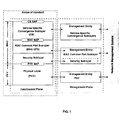
- the packets have a defined format which follows a layered protocol applied to the system and its component radio devices. Protocol layers relevant to packets as such are the so-called physical layer (PHY) and media access layer (MAC). In the IEEE 802.16-2004 specification, these protocol layers form a protocol "stack" as shown in Fig. 1 .
- the media access layer shown in Fig. 1 is the protocol layer of most concern in the invention to be described. It is responsible for handling various functions including network access, bandwidth allocation, and maintaining connections. This includes controlling access of the BS and SS's to the radio medium on the basis of "frames" which are the predetermined unit of time in the system, and which are divided in the time and frequency domain into a number of slots, and when utilising multiple transmit antennas may also be divided spatially into a number of streams.
- frames are the predetermined unit of time in the system, and which are divided in the time and frequency domain into a number of slots, and when utilising multiple transmit antennas may also be divided spatially into a number of streams.
- connection ID (CID)
- MS connection ID
- TDD time division duplex
- FDD frequency division duplex
- the PHY layer also defines the transmission technique such as OFDM (orthogonal frequency division multiplexing) or OFDMA (orthogonal frequency division multiple access), which techniques will now be outlined briefly.
- each sub-carrier signal has its own frequency range. This allows the total bandwidth (i.e. the amount of data to be sent in a given time interval) to be divided over a plurality of sub-carriers thereby increasing the duration of each data symbol. Since each sub-carrier has a lower information rate, multi-carrier systems benefit from enhanced immunity to channel induced distortion compared with single carrier systems. This is made possible by ensuring that the transmission rate and hence bandwidth of each subcarrier is less than the coherence bandwidth of the channel. As a result, the channel distortion experienced on a single subcarrier is frequency independent and can hence be corrected by a simple phase and amplitude correction factor. Thus the channel distortion correction entity within a multicarrier receiver can be of significantly lower complexity of its counterpart within a single carrier receiver when the system bandwidth is in excess of the coherence bandwidth of the channel.
- An OFDM system uses a plurality of sub-carrier frequencies which are orthogonal in a mathematical sense so that the sub-carriers' spectra may overlap without interference due to the fact they are mutually independent.
- the orthogonality of OFDM systems removes the need for guard band frequencies and thereby increases the spectral efficiency of the system.
- OFDM has been proposed and adopted for many wireless systems.
- a block of N modulated parallel data source signals is mapped to N orthogonal parallel sub-carriers by using an Inverse Discrete or Fast Fourier Transform algorithm (IDFT/IFFT) to form a signal known as an "OFDM symbol" in the time domain at the transmitter.
- IDFT/IFFT Inverse Discrete or Fast Fourier Transform algorithm
- an "OFDM symbol” is the composite signal of all N sub-carrier signals.
- DFT Discrete Fourier Transform
- FFT Fast Fourier Transform
- OFDMA Orthogonal Frequency Division Multiple Access
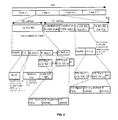
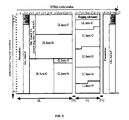
- FIGS 2 and 3 illustrate the TDD frame structure used in the OFDM/OFDMA physical layer mode of the IEEE802.16 standard (WiMAX).
- Fig. 2 shows an OFDM TDD frame structure from a packet perspective.
- the UL subframe shown in Fig. 2 first provides a contention slot for initial ranging.
- Initial ranging is the process by which an MS is admitted to the network, and involves the MS using the slot, on a contended basis (that is, in competition with any similar ranging requests from other users) to send an ID code to the BS, commonly referred to as a CDMA based ranging request.
- the BS responds to receipt of a ranging code by making a resource allocation on the next UL subframe.
- the BS does not yet know which MS made the CDMA based ranging request, the intended recipient is able to use the allocated resource to reply with a message (typically RNG-REQ, a MAC management message as referred to below) to identify itself and start off the network entry procedure.
- a message typically RNG-REQ, a MAC management message as referred to below
- the next resource allocated within the UL subframe is a contention slot for BW requests, which is used by any of the subscriber stations (again on a contended basis) to request bandwidth from the base station.
- a similar procedure may be followed as just outlined for initial ranging.
- Fig. 2 further illustrates, within the UL-subframe, a packet format having two parts, a PHY header and a MAC PDU.
- the MAC PDU in turn consists of a MAC header, an optional payload, and optional error check code (cyclic redundancy code or CRC).
- CRC cyclic redundancy code
- the PHY header includes training sequences.
- the MAC header normally gives essential parameters for media access, such as the type of header, CID, and format of the PDU (e.g. whether it is encrypted, length) etc.
- the CRC within MAC PDU is optional, and can be used to check the integrity of the received MAC PDU.
- the payload within MAC PDU contains the data which the MS wishes to send to the BS, but is also optional.
- the payload of the DL or UL MAC PDU can include any of a set of predefined MAC messages (Mmsg). These include a Channel measurement Report Request (REP-REQ) and a Channel measurement Report Response (REP-RSP). Furthermore, a subheader may be included immediately after the generic MAC header of a MAC PDU.
- Mmsg predefined MAC messages
- REP-REQ Channel measurement Report Request
- REP-RSP Channel measurement Report Response
- a subheader may be included immediately after the generic MAC header of a MAC PDU.
- the same basic structure is also employed in OFDMA, although there are some differences in the PHY layer signalling.
- the OFDMA physical layer divides the available OFDM symbols and component sub-carriers (see Fig. 3 ) into distinct logical and physical subchannels, allowing multiple bursts to co-exist in each time interval.
- a single burst may be shared by several users (subscriber stations) but on the uplink, each burst generally corresponds to a single user.
- the frame can be considered to occupy a given length of time and a given frequency band, the time dimension being denoted in Fig. 3 by "OFDMA symbol number", and the frequency dimension by "subchannel logical number" (each subchannel is a set of the sub-carriers referred to above).
- Each frame is divided into DL and UL subframes, each being a discrete transmission interval. They are separated by a Transmit/Receive and Receive/Transmit Transition Guard interval (TTG and RTG respectively).
- TTG and RTG Transmit/Receive and Receive/Transmit Transition Guard interval
- Each DL subframe starts with a preamble followed by the Frame Control Header (FCH), the DL-MAP, and, if present, the UL-MAP.
- FCH Frame Control Header
- FCH Frame Control Header
- the FCH contains the DL Frame Prefix (DLFP - see also Fig. 2 ) to specify the burst profile and the length of the DL-MAP.
- the DLFP is a data structure transmitted at the beginning of each frame and contains information regarding the current frame; it is mapped to the FCH.
- DL allocations can be broadcast, multicast and unicast and they can also include an allocation for another BS rather than a serving BS.
- UL allocations are either unicast data burst allocations or contended regions for ranging or bandwidth requests.
- the DL-subframe includes a broadcast control field with a DL-MAP and UL-MAP, by which the BS informs the receiving device of the frame structure.
- the MAP is a map of bandwidth allocation in the frame and also contains other PHY signalling related messages. It consists of Information Elements (IE).
- IE Information Elements
- the map IEs that define data burst allocations usually contain IDs to inform mobile stations to which burst(s) they have been assigned to transmit and receive information. Thus, in a TDD and FDD mode network, bandwidth allocation means the allocation of resources (slots) within frames.
- the DL-MAP and UL-MAP are examples of management messages broadcast by the BS (that is, transmitted to all subscribers). The areas marked UL burst#1 to #5 in Fig.
- each UL burst extends over the whole of the time dimension (the duration of the UL subframe) but occupies a different part of the available frequency dimension (subcarriers).
- the burst structure may be more complicated than this, with multiple bursts sharing the same frequencies but separated in time.
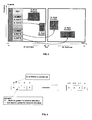
- Fig. 4 shows the frame structure more schematically in an example (TDD mode, OFDMA) wherein each burst has a "2xD" structure, having a defined extent in both frequency and time dimensions.
- the MAP-IE has to inform the MS concerned of not only the part of the frequency spectrum, but also the portion of the subframe duration, in which the burst is placed.
- each MS is allocated a 2xD burst both within the UL subframe, for transmitting data on the uplink to the BS, and within the DL subframe, for reception of data on the downlink.
- the amount of resource allocation on the downlink may need to be many times as large as that on the uplink.
- the UL subframe in practice has a "snake-like" configuration in which the allocations of respective users begin in the top left-hand corner, progress in time across the whole duration of the subframe, then increment in frequency as shown in Fig. 3 . In this way it is possible for the allocation to one user to extend over the whole duration of the subframe as well as over multiple subchannels.
- Fig. 4 should therefore be regarded only as illustrative for the uplink subframe.
- a wireless communication system comprising a base station and a plurality of fixed or mobile subscriber stations, the base station maintaining connections with each of the subscriber stations by performing wireless communication in units of frames, the base station allocating resources to each of the subscriber stations for communication with the base station and including resource allocation information in the frames; wherein: the base station is arranged to provide to the subscriber stations, in addition to said resource allocation information, a list indicative of the subscriber stations or connections for which the allocation of resources has changed.
- a wireless communication system comprising a base station and a plurality of fixed or mobile subscriber stations, the base station maintaining connections with each of the subscriber stations by performing wireless communication in units of frames, the base station allocating resources to each of the subscriber stations for communication with the base station and including resource allocation information in the frames; wherein: the base station is arranged to provide to the subscriber stations, in addition to said resource allocation information for each subscriber station, a period of validity of the resource allocation information during which the resource allocation to the subscriber station will not be changed.
- a wireless communication method used in a wireless communication system comprising a base station and a plurality of fixed or mobile subscriber stations, the base station maintaining connections with each of the subscriber stations by performing wireless communication in units of frames, the base station allocating resources to each of the subscriber stations for communication with the base station and including resource allocation information in every frame; wherein the base station provides to the subscriber stations, in addition to said resource allocation information in the frame, a list indicative of the subscriber stations or connections for which the allocation of resources has changed; the subscriber stations check the list to identify themselves, and each subscriber station identified in the list decodes the resource allocation information and alters its communication settings with the base station in accordance with the resource allocation information, whereas each subscriber station not identified in the list ignores the resource allocation information and continues using the same communication settings as before.
- a wireless communication method in a system comprising a base station and a plurality of fixed or mobile subscriber stations, the base station maintaining connections with each of the subscriber stations by performing wireless communication in units of frames, the base station allocating resources to each of the subscriber stations for communication with the base station and including resource allocation information in the frames; wherein: the base station provides to the subscriber stations, in addition to said resource allocation information for each subscriber station, a period of validity of the resource allocation information during which the resource allocation to the subscriber station will not be changed, and each subscriber station, upon receipt of resource allocation information with said period of validity, ignores subsequent resource allocation information for the duration of the period of validity.
- the base station in order to allocate resources to each fixed or mobile subscriber station (MS) within its cell, the base station (BS) first schedules the two-dimensional (2xD, frequency and time dimension) resource allocation and the relevant transmission parameters, such as transmission power, modulation and coding schemes for the connections with each MS. Then the BS informs the allocation and the related information to each MS by using broadcast messages, such as MAP-IEs (MAP Information Elements) in 802.16e-2005 (as shown in Fig. 4 ) in the MAP message.
- MAP-IEs MAP Information Elements
- the signalling overhead in existing OFDMA-based communication systems is high in comparison with other communication systems, such as CDMA-based systems, mainly because of the need for signalling a 2xD allocation on the DL and UL.
- OFDMA-based communication systems such as 802.16-2004 and 802.16e-2005
- the BS needs to inform the allocation and relevant information to each MS on a frame-by-frame basis, even if the current allocation or relevant parameters are the same as the previous frame.
- the allocation may be unchanged for the entire communication session. Therefore, informing the same resource allocation information to the MSs for multiple frames will entail extra overhead.
- each MS has to decode the whole MAP to find out its resource allocation, which incurs extra processing overhead at the MS.
- the present invention provides two embodiments as alternative techniques to save signalling overhead for both the DL and UL, and save processing overhead for MSs.
- the first embodiment involves listing the IDs (identifications) of the MSs or connections whose resource allocation has been modified, cancelled, or initialized, at the beginning of the frame. This allows other mobile stations, for which no relevant information is contained in the list, to omit decoding the resource allocation information in the current frame.
- the BS does not need to repeat unchanged resource allocation information to MSs. Only when the BS needs to cancel, modify, or initialize the resource allocation, must the BS inform the allocation information to the MSs.
- the BS allocates "persistent" resources to particular services for a certain time period, henceforth called a "valid duration".
- the BS can indicate the valid duration for each item of resource allocation information, thus avoiding the need to repeat the same allocation information within this valid duration, and the MSs will keep using this same resource allocation information within the valid duration.
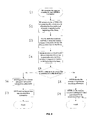
- Figure 6 shows the flow chart of this embodiment, in which the signalling method uses an ID list.
- the BS first calculates the resource allocation for each MS or connection ( Fig. 6 , step S1). Then the BS constructs the list of MS IDs or connection IDs, whose resource allocation is initialized, modified, or cancelled in the current frame (S2). The list may be compiled collectively for both DL and UL, or separate lists may be compiled for each subframe. The BS then sends (S3) the corresponding resource allocation information within the current frame. In step S4, the MS first checks whether its own ID, or the connection ID of its connection with the BS (below, "relative connection ID"), is listed within the frame, for either or both subframes.
- step S5 the MS decodes its resource allocation information (S8), and use these parameters for its receiving and transmission (S9).
- the MS may send an acknowledgement back to the BS, when it notices that its ID is in the list.
- MS/SS cannot find its ID or relative connection ID within the ID list (S5, "No"), the MS ignores the resource allocation information (S6) and keeps using previously obtained resource allocation parameters, if any, for its transmission and receiving (S7). If the MS cannot decode the MAP information correctly (a check can be facilitated by the CRC), then the data burst in that frame should not be attempted to be decoded (or if it is, then its integrity should be scrutinised as an allocation change could have been missed).
- the BS uses the DL-MAP/UL-MAP to instruct the MSs of the resource allocation, as outlined earlier with reference to Fig.s 3 and 4 .
- multiple MAP-IEs MAP information elements are used to describe each burst allocation.
- the list of MS IDs/connection IDs affected by changes in resource allocation is included near the beginning of the frame (more specifically, the DL-subframe).
- the receiving mobile stations are able to check the list to see whether or not it is necessary for them to decode the DL-MAP and UL-MAP.
- "early" and "before” refer primarily to an arrangement that results in the ID list being decoded in the receiver before the MAP message.
- the order of slot mapping is usually starting from the lowest numbered subchannel on the lowest numbered symbol in the frame, i.e. the top left corner of the frame in Figure 4 . Mapping increases in the frequency direction first before an increase in the symbol number once the highest numbered subchannel is reached. Therefore, referring to Figure 4 , the ID list would be directly below the FCH on the same symbols.
- the following information listed in Table 1 is incorporated into the DL-MAP/UL-MAP as an IE or a separated message body/entity within the frame that can be decoded prior to decoding of the MAP message, or incorporated into the frame as an independent entity, preferably ahead of (i.e. above the location of in Fig. 4 ) the MAP information.
- the MS ID or Connection ID is used to identify each MS whose resource allocation has been updated.
- the first bit in the table simply indicates whether or not all MSs have to update their resource allocation. If all MSs or connections have to update their resource allocation, then the ID list is not needed, and resource allocation can proceed in the conventional way.
- a "None Updated" flag (not shown) may be used to denote such an occurrence in order to notify all the subscriber stations that there is no need to consider any DL-MAP and/or the UL-MAP in the current frame.
- Table 1 may be constructed as a combined table for both DL and UL, or separate tables may be constructed for each of the DL and UL respectively.
- Table 1 is only one example.
- a variation on the configuration shown in Table 1 is to provide variable field sizes for the parameters "N" and "ID”. The field size is then indicated prior to "N", thus further reducing the overhead if the number of users in the cell is small.
- a bit map is used to identify the IDs of MSs or connections, whose resource allocations have been updated.
- the information in Table 2 below can be added into DL-MAP/UL-MAP as an IE, or a separate message body/entity within the frame.
- the next item in the table is the length of the bit map, which is decided by the total number of MSs or connections within the cell.
- a specific value of "length of bit map” such as 255 is used to indicate that all MSs need to update the resource allocation, so that no bit map is needed (and making the All Updated bit optional).
- bit map is also considered to be a form of "list" within the meaning of the accompanying claims.
- a bit map may be regarded as a special form of list having a particularly compact and thus bandwidth-efficient form.
- a bit map is particularly useful if a significant proportion of the users will be scheduled resource information every frame. For example consider the case of 256 users, this would require 256 bits of bit map signalling. For the non bit map approach, this would require 8 bits of signalling for every user scheduled. If more than 32 users are scheduled in a frame, then it is more efficient to use bit map signalling due to the lower signalling overhead.
- bit Map itself, the structure of which is shown in Fig. 5 .
- bit map may apply jointly to both subframes, or separate bit maps may be formed to apply individually to the DL- and UL-subframes.
- the processing in the MS may occur collectively for both DL and UL resource allocation, or the DL and UL may be considered separately when separate lists/bit maps are provided by the BS.
- an MS it would be possible for an MS to identify itself in a list for DL resource allocation, and thus decode the DL-MAP, whilst continuing to use an existing allocation of resources on the uplink without decoding the UL-MAP, if its ID were absent from a separate list pertaining to UL resource allocation.
- the BS will include one or more lists as described above in every frame.
- the subscriber stations are fixed stations, and/or where the traffic on the network is relatively steady, it may be appropriate to update resources less frequently.
- the above list(s) need only be included in every n-th frame, where n is an integer.
- BS may allocate persistent resources to a particular MS or connection.
- An appropriate length of persistence may be estimated by the BS, or the BS may have direct knowledge of the required duration of the resource allocation (such as the time duration of a streamed video being transmitted to a particular MS).
- service flow parameters learned by the base station during establishment of a connection may be used to indicate how long the service flow is anticipated to last.
- BS can indicate a value of the "valid duration" of the resource allocation (in other words, a length of time for which the allocation will remain valid) to the corresponding MS/SS or connection.
- valid duration the resource allocation (in other words, a length of time for which the allocation will remain valid) to the corresponding MS/SS or connection.
- the resource allocation may be every frame, or every n frames where n is an integer more than one. That is, the persistent resource allocation may have a periodicity such that it only appears every other frame, or once every four frames and so on.
- the "valid duration" will of course apply to all the subscriber stations in the group. After this "valid duration", the MS/SS will start to receive and decode the allocation information to see whether or not there is a resource allocation for its connection.
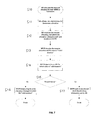
- Fig. 7 shows the flow chart of this method.
- the BS uses DL-MAP/UL-MAP to instruct the resource allocation information as mentioned above with reference to Fig.s 3 and 4 .
- multiple MAP-IEs MAP information elements
- the "valid duration" is added to the resource allocation information, for example directly into the DL-MAP-IE/UL-MAP-IE as an additional field, to indicate the valid duration of this MAP-IE.
- the first step of the flowchart ( Fig. 7 , step S10), as in Fig. 6 , is for the BS to calculate the resource allocation for each MS or connection.
- the BS acquires or estimates the valid duration for the resource allocation (S11).
- the BS can take account of such factors as the service type (e.g. voice call, video).
- the BS uses the DL-MAP and UL-MAP to inform each MS of its allocated resource along with the valid duration.
- the valid duration may be expressed, for example, as a time value in milliseconds or a number of frames until the MS should check again for a new resource allocation.
- the BS constructs a frame including the DL-MAP and UL-MAP near the start of the DL subframe (see Fig. 4 ) and transmits it to the users within its cell (S12).
- the MS receives the transmitted data from the BS, decodes the DL-MAP and UL-MAP (S13), and extracts both the information of the resources allocated to it (including the size and position of DL and/or UL bursts), and the valid duration of this allocation.
- the MS starts a timer (which could be a counter incremented frame-by-frame) to start counting down the valid duration (S14).
- the MS checks whether the timer has expired. If no, (S15, "No") it keeps using the same resource allocation information allocated to it previously (S16). If yes (S15, "Yes"), the MS decodes the DL-MAP and/or UL-MAP contained in the next-received DL subframe to check for any new allocation information (S17).
- the BS may be arranged to send new allocation information unconditionally at the expiry of the valid duration, even if there is no actual change required in the resource allocation; alternatively, BS may omit the MAP-IE for an MS for which no change in resource allocation is required, allowing the MS to continue to use the existing resource allocation until positively rescinded by a new MAP-IE from the BS.
- the BS may process the whole frame, or may consider the DL- and UL-subframes separately. That is, processing at the BS and in each MS may proceed through the steps in Fig. 7 either once per frame to deal with both subframes jointly, or twice to handle resource allocation in each subframe individually. In either case, of course, the BS will need to complete the estimation and setting of "valid duration" values before transmitting the current frame, and processing at each MS should occur as quickly as possible after receipt of the DL-MAP and UL-MAP so that any adjustments required on the MS side can be made in time to process the subsequent bursts.
- an aspect of a first form of the present invention provides a wireless communication system comprising a base station and a plurality of fixed or mobile subscriber stations, the base station maintaining connections with each of the subscriber stations by performing wireless communication in units of frames, the base station allocating resources to each of the subscriber stations for communication with the base station and including resource allocation information in every frame; wherein the base station is arranged to provide to the subscriber stations, in addition to said resource allocation information, a list indicative of the subscriber stations or the connections for which the allocation of resources has changed.
- the list applies to resource allocation on a downlink from the base station to each of the subscriber stations.
- the list may also apply to resource allocation on an uplink from the subscriber stations to the base station.
- each frame is divided into a downlink subframe and an uplink subframe, and said resource allocation information is provided for both the downlink subframe and the uplink subframe.
- the list identifies subscriber stations for which resource allocation has changed on at least one of the downlink subframe and the uplink subframe.
- Two such lists may be provided by the base station to the subscriber stations, one list for the downlink subframe and one for the uplink subframe; alternatively one list is provided by the base station as a combined list for both the downlink subframe and the uplink subframe.
- the list(s) is provided in every frame. In a configuration where each frame is configured as an ordered sequence of slots, the or each list is desirably located earlier in said sequence than the resource allocation information.
- each connection has an associated ID and the list includes the IDs of connections for which resource allocation has changed.
- each of the subscriber stations has an associated ID and the list preferably includes the IDs of subscriber stations for which the resource allocation has changed.
- the list includes a bit map in which each bit represents an individual subscriber station or an individual connection and its binary value indicates whether the resource allocation has changed for that subscriber station.
- Each subscriber station is preferably arranged to decode the or each list and, in response to determining the presence of its associated ID in the list, to send an acknowledgement to the base station.
- the base station is further arranged to process acknowledgements received from the subscriber stations to determine whether to repeat the relevant resource allocation information in the next frame.
- a "changed" resource allocation can be a resource allocation which has been modified, cancelled, or initiated.
- the system may be an OFDMA TDD-based system wherein the resource allocation information includes a DL-MAP and a UL-MAP and the list is provided between a frame control header of each frame and the DL-MAP and UL-MAP.
- the list includes an "all-updated” flag to indicate whether the resource allocation for all the subscriber stations has changed, and/or a “none-updated” flag to indicate whether the resource allocation for none of the subscriber stations has changed.
- the present invention provides a base station for use in a wireless communication system together with a plurality of fixed or mobile subscriber stations, the base station operable to maintain connections with each of the subscriber stations by performing wireless communication in units of frames, and comprising resource allocation means for allocating resources to each of the subscriber stations for communication with the base station and for including resource allocation information in every frame, the resource allocation means being arranged to provide to the subscriber stations, in addition to said resource allocation information, a list indicative of the subscriber stations or the connections for which the allocation of resources has changed.
- each frame is divided into a downlink subframe and an uplink subframe, said resource allocation means providing the resource allocation information for both the downlink subframe and the uplink subframe, wherein the resource allocation means constructs at least one list which identifies subscriber stations for which the resource allocation has changed on at least one of the downlink subframe and the uplink subframe.
- the resource allocation information includes a DL-MAP and a UL-MAP and the resource allocation means inserts the or each list ahead of the resource allocation information within the frame.
- the base station may further comprise a memory for storing an ID identifying each said subscriber station and/or its connection with the base station, the resource allocation means including the IDs in the or each list.
- a further aspect provides a subscriber station for use in a wireless communication system, the system comprising a base station and a plurality of such subscriber stations, the base station maintaining connections with each of the subscriber stations by performing wireless communication in units of frames, allocating system resources to each of the subscriber stations, and notifying the subscriber stations of resource allocation information in every frame, wherein the subscriber station comprises a frame decoder including means for identifying its own subscriber station in a list provided by said base station in addition to of the resource allocation information in the frame.
- the subscriber station is arranged, in the event that the frame decoder identifies its own subscriber station in said list, to decode the resource allocation information and to adjust its internal configuration in response to the resource allocation information thus decoded.
- the subscriber station may ignore the resource allocation information and maintain its internal configuration unchanged.
- the frame decoder is responsive to an "all updated flag" in said list to decode the resource allocation information unconditionally without identifying its own subscriber station in the list.
- a further aspect of this form of the invention is a frame format used in a wireless communication system comprising: a downlink subframe for containing downlink data and signalling information to be transmitted from a base station, to subscriber stations of the wireless communication system having a connection to the base station; and an uplink subframe for containing uplink data and signalling information to be transmitted from the subscriber stations to the base station; wherein the downlink subframe includes, precedent to a DL-MAP for allocation of resources in the downlink subframe and a UL-MAP for allocation of resources in the uplink subframe, at least one list identifying subscriber stations or their connections with the base station, for which resource allocation has changed from the preceding frame.
- the list is provided jointly for both the DL-MAP and UL-MAP and occurs directly after a frame control header of the frame.
- the present invention also provides a wireless communication method used in a wireless communication system comprising a base station and a plurality of fixed or mobile subscriber stations, the base station maintaining connections with each of the subscriber stations by performing wireless communication in units of frames, the base station allocating resources to each of the subscriber stations for communication with the base station and including resource allocation information in every frame; wherein: the base station provides to the subscriber stations, in addition to said resource allocation information in the frame, a list indicative of the subscriber stations for which the allocation of resources has changed; the subscriber stations check the list to identify themselves, and: each subscriber station identified in the list decodes the resource allocation information and alters its communication settings with the base station in accordance with the resource allocation information; whereas each subscriber station not identified in the list ignores the resource allocation information and continues communicating as before.
- the present invention further embraces software which, when executed by processors of a base station and subscriber stations in a wireless communication system, performs the above method.
- the present invention provides in one aspect thereof a wireless communication system comprising a base station and a plurality of fixed or mobile subscriber stations, the base station maintaining connections with each of the subscriber stations by performing wireless communication in units of frames, the base station allocating resources to each of the subscriber stations or connections for communication with the base station and including resource allocation information in the frames; wherein: the base station is arranged to provide to the subscriber stations, in addition to said resource allocation information for each subscriber station, a period of validity of the resource allocation information during which the resource allocation to the subscriber station will not be changed.
- one said connection is a broadcast or multicast connection maintained with a group of the subscriber stations, and the period of validity applies to all of the subscriber stations in the group.
- This period of validity may be a number of frames.
- a periodicity of the resource allocation may be set.
- each subscriber station is arranged to ignore resource allocation information in subsequent frames until expiry of the period of validity.
- the base station is arranged to omit from subsequent frames resource allocation information previously transmitted and for which the period of validity has not yet expired.
- Each subscriber station may send an acknowledgement to the base station upon receiving said resource allocation information, and the base station may omit from subsequent frames resource allocation information in respect of which an acknowledgement has been received.
- each subscriber station is arranged to count down the period of validity and upon expiry thereof, to decode subsequent resource allocation information received from the base station.
- each frame is divided into a downlink subframe and an uplink subframe, and said period of validity is provided for resource allocation information of both the downlink subframe and the uplink subframe.
- the period of validity is provided separately for each of the downlink subframe and uplink subframe.
- a "changed" resource allocation may be one which has been modified, cancelled, or initiated.
- One embodiment of the system in this form of the invention is an OFDMA TDD-based system wherein the resource allocation information includes a DL-MAP and a UL-MAP each containing MAP-IEs which identify connections between the subscriber stations and the base station, and the period of validity is added to MAP-IEs in each of the DL-MAP and UL-MAP.
- a base station for use in a wireless communication system together with a plurality of fixed or mobile subscriber stations, the base station operable to maintain connections with each of the subscriber stations by performing wireless communication in units of frames, and comprising resource allocation means for allocating resources to each of the subscriber stations for their communications with the base station and for including resource allocation information in the frames, the resource allocation means being arranged to provide to the subscriber stations, in addition to said resource allocation information, a period of validity during which the resource allocation will not change.
- the base station is preferably arranged to omit from subsequent frames resource allocation information previously transmitted and for which the period of validity has not yet expired.
- each frame is divided into a downlink subframe and an uplink subframe, and said resource allocation means provides resource allocation information for both the downlink subframe and the uplink subframe, wherein the resource allocation means is arranged to include said period of validity for the resource allocation information of at least one of the downlink subframe and the uplink subframe.
- the base station may be for use in an OFDMA TDD-based system wherein the resource allocation information includes a DL-MAP and a UL-MAP each containing MAP-IEs which identify connections between the subscriber stations and the base station, and the resource allocation means is configured to add the period of validity to the MAP-IEs in each of the DL-MAP and UL-MAP.
- the resource allocation information includes a DL-MAP and a UL-MAP each containing MAP-IEs which identify connections between the subscriber stations and the base station, and the resource allocation means is configured to add the period of validity to the MAP-IEs in each of the DL-MAP and UL-MAP.
- a further aspect is a subscriber station for use in a wireless communication system comprising a base station and a plurality of such subscriber stations, the base station maintaining connections with each of the subscriber stations by performing wireless communication in units of frames, allocating system resources to each of the subscriber stations, and notifying the subscriber stations of resource allocation information in the frames, wherein the subscriber station comprises a frame decoder including means for extracting a period of validity from the resource allocation information, the subscriber station being responsive to the period of validity to ignore resource allocation information received in subsequent frames for the duration of the period of validity.
- the subscriber station preferably has a timer for counting down the period of validity and upon expiry thereof, to decode subsequent resource allocation information received from the base station.
- Another aspect of this form of the invention is a wireless communication method in a system comprising a base station and a plurality of fixed or mobile subscriber stations, the base station maintaining connections with each of the subscriber stations by performing wireless communication in units of frames, the base station allocating resources to each of the subscriber stations for communication with the base station and including resource allocation information in the frames; wherein: the base station provides to the subscriber stations, in addition to said resource allocation information for each subscriber station, a period of validity of the resource allocation information during which the resource allocation to the subscriber station will not be changed, and each subscriber station, upon receipt of resource allocation information with said period of validity, ignores subsequent resource allocation information for the duration of the period of validity.
- Software may be executed by processors of a base station and subscriber stations in a wireless communication system, to perform the above method.
- the present invention provides a signalling method in a frame-based wireless communication system allowing a base station (BS) to inform fixed or mobile subscriber stations (MS) of resource allocations without excessive signalling and processing overhead.
- BS base station
- MS mobile subscriber stations
- IDs of MSs or connections for which the resource allocation has been modified, cancelled, or initialized are listed at the start of the frame, allowing each MS to identify itself (or its connection) in the list. Only those mobile stations for which the list is relevant need to act on the resource allocation information.
- the BS attaches a period of validity to each allocation of resources which is transmitted along with the normal resource allocation information. This frees the BS from having to repeat the same information in subsequent frames, and each MS can go on using the same resource during the period of validity without needing to check for updates.
- the present invention may take the form of a novel BS or MS, or hardware modules for the same, and can be implemented by replacing or modifying software executed by processors of the BS and/or each MS.
- the present invention may also be applied to each relay station.
- embodiments of the present invention may be implemented in hardware, or as software modules running on one or more processors, or on a combination thereof. That is, those skilled in the art will appreciate that a microprocessor or digital signal processor (DSP) may be used in practice to implement some or all of the functionality of the above-described subsystem.
- DSP digital signal processor
- the invention may also be embodied as one or more device or apparatus programs (e.g. computer programs and computer program products) for carrying out part or all of any of the methods described herein.
- Such programs embodying the present invention may be stored on computer-readable media, or could, for example, be in the form of one or more signals.
- Such signals may be data signals downloadable from an Internet website, or provided on a carrier signal, or in any other form.
- IEEE 802.16 wireless communication system Although the above description has referred to an IEEE 802.16 wireless communication system by way of example, the invention may be applied to other frame-based communication systems in which resource allocation is possible on a frame-by-frame basis.
Landscapes
- Engineering & Computer Science (AREA)
- Computer Networks & Wireless Communication (AREA)
- Signal Processing (AREA)
- Mobile Radio Communication Systems (AREA)
Applications Claiming Priority (1)
| Application Number | Priority Date | Filing Date | Title |
|---|---|---|---|
| GB0719029A GB2453527A (en) | 2007-09-28 | 2007-09-28 | Signalling method in a frame-based wireless communication system |
Publications (2)
| Publication Number | Publication Date |
|---|---|
| EP2043403A2 true EP2043403A2 (de) | 2009-04-01 |
| EP2043403A3 EP2043403A3 (de) | 2011-08-10 |
Family
ID=38701886
Family Applications (1)
| Application Number | Title | Priority Date | Filing Date |
|---|---|---|---|
| EP08154587A Withdrawn EP2043403A3 (de) | 2007-09-28 | 2008-04-16 | Drahtlose Kommunikationssysteme |
Country Status (6)
| Country | Link |
|---|---|
| US (1) | US20090086670A1 (de) |
| EP (1) | EP2043403A3 (de) |
| JP (1) | JP2009089388A (de) |
| KR (1) | KR101001485B1 (de) |
| CN (1) | CN101399733A (de) |
| GB (1) | GB2453527A (de) |
Cited By (2)
| Publication number | Priority date | Publication date | Assignee | Title |
|---|---|---|---|---|
| WO2011003450A1 (en) * | 2009-07-09 | 2011-01-13 | Nokia Siemens Networks Oy | Spectral arrangement for radio resources |
| WO2011109290A1 (en) * | 2010-03-01 | 2011-09-09 | Interdigital Patent Holdings, Inc. | Method and apparatus for performing hybrid per station and per flow uplink allocations |
Families Citing this family (25)
| Publication number | Priority date | Publication date | Assignee | Title |
|---|---|---|---|---|
| CN1285194C (zh) * | 2004-11-01 | 2006-11-15 | 华为技术有限公司 | 一种实现多播业务资源指示的方法 |
| US7965985B2 (en) * | 2006-10-04 | 2011-06-21 | Industrial Technology Research Institute | Wireless communication systems, methods, and data structure |
| US8139580B2 (en) * | 2008-02-27 | 2012-03-20 | Industrial Technology Research Institute | System and method for providing multicast and broadcast services |
| WO2009136446A1 (ja) * | 2008-05-09 | 2009-11-12 | 富士通株式会社 | 移動体通信システム、移動体通信方法、移動体通信基地局装置および移動体通信端末装置 |
| KR101603651B1 (ko) * | 2008-10-30 | 2016-03-15 | 엘지전자 주식회사 | 단일 주파수 대역만을 사용하는 제1 사용자 기기와 복수의 주파수 대역을 사용하는 제2 사용자 기기를 지원하는 무선 통신 시스템에 있어서, 사용자 기기와 기지국 간의 무선 통신 방법 |
| US8270327B2 (en) * | 2009-01-23 | 2012-09-18 | Qualcomm Incorporated | Methods and systems for WiMAX broadcasting messages processing |
| CN101867971B (zh) * | 2009-04-14 | 2016-03-02 | 中兴通讯股份有限公司 | 持久资源的处理方法、终端以及基站 |
| US9106375B2 (en) | 2009-06-19 | 2015-08-11 | Samsung Electronics Co., Ltd. | Method and system for arranging resource allocation messages to reduce blind decoding complexity in OFDMA-based systems |
| WO2011052135A1 (ja) * | 2009-10-27 | 2011-05-05 | 日本電気株式会社 | 移動通信システム、中継局装置、基地局装置、無線中継方法、及びコンピュータ可読媒体 |
| IL203053A (en) * | 2009-12-31 | 2017-01-31 | Alvarion Ltd | A method and device for transmitting wireless transmissions |
| KR101672769B1 (ko) * | 2010-02-09 | 2016-11-04 | 삼성전자주식회사 | 겹치는 무선 자원을 이용하여 업링크 통신 및 다운링크 통신을 수행하는 통신 시스템 |
| US9226116B2 (en) | 2010-03-04 | 2015-12-29 | Electronics And Telecommunications Research Institute | Method and apparatus for managing configuration information of multicast and broadcast service |
| JP5647676B2 (ja) * | 2010-04-28 | 2015-01-07 | 京セラ株式会社 | 無線通信システム、高電力基地局、無線端末、低電力基地局、及び無線通信方法 |
| JP4938117B2 (ja) * | 2010-08-16 | 2012-05-23 | 株式会社エヌ・ティ・ティ・ドコモ | シグナリング方法、基地局装置、移動端末装置及び無線通信システム |
| US20130294319A1 (en) * | 2010-10-14 | 2013-11-07 | Mikko Markus Haapaniemi | Base Station, Radio Device, and Methods for Transmitting Data in a Radio Communications System |
| US8937894B2 (en) | 2010-12-24 | 2015-01-20 | Electronics And Telecommunications Research Institute | Method and apparatus for allocating multicast resource and method and apparatus for receiving multicast resource allocation information |
| US20130034061A1 (en) * | 2011-08-02 | 2013-02-07 | Broadcom Corporation | Reverse direction protocol implementation |
| CN103220077A (zh) | 2012-01-21 | 2013-07-24 | 华为技术有限公司 | 数据发送和接收方法、基站和用户设备 |
| KR101406320B1 (ko) * | 2012-03-06 | 2014-06-13 | 한국전자통신연구원 | 멀티캐스트 자원 관리 방법 및 장치 |
| US10390333B2 (en) * | 2013-05-02 | 2019-08-20 | Huawei Technologies Co., Ltd. | System and method for transmission source identification |
| US9955485B2 (en) * | 2013-09-26 | 2018-04-24 | Lg Electronics Inc. | Method for D2D communication performed by terminals in wireless communication system, and devices for supporting same |
| US9553744B2 (en) * | 2014-03-10 | 2017-01-24 | Broadcom Corporation | Two-dimensional (2D) burst marker (BM) to identify data start and stop |
| JP6643848B2 (ja) * | 2015-09-24 | 2020-02-12 | キヤノン株式会社 | 通信装置、通信方法、およびプログラム |
| CN111405674B (zh) * | 2016-12-09 | 2023-05-26 | 上海朗帛通信技术有限公司 | 一种ue和基站中的方法和设备 |
| US11627554B2 (en) * | 2019-04-01 | 2023-04-11 | Telefonaktiebolaget Lm Ericsson (Publ) | Methods, apparatus and machine-readable mediums relating to establishment of broadcast/multicast bearers |
Family Cites Families (7)
| Publication number | Priority date | Publication date | Assignee | Title |
|---|---|---|---|---|
| FI95428C (fi) * | 1993-08-12 | 1996-01-25 | Nokia Telecommunications Oy | Menetelmä, radiopuhelinkeskus ja radiopuhelinjärjestelmän tilaaja-asema korkeaprioriteettisen puhelun tai korkeaprioriteettisen ryhmäpuhelunmuodostamiseksi |
| US20020065072A1 (en) * | 1998-11-19 | 2002-05-30 | Annika Lindh | Method and apparatus for resuming re-transmission after interruption |
| GB2366138B (en) * | 2000-08-14 | 2002-10-30 | Qualcomm Inc | A method of, and apparatus for, communicating messages to a mobile station |
| WO2002041520A2 (en) * | 2000-11-15 | 2002-05-23 | Ensemble Communications, Inc. | Improved frame structure for a communication system using adaptive modulation |
| US7684372B2 (en) * | 2004-05-04 | 2010-03-23 | Ipwireless, Inc. | Signaling MIMO allocations |
| US7564815B2 (en) * | 2005-11-10 | 2009-07-21 | Research In Motion Limited | Apparatus and method for providing notification of allocation of communication resources by using a temporary flow set indicator |
| KR101221821B1 (ko) * | 2006-04-21 | 2013-01-14 | 삼성전자주식회사 | 주파수 분할 다중 접속 시스템에서 자원 할당 정보 시그널링 방법 |
-
2007
- 2007-09-28 GB GB0719029A patent/GB2453527A/en not_active Withdrawn
-
2008
- 2008-04-16 EP EP08154587A patent/EP2043403A3/de not_active Withdrawn
- 2008-05-26 KR KR1020080048776A patent/KR101001485B1/ko not_active Expired - Fee Related
- 2008-06-04 CN CNA2008101099131A patent/CN101399733A/zh active Pending
- 2008-08-21 US US12/195,526 patent/US20090086670A1/en not_active Abandoned
- 2008-09-26 JP JP2008248649A patent/JP2009089388A/ja not_active Withdrawn
Cited By (9)
| Publication number | Priority date | Publication date | Assignee | Title |
|---|---|---|---|---|
| WO2011003450A1 (en) * | 2009-07-09 | 2011-01-13 | Nokia Siemens Networks Oy | Spectral arrangement for radio resources |
| US8989135B2 (en) | 2009-07-09 | 2015-03-24 | Nokia Siemens Networks Oy | Spectral arrangement for radio resources |
| WO2011109290A1 (en) * | 2010-03-01 | 2011-09-09 | Interdigital Patent Holdings, Inc. | Method and apparatus for performing hybrid per station and per flow uplink allocations |
| US8891366B2 (en) | 2010-03-01 | 2014-11-18 | Interdigital Patent Holdings, Inc. | Method and apparatus for performing hybrid per station and per flow uplink allocations |
| CN105704831A (zh) * | 2010-03-01 | 2016-06-22 | 交互数字专利控股公司 | 用于从wtru传送上行链路数据的方法、wtru以及基站 |
| US9521687B2 (en) | 2010-03-01 | 2016-12-13 | Interdigital Patent Holdings, Inc. | Method and apparatus for performing hybrid per station and per flow uplink allocations |
| US10111209B2 (en) | 2010-03-01 | 2018-10-23 | Interdigital Patent Holdings, Inc. | Method and apparatus for performing hybrid per station and per flow uplink allocations |
| RU2684634C2 (ru) * | 2010-03-01 | 2019-04-11 | Интердиджитал Пейтент Холдингз, Инк. | Способ и устройство для выполнения гибридных распределений восходящей линии связи по станции и по потоку |
| EP3787364A1 (de) * | 2010-03-01 | 2021-03-03 | Interdigital Patent Holdings, Inc. | Verfahren und vorrichtung zur durchführung hybrider pro-station- und pro-durchfluss-uplink-zuweisungen |
Also Published As
| Publication number | Publication date |
|---|---|
| KR101001485B1 (ko) | 2010-12-14 |
| JP2009089388A (ja) | 2009-04-23 |
| CN101399733A (zh) | 2009-04-01 |
| EP2043403A3 (de) | 2011-08-10 |
| KR20090032930A (ko) | 2009-04-01 |
| GB0719029D0 (en) | 2007-11-07 |
| US20090086670A1 (en) | 2009-04-02 |
| GB2453527A (en) | 2009-04-15 |
Similar Documents
| Publication | Publication Date | Title |
|---|---|---|
| EP2043403A2 (de) | Drahtlose Kommunikationssysteme | |
| EP2026625B1 (de) | Signalisierungsverfahren in einem Kommunikationssystem mit Mehrfachzugriff | |
| US8355370B2 (en) | Wireless communication systems | |
| JP5709348B2 (ja) | 無線通信方法、無線通信システム、基地局及び加入局 | |
| US8396068B2 (en) | Method for transmitting data in wireless communication system | |
| US8134965B2 (en) | Method for transmitting and receiving data with superframe structure | |
| WO2016004634A1 (en) | Method for enb, ue uplink transmission and reception | |
| US9237554B2 (en) | Method for allocating control information in wireless communication system | |
| EP3592046B1 (de) | Steuerung der uplink-übertragungsleistung in einem drahtlosen zellularen kommunikationssystem | |
| KR20090067011A (ko) | 무선통신 시스템에서 데이터 전송 방법 |
Legal Events
| Date | Code | Title | Description |
|---|---|---|---|
| PUAI | Public reference made under article 153(3) epc to a published international application that has entered the european phase |
Free format text: ORIGINAL CODE: 0009012 |
|
| AK | Designated contracting states |
Kind code of ref document: A2 Designated state(s): AT BE BG CH CY CZ DE DK EE ES FI FR GB GR HR HU IE IS IT LI LT LU LV MC MT NL NO PL PT RO SE SI SK TR |
|
| AX | Request for extension of the european patent |
Extension state: AL BA MK RS |
|
| PUAL | Search report despatched |
Free format text: ORIGINAL CODE: 0009013 |
|
| AK | Designated contracting states |
Kind code of ref document: A3 Designated state(s): AT BE BG CH CY CZ DE DK EE ES FI FR GB GR HR HU IE IS IT LI LT LU LV MC MT NL NO PL PT RO SE SI SK TR |
|
| AX | Request for extension of the european patent |
Extension state: AL BA MK RS |
|
| RIC1 | Information provided on ipc code assigned before grant |
Ipc: H04W 72/04 20090101AFI20110705BHEP |
|
| AKY | No designation fees paid | ||
| REG | Reference to a national code |
Ref country code: DE Ref legal event code: R108 Effective date: 20120419 |
|
| STAA | Information on the status of an ep patent application or granted ep patent |
Free format text: STATUS: THE APPLICATION IS DEEMED TO BE WITHDRAWN |
|
| 18D | Application deemed to be withdrawn |
Effective date: 20120211 |