EP2030977A1 - Improved method for crystallization of azetidinonecarboxylic acid - Google Patents
Improved method for crystallization of azetidinonecarboxylic acid Download PDFInfo
- Publication number
- EP2030977A1 EP2030977A1 EP07745204A EP07745204A EP2030977A1 EP 2030977 A1 EP2030977 A1 EP 2030977A1 EP 07745204 A EP07745204 A EP 07745204A EP 07745204 A EP07745204 A EP 07745204A EP 2030977 A1 EP2030977 A1 EP 2030977A1
- Authority
- EP
- European Patent Office
- Prior art keywords
- compound
- solution
- crystallization
- crystal
- formula
- Prior art date
- Legal status (The legal status is an assumption and is not a legal conclusion. Google has not performed a legal analysis and makes no representation as to the accuracy of the status listed.)
- Withdrawn
Links
- 238000002425 crystallisation Methods 0.000 title claims abstract description 57
- 230000008025 crystallization Effects 0.000 title claims abstract description 44
- 238000000034 method Methods 0.000 title abstract description 35
- 239000002253 acid Substances 0.000 title description 4
- 239000002904 solvent Substances 0.000 claims abstract description 140
- 150000001875 compounds Chemical class 0.000 claims abstract description 123
- 239000013078 crystal Substances 0.000 claims abstract description 73
- 238000002156 mixing Methods 0.000 claims abstract description 20
- NNANGMFTFSNDLW-GWOFURMSSA-N (2r)-2-[(2s,3s)-3-[(1r)-1-[tert-butyl(dimethyl)silyl]oxyethyl]-4-oxoazetidin-2-yl]propanoic acid Chemical compound CC(C)(C)[Si](C)(C)O[C@H](C)[C@@H]1[C@@H]([C@@H](C)C(O)=O)NC1=O NNANGMFTFSNDLW-GWOFURMSSA-N 0.000 claims abstract description 18
- 150000008282 halocarbons Chemical class 0.000 claims abstract description 18
- 150000004945 aromatic hydrocarbons Chemical class 0.000 claims abstract description 17
- 239000000243 solution Substances 0.000 claims description 98
- 238000004519 manufacturing process Methods 0.000 claims description 23
- XLYOFNOQVPJJNP-UHFFFAOYSA-N water Substances O XLYOFNOQVPJJNP-UHFFFAOYSA-N 0.000 claims description 15
- 239000007788 liquid Substances 0.000 claims description 8
- 150000002576 ketones Chemical class 0.000 claims description 7
- 150000002148 esters Chemical class 0.000 claims description 6
- NNANGMFTFSNDLW-LNFKQOIKSA-N (2s)-2-[(2s,3s)-3-[(1r)-1-[tert-butyl(dimethyl)silyl]oxyethyl]-4-oxoazetidin-2-yl]propanoic acid Chemical compound CC(C)(C)[Si](C)(C)O[C@H](C)[C@@H]1[C@@H]([C@H](C)C(O)=O)NC1=O NNANGMFTFSNDLW-LNFKQOIKSA-N 0.000 claims description 4
- 238000000634 powder X-ray diffraction Methods 0.000 claims description 4
- 238000003756 stirring Methods 0.000 claims description 4
- 239000011259 mixed solution Substances 0.000 claims 2
- XEKOWRVHYACXOJ-UHFFFAOYSA-N Ethyl acetate Chemical compound CCOC(C)=O XEKOWRVHYACXOJ-UHFFFAOYSA-N 0.000 description 78
- YXFVVABEGXRONW-UHFFFAOYSA-N Toluene Chemical compound CC1=CC=CC=C1 YXFVVABEGXRONW-UHFFFAOYSA-N 0.000 description 45
- 239000000203 mixture Substances 0.000 description 18
- VEXZGXHMUGYJMC-UHFFFAOYSA-N Hydrochloric acid Chemical compound Cl VEXZGXHMUGYJMC-UHFFFAOYSA-N 0.000 description 16
- 239000002002 slurry Substances 0.000 description 14
- 238000006243 chemical reaction Methods 0.000 description 13
- 238000011084 recovery Methods 0.000 description 13
- 238000001914 filtration Methods 0.000 description 12
- 238000001816 cooling Methods 0.000 description 10
- CSCPPACGZOOCGX-UHFFFAOYSA-N Acetone Chemical compound CC(C)=O CSCPPACGZOOCGX-UHFFFAOYSA-N 0.000 description 9
- OKKJLVBELUTLKV-UHFFFAOYSA-N Methanol Chemical compound OC OKKJLVBELUTLKV-UHFFFAOYSA-N 0.000 description 9
- VLKZOEOYAKHREP-UHFFFAOYSA-N n-Hexane Chemical compound CCCCCC VLKZOEOYAKHREP-UHFFFAOYSA-N 0.000 description 9
- 239000012670 alkaline solution Substances 0.000 description 7
- YKMONJZIUAOVEM-WDSKDSINSA-N 1beta-methylcarbapenem Chemical class C[C@H]1C=CN2C(=O)C[C@@H]12 YKMONJZIUAOVEM-WDSKDSINSA-N 0.000 description 6
- QTBSBXVTEAMEQO-UHFFFAOYSA-N Acetic acid Chemical compound CC(O)=O QTBSBXVTEAMEQO-UHFFFAOYSA-N 0.000 description 6
- YMWUJEATGCHHMB-UHFFFAOYSA-N Dichloromethane Chemical compound ClCCl YMWUJEATGCHHMB-UHFFFAOYSA-N 0.000 description 6
- CSNNHWWHGAXBCP-UHFFFAOYSA-L Magnesium sulfate Chemical compound [Mg+2].[O-][S+2]([O-])([O-])[O-] CSNNHWWHGAXBCP-UHFFFAOYSA-L 0.000 description 6
- WYURNTSHIVDZCO-UHFFFAOYSA-N Tetrahydrofuran Chemical compound C1CCOC1 WYURNTSHIVDZCO-UHFFFAOYSA-N 0.000 description 6
- 239000007864 aqueous solution Substances 0.000 description 6
- 238000001035 drying Methods 0.000 description 6
- 239000007787 solid Substances 0.000 description 6
- 238000003786 synthesis reaction Methods 0.000 description 6
- 230000015572 biosynthetic process Effects 0.000 description 5
- 230000000694 effects Effects 0.000 description 5
- 239000002243 precursor Substances 0.000 description 5
- 239000011877 solvent mixture Substances 0.000 description 5
- 230000032683 aging Effects 0.000 description 4
- DKPFZGUDAPQIHT-UHFFFAOYSA-N butyl acetate Chemical compound CCCCOC(C)=O DKPFZGUDAPQIHT-UHFFFAOYSA-N 0.000 description 4
- 230000003247 decreasing effect Effects 0.000 description 4
- 238000000605 extraction Methods 0.000 description 4
- 239000012044 organic layer Substances 0.000 description 4
- XNLICIUVMPYHGG-UHFFFAOYSA-N pentan-2-one Chemical compound CCCC(C)=O XNLICIUVMPYHGG-UHFFFAOYSA-N 0.000 description 4
- FDPIMTJIUBPUKL-UHFFFAOYSA-N pentan-3-one Chemical compound CCC(=O)CC FDPIMTJIUBPUKL-UHFFFAOYSA-N 0.000 description 4
- YKYONYBAUNKHLG-UHFFFAOYSA-N propyl acetate Chemical compound CCCOC(C)=O YKYONYBAUNKHLG-UHFFFAOYSA-N 0.000 description 4
- 238000000926 separation method Methods 0.000 description 4
- ZWEHNKRNPOVVGH-UHFFFAOYSA-N 2-Butanone Chemical compound CCC(C)=O ZWEHNKRNPOVVGH-UHFFFAOYSA-N 0.000 description 3
- WEVYAHXRMPXWCK-UHFFFAOYSA-N Acetonitrile Chemical compound CC#N WEVYAHXRMPXWCK-UHFFFAOYSA-N 0.000 description 3
- RTZKZFJDLAIYFH-UHFFFAOYSA-N Diethyl ether Chemical compound CCOCC RTZKZFJDLAIYFH-UHFFFAOYSA-N 0.000 description 3
- LFQSCWFLJHTTHZ-UHFFFAOYSA-N Ethanol Chemical compound CCO LFQSCWFLJHTTHZ-UHFFFAOYSA-N 0.000 description 3
- KFZMGEQAYNKOFK-UHFFFAOYSA-N Isopropanol Chemical compound CC(C)O KFZMGEQAYNKOFK-UHFFFAOYSA-N 0.000 description 3
- ZMXDDKWLCZADIW-UHFFFAOYSA-N N,N-Dimethylformamide Chemical compound CN(C)C=O ZMXDDKWLCZADIW-UHFFFAOYSA-N 0.000 description 3
- HEMHJVSKTPXQMS-UHFFFAOYSA-M Sodium hydroxide Chemical compound [OH-].[Na+] HEMHJVSKTPXQMS-UHFFFAOYSA-M 0.000 description 3
- 150000001298 alcohols Chemical class 0.000 description 3
- 230000000844 anti-bacterial effect Effects 0.000 description 3
- BTANRVKWQNVYAZ-UHFFFAOYSA-N butan-2-ol Chemical compound CCC(C)O BTANRVKWQNVYAZ-UHFFFAOYSA-N 0.000 description 3
- 239000006227 byproduct Substances 0.000 description 3
- 125000004432 carbon atom Chemical group C* 0.000 description 3
- 230000000052 comparative effect Effects 0.000 description 3
- 150000002170 ethers Chemical class 0.000 description 3
- 239000000706 filtrate Substances 0.000 description 3
- 229910052943 magnesium sulfate Inorganic materials 0.000 description 3
- 235000019341 magnesium sulphate Nutrition 0.000 description 3
- 238000005259 measurement Methods 0.000 description 3
- 150000002894 organic compounds Chemical class 0.000 description 3
- BDERNNFJNOPAEC-UHFFFAOYSA-N propan-1-ol Chemical compound CCCO BDERNNFJNOPAEC-UHFFFAOYSA-N 0.000 description 3
- 125000001424 substituent group Chemical group 0.000 description 3
- YLQBMQCUIZJEEH-UHFFFAOYSA-N tetrahydrofuran Natural products C=1C=COC=1 YLQBMQCUIZJEEH-UHFFFAOYSA-N 0.000 description 3
- 238000005406 washing Methods 0.000 description 3
- SQUNMNLNORDCOK-UMSGYPCISA-N (3s,4r)-4-[(2s)-but-3-en-2-yl]-3-[(1r)-1-[tert-butyl(dimethyl)silyl]oxyethyl]azetidin-2-one Chemical compound CC(C)(C)[Si](C)(C)O[C@H](C)[C@@H]1[C@@H]([C@@H](C)C=C)NC1=O SQUNMNLNORDCOK-UMSGYPCISA-N 0.000 description 2
- QQZOPKMRPOGIEB-UHFFFAOYSA-N 2-Oxohexane Chemical compound CCCCC(C)=O QQZOPKMRPOGIEB-UHFFFAOYSA-N 0.000 description 2
- SYBYTAAJFKOIEJ-UHFFFAOYSA-N 3-Methylbutan-2-one Chemical compound CC(C)C(C)=O SYBYTAAJFKOIEJ-UHFFFAOYSA-N 0.000 description 2
- UHOVQNZJYSORNB-UHFFFAOYSA-N Benzene Chemical compound C1=CC=CC=C1 UHOVQNZJYSORNB-UHFFFAOYSA-N 0.000 description 2
- OKTJSMMVPCPJKN-UHFFFAOYSA-N Carbon Chemical compound [C] OKTJSMMVPCPJKN-UHFFFAOYSA-N 0.000 description 2
- ZAMOUSCENKQFHK-UHFFFAOYSA-N Chlorine atom Chemical compound [Cl] ZAMOUSCENKQFHK-UHFFFAOYSA-N 0.000 description 2
- MHAJPDPJQMAIIY-UHFFFAOYSA-N Hydrogen peroxide Chemical compound OO MHAJPDPJQMAIIY-UHFFFAOYSA-N 0.000 description 2
- BZLVMXJERCGZMT-UHFFFAOYSA-N Methyl tert-butyl ether Chemical compound COC(C)(C)C BZLVMXJERCGZMT-UHFFFAOYSA-N 0.000 description 2
- LRHPLDYGYMQRHN-UHFFFAOYSA-N N-Butanol Chemical compound CCCCO LRHPLDYGYMQRHN-UHFFFAOYSA-N 0.000 description 2
- CTQNGGLPUBDAKN-UHFFFAOYSA-N O-Xylene Chemical group CC1=CC=CC=C1C CTQNGGLPUBDAKN-UHFFFAOYSA-N 0.000 description 2
- URLKBWYHVLBVBO-UHFFFAOYSA-N Para-Xylene Chemical group CC1=CC=C(C)C=C1 URLKBWYHVLBVBO-UHFFFAOYSA-N 0.000 description 2
- XBDQKXXYIPTUBI-UHFFFAOYSA-M Propionate Chemical compound CCC([O-])=O XBDQKXXYIPTUBI-UHFFFAOYSA-M 0.000 description 2
- DWAQJAXMDSEUJJ-UHFFFAOYSA-M Sodium bisulfite Chemical compound [Na+].OS([O-])=O DWAQJAXMDSEUJJ-UHFFFAOYSA-M 0.000 description 2
- HCHKCACWOHOZIP-UHFFFAOYSA-N Zinc Chemical compound [Zn] HCHKCACWOHOZIP-UHFFFAOYSA-N 0.000 description 2
- KXKVLQRXCPHEJC-UHFFFAOYSA-N acetic acid trimethyl ester Natural products COC(C)=O KXKVLQRXCPHEJC-UHFFFAOYSA-N 0.000 description 2
- 125000000217 alkyl group Chemical group 0.000 description 2
- 150000001408 amides Chemical class 0.000 description 2
- 238000009835 boiling Methods 0.000 description 2
- 229910052801 chlorine Inorganic materials 0.000 description 2
- 239000000460 chlorine Substances 0.000 description 2
- 238000004090 dissolution Methods 0.000 description 2
- 238000004821 distillation Methods 0.000 description 2
- 125000001495 ethyl group Chemical group [H]C([H])([H])C([H])([H])* 0.000 description 2
- FKRCODPIKNYEAC-UHFFFAOYSA-N ethyl propionate Chemical compound CCOC(=O)CC FKRCODPIKNYEAC-UHFFFAOYSA-N 0.000 description 2
- 229910052736 halogen Inorganic materials 0.000 description 2
- 150000002367 halogens Chemical class 0.000 description 2
- 239000012535 impurity Substances 0.000 description 2
- GJRQTCIYDGXPES-UHFFFAOYSA-N iso-butyl acetate Natural products CC(C)COC(C)=O GJRQTCIYDGXPES-UHFFFAOYSA-N 0.000 description 2
- FGKJLKRYENPLQH-UHFFFAOYSA-M isocaproate Chemical compound CC(C)CCC([O-])=O FGKJLKRYENPLQH-UHFFFAOYSA-M 0.000 description 2
- JMMWKPVZQRWMSS-UHFFFAOYSA-N isopropanol acetate Natural products CC(C)OC(C)=O JMMWKPVZQRWMSS-UHFFFAOYSA-N 0.000 description 2
- 229940011051 isopropyl acetate Drugs 0.000 description 2
- GWYFCOCPABKNJV-UHFFFAOYSA-M isovalerate Chemical compound CC(C)CC([O-])=O GWYFCOCPABKNJV-UHFFFAOYSA-M 0.000 description 2
- OQAGVSWESNCJJT-UHFFFAOYSA-N isovaleric acid methyl ester Natural products COC(=O)CC(C)C OQAGVSWESNCJJT-UHFFFAOYSA-N 0.000 description 2
- IVSZLXZYQVIEFR-UHFFFAOYSA-N m-xylene Chemical group CC1=CC=CC(C)=C1 IVSZLXZYQVIEFR-UHFFFAOYSA-N 0.000 description 2
- 125000002496 methyl group Chemical group [H]C([H])([H])* 0.000 description 2
- 150000002825 nitriles Chemical class 0.000 description 2
- PGMYKACGEOXYJE-UHFFFAOYSA-N pentyl acetate Chemical compound CCCCCOC(C)=O PGMYKACGEOXYJE-UHFFFAOYSA-N 0.000 description 2
- 239000008177 pharmaceutical agent Substances 0.000 description 2
- 239000012286 potassium permanganate Substances 0.000 description 2
- 238000001953 recrystallisation Methods 0.000 description 2
- DCKVNWZUADLDEH-UHFFFAOYSA-N sec-butyl acetate Chemical compound CCC(C)OC(C)=O DCKVNWZUADLDEH-UHFFFAOYSA-N 0.000 description 2
- 229940079827 sodium hydrogen sulfite Drugs 0.000 description 2
- 235000010267 sodium hydrogen sulphite Nutrition 0.000 description 2
- GEHJYWRUCIMESM-UHFFFAOYSA-L sodium sulfite Chemical compound [Na+].[Na+].[O-]S([O-])=O GEHJYWRUCIMESM-UHFFFAOYSA-L 0.000 description 2
- 239000000126 substance Substances 0.000 description 2
- 238000001308 synthesis method Methods 0.000 description 2
- 230000002194 synthesizing effect Effects 0.000 description 2
- WMOVHXAZOJBABW-UHFFFAOYSA-N tert-butyl acetate Chemical compound CC(=O)OC(C)(C)C WMOVHXAZOJBABW-UHFFFAOYSA-N 0.000 description 2
- 229910052725 zinc Inorganic materials 0.000 description 2
- 239000011701 zinc Substances 0.000 description 2
- UOCLXMDMGBRAIB-UHFFFAOYSA-N 1,1,1-trichloroethane Chemical compound CC(Cl)(Cl)Cl UOCLXMDMGBRAIB-UHFFFAOYSA-N 0.000 description 1
- SCYULBFZEHDVBN-UHFFFAOYSA-N 1,1-Dichloroethane Chemical compound CC(Cl)Cl SCYULBFZEHDVBN-UHFFFAOYSA-N 0.000 description 1
- WSLDOOZREJYCGB-UHFFFAOYSA-N 1,2-Dichloroethane Chemical compound ClCCCl WSLDOOZREJYCGB-UHFFFAOYSA-N 0.000 description 1
- RYHBNJHYFVUHQT-UHFFFAOYSA-N 1,4-Dioxane Chemical compound C1COCCO1 RYHBNJHYFVUHQT-UHFFFAOYSA-N 0.000 description 1
- ZFPGARUNNKGOBB-UHFFFAOYSA-N 1-Ethyl-2-pyrrolidinone Chemical compound CCN1CCCC1=O ZFPGARUNNKGOBB-UHFFFAOYSA-N 0.000 description 1
- ZCYVEMRRCGMTRW-UHFFFAOYSA-N 7553-56-2 Chemical compound [I] ZCYVEMRRCGMTRW-UHFFFAOYSA-N 0.000 description 1
- 241000894006 Bacteria Species 0.000 description 1
- WKBOTKDWSSQWDR-UHFFFAOYSA-N Bromine atom Chemical compound [Br] WKBOTKDWSSQWDR-UHFFFAOYSA-N 0.000 description 1
- PXGOKWXKJXAPGV-UHFFFAOYSA-N Fluorine Chemical compound FF PXGOKWXKJXAPGV-UHFFFAOYSA-N 0.000 description 1
- NTIZESTWPVYFNL-UHFFFAOYSA-N Methyl isobutyl ketone Chemical compound CC(C)CC(C)=O NTIZESTWPVYFNL-UHFFFAOYSA-N 0.000 description 1
- UIHCLUNTQKBZGK-UHFFFAOYSA-N Methyl isobutyl ketone Natural products CCC(C)C(C)=O UIHCLUNTQKBZGK-UHFFFAOYSA-N 0.000 description 1
- RJUFJBKOKNCXHH-UHFFFAOYSA-N Methyl propionate Chemical compound CCC(=O)OC RJUFJBKOKNCXHH-UHFFFAOYSA-N 0.000 description 1
- FXHOOIRPVKKKFG-UHFFFAOYSA-N N,N-Dimethylacetamide Chemical compound CN(C)C(C)=O FXHOOIRPVKKKFG-UHFFFAOYSA-N 0.000 description 1
- SECXISVLQFMRJM-UHFFFAOYSA-N N-Methylpyrrolidone Chemical compound CN1CCCC1=O SECXISVLQFMRJM-UHFFFAOYSA-N 0.000 description 1
- 238000002441 X-ray diffraction Methods 0.000 description 1
- 150000001338 aliphatic hydrocarbons Chemical class 0.000 description 1
- YNQLUTRBYVCPMQ-UHFFFAOYSA-N alpha-methyl toluene Natural products CCC1=CC=CC=C1 YNQLUTRBYVCPMQ-UHFFFAOYSA-N 0.000 description 1
- 239000003242 anti bacterial agent Substances 0.000 description 1
- 244000052616 bacterial pathogen Species 0.000 description 1
- 230000003115 biocidal effect Effects 0.000 description 1
- GDTBXPJZTBHREO-UHFFFAOYSA-N bromine Substances BrBr GDTBXPJZTBHREO-UHFFFAOYSA-N 0.000 description 1
- 229910052794 bromium Inorganic materials 0.000 description 1
- 150000001782 cephems Chemical class 0.000 description 1
- 238000009833 condensation Methods 0.000 description 1
- 230000005494 condensation Effects 0.000 description 1
- 238000007796 conventional method Methods 0.000 description 1
- 239000011549 crystallization solution Substances 0.000 description 1
- 235000014113 dietary fatty acids Nutrition 0.000 description 1
- 150000002168 ethanoic acid esters Chemical class 0.000 description 1
- 229930195729 fatty acid Natural products 0.000 description 1
- 239000000194 fatty acid Substances 0.000 description 1
- -1 fatty acid esters Chemical class 0.000 description 1
- 229910052731 fluorine Inorganic materials 0.000 description 1
- 239000011737 fluorine Substances 0.000 description 1
- 238000009776 industrial production Methods 0.000 description 1
- 238000011835 investigation Methods 0.000 description 1
- 239000011630 iodine Substances 0.000 description 1
- 229910052740 iodine Inorganic materials 0.000 description 1
- 230000001678 irradiating effect Effects 0.000 description 1
- 125000001449 isopropyl group Chemical group [H]C([H])([H])C([H])(*)C([H])([H])[H] 0.000 description 1
- 239000010410 layer Substances 0.000 description 1
- 239000007791 liquid phase Substances 0.000 description 1
- 229910052751 metal Inorganic materials 0.000 description 1
- 239000002184 metal Substances 0.000 description 1
- 229940017219 methyl propionate Drugs 0.000 description 1
- 244000005700 microbiome Species 0.000 description 1
- 239000012046 mixed solvent Substances 0.000 description 1
- 125000004123 n-propyl group Chemical group [H]C([H])([H])C([H])([H])C([H])([H])* 0.000 description 1
- 125000000449 nitro group Chemical group [O-][N+](*)=O 0.000 description 1
- 229940078552 o-xylene Drugs 0.000 description 1
- 239000002244 precipitate Substances 0.000 description 1
- 238000001556 precipitation Methods 0.000 description 1
- FVSKHRXBFJPNKK-UHFFFAOYSA-N propionitrile Chemical compound CCC#N FVSKHRXBFJPNKK-UHFFFAOYSA-N 0.000 description 1
- 238000011160 research Methods 0.000 description 1
- 150000003839 salts Chemical class 0.000 description 1
- 238000005070 sampling Methods 0.000 description 1
- 229920006395 saturated elastomer Polymers 0.000 description 1
- 235000010265 sodium sulphite Nutrition 0.000 description 1
- 238000001179 sorption measurement Methods 0.000 description 1
- 230000001629 suppression Effects 0.000 description 1
- 238000005292 vacuum distillation Methods 0.000 description 1
Classifications
-
- B—PERFORMING OPERATIONS; TRANSPORTING
- B01—PHYSICAL OR CHEMICAL PROCESSES OR APPARATUS IN GENERAL
- B01D—SEPARATION
- B01D9/00—Crystallisation
- B01D9/02—Crystallisation from solutions
-
- C—CHEMISTRY; METALLURGY
- C07—ORGANIC CHEMISTRY
- C07F—ACYCLIC, CARBOCYCLIC OR HETEROCYCLIC COMPOUNDS CONTAINING ELEMENTS OTHER THAN CARBON, HYDROGEN, HALOGEN, OXYGEN, NITROGEN, SULFUR, SELENIUM OR TELLURIUM
- C07F7/00—Compounds containing elements of Groups 4 or 14 of the Periodic Table
- C07F7/02—Silicon compounds
- C07F7/08—Compounds having one or more C—Si linkages
- C07F7/18—Compounds having one or more C—Si linkages as well as one or more C—O—Si linkages
- C07F7/1804—Compounds having Si-O-C linkages
-
- C—CHEMISTRY; METALLURGY
- C07—ORGANIC CHEMISTRY
- C07F—ACYCLIC, CARBOCYCLIC OR HETEROCYCLIC COMPOUNDS CONTAINING ELEMENTS OTHER THAN CARBON, HYDROGEN, HALOGEN, OXYGEN, NITROGEN, SULFUR, SELENIUM OR TELLURIUM
- C07F7/00—Compounds containing elements of Groups 4 or 14 of the Periodic Table
- C07F7/02—Silicon compounds
- C07F7/08—Compounds having one or more C—Si linkages
- C07F7/18—Compounds having one or more C—Si linkages as well as one or more C—O—Si linkages
Definitions
- the present invention relates to an improved method for crystallization of azetidinonecarboxylic acid useful as a synthesis intermediate of a 1 ⁇ -methylcarbapenem derivative having an antibacterial activity.
- a 1 ⁇ -methylcarbapenem derivative has an excellent antibacterial activity to pathogenic bacteria in a wide range including gram positive and gram negative microorganism; has particularly strong antibacterial activity even to cephem-resistant bacteria; and is excellent in stability in a living body. Therefore, the derivative has drawn attention as an antibacterial agent.
- Such a 1 ⁇ -methylcarbapenem derivative is synthesized by various methods.
- Azetidinonecarboxylic acid represented by the following formula (1): is known as useful synthesis intermediate for the derivative, and many synthesis methods thereof are disclosed.
- a synthesis method of the compound represented by the formula (1) hereinafter, sometimes referred to as a "compound (1)"
- the following methods are known as a method of obtaining crystal thereof:
- the above-mentioned methods B) to D) are not satisfactory as a production method of the compound (1), since the methods involve a large number of complicated and non-economical operations from a viewpoint of industrial production scale.
- the operation is exemplified by drying of the ethyl acetate solution obtained with extraction of the compound (1) by using magnesium sulfate or the like and following filtration needed after the drying, recrystallization of the crystalline solid obtained by repeating concentration and dissolution, and the like.
- the conventional methods of obtaining the crystal have the above-mentioned problems in terms of a crystal production yield or a crystal purity, and are not satisfactory as the production method of the compound (1), since the methods are inferior in the effect of removing 2S isomer represented by the formula (2), and involve a large number of complicated and non-economical operations in consideration of industrial scale production.
- An objective to be achieved by the present invention is to provide an improved method of crystallization to obtain a crystal of the compound (1) with a high yield and a high purity.
- the present inventors made intensive studies on the method of crystallization of the compound (1). As a result, the inventors found that the compound represented by the formula (2) can be efficiently removed and a crystal of the compound (1) can be obtained with a high yield and a high purity by mixing a solution containing the compound (1) with a substituted aromatic hydrocarbon solvent and/or a halogenated hydrocarbon solvent and carrying out crystallization; and accordingly the finding leads to completion of the present invention.
- the present invention relates to a method for producing a compound represented by the formula (1), characterized in comprising a step of mixing a solution of (2R)-2- ⁇ (3S,4S)-3-[(1R)-1-(tert-butyldimethylsilyloxy)ethyl]-2-oxoazetidin-4-yl ⁇ propionic acid represented by the formula (1): with a substituted aromatic hydrocarbon solvent and/or a halogenated hydrocarbon solvent for crystallization.
- the present invention relates to (2R)-2- ⁇ (3S, 4S) -3-[(1R)-1-(tert-butyldimethylsilyloxy)ethyl]-2-oxoazetidin-4-yl ⁇ propionic acid represented by the general formula (1), wherein a content of (2S)-2- ⁇ (3S,4S)-3-[(1R)-1-(tert-butyldimethylsilyl oxy)ethyl]-2-oxoazetidin-4-yl ⁇ propionic acid represented by the formula (2): is 1% or less.
- the present invention relates to a crystal of (2R)-2- ⁇ (3S,4S)-3-[(1R)-1-(tert-butyldimethylsilyloxy)ethyl]-2 -oxoazetidin-4-yl ⁇ propionic acid represented by the formula (1), wherein the crystal shows a diffraction intensity peaks at diffraction angles of 7.48°, 11.30°, 14.50°, 15.04°, 15.54°, 16.54°, 16.94°, 18.58°, 22.68°, 24.24°, 28.50° and 31.62° in a powder x-ray diffraction pattern.
- the present invention provides an improved method of crystallization of the compound (1) useful as a synthesis intermediate of a 1 ⁇ -methylcarbapenem derivative, and the intermediate with high purity, and a crystal of the intermediate.
- the present invention is characterized in comprising a step of mixing a solution of (2R)-2- ⁇ (3S,4S)-3-[(1R)-1-(tert-butyl dimethylsilyloxy)ethyl]-2-oxoazetidin-4-yl ⁇ propionic acid represented by the formula (1): with a substituted aromatic hydrocarbon solvent and/or a halogenated hydrocarbon solvent for crystallization.
- a solution in which the compound (1) is dissolved is a solution containing the compound (1) partially or completely dissolved in a good solvent described below (hereinafter, sometimes abbreviated as "good solvent solution of the compound (1)").
- a good solvent is a solvent having high solubility of the compound (1), and is described below with a specific example.
- An example of a good solvent of the compound (1) may include ethers, nitriles, esters, ketones, alcohols, amides, and the solvent mixtures thereof.
- Ethers may include tetrahydrofuran, diethyl ether, 1,4-dioxane and methyl tert-butyl ether;
- nitriles may include acetonitrile and propionitrile;
- esters may include fatty acid esters such as methyl acetate, ethyl acetate, n-propyl acetate, isopropyl acetate, n-butyl acetate, sec-butyl acetate, isobutyl acetate, tert-butyl acetate, pentyl acetate, methyl propionate and ethyl propionate;
- ketones may include acetone, 2-butanone, 3-methyl-2-butanone, 2-pentanone, 3-pentanone, 4-
- esters acetic acid esters such as methyl acetate, ethyl acetate, n-propyl acetate, isopropyl acetate, n-butyl acetate, sec-butyl acetate, isobutyl acetate, tert-butyl acetate and the solvent mixtures thereof are preferable, and ethyl acetate is particularly preferable.
- ketones having 1 to 5 carbon atoms such as acetone, 2-butanone, 3-methyl-2-butanone, 2-pentanone, 3-pentanone, and the solvent mixtures thereof are preferable, and acetone and 2-butanone are particularly preferable.
- a good solvent solution of the compound (1) may be a crude reaction solution in which the compound (1) is synthesized by a conventionally known method and a good solvent is contained, or a solution obtained by dissolving the compound (1), which is once isolated, in a good solvent. Further, the solution may be a solution obtained by subjecting a crude reaction solution of the compound (1) to post-treatment such as washing with water optionally containing an acid, a base, a salt or the like, concentration adjustment by condensation, insoluble matter filtration treatment, and adsorption treatment with activated carbon, based on the necessity.
- the solution may be a homogenous or nonhomogenous solution obtained by concentrating the crude reaction solution in which the compound (1) is synthesized or the good solvent solution containing the compound (1) dissolved therein, or furthermore may be a slurry obtained by carrying out concentration to partially precipitate the compound (1).
- another solvent other than the good solvent may exist to an extent that no bad effect is caused.
- it is effective and particularly preferable for production in industrial scale to mix water with the good solvent solution of the compound (1) to give a water-containing solution, since a solubility of the compound (1) in the good solvent solution can be improved and a concentration of the compound (1) in the solution can be increased to reduce a volume of the good solvent solution.
- a concentration of the compound (1) in a good solvent solution is not particularly limited; however is generally preferably 1% by weight or higher, more preferably 3% by weight or higher, and even more preferably 5% by weight or higher, in consideration of a productivity or the like. Further, an upper limit of the concentration of the compound (1) in the good solvent solution is preferably equal to or lower than a saturated solubility of the compound (1) in a good solvent to be used; however the solution may be supersaturated or may be a slurry by partial precipitation.
- a substituted aromatic hydrocarbon solvent and/or a halogenated hydrocarbon solvent are used as a poor solvent.
- the substituted aromatic hydrocarbon solvents and the halogenated hydrocarbon solvents may be collectively called as "a poor solvent” in some cases.
- the poor solvent means a solvent having a low solubility of the compound (1). It is not common to use the substituted aromatic hydrocarbon solvent and the halogenated hydrocarbon solvent as a poor solvent at a time of crystallizing a common organic compound, since the solvents have a property of well dissolving an organic compound.
- the solvents can be used as a poor solvent, it is not common to use the substituted aromatic hydrocarbon solvent and the halogenated hydrocarbon solvent as a poor solvent, since the solvents more easily dissolve an organic compound than aliphatic hydrocarbons such as hexane often used as a poor solvent and tend to cause undesirable consequence such as low recovery ratio by crystallization.
- the present invention is completed on the basis of a finding that the compound (1) with a high yield and a high purity can be obtained by using the substituted aromatic hydrocarbon solvent and/or the halogenated hydrocarbon solvent as a poor solvent in the crystallization of the compound (1). Such a finding is significantly remarkable.
- a substituted aromatic hydrocarbon solvent is not particularly limited as long as the solvent is a poor solvent of the compound (1); however includes aromatic hydrocarbons having one or more substituents such as alkyl groups having 1 to 4 carbon atoms, halogens, nitro groups, and solvent mixtures thereof. Naturally, in case that there are two or more substituent groups, ortho-, meta-and para-position isomers may be included.
- the example of alkyl groups having 1 to 4 carbon atoms includes methyl, ethyl, n-propyl, isopropyl and the like.
- the example of halogens includes fluorine, chlorine, bromine and iodine.
- aromatic hydrocarbons having one or more substituents of methyl group and chlorine and the solvent mixtures thereof are preferable; toluene, o-xylene, m-xylene and p-xylene are more preferable; and toluene is particularly preferable.
- the above halogenated hydrocarbon solvents are not particularly limited as long as the solvents are a poor solvent of the compound (1); and include chain halogenated hydrocarbon solvents such as dichloromethane, 1,1-dichloroethane, 1,2-dichloroethane, 1,1,1-trichloroethane and the like. Among the example, dichloromethane is preferable.
- the above substituted aromatic hydrocarbon solvents and halogenated hydrocarbon solvents may be singly used respectively, or the combination thereof may be used.
- crystallization is carried out by a method of mixing a good solvent solution of the compound (1) and a poor solvent.
- a poor solvent may be added to a good solvent solution of the compound (1) or a good solvent solution of the compound (1) may be added to a poor solvent.
- the addition may be carried out at once or stepwise.
- the addition may be also carried out at once or stepwise.
- the solvent may be added continuously or the solvent is divided into several portions and the portions may successively be added. Further, at the time of mixing the good solvent solution of compound (1) and the poor solvent, the solution and the solvent may be simultaneously added to be mixed.
- the good solvent solution of the compound (1) Before mixing a good solvent solution of the compound (1) and a poor solvent, the good solvent solution of the compound (1) may be subjected to concentration crystallization or cooling crystallization to crystallize a portion of the compound (1) and then the poor solvent may be mixed as described above.
- the good solvent solution of the compound (1) formed to be in a slurry state by crystallization and the poor solvent may be mixed to further accelerate crystallization.
- a crystallization method by mixing a good solvent solution of the compound (1) and a poor solvent may also be carried out properly in combination with concentration crystallization or cooling crystallization.
- a boiling point of a poor solvent is higher than a boiling point of a good solvent to be used for a good solvent solution of the compound (1) or a good solvent and a poor solvent are azeotropic
- concentration at the time of mixing the good solvent solution of the compound (1) and the poor solvent and/or after mixing the solution and the solvent since a ratio of the good solvent in a crystallization solution can efficiently be decreased and a crystal recovery ratio can be improved.
- a ratio of a poor solvent is higher in a solvent composition before solid-liquid separation operation described later, the crystal can be obtained at a higher crystal recovery ratio.
- a method involving a crystallization method of mixing a good solvent solution of the compound (1) and a poor solvent in combination with a concentration crystallization and further in combination with cooling crystallization is particularly preferable, since the method can further improve a crystal recovery ratio. No need to say, when the concentration crystallization and the cooling crystallization are carried out, either one operation may be carried out previously and both operations may be repeated any times.
- a seed crystal may be added if necessary.
- a use amount of the seed crystal is not particularly limited; however, a lower limit is preferably not less than 0.001 w/w times, more preferably not less than 0.003 w/w times, and particularly more preferably not less than 0.005 w/w times, respective to the compound (1) in a good solvent solution.
- An upper limit of the compound (1) in a good solvent solution is preferably not more than 0.2 w/w times, more preferably not more than 0.1 w/w times, and further more preferably not more than 0.05 w/w times, respective to the compound (1) in a good solvent solution.
- a temperature is not particularly limited; however, the temperature is preferably 50°C or lower, more preferably 40°C or lower, and particularly more preferably 30°C or lower, since the compound (1) is sometimes inferior in a heat stability.
- a use amount of a poor solvent is preferably set every time in accordance with a crystallization method in order to obtain a desired crystallization recovery ratio.
- the amount is not particularly limited; however, a weight ratio of the poor solvent in a composition of solvent contained in a mother liquid is generally 1/2 or higher, preferably 2/3 or higher, and more preferably 3/4 or higher.
- the crystallization mother liquid means a liquid phase part immediately before a solid-liquid separation operation described later after a crystallization method of mixing a good solvent solution of the compound (1) and a poor solvent or after an operation of concentration crystallization and/or cooling crystallization to be carried out on the basis of necessity.
- An formula for calculating a weight ratio of a poor solvent contained in the mother liquid is defined as ([weight of poor solvent]) /([weight of good solvent]) + [weight of poor solvent]).
- the poor solvent may be used in a manner that a weight ratio of the poor solvent can satisfy the above-mentioned ratio.
- a crystallization method of mixing a good solvent solution of the compound (1) and a poor solvent is combined with a concentration crystallization to be carried out, a mixing of the good solvent solution of the compound (1) and the poor solvent and concentration may be carried out in a manner that a weight ratio of the poor solvent contained in the mother liquid can satisfy the above ratio.
- aging may be carried out at the last of a crystallization.
- An aging temperature is not particularly limited; however, the temperature is preferably as low as possible in terms of increase of a crystallization recovery ratio and is generally 20°C or lower, preferably 10°C or lower, and more preferably 0°C or lower.
- An aging time is not particularly limited; however, a lower limit is generally 10 minutes or longer, preferably 30 minutes or longer, and more preferably 1 hour or longer.
- An upper limit is generally 30 hours or shorter, preferably 20 hours or shorter, and more preferably 10 hours or shorter, in consideration of a productivity.
- the above crystallization by mixing a good solvent solution of the compound (1) and a poor solvent, concentration crystallization, cooling crystallization and aging are carried out with stirring.
- An intensity of the stirring is not particularly limited; however, the intensity is preferably not lower than 10 w/m 3 , more preferably not lower than 50 w/m 3 , furthermore preferably not lower than 100 w/m 3 , and even more preferably not lower than 300 w/m 3 , as needed motive energy of stirring per unit volume.
- a crystal of the compound (1) obtained by the crystallization method of the present invention can be isolated by common solid-liquid separation operation.
- the crystallization method of the present invention it is possible to obtain the highly pure compound (1) with a high crystal recovery ratio by executing crystallization in industrially simple operation such as mixing and concentration of a good solvent solution of the compound (1) which is obtained by post-treatment such as extraction operation of a crude reaction solution, without carrying out complicated operation, which is disclosed as a conventional crystal obtaining method, such as drying of a solution containing the compound (1) and recrystallization.
- the crystallization method of the present invention is particularly useful at the time of production of the compound (1) in an industrial scale, since the method is simple in an operation and economical due to an improvement of a productivity.
- a precursor of a compound represented by the following formula (2): which is an isomer of the compound (1), (hereinafter, sometimes referred to as a "2S isomer”) is often produced as a byproduct at the time of synthesizing a precursor of the compound (1), and the 2S isomer is contained in a good solvent solution of the compound (1) at the time of synthesizing the compound (1) from the precursor of the compound (1).
- the compound (1) can be obtained with high yield and high purity and the 2S isomer can be effectively removed by the crystallization method of the invention.
- the 2S isomer as an impurity can be removed at 50% or higher of a removal ratio, preferably 60% or higher, and more preferably 65% or higher; and thus, the crystallization method of the present invention is very useful in terms of a remarkable decrease of a content of a 2S isomer contained in a crystal of the compound (1).
- the formula for calculating the removal ratio can be defined as ([content of 2S isomer to compound (1) in good solvent solution] - [content of 2S isomer in crystal]) / [content of 2S isomer to compound (1) in good solvent solution] x 100 (%).
- the compound (1) thus obtained in the above-mentioned manner is a compound with high purity having a content of the 2S isomer as an impurity of 1% or less, preferably 0.5% or less, and more preferably 0.3% or less. Since a content of an isomer contained in a 1 ⁇ -methylcarbapenem antibiotic synthesized as a pharmaceutical agent from the compound (1) can be decreased by decreasing a content of the 2S isomer remaining in a crystal, the compound (1) with an extremely small content of the 2S isomer is very useful.
- the compound (1) obtained by using the present invention is remarkably useful as a synthesis intermediate for producing a 1 ⁇ -methylcarbapenem derivative with a high purity.
- a value of a diffraction angle 2 ⁇ is not limited to values at which the above-mentioned peaks exist and ranges thereof, and may include a margin of errors.
- a range within which such errors are generated can be easily expected by a person skilled in the art from a measurement condition and the like; and such a range of errors may be, for example, ⁇ 0.05°. The obtained crystal is easily handled and thus useful.
- the ethyl acetate solution (40.0g) of the compound (1) obtained in Reference Example 1 was concentrated to 10.0 g while the inner temperature was kept at 24 to 30°C. As a result, a crystal was precipitated. While the obtained slurry was stirred, toluene (17.8 g) was added. The slurry was further concentrated to 8.2 g , while the inner temperature was kept at 21 to 30°C. After toluene (41.9 g) was added, the slurry was cooled to -20°C and stirred for 1.5 hours. It was confirmed that the weight ratio of toluene in the composition of the solvents at the moment was 1/2 or higher. After the crystal was separated by filtration, the crystal was washed with toluene (4.2 g). The obtained wet crystal was dried under reduced pressure at room temperature for 24 hours to obtain 3.4 g of a dry crystal of the compound (1).
- the ethyl acetate solution (40.0 g) of the compound (1) obtained in Reference Example 1 was concentrated to 7.8 g while the inner temperature was kept at 24 to 30°C. As a result, a crystal was precipitated. While the obtained slurry was stirred, ethyl acetate (22.8 g) was added. The slurry was further concentrated to 7.8 g, while the inner temperature was kept at 27 to 30°C. After ethyl acetate (10.6 g) was added, the obtained slurry was cooled to -50°C and stirred for 1.5 hours. After the crystal was separated by filtration, the crystal was washed with ethyl acetate (3.6 g), and the obtained wet crystal was dried under reduced pressure at room temperature for 27 hours to obtain 3.2 g of a dry crystal of the compound (1).
- the precipitated crystal component was separated by filtration and the crystal component was washed with water (50 ml) twice.
- the filtrate and the washing solution was mixed to obtain an aqueous alkaline solution containing 8.9 g of (2R)-2- ⁇ (3S,4S)-3-[(1R)-1-(tert-butyldimethylsilyloxy) ethyl]-2-oxoazetidin-4-yl ⁇ propionic acid.
- the solution contained the 2S isomer in an amount of 2.7% on the basis of the compound (1).
- the powder x-ray diffraction of the crystal obtained by the method of Example 2 was measured by using the following apparatus under the following measurement conditions.
- Table 1 Diffraction angle (°) Relative intensity 7.48 66 11.30 58 14.50 38 15.04 100 15.54 14 16.54 10 16.94 16 18.58 28 22.68 38 24.24 14 28.50 12 31.62 16
Landscapes
- Chemical & Material Sciences (AREA)
- Organic Chemistry (AREA)
- Crystallography & Structural Chemistry (AREA)
- Chemical Kinetics & Catalysis (AREA)
- Organic Low-Molecular-Weight Compounds And Preparation Thereof (AREA)
Abstract
Description
- The present invention relates to an improved method for crystallization of azetidinonecarboxylic acid useful as a synthesis intermediate of a 1β-methylcarbapenem derivative having an antibacterial activity.
- A 1β-methylcarbapenem derivative has an excellent antibacterial activity to pathogenic bacteria in a wide range including gram positive and gram negative microorganism; has particularly strong antibacterial activity even to cephem-resistant bacteria; and is excellent in stability in a living body. Therefore, the derivative has drawn attention as an antibacterial agent.
- Such a 1β-methylcarbapenem derivative is synthesized by various methods. Azetidinonecarboxylic acid represented by the following formula (1):

- A) a method of carrying out crystallization in water to obtain the crystal by acidifying an aqueous alkaline solution of the compound (1) with an aqueous hydrochloric acid solution (Patent Documents 1 and 2);
- B) a method of acidifying an aqueous alkaline solution of the compound (1) with an aqueous hydrochloric acid solution; carrying out extraction with ethyl acetate; thereafter obtaining a crystalline solid substance by distillation of an ethyl acetate solution of the compound (1), which is obtained by drying with magnesium sulfate and filtration, under reduced pressure; and washing the solid substance with hexane to obtain the crystal (Patent Document 3);
- C) a method of acidifying an aqueous alkaline solution of the compound (1) with an aqueous hydrochloric acid solution; carrying out extraction with ethyl acetate; concentrating the ethyl acetate solution of the compound (1), which is obtained by drying with magnesium sulfate and filtration, under reduced pressure; crystallizing from the residue by using an ethyl acetate and hexane solvent to obtain the crystal (Patent Document 4); and
- D) a method extracting the compound (1) obtained by synthesis reaction with ethyl acetate, dissolving again the residue obtained by drying and concentration process in ethyl acetate, removing insoluble matter by filtration, concentrating the filtrate to obtain a crystalline solid, and re-crystallizing the solid from a mixed solvent of ethyl acetate and benzene to obtain the crystal (Patent Document 5).
- However, the methods of obtaining the crystal have the following problems in term of a crystal recovery yield and a crystal purity of the compound (1):
- low purity by the methods A) to C) and
- low yield by the method D).
- All of the above-mentioned methods have problems and thus are not satisfactory as a production method of the compound (1).
- Further, as a result of studies by the inventors of the present invention, it was found that the above-mentioned methods A) to C) are inferior in the removal effect of a compound represented by the following formula (2) (hereinafter, sometimes referred to as "2S isomer"):

- Furthermore, the above-mentioned methods B) to D) are not satisfactory as a production method of the compound (1), since the methods involve a large number of complicated and non-economical operations from a viewpoint of industrial production scale. The operation is exemplified by drying of the ethyl acetate solution obtained with extraction of the compound (1) by using magnesium sulfate or the like and following filtration needed after the drying, recrystallization of the crystalline solid obtained by repeating concentration and dissolution, and the like.
- Patent Document 1:
JP 7-25848 A - Patent Document 2:
JP 2000-44538 A - Patent Document 3:
JP 5-105660 A - Patent Document 4:
WO 2002/012230 - Patent Document 5:
JP 4-368365 A - As described above, the conventional methods of obtaining the crystal have the above-mentioned problems in terms of a crystal production yield or a crystal purity, and are not satisfactory as the production method of the compound (1), since the methods are inferior in the effect of removing 2S isomer represented by the formula (2), and involve a large number of complicated and non-economical operations in consideration of industrial scale production.
- An objective to be achieved by the present invention is to provide an improved method of crystallization to obtain a crystal of the compound (1) with a high yield and a high purity.
- The present inventors made intensive studies on the method of crystallization of the compound (1). As a result, the inventors found that the compound represented by the formula (2) can be efficiently removed and a crystal of the compound (1) can be obtained with a high yield and a high purity by mixing a solution containing the compound (1) with a substituted aromatic hydrocarbon solvent and/or a halogenated hydrocarbon solvent and carrying out crystallization; and accordingly the finding leads to completion of the present invention.
- The present invention relates to a method for producing a compound represented by the formula (1), characterized in comprising a step of mixing a solution of (2R)-2-{(3S,4S)-3-[(1R)-1-(tert-butyldimethylsilyloxy)ethyl]-2-oxoazetidin-4-yl} propionic acid represented by the formula (1):

- Further, the present invention relates to (2R)-2-{ (3S, 4S) -3-[(1R)-1-(tert-butyldimethylsilyloxy)ethyl]-2-oxoazetidin-4-yl} propionic acid represented by the general formula (1), wherein a content of (2S)-2-{(3S,4S)-3-[(1R)-1-(tert-butyldimethylsilyl oxy)ethyl]-2-oxoazetidin-4-yl}propionic acid represented by the formula (2):
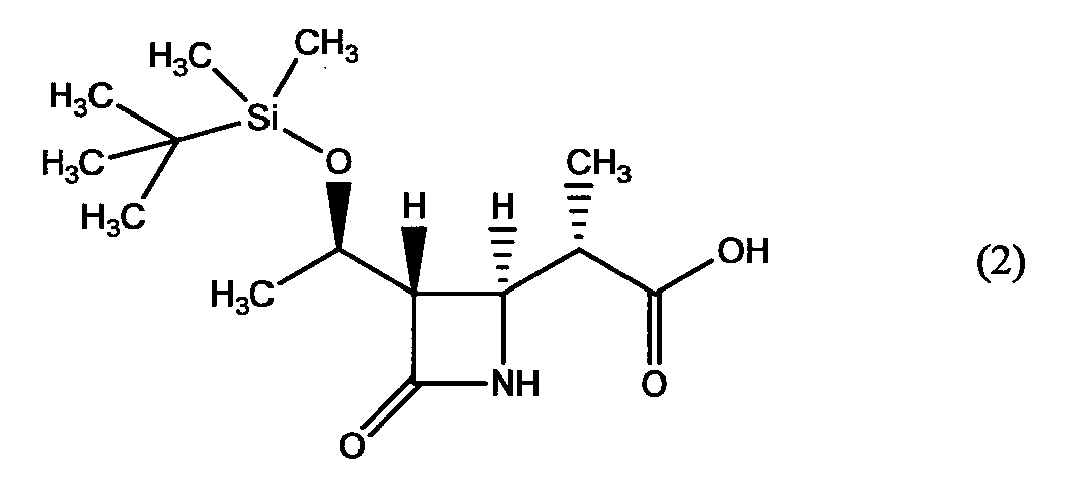
- Furthermore, the present invention relates to a crystal of (2R)-2-{(3S,4S)-3-[(1R)-1-(tert-butyldimethylsilyloxy)ethyl]-2 -oxoazetidin-4-yl}propionic acid represented by the formula (1), wherein the crystal shows a diffraction intensity peaks at diffraction angles of 7.48°, 11.30°, 14.50°, 15.04°, 15.54°, 16.54°, 16.94°, 18.58°, 22.68°, 24.24°, 28.50° and 31.62° in a powder x-ray diffraction pattern.
- The present invention provides an improved method of crystallization of the compound (1) useful as a synthesis intermediate of a 1β-methylcarbapenem derivative, and the intermediate with high purity, and a crystal of the intermediate.
- Hereinafter, the present invention is described in detail.
- The present invention is characterized in comprising a step of mixing a solution of (2R)-2-{(3S,4S)-3-[(1R)-1-(tert-butyl dimethylsilyloxy)ethyl]-2-oxoazetidin-4-yl}propionic acid represented by the formula (1):

- At first, a solution in which the compound (1) is dissolved is described.
- A solution in which the compound (1) is dissolved is a solution containing the compound (1) partially or completely dissolved in a good solvent described below (hereinafter, sometimes abbreviated as "good solvent solution of the compound (1)"). A good solvent is a solvent having high solubility of the compound (1), and is described below with a specific example.
- An example of a good solvent of the compound (1) may include ethers, nitriles, esters, ketones, alcohols, amides, and the solvent mixtures thereof. Ethers may include tetrahydrofuran, diethyl ether, 1,4-dioxane and methyl tert-butyl ether; nitriles may include acetonitrile and propionitrile; esters may include fatty acid esters such as methyl acetate, ethyl acetate, n-propyl acetate, isopropyl acetate, n-butyl acetate, sec-butyl acetate, isobutyl acetate, tert-butyl acetate, pentyl acetate, methyl propionate and ethyl propionate; ketones may include acetone, 2-butanone, 3-methyl-2-butanone, 2-pentanone, 3-pentanone, 4-methyl-2-pentanone and 2-hexanone; alcohols may include methanol, ethanol, 1-propanol, 2-propanol, n-butanol and 2-butanol; amides may include N,N-dimethylformamide, N,N-dimethylacetamide, N-methylpyrrolidone and N-ethylpyrrolidone.
- Among the above solvents, ethers, esters, ketones and alcohols are preferable, and esters and ketones are more preferable. As esters, acetic acid esters such as methyl acetate, ethyl acetate, n-propyl acetate, isopropyl acetate, n-butyl acetate, sec-butyl acetate, isobutyl acetate, tert-butyl acetate and the solvent mixtures thereof are preferable, and ethyl acetate is particularly preferable. As ketones, ketones having 1 to 5 carbon atoms such as acetone, 2-butanone, 3-methyl-2-butanone, 2-pentanone, 3-pentanone, and the solvent mixtures thereof are preferable, and acetone and 2-butanone are particularly preferable.
- A good solvent solution of the compound (1) may be a crude reaction solution in which the compound (1) is synthesized by a conventionally known method and a good solvent is contained, or a solution obtained by dissolving the compound (1), which is once isolated, in a good solvent. Further, the solution may be a solution obtained by subjecting a crude reaction solution of the compound (1) to post-treatment such as washing with water optionally containing an acid, a base, a salt or the like, concentration adjustment by condensation, insoluble matter filtration treatment, and adsorption treatment with activated carbon, based on the necessity. Further, the solution may be a homogenous or nonhomogenous solution obtained by concentrating the crude reaction solution in which the compound (1) is synthesized or the good solvent solution containing the compound (1) dissolved therein, or furthermore may be a slurry obtained by carrying out concentration to partially precipitate the compound (1). No need to say, another solvent other than the good solvent may exist to an extent that no bad effect is caused. For example, it is effective and particularly preferable for production in industrial scale to mix water with the good solvent solution of the compound (1) to give a water-containing solution, since a solubility of the compound (1) in the good solvent solution can be improved and a concentration of the compound (1) in the solution can be increased to reduce a volume of the good solvent solution.
- A concentration of the compound (1) in a good solvent solution is not particularly limited; however is generally preferably 1% by weight or higher, more preferably 3% by weight or higher, and even more preferably 5% by weight or higher, in consideration of a productivity or the like. Further, an upper limit of the concentration of the compound (1) in the good solvent solution is preferably equal to or lower than a saturated solubility of the compound (1) in a good solvent to be used; however the solution may be supersaturated or may be a slurry by partial precipitation.
- Next, a substituted aromatic hydrocarbon solvent and a halogenated hydrocarbon solvent to be used in the present invention is described.
- In the present invention, a substituted aromatic hydrocarbon solvent and/or a halogenated hydrocarbon solvent are used as a poor solvent. Hereinafter, the substituted aromatic hydrocarbon solvents and the halogenated hydrocarbon solvents may be collectively called as "a poor solvent" in some cases. The poor solvent means a solvent having a low solubility of the compound (1). It is not common to use the substituted aromatic hydrocarbon solvent and the halogenated hydrocarbon solvent as a poor solvent at a time of crystallizing a common organic compound, since the solvents have a property of well dissolving an organic compound. Even if the solvents can be used as a poor solvent, it is not common to use the substituted aromatic hydrocarbon solvent and the halogenated hydrocarbon solvent as a poor solvent, since the solvents more easily dissolve an organic compound than aliphatic hydrocarbons such as hexane often used as a poor solvent and tend to cause undesirable consequence such as low recovery ratio by crystallization. The present invention is completed on the basis of a finding that the compound (1) with a high yield and a high purity can be obtained by using the substituted aromatic hydrocarbon solvent and/or the halogenated hydrocarbon solvent as a poor solvent in the crystallization of the compound (1). Such a finding is significantly remarkable.
- A substituted aromatic hydrocarbon solvent is not particularly limited as long as the solvent is a poor solvent of the compound (1); however includes aromatic hydrocarbons having one or more substituents such as alkyl groups having 1 to 4 carbon atoms, halogens, nitro groups, and solvent mixtures thereof. Naturally, in case that there are two or more substituent groups, ortho-, meta-and para-position isomers may be included. The example of alkyl groups having 1 to 4 carbon atoms includes methyl, ethyl, n-propyl, isopropyl and the like. The example of halogens includes fluorine, chlorine, bromine and iodine. Among the examples, aromatic hydrocarbons having one or more substituents of methyl group and chlorine and the solvent mixtures thereof are preferable; toluene, o-xylene, m-xylene and p-xylene are more preferable; and toluene is particularly preferable.
- The above halogenated hydrocarbon solvents are not particularly limited as long as the solvents are a poor solvent of the compound (1); and include chain halogenated hydrocarbon solvents such as dichloromethane, 1,1-dichloroethane, 1,2-dichloroethane, 1,1,1-trichloroethane and the like. Among the example, dichloromethane is preferable.
- The above substituted aromatic hydrocarbon solvents and halogenated hydrocarbon solvents may be singly used respectively, or the combination thereof may be used.
- Next, a method of crystallization of the compound (1) of the present invention is described.
- In the present invention, crystallization is carried out by a method of mixing a good solvent solution of the compound (1) and a poor solvent.
- When crystallization is carried out, a poor solvent may be added to a good solvent solution of the compound (1) or a good solvent solution of the compound (1) may be added to a poor solvent. In the case of adding the poor solvent to the good solvent solution of the compound (1), the addition may be carried out at once or stepwise. In the case of adding the good solvent solution of compound (1) to the poor solvent, the addition may be also carried out at once or stepwise. In the case of the stepwise addition, the solvent may be added continuously or the solvent is divided into several portions and the portions may successively be added. Further, at the time of mixing the good solvent solution of compound (1) and the poor solvent, the solution and the solvent may be simultaneously added to be mixed.
- Before mixing a good solvent solution of the compound (1) and a poor solvent, the good solvent solution of the compound (1) may be subjected to concentration crystallization or cooling crystallization to crystallize a portion of the compound (1) and then the poor solvent may be mixed as described above. The good solvent solution of the compound (1) formed to be in a slurry state by crystallization and the poor solvent may be mixed to further accelerate crystallization.
- In addition, a crystallization method by mixing a good solvent solution of the compound (1) and a poor solvent may also be carried out properly in combination with concentration crystallization or cooling crystallization.
- In such a case that a boiling point of a poor solvent is higher than a boiling point of a good solvent to be used for a good solvent solution of the compound (1) or a good solvent and a poor solvent are azeotropic, it is preferable to carry out concentration at the time of mixing the good solvent solution of the compound (1) and the poor solvent and/or after mixing the solution and the solvent, since a ratio of the good solvent in a crystallization solution can efficiently be decreased and a crystal recovery ratio can be improved. When a ratio of a poor solvent is higher in a solvent composition before solid-liquid separation operation described later, the crystal can be obtained at a higher crystal recovery ratio.
- A method involving a crystallization method of mixing a good solvent solution of the compound (1) and a poor solvent in combination with a concentration crystallization and further in combination with cooling crystallization is particularly preferable, since the method can further improve a crystal recovery ratio. No need to say, when the concentration crystallization and the cooling crystallization are carried out, either one operation may be carried out previously and both operations may be repeated any times.
- Thus, a crystal with a high purity can be obtained by any crystallization method described above.
- In the above crystallization operations, a seed crystal may be added if necessary. A use amount of the seed crystal is not particularly limited; however, a lower limit is preferably not less than 0.001 w/w times, more preferably not less than 0.003 w/w times, and particularly more preferably not less than 0.005 w/w times, respective to the compound (1) in a good solvent solution. An upper limit of the compound (1) in a good solvent solution is preferably not more than 0.2 w/w times, more preferably not more than 0.1 w/w times, and further more preferably not more than 0.05 w/w times, respective to the compound (1) in a good solvent solution.
- In the crystallization by mixing a good solvent solution of the compound (1) and a poor solvent and/or concentration crystallization, a temperature is not particularly limited; however, the temperature is preferably 50°C or lower, more preferably 40°C or lower, and particularly more preferably 30°C or lower, since the compound (1) is sometimes inferior in a heat stability.
- A use amount of a poor solvent is preferably set every time in accordance with a crystallization method in order to obtain a desired crystallization recovery ratio. The amount is not particularly limited; however, a weight ratio of the poor solvent in a composition of solvent contained in a mother liquid is generally 1/2 or higher, preferably 2/3 or higher, and more preferably 3/4 or higher. The crystallization mother liquid means a liquid phase part immediately before a solid-liquid separation operation described later after a crystallization method of mixing a good solvent solution of the compound (1) and a poor solvent or after an operation of concentration crystallization and/or cooling crystallization to be carried out on the basis of necessity. An formula for calculating a weight ratio of a poor solvent contained in the mother liquid is defined as ([weight of poor solvent]) /([weight of good solvent]) + [weight of poor solvent]).
- In a crystallization method of mixing a good solvent solution of the compound (1) and a poor solvent, the poor solvent may be used in a manner that a weight ratio of the poor solvent can satisfy the above-mentioned ratio. In case that a crystallization method of mixing a good solvent solution of the compound (1) and a poor solvent is combined with a concentration crystallization to be carried out, a mixing of the good solvent solution of the compound (1) and the poor solvent and concentration may be carried out in a manner that a weight ratio of the poor solvent contained in the mother liquid can satisfy the above ratio.
- In the present invention, aging may be carried out at the last of a crystallization. An aging temperature is not particularly limited; however, the temperature is preferably as low as possible in terms of increase of a crystallization recovery ratio and is generally 20°C or lower, preferably 10°C or lower, and more preferably 0°C or lower. An aging time is not particularly limited; however, a lower limit is generally 10 minutes or longer, preferably 30 minutes or longer, and more preferably 1 hour or longer. An upper limit is generally 30 hours or shorter, preferably 20 hours or shorter, and more preferably 10 hours or shorter, in consideration of a productivity.
- Generally, the above crystallization by mixing a good solvent solution of the compound (1) and a poor solvent, concentration crystallization, cooling crystallization and aging are carried out with stirring. An intensity of the stirring is not particularly limited; however, the intensity is preferably not lower than 10 w/m3, more preferably not lower than 50 w/m3, furthermore preferably not lower than 100 w/m3, and even more preferably not lower than 300 w/m3, as needed motive energy of stirring per unit volume.
- A crystal of the compound (1) obtained by the crystallization method of the present invention can be isolated by common solid-liquid separation operation.
- According to the crystallization method of the present invention, it is possible to obtain the highly pure compound (1) with a high crystal recovery ratio by executing crystallization in industrially simple operation such as mixing and concentration of a good solvent solution of the compound (1) which is obtained by post-treatment such as extraction operation of a crude reaction solution, without carrying out complicated operation, which is disclosed as a conventional crystal obtaining method, such as drying of a solution containing the compound (1) and recrystallization. The crystallization method of the present invention is particularly useful at the time of production of the compound (1) in an industrial scale, since the method is simple in an operation and economical due to an improvement of a productivity.
- In the case of the methods as the above Patent Documents, a precursor of a compound represented by the following formula (2):

- When the crystallization method of the present invention is employed, the 2S isomer as an impurity can be removed at 50% or higher of a removal ratio, preferably 60% or higher, and more preferably 65% or higher; and thus, the crystallization method of the present invention is very useful in terms of a remarkable decrease of a content of a 2S isomer contained in a crystal of the compound (1). The formula for calculating the removal ratio can be defined as ([content of 2S isomer to compound (1) in good solvent solution] - [content of 2S isomer in crystal]) / [content of 2S isomer to compound (1) in good solvent solution] x 100 (%).
- The compound (1) thus obtained in the above-mentioned manner is a compound with high purity having a content of the 2S isomer as an impurity of 1% or less, preferably 0.5% or less, and more preferably 0.3% or less. Since a content of an isomer contained in a 1β-methylcarbapenem antibiotic synthesized as a pharmaceutical agent from the compound (1) can be decreased by decreasing a content of the 2S isomer remaining in a crystal, the compound (1) with an extremely small content of the 2S isomer is very useful.
- The compound (1) obtained by using the present invention is remarkably useful as a synthesis intermediate for producing a 1β-methylcarbapenem derivative with a high purity.
- The crystal of the compound (1) obtained in the above-mentioned manner shows main peaks at diffraction angles of, for example, 2θ =7.48°, 11.30°, 14.50°, 15.04°, 15.54°, 16.54°, 16.94°, 18.58°, 22.68°, 24.24°, 28.50° and 31.62° in a powder x-ray diffraction obtained by irradiating Kα-beam of Cu, having a wavelength of λ = 1.54 Å. The main peaks are peaks with 10 or higher relative intensity in case that an intensity of a peak at a diffraction angle of 2θ = 15.04° is defined to be 100. When a crystal is represented by employing a diffraction angle 2θ in the present specification, a value of a diffraction angle 2θ is not limited to values at which the above-mentioned peaks exist and ranges thereof, and may include a margin of errors. A range within which such errors are generated can be easily expected by a person skilled in the art from a measurement condition and the like; and such a range of errors may be, for example, ±0.05°. The obtained crystal is easily handled and thus useful.
- Hereinafter, the present invention is described much more in detail with reference to Examples, Comparative Examples and Reference Examples; however it is not intended that the present invention be limited to the Examples.
-

- After (3S,4R)-3-[(1R)-1-(tert-butyldimethylsilyloxy)ethyl]-4-[(1S)-1-methyl-2-propenyl]azetidin-2-one (10.6 g), acetic acid (17.1 g), ethyl acetate (105 ml) and water (73 ml) were mixed, the mixture was stirred. To the mixture, potassium permanganate (30.0 g) was added over 1.5 hours while the reaction solution temperature was kept at 6 to 15°C. Then, the reaction solution was stirred at 7°C for 3 hours. Thereafter, a 27% aqueous solution of sodium hydrogen sulfite (157 ml) was added while the reaction solution temperature was kept at 6 to 13°C, and the solution was stirred at 7°C for 30 minutes. Further, 6N HCl was added to adjust pH of the reaction solution to be at 1. 4, and the reaction solution was stirred at 7°C for 30 minutes. After an organic layer obtained by separating the resulting reaction solution was washed with water (55 ml) twice, ethyl acetate (28 ml) was added to obtain an ethyl acetate solution (112.5 g) containing 10.2 g of (2R)-2-{(3S,4S)-3-[(1R)-1-(tert-butyldimethylsilyloxy)ethyl]-2-oxoazetidin-4-yl}propionic acid. The solution contained a 2S isomer in an amount of 2.0% on the basis of the compound (1).
- The ethyl acetate solution (40.0g) of the compound (1) obtained in Reference Example 1 was concentrated to 10.0 g while the inner temperature was kept at 24 to 30°C. As a result, a crystal was precipitated. While the obtained slurry was stirred, toluene (17.8 g) was added. The slurry was further concentrated to 8.2 g , while the inner temperature was kept at 21 to 30°C. After toluene (41.9 g) was added, the slurry was cooled to -20°C and stirred for 1.5 hours. It was confirmed that the weight ratio of toluene in the composition of the solvents at the moment was 1/2 or higher. After the crystal was separated by filtration, the crystal was washed with toluene (4.2 g). The obtained wet crystal was dried under reduced pressure at room temperature for 24 hours to obtain 3.4 g of a dry crystal of the compound (1).
- Crystal purity: 99.0%
- 2S Isomer content: 0.7%
- 2S Isomer removal ratio: 67%
- Crystal recovery ratio: 92.1%
- The ethyl acetate solution (40.0 g) of the compound (1) obtained in Reference Example 1 was concentrated to 7.8 g while the inner temperature was kept at 24 to 30°C. As a result, a crystal was precipitated. While the obtained slurry was stirred, ethyl acetate (22.8 g) was added. The slurry was further concentrated to 7.8 g, while the inner temperature was kept at 27 to 30°C. After ethyl acetate (10.6 g) was added, the obtained slurry was cooled to -50°C and stirred for 1.5 hours. After the crystal was separated by filtration, the crystal was washed with ethyl acetate (3.6 g), and the obtained wet crystal was dried under reduced pressure at room temperature for 27 hours to obtain 3.2 g of a dry crystal of the compound (1).
- Crystal purity: 98.4%
- 2S Isomer content: 1.2%
- 2S Isomer removal ratio: 36%
- Crystal recovery ratio: 88.5%
-

- After zinc metal (6.8 g) of which surface was treated with diluted hydrochloric acid and 3-(2-bromopropanoyl)-spiro[3-azachloman-2,1'-cyclohexan]-4-one (1.8 g) were added to dry tetrahydrofuran (60 ml), the mixture was stirred at 25°C for 1.7 hours. After a solution obtained by dissolving 3-(2-bromopropanoyl)-spiro[3- azachloman-2,1'-cyclohexan]-4-one (16.5 g) and (3R,4R)-4-acetoxy-3-[(1R)-1-tert-butyldimethylsilyl oxy] -2-azetizinone (10. 0 g) in dry tetrahydrofuran (50 ml) was added at the same temperature over 30 minutes to the mixture, the resulting mixture was stirred for 15 hours. Thereafter, the solution was concentrated until the amount was decreased to 50 ml, while the inner temperature was kept at about 20°C. The unreacted zinc component was separated by filtration. After the filtrate was diluted with toluene (70 ml), water (30 ml) was added under cooling with ice, and a 1N aqueous solution of hydrochloric acid was further added to adjust pH at 4.0. The organic layer obtained by solution separation was washed with water (15 ml) twice. While the inner temperature was kept at 20 to 30°C, the solvent was removed by distillation to obtain 30.0 g of a toluene solution containing 15.5 g of 3-{(2R)-2-{(3S,4R)-3-[(1R)-1-tert-butyldimethylsilyloxy ethyl]-2-oxoazetidin-4-yl}propionyl}-spiro[2,3-dihydro-4H-1,3-benzoxadine-2,1'-cyclohexan]-4-one.
- After methanol (150 ml) was added for dissolution in the obtained toluene solution, the solution was cooled to 0°C. Then, 30% aqueous hydrogen peroxide (11.8 ml) and a 15% aqueous solution of sodium hydroxide (15. 3 g) were successively added to the solution. The mixture was stirred at the same temperature for 1 hour and 40 minutes. Next, after a 10% aqueous solution of sodium sulfite (145 g) was added dropwise over 1 hour and 20 minutes, the mixture was stirred for 30 minutes. A 1N aqueous solution of hydrochloric acid was added to adjust pH at 9.6, and methanol was removed by vacuum distillation. The precipitated crystal component was separated by filtration and the crystal component was washed with water (50 ml) twice. The filtrate and the washing solution was mixed to obtain an aqueous alkaline solution containing 8.9 g of (2R)-2-{(3S,4S)-3-[(1R)-1-(tert-butyldimethylsilyloxy) ethyl]-2-oxoazetidin-4-yl}propionic acid. The solution contained the 2S isomer in an amount of 2.7% on the basis of the compound (1).
- After ethyl acetate (75 ml) was added to the aqueous alkaline solution containing 4.5 g of (2R)-2-{(3S,4S)-3-[(1R)-1-(tert-butyldimethylsilyloxy)ethyl]-2-oxoazetidin-4-yl}propionic acid (compound (1)) obtained in Reference Example 2, 6N HCl was added under cooling with ice to adjust pH at 2.9. After the mixture was stirred for 10 minutes, an organic layer obtained by separating a water layer was washed with water (15 ml) twice to obtain an ethyl acetate solution containing 4.4 g of (2R)-2-{(3S,4S)-3-[(1R)-1-(tert-butyldimethylsilyloxy)ethyl]-2-oxoazetidin-4-yl}propioni c acid. The solution contained the 2S isomer in an amount of 2.7% on the basis of the compound (1).
- To the ethyl acetate solution of the compound (1) obtained in Reference Example 3, toluene (150 ml) was added over 10 minutes. As a result, a crystal was precipitated. The obtained slurry was concentrated to 29.3 g, while the inner temperature was kept at 20 to 30°C. The obtained slurry was cooled to -20°C and stirred at the same temperature for 2.5 hours. It was confirmed that the weight ratio of toluene in the composition of the solvents at the moment was 1/2 or higher. After the crystal was separated by filtration, the crystal was washed with toluene (8 ml) twice. The obtained wet crystal was dried under reduced pressure at room temperature for 24 hours to obtain 4.3 g of a dry crystal of the compound (1).
- Crystal purity: 98.7%
- 2S Isomer content: 0.8%
- 2S Isomer removal ratio: 70%
- Crystal recovery ratio: 97.5%
- Concentrated hydrochloric acid was added to the aqueous alkaline solution containing 4.4 g of the compound (1) obtained in Reference Example 2 under cooling with ice to adjust pH at 3.0. As a result, a crystal was precipitated. The obtained slurry was stirred for further 30 minutes under cooling with ice. The crystal was separated by filtration, and washed with water (25 ml). The obtained wet crystal was dried under reduced pressure at room temperature for 17 hours to obtain 4.7 g of a crystalline solid of the compound (1), containing 4.3 g of pure compound.
- Crystal purity: 90.6%
- 2S Isomer content: 2.2%
- 2S Isomer removal ratio: 18%
- Crystal recovery ratio: 96.7%
-

- After (3S,4R)-3-[(1R)-1-(tert-butyldimethylsilyloxy)ethyl]-4-[(1S)-1-methyl-2-propenyl]azetidin-2-one (10.0 g), acetic acid (16.1 g), ethyl acetate (100 ml) and water (70 ml) were mixed, and the mixture was stirred. While the reaction solution temperature was kept at 6 to 15°C, potassium permanganate (28.3 g) was added over 1.5 hours. The mixture was stirred at 7°C for 3 hours. Thereafter, a 27% aqueous solution of sodium hydrogen sulfite (150 ml) was added, while the reaction solution temperature was kept at 6 to 13°C. The mixture was stirred at 7°C for 30 minutes, and 6N HCl was further added to adjust pH of the reaction solution to be at 1.5. The mixture was stirred at 7°C for 30 minutes. An organic layer obtained by separating the mixture was washed with water (50 ml) twice to obtain an ethyl acetate solution containing 9.6 g of (2R)-2-{(3S,4S)-3-[(1R)-1-(tert-butyldimethylsilyloxy)ethyl]-2 -oxoazetidin-4-yl}propionic acid. The solution contained a 2S isomer in an amount of 1.3% on the basis of the compound (1).
- To the ethyl acetate solution containing 4.8 g of the compound (1) obtained in Reference Example 4, toluene (150 ml) was added over 10 minutes. As a result, a crystal was precipitated. The obtained slurry was concentrated to 32.0 g, while the inner temperature was kept at 20 to 30°C. The obtained slurry was cooled to -20°C and stirred at the same temperature for 2.5 hours. It was confirmed that the weight ratio of toluene in the composition of the solvents at the moment was 3/4 or higher. After the crystal was separated by filtration, the crystal was washed with toluene (8 ml) twice, and the obtained wet crystal was dried under reduced pressure at room temperature for 24 hours to obtain 4.7 g of a dry crystal of the compound (1).
- Crystal purity: 99.0%
- 2S Isomer content: 0.3%
- 2S Isomer removal ratio: 73%
- Crystal recovery ratio: 97.5%
- The powder x-ray diffraction of the crystal obtained by the method of Example 2 was measured by using the following apparatus under the following measurement conditions.
- Rotary twine cathode type x-ray diffraction apparatus Geiger Flex RAD-rA, manufactured by Rigaku Corporation
- Used x-ray: Cu-Kα ray; X-ray intensity: 40 kV, 100 mA; Angle range: 2θ = 3 to 80°; Scanning speed: 2°/min; Sampling interval: 0.02 seconds; Divergence slit: 1.0°; Receiving slit: 0.6°; Scattering slit: 1.0°
- The results are shown in Table 1.
Table 1 Diffraction angle (°) Relative intensity 7.48 66 11.30 58 14.50 38 15.04 100 15.54 14 16.54 10 16.94 16 18.58 28 22.68 38 24.24 14 28.50 12 31.62 16
Claims (12)
- A method for producing a compound represented by the formula (1),
comprising a step of mixing a solution of (2R)-2-{(3S,4S)-3-[(1R)-1-(tert-butyldimethylsilyloxy)ethyl]-2-oxoazetidin-4-yl} propionic acid represented by the following formula (1):
- The production method according to claim 1, wherein concentration is carried out during and/or after mixing the solution of the compound represented by the formula (1) with the substituted aromatic hydrocarbon solvent and/or the halogenated hydrocarbon solvent.
- The production method according to claim 1 or 2, wherein a ratio of a total weight of the substituted aromatic hydrocarbon solvent and the halogenated hydrocarbon solvent is 1/2 or higher in solvents contained in a crystallization mother liquid.
- The production method according to any one of claims 1 to 3, wherein a temperature of a mixed solution is 50°C or lower when the crystallization is carried out.
- The production method according to any one of claims 1 to 4, wherein a mixed solution is stirred at a stirring intensity of 10 W/m3 or higher when the crystallization is carried out.
- The production method according to any one of claims 1 to 5, wherein the solution of the compound represented by the formula (1) contains esters or ketones.
- The production method according to any one of claims 1 to 6, wherein the solution of the compound represented by the formula (1) contains water.
- The production method according to any one of claims 1 to 7, wherein the solution of the compound represented by the formula (1) has a concentration of the compound represented by the formula (1) of 1% by weight or higher.
- The production method according to any one of claims 1 to 8, wherein the halogenated hydrocarbon solvent is chain halogenated hydrocarbons.
- (2R)-2-{(3S,4S)-3-[(1R)-1-(tert-Butyldimethylsilyloxy) ethyl]-2-oxoazetidin-4-yl}propionic acid represented by the general formula (1),
wherein a content of (2S)-2-{(3S,4S)-3-[(1R)-1-(tert-butyl dimethylsilyloxy)ethyl]-2-oxoazetidin-4-yl}propionic acid represented by the following formula (2):
- A crystal of (2R)-2-{(3S,4S)-3-[(1R)-1-(tert-butyldimethyl silyloxy)ethyl]-2-oxoazetidin-4-yl}propionic acid represented by the formula (1),
wherein the crystal shows a diffraction intensity peaks at diffraction angles of 7.48°, 11.30°, 14.50°, 15.04°, 15.54°, 16.54°, 16.94°, 18.58°, 22.68°, 24.24°, 28.50° and 31.62° in a powder x-ray diffraction pattern. - The crystal of (2R)-2-{(3S,4S)-3-[(1R)-1-(tert-butyldimethyl silyloxy)ethyl]-2-oxoazetidin-4-yl}propionic acid represented by the formula (1) according to claim 11, wherein a content of (2S)-2-{(3S,4S)-3-[(1R)-1-(tert-butyldimethylsilyloxy)ethyl]-2 -oxoazetidin-4-yl}propionic acid represented by the formula (2) is 1% or less.
Applications Claiming Priority (2)
| Application Number | Priority Date | Filing Date | Title |
|---|---|---|---|
| JP2006167410 | 2006-06-16 | ||
| PCT/JP2007/061937 WO2007145260A1 (en) | 2006-06-16 | 2007-06-13 | Improved method for crystallization of azetidinonecarboxylic acid |
Publications (2)
| Publication Number | Publication Date |
|---|---|
| EP2030977A1 true EP2030977A1 (en) | 2009-03-04 |
| EP2030977A4 EP2030977A4 (en) | 2011-06-01 |
Family
ID=38831774
Family Applications (1)
| Application Number | Title | Priority Date | Filing Date |
|---|---|---|---|
| EP07745204A Withdrawn EP2030977A4 (en) | 2006-06-16 | 2007-06-13 | Improved method for crystallization of azetidinonecarboxylic acid |
Country Status (7)
| Country | Link |
|---|---|
| US (1) | US8232389B2 (en) |
| EP (1) | EP2030977A4 (en) |
| JP (1) | JP5130208B2 (en) |
| KR (1) | KR20090029786A (en) |
| CN (1) | CN101479281B (en) |
| TW (1) | TW200806624A (en) |
| WO (1) | WO2007145260A1 (en) |
Families Citing this family (3)
| Publication number | Priority date | Publication date | Assignee | Title |
|---|---|---|---|---|
| JP4955580B2 (en) * | 2008-01-18 | 2012-06-20 | 旭化成エレクトロニクス株式会社 | Switching amplifier |
| CN106632453B (en) * | 2016-12-30 | 2019-03-19 | 淄博鑫泉医药技术服务有限公司 | Synthesize the preparation method of the key intermediate 4-BMA of 1 Beta-methyl carbapenem antibiotic bicyclic mother nucleus |
| CN116444533A (en) * | 2023-04-17 | 2023-07-18 | 山东科源制药股份有限公司 | Refining method of amlexanox |
Family Cites Families (13)
| Publication number | Priority date | Publication date | Assignee | Title |
|---|---|---|---|---|
| JPH04368365A (en) | 1991-06-18 | 1992-12-21 | Sankyo Co Ltd | Production of azetidinone derivative |
| JP2902178B2 (en) | 1991-10-15 | 1999-06-07 | 鐘淵化学工業株式会社 | Method for producing carbapenem synthesis intermediate from 4- (1,2-substituted or unsubstituted allyl) -2-azetidinone compound |
| JP2958835B2 (en) * | 1991-12-20 | 1999-10-06 | 高砂香料工業株式会社 | Method for producing 4- (1-carboxyalkyl) azetidin-2-one derivative |
| EP0546742B1 (en) * | 1991-12-09 | 2001-06-20 | Takasago International Corporation | 4-(1,1-Dialkoxycarbonyl-alkyl)azetidin-2-one derivatives and synthesis of 4-(1-carboxy-alkyl)azetidin-2-one derivatives therefrom |
| AU5717894A (en) * | 1992-12-21 | 1994-07-19 | Chong Kun Dang Corporation | 2-(2-substituted pyrrolidin-4-yl)thio-carbapenem derivatives |
| DE69405922T2 (en) | 1993-06-30 | 1998-01-29 | Nippon Soda Co | Process for the preparation of 4-substituted azetidinone derivatives |
| JPH0725848A (en) | 1993-07-13 | 1995-01-27 | Nippon Soda Co Ltd | Production of 4-substituted azetidinone derivative |
| JP3450193B2 (en) | 1998-07-24 | 2003-09-22 | 高砂香料工業株式会社 | Method for producing 4-substituted azetidinone derivatives |
| KR100335848B1 (en) | 2000-03-31 | 2002-05-08 | 윤재승 | Azetidinone derivatives, a process for their preparation and a method for producing 1-β-alkylazetidinone using the same |
| KR100377448B1 (en) | 2000-08-10 | 2003-03-26 | 동화약품공업주식회사 | Intermediate of Carbapenem Antibiotics and Process for the Preparation thereof |
| KR20040099963A (en) * | 2003-05-21 | 2004-12-02 | 종근당바이오 주식회사 | Chiral 2-azetidinone compounds, process and use thereof |
| WO2006028037A1 (en) * | 2004-09-06 | 2006-03-16 | Shionogi & Co., Ltd. | Process for production of intermediates for the synthesis of carbapenems |
| US20110144326A1 (en) * | 2009-12-10 | 2011-06-16 | Wei-Hong Tseng | Method for manufacturing stereoselective preparation of 4-BMA using a chiral auxiliary and chiral auxiliary |
-
2007
- 2007-06-12 TW TW096121178A patent/TW200806624A/en unknown
- 2007-06-13 US US12/308,413 patent/US8232389B2/en not_active Expired - Fee Related
- 2007-06-13 KR KR1020097000256A patent/KR20090029786A/en not_active Ceased
- 2007-06-13 JP JP2008521242A patent/JP5130208B2/en not_active Expired - Fee Related
- 2007-06-13 CN CN2007800224655A patent/CN101479281B/en not_active Expired - Fee Related
- 2007-06-13 WO PCT/JP2007/061937 patent/WO2007145260A1/en not_active Ceased
- 2007-06-13 EP EP07745204A patent/EP2030977A4/en not_active Withdrawn
Also Published As
| Publication number | Publication date |
|---|---|
| US20100298556A1 (en) | 2010-11-25 |
| CN101479281B (en) | 2012-07-11 |
| JP5130208B2 (en) | 2013-01-30 |
| US8232389B2 (en) | 2012-07-31 |
| CN101479281A (en) | 2009-07-08 |
| WO2007145260A1 (en) | 2007-12-21 |
| EP2030977A4 (en) | 2011-06-01 |
| JPWO2007145260A1 (en) | 2009-11-12 |
| TW200806624A (en) | 2008-02-01 |
| KR20090029786A (en) | 2009-03-23 |
Similar Documents
| Publication | Publication Date | Title |
|---|---|---|
| KR20020046948A (en) | Production method of epoxide crystal | |
| US8232389B2 (en) | Method for crystallization of azetidinonecarboxylic acid | |
| JP2011006379A (en) | Method for recrystallizing {2-amino-1,4-dihydro-6-methyl-4-(3-nitrophenyl)-3,5-pyridine dicarboxylic acid-3-[1-(diphenylmethyl)azetidin-3-yl]ester-5-isopropyl ester}(azelnidipine), isopropyl alcohol adduct of azelnidipine, and method for producing azelnidipine | |
| WO2014081047A1 (en) | Process for the preparation of (1s,4s,5s)-4-bromo-6-oxabicyclo[3.2.1] octan-7-one | |
| JP2005120024A (en) | Process for producing 4'-cyano-3-[(4-fluorophenyl) sulfonyl] -2-hydroxy-2-methyl-3'-trifluoromethylpropionanilide | |
| JP7837317B2 (en) | Method for producing biotin, and L-lysine salt of biotin and method for producing the same. | |
| CN118184592A (en) | Preparation method of chlorhexidine impurity J gluconate | |
| KR20210158417A (en) | A crystalline anhydrous form of cabazitaxel, process for the preparation and pharmaceutical compositions thereof | |
| US12577269B2 (en) | Continuous process for preparing the crystalline form II of sotagliflozin | |
| JP2012020970A (en) | Method for producing {3-(1-diphenylmethylazetidin-3-yl)ester-5-isopropyl ester 2-amino-1,4-dihydro-6-methyl-4-(3-nitrophenyl)-3,5-pyridinedicarboxylate} | |
| JP5952748B2 (en) | Novel crystalline form of phthaloyl amlodipine and process for producing high purity amlodipine besylate using the same | |
| WO2005063702A1 (en) | Preparation of r-5-(2-(2-ethoxyphenoxyetylamino)propyl)-2- methoxybenzenesulphonamide hydrochloride of high chemical | |
| EP1666483B1 (en) | Process for producing 3-chloromethyl-3-cephem derivative | |
| JP6676491B2 (en) | Method for producing azilsartan alkyl ester and method for producing azilsartan | |
| JP6483483B2 (en) | Manufacturing method of ezetimibe | |
| JP7566783B2 (en) | Carba cyclic phosphatidic acid compounds | |
| EP3943482B1 (en) | Process for the preparation of latanoprostene bunod and intermediate thereof | |
| JP6275596B2 (en) | Method for producing ammonium salt of telmisartan | |
| EP1730153B1 (en) | Isopropanol water solvate of olanzapine | |
| EP2938617B1 (en) | Process for preparing meropenem trihydrate | |
| KR20000013423A (en) | Synthesis of amorphous cephroxim acetyl | |
| JP5448588B2 (en) | Method for purifying L-carnosine | |
| WO2020129591A1 (en) | Production method for amide alcohol compound | |
| KR20200136167A (en) | New preparing method of Polaprezinc | |
| EP2388252A1 (en) | Process for producing 2-hydroxymethylmorpholine salt |
Legal Events
| Date | Code | Title | Description |
|---|---|---|---|
| PUAI | Public reference made under article 153(3) epc to a published international application that has entered the european phase |
Free format text: ORIGINAL CODE: 0009012 |
|
| 17P | Request for examination filed |
Effective date: 20090107 |
|
| AK | Designated contracting states |
Kind code of ref document: A1 Designated state(s): AT BE BG CH CY CZ DE DK EE ES FI FR GB GR HU IE IS IT LI LT LU LV MC MT NL PL PT RO SE SI SK TR |
|
| AX | Request for extension of the european patent |
Extension state: AL BA HR MK RS |
|
| A4 | Supplementary search report drawn up and despatched |
Effective date: 20110503 |
|
| DAX | Request for extension of the european patent (deleted) | ||
| RAP1 | Party data changed (applicant data changed or rights of an application transferred) |
Owner name: KANEKA CORPORATION |
|
| 17Q | First examination report despatched |
Effective date: 20130305 |
|
| STAA | Information on the status of an ep patent application or granted ep patent |
Free format text: STATUS: THE APPLICATION IS DEEMED TO BE WITHDRAWN |
|
| 18D | Application deemed to be withdrawn |
Effective date: 20130917 |