WO2002012230A1 - Intermediate of carbapenem antibiotics and process for the preparation thereof - Google Patents
Intermediate of carbapenem antibiotics and process for the preparation thereof Download PDFInfo
- Publication number
- WO2002012230A1 WO2002012230A1 PCT/KR2001/001327 KR0101327W WO0212230A1 WO 2002012230 A1 WO2002012230 A1 WO 2002012230A1 KR 0101327 W KR0101327 W KR 0101327W WO 0212230 A1 WO0212230 A1 WO 0212230A1
- Authority
- WO
- WIPO (PCT)
- Prior art keywords
- general formula
- compound
- oxo
- methyl
- acid ester
- Prior art date
- Legal status (The legal status is an assumption and is not a legal conclusion. Google has not performed a legal analysis and makes no representation as to the accuracy of the status listed.)
- Ceased
Links
- 0 CC(C)C([C@@](C)(*)[C@](C(*(C(*)(*)OC(*)=C1*)C1=*)=O)N)*(C)=O Chemical compound CC(C)C([C@@](C)(*)[C@](C(*(C(*)(*)OC(*)=C1*)C1=*)=O)N)*(C)=O 0.000 description 4
Classifications
-
- C—CHEMISTRY; METALLURGY
- C07—ORGANIC CHEMISTRY
- C07D—HETEROCYCLIC COMPOUNDS
- C07D413/00—Heterocyclic compounds containing two or more hetero rings, at least one ring having nitrogen and oxygen atoms as the only ring hetero atoms
- C07D413/14—Heterocyclic compounds containing two or more hetero rings, at least one ring having nitrogen and oxygen atoms as the only ring hetero atoms containing three or more hetero rings
-
- C—CHEMISTRY; METALLURGY
- C07—ORGANIC CHEMISTRY
- C07D—HETEROCYCLIC COMPOUNDS
- C07D413/00—Heterocyclic compounds containing two or more hetero rings, at least one ring having nitrogen and oxygen atoms as the only ring hetero atoms
- C07D413/02—Heterocyclic compounds containing two or more hetero rings, at least one ring having nitrogen and oxygen atoms as the only ring hetero atoms containing two hetero rings
- C07D413/06—Heterocyclic compounds containing two or more hetero rings, at least one ring having nitrogen and oxygen atoms as the only ring hetero atoms containing two hetero rings linked by a carbon chain containing only aliphatic carbon atoms
-
- C—CHEMISTRY; METALLURGY
- C07—ORGANIC CHEMISTRY
- C07D—HETEROCYCLIC COMPOUNDS
- C07D205/00—Heterocyclic compounds containing four-membered rings with one nitrogen atom as the only ring hetero atom
- C07D205/02—Heterocyclic compounds containing four-membered rings with one nitrogen atom as the only ring hetero atom not condensed with other rings
- C07D205/06—Heterocyclic compounds containing four-membered rings with one nitrogen atom as the only ring hetero atom not condensed with other rings having one double bond between ring members or between a ring member and a non-ring member
- C07D205/08—Heterocyclic compounds containing four-membered rings with one nitrogen atom as the only ring hetero atom not condensed with other rings having one double bond between ring members or between a ring member and a non-ring member with one oxygen atom directly attached in position 2, e.g. beta-lactams
-
- C—CHEMISTRY; METALLURGY
- C07—ORGANIC CHEMISTRY
- C07D—HETEROCYCLIC COMPOUNDS
- C07D265/00—Heterocyclic compounds containing six-membered rings having one nitrogen atom and one oxygen atom as the only ring hetero atoms
- C07D265/04—1,3-Oxazines; Hydrogenated 1,3-oxazines
- C07D265/06—1,3-Oxazines; Hydrogenated 1,3-oxazines not condensed with other rings
-
- C—CHEMISTRY; METALLURGY
- C07—ORGANIC CHEMISTRY
- C07D—HETEROCYCLIC COMPOUNDS
- C07D265/00—Heterocyclic compounds containing six-membered rings having one nitrogen atom and one oxygen atom as the only ring hetero atoms
- C07D265/04—1,3-Oxazines; Hydrogenated 1,3-oxazines
- C07D265/12—1,3-Oxazines; Hydrogenated 1,3-oxazines condensed with carbocyclic rings or ring systems
- C07D265/14—1,3-Oxazines; Hydrogenated 1,3-oxazines condensed with carbocyclic rings or ring systems condensed with one six-membered ring
-
- C—CHEMISTRY; METALLURGY
- C07—ORGANIC CHEMISTRY
- C07D—HETEROCYCLIC COMPOUNDS
- C07D487/00—Heterocyclic compounds containing nitrogen atoms as the only ring hetero atoms in the condensed system, not provided for by groups C07D451/00 - C07D477/00
- C07D487/02—Heterocyclic compounds containing nitrogen atoms as the only ring hetero atoms in the condensed system, not provided for by groups C07D451/00 - C07D477/00 in which the condensed system contains two hetero rings
- C07D487/04—Ortho-condensed systems
-
- C—CHEMISTRY; METALLURGY
- C07—ORGANIC CHEMISTRY
- C07F—ACYCLIC, CARBOCYCLIC OR HETEROCYCLIC COMPOUNDS CONTAINING ELEMENTS OTHER THAN CARBON, HYDROGEN, HALOGEN, OXYGEN, NITROGEN, SULFUR, SELENIUM OR TELLURIUM
- C07F9/00—Compounds containing elements of Groups 5 or 15 of the Periodic Table
- C07F9/02—Phosphorus compounds
- C07F9/547—Heterocyclic compounds, e.g. containing phosphorus as a ring hetero atom
- C07F9/6561—Heterocyclic compounds, e.g. containing phosphorus as a ring hetero atom containing systems of two or more relevant hetero rings condensed among themselves or condensed with a common carbocyclic ring or ring system, with or without other non-condensed hetero rings
- C07F9/65611—Heterocyclic compounds, e.g. containing phosphorus as a ring hetero atom containing systems of two or more relevant hetero rings condensed among themselves or condensed with a common carbocyclic ring or ring system, with or without other non-condensed hetero rings containing the ring system (X = CH2, O, S, NH) optionally with an additional double bond and/or substituents, e.g. penicillins and analogs
-
- Y—GENERAL TAGGING OF NEW TECHNOLOGICAL DEVELOPMENTS; GENERAL TAGGING OF CROSS-SECTIONAL TECHNOLOGIES SPANNING OVER SEVERAL SECTIONS OF THE IPC; TECHNICAL SUBJECTS COVERED BY FORMER USPC CROSS-REFERENCE ART COLLECTIONS [XRACs] AND DIGESTS
- Y02—TECHNOLOGIES OR APPLICATIONS FOR MITIGATION OR ADAPTATION AGAINST CLIMATE CHANGE
- Y02P—CLIMATE CHANGE MITIGATION TECHNOLOGIES IN THE PRODUCTION OR PROCESSING OF GOODS
- Y02P20/00—Technologies relating to chemical industry
- Y02P20/50—Improvements relating to the production of bulk chemicals
- Y02P20/55—Design of synthesis routes, e.g. reducing the use of auxiliary or protecting groups
Definitions
- This invention relates to a novel azetidinone compound of the following general formula ( I ), which is useful as an intermediate of J ⁇ -methylcarbapenem antibiotics and its preparing process:
- R is a hydrogen atom or a protecting group of hydroxy
- Ri and R2 are independently C1-C15 alkyl, benzyl or cyclized to be 5 or 6-membered ring which is cyclic hydrocarbon or heterocyclic compound containing at least one of O and S
- 3 is a lower alkyl or a lower alkyl ester
- R4 is benzene or benzene substituted with halogen atom, a lower alkoxy or nitro
- the methyl group in 1' position is R configuration, which is expressed by j ⁇ -methyl in all general formula hereunder.
- this invention relates to a process for preparing a novel azetidinone compound of the general formula (I) by reacting 4-acetoxy-azetidinone compound of the general formula (II) with ⁇ -halopropionamide compound of the general formula (HI):
- this invention relates to -halopropionamide compound of the general formula (HI), a novel stereoselective additive.
- the general formula ( I ) compound with better stereoselectivity may be made available using the general formula (HI) compound. Further, this invention relates to ⁇ -halopropionamide compound of the novel general formula (HI) by reacting monocycHc compound of the general formula (VE) with 2-halopropionic acid of the general formula (IX) or its activated complex.
- this invention relates to a novel process for preparing J3 -methylcarbapenem ester compound of the general formula (V).
- the general formula (V) compound may be made available in a manner such that N-substituted azetidinone compound of the general formula (X I ), so obtained by reacting the general formula ( I ) compound with haloacetate compound of the general formula (X), is further under cyclization and esterification in situ.
- R5 which is a protecting group of carboxyl to be easily removed by the common process, includes a lower alkyl, a lower alkenyl, a halogeno-lower alkyl, nitrobenzyl, a lower alkoxy-benzyl or benzhydryl;
- OA which is an esterified hydroxy group which can be easily substituted by -S-R ⁇ (Re is the corresponding heterocyclic compound exhibiting antibiotic activity), includes -OP(0)(OR7)2 (R7 is aryl or a lower alkyl), a substituted or unsubstituted lower alkylsulfonyl (e.g., methanesul- fonyl, ethanesulfonyl, trifluoromethanesulfonyl), aryloxycarbonyl (e.g.,benzyloxy carbonyl) and among them, it is preferred to employ some esterified
- this invention relates to a novel process for preparing l' ⁇ -meth- ylazetidinone compound of the general formula (IV). More specifically, the general formula (IV) compound may be made available via hydrolysis of the general formula ( I ) compound.
- BACKGROUND ART ⁇ -methylcairbapenem antibiotic of the following general formula (X H) has a wide spectrum of antibiotic activity against Gram-negative bacteria including Pseudomonas aeruginosa and Gram-positive bacteria as well as penicillin- or cephalosporin-resistant bacteria..
- ⁇ -methylcarbapenem antibiotic examples include meropenem (Europe Publication Patent No. 126587) and biapenem (Japan Publication Patent Pyung 1*25779), and a number of other ⁇ -methylcarbapenem antibiotic has been under development.
- -methylcarbapenem antibiotic are made available through the following two processes.
- R and Rs are the same as defined above; and e is a heterocyclic compound exhibiting an antibiotic activity.
- the first process comprises the steps of:
- (1) generating ⁇ -methylazetidinone compound of the general formula (IV) is prepared using 4-acetoxy-azetidinone compound of the general formula ( II ) as starting material in the presence of diverse stereoselective additives; and,
- the second process developed by Tanabe Co. of Japan is designed to improve some shortcomings encountered with the first process. More specifically, the second process comprises the steps of:
- R is the same as defined as above;
- Z is C3-C7 alkenyl, C1-20 alkyl, or methylene substituted into two groups selected from one group of aralkyl;
- Y is an oxygen atom, an sulfur atom, methylene or amine; and.
- ring B is a benzene ring substituted with a halogen atom, a lower alkyl, or a lower alkoxy.
- ⁇ -methylcarbapenem antibiotic of the general formula (X II) may be made available through the well known process (e.g., Japan Publication Patent Pyung 4-279588) by reacting the general formula (V) compound with some heterocyclic thiol compound.
- An object of this invention is to provide an intermediate of ⁇ -methylcar- bapenem stereoselectively, wherein an intermediate of l' ⁇ -methylcarbapenem is prepared in Ref ormatsky reaction using ⁇ -halopropionamide of the general formula (HI), a novel stereoselective additive, thus ensuring more increasing rate of l' ⁇ -methyl group versus l' ⁇ -methyl group than the prior art.
- This invention relates to a novel azetidinone compound of the following general formula (1), which is useful as an intermediate of ⁇ -methylcarbapenem antibiotics and its preparing process:
- R, Ri, R 2 , R3 and are the same as defined above.
- the examples of the protecting group of R include a lower alkoxy- carbonyl, tri-lower alkylsilyl, quartertaiy-butyl-dimethylsilyl, benzyloxycarbonyl or 4-nitrobenzyloxycarbonyl.
- the most preferred compound from the general formula ( I ) compound is comprised, wherein R is quartenary-butyl-dimethylsilyl; Ri and R2is cyclized to form cyclohexyl; R3 is methyl ester; and, R4 is benzene ring.
- the examples of the salts of general formula ( I ) azetidinone compound include inorganic and organic acid addition salts.
- the examples of inorganic acid addition salts include hydrochloride, hydrobromide or sulfate.
- the examples of organic acid salts include acetate, oxalate, tartrate, fumarate, maleate or benzenesulfonate.
- azetidinone compound ( I ) may contain stereoisomers of ⁇ -methyl group (R configuration) and ⁇ -methyl group (S direction) in V position.
- Ri, R2, R3, R , and X are the same as defined above.
- the reaction between ⁇ -halopropionamide (HI) and azetidinone compound (H) may be performed using some metals employed in Grignard reaction among nonpolar solvents or some metals which can form a metal complex with the general formula (HI) compound as steroselective additive.
- the examples of metals used for this invention include zinc or magnesium.
- the reaction solvents may be employed from the group consisting of tetrahydrofuran, toluene, xylene, dimethylformamide, and dimethylsulfoxide.
- ⁇ -halopropionamide compound of the general formula (HI) is employed to the general formula (H) compound in the amount of 1 ⁇ 3 mols, preferably in the amount of 1.2 ⁇ 1.7 mols. Some metals such as zinc may be employed in the amount of 2 ⁇ 4 mols.
- methyl iodide or 1,2-dibromoethane is added to the general formula (HI) compound to prepare Grignard compound beforehand and then, the aforementioned reaction is performed. Such reaction is performed at the temperature of -10 ⁇ 100°C.
- the reaction using zinc is preferably performed at the temperature of 50—80 * , while the reaction using magnesium is performed at the temperature of 0—30C.
- Lewis acid catalyst e.g., zinc bromide, triefhylboran, trimethylsilyl chloride or magnesium bromide
- the use of Lewis acid catalyst may facilitate the reaction, thus shortening the reaction time.
- this invention relates to ⁇ -halopropionamide compound of the general formula (HI), a novel stereoselective additive.
- the general formula ( I ) compound with better stereoselectivity may be made available using the general formula (HI) compound.
- this invention relates to ⁇ -halopropionamide compound of the novel general formula (HI) by reacting monocycHc compound Of the general formula (VHI) with 2-halopropionic acid of the general formula (IX) or its activated complex.
- the reaction between monocycHc compound of the general formula (V_H) and 2-halopropionic acid of the general formula (IX) is performed in the presence of dehydrating agent from nonpolar solvents.
- nonpolar solvents include ethylether, dichloromethane, chloroform, benzene, toluene, tetrahydrofu- ran or acetonitrile.
- dehydrating agents also include carbonyldn- midazole, dicyclocarbodiamide or 1-hydrobenzimidazole.
- the reaction is performed at the temperature of -10 ⁇ 50°C, preferably at the temperature of 0 ⁇ 25'C.
- HI by reacting monocycHc compound of the general formula (V ) with the activated complex of 2-halopropionic acid such as acid halide or mixed acid anhydride in the presence of base.
- the solvent may be selected from the aforementioned reaction.
- the examples of base include alkali metal, a lower alkyl lithium, pyridine or di-lower alkylaniline.
- the reaction is preferably at the temperature of -20 — 30 °C .
- this invention relates to a novel process for preparing ⁇ -methylcarbapenem ester compound of the general formula (V).
- the general formula (V) compound may be made available in a manner such that N-substituted azetidinone compound of the general formula (X I ), so obtained by reacting the general formula ( I ) compound with haloacetate compound of the general formula (X), is further under cycHzation and esterification in situ.
- the examples of base include l,8-diazabicyclo[5.4.0]undec-7-ene as organic base; alkaH metal hydride, alkaH metal hydroxide or alkali metal carbonate as alkali metal base; and, sodium amide, Hthium dusopropylamide, sodium bis(trimethylsilyl)amide as amine metal salt.
- the examples of solvent include tetrahydrofuran, benzene, toluene, dichloromethane. The reaction is performed at the temperature of -50 ⁇ -20 °C .
- the cyclization of N-substituted azetidinone compound of the general formula (X I ) is performed in the presence of base.
- the base used in the cycHazation may be selected from Dieckmann-iype reaction, and the examples of base include alkali metal salts such as sodium bis(trimethylsilyl)amide or Hthum bis(trimethylsilyl)amide.
- the base is employed to the general formula (X I ) compound in the amount of 1.0 ⁇ 3.0 equivalents, preferably in the amount of
- the examples of solvent in the reaction include tetrahydrofuran, ethylether, dioxane, toluene or benzene.
- the reaction is performed at the temperature of -78 ⁇ 50 ⁇ C, preferably at the temperature of -60 ⁇ 10T During the reaction, enolate salt of the general formula (X HI) is generated but the esterification is continued without separating the salt.
- R and Rs are the same as defined above; and, M + is alkali metal ion.
- the esterification of hydroxy salt of the general formula ( X HI) compound so, generated from intramolecular cycHzation is further proceeded with the addition of activated complex.
- activated complex include acid chloride or acid anhydride such as di-arylphosphate (e.g., diphenylphosphate) or di-lower alkylphosphate (e.g., diethylphosphate).
- the activated complex of esterified agent in the reaction to the general formula (X I ) compound in the amount of 1.0 ⁇ 4.0 equivalents, preferably in the amount of 2.0 ⁇ 3.0 equivalents.
- the reaction is preferably performed at the temperature of -78 ⁇ 30t!, more preferably at the temperature of -60 ⁇ 10°C.
- the next esterification may be continued with the addition of base and silylated material in order.
- silylated material include trimethylsilyl choride, _ butyldimethylsilyl chloride or tetrachlorosilane.
- reaction catalyst may shorten the reaction time.
- Such catalyst may be employed to the general formula (X I ) compound in the amount of 0.01 ⁇ 0.5 equivalents, preferably in the amount of 0.05 ⁇ 0.1 equivalents.
- the general formula (VM) compound is generated as by-product but its recycling into the general formula (HI) compound as stereoselectie additive after recovery.
- this invention relates to a novel process for preparing l' ⁇ -methylazetidinone compound of the general formula (IV).
- the general formula (IV) compound may be made available via hydrolysis of the general formula ( I ) compound.
- R is the same as defined above.
- the hydrolysis of the general formula ( I ) compound may be performed in the presence of hydrogen peroxide and metal salt hydroxide using nonpolar solvent.
- solvent include water and dioxane, tetrahydrofuran, dimethylformamide or methylalcohol; hence, it is preferred to employ water and tetrahydrofuran.
- metal salt hydroxide include Hthium hydroxide, sodium hydroxide or potassium hydroxide; hence, it is preferred to employ Hthium hydroxide.
- Hydrogen peroxide is employed to the general formula ( I ) compound in the amount of 1 ⁇ 10 equivalents, preferably in the amount of 6 ⁇ 8 equivalents.
- Metal salt hydroxide is employed to the general formula ( I ) com- pound in the amount of 1 ⁇ 5 equivalents, preferably in the amount of 2 ⁇ 3 equivalents.
- the reaction is preferably performed at the temperature of -5 ⁇ 5°C.
- a lower alkyl refers to linear or branched chain having 1 to 4 carbons, respectively; and, the definition “a lower alkenyl” means a linear chain having 2 to 5 carbons.
- Preparation example 2 Preparation of ethyl 3-cyano-3-phenylpyravic acid ester The reaction was performed in the same manner as Preparation example
- Example 10 Preparation of methyl 5-f(2R)-2-[(3S,4R)-3-[(lR)-l-t-butyl dimethyl- s ⁇ yloxyefhyI]-2-oxo-azetid__ne-4-yl]propionyl ⁇ -4-oxo-3-phenyl-l-oxa-5-azaspiro[ 5.5]undec-2-en-2-carboxylic acid ester (the general formula ( I ) compound)
- Example 17 Preparation of methyl 5- ⁇ (2R)-2-[(3S, 4R)-3- [(lR)-l-t-butyldimeth- ylsUyloxyethyl]-2-oxo-azetidine-4-yl]propionyl ⁇ -4-oxo-3-phenyl-l-oxa-5-azaspi- ro[5.5]undec-2-en-2-carboxylic acid ester (the general formula ( I ) compound)
- Example 18 Preparation of methyl 5-f(2R) ⁇ 2-[(3S, 4R)-l-allyloxycarboxylmethyl -3-[(lR)-l-t-butyldimethylsilyloxyethyl]-2-oxo-azetidine-4-yl]propionyl ⁇ -4-oxo- 3-phenyl-l-oxa-5-azaspiro[5.5
- Example 19 Preparation of methyl 5- ⁇ (2R)-2-[(3S, 4R)-l-(4-methoxybenzyloxy- carbonyl_methyl) ⁇ 3-[(lR)-l-t-butyl- propionyl ⁇ -4-oxo-3-phenyl-l-oxa-5-azaspiro[5.5]undec-2-en-2-carboxylic acid ester (the general formula (X I ) compound)
- the reaction was performed in the same manner as Example 18 except for using 4-methoxybenzylbromoacetate was employed instead of 3.0g of methyl 5- ⁇ (2R)-2-[(3S,4R)-3-[(lR)-l-t-butyldimemylsnyloxyethyl]-2-oxo-azetidine-4-yl]- propionyl ⁇ -4-oxo-3-phenyl-l-oxa-5-azaspiro[5.5]undec-2-en-2-
- Example 20 Preparation of methyl 5- ⁇ (2R)-2-[(3S, 4R)-l-(4-nitrobenzyloxycarbo- nylmethyl)-3-[(lR)-l-t-butyldimethylsilyloxyethyl]-2-oxo-azetidine-4-yl]propi- onyl ⁇ -4-oxo-3-phenyl-l-oxa-5-azaspiro[5.5]undec-2-en-2-C-irboxy--ic acid ester (the general formula (X I ) compound)
- Example 22 Preparation of 4-nitrobenzyl(lR, SR ⁇ SJ- ⁇ -ftlRJ-l-t-butyldimethy- lsilyloxyethyl]-l-methyl-2-diphenylphosphoryloxy-2-carbapen-2-em-3-carbox- ylic acid ester (the general formula ( V ) compound)
- Example 23 Preparation of 4-methoxybenzyl (1R, 5R, 6S)-6-[(lR)-l-t-butyldim- ethyls__lyloxyethyl]-l-methyl-2- ⁇ phenylphosphotyloxy-2-carbapen-2-em-3-car- boxylic acid ester (the general formula ( V ) compound) The reaction was performed in the same manner as Example 21 using
- the stereoisomers only having ⁇ -methyl group in l'-position of the general formula ( I ) compound may be made avaUable in an effective manner.
- the existing Hterature (Tetrahedron, Vol. 52, No. 2 pp. 331-375. 1996) has disclosed a process of preparing the intermediate of ⁇ -methylcarbapenem antibiotics corresponding to the general formula ( I ) of this invention using a stereoselective additive.
- the foUowing table 4 summarized the ratios of ⁇ -isomer generated, when zinc powder was used as an easily handled reagent.
- Table 4 Ratios of ⁇ -isomer of the general formula ( V) compound generated by reacting the general formula (II) compound with diverse stereoselective additives
- the highest ratio of ⁇ -isomer according to this invention was 98: 2 (Example 11), while the lowest ratio was 92:8 (Example 13).
- the average ratio of ⁇ -isomer was 96:4.
- this invention has an advantage of recycling the by-product of the general formula (HI) compound, a stereoselective additive, after recovery process during the process of preparing the general formula (V) compound, a final intermediate of carbapenem antibiotic from the general formula ( I ) compound.
Landscapes
- Chemical & Material Sciences (AREA)
- Organic Chemistry (AREA)
- Health & Medical Sciences (AREA)
- Life Sciences & Earth Sciences (AREA)
- Biochemistry (AREA)
- General Health & Medical Sciences (AREA)
- Molecular Biology (AREA)
- Pharmaceuticals Containing Other Organic And Inorganic Compounds (AREA)
- Low-Molecular Organic Synthesis Reactions Using Catalysts (AREA)
- Heterocyclic Carbon Compounds Containing A Hetero Ring Having Nitrogen And Oxygen As The Only Ring Hetero Atoms (AREA)
- Nitrogen And Oxygen Or Sulfur-Condensed Heterocyclic Ring Systems (AREA)
Abstract
There is disclosed an azetidinones compound of the formula (I): Wherein R is hydrogen, or hydroxy protecting groups, R1 and R2 are each independently alkyl of 1-15 carbon atoms, benzyl, or cycloalkyl of 5-6 carbon atom which may have substituent(s), R3 is low alkyl, or low alkyl ester, R4 is aryl, or aryl substituted by halogen, alkoxy of 1-6 carbon atom, nitro groups which is useful as a synthetic intermediate of the 1'β-methylcarbapenem-type antibacterial agent.
Description
INTERMEDIATE OF CARBAPENEM ANTIBIOTICS AND PROCESS FOR THE PREPARATION THEREOF
TECHNICAL FIELD
This invention relates to a novel azetidinone compound of the following general formula ( I ), which is useful as an intermediate of Jβ -methylcarbapenem antibiotics and its preparing process:

Wherein, R is a hydrogen atom or a protecting group of hydroxy; Ri and R2are independently C1-C15 alkyl, benzyl or cyclized to be 5 or 6-membered ring which is cyclic hydrocarbon or heterocyclic compound containing at least one of O and S; 3 is a lower alkyl or a lower alkyl ester; R4 is benzene or benzene substituted with halogen atom, a lower alkoxy or nitro; and, the methyl group in 1' position is R configuration, which is expressed by jβ -methyl in all general formula hereunder. Further, this invention relates to a process for preparing a novel azetidinone compound of the general formula (I) by reacting 4-acetoxy-azetidinone compound of the general formula (II) with α -halopropionamide compound of the general formula (HI):

(H) (III)
Wherein R, Rlr R2, R3 and 4 are the same as defined above; and, X is a halogen atom.
Further, this invention relates to -halopropionamide compound of the general formula (HI), a novel stereoselective additive.
The general formula ( I ) compound with better stereoselectivity may be made available using the general formula (HI) compound. Further, this invention relates to α -halopropionamide compound of the novel general formula (HI) by reacting monocycHc compound of the general formula (VE) with 2-halopropionic acid of the general formula (IX) or its activated complex.

(VHI) (IX)
Wherein Ri, R2, R3, R , and X are the same as defined above.
Further, this invention relates to a novel process for preparing J3 -methylcarbapenem ester compound of the general formula (V).
More specifically, the general formula (V) compound may be made available in a manner such that N-substituted azetidinone compound of the general formula (X I ), so obtained by reacting the general formula ( I ) compound with haloacetate compound of the general formula (X), is further under cyclization and esterification in situ.

Wherein Ri, R2, R3, R4, and X are the same as defined above. R5, which is a protecting group of carboxyl to be easily removed by the common process, includes a lower alkyl, a lower alkenyl, a halogeno-lower alkyl, nitrobenzyl, a lower alkoxy-benzyl or benzhydryl; OA, which is an esterified hydroxy group which can be easily substituted by -S-Rβ (Re is the corresponding heterocyclic compound exhibiting antibiotic activity), includes -OP(0)(OR7)2 (R7 is aryl or a lower alkyl), a substituted or unsubstituted lower alkylsulfonyl (e.g., methanesul- fonyl, ethanesulfonyl, trifluoromethanesulfonyl), aryloxycarbonyl (e.g.,benzyloxy carbonyl) and among them, it is preferred to employ some esterified hydroxyl groups selected from diarylphosphoryloxy, di-lower arylphosphoryloxy, a substituted or unsubstituted lower alkylsulfonyl, substituted or unsubstituted arylsul- fonyl.
Further, this invention relates to a novel process for preparing l'β -meth- ylazetidinone compound of the general formula (IV). More specifically, the general formula (IV) compound may be made available via hydrolysis of the general formula ( I ) compound.

(IV)
Wherein R is the same as defined above.
BACKGROUND ART β -methylcairbapenem antibiotic of the following general formula (X H) has a wide spectrum of antibiotic activity against Gram-negative bacteria including Pseudomonas aeruginosa and Gram-positive bacteria as well as penicillin- or cephalosporin-resistant bacteria..
The typical examples of β -methylcarbapenem antibiotic include meropenem (Europe Publication Patent No. 126587) and biapenem (Japan Publication Patent Pyung 1*25779), and a number of other β -methylcarbapenem antibiotic has been under development. The currently known synthesis process for the preparation of β
-methylcarbapenem antibiotic are made available through the following two processes.

Wherein R and Rs are the same as defined above; and e is a heterocyclic compound exhibiting an antibiotic activity.
The first process comprises the steps of:
(1) generating β -methylazetidinone compound of the general formula (IV) is prepared using 4-acetoxy-azetidinone compound of the general formula ( II ) as starting material in the presence of diverse stereoselective additives; and,
(2) preparing the general formula (V) compound, a final intermediate of carbapenem antibiotic, from the general formula (IV) compound via 5 or 6 steps,
followed by preparing β -methylcarbapenem antibiotic of the general formula (x n).
Now that the process for preparing the general formula (V) compound, a final intermediate of carbapenem antibiotic from the general formula (IV) compound has been well disclosed in Japan Publication Patent Sho 63-188662, this invention does not discussed such process in detail. The introduction of l'β -methyl group in the aforementioned reactions in
Aldol-type has been known with better stereoselectivity, but a variety of reagents used for these reactions, including tin triplate, titanium chloride or dibutylboron triplate, are uneasy to be handled and expensive, thus making it difficult to ensure the large-scale production of β -methylcarbapenem antibiotics. Some similar process has been disclosed in a number of literatures (Japan
Publication Patent No. 87-252786): J.A.C.S. vol. 108, pp. 4675-4676, 1986: same journal vol. 108, pp. 4673-4675, 1986: /. Antibiotics, pp. 374, 1989, Tetrahedron Letters, pp. 9657, 1995: same journal vol. 27, pp. 5687, 1986).
Such process, which is designed to synthesize the general formula (V) compound, a final intermediate of carbapenem antibiotic from the general formula (IV) compound via 5 or 6 steps, proven to have better yield in each process step but requires a longer time in the whole preparing process.
The second process developed by Tanabe Co. of Japan is designed to improve some shortcomings encountered with the first process. More specifically, the second process comprises the steps of:
(1) generating l'β -methyl intermediate of the following general formula (VH) in Reformatsky reaction using 4-acetoxy-azetidinone compound of the general formula (II) as starting material in the presence of stereoselective additive of the general formula (VI) to easily handle zinc or magnesium; and, (2) hydrolyzing the general formula (VII) compound to obtain either general formula (3V) compound of the first process, or to generate the general
formula (V) compound from the general formula (VH) compound via N*alkylat- ion, cyclization and esterification (Korea Patent Registration No. 10-231223), followed by preparing lβ -methylcarbapenem antibiotic of the general formula
(X II).

(VI) (VII)
Wherein R is the same as defined as above; Z is C3-C7 alkenyl, C1-20 alkyl, or methylene substituted into two groups selected from one group of aralkyl; Y is an oxygen atom, an sulfur atom, methylene or amine; and. ring B is a benzene ring substituted with a halogen atom, a lower alkyl, or a lower alkoxy.
It has been reported that the second process is industrially more advantageous than the first process in terms of easier reaction steps and conditions.
Some similar process have been disclosed in a number of literatures (e.g., Tetrahedron Letters, pp. 2801, 1991: same journal 6625 pp, 1987: Japan Publication Patent Gazette Pyung 7-82248: same Gazette Pyung 7-82249). β -methylcarbapenem antibiotic of the general formula (X II) may be made available through the well known process (e.g., Japan Publication Patent Pyung 4-279588) by reacting the general formula (V) compound with some heterocyclic thiol compound.
Nevertheless, the second process has recognized some disadvantage in terms of poor stereoselectivity.
DISCLOSURE OF INVENTION
An object of this invention is to provide an intermediate of β -methylcar- bapenem stereoselectively, wherein an intermediate of l'β -methylcarbapenem is prepared in Ref ormatsky reaction using α -halopropionamide of the general formula (HI), a novel stereoselective additive, thus ensuring more increasing rate of l'β -methyl group versus l'α -methyl group than the prior art.
This invention relates to a novel azetidinone compound of the following general formula (1), which is useful as an intermediate of β -methylcarbapenem antibiotics and its preparing process:

Wherein R, Ri, R2, R3 and are the same as defined above..
The examples of the protecting group of R include a lower alkoxy- carbonyl, tri-lower alkylsilyl, quartertaiy-butyl-dimethylsilyl, benzyloxycarbonyl or 4-nitrobenzyloxycarbonyl.
The most preferred compound from the general formula ( I ) compound is comprised, wherein R is quartenary-butyl-dimethylsilyl; Ri and R2is cyclized to form cyclohexyl; R3 is methyl ester; and, R4 is benzene ring.
The examples of the salts of general formula ( I ) azetidinone compound include inorganic and organic acid addition salts. According to this invention, the examples of inorganic acid addition salts include hydrochloride, hydrobromide or sulfate. The examples of organic acid salts include acetate, oxalate, tartrate, fumarate, maleate or benzenesulfonate.
Further, azetidinone compound ( I ) may contain stereoisomers of β -methyl group (R configuration) and α -methyl group (S direction) in V position.
The process for preparing the general formula ( I ) compound is prepared by reacting 4-acetoxy-azetidinone compound of the following general formula
( H ) with α -halopropionamide compound of the following general formula (HI).

Wherein Ri, R2, R3, R , and X are the same as defined above. The reaction between α -halopropionamide (HI) and azetidinone compound (H) may be performed using some metals employed in Grignard reaction among nonpolar solvents or some metals which can form a metal complex with the general formula (HI) compound as steroselective additive. The examples of metals used for this invention include zinc or magnesium. The reaction solvents may be employed from the group consisting of tetrahydrofuran, toluene, xylene, dimethylformamide, and dimethylsulfoxide. α -halopropionamide compound of the general formula (HI) is employed to the general formula (H) compound in the amount of 1~3 mols, preferably in the amount of 1.2 ~ 1.7 mols. Some metals such as zinc may be employed in the amount of 2~4 mols. In the case of using magnesium, methyl iodide or 1,2-dibromoethane is added to the general formula (HI) compound to prepare Grignard compound beforehand and then, the aforementioned reaction is performed. Such reaction is performed at the temperature of -10~100°C. In particular, the reaction using zinc is preferably performed at the temperature of
50—80* , while the reaction using magnesium is performed at the temperature of 0—30C. The use of Lewis acid catalyst (e.g., zinc bromide, triefhylboran, trimethylsilyl chloride or magnesium bromide) in the amount of 0.01—1 mol in the reaction may facilitate the reaction, thus shortening the reaction time.
Further, this invention relates to α -halopropionamide compound of the general formula (HI), a novel stereoselective additive. The general formula ( I ) compound with better stereoselectivity may be made available using the general formula (HI) compound.

Wherein Ri, R2, R3, R4, and X are the same as defined above. Further, this invention relates to α -halopropionamide compound of the novel general formula (HI) by reacting monocycHc compound Of the general formula (VHI) with 2-halopropionic acid of the general formula (IX) or its activated complex.

(VIII) (IX)
Wherein Ri, R2, R3, R4, and X are the same as defined above.
The reaction between monocycHc compound of the general formula (V_H)
and 2-halopropionic acid of the general formula (IX) is performed in the presence of dehydrating agent from nonpolar solvents. The examples of nonpolar solvents include ethylether, dichloromethane, chloroform, benzene, toluene, tetrahydrofu- ran or acetonitrile. The examples of dehydrating agents also include carbonyldn- midazole, dicyclocarbodiamide or 1-hydrobenzimidazole. The reaction is performed at the temperature of -10~50°C, preferably at the temperature of 0~25'C. Further, α -halopropionamide compound of the novel general formula
(HI) by reacting monocycHc compound of the general formula (V ) with the activated complex of 2-halopropionic acid such as acid halide or mixed acid anhydride in the presence of base. The solvent may be selected from the aforementioned reaction. The examples of base include alkali metal, a lower alkyl lithium, pyridine or di-lower alkylaniline. The reaction is preferably at the temperature of -20 — 30 °C .
Further, this invention relates to a novel process for preparing β -methylcarbapenem ester compound of the general formula (V).
More specifically, the general formula (V) compound may be made available in a manner such that N-substituted azetidinone compound of the general formula (X I ), so obtained by reacting the general formula ( I ) compound with haloacetate compound of the general formula (X), is further under cycHzation and esterification in situ.

The examples of base include l,8-diazabicyclo[5.4.0]undec-7-ene as organic base; alkaH metal hydride, alkaH metal hydroxide or alkali metal carbonate as alkali metal base; and, sodium amide, Hthium dusopropylamide, sodium bis(trimethylsilyl)amide as amine metal salt. The examples of solvent include tetrahydrofuran, benzene, toluene, dichloromethane. The reaction is performed at the temperature of -50~-20 °C .
The general formula (X I ) compound, so obtained by reacting the general formula ( I ) compound with the general formula (X) compound, is further under cycϊization and esterification in situ to afford the general formula
(V) compound.
The cyclization of N-substituted azetidinone compound of the general formula (X I ) is performed in the presence of base. The base used in the cycHazation may be selected from Dieckmann-iype reaction, and the examples of base include alkali metal salts such as sodium bis(trimethylsilyl)amide or Hthum bis(trimethylsilyl)amide. The base is employed to the general formula (X I ) compound in the amount of 1.0~3.0 equivalents, preferably in the amount of
2.0~2.5 equivalents. The examples of solvent in the reaction include tetrahydrofuran, ethylether, dioxane, toluene or benzene. The reaction is performed at the temperature of -78~50<C, preferably at the temperature of -60~10T During the reaction, enolate salt of the general formula (X HI) is generated but the esterification is continued without separating the salt.

(XHI)
Wherein R and Rsare the same as defined above; and, M+ is alkali metal ion.
The esterification of hydroxy salt of the general formula ( X HI) compound so, generated from intramolecular cycHzation is further proceeded with the addition of activated complex. The examples of activated complex include acid chloride or acid anhydride such as di-arylphosphate (e.g., diphenylphosphate) or di-lower alkylphosphate (e.g., diethylphosphate). Further, the activated complex of esterified agent in the reaction to the general formula (X I ) compound in the amount of 1.0~4.0 equivalents, preferably in the amount of 2.0~3.0 equivalents. The reaction is preferably performed at the temperature of -78~30t!, more preferably at the temperature of -60~10°C.
After the intramolecular cycHzation, the next esterification may be continued with the addition of base and silylated material in order. The examples of silylated material include trimethylsilyl choride, _ butyldimethylsilyl chloride or tetrachlorosilane.
The use of 4-dimethylaminopyridine in the esterification as reaction catalyst may shorten the reaction time. Such catalyst may be employed to the general formula (X I ) compound in the amount of 0.01~0.5 equivalents, preferably in the amount of 0.05~0.1 equivalents. During the intramolecular cycHzation, the general formula (VM) compound is generated as by-product but its recycling into the general formula (HI) compound as stereoselectie additive after recovery.
Further, this invention relates to a novel process for preparing l'β -methylazetidinone compound of the general formula (IV).
More specificaUy, the general formula (IV) compound may be made available via hydrolysis of the general formula ( I ) compound.

(IV)
Wherein R is the same as defined above.
The hydrolysis of the general formula ( I ) compound may be performed in the presence of hydrogen peroxide and metal salt hydroxide using nonpolar solvent. The examples of solvent include water and dioxane, tetrahydrofuran, dimethylformamide or methylalcohol; hence, it is preferred to employ water and tetrahydrofuran. The examples of metal salt hydroxide include Hthium hydroxide, sodium hydroxide or potassium hydroxide; hence, it is preferred to employ Hthium hydroxide. Hydrogen peroxide is employed to the general formula ( I ) compound in the amount of 1~10 equivalents, preferably in the amount of 6~8 equivalents. Metal salt hydroxide is employed to the general formula ( I ) com- pound in the amount of 1~5 equivalents, preferably in the amount of 2~3 equivalents. The reaction is preferably performed at the temperature of -5~5°C.
From the abbreviated definitions described in the Detailed Description of the Invention and Claims, the definitions "a lower alkyl", "a lower alkoxy" and "a lower alkylene" refer to linear or branched chain having 1 to 4 carbons, respectively; and, the definition "a lower alkenyl" means a linear chain having 2 to 5 carbons.
Hereunder is given a more detailed description of the present invention using examples and comparative examples. However, it should not be construed
as limiting the scope of the present invention.
BEST MODE FOR CARRYING OUT THE INVENTION
Preparation example 1: Preparation of methyl 3-cyano-3-phenylpyravic acid ester
12g of metal sodium (or a same equivalent of sodium methoxide) was slowly added to 46.8g of phenylacetonitrile dissolved in 200ml. of dried methylalcohol. Hence, the temperature was increased by 50 °C due to exothermic reaction. 47.2g of dimethyloxalate was added to the mixture at the same temperature, cooled down to room temperature and stirred for 18 hours at room temperature. The reacting solution was cooled down by ice water and with the addition of 200m£ of 2N-sulfuric acid solution and then, methanol solvent only was concentrated under reduced pressure. The residue was extracted by ethyl acetate two times and dried over MgSθ4, while the solvent was concentrated under reduced pressure. Normal hexane was added to a yeUow crystal, so obtained, and after being filtered off, the residue was dried under vacuum to obtain 66.6g of a desired compound (yield: 82%). mp 112— 114 °C ; iH-NMR(CDCl3, 200MHz)δ 1.25-1.78(s, 8H), 2.04-2.27(m, 5H), 3.58(s, 3H), 6.99(bs, 1H), 7.25-7.37(m, 5H) ; __R(CHC_3) 1242, 1402, 1736, 2939, 3070, 3200cm 1.
Preparation example 2: Preparation of ethyl 3-cyano-3-phenylpyravic acid ester The reaction was performed in the same manner as Preparation example
1 except for using diethyloxalate instead of dimethyloxalate and ethanol as a reaction solvent, thus obtaining a desired compound in a yellow crystals (yield: 75%). mp 95~97°C ; Η-NMR(CDα., 200MHz)δ 1.51(t, J=7.2Hz, 3H), 4.53(AB-q, J=7.2Hz, 2H), 7.26-7.48(m, 3H), 7.66-7.92(m, 2H) ; MS(70ev, m/e) 217(M+), 193, 111.
Preparation example 3: Preparation of methyl 3-cyano-3-(4-chlorophenyl)pyru- vie acid ester
The reaction was performed in the same manner as Preparation example
2 except for using 4-chlorophenylacetonitrile instead of phenylacetonitrile, thus obtaining a desired compound in a yeUow crystals (yield: 82%). mp 105— 107 °C; iH-NMR(CDCl3, 200MHz)δ 4.20(s, 3H), 7.49(d, J=7.6Hz, 2H), 7.91(d, J=7.8Hz, 2H) ; MS(70ev, m/e) 237(M+), 183, 135.
Preparation example 4: Preparation of methyl 3-cyano-3-(4-methoxyphenyl) pyravic acid ester
The reaction was performed in the same manner as Preparation example 2 except for using 4-methoxyphenylacetonitrile instead of phenylacetonitrile, thus obtaining a desired compound in a yeUow crystals (yield: 87%). mp 125-127°C ; iH-NMR(CDCl3, 200MHz)δ 3.77(s, 3H), 4.00(s, 3H), 6.85(d, J=9.2Hz, 2H), 7.76(d, J=9.2Hz, 2H) ; MS(70ev, m/e) 233(M+), 173, 145.
Preparation example 5: Preparation of methyl 3-cyano-3-(4-nitrophenyl) pyr- uvic acid ester
The reaction was performed in the same manner as Preparation example
2 except for using 4-nitrophenylacetonitrile instead of phenylacetonitrile, thus obtaining a desired compound in a bright yellow crystals (yield: 35%). mp 135 — 137°C ; Η-NMRtCDCb, 200MHz)6 3.82(s, 3H), 7.48(d, J=8.62Hz, 2H), 8.18(d,
J=8.8Hz, 2H) ; MS(70ev, m/e) 248(M+).
Preparation example 6 : Preparation of methyl 4-oxo-3-phenyl-l-oxa-5- azaspiro[5.5]undec-2-en-2-carboxylic acid ester (the general formula (VI) com- pound)
52.5g of methyl 3-cyano-3-phenylpyruvic acid ester was added to 97 .H of
glacial acetic acid, followed by the addition of 29.4g of cyclohexanone and 32.7m£ of anhydrous acetic acid in order at 10 °C. With the slow addition of 48mβ of concentrated sulfuric acid dissolved in 97m of glacial acetic acid at the same temperature, the reacting solution was stirred for 2 hours by graduaUy increasing the temperature to room temperature. The reacting solution was cooled down and with the addition of 100ml of water, stirred for 10 minutes. The precipitation, so formed, was filtered off and washed with a mixing solution (normal hexane: ethyl acetate = 1:1) and hexane, respectively. The residue was dried under vacuum to obtain 67g of a pure desired compound in a pale yellow solid (yield: 82%). mp 170- 172 ; Η-NMR CDCb, 200MHz)δ 3.89(s, 3H), 7.22-7.26(m, 5H), 7.77(d, 1H) ; IR(CHCl3) 1438, 1719, 2224, 3191cm-ι.
Preparation example 7-14 : Preparation of the general formula (Vl) compound
As outiined in the following table 1, the compounds were prepared in a manner such that each compound, so prepared by Preparation examples and ketone compounds were reacted by Preparation example 6.
Table 1.

Example 1: Preparation of methyl 5-(2-bromopropionyl)-4-oxo-3-phenyl-l-oxa- 5-azaspiro[5.5]undec-2-en-2-carboxylic acid ester (the general formula (HI) compound)

(Vlfl) ( III )
12.2g of methyl 4-oxo-3-phenyl-l-oxa-5-azaspiro[5.5]undec-2-en-2-carb- oxylic acid ester was dissolved in 60ml of anhydrous tetrahydrofuran and after being cooled down to -10 °C, 4.26ml of pyridine and 5.52ml of 2-bromoacetyl bromide were slowly added to the above mixture. The reacting solution was stirred at room temperature for 6 hours and then, the reaction was terminated. The reacting solution was diluted with water and extracted two times by 100ml of ethyl acetate each. The collected organic layer was washed with 10% sodium bicarbonate solution, dried over MgSθ and concentrated under reduced pressure. After 50ml of isopropylalcohol was added to the residue, the mixture was stirred for a short time and then, crystals were formed. The crystals, so formed, filtered off and washed with 10ml of isopropylalcohol each two times. After being washed with normal hexane, the residue was dried under vacuum to obtain 16.1g of a desired compound in pale yellow soHd (yield: 92%). mp 104 — 1051: ; iH-NMR(CDCl3, 200MHz)δ l.ll-12.66(m, 10H), 1.84(d, J=6.6Hz, 3H), 3.64(s, 3H), 5.06(q,
 IH), 7.21-7.41(m, 5H) ; _-R(CHC-3) 1384, 1445, 1675, 1631, 1735, 2866, 2940cm 1.
Examples 2-9: Preparation of the general formula (HI) compound
The corresponding starting material and 2-bromoacetylbromide were reacted by the same process of Example 1, thus preparation the compounds Hsted
in the foUowing table 2.
Table 2

Example 10: Preparation of methyl 5-f(2R)-2-[(3S,4R)-3-[(lR)-l-t-butyl dimethyl- sπyloxyefhyI]-2-oxo-azetid__ne-4-yl]propionyl}-4-oxo-3-phenyl-l-oxa-5-azaspiro[ 5.5]undec-2-en-2-carboxylic acid ester (the general formula ( I ) compound)

( II ) ( III ) ( I )
5g of (3R, 4R)-4-acetoxy-3-[(lR)-l-t-butyldimethylsilyloxyethyl]-2-azetidi- none was dissolved in 60ml of anhydrous tetrahydrofuran and with the addition of 3.41g of zinc powder, the mixture was refluxed for 20 minutes. The reacting solution was cooled down to room temperature and then, 8.33g of methyl 5-(2-bromopropionyl)-4-oxo-3-phenyl-l-oxa-5-azaspiro[5.5]undec-2-en-2-carboX'- ylic acid ester dissolved in 20ml of anhydrous tetrahydrofuran was slowly added to the reacting solution. The solution was reheated and refluxed for 2 hours. The reacting solution was cooled down to room temperature and with the addition of phosphate buffer solution (pH=7.0), the insoluble material, so formed, was filtered off. The remaining solution was extracted with ethyl acetate two times. After the organic layer was dried over MgSθ4, the residue was purified on sitica gel column chromatograpy (elute; ethyl acetate: hexane =1:4) to obtain compound 9.92g of a desired compound (yield: 97%).
From the desired compound, so obtained, a mixture of stereoisomer l'R and l'S was present in 1' position expressed by the above scheme, and as a result of analysis by HPLC (Capcll park C-18 column, elute; acetonitrile: water = 7:3), the ratio between l'R isomer : l'S isomer was 95 : 5. mp 68— 70 °C ; Η-NM (CDCb, 200MHz)δ 0.00(s, 6H), 0.80(s, 9H), l.ll(d, J=6.4Hz, 3H), 1.16(d, J=7.0Hz, 3H), 1.52-1.81(m, 6H), 2.02-2.41(m, 4H), 2.79-2.82(m, IH, l'S-H), 3.12-3.16(m, IH, l'R-H), 3.12-3.16(m, IH), 3.37-3.44(m, IH), 3.57(s, 3H), 3.85-3.89(m, IH), 5.09(s, IH), 7.13-7.21(m, 2H), 7.25-7.35(m, 3H) ; IR(CHCl3) 1377, 1447, 1633, 1678, 1758, 2857, 2949cm 1.
Examples 11-16: Preparation of the general formula ( I ) compound
The corresponding starting material and (3R, 4R)-4-acetoxy-3-[(lR)- l-t-butyldimethylsilyloxyethyl]-2-azetidinone were reacted by the same process of Example 10, thus preparing the compounds Hsted in the following table 3.
Table 3.

Example 17: Preparation of methyl 5-{(2R)-2-[(3S, 4R)-3- [(lR)-l-t-butyldimeth- ylsUyloxyethyl]-2-oxo-azetidine-4-yl]propionyl}-4-oxo-3-phenyl-l-oxa-5-azaspi- ro[5.5]undec-2-en-2-carboxylic acid ester (the general formula ( I ) compound)
As another process for preparing the compound of Example 10, a smaU amount of iodine was added to 15ml of anhydrous tetrahydrofuran and with the addition of 655mg of magnesium piece, 1.13g of 1,2-dibromoethane was slowly
added to the mixture. The temperature of the reacting solution was increased to reflux temperature due to exothermal reaction. Then, 2.26g of 1,2-dibromoethane dissolved in 4.5ml of tetrahydrofuran was slowly added to the solution and refluxed for 30 minutes. After the mixture was cooled down to 5V, 2.88g of (3R, 4R)-4-acetoxy-3-[(lR)-l-t-butyldimethylsilyloxyethylJ-2-azetidinone l.72g and methyl 5-(2-bromopropionyl)-4-oxo-3-phenyl-l-oxa-5-azaspiro[5.5]undec-2-en-2- carboxyUc acid ester dissolved in 8ml of tetiahychofuran were slowly added to the mixture. The reacting solution was stirred at 10 for 1 hour and with the addition of 90ml of saturated ammonium chloride, the reaction was terminated and extracted with ethyl acetate. The extract was washed with brine, dried over MgSθ4 and concentrated under reduced pressure. The residue was purified on siHca gel column chromatography (elute; ethyl acetate: hexane = 1:4) to obtain 3.07g of a desired compound (yield: 88%). This compound was the same as Example 2 and as a result of HPLC (the same conditions as Example 10), the ratio of l'R-isomer : l'S-isomer was 98 : 2.
Example 18: Preparation of methyl 5-f(2R)~2-[(3S, 4R)-l-allyloxycarboxylmethyl -3-[(lR)-l-t-butyldimethylsilyloxyethyl]-2-oxo-azetidine-4-yl]propionyl}-4-oxo- 3-phenyl-l-oxa-5-azaspiro[5.5|undec-2-en-2-c_ιrboxylic acid ester (the general formula (X I ) compound)

( I ) ( X I )
5.0g of methyl 5-{(2R)-2-[(3S, 4R)- 3-[(lR)-l-t-butyldimethylsilyloxyethyl] -2-oxo-azetidine-4-yl]propionyl}-4-oxo-3-phenyl- l-oxa-5-azaspiro[5.5]undec-2- en-2-car-boxyHc acid ester was dissolved in 50ml of anhydrous tetrahydrofuran and cooled down to -60 °C. Under the atmosphere of nitrogen gas, 1.53g of aUylbromoacetate and 9.76ml of sodium bis(trimethyls_lyl)amide (1 mol of tetrahydrofuran solution) were slowly added to the mixture. The reacting solution was stirred at the same temperature for 15 minutes and with the gradual increase of temperature, the solution was further stirred at -30 V for 40 minutes. After water was added to the reacting solution, the solution was extracted with ethyl acetate, dried over MgS04 and concentrated under reduced pressure. The residue was purified on siHca gel column chromatography (elute; ethyl acetate: hexane = 1:4) to obtain 4.89g of oily desired compound (yield: 88%). 1H-NMR (CDCl3,200MHz)δ 0.08(s, 6H), 0.86(s, 9H), 1.24(d, J=4.0Hz, 3H), 1.27(d, J=3.0Hz, 3H), 1.62-2.24(m, 10H), 3.01(dd, J=7.6, 2.0Hz, IH), 3.43-3.58(m, IH), 3.63(s, 3H), 3.88-4.01(m, 2H), 5.21-5.39(m, 2H), 5.80-6.01(m, IH), 7.19-7.39(m, 5H) ; IR(CHCl3) 1377, 1447, 1680, 1678, 1745, 2252, 2948cm 1.
Example 19: Preparation of methyl 5-{(2R)-2-[(3S, 4R)-l-(4-methoxybenzyloxy- carbonyl_methyl)~3-[(lR)-l-t-butyl- propionyl}-4-oxo-3-phenyl-l-oxa-5-azaspiro[5.5]undec-2-en-2-carboxylic acid ester (the general formula (X I ) compound) The reaction was performed in the same manner as Example 18 except for using 4-methoxybenzylbromoacetate was employed instead of 3.0g of methyl 5-{(2R)-2-[(3S,4R)-3-[(lR)-l-t-butyldimemylsnyloxyethyl]-2-oxo-azetidine-4-yl]- propionyl}-4-oxo-3-phenyl-l-oxa-5-azaspiro[5.5]undec-2-en-2-carboxyHc acid ester and aUylbromoacetate, thus obtaining 3.23g of oUy desired compound (yield: 83% ). Η-NMR CDCb, 200MHz)δ 0.06(s, 6H), 0.86(s, 9H), 1.23(d, J=5.2Hz, 3H), 1.27(d, J=6.2Hz, 3H), 1.48-1.68(m, 5H), 2.04-2.21(m, 5H), 3H), 3.02(dd, J=7.4,
2.1Hz, IH), 3.52-3.59(m, IH), 3.63(s, 3H), 3.81(s, 3H), 4.17(dd, J=62.4, 18Hz, 2H), 4.05-4.17(m, 2H), 5.07(s, 2H), 6.91(m, 2H), 7.20-7.41(m, 7H).
Example 20: Preparation of methyl 5-{(2R)-2-[(3S, 4R)-l-(4-nitrobenzyloxycarbo- nylmethyl)-3-[(lR)-l-t-butyldimethylsilyloxyethyl]-2-oxo-azetidine-4-yl]propi- onyl}-4-oxo-3-phenyl-l-oxa-5-azaspiro[5.5]undec-2-en-2-C-irboxy--ic acid ester (the general formula (X I ) compound)
The reaction was performed in the same manner as Example 18 except for using 4-nitrobenzylbromoacetate was employed instead of 600mg of methyl 5-{(2R)-2-[(3S, 4R)-3-[(lR)-l-t-butyldiιnethylsUyloxyethyl]-2-oxo-azetidine-4-yl] propionyl}-4-oxo-3-phenyl-l-oxa-5-azaspiro[5.5]undec-2-en-2-carboxyHc acid est- er and aUylbromoacetate, thus obtaining 646mg of oily desired compound (yield: 84%). Η-NMR CDCls, 200MHz)δ 0.02(s, 6H), 0.82(s, 9H), 1.23(d, J=6.8Hz, 3H), 1.25(d, J=6.8Hz, 3H), 1.56-1.78(m, 6H), 2.01-2.36(m, 4H), 3.03(dd, J=7.3, 2.2, IH), 2.04-2.21(m, 5H), 3.02(dd, J=7.4, 2.1Hz, IH), 3.52-3.59(m, IH), 3.60(s, 3H), 4.17(dd, J=62.4, 18Hz, 2H), 5.20(s, 2H), 6.91(m, 2H), 7.18-7.37(m, 5H), 7.45(d, J=8.6Hz, 2H), 8.21(d, J=8.6Hz, 2H).
Example 21: Preparation of allyl (1R, 5R, 6S)-6-[(lR)-l-t-butyldimethylsilyloxy- ethyl]-l-methyl-2-diphenylphosphoryloxy-2-carbapen-2-em-3-carboxylic acid ester (the general formula (V) compound)

( X I ) (V )
4.89g of methyl 5-{(2R)-2-[(3S, 4R)-l-aUyloxycarbonylmethyl-3-[(lR)-l-t- butyldimethylsUyloxyethyl]-2-oxo-azetidine-4-yl]propionyl}-4-oxo-3-phenyl-l- oxa-5-azaspiro[5.5]ιmdec-2-en-2-carboxyHc acid ester was dissolved in 60ml of anhydrous tetrahydrofuran and cooled down to -45 ϋ. Under the atomosphere of nitrogen gas, 16.9ml of sodium bis(trimethylsilyl)amide(l mol of tetrahydrofuran solution) was slowly added to the mixture. With the temperature at -30 °C, 1.2ml of chlorotrimethylsUane was added to the reacting mixture and stirred at the same temperature for 5 minutes. With the slow addition of 2.23ml of diphenylchlorophosphate, 44mg of 4-dimethylaminopyridine was further added to the reacting solution and stirred at the temperature of -30~-10°C for 2 hours.
With the addition of phosphate buffer solution (pH=7.0), the solution was extracted with ethyl acetate two times, dried over MgS04 and concentrated under reduced pressure. 50ml of a mixed solution (ethyl acetate: hexane = 1:4) was added to the residue and crystaUized. After being filtered off, methyl 4-oxo-3- pheyl-l-oxa-5-azaspiro[5.5]undec-2-en-2-carboxylic acid ester in yeUow crystal was obtained. This compound, a stereoselective additive, was prepared in the same manner as Preparation example 2 and its recycling can be possible. The remaining solution, so concentrated, was purified on siHca gel column chromatography (elute: ethyl acetate: hexane = 1:4) to obtain 4.01g of pure oUy desired compound (yield: 91%). Η-NMR^DCk, 200MHz)δ 0.06(s, 6H), 0.87(s, 9H), 1.16(d, J=7.4Hz, 3H), 1.21(d, J=6.0Hz, 3H), 3.22(dd, J=6.4, 2.8Hz, IH), 3.31- 3.52(m, IH), 4.07-4.21(m, 2H), 4.64(d, J=5.8Hz, IH), 5.16(dd, J=10.6, 1.6Hz, IH), 5.32(dd, J=17.4, 1.6Hz, IH), 5.75-5.94(m, IH), 7.17-7.44(m, 10H).
Example 22: Preparation of 4-nitrobenzyl(lR, SR^SJ-β-ftlRJ-l-t-butyldimethy- lsilyloxyethyl]-l-methyl-2-diphenylphosphoryloxy-2-carbapen-2-em-3-carbox- ylic acid ester (the general formula ( V ) compound)
The reaction was performed in the same manner as Example 21 using
300mg of methyl 5-{(2R)-2-[(3S, 4R)-l-(4-nitrobenzyloxycarbonylmethyl)-3-[(lR)- l-t-butyld_methylsUyloxyethyl]-2-oxo-azetidine-4-yl]propionyl}-4-oxo-3-phenyl-l -oxa-5-azaspiro[5.5]undec-2-en-2-carboxyHc acid ester as starting material, thus obtaining 87mg of oily desired compound (yield: 32%). Η-NMR CDG , 200MHz)δ 0.06(s, 6H), 0.85(s, 9H), 1.22(d, J=5.2Hz, 3H), 1.28(d, J=6.2Hz, 3H), 3.23-3.33(m, IH), 3.36-3.48(m, 2H), 5.21-5.39(q, J=10Hz, 2H), 7.12-7.42(m, 10H), 7.53(d, J=8.6Hz, 2H), 8.11(d, J=8.4Hz, 2H).
Example 23: Preparation of 4-methoxybenzyl (1R, 5R, 6S)-6-[(lR)-l-t-butyldim- ethyls__lyloxyethyl]-l-methyl-2-ό^phenylphosphotyloxy-2-carbapen-2-em-3-car- boxylic acid ester (the general formula ( V ) compound) The reaction was performed in the same manner as Example 21 using
323mg of methyl 5-{(2R)-2-[(3S, 4R)-l-(4-methoxybenzyloxycarbonylmethyl)-3- [(lR)- l-t-butyldimethylsilyloxyethyl]-2-oxo-azetidine-4-yl]propionyl}-4-oxo-3- phenyl-l-oxa-5-azaspiro[5.5]undec-2-en-2-carboxyHc acid ester as starting material, thus obtaining 222mg of oUy desired compound (yield: 85%). H-NMR (CDCI3, 200MHz)δ 0.01(s, 6H), 0.82(s, 9H), 1.12(d, J=7.4Hz, 3H), 1.17(d, J=6.0Hz, 3H), 3.24-3.49(m, IH), 3.72(s, 3H), 4.01-4.22(m, 2H), 7.08-7.41(m, 12H).
Example 24: Preparation of (2R)-2-[(3S, 4R)-3-[(lR)-t utyldimethylsilyloxyeth- yl]-2-oxo-azetidine-4-yl]propionic acid (the general formula (IV) compound)

( I ) (IV )
388mg of methyl 5-{(2R)-2-[(3S, 4R)-l-(4-nitrobenzyloxycarbonylmethyl)- 3-[(lR)-l-t-butyldimethylsilyloxyethyl]-2-oxo-azetidine-4-yl]propionyl}-4-oxo-3- phenyl-l-oxa-5-azaspiro[5.5]undec-2-en-2-carboxyHc acid ester, so prepared by Example 10, was dissolved in 10ml of anhydrous tetrahydrofuran and 0.34ml of water and cooled down to 0°C. 0.6ml of 30% hydrogen peroxide and 56mg of lithium hydroxide were added to the reacting solution. The solution was stirred at the same temperature for 1 hour and then, 4ml of 1.5 normal sodium sulfite solution was added to the reacting solution. After tetrahydrofuran was concentrated under reduced pressure, the crystals formed from the remaining solution was being filtered off to obtain methyl 4-oxo-3-phenyl-l-oxa-5-azaspiro [5.5]undec-2-en-2-carboxyHc acid ester. After the remaining solution was washed with chloroform and pH was also adjusted to about 1 using 10% hydrochloric acid, the solution was extracted with ethyl acetate, dried over MgSC and concentrated under reduced pressure. The residue was crystallized with ethyl acetate and hexane to obtain 144mg of desired compound in white soHd form (yield: 73%). mp 143-146 O.
INDUSTRIAL APPLICABILITY
Through the preparation of the general formula ( I ) compound using the general formula (IH) compound as an stereoselective additive of this invention, the stereoisomers only having β -methyl group in l'-position of the general formula ( I ) compound may be made avaUable in an effective manner.
The existing Hterature (Tetrahedron, Vol. 52, No. 2 pp. 331-375. 1996) has disclosed a process of preparing the intermediate of β -methylcarbapenem antibiotics corresponding to the general formula ( I ) of this invention using a stereoselective additive. The foUowing table 4 summarized the ratios of β -isomer generated, when zinc powder was used as an easily handled reagent.
Table 4: Ratios of β -isomer of the general formula ( V) compound generated by reacting the general formula (II) compound with diverse stereoselective additives

The highest ratio of β -isomer according to this invention was 98: 2 (Example 11), while the lowest ratio was 92:8 (Example 13). The average ratio of β -isomer was 96:4.
The above table 4 indicated that the ratio of β -isomer of Tanabe and Sagami was 92:8, 79:21 and 91:9, respectively.
In comparison, it was found that a higher ratio of β -isomer was achieved.
Further, this invention has an advantage of recycling the by-product of the general formula (HI) compound, a stereoselective additive, after recovery process during the process of preparing the general formula (V) compound, a final intermediate of carbapenem antibiotic from the general formula ( I ) compound.
Claims
1. An azetidinone compound of the general formula ( I ):
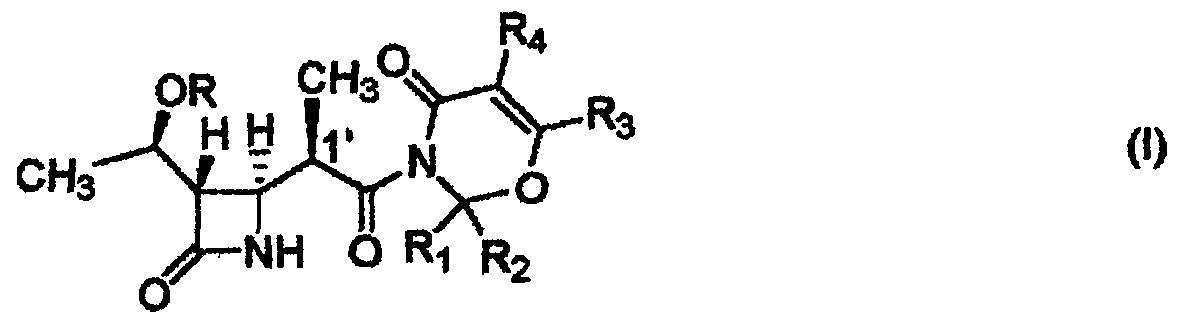
Wherein, R is a hydrogen atom or a protecting group of hydroxy; Ri and
R2are independently G-Cis alkyl, benzyl or cyclized to be 5 or 6-membered ring which is cycHc hydrocarbon or heterocycHc compound containing at least one of O and S; R3 is a lower alkyl or a lower alkyl ester; R4 is benzene or benzene substituted with halogen atom, a lower alkoxy or nitro; and the methyl group in 1' position is R configuration
2. The compound according to claim 1, wherein R is t-butyldimethylsUyl; Ri and R2 are independently G-G. alkyl, benzyl or cycHzed to be 5 or 6-membered ring; R3 is a lower alkyl ester; and, Rt is benzene or benzene substituted with halogen atom, a lower alkoxy or nitro.
3. The compound according to claim 1, wherein said general formula ( I ) compound is methyl 5-{(2R)-2-[(3S, 4R)-3-[(lR)-l-t-butyldimethylsilyloxyethyl]-2- oxo-azetidine-4-yl]propionyl}-4-oxo-3-phenyl-l-oxa-5-azaspiro[5.5]undec-2-en-2- carboxyUc acid ester.
4. An α -halopropionamide compound of the general formula (HI): 
Wherein R, Ri, R_, R3 and R4 are the same as defined above; and X is a halogen atom.
5. The compound according to claim 4, wherein said general formula (HI) compound is methyl 5-(2-bromopropionyl)-4-oxo-3-phenyl-l-oxa-5-azaspiro[5.5j- undec-2-en-2-carboxylic acid ester.
6. A process for preparing the general formula ( I ) by reacting the general formula ( II ) compound with the general formula (El) compound.


7. The process according to claim 6, wherein methyl 5-{(2R)-2-[(3S, 4R)-3-[(lR)-l- t-butyldimethylsilyloxyethyl]-2-oxo-azetidine-4-yl]propionyl}-4-oxo-3-phenyl-l- oxa-5-azaspiro[5.5]undec-2-en-2-carboxyhc acid ester of the general formula ( I ) is prepared by reacting (3R, 4R)-4-acetoxy-3-[(lR)-l-t-butyldimethylsilyloxyeth- yl]-2-azetidinone of the general formula ( II ) with methyl 5-(2-bromopropionyl)- 4-oxo-3-phenyl-l-oxa-5-azaspiro[5.5]undec-2-en-2-carboxyUc acid ester compound of the general formula (HI).
8. A process for preparing the general formula (HI) compound by reacting the general formula M) compound with the general formula (K) compound or its activated complex:

CH3
-XCOOH (,χ)
Wherein R, Ri, R2, R3, Ri and X are the same as defined above.
9. The process according to claim 8, wherein methyl 4-oxo-3-phenyl-l-oxa-5-azas- piro[5.5]undec-2-en-2-carboxyHc acid ester of the general formula (W) compound is reacted with 2-bromoacetylbromide of the general formula (K) to obtain methyl 5-(2-bromopropionyl)-4-oxo-3-phenyl-l-oxa-5-azaspiro[5.5]undec-2-en-2- carboxyHc acid ester of the general formula (HI) compound.
10. A process for preparing the general formula (V) compound, wherein the general formula (X I ) compound generated by reacting the general formula ( I ) with the general formula (X ) compound is further under cycHzation and esterification in situ.

X COOR« (X)

11. The process according to claim 10, wherein methyl 5-{(2R)-2-[(3S, 4R)-3-[(lR)- l-t-butyldimethylsilyloxyethyl]-2-oxo-azetidine-4-yl]propionyl}-4-oxo-3-phenyl-l -oxa-5-azaspiro[5.5]undec-2-en-2-carboxyHc acid ester of the general formula ( I ) is reacted with aUylbromoacetate of the general formula (X) to obtain methyl 5- {(2R)-2-[(3S,4R)-l-aUyloxycarbonyl ethyl-3-[(lR)-l-t-butyldimethylsUyloxyeth- yl]-2-oxo-azetidine-4-yl]propionyl}-4-oxo-3-phenyl-l-oxa-5-azaspiro[5.5]undec-2- en-2-carboxylic acid ester of the general formula (X I ), followed by cycHzation and esterification of the general formula (X I ) in situ to yield allyl(lR, 5R, 6S)-6- [(lR)-l-t-butyldunethylsUyloxyethyl]-l-methyl-2-diphenylphosphoryloxy-2-carb- apen-2-em-3-carboxyhc acid ester of the general formula (V).
12. A process for preparing the general formula (IV) compound by hydrolyzing the general formula ( I ) compound: 

Wherein R, Ri, R^ R3 and R4 are the same as defined above.
13. The process according to claim 12, wherein methyl 5-{(2R)-2-[(3S, 4R)-3-[(lR)- l-t-butyldimethylsilyloxyethyl]-2-oxo-azetidine-4-yl]propionyl}-4-oxo-3-phenyl- l-oxa-5-azaspiro[5.5]undec-2-en-2-carboxylic acid ester of the general formula ( I ) is hydrolyzed to obtain (2R)-2-[(3R,4R)-3-[(lR)-t-butyldimethylsilyloxyethyl]- 2-oxo-azetidine-4-yl]propionic acid of the general formula (IV) compound.
Priority Applications (2)
| Application Number | Priority Date | Filing Date | Title |
|---|---|---|---|
| JP2002518205A JP2004505968A (en) | 2000-08-10 | 2001-08-06 | Intermediates of carbapenem antibiotics and their preparation |
| US10/344,267 US6858727B2 (en) | 2000-08-10 | 2001-08-06 | Intermediate of carbapenem antibiotics and process for the preparation thereof |
Applications Claiming Priority (2)
| Application Number | Priority Date | Filing Date | Title |
|---|---|---|---|
| KR10-2000-0046447A KR100377448B1 (en) | 2000-08-10 | 2000-08-10 | Intermediate of Carbapenem Antibiotics and Process for the Preparation thereof |
| KR2000/0046447 | 2000-08-10 |
Publications (1)
| Publication Number | Publication Date |
|---|---|
| WO2002012230A1 true WO2002012230A1 (en) | 2002-02-14 |
Family
ID=19682715
Family Applications (1)
| Application Number | Title | Priority Date | Filing Date |
|---|---|---|---|
| PCT/KR2001/001327 Ceased WO2002012230A1 (en) | 2000-08-10 | 2001-08-06 | Intermediate of carbapenem antibiotics and process for the preparation thereof |
Country Status (4)
| Country | Link |
|---|---|
| US (1) | US6858727B2 (en) |
| JP (1) | JP2004505968A (en) |
| KR (1) | KR100377448B1 (en) |
| WO (1) | WO2002012230A1 (en) |
Cited By (4)
| Publication number | Priority date | Publication date | Assignee | Title |
|---|---|---|---|---|
| KR100377448B1 (en) * | 2000-08-10 | 2003-03-26 | 동화약품공업주식회사 | Intermediate of Carbapenem Antibiotics and Process for the Preparation thereof |
| WO2005033120A1 (en) * | 2003-10-02 | 2005-04-14 | Takasago International Corporation | Method for producing carbapenem derivative |
| WO2007145260A1 (en) | 2006-06-16 | 2007-12-21 | Kaneka Corporation | Improved method for crystallization of azetidinonecarboxylic acid |
| CN102304148A (en) * | 2011-07-20 | 2012-01-04 | 江西华邦药业有限公司 | Preparation method of (1R, 5R, 6S)-3-[(1R)-1-tertiary butyl dimethylsilyloxy ethane]-1-methyl-2-diphenylphosphoryloxyl-carbapenem-2-ene-3-carboxylic acid p-nitro benzyl ester |
Families Citing this family (4)
| Publication number | Priority date | Publication date | Assignee | Title |
|---|---|---|---|---|
| KR20110049823A (en) * | 2008-07-30 | 2011-05-12 | 랜박시 래보러터리스 리미티드 | Process for preparing carbapenem compound |
| WO2011048583A1 (en) | 2009-10-23 | 2011-04-28 | Ranbaxy Laboratories Limited | Process for the preparation of carbapenem compounds |
| US10695322B2 (en) | 2016-01-29 | 2020-06-30 | The Johns Hopkins University | Inhibitors of bacterial growth |
| CN117801020A (en) * | 2024-03-01 | 2024-04-02 | 山东安弘制药有限公司 | Preparation method of carbapenem double-ring mother nucleus |
Citations (3)
| Publication number | Priority date | Publication date | Assignee | Title |
|---|---|---|---|---|
| US5442055A (en) * | 1992-11-13 | 1995-08-15 | Tanabe Seiyaku Co., Ltd. | Azetidinone compound and process for preparation thereof |
| US5631363A (en) * | 1992-11-13 | 1997-05-20 | Tanabe Seiyaku Co., Ltd. | Azetidinone compound and process for preparation thereof |
| US6011150A (en) * | 1992-11-13 | 2000-01-04 | Tanabe Seiyaku Co., Ltd. | Azetidinone compound and process for preparation thereof |
Family Cites Families (12)
| Publication number | Priority date | Publication date | Assignee | Title |
|---|---|---|---|---|
| CA1283906C (en) | 1983-05-09 | 1991-05-07 | Makoto Sunagawa | .beta.-LACTAM COMPOUNDS AND PRODUCTION THEREOF |
| JPS62252785A (en) | 1986-01-08 | 1987-11-04 | Sankyo Co Ltd | 4-substituted beta-lactam compound |
| JPH0782248B2 (en) | 1986-10-27 | 1995-09-06 | キヤノン株式会社 | Method for producing polymerized toner |
| JPS63188662U (en) | 1987-05-25 | 1988-12-02 | ||
| JPS6425779U (en) | 1987-08-06 | 1989-02-13 | ||
| JPH0782249B2 (en) | 1989-11-09 | 1995-09-06 | キヤノン株式会社 | toner |
| CA2050255C (en) | 1990-09-07 | 1997-02-04 | Tameo Iwasaki | 1-methylcarbapenem derivatives and process for preparation thereof |
| JPH06256327A (en) * | 1993-03-03 | 1994-09-13 | Nippon Soda Co Ltd | Production of 4-substituted azetidinone derivative |
| JP3118143B2 (en) * | 1993-06-23 | 2000-12-18 | 田辺製薬株式会社 | Novel production method of azetidinone compounds and new raw material compounds |
| JP3954670B2 (en) * | 1996-05-28 | 2007-08-08 | 株式会社カネカ | Preparation of carbapenem antibiotic intermediates |
| JP3450193B2 (en) * | 1998-07-24 | 2003-09-22 | 高砂香料工業株式会社 | Method for producing 4-substituted azetidinone derivatives |
| KR100377448B1 (en) * | 2000-08-10 | 2003-03-26 | 동화약품공업주식회사 | Intermediate of Carbapenem Antibiotics and Process for the Preparation thereof |
-
2000
- 2000-08-10 KR KR10-2000-0046447A patent/KR100377448B1/en not_active Expired - Fee Related
-
2001
- 2001-08-06 US US10/344,267 patent/US6858727B2/en not_active Expired - Fee Related
- 2001-08-06 WO PCT/KR2001/001327 patent/WO2002012230A1/en not_active Ceased
- 2001-08-06 JP JP2002518205A patent/JP2004505968A/en not_active Ceased
Patent Citations (4)
| Publication number | Priority date | Publication date | Assignee | Title |
|---|---|---|---|---|
| US5442055A (en) * | 1992-11-13 | 1995-08-15 | Tanabe Seiyaku Co., Ltd. | Azetidinone compound and process for preparation thereof |
| US5631363A (en) * | 1992-11-13 | 1997-05-20 | Tanabe Seiyaku Co., Ltd. | Azetidinone compound and process for preparation thereof |
| US5847115A (en) * | 1992-11-13 | 1998-12-08 | Tanabe Seiyaku Co., Ltd. | Azetidinone compound and process for preparation thereof |
| US6011150A (en) * | 1992-11-13 | 2000-01-04 | Tanabe Seiyaku Co., Ltd. | Azetidinone compound and process for preparation thereof |
Non-Patent Citations (1)
| Title |
|---|
| BERKS: "Preparation of two pivotal intermediates for the synthesis of 1-beta-methyl carbapenem antibiotics", TETRAHEDRON, vol. 52, 1996, pages 331 - 375 * |
Cited By (5)
| Publication number | Priority date | Publication date | Assignee | Title |
|---|---|---|---|---|
| KR100377448B1 (en) * | 2000-08-10 | 2003-03-26 | 동화약품공업주식회사 | Intermediate of Carbapenem Antibiotics and Process for the Preparation thereof |
| WO2005033120A1 (en) * | 2003-10-02 | 2005-04-14 | Takasago International Corporation | Method for producing carbapenem derivative |
| WO2007145260A1 (en) | 2006-06-16 | 2007-12-21 | Kaneka Corporation | Improved method for crystallization of azetidinonecarboxylic acid |
| US8232389B2 (en) | 2006-06-16 | 2012-07-31 | Kaneka Corporation | Method for crystallization of azetidinonecarboxylic acid |
| CN102304148A (en) * | 2011-07-20 | 2012-01-04 | 江西华邦药业有限公司 | Preparation method of (1R, 5R, 6S)-3-[(1R)-1-tertiary butyl dimethylsilyloxy ethane]-1-methyl-2-diphenylphosphoryloxyl-carbapenem-2-ene-3-carboxylic acid p-nitro benzyl ester |
Also Published As
| Publication number | Publication date |
|---|---|
| KR20020013988A (en) | 2002-02-25 |
| KR100377448B1 (en) | 2003-03-26 |
| US6858727B2 (en) | 2005-02-22 |
| JP2004505968A (en) | 2004-02-26 |
| US20030191106A1 (en) | 2003-10-09 |
Similar Documents
| Publication | Publication Date | Title |
|---|---|---|
| CZ227592A3 (en) | Method of taxol side chain asymmetric synthesis | |
| IE58997B1 (en) | Process and intermediates for beta-lactam antibiotics | |
| IE881327L (en) | Novel process for the manufacture of¹4-acyloxy-3-hydroxyethyl-azetidinones | |
| KR100231223B1 (en) | Azetidinone compounds and preparation methods thereof | |
| SU1442071A3 (en) | Versions of method of producing derivatives of 4-acetoxy-3-oxyethyl-azetidi-2-non | |
| US20030191106A1 (en) | Intermediate of carbapenem antibiotics and process for the preparation thereof | |
| Maruyama et al. | A synthesis of a versatile intermediate leading to thienamycin analogs. | |
| KR100205767B1 (en) | Stereoselective preparation method of azetidinone | |
| JP2019199446A (en) | Method of producing s-ica ribosylhomocysteine | |
| KR100385364B1 (en) | Intermediate of Carbapenem Antibiotics and Process for the Preparation thereof | |
| EP0283253B1 (en) | Method for preparation of azetidinone-1-oxoacetate by oxidation of the corresponding 2-hydroxyacetate | |
| JPH0135823B2 (en) | ||
| JP3748933B2 (en) | Process for producing 1-substituted azetidinone derivatives | |
| JP3388874B2 (en) | Method for producing β-lactam compound | |
| KR100283608B1 (en) | Method of preparing 1-betamethyl-2-formyl carbapenem derivatives | |
| JP4213229B2 (en) | Method for producing azetidinone derivative | |
| US5075439A (en) | Processes for (3S,4R)-3-[1(R)-t-butyl-dimethylsilyloxy)-ethyl]-4-[1-oxo-3-thiolanylthio(thiocarbonyl)thio]azetidin-2-ones and intermediates therefor | |
| KR0182192B1 (en) | Selective preparation of optically active (3R, 4S) -3-alkoxy-4-phenyl-2-azetidinone | |
| JP3059475B2 (en) | Method for producing 2-azetidinone derivative | |
| EP0574784B1 (en) | Process for preparing (1'R,3S,4R)4-acylthio azetidinones | |
| EP0229384B1 (en) | Beta-lactam compounds and their production | |
| KR20040099963A (en) | Chiral 2-azetidinone compounds, process and use thereof | |
| KR100518933B1 (en) | Method for purifying Oxazoline- azetidinone derivative | |
| JP2922943B2 (en) | Imidazolidinone derivatives | |
| JPH0142946B2 (en) |
Legal Events
| Date | Code | Title | Description |
|---|---|---|---|
| AK | Designated states |
Kind code of ref document: A1 Designated state(s): CN JP US |
|
| AL | Designated countries for regional patents |
Kind code of ref document: A1 Designated state(s): AT BE CH CY DE DK ES FI FR GB GR IE IT LU MC NL PT SE TR |
|
| 121 | Ep: the epo has been informed by wipo that ep was designated in this application | ||
| DFPE | Request for preliminary examination filed prior to expiration of 19th month from priority date (pct application filed before 20040101) | ||
| WWE | Wipo information: entry into national phase |
Ref document number: 2002518205 Country of ref document: JP Ref document number: 10344267 Country of ref document: US |
|
| 122 | Ep: pct application non-entry in european phase |