EP2030517A1 - Swimsuit and process for manufacturing the same - Google Patents
Swimsuit and process for manufacturing the same Download PDFInfo
- Publication number
- EP2030517A1 EP2030517A1 EP07744719A EP07744719A EP2030517A1 EP 2030517 A1 EP2030517 A1 EP 2030517A1 EP 07744719 A EP07744719 A EP 07744719A EP 07744719 A EP07744719 A EP 07744719A EP 2030517 A1 EP2030517 A1 EP 2030517A1
- Authority
- EP
- European Patent Office
- Prior art keywords
- water
- swimsuit
- particles
- absorbing gel
- fabric
- Prior art date
- Legal status (The legal status is an assumption and is not a legal conclusion. Google has not performed a legal analysis and makes no representation as to the accuracy of the status listed.)
- Withdrawn
Links
- 238000000034 method Methods 0.000 title claims description 19
- 238000004519 manufacturing process Methods 0.000 title claims description 12
- 239000004744 fabric Substances 0.000 claims abstract description 104
- 239000011347 resin Substances 0.000 claims abstract description 89
- 229920005989 resin Polymers 0.000 claims abstract description 89
- 239000002245 particle Substances 0.000 claims abstract description 49
- 239000011230 binding agent Substances 0.000 claims abstract description 26
- 239000010954 inorganic particle Substances 0.000 claims abstract description 26
- 239000005871 repellent Substances 0.000 claims description 84
- 230000009182 swimming Effects 0.000 claims description 15
- 239000006185 dispersion Substances 0.000 claims description 7
- 238000007654 immersion Methods 0.000 claims description 7
- XLYOFNOQVPJJNP-UHFFFAOYSA-N water Substances O XLYOFNOQVPJJNP-UHFFFAOYSA-N 0.000 abstract description 72
- 230000007423 decrease Effects 0.000 abstract description 5
- 230000008961 swelling Effects 0.000 abstract description 4
- 230000002708 enhancing effect Effects 0.000 abstract 1
- 239000000499 gel Substances 0.000 description 52
- 238000010521 absorption reaction Methods 0.000 description 15
- 230000000052 comparative effect Effects 0.000 description 11
- 230000003203 everyday effect Effects 0.000 description 8
- 239000007788 liquid Substances 0.000 description 8
- 238000012360 testing method Methods 0.000 description 8
- 239000000843 powder Substances 0.000 description 6
- 239000011164 primary particle Substances 0.000 description 6
- 230000002940 repellent Effects 0.000 description 6
- VYPSYNLAJGMNEJ-UHFFFAOYSA-N Silicium dioxide Chemical compound O=[Si]=O VYPSYNLAJGMNEJ-UHFFFAOYSA-N 0.000 description 5
- 230000000694 effects Effects 0.000 description 5
- OKTJSMMVPCPJKN-UHFFFAOYSA-N Carbon Chemical compound [C] OKTJSMMVPCPJKN-UHFFFAOYSA-N 0.000 description 4
- GWEVSGVZZGPLCZ-UHFFFAOYSA-N Titan oxide Chemical compound O=[Ti]=O GWEVSGVZZGPLCZ-UHFFFAOYSA-N 0.000 description 4
- 239000007864 aqueous solution Substances 0.000 description 4
- 238000001035 drying Methods 0.000 description 4
- LEQAOMBKQFMDFZ-UHFFFAOYSA-N glyoxal Chemical compound O=CC=O LEQAOMBKQFMDFZ-UHFFFAOYSA-N 0.000 description 4
- 239000011148 porous material Substances 0.000 description 4
- JOYRKODLDBILNP-UHFFFAOYSA-N Ethyl urethane Chemical compound CCOC(N)=O JOYRKODLDBILNP-UHFFFAOYSA-N 0.000 description 3
- HEMHJVSKTPXQMS-UHFFFAOYSA-M Sodium hydroxide Chemical compound [OH-].[Na+] HEMHJVSKTPXQMS-UHFFFAOYSA-M 0.000 description 3
- 239000003795 chemical substances by application Substances 0.000 description 3
- 239000011521 glass Substances 0.000 description 3
- 229920000728 polyester Polymers 0.000 description 3
- 229920000642 polymer Polymers 0.000 description 3
- 229920002635 polyurethane Polymers 0.000 description 3
- 239000004814 polyurethane Substances 0.000 description 3
- RQAGEUFKLGHJPA-UHFFFAOYSA-N prop-2-enoylsilicon Chemical compound [Si]C(=O)C=C RQAGEUFKLGHJPA-UHFFFAOYSA-N 0.000 description 3
- 229920002994 synthetic fiber Polymers 0.000 description 3
- 239000012209 synthetic fiber Substances 0.000 description 3
- 239000004925 Acrylic resin Substances 0.000 description 2
- 229920000178 Acrylic resin Polymers 0.000 description 2
- VTYYLEPIZMXCLO-UHFFFAOYSA-L Calcium carbonate Chemical compound [Ca+2].[O-]C([O-])=O VTYYLEPIZMXCLO-UHFFFAOYSA-L 0.000 description 2
- 239000004593 Epoxy Substances 0.000 description 2
- YCKRFDGAMUMZLT-UHFFFAOYSA-N Fluorine atom Chemical compound [F] YCKRFDGAMUMZLT-UHFFFAOYSA-N 0.000 description 2
- VGGLHLAESQEWCR-UHFFFAOYSA-N N-(hydroxymethyl)urea Chemical compound NC(=O)NCO VGGLHLAESQEWCR-UHFFFAOYSA-N 0.000 description 2
- MCMNRKCIXSYSNV-UHFFFAOYSA-N Zirconium dioxide Chemical compound O=[Zr]=O MCMNRKCIXSYSNV-UHFFFAOYSA-N 0.000 description 2
- 239000002253 acid Substances 0.000 description 2
- 230000004931 aggregating effect Effects 0.000 description 2
- 230000003247 decreasing effect Effects 0.000 description 2
- 239000012153 distilled water Substances 0.000 description 2
- 238000009826 distribution Methods 0.000 description 2
- 239000000835 fiber Substances 0.000 description 2
- 229910052731 fluorine Inorganic materials 0.000 description 2
- 239000011737 fluorine Substances 0.000 description 2
- 229940015043 glyoxal Drugs 0.000 description 2
- 239000000463 material Substances 0.000 description 2
- 229920006395 saturated elastomer Polymers 0.000 description 2
- 239000000377 silicon dioxide Substances 0.000 description 2
- 239000000126 substance Substances 0.000 description 2
- 150000003457 sulfones Chemical class 0.000 description 2
- 239000002759 woven fabric Substances 0.000 description 2
- LCPVQAHEFVXVKT-UHFFFAOYSA-N 2-(2,4-difluorophenoxy)pyridin-3-amine Chemical compound NC1=CC=CN=C1OC1=CC=C(F)C=C1F LCPVQAHEFVXVKT-UHFFFAOYSA-N 0.000 description 1
- SMZOUWXMTYCWNB-UHFFFAOYSA-N 2-(2-methoxy-5-methylphenyl)ethanamine Chemical compound COC1=CC=C(C)C=C1CCN SMZOUWXMTYCWNB-UHFFFAOYSA-N 0.000 description 1
- NIXOWILDQLNWCW-UHFFFAOYSA-N 2-Propenoic acid Natural products OC(=O)C=C NIXOWILDQLNWCW-UHFFFAOYSA-N 0.000 description 1
- 241000251468 Actinopterygii Species 0.000 description 1
- 229910052582 BN Inorganic materials 0.000 description 1
- PZNSFCLAULLKQX-UHFFFAOYSA-N Boron nitride Chemical compound N#B PZNSFCLAULLKQX-UHFFFAOYSA-N 0.000 description 1
- 241000283153 Cetacea Species 0.000 description 1
- 206010016807 Fluid retention Diseases 0.000 description 1
- DGAQECJNVWCQMB-PUAWFVPOSA-M Ilexoside XXIX Chemical compound C[C@@H]1CC[C@@]2(CC[C@@]3(C(=CC[C@H]4[C@]3(CC[C@@H]5[C@@]4(CC[C@@H](C5(C)C)OS(=O)(=O)[O-])C)C)[C@@H]2[C@]1(C)O)C)C(=O)O[C@H]6[C@@H]([C@H]([C@@H]([C@H](O6)CO)O)O)O.[Na+] DGAQECJNVWCQMB-PUAWFVPOSA-M 0.000 description 1
- 241000124008 Mammalia Species 0.000 description 1
- QPCDCPDFJACHGM-UHFFFAOYSA-N N,N-bis{2-[bis(carboxymethyl)amino]ethyl}glycine Chemical compound OC(=O)CN(CC(O)=O)CCN(CC(=O)O)CCN(CC(O)=O)CC(O)=O QPCDCPDFJACHGM-UHFFFAOYSA-N 0.000 description 1
- 239000002202 Polyethylene glycol Substances 0.000 description 1
- 239000004743 Polypropylene Substances 0.000 description 1
- 229910021536 Zeolite Inorganic materials 0.000 description 1
- PNEYBMLMFCGWSK-UHFFFAOYSA-N aluminium oxide Inorganic materials [O-2].[O-2].[O-2].[Al+3].[Al+3] PNEYBMLMFCGWSK-UHFFFAOYSA-N 0.000 description 1
- 229910000019 calcium carbonate Inorganic materials 0.000 description 1
- 238000006243 chemical reaction Methods 0.000 description 1
- 229910052681 coesite Inorganic materials 0.000 description 1
- 238000007796 conventional method Methods 0.000 description 1
- 229910052906 cristobalite Inorganic materials 0.000 description 1
- 239000003431 cross linking reagent Substances 0.000 description 1
- 238000013461 design Methods 0.000 description 1
- 125000004386 diacrylate group Chemical group 0.000 description 1
- HNPSIPDUKPIQMN-UHFFFAOYSA-N dioxosilane;oxo(oxoalumanyloxy)alumane Chemical compound O=[Si]=O.O=[Al]O[Al]=O HNPSIPDUKPIQMN-UHFFFAOYSA-N 0.000 description 1
- 239000000017 hydrogel Substances 0.000 description 1
- 230000005660 hydrophilic surface Effects 0.000 description 1
- 239000012948 isocyanate Substances 0.000 description 1
- 150000002513 isocyanates Chemical class 0.000 description 1
- 238000005259 measurement Methods 0.000 description 1
- 229910052751 metal Inorganic materials 0.000 description 1
- 239000002184 metal Substances 0.000 description 1
- 239000010445 mica Substances 0.000 description 1
- 229910052618 mica group Inorganic materials 0.000 description 1
- 229960003330 pentetic acid Drugs 0.000 description 1
- 230000000704 physical effect Effects 0.000 description 1
- 229920002647 polyamide Polymers 0.000 description 1
- 229920001223 polyethylene glycol Polymers 0.000 description 1
- 230000000379 polymerizing effect Effects 0.000 description 1
- -1 polypropylene Polymers 0.000 description 1
- 229920001155 polypropylene Polymers 0.000 description 1
- 229920001296 polysiloxane Polymers 0.000 description 1
- 229920006306 polyurethane fiber Polymers 0.000 description 1
- 238000007789 sealing Methods 0.000 description 1
- 229910052708 sodium Inorganic materials 0.000 description 1
- 239000011734 sodium Substances 0.000 description 1
- CHQMHPLRPQMAMX-UHFFFAOYSA-L sodium persulfate Substances [Na+].[Na+].[O-]S(=O)(=O)OOS([O-])(=O)=O CHQMHPLRPQMAMX-UHFFFAOYSA-L 0.000 description 1
- 239000000243 solution Substances 0.000 description 1
- 229910052682 stishovite Inorganic materials 0.000 description 1
- 239000002562 thickening agent Substances 0.000 description 1
- 229910052905 tridymite Inorganic materials 0.000 description 1
- 239000010457 zeolite Substances 0.000 description 1
Images



Classifications
-
- A—HUMAN NECESSITIES
- A41—WEARING APPAREL
- A41D—OUTERWEAR; PROTECTIVE GARMENTS; ACCESSORIES
- A41D7/00—Bathing gowns; Swim-suits, drawers, or trunks; Beach suits
-
- A—HUMAN NECESSITIES
- A41—WEARING APPAREL
- A41D—OUTERWEAR; PROTECTIVE GARMENTS; ACCESSORIES
- A41D2400/00—Functions or special features of garments
- A41D2400/24—Reducing drag or turbulence in air or water
Definitions
- the present invention relates to a swimsuit with hydrophilicity imparted to a fibrous surface, and a process for manufacturing the swimsuit.
- Patent Document 1 proposes that an aqueous solution of polyethylenemonoxide having a molecular weight of 4,000,000 to 5,000,000 is allowed to adhere to the surface of a swimsuit.
- this technique has a problem in that the adhering polymer is eluted in the water of a swimming pool to contaminate the water.
- Patent Document 2 proposes that the entire surface of a swimsuit is subjected to a water-repellent treatment, and further, arbitrary positions of the swimsuit are subjected to a hydrophilic treatment, using a binder resin.
- Patent Documents 3-4 disclose the technique of providing a water-repellent part and a non-water-repellent part on the surface of a fabric for the purpose of ensuring a water dripping property as well as reducing the friction resistance of the surface of the fabric.
- the effect of reducing resistance is expressed by providing a water-repellent part and a non-water-repellent part on the surface of a fabric. Furthermore, while the effect of reducing friction resistance is enhanced by increasing a water-repellent area, the water dripping property of water having entered a swimsuit decreases, which tends to increase resistance for wearing. Therefore, if the ratio of the area occupied by the non-water-repellent part is decreased by increasing the width of a stripe-shaped water-repellent part, the effect of reducing friction resistance is cancelled by the increase in resistance for wearing caused by the decrease in a water dripping property, with the result that the resistance increases relatively.
- a continuous water-repellent part which is subjected to a water-repellent treatment continuously, and an intermittent water-repellent part, in which a water-repellent part subjected to a water-repellent treatment and a non-water-repellent part not subjected to a water-repellent treatment are formed intermittently, are formed in at least a part of the surface of a swimsuit in a stripe shape parallel to a body length direction (Patent Document 5).
- the inventors of the present invention paid attention to the fact that the skin and scales of fish and the mammals such as a whale living in water are intrinsically hydrophilic. According to the present invention, a basic way of thinking is reconsidered, and a swimsuit with hydrophilicity imparted to a fibrous surface of a stretchable fabric and a process for manufacturing the swimsuit are provided.
- a swimsuit of the present invention is made of a stretchable fabric, wherein particles with water-absorbing gel adsorbed thereon, in which a water-absorbing gel resin is adsorbed on porous inorganic particles, are fixed to at least a part of the surface of the stretchable fabric together with a binder resin.
- a process for manufacturing a swimsuit of the present invention is a process for manufacturing a swimsuit made of a stretchable fabric, wherein particles with water-absorbing gel adsorbed thereon, in which a water-absorbing gel resin is adsorbed on porous inorganic particles, are provided to at least a part of the surface of the stretchable fabric together with a binder resin.
- particles with water-absorbing gel adsorbed thereon are fixed to at least a part of the surface of a stretchable fabric together with a binder resin.
- the water-absorbing gel resin is adsorbed on the porous inorganic particles, so that even when getting wet with water, the water-absorbing gel resin induces no apparent swelling, thereby attaining the avoidance of dimensional change and merely imparting hydrophilicity without causing resistance. Consequently, a part, to which the particles with water-absorbing gel adsorbed thereon are fixed, becomes hydrophilic.
- a part to which such particles are fixed will be referred to as a "hydrophilic part”.
- the affinity with water is enhanced, the water dripping property is enhanced, and the friction resistance to water as a whole is decreased. Furthermore, it is difficult to fix only the water-absorbing gel resin to a fabric with high durability even together with a binder resin.
- particles with water-absorbing gel adsorbed thereon in which a water-absorbing gel resin is adsorbed on porous inorganic particles, are fixed to a stretchable fabric together with a binder resin, whereby the water-absorbing gel resin can be fixed to the fabric with high durability. Consequently, a hydrophilic surface with high durability is obtained.
- particles with water-absorbing gel adsorbed thereon in which a water-absorbing gel resin is adsorbed on porous inorganic particles, are fixed to at least a part of the surface of a stretchable fabric together with a binder resin.
- the water-absorbing gel resin generally is used in a diaper or the like, and has a function of absorbing water in an amount several times to hundreds of times the self-weight and swelling by the absorbed amount.
- the water-absorbing gel resin absorbs water to swell, which increases the friction resistance to water. Therefore, in the present invention, the water-absorbing gel resin is used under the condition of being adsorbed on porous inorganic particles.
- the water-absorbing gel resin adsorbed on porous inorganic particles is obtained by mixing a gel resin subjected to saturated absorption with porous inorganic particle powder such as silica (SiO 2 ), zeolite, alumina (Al 2 O 3 ) particles, calcium carbonate, boron nitride, mica, titania (TiO 2 ), zirconia, and activated carbon, followed by drying.
- porous inorganic particle powder such as silica (SiO 2 ), zeolite, alumina (Al 2 O 3 ) particles, calcium carbonate, boron nitride, mica, titania (TiO 2 ), zirconia, and activated carbon, followed by drying.
- porous inorganic particle powder primary particles (for example, activated carbon) may be used as they are or aggregated particles (for example, silica) obtained by aggregating primary particles may be used.
- the aggregated particles are obtained by mixing a gel resin having absorbed water with primary particles, and aggregating the primary particles during drying.
- the primary particles are not necessarily required to be porous, and may be porous to such a degree as being capable of containing the water-absorbing gel resin when formed into aggregated particles.
- the water-absorbing gel resin of the present invention also is called a high water absorption resin, which is a cross-linked body of a hydrophilic straight-chain polymer or branched polymer and has a three-dimensional network structure in the unit of angstrom.
- the water-absorbing gel resin absorbs water with the force of being dissolved in water when coming into contact with water; however, the water-absorbing gel resin is suppressed from absorbing water due to the presence of a cross-linked structure between molecules, and due to its balance, becomes a hydrogel in a swollen state having absorbed a predetermined amount of water.
- a resin whose water absorption amount is 10 g or more per gram generally is called a high water absorption resin.
- the volume ratio therebetween is adjusted to such a degree that the water-absorbing gel resin does not swell to come out of the powder particle when a swimsuit gets wet later.
- the water-absorbing gel resin is adsorbed in an amount of about 2 to 6% by volume per 100% by volume of pores of particle powder in terms of dry volume conversion.
- the volume of a water-absorbing gel resin subjected to saturated absorption is set to be in a range of 50 to 250% by volume per 100% by volume of the pores of the powder particle.
- a binder resin may be mixed.
- a binder resin a N-methylol (urea) based resin, a sulfone-based resin, an epoxy-based resin, a glyoxal-based resin, a polycarboxylic acid based resin, an acrylic resin, an acrylsilicon-based resin, an urethane-based resin, or the like can be used.
- the particles with water-absorbing gel adsorbed thereon are fixed to at least a part of the surface of a stretchable fabric together with a binder resin.
- a binder resin a N-methylol (urea) based resin, a sulfone-based resin, an epoxy-based resin, a glyoxal-based resin, a polycarboxylic acid based resin, an acrylic resin, an acrylsilicon-based resin, an urethane-based resin, or the like can be used. These resins are selected so that the handfeel is not changed so much.
- the particles with water-absorbing gel adsorbed thereon only need to be fixed to at least a part of the surface of a stretchable fabric.
- the particles with water-absorbing gel adsorbed thereon are fixed to an area of 10% or more, more preferably 50% or more, and particularly preferably 70% or more of the surface of a swimsuit.
- the particles with water-absorbing gel adsorbed thereon can be formed into a dispersion together with a binder resin and provided to a stretchable fabric by immersion. In this case, the particles with gel adsorbed thereon are fixed to the entire surface of the stretchable fabric.
- the particles with water-absorbing gel adsorbed thereon also can be formed into a dispersion together with a binder resin and provided to a stretchable fabric by printing. In this case, the particles with water-absorbing gel adsorbed thereon can be fixed to a part of the surface of the stretchable fabric.
- the adhesion amount of the particles with water-absorbing gel adsorbed thereon, in which a water-absorbing gel resin is adsorbed on porous inorganic particles, with respect to a stretchable fabric is preferably 5 to 20 g/m 2 , although it depends upon the kind of the fabric.
- the adhesion amount of the binder resin with respect to the stretchable fabric is preferably 0.5 to 20 g/m 2 .
- any resin can be used as long as it can be used as a material for diapers.
- a water-absorbing gel resin having a cross-linked structure obtained by mixing and polymerizing a solution in which acrylic acid, polyethylene glycol diacrylate, and diethylenetriamine pentaacetic acid 5 sodium aqueous solution are mixed, a sodium hydroxide aqueous solution, and a sodium persulfate aqueous solution.
- At least a part of the surface of the swimsuit of the present invention further may include a water-repellent part.
- a water repellent a silicone-based water repellent, a fluorine-based water repellent, or the like can be used.
- a treatment agent used in the water-repellent part may be a print agent or a sealing agent.
- the water-repellent part and the hydrophilic part may be formed continuously or intermittently in the body length direction of a swimsuit. Furthermore, the continuous part and the intermittent part may be mixed. When there is a hydrophilic part, the water dripping property becomes excellent.
- a roller printer In order to form the water-repellent part on the surface of a fabric, generally industrialized printing is preferred.
- a roller printer As an apparatus to be used, a roller printer, an auto-screen printer, a hand-screen printer, or the like can be selected appropriately.
- the application amount of the water repellent with respect to a fabric is preferably 5 to 20 g/m 2 , although it varies depending upon the unit weight, thickness, and water-repellent treatment area of a ground fabric, the kind of a water repellent, and the like.
- the area ratio between the hydrophilic part and the water-repellent part is 10-90:90-10, more preferably 50-80:50-20, much more preferably 60-80:40-20, and particularly preferably 70-80:30-20. It is preferred that the area of the hydrophilic part is larger, and it is preferred that a hydrophilic part is formed over the entire surface by an immersion method and a water-repellent part is formed thereon by printing.
- a water-repellent part further may be formed on a back surface of a swimsuit.
- the area ratio of the water-repellent part on the back surface is in a range of 10 to 90%.
- a continuous pattern or an intermittent pattern can be adopted in the same way as in the front, and for example, a vertical stripe shape, a horizontal stripe shape (border pattern), an oblique stripe shape, a polka-dot pattern, a lattice pattern, or a design obtained by combining them arbitrarily can be adopted.
- a knit fabric or a woven fabric made of a synthetic fiber multi-filament yarn such as a polyamide-based yarn, a polyester-based yarn or a polypropylene-based yarn, or a knit fabric or a woven fabric made of an inter knit or a mixed weave of these synthetic fiber multi-filament yarns and polyurethane elastic yarns
- a knit fabric or a woven fabric made of a synthetic fiber multi-filament yarn such as a polyamide-based yarn, a polyester-based yarn or a polypropylene-based yarn, or a knit fabric or a woven fabric made of an inter knit or a mixed weave of these synthetic fiber multi-filament yarns and polyurethane elastic yarns
- a knit fabric or a woven fabric made of an inter knit or a mixed weave of these synthetic fiber multi-filament yarns and polyurethane elastic yarns can be used.
- an inter knit fabric of a synthetic fiber multi-filament yarn and a polyurethane elastic yarn is more preferred
- any of a circular knitted fabric such as a single circular knitted fabric and a double circular knitted fabric, and a warp knitted fabric such as a tricot fabric and a Russel fabric can be used.
- the tricot fabric is more preferred in terms of stretchability, fabric thinness, and the like that influence the ease of movement. Such a fabric is subjected to ordinary dying and finishing to form a stretchable fabric.
- the swimsuit of the present invention is preferred for a swimming competition.
- a knit fabric is preferred, which has an elongation ratio of 5 to 150% under a load of 4.9 N (500 gf) measured by JIS1096 in at least one direction selected from warp and weft directions. If the elongation ratio is in this range, the knit fabric follows the movement of the body, which enhances a property of wearing.
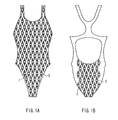
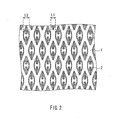
- FIG. 2 is an enlarged view of FIGS. 1A-1B , showing the arrangement and shape of the hydrophilic fabric part 1 and the intermittent water-repellent part 2 on the surface of the hydrophilic fabric part 1.
- a width L2 of the water-repellent part 2 is 12 mm
- an interval L1 of the water-repellent part 2, 2 is 10 mm.
- the area ratio between the hydrophilic part 1 and the water-repellent part 2 is 75:25.
- FIG. 3 is a schematic view illustrating a surface friction resistance test apparatus in water used in an example of the present invention.
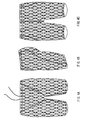
- FIG. 4A is a front view of a men's swimsuit in another example of the present invention
- FIG. 4B is a side view thereof
- FIG. 4C is a back view thereof.
- the pattern of the swimsuit, the hydrophilic fabric part, and the intermittent water-repellent part on the surface of the hydrophilic fabric part are the same as those in FIGS. 1-2 .
- FIG. 5 is a schematic conceptual view of porous inorganic particles (aggregated particles) in one example of the present invention.
- a water-absorbing gel resin 3 is present among inorganic primary particles 4.
- the porous inorganic particles 5 come into contact with water, the water-absorbing gel resin 3 absorbs a predetermined amount of water, and the porous inorganic particles (aggregated particles) 5 become hydrophilic as a whole. Since the water-absorbing gel resin 3 is present in the porous inorganic particles (aggregated particles) 5, the porous inorganic particles (aggregated particles) 5 do not induce apparent swelling caused by the absorption of water.
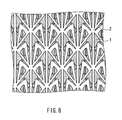
- FIGS. 6-8 show patterns of a swimsuit fabric in other examples of the present invention.
- the hydrophilic fabric part 1 in an intermittent pattern and the continuous stripe-shaped water-repellent part 2 on the surface of the hydrophilic fabric part 1 are provided in the body length direction.
- water-repellency and a water dripping property are well-balanced in the same way as in FIGS. 1 , 2 , and 4 , and hence, a preferred swimsuit is obtained.
- the average time is less than 3 minutes, preferably less than 2 minutes, and more preferably less than one minute.
- the average time is 3 minutes to less than 15 minutes.
- the water-repellency refers to a state (hereinafter, referred to as "infinite") in which the fabric does not absorb water even after the elapse of 15 minutes or more.
- a two-way knit fabric (which is the same knit fabric as that used in a JASPO product manufactured by Mizuno Corporation, having a fabric average thickness of 0.54 mm, a unit weight of 245 g/cm 2 , an elongation ratio in a warp direction of 50% and an elongation ratio in a weft direction of 20% under a load of 4.9 N measured by JIS1096, and an elongation ratio in a warp direction of 110% and an elongation ratio in a weft direction of 90% under a load of 17.6 N measured by JIS1096) containing 80% by weight of polyester fibers and 20% by weight of polyurethane fibers was used.
- the width L2 of the water-repellent part 2 was set to be 12 mm, and the interval L1 between the water-repellent part 2, 2 was set to be 10 mm. Furthermore, the area ratio between the hydrophilic part 1 and the water-repellent part 2 was 75:25.
- a 10-point average absorption time under water dropping of the hydrophilic part of the obtained swimsuit was 1.6 seconds, and that of the water-repellent part was infinite.
- a water-repellent part was formed in the same way as in Example 1, except that the hydrophilic treatment in Example 1 was not conducted, and a swimsuit was sewed.
- Abase fabric part (hereinafter, referred to as a "non-water-repellent part") that is not subjected to a hydrophilic treatment is composed of polyester fibers and polyurethane filers and is not subjected to an aftertreatment.
- a test fabric 14 is attached to both surfaces of a glass plate 13 (length: 3,000 mm; width: 600 mm) supported by columns 12a, 12b whose upper ends 11a, 11b are capable of moving freely in a horizontal direction (arrow B), and is allowed to sink in a water flow path 15 to a predetermined depth.
- Alower end of a metal column 16 is fixed to the glass plate 13, and an upper end of the column 16 is fixed to a ceiling.
- a strain gauge 17 is set in an upper portion of the column 16.
- the magnitude of a resistance which the surface of the fabric 14 attached to the glass plate 13 receives from a water stream flowing in a direction of an arrow A is measured by a dynamic strain meter 18 as an electric signal from the strain gauge 17, and is displayed and recorded in a computer 20 via an A/D converter 19.
- Example 1 a swimsuit was manufactured in the same way as in Example 1, except that the pattern for printing a water-repellent treatment liquid was changed to a stripe pattern shown in FIG. 6 .
- the area ratio between the hydrophilic part 1 and the water-repellent part 2 was 25:75.
- the 10-point average absorption time under water dropping of the hydrophilic part of the obtained swimsuit was 1 minute 44 seconds, and that of the water-repellent part was infinite.
- a swimmer wore the obtained swimsuit every day for one hour during one month, and the swimsuit was washed at home every day; however, no changes in hydrophilicity were recognized. It was confirmed from this result that the obtained swimsuit has hydrophilicity with high durability.
- Table 2 shows a surface friction resistance in flowing water of the stretchable fabrics used for the swimsuits in Examples 1-2 and Comparative Example 1.
- the flow velocities used for measurement were selected so as to be in a range close to the swimming speed of a swimmer in a swimming competition.
- a swimsuit was manufactured in the same way as in Example 1, except that the same water-repellent treatment liquid as that on the front side of a fabric was printed in a stripe pattern on the back surface of the fabric.
- the width of the stripe in the water-repellent part on the back surface was set to be 7 mm, and the width between the water-repellent stripes (part not subjected to a treatment) was set to be 7 mm.
- the area ratio between the part not subjected to a treatment and the water-repellent part was 50:50.
- the 10-point average absorption time under water dropping of the hydrophilic part on the surface of the obtained swimsuit was 1 minute 44 seconds, and that of the water-repellent part was infinite.
- a swimmer wore the obtained swimsuit every day for one hour during one month, and the swimsuit was washed at home every day; however, no changes in hydrophilicity were recognized. It was confirmed from this result that the swimsuit has hydrophilicity with high durability. Furthermore, 10 monitor swimmers conducted a test of wearing the obtained swimsuits. As a result, it was confirmed that the swimsuits were excellent in a water dripping property during swimming and the feeling of lightness when the swimmers came out of a swimming pool, and hence the swimsuits were preferred as those for a swimming competition.
- a swimsuit was manufactured in the same way as in Example 2, except that an acrylsilicon-based resin "FUKUSOLA-30S" manufactured by Daiwa Chemical Industries Co., Ltd. was used as a binder resin, and the same water-repellent treatment liquid as that on the front side of a fabric was printed in a vertical stripe pattern on the back surface of the fabric.
- the width of the vertical stripe in the water-repellent part on the back surface was set to be 7 mm, and the width between the water-repellent stripes (part not subjected to a treatment) was set to be 7 mm. Furthermore, the area ratio between the part not subjected to a treatment and the water-repellent part was 50:50.
- the 10-point average absorption time under water dropping of the hydrophilic part on the surface of the obtained swimsuit was 1 minute 44 seconds, and that of the water-repellent part was infinite. Furthermore, a swimmer wore the obtained swimsuit every day for one hour during one month, and the swimsuit was washed at home every day; however, no changes in hydrophilicity were recognized. It was confirmed from this result that the swimsuit has hydrophilicity with high durability. Furthermore, 10 monitor swimmers conducted a test of wearing the obtained swimsuits. As a result, it was confirmed that the swimsuits were excellent in a water dripping property during swimming and the feeling of lightness when the swimmers came out of a swimming pool, and hence the swimsuits were preferred as those for a swimming competition.
Landscapes
- Engineering & Computer Science (AREA)
- Textile Engineering (AREA)
- Professional, Industrial, Or Sporting Protective Garments (AREA)
- Treatments For Attaching Organic Compounds To Fibrous Goods (AREA)
Abstract

Description
- The present invention relates to a swimsuit with hydrophilicity imparted to a fibrous surface, and a process for manufacturing the swimsuit.
- One function requested in a swimsuit is how to reduce the surface friction resistance of the swimsuit in water generated during a swimming competition, and conventionally, various techniques of reducing the surface friction resistance of the swimsuit have been proposed. For example, according to
Patent Document 1, an aqueous solution of polyethylenemonoxide having a molecular weight of 4,000,000 to 5,000,000 is allowed to adhere to the surface of a swimsuit. However, this technique has a problem in that the adhering polymer is eluted in the water of a swimming pool to contaminate the water. Furthermore,Patent Document 2 proposes that the entire surface of a swimsuit is subjected to a water-repellent treatment, and further, arbitrary positions of the swimsuit are subjected to a hydrophilic treatment, using a binder resin. However, there is a problem in that hydrophilicity is insufficient only with the binder resin, and the friction resistance of the surface cannot be reduced. As still another proposal, Patent Documents 3-4 disclose the technique of providing a water-repellent part and a non-water-repellent part on the surface of a fabric for the purpose of ensuring a water dripping property as well as reducing the friction resistance of the surface of the fabric. - In the conventional technique, the effect of reducing resistance is expressed by providing a water-repellent part and a non-water-repellent part on the surface of a fabric. Furthermore, while the effect of reducing friction resistance is enhanced by increasing a water-repellent area, the water dripping property of water having entered a swimsuit decreases, which tends to increase resistance for wearing. Therefore, if the ratio of the area occupied by the non-water-repellent part is decreased by increasing the width of a stripe-shaped water-repellent part, the effect of reducing friction resistance is cancelled by the increase in resistance for wearing caused by the decrease in a water dripping property, with the result that the resistance increases relatively.
- Furthermore, in the case of providing a stripe-shaped non-water-repellent part with a water-repellent part intermittently in a stripe direction, thereby forming a water-repellent part in a so-called ladder shape, in order to increase a water-repellent area, although the effect of reducing resistance is obtained due to the increase in a water-repellent area, portions corresponding to bars of the ladder-shaped water-repellent part are orthogonal to the flow of water during swimming, so that the effect of reducing friction resistance is small. In order to solve this problem, it has been proposed that a continuous water-repellent part, which is subjected to a water-repellent treatment continuously, and an intermittent water-repellent part, in which a water-repellent part subjected to a water-repellent treatment and a non-water-repellent part not subjected to a water-repellent treatment are formed intermittently, are formed in at least a part of the surface of a swimsuit in a stripe shape parallel to a body length direction (Patent Document 5).
- Patent Document 1:
JP No. 2715088 - Patent Document 2:
JP 2004-292962 A - Patent Document 3:
JP 8(1996)-311751 A - Patent Document 4:
JP 9(1997 49107 A - Patent Document 5:
JP 2000-226709 A - As described above, although a swimsuit conventionally has been modified variously, there still is a demand for further reducing friction resistance in water.
- The inventors of the present invention paid attention to the fact that the skin and scales of fish and the mammals such as a whale living in water are intrinsically hydrophilic. According to the present invention, a basic way of thinking is reconsidered, and a swimsuit with hydrophilicity imparted to a fibrous surface of a stretchable fabric and a process for manufacturing the swimsuit are provided.
- A swimsuit of the present invention is made of a stretchable fabric, wherein particles with water-absorbing gel adsorbed thereon, in which a water-absorbing gel resin is adsorbed on porous inorganic particles, are fixed to at least a part of the surface of the stretchable fabric together with a binder resin.
- A process for manufacturing a swimsuit of the present invention is a process for manufacturing a swimsuit made of a stretchable fabric, wherein particles with water-absorbing gel adsorbed thereon, in which a water-absorbing gel resin is adsorbed on porous inorganic particles, are provided to at least a part of the surface of the stretchable fabric together with a binder resin.
-
- [
FIG. 1] FIG. 1A is a front view of a women's swimsuit of one example according to the present invention, andFIG. 1B is a back view thereof. - [
FIG. 2] FIG. 2 is an enlarged view ofFIG. 1 , showing a state in which a hydrophilic part of a fabric and a water-repellent part in an intermittent shape on the surface of the hydrophilic part of the fabric are placed. - [
FIG. 3] FIG. 3 is a view schematically illustrating a surface friction resistance test apparatus in water used in the example according to the present invention. - [
FIG. 4] FIG. 4A is a front view of a men's swimsuit in another example according to the present invention,FIG. 4B is a side view thereof, andFIG. 4C is a back view thereof. - [
FIG. 5] FIG. 5 is a schematic conceptual view of porous inorganic particles (aggregated particles) in one example according to the present invention. - [
FIG. 6] FIG. 6 shows a pattern of a swimsuit fabric in another example according to the present invention. - [
FIG. 7] FIG. 7 shows a pattern of a swimsuit fabric in another example according to the present invention. - [
FIG. 8] FIG. 8 shows a pattern of a swimsuit fabric in another example according to the present invention. - In a swimsuit of the present invention, particles with water-absorbing gel adsorbed thereon, in which a water-absorbing gel resin is adsorbed on porous inorganic particles, are fixed to at least a part of the surface of a stretchable fabric together with a binder resin. The water-absorbing gel resin is adsorbed on the porous inorganic particles, so that even when getting wet with water, the water-absorbing gel resin induces no apparent swelling, thereby attaining the avoidance of dimensional change and merely imparting hydrophilicity without causing resistance. Consequently, a part, to which the particles with water-absorbing gel adsorbed thereon are fixed, becomes hydrophilic. Hereinafter, a part to which such particles are fixed will be referred to as a "hydrophilic part". Because of the above, the affinity with water is enhanced, the water dripping property is enhanced, and the friction resistance to water as a whole is decreased. Furthermore, it is difficult to fix only the water-absorbing gel resin to a fabric with high durability even together with a binder resin. However, particles with water-absorbing gel adsorbed thereon, in which a water-absorbing gel resin is adsorbed on porous inorganic particles, are fixed to a stretchable fabric together with a binder resin, whereby the water-absorbing gel resin can be fixed to the fabric with high durability. Consequently, a hydrophilic surface with high durability is obtained.
- In the swimsuit of the present invention, particles with water-absorbing gel adsorbed thereon, in which a water-absorbing gel resin is adsorbed on porous inorganic particles, are fixed to at least a part of the surface of a stretchable fabric together with a binder resin. The water-absorbing gel resin generally is used in a diaper or the like, and has a function of absorbing water in an amount several times to hundreds of times the self-weight and swelling by the absorbed amount. However, when the water-absorbing gel resin is used alone, it is considered that the water-absorbing gel resin absorbs water to swell, which increases the friction resistance to water. Therefore, in the present invention, the water-absorbing gel resin is used under the condition of being adsorbed on porous inorganic particles.
- The water-absorbing gel resin adsorbed on porous inorganic particles is obtained by mixing a gel resin subjected to saturated absorption with porous inorganic particle powder such as silica (SiO2), zeolite, alumina (Al2O3) particles, calcium carbonate, boron nitride, mica, titania (TiO2), zirconia, and activated carbon, followed by drying. Regarding the porous inorganic particle powder, primary particles (for example, activated carbon) may be used as they are or aggregated particles (for example, silica) obtained by aggregating primary particles may be used. In the case of using aggregated particles, the aggregated particles are obtained by mixing a gel resin having absorbed water with primary particles, and aggregating the primary particles during drying. In this case, the primary particles are not necessarily required to be porous, and may be porous to such a degree as being capable of containing the water-absorbing gel resin when formed into aggregated particles.
- The water-absorbing gel resin of the present invention also is called a high water absorption resin, which is a cross-linked body of a hydrophilic straight-chain polymer or branched polymer and has a three-dimensional network structure in the unit of angstrom. The water-absorbing gel resin absorbs water with the force of being dissolved in water when coming into contact with water; however, the water-absorbing gel resin is suppressed from absorbing water due to the presence of a cross-linked structure between molecules, and due to its balance, becomes a hydrogel in a swollen state having absorbed a predetermined amount of water. Unlike water taken in through pores of a porous substance such as sponge or flocculate pulp or a capillary action, the water thus absorbed is unlikely to leave even by applying a pressure. A resin whose water absorption amount is 10 g or more per gram generally is called a high water absorption resin.
- Regarding the mixing ratio between the water-absorbing gel resin and the porous inorganic particle powder, the volume ratio therebetween is adjusted to such a degree that the water-absorbing gel resin does not swell to come out of the powder particle when a swimsuit gets wet later. For example, in the case of a water-absorbing gel resin that swells 35 times by absorbing water, the water-absorbing gel resin is adsorbed in an amount of about 2 to 6% by volume per 100% by volume of pores of particle powder in terms of dry volume conversion. Alternatively, the volume of a water-absorbing gel resin subjected to saturated absorption is set to be in a range of 50 to 250% by volume per 100% by volume of the pores of the powder particle. The reason why a slightly larger amount of the water-absorbing gel resin may be mixed is that complete water absorption may not be performed in the pores of the porous inorganic particles. When the water-absorbing gel resin is adsorbed on the porous inorganic particles, a binder resin may be mixed. As the binder resin, a N-methylol (urea) based resin, a sulfone-based resin, an epoxy-based resin, a glyoxal-based resin, a polycarboxylic acid based resin, an acrylic resin, an acrylsilicon-based resin, an urethane-based resin, or the like can be used.
- The particles with water-absorbing gel adsorbed thereon, in which a water-absorbing gel resin is adsorbed on porous inorganic particles, are fixed to at least a part of the surface of a stretchable fabric together with a binder resin. As the binder resin, a N-methylol (urea) based resin, a sulfone-based resin, an epoxy-based resin, a glyoxal-based resin, a polycarboxylic acid based resin, an acrylic resin, an acrylsilicon-based resin, an urethane-based resin, or the like can be used. These resins are selected so that the handfeel is not changed so much.
- In the present invention, the particles with water-absorbing gel adsorbed thereon only need to be fixed to at least a part of the surface of a stretchable fabric. Preferably, the particles with water-absorbing gel adsorbed thereon are fixed to an area of 10% or more, more preferably 50% or more, and particularly preferably 70% or more of the surface of a swimsuit.
- The particles with water-absorbing gel adsorbed thereon can be formed into a dispersion together with a binder resin and provided to a stretchable fabric by immersion. In this case, the particles with gel adsorbed thereon are fixed to the entire surface of the stretchable fabric. The particles with water-absorbing gel adsorbed thereon also can be formed into a dispersion together with a binder resin and provided to a stretchable fabric by printing. In this case, the particles with water-absorbing gel adsorbed thereon can be fixed to a part of the surface of the stretchable fabric.
- The adhesion amount of the particles with water-absorbing gel adsorbed thereon, in which a water-absorbing gel resin is adsorbed on porous inorganic particles, with respect to a stretchable fabric is preferably 5 to 20 g/m2, although it depends upon the kind of the fabric. The adhesion amount of the binder resin with respect to the stretchable fabric is preferably 0.5 to 20 g/m2.
- As the water-absorbing gel resin, any resin can be used as long as it can be used as a material for diapers. For example, there is a water-absorbing gel resin having a cross-linked structure obtained by mixing and polymerizing a solution in which acrylic acid, polyethylene glycol diacrylate, and diethylenetriamine
pentaacetic acid 5 sodium aqueous solution are mixed, a sodium hydroxide aqueous solution, and a sodium persulfate aqueous solution. - At least a part of the surface of the swimsuit of the present invention further may include a water-repellent part. As a water repellent, a silicone-based water repellent, a fluorine-based water repellent, or the like can be used. Furthermore, a treatment agent used in the water-repellent part may be a print agent or a sealing agent.
- The water-repellent part and the hydrophilic part may be formed continuously or intermittently in the body length direction of a swimsuit. Furthermore, the continuous part and the intermittent part may be mixed. When there is a hydrophilic part, the water dripping property becomes excellent.
- In order to form the water-repellent part on the surface of a fabric, generally industrialized printing is preferred. As an apparatus to be used, a roller printer, an auto-screen printer, a hand-screen printer, or the like can be selected appropriately.
- The application amount of the water repellent with respect to a fabric is preferably 5 to 20 g/m2, although it varies depending upon the unit weight, thickness, and water-repellent treatment area of a ground fabric, the kind of a water repellent, and the like.
- The area ratio between the hydrophilic part and the water-repellent part is 10-90:90-10, more preferably 50-80:50-20, much more preferably 60-80:40-20, and particularly preferably 70-80:30-20. It is preferred that the area of the hydrophilic part is larger, and it is preferred that a hydrophilic part is formed over the entire surface by an immersion method and a water-repellent part is formed thereon by printing.
- In the present invention, a water-repellent part further may be formed on a back surface of a swimsuit. In the case of forming a water-repellent part on the back surface, it is preferred that the area ratio of the water-repellent part on the back surface is in a range of 10 to 90%. Thus, the water-retention ratio of the fabric of the swimsuit decreases, which further can decrease the resistance to water. In the case of forming a water-repellent part on the back surface, a continuous pattern or an intermittent pattern can be adopted in the same way as in the front, and for example, a vertical stripe shape, a horizontal stripe shape (border pattern), an oblique stripe shape, a polka-dot pattern, a lattice pattern, or a design obtained by combining them arbitrarily can be adopted.
- As the fabric used for the swimsuit of the present invention, a knit fabric or a woven fabric made of a synthetic fiber multi-filament yarn such as a polyamide-based yarn, a polyester-based yarn or a polypropylene-based yarn, or a knit fabric or a woven fabric made of an inter knit or a mixed weave of these synthetic fiber multi-filament yarns and polyurethane elastic yarns can be used. Particularly in a swimsuit for a swimming competition, the ease of movement mostly is considered to be important, and as a material form, an inter knit fabric of a synthetic fiber multi-filament yarn and a polyurethane elastic yarn is more preferred. As the knit fabric, any of a circular knitted fabric such as a single circular knitted fabric and a double circular knitted fabric, and a warp knitted fabric such as a tricot fabric and a Russel fabric can be used. The tricot fabric is more preferred in terms of stretchability, fabric thinness, and the like that influence the ease of movement. Such a fabric is subjected to ordinary dying and finishing to form a stretchable fabric.
- The swimsuit of the present invention is preferred for a swimming competition.
- Next, the stretchable fabric constituting the swimsuit of the present invention and the physical properties thereof will be described.
- A knit fabric is preferred, which has an elongation ratio of 5 to 150% under a load of 4.9 N (500 gf) measured by JIS1096 in at least one direction selected from warp and weft directions. If the elongation ratio is in this range, the knit fabric follows the movement of the body, which enhances a property of wearing.
- The unit weight of a stretchable fabric is preferably in a range of 100 to 400 g/m2. If the unit weight is in this range, there arise no problems of transparency and the like, and the stretchable fabric with a unit weight in this range is suitable in terms of an aesthetic property and enables high wearing feeling without causing no massive feeling.
- Hereinafter, a description will be made with reference to the drawings.
FIG. 1A is a front view of a women's swimsuit in one example of the present invention, andFIG. 1B is a back view thereof. The swimsuit includes ahydrophilic fabric part 1 and an intermittent water-repellent part 2 on the surface of thehydrophilic fabric part 1. Thehydrophilic fabric part 1 is obtained by allowing particles with water-absorbing gel adsorbed thereon to adhere to the fabric together with a binder resin by an immersion method and fixing them to the fabric. The water-repellent part 2 can be formed by printing a water-repellent resin. -
FIG. 2 is an enlarged view ofFIGS. 1A-1B , showing the arrangement and shape of thehydrophilic fabric part 1 and the intermittent water-repellent part 2 on the surface of thehydrophilic fabric part 1. InFIG. 2 , for example, a width L2 of the water-repellent part 2 is 12 mm, and an interval L1 of the water-repellent part hydrophilic part 1 and the water-repellent part 2 is 75:25. -
FIG. 3 is a schematic view illustrating a surface friction resistance test apparatus in water used in an example of the present invention. -
FIG. 4A is a front view of a men's swimsuit in another example of the present invention,FIG. 4B is a side view thereof, andFIG. 4C is a back view thereof. The pattern of the swimsuit, the hydrophilic fabric part, and the intermittent water-repellent part on the surface of the hydrophilic fabric part are the same as those inFIGS. 1-2 . -
FIG. 5 is a schematic conceptual view of porous inorganic particles (aggregated particles) in one example of the present invention. In porous inorganic particles (aggregated particles) 5, a water-absorbinggel resin 3 is present among inorganicprimary particles 4. When the porousinorganic particles 5 come into contact with water, the water-absorbinggel resin 3 absorbs a predetermined amount of water, and the porous inorganic particles (aggregated particles) 5 become hydrophilic as a whole. Since the water-absorbinggel resin 3 is present in the porous inorganic particles (aggregated particles) 5, the porous inorganic particles (aggregated particles) 5 do not induce apparent swelling caused by the absorption of water. -
FIGS. 6-8 show patterns of a swimsuit fabric in other examples of the present invention. In the swimsuit fabric, thehydrophilic fabric part 1 in an intermittent pattern and the continuous stripe-shaped water-repellent part 2 on the surface of thehydrophilic fabric part 1 are provided in the body length direction. In a swimsuit sewed from the fabric, water-repellency and a water dripping property are well-balanced in the same way as inFIGS. 1 ,2 , and4 , and hence, a preferred swimsuit is obtained. - Hereinafter, the present invention will be described by way of examples. However, the present invention is not limited thereto.
- The hydrophilicity, hydrophobicity, and water-repellency in the following examples and comparative examples were measured based on an absorption time under water dropping. A stretchable fabric was placed horizontally in a natural state under the conditions of a temperature of 25°C and a relative humidity of 65%RH, and 0.05 ml of distilled water was dropped to the fabric from above at a height of 30 cm with a dropper. A period of time (water absorption time) from a time when the distilled water was dropped to the fabric to a time when the water droplets on the fabric stopped light reflection by water was measured at 10 points and averaged. The hydrophilicity, hydrophobicity, and water-repellency were determined based on the average time. Regarding the hydrophilicity, the average time is less than 3 minutes, preferably less than 2 minutes, and more preferably less than one minute. Regarding the hydrophobicity, the average time is 3 minutes to less than 15 minutes. The water-repellency refers to a state (hereinafter, referred to as "infinite") in which the fabric does not absorb water even after the elapse of 15 minutes or more.
- As a stretchable fabric for a women's swimsuit, a two-way knit fabric (which is the same knit fabric as that used in a JASPO product manufactured by Mizuno Corporation, having a fabric average thickness of 0.54 mm, a unit weight of 245 g/cm2, an elongation ratio in a warp direction of 50% and an elongation ratio in a weft direction of 20% under a load of 4.9 N measured by JIS1096, and an elongation ratio in a warp direction of 110% and an elongation ratio in a weft direction of 90% under a load of 17.6 N measured by JIS1096) containing 80% by weight of polyester fibers and 20% by weight of polyurethane fibers was used.
- As particles with water-absorbing gel adsorbed thereon, 10% by weight of "GP-K-1" (trade name) manufactured by Ennex Limited Liability Company, in which a water-absorbing gel resin was adsorbed on SiO2 aggregated particles with an average particle size of 3 to 5 µm, was adopted, and as a binder resin, 1% by weight of an urethane-based resin "EVAFANOL AP12" manufactured by Nicca Chemical Co., Ltd. was adopted. They were dispersed in 10 liters of water to obtain a hydrophilic treatment liquid. A stretchable fabric was immersed in the hydrophilic treatment liquid, and squeezed so as to obtain a pickup rate of 16% by weight, followed by drying. Thus, the particles with water-absorbing gel adsorbed thereon adhered to the stretchable fabric in an amount of 1.6% by weight. The average particle size can be measured by a commercially available particle size distribution analyzer. For example, the average particle size can be measured using a laser diffraction particle size distribution analyzer (LA920) manufactured by Horiba Ltd., a laser diffraction particle size analyzer (SALD2100) manufactured by Shimazu Corporation, or the like can be used.
- Next, 4% by weight of a fluorine resin based water repellent ("DP-10" (trade name), manufactured by Shichifuku Chemical Co., Ltd.) as a water-repellent treatment liquid, 3% by weight of "SEBTEX M-20" (trade name) manufactured by Shichifuku Chemical Co., Ltd. as a thickener, and 3% by weight of "Block isocyanate ZR, ZN" (trade name) manufactured by Shichifuku Chemical Co., Ltd. as a cross-linking agent were dispersed in 10 liters of water to obtain a water-repellent treatment liquid. The water-repellent treatment liquid was printed onto stretchable fabrics so as to obtain a wetup rate of 21% by weight in patterns shown in
FIGS. 1 to 2 by printing, followed by drying. After that, each stretchable fabric was set at a pin tenter at 170°C to finish the stretchable fabric, and was sewed into a swimsuit. - In
FIGS. 1-2 , as an example, the width L2 of the water-repellent part 2 was set to be 12 mm, and the interval L1 between the water-repellent part hydrophilic part 1 and the water-repellent part 2 was 75:25. - A 10-point average absorption time under water dropping of the hydrophilic part of the obtained swimsuit was 1.6 seconds, and that of the water-repellent part was infinite.
- A swimmer wore the obtained swimsuit every day for one hour during one month, and the swimsuit was washed at home every day; however, no changes in hydrophilicity were recognized. It was confirmed from this result that the obtained swimsuit has hydrophilicity with high durability.
- The surface friction resistance in water will be described later with reference to Table 2, together with comparative examples.
- As a comparative example, a water-repellent part was formed in the same way as in Example 1, except that the hydrophilic treatment in Example 1 was not conducted, and a swimsuit was sewed. Abase fabric part (hereinafter, referred to as a "non-water-repellent part") that is not subjected to a hydrophilic treatment is composed of polyester fibers and polyurethane filers and is not subjected to an aftertreatment.
- The 10-point average absorption times under water dropping of the water-repellent part, the hydrophilic part, and the non-water-repellent part of each stretchable fabric obtained in Example 1 and Comparative Example 1 are as shown in the following Table 1.
-
[Table 1] Water-repellent part (common to Example 1 and Comparative Example 1) Hydrophilic part (Example 1) Non-water-repellent part (Comparative Example 1) Even after the elapse of one hour or more, the fabric does not absorb water droplets (infinite) 1 minute 44 seconds 10 minutes 2 seconds - The surface friction resistances in water of the stretchable fabrics used in the swimsuits in Example 1 and Comparative Example 1 were measured, using a surface friction resistance test apparatus shown in
FIG. 3 . Atest fabric 14 is attached to both surfaces of a glass plate 13 (length: 3,000 mm; width: 600 mm) supported bycolumns upper ends water flow path 15 to a predetermined depth. Alower end of ametal column 16 is fixed to theglass plate 13, and an upper end of thecolumn 16 is fixed to a ceiling. Astrain gauge 17 is set in an upper portion of thecolumn 16. The magnitude of a resistance which the surface of thefabric 14 attached to theglass plate 13 receives from a water stream flowing in a direction of an arrow A is measured by adynamic strain meter 18 as an electric signal from thestrain gauge 17, and is displayed and recorded in acomputer 20 via an A/D converter 19. - The surface friction resistance in water will be described later with reference to Table 2.
- In Example 1, a swimsuit was manufactured in the same way as in Example 1, except that the pattern for printing a water-repellent treatment liquid was changed to a stripe pattern shown in
FIG. 6 . The area ratio between thehydrophilic part 1 and the water-repellent part 2 was 25:75. The 10-point average absorption time under water dropping of the hydrophilic part of the obtained swimsuit was 1 minute 44 seconds, and that of the water-repellent part was infinite. Furthermore, a swimmer wore the obtained swimsuit every day for one hour during one month, and the swimsuit was washed at home every day; however, no changes in hydrophilicity were recognized. It was confirmed from this result that the obtained swimsuit has hydrophilicity with high durability. - Table 2 shows a surface friction resistance in flowing water of the stretchable fabrics used for the swimsuits in Examples 1-2 and Comparative Example 1. The flow velocities used for measurement were selected so as to be in a range close to the swimming speed of a swimmer in a swimming competition.
-
[Table 2] Flow velocity m/s Comparative Example 1 Resistance g Example 1 Resistance g/reduction ratio % Example 2 Resistance g/reduction ratio % 1.6 112.5 111.4/1.0 111.7/0.7 1.7 125.2 123.3/1.5 123.9/1.0 1.8 138.6 136.4/1.6 136.9/1.2 1.9 167.4 164.7/1.6 165.2/1.3 2.0 199.5 196.1/1.7 196.9/1.3 - As is apparent from the results of Table 2, it was confirmed that as the flow velocity increases, the surface friction resistances of the swimsuits in Examples 1-2 of the present invention does not increase so much like Comparative Example 1.
- A swimsuit was manufactured in the same way as in Example 1, except that the same water-repellent treatment liquid as that on the front side of a fabric was printed in a stripe pattern on the back surface of the fabric. The width of the stripe in the water-repellent part on the back surface was set to be 7 mm, and the width between the water-repellent stripes (part not subjected to a treatment) was set to be 7 mm. Furthermore, the area ratio between the part not subjected to a treatment and the water-repellent part was 50:50. The 10-point average absorption time under water dropping of the hydrophilic part on the surface of the obtained swimsuit was 1 minute 44 seconds, and that of the water-repellent part was infinite. Furthermore, a swimmer wore the obtained swimsuit every day for one hour during one month, and the swimsuit was washed at home every day; however, no changes in hydrophilicity were recognized. It was confirmed from this result that the swimsuit has hydrophilicity with high durability. Furthermore, 10 monitor swimmers conducted a test of wearing the obtained swimsuits. As a result, it was confirmed that the swimsuits were excellent in a water dripping property during swimming and the feeling of lightness when the swimmers came out of a swimming pool, and hence the swimsuits were preferred as those for a swimming competition.
- A swimsuit was manufactured in the same way as in Example 2, except that an acrylsilicon-based resin "FUKUSOLA-30S" manufactured by Daiwa Chemical Industries Co., Ltd. was used as a binder resin, and the same water-repellent treatment liquid as that on the front side of a fabric was printed in a vertical stripe pattern on the back surface of the fabric. The width of the vertical stripe in the water-repellent part on the back surface was set to be 7 mm, and the width between the water-repellent stripes (part not subjected to a treatment) was set to be 7 mm. Furthermore, the area ratio between the part not subjected to a treatment and the water-repellent part was 50:50. The 10-point average absorption time under water dropping of the hydrophilic part on the surface of the obtained swimsuit was 1 minute 44 seconds, and that of the water-repellent part was infinite. Furthermore, a swimmer wore the obtained swimsuit every day for one hour during one month, and the swimsuit was washed at home every day; however, no changes in hydrophilicity were recognized. It was confirmed from this result that the swimsuit has hydrophilicity with high durability. Furthermore, 10 monitor swimmers conducted a test of wearing the obtained swimsuits. As a result, it was confirmed that the swimsuits were excellent in a water dripping property during swimming and the feeling of lightness when the swimmers came out of a swimming pool, and hence the swimsuits were preferred as those for a swimming competition.
Claims (16)
- A swimsuit made of a stretchable fabric,
wherein particles with water-absorbing gel adsorbed thereon, in which a water-absorbing gel resin is adsorbed on porous inorganic particles, are fixed to at least a part of a surface of the stretchable fabric together with a binder resin. - The swimsuit according to claim 1, wherein the particles with water-absorbing gel adsorbed thereon are formed into a dispersion together with the binder resin, and are provided to the stretchable fabric by immersion.
- The swimsuit according to claim 1, wherein the particles with water-absorbing gel adsorbed thereon are formed into a dispersion together with the binder resin, and are provided to the stretchable fabric by printing.
- The swimsuit according to any one of claims 1-3, further comprising a water-repellent part in at least a part of the surface of the swimsuit.
- The swimsuit according to claim 4, wherein the water-repellent part is formed in at least one pattern selected from a continuous pattern and an intermittent pattern in a body length direction of the swimsuit.
- The swimsuit according to any one of claims 1-5, wherein a part, to which the particles with water-absorbing gel adsorbed thereon are fixed, is formed over an entire surface of the stretchable fabric by an immersion method, and a water-repellent part is formed thereon in a predetermined shape by printing.
- The swimsuit according to any one of claims 1-5, wherein the water-repellent part is formed on a back surface of the swimsuit.
- The swimsuit according to claim 7, wherein an area ratio of the water-repellent part is in a range of 10 to 90%.
- The swimsuit according to any one of claims 1-8, wherein the swimsuit is a swimsuit for a swimming competition.
- A process for manufacturing a swimsuit made of a stretchable fabric,
wherein particles with water-absorbing gel adsorbed thereon, in which a water-absorbing gel resin is adsorbed on porous inorganic particles, are provided to at least a part of a surface of the stretchable fabric together with a binder resin. - The process for manufacturing a swimsuit according to claim 10,
wherein the particles with water-absorbing gel adsorbed thereon is formed into a dispersion together with the binder resin, and provided to the stretchable fabric by immersion. - The process for manufacturing a swimsuit according to claim 10,
wherein the particles with water-absorbing gel adsorbed thereon is formed into a dispersion together with the binder resin, and provided to the stretchable fabric by printing. - The process for manufacturing a swimsuit according to any one of claims 10-12, wherein at least a part of the surface of the swimsuit further is subjected to a water-repellent treatment.
- The process for manufacturing a swimsuit according to claim 13,
wherein the water-repellent part is formed in at least one pattern selected from a continuous pattern and an intermittent pattern in a body length direction of the swimsuit by the water-repellent treatment. - The process for manufacturing a swimsuit according to any one of claims 10-14, wherein the particles with water-absorbing gel adsorbed thereon are formed into a dispersion together the binder resin and provided to an entire surface of the stretchable fabric by an immersion method, and thereafter, a water-repellent part is formed in a predetermined shape by printing.
- The process for manufacturing a swimsuit according to any one of claims 10-15, wherein the swimsuit is a swimsuit for a swimming competition.
Applications Claiming Priority (2)
| Application Number | Priority Date | Filing Date | Title |
|---|---|---|---|
| JP2006161406 | 2006-06-09 | ||
| PCT/JP2007/061367 WO2007142232A1 (en) | 2006-06-09 | 2007-06-05 | Swimsuit and process for manufacturing the same |
Publications (2)
| Publication Number | Publication Date |
|---|---|
| EP2030517A1 true EP2030517A1 (en) | 2009-03-04 |
| EP2030517A4 EP2030517A4 (en) | 2012-11-28 |
Family
ID=38801483
Family Applications (1)
| Application Number | Title | Priority Date | Filing Date |
|---|---|---|---|
| EP07744719A Withdrawn EP2030517A4 (en) | 2006-06-09 | 2007-06-05 | SWIMSUIT AND MANUFACTURING METHOD THEREFOR |
Country Status (5)
| Country | Link |
|---|---|
| EP (1) | EP2030517A4 (en) |
| JP (1) | JP4839372B2 (en) |
| CN (1) | CN101466280B (en) |
| TW (1) | TWI421039B (en) |
| WO (1) | WO2007142232A1 (en) |
Cited By (11)
| Publication number | Priority date | Publication date | Assignee | Title |
|---|---|---|---|---|
| WO2016033277A1 (en) * | 2014-08-27 | 2016-03-03 | Nike Innovate C.V. | Articles of footwear, apparel, and sports equipment with water absorbtion properties |
| US9392841B2 (en) | 2014-08-27 | 2016-07-19 | Nike Innovate C.V. | Article of footwear with soil-shedding performance |
| US10070686B2 (en) | 2014-08-27 | 2018-09-11 | Nike, Inc. | Soil-shedding article of footwear, components thereof, and methods of making the article |
| US10314364B2 (en) | 2014-08-27 | 2019-06-11 | Nike, Inc. | Soil-shedding article of footwear, and method of using the same |
| US10362834B2 (en) | 2016-03-02 | 2019-07-30 | Nike, Inc. | Hydrogel connection |
| US10405604B2 (en) | 2014-08-27 | 2019-09-10 | Nike, Inc. | Article of footwear with soil-shedding performance |
| US10455893B2 (en) | 2016-03-02 | 2019-10-29 | Nike, Inc. | Hydrogel with mesh for soil deflection |
| US10531705B2 (en) | 2016-03-02 | 2020-01-14 | Nike, Inc. | Hydrogel tie layer |
| US10675609B2 (en) | 2016-03-02 | 2020-06-09 | Nike, Inc. | Articles with soil-shedding performance |
| US10919257B2 (en) | 2017-10-19 | 2021-02-16 | Nike, Inc. | Composite materials, methods of making, methods of use, and articles incorporating the composite materials |
| US11084239B2 (en) | 2017-08-01 | 2021-08-10 | Nike, Inc. | Method of manufacturing a component of an outsole for use in an article of footwear |
Families Citing this family (6)
| Publication number | Priority date | Publication date | Assignee | Title |
|---|---|---|---|---|
| WO2010007986A1 (en) | 2008-07-18 | 2010-01-21 | 美津濃株式会社 | Sportswear |
| JP4578559B1 (en) * | 2009-06-04 | 2010-11-10 | 株式会社ゴールドウイン | Swimsuit with water ingress suppression part |
| KR101886769B1 (en) * | 2014-03-31 | 2018-08-08 | 미즈노 가부시키가이샤 | Stretch woven fabric, and sportswear and swimwear employing same |
| JP6012817B1 (en) * | 2015-06-05 | 2016-10-25 | 美津濃株式会社 | Swimsuit |
| CN107536122A (en) * | 2017-10-27 | 2018-01-05 | 上海海螺服饰有限公司 | A kind of shirt |
| WO2020178987A1 (en) * | 2019-03-05 | 2020-09-10 | 株式会社アシックス | Anti-slip member for article of equipment or sport gear, article of equipment, and article of sport gear |
Family Cites Families (10)
| Publication number | Priority date | Publication date | Assignee | Title |
|---|---|---|---|---|
| JP2715088B2 (en) * | 1988-02-18 | 1998-02-16 | 株式会社デサント | Swimsuit with reduced fluid resistance |
| JPH0457970A (en) * | 1990-06-26 | 1992-02-25 | Kanebo Ltd | Moisture-permeable waterproofing of textile goods |
| JPH091997A (en) | 1995-06-21 | 1997-01-07 | Toru Hachisu | Origami three-dimensional frame |
| JP3283404B2 (en) | 1995-07-06 | 2002-05-20 | 美津濃株式会社 | Swimsuit |
| CN1134282C (en) * | 1998-11-17 | 2004-01-14 | 三洋化成工业株式会社 | Water absorbing agent and preparing method thereof |
| JP4214246B2 (en) * | 1998-12-16 | 2009-01-28 | 東洋紡績株式会社 | Woven knitted fabric with good drainage |
| JP3462108B2 (en) | 1999-02-05 | 2003-11-05 | 美津濃株式会社 | Swimsuit |
| JP2004292962A (en) | 2003-03-26 | 2004-10-21 | Descente Ltd | Fluid drag reduction swimwear |
| JP4017554B2 (en) * | 2003-05-01 | 2007-12-05 | 株式会社デサント | Fluid resistance reduced swimsuit |
| JP3604680B2 (en) * | 2003-05-09 | 2004-12-22 | 美津濃株式会社 | Swimsuit |
-
2007
- 2007-06-05 WO PCT/JP2007/061367 patent/WO2007142232A1/en not_active Ceased
- 2007-06-05 JP JP2008520587A patent/JP4839372B2/en not_active Expired - Fee Related
- 2007-06-05 EP EP07744719A patent/EP2030517A4/en not_active Withdrawn
- 2007-06-05 CN CN2007800214009A patent/CN101466280B/en not_active Expired - Fee Related
- 2007-06-07 TW TW096120466A patent/TWI421039B/en not_active IP Right Cessation
Non-Patent Citations (2)
| Title |
|---|
| No further relevant documents disclosed * |
| See also references of WO2007142232A1 * |
Cited By (36)
| Publication number | Priority date | Publication date | Assignee | Title |
|---|---|---|---|---|
| US10405604B2 (en) | 2014-08-27 | 2019-09-10 | Nike, Inc. | Article of footwear with soil-shedding performance |
| US9392841B2 (en) | 2014-08-27 | 2016-07-19 | Nike Innovate C.V. | Article of footwear with soil-shedding performance |
| US9456654B2 (en) | 2014-08-27 | 2016-10-04 | Nike, Inc. | Article of footwear with soil-shedding performance |
| US10051913B2 (en) | 2014-08-27 | 2018-08-21 | Nike, Inc. | Article of footwear with soil-shedding performance |
| US10064447B2 (en) | 2014-08-27 | 2018-09-04 | Nike, Inc. | Article of footwear with soil-shedding performance |
| US10070685B2 (en) | 2014-08-27 | 2018-09-11 | Nike, Inc. | Article of footwear with soil-shedding performance |
| US10070686B2 (en) | 2014-08-27 | 2018-09-11 | Nike, Inc. | Soil-shedding article of footwear, components thereof, and methods of making the article |
| US10076155B2 (en) | 2014-08-27 | 2018-09-18 | Nike, Inc. | Article of footwear with soil-shedding performance |
| US10076157B2 (en) | 2014-08-27 | 2018-09-18 | Nike, Inc. | Article of footwear with soil-shedding performance |
| US10076158B2 (en) | 2014-08-27 | 2018-09-18 | Nike, Inc. | Article of footwear with soil-shedding performance |
| US10076159B2 (en) | 2014-08-27 | 2018-09-18 | Nike, Inc. | Soil-shedding article of footwear, and method of using the same |
| US10076156B2 (en) | 2014-08-27 | 2018-09-18 | Nike, Inc. | Article of footwear with soil-shedding performance |
| US10076154B2 (en) | 2014-08-27 | 2018-09-18 | Nike, Inc. | Article of footwear with soil-shedding performance |
| US10085513B2 (en) | 2014-08-27 | 2018-10-02 | Nike, Inc. | Article of footwear with soil-shedding performance |
| US10092062B2 (en) | 2014-08-27 | 2018-10-09 | Nike, Inc. | Article of footwear with soil-shedding performance |
| US10130140B2 (en) | 2014-08-27 | 2018-11-20 | Nike, Inc. | Article of footwear with soil-shedding performance |
| US12342900B2 (en) | 2014-08-27 | 2025-07-01 | Nike, Inc. | Article of footwear with soil-shedding performance |
| US10314364B2 (en) | 2014-08-27 | 2019-06-11 | Nike, Inc. | Soil-shedding article of footwear, and method of using the same |
| US11178933B2 (en) | 2014-08-27 | 2021-11-23 | Nike, Inc. | Article of footwear with soil-shedding performance |
| US11517071B2 (en) | 2014-08-27 | 2022-12-06 | Nike, Inc. | Article of footwear with soil-shedding performance |
| US10463105B2 (en) | 2014-08-27 | 2019-11-05 | Nike, Inc. | Articles of footwear, apparel, and sports equipment with soil-shedding properties |
| US11445782B2 (en) | 2014-08-27 | 2022-09-20 | Nike, Inc. | Articles of footwear, apparel, and sports equipment with soil-shedding properties |
| WO2016033277A1 (en) * | 2014-08-27 | 2016-03-03 | Nike Innovate C.V. | Articles of footwear, apparel, and sports equipment with water absorbtion properties |
| US11103026B2 (en) | 2014-08-27 | 2021-08-31 | Nike, Inc. | Article of footwear with soil-shedding performance |
| US10675609B2 (en) | 2016-03-02 | 2020-06-09 | Nike, Inc. | Articles with soil-shedding performance |
| US10531705B2 (en) | 2016-03-02 | 2020-01-14 | Nike, Inc. | Hydrogel tie layer |
| US10455893B2 (en) | 2016-03-02 | 2019-10-29 | Nike, Inc. | Hydrogel with mesh for soil deflection |
| US11540591B2 (en) | 2016-03-02 | 2023-01-03 | Nike, Inc. | Hydrogel tie layer |
| US10362834B2 (en) | 2016-03-02 | 2019-07-30 | Nike, Inc. | Hydrogel connection |
| US11084239B2 (en) | 2017-08-01 | 2021-08-10 | Nike, Inc. | Method of manufacturing a component of an outsole for use in an article of footwear |
| US11840036B2 (en) | 2017-08-01 | 2023-12-12 | Nike, Inc. | Method of manufacturing a component of an outsole for use in an article of footwear |
| US12358251B2 (en) | 2017-08-01 | 2025-07-15 | Nike, Inc. | Method of manufacturing a component of an outsole for use in an article of footwear |
| US11001031B2 (en) | 2017-10-19 | 2021-05-11 | Nike, Inc. | Composite materials, methods of making, methods of use, and articles incorporating the composite materials |
| US10919257B2 (en) | 2017-10-19 | 2021-02-16 | Nike, Inc. | Composite materials, methods of making, methods of use, and articles incorporating the composite materials |
| US11130309B2 (en) | 2017-10-19 | 2021-09-28 | Nike, Inc. | Color change materials, methods of making, methods of use, and articles incorporating the color change materials |
| US11975517B2 (en) | 2017-10-19 | 2024-05-07 | Nike, Inc. | Color change materials, methods of making, methods of use, and articles incorporating the color change materials |
Also Published As
| Publication number | Publication date |
|---|---|
| JP4839372B2 (en) | 2011-12-21 |
| TWI421039B (en) | 2014-01-01 |
| EP2030517A4 (en) | 2012-11-28 |
| CN101466280A (en) | 2009-06-24 |
| WO2007142232A1 (en) | 2007-12-13 |
| JPWO2007142232A1 (en) | 2009-10-29 |
| CN101466280B (en) | 2011-07-13 |
| TW200808210A (en) | 2008-02-16 |
Similar Documents
| Publication | Publication Date | Title |
|---|---|---|
| JP4839372B2 (en) | Swimsuit and manufacturing method thereof | |
| RU2183443C2 (en) | Multifunctional absorbing material and products made out of this material | |
| RU2003127674A (en) | LIQUID DISTRIBUTION AGENT AND ABSORBENT PRODUCT HAVING THE SAME PURPOSE | |
| KR102559825B1 (en) | high functional fabric of chemical protecting cloth | |
| KR20080107370A (en) | Morphological Fiber | |
| EP3854580A1 (en) | Method of designing fabric having different liquid permeabilities by calculating fabric capillary liquid permeability | |
| KR101903145B1 (en) | Oil absorbing sheet and the manufacturing method of the same | |
| JP3283404B2 (en) | Swimsuit | |
| EP1605881B1 (en) | Absorbent article comprising an absorbent structure | |
| CN220685394U (en) | Fabric for facilitating sweat-print reduced display | |
| EP4623881A1 (en) | Absorbent core body of flexible elastic core | |
| CN211300700U (en) | Bendable core | |
| CN208989386U (en) | A kind of dry and comfortable composite water absorbing pad | |
| CN219294929U (en) | Ultraviolet-resistant PVC (polyvinyl chloride) coating cloth | |
| JP4657562B2 (en) | Fiber structure | |
| JP4147804B2 (en) | Wiping cloth | |
| JPH0226555A (en) | Body fluid absorber | |
| CN218399683U (en) | Oil-stain-resistant synthetic leather | |
| EP4534746A1 (en) | Fabric supporting weakened display of sweat print | |
| CN210590891U (en) | Special dust-free paper for dust-free workshop | |
| CN101543442A (en) | Thin layer object with guide function | |
| CN112245116A (en) | Paper diaper with fast absorption and low reverse osmosis | |
| CN204622702U (en) | A kind of multilayer non-dust cloth structure | |
| CN217704983U (en) | Superfine dustless wiping cloth with two-sided pearl ground meshes | |
| CN106553406A (en) | A kind of wiper cord |
Legal Events
| Date | Code | Title | Description |
|---|---|---|---|
| PUAI | Public reference made under article 153(3) epc to a published international application that has entered the european phase |
Free format text: ORIGINAL CODE: 0009012 |
|
| 17P | Request for examination filed |
Effective date: 20081223 |
|
| AK | Designated contracting states |
Kind code of ref document: A1 Designated state(s): AT BE BG CH CY CZ DE DK EE ES FI FR GB GR HU IE IS IT LI LT LU LV MC MT NL PL PT RO SE SI SK TR |
|
| AX | Request for extension of the european patent |
Extension state: AL BA HR MK RS |
|
| DAX | Request for extension of the european patent (deleted) | ||
| A4 | Supplementary search report drawn up and despatched |
Effective date: 20121029 |
|
| RIC1 | Information provided on ipc code assigned before grant |
Ipc: A41D 31/00 20060101ALI20121023BHEP Ipc: A41D 7/00 20060101AFI20121023BHEP |
|
| STAA | Information on the status of an ep patent application or granted ep patent |
Free format text: STATUS: THE APPLICATION HAS BEEN WITHDRAWN |
|
| 18W | Application withdrawn |
Effective date: 20130517 |