EP2028263A1 - Use of fabric softener to minimize loss of reslient properties in a fabric - Google Patents
Use of fabric softener to minimize loss of reslient properties in a fabric Download PDFInfo
- Publication number
- EP2028263A1 EP2028263A1 EP07253281A EP07253281A EP2028263A1 EP 2028263 A1 EP2028263 A1 EP 2028263A1 EP 07253281 A EP07253281 A EP 07253281A EP 07253281 A EP07253281 A EP 07253281A EP 2028263 A1 EP2028263 A1 EP 2028263A1
- Authority
- EP
- European Patent Office
- Prior art keywords
- fabric
- fabric softener
- softener
- alkyl
- carbon atoms
- Prior art date
- Legal status (The legal status is an assumption and is not a legal conclusion. Google has not performed a legal analysis and makes no representation as to the accuracy of the status listed.)
- Withdrawn
Links
- 239000004744 fabric Substances 0.000 title claims abstract description 174
- 239000002979 fabric softener Substances 0.000 title claims abstract description 152
- 229920002334 Spandex Polymers 0.000 claims description 48
- 229920000742 Cotton Polymers 0.000 claims description 27
- 239000000203 mixture Substances 0.000 claims description 27
- 238000005406 washing Methods 0.000 claims description 27
- 125000001997 phenyl group Chemical group [H]C1=C([H])C([H])=C(*)C([H])=C1[H] 0.000 claims description 16
- 230000014759 maintenance of location Effects 0.000 claims description 15
- 125000004432 carbon atom Chemical group C* 0.000 claims description 14
- 125000004178 (C1-C4) alkyl group Chemical group 0.000 claims description 12
- 150000001450 anions Chemical class 0.000 claims description 12
- 239000000835 fiber Substances 0.000 claims description 12
- 125000001797 benzyl group Chemical group [H]C1=C([H])C([H])=C(C([H])=C1[H])C([H])([H])* 0.000 claims description 10
- XLYOFNOQVPJJNP-UHFFFAOYSA-N water Substances O XLYOFNOQVPJJNP-UHFFFAOYSA-N 0.000 claims description 8
- 125000000217 alkyl group Chemical group 0.000 claims description 7
- 125000001931 aliphatic group Chemical group 0.000 claims description 6
- 238000001035 drying Methods 0.000 claims description 5
- 229920006395 saturated elastomer Polymers 0.000 claims description 5
- 229920002994 synthetic fiber Polymers 0.000 claims description 5
- 125000002853 C1-C4 hydroxyalkyl group Chemical group 0.000 claims description 4
- 125000003342 alkenyl group Chemical group 0.000 claims description 4
- 125000004453 alkoxycarbonyl group Chemical group 0.000 claims description 4
- 125000002768 hydroxyalkyl group Chemical group 0.000 claims description 4
- 125000001453 quaternary ammonium group Chemical group 0.000 claims description 3
- 239000012209 synthetic fiber Substances 0.000 claims description 3
- PUAQLLVFLMYYJJ-UHFFFAOYSA-N 2-aminopropiophenone Chemical compound CC(N)C(=O)C1=CC=CC=C1 PUAQLLVFLMYYJJ-UHFFFAOYSA-N 0.000 claims description 2
- 125000003118 aryl group Chemical group 0.000 claims description 2
- 235000014113 dietary fatty acids Nutrition 0.000 claims description 2
- 210000004177 elastic tissue Anatomy 0.000 claims description 2
- 150000002148 esters Chemical class 0.000 claims description 2
- 239000000194 fatty acid Substances 0.000 claims description 2
- 229930195729 fatty acid Natural products 0.000 claims description 2
- 150000004665 fatty acids Chemical class 0.000 claims description 2
- 239000004677 Nylon Substances 0.000 description 20
- 229920001778 nylon Polymers 0.000 description 20
- 239000004759 spandex Substances 0.000 description 19
- 229920000297 Rayon Polymers 0.000 description 10
- 229920002058 Tactel Polymers 0.000 description 10
- 239000000178 monomer Substances 0.000 description 9
- 125000002091 cationic group Chemical group 0.000 description 5
- 239000003431 cross linking reagent Substances 0.000 description 5
- 239000002562 thickening agent Substances 0.000 description 5
- 239000000463 material Substances 0.000 description 4
- ZIUHHBKFKCYYJD-UHFFFAOYSA-N n,n'-methylenebisacrylamide Chemical compound C=CC(=O)NCNC(=O)C=C ZIUHHBKFKCYYJD-UHFFFAOYSA-N 0.000 description 4
- 229920000642 polymer Polymers 0.000 description 4
- HRPVXLWXLXDGHG-UHFFFAOYSA-N Acrylamide Chemical compound NC(=O)C=C HRPVXLWXLXDGHG-UHFFFAOYSA-N 0.000 description 3
- GSEJCLTVZPLZKY-UHFFFAOYSA-N Triethanolamine Chemical compound OCCN(CCO)CCO GSEJCLTVZPLZKY-UHFFFAOYSA-N 0.000 description 3
- 229920006317 cationic polymer Polymers 0.000 description 3
- 150000002170 ethers Chemical class 0.000 description 3
- 239000007788 liquid Substances 0.000 description 3
- 238000011084 recovery Methods 0.000 description 3
- 239000004667 Diesterquat Substances 0.000 description 2
- 229920003118 cationic copolymer Polymers 0.000 description 2
- 239000002752 cationic softener Substances 0.000 description 2
- 239000007795 chemical reaction product Substances 0.000 description 2
- 150000001875 compounds Chemical class 0.000 description 2
- 238000002844 melting Methods 0.000 description 2
- 230000008018 melting Effects 0.000 description 2
- 229920001281 polyalkylene Polymers 0.000 description 2
- 229920000728 polyester Polymers 0.000 description 2
- 238000006116 polymerization reaction Methods 0.000 description 2
- 239000004814 polyurethane Substances 0.000 description 2
- 229920002635 polyurethane Polymers 0.000 description 2
- 239000000047 product Substances 0.000 description 2
- 239000000126 substance Substances 0.000 description 2
- 150000005691 triesters Chemical class 0.000 description 2
- USFMMZYROHDWPJ-UHFFFAOYSA-N trimethyl-[2-(2-methylprop-2-enoyloxy)ethyl]azanium Chemical class CC(=C)C(=O)OCC[N+](C)(C)C USFMMZYROHDWPJ-UHFFFAOYSA-N 0.000 description 2
- 229920002554 vinyl polymer Polymers 0.000 description 2
- -1 wool Polymers 0.000 description 2
- CPELXLSAUQHCOX-UHFFFAOYSA-M Bromide Chemical compound [Br-] CPELXLSAUQHCOX-UHFFFAOYSA-M 0.000 description 1
- 241000195940 Bryophyta Species 0.000 description 1
- 239000004970 Chain extender Substances 0.000 description 1
- JOYRKODLDBILNP-UHFFFAOYSA-N Ethyl urethane Chemical compound CCOC(N)=O JOYRKODLDBILNP-UHFFFAOYSA-N 0.000 description 1
- 229920006309 Invista Polymers 0.000 description 1
- 229910002651 NO3 Inorganic materials 0.000 description 1
- NHNBFGGVMKEFGY-UHFFFAOYSA-N Nitrate Chemical compound [O-][N+]([O-])=O NHNBFGGVMKEFGY-UHFFFAOYSA-N 0.000 description 1
- 239000004952 Polyamide Substances 0.000 description 1
- 229920006397 acrylic thermoplastic Polymers 0.000 description 1
- 230000015572 biosynthetic process Effects 0.000 description 1
- 238000006243 chemical reaction Methods 0.000 description 1
- NEHMKBQYUWJMIP-NJFSPNSNSA-N chloro(114C)methane Chemical compound [14CH3]Cl NEHMKBQYUWJMIP-NJFSPNSNSA-N 0.000 description 1
- 239000013065 commercial product Substances 0.000 description 1
- 230000003750 conditioning effect Effects 0.000 description 1
- 229920001577 copolymer Polymers 0.000 description 1
- 229920006037 cross link polymer Polymers 0.000 description 1
- 230000001186 cumulative effect Effects 0.000 description 1
- 239000003599 detergent Substances 0.000 description 1
- 150000004985 diamines Chemical class 0.000 description 1
- VAYGXNSJCAHWJZ-UHFFFAOYSA-N dimethyl sulfate Chemical compound COS(=O)(=O)OC VAYGXNSJCAHWJZ-UHFFFAOYSA-N 0.000 description 1
- IQDGSYLLQPDQDV-UHFFFAOYSA-N dimethylazanium;chloride Chemical compound Cl.CNC IQDGSYLLQPDQDV-UHFFFAOYSA-N 0.000 description 1
- 230000000694 effects Effects 0.000 description 1
- 239000000839 emulsion Substances 0.000 description 1
- 238000011156 evaluation Methods 0.000 description 1
- 235000019387 fatty acid methyl ester Nutrition 0.000 description 1
- 150000002500 ions Chemical class 0.000 description 1
- 239000012948 isocyanate Substances 0.000 description 1
- 150000002513 isocyanates Chemical class 0.000 description 1
- 238000000034 method Methods 0.000 description 1
- JZMJDSHXVKJFKW-UHFFFAOYSA-M methyl sulfate(1-) Chemical compound COS([O-])(=O)=O JZMJDSHXVKJFKW-UHFFFAOYSA-M 0.000 description 1
- 239000002480 mineral oil Substances 0.000 description 1
- 235000010446 mineral oil Nutrition 0.000 description 1
- 235000011929 mousse Nutrition 0.000 description 1
- 229920003229 poly(methyl methacrylate) Polymers 0.000 description 1
- 229920002647 polyamide Polymers 0.000 description 1
- 239000000843 powder Substances 0.000 description 1
- 238000005956 quaternization reaction Methods 0.000 description 1
- 238000005096 rolling process Methods 0.000 description 1
- 238000002791 soaking Methods 0.000 description 1
- 239000007787 solid Substances 0.000 description 1
- 239000007921 spray Substances 0.000 description 1
- 238000005507 spraying Methods 0.000 description 1
- 238000003786 synthesis reaction Methods 0.000 description 1
- 229920001059 synthetic polymer Polymers 0.000 description 1
- ISXSCDLOGDJUNJ-UHFFFAOYSA-N tert-butyl prop-2-enoate Chemical compound CC(C)(C)OC(=O)C=C ISXSCDLOGDJUNJ-UHFFFAOYSA-N 0.000 description 1
- 125000000391 vinyl group Chemical group [H]C([*])=C([H])[H] 0.000 description 1
- 210000002268 wool Anatomy 0.000 description 1
Images

Classifications
-
- C—CHEMISTRY; METALLURGY
- C11—ANIMAL OR VEGETABLE OILS, FATS, FATTY SUBSTANCES OR WAXES; FATTY ACIDS THEREFROM; DETERGENTS; CANDLES
- C11D—DETERGENT COMPOSITIONS; USE OF SINGLE SUBSTANCES AS DETERGENTS; SOAP OR SOAP-MAKING; RESIN SOAPS; RECOVERY OF GLYCEROL
- C11D1/00—Detergent compositions based essentially on surface-active compounds; Use of these compounds as a detergent
- C11D1/38—Cationic compounds
- C11D1/62—Quaternary ammonium compounds
-
- D—TEXTILES; PAPER
- D06—TREATMENT OF TEXTILES OR THE LIKE; LAUNDERING; FLEXIBLE MATERIALS NOT OTHERWISE PROVIDED FOR
- D06M—TREATMENT, NOT PROVIDED FOR ELSEWHERE IN CLASS D06, OF FIBRES, THREADS, YARNS, FABRICS, FEATHERS OR FIBROUS GOODS MADE FROM SUCH MATERIALS
- D06M13/00—Treating fibres, threads, yarns, fabrics or fibrous goods made from such materials, with non-macromolecular organic compounds; Such treatment combined with mechanical treatment
- D06M13/10—Treating fibres, threads, yarns, fabrics or fibrous goods made from such materials, with non-macromolecular organic compounds; Such treatment combined with mechanical treatment with compounds containing oxygen
- D06M13/224—Esters of carboxylic acids; Esters of carbonic acid
-
- D—TEXTILES; PAPER
- D06—TREATMENT OF TEXTILES OR THE LIKE; LAUNDERING; FLEXIBLE MATERIALS NOT OTHERWISE PROVIDED FOR
- D06M—TREATMENT, NOT PROVIDED FOR ELSEWHERE IN CLASS D06, OF FIBRES, THREADS, YARNS, FABRICS, FEATHERS OR FIBROUS GOODS MADE FROM SUCH MATERIALS
- D06M13/00—Treating fibres, threads, yarns, fabrics or fibrous goods made from such materials, with non-macromolecular organic compounds; Such treatment combined with mechanical treatment
- D06M13/322—Treating fibres, threads, yarns, fabrics or fibrous goods made from such materials, with non-macromolecular organic compounds; Such treatment combined with mechanical treatment with compounds containing nitrogen
- D06M13/46—Compounds containing quaternary nitrogen atoms
-
- D—TEXTILES; PAPER
- D06—TREATMENT OF TEXTILES OR THE LIKE; LAUNDERING; FLEXIBLE MATERIALS NOT OTHERWISE PROVIDED FOR
- D06M—TREATMENT, NOT PROVIDED FOR ELSEWHERE IN CLASS D06, OF FIBRES, THREADS, YARNS, FABRICS, FEATHERS OR FIBROUS GOODS MADE FROM SUCH MATERIALS
- D06M13/00—Treating fibres, threads, yarns, fabrics or fibrous goods made from such materials, with non-macromolecular organic compounds; Such treatment combined with mechanical treatment
- D06M13/322—Treating fibres, threads, yarns, fabrics or fibrous goods made from such materials, with non-macromolecular organic compounds; Such treatment combined with mechanical treatment with compounds containing nitrogen
- D06M13/46—Compounds containing quaternary nitrogen atoms
- D06M13/463—Compounds containing quaternary nitrogen atoms derived from monoamines
-
- D—TEXTILES; PAPER
- D06—TREATMENT OF TEXTILES OR THE LIKE; LAUNDERING; FLEXIBLE MATERIALS NOT OTHERWISE PROVIDED FOR
- D06M—TREATMENT, NOT PROVIDED FOR ELSEWHERE IN CLASS D06, OF FIBRES, THREADS, YARNS, FABRICS, FEATHERS OR FIBROUS GOODS MADE FROM SUCH MATERIALS
- D06M2200/00—Functionality of the treatment composition and/or properties imparted to the textile material
- D06M2200/50—Modified hand or grip properties; Softening compositions
Definitions
- elastic fabric may lose some of its resilience properties.
- the fabric may become more difficult to stretch, lose its shape, or lose the ability to recover from stretch.
- the present invention provides for the use of fabric softener to minimize the loss of at least one resilience property of a fabric by contacting the fabric with fabric softener.
- fabric softeners may minimize the loss of at least one resilience property of a fabric by contacting the fabric with a fabric softener.
- fabric may lose a degree of its resilience properties after washing and wearing.
- a fabric's loss of resilience properties after washing and wearing is minimized when the fabric is contacted with a fabric softener.
- a fabric maintains a greater degree of one or more of its resilience properties after washing and wearing when contacted with a fabric softener, compared to a fabric after the same amount of washing and wearing but without contact with a fabric softener.
- a fabric to be treated may include natural fiber.
- a fabric may include synthetic fiber, and/or a combination of natural and synthetic fiber.
- a fabric may include cotton, such as cotton interlock knit.
- a fabric may include elastic fiber.
- a fabric may include spandex based or elastane based fiber.
- "spandex” or “elastane” are generic names that refer to a manufactured fiber in which the fiber forming substance is a long chain synthetic polymer compound. The term “spandex” is used in the United States, and the term “elastane” is used in Europe.
- the manufactured fiber includes at least 85% of a segmented polyurethane.
- a fabric may include elastane fibers mixed with other fibers such as cotton, polyamide, wool, polyester, or acrylics. In various embodiments, the fabric contains 0.5% by weight to 50% by weight, 1% to 35% by weight, or 1.5% to 30% by weight of elastane fibers.
- a polymer that is spun into elastane fibers is typically a copolymer incorporating, for example, urethane linkages.
- Certain polymers to be treated may contain soft segments (i.e., lower melting) and hard segments (i.e., higher melting).
- Elastane fibers with poly(tetramethylene)ethers as the soft segments are marketed by Invista under the registered trademark LYCRA®.
- Elastane, Spandex and LYCRA® fibers are made of two types of segments - polyurethane to secure the strength and robustness of the fibers, and polyalkylene ethers to secure the elasticity.
- soft segments may include polyalkylene ethers or polyesters.
- hard segments may be derived from the reaction of an isocyanate and a chain extender.
- hard segments may include a diamine.
- Suitable fabric softeners for use in the present invention include one or more products containing an quaternary ammonium fabric softener.
- the fabric softener is an esterquat fabric softener.
- the fabric softener may be in any acceptable form, including, for example, a solid, liquid, powder, spray, sheet, bar, stick, tablet, mousse, or gel, or combination of any of the foregoing.
- a fabric softener may be contacted with a fabric prior to washing, during washing, prior to drying, during drying, or after drying.
- the fabric softener is an esterquat fabric softener having the following structure: wherein
- the esterquat is produced by reacting two moles of fatty acid methyl ester with one mole of triethanolamine followed by quaternization with dimethyl sulfate, as described in United States Patent No. 3,915,867 .
- the reaction products are approximately 50% diesterquat (a) material, 20% monoester (b) and 30% triester (c), as shown in Figure 1 .
- R is a C 8 -C 22 alkyl chain that may be saturated, non-saturated or partially saturated. It is commercially available from, e.g., Kao Corp. as TETRANYL AT1-75TM.
- the above reaction product mixture of triethanolamine esterquat is often referred to simply as esterquat.
- the quaternary ammonium fabric softener is of the formula:
- the two above-mentioned structures cover some typical cationic softeners, namely the ditallow dimethyl ammonium chloride (DTDMAC) and the group of esterquats.
- the fabric softener has one of Formulas (I) or (II) (as discussed in United States Patents Nos. 4,767,547 and 6,020,304 ): or
- the fabric softener has the following Formula (as discussed in United States Patents Nos. 5,501,806 and 5,939,377 ) wherein each R 4 independently represents an aliphatic hydrocarbon group having from 8 to 22 carbon atoms, R 5 represents (CH 2 )s-R 7 where R 7 represents an alkoxy carbonyl group containing from 8 to 22 carbon atoms, benzyl, phenyl, (C 1 -C 4 )-alkyl substituted phenyl, OH or H; R 6 represents (CH 2 ) t R 8 where R 8 represents benzyl, phenyl, (C 1 -C 4 ) alkyl substituted phenyl, OH or H; q, r, s and t, each independently, represent a number of from 1 to 3; and X -a is an anion of valence a.
- the fabric softener comprises a fatty acid ester quat of the following Formula (as discussed in United States Patent No. 5,133,885 ): where one or two R groups represent an aliphatic ester residue of from 12 to 30 carbon atoms of formula (CH 2 ) n OCOR 4 , and the remaining R groups represent lower aliphatic, aryl or hydroxyalkyl groups, X - is an anion and "a" represents the ionic valence of the anion.
- the fabric softener has the formula (as discussed in United States Patent No. 4,137,180 ): wherein R 1 , R 2 and R 3 are each an alkyl or hydroxy alkyl group containing from 1 to 4 carbon atoms, or a benzyl group; R 4 and R 5 are each an alkyl or alkenyl chain containing from 11 to 23 carbon atoms; and X - is a water soluble anion.
- typical counter ions that can be used include, for example, methyl sulfate, chloride, bromide, nitrate and the like.
- the fabric softener can additionally contain a thickening agent to provide a desired viscosity to the fabric softener.
- the thickening agent is present at an amount of at least 0.001 weight percent of the composition.
- the thickener is the thickener described in WO 90/12862 (assigned to BP Chemicals Ltd.), which is a cross-linked cationic polymer that is derivable from a water soluble cationic ethylenically unsaturated monomer or blend of monomers, which is cross-linked by 5 to 45 ppm of a cross-linking agent comprising polyethylenic functions.
- these cationic polymers are formed from monoethylenically unsaturated monomer that is either a water soluble cationic monomer or is a cationic blend of monomers that may contain cationic monomers alone or may contain a mixture of cationic and non-ionic monomers in the presence of a cross-linking agent.
- the preferred amount of cross-linking agent used in the polymerization is said to be selected in such a way that the Ionic Regain reaches a peak or plateau and preferably is between 10 and 25 ppm.
- a commercial product covered by WO 90/12862 is a cross-linked cationic copolymer of about 20 % acrylamide and about 80% of trimethylammonioethylmethacrylate salt cross-linked with 5-45 ppm methylene bis acrylamide (MBA).
- the cross-linked polymer is supplied in a liquid form as an inverse emulsion in mineral oil.
- the thickening agent is a water soluble cross-linked cationic polymer derived from the polymerization of from 5 to 100 mole percent of a cationic vinyl addition monomer, from 0 to 95 mole percent of acrylamide, and from 70 to 300 ppm of a difunctional vinyl addition monomer cross-linking agent.
- This polymer is described in United States Patent No. 4,806,345 , EP 1399533 A1 , and Research Disclosure page 136, no. 429116 of January 2000 , all of which are incorporated herein by reference.
- this polymer is available as SNF DP/EP 2037B from SNF Floerger, France, which is a cross-linked cationic copolymer of about 20% acrylamide and about 80% trimethylammonioethylmethacrylate salt, and the cross-linking agent is methylene bisacrylamide (MBA).
- a fabric may lose a degree of its resilience properties after washing and wearing.
- a fabric's loss of resilience properties after washing and wearing is minimized when the fabric is contacted with a fabric softener.
- a fabric maintains a greater degree of its resilience properties after washing and wearing when contacted with a fabric softener, compared to a fabric after the same amount of washing and wearing but without contact with a fabric softener.
- resilience properties may include elastic properties.
- resilience properties may include one or more of the following: a) ability to elongate, b) shape retention, c) elasticity, d) reduced creasing or e) reduced crumpling.
- use of a fabric softener may minimize the loss of ability to elongate a fabric.
- Ability to elongate a fabric may be defined as the amount of force needed for a specified amount of elongation of the fabric.
- Ability to elongate a fabric may be measured in a row ( i.e ., horizontal) direction or a column ( i.e., vertical) direction of the fabric.
- use of a fabric softener results in less force needed for a specified amount of elongation of a fabric after washing and wearing, as compared to a fabric which was not contacted with a fabric softener and which was exposed to the same amount of washing and wearing.
- a fabric with a minimized loss of ability to elongate is desirable for increased comfort, shape, and freedom of movement.
- use of a fabric softener on a knitted cotton/elastane blend or pure cotton fabric results in 20% to 60% less force needed for an 80% elongation of the fabric in a column direction after ten washes than a fabric washed ten times without a fabric softener. In some embodiments, use of a fabric softener on a knitted cotton/elastane blend or pure cotton fabric results in 20% to 45% less force needed for an 80% elongation of the fabric in a row direction after ten washes than the same type of fabric washed ten times without a fabric softener.
- use of a fabric softener on a Tactel® nylon/elastane blend fabric results in 20% to 60% less force needed for an 80% elongation of the fabric in a column direction after ten washes than a fabric washed ten times without a fabric softener.
- use of a fabric softener on a knitted Tactel® nylon/elastane blend fabric results in 2% to 15% less force needed for an 80% elongation of the fabric in a row direction after ten washes than the same type of fabric washed ten times without a fabric softener.
- use of a fabric softener on a knitted Viscose Nylon/elastane blend fabric results in 20% to 60% less force needed for an 80% elongation of the fabric in a column direction after ten washes than a fabric washed ten times without a fabric softener.
- use of a fabric softener on a knitted Viscose Nylon/elastane blend fabric results in 20% to 60% less force needed for an 80% elongation of the fabric in a row direction after ten washes than the same type of fabric washed ten times without a fabric softener.
- use of a fabric softener on a cotton interlock knit fabric results in 20% to 60% less force needed for an 80% elongation of the fabric in a column direction after ten washes than a fabric washed ten times without a fabric softener. In some embodiments, use of a fabric softener on a knitted cotton interlock fabric results in 20% to 55% less force needed for an 80% elongation of the fabric in a row direction after ten washes than the same type of fabric washed ten times without a fabric softener.
- use of a fabric softener may minimize the loss of shape retention of a fabric.
- Shape retention may be defined as a fabric's stretch recovery, i.e., its ability to recover its original length and/or shape after stretching the fabric repeatedly. Shape retention may be measured in a row direction or a column direction of the fabric.
- use of a fabric softener results in a fabric with greater stretch recovery after washing and wearing, as compared to a fabric which was not contacted with a fabric softener and which was exposed to the same amount of washing and wearing.
- use of a fabric softener on a cotton/elastane blend fabric results in 40% to 50% more elongation recovered in a column direction after five stretchings of the fabric after ten washes than a fabric washed ten times without a fabric softener. In some embodiments, use of a fabric softener on a cotton/elastane blend fabric results in 35% to 45% more elongation recovered in a row direction after five stretchings of the fabric after ten washes than a fabric washed ten times without a fabric softener.
- use of a fabric softener on a Tactel® nylon/elastane blend fabric results in 1% to 10% more elongation recovered in a column direction after five stretchings of the fabric after ten washes than a fabric washed ten times without a fabric softener. In some embodiments, use of a fabric softener on a Tactel® nylon/elastane blend fabric results in 20% to 30% more elongation recovered in a row direction after five stretchings of the fabric after ten washes than a fabric washed ten times without a fabric softener.
- use of a fabric softener on a Viscose Nylon/elastane blend fabric results in 30% to 40% more elongation recovered in a column direction after five stretchings of the fabric after ten washes than a fabric washed ten times without a fabric softener. In some embodiments, use of a fabric softener on a Viscose Nylon/elastane blend fabric results in 50% to 60% more elongation recovered in a row direction after five stretchings of the fabric after ten washes than a fabric washed ten times without a fabric softener.
- use of a fabric softener on a cotton interlock knit fabric results in 20% to 30% more elongation recovered in a column direction after five stretchings of the fabric after ten washes than a fabric washed ten times without a fabric softener. In some embodiments, use of a fabric softener on a cotton interlock knit fabric results in 30% to 40% more elongation recovered in a row direction after five stretchings of the fabric after ten washes than a fabric washed ten times without a fabric softener.
- use of a fabric softener may minimize the loss of elasticity and/or endurance of a fabric.
- elasticity may be defined as the ability of a material to deform under stress and to return to its original shape when the stress is removed.
- endurance also known as constant elasticity
- Fabric with high elasticity and/or endurance may require the same or close to the same amount of force to elongate the fabric after repeated stretchings.
- Fabric which has experienced elasticity loss and/or endurance loss, for example after washing and wearing, may require less force to elongate the fabric after repeated stretchings.
- use of a fabric softener results in a fabric with less elasticity loss and/or less endurance loss after washing and wearing, as compared to a fabric which was not contacted with a fabric softener and which was exposed to the same amount of washing and wearing.
- use of a fabric softener on a knitted cotton/elastane blend fabric results in 20% to 40% greater retention of required stretching force after five repeated stretchings in a column direction of the fabric after ten washes than a fabric washed ten times without a fabric softener. In some embodiments, use of a fabric softener on a knitted cotton/elastane blend fabric results in 40% to 60% greater retention of required stretching force after five repeated stretchings in a row direction of the fabric after ten washes than a fabric washed ten times without a fabric softener.
- use of a fabric softener on a knitted Tactel® nylon/elastane blend fabric results in 45% to 55% greater retention of required stretching force after five repeated stretchings in a column direction of the fabric after ten washes than a fabric washed ten times without a fabric softener.
- use of a fabric softener on a Viscose knitted Nylon/elastane blend fabric results in 40% to 50% greater retention of required stretching force after five repeated stretchings in a column direction of the fabric after ten washes than a fabric washed ten times without a fabric softener.
- use of a fabric softener on a Viscose nylon/elastane blend fabric results in 50% to 60% greater retention of required stretching force after five repeated stretchings in a row direction of the fabric after ten washes than a fabric washed ten times without a fabric softener.
- use of a fabric softener on a cotton interlock knit fabric results in 15% to 25% greater retention of required stretching force after five repeated stretchings in a column direction of the fabric after ten washes than a fabric washed ten times without a fabric softener. In some embodiments, use of a fabric softener on a cotton interlock knit fabric results in 50% to 10% greater retention of required stretching force after five repeated stretchings in a row direction of the fabric after ten washes than a fabric washed ten times without a fabric softener.
- Fabric softeners may contact a fabric by various means. Any technique used in the art to contact a fabric softener to a fabric is suitable. In some embodiments, a fabric softener may be applied directly to a fabric. In some embodiments, a fabric softener may contact a fabric by spraying, rubbing, pouring, soaking, or rolling. In some embodiments, a fabric softener may be diluted with water, dispersed in water, or combined with one or more other fabric softeners.
- a fabric softener may contact the fabric at any stage during a washing and drying cycle for the fabric.
- a fabric softener may be contacted with a fabric in a dryer, for example in the form of a dryer sheet.
- fabric softeners may be contacted to a fabric before washing.
- fabric softeners may be contacted to a fabric during washing.
- fabric softeners may be contacted to a fabric after washing.
- SOUPLINETM fabric softener from Colgate Palmolive. This fabric softener contains about 13.5 weight % (based on the active weight of the material) of a mixture of 50% diesterquat (a) material, 20% monoester (b) and 30% triester (c) shown in Figure 1 .
- the following examples evaluate the effect of a fabric softener on resilience properties of various fabrics.
- the fabrics tested include elastane-containing fabrics (cotton/Lycra®, Tactel® nylon/Lycra® and Viscose nylon/Lycra® ) and a fabric without elastane (cotton interlock knit)
- a Miele washing machine was used for the ten washes, with a water temperature of 40°C. 20 g of European Ariel liquid detergent was used for each wash. Each wash load contained 2.5 kg of fabric. After each wash, the fabric was on-line dried overnight.
- column refers to the direction parallel to the stitches and row refers to the direction perpendicular to the stitches.
- the "Untreated” column displays the force necessary to obtain 80% elongation of a fabric before the fabric has been washed.
- the “Without Fabric Softener” column displays the force necessary to obtain 80% elongation of a fabric after the fabric has been washed ten times under the conditions described above, without fabric softener.
- the “With Fabric Softener” column displays the force necessary to obtain 80% elongation of a fabric after the fabric has been washed ten times under the conditions described above, with fabric softener.
- the "Untreated” column displays the percent of elongation not recovered after five stretchings and 30 minutes rest, before the fabric is washed.
- the “Without Fabric Softener” column displays the percent of elongation not recovered after five stretchings and 30 minutes rest after the fabric has been washed ten times under the conditions described above, without fabric softener.
- the “With Fabric Softener” column displays the percent of elongation not recovered after five stretchings and 30 minutes rest after the fabric has been washed ten times under the conditions described above, with fabric softener.
- the following table shows the loss of stretching force after five stretchings compared with the first stretching.
- the loss of stretching force is displayed as a percentage: Fabric Untreated Without Fabric Softener With Fabric Softener Cotton/ Lycra ® Column 18.3 19.7 14.5 Row 11.3 17.1 9.8 Tactel ® nylon/ Lycra ® Column 11.4 18.2 8.7 Row 9.8 4.8 7.2 Viscose nylon /Lycra® Column 15.8 19.6 10.6 Row 12.2 17.3 8.1 Cotton interlock knit Column 19.8 25.3 20.2 Row 13.3 15.1 11.4
- the "Untreated” column displays the loss of stretching force after five stretchings compared with the first stretching before the fabric is washed.
- the “Without Fabric Softener” column displays the loss of stretching force after five stretchings compared with the first stretching after the fabric has been washed ten times under the conditions described above, without fabric softener.
- the “With Fabric Softener” column displays the loss of stretching force after five stretchings compared with the first stretching after the fabric has been washed ten times under the conditions described above, with fabric softener.
Landscapes
- Engineering & Computer Science (AREA)
- Textile Engineering (AREA)
- Chemical & Material Sciences (AREA)
- Life Sciences & Earth Sciences (AREA)
- Chemical Kinetics & Catalysis (AREA)
- Oil, Petroleum & Natural Gas (AREA)
- Wood Science & Technology (AREA)
- Organic Chemistry (AREA)
- Treatments For Attaching Organic Compounds To Fibrous Goods (AREA)
Abstract
Description
- Over time and with repeated use and washing, elastic fabric may lose some of its resilience properties. The fabric may become more difficult to stretch, lose its shape, or lose the ability to recover from stretch.
- In various embodiments, the present invention provides for the use of fabric softener to minimize the loss of at least one resilience property of a fabric by contacting the fabric with fabric softener.
-
-
Figure 1 shows the synthesis of a triethanolamine esterquat in certain embodiments of the invention. - It has been found that use of fabric softeners may minimize the loss of at least one resilience property of a fabric by contacting the fabric with a fabric softener. In general, fabric may lose a degree of its resilience properties after washing and wearing. In some embodiments of the present invention, a fabric's loss of resilience properties after washing and wearing is minimized when the fabric is contacted with a fabric softener. In such instances, a fabric maintains a greater degree of one or more of its resilience properties after washing and wearing when contacted with a fabric softener, compared to a fabric after the same amount of washing and wearing but without contact with a fabric softener.
- Each of the fabric to be treated, the treatment products, and use of the treatment are hereafter described.
- The present invention relates to the treatment of various types of fabrics in a manner as described below. In some embodiments, a fabric to be treated may include natural fiber. In certain embodiments, a fabric may include synthetic fiber, and/or a combination of natural and synthetic fiber. In certain embodiments, a fabric may include cotton, such as cotton interlock knit. In certain embodiments, a fabric may include elastic fiber.
- In some embodiments, a fabric may include spandex based or elastane based fiber. "spandex" or "elastane" are generic names that refer to a manufactured fiber in which the fiber forming substance is a long chain synthetic polymer compound. The term "spandex" is used in the United States, and the term "elastane" is used in Europe. In some embodiments, the manufactured fiber includes at least 85% of a segmented polyurethane. In some embodiments, a fabric may include elastane fibers mixed with other fibers such as cotton, polyamide, wool, polyester, or acrylics. In various embodiments, the fabric contains 0.5% by weight to 50% by weight, 1% to 35% by weight, or 1.5% to 30% by weight of elastane fibers.
- A polymer that is spun into elastane fibers is typically a copolymer incorporating, for example, urethane linkages. Certain polymers to be treated may contain soft segments (i.e., lower melting) and hard segments (i.e., higher melting). Elastane fibers with poly(tetramethylene)ethers as the soft segments are marketed by Invista under the registered trademark LYCRA®. Elastane, Spandex and LYCRA® fibers are made of two types of segments - polyurethane to secure the strength and robustness of the fibers, and polyalkylene ethers to secure the elasticity.
- In various embodiments, soft segments may include polyalkylene ethers or polyesters. In some embodiments, hard segments may be derived from the reaction of an isocyanate and a chain extender. In some embodiments, hard segments may include a diamine.

- Suitable fabric softeners for use in the present invention include one or more products containing an quaternary ammonium fabric softener. In certain embodiments, the fabric softener is an esterquat fabric softener. The fabric softener may be in any acceptable form, including, for example, a solid, liquid, powder, spray, sheet, bar, stick, tablet, mousse, or gel, or combination of any of the foregoing.
- In certain embodiments, a fabric softener may be contacted with a fabric prior to washing, during washing, prior to drying, during drying, or after drying. In one embodiment, the fabric softener is an esterquat fabric softener having the following structure:

- R4 represents an aliphatic hydrocarbon group having 8 to 22 carbon atoms,
- R2 and R3 each independently represent {(CH2)s-R5 wherein R5 represents an alkoxy carbonyl group containing 8 to 22 carbon atoms, benzyl, phenyl, (C1-C4)-alkyl substituted phenyl, OH or H}; or
- R2 and R3 are each independently represented by the structure defined by R1;
- R1 represents (CH2)tR6 where R6 represents benzyl, phenyl, (C1-C4)-alkyl substituted phenyl, OH or H;
- q, s, and t each independently, represent an integer 1 to 3; and
- X- is a softener anion.
- In certain embodiments, the esterquat is produced by reacting two moles of fatty acid methyl ester with one mole of triethanolamine followed by quaternization with dimethyl sulfate, as described in United States Patent No.
3,915,867 . The reaction products are approximately 50% diesterquat (a) material, 20% monoester (b) and 30% triester (c), as shown inFigure 1 ._InFigure 1 , R is a C8-C22 alkyl chain that may be saturated, non-saturated or partially saturated. It is commercially available from, e.g., Kao Corp. as TETRANYL AT1-75™. Furthermore, for the purposes of the present disclosure, the above reaction product mixture of triethanolamine esterquat is often referred to simply as esterquat. - In certain embodiments, the quaternary ammonium fabric softener is of the formula:

- The two above-mentioned structures cover some typical cationic softeners, namely the ditallow dimethyl ammonium chloride (DTDMAC) and the group of esterquats.
In another embodiment, the fabric softener has one of Formulas (I) or (II) (as discussed in United States Patents Nos.4,767,547 and6,020,304 ):

- In Formulas (I) and (II) above,
- Q is chosen from:
-O-C(O)-,
-C(O)-O-,
-O-C(O)-O-,
-NR4-C(O)-,
-C(O)-NR4-;
- R1 is (CH2)n-Q-T2 or T3;
- R2 is (CH2)m-Q-T4 or T5 or R3 ;
- R3 is C1-C4 alkyl or C1-C4 hydroxyalkyl or H;
- R4 is H or C1-C4 alkyl or C1-C4 hydroxyalkyl;
- T1, T2, T3, T4, T5 are independently C1-C22 alkyl or alkenyl;
- n and m are integers from 1 to 4; and
- X- is a softener-compatible anion.
- In another embodiment, the fabric softener has the following Formula (as discussed in United States Patents Nos.
5,501,806 and5,939,377 )
- In another embodiment, the fabric softener comprises a fatty acid ester quat of the following Formula (as discussed in United States Patent No.
5,133,885 ):
- In another embodiment, the fabric softener has the formula (as discussed in United States Patent No.
4,137,180 ):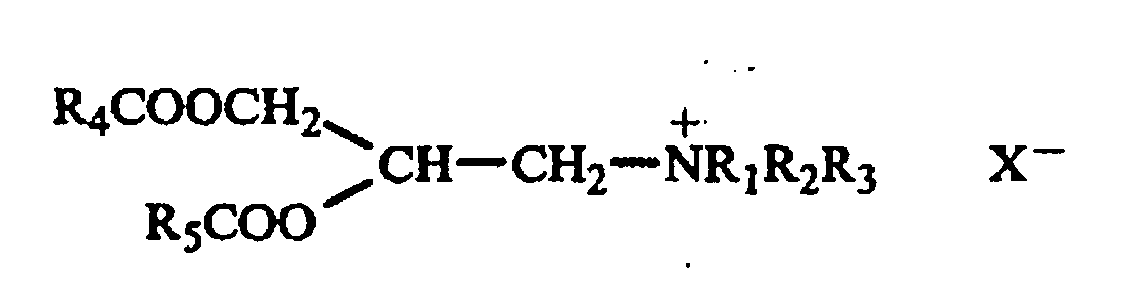
- Various fabric conditioning compounds are discussed in
U.S. Patent No. 4,137,180 , which is incorporated herein in its entirety. Suitable cationic softeners are described in, for example,U.S. Patent Nos. 5,939,377 ;6,020,304 ;4,830,771 ;5,501,806 ;5,133,885 ; and4,767,547 . - In the above fabric softeners, typical counter ions that can be used include, for example, methyl sulfate, chloride, bromide, nitrate and the like.
- The fabric softener can additionally contain a thickening agent to provide a desired viscosity to the fabric softener. In certain embodiments, the thickening agent is present at an amount of at least 0.001 weight percent of the composition.
- In one embodiment, the thickener is the thickener described in
WO 90/12862 WO 90/12862 - In another embodiment, the thickening agent is a water soluble cross-linked cationic polymer derived from the polymerization of from 5 to 100 mole percent of a cationic vinyl addition monomer, from 0 to 95 mole percent of acrylamide, and from 70 to 300 ppm of a difunctional vinyl addition monomer cross-linking agent. This polymer is described in United States Patent No.
4,806,345 ,EP 1399533 A1 , and Research Disclosure page 136, no. 429116 of January 2000, all of which are incorporated herein by reference. In one embodiment, this polymer is available as SNF DP/EP 2037B from SNF Floerger, France, which is a cross-linked cationic copolymer of about 20% acrylamide and about 80% trimethylammonioethylmethacrylate salt, and the cross-linking agent is methylene bisacrylamide (MBA). - In general, a fabric may lose a degree of its resilience properties after washing and wearing. In some embodiments of the present invention, a fabric's loss of resilience properties after washing and wearing is minimized when the fabric is contacted with a fabric softener. In some embodiments, a fabric maintains a greater degree of its resilience properties after washing and wearing when contacted with a fabric softener, compared to a fabric after the same amount of washing and wearing but without contact with a fabric softener.
- As described above, use of a fabric softener minimizes the loss of at least one resilience property of a fabric. In some embodiments, resilience properties may include elastic properties. In some embodiments, resilience properties may include one or more of the following: a) ability to elongate, b) shape retention, c) elasticity, d) reduced creasing or e) reduced crumpling.
- In some embodiments, use of a fabric softener may minimize the loss of ability to elongate a fabric. Ability to elongate a fabric may be defined as the amount of force needed for a specified amount of elongation of the fabric. Ability to elongate a fabric may be measured in a row (i.e., horizontal) direction or a column (i.e., vertical) direction of the fabric. In some embodiments, use of a fabric softener results in less force needed for a specified amount of elongation of a fabric after washing and wearing, as compared to a fabric which was not contacted with a fabric softener and which was exposed to the same amount of washing and wearing. In various embodiments, a fabric with a minimized loss of ability to elongate is desirable for increased comfort, shape, and freedom of movement.
- In some embodiments, use of a fabric softener on a knitted cotton/elastane blend or pure cotton fabric results in 20% to 60% less force needed for an 80% elongation of the fabric in a column direction after ten washes than a fabric washed ten times without a fabric softener. In some embodiments, use of a fabric softener on a knitted cotton/elastane blend or pure cotton fabric results in 20% to 45% less force needed for an 80% elongation of the fabric in a row direction after ten washes than the same type of fabric washed ten times without a fabric softener.
- In some embodiments, use of a fabric softener on a Tactel® nylon/elastane blend fabric results in 20% to 60% less force needed for an 80% elongation of the fabric in a column direction after ten washes than a fabric washed ten times without a fabric softener. In some embodiments, use of a fabric softener on a knitted Tactel® nylon/elastane blend fabric results in 2% to 15% less force needed for an 80% elongation of the fabric in a row direction after ten washes than the same type of fabric washed ten times without a fabric softener.
- In some embodiments, use of a fabric softener on a knitted Viscose Nylon/elastane blend fabric results in 20% to 60% less force needed for an 80% elongation of the fabric in a column direction after ten washes than a fabric washed ten times without a fabric softener. In some embodiments, use of a fabric softener on a knitted Viscose Nylon/elastane blend fabric results in 20% to 60% less force needed for an 80% elongation of the fabric in a row direction after ten washes than the same type of fabric washed ten times without a fabric softener.
- In some embodiments, use of a fabric softener on a cotton interlock knit fabric results in 20% to 60% less force needed for an 80% elongation of the fabric in a column direction after ten washes than a fabric washed ten times without a fabric softener. In some embodiments, use of a fabric softener on a knitted cotton interlock fabric results in 20% to 55% less force needed for an 80% elongation of the fabric in a row direction after ten washes than the same type of fabric washed ten times without a fabric softener.
- In some embodiments, use of a fabric softener may minimize the loss of shape retention of a fabric. Shape retention may be defined as a fabric's stretch recovery, i.e., its ability to recover its original length and/or shape after stretching the fabric repeatedly. Shape retention may be measured in a row direction or a column direction of the fabric. In some embodiments, use of a fabric softener results in a fabric with greater stretch recovery after washing and wearing, as compared to a fabric which was not contacted with a fabric softener and which was exposed to the same amount of washing and wearing.
- In some embodiments, use of a fabric softener on a cotton/elastane blend fabric results in 40% to 50% more elongation recovered in a column direction after five stretchings of the fabric after ten washes than a fabric washed ten times without a fabric softener. In some embodiments, use of a fabric softener on a cotton/elastane blend fabric results in 35% to 45% more elongation recovered in a row direction after five stretchings of the fabric after ten washes than a fabric washed ten times without a fabric softener.
- In some embodiments, use of a fabric softener on a Tactel® nylon/elastane blend fabric results in 1% to 10% more elongation recovered in a column direction after five stretchings of the fabric after ten washes than a fabric washed ten times without a fabric softener. In some embodiments, use of a fabric softener on a Tactel® nylon/elastane blend fabric results in 20% to 30% more elongation recovered in a row direction after five stretchings of the fabric after ten washes than a fabric washed ten times without a fabric softener.
- In some embodiments, use of a fabric softener on a Viscose Nylon/elastane blend fabric results in 30% to 40% more elongation recovered in a column direction after five stretchings of the fabric after ten washes than a fabric washed ten times without a fabric softener. In some embodiments, use of a fabric softener on a Viscose Nylon/elastane blend fabric results in 50% to 60% more elongation recovered in a row direction after five stretchings of the fabric after ten washes than a fabric washed ten times without a fabric softener.
- In some embodiments, use of a fabric softener on a cotton interlock knit fabric results in 20% to 30% more elongation recovered in a column direction after five stretchings of the fabric after ten washes than a fabric washed ten times without a fabric softener. In some embodiments, use of a fabric softener on a cotton interlock knit fabric results in 30% to 40% more elongation recovered in a row direction after five stretchings of the fabric after ten washes than a fabric washed ten times without a fabric softener.
- In some embodiments, use of a fabric softener may minimize the loss of elasticity and/or endurance of a fabric. As used herein, elasticity may be defined as the ability of a material to deform under stress and to return to its original shape when the stress is removed. Furthermore, as used herein, endurance (also known as constant elasticity) may be defined as the consistency of force required to elongate a fabric after stretching the fabric repeatedly. Fabric with high elasticity and/or endurance may require the same or close to the same amount of force to elongate the fabric after repeated stretchings. Fabric which has experienced elasticity loss and/or endurance loss, for example after washing and wearing, may require less force to elongate the fabric after repeated stretchings. In some embodiments, use of a fabric softener results in a fabric with less elasticity loss and/or less endurance loss after washing and wearing, as compared to a fabric which was not contacted with a fabric softener and which was exposed to the same amount of washing and wearing.
- In some embodiments, use of a fabric softener on a knitted cotton/elastane blend fabric results in 20% to 40% greater retention of required stretching force after five repeated stretchings in a column direction of the fabric after ten washes than a fabric washed ten times without a fabric softener. In some embodiments, use of a fabric softener on a knitted cotton/elastane blend fabric results in 40% to 60% greater retention of required stretching force after five repeated stretchings in a row direction of the fabric after ten washes than a fabric washed ten times without a fabric softener.
- In some embodiments, use of a fabric softener on a knitted Tactel® nylon/elastane blend fabric results in 45% to 55% greater retention of required stretching force after five repeated stretchings in a column direction of the fabric after ten washes than a fabric washed ten times without a fabric softener.
- In some embodiments, use of a fabric softener on a Viscose knitted Nylon/elastane blend fabric results in 40% to 50% greater retention of required stretching force after five repeated stretchings in a column direction of the fabric after ten washes than a fabric washed ten times without a fabric softener. In some embodiments, use of a fabric softener on a Viscose nylon/elastane blend fabric results in 50% to 60% greater retention of required stretching force after five repeated stretchings in a row direction of the fabric after ten washes than a fabric washed ten times without a fabric softener.
- In some embodiments, use of a fabric softener on a cotton interlock knit fabric results in 15% to 25% greater retention of required stretching force after five repeated stretchings in a column direction of the fabric after ten washes than a fabric washed ten times without a fabric softener. In some embodiments, use of a fabric softener on a cotton interlock knit fabric results in 50% to 10% greater retention of required stretching force after five repeated stretchings in a row direction of the fabric after ten washes than a fabric washed ten times without a fabric softener.
- Fabric softeners may contact a fabric by various means. Any technique used in the art to contact a fabric softener to a fabric is suitable. In some embodiments, a fabric softener may be applied directly to a fabric. In some embodiments, a fabric softener may contact a fabric by spraying, rubbing, pouring, soaking, or rolling. In some embodiments, a fabric softener may be diluted with water, dispersed in water, or combined with one or more other fabric softeners.
- A fabric softener may contact the fabric at any stage during a washing and drying cycle for the fabric. In some embodiments, a fabric softener may be contacted with a fabric in a dryer, for example in the form of a dryer sheet. In some embodiments, fabric softeners may be contacted to a fabric before washing. In some embodiments, fabric softeners may be contacted to a fabric during washing. In some embodiments, fabric softeners may be contacted to a fabric after washing.
- The examples below used SOUPLINE™ fabric softener from Colgate Palmolive. This fabric softener contains about 13.5 weight % (based on the active weight of the material) of a mixture of 50% diesterquat (a) material, 20% monoester (b) and 30% triester (c) shown in
Figure 1 . - The following examples evaluate the effect of a fabric softener on resilience properties of various fabrics. The fabrics tested include elastane-containing fabrics (cotton/Lycra®, Tactel® nylon/Lycra® and Viscose nylon/Lycra® ) and a fabric without elastane (cotton interlock knit)
- The three tests are based on an European norm: EN 14704-01:
- Stretching Force (with lengthening max 80 %)
- Elongation not recovered after 5 cycles (after 30 minutes rest)
- Loss of Stretching Force due to fatigue.
- Evaluations were carried out after ten cumulative washes on the fabrics with and without SOUPLINE fabric softener.
- A Miele washing machine was used for the ten washes, with a water temperature of 40°C. 20 g of European Ariel liquid detergent was used for each wash. Each wash load contained 2.5 kg of fabric. After each wash, the fabric was on-line dried overnight.
- In the following examples, column refers to the direction parallel to the stitches and row refers to the direction perpendicular to the stitches.
- The following table shows the force in Newtons necessary to obtain an 80% elongation of a fabric in a column direction and a row direction:
Fabric Untreated Without Fabric Softener With Fabric Softener Cotton/ Lycra® Column 12.7 12.6 7 Row 2.8 4.6 2.9 Tactel nylon/ Lycra® Column 5.6 8.3 4.2 Row 3.1 3.3 2.9 Viscose nylon /Lycra® Column 66.4 51.7 28.9 Row 8.8 15.1 7 Cotton interlock knit Column 146.8 12.0 6.3 Row 2.7 3.2 1.6 - The "Untreated" column displays the force necessary to obtain 80% elongation of a fabric before the fabric has been washed. The "Without Fabric Softener" column displays the force necessary to obtain 80% elongation of a fabric after the fabric has been washed ten times under the conditions described above, without fabric softener. The "With Fabric Softener" column displays the force necessary to obtain 80% elongation of a fabric after the fabric has been washed ten times under the conditions described above, with fabric softener.
- The results in the table above demonstrate that use of the fabric softener made the fabric easier to stretch: less force was needed for the same elongation. For clothing, a minimized loss of a fabric's ability to elongate after washing and wearing is often desirable because it means better comfort, shape and freedom of movement.
- The following table shows the elongation not recovered after five stretchings and 30 minutes rest. The values of the elongation not recovered are displayed as percentages:
Fabric Untreated Without Fabric Softener With Fabric Softener Cotton/ Lycra® Column 3.9 7.5 4.3 Row 3.3 6.0 3.5 Tactel® nylon/ Lycra® Column 2.1 2.4 2.3 Row 1.6 1.6 1.2 Viscose nylon /Lycra® Column 8.6 10.1 6.5 Row 4.6 10.5 4.5 Cotton interlock knit Column 32.4 17.1 12.9 Row 5.2 10.0 6.4 - The "Untreated" column displays the percent of elongation not recovered after five stretchings and 30 minutes rest, before the fabric is washed. The "Without Fabric Softener" column displays the percent of elongation not recovered after five stretchings and 30 minutes rest after the fabric has been washed ten times under the conditions described above, without fabric softener. The "With Fabric Softener" column displays the percent of elongation not recovered after five stretchings and 30 minutes rest after the fabric has been washed ten times under the conditions described above, with fabric softener.
- The results show that the lengthening not recovered is lower with fabric softener treatment than with without it. Use of fabric softener is shown to protect stretch recovery and therefore shape retention, and is safe to the elastane containing fabrics. On cotton interlock knit, SOUPLINE™ treatment is also superior to treatment without SOUPLINE™.
- The following table shows the loss of stretching force after five stretchings compared with the first stretching. The loss of stretching force is displayed as a percentage:
Fabric Untreated Without Fabric Softener With Fabric Softener Cotton/ Lycra® Column 18.3 19.7 14.5 Row 11.3 17.1 9.8 Tactel® nylon/ Lycra® Column 11.4 18.2 8.7 Row 9.8 4.8 7.2 Viscose nylon /Lycra® Column 15.8 19.6 10.6 Row 12.2 17.3 8.1 Cotton interlock knit Column 19.8 25.3 20.2 Row 13.3 15.1 11.4 - The "Untreated" column displays the loss of stretching force after five stretchings compared with the first stretching before the fabric is washed. The "Without Fabric Softener" column displays the loss of stretching force after five stretchings compared with the first stretching after the fabric has been washed ten times under the conditions described above, without fabric softener. The "With Fabric Softener" column displays the loss of stretching force after five stretchings compared with the first stretching after the fabric has been washed ten times under the conditions described above, with fabric softener.
- The data demonstrates that the loss of stretching force of a fabric after washing is far lower when fabrics are treated with fabric softener, with the exception of Tactel® nylon/Lycra® row. In general then, use of a fabric softener is shown to increase the resistance to elasticity loss after washing for elastane- and non elastane- containing fabrics.
Claims (15)
- The use of fabric softener to minimize the loss of at least one resilience property of a fabric by contacting the fabric with fabric softener, wherein the fabric softener comprises a quaternary ammonium fabric softener.
- The use of fabric softener according to any preceding claim, wherein the fabric softener comprises an esterquat.
- The use of fabric softener according to any preceding claim, wherein the fabric softener comprises a mixture of:

- The use of fabric softener according to any preceding claim, wherein the fabric softener comprises
 wherein R4 represents an aliphatic hydrocarbon group having 8 to 22 carbon atoms,R2 and R3 each independently represent {(CH2)s-R5 wherein R5 represents an alkoxy carbonyl group containing 8 to 22 carbon atoms, benzyl, phenyl, (C1-C4)-alkyl substituted phenyl, OH or H}; orR2 and R3 are each independently represented by the structure defined by R1;R1 represents (CH2)tR6 where R6 represents benzyl, phenyl, (C1-C4)-alkyl substituted phenyl, OH or H;q, s, and t each independently, represent an integer 1 to 3; andX- is a softener anion.
 - The use of fabric softener according to any preceding claim, wherein the fabric softener comprises a composition chosen from the following:


-O-C(O)-,
-C(O)-O-,
-O-C(O)-O-,
-NR4-C(O)-,
-C(O)-NR4-;
R1 is (CH2)n-Q-T2 or T3;R2 is (CH2)m-Q-T4 or T5 or R3 ;R3 is C1-C4 alkyl or C1-C4 hydroxyalkyl or H;R4 is H or C1-C4 alkyl or C1-C4 hydroxyalkyl;T1, T2, T3, T4, T5 are independently C11-C22 alkyl or alkenyl;n and m are integers from 1 to 4; andX- is a softener-compatible anion. - The use of fabric softener according to any preceding claim, wherein the fabric softener comprises a composition according to the following:

- The use of fabric softener according to any preceding claim, wherein the fabric softener comprises a fatty acid ester quat of the following formula:

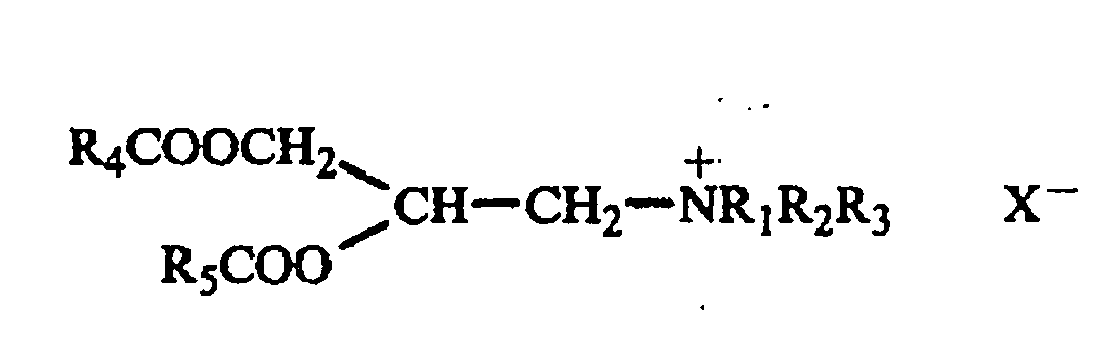
- The use of fabric softener according to any preceding claim, wherein the fabric softener comprises a composition according to the following
- The use of fabric softener according to any preceding claim, wherein the resilience property comprises one or more properties chosen from shape retention, ability to elongate, and elasticity.
- The use of fabric softener according to any preceding claim, wherein the fabric comprises a natural fiber.
- The use of fabric softener according to any preceding claim, wherein the fabric comprises a synthetic fiber.
- The use of fabric softener according to any preceding claim, wherein the fabric comprises a cotton interlock knit.
- The use of fabric softener according to any preceding claim, wherein the fabric comprises an elastic fiber.
- The use of fabric softener according to any preceding claim, wherein the fabric comprises an elastane based fiber.
- The use of fabric softener according to any preceding claim, wherein the fabric softener contacts the fabric at any stage during a washing and drying cycle for the fabric.
Priority Applications (1)
| Application Number | Priority Date | Filing Date | Title |
|---|---|---|---|
| EP07253281A EP2028263A1 (en) | 2007-08-20 | 2007-08-20 | Use of fabric softener to minimize loss of reslient properties in a fabric |
Applications Claiming Priority (1)
| Application Number | Priority Date | Filing Date | Title |
|---|---|---|---|
| EP07253281A EP2028263A1 (en) | 2007-08-20 | 2007-08-20 | Use of fabric softener to minimize loss of reslient properties in a fabric |
Publications (1)
| Publication Number | Publication Date |
|---|---|
| EP2028263A1 true EP2028263A1 (en) | 2009-02-25 |
Family
ID=39009648
Family Applications (1)
| Application Number | Title | Priority Date | Filing Date |
|---|---|---|---|
| EP07253281A Withdrawn EP2028263A1 (en) | 2007-08-20 | 2007-08-20 | Use of fabric softener to minimize loss of reslient properties in a fabric |
Country Status (1)
| Country | Link |
|---|---|
| EP (1) | EP2028263A1 (en) |
-
2007
- 2007-08-20 EP EP07253281A patent/EP2028263A1/en not_active Withdrawn
Non-Patent Citations (3)
| Title |
|---|
| FLICK W: "Products for The Textile Industry", TEXTILE FINISHING CHEMICALS, XX, XX, 1990, pages 587, XP008087858 * |
| JUODSNUKYTE D ET AL: "Influence of fabric softeners on performance stability of the textile materials", MATERIALS SCIENCE EDITORIAL BOARD OF JOURNAL MATERIALS SCIENCE LITHUANIA, vol. 11, no. 2, 2005, pages 179 - 182, XP009095848, ISSN: 1392-1320 * |
| TRUNCYTE D ET AL: "The change of handle properties of knitted farics influenced by washing process", MEDZIAGOTYRA - MATERIALS SCIENCE, KAUNO TECHNOLOGIJOS UNIVERSITETAS,, LT, vol. 12, no. 2, 2006, pages 158 - 161, XP008087855, ISSN: 1392-1320 * |
Similar Documents
| Publication | Publication Date | Title |
|---|---|---|
| CA2011125C (en) | Fabric softening composition | |
| JP2001512538A (en) | Softening active substance for woven fabric and softening composition for woven fabric containing the same | |
| US5254271A (en) | Ammonium compounds, preparation thereof and use thereof as cleaning agent, cosmetic raw material and softener, in particular as final-rinse fabric softner | |
| DE10112318A1 (en) | conditioning | |
| EP0356210B1 (en) | Method of enhancing fabric rewettability | |
| JPH0759792B2 (en) | Softening agent | |
| EP3071681B1 (en) | Fabric softener composition | |
| DE2849931A1 (en) | TEXTILE TREATMENT PRODUCTS | |
| EP1597343B1 (en) | Fabric softening composition | |
| US6890895B2 (en) | Fiber-softening compositions containing non-ionic surfactants | |
| EP3418355B1 (en) | Fabric softener active compositions | |
| JPH0765267B2 (en) | Softening agent | |
| EP1103650B2 (en) | Softener compositions | |
| JP2992419B2 (en) | Soft finish | |
| JP4215545B2 (en) | Softener composition | |
| KR100500608B1 (en) | Fabric softener composition | |
| EP1096055B1 (en) | Softener composition | |
| DE60105763T2 (en) | COMPOSITION TO TEXTILE CARE | |
| JP3820007B2 (en) | Textile softener | |
| KR100473765B1 (en) | Fabric softener composition | |
| JPH0441773A (en) | Soft finishing agent | |
| KR20030037919A (en) | Fabric softener composition | |
| JP3235935B2 (en) | Liquid softener composition | |
| JP3224173B2 (en) | Liquid softener composition | |
| JP3398230B2 (en) | Liquid softener composition |
Legal Events
| Date | Code | Title | Description |
|---|---|---|---|
| PUAI | Public reference made under article 153(3) epc to a published international application that has entered the european phase |
Free format text: ORIGINAL CODE: 0009012 |
|
| AK | Designated contracting states |
Kind code of ref document: A1 Designated state(s): AT BE BG CH CY CZ DE DK EE ES FI FR GB GR HU IE IS IT LI LT LU LV MC MT NL PL PT RO SE SI SK TR |
|
| AX | Request for extension of the european patent |
Extension state: AL BA HR MK RS |
|
| 17P | Request for examination filed |
Effective date: 20090526 |
|
| 17Q | First examination report despatched |
Effective date: 20090617 |
|
| AKX | Designation fees paid |
Designated state(s): AT BE BG CH CY CZ DE DK EE ES FI FR GB GR HU IE IS IT LI LT LU LV MC MT NL PL PT RO SE SI SK TR |
|
| STAA | Information on the status of an ep patent application or granted ep patent |
Free format text: STATUS: THE APPLICATION IS DEEMED TO BE WITHDRAWN |
|
| 18D | Application deemed to be withdrawn |
Effective date: 20110301 |