EP2028237A1 - Coating agent for UV curable inkjet printing - Google Patents
Coating agent for UV curable inkjet printing Download PDFInfo
- Publication number
- EP2028237A1 EP2028237A1 EP20080290561 EP08290561A EP2028237A1 EP 2028237 A1 EP2028237 A1 EP 2028237A1 EP 20080290561 EP20080290561 EP 20080290561 EP 08290561 A EP08290561 A EP 08290561A EP 2028237 A1 EP2028237 A1 EP 2028237A1
- Authority
- EP
- European Patent Office
- Prior art keywords
- organic
- coating agent
- curable inkjet
- inkjet printing
- ink
- Prior art date
- Legal status (The legal status is an assumption and is not a legal conclusion. Google has not performed a legal analysis and makes no representation as to the accuracy of the status listed.)
- Withdrawn
Links
- 239000011248 coating agent Substances 0.000 title claims abstract description 45
- 238000007641 inkjet printing Methods 0.000 title claims abstract description 28
- 239000002114 nanocomposite Substances 0.000 claims abstract description 37
- 238000007639 printing Methods 0.000 claims abstract description 20
- VYPSYNLAJGMNEJ-UHFFFAOYSA-N Silicium dioxide Chemical compound O=[Si]=O VYPSYNLAJGMNEJ-UHFFFAOYSA-N 0.000 claims description 40
- 239000008119 colloidal silica Substances 0.000 claims description 29
- 229920000642 polymer Polymers 0.000 claims description 21
- XLYOFNOQVPJJNP-UHFFFAOYSA-N water Substances O XLYOFNOQVPJJNP-UHFFFAOYSA-N 0.000 claims description 21
- 150000003377 silicon compounds Chemical group 0.000 claims description 19
- 239000003960 organic solvent Substances 0.000 claims description 17
- -1 organosilane compound Chemical class 0.000 claims description 9
- 238000003980 solgel method Methods 0.000 claims description 5
- 229910052909 inorganic silicate Inorganic materials 0.000 claims description 4
- 239000000976 ink Substances 0.000 description 35
- NIXOWILDQLNWCW-UHFFFAOYSA-M Acrylate Chemical compound [O-]C(=O)C=C NIXOWILDQLNWCW-UHFFFAOYSA-M 0.000 description 24
- NIXOWILDQLNWCW-UHFFFAOYSA-N acrylic acid group Chemical group C(C=C)(=O)O NIXOWILDQLNWCW-UHFFFAOYSA-N 0.000 description 13
- 239000002245 particle Substances 0.000 description 9
- 229920005989 resin Polymers 0.000 description 9
- 239000011347 resin Substances 0.000 description 9
- 239000011521 glass Substances 0.000 description 7
- 239000003973 paint Substances 0.000 description 7
- 238000000034 method Methods 0.000 description 6
- 239000002904 solvent Substances 0.000 description 6
- 239000000178 monomer Substances 0.000 description 5
- 238000000576 coating method Methods 0.000 description 4
- 239000011246 composite particle Substances 0.000 description 4
- 150000001875 compounds Chemical class 0.000 description 4
- 238000001035 drying Methods 0.000 description 4
- 239000003822 epoxy resin Substances 0.000 description 4
- 239000010408 film Substances 0.000 description 4
- 239000000463 material Substances 0.000 description 4
- 229920003023 plastic Polymers 0.000 description 4
- 229920000647 polyepoxide Polymers 0.000 description 4
- 229920001296 polysiloxane Polymers 0.000 description 4
- 239000000047 product Substances 0.000 description 4
- LYCAIKOWRPUZTN-UHFFFAOYSA-N Ethylene glycol Chemical group OCCO LYCAIKOWRPUZTN-UHFFFAOYSA-N 0.000 description 3
- ZJCCRDAZUWHFQH-UHFFFAOYSA-N Trimethylolpropane Chemical compound CCC(CO)(CO)CO ZJCCRDAZUWHFQH-UHFFFAOYSA-N 0.000 description 3
- MTHSVFCYNBDYFN-UHFFFAOYSA-N diethylene glycol Chemical compound OCCOCCO MTHSVFCYNBDYFN-UHFFFAOYSA-N 0.000 description 3
- 238000005516 engineering process Methods 0.000 description 3
- 150000002148 esters Chemical class 0.000 description 3
- 239000010419 fine particle Substances 0.000 description 3
- 239000003999 initiator Substances 0.000 description 3
- 238000004519 manufacturing process Methods 0.000 description 3
- 239000000049 pigment Substances 0.000 description 3
- 239000002985 plastic film Substances 0.000 description 3
- 229920003002 synthetic resin Polymers 0.000 description 3
- 239000000057 synthetic resin Substances 0.000 description 3
- SMZOUWXMTYCWNB-UHFFFAOYSA-N 2-(2-methoxy-5-methylphenyl)ethanamine Chemical compound COC1=CC=C(C)C=C1CCN SMZOUWXMTYCWNB-UHFFFAOYSA-N 0.000 description 2
- OMIGHNLMNHATMP-UHFFFAOYSA-N 2-hydroxyethyl prop-2-enoate Chemical compound OCCOC(=O)C=C OMIGHNLMNHATMP-UHFFFAOYSA-N 0.000 description 2
- IZSHZLKNFQAAKX-UHFFFAOYSA-N 5-cyclopenta-2,4-dien-1-ylcyclopenta-1,3-diene Chemical group C1=CC=CC1C1C=CC=C1 IZSHZLKNFQAAKX-UHFFFAOYSA-N 0.000 description 2
- KBEBGUQPQBELIU-CMDGGOBGSA-N Ethyl cinnamate Chemical compound CCOC(=O)\C=C\C1=CC=CC=C1 KBEBGUQPQBELIU-CMDGGOBGSA-N 0.000 description 2
- JOYRKODLDBILNP-UHFFFAOYSA-N Ethyl urethane Chemical compound CCOC(N)=O JOYRKODLDBILNP-UHFFFAOYSA-N 0.000 description 2
- CERQOIWHTDAKMF-UHFFFAOYSA-N Methacrylic acid Chemical compound CC(=C)C(O)=O CERQOIWHTDAKMF-UHFFFAOYSA-N 0.000 description 2
- 239000002202 Polyethylene glycol Substances 0.000 description 2
- 239000004372 Polyvinyl alcohol Substances 0.000 description 2
- KBEBGUQPQBELIU-UHFFFAOYSA-N cinnamic acid ethyl ester Natural products CCOC(=O)C=CC1=CC=CC=C1 KBEBGUQPQBELIU-UHFFFAOYSA-N 0.000 description 2
- 125000004386 diacrylate group Chemical group 0.000 description 2
- 238000000635 electron micrograph Methods 0.000 description 2
- 230000002209 hydrophobic effect Effects 0.000 description 2
- NLYAJNPCOHFWQQ-UHFFFAOYSA-N kaolin Chemical compound O.O.O=[Al]O[Si](=O)O[Si](=O)O[Al]=O NLYAJNPCOHFWQQ-UHFFFAOYSA-N 0.000 description 2
- 239000002105 nanoparticle Substances 0.000 description 2
- 239000004033 plastic Substances 0.000 description 2
- 229920001223 polyethylene glycol Polymers 0.000 description 2
- 229920001228 polyisocyanate Polymers 0.000 description 2
- 239000005056 polyisocyanate Substances 0.000 description 2
- 229920002451 polyvinyl alcohol Polymers 0.000 description 2
- 229920000036 polyvinylpyrrolidone Polymers 0.000 description 2
- 239000001267 polyvinylpyrrolidone Substances 0.000 description 2
- 235000013855 polyvinylpyrrolidone Nutrition 0.000 description 2
- 239000000126 substance Substances 0.000 description 2
- 229920006352 transparent thermoplastic Polymers 0.000 description 2
- RSJKGSCJYJTIGS-UHFFFAOYSA-N undecane Chemical compound CCCCCCCCCCC RSJKGSCJYJTIGS-UHFFFAOYSA-N 0.000 description 2
- 229920003169 water-soluble polymer Polymers 0.000 description 2
- DTGKSKDOIYIVQL-WEDXCCLWSA-N (+)-borneol Chemical group C1C[C@@]2(C)[C@@H](O)C[C@@H]1C2(C)C DTGKSKDOIYIVQL-WEDXCCLWSA-N 0.000 description 1
- 239000012956 1-hydroxycyclohexylphenyl-ketone Substances 0.000 description 1
- XMLYCEVDHLAQEL-UHFFFAOYSA-N 2-hydroxy-2-methyl-1-phenylpropan-1-one Chemical compound CC(C)(O)C(=O)C1=CC=CC=C1 XMLYCEVDHLAQEL-UHFFFAOYSA-N 0.000 description 1
- LWRBVKNFOYUCNP-UHFFFAOYSA-N 2-methyl-1-(4-methylsulfanylphenyl)-2-morpholin-4-ylpropan-1-one Chemical compound C1=CC(SC)=CC=C1C(=O)C(C)(C)N1CCOCC1 LWRBVKNFOYUCNP-UHFFFAOYSA-N 0.000 description 1
- 125000003903 2-propenyl group Chemical group [H]C([*])([H])C([H])=C([H])[H] 0.000 description 1
- SKKHNUKNMQLBTJ-UHFFFAOYSA-N 3-bicyclo[2.2.1]heptanyl 2-methylprop-2-enoate Chemical compound C1CC2C(OC(=O)C(=C)C)CC1C2 SKKHNUKNMQLBTJ-UHFFFAOYSA-N 0.000 description 1
- MWSKJDNQKGCKPA-UHFFFAOYSA-N 6-methyl-3a,4,5,7a-tetrahydro-2-benzofuran-1,3-dione Chemical compound C1CC(C)=CC2C(=O)OC(=O)C12 MWSKJDNQKGCKPA-UHFFFAOYSA-N 0.000 description 1
- HRPVXLWXLXDGHG-UHFFFAOYSA-N Acrylamide Chemical compound NC(=O)C=C HRPVXLWXLXDGHG-UHFFFAOYSA-N 0.000 description 1
- 229920000178 Acrylic resin Polymers 0.000 description 1
- 239000004925 Acrylic resin Substances 0.000 description 1
- LCFVJGUPQDGYKZ-UHFFFAOYSA-N Bisphenol A diglycidyl ether Chemical compound C=1C=C(OCC2OC2)C=CC=1C(C)(C)C(C=C1)=CC=C1OCC1CO1 LCFVJGUPQDGYKZ-UHFFFAOYSA-N 0.000 description 1
- FBPFZTCFMRRESA-FSIIMWSLSA-N D-Glucitol Natural products OC[C@H](O)[C@H](O)[C@@H](O)[C@H](O)CO FBPFZTCFMRRESA-FSIIMWSLSA-N 0.000 description 1
- FBPFZTCFMRRESA-JGWLITMVSA-N D-glucitol Chemical compound OC[C@H](O)[C@@H](O)[C@H](O)[C@H](O)CO FBPFZTCFMRRESA-JGWLITMVSA-N 0.000 description 1
- LCGLNKUTAGEVQW-UHFFFAOYSA-N Dimethyl ether Chemical compound COC LCGLNKUTAGEVQW-UHFFFAOYSA-N 0.000 description 1
- 239000001828 Gelatine Substances 0.000 description 1
- LGRFSURHDFAFJT-UHFFFAOYSA-N Phthalic anhydride Natural products C1=CC=C2C(=O)OC(=O)C2=C1 LGRFSURHDFAFJT-UHFFFAOYSA-N 0.000 description 1
- NBBJYMSMWIIQGU-UHFFFAOYSA-N Propionic aldehyde Chemical compound CCC=O NBBJYMSMWIIQGU-UHFFFAOYSA-N 0.000 description 1
- 238000005299 abrasion Methods 0.000 description 1
- 238000010521 absorption reaction Methods 0.000 description 1
- 150000001252 acrylic acid derivatives Chemical class 0.000 description 1
- 125000005396 acrylic acid ester group Chemical group 0.000 description 1
- 229920005822 acrylic binder Polymers 0.000 description 1
- 125000003647 acryloyl group Chemical group O=C([*])C([H])=C([H])[H] 0.000 description 1
- 239000000853 adhesive Substances 0.000 description 1
- 230000001070 adhesive effect Effects 0.000 description 1
- 125000004183 alkoxy alkyl group Chemical group 0.000 description 1
- 229920000180 alkyd Polymers 0.000 description 1
- 125000000217 alkyl group Chemical group 0.000 description 1
- 150000001350 alkyl halides Chemical class 0.000 description 1
- 125000003277 amino group Chemical group 0.000 description 1
- 229920003180 amino resin Polymers 0.000 description 1
- 125000004103 aminoalkyl group Chemical group 0.000 description 1
- 150000003934 aromatic aldehydes Chemical class 0.000 description 1
- 239000012298 atmosphere Substances 0.000 description 1
- 239000011324 bead Substances 0.000 description 1
- 125000001797 benzyl group Chemical group [H]C1=C([H])C([H])=C(C([H])=C1[H])C([H])([H])* 0.000 description 1
- 230000015572 biosynthetic process Effects 0.000 description 1
- MQDJYUACMFCOFT-UHFFFAOYSA-N bis[2-(1-hydroxycyclohexyl)phenyl]methanone Chemical compound C=1C=CC=C(C(=O)C=2C(=CC=CC=2)C2(O)CCCCC2)C=1C1(O)CCCCC1 MQDJYUACMFCOFT-UHFFFAOYSA-N 0.000 description 1
- JHIWVOJDXOSYLW-UHFFFAOYSA-N butyl 2,2-difluorocyclopropane-1-carboxylate Chemical compound CCCCOC(=O)C1CC1(F)F JHIWVOJDXOSYLW-UHFFFAOYSA-N 0.000 description 1
- 125000003178 carboxy group Chemical group [H]OC(*)=O 0.000 description 1
- 150000001735 carboxylic acids Chemical class 0.000 description 1
- 229940114081 cinnamate Drugs 0.000 description 1
- 239000003086 colorant Substances 0.000 description 1
- 230000000052 comparative effect Effects 0.000 description 1
- 239000007859 condensation product Substances 0.000 description 1
- 229920001577 copolymer Polymers 0.000 description 1
- 239000003431 cross linking reagent Substances 0.000 description 1
- 125000000753 cycloalkyl group Chemical group 0.000 description 1
- IJKVHSBPTUYDLN-UHFFFAOYSA-N dihydroxy(oxo)silane Chemical compound O[Si](O)=O IJKVHSBPTUYDLN-UHFFFAOYSA-N 0.000 description 1
- 238000010894 electron beam technology Methods 0.000 description 1
- 125000001495 ethyl group Chemical group [H]C([H])([H])C([H])([H])* 0.000 description 1
- 238000001914 filtration Methods 0.000 description 1
- 125000000524 functional group Chemical group 0.000 description 1
- 229920000159 gelatin Polymers 0.000 description 1
- 235000019322 gelatine Nutrition 0.000 description 1
- 125000003055 glycidyl group Chemical group C(C1CO1)* 0.000 description 1
- VOZRXNHHFUQHIL-UHFFFAOYSA-N glycidyl methacrylate Chemical compound CC(=C)C(=O)OCC1CO1 VOZRXNHHFUQHIL-UHFFFAOYSA-N 0.000 description 1
- LNEPOXFFQSENCJ-UHFFFAOYSA-N haloperidol Chemical compound C1CC(O)(C=2C=CC(Cl)=CC=2)CCN1CCCC(=O)C1=CC=C(F)C=C1 LNEPOXFFQSENCJ-UHFFFAOYSA-N 0.000 description 1
- 125000002887 hydroxy group Chemical group [H]O* 0.000 description 1
- 239000007788 liquid Substances 0.000 description 1
- PAZHGORSDKKUPI-UHFFFAOYSA-N lithium metasilicate Chemical compound [Li+].[Li+].[O-][Si]([O-])=O PAZHGORSDKKUPI-UHFFFAOYSA-N 0.000 description 1
- 229910052912 lithium silicate Inorganic materials 0.000 description 1
- 239000011159 matrix material Substances 0.000 description 1
- 229910052751 metal Inorganic materials 0.000 description 1
- 239000002184 metal Substances 0.000 description 1
- FQPSGWSUVKBHSU-UHFFFAOYSA-N methacrylamide Chemical compound CC(=C)C(N)=O FQPSGWSUVKBHSU-UHFFFAOYSA-N 0.000 description 1
- 239000011325 microbead Substances 0.000 description 1
- 239000000203 mixture Substances 0.000 description 1
- 239000003921 oil Substances 0.000 description 1
- WXZMFSXDPGVJKK-UHFFFAOYSA-N pentaerythritol Chemical compound OCC(CO)(CO)CO WXZMFSXDPGVJKK-UHFFFAOYSA-N 0.000 description 1
- 125000000951 phenoxy group Chemical group [H]C1=C([H])C([H])=C(O*)C([H])=C1[H] 0.000 description 1
- 229920006255 plastic film Polymers 0.000 description 1
- 229920000728 polyester Polymers 0.000 description 1
- 229920005906 polyester polyol Polymers 0.000 description 1
- 229920001225 polyester resin Polymers 0.000 description 1
- 239000004645 polyester resin Substances 0.000 description 1
- 229920005862 polyol Polymers 0.000 description 1
- 150000003077 polyols Chemical class 0.000 description 1
- 125000001436 propyl group Chemical group [H]C([*])([H])C([H])([H])C([H])([H])[H] 0.000 description 1
- 238000007151 ring opening polymerisation reaction Methods 0.000 description 1
- 229920006395 saturated elastomer Polymers 0.000 description 1
- RMAQACBXLXPBSY-UHFFFAOYSA-N silicic acid Chemical compound O[Si](O)(O)O RMAQACBXLXPBSY-UHFFFAOYSA-N 0.000 description 1
- 239000000600 sorbitol Substances 0.000 description 1
- 239000007921 spray Substances 0.000 description 1
- 239000000758 substrate Substances 0.000 description 1
- 229920002803 thermoplastic polyurethane Polymers 0.000 description 1
- 229920005992 thermoplastic resin Polymers 0.000 description 1
- 229920001187 thermosetting polymer Polymers 0.000 description 1
- 239000010409 thin film Substances 0.000 description 1
- VZCYOOQTPOCHFL-UHFFFAOYSA-N trans-butenedioic acid Natural products OC(=O)C=CC(O)=O VZCYOOQTPOCHFL-UHFFFAOYSA-N 0.000 description 1
- WBYWAXJHAXSJNI-VOTSOKGWSA-M trans-cinnamate Chemical compound [O-]C(=O)\C=C\C1=CC=CC=C1 WBYWAXJHAXSJNI-VOTSOKGWSA-M 0.000 description 1
- 239000011882 ultra-fine particle Substances 0.000 description 1
- 239000002966 varnish Substances 0.000 description 1
- 229920003176 water-insoluble polymer Polymers 0.000 description 1
- 239000003232 water-soluble binding agent Substances 0.000 description 1
Images
Classifications
-
- C—CHEMISTRY; METALLURGY
- C09—DYES; PAINTS; POLISHES; NATURAL RESINS; ADHESIVES; COMPOSITIONS NOT OTHERWISE PROVIDED FOR; APPLICATIONS OF MATERIALS NOT OTHERWISE PROVIDED FOR
- C09D—COATING COMPOSITIONS, e.g. PAINTS, VARNISHES OR LACQUERS; FILLING PASTES; CHEMICAL PAINT OR INK REMOVERS; INKS; CORRECTING FLUIDS; WOODSTAINS; PASTES OR SOLIDS FOR COLOURING OR PRINTING; USE OF MATERIALS THEREFOR
- C09D11/00—Inks
- C09D11/54—Inks based on two liquids, one liquid being the ink, the other liquid being a reaction solution, a fixer or a treatment solution for the ink
-
- C—CHEMISTRY; METALLURGY
- C09—DYES; PAINTS; POLISHES; NATURAL RESINS; ADHESIVES; COMPOSITIONS NOT OTHERWISE PROVIDED FOR; APPLICATIONS OF MATERIALS NOT OTHERWISE PROVIDED FOR
- C09D—COATING COMPOSITIONS, e.g. PAINTS, VARNISHES OR LACQUERS; FILLING PASTES; CHEMICAL PAINT OR INK REMOVERS; INKS; CORRECTING FLUIDS; WOODSTAINS; PASTES OR SOLIDS FOR COLOURING OR PRINTING; USE OF MATERIALS THEREFOR
- C09D11/00—Inks
- C09D11/30—Inkjet printing inks
-
- B—PERFORMING OPERATIONS; TRANSPORTING
- B41—PRINTING; LINING MACHINES; TYPEWRITERS; STAMPS
- B41J—TYPEWRITERS; SELECTIVE PRINTING MECHANISMS, i.e. MECHANISMS PRINTING OTHERWISE THAN FROM A FORME; CORRECTION OF TYPOGRAPHICAL ERRORS
- B41J2/00—Typewriters or selective printing mechanisms characterised by the printing or marking process for which they are designed
- B41J2/005—Typewriters or selective printing mechanisms characterised by the printing or marking process for which they are designed characterised by bringing liquid or particles selectively into contact with a printing material
- B41J2/01—Ink jet
-
- B—PERFORMING OPERATIONS; TRANSPORTING
- B41—PRINTING; LINING MACHINES; TYPEWRITERS; STAMPS
- B41M—PRINTING, DUPLICATING, MARKING, OR COPYING PROCESSES; COLOUR PRINTING
- B41M5/00—Duplicating or marking methods; Sheet materials for use therein
- B41M5/0011—Pre-treatment or treatment during printing of the recording material, e.g. heating, irradiating
-
- B—PERFORMING OPERATIONS; TRANSPORTING
- B41—PRINTING; LINING MACHINES; TYPEWRITERS; STAMPS
- B41M—PRINTING, DUPLICATING, MARKING, OR COPYING PROCESSES; COLOUR PRINTING
- B41M5/00—Duplicating or marking methods; Sheet materials for use therein
- B41M5/50—Recording sheets characterised by the coating used to improve ink, dye or pigment receptivity, e.g. for ink-jet or thermal dye transfer recording
-
- B—PERFORMING OPERATIONS; TRANSPORTING
- B41—PRINTING; LINING MACHINES; TYPEWRITERS; STAMPS
- B41M—PRINTING, DUPLICATING, MARKING, OR COPYING PROCESSES; COLOUR PRINTING
- B41M5/00—Duplicating or marking methods; Sheet materials for use therein
- B41M5/50—Recording sheets characterised by the coating used to improve ink, dye or pigment receptivity, e.g. for ink-jet or thermal dye transfer recording
- B41M5/52—Macromolecular coatings
-
- B—PERFORMING OPERATIONS; TRANSPORTING
- B41—PRINTING; LINING MACHINES; TYPEWRITERS; STAMPS
- B41M—PRINTING, DUPLICATING, MARKING, OR COPYING PROCESSES; COLOUR PRINTING
- B41M7/00—After-treatment of prints, e.g. heating, irradiating, setting of the ink, protection of the printed stock
- B41M7/0081—After-treatment of prints, e.g. heating, irradiating, setting of the ink, protection of the printed stock using electromagnetic radiation or waves, e.g. ultraviolet radiation, electron beams
-
- C—CHEMISTRY; METALLURGY
- C09—DYES; PAINTS; POLISHES; NATURAL RESINS; ADHESIVES; COMPOSITIONS NOT OTHERWISE PROVIDED FOR; APPLICATIONS OF MATERIALS NOT OTHERWISE PROVIDED FOR
- C09D—COATING COMPOSITIONS, e.g. PAINTS, VARNISHES OR LACQUERS; FILLING PASTES; CHEMICAL PAINT OR INK REMOVERS; INKS; CORRECTING FLUIDS; WOODSTAINS; PASTES OR SOLIDS FOR COLOURING OR PRINTING; USE OF MATERIALS THEREFOR
- C09D11/00—Inks
- C09D11/02—Printing inks
- C09D11/10—Printing inks based on artificial resins
- C09D11/101—Inks specially adapted for printing processes involving curing by wave energy or particle radiation, e.g. with UV-curing following the printing
-
- C—CHEMISTRY; METALLURGY
- C09—DYES; PAINTS; POLISHES; NATURAL RESINS; ADHESIVES; COMPOSITIONS NOT OTHERWISE PROVIDED FOR; APPLICATIONS OF MATERIALS NOT OTHERWISE PROVIDED FOR
- C09D—COATING COMPOSITIONS, e.g. PAINTS, VARNISHES OR LACQUERS; FILLING PASTES; CHEMICAL PAINT OR INK REMOVERS; INKS; CORRECTING FLUIDS; WOODSTAINS; PASTES OR SOLIDS FOR COLOURING OR PRINTING; USE OF MATERIALS THEREFOR
- C09D7/00—Features of coating compositions, not provided for in group C09D5/00; Processes for incorporating ingredients in coating compositions
- C09D7/40—Additives
- C09D7/60—Additives non-macromolecular
- C09D7/61—Additives non-macromolecular inorganic
- C09D7/62—Additives non-macromolecular inorganic modified by treatment with other compounds
-
- C—CHEMISTRY; METALLURGY
- C08—ORGANIC MACROMOLECULAR COMPOUNDS; THEIR PREPARATION OR CHEMICAL WORKING-UP; COMPOSITIONS BASED THEREON
- C08K—Use of inorganic or non-macromolecular organic substances as compounding ingredients
- C08K3/00—Use of inorganic substances as compounding ingredients
- C08K3/34—Silicon-containing compounds
- C08K3/36—Silica
-
- C—CHEMISTRY; METALLURGY
- C08—ORGANIC MACROMOLECULAR COMPOUNDS; THEIR PREPARATION OR CHEMICAL WORKING-UP; COMPOSITIONS BASED THEREON
- C08K—Use of inorganic or non-macromolecular organic substances as compounding ingredients
- C08K9/00—Use of pretreated ingredients
- C08K9/08—Ingredients agglomerated by treatment with a binding agent
Definitions
- the present invention relates to a coating agent (hereinafter, coating agent for UV curable inkjet printing) to be used to form an under coat before the printing and a finishing coat after the printing and curing in UV curable inkjet printing using nonaqueous UV ink.
- a coating agent hereinafter, coating agent for UV curable inkjet printing
- a recording substrate which comprises a base sheet such as a normal paper or an inkjet printing paper and a porous inkjet ink receiving layer formed on the base sheet and made of fine particles such as amorphous silica and a water soluble binder resin such as polyvinyl alcohol (see Document JP-A-64-011877 ).
- an inkjet recording sheet comprising a transparent synthetic resin sheet and an ink receiving layer, containing polyvinylpyrrolidone, formed on the surface of the transparent synthetic resin sheet (see JP-A-61-032788 ), (2) a recording sheet comprising a transparent thermoplastic resin film and a transparent ink receiving layer, containing aqueous resin such as polyvinyl alcohol or gelatine and colloidal silica, formed on the transparent thermoplastic resin film (see JP-A-61-019389 ), (3) a recording sheet comprising a transparent plastic film and a water soluble polymer thin film, containing ultrafine particles of which the average particle diameter is from 1 m ⁇ to 100 m ⁇ and fine particles of which average particle diameter is from 1 ⁇ m to 20 ⁇ m, formed on the transparent plastic film (see JP-A-61-280983 ), (4) an overhead projector film comprising a transparent film which is coated with a transparent adhesive containing transparent
- a printed surface is protected by over coating.
- an ultraviolet curable ink paint
- an aqueous ink paint
- a solvent-based ink paint
- the aqueous paint is not practical because it requires time for a drying process and the drying affects the base.
- the solvent-base paint has problems that the solvent breathes into air due to drying and thus affects the working atmosphere and worker's health, also leading to a burden on the global environment.
- thermoplastic resin supplied by Valspar of High Point, North Carolina as a coating material used in a step of forming an under coat, which has a high surface tension in the range of 38-50 surface dynes and should be applied in a smooth coat without dry spray to maximize ink droplet formation.
- a top coat applied to the outer surface after the step for applying said ink droplets a clear (transparent) varnish has been proposed (see JP-A-2005-521578 ).
- a method for producing an inkjet printed matter has been proposed in which a white undercoat layer (I) is formed on a base by using a white paint containing silica particles of which the oil absorption is 10-400 ml/100g and having a pigment volume concentration of 5-90%, a printed layer (II) is formed on the white undercoat layer (I) by inkjet method using an aqueous ink composition, and a clear coat layer (III) is formed on the printed layer (II) by using a clear paint (see WO2002-100652 ).
- a white undercoat layer (I) is formed on a base by using a white paint containing silica particles of which the oil absorption is 10-400 ml/100g and having a pigment volume concentration of 5-90%
- a printed layer (II) is formed on the white undercoat layer (I) by inkjet method using an aqueous ink composition
- a clear coat layer (III) is formed on the printed layer (II) by using a clear paint
- the present invention is made under the aforementioned circumstances and the first object of the present invention is to provide a coating agent to be used in UV curable inkjet printing using nonaqueous UV ink, which can improve durability of a printed matter such as adhesion relative to a base and abrasion-resistance of the printed matter.
- the second object of the present invention is to provide a coating agent to be used in UV curable inkjet printing using nonaqueous UV ink, for forming an under coat having excellent adhesion relative to a base and excellent adhesion relative to an ink cured layer.
- the third object of the present invention is to provide a coating agent to be used in UV curable inkjet printing using nonaqueous UV ink, for forming a finishing coat having excellent adhesion relative to the ink cured layer and extremely excellent abrasion-resistance.
- a coating agent to be used in UV curable inkjet printing using nonaqueous UV ink for forming an under coat before the printing or a finishing coat after the printing and curing, wherein the main component of the coating agent is organic-inorganic nanocomposite.
- the organic-inorganic nanocomposite is an organic-inorganic nanocomposite of which the inorganic component is silicon compound and the organic component is polymeric compound which is dispersible in water or in organic solvent.
- the silicon compound is water dispersible colloidal silica obtained from organosilane compound by sol-gel method or colloidal silica obtained from inorganic silicate and the organic component is polymeric compound which is dispersible in water.
- the organic-inorganic nanocomposite is an organic-inorganic nanocomposite in which the silicon compound is colloidal silica of which the periphery is coated with water dispersible polymer. It is preferable that the silicon compound is organic solvent dispersible colloidal silica and the organic component is polymeric compound which is soluble or dispersible in organic solvent.
- the present invention has the following arrangements.
- (Arrangement 1) A coating agent to be used in UV curable inkjet printing using nonaqueous UV ink, for forming an under coat before the printing or a finishing coat after the printing and curing, wherein the main component of the coating agent is organic-inorganic nanocomposite.
- (Arrangement 2) A coating agent to be used in UV curable inkjet printing as described in Arrangement 1, wherein said organic-inorganic nanocomposite is an organic-inorganic nanocomposite of which the inorganic component is silicon compound and the organic component is polymeric compound which is dispersible in water or in organic solvent.
- (Arrangement 3) A coating agent to be used in UV curable inkjet printing as described in Arrangement 2, wherein said silicon compound is water dispersible colloidal silica obtained from organosilane compound by sol-gel method or colloidal silica obtained from inorganic silicate and said organic component is polymeric compound which is dispersible in water.
- (Arrangement 4) A coating agent to be used in UV curable inkjet printing as described in Arrangement 2 or 3, wherein said organic-inorganic nanocomposite is an organic-inorganic nanocomposite in which the silicon compound is colloidal silica of which the periphery is coated with water dispersible polymer.
- (Arrangement 5) A coating agent to be used in UV curable inkjet printing as described in Arrangement 2, wherein said silicon compound is organic solvent dispersible colloidal silica and said organic component is polymeric compound which is soluble or dispersible in organic solvent.
- a coating agent to be used in UV curable inkjet printing using nonaqueous UV ink for forming an under coat having excellent adhesion relative to a base and excellent adhesion relative to an ink cured layer.
- a coating agent to be used in UV curable inkjet printing using nonaqueous UV ink for forming a finishing coat having excellent adhesion relative to the ink cured layer and extremely excellent abrasion-resistance.
- a coating agent to be used in UV curable inkjet printing using nonaqueous UV ink which can improve durability of a printed matter such as adhesion relative to a base and fastness to rubbing of the printed matter.
- a coating agent for UV curable inkjet printing of which the main component is organic-inorganic nanocomposite material is applied to form an under coat before the printing or a finishing coat after the printing and curing (Arrangement 1).
- a coating agent of which the main component is organic-inorganic nanocomposite material a commercially available coating agent (SSG coat; ordinary-temperature cure coating agent of which the main component is organic-inorganic nanocomposite material: available from Nitto Boseki Co., Ltd.) may be used.
- SSG coat ordinary-temperature cure coating agent of which the main component is organic-inorganic nanocomposite material: available from Nitto Boseki Co., Ltd.
- such a coating agent can be obtained by the following method in accordance with the intended use.
- the organic-inorganic nanocomposite is an organic-inorganic nanocomposite of which the inorganic component is silicon compound and the organic component is polymeric compound which is dispersible in water or polymeric compound which is dispersible in organic solvent (Arrangement 2).
- An organic-inorganic nanocomposite of which the organic component is polymeric compound which is soluble in water is not preferable because it is easy to peel off in practice.
- the organic-inorganic nanocomposite is not preferable because of insufficient adhesion.
- the aforementioned silicon compound is water dispersible colloidal silica obtained from organosilane compound by sol-gel method or colloidal silica obtained from inorganic silicate and the aforementioned organic component is polymeric compound which is dispersible in water (Arrangement 3). Since ordinary powder-like silica particles are difficult to be uniformly dispersed, water dispersible colloidal silica produced directly in liquid by the sol-gel method is preferable as the silicon compound as the inorganic component. Colloidal silica particles may be produced from silicate.
- the organic component is preferably selected from polymers which are dispersible in water.
- colloidal silica a commercially available one (for example, colloidal silica manufactured by Nissan Chemical Industries, Ltd.: SNOWTEX XS, OXS, S, OS, 20, 30, 40, 0, N, C, AK, 50, 0-40, CM, 20L, OL, XL, ZL, MP-2040, MP-4540M, UP, OUP, SP-S, PS-M (these are SNOWTEX) and Lithium Silicate 45) may be used.
- colloidal silica manufactured by Nissan Chemical Industries, Ltd.: SNOWTEX XS, OXS, S, OS, 20, 30, 40, 0, N, C, AK, 50, 0-40, CM, 20L, OL, XL, ZL, MP-2040, MP-4540M, UP, OUP, SP-S, PS-M (these are SNOWTEX) and Lithium Silicate 45) may be used.
- the aforementioned organic-inorganic nanocomposite is an organic-inorganic nanocomposite in which the silicon compound is colloidal silica of which the periphery is coated with water dispersible polymer (Arrangement 4).
- Hybrid-type nanoparticles (organic-inorganic nanocomposite particles) in which the silicon compound is colloidal silica of which the periphery is coated with water dispersible polymer as mentioned above are excellent especially for characteristics of an organic-inorganic nanocomposite coat obtained using the nanoparticles.
- the manufacturing method disclosed in, for example, JP2000-290464 may be applied to the method for manufacturing the aforementioned organic-inorganic nanocomposite particles.
- a commercially available one (Nanocomposite W: manufactured by Mizutani Paint Co., Ltd.) may be used or concomitantly used as the organic-inorganic nanocomposite particles.
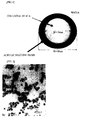
- Fig. 1 is a schematic view illustrating a core shell-type composite particle (for example, 50-60 nm in particle diameter) (for example, Nanocomposite W manufactured by Mizutani Paint Co., Ltd.) in which outer surface of colloidal silica (for example, 20-30 nm in particle diameter) is coated by acrylic silicone.
- Fig. 2 is an electron micrograph of core shell-type composite particles (Nanocomposite W manufactured by Mizutani Paint Co., Ltd.) in which outer surfaces of colloidal silica are coated by acrylic silicone.
- the aforementioned silicon compound is organic solvent dispersible colloidal silica and the aforementioned organic component is polymeric compound which is soluble or dispersible in organic solvent (Arrangement 5).
- a coating agent in which the silicon compound is organic solvent dispersible colloidal silica and the organic component is selected from polymers which are soluble or dispersible in organic solvent has such a property as to easily get wet relative to even a water-shedding surface.
- the organic solvent dispersible colloidal silica can be easily synthetically prepared in organic solvent using a known method and may be a commercially available one (for example, organic solvent dispersible colloidal silica manufactured by Nissan Chemical Industries, Ltd.: ORGANO SILICA SOL: IPA-ST, IPA-ST-UP, IPA-ST-ZL, EG-ST, NPC-ST-30, DMAC-ST, MEK-ST, MIBK-ST, XBA-ST, PMA-ST, PGM-ST).
- ORGANO SILICA SOL IPA-ST, IPA-ST-UP, IPA-ST-ZL, EG-ST, NPC-ST-30, DMAC-ST, MEK-ST, MIBK-ST, XBA-ST, PMA-ST, PGM-ST.
- ORGANO SILICA SOL IPA-ST, IPA-ST-UP, IPA-ST-ZL, EG-ST, NPC-ST-30, DMAC-ST, MEK-ST, MI
- the resin-matrix component various resins such as acrylic resins, polyester resins, alkyd resins, urethane resins, and epoxy resins which may have a functional group such as hydroxyl group, carboxyl group, and amino group may be employed. These resins may be suitably blocked.
- the coating agent of the present invention may be used in combination with a cross-linking agent such as a polyisocyanate compound and amino resin.
- the coating agent of the present invention may be of any of a non-curable type of a lacquer-type, an ordinary-temperature curable type, and a thermosetting type.
- the coating agent of the present invention may be of such a type as to cure by active beam such as ultraviolet beam or electron beam.
- the coating agent of the present invention is preferably of an urethane curable type containing as a resin component a polyisocyanate compound, which may be blocked with polyacrylic polyol or polyester polyol, or an ultraviolet curable type containing an ultraviolet curable acryl resin as a resin component.
- acrylic binders for the ultraviolet curable coating agent include acrylic light curing components.
- acrylic light curing component having hydrophilic property for example, acrylic light curing components such as polyethylene glycol diacrylate ("n" is 3 or more and below about 14) having ethylene glycol units in the molecule, and trimethylolpropane EO-modified triacrylate ("n" is 3 or more and below about 14)
- acrylic light curing component having hydrophobic property for example, acrylic light curing components such as polyethylene glycol diacrylate which does not have ethylene glycol units in the molecule or of which "n" is 2 or less even having ethylene glycol units in the molecule, and trimethylolpropane EO-modified triacrylate ("n” is 2 or less)
- acrylic light curing component having hydrophilic property for example, acrylic light curing components such as polyethylene glycol diacrylate ("n" is 3 or more and below about 14) having ethylene glycol units in the molecule, and trimethylolpropane EO-modified triacrylate
- photopolymerizable monomers having hydrophilic property include unsaturated carboxylic acids such as acrylic acid or methacrylic acid and esters thereof, alkyl (meth)acrylate, cycloalkyl (meth)acrylate, alkyl halide (meth)acrylate, alkoxyalkyl (meth)acrylate, hydroxylcycloalkyl (meth)acrylate, aminoalkyl (meth)acrylate, tetrahydrofurfuryl (meth)acrylate, allyl (meth)acrylate, glycidyl (meth)acrylate, benzyl (meth)acrylate, phenoxy (meth)acrylate, trimethylolpropane tri(meth)acrylate, pentaerythritol tetra(meth)acrylate, acrylamide, methacrylamide, and derivatives thereof.
- unsaturated carboxylic acids such as acrylic acid or methacrylic acid and esters thereof
- the photopolymerizable monomer it is preferable to employ, for example, isobornyl (meth)acrylate, norbornyl (meth)acrylate, dicyclopentenoxy ethyl (meth)acrylate, dicyclopentenoxy propyl (meth)acrylate, (meth)acrylic acid ester of diethylene glycol dicyclopentenyl monoether, dicyclopentenyl cinnamate, dicyclopentenoxy ethyl cinnamate, dicyclopentenoxy ethyl cinnamate mono- or di- fumarate, 3,9-bis(1,1-bismethyl-2-oxyethyl)-spiro[5,5]undecane mono- or di- (meth)acrylate, 3,9-bis(1,1-bismethyl-2-oxyethyl)-2,4,8,10-tetraoxaspiro[5,5]undecane mono- or di-(meth)acryl
- acrylic photopolymerizable oligomers having hydrophobic property include acrylic acid esters of epoxy resin such as bisphenol A diglycidyl ether diacrylate, reactive products of epoxy resin with acrylic acid and methyltetrahydrophthalic anhydride, reactive products of epoxy resin with 2-hydroxyethyl acrylate, ring-opening copolymerization esters of glycidyl diacrylate and phthalic anhydride, reactive products of methyl vinyl ether-maleic anhydride copolymers and 2-hydroxyethyl acrylate, polyacrylic or maleic prepolymers obtainable by further reacting the reactive products with glycidyl methacrylate, urethane prepolymer which have acryloyl groups or methacryloyl groups at both terminals and in which a saturated polyester segments are connected via an urethane bond, and the like.
- acrylic photopolymerizable oligomers having a weight average molecular weight ranging from 2000 to 30000 are suitably used.
- a photopolymerization initiator As a photopolymerization initiator, a conventional one may be employed. Specific examples include 1-hydroxy-cyclohexyl-phenyl-ketone, 2-hydroxy-2-methyl-1-phenyl-propane-1-one, 1-[4-(2-hydroxyethoxy)-phenyl]-2-hydroxy-methyl-1 propane-1-one, 2-methyl-1-[4-(methylthio)phenyl]-2-morpholino-propane-1-one, 2-benzyl-2-dimethylamino-1-(4-morpholinophenyl)-butanone-1-bis(2,6-dimethoxybenzoil)-2,4,4-trimethylpentyl phosphineoxide-bis(2,4,6-trimethylbenzoil)-phenyl phosphineoxide and the like. These photopolymerization initiators may be used alone or in combination. The contained amount of the photopolymerization initiator is generally preferably selected from a range from 5 to 15 parts by
- the UV ink used for UV curable inkjet printing is preferably nonaqueous UV ink.
- Aqueous UV ink is not preferable as the UV ink used for UV curable inkjet printing because of insufficient adhesion.
- SSG coat organic-inorganic nanocomposite ordinary-temperature cure coating agent: available from Nitto Boseki Co., Ltd
- SSG coat organic-inorganic nanocomposite ordinary-temperature cure coating agent: available from Nitto Boseki Co., Ltd
- UV curable inkjet printer manufactured by Mimaki Engineering Co., Ltd.
- SSG coat organic-inorganic nanocomposite ordinary-temperature cure coating agent: available from Nitto Boseki Co., Ltd
- SSG coat organic-inorganic nanocomposite ordinary-temperature cure coating agent: available from Nitto Boseki Co., Ltd
- Nanocomposite W manufactured by Mizutani Paint Co., Ltd.
- UV curable inkjet printer manufactured by Mimaki Engineering Co., Ltd.
- Example 1 Printing on a glass plate without the SSG coat of Example 1 was conducted by the UV curable inkjet printer (manufactured by Mimaki Engineering Co., Ltd.). A printed matter thus obtained has extremely poor adhesion relative to the glass plate so that the ink coating easily peels.
Landscapes
- Chemical & Material Sciences (AREA)
- Life Sciences & Earth Sciences (AREA)
- Engineering & Computer Science (AREA)
- Materials Engineering (AREA)
- Wood Science & Technology (AREA)
- Organic Chemistry (AREA)
- Physics & Mathematics (AREA)
- Inorganic Chemistry (AREA)
- Chemical Kinetics & Catalysis (AREA)
- Health & Medical Sciences (AREA)
- Electromagnetism (AREA)
- General Health & Medical Sciences (AREA)
- Toxicology (AREA)
- Paints Or Removers (AREA)
- Ink Jet (AREA)
- Laminated Bodies (AREA)
- Ink Jet Recording Methods And Recording Media Thereof (AREA)
Abstract
Description
- The present invention relates to a coating agent (hereinafter, coating agent for UV curable inkjet printing) to be used to form an under coat before the printing and a finishing coat after the printing and curing in UV curable inkjet printing using nonaqueous UV ink.
- Generally, for improving characteristics of printing by inkjet inks, a recording substrate has been known which comprises a base sheet such as a normal paper or an inkjet printing paper and a porous inkjet ink receiving layer formed on the base sheet and made of fine particles such as amorphous silica and a water soluble binder resin such as polyvinyl alcohol (see Document
JP-A-64-011877
As for base sheets such as a plastic film or a plastic card, there have been proposed (1) an inkjet recording sheet comprising a transparent synthetic resin sheet and an ink receiving layer, containing polyvinylpyrrolidone, formed on the surface of the transparent synthetic resin sheet (seeJP-A-61-032788 JP-A-61-019389 JP-A-61-280983 JP-A-61-024494 2694042
In the technologies disclosed in these documents, however, aqueous dye or hydrophilic pigment is used as colorant. This means insufficient water resistance and poor abrasion resistance. As one of conditions required in printing on especially a plastic card, highly advanced resistance as compared to the case printing on normal paper is required. - For this, a printed surface is protected by over coating. For the over coating, an ultraviolet curable ink (paint), an aqueous ink (paint), or a solvent-based ink (paint) may be widely employed.
However, the aqueous paint is not practical because it requires time for a drying process and the drying affects the base. Further, the solvent-base paint has problems that the solvent breathes into air due to drying and thus affects the working atmosphere and worker's health, also leading to a burden on the global environment. - Under the aforementioned circumstances, the following technologies have been proposed.
In a method of printing an image on an object, it has been proposed to use a thermoplastic resin supplied by Valspar of High Point, North Carolina as a coating material used in a step of forming an under coat, which has a high surface tension in the range of 38-50 surface dynes and should be applied in a smooth coat without dry spray to maximize ink droplet formation. As a top coat applied to the outer surface after the step for applying said ink droplets, a clear (transparent) varnish has been proposed (seeJP-A-2005-521578
A method for producing an inkjet printed matter has been proposed in which a white undercoat layer (I) is formed on a base by using a white paint containing silica particles of which the oil absorption is 10-400 ml/100g and having a pigment volume concentration of 5-90%, a printed layer (II) is formed on the white undercoat layer (I) by inkjet method using an aqueous ink composition, and a clear coat layer (III) is formed on the printed layer (II) by using a clear paint (seeWO2002-100652 ).
However, when the known technologies disclosed in the two documents, adapted to the printing system using UV curable inkjet inks, there are limits on improvement in adhesion relative to glass and metal and on abrasion-resistance of printed matter. - The present invention is made under the aforementioned circumstances and the first object of the present invention is to provide a coating agent to be used in UV curable inkjet printing using nonaqueous UV ink, which can improve durability of a printed matter such as adhesion relative to a base and abrasion-resistance of the printed matter.
The second object of the present invention is to provide a coating agent to be used in UV curable inkjet printing using nonaqueous UV ink, for forming an under coat having excellent adhesion relative to a base and excellent adhesion relative to an ink cured layer.
Further, the third object of the present invention is to provide a coating agent to be used in UV curable inkjet printing using nonaqueous UV ink, for forming a finishing coat having excellent adhesion relative to the ink cured layer and extremely excellent abrasion-resistance.
To this end, there is provided a coating agent to be used in UV curable inkjet printing using nonaqueous UV ink, for forming an under coat before the printing or a finishing coat after the printing and curing, wherein the main component of the coating agent is organic-inorganic nanocomposite.
Preferably, the organic-inorganic nanocomposite is an organic-inorganic nanocomposite of which the inorganic component is silicon compound and the organic component is polymeric compound which is dispersible in water or in organic solvent.
It is preferable that the silicon compound is water dispersible colloidal silica obtained from organosilane compound by sol-gel method or colloidal silica obtained from inorganic silicate and the organic component is polymeric compound which is dispersible in water.
Preferably, the organic-inorganic nanocomposite is an organic-inorganic nanocomposite in which the silicon compound is colloidal silica of which the periphery is coated with water dispersible polymer.
It is preferable that the silicon compound is organic solvent dispersible colloidal silica and the organic component is polymeric compound which is soluble or dispersible in organic solvent. - The present invention has the following arrangements.
(Arrangement 1) A coating agent to be used in UV curable inkjet printing using nonaqueous UV ink, for forming an under coat before the printing or a finishing coat after the printing and curing, wherein the main component of the coating agent is organic-inorganic nanocomposite.
(Arrangement 2) A coating agent to be used in UV curable inkjet printing as described in Arrangement 1, wherein said organic-inorganic nanocomposite is an organic-inorganic nanocomposite of which the inorganic component is silicon compound and the organic component is polymeric compound which is dispersible in water or in organic solvent.
(Arrangement 3) A coating agent to be used in UV curable inkjet printing as described in Arrangement 2, wherein said silicon compound is water dispersible colloidal silica obtained from organosilane compound by sol-gel method or colloidal silica obtained from inorganic silicate and said organic component is polymeric compound which is dispersible in water.
(Arrangement 4) A coating agent to be used in UV curable inkjet printing as described in Arrangement 2 or 3, wherein said organic-inorganic nanocomposite is an organic-inorganic nanocomposite in which the silicon compound is colloidal silica of which the periphery is coated with water dispersible polymer.
(Arrangement 5) A coating agent to be used in UV curable inkjet printing as described in Arrangement 2, wherein said silicon compound is organic solvent dispersible colloidal silica and said organic component is polymeric compound which is soluble or dispersible in organic solvent. - According to the present invention, there is provided a coating agent to be used in UV curable inkjet printing using nonaqueous UV ink, for forming an under coat having excellent adhesion relative to a base and excellent adhesion relative to an ink cured layer.
Further, according to the present invention, there is provided a coating agent to be used in UV curable inkjet printing using nonaqueous UV ink, for forming a finishing coat having excellent adhesion relative to the ink cured layer and extremely excellent abrasion-resistance.
According to the present invention, therefore, there is provided a coating agent to be used in UV curable inkjet printing using nonaqueous UV ink, which can improve durability of a printed matter such as adhesion relative to a base and fastness to rubbing of the printed matter. - Hereinafter, a preferred embodiment will be described in detail, by way of non-limiting example, with reference to the accompanying drawings in which:
-
Fig. 1 is a schematic illustration of a core shell-type composite particle (for example, Nanocomposite W manufactured by Mizutani Paint Co., Ltd.) in which outer surface of colloidal silica is coated by acrylic silicone. -
Fig. 2 is an electron micrograph of core shell-type composite particles (Nanocomposite W manufactured by Mizutani Paint Co., Ltd.) in which outer surfaces of colloidal silica are coated by acrylic silicone. - In the present invention, in UV curable inkjet printing using nonaqueous UV ink, a coating agent for UV curable inkjet printing of which the main component is organic-inorganic nanocomposite material is applied to form an under coat before the printing or a finishing coat after the printing and curing (Arrangement 1).
As the coating agent of which the main component is organic-inorganic nanocomposite material, a commercially available coating agent (SSG coat; ordinary-temperature cure coating agent of which the main component is organic-inorganic nanocomposite material: available from Nitto Boseki Co., Ltd.) may be used. Alternatively, such a coating agent can be obtained by the following method in accordance with the intended use. - In the present invention, it is preferable that the organic-inorganic nanocomposite is an organic-inorganic nanocomposite of which the inorganic component is silicon compound and the organic component is polymeric compound which is dispersible in water or polymeric compound which is dispersible in organic solvent (Arrangement 2).
An organic-inorganic nanocomposite of which the organic component is polymeric compound which is soluble in water is not preferable because it is easy to peel off in practice. In addition, also in case of UV curable inkjet printing using aqueous UV ink, the organic-inorganic nanocomposite is not preferable because of insufficient adhesion. - In the present invention, it is preferable that the aforementioned silicon compound is water dispersible colloidal silica obtained from organosilane compound by sol-gel method or colloidal silica obtained from inorganic silicate and the aforementioned organic component is polymeric compound which is dispersible in water (Arrangement 3).
Since ordinary powder-like silica particles are difficult to be uniformly dispersed, water dispersible colloidal silica produced directly in liquid by the sol-gel method is preferable as the silicon compound as the inorganic component. Colloidal silica particles may be produced from silicate. The organic component is preferably selected from polymers which are dispersible in water.
As the colloidal silica, a commercially available one (for example, colloidal silica manufactured by Nissan Chemical Industries, Ltd.: SNOWTEX XS, OXS, S, OS, 20, 30, 40, 0, N, C, AK, 50, 0-40, CM, 20L, OL, XL, ZL, MP-2040, MP-4540M, UP, OUP, SP-S, PS-M (these are SNOWTEX) and Lithium Silicate 45) may be used. However, the present invention is not limited thereto. - In the present invention, it is preferable that the aforementioned organic-inorganic nanocomposite is an organic-inorganic nanocomposite in which the silicon compound is colloidal silica of which the periphery is coated with water dispersible polymer (Arrangement 4).
Hybrid-type nanoparticles (organic-inorganic nanocomposite particles) in which the silicon compound is colloidal silica of which the periphery is coated with water dispersible polymer as mentioned above are excellent especially for characteristics of an organic-inorganic nanocomposite coat obtained using the nanoparticles.
The manufacturing method disclosed in, for example,JP2000-290464
In the present invention, a commercially available one (Nanocomposite W: manufactured by Mizutani Paint Co., Ltd.) may be used or concomitantly used as the organic-inorganic nanocomposite particles.
Fig. 1 is a schematic view illustrating a core shell-type composite particle (for example, 50-60 nm in particle diameter) (for example, Nanocomposite W manufactured by Mizutani Paint Co., Ltd.) in which outer surface of colloidal silica (for example, 20-30 nm in particle diameter) is coated by acrylic silicone.Fig. 2 is an electron micrograph of core shell-type composite particles (Nanocomposite W manufactured by Mizutani Paint Co., Ltd.) in which outer surfaces of colloidal silica are coated by acrylic silicone. - In another embodiment of the present invention, it is preferable that the aforementioned silicon compound is organic solvent dispersible colloidal silica and the aforementioned organic component is polymeric compound which is soluble or dispersible in organic solvent (Arrangement 5).
A coating agent in which the silicon compound is organic solvent dispersible colloidal silica and the organic component is selected from polymers which are soluble or dispersible in organic solvent has such a property as to easily get wet relative to even a water-shedding surface.
The organic solvent dispersible colloidal silica can be easily synthetically prepared in organic solvent using a known method and may be a commercially available one (for example, organic solvent dispersible colloidal silica manufactured by Nissan Chemical Industries, Ltd.: ORGANO SILICA SOL: IPA-ST, IPA-ST-UP, IPA-ST-ZL, EG-ST, NPC-ST-30, DMAC-ST, MEK-ST, MIBK-ST, XBA-ST, PMA-ST, PGM-ST). However, the present invention is not limited thereto. - In the coating agent of the present invention, as the resin-matrix component, various resins such as acrylic resins, polyester resins, alkyd resins, urethane resins, and epoxy resins which may have a functional group such as hydroxyl group, carboxyl group, and amino group may be employed. These resins may be suitably blocked.
The coating agent of the present invention may be used in combination with a cross-linking agent such as a polyisocyanate compound and amino resin.
The coating agent of the present invention may be of any of a non-curable type of a lacquer-type, an ordinary-temperature curable type, and a thermosetting type. Alternatively, the coating agent of the present invention may be of such a type as to cure by active beam such as ultraviolet beam or electron beam.
The coating agent of the present invention is preferably of an urethane curable type containing as a resin component a polyisocyanate compound, which may be blocked with polyacrylic polyol or polyester polyol, or an ultraviolet curable type containing an ultraviolet curable acryl resin as a resin component. - Specific examples of acrylic binders for the ultraviolet curable coating agent include acrylic light curing components. Either of an acrylic light curing component having hydrophilic property [for example, acrylic light curing components such as polyethylene glycol diacrylate ("n" is 3 or more and below about 14) having ethylene glycol units in the molecule, and trimethylolpropane EO-modified triacrylate ("n" is 3 or more and below about 14)] and an acrylic light curing component having hydrophobic property [for example, acrylic light curing components such as polyethylene glycol diacrylate which does not have ethylene glycol units in the molecule or of which "n" is 2 or less even having ethylene glycol units in the molecule, and trimethylolpropane EO-modified triacrylate ("n" is 2 or less)] may be employed.
- Specific examples of photopolymerizable monomers having hydrophilic property include unsaturated carboxylic acids such as acrylic acid or methacrylic acid and esters thereof, alkyl (meth)acrylate, cycloalkyl (meth)acrylate, alkyl halide (meth)acrylate, alkoxyalkyl (meth)acrylate, hydroxylcycloalkyl (meth)acrylate, aminoalkyl (meth)acrylate, tetrahydrofurfuryl (meth)acrylate, allyl (meth)acrylate, glycidyl (meth)acrylate, benzyl (meth)acrylate, phenoxy (meth)acrylate, trimethylolpropane tri(meth)acrylate, pentaerythritol tetra(meth)acrylate, acrylamide, methacrylamide, and derivatives thereof.
For an application that cure shrinkage is an obstacle, as the photopolymerizable monomer, it is preferable to employ, for example, isobornyl (meth)acrylate, norbornyl (meth)acrylate, dicyclopentenoxy ethyl (meth)acrylate, dicyclopentenoxy propyl (meth)acrylate, (meth)acrylic acid ester of diethylene glycol dicyclopentenyl monoether, dicyclopentenyl cinnamate, dicyclopentenoxy ethyl cinnamate, dicyclopentenoxy ethyl cinnamate mono- or di- fumarate, 3,9-bis(1,1-bismethyl-2-oxyethyl)-spiro[5,5]undecane mono- or di- (meth)acrylate, 3,9-bis(1,1-bismethyl-2-oxyethyl)-2,4,8,10-tetraoxaspiro[5,5]undecane mono- or di-(meth)acrylate, 3,9-bis(2-oxyethyl)-spiro[5,5]undecane mono- or di- (meth)acrylate, 3,9-bis(2-oxyethyl)-2,4,8-10-tetraoxaspiro[5,5]undecane mono- or di-(meth)acrylate, methyl ether of the above mono(meth)acrylates, 1-azabicyclo[2,2,2]-3-octenyl(meth)acrylate, bicyclo[2,2,1]-5-heptene-2,3-dicarboxyl monoallyl ester, dicyclopentadienyl (meth)acrylate, dicyclopentadienyl oxyethyl (meth)acrylate, and dihydrodicyclopentadienyl (meth)acrylate.
In the present invention, these photopolymerizable monomers may be used alone or in combination. - Specific examples of acrylic photopolymerizable oligomers having hydrophobic property include acrylic acid esters of epoxy resin such as bisphenol A diglycidyl ether diacrylate, reactive products of epoxy resin with acrylic acid and methyltetrahydrophthalic anhydride, reactive products of epoxy resin with 2-hydroxyethyl acrylate, ring-opening copolymerization esters of glycidyl diacrylate and phthalic anhydride, reactive products of methyl vinyl ether-maleic anhydride copolymers and 2-hydroxyethyl acrylate, polyacrylic or maleic prepolymers obtainable by further reacting the reactive products with glycidyl methacrylate, urethane prepolymer which have acryloyl groups or methacryloyl groups at both terminals and in which a saturated polyester segments are connected via an urethane bond, and the like.
These acrylic photopolymerizable oligomers having a weight average molecular weight ranging from 2000 to 30000 are suitably used. - As a photopolymerization initiator, a conventional one may be employed. Specific examples include 1-hydroxy-cyclohexyl-phenyl-ketone, 2-hydroxy-2-methyl-1-phenyl-propane-1-one, 1-[4-(2-hydroxyethoxy)-phenyl]-2-hydroxy-methyl-1 propane-1-one, 2-methyl-1-[4-(methylthio)phenyl]-2-morpholino-propane-1-one, 2-benzyl-2-dimethylamino-1-(4-morpholinophenyl)-butanone-1-bis(2,6-dimethoxybenzoil)-2,4,4-trimethylpentyl phosphineoxide-bis(2,4,6-trimethylbenzoil)-phenyl phosphineoxide and the like.
These photopolymerization initiators may be used alone or in combination. The contained amount of the photopolymerization initiator is generally preferably selected from a range from 5 to 15 parts by mass per 100 parts by mass of acrylic-type light curable component. - In the present invention, the UV ink used for UV curable inkjet printing is preferably nonaqueous UV ink. Aqueous UV ink is not preferable as the UV ink used for UV curable inkjet printing because of insufficient adhesion.
There is no limitation on nonaqueous UV ink in the present invention and thus existing commercially available nonaqueous UV inks and nonaqueous UV inks which are prepared by dispersing a pigment into a photopolymerizable component which is any one of the aforementioned photopolymerizable monomers or a combination of any one of the aforementioned photopolymerizable monomers and a photopolymerizable oligomer and filtering the pigment-dispersed photopolymerizable component may be employed. - Hereinafter, embodiments of the present invention will be described. However, the present invention is not limited thereto.
- After SSG coat (organic-inorganic nanocomposite ordinary-temperature cure coating agent: available from Nitto Boseki Co., Ltd) was coated on a glass plate and was left at a room temperature for 30 minutes, printing on this coat was conducted by a UV curable inkjet printer (manufactured by Mimaki Engineering Co., Ltd.).
A printed matter thus obtained has excellent adhesion relative to the glass plate. - Following Example 1, SSG coat (organic-inorganic nanocomposite ordinary-temperature cure coating agent: available from Nitto Boseki Co., Ltd) was coated over the printed matter obtained in Example 1 and was left at a room temperature for 60 minutes.
A printed matter thus obtained has excellent adhesion relative to the glass plate and is very hard and thus extremely good in abrasion-resistance. - After Nanocomposite W (manufactured by Mizutani Paint Co., Ltd.) was coated on a stainless plate and was left at a room temperature for 1 hour, printing on this coat was conducted by the UV curable inkjet printer (manufactured by Mimaki Engineering Co., Ltd.).
A printed matter thus obtained has excellent adhesion relative to the stainless plate. - Printing on a glass plate without the SSG coat of Example 1 was conducted by the UV curable inkjet printer (manufactured by Mimaki Engineering Co., Ltd.).
A printed matter thus obtained has extremely poor adhesion relative to the glass plate so that the ink coating easily peels.
Claims (5)
- A coating agent to be used in UV curable inkjet printing using nonaqueous UV ink, for forming an under coat before the printing or a finishing coat after the printing and curing, wherein
the main component of the coating agent is organic-inorganic nanocomposite. - The coating agent to be used in UV curable inkjet printing according to claim 1, wherein said organic-inorganic nanocomposite is an organic-inorganic nanocomposite of which the inorganic component is silicon compound and the organic component is polymeric compound which is dispersible in water or in organic solvent.
- The coating agent to be used in UV curable inkjet printing according to claim 2, wherein said silicon compound is water dispersible colloidal silica obtained from organosilane compound by sol-gel method or colloidal silica obtained from inorganic silicate and said organic component is polymeric compound which is dispersible in water.
- The coating agent to be used in UV curable inkjet printing according to claim 2 or 3, wherein said organic-inorganic nanocomposite is an organic-inorganic nanocomposite in which the silicon compound is colloidal silica of which the periphery is coated with water dispersible polymer.
- The coating agent to be used in UV curable inkjet printing according to claim 2, wherein said silicon compound is organic solvent dispersible colloidal silica and said organic component is polymeric compound which is soluble or dispersible in organic solvent.
Applications Claiming Priority (1)
| Application Number | Priority Date | Filing Date | Title |
|---|---|---|---|
| JP2007215531A JP2009045875A (en) | 2007-08-22 | 2007-08-22 | Uv-curing type inkjet coating agent |
Publications (1)
| Publication Number | Publication Date |
|---|---|
| EP2028237A1 true EP2028237A1 (en) | 2009-02-25 |
Family
ID=39720626
Family Applications (1)
| Application Number | Title | Priority Date | Filing Date |
|---|---|---|---|
| EP20080290561 Withdrawn EP2028237A1 (en) | 2007-08-22 | 2008-06-13 | Coating agent for UV curable inkjet printing |
Country Status (5)
| Country | Link |
|---|---|
| US (1) | US8104884B2 (en) |
| EP (1) | EP2028237A1 (en) |
| JP (1) | JP2009045875A (en) |
| KR (1) | KR20090020506A (en) |
| CN (1) | CN101372603B (en) |
Cited By (3)
| Publication number | Priority date | Publication date | Assignee | Title |
|---|---|---|---|---|
| EP2449039A4 (en) * | 2009-06-30 | 2013-12-25 | Hewlett Packard Development Co | Ink-jet overcoats including latex polymers and inorganic nano particles |
| EP2358541B1 (en) | 2008-12-19 | 2015-09-09 | Mankiewicz Gebr. & Co. Gmbh & Co Kg | Method for applying a coating by ink jet printing methods |
| WO2019243080A1 (en) * | 2018-06-18 | 2019-12-26 | Agfa Nv | Aqueous resin based inkjet inks |
Families Citing this family (12)
| Publication number | Priority date | Publication date | Assignee | Title |
|---|---|---|---|---|
| JP5531420B2 (en) | 2009-02-27 | 2014-06-25 | 日本電気株式会社 | Process allocation system, process allocation method, process allocation program |
| CN102092204B (en) * | 2009-12-10 | 2012-05-02 | 上海宝钢包装股份有限公司 | UV Bottomless Oil Red Bull Beverage Can Coating and Printing Process |
| CN101921508A (en) * | 2010-06-30 | 2010-12-22 | 广州市尤特新材料有限公司 | UV printable ink |
| JP2012087239A (en) * | 2010-10-21 | 2012-05-10 | Nitto Denko Corp | Primer composition and adhesive sheet |
| JP6062265B2 (en) * | 2013-01-30 | 2017-01-18 | リンテック株式会社 | Printing sheet, coating liquid for forming the printing sheet, and method for producing a printing sheet using the coating liquid |
| JP2015006774A (en) * | 2013-06-26 | 2015-01-15 | 理想科学工業株式会社 | Oily inkjet printing method and ink set |
| CN103865369B (en) * | 2014-03-07 | 2017-04-26 | 宜兴市王者塑封有限公司 | Preparation method for UV (Ultraviolet) curing organic-inorganic hybridized antistatic coating |
| CN104199138B (en) * | 2014-08-19 | 2017-10-13 | 常熟昊虞电子信息科技有限公司 | A kind of ultrathin lamp box light guide plate |
| CN106592325A (en) * | 2016-11-24 | 2017-04-26 | 陕西科技大学 | Multifunctional protective liquid for paper-based material printed matters and application |
| JP7068270B2 (en) * | 2017-03-06 | 2022-05-16 | マクセル株式会社 | Manufacturing method of model material ink set, support material composition, ink set, three-dimensional model and three-dimensional model |
| JP6936765B2 (en) * | 2018-04-23 | 2021-09-22 | 株式会社ミマキエンジニアリング | UV curable ink for material jet deposition |
| CN112533763B (en) * | 2018-06-06 | 2022-08-09 | 艾利丹尼森公司 | Water-based coatings with improved printing performance using multiple printing techniques |
Citations (17)
| Publication number | Priority date | Publication date | Assignee | Title |
|---|---|---|---|---|
| JPS6119389A (en) | 1984-07-06 | 1986-01-28 | Mitsubishi Paper Mills Ltd | Recording sheet |
| JPS6124494A (en) | 1984-07-13 | 1986-02-03 | Nec Corp | Film for overhead projector |
| JPS6132788A (en) | 1984-07-26 | 1986-02-15 | Toyo Ink Mfg Co Ltd | Inkjet recording sheet |
| JPS61280983A (en) | 1985-06-07 | 1986-12-11 | Teijin Ltd | Recording sheet |
| JPS6411877A (en) | 1987-07-07 | 1989-01-17 | Canon Kk | Material to be recorded and recording method |
| JP2694042B2 (en) | 1990-09-06 | 1997-12-24 | キヤノン株式会社 | Manufacturing method of recording material |
| EP1038665A1 (en) * | 1998-07-14 | 2000-09-27 | Dai Nippon Printing Co., Ltd. | Decorative material |
| JP2000290464A (en) | 1999-02-04 | 2000-10-17 | Mizutani Paint Co Ltd | Aqueous dispersion, method for producing the same, and coating composition |
| US6461419B1 (en) * | 1999-11-01 | 2002-10-08 | 3M Innovative Properties Company | Curable inkjet printable ink compositions |
| US20020149656A1 (en) * | 2000-10-02 | 2002-10-17 | Nohr Ronald S. | Nanoparticle based inks and methods of making the same |
| WO2002096982A1 (en) * | 2001-05-31 | 2002-12-05 | Nelson Gordon L | Organic/inorganic nanocomposites obtained by extrusion |
| WO2002100652A1 (en) | 2001-06-12 | 2002-12-19 | Kansai Paint Co., Ltd. | Ink-jet printing |
| US20040171728A1 (en) * | 2001-06-21 | 2004-09-02 | Zhijian Xue | Method for producing an aqueous dispersion of particles composed of a polymer and a fine-particle inorganic solid |
| JP2005521578A (en) | 2002-04-03 | 2005-07-21 | マソナイト・コーポレイション | Method and apparatus for forming an image on a product and printed product |
| WO2006129973A1 (en) * | 2005-06-02 | 2006-12-07 | Lg Chem, Ltd. | Coating composition for film with low refractive index and film prepared therefrom |
| EP1739136A1 (en) * | 2005-06-29 | 2007-01-03 | Oji Paper Co., Ltd. | Composite fine particles and ink jet recording material containing these particles. |
| WO2007019033A1 (en) * | 2005-08-04 | 2007-02-15 | Hewlett-Packard Development Company, L.P. | Porous inkjet recording material |
Family Cites Families (9)
| Publication number | Priority date | Publication date | Assignee | Title |
|---|---|---|---|---|
| JP2694012B2 (en) | 1989-06-01 | 1997-12-24 | 沖電気工業株式会社 | Print head gap automatic adjustment mechanism |
| US6283589B1 (en) * | 1998-04-29 | 2001-09-04 | Creo Srl | Resolution ink jet printing |
| JP2002103794A (en) * | 2000-09-28 | 2002-04-09 | Daicel Chem Ind Ltd | Resin composition for inkjet recording and recording sheet |
| US6420451B1 (en) * | 2000-12-11 | 2002-07-16 | Sola International, Inc. | Impact resistant UV curable hardcoatings |
| JP2002371223A (en) * | 2001-06-18 | 2002-12-26 | Asia Kogyo Kk | Aqueous inorganic coating composition |
| JP2005219429A (en) * | 2004-02-09 | 2005-08-18 | Konica Minolta Holdings Inc | Inkjet recording medium and inkjet recording method |
| US8087768B2 (en) * | 2005-06-02 | 2012-01-03 | Agfa Graphics Nv | Ink-jet authentication mark for a product or product packaging |
| JP2007112043A (en) * | 2005-10-21 | 2007-05-10 | Mitsubishi Paper Mills Ltd | Thermal recording material |
| US20070238804A1 (en) * | 2006-04-11 | 2007-10-11 | Encai Ho | UV-curable hard coating compositions |
-
2007
- 2007-08-22 JP JP2007215531A patent/JP2009045875A/en active Pending
-
2008
- 2008-04-23 CN CN2008100932462A patent/CN101372603B/en not_active Expired - Fee Related
- 2008-06-13 EP EP20080290561 patent/EP2028237A1/en not_active Withdrawn
- 2008-08-07 US US12/187,647 patent/US8104884B2/en not_active Expired - Fee Related
- 2008-08-21 KR KR20080081935A patent/KR20090020506A/en not_active Ceased
Patent Citations (17)
| Publication number | Priority date | Publication date | Assignee | Title |
|---|---|---|---|---|
| JPS6119389A (en) | 1984-07-06 | 1986-01-28 | Mitsubishi Paper Mills Ltd | Recording sheet |
| JPS6124494A (en) | 1984-07-13 | 1986-02-03 | Nec Corp | Film for overhead projector |
| JPS6132788A (en) | 1984-07-26 | 1986-02-15 | Toyo Ink Mfg Co Ltd | Inkjet recording sheet |
| JPS61280983A (en) | 1985-06-07 | 1986-12-11 | Teijin Ltd | Recording sheet |
| JPS6411877A (en) | 1987-07-07 | 1989-01-17 | Canon Kk | Material to be recorded and recording method |
| JP2694042B2 (en) | 1990-09-06 | 1997-12-24 | キヤノン株式会社 | Manufacturing method of recording material |
| EP1038665A1 (en) * | 1998-07-14 | 2000-09-27 | Dai Nippon Printing Co., Ltd. | Decorative material |
| JP2000290464A (en) | 1999-02-04 | 2000-10-17 | Mizutani Paint Co Ltd | Aqueous dispersion, method for producing the same, and coating composition |
| US6461419B1 (en) * | 1999-11-01 | 2002-10-08 | 3M Innovative Properties Company | Curable inkjet printable ink compositions |
| US20020149656A1 (en) * | 2000-10-02 | 2002-10-17 | Nohr Ronald S. | Nanoparticle based inks and methods of making the same |
| WO2002096982A1 (en) * | 2001-05-31 | 2002-12-05 | Nelson Gordon L | Organic/inorganic nanocomposites obtained by extrusion |
| WO2002100652A1 (en) | 2001-06-12 | 2002-12-19 | Kansai Paint Co., Ltd. | Ink-jet printing |
| US20040171728A1 (en) * | 2001-06-21 | 2004-09-02 | Zhijian Xue | Method for producing an aqueous dispersion of particles composed of a polymer and a fine-particle inorganic solid |
| JP2005521578A (en) | 2002-04-03 | 2005-07-21 | マソナイト・コーポレイション | Method and apparatus for forming an image on a product and printed product |
| WO2006129973A1 (en) * | 2005-06-02 | 2006-12-07 | Lg Chem, Ltd. | Coating composition for film with low refractive index and film prepared therefrom |
| EP1739136A1 (en) * | 2005-06-29 | 2007-01-03 | Oji Paper Co., Ltd. | Composite fine particles and ink jet recording material containing these particles. |
| WO2007019033A1 (en) * | 2005-08-04 | 2007-02-15 | Hewlett-Packard Development Company, L.P. | Porous inkjet recording material |
Cited By (7)
| Publication number | Priority date | Publication date | Assignee | Title |
|---|---|---|---|---|
| EP2358541B1 (en) | 2008-12-19 | 2015-09-09 | Mankiewicz Gebr. & Co. Gmbh & Co Kg | Method for applying a coating by ink jet printing methods |
| US10494533B2 (en) | 2008-12-19 | 2019-12-03 | Mankiewicz Gebr. & Co. Gmbh & Co. Kg | Coating and production method thereof by inkjet printing methods |
| EP2449039A4 (en) * | 2009-06-30 | 2013-12-25 | Hewlett Packard Development Co | Ink-jet overcoats including latex polymers and inorganic nano particles |
| US8926081B2 (en) | 2009-06-30 | 2015-01-06 | Hewlett-Packard Development Company, L.P. | Ink-jet overcoats including latex polymers and inorganic nano particles |
| WO2019243080A1 (en) * | 2018-06-18 | 2019-12-26 | Agfa Nv | Aqueous resin based inkjet inks |
| CN112272690A (en) * | 2018-06-18 | 2021-01-26 | 爱克发有限公司 | Water-based resin-based inkjet inks |
| US12209182B2 (en) | 2018-06-18 | 2025-01-28 | Agfa Nv | Aqueous resin based inkjet inks |
Also Published As
| Publication number | Publication date |
|---|---|
| US8104884B2 (en) | 2012-01-31 |
| US20110221839A1 (en) | 2011-09-15 |
| CN101372603A (en) | 2009-02-25 |
| CN101372603B (en) | 2011-05-04 |
| JP2009045875A (en) | 2009-03-05 |
| KR20090020506A (en) | 2009-02-26 |
Similar Documents
| Publication | Publication Date | Title |
|---|---|---|
| US8104884B2 (en) | Coating agent for UV curable inkjet printing | |
| US9393740B2 (en) | Method of producing three-dimensional structure, apparatus for producing three-dimensional structure, and three-dimensional structure | |
| KR101988677B1 (en) | Uv ink jet printing ink composition | |
| EP3524648B1 (en) | Transfer of uv print onto curved surfaces with stretchable uv inks | |
| US20070238804A1 (en) | UV-curable hard coating compositions | |
| JP6900630B2 (en) | Active energy ray-curable composition, active energy ray-curable ink, composition storage container, two-dimensional or three-dimensional image forming method and forming apparatus, and molded product | |
| CN111093949B (en) | Composition for mold material | |
| JP6064555B2 (en) | UV-curable ink jet composition and recorded matter | |
| US20110172331A1 (en) | Reactive monomer-dispersed silica sol and production method thereof, and curable composition and cured article thereof | |
| AU2006337146B2 (en) | High elongation vacuum formable digital ink | |
| JP6268947B2 (en) | Manufacturing method of recorded matter | |
| JP2003183551A (en) | White ink composition for inkjet | |
| JP2014172946A (en) | Ultraviolet ray-curable inkjet composition and recorded matter | |
| JP2013121656A (en) | Inkjet drawing method and recorded matter | |
| EP1316434A2 (en) | Process for making weather proof and chemical-resistant outdoor signs and signs made thereby | |
| JP2013122008A (en) | Method of manufacturing recorded matter, and recorded matter | |
| JP2001011343A (en) | UV curable resin composition and inkjet recording material having a coating based on the composition | |
| US20120308791A1 (en) | Ink set, printed matter, and molded article | |
| JP2013107254A (en) | Hydrophilic member and manufacturing method thereof | |
| JP6035709B2 (en) | Method for producing metal powder | |
| JP2019218435A (en) | Inkjet ink, inkjet printed matter and method for producing inkjet printed matter | |
| JP2005104010A (en) | Ink jet ink receiving layer forming ink and sheet using the same | |
| JP5853416B2 (en) | Metal powder, ultraviolet curable ink jet composition and recorded matter | |
| JP2014114406A (en) | Ultraviolet-curable inkjet composition and recorded material | |
| JP2019163382A (en) | Ink composition, ink composition for liquid discharge device, image forming device, and image forming method |
Legal Events
| Date | Code | Title | Description |
|---|---|---|---|
| PUAI | Public reference made under article 153(3) epc to a published international application that has entered the european phase |
Free format text: ORIGINAL CODE: 0009012 |
|
| 17P | Request for examination filed |
Effective date: 20080613 |
|
| AK | Designated contracting states |
Kind code of ref document: A1 Designated state(s): AT BE BG CH CY CZ DE DK EE ES FI FR GB GR HR HU IE IS IT LI LT LU LV MC MT NL NO PL PT RO SE SI SK TR |
|
| AX | Request for extension of the european patent |
Extension state: AL BA MK RS |
|
| 17Q | First examination report despatched |
Effective date: 20090416 |
|
| AKX | Designation fees paid |
Designated state(s): AT BE BG CH CY CZ DE DK EE ES FI FR GB GR HR HU IE IS IT LI LT LU LV MC MT NL NO PL PT RO SE SI SK TR |
|
| STAA | Information on the status of an ep patent application or granted ep patent |
Free format text: STATUS: THE APPLICATION HAS BEEN WITHDRAWN |
|
| 18W | Application withdrawn |
Effective date: 20170303 |