EP2025512A1 - Method for making a lithographic printing plate - Google Patents
Method for making a lithographic printing plate Download PDFInfo
- Publication number
- EP2025512A1 EP2025512A1 EP07114332A EP07114332A EP2025512A1 EP 2025512 A1 EP2025512 A1 EP 2025512A1 EP 07114332 A EP07114332 A EP 07114332A EP 07114332 A EP07114332 A EP 07114332A EP 2025512 A1 EP2025512 A1 EP 2025512A1
- Authority
- EP
- European Patent Office
- Prior art keywords
- precursor
- inhibiting agent
- developing solution
- heat
- sludge
- Prior art date
- Legal status (The legal status is an assumption and is not a legal conclusion. Google has not performed a legal analysis and makes no representation as to the accuracy of the status listed.)
- Granted
Links
- 238000007639 printing Methods 0.000 title claims abstract description 48
- 238000000034 method Methods 0.000 title claims abstract description 31
- 239000003795 chemical substances by application Substances 0.000 claims abstract description 79
- 239000010802 sludge Substances 0.000 claims abstract description 75
- 239000011248 coating agent Substances 0.000 claims abstract description 71
- 238000000576 coating method Methods 0.000 claims abstract description 71
- 230000002401 inhibitory effect Effects 0.000 claims abstract description 63
- 239000002243 precursor Substances 0.000 claims abstract description 55
- 150000001875 compounds Chemical class 0.000 claims abstract description 51
- 230000015572 biosynthetic process Effects 0.000 claims abstract description 7
- 230000005660 hydrophilic surface Effects 0.000 claims abstract description 7
- 239000001257 hydrogen Substances 0.000 claims description 22
- 229910052739 hydrogen Inorganic materials 0.000 claims description 22
- 125000003118 aryl group Chemical group 0.000 claims description 21
- 125000000547 substituted alkyl group Chemical group 0.000 claims description 20
- 125000001072 heteroaryl group Chemical group 0.000 claims description 16
- 125000003342 alkenyl group Chemical group 0.000 claims description 14
- 125000002877 alkyl aryl group Chemical group 0.000 claims description 14
- 125000000304 alkynyl group Chemical group 0.000 claims description 14
- 125000003710 aryl alkyl group Chemical group 0.000 claims description 14
- 125000004435 hydrogen atom Chemical group [H]* 0.000 claims description 8
- BPQQTUXANYXVAA-UHFFFAOYSA-N Orthosilicate Chemical compound [O-][Si]([O-])([O-])[O-] BPQQTUXANYXVAA-UHFFFAOYSA-N 0.000 claims description 7
- UFHFLCQGNIYNRP-UHFFFAOYSA-N Hydrogen Chemical compound [H][H] UFHFLCQGNIYNRP-UHFFFAOYSA-N 0.000 claims description 5
- 125000004429 atom Chemical group 0.000 claims description 2
- 125000004432 carbon atom Chemical group C* 0.000 claims description 2
- 229910052736 halogen Inorganic materials 0.000 claims description 2
- 150000002367 halogens Chemical class 0.000 claims description 2
- 230000002829 reductive effect Effects 0.000 abstract description 18
- 239000000243 solution Substances 0.000 description 99
- -1 nitrogen-containing heterocyclic compound Chemical class 0.000 description 78
- 239000010410 layer Substances 0.000 description 57
- 229920000642 polymer Polymers 0.000 description 38
- 238000004090 dissolution Methods 0.000 description 29
- 238000011161 development Methods 0.000 description 22
- 230000018109 developmental process Effects 0.000 description 22
- 229920003986 novolac Polymers 0.000 description 17
- 238000012545 processing Methods 0.000 description 17
- 239000003112 inhibitor Substances 0.000 description 16
- 239000000463 material Substances 0.000 description 15
- 239000004094 surface-active agent Substances 0.000 description 15
- ISWSIDIOOBJBQZ-UHFFFAOYSA-N phenol group Chemical group C1(=CC=CC=C1)O ISWSIDIOOBJBQZ-UHFFFAOYSA-N 0.000 description 13
- 229910019142 PO4 Inorganic materials 0.000 description 12
- 239000000975 dye Substances 0.000 description 12
- 235000021317 phosphate Nutrition 0.000 description 12
- 229920001577 copolymer Polymers 0.000 description 11
- 239000000178 monomer Substances 0.000 description 11
- 239000010452 phosphate Substances 0.000 description 11
- 229920005989 resin Polymers 0.000 description 11
- 239000011347 resin Substances 0.000 description 11
- 239000000976 ink Substances 0.000 description 10
- 150000003839 salts Chemical class 0.000 description 10
- 235000000346 sugar Nutrition 0.000 description 10
- 229920003171 Poly (ethylene oxide) Polymers 0.000 description 9
- HEMHJVSKTPXQMS-UHFFFAOYSA-M Sodium hydroxide Chemical compound [OH-].[Na+] HEMHJVSKTPXQMS-UHFFFAOYSA-M 0.000 description 9
- 229910052782 aluminium Inorganic materials 0.000 description 9
- XAGFODPZIPBFFR-UHFFFAOYSA-N aluminium Chemical compound [Al] XAGFODPZIPBFFR-UHFFFAOYSA-N 0.000 description 9
- KWIUHFFTVRNATP-UHFFFAOYSA-N glycine betaine Chemical class C[N+](C)(C)CC([O-])=O KWIUHFFTVRNATP-UHFFFAOYSA-N 0.000 description 9
- 239000004615 ingredient Substances 0.000 description 9
- 239000000203 mixture Substances 0.000 description 9
- 230000008569 process Effects 0.000 description 9
- 239000005871 repellent Substances 0.000 description 9
- XLYOFNOQVPJJNP-UHFFFAOYSA-N water Substances O XLYOFNOQVPJJNP-UHFFFAOYSA-N 0.000 description 9
- 239000002253 acid Substances 0.000 description 8
- 239000007864 aqueous solution Substances 0.000 description 8
- 230000001965 increasing effect Effects 0.000 description 8
- 239000002736 nonionic surfactant Substances 0.000 description 8
- 125000002467 phosphate group Chemical group [H]OP(=O)(O[H])O[*] 0.000 description 8
- 238000011282 treatment Methods 0.000 description 8
- QAOWNCQODCNURD-UHFFFAOYSA-N Sulfuric acid Chemical compound OS(O)(=O)=O QAOWNCQODCNURD-UHFFFAOYSA-N 0.000 description 7
- 239000003960 organic solvent Substances 0.000 description 7
- 229920001568 phenolic resin Polymers 0.000 description 7
- 239000005011 phenolic resin Substances 0.000 description 7
- ARXJGSRGQADJSQ-UHFFFAOYSA-N 1-methoxypropan-2-ol Chemical compound COCC(C)O ARXJGSRGQADJSQ-UHFFFAOYSA-N 0.000 description 6
- NIXOWILDQLNWCW-UHFFFAOYSA-M Acrylate Chemical compound [O-]C(=O)C=C NIXOWILDQLNWCW-UHFFFAOYSA-M 0.000 description 6
- KWYUFKZDYYNOTN-UHFFFAOYSA-M Potassium hydroxide Chemical compound [OH-].[K+] KWYUFKZDYYNOTN-UHFFFAOYSA-M 0.000 description 6
- JUJWROOIHBZHMG-UHFFFAOYSA-N Pyridine Chemical compound C1=CC=NC=C1 JUJWROOIHBZHMG-UHFFFAOYSA-N 0.000 description 6
- WYURNTSHIVDZCO-UHFFFAOYSA-N Tetrahydrofuran Chemical compound C1CCOC1 WYURNTSHIVDZCO-UHFFFAOYSA-N 0.000 description 6
- 229940048053 acrylate Drugs 0.000 description 6
- RTZKZFJDLAIYFH-UHFFFAOYSA-N ether Substances CCOCC RTZKZFJDLAIYFH-UHFFFAOYSA-N 0.000 description 6
- 150000002431 hydrogen Chemical group 0.000 description 6
- 239000005022 packaging material Substances 0.000 description 6
- 239000011734 sodium Substances 0.000 description 6
- 159000000000 sodium salts Chemical class 0.000 description 6
- 239000000126 substance Substances 0.000 description 6
- ZWEHNKRNPOVVGH-UHFFFAOYSA-N 2-Butanone Chemical compound CCC(C)=O ZWEHNKRNPOVVGH-UHFFFAOYSA-N 0.000 description 5
- KXGFMDJXCMQABM-UHFFFAOYSA-N 2-methoxy-6-methylphenol Chemical compound [CH]OC1=CC=CC([CH])=C1O KXGFMDJXCMQABM-UHFFFAOYSA-N 0.000 description 5
- YTFVRYKNXDADBI-UHFFFAOYSA-N 3,4,5-trimethoxycinnamic acid Chemical compound COC1=CC(C=CC(O)=O)=CC(OC)=C1OC YTFVRYKNXDADBI-UHFFFAOYSA-N 0.000 description 5
- FUGYGGDSWSUORM-UHFFFAOYSA-N 4-hydroxystyrene Chemical compound OC1=CC=C(C=C)C=C1 FUGYGGDSWSUORM-UHFFFAOYSA-N 0.000 description 5
- IAYPIBMASNFSPL-UHFFFAOYSA-N Ethylene oxide Chemical group C1CO1 IAYPIBMASNFSPL-UHFFFAOYSA-N 0.000 description 5
- WSFSSNUMVMOOMR-UHFFFAOYSA-N Formaldehyde Chemical compound O=C WSFSSNUMVMOOMR-UHFFFAOYSA-N 0.000 description 5
- VYPSYNLAJGMNEJ-UHFFFAOYSA-N Silicium dioxide Chemical compound O=[Si]=O VYPSYNLAJGMNEJ-UHFFFAOYSA-N 0.000 description 5
- 229910000272 alkali metal oxide Inorganic materials 0.000 description 5
- 239000002280 amphoteric surfactant Substances 0.000 description 5
- 125000000129 anionic group Chemical group 0.000 description 5
- IISBACLAFKSPIT-UHFFFAOYSA-N bisphenol A Chemical compound C=1C=C(O)C=CC=1C(C)(C)C1=CC=C(O)C=C1 IISBACLAFKSPIT-UHFFFAOYSA-N 0.000 description 5
- 239000011888 foil Substances 0.000 description 5
- 229930182470 glycoside Natural products 0.000 description 5
- 125000004464 hydroxyphenyl group Chemical group 0.000 description 5
- 150000002576 ketones Chemical class 0.000 description 5
- 125000005647 linker group Chemical group 0.000 description 5
- 239000007788 liquid Substances 0.000 description 5
- 229910052814 silicon oxide Inorganic materials 0.000 description 5
- 229910052708 sodium Inorganic materials 0.000 description 5
- YEJRWHAVMIAJKC-UHFFFAOYSA-N 4-Butyrolactone Chemical compound O=C1CCCO1 YEJRWHAVMIAJKC-UHFFFAOYSA-N 0.000 description 4
- HRPVXLWXLXDGHG-UHFFFAOYSA-N Acrylamide Chemical compound NC(=O)C=C HRPVXLWXLXDGHG-UHFFFAOYSA-N 0.000 description 4
- DHMQDGOQFOQNFH-UHFFFAOYSA-M Aminoacetate Chemical compound NCC([O-])=O DHMQDGOQFOQNFH-UHFFFAOYSA-M 0.000 description 4
- QGZKDVFQNNGYKY-UHFFFAOYSA-O Ammonium Chemical group [NH4+] QGZKDVFQNNGYKY-UHFFFAOYSA-O 0.000 description 4
- WVDDGKGOMKODPV-UHFFFAOYSA-N Benzyl alcohol Chemical compound OCC1=CC=CC=C1 WVDDGKGOMKODPV-UHFFFAOYSA-N 0.000 description 4
- DGAQECJNVWCQMB-PUAWFVPOSA-M Ilexoside XXIX Chemical compound C[C@@H]1CC[C@@]2(CC[C@@]3(C(=CC[C@H]4[C@]3(CC[C@@H]5[C@@]4(CC[C@@H](C5(C)C)OS(=O)(=O)[O-])C)C)[C@@H]2[C@]1(C)O)C)C(=O)O[C@H]6[C@@H]([C@H]([C@@H]([C@H](O6)CO)O)O)O.[Na+] DGAQECJNVWCQMB-PUAWFVPOSA-M 0.000 description 4
- 239000004793 Polystyrene Substances 0.000 description 4
- KYQCOXFCLRTKLS-UHFFFAOYSA-N Pyrazine Chemical compound C1=CN=CC=N1 KYQCOXFCLRTKLS-UHFFFAOYSA-N 0.000 description 4
- SMWDFEZZVXVKRB-UHFFFAOYSA-N Quinoline Chemical compound N1=CC=CC2=CC=CC=C21 SMWDFEZZVXVKRB-UHFFFAOYSA-N 0.000 description 4
- CDBYLPFSWZWCQE-UHFFFAOYSA-L Sodium Carbonate Chemical group [Na+].[Na+].[O-]C([O-])=O CDBYLPFSWZWCQE-UHFFFAOYSA-L 0.000 description 4
- 150000001298 alcohols Chemical class 0.000 description 4
- 150000001299 aldehydes Chemical class 0.000 description 4
- 239000003945 anionic surfactant Substances 0.000 description 4
- 239000004637 bakelite Substances 0.000 description 4
- 230000004888 barrier function Effects 0.000 description 4
- 230000008901 benefit Effects 0.000 description 4
- 229960003237 betaine Drugs 0.000 description 4
- 239000013078 crystal Substances 0.000 description 4
- LQZZUXJYWNFBMV-UHFFFAOYSA-N dodecan-1-ol Chemical compound CCCCCCCCCCCCO LQZZUXJYWNFBMV-UHFFFAOYSA-N 0.000 description 4
- 229920001600 hydrophobic polymer Polymers 0.000 description 4
- 125000002887 hydroxy group Chemical group [H]O* 0.000 description 4
- KWGKDLIKAYFUFQ-UHFFFAOYSA-M lithium chloride Chemical compound [Li+].[Cl-] KWGKDLIKAYFUFQ-UHFFFAOYSA-M 0.000 description 4
- 150000007524 organic acids Chemical class 0.000 description 4
- TWNQGVIAIRXVLR-UHFFFAOYSA-N oxo(oxoalumanyloxy)alumane Chemical compound O=[Al]O[Al]=O TWNQGVIAIRXVLR-UHFFFAOYSA-N 0.000 description 4
- 229920001296 polysiloxane Polymers 0.000 description 4
- 229920002223 polystyrene Polymers 0.000 description 4
- BWHMMNNQKKPAPP-UHFFFAOYSA-L potassium carbonate Chemical group [K+].[K+].[O-]C([O-])=O BWHMMNNQKKPAPP-UHFFFAOYSA-L 0.000 description 4
- 238000002360 preparation method Methods 0.000 description 4
- 150000003242 quaternary ammonium salts Chemical class 0.000 description 4
- GHMLBKRAJCXXBS-UHFFFAOYSA-N resorcinol Chemical compound OC1=CC=CC(O)=C1 GHMLBKRAJCXXBS-UHFFFAOYSA-N 0.000 description 4
- 230000035945 sensitivity Effects 0.000 description 4
- 150000005846 sugar alcohols Chemical class 0.000 description 4
- 125000000565 sulfonamide group Chemical group 0.000 description 4
- 150000003460 sulfonic acids Chemical class 0.000 description 4
- 229920002554 vinyl polymer Polymers 0.000 description 4
- HYZJCKYKOHLVJF-UHFFFAOYSA-N 1H-benzimidazole Chemical compound C1=CC=C2NC=NC2=C1 HYZJCKYKOHLVJF-UHFFFAOYSA-N 0.000 description 3
- JESXATFQYMPTNL-UHFFFAOYSA-N 2-ethenylphenol Chemical compound OC1=CC=CC=C1C=C JESXATFQYMPTNL-UHFFFAOYSA-N 0.000 description 3
- XLLXMBCBJGATSP-UHFFFAOYSA-N 2-phenylethenol Chemical class OC=CC1=CC=CC=C1 XLLXMBCBJGATSP-UHFFFAOYSA-N 0.000 description 3
- CSCPPACGZOOCGX-UHFFFAOYSA-N Acetone Chemical compound CC(C)=O CSCPPACGZOOCGX-UHFFFAOYSA-N 0.000 description 3
- XEKOWRVHYACXOJ-UHFFFAOYSA-N Ethyl acetate Chemical compound CCOC(C)=O XEKOWRVHYACXOJ-UHFFFAOYSA-N 0.000 description 3
- WMFOQBRAJBCJND-UHFFFAOYSA-M Lithium hydroxide Chemical compound [Li+].[OH-] WMFOQBRAJBCJND-UHFFFAOYSA-M 0.000 description 3
- 239000002202 Polyethylene glycol Substances 0.000 description 3
- ZLMJMSJWJFRBEC-UHFFFAOYSA-N Potassium Chemical group [K] ZLMJMSJWJFRBEC-UHFFFAOYSA-N 0.000 description 3
- RWRDLPDLKQPQOW-UHFFFAOYSA-N Pyrrolidine Chemical compound C1CCNC1 RWRDLPDLKQPQOW-UHFFFAOYSA-N 0.000 description 3
- 239000004115 Sodium Silicate Substances 0.000 description 3
- CZMRCDWAGMRECN-UGDNZRGBSA-N Sucrose Chemical compound O[C@H]1[C@H](O)[C@@H](CO)O[C@@]1(CO)O[C@@H]1[C@H](O)[C@@H](O)[C@H](O)[C@@H](CO)O1 CZMRCDWAGMRECN-UGDNZRGBSA-N 0.000 description 3
- 229930006000 Sucrose Natural products 0.000 description 3
- ZMANZCXQSJIPKH-UHFFFAOYSA-N Triethylamine Chemical compound CCN(CC)CC ZMANZCXQSJIPKH-UHFFFAOYSA-N 0.000 description 3
- 230000002378 acidificating effect Effects 0.000 description 3
- 239000003513 alkali Substances 0.000 description 3
- 239000012670 alkaline solution Substances 0.000 description 3
- 239000011230 binding agent Substances 0.000 description 3
- 229920001400 block copolymer Polymers 0.000 description 3
- KRKNYBCHXYNGOX-UHFFFAOYSA-N citric acid Chemical compound OC(=O)CC(O)(C(O)=O)CC(O)=O KRKNYBCHXYNGOX-UHFFFAOYSA-N 0.000 description 3
- 239000011247 coating layer Substances 0.000 description 3
- 239000000994 contrast dye Substances 0.000 description 3
- IOJUPLGTWVMSFF-UHFFFAOYSA-N cyclobenzothiazole Natural products C1=CC=C2SC=NC2=C1 IOJUPLGTWVMSFF-UHFFFAOYSA-N 0.000 description 3
- UAOMVDZJSHZZME-UHFFFAOYSA-N diisopropylamine Chemical compound CC(C)NC(C)C UAOMVDZJSHZZME-UHFFFAOYSA-N 0.000 description 3
- KPUWHANPEXNPJT-UHFFFAOYSA-N disiloxane Chemical group [SiH3]O[SiH3] KPUWHANPEXNPJT-UHFFFAOYSA-N 0.000 description 3
- 239000012530 fluid Substances 0.000 description 3
- 229940093915 gynecological organic acid Drugs 0.000 description 3
- 238000010438 heat treatment Methods 0.000 description 3
- FBPFZTCFMRRESA-UHFFFAOYSA-N hexane-1,2,3,4,5,6-hexol Chemical compound OCC(O)C(O)C(O)C(O)CO FBPFZTCFMRRESA-UHFFFAOYSA-N 0.000 description 3
- 238000005984 hydrogenation reaction Methods 0.000 description 3
- 238000003384 imaging method Methods 0.000 description 3
- RAXXELZNTBOGNW-UHFFFAOYSA-N imidazole Natural products C1=CNC=N1 RAXXELZNTBOGNW-UHFFFAOYSA-N 0.000 description 3
- HEBKCHPVOIAQTA-UHFFFAOYSA-N meso ribitol Natural products OCC(O)C(O)C(O)CO HEBKCHPVOIAQTA-UHFFFAOYSA-N 0.000 description 3
- 229920001542 oligosaccharide Polymers 0.000 description 3
- 150000002482 oligosaccharides Chemical class 0.000 description 3
- 235000005985 organic acids Nutrition 0.000 description 3
- 150000002894 organic compounds Chemical class 0.000 description 3
- NBIIXXVUZAFLBC-UHFFFAOYSA-K phosphate Chemical compound [O-]P([O-])([O-])=O NBIIXXVUZAFLBC-UHFFFAOYSA-K 0.000 description 3
- 239000000049 pigment Substances 0.000 description 3
- 238000006116 polymerization reaction Methods 0.000 description 3
- 229920002503 polyoxyethylene-polyoxypropylene Polymers 0.000 description 3
- 229920002451 polyvinyl alcohol Polymers 0.000 description 3
- 235000019422 polyvinyl alcohol Nutrition 0.000 description 3
- 229910052700 potassium Inorganic materials 0.000 description 3
- 239000011591 potassium Chemical group 0.000 description 3
- 229960003975 potassium Drugs 0.000 description 3
- UMJSCPRVCHMLSP-UHFFFAOYSA-N pyridine Natural products COC1=CC=CN=C1 UMJSCPRVCHMLSP-UHFFFAOYSA-N 0.000 description 3
- 239000011541 reaction mixture Substances 0.000 description 3
- 229920003987 resole Polymers 0.000 description 3
- NTHWMYGWWRZVTN-UHFFFAOYSA-N sodium silicate Chemical compound [Na+].[Na+].[O-][Si]([O-])=O NTHWMYGWWRZVTN-UHFFFAOYSA-N 0.000 description 3
- 229910052911 sodium silicate Inorganic materials 0.000 description 3
- 239000005720 sucrose Substances 0.000 description 3
- 230000001502 supplementing effect Effects 0.000 description 3
- JOXIMZWYDAKGHI-UHFFFAOYSA-N toluene-4-sulfonic acid Chemical compound CC1=CC=C(S(O)(=O)=O)C=C1 JOXIMZWYDAKGHI-UHFFFAOYSA-N 0.000 description 3
- QGKMIGUHVLGJBR-UHFFFAOYSA-M (4z)-1-(3-methylbutyl)-4-[[1-(3-methylbutyl)quinolin-1-ium-4-yl]methylidene]quinoline;iodide Chemical compound [I-].C12=CC=CC=C2N(CCC(C)C)C=CC1=CC1=CC=[N+](CCC(C)C)C2=CC=CC=C12 QGKMIGUHVLGJBR-UHFFFAOYSA-M 0.000 description 2
- YXIWHUQXZSMYRE-UHFFFAOYSA-N 1,3-benzothiazole-2-thiol Chemical compound C1=CC=C2SC(S)=NC2=C1 YXIWHUQXZSMYRE-UHFFFAOYSA-N 0.000 description 2
- NKTOLZVEWDHZMU-UHFFFAOYSA-N 2,5-xylenol Chemical compound CC1=CC=C(C)C(O)=C1 NKTOLZVEWDHZMU-UHFFFAOYSA-N 0.000 description 2
- TUAMRELNJMMDMT-UHFFFAOYSA-N 3,5-xylenol Chemical compound CC1=CC(C)=CC(O)=C1 TUAMRELNJMMDMT-UHFFFAOYSA-N 0.000 description 2
- VISOTGQYFFULBK-UHFFFAOYSA-N 3-hydroxy-4-phenylpyrrole-2,5-dione Chemical class O=C1C(=O)NC(O)=C1C1=CC=CC=C1 VISOTGQYFFULBK-UHFFFAOYSA-N 0.000 description 2
- NPFYZDNDJHZQKY-UHFFFAOYSA-N 4-Hydroxybenzophenone Chemical compound C1=CC(O)=CC=C1C(=O)C1=CC=CC=C1 NPFYZDNDJHZQKY-UHFFFAOYSA-N 0.000 description 2
- IKHGUXGNUITLKF-UHFFFAOYSA-N Acetaldehyde Chemical compound CC=O IKHGUXGNUITLKF-UHFFFAOYSA-N 0.000 description 2
- ATRRKUHOCOJYRX-UHFFFAOYSA-N Ammonium bicarbonate Chemical group [NH4+].OC([O-])=O ATRRKUHOCOJYRX-UHFFFAOYSA-N 0.000 description 2
- CIWBSHSKHKDKBQ-JLAZNSOCSA-N Ascorbic acid Chemical compound OC[C@H](O)[C@H]1OC(=O)C(O)=C1O CIWBSHSKHKDKBQ-JLAZNSOCSA-N 0.000 description 2
- IJGRMHOSHXDMSA-UHFFFAOYSA-N Atomic nitrogen Chemical compound N#N IJGRMHOSHXDMSA-UHFFFAOYSA-N 0.000 description 2
- 229920001342 Bakelite® Polymers 0.000 description 2
- YMWUJEATGCHHMB-UHFFFAOYSA-N Dichloromethane Chemical compound ClCCl YMWUJEATGCHHMB-UHFFFAOYSA-N 0.000 description 2
- ROSDSFDQCJNGOL-UHFFFAOYSA-N Dimethylamine Chemical compound CNC ROSDSFDQCJNGOL-UHFFFAOYSA-N 0.000 description 2
- LFQSCWFLJHTTHZ-UHFFFAOYSA-N Ethanol Chemical compound CCO LFQSCWFLJHTTHZ-UHFFFAOYSA-N 0.000 description 2
- QUSNBJAOOMFDIB-UHFFFAOYSA-N Ethylamine Chemical compound CCN QUSNBJAOOMFDIB-UHFFFAOYSA-N 0.000 description 2
- LYCAIKOWRPUZTN-UHFFFAOYSA-N Ethylene glycol Chemical compound OCCO LYCAIKOWRPUZTN-UHFFFAOYSA-N 0.000 description 2
- PIICEJLVQHRZGT-UHFFFAOYSA-N Ethylenediamine Chemical compound NCCN PIICEJLVQHRZGT-UHFFFAOYSA-N 0.000 description 2
- 101000835998 Homo sapiens SRA stem-loop-interacting RNA-binding protein, mitochondrial Proteins 0.000 description 2
- 239000004166 Lanolin Substances 0.000 description 2
- NTIZESTWPVYFNL-UHFFFAOYSA-N Methyl isobutyl ketone Chemical compound CC(C)CC(C)=O NTIZESTWPVYFNL-UHFFFAOYSA-N 0.000 description 2
- UIHCLUNTQKBZGK-UHFFFAOYSA-N Methyl isobutyl ketone Natural products CCC(C)C(C)=O UIHCLUNTQKBZGK-UHFFFAOYSA-N 0.000 description 2
- BAVYZALUXZFZLV-UHFFFAOYSA-N Methylamine Chemical compound NC BAVYZALUXZFZLV-UHFFFAOYSA-N 0.000 description 2
- YNAVUWVOSKDBBP-UHFFFAOYSA-N Morpholine Chemical compound C1COCCN1 YNAVUWVOSKDBBP-UHFFFAOYSA-N 0.000 description 2
- AMQJEAYHLZJPGS-UHFFFAOYSA-N N-Pentanol Chemical compound CCCCCO AMQJEAYHLZJPGS-UHFFFAOYSA-N 0.000 description 2
- UFWIBTONFRDIAS-UHFFFAOYSA-N Naphthalene Chemical compound C1=CC=CC2=CC=CC=C21 UFWIBTONFRDIAS-UHFFFAOYSA-N 0.000 description 2
- ZCQWOFVYLHDMMC-UHFFFAOYSA-N Oxazole Chemical compound C1=COC=N1 ZCQWOFVYLHDMMC-UHFFFAOYSA-N 0.000 description 2
- PCNDJXKNXGMECE-UHFFFAOYSA-N Phenazine Natural products C1=CC=CC2=NC3=CC=CC=C3N=C21 PCNDJXKNXGMECE-UHFFFAOYSA-N 0.000 description 2
- NBIIXXVUZAFLBC-UHFFFAOYSA-N Phosphoric acid Chemical compound OP(O)(O)=O NBIIXXVUZAFLBC-UHFFFAOYSA-N 0.000 description 2
- NQRYJNQNLNOLGT-UHFFFAOYSA-N Piperidine Chemical compound C1CCNCC1 NQRYJNQNLNOLGT-UHFFFAOYSA-N 0.000 description 2
- 239000004372 Polyvinyl alcohol Substances 0.000 description 2
- NBBJYMSMWIIQGU-UHFFFAOYSA-N Propionic aldehyde Chemical compound CCC=O NBBJYMSMWIIQGU-UHFFFAOYSA-N 0.000 description 2
- GOOHAUXETOMSMM-UHFFFAOYSA-N Propylene oxide Chemical group CC1CO1 GOOHAUXETOMSMM-UHFFFAOYSA-N 0.000 description 2
- KAESVJOAVNADME-UHFFFAOYSA-N Pyrrole Chemical compound C=1C=CNC=1 KAESVJOAVNADME-UHFFFAOYSA-N 0.000 description 2
- 102100025491 SRA stem-loop-interacting RNA-binding protein, mitochondrial Human genes 0.000 description 2
- FAPWRFPIFSIZLT-UHFFFAOYSA-M Sodium chloride Chemical compound [Na+].[Cl-] FAPWRFPIFSIZLT-UHFFFAOYSA-M 0.000 description 2
- 229920002472 Starch Polymers 0.000 description 2
- PPBRXRYQALVLMV-UHFFFAOYSA-N Styrene Chemical compound C=CC1=CC=CC=C1 PPBRXRYQALVLMV-UHFFFAOYSA-N 0.000 description 2
- QAOWNCQODCNURD-UHFFFAOYSA-L Sulfate Chemical compound [O-]S([O-])(=O)=O QAOWNCQODCNURD-UHFFFAOYSA-L 0.000 description 2
- KKEYFWRCBNTPAC-UHFFFAOYSA-N Terephthalic acid Chemical compound OC(=O)C1=CC=C(C(O)=O)C=C1 KKEYFWRCBNTPAC-UHFFFAOYSA-N 0.000 description 2
- FZWLAAWBMGSTSO-UHFFFAOYSA-N Thiazole Chemical compound C1=CSC=N1 FZWLAAWBMGSTSO-UHFFFAOYSA-N 0.000 description 2
- 238000010521 absorption reaction Methods 0.000 description 2
- 150000001252 acrylic acid derivatives Chemical class 0.000 description 2
- 239000004480 active ingredient Substances 0.000 description 2
- WNLRTRBMVRJNCN-UHFFFAOYSA-N adipic acid Chemical compound OC(=O)CCCCC(O)=O WNLRTRBMVRJNCN-UHFFFAOYSA-N 0.000 description 2
- 229910052783 alkali metal Inorganic materials 0.000 description 2
- 150000001340 alkali metals Chemical class 0.000 description 2
- 125000000217 alkyl group Chemical group 0.000 description 2
- 125000002947 alkylene group Chemical group 0.000 description 2
- 239000001099 ammonium carbonate Chemical group 0.000 description 2
- 150000004945 aromatic hydrocarbons Chemical class 0.000 description 2
- HUMNYLRZRPPJDN-UHFFFAOYSA-N benzaldehyde Chemical compound O=CC1=CC=CC=C1 HUMNYLRZRPPJDN-UHFFFAOYSA-N 0.000 description 2
- 229940050390 benzoate Drugs 0.000 description 2
- WPYMKLBDIGXBTP-UHFFFAOYSA-N benzoic acid Chemical compound OC(=O)C1=CC=CC=C1 WPYMKLBDIGXBTP-UHFFFAOYSA-N 0.000 description 2
- QUKGYYKBILRGFE-UHFFFAOYSA-N benzyl acetate Chemical compound CC(=O)OCC1=CC=CC=C1 QUKGYYKBILRGFE-UHFFFAOYSA-N 0.000 description 2
- 125000001797 benzyl group Chemical group [H]C1=C([H])C([H])=C(C([H])=C1[H])C([H])([H])* 0.000 description 2
- 230000003139 buffering effect Effects 0.000 description 2
- 125000003178 carboxy group Chemical group [H]OC(*)=O 0.000 description 2
- 239000003093 cationic surfactant Substances 0.000 description 2
- 239000002738 chelating agent Substances 0.000 description 2
- 239000000460 chlorine Substances 0.000 description 2
- NEHMKBQYUWJMIP-UHFFFAOYSA-N chloromethane Chemical compound ClC NEHMKBQYUWJMIP-UHFFFAOYSA-N 0.000 description 2
- 230000000052 comparative effect Effects 0.000 description 2
- 239000008139 complexing agent Substances 0.000 description 2
- 238000011109 contamination Methods 0.000 description 2
- 125000004122 cyclic group Chemical group 0.000 description 2
- JHIVVAPYMSGYDF-UHFFFAOYSA-N cyclohexanone Chemical compound O=C1CCCCC1 JHIVVAPYMSGYDF-UHFFFAOYSA-N 0.000 description 2
- POULHZVOKOAJMA-UHFFFAOYSA-N dodecanoic acid Chemical compound CCCCCCCCCCCC(O)=O POULHZVOKOAJMA-UHFFFAOYSA-N 0.000 description 2
- 150000002148 esters Chemical class 0.000 description 2
- 238000005530 etching Methods 0.000 description 2
- 235000019256 formaldehyde Nutrition 0.000 description 2
- HYBBIBNJHNGZAN-UHFFFAOYSA-N furfural Chemical compound O=CC1=CC=CO1 HYBBIBNJHNGZAN-UHFFFAOYSA-N 0.000 description 2
- 238000005227 gel permeation chromatography Methods 0.000 description 2
- 150000002338 glycosides Chemical class 0.000 description 2
- LEQAOMBKQFMDFZ-UHFFFAOYSA-N glyoxal Chemical compound O=CC=O LEQAOMBKQFMDFZ-UHFFFAOYSA-N 0.000 description 2
- BXWNKGSJHAJOGX-UHFFFAOYSA-N hexadecan-1-ol Chemical compound CCCCCCCCCCCCCCCCO BXWNKGSJHAJOGX-UHFFFAOYSA-N 0.000 description 2
- QNVRIHYSUZMSGM-UHFFFAOYSA-N hexan-2-ol Chemical compound CCCCC(C)O QNVRIHYSUZMSGM-UHFFFAOYSA-N 0.000 description 2
- 150000002430 hydrocarbons Chemical group 0.000 description 2
- 230000002209 hydrophobic effect Effects 0.000 description 2
- 150000002462 imidazolines Chemical class 0.000 description 2
- 125000005462 imide group Chemical group 0.000 description 2
- 230000003993 interaction Effects 0.000 description 2
- QQVIHTHCMHWDBS-UHFFFAOYSA-N isophthalic acid Chemical compound OC(=O)C1=CC=CC(C(O)=O)=C1 QQVIHTHCMHWDBS-UHFFFAOYSA-N 0.000 description 2
- 229940039717 lanolin Drugs 0.000 description 2
- 235000019388 lanolin Nutrition 0.000 description 2
- 150000002642 lithium compounds Chemical class 0.000 description 2
- RLSSMJSEOOYNOY-UHFFFAOYSA-N m-cresol Chemical compound CC1=CC=CC(O)=C1 RLSSMJSEOOYNOY-UHFFFAOYSA-N 0.000 description 2
- 229910052751 metal Inorganic materials 0.000 description 2
- 239000002184 metal Substances 0.000 description 2
- FQPSGWSUVKBHSU-UHFFFAOYSA-N methacrylamide Chemical compound CC(=C)C(N)=O FQPSGWSUVKBHSU-UHFFFAOYSA-N 0.000 description 2
- WSFSSNUMVMOOMR-NJFSPNSNSA-N methanone Chemical compound O=[14CH2] WSFSSNUMVMOOMR-NJFSPNSNSA-N 0.000 description 2
- 229910052757 nitrogen Inorganic materials 0.000 description 2
- QWVGKYWNOKOFNN-UHFFFAOYSA-N o-cresol Chemical compound CC1=CC=CC=C1O QWVGKYWNOKOFNN-UHFFFAOYSA-N 0.000 description 2
- GJYCVCVHRSWLNY-UHFFFAOYSA-N ortho-butylphenol Natural products CCCCC1=CC=CC=C1O GJYCVCVHRSWLNY-UHFFFAOYSA-N 0.000 description 2
- IWDCLRJOBJJRNH-UHFFFAOYSA-N p-cresol Chemical compound CC1=CC=C(O)C=C1 IWDCLRJOBJJRNH-UHFFFAOYSA-N 0.000 description 2
- LPNBBFKOUUSUDB-UHFFFAOYSA-N p-toluic acid Chemical compound CC1=CC=C(C(O)=O)C=C1 LPNBBFKOUUSUDB-UHFFFAOYSA-N 0.000 description 2
- 125000005010 perfluoroalkyl group Chemical group 0.000 description 2
- 150000002989 phenols Chemical class 0.000 description 2
- 125000001997 phenyl group Chemical group [H]C1=C([H])C([H])=C(*)C([H])=C1[H] 0.000 description 2
- XNGIFLGASWRNHJ-UHFFFAOYSA-N phthalic acid Chemical compound OC(=O)C1=CC=CC=C1C(O)=O XNGIFLGASWRNHJ-UHFFFAOYSA-N 0.000 description 2
- 229920000233 poly(alkylene oxides) Polymers 0.000 description 2
- 238000006068 polycondensation reaction Methods 0.000 description 2
- 229920001223 polyethylene glycol Polymers 0.000 description 2
- 229910000027 potassium carbonate Inorganic materials 0.000 description 2
- 235000011181 potassium carbonates Nutrition 0.000 description 2
- WQGWDDDVZFFDIG-UHFFFAOYSA-N pyrogallol Chemical compound OC1=CC=CC(O)=C1O WQGWDDDVZFFDIG-UHFFFAOYSA-N 0.000 description 2
- 150000004760 silicates Chemical class 0.000 description 2
- 125000005373 siloxane group Chemical group [SiH2](O*)* 0.000 description 2
- 229910052709 silver Inorganic materials 0.000 description 2
- 239000004332 silver Substances 0.000 description 2
- 229910000029 sodium carbonate Inorganic materials 0.000 description 2
- 235000017550 sodium carbonate Nutrition 0.000 description 2
- GEHJYWRUCIMESM-UHFFFAOYSA-L sodium sulfite Chemical compound [Na+].[Na+].[O-]S([O-])=O GEHJYWRUCIMESM-UHFFFAOYSA-L 0.000 description 2
- 239000008107 starch Substances 0.000 description 2
- 235000019698 starch Nutrition 0.000 description 2
- 125000001424 substituent group Chemical group 0.000 description 2
- 239000000758 substrate Substances 0.000 description 2
- BDHFUVZGWQCTTF-UHFFFAOYSA-M sulfonate Chemical compound [O-]S(=O)=O BDHFUVZGWQCTTF-UHFFFAOYSA-M 0.000 description 2
- 239000006188 syrup Substances 0.000 description 2
- 235000020357 syrup Nutrition 0.000 description 2
- 150000003536 tetrazoles Chemical class 0.000 description 2
- CWERGRDVMFNCDR-UHFFFAOYSA-N thioglycolic acid Chemical compound OC(=O)CS CWERGRDVMFNCDR-UHFFFAOYSA-N 0.000 description 2
- 125000003396 thiol group Chemical group [H]S* 0.000 description 2
- GETQZCLCWQTVFV-UHFFFAOYSA-N trimethylamine Chemical compound CN(C)C GETQZCLCWQTVFV-UHFFFAOYSA-N 0.000 description 2
- ZDPHROOEEOARMN-UHFFFAOYSA-N undecanoic acid Chemical compound CCCCCCCCCCC(O)=O ZDPHROOEEOARMN-UHFFFAOYSA-N 0.000 description 2
- 239000002699 waste material Substances 0.000 description 2
- HDTRYLNUVZCQOY-UHFFFAOYSA-N α-D-glucopyranosyl-α-D-glucopyranoside Natural products OC1C(O)C(O)C(CO)OC1OC1C(O)C(O)C(O)C(CO)O1 HDTRYLNUVZCQOY-UHFFFAOYSA-N 0.000 description 1
- OKJFKPFBSPZTAH-UHFFFAOYSA-N (2,4-dihydroxyphenyl)-(4-hydroxyphenyl)methanone Chemical compound C1=CC(O)=CC=C1C(=O)C1=CC=C(O)C=C1O OKJFKPFBSPZTAH-UHFFFAOYSA-N 0.000 description 1
- HZBSQYSUONRRMW-UHFFFAOYSA-N (2-hydroxyphenyl) 2-methylprop-2-enoate Chemical group CC(=C)C(=O)OC1=CC=CC=C1O HZBSQYSUONRRMW-UHFFFAOYSA-N 0.000 description 1
- MUTGBJKUEZFXGO-OLQVQODUSA-N (3as,7ar)-3a,4,5,6,7,7a-hexahydro-2-benzofuran-1,3-dione Chemical compound C1CCC[C@@H]2C(=O)OC(=O)[C@@H]21 MUTGBJKUEZFXGO-OLQVQODUSA-N 0.000 description 1
- KMOUUZVZFBCRAM-OLQVQODUSA-N (3as,7ar)-3a,4,7,7a-tetrahydro-2-benzofuran-1,3-dione Chemical compound C1C=CC[C@@H]2C(=O)OC(=O)[C@@H]21 KMOUUZVZFBCRAM-OLQVQODUSA-N 0.000 description 1
- ALSTYHKOOCGGFT-KTKRTIGZSA-N (9Z)-octadecen-1-ol Chemical compound CCCCCCCC\C=C/CCCCCCCCO ALSTYHKOOCGGFT-KTKRTIGZSA-N 0.000 description 1
- 125000004178 (C1-C4) alkyl group Chemical group 0.000 description 1
- FFJCNSLCJOQHKM-CLFAGFIQSA-N (z)-1-[(z)-octadec-9-enoxy]octadec-9-ene Chemical compound CCCCCCCC\C=C/CCCCCCCCOCCCCCCCC\C=C/CCCCCCCC FFJCNSLCJOQHKM-CLFAGFIQSA-N 0.000 description 1
- QGLWBTPVKHMVHM-KTKRTIGZSA-N (z)-octadec-9-en-1-amine Chemical compound CCCCCCCC\C=C/CCCCCCCCN QGLWBTPVKHMVHM-KTKRTIGZSA-N 0.000 description 1
- DHKHKXVYLBGOIT-UHFFFAOYSA-N 1,1-Diethoxyethane Chemical compound CCOC(C)OCC DHKHKXVYLBGOIT-UHFFFAOYSA-N 0.000 description 1
- BCMCBBGGLRIHSE-UHFFFAOYSA-N 1,3-benzoxazole Chemical compound C1=CC=C2OC=NC2=C1 BCMCBBGGLRIHSE-UHFFFAOYSA-N 0.000 description 1
- YHMYGUUIMTVXNW-UHFFFAOYSA-N 1,3-dihydrobenzimidazole-2-thione Chemical compound C1=CC=C2NC(S)=NC2=C1 YHMYGUUIMTVXNW-UHFFFAOYSA-N 0.000 description 1
- PQUXFUBNSYCQAL-UHFFFAOYSA-N 1-(2,3-difluorophenyl)ethanone Chemical compound CC(=O)C1=CC=CC(F)=C1F PQUXFUBNSYCQAL-UHFFFAOYSA-N 0.000 description 1
- KBPLFHHGFOOTCA-UHFFFAOYSA-N 1-Octanol Chemical compound CCCCCCCCO KBPLFHHGFOOTCA-UHFFFAOYSA-N 0.000 description 1
- HXKKHQJGJAFBHI-UHFFFAOYSA-N 1-aminopropan-2-ol Chemical compound CC(O)CN HXKKHQJGJAFBHI-UHFFFAOYSA-N 0.000 description 1
- MKRBAPNEJMFMHU-UHFFFAOYSA-N 1-benzylpyrrole-2,5-dione Chemical compound O=C1C=CC(=O)N1CC1=CC=CC=C1 MKRBAPNEJMFMHU-UHFFFAOYSA-N 0.000 description 1
- CMCBDXRRFKYBDG-UHFFFAOYSA-N 1-dodecoxydodecane Chemical compound CCCCCCCCCCCCOCCCCCCCCCCCC CMCBDXRRFKYBDG-UHFFFAOYSA-N 0.000 description 1
- LHENQXAPVKABON-UHFFFAOYSA-N 1-methoxypropan-1-ol Chemical compound CCC(O)OC LHENQXAPVKABON-UHFFFAOYSA-N 0.000 description 1
- 125000004806 1-methylethylene group Chemical group [H]C([H])([H])C([H])([*:1])C([H])([H])[*:2] 0.000 description 1
- KJCVRFUGPWSIIH-UHFFFAOYSA-N 1-naphthol Chemical compound C1=CC=C2C(O)=CC=CC2=C1 KJCVRFUGPWSIIH-UHFFFAOYSA-N 0.000 description 1
- IIZPXYDJLKNOIY-JXPKJXOSSA-N 1-palmitoyl-2-arachidonoyl-sn-glycero-3-phosphocholine Chemical class CCCCCCCCCCCCCCCC(=O)OC[C@H](COP([O-])(=O)OCC[N+](C)(C)C)OC(=O)CCC\C=C/C\C=C/C\C=C/C\C=C/CCCCC IIZPXYDJLKNOIY-JXPKJXOSSA-N 0.000 description 1
- WAPNOHKVXSQRPX-UHFFFAOYSA-N 1-phenylethanol Chemical compound CC(O)C1=CC=CC=C1 WAPNOHKVXSQRPX-UHFFFAOYSA-N 0.000 description 1
- PMPBFICDXLLSRM-UHFFFAOYSA-N 1-propan-2-ylnaphthalene Chemical compound C1=CC=C2C(C(C)C)=CC=CC2=C1 PMPBFICDXLLSRM-UHFFFAOYSA-N 0.000 description 1
- 238000005160 1H NMR spectroscopy Methods 0.000 description 1
- AFBBKYQYNPNMAT-UHFFFAOYSA-N 1h-1,2,4-triazol-1-ium-3-thiolate Chemical compound SC=1N=CNN=1 AFBBKYQYNPNMAT-UHFFFAOYSA-N 0.000 description 1
- HTQNYBBTZSBWKL-UHFFFAOYSA-N 2,3,4-trihydroxbenzophenone Chemical compound OC1=C(O)C(O)=CC=C1C(=O)C1=CC=CC=C1 HTQNYBBTZSBWKL-UHFFFAOYSA-N 0.000 description 1
- XRUGBBIQLIVCSI-UHFFFAOYSA-N 2,3,4-trimethylphenol Chemical compound CC1=CC=C(O)C(C)=C1C XRUGBBIQLIVCSI-UHFFFAOYSA-N 0.000 description 1
- SMZOUWXMTYCWNB-UHFFFAOYSA-N 2-(2-methoxy-5-methylphenyl)ethanamine Chemical compound COC1=CC=C(C)C=C1CCN SMZOUWXMTYCWNB-UHFFFAOYSA-N 0.000 description 1
- GOHZKUSWWGUUNR-UHFFFAOYSA-N 2-(4,5-dihydroimidazol-1-yl)ethanol Chemical compound OCCN1CCN=C1 GOHZKUSWWGUUNR-UHFFFAOYSA-N 0.000 description 1
- FALRKNHUBBKYCC-UHFFFAOYSA-N 2-(chloromethyl)pyridine-3-carbonitrile Chemical compound ClCC1=NC=CC=C1C#N FALRKNHUBBKYCC-UHFFFAOYSA-N 0.000 description 1
- HZAXFHJVJLSVMW-UHFFFAOYSA-N 2-Aminoethan-1-ol Chemical compound NCCO HZAXFHJVJLSVMW-UHFFFAOYSA-N 0.000 description 1
- IXQGCWUGDFDQMF-UHFFFAOYSA-N 2-Ethylphenol Chemical compound CCC1=CC=CC=C1O IXQGCWUGDFDQMF-UHFFFAOYSA-N 0.000 description 1
- NIXOWILDQLNWCW-UHFFFAOYSA-N 2-Propenoic acid Natural products OC(=O)C=C NIXOWILDQLNWCW-UHFFFAOYSA-N 0.000 description 1
- KEZYHIPQRGTUDU-UHFFFAOYSA-N 2-[dithiocarboxy(methyl)amino]acetic acid Chemical group SC(=S)N(C)CC(O)=O KEZYHIPQRGTUDU-UHFFFAOYSA-N 0.000 description 1
- ICGLGDINCXDWJB-UHFFFAOYSA-N 2-benzylprop-2-enamide Chemical compound NC(=O)C(=C)CC1=CC=CC=C1 ICGLGDINCXDWJB-UHFFFAOYSA-N 0.000 description 1
- POAOYUHQDCAZBD-UHFFFAOYSA-N 2-butoxyethanol Chemical compound CCCCOCCO POAOYUHQDCAZBD-UHFFFAOYSA-N 0.000 description 1
- NQBXSWAWVZHKBZ-UHFFFAOYSA-N 2-butoxyethyl acetate Chemical compound CCCCOCCOC(C)=O NQBXSWAWVZHKBZ-UHFFFAOYSA-N 0.000 description 1
- WBIQQQGBSDOWNP-UHFFFAOYSA-N 2-dodecylbenzenesulfonic acid Chemical compound CCCCCCCCCCCCC1=CC=CC=C1S(O)(=O)=O WBIQQQGBSDOWNP-UHFFFAOYSA-N 0.000 description 1
- DILXLMRYFWFBGR-UHFFFAOYSA-N 2-formylbenzene-1,4-disulfonic acid Chemical compound OS(=O)(=O)C1=CC=C(S(O)(=O)=O)C(C=O)=C1 DILXLMRYFWFBGR-UHFFFAOYSA-N 0.000 description 1
- FLFWJIBUZQARMD-UHFFFAOYSA-N 2-mercapto-1,3-benzoxazole Chemical compound C1=CC=C2OC(S)=NC2=C1 FLFWJIBUZQARMD-UHFFFAOYSA-N 0.000 description 1
- YTTFFPATQICAQN-UHFFFAOYSA-N 2-methoxypropan-1-ol Chemical compound COC(C)CO YTTFFPATQICAQN-UHFFFAOYSA-N 0.000 description 1
- QTWJRLJHJPIABL-UHFFFAOYSA-N 2-methylphenol;3-methylphenol;4-methylphenol Chemical compound CC1=CC=C(O)C=C1.CC1=CC=CC(O)=C1.CC1=CC=CC=C1O QTWJRLJHJPIABL-UHFFFAOYSA-N 0.000 description 1
- JWAZRIHNYRIHIV-UHFFFAOYSA-N 2-naphthol Chemical compound C1=CC=CC2=CC(O)=CC=C21 JWAZRIHNYRIHIV-UHFFFAOYSA-N 0.000 description 1
- QCDWFXQBSFUVSP-UHFFFAOYSA-N 2-phenoxyethanol Chemical compound OCCOC1=CC=CC=C1 QCDWFXQBSFUVSP-UHFFFAOYSA-N 0.000 description 1
- CUZKCNWZBXLAJX-UHFFFAOYSA-N 2-phenylmethoxyethanol Chemical compound OCCOCC1=CC=CC=C1 CUZKCNWZBXLAJX-UHFFFAOYSA-N 0.000 description 1
- LCHYEKKJCUJAKN-UHFFFAOYSA-N 2-propylphenol Chemical compound CCCC1=CC=CC=C1O LCHYEKKJCUJAKN-UHFFFAOYSA-N 0.000 description 1
- WJQOZHYUIDYNHM-UHFFFAOYSA-N 2-tert-Butylphenol Chemical compound CC(C)(C)C1=CC=CC=C1O WJQOZHYUIDYNHM-UHFFFAOYSA-N 0.000 description 1
- YTFVRYKNXDADBI-SNAWJCMRSA-N 3,4,5-trimethoxycinnamic acid Chemical compound COC1=CC(\C=C\C(O)=O)=CC(OC)=C1OC YTFVRYKNXDADBI-SNAWJCMRSA-N 0.000 description 1
- DAUAQNGYDSHRET-UHFFFAOYSA-N 3,4-dimethoxybenzoic acid Chemical compound COC1=CC=C(C(O)=O)C=C1OC DAUAQNGYDSHRET-UHFFFAOYSA-N 0.000 description 1
- CXJAFLQWMOMYOW-UHFFFAOYSA-N 3-chlorofuran-2,5-dione Chemical compound ClC1=CC(=O)OC1=O CXJAFLQWMOMYOW-UHFFFAOYSA-N 0.000 description 1
- YNGIFMKMDRDNBQ-UHFFFAOYSA-N 3-ethenylphenol Chemical compound OC1=CC=CC(C=C)=C1 YNGIFMKMDRDNBQ-UHFFFAOYSA-N 0.000 description 1
- QZYCWJVSPFQUQC-UHFFFAOYSA-N 3-phenylfuran-2,5-dione Chemical compound O=C1OC(=O)C(C=2C=CC=CC=2)=C1 QZYCWJVSPFQUQC-UHFFFAOYSA-N 0.000 description 1
- KWIVRAVCZJXOQC-UHFFFAOYSA-N 3h-oxathiazole Chemical compound N1SOC=C1 KWIVRAVCZJXOQC-UHFFFAOYSA-N 0.000 description 1
- LKVFCSWBKOVHAH-UHFFFAOYSA-N 4-Ethoxyphenol Chemical compound CCOC1=CC=C(O)C=C1 LKVFCSWBKOVHAH-UHFFFAOYSA-N 0.000 description 1
- WFCQTAXSWSWIHS-UHFFFAOYSA-N 4-[bis(4-hydroxyphenyl)methyl]phenol Chemical compound C1=CC(O)=CC=C1C(C=1C=CC(O)=CC=1)C1=CC=C(O)C=C1 WFCQTAXSWSWIHS-UHFFFAOYSA-N 0.000 description 1
- BTJIUGUIPKRLHP-UHFFFAOYSA-N 4-nitrophenol Chemical compound OC1=CC=C([N+]([O-])=O)C=C1 BTJIUGUIPKRLHP-UHFFFAOYSA-N 0.000 description 1
- JAGRUUPXPPLSRX-UHFFFAOYSA-N 4-prop-1-en-2-ylphenol Chemical group CC(=C)C1=CC=C(O)C=C1 JAGRUUPXPPLSRX-UHFFFAOYSA-N 0.000 description 1
- NSPMIYGKQJPBQR-UHFFFAOYSA-N 4H-1,2,4-triazole Chemical compound C=1N=CNN=1 NSPMIYGKQJPBQR-UHFFFAOYSA-N 0.000 description 1
- AGGCEDYMGLPKNS-UHFFFAOYSA-N 5,5,6-trimethylundec-3-yne-2,2-diol Chemical compound CCCCCC(C)C(C)(C)C#CC(C)(O)O AGGCEDYMGLPKNS-UHFFFAOYSA-N 0.000 description 1
- XZIIFPSPUDAGJM-UHFFFAOYSA-N 6-chloro-2-n,2-n-diethylpyrimidine-2,4-diamine Chemical compound CCN(CC)C1=NC(N)=CC(Cl)=N1 XZIIFPSPUDAGJM-UHFFFAOYSA-N 0.000 description 1
- OMIHGPLIXGGMJB-UHFFFAOYSA-N 7-oxabicyclo[4.1.0]hepta-1,3,5-triene Chemical compound C1=CC=C2OC2=C1 OMIHGPLIXGGMJB-UHFFFAOYSA-N 0.000 description 1
- 239000004925 Acrylic resin Substances 0.000 description 1
- 229920000178 Acrylic resin Polymers 0.000 description 1
- NLHHRLWOUZZQLW-UHFFFAOYSA-N Acrylonitrile Chemical compound C=CC#N NLHHRLWOUZZQLW-UHFFFAOYSA-N 0.000 description 1
- FBPFZTCFMRRESA-FBXFSONDSA-N Allitol Chemical compound OC[C@H](O)[C@H](O)[C@H](O)[C@H](O)CO FBPFZTCFMRRESA-FBXFSONDSA-N 0.000 description 1
- QGZKDVFQNNGYKY-UHFFFAOYSA-N Ammonia Chemical compound N QGZKDVFQNNGYKY-UHFFFAOYSA-N 0.000 description 1
- 229910000013 Ammonium bicarbonate Inorganic materials 0.000 description 1
- 239000005711 Benzoic acid Substances 0.000 description 1
- BVKZGUZCCUSVTD-UHFFFAOYSA-M Bicarbonate Chemical compound OC([O-])=O BVKZGUZCCUSVTD-UHFFFAOYSA-M 0.000 description 1
- 229930185605 Bisphenol Natural products 0.000 description 1
- DPUOLQHDNGRHBS-UHFFFAOYSA-N Brassidinsaeure Natural products CCCCCCCCC=CCCCCCCCCCCCC(O)=O DPUOLQHDNGRHBS-UHFFFAOYSA-N 0.000 description 1
- WKBOTKDWSSQWDR-UHFFFAOYSA-N Bromine atom Chemical group [Br] WKBOTKDWSSQWDR-UHFFFAOYSA-N 0.000 description 1
- DKPFZGUDAPQIHT-UHFFFAOYSA-N Butyl acetate Natural products CCCCOC(C)=O DKPFZGUDAPQIHT-UHFFFAOYSA-N 0.000 description 1
- MRABAEUHTLLEML-UHFFFAOYSA-N Butyl lactate Chemical compound CCCCOC(=O)C(C)O MRABAEUHTLLEML-UHFFFAOYSA-N 0.000 description 1
- ISBWNEKJSSLXOD-UHFFFAOYSA-N Butyl levulinate Chemical compound CCCCOC(=O)CCC(C)=O ISBWNEKJSSLXOD-UHFFFAOYSA-N 0.000 description 1
- KXDHJXZQYSOELW-UHFFFAOYSA-N Carbamic acid Chemical class NC(O)=O KXDHJXZQYSOELW-UHFFFAOYSA-N 0.000 description 1
- KRKNYBCHXYNGOX-UHFFFAOYSA-K Citrate Chemical compound [O-]C(=O)CC(O)(CC([O-])=O)C([O-])=O KRKNYBCHXYNGOX-UHFFFAOYSA-K 0.000 description 1
- FBPFZTCFMRRESA-FSIIMWSLSA-N D-Glucitol Natural products OC[C@H](O)[C@H](O)[C@@H](O)[C@H](O)CO FBPFZTCFMRRESA-FSIIMWSLSA-N 0.000 description 1
- FBPFZTCFMRRESA-KAZBKCHUSA-N D-altritol Chemical compound OC[C@@H](O)[C@H](O)[C@H](O)[C@H](O)CO FBPFZTCFMRRESA-KAZBKCHUSA-N 0.000 description 1
- FBPFZTCFMRRESA-JGWLITMVSA-N D-glucitol Chemical compound OC[C@H](O)[C@@H](O)[C@H](O)[C@H](O)CO FBPFZTCFMRRESA-JGWLITMVSA-N 0.000 description 1
- RWSOTUBLDIXVET-UHFFFAOYSA-N Dihydrogen sulfide Chemical class S RWSOTUBLDIXVET-UHFFFAOYSA-N 0.000 description 1
- KCXVZYZYPLLWCC-UHFFFAOYSA-N EDTA Chemical compound OC(=O)CN(CC(O)=O)CCN(CC(O)=O)CC(O)=O KCXVZYZYPLLWCC-UHFFFAOYSA-N 0.000 description 1
- URXZXNYJPAJJOQ-UHFFFAOYSA-N Erucic acid Natural products CCCCCCC=CCCCCCCCCCCCC(O)=O URXZXNYJPAJJOQ-UHFFFAOYSA-N 0.000 description 1
- KIWBPDUYBMNFTB-UHFFFAOYSA-N Ethyl hydrogen sulfate Chemical compound CCOS(O)(=O)=O KIWBPDUYBMNFTB-UHFFFAOYSA-N 0.000 description 1
- 206010073306 Exposure to radiation Diseases 0.000 description 1
- PXGOKWXKJXAPGV-UHFFFAOYSA-N Fluorine Chemical compound FF PXGOKWXKJXAPGV-UHFFFAOYSA-N 0.000 description 1
- XUJNEKJLAYXESH-REOHCLBHSA-N L-Cysteine Chemical compound SC[C@H](N)C(O)=O XUJNEKJLAYXESH-REOHCLBHSA-N 0.000 description 1
- HEBKCHPVOIAQTA-IMJSIDKUSA-N L-arabinitol Chemical compound OC[C@H](O)C(O)[C@@H](O)CO HEBKCHPVOIAQTA-IMJSIDKUSA-N 0.000 description 1
- 239000005639 Lauric acid Substances 0.000 description 1
- 241000408529 Libra Species 0.000 description 1
- CERQOIWHTDAKMF-UHFFFAOYSA-M Methacrylate Chemical compound CC(=C)C([O-])=O CERQOIWHTDAKMF-UHFFFAOYSA-M 0.000 description 1
- VVQNEPGJFQJSBK-UHFFFAOYSA-N Methyl methacrylate Chemical compound COC(=O)C(C)=C VVQNEPGJFQJSBK-UHFFFAOYSA-N 0.000 description 1
- FXHOOIRPVKKKFG-UHFFFAOYSA-N N,N-Dimethylacetamide Chemical compound CN(C)C(C)=O FXHOOIRPVKKKFG-UHFFFAOYSA-N 0.000 description 1
- CTQNGGLPUBDAKN-UHFFFAOYSA-N O-Xylene Chemical compound CC1=CC=CC=C1C CTQNGGLPUBDAKN-UHFFFAOYSA-N 0.000 description 1
- 229930040373 Paraformaldehyde Natural products 0.000 description 1
- QLZHNIAADXEJJP-UHFFFAOYSA-N Phenylphosphonic acid Chemical compound OP(O)(=O)C1=CC=CC=C1 QLZHNIAADXEJJP-UHFFFAOYSA-N 0.000 description 1
- ABLZXFCXXLZCGV-UHFFFAOYSA-N Phosphorous acid Chemical compound OP(O)=O ABLZXFCXXLZCGV-UHFFFAOYSA-N 0.000 description 1
- LGRFSURHDFAFJT-UHFFFAOYSA-N Phthalic anhydride Natural products C1=CC=C2C(=O)OC(=O)C2=C1 LGRFSURHDFAFJT-UHFFFAOYSA-N 0.000 description 1
- 229920001213 Polysorbate 20 Polymers 0.000 description 1
- 229920002396 Polyurea Polymers 0.000 description 1
- 239000004111 Potassium silicate Substances 0.000 description 1
- JVWLUVNSQYXYBE-UHFFFAOYSA-N Ribitol Natural products OCC(C)C(O)C(O)CO JVWLUVNSQYXYBE-UHFFFAOYSA-N 0.000 description 1
- UIIMBOGNXHQVGW-DEQYMQKBSA-M Sodium bicarbonate-14C Chemical group [Na+].O[14C]([O-])=O UIIMBOGNXHQVGW-DEQYMQKBSA-M 0.000 description 1
- 239000004288 Sodium dehydroacetate Substances 0.000 description 1
- 241001061127 Thione Species 0.000 description 1
- HDTRYLNUVZCQOY-WSWWMNSNSA-N Trehalose Natural products O[C@@H]1[C@@H](O)[C@@H](O)[C@@H](CO)O[C@@H]1O[C@@H]1[C@H](O)[C@@H](O)[C@@H](O)[C@@H](CO)O1 HDTRYLNUVZCQOY-WSWWMNSNSA-N 0.000 description 1
- GSEJCLTVZPLZKY-UHFFFAOYSA-N Triethanolamine Chemical compound OCCN(CCO)CCO GSEJCLTVZPLZKY-UHFFFAOYSA-N 0.000 description 1
- GPVDHNVGGIAOQT-UHFFFAOYSA-N Veratric acid Natural products COC1=CC=C(C(O)=O)C(OC)=C1 GPVDHNVGGIAOQT-UHFFFAOYSA-N 0.000 description 1
- QYKIQEUNHZKYBP-UHFFFAOYSA-N Vinyl ether Chemical class C=COC=C QYKIQEUNHZKYBP-UHFFFAOYSA-N 0.000 description 1
- TVXBFESIOXBWNM-UHFFFAOYSA-N Xylitol Natural products OCCC(O)C(O)C(O)CCO TVXBFESIOXBWNM-UHFFFAOYSA-N 0.000 description 1
- 238000002679 ablation Methods 0.000 description 1
- 239000006096 absorbing agent Substances 0.000 description 1
- 239000011354 acetal resin Substances 0.000 description 1
- IKHGUXGNUITLKF-XPULMUKRSA-N acetaldehyde Chemical compound [14CH]([14CH3])=O IKHGUXGNUITLKF-XPULMUKRSA-N 0.000 description 1
- 150000001241 acetals Chemical class 0.000 description 1
- 239000003377 acid catalyst Substances 0.000 description 1
- 150000007513 acids Chemical class 0.000 description 1
- 150000003926 acrylamides Chemical class 0.000 description 1
- 239000001361 adipic acid Substances 0.000 description 1
- 235000011037 adipic acid Nutrition 0.000 description 1
- 125000003172 aldehyde group Chemical group 0.000 description 1
- 125000001931 aliphatic group Chemical group 0.000 description 1
- 150000008044 alkali metal hydroxides Chemical class 0.000 description 1
- 229910052910 alkali metal silicate Inorganic materials 0.000 description 1
- 229910052784 alkaline earth metal Inorganic materials 0.000 description 1
- 150000001342 alkaline earth metals Chemical class 0.000 description 1
- HDTRYLNUVZCQOY-LIZSDCNHSA-N alpha,alpha-trehalose Chemical compound O[C@@H]1[C@@H](O)[C@H](O)[C@@H](CO)O[C@@H]1O[C@@H]1[C@H](O)[C@@H](O)[C@H](O)[C@@H](CO)O1 HDTRYLNUVZCQOY-LIZSDCNHSA-N 0.000 description 1
- XPNGNIFUDRPBFJ-UHFFFAOYSA-N alpha-methylbenzylalcohol Natural products CC1=CC=CC=C1CO XPNGNIFUDRPBFJ-UHFFFAOYSA-N 0.000 description 1
- 229910000147 aluminium phosphate Inorganic materials 0.000 description 1
- 125000004397 aminosulfonyl group Chemical group NS(=O)(=O)* 0.000 description 1
- 235000012538 ammonium bicarbonate Nutrition 0.000 description 1
- 235000012501 ammonium carbonate Nutrition 0.000 description 1
- 150000003863 ammonium salts Chemical class 0.000 description 1
- 229940072049 amyl acetate Drugs 0.000 description 1
- PGMYKACGEOXYJE-UHFFFAOYSA-N anhydrous amyl acetate Natural products CCCCCOC(C)=O PGMYKACGEOXYJE-UHFFFAOYSA-N 0.000 description 1
- 238000002048 anodisation reaction Methods 0.000 description 1
- 230000000844 anti-bacterial effect Effects 0.000 description 1
- 239000002518 antifoaming agent Substances 0.000 description 1
- 125000000732 arylene group Chemical group 0.000 description 1
- 235000010323 ascorbic acid Nutrition 0.000 description 1
- 229960005070 ascorbic acid Drugs 0.000 description 1
- 239000011668 ascorbic acid Substances 0.000 description 1
- 239000003899 bactericide agent Substances 0.000 description 1
- 239000002585 base Substances 0.000 description 1
- 235000010233 benzoic acid Nutrition 0.000 description 1
- QRUDEWIWKLJBPS-UHFFFAOYSA-N benzotriazole Chemical compound C1=CC=C2N[N][N]C2=C1 QRUDEWIWKLJBPS-UHFFFAOYSA-N 0.000 description 1
- 229940007550 benzyl acetate Drugs 0.000 description 1
- 235000019445 benzyl alcohol Nutrition 0.000 description 1
- XFOZBWSTIQRFQW-UHFFFAOYSA-M benzyl-dimethyl-prop-2-enylazanium;chloride Chemical compound [Cl-].C=CC[N+](C)(C)CC1=CC=CC=C1 XFOZBWSTIQRFQW-UHFFFAOYSA-M 0.000 description 1
- 230000001588 bifunctional effect Effects 0.000 description 1
- 229910021538 borax Inorganic materials 0.000 description 1
- GDTBXPJZTBHREO-UHFFFAOYSA-N bromine Chemical group BrBr GDTBXPJZTBHREO-UHFFFAOYSA-N 0.000 description 1
- 229910052794 bromium Inorganic materials 0.000 description 1
- 239000000872 buffer Substances 0.000 description 1
- HQABUPZFAYXKJW-UHFFFAOYSA-N butan-1-amine Chemical compound CCCCN HQABUPZFAYXKJW-UHFFFAOYSA-N 0.000 description 1
- 239000001191 butyl (2R)-2-hydroxypropanoate Substances 0.000 description 1
- JHIWVOJDXOSYLW-UHFFFAOYSA-N butyl 2,2-difluorocyclopropane-1-carboxylate Chemical compound CCCCOC(=O)C1CC1(F)F JHIWVOJDXOSYLW-UHFFFAOYSA-N 0.000 description 1
- 229940043232 butyl acetate Drugs 0.000 description 1
- 229940005460 butyl levulinate Drugs 0.000 description 1
- ZTQSAGDEMFDKMZ-UHFFFAOYSA-N butyric aldehyde Natural products CCCC=O ZTQSAGDEMFDKMZ-UHFFFAOYSA-N 0.000 description 1
- 229930188620 butyrolactone Natural products 0.000 description 1
- 235000013877 carbamide Nutrition 0.000 description 1
- 125000003917 carbamoyl group Chemical group [H]N([H])C(*)=O 0.000 description 1
- 239000006229 carbon black Substances 0.000 description 1
- 125000002915 carbonyl group Chemical group [*:2]C([*:1])=O 0.000 description 1
- 150000001732 carboxylic acid derivatives Chemical class 0.000 description 1
- 150000001735 carboxylic acids Chemical class 0.000 description 1
- 239000004359 castor oil Substances 0.000 description 1
- 235000019438 castor oil Nutrition 0.000 description 1
- 229920006317 cationic polymer Polymers 0.000 description 1
- 238000010538 cationic polymerization reaction Methods 0.000 description 1
- 229940082500 cetostearyl alcohol Drugs 0.000 description 1
- 229960000541 cetyl alcohol Drugs 0.000 description 1
- 238000001311 chemical methods and process Methods 0.000 description 1
- 238000006243 chemical reaction Methods 0.000 description 1
- 229910052801 chlorine Inorganic materials 0.000 description 1
- 125000001309 chloro group Chemical group Cl* 0.000 description 1
- MVPPADPHJFYWMZ-UHFFFAOYSA-N chlorobenzene Chemical compound ClC1=CC=CC=C1 MVPPADPHJFYWMZ-UHFFFAOYSA-N 0.000 description 1
- 230000015271 coagulation Effects 0.000 description 1
- 238000005345 coagulation Methods 0.000 description 1
- 238000012937 correction Methods 0.000 description 1
- 238000005260 corrosion Methods 0.000 description 1
- 230000007797 corrosion Effects 0.000 description 1
- 229930003836 cresol Natural products 0.000 description 1
- 229920006037 cross link polymer Polymers 0.000 description 1
- 238000004132 cross linking Methods 0.000 description 1
- ILUAAIDVFMVTAU-UHFFFAOYSA-N cyclohex-4-ene-1,2-dicarboxylic acid Chemical compound OC(=O)C1CC=CCC1C(O)=O ILUAAIDVFMVTAU-UHFFFAOYSA-N 0.000 description 1
- XUJNEKJLAYXESH-UHFFFAOYSA-N cysteine Natural products SCC(N)C(O)=O XUJNEKJLAYXESH-UHFFFAOYSA-N 0.000 description 1
- 235000018417 cysteine Nutrition 0.000 description 1
- 230000006378 damage Effects 0.000 description 1
- 230000001419 dependent effect Effects 0.000 description 1
- AUTNMGCKBXKHNV-UHFFFAOYSA-P diazanium;3,7-dioxido-2,4,6,8,9-pentaoxa-1,3,5,7-tetraborabicyclo[3.3.1]nonane Chemical compound [NH4+].[NH4+].O1B([O-])OB2OB([O-])OB1O2 AUTNMGCKBXKHNV-UHFFFAOYSA-P 0.000 description 1
- 150000001993 dienes Chemical class 0.000 description 1
- ZBCBWPMODOFKDW-UHFFFAOYSA-N diethanolamine Chemical compound OCCNCCO ZBCBWPMODOFKDW-UHFFFAOYSA-N 0.000 description 1
- HPNMFZURTQLUMO-UHFFFAOYSA-N diethylamine Chemical compound CCNCC HPNMFZURTQLUMO-UHFFFAOYSA-N 0.000 description 1
- LVTYICIALWPMFW-UHFFFAOYSA-N diisopropanolamine Chemical compound CC(O)CNCC(C)O LVTYICIALWPMFW-UHFFFAOYSA-N 0.000 description 1
- 229940043276 diisopropanolamine Drugs 0.000 description 1
- 229940043279 diisopropylamine Drugs 0.000 description 1
- 229940113088 dimethylacetamide Drugs 0.000 description 1
- 235000019329 dioctyl sodium sulphosuccinate Nutrition 0.000 description 1
- ASMQGLCHMVWBQR-UHFFFAOYSA-M diphenyl phosphate Chemical compound C=1C=CC=CC=1OP(=O)([O-])OC1=CC=CC=C1 ASMQGLCHMVWBQR-UHFFFAOYSA-M 0.000 description 1
- 238000007598 dipping method Methods 0.000 description 1
- 150000002016 disaccharides Chemical class 0.000 description 1
- RZMWTGFSAMRLQH-UHFFFAOYSA-L disodium;2,2-dihexyl-3-sulfobutanedioate Chemical compound [Na+].[Na+].CCCCCCC(C([O-])=O)(C(C([O-])=O)S(O)(=O)=O)CCCCCC RZMWTGFSAMRLQH-UHFFFAOYSA-L 0.000 description 1
- YHAIUSTWZPMYGG-UHFFFAOYSA-L disodium;2,2-dioctyl-3-sulfobutanedioate Chemical compound [Na+].[Na+].CCCCCCCCC(C([O-])=O)(C(C([O-])=O)S(O)(=O)=O)CCCCCCCC YHAIUSTWZPMYGG-UHFFFAOYSA-L 0.000 description 1
- ZPRZNBBBOYYGJI-UHFFFAOYSA-L disodium;2-[1-[2-(carboxylatomethoxy)ethyl]-2-undecyl-4,5-dihydroimidazol-1-ium-1-yl]acetate;hydroxide Chemical compound [OH-].[Na+].[Na+].CCCCCCCCCCCC1=NCC[N+]1(CCOCC([O-])=O)CC([O-])=O ZPRZNBBBOYYGJI-UHFFFAOYSA-L 0.000 description 1
- 239000006185 dispersion Substances 0.000 description 1
- YRIUSKIDOIARQF-UHFFFAOYSA-N dodecyl benzenesulfonate Chemical compound CCCCCCCCCCCCOS(=O)(=O)C1=CC=CC=C1 YRIUSKIDOIARQF-UHFFFAOYSA-N 0.000 description 1
- 229940071161 dodecylbenzenesulfonate Drugs 0.000 description 1
- 229940060296 dodecylbenzenesulfonic acid Drugs 0.000 description 1
- 239000003480 eluent Substances 0.000 description 1
- 239000000839 emulsion Substances 0.000 description 1
- 239000003822 epoxy resin Substances 0.000 description 1
- DPUOLQHDNGRHBS-KTKRTIGZSA-N erucic acid Chemical compound CCCCCCCC\C=C/CCCCCCCCCCCC(O)=O DPUOLQHDNGRHBS-KTKRTIGZSA-N 0.000 description 1
- UYMKPFRHYYNDTL-UHFFFAOYSA-N ethenamine Chemical class NC=C UYMKPFRHYYNDTL-UHFFFAOYSA-N 0.000 description 1
- 150000002170 ethers Chemical class 0.000 description 1
- 229940093499 ethyl acetate Drugs 0.000 description 1
- 238000011156 evaluation Methods 0.000 description 1
- 238000001704 evaporation Methods 0.000 description 1
- 230000008020 evaporation Effects 0.000 description 1
- 230000001747 exhibiting effect Effects 0.000 description 1
- 239000011737 fluorine Substances 0.000 description 1
- 229910052731 fluorine Inorganic materials 0.000 description 1
- 125000003709 fluoroalkyl group Chemical group 0.000 description 1
- 125000000524 functional group Chemical group 0.000 description 1
- ANSXAPJVJOKRDJ-UHFFFAOYSA-N furo[3,4-f][2]benzofuran-1,3,5,7-tetrone Chemical compound C1=C2C(=O)OC(=O)C2=CC2=C1C(=O)OC2=O ANSXAPJVJOKRDJ-UHFFFAOYSA-N 0.000 description 1
- FBPFZTCFMRRESA-GUCUJZIJSA-N galactitol Chemical compound OC[C@H](O)[C@@H](O)[C@@H](O)[C@H](O)CO FBPFZTCFMRRESA-GUCUJZIJSA-N 0.000 description 1
- 238000001879 gelation Methods 0.000 description 1
- 230000009477 glass transition Effects 0.000 description 1
- ZSDBFLMJVAGKOU-UHFFFAOYSA-N glycerol phenylbutyrate Chemical compound C=1C=CC=CC=1CCCC(=O)OCC(OC(=O)CCCC=1C=CC=CC=1)COC(=O)CCCC1=CC=CC=C1 ZSDBFLMJVAGKOU-UHFFFAOYSA-N 0.000 description 1
- 229960002815 glycerol phenylbutyrate Drugs 0.000 description 1
- ZEMPKEQAKRGZGQ-XOQCFJPHSA-N glycerol triricinoleate Natural products CCCCCC[C@@H](O)CC=CCCCCCCCC(=O)OC[C@@H](COC(=O)CCCCCCCC=CC[C@@H](O)CCCCCC)OC(=O)CCCCCCCC=CC[C@H](O)CCCCCC ZEMPKEQAKRGZGQ-XOQCFJPHSA-N 0.000 description 1
- 150000002332 glycine derivatives Chemical class 0.000 description 1
- 229940015043 glyoxal Drugs 0.000 description 1
- 229920000578 graft copolymer Polymers 0.000 description 1
- 150000008282 halocarbons Chemical class 0.000 description 1
- 230000009931 harmful effect Effects 0.000 description 1
- NGAZZOYFWWSOGK-UHFFFAOYSA-N heptan-3-one Chemical compound CCCCC(=O)CC NGAZZOYFWWSOGK-UHFFFAOYSA-N 0.000 description 1
- MNWFXJYAOYHMED-UHFFFAOYSA-M heptanoate Chemical compound CCCCCCC([O-])=O MNWFXJYAOYHMED-UHFFFAOYSA-M 0.000 description 1
- 125000005549 heteroarylene group Chemical group 0.000 description 1
- 125000000623 heterocyclic group Chemical group 0.000 description 1
- UBHWBODXJBSFLH-UHFFFAOYSA-N hexadecan-1-ol;octadecan-1-ol Chemical compound CCCCCCCCCCCCCCCCO.CCCCCCCCCCCCCCCCCCO UBHWBODXJBSFLH-UHFFFAOYSA-N 0.000 description 1
- FUZZWVXGSFPDMH-UHFFFAOYSA-N hexanoic acid Chemical compound CCCCCC(O)=O FUZZWVXGSFPDMH-UHFFFAOYSA-N 0.000 description 1
- 229920001477 hydrophilic polymer Polymers 0.000 description 1
- 230000003165 hydrotropic effect Effects 0.000 description 1
- PQPVPZTVJLXQAS-UHFFFAOYSA-N hydroxy-methyl-phenylsilicon Chemical class C[Si](O)C1=CC=CC=C1 PQPVPZTVJLXQAS-UHFFFAOYSA-N 0.000 description 1
- WGCNASOHLSPBMP-UHFFFAOYSA-N hydroxyacetaldehyde Natural products OCC=O WGCNASOHLSPBMP-UHFFFAOYSA-N 0.000 description 1
- MTNDZQHUAFNZQY-UHFFFAOYSA-N imidazoline Chemical class C1CN=CN1 MTNDZQHUAFNZQY-UHFFFAOYSA-N 0.000 description 1
- 125000001841 imino group Chemical group [H]N=* 0.000 description 1
- 230000001939 inductive effect Effects 0.000 description 1
- 238000002329 infrared spectrum Methods 0.000 description 1
- 239000003999 initiator Substances 0.000 description 1
- 229910001506 inorganic fluoride Inorganic materials 0.000 description 1
- 230000009878 intermolecular interaction Effects 0.000 description 1
- PNDPGZBMCMUPRI-UHFFFAOYSA-N iodine Chemical group II PNDPGZBMCMUPRI-UHFFFAOYSA-N 0.000 description 1
- 239000002563 ionic surfactant Substances 0.000 description 1
- 150000002500 ions Chemical class 0.000 description 1
- JJWLVOIRVHMVIS-UHFFFAOYSA-N isopropylamine Chemical compound CC(C)N JJWLVOIRVHMVIS-UHFFFAOYSA-N 0.000 description 1
- 125000000468 ketone group Chemical group 0.000 description 1
- 239000004816 latex Substances 0.000 description 1
- 229920000126 latex Polymers 0.000 description 1
- 229940094506 lauryl betaine Drugs 0.000 description 1
- 229940031993 lithium benzoate Drugs 0.000 description 1
- PAZHGORSDKKUPI-UHFFFAOYSA-N lithium metasilicate Chemical compound [Li+].[Li+].[O-][Si]([O-])=O PAZHGORSDKKUPI-UHFFFAOYSA-N 0.000 description 1
- 229910052912 lithium silicate Inorganic materials 0.000 description 1
- LDJNSLOKTFFLSL-UHFFFAOYSA-M lithium;benzoate Chemical compound [Li+].[O-]C(=O)C1=CC=CC=C1 LDJNSLOKTFFLSL-UHFFFAOYSA-M 0.000 description 1
- FPYJFEHAWHCUMM-UHFFFAOYSA-N maleic anhydride Chemical compound O=C1OC(=O)C=C1 FPYJFEHAWHCUMM-UHFFFAOYSA-N 0.000 description 1
- 239000000845 maltitol Substances 0.000 description 1
- VQHSOMBJVWLPSR-WUJBLJFYSA-N maltitol Chemical compound OC[C@H](O)[C@@H](O)[C@@H]([C@H](O)CO)O[C@H]1O[C@H](CO)[C@@H](O)[C@H](O)[C@H]1O VQHSOMBJVWLPSR-WUJBLJFYSA-N 0.000 description 1
- 235000010449 maltitol Nutrition 0.000 description 1
- 229940035436 maltitol Drugs 0.000 description 1
- DZVCFNFOPIZQKX-LTHRDKTGSA-M merocyanine Chemical compound [Na+].O=C1N(CCCC)C(=O)N(CCCC)C(=O)C1=C\C=C\C=C/1N(CCCS([O-])(=O)=O)C2=CC=CC=C2O\1 DZVCFNFOPIZQKX-LTHRDKTGSA-M 0.000 description 1
- 239000000113 methacrylic resin Substances 0.000 description 1
- 229940050176 methyl chloride Drugs 0.000 description 1
- 125000002496 methyl group Chemical group [H]C([H])([H])* 0.000 description 1
- 239000008164 mustard oil Substances 0.000 description 1
- YKYONYBAUNKHLG-UHFFFAOYSA-N n-Propyl acetate Natural products CCCOC(C)=O YKYONYBAUNKHLG-UHFFFAOYSA-N 0.000 description 1
- DVEKCXOJTLDBFE-UHFFFAOYSA-N n-dodecyl-n,n-dimethylglycinate Chemical compound CCCCCCCCCCCC[N+](C)(C)CC([O-])=O DVEKCXOJTLDBFE-UHFFFAOYSA-N 0.000 description 1
- PSZYNBSKGUBXEH-UHFFFAOYSA-M naphthalene-1-sulfonate Chemical compound C1=CC=C2C(S(=O)(=O)[O-])=CC=CC2=C1 PSZYNBSKGUBXEH-UHFFFAOYSA-M 0.000 description 1
- 230000007935 neutral effect Effects 0.000 description 1
- 238000006386 neutralization reaction Methods 0.000 description 1
- 125000004433 nitrogen atom Chemical group N* 0.000 description 1
- HLERILKGMXJNBU-UHFFFAOYSA-N norvaline betaine Chemical compound CCCC(C([O-])=O)[N+](C)(C)C HLERILKGMXJNBU-UHFFFAOYSA-N 0.000 description 1
- 229920002114 octoxynol-9 Polymers 0.000 description 1
- 238000007645 offset printing Methods 0.000 description 1
- 229940055577 oleyl alcohol Drugs 0.000 description 1
- XMLQWXUVTXCDDL-UHFFFAOYSA-N oleyl alcohol Natural products CCCCCCC=CCCCCCCCCCCO XMLQWXUVTXCDDL-UHFFFAOYSA-N 0.000 description 1
- 229920000620 organic polymer Polymers 0.000 description 1
- 125000002524 organometallic group Chemical group 0.000 description 1
- WCPAKWJPBJAGKN-UHFFFAOYSA-N oxadiazole Chemical compound C1=CON=N1 WCPAKWJPBJAGKN-UHFFFAOYSA-N 0.000 description 1
- 230000003647 oxidation Effects 0.000 description 1
- 238000007254 oxidation reaction Methods 0.000 description 1
- 125000005702 oxyalkylene group Chemical group 0.000 description 1
- QNGNSVIICDLXHT-UHFFFAOYSA-N para-ethylbenzaldehyde Natural products CCC1=CC=C(C=O)C=C1 QNGNSVIICDLXHT-UHFFFAOYSA-N 0.000 description 1
- 229920002866 paraformaldehyde Polymers 0.000 description 1
- SQYNKIJPMDEDEG-UHFFFAOYSA-N paraldehyde Chemical compound CC1OC(C)OC(C)O1 SQYNKIJPMDEDEG-UHFFFAOYSA-N 0.000 description 1
- 229960003868 paraldehyde Drugs 0.000 description 1
- 239000002245 particle Substances 0.000 description 1
- 230000000737 periodic effect Effects 0.000 description 1
- 229940083254 peripheral vasodilators imidazoline derivative Drugs 0.000 description 1
- 229960005323 phenoxyethanol Drugs 0.000 description 1
- CMPQUABWPXYYSH-UHFFFAOYSA-N phenyl phosphate Chemical compound OP(O)(=O)OC1=CC=CC=C1 CMPQUABWPXYYSH-UHFFFAOYSA-N 0.000 description 1
- WRAQQYDMVSCOTE-UHFFFAOYSA-N phenyl prop-2-enoate Chemical class C=CC(=O)OC1=CC=CC=C1 WRAQQYDMVSCOTE-UHFFFAOYSA-N 0.000 description 1
- WVDDGKGOMKODPV-ZQBYOMGUSA-N phenyl(114C)methanol Chemical compound O[14CH2]C1=CC=CC=C1 WVDDGKGOMKODPV-ZQBYOMGUSA-N 0.000 description 1
- 125000000843 phenylene group Chemical group C1(=C(C=CC=C1)*)* 0.000 description 1
- MLCHBQKMVKNBOV-UHFFFAOYSA-N phenylphosphinic acid Chemical compound OP(=O)C1=CC=CC=C1 MLCHBQKMVKNBOV-UHFFFAOYSA-N 0.000 description 1
- 150000003009 phosphonic acids Chemical class 0.000 description 1
- 150000004714 phosphonium salts Chemical class 0.000 description 1
- 150000003013 phosphoric acid derivatives Chemical class 0.000 description 1
- 150000003014 phosphoric acid esters Chemical class 0.000 description 1
- 229920002120 photoresistant polymer Polymers 0.000 description 1
- 229920003023 plastic Polymers 0.000 description 1
- 239000004033 plastic Substances 0.000 description 1
- 229920006122 polyamide resin Polymers 0.000 description 1
- 229920000867 polyelectrolyte Polymers 0.000 description 1
- 229920000647 polyepoxide Polymers 0.000 description 1
- 229920000728 polyester Polymers 0.000 description 1
- 229920006267 polyester film Polymers 0.000 description 1
- 229920000151 polyglycol Polymers 0.000 description 1
- 239000010695 polyglycol Substances 0.000 description 1
- 239000003505 polymerization initiator Substances 0.000 description 1
- 230000000379 polymerizing effect Effects 0.000 description 1
- 229920005862 polyol Polymers 0.000 description 1
- 150000003077 polyols Chemical class 0.000 description 1
- 239000000256 polyoxyethylene sorbitan monolaurate Substances 0.000 description 1
- 235000010486 polyoxyethylene sorbitan monolaurate Nutrition 0.000 description 1
- 229920006324 polyoxymethylene Polymers 0.000 description 1
- 229920001451 polypropylene glycol Polymers 0.000 description 1
- 229920005749 polyurethane resin Polymers 0.000 description 1
- 239000011736 potassium bicarbonate Substances 0.000 description 1
- 235000015497 potassium bicarbonate Nutrition 0.000 description 1
- 229910000028 potassium bicarbonate Inorganic materials 0.000 description 1
- 239000001508 potassium citrate Substances 0.000 description 1
- 229960002635 potassium citrate Drugs 0.000 description 1
- QEEAPRPFLLJWCF-UHFFFAOYSA-K potassium citrate (anhydrous) Chemical compound [K+].[K+].[K+].[O-]C(=O)CC(O)(CC([O-])=O)C([O-])=O QEEAPRPFLLJWCF-UHFFFAOYSA-K 0.000 description 1
- 235000011082 potassium citrates Nutrition 0.000 description 1
- TYJJADVDDVDEDZ-UHFFFAOYSA-M potassium hydrogencarbonate Chemical compound [K+].OC([O-])=O TYJJADVDDVDEDZ-UHFFFAOYSA-M 0.000 description 1
- NNHHDJVEYQHLHG-UHFFFAOYSA-N potassium silicate Chemical compound [K+].[K+].[O-][Si]([O-])=O NNHHDJVEYQHLHG-UHFFFAOYSA-N 0.000 description 1
- 229910052913 potassium silicate Inorganic materials 0.000 description 1
- 235000019353 potassium silicate Nutrition 0.000 description 1
- 239000003755 preservative agent Substances 0.000 description 1
- 230000002335 preservative effect Effects 0.000 description 1
- 229940090181 propyl acetate Drugs 0.000 description 1
- LLHKCFNBLRBOGN-UHFFFAOYSA-N propylene glycol methyl ether acetate Chemical compound COCC(C)OC(C)=O LLHKCFNBLRBOGN-UHFFFAOYSA-N 0.000 description 1
- 230000001681 protective effect Effects 0.000 description 1
- PBMFSQRYOILNGV-UHFFFAOYSA-N pyridazine Chemical compound C1=CC=NN=C1 PBMFSQRYOILNGV-UHFFFAOYSA-N 0.000 description 1
- 229940079877 pyrogallol Drugs 0.000 description 1
- HNJBEVLQSNELDL-UHFFFAOYSA-N pyrrolidin-2-one Chemical compound O=C1CCCN1 HNJBEVLQSNELDL-UHFFFAOYSA-N 0.000 description 1
- 150000003254 radicals Chemical class 0.000 description 1
- 230000009467 reduction Effects 0.000 description 1
- 230000008929 regeneration Effects 0.000 description 1
- 238000011069 regeneration method Methods 0.000 description 1
- 230000001105 regulatory effect Effects 0.000 description 1
- 230000001846 repelling effect Effects 0.000 description 1
- HEBKCHPVOIAQTA-ZXFHETKHSA-N ribitol Chemical compound OC[C@H](O)[C@H](O)[C@H](O)CO HEBKCHPVOIAQTA-ZXFHETKHSA-N 0.000 description 1
- 229910052701 rubidium Inorganic materials 0.000 description 1
- 239000004065 semiconductor Substances 0.000 description 1
- 229910052710 silicon Inorganic materials 0.000 description 1
- 238000001542 size-exclusion chromatography Methods 0.000 description 1
- 229940047670 sodium acrylate Drugs 0.000 description 1
- WXMKPNITSTVMEF-UHFFFAOYSA-M sodium benzoate Chemical group [Na+].[O-]C(=O)C1=CC=CC=C1 WXMKPNITSTVMEF-UHFFFAOYSA-M 0.000 description 1
- 239000011780 sodium chloride Substances 0.000 description 1
- 239000001509 sodium citrate Substances 0.000 description 1
- NLJMYIDDQXHKNR-UHFFFAOYSA-K sodium citrate Chemical compound O.O.[Na+].[Na+].[Na+].[O-]C(=O)CC(O)(CC([O-])=O)C([O-])=O NLJMYIDDQXHKNR-UHFFFAOYSA-K 0.000 description 1
- 235000019259 sodium dehydroacetate Nutrition 0.000 description 1
- 229940079839 sodium dehydroacetate Drugs 0.000 description 1
- 235000019795 sodium metasilicate Nutrition 0.000 description 1
- 235000019794 sodium silicate Nutrition 0.000 description 1
- 235000010265 sodium sulphite Nutrition 0.000 description 1
- 235000010339 sodium tetraborate Nutrition 0.000 description 1
- DSOWAKKSGYUMTF-GZOLSCHFSA-M sodium;(1e)-1-(6-methyl-2,4-dioxopyran-3-ylidene)ethanolate Chemical compound [Na+].C\C([O-])=C1/C(=O)OC(C)=CC1=O DSOWAKKSGYUMTF-GZOLSCHFSA-M 0.000 description 1
- 230000007928 solubilization Effects 0.000 description 1
- 238000005063 solubilization Methods 0.000 description 1
- 230000003381 solubilizing effect Effects 0.000 description 1
- 239000002904 solvent Substances 0.000 description 1
- 229940035044 sorbitan monolaurate Drugs 0.000 description 1
- 229960002920 sorbitol Drugs 0.000 description 1
- 230000007480 spreading Effects 0.000 description 1
- 229910001220 stainless steel Inorganic materials 0.000 description 1
- 239000010935 stainless steel Substances 0.000 description 1
- 238000003756 stirring Methods 0.000 description 1
- 229940014800 succinic anhydride Drugs 0.000 description 1
- 150000008163 sugars Chemical class 0.000 description 1
- 150000003455 sulfinic acids Chemical class 0.000 description 1
- BDHFUVZGWQCTTF-UHFFFAOYSA-N sulfonic acid Chemical compound OS(=O)=O BDHFUVZGWQCTTF-UHFFFAOYSA-N 0.000 description 1
- 125000000472 sulfonyl group Chemical group *S(*)(=O)=O 0.000 description 1
- 239000001117 sulphuric acid Substances 0.000 description 1
- 235000011149 sulphuric acid Nutrition 0.000 description 1
- 230000009469 supplementation Effects 0.000 description 1
- 230000003746 surface roughness Effects 0.000 description 1
- 125000005207 tetraalkylammonium group Chemical group 0.000 description 1
- AUHHYELHRWCWEZ-UHFFFAOYSA-N tetrachlorophthalic anhydride Chemical compound ClC1=C(Cl)C(Cl)=C2C(=O)OC(=O)C2=C1Cl AUHHYELHRWCWEZ-UHFFFAOYSA-N 0.000 description 1
- YLQBMQCUIZJEEH-UHFFFAOYSA-N tetrahydrofuran Natural products C=1C=COC=1 YLQBMQCUIZJEEH-UHFFFAOYSA-N 0.000 description 1
- OULAJFUGPPVRBK-UHFFFAOYSA-N tetratriacontyl alcohol Natural products CCCCCCCCCCCCCCCCCCCCCCCCCCCCCCCCCCO OULAJFUGPPVRBK-UHFFFAOYSA-N 0.000 description 1
- 229920001169 thermoplastic Polymers 0.000 description 1
- VLLMWSRANPNYQX-UHFFFAOYSA-N thiadiazole Chemical compound C1=CSN=N1.C1=CSN=N1 VLLMWSRANPNYQX-UHFFFAOYSA-N 0.000 description 1
- 150000003568 thioethers Chemical class 0.000 description 1
- NBOMNTLFRHMDEZ-UHFFFAOYSA-N thiosalicylic acid Chemical compound OC(=O)C1=CC=CC=C1S NBOMNTLFRHMDEZ-UHFFFAOYSA-N 0.000 description 1
- 229940103494 thiosalicylic acid Drugs 0.000 description 1
- 238000012546 transfer Methods 0.000 description 1
- 239000001003 triarylmethane dye Substances 0.000 description 1
- 150000003852 triazoles Chemical class 0.000 description 1
- BXDAOUXDMHXPDI-UHFFFAOYSA-N trifluoperazine hydrochloride Chemical compound [H+].[H+].[Cl-].[Cl-].C1CN(C)CCN1CCCN1C2=CC(C(F)(F)F)=CC=C2SC2=CC=CC=C21 BXDAOUXDMHXPDI-UHFFFAOYSA-N 0.000 description 1
- RKBCYCFRFCNLTO-UHFFFAOYSA-N triisopropylamine Chemical compound CC(C)N(C(C)C)C(C)C RKBCYCFRFCNLTO-UHFFFAOYSA-N 0.000 description 1
- WUUHFRRPHJEEKV-UHFFFAOYSA-N tripotassium borate Chemical compound [K+].[K+].[K+].[O-]B([O-])[O-] WUUHFRRPHJEEKV-UHFFFAOYSA-N 0.000 description 1
- BSVBQGMMJUBVOD-UHFFFAOYSA-N trisodium borate Chemical compound [Na+].[Na+].[Na+].[O-]B([O-])[O-] BSVBQGMMJUBVOD-UHFFFAOYSA-N 0.000 description 1
- 238000002211 ultraviolet spectrum Methods 0.000 description 1
- 150000003672 ureas Chemical class 0.000 description 1
- NQPDZGIKBAWPEJ-UHFFFAOYSA-N valeric acid Chemical compound CCCCC(O)=O NQPDZGIKBAWPEJ-UHFFFAOYSA-N 0.000 description 1
- 125000000391 vinyl group Chemical group [H]C([*])=C([H])[H] 0.000 description 1
- 239000008096 xylene Substances 0.000 description 1
- 150000003739 xylenols Chemical class 0.000 description 1
- 239000000811 xylitol Substances 0.000 description 1
- HEBKCHPVOIAQTA-SCDXWVJYSA-N xylitol Chemical compound OC[C@H](O)[C@@H](O)[C@H](O)CO HEBKCHPVOIAQTA-SCDXWVJYSA-N 0.000 description 1
- 235000010447 xylitol Nutrition 0.000 description 1
- 229960002675 xylitol Drugs 0.000 description 1
Classifications
-
- B—PERFORMING OPERATIONS; TRANSPORTING
- B41—PRINTING; LINING MACHINES; TYPEWRITERS; STAMPS
- B41C—PROCESSES FOR THE MANUFACTURE OR REPRODUCTION OF PRINTING SURFACES
- B41C1/00—Forme preparation
- B41C1/10—Forme preparation for lithographic printing; Master sheets for transferring a lithographic image to the forme
- B41C1/1008—Forme preparation for lithographic printing; Master sheets for transferring a lithographic image to the forme by removal or destruction of lithographic material on the lithographic support, e.g. by laser or spark ablation; by the use of materials rendered soluble or insoluble by heat exposure, e.g. by heat produced from a light to heat transforming system; by on-the-press exposure or on-the-press development, e.g. by the fountain of photolithographic materials
-
- G—PHYSICS
- G03—PHOTOGRAPHY; CINEMATOGRAPHY; ANALOGOUS TECHNIQUES USING WAVES OTHER THAN OPTICAL WAVES; ELECTROGRAPHY; HOLOGRAPHY
- G03F—PHOTOMECHANICAL PRODUCTION OF TEXTURED OR PATTERNED SURFACES, e.g. FOR PRINTING, FOR PROCESSING OF SEMICONDUCTOR DEVICES; MATERIALS THEREFOR; ORIGINALS THEREFOR; APPARATUS SPECIALLY ADAPTED THEREFOR
- G03F7/00—Photomechanical, e.g. photolithographic, production of textured or patterned surfaces, e.g. printing surfaces; Materials therefor, e.g. comprising photoresists; Apparatus specially adapted therefor
- G03F7/26—Processing photosensitive materials; Apparatus therefor
- G03F7/30—Imagewise removal using liquid means
- G03F7/32—Liquid compositions therefor, e.g. developers
- G03F7/322—Aqueous alkaline compositions
-
- B—PERFORMING OPERATIONS; TRANSPORTING
- B41—PRINTING; LINING MACHINES; TYPEWRITERS; STAMPS
- B41C—PROCESSES FOR THE MANUFACTURE OR REPRODUCTION OF PRINTING SURFACES
- B41C2210/00—Preparation or type or constituents of the imaging layers, in relation to lithographic printing forme preparation
- B41C2210/02—Positive working, i.e. the exposed (imaged) areas are removed
-
- B—PERFORMING OPERATIONS; TRANSPORTING
- B41—PRINTING; LINING MACHINES; TYPEWRITERS; STAMPS
- B41C—PROCESSES FOR THE MANUFACTURE OR REPRODUCTION OF PRINTING SURFACES
- B41C2210/00—Preparation or type or constituents of the imaging layers, in relation to lithographic printing forme preparation
- B41C2210/04—Negative working, i.e. the non-exposed (non-imaged) areas are removed
-
- B—PERFORMING OPERATIONS; TRANSPORTING
- B41—PRINTING; LINING MACHINES; TYPEWRITERS; STAMPS
- B41C—PROCESSES FOR THE MANUFACTURE OR REPRODUCTION OF PRINTING SURFACES
- B41C2210/00—Preparation or type or constituents of the imaging layers, in relation to lithographic printing forme preparation
- B41C2210/06—Developable by an alkaline solution
-
- B—PERFORMING OPERATIONS; TRANSPORTING
- B41—PRINTING; LINING MACHINES; TYPEWRITERS; STAMPS
- B41C—PROCESSES FOR THE MANUFACTURE OR REPRODUCTION OF PRINTING SURFACES
- B41C2210/00—Preparation or type or constituents of the imaging layers, in relation to lithographic printing forme preparation
- B41C2210/22—Preparation or type or constituents of the imaging layers, in relation to lithographic printing forme preparation characterised by organic non-macromolecular additives, e.g. dyes, UV-absorbers, plasticisers
-
- B—PERFORMING OPERATIONS; TRANSPORTING
- B41—PRINTING; LINING MACHINES; TYPEWRITERS; STAMPS
- B41C—PROCESSES FOR THE MANUFACTURE OR REPRODUCTION OF PRINTING SURFACES
- B41C2210/00—Preparation or type or constituents of the imaging layers, in relation to lithographic printing forme preparation
- B41C2210/24—Preparation or type or constituents of the imaging layers, in relation to lithographic printing forme preparation characterised by a macromolecular compound or binder obtained by reactions involving carbon-to-carbon unsaturated bonds, e.g. acrylics, vinyl polymers
-
- B—PERFORMING OPERATIONS; TRANSPORTING
- B41—PRINTING; LINING MACHINES; TYPEWRITERS; STAMPS
- B41C—PROCESSES FOR THE MANUFACTURE OR REPRODUCTION OF PRINTING SURFACES
- B41C2210/00—Preparation or type or constituents of the imaging layers, in relation to lithographic printing forme preparation
- B41C2210/26—Preparation or type or constituents of the imaging layers, in relation to lithographic printing forme preparation characterised by a macromolecular compound or binder obtained by reactions not involving carbon-to-carbon unsaturated bonds
- B41C2210/262—Phenolic condensation polymers, e.g. novolacs, resols
Definitions
- the present invention relates to a method for making a lithographic printing plate wherein an image-wise exposed precursor is developed with an alkaline developing solution wherein a sludge inhibiting agent is present in said precursor or in said developing solution or in both said precursor and said developing solution, and wherein said sludge inhibiting agent is a triazaindolisine compound.
- the present invention relates also to an alkaline developing or replenishing solution comprising said sludge inhibiting agent.
- the present invention relates also to a lithographic printing plate precursor comprising said sludge inhibiting agent.
- Lithographic printing typically involves the use of a so-called printing master such as a printing plate which is mounted on a cylinder of a rotary printing press.
- the master carries a lithographic image on its surface and a print is obtained by applying ink to said image and then transferring the ink from the master onto a receiver material, which is typically paper.
- ink as well as an aqueous fountain solution also called dampening liquid
- dampening liquid are supplied to the lithographic image which consists of oleophilic (or hydrophobic, i.e. ink-accepting, water-repelling) areas as well as hydrophilic (or oleophobic, i.e. water-accepting, ink-repelling) areas.
- the lithographic image consists of ink-accepting and ink-abhesive (ink-repelling) areas and during driographic printing, only ink is supplied to the master.
- Printing masters are generally obtained by the image-wise exposure and processing of an imaging material called plate precursor.
- a typical positive-working plate precursor comprises a hydrophilic support and an oleophilic coating which is not readily soluble in an aqueous alkaline developer in the non-exposed state and becomes soluble in the developer after exposure to radiation.
- pre-sensitized plates also heat-sensitive printing plate precursors have become very popular.
- Such thermal materials offer the advantage of daylight stability and are especially used in the so-called computer-to-plate method (CtP) wherein the plate precursor is directly exposed, i.e. without the use of a film mask.
- the material is exposed to heat or to infrared light and the generated heat triggers a (physico-)chemical process, such as ablation, polymerization, insolubilization by cross-linking of a polymer or by particle coagulation of a thermoplastic polymer latex, and solubilization by the destruction of intermolecular interactions or by increasing the penetrability of a development barrier layer.
- a (physico-)chemical process such as ablation, polymerization, insolubilization by cross-linking of a polymer or by particle coagulation of a thermoplastic polymer latex, and solubilization by the destruction of intermolecular interactions or by increasing the penetrability of a development barrier layer.
- the most popular thermal plates form an image by a heat-induced solubility difference in an alkaline developer between exposed and non-exposed areas of the coating.
- the coating typically comprises an oleophilic binder of which the rate of dissolution in the developer is either reduced (negative working) or increased (positive working) by the image-wise exposure.
- the oleophilic resin in a heat-sensitive plate is a phenolic resin such as novolac, resol or a polyvinylphenolic resin.
- the phenolic resin can be chemically modified whereby the phenolic monomeric unit is substituted by a group such as described in WO99/01795 , EP 934 822 , EP 1 072 432 , US 3,929,488 , WO 2004/035687 , WO 2004/035686 , WO 2004/035645 , WO 2004/035310 .
- the phenolic resin can also been mixed with other polymers as described in WO2004/020484 , US 6,143,464 , WO2001/09682 , EP 933 682 , WO99/63407 , W02002/53626 , EP 1 433 594 and EP 1 439 058 .
- the coating can also be composed of two or more layers, each of them comprising one or more of the above described resins as described in e.g. EP 864420 , EP 909657 , EP-A 1011970 , EP-A 1263590 , EP-A 1268660 , EP-A 1072432 , EP-A 1120246 , EP-A 1303399 , EP-A 1311394 , EP-A 1211065 , EP-A 1368413 , EP-A 1241003 , EP-A 1299238 , EP-A 1262318 , EP-A 1275498 , EP-A 1291172 , WO2003/74287 , W02004/33206 , EP-A 1433594 and EP-A 1439058 .
- EP 864420 EP 909657 , EP-A 1011970 , EP-A 1263590 , EP-A 1268660 , EP-A 1072432 , EP-A 1120246 , EP-A
- a dissolution inhibitor is added to a phenolic resin as binder whereby the rate of dissolution of the coating is reduced. Upon heating, this reduced rate of dissolution of the coating is increased on the exposed areas compared with the non-exposed areas, resulting in a sufficient difference in solubility of the coating after image-wise recording by heat or IR-radiation.
- dissolution inhibitors are known and disclosed in the literature, such as organic compounds having an aromatic group and a hydrogen bonding site or polymers or surfactants comprising siloxane or fluoroalkyl units.
- the solubility differential leads to the removal of non-image (non-printing) areas of the coating, thereby revealing the hydrophilic support, while image (printing) areas of the coating remain on the support.
- the coating of the non-image (non-printing) areas is solubilized in the alkaline developing solution and the ingredients constituting the coating accumulate in the developing solution and may result in the formation of sludge.
- sludge is understood all kinds of insoluble matter such as undissolved, flocculated or precipitated products or gel structures, formed in the developing solution by interaction between the ingredients of the coating and the developing solution.
- This insoluble matter may adhere on the plate surface impairing the image on the plate and may also contaminate the developing station by adhesion on the surface of the rollers and the developing tanks.
- the development process may be hindered (increased viscosity of the developing solution, impairing of the image on the plate and contamination of the developing station, clogging of filters) and the developing solution needs to be changed regularly.
- WO 97/39894 discloses an oleophilic heat-sensitive composition
- a polymer soluble in an aqueous developer, and an inhibiting compound such as a nitrogen-containing heterocyclic compound (e.g. quinoline and 1,2,4-triazole), which reduces the aqueous solubility of the polymer, and wherein the solubility of the composition in the developer is increased upon heating.
- EP 1 439 058 discloses a planographic printing plate precursor including a hydrophilic support and, thereon, a lower layer, comprising a thiazole compound, and an image forming layer.
- the developing solution may comprise benzimidazole.
- WO 2004/020484 discloses a heat-sensitive positive working lithographic printing plate precursor comprising an optionally pretreated substrate and a positive working heat-sensitive coating.
- the coating may comprise a triazole compound or a benzthiazole compound.
- US 2002/0132193 discloses a developing solution for a photoresist comprising an alicyclic amine compound such as pyrrole, pyrrolidine, pyrrolidone, pyridine, morpholine, pyrazine, piperidine, oxazole or thiazole, and a non-metallic alkali compound.
- WO 2005/001571 discloses an infrared sensitive composition
- a chain transfer agents such as 2-mercaptobenzimidazole, 2-mercaptobenzthiazole, 2-mercaptobenzoxazole or 3-mercapto-1,2,4-triazole.
- US 6,162,575 discloses a process for making a lithographic printing plate, which comprises subjecting a lithographic printing material having physical development nuclei between an anodized aluminum support and a silver halide emulsion layer to exposure and then processing the material with a developing solution containing an alkaline earth metal.
- the developing solution may further comprise a nitrogen-containing heterocyclic ring compound having a mercapto group and a thione group such as derivates of imidazole, benzimiodazole, thiazole, benzthiazole, oxazole, benzoxazole, triazole, thiadiazole, oxathiazole, oxadiazole, tetrazole, pyridine, quinoline, pyridazine, pyrazine, trazine or triazoline.
- EP 517 245 discloses a developer for light-sensitive material capable of processing a light-sensitive lithographic printing plate material.
- the developer comprises an alkali agent, an anionic surface active agent and an antifoggant for a silver halide photographic material such as derivates of benzimidazole, benztriazole or tetrazole.
- This object is realized by the method defined in claim 1, having the characteristic feature that the precursor or the developing solution or both the precursor and the developing solution comprise a sludge inhibiting agent which is a triazaindolisine compound.
- the precursor or the developing solution or both the precursor and the developing solution comprise a sludge inhibiting agent which is a triazaindolisine compound.
- an alkaline developing or replenishing solution comprising a sludge inhibiting agent which is a triazaindolisine compound.
- a method for making a lithographic printing plate comprising the steps of:
- triazaindolisine compounds of the present invention are:
- At least two of said triazaindolisine compounds may be present, optionally linked together by a linking group.
- Said linking group may be a group which is substituted on at least one of the groups R 1 to R 13 of each the linked trazaindolisine compounds.
- the linking group may be divalent when two triazaindolisine compounds are linked, trivalent when three triazaindolisine compounds are linked,or tetravalent when four triazaindolisine compounds are linked.
- a divalent linking group is preferred.
- Trazaindolisine-11 is an example of such a triazaindolisine compound.
- the sludge inhibiting agent is present in the aqueous alkaline developing solution.
- the sludge inhibiting agent is present in the alkaline developing solution at the start of the developing process.
- the sludge inhibiting agent is added to the alkaline developing solution during the developing process, preferably as a solution or dispersion.
- the sludge inhibiting agent is added to the alkaline developing solution by the addition of a replenishing solution comprising the sludge inhibiting agent during the developing process.
- the sludge inhibiting agent is added to the alkaline developing solution during the developing process by removing at least part of the coating of the precursor comprising the sludge inhibiting agent.
- the sludge inhibiting agent can be present in the heat-sensitive coating, a top layer and/or a layer on the back side of the plate.
- the aqueous alkaline developing solution may comprise an alkaline agent.
- the composition of said aqueous alkaline solution can be selected from conventional alkaline developers.
- the aqueous alkaline developing solution of the present invention has preferably a pH value of at least 10, more preferably of at least 11.5, most preferably of at least 12. There is no specific upper limit for the pH but the pH is usually not higher than 14.
- the alkaline agent includes inorganic alkaline agents such as sodium hydroxide, potassium hydroxide, lithium hydroxide, sodium tertiary phosphate, potassium tertiary phosphate, ammonium tertiary phosphate, sodium secondary phosphate, potassium secondary phosphate, ammonium secondary phosphate, sodium carbonate, potassium carbonate, ammonium carbonate, sodium bicarbonate, potassium bicarbonate, ammonium bicarbonate, sodium borate, potassium borate and ammonium borate, and potassium citrate, sodium citrate and the like.
- inorganic alkaline agents such as sodium hydroxide, potassium hydroxide, lithium hydroxide, sodium tertiary phosphate, potassium tertiary phosphate, ammonium tertiary phosphate, sodium secondary phosphate, potassium secondary phosphate, ammonium secondary phosphate, sodium carbonate, potassium carbonate, ammonium carbonate, sodium bicarbonate, potassium bicarbonate, ammonium bicarbonate, sodium borate, potassium bo
- the alkaline agent may also include organic alkaline agents such as monomethylamine, dimethylamine, trimethylamine, monoethylamine, diethylamine, triethylamine, monoisopropylamine, diisopropylamine, triisopropylamine, n-butylamine, monoethanolamine, diethanolamine, triethanolamine, monoisopropanolamine, diisopropanolamine, ethylenediamine, pyridine and the like.
- the alkaline aqueous solution may also include an alkaline silicate.
- the alkaline silicate may be those exhibiting an alkalinity when dissolved in water, and examples thereof include an alkali metal silicate and alkali metal metasilicate such as sodium silicate, sodium metasilicate, potassium silicate and lithium silicate, and ammonium silicate. Said alkaline silicate may be used alone, or in combination.
- the development performance of the alkaline aqueous solution may be easily modulated by adjusting a molar ratio of alkaline silicates and alkali metal hydroxides, represented by silicon oxide (SiO 2 ) and an alkali oxide (M 2 O, wherein M represents an alkali metal or an ammonium group).
- the alkaline aqueous solution has preferably a molar ratio SiO 2/ M 2 O from 0.5 to 3.0, and more preferably from 1.0 to 2.0.
- SiO 2 /M 2 O is less than 0.5, alkalinity of the solution strengthens so as to cause a harmful effect such as etching of an aluminum plate which is generally used as a substrate in a lithographic printing plate precursor.
- SiO 2 /M 2 O is more than 3.0, the development performance of the solution may be degraded.
- the concentration of alkaline silicate in the developer ranges generally from 1 to 14% by weight, preferably from 3 to 14% by weight, and more preferably from 4 to 14% by weight.
- concentration When said concentration is less than 1% by weight, the development performance or treatment capacity may be degraded. When said concentration is more than 14% by weight, precipitated materials or crystals may be easily generated, and gelation may be easily caused during neutralization of waste liquid, resulting in an obstacle to the waste disposal.
- the developer based on an alkaline aqueous solution may also comprise a nonreducing sugar.
- the nonreducing sugar denotes sugars having no reductive property due to the absence of a free aldehyde group or a free ketone group.
- Said nonreducing sugar is classified into trehalose-type oligosaccharides wherein a reductive group and another reductive group make a linkage; glycosides wherein a reductive group in a sugar is linked to a non-sugar compound; and sugar alcohols which are produced by reducing a sugar with hydrogenation.
- Said trehalose-type oligosaccharides include sucrose and trehalose, and said glycosides include alkyl glycosides, phenol glycosides, mustard oil glycosides and the like.
- Said sugar alcohols include D,L-arabitol, ribitol, xylitol, D,L-sorbitol, D,L-mannitol, D,L-iditol, talitol, dulcitol, allodulcitol and the like.
- maltitol obtained by hydrogenation of disaccharide a reduced material obtained by hydrogenation of oligosaccharide (a reduced starch syrup) and the like are preferably used.
- nonreducing sugar preferred are sugar alcohols and sucrose, and particularly preferred are D-sorbitol, sucrose and a reduced starch syrup, since they have buffering action in the appropriate pH range.
- the above nonreducing sugar may be used alone or in combination with other ingredients, and the concentration thereof in the developer ranges generally from 0.1 to 30% by weight, and preferably from 1 to 20% by weight.
- an alkaline agent may be used as a base in combination with the above mentioned alkaline silicate or nonreducing sugar, and said alkaline agent may be selected from sodium hydroxide and potassium hydroxide. Further, sodium tertiary phosphate, potassium tertiary phosphate, sodium carbonate and potassium carbonate are also preferable, since they have themselves, buffering action.
- the above alkaline agent may be used alone or in combination.
- the developer may optionally contain further components, such as buffer substances, complexing agents, antifoaming agents, organic solvents, corrosion inhibitors, dyes, surfactants and/or hydrotropic agents as known in the art.
- buffer substances such as complexing agents, antifoaming agents, organic solvents, corrosion inhibitors, dyes, surfactants and/or hydrotropic agents as known in the art.
- organic solvents having solubility in water at 20 °C of not more than 15 % by weight are such carboxilic acid esters as ethyl acetate, propyl acetate, butyl acetate, amyl acetate, benzyl acetate, ethylene glycol monobutyl ether acetate, butyl lactate and butyl levulinate; such ketones as ethyl butyl ketone, methyl isobutyl ketone and cyclohexanone; such alcohols as ethylene glycol monobutyl ether, ethylene glycol benzyl ether, ethylene glycol monophenyl ether, benzyl alcohol, methylphenylcarbinol, n-amyl alcohol and methylamyl alcohol; such alkyl-substituted aromatic hydrocarbons as xylene; and such halogenated hydro
- organic solvents may be used alone or in combination. Particularly preferred is benzyl alcohol in the invention. These organic solvents are added to the developer or replenisher therefor generally in an amount of not more than 10 % by weight and preferably not more than 5 % by weight.
- the developing solution of the present invention comprises a non-ionic surfactant.
- a non-ionic surfactant may be used as a dissolution preventing agent whereby undercutting of non-exposed areas is reduced.
- nonionic surfactants include ethoxylated alcohols, polyethylene glycols and polyhydric alcohols. Ethoxylated alcohols are preferred, and in particular ethoxylated alcohols having a hydrophiliclipophilic balance (HLB) higher than 5 are more preferred.
- HLB hydrophiliclipophilic balance
- nonionic surfactants are listed below: polyethylene glycol, polyoxyethylene glycol, lauryl ether, laurylalcohol polyglycol ethers, oleyl alcohol ethoxylated, lanolin alcohol ethoxylated, dodecanol ethoxylated, cetostearyl alcohol ethoxylated, tetramethyldecindiol ethoxylated, polyoxyethylene nonyl ether, polyoxyethylene cetyl ether, polyoxyethylene stearyl ether, polyoxyethylene oleyl ether, polyoxyethylene behenyl ether, polyoxyethylene polyoxypropylene block copolymers, polyoxyethylene polyoxypropylene cetyl ether, polyoxyethylene polyoxypropylene behenyl ether, polyoxyethylene nonylphenyl ether, polyoxyethylene octylphenyl ether, polyoxyethylene stearylamine, polyoxyethylene oleylamine, polyoxyethylene stearic acid amide
- non-ionic surfactants preferably have an average molecular weight ranging from 500 to 10,000, preferably from 1000 to 5000. They can be comprised individually or as admixture of two or more compounds in an amount ranging from 0.05 to 5%, preferably from 0.1 to 1% by weight of the total developing solution.
- the developers used in the present invention may simultaneously contain another surfactant for the purpose of improving developing properties thereof.
- surfactants By incorporating surfactants to the developer solution, the surface tension reduces drastically and the developer solution becomes effective - i.e. removal of the non-image areas without occurrence of stain/toning - at a lower pH compared to the same developer solution without a surfactant.
- the developer may comprise an ionic surfactant such as anionic or cationic surfactant, a non-ionic surfactant and/or amphoteric surfactants such as Librateric AA30 (trademark from Libra Chemicals Limited).
- surfactants include salts of higher alcohol (C8 ⁇ C22) sulfuric acid esters such as sodium salt of lauryl alcohol sulfate, sodium salt of octyl alcohol sulfate, ammonium salt of lauryl alcohol sulfate, Teepol B-81 (trade mark, available from Shell Chemicals Co., Ltd.) and sodium alkyl sulfates; salts of aliphatic alcohol phosphoric acid esters such as sodium salt of cetyl alcohol phosphate; alkyl aryl sulfonic acid salts such as sodium salt of dodecylbenzene sulfonate, sodium salt of isopropylnaphthalene sulfonate,sodium salt of dinaphthalene disulfonate and sodium salt of metanitrobenzene sulfonate; sulfonic acid salts of alkylamides such as C 17 H 33 CON(CH 3 )CH 2 CH 2 SO 3 Na and sulfonic acid salts of
- surfactants may be used alone or in combination. Particularly preferred are sulfonic acid salts. These surfactants may be used in an amount of generally not more than 5 % by weight and preferably not more than 3 % by weight.
- the cationic surfactant used in the developer may include amine salts, quaternary ammonium salts, phosphonium salts, sulfonium salts and the like. Examples of the amine salts are primary amine salts, secondary amine salts, tertiary amine salts, and imidazoline salts.
- quaternary ammonium salts examples include tetraalkyl quaternary ammonium salts, trialkyl benzyl quaternary ammonium salts, alkyl pyridinium salts, alkyl quinolinium salts, imidazolinium salts and benzimidazolinium salts.
- amphoteric surfactants include betaine derivatives, such as, for example, alkylamidopropyl betaine, alkyldimethyl betaine, bishydroxyethyl betaine, alkylamido propyl betaine, lauryl betaine, and the like, glycine derivatives, such as, for example, cocoamphocarboxy glycinate, lauroamphocarboxy glycinate, caprylamphocarboxy glycinate, oleoamphocarboxy glycinate, oleoamphopolycarboxy glycinate, N-alkyl glycinate, and the like, imino derivatives, such as, for example, cocoiminodipropionate, octyliminodipropionate, and the like, imidazoline derivatives, such as, for example, coconut imidazoline, and the like, lecithin derivatives, and aminocarboxylic acids.
- betaine derivatives such as
- amphoteric surfactants preferably have an average molecular weight ranging from 500 to 10,000, preferably from 1,000 to 5,000. They can be comprised individually or as admixture of two or more compounds.
- the above described anionic and amphoteric surfactant can be present in the developing solution of the present invention in a total amount ranging from 0.5 to 10%, preferably from 1 to 6%, and more preferably from 1 to 3% by weight of the total developing solution.
- the following compounds may simultaneously be used.
- neutral salts such as NaCl, KCl and KBr as disclosed in JN- A- 58- 75 152 ; chelating agents such as EDTA and NTA as disclosed in JN- A- 58- 190 952 ( U.S-A- 4 469 776 ), complexes such as [Co(NH 3 ) 6 ]Cl 3 as disclosed in JN- A- 59- 121 336 ( US-A- 4 606 995 ); ionizable compounds of elements of the group IIa, IIIa or IIIb of the Periodic Table such as those disclosed in JN- A- 55- 25 100 ; anionic or amphoteric surfactants such as sodium alkyl naphthalene sulfonate and N-tetradecyl-N,N-dihydroxyethyl betaine as disclosed in JN- A- 50- 51 324 ; tetramethyldecy
- the non-image areas of the coating are removed with an aqueous alkaline developer solution optionally in combination combined with mechanical rubbing, e.g. by a rotating brush.
- any water-soluble layer present is preferably also removed.
- the development is preferably carried out at temperatures of from 20 to 40 °C in automated processing units as customary in the art.
- replenishing solution hereinafter also referred to as replenisher
- concentration of the sludge inhibiting agent of the present invention is present in the developing solution at a sufficiently high level in order to prevent sludge formation and this can be realised by adding a replenisher comprising the sludge inhibiting agent of the present invention.
- the replenishing solution preferably comprises active ingredients of the developing solution such as alkaline agent.
- the replenishing solution is added continuously or in small amounts to the developing solution during or after the developing process in order to regulate the concentration of the active ingredients in the developing solution at a level sufficiently high or at a constant level such that the development of image-wise exposed precursors remains at a constant level.
- the required amounts of regenerated material must be tailored to the developing apparatuses used, daily plate throughputs, image areas, etc. and are in general from 1 to 150 ml per square meter of plate precursor.
- the addition of replenisher can be regulated, for example, by measuring the conductivity of the developer as described in EP-A 0,556,690 . In the method for development processing, any known means of supplementing a replenisher for developer may also be employed.
- Examples of such methods preferably used are a method for intermittently or continuously supplementing a replenisher as a function of the amount of plates processed and time as disclosed in JN-A- 55- 115 039 ( GB-A- 2 046 931 ), a method comprising disposing a sensor for detecting the degree of light-sensitive layer dissolved out in the middle portion of a developing zone and supplementing the replenisher in proportion to the detected degree of the light-sensitive layer dissolved out as disclosed in JN-A- 58- 95 349 ( US-A- 4 537 496 ); a method comprising determining the impedance value of a developer and processing the detected impedance value by a computer to perform supplementation of a replenisher as disclosed in GB-A- 2 208 249 .
- the sludge inhibiting agent is present in a replenishing solution at a concentration of at least 0.5 g/l, preferably in a concentration ranging between 1 and 50 g/l, more preferably between 2 and 30 g/l, more preferably between 3 and 20 g/l, most preferably between 3 and 15 g/l.
- the ratio of the concentration of the sludge inhibiting agent in the replenishing solution, containing at least 0.5 g/l of the sludge inhibiting agent, and in the developing solution is preferably between 0.5 and 100, more preferably between 1.1 and 100, most preferably between 2 and 50.
- the replenishing solution has preferably a pH value of at least 10, more preferably of at least 11.5, most preferably of at least 12. There is no specific upper limit for the pH but the pH is usually not higher than 14.
- more than one replenishing solutions can be used for adding to the developing solution during or after the development processing and these replenishers may contain different types in different amounts of sludge inhibiting agents of the present invention, and also different types in different amounts of other compounds for improving the development processing.
- the fresh developing solution at starting the development processing for the first time is essentially free of the sludge inhibiting agent of the present invention and during or after processing precursors, a replenishing solution, containing a sludge inhibiting agent of the present invention, is added to the developing solution and/or a layer of the precursor, comprising a sludge inhibiting agent of the present invention, is removed at least partially in the developing solution.
- the heat-sensitive lithographic printing plate precursor of the present invention comprises a support having a hydrophilic surface or which is provided with a hydrophilic layer, and, on said support, a heat-sensitive coating.
- the support of the lithographic printing plate precursor has a hydrophilic surface or is provided with a hydrophilic layer.
- the support may be a sheet-like material such as a plate or it may be a cylindrical element such as a sleeve which can be slid around a print cylinder of a printing press.
- a preferred support is a metal support such as aluminum or stainless steel. The metal can also be laminated to a plastic layer, e.g. polyester film.
- a particularly preferred lithographic support is an electrochemically grained and anodized aluminum support. Graining and anodization of aluminum is well known in the art. The anodized aluminum support may be treated to improve the hydrophilic properties of its surface.
- the aluminum support may be silicated by treating its surface with a sodium silicate solution at elevated temperature, e.g. 95°C.
- a phosphate treatment may be applied which involves treating the aluminum oxide surface with a phosphate solution that may further contain an inorganic fluoride.
- the aluminum oxide surface may be rinsed with a citric acid or citrate solution. This treatment may be carried out at room temperature or may be carried out at a slightly elevated temperature of about 30 to 50°C.
- a further interesting treatment involves rinsing the aluminum oxide surface with a bicarbonate solution.
- the aluminum oxide surface may be treated with polyvinylphosphonic acid, polyvinylmethylphosphonic acid, phosphoric acid esters of polyvinyl alcohol, polyvinylsulfonic acid, polyvinylbenzenesulfonic acid, sulfuric acid esters of polyvinyl alcohol, and acetals of polyvinyl alcohols formed by reaction with a sulfonated aliphatic aldehyde It is further evident that one or more of these post treatments may be carried out alone or in combination.
- the heat-sensitive coating which is provided on the support, may be positive-working or negative-working.
- a positive-working heat-sensitive coating is preferred.
- the coating of a positive-working heat-sensitive coating does not dissolve in an alkaline developing solution in the unexposed areas and becomes soluble in the exposed areas within the time used for developing the plate.
- the coating preferably comprises an infrared absorbing agent and an alkaline soluble oleophilic resin whereof the solubility in an alkaline developing solution is reduced in the coating and whereof the solubility in an alkaline developing solution is increased upon heating or IR-radiation.
- the coating preferably further comprises a dissolution inhibitor whereby rate of dissolution in an alkaline developing solution is reduced. Due to this solubility differential the rate of dissolution of the exposed areas is sufficiently higher than in the non-exposed areas.
- the heat-sensitive coating comprises a first polymer which is a phenolic resin such as novolac, resol or a polyvinylphenolic resin; novolac is more preferred.
- a first polymer which is a phenolic resin such as novolac, resol or a polyvinylphenolic resin; novolac is more preferred.
- Typical examples of such polymers are described in DE-A-4007428 , DE-A-4027301 and DE-A-4445820 .
- phenolic resins wherein the phenyl group or the hydroxy group of the phenolic monomeric unit are chemically modified with an organic substituent as described in EP 894 622 , EP 901 902 , EP 933 682 , WO99/63407 , EP 934 822 , EP 1 072 432 , US 5,641,608 , EP 982 123 , WO99/01795 , WO04/035310 , WO04/035686 , WO04/035645 , WO04/035687 or EP 1 506 858 .
- the novolac resin or resol resin may be prepared by polycondensation of at least one member selected from aromatic hydrocarbons such as phenol, o-cresol, p-cresol, m-cresol, 2,5-xylenol, 3,5-xylenol, resorcinol, pyrogallol, bisphenol, bisphenol A, trisphenol, o-ethylphenol, p-etylphenol, propylphenol, n-butylphenol, t-butylphenol, 1-naphtol and 2-naphtol, with at least one aldehyde or ketone selected from aldehydes such as formaldehyde, glyoxal, acetoaldehyde, propionaldehyde, benzaldehyde and furfural and ketones such as acetone, methyl ethyl ketone and methyl isobutyl ketone, in the presence of an acid catalyst.
- the weight average molecular weight, measured by gel permeation chromatography using universal calibration and polystyrene standards, of the novolac resin is preferably from 500 to 150,000 g/mol, more preferably from 1,500 to 50,000 g/mol.
- the poly(vinylphenol) resin may also be a polymer of one or more hydroxy-phenyl containing monomers such as hydroxystyrenes or hydroxy-phenyl (meth)acrylates.
- hydroxystyrenes examples include o-hydroxystyrene, m-hydroxystyrene, p-hydroxystyrene, 2-(o-hydroxyphenyl)propylene, 2-(m-hydroxyphenyl)propylene and 2-(p-hydroxyphenyl)propylene.
- a hydroxystyrene may have a substituent such as chlorine, bromine, iodine, fluorine or a C 1-4 alkyl group, on its aromatic ring.
- An example of such hydroxy-phenyl (meth)acrylate is 2-hydroxy-phenyl methacrylate.
- the poly(vinylphenol) resin may usually be prepared by polymerizing one or more hydroxy-phenyl containing monomer in the presence of a radical initiator or a cationic polymerization initiator.
- the poly(vinylphenol) resin may also be prepared by copolymerizing one or more of these hydroxy-phenyl containing monomers with other monomeric compounds such as acrylate monomers, methacrylate monomers, acrylamide monomers, methacrylamide monomers, vinyl monomers, aromatic vinyl monomers or diene monomers.
- the weight average molecular weight, measured by gel permeation chromatography using universal calibration and polystyrene standards, of the poly(vinylphenol) resin is preferably from 1.000 to 200,000 g/mol, more preferably from 1,500 to 50,000 g/mol.
- phenolic resins are: POL-01: ALNOVOL TM SPN452 is a solution of a novolac resin, 40 % by weight in Dowanol TM PM, obtained from CLARIANT GmbH. Dowanol TM PM consists of 1-methoxy-2-propanol (>99.5 %) and 2-methoxy-1-propanol ( ⁇ 0.5 %).
- POL-02: ALNOVOL TM SPN400 is a solution of a novolac resin, 44 % by weight in Dowanol TM PMA, obtained from CLARIANT GmbH. Dowanol TM PMA consists of 2-methoxy-1-methyl-ethylacetate.
- POL-03 ALNOVOL TM HPN100 a novolac resin obtained from CLARIANT GmbH.
- POL-04 DURITE TM PD443 is a novolac resin obtained from BORDEN CHEM. INC.
- POL-05 DURITE TM SD423A is a novolac resin obtained from BORDEN CHEM. INC.
- POL-06 DURITE TM SD126A is a novolac resin obtained from BORDEN CHEM. INC.
- POL-07 BAKELITE TM 6866LB02 is a novolac resin obtained from BAKELITE AG.
- POL-08 BAKELITE TM 6866LB03 is a novolac resin obtained from BAKELITE AG.
- POL-09 KR 400/8 is a novolac resin obtained from KOYO CHEMICALS INC.
- POL-10: HRJ 1085 is a novolac resin obtained from SCHNECTADY INTERNATIONAL INC.
- POL-11 HRJ 2606 is a phenol novolac resin obtained from SCHNECTADY INTERNATIONAL INC.
- POL-12: LYNCUR TM CMM is a copolymer of 4-hydroxy-styrene and methyl methacrylate obtained from SIBER HEGNER.
- the heat-sensitive coating further comprises a second polymer which is insoluble in water and soluble in an alkaline solution.
- the heat-sensitive coating comprises a heat-sensitive layer and an intermediate layer.
- the intermediate layer is present between the heat-sensitive layer and the hydrophilic surface of the support.
- the heat-sensitive layer comprises a first polymer and optionally an inhibitor, and the intermediate layer comprises a second polymer.
- the second polymer is preferably an organic polymer which has acidic groups with a pKa of less than 13 to ensure that the layer is soluble or at least swellable in aqueous alkaline developers.
- the binder is a polymer, formed by polyaddition or by polycondensation, for example a polyester, a polyamide resin, an epoxy resin, an acetal resin, an acrylic resin, a methacrylic resin, a styrene based resin, a polyurethane resin or polyurea.
- the second polymer has more preferably one or more functional groups selected from the list of
- the heat-sensitive coating or the heat-sensitive layer also contain one or more dissolution inhibitors.
- Dissolution inhibitors are compounds which reduce the dissolution rate of the hydrophobic polymer in the aqueous alkaline developer at the non-exposed areas of the coating and wherein this reduction of the dissolution rate is destroyed by the heat generated during the exposure so that the coating readily dissolves in the developer at exposed areas.
- the dissolution inhibitor exhibits a substantial latitude in dissolution rate between the exposed and non-exposed areas.
- the dissolution inhibitor has a good dissolution rate latitude when the exposed coating areas have dissolved completely in the developer before the non-exposed areas are attacked by the developer to such an extent that the ink-accepting capability of the coating is affected.
- the dissolution inhibitor(s) can be added to the layer which comprises the hydrophobic polymer discussed above.
- the dissolution rate of the non-exposed coating in the developer is preferably reduced by interaction between the hydrophobic polymer and the inhibitor, due to e.g. hydrogen bonding between these compounds.
- Suitable dissolution inhibitors are preferably organic compounds which comprise at least one aromatic group and a hydrogen bonding site, e.g. a carbonyl group, a sulfonyl group, or a nitrogen atom which may be quaternized and which may be part of a heterocyclic ring or which may be part of an amino substituent of said organic compound.
- Suitable dissolution inhibitors of this type have been disclosed in e.g. EP-A 825 927 and 823 327 .
- Water-repellent polymers represent another type of suitable dissolution inhibitors. Such polymers seem to increase the developer resistance of the coating by repelling the aqueous developer from the coating.
- the water-repellent polymers can be added to the layer comprising the first polymer and/or can be present in a separate layer provided on top of the layer with the first polymer.
- the water-repellent polymer forms a barrier layer which shields the coating from the developer and the solubility of the barrier layer in the developer or the penetrability of the barrier layer by the developer can be increased by exposure to heat or infrared light, as described in e.g. EP-A 864420 , EP-A 950 517 and WO99/21725 .
- the water-repellent polymers are polymers comprising siloxane and/or perfluoroalkyl units.
- the coating contains such a water-repellent polymer in an amount between 0.5 and 25 mg/m 2 , preferably between 0.5 and 15 mg/m 2 and most preferably between 0.5 and 10 mg/m 2 .
- the water-repellent polymer is also ink-repelling, e.g. in the case of polysiloxanes, higher amounts than 25 mg/m 2 can result in poor ink-acceptance of the non-exposed areas.
- An amount lower than 0.5 mg/m 2 on the other hand may lead to an unsatisfactory development resistance.
- the polysiloxane may be a linear, cyclic or complex cross-linked polymer or copolymer.
- the term polysiloxane compound shall include any compound which contains more than one siloxane group -Si(R,R')-O-, wherein R and R' are optionally substituted alkyl or aryl groups.
- Preferred siloxanes are phenylalkylsiloxanes and dialkylsiloxanes.
- the number of siloxane groups in the (co)polymer is at least 2, preferably at least 10, more preferably at least 20. It may be less than 100, preferably less than 60.
- the water-repellent polymer is a block-copolymer or a graft-copolymer of a poly(alkylene oxide) block and a block of a polymer comprising siloxane and/or perfluoroalkyl units.
- a suitable copolymer comprises about 15 to 25 siloxane units and 50 to 70 alkylene oxide groups.
- Preferred examples include copolymers comprising phenylmethylsiloxane and/or dimethylsiloxane as well as ethylene oxide and/or propylene oxide, such as Tego Glide 410, Tego Wet 265, Tego Protect 5001 or Silikophen P50/X, all commercially available from Tego Chemie, Essen, Germany.
- Such a copolymer acts as a surfactant which upon coating, due to its bifunctional structure, automatically positions itself at the interface between the coating and air and thereby forms a separate top layer even when the whole coating is applied from a single coating solution. Simultaneously, such surfactants act as a spreading agent which improves the coating quality.
- the water-repellent polymer can be applied in a second solution, coated on top of the layer comprising the hydrophobic polymer. In that embodiment, it may be advantageous to use a solvent in the second coating solution that is not capable of dissolving the ingredients present in the first layer so that a highly concentrated water-repellent phase is obtained at the top of the coating.
- one or more development accelerators are included in the heat-sensitive coating or in the heat-sensitive layer, i.e. compounds which act as dissolution promoters because they are capable of increasing the dissolution rate of the non-exposed coating in the developer.
- Suitable dissolution accelerators are cyclic acid anhydrides, phenols or organic acids.
- cyclic acid anhydride examples include phthalic anhydride, tetrahydrophthalic anhydride, hexahydrophthalic anhydride, tetrachlorophthalic anhydride, maleic anhydride, chloromaleic anhydride, alpha -phenylmaleic anhydride, succinic anhydride, and pyromellitic anhydride, as described in U.S. Patent No. 4,115,128 .
- phenols examples include bisphenol A, p-nitrophenol, p-ethoxyphenol, 2,4,4'-trihydroxybenzophenone, 2,3,4-trihydroxybenzophenone, 4-hydroxybenzophenone, 4,4',4"-trihydroxy-triphenylmethane, and 4,4',3",4"-tetrahydroxy-3,5,3',5'-tetramethyltriphenyl-methane, and the like.
- organic acids include sulfonic acids, sulfinic acids, alkylsulfuric acids, phosphonic acids, phosphates, and carboxylic acids, as described in, for example, JP-A Nos. 60-88,942 and 2-96,755 .
- organic acids include p-toluenesulfonic acid, dodecylbenzenesulfonic acid, p-toluenesulfinic acid, ethylsulfuric acid, phenylphosphonic acid, phenylphosphinic acid, phenyl phosphate, diphenyl phosphate, benzoic acid, isophthalic acid, adipic acid, p-toluic acid, 3,4-dimethoxybenzoic acid, phthalic acid, terephthalic acid, 4-cyclohexene-1,2-dicarboxylic acid, erucic acid, lauric acid, n-undecanoic acid, and ascorbic acid.
- the amount of the cyclic acid anhydride, phenol, or organic acid contained in the coating is preferably in the range of 0.05 to 20% by weight, relative to the coating as a whole.
- the sludge inhibiting agent is added to the developing solution by removing at least part of the precursor wherein said sludge inhibiting agent of the present invention is present.
- the layer comprising the sludge inhibiting agent is removed at least partially during development, preferably, the sludge inhibiting agent is present in the heat-sensitive coating or in the heat-sensitive layer and/or the intermediate layer and/or in a top layer and/or in an optional other layer on the back side of the support.
- the sludge inhibiting agent is present in the heat-sensitive coating or in the heat-sensitive layer and/or the intermediate layer whereby the layer comprising the sludge inhibiting agent is removed at the exposed areas in the developing solution.
- the amount of sludge inhibiting agent added to the developing solution is in correspondence with the amount of dissolved ingredients, causing and/or inducing the formation of sludge.
- the sludge inhibiting agent can also be present in the toplayer and the addition of sludge inhibiting agent is also in correspondance with the exposed areas.
- the sludge inhibiting agent is released in proportion with exposed areas and the amount of sludge inhibiting agent present in such an image-wise dissolving coating ranges preferably between 0.01 g/m 2 to 2.5 g/m 2 , more preferably between 0.05 g/m 2 to 1.5 g/m 2 , most preferably between 0.07 g/m 2 to 1.0 g/m 2 .
- the sludge inhibiting agent is present in a layer on the back side of the support and this layer is removed at least partially in the developing solution. In this way the addition of sludge inhibiting agent is proportional with the surface of the precursors which are developed.
- the sludge inhibiting agent can also be present in a top layer which is removed also in the non-exposed areas.
- the sludge inhibiting agent is released in proportion with surface of the precursor and the amount of sludge inhibiting agent present in such a layer ranges preferably between 0.01 g/m 2 to 2.0 g/m 2 , more preferably between 0.05 g/m 2 to 1.5 g/m 2 , most preferably between 0.07 g/m 2 to 1.0 g/m 2 .
- the sludge inhibiting agent present in the heat-sensitive coating or in the heat-sensitive layer, may have an additional benefit of an improved sensitivity at the image-wise exposure of the precursor.
- concentration of the sludge inhibiting agent for obtaining an improved sensitivity may be different from the concentration for obtaining the optimum sludge inhibiting activity, usually an improved sensitivity may be obtained at a lower concentration of the sludge inhibiting agent, preferably between 0.01 and 0.20 g/m 2 .
- the material can be image-wise exposed directly with heat, e.g. by means of a thermal head, or indirectly by infrared light, which is preferably converted into heat by an infrared light absorbing compound, which may be a dye or pigment having an absorption maximum in the infrared wavelength range.
- the infrared light absorbing dye or pigment is preferably present in the heat-sensitive coating or the heat-sensitive layer and typically in a concentration ranging between 0.25 and 10.0 wt.%, more preferably between 0.5 and 7.5 wt.% relative to the coating as a whole.
- Preferred IR-absorbing compounds are dyes such as cyanine or merocyanine dyes or pigments such as carbon black.
- a suitable compound is the following infrared dye IR-1: (IR-1) wherein X is a suitable counter ion such as tosylate.
- the heat-sensitive coating, or the heat-sensitive layer and/or the intermediate layer may further contain an organic dye which absorbs visible light so that a perceptible image is obtained upon image-wise exposure and subsequent development.
- a dye is often called contrast dye or indicator dye.
- the dye has a blue color and an absorption maximum in the wavelength range between 600nm and 750 nm.
- the dye absorbs visible light, it preferably does not sensitize the printing plate precursor, i.e. the coating does not become more soluble in the developer upon exposure to visible light.
- Suitable examples of such a contrast dye are the quaternized triarylmethane dyes.
- the contrast dye is present in the heat-sensitive coating, or the heat-sensitive layer and/or the intermediate layer.
- the infrared light absorbing compound is concentrated in the heat-sensitive coating or the heat-sensitive layer.
- the printing plate precursor of the present invention can be exposed to infrared light with LEDs or a laser.
- a laser emitting near infrared light having a wavelength in the range from about 750 to about 1500 nm is used, such as a semiconductor laser diode, a Nd:YAG or a Nd:YLF laser.
- the required laser power depends on the sensitivity of the image-recording layer, the pixel dwell time of the laser beam, which is determined by the spot diameter (typical value of modern plate-setters at 1/e 2 of maximum intensity : 10-25 ⁇ m), the scan speed and the resolution of the exposure apparatus (i.e.
- ITD plate-setters for thermal plates are typically characterized by a very high scan speed up to 500 m/sec and may require a laser power of several Watts.
- the known plate-setters can be used as an off-press exposure apparatus, which offers the benefit of reduced press down-time.
- XTD plate-setter configurations can also be used for on-press exposure, offering the benefit of immediate registration in a multi-color press. More technical details of on-press exposure apparatuses are described in e.g. US 5,174,205 and US 5,163,368 .
- the development step may be followed by a rinsing step and/or a gumming step.
- the gumming step involves post-treatment of the lithographic printing plate with a gum solution.
- a gum solution is typically an aqueous liquid which comprises one or more surface protective compounds that are capable of protecting the lithographic image of a printing plate against contamination or damaging. Suitable examples of such compounds are film-forming hydrophilic polymers or surfactants.
- the plate precursor can, if required, be post-treated with a suitable correcting agent or preservative as known in the art.
- the layer can be briefly heated to elevated temperatures ("baking").
- the plate can be dried before baking or is dried during the baking process itself.
- the plate can be heated at a temperature which is higher than the glass transition temperature of the heat-sensitive coating, e.g. between 100°C and 230°C for a period of 40 seconds to 5 minutes. Baking can be done in conventional hot air ovens or by irradiation with lamps emitting in the infrared or ultraviolet spectrum.
- the printing plate thus obtained can be used for conventional, so-called wet offset printing, in which ink and an aqueous dampening liquid is supplied to the plate.
- Another suitable printing method uses so-called single-fluid ink without a dampening liquid.
- Suitable single-fluid inks have been described in US 4,045,232 ; US 4,981,517 and US 6,140,392 .
- the single-fluid ink comprises an ink phase, also called the hydrophobic or oleophilic phase, and a polyol phase as described in WO 00/32705 .
- a 0.30 mm thick aluminum foil was degreased by immersing the foil in an aqueous solution containing 34 g/l of sodium hydroxide at 70°C for 6 seconds and rinsed with demineralized water for 3.6 seconds.
- the foil was then electrochemically grained during 8 seconds using an alternating current in an aqueous solution containing 15 g/l HCl, 15 g/l SO 4 2- ions and 5 g/l Al 3+ at a temperature of 37°C and a current density of 100 A/dm 2 .
- the aluminum foil was then desmutted by etching with an aqueous solution containing 145 g/l of sulfuric acid at 80°C for 5 seconds and rinsed with demineralized water for 4 seconds.
- the foil was subsequently subjected to anodic oxidation during 10 seconds in an aqueous solution containing 145 g/l of sulfuric acid at a temperature of 57°C and a current density of 25 A/dm 2 , then washed with demineralized water for 7 seconds and post-treated for 4 seconds with a solution containing 2.2 g/l of polyvinylphosphonic acid at 70°C, rinsed with demineralized water for 3.5 seconds and dried at 120°C for 7 seconds.
- the support thus obtained was characterized by a surface roughness Ra of 0.35-0.40 ⁇ m (measured with interferometer NT1100) and an anodic weight of 3.0 g/m 2 .
- the PPP-01 was produced by first applying a first coating layer defined in Table 1 onto the above described lithographic support. The coating was applied at a wet coating thickness of 20 ⁇ m and then dried at 135°C. The total dry coating weight amounts to 0.75 g/m 2 .
- Table 1 Composition of the solution of the first coating layer INGREDIENTS Amount of product (g) Dowanol TM PM (1) 253.26 THF (2) 575.0 Binder-01 (25 % by weight) (3) 165.46 Crystal Violet (4) 0.63 Tegoglide TM 410 (1 % by weight) (5) 5.64 (1)Dowanol TM PM is 1-methoxy-2-propanol, commercially available from DOW CHEMICAL Company.
- (2)THF is tetrahydrofuran.
- (5)TEGOGLIDE TM 410 is a copolymer of polysiloxane and poly(alkylene oxide), commercially available from TEGO CHEMIE SERVICE GmbH.
- a second layer as defined in Table 2 was coated at a wet coating thickness of 25 ⁇ m and dried at 135°C. The dry coating weight amounts to 0.67 g/m 2 .
- Table 2 Composition of the solution of the second coating layer INGREDIENTS Amount of product (g) Dowanol TM PM (1) 427.0 Butanone 484.0 Alnovol TM SPN452 (40 % by weight) (2) 58.68 TMCA (10 % by weight) (3) 2.23 SOO94 (4) 1.0 Crystal Violet (5) 0.39 Fluorad TM FC4432 (1% by weight) (6) 22.27 Tegoglide TM 410 (1 % by weight) (7) 4.45 (1)See Table 1.
- (2)Alnovol TM SPN452 is a novolac solution, 40.5 % by weight in Dowanol TM PM, commercially available from CLARIANT.
- (3)TMCA is 3,4,5-trimethoxy cinnamic acid.
- (4)SOO94 is an IR absorbing cyanine dye, commercially available from FEW CHEMICALS; the chemical structure of SOO94 is equal to IR-1 with X is tosylate anion.
- (6)FLUORAD TM FC4432 is a solution of a fluor-copolymer 1 % by weight in Dowanol PM, commercially available from 3M. (7)See Table 1.
- the plates were cut into 24 strips of 4.5 cm x 9.5 cm, and all these strips were consecutively processed by dipping the strips into 20 ml of a developer, as defined in Table 4 and 5 and in Table 6 and 7, at a temperature of 25°C and during 30 seconds and the resulting solution adsorbed on each strip is squeezed off. After processing of the strips, 15 ml of the developing solution remains and this solution was kept at 25°C during 4 days.
- the solution was centrifuged by a Heraeus Labofuge 400 at 3500 rpm, and the amount of sludge was determined gravimetrically by evaporation of the residue during 4 hours at 130°C.
- Table 4 Composition of the developing solutions DEV-01 to DEV-12 INGREDIENTS DEV-Reference-01 (g) DEV-01 to DEV-12 (g) Na-metasilicate (1) 100 100 Crafol TM AP261 (2) 10.80 10.80 Surfynol TM 104H (3) 0.67 0.67 Synperonic TM T304 (4) 4.32 4.32 Na-Benzoate (5) 2.00 2.00 Water until 1000 1000 a triazaindolisine compound added as defined in Table 5 amount of added triazaindolisine compound as defined in Table 5 (1)Na-metasilicate is sodium metasilicate pentahydrate, commercially available from SILMACO NV (2)Crafol TM AP261 is alkylether sodium salt, commercially available from COGNIS (3)Surfynol TM 104H is a surfactant, commercially available from KEYSER&MACKAY (4)Synperonic TM T304 is a block-co-polymer of poly
- Table 5 summarizes the amount of sludge for each type of developing solution DEV-01 to DEV-12 and for DEV-Reference-01.
- Table 5 Results of sludge evaluation EXAMPLE Precursor Developer Type of triazaindolisine compound Amount triaza-indolisine compound (g) Amount of sludge in 15 ml developer (mg) Comparative Example 1 PPP-01 DEV-Ref-01 - - 149 Invention Example 1 PPP-01 DEV-01 Triazaindolisine -01 15 60 Invention Example 2 PPP-01 DEV-02 Triazaindolisine -01 20 56 Invention Example 3 PPP-01 DEV-03 Triazaindolisine -02 5 71 Invention Example 4 PPP-01 DEV-04 Triazaindolisine -02 15 56 Invention Example 5 PPP-01 DEV-05 Triazaindolisine -03 5 64 Invention Example 6 PPP-01 DEV-06 Triazaindolisine -04 15 86 Invention Example 7 PPP-01
Landscapes
- Physics & Mathematics (AREA)
- Optics & Photonics (AREA)
- Thermal Sciences (AREA)
- Engineering & Computer Science (AREA)
- Manufacturing & Machinery (AREA)
- General Physics & Mathematics (AREA)
- Photosensitive Polymer And Photoresist Processing (AREA)
Abstract
(1) providing a heat-sensitive lithographic printing plate precursor comprising on a support having a hydrophilic surface or which is provided with a hydrophilic layer, a heat-sensitive coating,
(2) image-wise exposing said precursor with IR-radiation or heat, and
(3) developing said image-wise exposed precursor with an alkaline developing solution,
characterised in that a sludge inhibiting agent is present in said precursor or in said developing solution or in said precursor and said developing solution, and wherein said sludge inhibiting agent is a triazaindolisine compound.
Description
- The present invention relates to a method for making a lithographic printing plate wherein an image-wise exposed precursor is developed with an alkaline developing solution wherein a sludge inhibiting agent is present in said precursor or in said developing solution or in both said precursor and said developing solution, and wherein said sludge inhibiting agent is a triazaindolisine compound.
The present invention relates also to an alkaline developing or replenishing solution comprising said sludge inhibiting agent.
The present invention relates also to a lithographic printing plate precursor comprising said sludge inhibiting agent. - Lithographic printing typically involves the use of a so-called printing master such as a printing plate which is mounted on a cylinder of a rotary printing press. The master carries a lithographic image on its surface and a print is obtained by applying ink to said image and then transferring the ink from the master onto a receiver material, which is typically paper. In conventional lithographic printing, ink as well as an aqueous fountain solution (also called dampening liquid) are supplied to the lithographic image which consists of oleophilic (or hydrophobic, i.e. ink-accepting, water-repelling) areas as well as hydrophilic (or oleophobic, i.e. water-accepting, ink-repelling) areas. In so-called driographic printing, the lithographic image consists of ink-accepting and ink-abhesive (ink-repelling) areas and during driographic printing, only ink is supplied to the master.
Printing masters are generally obtained by the image-wise exposure and processing of an imaging material called plate precursor. A typical positive-working plate precursor comprises a hydrophilic support and an oleophilic coating which is not readily soluble in an aqueous alkaline developer in the non-exposed state and becomes soluble in the developer after exposure to radiation. In addition to the well known photosensitive imaging materials which are suitable for UV contact exposure through a film mask (the so-called pre-sensitized plates), also heat-sensitive printing plate precursors have become very popular. Such thermal materials offer the advantage of daylight stability and are especially used in the so-called computer-to-plate method (CtP) wherein the plate precursor is directly exposed, i.e. without the use of a film mask. The material is exposed to heat or to infrared light and the generated heat triggers a (physico-)chemical process, such as ablation, polymerization, insolubilization by cross-linking of a polymer or by particle coagulation of a thermoplastic polymer latex, and solubilization by the destruction of intermolecular interactions or by increasing the penetrability of a development barrier layer.
Although some of these thermal processes enable platemaking without wet processing, the most popular thermal plates form an image by a heat-induced solubility difference in an alkaline developer between exposed and non-exposed areas of the coating. The coating typically comprises an oleophilic binder of which the rate of dissolution in the developer is either reduced (negative working) or increased (positive working) by the image-wise exposure.
Typically, the oleophilic resin in a heat-sensitive plate is a phenolic resin such as novolac, resol or a polyvinylphenolic resin. The phenolic resin can be chemically modified whereby the phenolic monomeric unit is substituted by a group such as described inWO99/01795 EP 934 822 EP 1 072 432 ,US 3,929,488 ,WO 2004/035687 ,WO 2004/035686 ,WO 2004/035645 ,WO 2004/035310 . The phenolic resin can also been mixed with other polymers as described inWO2004/020484 ,US 6,143,464 ,WO2001/09682 EP 933 682 WO99/63407 W02002/53626 EP 1 433 594 andEP 1 439 058 . The coating can also be composed of two or more layers, each of them comprising one or more of the above described resins as described in e.g.EP 864420 EP 909657 EP-A 1011970 ,EP-A 1263590 ,EP-A 1268660 ,EP-A 1072432 ,EP-A 1120246 ,EP-A 1303399 ,EP-A 1311394 ,EP-A 1211065 ,EP-A 1368413 ,EP-A 1241003 ,EP-A 1299238 ,EP-A 1262318 ,EP-A 1275498 ,EP-A 1291172 ,WO2003/74287 W02004/33206 EP-A 1433594 andEP-A 1439058 . - For a positive-working thermal plate, a dissolution inhibitor is added to a phenolic resin as binder whereby the rate of dissolution of the coating is reduced. Upon heating, this reduced rate of dissolution of the coating is increased on the exposed areas compared with the non-exposed areas, resulting in a sufficient difference in solubility of the coating after image-wise recording by heat or IR-radiation. Many different dissolution inhibitors are known and disclosed in the literature, such as organic compounds having an aromatic group and a hydrogen bonding site or polymers or surfactants comprising siloxane or fluoroalkyl units.
- During processing, the solubility differential leads to the removal of non-image (non-printing) areas of the coating, thereby revealing the hydrophilic support, while image (printing) areas of the coating remain on the support. Thereby, the coating of the non-image (non-printing) areas is solubilized in the alkaline developing solution and the ingredients constituting the coating accumulate in the developing solution and may result in the formation of sludge. Under sludge is understood all kinds of insoluble matter such as undissolved, flocculated or precipitated products or gel structures, formed in the developing solution by interaction between the ingredients of the coating and the developing solution. This insoluble matter may adhere on the plate surface impairing the image on the plate and may also contaminate the developing station by adhesion on the surface of the rollers and the developing tanks. As a result of the formation of sludge, the development process may be hindered (increased viscosity of the developing solution, impairing of the image on the plate and contamination of the developing station, clogging of filters) and the developing solution needs to be changed regularly.
-
WO 97/39894
EP 1 439 058 discloses a planographic printing plate precursor including a hydrophilic support and, thereon, a lower layer, comprising a thiazole compound, and an image forming layer. The developing solution may comprise benzimidazole.
WO 2004/020484 discloses a heat-sensitive positive working lithographic printing plate precursor comprising an optionally pretreated substrate and a positive working heat-sensitive coating. The coating may comprise a triazole compound or a benzthiazole compound.
US 2002/0132193 discloses a developing solution for a photoresist comprising an alicyclic amine compound such as pyrrole, pyrrolidine, pyrrolidone, pyridine, morpholine, pyrazine, piperidine, oxazole or thiazole, and a non-metallic alkali compound.
WO 2005/001571 discloses an infrared sensitive composition comprising a chain transfer agents such as 2-mercaptobenzimidazole, 2-mercaptobenzthiazole, 2-mercaptobenzoxazole or 3-mercapto-1,2,4-triazole.
US 6,162,575 discloses a process for making a lithographic printing plate, which comprises subjecting a lithographic printing material having physical development nuclei between an anodized aluminum support and a silver halide emulsion layer to exposure and then processing the material with a developing solution containing an alkaline earth metal. The developing solution may further comprise a nitrogen-containing heterocyclic ring compound having a mercapto group and a thione group such as derivates of imidazole, benzimiodazole, thiazole, benzthiazole, oxazole, benzoxazole, triazole, thiadiazole, oxathiazole, oxadiazole, tetrazole, pyridine, quinoline, pyridazine, pyrazine, trazine or triazoline.
EP 517 245 - It is an aspect of the present invention to provide a method for making a heat-sensitive lithographic printing plate whereby excellent printing properties are obtained and whereby the occurrence of sludge is inhibited or reduced. This object is realized by the method defined in claim 1, having the characteristic feature that the precursor or the developing solution or both the precursor and the developing solution comprise a sludge inhibiting agent which is a triazaindolisine compound.
It is also an aspect of the present invention to provide an alkaline developing or replenishing solution comprising a sludge inhibiting agent which is a triazaindolisine compound.
It is also an aspect of the present invention to provide a lithographic printing plate precursor comprising a sludge inhibiting agent which is a triazaindolisine compound.
Specific embodiments of the invention are defined in the dependent claims. - In accordance with the present invention, there is provided a method for making a lithographic printing plate comprising the steps of:
- (1) providing a heat-sensitive lithographic printing plate precursor comprising on a support having a hydrophilic surface or which is provided with a hydrophilic layer, a heat-sensitive coating,
- (2) image-wise exposing said precursor with IR-radiation or heat, and
- (3) developing said image-wise exposed precursor with an alkaline developing solution,
- R1 is hydrogen, an optionally substituted alkyl, alkenyl, alkynyl, aralkyl, alkaryl, aryl or heteroaryl group, -OR4, -COOR5, -CO-NR6R7, -NR8-CO-R12 or -NR10R11;
- R2 is hydrogen, an optionally substituted alkyl, alkenyl, alkynyl, aralkyl, alkaryl, aryl or heteroaryl group, a halogen, -COOR5, -CO-NR6R7, -NR8-CO-R12 or -NR10R11;
- R3 is hydrogen, an optionally substituted alkyl, alkenyl, alkynyl, aralkyl, alkaryl, aryl or heteroaryl group, -SR9, -COOR5, -CO-NR6R7, -NR8-CO-R12 or -NR10R11;
- R4 to R11 independently are selected from hydrogen, an optionally substituted alkyl, alkenyl, alkynyl, aralkyl, alkaryl, aryl or heteroaryl group;
- R12 is selected from hydrogen, an optionally substituted alkyl, alkenyl, alkynyl, aralkyl, alkaryl, aryl or heteroaryl group, -OR13 or -NR10R11;
- R13 is selected from an optionally substituted alkyl, alkenyl, alkynyl, aralkyl, alkaryl, aryl or heteroaryl group; or each of R1 and R2, R6 and R7, R8 and R12, or R10 and R11 represent the necessary atoms to form a 5 to 7 membered ring.
- Examples of triazaindolisine compounds of the present invention are:


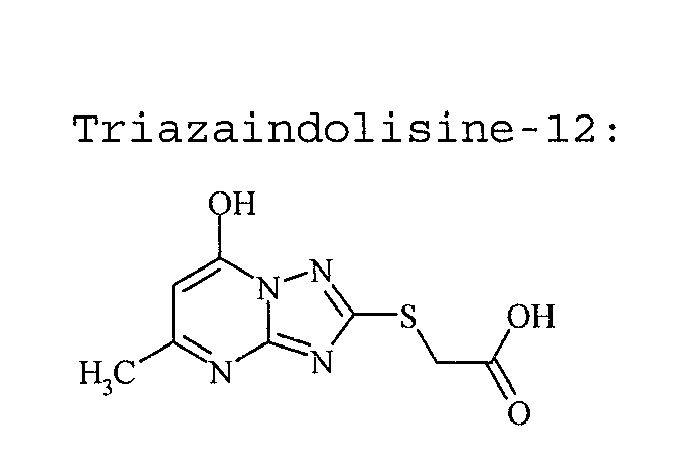

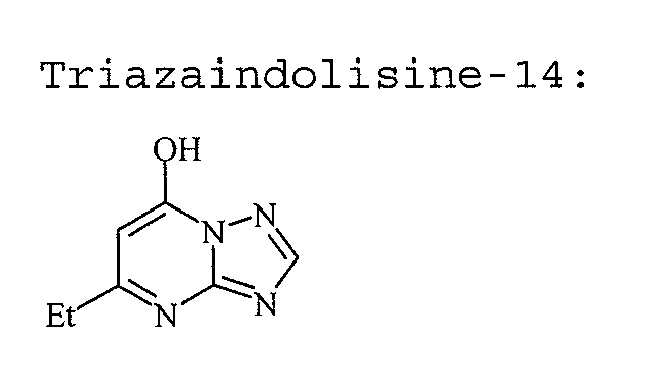


- In accordance with the present invention, at least two of said triazaindolisine compounds may be present, optionally linked together by a linking group. Said linking group may be a group which is substituted on at least one of the groups R1 to R13 of each the linked trazaindolisine compounds. The linking group is selected from the group consisting of an linear, branched or cyclic alkylene group such as a methylene, ethylene, propylene, butylene group, cyclohexamethylene or 1-methyl-ethylene; an arylene group such as a phenylene, naphtalene or an heteroarylene group; an arylalkylene group such as benzyl group; an oxy-alkylene group such as methylene oxide, ethylene oxide or propylene oxide group; an oxy-arylene or oxy-heteroarylene group such as phenylene oxide; -O-; -S-; -C(=O)-; -C(=S)-; -SO2-; - SO2-NRa-; -NRaRb-; -N=N-; or a combination of two or more of these groups, wherein Ra and Rb independently are hydrogen or an optionally substituted alkyl, alkenyl, alkynyl, aralkyl, alkaryl, aryl or heteroaryl group. The linking group may be divalent when two triazaindolisine compounds are linked, trivalent when three triazaindolisine compounds are linked,or tetravalent when four triazaindolisine compounds are linked. A divalent linking group is preferred. Trazaindolisine-11 is an example of such a triazaindolisine compound.
- During developing of an image-wise exposed heat-sensitive lithographic printing plate precursor, the sludge inhibiting agent is present in the aqueous alkaline developing solution.
In accordance with a preferred embodiment of the present invention, the sludge inhibiting agent is present in the alkaline developing solution at the start of the developing process.
In accordance with another preferred embodiment of the present invention, the sludge inhibiting agent is added to the alkaline developing solution during the developing process, preferably as a solution or dispersion. In a more preferred embodiment, the sludge inhibiting agent is added to the alkaline developing solution by the addition of a replenishing solution comprising the sludge inhibiting agent during the developing process.
In accordance with another preferred embodiment of the present invention, the sludge inhibiting agent is added to the alkaline developing solution during the developing process by removing at least part of the coating of the precursor comprising the sludge inhibiting agent. The sludge inhibiting agent can be present in the heat-sensitive coating, a top layer and/or a layer on the back side of the plate. - The aqueous alkaline developing solution (hereinafter also referred to as "developer") may comprise an alkaline agent. The composition of said aqueous alkaline solution can be selected from conventional alkaline developers.
The aqueous alkaline developing solution of the present invention has preferably a pH value of at least 10, more preferably of at least 11.5, most preferably of at least 12. There is no specific upper limit for the pH but the pH is usually not higher than 14. - The alkaline agent includes inorganic alkaline agents such as sodium hydroxide, potassium hydroxide, lithium hydroxide, sodium tertiary phosphate, potassium tertiary phosphate, ammonium tertiary phosphate, sodium secondary phosphate, potassium secondary phosphate, ammonium secondary phosphate, sodium carbonate, potassium carbonate, ammonium carbonate, sodium bicarbonate, potassium bicarbonate, ammonium bicarbonate, sodium borate, potassium borate and ammonium borate, and potassium citrate, sodium citrate and the like.
The alkaline agent may also include organic alkaline agents such as monomethylamine, dimethylamine, trimethylamine, monoethylamine, diethylamine, triethylamine, monoisopropylamine, diisopropylamine, triisopropylamine, n-butylamine, monoethanolamine, diethanolamine, triethanolamine, monoisopropanolamine, diisopropanolamine, ethylenediamine, pyridine and the like.
The alkaline aqueous solution may also include an alkaline silicate. The alkaline silicate may be those exhibiting an alkalinity when dissolved in water, and examples thereof include an alkali metal silicate and alkali metal metasilicate such as sodium silicate, sodium metasilicate, potassium silicate and lithium silicate, and ammonium silicate. Said alkaline silicate may be used alone, or in combination.
The development performance of the alkaline aqueous solution may be easily modulated by adjusting a molar ratio of alkaline silicates and alkali metal hydroxides, represented by silicon oxide (SiO2) and an alkali oxide (M2O, wherein M represents an alkali metal or an ammonium group). The alkaline aqueous solution has preferably a molar ratio SiO2/M2O from 0.5 to 3.0, and more preferably from 1.0 to 2.0. When the molar ratio SiO2/M2O is less than 0.5, alkalinity of the solution strengthens so as to cause a harmful effect such as etching of an aluminum plate which is generally used as a substrate in a lithographic printing plate precursor. When the molar ratio, SiO2/M2O is more than 3.0, the development performance of the solution may be degraded.
The concentration of alkaline silicate in the developer ranges generally from 1 to 14% by weight, preferably from 3 to 14% by weight, and more preferably from 4 to 14% by weight. When said concentration is less than 1% by weight, the development performance or treatment capacity may be degraded. When said concentration is more than 14% by weight, precipitated materials or crystals may be easily generated, and gelation may be easily caused during neutralization of waste liquid, resulting in an obstacle to the waste disposal. - The developer based on an alkaline aqueous solution may also comprise a nonreducing sugar. The nonreducing sugar denotes sugars having no reductive property due to the absence of a free aldehyde group or a free ketone group. Said nonreducing sugar is classified into trehalose-type oligosaccharides wherein a reductive group and another reductive group make a linkage; glycosides wherein a reductive group in a sugar is linked to a non-sugar compound; and sugar alcohols which are produced by reducing a sugar with hydrogenation. Said trehalose-type oligosaccharides include sucrose and trehalose, and said glycosides include alkyl glycosides, phenol glycosides, mustard oil glycosides and the like. Said sugar alcohols include D,L-arabitol, ribitol, xylitol, D,L-sorbitol, D,L-mannitol, D,L-iditol, talitol, dulcitol, allodulcitol and the like. Further, maltitol obtained by hydrogenation of disaccharide, a reduced material obtained by hydrogenation of oligosaccharide (a reduced starch syrup) and the like are preferably used. In the above nonreducing sugar, preferred are sugar alcohols and sucrose, and particularly preferred are D-sorbitol, sucrose and a reduced starch syrup, since they have buffering action in the appropriate pH range.
The above nonreducing sugar may be used alone or in combination with other ingredients, and the concentration thereof in the developer ranges generally from 0.1 to 30% by weight, and preferably from 1 to 20% by weight. - In the developer, an alkaline agent may be used as a base in combination with the above mentioned alkaline silicate or nonreducing sugar, and said alkaline agent may be selected from sodium hydroxide and potassium hydroxide. Further, sodium tertiary phosphate, potassium tertiary phosphate, sodium carbonate and potassium carbonate are also preferable, since they have themselves, buffering action. The above alkaline agent may be used alone or in combination.
- The developer may optionally contain further components, such as buffer substances, complexing agents, antifoaming agents, organic solvents, corrosion inhibitors, dyes, surfactants and/or hydrotropic agents as known in the art.
- In the aqueous alkaline developing solution, it is possible to simultaneously use organic solvents having solubility in water at 20 °C of not more than 15 % by weight according to need. Examples of such organic solvents are such carboxilic acid esters as ethyl acetate, propyl acetate, butyl acetate, amyl acetate, benzyl acetate, ethylene glycol monobutyl ether acetate, butyl lactate and butyl levulinate; such ketones as ethyl butyl ketone, methyl isobutyl ketone and cyclohexanone; such alcohols as ethylene glycol monobutyl ether, ethylene glycol benzyl ether, ethylene glycol monophenyl ether, benzyl alcohol, methylphenylcarbinol, n-amyl alcohol and methylamyl alcohol; such alkyl-substituted aromatic hydrocarbons as xylene; and such halogenated hydrocarbons as methylene dichloride and monochlorobenzene. These organic solvents may be used alone or in combination. Particularly preferred is benzyl alcohol in the invention. These organic solvents are added to the developer or replenisher therefor generally in an amount of not more than 10 % by weight and preferably not more than 5 % by weight.
- Besides the components described above, the developing solution of the present invention comprises a non-ionic surfactant. Such a non-ionic surfactant may be used as a dissolution preventing agent whereby undercutting of non-exposed areas is reduced. Examples of nonionic surfactants include ethoxylated alcohols, polyethylene glycols and polyhydric alcohols. Ethoxylated alcohols are preferred, and in particular ethoxylated alcohols having a hydrophiliclipophilic balance (HLB) higher than 5 are more preferred. Specific examples of nonionic surfactants are listed below: polyethylene glycol, polyoxyethylene glycol, lauryl ether, laurylalcohol polyglycol ethers, oleyl alcohol ethoxylated, lanolin alcohol ethoxylated, dodecanol ethoxylated, cetostearyl alcohol ethoxylated, tetramethyldecindiol ethoxylated, polyoxyethylene nonyl ether, polyoxyethylene cetyl ether, polyoxyethylene stearyl ether, polyoxyethylene oleyl ether, polyoxyethylene behenyl ether, polyoxyethylene polyoxypropylene block copolymers, polyoxyethylene polyoxypropylene cetyl ether, polyoxyethylene polyoxypropylene behenyl ether, polyoxyethylene nonylphenyl ether, polyoxyethylene octylphenyl ether, polyoxyethylene stearylamine, polyoxyethylene oleylamine, polyoxyethylene stearic acid amide, polyoxyethylene oleic acid amide, polyoxyethylene castor oil, polyoxyethylene abietyl ether, polyoxyethylene lanolin ether, polyoxyethylene monolaurate, polyoxyethylene monostearate, polyoxyethylene glyceryl monooleate, polyoxyethylene glyceryl monostearate, polyoxyethylene propylene glycol monostearate, polyoxyethylene sorbitan monolaurate, and sorbitan monolaurate. These non-ionic surfactants preferably have an average molecular weight ranging from 500 to 10,000, preferably from 1000 to 5000. They can be comprised individually or as admixture of two or more compounds in an amount ranging from 0.05 to 5%, preferably from 0.1 to 1% by weight of the total developing solution.
- The developers used in the present invention may simultaneously contain another surfactant for the purpose of improving developing properties thereof. By incorporating surfactants to the developer solution, the surface tension reduces drastically and the developer solution becomes effective - i.e. removal of the non-image areas without occurrence of stain/toning - at a lower pH compared to the same developer solution without a surfactant. The developer may comprise an ionic surfactant such as anionic or cationic surfactant, a non-ionic surfactant and/or amphoteric surfactants such as Librateric AA30 (trademark from Libra Chemicals Limited). Examples of such surfactants include salts of higher alcohol (C8 ∼ C22) sulfuric acid esters such as sodium salt of lauryl alcohol sulfate, sodium salt of octyl alcohol sulfate, ammonium salt of lauryl alcohol sulfate, Teepol B-81 (trade mark, available from Shell Chemicals Co., Ltd.) and sodium alkyl sulfates; salts of aliphatic alcohol phosphoric acid esters such as sodium salt of cetyl alcohol phosphate; alkyl aryl sulfonic acid salts such as sodium salt of dodecylbenzene sulfonate, sodium salt of isopropylnaphthalene sulfonate,sodium salt of dinaphthalene disulfonate and sodium salt of metanitrobenzene sulfonate; sulfonic acid salts of alkylamides such as C17H33CON(CH3)CH2CH2SO3Na and sulfonic acid salts of dibasic aliphatic acid esters such as sodium dioctyl sulfosuccinate and sodium dihexyl sulfosuccinate. These surfactants may be used alone or in combination. Particularly preferred are sulfonic acid salts. These surfactants may be used in an amount of generally not more than 5 % by weight and preferably not more than 3 % by weight.
The cationic surfactant used in the developer may include amine salts, quaternary ammonium salts, phosphonium salts, sulfonium salts and the like. Examples of the amine salts are primary amine salts, secondary amine salts, tertiary amine salts, and imidazoline salts. Examples of the quaternary ammonium salts include tetraalkyl quaternary ammonium salts, trialkyl benzyl quaternary ammonium salts, alkyl pyridinium salts, alkyl quinolinium salts, imidazolinium salts and benzimidazolinium salts.
Exemplary amphoteric surfactants include betaine derivatives, such as, for example, alkylamidopropyl betaine, alkyldimethyl betaine, bishydroxyethyl betaine, alkylamido propyl betaine, lauryl betaine, and the like, glycine derivatives, such as, for example, cocoamphocarboxy glycinate, lauroamphocarboxy glycinate, caprylamphocarboxy glycinate, oleoamphocarboxy glycinate, oleoamphopolycarboxy glycinate, N-alkyl glycinate, and the like, imino derivatives, such as, for example, cocoiminodipropionate, octyliminodipropionate, and the like, imidazoline derivatives, such as, for example, coconut imidazoline, and the like, lecithin derivatives, and aminocarboxylic acids. These amphoteric surfactants preferably have an average molecular weight ranging from 500 to 10,000, preferably from 1,000 to 5,000. They can be comprised individually or as admixture of two or more compounds.
The above described anionic and amphoteric surfactant can be present in the developing solution of the present invention in a total amount ranging from 0.5 to 10%, preferably from 1 to 6%, and more preferably from 1 to 3% by weight of the total developing solution. - In order to enhance developing stability of the developers, the following compounds may simultaneously be used. Examples of such compounds are neutral salts such as NaCl, KCl and KBr as disclosed in JN-
A- 58- 75 152 A- 58- 190 952 U.S-A- 4 469 776 ), complexes such as [Co(NH3)6]Cl3 as disclosed in JN-A- 59- 121 336 US-A- 4 606 995 ); ionizable compounds of elements of the group IIa, IIIa or IIIb of the Periodic Table such as those disclosed in JN-A- 55- 25 100 A- 50- 51 324 US-A- 4 374 920 ; non-ionic surfactants as disclosed in JN-A- 60- 213 943 A- 55- 95 946 JN-A- 56- 142 528 JN-A- 57- 192 952 US-A- 4 467 027 ) and alkaline-soluble mercapto compounds or thioether compounds such as thiosalicylic acid, cysteine and thioglycolic acid; inorganic lithium compounds such as lithium chloride as disclosed inJN-A- 58- 59 444 JN-A- 50 34 442 JN-A- 59- 75 255 JN-A- 59- 84 241 US-A- 4 500 625 ); quaternary ammonium salts such as tetraalkylammonium oxides as disclosed inEP-A- 101 010 JN-A- 63- 226 657 - During the development the non-image areas of the coating are removed with an aqueous alkaline developer solution optionally in combination combined with mechanical rubbing, e.g. by a rotating brush. During the development step, any water-soluble layer present is preferably also removed. The development is preferably carried out at temperatures of from 20 to 40 °C in automated processing units as customary in the art.
- To perform development processing stably for a long time period, it is particularly important to control the strength of alkali and the concentration of silicates and other ingredients in the developer. Therefor, a replenishing solution, hereinafter also referred to as replenisher, is added to the developing solution, usually in small amounts such that a stable development processing can be performed over a long time period without exchanging the developer. Therefor, it is also important that the concentration of the sludge inhibiting agent of the present invention is present in the developing solution at a sufficiently high level in order to prevent sludge formation and this can be realised by adding a replenisher comprising the sludge inhibiting agent of the present invention.
For regeneration, the replenishing solution preferably comprises active ingredients of the developing solution such as alkaline agent. The replenishing solution is added continuously or in small amounts to the developing solution during or after the developing process in order to regulate the concentration of the active ingredients in the developing solution at a level sufficiently high or at a constant level such that the development of image-wise exposed precursors remains at a constant level. The required amounts of regenerated material must be tailored to the developing apparatuses used, daily plate throughputs, image areas, etc. and are in general from 1 to 150 ml per square meter of plate precursor. The addition of replenisher can be regulated, for example, by measuring the conductivity of the developer as described inEP-A 0,556,690 .
In the method for development processing, any known means of supplementing a replenisher for developer may also be employed. Examples of such methods preferably used are a method for intermittently or continuously supplementing a replenisher as a function of the amount of plates processed and time as disclosed inJN-A- 55- 115 039 GB-A- 2 046 931 JN-A- 58- 95 349 US-A- 4 537 496 ); a method comprising determining the impedance value of a developer and processing the detected impedance value by a computer to perform supplementation of a replenisher as disclosed inGB-A- 2 208 249 - In a preferred embodiment of the present invention, the sludge inhibiting agent is present in a replenishing solution at a concentration of at least 0.5 g/l, preferably in a concentration ranging between 1 and 50 g/l, more preferably between 2 and 30 g/l, more preferably between 3 and 20 g/l, most preferably between 3 and 15 g/l. In another preferred embodiment, the ratio of the concentration of the sludge inhibiting agent in the replenishing solution, containing at least 0.5 g/l of the sludge inhibiting agent, and in the developing solution is preferably between 0.5 and 100, more preferably between 1.1 and 100, most preferably between 2 and 50.
The replenishing solution has preferably a pH value of at least 10, more preferably of at least 11.5, most preferably of at least 12. There is no specific upper limit for the pH but the pH is usually not higher than 14.
In another embodiment of the present invention, more than one replenishing solutions can be used for adding to the developing solution during or after the development processing and these replenishers may contain different types in different amounts of sludge inhibiting agents of the present invention, and also different types in different amounts of other compounds for improving the development processing.
In a more preferred embodiment of the present invention, the fresh developing solution at starting the development processing for the first time is essentially free of the sludge inhibiting agent of the present invention and during or after processing precursors, a replenishing solution, containing a sludge inhibiting agent of the present invention, is added to the developing solution and/or a layer of the precursor, comprising a sludge inhibiting agent of the present invention, is removed at least partially in the developing solution. - The heat-sensitive lithographic printing plate precursor of the present invention comprises a support having a hydrophilic surface or which is provided with a hydrophilic layer, and, on said support, a heat-sensitive coating.
- The support of the lithographic printing plate precursor has a hydrophilic surface or is provided with a hydrophilic layer. The support may be a sheet-like material such as a plate or it may be a cylindrical element such as a sleeve which can be slid around a print cylinder of a printing press. A preferred support is a metal support such as aluminum or stainless steel. The metal can also be laminated to a plastic layer, e.g. polyester film.
A particularly preferred lithographic support is an electrochemically grained and anodized aluminum support. Graining and anodization of aluminum is well known in the art. The anodized aluminum support may be treated to improve the hydrophilic properties of its surface. For example, the aluminum support may be silicated by treating its surface with a sodium silicate solution at elevated temperature, e.g. 95°C. Alternatively, a phosphate treatment may be applied which involves treating the aluminum oxide surface with a phosphate solution that may further contain an inorganic fluoride. Further, the aluminum oxide surface may be rinsed with a citric acid or citrate solution. This treatment may be carried out at room temperature or may be carried out at a slightly elevated temperature of about 30 to 50°C. A further interesting treatment involves rinsing the aluminum oxide surface with a bicarbonate solution. Still further, the aluminum oxide surface may be treated with polyvinylphosphonic acid, polyvinylmethylphosphonic acid, phosphoric acid esters of polyvinyl alcohol, polyvinylsulfonic acid, polyvinylbenzenesulfonic acid, sulfuric acid esters of polyvinyl alcohol, and acetals of polyvinyl alcohols formed by reaction with a sulfonated aliphatic aldehyde It is further evident that one or more of these post treatments may be carried out alone or in combination. More detailed descriptions of these treatments are given inGB-A 1 084 070 DE-A 4 423 140 ,DE-A 4 417 907 ,EP-A 659 909 EP-A 537 633 DE-A 4 001 466 ,EP-A 292 801 EP-A 291 760 US4,458,005 . - The heat-sensitive coating, which is provided on the support, may be positive-working or negative-working. A positive-working heat-sensitive coating is preferred. The coating of a positive-working heat-sensitive coating does not dissolve in an alkaline developing solution in the unexposed areas and becomes soluble in the exposed areas within the time used for developing the plate. The coating preferably comprises an infrared absorbing agent and an alkaline soluble oleophilic resin whereof the solubility in an alkaline developing solution is reduced in the coating and whereof the solubility in an alkaline developing solution is increased upon heating or IR-radiation. The coating preferably further comprises a dissolution inhibitor whereby rate of dissolution in an alkaline developing solution is reduced. Due to this solubility differential the rate of dissolution of the exposed areas is sufficiently higher than in the non-exposed areas.
- In a preferred embodiment of the present invention, the heat-sensitive coating comprises a first polymer which is a phenolic resin such as novolac, resol or a polyvinylphenolic resin; novolac is more preferred. Typical examples of such polymers are described in
DE-A-4007428 ,DE-A-4027301 andDE-A-4445820 . Other preferred polymers are phenolic resins wherein the phenyl group or the hydroxy group of the phenolic monomeric unit are chemically modified with an organic substituent as described inEP 894 622 EP 901 902 EP 933 682 WO99/63407 EP 934 822 EP 1 072 432 ,US 5,641,608 ,EP 982 123 WO99/01795 WO04/035310 WO04/035686 WO04/035645 WO04/035687 EP 1 506 858 .
The novolac resin or resol resin may be prepared by polycondensation of at least one member selected from aromatic hydrocarbons such as phenol, o-cresol, p-cresol, m-cresol, 2,5-xylenol, 3,5-xylenol, resorcinol, pyrogallol, bisphenol, bisphenol A, trisphenol, o-ethylphenol, p-etylphenol, propylphenol, n-butylphenol, t-butylphenol, 1-naphtol and 2-naphtol, with at least one aldehyde or ketone selected from aldehydes such as formaldehyde, glyoxal, acetoaldehyde, propionaldehyde, benzaldehyde and furfural and ketones such as acetone, methyl ethyl ketone and methyl isobutyl ketone, in the presence of an acid catalyst. Instead of formaldehyde and acetaldehyde, paraformaldehyde and paraldehyde may, respectively, be used. - The weight average molecular weight, measured by gel permeation chromatography using universal calibration and polystyrene standards, of the novolac resin is preferably from 500 to 150,000 g/mol, more preferably from 1,500 to 50,000 g/mol.
The poly(vinylphenol) resin may also be a polymer of one or more hydroxy-phenyl containing monomers such as hydroxystyrenes or hydroxy-phenyl (meth)acrylates. Examples of such hydroxystyrenes are o-hydroxystyrene, m-hydroxystyrene, p-hydroxystyrene, 2-(o-hydroxyphenyl)propylene, 2-(m-hydroxyphenyl)propylene and 2-(p-hydroxyphenyl)propylene. Such a hydroxystyrene may have a substituent such as chlorine, bromine, iodine, fluorine or a C1-4 alkyl group, on its aromatic ring. An example of such hydroxy-phenyl (meth)acrylate is 2-hydroxy-phenyl methacrylate.
The poly(vinylphenol) resin may usually be prepared by polymerizing one or more hydroxy-phenyl containing monomer in the presence of a radical initiator or a cationic polymerization initiator. The poly(vinylphenol) resin may also be prepared by copolymerizing one or more of these hydroxy-phenyl containing monomers with other monomeric compounds such as acrylate monomers, methacrylate monomers, acrylamide monomers, methacrylamide monomers, vinyl monomers, aromatic vinyl monomers or diene monomers.
The weight average molecular weight, measured by gel permeation chromatography using universal calibration and polystyrene standards, of the poly(vinylphenol) resin is preferably from 1.000 to 200,000 g/mol, more preferably from 1,500 to 50,000 g/mol. - Examples of phenolic resins are:
POL-01: ALNOVOL™ SPN452 is a solution of a novolac resin, 40 % by weight in Dowanol™ PM, obtained from CLARIANT GmbH. Dowanol™ PM consists of 1-methoxy-2-propanol (>99.5 %) and 2-methoxy-1-propanol (<0.5 %). POL-02: ALNOVOL™ SPN400 is a solution of a novolac resin, 44 % by weight in Dowanol™ PMA, obtained from CLARIANT GmbH. Dowanol™ PMA consists of 2-methoxy-1-methyl-ethylacetate. POL-03: ALNOVOL™ HPN100 a novolac resin obtained from CLARIANT GmbH. POL-04: DURITE™ PD443 is a novolac resin obtained from BORDEN CHEM. INC. POL-05: DURITE™ SD423A is a novolac resin obtained from BORDEN CHEM. INC. POL-06: DURITE™ SD126A is a novolac resin obtained from BORDEN CHEM. INC. POL-07: BAKELITE™ 6866LB02 is a novolac resin obtained from BAKELITE AG. POL-08: BAKELITE™ 6866LB03 is a novolac resin obtained from BAKELITE AG. POL-09: KR 400/8 is a novolac resin obtained from KOYO CHEMICALS INC. POL-10: HRJ 1085 is a novolac resin obtained from SCHNECTADY INTERNATIONAL INC. POL-11: HRJ 2606 is a phenol novolac resin obtained from SCHNECTADY INTERNATIONAL INC. POL-12: LYNCUR™ CMM is a copolymer of 4-hydroxy-styrene and methyl methacrylate obtained from SIBER HEGNER. - In another preferred embodiment of the present invention, the heat-sensitive coating further comprises a second polymer which is insoluble in water and soluble in an alkaline solution.
In accordance with a more preferred embodiment of the present invention, the heat-sensitive coating comprises a heat-sensitive layer and an intermediate layer. The intermediate layer is present between the heat-sensitive layer and the hydrophilic surface of the support. In a still more preferred embodiment, the heat-sensitive layer comprises a first polymer and optionally an inhibitor, and the intermediate layer comprises a second polymer.
The second polymer is preferably an organic polymer which has acidic groups with a pKa of less than 13 to ensure that the layer is soluble or at least swellable in aqueous alkaline developers. Advantageously, the binder is a polymer, formed by polyaddition or by polycondensation, for example a polyester, a polyamide resin, an epoxy resin, an acetal resin, an acrylic resin, a methacrylic resin, a styrene based resin, a polyurethane resin or polyurea.
The second polymer has more preferably one or more functional groups selected from the list of - (i) a sulfonamide group such as -SO2-NH-Rg wherein Rg represents a hydrogen or an optionally substituted hydrocarbon group such as an optionally substituted alkyl, aryl or heteroaryl group,
- (ii) an active imide group such as -SO2-NH-CO-Rh, -SO2-NH-SO2-Rh or - CO-NH-SO2-Rh wherein Rh represents a hydrogen or an optionally substituted hydrocarbon group such as an optionally substituted alkyl, aryl or heteroaryl group,
- (iii) a carboxyl group,
- (iv) a sulfonic group, and
- (v) a phosphoric group; a sulfonamide group or an active imide group are more preferred; most preferred are polymers selected from a copolymer comprising a N-benzyl-maleimide monomeric unit or a monomeric unit comprising a sulfonamide group as described in
EP-A 933 682 EP 0 894 622 (page 3 line 16 to page 6 line 30),EP-A 0 982 123 (page 3 line 56 to page 51 line 5),EP-A 1 072 432 (page 4 line 21 to page 10 line 29) andWO 99/63407 - In a preferred embodiment of the present invention, the heat-sensitive coating or the heat-sensitive layer also contain one or more dissolution inhibitors. Dissolution inhibitors are compounds which reduce the dissolution rate of the hydrophobic polymer in the aqueous alkaline developer at the non-exposed areas of the coating and wherein this reduction of the dissolution rate is destroyed by the heat generated during the exposure so that the coating readily dissolves in the developer at exposed areas. The dissolution inhibitor exhibits a substantial latitude in dissolution rate between the exposed and non-exposed areas. By preference, the dissolution inhibitor has a good dissolution rate latitude when the exposed coating areas have dissolved completely in the developer before the non-exposed areas are attacked by the developer to such an extent that the ink-accepting capability of the coating is affected. The dissolution inhibitor(s) can be added to the layer which comprises the hydrophobic polymer discussed above.
The dissolution rate of the non-exposed coating in the developer is preferably reduced by interaction between the hydrophobic polymer and the inhibitor, due to e.g. hydrogen bonding between these compounds. Suitable dissolution inhibitors are preferably organic compounds which comprise at least one aromatic group and a hydrogen bonding site, e.g. a carbonyl group, a sulfonyl group, or a nitrogen atom which may be quaternized and which may be part of a heterocyclic ring or which may be part of an amino substituent of said organic compound. Suitable dissolution inhibitors of this type have been disclosed in e.g.EP-A 825 927 823 327
Water-repellent polymers represent another type of suitable dissolution inhibitors. Such polymers seem to increase the developer resistance of the coating by repelling the aqueous developer from the coating. The water-repellent polymers can be added to the layer comprising the first polymer and/or can be present in a separate layer provided on top of the layer with the first polymer. In the latter embodiment, the water-repellent polymer forms a barrier layer which shields the coating from the developer and the solubility of the barrier layer in the developer or the penetrability of the barrier layer by the developer can be increased by exposure to heat or infrared light, as described in e.g.EP-A 864420 EP-A 950 517 WO99/21725 - Preferably, also one or more development accelerators are included in the heat-sensitive coating or in the heat-sensitive layer, i.e. compounds which act as dissolution promoters because they are capable of increasing the dissolution rate of the non-exposed coating in the developer. The simultaneous application of dissolution inhibitors and accelerators allows a precise fine tuning of the dissolution behavior of the coating. Suitable dissolution accelerators are cyclic acid anhydrides, phenols or organic acids. Examples of the cyclic acid anhydride include phthalic anhydride, tetrahydrophthalic anhydride, hexahydrophthalic anhydride, tetrachlorophthalic anhydride, maleic anhydride, chloromaleic anhydride, alpha -phenylmaleic anhydride, succinic anhydride, and pyromellitic anhydride, as described in
U.S. Patent No. 4,115,128 . Examples of the phenols include bisphenol A, p-nitrophenol, p-ethoxyphenol, 2,4,4'-trihydroxybenzophenone, 2,3,4-trihydroxybenzophenone, 4-hydroxybenzophenone, 4,4',4"-trihydroxy-triphenylmethane, and 4,4',3",4"-tetrahydroxy-3,5,3',5'-tetramethyltriphenyl-methane, and the like. Examples of the organic acids include sulfonic acids, sulfinic acids, alkylsulfuric acids, phosphonic acids, phosphates, and carboxylic acids, as described in, for example,JP-A Nos. 60-88,942 2-96,755 - In accordance with a preferred embodiment of the present invention, the sludge inhibiting agent is added to the developing solution by removing at least part of the precursor wherein said sludge inhibiting agent of the present invention is present. In this embodiment, the layer comprising the sludge inhibiting agent is removed at least partially during development, preferably, the sludge inhibiting agent is present in the heat-sensitive coating or in the heat-sensitive layer and/or the intermediate layer and/or in a top layer and/or in an optional other layer on the back side of the support.
According to a more preferred embodiment, the sludge inhibiting agent is present in the heat-sensitive coating or in the heat-sensitive layer and/or the intermediate layer whereby the layer comprising the sludge inhibiting agent is removed at the exposed areas in the developing solution. In this way, it is highly advantageous that the amount of sludge inhibiting agent added to the developing solution is in correspondence with the amount of dissolved ingredients, causing and/or inducing the formation of sludge. When the precursor has a toplayer which is removed only on the exposed areas, the sludge inhibiting agent can also be present in the toplayer and the addition of sludge inhibiting agent is also in correspondance with the exposed areas. In this way the sludge inhibiting agent is released in proportion with exposed areas and the amount of sludge inhibiting agent present in such an image-wise dissolving coating ranges preferably between 0.01 g/m2 to 2.5 g/m2, more preferably between 0.05 g/m2 to 1.5 g/m2, most preferably between 0.07 g/m2 to 1.0 g/m2.
According to another preferred embodiment of the present invention, the sludge inhibiting agent is present in a layer on the back side of the support and this layer is removed at least partially in the developing solution. In this way the addition of sludge inhibiting agent is proportional with the surface of the precursors which are developed. In an analoguous way, the sludge inhibiting agent can also be present in a top layer which is removed also in the non-exposed areas. In this way the sludge inhibiting agent is released in proportion with surface of the precursor and the amount of sludge inhibiting agent present in such a layer ranges preferably between 0.01 g/m2 to 2.0 g/m2, more preferably between 0.05 g/m2 to 1.5 g/m2, most preferably between 0.07 g/m2 to 1.0 g/m2. - According to another embodiment of the present invention, the sludge inhibiting agent, present in the heat-sensitive coating or in the heat-sensitive layer, may have an additional benefit of an improved sensitivity at the image-wise exposure of the precursor. The concentration of the sludge inhibiting agent for obtaining an improved sensitivity may be different from the concentration for obtaining the optimum sludge inhibiting activity, usually an improved sensitivity may be obtained at a lower concentration of the sludge inhibiting agent, preferably between 0.01 and 0.20 g/m2. In order to obtain an optimum sludge inhibiting activity, it is advantageous to combine a precursor, having this lower concentration of the sludge inhibiting agent, with a developing solution (or replenisher), having the sludge inhibiting agent.
- The material can be image-wise exposed directly with heat, e.g. by means of a thermal head, or indirectly by infrared light, which is preferably converted into heat by an infrared light absorbing compound, which may be a dye or pigment having an absorption maximum in the infrared wavelength range. The infrared light absorbing dye or pigment is preferably present in the heat-sensitive coating or the heat-sensitive layer and typically in a concentration ranging between 0.25 and 10.0 wt.%, more preferably between 0.5 and 7.5 wt.% relative to the coating as a whole. Preferred IR-absorbing compounds are dyes such as cyanine or merocyanine dyes or pigments such as carbon black. A suitable compound is the following infrared dye IR-1: (IR-1)

- The heat-sensitive coating, or the heat-sensitive layer and/or the intermediate layer, may further contain an organic dye which absorbs visible light so that a perceptible image is obtained upon image-wise exposure and subsequent development. Such a dye is often called contrast dye or indicator dye. Preferably, the dye has a blue color and an absorption maximum in the wavelength range between 600nm and 750 nm. Although the dye absorbs visible light, it preferably does not sensitize the printing plate precursor, i.e. the coating does not become more soluble in the developer upon exposure to visible light. Suitable examples of such a contrast dye are the quaternized triarylmethane dyes.
According to a preferred embodiment, the contrast dye is present in the heat-sensitive coating, or the heat-sensitive layer and/or the intermediate layer.
According to a highly preferred embodiment, the infrared light absorbing compound is concentrated in the heat-sensitive coating or the heat-sensitive layer. - The printing plate precursor of the present invention can be exposed to infrared light with LEDs or a laser. Preferably, a laser emitting near infrared light having a wavelength in the range from about 750 to about 1500 nm is used, such as a semiconductor laser diode, a Nd:YAG or a Nd:YLF laser. The required laser power depends on the sensitivity of the image-recording layer, the pixel dwell time of the laser beam, which is determined by the spot diameter (typical value of modern plate-setters at 1/e2 of maximum intensity : 10-25 µm), the scan speed and the resolution of the exposure apparatus (i.e. the number of addressable pixels per unit of linear distance, often expressed in dots per inch or dpi; typical value: 1000-4000 dpi, corresponding to about 39.4-157.5 dots per mm).
Two types of laser-exposure apparatuses are commonly used: internal (ITD) and external drum (XTD) plate-setters. ITD plate-setters for thermal plates are typically characterized by a very high scan speed up to 500 m/sec and may require a laser power of several Watts. XTD plate-setters for thermal plates having a typical laser power from about 200 mW to about 1 W operate at a lower scan speed, e.g. from 0.1 to 10 m/sec.
The known plate-setters can be used as an off-press exposure apparatus, which offers the benefit of reduced press down-time. XTD plate-setter configurations can also be used for on-press exposure, offering the benefit of immediate registration in a multi-color press. More technical details of on-press exposure apparatuses are described in e.g.US 5,174,205 andUS 5,163,368 . - The development step may be followed by a rinsing step and/or a gumming step. The gumming step involves post-treatment of the lithographic printing plate with a gum solution. A gum solution is typically an aqueous liquid which comprises one or more surface protective compounds that are capable of protecting the lithographic image of a printing plate against contamination or damaging. Suitable examples of such compounds are film-forming hydrophilic polymers or surfactants.
- The plate precursor can, if required, be post-treated with a suitable correcting agent or preservative as known in the art. To increase the resistance of the finished printing plate and hence to extend the run length, the layer can be briefly heated to elevated temperatures ("baking"). The plate can be dried before baking or is dried during the baking process itself. During the baking step, the plate can be heated at a temperature which is higher than the glass transition temperature of the heat-sensitive coating, e.g. between 100°C and 230°C for a period of 40 seconds to 5 minutes. Baking can be done in conventional hot air ovens or by irradiation with lamps emitting in the infrared or ultraviolet spectrum. As a result of this baking step, the resistance of the printing plate to plate cleaners, correction agents and UV-curable printing inks increases. Such a thermal post-treatment is described, inter alia, in
DE 1,447,963 andGB 1,154,749 - The printing plate thus obtained can be used for conventional, so-called wet offset printing, in which ink and an aqueous dampening liquid is supplied to the plate. Another suitable printing method uses so-called single-fluid ink without a dampening liquid. Suitable single-fluid inks have been described in
US 4,045,232 ;US 4,981,517 andUS 6,140,392 . In a most preferred embodiment, the single-fluid ink comprises an ink phase, also called the hydrophobic or oleophilic phase, and a polyol phase as described inWO 00/32705 - In a 250 ml reactor, 162 mmol of Monomer-01, 21.3g (132 mmol) benzyl acrylamide, 0.43 g (6 mmol) acrylic acid and 103g gamma-butyrolactone were added and the mixture was heated to 140°C, while stirring at 200 rpm. A constant flow of nitrogen was put over the reactor. After dissolution of all the components, the reactor was cooled to 100°C. 0.35 ml Trigonox™ DC50, commercially available from AKZO NOBEL, was added followed by the addition of 1.39 ml Trigonox™ 141, commercially available from AKZO NOBEL, in 3.43 ml butyrolactone. The polymerization was started and the reactor was heated to 140°C over 2 hours while dosing 1.75 ml Trigonox™ DC50. The mixture was stirred at 400 rpm and the polymerization was allowed to continue for 2 hours at 140°C. The reaction mixture was cooled to 120°C and the stirrer speed was enhanced to 500 rpm. 85.7 ml 1-methoxy-2-propanol was added and the reaction mixture was allowed to cool down to room temperature.
Binder-01 was analyzed with 1H-NMR-spectroscopy and size exclusion chromatography, using dimethyl acetamide/0.21 % LiCl as eluent on a 3x mixed-B column and relative to polystyrene standards.Mn Mw PD Binder-01 23500 67000 2.84 
- A 0.30 mm thick aluminum foil was degreased by immersing the foil in an aqueous solution containing 34 g/l of sodium hydroxide at 70°C for 6 seconds and rinsed with demineralized water for 3.6 seconds. The foil was then electrochemically grained during 8 seconds using an alternating current in an aqueous solution containing 15 g/l HCl, 15 g/l SO4 2- ions and 5 g/l Al3+ at a temperature of 37°C and a current density of 100 A/dm2. The aluminum foil was then desmutted by etching with an aqueous solution containing 145 g/l of sulfuric acid at 80°C for 5 seconds and rinsed with demineralized water for 4 seconds. The foil was subsequently subjected to anodic oxidation during 10 seconds in an aqueous solution containing 145 g/l of sulfuric acid at a temperature of 57°C and a current density of 25 A/dm2, then washed with demineralized water for 7 seconds and post-treated for 4 seconds with a solution containing 2.2 g/l of polyvinylphosphonic acid at 70°C, rinsed with demineralized water for 3.5 seconds and dried at 120°C for 7 seconds.
- The support thus obtained was characterized by a surface roughness Ra of 0.35-0.40 µm (measured with interferometer NT1100) and an anodic weight of 3.0 g/m2.
- The PPP-01 was produced by first applying a first coating layer defined in Table 1 onto the above described lithographic support. The coating was applied at a wet coating thickness of 20 µm and then dried at 135°C. The total dry coating weight amounts to 0.75 g/m2.
Table 1: Composition of the solution of the first coating layer INGREDIENTS Amount of product
(g)Dowanol™ PM (1) 253.26 THF (2) 575.0 Binder-01 (25 % by weight) (3) 165.46 Crystal Violet (4) 0.63 Tegoglide™ 410 (1 % by weight) (5) 5.64 (1)Dowanol™ PM is 1-methoxy-2-propanol, commercially available from DOW CHEMICAL Company.
(2)THF is tetrahydrofuran.
(3)Binder-01, preparation see above.
(4)Crystal Violet, commercially available from CIBA-GEIGY.
(5)TEGOGLIDE™ 410 is a copolymer of polysiloxane and poly(alkylene oxide), commercially available from TEGO CHEMIE SERVICE GmbH.Table 2: Composition of the solution of the second coating layer INGREDIENTS Amount of product (g) Dowanol™ PM (1) 427.0 Butanone 484.0 Alnovol™ SPN452 (40 % by weight) (2) 58.68 TMCA (10 % by weight) (3) 2.23 SOO94 (4) 1.0 Crystal Violet (5) 0.39 Fluorad™ FC4432 (1% by weight) (6) 22.27 Tegoglide™ 410 (1 % by weight) (7) 4.45 (1)See Table 1.
(2)Alnovol™ SPN452 is a novolac solution, 40.5 % by weight in Dowanol™ PM, commercially available from CLARIANT.
(3)TMCA is 3,4,5-trimethoxy cinnamic acid.
(4)SOO94 is an IR absorbing cyanine dye, commercially available from FEW CHEMICALS; the chemical structure of SOO94 is equal to IR-1 with X is tosylate anion.
(5)See Table 1.
(6)FLUORAD™ FC4432 is a solution of a fluor-copolymer 1 % by weight in Dowanol PM, commercially available from 3M.
(7)See Table 1. - Imaging and processing of the printing plate precursor PPP-01.
- A number of printing plate precursors PPP-01, having a total area of 1000 cm2, were exposed with a Creo Trendsetter 3244 (plate-setter, trademark from Creo, Burnaby, Canada), operating at 150 rpm and at an energy density of 200 mJ/cm2.
- After exposure the plates were cut into 24 strips of 4.5 cm x 9.5 cm, and all these strips were consecutively processed by dipping the strips into 20 ml of a developer, as defined in Table 4 and 5 and in Table 6 and 7, at a temperature of 25°C and during 30 seconds and the resulting solution adsorbed on each strip is squeezed off.
After processing of the strips, 15 ml of the developing solution remains and this solution was kept at 25°C during 4 days. The solution was centrifuged by a Heraeus Labofuge 400 at 3500 rpm, and the amount of sludge was determined gravimetrically by evaporation of the residue during 4 hours at 130°C.Table 4: Composition of the developing solutions DEV-01 to DEV-12 INGREDIENTS DEV-Reference-01 (g) DEV-01 to DEV-12 (g) Na-metasilicate (1) 100 100 Crafol™ AP261 (2) 10.80 10.80 Surfynol™ 104H (3) 0.67 0.67 Synperonic™ T304 (4) 4.32 4.32 Na-Benzoate (5) 2.00 2.00 Water until 1000 1000 a triazaindolisine compound added as defined in Table 5 amount of added triazaindolisine compound as defined in Table 5 (1)Na-metasilicate is sodium metasilicate pentahydrate, commercially available from SILMACO NV
(2)Crafol™ AP261 is alkylether sodium salt, commercially available from COGNIS
(3)Surfynol™ 104H is a surfactant, commercially available from KEYSER&MACKAY
(4)Synperonic™ T304 is a block-co-polymer of polyethylene oxide (=PEO) and polypropylene oxide (=PPO) attached to ethylenediamine (=EDA) in a ratio EDA/PEO/PPO of 1/15/14 and having a mean molecular weight of 1600, commercially available from UNIQEMA
(5)Na-Benzoate is benzoic acid sodium salt. - Table 5 summarizes the amount of sludge for each type of developing solution DEV-01 to DEV-12 and for DEV-Reference-01.
Table 5: Results of sludge evaluation EXAMPLE Precursor Developer Type of triazaindolisine compound Amount triaza-indolisine compound
(g)Amount of sludge in 15 ml developer
(mg)Comparative Example 1 PPP-01 DEV-Ref-01 - - 149 Invention Example 1 PPP-01 DEV-01 Triazaindolisine -01 15 60 Invention Example 2 PPP-01 DEV-02 Triazaindolisine -01 20 56 Invention Example 3 PPP-01 DEV-03 Triazaindolisine -02 5 71 Invention Example 4 PPP-01 DEV-04 Triazaindolisine -02 15 56 Invention Example 5 PPP-01 DEV-05 Triazaindolisine -03 5 64 Invention Example 6 PPP-01 DEV-06 Triazaindolisine -04 15 86 Invention Example 7 PPP-01 DEV-07 Triazaindolisine -05 5 89 Invention Example 8 PPP-01 DEV-08 Triazaindolisine -06 5 60 Invention Example 9 PPP-01 DEV-09 Triazaindolisine -06 15 52 Invention Example 10 PPP-01 DEV-10 Triazaindolisine -07 5 87 Invention Example 11 PPP-01 DEV-11 Triazaindolisine -07 15 76 Invention Example 12 PPP-01 DEV-12 Triazaindolisine -08 5 84 - The results in Table 5 demonstrate that for the Invention Examples 1 to 12, comprising different types of trazaindolisine compounds of the present invention in different concentrations in the developing solution, the formation of sludge is reduced in comparison with the Comparative Example 1, comprising no sludge inhibiting agent.

In another preferred embodiment, R3 is selected from hydrogen, an optionally substituted alkyl group having 1 to 5 carbon atoms, or -SR12, more preferably R3 is hydrogen.
Said optionally substituting group of said alkyl, alkenyl, alkynyl, aralkyl, alkaryl, aryl or heteroaryl group as defined in each of said groups of R1 to R13 is preferably a hydrophilic group. Said hydrophilic group is preferably selected from a carboxylic acid or salt thereof, a sulphonic acid or salt thereof, a sulphuric acid or salt thereof, a phosphonic acid or salt thereof, a phosphoric acid or salt thereof, and an aromatic alcohol or salt thereof, a hydroxyl group, a thiol group, a sulphonamide group, a non-ionic hydrophilic group such as an ethylene oxide group or a polymeric chain of two or more ethylene oxide groups (e.g. 3 to 50 ethylene oxide groups), or a combination of two or more of these hydrophilic groups. By incorporating such a hydrophilic group on at least one of the groups of R1 to R13, the solubility of the triazaindolisine compound of the present invention in the developing solution may be improved.
In another preferred embodiment of the present invention, the solubility of the triazaindolisine compounds of the present invention in the developing solution may be improved by adding to the developing solution a solubilizing compound such as an organic solvent, preferably a water-miscible organic solvent, a surfactant, preferably an anionic or non-ionic surfactant, a complexing agent, a chelating agent or a combination of such compounds.
In another preferred embodiment of the present invention, the triazaindolisine compound of the present invention is soluble in the developing solution at the temperature of the developing processing. This temperature is preferably between 18°C and 30°C, more preferably between 20°C and 25°C, most preferably 20°C.
In a more preferred embodiment of the present invention, the triazaindolisine compound of the present invention is soluble in the developing solution at 20°C for at least 1 g/l, more preferably at least 2 g/l, most preferably at least 3 g/l.
In another preferred embodiment of the present invention, the triazaindolisine compound of the present invention is soluble in an alkaline solution of water of pH 12 at 20°C for at least 1 g/l, more preferably at least 2 g/l, most preferably at least 3 g/l.
Claims (10)
- A method for making a lithographic printing plate comprising the steps of:(1) providing a heat-sensitive lithographic printing plate precursor comprising on a support having a hydrophilic surface or which is provided with a hydrophilic layer, a heat-sensitive coating,(2) image-wise exposing said precursor with IR-radiation or heat, and(3) developing said image-wise exposed precursor with an alkaline developing solution,characterised in that a sludge inhibiting agent is present in said precursor or in said developing solution or in said precursor and said developing solution, and wherein said sludge inhibiting agent is a triazaindolisine compound, having a structure according to formula I,
 R1 is hydrogen, an optionally substituted alkyl, alkenyl, alkynyl, aralkyl, alkaryl, aryl or heteroaryl group, -OR4, - COOR5, -CO-NR6R7, -NR8-CO-R12 or -NR10R11;R2 is hydrogen, an optionally substituted alkyl, alkenyl, alkynyl, aralkyl, alkaryl, aryl or heteroaryl group, a halogen, -COOR5, -CO-NR6R7, -NR8-CO-R12 or -NR10R11;R3 is hydrogen, an optionally substituted alkyl, alkenyl, alkynyl, aralkyl, alkaryl, aryl or heteroaryl group, -SR9, - COOR5, -CO-NR6R7, -NR8-CO-R12 or -NR10R11;R4 to R11 independently are selected from hydrogen, an optionally substituted alkyl, alkenyl, alkynyl, aralkyl, alkaryl, aryl or heteroaryl group;R12 is selected from hydrogen, an optionally substituted alkyl, alkenyl, alkynyl, aralkyl, alkaryl, aryl or heteroaryl group, - OR13 or -NR10R11;R13 is selected from an optionally substituted alkyl, alkenyl, alkynyl, aralkyl, alkaryl, aryl or heteroaryl group; oreach of R2 and R2, R6 and R7, R8 and R12, or R10 and R11 represent the necessary atoms to form a 5 to 7 membered ring.
 - A method according to claim 1, wherein R1 and R2 independently are selected from hydrogen or an optionally substituted alkyl group.
- A method according to any of the preceding claims, wherein R3 is selected from hydrogen, an optionally substituted alkyl group having 1 to 5 carbon atoms, or -SR9.
- A method according to any of the preceding claims, wherein R3 is hydrogen.
- A method according to any of the preceding claims, wherein the precursor comprises said sludge inhibiting agent and wherein during said developing step at least part of said sludge inhibiting agent is removed from said precursor.
- A method according to any of the preceding claims, wherein during or after said developing step, a replenishing solution comprising said sludge inhibiting agent is added to said developing solution.
- A method according to any of the preceding claims, wherein said alkaline developing solution comprising said sludge inhibiting agent further comprises a silicate or metasilicate.
- An aqueous alkaline developing or replenishing solution comprising an alkaline agent and a sludge inhibiting agent which is a triazaindolisine compound having a structure according to formula I as defined in claim 1.
- A heat-sensitive lithographic printing plate precursor comprising on a support having a hydrophilic surface or which is provided with a hydrophilic layer, a heat-sensitive coating comprising a sludge inhibiting agent which is a triazaindolisine compound having a structure according to formula I as defined in claim 1.
- A method for reducing sludge formation by developing a heat-sensitive lithographic printing plate precursor as defined in claim 1, with an alkaline developing solution, wherein said precursor and or said developing solution comprise a sludge inhibiting agent which is a triazaindolisine compound having a structure according to formula I as defined in claim 1.
Priority Applications (5)
| Application Number | Priority Date | Filing Date | Title |
|---|---|---|---|
| EP07114332A EP2025512B1 (en) | 2007-08-14 | 2007-08-14 | Method for making a lithographic printing plate |
| AT07114332T ATE509764T1 (en) | 2007-08-14 | 2007-08-14 | METHOD FOR PRODUCING A LITHOGRAPHIC PRINTING FORM |
| US12/670,836 US8889340B2 (en) | 2007-08-14 | 2008-08-13 | Method for making a lithographic printing plate |
| PCT/EP2008/060628 WO2009021969A1 (en) | 2007-08-14 | 2008-08-13 | Method for making a lithographic printing plate |
| CN200880103444.0A CN101790458B (en) | 2007-08-14 | 2008-08-13 | Method for making lithographic printing plates |
Applications Claiming Priority (1)
| Application Number | Priority Date | Filing Date | Title |
|---|---|---|---|
| EP07114332A EP2025512B1 (en) | 2007-08-14 | 2007-08-14 | Method for making a lithographic printing plate |
Publications (2)
| Publication Number | Publication Date |
|---|---|
| EP2025512A1 true EP2025512A1 (en) | 2009-02-18 |
| EP2025512B1 EP2025512B1 (en) | 2011-05-18 |
Family
ID=38896754
Family Applications (1)
| Application Number | Title | Priority Date | Filing Date |
|---|---|---|---|
| EP07114332A Not-in-force EP2025512B1 (en) | 2007-08-14 | 2007-08-14 | Method for making a lithographic printing plate |
Country Status (5)
| Country | Link |
|---|---|
| US (1) | US8889340B2 (en) |
| EP (1) | EP2025512B1 (en) |
| CN (1) | CN101790458B (en) |
| AT (1) | ATE509764T1 (en) |
| WO (1) | WO2009021969A1 (en) |
Families Citing this family (3)
| Publication number | Priority date | Publication date | Assignee | Title |
|---|---|---|---|---|
| EP2062728B1 (en) | 2007-11-13 | 2011-08-31 | Agfa Graphics N.V. | Method for making a lithographic printing plate |
| CN102841502B (en) * | 2012-09-21 | 2014-06-04 | 成都星科印刷器材有限公司 | Imaging liquid for thermosensitive CTP (cytidine triphosphate) plate |
| ES2909347T3 (en) * | 2018-06-27 | 2022-05-06 | Toray Industries | Original lithographic printing plate, method of manufacturing a lithographic printing plate and method of manufacturing prints using the same |
Citations (14)
| Publication number | Priority date | Publication date | Assignee | Title |
|---|---|---|---|---|
| GB1401112A (en) * | 1972-04-28 | 1975-07-16 | Fuji Photo Film Co Ltd | Developing solution for silver halide photographic materials |
| US3929488A (en) | 1971-06-17 | 1975-12-30 | Howson Algraphy Ltd | Light sensitive diazo composition with azo dye formed from a diazonium salt and a novolak resin |
| JPS55134848A (en) * | 1979-04-06 | 1980-10-21 | Konishiroku Photo Ind Co Ltd | Direct positive image forming method |
| EP0208346A2 (en) * | 1985-06-11 | 1987-01-14 | Agfa-Gevaert N.V. | Diffusion transfer reversal process |
| WO1999001795A2 (en) | 1997-07-05 | 1999-01-14 | Kodak Polychrome Graphics Company Ltd. | Pattern-forming methods and radiation sensitive materials |
| EP0934822A1 (en) | 1998-02-04 | 1999-08-11 | Mitsubishi Chemical Corporation | Positive photosensitive composition, positive photosensitive lithographic printing plate and method for forming a positive image |
| US5968725A (en) * | 1996-04-26 | 1999-10-19 | Fuji Photo Film Co., Ltd. | Photothermographic photosensitive material |
| EP1072432A2 (en) | 1999-07-27 | 2001-01-31 | Fuji Photo Film Co., Ltd. | Image forming material and method for forming thereof |
| JP2001201858A (en) * | 2000-01-20 | 2001-07-27 | Fuji Photo Film Co Ltd | Silver salt diffusion transfer process photosensitive material for planographic printing |
| US20030013044A1 (en) * | 2001-06-26 | 2003-01-16 | Agfa-Gevaert N.V. | Method of making a heat-mode lithographic printing plate precursor |
| WO2004035645A1 (en) | 2002-10-15 | 2004-04-29 | Agfa-Gevaert | Polymer for heat-sensitive lithographic printing plate precursor |
| WO2004035687A1 (en) | 2002-10-15 | 2004-04-29 | Agfa-Gevaert | Polymer for heat-sensitive lithographic printing plate precursor |
| WO2004035686A2 (en) | 2002-10-15 | 2004-04-29 | Agfa-Gevaert | Polymer for heat-sensitive lithographic printing plate precursor |
| WO2004035310A1 (en) | 2002-10-15 | 2004-04-29 | Agfa-Gevaert | Heat-sensitive lithographic printing plate precursor |
Family Cites Families (34)
| Publication number | Priority date | Publication date | Assignee | Title |
|---|---|---|---|---|
| DE3569623D1 (en) * | 1985-02-04 | 1989-05-24 | Agfa Gevaert Nv | Substituted triazolopyrimidines and their use in light-sensitive photographic elements |
| US5275915A (en) | 1991-06-05 | 1994-01-04 | Dainippon Ink And Chemicals, Inc. | Developer for light-sensitive material |
| JPH05188537A (en) * | 1992-01-08 | 1993-07-30 | Fuji Photo Film Co Ltd | Method for processing silver halide direct positive color photosensitive material |
| CZ292739B6 (en) | 1996-04-23 | 2003-12-17 | Horsell Graphic Industries Limited | Positive working oleophilic, heat-sensitive composition, a lithographic printing form precursor containing such composition as well as a method for producing the lithographic printing form precursor |
| EP0864420B2 (en) | 1997-03-11 | 2005-11-16 | Agfa-Gevaert | Heat-sensitive imaging element for making positive working printing plates |
| JP3779444B2 (en) | 1997-07-28 | 2006-05-31 | 富士写真フイルム株式会社 | Positive photosensitive composition for infrared laser |
| EP1258369B1 (en) | 1997-10-17 | 2005-03-30 | Fuji Photo Film Co., Ltd. | A positive type photosensitive image-forming material for an infrared laser and a positive type photosensitive composition for an infrared laser |
| DE19803564A1 (en) | 1998-01-30 | 1999-08-05 | Agfa Gevaert Ag | Polymers with units of N-substituted maleimide and their use in radiation-sensitive mixtures |
| GB9811813D0 (en) | 1998-06-03 | 1998-07-29 | Horsell Graphic Ind Ltd | Polymeric compounds |
| US6352811B1 (en) | 1998-06-23 | 2002-03-05 | Kodak Polychrome Graphics Llc | Thermal digital lithographic printing plate |
| US6352812B1 (en) | 1998-06-23 | 2002-03-05 | Kodak Polychrome Graphics Llc | Thermal digital lithographic printing plate |
| US6162575A (en) | 1998-10-27 | 2000-12-19 | Mitsubishi Paper Mills Limited | Process for making lithographic printing plate |
| US6344136B1 (en) | 1999-03-03 | 2002-02-05 | Fina Technology, Inc. | Methods for reducing sulfur and carbon in petroleum refining processes |
| US6255033B1 (en) | 1999-07-30 | 2001-07-03 | Creo, Ltd. | Positive acting photoresist compositions and imageable element |
| US6294311B1 (en) | 1999-12-22 | 2001-09-25 | Kodak Polychrome Graphics Llc | Lithographic printing plate having high chemical resistance |
| JP2001209172A (en) | 2000-01-27 | 2001-08-03 | Fuji Photo Film Co Ltd | Original plate of planographic printing plate and method for producing planographic printing plate |
| US6555291B1 (en) | 2000-08-14 | 2003-04-29 | Kodak Polychrome Graphics, Llc | Thermal digital lithographic printing plate |
| EP1211065B1 (en) | 2000-11-30 | 2009-01-14 | FUJIFILM Corporation | Planographic printing plate precursor |
| EP1368413B1 (en) | 2000-12-29 | 2008-07-23 | Eastman Kodak Company | Two-layer imageable element comprising thermally reversible polymers |
| US6506536B2 (en) | 2000-12-29 | 2003-01-14 | Kodak Polychrome Graphics, Llc | Imageable element and composition comprising thermally reversible polymers |
| JP4525885B2 (en) | 2001-01-12 | 2010-08-18 | 三菱瓦斯化学株式会社 | Photoresist developer and photoresist development method |
| US6613494B2 (en) | 2001-03-13 | 2003-09-02 | Kodak Polychrome Graphics Llc | Imageable element having a protective overlayer |
| BR0102218B1 (en) | 2001-05-31 | 2012-10-16 | radiation sensitive product, and the process of printing or developing image using said product. | |
| JP2002357894A (en) | 2001-06-01 | 2002-12-13 | Fuji Photo Film Co Ltd | Original plate for planographic printing plate and processing method for the same |
| US6893795B2 (en) | 2001-07-09 | 2005-05-17 | Fuji Photo Film Co., Ltd. | Lithographic printing plate precursor and production method of lithographic printing plate |
| US6593055B2 (en) | 2001-09-05 | 2003-07-15 | Kodak Polychrome Graphics Llc | Multi-layer thermally imageable element |
| DE10239505B4 (en) | 2002-08-28 | 2005-05-04 | Kodak Polychrome Graphics Gmbh | Heat sensitive positive working lithographic printing plate precursor with high chemical resistance |
| US6858359B2 (en) | 2002-10-04 | 2005-02-22 | Kodak Polychrome Graphics, Llp | Thermally sensitive, multilayer imageable element |
| EP1433594B1 (en) | 2002-12-27 | 2008-04-09 | FUJIFILM Corporation | Heat-sensitive lithographic printing plate precursor |
| JP2004226472A (en) | 2003-01-20 | 2004-08-12 | Fuji Photo Film Co Ltd | Lithographic printing original plate |
| DE10326326B4 (en) | 2003-06-11 | 2005-06-30 | Kodak Polychrome Graphics Gmbh | 1,4-dihydropyridine-containing IR-sensitive composition and its use for the preparation of imageable elements |
| JP4166167B2 (en) * | 2004-02-05 | 2008-10-15 | 富士フイルム株式会社 | Photosensitive lithographic printing plate developer and lithographic printing plate making method |
| WO2007099053A1 (en) * | 2006-02-28 | 2007-09-07 | Agfa Graphics Nv | Method for making a lithographic printing plate |
| EP1862301B1 (en) * | 2006-06-02 | 2011-09-28 | FUJIFILM Corporation | Image recording material, planographic printing plate precursor, and planographic printing method using the same |
-
2007
- 2007-08-14 EP EP07114332A patent/EP2025512B1/en not_active Not-in-force
- 2007-08-14 AT AT07114332T patent/ATE509764T1/en not_active IP Right Cessation
-
2008
- 2008-08-13 WO PCT/EP2008/060628 patent/WO2009021969A1/en not_active Ceased
- 2008-08-13 US US12/670,836 patent/US8889340B2/en not_active Expired - Fee Related
- 2008-08-13 CN CN200880103444.0A patent/CN101790458B/en not_active Expired - Fee Related
Patent Citations (14)
| Publication number | Priority date | Publication date | Assignee | Title |
|---|---|---|---|---|
| US3929488A (en) | 1971-06-17 | 1975-12-30 | Howson Algraphy Ltd | Light sensitive diazo composition with azo dye formed from a diazonium salt and a novolak resin |
| GB1401112A (en) * | 1972-04-28 | 1975-07-16 | Fuji Photo Film Co Ltd | Developing solution for silver halide photographic materials |
| JPS55134848A (en) * | 1979-04-06 | 1980-10-21 | Konishiroku Photo Ind Co Ltd | Direct positive image forming method |
| EP0208346A2 (en) * | 1985-06-11 | 1987-01-14 | Agfa-Gevaert N.V. | Diffusion transfer reversal process |
| US5968725A (en) * | 1996-04-26 | 1999-10-19 | Fuji Photo Film Co., Ltd. | Photothermographic photosensitive material |
| WO1999001795A2 (en) | 1997-07-05 | 1999-01-14 | Kodak Polychrome Graphics Company Ltd. | Pattern-forming methods and radiation sensitive materials |
| EP0934822A1 (en) | 1998-02-04 | 1999-08-11 | Mitsubishi Chemical Corporation | Positive photosensitive composition, positive photosensitive lithographic printing plate and method for forming a positive image |
| EP1072432A2 (en) | 1999-07-27 | 2001-01-31 | Fuji Photo Film Co., Ltd. | Image forming material and method for forming thereof |
| JP2001201858A (en) * | 2000-01-20 | 2001-07-27 | Fuji Photo Film Co Ltd | Silver salt diffusion transfer process photosensitive material for planographic printing |
| US20030013044A1 (en) * | 2001-06-26 | 2003-01-16 | Agfa-Gevaert N.V. | Method of making a heat-mode lithographic printing plate precursor |
| WO2004035645A1 (en) | 2002-10-15 | 2004-04-29 | Agfa-Gevaert | Polymer for heat-sensitive lithographic printing plate precursor |
| WO2004035687A1 (en) | 2002-10-15 | 2004-04-29 | Agfa-Gevaert | Polymer for heat-sensitive lithographic printing plate precursor |
| WO2004035686A2 (en) | 2002-10-15 | 2004-04-29 | Agfa-Gevaert | Polymer for heat-sensitive lithographic printing plate precursor |
| WO2004035310A1 (en) | 2002-10-15 | 2004-04-29 | Agfa-Gevaert | Heat-sensitive lithographic printing plate precursor |
Also Published As
| Publication number | Publication date |
|---|---|
| ATE509764T1 (en) | 2011-06-15 |
| US20100227271A1 (en) | 2010-09-09 |
| CN101790458A (en) | 2010-07-28 |
| US8889340B2 (en) | 2014-11-18 |
| EP2025512B1 (en) | 2011-05-18 |
| CN101790458B (en) | 2012-05-30 |
| WO2009021969A1 (en) | 2009-02-19 |
Similar Documents
| Publication | Publication Date | Title |
|---|---|---|
| EP2159049B1 (en) | A heat-sensitive positive-working lithographic printing plate precursor | |
| US8216771B2 (en) | Method for making a lithographic printing plate | |
| EP1554117B1 (en) | Heat-sensitive lithographic printing plate precursor | |
| EP1554347B1 (en) | Polymer for heat-sensitive lithographic printing plate precursor | |
| WO2007099047A1 (en) | A heat-sensitive positive-working lithographic printing plate precursor | |
| US8192918B2 (en) | Lithographic printing plate precursor | |
| US20090305164A1 (en) | Method for making a lithographic printing plate | |
| EP1506858A2 (en) | Heat-sensitive lithographic printing plate precursor | |
| US7425402B2 (en) | Heat-sensitive lithographic printing plate precursor | |
| US8088562B2 (en) | Method for making a lithographic printing plate | |
| US8455177B2 (en) | Method for making a lithographic printing plate | |
| EP2025512B1 (en) | Method for making a lithographic printing plate | |
| CN101389476B (en) | Method for making lithographic printing plate | |
| EP1738901B1 (en) | Heat-sensitive lithographic printing plate precursor | |
| US7678533B2 (en) | Heat-sensitive lithographic printing plate precursor | |
| WO2007099108A1 (en) | Method for making a lithographic printing plate | |
| WO2007131951A2 (en) | Method for making a lithographic printing plate | |
| WO2007107494A1 (en) | Method for making a lithographic printing plate |
Legal Events
| Date | Code | Title | Description |
|---|---|---|---|
| PUAI | Public reference made under article 153(3) epc to a published international application that has entered the european phase |
Free format text: ORIGINAL CODE: 0009012 |
|
| AK | Designated contracting states |
Kind code of ref document: A1 Designated state(s): AT BE BG CH CY CZ DE DK EE ES FI FR GB GR HU IE IS IT LI LT LU LV MC MT NL PL PT RO SE SI SK TR |
|
| AX | Request for extension of the european patent |
Extension state: AL BA HR MK RS |
|
| 17P | Request for examination filed |
Effective date: 20090818 |
|
| AKX | Designation fees paid |
Designated state(s): AT BE BG CH CY CZ DE DK EE ES FI FR GB GR HU IE IS IT LI LT LU LV MC MT NL PL PT RO SE SI SK TR |
|
| GRAP | Despatch of communication of intention to grant a patent |
Free format text: ORIGINAL CODE: EPIDOSNIGR1 |
|
| GRAS | Grant fee paid |
Free format text: ORIGINAL CODE: EPIDOSNIGR3 |
|
| GRAA | (expected) grant |
Free format text: ORIGINAL CODE: 0009210 |
|
| REG | Reference to a national code |
Ref country code: GB Ref legal event code: FG4D |
|
| REG | Reference to a national code |
Ref country code: CH Ref legal event code: EP |
|
| REG | Reference to a national code |
Ref country code: IE Ref legal event code: FG4D |
|
| REG | Reference to a national code |
Ref country code: DE Ref legal event code: R096 Ref document number: 602007014674 Country of ref document: DE Effective date: 20110630 |
|
| REG | Reference to a national code |
Ref country code: ES Ref legal event code: FG2A Ref document number: 2363449 Country of ref document: ES Kind code of ref document: T3 Effective date: 20110804 |
|
| REG | Reference to a national code |
Ref country code: NL Ref legal event code: T3 |
|
| PG25 | Lapsed in a contracting state [announced via postgrant information from national office to epo] |
Ref country code: SE Free format text: LAPSE BECAUSE OF FAILURE TO SUBMIT A TRANSLATION OF THE DESCRIPTION OR TO PAY THE FEE WITHIN THE PRESCRIBED TIME-LIMIT Effective date: 20110518 Ref country code: PT Free format text: LAPSE BECAUSE OF FAILURE TO SUBMIT A TRANSLATION OF THE DESCRIPTION OR TO PAY THE FEE WITHIN THE PRESCRIBED TIME-LIMIT Effective date: 20110919 Ref country code: LT Free format text: LAPSE BECAUSE OF FAILURE TO SUBMIT A TRANSLATION OF THE DESCRIPTION OR TO PAY THE FEE WITHIN THE PRESCRIBED TIME-LIMIT Effective date: 20110518 |
|
| PG25 | Lapsed in a contracting state [announced via postgrant information from national office to epo] |
Ref country code: LV Free format text: LAPSE BECAUSE OF FAILURE TO SUBMIT A TRANSLATION OF THE DESCRIPTION OR TO PAY THE FEE WITHIN THE PRESCRIBED TIME-LIMIT Effective date: 20110518 Ref country code: FI Free format text: LAPSE BECAUSE OF FAILURE TO SUBMIT A TRANSLATION OF THE DESCRIPTION OR TO PAY THE FEE WITHIN THE PRESCRIBED TIME-LIMIT Effective date: 20110518 Ref country code: IS Free format text: LAPSE BECAUSE OF FAILURE TO SUBMIT A TRANSLATION OF THE DESCRIPTION OR TO PAY THE FEE WITHIN THE PRESCRIBED TIME-LIMIT Effective date: 20110918 Ref country code: CY Free format text: LAPSE BECAUSE OF FAILURE TO SUBMIT A TRANSLATION OF THE DESCRIPTION OR TO PAY THE FEE WITHIN THE PRESCRIBED TIME-LIMIT Effective date: 20110518 Ref country code: SI Free format text: LAPSE BECAUSE OF FAILURE TO SUBMIT A TRANSLATION OF THE DESCRIPTION OR TO PAY THE FEE WITHIN THE PRESCRIBED TIME-LIMIT Effective date: 20110518 Ref country code: BE Free format text: LAPSE BECAUSE OF FAILURE TO SUBMIT A TRANSLATION OF THE DESCRIPTION OR TO PAY THE FEE WITHIN THE PRESCRIBED TIME-LIMIT Effective date: 20110518 Ref country code: AT Free format text: LAPSE BECAUSE OF FAILURE TO SUBMIT A TRANSLATION OF THE DESCRIPTION OR TO PAY THE FEE WITHIN THE PRESCRIBED TIME-LIMIT Effective date: 20110518 Ref country code: GR Free format text: LAPSE BECAUSE OF FAILURE TO SUBMIT A TRANSLATION OF THE DESCRIPTION OR TO PAY THE FEE WITHIN THE PRESCRIBED TIME-LIMIT Effective date: 20110819 |
|
| PG25 | Lapsed in a contracting state [announced via postgrant information from national office to epo] |
Ref country code: MT Free format text: LAPSE BECAUSE OF FAILURE TO SUBMIT A TRANSLATION OF THE DESCRIPTION OR TO PAY THE FEE WITHIN THE PRESCRIBED TIME-LIMIT Effective date: 20110518 |
|
| PG25 | Lapsed in a contracting state [announced via postgrant information from national office to epo] |
Ref country code: CZ Free format text: LAPSE BECAUSE OF FAILURE TO SUBMIT A TRANSLATION OF THE DESCRIPTION OR TO PAY THE FEE WITHIN THE PRESCRIBED TIME-LIMIT Effective date: 20110518 Ref country code: EE Free format text: LAPSE BECAUSE OF FAILURE TO SUBMIT A TRANSLATION OF THE DESCRIPTION OR TO PAY THE FEE WITHIN THE PRESCRIBED TIME-LIMIT Effective date: 20110518 |
|
| PG25 | Lapsed in a contracting state [announced via postgrant information from national office to epo] |
Ref country code: SK Free format text: LAPSE BECAUSE OF FAILURE TO SUBMIT A TRANSLATION OF THE DESCRIPTION OR TO PAY THE FEE WITHIN THE PRESCRIBED TIME-LIMIT Effective date: 20110518 Ref country code: DK Free format text: LAPSE BECAUSE OF FAILURE TO SUBMIT A TRANSLATION OF THE DESCRIPTION OR TO PAY THE FEE WITHIN THE PRESCRIBED TIME-LIMIT Effective date: 20110518 Ref country code: RO Free format text: LAPSE BECAUSE OF FAILURE TO SUBMIT A TRANSLATION OF THE DESCRIPTION OR TO PAY THE FEE WITHIN THE PRESCRIBED TIME-LIMIT Effective date: 20110518 Ref country code: PL Free format text: LAPSE BECAUSE OF FAILURE TO SUBMIT A TRANSLATION OF THE DESCRIPTION OR TO PAY THE FEE WITHIN THE PRESCRIBED TIME-LIMIT Effective date: 20110518 |
|
| PLBE | No opposition filed within time limit |
Free format text: ORIGINAL CODE: 0009261 |
|
| STAA | Information on the status of an ep patent application or granted ep patent |
Free format text: STATUS: NO OPPOSITION FILED WITHIN TIME LIMIT |
|
| PG25 | Lapsed in a contracting state [announced via postgrant information from national office to epo] |
Ref country code: MC Free format text: LAPSE BECAUSE OF NON-PAYMENT OF DUE FEES Effective date: 20110831 |
|
| REG | Reference to a national code |
Ref country code: CH Ref legal event code: PL |
|
| 26N | No opposition filed |
Effective date: 20120221 |
|
| PG25 | Lapsed in a contracting state [announced via postgrant information from national office to epo] |
Ref country code: LI Free format text: LAPSE BECAUSE OF NON-PAYMENT OF DUE FEES Effective date: 20110831 Ref country code: CH Free format text: LAPSE BECAUSE OF NON-PAYMENT OF DUE FEES Effective date: 20110831 |
|
| REG | Reference to a national code |
Ref country code: IE Ref legal event code: MM4A |
|
| REG | Reference to a national code |
Ref country code: DE Ref legal event code: R097 Ref document number: 602007014674 Country of ref document: DE Effective date: 20120221 |
|
| PG25 | Lapsed in a contracting state [announced via postgrant information from national office to epo] |
Ref country code: IE Free format text: LAPSE BECAUSE OF NON-PAYMENT OF DUE FEES Effective date: 20110814 |
|
| PG25 | Lapsed in a contracting state [announced via postgrant information from national office to epo] |
Ref country code: LU Free format text: LAPSE BECAUSE OF NON-PAYMENT OF DUE FEES Effective date: 20110814 |
|
| PG25 | Lapsed in a contracting state [announced via postgrant information from national office to epo] |
Ref country code: BG Free format text: LAPSE BECAUSE OF FAILURE TO SUBMIT A TRANSLATION OF THE DESCRIPTION OR TO PAY THE FEE WITHIN THE PRESCRIBED TIME-LIMIT Effective date: 20110818 |
|
| PG25 | Lapsed in a contracting state [announced via postgrant information from national office to epo] |
Ref country code: TR Free format text: LAPSE BECAUSE OF FAILURE TO SUBMIT A TRANSLATION OF THE DESCRIPTION OR TO PAY THE FEE WITHIN THE PRESCRIBED TIME-LIMIT Effective date: 20110518 |
|
| PG25 | Lapsed in a contracting state [announced via postgrant information from national office to epo] |
Ref country code: HU Free format text: LAPSE BECAUSE OF FAILURE TO SUBMIT A TRANSLATION OF THE DESCRIPTION OR TO PAY THE FEE WITHIN THE PRESCRIBED TIME-LIMIT Effective date: 20110518 |
|
| REG | Reference to a national code |
Ref country code: FR Ref legal event code: PLFP Year of fee payment: 9 |
|
| PGFP | Annual fee paid to national office [announced via postgrant information from national office to epo] |
Ref country code: NL Payment date: 20150701 Year of fee payment: 9 |
|
| PGFP | Annual fee paid to national office [announced via postgrant information from national office to epo] |
Ref country code: DE Payment date: 20150709 Year of fee payment: 9 Ref country code: GB Payment date: 20150701 Year of fee payment: 9 Ref country code: ES Payment date: 20150825 Year of fee payment: 9 |
|
| PGFP | Annual fee paid to national office [announced via postgrant information from national office to epo] |
Ref country code: FR Payment date: 20150710 Year of fee payment: 9 |
|
| PGFP | Annual fee paid to national office [announced via postgrant information from national office to epo] |
Ref country code: IT Payment date: 20150827 Year of fee payment: 9 |
|
| REG | Reference to a national code |
Ref country code: DE Ref legal event code: R119 Ref document number: 602007014674 Country of ref document: DE |
|
| REG | Reference to a national code |
Ref country code: NL Ref legal event code: MM Effective date: 20160901 |
|
| GBPC | Gb: european patent ceased through non-payment of renewal fee |
Effective date: 20160814 |
|
| REG | Reference to a national code |
Ref country code: FR Ref legal event code: ST Effective date: 20170428 |
|
| PG25 | Lapsed in a contracting state [announced via postgrant information from national office to epo] |
Ref country code: NL Free format text: LAPSE BECAUSE OF NON-PAYMENT OF DUE FEES Effective date: 20160901 |
|
| PG25 | Lapsed in a contracting state [announced via postgrant information from national office to epo] |
Ref country code: DE Free format text: LAPSE BECAUSE OF NON-PAYMENT OF DUE FEES Effective date: 20170301 Ref country code: FR Free format text: LAPSE BECAUSE OF NON-PAYMENT OF DUE FEES Effective date: 20160831 Ref country code: GB Free format text: LAPSE BECAUSE OF NON-PAYMENT OF DUE FEES Effective date: 20160814 |
|
| PG25 | Lapsed in a contracting state [announced via postgrant information from national office to epo] |
Ref country code: IT Free format text: LAPSE BECAUSE OF NON-PAYMENT OF DUE FEES Effective date: 20160814 |
|
| PG25 | Lapsed in a contracting state [announced via postgrant information from national office to epo] |
Ref country code: ES Free format text: LAPSE BECAUSE OF NON-PAYMENT OF DUE FEES Effective date: 20160815 |
|
| REG | Reference to a national code |
Ref country code: ES Ref legal event code: FD2A Effective date: 20181128 |